IChO 1986 · Theory problem 1
Platinum(II) antitumour complexes: isomers, hydrolysis and DNA binding
Compounds containing divalent platinum with the general formula \(\ce{PtX2(amine)2}\) (X = \(\ce{Cl2}\), \(\ce{SO4^2-}\), malonate, etc.) have met a lot of scientific interest because of their biological activity, particularly in view of their properties in the treatment of tumours. The best known compound used clinically is \(\ce{PtCl2(NH3)2}\). This compound, in which platinum is coordinated in a planar square, has two geometrical isomers of which only one shows the antitumour activity.
1.1 Sketch the spatial structures of the two possible isomers.
1.2 How many isomers has \(\ce{PtBrCl(NH3)2}\)? Sketch all of them.
It is possible to replace the amine ligands by one ligand containing two donor atoms (N). Then one obtains a chelating ligand, such as 1,2-diaminoethane (en).
1.3 Show graphically that \(\ce{PtBrCl(en)}\) has only one stable structure.
The ligand en can be substituted via methylation to form dmen or pn (racemic).
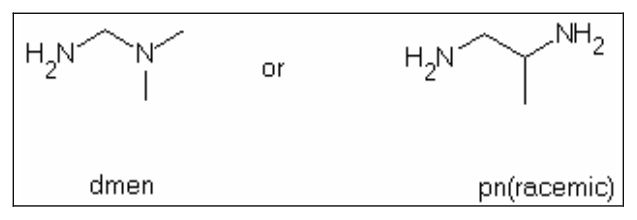
1.4 Give spatial structures of all isomers of the following compounds: \(\ce{PtCl2(dmen)}\), \(\ce{PtCl2(pn)}\), \(\ce{PtBrCl(dmen)}\) and \(\ce{PtBrCl(pn)}\).
These compounds can isomerise in aqueous solution through dissociation of a ligand and transient replacement of the stronger ligands by the weak ligand water. \(\ce{Cl-}\) and \(\ce{Br-}\) are replaced relatively easily, but it is more difficult to replace the amine ligands, which usually requires heating.
1.5 Considering each of the isomers in the previous questions a-d, indicate which Isomers can be converted to another at room temperature. Give both the original molecule and the products.
1.6 \(\ce{PtCl2(en)}\) reacts with \(\ce{Br-}\) in a molar proportion of 1:2 at room temperature. Which compound would you expect to form in what proportion? You can assume that the \(\ce{Pt-Br}\) and \(\ce{Pt-Cl}\) bonds are equally strong and that there is no perturbing influence from hydrolysis.
1.7 Using the equation to express chemical equilibrium, show that hydrolysis hardly ever occurs in blood but that it does occur in the cells. Note: \(\ce{PtCl2(NH3)2}\) hydrolyses to and \(\ce{2Cl-}\). In cells the \(\ce{Cl-}\) concentration is low; in blood it is fairly high.
After hydrolysis in the tumour cell a reactive platinum ion is formed to which two \(\ce{NH3}\) groups are still bound, as it was found in the urine of patients treated with this compound. The reactive platinum ion appears to be bound to cellular DNA, where the bonding occurs via guanine to one of the N-atoms.
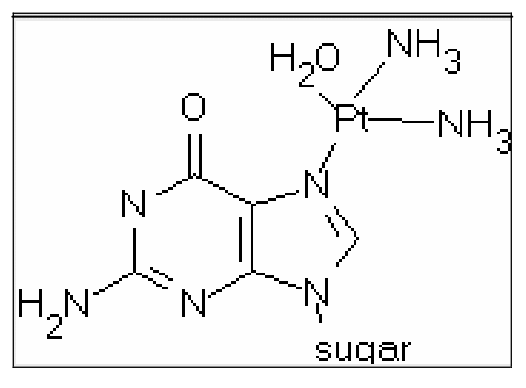
As a result of the two reactive sites of platinum and the two unreactive \(\ce{NH3}\) ligands, it can form additionally a second bond to DNA. Research has shown that this happens in particular with a second guanine base from the same strand of DNA.
1.8 Show by calculations which of the two isomers in question a) can form this bond.
(Note: \(\ce{Pt-N}\) distance = 210 pm, DNA base distance = 320 pm).
Official English text of the problem.
Answers
The named structures and their stereochemical SMILES are given individually in the solution.
- 1.1: Two isomers: cisplatin, with adjacent ammonia ligands, and transplatin, with opposite ammonia ligands.
- 1.2: Two isomers: cis- and trans-diamminebromidochloridoplatinum(II).
- 1.3: One configurational isomer: the two nitrogen donors of en occupy adjacent sites; bromide and chloride occupy the remaining adjacent sites.
- 1.4: The numbers of isomers are:
| Compound | Number | Relationship |
|---|---|---|
| \(\ce{PtCl2(dmen)}\) | 1 | One configuration |
| \(\ce{PtCl2(pn)}\) | 2 | One enantiomeric pair |
| \(\ce{PtBrCl(dmen)}\) | 2 | Two geometrical arrangements |
| \(\ce{PtBrCl(pn)}\) | 4 | Two enantiomeric pairs |
- 1.5: The two mixed-halide dmen isomers interconvert. For mixed-halide pn, the two halide arrangements interconvert separately within each carbon configuration, \(R\) or \(S\). No other distinct isomers listed above interconvert through the stipulated room-temperature halide-exchange process.
- 1.6: The equilibrium platinum-containing mixture is
\[ \ce{PtCl2(en)}:\ce{PtBrCl(en)}:\ce{PtBr2(en)} =\boxed{1:2:1}, \]
corresponding to 25%, 50%, and 25%, respectively. - 1.7: Aquation releases chloride. High chloride concentration in blood shifts the equilibrium toward the original complex; lower chloride concentration in cells favours aquation. The diaqua/original-complex activity ratio varies as \(a_{\ce{Cl-}}^{-2}\). - 1.8: Cisplatin fits the proposed adjacent-guanine cross-link: its two binding sites give a donor separation of approximately 297 pm, compared with 420 pm for transplatin and the supplied DNA spacing of 320 pm.
Solution
The structures below count configurational isomers, excluding rapidly interconverting conformations of the chelate rings.
In the SMILES, -> denotes a donor-to-metal coordination bond. Platinum is represented as \(\ce{Pt^2+}\), and coordinated halides retain their formal negative charges. The square-planar descriptor @SP1 places neighbours 1 and 3 opposite one another, and neighbours 2 and 4 opposite one another, in their SMILES order. These strings specify coordination geometry and carbon configuration; they do not fix ring puckering.
The ligand and small-species identities used below are:
| Name | SMILES |
|---|---|
| Ammonia | N |
| Water | O |
| Chloride ion | [Cl-] |
| Bromide ion | [Br-] |
| Ethane-1,2-diamine, en | NCCN |
| \(N,N\)-Dimethylethane-1,2-diamine, dmen, as implied by methylation of en | NCCN(C)C |
| \((R)\)-Propane-1,2-diamine, \((R)\)-pn | NC[C@@H](C)N |
| \((S)\)-Propane-1,2-diamine, \((S)\)-pn | NC[C@H](C)N |
Racemic pn contains equal amounts of its \(R\) and \(S\) enantiomers.
1.1 — The two isomers of \(\ce{PtCl2(NH3)2}\)
Place platinum at the centre of a square, with its four donor atoms above, right, below and left, all in one plane.
| Name | Ligands clockwise from above platinum | SMILES |
|---|---|---|
| Cisplatin, cis-diamminedichloridoplatinum(II) | \(\ce{NH3},\ce{NH3},\ce{Cl},\ce{Cl}\) | [NH3]->[Pt@SP1+2](<-[NH3])(<-[Cl-])<-[Cl-] |
| Transplatin, trans-diamminedichloridoplatinum(II) | \(\ce{NH3},\ce{Cl},\ce{NH3},\ce{Cl}\) | [NH3]->[Pt@SP1+2](<-[Cl-])(<-[NH3])<-[Cl-] |
The two ammonia ligands are separated by \(90^\circ\) in the cis isomer and \(180^\circ\) in the trans isomer. These exhaust the possibilities for two pairs of identical ligands in a square plane.
1.2 — Isomers of \(\ce{PtBrCl(NH3)2}\)
The two identical ammonia ligands can again be adjacent or opposite.
| Name | Ligands clockwise from above platinum | SMILES |
|---|---|---|
| cis-Diamminebromidochloridoplatinum(II) | \(\ce{NH3},\ce{NH3},\ce{Br},\ce{Cl}\) | [NH3]->[Pt@SP1+2](<-[NH3])(<-[Br-])<-[Cl-] |
| trans-Diamminebromidochloridoplatinum(II) | \(\ce{NH3},\ce{Br},\ce{NH3},\ce{Cl}\) | [NH3]->[Pt@SP1+2](<-[Br-])(<-[NH3])<-[Cl-] |
Interchanging bromide and chloride within either arrangement does not generate an additional isomer: the resulting drawing can be superimposed on the original by rotating the molecule. Thus there are two isomers.
1.3 — Why \(\ce{PtBrCl(en)}\) has one stable configuration
The short \(\ce{-CH2CH2-}\) bridge of en makes a five-membered chelate ring with platinum. Its two nitrogen donors must occupy adjacent coordination sites; a trans arrangement is not compatible with a stable en chelate.
For the requested sketch, put one nitrogen above platinum and the other to its right. Connect them through the \(\ce{-CH2CH2-}\) chain outside that corner. Put chloride below platinum and bromide to its left.
The product is bromidochlorido(ethane-1,2-diamine)platinum(II):
N1CCN->[Pt@SP1+2](<-[Cl-])(<-[Br-])<-1
The two ends of en are equivalent. Consequently, reversing the bromide/chloride placement produces an equivalent structure, leaving one configurational isomer.
1.4 — All isomers of the four substituted-chelate complexes
Use the following common drawing convention:
- Put donor \(N_a\) above platinum and donor \(N_b\) to its right.
- Connect them by the ligand’s carbon backbone.
- Put the two halides below and to the left of platinum.
- The lower halide is therefore trans to \(N_a\); the left-hand halide is trans to \(N_b\).
For dmen, \(N_a\) is the primary amino donor and \(N_b\) is the dimethylamino donor. For pn, \(N_a\) is attached to the terminal methylene carbon, while \(N_b\) is attached to the stereogenic carbon.
Define the mixed-halide arrangements as:
\[ \begin{aligned} A &: \quad \ce{Cl}\text{ trans to }N_a,\quad \ce{Br}\text{ trans to }N_b,\\ B &: \quad \ce{Br}\text{ trans to }N_a,\quad \ce{Cl}\text{ trans to }N_b. \end{aligned} \]
The complete set is:
| Name and label | Configuration | SMILES |
|---|---|---|
| Dichlorido(dmen)platinum(II) | Single configuration | N1CCN(C)(C)->[Pt@SP1+2](<-[Cl-])(<-[Cl-])<-1 |
| Dichlorido[(R)-pn]platinum(II) | \(R\) | N1C[C@@H](C)N->[Pt@SP1+2](<-[Cl-])(<-[Cl-])<-1 |
| Dichlorido[(S)-pn]platinum(II) | \(S\) | N1C[C@H](C)N->[Pt@SP1+2](<-[Cl-])(<-[Cl-])<-1 |
| Bromidochlorido(dmen)platinum(II), \(D_A\) | Arrangement \(A\) | N1CCN(C)(C)->[Pt@SP1+2](<-[Cl-])(<-[Br-])<-1 |
| Bromidochlorido(dmen)platinum(II), \(D_B\) | Arrangement \(B\) | N1CCN(C)(C)->[Pt@SP1+2](<-[Br-])(<-[Cl-])<-1 |
| Bromidochlorido[(R)-pn]platinum(II), \(P_{R,A}\) | \(R,A\) | N1C[C@@H](C)N->[Pt@SP1+2](<-[Cl-])(<-[Br-])<-1 |
| Bromidochlorido[(S)-pn]platinum(II), \(P_{S,A}\) | \(S,A\) | N1C[C@H](C)N->[Pt@SP1+2](<-[Cl-])(<-[Br-])<-1 |
| Bromidochlorido[(R)-pn]platinum(II), \(P_{R,B}\) | \(R,B\) | N1C[C@@H](C)N->[Pt@SP1+2](<-[Br-])(<-[Cl-])<-1 |
| Bromidochlorido[(S)-pn]platinum(II), \(P_{S,B}\) | \(S,B\) | N1C[C@H](C)N->[Pt@SP1+2](<-[Br-])(<-[Cl-])<-1 |
For an explicit spatial description of the pn stereocentre, its substituent priorities are
\[ \text{amino nitrogen} > \text{methylene–amino group} > \text{methyl group} > \text{hydrogen}. \]
With hydrogen directed away from the viewer, the first three groups run clockwise for \(R\) and counterclockwise for \(S\).
The counts follow directly:
- \(\ce{PtCl2(dmen)}\): The chlorides are identical, and dmen has no configurationally stereogenic centre. There is one isomer.
- \(\ce{PtCl2(pn)}\): The chlorides are identical, but pn has one stereogenic carbon. There are two, an \(R/S\) enantiomeric pair.
- \(\ce{PtBrCl(dmen)}\): The two nitrogen donors differ, so arrangements \(A\) and \(B\) are distinct. There are two geometrical isomers.
- \(\ce{PtBrCl(pn)}\): Each halide arrangement occurs with either carbon configuration. There are four isomers, forming the enantiomeric pairs \((P_{R,A},P_{S,A})\) and \((P_{R,B},P_{S,B})\).
1.5 — Room-temperature interconversions
Under the problem’s substitution model, room-temperature exchange preserves the platinum–nitrogen framework. It also preserves the configuration of the pn carbon atom.
Temporary replacement of the halides by water, followed by halide rebinding, can exchange which halide occupies each available site. Thus the following net isomerizations are possible; the labels refer to the fully specified structures in 1.4:
\[ \underset{D_A}{\ce{[PtBrCl(dmen)]}} \ \ce{<=>[H2O]}\ \underset{D_B}{\ce{[PtBrCl(dmen)]}}. \]
\[ \underset{P_{R,A}}{\ce{[PtBrCl(pn)]}} \ \ce{<=>[H2O]}\ \underset{P_{R,B}}{\ce{[PtBrCl(pn)]}}. \]
\[ \underset{P_{S,A}}{\ce{[PtBrCl(pn)]}} \ \ce{<=>[H2O]}\ \underset{P_{S,B}}{\ce{[PtBrCl(pn)]}}. \]
These net equations are balanced: water mediates the exchange and is not consumed overall.
For completeness, the other cases are:
| Earlier complex | Consequence of halide exchange alone |
|---|---|
| cis-/trans-\(\ce{PtCl2(NH3)2}\) | No interconversion: the relative ammonia positions remain unchanged. |
| cis-/trans-\(\ce{PtBrCl(NH3)2}\) | No interconversion: swapping halides does not change the relative ammonia positions. |
| \(\ce{PtBrCl(en)}\) | Returns the same configurational isomer. |
| \(\ce{PtCl2(dmen)}\) | Returns the same configurational isomer. |
| \(R/S\)-\(\ce{PtCl2(pn)}\) | No interconversion: halide exchange does not invert the stereogenic carbon. |
Similarly, \(P_{R,A}\) or \(P_{R,B}\) does not become either \(S\) isomer by this process.
1.6 — Reaction of \(\ce{PtCl2(en)}\) with two equivalents of bromide
The balanced exchange equilibria are
\[ \ce{[PtCl2(en)] + Br- <=> [PtBrCl(en)] + Cl-} \]
and
\[ \ce{[PtBrCl(en)] + Br- <=> [PtBr2(en)] + Cl-}. \]
The additional named structures are:
| Name | SMILES |
|---|---|
| Dichlorido(ethane-1,2-diamine)platinum(II) | N1CCN->[Pt@SP1+2](<-[Cl-])(<-[Cl-])<-1 |
| Dibromido(ethane-1,2-diamine)platinum(II) | N1CCN->[Pt@SP1+2](<-[Br-])(<-[Br-])<-1 |
The mixed-halide complex was specified in 1.3.
Initially, each mole of platinum complex supplies two moles of chloride, and two moles of bromide are added. Thus the total amounts of the two halides are equal.
Using the intended equal-affinity, independent-site approximation, equal total amounts imply equal equilibrium free-halide concentrations. Each of the two halide sites therefore has probability \(1/2\) of containing either halide:
\[ \begin{aligned} P(\text{two chlorides})&=\left(\frac12\right)^2=\frac14,\\ P(\text{one of each})&=2\left(\frac12\right)\left(\frac12\right)=\frac12,\\ P(\text{two bromides})&=\left(\frac12\right)^2=\frac14. \end{aligned} \]
Therefore,
\[ \boxed{ \ce{PtCl2(en)}:\ce{PtBrCl(en)}:\ce{PtBr2(en)} =1:2:1 }. \]
Per mole of initial platinum complex, the final amounts are \(0.25\), \(0.50\), and \(0.25\ \mathrm{mol}\), respectively, together with \(1.0\ \mathrm{mol}\) each of free chloride and free bromide.
The factor of two for the mixed complex counts two equivalent site assignments; it does not imply two distinct mixed-halide en isomers.
1.7 — Hydrolysis in blood and in cells
Writing the replacing water ligands explicitly, the overall aquation equilibrium is
\[ \boxed{ \ce{[PtCl2(NH3)2] + 2H2O <=> [Pt(NH3)2(H2O)2]^2+ + 2Cl-} }. \]
For cisplatin, the product is cis-diamminediaquaplatinum(II) ion:
[NH3]->[Pt@SP1+2](<-[NH3])(<-[OH2])<-[OH2]
The equilibrium constant is
\[ K= \frac{ a_{\ce{[Pt(NH3)2(H2O)2]^2+}}\, a_{\ce{Cl-}}^{\,2} }{ a_{\ce{[PtCl2(NH3)2]}}\, a_{\ce{H2O}}^{\,2} }. \]
Taking water activity as approximately unity,
\[ \boxed{ \frac{ a_{\ce{[Pt(NH3)2(H2O)2]^2+}} }{ a_{\ce{[PtCl2(NH3)2]}} } = \frac{K}{a_{\ce{Cl-}}^{\,2}} }. \]
Thus:
- Blood: high chloride activity suppresses aquation through the common-ion effect.
- Cells: lower chloride activity favours the reactive aquated complex.
For example, a tenfold decrease in chloride activity increases this diaqua/original-complex ratio by a factor of \(10^2=100\). The supplied information establishes the direction of the effect; numerical hydrolysis fractions would require equilibrium constants and concentrations.
1.8 — Which isomer can cross-link the two guanines?
The binding atom shown is guanine’s N7. Guanine, as a free-base reference, has SMILES:
Nc1nc2[nH]cnc2c(=O)[nH]1
In DNA, its N9 position is attached to the sugar. The whole DNA molecule cannot be assigned a unique SMILES without specifying its sequence and structure.
After aquation, the two replaceable ligands occupy the positions originally occupied by the chlorides. Therefore the two guanine-binding sites are cis for cisplatin and trans for transplatin.
For two platinum–nitrogen bonds of length \(r\), enclosing angle \(\theta\), the nitrogen–nitrogen distance is
\[ d=\sqrt{r^2+r^2-2r^2\cos\theta} =2r\sin\frac{\theta}{2}. \]
Using \(r=210\ \mathrm{pm}\):
For cisplatin, \(\theta=90^\circ\):
\[ d_{\mathrm{cis}} =\sqrt{2}(210\ \mathrm{pm}) \approx \boxed{297\ \mathrm{pm}}. \]
For transplatin, \(\theta=180^\circ\):
\[ d_{\mathrm{trans}} =2(210\ \mathrm{pm}) =\boxed{420\ \mathrm{pm}}. \]
The supplied DNA base spacing is \(320\ \mathrm{pm}\), much closer to the cis separation. Equivalently, an exact donor separation of \(320\ \mathrm{pm}\) with two \(210\ \mathrm{pm}\) bonds would require
\[ \theta =2\arcsin\!\left(\frac{320}{420}\right) \approx99^\circ, \]
which is close to a cis angle.
Thus cisplatin is the isomer consistent with the proposed cross-link between nearby guanines on the same DNA strand, with some structural adjustment implicit in the approximate distance comparison.
The solution was checked against the official solution. Where this solution differs from the official solution, the official solution contains an error or a misprint.
IChO 1986 · Theorieaufgabe 1
Platin(II)-Komplexe mit Antitumorwirkung: Isomere, Hydrolyse und DNA-Bindung
Verbindungen mit zweiwertigem Platin der allgemeinen Formel \(\ce{PtX2(amine)2}\) (X = \(\ce{Cl2}\), \(\ce{SO4^2-}\), Malonat usw.) haben wegen ihrer biologischen Aktivität großes wissenschaftliches Interesse geweckt, insbesondere im Hinblick auf ihre Eigenschaften bei der Behandlung von Tumoren. Die bekannteste klinisch eingesetzte Verbindung ist \(\ce{PtCl2(NH3)2}\). Diese Verbindung, in der Platin quadratisch-planar koordiniert ist, besitzt zwei geometrische Isomere, von denen nur eines eine Antitumorwirkung zeigt.
1.1 Skizzieren Sie die räumlichen Strukturen der beiden möglichen Isomere.
1.2 Wie viele Isomere besitzt \(\ce{PtBrCl(NH3)2}\)? Skizzieren Sie alle.
Die Aminliganden lassen sich durch einen einzigen Liganden mit zwei Donoratomen (N) ersetzen. Man erhält dann einen Chelatliganden, beispielsweise 1,2-Diaminoethan (en).
1.3 Zeigen Sie zeichnerisch, dass \(\ce{PtBrCl(en)}\) nur eine stabile Struktur besitzt.
Der Ligand en kann durch Methylierung zu dmen oder pn (racemisch) substituiert werden.
1.4 Geben Sie die räumlichen Strukturen aller Isomere der folgenden Verbindungen an: \(\ce{PtCl2(dmen)}\), \(\ce{PtCl2(pn)}\), \(\ce{PtBrCl(dmen)}\) und \(\ce{PtBrCl(pn)}\).
Diese Verbindungen können in wässriger Lösung durch Dissoziation eines Liganden und vorübergehenden Ersatz der stärkeren Liganden durch den schwachen Liganden Wasser isomerisieren. \(\ce{Cl-}\) und \(\ce{Br-}\) werden relativ leicht ersetzt; die Aminliganden lassen sich dagegen schwerer ersetzen, wozu gewöhnlich Erwärmen erforderlich ist.
1.5 Geben Sie für jedes der Isomere aus den vorangegangenen Fragen a-d an, welche Isomere bei Raumtemperatur ineinander umgewandelt werden können. Geben Sie sowohl das Ausgangsmolekül als auch die Produkte an.
1.6 \(\ce{PtCl2(en)}\) reagiert bei Raumtemperatur mit \(\ce{Br-}\) im Stoffmengenverhältnis 1:2. Welche Verbindung erwarten Sie in welchem Anteil? Sie können annehmen, dass die Bindungen \(\ce{Pt-Br}\) und \(\ce{Pt-Cl}\) gleich stark sind und kein störender Einfluss durch Hydrolyse vorliegt.
1.7 Zeigen Sie mithilfe der Gleichung für das chemische Gleichgewicht, dass im Blut kaum Hydrolyse auftritt, in den Zellen hingegen schon. Hinweis: \(\ce{PtCl2(NH3)2}\) hydrolysiert zu und \(\ce{2Cl-}\). In Zellen ist die \(\ce{Cl-}\)-Konzentration niedrig; im Blut ist sie ziemlich hoch.
Nach der Hydrolyse in der Tumorzelle entsteht ein reaktives Platinion, an das noch zwei \(\ce{NH3}\)-Gruppen gebunden sind, wie es im Urin von Patienten gefunden wurde, die mit dieser Verbindung behandelt wurden. Das reaktive Platinion scheint an die zelluläre DNA gebunden zu sein, wobei die Bindung über eines der N-Atome des Guanins erfolgt.
Aufgrund der beiden reaktiven Stellen des Platins und der beiden nicht reaktiven \(\ce{NH3}\)-Liganden kann es zusätzlich eine zweite Bindung zur DNA ausbilden. Untersuchungen haben gezeigt, dass dies insbesondere mit einer zweiten Guaninbase desselben DNA-Strangs geschieht.
1.8 Zeigen Sie durch Berechnungen, welches der beiden Isomere aus Frage a) diese Bindung ausbilden kann.
(Hinweis: \(\ce{Pt-N}\)-Abstand = 210 pm, Abstand der DNA-Basen = 320 pm).
Aufgabentext aus dem offiziellen englischen Text übersetzt.
Antworten
Die benannten Strukturen und ihre stereochemischen SMILES sind einzeln in der Lösung angegeben.
- 1.1: Zwei Isomere: Cisplatin mit benachbarten Ammoniakliganden und Transplatin mit gegenüberliegenden Ammoniakliganden.
- 1.2: Zwei Isomere: cis- und trans-Diamminbromidochloridoplatin(II).
- 1.3: Ein Konfigurationsisomer: Die beiden Stickstoffdonoren von en besetzen benachbarte Positionen; Bromid und Chlorid besetzen die verbleibenden benachbarten Positionen.
- 1.4: Die Anzahlen der Isomere sind:
| Verbindung | Anzahl | Beziehung |
|---|---|---|
| \(\ce{PtCl2(dmen)}\) | 1 | Eine Konfiguration |
| \(\ce{PtCl2(pn)}\) | 2 | Ein Enantiomerenpaar |
| \(\ce{PtBrCl(dmen)}\) | 2 | Zwei geometrische Anordnungen |
| \(\ce{PtBrCl(pn)}\) | 4 | Zwei Enantiomerenpaare |
- 1.5: Die beiden dmen-Isomere mit gemischten Halogenidliganden wandeln sich ineinander um. Bei pn mit gemischten Halogenidliganden wandeln sich die beiden Halogenidanordnungen getrennt innerhalb jeder Kohlenstoffkonfiguration, \(R\) oder \(S\), ineinander um. Keine anderen der oben aufgeführten unterschiedlichen Isomere wandeln sich durch den vorgegebenen Halogenidaustausch bei Raumtemperatur ineinander um.
- 1.6: Das platinhaltige Gleichgewichtsgemisch ist
\[ \ce{PtCl2(en)}:\ce{PtBrCl(en)}:\ce{PtBr2(en)} =\boxed{1:2:1}, \]
entsprechend 25%, 50% bzw. 25%. - 1.7: Bei der Aquatisierung wird Chlorid freigesetzt. Die hohe Chloridkonzentration im Blut verschiebt das Gleichgewicht zum Ausgangskomplex; die niedrigere Chloridkonzentration in Zellen begünstigt die Aquatisierung. Das Aktivitätsverhältnis von Diaqua- zu Ausgangskomplex ist proportional zu \(a_{\ce{Cl-}}^{-2}\). - 1.8: Cisplatin passt zur vorgeschlagenen Quervernetzung benachbarter Guaninbasen: Seine beiden Bindungsstellen ergeben einen Donorabstand von ungefähr 297 pm, verglichen mit 420 pm für Transplatin und dem angegebenen DNA-Abstand von 320 pm.
Lösung
Bei den folgenden Strukturen werden Konfigurationsisomere gezählt; rasch ineinander übergehende Konformationen der Chelatringe werden nicht berücksichtigt.
In den SMILES bezeichnet -> eine Koordinationsbindung vom Donor zum Metall. Platin wird als \(\ce{Pt^2+}\) dargestellt, und koordinierte Halogenide behalten ihre formalen negativen Ladungen. Der Deskriptor @SP1 für die quadratisch-planare Geometrie ordnet die Nachbarn 1 und 3 sowie die Nachbarn 2 und 4 in ihrer SMILES-Reihenfolge jeweils einander gegenüber an. Diese Zeichenfolgen legen die Koordinationsgeometrie und die Kohlenstoffkonfiguration fest; sie legen die Faltung des Rings nicht fest.
Die nachfolgend verwendeten Liganden und kleinen chemischen Spezies sind:
| Name | SMILES |
|---|---|
| Ammoniak | N |
| Wasser | O |
| Chloridion | [Cl-] |
| Bromidion | [Br-] |
| Ethan-1,2-diamin, en | NCCN |
| \(N,N\)-Dimethylethan-1,2-diamin, dmen, wie es sich aus der Methylierung von en ergibt | NCCN(C)C |
| \((R)\)-Propan-1,2-diamin, \((R)\)-pn | NC[C@@H](C)N |
| \((S)\)-Propan-1,2-diamin, \((S)\)-pn | NC[C@H](C)N |
Racemisches pn enthält gleiche Mengen seiner \(R\)- und \(S\)-Enantiomere.
1.1 — Die beiden Isomere von \(\ce{PtCl2(NH3)2}\)
Platzieren Sie Platin im Mittelpunkt eines Quadrats, mit seinen vier Donoratomen oben, rechts, unten und links, alle in einer Ebene.
| Name | Liganden im Uhrzeigersinn, beginnend oberhalb des Platins | SMILES |
|---|---|---|
| Cisplatin, cis-Diammindichloridoplatin(II) | \(\ce{NH3},\ce{NH3},\ce{Cl},\ce{Cl}\) | [NH3]->[Pt@SP1+2](<-[NH3])(<-[Cl-])<-[Cl-] |
| Transplatin, trans-Diammindichloridoplatin(II) | \(\ce{NH3},\ce{Cl},\ce{NH3},\ce{Cl}\) | [NH3]->[Pt@SP1+2](<-[Cl-])(<-[NH3])<-[Cl-] |
Die beiden Ammoniakliganden schließen im cis-Isomer einen Winkel von \(90^\circ\) und im trans-Isomer einen Winkel von \(180^\circ\) ein. Damit sind alle Möglichkeiten für zwei Paare identischer Liganden in einer quadratisch-planaren Anordnung erfasst.
1.2 — Isomere von \(\ce{PtBrCl(NH3)2}\)
Die beiden identischen Ammoniakliganden können wiederum benachbart oder einander gegenüber angeordnet sein.
| Name | Liganden im Uhrzeigersinn, beginnend oberhalb des Platins | SMILES |
|---|---|---|
| cis-Diamminbromidochloridoplatin(II) | \(\ce{NH3},\ce{NH3},\ce{Br},\ce{Cl}\) | [NH3]->[Pt@SP1+2](<-[NH3])(<-[Br-])<-[Cl-] |
| trans-Diamminbromidochloridoplatin(II) | \(\ce{NH3},\ce{Br},\ce{NH3},\ce{Cl}\) | [NH3]->[Pt@SP1+2](<-[Br-])(<-[NH3])<-[Cl-] |
Das Vertauschen von Bromid und Chlorid innerhalb einer der beiden Anordnungen erzeugt kein zusätzliches Isomer: Die resultierende Zeichnung lässt sich durch Drehung des Moleküls mit der ursprünglichen zur Deckung bringen. Somit gibt es zwei Isomere.
1.3 — Warum \(\ce{PtBrCl(en)}\) eine stabile Konfiguration besitzt
Die kurze \(\ce{-CH2CH2-}\)-Brücke von en bildet mit Platin einen fünfgliedrigen Chelatring. Seine beiden Stickstoffdonoren müssen benachbarte Koordinationsstellen besetzen; eine trans-Anordnung ist mit einem stabilen en-Chelat nicht vereinbar.
Platzieren Sie für die geforderte Skizze ein Stickstoffatom oberhalb des Platins und das andere rechts davon. Verbinden Sie sie durch die \(\ce{-CH2CH2-}\)-Kette außerhalb dieser Ecke. Platzieren Sie Chlorid unterhalb des Platins und Bromid links davon.
Das Produkt ist Bromidochlorido(ethan-1,2-diamin)platin(II):
N1CCN->[Pt@SP1+2](<-[Cl-])(<-[Br-])<-1
Die beiden Enden von en sind gleichwertig. Folglich ergibt das Vertauschen der Bromid-/Chloridpositionen eine gleichwertige Struktur, sodass ein Konfigurationsisomer verbleibt.
1.4 — Alle Isomere der vier Komplexe mit substituierten Chelatliganden
Verwenden Sie die folgende einheitliche Zeichenkonvention:
- Platzieren Sie den Donor \(N_a\) oberhalb des Platins und den Donor \(N_b\) rechts davon.
- Verbinden Sie sie durch das Kohlenstoffgerüst des Liganden.
- Platzieren Sie die beiden Halogenide unterhalb und links vom Platin.
- Das untere Halogenid steht somit trans zu \(N_a\); das linke Halogenid steht trans zu \(N_b\).
Bei dmen ist \(N_a\) der primäre Aminodonor und \(N_b\) der Dimethylaminodonor. Bei pn ist \(N_a\) an das endständige Methylenkohlenstoffatom gebunden, während \(N_b\) an das stereogene Kohlenstoffatom gebunden ist.
Die Anordnungen der gemischten Halogenidliganden werden wie folgt definiert:
\[ \begin{aligned} A &: \quad \ce{Cl}\text{ trans zu }N_a,\quad \ce{Br}\text{ trans zu }N_b,\\ B &: \quad \ce{Br}\text{ trans zu }N_a,\quad \ce{Cl}\text{ trans zu }N_b. \end{aligned} \]
Der vollständige Satz lautet:
| Name und Bezeichnung | Konfiguration | SMILES |
|---|---|---|
| Dichlorido(dmen)platin(II) | Einzige Konfiguration | N1CCN(C)(C)->[Pt@SP1+2](<-[Cl-])(<-[Cl-])<-1 |
| Dichlorido[(R)-pn]platin(II) | \(R\) | N1C[C@@H](C)N->[Pt@SP1+2](<-[Cl-])(<-[Cl-])<-1 |
| Dichlorido[(S)-pn]platin(II) | \(S\) | N1C[C@H](C)N->[Pt@SP1+2](<-[Cl-])(<-[Cl-])<-1 |
| Bromidochlorido(dmen)platin(II), \(D_A\) | Anordnung \(A\) | N1CCN(C)(C)->[Pt@SP1+2](<-[Cl-])(<-[Br-])<-1 |
| Bromidochlorido(dmen)platin(II), \(D_B\) | Anordnung \(B\) | N1CCN(C)(C)->[Pt@SP1+2](<-[Br-])(<-[Cl-])<-1 |
| Bromidochlorido[(R)-pn]platin(II), \(P_{R,A}\) | \(R,A\) | N1C[C@@H](C)N->[Pt@SP1+2](<-[Cl-])(<-[Br-])<-1 |
| Bromidochlorido[(S)-pn]platin(II), \(P_{S,A}\) | \(S,A\) | N1C[C@H](C)N->[Pt@SP1+2](<-[Cl-])(<-[Br-])<-1 |
| Bromidochlorido[(R)-pn]platin(II), \(P_{R,B}\) | \(R,B\) | N1C[C@@H](C)N->[Pt@SP1+2](<-[Br-])(<-[Cl-])<-1 |
| Bromidochlorido[(S)-pn]platin(II), \(P_{S,B}\) | \(S,B\) | N1C[C@H](C)N->[Pt@SP1+2](<-[Br-])(<-[Cl-])<-1 |
Für eine ausdrückliche räumliche Beschreibung des Stereozentrums von pn lauten die Prioritäten seiner Substituenten
\[ \text{Aminostickstoff} > \text{Methylen–Amino-Gruppe} > \text{Methylgruppe} > \text{Wasserstoff}. \]
Wenn der Wasserstoff vom Betrachter weg zeigt, verlaufen die ersten drei Gruppen bei \(R\) im Uhrzeigersinn und bei \(S\) gegen den Uhrzeigersinn.
Die Anzahlen ergeben sich unmittelbar:
- \(\ce{PtCl2(dmen)}\): Die Chloride sind identisch, und dmen besitzt kein konfigurationsbestimmendes stereogenes Zentrum. Es gibt ein Isomer.
- \(\ce{PtCl2(pn)}\): Die Chloride sind identisch, aber pn besitzt ein stereogenes Kohlenstoffatom. Es gibt zwei, ein \(R/S\)-Enantiomerenpaar.
- \(\ce{PtBrCl(dmen)}\): Die beiden Stickstoffdonoren unterscheiden sich, sodass die Anordnungen \(A\) und \(B\) verschieden sind. Es gibt zwei geometrische Isomere.
- \(\ce{PtBrCl(pn)}\): Jede Halogenidanordnung tritt mit jeder der beiden Kohlenstoffkonfigurationen auf. Es gibt vier Isomere, die die Enantiomerenpaare \((P_{R,A},P_{S,A})\) und \((P_{R,B},P_{S,B})\) bilden.
1.5 — Umwandlungen bei Raumtemperatur
Im Substitutionsmodell der Aufgabe bleibt beim Austausch bei Raumtemperatur das Platin–Stickstoff-Gerüst erhalten. Auch die Konfiguration des Kohlenstoffatoms von pn bleibt erhalten.
Durch den vorübergehenden Ersatz der Halogenide durch Wasser mit anschließender erneuter Bindung von Halogeniden kann sich ändern, welches Halogenid die jeweilige verfügbare Position besetzt. Somit sind die folgenden Nettoisomerisierungen möglich; die Bezeichnungen beziehen sich auf die vollständig angegebenen Strukturen in 1.4:
\[ \underset{D_A}{\ce{[PtBrCl(dmen)]}} \ \ce{<=>[H2O]}\ \underset{D_B}{\ce{[PtBrCl(dmen)]}}. \]
\[ \underset{P_{R,A}}{\ce{[PtBrCl(pn)]}} \ \ce{<=>[H2O]}\ \underset{P_{R,B}}{\ce{[PtBrCl(pn)]}}. \]
\[ \underset{P_{S,A}}{\ce{[PtBrCl(pn)]}} \ \ce{<=>[H2O]}\ \underset{P_{S,B}}{\ce{[PtBrCl(pn)]}}. \]
Diese Nettogleichungen sind ausgeglichen: Wasser vermittelt den Austausch und wird insgesamt nicht verbraucht.
Der Vollständigkeit halber sind die übrigen Fälle:
| Zuvor betrachteter Komplex | Folge eines ausschließlichen Halogenidaustauschs |
|---|---|
| cis-/trans-\(\ce{PtCl2(NH3)2}\) | Keine Umwandlung ineinander: Die relativen Positionen der Ammoniakliganden bleiben unverändert. |
| cis-/trans-\(\ce{PtBrCl(NH3)2}\) | Keine Umwandlung ineinander: Das Vertauschen der Halogenide ändert die relativen Positionen der Ammoniakliganden nicht. |
| \(\ce{PtBrCl(en)}\) | Ergibt wieder dasselbe Konfigurationsisomer. |
| \(\ce{PtCl2(dmen)}\) | Ergibt wieder dasselbe Konfigurationsisomer. |
| \(R/S\)-\(\ce{PtCl2(pn)}\) | Keine Umwandlung ineinander: Halogenidaustausch führt nicht zur Inversion am stereogenen Kohlenstoffatom. |
Ebenso wird \(P_{R,A}\) oder \(P_{R,B}\) durch diesen Prozess nicht in eines der beiden \(S\)-Isomere umgewandelt.
1.6 — Reaktion von \(\ce{PtCl2(en)}\) mit zwei Äquivalenten Bromid
Die ausgeglichenen Austauschgleichgewichte lauten
\[ \ce{[PtCl2(en)] + Br- <=> [PtBrCl(en)] + Cl-} \]
und
\[ \ce{[PtBrCl(en)] + Br- <=> [PtBr2(en)] + Cl-}. \]
Die zusätzlich benannten Strukturen sind:
| Name | SMILES |
|---|---|
| Dichlorido(ethan-1,2-diamin)platin(II) | N1CCN->[Pt@SP1+2](<-[Cl-])(<-[Cl-])<-1 |
| Dibromido(ethan-1,2-diamin)platin(II) | N1CCN->[Pt@SP1+2](<-[Br-])(<-[Br-])<-1 |
Der Komplex mit gemischten Halogenidliganden wurde in 1.3 angegeben.
Anfangs liefert jedes Mol Platinkomplex zwei Mol Chlorid, und zwei Mol Bromid werden hinzugefügt. Somit sind die Gesamtstoffmengen der beiden Halogenide gleich.
In der vorgesehenen Näherung gleicher Affinitäten und unabhängiger Bindungsstellen ergeben gleiche Gesamtstoffmengen gleiche Gleichgewichtskonzentrationen der freien Halogenide. Daher ist jede der beiden Halogenidpositionen mit der Wahrscheinlichkeit \(1/2\) von einem der beiden Halogenide besetzt:
\[ \begin{aligned} P(\text{zwei Chloride})&=\left(\frac12\right)^2=\frac14,\\ P(\text{je eines})&=2\left(\frac12\right)\left(\frac12\right)=\frac12,\\ P(\text{zwei Bromide})&=\left(\frac12\right)^2=\frac14. \end{aligned} \]
Somit gilt
\[ \boxed{ \ce{PtCl2(en)}:\ce{PtBrCl(en)}:\ce{PtBr2(en)} =1:2:1 }. \]
Pro Mol des anfänglichen Platinkomplexes betragen die endgültigen Stoffmengen \(0.25\), \(0.50\) bzw. \(0.25\ \mathrm{mol}\), zusammen mit jeweils \(1.0\ \mathrm{mol}\) freiem Chlorid und freiem Bromid.
Der Faktor zwei für den gemischten Komplex berücksichtigt zwei gleichwertige Zuordnungen zu den Bindungsstellen; er bedeutet nicht, dass es zwei unterschiedliche en-Isomere mit gemischten Halogenidliganden gibt.
1.7 — Hydrolyse im Blut und in Zellen
Schreibt man die eintretenden Wasserliganden ausdrücklich hin, lautet das gesamte Aquatisierungsgleichgewicht
\[ \boxed{ \ce{[PtCl2(NH3)2] + 2H2O <=> [Pt(NH3)2(H2O)2]^2+ + 2Cl-} }. \]
Bei Cisplatin ist das Produkt das cis-Diammindiaquaplatin(II)-Ion:
[NH3]->[Pt@SP1+2](<-[NH3])(<-[OH2])<-[OH2]
Die Gleichgewichtskonstante lautet
\[ K= \frac{ a_{\ce{[Pt(NH3)2(H2O)2]^2+}}\, a_{\ce{Cl-}}^{\,2} }{ a_{\ce{[PtCl2(NH3)2]}}\, a_{\ce{H2O}}^{\,2} }. \]
Setzt man die Wasseraktivität näherungsweise gleich eins, ergibt sich
\[ \boxed{ \frac{ a_{\ce{[Pt(NH3)2(H2O)2]^2+}} }{ a_{\ce{[PtCl2(NH3)2]}} } = \frac{K}{a_{\ce{Cl-}}^{\,2}} }. \]
Somit gilt:
- Blut: Eine hohe Chloridaktivität unterdrückt die Aquatisierung durch den gleichionigen Effekt.
- Zellen: Eine niedrigere Chloridaktivität begünstigt den reaktiven aquatisierten Komplex.
Beispielsweise erhöht eine Verringerung der Chloridaktivität auf ein Zehntel dieses Verhältnis von Diaqua- zu Ausgangskomplex um den Faktor \(10^2=100\). Die angegebenen Informationen bestimmen die Richtung des Effekts; zur zahlenmäßigen Bestimmung der hydrolysierten Anteile wären Gleichgewichtskonstanten und Konzentrationen erforderlich.
1.8 — Welches Isomer kann die beiden Guaninbasen quervernetzen?
Das gezeigte Bindungsatom ist N7 des Guanins. Guanin als freie Base zum Vergleich hat die SMILES:
Nc1nc2[nH]cnc2c(=O)[nH]1
In der DNA ist seine N9-Position an den Zucker gebunden. Dem gesamten DNA-Molekül lässt sich ohne Angabe seiner Sequenz und Struktur keine eindeutige SMILES zuordnen.
Nach der Aquatisierung besetzen die beiden austauschbaren Liganden die ursprünglich von den Chloriden besetzten Positionen. Daher stehen die beiden Guaninbindungsstellen bei Cisplatin cis und bei Transplatin trans zueinander.
Für zwei Platin–Stickstoff-Bindungen der Länge \(r\), die den Winkel \(\theta\) einschließen, beträgt der Stickstoff–Stickstoff-Abstand
\[ d=\sqrt{r^2+r^2-2r^2\cos\theta} =2r\sin\frac{\theta}{2}. \]
Mit \(r=210\ \mathrm{pm}\):
Für Cisplatin, \(\theta=90^\circ\):
\[ d_{\mathrm{cis}} =\sqrt{2}(210\ \mathrm{pm}) \approx \boxed{297\ \mathrm{pm}}. \]
Für Transplatin, \(\theta=180^\circ\):
\[ d_{\mathrm{trans}} =2(210\ \mathrm{pm}) =\boxed{420\ \mathrm{pm}}. \]
Der angegebene Abstand der DNA-Basen beträgt \(320\ \mathrm{pm}\) und liegt damit wesentlich näher am cis-Abstand. Gleichbedeutend damit würde ein exakter Donorabstand von \(320\ \mathrm{pm}\) bei zwei Bindungen von \(210\ \mathrm{pm}\) einen Winkel von
\[ \theta =2\arcsin\!\left(\frac{320}{420}\right) \approx99^\circ, \]
erfordern, der nahe an einem cis-Winkel liegt.
Somit ist Cisplatin das Isomer, das mit der vorgeschlagenen Quervernetzung benachbarter Guaninbasen desselben DNA-Strangs vereinbar ist, wobei der näherungsweise Abstandsvergleich eine gewisse strukturelle Anpassung voraussetzt.
Die Lösung wurde mit der offiziellen Lösung abgeglichen. Wo diese Lösung von der offiziellen Lösung abweicht, enthält die offizielle Lösung einen Fehler oder Druckfehler.
IChO 1986 · Teori sorusu 1
Platin(II) antitümör kompleksleri: izomerler, hidroliz ve DNA'ya bağlanma
Genel formülü \(\ce{PtX2(amine)2}\) (X = \(\ce{Cl2}\), \(\ce{SO4^2-}\), malonat vb.) olan, iki değerlikli platin içeren bileşikler, biyolojik etkinlikleri ve özellikle tümör tedavisindeki özellikleri nedeniyle bilim dünyasında büyük ilgi görmüştür. Klinik uygulamada kullanılan en iyi bilinen bileşik \(\ce{PtCl2(NH3)2}\)'dir. Platinin kare düzlemsel bir geometride koordine olduğu bu bileşiğin iki geometrik izomeri vardır ve bunlardan yalnızca biri antitümör etkinlik gösterir.
1.1 Olası iki izomerin uzaysal yapılarını çiziniz.
1.2 \(\ce{PtBrCl(NH3)2}\)'nin kaç izomeri vardır? Hepsini çiziniz.
Amin ligandlarını, iki verici atom (N) içeren tek bir ligandla değiştirmek mümkündür. Böylece 1,2-diaminoetan (en) gibi şelat oluşturan bir ligand elde edilir.
1.3 \(\ce{PtBrCl(en)}\)'nin yalnızca bir kararlı yapısının olduğunu çizimle gösteriniz.
en ligandına metilleme yoluyla sübstitüsyon uygulanarak dmen veya pn (rasemik) oluşturulabilir.
1.4 Şu bileşiklerin tüm izomerlerinin uzaysal yapılarını veriniz: \(\ce{PtCl2(dmen)}\), \(\ce{PtCl2(pn)}\), \(\ce{PtBrCl(dmen)}\) ve \(\ce{PtBrCl(pn)}\).
Bu bileşikler, sulu çözeltide bir ligandın ayrılması ve daha kuvvetli ligandların geçici olarak zayıf bir ligand olan suyla yer değiştirmesi yoluyla izomerleşebilir. \(\ce{Cl-}\) ve \(\ce{Br-}\) nispeten kolay yer değiştirir; ancak amin ligandlarının yer değiştirmesi daha zordur ve genellikle ısıtma gerektirir.
1.5 Önceki a-d sorularındaki izomerlerin her birini ele alarak hangi izomerlerin oda sıcaklığında birbirine dönüşebileceğini belirtiniz. Hem başlangıç molekülünü hem de ürünleri veriniz.
1.6 \(\ce{PtCl2(en)}\), oda sıcaklığında \(\ce{Br-}\) ile 1:2 mol oranında tepkimeye girer. Hangi bileşiğin hangi oranda oluşmasını beklersiniz? \(\ce{Pt-Br}\) ve \(\ce{Pt-Cl}\) bağlarının eşit kuvvette olduğunu ve hidrolizin bozucu bir etkisinin bulunmadığını varsayabilirsiniz.
1.7 Kimyasal dengeyi ifade eden denklemi kullanarak hidrolizin kanda hemen hemen hiç gerçekleşmediğini, ancak hücrelerde gerçekleştiğini gösteriniz. Not: \(\ce{PtCl2(NH3)2}\) hidrolizlenerek ve \(\ce{2Cl-}\) oluşturur. Hücrelerde \(\ce{Cl-}\) derişimi düşüktür; kanda ise oldukça yüksektir.
Tümör hücresindeki hidrolizin ardından, kendisine iki \(\ce{NH3}\) grubunun hâlâ bağlı olduğu reaktif bir platin iyonu oluşur; bu iyon, söz konusu bileşikle tedavi edilen hastaların idrarında bulunmuştur. Reaktif platin iyonunun hücresel DNA'ya bağlandığı ve bu bağlanmanın guanindeki N atomlarından biri üzerinden gerçekleştiği anlaşılmaktadır.
Platinin iki reaktif bağlanma yeri ve tepkimeye girmeyen iki \(\ce{NH3}\) ligandı bulunması nedeniyle, DNA ile ayrıca ikinci bir bağ oluşturabilir. Araştırmalar, bunun özellikle aynı DNA zincirindeki ikinci bir guanin bazıyla gerçekleştiğini göstermiştir.
1.8 a) sorusundaki iki izomerden hangisinin bu bağı oluşturabileceğini hesaplamalarla gösteriniz.
(Not: \(\ce{Pt-N}\) uzaklığı = 210 pm, DNA bazları arasındaki uzaklık = 320 pm).
Soru metni resmi İngilizce metinden çevrilmiştir.
Cevaplar
Adlandırılmış yapılar ve bunların stereokimyasal SMILES gösterimleri çözümde ayrı ayrı verilmiştir.
- 1.1: İki izomer: amonyak ligandları komşu konumlarda olan sisplatin ve amonyak ligandları karşılıklı konumlarda olan transplatin.
- 1.2: İki izomer: cis- ve trans-diamminbromidokloridoplatin(II).
- 1.3: Bir konfigürasyon izomeri: en'nin iki azot verici atomu komşu konumları; bromür ve klorür ise geriye kalan komşu konumları işgal eder.
- 1.4: İzomer sayıları şöyledir:
| Bileşik | Sayı | İlişki |
|---|---|---|
| \(\ce{PtCl2(dmen)}\) | 1 | Tek konfigürasyon |
| \(\ce{PtCl2(pn)}\) | 2 | Bir enantiyomer çifti |
| \(\ce{PtBrCl(dmen)}\) | 2 | İki geometrik düzenlenme |
| \(\ce{PtBrCl(pn)}\) | 4 | İki enantiyomer çifti |
- 1.5: Karışık halojenür içeren iki dmen izomeri birbirine dönüşür. Karışık halojenür içeren pn için, iki halojenür düzenlenmesi her bir karbon konfigürasyonu içinde ayrı ayrı, \(R\) veya \(S\), birbirine dönüşür. Yukarıda listelenen diğer farklı izomerlerin hiçbiri, belirtilen oda sıcaklığındaki halojenür değişimi süreciyle birbirine dönüşmez.
- 1.6: Dengede platin içeren karışımın bileşimi
\[ \ce{PtCl2(en)}:\ce{PtBrCl(en)}:\ce{PtBr2(en)} =\boxed{1:2:1}, \]
olup sırasıyla %25, %50 ve %25'e karşılık gelir. - 1.7: Akuasyon klorür açığa çıkarır. Kandaki yüksek klorür derişimi dengeyi başlangıç kompleksine doğru kaydırır; hücrelerdeki daha düşük klorür derişimi ise akuasyonu destekler. Diakua kompleksinin başlangıç kompleksine aktivite oranı, \(a_{\ce{Cl-}}^{-2}\) ile orantılı olarak değişir. - 1.8: Sisplatin, önerilen komşu guaninler arası çapraz bağa uygundur: iki bağlanma yeri, verici atomlar arasında yaklaşık 297 pm uzaklık sağlar; bu uzaklık transplatin için 420 pm, verilen DNA aralığı ise 320 pm'dir.
Çözüm
Aşağıdaki yapılarda, şelat halkalarının hızla birbirine dönüşen konformasyonları dışarıda bırakılarak konfigürasyon izomerleri sayılmıştır.
SMILES gösterimlerinde ->, verici atomdan metale doğru bir koordinasyon bağını belirtir. Platin \(\ce{Pt^2+}\) olarak gösterilir ve koordine halojenürler biçimsel negatif yüklerini korur. Kare düzlemsel geometri belirteci @SP1, SMILES sıralarına göre 1. ve 3. komşuları birbirinin karşısına, 2. ve 4. komşuları da birbirinin karşısına yerleştirir. Bu dizeler koordinasyon geometrisini ve karbon konfigürasyonunu belirtir; halkanın düzlem dışı bükülmesini sabitlemez.
Aşağıda kullanılan ligandlar ve küçük kimyasal türler şunlardır:
| Ad | SMILES |
|---|---|
| Amonyak | N |
| Su | O |
| Klorür iyonu | [Cl-] |
| Bromür iyonu | [Br-] |
| Etan-1,2-diamin, en | NCCN |
| en'nin metillenmesinden anlaşıldığı biçimiyle \(N,N\)-dimetiletan-1,2-diamin, dmen | NCCN(C)C |
| \((R)\)-Propan-1,2-diamin, \((R)\)-pn | NC[C@@H](C)N |
| \((S)\)-Propan-1,2-diamin, \((S)\)-pn | NC[C@H](C)N |
Rasemik pn, \(R\) ve \(S\) enantiyomerlerini eşit miktarda içerir.
1.1 — \(\ce{PtCl2(NH3)2}\)'nin iki izomeri
Platini bir karenin merkezine; dört verici atomunu ise tümü aynı düzlemde olacak şekilde üstüne, sağına, altına ve soluna yerleştiriniz.
| Ad | Platinin üstünden başlayarak saat yönünde ligandlar | SMILES |
|---|---|---|
| Sisplatin, cis-diammindikloridoplatin(II) | \(\ce{NH3},\ce{NH3},\ce{Cl},\ce{Cl}\) | [NH3]->[Pt@SP1+2](<-[NH3])(<-[Cl-])<-[Cl-] |
| Transplatin, trans-diammindikloridoplatin(II) | \(\ce{NH3},\ce{Cl},\ce{NH3},\ce{Cl}\) | [NH3]->[Pt@SP1+2](<-[Cl-])(<-[NH3])<-[Cl-] |
İki amonyak ligandı arasındaki açı cis izomerinde \(90^\circ\), trans izomerinde ise \(180^\circ\)'dir. Kare düzlemsel geometride, kendi içinde özdeş iki ligand çiftinin tüm olası düzenlenmeleri bunlardır.
1.2 — \(\ce{PtBrCl(NH3)2}\)'nin izomerleri
İki özdeş amonyak ligandı yine komşu veya karşılıklı konumlarda bulunabilir.
| Ad | Platinin üstünden başlayarak saat yönünde ligandlar | SMILES |
|---|---|---|
| cis-Diamminbromidokloridoplatin(II) | \(\ce{NH3},\ce{NH3},\ce{Br},\ce{Cl}\) | [NH3]->[Pt@SP1+2](<-[NH3])(<-[Br-])<-[Cl-] |
| trans-Diamminbromidokloridoplatin(II) | \(\ce{NH3},\ce{Br},\ce{NH3},\ce{Cl}\) | [NH3]->[Pt@SP1+2](<-[Br-])(<-[NH3])<-[Cl-] |
Her iki düzenlenmede de bromür ve klorürün yerlerini değiştirmek ek bir izomer oluşturmaz: elde edilen çizim, molekül döndürülerek başlangıçtakiyle üst üste çakıştırılabilir. Dolayısıyla iki izomer vardır.
1.3 — \(\ce{PtBrCl(en)}\) neden tek bir kararlı konfigürasyona sahiptir?
en'nin kısa \(\ce{-CH2CH2-}\) köprüsü, platinle beş üyeli bir şelat halkası oluşturur. İki azot verici atomu komşu koordinasyon konumlarını işgal etmek zorundadır; trans düzenlenmesi kararlı bir en şelatıyla bağdaşmaz.
İstenen çizim için azotlardan birini platinin üstüne, diğerini sağına yerleştiriniz. Bunları, bu köşenin dışından geçen \(\ce{-CH2CH2-}\) zinciriyle birleştiriniz. Klorürü platinin altına, bromürü ise soluna yerleştiriniz.
Ürün bromidoklorido(etan-1,2-diamin)platin(II)'dir:
N1CCN->[Pt@SP1+2](<-[Cl-])(<-[Br-])<-1
en'nin iki ucu eşdeğerdir. Bu nedenle bromür/klorür yerleşimini tersine çevirmek eşdeğer bir yapı oluşturur ve geriye bir konfigürasyon izomeri kalır.
1.4 — Sübstitüe şelat içeren dört kompleksin tüm izomerleri
Şu ortak çizim düzenini kullanınız:
- Verici \(N_a\)'yı platinin üstüne, verici \(N_b\)'yi ise sağına yerleştiriniz.
- Bunları ligandın karbon iskeletiyle birleştiriniz.
- İki halojenürü platinin altına ve soluna yerleştiriniz.
- Böylece alttaki halojenür \(N_a\)'ya trans; soldaki halojenür ise \(N_b\)'ye trans konumdadır.
dmen için \(N_a\) birincil amino verici atomu, \(N_b\) ise dimetilamino verici atomudur. pn için \(N_a\) uçtaki metilen karbonuna, \(N_b\) ise stereojenik karbona bağlıdır.
Karışık halojenür düzenlenmelerini şöyle tanımlayalım:
\[ \begin{aligned} A &: \quad \ce{Cl}\text{ trans konumunda }N_a,\quad \ce{Br}\text{ trans konumunda }N_b,\\ B &: \quad \ce{Br}\text{ trans konumunda }N_a,\quad \ce{Cl}\text{ trans konumunda }N_b. \end{aligned} \]
Tam liste şöyledir:
| Ad ve etiket | Konfigürasyon | SMILES |
|---|---|---|
| Diklorido(dmen)platin(II) | Tek konfigürasyon | N1CCN(C)(C)->[Pt@SP1+2](<-[Cl-])(<-[Cl-])<-1 |
| Diklorido[(R)-pn]platin(II) | \(R\) | N1C[C@@H](C)N->[Pt@SP1+2](<-[Cl-])(<-[Cl-])<-1 |
| Diklorido[(S)-pn]platin(II) | \(S\) | N1C[C@H](C)N->[Pt@SP1+2](<-[Cl-])(<-[Cl-])<-1 |
| Bromidoklorido(dmen)platin(II), \(D_A\) | \(A\) düzenlenmesi | N1CCN(C)(C)->[Pt@SP1+2](<-[Cl-])(<-[Br-])<-1 |
| Bromidoklorido(dmen)platin(II), \(D_B\) | \(B\) düzenlenmesi | N1CCN(C)(C)->[Pt@SP1+2](<-[Br-])(<-[Cl-])<-1 |
| Bromidoklorido[(R)-pn]platin(II), \(P_{R,A}\) | \(R,A\) | N1C[C@@H](C)N->[Pt@SP1+2](<-[Cl-])(<-[Br-])<-1 |
| Bromidoklorido[(S)-pn]platin(II), \(P_{S,A}\) | \(S,A\) | N1C[C@H](C)N->[Pt@SP1+2](<-[Cl-])(<-[Br-])<-1 |
| Bromidoklorido[(R)-pn]platin(II), \(P_{R,B}\) | \(R,B\) | N1C[C@@H](C)N->[Pt@SP1+2](<-[Br-])(<-[Cl-])<-1 |
| Bromidoklorido[(S)-pn]platin(II), \(P_{S,B}\) | \(S,B\) | N1C[C@H](C)N->[Pt@SP1+2](<-[Br-])(<-[Cl-])<-1 |
pn stereomerkezinin açık bir uzaysal betimlemesi için sübstitüent öncelikleri şöyledir:
\[ \text{amino azotu} > \text{metilen–amino grubu} > \text{metil grubu} > \text{hidrojen}. \]
Hidrojen gözlemciden uzağa yöneldiğinde ilk üç grup \(R\) için saat yönünde, \(S\) için saat yönünün tersinde sıralanır.
Sayılar doğrudan buradan çıkar:
- \(\ce{PtCl2(dmen)}\): Klorürler özdeştir ve dmen'nin konfigürasyon bakımından stereojenik bir merkezi yoktur. Bir izomer vardır.
- \(\ce{PtCl2(pn)}\): Klorürler özdeştir, ancak pn'nin bir stereojenik karbonu vardır. Bir \(R/S\) enantiyomer çifti oluşturan iki izomer vardır.
- \(\ce{PtBrCl(dmen)}\): İki azot verici atomu birbirinden farklıdır; dolayısıyla \(A\) ve \(B\) düzenlenmeleri farklıdır. İki geometrik izomer vardır.
- \(\ce{PtBrCl(pn)}\): Her halojenür düzenlenmesi her iki karbon konfigürasyonuyla da bulunur. \((P_{R,A},P_{S,A})\) ve \((P_{R,B},P_{S,B})\) enantiyomer çiftlerini oluşturan dört izomer vardır.
1.5 — Oda sıcaklığında birbirine dönüşümler
Sorudaki yer değiştirme modeline göre, oda sıcaklığındaki değişim platin–azot iskeletini korur. Ayrıca pn karbon atomunun konfigürasyonunu da korur.
Halojenürlerin geçici olarak suyla yer değiştirmesi ve ardından halojenürlerin yeniden bağlanması, kullanılabilir konumların her birini hangi halojenürün işgal ettiğini değiştirebilir. Dolayısıyla aşağıdaki net izomerleşmeler mümkündür; etiketler, 1.4'te tam olarak belirtilen yapılara karşılık gelir:
\[ \underset{D_A}{\ce{[PtBrCl(dmen)]}} \ \ce{<=>[H2O]}\ \underset{D_B}{\ce{[PtBrCl(dmen)]}}. \]
\[ \underset{P_{R,A}}{\ce{[PtBrCl(pn)]}} \ \ce{<=>[H2O]}\ \underset{P_{R,B}}{\ce{[PtBrCl(pn)]}}. \]
\[ \underset{P_{S,A}}{\ce{[PtBrCl(pn)]}} \ \ce{<=>[H2O]}\ \underset{P_{S,B}}{\ce{[PtBrCl(pn)]}}. \]
Bu net denklemler denkleştirilmiştir: su değişime aracılık eder ve toplam süreçte tüketilmez.
Eksiksiz olması için diğer durumlar da aşağıda verilmiştir:
| Önceki kompleks | Yalnızca halojenür değişiminin sonucu |
|---|---|
| cis-/trans-\(\ce{PtCl2(NH3)2}\) | Birbirine dönüşüm olmaz: amonyakların birbirine göre konumları değişmeden kalır. |
| cis-/trans-\(\ce{PtBrCl(NH3)2}\) | Birbirine dönüşüm olmaz: halojenürlerin yer değiştirmesi amonyakların birbirine göre konumlarını değiştirmez. |
| \(\ce{PtBrCl(en)}\) | Aynı konfigürasyon izomeri yeniden oluşur. |
| \(\ce{PtCl2(dmen)}\) | Aynı konfigürasyon izomeri yeniden oluşur. |
| \(R/S\)-\(\ce{PtCl2(pn)}\) | Birbirine dönüşüm olmaz: halojenür değişimi stereojenik karbonun konfigürasyonunu tersine çevirmez. |
Benzer şekilde, \(P_{R,A}\) veya \(P_{R,B}\) bu süreçle \(S\) izomerlerinden herhangi birine dönüşmez.
1.6 — \(\ce{PtCl2(en)}\)'nin iki eşdeğer bromürle tepkimesi
Denkleştirilmiş yer değiştirme dengeleri şöyledir:
\[ \ce{[PtCl2(en)] + Br- <=> [PtBrCl(en)] + Cl-} \]
ve
\[ \ce{[PtBrCl(en)] + Br- <=> [PtBr2(en)] + Cl-}. \]
Ek adlandırılmış yapılar şunlardır:
| Ad | SMILES |
|---|---|
| Diklorido(etan-1,2-diamin)platin(II) | N1CCN->[Pt@SP1+2](<-[Cl-])(<-[Cl-])<-1 |
| Dibromido(etan-1,2-diamin)platin(II) | N1CCN->[Pt@SP1+2](<-[Br-])(<-[Br-])<-1 |
Karışık halojenür kompleksi 1.3'te belirtilmiştir.
Başlangıçta her bir mol platin kompleksi iki mol klorür sağlar ve iki mol bromür eklenir. Dolayısıyla iki halojenürün toplam miktarları eşittir.
Soruda amaçlanan eşit ilgi ve bağımsız bağlanma yerleri yaklaşımı kullanıldığında, toplam miktarların eşit olması dengedeki serbest halojenür derişimlerinin eşit olmasını gerektirir. Bu nedenle iki halojenür bağlanma yerinin her birinde, halojenürlerden herhangi birinin bulunma olasılığı \(1/2\)'dir:
\[ \begin{aligned} P(\text{iki klorür})&=\left(\frac12\right)^2=\frac14,\\ P(\text{her birinden bir tane})&=2\left(\frac12\right)\left(\frac12\right)=\frac12,\\ P(\text{iki bromür})&=\left(\frac12\right)^2=\frac14. \end{aligned} \]
Dolayısıyla,
\[ \boxed{ \ce{PtCl2(en)}:\ce{PtBrCl(en)}:\ce{PtBr2(en)} =1:2:1 }. \]
Başlangıçtaki her bir mol platin kompleksi başına son miktarlar sırasıyla \(0.25\), \(0.50\) ve \(0.25\ \mathrm{mol}\)'dür; bunlara serbest klorür ve serbest bromürün her birinden \(1.0\ \mathrm{mol}\) eşlik eder.
Karışık kompleks için iki çarpanı, bağlanma yerlerine yapılan iki eşdeğer yerleştirmeyi hesaba katar; karışık halojenür içeren iki farklı en izomeri olduğu anlamına gelmez.
1.7 — Kanda ve hücrelerde hidroliz
Yer değiştiren su ligandları açıkça yazıldığında toplam akuasyon dengesi şöyledir:
\[ \boxed{ \ce{[PtCl2(NH3)2] + 2H2O <=> [Pt(NH3)2(H2O)2]^2+ + 2Cl-} }. \]
Sisplatin için ürün cis-diammindiakuaplatin(II) iyonudur:
[NH3]->[Pt@SP1+2](<-[NH3])(<-[OH2])<-[OH2]
Denge sabiti şöyledir:
\[ K= \frac{ a_{\ce{[Pt(NH3)2(H2O)2]^2+}}\, a_{\ce{Cl-}}^{\,2} }{ a_{\ce{[PtCl2(NH3)2]}}\, a_{\ce{H2O}}^{\,2} }. \]
Suyun aktivitesi yaklaşık bir alındığında,
\[ \boxed{ \frac{ a_{\ce{[Pt(NH3)2(H2O)2]^2+}} }{ a_{\ce{[PtCl2(NH3)2]}} } = \frac{K}{a_{\ce{Cl-}}^{\,2}} }. \]
Buna göre:
- Kan: yüksek klorür aktivitesi, ortak iyon etkisiyle akuasyonu baskılar.
- Hücreler: daha düşük klorür aktivitesi, reaktif akuasyon kompleksinin oluşumunu destekler.
Örneğin, klorür aktivitesinin on kat azalması, diakua kompleksinin başlangıç kompleksine oranını \(10^2=100\) kat artırır. Verilen bilgiler etkinin yönünü ortaya koyar; hidrolizlenen kesirlerin sayısal olarak belirlenmesi için denge sabitleri ve derişimler gerekir.
1.8 — Hangi izomer iki guanin arasında çapraz bağ oluşturabilir?
Gösterilen bağlanma atomu guaninin N7 atomudur. Serbest baz referansı olarak guaninin SMILES gösterimi şöyledir:
Nc1nc2[nH]cnc2c(=O)[nH]1
DNA'da N9 konumu şekere bağlıdır. Dizisi ve yapısı belirtilmeden DNA molekülünün tamamına tek bir SMILES gösterimi atanamaz.
Akuasyondan sonra yer değiştirebilen iki ligand, başlangıçta klorürlerin işgal ettiği konumları işgal eder. Bu nedenle iki guanin bağlanma yeri sisplatin için cis, transplatin için trans konumundadır.
Uzunlukları \(r\) ve aralarındaki açı \(\theta\) olan iki platin–azot bağı için azot–azot uzaklığı şöyledir:
\[ d=\sqrt{r^2+r^2-2r^2\cos\theta} =2r\sin\frac{\theta}{2}. \]
\(r=210\ \mathrm{pm}\) kullanıldığında:
Sisplatin için \(\theta=90^\circ\):
\[ d_{\mathrm{cis}} =\sqrt{2}(210\ \mathrm{pm}) \approx \boxed{297\ \mathrm{pm}}. \]
Transplatin için \(\theta=180^\circ\):
\[ d_{\mathrm{trans}} =2(210\ \mathrm{pm}) =\boxed{420\ \mathrm{pm}}. \]
Verilen DNA bazları arası uzaklık \(320\ \mathrm{pm}\) olup cis düzenlenmesindeki uzaklığa çok daha yakındır. Eşdeğer biçimde, iki \(210\ \mathrm{pm}\) bağ ile verici atomlar arasında tam olarak \(320\ \mathrm{pm}\) uzaklık bulunması için
\[ \theta =2\arcsin\!\left(\frac{320}{420}\right) \approx99^\circ, \]
açısı gerekir; bu da cis açısına yakındır.
Dolayısıyla aynı DNA zincirindeki birbirine yakın guaninler arasında önerilen çapraz bağla uyumlu izomer sisplatindir; yaklaşık uzaklık karşılaştırması, yapının bir miktar uyum sağlamasını örtük olarak gerektirir.
Çözüm, resmi çözümle karşılaştırılarak kontrol edildi. Bu çözümün resmi çözümden ayrıldığı yerlerde resmi çözümde bir hata ya da baskı hatası vardır.
IChO 1986 · Problema teórico 1
Complejos antitumorales de platino(II): isómeros, hidrólisis y unión al ADN
Los compuestos que contienen platino divalente con la fórmula general \(\ce{PtX2(amine)2}\) (X = \(\ce{Cl2}\), \(\ce{SO4^2-}\), malonato, etc.) han despertado un gran interés científico por su actividad biológica, especialmente por sus propiedades en el tratamiento de tumores. El compuesto más conocido que se utiliza clínicamente es \(\ce{PtCl2(NH3)2}\). Este compuesto, en el que el platino presenta una coordinación cuadrada plana, tiene dos isómeros geométricos, de los cuales solo uno muestra actividad antitumoral.
1.1 Dibuje las estructuras espaciales de los dos isómeros posibles.
1.2 ¿Cuántos isómeros tiene \(\ce{PtBrCl(NH3)2}\)? Dibújelos todos.
Es posible sustituir los ligandos amina por un ligando que contenga dos átomos donadores (N). Se obtiene entonces un ligando quelante, como el 1,2-diaminoetano (en).
1.3 Muestre gráficamente que \(\ce{PtBrCl(en)}\) tiene una sola estructura estable.
El ligando en puede sustituirse mediante metilación para formar dmen o pn (racémico).
1.4 Indique las estructuras espaciales de todos los isómeros de los siguientes compuestos: \(\ce{PtCl2(dmen)}\), \(\ce{PtCl2(pn)}\), \(\ce{PtBrCl(dmen)}\) y \(\ce{PtBrCl(pn)}\).
Estos compuestos pueden isomerizarse en disolución acuosa mediante la disociación de un ligando y la sustitución transitoria de los ligandos más fuertes por el ligando débil agua. \(\ce{Cl-}\) y \(\ce{Br-}\) se sustituyen con relativa facilidad, pero es más difícil sustituir los ligandos amina, lo que suele requerir calentamiento.
1.5 Considerando cada uno de los isómeros de las preguntas anteriores a-d, indique qué isómeros pueden convertirse en otro a temperatura ambiente. Indique tanto la molécula original como los productos.
1.6 \(\ce{PtCl2(en)}\) reacciona con \(\ce{Br-}\) en una proporción molar de 1:2 a temperatura ambiente. ¿Qué compuesto esperaría que se formase y en qué proporción? Puede suponer que los enlaces \(\ce{Pt-Br}\) y \(\ce{Pt-Cl}\) tienen la misma fuerza y que no hay ninguna influencia perturbadora de la hidrólisis.
1.7 Utilizando la ecuación que expresa el equilibrio químico, muestre que la hidrólisis apenas ocurre en la sangre, pero sí en las células. Nota: \(\ce{PtCl2(NH3)2}\) se hidroliza para dar y \(\ce{2Cl-}\). En las células, la concentración de \(\ce{Cl-}\) es baja; en la sangre es bastante alta.
Tras la hidrólisis en la célula tumoral, se forma un ion platino reactivo al que siguen unidos dos grupos \(\ce{NH3}\), tal como se encontró en la orina de pacientes tratados con este compuesto. El ion platino reactivo parece estar unido al ADN celular, donde la unión se produce a través de la guanina, en uno de los átomos de N.
Debido a los dos sitios reactivos del platino y a los dos ligandos \(\ce{NH3}\) no reactivos, puede formar además un segundo enlace con el ADN. Las investigaciones han mostrado que esto ocurre, en particular, con una segunda base de guanina de la misma hebra de ADN.
1.8 Muestre mediante cálculos cuál de los dos isómeros de la pregunta a) puede formar este enlace.
(Nota: distancia \(\ce{Pt-N}\) = 210 pm, distancia entre bases del ADN = 320 pm).
Enunciado traducido del texto oficial en inglés.
Respuestas
Las estructuras con sus nombres y sus SMILES estereoquímicos se presentan individualmente en la solución.
- 1.1: Dos isómeros: cisplatino, con ligandos de amoníaco adyacentes, y transplatino, con ligandos de amoníaco opuestos.
- 1.2: Dos isómeros: cis- y trans-diamminobromidocloridoplatino(II).
- 1.3: Un isómero configuracional: los dos átomos donadores de nitrógeno de en ocupan sitios adyacentes; el bromuro y el cloruro ocupan los sitios adyacentes restantes.
- 1.4: Los números de isómeros son:
| Compuesto | Número | Relación |
|---|---|---|
| \(\ce{PtCl2(dmen)}\) | 1 | Una configuración |
| \(\ce{PtCl2(pn)}\) | 2 | Un par de enantiómeros |
| \(\ce{PtBrCl(dmen)}\) | 2 | Dos disposiciones geométricas |
| \(\ce{PtBrCl(pn)}\) | 4 | Dos pares de enantiómeros |
- 1.5: Los dos isómeros de dmen con haluros mixtos se interconvierten. En el caso de pn con haluros mixtos, las dos disposiciones de los haluros se interconvierten por separado dentro de cada configuración del carbono, \(R\) o \(S\). Ningún otro isómero distinto de los enumerados anteriormente se interconvierte mediante el proceso de intercambio de haluros a temperatura ambiente estipulado.
- 1.6: La mezcla de especies que contienen platino en el equilibrio es
\[ \ce{PtCl2(en)}:\ce{PtBrCl(en)}:\ce{PtBr2(en)} =\boxed{1:2:1}, \]
lo que corresponde al 25%, 50% y 25%, respectivamente. - 1.7: La acuación libera cloruro. La alta concentración de cloruro en la sangre desplaza el equilibrio hacia el complejo original; la menor concentración de cloruro en las células favorece la acuación. La relación de actividades entre el complejo diaqua y el complejo original varía como \(a_{\ce{Cl-}}^{-2}\). - 1.8: El cisplatino se ajusta al entrecruzamiento propuesto entre guaninas adyacentes: sus dos sitios de unión dan una separación entre átomos donadores de aproximadamente 297 pm, frente a 420 pm para el transplatino y la separación de 320 pm indicada para el ADN.
Solución
Las estructuras siguientes contabilizan isómeros configuracionales, excluyendo las conformaciones de los anillos quelato que se interconvierten rápidamente.
En los SMILES, -> representa un enlace de coordinación del donador al metal. El platino se representa como \(\ce{Pt^2+}\), y los haluros coordinados conservan sus cargas negativas formales. El descriptor de geometría cuadrada plana @SP1 sitúa los vecinos 1 y 3 en posiciones opuestas entre sí, y los vecinos 2 y 4 en posiciones opuestas entre sí, según su orden en el SMILES. Estas cadenas especifican la geometría de coordinación y la configuración del carbono; no fijan el plegamiento del anillo.
Las identidades de los ligandos y de las especies pequeñas que se utilizan a continuación son:
| Nombre | SMILES |
|---|---|
| Amoníaco | N |
| Agua | O |
| Ion cloruro | [Cl-] |
| Ion bromuro | [Br-] |
| Etano-1,2-diamina, en | NCCN |
| \(N,N\)-Dimetiletano-1,2-diamina, dmen, según se deduce de la metilación de en | NCCN(C)C |
| \((R)\)-Propano-1,2-diamina, \((R)\)-pn | NC[C@@H](C)N |
| \((S)\)-Propano-1,2-diamina, \((S)\)-pn | NC[C@H](C)N |
El pn racémico contiene cantidades iguales de sus enantiómeros \(R\) y \(S\).
1.1 — Los dos isómeros de \(\ce{PtCl2(NH3)2}\)
Sitúe el platino en el centro de un cuadrado, con sus cuatro átomos donadores arriba, a la derecha, abajo y a la izquierda, todos en un mismo plano.
| Nombre | Ligandos en sentido horario desde la posición superior al platino | SMILES |
|---|---|---|
| Cisplatino, cis-diamminodicloridoplatino(II) | \(\ce{NH3},\ce{NH3},\ce{Cl},\ce{Cl}\) | [NH3]->[Pt@SP1+2](<-[NH3])(<-[Cl-])<-[Cl-] |
| Transplatino, trans-diamminodicloridoplatino(II) | \(\ce{NH3},\ce{Cl},\ce{NH3},\ce{Cl}\) | [NH3]->[Pt@SP1+2](<-[Cl-])(<-[NH3])<-[Cl-] |
Los dos ligandos de amoníaco están separados por \(90^\circ\) en el isómero cis y por \(180^\circ\) en el isómero trans. Estas son todas las posibilidades para dos pares de ligandos idénticos en una disposición cuadrada plana.
1.2 — Isómeros de \(\ce{PtBrCl(NH3)2}\)
Los dos ligandos de amoníaco idénticos pueden ser, de nuevo, adyacentes u opuestos.
| Nombre | Ligandos en sentido horario desde la posición superior al platino | SMILES |
|---|---|---|
| cis-Diamminobromidocloridoplatino(II) | \(\ce{NH3},\ce{NH3},\ce{Br},\ce{Cl}\) | [NH3]->[Pt@SP1+2](<-[NH3])(<-[Br-])<-[Cl-] |
| trans-Diamminobromidocloridoplatino(II) | \(\ce{NH3},\ce{Br},\ce{NH3},\ce{Cl}\) | [NH3]->[Pt@SP1+2](<-[Br-])(<-[NH3])<-[Cl-] |
Intercambiar el bromuro y el cloruro en cualquiera de las disposiciones no genera un isómero adicional: el dibujo resultante puede superponerse al original mediante una rotación de la molécula. Por tanto, hay dos isómeros.
1.3 — Por qué \(\ce{PtBrCl(en)}\) tiene una sola configuración estable
El corto puente \(\ce{-CH2CH2-}\) de en forma un anillo quelato de cinco miembros con el platino. Sus dos átomos donadores de nitrógeno deben ocupar sitios de coordinación adyacentes; una disposición trans no es compatible con un quelato estable de en.
Para el dibujo solicitado, sitúe un nitrógeno por encima del platino y el otro a su derecha. Conéctelos mediante la cadena \(\ce{-CH2CH2-}\) por fuera de ese vértice. Sitúe el cloruro por debajo del platino y el bromuro a su izquierda.
El producto es bromidoclorido(etano-1,2-diamina)platino(II):
N1CCN->[Pt@SP1+2](<-[Cl-])(<-[Br-])<-1
Los dos extremos de en son equivalentes. Por consiguiente, invertir la posición del bromuro y el cloruro produce una estructura equivalente, por lo que queda un solo isómero configuracional.
1.4 — Todos los isómeros de los cuatro complejos con quelatos sustituidos
Utilice la siguiente convención común para los dibujos:
- Sitúe el donador \(N_a\) por encima del platino y el donador \(N_b\) a su derecha.
- Conéctelos mediante el esqueleto carbonado del ligando.
- Sitúe los dos haluros por debajo y a la izquierda del platino.
- Por tanto, el haluro inferior está en posición trans respecto a \(N_a\); el haluro de la izquierda está en posición trans respecto a \(N_b\).
Para dmen, \(N_a\) es el donador del grupo amino primario y \(N_b\) es el donador del grupo dimetilamino. Para pn, \(N_a\) está unido al carbono metilénico terminal, mientras que \(N_b\) está unido al carbono estereogénico.
Definimos las disposiciones de los haluros mixtos como:
\[ \begin{aligned} A &: \quad \ce{Cl}\text{ trans respecto a }N_a,\quad \ce{Br}\text{ trans respecto a }N_b,\\ B &: \quad \ce{Br}\text{ trans respecto a }N_a,\quad \ce{Cl}\text{ trans respecto a }N_b. \end{aligned} \]
El conjunto completo es:
| Nombre y etiqueta | Configuración | SMILES |
|---|---|---|
| Diclorido(dmen)platino(II) | Configuración única | N1CCN(C)(C)->[Pt@SP1+2](<-[Cl-])(<-[Cl-])<-1 |
| Diclorido[(R)-pn]platino(II) | \(R\) | N1C[C@@H](C)N->[Pt@SP1+2](<-[Cl-])(<-[Cl-])<-1 |
| Diclorido[(S)-pn]platino(II) | \(S\) | N1C[C@H](C)N->[Pt@SP1+2](<-[Cl-])(<-[Cl-])<-1 |
| Bromidoclorido(dmen)platino(II), \(D_A\) | Disposición \(A\) | N1CCN(C)(C)->[Pt@SP1+2](<-[Cl-])(<-[Br-])<-1 |
| Bromidoclorido(dmen)platino(II), \(D_B\) | Disposición \(B\) | N1CCN(C)(C)->[Pt@SP1+2](<-[Br-])(<-[Cl-])<-1 |
| Bromidoclorido[(R)-pn]platino(II), \(P_{R,A}\) | \(R,A\) | N1C[C@@H](C)N->[Pt@SP1+2](<-[Cl-])(<-[Br-])<-1 |
| Bromidoclorido[(S)-pn]platino(II), \(P_{S,A}\) | \(S,A\) | N1C[C@H](C)N->[Pt@SP1+2](<-[Cl-])(<-[Br-])<-1 |
| Bromidoclorido[(R)-pn]platino(II), \(P_{R,B}\) | \(R,B\) | N1C[C@@H](C)N->[Pt@SP1+2](<-[Br-])(<-[Cl-])<-1 |
| Bromidoclorido[(S)-pn]platino(II), \(P_{S,B}\) | \(S,B\) | N1C[C@H](C)N->[Pt@SP1+2](<-[Br-])(<-[Cl-])<-1 |
Para una descripción espacial explícita del estereocentro de pn, las prioridades de sus sustituyentes son
\[ \text{nitrógeno del grupo amino} > \text{grupo metileno–amino} > \text{grupo metilo} > \text{hidrógeno}. \]
Con el hidrógeno orientado en dirección opuesta al observador, los tres primeros grupos se suceden en sentido horario para \(R\) y en sentido antihorario para \(S\).
Los recuentos se deducen directamente:
- \(\ce{PtCl2(dmen)}\): Los cloruros son idénticos y dmen no tiene ningún centro estereogénico configuracional. Hay un isómero.
- \(\ce{PtCl2(pn)}\): Los cloruros son idénticos, pero pn tiene un carbono estereogénico. Hay dos, un par de enantiómeros \(R/S\).
- \(\ce{PtBrCl(dmen)}\): Los dos átomos donadores de nitrógeno son diferentes, por lo que las disposiciones \(A\) y \(B\) son distintas. Hay dos isómeros geométricos.
- \(\ce{PtBrCl(pn)}\): Cada disposición de los haluros se presenta con cualquiera de las dos configuraciones del carbono. Hay cuatro isómeros, que forman los pares de enantiómeros \((P_{R,A},P_{S,A})\) y \((P_{R,B},P_{S,B})\).
1.5 — Interconversiones a temperatura ambiente
Según el modelo de sustitución del problema, el intercambio a temperatura ambiente conserva el entramado platino–nitrógeno. También conserva la configuración del átomo de carbono de pn.
La sustitución temporal de los haluros por agua, seguida de la unión de nuevo de los haluros, puede intercambiar qué haluro ocupa cada sitio disponible. Por tanto, son posibles las siguientes isomerizaciones netas; las etiquetas se refieren a las estructuras completamente especificadas en 1.4:
\[ \underset{D_A}{\ce{[PtBrCl(dmen)]}} \ \ce{<=>[H2O]}\ \underset{D_B}{\ce{[PtBrCl(dmen)]}}. \]
\[ \underset{P_{R,A}}{\ce{[PtBrCl(pn)]}} \ \ce{<=>[H2O]}\ \underset{P_{R,B}}{\ce{[PtBrCl(pn)]}}. \]
\[ \underset{P_{S,A}}{\ce{[PtBrCl(pn)]}} \ \ce{<=>[H2O]}\ \underset{P_{S,B}}{\ce{[PtBrCl(pn)]}}. \]
Estas ecuaciones netas están ajustadas: el agua media en el intercambio y no se consume globalmente.
Para completar el análisis, los demás casos son:
| Complejo anterior | Consecuencia del intercambio exclusivo de haluros |
|---|---|
| cis-/trans-\(\ce{PtCl2(NH3)2}\) | No hay interconversión: las posiciones relativas de los ligandos de amoníaco permanecen inalteradas. |
| cis-/trans-\(\ce{PtBrCl(NH3)2}\) | No hay interconversión: intercambiar los haluros no cambia las posiciones relativas de los ligandos de amoníaco. |
| \(\ce{PtBrCl(en)}\) | Se obtiene de nuevo el mismo isómero configuracional. |
| \(\ce{PtCl2(dmen)}\) | Se obtiene de nuevo el mismo isómero configuracional. |
| \(R/S\)-\(\ce{PtCl2(pn)}\) | No hay interconversión: el intercambio de haluros no invierte el carbono estereogénico. |
Del mismo modo, ni \(P_{R,A}\) ni \(P_{R,B}\) se convierte en ninguno de los isómeros \(S\) mediante este proceso.
1.6 — Reacción de \(\ce{PtCl2(en)}\) con dos equivalentes de bromuro
Los equilibrios de intercambio ajustados son
\[ \ce{[PtCl2(en)] + Br- <=> [PtBrCl(en)] + Cl-} \]
y
\[ \ce{[PtBrCl(en)] + Br- <=> [PtBr2(en)] + Cl-}. \]
Las estructuras adicionales con sus nombres son:
| Nombre | SMILES |
|---|---|
| Diclorido(etano-1,2-diamina)platino(II) | N1CCN->[Pt@SP1+2](<-[Cl-])(<-[Cl-])<-1 |
| Dibromido(etano-1,2-diamina)platino(II) | N1CCN->[Pt@SP1+2](<-[Br-])(<-[Br-])<-1 |
El complejo con haluros mixtos se especificó en 1.3.
Inicialmente, cada mol de complejo de platino aporta dos moles de cloruro y se añaden dos moles de bromuro. Por tanto, las cantidades totales de los dos haluros son iguales.
Utilizando la aproximación prevista de igual afinidad y sitios independientes, unas cantidades totales iguales implican concentraciones iguales de haluros libres en el equilibrio. Por tanto, cada uno de los dos sitios de haluro tiene una probabilidad de \(1/2\) de contener cualquiera de los dos haluros:
\[ \begin{aligned} P(\text{dos cloruros})&=\left(\frac12\right)^2=\frac14,\\ P(\text{uno de cada})&=2\left(\frac12\right)\left(\frac12\right)=\frac12,\\ P(\text{dos bromuros})&=\left(\frac12\right)^2=\frac14. \end{aligned} \]
Por tanto,
\[ \boxed{ \ce{PtCl2(en)}:\ce{PtBrCl(en)}:\ce{PtBr2(en)} =1:2:1 }. \]
Por cada mol de complejo de platino inicial, las cantidades finales son \(0.25\), \(0.50\) y \(0.25\ \mathrm{mol}\), respectivamente, junto con \(1.0\ \mathrm{mol}\) tanto de cloruro libre como de bromuro libre.
El factor dos del complejo mixto contabiliza dos asignaciones equivalentes de los sitios; no implica dos isómeros distintos de en con haluros mixtos.
1.7 — Hidrólisis en la sangre y en las células
Escribiendo explícitamente los ligandos de agua que sustituyen a los cloruros, el equilibrio global de acuación es
\[ \boxed{ \ce{[PtCl2(NH3)2] + 2H2O <=> [Pt(NH3)2(H2O)2]^2+ + 2Cl-} }. \]
Para el cisplatino, el producto es el ion cis-diamminodiaquaplatino(II):
[NH3]->[Pt@SP1+2](<-[NH3])(<-[OH2])<-[OH2]
La constante de equilibrio es
\[ K= \frac{ a_{\ce{[Pt(NH3)2(H2O)2]^2+}}\, a_{\ce{Cl-}}^{\,2} }{ a_{\ce{[PtCl2(NH3)2]}}\, a_{\ce{H2O}}^{\,2} }. \]
Tomando la actividad del agua como aproximadamente igual a la unidad,
\[ \boxed{ \frac{ a_{\ce{[Pt(NH3)2(H2O)2]^2+}} }{ a_{\ce{[PtCl2(NH3)2]}} } = \frac{K}{a_{\ce{Cl-}}^{\,2}} }. \]
Así:
- Sangre: la alta actividad del cloruro inhibe la acuación mediante el efecto del ion común.
- Células: la menor actividad del cloruro favorece el complejo acuado reactivo.
Por ejemplo, una disminución de diez veces en la actividad del cloruro aumenta esta relación entre el complejo diaqua y el complejo original en un factor de \(10^2=100\). La información proporcionada establece la dirección del efecto; para obtener valores numéricos de las fracciones hidrolizadas se necesitarían las constantes de equilibrio y las concentraciones.
1.8 — ¿Qué isómero puede entrecruzar las dos guaninas?
El átomo de unión mostrado es el N7 de la guanina. La guanina, como referencia de la base libre, tiene el SMILES:
Nc1nc2[nH]cnc2c(=O)[nH]1
En el ADN, su posición N9 está unida al azúcar. No se puede asignar un SMILES único a la molécula completa de ADN sin especificar su secuencia y su estructura.
Tras la acuación, los dos ligandos sustituibles ocupan las posiciones que originalmente ocupaban los cloruros. Por tanto, los dos sitios de unión a la guanina están en disposición cis para el cisplatino y trans para el transplatino.
Para dos enlaces platino–nitrógeno de longitud \(r\), que forman un ángulo \(\theta\), la distancia nitrógeno–nitrógeno es
\[ d=\sqrt{r^2+r^2-2r^2\cos\theta} =2r\sin\frac{\theta}{2}. \]
Utilizando \(r=210\ \mathrm{pm}\):
Para el cisplatino, \(\theta=90^\circ\):
\[ d_{\mathrm{cis}} =\sqrt{2}(210\ \mathrm{pm}) \approx \boxed{297\ \mathrm{pm}}. \]
Para el transplatino, \(\theta=180^\circ\):
\[ d_{\mathrm{trans}} =2(210\ \mathrm{pm}) =\boxed{420\ \mathrm{pm}}. \]
La separación entre bases del ADN proporcionada es de \(320\ \mathrm{pm}\), mucho más próxima a la separación cis. De manera equivalente, una separación exacta entre donadores de \(320\ \mathrm{pm}\) con dos enlaces de \(210\ \mathrm{pm}\) requeriría
\[ \theta =2\arcsin\!\left(\frac{320}{420}\right) \approx99^\circ, \]
lo que se aproxima a un ángulo cis.
Por tanto, el cisplatino es el isómero compatible con el entrecruzamiento propuesto entre guaninas próximas de la misma hebra de ADN, con cierto ajuste estructural implícito en la comparación aproximada de las distancias.
La solución se comprobó con la solución oficial. Donde esta solución difiere de la solución oficial, la solución oficial contiene un error o una errata.
IChO 1986 · 理论题 1
铂(II)抗肿瘤配合物:异构体、水解与 DNA 结合
含有二价铂、通式为 \(\ce{PtX2(amine)2}\)(X = \(\ce{Cl2}\)、\(\ce{SO4^2-}\)、丙二酸根等)的化合物因其生物活性,尤其是治疗肿瘤方面的性质,引起了科学界的广泛关注。临床上使用的最著名的化合物是 \(\ce{PtCl2(NH3)2}\)。在该化合物中,铂的配位构型为平面正方形;它有两种几何异构体,其中只有一种具有抗肿瘤活性。
1.1 画出两种可能异构体的空间结构示意图。
1.2 \(\ce{PtBrCl(NH3)2}\) 有多少种异构体?画出所有异构体的结构示意图。
可以用一个含有两个配位原子(N)的配体取代胺配体。这样就得到一个螯合配体,例如 1,2-乙二胺(en)。
1.3 用图示说明 \(\ce{PtBrCl(en)}\) 只有一种稳定结构。
配体 en 可通过甲基化发生取代,形成 dmen 或 pn(外消旋体)。
1.4 给出下列化合物所有异构体的空间结构:\(\ce{PtCl2(dmen)}\)、\(\ce{PtCl2(pn)}\)、\(\ce{PtBrCl(dmen)}\) 和 \(\ce{PtBrCl(pn)}\)。
这些化合物在水溶液中可通过配体的解离,以及弱配体水对较强配体的暂时取代而发生异构化。\(\ce{Cl-}\) 和 \(\ce{Br-}\) 较容易被取代,但胺配体较难被取代,通常需要加热。
1.5 考虑前面 a-d 各问中的每一种异构体,指出哪些异构体在室温下可以转化为另一种异构体。同时给出原始分子和产物。
1.6 \(\ce{PtCl2(en)}\) 与 \(\ce{Br-}\) 在室温下按 1:2 的摩尔比反应。你预计会生成哪些化合物,其比例如何?可以假设 \(\ce{Pt-Br}\) 和 \(\ce{Pt-Cl}\) 键同样强,且不存在水解的干扰。
1.7 用表示化学平衡的方程式说明,为什么水解在血液中几乎不发生,却会在细胞内发生。注:\(\ce{PtCl2(NH3)2}\) 水解生成以及 \(\ce{2Cl-}\)。细胞内的 \(\ce{Cl-}\) 浓度低;血液中的浓度则相当高。
在肿瘤细胞内水解后,会形成一种活泼的铂离子,其上仍结合着两个 \(\ce{NH3}\) 基团;这一点已通过接受该化合物治疗的患者尿液中的检测结果得到证实。这种活泼的铂离子似乎与细胞 DNA 结合,结合通过鸟嘌呤的一个 N 原子发生。
由于铂具有两个反应位点和两个不参与反应的 \(\ce{NH3}\) 配体,它还可以与 DNA 形成第二个键。研究表明,这尤其会发生在同一条 DNA 链上的另一个鸟嘌呤碱基处。
1.8 通过计算说明 a) 问中的两种异构体哪一种能够形成这个键。
(注:\(\ce{Pt-N}\) 距离 = 210 pm,DNA 碱基间距 = 320 pm。)
题目译自官方英文原文。
答案
各结构的名称及其立体化学 SMILES 在解答中逐一给出。
- 1.1: 两种异构体:氨配体相邻的顺铂和氨配体相对的反铂。
- 1.2: 两种异构体:顺式和反式的一溴一氯二氨合铂(II)。
- 1.3: 一种构型异构体:en 的两个氮配位原子占据相邻位置;溴离子和氯离子占据其余两个相邻位置。
- 1.4: 异构体的数目为:
| 化合物 | 数目 | 关系 |
|---|---|---|
| \(\ce{PtCl2(dmen)}\) | 1 | 一种构型 |
| \(\ce{PtCl2(pn)}\) | 2 | 一对对映异构体 |
| \(\ce{PtBrCl(dmen)}\) | 2 | 两种几何排列 |
| \(\ce{PtBrCl(pn)}\) | 4 | 两对对映异构体 |
- 1.5: 两种含混合卤素配体的 dmen 异构体可以相互转化。对于含混合卤素配体的 pn 配合物,两种卤素配体排列分别在各自的碳构型内部相互转化,即 \(R\) 或 \(S\) 构型内部。上述其余不同异构体均不能通过题设的室温卤素配体交换过程相互转化。
- 1.6: 平衡时含铂混合物的组成为
\[ \ce{PtCl2(en)}:\ce{PtBrCl(en)}:\ce{PtBr2(en)} =\boxed{1:2:1}, \]
分别对应 25%、50% 和 25%。 - 1.7: 水合取代释放氯离子。血液中较高的氯离子浓度使平衡向原配合物方向移动;细胞内较低的氯离子浓度有利于水合取代。二水合配合物与原配合物的活度之比随 \(a_{\ce{Cl-}}^{-2}\) 成比例变化。 - 1.8: 顺铂符合所提出的相邻鸟嘌呤交联模型:其两个结合位点给出的配位原子间距约为 297 pm,相比之下,反铂为 420 pm,而题目给出的 DNA 间距为 320 pm。
解答
下列结构只计入构型异构体,不包括螯合环中快速相互转化的构象。
在 SMILES 中,-> 表示从配位原子指向金属的配位键。铂表示为 \(\ce{Pt^2+}\),配位的卤离子保留其形式负电荷。平面正方形描述符 @SP1 按 SMILES 中的顺序,将相邻原子 1 与 3 置于彼此相对的位置,将相邻原子 2 与 4 置于彼此相对的位置。这些字符串指定了配位几何构型和碳原子构型,但不固定环的褶皱构象。
下文所用配体及小分子或离子的具体信息如下:
| 名称 | SMILES |
|---|---|
| 氨 | N |
| 水 | O |
| 氯离子 | [Cl-] |
| 溴离子 | [Br-] |
| 1,2-乙二胺,en | NCCN |
| \(N,N\)-二甲基-1,2-乙二胺,dmen,按 en 甲基化的描述所推定 | NCCN(C)C |
| \((R)\)-1,2-丙二胺,\((R)\)-pn | NC[C@@H](C)N |
| \((S)\)-1,2-丙二胺,\((S)\)-pn | NC[C@H](C)N |
外消旋 pn 含有等量的 \(R\) 和 \(S\) 对映异构体。
1.1 — \(\ce{PtCl2(NH3)2}\) 的两种异构体
将铂置于正方形中心,四个配位原子分别位于上、右、下、左方,所有原子均在同一平面内。
| 名称 | 从铂上方开始按顺时针顺序排列的配体 | SMILES |
|---|---|---|
| 顺铂,顺式二氯二氨合铂(II) | \(\ce{NH3},\ce{NH3},\ce{Cl},\ce{Cl}\) | [NH3]->[Pt@SP1+2](<-[NH3])(<-[Cl-])<-[Cl-] |
| 反铂,反式二氯二氨合铂(II) | \(\ce{NH3},\ce{Cl},\ce{NH3},\ce{Cl}\) | [NH3]->[Pt@SP1+2](<-[Cl-])(<-[NH3])<-[Cl-] |
两个氨配体在顺式异构体中相隔 \(90^\circ\),在反式异构体中相隔 \(180^\circ\)。对于平面正方形中两对相同的配体,这已穷尽所有可能情况。
1.2 — \(\ce{PtBrCl(NH3)2}\) 的异构体
两个相同的氨配体同样可以相邻或相对。
| 名称 | 从铂上方开始按顺时针顺序排列的配体 | SMILES |
|---|---|---|
| 顺式一溴一氯二氨合铂(II) | \(\ce{NH3},\ce{NH3},\ce{Br},\ce{Cl}\) | [NH3]->[Pt@SP1+2](<-[NH3])(<-[Br-])<-[Cl-] |
| 反式一溴一氯二氨合铂(II) | \(\ce{NH3},\ce{Br},\ce{NH3},\ce{Cl}\) | [NH3]->[Pt@SP1+2](<-[Br-])(<-[NH3])<-[Cl-] |
在任一种排列中互换溴离子和氯离子,都不会产生额外的异构体:所得图形可以通过旋转分子与原图重合。因此共有两种异构体。
1.3 — 为什么 \(\ce{PtBrCl(en)}\) 只有一种稳定构型
en 的短 \(\ce{-CH2CH2-}\) 桥与铂形成五元螯合环。它的两个氮配位原子必须占据相邻的配位位置;反式排列无法形成稳定的 en 螯合物。
绘制题目要求的示意图时,将一个氮原子置于铂的上方,另一个置于右方。在该转角外侧通过 \(\ce{-CH2CH2-}\) 链将它们连接起来。将氯离子置于铂的下方,溴离子置于左方。
产物为一溴一氯(1,2-乙二胺)合铂(II):
N1CCN->[Pt@SP1+2](<-[Cl-])(<-[Br-])<-1
en 的两端等价。因此,互换溴离子和氯离子的位置会得到等价结构,故只有一种构型异构体。
1.4 — 四种取代螯合配合物的所有异构体
采用以下统一的绘图约定:
- 将配位原子 \(N_a\) 置于铂的上方,配位原子 \(N_b\) 置于右方。
- 通过配体的碳骨架将它们连接起来。
- 将两个卤离子分别置于铂的下方和左方。
- 因此,下方的卤离子与 \(N_a\) 处于反位;左方的卤离子与 \(N_b\) 处于反位。
对于 dmen,\(N_a\) 是伯氨基的配位原子,\(N_b\) 是二甲氨基的配位原子。对于 pn,\(N_a\) 与末端亚甲基碳相连,而 \(N_b\) 与立体异构中心碳相连。
将混合卤素配体的排列定义为:
\[ \begin{aligned} A &: \quad \ce{Cl}\text{ 反位于 }N_a,\quad \ce{Br}\text{ 反位于 }N_b,\\ B &: \quad \ce{Br}\text{ 反位于 }N_a,\quad \ce{Cl}\text{ 反位于 }N_b. \end{aligned} \]
完整的异构体集合如下:
| 名称与标记 | 构型 | SMILES |
|---|---|---|
| 二氯(dmen)合铂(II) | 单一构型 | N1CCN(C)(C)->[Pt@SP1+2](<-[Cl-])(<-[Cl-])<-1 |
| 二氯[(R)-pn]合铂(II) | \(R\) | N1C[C@@H](C)N->[Pt@SP1+2](<-[Cl-])(<-[Cl-])<-1 |
| 二氯[(S)-pn]合铂(II) | \(S\) | N1C[C@H](C)N->[Pt@SP1+2](<-[Cl-])(<-[Cl-])<-1 |
| 一溴一氯(dmen)合铂(II),\(D_A\) | 排列 \(A\) | N1CCN(C)(C)->[Pt@SP1+2](<-[Cl-])(<-[Br-])<-1 |
| 一溴一氯(dmen)合铂(II),\(D_B\) | 排列 \(B\) | N1CCN(C)(C)->[Pt@SP1+2](<-[Br-])(<-[Cl-])<-1 |
| 一溴一氯[(R)-pn]合铂(II),\(P_{R,A}\) | \(R,A\) | N1C[C@@H](C)N->[Pt@SP1+2](<-[Cl-])(<-[Br-])<-1 |
| 一溴一氯[(S)-pn]合铂(II),\(P_{S,A}\) | \(S,A\) | N1C[C@H](C)N->[Pt@SP1+2](<-[Cl-])(<-[Br-])<-1 |
| 一溴一氯[(R)-pn]合铂(II),\(P_{R,B}\) | \(R,B\) | N1C[C@@H](C)N->[Pt@SP1+2](<-[Br-])(<-[Cl-])<-1 |
| 一溴一氯[(S)-pn]合铂(II),\(P_{S,B}\) | \(S,B\) | N1C[C@H](C)N->[Pt@SP1+2](<-[Br-])(<-[Cl-])<-1 |
为明确描述 pn 立体中心的空间结构,其取代基的优先次序为
\[ \text{氨基氮原子} > \text{亚甲基–氨基基团} > \text{甲基} > \text{氢}. \]
当氢背向观察者时,前三个基团按顺时针方向排列对应 \(R\),按逆时针方向排列对应 \(S\)。
由此可直接得出异构体数目:
- \(\ce{PtCl2(dmen)}\): 两个氯离子相同,且 dmen 没有产生构型异构的立体中心。因此有一种异构体。
- \(\ce{PtCl2(pn)}\): 两个氯离子相同,但 pn 有一个立体异构中心碳。因此有两种异构体,构成一对 \(R/S\) 对映异构体。
- \(\ce{PtBrCl(dmen)}\): 两个氮配位原子不同,因此排列 \(A\) 和 \(B\) 不同。有两种几何异构体。
- \(\ce{PtBrCl(pn)}\): 每一种卤素配体排列都可对应两种碳构型。因此有四种异构体,构成两对对映异构体 \((P_{R,A},P_{S,A})\) 和 \((P_{R,B},P_{S,B})\)。
1.5 — 室温下的相互转化
在题目的取代模型下,室温交换保留铂–氮骨架,也保留 pn 碳原子的构型。
卤离子暂时被水取代后再重新结合,可以改变每个可用位置上所占据的卤离子。因此可以发生以下净异构化反应;其中的标记指代 1.4 中已完整指定的结构:
\[ \underset{D_A}{\ce{[PtBrCl(dmen)]}} \ \ce{<=>[H2O]}\ \underset{D_B}{\ce{[PtBrCl(dmen)]}}. \]
\[ \underset{P_{R,A}}{\ce{[PtBrCl(pn)]}} \ \ce{<=>[H2O]}\ \underset{P_{R,B}}{\ce{[PtBrCl(pn)]}}. \]
\[ \underset{P_{S,A}}{\ce{[PtBrCl(pn)]}} \ \ce{<=>[H2O]}\ \underset{P_{S,B}}{\ce{[PtBrCl(pn)]}}. \]
这些净反应方程式均已配平:水介导交换,但总体上不被消耗。
为完整起见,其余情况如下:
| 前述配合物 | 仅发生卤素配体交换的结果 |
|---|---|
| 顺式/反式-\(\ce{PtCl2(NH3)2}\) | 不发生相互转化:氨配体的相对位置保持不变。 |
| 顺式/反式-\(\ce{PtBrCl(NH3)2}\) | 不发生相互转化:互换卤离子不会改变氨配体的相对位置。 |
| \(\ce{PtBrCl(en)}\) | 仍得到相同的构型异构体。 |
| \(\ce{PtCl2(dmen)}\) | 仍得到相同的构型异构体。 |
| \(R/S\)-\(\ce{PtCl2(pn)}\) | 不发生相互转化:卤素配体交换不会使立体异构中心碳的构型反转。 |
同样,\(P_{R,A}\) 或 \(P_{R,B}\) 也不会通过这一过程转化为任一种 \(S\) 异构体。
1.6 — \(\ce{PtCl2(en)}\) 与两当量溴离子的反应
配平的交换平衡为
\[ \ce{[PtCl2(en)] + Br- <=> [PtBrCl(en)] + Cl-} \]
以及
\[ \ce{[PtBrCl(en)] + Br- <=> [PtBr2(en)] + Cl-}. \]
另外涉及的结构及其名称如下:
| 名称 | SMILES |
|---|---|
| 二氯(1,2-乙二胺)合铂(II) | N1CCN->[Pt@SP1+2](<-[Cl-])(<-[Cl-])<-1 |
| 二溴(1,2-乙二胺)合铂(II) | N1CCN->[Pt@SP1+2](<-[Br-])(<-[Br-])<-1 |
混合卤素配体配合物已在 1.3 中给出。
初始时,每摩尔铂配合物提供两摩尔氯离子,并加入两摩尔溴离子。因此,两种卤离子的总量相等。
采用题目所预期的亲和力相同、位点彼此独立的近似,两种卤离子的总量相等意味着平衡时游离卤离子的浓度相等。因此,两个卤素配体位置中的每一个被任一种卤离子占据的概率均为 \(1/2\):
\[ \begin{aligned} P(\text{两个氯离子})&=\left(\frac12\right)^2=\frac14,\\ P(\text{各一个})&=2\left(\frac12\right)\left(\frac12\right)=\frac12,\\ P(\text{两个溴离子})&=\left(\frac12\right)^2=\frac14. \end{aligned} \]
因此,
\[ \boxed{ \ce{PtCl2(en)}:\ce{PtBrCl(en)}:\ce{PtBr2(en)} =1:2:1 }. \]
每摩尔初始铂配合物最终分别得到 \(0.25\)、\(0.50\) 和 \(0.25\ \mathrm{mol}\) 的上述配合物,同时还有各 \(1.0\ \mathrm{mol}\) 的游离氯离子和游离溴离子。
混合配合物前的因子二计入了两种等价的位点分配方式;它并不意味着存在两种不同的混合卤素配体 en 异构体。
1.7 — 血液和细胞内的水解
将参与取代的水配体明确写出,总水合取代平衡为
\[ \boxed{ \ce{[PtCl2(NH3)2] + 2H2O <=> [Pt(NH3)2(H2O)2]^2+ + 2Cl-} }. \]
对于顺铂,产物为顺式二氨二水合铂(II)离子:
[NH3]->[Pt@SP1+2](<-[NH3])(<-[OH2])<-[OH2]
平衡常数为
\[ K= \frac{ a_{\ce{[Pt(NH3)2(H2O)2]^2+}}\, a_{\ce{Cl-}}^{\,2} }{ a_{\ce{[PtCl2(NH3)2]}}\, a_{\ce{H2O}}^{\,2} }. \]
取水的活度近似为一,
\[ \boxed{ \frac{ a_{\ce{[Pt(NH3)2(H2O)2]^2+}} }{ a_{\ce{[PtCl2(NH3)2]}} } = \frac{K}{a_{\ce{Cl-}}^{\,2}} }. \]
因此:
- 血液: 较高的氯离子活度通过同离子效应抑制水合取代。
- 细胞: 较低的氯离子活度有利于形成活泼的水合配合物。
例如,氯离子活度降低至原来的十分之一,会使二水合配合物与原配合物的这一比值增大至原来的 \(10^2=100\) 倍。题目给出的信息确定了影响的方向;要计算具体的水解比例,还需要平衡常数和浓度。
1.8 — 哪种异构体能够使两个鸟嘌呤交联?
图中所示的结合原子是鸟嘌呤的 N7。以游离碱基形式的鸟嘌呤作为参考,其 SMILES 为:
Nc1nc2[nH]cnc2c(=O)[nH]1
在 DNA 中,其 N9 位与糖相连。若不指定序列和结构,就无法为整个 DNA 分子指定唯一的 SMILES。
水合取代后,两个可被取代的配体占据原先氯离子的位置。因此,两个鸟嘌呤结合位点在顺铂中处于顺式位置,在反铂中处于反式位置。
对于两个长度为 \(r\)、夹角为 \(\theta\) 的铂–氮键,氮–氮距离为
\[ d=\sqrt{r^2+r^2-2r^2\cos\theta} =2r\sin\frac{\theta}{2}. \]
取 \(r=210\ \mathrm{pm}\):
对于顺铂,\(\theta=90^\circ\):
\[ d_{\mathrm{cis}} =\sqrt{2}(210\ \mathrm{pm}) \approx \boxed{297\ \mathrm{pm}}. \]
对于反铂,\(\theta=180^\circ\):
\[ d_{\mathrm{trans}} =2(210\ \mathrm{pm}) =\boxed{420\ \mathrm{pm}}. \]
题目给出的 DNA 碱基间距为 \(320\ \mathrm{pm}\),与顺式的间距接近得多。等价地,若两个键长均为 \(210\ \mathrm{pm}\),而配位原子间距恰为 \(320\ \mathrm{pm}\),则所需夹角为
\[ \theta =2\arcsin\!\left(\frac{320}{420}\right) \approx99^\circ, \]
这接近顺式夹角。
因此,顺铂是符合所提出的同一条 DNA 链上邻近鸟嘌呤之间交联模型的异构体;这种近似距离比较隐含了结构需要进行一定调整。
解答已与官方解答核对。本解答与官方解答不同之处,均为官方解答中的错误或印刷错误。
IChO 1986 · Теоретическая задача 1
Противоопухолевые комплексы платины(II): изомеры, гидролиз и связывание с ДНК
Соединения, содержащие двухвалентную платину и имеющие общую формулу \(\ce{PtX2(amine)2}\) (X = \(\ce{Cl2}\), \(\ce{SO4^2-}\), малонат и т. д.), привлекли большой научный интерес благодаря своей биологической активности, особенно в связи с их свойствами, позволяющими использовать их для лечения опухолей. Наиболее известное соединение, применяемое в клинической практике, — \(\ce{PtCl2(NH3)2}\). Это соединение, в котором платина имеет плоскую квадратную координацию, существует в виде двух геометрических изомеров, из которых лишь один обладает противоопухолевой активностью.
1.1 Изобразите пространственные структуры двух возможных изомеров.
1.2 Сколько изомеров имеет \(\ce{PtBrCl(NH3)2}\)? Изобразите их все.
Аминные лиганды можно заменить одним лигандом, содержащим два донорных атома (N). В этом случае получают хелатный лиганд, например 1,2-диаминоэтан (en).
1.3 Покажите графически, что \(\ce{PtBrCl(en)}\) имеет только одну устойчивую структуру.
Путём метилирования лиганда en можно получить его замещённые производные dmen или pn (рацемический).
1.4 Приведите пространственные структуры всех изомеров следующих соединений: \(\ce{PtCl2(dmen)}\), \(\ce{PtCl2(pn)}\), \(\ce{PtBrCl(dmen)}\) и \(\ce{PtBrCl(pn)}\).
Эти соединения могут изомеризоваться в водном растворе за счёт отщепления лиганда и временного замещения более сильных лигандов слабым лигандом — водой. \(\ce{Cl-}\) и \(\ce{Br-}\) замещаются сравнительно легко, тогда как заместить аминные лиганды труднее: для этого обычно требуется нагревание.
1.5 Рассматривая каждый из изомеров в предыдущих вопросах a-d, укажите, какие изомеры могут превращаться друг в друга при комнатной температуре. Приведите как исходную молекулу, так и продукты.
1.6 \(\ce{PtCl2(en)}\) реагирует с \(\ce{Br-}\) в молярном соотношении 1:2 при комнатной температуре. Образования какого соединения и в какой доле вы ожидаете? Можно считать, что связи \(\ce{Pt-Br}\) и \(\ce{Pt-Cl}\) одинаково прочны и что гидролиз не оказывает мешающего влияния.
1.7 Используя уравнение химического равновесия, покажите, что в крови гидролиз практически не происходит, а в клетках происходит. Примечание: \(\ce{PtCl2(NH3)2}\) гидролизуется с образованием и \(\ce{2Cl-}\). В клетках концентрация \(\ce{Cl-}\) низкая, а в крови — довольно высокая.
После гидролиза в опухолевой клетке образуется реакционноспособный ион платины, с которым по-прежнему связаны две группы \(\ce{NH3}\), что было установлено при исследовании мочи пациентов, получавших это соединение. По-видимому, реакционноспособный ион платины связывается с клеточной ДНК, причём связывание происходит через один из атомов N гуанина.
Благодаря наличию у платины двух реакционноспособных центров и двух нереакционноспособных лигандов \(\ce{NH3}\) она может дополнительно образовать вторую связь с ДНК. Исследования показали, что это происходит, в частности, со вторым гуаниновым основанием той же цепи ДНК.
1.8 Покажите расчётами, какой из двух изомеров в вопросе a) может образовать эту связь.
(Примечание: расстояние \(\ce{Pt-N}\) = 210 пм, расстояние между основаниями ДНК = 320 пм).
Условие переведено с официального английского текста.
Ответы
Названия структур и их стереохимические SMILES приведены по отдельности в решении.
- 1.1: Два изомера: цисплатин, в котором аммиачные лиганды расположены рядом, и трансплатин, в котором аммиачные лиганды расположены напротив друг друга.
- 1.2: Два изомера: цис- и транс-диамминбромидохлоридоплатина(II).
- 1.3: Один конфигурационный изомер: два донорных атома азота en занимают соседние положения; бромид и хлорид занимают оставшиеся соседние положения.
- 1.4: Числа изомеров:
| Соединение | Число | Взаимосвязь |
|---|---|---|
| \(\ce{PtCl2(dmen)}\) | 1 | Одна конфигурация |
| \(\ce{PtCl2(pn)}\) | 2 | Одна пара энантиомеров |
| \(\ce{PtBrCl(dmen)}\) | 2 | Два геометрических расположения |
| \(\ce{PtBrCl(pn)}\) | 4 | Две пары энантиомеров |
- 1.5: Два разногалогенидных изомера с dmen взаимопревращаются. Для разногалогенидных комплексов с pn два расположения галогенидов взаимопревращаются отдельно в пределах каждой конфигурации атома углерода, \(R\) или \(S\). Никакие другие различные изомеры из перечисленных выше не взаимопревращаются в результате предусмотренного условием обмена галогенидов при комнатной температуре.
- 1.6: Равновесная смесь платиносодержащих соединений имеет состав
\[ \ce{PtCl2(en)}:\ce{PtBrCl(en)}:\ce{PtBr2(en)} =\boxed{1:2:1}, \]
что соответствует 25%, 50% и 25% соответственно. - 1.7: При акватации высвобождается хлорид. Высокая концентрация хлорида в крови сдвигает равновесие в сторону исходного комплекса; более низкая концентрация хлорида в клетках благоприятствует акватации. Отношение активностей диаквакомплекса и исходного комплекса изменяется пропорционально \(a_{\ce{Cl-}}^{-2}\). - 1.8: Цисплатин подходит для образования предполагаемой сшивки между соседними гуанинами: его два центра связывания обеспечивают расстояние между донорными атомами приблизительно 297 пм, по сравнению с 420 пм для трансплатина и заданным расстоянием в ДНК 320 пм.
Решение
При рассмотрении приведённых ниже структур учитываются конфигурационные изомеры, без учёта быстро взаимопревращающихся конформаций хелатных циклов.
В SMILES -> обозначает координационную связь от донорного атома к металлу. Платина представлена как \(\ce{Pt^2+}\), а координированные галогениды сохраняют свои формальные отрицательные заряды. Дескриптор плоской квадратной геометрии @SP1 располагает соседние атомы 1 и 3 напротив друг друга, а соседние атомы 2 и 4 — напротив друг друга в соответствии с их порядком в SMILES. Эти строки задают координационную геометрию и конфигурацию атома углерода; они не фиксируют неплоскую конформацию цикла.
Ниже используются следующие лиганды и простые частицы:
| Название | SMILES |
|---|---|
| Аммиак | N |
| Вода | O |
| Хлорид-ион | [Cl-] |
| Бромид-ион | [Br-] |
| Этан-1,2-диамин, en | NCCN |
| \(N,N\)-Диметилэтан-1,2-диамин, dmen, как следует из метилирования en | NCCN(C)C |
| \((R)\)-Пропан-1,2-диамин, \((R)\)-pn | NC[C@@H](C)N |
| \((S)\)-Пропан-1,2-диамин, \((S)\)-pn | NC[C@H](C)N |
Рацемический pn содержит равные количества своих \(R\)- и \(S\)-энантиомеров.
1.1 — Два изомера \(\ce{PtCl2(NH3)2}\)
Расположите платину в центре квадрата, а четыре её донорных атома — сверху, справа, снизу и слева, все в одной плоскости.
| Название | Лиганды по часовой стрелке, начиная с положения над платиной | SMILES |
|---|---|---|
| Цисплатин, цис-диамминдихлоридоплатина(II) | \(\ce{NH3},\ce{NH3},\ce{Cl},\ce{Cl}\) | [NH3]->[Pt@SP1+2](<-[NH3])(<-[Cl-])<-[Cl-] |
| Трансплатин, транс-диамминдихлоридоплатина(II) | \(\ce{NH3},\ce{Cl},\ce{NH3},\ce{Cl}\) | [NH3]->[Pt@SP1+2](<-[Cl-])(<-[NH3])<-[Cl-] |
Два аммиачных лиганда расположены под углом \(90^\circ\) в цис-изомере и \(180^\circ\) в транс-изомере. Этим исчерпываются все возможности расположения двух пар одинаковых лигандов в плоском квадрате.
1.2 — Изомеры \(\ce{PtBrCl(NH3)2}\)
Два одинаковых аммиачных лиганда снова могут располагаться рядом или напротив друг друга.
| Название | Лиганды по часовой стрелке, начиная с положения над платиной | SMILES |
|---|---|---|
| цис-Диамминбромидохлоридоплатина(II) | \(\ce{NH3},\ce{NH3},\ce{Br},\ce{Cl}\) | [NH3]->[Pt@SP1+2](<-[NH3])(<-[Br-])<-[Cl-] |
| транс-Диамминбромидохлоридоплатина(II) | \(\ce{NH3},\ce{Br},\ce{NH3},\ce{Cl}\) | [NH3]->[Pt@SP1+2](<-[Br-])(<-[NH3])<-[Cl-] |
Перестановка бромида и хлорида при любом из этих расположений не создаёт дополнительного изомера: полученный рисунок можно совместить с исходным поворотом молекулы. Таким образом, существуют два изомера.
1.3 — Почему \(\ce{PtBrCl(en)}\) имеет одну устойчивую конфигурацию
Короткий мостик \(\ce{-CH2CH2-}\) лиганда en образует с платиной пятичленный хелатный цикл. Два его донорных атома азота должны занимать соседние координационные положения; транс-расположение несовместимо с устойчивым хелатом en.
Для требуемого рисунка поместите один атом азота над платиной, а другой — справа от неё. Соедините их цепью \(\ce{-CH2CH2-}\), проходящей снаружи этого угла. Поместите хлорид под платиной, а бромид — слева от неё.
Продукт — бромидохлоридо(этан-1,2-диамин)платина(II):
N1CCN->[Pt@SP1+2](<-[Cl-])(<-[Br-])<-1
Два конца en эквивалентны. Следовательно, перестановка бромида и хлорида даёт эквивалентную структуру, поэтому остаётся один конфигурационный изомер.
1.4 — Все изомеры четырёх комплексов с замещёнными хелатными лигандами
Используйте следующую общую схему изображения:
- Поместите донорный атом \(N_a\) над платиной, а донорный атом \(N_b\) — справа от неё.
- Соедините их углеродным скелетом лиганда.
- Поместите два галогенида снизу и слева от платины.
- Таким образом, нижний галогенид находится в транс-положении к \(N_a\), а левый галогенид — в транс-положении к \(N_b\).
Для dmen \(N_a\) — донорный атом первичной аминогруппы, а \(N_b\) — донорный атом диметиламиногруппы. Для pn \(N_a\) связан с концевым метиленовым атомом углерода, а \(N_b\) — со стереогенным атомом углерода.
Обозначим расположения различных галогенидов следующим образом:
\[ \begin{aligned} A &: \quad \ce{Cl}\text{ в транс-положении к }N_a,\quad \ce{Br}\text{ в транс-положении к }N_b,\\ B &: \quad \ce{Br}\text{ в транс-положении к }N_a,\quad \ce{Cl}\text{ в транс-положении к }N_b. \end{aligned} \]
Полный набор:
| Название и обозначение | Конфигурация | SMILES |
|---|---|---|
| Дихлоридо(dmen)платина(II) | Единственная конфигурация | N1CCN(C)(C)->[Pt@SP1+2](<-[Cl-])(<-[Cl-])<-1 |
| Дихлоридо[(R)-pn]платина(II) | \(R\) | N1C[C@@H](C)N->[Pt@SP1+2](<-[Cl-])(<-[Cl-])<-1 |
| Дихлоридо[(S)-pn]платина(II) | \(S\) | N1C[C@H](C)N->[Pt@SP1+2](<-[Cl-])(<-[Cl-])<-1 |
| Бромидохлоридо(dmen)платина(II), \(D_A\) | Расположение \(A\) | N1CCN(C)(C)->[Pt@SP1+2](<-[Cl-])(<-[Br-])<-1 |
| Бромидохлоридо(dmen)платина(II), \(D_B\) | Расположение \(B\) | N1CCN(C)(C)->[Pt@SP1+2](<-[Br-])(<-[Cl-])<-1 |
| Бромидохлоридо[(R)-pn]платина(II), \(P_{R,A}\) | \(R,A\) | N1C[C@@H](C)N->[Pt@SP1+2](<-[Cl-])(<-[Br-])<-1 |
| Бромидохлоридо[(S)-pn]платина(II), \(P_{S,A}\) | \(S,A\) | N1C[C@H](C)N->[Pt@SP1+2](<-[Cl-])(<-[Br-])<-1 |
| Бромидохлоридо[(R)-pn]платина(II), \(P_{R,B}\) | \(R,B\) | N1C[C@@H](C)N->[Pt@SP1+2](<-[Br-])(<-[Cl-])<-1 |
| Бромидохлоридо[(S)-pn]платина(II), \(P_{S,B}\) | \(S,B\) | N1C[C@H](C)N->[Pt@SP1+2](<-[Br-])(<-[Cl-])<-1 |
Для явного пространственного описания стереоцентра pn приоритеты его заместителей располагаются в следующем порядке:
\[ \text{азот аминогруппы} > \text{метилен–аминогруппа} > \text{метильная группа} > \text{водород}. \]
Если водород направлен от наблюдателя, первые три группы следуют по часовой стрелке для \(R\) и против часовой стрелки для \(S\).
Числа изомеров следуют непосредственно:
- \(\ce{PtCl2(dmen)}\): Хлориды одинаковы, а dmen не имеет конфигурационно стереогенного центра. Существует один изомер.
- \(\ce{PtCl2(pn)}\): Хлориды одинаковы, но pn имеет один стереогенный атом углерода. Существуют два изомера, образующие пару \(R/S\)-энантиомеров.
- \(\ce{PtBrCl(dmen)}\): Два донорных атома азота различаются, поэтому расположения \(A\) и \(B\) различны. Существуют два геометрических изомера.
- \(\ce{PtBrCl(pn)}\): Каждое расположение галогенидов возможно при любой из двух конфигураций атома углерода. Существуют четыре изомера, образующие пары энантиомеров \((P_{R,A},P_{S,A})\) и \((P_{R,B},P_{S,B})\).
1.5 — Взаимопревращения при комнатной температуре
В рамках принятой в задаче модели замещения обмен при комнатной температуре сохраняет каркас связей платина–азот. Он также сохраняет конфигурацию атома углерода pn.
Временное замещение галогенидов водой с последующим повторным связыванием галогенидов может изменить то, какой галогенид занимает каждое из доступных положений. Поэтому возможны следующие суммарные изомеризации; обозначения относятся к полностью заданным структурам из 1.4:
\[ \underset{D_A}{\ce{[PtBrCl(dmen)]}} \ \ce{<=>[H2O]}\ \underset{D_B}{\ce{[PtBrCl(dmen)]}}. \]
\[ \underset{P_{R,A}}{\ce{[PtBrCl(pn)]}} \ \ce{<=>[H2O]}\ \underset{P_{R,B}}{\ce{[PtBrCl(pn)]}}. \]
\[ \underset{P_{S,A}}{\ce{[PtBrCl(pn)]}} \ \ce{<=>[H2O]}\ \underset{P_{S,B}}{\ce{[PtBrCl(pn)]}}. \]
Эти суммарные уравнения сбалансированы: вода участвует в обмене, но в целом не расходуется.
Для полноты рассмотрим остальные случаи:
| Ранее рассмотренный комплекс | Результат только обмена галогенидов |
|---|---|
| цис-/транс-\(\ce{PtCl2(NH3)2}\) | Взаимопревращения нет: взаимное расположение аммиачных лигандов остаётся неизменным. |
| цис-/транс-\(\ce{PtBrCl(NH3)2}\) | Взаимопревращения нет: перестановка галогенидов не меняет взаимного расположения аммиачных лигандов. |
| \(\ce{PtBrCl(en)}\) | Получается тот же конфигурационный изомер. |
| \(\ce{PtCl2(dmen)}\) | Получается тот же конфигурационный изомер. |
| \(R/S\)-\(\ce{PtCl2(pn)}\) | Взаимопревращения нет: обмен галогенидов не приводит к обращению конфигурации стереогенного атома углерода. |
Аналогично, \(P_{R,A}\) или \(P_{R,B}\) в результате этого процесса не превращается ни в один из \(S\)-изомеров.
1.6 — Реакция \(\ce{PtCl2(en)}\) с двумя эквивалентами бромида
Сбалансированные уравнения равновесий обмена имеют вид
\[ \ce{[PtCl2(en)] + Br- <=> [PtBrCl(en)] + Cl-} \]
и
\[ \ce{[PtBrCl(en)] + Br- <=> [PtBr2(en)] + Cl-}. \]
Дополнительные структуры и их названия:
| Название | SMILES |
|---|---|
| Дихлоридо(этан-1,2-диамин)платина(II) | N1CCN->[Pt@SP1+2](<-[Cl-])(<-[Cl-])<-1 |
| Дибромидо(этан-1,2-диамин)платина(II) | N1CCN->[Pt@SP1+2](<-[Br-])(<-[Br-])<-1 |
Разногалогенидный комплекс был указан в 1.3.
Изначально на каждый моль комплекса платины приходится два моля хлорида, и добавляют два моля бромида. Таким образом, суммарные количества обоих галогенидов равны.
В предполагаемом приближении одинакового сродства и независимых центров равные суммарные количества означают равные равновесные концентрации свободных галогенидов. Поэтому каждое из двух галогенидных положений с вероятностью \(1/2\) занято любым из галогенидов:
\[ \begin{aligned} P(\text{два хлорида})&=\left(\frac12\right)^2=\frac14,\\ P(\text{по одному каждого})&=2\left(\frac12\right)\left(\frac12\right)=\frac12,\\ P(\text{два бромида})&=\left(\frac12\right)^2=\frac14. \end{aligned} \]
Следовательно,
\[ \boxed{ \ce{PtCl2(en)}:\ce{PtBrCl(en)}:\ce{PtBr2(en)} =1:2:1 }. \]
На моль исходного комплекса платины конечные количества составляют соответственно \(0.25\), \(0.50\) и \(0.25\ \mathrm{mol}\), а также по \(1.0\ \mathrm{mol}\) свободного хлорида и свободного бромида.
Множитель два для смешанного комплекса учитывает два эквивалентных способа распределения по положениям; он не означает существования двух различных разногалогенидных изомеров с en.
1.7 — Гидролиз в крови и в клетках
При явном указании замещающих лигандов воды суммарное равновесие акватации имеет вид
\[ \boxed{ \ce{[PtCl2(NH3)2] + 2H2O <=> [Pt(NH3)2(H2O)2]^2+ + 2Cl-} }. \]
Для цисплатина продуктом является ион цис-диамминдиакваплатины(II):
[NH3]->[Pt@SP1+2](<-[NH3])(<-[OH2])<-[OH2]
Константа равновесия равна
\[ K= \frac{ a_{\ce{[Pt(NH3)2(H2O)2]^2+}}\, a_{\ce{Cl-}}^{\,2} }{ a_{\ce{[PtCl2(NH3)2]}}\, a_{\ce{H2O}}^{\,2} }. \]
Принимая активность воды приблизительно равной единице, получаем
\[ \boxed{ \frac{ a_{\ce{[Pt(NH3)2(H2O)2]^2+}} }{ a_{\ce{[PtCl2(NH3)2]}} } = \frac{K}{a_{\ce{Cl-}}^{\,2}} }. \]
Таким образом:
- Кровь: высокая активность хлорида подавляет акватацию вследствие эффекта общего иона.
- Клетки: более низкая активность хлорида благоприятствует образованию реакционноспособного аквакомплекса.
Например, десятикратное уменьшение активности хлорида увеличивает это отношение активностей диаквакомплекса и исходного комплекса в \(10^2=100\) раз. Приведённые данные устанавливают направление эффекта; для численного определения долей гидролизованных форм потребовались бы константы равновесия и концентрации.
1.8 — Какой изомер может образовать сшивку между двумя гуанинами?
Показанный атом связывания — N7 гуанина. Гуанин в виде свободного основания, приведённого для справки, имеет SMILES:
Nc1nc2[nH]cnc2c(=O)[nH]1
В ДНК его положение N9 связано с сахаром. Всей молекуле ДНК нельзя приписать единственную строку SMILES без указания её последовательности и структуры.
После акватации два замещаемых лиганда занимают положения, первоначально занятые хлоридами. Поэтому два центра связывания гуанина расположены в цис-положениях у цисплатина и в транс-положениях у трансплатина.
Для двух связей платина–азот длиной \(r\), образующих угол \(\theta\), расстояние между атомами азота равно
\[ d=\sqrt{r^2+r^2-2r^2\cos\theta} =2r\sin\frac{\theta}{2}. \]
Используем \(r=210\ \mathrm{pm}\):
Для цисплатина, \(\theta=90^\circ\):
\[ d_{\mathrm{cis}} =\sqrt{2}(210\ \mathrm{pm}) \approx \boxed{297\ \mathrm{pm}}. \]
Для трансплатина, \(\theta=180^\circ\):
\[ d_{\mathrm{trans}} =2(210\ \mathrm{pm}) =\boxed{420\ \mathrm{pm}}. \]
Заданное расстояние между основаниями ДНК составляет \(320\ \mathrm{pm}\), что гораздо ближе к расстоянию для цис-изомера. Эквивалентно, точное расстояние между донорными атомами \(320\ \mathrm{pm}\) при двух связях длиной \(210\ \mathrm{pm}\) потребовало бы угла
\[ \theta =2\arcsin\!\left(\frac{320}{420}\right) \approx99^\circ, \]
который близок к углу при цис-расположении.
Таким образом, цисплатин — изомер, согласующийся с предполагаемой сшивкой между близко расположенными гуанинами одной цепи ДНК, причём приближённое сравнение расстояний подразумевает некоторую структурную перестройку.
Решение проверено по официальному решению. Там, где это решение расходится с официальным, в официальном решении есть ошибка или опечатка.
IChO 1986 · مسألة نظرية 1
معقّدات البلاتين(II) المضادّة للأورام: المتماكبات والتحلّل المائي والارتباط بالحمض النووي DNA
حظيت المركّبات التي تحتوي على البلاتين ثنائي التكافؤ، ذات الصيغة العامة \(\ce{PtX2(amine)2}\) (X = \(\ce{Cl2}\)، \(\ce{SO4^2-}\)، مالونات، إلخ)، باهتمام علمي كبير بسبب نشاطها الحيوي، ولا سيما بالنظر إلى خصائصها في علاج الأورام. وأشهر مركّب مستخدم سريريًا هو \(\ce{PtCl2(NH3)2}\). ولهذا المركّب، الذي تتخذ فيه الروابط التناسقية حول البلاتين ترتيبًا مربّعًا مستويًا، متماكبان هندسيان، لا يُظهر النشاط المضادّ للأورام إلا أحدهما.
1.1 ارسم البنيتين الفراغيتين للمتماكبين الممكنين.
1.2 كم عدد متماكبات \(\ce{PtBrCl(NH3)2}\)؟ ارسمها جميعًا.
يمكن استبدال ربيطات الأمين بربيطة واحدة تحتوي على ذرّتين مانحتين (N). وعندئذ نحصل على ربيطة مخلِّبة، مثل 1,2-ثنائي أمينو الإيثان (en).
1.3 بيّن بالرسم أن \(\ce{PtBrCl(en)}\) له بنية مستقرة واحدة فقط.
يمكن تعديل الربيطة en بالاستبدال عن طريق المثيلة لتكوين dmen أو pn (راسيمي).
1.4 أعطِ البنى الفراغية لجميع متماكبات المركّبات الآتية: \(\ce{PtCl2(dmen)}\)، و\(\ce{PtCl2(pn)}\)، و\(\ce{PtBrCl(dmen)}\)، و\(\ce{PtBrCl(pn)}\).
يمكن لهذه المركّبات أن تتماكب في المحلول المائي من خلال انفصال ربيطة واستبدال الربيطات الأقوى مؤقتًا بالربيطة الضعيفة، وهي الماء. ويُستبدل كلٌّ من \(\ce{Cl-}\) و\(\ce{Br-}\) بسهولة نسبية، لكن استبدال ربيطات الأمين أصعب، ويتطلّب عادةً التسخين.
1.5 بالنظر إلى كلّ متماكب من المتماكبات الواردة في الأسئلة السابقة a-d، حدّد المتماكبات التي يمكن أن يتحوّل أحدها إلى آخر عند درجة حرارة الغرفة. أعطِ كلًّا من الجزيء الأصلي والنواتج.
1.6 يتفاعل \(\ce{PtCl2(en)}\) مع \(\ce{Br-}\) بنسبة مولية 1:2 عند درجة حرارة الغرفة. ما المركّب الذي تتوقّع تكوّنه، وبأيّ نسبة؟ يمكنك افتراض أن رابطتي \(\ce{Pt-Br}\) و\(\ce{Pt-Cl}\) متساويتان في القوة، وأنه لا يوجد تأثير مُخلّ ناتج عن التحلّل المائي.
1.7 باستخدام معادلة تعبّر عن الاتزان الكيميائي، بيّن أن التحلّل المائي يكاد لا يحدث في الدم، ولكنه يحدث في الخلايا. ملاحظة: يتحلّل \(\ce{PtCl2(NH3)2}\) مائيًا إلى و\(\ce{2Cl-}\). يكون تركيز \(\ce{Cl-}\) منخفضًا في الخلايا؛ أمّا في الدم فيكون مرتفعًا نسبيًا.
بعد التحلّل المائي في الخلية الورمية، يتكوّن أيون بلاتين نشط تظلّ مجموعتا \(\ce{NH3}\) مرتبطتين به، كما وُجد في بول المرضى الذين عولجوا بهذا المركّب. ويبدو أن أيون البلاتين النشط يرتبط بالحمض النووي DNA الخلوي، حيث يحدث الارتباط عبر الغوانين عند إحدى ذرّات N.
نتيجةً لوجود موقعين نشطين في البلاتين وربيطتي \(\ce{NH3}\) غير نشطتين، يمكنه أيضًا تكوين رابطة ثانية مع DNA. وقد أظهرت الأبحاث أن هذا يحدث على وجه الخصوص مع قاعدة غوانين ثانية من شريط DNA نفسه.
1.8 بيّن بالحسابات أيّ المتماكبين الواردين في السؤال a) يستطيع تكوين هذه الرابطة.
(ملاحظة: المسافة \(\ce{Pt-N}\) = 210 pm، والمسافة بين قواعد DNA = 320 pm).
نص المسألة مترجم عن النص الإنجليزي الرسمي.
الإجابات
تُورَد البنى المسمّاة وتمثيلاتها بصيغة SMILES الكيميائية الفراغية كلٌّ على حدة في الحل.
- 1.1: متماكبان: سيسبلاتين، ذو ربيطتي أمونيا متجاورتين، وترانسبلاتين، ذو ربيطتي أمونيا متقابلتين.
- 1.2: متماكبان اثنان: سيس- وترانس-ثنائي أمين بروميدو كلوريدو البلاتين(II).
- 1.3: متماكب تكويني واحد: تشغل ذرّتا النيتروجين المانحتان في en موقعين متجاورين؛ ويشغل البروميد والكلوريد الموقعين المتجاورين المتبقّيين.
- 1.4: أعداد المتماكبات هي:
| المركّب | العدد | العلاقة |
|---|---|---|
| \(\ce{PtCl2(dmen)}\) | 1 | تكوين واحد |
| \(\ce{PtCl2(pn)}\) | 2 | زوج واحد من المتماكبات المرآتية |
| \(\ce{PtBrCl(dmen)}\) | 2 | ترتيبان هندسيان |
| \(\ce{PtBrCl(pn)}\) | 4 | زوجان من المتماكبات المرآتية |
- 1.5: يتحوّل متماكبا dmen ذوا الهاليدين المختلفين أحدهما إلى الآخر. وفي حالة pn ذي الهاليدين المختلفين، يتحوّل ترتيبا الهاليدين أحدهما إلى الآخر على حدة ضمن كلّ تكوين لذرّة الكربون، \(R\) أو \(S\). ولا تتحوّل أيّ متماكبات متميّزة أخرى مذكورة أعلاه بعضها إلى بعض عبر عملية تبادل الهاليدات المحدّدة عند درجة حرارة الغرفة.
- 1.6: يكون المزيج المحتوي على البلاتين عند الاتزان
\[ \ce{PtCl2(en)}:\ce{PtBrCl(en)}:\ce{PtBr2(en)} =\boxed{1:2:1}, \]
وهو ما يقابل 25% و50% و25%، على الترتيب. - 1.7: يُحرِّر الاستبدال بالماء الكلوريد. ويُزيح تركيز الكلوريد المرتفع في الدم الاتزان نحو المعقّد الأصلي؛ أمّا تركيز الكلوريد الأقل في الخلايا فيُرجّح الاستبدال بالماء. وتتغيّر نسبة فعالية المعقّد ثنائي الأكوا إلى فعالية المعقّد الأصلي وفقًا لـ \(a_{\ce{Cl-}}^{-2}\). - 1.8: يتلاءم السيسبلاتين مع الارتباط التصالبي المقترح بين قاعدتي الغوانين المتجاورتين: إذ يعطي موقعا ارتباطه مسافة بين الذرّتين المانحتين تبلغ نحو 297 pm، مقارنةً بـ 420 pm للترانسبلاتين، وبالمسافة المعطاة في DNA البالغة 320 pm.
الحل
تُحصي البنى الآتية المتماكبات التكوينية، مع استبعاد الهيئات الفراغية لحلقات التخليب التي تتحوّل سريعًا بعضها إلى بعض.
في SMILES، يدلّ -> على رابطة تناسقية من الذرّة المانحة إلى الفلز. ويُمثَّل البلاتين بالصيغة \(\ce{Pt^2+}\)، وتحتفظ الهاليدات المتناسقة بشحناتها الشكلية السالبة. ويجعل الواصف المربّع المستوي @SP1 الجارين 1 و3 متقابلين، والجارين 2 و4 متقابلين، بحسب ترتيبهما في SMILES. وتحدّد هذه السلاسل الهندسة التناسقية وتكوين ذرّة الكربون؛ لكنها لا تثبّت تجعّد الحلقة.
هويات الربيطات والأنواع الكيميائية الصغيرة المستخدمة أدناه هي:
| الاسم | SMILES |
|---|---|
| الأمونيا | N |
| الماء | O |
| أيون الكلوريد | [Cl-] |
| أيون البروميد | [Br-] |
| إيثان-1,2-ثنائي الأمين، en | NCCN |
| \(N,N\)-ثنائي ميثيل إيثان-1,2-ثنائي الأمين، dmen، كما يُستدلّ عليه من مثيلة en | NCCN(C)C |
| \((R)\)-بروبان-1,2-ثنائي الأمين، \((R)\)-pn | NC[C@@H](C)N |
| \((S)\)-بروبان-1,2-ثنائي الأمين، \((S)\)-pn | NC[C@H](C)N |
يحتوي pn الراسيمي على كميتين متساويتين من متماكبيه المرآتيين \(R\) و\(S\).
1.1 — متماكبا \(\ce{PtCl2(NH3)2}\)
ضع البلاتين في مركز مربّع، بحيث تقع ذرّاته المانحة الأربع أعلاه ويمينه وأسفله ويساره، وجميعها في مستوى واحد.
| الاسم | الربيطات باتجاه عقارب الساعة بدءًا من أعلى البلاتين | SMILES |
|---|---|---|
| سيسبلاتين، سيس-ثنائي أمين ثنائي كلوريدو البلاتين(II) | \(\ce{NH3},\ce{NH3},\ce{Cl},\ce{Cl}\) | [NH3]->[Pt@SP1+2](<-[NH3])(<-[Cl-])<-[Cl-] |
| ترانسبلاتين، ترانس-ثنائي أمين ثنائي كلوريدو البلاتين(II) | \(\ce{NH3},\ce{Cl},\ce{NH3},\ce{Cl}\) | [NH3]->[Pt@SP1+2](<-[Cl-])(<-[NH3])<-[Cl-] |
تفصل بين ربيطتي الأمونيا زاوية مقدارها \(90^\circ\) في المتماكب سيس، و\(180^\circ\) في المتماكب ترانس. وهذان هما جميع الاحتمالات لزوجين من الربيطات المتماثلة في ترتيب مربّع مستوٍ.
1.2 — متماكبات \(\ce{PtBrCl(NH3)2}\)
يمكن لربيطتي الأمونيا المتماثلتين أن تكونا متجاورتين أو متقابلتين هنا أيضًا.
| الاسم | الربيطات باتجاه عقارب الساعة بدءًا من أعلى البلاتين | SMILES |
|---|---|---|
| سيس-ثنائي أمين بروميدو كلوريدو البلاتين(II) | \(\ce{NH3},\ce{NH3},\ce{Br},\ce{Cl}\) | [NH3]->[Pt@SP1+2](<-[NH3])(<-[Br-])<-[Cl-] |
| ترانس-ثنائي أمين بروميدو كلوريدو البلاتين(II) | \(\ce{NH3},\ce{Br},\ce{NH3},\ce{Cl}\) | [NH3]->[Pt@SP1+2](<-[Br-])(<-[NH3])<-[Cl-] |
لا يؤدّي تبديل موضعي البروميد والكلوريد ضمن أيّ من الترتيبين إلى توليد متماكب إضافي: إذ يمكن مطابقة الرسم الناتج مع الرسم الأصلي بتدوير الجزيء. ولذلك يوجد متماكبان اثنان.
1.3 — لماذا يمتلك \(\ce{PtBrCl(en)}\) تكوينًا مستقرًا واحدًا
يُكوِّن الجسر القصير \(\ce{-CH2CH2-}\) في en حلقة تخليب خماسية الأعضاء مع البلاتين. ولا بدّ أن تشغل ذرّتا النيتروجين المانحتان فيه موقعين تناسقيين متجاورين؛ فالترتيب ترانس لا يتوافق مع معقّد مخلَّبي مستقر للربيطة en.
لإنجاز الرسم المطلوب، ضع إحدى ذرّتي النيتروجين أعلى البلاتين والأخرى إلى يمينه. وصِل بينهما عبر السلسلة \(\ce{-CH2CH2-}\) خارج تلك الزاوية. وضع الكلوريد أسفل البلاتين والبروميد إلى يساره.
الناتج هو بروميدو كلوريدو(إيثان-1,2-ثنائي الأمين)البلاتين(II):
N1CCN->[Pt@SP1+2](<-[Cl-])(<-[Br-])<-1
طرفا en متكافئان. ومن ثمّ فإن عكس موضعي البروميد والكلوريد يعطي بنية مكافئة، فلا يبقى إلا متماكب تكويني واحد.
1.4 — جميع متماكبات المعقّدات المخلَّبية الأربعة المستبدَلة
استخدم الاصطلاح الموحّد الآتي للرسم:
- ضع الذرّة المانحة \(N_a\) أعلى البلاتين، والذرّة المانحة \(N_b\) إلى يمينه.
- صِل بينهما عبر الهيكل الكربوني للربيطة.
- ضع الهاليدين أسفل البلاتين وإلى يساره.
- ومن ثمّ يكون الهاليد السفلي في وضع ترانس بالنسبة إلى \(N_a\)؛ ويكون الهاليد الأيسر في وضع ترانس بالنسبة إلى \(N_b\).
في dmen، تمثّل \(N_a\) الذرّة المانحة في مجموعة الأمينو الأولية، وتمثّل \(N_b\) الذرّة المانحة في مجموعة ثنائي ميثيل أمينو. وفي pn، ترتبط \(N_a\) بكربون الميثيلين الطرفي، بينما ترتبط \(N_b\) بذرّة الكربون المولِّدة للتصاوغ الفراغي.
عرِّف ترتيبي الهاليدين المختلفين كما يأتي:
\[ \begin{aligned} A &: \quad \ce{Cl}\text{ في وضع ترانس بالنسبة إلى }N_a,\quad \ce{Br}\text{ في وضع ترانس بالنسبة إلى }N_b,\\ B &: \quad \ce{Br}\text{ في وضع ترانس بالنسبة إلى }N_a,\quad \ce{Cl}\text{ في وضع ترانس بالنسبة إلى }N_b. \end{aligned} \]
المجموعة الكاملة هي:
| الاسم والرمز | التكوين | SMILES |
|---|---|---|
| ثنائي كلوريدو(dmen)البلاتين(II) | تكوين واحد | N1CCN(C)(C)->[Pt@SP1+2](<-[Cl-])(<-[Cl-])<-1 |
| ثنائي كلوريدو[(R)-pn]البلاتين(II) | \(R\) | N1C[C@@H](C)N->[Pt@SP1+2](<-[Cl-])(<-[Cl-])<-1 |
| ثنائي كلوريدو[(S)-pn]البلاتين(II) | \(S\) | N1C[C@H](C)N->[Pt@SP1+2](<-[Cl-])(<-[Cl-])<-1 |
| بروميدو كلوريدو(dmen)البلاتين(II)، \(D_A\) | الترتيب \(A\) | N1CCN(C)(C)->[Pt@SP1+2](<-[Cl-])(<-[Br-])<-1 |
| بروميدو كلوريدو(dmen)البلاتين(II)، \(D_B\) | الترتيب \(B\) | N1CCN(C)(C)->[Pt@SP1+2](<-[Br-])(<-[Cl-])<-1 |
| بروميدو كلوريدو[(R)-pn]البلاتين(II)، \(P_{R,A}\) | \(R,A\) | N1C[C@@H](C)N->[Pt@SP1+2](<-[Cl-])(<-[Br-])<-1 |
| بروميدو كلوريدو[(S)-pn]البلاتين(II)، \(P_{S,A}\) | \(S,A\) | N1C[C@H](C)N->[Pt@SP1+2](<-[Cl-])(<-[Br-])<-1 |
| بروميدو كلوريدو[(R)-pn]البلاتين(II)، \(P_{R,B}\) | \(R,B\) | N1C[C@@H](C)N->[Pt@SP1+2](<-[Br-])(<-[Cl-])<-1 |
| بروميدو كلوريدو[(S)-pn]البلاتين(II)، \(P_{S,B}\) | \(S,B\) | N1C[C@H](C)N->[Pt@SP1+2](<-[Br-])(<-[Cl-])<-1 |
للوصف الفراغي الصريح للمركز الفراغي في pn، تكون أولويات مستبدلاته
\[ \text{نيتروجين الأمينو} > \text{مجموعة الميثيلين–أمينو} > \text{مجموعة الميثيل} > \text{الهيدروجين}. \]
عندما يكون الهيدروجين متجهًا بعيدًا عن الناظر، تتتابع المجموعات الثلاث الأولى باتجاه عقارب الساعة في التكوين \(R\)، وعكس اتجاه عقارب الساعة في التكوين \(S\).
تُستنتج الأعداد مباشرةً:
- \(\ce{PtCl2(dmen)}\): ربيطتا الكلوريد متماثلتان، ولا تحتوي dmen على مركز يولِّد تماكبًا تكوينيًا. يوجد متماكب واحد.
- \(\ce{PtCl2(pn)}\): ربيطتا الكلوريد متماثلتان، لكن pn تحتوي على ذرّة كربون واحدة مولِّدة للتصاوغ الفراغي. يوجد متماكبان اثنان، يشكّلان زوجًا مرآتيًا \(R/S\).
- \(\ce{PtBrCl(dmen)}\): تختلف ذرّتا النيتروجين المانحتان، ولذلك يكون الترتيبان \(A\) و\(B\) متميّزين. يوجد متماكبان هندسيان.
- \(\ce{PtBrCl(pn)}\): يوجد كلّ ترتيب للهاليدين مع أيٍّ من تكويني الكربون. توجد أربعة متماكبات، تكوّن الزوجين المرآتيين \((P_{R,A},P_{S,A})\) و\((P_{R,B},P_{S,B})\).
1.5 — التحوّلات المتبادلة عند درجة حرارة الغرفة
وفق نموذج الاستبدال الوارد في المسألة، يحافظ التبادل عند درجة حرارة الغرفة على إطار البلاتين–النيتروجين. كما يحافظ على تكوين ذرّة الكربون في pn.
يمكن أن يؤدّي الاستبدال المؤقّت للهاليدات بالماء، ثم إعادة ارتباط الهاليدات، إلى تبديل الهاليد الذي يشغل كلّ موقع متاح. ومن ثمّ تكون تحوّلات التماكب الصافية الآتية ممكنة؛ وتشير الرموز إلى البنى المحدّدة بالكامل في 1.4:
\[ \underset{D_A}{\ce{[PtBrCl(dmen)]}} \ \ce{<=>[H2O]}\ \underset{D_B}{\ce{[PtBrCl(dmen)]}}. \]
\[ \underset{P_{R,A}}{\ce{[PtBrCl(pn)]}} \ \ce{<=>[H2O]}\ \underset{P_{R,B}}{\ce{[PtBrCl(pn)]}}. \]
\[ \underset{P_{S,A}}{\ce{[PtBrCl(pn)]}} \ \ce{<=>[H2O]}\ \underset{P_{S,B}}{\ce{[PtBrCl(pn)]}}. \]
هذه المعادلات الصافية موزونة: يتوسّط الماء عملية التبادل ولا يُستهلك في المحصّلة الكلّية.
واستكمالًا للعرض، فإن الحالات الأخرى هي:
| المعقّد السابق | نتيجة تبادل الهاليدات وحده |
|---|---|
| سيس-/ترانس-\(\ce{PtCl2(NH3)2}\) | لا يحدث تحوّل متبادل: تبقى المواضع النسبية لربيطتي الأمونيا دون تغيير. |
| سيس-/ترانس-\(\ce{PtBrCl(NH3)2}\) | لا يحدث تحوّل متبادل: لا يؤدّي تبديل الهاليدات إلى تغيير المواضع النسبية لربيطتي الأمونيا. |
| \(\ce{PtBrCl(en)}\) | يُعيد المتماكب التكويني نفسه. |
| \(\ce{PtCl2(dmen)}\) | يُعيد المتماكب التكويني نفسه. |
| \(R/S\)-\(\ce{PtCl2(pn)}\) | لا يحدث تحوّل متبادل: لا يؤدّي تبادل الهاليدات إلى قلب تكوين ذرّة الكربون المولِّدة للتصاوغ الفراغي. |
وبالمثل، لا يتحوّل \(P_{R,A}\) أو \(P_{R,B}\) إلى أيٍّ من متماكبي \(S\) بهذه العملية.
1.6 — تفاعل \(\ce{PtCl2(en)}\) مع مكافئين من البروميد
اتزانا التبادل الموزونان هما
\[ \ce{[PtCl2(en)] + Br- <=> [PtBrCl(en)] + Cl-} \]
و
\[ \ce{[PtBrCl(en)] + Br- <=> [PtBr2(en)] + Cl-}. \]
البنى المسمّاة الإضافية هي:
| الاسم | SMILES |
|---|---|
| ثنائي كلوريدو(إيثان-1,2-ثنائي الأمين)البلاتين(II) | N1CCN->[Pt@SP1+2](<-[Cl-])(<-[Cl-])<-1 |
| ثنائي بروميدو(إيثان-1,2-ثنائي الأمين)البلاتين(II) | N1CCN->[Pt@SP1+2](<-[Br-])(<-[Br-])<-1 |
حُدِّد المعقّد ذو الهاليدين المختلفين في 1.3.
في البداية، يوفّر كلّ مول من معقّد البلاتين مولين من الكلوريد، ويُضاف مولان من البروميد. ومن ثمّ تكون الكميتان الكلّيتان للهاليدين متساويتين.
باستخدام التقريب المقصود، الذي يفترض تساوي الألفة واستقلال الموقعين، يقتضي تساوي الكميتين الكلّيتين تساوي تركيزي الهاليدين الحرّين عند الاتزان. ولذلك يكون احتمال احتواء كلّ موقع من موقعي الهاليد على أيٍّ من الهاليدين مساويًا لـ \(1/2\):
\[ \begin{aligned} P(\text{ربيطتي كلوريد})&=\left(\frac12\right)^2=\frac14,\\ P(\text{ربيطة واحدة من كل نوع})&=2\left(\frac12\right)\left(\frac12\right)=\frac12,\\ P(\text{ربيطتي بروميد})&=\left(\frac12\right)^2=\frac14. \end{aligned} \]
وعليه،
\[ \boxed{ \ce{PtCl2(en)}:\ce{PtBrCl(en)}:\ce{PtBr2(en)} =1:2:1 }. \]
لكلّ مول من معقّد البلاتين الابتدائي، تكون الكميات النهائية \(0.25\)، و\(0.50\)، و\(0.25\ \mathrm{mol}\)، على الترتيب، مع \(1.0\ \mathrm{mol}\) من كلٍّ من الكلوريد الحرّ والبروميد الحرّ.
يحصي العامل اثنان للمعقّد المختلط طريقتين متكافئتين لتوزيع الهاليدين على الموقعين؛ وهو لا يعني وجود متماكبين متميّزين لمعقّد en ذي الهاليدين المختلفين.
1.7 — التحلّل المائي في الدم وفي الخلايا
عند كتابة ربيطات الماء التي تحلّ محلّ الربيطات الأخرى صراحةً، يكون اتزان الاستبدال بالماء الكلّي
\[ \boxed{ \ce{[PtCl2(NH3)2] + 2H2O <=> [Pt(NH3)2(H2O)2]^2+ + 2Cl-} }. \]
في حالة السيسبلاتين، يكون الناتج أيون سيس-ثنائي أمين ثنائي أكوا البلاتين(II):
[NH3]->[Pt@SP1+2](<-[NH3])(<-[OH2])<-[OH2]
ثابت الاتزان هو
\[ K= \frac{ a_{\ce{[Pt(NH3)2(H2O)2]^2+}}\, a_{\ce{Cl-}}^{\,2} }{ a_{\ce{[PtCl2(NH3)2]}}\, a_{\ce{H2O}}^{\,2} }. \]
باعتبار فعالية الماء مساويةً تقريبًا للواحد،
\[ \boxed{ \frac{ a_{\ce{[Pt(NH3)2(H2O)2]^2+}} }{ a_{\ce{[PtCl2(NH3)2]}} } = \frac{K}{a_{\ce{Cl-}}^{\,2}} }. \]
إذن:
- الدم: تثبّط فعالية الكلوريد المرتفعة الاستبدال بالماء بفعل تأثير الأيون المشترك.
- الخلايا: ترجّح فعالية الكلوريد الأقل تكوّن المعقّد النشط الذي حلّ فيه الماء محلّ الربيطات.
فعلى سبيل المثال، يؤدّي انخفاض فعالية الكلوريد إلى عُشر قيمتها إلى زيادة نسبة المعقّد ثنائي الأكوا إلى المعقّد الأصلي بمعامل \(10^2=100\). وتحدّد المعلومات المعطاة اتجاه التأثير؛ أمّا حساب الكسور المتحلّلة مائيًا عدديًا فيتطلّب معرفة ثوابت الاتزان والتراكيز.
1.8 — أيّ المتماكبين يستطيع تكوين ارتباط تصالبي بين قاعدتي الغوانين؟
ذرّة الارتباط الموضّحة هي N7 في الغوانين. وللغوانين، بوصفه قاعدة حرّة مرجعية، تمثيل SMILES الآتي:
Nc1nc2[nH]cnc2c(=O)[nH]1
في DNA، يرتبط موضع N9 فيه بالسكّر. ولا يمكن تعيين تمثيل SMILES وحيد لجزيء DNA بأكمله دون تحديد تسلسله وبنيته.
بعد الاستبدال بالماء، تشغل الربيطتان القابلتان للاستبدال الموضعين اللذين كانت تشغلهما ربيطتا الكلوريد أصلًا. ولذلك يكون موقعا الارتباط بالغوانين في وضع سيس في السيسبلاتين، وفي وضع ترانس في الترانسبلاتين.
بالنسبة إلى رابطتين بين البلاتين والنيتروجين طول كلٍّ منهما \(r\)، وتحصران زاوية \(\theta\)، تكون المسافة بين ذرّتي النيتروجين
\[ d=\sqrt{r^2+r^2-2r^2\cos\theta} =2r\sin\frac{\theta}{2}. \]
باستخدام \(r=210\ \mathrm{pm}\):
في السيسبلاتين، \(\theta=90^\circ\):
\[ d_{\mathrm{cis}} =\sqrt{2}(210\ \mathrm{pm}) \approx \boxed{297\ \mathrm{pm}}. \]
في الترانسبلاتين، \(\theta=180^\circ\):
\[ d_{\mathrm{trans}} =2(210\ \mathrm{pm}) =\boxed{420\ \mathrm{pm}}. \]
المسافة المعطاة بين قواعد DNA هي \(320\ \mathrm{pm}\)، وهي أقرب بكثير إلى المسافة في ترتيب سيس. وبصورة مكافئة، فإن مسافة بين الذرّتين المانحتين تساوي تمامًا \(320\ \mathrm{pm}\)، مع رابطتين طول كلٍّ منهما \(210\ \mathrm{pm}\)، تستلزم
\[ \theta =2\arcsin\!\left(\frac{320}{420}\right) \approx99^\circ, \]
وهي زاوية قريبة من زاوية سيس.
وعليه، فإن السيسبلاتين هو المتماكب المتوافق مع الارتباط التصالبي المقترح بين قاعدتي غوانين متقاربتين على شريط DNA نفسه، مع افتراض قدر من التكيّف البنيوي ضمنيًا في المقارنة التقريبية للمسافات.
تمت مراجعة الحل بمقارنته بالحل الرسمي. حيثما يختلف هذا الحل عن الحل الرسمي، يحتوي الحل الرسمي على خطأ أو خطأ مطبعي.