International Chemistry Olympiad
IChO 1985
Bratislava, Czechoslovakia · 8 theory problems with complete solutions
Problem 1: Determination of aluminium with 8-hydroxyquinoline and bromate
A solution was formed from 0.5284 g of a sample of an alloy containing aluminium. The aluminium was then precipitated as aluminium 8-hydroxyquinolate. The precipitate was separated, dissolved in hydrochloric acid and the 8-hydroxyquinoline formed was titrated with a standard solution of potassium bromate containing potassium bromide. The concentration of the standard potassium bromate solution was 0.0200 M and 17.40 cm³ of it were required. The resultant product is a dibromo derivative of 8-hydroxyquinoline.
The structural formula of 8-hydroxiquinoline is:
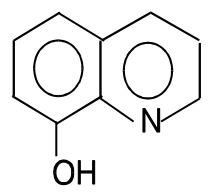
The relative atomic mass of aluminium is 26.98.
Problems:
1.1 Write the balanced equation for the reaction of the aluminium (III) ion with 8-hydroxyquinoline, showing clearly the structure of the products.
1.2 Give the name of the type of compound which is formed during the precipitation.
1.3 Write the balanced equation for the reaction in which bromine is produced.
1.4 Write the balanced equation for the reaction of bromine with 8-hydroxyquinoline.
1.5 Calculate the molar ratio of aluminium ions to bromate ions.
1.6 Calculate the percentage by weight of aluminium in the alloy.
Official English text of the problem.
Problem 2: Dioxygen species O2+, O2- and O2(2-): bond orders, distances and energies
It is possible to prepare compounds containing ions \(\ce{O2^-}\), \(\ce{O2^{2-}}\) or even \(\ce{O2^+}\). These ions are usually formed from molecules of oxygen during various reactions, as indicated in the scheme below:
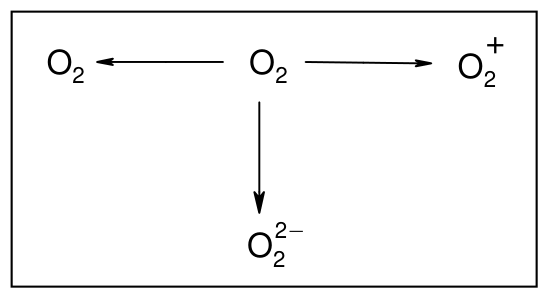
2.1 Indicate clearly which of the above reactions correspond to the oxidation and which to the reduction of the oxygen molecule.
2.2 For each of the ions in the scheme give the formula of a compound containing that particular ion.
2.3 It has been found that one of the species in the scheme is diamagnetic. Which one is it?
2.4 Copy out the following table:
Species Bond order Interatomic distance Bonding energy \(\ce{O2}\) \(\ce{O2^+}\) \(\ce{O2^-}\) \(\ce{O2^{2-}}\) The interatomic distances, \(\ce{O-O}\), in the above species have the values 112, 121, 132 and about 149 pm. Write these values in the appropriate column in the table.
\(1\ \mathrm{pm}=10^{-12}\ \mathrm{m}\).
2.5 Three of the bond energies, \(E_{\ce{O-O}}\), have the values approximately 200, 490 and 625 kJ mol\(^{-1}\). The value for one of the species is uncertain and, therefore, not given. Write the values in the appropriate spaces in the table.
2.6 Determine the bond order for the individual species and write the answers in the table.
2.7 Is it possible to prepare compounds containing the \(\ce{F2^{2-}}\) ion? Give reasons for your answer.
Official English text of the problem.
Problem 3: Solubility of calcium sulphate and the calcium-EDTA complex
Calcium sulphate is a sparingly soluble compound. Its solubility product is given by:
\[ K_s(\ce{CaSO4})=[\ce{Ca^2+}][\ce{SO4^2-}]=6.1\times10^{-5} \]
Ethylenediaminetetraacetic acid (EDTA) has the formula \(\ce{C10H16N2O8}\) and the structure:
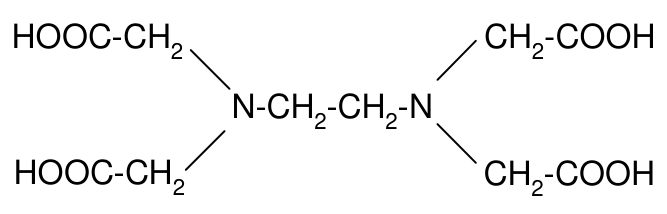
The anion of this acid, \(\ce{C10H12N2O8^4-}\), forms a stable complex \(\ce{CaC10H12N2O8^2-}\) with calcium ions. The stability constant of this complex ion is given by:
\[ K=\frac{[\ce{CaC10H12N2O8^2-}]} {[\ce{Ca^2+}][\ce{C10H12N2O8^4-}]} =1.0\times10^{11} \]
EDTA is completely dissociated in strongly alkaline solution. The equation for this dissociation is:
\[ \ce{C10H16N2O8 -> 4H+ + C10H12N2O8^4-} \]
Problems:
3.1 Calculate the concentration of calcium ions in a saturated solution of calcium sulphate.
3.2 Calculate the concentration of free \(\ce{Ca^2+}\) cations in a solution of 0.1 M \(\ce{Na2(CaC10H12N2O8)}\). You should ignore any protonation of the ligand.
3.3 How many moles of calcium sulphate will dissolve in 1 litre of a strongly alkaline solution of 0.1 M \(\ce{Na4C10H12N2O8}\)?
What would be the concentrations of the calcium and sulphate ions in the resulting solution?
3.4 Suggest a structure for the complex ion \(\ce{[CaC10H12N2O8]^2-}\) assuming that it is approximately octahedral.
3.5 Is the structure you have suggested in 4) optically active?
If your answer is "yes" then draw the structure of the other optical isomer enantiomer).
3.6 Explain why the complexes formed by the anion \(\ce{C10H12N2O8^4-}\) are exceptionally table.
Official English text of the problem.
Problem 4: Kinetics of the racemisation of alpha-pinene
At a temperature around \(200\,^\circ\mathrm{C}\) the racemisation of pinene can be followed in the gaseous phase by measuring the optical rotation.
If, for example, you take the (+)-enantiomer of α-pinene
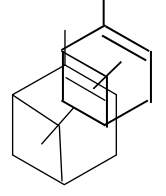
an equilibrium is gradually established between the two enantiomers (optical isomers). The two opposing reactions are both of the first order.
In 1927 D. F. Smith obtained the following data in his study of racemisation of α-pinene:
\(T/\mathrm{K}\) \(\alpha_1\) \(\alpha_2\) \(t/\mathrm{min}\) 490.9 32.75 18.01 579 490.9 29.51 15.59 587 503.9 30.64 8.74 371 505.4 12.95 8.05 120 510.1 23.22 6.15 216 \(\alpha_1\) and \(\alpha_2\) are the values for optical rotation in terms of the dimensions of the polarimeter scale; \(t\) is the time which has elapsed between the two measurements.
Problems:
4.1 What is the value for the equilibrium constant for the racemisation?
What is the corresponding value of \(\Delta_{\mathrm r}G^\circ\) (racemisation)?
What is the relationship between the forward and backward rate constants, \(k_1\) and \(k_{-1}\), in a state of dynamic equilibrium?
4.2 State the rate equation for the racemisation of pinene.
Derive a relationship which could be used to calculate the rate constant for the conversion of the (+)-enantiomer into the (-)-enantiomer using the data given in the table.
4.3 Calculate the rate constant for this reaction at the four temperatures given in the table.
4.4 Calculate the average value of the activation energy for this reaction. You should take the average of the values at a minimum of three temperatures or use a graphical method.
HINT:
If the loss of concentration of a substance obeys the rate equation:
\[ -\frac{dc}{dt}=k(2c-\text{constant}) \]
Then the dependence of concentration on time is given by:
\[ \ln\frac{2c_0-\text{constant}}{2c-\text{constant}}=2kt \]
where \(c_0\) is the initial concentration at time \(t=0\).
Official English text of the problem.
Problem 5: Thermodynamics of a zinc - silver sulphate galvanic cell
The equilibrium voltage of the cell,
\[ \ce{Zn}\;/\;\ce{ZnSO4}\;(0.0125\ \mathrm{M}) \;\|\; \ce{Ag2SO4}\;(0.0125\ \mathrm{M})\;/\;\ce{Ag} \]
was measured at several temperatures and the results of the measurements are given in the following table:
\(t\,/\,^\circ\mathrm{C}\) 10 20 30 \(E\,/\,\mathrm{V}\) 1.5784 1.5675 1.5566 Problems:
5.1 Give the equation for the reaction occurring in this galvanic cell.
5.2 Determine the value of the cell voltage at the temperature T = 298 K.
5.3 Determine \(\Delta_{\mathrm r}G_{298}\) of the cell reaction.
5.4 Determine \(\Delta_{\mathrm r}H_{298}\) of the cell reaction.
Official English text of the problem.
Problem 6: Synthesis of a sympathomimetic 2-phenylethylamine derivative from acetophenone
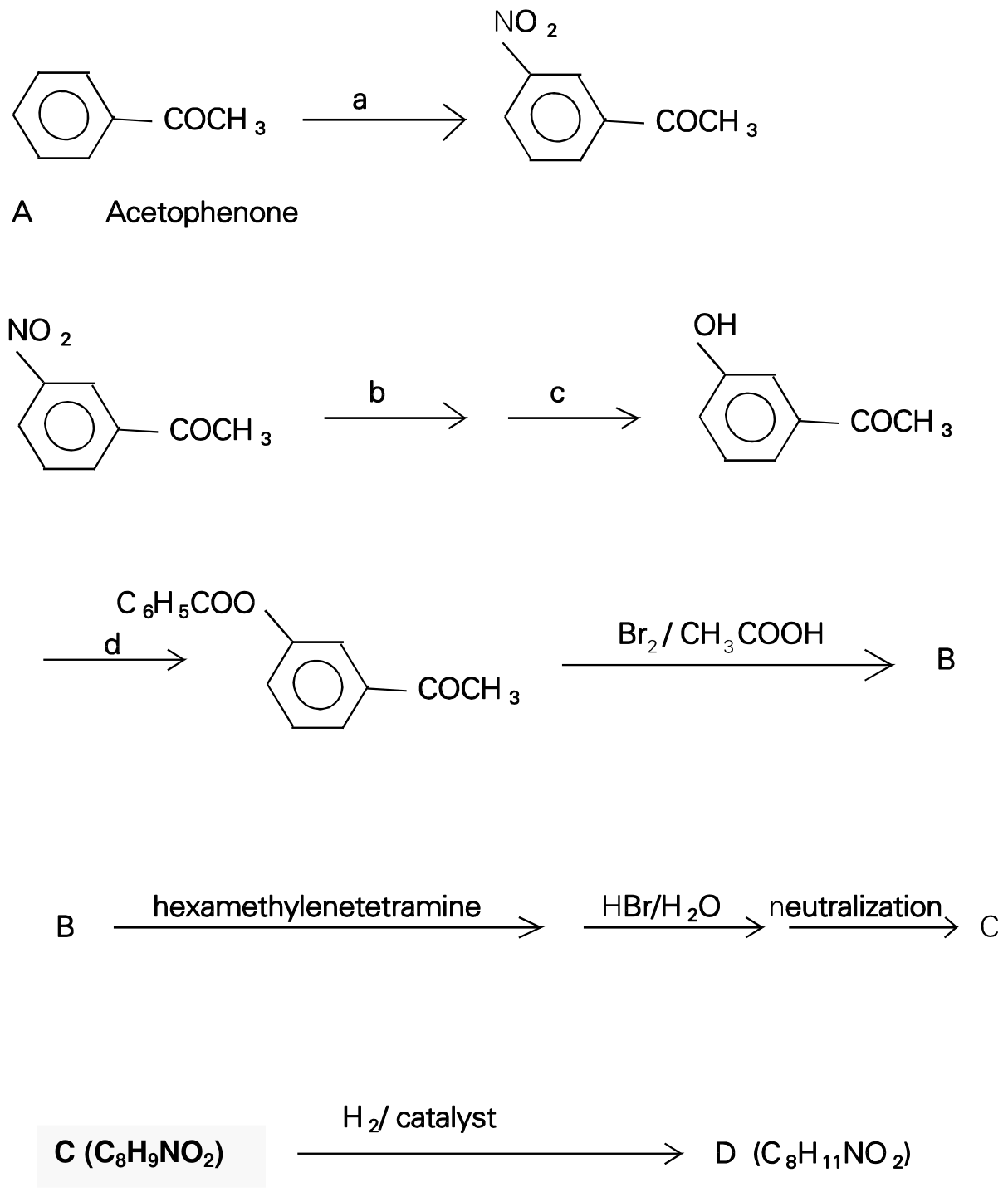
The following scheme describes the synthesis of a compound D (with sympathomimetic effects) whose skeleton consists of 2-phenylethylamine.
Problems:
6.1 What reagents were used in steps a, b, c, and d?
6.2 Give the structural formulae of compounds B, C and D.
6.3 Is it possible to prepare 3-hydroxyacetophenone from the reaction between phenol, acetylchloride and \(\ce{AlCl3}\)? Give reasons for your answer.
6.4 Give the formulae of the compounds that are formed by the reaction of compound C with a) 10% \(\ce{HCl}\) and b) 10% \(\ce{NaOH}\).
6.5 By the asterisk denote the chirality centre in the formula of compound D.
6.6 Give the spatial formula of enantiomer (R) of compound D.
Official English text of the problem.
Problem 7: Aldol reaction of propanal: intermediate and rate equation
Propanal, A, reacts in an aqueous-ethanolic solution of sodium hydroxide to yield compound B that is readily dehydrated to give compound C (\(\ce{C6H10O}\)).
Problems:
7.1 Give the structural formulae of substances B and C.
7.2 Give the formula of intermediate M that is formed from propanal A by the action of hydroxide ions.
7.3 Give the formulae of the two most important mesomeric structures of intermediate M and denote the nonbonding electron pairs and the charge distribution.
7.4 The reaction of propanal A with sodium hydroxide, producing substance B, can be described by the scheme:
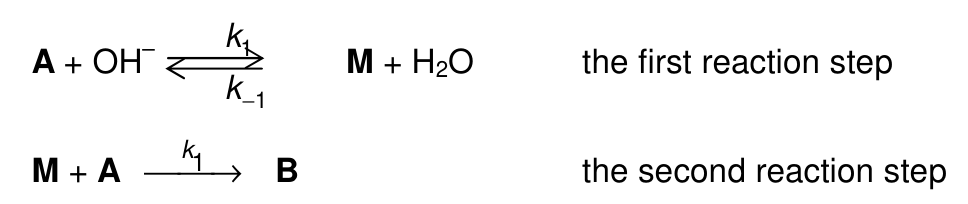
The rate of the formation of substance B is given by the equation:
\[ v=k_2[\mathbf M][\mathbf A] \qquad (1) \]
The above values of \(k\) are the rate constants for the individual reaction steps.
Assume that the concentration of intermediate M is small and constant during the reaction and express this fact by an aquation involving terms with constants \(k_1\), \(k_{-1}\) and \(k_2\).
\[ \frac{d[\mathbf M]}{dt}=0 \qquad (2) \]
Derive an expression for the concentration of M from equation 2 and then substitute for \([\mathbf M]\) in equation 1. This gives equation 3 which is the complete rate equation for the formation of substance B.
If it is assumed that the second reaction step is rate determining, then the rearrangement of equation 3 gives equation 4, the rate equation.
Give equations 2, 3, and 4.
7.5 Determine the overall order of the reaction described by equation 4.
Official English text of the problem.
Problem 8: Glycolysis equilibria of glucose-1-phosphate, glucose-6-phosphate and fructose-6-phosphate
The following reaction scheme represents part of anaerobic degradation of saccharides, i.e. the glycolysis, involving equilibrium constants \(K_1\) and \(K_2\):

Problems:
8.1 Give the structural formulae for all the three reactants (compounds) that are mutually interconverted, i.e. α-D-glucose-1-phosphate, α-D-glucose-6-phosphate and α-D-fructose-6-phosphate.
8.2 In the beginning of the reaction the reaction mixture contained 1 mmol of glucose-6-phosphate. Calculate the amounts of glucose-6-phosphate, glucose-1-phosphate and fructose-6-phosphate in the mixture at equilibrium. (As the reaction take place in a constant volume, the ratio of the amounts of substances equals that of their concentrations.)
Official English text of the problem.
Internationale Chemie-Olympiade
IChO 1985
Bratislava, Tschechoslowakei · 8 Theorieaufgaben mit vollständigen Lösungen
Aufgabe 1: Bestimmung von Aluminium mit 8-Hydroxychinolin und Bromat
Aus 0.5284 g einer Probe einer aluminiumhaltigen Legierung wurde eine Lösung hergestellt. Das Aluminium wurde anschließend als Aluminium-8-hydroxychinolinat gefällt. Der Niederschlag wurde abgetrennt und in Salzsäure gelöst; das dabei gebildete 8-Hydroxychinolin wurde mit einer Kaliumbromid enthaltenden Kaliumbromat-Maßlösung titriert. Die Konzentration der Kaliumbromat-Maßlösung betrug 0.0200 M, und es wurden 17.40 cm³ davon benötigt. Das entstehende Produkt ist ein Dibromderivat von 8-Hydroxychinolin.
Die Strukturformel von 8-Hydroxychinolin lautet:
Die relative Atommasse von Aluminium beträgt 26.98.
Aufgaben:
1.1 Stellen Sie die ausgeglichene Reaktionsgleichung für die Reaktion des Aluminium(III)-Ions mit 8-Hydroxychinolin auf und geben Sie dabei die Struktur der Produkte eindeutig an.
1.2 Geben Sie an, zu welchem Verbindungstyp die bei der Fällung gebildete Verbindung gehört.
1.3 Stellen Sie die ausgeglichene Reaktionsgleichung für die Reaktion auf, bei der Brom entsteht.
1.4 Stellen Sie die ausgeglichene Reaktionsgleichung für die Reaktion von Brom mit 8-Hydroxychinolin auf.
1.5 Berechnen Sie das Stoffmengenverhältnis von Aluminiumionen zu Bromationen.
1.6 Berechnen Sie den Massenanteil von Aluminium in der Legierung in Prozent.
Aufgabentext aus dem offiziellen englischen Text übersetzt.
Aufgabe 2: Disauerstoff-Spezies O2+, O2- und O2(2-): Bindungsordnungen, Abstände und Energien
Es ist möglich, Verbindungen herzustellen, die die Ionen \(\ce{O2^-}\), \(\ce{O2^{2-}}\) oder sogar \(\ce{O2^+}\) enthalten. Diese Ionen entstehen gewöhnlich bei verschiedenen Reaktionen aus Sauerstoffmolekülen, wie im folgenden Schema dargestellt:
2.1 Geben Sie eindeutig an, welche der oben dargestellten Reaktionen einer Oxidation und welche einer Reduktion des Sauerstoffmoleküls entsprechen.
2.2 Geben Sie für jedes Ion im Schema die Formel einer Verbindung an, die dieses Ion enthält.
2.3 Es wurde festgestellt, dass eine der Spezies im Schema diamagnetisch ist. Um welche handelt es sich?
2.4 Übertragen Sie die folgende Tabelle:
Spezies Bindungsordnung Kernabstand Bindungsenergie \(\ce{O2}\) \(\ce{O2^+}\) \(\ce{O2^-}\) \(\ce{O2^{2-}}\) Die Kernabstände \(\ce{O-O}\) in den oben genannten Spezies betragen 112, 121, 132 und etwa 149 pm. Tragen Sie diese Werte in die entsprechende Spalte der Tabelle ein.
\(1\ \mathrm{pm}=10^{-12}\ \mathrm{m}\).
2.5 Drei der Bindungsenergien \(E_{\ce{O-O}}\) betragen ungefähr 200, 490 und 625 kJ mol\(^{-1}\). Der Wert für eine der Spezies ist unsicher und wird daher nicht angegeben. Tragen Sie die Werte in die entsprechenden Felder der Tabelle ein.
2.6 Bestimmen Sie die Bindungsordnung der einzelnen Spezies und tragen Sie die Ergebnisse in die Tabelle ein.
2.7 Ist es möglich, Verbindungen herzustellen, die das Ion \(\ce{F2^{2-}}\) enthalten? Begründen Sie Ihre Antwort.
Aufgabentext aus dem offiziellen englischen Text übersetzt.
Aufgabe 3: Löslichkeit von Calciumsulfat und des Calcium-EDTA-Komplexes
Calciumsulfat ist eine schwer lösliche Verbindung. Sein Löslichkeitsprodukt ist gegeben durch:
\[ K_s(\ce{CaSO4})=[\ce{Ca^2+}][\ce{SO4^2-}]=6.1\times10^{-5} \]
Ethylendiamintetraessigsäure (EDTA) hat die Formel \(\ce{C10H16N2O8}\) und die Struktur:
Das Anion dieser Säure, \(\ce{C10H12N2O8^4-}\), bildet mit Calciumionen einen stabilen Komplex \(\ce{CaC10H12N2O8^2-}\). Die Stabilitätskonstante dieses Komplexions ist gegeben durch:
\[ K=\frac{[\ce{CaC10H12N2O8^2-}]} {[\ce{Ca^2+}][\ce{C10H12N2O8^4-}]} =1.0\times10^{11} \]
EDTA ist in stark alkalischer Lösung vollständig dissoziiert. Die Gleichung für diese Dissoziation lautet:
\[ \ce{C10H16N2O8 -> 4H+ + C10H12N2O8^4-} \]
Aufgaben:
3.1 Berechnen Sie die Konzentration der Calciumionen in einer gesättigten Calciumsulfatlösung.
3.2 Berechnen Sie die Konzentration der freien \(\ce{Ca^2+}\)-Kationen in einer 0.1 M Lösung von \(\ce{Na2(CaC10H12N2O8)}\). Vernachlässigen Sie jegliche Protonierung des Liganden.
3.3 Wie viele Mol Calciumsulfat lösen sich in 1 Liter einer stark alkalischen 0.1 M Lösung von \(\ce{Na4C10H12N2O8}\)?
Welche Konzentrationen hätten die Calcium- und Sulfationen in der entstehenden Lösung?
3.4 Schlagen Sie eine Struktur für das Komplexion \(\ce{[CaC10H12N2O8]^2-}\) vor, unter der Annahme, dass es annähernd oktaedrisch ist.
3.5 Ist die von Ihnen in 4) vorgeschlagene Struktur optisch aktiv?
Wenn Ihre Antwort „ja“ lautet, zeichnen Sie die Struktur des anderen optischen Isomers (Enantiomers).
3.6 Erklären Sie, warum die vom Anion \(\ce{C10H12N2O8^4-}\) gebildeten Komplexe außergewöhnlich stabil sind.
Aufgabentext aus dem offiziellen englischen Text übersetzt.
Aufgabe 4: Kinetik der Racemisierung von α-Pinen
Bei einer Temperatur um \(200\,^\circ\mathrm{C}\) lässt sich die Racemisierung von Pinen in der Gasphase durch Messung des optischen Drehwinkels verfolgen.
Geht man beispielsweise vom (+)-Enantiomer des α-Pinens aus,
so stellt sich allmählich ein Gleichgewicht zwischen den beiden Enantiomeren (optischen Isomeren) ein. Die beiden entgegengesetzten Reaktionen sind jeweils erster Ordnung.
1927 erhielt D. F. Smith bei seiner Untersuchung der Racemisierung von α-Pinen die folgenden Daten:
\(T/\mathrm{K}\) \(\alpha_1\) \(\alpha_2\) \(t/\mathrm{min}\) 490.9 32.75 18.01 579 490.9 29.51 15.59 587 503.9 30.64 8.74 371 505.4 12.95 8.05 120 510.1 23.22 6.15 216 \(\alpha_1\) und \(\alpha_2\) sind die Werte des optischen Drehwinkels in Einheiten der Polarimeterskala; \(t\) ist die zwischen den beiden Messungen verstrichene Zeit.
Aufgaben:
4.1 Welchen Wert hat die Gleichgewichtskonstante der Racemisierung?
Welchen entsprechenden Wert hat \(\Delta_{\mathrm r}G^\circ\) (Racemisierung)?
In welcher Beziehung stehen die Geschwindigkeitskonstanten der Hin- und Rückreaktion, \(k_1\) und \(k_{-1}\), im dynamischen Gleichgewicht zueinander?
4.2 Geben Sie das Geschwindigkeitsgesetz für die Racemisierung von Pinen an.
Leiten Sie eine Beziehung her, mit der sich die Geschwindigkeitskonstante für die Umwandlung des (+)-Enantiomers in das (-)-Enantiomer anhand der in der Tabelle angegebenen Daten berechnen lässt.
4.3 Berechnen Sie die Geschwindigkeitskonstante dieser Reaktion bei den vier in der Tabelle angegebenen Temperaturen.
4.4 Berechnen Sie den Mittelwert der Aktivierungsenergie dieser Reaktion. Bilden Sie dazu den Mittelwert der Werte bei mindestens drei Temperaturen oder verwenden Sie eine grafische Methode.
HINWEIS:
Wenn die Abnahme der Konzentration eines Stoffes dem folgenden Geschwindigkeitsgesetz gehorcht:
\[ -\frac{dc}{dt}=k(2c-\text{Konstante}) \]
dann ist die Zeitabhängigkeit der Konzentration gegeben durch:
\[ \ln\frac{2c_0-\text{Konstante}}{2c-\text{Konstante}}=2kt \]
wobei \(c_0\) die Anfangskonzentration zum Zeitpunkt \(t=0\) ist.
Aufgabentext aus dem offiziellen englischen Text übersetzt.
Aufgabe 5: Thermodynamik einer galvanischen Zink-Silbersulfat-Zelle
Die Gleichgewichtsspannung der Zelle
\[ \ce{Zn}\;/\;\ce{ZnSO4}\;(0.0125\ \mathrm{M}) \;\|\; \ce{Ag2SO4}\;(0.0125\ \mathrm{M})\;/\;\ce{Ag} \]
wurde bei mehreren Temperaturen gemessen. Die Messergebnisse sind in der folgenden Tabelle angegeben:
\(t\,/\,^\circ\mathrm{C}\) 10 20 30 \(E\,/\,\mathrm{V}\) 1.5784 1.5675 1.5566 Aufgaben:
5.1 Geben Sie die Gleichung für die in dieser galvanischen Zelle ablaufende Reaktion an.
5.2 Bestimmen Sie den Wert der Zellspannung bei der Temperatur T = 298 K.
5.3 Bestimmen Sie \(\Delta_{\mathrm r}G_{298}\) der Zellreaktion.
5.4 Bestimmen Sie \(\Delta_{\mathrm r}H_{298}\) der Zellreaktion.
Aufgabentext aus dem offiziellen englischen Text übersetzt.
Aufgabe 6: Synthese eines sympathomimetischen 2-Phenylethylamin-Derivats aus Acetophenon
Das folgende Schema beschreibt die Synthese einer Verbindung D (mit sympathomimetischer Wirkung), deren Grundgerüst aus 2-Phenylethylamin besteht.
Aufgaben:
6.1 Welche Reagenzien wurden in den Schritten a, b, c und d verwendet?
6.2 Geben Sie die Strukturformeln der Verbindungen B, C und D an.
6.3 Ist es möglich, 3-Hydroxyacetophenon durch die Reaktion von Phenol, Acetylchlorid und \(\ce{AlCl3}\) herzustellen? Begründen Sie Ihre Antwort.
6.4 Geben Sie die Formeln der Verbindungen an, die bei der Reaktion der Verbindung C mit a) 10%iger \(\ce{HCl}\) und b) 10%iger \(\ce{NaOH}\) entstehen.
6.5 Kennzeichnen Sie das Chiralitätszentrum in der Formel der Verbindung D mit einem Sternchen.
6.6 Geben Sie die räumliche Strukturformel des Enantiomers (R) der Verbindung D an.
Aufgabentext aus dem offiziellen englischen Text übersetzt.
Aufgabe 7: Aldolreaktion von Propanal: Zwischenprodukt und Geschwindigkeitsgleichung
Propanal, A, reagiert in einer wässrig-ethanolischen Natriumhydroxidlösung zur Verbindung B, die leicht unter Bildung der Verbindung C (\(\ce{C6H10O}\)) dehydratisiert wird.
Aufgaben:
7.1 Geben Sie die Strukturformeln der Stoffe B und C an.
7.2 Geben Sie die Formel des Zwischenprodukts M an, das aus Propanal A durch die Einwirkung von Hydroxidionen gebildet wird.
7.3 Geben Sie die Formeln der beiden wichtigsten mesomeren Grenzstrukturen des Zwischenprodukts M an und kennzeichnen Sie die freien Elektronenpaare sowie die Ladungsverteilung.
7.4 Die Reaktion von Propanal A mit Natriumhydroxid unter Bildung des Stoffes B lässt sich durch folgendes Schema beschreiben:
Die Bildungsgeschwindigkeit des Stoffes B ist durch folgende Gleichung gegeben:
\[ v=k_2[\mathbf M][\mathbf A] \qquad (1) \]
Die oben angegebenen Werte von \(k\) sind die Geschwindigkeitskonstanten der einzelnen Reaktionsschritte.
Nehmen Sie an, dass die Konzentration des Zwischenprodukts M während der Reaktion klein und konstant ist, und drücken Sie dies durch eine Gleichung aus, die Terme mit den Konstanten \(k_1\), \(k_{-1}\) und \(k_2\) enthält.
\[ \frac{d[\mathbf M]}{dt}=0 \qquad (2) \]
Leiten Sie aus Gleichung 2 einen Ausdruck für die Konzentration von M ab und setzen Sie diesen anschließend für \([\mathbf M]\) in Gleichung 1 ein. Dadurch ergibt sich Gleichung 3, die vollständige Geschwindigkeitsgleichung für die Bildung des Stoffes B.
Unter der Annahme, dass der zweite Reaktionsschritt geschwindigkeitsbestimmend ist, ergibt die Umformung von Gleichung 3 die Geschwindigkeitsgleichung 4.
Geben Sie die Gleichungen 2, 3 und 4 an.
7.5 Bestimmen Sie die Gesamtordnung der durch Gleichung 4 beschriebenen Reaktion.
Aufgabentext aus dem offiziellen englischen Text übersetzt.
Aufgabe 8: Glykolysegleichgewichte von Glucose-1-phosphat, Glucose-6-phosphat und Fructose-6-phosphat
Das folgende Reaktionsschema zeigt einen Teil des anaeroben Abbaus von Sacchariden, d. h. der Glykolyse, mit den Gleichgewichtskonstanten \(K_1\) und \(K_2\):
Aufgaben:
8.1 Geben Sie die Strukturformeln aller drei ineinander umgewandelten Reaktanten (Verbindungen) an, d. h. von α-D-Glucose-1-phosphat, α-D-Glucose-6-phosphat und α-D-Fructose-6-phosphat.
8.2 Zu Beginn der Reaktion enthielt das Reaktionsgemisch 1 mmol Glucose-6-phosphat. Berechnen Sie die Stoffmengen von Glucose-6-phosphat, Glucose-1-phosphat und Fructose-6-phosphat im Gemisch im Gleichgewicht. (Da die Reaktionen bei konstantem Volumen ablaufen, entspricht das Verhältnis der Stoffmengen dem ihrer Konzentrationen.)
Aufgabentext aus dem offiziellen englischen Text übersetzt.
Uluslararası Kimya Olimpiyatı
IChO 1985
Bratislava, Çekoslovakya · 8 teori sorusu, tam çözümleriyle
Soru 1: 8-hidroksikinolin ve bromat ile alüminyum tayini
Alüminyum içeren bir alaşımdan alınan 0.5284 g numune kullanılarak bir çözelti hazırlandı. Ardından alüminyum, alüminyum 8-hidroksikinolat olarak çöktürüldü. Çökelek ayrıldı, hidroklorik asitte çözüldü ve oluşan 8-hidroksikinolin, potasyum bromür içeren standart bir potasyum bromat çözeltisiyle titre edildi. Standart potasyum bromat çözeltisinin derişimi 0.0200 M idi ve bu çözeltiden 17.40 cm³ gerekti. Oluşan ürün, 8-hidroksikinolinin bir dibromo türevidir.
8-hidroksikinolinin yapı formülü şöyledir:
Alüminyumun bağıl atom kütlesi 26.98'dir.
Sorular:
1.1 Alüminyum (III) iyonunun 8-hidroksikinolin ile tepkimesinin denkleştirilmiş denklemini, ürünlerin yapısını açıkça göstererek yazınız.
1.2 Çöktürme sırasında oluşan bileşik türünün adını belirtiniz.
1.3 Bromun oluştuğu tepkimenin denkleştirilmiş denklemini yazınız.
1.4 Bromun 8-hidroksikinolin ile tepkimesinin denkleştirilmiş denklemini yazınız.
1.5 Alüminyum iyonlarının bromat iyonlarına mol oranını hesaplayınız.
1.6 Alaşımın kütlece alüminyum yüzdesini hesaplayınız.
Soru metni resmi İngilizce metinden çevrilmiştir.
Soru 2: Dioksijen türleri O2+, O2- ve O2(2-): bağ mertebeleri, uzaklıklar ve enerjiler
\(\ce{O2^-}\), \(\ce{O2^{2-}}\) ve hatta \(\ce{O2^+}\) iyonlarını içeren bileşikler hazırlamak mümkündür. Bu iyonlar genellikle aşağıdaki şemada gösterildiği gibi çeşitli tepkimeler sırasında oksijen moleküllerinden oluşur:
2.1 Yukarıdaki tepkimelerden hangilerinin oksijen molekülünün yükseltgenmesine, hangilerinin indirgenmesine karşılık geldiğini açıkça belirtiniz.
2.2 Şemadaki iyonların her biri için o iyonu içeren bir bileşiğin formülünü veriniz.
2.3 Şemadaki türlerden birinin diyamanyetik olduğu bulunmuştur. Bu tür hangisidir?
2.4 Aşağıdaki tabloyu kopyalayınız:
Tür Bağ mertebesi Atomlar arası uzaklık Bağ enerjisi \(\ce{O2}\) \(\ce{O2^+}\) \(\ce{O2^-}\) \(\ce{O2^{2-}}\) Yukarıdaki türlerde atomlar arası \(\ce{O-O}\) uzaklıkları 112, 121, 132 ve yaklaşık 149 pm değerlerindedir. Bu değerleri tablodaki uygun sütuna yazınız.
\(1\ \mathrm{pm}=10^{-12}\ \mathrm{m}\).
2.5 Bağ enerjilerinden, \(E_{\ce{O-O}}\), üçünün değerleri yaklaşık olarak 200, 490 ve 625 kJ mol\(^{-1}\)'dir. Türlerden birinin değeri belirsizdir ve bu nedenle verilmemiştir. Değerleri tablodaki uygun yerlere yazınız.
2.6 Her bir türün bağ mertebesini belirleyiniz ve cevapları tabloya yazınız.
2.7 \(\ce{F2^{2-}}\) iyonunu içeren bileşikler hazırlamak mümkün müdür? Cevabınızı gerekçelendiriniz.
Soru metni resmi İngilizce metinden çevrilmiştir.
Soru 3: Kalsiyum sülfatın çözünürlüğü ve kalsiyum–EDTA kompleksi
Kalsiyum sülfat az çözünen bir bileşiktir. Çözünürlük çarpımı aşağıdaki gibi verilir:
\[ K_s(\ce{CaSO4})=[\ce{Ca^2+}][\ce{SO4^2-}]=6.1\times10^{-5} \]
Etilendiamintetraasetik asidin (EDTA) formülü \(\ce{C10H16N2O8}\), yapısı ise şöyledir:
Bu asidin anyonu olan \(\ce{C10H12N2O8^4-}\), kalsiyum iyonlarıyla kararlı bir \(\ce{CaC10H12N2O8^2-}\) kompleksi oluşturur. Bu kompleks iyonunun kararlılık sabiti aşağıdaki gibi verilir:
\[ K=\frac{[\ce{CaC10H12N2O8^2-}]} {[\ce{Ca^2+}][\ce{C10H12N2O8^4-}]} =1.0\times10^{11} \]
EDTA, kuvvetli bazik çözeltide tamamen ayrışır. Bu ayrışmanın denklemi şöyledir:
\[ \ce{C10H16N2O8 -> 4H+ + C10H12N2O8^4-} \]
Sorular:
3.1 Doygun bir kalsiyum sülfat çözeltisindeki kalsiyum iyonlarının derişimini hesaplayınız.
3.2 0.1 M \(\ce{Na2(CaC10H12N2O8)}\) çözeltisindeki serbest \(\ce{Ca^2+}\) katyonlarının derişimini hesaplayınız. Ligandın protonlanmasını ihmal ediniz.
3.3 0.1 M \(\ce{Na4C10H12N2O8}\) içeren kuvvetli bazik bir çözeltinin 1 litresinde kaç mol kalsiyum sülfat çözünür?
Oluşan çözeltideki kalsiyum ve sülfat iyonlarının derişimleri ne olur?
3.4 Yaklaşık olarak oktahedral olduğunu varsayarak \(\ce{[CaC10H12N2O8]^2-}\) kompleks iyonu için bir yapı öneriniz.
3.5 4) numaralı soruda önerdiğiniz yapı optikçe aktif midir?
Cevabınız "evet" ise diğer optik izomerin (enantiyomerin) yapısını çiziniz.
3.6 \(\ce{C10H12N2O8^4-}\) anyonunun oluşturduğu komplekslerin neden olağanüstü kararlı olduğunu açıklayınız.
Soru metni resmi İngilizce metinden çevrilmiştir.
Soru 4: Alfa-pinenin rasemleşme kinetiği
Yaklaşık \(200\,^\circ\mathrm{C}\) sıcaklıkta pinenin rasemleşmesi, optik dönme ölçülerek gaz fazında izlenebilir.
Örneğin, α-pinenin (+)-enantiyomerini alırsanız
iki enantiyomer (optik izomer) arasında yavaş yavaş bir denge kurulur. Birbirine zıt yönde ilerleyen iki tepkime de birinci derecedendir.
1927 yılında D. F. Smith, α-pinenin rasemleşmesi üzerine yaptığı çalışmada aşağıdaki verileri elde etmiştir:
\(T/\mathrm{K}\) \(\alpha_1\) \(\alpha_2\) \(t/\mathrm{min}\) 490.9 32.75 18.01 579 490.9 29.51 15.59 587 503.9 30.64 8.74 371 505.4 12.95 8.05 120 510.1 23.22 6.15 216 \(\alpha_1\) ve \(\alpha_2\), polarimetre ölçeğinin birimleri cinsinden optik dönme değerleridir; \(t\), iki ölçüm arasında geçen süredir.
Sorular:
4.1 Rasemleşmenin denge sabitinin değeri nedir?
Buna karşılık gelen \(\Delta_{\mathrm r}G^\circ\) (rasemleşme) değeri nedir?
Dinamik denge durumunda ileri ve geri tepkimelerin hız sabitleri \(k_1\) ve \(k_{-1}\) arasındaki ilişki nedir?
4.2 Pinenin rasemleşmesinin hız denklemini yazınız.
Tabloda verilen veriler kullanılarak (+)-enantiyomerin (-)-enantiyomere dönüşümünün hız sabitini hesaplamak için kullanılabilecek bir bağıntı türetiniz.
4.3 Tabloda verilen dört sıcaklıkta bu tepkimenin hız sabitini hesaplayınız.
4.4 Bu tepkimenin aktivasyon enerjisinin ortalama değerini hesaplayınız. En az üç sıcaklıktaki değerlerin ortalamasını almalı veya grafik yöntemini kullanmalısınız.
İPUCU:
Bir maddenin derişimindeki azalma şu hız denklemine uyuyorsa:
\[ -\frac{dc}{dt}=k(2c-\text{sabit}) \]
Derişimin zamana bağlılığı şu şekilde verilir:
\[ \ln\frac{2c_0-\text{sabit}}{2c-\text{sabit}}=2kt \]
burada \(c_0\), \(t=0\) anındaki başlangıç derişimidir.
Soru metni resmi İngilizce metinden çevrilmiştir.
Soru 5: Çinko - gümüş sülfat galvanik pilinin termodinamiği
Aşağıdaki pilin denge gerilimi,
\[ \ce{Zn}\;/\;\ce{ZnSO4}\;(0.0125\ \mathrm{M}) \;\|\; \ce{Ag2SO4}\;(0.0125\ \mathrm{M})\;/\;\ce{Ag} \]
birkaç farklı sıcaklıkta ölçülmüş ve ölçüm sonuçları aşağıdaki tabloda verilmiştir:
\(t\,/\,^\circ\mathrm{C}\) 10 20 30 \(E\,/\,\mathrm{V}\) 1.5784 1.5675 1.5566 Sorular:
5.1 Bu galvanik pilde gerçekleşen tepkimenin denklemini yazınız.
5.2 T = 298 K sıcaklığında pil geriliminin değerini belirleyiniz.
5.3 Pil tepkimesinin \(\Delta_{\mathrm r}G_{298}\) değerini belirleyiniz.
5.4 Pil tepkimesinin \(\Delta_{\mathrm r}H_{298}\) değerini belirleyiniz.
Soru metni resmi İngilizce metinden çevrilmiştir.
Soru 6: Asetofenondan sempatomimetik bir 2-feniletilamin türevinin sentezi
Aşağıdaki şema, iskeleti 2-feniletilaminden oluşan (sempatomimetik etkileri olan) bir D bileşiğinin sentezini göstermektedir.
Sorular:
6.1 a, b, c ve d basamaklarında hangi reaktifler kullanılmıştır?
6.2 B, C ve D bileşiklerinin yapı formüllerini veriniz.
6.3 Fenol, asetil klorür ve \(\ce{AlCl3}\) arasındaki tepkimeyle 3-hidroksiasetofenon hazırlamak mümkün müdür? Yanıtınızın gerekçelerini belirtiniz.
6.4 C bileşiğinin a) %10'luk \(\ce{HCl}\) ve b) %10'luk \(\ce{NaOH}\) ile tepkimesinde oluşan bileşiklerin formüllerini veriniz.
6.5 D bileşiğinin formülünde kiralite merkezini yıldız işaretiyle belirtiniz.
6.6 D bileşiğinin (R) enantiyomerinin uzaysal formülünü veriniz.
Soru metni resmi İngilizce metinden çevrilmiştir.
Soru 7: Propanalın aldol tepkimesi: ara tür ve hız denklemi
Propanal, A, sodyum hidroksitin sulu etanollü çözeltisinde tepkimeye girerek kolayca su kaybedip C bileşiğini (\(\ce{C6H10O}\)) veren B bileşiğini oluşturur.
Sorular:
7.1 B ve C maddelerinin yapı formüllerini veriniz.
7.2 Hidroksit iyonlarının etkisiyle propanal A'dan oluşan M ara türünün formülünü veriniz.
7.3 M ara türünün en önemli iki mezomerik yapısının formüllerini veriniz; bağ yapmayan elektron çiftlerini ve yük dağılımını belirtiniz.
7.4 Propanal A'nın sodyum hidroksitle tepkimeye girerek B maddesini oluşturması aşağıdaki şemayla gösterilebilir:
B maddesinin oluşum hızı şu denklemle verilir:
\[ v=k_2[\mathbf M][\mathbf A] \qquad (1) \]
Yukarıdaki \(k\) değerleri, ayrı ayrı tepkime basamaklarının hız sabitleridir.
M ara türünün derişiminin tepkime boyunca düşük ve sabit olduğunu varsayınız ve bu durumu \(k_1\), \(k_{-1}\) ve \(k_2\) sabitlerini içeren terimlerden oluşan bir denklemle ifade ediniz.
\[ \frac{d[\mathbf M]}{dt}=0 \qquad (2) \]
2 numaralı denklemden M'nin derişimi için bir ifade türetiniz ve ardından 1 numaralı denklemde \([\mathbf M]\) yerine bu ifadeyi yazınız. Böylece B maddesinin oluşumuna ilişkin tam hız denklemi olan 3 numaralı denklem elde edilir.
İkinci tepkime basamağının hız belirleyici olduğu varsayılırsa, 3 numaralı denklemin yeniden düzenlenmesiyle hız denklemi olan 4 numaralı denklem elde edilir.
2, 3 ve 4 numaralı denklemleri veriniz.
7.5 4 numaralı denklemle tanımlanan tepkimenin toplam derecesini belirleyiniz.
Soru metni resmi İngilizce metinden çevrilmiştir.
Soru 8: Glukoz-1-fosfat, glukoz-6-fosfat ve fruktoz-6-fosfatın glikoliz dengeleri
Aşağıdaki tepkime şeması, sakkaritlerin anaerobik yıkımının, yani glikolizin, denge sabitleri \(K_1\) ve \(K_2\) olan bir bölümünü göstermektedir:
Sorular:
8.1 Birbirine dönüşen üç reaktanın (bileşiğin), yani α-D-glukoz-1-fosfat, α-D-glukoz-6-fosfat ve α-D-fruktoz-6-fosfatın tümünün yapı formüllerini veriniz.
8.2 Tepkimenin başlangıcında tepkime karışımı 1 mmol glukoz-6-fosfat içermektedir. Dengeye ulaşıldığında karışımdaki glukoz-6-fosfat, glukoz-1-fosfat ve fruktoz-6-fosfat miktarlarını hesaplayınız. (Tepkime sabit hacimde gerçekleştiğinden, maddelerin miktarlarının oranı derişimlerinin oranına eşittir.)
Soru metni resmi İngilizce metinden çevrilmiştir.
Olimpiada Internacional de Química
IChO 1985
Bratislava, Checoslovaquia · 8 problemas teóricos con soluciones completas
Problema 1: Determinación de aluminio con 8-hidroxiquinolina y bromato
Se preparó una disolución a partir de 0.5284 g de una muestra de una aleación que contenía aluminio. A continuación, el aluminio se precipitó como 8-hidroxiquinolinato de aluminio. El precipitado se separó, se disolvió en ácido clorhídrico y la 8-hidroxiquinolina formada se valoró con una disolución patrón de bromato de potasio que contenía bromuro de potasio. La concentración de la disolución patrón de bromato de potasio era de 0.0200 M y se necesitaron 17.40 cm³ de ella. El producto resultante es un derivado dibromado de la 8-hidroxiquinolina.
La fórmula estructural de la 8-hidroxiquinolina es:
La masa atómica relativa del aluminio es 26.98.
Cuestiones:
1.1 Escriba la ecuación ajustada de la reacción del ion aluminio(III) con la 8-hidroxiquinolina, mostrando claramente la estructura de los productos.
1.2 Indique el nombre del tipo de compuesto que se forma durante la precipitación.
1.3 Escriba la ecuación ajustada de la reacción en la que se produce bromo.
1.4 Escriba la ecuación ajustada de la reacción del bromo con la 8-hidroxiquinolina.
1.5 Calcule la relación molar entre los iones aluminio y los iones bromato.
1.6 Calcule el porcentaje en masa de aluminio en la aleación.
Enunciado traducido del texto oficial en inglés.
Problema 2: Especies de dioxígeno O2+, O2- y O2(2-): órdenes de enlace, distancias y energías
Es posible preparar compuestos que contengan iones \(\ce{O2^-}\), \(\ce{O2^{2-}}\) o incluso \(\ce{O2^+}\). Estos iones suelen formarse a partir de moléculas de oxígeno durante diversas reacciones, como se indica en el siguiente esquema:
2.1 Indique claramente cuáles de las reacciones anteriores corresponden a la oxidación y cuáles a la reducción de la molécula de oxígeno.
2.2 Para cada uno de los iones del esquema, dé la fórmula de un compuesto que contenga ese ion concreto.
2.3 Se ha comprobado que una de las especies del esquema es diamagnética. ¿Cuál es?
2.4 Copie la siguiente tabla:
Especie Orden de enlace Distancia interatómica Energía de enlace \(\ce{O2}\) \(\ce{O2^+}\) \(\ce{O2^-}\) \(\ce{O2^{2-}}\) Las distancias interatómicas, \(\ce{O-O}\), en las especies anteriores tienen los valores 112, 121, 132 y aproximadamente 149 pm. Escriba estos valores en la columna correspondiente de la tabla.
\(1\ \mathrm{pm}=10^{-12}\ \mathrm{m}\).
2.5 Tres de las energías de enlace, \(E_{\ce{O-O}}\), tienen los valores aproximados de 200, 490 y 625 kJ mol\(^{-1}\). El valor de una de las especies es incierto y, por tanto, no se proporciona. Escriba los valores en las casillas correspondientes de la tabla.
2.6 Determine el orden de enlace de cada especie y escriba las respuestas en la tabla.
2.7 ¿Es posible preparar compuestos que contengan el ion \(\ce{F2^{2-}}\)? Justifique su respuesta.
Enunciado traducido del texto oficial en inglés.
Problema 3: Solubilidad del sulfato de calcio y del complejo calcio-EDTA
El sulfato de calcio es un compuesto poco soluble. Su producto de solubilidad viene dado por:
\[ K_s(\ce{CaSO4})=[\ce{Ca^2+}][\ce{SO4^2-}]=6.1\times10^{-5} \]
El ácido etilendiaminotetraacético (EDTA) tiene la fórmula \(\ce{C10H16N2O8}\) y la estructura:
El anión de este ácido, \(\ce{C10H12N2O8^4-}\), forma un complejo estable \(\ce{CaC10H12N2O8^2-}\) con los iones calcio. La constante de estabilidad de este ion complejo viene dada por:
\[ K=\frac{[\ce{CaC10H12N2O8^2-}]} {[\ce{Ca^2+}][\ce{C10H12N2O8^4-}]} =1.0\times10^{11} \]
El EDTA está completamente disociado en una disolución fuertemente alcalina. La ecuación de esta disociación es:
\[ \ce{C10H16N2O8 -> 4H+ + C10H12N2O8^4-} \]
Cuestiones:
3.1 Calcule la concentración de iones calcio en una disolución saturada de sulfato de calcio.
3.2 Calcule la concentración de cationes \(\ce{Ca^2+}\) libres en una disolución de \(\ce{Na2(CaC10H12N2O8)}\) 0.1 M. Debe despreciar cualquier protonación del ligando.
3.3 ¿Cuántos moles de sulfato de calcio se disolverán en 1 litro de una disolución fuertemente alcalina de \(\ce{Na4C10H12N2O8}\) 0.1 M?
¿Cuáles serían las concentraciones de los iones calcio y sulfato en la disolución resultante?
3.4 Proponga una estructura para el ion complejo \(\ce{[CaC10H12N2O8]^2-}\) suponiendo que es aproximadamente octaédrico.
3.5 ¿Es ópticamente activa la estructura que ha propuesto en 4)?
Si su respuesta es «sí», dibuje la estructura del otro isómero óptico (enantiómero).
3.6 Explique por qué los complejos formados por el anión \(\ce{C10H12N2O8^4-}\) son excepcionalmente estables.
Enunciado traducido del texto oficial en inglés.
Problema 4: Cinética de la racemización del alfa-pineno
A una temperatura de alrededor de \(200\,^\circ\mathrm{C}\), la racemización del pineno puede seguirse en fase gaseosa midiendo la rotación óptica.
Si, por ejemplo, se parte del enantiómero (+) del α-pineno
se establece gradualmente un equilibrio entre los dos enantiómeros (isómeros ópticos). Las dos reacciones opuestas son de primer orden.
En 1927, D. F. Smith obtuvo los siguientes datos en su estudio de la racemización del α-pineno:
\(T/\mathrm{K}\) \(\alpha_1\) \(\alpha_2\) \(t/\mathrm{min}\) 490.9 32.75 18.01 579 490.9 29.51 15.59 587 503.9 30.64 8.74 371 505.4 12.95 8.05 120 510.1 23.22 6.15 216 \(\alpha_1\) y \(\alpha_2\) son los valores de la rotación óptica expresados en unidades de la escala del polarímetro; \(t\) es el tiempo transcurrido entre las dos mediciones.
Cuestiones:
4.1 ¿Cuál es el valor de la constante de equilibrio de la racemización?
¿Cuál es el valor correspondiente de \(\Delta_{\mathrm r}G^\circ\) (racemización)?
¿Qué relación existe entre las constantes de velocidad de las reacciones directa e inversa, \(k_1\) y \(k_{-1}\), en un estado de equilibrio dinámico?
4.2 Escriba la ecuación de velocidad de la racemización del pineno.
Deduzca una relación que permita calcular la constante de velocidad de la conversión del enantiómero (+) en el enantiómero (-) utilizando los datos de la tabla.
4.3 Calcule la constante de velocidad de esta reacción a las cuatro temperaturas indicadas en la tabla.
4.4 Calcule el valor medio de la energía de activación de esta reacción. Debe tomar el promedio de los valores a un mínimo de tres temperaturas o utilizar un método gráfico.
INDICACIÓN:
Si la disminución de la concentración de una sustancia obedece a la ecuación de velocidad:
\[ -\frac{dc}{dt}=k(2c-\text{constante}) \]
Entonces la dependencia de la concentración con el tiempo viene dada por:
\[ \ln\frac{2c_0-\text{constante}}{2c-\text{constante}}=2kt \]
donde \(c_0\) es la concentración inicial en el instante \(t=0\).
Enunciado traducido del texto oficial en inglés.
Problema 5: Termodinámica de una pila galvánica de zinc - sulfato de plata
La tensión de equilibrio de la pila,
\[ \ce{Zn}\;/\;\ce{ZnSO4}\;(0.0125\ \mathrm{M}) \;\|\; \ce{Ag2SO4}\;(0.0125\ \mathrm{M})\;/\;\ce{Ag} \]
se midió a varias temperaturas y los resultados de las mediciones se presentan en la siguiente tabla:
\(t\,/\,^\circ\mathrm{C}\) 10 20 30 \(E\,/\,\mathrm{V}\) 1.5784 1.5675 1.5566 Cuestiones:
5.1 Escriba la ecuación de la reacción que tiene lugar en esta pila galvánica.
5.2 Determine el valor de la tensión de la pila a la temperatura T = 298 K.
5.3 Determine \(\Delta_{\mathrm r}G_{298}\) de la reacción de la pila.
5.4 Determine \(\Delta_{\mathrm r}H_{298}\) de la reacción de la pila.
Enunciado traducido del texto oficial en inglés.
Problema 6: Síntesis de un derivado simpaticomimético de la 2-feniletilamina a partir de acetofenona
El siguiente esquema describe la síntesis de un compuesto D (con efectos simpaticomiméticos) cuyo esqueleto es el de la 2-feniletilamina.
Cuestiones:
6.1 ¿Qué reactivos se utilizaron en las etapas a, b, c y d?
6.2 Dé las fórmulas estructurales de los compuestos B, C y D.
6.3 ¿Es posible preparar 3-hidroxiacetofenona mediante la reacción entre fenol, cloruro de acetilo y \(\ce{AlCl3}\)? Justifique su respuesta.
6.4 Dé las fórmulas de los compuestos que se forman por reacción del compuesto C con a) \(\ce{HCl}\) al 10% y b) \(\ce{NaOH}\) al 10%.
6.5 Indique con un asterisco el centro de quiralidad en la fórmula del compuesto D.
6.6 Dé la fórmula espacial del enantiómero (R) del compuesto D.
Enunciado traducido del texto oficial en inglés.
Problema 7: Reacción aldólica del propanal: intermedio y ecuación de velocidad
El propanal, A, reacciona en una disolución acuosa-etanólica de hidróxido de sodio para dar el compuesto B, que se deshidrata fácilmente para dar el compuesto C (\(\ce{C6H10O}\)).
Cuestiones:
7.1 Dé las fórmulas estructurales de las sustancias B y C.
7.2 Dé la fórmula del intermedio M que se forma a partir del propanal A por acción de los iones hidróxido.
7.3 Dé las fórmulas de las dos estructuras mesoméricas más importantes del intermedio M e indique los pares de electrones no enlazantes y la distribución de carga.
7.4 La reacción del propanal A con hidróxido de sodio, que produce la sustancia B, puede describirse mediante el esquema:
La velocidad de formación de la sustancia B viene dada por la ecuación:
\[ v=k_2[\mathbf M][\mathbf A] \qquad (1) \]
Los valores de \(k\) anteriores son las constantes de velocidad de las etapas individuales de la reacción.
Suponga que la concentración del intermedio M es pequeña y constante durante la reacción y exprese este hecho mediante una ecuación que contenga términos con las constantes \(k_1\), \(k_{-1}\) y \(k_2\).
\[ \frac{d[\mathbf M]}{dt}=0 \qquad (2) \]
Deduzca una expresión para la concentración de M a partir de la ecuación 2 y, a continuación, sustituya \([\mathbf M]\) en la ecuación 1. Así se obtiene la ecuación 3, que es la ecuación de velocidad completa para la formación de la sustancia B.
Si se supone que la segunda etapa de la reacción es la determinante de la velocidad, entonces la reorganización de la ecuación 3 da la ecuación 4, la ecuación de velocidad.
Dé las ecuaciones 2, 3 y 4.
7.5 Determine el orden global de la reacción descrita por la ecuación 4.
Enunciado traducido del texto oficial en inglés.
Problema 8: Equilibrios de la glucólisis de la glucosa-1-fosfato, la glucosa-6-fosfato y la fructosa-6-fosfato
El siguiente esquema de reacción representa una parte de la degradación anaerobia de los sacáridos, es decir, la glucólisis, en la que intervienen las constantes de equilibrio \(K_1\) y \(K_2\):
Cuestiones:
8.1 Escriba las fórmulas estructurales de los tres reactivos (compuestos) que se interconvierten entre sí, es decir, la α-D-glucosa-1-fosfato, la α-D-glucosa-6-fosfato y la α-D-fructosa-6-fosfato.
8.2 Al inicio de la reacción, la mezcla de reacción contenía 1 mmol de glucosa-6-fosfato. Calcule las cantidades de glucosa-6-fosfato, glucosa-1-fosfato y fructosa-6-fosfato presentes en la mezcla en el equilibrio. (Como la reacción tiene lugar a volumen constante, la relación entre las cantidades de sustancia es igual a la relación entre sus concentraciones.)
Enunciado traducido del texto oficial en inglés.
国际化学奥林匹克
IChO 1985
捷克斯洛伐克布拉迪斯拉发 · 8 道理论题及完整解答
题目 1:用8-羟基喹啉和溴酸盐测定铝
将0.5284 g含铝合金试样制成溶液。随后使其中的铝以8-羟基喹啉铝的形式沉淀。分离沉淀,将其溶于盐酸,再用含有溴化钾的溴酸钾标准溶液滴定所生成的8-羟基喹啉。溴酸钾标准溶液的浓度为0.0200 M,滴定消耗了17.40 cm³该溶液。反应产物为8-羟基喹啉的二溴代衍生物。
8-羟基喹啉的结构式为:
铝的相对原子质量为26.98。
问题:
1.1 写出铝(III)离子与8-羟基喹啉反应的配平方程式,并清楚地表示产物的结构。
1.2 指出沉淀过程中形成的化合物所属的类型。
1.3 写出生成溴的反应的配平方程式。
1.4 写出溴与8-羟基喹啉反应的配平方程式。
1.5 计算铝离子与溴酸根离子的物质的量之比。
1.6 计算合金中铝的质量百分含量。
题目译自官方英文原文。
题目 2:双氧物种 O2+、O2- 和 O2(2-):键级、原子间距与键能
可以制备含有 \(\ce{O2^-}\)、\(\ce{O2^{2-}}\) 甚至 \(\ce{O2^+}\) 离子的化合物。这些离子通常在各种反应中由氧分子形成,如下图所示:
2.1 明确指出上述哪些反应对应于氧分子的氧化,哪些对应于氧分子的还原。
2.2 对图中的每一种离子,写出一种含有该离子的化合物的化学式。
2.3 已发现图中的一种物种具有抗磁性。它是哪一种?
2.4 抄写下表:
物种 键级 原子间距 键能 \(\ce{O2}\) \(\ce{O2^+}\) \(\ce{O2^-}\) \(\ce{O2^{2-}}\) 上述物种中 \(\ce{O-O}\) 的原子间距分别为 112、121、132 和约 149 pm。将这些数值填入表中相应的列。
\(1\ \mathrm{pm}=10^{-12}\ \mathrm{m}\)。
2.5 其中三个键能 \(E_{\ce{O-O}}\) 的数值约为 200、490 和 625 kJ mol\(^{-1}\)。其中一种物种的键能数值尚不确定,因此未予给出。将这些数值填入表中相应的空格。
2.6 确定各物种的键级,并将答案填入表中。
2.7 能否制备含有 \(\ce{F2^{2-}}\) 离子的化合物?说明理由。
题目译自官方英文原文。
题目 3:硫酸钙的溶解度与钙–EDTA 配合物
硫酸钙是一种微溶化合物。其溶度积为:
\[ K_s(\ce{CaSO4})=[\ce{Ca^2+}][\ce{SO4^2-}]=6.1\times10^{-5} \]
乙二胺四乙酸(EDTA)的分子式为 \(\ce{C10H16N2O8}\),其结构为:
这种酸的阴离子 \(\ce{C10H12N2O8^4-}\) 与钙离子形成稳定的配合物 \(\ce{CaC10H12N2O8^2-}\)。该配离子的稳定常数为:
\[ K=\frac{[\ce{CaC10H12N2O8^2-}]} {[\ce{Ca^2+}][\ce{C10H12N2O8^4-}]} =1.0\times10^{11} \]
EDTA 在强碱性溶液中完全电离。其电离方程式为:
\[ \ce{C10H16N2O8 -> 4H+ + C10H12N2O8^4-} \]
问题:
3.1 计算硫酸钙饱和溶液中钙离子的浓度。
3.2 计算 0.1 M \(\ce{Na2(CaC10H12N2O8)}\) 溶液中游离 \(\ce{Ca^2+}\) 阳离子的浓度。忽略配体的任何质子化作用。
3.3 在 1 升 0.1 M \(\ce{Na4C10H12N2O8}\) 的强碱性溶液中,能溶解多少摩尔硫酸钙?
所得溶液中钙离子和硫酸根离子的浓度各为多少?
3.4 假设配离子 \(\ce{[CaC10H12N2O8]^2-}\) 近似呈八面体构型,提出其结构。
3.5 你在 4) 中提出的结构是否具有旋光性?
如果你的回答是“是”,请画出另一种旋光异构体(对映异构体)的结构。
3.6 解释为什么阴离子 \(\ce{C10H12N2O8^4-}\) 形成的配合物特别稳定。
题目译自官方英文原文。
题目 4:α-蒎烯外消旋化的动力学
在约 \(200\,^\circ\mathrm{C}\) 的温度下,可以通过测量旋光度来跟踪气相中蒎烯的外消旋化过程。
例如,若取 α-蒎烯的 (+)-对映异构体
两种对映异构体(旋光异构体)之间就会逐渐建立平衡。正、逆两个反应均为一级反应。
1927 年,D. F. Smith 在研究 α-蒎烯的外消旋化时获得了以下数据:
\(T/\mathrm{K}\) \(\alpha_1\) \(\alpha_2\) \(t/\mathrm{min}\) 490.9 32.75 18.01 579 490.9 29.51 15.59 587 503.9 30.64 8.74 371 505.4 12.95 8.05 120 510.1 23.22 6.15 216 \(\alpha_1\) 和 \(\alpha_2\) 是以旋光仪刻度单位表示的旋光度;\(t\) 是两次测量之间经过的时间。
问题:
4.1 外消旋化反应的平衡常数是多少?
对应的 \(\Delta_{\mathrm r}G^\circ\)(外消旋化)是多少?
在动态平衡状态下,正、逆反应速率常数 \(k_1\) 和 \(k_{-1}\) 之间有什么关系?
4.2 写出蒎烯外消旋化的速率方程。
推导一个关系式,使其能够利用表中所给数据计算 (+)-对映异构体转化为 (-)-对映异构体的速率常数。
4.3 计算表中所给四个温度下该反应的速率常数。
4.4 计算该反应活化能的平均值。应取至少三个温度下所得数值的平均值,或使用作图法。
提示:
若某物质浓度的降低遵循以下速率方程:
\[ -\frac{dc}{dt}=k(2c-\text{常数}) \]
则浓度随时间的变化关系为:
\[ \ln\frac{2c_0-\text{常数}}{2c-\text{常数}}=2kt \]
其中,\(c_0\) 是 \(t=0\) 时的初始浓度。
题目译自官方英文原文。
题目 5:锌-硫酸银原电池的热力学
在若干温度下测量了下列电池的平衡电动势,
\[ \ce{Zn}\;/\;\ce{ZnSO4}\;(0.0125\ \mathrm{M}) \;\|\; \ce{Ag2SO4}\;(0.0125\ \mathrm{M})\;/\;\ce{Ag} \]
测量结果列于下表:
\(t\,/\,^\circ\mathrm{C}\) 10 20 30 \(E\,/\,\mathrm{V}\) 1.5784 1.5675 1.5566 问题:
5.1 写出该原电池中发生的反应的方程式。
5.2 求温度 T = 298 K 时的电池电动势。
5.3 求电池反应的 \(\Delta_{\mathrm r}G_{298}\)。
5.4 求电池反应的 \(\Delta_{\mathrm r}H_{298}\)。
题目译自官方英文原文。
题目 6:由苯乙酮合成具有拟交感作用的2-苯基乙胺衍生物
以下反应路线描述了一种以2-苯基乙胺为骨架、具有拟交感作用的化合物 D 的合成。
问题:
6.1 步骤 a、b、c 和 d 中使用了哪些试剂?
6.2 写出化合物 B、C 和 D 的结构式。
6.3 能否通过苯酚、乙酰氯与 \(\ce{AlCl3}\) 的反应制备3-羟基苯乙酮?说明理由。
6.4 写出化合物 C 分别与 a) 10% \(\ce{HCl}\) 和 b) 10% \(\ce{NaOH}\) 反应所生成的化合物的化学式。
6.5 在化合物 D 的结构式中用星号标出手性中心。
6.6 写出化合物 D 的 (R) 对映异构体的空间结构式。
题目译自官方英文原文。
题目 7:丙醛的羟醛反应:中间体与速率方程
丙醛 A 在氢氧化钠的水–乙醇溶液中反应,生成化合物 B,后者易脱水生成化合物 C(\(\ce{C6H10O}\))。
问题:
7.1 写出物质 B 和 C 的结构式。
7.2 写出丙醛 A 在氢氧根离子作用下形成的中间体 M 的化学式。
7.3 写出中间体 M 的两个最重要的共振式,并标出非键合电子对和电荷分布。
7.4 丙醛 A 与氢氧化钠反应生成物质 B 的过程可用下列反应示意图表示:
物质 B 的生成速率由下式给出:
\[ v=k_2[\mathbf M][\mathbf A] \qquad (1) \]
上述各个 \(k\) 值为各反应步骤的速率常数。
假设中间体 M 的浓度很小,且在反应过程中保持恒定,用一个包含常数 \(k_1\)、\(k_{-1}\) 和 \(k_2\) 所对应各项的方程表示这一条件。
\[ \frac{d[\mathbf M]}{dt}=0 \qquad (2) \]
由方程 2 推导出 M 的浓度表达式,然后将其代入方程 1 中的 \([\mathbf M]\)。由此得到方程 3,即物质 B 生成的完整速率方程。
若假设第二个反应步骤为速率决定步骤,则整理方程 3 可得到速率方程,即方程 4。
写出方程 2、3 和 4。
7.5 确定方程 4 所描述反应的总反应级数。
题目译自官方英文原文。
题目 8:葡萄糖-1-磷酸、葡萄糖-6-磷酸和果糖-6-磷酸的糖酵解平衡
以下反应示意图表示糖类无氧降解过程(即糖酵解)的一部分,其中涉及平衡常数 \(K_1\) 和 \(K_2\):
问题:
8.1 写出三种相互转化的反应物(化合物),即 α-D-葡萄糖-1-磷酸、α-D-葡萄糖-6-磷酸和 α-D-果糖-6-磷酸的结构式。
8.2 反应开始时,反应混合物中含有 1 mmol 葡萄糖-6-磷酸。计算达到平衡时混合物中葡萄糖-6-磷酸、葡萄糖-1-磷酸和果糖-6-磷酸的物质的量。(由于反应在恒定体积下进行,物质的量之比等于其浓度之比。)
题目译自官方英文原文。
Международная химическая олимпиада
IChO 1985
Братислава, Чехословакия · 8 теоретических задач с полными решениями
Задача 1: Определение алюминия с помощью 8-гидроксихинолина и бромата
Из навески сплава, содержащего алюминий, массой 0.5284 г приготовили раствор. Затем алюминий осадили в виде 8-гидроксихинолята алюминия. Осадок отделили, растворили в соляной кислоте, а образовавшийся 8-гидроксихинолин оттитровали стандартным раствором бромата калия, содержащим бромид калия. Концентрация стандартного раствора бромата калия составляла 0.0200 М, и на титрование потребовалось 17.40 см³ этого раствора. Полученный продукт представляет собой дибромпроизводное 8-гидроксихинолина.
Структурная формула 8-гидроксихинолина:
Относительная атомная масса алюминия равна 26.98.
Задания:
1.1 Напишите уравнение реакции иона алюминия (III) с 8-гидроксихинолином, расставив коэффициенты и чётко показав строение продуктов.
1.2 Укажите, к какому типу соединений относится вещество, образующееся при осаждении.
1.3 Напишите уравнение реакции образования брома, расставив коэффициенты.
1.4 Напишите уравнение реакции брома с 8-гидроксихинолином, расставив коэффициенты.
1.5 Рассчитайте молярное отношение ионов алюминия к бромат-ионам.
1.6 Рассчитайте массовую долю алюминия в сплаве в процентах.
Условие переведено с официального английского текста.
Задача 2: Частицы молекулярного кислорода O2+, O2- и O2(2-): порядки связей, межатомные расстояния и энергии связей
Можно получить соединения, содержащие ионы \(\ce{O2^-}\), \(\ce{O2^{2-}}\) или даже \(\ce{O2^+}\). Эти ионы обычно образуются из молекул кислорода в ходе различных реакций, как показано на приведённой ниже схеме:
2.1 Чётко укажите, какие из приведённых выше реакций соответствуют окислению, а какие — восстановлению молекулы кислорода.
2.2 Для каждого из ионов на схеме приведите формулу соединения, содержащего этот ион.
2.3 Установлено, что одна из частиц на схеме диамагнитна. Какая именно?
2.4 Перепишите следующую таблицу:
Частица Порядок связи Межатомное расстояние Энергия связи \(\ce{O2}\) \(\ce{O2^+}\) \(\ce{O2^-}\) \(\ce{O2^{2-}}\) Межатомные расстояния \(\ce{O-O}\) в приведённых выше частицах составляют 112, 121, 132 и около 149 пм. Впишите эти значения в соответствующий столбец таблицы.
\(1\ \mathrm{pm}=10^{-12}\ \mathrm{m}\).
2.5 Три значения энергии связи \(E_{\ce{O-O}}\) составляют приблизительно 200, 490 и 625 кДж моль\(^{-1}\). Значение для одной из частиц достоверно не установлено и поэтому не приведено. Впишите эти значения в соответствующие ячейки таблицы.
2.6 Определите порядок связи для каждой частицы и впишите ответы в таблицу.
2.7 Можно ли получить соединения, содержащие ион \(\ce{F2^{2-}}\)? Обоснуйте свой ответ.
Условие переведено с официального английского текста.
Задача 3: Растворимость сульфата кальция и комплекс кальция с ЭДТА
Сульфат кальция — малорастворимое соединение. Его произведение растворимости равно:
\[ K_s(\ce{CaSO4})=[\ce{Ca^2+}][\ce{SO4^2-}]=6.1\times10^{-5} \]
Этилендиаминтетрауксусная кислота (ЭДТА) имеет формулу \(\ce{C10H16N2O8}\) и следующую структуру:
Анион этой кислоты, \(\ce{C10H12N2O8^4-}\), образует с ионами кальция устойчивый комплекс \(\ce{CaC10H12N2O8^2-}\). Константа устойчивости этого комплексного иона равна:
\[ K=\frac{[\ce{CaC10H12N2O8^2-}]} {[\ce{Ca^2+}][\ce{C10H12N2O8^4-}]} =1.0\times10^{11} \]
В сильнощелочном растворе ЭДТА полностью диссоциирует. Уравнение этой диссоциации:
\[ \ce{C10H16N2O8 -> 4H+ + C10H12N2O8^4-} \]
Задания:
3.1 Рассчитайте концентрацию ионов кальция в насыщенном растворе сульфата кальция.
3.2 Рассчитайте концентрацию свободных катионов \(\ce{Ca^2+}\) в 0.1 М растворе \(\ce{Na2(CaC10H12N2O8)}\). Протонированием лиганда следует пренебречь.
3.3 Сколько молей сульфата кальция растворится в 1 литре сильнощелочного 0.1 М раствора \(\ce{Na4C10H12N2O8}\)?
Каковы будут концентрации ионов кальция и сульфат-ионов в полученном растворе?
3.4 Предложите структуру комплексного иона \(\ce{[CaC10H12N2O8]^2-}\), предполагая, что он имеет приблизительно октаэдрическое строение.
3.5 Является ли предложенная вами в 4) структура оптически активной?
Если ваш ответ — «да», изобразите структуру другого оптического изомера (энантиомера).
3.6 Объясните, почему комплексы, образуемые анионом \(\ce{C10H12N2O8^4-}\), исключительно устойчивы.
Условие переведено с официального английского текста.
Задача 4: Кинетика рацемизации альфа-пинена
При температуре около \(200\,^\circ\mathrm{C}\) за рацемизацией пинена в газовой фазе можно следить, измеряя оптическое вращение.
Если, например, взять (+)-энантиомер α-пинена
то между двумя энантиомерами (оптическими изомерами) постепенно устанавливается равновесие. Обе противоположно направленные реакции имеют первый порядок.
В 1927 году D. F. Smith получил следующие данные при изучении рацемизации α-пинена:
\(T/\mathrm{K}\) \(\alpha_1\) \(\alpha_2\) \(t/\mathrm{min}\) 490.9 32.75 18.01 579 490.9 29.51 15.59 587 503.9 30.64 8.74 371 505.4 12.95 8.05 120 510.1 23.22 6.15 216 \(\alpha_1\) и \(\alpha_2\) — значения оптического вращения, выраженные в делениях шкалы поляриметра; \(t\) — время, прошедшее между двумя измерениями.
Вопросы:
4.1 Чему равна константа равновесия рацемизации?
Каково соответствующее значение \(\Delta_{\mathrm r}G^\circ\) (рацемизации)?
Как связаны константы скорости прямой и обратной реакций, \(k_1\) и \(k_{-1}\), в состоянии динамического равновесия?
4.2 Запишите кинетическое уравнение рацемизации пинена.
Выведите соотношение, позволяющее рассчитать константу скорости превращения (+)-энантиомера в (-)-энантиомер по данным таблицы.
4.3 Рассчитайте константу скорости этой реакции при четырёх температурах, приведённых в таблице.
4.4 Рассчитайте среднее значение энергии активации этой реакции. Следует усреднить значения, полученные как минимум для трёх температур, или воспользоваться графическим методом.
УКАЗАНИЕ:
Если уменьшение концентрации вещества подчиняется кинетическому уравнению:
\[ -\frac{dc}{dt}=k(2c-\text{константа}) \]
то зависимость концентрации от времени имеет вид:
\[ \ln\frac{2c_0-\text{константа}}{2c-\text{константа}}=2kt \]
где \(c_0\) — начальная концентрация в момент времени \(t=0\).
Условие переведено с официального английского текста.
Задача 5: Термодинамика цинк-серебряного сульфатного гальванического элемента
Равновесное напряжение элемента
\[ \ce{Zn}\;/\;\ce{ZnSO4}\;(0.0125\ \mathrm{M}) \;\|\; \ce{Ag2SO4}\;(0.0125\ \mathrm{M})\;/\;\ce{Ag} \]
измерили при нескольких температурах; результаты измерений приведены в следующей таблице:
\(t\,/\,^\circ\mathrm{C}\) 10 20 30 \(E\,/\,\mathrm{V}\) 1.5784 1.5675 1.5566 Задания:
5.1 Запишите уравнение реакции, протекающей в этом гальваническом элементе.
5.2 Определите напряжение элемента при температуре T = 298 K.
5.3 Определите \(\Delta_{\mathrm r}G_{298}\) реакции, протекающей в элементе.
5.4 Определите \(\Delta_{\mathrm r}H_{298}\) реакции, протекающей в элементе.
Условие переведено с официального английского текста.
Задача 6: Синтез производного 2-фенилэтиламина с симпатомиметическим действием из ацетофенона
Следующая схема описывает синтез соединения D (обладающего симпатомиметическим действием), в основе строения которого лежит 2-фенилэтиламин.
Вопросы:
6.1 Какие реагенты использованы на стадиях a, b, c и d?
6.2 Приведите структурные формулы соединений B, C и D.
6.3 Можно ли получить 3-гидроксиацетофенон при взаимодействии фенола, ацетилхлорида и \(\ce{AlCl3}\)? Обоснуйте свой ответ.
6.4 Приведите формулы соединений, образующихся при взаимодействии соединения C с a) 10% \(\ce{HCl}\) и b) 10% \(\ce{NaOH}\).
6.5 Обозначьте звёздочкой центр хиральности в формуле соединения D.
6.6 Приведите пространственную формулу энантиомера (R) соединения D.
Условие переведено с официального английского текста.
Задача 7: Альдольная реакция пропаналя: промежуточная частица и кинетическое уравнение
Пропаналь, A, реагирует в водно-этанольном растворе гидроксида натрия с образованием соединения B, которое легко дегидратируется с образованием соединения C (\(\ce{C6H10O}\)).
Задания:
7.1 Приведите структурные формулы веществ B и C.
7.2 Приведите формулу промежуточной частицы M, которая образуется из пропаналя A под действием гидроксид-ионов.
7.3 Приведите формулы двух наиболее важных мезомерных структур промежуточной частицы M и обозначьте неподелённые электронные пары и распределение заряда.
7.4 Реакцию пропаналя A с гидроксидом натрия, в результате которой образуется вещество B, можно описать следующей схемой:
Скорость образования вещества B задаётся уравнением:
\[ v=k_2[\mathbf M][\mathbf A] \qquad (1) \]
Указанные выше величины \(k\) являются константами скорости отдельных стадий реакции.
Предположите, что концентрация промежуточной частицы M мала и постоянна в ходе реакции, и выразите этот факт уравнением, содержащим слагаемые с константами \(k_1\), \(k_{-1}\) и \(k_2\).
\[ \frac{d[\mathbf M]}{dt}=0 \qquad (2) \]
Выведите выражение для концентрации M из уравнения 2, а затем подставьте его вместо \([\mathbf M]\) в уравнение 1. Полученное уравнение 3 представляет собой полное кинетическое уравнение образования вещества B.
Если предположить, что вторая стадия реакции является лимитирующей, то преобразование уравнения 3 даёт кинетическое уравнение 4.
Приведите уравнения 2, 3 и 4.
7.5 Определите общий порядок реакции, описываемой уравнением 4.
Условие переведено с официального английского текста.
Задача 8: Равновесия гликолиза с участием глюкозо-1-фосфата, глюкозо-6-фосфата и фруктозо-6-фосфата
Следующая схема реакций представляет часть анаэробного расщепления сахаридов, то есть гликолиза, с константами равновесия \(K_1\) и \(K_2\):
Задания:
8.1 Приведите структурные формулы всех трёх взаимопревращающихся реагентов (соединений), то есть α-D-глюкозо-1-фосфата, α-D-глюкозо-6-фосфата и α-D-фруктозо-6-фосфата.
8.2 В начале реакции реакционная смесь содержала 1 ммоль глюкозо-6-фосфата. Рассчитайте количества глюкозо-6-фосфата, глюкозо-1-фосфата и фруктозо-6-фосфата в смеси при равновесии. (Поскольку реакции протекают при постоянном объёме, отношение количеств веществ равно отношению их концентраций.)
Условие переведено с официального английского текста.
الأولمبياد الدولي للكيمياء
IChO 1985
براتيسلافا، تشيكوسلوفاكيا · 8 مسائل نظرية مع حلول كاملة
المسألة 1: تقدير الألومنيوم باستخدام 8-هيدروكسي كينولين والبرومات
حُضِّر محلول من 0.5284 g من عينة سبيكة تحتوي على الألومنيوم. ثم رُسِّب الألومنيوم على هيئة 8-هيدروكسي كينولات الألومنيوم. فُصل الراسب وأُذيب في حمض الهيدروكلوريك، وعُويِر 8-هيدروكسي كينولين المتكوّن بمحلول قياسي من برومات البوتاسيوم يحتوي على بروميد البوتاسيوم. كان تركيز محلول برومات البوتاسيوم القياسي 0.0200 M، ولزم منه 17.40 cm³. والناتج المتكوّن مشتق ثنائي البروم من 8-هيدروكسي كينولين.
الصيغة البنائية لـ8-هيدروكسي كينولين هي:
الكتلة الذرية النسبية للألومنيوم هي 26.98.
المطلوب:
1.1 اكتب المعادلة الموزونة لتفاعل أيون الألومنيوم (III) مع 8-هيدروكسي كينولين، موضحًا بنية النواتج بجلاء.
1.2 اذكر اسم نوع المركّب الذي يتكوّن أثناء الترسيب.
1.3 اكتب المعادلة الموزونة للتفاعل الذي يُنتَج فيه البروم.
1.4 اكتب المعادلة الموزونة لتفاعل البروم مع 8-هيدروكسي كينولين.
1.5 احسب النسبة المولية لأيونات الألومنيوم إلى أيونات البرومات.
1.6 احسب النسبة المئوية الكتلية للألومنيوم في السبيكة.
نص المسألة مترجم عن النص الإنجليزي الرسمي.
المسألة 2: الأنواع الكيميائية لثنائي الأكسجين O2+ وO2- وO2(2-): رتب الروابط والمسافات والطاقات
يمكن تحضير مركبات تحتوي على الأيونات \(\ce{O2^-}\) أو \(\ce{O2^{2-}}\) أو حتى \(\ce{O2^+}\). وتتكوّن هذه الأيونات عادةً من جزيئات الأكسجين خلال تفاعلات مختلفة، كما هو موضح في المخطط أدناه:
2.1 بيّن بوضوح أيّ التفاعلات السابقة يمثّل أكسدة جزيء الأكسجين وأيّها يمثّل اختزاله.
2.2 أعطِ، لكل أيون في المخطط، صيغة مركب يحتوي على ذلك الأيون تحديدًا.
2.3 تبيّن أن أحد الأنواع الكيميائية في المخطط دايامغناطيسي. أيّها هو؟
2.4 انسخ الجدول الآتي:
النوع الكيميائي رتبة الرابطة المسافة بين الذرتين طاقة الرابطة \(\ce{O2}\) \(\ce{O2^+}\) \(\ce{O2^-}\) \(\ce{O2^{2-}}\) تأخذ المسافات بين الذرتين، \(\ce{O-O}\)، في الأنواع الكيميائية السابقة القيم 112 و121 و132 ونحو 149 pm. اكتب هذه القيم في العمود المناسب من الجدول.
\(1\ \mathrm{pm}=10^{-12}\ \mathrm{m}\).
2.5 تبلغ قيم ثلاث من طاقات الروابط، \(E_{\ce{O-O}}\)، نحو 200 و490 و625 kJ mol\(^{-1}\). أما قيمة أحد الأنواع الكيميائية فهي غير مؤكدة، ولذلك لم تُعطَ. اكتب القيم في الخانات المناسبة من الجدول.
2.6 حدّد رتبة الرابطة لكل نوع كيميائي واكتب الإجابات في الجدول.
2.7 هل يمكن تحضير مركبات تحتوي على الأيون \(\ce{F2^{2-}}\)؟ علّل إجابتك.
نص المسألة مترجم عن النص الإنجليزي الرسمي.
المسألة 3: ذوبانية كبريتات الكالسيوم ومعقد الكالسيوم–EDTA
كبريتات الكالسيوم مركب شحيح الذوبان. ويُعطى حاصل إذابتها بالعلاقة:
\[ K_s(\ce{CaSO4})=[\ce{Ca^2+}][\ce{SO4^2-}]=6.1\times10^{-5} \]
لحمض الإيثيلين ثنائي الأمين رباعي الأسيتيك (EDTA) الصيغة \(\ce{C10H16N2O8}\) والبنية الآتية:
يُكوِّن أنيون هذا الحمض، \(\ce{C10H12N2O8^4-}\)، معقدًا مستقرًا \(\ce{CaC10H12N2O8^2-}\) مع أيونات الكالسيوم. ويُعطى ثابت استقرار هذا الأيون المعقد بالعلاقة:
\[ K=\frac{[\ce{CaC10H12N2O8^2-}]} {[\ce{Ca^2+}][\ce{C10H12N2O8^4-}]} =1.0\times10^{11} \]
يتفكك EDTA تفككًا تامًا في المحلول شديد القلوية. ومعادلة هذا التفكك هي:
\[ \ce{C10H16N2O8 -> 4H+ + C10H12N2O8^4-} \]
المطلوب:
3.1 احسب تركيز أيونات الكالسيوم في محلول مشبع من كبريتات الكالسيوم.
3.2 احسب تركيز كاتيونات \(\ce{Ca^2+}\) الحرة في محلول من \(\ce{Na2(CaC10H12N2O8)}\) تركيزه 0.1 M. أهمل أي بروتنة للربيطة.
3.3 كم مولًا من كبريتات الكالسيوم يذوب في لتر واحد من محلول شديد القلوية من \(\ce{Na4C10H12N2O8}\) تركيزه 0.1 M؟
ما تركيزا أيونات الكالسيوم والكبريتات في المحلول الناتج؟
3.4 اقترح بنية للأيون المعقد \(\ce{[CaC10H12N2O8]^2-}\) بافتراض أنه ثماني السطوح تقريبًا.
3.5 هل البنية التي اقترحتها في 4) نشطة ضوئيًا؟
إذا كانت إجابتك «نعم»، فارسم بنية المتماكب الضوئي الآخر (المتماكب المرآتي).
3.6 فسِّر سبب الاستقرار الاستثنائي للمعقدات التي يُكوِّنها الأنيون \(\ce{C10H12N2O8^4-}\).
نص المسألة مترجم عن النص الإنجليزي الرسمي.
المسألة 4: حركية التراسم في ألفا-بينين
عند درجة حرارة تقارب \(200\,^\circ\mathrm{C}\)، يمكن تتبّع تراسم البينين في الطور الغازي بقياس الدوران الضوئي.
فإذا أخذت، مثلاً، المتماكب المرآتي (+) لألفا-بينين
ينشأ تدريجياً اتزان بين المتماكبين المرآتيين (المتماكبين الضوئيين). وكلا التفاعلين المتعاكسين من الرتبة الأولى.
في عام 1927، حصل D. F. Smith على البيانات الآتية في دراسته لتراسم ألفا-بينين:
\(T/\mathrm{K}\) \(\alpha_1\) \(\alpha_2\) \(t/\mathrm{min}\) 490.9 32.75 18.01 579 490.9 29.51 15.59 587 503.9 30.64 8.74 371 505.4 12.95 8.05 120 510.1 23.22 6.15 216 تمثّل \(\alpha_1\) و\(\alpha_2\) قيمتي الدوران الضوئي بوحدات تدريج مقياس الاستقطاب؛ ويمثّل \(t\) الزمن المنقضي بين القياسين.
المطلوب:
4.1 ما قيمة ثابت الاتزان للتراسم؟
ما القيمة المقابلة لـ \(\Delta_{\mathrm r}G^\circ\) (للتراسم)؟
ما العلاقة بين ثابتي سرعة التفاعلين الأمامي والعكسي، \(k_1\) و\(k_{-1}\)، في حالة الاتزان الديناميكي؟
4.2 اكتب معادلة سرعة تراسم البينين.
اشتقّ علاقة يمكن استخدامها لحساب ثابت سرعة تحوّل المتماكب المرآتي (+) إلى المتماكب المرآتي (-) باستخدام البيانات الواردة في الجدول.
4.3 احسب ثابت سرعة هذا التفاعل عند درجات الحرارة الأربع الواردة في الجدول.
4.4 احسب القيمة المتوسطة لطاقة تنشيط هذا التفاعل. ينبغي أن تأخذ متوسط القيم عند ثلاث درجات حرارة على الأقل أو أن تستخدم طريقة بيانية.
تلميح:
إذا كان تناقص تركيز مادة يخضع لمعادلة السرعة:
\[ -\frac{dc}{dt}=k(2c-\text{ثابت}) \]
فإن اعتماد التركيز على الزمن يُعطى بالعلاقة:
\[ \ln\frac{2c_0-\text{ثابت}}{2c-\text{ثابت}}=2kt \]
حيث \(c_0\) هو التركيز الابتدائي عند الزمن \(t=0\).
نص المسألة مترجم عن النص الإنجليزي الرسمي.
المسألة 5: الديناميكا الحرارية لخلية جلفانية من الزنك وكبريتات الفضة
قيس جهد الاتزان للخلية،
\[ \ce{Zn}\;/\;\ce{ZnSO4}\;(0.0125\ \mathrm{M}) \;\|\; \ce{Ag2SO4}\;(0.0125\ \mathrm{M})\;/\;\ce{Ag} \]
عند عدة درجات حرارة، وترد نتائج القياسات في الجدول الآتي:
\(t\,/\,^\circ\mathrm{C}\) 10 20 30 \(E\,/\,\mathrm{V}\) 1.5784 1.5675 1.5566 المطلوب:
5.1 اكتب معادلة التفاعل الذي يحدث في هذه الخلية الجلفانية.
5.2 حدد قيمة جهد الخلية عند درجة الحرارة T = 298 K.
5.3 حدد \(\Delta_{\mathrm r}G_{298}\) لتفاعل الخلية.
5.4 حدد \(\Delta_{\mathrm r}H_{298}\) لتفاعل الخلية.
نص المسألة مترجم عن النص الإنجليزي الرسمي.
المسألة 6: اصطناع مشتق من 2-فينيل إيثيل أمين محاكٍ للودي انطلاقًا من الأسيتوفينون
يصف المخطط الآتي اصطناع مركب D (ذي تأثيرات محاكية للودي) يتكون هيكله من 2-فينيل إيثيل أمين.
المطلوب:
6.1 ما الكواشف المستخدمة في الخطوات a, b, c, وd؟
6.2 أعطِ الصيغ البنائية للمركبات B, C وD.
6.3 هل يمكن تحضير 3-هيدروكسي أسيتوفينون من التفاعل بين الفينول وكلوريد الأسيتيل و\(\ce{AlCl3}\)؟ علّل إجابتك.
6.4 أعطِ صيغ المركبات التي تتكون بتفاعل المركب C مع a) محلول \(\ce{HCl}\) بتركيز 10% وb) محلول \(\ce{NaOH}\) بتركيز 10%.
6.5 عيّن مركز الكيرالية بعلامة النجمة في صيغة المركب D.
6.6 أعطِ الصيغة الفراغية للمتماكب المرآتي (R) للمركب D.
نص المسألة مترجم عن النص الإنجليزي الرسمي.
المسألة 7: تفاعل الألدول للبروبانال: المركب الوسيط ومعادلة السرعة
يتفاعل البروبانال، A، في محلول مائي إيثانولي من هيدروكسيد الصوديوم ليعطي المركب B الذي يُنزع منه الماء بسهولة ليعطي المركب C (\(\ce{C6H10O}\)).
المطلوب:
7.1 أعطِ الصيغ البنائية للمادتين B وC.
7.2 أعطِ صيغة المركب الوسيط M الذي يتكوّن من البروبانال A بفعل أيونات الهيدروكسيد.
7.3 أعطِ صيغتي أهم بنيتين رنينيتين للمركب الوسيط M، وبيّن أزواج الإلكترونات غير الرابطة وتوزيع الشحنة.
7.4 يمكن وصف تفاعل البروبانال A مع هيدروكسيد الصوديوم، الذي ينتج المادة B، بالمخطط الآتي:
تُعطى سرعة تكوّن المادة B بالمعادلة:
\[ v=k_2[\mathbf M][\mathbf A] \qquad (1) \]
قيم \(k\) أعلاه هي ثوابت السرعة لخطوات التفاعل المنفردة.
افترض أن تركيز المركب الوسيط M صغير وثابت أثناء التفاعل، وعبّر عن ذلك بمعادلة تتضمن حدودًا تحتوي على الثوابت \(k_1\) و\(k_{-1}\) و\(k_2\).
\[ \frac{d[\mathbf M]}{dt}=0 \qquad (2) \]
اشتق تعبيرًا لتركيز M من المعادلة 2، ثم عوّض به عن \([\mathbf M]\) في المعادلة 1. ينتج عن ذلك المعادلة 3، وهي معادلة السرعة الكاملة لتكوّن المادة B.
إذا افترضنا أن خطوة التفاعل الثانية هي المحدِّدة للسرعة، فإن إعادة ترتيب المعادلة 3 تعطي المعادلة 4، وهي معادلة السرعة.
أعطِ المعادلات 2 و3 و4.
7.5 حدّد الرتبة الكلية للتفاعل الموصوف بالمعادلة 4.
نص المسألة مترجم عن النص الإنجليزي الرسمي.
المسألة 8: اتزانات التحلل السكري لغلوكوز-1-فوسفات وغلوكوز-6-فوسفات وفركتوز-6-فوسفات
يمثل مخطط التفاعلات الآتي جزءًا من التحلل اللاهوائي للسكريات، أي التحلل السكري، ويتضمن ثابتي الاتزان \(K_1\) و\(K_2\):
المطلوب:
8.1 أعطِ الصيغ البنائية للمتفاعلات (المركبات) الثلاثة جميعها التي يتحول كل منها إلى الآخر، أي α-D-غلوكوز-1-فوسفات وα-D-غلوكوز-6-فوسفات وα-D-فركتوز-6-فوسفات.
8.2 في بداية التفاعل، كان مزيج التفاعل يحتوي على 1 mmol من غلوكوز-6-فوسفات. احسب كميات غلوكوز-6-فوسفات وغلوكوز-1-فوسفات وفركتوز-6-فوسفات في المزيج عند الاتزان. (بما أن التفاعل يحدث في حجم ثابت، فإن نسبة كميات المواد تساوي نسبة تراكيزها.)
نص المسألة مترجم عن النص الإنجليزي الرسمي.