IChO 1985 · Theory problem 7
Aldol reaction of propanal: intermediate and rate equation
Propanal, A, reacts in an aqueous-ethanolic solution of sodium hydroxide to yield compound B that is readily dehydrated to give compound C (\(\ce{C6H10O}\)).
Problems:
7.1 Give the structural formulae of substances B and C.
7.2 Give the formula of intermediate M that is formed from propanal A by the action of hydroxide ions.
7.3 Give the formulae of the two most important mesomeric structures of intermediate M and denote the nonbonding electron pairs and the charge distribution.
7.4 The reaction of propanal A with sodium hydroxide, producing substance B, can be described by the scheme:
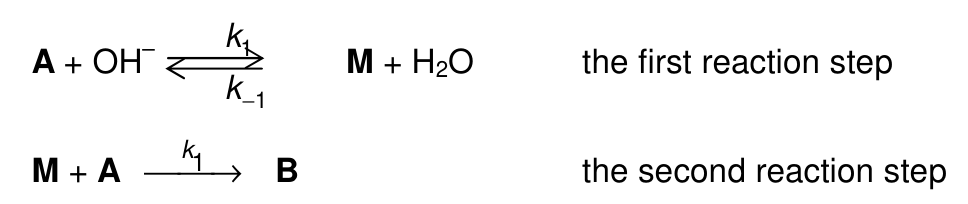
The rate of the formation of substance B is given by the equation:
\[ v=k_2[\mathbf M][\mathbf A] \qquad (1) \]
The above values of \(k\) are the rate constants for the individual reaction steps.
Assume that the concentration of intermediate M is small and constant during the reaction and express this fact by an aquation involving terms with constants \(k_1\), \(k_{-1}\) and \(k_2\).
\[ \frac{d[\mathbf M]}{dt}=0 \qquad (2) \]
Derive an expression for the concentration of M from equation 2 and then substitute for \([\mathbf M]\) in equation 1. This gives equation 3 which is the complete rate equation for the formation of substance B.
If it is assumed that the second reaction step is rate determining, then the rearrangement of equation 3 gives equation 4, the rate equation.
Give equations 2, 3, and 4.
7.5 Determine the overall order of the reaction described by equation 4.
Official English text of the problem.
Answers
-
7.1 B is 3-hydroxy-2-methylpentanal, \(\ce{CH3CH2CH(OH)CH(CH3)CHO}\), SMILES
CCC(O)C(C)C=O. C is 2-methylpent-2-enal, \(\ce{CH3CH2CH=C(CH3)CHO}\), SMILESCCC=C(C)C=O. The problem does not specify their stereochemistry. -
7.2 M is the propanal enolate ion, \(\ce{C3H5O^-}\), represented by \(\ce{CH3-CH^{-}-CH=O}\), SMILES
C[CH-]C=O. -
7.3 Its two principal resonance contributors are \[ \ce{CH3-CH^{-}-CH=O <-> CH3-CH=CH-O^-}. \] Their SMILES are
C[CH-]C=OandCC=C[O-], respectively. The carbon-centred contributor has one lone pair and charge \(-1\) on the α carbon, and two lone pairs on oxygen. The oxygen-centred contributor has three lone pairs and charge \(-1\) on oxygen. -
7.4 Writing solvent water explicitly: \[ \frac{d[\mathbf M]}{dt} =k_1[\mathbf A][\ce{OH^-}] -k_{-1}[\mathbf M][\ce{H2O}] -k_2[\mathbf M][\mathbf A] =0. \tag{2} \] Hence \[ [\mathbf M] =\frac{k_1[\mathbf A][\ce{OH^-}]} {k_{-1}[\ce{H2O}]+k_2[\mathbf A]}, \] and \[ v=\frac{k_1k_2[\mathbf A]^2[\ce{OH^-}]} {k_{-1}[\ce{H2O}]+k_2[\mathbf A]}. \tag{3} \] When \(k_2[\mathbf A]\ll k_{-1}[\ce{H2O}]\), \[ v\simeq \frac{k_1k_2}{k_{-1}[\ce{H2O}]} [\mathbf A]^2[\ce{OH^-}] =k_{\mathrm{obs}}[\mathbf A]^2[\ce{OH^-}]. \tag{4} \] The constant water concentration may instead be absorbed into the reverse rate constant.
-
7.5 The overall reaction order is three: second order in propanal and first order in hydroxide, at fixed solvent composition.
Solution
7.1 — Identification of B and C
Propanal, A, is \(\ce{CH3CH2CHO}\), SMILES CCC=O. It contains α hydrogens, allowing base-catalysed self-aldol addition. Sodium hydroxide, SMILES [Na+].[OH-], supplies the hydroxide ion, SMILES [OH-].
The α carbon of one propanal molecule forms a bond to the carbonyl carbon of a second molecule. The first molecule retains its aldehyde group; the second molecule’s carbonyl group becomes an alcohol group. The balanced overall addition is
\[ \ce{2 CH3CH2CHO <=>[OH^-] CH3CH2CH(OH)CH(CH3)CHO}. \]
Numbering the product from its aldehyde carbon gives
\[ \ce{OHC-CH(CH3)-CH(OH)-CH2-CH3}. \]
Thus B is 3-hydroxy-2-methylpentanal, SMILES CCC(O)C(C)C=O, with molecular formula \(\ce{C6H12O2}\).
Dehydration removes the hydroxyl group at carbon 3 and a hydrogen from carbon 2, forming a double bond conjugated with the aldehyde group:
\[ \ce{CH3CH2CH(OH)CH(CH3)CHO -> CH3CH2CH=C(CH3)CHO + H2O}. \]
Water has SMILES O. The organic product C is 2-methylpent-2-enal, SMILES CCC=C(C)C=O. Its molecular formula is \(\ce{C6H10O}\), agreeing with the stated formula.
The problem fixes connectivity but does not select configurations at the two stereogenic centres of B, or an \(E/Z\) configuration for C. These features are therefore left unspecified in the SMILES.
7.2 — Formation of intermediate M
Hydroxide removes a proton from the carbon adjacent to the aldehyde group:
\[ \ce{CH3-CH2-CH=O + OH^- <=> CH3-CH^{-}-CH=O + H2O}. \]
The resulting propanal enolate ion, M, has molecular formula \(\ce{C3H5O^-}\), with carbon-centred representation C[CH-]C=O.
In electron-flow terms, a hydroxide lone pair forms a bond to the α hydrogen, and the electrons of the broken carbon–hydrogen bond remain in the conjugated enolate system.
7.3 — Mesomeric structures, lone pairs and charge
The two principal contributors to the propanal enolate are
\[ \underbrace{\ce{CH3-CH^{-}-CH=O}}_{\text{carbon-centred contributor}} \quad\leftrightarrow\quad \underbrace{\ce{CH3-CH=CH-O^-}}_{\text{oxygen-centred contributor}}. \]
The precise lone-pair and formal-charge assignments are:
| Contributor | SMILES | Lone pairs on α carbon | Lone pairs on oxygen | Formal negative charge |
|---|---|---|---|---|
| Carbon-centred propanal enolate | C[CH-]C=O |
1 | 2 | \(-1\) on the α carbon |
| Oxygen-centred propanal enolate | CC=C[O-] |
0 | 3 | \(-1\) on oxygen |
All other atoms have zero formal charge in these contributors.
To obtain the oxygen-centred contributor from the carbon-centred one, the α-carbon lone pair forms a π bond to the aldehyde carbon, while the carbonyl π electrons move onto oxygen. The resonance arrow describes one delocalized ion, rather than an equilibrium between separate species. The oxygen-centred contributor is especially important because oxygen stabilizes negative charge.
7.4 — Steady-state and limiting rate equations
The reaction scheme abbreviates the product-forming sequence. Carbon–carbon bond formation initially produces the aldolate ion, the alkoxide of 3-hydroxy-2-methylpentanal, SMILES CCC([O-])C(C)C=O:
\[ \ce{CH3-CH^{-}-CHO + CH3CH2CHO -> CH3CH2CH(O^-)CH(CH3)CHO}. \]
Rapid protonation by water then produces B and regenerates hydroxide:
\[ \ce{CH3CH2CH(O^-)CH(CH3)CHO + H2O <=> CH3CH2CH(OH)CH(CH3)CHO + OH^-}. \]
Thus the stated rate \(v=k_2[\mathbf M][\mathbf A]\) represents the carbon–carbon bond-forming step followed by rapid protonation.
Intermediate M is formed by deprotonation of A and consumed in two ways: reverse protonation by water and attack on another molecule of A. Under the stated steady-state approximation,
\[ \boxed{ \frac{d[\mathbf M]}{dt} =k_1[\mathbf A][\ce{OH^-}] -k_{-1}[\mathbf M][\ce{H2O}] -k_2[\mathbf M][\mathbf A] =0 }. \tag{2} \]
Rearranging,
\[ [\mathbf M]\left(k_{-1}[\ce{H2O}]+k_2[\mathbf A]\right) =k_1[\mathbf A][\ce{OH^-}], \]
so
\[ \boxed{ [\mathbf M]= \frac{k_1[\mathbf A][\ce{OH^-}]} {k_{-1}[\ce{H2O}]+k_2[\mathbf A]} }. \]
Substitution into equation (1) gives the complete steady-state rate equation:
\[ \boxed{ v= \frac{k_1k_2[\mathbf A]^2[\ce{OH^-}]} {k_{-1}[\ce{H2O}]+k_2[\mathbf A]} }. \tag{3} \]
When carbon–carbon bond formation is slow relative to the return of M to A,
\[ k_2[\mathbf A]\ll k_{-1}[\ce{H2O}]. \]
The first step is then approximately a pre-equilibrium, and equation (3) reduces to
\[ \boxed{ v\simeq \frac{k_1k_2}{k_{-1}[\ce{H2O}]} [\mathbf A]^2[\ce{OH^-}] =k_{\mathrm{obs}}[\mathbf A]^2[\ce{OH^-}] }. \tag{4} \]
At fixed solvent composition, \([\ce{H2O}]\) is constant. Equivalently, define the apparent reverse rate constant
\[ k_{-1}^{*}=k_{-1}[\ce{H2O}]. \]
Using this convention, the same equations become
\[ \begin{aligned} (2)\qquad 0&=k_1[\mathbf A][\ce{OH^-}] -k_{-1}^{*}[\mathbf M] -k_2[\mathbf M][\mathbf A],\\[2mm] (3)\qquad v&=\frac{k_1k_2[\mathbf A]^2[\ce{OH^-}]} {k_{-1}^{*}+k_2[\mathbf A]},\\[2mm] (4)\qquad v&\simeq\frac{k_1k_2}{k_{-1}^{*}} [\mathbf A]^2[\ce{OH^-}]. \end{aligned} \]
For concentrations in \(\mathrm{mol\,L^{-1}}\) and time in seconds, \(k_{\mathrm{obs}}\) has units \(\mathrm{L^2\,mol^{-2}\,s^{-1}}\), giving \(v\) in \(\mathrm{mol\,L^{-1}\,s^{-1}}\).
7.5 — Overall order
Equation (4), with solvent composition fixed, contains the concentration factors
\[ [\mathbf A]^2[\ce{OH^-}]^1. \]
Consequently,
\[ \boxed{n=2+1=3}. \]
Water is part of the fixed solvent medium, so its concentration is included in the effective rate constant when assigning this order.
The solution was checked against the official solution.
IChO 1985 · Theorieaufgabe 7
Aldolreaktion von Propanal: Zwischenprodukt und Geschwindigkeitsgleichung
Propanal, A, reagiert in einer wässrig-ethanolischen Natriumhydroxidlösung zur Verbindung B, die leicht unter Bildung der Verbindung C (\(\ce{C6H10O}\)) dehydratisiert wird.
Aufgaben:
7.1 Geben Sie die Strukturformeln der Stoffe B und C an.
7.2 Geben Sie die Formel des Zwischenprodukts M an, das aus Propanal A durch die Einwirkung von Hydroxidionen gebildet wird.
7.3 Geben Sie die Formeln der beiden wichtigsten mesomeren Grenzstrukturen des Zwischenprodukts M an und kennzeichnen Sie die freien Elektronenpaare sowie die Ladungsverteilung.
7.4 Die Reaktion von Propanal A mit Natriumhydroxid unter Bildung des Stoffes B lässt sich durch folgendes Schema beschreiben:
Die Bildungsgeschwindigkeit des Stoffes B ist durch folgende Gleichung gegeben:
\[ v=k_2[\mathbf M][\mathbf A] \qquad (1) \]
Die oben angegebenen Werte von \(k\) sind die Geschwindigkeitskonstanten der einzelnen Reaktionsschritte.
Nehmen Sie an, dass die Konzentration des Zwischenprodukts M während der Reaktion klein und konstant ist, und drücken Sie dies durch eine Gleichung aus, die Terme mit den Konstanten \(k_1\), \(k_{-1}\) und \(k_2\) enthält.
\[ \frac{d[\mathbf M]}{dt}=0 \qquad (2) \]
Leiten Sie aus Gleichung 2 einen Ausdruck für die Konzentration von M ab und setzen Sie diesen anschließend für \([\mathbf M]\) in Gleichung 1 ein. Dadurch ergibt sich Gleichung 3, die vollständige Geschwindigkeitsgleichung für die Bildung des Stoffes B.
Unter der Annahme, dass der zweite Reaktionsschritt geschwindigkeitsbestimmend ist, ergibt die Umformung von Gleichung 3 die Geschwindigkeitsgleichung 4.
Geben Sie die Gleichungen 2, 3 und 4 an.
7.5 Bestimmen Sie die Gesamtordnung der durch Gleichung 4 beschriebenen Reaktion.
Aufgabentext aus dem offiziellen englischen Text übersetzt.
Antworten
-
7.1 B ist 3-Hydroxy-2-methylpentanal, \(\ce{CH3CH2CH(OH)CH(CH3)CHO}\), SMILES
CCC(O)C(C)C=O. C ist 2-Methylpent-2-enal, \(\ce{CH3CH2CH=C(CH3)CHO}\), SMILESCCC=C(C)C=O. Die Aufgabe legt ihre Stereochemie nicht fest. -
7.2 M ist das Propanal-Enolat-Ion, \(\ce{C3H5O^-}\), dargestellt durch \(\ce{CH3-CH^{-}-CH=O}\), SMILES
C[CH-]C=O. -
7.3 Seine beiden wichtigsten mesomeren Grenzstrukturen sind \[ \ce{CH3-CH^{-}-CH=O <-> CH3-CH=CH-O^-}. \] Ihre SMILES lauten
C[CH-]C=Obzw.CC=C[O-]. Die kohlenstoffzentrierte Grenzstruktur besitzt ein freies Elektronenpaar und die Ladung \(-1\) am α-Kohlenstoffatom sowie zwei freie Elektronenpaare am Sauerstoffatom. Die sauerstoffzentrierte Grenzstruktur besitzt drei freie Elektronenpaare und die Ladung \(-1\) am Sauerstoffatom. -
7.4 Bei expliziter Berücksichtigung des Lösungsmittels Wasser: \[ \frac{d[\mathbf M]}{dt} =k_1[\mathbf A][\ce{OH^-}] -k_{-1}[\mathbf M][\ce{H2O}] -k_2[\mathbf M][\mathbf A] =0. \tag{2} \] Daraus folgt \[ [\mathbf M] =\frac{k_1[\mathbf A][\ce{OH^-}]} {k_{-1}[\ce{H2O}]+k_2[\mathbf A]}, \] und \[ v=\frac{k_1k_2[\mathbf A]^2[\ce{OH^-}]} {k_{-1}[\ce{H2O}]+k_2[\mathbf A]}. \tag{3} \] Wenn \(k_2[\mathbf A]\ll k_{-1}[\ce{H2O}]\), gilt \[ v\simeq \frac{k_1k_2}{k_{-1}[\ce{H2O}]} [\mathbf A]^2[\ce{OH^-}] =k_{\mathrm{obs}}[\mathbf A]^2[\ce{OH^-}]. \tag{4} \] Die konstante Wasserkonzentration kann stattdessen in die Geschwindigkeitskonstante der Rückreaktion einbezogen werden.
-
7.5 Die Gesamtordnung der Reaktion ist drei: zweite Ordnung bezüglich Propanal und erste Ordnung bezüglich Hydroxid bei konstanter Zusammensetzung des Lösungsmittels.
Lösung
7.1 — Identifizierung von B und C
Propanal, A, ist \(\ce{CH3CH2CHO}\), SMILES CCC=O. Es enthält α-Wasserstoffatome, wodurch eine basenkatalysierte Selbstaldoladdition möglich ist. Natriumhydroxid, SMILES [Na+].[OH-], liefert das Hydroxidion, SMILES [OH-].
Das α-Kohlenstoffatom eines Propanalmoleküls bildet eine Bindung zum Carbonylkohlenstoffatom eines zweiten Moleküls. Das erste Molekül behält seine Aldehydgruppe; die Carbonylgruppe des zweiten Moleküls wird zu einer Alkoholgruppe. Die ausgeglichene Gesamtgleichung der Addition lautet
\[ \ce{2 CH3CH2CHO <=>[OH^-] CH3CH2CH(OH)CH(CH3)CHO}. \]
Bei Nummerierung des Produkts ausgehend von seinem Aldehydkohlenstoffatom ergibt sich
\[ \ce{OHC-CH(CH3)-CH(OH)-CH2-CH3}. \]
Somit ist B 3-Hydroxy-2-methylpentanal, SMILES CCC(O)C(C)C=O, mit der Summenformel \(\ce{C6H12O2}\).
Bei der Dehydratisierung werden die Hydroxygruppe am Kohlenstoffatom 3 und ein Wasserstoffatom am Kohlenstoffatom 2 abgespalten, wobei eine mit der Aldehydgruppe konjugierte Doppelbindung entsteht:
\[ \ce{CH3CH2CH(OH)CH(CH3)CHO -> CH3CH2CH=C(CH3)CHO + H2O}. \]
Wasser hat den SMILES O. Das organische Produkt C ist 2-Methylpent-2-enal, SMILES CCC=C(C)C=O. Seine Summenformel ist \(\ce{C6H10O}\) und stimmt mit der angegebenen Formel überein.
Die Aufgabe legt die Verknüpfung der Atome fest, bestimmt jedoch weder die Konfigurationen an den beiden stereogenen Zentren von B noch eine \(E/Z\)-Konfiguration für C. Diese Merkmale bleiben daher in den SMILES unbestimmt.
7.2 — Bildung des Zwischenprodukts M
Hydroxid abstrahiert ein Proton vom Kohlenstoffatom neben der Aldehydgruppe:
\[ \ce{CH3-CH2-CH=O + OH^- <=> CH3-CH^{-}-CH=O + H2O}. \]
Das entstehende Propanal-Enolat-Ion, M, hat die Summenformel \(\ce{C3H5O^-}\) und die kohlenstoffzentrierte Darstellung C[CH-]C=O.
Hinsichtlich der Elektronenverschiebung bildet ein freies Elektronenpaar des Hydroxidions eine Bindung zum α-Wasserstoffatom, und die Elektronen der gespaltenen Kohlenstoff–Wasserstoff-Bindung verbleiben im konjugierten Enolatsystem.
7.3 — Mesomere Grenzstrukturen, freie Elektronenpaare und Ladung
Die beiden wichtigsten Grenzstrukturen des Propanal-Enolats sind
\[ \underbrace{\ce{CH3-CH^{-}-CH=O}}_{\text{kohlenstoffzentrierte Grenzstruktur}} \quad\leftrightarrow\quad \underbrace{\ce{CH3-CH=CH-O^-}}_{\text{sauerstoffzentrierte Grenzstruktur}}. \]
Die genaue Zuordnung der freien Elektronenpaare und Formalladungen lautet:
| Grenzstruktur | SMILES | Freie Elektronenpaare am α-Kohlenstoffatom | Freie Elektronenpaare am Sauerstoffatom | Negative Formalladung |
|---|---|---|---|---|
| Kohlenstoffzentriertes Propanal-Enolat | C[CH-]C=O |
1 | 2 | \(-1\) am α-Kohlenstoffatom |
| Sauerstoffzentriertes Propanal-Enolat | CC=C[O-] |
0 | 3 | \(-1\) am Sauerstoffatom |
Alle anderen Atome haben in diesen Grenzstrukturen die Formalladung null.
Um aus der kohlenstoffzentrierten Grenzstruktur die sauerstoffzentrierte zu erhalten, bildet das freie Elektronenpaar am α-Kohlenstoffatom eine π-Bindung zum Aldehydkohlenstoffatom, während die π-Elektronen der Carbonylgruppe auf das Sauerstoffatom verschoben werden. Der Mesomeriepfeil beschreibt ein einziges delokalisiertes Ion und kein Gleichgewicht zwischen getrennten Spezies. Die sauerstoffzentrierte Grenzstruktur ist besonders wichtig, weil Sauerstoff die negative Ladung stabilisiert.
7.4 — Quasistationäre Geschwindigkeitsgleichung und ihr Grenzfall
Das Reaktionsschema stellt die zur Produktbildung führende Reaktionsfolge verkürzt dar. Durch die Bildung der Kohlenstoff–Kohlenstoff-Bindung entsteht zunächst das Aldolat-Ion, das Alkoholat des 3-Hydroxy-2-methylpentanals, SMILES CCC([O-])C(C)C=O:
\[ \ce{CH3-CH^{-}-CHO + CH3CH2CHO -> CH3CH2CH(O^-)CH(CH3)CHO}. \]
Durch schnelle Protonierung mit Wasser entsteht anschließend B, wobei Hydroxid regeneriert wird:
\[ \ce{CH3CH2CH(O^-)CH(CH3)CHO + H2O <=> CH3CH2CH(OH)CH(CH3)CHO + OH^-}. \]
Somit beschreibt die angegebene Geschwindigkeit \(v=k_2[\mathbf M][\mathbf A]\) den Schritt der Kohlenstoff–Kohlenstoff-Bindungsbildung mit anschließender schneller Protonierung.
Das Zwischenprodukt M entsteht durch Deprotonierung von A und wird auf zwei Wegen verbraucht: durch Rückprotonierung mit Wasser und durch Angriff auf ein weiteres Molekül von A. Unter der angegebenen Quasistationaritätsnäherung gilt
\[ \boxed{ \frac{d[\mathbf M]}{dt} =k_1[\mathbf A][\ce{OH^-}] -k_{-1}[\mathbf M][\ce{H2O}] -k_2[\mathbf M][\mathbf A] =0 }. \tag{2} \]
Durch Umformen erhält man
\[ [\mathbf M]\left(k_{-1}[\ce{H2O}]+k_2[\mathbf A]\right) =k_1[\mathbf A][\ce{OH^-}], \]
also
\[ \boxed{ [\mathbf M]= \frac{k_1[\mathbf A][\ce{OH^-}]} {k_{-1}[\ce{H2O}]+k_2[\mathbf A]} }. \]
Einsetzen in Gleichung (1) ergibt die vollständige quasistationäre Geschwindigkeitsgleichung:
\[ \boxed{ v= \frac{k_1k_2[\mathbf A]^2[\ce{OH^-}]} {k_{-1}[\ce{H2O}]+k_2[\mathbf A]} }. \tag{3} \]
Wenn die Bildung der Kohlenstoff–Kohlenstoff-Bindung im Vergleich zur Rückreaktion von M zu A langsam ist, gilt
\[ k_2[\mathbf A]\ll k_{-1}[\ce{H2O}]. \]
Der erste Schritt ist dann näherungsweise ein vorgelagertes Gleichgewicht, und Gleichung (3) vereinfacht sich zu
\[ \boxed{ v\simeq \frac{k_1k_2}{k_{-1}[\ce{H2O}]} [\mathbf A]^2[\ce{OH^-}] =k_{\mathrm{obs}}[\mathbf A]^2[\ce{OH^-}] }. \tag{4} \]
Bei konstanter Zusammensetzung des Lösungsmittels ist \([\ce{H2O}]\) konstant. Gleichwertig dazu definiert man die scheinbare Geschwindigkeitskonstante der Rückreaktion
\[ k_{-1}^{*}=k_{-1}[\ce{H2O}]. \]
Mit dieser Konvention lauten dieselben Gleichungen
\[ \begin{aligned} (2)\qquad 0&=k_1[\mathbf A][\ce{OH^-}] -k_{-1}^{*}[\mathbf M] -k_2[\mathbf M][\mathbf A],\\[2mm] (3)\qquad v&=\frac{k_1k_2[\mathbf A]^2[\ce{OH^-}]} {k_{-1}^{*}+k_2[\mathbf A]},\\[2mm] (4)\qquad v&\simeq\frac{k_1k_2}{k_{-1}^{*}} [\mathbf A]^2[\ce{OH^-}]. \end{aligned} \]
Bei Konzentrationen in \(\mathrm{mol\,L^{-1}}\) und der Zeit in Sekunden hat \(k_{\mathrm{obs}}\) die Einheit \(\mathrm{L^2\,mol^{-2}\,s^{-1}}\), wodurch sich \(v\) in \(\mathrm{mol\,L^{-1}\,s^{-1}}\) ergibt.
7.5 — Gesamtordnung
Gleichung (4) enthält bei konstanter Zusammensetzung des Lösungsmittels die Konzentrationsfaktoren
\[ [\mathbf A]^2[\ce{OH^-}]^1. \]
Folglich gilt
\[ \boxed{n=2+1=3}. \]
Wasser ist Bestandteil des Lösungsmittelmediums mit konstanter Zusammensetzung, sodass seine Konzentration bei der Zuordnung dieser Reaktionsordnung in der effektiven Geschwindigkeitskonstante enthalten ist.
Die Lösung wurde mit der offiziellen Lösung abgeglichen.
IChO 1985 · Teori sorusu 7
Propanalın aldol tepkimesi: ara tür ve hız denklemi
Propanal, A, sodyum hidroksitin sulu etanollü çözeltisinde tepkimeye girerek kolayca su kaybedip C bileşiğini (\(\ce{C6H10O}\)) veren B bileşiğini oluşturur.
Sorular:
7.1 B ve C maddelerinin yapı formüllerini veriniz.
7.2 Hidroksit iyonlarının etkisiyle propanal A'dan oluşan M ara türünün formülünü veriniz.
7.3 M ara türünün en önemli iki mezomerik yapısının formüllerini veriniz; bağ yapmayan elektron çiftlerini ve yük dağılımını belirtiniz.
7.4 Propanal A'nın sodyum hidroksitle tepkimeye girerek B maddesini oluşturması aşağıdaki şemayla gösterilebilir:
B maddesinin oluşum hızı şu denklemle verilir:
\[ v=k_2[\mathbf M][\mathbf A] \qquad (1) \]
Yukarıdaki \(k\) değerleri, ayrı ayrı tepkime basamaklarının hız sabitleridir.
M ara türünün derişiminin tepkime boyunca düşük ve sabit olduğunu varsayınız ve bu durumu \(k_1\), \(k_{-1}\) ve \(k_2\) sabitlerini içeren terimlerden oluşan bir denklemle ifade ediniz.
\[ \frac{d[\mathbf M]}{dt}=0 \qquad (2) \]
2 numaralı denklemden M'nin derişimi için bir ifade türetiniz ve ardından 1 numaralı denklemde \([\mathbf M]\) yerine bu ifadeyi yazınız. Böylece B maddesinin oluşumuna ilişkin tam hız denklemi olan 3 numaralı denklem elde edilir.
İkinci tepkime basamağının hız belirleyici olduğu varsayılırsa, 3 numaralı denklemin yeniden düzenlenmesiyle hız denklemi olan 4 numaralı denklem elde edilir.
2, 3 ve 4 numaralı denklemleri veriniz.
7.5 4 numaralı denklemle tanımlanan tepkimenin toplam derecesini belirleyiniz.
Soru metni resmi İngilizce metinden çevrilmiştir.
Cevaplar
-
7.1 B, 3-hidroksi-2-metilpentanal, \(\ce{CH3CH2CH(OH)CH(CH3)CHO}\), SMILES
CCC(O)C(C)C=Obileşiğidir. C, 2-metilpent-2-enal, \(\ce{CH3CH2CH=C(CH3)CHO}\), SMILESCCC=C(C)C=Obileşiğidir. Soruda bu bileşiklerin stereokimyası belirtilmemiştir. -
7.2 M, \(\ce{CH3-CH^{-}-CH=O}\), SMILES
C[CH-]C=Oile gösterilen propanal enolat iyonudur, \(\ce{C3H5O^-}\). -
7.3 Rezonansa katkıda bulunan iki başlıca yapısı şunlardır: \[ \ce{CH3-CH^{-}-CH=O <-> CH3-CH=CH-O^-}. \] Bunların SMILES gösterimleri sırasıyla
C[CH-]C=OveCC=C[O-]şeklindedir. Karbon merkezli yapıda α karbonunda bir ortaklanmamış elektron çifti ve \(-1\) yük, oksijende ise iki ortaklanmamış elektron çifti bulunur. Oksijen merkezli yapıda oksijende üç ortaklanmamış elektron çifti ve \(-1\) yük bulunur. -
7.4 Çözücü olan su açıkça yazıldığında: \[ \frac{d[\mathbf M]}{dt} =k_1[\mathbf A][\ce{OH^-}] -k_{-1}[\mathbf M][\ce{H2O}] -k_2[\mathbf M][\mathbf A] =0. \tag{2} \] Buradan \[ [\mathbf M] =\frac{k_1[\mathbf A][\ce{OH^-}]} {k_{-1}[\ce{H2O}]+k_2[\mathbf A]}, \] ve \[ v=\frac{k_1k_2[\mathbf A]^2[\ce{OH^-}]} {k_{-1}[\ce{H2O}]+k_2[\mathbf A]}. \tag{3} \] \(k_2[\mathbf A]\ll k_{-1}[\ce{H2O}]\) olduğunda, \[ v\simeq \frac{k_1k_2}{k_{-1}[\ce{H2O}]} [\mathbf A]^2[\ce{OH^-}] =k_{\mathrm{obs}}[\mathbf A]^2[\ce{OH^-}]. \tag{4} \] Bunun yerine, sabit su derişimi ters tepkimenin hız sabitine dahil edilebilir.
-
7.5 Tepkimenin toplam derecesi üçtür: çözücü bileşimi sabitken propanale göre ikinci, hidroksite göre birinci derecedendir.
Çözüm
7.1 — B ve C'nin belirlenmesi
Propanal, A, \(\ce{CH3CH2CHO}\), SMILES CCC=O bileşiğidir. α hidrojenleri içerdiğinden, baz katalizli olarak kendi molekülleri arasında aldol katılması gerçekleştirebilir. Sodyum hidroksit, SMILES [Na+].[OH-], hidroksit iyonunu, SMILES [OH-], sağlar.
Bir propanal molekülünün α karbonu, ikinci bir molekülün karbonil karbonuyla bağ oluşturur. İlk molekül aldehit grubunu korur; ikinci molekülün karbonil grubu ise bir alkol grubuna dönüşür. Denkleştirilmiş toplam katılma tepkimesi şöyledir:
\[ \ce{2 CH3CH2CHO <=>[OH^-] CH3CH2CH(OH)CH(CH3)CHO}. \]
Ürün, aldehit karbonundan başlayarak numaralandırıldığında şu yapı elde edilir:
\[ \ce{OHC-CH(CH3)-CH(OH)-CH2-CH3}. \]
Dolayısıyla B, molekül formülü \(\ce{C6H12O2}\) olan 3-hidroksi-2-metilpentanal, SMILES CCC(O)C(C)C=O bileşiğidir.
Dehidrasyon sırasında 3 numaralı karbondaki hidroksil grubu ile 2 numaralı karbondaki bir hidrojen uzaklaşır ve aldehit grubuyla konjuge bir çift bağ oluşur:
\[ \ce{CH3CH2CH(OH)CH(CH3)CHO -> CH3CH2CH=C(CH3)CHO + H2O}. \]
Suyun SMILES gösterimi O şeklindedir. Organik ürün C, 2-metilpent-2-enal, SMILES CCC=C(C)C=O bileşiğidir. Molekül formülü \(\ce{C6H10O}\) olup soruda verilen formülle uyumludur.
Soru, atomların bağlanma düzenini belirler; ancak B'nin iki stereojenik merkezindeki konfigürasyonları veya C için bir \(E/Z\) konfigürasyonunu seçmez. Bu nedenle bu özellikler SMILES gösterimlerinde belirtilmemiştir.
7.2 — M ara türünün oluşumu
Hidroksit, aldehit grubuna komşu karbondan bir proton koparır:
\[ \ce{CH3-CH2-CH=O + OH^- <=> CH3-CH^{-}-CH=O + H2O}. \]
Oluşan propanal enolat iyonunun, M, molekül formülü \(\ce{C3H5O^-}\), karbon merkezli gösterimi ise C[CH-]C=O şeklindedir.
Elektron akışı açısından, hidroksitin ortaklanmamış bir elektron çifti α hidrojeniyle bağ oluşturur; kırılan karbon–hidrojen bağının elektronları ise konjuge enolat sisteminde kalır.
7.3 — Mezomerik yapılar, ortaklanmamış elektron çiftleri ve yük
Propanal enolatın rezonansına katkıda bulunan iki başlıca yapı şunlardır:
\[ \underbrace{\ce{CH3-CH^{-}-CH=O}}_{\text{karbon merkezli yapı}} \quad\leftrightarrow\quad \underbrace{\ce{CH3-CH=CH-O^-}}_{\text{oksijen merkezli yapı}}. \]
Ortaklanmamış elektron çiftlerinin ve formal yüklerin tam dağılımı şöyledir:
| Katkıda bulunan yapı | SMILES | α karbonundaki ortaklanmamış elektron çiftleri | Oksijendeki ortaklanmamış elektron çiftleri | Formal negatif yük |
|---|---|---|---|---|
| Karbon merkezli propanal enolat | C[CH-]C=O |
1 | 2 | α karbonunda \(-1\) |
| Oksijen merkezli propanal enolat | CC=C[O-] |
0 | 3 | Oksijende \(-1\) |
Bu yapılarda diğer tüm atomların formal yükü sıfırdır.
Karbon merkezli yapıdan oksijen merkezli yapıyı elde etmek için, α karbonundaki ortaklanmamış elektron çifti aldehit karbonuyla bir π bağı oluştururken karbonil grubunun π elektronları oksijene geçer. Rezonans oku, ayrı türler arasındaki bir dengeyi değil, elektronları delokalize olmuş tek bir iyonu ifade eder. Oksijen negatif yükü kararlı kıldığından, oksijen merkezli yapının katkısı özellikle önemlidir.
7.4 — Kararlı hâl ve sınır durum hız denklemleri
Tepkime şeması, ürün oluşumuna giden basamaklar dizisini kısaltarak gösterir. Karbon–karbon bağının oluşması başlangıçta 3-hidroksi-2-metilpentanalın alkoksiti olan aldolat iyonunu, SMILES CCC([O-])C(C)C=O, verir:
\[ \ce{CH3-CH^{-}-CHO + CH3CH2CHO -> CH3CH2CH(O^-)CH(CH3)CHO}. \]
Ardından su tarafından hızlı protonlanma, B'yi oluşturur ve hidroksiti yeniden meydana getirir:
\[ \ce{CH3CH2CH(O^-)CH(CH3)CHO + H2O <=> CH3CH2CH(OH)CH(CH3)CHO + OH^-}. \]
Dolayısıyla verilen \(v=k_2[\mathbf M][\mathbf A]\) hızı, ardından hızlı protonlanmanın gerçekleştiği karbon–karbon bağı oluşum basamağını temsil eder.
M ara türü, A'nın proton kaybetmesiyle oluşur ve iki yolla tüketilir: ters yönde su tarafından protonlanma ve başka bir A molekülüne saldırı. Verilen kararlı hâl yaklaşımı altında,
\[ \boxed{ \frac{d[\mathbf M]}{dt} =k_1[\mathbf A][\ce{OH^-}] -k_{-1}[\mathbf M][\ce{H2O}] -k_2[\mathbf M][\mathbf A] =0 }. \tag{2} \]
Yeniden düzenlendiğinde,
\[ [\mathbf M]\left(k_{-1}[\ce{H2O}]+k_2[\mathbf A]\right) =k_1[\mathbf A][\ce{OH^-}], \]
dolayısıyla
\[ \boxed{ [\mathbf M]= \frac{k_1[\mathbf A][\ce{OH^-}]} {k_{-1}[\ce{H2O}]+k_2[\mathbf A]} }. \]
(1) numaralı denklemde yerine konulduğunda tam kararlı hâl hız denklemi elde edilir:
\[ \boxed{ v= \frac{k_1k_2[\mathbf A]^2[\ce{OH^-}]} {k_{-1}[\ce{H2O}]+k_2[\mathbf A]} }. \tag{3} \]
Karbon–karbon bağı oluşumu, M'nin A'ya geri dönüşüne göre yavaş olduğunda,
\[ k_2[\mathbf A]\ll k_{-1}[\ce{H2O}]. \]
Bu durumda ilk basamak yaklaşık olarak bir ön dengedir ve (3) numaralı denklem şu biçime indirgenir:
\[ \boxed{ v\simeq \frac{k_1k_2}{k_{-1}[\ce{H2O}]} [\mathbf A]^2[\ce{OH^-}] =k_{\mathrm{obs}}[\mathbf A]^2[\ce{OH^-}] }. \tag{4} \]
Çözücü bileşimi sabitken \([\ce{H2O}]\) sabittir. Eşdeğer olarak, görünür ters tepkime hız sabiti şöyle tanımlanır:
\[ k_{-1}^{*}=k_{-1}[\ce{H2O}]. \]
Bu tanım kullanıldığında aynı denklemler şu biçimi alır:
\[ \begin{aligned} (2)\qquad 0&=k_1[\mathbf A][\ce{OH^-}] -k_{-1}^{*}[\mathbf M] -k_2[\mathbf M][\mathbf A],\\[2mm] (3)\qquad v&=\frac{k_1k_2[\mathbf A]^2[\ce{OH^-}]} {k_{-1}^{*}+k_2[\mathbf A]},\\[2mm] (4)\qquad v&\simeq\frac{k_1k_2}{k_{-1}^{*}} [\mathbf A]^2[\ce{OH^-}]. \end{aligned} \]
Derişimler \(\mathrm{mol\,L^{-1}}\), zaman ise saniye cinsinden ifade edildiğinde, \(k_{\mathrm{obs}}\) sabitinin birimi \(\mathrm{L^2\,mol^{-2}\,s^{-1}}\) olur ve \(v\), \(\mathrm{mol\,L^{-1}\,s^{-1}}\) biriminde elde edilir.
7.5 — Toplam derece
Çözücü bileşimi sabitken (4) numaralı denklem şu derişim çarpanlarını içerir:
\[ [\mathbf A]^2[\ce{OH^-}]^1. \]
Sonuç olarak,
\[ \boxed{n=2+1=3}. \]
Su, bileşimi sabit tutulan çözücü ortamının bir parçası olduğundan, bu derece belirlenirken suyun derişimi etkin hız sabitine dahil edilir.
Çözüm, resmi çözümle karşılaştırılarak kontrol edildi.
IChO 1985 · Problema teórico 7
Reacción aldólica del propanal: intermedio y ecuación de velocidad
El propanal, A, reacciona en una disolución acuosa-etanólica de hidróxido de sodio para dar el compuesto B, que se deshidrata fácilmente para dar el compuesto C (\(\ce{C6H10O}\)).
Cuestiones:
7.1 Dé las fórmulas estructurales de las sustancias B y C.
7.2 Dé la fórmula del intermedio M que se forma a partir del propanal A por acción de los iones hidróxido.
7.3 Dé las fórmulas de las dos estructuras mesoméricas más importantes del intermedio M e indique los pares de electrones no enlazantes y la distribución de carga.
7.4 La reacción del propanal A con hidróxido de sodio, que produce la sustancia B, puede describirse mediante el esquema:
La velocidad de formación de la sustancia B viene dada por la ecuación:
\[ v=k_2[\mathbf M][\mathbf A] \qquad (1) \]
Los valores de \(k\) anteriores son las constantes de velocidad de las etapas individuales de la reacción.
Suponga que la concentración del intermedio M es pequeña y constante durante la reacción y exprese este hecho mediante una ecuación que contenga términos con las constantes \(k_1\), \(k_{-1}\) y \(k_2\).
\[ \frac{d[\mathbf M]}{dt}=0 \qquad (2) \]
Deduzca una expresión para la concentración de M a partir de la ecuación 2 y, a continuación, sustituya \([\mathbf M]\) en la ecuación 1. Así se obtiene la ecuación 3, que es la ecuación de velocidad completa para la formación de la sustancia B.
Si se supone que la segunda etapa de la reacción es la determinante de la velocidad, entonces la reorganización de la ecuación 3 da la ecuación 4, la ecuación de velocidad.
Dé las ecuaciones 2, 3 y 4.
7.5 Determine el orden global de la reacción descrita por la ecuación 4.
Enunciado traducido del texto oficial en inglés.
Respuestas
-
7.1 B es 3-hidroxi-2-metilpentanal, \(\ce{CH3CH2CH(OH)CH(CH3)CHO}\), SMILES
CCC(O)C(C)C=O. C es 2-metilpent-2-enal, \(\ce{CH3CH2CH=C(CH3)CHO}\), SMILESCCC=C(C)C=O. El problema no especifica su estereoquímica. -
7.2 M es el ion enolato del propanal, \(\ce{C3H5O^-}\), representado por \(\ce{CH3-CH^{-}-CH=O}\), SMILES
C[CH-]C=O. -
7.3 Sus dos formas contribuyentes principales de resonancia son \[ \ce{CH3-CH^{-}-CH=O <-> CH3-CH=CH-O^-}. \] Sus SMILES son
C[CH-]C=OyCC=C[O-], respectivamente. La forma contribuyente centrada en el carbono tiene un par solitario y una carga \(-1\) en el carbono α, y dos pares solitarios en el oxígeno. La forma contribuyente centrada en el oxígeno tiene tres pares solitarios y una carga \(-1\) en el oxígeno. -
7.4 Escribiendo explícitamente el agua del disolvente: \[ \frac{d[\mathbf M]}{dt} =k_1[\mathbf A][\ce{OH^-}] -k_{-1}[\mathbf M][\ce{H2O}] -k_2[\mathbf M][\mathbf A] =0. \tag{2} \] Por tanto, \[ [\mathbf M] =\frac{k_1[\mathbf A][\ce{OH^-}]} {k_{-1}[\ce{H2O}]+k_2[\mathbf A]}, \] y \[ v=\frac{k_1k_2[\mathbf A]^2[\ce{OH^-}]} {k_{-1}[\ce{H2O}]+k_2[\mathbf A]}. \tag{3} \] Cuando \(k_2[\mathbf A]\ll k_{-1}[\ce{H2O}]\), \[ v\simeq \frac{k_1k_2}{k_{-1}[\ce{H2O}]} [\mathbf A]^2[\ce{OH^-}] =k_{\mathrm{obs}}[\mathbf A]^2[\ce{OH^-}]. \tag{4} \] Como alternativa, la concentración constante de agua puede incorporarse a la constante de velocidad de la reacción inversa.
-
7.5 El orden global de reacción es tres: de segundo orden respecto al propanal y de primer orden respecto al hidróxido, con una composición fija del disolvente.
Solución
7.1 — Identificación de B y C
El propanal, A, es \(\ce{CH3CH2CHO}\), SMILES CCC=O. Contiene hidrógenos α, lo que permite una autoadición aldólica catalizada por una base. El hidróxido de sodio, SMILES [Na+].[OH-], proporciona el ion hidróxido, SMILES [OH-].
El carbono α de una molécula de propanal forma un enlace con el carbono carbonílico de una segunda molécula. La primera molécula conserva su grupo aldehído; el grupo carbonilo de la segunda molécula se convierte en un grupo alcohol. La reacción global de adición ajustada es
\[ \ce{2 CH3CH2CHO <=>[OH^-] CH3CH2CH(OH)CH(CH3)CHO}. \]
Numerando el producto a partir de su carbono aldehídico se obtiene
\[ \ce{OHC-CH(CH3)-CH(OH)-CH2-CH3}. \]
Así, B es 3-hidroxi-2-metilpentanal, SMILES CCC(O)C(C)C=O, con fórmula molecular \(\ce{C6H12O2}\).
La deshidratación elimina el grupo hidroxilo del carbono 3 y un hidrógeno del carbono 2, formando un doble enlace conjugado con el grupo aldehído:
\[ \ce{CH3CH2CH(OH)CH(CH3)CHO -> CH3CH2CH=C(CH3)CHO + H2O}. \]
El agua tiene el SMILES O. El producto orgánico C es 2-metilpent-2-enal, SMILES CCC=C(C)C=O. Su fórmula molecular es \(\ce{C6H10O}\), que concuerda con la fórmula indicada.
El problema fija la conectividad, pero no selecciona las configuraciones de los dos centros estereogénicos de B, ni una configuración \(E/Z\) para C. Por tanto, estas características se dejan sin especificar en los SMILES.
7.2 — Formación del intermedio M
El hidróxido extrae un protón del carbono adyacente al grupo aldehído:
\[ \ce{CH3-CH2-CH=O + OH^- <=> CH3-CH^{-}-CH=O + H2O}. \]
El ion enolato del propanal resultante, M, tiene fórmula molecular \(\ce{C3H5O^-}\), con la representación centrada en el carbono C[CH-]C=O.
En términos de flujo de electrones, un par solitario del hidróxido forma un enlace con el hidrógeno α, y los electrones del enlace carbono–hidrógeno que se rompe permanecen en el sistema conjugado del enolato.
7.3 — Estructuras mesoméricas, pares solitarios y carga
Las dos formas contribuyentes principales del enolato del propanal son
\[ \underbrace{\ce{CH3-CH^{-}-CH=O}}_{\text{forma contribuyente centrada en el carbono}} \quad\leftrightarrow\quad \underbrace{\ce{CH3-CH=CH-O^-}}_{\text{forma contribuyente centrada en el oxígeno}}. \]
Las asignaciones precisas de pares solitarios y cargas formales son:
| Forma contribuyente | SMILES | Pares solitarios en el carbono α | Pares solitarios en el oxígeno | Carga formal negativa |
|---|---|---|---|---|
| Enolato del propanal centrado en el carbono | C[CH-]C=O |
1 | 2 | \(-1\) en el carbono α |
| Enolato del propanal centrado en el oxígeno | CC=C[O-] |
0 | 3 | \(-1\) en el oxígeno |
Todos los demás átomos tienen carga formal cero en estas formas contribuyentes.
Para obtener la forma contribuyente centrada en el oxígeno a partir de la centrada en el carbono, el par solitario del carbono α forma un enlace π con el carbono aldehídico, mientras que los electrones π del carbonilo se desplazan al oxígeno. La flecha de resonancia describe un único ion deslocalizado, en lugar de un equilibrio entre especies distintas. La forma contribuyente centrada en el oxígeno es especialmente importante porque el oxígeno estabiliza la carga negativa.
7.4 — Ecuaciones de velocidad en estado estacionario y en el caso límite
El esquema de reacción abrevia la secuencia de formación del producto. La formación del enlace carbono–carbono produce inicialmente el ion aldolato, el alcóxido del 3-hidroxi-2-metilpentanal, SMILES CCC([O-])C(C)C=O:
\[ \ce{CH3-CH^{-}-CHO + CH3CH2CHO -> CH3CH2CH(O^-)CH(CH3)CHO}. \]
La protonación rápida por el agua produce entonces B y regenera el hidróxido:
\[ \ce{CH3CH2CH(O^-)CH(CH3)CHO + H2O <=> CH3CH2CH(OH)CH(CH3)CHO + OH^-}. \]
Así, la velocidad indicada \(v=k_2[\mathbf M][\mathbf A]\) representa la etapa de formación del enlace carbono–carbono seguida de una protonación rápida.
El intermedio M se forma por desprotonación de A y se consume de dos maneras: por la protonación inversa por el agua y por el ataque a otra molécula de A. Bajo la aproximación de estado estacionario indicada,
\[ \boxed{ \frac{d[\mathbf M]}{dt} =k_1[\mathbf A][\ce{OH^-}] -k_{-1}[\mathbf M][\ce{H2O}] -k_2[\mathbf M][\mathbf A] =0 }. \tag{2} \]
Reordenando,
\[ [\mathbf M]\left(k_{-1}[\ce{H2O}]+k_2[\mathbf A]\right) =k_1[\mathbf A][\ce{OH^-}], \]
por lo que
\[ \boxed{ [\mathbf M]= \frac{k_1[\mathbf A][\ce{OH^-}]} {k_{-1}[\ce{H2O}]+k_2[\mathbf A]} }. \]
La sustitución en la ecuación (1) da la ecuación de velocidad completa en estado estacionario:
\[ \boxed{ v= \frac{k_1k_2[\mathbf A]^2[\ce{OH^-}]} {k_{-1}[\ce{H2O}]+k_2[\mathbf A]} }. \tag{3} \]
Cuando la formación del enlace carbono–carbono es lenta en comparación con la conversión de M de nuevo en A,
\[ k_2[\mathbf A]\ll k_{-1}[\ce{H2O}]. \]
La primera etapa constituye entonces aproximadamente un preequilibrio, y la ecuación (3) se reduce a
\[ \boxed{ v\simeq \frac{k_1k_2}{k_{-1}[\ce{H2O}]} [\mathbf A]^2[\ce{OH^-}] =k_{\mathrm{obs}}[\mathbf A]^2[\ce{OH^-}] }. \tag{4} \]
Con una composición fija del disolvente, \([\ce{H2O}]\) es constante. De forma equivalente, se define la constante de velocidad aparente de la reacción inversa
\[ k_{-1}^{*}=k_{-1}[\ce{H2O}]. \]
Con esta convención, las mismas ecuaciones se convierten en
\[ \begin{aligned} (2)\qquad 0&=k_1[\mathbf A][\ce{OH^-}] -k_{-1}^{*}[\mathbf M] -k_2[\mathbf M][\mathbf A],\\[2mm] (3)\qquad v&=\frac{k_1k_2[\mathbf A]^2[\ce{OH^-}]} {k_{-1}^{*}+k_2[\mathbf A]},\\[2mm] (4)\qquad v&\simeq\frac{k_1k_2}{k_{-1}^{*}} [\mathbf A]^2[\ce{OH^-}]. \end{aligned} \]
Para concentraciones en \(\mathrm{mol\,L^{-1}}\) y el tiempo en segundos, \(k_{\mathrm{obs}}\) tiene unidades de \(\mathrm{L^2\,mol^{-2}\,s^{-1}}\), lo que da \(v\) en \(\mathrm{mol\,L^{-1}\,s^{-1}}\).
7.5 — Orden global
La ecuación (4), con la composición del disolvente fija, contiene los factores de concentración
\[ [\mathbf A]^2[\ce{OH^-}]^1. \]
Por consiguiente,
\[ \boxed{n=2+1=3}. \]
El agua forma parte del medio disolvente de composición fija, por lo que su concentración se incluye en la constante de velocidad efectiva al asignar este orden.
La solución se comprobó con la solución oficial.
IChO 1985 · 理论题 7
丙醛的羟醛反应:中间体与速率方程
丙醛 A 在氢氧化钠的水–乙醇溶液中反应,生成化合物 B,后者易脱水生成化合物 C(\(\ce{C6H10O}\))。
问题:
7.1 写出物质 B 和 C 的结构式。
7.2 写出丙醛 A 在氢氧根离子作用下形成的中间体 M 的化学式。
7.3 写出中间体 M 的两个最重要的共振式,并标出非键合电子对和电荷分布。
7.4 丙醛 A 与氢氧化钠反应生成物质 B 的过程可用下列反应示意图表示:
物质 B 的生成速率由下式给出:
\[ v=k_2[\mathbf M][\mathbf A] \qquad (1) \]
上述各个 \(k\) 值为各反应步骤的速率常数。
假设中间体 M 的浓度很小,且在反应过程中保持恒定,用一个包含常数 \(k_1\)、\(k_{-1}\) 和 \(k_2\) 所对应各项的方程表示这一条件。
\[ \frac{d[\mathbf M]}{dt}=0 \qquad (2) \]
由方程 2 推导出 M 的浓度表达式,然后将其代入方程 1 中的 \([\mathbf M]\)。由此得到方程 3,即物质 B 生成的完整速率方程。
若假设第二个反应步骤为速率决定步骤,则整理方程 3 可得到速率方程,即方程 4。
写出方程 2、3 和 4。
7.5 确定方程 4 所描述反应的总反应级数。
题目译自官方英文原文。
答案
-
7.1 B 为 3-羟基-2-甲基戊醛,\(\ce{CH3CH2CH(OH)CH(CH3)CHO}\),SMILES 为
CCC(O)C(C)C=O。C 为 2-甲基-2-戊烯醛,\(\ce{CH3CH2CH=C(CH3)CHO}\),SMILES 为CCC=C(C)C=O。题目未指定它们的立体化学。 -
7.2 M 为丙醛的烯醇负离子,\(\ce{C3H5O^-}\),可表示为 \(\ce{CH3-CH^{-}-CH=O}\),SMILES 为
C[CH-]C=O。 -
7.3 它的两个主要共振贡献式为 \[ \ce{CH3-CH^{-}-CH=O <-> CH3-CH=CH-O^-}. \] 它们的 SMILES 分别为
C[CH-]C=O和CC=C[O-]。在以碳为负电荷中心的贡献式中,α 碳上有一对孤电子对并带有 \(-1\) 电荷,氧上有两对孤电子对。在以氧为负电荷中心的贡献式中,氧上有三对孤电子对并带有 \(-1\) 电荷。 -
7.4 显式写出溶剂水: \[ \frac{d[\mathbf M]}{dt} =k_1[\mathbf A][\ce{OH^-}] -k_{-1}[\mathbf M][\ce{H2O}] -k_2[\mathbf M][\mathbf A] =0. \tag{2} \] 因此 \[ [\mathbf M] =\frac{k_1[\mathbf A][\ce{OH^-}]} {k_{-1}[\ce{H2O}]+k_2[\mathbf A]}, \] 且 \[ v=\frac{k_1k_2[\mathbf A]^2[\ce{OH^-}]} {k_{-1}[\ce{H2O}]+k_2[\mathbf A]}. \tag{3} \] 当 \(k_2[\mathbf A]\ll k_{-1}[\ce{H2O}]\) 时, \[ v\simeq \frac{k_1k_2}{k_{-1}[\ce{H2O}]} [\mathbf A]^2[\ce{OH^-}] =k_{\mathrm{obs}}[\mathbf A]^2[\ce{OH^-}]. \tag{4} \] 也可将恒定的水浓度并入逆反应速率常数。
-
7.5 在溶剂组成固定时,总反应级数为三级:对丙醛为二级,对氢氧根离子为一级。
解答
7.1 — 确定 B 和 C
丙醛 A 为 \(\ce{CH3CH2CHO}\),SMILES 为 CCC=O。它含有 α 氢,因此能够发生碱催化的自身羟醛加成。氢氧化钠的 SMILES 为 [Na+].[OH-],它提供氢氧根离子,其 SMILES 为 [OH-]。
一个丙醛分子的 α 碳与另一个丙醛分子的羰基碳成键。第一个分子保留其醛基;第二个分子的羰基转化为醇羟基。配平后的总加成反应为
\[ \ce{2 CH3CH2CHO <=>[OH^-] CH3CH2CH(OH)CH(CH3)CHO}. \]
从产物的醛基碳开始编号,得到
\[ \ce{OHC-CH(CH3)-CH(OH)-CH2-CH3}. \]
因此,B 为 3-羟基-2-甲基戊醛,SMILES 为 CCC(O)C(C)C=O,分子式为 \(\ce{C6H12O2}\)。
脱水时脱去 3 号碳上的羟基和 2 号碳上的一个氢,形成与醛基共轭的双键:
\[ \ce{CH3CH2CH(OH)CH(CH3)CHO -> CH3CH2CH=C(CH3)CHO + H2O}. \]
水的 SMILES 为 O。有机产物 C 为 2-甲基-2-戊烯醛,SMILES 为 CCC=C(C)C=O。其分子式为 \(\ce{C6H10O}\),与题目给出的分子式一致。
题目确定了原子的连接关系,但未指定 B 的两个立体中心的构型,也未指定 C 的 \(E/Z\) 构型。因此,SMILES 中不指定这些立体化学特征。
7.2 — 中间体 M 的形成
氢氧根离子从与醛基相邻的碳上夺取一个质子:
\[ \ce{CH3-CH2-CH=O + OH^- <=> CH3-CH^{-}-CH=O + H2O}. \]
生成的丙醛的烯醇负离子 M 的分子式为 \(\ce{C3H5O^-}\),其以碳为负电荷中心的表示形式为 C[CH-]C=O。
从电子转移的角度看,氢氧根离子的一对孤电子对与 α 氢形成键,而断裂的碳–氢键中的电子保留在共轭的烯醇负离子体系中。
7.3 — 共振式、孤电子对与电荷
丙醛的烯醇负离子的两个主要贡献式为
\[ \underbrace{\ce{CH3-CH^{-}-CH=O}}_{\text{以碳为负电荷中心的贡献式}} \quad\leftrightarrow\quad \underbrace{\ce{CH3-CH=CH-O^-}}_{\text{以氧为负电荷中心的贡献式}}. \]
孤电子对和形式电荷的具体分布如下:
| 贡献式 | SMILES | α 碳上的孤电子对数 | 氧上的孤电子对数 | 形式负电荷 |
|---|---|---|---|---|
| 以碳为负电荷中心的丙醛烯醇负离子 | C[CH-]C=O |
1 | 2 | α 碳上为 \(-1\) |
| 以氧为负电荷中心的丙醛烯醇负离子 | CC=C[O-] |
0 | 3 | 氧上为 \(-1\) |
在这些贡献式中,所有其他原子的形式电荷均为零。
要由以碳为负电荷中心的贡献式得到以氧为负电荷中心的贡献式,α 碳上的孤电子对与醛基碳形成一个 π 键,同时羰基的 π 电子移向氧。共振箭头描述的是一个电子离域的离子,而不是不同物种之间的平衡。由于氧能够稳定负电荷,以氧为负电荷中心的贡献式尤为重要。
7.4 — 稳态速率方程及极限条件下的速率方程
反应示意图简略表示了生成产物的反应序列。碳–碳键形成时,首先生成羟醛加成产物的醇盐离子,即 3-羟基-2-甲基戊醛的醇盐离子,SMILES 为 CCC([O-])C(C)C=O:
\[ \ce{CH3-CH^{-}-CHO + CH3CH2CHO -> CH3CH2CH(O^-)CH(CH3)CHO}. \]
随后,水使其迅速质子化,生成 B 并再生氢氧根离子:
\[ \ce{CH3CH2CH(O^-)CH(CH3)CHO + H2O <=> CH3CH2CH(OH)CH(CH3)CHO + OH^-}. \]
因此,题目给出的速率 \(v=k_2[\mathbf M][\mathbf A]\) 对应于碳–碳键形成后紧接着发生快速质子化的过程。
中间体 M 由 A 脱质子生成,并通过两种途径消耗:被水质子化而发生逆反应,以及进攻另一个 A 分子。在题目给定的稳态近似下,
\[ \boxed{ \frac{d[\mathbf M]}{dt} =k_1[\mathbf A][\ce{OH^-}] -k_{-1}[\mathbf M][\ce{H2O}] -k_2[\mathbf M][\mathbf A] =0 }. \tag{2} \]
整理得,
\[ [\mathbf M]\left(k_{-1}[\ce{H2O}]+k_2[\mathbf A]\right) =k_1[\mathbf A][\ce{OH^-}], \]
因此
\[ \boxed{ [\mathbf M]= \frac{k_1[\mathbf A][\ce{OH^-}]} {k_{-1}[\ce{H2O}]+k_2[\mathbf A]} }. \]
代入方程 (1),得到完整的稳态速率方程:
\[ \boxed{ v= \frac{k_1k_2[\mathbf A]^2[\ce{OH^-}]} {k_{-1}[\ce{H2O}]+k_2[\mathbf A]} }. \tag{3} \]
当碳–碳键的形成相对于 M 转回 A 的过程较慢时,
\[ k_2[\mathbf A]\ll k_{-1}[\ce{H2O}]. \]
此时第一步近似处于预平衡状态,方程 (3) 简化为
\[ \boxed{ v\simeq \frac{k_1k_2}{k_{-1}[\ce{H2O}]} [\mathbf A]^2[\ce{OH^-}] =k_{\mathrm{obs}}[\mathbf A]^2[\ce{OH^-}] }. \tag{4} \]
在溶剂组成固定时,\([\ce{H2O}]\) 为常数。等价地,可定义表观逆反应速率常数
\[ k_{-1}^{*}=k_{-1}[\ce{H2O}]. \]
采用这一约定,同样的方程可写为
\[ \begin{aligned} (2)\qquad 0&=k_1[\mathbf A][\ce{OH^-}] -k_{-1}^{*}[\mathbf M] -k_2[\mathbf M][\mathbf A],\\[2mm] (3)\qquad v&=\frac{k_1k_2[\mathbf A]^2[\ce{OH^-}]} {k_{-1}^{*}+k_2[\mathbf A]},\\[2mm] (4)\qquad v&\simeq\frac{k_1k_2}{k_{-1}^{*}} [\mathbf A]^2[\ce{OH^-}]. \end{aligned} \]
当浓度以 \(\mathrm{mol\,L^{-1}}\) 为单位、时间以秒为单位时,\(k_{\mathrm{obs}}\) 的单位为 \(\mathrm{L^2\,mol^{-2}\,s^{-1}}\),由此得到的 \(v\) 的单位为 \(\mathrm{mol\,L^{-1}\,s^{-1}}\)。
7.5 — 总反应级数
在溶剂组成固定时,方程 (4) 包含以下浓度因子
\[ [\mathbf A]^2[\ce{OH^-}]^1. \]
因此,
\[ \boxed{n=2+1=3}. \]
水是组成固定的溶剂介质的一部分,因此在确定该反应级数时,其浓度被并入有效速率常数中。
解答已与官方解答核对。
IChO 1985 · Теоретическая задача 7
Альдольная реакция пропаналя: промежуточная частица и кинетическое уравнение
Пропаналь, A, реагирует в водно-этанольном растворе гидроксида натрия с образованием соединения B, которое легко дегидратируется с образованием соединения C (\(\ce{C6H10O}\)).
Задания:
7.1 Приведите структурные формулы веществ B и C.
7.2 Приведите формулу промежуточной частицы M, которая образуется из пропаналя A под действием гидроксид-ионов.
7.3 Приведите формулы двух наиболее важных мезомерных структур промежуточной частицы M и обозначьте неподелённые электронные пары и распределение заряда.
7.4 Реакцию пропаналя A с гидроксидом натрия, в результате которой образуется вещество B, можно описать следующей схемой:
Скорость образования вещества B задаётся уравнением:
\[ v=k_2[\mathbf M][\mathbf A] \qquad (1) \]
Указанные выше величины \(k\) являются константами скорости отдельных стадий реакции.
Предположите, что концентрация промежуточной частицы M мала и постоянна в ходе реакции, и выразите этот факт уравнением, содержащим слагаемые с константами \(k_1\), \(k_{-1}\) и \(k_2\).
\[ \frac{d[\mathbf M]}{dt}=0 \qquad (2) \]
Выведите выражение для концентрации M из уравнения 2, а затем подставьте его вместо \([\mathbf M]\) в уравнение 1. Полученное уравнение 3 представляет собой полное кинетическое уравнение образования вещества B.
Если предположить, что вторая стадия реакции является лимитирующей, то преобразование уравнения 3 даёт кинетическое уравнение 4.
Приведите уравнения 2, 3 и 4.
7.5 Определите общий порядок реакции, описываемой уравнением 4.
Условие переведено с официального английского текста.
Ответы
-
7.1 B — 3-гидрокси-2-метилпентаналь, \(\ce{CH3CH2CH(OH)CH(CH3)CHO}\), SMILES
CCC(O)C(C)C=O. C — 2-метилпент-2-еналь, \(\ce{CH3CH2CH=C(CH3)CHO}\), SMILESCCC=C(C)C=O. В условии задачи их стереохимия не указана. -
7.2 M — енолят-ион пропаналя, \(\ce{C3H5O^-}\), представляемый формулой \(\ce{CH3-CH^{-}-CH=O}\), SMILES
C[CH-]C=O. -
7.3 Его две основные резонансные структуры: \[ \ce{CH3-CH^{-}-CH=O <-> CH3-CH=CH-O^-}. \] Их SMILES —
C[CH-]C=OиCC=C[O-]соответственно. В структуре с зарядом на углероде α-атом углерода имеет одну неподелённую пару и заряд \(-1\), а атом кислорода — две неподелённые пары. В структуре с зарядом на кислороде атом кислорода имеет три неподелённые пары и заряд \(-1\). -
7.4 При явном учёте воды как растворителя: \[ \frac{d[\mathbf M]}{dt} =k_1[\mathbf A][\ce{OH^-}] -k_{-1}[\mathbf M][\ce{H2O}] -k_2[\mathbf M][\mathbf A] =0. \tag{2} \] Отсюда \[ [\mathbf M] =\frac{k_1[\mathbf A][\ce{OH^-}]} {k_{-1}[\ce{H2O}]+k_2[\mathbf A]}, \] и \[ v=\frac{k_1k_2[\mathbf A]^2[\ce{OH^-}]} {k_{-1}[\ce{H2O}]+k_2[\mathbf A]}. \tag{3} \] При \(k_2[\mathbf A]\ll k_{-1}[\ce{H2O}]\), \[ v\simeq \frac{k_1k_2}{k_{-1}[\ce{H2O}]} [\mathbf A]^2[\ce{OH^-}] =k_{\mathrm{obs}}[\mathbf A]^2[\ce{OH^-}]. \tag{4} \] Вместо этого постоянную концентрацию воды можно включить в константу скорости обратной реакции.
-
7.5 Общий порядок реакции равен трём: второй порядок по пропаналю и первый порядок по гидроксид-иону при постоянном составе растворителя.
Решение
7.1 — Определение B и C
Пропаналь, A, имеет формулу \(\ce{CH3CH2CHO}\), SMILES CCC=O. Он содержит α-атомы водорода, что позволяет ему вступать в катализируемую основанием реакцию альдольного присоединения с другой молекулой пропаналя. Гидроксид натрия, SMILES [Na+].[OH-], служит источником гидроксид-иона, SMILES [OH-].
α-Атом углерода одной молекулы пропаналя образует связь с карбонильным атомом углерода второй молекулы. Первая молекула сохраняет свою альдегидную группу; карбонильная группа второй молекулы превращается в спиртовую группу. Суммарное уравнение присоединения с расставленными коэффициентами:
\[ \ce{2 CH3CH2CHO <=>[OH^-] CH3CH2CH(OH)CH(CH3)CHO}. \]
При нумерации продукта начиная с его альдегидного атома углерода получаем
\[ \ce{OHC-CH(CH3)-CH(OH)-CH2-CH3}. \]
Таким образом, B — 3-гидрокси-2-метилпентаналь, SMILES CCC(O)C(C)C=O, с молекулярной формулой \(\ce{C6H12O2}\).
При дегидратации отщепляются гидроксильная группа при атоме углерода 3 и атом водорода при атоме углерода 2, в результате чего образуется двойная связь, сопряжённая с альдегидной группой:
\[ \ce{CH3CH2CH(OH)CH(CH3)CHO -> CH3CH2CH=C(CH3)CHO + H2O}. \]
SMILES воды — O. Органический продукт C — 2-метилпент-2-еналь, SMILES CCC=C(C)C=O. Его молекулярная формула — \(\ce{C6H10O}\), что согласуется с формулой, указанной в условии.
Условие задачи определяет порядок соединения атомов, но не задаёт конфигурации двух стереогенных центров B или \(E/Z\)-конфигурацию C. Поэтому эти особенности в SMILES не указаны.
7.2 — Образование промежуточной частицы M
Гидроксид-ион отщепляет протон от атома углерода, соседнего с альдегидной группой:
\[ \ce{CH3-CH2-CH=O + OH^- <=> CH3-CH^{-}-CH=O + H2O}. \]
Образующийся енолят-ион пропаналя, M, имеет молекулярную формулу \(\ce{C3H5O^-}\); его структура с зарядом на углероде представляется как C[CH-]C=O.
С точки зрения перемещения электронов неподелённая пара гидроксид-иона образует связь с α-атомом водорода, а электроны разрываемой связи углерод–водород остаются в сопряжённой енолятной системе.
7.3 — Мезомерные структуры, неподелённые пары и заряд
Две основные резонансные структуры енолят-иона пропаналя:
\[ \underbrace{\ce{CH3-CH^{-}-CH=O}}_{\text{структура с зарядом на углероде}} \quad\leftrightarrow\quad \underbrace{\ce{CH3-CH=CH-O^-}}_{\text{структура с зарядом на кислороде}}. \]
Точное распределение неподелённых пар и формальных зарядов:
| Резонансная структура | SMILES | Неподелённые пары на α-атоме углерода | Неподелённые пары на атоме кислорода | Формальный отрицательный заряд |
|---|---|---|---|---|
| Енолят-ион пропаналя с зарядом на углероде | C[CH-]C=O |
1 | 2 | \(-1\) на α-атоме углерода |
| Енолят-ион пропаналя с зарядом на кислороде | CC=C[O-] |
0 | 3 | \(-1\) на атоме кислорода |
Все остальные атомы в этих структурах имеют нулевой формальный заряд.
Чтобы получить структуру с зарядом на кислороде из структуры с зарядом на углероде, неподелённая пара α-атома углерода образует π-связь с альдегидным атомом углерода, а π-электроны карбонильной группы переходят на кислород. Резонансная стрелка описывает один делокализованный ион, а не равновесие между отдельными частицами. Структура с зарядом на кислороде особенно важна, поскольку кислород стабилизирует отрицательный заряд.
7.4 — Кинетические уравнения в квазистационарном приближении и предельном случае
Схема реакции представляет последовательность образования продукта в сокращённом виде. При образовании связи углерод–углерод первоначально возникает альдолят-ион, алкоголят 3-гидрокси-2-метилпентаналя, SMILES CCC([O-])C(C)C=O:
\[ \ce{CH3-CH^{-}-CHO + CH3CH2CHO -> CH3CH2CH(O^-)CH(CH3)CHO}. \]
Последующее быстрое протонирование водой приводит к образованию B и регенерации гидроксид-иона:
\[ \ce{CH3CH2CH(O^-)CH(CH3)CHO + H2O <=> CH3CH2CH(OH)CH(CH3)CHO + OH^-}. \]
Таким образом, указанная скорость \(v=k_2[\mathbf M][\mathbf A]\) соответствует стадии образования связи углерод–углерод, за которой следует быстрое протонирование.
Промежуточная частица M образуется при депротонировании A и расходуется двумя путями: при обратном протонировании водой и при атаке на другую молекулу A. В указанном квазистационарном приближении
\[ \boxed{ \frac{d[\mathbf M]}{dt} =k_1[\mathbf A][\ce{OH^-}] -k_{-1}[\mathbf M][\ce{H2O}] -k_2[\mathbf M][\mathbf A] =0 }. \tag{2} \]
После преобразования получаем
\[ [\mathbf M]\left(k_{-1}[\ce{H2O}]+k_2[\mathbf A]\right) =k_1[\mathbf A][\ce{OH^-}], \]
откуда
\[ \boxed{ [\mathbf M]= \frac{k_1[\mathbf A][\ce{OH^-}]} {k_{-1}[\ce{H2O}]+k_2[\mathbf A]} }. \]
Подстановка в уравнение (1) даёт полное кинетическое уравнение в квазистационарном приближении:
\[ \boxed{ v= \frac{k_1k_2[\mathbf A]^2[\ce{OH^-}]} {k_{-1}[\ce{H2O}]+k_2[\mathbf A]} }. \tag{3} \]
Когда образование связи углерод–углерод происходит медленно по сравнению с обратным превращением M в A,
\[ k_2[\mathbf A]\ll k_{-1}[\ce{H2O}]. \]
Тогда на первой стадии приближённо устанавливается предварительное равновесие, и уравнение (3) сводится к
\[ \boxed{ v\simeq \frac{k_1k_2}{k_{-1}[\ce{H2O}]} [\mathbf A]^2[\ce{OH^-}] =k_{\mathrm{obs}}[\mathbf A]^2[\ce{OH^-}] }. \tag{4} \]
При постоянном составе растворителя \([\ce{H2O}]\) постоянна. Эквивалентный подход состоит во введении кажущейся константы скорости обратной реакции
\[ k_{-1}^{*}=k_{-1}[\ce{H2O}]. \]
С использованием этого обозначения те же уравнения принимают вид
\[ \begin{aligned} (2)\qquad 0&=k_1[\mathbf A][\ce{OH^-}] -k_{-1}^{*}[\mathbf M] -k_2[\mathbf M][\mathbf A],\\[2mm] (3)\qquad v&=\frac{k_1k_2[\mathbf A]^2[\ce{OH^-}]} {k_{-1}^{*}+k_2[\mathbf A]},\\[2mm] (4)\qquad v&\simeq\frac{k_1k_2}{k_{-1}^{*}} [\mathbf A]^2[\ce{OH^-}]. \end{aligned} \]
Если концентрации выражены в \(\mathrm{mol\,L^{-1}}\), а время — в секундах, то \(k_{\mathrm{obs}}\) имеет единицы \(\mathrm{L^2\,mol^{-2}\,s^{-1}}\), что даёт для \(v\) единицы \(\mathrm{mol\,L^{-1}\,s^{-1}}\).
7.5 — Общий порядок
При постоянном составе растворителя уравнение (4) содержит концентрационные множители
\[ [\mathbf A]^2[\ce{OH^-}]^1. \]
Следовательно,
\[ \boxed{n=2+1=3}. \]
Вода является частью среды растворителя с постоянным составом, поэтому при определении этого порядка её концентрация включается в эффективную константу скорости.
Решение проверено по официальному решению.
IChO 1985 · مسألة نظرية 7
تفاعل الألدول للبروبانال: المركب الوسيط ومعادلة السرعة
يتفاعل البروبانال، A، في محلول مائي إيثانولي من هيدروكسيد الصوديوم ليعطي المركب B الذي يُنزع منه الماء بسهولة ليعطي المركب C (\(\ce{C6H10O}\)).
المطلوب:
7.1 أعطِ الصيغ البنائية للمادتين B وC.
7.2 أعطِ صيغة المركب الوسيط M الذي يتكوّن من البروبانال A بفعل أيونات الهيدروكسيد.
7.3 أعطِ صيغتي أهم بنيتين رنينيتين للمركب الوسيط M، وبيّن أزواج الإلكترونات غير الرابطة وتوزيع الشحنة.
7.4 يمكن وصف تفاعل البروبانال A مع هيدروكسيد الصوديوم، الذي ينتج المادة B، بالمخطط الآتي:
تُعطى سرعة تكوّن المادة B بالمعادلة:
\[ v=k_2[\mathbf M][\mathbf A] \qquad (1) \]
قيم \(k\) أعلاه هي ثوابت السرعة لخطوات التفاعل المنفردة.
افترض أن تركيز المركب الوسيط M صغير وثابت أثناء التفاعل، وعبّر عن ذلك بمعادلة تتضمن حدودًا تحتوي على الثوابت \(k_1\) و\(k_{-1}\) و\(k_2\).
\[ \frac{d[\mathbf M]}{dt}=0 \qquad (2) \]
اشتق تعبيرًا لتركيز M من المعادلة 2، ثم عوّض به عن \([\mathbf M]\) في المعادلة 1. ينتج عن ذلك المعادلة 3، وهي معادلة السرعة الكاملة لتكوّن المادة B.
إذا افترضنا أن خطوة التفاعل الثانية هي المحدِّدة للسرعة، فإن إعادة ترتيب المعادلة 3 تعطي المعادلة 4، وهي معادلة السرعة.
أعطِ المعادلات 2 و3 و4.
7.5 حدّد الرتبة الكلية للتفاعل الموصوف بالمعادلة 4.
نص المسألة مترجم عن النص الإنجليزي الرسمي.
الإجابات
-
7.1 المركب B هو 3-هيدروكسي-2-ميثيل بنتانال، \(\ce{CH3CH2CH(OH)CH(CH3)CHO}\)، وتمثيله بصيغة SMILES هو
CCC(O)C(C)C=O. والمركب C هو 2-ميثيل بنت-2-ينال، \(\ce{CH3CH2CH=C(CH3)CHO}\)، وتمثيله بصيغة SMILES هوCCC=C(C)C=O. لا تحدّد المسألة الكيمياء الفراغية لهما. -
7.2 المركب M هو أيون إينولات البروبانال، \(\ce{C3H5O^-}\)، ويُمثَّل بالصيغة \(\ce{CH3-CH^{-}-CH=O}\)، وتمثيله بصيغة SMILES هو
C[CH-]C=O. -
7.3 صيغتاه الرنينيتان الرئيسيتان هما \[ \ce{CH3-CH^{-}-CH=O <-> CH3-CH=CH-O^-}. \] وتمثيلاهما بصيغة SMILES هما
C[CH-]C=OوCC=C[O-]، على الترتيب. في الصيغة المتمركزة على الكربون، يوجد زوج إلكتروني وحيد واحد وشحنة \(-1\) على كربون α، وزوجان إلكترونيان وحيدان على الأكسجين. وفي الصيغة المتمركزة على الأكسجين، توجد ثلاثة أزواج إلكترونية وحيدة وشحنة \(-1\) على الأكسجين. -
7.4 بكتابة ماء المذيب صراحةً: \[ \frac{d[\mathbf M]}{dt} =k_1[\mathbf A][\ce{OH^-}] -k_{-1}[\mathbf M][\ce{H2O}] -k_2[\mathbf M][\mathbf A] =0. \tag{2} \] ومن ثمّ \[ [\mathbf M] =\frac{k_1[\mathbf A][\ce{OH^-}]} {k_{-1}[\ce{H2O}]+k_2[\mathbf A]}, \] و \[ v=\frac{k_1k_2[\mathbf A]^2[\ce{OH^-}]} {k_{-1}[\ce{H2O}]+k_2[\mathbf A]}. \tag{3} \] عندما يكون \(k_2[\mathbf A]\ll k_{-1}[\ce{H2O}]\)، \[ v\simeq \frac{k_1k_2}{k_{-1}[\ce{H2O}]} [\mathbf A]^2[\ce{OH^-}] =k_{\mathrm{obs}}[\mathbf A]^2[\ce{OH^-}]. \tag{4} \] ويمكن بدلًا من ذلك تضمين تركيز الماء الثابت في ثابت سرعة التفاعل العكسي.
-
7.5 الرتبة الكلية للتفاعل هي الثالثة: الرتبة الثانية بالنسبة إلى البروبانال والرتبة الأولى بالنسبة إلى الهيدروكسيد، عند ثبات تركيب المذيب.
الحل
7.1 — تحديد هوية B وC
البروبانال، A، صيغته \(\ce{CH3CH2CHO}\)، وتمثيله بصيغة SMILES هو CCC=O. وهو يحتوي على ذرات هيدروجين في الموضع α، مما يتيح إضافة ألدول ذاتية محفَّزة بقاعدة. ويوفّر هيدروكسيد الصوديوم، الذي تمثيله بصيغة SMILES هو [Na+].[OH-]، أيون الهيدروكسيد، الذي تمثيله بصيغة SMILES هو [OH-].
تُكوِّن ذرة كربون α في أحد جزيئات البروبانال رابطةً مع كربون الكربونيل في جزيء ثانٍ. يحتفظ الجزيء الأول بمجموعة الألدهيد الخاصة به؛ وتتحول مجموعة الكربونيل في الجزيء الثاني إلى مجموعة كحولية. ومعادلة الإضافة الكلية الموزونة هي
\[ \ce{2 CH3CH2CHO <=>[OH^-] CH3CH2CH(OH)CH(CH3)CHO}. \]
يؤدي ترقيم الناتج بدءًا من كربون الألدهيد إلى
\[ \ce{OHC-CH(CH3)-CH(OH)-CH2-CH3}. \]
إذن، B هو 3-هيدروكسي-2-ميثيل بنتانال، وتمثيله بصيغة SMILES هو CCC(O)C(C)C=O، وصيغته الجزيئية \(\ce{C6H12O2}\).
يُزيل نزع الماء مجموعة الهيدروكسيل عند الكربون 3 وذرة هيدروجين من الكربون 2، فتتكوّن رابطة مزدوجة مترافقة مع مجموعة الألدهيد:
\[ \ce{CH3CH2CH(OH)CH(CH3)CHO -> CH3CH2CH=C(CH3)CHO + H2O}. \]
تمثيل الماء بصيغة SMILES هو O. والناتج العضوي C هو 2-ميثيل بنت-2-ينال، وتمثيله بصيغة SMILES هو CCC=C(C)C=O. وصيغته الجزيئية هي \(\ce{C6H10O}\)، بما يتفق مع الصيغة المذكورة.
تحدّد المسألة كيفية اتصال الذرات، لكنها لا تعيّن التشكيلات الفراغية عند المركزين المولِّدين للتصاوغ الفراغي في B، ولا تشكيلًا فراغيًا من نوع \(E/Z\) للمركب C. لذلك تُترك هذه السمات دون تحديد في تمثيلات SMILES.
7.2 — تكوّن المركب الوسيط M
ينتزع الهيدروكسيد بروتونًا من الكربون المجاور لمجموعة الألدهيد:
\[ \ce{CH3-CH2-CH=O + OH^- <=> CH3-CH^{-}-CH=O + H2O}. \]
الصيغة الجزيئية لـأيون إينولات البروبانال الناتج، M، هي \(\ce{C3H5O^-}\)، وتمثيله المتمركز على الكربون هو C[CH-]C=O.
من حيث حركة الإلكترونات، يُكوِّن زوج إلكتروني وحيد في الهيدروكسيد رابطةً مع هيدروجين α، وتبقى إلكترونات رابطة الكربون–الهيدروجين المكسورة في نظام الإينولات المترافق.
7.3 — البنى الرنينية والأزواج الإلكترونية الوحيدة والشحنة
الصيغتان الرنينيتان الرئيسيتان لإينولات البروبانال هما
\[ \underbrace{\ce{CH3-CH^{-}-CH=O}}_{\text{الصيغة المتمركزة على الكربون}} \quad\leftrightarrow\quad \underbrace{\ce{CH3-CH=CH-O^-}}_{\text{الصيغة المتمركزة على الأكسجين}}. \]
التوزيع الدقيق للأزواج الإلكترونية الوحيدة والشحنات الشكلية هو:
| الصيغة الرنينية | SMILES | الأزواج الإلكترونية الوحيدة على كربون α | الأزواج الإلكترونية الوحيدة على الأكسجين | الشحنة الشكلية السالبة |
|---|---|---|---|---|
| إينولات البروبانال المتمركزة على الكربون | C[CH-]C=O |
1 | 2 | \(-1\) على كربون α |
| إينولات البروبانال المتمركزة على الأكسجين | CC=C[O-] |
0 | 3 | \(-1\) على الأكسجين |
الشحنة الشكلية لجميع الذرات الأخرى في هاتين الصيغتين تساوي صفرًا.
للحصول على الصيغة المتمركزة على الأكسجين انطلاقًا من الصيغة المتمركزة على الكربون، يُكوِّن الزوج الإلكتروني الوحيد على كربون α رابطة π مع كربون الألدهيد، بينما تنتقل إلكترونات π في مجموعة الكربونيل إلى الأكسجين. يصف سهم الرنين أيونًا واحدًا غير متمركز الإلكترونات، وليس اتزانًا بين أنواع كيميائية منفصلة. وتكتسب الصيغة المتمركزة على الأكسجين أهمية خاصة لأن الأكسجين يثبّت الشحنة السالبة.
7.4 — معادلات السرعة في الحالة المستقرة وفي الحالة الحدّية
يختصر مخطط التفاعل تسلسل الخطوات المؤدية إلى تكوّن الناتج. يؤدي تكوّن رابطة الكربون–الكربون في البداية إلى إنتاج أيون الألدولات، وهو ألكوكسيد 3-هيدروكسي-2-ميثيل بنتانال، وتمثيله بصيغة SMILES هو CCC([O-])C(C)C=O:
\[ \ce{CH3-CH^{-}-CHO + CH3CH2CHO -> CH3CH2CH(O^-)CH(CH3)CHO}. \]
ثم تؤدي البروتنة السريعة بواسطة الماء إلى إنتاج B وتجديد الهيدروكسيد:
\[ \ce{CH3CH2CH(O^-)CH(CH3)CHO + H2O <=> CH3CH2CH(OH)CH(CH3)CHO + OH^-}. \]
وهكذا تمثّل السرعة المذكورة \(v=k_2[\mathbf M][\mathbf A]\) خطوة تكوين رابطة الكربون–الكربون التي تتبعها بروتنة سريعة.
يتكوّن المركب الوسيط M بنزع بروتون من A، ويُستهلك بطريقتين: البروتنة العكسية بواسطة الماء، والهجوم على جزيء آخر من A. وفق تقريب الحالة المستقرة المذكور،
\[ \boxed{ \frac{d[\mathbf M]}{dt} =k_1[\mathbf A][\ce{OH^-}] -k_{-1}[\mathbf M][\ce{H2O}] -k_2[\mathbf M][\mathbf A] =0 }. \tag{2} \]
بإعادة الترتيب،
\[ [\mathbf M]\left(k_{-1}[\ce{H2O}]+k_2[\mathbf A]\right) =k_1[\mathbf A][\ce{OH^-}], \]
ومن ثمّ
\[ \boxed{ [\mathbf M]= \frac{k_1[\mathbf A][\ce{OH^-}]} {k_{-1}[\ce{H2O}]+k_2[\mathbf A]} }. \]
بالتعويض في المعادلة (1)، نحصل على معادلة السرعة الكاملة للحالة المستقرة:
\[ \boxed{ v= \frac{k_1k_2[\mathbf A]^2[\ce{OH^-}]} {k_{-1}[\ce{H2O}]+k_2[\mathbf A]} }. \tag{3} \]
عندما يكون تكوّن رابطة الكربون–الكربون بطيئًا مقارنةً بعودة M إلى A،
\[ k_2[\mathbf A]\ll k_{-1}[\ce{H2O}]. \]
تكون الخطوة الأولى عندئذٍ في حالة اتزان مسبق تقريبًا، وتُختزل المعادلة (3) إلى
\[ \boxed{ v\simeq \frac{k_1k_2}{k_{-1}[\ce{H2O}]} [\mathbf A]^2[\ce{OH^-}] =k_{\mathrm{obs}}[\mathbf A]^2[\ce{OH^-}] }. \tag{4} \]
عند ثبات تركيب المذيب، يكون \([\ce{H2O}]\) ثابتًا. وبصورة مكافئة، نعرّف ثابت السرعة الظاهري للتفاعل العكسي كما يأتي
\[ k_{-1}^{*}=k_{-1}[\ce{H2O}]. \]
باستخدام هذا الاصطلاح، تصبح المعادلات نفسها
\[ \begin{aligned} (2)\qquad 0&=k_1[\mathbf A][\ce{OH^-}] -k_{-1}^{*}[\mathbf M] -k_2[\mathbf M][\mathbf A],\\[2mm] (3)\qquad v&=\frac{k_1k_2[\mathbf A]^2[\ce{OH^-}]} {k_{-1}^{*}+k_2[\mathbf A]},\\[2mm] (4)\qquad v&\simeq\frac{k_1k_2}{k_{-1}^{*}} [\mathbf A]^2[\ce{OH^-}]. \end{aligned} \]
عند التعبير عن التراكيز بوحدة \(\mathrm{mol\,L^{-1}}\) والزمن بالثواني، تكون وحدات \(k_{\mathrm{obs}}\) هي \(\mathrm{L^2\,mol^{-2}\,s^{-1}}\)، فتكون وحدة \(v\) هي \(\mathrm{mol\,L^{-1}\,s^{-1}}\).
7.5 — الرتبة الكلية
تحتوي المعادلة (4)، عند ثبات تركيب المذيب، على عوامل التركيز
\[ [\mathbf A]^2[\ce{OH^-}]^1. \]
وبالتالي،
\[ \boxed{n=2+1=3}. \]
الماء جزء من وسط المذيب الثابت، ولذلك يُضمَّن تركيزه في ثابت السرعة الفعّال عند تعيين هذه الرتبة.
تمت مراجعة الحل بمقارنته بالحل الرسمي.