IChO 1985 · Theory problem 6
Synthesis of a sympathomimetic 2-phenylethylamine derivative from acetophenone
The following scheme describes the synthesis of a compound D (with sympathomimetic effects) whose skeleton consists of 2-phenylethylamine.
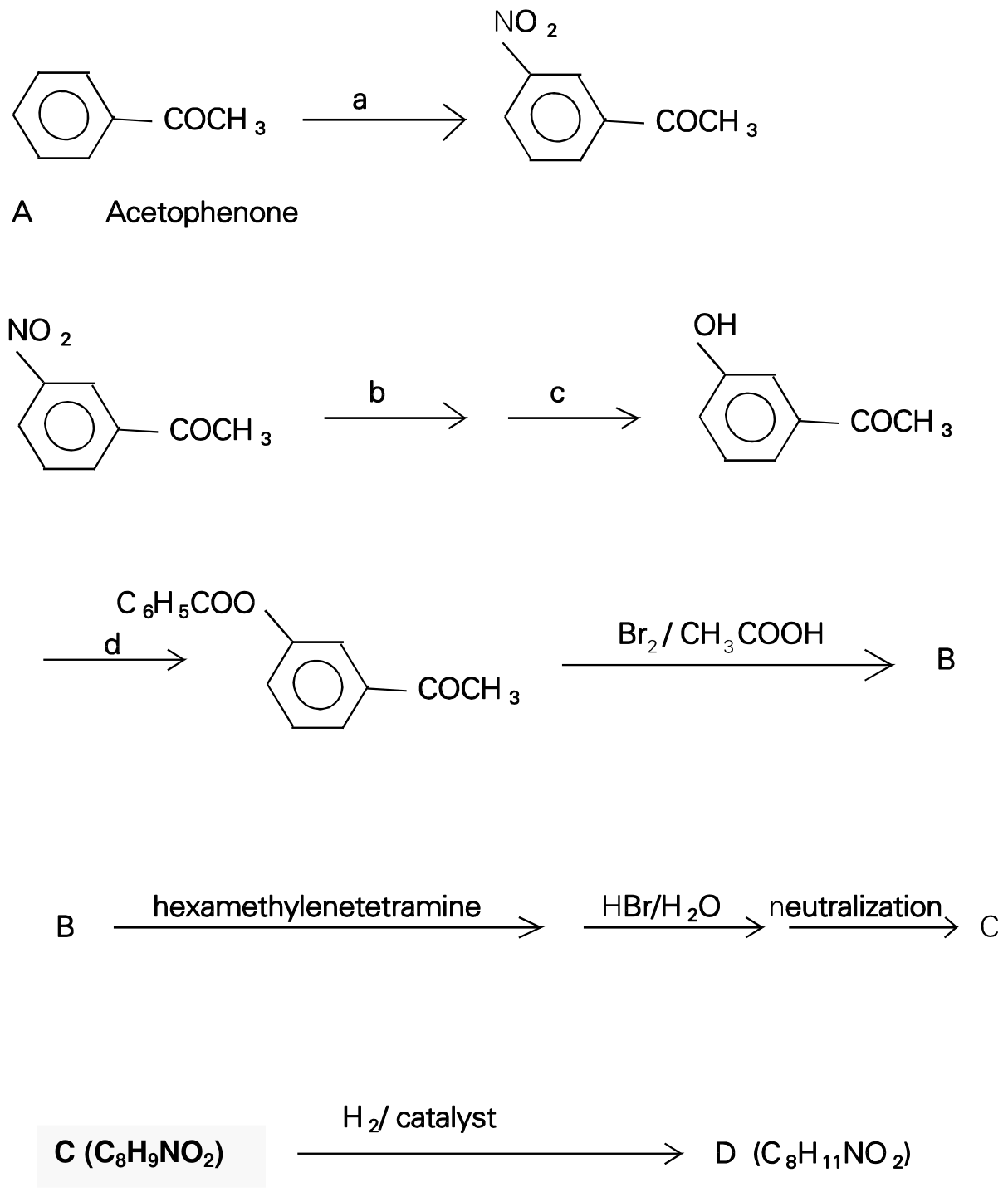
Problems:
6.1 What reagents were used in steps a, b, c, and d?
6.2 Give the structural formulae of compounds B, C and D.
6.3 Is it possible to prepare 3-hydroxyacetophenone from the reaction between phenol, acetylchloride and \(\ce{AlCl3}\)? Give reasons for your answer.
6.4 Give the formulae of the compounds that are formed by the reaction of compound C with a) 10% \(\ce{HCl}\) and b) 10% \(\ce{NaOH}\).
6.5 By the asterisk denote the chirality centre in the formula of compound D.
6.6 Give the spatial formula of enantiomer (R) of compound D.
Official English text of the problem.
Answers
-
6.1 a: Concentrated nitric acid
O=[N+]([O-])Oand concentrated sulfuric acidOS(=O)(=O)O. b: Iron[Fe]and hydrochloric acidCl. c: Sodium nitrite[Na+].[O-]N=Oand hydrochloric acid at \(0\text{–}5\,^\circ\mathrm{C}\), followed by warming with waterO. d: Benzoyl chlorideO=C(Cl)c1ccccc1and sodium hydroxide[Na+].[OH-]. -
6.2 B: 3-(2-Bromoacetyl)phenyl benzoate,
O=C(CBr)c1cccc(OC(=O)c2ccccc2)c1, molecular formula \(\ce{C15H11BrO3}\). C: 2-Amino-1-(3-hydroxyphenyl)ethan-1-one,NCC(=O)c1cccc(O)c1, molecular formula \(\ce{C8H9NO2}\). D: 2-Amino-1-(3-hydroxyphenyl)ethan-1-ol (norphenylephrine),NCC(O)c1cccc(O)c1, molecular formula \(\ce{C8H11NO2}\). -
6.3 No. The phenolic hydroxyl group directs ring acetylation to the ortho and para positions; this route does not prepare the required meta isomer.
-
6.4 a: C hydrochloride,
[NH3+]CC(=O)c1cccc(O)c1.[Cl-], formula \(\ce{C8H10ClNO2}\). b: Sodium 3-(2-aminoacetyl)phenolate,NCC(=O)c1cccc([O-])c1.[Na+], formula \(\ce{C8H8NNaO2}\). -
6.5 The sole chirality centre is the benzylic alcohol carbon: \[ \ce{HO-C6H4-C^{*}H(OH)-CH2NH2} \] with meta substitution on the ring.
-
6.6 (1R)-2-Amino-1-(3-hydroxyphenyl)ethan-1-ol:
NC[C@H](O)c1cccc(O)c1. A Fischer projection has 3-hydroxyphenyl at the top, aminomethyl at the bottom, hydroxyl on the left, and hydrogen on the right.
Solution
In the condensed equations below, the two substituents on each \(\ce{C6H4}\) ring are meta, except where ortho or para is explicitly specified.
6.1 — Reagents and transformations
Step a: nitration. Acetophenone, CC(=O)c1ccccc1, is nitrated with concentrated nitric and sulfuric acids:
\[ \ce{C6H5COCH3 + HNO3 -> O2NC6H4COCH3 + H2O}. \]
The acetyl group withdraws electron density and is a deactivating, meta-directing substituent. The principal product is therefore 3-nitroacetophenone, CC(=O)c1cccc([N+](=O)[O-])c1.
Step b: reduction of the nitro group. Iron and hydrochloric acid reduce the nitro group to an amino group while preserving the ketone. In the acidic medium, the product is 3-aminoacetophenone hydrochloride, CC(=O)c1cccc([NH3+])c1.[Cl-]:
\[ \ce{O2NC6H4COCH3 + 3Fe + 7HCl -> [H3NC6H4COCH3]Cl + 3FeCl2 + 2H2O}. \]
The inorganic reduction product is iron(II) chloride, [Fe+2].[Cl-].[Cl-].
Step c: diazotization followed by hydrolysis. Sodium nitrite and hydrochloric acid at \(0\text{–}5\,^\circ\mathrm{C}\) convert the aromatic amino group into a diazonium group:
\[ \ce{[H3NC6H4COCH3]Cl + NaNO2 + HCl -> [N2C6H4COCH3]Cl + NaCl + 2H2O}. \]
The intermediate is 3-acetylbenzenediazonium chloride, CC(=O)c1cccc([N+]#N)c1.[Cl-]. Warming its aqueous solution replaces the diazonium group with hydroxyl:
\[ \ce{[N2C6H4COCH3]Cl + H2O -> HOC6H4COCH3 + N2 + HCl}. \]
This gives 3-hydroxyacetophenone, CC(=O)c1cccc(O)c1. The other products include sodium chloride, [Na+].[Cl-], and nitrogen, N#N.
Step d: protection by benzoylation. Benzoyl chloride and aqueous sodium hydroxide convert the phenolic hydroxyl group into a benzoate ester:
\[ \ce{HOC6H4COCH3 + C6H5COCl + NaOH -> C6H5COOC6H4COCH3 + NaCl + H2O}. \]
The product is 3-acetylphenyl benzoate, CC(=O)c1cccc(OC(=O)c2ccccc2)c1. Benzoylation protects the phenolic group and reduces its strong activation of the aromatic ring toward bromination.
6.2 — Identification of B, C and D
Formation of B. Bromine, BrBr, in acetic acid, CC(=O)O, brominates the ketone at its alpha carbon through the enol:
\[ \ce{C6H5COOC6H4COCH3 + Br2 -> C6H5COOC6H4COCH2Br + HBr}. \]
Thus B is the alpha-bromoketone 3-(2-bromoacetyl)phenyl benzoate. The coproduct is hydrogen bromide, present as hydrobromic acid, Br, in aqueous solution.
Formation of C. Hexamethylenetetramine, C1N2CN3CN1CN(C2)C3, effects a Delépine synthesis: a cage nitrogen displaces bromide from the bromomethyl group, and subsequent acidic hydrolysis releases a primary amine.
The aqueous acid treatment also hydrolyses the phenolic benzoate protecting group. This deprotection is required by the stated formula of C: the seven carbons of the benzoyl group are absent.
A balanced overall equation for the reaction with hexamethylenetetramine and the acidic hydrolysis is
\[ \begin{aligned} &\ce{C6H5COOC6H4COCH2Br + C6H12N4 + 3HBr + 7H2O}\\ &\qquad\ce{-> [HOC6H4COCH2NH3]Br + C6H5COOH + 3NH4Br + 6HCHO}. \end{aligned} \]
The organic salt is C hydrobromide, [NH3+]CC(=O)c1cccc(O)c1.[Br-]. The other hydrolysis products are benzoic acid, O=C(O)c1ccccc1, ammonium bromide, [NH4+].[Br-], and formaldehyde, C=O.
Neutralization releases C; using sodium hydroxide, the relevant equation is
\[ \ce{[HOC6H4COCH2NH3]Br + NaOH -> HOC6H4COCH2NH2 + NaBr + H2O}. \]
Here sodium bromide is [Na+].[Br-]. Consequently,
\[ \boxed{\ce{C = HOC6H4COCH2NH2}} \]
with molecular formula \(\ce{C8H9NO2}\), as given.
Formation of D. Catalytic hydrogenation with hydrogen, [H][H], reduces the ketone to a secondary alcohol:
\[ \ce{HOC6H4COCH2NH2 + H2 ->[catalyst] HOC6H4CH(OH)CH2NH2}. \]
Therefore,
\[ \boxed{\ce{D = HOC6H4CH(OH)CH2NH2}}. \]
The addition of two hydrogen atoms changes \(\ce{C8H9NO2}\) into \(\ce{C8H11NO2}\), matching the supplied formula. With an achiral catalyst, reduction of the planar carbonyl group gives a racemic mixture.
6.3 — Why direct acetylation of phenol does not give the required isomer
The proposed reagents are phenol, Oc1ccccc1, acetyl chloride, CC(=O)Cl, and aluminium chloride, Cl[Al](Cl)Cl.
The phenolic hydroxyl group directs electrophilic aromatic substitution to the ortho and para positions. Consequently, this reaction does not establish the meta relationship required for 3-hydroxyacetophenone.
O-Acetylation may occur first, giving phenyl acetate, CC(=O)Oc1ccccc1:
\[ \ce{C6H5OH + CH3COCl -> C6H5OCOCH3 + HCl}. \]
Aluminium chloride can promote a Fries rearrangement of this ester:
\[ \ce{C6H5OCOCH3 ->[AlCl3] HOC6H4COCH3} \qquad\text{(ortho or para product)}. \]
The resulting ring-acetylated products are 2-hydroxyacetophenone, CC(=O)c1ccccc1O, and/or 4-hydroxyacetophenone, CC(=O)c1ccc(O)cc1.
The supplied synthesis instead establishes the meta relationship by nitrating acetophenone, then converts the nitro substituent into hydroxyl.
6.4 — Reactions of C with acid and base
a) With 10% hydrochloric acid: the amino group is protonated, giving C hydrochloride:
\[ \ce{HOC6H4COCH2NH2 + HCl -> [HOC6H4COCH2NH3]+ + Cl-}. \]
Its structure is [NH3+]CC(=O)c1cccc(O)c1.[Cl-]; the phenolic group remains neutral.
b) With 10% sodium hydroxide: the phenolic hydroxyl group is deprotonated, giving sodium 3-(2-aminoacetyl)phenolate:
\[ \ce{HOC6H4COCH2NH2 + NaOH -> [OC6H4COCH2NH2]- + Na+ + H2O}. \]
Its structure is NCC(=O)c1cccc([O-])c1.[Na+]; the amino group remains neutral.
6.5 — Chirality centre
The carbon formed by reduction of the carbonyl group bears four different substituents:
- hydroxyl;
- hydrogen;
- aminomethyl;
- 3-hydroxyphenyl.
It is therefore the only chirality centre:
\[ \boxed{\ce{HO-C6H4-C^{*}H(OH)-CH2NH2}}. \]
Place the asterisk on the side-chain carbon directly bonded to the benzene ring and to the alcoholic hydroxyl group.
6.6 — Spatial formula of the \(R\) enantiomer
The Cahn–Ingold–Prelog priorities at the stereocentre are
\[ \underbrace{\ce{-OH}}_{1} > \underbrace{\ce{-CH2NH2}}_{2} > \underbrace{\ce{-C6H4OH}}_{3} > \underbrace{\ce{-H}}_{4}. \]
The two carbon-attached groups are distinguished at the next comparison: the aminomethyl carbon has the list \((\ce{N},\ce{H},\ce{H})\), whereas the aromatic carbon has \((\ce{C},\ce{C},\ce{C})\), including the aromatic multiple-bond duplication. Nitrogen outranks carbon, so aminomethyl has priority 2.
For a Fischer projection, place:
- the 3-hydroxyphenyl group at the top;
- the aminomethyl group at the bottom;
- hydroxyl on the left;
- hydrogen on the right.
The horizontal bonds point toward the observer, and the vertical bonds point away. The sequence \(1\rightarrow2\rightarrow3\) is counterclockwise on the page; because hydrogen points toward the observer, reversing that sense gives \(R\).
The corresponding stereochemical SMILES is NC[C@H](O)c1cccc(O)c1, representing (1R)-2-amino-1-(3-hydroxyphenyl)ethan-1-ol.
The answers were checked against the official answers published by the organisers.
IChO 1985 · Theorieaufgabe 6
Synthese eines sympathomimetischen 2-Phenylethylamin-Derivats aus Acetophenon
Das folgende Schema beschreibt die Synthese einer Verbindung D (mit sympathomimetischer Wirkung), deren Grundgerüst aus 2-Phenylethylamin besteht.
Aufgaben:
6.1 Welche Reagenzien wurden in den Schritten a, b, c und d verwendet?
6.2 Geben Sie die Strukturformeln der Verbindungen B, C und D an.
6.3 Ist es möglich, 3-Hydroxyacetophenon durch die Reaktion von Phenol, Acetylchlorid und \(\ce{AlCl3}\) herzustellen? Begründen Sie Ihre Antwort.
6.4 Geben Sie die Formeln der Verbindungen an, die bei der Reaktion der Verbindung C mit a) 10%iger \(\ce{HCl}\) und b) 10%iger \(\ce{NaOH}\) entstehen.
6.5 Kennzeichnen Sie das Chiralitätszentrum in der Formel der Verbindung D mit einem Sternchen.
6.6 Geben Sie die räumliche Strukturformel des Enantiomers (R) der Verbindung D an.
Aufgabentext aus dem offiziellen englischen Text übersetzt.
Antworten
-
6.1 a: Konzentrierte Salpetersäure
O=[N+]([O-])Ound konzentrierte SchwefelsäureOS(=O)(=O)O. b: Eisen[Fe]und SalzsäureCl. c: Natriumnitrit[Na+].[O-]N=Ound Salzsäure bei \(0\text{–}5\,^\circ\mathrm{C}\), anschließend Erwärmen mit WasserO. d: BenzoylchloridO=C(Cl)c1ccccc1und Natriumhydroxid[Na+].[OH-]. -
6.2 B: 3-(2-Bromacetyl)phenylbenzoat,
O=C(CBr)c1cccc(OC(=O)c2ccccc2)c1, Summenformel \(\ce{C15H11BrO3}\). C: 2-Amino-1-(3-hydroxyphenyl)ethan-1-on,NCC(=O)c1cccc(O)c1, Summenformel \(\ce{C8H9NO2}\). D: 2-Amino-1-(3-hydroxyphenyl)ethan-1-ol (Norfenefrin),NCC(O)c1cccc(O)c1, Summenformel \(\ce{C8H11NO2}\). -
6.3 Nein. Die phenolische Hydroxygruppe dirigiert die Acetylierung am Ring in die ortho- und para-Positionen; auf diesem Weg lässt sich das erforderliche meta-Isomer nicht herstellen.
-
6.4 a: C-Hydrochlorid,
[NH3+]CC(=O)c1cccc(O)c1.[Cl-], Formel \(\ce{C8H10ClNO2}\). b: Natrium-3-(2-aminoacetyl)phenolat,NCC(=O)c1cccc([O-])c1.[Na+], Formel \(\ce{C8H8NNaO2}\). -
6.5 Das einzige Chiralitätszentrum ist das benzylische Alkohol-Kohlenstoffatom: \[ \ce{HO-C6H4-C^{*}H(OH)-CH2NH2} \] mit meta-Substitution am Ring.
-
6.6 (1R)-2-Amino-1-(3-hydroxyphenyl)ethan-1-ol:
NC[C@H](O)c1cccc(O)c1. In einer Fischer-Projektion steht 3-Hydroxyphenyl oben, Aminomethyl unten, die Hydroxygruppe links und Wasserstoff rechts.
Lösung
In den folgenden Gleichungen mit kondensierten Strukturformeln stehen die beiden Substituenten an jedem \(\ce{C6H4}\)-Ring meta zueinander, außer wenn ausdrücklich ortho oder para angegeben ist.
6.1 — Reagenzien und Umsetzungen
Schritt a: Nitrierung. Acetophenon, CC(=O)c1ccccc1, wird mit konzentrierter Salpeter- und Schwefelsäure nitriert:
\[ \ce{C6H5COCH3 + HNO3 -> O2NC6H4COCH3 + H2O}. \]
Die Acetylgruppe zieht Elektronendichte ab und ist ein desaktivierender, meta-dirigierender Substituent. Das Hauptprodukt ist daher 3-Nitroacetophenon, CC(=O)c1cccc([N+](=O)[O-])c1.
Schritt b: Reduktion der Nitrogruppe. Eisen und Salzsäure reduzieren die Nitrogruppe zu einer Aminogruppe, während die Ketogruppe erhalten bleibt. Im sauren Medium ist das Produkt 3-Aminoacetophenonhydrochlorid, CC(=O)c1cccc([NH3+])c1.[Cl-]:
\[ \ce{O2NC6H4COCH3 + 3Fe + 7HCl -> [H3NC6H4COCH3]Cl + 3FeCl2 + 2H2O}. \]
Das anorganische Reduktionsprodukt ist Eisen(II)-chlorid, [Fe+2].[Cl-].[Cl-].
Schritt c: Diazotierung mit anschließender Hydrolyse. Natriumnitrit und Salzsäure wandeln bei \(0\text{–}5\,^\circ\mathrm{C}\) die aromatische Aminogruppe in eine Diazoniumgruppe um:
\[ \ce{[H3NC6H4COCH3]Cl + NaNO2 + HCl -> [N2C6H4COCH3]Cl + NaCl + 2H2O}. \]
Das Zwischenprodukt ist 3-Acetylbenzoldiazoniumchlorid, CC(=O)c1cccc([N+]#N)c1.[Cl-]. Beim Erwärmen seiner wässrigen Lösung wird die Diazoniumgruppe durch eine Hydroxygruppe ersetzt:
\[ \ce{[N2C6H4COCH3]Cl + H2O -> HOC6H4COCH3 + N2 + HCl}. \]
Dabei entsteht 3-Hydroxyacetophenon, CC(=O)c1cccc(O)c1. Zu den weiteren Produkten gehören Natriumchlorid, [Na+].[Cl-], und Stickstoff, N#N.
Schritt d: Schutz durch Benzoylierung. Benzoylchlorid und wässrige Natriumhydroxidlösung wandeln die phenolische Hydroxygruppe in einen Benzoesäureester um:
\[ \ce{HOC6H4COCH3 + C6H5COCl + NaOH -> C6H5COOC6H4COCH3 + NaCl + H2O}. \]
Das Produkt ist 3-Acetylphenylbenzoat, CC(=O)c1cccc(OC(=O)c2ccccc2)c1. Die Benzoylierung schützt die phenolische Gruppe und vermindert deren starke aktivierende Wirkung auf den aromatischen Ring gegenüber der Bromierung.
6.2 — Identifizierung von B, C und D
Bildung von B. Brom, BrBr, in Essigsäure, CC(=O)O, bromiert das Keton über das Enol am alpha-Kohlenstoffatom:
\[ \ce{C6H5COOC6H4COCH3 + Br2 -> C6H5COOC6H4COCH2Br + HBr}. \]
Somit ist B das alpha-Bromketon 3-(2-Bromacetyl)phenylbenzoat. Als weiteres Produkt entsteht Bromwasserstoff, der in wässriger Lösung als Bromwasserstoffsäure, Br, vorliegt.
Bildung von C. Hexamethylentetramin, C1N2CN3CN1CN(C2)C3, bewirkt eine Delépine-Synthese: Ein Stickstoffatom der Käfigstruktur verdrängt Bromid aus der Brommethylgruppe, und die anschließende saure Hydrolyse setzt ein primäres Amin frei.
Die Behandlung mit wässriger Säure hydrolysiert auch die Benzoat-Schutzgruppe der phenolischen Gruppe. Diese Abspaltung der Schutzgruppe ist aufgrund der angegebenen Formel von C erforderlich: Die sieben Kohlenstoffatome der Benzoylgruppe fehlen.
Eine ausgeglichene Gesamtgleichung für die Reaktion mit Hexamethylentetramin und die saure Hydrolyse lautet
\[ \begin{aligned} &\ce{C6H5COOC6H4COCH2Br + C6H12N4 + 3HBr + 7H2O}\\ &\qquad\ce{-> [HOC6H4COCH2NH3]Br + C6H5COOH + 3NH4Br + 6HCHO}. \end{aligned} \]
Das organische Salz ist C-Hydrobromid, [NH3+]CC(=O)c1cccc(O)c1.[Br-]. Die weiteren Hydrolyseprodukte sind Benzoesäure, O=C(O)c1ccccc1, Ammoniumbromid, [NH4+].[Br-], und Formaldehyd, C=O.
Die Neutralisation setzt C frei; bei Verwendung von Natriumhydroxid lautet die entsprechende Gleichung
\[ \ce{[HOC6H4COCH2NH3]Br + NaOH -> HOC6H4COCH2NH2 + NaBr + H2O}. \]
Hier ist Natriumbromid [Na+].[Br-]. Folglich gilt
\[ \boxed{\ce{C = HOC6H4COCH2NH2}} \]
mit der Summenformel \(\ce{C8H9NO2}\), wie angegeben.
Bildung von D. Die katalytische Hydrierung mit Wasserstoff, [H][H], reduziert das Keton zu einem sekundären Alkohol:
\[ \ce{HOC6H4COCH2NH2 + H2 ->[catalyst] HOC6H4CH(OH)CH2NH2}. \]
Daher gilt
\[ \boxed{\ce{D = HOC6H4CH(OH)CH2NH2}}. \]
Durch die Addition von zwei Wasserstoffatomen wird aus \(\ce{C8H9NO2}\) die Formel \(\ce{C8H11NO2}\), was mit der vorgegebenen Formel übereinstimmt. Mit einem achiralen Katalysator ergibt die Reduktion der planaren Carbonylgruppe ein racemisches Gemisch.
6.3 — Warum die direkte Acetylierung von Phenol nicht das erforderliche Isomer ergibt
Die vorgeschlagenen Reagenzien sind Phenol, Oc1ccccc1, Acetylchlorid, CC(=O)Cl, und Aluminiumchlorid, Cl[Al](Cl)Cl.
Die phenolische Hydroxygruppe dirigiert die elektrophile aromatische Substitution in die ortho- und para-Positionen. Folglich führt diese Reaktion nicht zu der für 3-Hydroxyacetophenon erforderlichen meta-Stellung.
Zunächst kann eine O-Acetylierung stattfinden, bei der Phenylacetat, CC(=O)Oc1ccccc1, entsteht:
\[ \ce{C6H5OH + CH3COCl -> C6H5OCOCH3 + HCl}. \]
Aluminiumchlorid kann eine Fries-Umlagerung dieses Esters fördern:
\[ \ce{C6H5OCOCH3 ->[AlCl3] HOC6H4COCH3} \qquad\text{(ortho- oder para-Produkt)}. \]
Die dabei entstehenden am Ring acetylierten Produkte sind 2-Hydroxyacetophenon, CC(=O)c1ccccc1O, und/oder 4-Hydroxyacetophenon, CC(=O)c1ccc(O)cc1.
Die vorgegebene Synthese stellt die meta-Stellung dagegen durch Nitrierung von Acetophenon her und wandelt anschließend den Nitrosubstituenten in eine Hydroxygruppe um.
6.4 — Reaktionen von C mit Säure und Base
a) Mit 10%iger Salzsäure: Die Aminogruppe wird protoniert, wobei C-Hydrochlorid entsteht:
\[ \ce{HOC6H4COCH2NH2 + HCl -> [HOC6H4COCH2NH3]+ + Cl-}. \]
Seine Struktur ist [NH3+]CC(=O)c1cccc(O)c1.[Cl-]; die phenolische Gruppe bleibt neutral.
b) Mit 10%iger Natronlauge: Die phenolische Hydroxygruppe wird deprotoniert, wobei Natrium-3-(2-aminoacetyl)phenolat entsteht:
\[ \ce{HOC6H4COCH2NH2 + NaOH -> [OC6H4COCH2NH2]- + Na+ + H2O}. \]
Seine Struktur ist NCC(=O)c1cccc([O-])c1.[Na+]; die Aminogruppe bleibt neutral.
6.5 — Chiralitätszentrum
Das durch Reduktion der Carbonylgruppe entstandene Kohlenstoffatom trägt vier verschiedene Substituenten:
- Hydroxygruppe;
- Wasserstoff;
- Aminomethyl;
- 3-Hydroxyphenyl.
Es ist daher das einzige Chiralitätszentrum:
\[ \boxed{\ce{HO-C6H4-C^{*}H(OH)-CH2NH2}}. \]
Setzen Sie das Sternchen an das Kohlenstoffatom der Seitenkette, das direkt an den Benzolring und an die alkoholische Hydroxygruppe gebunden ist.
6.6 — Räumliche Strukturformel des \(R\)-Enantiomers
Die Cahn–Ingold–Prelog-Prioritäten am Stereozentrum sind
\[ \underbrace{\ce{-OH}}_{1} > \underbrace{\ce{-CH2NH2}}_{2} > \underbrace{\ce{-C6H4OH}}_{3} > \underbrace{\ce{-H}}_{4}. \]
Die beiden über Kohlenstoff gebundenen Gruppen unterscheiden sich auf der nächsten Vergleichsebene: Das Aminomethyl-Kohlenstoffatom hat die Liste \((\ce{N},\ce{H},\ce{H})\), während das aromatische Kohlenstoffatom unter Berücksichtigung der Duplikation bei aromatischen Mehrfachbindungen die Liste \((\ce{C},\ce{C},\ce{C})\) hat. Stickstoff hat Vorrang vor Kohlenstoff, daher erhält Aminomethyl die Priorität 2.
Ordnen Sie für eine Fischer-Projektion die Gruppen wie folgt an:
- die 3-Hydroxyphenylgruppe oben;
- die Aminomethylgruppe unten;
- die Hydroxygruppe links;
- Wasserstoff rechts.
Die horizontalen Bindungen zeigen zum Betrachter hin, die vertikalen Bindungen von ihm weg. Die Folge \(1\rightarrow2\rightarrow3\) verläuft auf dem Blatt gegen den Uhrzeigersinn; da Wasserstoff zum Betrachter hin zeigt, ergibt die Umkehrung dieses Drehsinns \(R\).
Der entsprechende stereochemische SMILES lautet NC[C@H](O)c1cccc(O)c1 und stellt (1R)-2-Amino-1-(3-hydroxyphenyl)ethan-1-ol dar.
Die Ergebnisse wurden mit den von den Veranstaltern veröffentlichten offiziellen Ergebnissen abgeglichen.
IChO 1985 · Teori sorusu 6
Asetofenondan sempatomimetik bir 2-feniletilamin türevinin sentezi
Aşağıdaki şema, iskeleti 2-feniletilaminden oluşan (sempatomimetik etkileri olan) bir D bileşiğinin sentezini göstermektedir.
Sorular:
6.1 a, b, c ve d basamaklarında hangi reaktifler kullanılmıştır?
6.2 B, C ve D bileşiklerinin yapı formüllerini veriniz.
6.3 Fenol, asetil klorür ve \(\ce{AlCl3}\) arasındaki tepkimeyle 3-hidroksiasetofenon hazırlamak mümkün müdür? Yanıtınızın gerekçelerini belirtiniz.
6.4 C bileşiğinin a) %10'luk \(\ce{HCl}\) ve b) %10'luk \(\ce{NaOH}\) ile tepkimesinde oluşan bileşiklerin formüllerini veriniz.
6.5 D bileşiğinin formülünde kiralite merkezini yıldız işaretiyle belirtiniz.
6.6 D bileşiğinin (R) enantiyomerinin uzaysal formülünü veriniz.
Soru metni resmi İngilizce metinden çevrilmiştir.
Cevaplar
-
6.1 a: Derişik nitrik asit
O=[N+]([O-])Ove derişik sülfürik asitOS(=O)(=O)O. b: Demir[Fe]ve hidroklorik asitCl. c: \(0\text{–}5\,^\circ\mathrm{C}\) sıcaklıkta sodyum nitrit[Na+].[O-]N=Ove hidroklorik asit, ardından suOile ısıtma. d: Benzoil klorürO=C(Cl)c1ccccc1ve sodyum hidroksit[Na+].[OH-]. -
6.2 B: 3-(2-Bromoasetil)fenil benzoat,
O=C(CBr)c1cccc(OC(=O)c2ccccc2)c1, molekül formülü \(\ce{C15H11BrO3}\). C: 2-Amino-1-(3-hidroksifenil)etan-1-on,NCC(=O)c1cccc(O)c1, molekül formülü \(\ce{C8H9NO2}\). D: 2-Amino-1-(3-hidroksifenil)etan-1-ol (norfenilefrin),NCC(O)c1cccc(O)c1, molekül formülü \(\ce{C8H11NO2}\). -
6.3 Hayır. Fenolik hidroksil grubu, halkadaki asetillenmeyi orto ve para konumlarına yönlendirir; bu yolla gerekli meta izomeri elde edilemez.
-
6.4 a: C hidroklorür,
[NH3+]CC(=O)c1cccc(O)c1.[Cl-], formülü \(\ce{C8H10ClNO2}\). b: Sodyum 3-(2-aminoasetil)fenolat,NCC(=O)c1cccc([O-])c1.[Na+], formülü \(\ce{C8H8NNaO2}\). -
6.5 Tek kiralite merkezi, benzilik alkol karbonudur: \[ \ce{HO-C6H4-C^{*}H(OH)-CH2NH2} \] Halkadaki sübstitüentler meta konumundadır.
-
6.6 (1R)-2-Amino-1-(3-hidroksifenil)etan-1-ol:
NC[C@H](O)c1cccc(O)c1. Fischer izdüşümünde 3-hidroksifenil üstte, aminometil altta, hidroksil solda ve hidrojen sağda bulunur.
Çözüm
Aşağıdaki kısaltılmış denklemlerde, orto veya para olduğu açıkça belirtilen durumlar dışında, her \(\ce{C6H4}\) halkasındaki iki sübstitüent birbirine göre meta konumundadır.
6.1 — Reaktifler ve dönüşümler
a basamağı: nitrolama. Asetofenon, CC(=O)c1ccccc1, derişik nitrik ve sülfürik asitlerle nitrolanır:
\[ \ce{C6H5COCH3 + HNO3 -> O2NC6H4COCH3 + H2O}. \]
Asetil grubu elektron yoğunluğunu çeker ve halkayı deaktive eden, meta yönlendirici bir sübstitüenttir. Bu nedenle ana ürün 3-nitroasetofenon, CC(=O)c1cccc([N+](=O)[O-])c1, olur.
b basamağı: nitro grubunun indirgenmesi. Demir ve hidroklorik asit, keton grubunu koruyarak nitro grubunu amino grubuna indirger. Asidik ortamda ürün 3-aminoasetofenon hidroklorür, CC(=O)c1cccc([NH3+])c1.[Cl-], olur:
\[ \ce{O2NC6H4COCH3 + 3Fe + 7HCl -> [H3NC6H4COCH3]Cl + 3FeCl2 + 2H2O}. \]
İndirgeme tepkimesinin inorganik ürünü demir(II) klorür, [Fe+2].[Cl-].[Cl-], olur.
c basamağı: diazolama ve ardından hidroliz. Sodyum nitrit ve hidroklorik asit, \(0\text{–}5\,^\circ\mathrm{C}\) sıcaklıkta aromatik amino grubunu diazonyum grubuna dönüştürür:
\[ \ce{[H3NC6H4COCH3]Cl + NaNO2 + HCl -> [N2C6H4COCH3]Cl + NaCl + 2H2O}. \]
Ara ürün 3-asetilbenzendiazonyum klorür, CC(=O)c1cccc([N+]#N)c1.[Cl-], olur. Sulu çözeltisi ısıtıldığında diazonyum grubu hidroksil grubuyla yer değiştirir:
\[ \ce{[N2C6H4COCH3]Cl + H2O -> HOC6H4COCH3 + N2 + HCl}. \]
Böylece 3-hidroksiasetofenon, CC(=O)c1cccc(O)c1, elde edilir. Diğer ürünler arasında sodyum klorür, [Na+].[Cl-], ve azot, N#N, bulunur.
d basamağı: benzoilleme ile koruma. Benzoil klorür ve sulu sodyum hidroksit, fenolik hidroksil grubunu bir benzoat esterine dönüştürür:
\[ \ce{HOC6H4COCH3 + C6H5COCl + NaOH -> C6H5COOC6H4COCH3 + NaCl + H2O}. \]
Ürün 3-asetilfenil benzoat, CC(=O)c1cccc(OC(=O)c2ccccc2)c1, olur. Benzoilleme, fenolik grubu korur ve bu grubun aromatik halkayı bromlanmaya karşı güçlü biçimde etkinleştirme etkisini azaltır.
6.2 — B, C ve D'nin belirlenmesi
B'nin oluşumu. Asetik asit, CC(=O)O, içindeki brom, BrBr, enol üzerinden ketonun alfa karbonunu bromlar:
\[ \ce{C6H5COOC6H4COCH3 + Br2 -> C6H5COOC6H4COCH2Br + HBr}. \]
Dolayısıyla B, bir alfa-bromoketon olan 3-(2-bromoasetil)fenil benzoattır. Birlikte oluşan diğer ürün, sulu çözeltide hidrobromik asit, Br, olarak bulunan hidrojen bromürdür.
C'nin oluşumu. Hekzametilentetramin, C1N2CN3CN1CN(C2)C3, bir Delépine sentezi gerçekleştirir: kafes yapısındaki bir azot atomu, bromometil grubundaki bromürün yerini alır ve ardından yapılan asidik hidroliz bir birincil amin açığa çıkarır.
Sulu asitle işlem, fenolik benzoat koruyucu grubunu da hidroliz eder. C için belirtilen formül, bu koruyucu grubun uzaklaştırılmasını gerektirir: benzoil grubunun yedi karbonu bu formülde bulunmaz.
Hekzametilentetramin ile tepkimeyi ve asidik hidrolizi kapsayan denkleştirilmiş toplam denklem şöyledir:
\[ \begin{aligned} &\ce{C6H5COOC6H4COCH2Br + C6H12N4 + 3HBr + 7H2O}\\ &\qquad\ce{-> [HOC6H4COCH2NH3]Br + C6H5COOH + 3NH4Br + 6HCHO}. \end{aligned} \]
Organik tuz C hidrobromür, [NH3+]CC(=O)c1cccc(O)c1.[Br-], olur. Diğer hidroliz ürünleri benzoik asit, O=C(O)c1ccccc1, amonyum bromür, [NH4+].[Br-], ve formaldehit, C=O, olur.
Nötralleştirme C'yi serbest hâle getirir; sodyum hidroksit kullanıldığında ilgili denklem şöyledir:
\[ \ce{[HOC6H4COCH2NH3]Br + NaOH -> HOC6H4COCH2NH2 + NaBr + H2O}. \]
Burada sodyum bromür, [Na+].[Br-], şeklindedir. Sonuç olarak,
\[ \boxed{\ce{C = HOC6H4COCH2NH2}} \]
olup molekül formülü, verildiği gibi, \(\ce{C8H9NO2}\) olur.
D'nin oluşumu. Hidrojen, [H][H], ile katalitik hidrojenleme, ketonu ikincil bir alkole indirger:
\[ \ce{HOC6H4COCH2NH2 + H2 ->[catalyst] HOC6H4CH(OH)CH2NH2}. \]
Dolayısıyla,
\[ \boxed{\ce{D = HOC6H4CH(OH)CH2NH2}}. \]
İki hidrojen atomunun eklenmesi, \(\ce{C8H9NO2}\) formülünü \(\ce{C8H11NO2}\) formülüne dönüştürür; bu da verilen formülle uyumludur. Akiral bir katalizör kullanıldığında, düzlemsel karbonil grubunun indirgenmesi rasemik bir karışım verir.
6.3 — Fenolün doğrudan asetillenmesinin neden gerekli izomeri vermediği
Önerilen reaktifler fenol, Oc1ccccc1, asetil klorür, CC(=O)Cl, ve alüminyum klorür, Cl[Al](Cl)Cl, bileşikleridir.
Fenolik hidroksil grubu, elektrofilik aromatik sübstitüsyonu orto ve para konumlarına yönlendirir. Bu nedenle bu tepkime, 3-hidroksiasetofenon için gerekli olan meta konumlanmasını sağlamaz.
Önce O-asetilleme gerçekleşerek fenil asetat, CC(=O)Oc1ccccc1, oluşabilir:
\[ \ce{C6H5OH + CH3COCl -> C6H5OCOCH3 + HCl}. \]
Alüminyum klorür, bu esterin Fries çevrilmesini kolaylaştırabilir:
\[ \ce{C6H5OCOCH3 ->[AlCl3] HOC6H4COCH3} \qquad\text{(orto veya para ürünü)}. \]
Halkası asetillenmiş ürünler 2-hidroksiasetofenon, CC(=O)c1ccccc1O, ve/veya 4-hidroksiasetofenon, CC(=O)c1ccc(O)cc1, olur.
Verilen sentezde ise meta konumlanması asetofenonun nitrolanmasıyla sağlanır, ardından nitro sübstitüenti hidroksile dönüştürülür.
6.4 — C'nin asit ve bazla tepkimeleri
a) %10'luk hidroklorik asitle: amino grubu protonlanarak C hidroklorür oluşur:
\[ \ce{HOC6H4COCH2NH2 + HCl -> [HOC6H4COCH2NH3]+ + Cl-}. \]
Yapısı [NH3+]CC(=O)c1cccc(O)c1.[Cl-] şeklindedir; fenolik grup nötr kalır.
b) %10'luk sodyum hidroksitle: fenolik hidroksil grubu protonunu kaybederek sodyum 3-(2-aminoasetil)fenolat oluşur:
\[ \ce{HOC6H4COCH2NH2 + NaOH -> [OC6H4COCH2NH2]- + Na+ + H2O}. \]
Yapısı NCC(=O)c1cccc([O-])c1.[Na+] şeklindedir; amino grubu nötr kalır.
6.5 — Kiralite merkezi
Karbonil grubunun indirgenmesiyle oluşan karbon, dört farklı sübstitüent taşır:
- hidroksil;
- hidrojen;
- aminometil;
- 3-hidroksifenil.
Bu nedenle tek kiralite merkezi bu karbondur:
\[ \boxed{\ce{HO-C6H4-C^{*}H(OH)-CH2NH2}}. \]
Yıldız işaretini benzen halkasına ve alkol hidroksil grubuna doğrudan bağlı olan yan zincir karbonunun üzerine yerleştiriniz.
6.6 — \(R\) enantiyomerinin uzaysal formülü
Stereomerkezdeki Cahn–Ingold–Prelog öncelikleri şöyledir:
\[ \underbrace{\ce{-OH}}_{1} > \underbrace{\ce{-CH2NH2}}_{2} > \underbrace{\ce{-C6H4OH}}_{3} > \underbrace{\ce{-H}}_{4}. \]
Karbon üzerinden bağlı iki grup, bir sonraki karşılaştırmada ayırt edilir: aminometil karbonu için liste \((\ce{N},\ce{H},\ce{H})\) iken, aromatik çoklu bağ için yapılan atom çoğaltımı da hesaba katıldığında aromatik karbon için liste \((\ce{C},\ce{C},\ce{C})\) olur. Azot karbondan daha yüksek öncelikli olduğundan aminometilin önceliği 2'dir.
Bir Fischer izdüşümü için:
- 3-hidroksifenil grubunu üste;
- aminometil grubunu alta;
- hidroksili sola;
- hidrojeni sağa yerleştiriniz.
Yatay bağlar gözlemciye doğru, düşey bağlar ise gözlemciden uzağa yönelir. \(1\rightarrow2\rightarrow3\) sırası, sayfa üzerinde saat yönünün tersinedir; hidrojen gözlemciye doğru yöneldiği için bu yönün tersine çevrilmesi \(R\) konfigürasyonunu verir.
Buna karşılık gelen stereokimyasal SMILES, (1R)-2-amino-1-(3-hidroksifenil)etan-1-ol bileşiğini temsil eden NC[C@H](O)c1cccc(O)c1 şeklindedir.
Sonuçlar, düzenleyicilerin yayımladığı resmi sonuçlarla karşılaştırılarak kontrol edildi.
IChO 1985 · Problema teórico 6
Síntesis de un derivado simpaticomimético de la 2-feniletilamina a partir de acetofenona
El siguiente esquema describe la síntesis de un compuesto D (con efectos simpaticomiméticos) cuyo esqueleto es el de la 2-feniletilamina.
Cuestiones:
6.1 ¿Qué reactivos se utilizaron en las etapas a, b, c y d?
6.2 Dé las fórmulas estructurales de los compuestos B, C y D.
6.3 ¿Es posible preparar 3-hidroxiacetofenona mediante la reacción entre fenol, cloruro de acetilo y \(\ce{AlCl3}\)? Justifique su respuesta.
6.4 Dé las fórmulas de los compuestos que se forman por reacción del compuesto C con a) \(\ce{HCl}\) al 10% y b) \(\ce{NaOH}\) al 10%.
6.5 Indique con un asterisco el centro de quiralidad en la fórmula del compuesto D.
6.6 Dé la fórmula espacial del enantiómero (R) del compuesto D.
Enunciado traducido del texto oficial en inglés.
Respuestas
-
6.1 a: Ácido nítrico concentrado
O=[N+]([O-])Oy ácido sulfúrico concentradoOS(=O)(=O)O. b: Hierro[Fe]y ácido clorhídricoCl. c: Nitrito de sodio[Na+].[O-]N=Oy ácido clorhídrico a \(0\text{–}5\,^\circ\mathrm{C}\), seguidos de calentamiento con aguaO. d: Cloruro de benzoiloO=C(Cl)c1ccccc1e hidróxido de sodio[Na+].[OH-]. -
6.2 B: Benzoato de 3-(2-bromoacetil)fenilo,
O=C(CBr)c1cccc(OC(=O)c2ccccc2)c1, fórmula molecular \(\ce{C15H11BrO3}\). C: 2-Amino-1-(3-hidroxifenil)etan-1-ona,NCC(=O)c1cccc(O)c1, fórmula molecular \(\ce{C8H9NO2}\). D: 2-Amino-1-(3-hidroxifenil)etan-1-ol (norfenilefrina),NCC(O)c1cccc(O)c1, fórmula molecular \(\ce{C8H11NO2}\). -
6.3 No. El grupo hidroxilo fenólico orienta la acetilación del anillo hacia las posiciones orto y para; esta vía no permite preparar el isómero meta requerido.
-
6.4 a: Clorhidrato de C,
[NH3+]CC(=O)c1cccc(O)c1.[Cl-], fórmula \(\ce{C8H10ClNO2}\). b: 3-(2-Aminoacetil)fenolato de sodio,NCC(=O)c1cccc([O-])c1.[Na+], fórmula \(\ce{C8H8NNaO2}\). -
6.5 El único centro de quiralidad es el carbono bencílico que porta el grupo alcohol: \[ \ce{HO-C6H4-C^{*}H(OH)-CH2NH2} \] con sustitución meta en el anillo.
-
6.6 (1R)-2-Amino-1-(3-hidroxifenil)etan-1-ol:
NC[C@H](O)c1cccc(O)c1. Una proyección de Fischer tiene el 3-hidroxifenilo arriba, el aminometilo abajo, el hidroxilo a la izquierda y el hidrógeno a la derecha.
Solución
En las ecuaciones condensadas que siguen, los dos sustituyentes de cada anillo de \(\ce{C6H4}\) están en posición meta, salvo cuando se especifica explícitamente orto o para.
6.1 — Reactivos y transformaciones
Etapa a: nitración. La acetofenona, CC(=O)c1ccccc1, se nitra con ácidos nítrico y sulfúrico concentrados:
\[ \ce{C6H5COCH3 + HNO3 -> O2NC6H4COCH3 + H2O}. \]
El grupo acetilo atrae densidad electrónica y es un sustituyente desactivante y director meta. Por tanto, el producto principal es la 3-nitroacetofenona, CC(=O)c1cccc([N+](=O)[O-])c1.
Etapa b: reducción del grupo nitro. El hierro y el ácido clorhídrico reducen el grupo nitro a un grupo amino sin alterar la cetona. En el medio ácido, el producto es el clorhidrato de 3-aminoacetofenona, CC(=O)c1cccc([NH3+])c1.[Cl-]:
\[ \ce{O2NC6H4COCH3 + 3Fe + 7HCl -> [H3NC6H4COCH3]Cl + 3FeCl2 + 2H2O}. \]
El producto inorgánico de la reducción es el cloruro de hierro(II), [Fe+2].[Cl-].[Cl-].
Etapa c: diazotación seguida de hidrólisis. El nitrito de sodio y el ácido clorhídrico a \(0\text{–}5\,^\circ\mathrm{C}\) convierten el grupo amino aromático en un grupo diazonio:
\[ \ce{[H3NC6H4COCH3]Cl + NaNO2 + HCl -> [N2C6H4COCH3]Cl + NaCl + 2H2O}. \]
El intermedio es el cloruro de 3-acetilbencenodiazonio, CC(=O)c1cccc([N+]#N)c1.[Cl-]. El calentamiento de su disolución acuosa sustituye el grupo diazonio por un hidroxilo:
\[ \ce{[N2C6H4COCH3]Cl + H2O -> HOC6H4COCH3 + N2 + HCl}. \]
Así se obtiene 3-hidroxiacetofenona, CC(=O)c1cccc(O)c1. Entre los demás productos se encuentran el cloruro de sodio, [Na+].[Cl-], y el nitrógeno, N#N.
Etapa d: protección por benzoilación. El cloruro de benzoilo y el hidróxido de sodio acuoso convierten el grupo hidroxilo fenólico en un éster de benzoato:
\[ \ce{HOC6H4COCH3 + C6H5COCl + NaOH -> C6H5COOC6H4COCH3 + NaCl + H2O}. \]
El producto es el benzoato de 3-acetilfenilo, CC(=O)c1cccc(OC(=O)c2ccccc2)c1. La benzoilación protege el grupo fenólico y reduce la intensa activación que este ejerce sobre el anillo aromático frente a la bromación.
6.2 — Identificación de B, C y D
Formación de B. El bromo, BrBr, en ácido acético, CC(=O)O, broma la cetona en su carbono alfa a través del enol:
\[ \ce{C6H5COOC6H4COCH3 + Br2 -> C6H5COOC6H4COCH2Br + HBr}. \]
Así, B es la alfa-bromocetona benzoato de 3-(2-bromoacetil)fenilo. El coproducto es bromuro de hidrógeno, presente como ácido bromhídrico, Br, en disolución acuosa.
Formación de C. La hexametilentetramina, C1N2CN3CN1CN(C2)C3, lleva a cabo una síntesis de Delépine: un átomo de nitrógeno de la estructura de jaula desplaza al bromuro del grupo bromometilo, y la posterior hidrólisis ácida libera una amina primaria.
El tratamiento con ácido acuoso también hidroliza el grupo protector benzoato del hidroxilo fenólico. Esta desprotección es necesaria para obtener la fórmula indicada de C: los siete carbonos del grupo benzoilo están ausentes.
Una ecuación global ajustada de la reacción con hexametilentetramina y la hidrólisis ácida es
\[ \begin{aligned} &\ce{C6H5COOC6H4COCH2Br + C6H12N4 + 3HBr + 7H2O}\\ &\qquad\ce{-> [HOC6H4COCH2NH3]Br + C6H5COOH + 3NH4Br + 6HCHO}. \end{aligned} \]
La sal orgánica es el bromhidrato de C, [NH3+]CC(=O)c1cccc(O)c1.[Br-]. Los demás productos de la hidrólisis son ácido benzoico, O=C(O)c1ccccc1, bromuro de amonio, [NH4+].[Br-], y formaldehído, C=O.
La neutralización libera C; si se utiliza hidróxido de sodio, la ecuación correspondiente es
\[ \ce{[HOC6H4COCH2NH3]Br + NaOH -> HOC6H4COCH2NH2 + NaBr + H2O}. \]
Aquí, el bromuro de sodio es [Na+].[Br-]. Por consiguiente,
\[ \boxed{\ce{C = HOC6H4COCH2NH2}} \]
con fórmula molecular \(\ce{C8H9NO2}\), tal como se indica.
Formación de D. La hidrogenación catalítica con hidrógeno, [H][H], reduce la cetona a un alcohol secundario:
\[ \ce{HOC6H4COCH2NH2 + H2 ->[catalyst] HOC6H4CH(OH)CH2NH2}. \]
Por tanto,
\[ \boxed{\ce{D = HOC6H4CH(OH)CH2NH2}}. \]
La adición de dos átomos de hidrógeno transforma \(\ce{C8H9NO2}\) en \(\ce{C8H11NO2}\), lo que coincide con la fórmula proporcionada. Con un catalizador aquiral, la reducción del grupo carbonilo plano da una mezcla racémica.
6.3 — Por qué la acetilación directa del fenol no da el isómero requerido
Los reactivos propuestos son fenol, Oc1ccccc1, cloruro de acetilo, CC(=O)Cl, y cloruro de aluminio, Cl[Al](Cl)Cl.
El grupo hidroxilo fenólico orienta la sustitución electrófila aromática hacia las posiciones orto y para. Por consiguiente, esta reacción no establece la relación meta requerida para la 3-hidroxiacetofenona.
Puede producirse primero una O-acetilación, que da acetato de fenilo, CC(=O)Oc1ccccc1:
\[ \ce{C6H5OH + CH3COCl -> C6H5OCOCH3 + HCl}. \]
El cloruro de aluminio puede promover una transposición de Fries de este éster:
\[ \ce{C6H5OCOCH3 ->[AlCl3] HOC6H4COCH3} \qquad\text{(producto orto o para)}. \]
Los productos resultantes de la acetilación del anillo son 2-hidroxiacetofenona, CC(=O)c1ccccc1O, y/o 4-hidroxiacetofenona, CC(=O)c1ccc(O)cc1.
En cambio, la síntesis proporcionada establece la relación meta mediante la nitración de la acetofenona y después convierte el sustituyente nitro en hidroxilo.
6.4 — Reacciones de C con ácido y base
a) Con ácido clorhídrico al 10%: el grupo amino se protona y da el clorhidrato de C:
\[ \ce{HOC6H4COCH2NH2 + HCl -> [HOC6H4COCH2NH3]+ + Cl-}. \]
Su estructura es [NH3+]CC(=O)c1cccc(O)c1.[Cl-]; el grupo fenólico permanece neutro.
b) Con hidróxido de sodio al 10%: el grupo hidroxilo fenólico se desprotona y da 3-(2-aminoacetil)fenolato de sodio:
\[ \ce{HOC6H4COCH2NH2 + NaOH -> [OC6H4COCH2NH2]- + Na+ + H2O}. \]
Su estructura es NCC(=O)c1cccc([O-])c1.[Na+]; el grupo amino permanece neutro.
6.5 — Centro de quiralidad
El carbono formado por reducción del grupo carbonilo lleva cuatro sustituyentes diferentes:
- hidroxilo;
- hidrógeno;
- aminometilo;
- 3-hidroxifenilo.
Por tanto, es el único centro de quiralidad:
\[ \boxed{\ce{HO-C6H4-C^{*}H(OH)-CH2NH2}}. \]
Coloque el asterisco en el carbono de la cadena lateral unido directamente al anillo de benceno y al grupo hidroxilo alcohólico.
6.6 — Fórmula espacial del enantiómero \(R\)
Las prioridades de Cahn–Ingold–Prelog en el estereocentro son
\[ \underbrace{\ce{-OH}}_{1} > \underbrace{\ce{-CH2NH2}}_{2} > \underbrace{\ce{-C6H4OH}}_{3} > \underbrace{\ce{-H}}_{4}. \]
Los dos grupos unidos a través de un carbono se distinguen en la siguiente comparación: el carbono del aminometilo tiene la lista \((\ce{N},\ce{H},\ce{H})\), mientras que el carbono aromático tiene \((\ce{C},\ce{C},\ce{C})\), incluida la duplicación correspondiente al enlace múltiple aromático. El nitrógeno tiene mayor prioridad que el carbono, por lo que el aminometilo tiene prioridad 2.
Para una proyección de Fischer, coloque:
- el grupo 3-hidroxifenilo arriba;
- el grupo aminometilo abajo;
- el hidroxilo a la izquierda;
- el hidrógeno a la derecha.
Los enlaces horizontales apuntan hacia el observador y los verticales se alejan de él. La secuencia \(1\rightarrow2\rightarrow3\) tiene sentido antihorario en la página; como el hidrógeno apunta hacia el observador, al invertir ese sentido se obtiene \(R\).
El SMILES estereoquímico correspondiente es NC[C@H](O)c1cccc(O)c1, que representa el (1R)-2-amino-1-(3-hidroxifenil)etan-1-ol.
Los resultados se comprobaron con los resultados oficiales publicados por los organizadores.
IChO 1985 · 理论题 6
由苯乙酮合成具有拟交感作用的2-苯基乙胺衍生物
以下反应路线描述了一种以2-苯基乙胺为骨架、具有拟交感作用的化合物 D 的合成。
问题:
6.1 步骤 a、b、c 和 d 中使用了哪些试剂?
6.2 写出化合物 B、C 和 D 的结构式。
6.3 能否通过苯酚、乙酰氯与 \(\ce{AlCl3}\) 的反应制备3-羟基苯乙酮?说明理由。
6.4 写出化合物 C 分别与 a) 10% \(\ce{HCl}\) 和 b) 10% \(\ce{NaOH}\) 反应所生成的化合物的化学式。
6.5 在化合物 D 的结构式中用星号标出手性中心。
6.6 写出化合物 D 的 (R) 对映异构体的空间结构式。
题目译自官方英文原文。
答案
-
6.1 a: 浓硝酸
O=[N+]([O-])O和浓硫酸OS(=O)(=O)O。 b: 铁[Fe]和盐酸Cl。 c: 在 \(0\text{–}5\,^\circ\mathrm{C}\) 下使用亚硝酸钠[Na+].[O-]N=O和盐酸,随后与水O一起加热。 d: 苯甲酰氯O=C(Cl)c1ccccc1和氢氧化钠[Na+].[OH-]。 -
6.2 B: 苯甲酸3-(2-溴乙酰基)苯酯,
O=C(CBr)c1cccc(OC(=O)c2ccccc2)c1,分子式为 \(\ce{C15H11BrO3}\)。 C: 2-氨基-1-(3-羟基苯基)乙-1-酮,NCC(=O)c1cccc(O)c1,分子式为 \(\ce{C8H9NO2}\)。 D: 2-氨基-1-(3-羟基苯基)乙-1-醇(去甲苯福林),NCC(O)c1cccc(O)c1,分子式为 \(\ce{C8H11NO2}\)。 -
6.3 不能。酚羟基使苯环上的乙酰化发生在邻位和对位;这条路线无法制得所需的间位异构体。
-
6.4 a: C 的盐酸盐,
[NH3+]CC(=O)c1cccc(O)c1.[Cl-],化学式为 \(\ce{C8H10ClNO2}\)。 b: 3-(2-氨基乙酰基)苯酚钠,NCC(=O)c1cccc([O-])c1.[Na+],化学式为 \(\ce{C8H8NNaO2}\)。 -
6.5 唯一的手性中心是苄位上连有醇羟基的碳原子: \[ \ce{HO-C6H4-C^{*}H(OH)-CH2NH2} \] 苯环上的两个取代基处于间位。
-
6.6 (1R)-2-氨基-1-(3-羟基苯基)乙-1-醇:
NC[C@H](O)c1cccc(O)c1。其 Fischer 投影式中,3-羟基苯基位于上方,氨甲基位于下方,羟基位于左侧,氢位于右侧。
解答
在以下缩写反应式中,除明确注明邻位或对位的情形外,每个 \(\ce{C6H4}\) 环上的两个取代基均处于间位。
6.1 — 试剂与转化
步骤 a:硝化。 苯乙酮 CC(=O)c1ccccc1 用浓硝酸和浓硫酸进行硝化:
\[ \ce{C6H5COCH3 + HNO3 -> O2NC6H4COCH3 + H2O}. \]
乙酰基吸引电子,是使苯环钝化的间位定位基。因此,主要产物为 3-硝基苯乙酮,CC(=O)c1cccc([N+](=O)[O-])c1。
步骤 b:硝基的还原。 铁和盐酸将硝基还原为氨基,同时保留酮基。在酸性介质中,产物为 3-氨基苯乙酮盐酸盐,CC(=O)c1cccc([NH3+])c1.[Cl-]:
\[ \ce{O2NC6H4COCH3 + 3Fe + 7HCl -> [H3NC6H4COCH3]Cl + 3FeCl2 + 2H2O}. \]
该还原反应的无机产物为氯化亚铁,[Fe+2].[Cl-].[Cl-]。
步骤 c:重氮化后水解。 亚硝酸钠和盐酸在 \(0\text{–}5\,^\circ\mathrm{C}\) 下将芳香氨基转化为重氮基:
\[ \ce{[H3NC6H4COCH3]Cl + NaNO2 + HCl -> [N2C6H4COCH3]Cl + NaCl + 2H2O}. \]
中间体为氯化3-乙酰基苯重氮盐,CC(=O)c1cccc([N+]#N)c1.[Cl-]。加热其水溶液,使重氮基被羟基取代:
\[ \ce{[N2C6H4COCH3]Cl + H2O -> HOC6H4COCH3 + N2 + HCl}. \]
由此得到 3-羟基苯乙酮,CC(=O)c1cccc(O)c1。其他产物包括氯化钠 [Na+].[Cl-] 和氮气 N#N。
步骤 d:通过苯甲酰化进行保护。 苯甲酰氯与氢氧化钠水溶液使酚羟基转化为苯甲酸酯:
\[ \ce{HOC6H4COCH3 + C6H5COCl + NaOH -> C6H5COOC6H4COCH3 + NaCl + H2O}. \]
产物为苯甲酸3-乙酰基苯酯,CC(=O)c1cccc(OC(=O)c2ccccc2)c1。苯甲酰化保护了酚羟基,并减弱了它对芳环溴化反应的强烈活化作用。
6.2 — B、C 和 D 的确定
B 的生成。 溴 BrBr 在乙酸 CC(=O)O 中通过烯醇中间体使酮的 α 碳原子发生溴化:
\[ \ce{C6H5COOC6H4COCH3 + Br2 -> C6H5COOC6H4COCH2Br + HBr}. \]
因此,B 是 α-溴代酮,即苯甲酸3-(2-溴乙酰基)苯酯。同时生成的产物为溴化氢,在水溶液中以氢溴酸 Br 的形式存在。
C 的生成。 六亚甲基四胺 C1N2CN3CN1CN(C2)C3 参与 Delépine 合成:笼状结构中的一个氮原子取代溴甲基中的溴离子,随后经酸性水解释放出伯胺。
酸性水溶液处理还会使酚羟基上的苯甲酸酯保护基水解。题目给出的 C 的分子式要求发生这一脱保护过程:其中不含苯甲酰基的七个碳原子。
与六亚甲基四胺反应并经酸性水解的配平总反应式为
\[ \begin{aligned} &\ce{C6H5COOC6H4COCH2Br + C6H12N4 + 3HBr + 7H2O}\\ &\qquad\ce{-> [HOC6H4COCH2NH3]Br + C6H5COOH + 3NH4Br + 6HCHO}. \end{aligned} \]
生成的有机盐为 C 的氢溴酸盐,[NH3+]CC(=O)c1cccc(O)c1.[Br-]。其他水解产物为苯甲酸 O=C(O)c1ccccc1、溴化铵 [NH4+].[Br-] 和甲醛 C=O。
中和后释放出 C;使用氢氧化钠时,相应的反应式为
\[ \ce{[HOC6H4COCH2NH3]Br + NaOH -> HOC6H4COCH2NH2 + NaBr + H2O}. \]
此处的溴化钠为 [Na+].[Br-]。因此,
\[ \boxed{\ce{C = HOC6H4COCH2NH2}} \]
其分子式为 \(\ce{C8H9NO2}\),与题目所给的一致。
D 的生成。 用氢气 [H][H] 进行催化加氢,将酮还原为仲醇:
\[ \ce{HOC6H4COCH2NH2 + H2 ->[catalyst] HOC6H4CH(OH)CH2NH2}. \]
因此,
\[ \boxed{\ce{D = HOC6H4CH(OH)CH2NH2}}. \]
加上两个氢原子使 \(\ce{C8H9NO2}\) 变为 \(\ce{C8H11NO2}\),与所给分子式相符。使用非手性催化剂时,平面羰基的还原会得到外消旋混合物。
6.3 — 为什么苯酚的直接乙酰化不能得到所需的异构体
所提出的试剂为苯酚 Oc1ccccc1、乙酰氯 CC(=O)Cl 和氯化铝 Cl[Al](Cl)Cl。
酚羟基使芳香亲电取代反应发生在邻位和对位。因此,该反应无法建立3-羟基苯乙酮所需的间位关系。
可能首先发生 O-乙酰化,生成乙酸苯酯 CC(=O)Oc1ccccc1:
\[ \ce{C6H5OH + CH3COCl -> C6H5OCOCH3 + HCl}. \]
氯化铝可促进该酯发生 Fries 重排:
\[ \ce{C6H5OCOCH3 ->[AlCl3] HOC6H4COCH3} \qquad\text{(邻位或对位产物)}. \]
所得的苯环乙酰化产物为 2-羟基苯乙酮 CC(=O)c1ccccc1O 和/或 4-羟基苯乙酮 CC(=O)c1ccc(O)cc1。
题目给出的合成路线则通过苯乙酮的硝化建立间位关系,再将硝基取代基转化为羟基。
6.4 — C 与酸和碱的反应
a) 与10%盐酸反应: 氨基被质子化,生成 C 的盐酸盐:
\[ \ce{HOC6H4COCH2NH2 + HCl -> [HOC6H4COCH2NH3]+ + Cl-}. \]
其结构为 [NH3+]CC(=O)c1cccc(O)c1.[Cl-];酚羟基保持中性。
b) 与10%氢氧化钠反应: 酚羟基失去质子,生成 3-(2-氨基乙酰基)苯酚钠:
\[ \ce{HOC6H4COCH2NH2 + NaOH -> [OC6H4COCH2NH2]- + Na+ + H2O}. \]
其结构为 NCC(=O)c1cccc([O-])c1.[Na+];氨基保持中性。
6.5 — 手性中心
羰基还原后形成的碳原子连接着四个不同的取代基:
- 羟基;
- 氢;
- 氨甲基;
- 3-羟基苯基。
因此,它是唯一的手性中心:
\[ \boxed{\ce{HO-C6H4-C^{*}H(OH)-CH2NH2}}. \]
将星号标在与苯环及醇羟基直接相连的侧链碳原子上。
6.6 — \(R\) 对映异构体的空间结构式
根据 Cahn–Ingold–Prelog 规则,该立体中心上各基团的优先次序为
\[ \underbrace{\ce{-OH}}_{1} > \underbrace{\ce{-CH2NH2}}_{2} > \underbrace{\ce{-C6H4OH}}_{3} > \underbrace{\ce{-H}}_{4}. \]
两个以碳原子相连的基团需在下一层比较中区分:氨甲基碳原子所连接的原子列表为 \((\ce{N},\ce{H},\ce{H})\),而芳环碳原子的列表为 \((\ce{C},\ce{C},\ce{C})\),其中计入了芳香多重键的重复原子。氮的优先级高于碳,因此氨甲基的优先次序为2。
在 Fischer 投影式中,将:
- 3-羟基苯基置于上方;
- 氨甲基置于下方;
- 羟基置于左侧;
- 氢置于右侧。
水平键朝向观察者,竖直键背向观察者。\(1\rightarrow2\rightarrow3\) 的顺序在纸面上呈逆时针方向;由于氢朝向观察者,将该方向反转后得到 \(R\) 构型。
相应的立体化学 SMILES 为 NC[C@H](O)c1cccc(O)c1,表示 (1R)-2-氨基-1-(3-羟基苯基)乙-1-醇。
结果已与主办方公布的官方答案核对。
IChO 1985 · Теоретическая задача 6
Синтез производного 2-фенилэтиламина с симпатомиметическим действием из ацетофенона
Следующая схема описывает синтез соединения D (обладающего симпатомиметическим действием), в основе строения которого лежит 2-фенилэтиламин.
Вопросы:
6.1 Какие реагенты использованы на стадиях a, b, c и d?
6.2 Приведите структурные формулы соединений B, C и D.
6.3 Можно ли получить 3-гидроксиацетофенон при взаимодействии фенола, ацетилхлорида и \(\ce{AlCl3}\)? Обоснуйте свой ответ.
6.4 Приведите формулы соединений, образующихся при взаимодействии соединения C с a) 10% \(\ce{HCl}\) и b) 10% \(\ce{NaOH}\).
6.5 Обозначьте звёздочкой центр хиральности в формуле соединения D.
6.6 Приведите пространственную формулу энантиомера (R) соединения D.
Условие переведено с официального английского текста.
Ответы
-
6.1 a: Концентрированная азотная кислота
O=[N+]([O-])Oи концентрированная серная кислотаOS(=O)(=O)O. b: Железо[Fe]и соляная кислотаCl. c: Нитрит натрия[Na+].[O-]N=Oи соляная кислота при \(0\text{–}5\,^\circ\mathrm{C}\), затем нагревание с водойO. d: БензоилхлоридO=C(Cl)c1ccccc1и гидроксид натрия[Na+].[OH-]. -
6.2 B: 3-(2-Бромацетил)фенилбензоат,
O=C(CBr)c1cccc(OC(=O)c2ccccc2)c1, молекулярная формула \(\ce{C15H11BrO3}\). C: 2-Амино-1-(3-гидроксифенил)этан-1-он,NCC(=O)c1cccc(O)c1, молекулярная формула \(\ce{C8H9NO2}\). D: 2-Амино-1-(3-гидроксифенил)этан-1-ол (норфенилэфрин),NCC(O)c1cccc(O)c1, молекулярная формула \(\ce{C8H11NO2}\). -
6.3 Нет. Фенольная гидроксильная группа направляет ацетилирование кольца в орто- и пара-положения; этим путём нельзя получить требуемый мета-изомер.
-
6.4 a: Гидрохлорид C,
[NH3+]CC(=O)c1cccc(O)c1.[Cl-], формула \(\ce{C8H10ClNO2}\). b: 3-(2-Аминоацетил)фенолят натрия,NCC(=O)c1cccc([O-])c1.[Na+], формула \(\ce{C8H8NNaO2}\). -
6.5 Единственный центр хиральности — бензильный атом углерода, несущий спиртовую гидроксильную группу: \[ \ce{HO-C6H4-C^{*}H(OH)-CH2NH2} \] с мета-расположением заместителей в кольце.
-
6.6 (1R)-2-Амино-1-(3-гидроксифенил)этан-1-ол:
NC[C@H](O)c1cccc(O)c1. В проекции Фишера 3-гидроксифенил расположен сверху, аминометил — снизу, гидроксил — слева, а водород — справа.
Решение
В приведённых ниже уравнениях с сокращёнными структурными формулами два заместителя в каждом кольце \(\ce{C6H4}\) находятся в мета-положениях, кроме случаев, когда явно указано орто- или пара-расположение.
6.1 — Реагенты и превращения
Стадия a: нитрование. Ацетофенон, CC(=O)c1ccccc1, нитруют концентрированными азотной и серной кислотами:
\[ \ce{C6H5COCH3 + HNO3 -> O2NC6H4COCH3 + H2O}. \]
Ацетильная группа оттягивает электронную плотность и является дезактивирующим заместителем, ориентирующим замещение в мета-положение. Поэтому основной продукт — 3-нитроацетофенон, CC(=O)c1cccc([N+](=O)[O-])c1.
Стадия b: восстановление нитрогруппы. Железо и соляная кислота восстанавливают нитрогруппу до аминогруппы, сохраняя кетонную группу. В кислой среде продуктом является гидрохлорид 3-аминоацетофенона, CC(=O)c1cccc([NH3+])c1.[Cl-]:
\[ \ce{O2NC6H4COCH3 + 3Fe + 7HCl -> [H3NC6H4COCH3]Cl + 3FeCl2 + 2H2O}. \]
Неорганическим продуктом восстановления является хлорид железа(II), [Fe+2].[Cl-].[Cl-].
Стадия c: диазотирование с последующим гидролизом. Нитрит натрия и соляная кислота при \(0\text{–}5\,^\circ\mathrm{C}\) превращают ароматическую аминогруппу в диазониевую группу:
\[ \ce{[H3NC6H4COCH3]Cl + NaNO2 + HCl -> [N2C6H4COCH3]Cl + NaCl + 2H2O}. \]
Промежуточное соединение — хлорид 3-ацетилбензолдиазония, CC(=O)c1cccc([N+]#N)c1.[Cl-]. При нагревании его водного раствора диазониевая группа замещается гидроксилом:
\[ \ce{[N2C6H4COCH3]Cl + H2O -> HOC6H4COCH3 + N2 + HCl}. \]
При этом образуется 3-гидроксиацетофенон, CC(=O)c1cccc(O)c1. Среди других продуктов — хлорид натрия, [Na+].[Cl-], и азот, N#N.
Стадия d: защита бензоилированием. Бензоилхлорид и водный раствор гидроксида натрия превращают фенольную гидроксильную группу в сложноэфирную группу бензоата:
\[ \ce{HOC6H4COCH3 + C6H5COCl + NaOH -> C6H5COOC6H4COCH3 + NaCl + H2O}. \]
Продукт — 3-ацетилфенилбензоат, CC(=O)c1cccc(OC(=O)c2ccccc2)c1. Бензоилирование защищает фенольную группу и ослабляет её сильное активирующее влияние на ароматическое кольцо в реакции бромирования.
6.2 — Установление строения B, C и D
Образование B. Бром, BrBr, в уксусной кислоте, CC(=O)O, бромирует кетон по альфа-атому углерода через енольную форму:
\[ \ce{C6H5COOC6H4COCH3 + Br2 -> C6H5COOC6H4COCH2Br + HBr}. \]
Таким образом, B — альфа-бромкетон 3-(2-бромацетил)фенилбензоат. Сопутствующим продуктом является бромоводород, присутствующий в водном растворе в виде бромоводородной кислоты, Br.
Образование C. Гексаметилентетрамин, C1N2CN3CN1CN(C2)C3, осуществляет синтез Делепина: атом азота каркасной структуры вытесняет бромид из бромметильной группы, а последующий кислотный гидролиз высвобождает первичный амин.
Обработка водным раствором кислоты также приводит к гидролизу бензоатной защитной группы фенольного гидроксила. Необходимость снятия этой защиты следует из указанной формулы C: семь атомов углерода бензоильной группы в ней отсутствуют.
Суммарное уравнение реакции с гексаметилентетрамином и кислотного гидролиза с расставленными коэффициентами имеет вид
\[ \begin{aligned} &\ce{C6H5COOC6H4COCH2Br + C6H12N4 + 3HBr + 7H2O}\\ &\qquad\ce{-> [HOC6H4COCH2NH3]Br + C6H5COOH + 3NH4Br + 6HCHO}. \end{aligned} \]
Органическая соль — гидробромид C, [NH3+]CC(=O)c1cccc(O)c1.[Br-]. Другие продукты гидролиза — бензойная кислота, O=C(O)c1ccccc1, бромид аммония, [NH4+].[Br-], и формальдегид, C=O.
При нейтрализации высвобождается C; при использовании гидроксида натрия соответствующее уравнение имеет вид
\[ \ce{[HOC6H4COCH2NH3]Br + NaOH -> HOC6H4COCH2NH2 + NaBr + H2O}. \]
Здесь бромид натрия — [Na+].[Br-]. Следовательно,
\[ \boxed{\ce{C = HOC6H4COCH2NH2}} \]
с молекулярной формулой \(\ce{C8H9NO2}\), как и указано в условии.
Образование D. Каталитическое гидрирование водородом, [H][H], восстанавливает кетон до вторичного спирта:
\[ \ce{HOC6H4COCH2NH2 + H2 ->[catalyst] HOC6H4CH(OH)CH2NH2}. \]
Следовательно,
\[ \boxed{\ce{D = HOC6H4CH(OH)CH2NH2}}. \]
Присоединение двух атомов водорода превращает \(\ce{C8H9NO2}\) в \(\ce{C8H11NO2}\), что соответствует приведённой формуле. При использовании ахирального катализатора восстановление плоской карбонильной группы даёт рацемическую смесь.
6.3 — Почему прямое ацетилирование фенола не даёт требуемого изомера
Предложенные реагенты — фенол, Oc1ccccc1, ацетилхлорид, CC(=O)Cl, и хлорид алюминия, Cl[Al](Cl)Cl.
Фенольная гидроксильная группа направляет электрофильное ароматическое замещение в орто- и пара-положения. Следовательно, эта реакция не обеспечивает мета-расположения заместителей, необходимого для получения 3-гидроксиацетофенона.
Сначала может происходить O-ацетилирование с образованием фенилацетата, CC(=O)Oc1ccccc1:
\[ \ce{C6H5OH + CH3COCl -> C6H5OCOCH3 + HCl}. \]
Хлорид алюминия может способствовать перегруппировке Фриса этого сложного эфира:
\[ \ce{C6H5OCOCH3 ->[AlCl3] HOC6H4COCH3} \qquad\text{(орто- или пара-продукт)}. \]
Образующиеся продукты ацетилирования кольца — 2-гидроксиацетофенон, CC(=O)c1ccccc1O, и/или 4-гидроксиацетофенон, CC(=O)c1ccc(O)cc1.
В предложенной схеме синтеза мета-расположение, напротив, достигается нитрованием ацетофенона, после чего нитрогруппу превращают в гидроксил.
6.4 — Реакции C с кислотой и основанием
a) С 10% соляной кислотой: аминогруппа протонируется с образованием гидрохлорида C:
\[ \ce{HOC6H4COCH2NH2 + HCl -> [HOC6H4COCH2NH3]+ + Cl-}. \]
Его структура — [NH3+]CC(=O)c1cccc(O)c1.[Cl-]; фенольная группа остаётся нейтральной.
b) С 10% раствором гидроксида натрия: фенольная гидроксильная группа депротонируется с образованием 3-(2-аминоацетил)фенолята натрия:
\[ \ce{HOC6H4COCH2NH2 + NaOH -> [OC6H4COCH2NH2]- + Na+ + H2O}. \]
Его структура — NCC(=O)c1cccc([O-])c1.[Na+]; аминогруппа остаётся нейтральной.
6.5 — Центр хиральности
Атом углерода, образующийся при восстановлении карбонильной группы, несёт четыре разных заместителя:
- гидроксил;
- водород;
- аминометил;
- 3-гидроксифенил.
Поэтому он является единственным центром хиральности:
\[ \boxed{\ce{HO-C6H4-C^{*}H(OH)-CH2NH2}}. \]
Поставьте звёздочку у атома углерода боковой цепи, непосредственно связанного с бензольным кольцом и спиртовой гидроксильной группой.
6.6 — Пространственная формула \(R\)-энантиомера
Приоритеты заместителей у стереоцентра по правилам Кана — Ингольда — Прелога таковы:
\[ \underbrace{\ce{-OH}}_{1} > \underbrace{\ce{-CH2NH2}}_{2} > \underbrace{\ce{-C6H4OH}}_{3} > \underbrace{\ce{-H}}_{4}. \]
Две группы, связанные со стереоцентром через атомы углерода, различаются на следующем этапе сравнения: для атома углерода аминометильной группы список имеет вид \((\ce{N},\ce{H},\ce{H})\), а для ароматического атома углерода — \((\ce{C},\ce{C},\ce{C})\), с учётом дублирования атомов для ароматических кратных связей. Азот имеет более высокий приоритет, чем углерод, поэтому аминометилу присваивается приоритет 2.
В проекции Фишера расположите:
- 3-гидроксифенильную группу сверху;
- аминометильную группу снизу;
- гидроксил слева;
- водород справа.
Горизонтальные связи направлены к наблюдателю, а вертикальные — от него. Последовательность \(1\rightarrow2\rightarrow3\) на странице идёт против часовой стрелки; поскольку водород направлен к наблюдателю, обращение этого направления даёт \(R\).
Соответствующая стереохимическая запись SMILES — NC[C@H](O)c1cccc(O)c1, представляющая (1R)-2-амино-1-(3-гидроксифенил)этан-1-ол.
Ответы проверены по официальным ответам, опубликованным организаторами.
IChO 1985 · مسألة نظرية 6
اصطناع مشتق من 2-فينيل إيثيل أمين محاكٍ للودي انطلاقًا من الأسيتوفينون
يصف المخطط الآتي اصطناع مركب D (ذي تأثيرات محاكية للودي) يتكون هيكله من 2-فينيل إيثيل أمين.
المطلوب:
6.1 ما الكواشف المستخدمة في الخطوات a, b, c, وd؟
6.2 أعطِ الصيغ البنائية للمركبات B, C وD.
6.3 هل يمكن تحضير 3-هيدروكسي أسيتوفينون من التفاعل بين الفينول وكلوريد الأسيتيل و\(\ce{AlCl3}\)؟ علّل إجابتك.
6.4 أعطِ صيغ المركبات التي تتكون بتفاعل المركب C مع a) محلول \(\ce{HCl}\) بتركيز 10% وb) محلول \(\ce{NaOH}\) بتركيز 10%.
6.5 عيّن مركز الكيرالية بعلامة النجمة في صيغة المركب D.
6.6 أعطِ الصيغة الفراغية للمتماكب المرآتي (R) للمركب D.
نص المسألة مترجم عن النص الإنجليزي الرسمي.
الإجابات
-
6.1 a: حمض النتريك المركز
O=[N+]([O-])Oوحمض الكبريتيك المركزOS(=O)(=O)O. b: الحديد[Fe]وحمض الهيدروكلوريكCl. c: نتريت الصوديوم[Na+].[O-]N=Oوحمض الهيدروكلوريك عند \(0\text{–}5\,^\circ\mathrm{C}\)، يلي ذلك التسخين مع الماءO. d: كلوريد البنزويلO=C(Cl)c1ccccc1وهيدروكسيد الصوديوم[Na+].[OH-]. -
6.2 B: بنزوات 3-(2-برومو أسيتيل)فينيل،
O=C(CBr)c1cccc(OC(=O)c2ccccc2)c1، وصيغته الجزيئية \(\ce{C15H11BrO3}\). C: 2-أمينو-1-(3-هيدروكسي فينيل)إيثان-1-ون،NCC(=O)c1cccc(O)c1، وصيغته الجزيئية \(\ce{C8H9NO2}\). D: 2-أمينو-1-(3-هيدروكسي فينيل)إيثان-1-ول (نورفينيل إفرين)،NCC(O)c1cccc(O)c1، وصيغته الجزيئية \(\ce{C8H11NO2}\). -
6.3 لا. توجّه مجموعة الهيدروكسيل الفينولية أستلة الحلقة إلى موضعي أورثو وبارا؛ ولا يتيح هذا المسار تحضير متماكب ميتا المطلوب.
-
6.4 a: هيدروكلوريد C،
[NH3+]CC(=O)c1cccc(O)c1.[Cl-]، وصيغته \(\ce{C8H10ClNO2}\). b: 3-(2-أمينو أسيتيل)فينولات الصوديوم،NCC(=O)c1cccc([O-])c1.[Na+]، وصيغته \(\ce{C8H8NNaO2}\). -
6.5 مركز الكيرالية الوحيد هو ذرة الكربون الكحولية البنزيلية: \[ \ce{HO-C6H4-C^{*}H(OH)-CH2NH2} \] مع وجود المستبدلين في وضعي ميتا على الحلقة.
-
6.6 (1R)-2-أمينو-1-(3-هيدروكسي فينيل)إيثان-1-ول:
NC[C@H](O)c1cccc(O)c1. في إسقاط فيشر تكون مجموعة 3-هيدروكسي فينيل في الأعلى، والأمينوميثيل في الأسفل، والهيدروكسيل على اليسار، والهيدروجين على اليمين.
الحل
في المعادلات المكثفة أدناه، يكون المستبدلان على كل حلقة \(\ce{C6H4}\) في وضعي ميتا، إلا حيث يُنصّ صراحةً على أورثو أو بارا.
6.1 — الكواشف والتحولات
الخطوة a: النترتة. يُنترت الأسيتوفينون، CC(=O)c1ccccc1، باستخدام حمضي النتريك والكبريتيك المركزين:
\[ \ce{C6H5COCH3 + HNO3 -> O2NC6H4COCH3 + H2O}. \]
تسحب مجموعة الأسيتيل الكثافة الإلكترونية، وهي مستبدل مثبّط للنشاط وموجّه إلى ميتا. ولذلك يكون الناتج الرئيسي 3-نيترو أسيتوفينون، CC(=O)c1cccc([N+](=O)[O-])c1.
الخطوة b: اختزال مجموعة النيترو. يختزل الحديد وحمض الهيدروكلوريك مجموعة النيترو إلى مجموعة أمينو مع الإبقاء على مجموعة الكيتون. في الوسط الحمضي، يكون الناتج هيدروكلوريد 3-أمينو أسيتوفينون، CC(=O)c1cccc([NH3+])c1.[Cl-]:
\[ \ce{O2NC6H4COCH3 + 3Fe + 7HCl -> [H3NC6H4COCH3]Cl + 3FeCl2 + 2H2O}. \]
الناتج غير العضوي لتفاعل الاختزال هو كلوريد الحديد(II)، [Fe+2].[Cl-].[Cl-].
الخطوة c: الديازتة يليها التحلل المائي. تحوّل نتريت الصوديوم وحمض الهيدروكلوريك عند \(0\text{–}5\,^\circ\mathrm{C}\) مجموعة الأمينو العطرية إلى مجموعة ديازونيوم:
\[ \ce{[H3NC6H4COCH3]Cl + NaNO2 + HCl -> [N2C6H4COCH3]Cl + NaCl + 2H2O}. \]
المركب الوسيط هو كلوريد 3-أسيتيل بنزين ديازونيوم، CC(=O)c1cccc([N+]#N)c1.[Cl-]. يؤدي تسخين محلوله المائي إلى إحلال الهيدروكسيل محل مجموعة الديازونيوم:
\[ \ce{[N2C6H4COCH3]Cl + H2O -> HOC6H4COCH3 + N2 + HCl}. \]
ينتج عن ذلك 3-هيدروكسي أسيتوفينون، CC(=O)c1cccc(O)c1. وتشمل النواتج الأخرى كلوريد الصوديوم، [Na+].[Cl-]، والنيتروجين، N#N.
الخطوة d: الحماية بالبنزويلة. يحوّل كلوريد البنزويل وهيدروكسيد الصوديوم المائي مجموعة الهيدروكسيل الفينولية إلى إستر بنزوات:
\[ \ce{HOC6H4COCH3 + C6H5COCl + NaOH -> C6H5COOC6H4COCH3 + NaCl + H2O}. \]
الناتج هو بنزوات 3-أسيتيل فينيل، CC(=O)c1cccc(OC(=O)c2ccccc2)c1. تحمي البنزويلة المجموعة الفينولية وتقلّل تنشيطها القوي للحلقة العطرية تجاه البرومة.
6.2 — تعيين B وC وD
تكوّن B. يُبروم البروم، BrBr، في حمض الأسيتيك، CC(=O)O، الكيتون عند ذرة الكربون ألفا عبر الإينول:
\[ \ce{C6H5COOC6H4COCH3 + Br2 -> C6H5COOC6H4COCH2Br + HBr}. \]
إذن B هو كيتون ألفا-برومي، وهو بنزوات 3-(2-برومو أسيتيل)فينيل. والناتج المرافق هو بروميد الهيدروجين، الذي يوجد على هيئة حمض الهيدروبروميك، Br، في المحلول المائي.
تكوّن C. يُجري الهكساميثيلين تترا أمين، C1N2CN3CN1CN(C2)C3، اصطناع ديليبين: تُزيح ذرة نيتروجين في البنية القفصية البروميد من مجموعة البروموميثيل، ثم يحرّر التحلل المائي الحمضي اللاحق أمينًا أوليًا.
تؤدي المعالجة بالحمض المائي أيضًا إلى التحلل المائي لمجموعة حماية البنـزوات الفينولية. وإزالة الحماية هذه لازمة وفقًا للصيغة المذكورة للمركب C: إذ تغيب ذرات الكربون السبع لمجموعة البنزويل.
المعادلة الإجمالية الموزونة للتفاعل مع الهكساميثيلين تترا أمين والتحلل المائي الحمضي هي
\[ \begin{aligned} &\ce{C6H5COOC6H4COCH2Br + C6H12N4 + 3HBr + 7H2O}\\ &\qquad\ce{-> [HOC6H4COCH2NH3]Br + C6H5COOH + 3NH4Br + 6HCHO}. \end{aligned} \]
الملح العضوي هو هيدروبروميد C، [NH3+]CC(=O)c1cccc(O)c1.[Br-]. أما نواتج التحلل المائي الأخرى فهي حمض البنزويك، O=C(O)c1ccccc1، وبروميد الأمونيوم، [NH4+].[Br-]، والفورمالدهيد، C=O.
يحرّر التعادل المركب C؛ وعند استخدام هيدروكسيد الصوديوم، تكون المعادلة المعنية
\[ \ce{[HOC6H4COCH2NH3]Br + NaOH -> HOC6H4COCH2NH2 + NaBr + H2O}. \]
هنا يكون بروميد الصوديوم هو [Na+].[Br-]. وبناءً على ذلك،
\[ \boxed{\ce{C = HOC6H4COCH2NH2}} \]
وصيغته الجزيئية \(\ce{C8H9NO2}\)، كما ورد في المعطيات.
تكوّن D. تختزل الهدرجة الحفزية باستخدام الهيدروجين، [H][H]، الكيتون إلى كحول ثانوي:
\[ \ce{HOC6H4COCH2NH2 + H2 ->[catalyst] HOC6H4CH(OH)CH2NH2}. \]
وعليه،
\[ \boxed{\ce{D = HOC6H4CH(OH)CH2NH2}}. \]
تؤدي إضافة ذرتي هيدروجين إلى تحويل \(\ce{C8H9NO2}\) إلى \(\ce{C8H11NO2}\)، بما يطابق الصيغة المعطاة. ومع حفاز غير كيرالي، يعطي اختزال مجموعة الكربونيل المستوية مزيجًا راسيميًا.
6.3 — لماذا لا تعطي الأستلة المباشرة للفينول المتماكب المطلوب
الكواشف المقترحة هي الفينول، Oc1ccccc1، وكلوريد الأسيتيل، CC(=O)Cl، وكلوريد الألومنيوم، Cl[Al](Cl)Cl.
توجّه مجموعة الهيدروكسيل الفينولية الاستبدال العطري الإلكتروفيلي إلى موضعي أورثو وبارا. ولذلك، لا يحقق هذا التفاعل العلاقة الموضعية ميتا المطلوبة في 3-هيدروكسي أسيتوفينون.
قد تحدث الأستلة على الأكسجين (O) أولًا، لتعطي أسيتات الفينيل، CC(=O)Oc1ccccc1:
\[ \ce{C6H5OH + CH3COCl -> C6H5OCOCH3 + HCl}. \]
يمكن لكلوريد الألومنيوم أن يعزّز إعادة ترتيب فريس لهذا الإستر:
\[ \ce{C6H5OCOCH3 ->[AlCl3] HOC6H4COCH3} \qquad\text{(ناتج أورثو أو بارا)}. \]
النواتج التي خضعت لأستلة الحلقة هي 2-هيدروكسي أسيتوفينون، CC(=O)c1ccccc1O، و/أو 4-هيدروكسي أسيتوفينون، CC(=O)c1ccc(O)cc1.
أما مسار الاصطناع المعطى فيحقق العلاقة الموضعية ميتا بنترتة الأسيتوفينون، ثم يحوّل مستبدل النيترو إلى هيدروكسيل.
6.4 — تفاعلات C مع الحمض والقاعدة
a) مع حمض الهيدروكلوريك بتركيز 10%: تُبرتن مجموعة الأمينو، لتعطي هيدروكلوريد C:
\[ \ce{HOC6H4COCH2NH2 + HCl -> [HOC6H4COCH2NH3]+ + Cl-}. \]
بنيته هي [NH3+]CC(=O)c1cccc(O)c1.[Cl-]؛ وتبقى المجموعة الفينولية متعادلة.
b) مع هيدروكسيد الصوديوم بتركيز 10%: يُنزع بروتون مجموعة الهيدروكسيل الفينولية، لتتكوّن 3-(2-أمينو أسيتيل)فينولات الصوديوم:
\[ \ce{HOC6H4COCH2NH2 + NaOH -> [OC6H4COCH2NH2]- + Na+ + H2O}. \]
بنيته هي NCC(=O)c1cccc([O-])c1.[Na+]؛ وتبقى مجموعة الأمينو متعادلة.
6.5 — مركز الكيرالية
تحمل ذرة الكربون الناتجة عن اختزال مجموعة الكربونيل أربعة مستبدلات مختلفة:
- هيدروكسيل؛
- هيدروجين؛
- أمينوميثيل؛
- 3-هيدروكسي فينيل.
ولذلك فهي مركز الكيرالية الوحيد:
\[ \boxed{\ce{HO-C6H4-C^{*}H(OH)-CH2NH2}}. \]
ضع النجمة على ذرة كربون السلسلة الجانبية المرتبطة مباشرةً بحلقة البنزين وبمجموعة الهيدروكسيل الكحولية.
6.6 — الصيغة الفراغية للمتماكب المرآتي \(R\)
تكون الأولويات وفق قواعد كان–إنغولد–بريلوغ عند المركز الفراغي كما يلي
\[ \underbrace{\ce{-OH}}_{1} > \underbrace{\ce{-CH2NH2}}_{2} > \underbrace{\ce{-C6H4OH}}_{3} > \underbrace{\ce{-H}}_{4}. \]
يُميَّز بين المجموعتين المرتبطتين عبر ذرة كربون في المقارنة التالية: تكون قائمة الذرات لذرة كربون الأمينوميثيل \((\ce{N},\ce{H},\ce{H})\)، في حين تكون لذرة الكربون العطرية \((\ce{C},\ce{C},\ce{C})\)، مع احتساب تكرار الذرات المرتبط بالروابط العطرية المتعددة. يتقدم النيتروجين على الكربون في الأولوية، لذا تكون أولوية الأمينوميثيل 2.
لرسم إسقاط فيشر، ضع:
- مجموعة 3-هيدروكسي فينيل في الأعلى؛
- مجموعة الأمينوميثيل في الأسفل؛
- الهيدروكسيل على اليسار؛
- الهيدروجين على اليمين.
تتجه الروابط الأفقية نحو الناظر، وتتجه الروابط الرأسية بعيدًا عنه. يكون التسلسل \(1\rightarrow2\rightarrow3\) عكس اتجاه عقارب الساعة على الصفحة؛ ولأن الهيدروجين يتجه نحو الناظر، فإن عكس ذلك الاتجاه يعطي \(R\).
ترميز SMILES الكيميائي الفراغي الموافق هو NC[C@H](O)c1cccc(O)c1، ويمثّل (1R)-2-أمينو-1-(3-هيدروكسي فينيل)إيثان-1-ول.
تمت مراجعة النتائج بمقارنتها بالنتائج الرسمية التي نشرها المنظمون.