IChO 1985 · Theory problem 1
Determination of aluminium with 8-hydroxyquinoline and bromate
A solution was formed from 0.5284 g of a sample of an alloy containing aluminium. The aluminium was then precipitated as aluminium 8-hydroxyquinolate. The precipitate was separated, dissolved in hydrochloric acid and the 8-hydroxyquinoline formed was titrated with a standard solution of potassium bromate containing potassium bromide. The concentration of the standard potassium bromate solution was 0.0200 M and 17.40 cm³ of it were required. The resultant product is a dibromo derivative of 8-hydroxyquinoline.
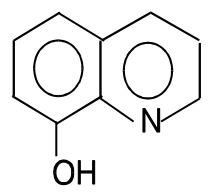
The structural formula of 8-hydroxiquinoline is:
The relative atomic mass of aluminium is 26.98.
Problems:
1.1 Write the balanced equation for the reaction of the aluminium (III) ion with 8-hydroxyquinoline, showing clearly the structure of the products.
1.2 Give the name of the type of compound which is formed during the precipitation.
1.3 Write the balanced equation for the reaction in which bromine is produced.
1.4 Write the balanced equation for the reaction of bromine with 8-hydroxyquinoline.
1.5 Calculate the molar ratio of aluminium ions to bromate ions.
1.6 Calculate the percentage by weight of aluminium in the alloy.
Official English text of the problem.
Answers
-
1.1 \[ \ce{Al^3+ + 3 C9H7NO -> Al(C9H6NO)3(s) + 3 H+} \] The precipitate is aluminium tris(quinolin-8-olate), with three bidentate ligands coordinated through oxygen and nitrogen; its structure and SMILES are specified below.
-
1.2 A chelate complex, specifically a neutral complex with three five-membered chelate rings.
-
1.3 \[ \ce{BrO3^- + 5 Br^- + 6 H+ -> 3 Br2 + 3 H2O} \]
-
1.4 \[ \ce{C9H7NO + 2 Br2 -> C9H5Br2NO + 2 HBr} \] The organic product is 5,7-dibromoquinolin-8-ol, SMILES
Oc1c(Br)cc(Br)c2cccnc12. -
1.5 \[ \boxed{n(\ce{Al^3+}):n(\ce{BrO3^-})=1:2} \]
-
1.6 \[ \boxed{\text{Aluminium content}=0.888\%\text{ by mass}} \]
Solution
1.1 — Precipitation and structure
8-Hydroxyquinoline, also called quinolin-8-ol or oxine, has formula \(\ce{C9H7NO}\) and SMILES Oc1cccc2cccnc12. Loss of its hydroxyl proton gives the quinolin-8-olate ion, \(\ce{C9H6NO^-}\), SMILES [O-]c1cccc2cccnc12.
Each ligand binds aluminium through two donor atoms:
- the negatively charged phenoxide oxygen;
- the quinoline nitrogen, using its lone pair.
Three singly charged ligands neutralize one aluminium(III) ion, \(\ce{Al^3+}\), SMILES [Al+3]. Therefore,
\[
\boxed{\ce{Al^3+(aq) + 3 C9H7NO -> Al(C9H6NO)3(s) + 3 H+(aq)}}
\]
where the hydrogen ion, or proton, has SMILES [H+].
The product is aluminium tris(quinolin-8-olate), also called aluminium 8-hydroxyquinolate. An extended SMILES explicitly representing all six donor-to-metal bonds is:
[Al+3]123(<-[O-]c4cccc5cccn->1c45)(<-[O-]c4cccc5cccn->2c45)<-[O-]c4cccc5cccn->3c45
Here the arrows denote coordinate bonds directed from the donor atom towards aluminium.
To draw the product, place aluminium at the centre and surround it with three quinolin-8-olate ligands. Join both the oxygen and nitrogen of each ligand to the same aluminium centre. Each ligand forms a five-membered ring following the sequence aluminium–oxygen–carbon-8–carbon-8a–nitrogen. The six donor atoms give a distorted octahedral coordination geometry. No particular geometric or optical isomer is specified.
1.2 — Type of compound
The product is a chelate complex. A chelating ligand binds the same metal ion through at least two donor atoms, forming a ring that includes the metal. Here each quinolin-8-olate ligand is bidentate, and three such ligands produce three chelate rings.
1.3 — Production of bromine
In acidic solution, bromate oxidizes bromide to bromine. The species are bromate, SMILES [O-][Br](=O)=O; bromide, [Br-]; bromine, BrBr; and water, O.
Bromine in bromate has oxidation state \(+5\), so its reduction to oxidation state zero requires five electrons. Five bromide ions, each initially at oxidation state \(-1\), supply these electrons. Balancing oxygen with water and hydrogen with protons gives \[ \boxed{\ce{BrO3^- + 5 Br^- + 6 H+ -> 3 Br2 + 3 H2O}}. \]
Thus, one mole of bromate produces three moles of bromine.
1.4 — Bromination of 8-hydroxyquinoline
The hydroxyl group activates the benzene portion of the quinoline system towards electrophilic substitution. Bromination occurs at positions 7 and 5, respectively ortho and para to the hydroxyl group.
The product is 5,7-dibromo-8-hydroxyquinoline, or 5,7-dibromoquinolin-8-ol, SMILES Oc1c(Br)cc(Br)c2cccnc12. Its structure retains the original quinoline skeleton and hydroxyl group at position 8, with bromine atoms replacing the hydrogens at positions 5 and 7.
Each substitution consumes one bromine molecule and produces one hydrogen bromide molecule, SMILES [H]Br. Consequently,
\[
\boxed{\ce{C9H7NO + 2 Br2 -> C9H5Br2NO + 2 HBr}}.
\]
One mole of 8-hydroxyquinoline therefore consumes two moles of bromine.
1.5 — Aluminium-to-bromate molar ratio
Acid dissolution of the precipitate releases three molecules of 8-hydroxyquinoline per aluminium ion. Representing the liberated ligand in its neutral form, \[ \ce{Al(C9H6NO)3(s) + 3 H+ -> Al^3+ + 3 C9H7NO}. \]
Each of these three ligand molecules consumes two bromine molecules. Hence, \[ n(\ce{Br2})=2\,n(\ce{C9H7NO})=6\,n(\ce{Al^3+}). \]
From part 1.3, \[ n(\ce{Br2})=3\,n(\ce{BrO3^-}). \]
Equating these expressions gives \[ 6\,n(\ce{Al^3+})=3\,n(\ce{BrO3^-}), \] so \[ \boxed{n(\ce{Al^3+}):n(\ce{BrO3^-})=1:2}. \]
1.6 — Aluminium mass percentage
The volume of bromate solution is \[ V=17.40\ \mathrm{cm^3}=0.01740\ \mathrm{L}. \]
The amount of bromate used is \[ n(\ce{BrO3^-}) =cV =(0.0200\ \mathrm{mol\,L^{-1}})(0.01740\ \mathrm{L}) =3.48\times10^{-4}\ \mathrm{mol}. \]
Using the \(1:2\) aluminium-to-bromate ratio, \[ n(\ce{Al}) =\frac{3.48\times10^{-4}}{2} =1.74\times10^{-4}\ \mathrm{mol}. \]
The given relative atomic mass corresponds to a molar mass of \(26.98\ \mathrm{g\,mol^{-1}}\). Retaining guard digits, \[ m(\ce{Al}) =(1.74\times10^{-4}\ \mathrm{mol})(26.98\ \mathrm{g\,mol^{-1}}) =0.00469452\ \mathrm{g}. \]
Therefore, \[ \text{Aluminium mass percentage} =\frac{0.00469452\ \mathrm{g}}{0.5284\ \mathrm{g}}\times100\% =0.8884406\%. \]
The bromate concentration has three significant figures, so the final result is \[ \boxed{0.888\%\text{ aluminium by mass}}. \]
The solution was checked against the official solution. Where this solution differs from the official solution, the official solution contains an error or a misprint.
IChO 1985 · Theorieaufgabe 1
Bestimmung von Aluminium mit 8-Hydroxychinolin und Bromat
Aus 0.5284 g einer Probe einer aluminiumhaltigen Legierung wurde eine Lösung hergestellt. Das Aluminium wurde anschließend als Aluminium-8-hydroxychinolinat gefällt. Der Niederschlag wurde abgetrennt und in Salzsäure gelöst; das dabei gebildete 8-Hydroxychinolin wurde mit einer Kaliumbromid enthaltenden Kaliumbromat-Maßlösung titriert. Die Konzentration der Kaliumbromat-Maßlösung betrug 0.0200 M, und es wurden 17.40 cm³ davon benötigt. Das entstehende Produkt ist ein Dibromderivat von 8-Hydroxychinolin.
Die Strukturformel von 8-Hydroxychinolin lautet:
Die relative Atommasse von Aluminium beträgt 26.98.
Aufgaben:
1.1 Stellen Sie die ausgeglichene Reaktionsgleichung für die Reaktion des Aluminium(III)-Ions mit 8-Hydroxychinolin auf und geben Sie dabei die Struktur der Produkte eindeutig an.
1.2 Geben Sie an, zu welchem Verbindungstyp die bei der Fällung gebildete Verbindung gehört.
1.3 Stellen Sie die ausgeglichene Reaktionsgleichung für die Reaktion auf, bei der Brom entsteht.
1.4 Stellen Sie die ausgeglichene Reaktionsgleichung für die Reaktion von Brom mit 8-Hydroxychinolin auf.
1.5 Berechnen Sie das Stoffmengenverhältnis von Aluminiumionen zu Bromationen.
1.6 Berechnen Sie den Massenanteil von Aluminium in der Legierung in Prozent.
Aufgabentext aus dem offiziellen englischen Text übersetzt.
Antworten
-
1.1 \[ \ce{Al^3+ + 3 C9H7NO -> Al(C9H6NO)3(s) + 3 H+} \] Der Niederschlag ist Aluminium-tris(chinolin-8-olat) mit drei zweizähnigen Liganden, die über Sauerstoff und Stickstoff koordiniert sind; seine Struktur und sein SMILES sind unten angegeben.
-
1.2 Ein Chelatkomplex, genauer ein neutraler Komplex mit drei fünfgliedrigen Chelatringen.
-
1.3 \[ \ce{BrO3^- + 5 Br^- + 6 H+ -> 3 Br2 + 3 H2O} \]
-
1.4 \[ \ce{C9H7NO + 2 Br2 -> C9H5Br2NO + 2 HBr} \] Das organische Produkt ist 5,7-Dibromchinolin-8-ol, SMILES
Oc1c(Br)cc(Br)c2cccnc12. -
1.5 \[ \boxed{n(\ce{Al^3+}):n(\ce{BrO3^-})=1:2} \]
-
1.6 \[ \boxed{\text{Aluminiumgehalt}=0.888\%\text{ Massenanteil}} \]
Lösung
1.1 — Fällung und Struktur
8-Hydroxychinolin, auch Chinolin-8-ol oder Oxin genannt, hat die Formel \(\ce{C9H7NO}\) und den SMILES Oc1cccc2cccnc12. Durch Abgabe seines Hydroxyprotons entsteht das Chinolin-8-olat-Ion, \(\ce{C9H6NO^-}\), SMILES [O-]c1cccc2cccnc12.
Jeder Ligand bindet über zwei Donoratome an Aluminium:
- das negativ geladene Phenoxid-Sauerstoffatom;
- das Chinolin-Stickstoffatom unter Nutzung seines freien Elektronenpaars.
Drei einfach negativ geladene Liganden gleichen die Ladung eines Aluminium(III)-Ions, \(\ce{Al^3+}\), SMILES [Al+3], aus. Daher gilt:
\[
\boxed{\ce{Al^3+(aq) + 3 C9H7NO -> Al(C9H6NO)3(s) + 3 H+(aq)}}
\]
Dabei hat das Wasserstoffion, also das Proton, den SMILES [H+].
Das Produkt ist Aluminium-tris(chinolin-8-olat), auch Aluminium-8-hydroxychinolinat genannt. Ein erweiterter SMILES, der alle sechs Donor-Metall-Bindungen ausdrücklich darstellt, lautet:
[Al+3]123(<-[O-]c4cccc5cccn->1c45)(<-[O-]c4cccc5cccn->2c45)<-[O-]c4cccc5cccn->3c45
Hier bezeichnen die Pfeile koordinative Bindungen, die vom Donoratom zum Aluminium gerichtet sind.
Um das Produkt zu zeichnen, setzen Sie Aluminium in die Mitte und umgeben Sie es mit drei Chinolin-8-olat-Liganden. Verbinden Sie sowohl das Sauerstoff- als auch das Stickstoffatom jedes Liganden mit demselben Aluminiumzentrum. Jeder Ligand bildet einen fünfgliedrigen Ring mit der Abfolge Aluminium–Sauerstoff–Kohlenstoff-8–Kohlenstoff-8a–Stickstoff. Die sechs Donoratome ergeben eine verzerrt oktaedrische Koordinationsgeometrie. Es ist kein bestimmtes geometrisches oder optisches Isomer vorgegeben.
1.2 — Verbindungstyp
Das Produkt ist ein Chelatkomplex. Ein Chelatligand bindet über mindestens zwei Donoratome an dasselbe Metallion und bildet dabei einen Ring, der das Metall einschließt. Hier ist jeder Chinolin-8-olat-Ligand zweizähnig, und drei solche Liganden bilden drei Chelatringe.
1.3 — Bildung von Brom
In saurer Lösung oxidiert Bromat Bromid zu Brom. Die beteiligten Spezies sind Bromat, SMILES [O-][Br](=O)=O; Bromid, [Br-]; Brom, BrBr; und Wasser, O.
Brom hat im Bromat die Oxidationszahl \(+5\), sodass seine Reduktion zur Oxidationszahl null fünf Elektronen erfordert. Fünf Bromidionen, die jeweils zunächst die Oxidationszahl \(-1\) haben, liefern diese Elektronen. Durch Ausgleichen von Sauerstoff mit Wasser und von Wasserstoff mit Protonen erhält man \[ \boxed{\ce{BrO3^- + 5 Br^- + 6 H+ -> 3 Br2 + 3 H2O}}. \]
Somit entstehen aus einem Mol Bromat drei Mol Brom.
1.4 — Bromierung von 8-Hydroxychinolin
Die Hydroxygruppe aktiviert den Benzolteil des Chinolinsystems für die elektrophile Substitution. Die Bromierung erfolgt an den Positionen 7 und 5, also in ortho- beziehungsweise para-Stellung zur Hydroxygruppe.
Das Produkt ist 5,7-Dibrom-8-hydroxychinolin, auch 5,7-Dibromchinolin-8-ol genannt, SMILES Oc1c(Br)cc(Br)c2cccnc12. In seiner Struktur bleiben das ursprüngliche Chinolingerüst und die Hydroxygruppe an Position 8 erhalten, während Bromatome die Wasserstoffatome an den Positionen 5 und 7 ersetzen.
Bei jeder Substitution wird ein Brommolekül verbraucht und ein Bromwasserstoffmolekül, SMILES [H]Br, gebildet. Folglich gilt:
\[
\boxed{\ce{C9H7NO + 2 Br2 -> C9H5Br2NO + 2 HBr}}.
\]
Ein Mol 8-Hydroxychinolin verbraucht daher zwei Mol Brom.
1.5 — Stoffmengenverhältnis von Aluminium zu Bromat
Beim Auflösen des Niederschlags in Säure werden pro Aluminiumion drei Moleküle 8-Hydroxychinolin freigesetzt. Stellt man den freigesetzten Liganden in seiner neutralen Form dar, ergibt sich \[ \ce{Al(C9H6NO)3(s) + 3 H+ -> Al^3+ + 3 C9H7NO}. \]
Jedes dieser drei Ligandenmoleküle verbraucht zwei Brommoleküle. Daher gilt: \[ n(\ce{Br2})=2\,n(\ce{C9H7NO})=6\,n(\ce{Al^3+}). \]
Aus Teil 1.3 folgt: \[ n(\ce{Br2})=3\,n(\ce{BrO3^-}). \]
Gleichsetzen dieser Ausdrücke ergibt \[ 6\,n(\ce{Al^3+})=3\,n(\ce{BrO3^-}), \] also \[ \boxed{n(\ce{Al^3+}):n(\ce{BrO3^-})=1:2}. \]
1.6 — Massenanteil von Aluminium in Prozent
Das Volumen der Bromatlösung beträgt \[ V=17.40\ \mathrm{cm^3}=0.01740\ \mathrm{L}. \]
Die eingesetzte Stoffmenge an Bromat beträgt \[ n(\ce{BrO3^-}) =cV =(0.0200\ \mathrm{mol\,L^{-1}})(0.01740\ \mathrm{L}) =3.48\times10^{-4}\ \mathrm{mol}. \]
Mit dem Aluminium-zu-Bromat-Verhältnis von \(1:2\) ergibt sich \[ n(\ce{Al}) =\frac{3.48\times10^{-4}}{2} =1.74\times10^{-4}\ \mathrm{mol}. \]
Die angegebene relative Atommasse entspricht einer molaren Masse von \(26.98\ \mathrm{g\,mol^{-1}}\). Unter Beibehaltung zusätzlicher Stellen zur Vermeidung von Rundungsfehlern ergibt sich \[ m(\ce{Al}) =(1.74\times10^{-4}\ \mathrm{mol})(26.98\ \mathrm{g\,mol^{-1}}) =0.00469452\ \mathrm{g}. \]
Daher gilt: \[ \text{Massenanteil von Aluminium in Prozent} =\frac{0.00469452\ \mathrm{g}}{0.5284\ \mathrm{g}}\times100\% =0.8884406\%. \]
Die Bromatkonzentration ist mit drei signifikanten Stellen angegeben, sodass das Endergebnis lautet: \[ \boxed{0.888\%\text{ Aluminium als Massenanteil}}. \]
Die Lösung wurde mit der offiziellen Lösung abgeglichen. Wo diese Lösung von der offiziellen Lösung abweicht, enthält die offizielle Lösung einen Fehler oder Druckfehler.
IChO 1985 · Teori sorusu 1
8-hidroksikinolin ve bromat ile alüminyum tayini
Alüminyum içeren bir alaşımdan alınan 0.5284 g numune kullanılarak bir çözelti hazırlandı. Ardından alüminyum, alüminyum 8-hidroksikinolat olarak çöktürüldü. Çökelek ayrıldı, hidroklorik asitte çözüldü ve oluşan 8-hidroksikinolin, potasyum bromür içeren standart bir potasyum bromat çözeltisiyle titre edildi. Standart potasyum bromat çözeltisinin derişimi 0.0200 M idi ve bu çözeltiden 17.40 cm³ gerekti. Oluşan ürün, 8-hidroksikinolinin bir dibromo türevidir.
8-hidroksikinolinin yapı formülü şöyledir:
Alüminyumun bağıl atom kütlesi 26.98'dir.
Sorular:
1.1 Alüminyum (III) iyonunun 8-hidroksikinolin ile tepkimesinin denkleştirilmiş denklemini, ürünlerin yapısını açıkça göstererek yazınız.
1.2 Çöktürme sırasında oluşan bileşik türünün adını belirtiniz.
1.3 Bromun oluştuğu tepkimenin denkleştirilmiş denklemini yazınız.
1.4 Bromun 8-hidroksikinolin ile tepkimesinin denkleştirilmiş denklemini yazınız.
1.5 Alüminyum iyonlarının bromat iyonlarına mol oranını hesaplayınız.
1.6 Alaşımın kütlece alüminyum yüzdesini hesaplayınız.
Soru metni resmi İngilizce metinden çevrilmiştir.
Cevaplar
-
1.1 \[ \ce{Al^3+ + 3 C9H7NO -> Al(C9H6NO)3(s) + 3 H+} \] Çökelek, oksijen ve azot üzerinden koordine olan üç çift dişli ligand içeren alüminyum tris(kinolin-8-olat)tır; yapısı ve SMILES gösterimi aşağıda belirtilmiştir.
-
1.2 Bir şelat kompleksi, daha açık bir ifadeyle beş üyeli üç şelat halkası içeren nötr bir kompleks.
-
1.3 \[ \ce{BrO3^- + 5 Br^- + 6 H+ -> 3 Br2 + 3 H2O} \]
-
1.4 \[ \ce{C9H7NO + 2 Br2 -> C9H5Br2NO + 2 HBr} \] Organik ürün 5,7-dibromokinolin-8-ol olup SMILES gösterimi
Oc1c(Br)cc(Br)c2cccnc12şeklindedir. -
1.5 \[ \boxed{n(\ce{Al^3+}):n(\ce{BrO3^-})=1:2} \]
-
1.6 \[ \boxed{\text{Alüminyum içeriği}=0.888\%\text{ kütlece}} \]
Çözüm
1.1 — Çöktürme ve yapı
Kinolin-8-ol veya oksin olarak da adlandırılan 8-hidroksikinolinin formülü \(\ce{C9H7NO}\), SMILES gösterimi ise Oc1cccc2cccnc12 şeklindedir. Hidroksil protonunu kaybetmesiyle kinolin-8-olat iyonu, \(\ce{C9H6NO^-}\), oluşur; bu iyonun SMILES gösterimi [O-]c1cccc2cccnc12 şeklindedir.
Her ligand alüminyuma iki donör atom üzerinden bağlanır:
- negatif yüklü fenoksit oksijeni;
- ortaklanmamış elektron çiftini kullanan kinolin azotu.
Tek yüklü üç ligand, SMILES gösterimi [Al+3] olan bir alüminyum(III) iyonunun, \(\ce{Al^3+}\), yükünü nötrleştirir. Dolayısıyla,
\[
\boxed{\ce{Al^3+(aq) + 3 C9H7NO -> Al(C9H6NO)3(s) + 3 H+(aq)}}
\]
burada hidrojen iyonunun, yani protonun, SMILES gösterimi [H+] şeklindedir.
Ürün, alüminyum 8-hidroksikinolat olarak da adlandırılan alüminyum tris(kinolin-8-olat)tır. Donör atomlardan metale uzanan altı bağın tümünü açıkça gösteren genişletilmiş bir SMILES gösterimi şöyledir:
[Al+3]123(<-[O-]c4cccc5cccn->1c45)(<-[O-]c4cccc5cccn->2c45)<-[O-]c4cccc5cccn->3c45
Burada oklar, donör atomdan alüminyuma doğru yönelen koordinatif bağları belirtir.
Ürünü çizmek için alüminyumu merkeze yerleştirip çevresine üç kinolin-8-olat ligandı yerleştiriniz. Her ligandın hem oksijenini hem de azotunu aynı alüminyum merkezine bağlayınız. Her ligand, alüminyum–oksijen–karbon-8–karbon-8a–azot sırasını izleyen beş üyeli bir halka oluşturur. Altı donör atom, bozulmuş oktahedral bir koordinasyon geometrisi oluşturur. Belirli bir geometrik veya optik izomer belirtilmemiştir.
1.2 — Bileşik türü
Ürün bir şelat kompleksidir. Şelat oluşturan bir ligand, aynı metal iyonuna en az iki donör atom üzerinden bağlanarak metali de içeren bir halka oluşturur. Burada her kinolin-8-olat ligandı çift dişlidir ve bu tür üç ligand, üç şelat halkası oluşturur.
1.3 — Brom oluşumu
Asidik çözeltide bromat, bromürü broma yükseltger. Türler ve SMILES gösterimleri şöyledir: bromat, [O-][Br](=O)=O; bromür, [Br-]; brom, BrBr; ve su, O.
Bromattaki bromun yükseltgenme basamağı \(+5\) olduğundan, sıfır yükseltgenme basamağına indirgenmesi beş elektron gerektirir. Başlangıçta her biri \(-1\) yükseltgenme basamağında olan beş bromür iyonu bu elektronları sağlar. Oksijenin suyla, hidrojenin ise protonlarla denkleştirilmesiyle şu denklem elde edilir: \[ \boxed{\ce{BrO3^- + 5 Br^- + 6 H+ -> 3 Br2 + 3 H2O}}. \]
Böylece, bir mol bromat üç mol brom oluşturur.
1.4 — 8-hidroksikinolinin bromlanması
Hidroksil grubu, kinolin sisteminin benzen kısmını elektrofilik yer değiştirmeye karşı etkinleştirir. Bromlanma, hidroksil grubuna göre sırasıyla orto ve para konumlarında bulunan 7 ve 5 konumlarında gerçekleşir.
Ürün, SMILES gösterimi Oc1c(Br)cc(Br)c2cccnc12 olan 5,7-dibromo-8-hidroksikinolin, diğer adıyla 5,7-dibromokinolin-8-oldür. Yapısında başlangıçtaki kinolin iskeleti ve 8 konumundaki hidroksil grubu korunurken, 5 ve 7 konumlarındaki hidrojenlerin yerini brom atomları alır.
Her yer değiştirme bir brom molekülü tüketir ve SMILES gösterimi [H]Br olan bir hidrojen bromür molekülü oluşturur. Dolayısıyla,
\[
\boxed{\ce{C9H7NO + 2 Br2 -> C9H5Br2NO + 2 HBr}}.
\]
Buna göre bir mol 8-hidroksikinolin iki mol brom tüketir.
1.5 — Alüminyumun bromata mol oranı
Çökeleğin asitte çözünmesiyle alüminyum iyonu başına üç 8-hidroksikinolin molekülü açığa çıkar. Serbest kalan ligand nötr biçimiyle gösterildiğinde, \[ \ce{Al(C9H6NO)3(s) + 3 H+ -> Al^3+ + 3 C9H7NO}. \]
Bu üç ligand molekülünün her biri iki brom molekülü tüketir. Dolayısıyla, \[ n(\ce{Br2})=2\,n(\ce{C9H7NO})=6\,n(\ce{Al^3+}). \]
1.3 kısmından, \[ n(\ce{Br2})=3\,n(\ce{BrO3^-}). \]
Bu ifadeler eşitlendiğinde, \[ 6\,n(\ce{Al^3+})=3\,n(\ce{BrO3^-}), \] dolayısıyla \[ \boxed{n(\ce{Al^3+}):n(\ce{BrO3^-})=1:2}. \]
1.6 — Alüminyumun kütle yüzdesi
Bromat çözeltisinin hacmi şöyledir: \[ V=17.40\ \mathrm{cm^3}=0.01740\ \mathrm{L}. \]
Kullanılan bromatın madde miktarı şöyledir: \[ n(\ce{BrO3^-}) =cV =(0.0200\ \mathrm{mol\,L^{-1}})(0.01740\ \mathrm{L}) =3.48\times10^{-4}\ \mathrm{mol}. \]
Alüminyumun bromata \(1:2\) oranı kullanıldığında, \[ n(\ce{Al}) =\frac{3.48\times10^{-4}}{2} =1.74\times10^{-4}\ \mathrm{mol}. \]
Verilen bağıl atom kütlesi, \(26.98\ \mathrm{g\,mol^{-1}}\) molar kütleye karşılık gelir. Ara hesaplamalarda ek basamaklar korunarak, \[ m(\ce{Al}) =(1.74\times10^{-4}\ \mathrm{mol})(26.98\ \mathrm{g\,mol^{-1}}) =0.00469452\ \mathrm{g}. \]
Dolayısıyla, \[ \text{Alüminyumun kütle yüzdesi} =\frac{0.00469452\ \mathrm{g}}{0.5284\ \mathrm{g}}\times100\% =0.8884406\%. \]
Bromat derişimi üç anlamlı basamakla verildiğinden, nihai sonuç şöyledir: \[ \boxed{0.888\%\text{ kütlece alüminyum}}. \]
Çözüm, resmi çözümle karşılaştırılarak kontrol edildi. Bu çözümün resmi çözümden ayrıldığı yerlerde resmi çözümde bir hata ya da baskı hatası vardır.
IChO 1985 · Problema teórico 1
Determinación de aluminio con 8-hidroxiquinolina y bromato
Se preparó una disolución a partir de 0.5284 g de una muestra de una aleación que contenía aluminio. A continuación, el aluminio se precipitó como 8-hidroxiquinolinato de aluminio. El precipitado se separó, se disolvió en ácido clorhídrico y la 8-hidroxiquinolina formada se valoró con una disolución patrón de bromato de potasio que contenía bromuro de potasio. La concentración de la disolución patrón de bromato de potasio era de 0.0200 M y se necesitaron 17.40 cm³ de ella. El producto resultante es un derivado dibromado de la 8-hidroxiquinolina.
La fórmula estructural de la 8-hidroxiquinolina es:
La masa atómica relativa del aluminio es 26.98.
Cuestiones:
1.1 Escriba la ecuación ajustada de la reacción del ion aluminio(III) con la 8-hidroxiquinolina, mostrando claramente la estructura de los productos.
1.2 Indique el nombre del tipo de compuesto que se forma durante la precipitación.
1.3 Escriba la ecuación ajustada de la reacción en la que se produce bromo.
1.4 Escriba la ecuación ajustada de la reacción del bromo con la 8-hidroxiquinolina.
1.5 Calcule la relación molar entre los iones aluminio y los iones bromato.
1.6 Calcule el porcentaje en masa de aluminio en la aleación.
Enunciado traducido del texto oficial en inglés.
Respuestas
-
1.1 \[ \ce{Al^3+ + 3 C9H7NO -> Al(C9H6NO)3(s) + 3 H+} \] El precipitado es tris(quinolin-8-olato) de aluminio, con tres ligandos bidentados coordinados a través del oxígeno y del nitrógeno; su estructura y su SMILES se especifican más adelante.
-
1.2 Un complejo quelato, concretamente un complejo neutro con tres anillos quelato de cinco miembros.
-
1.3 \[ \ce{BrO3^- + 5 Br^- + 6 H+ -> 3 Br2 + 3 H2O} \]
-
1.4 \[ \ce{C9H7NO + 2 Br2 -> C9H5Br2NO + 2 HBr} \] El producto orgánico es 5,7-dibromoquinolin-8-ol, SMILES
Oc1c(Br)cc(Br)c2cccnc12. -
1.5 \[ \boxed{n(\ce{Al^3+}):n(\ce{BrO3^-})=1:2} \]
-
1.6 \[ \boxed{\text{Contenido de aluminio}=0.888\%\text{ en masa}} \]
Solución
1.1 — Precipitación y estructura
La 8-hidroxiquinolina, también llamada quinolin-8-ol u oxina, tiene fórmula \(\ce{C9H7NO}\) y SMILES Oc1cccc2cccnc12. La pérdida del protón de su grupo hidroxilo da lugar al ion quinolin-8-olato, \(\ce{C9H6NO^-}\), SMILES [O-]c1cccc2cccnc12.
Cada ligando se une al aluminio a través de dos átomos donadores:
- el oxígeno fenóxido con carga negativa;
- el nitrógeno de la quinolina, mediante su par de electrones no compartido.
Tres ligandos con una sola carga negativa cada uno neutralizan un ion aluminio(III), \(\ce{Al^3+}\), SMILES [Al+3]. Por tanto,
\[
\boxed{\ce{Al^3+(aq) + 3 C9H7NO -> Al(C9H6NO)3(s) + 3 H+(aq)}}
\]
donde el ion hidrógeno, o protón, tiene el SMILES [H+].
El producto es tris(quinolin-8-olato) de aluminio, también llamado 8-hidroxiquinolinato de aluminio. Un SMILES extendido que representa explícitamente los seis enlaces de los átomos donadores al metal es:
[Al+3]123(<-[O-]c4cccc5cccn->1c45)(<-[O-]c4cccc5cccn->2c45)<-[O-]c4cccc5cccn->3c45
Aquí, las flechas indican enlaces coordinados dirigidos desde el átomo donador hacia el aluminio.
Para dibujar el producto, sitúe el aluminio en el centro y rodéelo de tres ligandos quinolin-8-olato. Una tanto el oxígeno como el nitrógeno de cada ligando al mismo centro de aluminio. Cada ligando forma un anillo de cinco miembros siguiendo la secuencia aluminio–oxígeno–carbono-8–carbono-8a–nitrógeno. Los seis átomos donadores dan lugar a una geometría de coordinación octaédrica distorsionada. No se especifica ningún isómero geométrico u óptico en particular.
1.2 — Tipo de compuesto
El producto es un complejo quelato. Un ligando quelante se une al mismo ion metálico a través de al menos dos átomos donadores, formando un anillo que incluye el metal. En este caso, cada ligando quinolin-8-olato es bidentado, y tres de estos ligandos producen tres anillos quelato.
1.3 — Producción de bromo
En disolución ácida, el bromato oxida el bromuro a bromo. Las especies son bromato, SMILES [O-][Br](=O)=O; bromuro, [Br-]; bromo, BrBr; y agua, O.
El bromo del bromato tiene un estado de oxidación de \(+5\), por lo que su reducción al estado de oxidación cero requiere cinco electrones. Cinco iones bromuro, cada uno inicialmente con un estado de oxidación de \(-1\), aportan estos electrones. Al ajustar el oxígeno con agua y el hidrógeno con protones se obtiene \[ \boxed{\ce{BrO3^- + 5 Br^- + 6 H+ -> 3 Br2 + 3 H2O}}. \]
Así, un mol de bromato produce tres moles de bromo.
1.4 — Bromación de la 8-hidroxiquinolina
El grupo hidroxilo activa la porción bencénica del sistema de la quinolina frente a la sustitución electrófila. La bromación tiene lugar en las posiciones 7 y 5, respectivamente orto y para respecto al grupo hidroxilo.
El producto es 5,7-dibromo-8-hidroxiquinolina, o 5,7-dibromoquinolin-8-ol, SMILES Oc1c(Br)cc(Br)c2cccnc12. Su estructura conserva el esqueleto original de la quinolina y el grupo hidroxilo en la posición 8, con átomos de bromo que sustituyen a los hidrógenos de las posiciones 5 y 7.
Cada sustitución consume una molécula de bromo y produce una molécula de bromuro de hidrógeno, SMILES [H]Br. En consecuencia,
\[
\boxed{\ce{C9H7NO + 2 Br2 -> C9H5Br2NO + 2 HBr}}.
\]
Por tanto, un mol de 8-hidroxiquinolina consume dos moles de bromo.
1.5 — Relación molar entre aluminio y bromato
La disolución del precipitado en ácido libera tres moléculas de 8-hidroxiquinolina por cada ion aluminio. Representando el ligando liberado en su forma neutra, \[ \ce{Al(C9H6NO)3(s) + 3 H+ -> Al^3+ + 3 C9H7NO}. \]
Cada una de estas tres moléculas de ligando consume dos moléculas de bromo. Por consiguiente, \[ n(\ce{Br2})=2\,n(\ce{C9H7NO})=6\,n(\ce{Al^3+}). \]
Del apartado 1.3, \[ n(\ce{Br2})=3\,n(\ce{BrO3^-}). \]
Al igualar estas expresiones se obtiene \[ 6\,n(\ce{Al^3+})=3\,n(\ce{BrO3^-}), \] de modo que \[ \boxed{n(\ce{Al^3+}):n(\ce{BrO3^-})=1:2}. \]
1.6 — Porcentaje en masa de aluminio
El volumen de la disolución de bromato es \[ V=17.40\ \mathrm{cm^3}=0.01740\ \mathrm{L}. \]
La cantidad de bromato utilizada es \[ n(\ce{BrO3^-}) =cV =(0.0200\ \mathrm{mol\,L^{-1}})(0.01740\ \mathrm{L}) =3.48\times10^{-4}\ \mathrm{mol}. \]
Utilizando la relación \(1:2\) entre aluminio y bromato, \[ n(\ce{Al}) =\frac{3.48\times10^{-4}}{2} =1.74\times10^{-4}\ \mathrm{mol}. \]
La masa atómica relativa dada corresponde a una masa molar de \(26.98\ \mathrm{g\,mol^{-1}}\). Conservando cifras adicionales para evitar errores de redondeo, \[ m(\ce{Al}) =(1.74\times10^{-4}\ \mathrm{mol})(26.98\ \mathrm{g\,mol^{-1}}) =0.00469452\ \mathrm{g}. \]
Por tanto, \[ \text{Porcentaje en masa de aluminio} =\frac{0.00469452\ \mathrm{g}}{0.5284\ \mathrm{g}}\times100\% =0.8884406\%. \]
La concentración de bromato tiene tres cifras significativas, por lo que el resultado final es \[ \boxed{0.888\%\text{ de aluminio en masa}}. \]
La solución se comprobó con la solución oficial. Donde esta solución difiere de la solución oficial, la solución oficial contiene un error o una errata.
IChO 1985 · 理论题 1
用8-羟基喹啉和溴酸盐测定铝
将0.5284 g含铝合金试样制成溶液。随后使其中的铝以8-羟基喹啉铝的形式沉淀。分离沉淀,将其溶于盐酸,再用含有溴化钾的溴酸钾标准溶液滴定所生成的8-羟基喹啉。溴酸钾标准溶液的浓度为0.0200 M,滴定消耗了17.40 cm³该溶液。反应产物为8-羟基喹啉的二溴代衍生物。
8-羟基喹啉的结构式为:
铝的相对原子质量为26.98。
问题:
1.1 写出铝(III)离子与8-羟基喹啉反应的配平方程式,并清楚地表示产物的结构。
1.2 指出沉淀过程中形成的化合物所属的类型。
1.3 写出生成溴的反应的配平方程式。
1.4 写出溴与8-羟基喹啉反应的配平方程式。
1.5 计算铝离子与溴酸根离子的物质的量之比。
1.6 计算合金中铝的质量百分含量。
题目译自官方英文原文。
答案
-
1.1 \[ \ce{Al^3+ + 3 C9H7NO -> Al(C9H6NO)3(s) + 3 H+} \] 沉淀为三(喹啉-8-氧基)合铝,其中三个双齿配体通过氧原子和氮原子配位;其结构及SMILES见下文。
-
1.2 螯合物,具体而言,是具有三个五元螯合环的中性配合物。
-
1.3 \[ \ce{BrO3^- + 5 Br^- + 6 H+ -> 3 Br2 + 3 H2O} \]
-
1.4 \[ \ce{C9H7NO + 2 Br2 -> C9H5Br2NO + 2 HBr} \] 有机产物为5,7-二溴喹啉-8-醇,SMILES为
Oc1c(Br)cc(Br)c2cccnc12。 -
1.5 \[ \boxed{n(\ce{Al^3+}):n(\ce{BrO3^-})=1:2} \]
-
1.6 \[ \boxed{\text{铝含量}=0.888\%\text{(质量分数)}} \]
解答
1.1 — 沉淀及结构
8-羟基喹啉,也称喹啉-8-醇或羟基喹啉,其分子式为\(\ce{C9H7NO}\),SMILES为Oc1cccc2cccnc12。其羟基失去质子后,形成喹啉-8-氧负离子,\(\ce{C9H6NO^-}\),SMILES为[O-]c1cccc2cccnc12。
每个配体通过两个配位原子与铝结合:
- 带负电荷的酚氧原子;
- 利用其孤电子对配位的喹啉氮原子。
三个各带一个单位负电荷的配体中和一个铝(III)离子\(\ce{Al^3+}\)的电荷,该离子的SMILES为[Al+3]。因此,
\[
\boxed{\ce{Al^3+(aq) + 3 C9H7NO -> Al(C9H6NO)3(s) + 3 H+(aq)}}
\]
其中,氢离子(即质子)的SMILES为[H+]。
产物为三(喹啉-8-氧基)合铝,也称8-羟基喹啉铝。明确表示全部六条配位原子与金属之间的键的扩展SMILES如下:
[Al+3]123(<-[O-]c4cccc5cccn->1c45)(<-[O-]c4cccc5cccn->2c45)<-[O-]c4cccc5cccn->3c45
这里的箭头表示从配位原子指向铝的配位键。
绘制产物结构时,将铝置于中心,并在其周围放置三个喹啉-8-氧负离子配体。将每个配体的氧原子和氮原子均连接到同一个铝中心。每个配体按铝–氧–碳-8–碳-8a–氮的顺序形成一个五元环。六个配位原子构成畸变八面体配位构型。题目未指定任何特定的几何异构体或旋光异构体。
1.2 — 化合物类型
产物是螯合物。螯合配体通过至少两个配位原子与同一个金属离子结合,形成包含该金属的环。这里,每个喹啉-8-氧负离子配体都是双齿配体,三个这样的配体形成三个螯合环。
1.3 — 溴的生成
在酸性溶液中,溴酸根离子将溴离子氧化为溴。涉及的物种为溴酸根离子,SMILES为[O-][Br](=O)=O;溴离子,[Br-];溴,BrBr;以及水,O。
溴酸根离子中溴的氧化数为\(+5\),因此将其还原至氧化数为零需要五个电子。五个初始氧化数均为\(-1\)的溴离子提供这些电子。用水配平氧原子,用质子配平氢原子,得到 \[ \boxed{\ce{BrO3^- + 5 Br^- + 6 H+ -> 3 Br2 + 3 H2O}}. \]
因此,一摩尔溴酸根离子生成三摩尔溴。
1.4 — 8-羟基喹啉的溴化
羟基使喹啉环系中的苯环部分活化,更易发生亲电取代反应。溴化发生在7位和5位,分别为羟基的邻位和对位。
产物为5,7-二溴-8-羟基喹啉,也称5,7-二溴喹啉-8-醇,SMILES为Oc1c(Br)cc(Br)c2cccnc12。其结构保留了原有的喹啉骨架和8位羟基,5位和7位的氢原子被溴原子取代。
每次取代消耗一个溴分子,并生成一个溴化氢分子,其SMILES为[H]Br。因此,
\[
\boxed{\ce{C9H7NO + 2 Br2 -> C9H5Br2NO + 2 HBr}}.
\]
因此,一摩尔8-羟基喹啉消耗两摩尔溴。
1.5 — 铝与溴酸根的物质的量之比
用酸溶解沉淀时,每个铝离子对应释放三个8-羟基喹啉分子。将释放出的配体表示为中性形式, \[ \ce{Al(C9H6NO)3(s) + 3 H+ -> Al^3+ + 3 C9H7NO}. \]
这三个配体分子中的每一个都消耗两个溴分子。因此, \[ n(\ce{Br2})=2\,n(\ce{C9H7NO})=6\,n(\ce{Al^3+}). \]
由1.3部分可知, \[ n(\ce{Br2})=3\,n(\ce{BrO3^-}). \]
令这些表达式相等,得到 \[ 6\,n(\ce{Al^3+})=3\,n(\ce{BrO3^-}), \] 所以 \[ \boxed{n(\ce{Al^3+}):n(\ce{BrO3^-})=1:2}. \]
1.6 — 铝的质量百分含量
溴酸盐溶液的体积为 \[ V=17.40\ \mathrm{cm^3}=0.01740\ \mathrm{L}. \]
所消耗的溴酸根离子的物质的量为 \[ n(\ce{BrO3^-}) =cV =(0.0200\ \mathrm{mol\,L^{-1}})(0.01740\ \mathrm{L}) =3.48\times10^{-4}\ \mathrm{mol}. \]
利用铝与溴酸根的\(1:2\)物质的量之比, \[ n(\ce{Al}) =\frac{3.48\times10^{-4}}{2} =1.74\times10^{-4}\ \mathrm{mol}. \]
所给的相对原子质量对应的摩尔质量为\(26.98\ \mathrm{g\,mol^{-1}}\)。保留额外位数以避免中间计算的舍入误差, \[ m(\ce{Al}) =(1.74\times10^{-4}\ \mathrm{mol})(26.98\ \mathrm{g\,mol^{-1}}) =0.00469452\ \mathrm{g}. \]
因此, \[ \text{铝的质量百分含量} =\frac{0.00469452\ \mathrm{g}}{0.5284\ \mathrm{g}}\times100\% =0.8884406\%. \]
溴酸盐浓度具有三位有效数字,因此最终结果为 \[ \boxed{0.888\%\text{(铝的质量分数)}}. \]
解答已与官方解答核对。本解答与官方解答不同之处,均为官方解答中的错误或印刷错误。
IChO 1985 · Теоретическая задача 1
Определение алюминия с помощью 8-гидроксихинолина и бромата
Из навески сплава, содержащего алюминий, массой 0.5284 г приготовили раствор. Затем алюминий осадили в виде 8-гидроксихинолята алюминия. Осадок отделили, растворили в соляной кислоте, а образовавшийся 8-гидроксихинолин оттитровали стандартным раствором бромата калия, содержащим бромид калия. Концентрация стандартного раствора бромата калия составляла 0.0200 М, и на титрование потребовалось 17.40 см³ этого раствора. Полученный продукт представляет собой дибромпроизводное 8-гидроксихинолина.
Структурная формула 8-гидроксихинолина:
Относительная атомная масса алюминия равна 26.98.
Задания:
1.1 Напишите уравнение реакции иона алюминия (III) с 8-гидроксихинолином, расставив коэффициенты и чётко показав строение продуктов.
1.2 Укажите, к какому типу соединений относится вещество, образующееся при осаждении.
1.3 Напишите уравнение реакции образования брома, расставив коэффициенты.
1.4 Напишите уравнение реакции брома с 8-гидроксихинолином, расставив коэффициенты.
1.5 Рассчитайте молярное отношение ионов алюминия к бромат-ионам.
1.6 Рассчитайте массовую долю алюминия в сплаве в процентах.
Условие переведено с официального английского текста.
Ответы
-
1.1 \[ \ce{Al^3+ + 3 C9H7NO -> Al(C9H6NO)3(s) + 3 H+} \] Осадок представляет собой трис(хинолин-8-олят) алюминия с тремя бидентатными лигандами, координированными через атомы кислорода и азота; его строение и SMILES приведены ниже.
-
1.2 Хелатный комплекс, а именно нейтральный комплекс с тремя пятичленными хелатными циклами.
-
1.3 \[ \ce{BrO3^- + 5 Br^- + 6 H+ -> 3 Br2 + 3 H2O} \]
-
1.4 \[ \ce{C9H7NO + 2 Br2 -> C9H5Br2NO + 2 HBr} \] Органический продукт — 5,7-дибромхинолин-8-ол, SMILES
Oc1c(Br)cc(Br)c2cccnc12. -
1.5 \[ \boxed{n(\ce{Al^3+}):n(\ce{BrO3^-})=1:2} \]
-
1.6 \[ \boxed{\text{Содержание алюминия}=0.888\%\text{ по массе}} \]
Решение
1.1 — Осаждение и строение
8-Гидроксихинолин, также называемый хинолин-8-олом или оксином, имеет формулу \(\ce{C9H7NO}\) и SMILES Oc1cccc2cccnc12. При отщеплении протона гидроксильной группы образуется хинолин-8-олят-ион, \(\ce{C9H6NO^-}\), SMILES [O-]c1cccc2cccnc12.
Каждый лиганд связывается с алюминием через два донорных атома:
- отрицательно заряженный феноксидный атом кислорода;
- атом азота хинолина, предоставляющий свою неподелённую электронную пару.
Три однозарядных лиганда нейтрализуют заряд одного иона алюминия(III), \(\ce{Al^3+}\), SMILES [Al+3]. Следовательно,
\[
\boxed{\ce{Al^3+(aq) + 3 C9H7NO -> Al(C9H6NO)3(s) + 3 H+(aq)}}
\]
где ион водорода, или протон, имеет SMILES [H+].
Продукт представляет собой трис(хинолин-8-олят) алюминия, также называемый 8-гидроксихинолятом алюминия. Расширенная запись SMILES, явно показывающая все шесть связей от донорных атомов к металлу:
[Al+3]123(<-[O-]c4cccc5cccn->1c45)(<-[O-]c4cccc5cccn->2c45)<-[O-]c4cccc5cccn->3c45
Здесь стрелки обозначают координационные связи, направленные от донорного атома к алюминию.
Чтобы изобразить продукт, поместите алюминий в центр и расположите вокруг него три хинолин-8-олятных лиганда. Соедините и кислород, и азот каждого лиганда с одним и тем же центральным атомом алюминия. Каждый лиганд образует пятичленный цикл с последовательностью атомов алюминий–кислород–углерод-8–углерод-8a–азот. Шесть донорных атомов образуют искажённое октаэдрическое координационное окружение. Конкретный геометрический или оптический изомер не указан.
1.2 — Тип соединения
Продукт представляет собой хелатный комплекс. Хелатирующий лиганд связывается с одним и тем же ионом металла через по меньшей мере два донорных атома, образуя цикл, в состав которого входит металл. Здесь каждый хинолин-8-олятный лиганд является бидентатным, и три таких лиганда образуют три хелатных цикла.
1.3 — Получение брома
В кислом растворе бромат окисляет бромид до брома. Участвующие частицы: бромат, SMILES [O-][Br](=O)=O; бромид, [Br-]; бром, BrBr; и вода, O.
Бром в бромате имеет степень окисления \(+5\), поэтому для его восстановления до нулевой степени окисления требуется пять электронов. Эти электроны отдают пять бромид-ионов, каждый из которых первоначально имеет степень окисления \(-1\). Уравнивая число атомов кислорода с помощью воды, а водорода — с помощью протонов, получаем \[ \boxed{\ce{BrO3^- + 5 Br^- + 6 H+ -> 3 Br2 + 3 H2O}}. \]
Таким образом, из одного моля бромата образуется три моля брома.
1.4 — Бромирование 8-гидроксихинолина
Гидроксильная группа активирует бензольную часть хинолиновой системы по отношению к электрофильному замещению. Бромирование происходит в положениях 7 и 5, соответственно орто- и пара-положениях относительно гидроксильной группы.
Продукт представляет собой 5,7-дибром-8-гидроксихинолин, или 5,7-дибромхинолин-8-ол, SMILES Oc1c(Br)cc(Br)c2cccnc12. В его структуре сохраняются исходный хинолиновый скелет и гидроксильная группа в положении 8, а атомы брома замещают атомы водорода в положениях 5 и 7.
При каждом замещении расходуется одна молекула брома и образуется одна молекула бромоводорода, SMILES [H]Br. Следовательно,
\[
\boxed{\ce{C9H7NO + 2 Br2 -> C9H5Br2NO + 2 HBr}}.
\]
Таким образом, на один моль 8-гидроксихинолина расходуется два моля брома.
1.5 — Молярное отношение алюминия к бромату
При растворении осадка в кислоте на каждый ион алюминия высвобождаются три молекулы 8-гидроксихинолина. Представляя высвободившийся лиганд в нейтральной форме, получаем \[ \ce{Al(C9H6NO)3(s) + 3 H+ -> Al^3+ + 3 C9H7NO}. \]
Каждая из этих трёх молекул лиганда расходует две молекулы брома. Следовательно, \[ n(\ce{Br2})=2\,n(\ce{C9H7NO})=6\,n(\ce{Al^3+}). \]
Из пункта 1.3, \[ n(\ce{Br2})=3\,n(\ce{BrO3^-}). \]
Приравнивая эти выражения, получаем \[ 6\,n(\ce{Al^3+})=3\,n(\ce{BrO3^-}), \] поэтому \[ \boxed{n(\ce{Al^3+}):n(\ce{BrO3^-})=1:2}. \]
1.6 — Массовая доля алюминия в процентах
Объём раствора бромата равен \[ V=17.40\ \mathrm{cm^3}=0.01740\ \mathrm{L}. \]
Количество вещества израсходованного бромата составляет \[ n(\ce{BrO3^-}) =cV =(0.0200\ \mathrm{mol\,L^{-1}})(0.01740\ \mathrm{L}) =3.48\times10^{-4}\ \mathrm{mol}. \]
Используя отношение алюминия к бромату \(1:2\), получаем \[ n(\ce{Al}) =\frac{3.48\times10^{-4}}{2} =1.74\times10^{-4}\ \mathrm{mol}. \]
Указанная относительная атомная масса соответствует молярной массе \(26.98\ \mathrm{g\,mol^{-1}}\). Сохраняя дополнительные цифры в промежуточных вычислениях, получаем \[ m(\ce{Al}) =(1.74\times10^{-4}\ \mathrm{mol})(26.98\ \mathrm{g\,mol^{-1}}) =0.00469452\ \mathrm{g}. \]
Следовательно, \[ \text{Массовая доля алюминия в процентах} =\frac{0.00469452\ \mathrm{g}}{0.5284\ \mathrm{g}}\times100\% =0.8884406\%. \]
Концентрация бромата задана с тремя значащими цифрами, поэтому окончательный результат: \[ \boxed{0.888\%\text{ алюминия по массе}}. \]
Решение проверено по официальному решению. Там, где это решение расходится с официальным, в официальном решении есть ошибка или опечатка.
IChO 1985 · مسألة نظرية 1
تقدير الألومنيوم باستخدام 8-هيدروكسي كينولين والبرومات
حُضِّر محلول من 0.5284 g من عينة سبيكة تحتوي على الألومنيوم. ثم رُسِّب الألومنيوم على هيئة 8-هيدروكسي كينولات الألومنيوم. فُصل الراسب وأُذيب في حمض الهيدروكلوريك، وعُويِر 8-هيدروكسي كينولين المتكوّن بمحلول قياسي من برومات البوتاسيوم يحتوي على بروميد البوتاسيوم. كان تركيز محلول برومات البوتاسيوم القياسي 0.0200 M، ولزم منه 17.40 cm³. والناتج المتكوّن مشتق ثنائي البروم من 8-هيدروكسي كينولين.
الصيغة البنائية لـ8-هيدروكسي كينولين هي:
الكتلة الذرية النسبية للألومنيوم هي 26.98.
المطلوب:
1.1 اكتب المعادلة الموزونة لتفاعل أيون الألومنيوم (III) مع 8-هيدروكسي كينولين، موضحًا بنية النواتج بجلاء.
1.2 اذكر اسم نوع المركّب الذي يتكوّن أثناء الترسيب.
1.3 اكتب المعادلة الموزونة للتفاعل الذي يُنتَج فيه البروم.
1.4 اكتب المعادلة الموزونة لتفاعل البروم مع 8-هيدروكسي كينولين.
1.5 احسب النسبة المولية لأيونات الألومنيوم إلى أيونات البرومات.
1.6 احسب النسبة المئوية الكتلية للألومنيوم في السبيكة.
نص المسألة مترجم عن النص الإنجليزي الرسمي.
الإجابات
-
1.1 \[ \ce{Al^3+ + 3 C9H7NO -> Al(C9H6NO)3(s) + 3 H+} \] الراسب هو ثلاثي(كينولين-8-ولات) الألومنيوم، وفيه ثلاث ربيطات ثنائية السن تتناسق عبر الأكسجين والنيتروجين؛ وتُحدَّد بنيته وتمثيله بصيغة SMILES أدناه.
-
1.2 معقّد مخلبي، وتحديدًا معقّد متعادل يحوي ثلاث حلقات مخلبية خماسية الأعضاء.
-
1.3 \[ \ce{BrO3^- + 5 Br^- + 6 H+ -> 3 Br2 + 3 H2O} \]
-
1.4 \[ \ce{C9H7NO + 2 Br2 -> C9H5Br2NO + 2 HBr} \] الناتج العضوي هو 5,7-ثنائي برومو كينولين-8-ول، وتمثيله بصيغة SMILES هو
Oc1c(Br)cc(Br)c2cccnc12. -
1.5 \[ \boxed{n(\ce{Al^3+}):n(\ce{BrO3^-})=1:2} \]
-
1.6 \[ \boxed{\text{محتوى الألومنيوم}=0.888\%\text{ كتليًا}} \]
الحل
1.1 — الترسيب والبنية
يُسمّى 8-هيدروكسي كينولين أيضًا كينولين-8-ول أو أوكسين، وصيغته هي \(\ce{C9H7NO}\)، وتمثيله بصيغة SMILES هو Oc1cccc2cccnc12. ويؤدي فقدان بروتون مجموعة الهيدروكسيل فيه إلى تكوّن أيون كينولين-8-ولات، \(\ce{C9H6NO^-}\)، وتمثيله بصيغة SMILES هو [O-]c1cccc2cccnc12.
ترتبط كل ربيطة بالألومنيوم عبر ذرتين مانحتين:
- ذرة أكسجين الفينوكسيد ذات الشحنة السالبة؛
- ذرة نيتروجين الكينولين، باستخدام زوجها الإلكتروني الحر.
تعادل ثلاث ربيطات أحادية الشحنة شحنة أيون ألومنيوم(III) واحد، \(\ce{Al^3+}\)، وتمثيله بصيغة SMILES هو [Al+3]. ومن ثم،
\[
\boxed{\ce{Al^3+(aq) + 3 C9H7NO -> Al(C9H6NO)3(s) + 3 H+(aq)}}
\]
حيث يُمثَّل أيون الهيدروجين، أو البروتون، بصيغة SMILES [H+].
الناتج هو ثلاثي(كينولين-8-ولات) الألومنيوم، ويُسمّى أيضًا 8-هيدروكسي كينولات الألومنيوم. وفيما يلي تمثيل موسّع بصيغة SMILES يبيّن صراحةً الروابط الست جميعها من الذرات المانحة إلى الفلز:
[Al+3]123(<-[O-]c4cccc5cccn->1c45)(<-[O-]c4cccc5cccn->2c45)<-[O-]c4cccc5cccn->3c45
تشير الأسهم هنا إلى روابط تناسقية تتجه من الذرة المانحة نحو الألومنيوم.
لرسم الناتج، ضع الألومنيوم في المركز وأحطْه بثلاث ربيطات كينولين-8-ولات. صِلْ ذرتَي الأكسجين والنيتروجين في كل ربيطة بمركز الألومنيوم نفسه. تكوّن كل ربيطة حلقة خماسية الأعضاء وفق التسلسل: ألومنيوم–أكسجين–كربون-8–كربون-8a–نيتروجين. وتعطي الذرات المانحة الست هندسة تناسقية ثمانية السطوح مشوّهة. ولم يُحدَّد متماكب هندسي أو ضوئي بعينه.
1.2 — نوع المركّب
الناتج معقّد مخلبي. ترتبط الربيطة المخلبية بأيون الفلز نفسه عبر ذرتين مانحتين على الأقل، مكوّنةً حلقة تضم الفلز. وهنا تكون كل ربيطة كينولين-8-ولات ثنائية السن، وتنتج ثلاث ربيطات من هذا النوع ثلاث حلقات مخلبية.
1.3 — إنتاج البروم
في المحلول الحمضي، تؤكسد البرومات البروميد إلى بروم. والأنواع الكيميائية هي البرومات، وتمثيلها بصيغة SMILES هو [O-][Br](=O)=O؛ والبروميد، [Br-]؛ والبروم، BrBr؛ والماء، O.
للبروم في البرومات حالة أكسدة \(+5\)، لذا يتطلب اختزاله إلى حالة الأكسدة صفر خمسة إلكترونات. وتوفّر هذه الإلكترونات خمسة أيونات بروميد، تكون حالة أكسدة كل منها في البداية \(-1\). وبموازنة الأكسجين بالماء والهيدروجين بالبروتونات نحصل على \[ \boxed{\ce{BrO3^- + 5 Br^- + 6 H+ -> 3 Br2 + 3 H2O}}. \]
إذن، ينتج مول واحد من البرومات ثلاثة مولات من البروم.
1.4 — برومة 8-هيدروكسي كينولين
تنشّط مجموعة الهيدروكسيل الجزء البنزيني من نظام الكينولين تجاه الاستبدال الإلكتروفيلي. وتحدث البرومة في الموضعين 7 و5، وهما موضعا أورثو وبارا، على الترتيب، بالنسبة إلى مجموعة الهيدروكسيل.
الناتج هو 5,7-ثنائي برومو-8-هيدروكسي كينولين، أو 5,7-ثنائي برومو كينولين-8-ول، وتمثيله بصيغة SMILES هو Oc1c(Br)cc(Br)c2cccnc12. وتحتفظ بنيته بالهيكل الأصلي للكينولين ومجموعة الهيدروكسيل في الموضع 8، مع إحلال ذرتَي بروم محل ذرتَي الهيدروجين في الموضعين 5 و7.
يستهلك كل استبدال جزيئًا واحدًا من البروم وينتج جزيئًا واحدًا من بروميد الهيدروجين، الذي يُمثَّل بصيغة SMILES [H]Br. وبالتالي،
\[
\boxed{\ce{C9H7NO + 2 Br2 -> C9H5Br2NO + 2 HBr}}.
\]
لذلك يستهلك مول واحد من 8-هيدروكسي كينولين مولين من البروم.
1.5 — النسبة المولية للألومنيوم إلى البرومات
تحرّر إذابة الراسب بالحمض ثلاثة جزيئات من 8-هيدروكسي كينولين لكل أيون ألومنيوم. وبتمثيل الربيطة المتحرّرة في صورتها المتعادلة، \[ \ce{Al(C9H6NO)3(s) + 3 H+ -> Al^3+ + 3 C9H7NO}. \]
يستهلك كل جزيء من جزيئات الربيطة الثلاثة هذه جزيئين من البروم. ومن ثم، \[ n(\ce{Br2})=2\,n(\ce{C9H7NO})=6\,n(\ce{Al^3+}). \]
من الجزء 1.3، \[ n(\ce{Br2})=3\,n(\ce{BrO3^-}). \]
بمساواة هذين التعبيرين نحصل على \[ 6\,n(\ce{Al^3+})=3\,n(\ce{BrO3^-}), \] ومن ثم \[ \boxed{n(\ce{Al^3+}):n(\ce{BrO3^-})=1:2}. \]
1.6 — النسبة المئوية الكتلية للألومنيوم
حجم محلول البرومات هو \[ V=17.40\ \mathrm{cm^3}=0.01740\ \mathrm{L}. \]
كمية مادة البرومات المستخدمة هي \[ n(\ce{BrO3^-}) =cV =(0.0200\ \mathrm{mol\,L^{-1}})(0.01740\ \mathrm{L}) =3.48\times10^{-4}\ \mathrm{mol}. \]
باستخدام نسبة الألومنيوم إلى البرومات \(1:2\)، \[ n(\ce{Al}) =\frac{3.48\times10^{-4}}{2} =1.74\times10^{-4}\ \mathrm{mol}. \]
تقابل الكتلة الذرية النسبية المعطاة كتلةً مولية مقدارها \(26.98\ \mathrm{g\,mol^{-1}}\). وبالاحتفاظ بأرقام إضافية لتجنّب أخطاء التقريب، \[ m(\ce{Al}) =(1.74\times10^{-4}\ \mathrm{mol})(26.98\ \mathrm{g\,mol^{-1}}) =0.00469452\ \mathrm{g}. \]
إذن، \[ \text{النسبة المئوية الكتلية للألومنيوم} =\frac{0.00469452\ \mathrm{g}}{0.5284\ \mathrm{g}}\times100\% =0.8884406\%. \]
تركيز البرومات معطى بثلاثة أرقام معنوية، لذا تكون النتيجة النهائية \[ \boxed{0.888\%\text{ ألومنيوم كتليًا}}. \]
تمت مراجعة الحل بمقارنته بالحل الرسمي. حيثما يختلف هذا الحل عن الحل الرسمي، يحتوي الحل الرسمي على خطأ أو خطأ مطبعي.