IChO 1985 · Theory problem 2
Dioxygen species O2+, O2- and O2(2-): bond orders, distances and energies
It is possible to prepare compounds containing ions \(\ce{O2^-}\), \(\ce{O2^{2-}}\) or even \(\ce{O2^+}\). These ions are usually formed from molecules of oxygen during various reactions, as indicated in the scheme below:
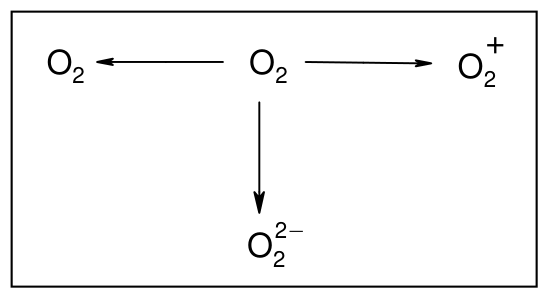
2.1 Indicate clearly which of the above reactions correspond to the oxidation and which to the reduction of the oxygen molecule.
2.2 For each of the ions in the scheme give the formula of a compound containing that particular ion.
2.3 It has been found that one of the species in the scheme is diamagnetic. Which one is it?
2.4 Copy out the following table:
| Species | Bond order | Interatomic distance | Bonding energy |
|---|---|---|---|
| \(\ce{O2}\) | |||
| \(\ce{O2^+}\) | |||
| \(\ce{O2^-}\) | |||
| \(\ce{O2^{2-}}\) |
The interatomic distances, \(\ce{O-O}\), in the above species have the values 112, 121, 132 and about 149 pm. Write these values in the appropriate column in the table.
\(1\ \mathrm{pm}=10^{-12}\ \mathrm{m}\).
2.5 Three of the bond energies, \(E_{\ce{O-O}}\), have the values approximately 200, 490 and 625 kJ mol\(^{-1}\). The value for one of the species is uncertain and, therefore, not given. Write the values in the appropriate spaces in the table.
2.6 Determine the bond order for the individual species and write the answers in the table.
2.7 Is it possible to prepare compounds containing the \(\ce{F2^{2-}}\) ion? Give reasons for your answer.
Official English text of the problem.
Answers
- 2.1 Oxidation: \(\ce{O2 -> O2^+ + e^-}\). Reduction: \(\ce{O2 + e^- -> O2^-}\) and \(\ce{O2 + 2e^- -> O2^{2-}}\).
- 2.2 Suitable compounds are potassium superoxide, \(\ce{KO2}\); sodium peroxide, \(\ce{Na2O2}\); and dioxygenyl hexafluoroplatinate(V), \(\ce{O2PtF6}\). Their SMILES are given in the solution.
- 2.3 The peroxide ion, \(\ce{O2^{2-}}\), is diamagnetic.
- 2.4 Distances: \(\ce{O2}\), \(121\ \mathrm{pm}\); \(\ce{O2^+}\), \(112\ \mathrm{pm}\); \(\ce{O2^-}\), \(132\ \mathrm{pm}\); \(\ce{O2^{2-}}\), approximately \(149\ \mathrm{pm}\).
- 2.5 Using the peroxide single-bond assignment discussed below: \(\ce{O2}\), approximately \(490\ \mathrm{kJ\,mol^{-1}}\); \(\ce{O2^+}\), approximately \(625\ \mathrm{kJ\,mol^{-1}}\); \(\ce{O2^{2-}}\), approximately \(200\ \mathrm{kJ\,mol^{-1}}\). The superoxide value is left unspecified.
- 2.6 Bond orders: \(\ce{O2}\), \(2\); \(\ce{O2^+}\), \(2.5\); \(\ce{O2^-}\), \(1.5\); \(\ce{O2^{2-}}\), \(1\).
- 2.7 No stable, discrete bonded \(\ce{F2^{2-}}\) ion is predicted: its bond order is zero. Reduction gives two separate fluoride ions.
Solution
2.1 — Oxidation and reduction
The oxygen species have the following names and formal SMILES representations:
| Species | Name | SMILES |
|---|---|---|
| \(\ce{O2}\) | Dioxygen | O=O |
| \(\ce{O2^+}\) | Dioxygenyl ion | [O+]=O |
| \(\ce{O2^-}\) | Superoxide ion | [O-][O] |
| \(\ce{O2^{2-}}\) | Peroxide ion | [O-][O-] |
These SMILES specify formal connectivity and charge. They do not express fractional molecular orbital bond orders or the distribution of electrons between molecular orbitals. In particular, O=O does not specify dioxygen’s triplet ground state.
Oxidation is electron loss, so formation of the dioxygenyl ion is oxidation:
\[ \boxed{\ce{O2 -> O2^+ + e^-}} \]
Reduction is electron gain. Formation of either negative ion is therefore reduction:
\[ \boxed{\ce{O2 + e^- -> O2^-}} \]
\[ \boxed{\ce{O2 + 2e^- -> O2^{2-}}} \]
Each equation conserves both oxygen atoms and total charge.
2.2 — Compounds containing the ions
One example for each ion is:
| Ion | Compound formula | Compound name | SMILES |
|---|---|---|---|
| \(\ce{O2^-}\) | \(\ce{KO2}\) | Potassium superoxide | [K+].[O-][O] |
| \(\ce{O2^{2-}}\) | \(\ce{Na2O2}\) | Sodium peroxide | [Na+].[Na+].[O-][O-] |
| \(\ce{O2^+}\) | \(\ce{O2PtF6}\) | Dioxygenyl hexafluoroplatinate(V) | [O+]=O.F[Pt-](F)(F)(F)(F)F |
The charge balances are respectively \(+1-1=0\), \(2(+1)-2=0\), and \(+1-1=0\).
In the last compound, the counterion is hexafluoroplatinate(V), \(\ce{[PtF6]^-}\), represented by F[Pt-](F)(F)(F)(F)F. Its six fluorine ligands have octahedral coordination around platinum. The SMILES does not specify this geometry or the crystal lattice; the formal charge on platinum in this covalent SMILES representation is not its oxidation state.
2.3 — Diamagnetism
All four oxygen species have filled lower molecular orbitals. Their magnetic differences arise from the two degenerate antibonding \(\pi_{2p}^{*}\) orbitals.
Neutral dioxygen has two electrons in these orbitals. By Hund’s rule, they occupy different orbitals with parallel spins. Removing one electron gives the dioxygenyl ion; adding one or two gives superoxide or peroxide:
| Species | Occupation of the two \(\pi^{*}\) orbitals | Unpaired electrons | Magnetic character |
|---|---|---|---|
| \(\ce{O2}\) | \((\uparrow)(\uparrow)\) | 2 | Paramagnetic |
| \(\ce{O2^+}\) | \((\uparrow)(\text{empty})\) | 1 | Paramagnetic |
| \(\ce{O2^-}\) | \((\uparrow\downarrow)(\uparrow)\) | 1 | Paramagnetic |
| \(\ce{O2^{2-}}\) | \((\uparrow\downarrow)(\uparrow\downarrow)\) | 0 | Diamagnetic |
Thus only the peroxide ion has every electron paired:
\[ \boxed{\ce{O2^{2-}}\text{ is diamagnetic}.} \]
2.4 — Interatomic distances
Removing an electron from an antibonding orbital strengthens and shortens the bond. Adding electrons to antibonding orbitals weakens and lengthens it. Consequently,
\[ r(\ce{O2^+}) < r(\ce{O2}) < r(\ce{O2^-}) < r(\ce{O2^{2-}}). \]
Assigning the supplied distances in increasing order gives
\[ \begin{aligned} r(\ce{O2^+}) &=112\ \mathrm{pm},\\ r(\ce{O2}) &=121\ \mathrm{pm},\\ r(\ce{O2^-}) &=132\ \mathrm{pm},\\ r(\ce{O2^{2-}}) &\approx149\ \mathrm{pm}. \end{aligned} \]
2.5 — Bond energies
The expected bond-strength order is the reverse of the bond-length order:
\[ E(\ce{O2^+}) > E(\ce{O2}) > E(\ce{O2^-}) > E(\ce{O2^{2-}}). \]
The conventional assignment associates approximately \(490\ \mathrm{kJ\,mol^{-1}}\) with the dioxygen double bond and approximately \(625\ \mathrm{kJ\,mol^{-1}}\) with the stronger dioxygenyl bond. Assigning approximately \(200\ \mathrm{kJ\,mol^{-1}}\) to the peroxide single bond leaves the superoxide entry unspecified:
\[ \begin{aligned} E(\ce{O2^+}) &\approx625\ \mathrm{kJ\,mol^{-1}},\\ E(\ce{O2}) &\approx490\ \mathrm{kJ\,mol^{-1}},\\ E(\ce{O2^{2-}}) &\approx200\ \mathrm{kJ\,mol^{-1}}. \end{aligned} \]
Bond order does not determine a numerical bond energy through an exact proportionality, so the missing value should not be calculated by interpolation.
2.6 — Bond orders
For these oxygen species, the valence molecular orbital configuration can be written as
\[ (\sigma_{2s})^2 (\sigma_{2s}^{*})^2 (\sigma_{2p_z})^2 (\pi_{2p_x})^2 (\pi_{2p_y})^2 (\pi_{2p}^{*})^n, \]
where the final factor denotes the total occupation of the two degenerate antibonding \(\pi^{*}\) orbitals.
There are eight bonding electrons and \(2+n\) antibonding electrons. Therefore,
\[ \text{bond order} =\frac{N_{\mathrm{bonding}}-N_{\mathrm{antibonding}}}{2} =\frac{8-(2+n)}{2}. \]
The values of \(n\) are \(2,1,3,4\) for \(\ce{O2}\), \(\ce{O2^+}\), \(\ce{O2^-}\), and \(\ce{O2^{2-}}\), respectively. Hence,
\[ \begin{aligned} \ce{O2}:&\quad \frac{8-4}{2}=2,\\ \ce{O2^+}:&\quad \frac{8-3}{2}=2.5,\\ \ce{O2^-}:&\quad \frac{8-5}{2}=1.5,\\ \ce{O2^{2-}}:&\quad \frac{8-6}{2}=1. \end{aligned} \]
The completed table, using the energy assignment in 2.5, is:
| Species | Bond order | Interatomic distance / pm | Bonding energy / \(\mathrm{kJ\,mol^{-1}}\) |
|---|---|---|---|
| \(\ce{O2}\) | 2 | 121 | approximately 490 |
| \(\ce{O2^+}\) | 2.5 | 112 | approximately 625 |
| \(\ce{O2^-}\) | 1.5 | 132 | Unspecified |
| \(\ce{O2^{2-}}\) | 1 | approximately 149 | approximately 200 |
2.7 — The proposed difluorine dianion
Difluorine, \(\ce{F2}\), has SMILES FF and fourteen valence electrons. Its bonding orbitals contain eight electrons and its antibonding orbitals contain six, giving
\[ \text{bond order of }\ce{F2}=\frac{8-6}{2}=1. \]
Adding two electrons fills the remaining antibonding \(\sigma_{2p_z}^{*}\) orbital. The hypothetical difluorine dianion would then have
\[ \boxed{\text{bond order of }\ce{F2^{2-}}=\frac{8-8}{2}=0.} \]
There is no net covalent bonding stabilization, and separation also relieves repulsion between the negative ions. Thus compounds are expected to contain individual fluoride ions, \(\ce{F^-}\), SMILES [F-], rather than a stable bonded difluorine dianion. The balanced overall reduction is
\[ \boxed{\ce{F2 + 2e^- -> 2F^-}.} \]
The appropriate product representation is [F-].[F-]: two separate fluoride ions, with no bond between them.
The solution was checked against the official solution.
IChO 1985 · Theorieaufgabe 2
Disauerstoff-Spezies O2+, O2- und O2(2-): Bindungsordnungen, Abstände und Energien
Es ist möglich, Verbindungen herzustellen, die die Ionen \(\ce{O2^-}\), \(\ce{O2^{2-}}\) oder sogar \(\ce{O2^+}\) enthalten. Diese Ionen entstehen gewöhnlich bei verschiedenen Reaktionen aus Sauerstoffmolekülen, wie im folgenden Schema dargestellt:
2.1 Geben Sie eindeutig an, welche der oben dargestellten Reaktionen einer Oxidation und welche einer Reduktion des Sauerstoffmoleküls entsprechen.
2.2 Geben Sie für jedes Ion im Schema die Formel einer Verbindung an, die dieses Ion enthält.
2.3 Es wurde festgestellt, dass eine der Spezies im Schema diamagnetisch ist. Um welche handelt es sich?
2.4 Übertragen Sie die folgende Tabelle:
| Spezies | Bindungsordnung | Kernabstand | Bindungsenergie |
|---|---|---|---|
| \(\ce{O2}\) | |||
| \(\ce{O2^+}\) | |||
| \(\ce{O2^-}\) | |||
| \(\ce{O2^{2-}}\) |
Die Kernabstände \(\ce{O-O}\) in den oben genannten Spezies betragen 112, 121, 132 und etwa 149 pm. Tragen Sie diese Werte in die entsprechende Spalte der Tabelle ein.
\(1\ \mathrm{pm}=10^{-12}\ \mathrm{m}\).
2.5 Drei der Bindungsenergien \(E_{\ce{O-O}}\) betragen ungefähr 200, 490 und 625 kJ mol\(^{-1}\). Der Wert für eine der Spezies ist unsicher und wird daher nicht angegeben. Tragen Sie die Werte in die entsprechenden Felder der Tabelle ein.
2.6 Bestimmen Sie die Bindungsordnung der einzelnen Spezies und tragen Sie die Ergebnisse in die Tabelle ein.
2.7 Ist es möglich, Verbindungen herzustellen, die das Ion \(\ce{F2^{2-}}\) enthalten? Begründen Sie Ihre Antwort.
Aufgabentext aus dem offiziellen englischen Text übersetzt.
Antworten
- 2.1 Oxidation: \(\ce{O2 -> O2^+ + e^-}\). Reduktion: \(\ce{O2 + e^- -> O2^-}\) und \(\ce{O2 + 2e^- -> O2^{2-}}\).
- 2.2 Geeignete Verbindungen sind Kaliumsuperoxid, \(\ce{KO2}\); Natriumperoxid, \(\ce{Na2O2}\); und Dioxygenylhexafluoroplatinat(V), \(\ce{O2PtF6}\). Ihre SMILES sind in der Lösung angegeben.
- 2.3 Das Peroxid-Ion, \(\ce{O2^{2-}}\), ist diamagnetisch.
- 2.4 Abstände: \(\ce{O2}\), \(121\ \mathrm{pm}\); \(\ce{O2^+}\), \(112\ \mathrm{pm}\); \(\ce{O2^-}\), \(132\ \mathrm{pm}\); \(\ce{O2^{2-}}\), ungefähr \(149\ \mathrm{pm}\).
- 2.5 Bei Verwendung der unten erläuterten Zuordnung zur Peroxid-Einfachbindung: \(\ce{O2}\), ungefähr \(490\ \mathrm{kJ\,mol^{-1}}\); \(\ce{O2^+}\), ungefähr \(625\ \mathrm{kJ\,mol^{-1}}\); \(\ce{O2^{2-}}\), ungefähr \(200\ \mathrm{kJ\,mol^{-1}}\). Der Wert für Superoxid bleibt offen.
- 2.6 Bindungsordnungen: \(\ce{O2}\), \(2\); \(\ce{O2^+}\), \(2.5\); \(\ce{O2^-}\), \(1.5\); \(\ce{O2^{2-}}\), \(1\).
- 2.7 Ein stabiles, diskretes \(\ce{F2^{2-}}\)-Ion mit einer Bindung zwischen den Atomen wird nicht vorhergesagt: Seine Bindungsordnung ist null. Die Reduktion ergibt zwei getrennte Fluorid-Ionen.
Lösung
2.1 — Oxidation und Reduktion
Die Sauerstoffspezies haben die folgenden Namen und formalen SMILES-Darstellungen:
| Spezies | Name | SMILES |
|---|---|---|
| \(\ce{O2}\) | Disauerstoff | O=O |
| \(\ce{O2^+}\) | Dioxygenyl-Ion | [O+]=O |
| \(\ce{O2^-}\) | Superoxid-Ion | [O-][O] |
| \(\ce{O2^{2-}}\) | Peroxid-Ion | [O-][O-] |
Diese SMILES geben die formale Verknüpfung der Atome und die Ladung an. Sie drücken weder nichtganzzahlige Bindungsordnungen nach der Molekülorbitaltheorie noch die Verteilung der Elektronen auf die Molekülorbitale aus. Insbesondere legt O=O den Triplett-Grundzustand des Disauerstoffs nicht fest.
Oxidation ist die Abgabe von Elektronen; daher ist die Bildung des Dioxygenyl-Ions eine Oxidation:
\[ \boxed{\ce{O2 -> O2^+ + e^-}} \]
Reduktion ist die Aufnahme von Elektronen. Die Bildung jedes der beiden negativen Ionen ist daher eine Reduktion:
\[ \boxed{\ce{O2 + e^- -> O2^-}} \]
\[ \boxed{\ce{O2 + 2e^- -> O2^{2-}}} \]
In jeder Gleichung bleiben sowohl die Anzahl der Sauerstoffatome als auch die Gesamtladung erhalten.
2.2 — Verbindungen, die die Ionen enthalten
Je ein Beispiel für jedes Ion ist:
| Ion | Formel der Verbindung | Name der Verbindung | SMILES |
|---|---|---|---|
| \(\ce{O2^-}\) | \(\ce{KO2}\) | Kaliumsuperoxid | [K+].[O-][O] |
| \(\ce{O2^{2-}}\) | \(\ce{Na2O2}\) | Natriumperoxid | [Na+].[Na+].[O-][O-] |
| \(\ce{O2^+}\) | \(\ce{O2PtF6}\) | Dioxygenylhexafluoroplatinat(V) | [O+]=O.F[Pt-](F)(F)(F)(F)F |
Die Ladungsbilanzen lauten entsprechend \(+1-1=0\), \(2(+1)-2=0\) und \(+1-1=0\).
In der letzten Verbindung ist das Gegenion Hexafluoroplatinat(V), \(\ce{[PtF6]^-}\), dargestellt durch F[Pt-](F)(F)(F)(F)F. Seine sechs Fluorliganden sind oktaedrisch um das Platin koordiniert. Die SMILES-Darstellung legt weder diese Geometrie noch das Kristallgitter fest; die Formalladung am Platin in dieser kovalenten SMILES-Darstellung ist nicht seine Oxidationsstufe.
2.3 — Diamagnetismus
Bei allen vier Sauerstoffspezies sind die tiefer liegenden Molekülorbitale vollständig besetzt. Ihre magnetischen Unterschiede ergeben sich aus den beiden entarteten antibindenden \(\pi_{2p}^{*}\)-Orbitalen.
Neutraler Disauerstoff besitzt zwei Elektronen in diesen Orbitalen. Nach der Hundschen Regel besetzen sie verschiedene Orbitale mit parallelen Spins. Die Entfernung eines Elektrons ergibt das Dioxygenyl-Ion; die Aufnahme eines beziehungsweise zweier Elektronen ergibt Superoxid beziehungsweise Peroxid:
| Spezies | Besetzung der beiden \(\pi^{*}\)-Orbitale | Ungepaarte Elektronen | Magnetisches Verhalten |
|---|---|---|---|
| \(\ce{O2}\) | \((\uparrow)(\uparrow)\) | 2 | Paramagnetisch |
| \(\ce{O2^+}\) | \((\uparrow)(\text{leer})\) | 1 | Paramagnetisch |
| \(\ce{O2^-}\) | \((\uparrow\downarrow)(\uparrow)\) | 1 | Paramagnetisch |
| \(\ce{O2^{2-}}\) | \((\uparrow\downarrow)(\uparrow\downarrow)\) | 0 | Diamagnetisch |
Somit sind nur im Peroxid-Ion alle Elektronen gepaart:
\[ \boxed{\ce{O2^{2-}}\text{ ist diamagnetisch}.} \]
2.4 — Kernabstände
Die Entfernung eines Elektrons aus einem antibindenden Orbital verstärkt und verkürzt die Bindung. Die Aufnahme von Elektronen in antibindende Orbitale schwächt und verlängert sie. Folglich gilt:
\[ r(\ce{O2^+}) < r(\ce{O2}) < r(\ce{O2^-}) < r(\ce{O2^{2-}}). \]
Die Zuordnung der angegebenen Abstände in aufsteigender Reihenfolge ergibt
\[ \begin{aligned} r(\ce{O2^+}) &=112\ \mathrm{pm},\\ r(\ce{O2}) &=121\ \mathrm{pm},\\ r(\ce{O2^-}) &=132\ \mathrm{pm},\\ r(\ce{O2^{2-}}) &\approx149\ \mathrm{pm}. \end{aligned} \]
2.5 — Bindungsenergien
Die erwartete Reihenfolge der Bindungsstärken ist der Reihenfolge der Bindungslängen entgegengesetzt:
\[ E(\ce{O2^+}) > E(\ce{O2}) > E(\ce{O2^-}) > E(\ce{O2^{2-}}). \]
Die übliche Zuordnung weist der Disauerstoff-Doppelbindung ungefähr \(490\ \mathrm{kJ\,mol^{-1}}\) und der stärkeren Dioxygenyl-Bindung ungefähr \(625\ \mathrm{kJ\,mol^{-1}}\) zu. Wird der Peroxid-Einfachbindung ein Wert von ungefähr \(200\ \mathrm{kJ\,mol^{-1}}\) zugeordnet, bleibt der Eintrag für Superoxid offen:
\[ \begin{aligned} E(\ce{O2^+}) &\approx625\ \mathrm{kJ\,mol^{-1}},\\ E(\ce{O2}) &\approx490\ \mathrm{kJ\,mol^{-1}},\\ E(\ce{O2^{2-}}) &\approx200\ \mathrm{kJ\,mol^{-1}}. \end{aligned} \]
Die Bindungsordnung bestimmt die Bindungsenergie nicht über eine exakte Proportionalität, sodass der fehlende Wert nicht durch Interpolation berechnet werden sollte.
2.6 — Bindungsordnungen
Für diese Sauerstoffspezies lässt sich die Elektronenkonfiguration der Valenzmolekülorbitale wie folgt schreiben:
\[ (\sigma_{2s})^2 (\sigma_{2s}^{*})^2 (\sigma_{2p_z})^2 (\pi_{2p_x})^2 (\pi_{2p_y})^2 (\pi_{2p}^{*})^n, \]
wobei der letzte Faktor die Gesamtbesetzung der beiden entarteten antibindenden \(\pi^{*}\)-Orbitale bezeichnet.
Es gibt acht bindende Elektronen und \(2+n\) antibindende Elektronen. Daher gilt:
\[ \text{Bindungsordnung} =\frac{N_{\mathrm{bonding}}-N_{\mathrm{antibonding}}}{2} =\frac{8-(2+n)}{2}. \]
Die Werte von \(n\) betragen für \(\ce{O2}\), \(\ce{O2^+}\), \(\ce{O2^-}\) und \(\ce{O2^{2-}}\) entsprechend \(2,1,3,4\). Somit ergibt sich:
\[ \begin{aligned} \ce{O2}:&\quad \frac{8-4}{2}=2,\\ \ce{O2^+}:&\quad \frac{8-3}{2}=2.5,\\ \ce{O2^-}:&\quad \frac{8-5}{2}=1.5,\\ \ce{O2^{2-}}:&\quad \frac{8-6}{2}=1. \end{aligned} \]
Die ausgefüllte Tabelle unter Verwendung der Energiezuordnung aus 2.5 lautet:
| Spezies | Bindungsordnung | Kernabstand / pm | Bindungsenergie / \(\mathrm{kJ\,mol^{-1}}\) |
|---|---|---|---|
| \(\ce{O2}\) | 2 | 121 | ungefähr 490 |
| \(\ce{O2^+}\) | 2.5 | 112 | ungefähr 625 |
| \(\ce{O2^-}\) | 1.5 | 132 | Nicht angegeben |
| \(\ce{O2^{2-}}\) | 1 | ungefähr 149 | ungefähr 200 |
2.7 — Das vorgeschlagene Difluor-Dianion
Difluor, \(\ce{F2}\), hat die SMILES-Darstellung FF und vierzehn Valenzelektronen. Seine bindenden Orbitale enthalten acht Elektronen und seine antibindenden Orbitale sechs. Daraus ergibt sich
\[ \text{Bindungsordnung von }\ce{F2}=\frac{8-6}{2}=1. \]
Die Aufnahme zweier Elektronen füllt das verbleibende antibindende \(\sigma_{2p_z}^{*}\)-Orbital. Für das hypothetische Difluor-Dianion ergäbe sich dann
\[ \boxed{\text{Bindungsordnung von }\ce{F2^{2-}}=\frac{8-8}{2}=0.} \]
Es gibt keine Nettostabilisierung durch kovalente Bindung, und die Trennung verringert außerdem die Abstoßung zwischen den negativen Ionen. Daher ist zu erwarten, dass Verbindungen einzelne Fluorid-Ionen, \(\ce{F^-}\), mit der SMILES-Darstellung [F-] enthalten, anstelle eines stabilen Difluor-Dianions mit einer Bindung zwischen den Atomen. Die ausgeglichene Gesamtreaktion der Reduktion lautet
\[ \boxed{\ce{F2 + 2e^- -> 2F^-}.} \]
Die geeignete Darstellung des Produkts ist [F-].[F-]: zwei getrennte Fluorid-Ionen ohne Bindung zwischen ihnen.
Die Lösung wurde mit der offiziellen Lösung abgeglichen.
IChO 1985 · Teori sorusu 2
Dioksijen türleri O2+, O2- ve O2(2-): bağ mertebeleri, uzaklıklar ve enerjiler
\(\ce{O2^-}\), \(\ce{O2^{2-}}\) ve hatta \(\ce{O2^+}\) iyonlarını içeren bileşikler hazırlamak mümkündür. Bu iyonlar genellikle aşağıdaki şemada gösterildiği gibi çeşitli tepkimeler sırasında oksijen moleküllerinden oluşur:
2.1 Yukarıdaki tepkimelerden hangilerinin oksijen molekülünün yükseltgenmesine, hangilerinin indirgenmesine karşılık geldiğini açıkça belirtiniz.
2.2 Şemadaki iyonların her biri için o iyonu içeren bir bileşiğin formülünü veriniz.
2.3 Şemadaki türlerden birinin diyamanyetik olduğu bulunmuştur. Bu tür hangisidir?
2.4 Aşağıdaki tabloyu kopyalayınız:
| Tür | Bağ mertebesi | Atomlar arası uzaklık | Bağ enerjisi |
|---|---|---|---|
| \(\ce{O2}\) | |||
| \(\ce{O2^+}\) | |||
| \(\ce{O2^-}\) | |||
| \(\ce{O2^{2-}}\) |
Yukarıdaki türlerde atomlar arası \(\ce{O-O}\) uzaklıkları 112, 121, 132 ve yaklaşık 149 pm değerlerindedir. Bu değerleri tablodaki uygun sütuna yazınız.
\(1\ \mathrm{pm}=10^{-12}\ \mathrm{m}\).
2.5 Bağ enerjilerinden, \(E_{\ce{O-O}}\), üçünün değerleri yaklaşık olarak 200, 490 ve 625 kJ mol\(^{-1}\)'dir. Türlerden birinin değeri belirsizdir ve bu nedenle verilmemiştir. Değerleri tablodaki uygun yerlere yazınız.
2.6 Her bir türün bağ mertebesini belirleyiniz ve cevapları tabloya yazınız.
2.7 \(\ce{F2^{2-}}\) iyonunu içeren bileşikler hazırlamak mümkün müdür? Cevabınızı gerekçelendiriniz.
Soru metni resmi İngilizce metinden çevrilmiştir.
Cevaplar
- 2.1 Yükseltgenme: \(\ce{O2 -> O2^+ + e^-}\). İndirgenme: \(\ce{O2 + e^- -> O2^-}\) ve \(\ce{O2 + 2e^- -> O2^{2-}}\).
- 2.2 Uygun bileşikler potasyum süperoksit, \(\ce{KO2}\); sodyum peroksit, \(\ce{Na2O2}\); ve dioksijenil hekzafloroplatinat(V), \(\ce{O2PtF6}\)'dır. Bunların SMILES gösterimleri çözümde verilmiştir.
- 2.3 Peroksit iyonu, \(\ce{O2^{2-}}\), diyamanyetiktir.
- 2.4 Uzaklıklar: \(\ce{O2}\), \(121\ \mathrm{pm}\); \(\ce{O2^+}\), \(112\ \mathrm{pm}\); \(\ce{O2^-}\), \(132\ \mathrm{pm}\); \(\ce{O2^{2-}}\), yaklaşık \(149\ \mathrm{pm}\).
- 2.5 Aşağıda ele alınan peroksit tek bağına ilişkin atama kullanıldığında: \(\ce{O2}\), yaklaşık \(490\ \mathrm{kJ\,mol^{-1}}\); \(\ce{O2^+}\), yaklaşık \(625\ \mathrm{kJ\,mol^{-1}}\); \(\ce{O2^{2-}}\), yaklaşık \(200\ \mathrm{kJ\,mol^{-1}}\). Süperoksitin değeri belirtilmemiştir.
- 2.6 Bağ mertebeleri: \(\ce{O2}\), \(2\); \(\ce{O2^+}\), \(2.5\); \(\ce{O2^-}\), \(1.5\); \(\ce{O2^{2-}}\), \(1\).
- 2.7 Kararlı, bağımsız ve bağ içeren bir \(\ce{F2^{2-}}\) iyonu öngörülmez: bağ mertebesi sıfırdır. İndirgenme sonucunda iki ayrı florür iyonu oluşur.
Çözüm
2.1 — Yükseltgenme ve indirgenme
Oksijen türlerinin adları ve biçimsel SMILES gösterimleri şöyledir:
| Tür | Adı | SMILES |
|---|---|---|
| \(\ce{O2}\) | Dioksijen | O=O |
| \(\ce{O2^+}\) | Dioksijenil iyonu | [O+]=O |
| \(\ce{O2^-}\) | Süperoksit iyonu | [O-][O] |
| \(\ce{O2^{2-}}\) | Peroksit iyonu | [O-][O-] |
Bu SMILES gösterimleri biçimsel bağlanma düzenini ve yükü belirtir. Kesirli moleküler orbital bağ mertebelerini veya elektronların moleküler orbitaller arasındaki dağılımını ifade etmez. Özellikle, O=O dioksijenin triplet temel hâlini belirtmez.
Yükseltgenme elektron kaybıdır; dolayısıyla dioksijenil iyonunun oluşumu yükseltgenmedir:
\[ \boxed{\ce{O2 -> O2^+ + e^-}} \]
İndirgenme elektron kazanımıdır. Bu nedenle negatif iyonların her ikisinin oluşumu da indirgenmedir:
\[ \boxed{\ce{O2 + e^- -> O2^-}} \]
\[ \boxed{\ce{O2 + 2e^- -> O2^{2-}}} \]
Her denklemde hem oksijen atomları hem de toplam yük korunur.
2.2 — İyonları içeren bileşikler
Her iyon için bir örnek şöyledir:
| İyon | Bileşiğin formülü | Bileşiğin adı | SMILES |
|---|---|---|---|
| \(\ce{O2^-}\) | \(\ce{KO2}\) | Potasyum süperoksit | [K+].[O-][O] |
| \(\ce{O2^{2-}}\) | \(\ce{Na2O2}\) | Sodyum peroksit | [Na+].[Na+].[O-][O-] |
| \(\ce{O2^+}\) | \(\ce{O2PtF6}\) | Dioksijenil hekzafloroplatinat(V) | [O+]=O.F[Pt-](F)(F)(F)(F)F |
Yük dengeleri sırasıyla \(+1-1=0\), \(2(+1)-2=0\) ve \(+1-1=0\)'dır.
Son bileşikte karşı iyon, F[Pt-](F)(F)(F)(F)F ile gösterilen hekzafloroplatinat(V), \(\ce{[PtF6]^-}\), iyonudur. Altı flor ligandı, platin çevresinde oktahedral koordinasyon düzenine sahiptir. SMILES gösterimi bu geometriyi veya kristal örgüyü belirtmez; bu kovalent SMILES gösteriminde platin üzerindeki biçimsel yük, platinin yükseltgenme basamağı değildir.
2.3 — Diyamanyetizma
Dört oksijen türünün de alt enerji düzeylerindeki moleküler orbitalleri doludur. Manyetik özelliklerindeki farklılıklar, eş enerjili iki karşıt bağlayıcı \(\pi_{2p}^{*}\) orbitalinden kaynaklanır.
Nötr dioksijenin bu orbitallerinde iki elektron bulunur. Hund kuralına göre bu elektronlar, spinleri paralel olacak şekilde farklı orbitallere yerleşir. Bir elektron uzaklaştırılması dioksijenil iyonunu; bir veya iki elektron eklenmesi ise süperoksit veya peroksiti verir:
| Tür | İki \(\pi^{*}\) orbitalinin doluluğu | Eşleşmemiş elektronlar | Manyetik özellik |
|---|---|---|---|
| \(\ce{O2}\) | \((\uparrow)(\uparrow)\) | 2 | Paramanyetik |
| \(\ce{O2^+}\) | \((\uparrow)(\text{boş})\) | 1 | Paramanyetik |
| \(\ce{O2^-}\) | \((\uparrow\downarrow)(\uparrow)\) | 1 | Paramanyetik |
| \(\ce{O2^{2-}}\) | \((\uparrow\downarrow)(\uparrow\downarrow)\) | 0 | Diyamanyetik |
Dolayısıyla yalnızca peroksit iyonunda tüm elektronlar eşleşmiştir:
\[ \boxed{\ce{O2^{2-}}\text{ diyamanyetiktir}.} \]
2.4 — Atomlar arası uzaklıklar
Karşıt bağlayıcı bir orbitalden bir elektron uzaklaştırılması bağı güçlendirir ve kısaltır. Karşıt bağlayıcı orbitallere elektron eklenmesi ise bağı zayıflatır ve uzatır. Dolayısıyla,
\[ r(\ce{O2^+}) < r(\ce{O2}) < r(\ce{O2^-}) < r(\ce{O2^{2-}}). \]
Verilen uzaklıklar artan sırayla eşleştirildiğinde şu değerler elde edilir:
\[ \begin{aligned} r(\ce{O2^+}) &=112\ \mathrm{pm},\\ r(\ce{O2}) &=121\ \mathrm{pm},\\ r(\ce{O2^-}) &=132\ \mathrm{pm},\\ r(\ce{O2^{2-}}) &\approx149\ \mathrm{pm}. \end{aligned} \]
2.5 — Bağ enerjileri
Beklenen bağ kuvveti sıralaması, bağ uzunluğu sıralamasının tersidir:
\[ E(\ce{O2^+}) > E(\ce{O2}) > E(\ce{O2^-}) > E(\ce{O2^{2-}}). \]
Geleneksel atamada yaklaşık \(490\ \mathrm{kJ\,mol^{-1}}\) değeri dioksijenin çift bağıyla, yaklaşık \(625\ \mathrm{kJ\,mol^{-1}}\) değeri ise daha güçlü olan dioksijenil bağıyla ilişkilendirilir. Yaklaşık \(200\ \mathrm{kJ\,mol^{-1}}\) değeri peroksitin tek bağına atandığında süperoksit için değer belirtilmemiş olur:
\[ \begin{aligned} E(\ce{O2^+}) &\approx625\ \mathrm{kJ\,mol^{-1}},\\ E(\ce{O2}) &\approx490\ \mathrm{kJ\,mol^{-1}},\\ E(\ce{O2^{2-}}) &\approx200\ \mathrm{kJ\,mol^{-1}}. \end{aligned} \]
Bağ mertebesi, kesin bir orantı yoluyla sayısal bir bağ enerjisi belirlemez; bu nedenle eksik değer interpolasyonla hesaplanmamalıdır.
2.6 — Bağ mertebeleri
Bu oksijen türleri için değerlik moleküler orbital elektron dizilimi şöyle yazılabilir:
\[ (\sigma_{2s})^2 (\sigma_{2s}^{*})^2 (\sigma_{2p_z})^2 (\pi_{2p_x})^2 (\pi_{2p_y})^2 (\pi_{2p}^{*})^n, \]
burada son çarpan, eş enerjili iki karşıt bağlayıcı \(\pi^{*}\) orbitalinin toplam elektron doluluğunu gösterir.
Sekiz bağlayıcı elektron ve \(2+n\) karşıt bağlayıcı elektron vardır. Dolayısıyla,
\[ \text{bağ mertebesi} =\frac{N_{\mathrm{bonding}}-N_{\mathrm{antibonding}}}{2} =\frac{8-(2+n)}{2}. \]
\(n\) değerleri \(\ce{O2}\), \(\ce{O2^+}\), \(\ce{O2^-}\) ve \(\ce{O2^{2-}}\) için sırasıyla \(2,1,3,4\)'tür. Buna göre,
\[ \begin{aligned} \ce{O2}:&\quad \frac{8-4}{2}=2,\\ \ce{O2^+}:&\quad \frac{8-3}{2}=2.5,\\ \ce{O2^-}:&\quad \frac{8-5}{2}=1.5,\\ \ce{O2^{2-}}:&\quad \frac{8-6}{2}=1. \end{aligned} \]
2.5'teki enerji ataması kullanılarak tamamlanan tablo şöyledir:
| Tür | Bağ mertebesi | Atomlar arası uzaklık / pm | Bağ enerjisi / \(\mathrm{kJ\,mol^{-1}}\) |
|---|---|---|---|
| \(\ce{O2}\) | 2 | 121 | yaklaşık 490 |
| \(\ce{O2^+}\) | 2.5 | 112 | yaklaşık 625 |
| \(\ce{O2^-}\) | 1.5 | 132 | Belirtilmemiş |
| \(\ce{O2^{2-}}\) | 1 | yaklaşık 149 | yaklaşık 200 |
2.7 — Önerilen diflor dianyonu
Diflorun, \(\ce{F2}\), SMILES gösterimi FF'dir ve on dört değerlik elektronu vardır. Bağlayıcı orbitallerinde sekiz, karşıt bağlayıcı orbitallerinde altı elektron bulunur; buradan şu sonuç elde edilir:
\[ \text{bağ mertebesi: }\ce{F2}=\frac{8-6}{2}=1. \]
İki elektron eklenmesi, geriye kalan karşıt bağlayıcı \(\sigma_{2p_z}^{*}\) orbitalini doldurur. Bu durumda varsayımsal diflor dianyonunun bağ mertebesi şöyle olur:
\[ \boxed{\text{bağ mertebesi: }\ce{F2^{2-}}=\frac{8-8}{2}=0.} \]
Kovalent bağlanmadan kaynaklanan net bir kararlılık kazanımı yoktur ve ayrılma, negatif iyonlar arasındaki itmeyi de azaltır. Bu nedenle bileşiklerin, kararlı ve bağ içeren bir diflor dianyonu yerine SMILES gösterimi [F-] olan ayrı florür iyonları, \(\ce{F^-}\), içermesi beklenir. Denkleştirilmiş toplam indirgenme tepkimesi şöyledir:
\[ \boxed{\ce{F2 + 2e^- -> 2F^-}.} \]
Uygun ürün gösterimi [F-].[F-]'dir: aralarında bağ bulunmayan iki ayrı florür iyonu.
Çözüm, resmi çözümle karşılaştırılarak kontrol edildi.
IChO 1985 · Problema teórico 2
Especies de dioxígeno O2+, O2- y O2(2-): órdenes de enlace, distancias y energías
Es posible preparar compuestos que contengan iones \(\ce{O2^-}\), \(\ce{O2^{2-}}\) o incluso \(\ce{O2^+}\). Estos iones suelen formarse a partir de moléculas de oxígeno durante diversas reacciones, como se indica en el siguiente esquema:
2.1 Indique claramente cuáles de las reacciones anteriores corresponden a la oxidación y cuáles a la reducción de la molécula de oxígeno.
2.2 Para cada uno de los iones del esquema, dé la fórmula de un compuesto que contenga ese ion concreto.
2.3 Se ha comprobado que una de las especies del esquema es diamagnética. ¿Cuál es?
2.4 Copie la siguiente tabla:
| Especie | Orden de enlace | Distancia interatómica | Energía de enlace |
|---|---|---|---|
| \(\ce{O2}\) | |||
| \(\ce{O2^+}\) | |||
| \(\ce{O2^-}\) | |||
| \(\ce{O2^{2-}}\) |
Las distancias interatómicas, \(\ce{O-O}\), en las especies anteriores tienen los valores 112, 121, 132 y aproximadamente 149 pm. Escriba estos valores en la columna correspondiente de la tabla.
\(1\ \mathrm{pm}=10^{-12}\ \mathrm{m}\).
2.5 Tres de las energías de enlace, \(E_{\ce{O-O}}\), tienen los valores aproximados de 200, 490 y 625 kJ mol\(^{-1}\). El valor de una de las especies es incierto y, por tanto, no se proporciona. Escriba los valores en las casillas correspondientes de la tabla.
2.6 Determine el orden de enlace de cada especie y escriba las respuestas en la tabla.
2.7 ¿Es posible preparar compuestos que contengan el ion \(\ce{F2^{2-}}\)? Justifique su respuesta.
Enunciado traducido del texto oficial en inglés.
Respuestas
- 2.1 Oxidación: \(\ce{O2 -> O2^+ + e^-}\). Reducción: \(\ce{O2 + e^- -> O2^-}\) y \(\ce{O2 + 2e^- -> O2^{2-}}\).
- 2.2 Algunos compuestos adecuados son el superóxido de potasio, \(\ce{KO2}\); el peróxido de sodio, \(\ce{Na2O2}\); y el hexafluoroplatinato(V) de dioxigenilo, \(\ce{O2PtF6}\). Sus SMILES se indican en la solución.
- 2.3 El ion peróxido, \(\ce{O2^{2-}}\), es diamagnético.
- 2.4 Distancias: \(\ce{O2}\), \(121\ \mathrm{pm}\); \(\ce{O2^+}\), \(112\ \mathrm{pm}\); \(\ce{O2^-}\), \(132\ \mathrm{pm}\); \(\ce{O2^{2-}}\), aproximadamente \(149\ \mathrm{pm}\).
- 2.5 Utilizando la asignación al enlace sencillo del peróxido que se analiza más adelante: \(\ce{O2}\), aproximadamente \(490\ \mathrm{kJ\,mol^{-1}}\); \(\ce{O2^+}\), aproximadamente \(625\ \mathrm{kJ\,mol^{-1}}\); \(\ce{O2^{2-}}\), aproximadamente \(200\ \mathrm{kJ\,mol^{-1}}\). El valor del superóxido se deja sin especificar.
- 2.6 Órdenes de enlace: \(\ce{O2}\), \(2\); \(\ce{O2^+}\), \(2.5\); \(\ce{O2^-}\), \(1.5\); \(\ce{O2^{2-}}\), \(1\).
- 2.7 No se predice la existencia de un ion \(\ce{F2^{2-}}\) estable, discreto y con enlace: su orden de enlace es cero. La reducción produce dos iones fluoruro separados.
Solución
2.1 — Oxidación y reducción
Las especies de oxígeno tienen los siguientes nombres y representaciones SMILES formales:
| Especie | Nombre | SMILES |
|---|---|---|
| \(\ce{O2}\) | Dioxígeno | O=O |
| \(\ce{O2^+}\) | Ion dioxigenilo | [O+]=O |
| \(\ce{O2^-}\) | Ion superóxido | [O-][O] |
| \(\ce{O2^{2-}}\) | Ion peróxido | [O-][O-] |
Estos SMILES especifican la conectividad y la carga formales. No expresan los órdenes de enlace fraccionarios de la teoría de orbitales moleculares ni la distribución de los electrones entre los orbitales moleculares. En particular, O=O no especifica el estado fundamental triplete del dioxígeno.
La oxidación consiste en la pérdida de electrones, por lo que la formación del ion dioxigenilo es una oxidación:
\[ \boxed{\ce{O2 -> O2^+ + e^-}} \]
La reducción consiste en la ganancia de electrones. Por tanto, la formación de cualquiera de los dos iones negativos es una reducción:
\[ \boxed{\ce{O2 + e^- -> O2^-}} \]
\[ \boxed{\ce{O2 + 2e^- -> O2^{2-}}} \]
Cada ecuación conserva tanto los átomos de oxígeno como la carga total.
2.2 — Compuestos que contienen los iones
Un ejemplo para cada ion es:
| Ion | Fórmula del compuesto | Nombre del compuesto | SMILES |
|---|---|---|---|
| \(\ce{O2^-}\) | \(\ce{KO2}\) | Superóxido de potasio | [K+].[O-][O] |
| \(\ce{O2^{2-}}\) | \(\ce{Na2O2}\) | Peróxido de sodio | [Na+].[Na+].[O-][O-] |
| \(\ce{O2^+}\) | \(\ce{O2PtF6}\) | Hexafluoroplatinato(V) de dioxigenilo | [O+]=O.F[Pt-](F)(F)(F)(F)F |
Los balances de carga son, respectivamente, \(+1-1=0\), \(2(+1)-2=0\) y \(+1-1=0\).
En el último compuesto, el contraión es el hexafluoroplatinato(V), \(\ce{[PtF6]^-}\), representado por F[Pt-](F)(F)(F)(F)F. Sus seis ligandos de flúor presentan una coordinación octaédrica alrededor del platino. El SMILES no especifica esta geometría ni la red cristalina; la carga formal del platino en esta representación SMILES covalente no es su estado de oxidación.
2.3 — Diamagnetismo
Las cuatro especies de oxígeno tienen llenos los orbitales moleculares de menor energía. Sus diferencias magnéticas se deben a los dos orbitales antienlazantes degenerados \(\pi_{2p}^{*}\).
El dioxígeno neutro tiene dos electrones en estos orbitales. Según la regla de Hund, ocupan orbitales distintos con espines paralelos. La eliminación de un electrón da lugar al ion dioxigenilo; la adición de uno o dos da lugar al superóxido o al peróxido:
| Especie | Ocupación de los dos orbitales \(\pi^{*}\) | Electrones desapareados | Carácter magnético |
|---|---|---|---|
| \(\ce{O2}\) | \((\uparrow)(\uparrow)\) | 2 | Paramagnético |
| \(\ce{O2^+}\) | \((\uparrow)(\text{vacío})\) | 1 | Paramagnético |
| \(\ce{O2^-}\) | \((\uparrow\downarrow)(\uparrow)\) | 1 | Paramagnético |
| \(\ce{O2^{2-}}\) | \((\uparrow\downarrow)(\uparrow\downarrow)\) | 0 | Diamagnético |
Por tanto, solo el ion peróxido tiene todos sus electrones apareados:
\[ \boxed{\ce{O2^{2-}}\text{ es diamagnético}.} \]
2.4 — Distancias interatómicas
La eliminación de un electrón de un orbital antienlazante refuerza y acorta el enlace. La adición de electrones a orbitales antienlazantes lo debilita y lo alarga. En consecuencia,
\[ r(\ce{O2^+}) < r(\ce{O2}) < r(\ce{O2^-}) < r(\ce{O2^{2-}}). \]
Al asignar las distancias proporcionadas en orden creciente se obtiene
\[ \begin{aligned} r(\ce{O2^+}) &=112\ \mathrm{pm},\\ r(\ce{O2}) &=121\ \mathrm{pm},\\ r(\ce{O2^-}) &=132\ \mathrm{pm},\\ r(\ce{O2^{2-}}) &\approx149\ \mathrm{pm}. \end{aligned} \]
2.5 — Energías de enlace
El orden esperado de la fuerza de enlace es el inverso del orden de la longitud de enlace:
\[ E(\ce{O2^+}) > E(\ce{O2}) > E(\ce{O2^-}) > E(\ce{O2^{2-}}). \]
La asignación convencional asocia aproximadamente \(490\ \mathrm{kJ\,mol^{-1}}\) al enlace doble del dioxígeno y aproximadamente \(625\ \mathrm{kJ\,mol^{-1}}\) al enlace más fuerte del dioxigenilo. La asignación de aproximadamente \(200\ \mathrm{kJ\,mol^{-1}}\) al enlace sencillo del peróxido deja sin especificar la casilla del superóxido:
\[ \begin{aligned} E(\ce{O2^+}) &\approx625\ \mathrm{kJ\,mol^{-1}},\\ E(\ce{O2}) &\approx490\ \mathrm{kJ\,mol^{-1}},\\ E(\ce{O2^{2-}}) &\approx200\ \mathrm{kJ\,mol^{-1}}. \end{aligned} \]
El orden de enlace no determina un valor numérico de la energía de enlace mediante una proporcionalidad exacta, por lo que el valor que falta no debe calcularse por interpolación.
2.6 — Órdenes de enlace
Para estas especies de oxígeno, la configuración de los orbitales moleculares de valencia puede escribirse como
\[ (\sigma_{2s})^2 (\sigma_{2s}^{*})^2 (\sigma_{2p_z})^2 (\pi_{2p_x})^2 (\pi_{2p_y})^2 (\pi_{2p}^{*})^n, \]
donde el último factor indica la ocupación total de los dos orbitales antienlazantes degenerados \(\pi^{*}\).
Hay ocho electrones enlazantes y \(2+n\) electrones antienlazantes. Por tanto,
\[ \text{orden de enlace} =\frac{N_{\mathrm{bonding}}-N_{\mathrm{antibonding}}}{2} =\frac{8-(2+n)}{2}. \]
Los valores de \(n\) son \(2,1,3,4\) para \(\ce{O2}\), \(\ce{O2^+}\), \(\ce{O2^-}\) y \(\ce{O2^{2-}}\), respectivamente. Así,
\[ \begin{aligned} \ce{O2}:&\quad \frac{8-4}{2}=2,\\ \ce{O2^+}:&\quad \frac{8-3}{2}=2.5,\\ \ce{O2^-}:&\quad \frac{8-5}{2}=1.5,\\ \ce{O2^{2-}}:&\quad \frac{8-6}{2}=1. \end{aligned} \]
La tabla completa, utilizando la asignación de energías de 2.5, es:
| Especie | Orden de enlace | Distancia interatómica / pm | Energía de enlace / \(\mathrm{kJ\,mol^{-1}}\) |
|---|---|---|---|
| \(\ce{O2}\) | 2 | 121 | aproximadamente 490 |
| \(\ce{O2^+}\) | 2.5 | 112 | aproximadamente 625 |
| \(\ce{O2^-}\) | 1.5 | 132 | Sin especificar |
| \(\ce{O2^{2-}}\) | 1 | aproximadamente 149 | aproximadamente 200 |
2.7 — El dianión de diflúor propuesto
El diflúor, \(\ce{F2}\), tiene el SMILES FF y catorce electrones de valencia. Sus orbitales enlazantes contienen ocho electrones y sus orbitales antienlazantes contienen seis, lo que da
\[ \text{orden de enlace de }\ce{F2}=\frac{8-6}{2}=1. \]
La adición de dos electrones llena el orbital antienlazante \(\sigma_{2p_z}^{*}\) restante. El hipotético dianión de diflúor tendría entonces
\[ \boxed{\text{orden de enlace de }\ce{F2^{2-}}=\frac{8-8}{2}=0.} \]
No existe estabilización neta por enlace covalente, y la separación también reduce la repulsión entre los iones negativos. Por tanto, se espera que los compuestos contengan iones fluoruro individuales, \(\ce{F^-}\), con SMILES [F-], en lugar de un dianión de diflúor estable con enlace. La reducción global ajustada es
\[ \boxed{\ce{F2 + 2e^- -> 2F^-}.} \]
La representación adecuada del producto es [F-].[F-]: dos iones fluoruro separados, sin enlace entre ellos.
La solución se comprobó con la solución oficial.
IChO 1985 · 理论题 2
双氧物种 O2+、O2- 和 O2(2-):键级、原子间距与键能
可以制备含有 \(\ce{O2^-}\)、\(\ce{O2^{2-}}\) 甚至 \(\ce{O2^+}\) 离子的化合物。这些离子通常在各种反应中由氧分子形成,如下图所示:
2.1 明确指出上述哪些反应对应于氧分子的氧化,哪些对应于氧分子的还原。
2.2 对图中的每一种离子,写出一种含有该离子的化合物的化学式。
2.3 已发现图中的一种物种具有抗磁性。它是哪一种?
2.4 抄写下表:
| 物种 | 键级 | 原子间距 | 键能 |
|---|---|---|---|
| \(\ce{O2}\) | |||
| \(\ce{O2^+}\) | |||
| \(\ce{O2^-}\) | |||
| \(\ce{O2^{2-}}\) |
上述物种中 \(\ce{O-O}\) 的原子间距分别为 112、121、132 和约 149 pm。将这些数值填入表中相应的列。
\(1\ \mathrm{pm}=10^{-12}\ \mathrm{m}\)。
2.5 其中三个键能 \(E_{\ce{O-O}}\) 的数值约为 200、490 和 625 kJ mol\(^{-1}\)。其中一种物种的键能数值尚不确定,因此未予给出。将这些数值填入表中相应的空格。
2.6 确定各物种的键级,并将答案填入表中。
2.7 能否制备含有 \(\ce{F2^{2-}}\) 离子的化合物?说明理由。
题目译自官方英文原文。
答案
- 2.1 氧化:\(\ce{O2 -> O2^+ + e^-}\)。还原:\(\ce{O2 + e^- -> O2^-}\) 和 \(\ce{O2 + 2e^- -> O2^{2-}}\)。
- 2.2 合适的化合物有超氧化钾 \(\ce{KO2}\)、过氧化钠 \(\ce{Na2O2}\) 和六氟合铂(V)酸氧酰 \(\ce{O2PtF6}\)。它们的 SMILES 在解答中给出。
- 2.3 过氧根离子 \(\ce{O2^{2-}}\) 具有抗磁性。
- 2.4 原子间距:\(\ce{O2}\),\(121\ \mathrm{pm}\);\(\ce{O2^+}\),\(112\ \mathrm{pm}\);\(\ce{O2^-}\),\(132\ \mathrm{pm}\);\(\ce{O2^{2-}}\),约 \(149\ \mathrm{pm}\)。
- 2.5 按照下文讨论的过氧根单键的数值归属:\(\ce{O2}\),约 \(490\ \mathrm{kJ\,mol^{-1}}\);\(\ce{O2^+}\),约 \(625\ \mathrm{kJ\,mol^{-1}}\);\(\ce{O2^{2-}}\),约 \(200\ \mathrm{kJ\,mol^{-1}}\)。超氧根的键能数值未指定。
- 2.6 键级:\(\ce{O2}\),\(2\);\(\ce{O2^+}\),\(2.5\);\(\ce{O2^-}\),\(1.5\);\(\ce{O2^{2-}}\),\(1\)。
- 2.7 理论预测不存在稳定、独立且具有化学键的 \(\ce{F2^{2-}}\) 离子:其键级为零。还原会生成两个彼此分离的氟离子。
解答
2.1 — 氧化与还原
各氧物种的名称及其形式上的 SMILES 表示如下:
| 物种 | 名称 | SMILES |
|---|---|---|
| \(\ce{O2}\) | 氧分子 | O=O |
| \(\ce{O2^+}\) | 氧酰离子 | [O+]=O |
| \(\ce{O2^-}\) | 超氧根离子 | [O-][O] |
| \(\ce{O2^{2-}}\) | 过氧根离子 | [O-][O-] |
这些 SMILES 指定了形式上的连接关系和电荷。它们并不表示分子轨道理论中的分数键级,也不表示电子在分子轨道之间的分布。特别是,O=O 并未指定氧分子的三重态基态。
氧化是失去电子,因此氧酰离子的形成属于氧化:
\[ \boxed{\ce{O2 -> O2^+ + e^-}} \]
还原是得到电子。因此,任一种阴离子的形成都属于还原:
\[ \boxed{\ce{O2 + e^- -> O2^-}} \]
\[ \boxed{\ce{O2 + 2e^- -> O2^{2-}}} \]
每个方程式都满足氧原子数守恒和总电荷守恒。
2.2 — 含有这些离子的化合物
对于每种离子,各举一例如下:
| 离子 | 化合物化学式 | 化合物名称 | SMILES |
|---|---|---|---|
| \(\ce{O2^-}\) | \(\ce{KO2}\) | 超氧化钾 | [K+].[O-][O] |
| \(\ce{O2^{2-}}\) | \(\ce{Na2O2}\) | 过氧化钠 | [Na+].[Na+].[O-][O-] |
| \(\ce{O2^+}\) | \(\ce{O2PtF6}\) | 六氟合铂(V)酸氧酰 | [O+]=O.F[Pt-](F)(F)(F)(F)F |
电荷平衡分别为 \(+1-1=0\)、\(2(+1)-2=0\) 和 \(+1-1=0\)。
在最后一种化合物中,抗衡离子为六氟合铂(V)酸根 \(\ce{[PtF6]^-}\),用 F[Pt-](F)(F)(F)(F)F 表示。其六个氟配体在铂周围呈八面体配位。该 SMILES 并未指定这一几何构型或晶格;在这种以共价键表示的 SMILES 中,铂上的形式电荷并不是其氧化态。
2.3 — 抗磁性
这四种氧物种的低能分子轨道均已填满。它们的磁性差异源于两个简并的反键 \(\pi_{2p}^{*}\) 轨道。
中性氧分子在这些轨道中有两个电子。根据洪特规则,它们以平行自旋分别占据不同的轨道。移去一个电子得到氧酰离子;加入一个或两个电子则分别得到超氧根或过氧根:
| 物种 | 两个 \(\pi^{*}\) 轨道的占据情况 | 未成对电子数 | 磁性 |
|---|---|---|---|
| \(\ce{O2}\) | \((\uparrow)(\uparrow)\) | 2 | 顺磁性 |
| \(\ce{O2^+}\) | \((\uparrow)(\text{空})\) | 1 | 顺磁性 |
| \(\ce{O2^-}\) | \((\uparrow\downarrow)(\uparrow)\) | 1 | 顺磁性 |
| \(\ce{O2^{2-}}\) | \((\uparrow\downarrow)(\uparrow\downarrow)\) | 0 | 抗磁性 |
因此,只有过氧根离子的所有电子都已成对:
\[ \boxed{\ce{O2^{2-}}\text{ 具有抗磁性}.} \]
2.4 — 原子间距
从反键轨道中移去一个电子会使键增强并缩短。向反键轨道中加入电子会使键减弱并伸长。因此,
\[ r(\ce{O2^+}) < r(\ce{O2}) < r(\ce{O2^-}) < r(\ce{O2^{2-}}). \]
将给定的原子间距按从小到大的顺序对应分配,得到
\[ \begin{aligned} r(\ce{O2^+}) &=112\ \mathrm{pm},\\ r(\ce{O2}) &=121\ \mathrm{pm},\\ r(\ce{O2^-}) &=132\ \mathrm{pm},\\ r(\ce{O2^{2-}}) &\approx149\ \mathrm{pm}. \end{aligned} \]
2.5 — 键能
预期的键强弱顺序与键长顺序相反:
\[ E(\ce{O2^+}) > E(\ce{O2}) > E(\ce{O2^-}) > E(\ce{O2^{2-}}). \]
通常将约 \(490\ \mathrm{kJ\,mol^{-1}}\) 归属于氧分子的双键,将约 \(625\ \mathrm{kJ\,mol^{-1}}\) 归属于更强的氧酰离子中的键。将约 \(200\ \mathrm{kJ\,mol^{-1}}\) 归属于过氧根的单键后,超氧根一项的数值则不予指定:
\[ \begin{aligned} E(\ce{O2^+}) &\approx625\ \mathrm{kJ\,mol^{-1}},\\ E(\ce{O2}) &\approx490\ \mathrm{kJ\,mol^{-1}},\\ E(\ce{O2^{2-}}) &\approx200\ \mathrm{kJ\,mol^{-1}}. \end{aligned} \]
键级与键能之间并不存在可用来确定键能数值的精确比例关系,因此不应通过插值计算缺失的数值。
2.6 — 键级
对于这些氧物种,价电子的分子轨道组态可写为
\[ (\sigma_{2s})^2 (\sigma_{2s}^{*})^2 (\sigma_{2p_z})^2 (\pi_{2p_x})^2 (\pi_{2p_y})^2 (\pi_{2p}^{*})^n, \]
其中最后一项表示两个简并的反键 \(\pi^{*}\) 轨道的总占据电子数。
成键电子有八个,反键电子有 \(2+n\) 个。因此,
\[ \text{键级} =\frac{N_{\mathrm{bonding}}-N_{\mathrm{antibonding}}}{2} =\frac{8-(2+n)}{2}. \]
对于 \(\ce{O2}\)、\(\ce{O2^+}\)、\(\ce{O2^-}\) 和 \(\ce{O2^{2-}}\),\(n\) 的值分别为 \(2,1,3,4\)。因此,
\[ \begin{aligned} \ce{O2}:&\quad \frac{8-4}{2}=2,\\ \ce{O2^+}:&\quad \frac{8-3}{2}=2.5,\\ \ce{O2^-}:&\quad \frac{8-5}{2}=1.5,\\ \ce{O2^{2-}}:&\quad \frac{8-6}{2}=1. \end{aligned} \]
采用 2.5 中的键能数值归属,填好的表格如下:
| 物种 | 键级 | 原子间距 / pm | 键能 / \(\mathrm{kJ\,mol^{-1}}\) |
|---|---|---|---|
| \(\ce{O2}\) | 2 | 121 | 约 490 |
| \(\ce{O2^+}\) | 2.5 | 112 | 约 625 |
| \(\ce{O2^-}\) | 1.5 | 132 | 未指定 |
| \(\ce{O2^{2-}}\) | 1 | 约 149 | 约 200 |
2.7 — 假设的双氟二价阴离子
氟分子 \(\ce{F2}\) 的 SMILES 为 FF,有十四个价电子。其成键轨道中含有八个电子,反键轨道中含有六个电子,因此
\[ \text{氟分子的键级 }\ce{F2}=\frac{8-6}{2}=1. \]
加入两个电子会填满剩余的反键 \(\sigma_{2p_z}^{*}\) 轨道。于是,假设的双氟二价阴离子的键级为
\[ \boxed{\text{双氟二价阴离子的键级 }\ce{F2^{2-}}=\frac{8-8}{2}=0.} \]
此时不存在共价成键带来的净稳定作用,而且彼此分离还能减轻阴离子之间的排斥。因此,预期化合物中含有的是单独的氟离子 \(\ce{F^-}\),其 SMILES 为 [F-],而不是稳定且具有化学键的双氟二价阴离子。配平后的总还原反应为
\[ \boxed{\ce{F2 + 2e^- -> 2F^-}.} \]
恰当的产物表示为 [F-].[F-]:两个彼此分离的氟离子,它们之间没有化学键。
解答已与官方解答核对。
IChO 1985 · Теоретическая задача 2
Частицы молекулярного кислорода O2+, O2- и O2(2-): порядки связей, межатомные расстояния и энергии связей
Можно получить соединения, содержащие ионы \(\ce{O2^-}\), \(\ce{O2^{2-}}\) или даже \(\ce{O2^+}\). Эти ионы обычно образуются из молекул кислорода в ходе различных реакций, как показано на приведённой ниже схеме:
2.1 Чётко укажите, какие из приведённых выше реакций соответствуют окислению, а какие — восстановлению молекулы кислорода.
2.2 Для каждого из ионов на схеме приведите формулу соединения, содержащего этот ион.
2.3 Установлено, что одна из частиц на схеме диамагнитна. Какая именно?
2.4 Перепишите следующую таблицу:
| Частица | Порядок связи | Межатомное расстояние | Энергия связи |
|---|---|---|---|
| \(\ce{O2}\) | |||
| \(\ce{O2^+}\) | |||
| \(\ce{O2^-}\) | |||
| \(\ce{O2^{2-}}\) |
Межатомные расстояния \(\ce{O-O}\) в приведённых выше частицах составляют 112, 121, 132 и около 149 пм. Впишите эти значения в соответствующий столбец таблицы.
\(1\ \mathrm{pm}=10^{-12}\ \mathrm{m}\).
2.5 Три значения энергии связи \(E_{\ce{O-O}}\) составляют приблизительно 200, 490 и 625 кДж моль\(^{-1}\). Значение для одной из частиц достоверно не установлено и поэтому не приведено. Впишите эти значения в соответствующие ячейки таблицы.
2.6 Определите порядок связи для каждой частицы и впишите ответы в таблицу.
2.7 Можно ли получить соединения, содержащие ион \(\ce{F2^{2-}}\)? Обоснуйте свой ответ.
Условие переведено с официального английского текста.
Ответы
- 2.1 Окисление: \(\ce{O2 -> O2^+ + e^-}\). Восстановление: \(\ce{O2 + e^- -> O2^-}\) и \(\ce{O2 + 2e^- -> O2^{2-}}\).
- 2.2 Подходящие соединения: супероксид калия, \(\ce{KO2}\); пероксид натрия, \(\ce{Na2O2}\); гексафтороплатинат(V) диоксигенила, \(\ce{O2PtF6}\). Их SMILES приведены в решении.
- 2.3 Пероксид-ион, \(\ce{O2^{2-}}\), диамагнитен.
- 2.4 Расстояния: \(\ce{O2}\), \(121\ \mathrm{pm}\); \(\ce{O2^+}\), \(112\ \mathrm{pm}\); \(\ce{O2^-}\), \(132\ \mathrm{pm}\); \(\ce{O2^{2-}}\), приблизительно \(149\ \mathrm{pm}\).
- 2.5 При отнесении энергии к одинарной связи в пероксид-ионе, обсуждаемом ниже: \(\ce{O2}\), приблизительно \(490\ \mathrm{kJ\,mol^{-1}}\); \(\ce{O2^+}\), приблизительно \(625\ \mathrm{kJ\,mol^{-1}}\); \(\ce{O2^{2-}}\), приблизительно \(200\ \mathrm{kJ\,mol^{-1}}\). Значение для супероксид-иона остаётся неуказанным.
- 2.6 Порядки связей: \(\ce{O2}\), \(2\); \(\ce{O2^+}\), \(2.5\); \(\ce{O2^-}\), \(1.5\); \(\ce{O2^{2-}}\), \(1\).
- 2.7 Существование устойчивого отдельного иона \(\ce{F2^{2-}}\) со связью между атомами не предсказывается: его порядок связи равен нулю. При восстановлении образуются два отдельных фторид-иона.
Решение
2.1 — Окисление и восстановление
Рассматриваемые частицы кислорода имеют следующие названия и формальные представления SMILES:
| Частица | Название | SMILES |
|---|---|---|
| \(\ce{O2}\) | Молекулярный кислород | O=O |
| \(\ce{O2^+}\) | Ион диоксигенила | [O+]=O |
| \(\ce{O2^-}\) | Супероксид-ион | [O-][O] |
| \(\ce{O2^{2-}}\) | Пероксид-ион | [O-][O-] |
Эти записи SMILES задают формальную связность атомов и заряд. Они не отражают дробные порядки связей в методе молекулярных орбиталей или распределение электронов по молекулярным орбиталям. В частности, запись O=O не указывает на триплетное основное состояние молекулярного кислорода.
Окисление — это отдача электронов, поэтому образование иона диоксигенила является окислением:
\[ \boxed{\ce{O2 -> O2^+ + e^-}} \]
Восстановление — это присоединение электронов. Следовательно, образование любого из двух отрицательных ионов является восстановлением:
\[ \boxed{\ce{O2 + e^- -> O2^-}} \]
\[ \boxed{\ce{O2 + 2e^- -> O2^{2-}}} \]
В каждом уравнении сохраняются как число атомов кислорода, так и суммарный заряд.
2.2 — Соединения, содержащие эти ионы
По одному примеру для каждого иона:
| Ион | Формула соединения | Название соединения | SMILES |
|---|---|---|---|
| \(\ce{O2^-}\) | \(\ce{KO2}\) | Супероксид калия | [K+].[O-][O] |
| \(\ce{O2^{2-}}\) | \(\ce{Na2O2}\) | Пероксид натрия | [Na+].[Na+].[O-][O-] |
| \(\ce{O2^+}\) | \(\ce{O2PtF6}\) | Гексафтороплатинат(V) диоксигенила | [O+]=O.F[Pt-](F)(F)(F)(F)F |
Баланс зарядов соответственно составляет \(+1-1=0\), \(2(+1)-2=0\) и \(+1-1=0\).
В последнем соединении противоионом служит гексафтороплатинат(V), \(\ce{[PtF6]^-}\), представленный записью F[Pt-](F)(F)(F)(F)F. Его шесть фторидных лигандов образуют октаэдрическое координационное окружение платины. Запись SMILES не задаёт эту геометрию или кристаллическую решётку; формальный заряд платины в этом ковалентном представлении SMILES не является её степенью окисления.
2.3 — Диамагнетизм
У всех четырёх частиц кислорода нижние молекулярные орбитали заполнены. Различия в их магнитных свойствах обусловлены двумя вырожденными разрыхляющими \(\pi_{2p}^{*}\)-орбиталями.
У нейтральной молекулы кислорода на этих орбиталях находятся два электрона. Согласно правилу Хунда, они занимают разные орбитали и имеют параллельные спины. Удаление одного электрона даёт ион диоксигенила; присоединение одного или двух электронов даёт супероксид- или пероксид-ион:
| Частица | Заполнение двух \(\pi^{*}\)-орбиталей | Неспаренные электроны | Магнитные свойства |
|---|---|---|---|
| \(\ce{O2}\) | \((\uparrow)(\uparrow)\) | 2 | Парамагнитная |
| \(\ce{O2^+}\) | \((\uparrow)(\text{пустая})\) | 1 | Парамагнитная |
| \(\ce{O2^-}\) | \((\uparrow\downarrow)(\uparrow)\) | 1 | Парамагнитная |
| \(\ce{O2^{2-}}\) | \((\uparrow\downarrow)(\uparrow\downarrow)\) | 0 | Диамагнитная |
Таким образом, только в пероксид-ионе все электроны спарены:
\[ \boxed{\ce{O2^{2-}}\text{ диамагнитен}.} \]
2.4 — Межатомные расстояния
Удаление электрона с разрыхляющей орбитали упрочняет и укорачивает связь. Добавление электронов на разрыхляющие орбитали ослабляет и удлиняет её. Следовательно,
\[ r(\ce{O2^+}) < r(\ce{O2}) < r(\ce{O2^-}) < r(\ce{O2^{2-}}). \]
Распределение заданных расстояний в порядке возрастания даёт
\[ \begin{aligned} r(\ce{O2^+}) &=112\ \mathrm{pm},\\ r(\ce{O2}) &=121\ \mathrm{pm},\\ r(\ce{O2^-}) &=132\ \mathrm{pm},\\ r(\ce{O2^{2-}}) &\approx149\ \mathrm{pm}. \end{aligned} \]
2.5 — Энергии связей
Ожидаемый порядок прочности связей обратен порядку их длин:
\[ E(\ce{O2^+}) > E(\ce{O2}) > E(\ce{O2^-}) > E(\ce{O2^{2-}}). \]
При обычном отнесении значений приблизительно \(490\ \mathrm{kJ\,mol^{-1}}\) соответствует двойной связи в молекуле кислорода, а приблизительно \(625\ \mathrm{kJ\,mol^{-1}}\) — более прочной связи в ионе диоксигенила. Если отнести приблизительно \(200\ \mathrm{kJ\,mol^{-1}}\) к одинарной связи в пероксид-ионе, значение для супероксид-иона остаётся неуказанным:
\[ \begin{aligned} E(\ce{O2^+}) &\approx625\ \mathrm{kJ\,mol^{-1}},\\ E(\ce{O2}) &\approx490\ \mathrm{kJ\,mol^{-1}},\\ E(\ce{O2^{2-}}) &\approx200\ \mathrm{kJ\,mol^{-1}}. \end{aligned} \]
Между порядком связи и её численной энергией нет точной пропорциональности, поэтому недостающее значение не следует вычислять интерполяцией.
2.6 — Порядки связей
Для этих частиц кислорода конфигурацию валентных молекулярных орбиталей можно записать в виде
\[ (\sigma_{2s})^2 (\sigma_{2s}^{*})^2 (\sigma_{2p_z})^2 (\pi_{2p_x})^2 (\pi_{2p_y})^2 (\pi_{2p}^{*})^n, \]
где последний множитель обозначает суммарное заполнение двух вырожденных разрыхляющих \(\pi^{*}\)-орбиталей.
Имеются восемь связывающих электронов и \(2+n\) разрыхляющих электронов. Поэтому
\[ \text{порядок связи} =\frac{N_{\mathrm{bonding}}-N_{\mathrm{antibonding}}}{2} =\frac{8-(2+n)}{2}. \]
Значения \(n\) равны \(2,1,3,4\) для \(\ce{O2}\), \(\ce{O2^+}\), \(\ce{O2^-}\) и \(\ce{O2^{2-}}\) соответственно. Следовательно,
\[ \begin{aligned} \ce{O2}:&\quad \frac{8-4}{2}=2,\\ \ce{O2^+}:&\quad \frac{8-3}{2}=2.5,\\ \ce{O2^-}:&\quad \frac{8-5}{2}=1.5,\\ \ce{O2^{2-}}:&\quad \frac{8-6}{2}=1. \end{aligned} \]
Заполненная таблица с использованием отнесения энергий из пункта 2.5:
| Частица | Порядок связи | Межатомное расстояние / пм | Энергия связи / \(\mathrm{kJ\,mol^{-1}}\) |
|---|---|---|---|
| \(\ce{O2}\) | 2 | 121 | приблизительно 490 |
| \(\ce{O2^+}\) | 2.5 | 112 | приблизительно 625 |
| \(\ce{O2^-}\) | 1.5 | 132 | Не указана |
| \(\ce{O2^{2-}}\) | 1 | приблизительно 149 | приблизительно 200 |
2.7 — Предполагаемый дианион молекулярного фтора
Молекулярный фтор, \(\ce{F2}\), имеет запись SMILES FF и четырнадцать валентных электронов. Его связывающие орбитали содержат восемь электронов, а разрыхляющие — шесть, что даёт
\[ \text{порядок связи в }\ce{F2}=\frac{8-6}{2}=1. \]
Присоединение двух электронов заполняет оставшуюся разрыхляющую \(\sigma_{2p_z}^{*}\)-орбиталь. Тогда для гипотетического дианиона молекулярного фтора получаем
\[ \boxed{\text{порядок связи в }\ce{F2^{2-}}=\frac{8-8}{2}=0.} \]
Суммарная стабилизация за счёт ковалентной связи отсутствует, а разделение также снимает отталкивание между отрицательными ионами. Поэтому ожидается, что соединения будут содержать отдельные фторид-ионы, \(\ce{F^-}\), SMILES [F-], а не устойчивый дианион молекулярного фтора со связью между атомами. Сбалансированное суммарное уравнение восстановления имеет вид
\[ \boxed{\ce{F2 + 2e^- -> 2F^-}.} \]
Правильное представление продукта — [F-].[F-]: два отдельных фторид-иона без связи между ними.
Решение проверено по официальному решению.
IChO 1985 · مسألة نظرية 2
الأنواع الكيميائية لثنائي الأكسجين O2+ وO2- وO2(2-): رتب الروابط والمسافات والطاقات
يمكن تحضير مركبات تحتوي على الأيونات \(\ce{O2^-}\) أو \(\ce{O2^{2-}}\) أو حتى \(\ce{O2^+}\). وتتكوّن هذه الأيونات عادةً من جزيئات الأكسجين خلال تفاعلات مختلفة، كما هو موضح في المخطط أدناه:
2.1 بيّن بوضوح أيّ التفاعلات السابقة يمثّل أكسدة جزيء الأكسجين وأيّها يمثّل اختزاله.
2.2 أعطِ، لكل أيون في المخطط، صيغة مركب يحتوي على ذلك الأيون تحديدًا.
2.3 تبيّن أن أحد الأنواع الكيميائية في المخطط دايامغناطيسي. أيّها هو؟
2.4 انسخ الجدول الآتي:
| النوع الكيميائي | رتبة الرابطة | المسافة بين الذرتين | طاقة الرابطة |
|---|---|---|---|
| \(\ce{O2}\) | |||
| \(\ce{O2^+}\) | |||
| \(\ce{O2^-}\) | |||
| \(\ce{O2^{2-}}\) |
تأخذ المسافات بين الذرتين، \(\ce{O-O}\)، في الأنواع الكيميائية السابقة القيم 112 و121 و132 ونحو 149 pm. اكتب هذه القيم في العمود المناسب من الجدول.
\(1\ \mathrm{pm}=10^{-12}\ \mathrm{m}\).
2.5 تبلغ قيم ثلاث من طاقات الروابط، \(E_{\ce{O-O}}\)، نحو 200 و490 و625 kJ mol\(^{-1}\). أما قيمة أحد الأنواع الكيميائية فهي غير مؤكدة، ولذلك لم تُعطَ. اكتب القيم في الخانات المناسبة من الجدول.
2.6 حدّد رتبة الرابطة لكل نوع كيميائي واكتب الإجابات في الجدول.
2.7 هل يمكن تحضير مركبات تحتوي على الأيون \(\ce{F2^{2-}}\)؟ علّل إجابتك.
نص المسألة مترجم عن النص الإنجليزي الرسمي.
الإجابات
- 2.1 الأكسدة: \(\ce{O2 -> O2^+ + e^-}\). الاختزال: \(\ce{O2 + e^- -> O2^-}\) و\(\ce{O2 + 2e^- -> O2^{2-}}\).
- 2.2 من المركبات المناسبة فوق أكسيد البوتاسيوم، \(\ce{KO2}\)؛ وبيروكسيد الصوديوم، \(\ce{Na2O2}\)؛ وسداسي فلوروبلاتينات(V) ثنائي الأكسجينيل، \(\ce{O2PtF6}\). وترد تمثيلاتها بترميز SMILES في الحل.
- 2.3 أيون البيروكسيد، \(\ce{O2^{2-}}\)، دايامغناطيسي.
- 2.4 المسافات: \(\ce{O2}\)، \(121\ \mathrm{pm}\)؛ \(\ce{O2^+}\)، \(112\ \mathrm{pm}\)؛ \(\ce{O2^-}\)، \(132\ \mathrm{pm}\)؛ \(\ce{O2^{2-}}\)، نحو \(149\ \mathrm{pm}\).
- 2.5 باستخدام إسناد الطاقة إلى الرابطة الأحادية في البيروكسيد الذي يُناقَش أدناه: \(\ce{O2}\)، نحو \(490\ \mathrm{kJ\,mol^{-1}}\)؛ \(\ce{O2^+}\)، نحو \(625\ \mathrm{kJ\,mol^{-1}}\)؛ \(\ce{O2^{2-}}\)، نحو \(200\ \mathrm{kJ\,mol^{-1}}\). وتُترك قيمة فوق الأكسيد غير محددة.
- 2.6 رتب الروابط: \(\ce{O2}\)، \(2\)؛ \(\ce{O2^+}\)، \(2.5\)؛ \(\ce{O2^-}\)، \(1.5\)؛ \(\ce{O2^{2-}}\)، \(1\).
- 2.7 لا يُتوقَّع وجود أيون \(\ce{F2^{2-}}\) مستقر ومستقل ترتبط فيه الذرتان: إذ إن رتبة رابطته تساوي صفرًا. ويؤدي الاختزال إلى تكوّن أيوني فلوريد منفصلين.
الحل
2.1 — الأكسدة والاختزال
للأنواع الكيميائية للأكسجين الأسماء والتمثيلات الشكلية الآتية بترميز SMILES:
| النوع الكيميائي | الاسم | SMILES |
|---|---|---|
| \(\ce{O2}\) | ثنائي الأكسجين | O=O |
| \(\ce{O2^+}\) | أيون ثنائي الأكسجينيل | [O+]=O |
| \(\ce{O2^-}\) | أيون فوق الأكسيد | [O-][O] |
| \(\ce{O2^{2-}}\) | أيون البيروكسيد | [O-][O-] |
تحدّد تمثيلات SMILES هذه الاتصال الشكلي بين الذرات والشحنة الشكلية. وهي لا تعبّر عن رتب الروابط الكسرية وفق نظرية المدارات الجزيئية ولا عن توزيع الإلكترونات بين المدارات الجزيئية. وعلى وجه الخصوص، لا يحدّد التمثيل O=O الحالة الأرضية الثلاثية لثنائي الأكسجين.
الأكسدة هي فقد الإلكترونات، ومن ثم فإن تكوّن أيون ثنائي الأكسجينيل يمثّل أكسدة:
\[ \boxed{\ce{O2 -> O2^+ + e^-}} \]
الاختزال هو اكتساب الإلكترونات. ولذلك فإن تكوّن أيٍّ من الأيونين السالبين يمثّل اختزالًا:
\[ \boxed{\ce{O2 + e^- -> O2^-}} \]
\[ \boxed{\ce{O2 + 2e^- -> O2^{2-}}} \]
تحافظ كل معادلة على كلٍّ من عدد ذرات الأكسجين والشحنة الكلية.
2.2 — المركبات المحتوية على الأيونات
فيما يأتي مثال واحد لكل أيون:
| الأيون | صيغة المركب | اسم المركب | SMILES |
|---|---|---|---|
| \(\ce{O2^-}\) | \(\ce{KO2}\) | فوق أكسيد البوتاسيوم | [K+].[O-][O] |
| \(\ce{O2^{2-}}\) | \(\ce{Na2O2}\) | بيروكسيد الصوديوم | [Na+].[Na+].[O-][O-] |
| \(\ce{O2^+}\) | \(\ce{O2PtF6}\) | سداسي فلوروبلاتينات(V) ثنائي الأكسجينيل | [O+]=O.F[Pt-](F)(F)(F)(F)F |
تكون موازنات الشحنة، على الترتيب، \(+1-1=0\) و\(2(+1)-2=0\) و\(+1-1=0\).
في المركب الأخير، الأيون المقابل هو سداسي فلوروبلاتينات(V)، \(\ce{[PtF6]^-}\)، ويُمثَّل بالصيغة F[Pt-](F)(F)(F)(F)F. وتنتظم ربيطات الفلور الست فيه بتناسق ثماني السطوح حول البلاتين. ولا يحدّد تمثيل SMILES هذا الشكل الهندسي أو الشبكة البلورية؛ كما أن الشحنة الشكلية على البلاتين في هذا التمثيل التساهمي بترميز SMILES ليست حالة تأكسده.
2.3 — الدايامغناطيسية
تحتوي الأنواع الكيميائية الأربعة للأكسجين جميعها على مدارات جزيئية دنيا ممتلئة. وتنشأ اختلافاتها المغناطيسية من المدارين المضادين للترابط \(\pi_{2p}^{*}\) المتساويين في الطاقة.
يحتوي ثنائي الأكسجين المتعادل على إلكترونين في هذين المدارين. ووفقًا لقاعدة هوند، يشغلان مدارين مختلفين بلفّين مغزليين متوازيين. وتؤدي إزالة إلكترون واحد إلى تكوّن أيون ثنائي الأكسجينيل؛ بينما تؤدي إضافة إلكترون واحد أو إلكترونين إلى تكوّن فوق الأكسيد أو البيروكسيد:
| النوع الكيميائي | إشغال مداري \(\pi^{*}\) | الإلكترونات غير المزدوجة | الخاصية المغناطيسية |
|---|---|---|---|
| \(\ce{O2}\) | \((\uparrow)(\uparrow)\) | 2 | بارامغناطيسي |
| \(\ce{O2^+}\) | \((\uparrow)(\text{فارغ})\) | 1 | بارامغناطيسي |
| \(\ce{O2^-}\) | \((\uparrow\downarrow)(\uparrow)\) | 1 | بارامغناطيسي |
| \(\ce{O2^{2-}}\) | \((\uparrow\downarrow)(\uparrow\downarrow)\) | 0 | دايامغناطيسي |
وهكذا، فإن أيون البيروكسيد وحده تكون جميع إلكتروناته مزدوجة:
\[ \boxed{\ce{O2^{2-}}\text{ دايامغناطيسي}.} \]
2.4 — المسافات بين الذرات
تؤدي إزالة إلكترون من مدار مضاد للترابط إلى تقوية الرابطة وتقصيرها. وتؤدي إضافة إلكترونات إلى المدارات المضادة للترابط إلى إضعافها وإطالتها. وبناءً على ذلك،
\[ r(\ce{O2^+}) < r(\ce{O2}) < r(\ce{O2^-}) < r(\ce{O2^{2-}}). \]
يؤدي إسناد المسافات المعطاة بترتيب تصاعدي إلى
\[ \begin{aligned} r(\ce{O2^+}) &=112\ \mathrm{pm},\\ r(\ce{O2}) &=121\ \mathrm{pm},\\ r(\ce{O2^-}) &=132\ \mathrm{pm},\\ r(\ce{O2^{2-}}) &\approx149\ \mathrm{pm}. \end{aligned} \]
2.5 — طاقات الروابط
الترتيب المتوقع لقوة الرابطة هو عكس ترتيب طول الرابطة:
\[ E(\ce{O2^+}) > E(\ce{O2}) > E(\ce{O2^-}) > E(\ce{O2^{2-}}). \]
يربط الإسناد المتعارف عليه القيمة التقريبية \(490\ \mathrm{kJ\,mol^{-1}}\) بالرابطة المزدوجة في ثنائي الأكسجين، والقيمة التقريبية \(625\ \mathrm{kJ\,mol^{-1}}\) بالرابطة الأقوى في ثنائي الأكسجينيل. ويؤدي إسناد القيمة التقريبية \(200\ \mathrm{kJ\,mol^{-1}}\) إلى الرابطة الأحادية في البيروكسيد إلى ترك خانة فوق الأكسيد غير محددة:
\[ \begin{aligned} E(\ce{O2^+}) &\approx625\ \mathrm{kJ\,mol^{-1}},\\ E(\ce{O2}) &\approx490\ \mathrm{kJ\,mol^{-1}},\\ E(\ce{O2^{2-}}) &\approx200\ \mathrm{kJ\,mol^{-1}}. \end{aligned} \]
لا تحدّد رتبة الرابطة قيمة عددية لطاقة الرابطة من خلال تناسب دقيق، ولذلك ينبغي ألّا تُحسب القيمة الناقصة بالاستيفاء.
2.6 — رتب الروابط
يمكن كتابة التوزيع الإلكتروني في المدارات الجزيئية للتكافؤ لهذه الأنواع الكيميائية للأكسجين على الصورة
\[ (\sigma_{2s})^2 (\sigma_{2s}^{*})^2 (\sigma_{2p_z})^2 (\pi_{2p_x})^2 (\pi_{2p_y})^2 (\pi_{2p}^{*})^n, \]
حيث يشير العامل الأخير إلى الإشغال الكلي لمداري \(\pi^{*}\) المضادين للترابط والمتساويين في الطاقة.
توجد ثمانية إلكترونات رابطة و\(2+n\) إلكترونًا مضادًا للترابط. ومن ثم،
\[ \text{رتبة الرابطة} =\frac{N_{\mathrm{bonding}}-N_{\mathrm{antibonding}}}{2} =\frac{8-(2+n)}{2}. \]
قيم \(n\) هي \(2,1,3,4\) لكلٍّ من \(\ce{O2}\) و\(\ce{O2^+}\) و\(\ce{O2^-}\) و\(\ce{O2^{2-}}\)، على الترتيب. ومن ثم،
\[ \begin{aligned} \ce{O2}:&\quad \frac{8-4}{2}=2,\\ \ce{O2^+}:&\quad \frac{8-3}{2}=2.5,\\ \ce{O2^-}:&\quad \frac{8-5}{2}=1.5,\\ \ce{O2^{2-}}:&\quad \frac{8-6}{2}=1. \end{aligned} \]
الجدول المكتمل، باستخدام إسناد الطاقة في 2.5، هو:
| النوع الكيميائي | رتبة الرابطة | المسافة بين الذرتين / pm | طاقة الرابطة / \(\mathrm{kJ\,mol^{-1}}\) |
|---|---|---|---|
| \(\ce{O2}\) | 2 | 121 | نحو 490 |
| \(\ce{O2^+}\) | 2.5 | 112 | نحو 625 |
| \(\ce{O2^-}\) | 1.5 | 132 | غير محددة |
| \(\ce{O2^{2-}}\) | 1 | نحو 149 | نحو 200 |
2.7 — الأنيون الثنائي الشحنة المقترح لثنائي الفلور
لثنائي الفلور، \(\ce{F2}\)، تمثيل SMILES هو FF، وله أربعة عشر إلكترون تكافؤ. وتحتوي مداراته الرابطة على ثمانية إلكترونات، بينما تحتوي مداراته المضادة للترابط على ستة إلكترونات، مما يعطي
\[ \text{رتبة رابطة }\ce{F2}=\frac{8-6}{2}=1. \]
تؤدي إضافة إلكترونين إلى ملء المدار المضاد للترابط المتبقي \(\sigma_{2p_z}^{*}\). وعندئذ تكون رتبة الرابطة في الأنيون الثنائي الشحنة الافتراضي لثنائي الفلور
\[ \boxed{\text{رتبة رابطة }\ce{F2^{2-}}=\frac{8-8}{2}=0.} \]
لا يوجد تثبيت صافٍ ناتج عن الترابط التساهمي، كما أن الانفصال يخفّف التنافر بين الأيونات السالبة. ولذلك يُتوقَّع أن تحتوي المركبات على أيونات فلوريد منفردة، \(\ce{F^-}\)، بتمثيل SMILES هو [F-]، بدلًا من أنيون ثنائي الشحنة مستقر لثنائي الفلور ترتبط فيه الذرتان. ويكون تفاعل الاختزال الكلي الموزون
\[ \boxed{\ce{F2 + 2e^- -> 2F^-}.} \]
التمثيل المناسب للناتج هو [F-].[F-]: أيونا فلوريد منفصلان، لا توجد رابطة بينهما.
تمت مراجعة الحل بمقارنته بالحل الرسمي.