IChO 1985 · Theory problem 3
Solubility of calcium sulphate and the calcium-EDTA complex
Calcium sulphate is a sparingly soluble compound. Its solubility product is given by:
\[ K_s(\ce{CaSO4})=[\ce{Ca^2+}][\ce{SO4^2-}]=6.1\times10^{-5} \]
Ethylenediaminetetraacetic acid (EDTA) has the formula \(\ce{C10H16N2O8}\) and the structure:
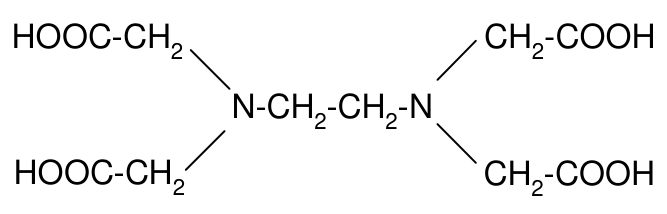
The anion of this acid, \(\ce{C10H12N2O8^4-}\), forms a stable complex \(\ce{CaC10H12N2O8^2-}\) with calcium ions. The stability constant of this complex ion is given by:
\[ K=\frac{[\ce{CaC10H12N2O8^2-}]} {[\ce{Ca^2+}][\ce{C10H12N2O8^4-}]} =1.0\times10^{11} \]
EDTA is completely dissociated in strongly alkaline solution. The equation for this dissociation is:
\[ \ce{C10H16N2O8 -> 4H+ + C10H12N2O8^4-} \]
Problems:
3.1 Calculate the concentration of calcium ions in a saturated solution of calcium sulphate.
3.2 Calculate the concentration of free \(\ce{Ca^2+}\) cations in a solution of 0.1 M \(\ce{Na2(CaC10H12N2O8)}\). You should ignore any protonation of the ligand.
3.3 How many moles of calcium sulphate will dissolve in 1 litre of a strongly alkaline solution of 0.1 M \(\ce{Na4C10H12N2O8}\)?
What would be the concentrations of the calcium and sulphate ions in the resulting solution?
3.4 Suggest a structure for the complex ion \(\ce{[CaC10H12N2O8]^2-}\) assuming that it is approximately octahedral.
3.5 Is the structure you have suggested in 4) optically active?
If your answer is "yes" then draw the structure of the other optical isomer enantiomer).
3.6 Explain why the complexes formed by the anion \(\ce{C10H12N2O8^4-}\) are exceptionally table.
Official English text of the problem.
Answers
- 3.1: \([\ce{Ca^2+}]=7.8\times10^{-3}\,\mathrm{mol\,L^{-1}}\).
- 3.2: \([\ce{Ca^2+}]=1.0\times10^{-6}\,\mathrm{mol\,L^{-1}}\).
- 3.3: Approximately \(0.10\,\mathrm{mol}\) dissolves. The resulting free-ion concentrations are \([\ce{Ca^2+}]\approx6.1\times10^{-4}\,\mathrm{mol\,L^{-1}}\) and \([\ce{SO4^2-}]\approx0.10\,\mathrm{mol\,L^{-1}}\). Retaining the small additional dissolution gives \(0.100606\ldots\,\mathrm{mol}\) and the same numerical sulphate concentration in \(\mathrm{mol\,L^{-1}}\).
- 3.4: The calcium(II)–EDTA ion, \(\ce{[Ca(EDTA)]^2-}\), has EDTA bound through two cis nitrogen donors and four carboxylate oxygen donors, forming an approximately octahedral, hexadentate complex. Its stereochemical SMILES and drawing instructions appear below.
- 3.5: Yes. The proposed structure is chiral and has a non-superimposable mirror-image enantiomer, specified below. A racemic mixture has no net optical rotation.
- 3.6: Its exceptional stability arises from the chelate effect, six donor–metal interactions, five five-membered chelate rings, and favorable attraction between calcium and the negatively charged oxygen donors.
Solution
Write \(\ce{Y^4-}\) for the ethylenediaminetetraacetate ion and \(\ce{[CaY]^2-}\) for its calcium complex.
The relevant species have the following names and SMILES. The calcium sulphate entry represents an ionic formula unit, not a discrete molecule or its crystal lattice.
| Species | Name | SMILES |
|---|---|---|
| \(\ce{C10H16N2O8}\) | Ethylenediaminetetraacetic acid | O=C(O)CN(CC(=O)O)CCN(CC(=O)O)CC(=O)O |
| \(\ce{Y^4-}\) | Ethylenediaminetetraacetate ion | O=C([O-])CN(CC(=O)[O-])CCN(CC(=O)[O-])CC(=O)[O-] |
| \(\ce{Ca^2+}\) | Calcium(II) ion | [Ca+2] |
| \(\ce{SO4^2-}\) | Sulphate ion | [O-]S(=O)(=O)[O-] |
| \(\ce{CaSO4}\) | Calcium sulphate | [Ca+2].[O-]S(=O)(=O)[O-] |
3.1 — Saturated calcium sulphate solution
The dissolution equilibrium is
\[ \ce{CaSO4(s) <=> Ca^2+(aq) + SO4^2-(aq)}. \]
Let the molar solubility in water be \(s_0\). Each mole dissolved produces one mole of each ion, so
\[ [\ce{Ca^2+}]=[\ce{SO4^2-}]=s_0. \]
Thus
\[ s_0^2=K_s, \qquad s_0=\sqrt{6.1\times10^{-5}} =7.810\ldots\times10^{-3}\,\mathrm{mol\,L^{-1}}. \]
Therefore,
\[ \boxed{[\ce{Ca^2+}]=7.8\times10^{-3}\,\mathrm{mol\,L^{-1}}}. \]
3.2 — Dissociation of the calcium–EDTA complex
The equilibrium is
\[ \ce{[CaY]^2- <=> Ca^2+ + Y^4-}. \]
Let \(C=0.1\,\mathrm{mol\,L^{-1}}\) be the analytical complex concentration and \(x\) the concentration dissociated. Ignoring ligand protonation,
\[ [\ce{Ca^2+}]=[\ce{Y^4-}]=x, \qquad [\ce{[CaY]^2-}]=C-x. \]
The given formation constant gives
\[ K=\frac{C-x}{x^2}, \qquad Kx^2+x-C=0. \]
Because the complex is very stable, \(x\ll C\), giving
\[ x\simeq\sqrt{\frac{C}{K}} =\sqrt{\frac{0.1}{1.0\times10^{11}}} =1.0\times10^{-6}\,\mathrm{mol\,L^{-1}}. \]
Here \(x/C=10^{-5}\), so neglecting \(x\) relative to \(C\) is justified.
\[ \boxed{[\ce{Ca^2+}]=1.0\times10^{-6}\,\mathrm{mol\,L^{-1}}}. \]
3.3 — Dissolution in strongly alkaline EDTA solution
Dissolution and complex formation occur together:
\[ \ce{CaSO4(s) <=> Ca^2+ + SO4^2-}, \]
\[ \ce{Ca^2+ + Y^4- <=> [CaY]^2-}. \]
Adding these gives
\[ \ce{CaSO4(s) + Y^4- <=> [CaY]^2- + SO4^2-}, \]
whose equilibrium constant is
\[ K_{\mathrm{net}}=K_sK =(6.1\times10^{-5})(1.0\times10^{11}) =6.1\times10^6. \]
Complex formation therefore greatly increases dissolution.
Assume excess solid is available and the solution volume remains \(1\,\mathrm L\). Define
\[ c=[\ce{Ca^2+}],\quad b=[\ce{[CaY]^2-}],\quad \ell=[\ce{Y^4-}],\quad s=[\ce{SO4^2-}], \]
and let \(C_L=0.1\,\mathrm{mol\,L^{-1}}\) be the total ligand concentration.
The ligand and calcium balances are
\[ b+\ell=C_L, \qquad s=b+c. \]
The equilibrium equations are
\[ cs=K_s, \qquad b=Kc\ell. \]
Combining the ligand balance with complex formation gives
\[ b=\frac{C_LKc}{1+Kc}. \]
Consequently, the exact equation for free calcium is
\[ c\left(c+\frac{C_LKc}{1+Kc}\right)=K_s. \]
Almost all EDTA is complexed, so initially take \(b\simeq C_L\). Then
\[ c(c+C_L)\simeq K_s, \]
and therefore
\[ c\simeq \frac{\sqrt{C_L^2+4K_s}-C_L}{2} =6.0632\times10^{-4}\,\mathrm{mol\,L^{-1}}. \]
This approximation is consistent because
\[ Kc\simeq6.1\times10^7\gg1. \]
Indeed, the remaining free ligand concentration is only
\[ \ell=\frac{C_L}{1+Kc} \simeq1.65\times10^{-9}\,\mathrm{mol\,L^{-1}}. \]
Using the full balances gives the following numerical values, with extra digits retained only to show the small correction:
\[ \begin{aligned} c&=0.000606323725\ldots\,\mathrm{mol\,L^{-1}},\\ b&=0.099999998351\ldots\,\mathrm{mol\,L^{-1}},\\ s&=b+c=0.100606322076\ldots\,\mathrm{mol\,L^{-1}}. \end{aligned} \]
Thus
\[ n(\ce{CaSO4})=sV =0.100606322076\ldots\,\mathrm{mol} \approx0.10\,\mathrm{mol}. \]
The requested free-ion concentrations are
\[ \boxed{[\ce{Ca^2+}]\approx6.1\times10^{-4}\,\mathrm{mol\,L^{-1}}}, \]
\[ \boxed{[\ce{SO4^2-}]\approx0.10\,\mathrm{mol\,L^{-1}}}. \]
The total dissolved calcium concentration is \(s\), whereas the free calcium concentration is only \(c\).
3.4 — Structure of the calcium–EDTA ion
EDTA supplies six donor atoms:
- The two tertiary amine nitrogen atoms, each donating a lone pair.
- One oxygen atom from each of the four carboxylate groups.
It therefore acts as a hexadentate ligand. Under the stipulated octahedral model, these six donors occupy the six vertices around calcium. The nitrogen donors are cis, allowing their ethylene bridge to form a five-membered chelate ring.
A precise drawing can be specified as follows. Put calcium at the origin, with the \(xy\)-plane as the page and \(+z\) pointing toward the viewer. Label the nitrogen donors \(N_A,N_B\); label the two oxygen donors belonging to arms attached to each nitrogen \(O_{A1},O_{A2}\) and \(O_{B1},O_{B2}\).
| Donor | Position in enantiomer A |
|---|---|
| \(N_A\) | \(+x\): right |
| \(N_B\) | \(+y\): above |
| \(O_{A1}\) | \(-y\): below |
| \(O_{A2}\) | \(+z\): toward the viewer |
| \(O_{B1}\) | \(-x\): left |
| \(O_{B2}\) | \(-z\): behind the page |
Draw bonds from calcium to all six donors, using a solid wedge for the forward oxygen and a hashed wedge for the rear oxygen. Connect the two nitrogen atoms through the \(\ce{-CH2-CH2-}\) bridge. Connect each nitrogen to its two designated oxygen donors through separate \(\ce{N-CH2-C(=O)-O^-}\) arms. The carbonyl oxygen of each arm is not coordinated in this model.
Calcium(II)–ethylenediaminetetraacetate ion, enantiomer A, has the coordination SMILES:
[Ca@OH1+2]12345<-N(CC(=O)[O-]->2)(CC(=O)[O-]->3)CCN->4(CC(=O)[O-]->1)CC(=O)[O-]->5
Here the arrows denote donor-to-metal coordinate bonds, and @OH1 is an extended SMILES octahedral stereochemical descriptor. This notation specifies connectivity and configuration, but not exact bond lengths, chelate-ring puckering, or departures from a regular octahedron.
3.5 — Optical activity and the other enantiomer
Yes. The arrangement described above is chiral: its mirror image cannot be superimposed on it by rotating the complete complex while preserving the ligand connections. These opposite coordination configurations form a \(\Delta/\Lambda\) enantiomeric pair.
To draw the other enantiomer, reflect the entire structure through the plane of the page:
- Keep \(N_A,N_B,O_{A1}\), and \(O_{B1}\) at their stated positions.
- Put \(O_{A2}\) behind the page, at \(-z\).
- Put \(O_{B2}\) toward the viewer, at \(+z\).
- Preserve all nitrogen–arm connections and reflect the associated ligand backbone.
Thus the forward and rear oxygen donors exchange positions, with their attached arms reflected accordingly.
Calcium(II)–ethylenediaminetetraacetate ion, enantiomer B, has the coordination SMILES:
[Ca@OH2+2]12345<-N(CC(=O)[O-]->2)(CC(=O)[O-]->3)CCN->4(CC(=O)[O-]->1)CC(=O)[O-]->5
For this same SMILES atom order, changing @OH1 to @OH2 specifies the opposite octahedral configuration. A racemic mixture of the two enantiomers is optically inactive.
3.6 — Origin of the exceptional stability
The principal explanation is the chelate effect.
One EDTA ion makes six donor–metal interactions and forms five five-membered chelate rings: four involving the carboxylate arms and one involving the ethylene bridge between the nitrogen atoms. These ring sizes permit favorable binding without excessive ring strain.
After the first donor attaches, the remaining donors are held close to calcium. Their attachment is therefore intramolecular and avoids the repeated translational entropy cost associated with bringing separate ligands to the metal. Binding also releases coordinated solvent molecules into the surrounding solution, which can provide a favorable entropy contribution.
Finally, calcium is a hard Lewis acid and binds favorably to the negatively charged oxygen donors. Together, these interactions and the chelate effect account for the large formation constant.
The answers were checked against the official answers published by the organisers.
IChO 1985 · Theorieaufgabe 3
Löslichkeit von Calciumsulfat und des Calcium-EDTA-Komplexes
Calciumsulfat ist eine schwer lösliche Verbindung. Sein Löslichkeitsprodukt ist gegeben durch:
\[ K_s(\ce{CaSO4})=[\ce{Ca^2+}][\ce{SO4^2-}]=6.1\times10^{-5} \]
Ethylendiamintetraessigsäure (EDTA) hat die Formel \(\ce{C10H16N2O8}\) und die Struktur:
Das Anion dieser Säure, \(\ce{C10H12N2O8^4-}\), bildet mit Calciumionen einen stabilen Komplex \(\ce{CaC10H12N2O8^2-}\). Die Stabilitätskonstante dieses Komplexions ist gegeben durch:
\[ K=\frac{[\ce{CaC10H12N2O8^2-}]} {[\ce{Ca^2+}][\ce{C10H12N2O8^4-}]} =1.0\times10^{11} \]
EDTA ist in stark alkalischer Lösung vollständig dissoziiert. Die Gleichung für diese Dissoziation lautet:
\[ \ce{C10H16N2O8 -> 4H+ + C10H12N2O8^4-} \]
Aufgaben:
3.1 Berechnen Sie die Konzentration der Calciumionen in einer gesättigten Calciumsulfatlösung.
3.2 Berechnen Sie die Konzentration der freien \(\ce{Ca^2+}\)-Kationen in einer 0.1 M Lösung von \(\ce{Na2(CaC10H12N2O8)}\). Vernachlässigen Sie jegliche Protonierung des Liganden.
3.3 Wie viele Mol Calciumsulfat lösen sich in 1 Liter einer stark alkalischen 0.1 M Lösung von \(\ce{Na4C10H12N2O8}\)?
Welche Konzentrationen hätten die Calcium- und Sulfationen in der entstehenden Lösung?
3.4 Schlagen Sie eine Struktur für das Komplexion \(\ce{[CaC10H12N2O8]^2-}\) vor, unter der Annahme, dass es annähernd oktaedrisch ist.
3.5 Ist die von Ihnen in 4) vorgeschlagene Struktur optisch aktiv?
Wenn Ihre Antwort „ja“ lautet, zeichnen Sie die Struktur des anderen optischen Isomers (Enantiomers).
3.6 Erklären Sie, warum die vom Anion \(\ce{C10H12N2O8^4-}\) gebildeten Komplexe außergewöhnlich stabil sind.
Aufgabentext aus dem offiziellen englischen Text übersetzt.
Antworten
- 3.1: \([\ce{Ca^2+}]=7.8\times10^{-3}\,\mathrm{mol\,L^{-1}}\).
- 3.2: \([\ce{Ca^2+}]=1.0\times10^{-6}\,\mathrm{mol\,L^{-1}}\).
- 3.3: Es lösen sich ungefähr \(0.10\,\mathrm{mol}\). Die resultierenden Konzentrationen der freien Ionen betragen \([\ce{Ca^2+}]\approx6.1\times10^{-4}\,\mathrm{mol\,L^{-1}}\) und \([\ce{SO4^2-}]\approx0.10\,\mathrm{mol\,L^{-1}}\). Berücksichtigt man die geringe zusätzliche Auflösung, ergeben sich \(0.100606\ldots\,\mathrm{mol}\) und derselbe Zahlenwert für die Sulfationenkonzentration in \(\mathrm{mol\,L^{-1}}\).
- 3.4: Im Calcium(II)–EDTA-Ion, \(\ce{[Ca(EDTA)]^2-}\), ist EDTA über zwei cis-ständige Stickstoffdonoren und vier Carboxylat-Sauerstoffdonoren gebunden und bildet einen annähernd oktaedrischen, sechszähnigen Komplex. Seine stereochemische SMILES-Darstellung und eine Zeichenanleitung folgen weiter unten.
- 3.5: Ja. Die vorgeschlagene Struktur ist chiral und besitzt ein nicht zur Deckung zu bringendes spiegelbildliches Enantiomer, das weiter unten angegeben ist. Ein racemisches Gemisch zeigt insgesamt keine optische Drehung.
- 3.6: Seine außergewöhnliche Stabilität beruht auf dem Chelateffekt, sechs Donor–Metall-Wechselwirkungen, fünf fünfgliedrigen Chelatringen und der günstigen Anziehung zwischen Calcium und den negativ geladenen Sauerstoffdonoren.
Lösung
Wir bezeichnen das Ethylendiamintetraacetat-Ion mit \(\ce{Y^4-}\) und seinen Calciumkomplex mit \(\ce{[CaY]^2-}\).
Die relevanten Spezies haben die folgenden Namen und SMILES-Darstellungen. Der Eintrag für Calciumsulfat stellt eine ionische Formeleinheit dar, kein diskretes Molekül und auch nicht dessen Kristallgitter.
| Spezies | Name | SMILES |
|---|---|---|
| \(\ce{C10H16N2O8}\) | Ethylendiamintetraessigsäure | O=C(O)CN(CC(=O)O)CCN(CC(=O)O)CC(=O)O |
| \(\ce{Y^4-}\) | Ethylendiamintetraacetat-Ion | O=C([O-])CN(CC(=O)[O-])CCN(CC(=O)[O-])CC(=O)[O-] |
| \(\ce{Ca^2+}\) | Calcium(II)-Ion | [Ca+2] |
| \(\ce{SO4^2-}\) | Sulfat-Ion | [O-]S(=O)(=O)[O-] |
| \(\ce{CaSO4}\) | Calciumsulfat | [Ca+2].[O-]S(=O)(=O)[O-] |
3.1 — Gesättigte Calciumsulfatlösung
Das Lösungsgleichgewicht lautet
\[ \ce{CaSO4(s) <=> Ca^2+(aq) + SO4^2-(aq)}. \]
Die molare Löslichkeit in Wasser sei \(s_0\). Jedes gelöste Mol liefert jeweils ein Mol beider Ionen, sodass
\[ [\ce{Ca^2+}]=[\ce{SO4^2-}]=s_0. \]
Somit gilt
\[ s_0^2=K_s, \qquad s_0=\sqrt{6.1\times10^{-5}} =7.810\ldots\times10^{-3}\,\mathrm{mol\,L^{-1}}. \]
Daher ist
\[ \boxed{[\ce{Ca^2+}]=7.8\times10^{-3}\,\mathrm{mol\,L^{-1}}}. \]
3.2 — Dissoziation des Calcium–EDTA-Komplexes
Das Gleichgewicht lautet
\[ \ce{[CaY]^2- <=> Ca^2+ + Y^4-}. \]
Es sei \(C=0.1\,\mathrm{mol\,L^{-1}}\) die analytische Komplexkonzentration und \(x\) die Konzentration des dissoziierten Anteils. Unter Vernachlässigung der Protonierung des Liganden gilt
\[ [\ce{Ca^2+}]=[\ce{Y^4-}]=x, \qquad [\ce{[CaY]^2-}]=C-x. \]
Aus der gegebenen Bildungskonstante folgt
\[ K=\frac{C-x}{x^2}, \qquad Kx^2+x-C=0. \]
Da der Komplex sehr stabil ist, gilt \(x\ll C\), woraus sich ergibt:
\[ x\simeq\sqrt{\frac{C}{K}} =\sqrt{\frac{0.1}{1.0\times10^{11}}} =1.0\times10^{-6}\,\mathrm{mol\,L^{-1}}. \]
Hier ist \(x/C=10^{-5}\), sodass die Vernachlässigung von \(x\) gegenüber \(C\) gerechtfertigt ist.
\[ \boxed{[\ce{Ca^2+}]=1.0\times10^{-6}\,\mathrm{mol\,L^{-1}}}. \]
3.3 — Auflösung in stark alkalischer EDTA-Lösung
Auflösung und Komplexbildung laufen gemeinsam ab:
\[ \ce{CaSO4(s) <=> Ca^2+ + SO4^2-}, \]
\[ \ce{Ca^2+ + Y^4- <=> [CaY]^2-}. \]
Durch Addition ergibt sich
\[ \ce{CaSO4(s) + Y^4- <=> [CaY]^2- + SO4^2-}, \]
mit der Gleichgewichtskonstanten
\[ K_{\mathrm{net}}=K_sK =(6.1\times10^{-5})(1.0\times10^{11}) =6.1\times10^6. \]
Die Komplexbildung erhöht daher die gelöste Menge erheblich.
Wir nehmen an, dass Feststoff im Überschuss vorliegt und das Lösungsvolumen bei \(1\,\mathrm L\) bleibt. Wir definieren
\[ c=[\ce{Ca^2+}],\quad b=[\ce{[CaY]^2-}],\quad \ell=[\ce{Y^4-}],\quad s=[\ce{SO4^2-}], \]
und bezeichnen mit \(C_L=0.1\,\mathrm{mol\,L^{-1}}\) die Gesamtkonzentration des Liganden.
Die Liganden- und Calciumbilanzen lauten
\[ b+\ell=C_L, \qquad s=b+c. \]
Die Gleichgewichtsgleichungen lauten
\[ cs=K_s, \qquad b=Kc\ell. \]
Die Kombination der Ligandenbilanz mit der Komplexbildung ergibt
\[ b=\frac{C_LKc}{1+Kc}. \]
Folglich lautet die exakte Gleichung für freies Calcium
\[ c\left(c+\frac{C_LKc}{1+Kc}\right)=K_s. \]
Nahezu das gesamte EDTA liegt komplexiert vor, daher setzen wir zunächst \(b\simeq C_L\). Dann gilt
\[ c(c+C_L)\simeq K_s, \]
und somit
\[ c\simeq \frac{\sqrt{C_L^2+4K_s}-C_L}{2} =6.0632\times10^{-4}\,\mathrm{mol\,L^{-1}}. \]
Diese Näherung ist konsistent, da
\[ Kc\simeq6.1\times10^7\gg1. \]
Tatsächlich beträgt die verbleibende Konzentration des freien Liganden nur
\[ \ell=\frac{C_L}{1+Kc} \simeq1.65\times10^{-9}\,\mathrm{mol\,L^{-1}}. \]
Unter Verwendung der vollständigen Bilanzen ergeben sich die folgenden Zahlenwerte, wobei die zusätzlichen Stellen ausschließlich angegeben werden, um die kleine Korrektur zu zeigen:
\[ \begin{aligned} c&=0.000606323725\ldots\,\mathrm{mol\,L^{-1}},\\ b&=0.099999998351\ldots\,\mathrm{mol\,L^{-1}},\\ s&=b+c=0.100606322076\ldots\,\mathrm{mol\,L^{-1}}. \end{aligned} \]
Somit gilt
\[ n(\ce{CaSO4})=sV =0.100606322076\ldots\,\mathrm{mol} \approx0.10\,\mathrm{mol}. \]
Die gesuchten Konzentrationen der freien Ionen sind
\[ \boxed{[\ce{Ca^2+}]\approx6.1\times10^{-4}\,\mathrm{mol\,L^{-1}}}, \]
\[ \boxed{[\ce{SO4^2-}]\approx0.10\,\mathrm{mol\,L^{-1}}}. \]
Die Gesamtkonzentration des gelösten Calciums beträgt \(s\), während die Konzentration des freien Calciums nur \(c\) beträgt.
3.4 — Struktur des Calcium–EDTA-Ions
EDTA stellt sechs Donoratome zur Verfügung:
- Die beiden Stickstoffatome der tertiären Aminogruppen, die jeweils ein freies Elektronenpaar zur Verfügung stellen.
- Je ein Sauerstoffatom aus jeder der vier Carboxylatgruppen.
Es wirkt daher als sechszähniger Ligand. Im vorgegebenen oktaedrischen Modell besetzen diese sechs Donoren die sechs Ecken um das Calcium. Die Stickstoffdonoren stehen cis zueinander, sodass ihre Ethylenbrücke einen fünfgliedrigen Chelatring bilden kann.
Eine genaue Zeichnung lässt sich wie folgt festlegen. Setzen Sie Calcium in den Ursprung, wobei die \(xy\)-Ebene die Zeichenebene ist und \(+z\) zum Betrachter zeigt. Bezeichnen Sie die Stickstoffdonoren mit \(N_A,N_B\); bezeichnen Sie die beiden Sauerstoffdonoren der an den jeweiligen Stickstoff gebundenen Arme mit \(O_{A1},O_{A2}\) und \(O_{B1},O_{B2}\).
| Donor | Position im Enantiomer A |
|---|---|
| \(N_A\) | \(+x\): rechts |
| \(N_B\) | \(+y\): oben |
| \(O_{A1}\) | \(-y\): unten |
| \(O_{A2}\) | \(+z\): zum Betrachter hin |
| \(O_{B1}\) | \(-x\): links |
| \(O_{B2}\) | \(-z\): hinter der Zeichenebene |
Zeichnen Sie Bindungen vom Calcium zu allen sechs Donoren und verwenden Sie für das nach vorn gerichtete Sauerstoffatom einen ausgefüllten Keil und für das nach hinten gerichtete Sauerstoffatom einen gestrichelten Keil. Verbinden Sie die beiden Stickstoffatome über die \(\ce{-CH2-CH2-}\)-Brücke. Verbinden Sie jedes Stickstoffatom über getrennte \(\ce{N-CH2-C(=O)-O^-}\)-Arme mit den beiden ihm zugeordneten Sauerstoffdonoren. Das Carbonylsauerstoffatom jedes Arms ist in diesem Modell nicht koordiniert.
Das Calcium(II)–ethylendiamintetraacetat-Ion, Enantiomer A, hat die folgende Koordinations-SMILES-Darstellung:
[Ca@OH1+2]12345<-N(CC(=O)[O-]->2)(CC(=O)[O-]->3)CCN->4(CC(=O)[O-]->1)CC(=O)[O-]->5
Hier bezeichnen die Pfeile koordinative Bindungen vom Donor zum Metall, und @OH1 ist ein erweiterter SMILES-Deskriptor für die oktaedrische Stereochemie. Diese Notation legt die Konnektivität und Konfiguration fest, jedoch keine exakten Bindungslängen, keine Faltung der Chelatringe und keine Abweichungen von einem regelmäßigen Oktaeder.
3.5 — Optische Aktivität und das andere Enantiomer
Ja. Die oben beschriebene Anordnung ist chiral: Ihr Spiegelbild lässt sich durch Drehung des gesamten Komplexes unter Beibehaltung der Verknüpfungen des Liganden nicht mit ihr zur Deckung bringen. Diese entgegengesetzten Koordinationskonfigurationen bilden ein \(\Delta/\Lambda\)-Enantiomerenpaar.
Um das andere Enantiomer zu zeichnen, spiegeln Sie die gesamte Struktur an der Zeichenebene:
- Belassen Sie \(N_A,N_B,O_{A1}\) und \(O_{B1}\) an ihren angegebenen Positionen.
- Platzieren Sie \(O_{A2}\) hinter der Zeichenebene bei \(-z\).
- Platzieren Sie \(O_{B2}\) zum Betrachter hin bei \(+z\).
- Behalten Sie alle Verknüpfungen zwischen Stickstoffatomen und Armen bei und spiegeln Sie das zugehörige Ligandengerüst.
Somit tauschen die vorderen und hinteren Sauerstoffdonoren ihre Positionen, wobei die mit ihnen verbundenen Arme entsprechend gespiegelt werden.
Das Calcium(II)–ethylendiamintetraacetat-Ion, Enantiomer B, hat die folgende Koordinations-SMILES-Darstellung:
[Ca@OH2+2]12345<-N(CC(=O)[O-]->2)(CC(=O)[O-]->3)CCN->4(CC(=O)[O-]->1)CC(=O)[O-]->5
Bei dieser unveränderten SMILES-Atomreihenfolge legt die Änderung von @OH1 zu @OH2 die entgegengesetzte oktaedrische Konfiguration fest. Ein racemisches Gemisch der beiden Enantiomere ist optisch inaktiv.
3.6 — Ursache der außergewöhnlichen Stabilität
Die wesentliche Erklärung ist der Chelateffekt.
Ein EDTA-Ion geht sechs Donor–Metall-Wechselwirkungen ein und bildet fünf fünfgliedrige Chelatringe: vier unter Beteiligung der Carboxylatarme und einen unter Beteiligung der Ethylenbrücke zwischen den Stickstoffatomen. Diese Ringgrößen ermöglichen eine günstige Bindung ohne übermäßige Ringspannung.
Nachdem der erste Donor gebunden ist, werden die übrigen Donoren in der Nähe des Calciums gehalten. Ihre Bindung erfolgt daher intramolekular und vermeidet den wiederholten Verlust an Translationsentropie, der mit dem Heranführen einzelner Liganden an das Metall verbunden ist. Bei der Bindung werden außerdem koordinierte Lösungsmittelmoleküle in die umgebende Lösung freigesetzt, was einen günstigen Entropiebeitrag liefern kann.
Schließlich ist Calcium eine harte Lewis-Säure und bindet günstig an die negativ geladenen Sauerstoffdonoren. Zusammen erklären diese Wechselwirkungen und der Chelateffekt die große Bildungskonstante.
Die Ergebnisse wurden mit den von den Veranstaltern veröffentlichten offiziellen Ergebnissen abgeglichen.
IChO 1985 · Teori sorusu 3
Kalsiyum sülfatın çözünürlüğü ve kalsiyum–EDTA kompleksi
Kalsiyum sülfat az çözünen bir bileşiktir. Çözünürlük çarpımı aşağıdaki gibi verilir:
\[ K_s(\ce{CaSO4})=[\ce{Ca^2+}][\ce{SO4^2-}]=6.1\times10^{-5} \]
Etilendiamintetraasetik asidin (EDTA) formülü \(\ce{C10H16N2O8}\), yapısı ise şöyledir:
Bu asidin anyonu olan \(\ce{C10H12N2O8^4-}\), kalsiyum iyonlarıyla kararlı bir \(\ce{CaC10H12N2O8^2-}\) kompleksi oluşturur. Bu kompleks iyonunun kararlılık sabiti aşağıdaki gibi verilir:
\[ K=\frac{[\ce{CaC10H12N2O8^2-}]} {[\ce{Ca^2+}][\ce{C10H12N2O8^4-}]} =1.0\times10^{11} \]
EDTA, kuvvetli bazik çözeltide tamamen ayrışır. Bu ayrışmanın denklemi şöyledir:
\[ \ce{C10H16N2O8 -> 4H+ + C10H12N2O8^4-} \]
Sorular:
3.1 Doygun bir kalsiyum sülfat çözeltisindeki kalsiyum iyonlarının derişimini hesaplayınız.
3.2 0.1 M \(\ce{Na2(CaC10H12N2O8)}\) çözeltisindeki serbest \(\ce{Ca^2+}\) katyonlarının derişimini hesaplayınız. Ligandın protonlanmasını ihmal ediniz.
3.3 0.1 M \(\ce{Na4C10H12N2O8}\) içeren kuvvetli bazik bir çözeltinin 1 litresinde kaç mol kalsiyum sülfat çözünür?
Oluşan çözeltideki kalsiyum ve sülfat iyonlarının derişimleri ne olur?
3.4 Yaklaşık olarak oktahedral olduğunu varsayarak \(\ce{[CaC10H12N2O8]^2-}\) kompleks iyonu için bir yapı öneriniz.
3.5 4) numaralı soruda önerdiğiniz yapı optikçe aktif midir?
Cevabınız "evet" ise diğer optik izomerin (enantiyomerin) yapısını çiziniz.
3.6 \(\ce{C10H12N2O8^4-}\) anyonunun oluşturduğu komplekslerin neden olağanüstü kararlı olduğunu açıklayınız.
Soru metni resmi İngilizce metinden çevrilmiştir.
Cevaplar
- 3.1: \([\ce{Ca^2+}]=7.8\times10^{-3}\,\mathrm{mol\,L^{-1}}\).
- 3.2: \([\ce{Ca^2+}]=1.0\times10^{-6}\,\mathrm{mol\,L^{-1}}\).
- 3.3: Yaklaşık \(0.10\,\mathrm{mol}\) çözünür. Oluşan çözeltideki serbest iyon derişimleri \([\ce{Ca^2+}]\approx6.1\times10^{-4}\,\mathrm{mol\,L^{-1}}\) ve \([\ce{SO4^2-}]\approx0.10\,\mathrm{mol\,L^{-1}}\) olur. Küçük ek çözünme de hesaba katıldığında \(0.100606\ldots\,\mathrm{mol}\) ve \(\mathrm{mol\,L^{-1}}\) cinsinden sayısal olarak aynı sülfat derişimi elde edilir.
- 3.4: Kalsiyum(II)–EDTA iyonunda, \(\ce{[Ca(EDTA)]^2-}\), EDTA birbirine cis konumdaki iki azot donörü ve dört karboksilat oksijen donörü üzerinden bağlanarak yaklaşık oktahedral, altı dişli bir kompleks oluşturur. Stereokimyasal SMILES gösterimi ve çizim talimatları aşağıda verilmiştir.
- 3.5: Evet. Önerilen yapı kiraldir ve kendisiyle üst üste çakıştırılamayan bir ayna görüntüsü enantiyomeri vardır; bu enantiyomer aşağıda belirtilmiştir. Rasemik bir karışımın net optik çevirmesi yoktur.
- 3.6: Olağanüstü kararlılığı şelat etkisinden, altı donör–metal etkileşiminden, beş adet beş üyeli şelat halkasından ve kalsiyum ile negatif yüklü oksijen donörleri arasındaki elverişli çekimden kaynaklanır.
Çözüm
Etilendiamintetraasetat iyonunu \(\ce{Y^4-}\), kalsiyum kompleksini ise \(\ce{[CaY]^2-}\) ile gösterelim.
İlgili türlerin adları ve SMILES gösterimleri aşağıda verilmiştir. Kalsiyum sülfat satırındaki gösterim, tekil bir molekülü veya kristal örgüsünü değil, iyonik bir formül birimini temsil eder.
| Tür | Adı | SMILES |
|---|---|---|
| \(\ce{C10H16N2O8}\) | Etilendiamintetraasetik asit | O=C(O)CN(CC(=O)O)CCN(CC(=O)O)CC(=O)O |
| \(\ce{Y^4-}\) | Etilendiamintetraasetat iyonu | O=C([O-])CN(CC(=O)[O-])CCN(CC(=O)[O-])CC(=O)[O-] |
| \(\ce{Ca^2+}\) | Kalsiyum(II) iyonu | [Ca+2] |
| \(\ce{SO4^2-}\) | Sülfat iyonu | [O-]S(=O)(=O)[O-] |
| \(\ce{CaSO4}\) | Kalsiyum sülfat | [Ca+2].[O-]S(=O)(=O)[O-] |
3.1 — Doygun kalsiyum sülfat çözeltisi
Çözünme dengesi şöyledir:
\[ \ce{CaSO4(s) <=> Ca^2+(aq) + SO4^2-(aq)}. \]
Sudaki molar çözünürlük \(s_0\) olsun. Çözünen her mol, her bir iyondan birer mol oluşturduğundan
\[ [\ce{Ca^2+}]=[\ce{SO4^2-}]=s_0. \]
Böylece
\[ s_0^2=K_s, \qquad s_0=\sqrt{6.1\times10^{-5}} =7.810\ldots\times10^{-3}\,\mathrm{mol\,L^{-1}}. \]
Dolayısıyla,
\[ \boxed{[\ce{Ca^2+}]=7.8\times10^{-3}\,\mathrm{mol\,L^{-1}}}. \]
3.2 — Kalsiyum–EDTA kompleksinin ayrışması
Denge şöyledir:
\[ \ce{[CaY]^2- <=> Ca^2+ + Y^4-}. \]
Analitik kompleks derişimi \(C=0.1\,\mathrm{mol\,L^{-1}}\), ayrışan kısmın derişimi ise \(x\) olsun. Ligandın protonlanması ihmal edildiğinde,
\[ [\ce{Ca^2+}]=[\ce{Y^4-}]=x, \qquad [\ce{[CaY]^2-}]=C-x. \]
Verilen oluşum sabitinden
\[ K=\frac{C-x}{x^2}, \qquad Kx^2+x-C=0. \]
Kompleks çok kararlı olduğundan \(x\ll C\) olur ve buradan
\[ x\simeq\sqrt{\frac{C}{K}} =\sqrt{\frac{0.1}{1.0\times10^{11}}} =1.0\times10^{-6}\,\mathrm{mol\,L^{-1}}. \]
Burada \(x/C=10^{-5}\) olduğundan \(x\)'in \(C\) yanında ihmal edilmesi uygundur.
\[ \boxed{[\ce{Ca^2+}]=1.0\times10^{-6}\,\mathrm{mol\,L^{-1}}}. \]
3.3 — Kuvvetli bazik EDTA çözeltisinde çözünme
Çözünme ve kompleks oluşumu birlikte gerçekleşir:
\[ \ce{CaSO4(s) <=> Ca^2+ + SO4^2-}, \]
\[ \ce{Ca^2+ + Y^4- <=> [CaY]^2-}. \]
Bu denklemler toplandığında
\[ \ce{CaSO4(s) + Y^4- <=> [CaY]^2- + SO4^2-}, \]
elde edilir; bu tepkimenin denge sabiti şöyledir:
\[ K_{\mathrm{net}}=K_sK =(6.1\times10^{-5})(1.0\times10^{11}) =6.1\times10^6. \]
Dolayısıyla kompleks oluşumu çözünmeyi büyük ölçüde artırır.
Katının fazlasının bulunduğunu ve çözelti hacminin \(1\,\mathrm L\) olarak kaldığını varsayalım. Şu tanımları yapalım:
\[ c=[\ce{Ca^2+}],\quad b=[\ce{[CaY]^2-}],\quad \ell=[\ce{Y^4-}],\quad s=[\ce{SO4^2-}], \]
ve toplam ligand derişimi \(C_L=0.1\,\mathrm{mol\,L^{-1}}\) olsun.
Ligand ve kalsiyum madde denklikleri şöyledir:
\[ b+\ell=C_L, \qquad s=b+c. \]
Denge denklemleri şöyledir:
\[ cs=K_s, \qquad b=Kc\ell. \]
Ligand madde denkliği kompleks oluşumuyla birleştirildiğinde
\[ b=\frac{C_LKc}{1+Kc}. \]
Böylece serbest kalsiyum için kesin denklem şöyledir:
\[ c\left(c+\frac{C_LKc}{1+Kc}\right)=K_s. \]
EDTA'nın hemen hemen tamamı kompleks hâlinde olduğundan ilk olarak \(b\simeq C_L\) alalım. Bu durumda
\[ c(c+C_L)\simeq K_s, \]
ve dolayısıyla
\[ c\simeq \frac{\sqrt{C_L^2+4K_s}-C_L}{2} =6.0632\times10^{-4}\,\mathrm{mol\,L^{-1}}. \]
Bu yaklaşım tutarlıdır, çünkü
\[ Kc\simeq6.1\times10^7\gg1. \]
Nitekim geriye kalan serbest ligand derişimi yalnızca
\[ \ell=\frac{C_L}{1+Kc} \simeq1.65\times10^{-9}\,\mathrm{mol\,L^{-1}}. \]
Madde denklikleri herhangi bir ihmal yapılmadan kullanıldığında aşağıdaki sayısal değerler elde edilir; ek basamaklar yalnızca küçük düzeltmeyi göstermek amacıyla korunmuştur:
\[ \begin{aligned} c&=0.000606323725\ldots\,\mathrm{mol\,L^{-1}},\\ b&=0.099999998351\ldots\,\mathrm{mol\,L^{-1}},\\ s&=b+c=0.100606322076\ldots\,\mathrm{mol\,L^{-1}}. \end{aligned} \]
Böylece
\[ n(\ce{CaSO4})=sV =0.100606322076\ldots\,\mathrm{mol} \approx0.10\,\mathrm{mol}. \]
İstenen serbest iyon derişimleri şöyledir:
\[ \boxed{[\ce{Ca^2+}]\approx6.1\times10^{-4}\,\mathrm{mol\,L^{-1}}}, \]
\[ \boxed{[\ce{SO4^2-}]\approx0.10\,\mathrm{mol\,L^{-1}}}. \]
Çözünmüş toplam kalsiyum derişimi \(s\) iken serbest kalsiyum derişimi yalnızca \(c\)'dir.
3.4 — Kalsiyum–EDTA iyonunun yapısı
EDTA altı donör atom sağlar:
- Her biri bir ortaklanmamış elektron çifti veren iki tersiyer amin azot atomu.
- Dört karboksilat grubunun her birinden bir oksijen atomu.
Bu nedenle altı dişli bir ligand olarak davranır. Soruda öngörülen oktahedral modelde bu altı donör, kalsiyum çevresindeki altı köşeyi işgal eder. Azot donörleri cis konumundadır; bu sayede aralarındaki etilen köprüsü beş üyeli bir şelat halkası oluşturabilir.
Kesin bir çizim şu şekilde tarif edilebilir. Kalsiyumu koordinat sisteminin başlangıç noktasına yerleştiriniz; \(xy\) düzlemi sayfa düzlemi olsun ve \(+z\) gözlemciye doğru yönelsin. Azot donörlerini \(N_A,N_B\) ile; her bir azota bağlı kollara ait iki oksijen donörünü ise \(O_{A1},O_{A2}\) ve \(O_{B1},O_{B2}\) ile etiketleyiniz.
| Donör | A enantiyomerindeki konumu |
|---|---|
| \(N_A\) | \(+x\): sağda |
| \(N_B\) | \(+y\): yukarıda |
| \(O_{A1}\) | \(-y\): aşağıda |
| \(O_{A2}\) | \(+z\): gözlemciye doğru |
| \(O_{B1}\) | \(-x\): solda |
| \(O_{B2}\) | \(-z\): sayfanın arkasında |
Kalsiyumdan altı donörün tümüne bağlar çiziniz; öne yönelen oksijen için dolu kama, arkaya yönelen oksijen için kesik çizgili kama kullanınız. İki azot atomunu \(\ce{-CH2-CH2-}\) köprüsü üzerinden birleştiriniz. Her bir azotu, kendisine atanmış iki oksijen donörüne ayrı \(\ce{N-CH2-C(=O)-O^-}\) kolları üzerinden bağlayınız. Bu modelde her kolun karbonil oksijeni koordinasyona katılmaz.
Kalsiyum(II)–etilendiamintetraasetat iyonunun A enantiyomerinin koordinasyon SMILES gösterimi şöyledir:
[Ca@OH1+2]12345<-N(CC(=O)[O-]->2)(CC(=O)[O-]->3)CCN->4(CC(=O)[O-]->1)CC(=O)[O-]->5
Burada oklar donörden metale yönelen koordinatif bağları gösterir; @OH1 ise genişletilmiş SMILES gösteriminde oktahedral bir stereokimya tanımlayıcısıdır. Bu gösterim, atomların bağlanma düzenini ve konfigürasyonunu belirtir; ancak kesin bağ uzunluklarını, şelat halkalarının düzlem dışına bükülmesini veya düzgün bir oktahedrondan sapmaları belirtmez.
3.5 — Optik aktiflik ve diğer enantiyomer
Evet. Yukarıda açıklanan düzenleme kiraldir: ligand bağlantıları korunarak kompleksin tamamı döndürüldüğünde ayna görüntüsü kendisiyle üst üste çakıştırılamaz. Bu karşıt koordinasyon konfigürasyonları bir \(\Delta/\Lambda\) enantiyomer çifti oluşturur.
Diğer enantiyomeri çizmek için tüm yapının sayfa düzlemine göre yansımasını alınız:
- \(N_A,N_B,O_{A1}\) ve \(O_{B1}\)'i belirtilen konumlarında tutunuz.
- \(O_{A2}\)'yi sayfanın arkasına, \(-z\) konumuna yerleştiriniz.
- \(O_{B2}\)'yi gözlemciye doğru, \(+z\) konumuna yerleştiriniz.
- Tüm azot–kol bağlantılarını koruyunuz ve ilgili ligand iskeletinin yansımasını alınız.
Böylece öne ve arkaya yönelen oksijen donörleri yer değiştirir; bunlara bağlı kolların da buna uygun olarak yansımaları alınır.
Kalsiyum(II)–etilendiamintetraasetat iyonunun B enantiyomerinin koordinasyon SMILES gösterimi şöyledir:
[Ca@OH2+2]12345<-N(CC(=O)[O-]->2)(CC(=O)[O-]->3)CCN->4(CC(=O)[O-]->1)CC(=O)[O-]->5
SMILES atom sırası aynı tutulduğunda @OH1 yerine @OH2 yazılması karşıt oktahedral konfigürasyonu belirtir. İki enantiyomerin rasemik karışımı optikçe inaktiftir.
3.6 — Olağanüstü kararlılığın kökeni
Temel açıklama şelat etkisidir.
Bir EDTA iyonu altı donör–metal etkileşimi kurar ve beş adet beş üyeli şelat halkası oluşturur: bunların dördü karboksilat kollarını, biri ise azot atomları arasındaki etilen köprüsünü içerir. Bu halka büyüklükleri, aşırı halka gerilimi olmadan elverişli bağlanmaya olanak tanır.
İlk donör bağlandıktan sonra diğer donörler kalsiyuma yakın konumda tutulur. Dolayısıyla bunların bağlanması molekül içi bir süreçtir ve ayrı ligandların metale getirilmesiyle ilişkili, tekrarlanan öteleme entropisi kaybını önler. Bağlanma ayrıca koordinasyona katılmış çözücü moleküllerini çevredeki çözeltiye serbest bırakır; bu da elverişli bir entropi katkısı sağlayabilir.
Son olarak kalsiyum sert bir Lewis asididir ve negatif yüklü oksijen donörlerine elverişli biçimde bağlanır. Bu etkileşimler ve şelat etkisi birlikte büyük oluşum sabitini açıklar.
Sonuçlar, düzenleyicilerin yayımladığı resmi sonuçlarla karşılaştırılarak kontrol edildi.
IChO 1985 · Problema teórico 3
Solubilidad del sulfato de calcio y del complejo calcio-EDTA
El sulfato de calcio es un compuesto poco soluble. Su producto de solubilidad viene dado por:
\[ K_s(\ce{CaSO4})=[\ce{Ca^2+}][\ce{SO4^2-}]=6.1\times10^{-5} \]
El ácido etilendiaminotetraacético (EDTA) tiene la fórmula \(\ce{C10H16N2O8}\) y la estructura:
El anión de este ácido, \(\ce{C10H12N2O8^4-}\), forma un complejo estable \(\ce{CaC10H12N2O8^2-}\) con los iones calcio. La constante de estabilidad de este ion complejo viene dada por:
\[ K=\frac{[\ce{CaC10H12N2O8^2-}]} {[\ce{Ca^2+}][\ce{C10H12N2O8^4-}]} =1.0\times10^{11} \]
El EDTA está completamente disociado en una disolución fuertemente alcalina. La ecuación de esta disociación es:
\[ \ce{C10H16N2O8 -> 4H+ + C10H12N2O8^4-} \]
Cuestiones:
3.1 Calcule la concentración de iones calcio en una disolución saturada de sulfato de calcio.
3.2 Calcule la concentración de cationes \(\ce{Ca^2+}\) libres en una disolución de \(\ce{Na2(CaC10H12N2O8)}\) 0.1 M. Debe despreciar cualquier protonación del ligando.
3.3 ¿Cuántos moles de sulfato de calcio se disolverán en 1 litro de una disolución fuertemente alcalina de \(\ce{Na4C10H12N2O8}\) 0.1 M?
¿Cuáles serían las concentraciones de los iones calcio y sulfato en la disolución resultante?
3.4 Proponga una estructura para el ion complejo \(\ce{[CaC10H12N2O8]^2-}\) suponiendo que es aproximadamente octaédrico.
3.5 ¿Es ópticamente activa la estructura que ha propuesto en 4)?
Si su respuesta es «sí», dibuje la estructura del otro isómero óptico (enantiómero).
3.6 Explique por qué los complejos formados por el anión \(\ce{C10H12N2O8^4-}\) son excepcionalmente estables.
Enunciado traducido del texto oficial en inglés.
Respuestas
- 3.1: \([\ce{Ca^2+}]=7.8\times10^{-3}\,\mathrm{mol\,L^{-1}}\).
- 3.2: \([\ce{Ca^2+}]=1.0\times10^{-6}\,\mathrm{mol\,L^{-1}}\).
- 3.3: Se disuelven aproximadamente \(0.10\,\mathrm{mol}\). Las concentraciones resultantes de los iones libres son \([\ce{Ca^2+}]\approx6.1\times10^{-4}\,\mathrm{mol\,L^{-1}}\) y \([\ce{SO4^2-}]\approx0.10\,\mathrm{mol\,L^{-1}}\). Si se tiene en cuenta la pequeña cantidad adicional que se disuelve, se obtienen \(0.100606\ldots\,\mathrm{mol}\) y el mismo valor numérico para la concentración de sulfato en \(\mathrm{mol\,L^{-1}}\).
- 3.4: El ion calcio(II)–EDTA, \(\ce{[Ca(EDTA)]^2-}\), tiene el EDTA unido a través de dos átomos donadores de nitrógeno en posición cis y cuatro átomos donadores de oxígeno de grupos carboxilato, formando un complejo hexadentado aproximadamente octaédrico. Su SMILES estereoquímico y las instrucciones para dibujarlo aparecen más abajo.
- 3.5: Sí. La estructura propuesta es quiral y tiene un enantiómero que es su imagen especular no superponible, especificado más abajo. Una mezcla racémica no presenta rotación óptica neta.
- 3.6: Su excepcional estabilidad se debe al efecto quelato, a seis interacciones donador–metal, a cinco anillos quelato de cinco miembros y a la atracción favorable entre el calcio y los átomos donadores de oxígeno con carga negativa.
Solución
Representemos el ion etilendiaminotetraacetato mediante \(\ce{Y^4-}\) y su complejo con calcio mediante \(\ce{[CaY]^2-}\).
Las especies pertinentes tienen los siguientes nombres y SMILES. La entrada del sulfato de calcio representa una unidad fórmula iónica, no una molécula discreta ni su red cristalina.
| Especie | Nombre | SMILES |
|---|---|---|
| \(\ce{C10H16N2O8}\) | Ácido etilendiaminotetraacético | O=C(O)CN(CC(=O)O)CCN(CC(=O)O)CC(=O)O |
| \(\ce{Y^4-}\) | Ion etilendiaminotetraacetato | O=C([O-])CN(CC(=O)[O-])CCN(CC(=O)[O-])CC(=O)[O-] |
| \(\ce{Ca^2+}\) | Ion calcio(II) | [Ca+2] |
| \(\ce{SO4^2-}\) | Ion sulfato | [O-]S(=O)(=O)[O-] |
| \(\ce{CaSO4}\) | Sulfato de calcio | [Ca+2].[O-]S(=O)(=O)[O-] |
3.1 — Disolución saturada de sulfato de calcio
El equilibrio de disolución es
\[ \ce{CaSO4(s) <=> Ca^2+(aq) + SO4^2-(aq)}. \]
Sea \(s_0\) la solubilidad molar en agua. Cada mol disuelto produce un mol de cada ion, por lo que
\[ [\ce{Ca^2+}]=[\ce{SO4^2-}]=s_0. \]
Así,
\[ s_0^2=K_s, \qquad s_0=\sqrt{6.1\times10^{-5}} =7.810\ldots\times10^{-3}\,\mathrm{mol\,L^{-1}}. \]
Por tanto,
\[ \boxed{[\ce{Ca^2+}]=7.8\times10^{-3}\,\mathrm{mol\,L^{-1}}}. \]
3.2 — Disociación del complejo calcio–EDTA
El equilibrio es
\[ \ce{[CaY]^2- <=> Ca^2+ + Y^4-}. \]
Sea \(C=0.1\,\mathrm{mol\,L^{-1}}\) la concentración analítica del complejo y \(x\) la concentración disociada. Despreciando la protonación del ligando,
\[ [\ce{Ca^2+}]=[\ce{Y^4-}]=x, \qquad [\ce{[CaY]^2-}]=C-x. \]
La constante de formación dada permite escribir
\[ K=\frac{C-x}{x^2}, \qquad Kx^2+x-C=0. \]
Como el complejo es muy estable, \(x\ll C\), de donde
\[ x\simeq\sqrt{\frac{C}{K}} =\sqrt{\frac{0.1}{1.0\times10^{11}}} =1.0\times10^{-6}\,\mathrm{mol\,L^{-1}}. \]
Aquí \(x/C=10^{-5}\), por lo que está justificado despreciar \(x\) frente a \(C\).
\[ \boxed{[\ce{Ca^2+}]=1.0\times10^{-6}\,\mathrm{mol\,L^{-1}}}. \]
3.3 — Disolución en una disolución de EDTA fuertemente alcalina
La disolución y la formación del complejo ocurren simultáneamente:
\[ \ce{CaSO4(s) <=> Ca^2+ + SO4^2-}, \]
\[ \ce{Ca^2+ + Y^4- <=> [CaY]^2-}. \]
Al sumar estas ecuaciones se obtiene
\[ \ce{CaSO4(s) + Y^4- <=> [CaY]^2- + SO4^2-}, \]
cuya constante de equilibrio es
\[ K_{\mathrm{net}}=K_sK =(6.1\times10^{-5})(1.0\times10^{11}) =6.1\times10^6. \]
Por tanto, la formación del complejo aumenta considerablemente la disolución.
Supongamos que hay un exceso de sólido disponible y que el volumen de la disolución permanece en \(1\,\mathrm L\). Definamos
\[ c=[\ce{Ca^2+}],\quad b=[\ce{[CaY]^2-}],\quad \ell=[\ce{Y^4-}],\quad s=[\ce{SO4^2-}], \]
y sea \(C_L=0.1\,\mathrm{mol\,L^{-1}}\) la concentración total de ligando.
Los balances de ligando y de calcio son
\[ b+\ell=C_L, \qquad s=b+c. \]
Las ecuaciones de equilibrio son
\[ cs=K_s, \qquad b=Kc\ell. \]
Al combinar el balance de ligando con la formación del complejo se obtiene
\[ b=\frac{C_LKc}{1+Kc}. \]
En consecuencia, la ecuación exacta para el calcio libre es
\[ c\left(c+\frac{C_LKc}{1+Kc}\right)=K_s. \]
Casi todo el EDTA está complejado, por lo que inicialmente tomamos \(b\simeq C_L\). Entonces
\[ c(c+C_L)\simeq K_s, \]
y, por tanto,
\[ c\simeq \frac{\sqrt{C_L^2+4K_s}-C_L}{2} =6.0632\times10^{-4}\,\mathrm{mol\,L^{-1}}. \]
Esta aproximación es coherente porque
\[ Kc\simeq6.1\times10^7\gg1. \]
En efecto, la concentración de ligando libre restante es tan solo
\[ \ell=\frac{C_L}{1+Kc} \simeq1.65\times10^{-9}\,\mathrm{mol\,L^{-1}}. \]
Utilizando los balances completos se obtienen los siguientes valores numéricos, en los que se conservan cifras adicionales únicamente para mostrar la pequeña corrección:
\[ \begin{aligned} c&=0.000606323725\ldots\,\mathrm{mol\,L^{-1}},\\ b&=0.099999998351\ldots\,\mathrm{mol\,L^{-1}},\\ s&=b+c=0.100606322076\ldots\,\mathrm{mol\,L^{-1}}. \end{aligned} \]
Así,
\[ n(\ce{CaSO4})=sV =0.100606322076\ldots\,\mathrm{mol} \approx0.10\,\mathrm{mol}. \]
Las concentraciones solicitadas de los iones libres son
\[ \boxed{[\ce{Ca^2+}]\approx6.1\times10^{-4}\,\mathrm{mol\,L^{-1}}}, \]
\[ \boxed{[\ce{SO4^2-}]\approx0.10\,\mathrm{mol\,L^{-1}}}. \]
La concentración total de calcio disuelto es \(s\), mientras que la concentración de calcio libre es solo \(c\).
3.4 — Estructura del ion calcio–EDTA
El EDTA aporta seis átomos donadores:
- Los dos átomos de nitrógeno de amina terciaria, cada uno de los cuales dona un par de electrones no compartido.
- Un átomo de oxígeno de cada uno de los cuatro grupos carboxilato.
Por tanto, actúa como un ligando hexadentado. En el modelo octaédrico estipulado, estos seis átomos donadores ocupan los seis vértices alrededor del calcio. Los átomos donadores de nitrógeno están en posición cis, lo que permite que su puente de etileno forme un anillo quelato de cinco miembros.
Se puede especificar un dibujo preciso de la siguiente manera. Sitúe el calcio en el origen, con el plano \(xy\) como plano de la página y \(+z\) apuntando hacia el observador. Designe los átomos donadores de nitrógeno como \(N_A,N_B\); designe los dos átomos donadores de oxígeno pertenecientes a los brazos unidos a cada nitrógeno como \(O_{A1},O_{A2}\) y \(O_{B1},O_{B2}\).
| Átomo donador | Posición en el enantiómero A |
|---|---|
| \(N_A\) | \(+x\): a la derecha |
| \(N_B\) | \(+y\): arriba |
| \(O_{A1}\) | \(-y\): abajo |
| \(O_{A2}\) | \(+z\): hacia el observador |
| \(O_{B1}\) | \(-x\): a la izquierda |
| \(O_{B2}\) | \(-z\): detrás de la página |
Dibuje enlaces desde el calcio hasta los seis átomos donadores, utilizando una cuña sólida para el oxígeno situado delante y una cuña discontinua para el oxígeno situado detrás. Conecte los dos átomos de nitrógeno mediante el puente \(\ce{-CH2-CH2-}\). Conecte cada nitrógeno a sus dos átomos donadores de oxígeno designados mediante brazos \(\ce{N-CH2-C(=O)-O^-}\) separados. El oxígeno carbonílico de cada brazo no está coordinado en este modelo.
El ion etilendiaminotetraacetato de calcio(II), enantiómero A, tiene el siguiente SMILES de coordinación:
[Ca@OH1+2]12345<-N(CC(=O)[O-]->2)(CC(=O)[O-]->3)CCN->4(CC(=O)[O-]->1)CC(=O)[O-]->5
Aquí las flechas indican enlaces coordinados del donador al metal, y @OH1 es un descriptor estereoquímico octaédrico de la notación SMILES extendida. Esta notación especifica la conectividad y la configuración, pero no las longitudes exactas de enlace, el plegamiento de los anillos quelato ni las desviaciones respecto de un octaedro regular.
3.5 — Actividad óptica y el otro enantiómero
Sí. La disposición descrita anteriormente es quiral: su imagen especular no puede superponerse a ella mediante la rotación del complejo completo manteniendo las conexiones del ligando. Estas configuraciones de coordinación opuestas forman un par de enantiómeros \(\Delta/\Lambda\).
Para dibujar el otro enantiómero, refleje la estructura completa respecto del plano de la página:
- Mantenga \(N_A,N_B,O_{A1}\) y \(O_{B1}\) en las posiciones indicadas.
- Sitúe \(O_{A2}\) detrás de la página, en \(-z\).
- Sitúe \(O_{B2}\) hacia el observador, en \(+z\).
- Conserve todas las conexiones nitrógeno–brazo y refleje el esqueleto del ligando asociado.
Así, los átomos donadores de oxígeno situados delante y detrás intercambian sus posiciones, y los brazos unidos a ellos se reflejan en consecuencia.
El ion etilendiaminotetraacetato de calcio(II), enantiómero B, tiene el siguiente SMILES de coordinación:
[Ca@OH2+2]12345<-N(CC(=O)[O-]->2)(CC(=O)[O-]->3)CCN->4(CC(=O)[O-]->1)CC(=O)[O-]->5
Para este mismo orden de átomos en el SMILES, cambiar @OH1 por @OH2 especifica la configuración octaédrica opuesta. Una mezcla racémica de los dos enantiómeros es ópticamente inactiva.
3.6 — Origen de la excepcional estabilidad
La explicación principal es el efecto quelato.
Un ion EDTA establece seis interacciones donador–metal y forma cinco anillos quelato de cinco miembros: cuatro en los que intervienen los brazos carboxilato y uno en el que interviene el puente de etileno entre los átomos de nitrógeno. Estos tamaños de anillo permiten una unión favorable sin una tensión de anillo excesiva.
Tras la unión del primer átomo donador, los restantes se mantienen cerca del calcio. Su unión es, por tanto, intramolecular y evita el coste repetido de entropía traslacional asociado al acercamiento de ligandos separados al metal. La unión también libera moléculas de disolvente coordinadas hacia la disolución circundante, lo que puede aportar una contribución entrópica favorable.
Por último, el calcio es un ácido de Lewis duro y se une favorablemente a los átomos donadores de oxígeno con carga negativa. En conjunto, estas interacciones y el efecto quelato explican la elevada constante de formación.
Los resultados se comprobaron con los resultados oficiales publicados por los organizadores.
IChO 1985 · 理论题 3
硫酸钙的溶解度与钙–EDTA 配合物
硫酸钙是一种微溶化合物。其溶度积为:
\[ K_s(\ce{CaSO4})=[\ce{Ca^2+}][\ce{SO4^2-}]=6.1\times10^{-5} \]
乙二胺四乙酸(EDTA)的分子式为 \(\ce{C10H16N2O8}\),其结构为:
这种酸的阴离子 \(\ce{C10H12N2O8^4-}\) 与钙离子形成稳定的配合物 \(\ce{CaC10H12N2O8^2-}\)。该配离子的稳定常数为:
\[ K=\frac{[\ce{CaC10H12N2O8^2-}]} {[\ce{Ca^2+}][\ce{C10H12N2O8^4-}]} =1.0\times10^{11} \]
EDTA 在强碱性溶液中完全电离。其电离方程式为:
\[ \ce{C10H16N2O8 -> 4H+ + C10H12N2O8^4-} \]
问题:
3.1 计算硫酸钙饱和溶液中钙离子的浓度。
3.2 计算 0.1 M \(\ce{Na2(CaC10H12N2O8)}\) 溶液中游离 \(\ce{Ca^2+}\) 阳离子的浓度。忽略配体的任何质子化作用。
3.3 在 1 升 0.1 M \(\ce{Na4C10H12N2O8}\) 的强碱性溶液中,能溶解多少摩尔硫酸钙?
所得溶液中钙离子和硫酸根离子的浓度各为多少?
3.4 假设配离子 \(\ce{[CaC10H12N2O8]^2-}\) 近似呈八面体构型,提出其结构。
3.5 你在 4) 中提出的结构是否具有旋光性?
如果你的回答是“是”,请画出另一种旋光异构体(对映异构体)的结构。
3.6 解释为什么阴离子 \(\ce{C10H12N2O8^4-}\) 形成的配合物特别稳定。
题目译自官方英文原文。
答案
- 3.1: \([\ce{Ca^2+}]=7.8\times10^{-3}\,\mathrm{mol\,L^{-1}}\)。
- 3.2: \([\ce{Ca^2+}]=1.0\times10^{-6}\,\mathrm{mol\,L^{-1}}\)。
- 3.3: 约有 \(0.10\,\mathrm{mol}\) 溶解。所得溶液中游离离子的浓度为 \([\ce{Ca^2+}]\approx6.1\times10^{-4}\,\mathrm{mol\,L^{-1}}\) 和 \([\ce{SO4^2-}]\approx0.10\,\mathrm{mol\,L^{-1}}\)。计入少量额外溶解后,溶解量为 \(0.100606\ldots\,\mathrm{mol}\),硫酸根离子浓度以 \(\mathrm{mol\,L^{-1}}\) 为单位时具有相同的数值。
- 3.4: 钙(II)–EDTA 离子 \(\ce{[Ca(EDTA)]^2-}\) 中,EDTA 通过两个互为顺式的氮配位原子和四个羧酸根氧配位原子与钙结合,形成近似八面体构型的六齿配合物。其立体化学 SMILES 和绘图说明见下文。
- 3.5: 是。 所提出的结构具有手性,存在一个与其不能重合的镜像对映异构体,具体见下文。外消旋混合物的净旋光度为零。
- 3.6: 其特别高的稳定性源于螯合效应、六个配位原子与金属之间的相互作用、五个五元螯合环,以及钙与带负电荷的氧配位原子之间有利的吸引作用。
解答
用 \(\ce{Y^4-}\) 表示乙二胺四乙酸根离子,用 \(\ce{[CaY]^2-}\) 表示其钙配合物。
相关物种的名称和 SMILES 如下。硫酸钙条目表示一个离子化学式单位,而非一个独立分子或其晶格。
| 物种 | 名称 | SMILES |
|---|---|---|
| \(\ce{C10H16N2O8}\) | 乙二胺四乙酸 | O=C(O)CN(CC(=O)O)CCN(CC(=O)O)CC(=O)O |
| \(\ce{Y^4-}\) | 乙二胺四乙酸根离子 | O=C([O-])CN(CC(=O)[O-])CCN(CC(=O)[O-])CC(=O)[O-] |
| \(\ce{Ca^2+}\) | 钙(II)离子 | [Ca+2] |
| \(\ce{SO4^2-}\) | 硫酸根离子 | [O-]S(=O)(=O)[O-] |
| \(\ce{CaSO4}\) | 硫酸钙 | [Ca+2].[O-]S(=O)(=O)[O-] |
3.1 — 硫酸钙饱和溶液
溶解平衡为
\[ \ce{CaSO4(s) <=> Ca^2+(aq) + SO4^2-(aq)}. \]
设其在水中的摩尔溶解度为 \(s_0\)。每溶解一摩尔硫酸钙,就产生各一摩尔的两种离子,因此
\[ [\ce{Ca^2+}]=[\ce{SO4^2-}]=s_0. \]
于是
\[ s_0^2=K_s, \qquad s_0=\sqrt{6.1\times10^{-5}} =7.810\ldots\times10^{-3}\,\mathrm{mol\,L^{-1}}. \]
因此,
\[ \boxed{[\ce{Ca^2+}]=7.8\times10^{-3}\,\mathrm{mol\,L^{-1}}}. \]
3.2 — 钙–EDTA 配合物的解离
平衡为
\[ \ce{[CaY]^2- <=> Ca^2+ + Y^4-}. \]
设配合物的分析浓度为 \(C=0.1\,\mathrm{mol\,L^{-1}}\),已解离部分的浓度为 \(x\)。忽略配体的质子化作用,有
\[ [\ce{Ca^2+}]=[\ce{Y^4-}]=x, \qquad [\ce{[CaY]^2-}]=C-x. \]
由给定的生成常数可得
\[ K=\frac{C-x}{x^2}, \qquad Kx^2+x-C=0. \]
由于配合物非常稳定,\(x\ll C\),因此
\[ x\simeq\sqrt{\frac{C}{K}} =\sqrt{\frac{0.1}{1.0\times10^{11}}} =1.0\times10^{-6}\,\mathrm{mol\,L^{-1}}. \]
这里 \(x/C=10^{-5}\),所以相对于 \(C\) 忽略 \(x\) 是合理的。
\[ \boxed{[\ce{Ca^2+}]=1.0\times10^{-6}\,\mathrm{mol\,L^{-1}}}. \]
3.3 — 在强碱性 EDTA 溶液中的溶解
溶解和配合物的形成同时发生:
\[ \ce{CaSO4(s) <=> Ca^2+ + SO4^2-}, \]
\[ \ce{Ca^2+ + Y^4- <=> [CaY]^2-}. \]
将两式相加可得
\[ \ce{CaSO4(s) + Y^4- <=> [CaY]^2- + SO4^2-}, \]
其平衡常数为
\[ K_{\mathrm{net}}=K_sK =(6.1\times10^{-5})(1.0\times10^{11}) =6.1\times10^6. \]
因此,配合物的形成大大促进了溶解。
假设存在过量固体,且溶液体积保持为 \(1\,\mathrm L\)。定义
\[ c=[\ce{Ca^2+}],\quad b=[\ce{[CaY]^2-}],\quad \ell=[\ce{Y^4-}],\quad s=[\ce{SO4^2-}], \]
并设配体的总浓度为 \(C_L=0.1\,\mathrm{mol\,L^{-1}}\)。
配体和钙的物料平衡关系为
\[ b+\ell=C_L, \qquad s=b+c. \]
平衡方程为
\[ cs=K_s, \qquad b=Kc\ell. \]
将配体的物料平衡关系与配合物生成关系结合,可得
\[ b=\frac{C_LKc}{1+Kc}. \]
因此,游离钙离子浓度的精确方程为
\[ c\left(c+\frac{C_LKc}{1+Kc}\right)=K_s. \]
几乎所有 EDTA 都形成了配合物,因此先取 \(b\simeq C_L\)。则
\[ c(c+C_L)\simeq K_s, \]
从而
\[ c\simeq \frac{\sqrt{C_L^2+4K_s}-C_L}{2} =6.0632\times10^{-4}\,\mathrm{mol\,L^{-1}}. \]
这一近似是自洽的,因为
\[ Kc\simeq6.1\times10^7\gg1. \]
事实上,剩余的游离配体浓度仅为
\[ \ell=\frac{C_L}{1+Kc} \simeq1.65\times10^{-9}\,\mathrm{mol\,L^{-1}}. \]
使用完整的物料平衡关系可得以下数值,保留额外位数仅用于显示这一微小修正:
\[ \begin{aligned} c&=0.000606323725\ldots\,\mathrm{mol\,L^{-1}},\\ b&=0.099999998351\ldots\,\mathrm{mol\,L^{-1}},\\ s&=b+c=0.100606322076\ldots\,\mathrm{mol\,L^{-1}}. \end{aligned} \]
于是
\[ n(\ce{CaSO4})=sV =0.100606322076\ldots\,\mathrm{mol} \approx0.10\,\mathrm{mol}. \]
所求的游离离子浓度为
\[ \boxed{[\ce{Ca^2+}]\approx6.1\times10^{-4}\,\mathrm{mol\,L^{-1}}}, \]
\[ \boxed{[\ce{SO4^2-}]\approx0.10\,\mathrm{mol\,L^{-1}}}. \]
已溶解的钙的总浓度为 \(s\),而游离钙离子浓度仅为 \(c\)。
3.4 — 钙–EDTA 离子的结构
EDTA 提供六个配位原子:
- 两个叔胺氮原子,各提供一对孤电子。
- 四个羧酸根基团各提供一个氧原子。
因此,它作为六齿配体参与配位。在题目规定的八面体模型中,这六个配位原子占据钙周围的六个顶点。两个氮配位原子互为顺式,使它们之间的乙撑桥能够形成一个五元螯合环。
可按以下方式精确绘制结构。将钙置于原点,以 \(xy\) 平面作为纸面,\(+z\) 方向朝向观察者。将两个氮配位原子标记为 \(N_A,N_B\);将连接于各氮原子的支臂上的两个氧配位原子分别标记为 \(O_{A1},O_{A2}\) 和 \(O_{B1},O_{B2}\)。
| 配位原子 | 在对映异构体 A 中的位置 |
|---|---|
| \(N_A\) | \(+x\):右方 |
| \(N_B\) | \(+y\):上方 |
| \(O_{A1}\) | \(-y\):下方 |
| \(O_{A2}\) | \(+z\):朝向观察者 |
| \(O_{B1}\) | \(-x\):左方 |
| \(O_{B2}\) | \(-z\):纸面后方 |
画出钙与全部六个配位原子之间的键,对朝前的氧使用实楔形键,对朝后的氧使用虚楔形键。通过 \(\ce{-CH2-CH2-}\) 桥连接两个氮原子。将每个氮原子分别通过独立的 \(\ce{N-CH2-C(=O)-O^-}\) 支臂连接到为其指定的两个氧配位原子。在此模型中,各支臂上的羰基氧不参与配位。
钙(II)–乙二胺四乙酸根配离子,对映异构体 A 的配位 SMILES 为:
[Ca@OH1+2]12345<-N(CC(=O)[O-]->2)(CC(=O)[O-]->3)CCN->4(CC(=O)[O-]->1)CC(=O)[O-]->5
这里,箭头表示从配位原子指向金属的配位键,@OH1 是扩展 SMILES 的八面体立体化学描述符。该表示法规定了连接关系和构型,但未规定精确的键长、螯合环的褶曲或对正八面体的偏离。
3.5 — 旋光性与另一对映异构体
是。 上述排列具有手性:在保持配体连接关系不变的情况下,无论如何旋转整个配合物,都无法使其与镜像重合。这两种相反的配位构型构成一对 \(\Delta/\Lambda\) 对映异构体。
要画出另一对映异构体,将整个结构以纸面为镜面进行反射:
- 保持 \(N_A,N_B,O_{A1}\) 和 \(O_{B1}\) 位于所述位置。
- 将 \(O_{A2}\) 置于纸面后方,即 \(-z\) 方向。
- 将 \(O_{B2}\) 置于朝向观察者的一侧,即 \(+z\) 方向。
- 保持所有氮原子与支臂之间的连接关系,并将相应的配体骨架作镜像反射。
这样,朝前与朝后的氧配位原子交换位置,与其相连的支臂也相应地作镜像反射。
钙(II)–乙二胺四乙酸根配离子,对映异构体 B 的配位 SMILES 为:
[Ca@OH2+2]12345<-N(CC(=O)[O-]->2)(CC(=O)[O-]->3)CCN->4(CC(=O)[O-]->1)CC(=O)[O-]->5
对于这一相同的 SMILES 原子顺序,将 @OH1 改为 @OH2 即表示相反的八面体构型。这两种对映异构体组成的外消旋混合物不具有旋光性。
3.6 — 特别高的稳定性的来源
主要原因是螯合效应。
一个 EDTA 离子产生六个配位原子与金属之间的相互作用,并形成五个五元螯合环:其中四个涉及羧酸根支臂,一个涉及两个氮原子之间的乙撑桥。这些环的大小有利于结合,同时不会产生过大的环张力。
第一个配位原子结合后,其余配位原子便被保持在钙附近。因此,它们的结合属于分子内过程,避免了将多个独立配体带到金属附近时反复付出的平动熵代价。结合还会将配位的溶剂分子释放到周围溶液中,从而可能提供有利的熵贡献。
最后,钙是硬路易斯酸,易于与带负电荷的氧配位原子结合。这些相互作用与螯合效应共同解释了其很大的生成常数。
结果已与主办方公布的官方答案核对。
IChO 1985 · Теоретическая задача 3
Растворимость сульфата кальция и комплекс кальция с ЭДТА
Сульфат кальция — малорастворимое соединение. Его произведение растворимости равно:
\[ K_s(\ce{CaSO4})=[\ce{Ca^2+}][\ce{SO4^2-}]=6.1\times10^{-5} \]
Этилендиаминтетрауксусная кислота (ЭДТА) имеет формулу \(\ce{C10H16N2O8}\) и следующую структуру:
Анион этой кислоты, \(\ce{C10H12N2O8^4-}\), образует с ионами кальция устойчивый комплекс \(\ce{CaC10H12N2O8^2-}\). Константа устойчивости этого комплексного иона равна:
\[ K=\frac{[\ce{CaC10H12N2O8^2-}]} {[\ce{Ca^2+}][\ce{C10H12N2O8^4-}]} =1.0\times10^{11} \]
В сильнощелочном растворе ЭДТА полностью диссоциирует. Уравнение этой диссоциации:
\[ \ce{C10H16N2O8 -> 4H+ + C10H12N2O8^4-} \]
Задания:
3.1 Рассчитайте концентрацию ионов кальция в насыщенном растворе сульфата кальция.
3.2 Рассчитайте концентрацию свободных катионов \(\ce{Ca^2+}\) в 0.1 М растворе \(\ce{Na2(CaC10H12N2O8)}\). Протонированием лиганда следует пренебречь.
3.3 Сколько молей сульфата кальция растворится в 1 литре сильнощелочного 0.1 М раствора \(\ce{Na4C10H12N2O8}\)?
Каковы будут концентрации ионов кальция и сульфат-ионов в полученном растворе?
3.4 Предложите структуру комплексного иона \(\ce{[CaC10H12N2O8]^2-}\), предполагая, что он имеет приблизительно октаэдрическое строение.
3.5 Является ли предложенная вами в 4) структура оптически активной?
Если ваш ответ — «да», изобразите структуру другого оптического изомера (энантиомера).
3.6 Объясните, почему комплексы, образуемые анионом \(\ce{C10H12N2O8^4-}\), исключительно устойчивы.
Условие переведено с официального английского текста.
Ответы
- 3.1: \([\ce{Ca^2+}]=7.8\times10^{-3}\,\mathrm{mol\,L^{-1}}\).
- 3.2: \([\ce{Ca^2+}]=1.0\times10^{-6}\,\mathrm{mol\,L^{-1}}\).
- 3.3: Растворяется приблизительно \(0.10\,\mathrm{mol}\). Концентрации свободных ионов в полученном растворе составляют \([\ce{Ca^2+}]\approx6.1\times10^{-4}\,\mathrm{mol\,L^{-1}}\) и \([\ce{SO4^2-}]\approx0.10\,\mathrm{mol\,L^{-1}}\). При учёте небольшого дополнительного растворения получаем \(0.100606\ldots\,\mathrm{mol}\) и такое же численное значение концентрации сульфат-ионов в \(\mathrm{mol\,L^{-1}}\).
- 3.4: В ионе кальция(II)–ЭДТА, \(\ce{[Ca(EDTA)]^2-}\), ЭДТА связана с кальцием через два донорных атома азота в цис-положении и четыре донорных атома кислорода карбоксилатных групп, образуя приблизительно октаэдрический комплекс с гексадентатным лигандом. Его стереохимическая запись SMILES и указания по изображению структуры приведены ниже.
- 3.5: Да. Предложенная структура хиральна и имеет зеркальный энантиомер, не совмещающийся с ней, который описан ниже. Рацемическая смесь не обладает суммарным оптическим вращением.
- 3.6: Его исключительная устойчивость обусловлена хелатным эффектом, шестью взаимодействиями донор–металл, пятью пятичленными хелатными циклами и благоприятным притяжением между кальцием и отрицательно заряженными донорными атомами кислорода.
Решение
Обозначим этилендиаминтетраацетат-ион как \(\ce{Y^4-}\), а его комплекс с кальцием — как \(\ce{[CaY]^2-}\).
Названия и записи SMILES рассматриваемых частиц приведены ниже. Запись для сульфата кальция представляет ионную формульную единицу, а не отдельную молекулу или его кристаллическую решётку.
| Частица | Название | SMILES |
|---|---|---|
| \(\ce{C10H16N2O8}\) | Этилендиаминтетрауксусная кислота | O=C(O)CN(CC(=O)O)CCN(CC(=O)O)CC(=O)O |
| \(\ce{Y^4-}\) | Этилендиаминтетраацетат-ион | O=C([O-])CN(CC(=O)[O-])CCN(CC(=O)[O-])CC(=O)[O-] |
| \(\ce{Ca^2+}\) | Ион кальция(II) | [Ca+2] |
| \(\ce{SO4^2-}\) | Сульфат-ион | [O-]S(=O)(=O)[O-] |
| \(\ce{CaSO4}\) | Сульфат кальция | [Ca+2].[O-]S(=O)(=O)[O-] |
3.1 — Насыщенный раствор сульфата кальция
Равновесие растворения имеет вид
\[ \ce{CaSO4(s) <=> Ca^2+(aq) + SO4^2-(aq)}. \]
Пусть молярная растворимость в воде равна \(s_0\). При растворении каждого моля образуется по одному молю каждого иона, поэтому
\[ [\ce{Ca^2+}]=[\ce{SO4^2-}]=s_0. \]
Таким образом,
\[ s_0^2=K_s, \qquad s_0=\sqrt{6.1\times10^{-5}} =7.810\ldots\times10^{-3}\,\mathrm{mol\,L^{-1}}. \]
Следовательно,
\[ \boxed{[\ce{Ca^2+}]=7.8\times10^{-3}\,\mathrm{mol\,L^{-1}}}. \]
3.2 — Диссоциация комплекса кальция с ЭДТА
Равновесие имеет вид
\[ \ce{[CaY]^2- <=> Ca^2+ + Y^4-}. \]
Пусть \(C=0.1\,\mathrm{mol\,L^{-1}}\) — аналитическая концентрация комплекса, а \(x\) — концентрация его диссоциировавшей части. Пренебрегая протонированием лиганда, получаем
\[ [\ce{Ca^2+}]=[\ce{Y^4-}]=x, \qquad [\ce{[CaY]^2-}]=C-x. \]
Из заданной константы образования следует
\[ K=\frac{C-x}{x^2}, \qquad Kx^2+x-C=0. \]
Поскольку комплекс очень устойчив, \(x\ll C\), откуда
\[ x\simeq\sqrt{\frac{C}{K}} =\sqrt{\frac{0.1}{1.0\times10^{11}}} =1.0\times10^{-6}\,\mathrm{mol\,L^{-1}}. \]
Здесь \(x/C=10^{-5}\), поэтому пренебрежение \(x\) по сравнению с \(C\) оправданно.
\[ \boxed{[\ce{Ca^2+}]=1.0\times10^{-6}\,\mathrm{mol\,L^{-1}}}. \]
3.3 — Растворение в сильнощелочном растворе ЭДТА
Растворение и комплексообразование протекают одновременно:
\[ \ce{CaSO4(s) <=> Ca^2+ + SO4^2-}, \]
\[ \ce{Ca^2+ + Y^4- <=> [CaY]^2-}. \]
Складывая эти уравнения, получаем
\[ \ce{CaSO4(s) + Y^4- <=> [CaY]^2- + SO4^2-}, \]
причём константа этого равновесия равна
\[ K_{\mathrm{net}}=K_sK =(6.1\times10^{-5})(1.0\times10^{11}) =6.1\times10^6. \]
Следовательно, комплексообразование значительно увеличивает количество растворяющегося вещества.
Предположим, что твёрдое вещество присутствует в избытке, а объём раствора остаётся равным \(1\,\mathrm L\). Введём обозначения
\[ c=[\ce{Ca^2+}],\quad b=[\ce{[CaY]^2-}],\quad \ell=[\ce{Y^4-}],\quad s=[\ce{SO4^2-}], \]
и пусть \(C_L=0.1\,\mathrm{mol\,L^{-1}}\) — общая концентрация лиганда.
Материальные балансы по лиганду и кальцию имеют вид
\[ b+\ell=C_L, \qquad s=b+c. \]
Уравнения равновесия:
\[ cs=K_s, \qquad b=Kc\ell. \]
Совместное рассмотрение баланса по лиганду и уравнения комплексообразования даёт
\[ b=\frac{C_LKc}{1+Kc}. \]
Следовательно, точное уравнение для концентрации свободных ионов кальция имеет вид
\[ c\left(c+\frac{C_LKc}{1+Kc}\right)=K_s. \]
Почти вся ЭДТА связана в комплекс, поэтому в первом приближении примем \(b\simeq C_L\). Тогда
\[ c(c+C_L)\simeq K_s, \]
и, следовательно,
\[ c\simeq \frac{\sqrt{C_L^2+4K_s}-C_L}{2} =6.0632\times10^{-4}\,\mathrm{mol\,L^{-1}}. \]
Это приближение согласуется с полученным результатом, поскольку
\[ Kc\simeq6.1\times10^7\gg1. \]
Действительно, концентрация оставшегося свободного лиганда составляет всего
\[ \ell=\frac{C_L}{1+Kc} \simeq1.65\times10^{-9}\,\mathrm{mol\,L^{-1}}. \]
Использование полных уравнений материального баланса даёт следующие численные значения; дополнительные цифры сохранены лишь для демонстрации небольшой поправки:
\[ \begin{aligned} c&=0.000606323725\ldots\,\mathrm{mol\,L^{-1}},\\ b&=0.099999998351\ldots\,\mathrm{mol\,L^{-1}},\\ s&=b+c=0.100606322076\ldots\,\mathrm{mol\,L^{-1}}. \end{aligned} \]
Таким образом,
\[ n(\ce{CaSO4})=sV =0.100606322076\ldots\,\mathrm{mol} \approx0.10\,\mathrm{mol}. \]
Искомые концентрации свободных ионов равны
\[ \boxed{[\ce{Ca^2+}]\approx6.1\times10^{-4}\,\mathrm{mol\,L^{-1}}}, \]
\[ \boxed{[\ce{SO4^2-}]\approx0.10\,\mathrm{mol\,L^{-1}}}. \]
Общая концентрация растворённого кальция равна \(s\), тогда как концентрация свободных ионов кальция равна лишь \(c\).
3.4 — Структура комплексного иона кальция с ЭДТА
ЭДТА предоставляет шесть донорных атомов:
- Два атома азота третичных аминогрупп, каждый из которых предоставляет неподелённую электронную пару.
- По одному атому кислорода от каждой из четырёх карбоксилатных групп.
Таким образом, она выступает в роли гексадентатного лиганда. В рамках заданной октаэдрической модели эти шесть донорных атомов занимают шесть вершин вокруг кальция. Донорные атомы азота находятся в цис-положении, что позволяет соединяющему их этиленовому мостику образовать пятичленный хелатный цикл.
Точное построение рисунка можно задать следующим образом. Поместите кальций в начало координат, расположив плоскость \(xy\) в плоскости страницы и направив \(+z\) к наблюдателю. Обозначьте донорные атомы азота как \(N_A,N_B\); два донорных атома кислорода, принадлежащих боковым цепям, присоединённым к каждому атому азота, обозначьте как \(O_{A1},O_{A2}\) и \(O_{B1},O_{B2}\).
| Донорный атом | Положение в энантиомере A |
|---|---|
| \(N_A\) | \(+x\): справа |
| \(N_B\) | \(+y\): сверху |
| \(O_{A1}\) | \(-y\): снизу |
| \(O_{A2}\) | \(+z\): к наблюдателю |
| \(O_{B1}\) | \(-x\): слева |
| \(O_{B2}\) | \(-z\): за плоскостью страницы |
Изобразите связи кальция со всеми шестью донорными атомами, используя сплошной клин для переднего атома кислорода и штриховой клин для заднего. Соедините два атома азота мостиком \(\ce{-CH2-CH2-}\). Соедините каждый атом азота с двумя назначенными ему донорными атомами кислорода через отдельные боковые цепи \(\ce{N-CH2-C(=O)-O^-}\). Карбонильный атом кислорода каждой боковой цепи в этой модели не координирован.
Этилендиаминтетраацетатный комплексный ион кальция(II), энантиомер A, имеет следующую координационную запись SMILES:
[Ca@OH1+2]12345<-N(CC(=O)[O-]->2)(CC(=O)[O-]->3)CCN->4(CC(=O)[O-]->1)CC(=O)[O-]->5
Здесь стрелки обозначают координационные связи, направленные от донорного атома к металлу, а @OH1 — октаэдрический стереохимический дескриптор расширенного формата SMILES. Эта запись задаёт порядок соединения атомов и конфигурацию, но не точные длины связей, неплоскую конформацию хелатных циклов или отклонения от правильного октаэдра.
3.5 — Оптическая активность и другой энантиомер
Да. Описанное выше расположение хирально: его зеркальное отражение нельзя совместить с ним вращением всего комплекса при сохранении связей внутри лиганда. Эти противоположные координационные конфигурации образуют пару энантиомеров \(\Delta/\Lambda\).
Чтобы изобразить другой энантиомер, отразите всю структуру относительно плоскости страницы:
- Оставьте \(N_A,N_B,O_{A1}\) и \(O_{B1}\) в указанных положениях.
- Поместите \(O_{A2}\) за плоскостью страницы, в положение \(-z\).
- Поместите \(O_{B2}\) перед плоскостью страницы, ближе к наблюдателю, в положение \(+z\).
- Сохраните все связи атомов азота с боковыми цепями и зеркально отразите соответствующий скелет лиганда.
Таким образом, передний и задний донорные атомы кислорода меняются местами, а присоединённые к ним боковые цепи отражаются соответствующим образом.
Этилендиаминтетраацетатный комплексный ион кальция(II), энантиомер B, имеет следующую координационную запись SMILES:
[Ca@OH2+2]12345<-N(CC(=O)[O-]->2)(CC(=O)[O-]->3)CCN->4(CC(=O)[O-]->1)CC(=O)[O-]->5
При сохранении этого порядка атомов в SMILES замена @OH1 на @OH2 задаёт противоположную октаэдрическую конфигурацию. Рацемическая смесь двух энантиомеров оптически неактивна.
3.6 — Причины исключительной устойчивости
Основное объяснение — хелатный эффект.
Один ион ЭДТА образует шесть взаимодействий донор–металл и пять пятичленных хелатных циклов: четыре с участием карбоксилатных боковых цепей и один с участием этиленового мостика между атомами азота. Такие размеры циклов обеспечивают благоприятное связывание без чрезмерного напряжения в циклах.
После присоединения первого донорного атома остальные донорные атомы удерживаются вблизи кальция. Поэтому их присоединение является внутримолекулярным и позволяет избежать повторяющегося уменьшения трансляционной энтропии, связанного с подведением отдельных лигандов к металлу. Связывание также сопровождается высвобождением координированных молекул растворителя в окружающий раствор, что может давать благоприятный энтропийный вклад.
Наконец, кальций является жёсткой кислотой Льюиса и благоприятно связывается с отрицательно заряженными донорными атомами кислорода. В совокупности эти взаимодействия и хелатный эффект объясняют большую величину константы образования.
Ответы проверены по официальным ответам, опубликованным организаторами.
IChO 1985 · مسألة نظرية 3
ذوبانية كبريتات الكالسيوم ومعقد الكالسيوم–EDTA
كبريتات الكالسيوم مركب شحيح الذوبان. ويُعطى حاصل إذابتها بالعلاقة:
\[ K_s(\ce{CaSO4})=[\ce{Ca^2+}][\ce{SO4^2-}]=6.1\times10^{-5} \]
لحمض الإيثيلين ثنائي الأمين رباعي الأسيتيك (EDTA) الصيغة \(\ce{C10H16N2O8}\) والبنية الآتية:
يُكوِّن أنيون هذا الحمض، \(\ce{C10H12N2O8^4-}\)، معقدًا مستقرًا \(\ce{CaC10H12N2O8^2-}\) مع أيونات الكالسيوم. ويُعطى ثابت استقرار هذا الأيون المعقد بالعلاقة:
\[ K=\frac{[\ce{CaC10H12N2O8^2-}]} {[\ce{Ca^2+}][\ce{C10H12N2O8^4-}]} =1.0\times10^{11} \]
يتفكك EDTA تفككًا تامًا في المحلول شديد القلوية. ومعادلة هذا التفكك هي:
\[ \ce{C10H16N2O8 -> 4H+ + C10H12N2O8^4-} \]
المطلوب:
3.1 احسب تركيز أيونات الكالسيوم في محلول مشبع من كبريتات الكالسيوم.
3.2 احسب تركيز كاتيونات \(\ce{Ca^2+}\) الحرة في محلول من \(\ce{Na2(CaC10H12N2O8)}\) تركيزه 0.1 M. أهمل أي بروتنة للربيطة.
3.3 كم مولًا من كبريتات الكالسيوم يذوب في لتر واحد من محلول شديد القلوية من \(\ce{Na4C10H12N2O8}\) تركيزه 0.1 M؟
ما تركيزا أيونات الكالسيوم والكبريتات في المحلول الناتج؟
3.4 اقترح بنية للأيون المعقد \(\ce{[CaC10H12N2O8]^2-}\) بافتراض أنه ثماني السطوح تقريبًا.
3.5 هل البنية التي اقترحتها في 4) نشطة ضوئيًا؟
إذا كانت إجابتك «نعم»، فارسم بنية المتماكب الضوئي الآخر (المتماكب المرآتي).
3.6 فسِّر سبب الاستقرار الاستثنائي للمعقدات التي يُكوِّنها الأنيون \(\ce{C10H12N2O8^4-}\).
نص المسألة مترجم عن النص الإنجليزي الرسمي.
الإجابات
- 3.1: \([\ce{Ca^2+}]=7.8\times10^{-3}\,\mathrm{mol\,L^{-1}}\).
- 3.2: \([\ce{Ca^2+}]=1.0\times10^{-6}\,\mathrm{mol\,L^{-1}}\).
- 3.3: يذوب نحو \(0.10\,\mathrm{mol}\). وتركيزا الأيونات الحرة الناتجان هما \([\ce{Ca^2+}]\approx6.1\times10^{-4}\,\mathrm{mol\,L^{-1}}\) و\([\ce{SO4^2-}]\approx0.10\,\mathrm{mol\,L^{-1}}\). وبأخذ الذوبان الإضافي الطفيف في الحسبان، نحصل على \(0.100606\ldots\,\mathrm{mol}\)، وعلى القيمة العددية نفسها لتركيز الكبريتات بوحدة \(\mathrm{mol\,L^{-1}}\).
- 3.4: في أيون الكالسيوم(II)–EDTA، \(\ce{[Ca(EDTA)]^2-}\)، ترتبط EDTA عبر ذرتَي نيتروجين مانحتين في وضع متجاور (cis) وأربع ذرات أكسجين مانحة من مجموعات الكربوكسيلات، مكوِّنةً معقدًا سداسي السن وثماني السطوح تقريبًا. ويرد أدناه تمثيله بصيغة SMILES الكيميائية الفراغية وتعليمات رسمه.
- 3.5: نعم. البنية المقترحة كيرالية، ولها متماكب مرآتي لا يمكن مطابقته عليها، وهو محدد أدناه. ولا يُحدِث المزيج الراسيمي دورانًا ضوئيًا صافيًا.
- 3.6: ينشأ استقراره الاستثنائي من تأثير التخليب، وستة تآثرات بين الذرات المانحة والفلز، وخمس حلقات مخلبية خماسية الأعضاء، والتجاذب الملائم بين الكالسيوم وذرات الأكسجين المانحة سالبة الشحنة.
الحل
لنرمز إلى أيون الإيثيلين ثنائي الأمين رباعي الأسيتات بالرمز \(\ce{Y^4-}\)، وإلى معقده مع الكالسيوم بالرمز \(\ce{[CaY]^2-}\).
ترد أسماء الأنواع الكيميائية ذات الصلة وتمثيلاتها بصيغة SMILES فيما يأتي. ويمثل مدخل كبريتات الكالسيوم وحدة صيغة أيونية، وليس جزيئًا منفصلًا أو شبكتها البلورية.
| النوع الكيميائي | الاسم | SMILES |
|---|---|---|
| \(\ce{C10H16N2O8}\) | حمض الإيثيلين ثنائي الأمين رباعي الأسيتيك | O=C(O)CN(CC(=O)O)CCN(CC(=O)O)CC(=O)O |
| \(\ce{Y^4-}\) | أيون الإيثيلين ثنائي الأمين رباعي الأسيتات | O=C([O-])CN(CC(=O)[O-])CCN(CC(=O)[O-])CC(=O)[O-] |
| \(\ce{Ca^2+}\) | أيون الكالسيوم(II) | [Ca+2] |
| \(\ce{SO4^2-}\) | أيون الكبريتات | [O-]S(=O)(=O)[O-] |
| \(\ce{CaSO4}\) | كبريتات الكالسيوم | [Ca+2].[O-]S(=O)(=O)[O-] |
3.1 — محلول كبريتات الكالسيوم المشبع
اتزان الذوبان هو
\[ \ce{CaSO4(s) <=> Ca^2+(aq) + SO4^2-(aq)}. \]
لتكن الذوبانية المولارية في الماء \(s_0\). ينتج عن ذوبان كل مول مول واحد من كل أيون، ومن ثم
\[ [\ce{Ca^2+}]=[\ce{SO4^2-}]=s_0. \]
وعليه
\[ s_0^2=K_s, \qquad s_0=\sqrt{6.1\times10^{-5}} =7.810\ldots\times10^{-3}\,\mathrm{mol\,L^{-1}}. \]
إذن،
\[ \boxed{[\ce{Ca^2+}]=7.8\times10^{-3}\,\mathrm{mol\,L^{-1}}}. \]
3.2 — تفكك معقد الكالسيوم–EDTA
الاتزان هو
\[ \ce{[CaY]^2- <=> Ca^2+ + Y^4-}. \]
ليكن \(C=0.1\,\mathrm{mol\,L^{-1}}\) التركيز التحليلي للمعقد، و\(x\) تركيز الجزء المتفكك. بإهمال بروتنة الربيطة،
\[ [\ce{Ca^2+}]=[\ce{Y^4-}]=x, \qquad [\ce{[CaY]^2-}]=C-x. \]
يعطي ثابت التكوين المعطى
\[ K=\frac{C-x}{x^2}, \qquad Kx^2+x-C=0. \]
لأن المعقد مستقر جدًا، فإن \(x\ll C\)، مما يعطي
\[ x\simeq\sqrt{\frac{C}{K}} =\sqrt{\frac{0.1}{1.0\times10^{11}}} =1.0\times10^{-6}\,\mathrm{mol\,L^{-1}}. \]
هنا \(x/C=10^{-5}\)، لذا فإن إهمال \(x\) بالمقارنة مع \(C\) مبرر.
\[ \boxed{[\ce{Ca^2+}]=1.0\times10^{-6}\,\mathrm{mol\,L^{-1}}}. \]
3.3 — الذوبان في محلول EDTA شديد القلوية
يحدث الذوبان وتكوُّن المعقد معًا:
\[ \ce{CaSO4(s) <=> Ca^2+ + SO4^2-}, \]
\[ \ce{Ca^2+ + Y^4- <=> [CaY]^2-}. \]
بجمع المعادلتين نحصل على
\[ \ce{CaSO4(s) + Y^4- <=> [CaY]^2- + SO4^2-}, \]
وثابت اتزان هذا التفاعل هو
\[ K_{\mathrm{net}}=K_sK =(6.1\times10^{-5})(1.0\times10^{11}) =6.1\times10^6. \]
إذن، يزيد تكوُّن المعقد الذوبان زيادة كبيرة.
نفترض وجود فائض من المادة الصلبة وبقاء حجم المحلول مساويًا لـ\(1\,\mathrm L\). نعرِّف
\[ c=[\ce{Ca^2+}],\quad b=[\ce{[CaY]^2-}],\quad \ell=[\ce{Y^4-}],\quad s=[\ce{SO4^2-}], \]
وليكن \(C_L=0.1\,\mathrm{mol\,L^{-1}}\) التركيز الكلي للربيطة.
معادلتا موازنة الربيطة والكالسيوم هما
\[ b+\ell=C_L, \qquad s=b+c. \]
ومعادلتَا الاتزان هما
\[ cs=K_s, \qquad b=Kc\ell. \]
بدمج موازنة الربيطة مع تكوُّن المعقد نحصل على
\[ b=\frac{C_LKc}{1+Kc}. \]
وبالتالي، فإن المعادلة الدقيقة للكالسيوم الحر هي
\[ c\left(c+\frac{C_LKc}{1+Kc}\right)=K_s. \]
تدخل EDTA كلها تقريبًا في تكوين المعقد، لذا نأخذ مبدئيًا \(b\simeq C_L\). عندئذٍ
\[ c(c+C_L)\simeq K_s, \]
ومن ثم
\[ c\simeq \frac{\sqrt{C_L^2+4K_s}-C_L}{2} =6.0632\times10^{-4}\,\mathrm{mol\,L^{-1}}. \]
هذا التقريب متسق لأن
\[ Kc\simeq6.1\times10^7\gg1. \]
وبالفعل، فإن تركيز الربيطة الحرة المتبقية لا يتجاوز
\[ \ell=\frac{C_L}{1+Kc} \simeq1.65\times10^{-9}\,\mathrm{mol\,L^{-1}}. \]
يعطي استخدام معادلات الموازنة الكاملة القيم العددية الآتية، مع الاحتفاظ بأرقام إضافية لإظهار التصحيح الطفيف فقط:
\[ \begin{aligned} c&=0.000606323725\ldots\,\mathrm{mol\,L^{-1}},\\ b&=0.099999998351\ldots\,\mathrm{mol\,L^{-1}},\\ s&=b+c=0.100606322076\ldots\,\mathrm{mol\,L^{-1}}. \end{aligned} \]
وعليه
\[ n(\ce{CaSO4})=sV =0.100606322076\ldots\,\mathrm{mol} \approx0.10\,\mathrm{mol}. \]
تركيزا الأيونات الحرة المطلوبان هما
\[ \boxed{[\ce{Ca^2+}]\approx6.1\times10^{-4}\,\mathrm{mol\,L^{-1}}}, \]
\[ \boxed{[\ce{SO4^2-}]\approx0.10\,\mathrm{mol\,L^{-1}}}. \]
التركيز الكلي للكالسيوم الذائب هو \(s\)، في حين أن تركيز الكالسيوم الحر لا يتجاوز \(c\).
3.4 — بنية أيون الكالسيوم–EDTA
توفر EDTA ست ذرات مانحة:
- ذرتا نيتروجين الأمين الثالثي، وتمنح كل منهما زوجًا إلكترونيًا حرًا.
- ذرة أكسجين واحدة من كل مجموعة من مجموعات الكربوكسيلات الأربع.
لذلك تعمل بوصفها ربيطة سداسية السن. وفق نموذج ثماني السطوح المفترض، تشغل هذه الذرات المانحة الست الرؤوس الستة حول الكالسيوم. وتقع ذرتا النيتروجين المانحتان في وضع متجاور (cis)، مما يتيح لجسر الإيثيلين الواصل بينهما تكوين حلقة مخلبية خماسية الأعضاء.
يمكن تحديد رسم دقيق على النحو الآتي. ضع الكالسيوم عند نقطة الأصل، واجعل المستوى \(xy\) مستوى الصفحة، والاتجاه \(+z\) نحو الناظر. سمِّ ذرتَي النيتروجين المانحتين \(N_A,N_B\)؛ وسمِّ ذرتَي الأكسجين المانحتين التابعتين للذراعين المتصلتين بكل ذرة نيتروجين \(O_{A1},O_{A2}\) و\(O_{B1},O_{B2}\).
| الذرة المانحة | الموضع في المتماكب المرآتي A |
|---|---|
| \(N_A\) | \(+x\): إلى اليمين |
| \(N_B\) | \(+y\): إلى الأعلى |
| \(O_{A1}\) | \(-y\): إلى الأسفل |
| \(O_{A2}\) | \(+z\): نحو الناظر |
| \(O_{B1}\) | \(-x\): إلى اليسار |
| \(O_{B2}\) | \(-z\): خلف الصفحة |
ارسم روابط من الكالسيوم إلى الذرات المانحة الست جميعها، مستخدمًا إسفينًا ممتلئًا للأكسجين الأمامي وإسفينًا مخططًا للأكسجين الخلفي. صِل ذرتَي النيتروجين عبر الجسر \(\ce{-CH2-CH2-}\). وصِل كل ذرة نيتروجين بذرتَي الأكسجين المانحتين المخصصتين لها عبر ذراعين منفصلتين من النوع \(\ce{N-CH2-C(=O)-O^-}\). ولا تتناسق ذرة أكسجين الكربونيل في كل ذراع في هذا النموذج.
لـأيون الكالسيوم(II)–إيثيلين ثنائي الأمين رباعي الأسيتات، المتماكب المرآتي A، تمثيل SMILES التناسقي الآتي:
[Ca@OH1+2]12345<-N(CC(=O)[O-]->2)(CC(=O)[O-]->3)CCN->4(CC(=O)[O-]->1)CC(=O)[O-]->5
تشير الأسهم هنا إلى روابط تناسقية من الذرة المانحة إلى الفلز، ويمثل @OH1 واصفًا كيميائيًا فراغيًا ثماني السطوح في صيغة SMILES الموسعة. يحدد هذا الترميز اتصال الذرات والتشكيل الفراغي، لكنه لا يحدد أطوال الروابط الدقيقة، أو تجعُّد الحلقات المخلبية، أو الانحرافات عن الشكل ثماني السطوح المنتظم.
3.5 — النشاط الضوئي والمتماكب المرآتي الآخر
نعم. الترتيب الموصوف أعلاه كيرالي: لا يمكن مطابقة صورته المرآتية عليه بتدوير المعقد كاملًا مع الحفاظ على اتصالات الربيطة. ويشكل هذان التشكيلان التناسقيان المتعاكسان زوجًا من المتماكبات المرآتية من النوع \(\Delta/\Lambda\).
لرسم المتماكب المرآتي الآخر، اعكس البنية بأكملها في مستوى الصفحة:
- أبقِ \(N_A,N_B,O_{A1}\) و\(O_{B1}\) في مواضعها المذكورة.
- ضع \(O_{A2}\) خلف الصفحة، عند \(-z\).
- ضع \(O_{B2}\) نحو الناظر، عند \(+z\).
- حافظ على جميع الاتصالات بين ذرات النيتروجين والأذرع، واعكس الهيكل الأساسي للربيطة المرتبط بها.
وهكذا تتبادل ذرتا الأكسجين المانحتان الأمامية والخلفية موضعيهما، وتنعكس الأذرع المتصلة بهما تبعًا لذلك.
لـأيون الكالسيوم(II)–إيثيلين ثنائي الأمين رباعي الأسيتات، المتماكب المرآتي B، تمثيل SMILES التناسقي الآتي:
[Ca@OH2+2]12345<-N(CC(=O)[O-]->2)(CC(=O)[O-]->3)CCN->4(CC(=O)[O-]->1)CC(=O)[O-]->5
عند استخدام ترتيب الذرات نفسه في SMILES، فإن تغيير @OH1 إلى @OH2 يحدد التشكيل ثماني السطوح المعاكس. ويكون المزيج الراسيمي من المتماكبين المرآتيين غير نشط ضوئيًا.
3.6 — منشأ الاستقرار الاستثنائي
التفسير الرئيسي هو تأثير التخليب.
يُنشئ أيون EDTA واحد ستة تآثرات بين الذرات المانحة والفلز، ويكوِّن خمس حلقات مخلبية خماسية الأعضاء: أربعًا تشترك فيها أذرع الكربوكسيلات وواحدة يشترك فيها جسر الإيثيلين بين ذرتَي النيتروجين. وتتيح أحجام هذه الحلقات ارتباطًا ملائمًا دون إجهاد حلقي مفرط.
بعد ارتباط الذرة المانحة الأولى، تبقى الذرات المانحة الأخرى قريبة من الكالسيوم. لذلك يكون ارتباطها داخل الجزيء، ويجنب الكلفة المتكررة للإنتروبيا الانتقالية المرتبطة بجلب ربيطات منفصلة إلى الفلز. كما يحرر الارتباط جزيئات المذيب المتناسقة إلى المحلول المحيط، مما قد يسهم إنتروبيًا في تفضيل الارتباط.
وأخيرًا، الكالسيوم حمض لويس صلب، ويرتبط على نحو ملائم بذرات الأكسجين المانحة سالبة الشحنة. وتفسر هذه التآثرات، مجتمعةً مع تأثير التخليب، كِبَر ثابت التكوين.
تمت مراجعة النتائج بمقارنتها بالنتائج الرسمية التي نشرها المنظمون.