IChO 1985 · Theory problem 4
Kinetics of the racemisation of alpha-pinene
At a temperature around \(200\,^\circ\mathrm{C}\) the racemisation of pinene can be followed in the gaseous phase by measuring the optical rotation.
If, for example, you take the (+)-enantiomer of α-pinene
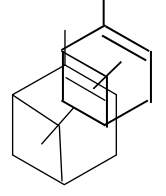
an equilibrium is gradually established between the two enantiomers (optical isomers). The two opposing reactions are both of the first order.
In 1927 D. F. Smith obtained the following data in his study of racemisation of α-pinene:
| \(T/\mathrm{K}\) | \(\alpha_1\) | \(\alpha_2\) | \(t/\mathrm{min}\) |
|---|---|---|---|
| 490.9 | 32.75 | 18.01 | 579 |
| 490.9 | 29.51 | 15.59 | 587 |
| 503.9 | 30.64 | 8.74 | 371 |
| 505.4 | 12.95 | 8.05 | 120 |
| 510.1 | 23.22 | 6.15 | 216 |
\(\alpha_1\) and \(\alpha_2\) are the values for optical rotation in terms of the dimensions of the polarimeter scale; \(t\) is the time which has elapsed between the two measurements.
Problems:
4.1 What is the value for the equilibrium constant for the racemisation?
What is the corresponding value of \(\Delta_{\mathrm r}G^\circ\) (racemisation)?
What is the relationship between the forward and backward rate constants, \(k_1\) and \(k_{-1}\), in a state of dynamic equilibrium?
4.2 State the rate equation for the racemisation of pinene.
Derive a relationship which could be used to calculate the rate constant for the conversion of the (+)-enantiomer into the (-)-enantiomer using the data given in the table.
4.3 Calculate the rate constant for this reaction at the four temperatures given in the table.
4.4 Calculate the average value of the activation energy for this reaction. You should take the average of the values at a minimum of three temperatures or use a graphical method.
HINT:
If the loss of concentration of a substance obeys the rate equation:
\[ -\frac{dc}{dt}=k(2c-\text{constant}) \]
Then the dependence of concentration on time is given by:
\[ \ln\frac{2c_0-\text{constant}}{2c-\text{constant}}=2kt \]
where \(c_0\) is the initial concentration at time \(t=0\).
Official English text of the problem.
Answers
- 4.1: \(K=1\), \(\Delta_{\mathrm r}G^\circ=0\), and \(k_1=k_{-1}\equiv k\).
- 4.2: With \(c_+\) and \(c_-\) the enantiomer concentrations and \(C=c_++c_-\), \[ -\frac{dc_+}{dt}=k(c_+-c_-)=k(2c_+-C), \qquad \boxed{k=\frac{1}{2t}\ln\frac{\alpha_1}{\alpha_2}}. \]
- 4.3: The one-way conversion constants are:
| \(T/\mathrm{K}\) | \(k/\mathrm{min^{-1}}\) | \(k/\mathrm{s^{-1}}\) |
|---|---|---|
| 490.9 | \(5.30\times10^{-4}\) | \(8.83\times10^{-6}\) |
| 503.9 | \(1.69\times10^{-3}\) | \(2.82\times10^{-5}\) |
| 505.4 | \(1.98\times10^{-3}\) | \(3.30\times10^{-5}\) |
| 510.1 | \(3.08\times10^{-3}\) | \(5.13\times10^{-5}\) |
The value at \(490.9\ \mathrm K\) is the mean of the two determinations.
- 4.4: An Arrhenius straight-line fit using all four temperatures gives \[ \boxed{E_{\mathrm a}\approx189\ \mathrm{kJ\,mol^{-1}}}. \]
Solution
4.1
The two species are:
- (+)-(1R,5R)-α-pinene, denoted \(P_+\):
CC1=CC[C@H]2C[C@@H]1C2(C)C. - (-)-(1S,5S)-α-pinene, denoted \(P_-\):
CC1=CC[C@@H]2C[C@H]1C2(C)C.
The SMILES specify absolute configuration; the \(+\) and \(-\) signs specify measured optical rotation, whose sign is not encoded in SMILES.
Their balanced interconversion is
\[ \ce{(+)-C10H16 <=>[k_1][k_{-1}] (-)-C10H16}. \]
Enantiomers have equal standard molar Gibbs energies in an achiral environment. Consequently,
\[ \Delta_{\mathrm r}G^\circ =\mu_-^\circ-\mu_+^\circ=0. \]
Using
\[ \Delta_{\mathrm r}G^\circ=-RT\ln K \]
gives
\[ \boxed{K=1}. \]
Thus the equilibrium mixture contains equal amounts of the two enantiomers:
\[ c_{+,\mathrm{eq}}=c_{-,\mathrm{eq}}. \]
At dynamic equilibrium the opposing reaction rates are equal:
\[ k_1c_{+,\mathrm{eq}}=k_{-1}c_{-,\mathrm{eq}}. \]
Therefore,
\[ \boxed{k_1=k_{-1}\equiv k}. \]
4.2
The net rate of disappearance of the (+)-enantiomer is
\[ -\frac{dc_+}{dt} =k_1c_+-k_{-1}c_-. \]
Since both rate constants equal \(k\),
\[ -\frac{dc_+}{dt}=k(c_+-c_-). \]
The total concentration is conserved:
\[ C=c_++c_-, \qquad c_-=C-c_+. \]
Hence the required concentration rate equation is
\[ \boxed{-\frac{dc_+}{dt}=k(2c_+-C)}. \]
At a fixed temperature and optical path length, the two enantiomers contribute equal and opposite rotations. Therefore, for a proportionality constant \(\beta\),
\[ \alpha=\beta(c_+-c_-)=\beta(2c_+-C). \]
Differentiating and substituting the rate equation,
\[ \frac{d\alpha}{dt} =2\beta\frac{dc_+}{dt} =-2k\beta(2c_+-C) =-2k\alpha. \]
Integration between two measurements separated by time \(t\) gives
\[ \ln\frac{\alpha_2}{\alpha_1}=-2kt, \]
or
\[ \boxed{\alpha_2=\alpha_1e^{-2kt}}, \qquad \boxed{k=\frac{1}{2t}\ln\frac{\alpha_1}{\alpha_2}}. \]
The factor of two is essential: the optical rotation decays with constant \(k_1+k_{-1}=2k\), whereas the requested one-way conversion constant is \(k\). Neither measurement needs to correspond to an initially pure enantiomer.
4.3
For example, the first experiment gives
\[ k= \frac{\ln(32.75/18.01)}{2(579\ \mathrm{min})} =5.16387\times10^{-4}\ \mathrm{min^{-1}}. \]
Applying the same expression to every row gives the following intermediate values:
| \(T/\mathrm{K}\) | \(t/\mathrm{min}\) | \(\ln(\alpha_1/\alpha_2)\) | \(k/\mathrm{min^{-1}}\) |
|---|---|---|---|
| 490.9 | 579 | 0.597976 | \(5.16387\times10^{-4}\) |
| 490.9 | 587 | 0.638100 | \(5.43526\times10^{-4}\) |
| 503.9 | 371 | 1.254396 | \(1.69056\times10^{-3}\) |
| 505.4 | 120 | 0.475424 | \(1.98093\times10^{-3}\) |
| 510.1 | 216 | 1.328562 | \(3.07537\times10^{-3}\) |
The arithmetic mean of the two measurements at \(490.9\ \mathrm K\) is
\[ \begin{aligned} \overline{k} &=\frac{5.16387\times10^{-4} +5.43526\times10^{-4}}{2}\ \mathrm{min^{-1}}\\ &=5.29956\times10^{-4}\ \mathrm{min^{-1}}\\ &\approx\boxed{5.30\times10^{-4}\ \mathrm{min^{-1}}}. \end{aligned} \]
The other three values, rounded to three significant figures, are
\[ \boxed{ \begin{aligned} k(503.9\ \mathrm K)&=1.69\times10^{-3}\ \mathrm{min^{-1}},\\ k(505.4\ \mathrm K)&=1.98\times10^{-3}\ \mathrm{min^{-1}},\\ k(510.1\ \mathrm K)&=3.08\times10^{-3}\ \mathrm{min^{-1}}. \end{aligned}} \]
Division by \(60\) converts these values to \(\mathrm{s^{-1}}\).
4.4
The Arrhenius equation is
\[ k=A\exp\left(-\frac{E_{\mathrm a}}{RT}\right). \]
Thus a plot of
\[ y=\ln\left(\frac{k}{1\ \mathrm{min^{-1}}}\right) \quad\text{against}\quad x=\frac1T \]
should be a straight line with slope
\[ m=-\frac{E_{\mathrm a}}R. \]
Using the mean rate constant at \(490.9\ \mathrm K\), the four plotting points are:
| \(1/T\;(\mathrm{K^{-1}})\) | \(\ln[k/(1\ \mathrm{min^{-1}})]\) |
|---|---|
| 0.002037075 | −7.542716 |
| 0.001984521 | −6.382695 |
| 0.001978631 | −6.224188 |
| 0.001960400 | −5.784329 |
The points lie close to a descending straight line. An unweighted least-squares fit, implementing the graphical method numerically, gives
\[ y=38.8473-(2.27775\times10^4\ \mathrm K)x. \]
Using \(R=8.314\ \mathrm{J\,mol^{-1}\,K^{-1}}\),
\[ \begin{aligned} E_{\mathrm a} &=-Rm\\ &=(8.314\ \mathrm{J\,mol^{-1}\,K^{-1}}) (2.27775\times10^4\ \mathrm K)\\ &=1.89372\times10^5\ \mathrm{J\,mol^{-1}}. \end{aligned} \]
Therefore,
\[ \boxed{E_{\mathrm a}\approx189\ \mathrm{kJ\,mol^{-1}}}. \]
The solution was checked against the official solution.
IChO 1985 · Theorieaufgabe 4
Kinetik der Racemisierung von α-Pinen
Bei einer Temperatur um \(200\,^\circ\mathrm{C}\) lässt sich die Racemisierung von Pinen in der Gasphase durch Messung des optischen Drehwinkels verfolgen.
Geht man beispielsweise vom (+)-Enantiomer des α-Pinens aus,
so stellt sich allmählich ein Gleichgewicht zwischen den beiden Enantiomeren (optischen Isomeren) ein. Die beiden entgegengesetzten Reaktionen sind jeweils erster Ordnung.
1927 erhielt D. F. Smith bei seiner Untersuchung der Racemisierung von α-Pinen die folgenden Daten:
| \(T/\mathrm{K}\) | \(\alpha_1\) | \(\alpha_2\) | \(t/\mathrm{min}\) |
|---|---|---|---|
| 490.9 | 32.75 | 18.01 | 579 |
| 490.9 | 29.51 | 15.59 | 587 |
| 503.9 | 30.64 | 8.74 | 371 |
| 505.4 | 12.95 | 8.05 | 120 |
| 510.1 | 23.22 | 6.15 | 216 |
\(\alpha_1\) und \(\alpha_2\) sind die Werte des optischen Drehwinkels in Einheiten der Polarimeterskala; \(t\) ist die zwischen den beiden Messungen verstrichene Zeit.
Aufgaben:
4.1 Welchen Wert hat die Gleichgewichtskonstante der Racemisierung?
Welchen entsprechenden Wert hat \(\Delta_{\mathrm r}G^\circ\) (Racemisierung)?
In welcher Beziehung stehen die Geschwindigkeitskonstanten der Hin- und Rückreaktion, \(k_1\) und \(k_{-1}\), im dynamischen Gleichgewicht zueinander?
4.2 Geben Sie das Geschwindigkeitsgesetz für die Racemisierung von Pinen an.
Leiten Sie eine Beziehung her, mit der sich die Geschwindigkeitskonstante für die Umwandlung des (+)-Enantiomers in das (-)-Enantiomer anhand der in der Tabelle angegebenen Daten berechnen lässt.
4.3 Berechnen Sie die Geschwindigkeitskonstante dieser Reaktion bei den vier in der Tabelle angegebenen Temperaturen.
4.4 Berechnen Sie den Mittelwert der Aktivierungsenergie dieser Reaktion. Bilden Sie dazu den Mittelwert der Werte bei mindestens drei Temperaturen oder verwenden Sie eine grafische Methode.
HINWEIS:
Wenn die Abnahme der Konzentration eines Stoffes dem folgenden Geschwindigkeitsgesetz gehorcht:
\[ -\frac{dc}{dt}=k(2c-\text{Konstante}) \]
dann ist die Zeitabhängigkeit der Konzentration gegeben durch:
\[ \ln\frac{2c_0-\text{Konstante}}{2c-\text{Konstante}}=2kt \]
wobei \(c_0\) die Anfangskonzentration zum Zeitpunkt \(t=0\) ist.
Aufgabentext aus dem offiziellen englischen Text übersetzt.
Antworten
- 4.1: \(K=1\), \(\Delta_{\mathrm r}G^\circ=0\) und \(k_1=k_{-1}\equiv k\).
- 4.2: Mit den Enantiomerkonzentrationen \(c_+\) und \(c_-\) sowie \(C=c_++c_-\) gilt \[ -\frac{dc_+}{dt}=k(c_+-c_-)=k(2c_+-C), \qquad \boxed{k=\frac{1}{2t}\ln\frac{\alpha_1}{\alpha_2}}. \]
- 4.3: Die Geschwindigkeitskonstanten für die Umwandlung in einer Richtung sind:
| \(T/\mathrm{K}\) | \(k/\mathrm{min^{-1}}\) | \(k/\mathrm{s^{-1}}\) |
|---|---|---|
| 490.9 | \(5.30\times10^{-4}\) | \(8.83\times10^{-6}\) |
| 503.9 | \(1.69\times10^{-3}\) | \(2.82\times10^{-5}\) |
| 505.4 | \(1.98\times10^{-3}\) | \(3.30\times10^{-5}\) |
| 510.1 | \(3.08\times10^{-3}\) | \(5.13\times10^{-5}\) |
Der Wert bei \(490.9\ \mathrm K\) ist der Mittelwert der beiden Bestimmungen.
- 4.4: Eine Anpassung einer Arrhenius-Geraden unter Verwendung aller vier Temperaturen ergibt \[ \boxed{E_{\mathrm a}\approx189\ \mathrm{kJ\,mol^{-1}}}. \]
Lösung
4.1
Die beiden Spezies sind:
- (+)-(1R,5R)-α-Pinen, bezeichnet mit \(P_+\):
CC1=CC[C@H]2C[C@@H]1C2(C)C. - (-)-(1S,5S)-α-Pinen, bezeichnet mit \(P_-\):
CC1=CC[C@@H]2C[C@H]1C2(C)C.
Die SMILES geben die absolute Konfiguration an; die Zeichen \(+\) und \(-\) geben den gemessenen optischen Drehwinkel an, dessen Vorzeichen in SMILES nicht codiert ist.
Die ausgeglichene Reaktionsgleichung ihrer gegenseitigen Umwandlung lautet
\[ \ce{(+)-C10H16 <=>[k_1][k_{-1}] (-)-C10H16}. \]
Enantiomere besitzen in einer achiralen Umgebung dieselben molaren Standard-Gibbs-Energien. Folglich gilt
\[ \Delta_{\mathrm r}G^\circ =\mu_-^\circ-\mu_+^\circ=0. \]
Mit
\[ \Delta_{\mathrm r}G^\circ=-RT\ln K \]
ergibt sich
\[ \boxed{K=1}. \]
Das Gleichgewichtsgemisch enthält somit gleiche Mengen der beiden Enantiomere:
\[ c_{+,\mathrm{eq}}=c_{-,\mathrm{eq}}. \]
Im dynamischen Gleichgewicht sind die Geschwindigkeiten der entgegengesetzten Reaktionen gleich:
\[ k_1c_{+,\mathrm{eq}}=k_{-1}c_{-,\mathrm{eq}}. \]
Daher gilt
\[ \boxed{k_1=k_{-1}\equiv k}. \]
4.2
Die Nettogeschwindigkeit der Abnahme der Konzentration des (+)-Enantiomers ist
\[ -\frac{dc_+}{dt} =k_1c_+-k_{-1}c_-. \]
Da beide Geschwindigkeitskonstanten gleich \(k\) sind, gilt
\[ -\frac{dc_+}{dt}=k(c_+-c_-). \]
Die Gesamtkonzentration bleibt erhalten:
\[ C=c_++c_-, \qquad c_-=C-c_+. \]
Damit lautet das gesuchte Geschwindigkeitsgesetz für die Konzentrationsänderung
\[ \boxed{-\frac{dc_+}{dt}=k(2c_+-C)}. \]
Bei konstanter Temperatur und optischer Weglänge liefern die beiden Enantiomere betragsgleiche, entgegengesetzte Beiträge zum Drehwinkel. Mit einer Proportionalitätskonstanten \(\beta\) gilt daher
\[ \alpha=\beta(c_+-c_-)=\beta(2c_+-C). \]
Durch Differenzieren und Einsetzen des Geschwindigkeitsgesetzes erhält man
\[ \frac{d\alpha}{dt} =2\beta\frac{dc_+}{dt} =-2k\beta(2c_+-C) =-2k\alpha. \]
Die Integration zwischen zwei Messungen, die im zeitlichen Abstand \(t\) erfolgen, ergibt
\[ \ln\frac{\alpha_2}{\alpha_1}=-2kt, \]
oder
\[ \boxed{\alpha_2=\alpha_1e^{-2kt}}, \qquad \boxed{k=\frac{1}{2t}\ln\frac{\alpha_1}{\alpha_2}}. \]
Der Faktor zwei ist entscheidend: Der optische Drehwinkel nimmt mit der Konstanten \(k_1+k_{-1}=2k\) ab, während die gesuchte Geschwindigkeitskonstante für die Umwandlung in einer Richtung \(k\) ist. Keine der beiden Messungen muss einem anfänglich reinen Enantiomer entsprechen.
4.3
Beispielsweise ergibt das erste Experiment
\[ k= \frac{\ln(32.75/18.01)}{2(579\ \mathrm{min})} =5.16387\times10^{-4}\ \mathrm{min^{-1}}. \]
Die Anwendung desselben Ausdrucks auf jede Zeile ergibt die folgenden Zwischenwerte:
| \(T/\mathrm{K}\) | \(t/\mathrm{min}\) | \(\ln(\alpha_1/\alpha_2)\) | \(k/\mathrm{min^{-1}}\) |
|---|---|---|---|
| 490.9 | 579 | 0.597976 | \(5.16387\times10^{-4}\) |
| 490.9 | 587 | 0.638100 | \(5.43526\times10^{-4}\) |
| 503.9 | 371 | 1.254396 | \(1.69056\times10^{-3}\) |
| 505.4 | 120 | 0.475424 | \(1.98093\times10^{-3}\) |
| 510.1 | 216 | 1.328562 | \(3.07537\times10^{-3}\) |
Das arithmetische Mittel der beiden Messungen bei \(490.9\ \mathrm K\) ist
\[ \begin{aligned} \overline{k} &=\frac{5.16387\times10^{-4} +5.43526\times10^{-4}}{2}\ \mathrm{min^{-1}}\\ &=5.29956\times10^{-4}\ \mathrm{min^{-1}}\\ &\approx\boxed{5.30\times10^{-4}\ \mathrm{min^{-1}}}. \end{aligned} \]
Die anderen drei Werte, auf drei signifikante Stellen gerundet, sind
\[ \boxed{ \begin{aligned} k(503.9\ \mathrm K)&=1.69\times10^{-3}\ \mathrm{min^{-1}},\\ k(505.4\ \mathrm K)&=1.98\times10^{-3}\ \mathrm{min^{-1}},\\ k(510.1\ \mathrm K)&=3.08\times10^{-3}\ \mathrm{min^{-1}}. \end{aligned}} \]
Durch Division durch \(60\) werden diese Werte in \(\mathrm{s^{-1}}\) umgerechnet.
4.4
Die Arrhenius-Gleichung lautet
\[ k=A\exp\left(-\frac{E_{\mathrm a}}{RT}\right). \]
Somit sollte eine Auftragung von
\[ y=\ln\left(\frac{k}{1\ \mathrm{min^{-1}}}\right) \quad\text{gegen}\quad x=\frac1T \]
eine Gerade mit folgender Steigung ergeben:
\[ m=-\frac{E_{\mathrm a}}R. \]
Unter Verwendung der mittleren Geschwindigkeitskonstanten bei \(490.9\ \mathrm K\) lauten die vier Punkte für die Auftragung:
| \(1/T\;(\mathrm{K^{-1}})\) | \(\ln[k/(1\ \mathrm{min^{-1}})]\) |
|---|---|
| 0.002037075 | −7.542716 |
| 0.001984521 | −6.382695 |
| 0.001978631 | −6.224188 |
| 0.001960400 | −5.784329 |
Die Punkte liegen nahe an einer fallenden Geraden. Eine ungewichtete Anpassung nach der Methode der kleinsten Quadrate, die die grafische Methode numerisch umsetzt, ergibt
\[ y=38.8473-(2.27775\times10^4\ \mathrm K)x. \]
Mit \(R=8.314\ \mathrm{J\,mol^{-1}\,K^{-1}}\) erhält man
\[ \begin{aligned} E_{\mathrm a} &=-Rm\\ &=(8.314\ \mathrm{J\,mol^{-1}\,K^{-1}}) (2.27775\times10^4\ \mathrm K)\\ &=1.89372\times10^5\ \mathrm{J\,mol^{-1}}. \end{aligned} \]
Daher gilt
\[ \boxed{E_{\mathrm a}\approx189\ \mathrm{kJ\,mol^{-1}}}. \]
Die Lösung wurde mit der offiziellen Lösung abgeglichen.
IChO 1985 · Teori sorusu 4
Alfa-pinenin rasemleşme kinetiği
Yaklaşık \(200\,^\circ\mathrm{C}\) sıcaklıkta pinenin rasemleşmesi, optik dönme ölçülerek gaz fazında izlenebilir.
Örneğin, α-pinenin (+)-enantiyomerini alırsanız
iki enantiyomer (optik izomer) arasında yavaş yavaş bir denge kurulur. Birbirine zıt yönde ilerleyen iki tepkime de birinci derecedendir.
1927 yılında D. F. Smith, α-pinenin rasemleşmesi üzerine yaptığı çalışmada aşağıdaki verileri elde etmiştir:
| \(T/\mathrm{K}\) | \(\alpha_1\) | \(\alpha_2\) | \(t/\mathrm{min}\) |
|---|---|---|---|
| 490.9 | 32.75 | 18.01 | 579 |
| 490.9 | 29.51 | 15.59 | 587 |
| 503.9 | 30.64 | 8.74 | 371 |
| 505.4 | 12.95 | 8.05 | 120 |
| 510.1 | 23.22 | 6.15 | 216 |
\(\alpha_1\) ve \(\alpha_2\), polarimetre ölçeğinin birimleri cinsinden optik dönme değerleridir; \(t\), iki ölçüm arasında geçen süredir.
Sorular:
4.1 Rasemleşmenin denge sabitinin değeri nedir?
Buna karşılık gelen \(\Delta_{\mathrm r}G^\circ\) (rasemleşme) değeri nedir?
Dinamik denge durumunda ileri ve geri tepkimelerin hız sabitleri \(k_1\) ve \(k_{-1}\) arasındaki ilişki nedir?
4.2 Pinenin rasemleşmesinin hız denklemini yazınız.
Tabloda verilen veriler kullanılarak (+)-enantiyomerin (-)-enantiyomere dönüşümünün hız sabitini hesaplamak için kullanılabilecek bir bağıntı türetiniz.
4.3 Tabloda verilen dört sıcaklıkta bu tepkimenin hız sabitini hesaplayınız.
4.4 Bu tepkimenin aktivasyon enerjisinin ortalama değerini hesaplayınız. En az üç sıcaklıktaki değerlerin ortalamasını almalı veya grafik yöntemini kullanmalısınız.
İPUCU:
Bir maddenin derişimindeki azalma şu hız denklemine uyuyorsa:
\[ -\frac{dc}{dt}=k(2c-\text{sabit}) \]
Derişimin zamana bağlılığı şu şekilde verilir:
\[ \ln\frac{2c_0-\text{sabit}}{2c-\text{sabit}}=2kt \]
burada \(c_0\), \(t=0\) anındaki başlangıç derişimidir.
Soru metni resmi İngilizce metinden çevrilmiştir.
Cevaplar
- 4.1: \(K=1\), \(\Delta_{\mathrm r}G^\circ=0\) ve \(k_1=k_{-1}\equiv k\).
- 4.2: \(c_+\) ve \(c_-\) enantiyomer derişimleri ve \(C=c_++c_-\) olmak üzere, \[ -\frac{dc_+}{dt}=k(c_+-c_-)=k(2c_+-C), \qquad \boxed{k=\frac{1}{2t}\ln\frac{\alpha_1}{\alpha_2}}. \]
- 4.3: Tek yönlü dönüşümün hız sabitleri şunlardır:
| \(T/\mathrm{K}\) | \(k/\mathrm{min^{-1}}\) | \(k/\mathrm{s^{-1}}\) |
|---|---|---|
| 490.9 | \(5.30\times10^{-4}\) | \(8.83\times10^{-6}\) |
| 503.9 | \(1.69\times10^{-3}\) | \(2.82\times10^{-5}\) |
| 505.4 | \(1.98\times10^{-3}\) | \(3.30\times10^{-5}\) |
| 510.1 | \(3.08\times10^{-3}\) | \(5.13\times10^{-5}\) |
\(490.9\ \mathrm K\) sıcaklığındaki değer, iki belirlemenin ortalamasıdır.
- 4.4: Dört sıcaklığın tümü kullanılarak yapılan Arrhenius doğrusu uyumu şu sonucu verir: \[ \boxed{E_{\mathrm a}\approx189\ \mathrm{kJ\,mol^{-1}}}. \]
Çözüm
4.1
İki tür şunlardır:
- (+)-(1R,5R)-α-pinen, \(P_+\) ile gösterilir:
CC1=CC[C@H]2C[C@@H]1C2(C)C. - (-)-(1S,5S)-α-pinen, \(P_-\) ile gösterilir:
CC1=CC[C@@H]2C[C@H]1C2(C)C.
SMILES gösterimleri mutlak konfigürasyonu belirtir; \(+\) ve \(-\) işaretleri, ölçülen optik dönmenin yönünü belirtir ve bu işaret SMILES gösteriminde kodlanmaz.
Birbirlerine dönüşümlerinin denkleştirilmiş tepkimesi şöyledir:
\[ \ce{(+)-C10H16 <=>[k_1][k_{-1}] (-)-C10H16}. \]
Enantiyomerler, akiral bir ortamda eşit standart molar Gibbs enerjilerine sahiptir. Dolayısıyla,
\[ \Delta_{\mathrm r}G^\circ =\mu_-^\circ-\mu_+^\circ=0. \]
Şu bağıntı kullanıldığında
\[ \Delta_{\mathrm r}G^\circ=-RT\ln K \]
şu sonuç elde edilir:
\[ \boxed{K=1}. \]
Böylece denge karışımı, iki enantiyomeri eşit miktarlarda içerir:
\[ c_{+,\mathrm{eq}}=c_{-,\mathrm{eq}}. \]
Dinamik dengede, birbirine zıt yönde ilerleyen tepkimelerin hızları eşittir:
\[ k_1c_{+,\mathrm{eq}}=k_{-1}c_{-,\mathrm{eq}}. \]
Bu nedenle,
\[ \boxed{k_1=k_{-1}\equiv k}. \]
4.2
(+)-enantiyomerin net tükenme hızı şöyledir:
\[ -\frac{dc_+}{dt} =k_1c_+-k_{-1}c_-. \]
Her iki hız sabiti de \(k\)'ye eşit olduğundan,
\[ -\frac{dc_+}{dt}=k(c_+-c_-). \]
Toplam derişim korunur:
\[ C=c_++c_-, \qquad c_-=C-c_+. \]
Dolayısıyla istenen derişim cinsinden hız denklemi şöyledir:
\[ \boxed{-\frac{dc_+}{dt}=k(2c_+-C)}. \]
Sabit sıcaklıkta ve sabit optik yol uzunluğunda, iki enantiyomer optik dönmeye eşit büyüklükte ve zıt yönlerde katkıda bulunur. Bu nedenle, \(\beta\) bir orantı sabiti olmak üzere,
\[ \alpha=\beta(c_+-c_-)=\beta(2c_+-C). \]
Türev alınıp hız denklemi yerine konulduğunda,
\[ \frac{d\alpha}{dt} =2\beta\frac{dc_+}{dt} =-2k\beta(2c_+-C) =-2k\alpha. \]
Aralarında \(t\) süresi bulunan iki ölçüm arasında integral alındığında
\[ \ln\frac{\alpha_2}{\alpha_1}=-2kt, \]
veya
\[ \boxed{\alpha_2=\alpha_1e^{-2kt}}, \qquad \boxed{k=\frac{1}{2t}\ln\frac{\alpha_1}{\alpha_2}}. \]
İki çarpanı esastır: optik dönme \(k_1+k_{-1}=2k\) sabitiyle azalırken, istenen tek yönlü dönüşümün hız sabiti \(k\)'dir. Ölçümlerden hiçbirinin başlangıçta saf bir enantiyomere karşılık gelmesi gerekmez.
4.3
Örneğin, ilk deney şu sonucu verir:
\[ k= \frac{\ln(32.75/18.01)}{2(579\ \mathrm{min})} =5.16387\times10^{-4}\ \mathrm{min^{-1}}. \]
Aynı ifade her satıra uygulandığında aşağıdaki ara değerler elde edilir:
| \(T/\mathrm{K}\) | \(t/\mathrm{min}\) | \(\ln(\alpha_1/\alpha_2)\) | \(k/\mathrm{min^{-1}}\) |
|---|---|---|---|
| 490.9 | 579 | 0.597976 | \(5.16387\times10^{-4}\) |
| 490.9 | 587 | 0.638100 | \(5.43526\times10^{-4}\) |
| 503.9 | 371 | 1.254396 | \(1.69056\times10^{-3}\) |
| 505.4 | 120 | 0.475424 | \(1.98093\times10^{-3}\) |
| 510.1 | 216 | 1.328562 | \(3.07537\times10^{-3}\) |
\(490.9\ \mathrm K\) sıcaklığındaki iki ölçümün aritmetik ortalaması şöyledir:
\[ \begin{aligned} \overline{k} &=\frac{5.16387\times10^{-4} +5.43526\times10^{-4}}{2}\ \mathrm{min^{-1}}\\ &=5.29956\times10^{-4}\ \mathrm{min^{-1}}\\ &\approx\boxed{5.30\times10^{-4}\ \mathrm{min^{-1}}}. \end{aligned} \]
Üç anlamlı basamağa yuvarlanmış diğer üç değer şöyledir:
\[ \boxed{ \begin{aligned} k(503.9\ \mathrm K)&=1.69\times10^{-3}\ \mathrm{min^{-1}},\\ k(505.4\ \mathrm K)&=1.98\times10^{-3}\ \mathrm{min^{-1}},\\ k(510.1\ \mathrm K)&=3.08\times10^{-3}\ \mathrm{min^{-1}}. \end{aligned}} \]
\(60\)'a bölmek, bu değerleri \(\mathrm{s^{-1}}\) birimine dönüştürür.
4.4
Arrhenius denklemi şöyledir:
\[ k=A\exp\left(-\frac{E_{\mathrm a}}{RT}\right). \]
Dolayısıyla
\[ y=\ln\left(\frac{k}{1\ \mathrm{min^{-1}}}\right) \quad\text{değerinin şu değişkene karşı grafiği:}\quad x=\frac1T \]
eğimi aşağıdaki gibi olan bir doğru olmalıdır:
\[ m=-\frac{E_{\mathrm a}}R. \]
\(490.9\ \mathrm K\) sıcaklığındaki ortalama hız sabiti kullanıldığında, grafiğe aktarılacak dört nokta şöyledir:
| \(1/T\;(\mathrm{K^{-1}})\) | \(\ln[k/(1\ \mathrm{min^{-1}})]\) |
|---|---|
| 0.002037075 | −7.542716 |
| 0.001984521 | −6.382695 |
| 0.001978631 | −6.224188 |
| 0.001960400 | −5.784329 |
Noktalar, azalan bir doğruya yakın konumlanır. Grafik yöntemini sayısal olarak uygulayan ağırlıksız bir en küçük kareler uyumu şu sonucu verir:
\[ y=38.8473-(2.27775\times10^4\ \mathrm K)x. \]
\(R=8.314\ \mathrm{J\,mol^{-1}\,K^{-1}}\) kullanıldığında,
\[ \begin{aligned} E_{\mathrm a} &=-Rm\\ &=(8.314\ \mathrm{J\,mol^{-1}\,K^{-1}}) (2.27775\times10^4\ \mathrm K)\\ &=1.89372\times10^5\ \mathrm{J\,mol^{-1}}. \end{aligned} \]
Bu nedenle,
\[ \boxed{E_{\mathrm a}\approx189\ \mathrm{kJ\,mol^{-1}}}. \]
Çözüm, resmi çözümle karşılaştırılarak kontrol edildi.
IChO 1985 · Problema teórico 4
Cinética de la racemización del alfa-pineno
A una temperatura de alrededor de \(200\,^\circ\mathrm{C}\), la racemización del pineno puede seguirse en fase gaseosa midiendo la rotación óptica.
Si, por ejemplo, se parte del enantiómero (+) del α-pineno
se establece gradualmente un equilibrio entre los dos enantiómeros (isómeros ópticos). Las dos reacciones opuestas son de primer orden.
En 1927, D. F. Smith obtuvo los siguientes datos en su estudio de la racemización del α-pineno:
| \(T/\mathrm{K}\) | \(\alpha_1\) | \(\alpha_2\) | \(t/\mathrm{min}\) |
|---|---|---|---|
| 490.9 | 32.75 | 18.01 | 579 |
| 490.9 | 29.51 | 15.59 | 587 |
| 503.9 | 30.64 | 8.74 | 371 |
| 505.4 | 12.95 | 8.05 | 120 |
| 510.1 | 23.22 | 6.15 | 216 |
\(\alpha_1\) y \(\alpha_2\) son los valores de la rotación óptica expresados en unidades de la escala del polarímetro; \(t\) es el tiempo transcurrido entre las dos mediciones.
Cuestiones:
4.1 ¿Cuál es el valor de la constante de equilibrio de la racemización?
¿Cuál es el valor correspondiente de \(\Delta_{\mathrm r}G^\circ\) (racemización)?
¿Qué relación existe entre las constantes de velocidad de las reacciones directa e inversa, \(k_1\) y \(k_{-1}\), en un estado de equilibrio dinámico?
4.2 Escriba la ecuación de velocidad de la racemización del pineno.
Deduzca una relación que permita calcular la constante de velocidad de la conversión del enantiómero (+) en el enantiómero (-) utilizando los datos de la tabla.
4.3 Calcule la constante de velocidad de esta reacción a las cuatro temperaturas indicadas en la tabla.
4.4 Calcule el valor medio de la energía de activación de esta reacción. Debe tomar el promedio de los valores a un mínimo de tres temperaturas o utilizar un método gráfico.
INDICACIÓN:
Si la disminución de la concentración de una sustancia obedece a la ecuación de velocidad:
\[ -\frac{dc}{dt}=k(2c-\text{constante}) \]
Entonces la dependencia de la concentración con el tiempo viene dada por:
\[ \ln\frac{2c_0-\text{constante}}{2c-\text{constante}}=2kt \]
donde \(c_0\) es la concentración inicial en el instante \(t=0\).
Enunciado traducido del texto oficial en inglés.
Respuestas
- 4.1: \(K=1\), \(\Delta_{\mathrm r}G^\circ=0\), y \(k_1=k_{-1}\equiv k\).
- 4.2: Si \(c_+\) y \(c_-\) son las concentraciones de los enantiómeros y \(C=c_++c_-\), \[ -\frac{dc_+}{dt}=k(c_+-c_-)=k(2c_+-C), \qquad \boxed{k=\frac{1}{2t}\ln\frac{\alpha_1}{\alpha_2}}. \]
- 4.3: Las constantes de conversión en un solo sentido son:
| \(T/\mathrm{K}\) | \(k/\mathrm{min^{-1}}\) | \(k/\mathrm{s^{-1}}\) |
|---|---|---|
| 490.9 | \(5.30\times10^{-4}\) | \(8.83\times10^{-6}\) |
| 503.9 | \(1.69\times10^{-3}\) | \(2.82\times10^{-5}\) |
| 505.4 | \(1.98\times10^{-3}\) | \(3.30\times10^{-5}\) |
| 510.1 | \(3.08\times10^{-3}\) | \(5.13\times10^{-5}\) |
El valor a \(490.9\ \mathrm K\) es la media de las dos determinaciones.
- 4.4: Un ajuste lineal de Arrhenius utilizando las cuatro temperaturas da \[ \boxed{E_{\mathrm a}\approx189\ \mathrm{kJ\,mol^{-1}}}. \]
Solución
4.1
Las dos especies son:
- (+)-(1R,5R)-α-pineno, representado por \(P_+\):
CC1=CC[C@H]2C[C@@H]1C2(C)C. - (-)-(1S,5S)-α-pineno, representado por \(P_-\):
CC1=CC[C@@H]2C[C@H]1C2(C)C.
Los SMILES especifican la configuración absoluta; los signos \(+\) y \(-\) especifican la rotación óptica medida, cuyo signo no está codificado en los SMILES.
La ecuación ajustada de su interconversión es
\[ \ce{(+)-C10H16 <=>[k_1][k_{-1}] (-)-C10H16}. \]
Los enantiómeros tienen la misma energía de Gibbs molar estándar en un entorno aquiral. Por consiguiente,
\[ \Delta_{\mathrm r}G^\circ =\mu_-^\circ-\mu_+^\circ=0. \]
Utilizando
\[ \Delta_{\mathrm r}G^\circ=-RT\ln K \]
se obtiene
\[ \boxed{K=1}. \]
Por tanto, la mezcla en equilibrio contiene cantidades iguales de los dos enantiómeros:
\[ c_{+,\mathrm{eq}}=c_{-,\mathrm{eq}}. \]
En el equilibrio dinámico, las velocidades de las reacciones opuestas son iguales:
\[ k_1c_{+,\mathrm{eq}}=k_{-1}c_{-,\mathrm{eq}}. \]
Por tanto,
\[ \boxed{k_1=k_{-1}\equiv k}. \]
4.2
La velocidad neta de desaparición del enantiómero (+) es
\[ -\frac{dc_+}{dt} =k_1c_+-k_{-1}c_-. \]
Como ambas constantes de velocidad son iguales a \(k\),
\[ -\frac{dc_+}{dt}=k(c_+-c_-). \]
La concentración total se conserva:
\[ C=c_++c_-, \qquad c_-=C-c_+. \]
Así, la ecuación de velocidad en función de la concentración que se pide es
\[ \boxed{-\frac{dc_+}{dt}=k(2c_+-C)}. \]
A temperatura y longitud del trayecto óptico fijas, los dos enantiómeros contribuyen con rotaciones iguales y opuestas. Por tanto, para una constante de proporcionalidad \(\beta\),
\[ \alpha=\beta(c_+-c_-)=\beta(2c_+-C). \]
Derivando y sustituyendo la ecuación de velocidad,
\[ \frac{d\alpha}{dt} =2\beta\frac{dc_+}{dt} =-2k\beta(2c_+-C) =-2k\alpha. \]
La integración entre dos mediciones separadas por un tiempo \(t\) da
\[ \ln\frac{\alpha_2}{\alpha_1}=-2kt, \]
o bien
\[ \boxed{\alpha_2=\alpha_1e^{-2kt}}, \qquad \boxed{k=\frac{1}{2t}\ln\frac{\alpha_1}{\alpha_2}}. \]
El factor dos es esencial: la rotación óptica disminuye con una constante \(k_1+k_{-1}=2k\), mientras que la constante de conversión en un solo sentido que se pide es \(k\). Ninguna de las dos mediciones tiene que corresponder a un enantiómero inicialmente puro.
4.3
Por ejemplo, el primer experimento da
\[ k= \frac{\ln(32.75/18.01)}{2(579\ \mathrm{min})} =5.16387\times10^{-4}\ \mathrm{min^{-1}}. \]
Al aplicar la misma expresión a cada fila se obtienen los siguientes valores intermedios:
| \(T/\mathrm{K}\) | \(t/\mathrm{min}\) | \(\ln(\alpha_1/\alpha_2)\) | \(k/\mathrm{min^{-1}}\) |
|---|---|---|---|
| 490.9 | 579 | 0.597976 | \(5.16387\times10^{-4}\) |
| 490.9 | 587 | 0.638100 | \(5.43526\times10^{-4}\) |
| 503.9 | 371 | 1.254396 | \(1.69056\times10^{-3}\) |
| 505.4 | 120 | 0.475424 | \(1.98093\times10^{-3}\) |
| 510.1 | 216 | 1.328562 | \(3.07537\times10^{-3}\) |
La media aritmética de las dos mediciones a \(490.9\ \mathrm K\) es
\[ \begin{aligned} \overline{k} &=\frac{5.16387\times10^{-4} +5.43526\times10^{-4}}{2}\ \mathrm{min^{-1}}\\ &=5.29956\times10^{-4}\ \mathrm{min^{-1}}\\ &\approx\boxed{5.30\times10^{-4}\ \mathrm{min^{-1}}}. \end{aligned} \]
Los otros tres valores, redondeados a tres cifras significativas, son
\[ \boxed{ \begin{aligned} k(503.9\ \mathrm K)&=1.69\times10^{-3}\ \mathrm{min^{-1}},\\ k(505.4\ \mathrm K)&=1.98\times10^{-3}\ \mathrm{min^{-1}},\\ k(510.1\ \mathrm K)&=3.08\times10^{-3}\ \mathrm{min^{-1}}. \end{aligned}} \]
La división por \(60\) convierte estos valores a \(\mathrm{s^{-1}}\).
4.4
La ecuación de Arrhenius es
\[ k=A\exp\left(-\frac{E_{\mathrm a}}{RT}\right). \]
Por tanto, una representación de
\[ y=\ln\left(\frac{k}{1\ \mathrm{min^{-1}}}\right) \quad\text{frente a}\quad x=\frac1T \]
debería ser una recta de pendiente
\[ m=-\frac{E_{\mathrm a}}R. \]
Utilizando la constante de velocidad media a \(490.9\ \mathrm K\), los cuatro puntos de la gráfica son:
| \(1/T\;(\mathrm{K^{-1}})\) | \(\ln[k/(1\ \mathrm{min^{-1}})]\) |
|---|---|
| 0.002037075 | −7.542716 |
| 0.001984521 | −6.382695 |
| 0.001978631 | −6.224188 |
| 0.001960400 | −5.784329 |
Los puntos se sitúan cerca de una recta descendente. Un ajuste por mínimos cuadrados sin ponderación, que aplica numéricamente el método gráfico, da
\[ y=38.8473-(2.27775\times10^4\ \mathrm K)x. \]
Utilizando \(R=8.314\ \mathrm{J\,mol^{-1}\,K^{-1}}\),
\[ \begin{aligned} E_{\mathrm a} &=-Rm\\ &=(8.314\ \mathrm{J\,mol^{-1}\,K^{-1}}) (2.27775\times10^4\ \mathrm K)\\ &=1.89372\times10^5\ \mathrm{J\,mol^{-1}}. \end{aligned} \]
Por tanto,
\[ \boxed{E_{\mathrm a}\approx189\ \mathrm{kJ\,mol^{-1}}}. \]
La solución se comprobó con la solución oficial.
IChO 1985 · 理论题 4
α-蒎烯外消旋化的动力学
在约 \(200\,^\circ\mathrm{C}\) 的温度下,可以通过测量旋光度来跟踪气相中蒎烯的外消旋化过程。
例如,若取 α-蒎烯的 (+)-对映异构体
两种对映异构体(旋光异构体)之间就会逐渐建立平衡。正、逆两个反应均为一级反应。
1927 年,D. F. Smith 在研究 α-蒎烯的外消旋化时获得了以下数据:
| \(T/\mathrm{K}\) | \(\alpha_1\) | \(\alpha_2\) | \(t/\mathrm{min}\) |
|---|---|---|---|
| 490.9 | 32.75 | 18.01 | 579 |
| 490.9 | 29.51 | 15.59 | 587 |
| 503.9 | 30.64 | 8.74 | 371 |
| 505.4 | 12.95 | 8.05 | 120 |
| 510.1 | 23.22 | 6.15 | 216 |
\(\alpha_1\) 和 \(\alpha_2\) 是以旋光仪刻度单位表示的旋光度;\(t\) 是两次测量之间经过的时间。
问题:
4.1 外消旋化反应的平衡常数是多少?
对应的 \(\Delta_{\mathrm r}G^\circ\)(外消旋化)是多少?
在动态平衡状态下,正、逆反应速率常数 \(k_1\) 和 \(k_{-1}\) 之间有什么关系?
4.2 写出蒎烯外消旋化的速率方程。
推导一个关系式,使其能够利用表中所给数据计算 (+)-对映异构体转化为 (-)-对映异构体的速率常数。
4.3 计算表中所给四个温度下该反应的速率常数。
4.4 计算该反应活化能的平均值。应取至少三个温度下所得数值的平均值,或使用作图法。
提示:
若某物质浓度的降低遵循以下速率方程:
\[ -\frac{dc}{dt}=k(2c-\text{常数}) \]
则浓度随时间的变化关系为:
\[ \ln\frac{2c_0-\text{常数}}{2c-\text{常数}}=2kt \]
其中,\(c_0\) 是 \(t=0\) 时的初始浓度。
题目译自官方英文原文。
答案
- 4.1: \(K=1\),\(\Delta_{\mathrm r}G^\circ=0\),且 \(k_1=k_{-1}\equiv k\)。
- 4.2: 设 \(c_+\) 和 \(c_-\) 为两种对映异构体的浓度,且 \(C=c_++c_-\),则 \[ -\frac{dc_+}{dt}=k(c_+-c_-)=k(2c_+-C), \qquad \boxed{k=\frac{1}{2t}\ln\frac{\alpha_1}{\alpha_2}}. \]
- 4.3: 单向转化的速率常数为:
| \(T/\mathrm{K}\) | \(k/\mathrm{min^{-1}}\) | \(k/\mathrm{s^{-1}}\) |
|---|---|---|
| 490.9 | \(5.30\times10^{-4}\) | \(8.83\times10^{-6}\) |
| 503.9 | \(1.69\times10^{-3}\) | \(2.82\times10^{-5}\) |
| 505.4 | \(1.98\times10^{-3}\) | \(3.30\times10^{-5}\) |
| 510.1 | \(3.08\times10^{-3}\) | \(5.13\times10^{-5}\) |
\(490.9\ \mathrm K\) 下的数值是两次测定结果的平均值。
- 4.4: 利用全部四个温度的数据进行阿伦尼乌斯直线拟合,得到 \[ \boxed{E_{\mathrm a}\approx189\ \mathrm{kJ\,mol^{-1}}}. \]
解答
4.1
这两种物质分别为:
- (+)-(1R,5R)-α-蒎烯,记作 \(P_+\):
CC1=CC[C@H]2C[C@@H]1C2(C)C。 - (-)-(1S,5S)-α-蒎烯,记作 \(P_-\):
CC1=CC[C@@H]2C[C@H]1C2(C)C。
SMILES 指定绝对构型;\(+\) 和 \(-\) 符号表示实测旋光度的正负,而 SMILES 并不编码旋光度的正负。
它们相互转化的配平反应式为
\[ \ce{(+)-C10H16 <=>[k_1][k_{-1}] (-)-C10H16}. \]
在非手性环境中,对映异构体具有相等的标准摩尔吉布斯能。因此,
\[ \Delta_{\mathrm r}G^\circ =\mu_-^\circ-\mu_+^\circ=0. \]
利用
\[ \Delta_{\mathrm r}G^\circ=-RT\ln K \]
可得
\[ \boxed{K=1}. \]
因此,平衡混合物中两种对映异构体的含量相等:
\[ c_{+,\mathrm{eq}}=c_{-,\mathrm{eq}}. \]
动态平衡时,正、逆反应速率相等:
\[ k_1c_{+,\mathrm{eq}}=k_{-1}c_{-,\mathrm{eq}}. \]
因此,
\[ \boxed{k_1=k_{-1}\equiv k}. \]
4.2
(+)-对映异构体的净消耗速率为
\[ -\frac{dc_+}{dt} =k_1c_+-k_{-1}c_-. \]
由于两个速率常数均等于 \(k\),
\[ -\frac{dc_+}{dt}=k(c_+-c_-). \]
总浓度保持不变:
\[ C=c_++c_-, \qquad c_-=C-c_+. \]
因此,所求的浓度变化速率方程为
\[ \boxed{-\frac{dc_+}{dt}=k(2c_+-C)}. \]
在温度和光程固定时,两种对映异构体对旋光度的贡献大小相等、方向相反。因此,设比例常数为 \(\beta\),则
\[ \alpha=\beta(c_+-c_-)=\beta(2c_+-C). \]
求导并代入速率方程,得到
\[ \frac{d\alpha}{dt} =2\beta\frac{dc_+}{dt} =-2k\beta(2c_+-C) =-2k\alpha. \]
在时间间隔为 \(t\) 的两次测量之间积分,得到
\[ \ln\frac{\alpha_2}{\alpha_1}=-2kt, \]
或
\[ \boxed{\alpha_2=\alpha_1e^{-2kt}}, \qquad \boxed{k=\frac{1}{2t}\ln\frac{\alpha_1}{\alpha_2}}. \]
因子 2 至关重要:旋光度以常数 \(k_1+k_{-1}=2k\) 衰减,而所求的单向转化速率常数为 \(k\)。两次测量均不必对应于初始纯对映异构体的状态。
4.3
例如,由第一次实验可得
\[ k= \frac{\ln(32.75/18.01)}{2(579\ \mathrm{min})} =5.16387\times10^{-4}\ \mathrm{min^{-1}}. \]
将同一表达式用于每一行数据,得到以下中间结果:
| \(T/\mathrm{K}\) | \(t/\mathrm{min}\) | \(\ln(\alpha_1/\alpha_2)\) | \(k/\mathrm{min^{-1}}\) |
|---|---|---|---|
| 490.9 | 579 | 0.597976 | \(5.16387\times10^{-4}\) |
| 490.9 | 587 | 0.638100 | \(5.43526\times10^{-4}\) |
| 503.9 | 371 | 1.254396 | \(1.69056\times10^{-3}\) |
| 505.4 | 120 | 0.475424 | \(1.98093\times10^{-3}\) |
| 510.1 | 216 | 1.328562 | \(3.07537\times10^{-3}\) |
\(490.9\ \mathrm K\) 下两次测定结果的算术平均值为
\[ \begin{aligned} \overline{k} &=\frac{5.16387\times10^{-4} +5.43526\times10^{-4}}{2}\ \mathrm{min^{-1}}\\ &=5.29956\times10^{-4}\ \mathrm{min^{-1}}\\ &\approx\boxed{5.30\times10^{-4}\ \mathrm{min^{-1}}}. \end{aligned} \]
其余三个数值保留三位有效数字后为
\[ \boxed{ \begin{aligned} k(503.9\ \mathrm K)&=1.69\times10^{-3}\ \mathrm{min^{-1}},\\ k(505.4\ \mathrm K)&=1.98\times10^{-3}\ \mathrm{min^{-1}},\\ k(510.1\ \mathrm K)&=3.08\times10^{-3}\ \mathrm{min^{-1}}. \end{aligned}} \]
将这些数值除以 \(60\),即可换算为 \(\mathrm{s^{-1}}\)。
4.4
阿伦尼乌斯方程为
\[ k=A\exp\left(-\frac{E_{\mathrm a}}{RT}\right). \]
因此,绘制
\[ y=\ln\left(\frac{k}{1\ \mathrm{min^{-1}}}\right) \quad\text{对}\quad x=\frac1T \]
的关系图,应得到一条直线,其斜率为
\[ m=-\frac{E_{\mathrm a}}R. \]
采用 \(490.9\ \mathrm K\) 下的平均速率常数,四个作图点为:
| \(1/T\;(\mathrm{K^{-1}})\) | \(\ln[k/(1\ \mathrm{min^{-1}})]\) |
|---|---|
| 0.002037075 | −7.542716 |
| 0.001984521 | −6.382695 |
| 0.001978631 | −6.224188 |
| 0.001960400 | −5.784329 |
这些点接近一条下降的直线。通过不加权最小二乘拟合,以数值方式实现作图法,得到
\[ y=38.8473-(2.27775\times10^4\ \mathrm K)x. \]
取 \(R=8.314\ \mathrm{J\,mol^{-1}\,K^{-1}}\),
\[ \begin{aligned} E_{\mathrm a} &=-Rm\\ &=(8.314\ \mathrm{J\,mol^{-1}\,K^{-1}}) (2.27775\times10^4\ \mathrm K)\\ &=1.89372\times10^5\ \mathrm{J\,mol^{-1}}. \end{aligned} \]
因此,
\[ \boxed{E_{\mathrm a}\approx189\ \mathrm{kJ\,mol^{-1}}}. \]
解答已与官方解答核对。
IChO 1985 · Теоретическая задача 4
Кинетика рацемизации альфа-пинена
При температуре около \(200\,^\circ\mathrm{C}\) за рацемизацией пинена в газовой фазе можно следить, измеряя оптическое вращение.
Если, например, взять (+)-энантиомер α-пинена
то между двумя энантиомерами (оптическими изомерами) постепенно устанавливается равновесие. Обе противоположно направленные реакции имеют первый порядок.
В 1927 году D. F. Smith получил следующие данные при изучении рацемизации α-пинена:
| \(T/\mathrm{K}\) | \(\alpha_1\) | \(\alpha_2\) | \(t/\mathrm{min}\) |
|---|---|---|---|
| 490.9 | 32.75 | 18.01 | 579 |
| 490.9 | 29.51 | 15.59 | 587 |
| 503.9 | 30.64 | 8.74 | 371 |
| 505.4 | 12.95 | 8.05 | 120 |
| 510.1 | 23.22 | 6.15 | 216 |
\(\alpha_1\) и \(\alpha_2\) — значения оптического вращения, выраженные в делениях шкалы поляриметра; \(t\) — время, прошедшее между двумя измерениями.
Вопросы:
4.1 Чему равна константа равновесия рацемизации?
Каково соответствующее значение \(\Delta_{\mathrm r}G^\circ\) (рацемизации)?
Как связаны константы скорости прямой и обратной реакций, \(k_1\) и \(k_{-1}\), в состоянии динамического равновесия?
4.2 Запишите кинетическое уравнение рацемизации пинена.
Выведите соотношение, позволяющее рассчитать константу скорости превращения (+)-энантиомера в (-)-энантиомер по данным таблицы.
4.3 Рассчитайте константу скорости этой реакции при четырёх температурах, приведённых в таблице.
4.4 Рассчитайте среднее значение энергии активации этой реакции. Следует усреднить значения, полученные как минимум для трёх температур, или воспользоваться графическим методом.
УКАЗАНИЕ:
Если уменьшение концентрации вещества подчиняется кинетическому уравнению:
\[ -\frac{dc}{dt}=k(2c-\text{константа}) \]
то зависимость концентрации от времени имеет вид:
\[ \ln\frac{2c_0-\text{константа}}{2c-\text{константа}}=2kt \]
где \(c_0\) — начальная концентрация в момент времени \(t=0\).
Условие переведено с официального английского текста.
Ответы
- 4.1: \(K=1\), \(\Delta_{\mathrm r}G^\circ=0\) и \(k_1=k_{-1}\equiv k\).
- 4.2: Если \(c_+\) и \(c_-\) — концентрации энантиомеров, а \(C=c_++c_-\), то \[ -\frac{dc_+}{dt}=k(c_+-c_-)=k(2c_+-C), \qquad \boxed{k=\frac{1}{2t}\ln\frac{\alpha_1}{\alpha_2}}. \]
- 4.3: Константы скорости превращения в одном направлении равны:
| \(T/\mathrm{K}\) | \(k/\mathrm{min^{-1}}\) | \(k/\mathrm{s^{-1}}\) |
|---|---|---|
| 490.9 | \(5.30\times10^{-4}\) | \(8.83\times10^{-6}\) |
| 503.9 | \(1.69\times10^{-3}\) | \(2.82\times10^{-5}\) |
| 505.4 | \(1.98\times10^{-3}\) | \(3.30\times10^{-5}\) |
| 510.1 | \(3.08\times10^{-3}\) | \(5.13\times10^{-5}\) |
Значение при \(490.9\ \mathrm K\) представляет собой среднее двух определений.
- 4.4: Линейная аппроксимация в координатах Аррениуса по данным для всех четырёх температур даёт \[ \boxed{E_{\mathrm a}\approx189\ \mathrm{kJ\,mol^{-1}}}. \]
Решение
4.1
Рассматриваются два соединения:
- (+)-(1R,5R)-α-пинен, обозначаемый \(P_+\):
CC1=CC[C@H]2C[C@@H]1C2(C)C. - (-)-(1S,5S)-α-пинен, обозначаемый \(P_-\):
CC1=CC[C@@H]2C[C@H]1C2(C)C.
Записи SMILES задают абсолютную конфигурацию; знаки \(+\) и \(-\) указывают знак измеренного оптического вращения, который не кодируется в SMILES.
Уравнение их взаимопревращения с расставленными коэффициентами имеет вид
\[ \ce{(+)-C10H16 <=>[k_1][k_{-1}] (-)-C10H16}. \]
В ахиральной среде энантиомеры имеют одинаковые стандартные молярные энергии Гиббса. Следовательно,
\[ \Delta_{\mathrm r}G^\circ =\mu_-^\circ-\mu_+^\circ=0. \]
Используя соотношение
\[ \Delta_{\mathrm r}G^\circ=-RT\ln K \]
получаем
\[ \boxed{K=1}. \]
Таким образом, равновесная смесь содержит равные количества двух энантиомеров:
\[ c_{+,\mathrm{eq}}=c_{-,\mathrm{eq}}. \]
При динамическом равновесии скорости противоположно направленных реакций равны:
\[ k_1c_{+,\mathrm{eq}}=k_{-1}c_{-,\mathrm{eq}}. \]
Поэтому
\[ \boxed{k_1=k_{-1}\equiv k}. \]
4.2
Суммарная скорость убывания концентрации (+)-энантиомера равна
\[ -\frac{dc_+}{dt} =k_1c_+-k_{-1}c_-. \]
Поскольку обе константы скорости равны \(k\),
\[ -\frac{dc_+}{dt}=k(c_+-c_-). \]
Общая концентрация сохраняется:
\[ C=c_++c_-, \qquad c_-=C-c_+. \]
Следовательно, искомое кинетическое уравнение, выраженное через концентрацию, имеет вид
\[ \boxed{-\frac{dc_+}{dt}=k(2c_+-C)}. \]
При постоянных температуре и длине оптического пути два энантиомера вносят равные по величине и противоположные по знаку вклады в оптическое вращение. Поэтому, обозначив коэффициент пропорциональности через \(\beta\), получаем
\[ \alpha=\beta(c_+-c_-)=\beta(2c_+-C). \]
Дифференцируя и подставляя кинетическое уравнение, получаем
\[ \frac{d\alpha}{dt} =2\beta\frac{dc_+}{dt} =-2k\beta(2c_+-C) =-2k\alpha. \]
Интегрирование между двумя измерениями, разделёнными промежутком времени \(t\), даёт
\[ \ln\frac{\alpha_2}{\alpha_1}=-2kt, \]
или
\[ \boxed{\alpha_2=\alpha_1e^{-2kt}}, \qquad \boxed{k=\frac{1}{2t}\ln\frac{\alpha_1}{\alpha_2}}. \]
Множитель два принципиально важен: оптическое вращение убывает с константой \(k_1+k_{-1}=2k\), тогда как искомая константа скорости превращения в одном направлении равна \(k\). Ни одно из измерений не обязательно должно соответствовать исходно чистому энантиомеру.
4.3
Например, первый эксперимент даёт
\[ k= \frac{\ln(32.75/18.01)}{2(579\ \mathrm{min})} =5.16387\times10^{-4}\ \mathrm{min^{-1}}. \]
Применяя то же выражение к каждой строке, получаем следующие промежуточные значения:
| \(T/\mathrm{K}\) | \(t/\mathrm{min}\) | \(\ln(\alpha_1/\alpha_2)\) | \(k/\mathrm{min^{-1}}\) |
|---|---|---|---|
| 490.9 | 579 | 0.597976 | \(5.16387\times10^{-4}\) |
| 490.9 | 587 | 0.638100 | \(5.43526\times10^{-4}\) |
| 503.9 | 371 | 1.254396 | \(1.69056\times10^{-3}\) |
| 505.4 | 120 | 0.475424 | \(1.98093\times10^{-3}\) |
| 510.1 | 216 | 1.328562 | \(3.07537\times10^{-3}\) |
Среднее арифметическое двух измерений при \(490.9\ \mathrm K\) равно
\[ \begin{aligned} \overline{k} &=\frac{5.16387\times10^{-4} +5.43526\times10^{-4}}{2}\ \mathrm{min^{-1}}\\ &=5.29956\times10^{-4}\ \mathrm{min^{-1}}\\ &\approx\boxed{5.30\times10^{-4}\ \mathrm{min^{-1}}}. \end{aligned} \]
Остальные три значения, округлённые до трёх значащих цифр, равны
\[ \boxed{ \begin{aligned} k(503.9\ \mathrm K)&=1.69\times10^{-3}\ \mathrm{min^{-1}},\\ k(505.4\ \mathrm K)&=1.98\times10^{-3}\ \mathrm{min^{-1}},\\ k(510.1\ \mathrm K)&=3.08\times10^{-3}\ \mathrm{min^{-1}}. \end{aligned}} \]
Деление на \(60\) переводит эти значения в \(\mathrm{s^{-1}}\).
4.4
Уравнение Аррениуса имеет вид
\[ k=A\exp\left(-\frac{E_{\mathrm a}}{RT}\right). \]
Таким образом, график зависимости
\[ y=\ln\left(\frac{k}{1\ \mathrm{min^{-1}}}\right) \quad\text{от}\quad x=\frac1T \]
должен представлять собой прямую с угловым коэффициентом
\[ m=-\frac{E_{\mathrm a}}R. \]
Используя среднюю константу скорости при \(490.9\ \mathrm K\), получаем четыре точки для построения графика:
| \(1/T\;(\mathrm{K^{-1}})\) | \(\ln[k/(1\ \mathrm{min^{-1}})]\) |
|---|---|
| 0.002037075 | −7.542716 |
| 0.001984521 | −6.382695 |
| 0.001978631 | −6.224188 |
| 0.001960400 | −5.784329 |
Точки лежат близко к убывающей прямой. Аппроксимация невзвешенным методом наименьших квадратов, численно реализующая графический метод, даёт
\[ y=38.8473-(2.27775\times10^4\ \mathrm K)x. \]
При \(R=8.314\ \mathrm{J\,mol^{-1}\,K^{-1}}\) получаем
\[ \begin{aligned} E_{\mathrm a} &=-Rm\\ &=(8.314\ \mathrm{J\,mol^{-1}\,K^{-1}}) (2.27775\times10^4\ \mathrm K)\\ &=1.89372\times10^5\ \mathrm{J\,mol^{-1}}. \end{aligned} \]
Следовательно,
\[ \boxed{E_{\mathrm a}\approx189\ \mathrm{kJ\,mol^{-1}}}. \]
Решение проверено по официальному решению.
IChO 1985 · مسألة نظرية 4
حركية التراسم في ألفا-بينين
عند درجة حرارة تقارب \(200\,^\circ\mathrm{C}\)، يمكن تتبّع تراسم البينين في الطور الغازي بقياس الدوران الضوئي.
فإذا أخذت، مثلاً، المتماكب المرآتي (+) لألفا-بينين
ينشأ تدريجياً اتزان بين المتماكبين المرآتيين (المتماكبين الضوئيين). وكلا التفاعلين المتعاكسين من الرتبة الأولى.
في عام 1927، حصل D. F. Smith على البيانات الآتية في دراسته لتراسم ألفا-بينين:
| \(T/\mathrm{K}\) | \(\alpha_1\) | \(\alpha_2\) | \(t/\mathrm{min}\) |
|---|---|---|---|
| 490.9 | 32.75 | 18.01 | 579 |
| 490.9 | 29.51 | 15.59 | 587 |
| 503.9 | 30.64 | 8.74 | 371 |
| 505.4 | 12.95 | 8.05 | 120 |
| 510.1 | 23.22 | 6.15 | 216 |
تمثّل \(\alpha_1\) و\(\alpha_2\) قيمتي الدوران الضوئي بوحدات تدريج مقياس الاستقطاب؛ ويمثّل \(t\) الزمن المنقضي بين القياسين.
المطلوب:
4.1 ما قيمة ثابت الاتزان للتراسم؟
ما القيمة المقابلة لـ \(\Delta_{\mathrm r}G^\circ\) (للتراسم)؟
ما العلاقة بين ثابتي سرعة التفاعلين الأمامي والعكسي، \(k_1\) و\(k_{-1}\)، في حالة الاتزان الديناميكي؟
4.2 اكتب معادلة سرعة تراسم البينين.
اشتقّ علاقة يمكن استخدامها لحساب ثابت سرعة تحوّل المتماكب المرآتي (+) إلى المتماكب المرآتي (-) باستخدام البيانات الواردة في الجدول.
4.3 احسب ثابت سرعة هذا التفاعل عند درجات الحرارة الأربع الواردة في الجدول.
4.4 احسب القيمة المتوسطة لطاقة تنشيط هذا التفاعل. ينبغي أن تأخذ متوسط القيم عند ثلاث درجات حرارة على الأقل أو أن تستخدم طريقة بيانية.
تلميح:
إذا كان تناقص تركيز مادة يخضع لمعادلة السرعة:
\[ -\frac{dc}{dt}=k(2c-\text{ثابت}) \]
فإن اعتماد التركيز على الزمن يُعطى بالعلاقة:
\[ \ln\frac{2c_0-\text{ثابت}}{2c-\text{ثابت}}=2kt \]
حيث \(c_0\) هو التركيز الابتدائي عند الزمن \(t=0\).
نص المسألة مترجم عن النص الإنجليزي الرسمي.
الإجابات
- 4.1: \(K=1\)، و\(\Delta_{\mathrm r}G^\circ=0\)، و\(k_1=k_{-1}\equiv k\).
- 4.2: إذا كان \(c_+\) و\(c_-\) تركيزي المتماكبين المرآتيين وكان \(C=c_++c_-\)، فإن \[ -\frac{dc_+}{dt}=k(c_+-c_-)=k(2c_+-C), \qquad \boxed{k=\frac{1}{2t}\ln\frac{\alpha_1}{\alpha_2}}. \]
- 4.3: ثوابت سرعة التحوّل في اتجاه واحد هي:
| \(T/\mathrm{K}\) | \(k/\mathrm{min^{-1}}\) | \(k/\mathrm{s^{-1}}\) |
|---|---|---|
| 490.9 | \(5.30\times10^{-4}\) | \(8.83\times10^{-6}\) |
| 503.9 | \(1.69\times10^{-3}\) | \(2.82\times10^{-5}\) |
| 505.4 | \(1.98\times10^{-3}\) | \(3.30\times10^{-5}\) |
| 510.1 | \(3.08\times10^{-3}\) | \(5.13\times10^{-5}\) |
القيمة عند \(490.9\ \mathrm K\) هي متوسط القيمتين المحدّدتين تجريبياً.
- 4.4: تعطي ملاءمة خط مستقيم وفق معادلة أرهينيوس باستخدام درجات الحرارة الأربع جميعها \[ \boxed{E_{\mathrm a}\approx189\ \mathrm{kJ\,mol^{-1}}}. \]
الحل
4.1
النوعان الكيميائيان هما:
- (+)-(1R,5R)-α-بينين، ويُرمز إليه بـ \(P_+\):
CC1=CC[C@H]2C[C@@H]1C2(C)C. - (-)-(1S,5S)-α-بينين، ويُرمز إليه بـ \(P_-\):
CC1=CC[C@@H]2C[C@H]1C2(C)C.
تحدّد صيغ SMILES التشكيل المطلق؛ أمّا الإشارتان \(+\) و\(-\) فتحدّدان الدوران الضوئي المقاس، الذي لا تُشفَّر إشارته في صيغ SMILES.
ومعادلة التحوّل المتبادل الموزونة بينهما هي
\[ \ce{(+)-C10H16 <=>[k_1][k_{-1}] (-)-C10H16}. \]
للمتماكبين المرآتيين طاقتا غيبس موليتان قياسيتان متساويتان في وسط غير كيرالي. وبناءً على ذلك،
\[ \Delta_{\mathrm r}G^\circ =\mu_-^\circ-\mu_+^\circ=0. \]
وباستخدام
\[ \Delta_{\mathrm r}G^\circ=-RT\ln K \]
نحصل على
\[ \boxed{K=1}. \]
إذن يحتوي مزيج الاتزان على كميتين متساويتين من المتماكبين المرآتيين:
\[ c_{+,\mathrm{eq}}=c_{-,\mathrm{eq}}. \]
عند الاتزان الديناميكي، تتساوى سرعتا التفاعلين المتعاكسين:
\[ k_1c_{+,\mathrm{eq}}=k_{-1}c_{-,\mathrm{eq}}. \]
ومن ثمّ،
\[ \boxed{k_1=k_{-1}\equiv k}. \]
4.2
السرعة الصافية لاختفاء المتماكب المرآتي (+) هي
\[ -\frac{dc_+}{dt} =k_1c_+-k_{-1}c_-. \]
وبما أنّ كلا ثابتي السرعة يساوي \(k\)، فإن
\[ -\frac{dc_+}{dt}=k(c_+-c_-). \]
يبقى التركيز الكلي محفوظاً:
\[ C=c_++c_-, \qquad c_-=C-c_+. \]
وعليه، فإن معادلة السرعة المطلوبة بدلالة التركيز هي
\[ \boxed{-\frac{dc_+}{dt}=k(2c_+-C)}. \]
عند ثبات درجة الحرارة وطول المسار الضوئي، يُسهم المتماكبان المرآتيان بدورانين متساويين في المقدار ومتعاكسين في الاتجاه. لذلك، إذا كان ثابت التناسب هو \(\beta\)، فإن
\[ \alpha=\beta(c_+-c_-)=\beta(2c_+-C). \]
بالتفاضل والتعويض بمعادلة السرعة،
\[ \frac{d\alpha}{dt} =2\beta\frac{dc_+}{dt} =-2k\beta(2c_+-C) =-2k\alpha. \]
يعطي التكامل بين قياسين يفصل بينهما زمن \(t\)
\[ \ln\frac{\alpha_2}{\alpha_1}=-2kt, \]
أو
\[ \boxed{\alpha_2=\alpha_1e^{-2kt}}, \qquad \boxed{k=\frac{1}{2t}\ln\frac{\alpha_1}{\alpha_2}}. \]
العامل اثنان أساسي: إذ يتناقص الدوران الضوئي بثابت \(k_1+k_{-1}=2k\)، بينما ثابت سرعة التحوّل المطلوب في اتجاه واحد هو \(k\). ولا يُشترط أن يقابل أيٌّ من القياسين متماكباً مرآتياً نقياً في البداية.
4.3
على سبيل المثال، تعطي التجربة الأولى
\[ k= \frac{\ln(32.75/18.01)}{2(579\ \mathrm{min})} =5.16387\times10^{-4}\ \mathrm{min^{-1}}. \]
بتطبيق التعبير نفسه على كل صف، نحصل على القيم الوسيطة الآتية:
| \(T/\mathrm{K}\) | \(t/\mathrm{min}\) | \(\ln(\alpha_1/\alpha_2)\) | \(k/\mathrm{min^{-1}}\) |
|---|---|---|---|
| 490.9 | 579 | 0.597976 | \(5.16387\times10^{-4}\) |
| 490.9 | 587 | 0.638100 | \(5.43526\times10^{-4}\) |
| 503.9 | 371 | 1.254396 | \(1.69056\times10^{-3}\) |
| 505.4 | 120 | 0.475424 | \(1.98093\times10^{-3}\) |
| 510.1 | 216 | 1.328562 | \(3.07537\times10^{-3}\) |
المتوسط الحسابي للقياسين عند \(490.9\ \mathrm K\) هو
\[ \begin{aligned} \overline{k} &=\frac{5.16387\times10^{-4} +5.43526\times10^{-4}}{2}\ \mathrm{min^{-1}}\\ &=5.29956\times10^{-4}\ \mathrm{min^{-1}}\\ &\approx\boxed{5.30\times10^{-4}\ \mathrm{min^{-1}}}. \end{aligned} \]
القيم الثلاث الأخرى، مقرّبةً إلى ثلاثة أرقام معنوية، هي
\[ \boxed{ \begin{aligned} k(503.9\ \mathrm K)&=1.69\times10^{-3}\ \mathrm{min^{-1}},\\ k(505.4\ \mathrm K)&=1.98\times10^{-3}\ \mathrm{min^{-1}},\\ k(510.1\ \mathrm K)&=3.08\times10^{-3}\ \mathrm{min^{-1}}. \end{aligned}} \]
تُحوِّل القسمة على \(60\) هذه القيم إلى \(\mathrm{s^{-1}}\).
4.4
معادلة أرهينيوس هي
\[ k=A\exp\left(-\frac{E_{\mathrm a}}{RT}\right). \]
لذلك، فإن تمثيل
\[ y=\ln\left(\frac{k}{1\ \mathrm{min^{-1}}}\right) \quad\text{بدلالة}\quad x=\frac1T \]
بيانياً ينبغي أن يعطي خطاً مستقيماً ميله
\[ m=-\frac{E_{\mathrm a}}R. \]
باستخدام متوسط ثابت السرعة عند \(490.9\ \mathrm K\)، تكون نقاط الرسم الأربع:
| \(1/T\;(\mathrm{K^{-1}})\) | \(\ln[k/(1\ \mathrm{min^{-1}})]\) |
|---|---|
| 0.002037075 | −7.542716 |
| 0.001984521 | −6.382695 |
| 0.001978631 | −6.224188 |
| 0.001960400 | −5.784329 |
تقع النقاط بالقرب من خط مستقيم تنازلي. وتعطي ملاءمة بطريقة المربعات الصغرى غير المرجّحة، تُطبِّق الطريقة البيانية عددياً،
\[ y=38.8473-(2.27775\times10^4\ \mathrm K)x. \]
وباستخدام \(R=8.314\ \mathrm{J\,mol^{-1}\,K^{-1}}\)،
\[ \begin{aligned} E_{\mathrm a} &=-Rm\\ &=(8.314\ \mathrm{J\,mol^{-1}\,K^{-1}}) (2.27775\times10^4\ \mathrm K)\\ &=1.89372\times10^5\ \mathrm{J\,mol^{-1}}. \end{aligned} \]
ومن ثمّ،
\[ \boxed{E_{\mathrm a}\approx189\ \mathrm{kJ\,mol^{-1}}}. \]
تمت مراجعة الحل بمقارنته بالحل الرسمي.