International Chemistry Olympiad
IChO 1984
Frankfurt am Main, German Federal Republic · 8 theory problems with complete solutions
Problem 1: Radioactive dating with 14C and 87Rb/87Sr
A)
The element carbon consists of the stable isotopes \(\ce{^{12}C}\) (98.90 percent of atoms) and \(\ce{^{13}C}\) (1.10 percent of atoms). In addition, carbon contains a small fraction of the radioisotope \(\ce{^{14}C}\) (\(t_{1/2}=5730\) years), which is continuously formed in the atmosphere by cosmic rays as \(\ce{CO2}\). \(\ce{^{14}C}\) mixes with the isotopes \(\ce{^{12}C}\) and \(\ce{^{13}C}\) via the natural \(\ce{CO2}\) cycle.
The decay rate of \(\ce{^{14}C}\) is described by (\(N\) = number of \(\ce{^{14}C}\) atoms; \(t\) = time; \(\lambda\) = decay constant):
\[ \text{decay rate}=-\frac{dN}{dt}=\lambda N \tag{1} \]
Integration of (1) leads to the well-known rate law (2) for the radioactive decay:
\[ N=N_0\,\mathrm{e}^{-\lambda t} \tag{2} \]
\(N_0\) = number of \(\ce{^{14}C}\) atoms at \(t=0\)
1.1 What is the mathematical relationship between the parameters \(\alpha\) and \(t_{1/2}\) (= half l life)?
1.2 The decay rate of carbon, which is a part of the natural \(\ce{CO2}\) cycle, is found to be 13.6 disintegrations per minute and gram of carbon. When a plant (e. g. a tree) dies, it no longer takes part in the \(\ce{CO2}\) cycle. As a consequence, the decay rate of carbon decreases.
In 1983, a decay rate of 12.0 disintegrations per minute and gram of carbon was measured for a piece of wood which belongs to a ship of the Vikings. In which year was cut the tree from which this piece of wood originated?
1.3 Assume that the error of the decay rate of 12.0 disintegrations per minute and gram of carbon is 0.2 disintegrations per minute and gram of carbon. What is the corresponding error in the age of the wood in question b)?
1.4 What is the isotope \(\ce{^{12}C}/\ce{^{14}C}\) ratio of carbon, which takes part in the natural \(\ce{CO2}\) cycle (1 year = 365 days)?
B)
The elements strontium and rubidium have the following isotope composition:
Strontium: 0.56 % \(\ce{^{84}Sr}\) ; 9.86 % \(\ce{^{86}Sr}\) ; 7.00 % \(\ce{^{87}Sr}\) ; 82.58 % \(\ce{^{88}Sr}\) (these isotopes are all stable).
Rubidium: 72.17 % \(\ce{^{85}Rb}\) (stable) ; 27.83 % \(\ce{^{87}Rb}\) (radioactive; \(t_{1/2}=4.7\times10^{10}\) years).
The radioactive decay of \(\ce{^{87}Rb}\) leads to \(\ce{^{87}Sr}\).
In Greenland one finds a gneiss (= silicate mineral) containing both strontium and rubidium.
1.5 What is the equation rate law describing the formation of \(\ce{^{87}Sr}\) from \(\ce{^{87}Rb}\) as a function of time?
1.6 Assume that the isotope ratio \(\ce{^{87}Sr}/\ce{^{86}Sr}\) (as determined by mass spectrometry) and the isotope ratio \(\ce{^{87}Rb}:\ce{^{86}Sr}\) are known for the gneiss. What is the mathematical relationship with which one can calculate the age of the gneiss?
Official English text of the problem.
Problem 2: Metal carbonyls and the eighteen-electron rule
Ludwig Mond discovered before the turn of this century that finely divided nickel reacts with carbon monoxide forming tetracarbonylnickel, \(\ce{Ni(CO)4}\), a colourless, very volatile liquid. The composition of \(\ce{Ni(CO)4}\) provides an example of the noble gas rule ("EAN rule").
Problems:
2.1 Use the eighteen-electron rule (noble gas rule) to predict the formula of the binary carbonyls of \(\ce{Fe(0)}\) and \(\ce{Cr(0)}\).
2.2 What composition would the eighteen-electron rule predict for the most simple binary chromium(0)-nitrosyl compound?
2.3 Explain why \(\ce{Mn(0)}\) and \(\ce{Co(0)}\) do not form so-called mononuclear carbonyl complexes of the type \(\ce{M(CO)_{x}}\) (M = metal), but rather compounds with metal-metal bonding.
2.4 Suggest structures of \(\ce{Ni(CO)4}\), \(\ce{Mn2(CO)10}\) and \(\ce{Co2(CO)8}\).
2.5 State whether \(\ce{V(CO)6}\) and the compounds mentioned in a) and d) are diamagnetic or paramagnetic.
2.6 Why are the carbon monoxide ligands bound to metals much more strongly than to boron in borane adducts (e.g. \(\ce{R3B-CO}\); R = alkyl)?
2.7 Determine the composition of the compounds labeled A - F in the following reaction scheme:
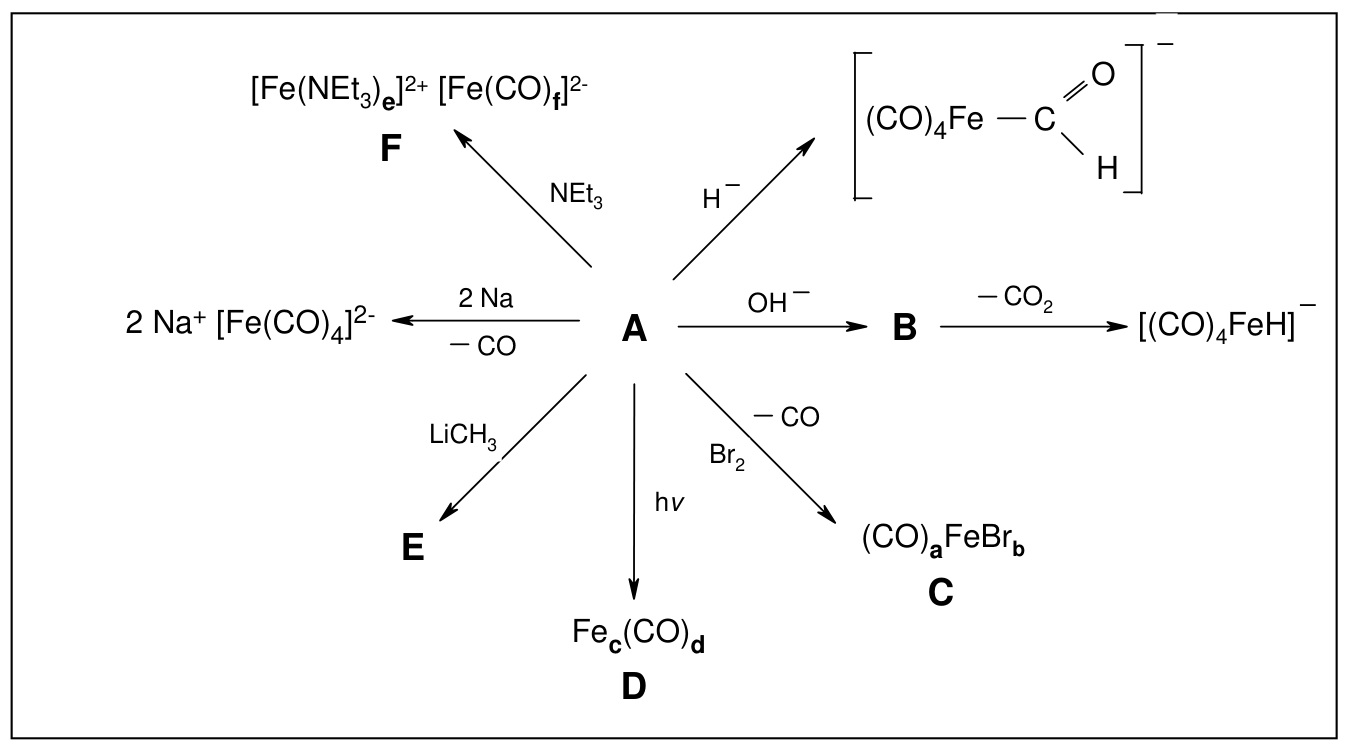
Hints:
a) C has the following analysis: \(\ce{C}\), 14.75 % ; \(\ce{Br}\), 48.90 % .
b) D contains 30.70 % \(\ce{Fe}\); the molecular mass is 363.8 a.m.u.
c) Excess triethylamine is used for the synthesis of F. F contains 5.782 % \(\ce{C}\) and 10.11 % \(\ce{N}\).
2.8 Why is the compound F formed in the disproportional reaction (given in g)), and not the compositional isomer \(\ce{[Fe(CO)_{f}]^{2+}[Fe(NEt3)_{e}]^{2-}}\)?
2.9 The eighteen-electron rule is also satisfied by a compound prepared from elementary chromium and benzene.
i) Draw the formula of this complex.
ii) Which complex with the analogous structure is prepared by the reaction of iron powder with cyclopentadiene? Write the chemical equation for its formation.
Official English text of the problem.
Problem 3: Spectrophotometric determination of the pKa of a coloured weak acid
A weak acid of total concentration \(2 \times 10^{-2}\ \mathrm{M}\) is dissolved in a buffer of pH = 8.8. The anion \(\ce{A^-}\) of this acid is coloured and has a molar decadic absorption coefficient \(\varepsilon\) of \(2.1 \times 10^4\ \mathrm{cm^2\,mol^{-1}}\). A layer \(l\) of the solution with 1.0 cm thickness absorbs 60 percent of the incident luminous intensity \(I_o\).
3.1 What is the equation relating the extinction to the thickness of the absorbing layer?
3.2 How large is the concentration of the acid anion in the buffer solution?
3.3 How large is the \(\mathrm{p}K_a\) of the acid?
Official English text of the problem.
Problem 4: Formula of a gaseous hydrocarbon from its combustion
15 cm³ of a gaseous hydrocarbon \(\ce{C_xH_y}\) are mixed with 120 cm³ oxygen and ignited. After the reaction the burned gases are shaken with concentrated aqueous \(\ce{KOH}\) solution. A part of the gases is completely absorbed while 67.5 cm³ gases remain. It has the same temperature and pressure as the original unburned mixture.
4.1 What is the composition of the remaining gas? Explain.
4.2 How large is the change in the amount of substance per mole of a hydrocarbon \(\ce{C_xH_y}\) when this is burned completely?
4.3 What is the chemical formula of the hydrocarbon used for the experiment?
Give the steps of the calculation.
Official English text of the problem.
Problem 5: Stereochemistry of the bromination-dehydrobromination of a monodeuterated alkene
One of the diastereotopic methylene protons at the double bond of A was selectively substituted by deuterium. Bromination and subsequent dehydrobromation yields the

deuteriated product B and the non-deuteriated product C.
5.1 Which configuration follows for the monodeuteriated A from the given reaction products?
5.2 The solution of this question requires the formulation of the reaction and a short argumentation why only B and C are formed.
Official English text of the problem.
Problem 6: A C5 hydrocarbon from pyrolysis fractions: dimerization, epoxidation and stereoisomers
A technical interesting \(\ce{C5}\) hydrocarbon A is separated via dimerization from the for-runnings of the benzene-pyrolysis fraction. This is achieved either by heating to \(140–150\,^\circ\mathrm{C}\) under pressure or by heating over several hours at \(100\,^\circ\mathrm{C}\). Then it is distilled out at \(200\,^\circ\mathrm{C}\). Treatment of A with peroxyacetic acid under neutral conditions (sodium acetate and sodium carbonate) in dichloromethane at \(20\,^\circ\mathrm{C}\) yields a product B. B yields two isomeric products C and D (summary formula \(\ce{C5H8O2}\)) by the reaction with aqueous sodium carbonate solution. The main product C contains three different bound carbon atoms whereas in the minor product D five different carbon atoms are present. C is chiral.
6.1 Write the formulas of A, B, C, and D considering the stereochemical representation.
6.2 What is the name of the chemical reaction which is used for the above mentioned separation procedure?
6.3 Which stereochemical rules hold for the dimerization reaction?
6.4 Give the structure of the dimerization product.
6.5 Give the mechanism of the formation of C and D from B.
6.6 Which kind of isomers are C and D ?
6.7 How many stereoisomers of C and D are principally (regardless of their synthetic availability) possible? Give their mutual stereochemical relations. Write their structural formulas.
Official English text of the problem.
Problem 7: DNA: mass, coding capacity and base composition
Deoxyribonucleic acid (DNA) represents the genetic program of all living beings. The human genetic program is subdivided into 23 chromosomes.
7.1 Calculate the mass of a DNA thread in grams, which reaches form earth to the moon (340,000 km). A mass of 1 g represents 1,000 nucleotide pairs.
One nucleotide pair (base pair) has a length of 0.34 nm.
7.2 Give estimation on how many nucleotid pairs are stored in the chromosome set of a human being. Human cells can synthesize 50,000 different proteins, which are on the average 300 amino acids long. Only 2 % of the DNA code for proteins.
7.3 The DNA of the bacteriophage M13 shows the following base composition:
A: 23 %, T: 36 %, G: 21 %, C: 20 % (mole %)
What does the base composition tell about the structure of the DNA?
Official English text of the problem.
Problem 8: Amino acid sequence of a pain-relieving peptide
The sequence of the amino acids in a peptide can be determined by a combination of chemical and enzymatic methods. The peptide in question functions in the human body as a pain reliever.
a) Hydrolysis of the peptide in 6 M \(\ce{HCl}\) at \(110^\circ\mathrm{C}\) followed by an analysis of the liberated amino acids, resulted in a molar ratio of Gly, Leu, and aromatic amino acids Phe, Tyr 2 : 1 : 1 : 1.
b) Reacting the peptide with 2,4-dinitrofluorobenzene (DNFB), followed by hydrolysis and chromatographic analysis, yielded the tyrosine derivative.
c) Partial hydrolysis with chymotrypsin yielded Leu, Tyr and a smaller peptide. After hydrolysis of this peptide Gly and Phe were identified in a ratio 2 : 1. Chymotrypsin is a protease which cleaves a peptide bond following an aromatic amino acid.
Problems:
8.1 Determine the amino acid sequence from the given information.
8.2 Write the structural formula of the DNFB- and the dansyl derivative of tyrosine. What is the advantage of the dansylation in comparison to the DNFB-modification?
Dansyl means 5-N,N-dimethylaminonaphtalene-4-sulphonyl.
8.3 In a similar peptide which shows the same biological activity, leucine is replaced by methionine. Explain from the chemical structure of both amino acids why the replacement is possible without loss of biological activity.
Official English text of the problem.
Internationale Chemie-Olympiade
IChO 1984
Frankfurt am Main, Bundesrepublik Deutschland · 8 Theorieaufgaben mit vollständigen Lösungen
Aufgabe 1: Radiometrische Datierung mit 14C und 87Rb/87Sr
A)
Das Element Kohlenstoff besteht aus den stabilen Isotopen \(\ce{^{12}C}\) (98.90 Prozent der Atome) und \(\ce{^{13}C}\) (1.10 Prozent der Atome). Darüber hinaus enthält Kohlenstoff einen kleinen Anteil des Radioisotops \(\ce{^{14}C}\) (\(t_{1/2}=5730\) Jahre), das in der Atmosphäre durch kosmische Strahlung kontinuierlich als \(\ce{CO2}\) gebildet wird. Über den natürlichen \(\ce{CO2}\)-Kreislauf vermischt sich \(\ce{^{14}C}\) mit den Isotopen \(\ce{^{12}C}\) und \(\ce{^{13}C}\).
Die Zerfallsrate von \(\ce{^{14}C}\) wird beschrieben durch (\(N\) = Anzahl der \(\ce{^{14}C}\)-Atome; \(t\) = Zeit; \(\lambda\) = Zerfallskonstante):
\[ \text{Zerfallsrate}=-\frac{dN}{dt}=\lambda N \tag{1} \]
Die Integration von (1) führt zum bekannten Zeitgesetz (2) für den radioaktiven Zerfall:
\[ N=N_0\,\mathrm{e}^{-\lambda t} \tag{2} \]
\(N_0\) = Anzahl der \(\ce{^{14}C}\)-Atome bei \(t=0\)
1.1 Welcher mathematische Zusammenhang besteht zwischen den Parametern \(\alpha\) und \(t_{1/2}\) (= Halbwertszeit)?
1.2 Für Kohlenstoff, der am natürlichen \(\ce{CO2}\)-Kreislauf teilnimmt, wird eine Zerfallsrate von 13.6 Zerfällen pro Minute und Gramm Kohlenstoff festgestellt. Wenn eine Pflanze (z. B. ein Baum) stirbt, nimmt sie nicht mehr am \(\ce{CO2}\)-Kreislauf teil. Infolgedessen nimmt die Zerfallsrate des Kohlenstoffs ab.
Im Jahr 1983 wurde für ein Holzstück, das zu einem Wikingerschiff gehört, eine Zerfallsrate von 12.0 Zerfällen pro Minute und Gramm Kohlenstoff gemessen. In welchem Jahr wurde der Baum gefällt, von dem dieses Holzstück stammt?
1.3 Nehmen Sie an, dass der Fehler der Zerfallsrate von 12.0 Zerfällen pro Minute und Gramm Kohlenstoff 0.2 Zerfälle pro Minute und Gramm Kohlenstoff beträgt. Wie groß ist der entsprechende Fehler des Alters des Holzes aus Frage b)?
1.4 Wie groß ist das Isotopenverhältnis \(\ce{^{12}C}/\ce{^{14}C}\) des Kohlenstoffs, der am natürlichen \(\ce{CO2}\)-Kreislauf teilnimmt (1 Jahr = 365 Tage)?
B)
Die Elemente Strontium und Rubidium haben folgende Isotopenzusammensetzung:
Strontium: 0.56 % \(\ce{^{84}Sr}\) ; 9.86 % \(\ce{^{86}Sr}\) ; 7.00 % \(\ce{^{87}Sr}\) ; 82.58 % \(\ce{^{88}Sr}\) (diese Isotope sind alle stabil).
Rubidium: 72.17 % \(\ce{^{85}Rb}\) (stabil) ; 27.83 % \(\ce{^{87}Rb}\) (radioaktiv; \(t_{1/2}=4.7\times10^{10}\) Jahre).
Der radioaktive Zerfall von \(\ce{^{87}Rb}\) führt zu \(\ce{^{87}Sr}\).
In Grönland findet man einen Gneis (= Silikatmineral), der sowohl Strontium als auch Rubidium enthält.
1.5 Welches Zeitgesetz beschreibt die Bildung von \(\ce{^{87}Sr}\) aus \(\ce{^{87}Rb}\) als Funktion der Zeit?
1.6 Nehmen Sie an, dass das Isotopenverhältnis \(\ce{^{87}Sr}/\ce{^{86}Sr}\) (massenspektrometrisch bestimmt) und das Isotopenverhältnis \(\ce{^{87}Rb}:\ce{^{86}Sr}\) für den Gneis bekannt sind. Mit welchem mathematischen Zusammenhang lässt sich das Alter des Gneises berechnen?
Aufgabentext aus dem offiziellen englischen Text übersetzt.
Aufgabe 2: Metallcarbonyle und die Achtzehnelektronenregel
Ludwig Mond entdeckte noch vor der Wende zu diesem Jahrhundert, dass fein verteiltes Nickel mit Kohlenstoffmonoxid unter Bildung von Tetracarbonylnickel, \(\ce{Ni(CO)4}\), einer farblosen, sehr flüchtigen Flüssigkeit, reagiert. Die Zusammensetzung von \(\ce{Ni(CO)4}\) liefert ein Beispiel für die Edelgasregel („EAN-Regel“).
Aufgaben:
2.1 Sagen Sie mithilfe der Achtzehnelektronenregel (Edelgasregel) die Formeln der binären Carbonyle von \(\ce{Fe(0)}\) und \(\ce{Cr(0)}\) voraus.
2.2 Welche Zusammensetzung würde die Achtzehnelektronenregel für die einfachste binäre Chrom(0)-Nitrosylverbindung vorhersagen?
2.3 Erklären Sie, warum \(\ce{Mn(0)}\) und \(\ce{Co(0)}\) keine sogenannten einkernigen Carbonylkomplexe des Typs \(\ce{M(CO)_{x}}\) (M = Metall), sondern Verbindungen mit Metall–Metall-Bindungen bilden.
2.4 Schlagen Sie Strukturen für \(\ce{Ni(CO)4}\), \(\ce{Mn2(CO)10}\) und \(\ce{Co2(CO)8}\) vor.
2.5 Geben Sie an, ob \(\ce{V(CO)6}\) und die in a) und d) genannten Verbindungen diamagnetisch oder paramagnetisch sind.
2.6 Warum sind Kohlenstoffmonoxidliganden an Metalle viel stärker gebunden als an Bor in Boranaddukten (z. B. \(\ce{R3B-CO}\); R = Alkyl)?
2.7 Bestimmen Sie die Zusammensetzung der im folgenden Reaktionsschema mit A - F bezeichneten Verbindungen:
Hinweise:
a) C weist die folgende Analyse auf: \(\ce{C}\), 14.75 % ; \(\ce{Br}\), 48.90 % .
b) D enthält 30.70 % \(\ce{Fe}\); die Molekülmasse beträgt 363.8 atomare Masseneinheiten.
c) Für die Synthese von F wird Triethylamin im Überschuss verwendet. F enthält 5.782 % \(\ce{C}\) und 10.11 % \(\ce{N}\).
2.8 Warum entsteht bei der Disproportionierungsreaktion (in g) angegeben) die Verbindung F und nicht das Verteilungsisomer \(\ce{[Fe(CO)_{f}]^{2+}[Fe(NEt3)_{e}]^{2-}}\)?
2.9 Die Achtzehnelektronenregel wird auch von einer Verbindung erfüllt, die aus elementarem Chrom und Benzol hergestellt wird.
i) Zeichnen Sie die Formel dieses Komplexes.
ii) Welcher Komplex mit analoger Struktur wird durch die Reaktion von Eisenpulver mit Cyclopentadien hergestellt? Geben Sie die chemische Gleichung für seine Bildung an.
Aufgabentext aus dem offiziellen englischen Text übersetzt.
Aufgabe 3: Spektrophotometrische Bestimmung des pKa-Werts einer farbigen schwachen Säure
Eine schwache Säure mit einer Gesamtkonzentration von \(2 \times 10^{-2}\ \mathrm{M}\) wird in einer Pufferlösung mit pH = 8.8 gelöst. Das Anion \(\ce{A^-}\) dieser Säure ist farbig und besitzt einen molaren dekadischen Absorptionskoeffizienten \(\varepsilon\) von \(2.1 \times 10^4\ \mathrm{cm^2\,mol^{-1}}\). Eine Schicht \(l\) der Lösung mit einer Dicke von 1.0 cm absorbiert 60 Prozent der einfallenden Lichtintensität \(I_o\).
3.1 Welche Gleichung beschreibt den Zusammenhang zwischen der Extinktion und der Dicke der absorbierenden Schicht?
3.2 Wie groß ist die Konzentration des Säureanions in der Pufferlösung?
3.3 Wie groß ist der \(\mathrm{p}K_a\)-Wert der Säure?
Aufgabentext aus dem offiziellen englischen Text übersetzt.
Aufgabe 4: Bestimmung der Formel eines gasförmigen Kohlenwasserstoffs durch seine Verbrennung
15 cm³ eines gasförmigen Kohlenwasserstoffs \(\ce{C_xH_y}\) werden mit 120 cm³ Sauerstoff gemischt und entzündet. Nach der Reaktion werden die Verbrennungsgase mit konzentrierter wässriger \(\ce{KOH}\)-Lösung geschüttelt. Ein Teil der Gase wird vollständig absorbiert, während 67.5 cm³ Gas zurückbleiben. Das verbleibende Gas hat dieselbe Temperatur und denselben Druck wie das ursprüngliche unverbrannte Gemisch.
4.1 Welche Zusammensetzung hat das verbleibende Gas? Begründen Sie Ihre Antwort.
4.2 Wie groß ist die Stoffmengenänderung pro Mol eines Kohlenwasserstoffs \(\ce{C_xH_y}\), wenn dieser vollständig verbrannt wird?
4.3 Welche chemische Formel hat der für den Versuch verwendete Kohlenwasserstoff?
Geben Sie die einzelnen Rechenschritte an.
Aufgabentext aus dem offiziellen englischen Text übersetzt.
Aufgabe 5: Stereochemie der Bromierung-Dehydrobromierung eines monodeuterierten Alkens
Eines der diastereotopen Methylenprotonen an der Doppelbindung von A wurde selektiv durch Deuterium ersetzt. Durch Bromierung und anschließende Dehydrobromierung entstehen das
deuterierte Produkt B und das nicht deuterierte Produkt C.
5.1 Welche Konfiguration ergibt sich für das monodeuterierte A aus den angegebenen Reaktionsprodukten?
5.2 Zur Lösung dieser Frage sind die Formulierung der Reaktion und eine kurze Begründung erforderlich, warum nur B und C entstehen.
Aufgabentext aus dem offiziellen englischen Text übersetzt.
Aufgabe 6: Ein C5-Kohlenwasserstoff aus Pyrolysefraktionen: Dimerisierung, Epoxidierung und Stereoisomere
Ein technisch interessanter \(\ce{C5}\)-Kohlenwasserstoff A wird durch Dimerisierung aus dem Vorlauf der Benzol-Pyrolysefraktion abgetrennt. Dies erfolgt entweder durch Erhitzen auf \(140–150\,^\circ\mathrm{C}\) unter Druck oder durch mehrstündiges Erhitzen bei \(100\,^\circ\mathrm{C}\). Anschließend wird er bei \(200\,^\circ\mathrm{C}\) abdestilliert. Die Behandlung von A mit Peressigsäure unter neutralen Bedingungen (Natriumacetat und Natriumcarbonat) in Dichlormethan bei \(20\,^\circ\mathrm{C}\) liefert ein Produkt B. B liefert bei der Reaktion mit wässriger Natriumcarbonatlösung zwei isomere Produkte C und D (Summenformel \(\ce{C5H8O2}\)). Das Hauptprodukt C enthält drei unterschiedlich gebundene Kohlenstoffatome, während im Nebenprodukt D fünf unterschiedliche Kohlenstoffatome vorliegen. C ist chiral.
6.1 Geben Sie die Formeln von A, B, C und D unter Berücksichtigung der stereochemischen Darstellung an.
6.2 Wie heißt die chemische Reaktion, die für das oben erwähnte Trennverfahren verwendet wird?
6.3 Welche stereochemischen Regeln gelten für die Dimerisierungsreaktion?
6.4 Geben Sie die Struktur des Dimerisierungsprodukts an.
6.5 Geben Sie den Mechanismus der Bildung von C und D aus B an.
6.6 Um welche Art von Isomeren handelt es sich bei C und D?
6.7 Wie viele Stereoisomere von C und D sind grundsätzlich (unabhängig von ihrer synthetischen Zugänglichkeit) möglich? Geben Sie ihre gegenseitigen stereochemischen Beziehungen an. Schreiben Sie ihre Strukturformeln auf.
Aufgabentext aus dem offiziellen englischen Text übersetzt.
Aufgabe 7: DNA: Masse, Codierungskapazität und Basenzusammensetzung
Desoxyribonukleinsäure (DNA) stellt das genetische Programm aller Lebewesen dar. Das genetische Programm des Menschen ist auf 23 Chromosomen verteilt.
7.1 Berechnen Sie die Masse eines DNA-Fadens in Gramm, der von der Erde bis zum Mond reicht (340.000 km). Eine Masse von 1 g entspricht 1.000 Nukleotidpaaren.
Ein Nukleotidpaar (Basenpaar) hat eine Länge von 0,34 nm.
7.2 Schätzen Sie ab, wie viele Nukleotidpaare im Chromosomensatz eines Menschen enthalten sind. Menschliche Zellen können 50.000 verschiedene Proteine synthetisieren, die im Durchschnitt 300 Aminosäuren lang sind. Nur 2 % der DNA codieren für Proteine.
7.3 Die DNA des Bakteriophagen M13 weist die folgende Basenzusammensetzung auf:
A: 23 %, T: 36 %, G: 21 %, C: 20 % (Mol-%)
Was sagt die Basenzusammensetzung über die Struktur der DNA aus?
Aufgabentext aus dem offiziellen englischen Text übersetzt.
Aufgabe 8: Aminosäuresequenz eines schmerzlindernden Peptids
Die Reihenfolge der Aminosäuren in einem Peptid kann durch eine Kombination chemischer und enzymatischer Methoden bestimmt werden. Das betreffende Peptid wirkt im menschlichen Körper schmerzlindernd.
a) Die Hydrolyse des Peptids in 6 M \(\ce{HCl}\) bei \(110^\circ\mathrm{C}\) mit anschließender Analyse der freigesetzten Aminosäuren ergab ein molares Verhältnis von Gly, Leu und den aromatischen Aminosäuren Phe, Tyr von 2 : 1 : 1 : 1.
b) Die Umsetzung des Peptids mit 2,4-Dinitrofluorbenzol (DNFB) mit anschließender Hydrolyse und chromatographischer Analyse lieferte das Tyrosinderivat.
c) Die partielle Hydrolyse mit Chymotrypsin lieferte Leu, Tyr und ein kleineres Peptid. Nach der Hydrolyse dieses Peptids wurden Gly und Phe im Verhältnis 2 : 1 identifiziert. Chymotrypsin ist eine Protease, die eine auf eine aromatische Aminosäure folgende Peptidbindung spaltet.
Aufgaben:
8.1 Bestimmen Sie die Aminosäuresequenz anhand der gegebenen Informationen.
8.2 Geben Sie die Strukturformeln des DNFB- und des Dansylderivats von Tyrosin an. Welchen Vorteil hat die Dansylierung gegenüber der DNFB-Modifizierung?
Dansyl bedeutet 5-N,N-Dimethylaminonaphthalin-4-sulfonyl.
8.3 In einem ähnlichen Peptid, das dieselbe biologische Aktivität aufweist, ist Leucin durch Methionin ersetzt. Erklären Sie anhand der chemischen Struktur beider Aminosäuren, warum dieser Austausch ohne Verlust der biologischen Aktivität möglich ist.
Aufgabentext aus dem offiziellen englischen Text übersetzt.
Uluslararası Kimya Olimpiyatı
IChO 1984
Frankfurt am Main, Almanya Federal Cumhuriyeti · 8 teori sorusu, tam çözümleriyle
Soru 1: 14C ve 87Rb/87Sr ile radyoaktif yaş tayini
A)
Karbon elementi, kararlı \(\ce{^{12}C}\) (atomların yüzde 98.90'ı) ve \(\ce{^{13}C}\) (atomların yüzde 1.10'u) izotoplarından oluşur. Ayrıca karbon, atmosferde kozmik ışınlar tarafından sürekli olarak \(\ce{CO2}\) biçiminde oluşturulan \(\ce{^{14}C}\) radyoizotopunu (\(t_{1/2}=5730\) yıl) küçük bir oranda içerir. \(\ce{^{14}C}\), doğal \(\ce{CO2}\) döngüsü yoluyla \(\ce{^{12}C}\) ve \(\ce{^{13}C}\) izotoplarıyla karışır.
\(\ce{^{14}C}\)'ün bozunma hızı aşağıdaki bağıntıyla tanımlanır (\(N\) = \(\ce{^{14}C}\) atomlarının sayısı; \(t\) = zaman; \(\lambda\) = bozunma sabiti):
\[ \text{bozunma hızı}=-\frac{dN}{dt}=\lambda N \tag{1} \]
(1)'in integrali alındığında, radyoaktif bozunma için iyi bilinen (2) hız yasası elde edilir:
\[ N=N_0\,\mathrm{e}^{-\lambda t} \tag{2} \]
\(N_0\) = \(t=0\) anındaki \(\ce{^{14}C}\) atomlarının sayısı
1.1 \(\alpha\) ve \(t_{1/2}\) (= yarı ömür) parametreleri arasındaki matematiksel ilişki nedir?
1.2 Doğal \(\ce{CO2}\) döngüsünde yer alan karbonun bozunma hızının, gram karbon başına dakikada 13.6 bozunma olduğu bulunmuştur. Bir bitki (örneğin bir ağaç) öldüğünde artık \(\ce{CO2}\) döngüsünde yer almaz. Bunun sonucunda karbonun bozunma hızı azalır.
1983 yılında, Vikinglere ait bir gemiden alınan bir odun parçası için gram karbon başına dakikada 12.0 bozunmalık bir bozunma hızı ölçülmüştür. Bu odun parçasının elde edildiği ağaç hangi yılda kesilmiştir?
1.3 Gram karbon başına dakikada 12.0 bozunma olarak ölçülen bozunma hızındaki hatanın, gram karbon başına dakikada 0.2 bozunma olduğunu varsayın. b) sorusundaki odunun yaşında buna karşılık gelen hata nedir?
1.4 Doğal \(\ce{CO2}\) döngüsünde yer alan karbonun \(\ce{^{12}C}/\ce{^{14}C}\) izotop oranı nedir (1 yıl = 365 gün)?
B)
Stronsiyum ve rubidyum elementlerinin izotop bileşimleri aşağıdaki gibidir:
Stronsiyum: % 0.56 \(\ce{^{84}Sr}\) ; % 9.86 \(\ce{^{86}Sr}\) ; % 7.00 \(\ce{^{87}Sr}\) ; % 82.58 \(\ce{^{88}Sr}\) (bu izotopların tümü kararlıdır).
Rubidyum: % 72.17 \(\ce{^{85}Rb}\) (kararlı) ; % 27.83 \(\ce{^{87}Rb}\) (radyoaktif; \(t_{1/2}=4.7\times10^{10}\) yıl).
\(\ce{^{87}Rb}\)'nin radyoaktif bozunması sonucunda \(\ce{^{87}Sr}\) oluşur.
Grönland'da hem stronsiyum hem de rubidyum içeren bir gnays (= silikat minerali) bulunur.
1.5 \(\ce{^{87}Rb}\)'den \(\ce{^{87}Sr}\) oluşumunu zamanın bir fonksiyonu olarak tanımlayan hız yasası denklemi nedir?
1.6 Gnays için \(\ce{^{87}Sr}/\ce{^{86}Sr}\) izotop oranının (kütle spektrometrisiyle belirlendiği şekliyle) ve \(\ce{^{87}Rb}:\ce{^{86}Sr}\) izotop oranının bilindiğini varsayın. Gnaysın yaşını hesaplamak için kullanılabilecek matematiksel ilişki nedir?
Soru metni resmi İngilizce metinden çevrilmiştir.
Soru 2: Metal karboniller ve on sekiz elektron kuralı
Ludwig Mond, bu yüzyılın başından önce, ince toz hâlindeki nikelin karbon monoksitle tepkimeye girerek renksiz, çok uçucu bir sıvı olan tetrakarbonilnikel, \(\ce{Ni(CO)4}\), oluşturduğunu keşfetmiştir. \(\ce{Ni(CO)4}\) bileşimi, soy gaz kuralına ("EAN kuralı") bir örnektir.
Sorular:
2.1 On sekiz elektron kuralını (soy gaz kuralını) kullanarak \(\ce{Fe(0)}\) ve \(\ce{Cr(0)}\)'ın ikili karbonil bileşiklerinin formüllerini öngörünüz.
2.2 On sekiz elektron kuralı, en basit ikili krom(0)-nitrozil bileşiği için hangi bileşimi öngörür?
2.3 \(\ce{Mn(0)}\) ve \(\ce{Co(0)}\)'ın neden \(\ce{M(CO)_{x}}\) (M = metal) türünde tek çekirdekli karbonil kompleksleri olarak adlandırılan bileşikler yerine metal-metal bağı içeren bileşikler oluşturduğunu açıklayınız.
2.4 \(\ce{Ni(CO)4}\), \(\ce{Mn2(CO)10}\) ve \(\ce{Co2(CO)8}\) için yapılar öneriniz.
2.5 \(\ce{V(CO)6}\) ile a) ve d)'de belirtilen bileşiklerin diyamanyetik mi yoksa paramanyetik mi olduğunu belirtiniz.
2.6 Karbon monoksit ligandları neden metallere, boran katılma bileşiklerindeki bora (örneğin \(\ce{R3B-CO}\); R = alkil) bağlandıklarından çok daha güçlü bağlanır?
2.7 Aşağıdaki tepkime şemasında A - F ile gösterilen bileşiklerin bileşimlerini belirleyiniz:
İpuçları:
a) C'nin analiz sonuçları şöyledir: \(\ce{C}\), 14.75 % ; \(\ce{Br}\), 48.90 % .
b) D, 30.70 % \(\ce{Fe}\) içerir; molekül kütlesi 363.8 atomik kütle birimidir.
c) F'nin sentezinde aşırı miktarda trietilamin kullanılır. F, 5.782 % \(\ce{C}\) ve 10.11 % \(\ce{N}\) içerir.
2.8 Disproporsiyonlaşma tepkimesinde (g)'de verilen) neden bileşim izomeri \(\ce{[Fe(CO)_{f}]^{2+}[Fe(NEt3)_{e}]^{2-}}\) yerine F bileşiği oluşur?
2.9 Elementel krom ve benzenden hazırlanan bir bileşik de on sekiz elektron kuralını sağlar.
i) Bu kompleksin formülünü çiziniz.
ii) Demir tozunun siklopentadienle tepkimesinden benzer yapıya sahip hangi kompleks elde edilir? Oluşum tepkimesinin kimyasal denklemini yazınız.
Soru metni resmi İngilizce metinden çevrilmiştir.
Soru 3: Renkli bir zayıf asidin pKa değerinin spektrofotometrik olarak belirlenmesi
Toplam derişimi \(2 \times 10^{-2}\ \mathrm{M}\) olan bir zayıf asit, pH = 8.8 olan bir tampon çözeltide çözülmüştür. Bu asidin \(\ce{A^-}\) anyonu renklidir ve molar onluk soğurma katsayısı \(\varepsilon\), \(2.1 \times 10^4\ \mathrm{cm^2\,mol^{-1}}\) değerindedir. Çözeltinin kalınlığı 1.0 cm olan bir \(l\) tabakası, gelen ışık şiddetinin \(I_o\) yüzde 60'ını soğurur.
3.1 Ekstinksiyon ile soğurucu tabakanın kalınlığı arasındaki ilişkiyi veren denklem nedir?
3.2 Tampon çözeltideki asit anyonunun derişimi ne kadardır?
3.3 Asidin \(\mathrm{p}K_a\) değeri ne kadardır?
Soru metni resmi İngilizce metinden çevrilmiştir.
Soru 4: Gaz hâlindeki bir hidrokarbonun yanmasından formülünün belirlenmesi
Gaz hâlindeki bir hidrokarbonun \(\ce{C_xH_y}\) 15 cm³'ü, 120 cm³ oksijenle karıştırılır ve tutuşturulur. Tepkimeden sonra yanma sonucu oluşan gaz karışımı, derişik sulu \(\ce{KOH}\) çözeltisiyle çalkalanır. Gazların bir kısmı tamamen soğurulurken geriye 67.5 cm³ gaz kalır. Kalan gazın sıcaklığı ve basıncı, başlangıçtaki yanmamış karışımın sıcaklığı ve basıncıyla aynıdır.
4.1 Kalan gazın bileşimi nedir? Açıklayınız.
4.2 Bir hidrokarbon \(\ce{C_xH_y}\) tamamen yakıldığında, hidrokarbonun molü başına madde miktarındaki değişim ne kadardır?
4.3 Deneyde kullanılan hidrokarbonun kimyasal formülü nedir?
Hesaplamanın adımlarını gösteriniz.
Soru metni resmi İngilizce metinden çevrilmiştir.
Soru 5: Monodöteryumlu bir alkenin bromlanma-dehidrobromlanma tepkimelerinin stereokimyası
A'nın çift bağındaki diastereotopik metilen protonlarından biri seçici olarak döteryumla değiştirilmiştir. Bromlanma ve ardından gerçekleşen dehidrobromlanma sonucunda
döteryumlu ürün B ve döteryumsuz ürün C oluşur.
5.1 Verilen tepkime ürünlerinden monodöteryumlu A için hangi konfigürasyon çıkarılır?
5.2 Bu sorunun çözümü, tepkimenin formüllerle gösterilmesini ve neden yalnızca B ve C'nin oluştuğunun kısaca gerekçelendirilmesini gerektirir.
Soru metni resmi İngilizce metinden çevrilmiştir.
Soru 6: Piroliz fraksiyonlarından elde edilen bir C5 hidrokarbonu: dimerleşme, epoksitlenme ve stereoizomerler
Teknik açıdan ilgi çekici bir \(\ce{C5}\) hidrokarbonu olan A, benzen pirolizi fraksiyonunun ilk distilasyon ürünlerinden dimerleşme yoluyla ayrılır. Bu işlem, basınç altında \(140–150\,^\circ\mathrm{C}\)'ye ısıtılarak veya \(100\,^\circ\mathrm{C}\)'de birkaç saat boyunca ısıtılarak gerçekleştirilir. Ardından \(200\,^\circ\mathrm{C}\)'de damıtılarak ayrılır. A'nın nötr koşullarda (sodyum asetat ve sodyum karbonat), diklorometan içinde \(20\,^\circ\mathrm{C}\)'de peroksiasetik asitle işleme tabi tutulmasıyla B ürünü elde edilir. B, sulu sodyum karbonat çözeltisiyle tepkimeye girerek C ve D olmak üzere iki izomerik ürün (molekül formülü \(\ce{C5H8O2}\)) verir. Ana ürün C, üç farklı bağlanma ortamına sahip karbon atomları içerirken, az miktarda oluşan D ürününde beş farklı karbon atomu bulunur. C kiraldir.
6.1 A, B, C ve D'nin formüllerini stereokimyasal gösterimi dikkate alarak yazınız.
6.2 Yukarıda belirtilen ayırma işleminde kullanılan kimyasal tepkimenin adı nedir?
6.3 Dimerleşme tepkimesi için hangi stereokimyasal kurallar geçerlidir?
6.4 Dimerleşme ürününün yapısını veriniz.
6.5 B'den C ve D'nin oluşum mekanizmasını veriniz.
6.6 C ve D ne tür izomerlerdir?
6.7 C ve D'nin ilke olarak (sentezlenebilir olup olmadıklarına bakılmaksızın) kaç stereoizomeri mümkündür? Birbirleriyle olan stereokimyasal ilişkilerini belirtiniz. Yapı formüllerini yazınız.
Soru metni resmi İngilizce metinden çevrilmiştir.
Soru 7: DNA: kütle, kodlama kapasitesi ve baz bileşimi
Deoksiribonükleik asit (DNA), tüm canlıların genetik programını temsil eder. İnsanın genetik programı 23 kromozoma bölünmüştür.
7.1 Dünya'dan Ay'a kadar uzanan (340,000 km) bir DNA ipliğinin kütlesini gram cinsinden hesaplayınız. 1 g kütle, 1,000 nükleotit çiftine karşılık gelir.
Bir nükleotit çiftinin (baz çiftinin) uzunluğu 0.34 nm'dir.
7.2 Bir insanın kromozom takımında kaç nükleotit çifti bulunduğunu tahmin ediniz. İnsan hücreleri, ortalama uzunlukları 300 amino asit olan 50,000 farklı proteini sentezleyebilir. DNA'nın yalnızca %2'si proteinleri kodlar.
7.3 M13 bakteriyofajının DNA'sı aşağıdaki baz bileşimine sahiptir:
A: %23, T: %36, G: %21, C: %20 (mol %)
Baz bileşimi, DNA'nın yapısı hakkında ne söyler?
Soru metni resmi İngilizce metinden çevrilmiştir.
Soru 8: Ağrı kesici bir peptidin amino asit dizisi
Bir peptitteki amino asitlerin dizisi, kimyasal ve enzimatik yöntemlerin birlikte kullanılmasıyla belirlenebilir. Söz konusu peptit, insan vücudunda ağrı kesici olarak işlev görür.
a) Peptidin 6 M \(\ce{HCl}\) içinde \(110^\circ\mathrm{C}\) sıcaklıkta hidroliz edilmesinin ardından açığa çıkan amino asitlerin analizi, Gly, Leu ve aromatik amino asitler Phe, Tyr için 2 : 1 : 1 : 1 mol oranını vermiştir.
b) Peptidin 2,4-dinitroflorobenzen (DNFB) ile tepkimeye sokulmasının ardından hidroliz ve kromatografik analiz yapılmasıyla tirozin türevi elde edilmiştir.
c) Kimotripsin ile kısmi hidroliz sonucunda Leu, Tyr ve daha küçük bir peptit elde edilmiştir. Bu peptidin hidrolizinden sonra Gly ve Phe, 2 : 1 oranında saptanmıştır. Kimotripsin, aromatik bir amino asitten sonra gelen peptit bağını kesen bir proteazdır.
Sorular:
8.1 Verilen bilgilerden amino asit dizisini belirleyiniz.
8.2 Tirozinin DNFB ve dansil türevlerinin yapı formüllerini yazınız. Dansillemenin DNFB ile modifikasyona göre avantajı nedir?
Dansil, 5-N,N-dimetilaminonaftalen-4-sülfonil anlamına gelir.
8.3 Aynı biyolojik aktiviteyi gösteren benzer bir peptitte lösinin yerini metiyonin alır. Her iki amino asidin kimyasal yapısından hareketle bu değişimin biyolojik aktivite kaybı olmadan neden mümkün olduğunu açıklayınız.
Soru metni resmi İngilizce metinden çevrilmiştir.
Olimpiada Internacional de Química
IChO 1984
Fráncfort del Meno, República Federal de Alemania · 8 problemas teóricos con soluciones completas
Problema 1: Datación radiactiva con 14C y 87Rb/87Sr
A)
El elemento carbono está constituido por los isótopos estables \(\ce{^{12}C}\) (98.90 por ciento de los átomos) y \(\ce{^{13}C}\) (1.10 por ciento de los átomos). Además, el carbono contiene una pequeña fracción del radioisótopo \(\ce{^{14}C}\) (\(t_{1/2}=5730\) años), que se forma continuamente en la atmósfera por la acción de los rayos cósmicos en forma de \(\ce{CO2}\). El \(\ce{^{14}C}\) se mezcla con los isótopos \(\ce{^{12}C}\) y \(\ce{^{13}C}\) a través del ciclo natural del \(\ce{CO2}\).
La velocidad de desintegración del \(\ce{^{14}C}\) se describe mediante (\(N\) = número de átomos de \(\ce{^{14}C}\); \(t\) = tiempo; \(\lambda\) = constante de desintegración):
\[ \text{velocidad de desintegración}=-\frac{dN}{dt}=\lambda N \tag{1} \]
La integración de (1) conduce a la conocida ley cinética (2) de la desintegración radiactiva:
\[ N=N_0\,\mathrm{e}^{-\lambda t} \tag{2} \]
\(N_0\) = número de átomos de \(\ce{^{14}C}\) en \(t=0\)
1.1 ¿Cuál es la relación matemática entre los parámetros \(\alpha\) y \(t_{1/2}\) (= período de semidesintegración)?
1.2 Se ha determinado que la velocidad de desintegración del carbono que forma parte del ciclo natural del \(\ce{CO2}\) es de 13.6 desintegraciones por minuto y gramo de carbono. Cuando una planta (por ejemplo, un árbol) muere, deja de participar en el ciclo del \(\ce{CO2}\). En consecuencia, la velocidad de desintegración del carbono disminuye.
En 1983 se midió una velocidad de desintegración de 12.0 desintegraciones por minuto y gramo de carbono en un trozo de madera perteneciente a un barco vikingo. ¿En qué año se taló el árbol del que procedía este trozo de madera?
1.3 Suponga que el error de la velocidad de desintegración de 12.0 desintegraciones por minuto y gramo de carbono es de 0.2 desintegraciones por minuto y gramo de carbono. ¿Cuál es el error correspondiente en la edad de la madera de la pregunta b)?
1.4 ¿Cuál es la relación isotópica \(\ce{^{12}C}/\ce{^{14}C}\) del carbono que participa en el ciclo natural del \(\ce{CO2}\) (1 año = 365 días)?
B)
Los elementos estroncio y rubidio tienen la siguiente composición isotópica:
Estroncio: 0.56 % \(\ce{^{84}Sr}\) ; 9.86 % \(\ce{^{86}Sr}\) ; 7.00 % \(\ce{^{87}Sr}\) ; 82.58 % \(\ce{^{88}Sr}\) (todos estos isótopos son estables).
Rubidio: 72.17 % \(\ce{^{85}Rb}\) (estable) ; 27.83 % \(\ce{^{87}Rb}\) (radiactivo; \(t_{1/2}=4.7\times10^{10}\) años).
La desintegración radiactiva del \(\ce{^{87}Rb}\) produce \(\ce{^{87}Sr}\).
En Groenlandia se encuentra un gneis (= mineral silicatado) que contiene tanto estroncio como rubidio.
1.5 ¿Cuál es la ecuación de la ley cinética que describe la formación de \(\ce{^{87}Sr}\) a partir de \(\ce{^{87}Rb}\) en función del tiempo?
1.6 Suponga que se conocen la relación isotópica \(\ce{^{87}Sr}/\ce{^{86}Sr}\) (determinada mediante espectrometría de masas) y la relación isotópica \(\ce{^{87}Rb}:\ce{^{86}Sr}\) del gneis. ¿Cuál es la relación matemática que permite calcular la edad del gneis?
Enunciado traducido del texto oficial en inglés.
Problema 2: Carbonilos metálicos y la regla de los dieciocho electrones
Ludwig Mond descubrió antes del comienzo de este siglo que el níquel finamente dividido reacciona con el monóxido de carbono formando tetracarbonilníquel, \(\ce{Ni(CO)4}\), un líquido incoloro y muy volátil. La composición de \(\ce{Ni(CO)4}\) constituye un ejemplo de la regla del gas noble («regla EAN»).
Problemas:
2.1 Utilice la regla de los dieciocho electrones (regla del gas noble) para predecir la fórmula de los carbonilos binarios de \(\ce{Fe(0)}\) y \(\ce{Cr(0)}\).
2.2 ¿Qué composición predeciría la regla de los dieciocho electrones para el compuesto binario de nitrosilo de cromo(0) más sencillo?
2.3 Explique por qué \(\ce{Mn(0)}\) y \(\ce{Co(0)}\) no forman los denominados complejos carbonílicos mononucleares del tipo \(\ce{M(CO)_{x}}\) (M = metal), sino compuestos con enlaces metal-metal.
2.4 Proponga estructuras para \(\ce{Ni(CO)4}\), \(\ce{Mn2(CO)10}\) y \(\ce{Co2(CO)8}\).
2.5 Indique si \(\ce{V(CO)6}\) y los compuestos mencionados en a) y d) son diamagnéticos o paramagnéticos.
2.6 ¿Por qué los ligandos de monóxido de carbono se unen a los metales con mucha más fuerza que al boro en los aductos de borano (p. ej., \(\ce{R3B-CO}\); R = alquilo)?
2.7 Determine la composición de los compuestos designados como A - F en el siguiente esquema de reacción:
Indicaciones:
a) C presenta el siguiente análisis: \(\ce{C}\), 14.75 % ; \(\ce{Br}\), 48.90 % .
b) D contiene un 30.70 % de \(\ce{Fe}\); la masa molecular es de 363.8 u.m.a.
c) Para la síntesis de F se utiliza trietilamina en exceso. F contiene un 5.782 % de \(\ce{C}\) y un 10.11 % de \(\ce{N}\).
2.8 ¿Por qué en la reacción de desproporción (indicada en g)) se forma el compuesto F, y no el isómero de composición \(\ce{[Fe(CO)_{f}]^{2+}[Fe(NEt3)_{e}]^{2-}}\)?
2.9 Un compuesto preparado a partir de cromo elemental y benceno también cumple la regla de los dieciocho electrones.
i) Dibuje la fórmula de este complejo.
ii) ¿Qué complejo de estructura análoga se prepara mediante la reacción de hierro en polvo con ciclopentadieno? Escriba la ecuación química de su formación.
Enunciado traducido del texto oficial en inglés.
Problema 3: Determinación espectrofotométrica del pKa de un ácido débil coloreado
Se disuelve un ácido débil de concentración total \(2 \times 10^{-2}\ \mathrm{M}\) en una disolución tampón de pH = 8.8. El anión \(\ce{A^-}\) de este ácido es coloreado y tiene un coeficiente de absorción molar decádico \(\varepsilon\) de \(2.1 \times 10^4\ \mathrm{cm^2\,mol^{-1}}\). Una capa \(l\) de la disolución de 1.0 cm de espesor absorbe el 60 por ciento de la intensidad luminosa incidente \(I_o\).
3.1 ¿Cuál es la ecuación que relaciona la extinción con el espesor de la capa absorbente?
3.2 ¿Cuál es la concentración del anión del ácido en la disolución tampón?
3.3 ¿Cuál es el \(\mathrm{p}K_a\) del ácido?
Enunciado traducido del texto oficial en inglés.
Problema 4: Fórmula de un hidrocarburo gaseoso a partir de su combustión
Se mezclan 15 cm³ de un hidrocarburo gaseoso \(\ce{C_xH_y}\) con 120 cm³ de oxígeno y se inflama la mezcla. Después de la reacción, los gases resultantes de la combustión se agitan con una disolución acuosa concentrada de \(\ce{KOH}\). Una parte de los gases se absorbe por completo, mientras que quedan 67.5 cm³ de gas. Este se encuentra a la misma temperatura y presión que la mezcla original antes de la combustión.
4.1 ¿Cuál es la composición del gas restante? Explique.
4.2 ¿Cuál es la variación de la cantidad de sustancia por mol de un hidrocarburo \(\ce{C_xH_y}\) cuando este se quema por completo?
4.3 ¿Cuál es la fórmula química del hidrocarburo utilizado en el experimento?
Indique los pasos del cálculo.
Enunciado traducido del texto oficial en inglés.
Problema 5: Estereoquímica de la bromación-deshidrobromación de un alqueno monodeuterado
Uno de los protones metilénicos diastereotópicos del doble enlace de A se sustituyó selectivamente por deuterio. La bromación y la posterior deshidrobromación dan lugar al
producto deuterado B y al producto no deuterado C.
5.1 ¿Qué configuración se deduce para el compuesto monodeuterado A a partir de los productos de reacción indicados?
5.2 La resolución de esta cuestión requiere formular la reacción y argumentar brevemente por qué solo se forman B y C.
Enunciado traducido del texto oficial en inglés.
Problema 6: Un hidrocarburo C5 procedente de fracciones de pirólisis: dimerización, epoxidación y estereoisómeros
Un hidrocarburo \(\ce{C5}\) A de interés técnico se separa mediante dimerización de las primeras fracciones de destilación de la fracción bencénica de pirólisis. Esto se consigue calentando a \(140–150\,^\circ\mathrm{C}\) bajo presión o calentando durante varias horas a \(100\,^\circ\mathrm{C}\). A continuación, se separa por destilación a \(200\,^\circ\mathrm{C}\). El tratamiento de A con ácido peroxiacético en condiciones neutras (acetato de sodio y carbonato de sodio) en diclorometano a \(20\,^\circ\mathrm{C}\) da un producto B. B da dos productos isómeros C y D (fórmula molecular \(\ce{C5H8O2}\)) al reaccionar con una disolución acuosa de carbonato de sodio. El producto principal C contiene átomos de carbono en tres entornos de enlace diferentes, mientras que en el producto minoritario D hay cinco átomos de carbono diferentes. C es quiral.
6.1 Escriba las fórmulas de A, B, C y D, teniendo en cuenta la representación estereoquímica.
6.2 ¿Cómo se llama la reacción química utilizada en el procedimiento de separación mencionado anteriormente?
6.3 ¿Qué reglas estereoquímicas se cumplen en la reacción de dimerización?
6.4 Indique la estructura del producto de dimerización.
6.5 Indique el mecanismo de formación de C y D a partir de B.
6.6 ¿Qué tipo de isómeros son C y D?
6.7 ¿Cuántos estereoisómeros de C y D son posibles en principio (independientemente de que puedan obtenerse por síntesis)? Indique sus relaciones estereoquímicas mutuas. Escriba sus fórmulas estructurales.
Enunciado traducido del texto oficial en inglés.
Problema 7: ADN: masa, capacidad de codificación y composición de bases
El ácido desoxirribonucleico (ADN) representa el programa genético de todos los seres vivos. El programa genético humano está subdividido en 23 cromosomas.
7.1 Calcule la masa en gramos de una hebra de ADN que se extienda desde la Tierra hasta la Luna (340,000 km). Una masa de 1 g corresponde a 1,000 pares de nucleótidos.
Un par de nucleótidos (par de bases) tiene una longitud de 0.34 nm.
7.2 Estime cuántos pares de nucleótidos contiene el conjunto de cromosomas de un ser humano. Las células humanas pueden sintetizar 50,000 proteínas diferentes, que tienen una longitud media de 300 aminoácidos. Solo el 2 % del ADN codifica proteínas.
7.3 El ADN del bacteriófago M13 presenta la siguiente composición de bases:
A: 23 %, T: 36 %, G: 21 %, C: 20 % (% molar)
¿Qué indica la composición de bases sobre la estructura del ADN?
Enunciado traducido del texto oficial en inglés.
Problema 8: Secuencia de aminoácidos de un péptido analgésico
La secuencia de los aminoácidos de un péptido puede determinarse mediante una combinación de métodos químicos y enzimáticos. El péptido en cuestión actúa en el organismo humano como analgésico.
a) La hidrólisis del péptido en \(\ce{HCl}\) 6 M a \(110^\circ\mathrm{C}\), seguida de un análisis de los aminoácidos liberados, dio como resultado una proporción molar de Gly, Leu y los aminoácidos aromáticos Phe, Tyr de 2 : 1 : 1 : 1.
b) La reacción del péptido con 2,4-dinitrofluorobenceno (DNFB), seguida de hidrólisis y análisis cromatográfico, produjo el derivado de la tirosina.
c) La hidrólisis parcial con quimotripsina produjo Leu, Tyr y un péptido más pequeño. Tras la hidrólisis de este péptido, se identificaron Gly y Phe en una proporción de 2 : 1. La quimotripsina es una proteasa que escinde un enlace peptídico situado después de un aminoácido aromático.
Cuestiones:
8.1 Determine la secuencia de aminoácidos a partir de la información proporcionada.
8.2 Escriba la fórmula estructural de los derivados de la tirosina obtenidos con DNFB y con dansilo. ¿Qué ventaja presenta la dansilación frente a la modificación con DNFB?
Dansilo significa 5-N,N-dimetilaminonaftaleno-4-sulfonilo.
8.3 En un péptido similar que presenta la misma actividad biológica, la leucina se sustituye por metionina. Explique, a partir de la estructura química de ambos aminoácidos, por qué es posible esta sustitución sin pérdida de actividad biológica.
Enunciado traducido del texto oficial en inglés.
国际化学奥林匹克
IChO 1984
德意志联邦共和国美因河畔法兰克福 · 8 道理论题及完整解答
题目 1:利用 14C 和 87Rb/87Sr 进行放射性测年
A)
碳元素由稳定同位素 \(\ce{^{12}C}\)(占原子总数的 98.90%)和 \(\ce{^{13}C}\)(占原子总数的 1.10%)组成。此外,碳还含有少量放射性同位素 \(\ce{^{14}C}\)(\(t_{1/2}=5730\) 年),它在宇宙射线的作用下于大气中不断生成,并以 \(\ce{CO2}\) 的形式存在。\(\ce{^{14}C}\) 通过自然界的 \(\ce{CO2}\) 循环与同位素 \(\ce{^{12}C}\) 和 \(\ce{^{13}C}\) 混合。
\(\ce{^{14}C}\) 的衰变速率由下式描述(\(N\) = \(\ce{^{14}C}\) 原子数;\(t\) = 时间;\(\lambda\) = 衰变常数):
\[ \text{衰变速率}=-\frac{dN}{dt}=\lambda N \tag{1} \]
对式 (1) 积分,可得到熟知的放射性衰变速率方程 (2):
\[ N=N_0\,\mathrm{e}^{-\lambda t} \tag{2} \]
\(N_0\) = \(t=0\) 时的 \(\ce{^{14}C}\) 原子数
1.1 参数 \(\alpha\) 与 \(t_{1/2}\)(即半衰期)之间的数学关系是什么?
1.2 经测定,参与自然界 \(\ce{CO2}\) 循环的碳,其衰变速率为每克碳每分钟 13.6 次衰变。当植物(例如树木)死亡后,它便不再参与 \(\ce{CO2}\) 循环。因此,碳的衰变速率随之降低。
1983 年,对一块来自维京人船只的木材进行测量,得到其衰变速率为每克碳每分钟 12.0 次衰变。这块木材所来自的树木是在哪一年被砍伐的?
1.3 假设每克碳每分钟 12.0 次衰变这一衰变速率的误差为每克碳每分钟 0.2 次衰变。问题 b) 中木材年龄的相应误差是多少?
1.4 参与自然界 \(\ce{CO2}\) 循环的碳,其同位素 \(\ce{^{12}C}/\ce{^{14}C}\) 比值是多少(1 年 = 365 天)?
B)
锶和铷元素的同位素组成如下:
锶:0.56 % \(\ce{^{84}Sr}\);9.86 % \(\ce{^{86}Sr}\);7.00 % \(\ce{^{87}Sr}\);82.58 % \(\ce{^{88}Sr}\)(这些同位素均为稳定同位素)。
铷:72.17 % \(\ce{^{85}Rb}\)(稳定);27.83 % \(\ce{^{87}Rb}\)(具有放射性;\(t_{1/2}=4.7\times10^{10}\) 年)。
\(\ce{^{87}Rb}\) 经放射性衰变生成 \(\ce{^{87}Sr}\)。
在格陵兰岛发现了一种同时含有锶和铷的片麻岩(即硅酸盐矿物)。
1.5 描述 \(\ce{^{87}Rb}\) 生成 \(\ce{^{87}Sr}\) 随时间变化的速率方程是什么?
1.6 假设已知该片麻岩的同位素比值 \(\ce{^{87}Sr}/\ce{^{86}Sr}\)(由质谱法测定)和同位素比值 \(\ce{^{87}Rb}:\ce{^{86}Sr}\)。可用于计算该片麻岩年龄的数学关系式是什么?
题目译自官方英文原文。
题目 2:金属羰基化合物与十八电子规则
Ludwig Mond 在本世纪之交以前发现,细分散的镍与一氧化碳反应,生成四羰基镍,\(\ce{Ni(CO)4}\),这是一种无色、极易挥发的液体。\(\ce{Ni(CO)4}\) 的组成是稀有气体规则(“EAN 规则”)的一个实例。
问题:
2.1 利用十八电子规则(稀有气体规则),预测 \(\ce{Fe(0)}\) 和 \(\ce{Cr(0)}\) 的二元羰基化合物的化学式。
2.2 根据十八电子规则,最简单的二元铬(0)亚硝酰化合物应具有怎样的组成?
2.3 解释为什么 \(\ce{Mn(0)}\) 和 \(\ce{Co(0)}\) 不形成所谓的 \(\ce{M(CO)_{x}}\) 型单核羰基配合物(M = 金属),而是形成含有金属—金属键的化合物。
2.4 提出 \(\ce{Ni(CO)4}\)、\(\ce{Mn2(CO)10}\) 和 \(\ce{Co2(CO)8}\) 的结构。
2.5 指出 \(\ce{V(CO)6}\) 以及 a) 和 d) 中提到的化合物是抗磁性的还是顺磁性的。
2.6 为什么一氧化碳配体与金属的结合远强于其在硼烷加合物中与硼的结合(例如 \(\ce{R3B-CO}\);R = 烷基)?
2.7 确定以下反应示意图中标记为 A - F 的化合物的组成:
提示:
a) C 的分析结果如下:\(\ce{C}\),14.75 %;\(\ce{Br}\),48.90 %。
b) D 含有 30.70 % 的 \(\ce{Fe}\);分子质量为 363.8 原子质量单位。
c) 合成 F 时使用过量三乙胺。F 含有 5.782 % 的 \(\ce{C}\) 和 10.11 % 的 \(\ce{N}\)。
2.8 为什么歧化反应(见 g))生成化合物 F,而不是其组成异构体 \(\ce{[Fe(CO)_{f}]^{2+}[Fe(NEt3)_{e}]^{2-}}\)?
2.9 由单质铬和苯制得的一种化合物也满足十八电子规则。
i) 画出该配合物的结构式。
ii) 铁粉与环戊二烯反应可制得哪种具有类似结构的配合物?写出其生成反应的化学方程式。
题目译自官方英文原文。
题目 3:有色弱酸的 pKa 的分光光度法测定
将一种弱酸溶解于 pH = 8.8 的缓冲溶液中,其总浓度为 \(2 \times 10^{-2}\ \mathrm{M}\)。该酸的阴离子 \(\ce{A^-}\) 有色,其摩尔十进吸光系数 \(\varepsilon\) 为 \(2.1 \times 10^4\ \mathrm{cm^2\,mol^{-1}}\)。厚度 \(l\) 为 1.0 cm 的溶液层吸收了入射光强 \(I_o\) 的 60%。
3.1 消光度与吸收层厚度之间的关系式是什么?
3.2 缓冲溶液中该酸的阴离子浓度是多少?
3.3 该酸的 \(\mathrm{p}K_a\) 是多少?
题目译自官方英文原文。
题目 4:根据燃烧反应确定气态烃的化学式
将 15 cm³ 气态烃 \(\ce{C_xH_y}\) 与 120 cm³ 氧气混合并点燃。反应结束后,将燃烧后的气体与浓 \(\ce{KOH}\) 水溶液一起振荡。一部分气体被完全吸收,剩余气体的体积为 67.5 cm³。剩余气体的温度和压力与原来未燃烧的混合气体相同。
4.1 剩余气体的组成是什么?请说明理由。
4.2 每摩尔烃 \(\ce{C_xH_y}\) 完全燃烧时,物质的量的变化是多少?
4.3 实验中所用烃的化学式是什么?
给出计算步骤。
题目译自官方英文原文。
题目 5:单氘代烯烃溴化–脱溴化氢反应的立体化学
A 中双键上亚甲基的两个非对映异位氢之一被选择性地用氘取代。经溴化及随后的脱溴化氢反应,得到
氘代产物 B 和非氘代产物 C。
5.1 根据给定的反应产物,可推断单氘代 A 具有何种构型?
5.2 解答此题需要写出反应,并简要论证为什么只生成 B 和 C。
题目译自官方英文原文。
题目 6:裂解馏分中的一种 C5 烃:二聚、环氧化与立体异构体
一种在工业上具有应用价值的 \(\ce{C5}\) 烃 A 可通过二聚反应从苯裂解馏分的前馏分中分离出来。该过程可通过在加压下加热至 \(140–150\,^\circ\mathrm{C}\),或在 \(100\,^\circ\mathrm{C}\) 下加热数小时来实现。随后在 \(200\,^\circ\mathrm{C}\) 下将其蒸馏出来。在 \(20\,^\circ\mathrm{C}\) 下,以二氯甲烷为溶剂,在中性条件(乙酸钠和碳酸钠)下用过氧乙酸处理 A,得到产物 B。B 与碳酸钠水溶液反应,生成两种互为异构体的产物 C 和 D(分子式为 \(\ce{C5H8O2}\))。主要产物 C 含有三种化学环境不同的碳原子,而次要产物 D 中存在五种化学环境不同的碳原子。C 具有手性。
6.1 写出 A、B、C 和 D 的结构式,并表示出其立体化学结构。
6.2 上述分离过程所利用的化学反应叫什么名称?
6.3 该二聚反应遵循哪些立体化学规则?
6.4 给出二聚产物的结构。
6.5 给出由 B 生成 C 和 D 的机理。
6.6 C 和 D 属于哪一种异构体?
6.7 原则上(不考虑能否通过合成获得),C 和 D 各有多少种可能的立体异构体?给出它们相互之间的立体化学关系,并写出它们的结构式。
题目译自官方英文原文。
题目 7:DNA:质量、编码容量与碱基组成
脱氧核糖核酸(DNA)承载着所有生物的遗传程序。人类的遗传程序分布在 23 条染色体上。
7.1 计算一条从地球延伸到月球(340,000 km)的 DNA 链的质量,以克为单位。1,000 个核苷酸对的质量为 1 g。
一个核苷酸对(碱基对)的长度为 0.34 nm。
7.2 估算人类一套染色体中含有多少个核苷酸对。人体细胞能够合成 50,000 种不同的蛋白质,每种蛋白质平均含有 300 个氨基酸。只有 2 % 的 DNA 编码蛋白质。
7.3 噬菌体 M13 的 DNA 具有如下碱基组成:
A: 23 %, T: 36 %, G: 21 %, C: 20 %(摩尔百分比)
这一碱基组成说明该 DNA 具有怎样的结构?
题目译自官方英文原文。
题目 8:一种镇痛肽的氨基酸序列
肽中氨基酸的序列可以通过化学方法与酶法相结合来确定。所研究的肽在人体内具有镇痛作用。
a) 将该肽置于 6 M \(\ce{HCl}\) 中,在 \(110^\circ\mathrm{C}\) 下水解,随后分析释放的氨基酸,得到 Gly、Leu 以及芳香族氨基酸 Phe、Tyr 的摩尔比为 2 : 1 : 1 : 1。
b) 使该肽与 2,4-二硝基氟苯(DNFB)反应,随后进行水解和色谱分析,得到酪氨酸的衍生物。
c) 用胰凝乳蛋白酶进行部分水解,得到 Leu、Tyr 和一个较小的肽。将这个肽水解后,鉴定出 Gly 和 Phe,其比例为 2 : 1。胰凝乳蛋白酶是一种蛋白酶,能够切断芳香族氨基酸之后的肽键。
问题:
8.1 根据所给信息确定氨基酸序列。
8.2 写出酪氨酸的 DNFB 衍生物和丹磺酰衍生物的结构式。与 DNFB 修饰相比,丹磺酰化有什么优点?
丹磺酰指 5-N,N-二甲氨基萘-4-磺酰基。
8.3 在一种具有相同生物活性的类似肽中,亮氨酸被甲硫氨酸取代。从这两种氨基酸的化学结构出发,解释为什么这种替换不会导致生物活性丧失。
题目译自官方英文原文。
Международная химическая олимпиада
IChO 1984
Франкфурт-на-Майне, Федеративная Республика Германия · 8 теоретических задач с полными решениями
Задача 1: Радиоизотопное датирование с помощью 14C и 87Rb/87Sr
A)
Элемент углерод состоит из стабильных изотопов \(\ce{^{12}C}\) (98.90 процента атомов) и \(\ce{^{13}C}\) (1.10 процента атомов). Кроме того, углерод содержит небольшую долю радиоактивного изотопа \(\ce{^{14}C}\) (\(t_{1/2}=5730\) лет), который непрерывно образуется в атмосфере под действием космических лучей в виде \(\ce{CO2}\). В ходе естественного круговорота \(\ce{CO2}\) изотоп \(\ce{^{14}C}\) смешивается с изотопами \(\ce{^{12}C}\) и \(\ce{^{13}C}\).
Скорость распада \(\ce{^{14}C}\) описывается следующим выражением (\(N\) = число атомов \(\ce{^{14}C}\); \(t\) = время; \(\lambda\) = постоянная распада):
\[ \text{скорость распада}=-\frac{dN}{dt}=\lambda N \tag{1} \]
Интегрирование (1) приводит к хорошо известному кинетическому закону (2) радиоактивного распада:
\[ N=N_0\,\mathrm{e}^{-\lambda t} \tag{2} \]
\(N_0\) = число атомов \(\ce{^{14}C}\) при \(t=0\)
1.1 Какова математическая связь между параметрами \(\alpha\) и \(t_{1/2}\) (= период полураспада)?
1.2 Установлено, что скорость распада углерода, участвующего в естественном круговороте \(\ce{CO2}\), составляет 13.6 распада в минуту на грамм углерода. Когда растение (например, дерево) погибает, оно перестаёт участвовать в круговороте \(\ce{CO2}\). Вследствие этого скорость распада углерода уменьшается.
В 1983 году для куска древесины с корабля викингов была измерена скорость распада 12.0 распада в минуту на грамм углерода. В каком году было срублено дерево, из которого получен этот кусок древесины?
1.3 Предположим, что погрешность скорости распада, равной 12.0 распада в минуту на грамм углерода, составляет 0.2 распада в минуту на грамм углерода. Какова соответствующая погрешность возраста древесины из вопроса b)?
1.4 Каково изотопное отношение \(\ce{^{12}C}/\ce{^{14}C}\) для углерода, участвующего в естественном круговороте \(\ce{CO2}\) (1 год = 365 дней)?
B)
Элементы стронций и рубидий имеют следующий изотопный состав:
Стронций: 0.56 % \(\ce{^{84}Sr}\) ; 9.86 % \(\ce{^{86}Sr}\) ; 7.00 % \(\ce{^{87}Sr}\) ; 82.58 % \(\ce{^{88}Sr}\) (все эти изотопы стабильны).
Рубидий: 72.17 % \(\ce{^{85}Rb}\) (стабильный) ; 27.83 % \(\ce{^{87}Rb}\) (радиоактивный; \(t_{1/2}=4.7\times10^{10}\) лет).
Радиоактивный распад \(\ce{^{87}Rb}\) приводит к образованию \(\ce{^{87}Sr}\).
В Гренландии встречается гнейс (= силикатный минерал), содержащий как стронций, так и рубидий.
1.5 Каково уравнение кинетического закона, описывающего образование \(\ce{^{87}Sr}\) из \(\ce{^{87}Rb}\) в зависимости от времени?
1.6 Предположим, что для гнейса известны изотопное отношение \(\ce{^{87}Sr}/\ce{^{86}Sr}\) (определённое методом масс-спектрометрии) и изотопное отношение \(\ce{^{87}Rb}:\ce{^{86}Sr}\). Каково математическое соотношение, с помощью которого можно рассчитать возраст гнейса?
Условие переведено с официального английского текста.
Задача 2: Карбонилы металлов и правило восемнадцати электронов
Людвиг Монд ещё до начала этого столетия обнаружил, что мелкодисперсный никель реагирует с монооксидом углерода с образованием тетракарбонила никеля, \(\ce{Ni(CO)4}\), — бесцветной, очень летучей жидкости. Состав \(\ce{Ni(CO)4}\) служит примером выполнения правила благородного газа («правила EAN»).
Вопросы:
2.1 Используя правило восемнадцати электронов (правило благородного газа), предскажите формулы бинарных карбонилов \(\ce{Fe(0)}\) и \(\ce{Cr(0)}\).
2.2 Какой состав предсказывает правило восемнадцати электронов для простейшего бинарного нитрозильного соединения хрома(0)?
2.3 Объясните, почему \(\ce{Mn(0)}\) и \(\ce{Co(0)}\) образуют не так называемые одноядерные карбонильные комплексы типа \(\ce{M(CO)_{x}}\) (M = металл), а соединения со связями металл–металл.
2.4 Предложите структуры \(\ce{Ni(CO)4}\), \(\ce{Mn2(CO)10}\) и \(\ce{Co2(CO)8}\).
2.5 Укажите, являются ли \(\ce{V(CO)6}\) и соединения, упомянутые в a) и d), диамагнитными или парамагнитными.
2.6 Почему лиганды монооксида углерода связаны с металлами гораздо прочнее, чем с бором в аддуктах боранов (например, \(\ce{R3B-CO}\); R = алкил)?
2.7 Определите состав соединений, обозначенных A - F в следующей схеме реакций:
Указания:
a) Для C получены следующие результаты анализа: \(\ce{C}\), 14.75 % ; \(\ce{Br}\), 48.90 % .
b) D содержит 30.70 % \(\ce{Fe}\); молекулярная масса составляет 363.8 а.е.м.
c) Для синтеза F используют избыток триэтиламина. F содержит 5.782 % \(\ce{C}\) и 10.11 % \(\ce{N}\).
2.8 Почему в реакции диспропорционирования (приведённой в g)) образуется соединение F, а не координационный изомер \(\ce{[Fe(CO)_{f}]^{2+}[Fe(NEt3)_{e}]^{2-}}\)?
2.9 Правило восемнадцати электронов выполняется также для соединения, получаемого из элементарного хрома и бензола.
i) Изобразите формулу этого комплекса.
ii) Какой комплекс с аналогичной структурой получают при реакции порошка железа с циклопентадиеном? Напишите химическое уравнение его образования.
Условие переведено с официального английского текста.
Задача 3: Спектрофотометрическое определение pKa окрашенной слабой кислоты
Слабая кислота с общей концентрацией \(2 \times 10^{-2}\ \mathrm{M}\) растворена в буферном растворе с pH = 8.8. Анион \(\ce{A^-}\) этой кислоты окрашен и имеет молярный десятичный коэффициент поглощения \(\varepsilon\), равный \(2.1 \times 10^4\ \mathrm{cm^2\,mol^{-1}}\). Слой раствора \(l\) толщиной 1.0 см поглощает 60 процентов интенсивности падающего света \(I_o\).
3.1 Какое уравнение связывает оптическую плотность с толщиной поглощающего слоя?
3.2 Какова концентрация аниона кислоты в буферном растворе?
3.3 Каково значение \(\mathrm{p}K_a\) кислоты?
Условие переведено с официального английского текста.
Задача 4: Определение формулы газообразного углеводорода по его сгоранию
15 cm³ газообразного углеводорода \(\ce{C_xH_y}\) смешивают со 120 cm³ кислорода и поджигают. После реакции газовую смесь встряхивают с концентрированным водным раствором \(\ce{KOH}\). Часть газов полностью поглощается, при этом остаётся 67.5 cm³ газа. Его температура и давление такие же, как у исходной смеси до сгорания.
4.1 Каков состав оставшегося газа? Объясните.
4.2 Чему равно изменение количества вещества в расчёте на один моль углеводорода \(\ce{C_xH_y}\) при его полном сгорании?
4.3 Какова химическая формула углеводорода, использованного в опыте?
Приведите этапы расчёта.
Условие переведено с официального английского текста.
Задача 5: Стереохимия бромирования и дегидробромирования монодейтерированного алкена
Один из диастереотопных протонов метиленовой группы при двойной связи в A был избирательно замещён дейтерием. Бромирование и последующее дегидробромирование приводят к образованию
дейтерированного продукта B и недейтерированного продукта C.
5.1 Какую конфигурацию монодейтерированного A можно установить по приведённым продуктам реакции?
5.2 Для решения этого вопроса необходимо записать реакцию и кратко обосновать, почему образуются только B и C.
Условие переведено с официального английского текста.
Задача 6: Углеводород C5 из фракций пиролиза: димеризация, эпоксидирование и стереоизомеры
Представляющий технический интерес углеводород \(\ce{C5}\) A выделяют посредством димеризации из головного погона бензольной фракции пиролиза. Для этого его либо нагревают до \(140–150\,^\circ\mathrm{C}\) под давлением, либо нагревают в течение нескольких часов при \(100\,^\circ\mathrm{C}\). Затем его отгоняют при \(200\,^\circ\mathrm{C}\). Обработка A надуксусной кислотой в нейтральных условиях (ацетат натрия и карбонат натрия) в дихлорметане при \(20\,^\circ\mathrm{C}\) приводит к образованию продукта B. При реакции с водным раствором карбоната натрия B образует два изомерных продукта C и D (молекулярная формула \(\ce{C5H8O2}\)). Основной продукт C содержит три типа атомов углерода с различным окружением, тогда как в побочном продукте D присутствуют пять различных атомов углерода. C хирален.
6.1 Напишите формулы A, B, C и D, отразив их стереохимию.
6.2 Как называется химическая реакция, используемая в описанном выше способе разделения?
6.3 Какие стереохимические правила выполняются для реакции димеризации?
6.4 Приведите структуру продукта димеризации.
6.5 Приведите механизм образования C и D из B.
6.6 К какому типу изомеров относятся C и D?
6.7 Сколько стереоизомеров C и D возможно в принципе (независимо от возможности их синтеза)? Укажите их взаимные стереохимические отношения. Напишите их структурные формулы.
Условие переведено с официального английского текста.
Задача 7: ДНК: масса, кодирующая ёмкость и состав оснований
Дезоксирибонуклеиновая кислота (ДНК) представляет собой генетическую программу всех живых организмов. Генетическая программа человека распределена между 23 хромосомами.
7.1 Рассчитайте массу в граммах нити ДНК, протянувшейся от Земли до Луны (340,000 км). Массе 1 г соответствуют 1,000 пар нуклеотидов.
Одна пара нуклеотидов (пара оснований) имеет длину 0.34 нм.
7.2 Оцените, сколько пар нуклеотидов содержится в наборе хромосом человека. Клетки человека способны синтезировать 50,000 различных белков, длина которых в среднем составляет 300 аминокислот. Только 2 % ДНК кодируют белки.
7.3 ДНК бактериофага M13 имеет следующий состав оснований:
A: 23 %, T: 36 %, G: 21 %, C: 20 % (мол. %)
Что можно сказать о структуре ДНК на основании её состава оснований?
Условие переведено с официального английского текста.
Задача 8: Аминокислотная последовательность пептида с обезболивающим действием
Последовательность аминокислот в пептиде можно определить с помощью сочетания химических и ферментативных методов. Рассматриваемый пептид действует в организме человека как обезболивающее средство.
a) Гидролиз пептида в 6 М \(\ce{HCl}\) при \(110^\circ\mathrm{C}\) с последующим анализом высвободившихся аминокислот показал, что молярное соотношение Gly, Leu и ароматических аминокислот Phe, Tyr составляет 2 : 1 : 1 : 1.
b) При взаимодействии пептида с 2,4-динитрофторбензолом (DNFB) с последующим гидролизом и хроматографическим анализом было получено производное тирозина.
c) При частичном гидролизе под действием химотрипсина были получены Leu, Tyr и пептид меньшего размера. После гидролиза этого пептида были обнаружены Gly и Phe в соотношении 2 : 1. Химотрипсин — протеаза, расщепляющая пептидную связь после ароматической аминокислоты.
Задания:
8.1 Определите аминокислотную последовательность на основании приведённых данных.
8.2 Напишите структурные формулы производного тирозина, полученного с помощью DNFB, и дансильного производного тирозина. В чём преимущество дансилирования по сравнению с модификацией с помощью DNFB?
Дансил означает 5-N,N-диметиламинонафталин-4-сульфонил.
8.3 В аналогичном пептиде, обладающем такой же биологической активностью, лейцин заменён метионином. Исходя из химического строения обеих аминокислот, объясните, почему такая замена возможна без потери биологической активности.
Условие переведено с официального английского текста.
الأولمبياد الدولي للكيمياء
IChO 1984
فرانكفورت أم ماين، جمهورية ألمانيا الاتحادية · 8 مسائل نظرية مع حلول كاملة
المسألة 1: التأريخ الإشعاعي باستخدام 14C و87Rb/87Sr
A)
يتكون عنصر الكربون من النظيرين المستقرين \(\ce{^{12}C}\) (98.90 بالمئة من الذرات) و\(\ce{^{13}C}\) (1.10 بالمئة من الذرات). وبالإضافة إلى ذلك، يحتوي الكربون على نسبة ضئيلة من النظير المشع \(\ce{^{14}C}\) (\(t_{1/2}=5730\) سنة)، الذي يتكون باستمرار في الغلاف الجوي بفعل الأشعة الكونية على هيئة \(\ce{CO2}\). ويمتزج \(\ce{^{14}C}\) بالنظيرين \(\ce{^{12}C}\) و\(\ce{^{13}C}\) عبر دورة \(\ce{CO2}\) الطبيعية.
يوصف معدل اضمحلال \(\ce{^{14}C}\) بالعلاقة الآتية (\(N\) = عدد ذرات \(\ce{^{14}C}\)؛ \(t\) = الزمن؛ \(\lambda\) = ثابت الاضمحلال):
\[ \text{معدل الاضمحلال}=-\frac{dN}{dt}=\lambda N \tag{1} \]
يؤدي تكامل (1) إلى قانون السرعة المعروف (2) للاضمحلال الإشعاعي:
\[ N=N_0\,\mathrm{e}^{-\lambda t} \tag{2} \]
\(N_0\) = عدد ذرات \(\ce{^{14}C}\) عند \(t=0\)
1.1 ما العلاقة الرياضية بين المعلمتين \(\alpha\) و\(t_{1/2}\) (= عمر النصف)؟
1.2 وُجد أن معدل اضمحلال الكربون الذي يشارك في دورة \(\ce{CO2}\) الطبيعية يساوي 13.6 تفككًا في الدقيقة لكل غرام من الكربون. عندما يموت نبات (شجرة مثلًا)، فإنه لا يعود مشاركًا في دورة \(\ce{CO2}\). ونتيجة لذلك، ينخفض معدل اضمحلال الكربون.
في عام 1983، قيس معدل اضمحلال قدره 12.0 تفككًا في الدقيقة لكل غرام من الكربون في قطعة خشب تنتمي إلى سفينة للفايكنغ. في أي سنة قُطعت الشجرة التي أُخذت منها هذه القطعة الخشبية؟
1.3 افترض أن الخطأ في معدل الاضمحلال البالغ 12.0 تفككًا في الدقيقة لكل غرام من الكربون يساوي 0.2 تفككًا في الدقيقة لكل غرام من الكربون. ما الخطأ المقابل في عمر الخشب الوارد في السؤال b)؟
1.4 ما النسبة النظيرية \(\ce{^{12}C}/\ce{^{14}C}\) للكربون الذي يشارك في دورة \(\ce{CO2}\) الطبيعية (1 سنة = 365 يومًا)؟
B)
لعنصري السترونشيوم والروبيديوم التركيب النظائري الآتي:
السترونشيوم: 0.56 % \(\ce{^{84}Sr}\) ؛ 9.86 % \(\ce{^{86}Sr}\) ؛ 7.00 % \(\ce{^{87}Sr}\) ؛ 82.58 % \(\ce{^{88}Sr}\) (جميع هذه النظائر مستقرة).
الروبيديوم: 72.17 % \(\ce{^{85}Rb}\) (مستقر) ؛ 27.83 % \(\ce{^{87}Rb}\) (مشع؛ \(t_{1/2}=4.7\times10^{10}\) سنة).
يؤدي الاضمحلال الإشعاعي لـ\(\ce{^{87}Rb}\) إلى \(\ce{^{87}Sr}\).
يوجد في غرينلاند نايس (= معدن سيليكاتي) يحتوي على كل من السترونشيوم والروبيديوم.
1.5 ما معادلة قانون السرعة التي تصف تكوّن \(\ce{^{87}Sr}\) من \(\ce{^{87}Rb}\) بدلالة الزمن؟
1.6 افترض أن النسبة النظيرية \(\ce{^{87}Sr}/\ce{^{86}Sr}\) (كما تُحدَّد بمطيافية الكتلة) والنسبة النظيرية \(\ce{^{87}Rb}:\ce{^{86}Sr}\) معلومتان للنايس. ما العلاقة الرياضية التي يمكن بواسطتها حساب عمر النايس؟
نص المسألة مترجم عن النص الإنجليزي الرسمي.
المسألة 2: كربونيلات الفلزات وقاعدة الثمانية عشر إلكترونًا
اكتشف لودفيغ موند قبل مطلع هذا القرن أن النيكل المجزأ تجزئة دقيقة يتفاعل مع أحادي أكسيد الكربون مكوِّنًا رباعي كربونيل النيكل، \(\ce{Ni(CO)4}\)، وهو سائل عديم اللون شديد التطاير. ويقدم تركيب \(\ce{Ni(CO)4}\) مثالًا على قاعدة الغاز النبيل («قاعدة EAN»).
المطلوب:
2.1 استخدم قاعدة الثمانية عشر إلكترونًا (قاعدة الغاز النبيل) للتنبؤ بصيغ الكربونيلات الثنائية لكل من \(\ce{Fe(0)}\) و\(\ce{Cr(0)}\).
2.2 ما التركيب الذي تتنبأ به قاعدة الثمانية عشر إلكترونًا لأبسط مركب ثنائي من الكروم(0) والنيتروسيل؟
2.3 فسّر لماذا لا يُكوِّن \(\ce{Mn(0)}\) و\(\ce{Co(0)}\) ما يُسمّى معقدات الكربونيل أحادية النواة من النوع \(\ce{M(CO)_{x}}\) (M = فلز)، بل يُكوِّنان مركبات ذات روابط فلز–فلز.
2.4 اقترح بُنى لكل من \(\ce{Ni(CO)4}\) و\(\ce{Mn2(CO)10}\) و\(\ce{Co2(CO)8}\).
2.5 بيّن ما إذا كان \(\ce{V(CO)6}\) والمركبات المذكورة في a) وd) ديامغناطيسية أم بارامغناطيسية.
2.6 لماذا ترتبط ربيطات أحادي أكسيد الكربون بالفلزات ارتباطًا أقوى بكثير من ارتباطها بالبورون في نواتج إضافة البوران (مثل \(\ce{R3B-CO}\)؛ R = ألكيل)؟
2.7 حدّد تركيب المركبات المشار إليها بالرموز A - F في مخطط التفاعلات الآتي:
تلميحات:
a) أعطى تحليل C النتائج الآتية: \(\ce{C}\)، 14.75 %؛ \(\ce{Br}\)، 48.90 %.
b) يحتوي D على 30.70 % من \(\ce{Fe}\)؛ وكتلته الجزيئية 363.8 وحدة كتلة ذرية.
c) تُستخدم كمية فائضة من ثلاثي إيثيل الأمين لتحضير F. يحتوي F على 5.782 % من \(\ce{C}\) و10.11 % من \(\ce{N}\).
2.8 لماذا يتكوّن المركب F في تفاعل عدم التناسب (الوارد في g))، ولا يتكوّن المتماكب التركيبي \(\ce{[Fe(CO)_{f}]^{2+}[Fe(NEt3)_{e}]^{2-}}\)؟
2.9 تتحقق قاعدة الثمانية عشر إلكترونًا أيضًا في مركب يُحضّر من الكروم العنصري والبنزين.
i) ارسم صيغة هذا المعقد.
ii) ما المعقد ذو البنية المماثلة الذي يُحضّر بتفاعل مسحوق الحديد مع السيكلوبنتاديين؟ اكتب المعادلة الكيميائية لتكوّنه.
نص المسألة مترجم عن النص الإنجليزي الرسمي.
المسألة 3: التعيين الطيفي الضوئي لقيمة pKa لحمض ضعيف ملوّن
أُذيب حمض ضعيف تركيزه الكلي \(2 \times 10^{-2}\ \mathrm{M}\) في محلول منظّم ذي pH = 8.8. أنيون هذا الحمض \(\ce{A^-}\) ملوّن، وله معامل امتصاص مولاري عشري \(\varepsilon\) مقداره \(2.1 \times 10^4\ \mathrm{cm^2\,mol^{-1}}\). تمتص طبقة من المحلول سمكها \(l\)، ويساوي 1.0 cm، نسبة 60 بالمئة من شدة الضوء الساقط \(I_o\).
3.1 ما المعادلة التي تربط الانطفاء بسمك الطبقة الماصّة؟
3.2 ما تركيز أنيون الحمض في المحلول المنظّم؟
3.3 ما قيمة \(\mathrm{p}K_a\) للحمض؟
نص المسألة مترجم عن النص الإنجليزي الرسمي.
المسألة 4: تعيين صيغة هيدروكربون غازي من احتراقه
تُمزج 15 cm³ من هيدروكربون غازي \(\ce{C_xH_y}\) مع 120 cm³ من الأكسجين ويُشعل المزيج. بعد التفاعل، تُرجّ غازات الاحتراق مع محلول مائي مركّز من \(\ce{KOH}\). يُمتص جزء من الغازات امتصاصًا تامًا، بينما يتبقى 67.5 cm³ من الغازات. ويكون الغاز المتبقي عند درجة الحرارة والضغط نفسيهما للمزيج الأصلي قبل الاحتراق.
4.1 ما تركيب الغاز المتبقي؟ فسّر إجابتك.
4.2 ما مقدار التغير في كمية المادة لكل مول من هيدروكربون \(\ce{C_xH_y}\) عند احتراقه احتراقًا تامًا؟
4.3 ما الصيغة الكيميائية للهيدروكربون المستخدم في التجربة؟
بيّن خطوات الحساب.
نص المسألة مترجم عن النص الإنجليزي الرسمي.
المسألة 5: الكيمياء الفراغية لبرومة ألكين أحادي الاستبدال بالديوتيريوم ونزع بروميد الهيدروجين منه
استُبدل أحد بروتوني الميثيلين الدياستيريوموضعيين عند الرابطة المزدوجة في A انتقائيًا بالديوتيريوم. وتؤدي البرومة ثم نزع بروميد الهيدروجين إلى تكوّن
الناتج المحتوي على الديوتيريوم B والناتج غير المحتوي على الديوتيريوم C.
5.1 ما التشكيل الفراغي الذي يُستنتج للمركب A أحادي الاستبدال بالديوتيريوم من نواتج التفاعل المعطاة؟
5.2 يتطلب حل هذا السؤال كتابة التفاعل وتقديم تعليل موجز لسبب تكوّن B وC فقط.
نص المسألة مترجم عن النص الإنجليزي الرسمي.
المسألة 6: هيدروكربون C5 من مقاطع الانحلال الحراري: التثنّي وتكوين الإيبوكسيد والمتماكبات الفراغية
يُفصل هيدروكربون A ذو أهمية تقنية يحتوي على \(\ce{C5}\) عن أوائل نواتج تقطير مقطع البنزين الناتج من الانحلال الحراري عن طريق التثنّي. ويُنجز ذلك إما بالتسخين إلى \(140–150\,^\circ\mathrm{C}\) تحت الضغط، وإما بالتسخين عدة ساعات عند \(100\,^\circ\mathrm{C}\). ثم يُقطَّر عند \(200\,^\circ\mathrm{C}\). تؤدي معالجة A بحمض البيروكسي أسيتيك في شروط متعادلة (أسيتات الصوديوم وكربونات الصوديوم) في ثنائي كلورو الميثان عند \(20\,^\circ\mathrm{C}\) إلى ناتج B. ويعطي B ناتجين متماكبين C وD (صيغتهما الجزيئية \(\ce{C5H8O2}\)) عند تفاعله مع محلول مائي من كربونات الصوديوم. يحتوي الناتج الرئيسي C على ثلاثة أنواع مختلفة من ذرات الكربون من حيث ارتباطها، بينما توجد في الناتج الثانوي D خمسة أنواع مختلفة من ذرات الكربون. والمركب C كيرالي.
6.1 اكتب صيغ A وB وC وD مع مراعاة التمثيل الكيميائي الفراغي.
6.2 ما اسم التفاعل الكيميائي المستخدم في عملية الفصل المذكورة أعلاه؟
6.3 ما القواعد الكيميائية الفراغية التي تنطبق على تفاعل التثنّي؟
6.4 أعطِ بنية ناتج التثنّي.
6.5 أعطِ آلية تكوّن C وD من B.
6.6 إلى أي نوع من المتماكبات ينتمي C وD؟
6.7 كم عدد المتماكبات الفراغية الممكنة مبدئيًا لكل من C وD (بصرف النظر عن إمكانية تحضيرها)؟ بيّن العلاقات الكيميائية الفراغية بينها. واكتب صيغها البنائية.
نص المسألة مترجم عن النص الإنجليزي الرسمي.
المسألة 7: DNA: الكتلة والقدرة الترميزية وتركيب القواعد
يمثّل الحمض النووي الريبوزي منقوص الأكسجين (DNA) البرنامج الوراثي لجميع الكائنات الحية. ويتوزّع البرنامج الوراثي للإنسان على 23 كروموسومًا.
7.1 احسب كتلة خيط من DNA بالغرامات يمتد من الأرض إلى القمر (340,000 km). تقابل كتلة مقدارها 1 g عددًا قدره 1,000 زوج من النيوكليوتيدات.
يبلغ طول زوج واحد من النيوكليوتيدات (زوج قاعدي) 0.34 nm.
7.2 قدّر عدد أزواج النيوكليوتيدات الموجودة في مجموعة كروموسومات الإنسان. تستطيع الخلايا البشرية تصنيع 50,000 بروتين مختلف، يبلغ طول كل منها في المتوسط 300 حمض أميني. ولا يشفّر البروتينات سوى 2 % من DNA.
7.3 يُظهر DNA الخاص بالعاثية M13 تركيب القواعد الآتي:
A: 23 %، T: 36 %، G: 21 %، C: 20 % (نسبة مئوية مولية)
ماذا يخبرنا تركيب القواعد عن بنية DNA؟
نص المسألة مترجم عن النص الإنجليزي الرسمي.
المسألة 8: تسلسل الأحماض الأمينية في ببتيد مسكّن للألم
يمكن تحديد تسلسل الأحماض الأمينية في ببتيد بالجمع بين الطرائق الكيميائية والإنزيمية. ويعمل الببتيد المعني في جسم الإنسان بوصفه مسكّنًا للألم.
a) أدّى التحلّل المائي للببتيد في محلول من \(\ce{HCl}\) تركيزه 6 M عند \(110^\circ\mathrm{C}\)، ثم تحليل الأحماض الأمينية المتحرّرة، إلى الحصول على نسبة مولية بين Gly وLeu والحمضين الأمينيين العطريين Phe وTyr مقدارها 2 : 1 : 1 : 1.
b) أدّى تفاعل الببتيد مع 2,4-ثنائي نيترو فلوروبنزين (DNFB)، ثم التحلّل المائي والتحليل الكروماتوغرافي، إلى الحصول على مشتق التيروزين.
c) أعطى التحلّل المائي الجزئي بالكيموتريبسين Leu وTyr وببتيدًا أصغر. وبعد التحلّل المائي لهذا الببتيد، جرى التعرّف على Gly وPhe بنسبة 2 : 1. والكيموتريبسين إنزيم محلّل للبروتين يشطر الرابطة الببتيدية التي تلي حمضًا أمينيًا عطريًا.
المطلوب:
8.1 حدّد تسلسل الأحماض الأمينية استنادًا إلى المعلومات المعطاة.
8.2 اكتب الصيغة البنائية لكلٍّ من مشتق DNFB ومشتق الدانسيل للتيروزين. ما ميزة الدنسلة مقارنةً بالتعديل باستخدام DNFB؟
يشير الدانسيل إلى 5-N,N-ثنائي ميثيل أمينو نفثالين-4-سلفونيل.
8.3 في ببتيد مشابه يُظهر النشاط الحيوي نفسه، يُحَلّ الميثيونين محلّ الليوسين. فسّر، انطلاقًا من البنية الكيميائية لكلا الحمضين الأمينيين، لماذا يمكن إجراء هذا الاستبدال دون فقدان النشاط الحيوي.
نص المسألة مترجم عن النص الإنجليزي الرسمي.