International Chemistry Olympiad
IChO 1983
Timisoara, Romania · 7 theory problems with complete solutions
Problem 1: Short questions A-J in inorganic and general chemistry
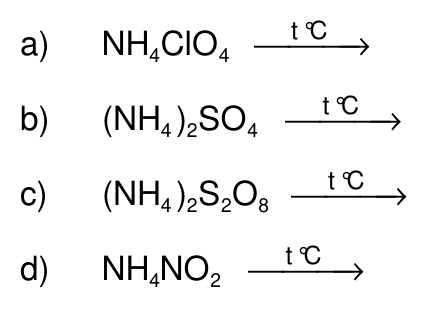
A) Describe the thermal decomposition of the following ammonium salts in terms of chemical equations:
B) Indicate the right answer:
a) Can the molar mass be determined by measuring the density of a gaseous compound at a given temperature and pressure?
- Yes, under any conditions.
- Yes, if the gaseous compound does not dissociate and associate.
- Yes, if the gaseous compound does not dissociate.
- Yes, if the gaseous compound does not associate.
b) Is a liquid boiling at a constant temperature (at a given pressure) a pure substance?
- Yes, if the liquid is not azeotropic.
- Yes, if the liquid is azeotropic.
C) Complete and balance the following equation: (in \(\ce{H2O}\))

D) The solubility of \(\ce{Hg2Cl2}\) in water is \(3.0\times10^{-5}\) g/100 ml solution.
a) What is the solubility product?
b) What is the solubility (in mol dm\(^{-3}\)) of this substance in a 0.01 M \(\ce{NaCl}\) solution?
c) What is the volume of a 0.01 M \(\ce{NaCl}\) solution which dissolves the same quantity of mercurous chloride as that dissolved in one litre of pure water?
\(A_\mathrm{r}(\ce{Hg})=200.61\qquad A_\mathrm{r}(\ce{Cl})=35.45\)
E) Which of the following groups contains solid compounds at \(10\,^\circ\mathrm{C}\)?
a) \(\ce{H2O, NH3, CH4}\)
b) \(\ce{F2, Cl2, Br2}\)
c) \(\ce{SO3, I2, NaCl}\)
d) \(\ce{Si, S8, Hg}\)
F) Which of the following salts forms an acidic aqueous solution?
a) \(\ce{CH3COONa}\)
b) \(\ce{NH4Cl}\)
c) \(\ce{Na2HPO4}\)
d) \(\ce{Na2CO3}\)
e) \(\ce{NaHCO3}\)
G) Write the electronic formulas for the following compounds so that the nature of the chemical bonds is evident:
a) \(\ce{NaClO3}\), b) \(\ce{HClO3}\), c) \(\ce{SiF4}\), d) \(\ce{NH3}\), e) \(\ce{CaF2}\), f) \(\ce{H2O}\)
H) Solid perchloric acid is usually written as \(\ce{HClO4.H2O}\). Based on experimental data showing four equal bonds, suggest a structure accounting for the experimental result.
I) The compounds of the second row elements with hydrogen are as follows: \(\ce{LiH, BeH2, B2H6, CH4, NH3, H2O, HF}\).
a) Which compounds are solid at room temperature? Explain.
b) Which of them are ionic?
c) Which are polymeric?
d) Which ones do not react with water under normal conditions?
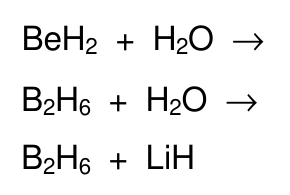
e) Give products of the following reactions.
f) Supposing that \(\ce{NH3}\), \(\ce{H2O}\) and \(\ce{HF}\) are acids under some conditions, write their corresponding conjugated bases and arrange them in order of increasing basic strength.
J) The following \(E^0\) values are given for the half-reactions:

Calculate \(E^0\) for the following reaction:

Official English text of the problem.
Problem 2: Composition of a CO-CO2 mixture
In a gaseous mixture of \(\ce{CO}\) and \(\ce{CO2}\), a mass ratio of carbon : oxygen = 1 : 2 was determined.
2.1 Calculate the mass percent composition.
2.2 Calculate the volume percent composition.
2.3 Indicate values of the carbon: oxygen ratios for which both gases cannot be present simultaneously.
Official English text of the problem.
Problem 3: Analysis of a NaCl-KCl mixture with silver nitrate and a copper strip
A sample containing a mixture of sodium chloride and potassium chloride weights 25 g. After its dissolution in water 840 ml of \(\ce{AgNO3}\) solution (\(c = 0.5\ \mathrm{mol\,dm^{-3}}\)) is added. The precipitate is filtered off and a strip of copper weighing 100.00 g is dipped into the filtrate. After a given time interval the strip weights 101.52 g.
Calculate the mass percent composition of the mixture.
Official English text of the problem.
Problem 4: Kinetics and stereochemistry of the alkaline hydrolysis of chlorinated compounds
The following data were gathered for the alkaline hydrolysis of certain chlorinated compounds:
a) A certain volume of a solution of the neutral potassium salt of chlorosuccinic acid is mixed with an equal volume of hydroxide solution. The initial concentration of each solution is \(0.2\ \mathrm{mol\,dm^{-3}}\). The potassium hydroxide concentration in the reaction mixture was determined at different time intervals at \(25\,^\circ\mathrm{C}\). The following values were obtained:
t (minutes) 10 20 30 45 60 80 100 \(c(\ce{KOH})\) \((\mathrm{mol\,dm^{-3}})\) 0.085 0.074 0.065 0.056 0.049 0.042 0.036 The experiment was repeated with the same initial solutions at \(35\,^\circ\mathrm{C}\). The hydroxide concentration is reduced to one half after 21 minutes.
b) In the hydrolysis of 3-chloro-3-methylhexane with potassium hydroxide, the concentration of potassium hydroxide was found to have been reduced to one half after 32 minutes at \(25\,^\circ\mathrm{C}\) or 11 minutes at \(35\,^\circ\mathrm{C}\), regardless of the initial reactant concentrations (identical).
c) In the alkaline hydrolysis of 3-chloro-2,4-dimethyl-3-isopropylpentane an identical reaction mechanism as for reaction b was found but the reaction rate was about 100 times faster under the same reaction conditions.
Considering the above data answer the following questions:
4.1 What is the reaction order in cases a, b, and c?
4.2 What is the rate constant at \(25\,^\circ\mathrm{C}\) for reaction a? Indicate the units.
4.3 Calculate the activation energies for reactions a and b.
4.4 If in reaction a dipotassium salt of L-chlorosuccinic acid (which is levorotatory,) is used, what type of optical rotation will be exhibited by the corresponding salt of malic acid formed by hydrolysis?
4.5 If the levorotatory isomer is also used in reaction b, what optical rotation will be exhibited by 3-methyl-3-hexanol formed in the hydrolysis reaction?
4.6 Why is the rate of reaction c much faster than that of reaction b when both reactions are of the same type and occur under the same temperature and concentration conditions?
Official English text of the problem.
Problem 5: Ethanol dehydration equilibrium and its pressure dependence
On passing ethanol over a catalyst at 400 K, a dehydration reaction occurs resulting in the formation of ethylene:

At the above temperature and \(p_0 = 101.325\ \mathrm{kPa}\), the conversion of ethyl alcohol is 90.6 mol %.
5.1 Calculate the equilibrium constant \(K_p\) of the reaction under given conditions.
5.2 Calculate the values of the equilibrium constants \(K_x\) and \(K_c\) at the above temperature.
5.3 Calculate the ethanol conversion at the following pressures:
\(5p_0\), \(10p_0\), \(50p_0\), \(100p_0\), and \(200p_0\).
5.4 Plot the graph for the variation of conversion vs. pressure.
Official English text of the problem.
Problem 6: Identification of compounds A-G from a base-catalysed reaction sequence
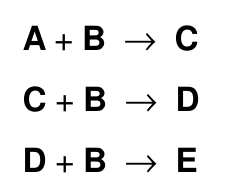
One mole of compound A reacts successively with 3 moles of compound B in aqueous solution in the presence of a basic catalyst (such as \(\ce{Ca(OH)2}\)):
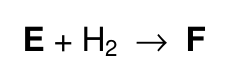
Hydrogenation of compound E yields compound F:
F has the composition: \(\ce{C} = 44.18\,\%,\quad \ce{H} = 8.82\,\%,\quad \ce{O} = 47.00\,\%.\)
Its molar mass: \(M = 136\ \mathrm{g\,mol^{-1}}\)
Knowing that 13.6 g of F reacts with 40.8 g acetic anhydride to form product G and acetic acid write down all chemical equations and assign the letters A, B, C, D, E, F, and G to particular formulas of compounds.
Official English text of the problem.
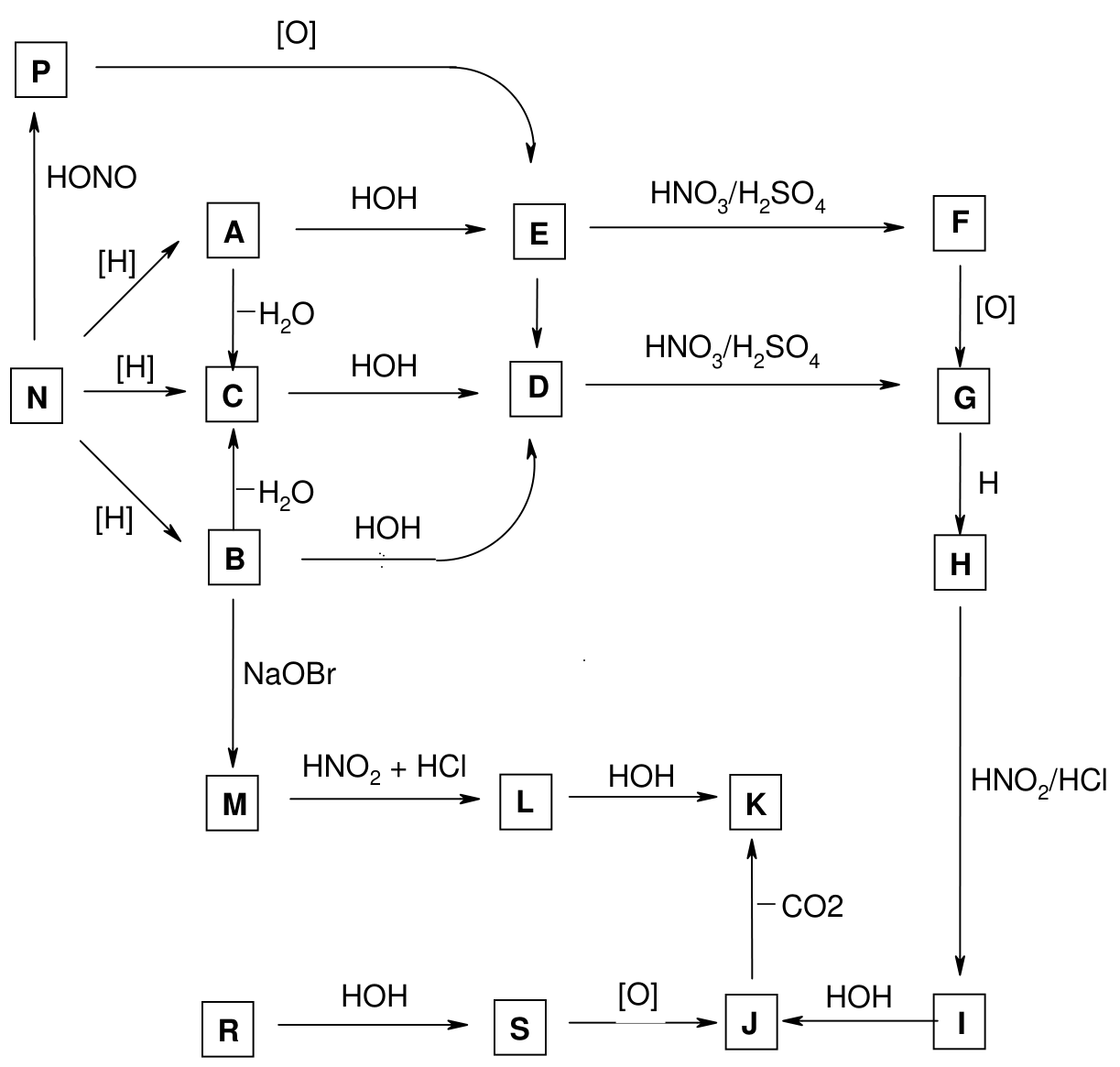
Problem 7: Reaction scheme of the isomers A and B (C7H7NO): compounds A-S
Knowing that compounds A and B are isomers with the molecular formula \(\ce{C7H7NO}\) and the relative molecular mass of compound M is 93, determine the formulae of compounds A to S taking in account the reactions given in the following reaction scheme:
Official English text of the problem.
Internationale Chemie-Olympiade
IChO 1983
Timișoara, Rumänien · 7 Theorieaufgaben mit vollständigen Lösungen
Aufgabe 1: Kurzfragen A-J zur anorganischen und allgemeinen Chemie
A) Beschreiben Sie die thermische Zersetzung der folgenden Ammoniumsalze mithilfe chemischer Gleichungen:
B) Geben Sie die richtige Antwort an:
a) Kann die molare Masse durch Messung der Dichte einer gasförmigen Verbindung bei gegebener Temperatur und gegebenem Druck bestimmt werden?
- Ja, unter allen Bedingungen.
- Ja, wenn die gasförmige Verbindung weder dissoziiert noch assoziiert.
- Ja, wenn die gasförmige Verbindung nicht dissoziiert.
- Ja, wenn die gasförmige Verbindung nicht assoziiert.
b) Ist eine Flüssigkeit, die bei konstanter Temperatur siedet (bei gegebenem Druck), ein Reinstoff?
- Ja, wenn die Flüssigkeit nicht azeotrop ist.
- Ja, wenn die Flüssigkeit azeotrop ist.
C) Vervollständigen Sie die folgende Gleichung und gleichen Sie sie aus: (in \(\ce{H2O}\))
D) Die Löslichkeit von \(\ce{Hg2Cl2}\) in Wasser beträgt \(3.0\times10^{-5}\) g/100 ml Lösung.
a) Wie groß ist das Löslichkeitsprodukt?
b) Wie groß ist die Löslichkeit (in mol dm\(^{-3}\)) dieser Substanz in einer 0.01 M \(\ce{NaCl}\)-Lösung?
c) Welches Volumen einer 0.01 M \(\ce{NaCl}\)-Lösung löst dieselbe Menge Quecksilber(I)-chlorid wie ein Liter reines Wasser?
\(A_\mathrm{r}(\ce{Hg})=200.61\qquad A_\mathrm{r}(\ce{Cl})=35.45\)
E) Welche der folgenden Gruppen enthält bei \(10\,^\circ\mathrm{C}\) feste Verbindungen?
a) \(\ce{H2O, NH3, CH4}\)
b) \(\ce{F2, Cl2, Br2}\)
c) \(\ce{SO3, I2, NaCl}\)
d) \(\ce{Si, S8, Hg}\)
F) Welches der folgenden Salze bildet eine saure wässrige Lösung?
a) \(\ce{CH3COONa}\)
b) \(\ce{NH4Cl}\)
c) \(\ce{Na2HPO4}\)
d) \(\ce{Na2CO3}\)
e) \(\ce{NaHCO3}\)
G) Schreiben Sie die Elektronenformeln der folgenden Verbindungen so auf, dass die Art der chemischen Bindungen erkennbar ist:
a) \(\ce{NaClO3}\), b) \(\ce{HClO3}\), c) \(\ce{SiF4}\), d) \(\ce{NH3}\), e) \(\ce{CaF2}\), f) \(\ce{H2O}\)
H) Feste Perchlorsäure wird üblicherweise als \(\ce{HClO4.H2O}\) geschrieben. Schlagen Sie auf Grundlage experimenteller Daten, die vier gleiche Bindungen zeigen, eine Struktur vor, die das experimentelle Ergebnis erklärt.
I) Die Verbindungen der Elemente der zweiten Periode mit Wasserstoff sind: \(\ce{LiH, BeH2, B2H6, CH4, NH3, H2O, HF}\).
a) Welche Verbindungen sind bei Raumtemperatur fest? Begründen Sie.
b) Welche davon sind ionisch?
c) Welche sind polymer?
d) Welche reagieren unter normalen Bedingungen nicht mit Wasser?
e) Geben Sie die Produkte der folgenden Reaktionen an.
f) Angenommen, \(\ce{NH3}\), \(\ce{H2O}\) und \(\ce{HF}\) sind unter bestimmten Bedingungen Säuren: Geben Sie ihre jeweiligen konjugierten Basen an und ordnen Sie diese nach zunehmender Basenstärke.
J) Für die Halbreaktionen sind die folgenden \(E^0\)-Werte gegeben:
Berechnen Sie \(E^0\) für die folgende Reaktion:
Aufgabentext aus dem offiziellen englischen Text übersetzt.
Aufgabe 2: Zusammensetzung eines CO-CO2-Gemisches
In einem gasförmigen Gemisch aus \(\ce{CO}\) und \(\ce{CO2}\) wurde ein Massenverhältnis von Kohlenstoff : Sauerstoff = 1 : 2 bestimmt.
2.1 Berechnen Sie die Zusammensetzung in Massenprozent.
2.2 Berechnen Sie die Zusammensetzung in Volumenprozent.
2.3 Geben Sie Werte des Verhältnisses Kohlenstoff : Sauerstoff an, bei denen beide Gase nicht gleichzeitig vorliegen können.
Aufgabentext aus dem offiziellen englischen Text übersetzt.
Aufgabe 3: Analyse eines NaCl-KCl-Gemisches mit Silbernitrat und einem Kupferstreifen
Eine Probe, die ein Gemisch aus Natriumchlorid und Kaliumchlorid enthält, wiegt 25 g. Nach dem Auflösen der Probe in Wasser werden 840 ml einer \(\ce{AgNO3}\)-Lösung (\(c = 0.5\ \mathrm{mol\,dm^{-3}}\)) zugegeben. Der Niederschlag wird abfiltriert, und ein Kupferstreifen mit einer Masse von 100.00 g wird in das Filtrat eingetaucht. Nach einer bestimmten Zeitspanne wiegt der Streifen 101.52 g.
Berechnen Sie die Zusammensetzung des Gemisches in Massenprozent.
Aufgabentext aus dem offiziellen englischen Text übersetzt.
Aufgabe 4: Kinetik und Stereochemie der alkalischen Hydrolyse chlorierter Verbindungen
Für die alkalische Hydrolyse bestimmter chlorierter Verbindungen wurden die folgenden Daten ermittelt:
a) Ein bestimmtes Volumen einer Lösung des neutralen Kaliumsalzes der Chlorbernsteinsäure wird mit dem gleichen Volumen einer Hydroxidlösung gemischt. Die Anfangskonzentration jeder Lösung beträgt \(0.2\ \mathrm{mol\,dm^{-3}}\). Die Kaliumhydroxidkonzentration im Reaktionsgemisch wurde bei \(25\,^\circ\mathrm{C}\) in verschiedenen Zeitabständen bestimmt. Dabei wurden folgende Werte erhalten:
t (Minuten) 10 20 30 45 60 80 100 \(c(\ce{KOH})\) \((\mathrm{mol\,dm^{-3}})\) 0.085 0.074 0.065 0.056 0.049 0.042 0.036 Der Versuch wurde mit denselben Ausgangslösungen bei \(35\,^\circ\mathrm{C}\) wiederholt. Die Hydroxidkonzentration sinkt nach 21 Minuten auf die Hälfte.
b) Bei der Hydrolyse von 3-Chlor-3-methylhexan mit Kaliumhydroxid wurde festgestellt, dass die Kaliumhydroxidkonzentration bei \(25\,^\circ\mathrm{C}\) nach 32 Minuten bzw. bei \(35\,^\circ\mathrm{C}\) nach 11 Minuten auf die Hälfte gesunken war, unabhängig von den (jeweils gleichen) Anfangskonzentrationen der Reaktanten.
c) Bei der alkalischen Hydrolyse von 3-Chlor-2,4-dimethyl-3-isopropylpentan wurde derselbe Reaktionsmechanismus wie bei Reaktion b festgestellt, die Reaktionsgeschwindigkeit war jedoch unter denselben Reaktionsbedingungen etwa 100-mal höher.
Beantworten Sie anhand der obigen Daten die folgenden Fragen:
4.1 Welche Reaktionsordnung liegt in den Fällen a, b und c vor?
4.2 Wie groß ist die Geschwindigkeitskonstante der Reaktion a bei \(25\,^\circ\mathrm{C}\)? Geben Sie die Einheiten an.
4.3 Berechnen Sie die Aktivierungsenergien der Reaktionen a und b.
4.4 Wenn bei Reaktion a das Dikaliumsalz der L-Chlorbernsteinsäure (das linksdrehend ist) verwendet wird, welchen optischen Drehsinn zeigt dann das entsprechende Salz der durch Hydrolyse gebildeten Äpfelsäure?
4.5 Wenn auch bei Reaktion b das linksdrehende Isomer verwendet wird, welchen optischen Drehsinn zeigt dann das bei der Hydrolysereaktion gebildete 3-Methyl-3-hexanol?
4.6 Warum ist die Geschwindigkeit der Reaktion c viel höher als die der Reaktion b, obwohl beide Reaktionen vom gleichen Typ sind und unter denselben Temperatur- und Konzentrationsbedingungen ablaufen?
Aufgabentext aus dem offiziellen englischen Text übersetzt.
Aufgabe 5: Gleichgewicht der Dehydratisierung von Ethanol und seine Druckabhängigkeit
Beim Leiten von Ethanol über einen Katalysator bei 400 K findet eine Dehydratisierungsreaktion statt, bei der Ethen entsteht:
Bei der oben genannten Temperatur und \(p_0 = 101.325\ \mathrm{kPa}\) beträgt der Umsatz von Ethanol 90.6 mol %.
5.1 Berechnen Sie die Gleichgewichtskonstante \(K_p\) der Reaktion unter den gegebenen Bedingungen.
5.2 Berechnen Sie die Werte der Gleichgewichtskonstanten \(K_x\) und \(K_c\) bei der oben genannten Temperatur.
5.3 Berechnen Sie den Ethanolumsatz bei den folgenden Drücken:
\(5p_0\), \(10p_0\), \(50p_0\), \(100p_0\) und \(200p_0\).
5.4 Stellen Sie die Abhängigkeit des Umsatzes vom Druck grafisch dar.
Aufgabentext aus dem offiziellen englischen Text übersetzt.
Aufgabe 6: Identifizierung der Verbindungen A-G anhand einer basenkatalysierten Reaktionsfolge
Ein Mol der Verbindung A reagiert schrittweise mit 3 Mol der Verbindung B in wässriger Lösung in Gegenwart eines basischen Katalysators (wie etwa \(\ce{Ca(OH)2}\)):
Die Hydrierung der Verbindung E liefert die Verbindung F:
F hat die Zusammensetzung: \(\ce{C} = 44.18\,\%,\quad \ce{H} = 8.82\,\%,\quad \ce{O} = 47.00\,\%.\)
Die molare Masse beträgt: \(M = 136\ \mathrm{g\,mol^{-1}}\)
Unter Berücksichtigung der Tatsache, dass 13.6 g F mit 40.8 g Essigsäureanhydrid unter Bildung des Produkts G und von Essigsäure reagieren, geben Sie alle Reaktionsgleichungen an und ordnen Sie den Buchstaben A, B, C, D, E, F und G die jeweiligen Formeln der Verbindungen zu.
Aufgabentext aus dem offiziellen englischen Text übersetzt.
Aufgabe 7: Reaktionsschema der Isomere A und B (C7H7NO): Verbindungen A-S
Bestimmen Sie die Formeln der Verbindungen A bis S unter Berücksichtigung der im folgenden Reaktionsschema angegebenen Reaktionen. Dabei ist bekannt, dass die Verbindungen A und B Isomere mit der Summenformel \(\ce{C7H7NO}\) sind und die relative Molekülmasse der Verbindung M 93 beträgt:
Aufgabentext aus dem offiziellen englischen Text übersetzt.
Uluslararası Kimya Olimpiyatı
IChO 1983
Timișoara, Romanya · 7 teori sorusu, tam çözümleriyle
Soru 1: İnorganik ve genel kimyada kısa sorular A-J
A) Aşağıdaki amonyum tuzlarının ısıl bozunmasını kimyasal denklemlerle açıklayınız:
B) Doğru cevabı belirtiniz:
a) Gaz hâlindeki bir bileşiğin belirli bir sıcaklık ve basınçta yoğunluğu ölçülerek molar kütlesi belirlenebilir mi?
- Evet, her koşulda.
- Evet, gaz hâlindeki bileşik ayrışmıyor ve birleşmiyorsa.
- Evet, gaz hâlindeki bileşik ayrışmıyorsa.
- Evet, gaz hâlindeki bileşik birleşmiyorsa.
b) Sabit sıcaklıkta (belirli bir basınçta) kaynayan bir sıvı saf madde midir?
- Evet, sıvı azeotropik değilse.
- Evet, sıvı azeotropik ise.
C) Aşağıdaki denklemi tamamlayıp denkleştiriniz: (\(\ce{H2O}\) içinde)
D) \(\ce{Hg2Cl2}\)'nin sudaki çözünürlüğü 100 ml çözelti başına \(3.0\times10^{-5}\) g'dır.
a) Çözünürlük çarpımı nedir?
b) Bu maddenin 0.01 M \(\ce{NaCl}\) çözeltisindeki çözünürlüğü (mol dm\(^{-3}\) cinsinden) nedir?
c) Bir litre saf suda çözünen cıva(I) klorür ile aynı miktarı çözen 0.01 M \(\ce{NaCl}\) çözeltisinin hacmi nedir?
\(A_\mathrm{r}(\ce{Hg})=200.61\qquad A_\mathrm{r}(\ce{Cl})=35.45\)
E) Aşağıdaki gruplardan hangisi \(10\,^\circ\mathrm{C}\)'de katı bileşikler içerir?
a) \(\ce{H2O, NH3, CH4}\)
b) \(\ce{F2, Cl2, Br2}\)
c) \(\ce{SO3, I2, NaCl}\)
d) \(\ce{Si, S8, Hg}\)
F) Aşağıdaki tuzlardan hangisi suda asidik bir çözelti oluşturur?
a) \(\ce{CH3COONa}\)
b) \(\ce{NH4Cl}\)
c) \(\ce{Na2HPO4}\)
d) \(\ce{Na2CO3}\)
e) \(\ce{NaHCO3}\)
G) Aşağıdaki bileşiklerin elektron formüllerini, kimyasal bağların niteliği açıkça görülecek biçimde yazınız:
a) \(\ce{NaClO3}\), b) \(\ce{HClO3}\), c) \(\ce{SiF4}\), d) \(\ce{NH3}\), e) \(\ce{CaF2}\), f) \(\ce{H2O}\)
H) Katı perklorik asit genellikle \(\ce{HClO4.H2O}\) olarak yazılır. Dört eşit bağ bulunduğunu gösteren deneysel verilere dayanarak, deneysel sonucu açıklayan bir yapı öneriniz.
I) İkinci periyot elementlerinin hidrojenle oluşturduğu bileşikler şunlardır: \(\ce{LiH, BeH2, B2H6, CH4, NH3, H2O, HF}\).
a) Hangi bileşikler oda sıcaklığında katıdır? Açıklayınız.
b) Bunlardan hangileri iyoniktir?
c) Hangileri polimeriktir?
d) Hangileri normal koşullarda suyla tepkimeye girmez?
e) Aşağıdaki tepkimelerin ürünlerini veriniz.
f) \(\ce{NH3}\), \(\ce{H2O}\) ve \(\ce{HF}\)'nin bazı koşullarda asit olduğunu varsayarak, bunların karşılık gelen eşlenik bazlarını yazınız ve artan bazlık kuvvetine göre sıralayınız.
J) Yarı tepkimeler için aşağıdaki \(E^0\) değerleri verilmiştir:
Aşağıdaki tepkime için \(E^0\)'ı hesaplayınız:
Soru metni resmi İngilizce metinden çevrilmiştir.
Soru 2: Bir CO-CO2 karışımının bileşimi
\(\ce{CO}\) ve \(\ce{CO2}\) gazlarından oluşan bir karışımda karbon : oksijen kütle oranının 1 : 2 olduğu belirlenmiştir.
2.1 Kütlece yüzde bileşimini hesaplayınız.
2.2 Hacimce yüzde bileşimini hesaplayınız.
2.3 Her iki gazın aynı anda bulunamayacağı karbon : oksijen oranı değerlerini belirtiniz.
Soru metni resmi İngilizce metinden çevrilmiştir.
Soru 3: Bir NaCl-KCl karışımının gümüş nitrat ve bakır şerit ile analizi
Sodyum klorür ve potasyum klorür karışımı içeren bir numunenin kütlesi 25 g'dır. Numune suda çözüldükten sonra 840 ml \(\ce{AgNO3}\) çözeltisi (\(c = 0.5\ \mathrm{mol\,dm^{-3}}\)) eklenir. Çökelek süzülerek ayrılır ve süzüntüye kütlesi 100.00 g olan bir bakır şerit daldırılır. Belirli bir süre sonra şeridin kütlesi 101.52 g olur.
Karışımın kütlece yüzde bileşimini hesaplayınız.
Soru metni resmi İngilizce metinden çevrilmiştir.
Soru 4: Klorlu bileşiklerin bazik hidrolizinin kinetiği ve stereokimyası
Bazı klorlu bileşiklerin bazik hidrolizi için aşağıdaki veriler elde edilmiştir:
a) Klorosüksinik asidin nötr potasyum tuzunun çözeltisinden belirli bir hacim, eşit hacimde hidroksit çözeltisiyle karıştırılır. Her bir çözeltinin başlangıç derişimi \(0.2\ \mathrm{mol\,dm^{-3}}\)'tür. Tepkime karışımındaki potasyum hidroksit derişimi, \(25\,^\circ\mathrm{C}\)'de farklı zaman aralıklarında belirlenmiştir. Aşağıdaki değerler elde edilmiştir:
t (dakika) 10 20 30 45 60 80 100 \(c(\ce{KOH})\) \((\mathrm{mol\,dm^{-3}})\) 0.085 0.074 0.065 0.056 0.049 0.042 0.036 Deney, aynı başlangıç çözeltileriyle \(35\,^\circ\mathrm{C}\)'de tekrarlanmıştır. Hidroksit derişimi 21 dakika sonra yarıya düşmektedir.
b) 3-kloro-3-metilhekzanın potasyum hidroksitle hidrolizinde, potasyum hidroksit derişiminin, reaktiflerin başlangıç derişimlerinden (birbirine eşit) bağımsız olarak, \(25\,^\circ\mathrm{C}\)'de 32 dakika veya \(35\,^\circ\mathrm{C}\)'de 11 dakika sonra yarıya düştüğü bulunmuştur.
c) 3-kloro-2,4-dimetil-3-izopropilpentanın bazik hidrolizinde, b tepkimesiyle aynı tepkime mekanizmasının geçerli olduğu, ancak aynı tepkime koşullarında tepkime hızının yaklaşık 100 kat daha yüksek olduğu bulunmuştur.
Yukarıdaki verileri dikkate alarak aşağıdaki soruları yanıtlayınız:
4.1 a, b ve c durumlarında tepkime derecesi nedir?
4.2 a tepkimesinin \(25\,^\circ\mathrm{C}\)'deki hız sabiti nedir? Birimlerini belirtiniz.
4.3 a ve b tepkimelerinin aktivasyon enerjilerini hesaplayınız.
4.4 a tepkimesinde L-klorosüksinik asidin (sola çeviren) dipotasyum tuzu kullanılırsa, hidrolizle oluşan malik asidin karşılık gelen tuzu hangi yönde optik çevirme gösterir?
4.5 b tepkimesinde de sola çeviren izomer kullanılırsa, hidroliz tepkimesinde oluşan 3-metil-3-hekzanol hangi yönde optik çevirme gösterir?
4.6 Her iki tepkime de aynı türde olduğu ve aynı sıcaklık ve derişim koşullarında gerçekleştiği hâlde, c tepkimesinin hızı neden b tepkimesininkinden çok daha yüksektir?
Soru metni resmi İngilizce metinden çevrilmiştir.
Soru 5: Etanolün dehidrasyon dengesi ve basınca bağımlılığı
Etanol 400 K'de bir katalizör üzerinden geçirildiğinde, etilen oluşumuyla sonuçlanan bir dehidrasyon tepkimesi gerçekleşir:
Yukarıdaki sıcaklıkta ve \(p_0 = 101.325\ \mathrm{kPa}\) basıncında etil alkolün dönüşümü molce %90.6'dır.
5.1 Verilen koşullarda tepkimenin denge sabiti \(K_p\)'yi hesaplayınız.
5.2 Yukarıdaki sıcaklıkta \(K_x\) ve \(K_c\) denge sabitlerinin değerlerini hesaplayınız.
5.3 Aşağıdaki basınçlarda etanol dönüşümünü hesaplayınız:
\(5p_0\), \(10p_0\), \(50p_0\), \(100p_0\) ve \(200p_0\).
5.4 Dönüşümün basınca bağlı değişiminin grafiğini çiziniz.
Soru metni resmi İngilizce metinden çevrilmiştir.
Soru 6: Baz katalizli bir tepkime dizisinden A-G bileşiklerinin belirlenmesi
Bir mol A bileşiği, sulu çözeltide bazik bir katalizör (örneğin \(\ce{Ca(OH)2}\)) varlığında 3 mol B bileşiği ile ardışık olarak tepkimeye girer:
E bileşiğinin hidrojenlenmesiyle F bileşiği elde edilir:
F bileşiğinin bileşimi şöyledir: \(\ce{C} = 44.18\,\%,\quad \ce{H} = 8.82\,\%,\quad \ce{O} = 47.00\,\%.\)
Molar kütlesi: \(M = 136\ \mathrm{g\,mol^{-1}}\)
13.6 g F bileşiğinin 40.8 g asetik anhidrit ile tepkimeye girerek G ürününü ve asetik asit oluşturduğunu bilerek tüm kimyasal denklemleri yazınız ve A, B, C, D, E, F ve G harflerini bileşiklerin ilgili formülleriyle eşleştiriniz.
Soru metni resmi İngilizce metinden çevrilmiştir.
Soru 7: A ve B izomerlerinin (C7H7NO) tepkime şeması: A-S bileşikleri
A ve B bileşiklerinin molekül formülü \(\ce{C7H7NO}\) olan izomerler olduğunu ve M bileşiğinin bağıl molekül kütlesinin 93 olduğunu bilerek, aşağıdaki tepkime şemasında verilen tepkimeleri dikkate alıp A'dan S'ye kadar olan bileşiklerin formüllerini belirleyiniz:
Soru metni resmi İngilizce metinden çevrilmiştir.
Olimpiada Internacional de Química
IChO 1983
Timișoara, Rumanía · 7 problemas teóricos con soluciones completas
Problema 1: Cuestiones breves A-J de química inorgánica y general
A) Describa la descomposición térmica de las siguientes sales de amonio mediante ecuaciones químicas:
B) Indique la respuesta correcta:
a) ¿Puede determinarse la masa molar midiendo la densidad de un compuesto gaseoso a una temperatura y una presión dadas?
- Sí, en cualquier condición.
- Sí, si el compuesto gaseoso no se disocia ni se asocia.
- Sí, si el compuesto gaseoso no se disocia.
- Sí, si el compuesto gaseoso no se asocia.
b) ¿Es una sustancia pura un líquido que hierve a temperatura constante (a una presión dada)?
- Sí, si el líquido no es azeotrópico.
- Sí, si el líquido es azeotrópico.
C) Complete y ajuste la siguiente ecuación: (en \(\ce{H2O}\))
D) La solubilidad del \(\ce{Hg2Cl2}\) en agua es de \(3.0\times10^{-5}\) g/100 ml de disolución.
a) ¿Cuál es el producto de solubilidad?
b) ¿Cuál es la solubilidad (en mol dm\(^{-3}\)) de esta sustancia en una disolución de \(\ce{NaCl}\) 0.01 M?
c) ¿Qué volumen de una disolución de \(\ce{NaCl}\) 0.01 M disuelve la misma cantidad de cloruro mercurioso que la disuelta en un litro de agua pura?
\(A_\mathrm{r}(\ce{Hg})=200.61\qquad A_\mathrm{r}(\ce{Cl})=35.45\)
E) ¿Cuál de los siguientes grupos contiene compuestos sólidos a \(10\,^\circ\mathrm{C}\)?
a) \(\ce{H2O, NH3, CH4}\)
b) \(\ce{F2, Cl2, Br2}\)
c) \(\ce{SO3, I2, NaCl}\)
d) \(\ce{Si, S8, Hg}\)
F) ¿Cuál de las siguientes sales forma una disolución acuosa ácida?
a) \(\ce{CH3COONa}\)
b) \(\ce{NH4Cl}\)
c) \(\ce{Na2HPO4}\)
d) \(\ce{Na2CO3}\)
e) \(\ce{NaHCO3}\)
G) Escriba las fórmulas electrónicas de los siguientes compuestos de modo que quede patente la naturaleza de los enlaces químicos:
a) \(\ce{NaClO3}\), b) \(\ce{HClO3}\), c) \(\ce{SiF4}\), d) \(\ce{NH3}\), e) \(\ce{CaF2}\), f) \(\ce{H2O}\)
H) El ácido perclórico sólido suele escribirse como \(\ce{HClO4.H2O}\). Basándose en los datos experimentales que muestran cuatro enlaces iguales, proponga una estructura que explique el resultado experimental.
I) Los compuestos de los elementos del segundo período con hidrógeno son los siguientes: \(\ce{LiH, BeH2, B2H6, CH4, NH3, H2O, HF}\).
a) ¿Qué compuestos son sólidos a temperatura ambiente? Explique por qué.
b) ¿Cuáles de ellos son iónicos?
c) ¿Cuáles son poliméricos?
d) ¿Cuáles no reaccionan con el agua en condiciones normales?
e) Indique los productos de las siguientes reacciones.
f) Suponiendo que \(\ce{NH3}\), \(\ce{H2O}\) y \(\ce{HF}\) sean ácidos en determinadas condiciones, escriba sus correspondientes bases conjugadas y ordénelas por fuerza básica creciente.
J) Se dan los siguientes valores de \(E^0\) para las semirreacciones:
Calcule \(E^0\) para la siguiente reacción:
Enunciado traducido del texto oficial en inglés.
Problema 2: Composición de una mezcla de CO-CO2
En una mezcla gaseosa de \(\ce{CO}\) y \(\ce{CO2}\), se determinó una relación de masas de carbono : oxígeno = 1 : 2.
2.1 Calcule la composición porcentual en masa.
2.2 Calcule la composición porcentual en volumen.
2.3 Indique los valores de la relación carbono : oxígeno para los cuales ambos gases no pueden estar presentes simultáneamente.
Enunciado traducido del texto oficial en inglés.
Problema 3: Análisis de una mezcla de NaCl-KCl con nitrato de plata y una lámina de cobre
Una muestra que contiene una mezcla de cloruro de sodio y cloruro de potasio tiene una masa de 25 g. Tras disolverla en agua, se añaden 840 ml de una disolución de \(\ce{AgNO3}\) (\(c = 0.5\ \mathrm{mol\,dm^{-3}}\)). El precipitado se separa por filtración y se sumerge en el filtrado una lámina de cobre de 100.00 g de masa. Transcurrido cierto intervalo de tiempo, la lámina tiene una masa de 101.52 g.
Calcule la composición porcentual en masa de la mezcla.
Enunciado traducido del texto oficial en inglés.
Problema 4: Cinética y estereoquímica de la hidrólisis alcalina de compuestos clorados
Se obtuvieron los siguientes datos para la hidrólisis alcalina de determinados compuestos clorados:
a) Se mezcla un volumen determinado de una disolución de la sal potásica neutra del ácido clorosuccínico con un volumen igual de una disolución de hidróxido. La concentración inicial de cada disolución es de \(0.2\ \mathrm{mol\,dm^{-3}}\). Se determinó la concentración de hidróxido de potasio en la mezcla de reacción a distintos intervalos de tiempo a \(25\,^\circ\mathrm{C}\). Se obtuvieron los siguientes valores:
t (minutos) 10 20 30 45 60 80 100 \(c(\ce{KOH})\) \((\mathrm{mol\,dm^{-3}})\) 0.085 0.074 0.065 0.056 0.049 0.042 0.036 Se repitió el experimento con las mismas disoluciones iniciales a \(35\,^\circ\mathrm{C}\). La concentración de hidróxido se reduce a la mitad al cabo de 21 minutos.
b) En la hidrólisis del 3-cloro-3-metilhexano con hidróxido de potasio, se observó que la concentración de hidróxido de potasio se había reducido a la mitad al cabo de 32 minutos a \(25\,^\circ\mathrm{C}\) o de 11 minutos a \(35\,^\circ\mathrm{C}\), independientemente de las concentraciones iniciales de los reactivos (idénticas).
c) En la hidrólisis alcalina del 3-cloro-2,4-dimetil-3-isopropilpentano se encontró un mecanismo de reacción idéntico al de la reacción b, pero la velocidad de reacción era unas 100 veces mayor en las mismas condiciones de reacción.
Teniendo en cuenta los datos anteriores, responda a las siguientes preguntas:
4.1 ¿Cuál es el orden de reacción en los casos a, b y c?
4.2 ¿Cuál es la constante de velocidad a \(25\,^\circ\mathrm{C}\) para la reacción a? Indique las unidades.
4.3 Calcule las energías de activación de las reacciones a y b.
4.4 Si en la reacción a se utiliza la sal dipotásica del ácido L-clorosuccínico (que es levógiro), ¿qué tipo de rotación óptica presentará la sal correspondiente del ácido málico formada por hidrólisis?
4.5 Si también se utiliza el isómero levógiro en la reacción b, ¿qué rotación óptica presentará el 3-metil-3-hexanol formado en la reacción de hidrólisis?
4.6 ¿Por qué la velocidad de la reacción c es mucho mayor que la de la reacción b si ambas reacciones son del mismo tipo y tienen lugar en las mismas condiciones de temperatura y concentración?
Enunciado traducido del texto oficial en inglés.
Problema 5: Equilibrio de deshidratación del etanol y su dependencia de la presión
Al hacer pasar etanol sobre un catalizador a 400 K, se produce una reacción de deshidratación que da lugar a la formación de etileno:
A la temperatura indicada y a \(p_0 = 101.325\ \mathrm{kPa}\), la conversión del alcohol etílico es del 90.6 mol %.
5.1 Calcule la constante de equilibrio \(K_p\) de la reacción en las condiciones dadas.
5.2 Calcule los valores de las constantes de equilibrio \(K_x\) y \(K_c\) a la temperatura indicada.
5.3 Calcule la conversión del etanol a las siguientes presiones:
\(5p_0\), \(10p_0\), \(50p_0\), \(100p_0\) y \(200p_0\).
5.4 Trace la gráfica de la variación de la conversión en función de la presión.
Enunciado traducido del texto oficial en inglés.
Problema 6: Identificación de los compuestos A-G a partir de una secuencia de reacciones catalizadas por una base
Un mol del compuesto A reacciona sucesivamente con 3 moles del compuesto B en disolución acuosa en presencia de un catalizador básico (como \(\ce{Ca(OH)2}\)):
La hidrogenación del compuesto E da lugar al compuesto F:
F tiene la siguiente composición: \(\ce{C} = 44.18\,\%,\quad \ce{H} = 8.82\,\%,\quad \ce{O} = 47.00\,\%.\)
Su masa molar: \(M = 136\ \mathrm{g\,mol^{-1}}\)
Sabiendo que 13.6 g de F reaccionan con 40.8 g de anhídrido acético para formar el producto G y ácido acético, escriba todas las ecuaciones químicas y asigne las letras A, B, C, D, E, F y G a las fórmulas concretas de los compuestos.
Enunciado traducido del texto oficial en inglés.
Problema 7: Esquema de reacciones de los isómeros A y B (C7H7NO): compuestos A-S
Sabiendo que los compuestos A y B son isómeros con la fórmula molecular \(\ce{C7H7NO}\) y que la masa molecular relativa del compuesto M es 93, determine las fórmulas de los compuestos A a S teniendo en cuenta las reacciones indicadas en el siguiente esquema de reacciones:
Enunciado traducido del texto oficial en inglés.
国际化学奥林匹克
IChO 1983
罗马尼亚蒂米什瓦拉 · 7 道理论题及完整解答
题目 1:无机化学与普通化学简答题 A-J
A) 用化学方程式描述下列铵盐的热分解:
B) 指出正确答案:
a) 能否通过测量气态化合物在给定温度和压力下的密度来确定其摩尔质量?
- 能,在任何条件下都可以。
- 能,前提是该气态化合物既不解离也不缔合。
- 能,前提是该气态化合物不解离。
- 能,前提是该气态化合物不缔合。
b) 在给定压力下以恒定温度沸腾的液体是否为纯物质?
- 是,前提是该液体不是共沸混合物。
- 是,前提是该液体是共沸混合物。
C) 补全并配平下列方程式:(在 \(\ce{H2O}\) 中)
D) \(\ce{Hg2Cl2}\) 在水中的溶解度为每 100 ml 溶液中溶解 \(3.0\times10^{-5}\) g。
a) 其溶度积是多少?
b) 该物质在 0.01 M \(\ce{NaCl}\) 溶液中的溶解度是多少(以 mol dm\(^{-3}\) 为单位)?
c) 要使溶解的氯化亚汞的量与一升纯水中溶解的量相同,需要多大体积的 0.01 M \(\ce{NaCl}\) 溶液?
\(A_\mathrm{r}(\ce{Hg})=200.61\qquad A_\mathrm{r}(\ce{Cl})=35.45\)
E) 下列哪一组中的化合物在 \(10\,^\circ\mathrm{C}\) 时为固体?
a) \(\ce{H2O, NH3, CH4}\)
b) \(\ce{F2, Cl2, Br2}\)
c) \(\ce{SO3, I2, NaCl}\)
d) \(\ce{Si, S8, Hg}\)
F) 下列哪种盐形成的水溶液呈酸性?
a) \(\ce{CH3COONa}\)
b) \(\ce{NH4Cl}\)
c) \(\ce{Na2HPO4}\)
d) \(\ce{Na2CO3}\)
e) \(\ce{NaHCO3}\)
G) 写出下列化合物的电子式,使其化学键的性质清晰可见:
a) \(\ce{NaClO3}\),b) \(\ce{HClO3}\),c) \(\ce{SiF4}\),d) \(\ce{NH3}\),e) \(\ce{CaF2}\),f) \(\ce{H2O}\)
H) 固态高氯酸通常写作 \(\ce{HClO4.H2O}\)。实验数据表明其中有四个相同的键,请提出一种能够解释该实验结果的结构。
I) 第二周期元素与氢形成的化合物如下:\(\ce{LiH, BeH2, B2H6, CH4, NH3, H2O, HF}\)。
a) 哪些化合物在室温下为固体?请解释。
b) 其中哪些是离子型化合物?
c) 哪些具有聚合结构?
d) 哪些在通常条件下不与水反应?
e) 写出下列反应的产物。
f) 假设 \(\ce{NH3}\)、\(\ce{H2O}\) 和 \(\ce{HF}\) 在某些条件下作为酸,写出它们各自的共轭碱,并按碱性由弱到强排列。
J) 已知下列半反应的 \(E^0\) 值:
计算下列反应的 \(E^0\):
题目译自官方英文原文。
题目 2:CO-CO2 混合物的组成
在由 \(\ce{CO}\) 和 \(\ce{CO2}\) 组成的气体混合物中,测得碳与氧的质量比为 1 : 2。
2.1 计算其质量百分组成。
2.2 计算其体积百分组成。
2.3 指出两种气体不能同时存在时碳与氧之比的取值。
题目译自官方英文原文。
题目 3:用硝酸银和铜片分析 NaCl-KCl 混合物
一份含有氯化钠和氯化钾混合物的样品质量为 25 g。将其溶于水后,加入 840 ml 的 \(\ce{AgNO3}\) 溶液(\(c = 0.5\ \mathrm{mol\,dm^{-3}}\))。滤去沉淀,将一片质量为 100.00 g 的铜片浸入滤液中。经过一定时间后,铜片的质量为 101.52 g。
计算该混合物中各组分的质量百分比。
题目译自官方英文原文。
题目 4:氯代化合物碱性水解的动力学与立体化学
对某些氯代化合物的碱性水解进行了研究,获得以下数据:
a) 将一定体积的氯代丁二酸正钾盐溶液与等体积的氢氧化物溶液混合。两种溶液的初始浓度均为 \(0.2\ \mathrm{mol\,dm^{-3}}\)。在 \(25\,^\circ\mathrm{C}\) 下,每隔一定时间测定反应混合物中氢氧化钾的浓度,得到以下数值:
t(分钟) 10 20 30 45 60 80 100 \(c(\ce{KOH})\) \((\mathrm{mol\,dm^{-3}})\) 0.085 0.074 0.065 0.056 0.049 0.042 0.036 使用相同的初始溶液,在 \(35\,^\circ\mathrm{C}\) 下重复该实验。21 分钟后,氢氧化物的浓度降至原来的一半。
b) 在 3-氯-3-甲基己烷与氢氧化钾的水解反应中,发现无论反应物的初始浓度如何(两种反应物的初始浓度相同),氢氧化钾的浓度均在 \(25\,^\circ\mathrm{C}\) 下经过 32 分钟,或在 \(35\,^\circ\mathrm{C}\) 下经过 11 分钟后降至原来的一半。
c) 在 3-氯-2,4-二甲基-3-异丙基戊烷的碱性水解中,发现其反应机理与反应 b 相同,但在相同反应条件下,反应速率约为反应 b 的 100 倍。
根据上述数据,回答以下问题:
4.1 a、b 和 c 各自的反应级数是多少?
4.2 反应 a 在 \(25\,^\circ\mathrm{C}\) 下的速率常数是多少?请注明单位。
4.3 计算反应 a 和 b 的活化能。
4.4 如果在反应 a 中使用 L-氯代丁二酸的二钾盐(该盐为左旋性),则水解生成的相应苹果酸盐将表现出哪种旋光性?
4.5 如果在反应 b 中也使用左旋异构体,则水解反应生成的 3-甲基-3-己醇将表现出何种旋光性?
4.6 反应 c 和反应 b 属于同一类型,且在相同的温度和浓度条件下进行,为什么反应 c 的速率远快于反应 b?
题目译自官方英文原文。
题目 5:乙醇脱水平衡及其压力依赖性
使乙醇在 400 K 下通过催化剂时,会发生脱水反应,生成乙烯:
在上述温度及 \(p_0 = 101.325\ \mathrm{kPa}\) 下,乙醇的转化率为 90.6 mol %。
5.1 计算给定条件下该反应的平衡常数 \(K_p\)。
5.2 计算上述温度下平衡常数 \(K_x\) 和 \(K_c\) 的值。
5.3 计算下列压力下乙醇的转化率:
\(5p_0\)、\(10p_0\)、\(50p_0\)、\(100p_0\) 和 \(200p_0\)。
5.4 绘制转化率随压力变化的曲线。
题目译自官方英文原文。
题目 6:通过碱催化反应序列鉴定化合物 A-G
在碱性催化剂(如 \(\ce{Ca(OH)2}\))存在下,1 摩尔化合物 A 在水溶液中依次与 3 摩尔化合物 B 反应:
化合物 E 经氢化生成化合物 F:
F 的组成如下:\(\ce{C} = 44.18\,\%,\quad \ce{H} = 8.82\,\%,\quad \ce{O} = 47.00\,\%.\)
其摩尔质量为:\(M = 136\ \mathrm{g\,mol^{-1}}\)
已知 13.6 g F 与 40.8 g 乙酸酐反应,生成产物 G 和乙酸,写出所有化学方程式,并确定字母 A、B、C、D、E、F 和 G 各自所代表的化合物的具体化学式。
题目译自官方英文原文。
题目 7:异构体 A 和 B(C7H7NO)的反应图式:化合物 A-S
已知化合物 A 和 B 是分子式为 \(\ce{C7H7NO}\) 的异构体,且化合物 M 的相对分子质量为 93,根据下列反应图式中给出的反应,确定化合物 A 至 S 的化学式:
题目译自官方英文原文。
Международная химическая олимпиада
IChO 1983
Тимишоара, Румыния · 7 теоретических задач с полными решениями
Задача 1: Краткие вопросы A-J по неорганической и общей химии
A) Опишите термическое разложение следующих солей аммония с помощью химических уравнений:
B) Укажите правильный ответ:
a) Можно ли определить молярную массу, измерив плотность газообразного соединения при заданных температуре и давлении?
- Да, при любых условиях.
- Да, если газообразное соединение не диссоциирует и не ассоциирует.
- Да, если газообразное соединение не диссоциирует.
- Да, если газообразное соединение не ассоциирует.
b) Является ли жидкость, кипящая при постоянной температуре (при заданном давлении), чистым веществом?
- Да, если жидкость не является азеотропной смесью.
- Да, если жидкость является азеотропной смесью.
C) Допишите следующее уравнение и расставьте коэффициенты: (в \(\ce{H2O}\))
D) Растворимость \(\ce{Hg2Cl2}\) в воде составляет \(3.0\times10^{-5}\) г/100 мл раствора.
a) Чему равно произведение растворимости?
b) Какова растворимость (в моль дм\(^{-3}\)) этого вещества в 0.01 М растворе \(\ce{NaCl}\)?
c) Какой объём 0.01 М раствора \(\ce{NaCl}\) растворяет такое же количество хлорида ртути(I), какое растворяется в одном литре чистой воды?
\(A_\mathrm{r}(\ce{Hg})=200.61\qquad A_\mathrm{r}(\ce{Cl})=35.45\)
E) В какой из следующих групп вещества являются твёрдыми при \(10\,^\circ\mathrm{C}\)?
a) \(\ce{H2O, NH3, CH4}\)
b) \(\ce{F2, Cl2, Br2}\)
c) \(\ce{SO3, I2, NaCl}\)
d) \(\ce{Si, S8, Hg}\)
F) Какая из следующих солей образует кислый водный раствор?
a) \(\ce{CH3COONa}\)
b) \(\ce{NH4Cl}\)
c) \(\ce{Na2HPO4}\)
d) \(\ce{Na2CO3}\)
e) \(\ce{NaHCO3}\)
G) Напишите электронные формулы следующих соединений так, чтобы был виден характер химических связей:
a) \(\ce{NaClO3}\), b) \(\ce{HClO3}\), c) \(\ce{SiF4}\), d) \(\ce{NH3}\), e) \(\ce{CaF2}\), f) \(\ce{H2O}\)
H) Твёрдую хлорную кислоту обычно записывают как \(\ce{HClO4.H2O}\). На основании экспериментальных данных, указывающих на наличие четырёх одинаковых связей, предложите структуру, объясняющую этот экспериментальный результат.
I) Соединения элементов второго периода с водородом таковы: \(\ce{LiH, BeH2, B2H6, CH4, NH3, H2O, HF}\).
a) Какие соединения являются твёрдыми при комнатной температуре? Объясните.
b) Какие из них являются ионными?
c) Какие являются полимерными?
d) Какие из них не реагируют с водой в обычных условиях?
e) Укажите продукты следующих реакций.
f) Предполагая, что \(\ce{NH3}\), \(\ce{H2O}\) и \(\ce{HF}\) в некоторых условиях являются кислотами, напишите соответствующие им сопряжённые основания и расположите их в порядке возрастания силы оснований.
J) Для полуреакций даны следующие значения \(E^0\):
Рассчитайте \(E^0\) для следующей реакции:
Условие переведено с официального английского текста.
Задача 2: Состав смеси CO-CO2
В газовой смеси \(\ce{CO}\) и \(\ce{CO2}\) определено массовое отношение углерод : кислород = 1 : 2.
2.1 Рассчитайте состав смеси в массовых процентах.
2.2 Рассчитайте состав смеси в объёмных процентах.
2.3 Укажите значения отношения углерод : кислород, при которых оба газа не могут присутствовать одновременно.
Условие переведено с официального английского текста.
Задача 3: Анализ смеси NaCl-KCl с помощью нитрата серебра и медной пластинки
Образец, содержащий смесь хлорида натрия и хлорида калия, имеет массу 25 г. После его растворения в воде добавляют 840 мл раствора \(\ce{AgNO3}\) (\(c = 0.5\ \mathrm{mol\,dm^{-3}}\)). Осадок отфильтровывают, а в фильтрат погружают медную пластинку массой 100.00 г. Через определённый промежуток времени масса пластинки составляет 101.52 г.
Рассчитайте массовый состав смеси в процентах.
Условие переведено с официального английского текста.
Задача 4: Кинетика и стереохимия щелочного гидролиза хлорсодержащих соединений
Для щелочного гидролиза некоторых хлорсодержащих соединений были получены следующие данные:
a) Некоторый объём раствора средней калиевой соли хлорянтарной кислоты смешивают с равным объёмом раствора гидроксида. Исходная концентрация каждого раствора составляет \(0.2\ \mathrm{mol\,dm^{-3}}\). Концентрацию гидроксида калия в реакционной смеси определяли через различные промежутки времени при \(25\,^\circ\mathrm{C}\). Были получены следующие значения:
t (минуты) 10 20 30 45 60 80 100 \(c(\ce{KOH})\) \((\mathrm{mol\,dm^{-3}})\) 0.085 0.074 0.065 0.056 0.049 0.042 0.036 Опыт повторили с теми же исходными растворами при \(35\,^\circ\mathrm{C}\). Концентрация гидроксида уменьшается вдвое за 21 минуту.
b) При гидролизе 3-хлор-3-метилгексана гидроксидом калия было установлено, что концентрация гидроксида калия уменьшается вдвое за 32 минуты при \(25\,^\circ\mathrm{C}\) или за 11 минут при \(35\,^\circ\mathrm{C}\), независимо от исходных концентраций реагентов (одинаковых).
c) Было установлено, что щелочной гидролиз 3-хлор-2,4-диметил-3-изопропилпентана протекает по тому же механизму, что и реакция b, однако скорость реакции при тех же условиях примерно в 100 раз выше.
На основании приведённых данных ответьте на следующие вопросы:
4.1 Каков порядок реакции в случаях a, b и c?
4.2 Чему равна константа скорости реакции a при \(25\,^\circ\mathrm{C}\)? Укажите единицы измерения.
4.3 Рассчитайте энергии активации реакций a и b.
4.4 Если в реакции a используется дикалиевая соль L-хлорянтарной кислоты (левовращающая), какое направление оптического вращения будет иметь соответствующая соль яблочной кислоты, образующаяся при гидролизе?
4.5 Если в реакции b также используется левовращающий изомер, какое оптическое вращение будет иметь 3-метил-3-гексанол, образующийся при гидролизе?
4.6 Почему скорость реакции c значительно выше скорости реакции b, хотя обе реакции относятся к одному типу и протекают при одинаковых температуре и концентрациях?
Условие переведено с официального английского текста.
Задача 5: Равновесие дегидратации этанола и его зависимость от давления
При пропускании этанола над катализатором при 400 K протекает реакция дегидратации, приводящая к образованию этилена:
При указанной температуре и \(p_0 = 101.325\ \mathrm{kPa}\) степень превращения этилового спирта составляет 90.6 мол. %.
5.1 Рассчитайте константу равновесия \(K_p\) реакции в данных условиях.
5.2 Рассчитайте значения констант равновесия \(K_x\) и \(K_c\) при указанной температуре.
5.3 Рассчитайте степень превращения этанола при следующих давлениях:
\(5p_0\), \(10p_0\), \(50p_0\), \(100p_0\) и \(200p_0\).
5.4 Постройте график зависимости степени превращения от давления.
Условие переведено с официального английского текста.
Задача 6: Определение соединений A-G в последовательности реакций, катализируемых основанием
Один моль соединения A последовательно реагирует с 3 молями соединения B в водном растворе в присутствии основного катализатора (например, \(\ce{Ca(OH)2}\)):
При гидрировании соединения E образуется соединение F:
F имеет следующий состав: \(\ce{C} = 44.18\,\%,\quad \ce{H} = 8.82\,\%,\quad \ce{O} = 47.00\,\%.\)
Его молярная масса: \(M = 136\ \mathrm{g\,mol^{-1}}\)
Зная, что 13.6 г F реагирует с 40.8 г уксусного ангидрида с образованием продукта G и уксусной кислоты, запишите все уравнения химических реакций и установите соответствие между буквами A, B, C, D, E, F и G и конкретными формулами соединений.
Условие переведено с официального английского текста.
Задача 7: Схема реакций изомеров A и B (C7H7NO): соединения A-S
Зная, что соединения A и B являются изомерами с молекулярной формулой \(\ce{C7H7NO}\), а относительная молекулярная масса соединения M равна 93, определите формулы соединений от A до S, учитывая реакции, приведённые на следующей схеме:
Условие переведено с официального английского текста.
الأولمبياد الدولي للكيمياء
IChO 1983
تيميشوارا، رومانيا · 7 مسائل نظرية مع حلول كاملة
المسألة 1: أسئلة قصيرة A-J في الكيمياء غير العضوية والعامة
A) صِف التحلل الحراري لأملاح الأمونيوم الآتية بمعادلات كيميائية:
B) حدّد الإجابة الصحيحة:
a) هل يمكن تحديد الكتلة المولية بقياس كثافة مركب غازي عند درجة حرارة وضغط معيّنين؟
- نعم، في جميع الظروف.
- نعم، إذا كان المركب الغازي لا يتفكك ولا يتجمع.
- نعم، إذا كان المركب الغازي لا يتفكك.
- نعم، إذا كان المركب الغازي لا يتجمع.
b) هل السائل الذي يغلي عند درجة حرارة ثابتة (عند ضغط معيّن) مادة نقية؟
- نعم، إذا لم يكن السائل أزيوتروبيًا.
- نعم، إذا كان السائل أزيوتروبيًا.
C) أكمل المعادلة الآتية ووازنها: (في \(\ce{H2O}\))
D) ذوبانية \(\ce{Hg2Cl2}\) في الماء هي \(3.0\times10^{-5}\) غ/100 مل من المحلول.
a) ما حاصل الإذابة؟
b) ما ذوبانية هذه المادة (بوحدة mol dm\(^{-3}\)) في محلول \(\ce{NaCl}\) تركيزه 0.01 M؟
c) ما حجم محلول \(\ce{NaCl}\) ذي التركيز 0.01 M الذي يذيب الكمية نفسها من كلوريد الزئبق الأحادي التي تذوب في لتر واحد من الماء النقي؟
\(A_\mathrm{r}(\ce{Hg})=200.61\qquad A_\mathrm{r}(\ce{Cl})=35.45\)
E) أيّ المجموعات الآتية تحتوي على مركبات صلبة عند \(10\,^\circ\mathrm{C}\)؟
a) \(\ce{H2O, NH3, CH4}\)
b) \(\ce{F2, Cl2, Br2}\)
c) \(\ce{SO3, I2, NaCl}\)
d) \(\ce{Si, S8, Hg}\)
F) أيّ الأملاح الآتية يكوّن محلولًا مائيًا حمضيًا؟
a) \(\ce{CH3COONa}\)
b) \(\ce{NH4Cl}\)
c) \(\ce{Na2HPO4}\)
d) \(\ce{Na2CO3}\)
e) \(\ce{NaHCO3}\)
G) اكتب الصيغ الإلكترونية للمركبات الآتية بحيث تتضح طبيعة الروابط الكيميائية:
a) \(\ce{NaClO3}\)، b) \(\ce{HClO3}\)، c) \(\ce{SiF4}\)، d) \(\ce{NH3}\)، e) \(\ce{CaF2}\)، f) \(\ce{H2O}\)
H) يُكتب حمض البيركلوريك الصلب عادةً بالصيغة \(\ce{HClO4.H2O}\). استنادًا إلى البيانات التجريبية التي تُظهر أربع روابط متساوية، اقترح بنية تفسّر النتيجة التجريبية.
I) مركبات عناصر الدورة الثانية مع الهيدروجين هي: \(\ce{LiH, BeH2, B2H6, CH4, NH3, H2O, HF}\).
a) أيّ المركبات صلبة عند درجة حرارة الغرفة؟ فسّر.
b) أيّها أيوني؟
c) أيّها بوليمري؟
d) أيّها لا يتفاعل مع الماء في الظروف العادية؟
e) أعطِ نواتج التفاعلات الآتية.
f) بافتراض أن \(\ce{NH3}\) و\(\ce{H2O}\) و\(\ce{HF}\) أحماض في بعض الظروف، اكتب قواعدها المرافقة ورتّبها تصاعديًا بحسب القوة القاعدية.
J) أُعطيت قيم \(E^0\) الآتية لأنصاف التفاعلات:
احسب \(E^0\) للتفاعل الآتي:
نص المسألة مترجم عن النص الإنجليزي الرسمي.
المسألة 2: تركيب مزيج من CO-CO2
حُدِّدت في مزيج غازي من \(\ce{CO}\) و\(\ce{CO2}\) نسبة كتلية مقدارها الكربون : الأكسجين = 1 : 2.
2.1 احسب التركيب بالنسبة المئوية الكتلية.
2.2 احسب التركيب بالنسبة المئوية الحجمية.
2.3 حدِّد قيم نسب الكربون : الأكسجين التي لا يمكن عندها أن يوجد الغازان معًا.
نص المسألة مترجم عن النص الإنجليزي الرسمي.
المسألة 3: تحليل خليط من NaCl-KCl باستخدام نترات الفضة وشريط من النحاس
تبلغ كتلة عينة تحتوي على خليط من كلوريد الصوديوم وكلوريد البوتاسيوم 25 g. بعد إذابتها في الماء، يُضاف إليها 840 ml من محلول \(\ce{AgNO3}\) (\(c = 0.5\ \mathrm{mol\,dm^{-3}}\)). يُفصل الراسب بالترشيح، ويُغمس في الراشح شريط من النحاس كتلته 100.00 g. بعد فترة زمنية معينة، تصبح كتلة الشريط 101.52 g.
احسب التركيب المئوي الكتلي للخليط.
نص المسألة مترجم عن النص الإنجليزي الرسمي.
المسألة 4: الحركية والكيمياء الفراغية للتحلل المائي القلوي للمركبات المكلورة
جُمعت البيانات الآتية للتحلل المائي القلوي لبعض المركبات المكلورة:
a) يُمزج حجم معين من محلول ملح البوتاسيوم المتعادل لحمض الكلوروسكسينيك بحجم مساوٍ من محلول الهيدروكسيد. التركيز الابتدائي لكل محلول هو \(0.2\ \mathrm{mol\,dm^{-3}}\). حُدِّد تركيز هيدروكسيد البوتاسيوم في مزيج التفاعل عند فترات زمنية مختلفة وعند \(25\,^\circ\mathrm{C}\). وقد حُصل على القيم الآتية:
t (دقائق) 10 20 30 45 60 80 100 \(c(\ce{KOH})\) \((\mathrm{mol\,dm^{-3}})\) 0.085 0.074 0.065 0.056 0.049 0.042 0.036 كُررت التجربة باستخدام المحلولين الابتدائيين نفسيهما عند \(35\,^\circ\mathrm{C}\). ينخفض تركيز الهيدروكسيد إلى النصف بعد 21 دقيقة.
b) في التحلل المائي لـ3-كلورو-3-ميثيل هكسان باستخدام هيدروكسيد البوتاسيوم، وُجد أن تركيز هيدروكسيد البوتاسيوم ينخفض إلى النصف بعد 32 دقيقة عند \(25\,^\circ\mathrm{C}\) أو 11 دقيقة عند \(35\,^\circ\mathrm{C}\)، بغض النظر عن التراكيز الابتدائية للمتفاعلات (المتساوية).
c) في التحلل المائي القلوي لـ3-كلورو-2,4-ثنائي ميثيل-3-أيزوبروبيل بنتان، وُجد أن آلية التفاعل مطابقة لآلية التفاعل b، إلا أن سرعة التفاعل كانت أكبر بنحو 100 مرة في ظروف التفاعل نفسها.
بالنظر إلى البيانات أعلاه، أجب عن الأسئلة الآتية:
4.1 ما رتبة التفاعل في الحالات a وb وc؟
4.2 ما ثابت السرعة عند \(25\,^\circ\mathrm{C}\) للتفاعل a؟ بيّن الوحدات.
4.3 احسب طاقتي التنشيط للتفاعلين a وb.
4.4 إذا استُخدم في التفاعل a ملح ثنائي البوتاسيوم لحمض L-كلوروسكسينيك (وهو أيسر التدوير)، فما نوع الدوران الضوئي الذي سيُظهره الملح المقابل لحمض الماليك المتكوّن بالتحلل المائي؟
4.5 إذا استُخدم المتماكب الأيسر التدوير أيضًا في التفاعل b، فما الدوران الضوئي الذي سيُظهره 3-ميثيل-3-هكسانول المتكوّن في تفاعل التحلل المائي؟
4.6 لماذا تكون سرعة التفاعل c أكبر بكثير من سرعة التفاعل b، مع أن التفاعلين من النوع نفسه ويحدثان في ظروف درجة الحرارة والتركيز نفسها؟
نص المسألة مترجم عن النص الإنجليزي الرسمي.
المسألة 5: اتزان نزع الماء من الإيثانول واعتماده على الضغط
عند إمرار الإيثانول فوق حفاز عند 400 K، يحدث تفاعل نزع ماء يؤدي إلى تكوّن الإيثيلين:
عند درجة الحرارة المذكورة أعلاه و\(p_0 = 101.325\ \mathrm{kPa}\)، تبلغ نسبة تحوّل الكحول الإيثيلي 90.6 % مولية.
5.1 احسب ثابت الاتزان \(K_p\) للتفاعل في الظروف المعطاة.
5.2 احسب قيمتي ثابتي الاتزان \(K_x\) و\(K_c\) عند درجة الحرارة المذكورة أعلاه.
5.3 احسب نسبة تحوّل الإيثانول عند الضغوط الآتية:
\(5p_0\)، \(10p_0\)، \(50p_0\)، \(100p_0\)، و\(200p_0\).
5.4 ارسم المنحنى البياني لتغيّر نسبة التحوّل بدلالة الضغط.
نص المسألة مترجم عن النص الإنجليزي الرسمي.
المسألة 6: تعيين هوية المركبات A-G من تتابع تفاعلات محفَّزة بقاعدة
يتفاعل مول واحد من المركب A على التوالي مع 3 مولات من المركب B في محلول مائي بوجود حفّاز قاعدي (مثل \(\ce{Ca(OH)2}\)):
تؤدي هدرجة المركب E إلى المركب F:
للمركب F التركيب الآتي: \(\ce{C} = 44.18\,\%,\quad \ce{H} = 8.82\,\%,\quad \ce{O} = 47.00\,\%.\)
كتلته المولية: \(M = 136\ \mathrm{g\,mol^{-1}}\)
بمعرفة أن 13.6 g من F تتفاعل مع 40.8 g من أنهيدريد الأسيتيك لتكوين الناتج G وحمض الأسيتيك، اكتب جميع المعادلات الكيميائية وعيّن صيغ المركبات التي تقابل الحروف A وB وC وD وE وF وG.
نص المسألة مترجم عن النص الإنجليزي الرسمي.
المسألة 7: مخطط تفاعلات المتماكبين A وB (C7H7NO): المركبات A-S
بالعلم أن المركبين A وB متماكبان صيغتهما الجزيئية \(\ce{C7H7NO}\)، وأن الكتلة الجزيئية النسبية للمركب M تساوي 93، حدّد صيغ المركبات من A إلى S مع مراعاة التفاعلات الواردة في مخطط التفاعلات الآتي:
نص المسألة مترجم عن النص الإنجليزي الرسمي.