IChO 1983 · Theory problem 7
Reaction scheme of the isomers A and B (C7H7NO): compounds A-S
Knowing that compounds A and B are isomers with the molecular formula \(\ce{C7H7NO}\) and the relative molecular mass of compound M is 93, determine the formulae of compounds A to S taking in account the reactions given in the following reaction scheme:
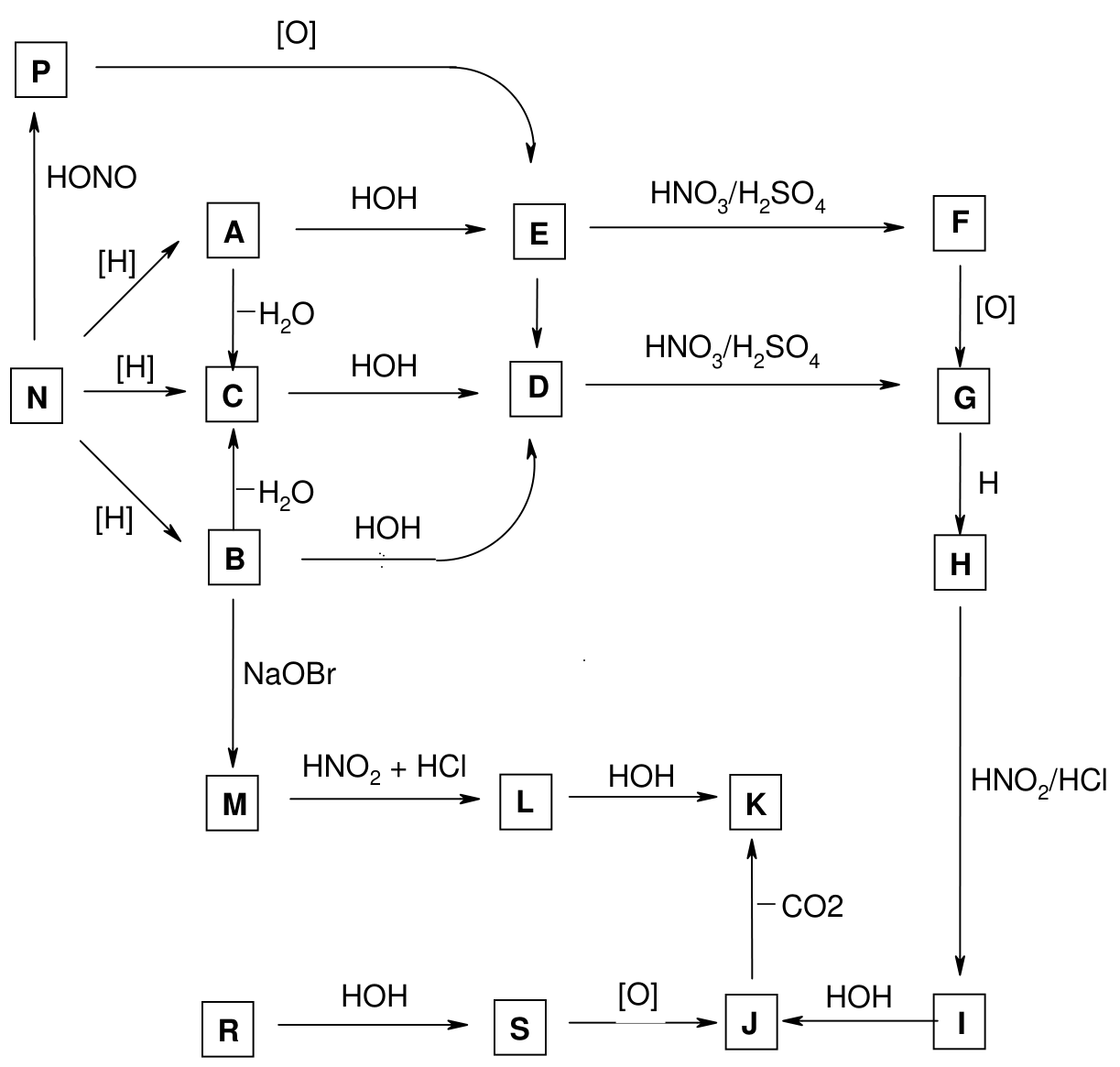
Official English text of the problem.
Answers
- The assignments are given below. They require reversing the three reduction arrows adjoining \(N\). The \(R,S\) pair is one chemically sound completion of that branch.
| Compound | Name | Formula | SMILES |
|---|---|---|---|
| A | Benzaldehyde oxime (benzaldoxime) | \(\ce{C7H7NO}\) | ON=Cc1ccccc1 |
| B | Benzamide | \(\ce{C7H7NO}\) | NC(=O)c1ccccc1 |
| C | Benzonitrile | \(\ce{C7H5N}\) | N#Cc1ccccc1 |
| D | Benzoic acid | \(\ce{C7H6O2}\) | O=C(O)c1ccccc1 |
| E | Benzaldehyde | \(\ce{C7H6O}\) | O=Cc1ccccc1 |
| F | 3-Nitrobenzaldehyde | \(\ce{C7H5NO3}\) | O=Cc1cccc([N+](=O)[O-])c1 |
| G | 3-Nitrobenzoic acid | \(\ce{C7H5NO4}\) | O=C(O)c1cccc([N+](=O)[O-])c1 |
| H | 3-Aminobenzoic acid | \(\ce{C7H7NO2}\) | Nc1cccc(C(=O)O)c1 |
| I | 3-Carboxybenzenediazonium chloride | \(\ce{[C7H5N2O2]+ Cl-}\) | O=C(O)c1cccc([N+]#N)c1.[Cl-] |
| J | 3-Hydroxybenzoic acid | \(\ce{C7H6O3}\) | O=C(O)c1cccc(O)c1 |
| K | Phenol | \(\ce{C6H6O}\) | Oc1ccccc1 |
| L | Benzenediazonium chloride | \(\ce{[C6H5N2]+ Cl-}\) | N#[N+]c1ccccc1.[Cl-] |
| M | Aniline | \(\ce{C6H7N}\) | Nc1ccccc1 |
| N | Benzylamine | \(\ce{C7H9N}\) | NCc1ccccc1 |
| P | Benzyl alcohol | \(\ce{C7H8O}\) | OCc1ccccc1 |
| R | 3-Formylbenzenediazonium chloride | \(\ce{[C7H5N2O]+ Cl-}\) | O=Cc1cccc([N+]#N)c1.[Cl-] |
| S | 3-Hydroxybenzaldehyde | \(\ce{C7H6O2}\) | O=Cc1cccc(O)c1 |
The scheme contains no compounds labelled \(O\) or \(Q\). The configuration about the oxime double bond in \(A\) is unspecified; its SMILES therefore leaves \(E/Z\) stereochemistry unassigned.
Solution
7. The names and structures of the compounds are listed above. In the equations below, every disubstituted benzene ring has its substituents in the 1,3-positions. The symbols \(\ce{[H]}\) and \(\ce{[O]}\) denote formal reducing and oxidizing equivalents, respectively. Hydrolyses are written as balanced overall equations with neutral products; acid/base conditions and workup are implicit where needed.
Identifying \(B\) and the \(M\rightarrow L\rightarrow K\) branch.
The reaction of \(B\) with sodium hypobromite identifies the Hofmann rearrangement of a primary amide. Its carbonyl carbon is lost, while its remaining organic group becomes attached to the amino group.
Starting from \(\ce{C7H7NO}\), the resulting amine has formula \(\ce{C6H7N}\):
\[ M_{\mathrm r}=6(12)+7(1)+14=93. \]
Relative molecular mass is dimensionless. This matches the stated value. Together with the aromatic reactions elsewhere in the scheme, this identifies \(M\) as aniline and \(B\) as benzamide.
The balanced equation under alkaline conditions is
\[ \ce{C6H5CONH2 + NaOBr + 2NaOH -> C6H5NH2 + Na2CO3 + NaBr + H2O}. \]
Aniline undergoes diazotization in cold hydrochloric acid, giving \(L\), benzenediazonium chloride:
\[ \ce{C6H5NH2 + HNO2 + HCl -> [C6H5N2]+ + Cl- + 2H2O}. \]
Warming the diazonium salt with water replaces the diazonium group by a hydroxyl group, giving \(K\), phenol:
\[ \ce{[C6H5N2]+ + Cl- + H2O -> C6H5OH + N2 + HCl}. \]
Identifying \(A,C,D,E\).
Dehydration of benzamide gives \(C\), benzonitrile:
\[ \ce{C6H5CONH2 -> C6H5CN + H2O} \qquad (B\rightarrow C). \]
Hydrolysis of either the nitrile or the amide gives \(D\), benzoic acid:
\[ \ce{C6H5CN + 2H2O -> C6H5COOH + NH3} \qquad (C\rightarrow D), \]
\[ \ce{C6H5CONH2 + H2O -> C6H5COOH + NH3} \qquad (B\rightarrow D). \]
The isomer \(A\), which also loses water to form benzonitrile but hydrolyses to a different compound, is benzaldehyde oxime. Its dehydration and hydrolysis are
\[ \ce{C6H5CH=NOH -> C6H5CN + H2O} \qquad (A\rightarrow C), \]
\[ \ce{C6H5CH=NOH + H2O -> C6H5CHO + NH2OH} \qquad (A\rightarrow E). \]
Here the nitrogen-containing hydrolysis product is hydroxylamine, NO. Thus \(E\) is benzaldehyde. The unlabelled \(E\rightarrow D\) transformation is oxidation:
\[ \ce{C6H5CHO + [O] -> C6H5COOH}. \]
Identifying \(N,P\) and resolving the reduction arrows.
Reduction of an aldoxime, a nitrile, or a primary amide gives the corresponding primary amine. Consequently, \(A,B,C\) all give \(N\), benzylamine:
\[ \ce{C6H5CH=NOH + 4[H] -> C6H5CH2NH2 + H2O} \qquad (A\rightarrow N), \]
\[ \ce{C6H5CONH2 + 4[H] -> C6H5CH2NH2 + H2O} \qquad (B\rightarrow N), \]
\[ \ce{C6H5CN + 4[H] -> C6H5CH2NH2} \qquad (C\rightarrow N). \]
These reactions require the reverse of the directions printed beside \(N\).
Benzylamine reacts with nitrous acid to give \(P\), benzyl alcohol, with evolution of nitrogen:
\[ \ce{C6H5CH2NH2 + HNO2 -> C6H5CH2OH + N2 + H2O}. \]
Controlled oxidation of benzyl alcohol produces benzaldehyde, confirming the connection \(P\rightarrow E\):
\[ \ce{C6H5CH2OH + [O] -> C6H5CHO + H2O}. \]
Identifying \(F,G,H,I,J\).
Both the aldehyde group and the carboxyl group are meta-directing in electrophilic aromatic substitution. Accordingly, the principal mononitration products are \(F\), 3-nitrobenzaldehyde, and \(G\), 3-nitrobenzoic acid:
\[ \ce{C6H5CHO + HNO3 ->[H2SO4] O2N-C6H4-CHO + H2O} \qquad (E\rightarrow F), \]
\[ \ce{C6H5COOH + HNO3 ->[H2SO4] O2N-C6H4-COOH + H2O} \qquad (D\rightarrow G). \]
Oxidation of the aldehyde group in \(F\) gives the same acid \(G\):
\[ \ce{O2N-C6H4-CHO + [O] -> O2N-C6H4-COOH}. \]
Selective reduction of the nitro group gives \(H\), 3-aminobenzoic acid:
\[ \ce{O2N-C6H4-COOH + 6[H] -> H2N-C6H4-COOH + 2H2O}. \]
Diazotization gives \(I\), 3-carboxybenzenediazonium chloride:
\[ \ce{H2N-C6H4-COOH + HNO2 + HCl -> [HOOC-C6H4-N2]+ + Cl- + 2H2O}. \]
Hydrolysis of this diazonium salt gives \(J\), 3-hydroxybenzoic acid:
\[ \ce{[HOOC-C6H4-N2]+ + Cl- + H2O -> HO-C6H4-COOH + N2 + HCl}. \]
Decarboxylation gives phenol, agreeing with the independently established identity of \(K\):
\[ \ce{HO-C6H4-COOH -> C6H5OH + CO2}. \]
This last equation expresses the overall transformation; suitable alkaline decarboxylation conditions followed by acidification can be used.
Completing \(R\rightarrow S\rightarrow J\) with standard reactions.
Choose \(R\) as 3-formylbenzenediazonium chloride. Its hydrolysis gives \(S\), 3-hydroxybenzaldehyde, by the same diazonium-to-phenol transformation used in the other branches:
\[ \ce{[OHC-C6H4-N2]+ + Cl- + H2O -> HO-C6H4-CHO + N2 + HCl}. \]
A mild, aldehyde-selective oxidation then gives \(J\):
\[ \ce{HO-C6H4-CHO + [O] -> HO-C6H4-COOH}. \]
For example, silver(I) oxidation followed by acidic workup accomplishes this transformation. Its overall stoichiometry can be represented as
\[ \ce{HO-C6H4-CHO + Ag2O -> HO-C6H4-COOH + 2Ag}. \]
The readily oxidized aldehyde group allows mild conditions that preserve the phenolic group. Thus both steps in this proposed branch are standard transformations.
The answers were checked against the official answers published by the organisers.
IChO 1983 · Theorieaufgabe 7
Reaktionsschema der Isomere A und B (C7H7NO): Verbindungen A-S
Bestimmen Sie die Formeln der Verbindungen A bis S unter Berücksichtigung der im folgenden Reaktionsschema angegebenen Reaktionen. Dabei ist bekannt, dass die Verbindungen A und B Isomere mit der Summenformel \(\ce{C7H7NO}\) sind und die relative Molekülmasse der Verbindung M 93 beträgt:
Aufgabentext aus dem offiziellen englischen Text übersetzt.
Antworten
- Die Zuordnungen sind nachstehend angegeben. Sie erfordern eine Umkehrung der drei an \(N\) angrenzenden Reduktionspfeile. Das Paar \(R,S\) stellt eine chemisch schlüssige Ergänzung dieses Zweigs dar.
| Verbindung | Name | Formel | SMILES |
|---|---|---|---|
| A | Benzaldehydoxim (Benzaldoxim) | \(\ce{C7H7NO}\) | ON=Cc1ccccc1 |
| B | Benzamid | \(\ce{C7H7NO}\) | NC(=O)c1ccccc1 |
| C | Benzonitril | \(\ce{C7H5N}\) | N#Cc1ccccc1 |
| D | Benzoesäure | \(\ce{C7H6O2}\) | O=C(O)c1ccccc1 |
| E | Benzaldehyd | \(\ce{C7H6O}\) | O=Cc1ccccc1 |
| F | 3-Nitrobenzaldehyd | \(\ce{C7H5NO3}\) | O=Cc1cccc([N+](=O)[O-])c1 |
| G | 3-Nitrobenzoesäure | \(\ce{C7H5NO4}\) | O=C(O)c1cccc([N+](=O)[O-])c1 |
| H | 3-Aminobenzoesäure | \(\ce{C7H7NO2}\) | Nc1cccc(C(=O)O)c1 |
| I | 3-Carboxybenzoldiazoniumchlorid | \(\ce{[C7H5N2O2]+ Cl-}\) | O=C(O)c1cccc([N+]#N)c1.[Cl-] |
| J | 3-Hydroxybenzoesäure | \(\ce{C7H6O3}\) | O=C(O)c1cccc(O)c1 |
| K | Phenol | \(\ce{C6H6O}\) | Oc1ccccc1 |
| L | Benzoldiazoniumchlorid | \(\ce{[C6H5N2]+ Cl-}\) | N#[N+]c1ccccc1.[Cl-] |
| M | Anilin | \(\ce{C6H7N}\) | Nc1ccccc1 |
| N | Benzylamin | \(\ce{C7H9N}\) | NCc1ccccc1 |
| P | Benzylalkohol | \(\ce{C7H8O}\) | OCc1ccccc1 |
| R | 3-Formylbenzoldiazoniumchlorid | \(\ce{[C7H5N2O]+ Cl-}\) | O=Cc1cccc([N+]#N)c1.[Cl-] |
| S | 3-Hydroxybenzaldehyd | \(\ce{C7H6O2}\) | O=Cc1cccc(O)c1 |
Das Schema enthält keine mit \(O\) oder \(Q\) bezeichneten Verbindungen. Die Konfiguration an der Oxim-Doppelbindung in \(A\) ist nicht angegeben; daher bleibt die \(E/Z\)-Stereochemie in der zugehörigen SMILES-Zeichenfolge unbestimmt.
Lösung
7. Die Namen und Strukturen der Verbindungen sind oben aufgeführt. In den folgenden Gleichungen stehen die Substituenten jedes disubstituierten Benzolrings in den 1,3-Positionen. Die Symbole \(\ce{[H]}\) und \(\ce{[O]}\) bezeichnen formale Reduktions- bzw. Oxidationsäquivalente. Hydrolysen werden als ausgeglichene Gesamtgleichungen mit neutralen Produkten angegeben; saure bzw. basische Bedingungen und die Aufarbeitung sind, soweit erforderlich, implizit berücksichtigt.
Identifizierung von \(B\) und des Zweigs \(M\rightarrow L\rightarrow K\).
Die Reaktion von \(B\) mit Natriumhypobromit lässt die Hofmann-Umlagerung eines primären Amids erkennen. Dabei wird das Carbonylkohlenstoffatom abgespalten, während der verbleibende organische Rest an die Aminogruppe gebunden wird.
Ausgehend von \(\ce{C7H7NO}\) hat das entstehende Amin die Formel \(\ce{C6H7N}\):
\[ M_{\mathrm r}=6(12)+7(1)+14=93. \]
Die relative Molekülmasse ist dimensionslos. Dies stimmt mit dem angegebenen Wert überein. Zusammen mit den Reaktionen aromatischer Verbindungen an anderen Stellen des Schemas lässt sich daraus \(M\) als Anilin und \(B\) als Benzamid identifizieren.
Die ausgeglichene Gleichung unter alkalischen Bedingungen lautet
\[ \ce{C6H5CONH2 + NaOBr + 2NaOH -> C6H5NH2 + Na2CO3 + NaBr + H2O}. \]
Anilin wird in kalter Salzsäure diazotiert, wobei \(L\), Benzoldiazoniumchlorid, entsteht:
\[ \ce{C6H5NH2 + HNO2 + HCl -> [C6H5N2]+ + Cl- + 2H2O}. \]
Beim Erwärmen des Diazoniumsalzes mit Wasser wird die Diazoniumgruppe durch eine Hydroxygruppe ersetzt, wobei \(K\), Phenol, entsteht:
\[ \ce{[C6H5N2]+ + Cl- + H2O -> C6H5OH + N2 + HCl}. \]
Identifizierung von \(A,C,D,E\).
Die Dehydratisierung von Benzamid ergibt \(C\), Benzonitril:
\[ \ce{C6H5CONH2 -> C6H5CN + H2O} \qquad (B\rightarrow C). \]
Die Hydrolyse sowohl des Nitrils als auch des Amids ergibt \(D\), Benzoesäure:
\[ \ce{C6H5CN + 2H2O -> C6H5COOH + NH3} \qquad (C\rightarrow D), \]
\[ \ce{C6H5CONH2 + H2O -> C6H5COOH + NH3} \qquad (B\rightarrow D). \]
Das Isomer \(A\), das ebenfalls unter Wasserabspaltung Benzonitril bildet, bei der Hydrolyse jedoch eine andere Verbindung ergibt, ist Benzaldehydoxim. Seine Dehydratisierung und Hydrolyse lauten
\[ \ce{C6H5CH=NOH -> C6H5CN + H2O} \qquad (A\rightarrow C), \]
\[ \ce{C6H5CH=NOH + H2O -> C6H5CHO + NH2OH} \qquad (A\rightarrow E). \]
Hier ist das stickstoffhaltige Hydrolyseprodukt Hydroxylamin, NO. Somit ist \(E\) Benzaldehyd. Die nicht beschriftete Umwandlung \(E\rightarrow D\) ist eine Oxidation:
\[ \ce{C6H5CHO + [O] -> C6H5COOH}. \]
Identifizierung von \(N,P\) und Klärung der Reduktionspfeile.
Die Reduktion eines Aldoxims, eines Nitrils oder eines primären Amids ergibt das entsprechende primäre Amin. Folglich ergeben \(A,B,C\) alle \(N\), Benzylamin:
\[ \ce{C6H5CH=NOH + 4[H] -> C6H5CH2NH2 + H2O} \qquad (A\rightarrow N), \]
\[ \ce{C6H5CONH2 + 4[H] -> C6H5CH2NH2 + H2O} \qquad (B\rightarrow N), \]
\[ \ce{C6H5CN + 4[H] -> C6H5CH2NH2} \qquad (C\rightarrow N). \]
Diese Reaktionen erfordern eine Umkehrung der neben \(N\) eingezeichneten Pfeilrichtungen.
Benzylamin reagiert mit salpetriger Säure unter Stickstoffentwicklung zu \(P\), Benzylalkohol:
\[ \ce{C6H5CH2NH2 + HNO2 -> C6H5CH2OH + N2 + H2O}. \]
Die kontrollierte Oxidation von Benzylalkohol ergibt Benzaldehyd und bestätigt damit die Verbindung \(P\rightarrow E\):
\[ \ce{C6H5CH2OH + [O] -> C6H5CHO + H2O}. \]
Identifizierung von \(F,G,H,I,J\).
Sowohl die Aldehydgruppe als auch die Carboxygruppe wirken bei der elektrophilen aromatischen Substitution meta-dirigierend. Dementsprechend sind die Hauptprodukte der Mononitrierung \(F\), 3-Nitrobenzaldehyd, und \(G\), 3-Nitrobenzoesäure:
\[ \ce{C6H5CHO + HNO3 ->[H2SO4] O2N-C6H4-CHO + H2O} \qquad (E\rightarrow F), \]
\[ \ce{C6H5COOH + HNO3 ->[H2SO4] O2N-C6H4-COOH + H2O} \qquad (D\rightarrow G). \]
Die Oxidation der Aldehydgruppe in \(F\) ergibt dieselbe Säure \(G\):
\[ \ce{O2N-C6H4-CHO + [O] -> O2N-C6H4-COOH}. \]
Die selektive Reduktion der Nitrogruppe ergibt \(H\), 3-Aminobenzoesäure:
\[ \ce{O2N-C6H4-COOH + 6[H] -> H2N-C6H4-COOH + 2H2O}. \]
Die Diazotierung ergibt \(I\), 3-Carboxybenzoldiazoniumchlorid:
\[ \ce{H2N-C6H4-COOH + HNO2 + HCl -> [HOOC-C6H4-N2]+ + Cl- + 2H2O}. \]
Die Hydrolyse dieses Diazoniumsalzes ergibt \(J\), 3-Hydroxybenzoesäure:
\[ \ce{[HOOC-C6H4-N2]+ + Cl- + H2O -> HO-C6H4-COOH + N2 + HCl}. \]
Die Decarboxylierung ergibt Phenol, was mit der unabhängig bestimmten Identität von \(K\) übereinstimmt:
\[ \ce{HO-C6H4-COOH -> C6H5OH + CO2}. \]
Diese letzte Gleichung beschreibt die Gesamtumwandlung; sie kann unter geeigneten alkalischen Decarboxylierungsbedingungen mit anschließendem Ansäuern durchgeführt werden.
Vervollständigung von \(R\rightarrow S\rightarrow J\) mit Standardreaktionen.
Als \(R\) wird 3-Formylbenzoldiazoniumchlorid gewählt. Seine Hydrolyse ergibt \(S\), 3-Hydroxybenzaldehyd, durch dieselbe Umwandlung eines Diazoniumsalzes in ein Phenol, die auch in den anderen Zweigen verwendet wird:
\[ \ce{[OHC-C6H4-N2]+ + Cl- + H2O -> HO-C6H4-CHO + N2 + HCl}. \]
Eine milde, aldehydselektive Oxidation ergibt anschließend \(J\):
\[ \ce{HO-C6H4-CHO + [O] -> HO-C6H4-COOH}. \]
Beispielsweise lässt sich diese Umwandlung durch Oxidation mit Silber(I) und anschließende saure Aufarbeitung erreichen. Ihre Gesamtstöchiometrie kann wie folgt dargestellt werden:
\[ \ce{HO-C6H4-CHO + Ag2O -> HO-C6H4-COOH + 2Ag}. \]
Die leicht oxidierbare Aldehydgruppe ermöglicht milde Bedingungen, unter denen die phenolische Gruppe erhalten bleibt. Somit sind beide Schritte in diesem vorgeschlagenen Zweig Standardumwandlungen.
Die Ergebnisse wurden mit den von den Veranstaltern veröffentlichten offiziellen Ergebnissen abgeglichen.
IChO 1983 · Teori sorusu 7
A ve B izomerlerinin (C7H7NO) tepkime şeması: A-S bileşikleri
A ve B bileşiklerinin molekül formülü \(\ce{C7H7NO}\) olan izomerler olduğunu ve M bileşiğinin bağıl molekül kütlesinin 93 olduğunu bilerek, aşağıdaki tepkime şemasında verilen tepkimeleri dikkate alıp A'dan S'ye kadar olan bileşiklerin formüllerini belirleyiniz:
Soru metni resmi İngilizce metinden çevrilmiştir.
Cevaplar
- Bileşiklerin kimlikleri aşağıda verilmiştir. Bu eşleştirmeler, \(N\)'ye bağlı üç indirgenme okunun yönünün tersine çevrilmesini gerektirir. \(R,S\) çifti, bu dalın kimyasal açıdan geçerli bir şekilde tamamlanmasını sağlar.
| Bileşik | Adı | Formül | SMILES |
|---|---|---|---|
| A | Benzaldehit oksim (benzaldoksim) | \(\ce{C7H7NO}\) | ON=Cc1ccccc1 |
| B | Benzamit | \(\ce{C7H7NO}\) | NC(=O)c1ccccc1 |
| C | Benzonitril | \(\ce{C7H5N}\) | N#Cc1ccccc1 |
| D | Benzoik asit | \(\ce{C7H6O2}\) | O=C(O)c1ccccc1 |
| E | Benzaldehit | \(\ce{C7H6O}\) | O=Cc1ccccc1 |
| F | 3-Nitrobenzaldehit | \(\ce{C7H5NO3}\) | O=Cc1cccc([N+](=O)[O-])c1 |
| G | 3-Nitrobenzoik asit | \(\ce{C7H5NO4}\) | O=C(O)c1cccc([N+](=O)[O-])c1 |
| H | 3-Aminobenzoik asit | \(\ce{C7H7NO2}\) | Nc1cccc(C(=O)O)c1 |
| I | 3-Karboksibenzendiazonyum klorür | \(\ce{[C7H5N2O2]+ Cl-}\) | O=C(O)c1cccc([N+]#N)c1.[Cl-] |
| J | 3-Hidroksibenzoik asit | \(\ce{C7H6O3}\) | O=C(O)c1cccc(O)c1 |
| K | Fenol | \(\ce{C6H6O}\) | Oc1ccccc1 |
| L | Benzendiazonyum klorür | \(\ce{[C6H5N2]+ Cl-}\) | N#[N+]c1ccccc1.[Cl-] |
| M | Anilin | \(\ce{C6H7N}\) | Nc1ccccc1 |
| N | Benzilamin | \(\ce{C7H9N}\) | NCc1ccccc1 |
| P | Benzil alkol | \(\ce{C7H8O}\) | OCc1ccccc1 |
| R | 3-Formilbenzendiazonyum klorür | \(\ce{[C7H5N2O]+ Cl-}\) | O=Cc1cccc([N+]#N)c1.[Cl-] |
| S | 3-Hidroksibenzaldehit | \(\ce{C7H6O2}\) | O=Cc1cccc(O)c1 |
Şemada \(O\) veya \(Q\) ile etiketlenmiş bileşik bulunmamaktadır. \(A\)'daki oksim çift bağının konfigürasyonu belirtilmemiştir; bu nedenle SMILES gösteriminde \(E/Z\) stereokimyası atanmamıştır.
Çözüm
7. Bileşiklerin adları ve yapıları yukarıda listelenmiştir. Aşağıdaki denklemlerde, iki sübstitüent taşıyan her benzen halkasının sübstitüentleri 1,3-konumlarındadır. \(\ce{[H]}\) ve \(\ce{[O]}\) simgeleri sırasıyla biçimsel indirgeme ve yükseltgeme eşdeğerlerini gösterir. Hidrolizler, nötr ürünler içeren denkleştirilmiş toplam tepkime denklemleri olarak yazılmıştır; gerektiğinde asidik/bazik koşulların ve tepkime sonrası işlemlerin uygulandığı varsayılmıştır.
\(B\)'nin ve \(M\rightarrow L\rightarrow K\) dalının belirlenmesi.
\(B\)'nin sodyum hipobromit ile tepkimesi, bir primer amidin Hofmann çevrilmesine uğradığını gösterir. Karbonil karbonu yapıdan ayrılırken geriye kalan organik grup amino grubuna bağlanır.
\(\ce{C7H7NO}\)'dan yola çıkıldığında oluşan aminin formülü \(\ce{C6H7N}\) olur:
\[ M_{\mathrm r}=6(12)+7(1)+14=93. \]
Bağıl molekül kütlesi boyutsuzdur. Bu sonuç, verilen değerle örtüşür. Şemanın diğer kısımlarındaki aromatik tepkimelerle birlikte bu bulgu, \(M\)'nin anilin, \(B\)'nin ise benzamit olduğunu gösterir.
Bazik koşullardaki denkleştirilmiş tepkime denklemi şöyledir:
\[ \ce{C6H5CONH2 + NaOBr + 2NaOH -> C6H5NH2 + Na2CO3 + NaBr + H2O}. \]
Anilin, soğuk hidroklorik asit ortamında diazolanarak \(L\)'yi, yani benzendiazonyum klorürü verir:
\[ \ce{C6H5NH2 + HNO2 + HCl -> [C6H5N2]+ + Cl- + 2H2O}. \]
Diazonyum tuzu suyla ısıtıldığında diazonyum grubunun yerini bir hidroksil grubu alır ve \(K\), yani fenol oluşur:
\[ \ce{[C6H5N2]+ + Cl- + H2O -> C6H5OH + N2 + HCl}. \]
\(A,C,D,E\)'nin belirlenmesi.
Benzamidin dehidrasyonu \(C\)'yi, yani benzonitrili verir:
\[ \ce{C6H5CONH2 -> C6H5CN + H2O} \qquad (B\rightarrow C). \]
Hem nitrilin hem de amidin hidrolizi \(D\)'yi, yani benzoik asidi verir:
\[ \ce{C6H5CN + 2H2O -> C6H5COOH + NH3} \qquad (C\rightarrow D), \]
\[ \ce{C6H5CONH2 + H2O -> C6H5COOH + NH3} \qquad (B\rightarrow D). \]
Su kaybederek benzonitril oluşturan, ancak hidrolizle farklı bir bileşiğe dönüşen \(A\) izomeri benzaldehit oksimdir. Dehidrasyon ve hidroliz tepkimeleri şöyledir:
\[ \ce{C6H5CH=NOH -> C6H5CN + H2O} \qquad (A\rightarrow C), \]
\[ \ce{C6H5CH=NOH + H2O -> C6H5CHO + NH2OH} \qquad (A\rightarrow E). \]
Burada azot içeren hidroliz ürünü hidroksilamindir, NO. Dolayısıyla \(E\), benzaldehittir. Etiketlenmemiş \(E\rightarrow D\) dönüşümü bir yükseltgenmedir:
\[ \ce{C6H5CHO + [O] -> C6H5COOH}. \]
\(N,P\)'nin belirlenmesi ve indirgenme oklarının açıklığa kavuşturulması.
Bir aldoksimin, nitrilin veya primer amidin indirgenmesi, karşılık gelen primer amini verir. Bu nedenle \(A,B,C\)'nin tümü \(N\)'yi, yani benzilamini verir:
\[ \ce{C6H5CH=NOH + 4[H] -> C6H5CH2NH2 + H2O} \qquad (A\rightarrow N), \]
\[ \ce{C6H5CONH2 + 4[H] -> C6H5CH2NH2 + H2O} \qquad (B\rightarrow N), \]
\[ \ce{C6H5CN + 4[H] -> C6H5CH2NH2} \qquad (C\rightarrow N). \]
Bu tepkimeler, \(N\)'nin yanında basılı olan okların yönlerinin tersine çevrilmesini gerektirir.
Benzilamin, nitröz asitle tepkimeye girerek azot gazı çıkışıyla birlikte \(P\)'yi, yani benzil alkolü verir:
\[ \ce{C6H5CH2NH2 + HNO2 -> C6H5CH2OH + N2 + H2O}. \]
Benzil alkolün kontrollü yükseltgenmesi benzaldehit oluşturur ve \(P\rightarrow E\) bağlantısını doğrular:
\[ \ce{C6H5CH2OH + [O] -> C6H5CHO + H2O}. \]
\(F,G,H,I,J\)'nin belirlenmesi.
Hem aldehit grubu hem de karboksil grubu, elektrofilik aromatik sübstitüsyonda meta yönlendiricidir. Buna göre başlıca mononitrolama ürünleri \(F\), yani 3-nitrobenzaldehit ve \(G\), yani 3-nitrobenzoik asittir:
\[ \ce{C6H5CHO + HNO3 ->[H2SO4] O2N-C6H4-CHO + H2O} \qquad (E\rightarrow F), \]
\[ \ce{C6H5COOH + HNO3 ->[H2SO4] O2N-C6H4-COOH + H2O} \qquad (D\rightarrow G). \]
\(F\)'deki aldehit grubunun yükseltgenmesi aynı asidi, \(G\)'yi verir:
\[ \ce{O2N-C6H4-CHO + [O] -> O2N-C6H4-COOH}. \]
Nitro grubunun seçici indirgenmesi \(H\)'yi, yani 3-aminobenzoik asidi verir:
\[ \ce{O2N-C6H4-COOH + 6[H] -> H2N-C6H4-COOH + 2H2O}. \]
Diazolama \(I\)'yı, yani 3-karboksibenzendiazonyum klorürü verir:
\[ \ce{H2N-C6H4-COOH + HNO2 + HCl -> [HOOC-C6H4-N2]+ + Cl- + 2H2O}. \]
Bu diazonyum tuzunun hidrolizi \(J\)'yi, yani 3-hidroksibenzoik asidi verir:
\[ \ce{[HOOC-C6H4-N2]+ + Cl- + H2O -> HO-C6H4-COOH + N2 + HCl}. \]
Dekarboksilasyon fenol verir; bu sonuç, \(K\)'nin bağımsız olarak belirlenmiş kimliğiyle uyumludur:
\[ \ce{HO-C6H4-COOH -> C6H5OH + CO2}. \]
Bu son denklem toplam dönüşümü ifade eder; uygun bazik dekarboksilasyon koşulları ve ardından asitlendirme uygulanabilir.
\(R\rightarrow S\rightarrow J\) dalının standart tepkimelerle tamamlanması.
\(R\) olarak 3-formilbenzendiazonyum klorürü seçelim. Bu bileşiğin hidrolizi, diğer dallarda kullanılan aynı diazonyumdan fenole dönüşüm yoluyla \(S\)'yi, yani 3-hidroksibenzaldehiti verir:
\[ \ce{[OHC-C6H4-N2]+ + Cl- + H2O -> HO-C6H4-CHO + N2 + HCl}. \]
Ardından, ılımlı koşullarda aldehit grubuna seçici bir yükseltgenme \(J\)'yi verir:
\[ \ce{HO-C6H4-CHO + [O] -> HO-C6H4-COOH}. \]
Örneğin, gümüş(I) ile yükseltgenme ve ardından asidik ortamda gerçekleştirilen tepkime sonrası işlemler bu dönüşümü sağlar. Toplam stokiyometrisi şu şekilde gösterilebilir:
\[ \ce{HO-C6H4-CHO + Ag2O -> HO-C6H4-COOH + 2Ag}. \]
Kolayca yükseltgenen aldehit grubu, fenolik grubu koruyan ılımlı koşulların kullanılmasını sağlar. Dolayısıyla önerilen bu daldaki her iki adım da standart dönüşümlerdir.
Sonuçlar, düzenleyicilerin yayımladığı resmi sonuçlarla karşılaştırılarak kontrol edildi.
IChO 1983 · Problema teórico 7
Esquema de reacciones de los isómeros A y B (C7H7NO): compuestos A-S
Sabiendo que los compuestos A y B son isómeros con la fórmula molecular \(\ce{C7H7NO}\) y que la masa molecular relativa del compuesto M es 93, determine las fórmulas de los compuestos A a S teniendo en cuenta las reacciones indicadas en el siguiente esquema de reacciones:
Enunciado traducido del texto oficial en inglés.
Respuestas
- Las asignaciones se indican a continuación. Requieren invertir las tres flechas de reducción adyacentes a \(N\). El par \(R,S\) constituye una forma químicamente válida de completar esa rama.
| Compuesto | Nombre | Fórmula | SMILES |
|---|---|---|---|
| A | Oxima del benzaldehído (benzaldoxima) | \(\ce{C7H7NO}\) | ON=Cc1ccccc1 |
| B | Benzamida | \(\ce{C7H7NO}\) | NC(=O)c1ccccc1 |
| C | Benzonitrilo | \(\ce{C7H5N}\) | N#Cc1ccccc1 |
| D | Ácido benzoico | \(\ce{C7H6O2}\) | O=C(O)c1ccccc1 |
| E | Benzaldehído | \(\ce{C7H6O}\) | O=Cc1ccccc1 |
| F | 3-Nitrobenzaldehído | \(\ce{C7H5NO3}\) | O=Cc1cccc([N+](=O)[O-])c1 |
| G | Ácido 3-nitrobenzoico | \(\ce{C7H5NO4}\) | O=C(O)c1cccc([N+](=O)[O-])c1 |
| H | Ácido 3-aminobenzoico | \(\ce{C7H7NO2}\) | Nc1cccc(C(=O)O)c1 |
| I | Cloruro de 3-carboxibencenodiazonio | \(\ce{[C7H5N2O2]+ Cl-}\) | O=C(O)c1cccc([N+]#N)c1.[Cl-] |
| J | Ácido 3-hidroxibenzoico | \(\ce{C7H6O3}\) | O=C(O)c1cccc(O)c1 |
| K | Fenol | \(\ce{C6H6O}\) | Oc1ccccc1 |
| L | Cloruro de bencenodiazonio | \(\ce{[C6H5N2]+ Cl-}\) | N#[N+]c1ccccc1.[Cl-] |
| M | Anilina | \(\ce{C6H7N}\) | Nc1ccccc1 |
| N | Bencilamina | \(\ce{C7H9N}\) | NCc1ccccc1 |
| P | Alcohol bencílico | \(\ce{C7H8O}\) | OCc1ccccc1 |
| R | Cloruro de 3-formilbencenodiazonio | \(\ce{[C7H5N2O]+ Cl-}\) | O=Cc1cccc([N+]#N)c1.[Cl-] |
| S | 3-Hidroxibenzaldehído | \(\ce{C7H6O2}\) | O=Cc1cccc(O)c1 |
El esquema no contiene compuestos designados como \(O\) o \(Q\). No se especifica la configuración en torno al doble enlace de la oxima en \(A\); por ello, su SMILES deja sin asignar la estereoquímica \(E/Z\).
Solución
7. Los nombres y las estructuras de los compuestos se enumeran arriba. En las ecuaciones siguientes, todos los anillos de benceno disustituidos tienen sus sustituyentes en las posiciones 1,3. Los símbolos \(\ce{[H]}\) y \(\ce{[O]}\) representan equivalentes formales reductores y oxidantes, respectivamente. Las hidrólisis se escriben como ecuaciones globales ajustadas con productos neutros; las condiciones ácidas o básicas y el tratamiento posterior están implícitos cuando son necesarios.
Identificación de \(B\) y de la rama \(M\rightarrow L\rightarrow K\).
La reacción de \(B\) con hipobromito de sodio permite identificar la transposición de Hofmann de una amida primaria. Se pierde su carbono carbonílico, mientras que el grupo orgánico restante queda unido al grupo amino.
Partiendo de \(\ce{C7H7NO}\), la amina resultante tiene la fórmula \(\ce{C6H7N}\):
\[ M_{\mathrm r}=6(12)+7(1)+14=93. \]
La masa molecular relativa es adimensional. Este resultado coincide con el valor indicado. Junto con las reacciones aromáticas que aparecen en otras partes del esquema, esto permite identificar \(M\) como anilina y \(B\) como benzamida.
La ecuación ajustada en medio alcalino es
\[ \ce{C6H5CONH2 + NaOBr + 2NaOH -> C6H5NH2 + Na2CO3 + NaBr + H2O}. \]
La anilina experimenta una diazotación en ácido clorhídrico frío, dando \(L\), cloruro de bencenodiazonio:
\[ \ce{C6H5NH2 + HNO2 + HCl -> [C6H5N2]+ + Cl- + 2H2O}. \]
Al calentar la sal de diazonio con agua, el grupo diazonio se sustituye por un grupo hidroxilo, dando \(K\), fenol:
\[ \ce{[C6H5N2]+ + Cl- + H2O -> C6H5OH + N2 + HCl}. \]
Identificación de \(A,C,D,E\).
La deshidratación de la benzamida da \(C\), benzonitrilo:
\[ \ce{C6H5CONH2 -> C6H5CN + H2O} \qquad (B\rightarrow C). \]
La hidrólisis tanto del nitrilo como de la amida da \(D\), ácido benzoico:
\[ \ce{C6H5CN + 2H2O -> C6H5COOH + NH3} \qquad (C\rightarrow D), \]
\[ \ce{C6H5CONH2 + H2O -> C6H5COOH + NH3} \qquad (B\rightarrow D). \]
El isómero \(A\), que también pierde agua para formar benzonitrilo, pero que se hidroliza para dar un compuesto diferente, es la oxima del benzaldehído. Su deshidratación y su hidrólisis son
\[ \ce{C6H5CH=NOH -> C6H5CN + H2O} \qquad (A\rightarrow C), \]
\[ \ce{C6H5CH=NOH + H2O -> C6H5CHO + NH2OH} \qquad (A\rightarrow E). \]
Aquí, el producto nitrogenado de la hidrólisis es la hidroxilamina, NO. Por tanto, \(E\) es benzaldehído. La transformación \(E\rightarrow D\), que no está rotulada, es una oxidación:
\[ \ce{C6H5CHO + [O] -> C6H5COOH}. \]
Identificación de \(N,P\) y resolución del sentido de las flechas de reducción.
La reducción de una aldoxima, un nitrilo o una amida primaria da la amina primaria correspondiente. En consecuencia, \(A,B,C\) dan todos \(N\), bencilamina:
\[ \ce{C6H5CH=NOH + 4[H] -> C6H5CH2NH2 + H2O} \qquad (A\rightarrow N), \]
\[ \ce{C6H5CONH2 + 4[H] -> C6H5CH2NH2 + H2O} \qquad (B\rightarrow N), \]
\[ \ce{C6H5CN + 4[H] -> C6H5CH2NH2} \qquad (C\rightarrow N). \]
Estas reacciones requieren invertir los sentidos impresos junto a \(N\).
La bencilamina reacciona con ácido nitroso para dar \(P\), alcohol bencílico, con desprendimiento de nitrógeno:
\[ \ce{C6H5CH2NH2 + HNO2 -> C6H5CH2OH + N2 + H2O}. \]
La oxidación controlada del alcohol bencílico produce benzaldehído, lo que confirma la conexión \(P\rightarrow E\):
\[ \ce{C6H5CH2OH + [O] -> C6H5CHO + H2O}. \]
Identificación de \(F,G,H,I,J\).
Tanto el grupo aldehído como el grupo carboxilo son orientadores meta en la sustitución electrófila aromática. Por consiguiente, los productos principales de la mononitración son \(F\), 3-nitrobenzaldehído, y \(G\), ácido 3-nitrobenzoico:
\[ \ce{C6H5CHO + HNO3 ->[H2SO4] O2N-C6H4-CHO + H2O} \qquad (E\rightarrow F), \]
\[ \ce{C6H5COOH + HNO3 ->[H2SO4] O2N-C6H4-COOH + H2O} \qquad (D\rightarrow G). \]
La oxidación del grupo aldehído de \(F\) da el mismo ácido \(G\):
\[ \ce{O2N-C6H4-CHO + [O] -> O2N-C6H4-COOH}. \]
La reducción selectiva del grupo nitro da \(H\), ácido 3-aminobenzoico:
\[ \ce{O2N-C6H4-COOH + 6[H] -> H2N-C6H4-COOH + 2H2O}. \]
La diazotación da \(I\), cloruro de 3-carboxibencenodiazonio:
\[ \ce{H2N-C6H4-COOH + HNO2 + HCl -> [HOOC-C6H4-N2]+ + Cl- + 2H2O}. \]
La hidrólisis de esta sal de diazonio da \(J\), ácido 3-hidroxibenzoico:
\[ \ce{[HOOC-C6H4-N2]+ + Cl- + H2O -> HO-C6H4-COOH + N2 + HCl}. \]
La descarboxilación da fenol, en concordancia con la identidad de \(K\) establecida de forma independiente:
\[ \ce{HO-C6H4-COOH -> C6H5OH + CO2}. \]
Esta última ecuación expresa la transformación global; pueden emplearse condiciones adecuadas de descarboxilación en medio alcalino, seguidas de una acidificación.
Completar \(R\rightarrow S\rightarrow J\) mediante reacciones habituales.
Se elige como \(R\) el cloruro de 3-formilbencenodiazonio. Su hidrólisis da \(S\), 3-hidroxibenzaldehído, mediante la misma transformación de diazonio a fenol utilizada en las otras ramas:
\[ \ce{[OHC-C6H4-N2]+ + Cl- + H2O -> HO-C6H4-CHO + N2 + HCl}. \]
Una oxidación suave y selectiva del grupo aldehído da entonces \(J\):
\[ \ce{HO-C6H4-CHO + [O] -> HO-C6H4-COOH}. \]
Por ejemplo, la oxidación con plata(I), seguida de un tratamiento en medio ácido, permite llevar a cabo esta transformación. Su estequiometría global puede representarse como
\[ \ce{HO-C6H4-CHO + Ag2O -> HO-C6H4-COOH + 2Ag}. \]
El grupo aldehído, fácilmente oxidable, permite utilizar condiciones suaves que preservan el grupo fenólico. Por tanto, ambas etapas de esta rama propuesta son transformaciones habituales.
Los resultados se comprobaron con los resultados oficiales publicados por los organizadores.
IChO 1983 · 理论题 7
异构体 A 和 B(C7H7NO)的反应图式:化合物 A-S
已知化合物 A 和 B 是分子式为 \(\ce{C7H7NO}\) 的异构体,且化合物 M 的相对分子质量为 93,根据下列反应图式中给出的反应,确定化合物 A 至 S 的化学式:
题目译自官方英文原文。
答案
- 各化合物的归属如下。要得到这些归属,必须将与 \(N\) 相连的三个还原反应箭头反向。\(R,S\) 这一对化合物是该支路在化学上合理的一种补全方案。
| 化合物 | 名称 | 化学式 | SMILES |
|---|---|---|---|
| A | 苯甲醛肟(苯甲醛的醛肟) | \(\ce{C7H7NO}\) | ON=Cc1ccccc1 |
| B | 苯甲酰胺 | \(\ce{C7H7NO}\) | NC(=O)c1ccccc1 |
| C | 苯甲腈 | \(\ce{C7H5N}\) | N#Cc1ccccc1 |
| D | 苯甲酸 | \(\ce{C7H6O2}\) | O=C(O)c1ccccc1 |
| E | 苯甲醛 | \(\ce{C7H6O}\) | O=Cc1ccccc1 |
| F | 3-硝基苯甲醛 | \(\ce{C7H5NO3}\) | O=Cc1cccc([N+](=O)[O-])c1 |
| G | 3-硝基苯甲酸 | \(\ce{C7H5NO4}\) | O=C(O)c1cccc([N+](=O)[O-])c1 |
| H | 3-氨基苯甲酸 | \(\ce{C7H7NO2}\) | Nc1cccc(C(=O)O)c1 |
| I | 氯化3-羧基苯重氮 | \(\ce{[C7H5N2O2]+ Cl-}\) | O=C(O)c1cccc([N+]#N)c1.[Cl-] |
| J | 3-羟基苯甲酸 | \(\ce{C7H6O3}\) | O=C(O)c1cccc(O)c1 |
| K | 苯酚 | \(\ce{C6H6O}\) | Oc1ccccc1 |
| L | 氯化苯重氮 | \(\ce{[C6H5N2]+ Cl-}\) | N#[N+]c1ccccc1.[Cl-] |
| M | 苯胺 | \(\ce{C6H7N}\) | Nc1ccccc1 |
| N | 苄胺 | \(\ce{C7H9N}\) | NCc1ccccc1 |
| P | 苯甲醇 | \(\ce{C7H8O}\) | OCc1ccccc1 |
| R | 氯化3-甲酰基苯重氮 | \(\ce{[C7H5N2O]+ Cl-}\) | O=Cc1cccc([N+]#N)c1.[Cl-] |
| S | 3-羟基苯甲醛 | \(\ce{C7H6O2}\) | O=Cc1cccc(O)c1 |
图式中没有标记为 \(O\) 或 \(Q\) 的化合物。\(A\) 中肟双键的构型未指定,因此其 SMILES 未指定 \(E/Z\) 立体化学构型。
解答
7. 各化合物的名称和结构已列于上表。在下列方程式中,每个二取代苯环上的取代基均位于 1,3-位。符号 \(\ce{[H]}\) 和 \(\ce{[O]}\) 分别表示形式上的还原当量和氧化当量。水解反应写成产物为中性物质的配平总反应方程式;必要的酸碱条件及后处理均隐含其中。
确定 \(B\) 及 \(M\rightarrow L\rightarrow K\) 支路。
\(B\) 与次溴酸钠的反应表明,这是伯酰胺的霍夫曼重排。其羰基碳原子被脱去,而剩余的有机基团与氨基相连。
由 \(\ce{C7H7NO}\) 出发,所得胺的分子式为 \(\ce{C6H7N}\):
\[ M_{\mathrm r}=6(12)+7(1)+14=93. \]
相对分子质量是无量纲量。该结果与题给数值相符。结合图式中其他支路的芳香族反应,可确定 \(M\) 为苯胺,\(B\) 为苯甲酰胺。
碱性条件下的配平反应方程式为
\[ \ce{C6H5CONH2 + NaOBr + 2NaOH -> C6H5NH2 + Na2CO3 + NaBr + H2O}. \]
苯胺在低温盐酸溶液中发生重氮化反应,生成 \(L\),即氯化苯重氮:
\[ \ce{C6H5NH2 + HNO2 + HCl -> [C6H5N2]+ + Cl- + 2H2O}. \]
将该重氮盐与水一起温热,重氮基被羟基取代,生成 \(K\),即苯酚:
\[ \ce{[C6H5N2]+ + Cl- + H2O -> C6H5OH + N2 + HCl}. \]
确定 \(A,C,D,E\)。
苯甲酰胺脱水生成 \(C\),即苯甲腈:
\[ \ce{C6H5CONH2 -> C6H5CN + H2O} \qquad (B\rightarrow C). \]
该腈或该酰胺水解均生成 \(D\),即苯甲酸:
\[ \ce{C6H5CN + 2H2O -> C6H5COOH + NH3} \qquad (C\rightarrow D), \]
\[ \ce{C6H5CONH2 + H2O -> C6H5COOH + NH3} \qquad (B\rightarrow D). \]
异构体 \(A\) 也能失水生成苯甲腈,但水解生成另一种化合物,因此它是苯甲醛肟。其脱水和水解反应为
\[ \ce{C6H5CH=NOH -> C6H5CN + H2O} \qquad (A\rightarrow C), \]
\[ \ce{C6H5CH=NOH + H2O -> C6H5CHO + NH2OH} \qquad (A\rightarrow E). \]
这里含氮的水解产物为羟胺,NO。因此,\(E\) 为苯甲醛。未标明反应类型的 \(E\rightarrow D\) 转化是氧化反应:
\[ \ce{C6H5CHO + [O] -> C6H5COOH}. \]
确定 \(N,P\) 并厘清还原反应箭头的方向。
醛肟、腈或伯酰胺还原均生成相应的伯胺。因此,\(A,B,C\) 均生成 \(N\),即苄胺:
\[ \ce{C6H5CH=NOH + 4[H] -> C6H5CH2NH2 + H2O} \qquad (A\rightarrow N), \]
\[ \ce{C6H5CONH2 + 4[H] -> C6H5CH2NH2 + H2O} \qquad (B\rightarrow N), \]
\[ \ce{C6H5CN + 4[H] -> C6H5CH2NH2} \qquad (C\rightarrow N). \]
这些反应要求将 \(N\) 旁印出的箭头方向反转。
苄胺与亚硝酸反应生成 \(P\),即苯甲醇,同时放出氮气:
\[ \ce{C6H5CH2NH2 + HNO2 -> C6H5CH2OH + N2 + H2O}. \]
苯甲醇在受控条件下氧化生成苯甲醛,证实了 \(P\rightarrow E\) 这一联系:
\[ \ce{C6H5CH2OH + [O] -> C6H5CHO + H2O}. \]
确定 \(F,G,H,I,J\)。
醛基和羧基在芳香亲电取代反应中均为间位定位基。因此,主要的一硝化产物分别为 \(F\),即 3-硝基苯甲醛,以及 \(G\),即 3-硝基苯甲酸:
\[ \ce{C6H5CHO + HNO3 ->[H2SO4] O2N-C6H4-CHO + H2O} \qquad (E\rightarrow F), \]
\[ \ce{C6H5COOH + HNO3 ->[H2SO4] O2N-C6H4-COOH + H2O} \qquad (D\rightarrow G). \]
将 \(F\) 中的醛基氧化,生成同一种酸 \(G\):
\[ \ce{O2N-C6H4-CHO + [O] -> O2N-C6H4-COOH}. \]
选择性还原硝基,生成 \(H\),即 3-氨基苯甲酸:
\[ \ce{O2N-C6H4-COOH + 6[H] -> H2N-C6H4-COOH + 2H2O}. \]
重氮化生成 \(I\),即氯化3-羧基苯重氮:
\[ \ce{H2N-C6H4-COOH + HNO2 + HCl -> [HOOC-C6H4-N2]+ + Cl- + 2H2O}. \]
该重氮盐水解生成 \(J\),即 3-羟基苯甲酸:
\[ \ce{[HOOC-C6H4-N2]+ + Cl- + H2O -> HO-C6H4-COOH + N2 + HCl}. \]
脱羧生成苯酚,与先前独立确定的 \(K\) 的身份一致:
\[ \ce{HO-C6H4-COOH -> C6H5OH + CO2}. \]
最后这个方程式表示总转化过程;可采用适宜的碱性脱羧条件,随后酸化。
用常规反应补全 \(R\rightarrow S\rightarrow J\)。
选择 \(R\) 为氯化3-甲酰基苯重氮。它通过与其他支路相同的重氮盐转化为酚的反应,水解生成 \(S\),即 3-羟基苯甲醛:
\[ \ce{[OHC-C6H4-N2]+ + Cl- + H2O -> HO-C6H4-CHO + N2 + HCl}. \]
随后进行温和的、对醛基具有选择性的氧化,得到 \(J\):
\[ \ce{HO-C6H4-CHO + [O] -> HO-C6H4-COOH}. \]
例如,用银(I)氧化后再进行酸性后处理,即可完成这一转化。其总化学计量关系可表示为
\[ \ce{HO-C6H4-CHO + Ag2O -> HO-C6H4-COOH + 2Ag}. \]
醛基易被氧化,因此可以采用温和条件,使酚羟基得以保留。所以,所提出的这一支路中的两步均为常规转化。
结果已与主办方公布的官方答案核对。
IChO 1983 · Теоретическая задача 7
Схема реакций изомеров A и B (C7H7NO): соединения A-S
Зная, что соединения A и B являются изомерами с молекулярной формулой \(\ce{C7H7NO}\), а относительная молекулярная масса соединения M равна 93, определите формулы соединений от A до S, учитывая реакции, приведённые на следующей схеме:
Условие переведено с официального английского текста.
Ответы
- Соответствия приведены ниже. Для них необходимо изменить на противоположное направление трёх стрелок восстановления, примыкающих к \(N\). Пара \(R,S\) представляет собой один химически обоснованный вариант завершения этой ветви.
| Соединение | Название | Формула | SMILES |
|---|---|---|---|
| A | Оксим бензальдегида (бензальдоксим) | \(\ce{C7H7NO}\) | ON=Cc1ccccc1 |
| B | Бензамид | \(\ce{C7H7NO}\) | NC(=O)c1ccccc1 |
| C | Бензонитрил | \(\ce{C7H5N}\) | N#Cc1ccccc1 |
| D | Бензойная кислота | \(\ce{C7H6O2}\) | O=C(O)c1ccccc1 |
| E | Бензальдегид | \(\ce{C7H6O}\) | O=Cc1ccccc1 |
| F | 3-Нитробензальдегид | \(\ce{C7H5NO3}\) | O=Cc1cccc([N+](=O)[O-])c1 |
| G | 3-Нитробензойная кислота | \(\ce{C7H5NO4}\) | O=C(O)c1cccc([N+](=O)[O-])c1 |
| H | 3-Аминобензойная кислота | \(\ce{C7H7NO2}\) | Nc1cccc(C(=O)O)c1 |
| I | Хлорид 3-карбоксибензолдиазония | \(\ce{[C7H5N2O2]+ Cl-}\) | O=C(O)c1cccc([N+]#N)c1.[Cl-] |
| J | 3-Гидроксибензойная кислота | \(\ce{C7H6O3}\) | O=C(O)c1cccc(O)c1 |
| K | Фенол | \(\ce{C6H6O}\) | Oc1ccccc1 |
| L | Хлорид бензолдиазония | \(\ce{[C6H5N2]+ Cl-}\) | N#[N+]c1ccccc1.[Cl-] |
| M | Анилин | \(\ce{C6H7N}\) | Nc1ccccc1 |
| N | Бензиламин | \(\ce{C7H9N}\) | NCc1ccccc1 |
| P | Бензиловый спирт | \(\ce{C7H8O}\) | OCc1ccccc1 |
| R | Хлорид 3-формилбензолдиазония | \(\ce{[C7H5N2O]+ Cl-}\) | O=Cc1cccc([N+]#N)c1.[Cl-] |
| S | 3-Гидроксибензальдегид | \(\ce{C7H6O2}\) | O=Cc1cccc(O)c1 |
В схеме нет соединений, обозначенных \(O\) или \(Q\). Конфигурация относительно двойной связи оксимной группы в \(A\) не указана; поэтому в его записи SMILES \(E/Z\)-стереохимия не задана.
Решение
7. Названия и структуры соединений приведены выше. В уравнениях ниже заместители в каждом дизамещённом бензольном кольце находятся в положениях 1,3. Символы \(\ce{[H]}\) и \(\ce{[O]}\) обозначают формальные восстановительные и окислительные эквиваленты соответственно. Реакции гидролиза записаны в виде уравненных суммарных уравнений с нейтральными продуктами; там, где это необходимо, подразумеваются кислая или щелочная среда и последующая обработка реакционной смеси.
Определение \(B\) и ветви \(M\rightarrow L\rightarrow K\).
Реакция \(B\) с гипобромитом натрия указывает на перегруппировку Гофмана первичного амида. Его карбонильный атом углерода отщепляется, а оставшаяся органическая группа оказывается связанной с аминогруппой.
Из исходного соединения \(\ce{C7H7NO}\) получается амин с формулой \(\ce{C6H7N}\):
\[ M_{\mathrm r}=6(12)+7(1)+14=93. \]
Относительная молекулярная масса — безразмерная величина. Полученное значение совпадает с указанным в условии. Вместе с реакциями ароматических соединений в других частях схемы это позволяет установить, что \(M\) — анилин, а \(B\) — бензамид.
Уравненное уравнение реакции в щелочной среде имеет вид
\[ \ce{C6H5CONH2 + NaOBr + 2NaOH -> C6H5NH2 + Na2CO3 + NaBr + H2O}. \]
Анилин подвергается диазотированию в холодной соляной кислоте с образованием \(L\), хлорида бензолдиазония:
\[ \ce{C6H5NH2 + HNO2 + HCl -> [C6H5N2]+ + Cl- + 2H2O}. \]
При нагревании соли диазония с водой диазониевая группа замещается гидроксильной группой с образованием \(K\), фенола:
\[ \ce{[C6H5N2]+ + Cl- + H2O -> C6H5OH + N2 + HCl}. \]
Определение \(A,C,D,E\).
Дегидратация бензамида даёт \(C\), бензонитрил:
\[ \ce{C6H5CONH2 -> C6H5CN + H2O} \qquad (B\rightarrow C). \]
Гидролиз как нитрила, так и амида даёт \(D\), бензойную кислоту:
\[ \ce{C6H5CN + 2H2O -> C6H5COOH + NH3} \qquad (C\rightarrow D), \]
\[ \ce{C6H5CONH2 + H2O -> C6H5COOH + NH3} \qquad (B\rightarrow D). \]
Изомер \(A\), который также отщепляет воду с образованием бензонитрила, но гидролизуется до другого соединения, представляет собой оксим бензальдегида. Его дегидратация и гидролиз описываются уравнениями
\[ \ce{C6H5CH=NOH -> C6H5CN + H2O} \qquad (A\rightarrow C), \]
\[ \ce{C6H5CH=NOH + H2O -> C6H5CHO + NH2OH} \qquad (A\rightarrow E). \]
Здесь азотсодержащим продуктом гидролиза является гидроксиламин, NO. Таким образом, \(E\) — бензальдегид. Превращение \(E\rightarrow D\), для которого не указан реагент, представляет собой окисление:
\[ \ce{C6H5CHO + [O] -> C6H5COOH}. \]
Определение \(N,P\) и уточнение направлений стрелок восстановления.
При восстановлении альдоксима, нитрила или первичного амида образуется соответствующий первичный амин. Следовательно, все соединения \(A,B,C\) дают \(N\), бензиламин:
\[ \ce{C6H5CH=NOH + 4[H] -> C6H5CH2NH2 + H2O} \qquad (A\rightarrow N), \]
\[ \ce{C6H5CONH2 + 4[H] -> C6H5CH2NH2 + H2O} \qquad (B\rightarrow N), \]
\[ \ce{C6H5CN + 4[H] -> C6H5CH2NH2} \qquad (C\rightarrow N). \]
Эти реакции требуют направления стрелок, противоположного указанному рядом с \(N\).
Бензиламин реагирует с азотистой кислотой с образованием \(P\), бензилового спирта, и выделением азота:
\[ \ce{C6H5CH2NH2 + HNO2 -> C6H5CH2OH + N2 + H2O}. \]
Контролируемое окисление бензилового спирта даёт бензальдегид, подтверждая связь \(P\rightarrow E\):
\[ \ce{C6H5CH2OH + [O] -> C6H5CHO + H2O}. \]
Определение \(F,G,H,I,J\).
И альдегидная, и карбоксильная группы являются мета-ориентантами в реакциях электрофильного ароматического замещения. Соответственно, основными продуктами мононитрования являются \(F\), 3-нитробензальдегид, и \(G\), 3-нитробензойная кислота:
\[ \ce{C6H5CHO + HNO3 ->[H2SO4] O2N-C6H4-CHO + H2O} \qquad (E\rightarrow F), \]
\[ \ce{C6H5COOH + HNO3 ->[H2SO4] O2N-C6H4-COOH + H2O} \qquad (D\rightarrow G). \]
Окисление альдегидной группы в \(F\) даёт ту же кислоту \(G\):
\[ \ce{O2N-C6H4-CHO + [O] -> O2N-C6H4-COOH}. \]
Селективное восстановление нитрогруппы даёт \(H\), 3-аминобензойную кислоту:
\[ \ce{O2N-C6H4-COOH + 6[H] -> H2N-C6H4-COOH + 2H2O}. \]
Диазотирование даёт \(I\), хлорид 3-карбоксибензолдиазония:
\[ \ce{H2N-C6H4-COOH + HNO2 + HCl -> [HOOC-C6H4-N2]+ + Cl- + 2H2O}. \]
Гидролиз этой соли диазония даёт \(J\), 3-гидроксибензойную кислоту:
\[ \ce{[HOOC-C6H4-N2]+ + Cl- + H2O -> HO-C6H4-COOH + N2 + HCl}. \]
Декарбоксилирование даёт фенол, что согласуется с независимо установленной природой \(K\):
\[ \ce{HO-C6H4-COOH -> C6H5OH + CO2}. \]
Это последнее уравнение выражает суммарное превращение; можно использовать подходящие условия декарбоксилирования в щелочной среде с последующим подкислением.
Завершение ветви \(R\rightarrow S\rightarrow J\) с помощью стандартных реакций.
Выберем в качестве \(R\) хлорид 3-формилбензолдиазония. Его гидролиз даёт \(S\), 3-гидроксибензальдегид, в результате того же превращения соли диазония в фенол, которое использовано в других ветвях:
\[ \ce{[OHC-C6H4-N2]+ + Cl- + H2O -> HO-C6H4-CHO + N2 + HCl}. \]
Затем мягкое окисление, селективное по отношению к альдегидной группе, даёт \(J\):
\[ \ce{HO-C6H4-CHO + [O] -> HO-C6H4-COOH}. \]
Например, это превращение можно осуществить окислением серебром(I) с последующей обработкой в кислой среде. Его суммарную стехиометрию можно представить следующим образом:
\[ \ce{HO-C6H4-CHO + Ag2O -> HO-C6H4-COOH + 2Ag}. \]
Легко окисляющаяся альдегидная группа позволяет проводить реакцию в мягких условиях, сохраняющих фенольную группу. Таким образом, обе стадии этой предложенной ветви являются стандартными превращениями.
Ответы проверены по официальным ответам, опубликованным организаторами.
IChO 1983 · مسألة نظرية 7
مخطط تفاعلات المتماكبين A وB (C7H7NO): المركبات A-S
بالعلم أن المركبين A وB متماكبان صيغتهما الجزيئية \(\ce{C7H7NO}\)، وأن الكتلة الجزيئية النسبية للمركب M تساوي 93، حدّد صيغ المركبات من A إلى S مع مراعاة التفاعلات الواردة في مخطط التفاعلات الآتي:
نص المسألة مترجم عن النص الإنجليزي الرسمي.
الإجابات
- يرد تعيين المركبات أدناه. ويتطلب ذلك عكس اتجاه أسهم الاختزال الثلاثة المجاورة لـ \(N\). ويمثّل الزوج \(R,S\) أحد الاحتمالات السليمة كيميائيًا لإكمال ذلك الفرع.
| المركب | الاسم | الصيغة | SMILES |
|---|---|---|---|
| A | أوكسيم البنزالدهيد (بنزألدوكسيم) | \(\ce{C7H7NO}\) | ON=Cc1ccccc1 |
| B | بنزاميد | \(\ce{C7H7NO}\) | NC(=O)c1ccccc1 |
| C | بنزونتريل | \(\ce{C7H5N}\) | N#Cc1ccccc1 |
| D | حمض البنزويك | \(\ce{C7H6O2}\) | O=C(O)c1ccccc1 |
| E | بنزالدهيد | \(\ce{C7H6O}\) | O=Cc1ccccc1 |
| F | 3-نيتروبنزالدهيد | \(\ce{C7H5NO3}\) | O=Cc1cccc([N+](=O)[O-])c1 |
| G | حمض 3-نيتروبنزويك | \(\ce{C7H5NO4}\) | O=C(O)c1cccc([N+](=O)[O-])c1 |
| H | حمض 3-أمينوبنزويك | \(\ce{C7H7NO2}\) | Nc1cccc(C(=O)O)c1 |
| I | كلوريد 3-كربوكسي بنزين ديازونيوم | \(\ce{[C7H5N2O2]+ Cl-}\) | O=C(O)c1cccc([N+]#N)c1.[Cl-] |
| J | حمض 3-هيدروكسي بنزويك | \(\ce{C7H6O3}\) | O=C(O)c1cccc(O)c1 |
| K | فينول | \(\ce{C6H6O}\) | Oc1ccccc1 |
| L | كلوريد بنزين ديازونيوم | \(\ce{[C6H5N2]+ Cl-}\) | N#[N+]c1ccccc1.[Cl-] |
| M | أنيلين | \(\ce{C6H7N}\) | Nc1ccccc1 |
| N | بنزيل أمين | \(\ce{C7H9N}\) | NCc1ccccc1 |
| P | كحول البنزيل | \(\ce{C7H8O}\) | OCc1ccccc1 |
| R | كلوريد 3-فورميل بنزين ديازونيوم | \(\ce{[C7H5N2O]+ Cl-}\) | O=Cc1cccc([N+]#N)c1.[Cl-] |
| S | 3-هيدروكسي بنزالدهيد | \(\ce{C7H6O2}\) | O=Cc1cccc(O)c1 |
لا يحتوي المخطط على مركبات موسومة بـ \(O\) أو \(Q\). ولم يُحدَّد التشكيل الفراغي حول الرابطة المزدوجة للأوكسيم في \(A\)؛ ولذلك لا يعيّن تمثيله بصيغة SMILES الكيمياء الفراغية \(E/Z\).
الحل
7. أُدرجت أسماء المركبات وبناها أعلاه. في المعادلات الآتية، تقع المستبدلات في كل حلقة بنزين ثنائية الاستبدال في الموضعين 1,3. ويرمز الرمزان \(\ce{[H]}\) و\(\ce{[O]}\) إلى مكافئات اختزال وأكسدة صورية، على الترتيب. وكُتبت تفاعلات التحلل المائي على هيئة معادلات إجمالية موزونة ذات نواتج متعادلة؛ وتُفهم ضمنًا ظروف الوسط الحمضي أو القاعدي ومعالجة مزيج التفاعل عند الحاجة.
تعيين \(B\) والفرع \(M\rightarrow L\rightarrow K\).
يدل تفاعل \(B\) مع هيبوبروميت الصوديوم على إعادة ترتيب هوفمان لأميد أولي. وفيه تُفقَد ذرة كربون مجموعة الكربونيل، بينما ترتبط المجموعة العضوية المتبقية بمجموعة الأمينو.
انطلاقًا من \(\ce{C7H7NO}\)، تكون صيغة الأمين الناتج \(\ce{C6H7N}\):
\[ M_{\mathrm r}=6(12)+7(1)+14=93. \]
الكتلة الجزيئية النسبية كمية بلا أبعاد. وهذه النتيجة تطابق القيمة المعطاة. وبالاستناد أيضًا إلى تفاعلات المركبات العطرية في المواضع الأخرى من المخطط، يتبيّن أن \(M\) هو الأنيلين وأن \(B\) هو البنزاميد.
المعادلة الموزونة في وسط قلوي هي
\[ \ce{C6H5CONH2 + NaOBr + 2NaOH -> C6H5NH2 + Na2CO3 + NaBr + H2O}. \]
يخضع الأنيلين للديازتة في حمض الهيدروكلوريك البارد، فيعطي \(L\)، وهو كلوريد بنزين ديازونيوم:
\[ \ce{C6H5NH2 + HNO2 + HCl -> [C6H5N2]+ + Cl- + 2H2O}. \]
يؤدي تسخين ملح الديازونيوم برفق مع الماء إلى إحلال مجموعة هيدروكسيل محل مجموعة الديازونيوم، فيعطي \(K\)، وهو الفينول:
\[ \ce{[C6H5N2]+ + Cl- + H2O -> C6H5OH + N2 + HCl}. \]
تعيين \(A,C,D,E\).
يعطي نزع الماء من البنزاميد المركب \(C\)، وهو البنزونتريل:
\[ \ce{C6H5CONH2 -> C6H5CN + H2O} \qquad (B\rightarrow C). \]
يعطي التحلل المائي لكلٍّ من النتريل والأميد المركب \(D\)، وهو حمض البنزويك:
\[ \ce{C6H5CN + 2H2O -> C6H5COOH + NH3} \qquad (C\rightarrow D), \]
\[ \ce{C6H5CONH2 + H2O -> C6H5COOH + NH3} \qquad (B\rightarrow D). \]
المتماكب \(A\)، الذي يفقد الماء أيضًا ليكوّن البنزونتريل ولكنه يتحلل مائيًا إلى مركب مختلف، هو أوكسيم البنزالدهيد. ومعادلتا نزع الماء منه وتحلله المائي هما
\[ \ce{C6H5CH=NOH -> C6H5CN + H2O} \qquad (A\rightarrow C), \]
\[ \ce{C6H5CH=NOH + H2O -> C6H5CHO + NH2OH} \qquad (A\rightarrow E). \]
ناتج التحلل المائي المحتوي على النيتروجين هنا هو الهيدروكسيل أمين، NO. وعليه، فإن \(E\) هو البنزالدهيد. والتحول \(E\rightarrow D\) غير الموسوم هو أكسدة:
\[ \ce{C6H5CHO + [O] -> C6H5COOH}. \]
تعيين \(N,P\) وتصحيح اتجاهات أسهم الاختزال.
يعطي اختزال ألدوكسيم أو نتريل أو أميد أولي الأمين الأولي الموافق. ومن ثم، تعطي المركبات \(A,B,C\) جميعها المركب \(N\)، وهو بنزيل أمين:
\[ \ce{C6H5CH=NOH + 4[H] -> C6H5CH2NH2 + H2O} \qquad (A\rightarrow N), \]
\[ \ce{C6H5CONH2 + 4[H] -> C6H5CH2NH2 + H2O} \qquad (B\rightarrow N), \]
\[ \ce{C6H5CN + 4[H] -> C6H5CH2NH2} \qquad (C\rightarrow N). \]
تتطلب هذه التفاعلات عكس الاتجاهات المطبوعة بجوار \(N\).
يتفاعل بنزيل أمين مع حمض النيتروز ليعطي \(P\)، وهو كحول البنزيل، مع تصاعد النيتروجين:
\[ \ce{C6H5CH2NH2 + HNO2 -> C6H5CH2OH + N2 + H2O}. \]
تنتج الأكسدة المضبوطة لكحول البنزيل البنزالدهيد، مما يؤكد الصلة \(P\rightarrow E\):
\[ \ce{C6H5CH2OH + [O] -> C6H5CHO + H2O}. \]
تعيين \(F,G,H,I,J\).
كلٌّ من مجموعة الألدهيد ومجموعة الكربوكسيل موجِّهة إلى موضع ميتا في الاستبدال العطري الإلكتروفيلي. وبناءً على ذلك، فإن الناتجين الرئيسيين للنترتة الأحادية هما \(F\)، أي 3-نيتروبنزالدهيد، و\(G\)، أي حمض 3-نيتروبنزويك:
\[ \ce{C6H5CHO + HNO3 ->[H2SO4] O2N-C6H4-CHO + H2O} \qquad (E\rightarrow F), \]
\[ \ce{C6H5COOH + HNO3 ->[H2SO4] O2N-C6H4-COOH + H2O} \qquad (D\rightarrow G). \]
تعطي أكسدة مجموعة الألدهيد في \(F\) الحمض نفسه \(G\):
\[ \ce{O2N-C6H4-CHO + [O] -> O2N-C6H4-COOH}. \]
يعطي الاختزال الانتقائي لمجموعة النيترو المركب \(H\)، وهو حمض 3-أمينوبنزويك:
\[ \ce{O2N-C6H4-COOH + 6[H] -> H2N-C6H4-COOH + 2H2O}. \]
تعطي الديازتة المركب \(I\)، وهو كلوريد 3-كربوكسي بنزين ديازونيوم:
\[ \ce{H2N-C6H4-COOH + HNO2 + HCl -> [HOOC-C6H4-N2]+ + Cl- + 2H2O}. \]
يعطي التحلل المائي لملح الديازونيوم هذا المركب \(J\)، وهو حمض 3-هيدروكسي بنزويك:
\[ \ce{[HOOC-C6H4-N2]+ + Cl- + H2O -> HO-C6H4-COOH + N2 + HCl}. \]
يعطي نزع الكربوكسيل الفينول، بما يتفق مع هوية \(K\) التي جرى إثباتها بصورة مستقلة:
\[ \ce{HO-C6H4-COOH -> C6H5OH + CO2}. \]
تعبّر هذه المعادلة الأخيرة عن التحول الإجمالي؛ ويمكن استخدام ظروف قلوية مناسبة لنزع الكربوكسيل، يتبعها التحميض.
إكمال \(R\rightarrow S\rightarrow J\) بتفاعلات قياسية.
نختار أن يكون \(R\) هو كلوريد 3-فورميل بنزين ديازونيوم. ويعطي تحلله المائي المركب \(S\)، وهو 3-هيدروكسي بنزالدهيد، من خلال التحول نفسه من الديازونيوم إلى الفينول المستخدم في الفروع الأخرى:
\[ \ce{[OHC-C6H4-N2]+ + Cl- + H2O -> HO-C6H4-CHO + N2 + HCl}. \]
ثم تعطي أكسدة لطيفة وانتقائية لمجموعة الألدهيد المركب \(J\):
\[ \ce{HO-C6H4-CHO + [O] -> HO-C6H4-COOH}. \]
على سبيل المثال، تحقق الأكسدة بالفضة(I)، المتبوعة بمعالجة مزيج التفاعل في وسط حمضي، هذا التحول. ويمكن تمثيل العلاقة الستوكيومترية الإجمالية له كما يأتي
\[ \ce{HO-C6H4-CHO + Ag2O -> HO-C6H4-COOH + 2Ag}. \]
تتيح مجموعة الألدهيد سهلة الأكسدة استخدام ظروف لطيفة تحافظ على المجموعة الفينولية. وهكذا، فإن كلتا الخطوتين في هذا الفرع المقترح تمثلان تحولين قياسيين.
تمت مراجعة النتائج بمقارنتها بالنتائج الرسمية التي نشرها المنظمون.