IChO 1983 · Theory problem 6
Identification of compounds A-G from a base-catalysed reaction sequence
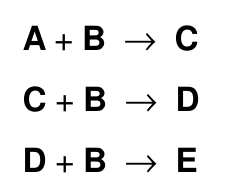
One mole of compound A reacts successively with 3 moles of compound B in aqueous solution in the presence of a basic catalyst (such as \(\ce{Ca(OH)2}\)):
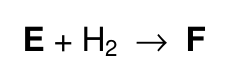
Hydrogenation of compound E yields compound F:
F has the composition: \(\ce{C} = 44.18\,\%,\quad \ce{H} = 8.82\,\%,\quad \ce{O} = 47.00\,\%.\)
Its molar mass: \(M = 136\ \mathrm{g\,mol^{-1}}\)
Knowing that 13.6 g of F reacts with 40.8 g acetic anhydride to form product G and acetic acid write down all chemical equations and assign the letters A, B, C, D, E, F, and G to particular formulas of compounds.
Official English text of the problem.
Answers
- Problem 6 — no numbered subparts or point values are printed.
| Compound | Name and condensed structural formula | SMILES |
|---|---|---|
| A | Ethanal (acetaldehyde), \(\ce{CH3CHO}\) | CC=O |
| B | Methanal (formaldehyde), \(\ce{HCHO}\) | C=O |
| C | 3-Hydroxypropanal, \(\ce{HOCH2CH2CHO}\) | O=CCCO |
| D | 3-Hydroxy-2-(hydroxymethyl)propanal, \(\ce{(HOCH2)2CHCHO}\) | O=CC(CO)CO |
| E | 3-Hydroxy-2,2-bis(hydroxymethyl)propanal (pentaerythrose), \(\ce{(HOCH2)3CCHO}\) | O=CC(CO)(CO)CO |
| F | Pentaerythritol, \(\ce{C(CH2OH)4}\), molecular formula \(\ce{C5H12O4}\) | C(CO)(CO)(CO)CO |
| G | Pentaerythritol tetraacetate, \(\ce{C(CH2OCOCH3)4}\), molecular formula \(\ce{C13H20O8}\) | C(COC(C)=O)(COC(C)=O)(COC(C)=O)COC(C)=O |
All seven compounds are achiral. The balanced equations are developed below in the order of the reaction sequence.
Solution
Determining the molecular formula and hydroxyl content of F.
Write the molecular formula as \(\ce{C_xH_yO_z}\). Using atomic molar masses of \(12\), \(1\), and \(16\ \mathrm{g\,mol^{-1}}\), respectively,
\[ \begin{aligned} x&=\frac{0.4418(136\ \mathrm{g\,mol^{-1}})} {12\ \mathrm{g\,mol^{-1}}}=5.007\approx5,\\ y&=\frac{0.0882(136\ \mathrm{g\,mol^{-1}})} {1\ \mathrm{g\,mol^{-1}}}=11.995\approx12,\\ z&=\frac{0.4700(136\ \mathrm{g\,mol^{-1}})} {16\ \mathrm{g\,mol^{-1}}}=3.995\approx4. \end{aligned} \]
Thus F has molecular formula \(\boxed{\ce{C5H12O4}}\), whose calculated molar mass is \(136\ \mathrm{g\,mol^{-1}}\).
Acetic anhydride, CC(=O)OC(C)=O, has formula \(\ce{C4H6O3}\) and molar mass
\[ M=4(12)+6(1)+3(16)=102\ \mathrm{g\,mol^{-1}}. \]
The reacting amounts are therefore
\[ n(\mathbf F)=\frac{13.6\ \mathrm g}{136\ \mathrm{g\,mol^{-1}}} =0.100\ \mathrm{mol}, \]
\[ n(\text{acetic anhydride}) =\frac{40.8\ \mathrm g}{102\ \mathrm{g\,mol^{-1}}} =0.400\ \mathrm{mol}. \]
Hence one mole of F consumes four moles of acetic anhydride. Each alcohol hydroxyl group consumes one anhydride molecule during acetylation, producing one ester group and one molecule of acetic acid, CC(=O)O. Consequently, F contains four hydroxyl groups, accounting for all four oxygen atoms.
Identifying A and B.
The aqueous basic conditions and successive additions indicate crossed aldol additions. In these reactions, methanal supplies a hydroxymethyl group, \(\ce{-CH2OH}\), while the original aldehyde group remains available for the final hydrogenation.
Three additions of one-carbon methanal to a five-carbon final skeleton leave two carbons in A. The required two-carbon aldehyde is ethanal. Its methyl group has exactly three hydrogens on the carbon adjacent to the aldehyde group, allowing three successive hydroxymethylations.
Thus A is ethanal and B is methanal. The first three equations below are base-catalysed; calcium hydroxide, [Ca+2].[OH-].[OH-], is the example given in the problem.
First addition: A + B → C.
\[ \boxed{\ce{CH3CHO + HCHO -> HOCH2CH2CHO}} \]
One hydrogen on ethanal’s methyl carbon is replaced by a hydroxymethyl group. The product is C, 3-hydroxypropanal.
Second addition: C + B → D.
\[ \boxed{\ce{HOCH2CH2CHO + HCHO -> (HOCH2)2CHCHO}} \]
The carbon adjacent to the aldehyde group still has two hydrogens. A second hydroxymethylation gives D, 3-hydroxy-2-(hydroxymethyl)propanal.
Third addition: D + B → E.
\[ \boxed{\ce{(HOCH2)2CHCHO + HCHO -> (HOCH2)3CCHO}} \]
The last hydrogen on that carbon is replaced, giving E, pentaerythrose, with molecular formula \(\ce{C5H10O4}\). Its central carbon now bears three hydroxymethyl groups and one aldehyde group. It has no remaining hydrogen adjacent to the aldehyde group, so this sequence of aldol additions stops.
These are addition reactions: no small molecule is eliminated.
Hydrogenation: E → F.
Hydrogen, [H][H], reduces the remaining aldehyde group to a fourth hydroxymethyl group:
\[ \boxed{\ce{(HOCH2)3CCHO + H2 -> C(CH2OH)4}} \]
The product F is therefore pentaerythritol, a central carbon bonded to four identical \(\ce{-CH2OH}\) groups. This agrees with both its molecular formula and its four acetylatable hydroxyl groups.
The overall synthesis through hydrogenation is
\[ \ce{CH3CHO + 3 HCHO + H2 -> C(CH2OH)4}. \]
Acetylation: F → G.
All four hydroxyl groups undergo acetylation:
\[ \boxed{ \ce{C(CH2OH)4 + 4 (CH3CO)2O -> C(CH2OCOCH3)4 + 4 CH3COOH} } \]
Thus G is pentaerythritol tetraacetate. Each hydroxyl hydrogen is replaced by an acetyl group, giving a net addition of \(\ce{C2H2O}\) per hydroxyl group. Its molecular formula is consequently
\[ \ce{C5H12O4} + 4(\ce{C2H2O}) \quad\Rightarrow\quad \boxed{\ce{C13H20O8}}. \]
The solution was checked against the official solution.
IChO 1983 · Theorieaufgabe 6
Identifizierung der Verbindungen A-G anhand einer basenkatalysierten Reaktionsfolge
Ein Mol der Verbindung A reagiert schrittweise mit 3 Mol der Verbindung B in wässriger Lösung in Gegenwart eines basischen Katalysators (wie etwa \(\ce{Ca(OH)2}\)):
Die Hydrierung der Verbindung E liefert die Verbindung F:
F hat die Zusammensetzung: \(\ce{C} = 44.18\,\%,\quad \ce{H} = 8.82\,\%,\quad \ce{O} = 47.00\,\%.\)
Die molare Masse beträgt: \(M = 136\ \mathrm{g\,mol^{-1}}\)
Unter Berücksichtigung der Tatsache, dass 13.6 g F mit 40.8 g Essigsäureanhydrid unter Bildung des Produkts G und von Essigsäure reagieren, geben Sie alle Reaktionsgleichungen an und ordnen Sie den Buchstaben A, B, C, D, E, F und G die jeweiligen Formeln der Verbindungen zu.
Aufgabentext aus dem offiziellen englischen Text übersetzt.
Antworten
- Aufgabe 6 — es sind keine nummerierten Teilaufgaben oder Punktzahlen angegeben.
| Verbindung | Name und Halbstrukturformel | SMILES |
|---|---|---|
| A | Ethanal (Acetaldehyd), \(\ce{CH3CHO}\) | CC=O |
| B | Methanal (Formaldehyd), \(\ce{HCHO}\) | C=O |
| C | 3-Hydroxypropanal, \(\ce{HOCH2CH2CHO}\) | O=CCCO |
| D | 3-Hydroxy-2-(hydroxymethyl)propanal, \(\ce{(HOCH2)2CHCHO}\) | O=CC(CO)CO |
| E | 3-Hydroxy-2,2-bis(hydroxymethyl)propanal (Pentaerythrose), \(\ce{(HOCH2)3CCHO}\) | O=CC(CO)(CO)CO |
| F | Pentaerythrit, \(\ce{C(CH2OH)4}\), Summenformel \(\ce{C5H12O4}\) | C(CO)(CO)(CO)CO |
| G | Pentaerythrittetraacetat, \(\ce{C(CH2OCOCH3)4}\), Summenformel \(\ce{C13H20O8}\) | C(COC(C)=O)(COC(C)=O)(COC(C)=O)COC(C)=O |
Alle sieben Verbindungen sind achiral. Die ausgeglichenen Reaktionsgleichungen werden im Folgenden in der Reihenfolge der Reaktionsschritte hergeleitet.
Lösung
Bestimmung der Summenformel und der Anzahl der Hydroxygruppen von F.
Die Summenformel wird als \(\ce{C_xH_yO_z}\) geschrieben. Mit den molaren Atommassen von \(12\), \(1\) bzw. \(16\ \mathrm{g\,mol^{-1}}\) ergibt sich
\[ \begin{aligned} x&=\frac{0.4418(136\ \mathrm{g\,mol^{-1}})} {12\ \mathrm{g\,mol^{-1}}}=5.007\approx5,\\ y&=\frac{0.0882(136\ \mathrm{g\,mol^{-1}})} {1\ \mathrm{g\,mol^{-1}}}=11.995\approx12,\\ z&=\frac{0.4700(136\ \mathrm{g\,mol^{-1}})} {16\ \mathrm{g\,mol^{-1}}}=3.995\approx4. \end{aligned} \]
Somit hat F die Summenformel \(\boxed{\ce{C5H12O4}}\), deren berechnete molare Masse \(136\ \mathrm{g\,mol^{-1}}\) beträgt.
Essigsäureanhydrid, CC(=O)OC(C)=O, hat die Formel \(\ce{C4H6O3}\) und die molare Masse
\[ M=4(12)+6(1)+3(16)=102\ \mathrm{g\,mol^{-1}}. \]
Die reagierenden Stoffmengen betragen daher
\[ n(\mathbf F)=\frac{13.6\ \mathrm g}{136\ \mathrm{g\,mol^{-1}}} =0.100\ \mathrm{mol}, \]
\[ n(\text{Essigsäureanhydrid}) =\frac{40.8\ \mathrm g}{102\ \mathrm{g\,mol^{-1}}} =0.400\ \mathrm{mol}. \]
Ein Mol F verbraucht folglich vier Mol Essigsäureanhydrid. Jede alkoholische Hydroxygruppe verbraucht bei der Acetylierung ein Anhydridmolekül, wobei eine Estergruppe und ein Molekül Essigsäure, CC(=O)O, entstehen. Folglich enthält F vier Hydroxygruppen, auf die alle vier Sauerstoffatome entfallen.
Identifizierung von A und B.
Die wässrig-basischen Bedingungen und die aufeinanderfolgenden Additionen deuten auf gekreuzte Aldoladditionen hin. Bei diesen Reaktionen liefert Methanal eine Hydroxymethylgruppe, \(\ce{-CH2OH}\), während die ursprüngliche Aldehydgruppe für die abschließende Hydrierung erhalten bleibt.
Bei drei Additionen von Methanal mit jeweils einem Kohlenstoffatom zu einem endgültigen Gerüst aus fünf Kohlenstoffatomen müssen zwei Kohlenstoffatome aus A stammen. Der erforderliche Aldehyd mit zwei Kohlenstoffatomen ist Ethanal. Seine Methylgruppe besitzt genau drei Wasserstoffatome an dem der Aldehydgruppe benachbarten Kohlenstoffatom, wodurch drei aufeinanderfolgende Hydroxymethylierungen möglich sind.
Somit ist A Ethanal und B Methanal. Die ersten drei nachstehenden Reaktionen sind basenkatalysiert; Calciumhydroxid, [Ca+2].[OH-].[OH-], ist das in der Aufgabe angegebene Beispiel.
Erste Addition: A + B → C.
\[ \boxed{\ce{CH3CHO + HCHO -> HOCH2CH2CHO}} \]
Ein Wasserstoffatom am Methylkohlenstoffatom des Ethanals wird durch eine Hydroxymethylgruppe ersetzt. Das Produkt ist C, 3-Hydroxypropanal.
Zweite Addition: C + B → D.
\[ \boxed{\ce{HOCH2CH2CHO + HCHO -> (HOCH2)2CHCHO}} \]
Das der Aldehydgruppe benachbarte Kohlenstoffatom trägt noch zwei Wasserstoffatome. Eine zweite Hydroxymethylierung liefert D, 3-Hydroxy-2-(hydroxymethyl)propanal.
Dritte Addition: D + B → E.
\[ \boxed{\ce{(HOCH2)2CHCHO + HCHO -> (HOCH2)3CCHO}} \]
Das letzte Wasserstoffatom an diesem Kohlenstoffatom wird ersetzt, wodurch E, Pentaerythrose, mit der Summenformel \(\ce{C5H10O4}\) entsteht. Ihr zentrales Kohlenstoffatom trägt nun drei Hydroxymethylgruppen und eine Aldehydgruppe. Sie besitzt kein weiteres Wasserstoffatom am Kohlenstoffatom neben der Aldehydgruppe, sodass diese Folge von Aldoladditionen endet.
Es handelt sich um Additionsreaktionen: Es wird kein kleines Molekül abgespalten.
Hydrierung: E → F.
Wasserstoff, [H][H], reduziert die verbleibende Aldehydgruppe zu einer vierten Hydroxymethylgruppe:
\[ \boxed{\ce{(HOCH2)3CCHO + H2 -> C(CH2OH)4}} \]
Das Produkt F ist daher Pentaerythrit, bei dem ein zentrales Kohlenstoffatom an vier identische \(\ce{-CH2OH}\)-Gruppen gebunden ist. Dies stimmt sowohl mit seiner Summenformel als auch mit seinen vier acetylierbaren Hydroxygruppen überein.
Die Gesamtreaktion der Synthese bis einschließlich der Hydrierung lautet
\[ \ce{CH3CHO + 3 HCHO + H2 -> C(CH2OH)4}. \]
Acetylierung: F → G.
Alle vier Hydroxygruppen werden acetyliert:
\[ \boxed{ \ce{C(CH2OH)4 + 4 (CH3CO)2O -> C(CH2OCOCH3)4 + 4 CH3COOH} } \]
Somit ist G Pentaerythrittetraacetat. Jedes Wasserstoffatom einer Hydroxygruppe wird durch eine Acetylgruppe ersetzt, sodass pro Hydroxygruppe netto \(\ce{C2H2O}\) hinzukommt. Seine Summenformel ergibt sich folglich zu
\[ \ce{C5H12O4} + 4(\ce{C2H2O}) \quad\Rightarrow\quad \boxed{\ce{C13H20O8}}. \]
Die Lösung wurde mit der offiziellen Lösung abgeglichen.
IChO 1983 · Teori sorusu 6
Baz katalizli bir tepkime dizisinden A-G bileşiklerinin belirlenmesi
Bir mol A bileşiği, sulu çözeltide bazik bir katalizör (örneğin \(\ce{Ca(OH)2}\)) varlığında 3 mol B bileşiği ile ardışık olarak tepkimeye girer:
E bileşiğinin hidrojenlenmesiyle F bileşiği elde edilir:
F bileşiğinin bileşimi şöyledir: \(\ce{C} = 44.18\,\%,\quad \ce{H} = 8.82\,\%,\quad \ce{O} = 47.00\,\%.\)
Molar kütlesi: \(M = 136\ \mathrm{g\,mol^{-1}}\)
13.6 g F bileşiğinin 40.8 g asetik anhidrit ile tepkimeye girerek G ürününü ve asetik asit oluşturduğunu bilerek tüm kimyasal denklemleri yazınız ve A, B, C, D, E, F ve G harflerini bileşiklerin ilgili formülleriyle eşleştiriniz.
Soru metni resmi İngilizce metinden çevrilmiştir.
Cevaplar
- Soru 6 — basılı metinde numaralandırılmış alt bölümler veya puan değerleri bulunmamaktadır.
| Bileşik | Adı ve yoğunlaştırılmış yapı formülü | SMILES |
|---|---|---|
| A | Etanal (asetaldehit), \(\ce{CH3CHO}\) | CC=O |
| B | Metanal (formaldehit), \(\ce{HCHO}\) | C=O |
| C | 3-Hidroksipropanal, \(\ce{HOCH2CH2CHO}\) | O=CCCO |
| D | 3-Hidroksi-2-(hidroksimetil)propanal, \(\ce{(HOCH2)2CHCHO}\) | O=CC(CO)CO |
| E | 3-Hidroksi-2,2-bis(hidroksimetil)propanal (pentaeritroz), \(\ce{(HOCH2)3CCHO}\) | O=CC(CO)(CO)CO |
| F | Pentaeritritol, \(\ce{C(CH2OH)4}\), molekül formülü \(\ce{C5H12O4}\) | C(CO)(CO)(CO)CO |
| G | Pentaeritritol tetraasetat, \(\ce{C(CH2OCOCH3)4}\), molekül formülü \(\ce{C13H20O8}\) | C(COC(C)=O)(COC(C)=O)(COC(C)=O)COC(C)=O |
Yedi bileşiğin tamamı akiraldir. Denkleştirilmiş denklemler aşağıda tepkime dizisindeki sıraya göre türetilmiştir.
Çözüm
F bileşiğinin molekül formülünün ve hidroksil grubu sayısının belirlenmesi.
Molekül formülünü \(\ce{C_xH_yO_z}\) olarak yazalım. Atomların molar kütleleri sırasıyla \(12\), \(1\) ve \(16\ \mathrm{g\,mol^{-1}}\) alınırsa,
\[ \begin{aligned} x&=\frac{0.4418(136\ \mathrm{g\,mol^{-1}})} {12\ \mathrm{g\,mol^{-1}}}=5.007\approx5,\\ y&=\frac{0.0882(136\ \mathrm{g\,mol^{-1}})} {1\ \mathrm{g\,mol^{-1}}}=11.995\approx12,\\ z&=\frac{0.4700(136\ \mathrm{g\,mol^{-1}})} {16\ \mathrm{g\,mol^{-1}}}=3.995\approx4. \end{aligned} \]
Böylece F bileşiğinin molekül formülü \(\boxed{\ce{C5H12O4}}\) olur; bu formülden hesaplanan molar kütle \(136\ \mathrm{g\,mol^{-1}}\) değerindedir.
Asetik anhidridin, CC(=O)OC(C)=O, formülü \(\ce{C4H6O3}\) olup molar kütlesi şöyledir:
\[ M=4(12)+6(1)+3(16)=102\ \mathrm{g\,mol^{-1}}. \]
Dolayısıyla tepkimeye giren madde miktarları şöyledir:
\[ n(\mathbf F)=\frac{13.6\ \mathrm g}{136\ \mathrm{g\,mol^{-1}}} =0.100\ \mathrm{mol}, \]
\[ n(\text{asetik anhidrit}) =\frac{40.8\ \mathrm g}{102\ \mathrm{g\,mol^{-1}}} =0.400\ \mathrm{mol}. \]
Buna göre bir mol F, dört mol asetik anhidrit tüketir. Her alkol hidroksil grubu, asetillenme sırasında bir anhidrit molekülü tüketerek bir ester grubu ve bir asetik asit molekülü, CC(=O)O, oluşturur. Sonuç olarak F, dört hidroksil grubu içerir ve bu gruplar dört oksijen atomunun tamamını içerir.
A ve B bileşiklerinin belirlenmesi.
Sulu bazik ortam koşulları ve ardışık katılmalar, çapraz aldol katılmalarına işaret eder. Bu tepkimelerde metanal bir hidroksimetil grubu, \(\ce{-CH2OH}\), sağlarken başlangıçtaki aldehit grubu son hidrojenlenme adımı için korunur.
Son ürünün beş karbonlu iskeletinden, tek karbonlu metanalin üç kez katılmasıyla gelen karbonlar çıkarıldığında A bileşiğinde iki karbon kalır. Gerekli iki karbonlu aldehit etanaldir. Etanalin metil grubunda, aldehit grubuna komşu karbon üzerinde tam olarak üç hidrojen bulunur; bu da art arda üç hidroksimetillenmeye olanak tanır.
Dolayısıyla A etanal, B ise metanaldir. Aşağıdaki ilk üç denklem baz katalizli tepkimelere aittir; kalsiyum hidroksit, [Ca+2].[OH-].[OH-], soruda verilen örnektir.
Birinci katılma: A + B → C.
\[ \boxed{\ce{CH3CHO + HCHO -> HOCH2CH2CHO}} \]
Etanalin metil karbonundaki bir hidrojenin yerini bir hidroksimetil grubu alır. Ürün, 3-hidroksipropanal olan C bileşiğidir.
İkinci katılma: C + B → D.
\[ \boxed{\ce{HOCH2CH2CHO + HCHO -> (HOCH2)2CHCHO}} \]
Aldehit grubuna komşu karbonda hâlâ iki hidrojen bulunur. İkinci bir hidroksimetillenme, 3-hidroksi-2-(hidroksimetil)propanal olan D bileşiğini verir.
Üçüncü katılma: D + B → E.
\[ \boxed{\ce{(HOCH2)2CHCHO + HCHO -> (HOCH2)3CCHO}} \]
Bu karbondaki son hidrojenin de yerini bir hidroksimetil grubu alır ve molekül formülü \(\ce{C5H10O4}\) olan E, pentaeritroz, oluşur. Merkezdeki karbon artık üç hidroksimetil grubu ve bir aldehit grubu taşır. Aldehit grubuna komşu karbonda hiç hidrojen kalmadığından bu aldol katılmaları dizisi sona erer.
Bunlar katılma tepkimeleridir: küçük bir molekül ayrılmaz.
Hidrojenlenme: E → F.
Hidrojen, [H][H], kalan aldehit grubunu dördüncü bir hidroksimetil grubuna indirger:
\[ \boxed{\ce{(HOCH2)3CCHO + H2 -> C(CH2OH)4}} \]
Dolayısıyla F ürünü, merkezdeki bir karbonun dört özdeş \(\ce{-CH2OH}\) grubuna bağlı olduğu pentaeritritoldür. Bu yapı hem molekül formülüyle hem de asetillenebilen dört hidroksil grubunun bulunmasıyla uyumludur.
Hidrojenlenme adımı dâhil sentezin toplam tepkimesi şöyledir:
\[ \ce{CH3CHO + 3 HCHO + H2 -> C(CH2OH)4}. \]
Asetillenme: F → G.
Dört hidroksil grubunun tamamı asetillenir:
\[ \boxed{ \ce{C(CH2OH)4 + 4 (CH3CO)2O -> C(CH2OCOCH3)4 + 4 CH3COOH} } \]
Böylece G, pentaeritritol tetraasetattır. Her hidroksil hidrojeninin yerini bir asetil grubu alır; bunun sonucunda hidroksil grubu başına net olarak \(\ce{C2H2O}\) eklenir. Dolayısıyla molekül formülü şöyle bulunur:
\[ \ce{C5H12O4} + 4(\ce{C2H2O}) \quad\Rightarrow\quad \boxed{\ce{C13H20O8}}. \]
Çözüm, resmi çözümle karşılaştırılarak kontrol edildi.
IChO 1983 · Problema teórico 6
Identificación de los compuestos A-G a partir de una secuencia de reacciones catalizadas por una base
Un mol del compuesto A reacciona sucesivamente con 3 moles del compuesto B en disolución acuosa en presencia de un catalizador básico (como \(\ce{Ca(OH)2}\)):
La hidrogenación del compuesto E da lugar al compuesto F:
F tiene la siguiente composición: \(\ce{C} = 44.18\,\%,\quad \ce{H} = 8.82\,\%,\quad \ce{O} = 47.00\,\%.\)
Su masa molar: \(M = 136\ \mathrm{g\,mol^{-1}}\)
Sabiendo que 13.6 g de F reaccionan con 40.8 g de anhídrido acético para formar el producto G y ácido acético, escriba todas las ecuaciones químicas y asigne las letras A, B, C, D, E, F y G a las fórmulas concretas de los compuestos.
Enunciado traducido del texto oficial en inglés.
Respuestas
- Problema 6 — no se indican apartados numerados ni puntuaciones.
| Compuesto | Nombre y fórmula estructural condensada | SMILES |
|---|---|---|
| A | Etanal (acetaldehído), \(\ce{CH3CHO}\) | CC=O |
| B | Metanal (formaldehído), \(\ce{HCHO}\) | C=O |
| C | 3-Hidroxipropanal, \(\ce{HOCH2CH2CHO}\) | O=CCCO |
| D | 3-Hidroxi-2-(hidroximetil)propanal, \(\ce{(HOCH2)2CHCHO}\) | O=CC(CO)CO |
| E | 3-Hidroxi-2,2-bis(hidroximetil)propanal (pentaeritrosa), \(\ce{(HOCH2)3CCHO}\) | O=CC(CO)(CO)CO |
| F | Pentaeritritol, \(\ce{C(CH2OH)4}\), fórmula molecular \(\ce{C5H12O4}\) | C(CO)(CO)(CO)CO |
| G | Tetraacetato de pentaeritritol, \(\ce{C(CH2OCOCH3)4}\), fórmula molecular \(\ce{C13H20O8}\) | C(COC(C)=O)(COC(C)=O)(COC(C)=O)COC(C)=O |
Los siete compuestos son aquirales. Las ecuaciones ajustadas se desarrollan a continuación siguiendo el orden de la secuencia de reacciones.
Solución
Determinación de la fórmula molecular y del número de grupos hidroxilo de F.
Escribimos la fórmula molecular como \(\ce{C_xH_yO_z}\). Utilizando masas molares atómicas de \(12\), \(1\) y \(16\ \mathrm{g\,mol^{-1}}\), respectivamente,
\[ \begin{aligned} x&=\frac{0.4418(136\ \mathrm{g\,mol^{-1}})} {12\ \mathrm{g\,mol^{-1}}}=5.007\approx5,\\ y&=\frac{0.0882(136\ \mathrm{g\,mol^{-1}})} {1\ \mathrm{g\,mol^{-1}}}=11.995\approx12,\\ z&=\frac{0.4700(136\ \mathrm{g\,mol^{-1}})} {16\ \mathrm{g\,mol^{-1}}}=3.995\approx4. \end{aligned} \]
Por tanto, F tiene la fórmula molecular \(\boxed{\ce{C5H12O4}}\), cuya masa molar calculada es \(136\ \mathrm{g\,mol^{-1}}\).
El anhídrido acético, CC(=O)OC(C)=O, tiene la fórmula \(\ce{C4H6O3}\) y la masa molar
\[ M=4(12)+6(1)+3(16)=102\ \mathrm{g\,mol^{-1}}. \]
Las cantidades de sustancia que reaccionan son, por tanto,
\[ n(\mathbf F)=\frac{13.6\ \mathrm g}{136\ \mathrm{g\,mol^{-1}}} =0.100\ \mathrm{mol}, \]
\[ n(\text{anhídrido acético}) =\frac{40.8\ \mathrm g}{102\ \mathrm{g\,mol^{-1}}} =0.400\ \mathrm{mol}. \]
Por consiguiente, un mol de F consume cuatro moles de anhídrido acético. Cada grupo hidroxilo alcohólico consume una molécula de anhídrido durante la acetilación y produce un grupo éster y una molécula de ácido acético, CC(=O)O. En consecuencia, F contiene cuatro grupos hidroxilo, que dan cuenta de los cuatro átomos de oxígeno.
Identificación de A y B.
Las condiciones básicas en medio acuoso y las adiciones sucesivas indican que se trata de adiciones aldólicas cruzadas. En estas reacciones, el metanal aporta un grupo hidroximetilo, \(\ce{-CH2OH}\), mientras que el grupo aldehído original permanece disponible para la hidrogenación final.
Las tres adiciones de metanal, de un átomo de carbono, para obtener un esqueleto final de cinco átomos de carbono implican que A contiene dos átomos de carbono. El aldehído de dos átomos de carbono requerido es el etanal. Su grupo metilo tiene exactamente tres hidrógenos en el carbono adyacente al grupo aldehído, lo que permite tres hidroximetilaciones sucesivas.
Por tanto, A es etanal y B es metanal. Las tres primeras ecuaciones que se muestran a continuación están catalizadas por una base; el hidróxido de calcio, [Ca+2].[OH-].[OH-], es el ejemplo que se da en el enunciado.
Primera adición: A + B → C.
\[ \boxed{\ce{CH3CHO + HCHO -> HOCH2CH2CHO}} \]
Un hidrógeno del carbono del grupo metilo del etanal se sustituye por un grupo hidroximetilo. El producto es C, 3-hidroxipropanal.
Segunda adición: C + B → D.
\[ \boxed{\ce{HOCH2CH2CHO + HCHO -> (HOCH2)2CHCHO}} \]
El carbono adyacente al grupo aldehído todavía tiene dos hidrógenos. Una segunda hidroximetilación da lugar a D, 3-hidroxi-2-(hidroximetil)propanal.
Tercera adición: D + B → E.
\[ \boxed{\ce{(HOCH2)2CHCHO + HCHO -> (HOCH2)3CCHO}} \]
Se sustituye el último hidrógeno de ese carbono y se obtiene E, pentaeritrosa, con fórmula molecular \(\ce{C5H10O4}\). Su carbono central está ahora unido a tres grupos hidroximetilo y un grupo aldehído. Ya no queda ningún hidrógeno adyacente al grupo aldehído, por lo que esta secuencia de adiciones aldólicas se detiene.
Estas son reacciones de adición: no se elimina ninguna molécula pequeña.
Hidrogenación: E → F.
El hidrógeno, [H][H], reduce el grupo aldehído restante a un cuarto grupo hidroximetilo:
\[ \boxed{\ce{(HOCH2)3CCHO + H2 -> C(CH2OH)4}} \]
El producto F es, por tanto, pentaeritritol, un carbono central unido a cuatro grupos \(\ce{-CH2OH}\) idénticos. Esto concuerda tanto con su fórmula molecular como con sus cuatro grupos hidroxilo acetilables.
La síntesis global hasta la hidrogenación incluida es
\[ \ce{CH3CHO + 3 HCHO + H2 -> C(CH2OH)4}. \]
Acetilación: F → G.
Los cuatro grupos hidroxilo experimentan acetilación:
\[ \boxed{ \ce{C(CH2OH)4 + 4 (CH3CO)2O -> C(CH2OCOCH3)4 + 4 CH3COOH} } \]
Por tanto, G es tetraacetato de pentaeritritol. Cada hidrógeno hidroxílico se sustituye por un grupo acetilo, lo que supone una adición neta de \(\ce{C2H2O}\) por grupo hidroxilo. Su fórmula molecular es, en consecuencia,
\[ \ce{C5H12O4} + 4(\ce{C2H2O}) \quad\Rightarrow\quad \boxed{\ce{C13H20O8}}. \]
La solución se comprobó con la solución oficial.
IChO 1983 · 理论题 6
通过碱催化反应序列鉴定化合物 A-G
在碱性催化剂(如 \(\ce{Ca(OH)2}\))存在下,1 摩尔化合物 A 在水溶液中依次与 3 摩尔化合物 B 反应:
化合物 E 经氢化生成化合物 F:
F 的组成如下:\(\ce{C} = 44.18\,\%,\quad \ce{H} = 8.82\,\%,\quad \ce{O} = 47.00\,\%.\)
其摩尔质量为:\(M = 136\ \mathrm{g\,mol^{-1}}\)
已知 13.6 g F 与 40.8 g 乙酸酐反应,生成产物 G 和乙酸,写出所有化学方程式,并确定字母 A、B、C、D、E、F 和 G 各自所代表的化合物的具体化学式。
题目译自官方英文原文。
答案
- 题目 6 — 原题未列出带编号的小题或分值。
| 化合物 | 名称及结构简式 | SMILES |
|---|---|---|
| A | 乙醛(醋醛),\(\ce{CH3CHO}\) | CC=O |
| B | 甲醛(蚁醛),\(\ce{HCHO}\) | C=O |
| C | 3-羟基丙醛,\(\ce{HOCH2CH2CHO}\) | O=CCCO |
| D | 3-羟基-2-(羟甲基)丙醛,\(\ce{(HOCH2)2CHCHO}\) | O=CC(CO)CO |
| E | 3-羟基-2,2-双(羟甲基)丙醛(季戊四糖),\(\ce{(HOCH2)3CCHO}\) | O=CC(CO)(CO)CO |
| F | 季戊四醇,\(\ce{C(CH2OH)4}\),分子式为 \(\ce{C5H12O4}\) | C(CO)(CO)(CO)CO |
| G | 季戊四醇四乙酸酯,\(\ce{C(CH2OCOCH3)4}\),分子式为 \(\ce{C13H20O8}\) | C(COC(C)=O)(COC(C)=O)(COC(C)=O)COC(C)=O |
这七种化合物均无手性。下文将按反应序列的顺序推导配平的化学方程式。
解答
确定 F 的分子式及羟基数目。
将分子式写为 \(\ce{C_xH_yO_z}\)。分别采用 \(12\)、\(1\) 和 \(16\ \mathrm{g\,mol^{-1}}\) 作为各元素原子的摩尔质量,得到
\[ \begin{aligned} x&=\frac{0.4418(136\ \mathrm{g\,mol^{-1}})} {12\ \mathrm{g\,mol^{-1}}}=5.007\approx5,\\ y&=\frac{0.0882(136\ \mathrm{g\,mol^{-1}})} {1\ \mathrm{g\,mol^{-1}}}=11.995\approx12,\\ z&=\frac{0.4700(136\ \mathrm{g\,mol^{-1}})} {16\ \mathrm{g\,mol^{-1}}}=3.995\approx4. \end{aligned} \]
因此,F 的分子式为 \(\boxed{\ce{C5H12O4}}\),由此计算的摩尔质量为 \(136\ \mathrm{g\,mol^{-1}}\)。
乙酸酐 CC(=O)OC(C)=O 的分子式为 \(\ce{C4H6O3}\),摩尔质量为
\[ M=4(12)+6(1)+3(16)=102\ \mathrm{g\,mol^{-1}}. \]
因此,参与反应的物质的量为
\[ n(\mathbf F)=\frac{13.6\ \mathrm g}{136\ \mathrm{g\,mol^{-1}}} =0.100\ \mathrm{mol}, \]
\[ n(\text{乙酸酐}) =\frac{40.8\ \mathrm g}{102\ \mathrm{g\,mol^{-1}}} =0.400\ \mathrm{mol}. \]
所以,1 摩尔 F 消耗 4 摩尔乙酸酐。在乙酰化过程中,每个醇羟基消耗一个酸酐分子,生成一个酯基和一个乙酸分子 CC(=O)O。因此,F 含有四个羟基,其全部四个氧原子均属于这些羟基。
确定 A 和 B。
水溶液中的碱性条件以及连续加成表明,这些反应是交叉羟醛加成反应。在这些反应中,甲醛提供羟甲基 \(\ce{-CH2OH}\),而原有的醛基保留下来,可在最后进行氢化。
最终骨架含有五个碳原子,其中三个来自单碳甲醛的三次加成,因此 A 含有两个碳原子。所需的二碳醛是乙醛。其甲基碳原子与醛基相邻,且恰好带有三个氢原子,因此可以连续进行三次羟甲基化。
因此,A 是乙醛,B 是甲醛。下面的前三个反应均由碱催化;题目中给出的催化剂示例是氢氧化钙 [Ca+2].[OH-].[OH-]。
第一次加成:A + B → C。
\[ \boxed{\ce{CH3CHO + HCHO -> HOCH2CH2CHO}} \]
乙醛甲基碳原子上的一个氢原子被羟甲基取代。产物为 C,即 3-羟基丙醛。
第二次加成:C + B → D。
\[ \boxed{\ce{HOCH2CH2CHO + HCHO -> (HOCH2)2CHCHO}} \]
与醛基相邻的碳原子上仍有两个氢原子。第二次羟甲基化生成 D,即 3-羟基-2-(羟甲基)丙醛。
第三次加成:D + B → E。
\[ \boxed{\ce{(HOCH2)2CHCHO + HCHO -> (HOCH2)3CCHO}} \]
该碳原子上的最后一个氢原子被取代,生成 E,即季戊四糖,其分子式为 \(\ce{C5H10O4}\)。此时,其中心碳原子连接三个羟甲基和一个醛基。与醛基相邻的碳原子上已无氢原子,因此这一系列羟醛加成反应到此终止。
这些反应都是加成反应:没有小分子被消去。
氢化:E → F。
氢气 [H][H] 将剩余的醛基还原为第四个羟甲基:
\[ \boxed{\ce{(HOCH2)3CCHO + H2 -> C(CH2OH)4}} \]
因此,产物 F 是季戊四醇,其中心碳原子连接四个相同的 \(\ce{-CH2OH}\) 基团。这既与其分子式一致,也与其含有四个可乙酰化的羟基相符。
截至氢化步骤的总合成反应为
\[ \ce{CH3CHO + 3 HCHO + H2 -> C(CH2OH)4}. \]
乙酰化:F → G。
四个羟基全部发生乙酰化:
\[ \boxed{ \ce{C(CH2OH)4 + 4 (CH3CO)2O -> C(CH2OCOCH3)4 + 4 CH3COOH} } \]
因此,G 是季戊四醇四乙酸酯。每个羟基的氢原子均被乙酰基取代,相当于每个羟基净增加 \(\ce{C2H2O}\)。因此,其分子式为
\[ \ce{C5H12O4} + 4(\ce{C2H2O}) \quad\Rightarrow\quad \boxed{\ce{C13H20O8}}. \]
解答已与官方解答核对。
IChO 1983 · Теоретическая задача 6
Определение соединений A-G в последовательности реакций, катализируемых основанием
Один моль соединения A последовательно реагирует с 3 молями соединения B в водном растворе в присутствии основного катализатора (например, \(\ce{Ca(OH)2}\)):
При гидрировании соединения E образуется соединение F:
F имеет следующий состав: \(\ce{C} = 44.18\,\%,\quad \ce{H} = 8.82\,\%,\quad \ce{O} = 47.00\,\%.\)
Его молярная масса: \(M = 136\ \mathrm{g\,mol^{-1}}\)
Зная, что 13.6 г F реагирует с 40.8 г уксусного ангидрида с образованием продукта G и уксусной кислоты, запишите все уравнения химических реакций и установите соответствие между буквами A, B, C, D, E, F и G и конкретными формулами соединений.
Условие переведено с официального английского текста.
Ответы
- Задача 6 — нумерованные подпункты и количество баллов в условии не указаны.
| Соединение | Название и сокращённая структурная формула | SMILES |
|---|---|---|
| A | Этаналь (ацетальдегид), \(\ce{CH3CHO}\) | CC=O |
| B | Метаналь (формальдегид), \(\ce{HCHO}\) | C=O |
| C | 3-Гидроксипропаналь, \(\ce{HOCH2CH2CHO}\) | O=CCCO |
| D | 3-Гидрокси-2-(гидроксиметил)пропаналь, \(\ce{(HOCH2)2CHCHO}\) | O=CC(CO)CO |
| E | 3-Гидрокси-2,2-бис(гидроксиметил)пропаналь (пентаэритроза), \(\ce{(HOCH2)3CCHO}\) | O=CC(CO)(CO)CO |
| F | Пентаэритрит, \(\ce{C(CH2OH)4}\), молекулярная формула \(\ce{C5H12O4}\) | C(CO)(CO)(CO)CO |
| G | Тетраацетат пентаэритрита, \(\ce{C(CH2OCOCH3)4}\), молекулярная формула \(\ce{C13H20O8}\) | C(COC(C)=O)(COC(C)=O)(COC(C)=O)COC(C)=O |
Все семь соединений ахиральны. Уравнения с расставленными коэффициентами приведены ниже в порядке следования реакций.
Решение
Определение молекулярной формулы и числа гидроксильных групп в F.
Запишем молекулярную формулу в виде \(\ce{C_xH_yO_z}\). Используя молярные массы атомов, равные соответственно \(12\), \(1\) и \(16\ \mathrm{g\,mol^{-1}}\), получаем:
\[ \begin{aligned} x&=\frac{0.4418(136\ \mathrm{g\,mol^{-1}})} {12\ \mathrm{g\,mol^{-1}}}=5.007\approx5,\\ y&=\frac{0.0882(136\ \mathrm{g\,mol^{-1}})} {1\ \mathrm{g\,mol^{-1}}}=11.995\approx12,\\ z&=\frac{0.4700(136\ \mathrm{g\,mol^{-1}})} {16\ \mathrm{g\,mol^{-1}}}=3.995\approx4. \end{aligned} \]
Таким образом, молекулярная формула F — \(\boxed{\ce{C5H12O4}}\), а рассчитанная по ней молярная масса равна \(136\ \mathrm{g\,mol^{-1}}\).
Уксусный ангидрид, CC(=O)OC(C)=O, имеет формулу \(\ce{C4H6O3}\) и молярную массу
\[ M=4(12)+6(1)+3(16)=102\ \mathrm{g\,mol^{-1}}. \]
Следовательно, количества реагирующих веществ составляют
\[ n(\mathbf F)=\frac{13.6\ \mathrm g}{136\ \mathrm{g\,mol^{-1}}} =0.100\ \mathrm{mol}, \]
\[ n(\text{уксусного ангидрида}) =\frac{40.8\ \mathrm g}{102\ \mathrm{g\,mol^{-1}}} =0.400\ \mathrm{mol}. \]
Следовательно, на один моль F расходуется четыре моля уксусного ангидрида. При ацетилировании каждая спиртовая гидроксильная группа расходует одну молекулу ангидрида, при этом образуются одна сложноэфирная группа и одна молекула уксусной кислоты, CC(=O)O. Таким образом, F содержит четыре гидроксильные группы, на которые приходятся все четыре атома кислорода.
Определение A и B.
Водная щелочная среда и последовательные реакции присоединения указывают на перекрёстное альдольное присоединение. В этих реакциях метаналь вводит гидроксиметильную группу \(\ce{-CH2OH}\), а исходная альдегидная группа сохраняется для заключительного гидрирования.
Три присоединения одноуглеродного метаналя к исходному соединению дают конечный пятиуглеродный скелет, поэтому в A должно быть два атома углерода. Требуемый двухуглеродный альдегид — этаналь. Его метильная группа содержит ровно три атома водорода при атоме углерода, соседнем с альдегидной группой, что позволяет провести три последовательных гидроксиметилирования.
Таким образом, A — этаналь, а B — метаналь. Первые три реакции, уравнения которых приведены ниже, катализируются основанием; гидроксид кальция, [Ca+2].[OH-].[OH-], приведён в условии в качестве примера.
Первое присоединение: A + B → C.
\[ \boxed{\ce{CH3CHO + HCHO -> HOCH2CH2CHO}} \]
Один атом водорода при метильном атоме углерода этаналя замещается гидроксиметильной группой. Продукт — C, 3-гидроксипропаналь.
Второе присоединение: C + B → D.
\[ \boxed{\ce{HOCH2CH2CHO + HCHO -> (HOCH2)2CHCHO}} \]
При атоме углерода, соседнем с альдегидной группой, всё ещё имеются два атома водорода. Второе гидроксиметилирование приводит к образованию D, 3-гидрокси-2-(гидроксиметил)пропаналя.
Третье присоединение: D + B → E.
\[ \boxed{\ce{(HOCH2)2CHCHO + HCHO -> (HOCH2)3CCHO}} \]
Последний атом водорода при этом атоме углерода замещается с образованием E, пентаэритрозы, с молекулярной формулой \(\ce{C5H10O4}\). Теперь её центральный атом углерода связан с тремя гидроксиметильными группами и одной альдегидной группой. При атоме углерода, соседнем с альдегидной группой, больше нет атомов водорода, поэтому данная последовательность альдольных присоединений прекращается.
Это реакции присоединения: отщепления низкомолекулярных веществ не происходит.
Гидрирование: E → F.
Водород, [H][H], восстанавливает сохранившуюся альдегидную группу до четвёртой гидроксиметильной группы:
\[ \boxed{\ce{(HOCH2)3CCHO + H2 -> C(CH2OH)4}} \]
Следовательно, продукт F — пентаэритрит, в котором центральный атом углерода связан с четырьмя одинаковыми группами \(\ce{-CH2OH}\). Это согласуется как с его молекулярной формулой, так и с наличием четырёх гидроксильных групп, способных к ацетилированию.
Суммарное уравнение синтеза, включая стадию гидрирования, имеет вид
\[ \ce{CH3CHO + 3 HCHO + H2 -> C(CH2OH)4}. \]
Ацетилирование: F → G.
Все четыре гидроксильные группы подвергаются ацетилированию:
\[ \boxed{ \ce{C(CH2OH)4 + 4 (CH3CO)2O -> C(CH2OCOCH3)4 + 4 CH3COOH} } \]
Таким образом, G — тетраацетат пентаэритрита. Каждый атом водорода гидроксильной группы замещается ацетильной группой, что даёт суммарное увеличение состава на \(\ce{C2H2O}\) в расчёте на каждую гидроксильную группу. Следовательно, его молекулярная формула определяется следующим образом:
\[ \ce{C5H12O4} + 4(\ce{C2H2O}) \quad\Rightarrow\quad \boxed{\ce{C13H20O8}}. \]
Решение проверено по официальному решению.
IChO 1983 · مسألة نظرية 6
تعيين هوية المركبات A-G من تتابع تفاعلات محفَّزة بقاعدة
يتفاعل مول واحد من المركب A على التوالي مع 3 مولات من المركب B في محلول مائي بوجود حفّاز قاعدي (مثل \(\ce{Ca(OH)2}\)):
تؤدي هدرجة المركب E إلى المركب F:
للمركب F التركيب الآتي: \(\ce{C} = 44.18\,\%,\quad \ce{H} = 8.82\,\%,\quad \ce{O} = 47.00\,\%.\)
كتلته المولية: \(M = 136\ \mathrm{g\,mol^{-1}}\)
بمعرفة أن 13.6 g من F تتفاعل مع 40.8 g من أنهيدريد الأسيتيك لتكوين الناتج G وحمض الأسيتيك، اكتب جميع المعادلات الكيميائية وعيّن صيغ المركبات التي تقابل الحروف A وB وC وD وE وF وG.
نص المسألة مترجم عن النص الإنجليزي الرسمي.
الإجابات
- المسألة 6 — لا توجد أجزاء فرعية مرقّمة أو درجات مطبوعة.
| المركب | الاسم والصيغة البنائية المكثفة | SMILES |
|---|---|---|
| A | إيثانال (أسيتالدهيد)، \(\ce{CH3CHO}\) | CC=O |
| B | ميثانال (فورمالدهيد)، \(\ce{HCHO}\) | C=O |
| C | 3-هيدروكسي بروبانال، \(\ce{HOCH2CH2CHO}\) | O=CCCO |
| D | 3-هيدروكسي-2-(هيدروكسي ميثيل) بروبانال، \(\ce{(HOCH2)2CHCHO}\) | O=CC(CO)CO |
| E | 3-هيدروكسي-2,2-بيس(هيدروكسي ميثيل) بروبانال (بنتا إريثروز)، \(\ce{(HOCH2)3CCHO}\) | O=CC(CO)(CO)CO |
| F | بنتا إريثريتول، \(\ce{C(CH2OH)4}\)، الصيغة الجزيئية \(\ce{C5H12O4}\) | C(CO)(CO)(CO)CO |
| G | رباعي أسيتات البنتا إريثريتول، \(\ce{C(CH2OCOCH3)4}\)، الصيغة الجزيئية \(\ce{C13H20O8}\) | C(COC(C)=O)(COC(C)=O)(COC(C)=O)COC(C)=O |
المركبات السبعة جميعها غير كيرالية. تُستنتج المعادلات الموزونة أدناه وفق ترتيب تتابع التفاعلات.
الحل
تحديد الصيغة الجزيئية وعدد مجموعات الهيدروكسيل في F.
نكتب الصيغة الجزيئية على الصورة \(\ce{C_xH_yO_z}\). باستخدام الكتل المولية الذرية \(12\) و\(1\) و\(16\ \mathrm{g\,mol^{-1}}\)، على الترتيب،
\[ \begin{aligned} x&=\frac{0.4418(136\ \mathrm{g\,mol^{-1}})} {12\ \mathrm{g\,mol^{-1}}}=5.007\approx5,\\ y&=\frac{0.0882(136\ \mathrm{g\,mol^{-1}})} {1\ \mathrm{g\,mol^{-1}}}=11.995\approx12,\\ z&=\frac{0.4700(136\ \mathrm{g\,mol^{-1}})} {16\ \mathrm{g\,mol^{-1}}}=3.995\approx4. \end{aligned} \]
إذن، الصيغة الجزيئية للمركب F هي \(\boxed{\ce{C5H12O4}}\)، وكتلته المولية المحسوبة هي \(136\ \mathrm{g\,mol^{-1}}\).
أنهيدريد الأسيتيك، CC(=O)OC(C)=O، صيغته \(\ce{C4H6O3}\) وكتلته المولية
\[ M=4(12)+6(1)+3(16)=102\ \mathrm{g\,mol^{-1}}. \]
وعليه، فإن كميتي المادة المتفاعلتين هما
\[ n(\mathbf F)=\frac{13.6\ \mathrm g}{136\ \mathrm{g\,mol^{-1}}} =0.100\ \mathrm{mol}, \]
\[ n(\text{أنهيدريد الأسيتيك}) =\frac{40.8\ \mathrm g}{102\ \mathrm{g\,mol^{-1}}} =0.400\ \mathrm{mol}. \]
وبالتالي، يستهلك مول واحد من F أربعة مولات من أنهيدريد الأسيتيك. تستهلك كل مجموعة هيدروكسيل كحولية جزيئًا واحدًا من الأنهيدريد أثناء الأستلة، منتجةً مجموعة إستر واحدة وجزيئًا واحدًا من حمض الأسيتيك، CC(=O)O. ومن ثم، يحتوي F على أربع مجموعات هيدروكسيل، تضم ذرات الأكسجين الأربع جميعها.
تعيين هوية A وB.
تشير الظروف القاعدية المائية وتفاعلات الإضافة المتتالية إلى تفاعلات إضافة ألدولية متصالبة. في هذه التفاعلات، يزوّد الميثانال المركب بمجموعة هيدروكسي ميثيل، \(\ce{-CH2OH}\)، بينما تبقى مجموعة الألدهيد الأصلية متاحة للهدرجة النهائية.
تترك ثلاث إضافات من الميثانال، الذي يحوي ذرة كربون واحدة، إلى هيكل نهائي يحوي خمس ذرات كربون، ذرتي كربون في A. والألدهيد المطلوب ذو ذرتي الكربون هو الإيثانال. تحتوي مجموعة الميثيل فيه على ثلاث ذرات هيدروجين بالضبط مرتبطة بذرة الكربون المجاورة لمجموعة الألدهيد، مما يسمح بثلاث عمليات متتالية لإدخال مجموعات هيدروكسي ميثيل.
إذن، A هو الإيثانال وB هو الميثانال. المعادلات الثلاث الأولى أدناه لتفاعلات محفَّزة بقاعدة؛ وهيدروكسيد الكالسيوم، [Ca+2].[OH-].[OH-]، هو المثال المعطى في المسألة.
الإضافة الأولى: A + B → C.
\[ \boxed{\ce{CH3CHO + HCHO -> HOCH2CH2CHO}} \]
تحل مجموعة هيدروكسي ميثيل محل ذرة هيدروجين واحدة مرتبطة بكربون مجموعة الميثيل في الإيثانال. والناتج هو C، 3-هيدروكسي بروبانال.
الإضافة الثانية: C + B → D.
\[ \boxed{\ce{HOCH2CH2CHO + HCHO -> (HOCH2)2CHCHO}} \]
لا تزال ذرة الكربون المجاورة لمجموعة الألدهيد تحمل ذرتي هيدروجين. ويعطي إدخال مجموعة هيدروكسي ميثيل ثانية المركب D، 3-هيدروكسي-2-(هيدروكسي ميثيل) بروبانال.
الإضافة الثالثة: D + B → E.
\[ \boxed{\ce{(HOCH2)2CHCHO + HCHO -> (HOCH2)3CCHO}} \]
تُستبدل ذرة الهيدروجين الأخيرة المرتبطة بذرة الكربون تلك، فينتج E، البنتا إريثروز، ذو الصيغة الجزيئية \(\ce{C5H10O4}\). تحمل ذرة الكربون المركزية فيه الآن ثلاث مجموعات هيدروكسي ميثيل ومجموعة ألدهيد واحدة. ولا تبقى فيه أي ذرة هيدروجين مرتبطة بالكربون المجاور لمجموعة الألدهيد، لذا يتوقف هذا التتابع من تفاعلات الإضافة الألدولية.
هذه تفاعلات إضافة: لا يُحذف فيها أي جزيء صغير.
الهدرجة: E → F.
يختزل الهيدروجين، [H][H]، مجموعة الألدهيد المتبقية إلى مجموعة هيدروكسي ميثيل رابعة:
\[ \boxed{\ce{(HOCH2)3CCHO + H2 -> C(CH2OH)4}} \]
وعليه، فإن الناتج F هو البنتا إريثريتول، وفيه ذرة كربون مركزية مرتبطة بأربع مجموعات \(\ce{-CH2OH}\) متماثلة. ويتفق ذلك مع كلٍّ من صيغته الجزيئية ومجموعات الهيدروكسيل الأربع القابلة للأستلة فيه.
المعادلة الإجمالية للتحضير حتى مرحلة الهدرجة هي
\[ \ce{CH3CHO + 3 HCHO + H2 -> C(CH2OH)4}. \]
الأستلة: F → G.
تخضع مجموعات الهيدروكسيل الأربع جميعها للأستلة:
\[ \boxed{ \ce{C(CH2OH)4 + 4 (CH3CO)2O -> C(CH2OCOCH3)4 + 4 CH3COOH} } \]
إذن، G هو رباعي أسيتات البنتا إريثريتول. تحل مجموعة أسيتيل محل هيدروجين كل مجموعة هيدروكسيل، مما يؤدي إلى إضافة صافية مقدارها \(\ce{C2H2O}\) لكل مجموعة هيدروكسيل. ومن ثم تكون صيغته الجزيئية
\[ \ce{C5H12O4} + 4(\ce{C2H2O}) \quad\Rightarrow\quad \boxed{\ce{C13H20O8}}. \]
تمت مراجعة الحل بمقارنته بالحل الرسمي.