IChO 1983 · Theory problem 1
Short questions A-J in inorganic and general chemistry
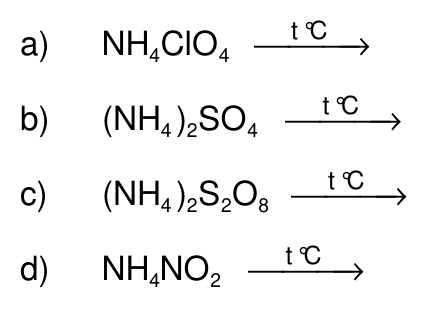
A) Describe the thermal decomposition of the following ammonium salts in terms of chemical equations:
B) Indicate the right answer:
a) Can the molar mass be determined by measuring the density of a gaseous compound at a given temperature and pressure?
- Yes, under any conditions.
- Yes, if the gaseous compound does not dissociate and associate.
- Yes, if the gaseous compound does not dissociate.
- Yes, if the gaseous compound does not associate.
b) Is a liquid boiling at a constant temperature (at a given pressure) a pure substance?
- Yes, if the liquid is not azeotropic.
- Yes, if the liquid is azeotropic.
C) Complete and balance the following equation: (in \(\ce{H2O}\))

D) The solubility of \(\ce{Hg2Cl2}\) in water is \(3.0\times10^{-5}\) g/100 ml solution.
a) What is the solubility product?
b) What is the solubility (in mol dm\(^{-3}\)) of this substance in a 0.01 M \(\ce{NaCl}\) solution?
c) What is the volume of a 0.01 M \(\ce{NaCl}\) solution which dissolves the same quantity of mercurous chloride as that dissolved in one litre of pure water?
\(A_\mathrm{r}(\ce{Hg})=200.61\qquad A_\mathrm{r}(\ce{Cl})=35.45\)
E) Which of the following groups contains solid compounds at \(10\,^\circ\mathrm{C}\)?
a) \(\ce{H2O, NH3, CH4}\)
b) \(\ce{F2, Cl2, Br2}\)
c) \(\ce{SO3, I2, NaCl}\)
d) \(\ce{Si, S8, Hg}\)
F) Which of the following salts forms an acidic aqueous solution?
a) \(\ce{CH3COONa}\)
b) \(\ce{NH4Cl}\)
c) \(\ce{Na2HPO4}\)
d) \(\ce{Na2CO3}\)
e) \(\ce{NaHCO3}\)
G) Write the electronic formulas for the following compounds so that the nature of the chemical bonds is evident:
a) \(\ce{NaClO3}\), b) \(\ce{HClO3}\), c) \(\ce{SiF4}\), d) \(\ce{NH3}\), e) \(\ce{CaF2}\), f) \(\ce{H2O}\)
H) Solid perchloric acid is usually written as \(\ce{HClO4.H2O}\). Based on experimental data showing four equal bonds, suggest a structure accounting for the experimental result.
I) The compounds of the second row elements with hydrogen are as follows: \(\ce{LiH, BeH2, B2H6, CH4, NH3, H2O, HF}\).
a) Which compounds are solid at room temperature? Explain.
b) Which of them are ionic?
c) Which are polymeric?
d) Which ones do not react with water under normal conditions?
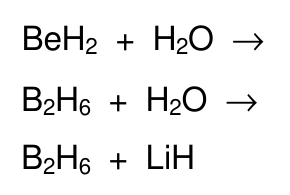
e) Give products of the following reactions.
f) Supposing that \(\ce{NH3}\), \(\ce{H2O}\) and \(\ce{HF}\) are acids under some conditions, write their corresponding conjugated bases and arrange them in order of increasing basic strength.
J) The following \(E^0\) values are given for the half-reactions:

Calculate \(E^0\) for the following reaction:

Official English text of the problem.
Answers
Names and SMILES are supplied with the corresponding explanations in the Solution.
-
A(a) \[ \ce{2NH4ClO4 ->[\Delta] N2 + Cl2 + 2O2 + 4H2O} \]
-
A(b) Initially: \[ \ce{(NH4)2SO4 ->[\Delta] NH3 + NH4HSO4} \] An overall equation for stronger heating is: \[ \ce{3(NH4)2SO4 ->[\Delta] 4NH3 + N2 + 3SO2 + 6H2O} \]
-
A(c) \[ \ce{(NH4)2S2O8 ->[\Delta] N2 + 2SO2 + 4H2O} \]
-
A(d) \[ \ce{NH4NO2 ->[\Delta] N2 + 2H2O} \]
-
B(a) 2, under the usual ideal-gas assumption.
-
B(b) 1.
-
C) \[ \boxed{\ce{K2Cr2O7 + 3SnCl2 + 14HCl -> 2CrCl3 + 3SnCl4 + 2KCl + 7H2O}} \]
-
D(a) \(K_\mathrm{sp}=1.0\times10^{-18}\), using concentrations expressed in \(\mathrm{mol\,dm^{-3}}\).
- D(b) \(s=1.0\times10^{-14}\ \mathrm{mol\,dm^{-3}}\).
-
D(c) \(V=6.2\times10^7\ \mathrm{dm^3}=6.2\times10^7\ \mathrm{L}\).
-
E) c): \(\ce{SO3, I2, NaCl}\).
-
F) b): ammonium chloride, \(\ce{NH4Cl}\).
-
G(a) Separate \(\ce{Na+}\) and \(\ce{ClO3-}\) ions; covalent bonds within the trigonal-pyramidal chlorate ion.
- G(b) \(\ce{H-O-Cl(=O)2}\), with one lone pair on chlorine; polar covalent bonds.
- G(c) Tetrahedral \(\ce{SiF4}\), with four single bonds and three lone pairs on each fluorine.
- G(d) Trigonal-pyramidal \(\ce{NH3}\), with three single bonds and one lone pair on nitrogen.
- G(e) Separate \(\ce{Ca^2+}\) and two \(\ce{F-}\) ions; ionic bonding.
-
G(f) Bent \(\ce{H2O}\), with two single bonds and two lone pairs on oxygen.
-
H) Hydronium perchlorate, \(\ce{[H3O]+[ClO4]-}\), containing a tetrahedral perchlorate ion with four equivalent chlorine–oxygen bonds.
-
I(a) \(\ce{LiH}\) and \(\ce{BeH2}\).
- I(b) \(\ce{LiH}\).
- I(c) \(\ce{BeH2}\).
- I(d) \(\ce{CH4}\); also \(\ce{H2O}\) in the trivial sense of adding water to water.
- I(e) \[ \begin{gathered} \ce{BeH2 + 2H2O -> Be(OH)2 + 2H2}\\ \ce{B2H6 + 6H2O -> 2B(OH)3 + 6H2}\\ \ce{B2H6 + 2LiH -> 2LiBH4} \end{gathered} \]
-
I(f) The conjugate bases are \(\ce{NH2-}\), \(\ce{OH-}\), and \(\ce{F-}\), respectively. Increasing basic strength: \[ \boxed{\ce{F- < OH- < NH2-}} \]
-
J) \[ \boxed{E_3^0=1.265\ \mathrm{V}\approx1.27\ \mathrm{V}} \]
Solution
SMILES below describe molecular connectivity or the constituent ions of a salt. They do not show lone pairs, resonance delocalization, hydrogen bonding, or crystal lattices. Formula-unit and schematic representations of extended or multicentre structures are identified explicitly.
A) Thermal decomposition
The equations below are conventional overall descriptions. Heating can proceed through intermediate stages, particularly for ammonium sulfate.
A(a) Ammonium perchlorate, [NH4+].[O-]Cl(=O)(=O)=O:
\[ \ce{2NH4ClO4 ->[\Delta] N2 + Cl2 + 2O2 + 4H2O} \]
This is internal oxidation–reduction. Nitrogen changes from oxidation state \(-3\) to \(0\), chlorine from \(+7\) to \(0\), and some oxygen from \(-2\) to \(0\). The equation conserves every element and balances the electron transfers.
A(b) Ammonium sulfate, [NH4+].[NH4+].[O-]S(=O)(=O)[O-], first loses ammonia:
\[ \ce{(NH4)2SO4 ->[\Delta] NH3 + NH4HSO4} \]
The residual salt is ammonium hydrogen sulfate, [NH4+].OS(=O)(=O)[O-].
On stronger heating, an overall decomposition equation is:
\[ \ce{3(NH4)2SO4 ->[\Delta] 4NH3 + N2 + 3SO2 + 6H2O} \]
Two of the six nitrogen atoms are oxidized from \(-3\) to \(0\), releasing six electrons. The three sulfur atoms are reduced from \(+6\) to \(+4\), accepting six electrons. The remaining nitrogen leaves as ammonia.
A(c) Ammonium peroxodisulfate, [NH4+].[NH4+].[O-]S(=O)(=O)OOS(=O)(=O)[O-]:
\[ \ce{(NH4)2S2O8 ->[\Delta] N2 + 2SO2 + 4H2O} \]
The anion contains an oxygen–oxygen peroxide linkage. Its two peroxide oxygen atoms have oxidation state \(-1\); its other oxygen atoms have oxidation state \(-2\).
The two nitrogen atoms release six electrons on oxidation to nitrogen. Reduction of the two sulfur atoms from \(+6\) to \(+4\) consumes four electrons, and reduction of the two peroxide oxygen atoms to \(-2\) consumes the remaining two.
A(d) Ammonium nitrite, [NH4+].[O-]N=O:
\[ \ce{NH4NO2 ->[\Delta] N2 + 2H2O} \]
The nitrogen atoms initially have oxidation states \(-3\) and \(+3\). They combine to form nitrogen in oxidation state \(0\).
The product identities used in A are:
| Species | Name | SMILES |
|---|---|---|
| \(\ce{N2}\) | Nitrogen | N#N |
| \(\ce{Cl2}\) | Chlorine | ClCl |
| \(\ce{O2}\) | Oxygen | O=O |
| \(\ce{H2O}\) | Water | O |
| \(\ce{NH3}\) | Ammonia | N |
| \(\ce{SO2}\) | Sulfur dioxide | O=S=O |
B) Physical properties and composition
B(a) For an ideal gas,
\[ pV=nRT=\frac{m}{M}RT. \]
Since \(\rho=m/V\),
\[ \boxed{M=\frac{\rho RT}{p}}. \]
Association or dissociation changes the number of gas particles corresponding to a given mass. The density then gives an apparent average molar mass of the equilibrium mixture, rather than directly giving the molar mass of the original compound. Thus option 2 is intended.
If nonideality matters, a known compressibility factor \(Z\) is also required:
\[ M=\frac{\rho ZRT}{p}. \]
B(b) A pure liquid boils at a fixed temperature at fixed pressure. However, an azeotropic mixture also boils at a constant temperature because its equilibrium vapour has the same composition as the liquid.
Consequently, constant boiling temperature indicates purity only after excluding an azeotrope: option 1.
C) Dichromate oxidation of tin(II)
The reduction and oxidation half-reactions are:
\[ \ce{Cr2O7^2- + 14H+ + 6e- -> 2Cr^3+ + 7H2O} \]
\[ \ce{Sn^2+ -> Sn^4+ + 2e-}. \]
Multiplying the second equation by three and adding gives:
\[ \ce{Cr2O7^2- + 14H+ + 3Sn^2+ -> 2Cr^3+ + 3Sn^4+ + 7H2O}. \]
Hydrochloric acid supplies the required acidity and chloride. Restoring the potassium and chloride ions gives:
\[ \boxed{\ce{K2Cr2O7 + 3SnCl2 + 14HCl -> 2CrCl3 + 3SnCl4 + 2KCl + 7H2O}}. \]
There are 20 chlorine atoms on each side: \(6+14=6+12+2\).
| Substance | Name | SMILES |
|---|---|---|
| \(\ce{K2Cr2O7}\) | Potassium dichromate | [K+].[K+].[O-][Cr](=O)(=O)O[Cr](=O)(=O)[O-] |
| \(\ce{SnCl2}\) | Tin(II) chloride | [Sn+2].[Cl-].[Cl-] |
| \(\ce{HCl}\) | Hydrogen chloride; hydrochloric acid in water | Cl |
| \(\ce{CrCl3}\) | Chromium(III) chloride | [Cr+3].[Cl-].[Cl-].[Cl-] |
| \(\ce{SnCl4}\) | Tin(IV) chloride | Cl[Sn](Cl)(Cl)Cl |
| \(\ce{KCl}\) | Potassium chloride | [K+].[Cl-] |
The half-reaction species are dichromate ion [O-][Cr](=O)(=O)O[Cr](=O)(=O)[O-], chromium(III) ion [Cr+3], tin(II) ion [Sn+2], tin(IV) ion [Sn+4], and hydrogen ion [H+]. The aqueous hydrogen ion is solvated; the bare-proton notation is conventional shorthand.
D) Solubility of mercury(I) chloride
Mercury(I) chloride, or calomel, has the structural-unit SMILES Cl[Hg][Hg]Cl. Its dissolution equilibrium is:
\[ \ce{Hg2Cl2(s) <=> Hg2^2+(aq) + 2Cl-(aq)}. \]
The mercury(I) cation is the bonded dimer \(\ce{Hg2^2+}\), [Hg+][Hg+]; chloride ion is [Cl-].
We use the concentration approximation to activities and the dissolution equilibrium specified by the problem.
D(a) The molar mass is
\[ M(\ce{Hg2Cl2}) =2(200.61)+2(35.45) =472.12\ \mathrm{g\,mol^{-1}}. \]
The mass solubility is
\[ \frac{3.0\times10^{-5}\ \mathrm{g}}{0.100\ \mathrm{dm^3}} =3.0\times10^{-4}\ \mathrm{g\,dm^{-3}}. \]
Thus the molar solubility in pure water is
\[ s_0= \frac{3.0\times10^{-4}\ \mathrm{g\,dm^{-3}}} {472.12\ \mathrm{g\,mol^{-1}}} =6.3543\times10^{-7}\ \mathrm{mol\,dm^{-3}}. \]
Because
\[ [\ce{Hg2^2+}]=s_0,\qquad [\ce{Cl-}]=2s_0, \]
the concentration-form solubility product is
\[ K_\mathrm{sp}=[\ce{Hg2^2+}][\ce{Cl-}]^2 =s_0(2s_0)^2=4s_0^3. \]
Therefore,
\[ K_\mathrm{sp}=1.0263\times10^{-18}\ \mathrm{mol^3\,dm^{-9}} \approx\boxed{1.0\times10^{-18}\ \mathrm{mol^3\,dm^{-9}}}. \]
The corresponding thermodynamic equilibrium constant is dimensionless when activities are referenced to the standard concentration.
D(b) Sodium chloride, [Na+].[Cl-], supplies the common chloride ion. If the new solubility is \(s\),
\[ K_\mathrm{sp}=s(0.010+2s)^2. \]
Since \(2s\ll0.010\ \mathrm{mol\,dm^{-3}}\),
\[ s\approx\frac{1.0263\times10^{-18}}{(0.010)^2} =1.0263\times10^{-14}\ \mathrm{mol\,dm^{-3}}. \]
Hence
\[ \boxed{s=1.0\times10^{-14}\ \mathrm{mol\,dm^{-3}}}. \]
The added chloride from dissolution is only about \(2\times10^{-12}\) of the initial chloride concentration, validating the approximation.
D(c) One litre of pure water dissolves
\[ n=s_0(1.000\ \mathrm{dm^3}) =6.3543\times10^{-7}\ \mathrm{mol}. \]
The volume of sodium chloride solution required to dissolve this amount is
\[ V=\frac{n}{s} =\frac{6.3543\times10^{-7}\ \mathrm{mol}} {1.0263\times10^{-14}\ \mathrm{mol\,dm^{-3}}} =6.1916\times10^7\ \mathrm{dm^3}. \]
Thus
\[ \boxed{V=6.2\times10^7\ \mathrm{L}}. \]
E) Physical states at \(10\,^\circ\mathrm{C}\)
At ordinary atmospheric pressure:
| Group | Substances, names and SMILES | States at \(10\,^\circ\mathrm{C}\) |
|---|---|---|
| a | Water O; ammonia N; methane C |
Liquid; gas; gas |
| b | Fluorine FF; chlorine ClCl; bromine BrBr |
Gas; gas; liquid |
| c | Sulfur trioxide O=S(=O)=O; iodine II; sodium chloride [Na+].[Cl-] |
All solid |
| d | Silicon [Si]; cyclooctasulfur S1SSSSSSS1; mercury [Hg] |
Solid; solid; liquid |
Therefore group c is correct.
The sulfur trioxide SMILES describes the monomeric unit; its solid forms can contain associated or polymeric structures. The silicon and mercury symbols likewise do not encode their extended condensed phases.
F) Acidic salt solution
The answer is ammonium chloride, [NH4+].[Cl-].
Ammonium ion, [NH4+], is the conjugate acid of ammonia and transfers a proton to water:
\[ \ce{NH4+ + H2O <=> NH3 + H3O+}. \]
Production of hydronium ion, [OH3+], makes the solution acidic. Chloride contributes negligible basicity in water.
The other choices give basic solutions:
| Salt | Name and SMILES | Reason |
|---|---|---|
| \(\ce{CH3COONa}\) | Sodium acetate, CC(=O)[O-].[Na+] |
Acetate accepts a proton from water. |
| \(\ce{Na2HPO4}\) | Disodium hydrogen phosphate, [Na+].[Na+].OP(=O)([O-])[O-] |
Hydrogen phosphate is amphiprotic, with basic behaviour predominating. |
| \(\ce{Na2CO3}\) | Sodium carbonate, [Na+].[Na+].[O-]C(=O)[O-] |
Carbonate accepts a proton from water. |
| \(\ce{NaHCO3}\) | Sodium hydrogen carbonate, [Na+].OC(=O)[O-] |
Hydrogen carbonate is amphiprotic, but its solution is mildly basic. |
G) Electronic formulas and bonding
G(a) Sodium chlorate
The constituent ions are sodium ion [Na+] and chlorate ion [O-]Cl(=O)=O.
Draw a separate sodium cation and a bracketed chlorate anion. In a conventional expanded-valence Lewis contributor:
- Chlorine is central and has one lone pair.
- Two oxygen atoms have double bonds to chlorine and two lone pairs each.
- The third oxygen has a single bond, three lone pairs, and formal charge \(-1\).
There are three equivalent resonance contributors, obtained by exchanging the singly bonded oxygen. The ion is trigonal pyramidal. Bonding between the ions is ionic; bonding within chlorate is polar covalent. The SMILES records one contributor rather than the delocalized structure.
G(b) Chloric acid
Chloric acid has SMILES OCl(=O)=O and conventional Lewis connectivity
\[ \ce{H-O-Cl(=O)2}. \]
Draw hydrogen bonded to oxygen, not directly to chlorine. Chlorine has one lone pair, and each oxygen has two lone pairs. All bonds within this molecular representation are polar covalent.
G(c) Silicon tetrafluoride
Silicon tetrafluoride has SMILES F[Si](F)(F)F.
Draw silicon at the centre with four single bonds to fluorine. Each fluorine has three lone pairs; silicon has no lone pairs. The molecular geometry is tetrahedral, and the bonds are polar covalent. The tetrahedral geometry is not specified by the plain SMILES.
G(d) Ammonia
Ammonia has SMILES N.
Draw three nitrogen–hydrogen single bonds and one lone pair on nitrogen. Four electron domains give a trigonal-pyramidal molecular geometry. The bonds are polar covalent.
G(e) Calcium fluoride
Calcium fluoride has ionic formula-unit SMILES [Ca+2].[F-].[F-].
Draw one calcium ion, [Ca+2], and two separate fluoride ions, [F-]. Each fluoride has four lone pairs, completing its octet. The solid is an ionic lattice; it is not a discrete three-atom molecule.
G(f) Water
Water has SMILES O.
Draw two oxygen–hydrogen single bonds and two lone pairs on oxygen. Its molecular geometry is bent, and its bonds are polar covalent.
H) Structure of solid perchloric acid monohydrate
Perchloric acid, OCl(=O)(=O)=O, transfers a proton to water:
\[ \ce{HClO4 + H2O -> H3O+ + ClO4-}. \]
The solid is therefore formulated as hydronium perchlorate:
\[ \boxed{\ce{[H3O]+[ClO4]-}} \]
with formula-unit SMILES [OH3+].[O-]Cl(=O)(=O)=O.
Draw a trigonal-pyramidal hydronium cation, [OH3+], and a separate tetrahedral perchlorate anion, [O-]Cl(=O)(=O)=O. In the perchlorate ion, the four oxygen positions are equivalent and the bonding is delocalized over all four chlorine–oxygen connections.
In conventional Lewis notation, four equivalent contributors interchange the singly bonded, negatively charged oxygen. The displayed SMILES represents only one contributor. Hydrogen bonding between the ions is also absent from that notation.
This ionic formulation accounts for four equivalent chlorine–oxygen bonds without assigning one oxygen a distinct covalently attached acidic hydrogen.
I) Hydrides of the second-period elements
The additional species needed here are:
| Substance | Name | SMILES or qualified representation |
|---|---|---|
| \(\ce{LiH}\) | Lithium hydride | [Li+].[H-] |
| \(\ce{BeH2}\) | Beryllium hydride | [BeH2], formula-unit representation only |
| \(\ce{B2H6}\) | Diborane | [H]1[BH2][H][BH2]1, schematic bridge-connectivity representation only |
| \(\ce{CH4}\) | Methane | C |
| \(\ce{HF}\) | Hydrogen fluoride | F |
Diborane has four terminal hydrogens and two bridging hydrogens. Each bridge forms a three-centre, two-electron bond involving two boron atoms and one hydrogen. The schematic string above must not be interpreted as eight ordinary two-centre, two-electron bonds; ordinary SMILES cannot faithfully encode this bonding.
I(a) The room-temperature solids are lithium hydride and beryllium hydride.
Lithium hydride forms an ionic lattice with strong electrostatic attractions. Beryllium hydride forms an extended covalent network, so melting or vaporization requires disruption of extensive bonding. The remaining hydrides are small molecular substances; under ordinary room conditions they are gases or, for water, a liquid.
I(b) Lithium hydride is ionic:
\[ \ce{LiH = Li+H-}. \]
Its ions are lithium ion [Li+] and hydride ion [H-].
I(c) Beryllium hydride is polymeric, conventionally written \(\ce{(BeH2)_{n}}\). Beryllium is surrounded by bridging hydrogens in an extended network with electron-deficient multicentre bonding. The isolated formula-unit SMILES does not show that network.
Diborane is a discrete bridged molecule.
I(d) Methane does not react with water under normal conditions. Water itself is also unchanged on mixing with water, apart from its usual self-ionization equilibrium.
The other hydrides are reactive: lithium hydride, beryllium hydride and diborane undergo hydrolysis; ammonia and hydrogen fluoride participate in acid–base equilibria:
\[ \ce{NH3 + H2O <=> NH4+ + OH-} \]
\[ \ce{HF + H2O <=> H3O+ + F-}. \]
Hydroxide is [OH-], and fluoride is [F-].
I(e) The balanced reactions are:
\[ \boxed{\ce{BeH2 + 2H2O -> Be(OH)2 + 2H2}} \]
\[ \boxed{\ce{B2H6 + 6H2O -> 2B(OH)3 + 6H2}} \]
\[ \boxed{\ce{B2H6 + 2LiH -> 2LiBH4}}. \]
The product identities are:
| Product | Name | SMILES |
|---|---|---|
| \(\ce{Be(OH)2}\) | Beryllium hydroxide | O[Be]O, formula-unit representation |
| \(\ce{H2}\) | Hydrogen | [H][H] |
| \(\ce{B(OH)3}\) | Boric acid | OB(O)O |
| \(\ce{LiBH4}\) | Lithium borohydride | [Li+].[BH4-] |
In the hydrolysis reactions, hydridic hydrogen combines with hydrogen from water to produce hydrogen gas. In the final reaction, hydride addition to diborane produces two tetrahedral borohydride ions, [BH4-].
I(f) Removal of one proton gives:
| Acid | Conjugate base | Base name and SMILES |
|---|---|---|
| \(\ce{NH3}\) | \(\ce{NH2-}\) | Amide ion, [NH2-] |
| \(\ce{H2O}\) | \(\ce{OH-}\) | Hydroxide ion, [OH-] |
| \(\ce{HF}\) | \(\ce{F-}\) | Fluoride ion, [F-] |
Acid strength increases from ammonia through water to hydrogen fluoride. Conjugate-base strength therefore decreases in that direction:
\[ \boxed{\text{Increasing basic strength: }\ce{F- < OH- < NH2-}}. \]
The amide ion is sufficiently basic to deprotonate water:
\[ \ce{NH2- + H2O -> NH3 + OH-}. \]
J) Standard reduction potential
The relevant species are permanganate ion [O-][Mn](=O)(=O)=O, manganese(IV) oxide O=[Mn]=O as a formula-unit representation of its extended solid, and manganese(II) ion [Mn+2].
The five-electron reduction is the sum of the three-electron and two-electron reductions:
\[ \ce{MnO4- + 4H+ + 3e- -> MnO2 + 2H2O} \]
\[ \ce{MnO2 + 4H+ + 2e- -> Mn^2+ + 2H2O}. \]
Standard Gibbs energies are additive, with
\[ \Delta G^0=-nFE^0. \]
Therefore,
\[ -5FE_1^0=-3FE_2^0-2FE_3^0, \]
so
\[ E_3^0=\frac{5E_1^0-3E_2^0}{2}. \]
Substituting the supplied values:
\[ E_3^0 =\frac{5(1.52)-3(1.69)}{2}\ \mathrm{V} =\frac{7.60-5.07}{2}\ \mathrm{V} =1.265\ \mathrm{V}. \]
Thus
\[ \boxed{E_3^0\approx1.27\ \mathrm{V}}. \]
The solution was checked against the official solution.
IChO 1983 · Theorieaufgabe 1
Kurzfragen A-J zur anorganischen und allgemeinen Chemie
A) Beschreiben Sie die thermische Zersetzung der folgenden Ammoniumsalze mithilfe chemischer Gleichungen:
B) Geben Sie die richtige Antwort an:
a) Kann die molare Masse durch Messung der Dichte einer gasförmigen Verbindung bei gegebener Temperatur und gegebenem Druck bestimmt werden?
- Ja, unter allen Bedingungen.
- Ja, wenn die gasförmige Verbindung weder dissoziiert noch assoziiert.
- Ja, wenn die gasförmige Verbindung nicht dissoziiert.
- Ja, wenn die gasförmige Verbindung nicht assoziiert.
b) Ist eine Flüssigkeit, die bei konstanter Temperatur siedet (bei gegebenem Druck), ein Reinstoff?
- Ja, wenn die Flüssigkeit nicht azeotrop ist.
- Ja, wenn die Flüssigkeit azeotrop ist.
C) Vervollständigen Sie die folgende Gleichung und gleichen Sie sie aus: (in \(\ce{H2O}\))
D) Die Löslichkeit von \(\ce{Hg2Cl2}\) in Wasser beträgt \(3.0\times10^{-5}\) g/100 ml Lösung.
a) Wie groß ist das Löslichkeitsprodukt?
b) Wie groß ist die Löslichkeit (in mol dm\(^{-3}\)) dieser Substanz in einer 0.01 M \(\ce{NaCl}\)-Lösung?
c) Welches Volumen einer 0.01 M \(\ce{NaCl}\)-Lösung löst dieselbe Menge Quecksilber(I)-chlorid wie ein Liter reines Wasser?
\(A_\mathrm{r}(\ce{Hg})=200.61\qquad A_\mathrm{r}(\ce{Cl})=35.45\)
E) Welche der folgenden Gruppen enthält bei \(10\,^\circ\mathrm{C}\) feste Verbindungen?
a) \(\ce{H2O, NH3, CH4}\)
b) \(\ce{F2, Cl2, Br2}\)
c) \(\ce{SO3, I2, NaCl}\)
d) \(\ce{Si, S8, Hg}\)
F) Welches der folgenden Salze bildet eine saure wässrige Lösung?
a) \(\ce{CH3COONa}\)
b) \(\ce{NH4Cl}\)
c) \(\ce{Na2HPO4}\)
d) \(\ce{Na2CO3}\)
e) \(\ce{NaHCO3}\)
G) Schreiben Sie die Elektronenformeln der folgenden Verbindungen so auf, dass die Art der chemischen Bindungen erkennbar ist:
a) \(\ce{NaClO3}\), b) \(\ce{HClO3}\), c) \(\ce{SiF4}\), d) \(\ce{NH3}\), e) \(\ce{CaF2}\), f) \(\ce{H2O}\)
H) Feste Perchlorsäure wird üblicherweise als \(\ce{HClO4.H2O}\) geschrieben. Schlagen Sie auf Grundlage experimenteller Daten, die vier gleiche Bindungen zeigen, eine Struktur vor, die das experimentelle Ergebnis erklärt.
I) Die Verbindungen der Elemente der zweiten Periode mit Wasserstoff sind: \(\ce{LiH, BeH2, B2H6, CH4, NH3, H2O, HF}\).
a) Welche Verbindungen sind bei Raumtemperatur fest? Begründen Sie.
b) Welche davon sind ionisch?
c) Welche sind polymer?
d) Welche reagieren unter normalen Bedingungen nicht mit Wasser?
e) Geben Sie die Produkte der folgenden Reaktionen an.
f) Angenommen, \(\ce{NH3}\), \(\ce{H2O}\) und \(\ce{HF}\) sind unter bestimmten Bedingungen Säuren: Geben Sie ihre jeweiligen konjugierten Basen an und ordnen Sie diese nach zunehmender Basenstärke.
J) Für die Halbreaktionen sind die folgenden \(E^0\)-Werte gegeben:
Berechnen Sie \(E^0\) für die folgende Reaktion:
Aufgabentext aus dem offiziellen englischen Text übersetzt.
Antworten
Namen und SMILES sind mit den zugehörigen Erläuterungen in der Lösung angegeben.
-
A(a) \[ \ce{2NH4ClO4 ->[\Delta] N2 + Cl2 + 2O2 + 4H2O} \]
-
A(b) Zunächst: \[ \ce{(NH4)2SO4 ->[\Delta] NH3 + NH4HSO4} \] Eine Gesamtgleichung für stärkeres Erhitzen lautet: \[ \ce{3(NH4)2SO4 ->[\Delta] 4NH3 + N2 + 3SO2 + 6H2O} \]
-
A(c) \[ \ce{(NH4)2S2O8 ->[\Delta] N2 + 2SO2 + 4H2O} \]
-
A(d) \[ \ce{NH4NO2 ->[\Delta] N2 + 2H2O} \]
-
B(a) 2, unter der üblichen Annahme eines idealen Gases.
-
B(b) 1.
-
C) \[ \boxed{\ce{K2Cr2O7 + 3SnCl2 + 14HCl -> 2CrCl3 + 3SnCl4 + 2KCl + 7H2O}} \]
-
D(a) \(K_\mathrm{sp}=1.0\times10^{-18}\), bei Verwendung von Konzentrationen in \(\mathrm{mol\,dm^{-3}}\).
- D(b) \(s=1.0\times10^{-14}\ \mathrm{mol\,dm^{-3}}\).
-
D(c) \(V=6.2\times10^7\ \mathrm{dm^3}=6.2\times10^7\ \mathrm{L}\).
-
E) c): \(\ce{SO3, I2, NaCl}\).
-
F) b): Ammoniumchlorid, \(\ce{NH4Cl}\).
-
G(a) Getrennte \(\ce{Na+}\)- und \(\ce{ClO3-}\)-Ionen; kovalente Bindungen innerhalb des trigonal-pyramidalen Chlorat-Ions.
- G(b) \(\ce{H-O-Cl(=O)2}\), mit einem freien Elektronenpaar am Chlor; polare kovalente Bindungen.
- G(c) Tetraedrisches \(\ce{SiF4}\), mit vier Einfachbindungen und drei freien Elektronenpaaren an jedem Fluoratom.
- G(d) Trigonal-pyramidales \(\ce{NH3}\), mit drei Einfachbindungen und einem freien Elektronenpaar am Stickstoff.
- G(e) Getrennte \(\ce{Ca^2+}\)- und zwei \(\ce{F-}\)-Ionen; Ionenbindung.
-
G(f) Gewinkeltes \(\ce{H2O}\), mit zwei Einfachbindungen und zwei freien Elektronenpaaren am Sauerstoff.
-
H) Oxoniumperchlorat, \(\ce{[H3O]+[ClO4]-}\), mit einem tetraedrischen Perchlorat-Ion, das vier gleichwertige Chlor–Sauerstoff-Bindungen aufweist.
-
I(a) \(\ce{LiH}\) und \(\ce{BeH2}\).
- I(b) \(\ce{LiH}\).
- I(c) \(\ce{BeH2}\).
- I(d) \(\ce{CH4}\); außerdem \(\ce{H2O}\) im trivialen Sinne der Zugabe von Wasser zu Wasser.
- I(e) \[ \begin{gathered} \ce{BeH2 + 2H2O -> Be(OH)2 + 2H2}\\ \ce{B2H6 + 6H2O -> 2B(OH)3 + 6H2}\\ \ce{B2H6 + 2LiH -> 2LiBH4} \end{gathered} \]
-
I(f) Die konjugierten Basen sind \(\ce{NH2-}\), \(\ce{OH-}\) bzw. \(\ce{F-}\). Zunehmende Basenstärke: \[ \boxed{\ce{F- < OH- < NH2-}} \]
-
J) \[ \boxed{E_3^0=1.265\ \mathrm{V}\approx1.27\ \mathrm{V}} \]
Lösung
Die nachstehenden SMILES beschreiben die molekulare Konnektivität oder die Ionen, aus denen ein Salz besteht. Sie zeigen keine freien Elektronenpaare, mesomere Delokalisierung, Wasserstoffbrückenbindungen oder Kristallgitter. Darstellungen von Formeleinheiten sowie schematische Darstellungen ausgedehnter Strukturen oder von Mehrzentrenstrukturen sind ausdrücklich gekennzeichnet.
A) Thermische Zersetzung
Die folgenden Gleichungen sind gebräuchliche Gesamtbeschreibungen. Beim Erhitzen können Zwischenstufen auftreten, insbesondere bei Ammoniumsulfat.
A(a) Ammoniumperchlorat, [NH4+].[O-]Cl(=O)(=O)=O:
\[ \ce{2NH4ClO4 ->[\Delta] N2 + Cl2 + 2O2 + 4H2O} \]
Dies ist eine innere Redoxreaktion. Die Oxidationszahl des Stickstoffs ändert sich von \(-3\) auf \(0\), die des Chlors von \(+7\) auf \(0\) und die eines Teils des Sauerstoffs von \(-2\) auf \(0\). In der Gleichung sind alle Elemente und die Elektronenübertragungen bilanziert.
A(b) Ammoniumsulfat, [NH4+].[NH4+].[O-]S(=O)(=O)[O-], gibt zunächst Ammoniak ab:
\[ \ce{(NH4)2SO4 ->[\Delta] NH3 + NH4HSO4} \]
Das zurückbleibende Salz ist Ammoniumhydrogensulfat, [NH4+].OS(=O)(=O)[O-].
Bei stärkerem Erhitzen lautet eine Gesamtgleichung der Zersetzung:
\[ \ce{3(NH4)2SO4 ->[\Delta] 4NH3 + N2 + 3SO2 + 6H2O} \]
Zwei der sechs Stickstoffatome werden von \(-3\) auf \(0\) oxidiert und geben dabei sechs Elektronen ab. Die drei Schwefelatome werden von \(+6\) auf \(+4\) reduziert und nehmen dabei sechs Elektronen auf. Der übrige Stickstoff entweicht als Ammoniak.
A(c) Ammoniumperoxodisulfat, [NH4+].[NH4+].[O-]S(=O)(=O)OOS(=O)(=O)[O-]:
\[ \ce{(NH4)2S2O8 ->[\Delta] N2 + 2SO2 + 4H2O} \]
Das Anion enthält eine Sauerstoff–Sauerstoff-Peroxidbindung. Seine beiden Peroxidsauerstoffatome haben die Oxidationszahl \(-1\); seine übrigen Sauerstoffatome haben die Oxidationszahl \(-2\).
Die beiden Stickstoffatome geben bei der Oxidation zu elementarem Stickstoff sechs Elektronen ab. Die Reduktion der beiden Schwefelatome von \(+6\) auf \(+4\) verbraucht vier Elektronen, und die Reduktion der beiden Peroxidsauerstoffatome auf \(-2\) verbraucht die verbleibenden zwei.
A(d) Ammoniumnitrit, [NH4+].[O-]N=O:
\[ \ce{NH4NO2 ->[\Delta] N2 + 2H2O} \]
Die Stickstoffatome haben anfangs die Oxidationszahlen \(-3\) und \(+3\). Sie verbinden sich zu Stickstoff mit der Oxidationszahl \(0\).
Die in A vorkommenden Produkte sind:
| Spezies | Name | SMILES |
|---|---|---|
| \(\ce{N2}\) | Stickstoff | N#N |
| \(\ce{Cl2}\) | Chlor | ClCl |
| \(\ce{O2}\) | Sauerstoff | O=O |
| \(\ce{H2O}\) | Wasser | O |
| \(\ce{NH3}\) | Ammoniak | N |
| \(\ce{SO2}\) | Schwefeldioxid | O=S=O |
B) Physikalische Eigenschaften und Zusammensetzung
B(a) Für ein ideales Gas gilt:
\[ pV=nRT=\frac{m}{M}RT. \]
Da \(\rho=m/V\), gilt:
\[ \boxed{M=\frac{\rho RT}{p}}. \]
Assoziation oder Dissoziation verändert die Anzahl der Gasteilchen, die einer gegebenen Masse entspricht. Aus der Dichte erhält man dann eine scheinbare mittlere molare Masse des Gleichgewichtsgemisches, anstatt unmittelbar die molare Masse der ursprünglichen Verbindung zu erhalten. Somit ist Antwort 2 gemeint.
Wenn die Abweichung vom idealen Verhalten von Bedeutung ist, muss zusätzlich der Kompressibilitätsfaktor \(Z\) bekannt sein:
\[ M=\frac{\rho ZRT}{p}. \]
B(b) Eine reine Flüssigkeit siedet bei festem Druck bei einer festen Temperatur. Ein azeotropes Gemisch siedet jedoch ebenfalls bei konstanter Temperatur, weil sein Dampf im Gleichgewicht dieselbe Zusammensetzung wie die Flüssigkeit hat.
Eine konstante Siedetemperatur weist daher erst dann auf Reinheit hin, wenn ein Azeotrop ausgeschlossen wurde: Antwort 1.
C) Oxidation von Zinn(II) durch Dichromat
Die Reduktions- und Oxidationshalbreaktionen lauten:
\[ \ce{Cr2O7^2- + 14H+ + 6e- -> 2Cr^3+ + 7H2O} \]
\[ \ce{Sn^2+ -> Sn^4+ + 2e-}. \]
Multiplikation der zweiten Gleichung mit drei und Addition ergibt:
\[ \ce{Cr2O7^2- + 14H+ + 3Sn^2+ -> 2Cr^3+ + 3Sn^4+ + 7H2O}. \]
Salzsäure liefert die erforderlichen Wasserstoff- und Chlorid-Ionen. Durch Einbeziehen der Kalium- und Chlorid-Ionen erhält man:
\[ \boxed{\ce{K2Cr2O7 + 3SnCl2 + 14HCl -> 2CrCl3 + 3SnCl4 + 2KCl + 7H2O}}. \]
Auf jeder Seite stehen 20 Chloratome: \(6+14=6+12+2\).
| Substanz | Name | SMILES |
|---|---|---|
| \(\ce{K2Cr2O7}\) | Kaliumdichromat | [K+].[K+].[O-][Cr](=O)(=O)O[Cr](=O)(=O)[O-] |
| \(\ce{SnCl2}\) | Zinn(II)-chlorid | [Sn+2].[Cl-].[Cl-] |
| \(\ce{HCl}\) | Chlorwasserstoff; in Wasser Salzsäure | Cl |
| \(\ce{CrCl3}\) | Chrom(III)-chlorid | [Cr+3].[Cl-].[Cl-].[Cl-] |
| \(\ce{SnCl4}\) | Zinn(IV)-chlorid | Cl[Sn](Cl)(Cl)Cl |
| \(\ce{KCl}\) | Kaliumchlorid | [K+].[Cl-] |
Die Spezies der Halbreaktionen sind das Dichromat-Ion [O-][Cr](=O)(=O)O[Cr](=O)(=O)[O-], das Chrom(III)-Ion [Cr+3], das Zinn(II)-Ion [Sn+2], das Zinn(IV)-Ion [Sn+4] und das Wasserstoff-Ion [H+]. Das Wasserstoff-Ion ist in wässriger Lösung solvatisiert; die Schreibweise als freies Proton ist eine gebräuchliche Kurzschreibweise.
D) Löslichkeit von Quecksilber(I)-chlorid
Quecksilber(I)-chlorid, auch Kalomel genannt, hat für seine Struktureinheit die SMILES-Darstellung Cl[Hg][Hg]Cl. Sein Lösungsgleichgewicht lautet:
\[ \ce{Hg2Cl2(s) <=> Hg2^2+(aq) + 2Cl-(aq)}. \]
Das Quecksilber(I)-Kation ist das durch eine Bindung zusammengehaltene Dimer \(\ce{Hg2^2+}\), [Hg+][Hg+]; das Chlorid-Ion ist [Cl-].
Wir verwenden Konzentrationen als Näherung für die Aktivitäten und das in der Aufgabe vorgegebene Lösungsgleichgewicht.
D(a) Die molare Masse beträgt
\[ M(\ce{Hg2Cl2}) =2(200.61)+2(35.45) =472.12\ \mathrm{g\,mol^{-1}}. \]
Die Massenlöslichkeit beträgt
\[ \frac{3.0\times10^{-5}\ \mathrm{g}}{0.100\ \mathrm{dm^3}} =3.0\times10^{-4}\ \mathrm{g\,dm^{-3}}. \]
Damit beträgt die molare Löslichkeit in reinem Wasser
\[ s_0= \frac{3.0\times10^{-4}\ \mathrm{g\,dm^{-3}}} {472.12\ \mathrm{g\,mol^{-1}}} =6.3543\times10^{-7}\ \mathrm{mol\,dm^{-3}}. \]
Da
\[ [\ce{Hg2^2+}]=s_0,\qquad [\ce{Cl-}]=2s_0, \]
lautet das Löslichkeitsprodukt in Konzentrationsform
\[ K_\mathrm{sp}=[\ce{Hg2^2+}][\ce{Cl-}]^2 =s_0(2s_0)^2=4s_0^3. \]
Somit gilt:
\[ K_\mathrm{sp}=1.0263\times10^{-18}\ \mathrm{mol^3\,dm^{-9}} \approx\boxed{1.0\times10^{-18}\ \mathrm{mol^3\,dm^{-9}}}. \]
Die entsprechende thermodynamische Gleichgewichtskonstante ist dimensionslos, wenn die Aktivitäten auf die Standardkonzentration bezogen werden.
D(b) Natriumchlorid, [Na+].[Cl-], liefert das gemeinsame Chlorid-Ion. Bezeichnet \(s\) die neue Löslichkeit, gilt:
\[ K_\mathrm{sp}=s(0.010+2s)^2. \]
Da \(2s\ll0.010\ \mathrm{mol\,dm^{-3}}\), gilt:
\[ s\approx\frac{1.0263\times10^{-18}}{(0.010)^2} =1.0263\times10^{-14}\ \mathrm{mol\,dm^{-3}}. \]
Daraus folgt
\[ \boxed{s=1.0\times10^{-14}\ \mathrm{mol\,dm^{-3}}}. \]
Die durch den Lösungsvorgang zusätzlich entstehende Chloridkonzentration beträgt nur etwa das \(2\times10^{-12}\)-Fache der ursprünglichen Chloridkonzentration, was die Näherung rechtfertigt.
D(c) Ein Liter reines Wasser löst
\[ n=s_0(1.000\ \mathrm{dm^3}) =6.3543\times10^{-7}\ \mathrm{mol}. \]
Das zum Lösen dieser Stoffmenge erforderliche Volumen der Natriumchloridlösung beträgt
\[ V=\frac{n}{s} =\frac{6.3543\times10^{-7}\ \mathrm{mol}} {1.0263\times10^{-14}\ \mathrm{mol\,dm^{-3}}} =6.1916\times10^7\ \mathrm{dm^3}. \]
Somit gilt
\[ \boxed{V=6.2\times10^7\ \mathrm{L}}. \]
E) Aggregatzustände bei \(10\,^\circ\mathrm{C}\)
Bei normalem Atmosphärendruck:
| Gruppe | Substanzen, Namen und SMILES | Aggregatzustände bei \(10\,^\circ\mathrm{C}\) |
|---|---|---|
| a | Wasser O; Ammoniak N; Methan C |
Flüssig; gasförmig; gasförmig |
| b | Fluor FF; Chlor ClCl; Brom BrBr |
Gasförmig; gasförmig; flüssig |
| c | Schwefeltrioxid O=S(=O)=O; Iod II; Natriumchlorid [Na+].[Cl-] |
Alle fest |
| d | Silicium [Si]; Cyclooctaschwefel S1SSSSSSS1; Quecksilber [Hg] |
Fest; fest; flüssig |
Somit ist Gruppe c richtig.
Die SMILES-Darstellung von Schwefeltrioxid beschreibt die monomere Einheit; seine festen Formen können assoziierte oder polymere Strukturen enthalten. Ebenso bilden die Symbole für Silicium und Quecksilber deren ausgedehnte kondensierte Phasen nicht ab.
F) Saure Salzlösung
Die Antwort lautet Ammoniumchlorid, [NH4+].[Cl-].
Das Ammonium-Ion, [NH4+], ist die konjugierte Säure von Ammoniak und überträgt ein Proton auf Wasser:
\[ \ce{NH4+ + H2O <=> NH3 + H3O+}. \]
Die Bildung von Oxonium-Ionen, [OH3+], macht die Lösung sauer. Chlorid trägt in Wasser nur vernachlässigbar zur Basizität bei.
Die übrigen Antwortmöglichkeiten ergeben basische Lösungen:
| Salz | Name und SMILES | Begründung |
|---|---|---|
| \(\ce{CH3COONa}\) | Natriumacetat, CC(=O)[O-].[Na+] |
Acetat nimmt ein Proton von Wasser auf. |
| \(\ce{Na2HPO4}\) | Dinatriumhydrogenphosphat, [Na+].[Na+].OP(=O)([O-])[O-] |
Hydrogenphosphat ist ein Ampholyt, wobei das basische Verhalten überwiegt. |
| \(\ce{Na2CO3}\) | Natriumcarbonat, [Na+].[Na+].[O-]C(=O)[O-] |
Carbonat nimmt ein Proton von Wasser auf. |
| \(\ce{NaHCO3}\) | Natriumhydrogencarbonat, [Na+].OC(=O)[O-] |
Hydrogencarbonat ist ein Ampholyt, seine Lösung ist jedoch schwach basisch. |
G) Elektronenformeln und Bindungen
G(a) Natriumchlorat
Die Bestandteile sind das Natrium-Ion [Na+] und das Chlorat-Ion [O-]Cl(=O)=O.
Zeichnen Sie ein separates Natrium-Kation und ein Chlorat-Anion in eckigen Klammern. In einer gebräuchlichen Lewis-Grenzstruktur mit erweitertem Oktett gilt:
- Chlor ist das Zentralatom und besitzt ein freies Elektronenpaar.
- Zwei Sauerstoffatome sind über Doppelbindungen an Chlor gebunden und besitzen jeweils zwei freie Elektronenpaare.
- Das dritte Sauerstoffatom hat eine Einfachbindung, drei freie Elektronenpaare und die Formalladung \(-1\).
Es gibt drei gleichwertige mesomere Grenzstrukturen, die sich durch Austausch des einfach gebundenen Sauerstoffatoms ergeben. Das Ion ist trigonal-pyramidal. Zwischen den Ionen liegt Ionenbindung vor; innerhalb des Chlorat-Ions sind die Bindungen polar kovalent. Die SMILES-Darstellung gibt eine Grenzstruktur wieder, nicht die delokalisierte Struktur.
G(b) Chlorsäure
Chlorsäure hat die SMILES-Darstellung OCl(=O)=O und die gebräuchliche Lewis-Konnektivität
\[ \ce{H-O-Cl(=O)2}. \]
Zeichnen Sie Wasserstoff an Sauerstoff gebunden, nicht direkt an Chlor. Chlor besitzt ein freies Elektronenpaar und jedes Sauerstoffatom zwei freie Elektronenpaare. Alle Bindungen innerhalb dieser molekularen Darstellung sind polar kovalent.
G(c) Siliciumtetrafluorid
Siliciumtetrafluorid hat die SMILES-Darstellung F[Si](F)(F)F.
Zeichnen Sie Silicium im Zentrum mit vier Einfachbindungen zu Fluor. Jedes Fluoratom besitzt drei freie Elektronenpaare; Silicium besitzt keine freien Elektronenpaare. Die Molekülgeometrie ist tetraedrisch, und die Bindungen sind polar kovalent. Die tetraedrische Geometrie wird durch die einfache SMILES-Darstellung nicht festgelegt.
G(d) Ammoniak
Ammoniak hat die SMILES-Darstellung N.
Zeichnen Sie drei Stickstoff–Wasserstoff-Einfachbindungen und ein freies Elektronenpaar am Stickstoff. Vier Elektronendomänen ergeben eine trigonal-pyramidale Molekülgeometrie. Die Bindungen sind polar kovalent.
G(e) Calciumfluorid
Calciumfluorid hat für seine ionische Formeleinheit die SMILES-Darstellung [Ca+2].[F-].[F-].
Zeichnen Sie ein Calcium-Ion, [Ca+2], und zwei separate Fluorid-Ionen, [F-]. Jedes Fluorid-Ion besitzt vier freie Elektronenpaare, womit sein Oktett vollständig ist. Der Feststoff ist ein Ionengitter; es handelt sich nicht um ein diskretes dreiatomiges Molekül.
G(f) Wasser
Wasser hat die SMILES-Darstellung O.
Zeichnen Sie zwei Sauerstoff–Wasserstoff-Einfachbindungen und zwei freie Elektronenpaare am Sauerstoff. Die Molekülgeometrie ist gewinkelt, und die Bindungen sind polar kovalent.
H) Struktur von festem Perchlorsäuremonohydrat
Perchlorsäure, OCl(=O)(=O)=O, überträgt ein Proton auf Wasser:
\[ \ce{HClO4 + H2O -> H3O+ + ClO4-}. \]
Der Feststoff wird daher als Oxoniumperchlorat formuliert:
\[ \boxed{\ce{[H3O]+[ClO4]-}} \]
mit der SMILES-Darstellung der Formeleinheit [OH3+].[O-]Cl(=O)(=O)=O.
Zeichnen Sie ein trigonal-pyramidales Oxonium-Kation, [OH3+], und ein separates tetraedrisches Perchlorat-Anion, [O-]Cl(=O)(=O)=O. Im Perchlorat-Ion sind die vier Sauerstoffpositionen gleichwertig, und die Bindung ist über alle vier Chlor–Sauerstoff-Verknüpfungen delokalisiert.
In der gebräuchlichen Lewis-Schreibweise unterscheiden sich vier gleichwertige Grenzstrukturen darin, welches Sauerstoffatom einfach gebunden und negativ geladen ist. Die angegebene SMILES-Darstellung stellt nur eine Grenzstruktur dar. Auch Wasserstoffbrückenbindungen zwischen den Ionen fehlen in dieser Schreibweise.
Diese ionische Formulierung erklärt vier gleichwertige Chlor–Sauerstoff-Bindungen, ohne einem Sauerstoffatom einen gesonderten, kovalent gebundenen sauren Wasserstoff zuzuordnen.
I) Hydride der Elemente der zweiten Periode
Die hier zusätzlich benötigten Spezies sind:
| Substanz | Name | SMILES oder Darstellung mit Einschränkung |
|---|---|---|
| \(\ce{LiH}\) | Lithiumhydrid | [Li+].[H-] |
| \(\ce{BeH2}\) | Berylliumhydrid | [BeH2], nur Darstellung der Formeleinheit |
| \(\ce{B2H6}\) | Diboran | [H]1[BH2][H][BH2]1, nur schematische Darstellung der Brückenkonnektivität |
| \(\ce{CH4}\) | Methan | C |
| \(\ce{HF}\) | Fluorwasserstoff | F |
Diboran besitzt vier endständige Wasserstoffatome und zwei verbrückende Wasserstoffatome. Jede Brücke bildet eine Dreizentren-Zweielektronenbindung unter Beteiligung zweier Boratome und eines Wasserstoffatoms. Die obige schematische Zeichenfolge darf nicht als acht gewöhnliche Zweizentren-Zweielektronenbindungen interpretiert werden; gewöhnliche SMILES können diese Bindungsverhältnisse nicht getreu abbilden.
I(a) Bei Raumtemperatur sind Lithiumhydrid und Berylliumhydrid fest.
Lithiumhydrid bildet ein Ionengitter mit starken elektrostatischen Anziehungskräften. Berylliumhydrid bildet ein ausgedehntes kovalentes Netzwerk, sodass beim Schmelzen oder Verdampfen zahlreiche Bindungen aufgebrochen werden müssen. Die übrigen Hydride sind niedermolekulare Substanzen; unter üblichen Raumbedingungen sind sie gasförmig oder, im Falle von Wasser, flüssig.
I(b) Lithiumhydrid ist ionisch:
\[ \ce{LiH = Li+H-}. \]
Seine Ionen sind das Lithium-Ion [Li+] und das Hydrid-Ion [H-].
I(c) Berylliumhydrid ist polymer und wird üblicherweise als \(\ce{(BeH2)_{n}}\) geschrieben. Beryllium ist in einem ausgedehnten Netzwerk mit elektronenarmen Mehrzentrenbindungen von verbrückenden Wasserstoffatomen umgeben. Die isolierte SMILES-Darstellung der Formeleinheit zeigt dieses Netzwerk nicht.
Diboran ist ein diskretes Molekül mit Brückenbindungen.
I(d) Methan reagiert unter normalen Bedingungen nicht mit Wasser. Auch Wasser selbst bleibt beim Mischen mit Wasser unverändert, abgesehen von seinem üblichen Autoprotolysegleichgewicht.
Die anderen Hydride sind reaktiv: Lithiumhydrid, Berylliumhydrid und Diboran werden hydrolysiert; Ammoniak und Fluorwasserstoff nehmen an Säure–Base-Gleichgewichten teil:
\[ \ce{NH3 + H2O <=> NH4+ + OH-} \]
\[ \ce{HF + H2O <=> H3O+ + F-}. \]
Hydroxid ist [OH-], und Fluorid ist [F-].
I(e) Die ausgeglichenen Reaktionsgleichungen lauten:
\[ \boxed{\ce{BeH2 + 2H2O -> Be(OH)2 + 2H2}} \]
\[ \boxed{\ce{B2H6 + 6H2O -> 2B(OH)3 + 6H2}} \]
\[ \boxed{\ce{B2H6 + 2LiH -> 2LiBH4}}. \]
Die Produkte sind:
| Produkt | Name | SMILES |
|---|---|---|
| \(\ce{Be(OH)2}\) | Berylliumhydroxid | O[Be]O, Darstellung der Formeleinheit |
| \(\ce{H2}\) | Wasserstoff | [H][H] |
| \(\ce{B(OH)3}\) | Borsäure | OB(O)O |
| \(\ce{LiBH4}\) | Lithiumborhydrid | [Li+].[BH4-] |
Bei den Hydrolysereaktionen verbindet sich hydridischer Wasserstoff mit Wasserstoff aus Wasser zu Wasserstoffgas. Bei der letzten Reaktion entstehen durch Hydridaddition an Diboran zwei tetraedrische Borhydrid-Ionen, [BH4-].
I(f) Durch Abspaltung eines Protons erhält man:
| Säure | Konjugierte Base | Name der Base und SMILES |
|---|---|---|
| \(\ce{NH3}\) | \(\ce{NH2-}\) | Amid-Ion, [NH2-] |
| \(\ce{H2O}\) | \(\ce{OH-}\) | Hydroxid-Ion, [OH-] |
| \(\ce{HF}\) | \(\ce{F-}\) | Fluorid-Ion, [F-] |
Die Säurestärke nimmt von Ammoniak über Wasser zu Fluorwasserstoff zu. Die Stärke der konjugierten Basen nimmt daher in dieser Richtung ab:
\[ \boxed{\text{Zunehmende Basenstärke: }\ce{F- < OH- < NH2-}}. \]
Das Amid-Ion ist ausreichend basisch, um Wasser zu deprotonieren:
\[ \ce{NH2- + H2O -> NH3 + OH-}. \]
J) Standardreduktionspotential
Die relevanten Spezies sind das Permanganat-Ion [O-][Mn](=O)(=O)=O, Mangan(IV)-oxid O=[Mn]=O als Darstellung einer Formeleinheit seines ausgedehnten Festkörpers und das Mangan(II)-Ion [Mn+2].
Die Fünfelektronenreduktion ist die Summe der Dreielektronen- und der Zweielektronenreduktion:
\[ \ce{MnO4- + 4H+ + 3e- -> MnO2 + 2H2O} \]
\[ \ce{MnO2 + 4H+ + 2e- -> Mn^2+ + 2H2O}. \]
Die Standard-Gibbs-Energien sind additiv, wobei gilt:
\[ \Delta G^0=-nFE^0. \]
Daher gilt
\[ -5FE_1^0=-3FE_2^0-2FE_3^0, \]
also
\[ E_3^0=\frac{5E_1^0-3E_2^0}{2}. \]
Einsetzen der angegebenen Werte ergibt:
\[ E_3^0 =\frac{5(1.52)-3(1.69)}{2}\ \mathrm{V} =\frac{7.60-5.07}{2}\ \mathrm{V} =1.265\ \mathrm{V}. \]
Somit gilt
\[ \boxed{E_3^0\approx1.27\ \mathrm{V}}. \]
Die Lösung wurde mit der offiziellen Lösung abgeglichen.
IChO 1983 · Teori sorusu 1
İnorganik ve genel kimyada kısa sorular A-J
A) Aşağıdaki amonyum tuzlarının ısıl bozunmasını kimyasal denklemlerle açıklayınız:
B) Doğru cevabı belirtiniz:
a) Gaz hâlindeki bir bileşiğin belirli bir sıcaklık ve basınçta yoğunluğu ölçülerek molar kütlesi belirlenebilir mi?
- Evet, her koşulda.
- Evet, gaz hâlindeki bileşik ayrışmıyor ve birleşmiyorsa.
- Evet, gaz hâlindeki bileşik ayrışmıyorsa.
- Evet, gaz hâlindeki bileşik birleşmiyorsa.
b) Sabit sıcaklıkta (belirli bir basınçta) kaynayan bir sıvı saf madde midir?
- Evet, sıvı azeotropik değilse.
- Evet, sıvı azeotropik ise.
C) Aşağıdaki denklemi tamamlayıp denkleştiriniz: (\(\ce{H2O}\) içinde)
D) \(\ce{Hg2Cl2}\)'nin sudaki çözünürlüğü 100 ml çözelti başına \(3.0\times10^{-5}\) g'dır.
a) Çözünürlük çarpımı nedir?
b) Bu maddenin 0.01 M \(\ce{NaCl}\) çözeltisindeki çözünürlüğü (mol dm\(^{-3}\) cinsinden) nedir?
c) Bir litre saf suda çözünen cıva(I) klorür ile aynı miktarı çözen 0.01 M \(\ce{NaCl}\) çözeltisinin hacmi nedir?
\(A_\mathrm{r}(\ce{Hg})=200.61\qquad A_\mathrm{r}(\ce{Cl})=35.45\)
E) Aşağıdaki gruplardan hangisi \(10\,^\circ\mathrm{C}\)'de katı bileşikler içerir?
a) \(\ce{H2O, NH3, CH4}\)
b) \(\ce{F2, Cl2, Br2}\)
c) \(\ce{SO3, I2, NaCl}\)
d) \(\ce{Si, S8, Hg}\)
F) Aşağıdaki tuzlardan hangisi suda asidik bir çözelti oluşturur?
a) \(\ce{CH3COONa}\)
b) \(\ce{NH4Cl}\)
c) \(\ce{Na2HPO4}\)
d) \(\ce{Na2CO3}\)
e) \(\ce{NaHCO3}\)
G) Aşağıdaki bileşiklerin elektron formüllerini, kimyasal bağların niteliği açıkça görülecek biçimde yazınız:
a) \(\ce{NaClO3}\), b) \(\ce{HClO3}\), c) \(\ce{SiF4}\), d) \(\ce{NH3}\), e) \(\ce{CaF2}\), f) \(\ce{H2O}\)
H) Katı perklorik asit genellikle \(\ce{HClO4.H2O}\) olarak yazılır. Dört eşit bağ bulunduğunu gösteren deneysel verilere dayanarak, deneysel sonucu açıklayan bir yapı öneriniz.
I) İkinci periyot elementlerinin hidrojenle oluşturduğu bileşikler şunlardır: \(\ce{LiH, BeH2, B2H6, CH4, NH3, H2O, HF}\).
a) Hangi bileşikler oda sıcaklığında katıdır? Açıklayınız.
b) Bunlardan hangileri iyoniktir?
c) Hangileri polimeriktir?
d) Hangileri normal koşullarda suyla tepkimeye girmez?
e) Aşağıdaki tepkimelerin ürünlerini veriniz.
f) \(\ce{NH3}\), \(\ce{H2O}\) ve \(\ce{HF}\)'nin bazı koşullarda asit olduğunu varsayarak, bunların karşılık gelen eşlenik bazlarını yazınız ve artan bazlık kuvvetine göre sıralayınız.
J) Yarı tepkimeler için aşağıdaki \(E^0\) değerleri verilmiştir:
Aşağıdaki tepkime için \(E^0\)'ı hesaplayınız:
Soru metni resmi İngilizce metinden çevrilmiştir.
Cevaplar
Adlar ve SMILES gösterimleri, Çözüm bölümünde ilgili açıklamalarla birlikte verilmiştir.
-
A(a) \[ \ce{2NH4ClO4 ->[\Delta] N2 + Cl2 + 2O2 + 4H2O} \]
-
A(b) Başlangıçta: \[ \ce{(NH4)2SO4 ->[\Delta] NH3 + NH4HSO4} \] Daha kuvvetli ısıtma için toplam denklem şöyledir: \[ \ce{3(NH4)2SO4 ->[\Delta] 4NH3 + N2 + 3SO2 + 6H2O} \]
-
A(c) \[ \ce{(NH4)2S2O8 ->[\Delta] N2 + 2SO2 + 4H2O} \]
-
A(d) \[ \ce{NH4NO2 ->[\Delta] N2 + 2H2O} \]
-
B(a) Olağan ideal gaz varsayımı altında 2.
-
B(b) 1.
-
C) \[ \boxed{\ce{K2Cr2O7 + 3SnCl2 + 14HCl -> 2CrCl3 + 3SnCl4 + 2KCl + 7H2O}} \]
-
D(a) Derişimler \(\mathrm{mol\,dm^{-3}}\) cinsinden ifade edildiğinde \(K_\mathrm{sp}=1.0\times10^{-18}\).
- D(b) \(s=1.0\times10^{-14}\ \mathrm{mol\,dm^{-3}}\).
-
D(c) \(V=6.2\times10^7\ \mathrm{dm^3}=6.2\times10^7\ \mathrm{L}\).
-
E) c): \(\ce{SO3, I2, NaCl}\).
-
F) b): amonyum klorür, \(\ce{NH4Cl}\).
-
G(a) Ayrı \(\ce{Na+}\) ve \(\ce{ClO3-}\) iyonları; üçgen piramidal klorat iyonu içinde kovalent bağlar.
- G(b) Klor üzerinde bir ortaklanmamış elektron çifti bulunan \(\ce{H-O-Cl(=O)2}\); polar kovalent bağlar.
- G(c) Dört tekli bağ ve her flor üzerinde üç ortaklanmamış elektron çifti bulunan tetrahedral \(\ce{SiF4}\).
- G(d) Üç tekli bağ ve azot üzerinde bir ortaklanmamış elektron çifti bulunan üçgen piramidal \(\ce{NH3}\).
- G(e) Ayrı bir \(\ce{Ca^2+}\) iyonu ve iki \(\ce{F-}\) iyonu; iyonik bağlanma.
-
G(f) İki tekli bağ ve oksijen üzerinde iki ortaklanmamış elektron çifti bulunan açısal \(\ce{H2O}\).
-
H) Dört eşdeğer klor–oksijen bağına sahip tetrahedral bir perklorat iyonu içeren hidronyum perklorat, \(\ce{[H3O]+[ClO4]-}\).
-
I(a) \(\ce{LiH}\) ve \(\ce{BeH2}\).
- I(b) \(\ce{LiH}\).
- I(c) \(\ce{BeH2}\).
- I(d) \(\ce{CH4}\); ayrıca, suya su eklemek şeklindeki aşikâr anlamıyla \(\ce{H2O}\).
- I(e) \[ \begin{gathered} \ce{BeH2 + 2H2O -> Be(OH)2 + 2H2}\\ \ce{B2H6 + 6H2O -> 2B(OH)3 + 6H2}\\ \ce{B2H6 + 2LiH -> 2LiBH4} \end{gathered} \]
-
I(f) Eşlenik bazlar sırasıyla \(\ce{NH2-}\), \(\ce{OH-}\) ve \(\ce{F-}\)'dir. Artan bazlık kuvveti: \[ \boxed{\ce{F- < OH- < NH2-}} \]
-
J) \[ \boxed{E_3^0=1.265\ \mathrm{V}\approx1.27\ \mathrm{V}} \]
Çözüm
Aşağıdaki SMILES gösterimleri, moleküllerdeki atomların bağlanma düzenini veya bir tuzu oluşturan iyonları betimler. Ortaklanmamış elektron çiftlerini, rezonans delokalizasyonunu, hidrojen bağlarını veya kristal örgüleri göstermezler. Uzamış ya da çok merkezli yapıların formül birimi gösterimleri ve şematik gösterimleri açıkça belirtilmiştir.
A) Isıl bozunma
Aşağıdaki denklemler, yaygın olarak kullanılan toplam tepkime gösterimleridir. Isıtma, özellikle amonyum sülfat için, ara aşamalardan geçerek ilerleyebilir.
A(a) Amonyum perklorat, [NH4+].[O-]Cl(=O)(=O)=O:
\[ \ce{2NH4ClO4 ->[\Delta] N2 + Cl2 + 2O2 + 4H2O} \]
Bu, bileşik içi bir yükseltgenme–indirgenme tepkimesidir. Azotun yükseltgenme basamağı \(-3\)'ten \(0\)'a, klorunki \(+7\)'den \(0\)'a ve oksijenin bir kısmınınki \(-2\)'den \(0\)'a değişir. Denklem, her elementin atom sayısını korur ve elektron alışverişlerini denkleştirir.
A(b) Amonyum sülfat, [NH4+].[NH4+].[O-]S(=O)(=O)[O-], önce amonyak kaybeder:
\[ \ce{(NH4)2SO4 ->[\Delta] NH3 + NH4HSO4} \]
Geriye kalan tuz, amonyum hidrojen sülfattır, [NH4+].OS(=O)(=O)[O-].
Daha kuvvetli ısıtıldığında toplam bozunma denklemi şöyledir:
\[ \ce{3(NH4)2SO4 ->[\Delta] 4NH3 + N2 + 3SO2 + 6H2O} \]
Altı azot atomunun ikisi \(-3\)'ten \(0\)'a yükseltgenerek altı elektron verir. Üç kükürt atomu \(+6\)'dan \(+4\)'e indirgenerek altı elektron alır. Geriye kalan azot, amonyak olarak ayrılır.
A(c) Amonyum peroksodisülfat, [NH4+].[NH4+].[O-]S(=O)(=O)OOS(=O)(=O)[O-]:
\[ \ce{(NH4)2S2O8 ->[\Delta] N2 + 2SO2 + 4H2O} \]
Anyon, bir oksijen–oksijen peroksit bağı içerir. İki peroksit oksijen atomunun yükseltgenme basamağı \(-1\), diğer oksijen atomlarının yükseltgenme basamağı ise \(-2\)'dir.
İki azot atomu, azota yükseltgenirken altı elektron verir. İki kükürt atomunun \(+6\)'dan \(+4\)'e indirgenmesi dört elektron tüketir; iki peroksit oksijen atomunun \(-2\)'ye indirgenmesi ise kalan iki elektronu tüketir.
A(d) Amonyum nitrit, [NH4+].[O-]N=O:
\[ \ce{NH4NO2 ->[\Delta] N2 + 2H2O} \]
Azot atomlarının başlangıçtaki yükseltgenme basamakları \(-3\) ve \(+3\)'tür. Birleşerek yükseltgenme basamağı \(0\) olan azotu oluştururlar.
A'da kullanılan ürünlerin kimlikleri şöyledir:
| Tür | Ad | SMILES |
|---|---|---|
| \(\ce{N2}\) | Azot | N#N |
| \(\ce{Cl2}\) | Klor | ClCl |
| \(\ce{O2}\) | Oksijen | O=O |
| \(\ce{H2O}\) | Su | O |
| \(\ce{NH3}\) | Amonyak | N |
| \(\ce{SO2}\) | Kükürt dioksit | O=S=O |
B) Fiziksel özellikler ve bileşim
B(a) İdeal bir gaz için,
\[ pV=nRT=\frac{m}{M}RT. \]
\(\rho=m/V\) olduğundan,
\[ \boxed{M=\frac{\rho RT}{p}}. \]
Birleşme veya ayrışma, belirli bir kütleye karşılık gelen gaz taneciklerinin sayısını değiştirir. Bu durumda yoğunluk, başlangıçtaki bileşiğin molar kütlesini doğrudan vermek yerine denge karışımının görünür ortalama molar kütlesini verir. Dolayısıyla kastedilen cevap 2. seçenektir.
İdeallikten sapma önemliyse, bilinen bir sıkıştırılabilirlik faktörü \(Z\) de gereklidir:
\[ M=\frac{\rho ZRT}{p}. \]
B(b) Saf bir sıvı, sabit basınçta sabit bir sıcaklıkta kaynar. Ancak azeotropik bir karışım da sabit sıcaklıkta kaynar; çünkü dengedeki buharı sıvıyla aynı bileşime sahiptir.
Bu nedenle, sabit kaynama sıcaklığı ancak azeotrop olasılığı dışlandıktan sonra saflığı gösterir: 1. seçenek.
C) Kalay(II)'nin dikromatla yükseltgenmesi
İndirgenme ve yükseltgenme yarı tepkimeleri şöyledir:
\[ \ce{Cr2O7^2- + 14H+ + 6e- -> 2Cr^3+ + 7H2O} \]
\[ \ce{Sn^2+ -> Sn^4+ + 2e-}. \]
İkinci denklem üçle çarpılıp denklemler toplandığında şu elde edilir:
\[ \ce{Cr2O7^2- + 14H+ + 3Sn^2+ -> 2Cr^3+ + 3Sn^4+ + 7H2O}. \]
Hidroklorik asit, gerekli asitliği ve klorürü sağlar. Potasyum ve klorür iyonları yeniden eklendiğinde şu elde edilir:
\[ \boxed{\ce{K2Cr2O7 + 3SnCl2 + 14HCl -> 2CrCl3 + 3SnCl4 + 2KCl + 7H2O}}. \]
Her iki tarafta da 20 klor atomu vardır: \(6+14=6+12+2\).
| Madde | Ad | SMILES |
|---|---|---|
| \(\ce{K2Cr2O7}\) | Potasyum dikromat | [K+].[K+].[O-][Cr](=O)(=O)O[Cr](=O)(=O)[O-] |
| \(\ce{SnCl2}\) | Kalay(II) klorür | [Sn+2].[Cl-].[Cl-] |
| \(\ce{HCl}\) | Hidrojen klorür; suda hidroklorik asit | Cl |
| \(\ce{CrCl3}\) | Krom(III) klorür | [Cr+3].[Cl-].[Cl-].[Cl-] |
| \(\ce{SnCl4}\) | Kalay(IV) klorür | Cl[Sn](Cl)(Cl)Cl |
| \(\ce{KCl}\) | Potasyum klorür | [K+].[Cl-] |
Yarı tepkimelerdeki türler; dikromat iyonu [O-][Cr](=O)(=O)O[Cr](=O)(=O)[O-], krom(III) iyonu [Cr+3], kalay(II) iyonu [Sn+2], kalay(IV) iyonu [Sn+4] ve hidrojen iyonu [H+]'dır. Sulu çözeltide hidrojen iyonu solvatlanmıştır; çıplak proton gösterimi, yerleşik bir kısa gösterimdir.
D) Cıva(I) klorürün çözünürlüğü
Cıva(I) klorürün, diğer adıyla kalomelin, yapısal birim SMILES gösterimi Cl[Hg][Hg]Cl'dir. Çözünme dengesi şöyledir:
\[ \ce{Hg2Cl2(s) <=> Hg2^2+(aq) + 2Cl-(aq)}. \]
Cıva(I) katyonu, atomları birbirine bağlı bir dimer olan \(\ce{Hg2^2+}\), [Hg+][Hg+]'dır; klorür iyonu ise [Cl-]'dir.
Aktiviteler için derişim yaklaşımını ve soruda belirtilen çözünme dengesini kullanıyoruz.
D(a) Molar kütle şöyledir:
\[ M(\ce{Hg2Cl2}) =2(200.61)+2(35.45) =472.12\ \mathrm{g\,mol^{-1}}. \]
Kütle cinsinden çözünürlük şöyledir:
\[ \frac{3.0\times10^{-5}\ \mathrm{g}}{0.100\ \mathrm{dm^3}} =3.0\times10^{-4}\ \mathrm{g\,dm^{-3}}. \]
Böylece saf sudaki molar çözünürlük şöyledir:
\[ s_0= \frac{3.0\times10^{-4}\ \mathrm{g\,dm^{-3}}} {472.12\ \mathrm{g\,mol^{-1}}} =6.3543\times10^{-7}\ \mathrm{mol\,dm^{-3}}. \]
Şu eşitlikler geçerli olduğundan,
\[ [\ce{Hg2^2+}]=s_0,\qquad [\ce{Cl-}]=2s_0, \]
derişim cinsinden çözünürlük çarpımı şöyledir:
\[ K_\mathrm{sp}=[\ce{Hg2^2+}][\ce{Cl-}]^2 =s_0(2s_0)^2=4s_0^3. \]
Dolayısıyla,
\[ K_\mathrm{sp}=1.0263\times10^{-18}\ \mathrm{mol^3\,dm^{-9}} \approx\boxed{1.0\times10^{-18}\ \mathrm{mol^3\,dm^{-9}}}. \]
Aktiviteler standart derişime göre tanımlandığında, karşılık gelen termodinamik denge sabiti boyutsuzdur.
D(b) Sodyum klorür, [Na+].[Cl-], ortak klorür iyonunu sağlar. Yeni çözünürlük \(s\) ise,
\[ K_\mathrm{sp}=s(0.010+2s)^2. \]
\(2s\ll0.010\ \mathrm{mol\,dm^{-3}}\) olduğundan,
\[ s\approx\frac{1.0263\times10^{-18}}{(0.010)^2} =1.0263\times10^{-14}\ \mathrm{mol\,dm^{-3}}. \]
Böylece
\[ \boxed{s=1.0\times10^{-14}\ \mathrm{mol\,dm^{-3}}}. \]
Çözünmeden kaynaklanan ek klorür, başlangıçtaki klorür derişiminin yalnızca yaklaşık \(2\times10^{-12}\) katıdır; bu da yaklaşımın geçerliliğini doğrular.
D(c) Bir litre saf suda çözünen madde miktarı şöyledir:
\[ n=s_0(1.000\ \mathrm{dm^3}) =6.3543\times10^{-7}\ \mathrm{mol}. \]
Bu miktarı çözmek için gereken sodyum klorür çözeltisinin hacmi şöyledir:
\[ V=\frac{n}{s} =\frac{6.3543\times10^{-7}\ \mathrm{mol}} {1.0263\times10^{-14}\ \mathrm{mol\,dm^{-3}}} =6.1916\times10^7\ \mathrm{dm^3}. \]
Böylece
\[ \boxed{V=6.2\times10^7\ \mathrm{L}}. \]
E) \(10\,^\circ\mathrm{C}\)'de fiziksel hâller
Normal atmosfer basıncında:
| Grup | Maddeler, adları ve SMILES gösterimleri | \(10\,^\circ\mathrm{C}\)'deki hâlleri |
|---|---|---|
| a | Su O; amonyak N; metan C |
Sıvı; gaz; gaz |
| b | Flor FF; klor ClCl; brom BrBr |
Gaz; gaz; sıvı |
| c | Kükürt trioksit O=S(=O)=O; iyot II; sodyum klorür [Na+].[Cl-] |
Hepsi katı |
| d | Silisyum [Si]; siklooktakükürt S1SSSSSSS1; cıva [Hg] |
Katı; katı; sıvı |
Dolayısıyla c grubu doğrudur.
Kükürt trioksitin SMILES gösterimi monomerik birimi betimler; katı biçimleri birleşmiş veya polimerik yapılar içerebilir. Benzer şekilde silisyum ve cıva simgeleri de bunların uzamış yoğun faz yapılarını kodlamaz.
F) Asidik tuz çözeltisi
Cevap amonyum klorür, [NH4+].[Cl-]'dür.
Amonyum iyonu, [NH4+], amonyağın eşlenik asididir ve suya bir proton aktarır:
\[ \ce{NH4+ + H2O <=> NH3 + H3O+}. \]
Hidronyum iyonunun, [OH3+], oluşması çözeltiyi asidik yapar. Klorürün sudaki bazlık katkısı ihmal edilebilir düzeydedir.
Diğer seçenekler bazik çözeltiler verir:
| Tuz | Ad ve SMILES | Neden |
|---|---|---|
| \(\ce{CH3COONa}\) | Sodyum asetat, CC(=O)[O-].[Na+] |
Asetat sudan bir proton alır. |
| \(\ce{Na2HPO4}\) | Disodyum hidrojen fosfat, [Na+].[Na+].OP(=O)([O-])[O-] |
Hidrojen fosfat amfiprotiktir ve bazik davranışı baskındır. |
| \(\ce{Na2CO3}\) | Sodyum karbonat, [Na+].[Na+].[O-]C(=O)[O-] |
Karbonat sudan bir proton alır. |
| \(\ce{NaHCO3}\) | Sodyum hidrojen karbonat, [Na+].OC(=O)[O-] |
Hidrojen karbonat amfiprotiktir, ancak çözeltisi hafif baziktir. |
G) Elektron formülleri ve bağlanma
G(a) Sodyum klorat
Bileşiği oluşturan iyonlar, sodyum iyonu [Na+] ve klorat iyonu [O-]Cl(=O)=O'dur.
Ayrı bir sodyum katyonu ve köşeli parantez içine alınmış bir klorat anyonu çiziniz. Yaygın olarak kullanılan genişlemiş değerlikli bir Lewis rezonans yapısında:
- Klor merkezde bulunur ve bir ortaklanmamış elektron çiftine sahiptir.
- İki oksijen atomu klora çift bağlarla bağlıdır ve her birinin iki ortaklanmamış elektron çifti vardır.
- Üçüncü oksijenin bir tekli bağı, üç ortaklanmamış elektron çifti ve \(-1\) formal yükü vardır.
Tekli bağla bağlı oksijenin değiştirilmesiyle elde edilen üç eşdeğer rezonans yapısı vardır. İyon üçgen piramidaldir. İyonlar arasındaki bağlanma iyoniktir; klorat içindeki bağlanma polar kovalenttir. SMILES, delokalize yapı yerine rezonans yapılarından birini kaydeder.
G(b) Klorik asit
Klorik asidin SMILES gösterimi OCl(=O)=O ve geleneksel Lewis bağlanma düzeni şöyledir:
\[ \ce{H-O-Cl(=O)2}. \]
Hidrojeni doğrudan klora değil, oksijene bağlı olarak çiziniz. Klorun bir ortaklanmamış elektron çifti, her oksijenin ise iki ortaklanmamış elektron çifti vardır. Bu moleküler gösterimdeki bütün bağlar polar kovalenttir.
G(c) Silisyum tetraflorür
Silisyum tetraflorürün SMILES gösterimi F[Si](F)(F)F'dir.
Silisyumu merkezde, flora dört tekli bağla bağlı olarak çiziniz. Her florun üç ortaklanmamış elektron çifti vardır; silisyumun ortaklanmamış elektron çifti yoktur. Molekül geometrisi tetrahedraldir ve bağlar polar kovalenttir. Yalın SMILES gösterimi tetrahedral geometriyi belirtmez.
G(d) Amonyak
Amonyağın SMILES gösterimi N'dir.
Üç azot–hidrojen tekli bağı ve azot üzerinde bir ortaklanmamış elektron çifti çiziniz. Dört elektron bölgesi, üçgen piramidal bir molekül geometrisi verir. Bağlar polar kovalenttir.
G(e) Kalsiyum florür
Kalsiyum florürün iyonik formül birimi SMILES gösterimi [Ca+2].[F-].[F-]'dir.
Bir kalsiyum iyonu, [Ca+2], ve iki ayrı florür iyonu, [F-], çiziniz. Her florürün, oktetini tamamlayan dört ortaklanmamış elektron çifti vardır. Katı, iyonik bir örgüdür; ayrı bir üç atomlu molekül değildir.
G(f) Su
Suyun SMILES gösterimi O'dur.
İki oksijen–hidrojen tekli bağı ve oksijen üzerinde iki ortaklanmamış elektron çifti çiziniz. Molekül geometrisi açısaldır ve bağları polar kovalenttir.
H) Katı perklorik asit monohidratın yapısı
Perklorik asit, OCl(=O)(=O)=O, suya bir proton aktarır:
\[ \ce{HClO4 + H2O -> H3O+ + ClO4-}. \]
Bu nedenle katı, hidronyum perklorat olarak formüle edilir:
\[ \boxed{\ce{[H3O]+[ClO4]-}} \]
Formül birimi SMILES gösterimi [OH3+].[O-]Cl(=O)(=O)=O'dur.
Üçgen piramidal bir hidronyum katyonu, [OH3+], ve ayrı bir tetrahedral perklorat anyonu, [O-]Cl(=O)(=O)=O, çiziniz. Perklorat iyonunda dört oksijen konumu eşdeğerdir ve bağlanma, dört klor–oksijen bağlantısının tümü üzerine delokalize olmuştur.
Geleneksel Lewis gösteriminde, dört eşdeğer rezonans yapısında tekli bağla bağlı, negatif yüklü oksijenin yeri değişir. Verilen SMILES gösterimi yalnızca bir rezonans yapısını temsil eder. İyonlar arasındaki hidrojen bağları da bu gösterimde yer almaz.
Bu iyonik formülasyon, oksijenlerden birine diğerlerinden farklı olarak kovalent bağlı bir asidik hidrojen atamadan, dört eşdeğer klor–oksijen bağını açıklar.
I) İkinci periyot elementlerinin hidrürleri
Burada gereken ek türler şöyledir:
| Madde | Ad | SMILES veya niteliği belirtilmiş gösterim |
|---|---|---|
| \(\ce{LiH}\) | Lityum hidrür | [Li+].[H-] |
| \(\ce{BeH2}\) | Berilyum hidrür | [BeH2], yalnızca formül birimi gösterimi |
| \(\ce{B2H6}\) | Diboran | [H]1[BH2][H][BH2]1, yalnızca köprü bağlanma düzeninin şematik gösterimi |
| \(\ce{CH4}\) | Metan | C |
| \(\ce{HF}\) | Hidrojen florür | F |
Diboranın dört uç hidrojeni ve iki köprü hidrojeni vardır. Her köprü, iki bor atomu ile bir hidrojenin katıldığı üç merkezli, iki elektronlu bir bağ oluşturur. Yukarıdaki şematik dizge, sekiz sıradan iki merkezli, iki elektronlu bağ olarak yorumlanmamalıdır; standart SMILES bu bağlanmayı aslına uygun biçimde kodlayamaz.
I(a) Oda sıcaklığında katı olanlar lityum hidrür ve berilyum hidrürdür.
Lityum hidrür, güçlü elektrostatik çekimlerin bulunduğu iyonik bir örgü oluşturur. Berilyum hidrür uzamış bir kovalent ağ oluşturur; dolayısıyla erime veya buharlaşma, yaygın bağ yapısının bozulmasını gerektirir. Diğer hidrürler küçük moleküllü maddelerdir; olağan oda koşullarında gaz hâlindedirler veya su örneğinde olduğu gibi sıvıdırlar.
I(b) Lityum hidrür iyoniktir:
\[ \ce{LiH = Li+H-}. \]
İyonları, lityum iyonu [Li+] ve hidrür iyonu [H-]'dır.
I(c) Berilyum hidrür polimeriktir ve geleneksel olarak \(\ce{(BeH2)_{n}}\) biçiminde yazılır. Berilyum, elektron eksikliği olan çok merkezli bağlanmaya sahip uzamış bir ağda köprü hidrojenleriyle çevrilidir. Tek başına formül biriminin SMILES gösterimi bu ağı göstermez.
Diboran, ayrı bir köprülü moleküldür.
I(d) Metan, normal koşullarda suyla tepkimeye girmez. Suyun kendisi de olağan kendi kendine iyonlaşma dengesi dışında, suyla karıştırıldığında değişmez.
Diğer hidrürler tepkime verir: lityum hidrür, berilyum hidrür ve diboran hidrolize uğrar; amonyak ve hidrojen florür ise asit–baz dengelerine katılır:
\[ \ce{NH3 + H2O <=> NH4+ + OH-} \]
\[ \ce{HF + H2O <=> H3O+ + F-}. \]
Hidroksit [OH-], florür ise [F-]'dir.
I(e) Denkleştirilmiş tepkimeler şöyledir:
\[ \boxed{\ce{BeH2 + 2H2O -> Be(OH)2 + 2H2}} \]
\[ \boxed{\ce{B2H6 + 6H2O -> 2B(OH)3 + 6H2}} \]
\[ \boxed{\ce{B2H6 + 2LiH -> 2LiBH4}}. \]
Ürünlerin kimlikleri şöyledir:
| Ürün | Ad | SMILES |
|---|---|---|
| \(\ce{Be(OH)2}\) | Berilyum hidroksit | O[Be]O, formül birimi gösterimi |
| \(\ce{H2}\) | Hidrojen | [H][H] |
| \(\ce{B(OH)3}\) | Borik asit | OB(O)O |
| \(\ce{LiBH4}\) | Lityum borohidrür | [Li+].[BH4-] |
Hidroliz tepkimelerinde hidrür karakterindeki hidrojen, sudaki hidrojenle birleşerek hidrojen gazı oluşturur. Son tepkimede diborana hidrür katılması, iki tetrahedral borohidrür iyonu, [BH4-], oluşturur.
I(f) Bir protonun uzaklaştırılmasıyla şunlar elde edilir:
| Asit | Eşlenik baz | Bazın adı ve SMILES gösterimi |
|---|---|---|
| \(\ce{NH3}\) | \(\ce{NH2-}\) | Amid iyonu, [NH2-] |
| \(\ce{H2O}\) | \(\ce{OH-}\) | Hidroksit iyonu, [OH-] |
| \(\ce{HF}\) | \(\ce{F-}\) | Florür iyonu, [F-] |
Asit kuvveti amonyaktan suya, sudan hidrojen florüre doğru artar. Dolayısıyla eşlenik baz kuvveti bu yönde azalır:
\[ \boxed{\text{Artan bazlık kuvveti: }\ce{F- < OH- < NH2-}}. \]
Amid iyonu, sudan proton koparabilecek kadar baziktir:
\[ \ce{NH2- + H2O -> NH3 + OH-}. \]
J) Standart indirgenme potansiyeli
İlgili türler; permanganat iyonu [O-][Mn](=O)(=O)=O, uzamış katı yapısının formül birimi gösterimi olarak mangan(IV) oksit O=[Mn]=O ve mangan(II) iyonu [Mn+2]'dır.
Beş elektronlu indirgenme, üç elektronlu ve iki elektronlu indirgenmelerin toplamıdır:
\[ \ce{MnO4- + 4H+ + 3e- -> MnO2 + 2H2O} \]
\[ \ce{MnO2 + 4H+ + 2e- -> Mn^2+ + 2H2O}. \]
Standart Gibbs enerjileri toplanabilir ve şu bağıntı geçerlidir:
\[ \Delta G^0=-nFE^0. \]
Dolayısıyla,
\[ -5FE_1^0=-3FE_2^0-2FE_3^0, \]
buradan
\[ E_3^0=\frac{5E_1^0-3E_2^0}{2}. \]
Verilen değerler yerine konulduğunda:
\[ E_3^0 =\frac{5(1.52)-3(1.69)}{2}\ \mathrm{V} =\frac{7.60-5.07}{2}\ \mathrm{V} =1.265\ \mathrm{V}. \]
Böylece
\[ \boxed{E_3^0\approx1.27\ \mathrm{V}}. \]
Çözüm, resmi çözümle karşılaştırılarak kontrol edildi.
IChO 1983 · Problema teórico 1
Cuestiones breves A-J de química inorgánica y general
A) Describa la descomposición térmica de las siguientes sales de amonio mediante ecuaciones químicas:
B) Indique la respuesta correcta:
a) ¿Puede determinarse la masa molar midiendo la densidad de un compuesto gaseoso a una temperatura y una presión dadas?
- Sí, en cualquier condición.
- Sí, si el compuesto gaseoso no se disocia ni se asocia.
- Sí, si el compuesto gaseoso no se disocia.
- Sí, si el compuesto gaseoso no se asocia.
b) ¿Es una sustancia pura un líquido que hierve a temperatura constante (a una presión dada)?
- Sí, si el líquido no es azeotrópico.
- Sí, si el líquido es azeotrópico.
C) Complete y ajuste la siguiente ecuación: (en \(\ce{H2O}\))
D) La solubilidad del \(\ce{Hg2Cl2}\) en agua es de \(3.0\times10^{-5}\) g/100 ml de disolución.
a) ¿Cuál es el producto de solubilidad?
b) ¿Cuál es la solubilidad (en mol dm\(^{-3}\)) de esta sustancia en una disolución de \(\ce{NaCl}\) 0.01 M?
c) ¿Qué volumen de una disolución de \(\ce{NaCl}\) 0.01 M disuelve la misma cantidad de cloruro mercurioso que la disuelta en un litro de agua pura?
\(A_\mathrm{r}(\ce{Hg})=200.61\qquad A_\mathrm{r}(\ce{Cl})=35.45\)
E) ¿Cuál de los siguientes grupos contiene compuestos sólidos a \(10\,^\circ\mathrm{C}\)?
a) \(\ce{H2O, NH3, CH4}\)
b) \(\ce{F2, Cl2, Br2}\)
c) \(\ce{SO3, I2, NaCl}\)
d) \(\ce{Si, S8, Hg}\)
F) ¿Cuál de las siguientes sales forma una disolución acuosa ácida?
a) \(\ce{CH3COONa}\)
b) \(\ce{NH4Cl}\)
c) \(\ce{Na2HPO4}\)
d) \(\ce{Na2CO3}\)
e) \(\ce{NaHCO3}\)
G) Escriba las fórmulas electrónicas de los siguientes compuestos de modo que quede patente la naturaleza de los enlaces químicos:
a) \(\ce{NaClO3}\), b) \(\ce{HClO3}\), c) \(\ce{SiF4}\), d) \(\ce{NH3}\), e) \(\ce{CaF2}\), f) \(\ce{H2O}\)
H) El ácido perclórico sólido suele escribirse como \(\ce{HClO4.H2O}\). Basándose en los datos experimentales que muestran cuatro enlaces iguales, proponga una estructura que explique el resultado experimental.
I) Los compuestos de los elementos del segundo período con hidrógeno son los siguientes: \(\ce{LiH, BeH2, B2H6, CH4, NH3, H2O, HF}\).
a) ¿Qué compuestos son sólidos a temperatura ambiente? Explique por qué.
b) ¿Cuáles de ellos son iónicos?
c) ¿Cuáles son poliméricos?
d) ¿Cuáles no reaccionan con el agua en condiciones normales?
e) Indique los productos de las siguientes reacciones.
f) Suponiendo que \(\ce{NH3}\), \(\ce{H2O}\) y \(\ce{HF}\) sean ácidos en determinadas condiciones, escriba sus correspondientes bases conjugadas y ordénelas por fuerza básica creciente.
J) Se dan los siguientes valores de \(E^0\) para las semirreacciones:
Calcule \(E^0\) para la siguiente reacción:
Enunciado traducido del texto oficial en inglés.
Respuestas
Los nombres y los SMILES se proporcionan junto con las explicaciones correspondientes en la Solución.
-
A(a) \[ \ce{2NH4ClO4 ->[\Delta] N2 + Cl2 + 2O2 + 4H2O} \]
-
A(b) Inicialmente: \[ \ce{(NH4)2SO4 ->[\Delta] NH3 + NH4HSO4} \] Una ecuación global para un calentamiento más intenso es: \[ \ce{3(NH4)2SO4 ->[\Delta] 4NH3 + N2 + 3SO2 + 6H2O} \]
-
A(c) \[ \ce{(NH4)2S2O8 ->[\Delta] N2 + 2SO2 + 4H2O} \]
-
A(d) \[ \ce{NH4NO2 ->[\Delta] N2 + 2H2O} \]
-
B(a) 2, bajo la hipótesis habitual de gas ideal.
-
B(b) 1.
-
C) \[ \boxed{\ce{K2Cr2O7 + 3SnCl2 + 14HCl -> 2CrCl3 + 3SnCl4 + 2KCl + 7H2O}} \]
-
D(a) \(K_\mathrm{sp}=1.0\times10^{-18}\), utilizando concentraciones expresadas en \(\mathrm{mol\,dm^{-3}}\).
- D(b) \(s=1.0\times10^{-14}\ \mathrm{mol\,dm^{-3}}\).
-
D(c) \(V=6.2\times10^7\ \mathrm{dm^3}=6.2\times10^7\ \mathrm{L}\).
-
E) c): \(\ce{SO3, I2, NaCl}\).
-
F) b): cloruro de amonio, \(\ce{NH4Cl}\).
-
G(a) Iones \(\ce{Na+}\) y \(\ce{ClO3-}\) separados; enlaces covalentes dentro del ion clorato de geometría piramidal trigonal.
- G(b) \(\ce{H-O-Cl(=O)2}\), con un par de electrones no compartidos en el cloro; enlaces covalentes polares.
- G(c) \(\ce{SiF4}\) tetraédrico, con cuatro enlaces simples y tres pares de electrones no compartidos en cada flúor.
- G(d) \(\ce{NH3}\) de geometría piramidal trigonal, con tres enlaces simples y un par de electrones no compartidos en el nitrógeno.
- G(e) Un ion \(\ce{Ca^2+}\) y dos iones \(\ce{F-}\) separados; enlace iónico.
-
G(f) \(\ce{H2O}\) angular, con dos enlaces simples y dos pares de electrones no compartidos en el oxígeno.
-
H) Perclorato de hidronio, \(\ce{[H3O]+[ClO4]-}\), que contiene un ion perclorato tetraédrico con cuatro enlaces cloro–oxígeno equivalentes.
-
I(a) \(\ce{LiH}\) y \(\ce{BeH2}\).
- I(b) \(\ce{LiH}\).
- I(c) \(\ce{BeH2}\).
- I(d) \(\ce{CH4}\); también \(\ce{H2O}\) en el sentido trivial de añadir agua al agua.
- I(e) \[ \begin{gathered} \ce{BeH2 + 2H2O -> Be(OH)2 + 2H2}\\ \ce{B2H6 + 6H2O -> 2B(OH)3 + 6H2}\\ \ce{B2H6 + 2LiH -> 2LiBH4} \end{gathered} \]
-
I(f) Las bases conjugadas son \(\ce{NH2-}\), \(\ce{OH-}\) y \(\ce{F-}\), respectivamente. En orden de fuerza básica creciente: \[ \boxed{\ce{F- < OH- < NH2-}} \]
-
J) \[ \boxed{E_3^0=1.265\ \mathrm{V}\approx1.27\ \mathrm{V}} \]
Solución
Los SMILES que figuran a continuación describen la conectividad molecular o los iones constituyentes de una sal. No muestran los pares de electrones no compartidos, la deslocalización por resonancia, los enlaces de hidrógeno ni las redes cristalinas. Las representaciones de unidades fórmula y las representaciones esquemáticas de estructuras extendidas o multicéntricas se identifican explícitamente.
A) Descomposición térmica
Las ecuaciones siguientes son descripciones globales convencionales. El calentamiento puede transcurrir a través de etapas intermedias, en particular en el caso del sulfato de amonio.
A(a) Perclorato de amonio, [NH4+].[O-]Cl(=O)(=O)=O:
\[ \ce{2NH4ClO4 ->[\Delta] N2 + Cl2 + 2O2 + 4H2O} \]
Se trata de una oxidación–reducción interna. El nitrógeno pasa del estado de oxidación \(-3\) al \(0\), el cloro del \(+7\) al \(0\) y parte del oxígeno del \(-2\) al \(0\). La ecuación conserva todos los elementos y equilibra las transferencias de electrones.
A(b) El sulfato de amonio, [NH4+].[NH4+].[O-]S(=O)(=O)[O-], pierde primero amoníaco:
\[ \ce{(NH4)2SO4 ->[\Delta] NH3 + NH4HSO4} \]
La sal residual es hidrogenosulfato de amonio, [NH4+].OS(=O)(=O)[O-].
Con un calentamiento más intenso, una ecuación global de descomposición es:
\[ \ce{3(NH4)2SO4 ->[\Delta] 4NH3 + N2 + 3SO2 + 6H2O} \]
Dos de los seis átomos de nitrógeno se oxidan de \(-3\) a \(0\), liberando seis electrones. Los tres átomos de azufre se reducen de \(+6\) a \(+4\), aceptando seis electrones. El nitrógeno restante se desprende como amoníaco.
A(c) Peroxodisulfato de amonio, [NH4+].[NH4+].[O-]S(=O)(=O)OOS(=O)(=O)[O-]:
\[ \ce{(NH4)2S2O8 ->[\Delta] N2 + 2SO2 + 4H2O} \]
El anión contiene un enlace peróxido oxígeno–oxígeno. Sus dos átomos de oxígeno peroxídico tienen un estado de oxidación de \(-1\); los demás átomos de oxígeno tienen un estado de oxidación de \(-2\).
Los dos átomos de nitrógeno liberan seis electrones al oxidarse a nitrógeno. La reducción de los dos átomos de azufre de \(+6\) a \(+4\) consume cuatro electrones, y la reducción de los dos átomos de oxígeno peroxídico a \(-2\) consume los dos restantes.
A(d) Nitrito de amonio, [NH4+].[O-]N=O:
\[ \ce{NH4NO2 ->[\Delta] N2 + 2H2O} \]
Los átomos de nitrógeno tienen inicialmente estados de oxidación de \(-3\) y \(+3\). Se combinan para formar nitrógeno en el estado de oxidación \(0\).
Las identidades de los productos utilizados en A son:
| Especie | Nombre | SMILES |
|---|---|---|
| \(\ce{N2}\) | Nitrógeno | N#N |
| \(\ce{Cl2}\) | Cloro | ClCl |
| \(\ce{O2}\) | Oxígeno | O=O |
| \(\ce{H2O}\) | Agua | O |
| \(\ce{NH3}\) | Amoníaco | N |
| \(\ce{SO2}\) | Dióxido de azufre | O=S=O |
B) Propiedades físicas y composición
B(a) Para un gas ideal,
\[ pV=nRT=\frac{m}{M}RT. \]
Como \(\rho=m/V\),
\[ \boxed{M=\frac{\rho RT}{p}}. \]
La asociación o la disociación modifican el número de partículas gaseosas correspondiente a una masa dada. En ese caso, la densidad proporciona una masa molar media aparente de la mezcla en equilibrio, en lugar de proporcionar directamente la masa molar del compuesto original. Por tanto, la respuesta buscada es la opción 2.
Si la falta de idealidad es significativa, también se necesita un factor de compresibilidad \(Z\) conocido:
\[ M=\frac{\rho ZRT}{p}. \]
B(b) Un líquido puro hierve a una temperatura fija a presión fija. Sin embargo, una mezcla azeotrópica también hierve a temperatura constante porque su vapor en equilibrio tiene la misma composición que el líquido.
Por consiguiente, una temperatura de ebullición constante indica pureza solo después de descartar un azeótropo: opción 1.
C) Oxidación del estaño(II) por dicromato
Las semirreacciones de reducción y oxidación son:
\[ \ce{Cr2O7^2- + 14H+ + 6e- -> 2Cr^3+ + 7H2O} \]
\[ \ce{Sn^2+ -> Sn^4+ + 2e-}. \]
Al multiplicar la segunda ecuación por tres y sumar, se obtiene:
\[ \ce{Cr2O7^2- + 14H+ + 3Sn^2+ -> 2Cr^3+ + 3Sn^4+ + 7H2O}. \]
El ácido clorhídrico aporta la acidez y el cloruro necesarios. Al reincorporar los iones potasio y cloruro, se obtiene:
\[ \boxed{\ce{K2Cr2O7 + 3SnCl2 + 14HCl -> 2CrCl3 + 3SnCl4 + 2KCl + 7H2O}}. \]
Hay 20 átomos de cloro a cada lado: \(6+14=6+12+2\).
| Sustancia | Nombre | SMILES |
|---|---|---|
| \(\ce{K2Cr2O7}\) | Dicromato de potasio | [K+].[K+].[O-][Cr](=O)(=O)O[Cr](=O)(=O)[O-] |
| \(\ce{SnCl2}\) | Cloruro de estaño(II) | [Sn+2].[Cl-].[Cl-] |
| \(\ce{HCl}\) | Cloruro de hidrógeno; ácido clorhídrico en agua | Cl |
| \(\ce{CrCl3}\) | Cloruro de cromo(III) | [Cr+3].[Cl-].[Cl-].[Cl-] |
| \(\ce{SnCl4}\) | Cloruro de estaño(IV) | Cl[Sn](Cl)(Cl)Cl |
| \(\ce{KCl}\) | Cloruro de potasio | [K+].[Cl-] |
Las especies de las semirreacciones son el ion dicromato [O-][Cr](=O)(=O)O[Cr](=O)(=O)[O-], el ion cromo(III) [Cr+3], el ion estaño(II) [Sn+2], el ion estaño(IV) [Sn+4] y el ion hidrógeno [H+]. El ion hidrógeno acuoso está solvatado; la notación del protón desnudo es una abreviatura convencional.
D) Solubilidad del cloruro de mercurio(I)
El cloruro de mercurio(I), o calomel, tiene el SMILES de unidad estructural Cl[Hg][Hg]Cl. Su equilibrio de disolución es:
\[ \ce{Hg2Cl2(s) <=> Hg2^2+(aq) + 2Cl-(aq)}. \]
El catión mercurio(I) es el dímero enlazado \(\ce{Hg2^2+}\), [Hg+][Hg+]; el ion cloruro es [Cl-].
Utilizamos la aproximación de las actividades mediante concentraciones y el equilibrio de disolución especificado en el problema.
D(a) La masa molar es
\[ M(\ce{Hg2Cl2}) =2(200.61)+2(35.45) =472.12\ \mathrm{g\,mol^{-1}}. \]
La solubilidad en masa es
\[ \frac{3.0\times10^{-5}\ \mathrm{g}}{0.100\ \mathrm{dm^3}} =3.0\times10^{-4}\ \mathrm{g\,dm^{-3}}. \]
Por tanto, la solubilidad molar en agua pura es
\[ s_0= \frac{3.0\times10^{-4}\ \mathrm{g\,dm^{-3}}} {472.12\ \mathrm{g\,mol^{-1}}} =6.3543\times10^{-7}\ \mathrm{mol\,dm^{-3}}. \]
Como
\[ [\ce{Hg2^2+}]=s_0,\qquad [\ce{Cl-}]=2s_0, \]
el producto de solubilidad expresado en función de las concentraciones es
\[ K_\mathrm{sp}=[\ce{Hg2^2+}][\ce{Cl-}]^2 =s_0(2s_0)^2=4s_0^3. \]
Por tanto,
\[ K_\mathrm{sp}=1.0263\times10^{-18}\ \mathrm{mol^3\,dm^{-9}} \approx\boxed{1.0\times10^{-18}\ \mathrm{mol^3\,dm^{-9}}}. \]
La constante de equilibrio termodinámica correspondiente es adimensional cuando las actividades se refieren a la concentración estándar.
D(b) El cloruro de sodio, [Na+].[Cl-], aporta el ion común cloruro. Si la nueva solubilidad es \(s\),
\[ K_\mathrm{sp}=s(0.010+2s)^2. \]
Como \(2s\ll0.010\ \mathrm{mol\,dm^{-3}}\),
\[ s\approx\frac{1.0263\times10^{-18}}{(0.010)^2} =1.0263\times10^{-14}\ \mathrm{mol\,dm^{-3}}. \]
Por consiguiente,
\[ \boxed{s=1.0\times10^{-14}\ \mathrm{mol\,dm^{-3}}}. \]
El cloruro añadido por la disolución representa solo alrededor de \(2\times10^{-12}\) de la concentración inicial de cloruro, lo que valida la aproximación.
D(c) Un litro de agua pura disuelve
\[ n=s_0(1.000\ \mathrm{dm^3}) =6.3543\times10^{-7}\ \mathrm{mol}. \]
El volumen de disolución de cloruro de sodio necesario para disolver esta cantidad es
\[ V=\frac{n}{s} =\frac{6.3543\times10^{-7}\ \mathrm{mol}} {1.0263\times10^{-14}\ \mathrm{mol\,dm^{-3}}} =6.1916\times10^7\ \mathrm{dm^3}. \]
Así,
\[ \boxed{V=6.2\times10^7\ \mathrm{L}}. \]
E) Estados físicos a \(10\,^\circ\mathrm{C}\)
A presión atmosférica ordinaria:
| Grupo | Sustancias, nombres y SMILES | Estados a \(10\,^\circ\mathrm{C}\) |
|---|---|---|
| a | Agua O; amoníaco N; metano C |
Líquido; gas; gas |
| b | Flúor FF; cloro ClCl; bromo BrBr |
Gas; gas; líquido |
| c | Trióxido de azufre O=S(=O)=O; yodo II; cloruro de sodio [Na+].[Cl-] |
Todos sólidos |
| d | Silicio [Si]; ciclooctaazufre S1SSSSSSS1; mercurio [Hg] |
Sólido; sólido; líquido |
Por tanto, el grupo c es el correcto.
El SMILES del trióxido de azufre describe la unidad monomérica; sus formas sólidas pueden contener estructuras asociadas o poliméricas. Del mismo modo, los símbolos del silicio y del mercurio no codifican sus fases condensadas extendidas.
F) Disolución ácida de una sal
La respuesta es cloruro de amonio, [NH4+].[Cl-].
El ion amonio, [NH4+], es el ácido conjugado del amoníaco y transfiere un protón al agua:
\[ \ce{NH4+ + H2O <=> NH3 + H3O+}. \]
La producción del ion hidronio, [OH3+], hace que la disolución sea ácida. El cloruro aporta una basicidad despreciable en agua.
Las demás opciones dan disoluciones básicas:
| Sal | Nombre y SMILES | Razón |
|---|---|---|
| \(\ce{CH3COONa}\) | Acetato de sodio, CC(=O)[O-].[Na+] |
El acetato acepta un protón del agua. |
| \(\ce{Na2HPO4}\) | Hidrogenofosfato de disodio, [Na+].[Na+].OP(=O)([O-])[O-] |
El hidrogenofosfato es anfiprótico y predomina su comportamiento básico. |
| \(\ce{Na2CO3}\) | Carbonato de sodio, [Na+].[Na+].[O-]C(=O)[O-] |
El carbonato acepta un protón del agua. |
| \(\ce{NaHCO3}\) | Hidrogenocarbonato de sodio, [Na+].OC(=O)[O-] |
El hidrogenocarbonato es anfiprótico, pero su disolución es ligeramente básica. |
G) Fórmulas electrónicas y enlaces
G(a) Clorato de sodio
Los iones constituyentes son el ion sodio [Na+] y el ion clorato [O-]Cl(=O)=O.
Dibuje un catión sodio separado y un anión clorato entre corchetes. En una estructura contribuyente de Lewis convencional de valencia expandida:
- El cloro es el átomo central y tiene un par de electrones no compartidos.
- Dos átomos de oxígeno tienen enlaces dobles con el cloro y dos pares de electrones no compartidos cada uno.
- El tercer oxígeno tiene un enlace simple, tres pares de electrones no compartidos y una carga formal de \(-1\).
Hay tres estructuras contribuyentes de resonancia equivalentes, que se obtienen intercambiando el oxígeno unido mediante un enlace simple. El ion tiene geometría piramidal trigonal. El enlace entre los iones es iónico; los enlaces dentro del clorato son covalentes polares. El SMILES representa una estructura contribuyente en lugar de la estructura deslocalizada.
G(b) Ácido clórico
El ácido clórico tiene el SMILES OCl(=O)=O y la conectividad de Lewis convencional
\[ \ce{H-O-Cl(=O)2}. \]
Dibuje el hidrógeno enlazado al oxígeno, no directamente al cloro. El cloro tiene un par de electrones no compartidos y cada oxígeno tiene dos pares de electrones no compartidos. Todos los enlaces de esta representación molecular son covalentes polares.
G(c) Tetrafluoruro de silicio
El tetrafluoruro de silicio tiene el SMILES F[Si](F)(F)F.
Dibuje el silicio en el centro, con cuatro enlaces simples con el flúor. Cada flúor tiene tres pares de electrones no compartidos; el silicio no tiene pares de electrones no compartidos. La geometría molecular es tetraédrica y los enlaces son covalentes polares. El SMILES simple no especifica la geometría tetraédrica.
G(d) Amoníaco
El amoníaco tiene el SMILES N.
Dibuje tres enlaces simples nitrógeno–hidrógeno y un par de electrones no compartidos en el nitrógeno. Cuatro dominios electrónicos dan lugar a una geometría molecular piramidal trigonal. Los enlaces son covalentes polares.
G(e) Fluoruro de calcio
El fluoruro de calcio tiene el SMILES de unidad fórmula iónica [Ca+2].[F-].[F-].
Dibuje un ion calcio, [Ca+2], y dos iones fluoruro separados, [F-]. Cada fluoruro tiene cuatro pares de electrones no compartidos, que completan su octeto. El sólido es una red iónica; no es una molécula discreta de tres átomos.
G(f) Agua
El agua tiene el SMILES O.
Dibuje dos enlaces simples oxígeno–hidrógeno y dos pares de electrones no compartidos en el oxígeno. Su geometría molecular es angular y sus enlaces son covalentes polares.
H) Estructura del ácido perclórico monohidratado sólido
El ácido perclórico, OCl(=O)(=O)=O, transfiere un protón al agua:
\[ \ce{HClO4 + H2O -> H3O+ + ClO4-}. \]
Por tanto, el sólido se formula como perclorato de hidronio:
\[ \boxed{\ce{[H3O]+[ClO4]-}} \]
con el SMILES de unidad fórmula [OH3+].[O-]Cl(=O)(=O)=O.
Dibuje un catión hidronio de geometría piramidal trigonal, [OH3+], y un anión perclorato tetraédrico separado, [O-]Cl(=O)(=O)=O. En el ion perclorato, las cuatro posiciones de oxígeno son equivalentes y el enlace está deslocalizado entre las cuatro uniones cloro–oxígeno.
En la notación de Lewis convencional, cuatro estructuras contribuyentes equivalentes intercambian el oxígeno unido mediante un enlace simple y con carga negativa. El SMILES mostrado representa solo una estructura contribuyente. Los enlaces de hidrógeno entre los iones tampoco aparecen en esa notación.
Esta formulación iónica explica la existencia de cuatro enlaces cloro–oxígeno equivalentes sin asignar a un oxígeno un hidrógeno ácido unido covalentemente que lo distinga de los demás.
I) Hidruros de los elementos del segundo período
Las especies adicionales necesarias aquí son:
| Sustancia | Nombre | SMILES o representación con aclaración |
|---|---|---|
| \(\ce{LiH}\) | Hidruro de litio | [Li+].[H-] |
| \(\ce{BeH2}\) | Hidruro de berilio | [BeH2], únicamente representación de la unidad fórmula |
| \(\ce{B2H6}\) | Diborano | [H]1[BH2][H][BH2]1, únicamente representación esquemática de la conectividad de los puentes |
| \(\ce{CH4}\) | Metano | C |
| \(\ce{HF}\) | Fluoruro de hidrógeno | F |
El diborano tiene cuatro hidrógenos terminales y dos hidrógenos puente. Cada puente forma un enlace de tres centros y dos electrones en el que participan dos átomos de boro y uno de hidrógeno. La cadena esquemática anterior no debe interpretarse como ocho enlaces ordinarios de dos centros y dos electrones; los SMILES ordinarios no pueden codificar fielmente este tipo de enlace.
I(a) Los sólidos a temperatura ambiente son el hidruro de litio y el hidruro de berilio.
El hidruro de litio forma una red iónica con fuertes atracciones electrostáticas. El hidruro de berilio forma una red covalente extendida, por lo que su fusión o vaporización requiere la ruptura de numerosos enlaces. Los hidruros restantes son sustancias moleculares pequeñas; en condiciones ambientales ordinarias son gases o, en el caso del agua, un líquido.
I(b) El hidruro de litio es iónico:
\[ \ce{LiH = Li+H-}. \]
Sus iones son el ion litio [Li+] y el ion hidruro [H-].
I(c) El hidruro de berilio es polimérico y se escribe convencionalmente como \(\ce{(BeH2)_{n}}\). El berilio está rodeado de hidrógenos puente en una red extendida con enlaces multicéntricos deficientes en electrones. El SMILES de la unidad fórmula aislada no muestra esa red.
El diborano es una molécula discreta con puentes.
I(d) El metano no reacciona con el agua en condiciones normales. La propia agua tampoco cambia al mezclarse con agua, aparte de su equilibrio habitual de autoionización.
Los demás hidruros son reactivos: el hidruro de litio, el hidruro de berilio y el diborano experimentan hidrólisis; el amoníaco y el fluoruro de hidrógeno participan en equilibrios ácido–base:
\[ \ce{NH3 + H2O <=> NH4+ + OH-} \]
\[ \ce{HF + H2O <=> H3O+ + F-}. \]
El hidróxido es [OH-] y el fluoruro es [F-].
I(e) Las reacciones ajustadas son:
\[ \boxed{\ce{BeH2 + 2H2O -> Be(OH)2 + 2H2}} \]
\[ \boxed{\ce{B2H6 + 6H2O -> 2B(OH)3 + 6H2}} \]
\[ \boxed{\ce{B2H6 + 2LiH -> 2LiBH4}}. \]
Las identidades de los productos son:
| Producto | Nombre | SMILES |
|---|---|---|
| \(\ce{Be(OH)2}\) | Hidróxido de berilio | O[Be]O, representación de la unidad fórmula |
| \(\ce{H2}\) | Hidrógeno | [H][H] |
| \(\ce{B(OH)3}\) | Ácido bórico | OB(O)O |
| \(\ce{LiBH4}\) | Borohidruro de litio | [Li+].[BH4-] |
En las reacciones de hidrólisis, el hidrógeno hidrídico se combina con el hidrógeno del agua para producir hidrógeno gaseoso. En la última reacción, la adición de hidruro al diborano produce dos iones borohidruro tetraédricos, [BH4-].
I(f) La eliminación de un protón da:
| Ácido | Base conjugada | Nombre de la base y SMILES |
|---|---|---|
| \(\ce{NH3}\) | \(\ce{NH2-}\) | Ion amiduro, [NH2-] |
| \(\ce{H2O}\) | \(\ce{OH-}\) | Ion hidróxido, [OH-] |
| \(\ce{HF}\) | \(\ce{F-}\) | Ion fluoruro, [F-] |
La fuerza ácida aumenta del amoníaco al agua y de esta al fluoruro de hidrógeno. Por tanto, la fuerza de las bases conjugadas disminuye en ese sentido:
\[ \boxed{\text{Fuerza básica creciente: }\ce{F- < OH- < NH2-}}. \]
El ion amiduro es suficientemente básico para desprotonar el agua:
\[ \ce{NH2- + H2O -> NH3 + OH-}. \]
J) Potencial estándar de reducción
Las especies pertinentes son el ion permanganato [O-][Mn](=O)(=O)=O, el óxido de manganeso(IV) O=[Mn]=O como representación de la unidad fórmula de su sólido extendido y el ion manganeso(II) [Mn+2].
La reducción de cinco electrones es la suma de las reducciones de tres y de dos electrones:
\[ \ce{MnO4- + 4H+ + 3e- -> MnO2 + 2H2O} \]
\[ \ce{MnO2 + 4H+ + 2e- -> Mn^2+ + 2H2O}. \]
Las energías de Gibbs estándar son aditivas, con
\[ \Delta G^0=-nFE^0. \]
Por tanto,
\[ -5FE_1^0=-3FE_2^0-2FE_3^0, \]
de modo que
\[ E_3^0=\frac{5E_1^0-3E_2^0}{2}. \]
Sustituyendo los valores proporcionados:
\[ E_3^0 =\frac{5(1.52)-3(1.69)}{2}\ \mathrm{V} =\frac{7.60-5.07}{2}\ \mathrm{V} =1.265\ \mathrm{V}. \]
Así,
\[ \boxed{E_3^0\approx1.27\ \mathrm{V}}. \]
La solución se comprobó con la solución oficial.
IChO 1983 · 理论题 1
无机化学与普通化学简答题 A-J
A) 用化学方程式描述下列铵盐的热分解:
B) 指出正确答案:
a) 能否通过测量气态化合物在给定温度和压力下的密度来确定其摩尔质量?
- 能,在任何条件下都可以。
- 能,前提是该气态化合物既不解离也不缔合。
- 能,前提是该气态化合物不解离。
- 能,前提是该气态化合物不缔合。
b) 在给定压力下以恒定温度沸腾的液体是否为纯物质?
- 是,前提是该液体不是共沸混合物。
- 是,前提是该液体是共沸混合物。
C) 补全并配平下列方程式:(在 \(\ce{H2O}\) 中)
D) \(\ce{Hg2Cl2}\) 在水中的溶解度为每 100 ml 溶液中溶解 \(3.0\times10^{-5}\) g。
a) 其溶度积是多少?
b) 该物质在 0.01 M \(\ce{NaCl}\) 溶液中的溶解度是多少(以 mol dm\(^{-3}\) 为单位)?
c) 要使溶解的氯化亚汞的量与一升纯水中溶解的量相同,需要多大体积的 0.01 M \(\ce{NaCl}\) 溶液?
\(A_\mathrm{r}(\ce{Hg})=200.61\qquad A_\mathrm{r}(\ce{Cl})=35.45\)
E) 下列哪一组中的化合物在 \(10\,^\circ\mathrm{C}\) 时为固体?
a) \(\ce{H2O, NH3, CH4}\)
b) \(\ce{F2, Cl2, Br2}\)
c) \(\ce{SO3, I2, NaCl}\)
d) \(\ce{Si, S8, Hg}\)
F) 下列哪种盐形成的水溶液呈酸性?
a) \(\ce{CH3COONa}\)
b) \(\ce{NH4Cl}\)
c) \(\ce{Na2HPO4}\)
d) \(\ce{Na2CO3}\)
e) \(\ce{NaHCO3}\)
G) 写出下列化合物的电子式,使其化学键的性质清晰可见:
a) \(\ce{NaClO3}\),b) \(\ce{HClO3}\),c) \(\ce{SiF4}\),d) \(\ce{NH3}\),e) \(\ce{CaF2}\),f) \(\ce{H2O}\)
H) 固态高氯酸通常写作 \(\ce{HClO4.H2O}\)。实验数据表明其中有四个相同的键,请提出一种能够解释该实验结果的结构。
I) 第二周期元素与氢形成的化合物如下:\(\ce{LiH, BeH2, B2H6, CH4, NH3, H2O, HF}\)。
a) 哪些化合物在室温下为固体?请解释。
b) 其中哪些是离子型化合物?
c) 哪些具有聚合结构?
d) 哪些在通常条件下不与水反应?
e) 写出下列反应的产物。
f) 假设 \(\ce{NH3}\)、\(\ce{H2O}\) 和 \(\ce{HF}\) 在某些条件下作为酸,写出它们各自的共轭碱,并按碱性由弱到强排列。
J) 已知下列半反应的 \(E^0\) 值:
计算下列反应的 \(E^0\):
题目译自官方英文原文。
答案
名称和 SMILES 随相应说明列于解答中。
-
A(a) \[ \ce{2NH4ClO4 ->[\Delta] N2 + Cl2 + 2O2 + 4H2O} \]
-
A(b) 最初: \[ \ce{(NH4)2SO4 ->[\Delta] NH3 + NH4HSO4} \] 更强烈加热时的总反应方程式为: \[ \ce{3(NH4)2SO4 ->[\Delta] 4NH3 + N2 + 3SO2 + 6H2O} \]
-
A(c) \[ \ce{(NH4)2S2O8 ->[\Delta] N2 + 2SO2 + 4H2O} \]
-
A(d) \[ \ce{NH4NO2 ->[\Delta] N2 + 2H2O} \]
-
B(a) 2,采用通常的理想气体假设。
-
B(b) 1。
-
C) \[ \boxed{\ce{K2Cr2O7 + 3SnCl2 + 14HCl -> 2CrCl3 + 3SnCl4 + 2KCl + 7H2O}} \]
-
D(a) \(K_\mathrm{sp}=1.0\times10^{-18}\),浓度以 \(\mathrm{mol\,dm^{-3}}\) 表示。
- D(b) \(s=1.0\times10^{-14}\ \mathrm{mol\,dm^{-3}}\)。
-
D(c) \(V=6.2\times10^7\ \mathrm{dm^3}=6.2\times10^7\ \mathrm{L}\)。
-
E) c):\(\ce{SO3, I2, NaCl}\)。
-
F) b):氯化铵,\(\ce{NH4Cl}\)。
-
G(a) 分开的 \(\ce{Na+}\) 和 \(\ce{ClO3-}\) 离子;三角锥形氯酸根离子内部为共价键。
- G(b) \(\ce{H-O-Cl(=O)2}\),氯原子上有一对孤电子对;键为极性共价键。
- G(c) 正四面体形的 \(\ce{SiF4}\),含四个单键,每个氟原子上有三对孤电子对。
- G(d) 三角锥形的 \(\ce{NH3}\),含三个单键,氮原子上有一对孤电子对。
- G(e) 分开的 \(\ce{Ca^2+}\) 和两个 \(\ce{F-}\) 离子;以离子键结合。
-
G(f) 折线形的 \(\ce{H2O}\),含两个单键,氧原子上有两对孤电子对。
-
H) 高氯酸水合氢盐,\(\ce{[H3O]+[ClO4]-}\),含有正四面体形的高氯酸根离子,其中四个氯—氧键等价。
-
I(a) \(\ce{LiH}\) 和 \(\ce{BeH2}\)。
- I(b) \(\ce{LiH}\)。
- I(c) \(\ce{BeH2}\)。
- I(d) \(\ce{CH4}\);若把向水中加水这一显然不发生反应的情形也计入,则还包括 \(\ce{H2O}\)。
- I(e) \[ \begin{gathered} \ce{BeH2 + 2H2O -> Be(OH)2 + 2H2}\\ \ce{B2H6 + 6H2O -> 2B(OH)3 + 6H2}\\ \ce{B2H6 + 2LiH -> 2LiBH4} \end{gathered} \]
-
I(f) 共轭碱分别为 \(\ce{NH2-}\)、\(\ce{OH-}\) 和 \(\ce{F-}\)。碱性由弱到强的顺序为: \[ \boxed{\ce{F- < OH- < NH2-}} \]
-
J) \[ \boxed{E_3^0=1.265\ \mathrm{V}\approx1.27\ \mathrm{V}} \]
解答
下文的 SMILES 描述分子中原子的连接关系或盐的组成离子。它们不表示孤电子对、共振离域、氢键或晶格。对于延展结构或多中心结构,所用的化学式单位表示法和示意性表示法均会明确注明。
A) 热分解
下列方程式是常用的总反应描述。加热过程可能经历中间阶段,硫酸铵尤其如此。
A(a) 高氯酸铵,[NH4+].[O-]Cl(=O)(=O)=O:
\[ \ce{2NH4ClO4 ->[\Delta] N2 + Cl2 + 2O2 + 4H2O} \]
这是内部氧化还原反应。氮的氧化态从 \(-3\) 变为 \(0\),氯从 \(+7\) 变为 \(0\),部分氧从 \(-2\) 变为 \(0\)。该方程式满足各元素守恒,且电子得失平衡。
A(b) 硫酸铵,[NH4+].[NH4+].[O-]S(=O)(=O)[O-],首先失去氨:
\[ \ce{(NH4)2SO4 ->[\Delta] NH3 + NH4HSO4} \]
残留的盐为硫酸氢铵,[NH4+].OS(=O)(=O)[O-]。
更强烈加热时,总分解方程式为:
\[ \ce{3(NH4)2SO4 ->[\Delta] 4NH3 + N2 + 3SO2 + 6H2O} \]
六个氮原子中的两个从 \(-3\) 被氧化为 \(0\),失去六个电子。三个硫原子从 \(+6\) 被还原为 \(+4\),得到六个电子。其余氮以氨的形式逸出。
A(c) 过二硫酸铵,[NH4+].[NH4+].[O-]S(=O)(=O)OOS(=O)(=O)[O-]:
\[ \ce{(NH4)2S2O8 ->[\Delta] N2 + 2SO2 + 4H2O} \]
该阴离子含有氧—氧过氧键。其中两个过氧氧原子的氧化态为 \(-1\);其余氧原子的氧化态为 \(-2\)。
两个氮原子被氧化为氮气时失去六个电子。两个硫原子从 \(+6\) 还原为 \(+4\) 消耗四个电子,两个过氧氧原子还原为 \(-2\) 消耗其余两个电子。
A(d) 亚硝酸铵,[NH4+].[O-]N=O:
\[ \ce{NH4NO2 ->[\Delta] N2 + 2H2O} \]
氮原子最初的氧化态分别为 \(-3\) 和 \(+3\)。它们结合生成氧化态为 \(0\) 的氮气。
A 中所涉及产物的信息如下:
| 物种 | 名称 | SMILES |
|---|---|---|
| \(\ce{N2}\) | 氮气 | N#N |
| \(\ce{Cl2}\) | 氯气 | ClCl |
| \(\ce{O2}\) | 氧气 | O=O |
| \(\ce{H2O}\) | 水 | O |
| \(\ce{NH3}\) | 氨 | N |
| \(\ce{SO2}\) | 二氧化硫 | O=S=O |
B) 物理性质与组成
B(a) 对于理想气体,
\[ pV=nRT=\frac{m}{M}RT. \]
由于 \(\rho=m/V\),
\[ \boxed{M=\frac{\rho RT}{p}}. \]
缔合或解离会改变给定质量所对应的气体粒子数。此时由密度得到的是平衡混合物的表观平均摩尔质量,而不是直接得到原化合物的摩尔质量。因此,题目所要求的是选项 2。
若非理想性不可忽略,还需已知压缩因子 \(Z\):
\[ M=\frac{\rho ZRT}{p}. \]
B(b) 纯液体在恒定压力下以固定温度沸腾。然而,共沸混合物也以恒定温度沸腾,因为与其平衡的蒸气和液体具有相同的组成。
因此,只有排除了共沸混合物的可能性,恒定的沸腾温度才能表明液体为纯物质:选项 1。
C) 重铬酸根氧化锡(II)
还原半反应和氧化半反应为:
\[ \ce{Cr2O7^2- + 14H+ + 6e- -> 2Cr^3+ + 7H2O} \]
\[ \ce{Sn^2+ -> Sn^4+ + 2e-}. \]
将第二个方程式乘以三后相加,得到:
\[ \ce{Cr2O7^2- + 14H+ + 3Sn^2+ -> 2Cr^3+ + 3Sn^4+ + 7H2O}. \]
盐酸提供所需的酸性环境和氯离子。补回钾离子和氯离子,得到:
\[ \boxed{\ce{K2Cr2O7 + 3SnCl2 + 14HCl -> 2CrCl3 + 3SnCl4 + 2KCl + 7H2O}}. \]
方程式两侧各有 20 个氯原子:\(6+14=6+12+2\)。
| 物质 | 名称 | SMILES |
|---|---|---|
| \(\ce{K2Cr2O7}\) | 重铬酸钾 | [K+].[K+].[O-][Cr](=O)(=O)O[Cr](=O)(=O)[O-] |
| \(\ce{SnCl2}\) | 氯化亚锡 | [Sn+2].[Cl-].[Cl-] |
| \(\ce{HCl}\) | 氯化氢;其水溶液为盐酸 | Cl |
| \(\ce{CrCl3}\) | 氯化铬(III) | [Cr+3].[Cl-].[Cl-].[Cl-] |
| \(\ce{SnCl4}\) | 氯化锡(IV) | Cl[Sn](Cl)(Cl)Cl |
| \(\ce{KCl}\) | 氯化钾 | [K+].[Cl-] |
半反应中的物种为重铬酸根离子 [O-][Cr](=O)(=O)O[Cr](=O)(=O)[O-]、铬(III)离子 [Cr+3]、锡(II)离子 [Sn+2]、锡(IV)离子 [Sn+4] 和氢离子 [H+]。水溶液中的氢离子是溶剂化的;裸质子的写法是惯用的简写。
D) 氯化亚汞的溶解度
氯化亚汞又称甘汞,其结构单元的 SMILES 为 Cl[Hg][Hg]Cl。其溶解平衡为:
\[ \ce{Hg2Cl2(s) <=> Hg2^2+(aq) + 2Cl-(aq)}. \]
汞(I)阳离子是由两个汞原子成键形成的二聚体 \(\ce{Hg2^2+}\),[Hg+][Hg+];氯离子为 [Cl-]。
我们用浓度近似代替活度,并采用题目指定的溶解平衡。
D(a) 摩尔质量为
\[ M(\ce{Hg2Cl2}) =2(200.61)+2(35.45) =472.12\ \mathrm{g\,mol^{-1}}. \]
质量溶解度为
\[ \frac{3.0\times10^{-5}\ \mathrm{g}}{0.100\ \mathrm{dm^3}} =3.0\times10^{-4}\ \mathrm{g\,dm^{-3}}. \]
因此,在纯水中的摩尔溶解度为
\[ s_0= \frac{3.0\times10^{-4}\ \mathrm{g\,dm^{-3}}} {472.12\ \mathrm{g\,mol^{-1}}} =6.3543\times10^{-7}\ \mathrm{mol\,dm^{-3}}. \]
由于
\[ [\ce{Hg2^2+}]=s_0,\qquad [\ce{Cl-}]=2s_0, \]
浓度形式的溶度积为
\[ K_\mathrm{sp}=[\ce{Hg2^2+}][\ce{Cl-}]^2 =s_0(2s_0)^2=4s_0^3. \]
因此,
\[ K_\mathrm{sp}=1.0263\times10^{-18}\ \mathrm{mol^3\,dm^{-9}} \approx\boxed{1.0\times10^{-18}\ \mathrm{mol^3\,dm^{-9}}}. \]
当活度以标准浓度为参照时,相应的热力学平衡常数是无量纲的。
D(b) 氯化钠 [Na+].[Cl-] 提供共同的氯离子。若新的溶解度为 \(s\),则
\[ K_\mathrm{sp}=s(0.010+2s)^2. \]
由于 \(2s\ll0.010\ \mathrm{mol\,dm^{-3}}\),
\[ s\approx\frac{1.0263\times10^{-18}}{(0.010)^2} =1.0263\times10^{-14}\ \mathrm{mol\,dm^{-3}}. \]
所以
\[ \boxed{s=1.0\times10^{-14}\ \mathrm{mol\,dm^{-3}}}. \]
溶解所增加的氯离子浓度仅约为初始氯离子浓度的 \(2\times10^{-12}\),证实了该近似的合理性。
D(c) 一升纯水溶解的物质的量为
\[ n=s_0(1.000\ \mathrm{dm^3}) =6.3543\times10^{-7}\ \mathrm{mol}. \]
溶解这一物质的量所需的氯化钠溶液体积为
\[ V=\frac{n}{s} =\frac{6.3543\times10^{-7}\ \mathrm{mol}} {1.0263\times10^{-14}\ \mathrm{mol\,dm^{-3}}} =6.1916\times10^7\ \mathrm{dm^3}. \]
因此
\[ \boxed{V=6.2\times10^7\ \mathrm{L}}. \]
E) 在 \(10\,^\circ\mathrm{C}\) 时的物态
在通常的大气压下:
| 组别 | 物质、名称和 SMILES | 在 \(10\,^\circ\mathrm{C}\) 时的物态 |
|---|---|---|
| a | 水 O;氨 N;甲烷 C |
液态;气态;气态 |
| b | 氟气 FF;氯气 ClCl;溴 BrBr |
气态;气态;液态 |
| c | 三氧化硫 O=S(=O)=O;碘 II;氯化钠 [Na+].[Cl-] |
均为固态 |
| d | 硅 [Si];环八硫 S1SSSSSSS1;汞 [Hg] |
固态;固态;液态 |
因此,c 组正确。
三氧化硫的 SMILES 描述的是单体单元;其固态形式可能包含缔合结构或聚合结构。硅和汞的符号同样不表示其延展的凝聚态结构。
F) 呈酸性的盐溶液
答案为氯化铵,[NH4+].[Cl-]。
铵离子 [NH4+] 是氨的共轭酸,会向水转移一个质子:
\[ \ce{NH4+ + H2O <=> NH3 + H3O+}. \]
生成水合氢离子 [OH3+] 使溶液呈酸性。氯离子在水中的碱性可忽略不计。
其他选项均形成碱性溶液:
| 盐 | 名称和 SMILES | 原因 |
|---|---|---|
| \(\ce{CH3COONa}\) | 乙酸钠,CC(=O)[O-].[Na+] |
乙酸根离子从水中接受一个质子。 |
| \(\ce{Na2HPO4}\) | 磷酸氢二钠,[Na+].[Na+].OP(=O)([O-])[O-] |
磷酸氢根离子既能给出质子又能接受质子,但以碱性行为为主。 |
| \(\ce{Na2CO3}\) | 碳酸钠,[Na+].[Na+].[O-]C(=O)[O-] |
碳酸根离子从水中接受一个质子。 |
| \(\ce{NaHCO3}\) | 碳酸氢钠,[Na+].OC(=O)[O-] |
碳酸氢根离子既能给出质子又能接受质子,但其溶液呈弱碱性。 |
G) 电子式与成键
G(a) 氯酸钠
组成离子为钠离子 [Na+] 和氯酸根离子 [O-]Cl(=O)=O。
画出分开的钠阳离子和置于方括号内的氯酸根阴离子。在一个常规的扩展价层路易斯共振式中:
- 氯位于中心,具有一对孤电子对。
- 两个氧原子与氯形成双键,各有两对孤电子对。
- 第三个氧原子形成单键,具有三对孤电子对,形式电荷为 \(-1\)。
改变形成单键的氧原子,即可得到三个等价的共振式。该离子呈三角锥形。离子之间以离子键结合;氯酸根内部的键为极性共价键。SMILES 记录的是一个共振式,而不是离域结构。
G(b) 氯酸
氯酸的 SMILES 为 OCl(=O)=O,其常规路易斯结构中的连接关系为
\[ \ce{H-O-Cl(=O)2}. \]
画出氢与氧成键,而不是直接与氯成键。氯原子有一对孤电子对,每个氧原子有两对孤电子对。这一分子表示中所有的键均为极性共价键。
G(c) 四氟化硅
四氟化硅的 SMILES 为 F[Si](F)(F)F。
将硅画在中心,以四个单键与氟相连。每个氟原子有三对孤电子对;硅原子没有孤电子对。分子的几何构型为正四面体形,键为极性共价键。普通 SMILES 不指定正四面体几何构型。
G(d) 氨
氨的 SMILES 为 N。
画出三个氮—氢单键和氮原子上的一对孤电子对。四个电子域使分子的几何构型呈三角锥形。键为极性共价键。
G(e) 氟化钙
氟化钙的离子化学式单位 SMILES 为 [Ca+2].[F-].[F-]。
画出一个钙离子 [Ca+2] 和两个分开的氟离子 [F-]。每个氟离子有四对孤电子对,满足八隅体结构。该固体为离子晶格,并非独立的三原子分子。
G(f) 水
水的 SMILES 为 O。
画出两个氧—氢单键和氧原子上的两对孤电子对。其分子的几何构型呈折线形,键为极性共价键。
H) 固态一水合高氯酸的结构
高氯酸 OCl(=O)(=O)=O 向水转移一个质子:
\[ \ce{HClO4 + H2O -> H3O+ + ClO4-}. \]
因此,该固体表示为高氯酸水合氢盐:
\[ \boxed{\ce{[H3O]+[ClO4]-}} \]
其化学式单位 SMILES 为 [OH3+].[O-]Cl(=O)(=O)=O。
画出一个三角锥形的水合氢阳离子 [OH3+],以及一个分开的正四面体形高氯酸根阴离子 [O-]Cl(=O)(=O)=O。在高氯酸根离子中,四个氧的位置等价,成键电子离域于全部四个氯—氧连接之间。
在常规路易斯表示法中,四个等价共振式通过改变以单键相连且带负电荷的氧原子的位置而相互对应。所列 SMILES 仅表示其中一个共振式。该表示法也不包含离子之间的氢键。
这一离子式解释了四个等价的氯—氧键,而不必使某个氧原子因以共价键连接一个酸性氢而与其他氧原子有所区别。
I) 第二周期元素的氢化物
此处还需要以下物种:
| 物质 | 名称 | SMILES 或附有限定说明的表示法 |
|---|---|---|
| \(\ce{LiH}\) | 氢化锂 | [Li+].[H-] |
| \(\ce{BeH2}\) | 氢化铍 | [BeH2],仅表示化学式单位 |
| \(\ce{B2H6}\) | 乙硼烷 | [H]1[BH2][H][BH2]1,仅为桥连连接关系的示意性表示 |
| \(\ce{CH4}\) | 甲烷 | C |
| \(\ce{HF}\) | 氟化氢 | F |
乙硼烷有四个端位氢和两个桥氢。每个桥形成一个三中心二电子键,涉及两个硼原子和一个氢原子。不得将上述示意性字符串理解为八个普通的两中心二电子键;普通 SMILES 无法如实表示这种成键方式。
I(a) 室温下为固体的是氢化锂和氢化铍。
氢化锂形成具有强静电吸引作用的离子晶格。氢化铍形成延展的共价网络,因此熔化或汽化需要破坏广泛连接的化学键。其余氢化物都是小分子物质;在通常的室温条件下,它们为气体,水则为液体。
I(b) 氢化锂是离子型化合物:
\[ \ce{LiH = Li+H-}. \]
其离子为锂离子 [Li+] 和氢负离子 [H-]。
I(c) 氢化铍具有聚合结构,通常写作 \(\ce{(BeH2)_{n}}\)。在具有缺电子多中心键的延展网络中,铍被桥氢包围。孤立的化学式单位 SMILES 不显示该网络。
乙硼烷是独立的桥连分子。
I(d) 甲烷在通常条件下不与水反应。水本身与水混合时,除其通常的自偶电离平衡外,也不发生变化。
其他氢化物会发生反应:氢化锂、氢化铍和乙硼烷发生水解;氨和氟化氢参与酸碱平衡:
\[ \ce{NH3 + H2O <=> NH4+ + OH-} \]
\[ \ce{HF + H2O <=> H3O+ + F-}. \]
氢氧根离子为 [OH-],氟离子为 [F-]。
I(e) 配平后的反应为:
\[ \boxed{\ce{BeH2 + 2H2O -> Be(OH)2 + 2H2}} \]
\[ \boxed{\ce{B2H6 + 6H2O -> 2B(OH)3 + 6H2}} \]
\[ \boxed{\ce{B2H6 + 2LiH -> 2LiBH4}}. \]
产物的信息如下:
| 产物 | 名称 | SMILES |
|---|---|---|
| \(\ce{Be(OH)2}\) | 氢氧化铍 | O[Be]O,化学式单位表示法 |
| \(\ce{H2}\) | 氢气 | [H][H] |
| \(\ce{B(OH)3}\) | 硼酸 | OB(O)O |
| \(\ce{LiBH4}\) | 硼氢化锂 | [Li+].[BH4-] |
在水解反应中,呈负氢性质的氢与水中的氢结合,生成氢气。在最后一个反应中,氢负离子加成到乙硼烷上,生成两个正四面体形的硼氢根离子 [BH4-]。
I(f) 脱去一个质子得到:
| 酸 | 共轭碱 | 碱的名称和 SMILES |
|---|---|---|
| \(\ce{NH3}\) | \(\ce{NH2-}\) | 氨基负离子,[NH2-] |
| \(\ce{H2O}\) | \(\ce{OH-}\) | 氢氧根离子,[OH-] |
| \(\ce{HF}\) | \(\ce{F-}\) | 氟离子,[F-] |
从氨到水再到氟化氢,酸性逐渐增强。因此,共轭碱的碱性沿此方向逐渐减弱:
\[ \boxed{\text{碱性由弱到强:}\ce{F- < OH- < NH2-}}. \]
氨基负离子的碱性足以使水脱去质子:
\[ \ce{NH2- + H2O -> NH3 + OH-}. \]
J) 标准还原电势
相关物种为高锰酸根离子 [O-][Mn](=O)(=O)=O、二氧化锰 O=[Mn]=O(作为其延展固体的化学式单位表示)以及锰(II)离子 [Mn+2]。
五电子还原反应是三电子还原反应与二电子还原反应之和:
\[ \ce{MnO4- + 4H+ + 3e- -> MnO2 + 2H2O} \]
\[ \ce{MnO2 + 4H+ + 2e- -> Mn^2+ + 2H2O}. \]
标准吉布斯能变具有可加性,且
\[ \Delta G^0=-nFE^0. \]
因此,
\[ -5FE_1^0=-3FE_2^0-2FE_3^0, \]
所以
\[ E_3^0=\frac{5E_1^0-3E_2^0}{2}. \]
代入所给数值:
\[ E_3^0 =\frac{5(1.52)-3(1.69)}{2}\ \mathrm{V} =\frac{7.60-5.07}{2}\ \mathrm{V} =1.265\ \mathrm{V}. \]
因此
\[ \boxed{E_3^0\approx1.27\ \mathrm{V}}. \]
解答已与官方解答核对。
IChO 1983 · Теоретическая задача 1
Краткие вопросы A-J по неорганической и общей химии
A) Опишите термическое разложение следующих солей аммония с помощью химических уравнений:
B) Укажите правильный ответ:
a) Можно ли определить молярную массу, измерив плотность газообразного соединения при заданных температуре и давлении?
- Да, при любых условиях.
- Да, если газообразное соединение не диссоциирует и не ассоциирует.
- Да, если газообразное соединение не диссоциирует.
- Да, если газообразное соединение не ассоциирует.
b) Является ли жидкость, кипящая при постоянной температуре (при заданном давлении), чистым веществом?
- Да, если жидкость не является азеотропной смесью.
- Да, если жидкость является азеотропной смесью.
C) Допишите следующее уравнение и расставьте коэффициенты: (в \(\ce{H2O}\))
D) Растворимость \(\ce{Hg2Cl2}\) в воде составляет \(3.0\times10^{-5}\) г/100 мл раствора.
a) Чему равно произведение растворимости?
b) Какова растворимость (в моль дм\(^{-3}\)) этого вещества в 0.01 М растворе \(\ce{NaCl}\)?
c) Какой объём 0.01 М раствора \(\ce{NaCl}\) растворяет такое же количество хлорида ртути(I), какое растворяется в одном литре чистой воды?
\(A_\mathrm{r}(\ce{Hg})=200.61\qquad A_\mathrm{r}(\ce{Cl})=35.45\)
E) В какой из следующих групп вещества являются твёрдыми при \(10\,^\circ\mathrm{C}\)?
a) \(\ce{H2O, NH3, CH4}\)
b) \(\ce{F2, Cl2, Br2}\)
c) \(\ce{SO3, I2, NaCl}\)
d) \(\ce{Si, S8, Hg}\)
F) Какая из следующих солей образует кислый водный раствор?
a) \(\ce{CH3COONa}\)
b) \(\ce{NH4Cl}\)
c) \(\ce{Na2HPO4}\)
d) \(\ce{Na2CO3}\)
e) \(\ce{NaHCO3}\)
G) Напишите электронные формулы следующих соединений так, чтобы был виден характер химических связей:
a) \(\ce{NaClO3}\), b) \(\ce{HClO3}\), c) \(\ce{SiF4}\), d) \(\ce{NH3}\), e) \(\ce{CaF2}\), f) \(\ce{H2O}\)
H) Твёрдую хлорную кислоту обычно записывают как \(\ce{HClO4.H2O}\). На основании экспериментальных данных, указывающих на наличие четырёх одинаковых связей, предложите структуру, объясняющую этот экспериментальный результат.
I) Соединения элементов второго периода с водородом таковы: \(\ce{LiH, BeH2, B2H6, CH4, NH3, H2O, HF}\).
a) Какие соединения являются твёрдыми при комнатной температуре? Объясните.
b) Какие из них являются ионными?
c) Какие являются полимерными?
d) Какие из них не реагируют с водой в обычных условиях?
e) Укажите продукты следующих реакций.
f) Предполагая, что \(\ce{NH3}\), \(\ce{H2O}\) и \(\ce{HF}\) в некоторых условиях являются кислотами, напишите соответствующие им сопряжённые основания и расположите их в порядке возрастания силы оснований.
J) Для полуреакций даны следующие значения \(E^0\):
Рассчитайте \(E^0\) для следующей реакции:
Условие переведено с официального английского текста.
Ответы
Названия и SMILES приведены вместе с соответствующими пояснениями в разделе «Решение».
-
A(a) \[ \ce{2NH4ClO4 ->[\Delta] N2 + Cl2 + 2O2 + 4H2O} \]
-
A(b) На начальном этапе: \[ \ce{(NH4)2SO4 ->[\Delta] NH3 + NH4HSO4} \] Суммарное уравнение при более сильном нагревании: \[ \ce{3(NH4)2SO4 ->[\Delta] 4NH3 + N2 + 3SO2 + 6H2O} \]
-
A(c) \[ \ce{(NH4)2S2O8 ->[\Delta] N2 + 2SO2 + 4H2O} \]
-
A(d) \[ \ce{NH4NO2 ->[\Delta] N2 + 2H2O} \]
-
B(a) 2, при обычном допущении об идеальности газа.
-
B(b) 1.
-
C) \[ \boxed{\ce{K2Cr2O7 + 3SnCl2 + 14HCl -> 2CrCl3 + 3SnCl4 + 2KCl + 7H2O}} \]
-
D(a) \(K_\mathrm{sp}=1.0\times10^{-18}\), если концентрации выражены в \(\mathrm{mol\,dm^{-3}}\).
- D(b) \(s=1.0\times10^{-14}\ \mathrm{mol\,dm^{-3}}\).
-
D(c) \(V=6.2\times10^7\ \mathrm{dm^3}=6.2\times10^7\ \mathrm{L}\).
-
E) c): \(\ce{SO3, I2, NaCl}\).
-
F) b): хлорид аммония, \(\ce{NH4Cl}\).
-
G(a) Отдельные ионы \(\ce{Na+}\) и \(\ce{ClO3-}\); ковалентные связи внутри хлорат-иона, имеющего форму тригональной пирамиды.
- G(b) \(\ce{H-O-Cl(=O)2}\), с одной неподелённой электронной парой на атоме хлора; полярные ковалентные связи.
- G(c) Тетраэдрическая молекула \(\ce{SiF4}\) с четырьмя одинарными связями и тремя неподелёнными электронными парами на каждом атоме фтора.
- G(d) Молекула \(\ce{NH3}\) в форме тригональной пирамиды с тремя одинарными связями и одной неподелённой электронной парой на атоме азота.
- G(e) Отдельные ионы \(\ce{Ca^2+}\) и два иона \(\ce{F-}\); ионная связь.
-
G(f) Угловая молекула \(\ce{H2O}\) с двумя одинарными связями и двумя неподелёнными электронными парами на атоме кислорода.
-
H) Перхлорат гидроксония, \(\ce{[H3O]+[ClO4]-}\), содержащий тетраэдрический перхлорат-ион с четырьмя равноценными связями хлор–кислород.
-
I(a) \(\ce{LiH}\) и \(\ce{BeH2}\).
- I(b) \(\ce{LiH}\).
- I(c) \(\ce{BeH2}\).
- I(d) \(\ce{CH4}\); также \(\ce{H2O}\) в тривиальном смысле добавления воды к воде.
- I(e) \[ \begin{gathered} \ce{BeH2 + 2H2O -> Be(OH)2 + 2H2}\\ \ce{B2H6 + 6H2O -> 2B(OH)3 + 6H2}\\ \ce{B2H6 + 2LiH -> 2LiBH4} \end{gathered} \]
-
I(f) Сопряжённые основания — соответственно \(\ce{NH2-}\), \(\ce{OH-}\) и \(\ce{F-}\). В порядке возрастания силы оснований: \[ \boxed{\ce{F- < OH- < NH2-}} \]
-
J) \[ \boxed{E_3^0=1.265\ \mathrm{V}\approx1.27\ \mathrm{V}} \]
Решение
Приведённые ниже SMILES описывают порядок соединения атомов в молекуле или ионы, составляющие соль. Они не показывают неподелённые электронные пары, резонансную делокализацию, водородные связи или кристаллические решётки. Представления формульных единиц и схематические изображения протяжённых или многоцентровых структур явно отмечены.
A) Термическое разложение
Приведённые ниже уравнения представляют собой общепринятые суммарные описания. При нагревании процесс может проходить через промежуточные стадии, особенно в случае сульфата аммония.
A(a) Перхлорат аммония, [NH4+].[O-]Cl(=O)(=O)=O:
\[ \ce{2NH4ClO4 ->[\Delta] N2 + Cl2 + 2O2 + 4H2O} \]
Это внутримолекулярная окислительно-восстановительная реакция. Степень окисления азота изменяется от \(-3\) до \(0\), хлора — от \(+7\) до \(0\), а части кислорода — от \(-2\) до \(0\). Уравнение удовлетворяет балансу атомов каждого элемента и электронному балансу.
A(b) Сульфат аммония, [NH4+].[NH4+].[O-]S(=O)(=O)[O-], сначала теряет аммиак:
\[ \ce{(NH4)2SO4 ->[\Delta] NH3 + NH4HSO4} \]
Оставшаяся соль — гидросульфат аммония, [NH4+].OS(=O)(=O)[O-].
При более сильном нагревании суммарное уравнение разложения имеет вид:
\[ \ce{3(NH4)2SO4 ->[\Delta] 4NH3 + N2 + 3SO2 + 6H2O} \]
Два из шести атомов азота окисляются от \(-3\) до \(0\), отдавая шесть электронов. Три атома серы восстанавливаются от \(+6\) до \(+4\), принимая шесть электронов. Остальной азот выделяется в виде аммиака.
A(c) Пероксодисульфат аммония, [NH4+].[NH4+].[O-]S(=O)(=O)OOS(=O)(=O)[O-]:
\[ \ce{(NH4)2S2O8 ->[\Delta] N2 + 2SO2 + 4H2O} \]
Анион содержит пероксидную связь кислород–кислород. Два атома кислорода в пероксидной группе имеют степень окисления \(-1\); остальные атомы кислорода имеют степень окисления \(-2\).
Два атома азота отдают шесть электронов при окислении до простого вещества азота. На восстановление двух атомов серы от \(+6\) до \(+4\) расходуются четыре электрона, а на восстановление двух пероксидных атомов кислорода до \(-2\) — оставшиеся два.
A(d) Нитрит аммония, [NH4+].[O-]N=O:
\[ \ce{NH4NO2 ->[\Delta] N2 + 2H2O} \]
Изначально атомы азота имеют степени окисления \(-3\) и \(+3\). Они соединяются, образуя азот со степенью окисления \(0\).
Продукты, упомянутые в A:
| Частица | Название | SMILES |
|---|---|---|
| \(\ce{N2}\) | Азот | N#N |
| \(\ce{Cl2}\) | Хлор | ClCl |
| \(\ce{O2}\) | Кислород | O=O |
| \(\ce{H2O}\) | Вода | O |
| \(\ce{NH3}\) | Аммиак | N |
| \(\ce{SO2}\) | Диоксид серы | O=S=O |
B) Физические свойства и состав
B(a) Для идеального газа
\[ pV=nRT=\frac{m}{M}RT. \]
Поскольку \(\rho=m/V\),
\[ \boxed{M=\frac{\rho RT}{p}}. \]
Ассоциация или диссоциация изменяет число частиц газа, соответствующее заданной массе. В этом случае плотность позволяет получить кажущуюся среднюю молярную массу равновесной смеси, а не непосредственно молярную массу исходного соединения. Следовательно, подразумевается вариант 2.
Если неидеальностью нельзя пренебречь, необходимо также знать коэффициент сжимаемости \(Z\):
\[ M=\frac{\rho ZRT}{p}. \]
B(b) Чистая жидкость кипит при постоянной температуре при постоянном давлении. Однако азеотропная смесь также кипит при постоянной температуре, поскольку её равновесный пар имеет тот же состав, что и жидкость.
Следовательно, постоянная температура кипения указывает на чистоту только после исключения азеотропной смеси: вариант 1.
C) Окисление олова(II) дихроматом
Полуреакции восстановления и окисления:
\[ \ce{Cr2O7^2- + 14H+ + 6e- -> 2Cr^3+ + 7H2O} \]
\[ \ce{Sn^2+ -> Sn^4+ + 2e-}. \]
Умножая второе уравнение на три и складывая, получаем:
\[ \ce{Cr2O7^2- + 14H+ + 3Sn^2+ -> 2Cr^3+ + 3Sn^4+ + 7H2O}. \]
Соляная кислота обеспечивает необходимую кислотность и служит источником хлорид-ионов. Возвращая в уравнение ионы калия и хлорид-ионы, получаем:
\[ \boxed{\ce{K2Cr2O7 + 3SnCl2 + 14HCl -> 2CrCl3 + 3SnCl4 + 2KCl + 7H2O}}. \]
С каждой стороны имеется по 20 атомов хлора: \(6+14=6+12+2\).
| Вещество | Название | SMILES |
|---|---|---|
| \(\ce{K2Cr2O7}\) | Дихромат калия | [K+].[K+].[O-][Cr](=O)(=O)O[Cr](=O)(=O)[O-] |
| \(\ce{SnCl2}\) | Хлорид олова(II) | [Sn+2].[Cl-].[Cl-] |
| \(\ce{HCl}\) | Хлороводород; в воде — соляная кислота | Cl |
| \(\ce{CrCl3}\) | Хлорид хрома(III) | [Cr+3].[Cl-].[Cl-].[Cl-] |
| \(\ce{SnCl4}\) | Хлорид олова(IV) | Cl[Sn](Cl)(Cl)Cl |
| \(\ce{KCl}\) | Хлорид калия | [K+].[Cl-] |
В полуреакциях участвуют дихромат-ион [O-][Cr](=O)(=O)O[Cr](=O)(=O)[O-], ион хрома(III) [Cr+3], ион олова(II) [Sn+2], ион олова(IV) [Sn+4] и ион водорода [H+]. Ион водорода в водном растворе сольватирован; обозначение в виде свободного протона является общепринятой сокращённой записью.
D) Растворимость хлорида ртути(I)
Хлорид ртути(I), или каломель, имеет SMILES структурной единицы Cl[Hg][Hg]Cl. Равновесие его растворения:
\[ \ce{Hg2Cl2(s) <=> Hg2^2+(aq) + 2Cl-(aq)}. \]
Катион ртути(I) представляет собой димер со связью между атомами \(\ce{Hg2^2+}\), [Hg+][Hg+]; хлорид-ион — [Cl-].
Используем приближение, в котором активности заменяются концентрациями, и равновесие растворения, заданное в условии задачи.
D(a) Молярная масса равна
\[ M(\ce{Hg2Cl2}) =2(200.61)+2(35.45) =472.12\ \mathrm{g\,mol^{-1}}. \]
Массовая растворимость равна
\[ \frac{3.0\times10^{-5}\ \mathrm{g}}{0.100\ \mathrm{dm^3}} =3.0\times10^{-4}\ \mathrm{g\,dm^{-3}}. \]
Таким образом, молярная растворимость в чистой воде равна
\[ s_0= \frac{3.0\times10^{-4}\ \mathrm{g\,dm^{-3}}} {472.12\ \mathrm{g\,mol^{-1}}} =6.3543\times10^{-7}\ \mathrm{mol\,dm^{-3}}. \]
Поскольку
\[ [\ce{Hg2^2+}]=s_0,\qquad [\ce{Cl-}]=2s_0, \]
произведение растворимости, выраженное через концентрации, равно
\[ K_\mathrm{sp}=[\ce{Hg2^2+}][\ce{Cl-}]^2 =s_0(2s_0)^2=4s_0^3. \]
Следовательно,
\[ K_\mathrm{sp}=1.0263\times10^{-18}\ \mathrm{mol^3\,dm^{-9}} \approx\boxed{1.0\times10^{-18}\ \mathrm{mol^3\,dm^{-9}}}. \]
Соответствующая термодинамическая константа равновесия безразмерна, если активности отнесены к стандартной концентрации.
D(b) Хлорид натрия, [Na+].[Cl-], служит источником общего хлорид-иона. Если новая растворимость равна \(s\),
\[ K_\mathrm{sp}=s(0.010+2s)^2. \]
Поскольку \(2s\ll0.010\ \mathrm{mol\,dm^{-3}}\),
\[ s\approx\frac{1.0263\times10^{-18}}{(0.010)^2} =1.0263\times10^{-14}\ \mathrm{mol\,dm^{-3}}. \]
Отсюда
\[ \boxed{s=1.0\times10^{-14}\ \mathrm{mol\,dm^{-3}}}. \]
Количество хлорид-ионов, добавляющихся при растворении, составляет лишь около \(2\times10^{-12}\) от исходной концентрации хлорид-ионов, что подтверждает справедливость приближения.
D(c) Один литр чистой воды растворяет
\[ n=s_0(1.000\ \mathrm{dm^3}) =6.3543\times10^{-7}\ \mathrm{mol}. \]
Объём раствора хлорида натрия, необходимый для растворения этого количества, равен
\[ V=\frac{n}{s} =\frac{6.3543\times10^{-7}\ \mathrm{mol}} {1.0263\times10^{-14}\ \mathrm{mol\,dm^{-3}}} =6.1916\times10^7\ \mathrm{dm^3}. \]
Таким образом,
\[ \boxed{V=6.2\times10^7\ \mathrm{L}}. \]
E) Агрегатные состояния при \(10\,^\circ\mathrm{C}\)
При обычном атмосферном давлении:
| Группа | Вещества, названия и SMILES | Состояния при \(10\,^\circ\mathrm{C}\) |
|---|---|---|
| a | Вода O; аммиак N; метан C |
Жидкость; газ; газ |
| b | Фтор FF; хлор ClCl; бром BrBr |
Газ; газ; жидкость |
| c | Триоксид серы O=S(=O)=O; иод II; хлорид натрия [Na+].[Cl-] |
Все твёрдые |
| d | Кремний [Si]; циклооктасера S1SSSSSSS1; ртуть [Hg] |
Твёрдое; твёрдое; жидкость |
Следовательно, правильный ответ — группа c.
SMILES триоксида серы описывает мономерную единицу; его твёрдые формы могут содержать ассоциированные или полимерные структуры. Символы кремния и ртути также не отражают структуру их протяжённых конденсированных фаз.
F) Кислый раствор соли
Ответ — хлорид аммония, [NH4+].[Cl-].
Ион аммония, [NH4+], является сопряжённой кислотой аммиака и передаёт протон воде:
\[ \ce{NH4+ + H2O <=> NH3 + H3O+}. \]
Образование иона гидроксония, [OH3+], делает раствор кислым. Основными свойствами хлорид-иона в воде можно пренебречь.
Остальные варианты дают щелочные растворы:
| Соль | Название и SMILES | Причина |
|---|---|---|
| \(\ce{CH3COONa}\) | Ацетат натрия, CC(=O)[O-].[Na+] |
Ацетат-ион принимает протон от воды. |
| \(\ce{Na2HPO4}\) | Гидрофосфат натрия, [Na+].[Na+].OP(=O)([O-])[O-] |
Гидрофосфат-ион амфипротен, причём основные свойства преобладают. |
| \(\ce{Na2CO3}\) | Карбонат натрия, [Na+].[Na+].[O-]C(=O)[O-] |
Карбонат-ион принимает протон от воды. |
| \(\ce{NaHCO3}\) | Гидрокарбонат натрия, [Na+].OC(=O)[O-] |
Гидрокарбонат-ион амфипротен, но его раствор слабощелочной. |
G) Электронные формулы и химические связи
G(a) Хлорат натрия
Составляющие его ионы — ион натрия [Na+] и хлорат-ион [O-]Cl(=O)=O.
Изобразите отдельный катион натрия и заключённый в скобки хлорат-анион. В обычной резонансной структуре Льюиса с расширенной валентной оболочкой:
- Хлор находится в центре и имеет одну неподелённую электронную пару.
- Два атома кислорода связаны с хлором двойными связями и имеют по две неподелённые электронные пары.
- Третий атом кислорода имеет одинарную связь, три неподелённые электронные пары и формальный заряд \(-1\).
Существуют три равноценные резонансные структуры, получаемые изменением положения атома кислорода с одинарной связью. Ион имеет форму тригональной пирамиды. Связь между ионами ионная; связи внутри хлорат-иона — полярные ковалентные. SMILES отражает одну резонансную структуру, а не делокализованную структуру.
G(b) Хлорноватая кислота
Хлорноватая кислота имеет SMILES OCl(=O)=O и обычную схему связей в структуре Льюиса
\[ \ce{H-O-Cl(=O)2}. \]
Изобразите водород связанным с кислородом, а не непосредственно с хлором. Хлор имеет одну неподелённую электронную пару, а каждый атом кислорода — две неподелённые электронные пары. Все связи в этом молекулярном представлении полярные ковалентные.
G(c) Тетрафторид кремния
Тетрафторид кремния имеет SMILES F[Si](F)(F)F.
Изобразите кремний в центре с четырьмя одинарными связями с атомами фтора. Каждый атом фтора имеет три неподелённые электронные пары; у кремния неподелённых электронных пар нет. Геометрия молекулы тетраэдрическая, а связи полярные ковалентные. Простая запись SMILES не задаёт тетраэдрическую геометрию.
G(d) Аммиак
Аммиак имеет SMILES N.
Изобразите три одинарные связи азот–водород и одну неподелённую электронную пару на атоме азота. Четыре области электронной плотности обусловливают геометрию молекулы в форме тригональной пирамиды. Связи полярные ковалентные.
G(e) Фторид кальция
Фторид кальция имеет SMILES ионной формульной единицы [Ca+2].[F-].[F-].
Изобразите один ион кальция, [Ca+2], и два отдельных фторид-иона, [F-]. Каждый фторид-ион имеет четыре неподелённые электронные пары, образующие завершённый октет. Твёрдое вещество представляет собой ионную решётку, а не отдельную трёхатомную молекулу.
G(f) Вода
Вода имеет SMILES O.
Изобразите две одинарные связи кислород–водород и две неподелённые электронные пары на атоме кислорода. Геометрия молекулы угловая, а связи полярные ковалентные.
H) Структура твёрдого моногидрата хлорной кислоты
Хлорная кислота, OCl(=O)(=O)=O, передаёт протон воде:
\[ \ce{HClO4 + H2O -> H3O+ + ClO4-}. \]
Поэтому твёрдое вещество записывают как перхлорат гидроксония:
\[ \boxed{\ce{[H3O]+[ClO4]-}} \]
со SMILES формульной единицы [OH3+].[O-]Cl(=O)(=O)=O.
Изобразите катион гидроксония в форме тригональной пирамиды, [OH3+], и отдельный тетраэдрический перхлорат-анион, [O-]Cl(=O)(=O)=O. В перхлорат-ионе четыре положения атомов кислорода равноценны, а связи делокализованы по всем четырём связям хлор–кислород.
В обычной записи Льюиса четыре равноценные резонансные структуры различаются положением отрицательно заряженного атома кислорода с одинарной связью. Приведённый SMILES представляет только одну резонансную структуру. Водородные связи между ионами также не отражены в этой записи.
Такая ионная формула объясняет наличие четырёх равноценных связей хлор–кислород, не выделяя один из атомов кислорода за счёт ковалентно связанного с ним кислотного атома водорода.
I) Гидриды элементов второго периода
Дополнительные вещества, необходимые здесь:
| Вещество | Название | SMILES или представление с оговоркой |
|---|---|---|
| \(\ce{LiH}\) | Гидрид лития | [Li+].[H-] |
| \(\ce{BeH2}\) | Гидрид бериллия | [BeH2], только представление формульной единицы |
| \(\ce{B2H6}\) | Диборан | [H]1[BH2][H][BH2]1, только схематическое представление соединения атомов через мостики |
| \(\ce{CH4}\) | Метан | C |
| \(\ce{HF}\) | Фтороводород | F |
Диборан имеет четыре концевых атома водорода и два мостиковых атома водорода. Каждый мостик образует трёхцентровую двухэлектронную связь с участием двух атомов бора и одного атома водорода. Приведённую выше схематическую строку нельзя интерпретировать как восемь обычных двухцентровых двухэлектронных связей; обычная запись SMILES не может достоверно передать такой характер связей.
I(a) При комнатной температуре твёрдыми являются гидрид лития и гидрид бериллия.
Гидрид лития образует ионную решётку с сильным электростатическим притяжением. Гидрид бериллия образует протяжённую ковалентную сетку, поэтому плавление или испарение требует разрыва большого числа связей. Остальные гидриды — вещества с небольшими молекулами; в обычных комнатных условиях они являются газами, а вода — жидкостью.
I(b) Гидрид лития является ионным:
\[ \ce{LiH = Li+H-}. \]
Его ионы — ион лития [Li+] и гидрид-ион [H-].
I(c) Гидрид бериллия является полимерным; его обычно записывают как \(\ce{(BeH2)_{n}}\). Бериллий окружён мостиковыми атомами водорода в протяжённой сетке с электронодефицитными многоцентровыми связями. SMILES отдельной формульной единицы не отражает эту сетку.
Диборан представляет собой отдельную молекулу с мостиковыми связями.
I(d) Метан не реагирует с водой в обычных условиях. Сама вода также не изменяется при смешивании с водой, если не считать обычного равновесия её самоионизации.
Остальные гидриды реагируют: гидрид лития, гидрид бериллия и диборан подвергаются гидролизу; аммиак и фтороводород участвуют в кислотно-основных равновесиях:
\[ \ce{NH3 + H2O <=> NH4+ + OH-} \]
\[ \ce{HF + H2O <=> H3O+ + F-}. \]
Гидроксид-ион — [OH-], а фторид-ион — [F-].
I(e) Уравнения реакций с расставленными коэффициентами:
\[ \boxed{\ce{BeH2 + 2H2O -> Be(OH)2 + 2H2}} \]
\[ \boxed{\ce{B2H6 + 6H2O -> 2B(OH)3 + 6H2}} \]
\[ \boxed{\ce{B2H6 + 2LiH -> 2LiBH4}}. \]
Продукты реакций:
| Продукт | Название | SMILES |
|---|---|---|
| \(\ce{Be(OH)2}\) | Гидроксид бериллия | O[Be]O, представление формульной единицы |
| \(\ce{H2}\) | Водород | [H][H] |
| \(\ce{B(OH)3}\) | Борная кислота | OB(O)O |
| \(\ce{LiBH4}\) | Борогидрид лития | [Li+].[BH4-] |
В реакциях гидролиза гидридный водород соединяется с водородом воды с образованием газообразного водорода. В последней реакции присоединение гидрид-ионов к диборану приводит к образованию двух тетраэдрических борогидрид-ионов, [BH4-].
I(f) Отщепление одного протона даёт:
| Кислота | Сопряжённое основание | Название основания и SMILES |
|---|---|---|
| \(\ce{NH3}\) | \(\ce{NH2-}\) | Амид-ион, [NH2-] |
| \(\ce{H2O}\) | \(\ce{OH-}\) | Гидроксид-ион, [OH-] |
| \(\ce{HF}\) | \(\ce{F-}\) | Фторид-ион, [F-] |
Сила кислот возрастает от аммиака через воду к фтороводороду. Поэтому сила сопряжённых оснований убывает в этом направлении:
\[ \boxed{\text{Возрастание силы оснований: }\ce{F- < OH- < NH2-}}. \]
Амид-ион является достаточно сильным основанием, чтобы депротонировать воду:
\[ \ce{NH2- + H2O -> NH3 + OH-}. \]
J) Стандартный восстановительный потенциал
Здесь рассматриваются перманганат-ион [O-][Mn](=O)(=O)=O, оксид марганца(IV) O=[Mn]=O как представление формульной единицы его протяжённой твёрдой структуры и ион марганца(II) [Mn+2].
Пятиэлектронное восстановление представляет собой сумму трёхэлектронного и двухэлектронного восстановлений:
\[ \ce{MnO4- + 4H+ + 3e- -> MnO2 + 2H2O} \]
\[ \ce{MnO2 + 4H+ + 2e- -> Mn^2+ + 2H2O}. \]
Стандартные изменения энергии Гиббса аддитивны, причём
\[ \Delta G^0=-nFE^0. \]
Следовательно,
\[ -5FE_1^0=-3FE_2^0-2FE_3^0, \]
откуда
\[ E_3^0=\frac{5E_1^0-3E_2^0}{2}. \]
Подставляя приведённые значения, получаем:
\[ E_3^0 =\frac{5(1.52)-3(1.69)}{2}\ \mathrm{V} =\frac{7.60-5.07}{2}\ \mathrm{V} =1.265\ \mathrm{V}. \]
Таким образом,
\[ \boxed{E_3^0\approx1.27\ \mathrm{V}}. \]
Решение проверено по официальному решению.
IChO 1983 · مسألة نظرية 1
أسئلة قصيرة A-J في الكيمياء غير العضوية والعامة
A) صِف التحلل الحراري لأملاح الأمونيوم الآتية بمعادلات كيميائية:
B) حدّد الإجابة الصحيحة:
a) هل يمكن تحديد الكتلة المولية بقياس كثافة مركب غازي عند درجة حرارة وضغط معيّنين؟
- نعم، في جميع الظروف.
- نعم، إذا كان المركب الغازي لا يتفكك ولا يتجمع.
- نعم، إذا كان المركب الغازي لا يتفكك.
- نعم، إذا كان المركب الغازي لا يتجمع.
b) هل السائل الذي يغلي عند درجة حرارة ثابتة (عند ضغط معيّن) مادة نقية؟
- نعم، إذا لم يكن السائل أزيوتروبيًا.
- نعم، إذا كان السائل أزيوتروبيًا.
C) أكمل المعادلة الآتية ووازنها: (في \(\ce{H2O}\))
D) ذوبانية \(\ce{Hg2Cl2}\) في الماء هي \(3.0\times10^{-5}\) غ/100 مل من المحلول.
a) ما حاصل الإذابة؟
b) ما ذوبانية هذه المادة (بوحدة mol dm\(^{-3}\)) في محلول \(\ce{NaCl}\) تركيزه 0.01 M؟
c) ما حجم محلول \(\ce{NaCl}\) ذي التركيز 0.01 M الذي يذيب الكمية نفسها من كلوريد الزئبق الأحادي التي تذوب في لتر واحد من الماء النقي؟
\(A_\mathrm{r}(\ce{Hg})=200.61\qquad A_\mathrm{r}(\ce{Cl})=35.45\)
E) أيّ المجموعات الآتية تحتوي على مركبات صلبة عند \(10\,^\circ\mathrm{C}\)؟
a) \(\ce{H2O, NH3, CH4}\)
b) \(\ce{F2, Cl2, Br2}\)
c) \(\ce{SO3, I2, NaCl}\)
d) \(\ce{Si, S8, Hg}\)
F) أيّ الأملاح الآتية يكوّن محلولًا مائيًا حمضيًا؟
a) \(\ce{CH3COONa}\)
b) \(\ce{NH4Cl}\)
c) \(\ce{Na2HPO4}\)
d) \(\ce{Na2CO3}\)
e) \(\ce{NaHCO3}\)
G) اكتب الصيغ الإلكترونية للمركبات الآتية بحيث تتضح طبيعة الروابط الكيميائية:
a) \(\ce{NaClO3}\)، b) \(\ce{HClO3}\)، c) \(\ce{SiF4}\)، d) \(\ce{NH3}\)، e) \(\ce{CaF2}\)، f) \(\ce{H2O}\)
H) يُكتب حمض البيركلوريك الصلب عادةً بالصيغة \(\ce{HClO4.H2O}\). استنادًا إلى البيانات التجريبية التي تُظهر أربع روابط متساوية، اقترح بنية تفسّر النتيجة التجريبية.
I) مركبات عناصر الدورة الثانية مع الهيدروجين هي: \(\ce{LiH, BeH2, B2H6, CH4, NH3, H2O, HF}\).
a) أيّ المركبات صلبة عند درجة حرارة الغرفة؟ فسّر.
b) أيّها أيوني؟
c) أيّها بوليمري؟
d) أيّها لا يتفاعل مع الماء في الظروف العادية؟
e) أعطِ نواتج التفاعلات الآتية.
f) بافتراض أن \(\ce{NH3}\) و\(\ce{H2O}\) و\(\ce{HF}\) أحماض في بعض الظروف، اكتب قواعدها المرافقة ورتّبها تصاعديًا بحسب القوة القاعدية.
J) أُعطيت قيم \(E^0\) الآتية لأنصاف التفاعلات:
احسب \(E^0\) للتفاعل الآتي:
نص المسألة مترجم عن النص الإنجليزي الرسمي.
الإجابات
ترد الأسماء وتمثيلات SMILES مع التفسيرات المقابلة لها في الحل.
-
A(a) \[ \ce{2NH4ClO4 ->[\Delta] N2 + Cl2 + 2O2 + 4H2O} \]
-
A(b) في البداية: \[ \ce{(NH4)2SO4 ->[\Delta] NH3 + NH4HSO4} \] المعادلة الإجمالية عند التسخين الأشد هي: \[ \ce{3(NH4)2SO4 ->[\Delta] 4NH3 + N2 + 3SO2 + 6H2O} \]
-
A(c) \[ \ce{(NH4)2S2O8 ->[\Delta] N2 + 2SO2 + 4H2O} \]
-
A(d) \[ \ce{NH4NO2 ->[\Delta] N2 + 2H2O} \]
-
B(a) 2، وفق الافتراض المعتاد لسلوك الغاز المثالي.
-
B(b) 1.
-
C) \[ \boxed{\ce{K2Cr2O7 + 3SnCl2 + 14HCl -> 2CrCl3 + 3SnCl4 + 2KCl + 7H2O}} \]
-
D(a) \(K_\mathrm{sp}=1.0\times10^{-18}\)، باستخدام التراكيز المعبّر عنها بوحدة \(\mathrm{mol\,dm^{-3}}\).
- D(b) \(s=1.0\times10^{-14}\ \mathrm{mol\,dm^{-3}}\).
-
D(c) \(V=6.2\times10^7\ \mathrm{dm^3}=6.2\times10^7\ \mathrm{L}\).
-
E) c): \(\ce{SO3, I2, NaCl}\).
-
F) b): كلوريد الأمونيوم، \(\ce{NH4Cl}\).
-
G(a) أيونات \(\ce{Na+}\) و\(\ce{ClO3-}\) منفصلة؛ وروابط تساهمية داخل أيون الكلورات ذي الشكل الهرمي الثلاثي.
- G(b) \(\ce{H-O-Cl(=O)2}\)، مع زوج إلكتروني حر واحد على الكلور؛ وروابط تساهمية قطبية.
- G(c) \(\ce{SiF4}\) رباعي السطوح، بأربع روابط أحادية وثلاثة أزواج إلكترونية حرة على كل ذرة فلور.
- G(d) \(\ce{NH3}\) هرمي ثلاثي، بثلاث روابط أحادية وزوج إلكتروني حر واحد على النيتروجين.
- G(e) أيون \(\ce{Ca^2+}\) وأيونان من \(\ce{F-}\) منفصلة؛ وترابط أيوني.
-
G(f) \(\ce{H2O}\) منحنٍ، برابطتين أحاديتين وزوجين إلكترونيين حرين على الأكسجين.
-
H) بيركلورات الهيدرونيوم، \(\ce{[H3O]+[ClO4]-}\)، وتحتوي على أيون بيركلورات رباعي السطوح بأربع روابط كلور–أكسجين متكافئة.
-
I(a) \(\ce{LiH}\) و\(\ce{BeH2}\).
- I(b) \(\ce{LiH}\).
- I(c) \(\ce{BeH2}\).
- I(d) \(\ce{CH4}\)؛ وكذلك \(\ce{H2O}\) بالمعنى البديهي لإضافة الماء إلى الماء.
- I(e) \[ \begin{gathered} \ce{BeH2 + 2H2O -> Be(OH)2 + 2H2}\\ \ce{B2H6 + 6H2O -> 2B(OH)3 + 6H2}\\ \ce{B2H6 + 2LiH -> 2LiBH4} \end{gathered} \]
-
I(f) القواعد المرافقة هي \(\ce{NH2-}\) و\(\ce{OH-}\) و\(\ce{F-}\)، على الترتيب. والترتيب التصاعدي للقوة القاعدية هو: \[ \boxed{\ce{F- < OH- < NH2-}} \]
-
J) \[ \boxed{E_3^0=1.265\ \mathrm{V}\approx1.27\ \mathrm{V}} \]
الحل
تصف تمثيلات SMILES أدناه كيفية اتصال الذرات في الجزيئات أو الأيونات المكوّنة للملح. وهي لا تُظهر الأزواج الإلكترونية الحرة، أو عدم تمركز الإلكترونات الناتج عن الرنين، أو الترابط الهيدروجيني، أو الشبكات البلورية. ويُشار صراحةً إلى تمثيلات وحدات الصيغة والتمثيلات التخطيطية للبنى الممتدة أو متعددة المراكز.
A) التحلل الحراري
المعادلات أدناه أوصاف إجمالية متعارف عليها. وقد يجري التحلل بالتسخين عبر مراحل وسيطة، ولا سيما في حالة كبريتات الأمونيوم.
A(a) بيركلورات الأمونيوم، [NH4+].[O-]Cl(=O)(=O)=O:
\[ \ce{2NH4ClO4 ->[\Delta] N2 + Cl2 + 2O2 + 4H2O} \]
هذا تفاعل أكسدة واختزال داخلي. تتغير حالة أكسدة النيتروجين من \(-3\) إلى \(0\)، والكلور من \(+7\) إلى \(0\)، وبعض الأكسجين من \(-2\) إلى \(0\). وتحفظ المعادلة عدد ذرات كل عنصر وتوازن انتقالات الإلكترونات.
A(b) تفقد كبريتات الأمونيوم، [NH4+].[NH4+].[O-]S(=O)(=O)[O-]، الأمونيا أولًا:
\[ \ce{(NH4)2SO4 ->[\Delta] NH3 + NH4HSO4} \]
الملح المتبقي هو هيدروجين كبريتات الأمونيوم، [NH4+].OS(=O)(=O)[O-].
عند التسخين الأشد، تكون معادلة التحلل الإجمالية:
\[ \ce{3(NH4)2SO4 ->[\Delta] 4NH3 + N2 + 3SO2 + 6H2O} \]
تتأكسد ذرتان من ذرات النيتروجين الست من \(-3\) إلى \(0\)، فتفقدان ستة إلكترونات. وتُختزل ذرات الكبريت الثلاث من \(+6\) إلى \(+4\)، فتكتسب ستة إلكترونات. ويغادر النيتروجين المتبقي على هيئة أمونيا.
A(c) بيروكسوثنائي كبريتات الأمونيوم، [NH4+].[NH4+].[O-]S(=O)(=O)OOS(=O)(=O)[O-]:
\[ \ce{(NH4)2S2O8 ->[\Delta] N2 + 2SO2 + 4H2O} \]
يحتوي الأنيون على رابطة بيروكسيدية أكسجين–أكسجين. وتكون حالة أكسدة ذرتي الأكسجين البيروكسيديتين فيه \(-1\)، بينما تكون حالة أكسدة ذرات الأكسجين الأخرى \(-2\).
تفقد ذرتا النيتروجين ستة إلكترونات عند تأكسدهما إلى النيتروجين. ويستهلك اختزال ذرتي الكبريت من \(+6\) إلى \(+4\) أربعة إلكترونات، ويستهلك اختزال ذرتي الأكسجين البيروكسيديتين إلى \(-2\) الإلكترونين المتبقيين.
A(d) نتريت الأمونيوم، [NH4+].[O-]N=O:
\[ \ce{NH4NO2 ->[\Delta] N2 + 2H2O} \]
تكون حالتا أكسدة ذرتي النيتروجين في البداية \(-3\) و\(+3\). وتتحدان لتكوين النيتروجين في حالة الأكسدة \(0\).
هويات النواتج المستخدمة في A هي:
| النوع الكيميائي | الاسم | SMILES |
|---|---|---|
| \(\ce{N2}\) | النيتروجين | N#N |
| \(\ce{Cl2}\) | الكلور | ClCl |
| \(\ce{O2}\) | الأكسجين | O=O |
| \(\ce{H2O}\) | الماء | O |
| \(\ce{NH3}\) | الأمونيا | N |
| \(\ce{SO2}\) | ثاني أكسيد الكبريت | O=S=O |
B) الخواص الفيزيائية والتركيب
B(a) بالنسبة إلى غاز مثالي،
\[ pV=nRT=\frac{m}{M}RT. \]
بما أن \(\rho=m/V\)،
\[ \boxed{M=\frac{\rho RT}{p}}. \]
يغيّر التجمع أو التفكك عدد جسيمات الغاز المقابلة لكتلة معيّنة. وعندئذٍ تعطي الكثافة متوسطًا ظاهريًا للكتلة المولية لخليط الاتزان، بدلًا من إعطاء الكتلة المولية للمركب الأصلي مباشرةً. لذا فالمقصود هو الخيار 2.
إذا كان الانحراف عن المثالية مؤثرًا، فلا بد أيضًا من معرفة معامل الانضغاط \(Z\):
\[ M=\frac{\rho ZRT}{p}. \]
B(b) يغلي السائل النقي عند درجة حرارة ثابتة تحت ضغط ثابت. غير أن الخليط الأزيوتروبي يغلي أيضًا عند درجة حرارة ثابتة لأن بخاره المتزن معه له التركيب نفسه للسائل.
وبالتالي، لا يدل ثبات درجة الغليان على النقاوة إلا بعد استبعاد وجود خليط أزيوتروبي: الخيار 1.
C) أكسدة القصدير(II) بثنائي الكرومات
نصفا تفاعل الاختزال والأكسدة هما:
\[ \ce{Cr2O7^2- + 14H+ + 6e- -> 2Cr^3+ + 7H2O} \]
\[ \ce{Sn^2+ -> Sn^4+ + 2e-}. \]
بضرب المعادلة الثانية في ثلاثة ثم الجمع نحصل على:
\[ \ce{Cr2O7^2- + 14H+ + 3Sn^2+ -> 2Cr^3+ + 3Sn^4+ + 7H2O}. \]
يوفّر حمض الهيدروكلوريك الحموضة والكلوريد اللازمين. وبإعادة أيونات البوتاسيوم والكلوريد نحصل على:
\[ \boxed{\ce{K2Cr2O7 + 3SnCl2 + 14HCl -> 2CrCl3 + 3SnCl4 + 2KCl + 7H2O}}. \]
توجد 20 ذرة كلور في كل طرف: \(6+14=6+12+2\).
| المادة | الاسم | SMILES |
|---|---|---|
| \(\ce{K2Cr2O7}\) | ثنائي كرومات البوتاسيوم | [K+].[K+].[O-][Cr](=O)(=O)O[Cr](=O)(=O)[O-] |
| \(\ce{SnCl2}\) | كلوريد القصدير(II) | [Sn+2].[Cl-].[Cl-] |
| \(\ce{HCl}\) | كلوريد الهيدروجين؛ حمض الهيدروكلوريك في الماء | Cl |
| \(\ce{CrCl3}\) | كلوريد الكروم(III) | [Cr+3].[Cl-].[Cl-].[Cl-] |
| \(\ce{SnCl4}\) | كلوريد القصدير(IV) | Cl[Sn](Cl)(Cl)Cl |
| \(\ce{KCl}\) | كلوريد البوتاسيوم | [K+].[Cl-] |
الأنواع الكيميائية في نصفي التفاعل هي أيون ثنائي الكرومات [O-][Cr](=O)(=O)O[Cr](=O)(=O)[O-]، وأيون الكروم(III) [Cr+3]، وأيون القصدير(II) [Sn+2]، وأيون القصدير(IV) [Sn+4]، وأيون الهيدروجين [H+]. يكون أيون الهيدروجين في المحلول المائي مُذابًا ومحاطًا بجزيئات المذيب؛ والتمثيل بالبروتون المجرد اختصار متعارف عليه.
D) ذوبانية كلوريد الزئبق(I)
لكلوريد الزئبق(I)، أو الكالوميل، تمثيل SMILES للوحدة البنائية هو Cl[Hg][Hg]Cl. واتزان ذوبانه هو:
\[ \ce{Hg2Cl2(s) <=> Hg2^2+(aq) + 2Cl-(aq)}. \]
كاتيون الزئبق(I) هو الثنائي المترابط \(\ce{Hg2^2+}\)، [Hg+][Hg+]؛ وأيون الكلوريد هو [Cl-].
نستخدم تقريب الفعاليات بالتراكيز واتزان الذوبان المحدد في المسألة.
D(a) الكتلة المولية هي
\[ M(\ce{Hg2Cl2}) =2(200.61)+2(35.45) =472.12\ \mathrm{g\,mol^{-1}}. \]
الذوبانية الكتلية هي
\[ \frac{3.0\times10^{-5}\ \mathrm{g}}{0.100\ \mathrm{dm^3}} =3.0\times10^{-4}\ \mathrm{g\,dm^{-3}}. \]
إذن الذوبانية المولية في الماء النقي هي
\[ s_0= \frac{3.0\times10^{-4}\ \mathrm{g\,dm^{-3}}} {472.12\ \mathrm{g\,mol^{-1}}} =6.3543\times10^{-7}\ \mathrm{mol\,dm^{-3}}. \]
بما أن
\[ [\ce{Hg2^2+}]=s_0,\qquad [\ce{Cl-}]=2s_0, \]
فإن حاصل الإذابة المعبّر عنه بالتراكيز هو
\[ K_\mathrm{sp}=[\ce{Hg2^2+}][\ce{Cl-}]^2 =s_0(2s_0)^2=4s_0^3. \]
وعليه،
\[ K_\mathrm{sp}=1.0263\times10^{-18}\ \mathrm{mol^3\,dm^{-9}} \approx\boxed{1.0\times10^{-18}\ \mathrm{mol^3\,dm^{-9}}}. \]
ثابت الاتزان الديناميكي الحراري المقابل عديم الأبعاد عندما تُنسب الفعاليات إلى التركيز القياسي.
D(b) يوفّر كلوريد الصوديوم، [Na+].[Cl-]، أيون الكلوريد المشترك. إذا كانت الذوبانية الجديدة \(s\)، فإن
\[ K_\mathrm{sp}=s(0.010+2s)^2. \]
بما أن \(2s\ll0.010\ \mathrm{mol\,dm^{-3}}\)، فإن
\[ s\approx\frac{1.0263\times10^{-18}}{(0.010)^2} =1.0263\times10^{-14}\ \mathrm{mol\,dm^{-3}}. \]
ومن ثم
\[ \boxed{s=1.0\times10^{-14}\ \mathrm{mol\,dm^{-3}}}. \]
لا يمثّل الكلوريد المضاف نتيجة الذوبان سوى نحو \(2\times10^{-12}\) من تركيز الكلوريد الابتدائي، مما يؤكد صحة التقريب.
D(c) يذيب لتر واحد من الماء النقي
\[ n=s_0(1.000\ \mathrm{dm^3}) =6.3543\times10^{-7}\ \mathrm{mol}. \]
حجم محلول كلوريد الصوديوم اللازم لإذابة هذه الكمية هو
\[ V=\frac{n}{s} =\frac{6.3543\times10^{-7}\ \mathrm{mol}} {1.0263\times10^{-14}\ \mathrm{mol\,dm^{-3}}} =6.1916\times10^7\ \mathrm{dm^3}. \]
إذن
\[ \boxed{V=6.2\times10^7\ \mathrm{L}}. \]
E) الحالات الفيزيائية عند \(10\,^\circ\mathrm{C}\)
عند الضغط الجوي المعتاد:
| المجموعة | المواد والأسماء وتمثيلات SMILES | الحالات عند \(10\,^\circ\mathrm{C}\) |
|---|---|---|
| a | الماء O؛ الأمونيا N؛ الميثان C |
سائل؛ غاز؛ غاز |
| b | الفلور FF؛ الكلور ClCl؛ البروم BrBr |
غاز؛ غاز؛ سائل |
| c | ثالث أكسيد الكبريت O=S(=O)=O؛ اليود II؛ كلوريد الصوديوم [Na+].[Cl-] |
جميعها صلبة |
| d | السيليكون [Si]؛ الكبريت الثماني الحلقي S1SSSSSSS1؛ الزئبق [Hg] |
صلب؛ صلب؛ سائل |
لذلك فإن المجموعة c هي الصحيحة.
يصف تمثيل SMILES لثالث أكسيد الكبريت الوحدة الأحادية؛ وقد تحتوي أشكاله الصلبة على بنى متجمعة أو بوليمرية. وبالمثل، لا يعبّر رمزا السيليكون والزئبق عن طوريهما المكثفين الممتدين.
F) محلول ملحي حمضي
الإجابة هي كلوريد الأمونيوم، [NH4+].[Cl-].
أيون الأمونيوم، [NH4+]، هو الحمض المرافق للأمونيا، وينقل بروتونًا إلى الماء:
\[ \ce{NH4+ + H2O <=> NH3 + H3O+}. \]
يجعل تكوّن أيون الهيدرونيوم، [OH3+]، المحلول حمضيًا. وإسهام الكلوريد في القاعدية في الماء مهمل.
تعطي الخيارات الأخرى محاليل قاعدية:
| الملح | الاسم وتمثيل SMILES | السبب |
|---|---|---|
| \(\ce{CH3COONa}\) | أسيتات الصوديوم، CC(=O)[O-].[Na+] |
تستقبل الأسيتات بروتونًا من الماء. |
| \(\ce{Na2HPO4}\) | هيدروجين فوسفات ثنائي الصوديوم، [Na+].[Na+].OP(=O)([O-])[O-] |
يمكن لهيدروجين الفوسفات منح البروتونات واستقبالها، ويغلب عليه السلوك القاعدي. |
| \(\ce{Na2CO3}\) | كربونات الصوديوم، [Na+].[Na+].[O-]C(=O)[O-] |
تستقبل الكربونات بروتونًا من الماء. |
| \(\ce{NaHCO3}\) | هيدروجين كربونات الصوديوم، [Na+].OC(=O)[O-] |
يمكن لهيدروجين الكربونات منح البروتونات واستقبالها، لكن محلوله قاعدي بدرجة طفيفة. |
G) الصيغ الإلكترونية والترابط
G(a) كلورات الصوديوم
الأيونات المكوّنة هي أيون الصوديوم [Na+] وأيون الكلورات [O-]Cl(=O)=O.
ارسم كاتيون صوديوم منفصلًا وأنيون كلورات بين قوسين مربعين. في صيغة لويس الرنينية التقليدية ذات غلاف التكافؤ الموسّع:
- يقع الكلور في المركز، وله زوج إلكتروني حر واحد.
- ترتبط ذرتا أكسجين بالكلور برابطتين مزدوجتين، ولكل منهما زوجان إلكترونيان حران.
- ترتبط ذرة الأكسجين الثالثة برابطة أحادية، ولها ثلاثة أزواج إلكترونية حرة وشحنة صورية \(-1\).
توجد ثلاث صيغ رنينية متكافئة، نحصل عليها بتبادل ذرة الأكسجين المرتبطة برابطة أحادية. والأيون هرمي ثلاثي. والترابط بين الأيونات أيوني؛ أما الترابط داخل الكلورات فتساهمي قطبي. يسجّل تمثيل SMILES صيغة رنينية واحدة بدلًا من البنية ذات الإلكترونات غير المتمركزة.
G(b) حمض الكلوريك
لحمض الكلوريك تمثيل SMILES هو OCl(=O)=O، وتكون طريقة اتصال الذرات في صيغة لويس التقليدية
\[ \ce{H-O-Cl(=O)2}. \]
ارسم الهيدروجين مرتبطًا بالأكسجين، لا بالكلور مباشرةً. للكلور زوج إلكتروني حر واحد، ولكل ذرة أكسجين زوجان إلكترونيان حران. وجميع الروابط في هذا التمثيل الجزيئي تساهمية قطبية.
G(c) رباعي فلوريد السيليكون
لرباعي فلوريد السيليكون تمثيل SMILES هو F[Si](F)(F)F.
ارسم السيليكون في المركز مع أربع روابط أحادية بالفلور. لكل ذرة فلور ثلاثة أزواج إلكترونية حرة؛ وليس للسيليكون أزواج إلكترونية حرة. الهندسة الجزيئية رباعية السطوح، والروابط تساهمية قطبية. ولا يحدّد تمثيل SMILES البسيط الهندسة رباعية السطوح.
G(d) الأمونيا
للأمونيا تمثيل SMILES هو N.
ارسم ثلاث روابط أحادية نيتروجين–هيدروجين وزوجًا إلكترونيًا حرًا واحدًا على النيتروجين. تعطي مناطق الكثافة الإلكترونية الأربع هندسة جزيئية هرمية ثلاثية. والروابط تساهمية قطبية.
G(e) فلوريد الكالسيوم
لفلوريد الكالسيوم تمثيل SMILES أيوني لوحدة الصيغة هو [Ca+2].[F-].[F-].
ارسم أيون كالسيوم واحدًا، [Ca+2]، وأيوني فلوريد منفصلين، [F-]. لكل أيون فلوريد أربعة أزواج إلكترونية حرة، فتكتمل ثمانيته الإلكترونية. المادة الصلبة شبكة أيونية؛ وليست جزيئًا منفصلًا ثلاثي الذرات.
G(f) الماء
للماء تمثيل SMILES هو O.
ارسم رابطتين أحاديتين أكسجين–هيدروجين وزوجين إلكترونيين حرين على الأكسجين. هندسته الجزيئية منحنية، وروابطه تساهمية قطبية.
H) بنية أحادي هيدرات حمض البيركلوريك الصلب
ينقل حمض البيركلوريك، OCl(=O)(=O)=O، بروتونًا إلى الماء:
\[ \ce{HClO4 + H2O -> H3O+ + ClO4-}. \]
لذلك تُكتب المادة الصلبة على هيئة بيركلورات الهيدرونيوم:
\[ \boxed{\ce{[H3O]+[ClO4]-}} \]
بتمثيل SMILES لوحدة الصيغة هو [OH3+].[O-]Cl(=O)(=O)=O.
ارسم كاتيون هيدرونيوم هرميًا ثلاثيًا، [OH3+]، وأنيون بيركلورات منفصلًا رباعي السطوح، [O-]Cl(=O)(=O)=O. في أيون البيركلورات، مواضع الأكسجين الأربعة متكافئة، وإلكترونات الترابط غير متمركزة وموزّعة على وصلات الكلور–الأكسجين الأربع جميعها.
في تمثيل لويس التقليدي، تتبادل أربع صيغ رنينية متكافئة موضع ذرة الأكسجين المرتبطة برابطة أحادية والحاملة للشحنة السالبة. ولا يمثّل تمثيل SMILES المعروض سوى صيغة رنينية واحدة. كما يغيب الترابط الهيدروجيني بين الأيونات عن هذا التمثيل.
تفسّر هذه الصياغة الأيونية وجود أربع روابط كلور–أكسجين متكافئة دون تخصيص إحدى ذرات الأكسجين بهيدروجين حمضي مميّز مرتبط بها تساهميًا.
I) هيدريدات عناصر الدورة الثانية
الأنواع الكيميائية الإضافية اللازمة هنا هي:
| المادة | الاسم | SMILES أو تمثيل مع بيان حدوده |
|---|---|---|
| \(\ce{LiH}\) | هيدريد الليثيوم | [Li+].[H-] |
| \(\ce{BeH2}\) | هيدريد البيريليوم | [BeH2]، تمثيل لوحدة الصيغة فقط |
| \(\ce{B2H6}\) | ثنائي البوران | [H]1[BH2][H][BH2]1، تمثيل تخطيطي لاتصال الجسور فقط |
| \(\ce{CH4}\) | الميثان | C |
| \(\ce{HF}\) | فلوريد الهيدروجين | F |
لثنائي البوران أربع ذرات هيدروجين طرفية وذرتا هيدروجين جسريتان. ويكوّن كل جسر رابطة ثلاثية المراكز ثنائية الإلكترونات تشمل ذرتي بورون وذرة هيدروجين واحدة. ويجب ألّا تُفسّر السلسلة التخطيطية أعلاه على أنها ثماني روابط عادية ثنائية المراكز ثنائية الإلكترونات؛ فلا يمكن لتمثيل SMILES العادي أن يعبّر عن هذا الترابط تعبيرًا أمينًا.
I(a) المادتان الصلبتان عند درجة حرارة الغرفة هما هيدريد الليثيوم وهيدريد البيريليوم.
يكوّن هيدريد الليثيوم شبكة أيونية ذات قوى تجاذب كهروستاتيكية قوية. ويكوّن هيدريد البيريليوم شبكة تساهمية ممتدة، لذا يتطلب الانصهار أو التبخر تفكيك ترابط واسع النطاق. أما الهيدريدات المتبقية فهي مواد جزيئية صغيرة؛ وتكون في ظروف الغرفة المعتادة غازات، أو سائلًا في حالة الماء.
I(b) هيدريد الليثيوم أيوني:
\[ \ce{LiH = Li+H-}. \]
أيوناه هما أيون الليثيوم [Li+] وأيون الهيدريد [H-].
I(c) هيدريد البيريليوم بوليمري، ويُكتب تقليديًا \(\ce{(BeH2)_{n}}\). تُحيط بالبيريليوم ذرات هيدروجين جسرية في شبكة ممتدة ذات ترابط متعدد المراكز ناقص الإلكترونات. ولا يُظهر تمثيل SMILES لوحدة الصيغة المنفردة تلك الشبكة.
ثنائي البوران جزيء منفصل ذو جسور.
I(d) لا يتفاعل الميثان مع الماء في الظروف العادية. كما لا يتغير الماء نفسه عند مزجه بالماء، باستثناء اتزان تأيّنه الذاتي المعتاد.
الهيدريدات الأخرى متفاعلة: يخضع هيدريد الليثيوم وهيدريد البيريليوم وثنائي البوران للتحلل المائي؛ وتشارك الأمونيا وفلوريد الهيدروجين في اتزانات حمض–قاعدة:
\[ \ce{NH3 + H2O <=> NH4+ + OH-} \]
\[ \ce{HF + H2O <=> H3O+ + F-}. \]
الهيدروكسيد هو [OH-]، والفلوريد هو [F-].
I(e) التفاعلات الموزونة هي:
\[ \boxed{\ce{BeH2 + 2H2O -> Be(OH)2 + 2H2}} \]
\[ \boxed{\ce{B2H6 + 6H2O -> 2B(OH)3 + 6H2}} \]
\[ \boxed{\ce{B2H6 + 2LiH -> 2LiBH4}}. \]
هويات النواتج هي:
| الناتج | الاسم | SMILES |
|---|---|---|
| \(\ce{Be(OH)2}\) | هيدروكسيد البيريليوم | O[Be]O، تمثيل لوحدة الصيغة |
| \(\ce{H2}\) | الهيدروجين | [H][H] |
| \(\ce{B(OH)3}\) | حمض البوريك | OB(O)O |
| \(\ce{LiBH4}\) | بوروهيدريد الليثيوم | [Li+].[BH4-] |
في تفاعلات التحلل المائي، يتحد الهيدروجين الهيدريدي مع هيدروجين الماء لإنتاج غاز الهيدروجين. وفي التفاعل الأخير، تؤدي إضافة الهيدريد إلى ثنائي البوران إلى إنتاج أيوني بوروهيدريد رباعيي السطوح، [BH4-].
I(f) تؤدي إزالة بروتون واحد إلى:
| الحمض | القاعدة المرافقة | اسم القاعدة وتمثيل SMILES |
|---|---|---|
| \(\ce{NH3}\) | \(\ce{NH2-}\) | أيون الأميد، [NH2-] |
| \(\ce{H2O}\) | \(\ce{OH-}\) | أيون الهيدروكسيد، [OH-] |
| \(\ce{HF}\) | \(\ce{F-}\) | أيون الفلوريد، [F-] |
تزداد القوة الحمضية من الأمونيا مرورًا بالماء إلى فلوريد الهيدروجين. ولذلك تتناقص قوة القاعدة المرافقة في هذا الاتجاه:
\[ \boxed{\text{ترتيب تصاعدي للقوة القاعدية: }\ce{F- < OH- < NH2-}}. \]
أيون الأميد قاعدي بدرجة تكفي لانتزاع بروتون من الماء:
\[ \ce{NH2- + H2O -> NH3 + OH-}. \]
J) جهد الاختزال القياسي
الأنواع الكيميائية ذات الصلة هي أيون البرمنغنات [O-][Mn](=O)(=O)=O، وأكسيد المنغنيز(IV) O=[Mn]=O بوصفه تمثيلًا لوحدة الصيغة لبنيته الصلبة الممتدة، وأيون المنغنيز(II) [Mn+2].
الاختزال بخمسة إلكترونات هو مجموع الاختزال بثلاثة إلكترونات والاختزال بإلكترونين:
\[ \ce{MnO4- + 4H+ + 3e- -> MnO2 + 2H2O} \]
\[ \ce{MnO2 + 4H+ + 2e- -> Mn^2+ + 2H2O}. \]
طاقات غيبس القياسية قابلة للجمع، حيث
\[ \Delta G^0=-nFE^0. \]
وعليه،
\[ -5FE_1^0=-3FE_2^0-2FE_3^0, \]
ومن ثم
\[ E_3^0=\frac{5E_1^0-3E_2^0}{2}. \]
بالتعويض بالقيم المعطاة:
\[ E_3^0 =\frac{5(1.52)-3(1.69)}{2}\ \mathrm{V} =\frac{7.60-5.07}{2}\ \mathrm{V} =1.265\ \mathrm{V}. \]
إذن
\[ \boxed{E_3^0\approx1.27\ \mathrm{V}}. \]
تمت مراجعة الحل بمقارنته بالحل الرسمي.