International Chemistry Olympiad
IChO 1982
Stockholm, Sweden · 7 theory problems with complete solutions
Problem 1: Ten short questions A-K (mostly multiple choice)
A. The IUPAC name of the compound \(\ce{[Co(NH3)6]Cl2}\) is
a) cobalt(II) hexaammonia dichlorine,
b) cobalt(II) hexaammonia dichloride,
c) hexaamminecobalt(II) chloride.
d) hexaamminedichlorocobalt(II)
e) cobalt(II) chloride-hexaammoniaB. The IUPAC name of the compound
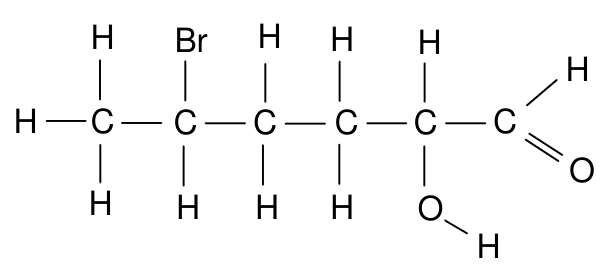
is:
a) 5-bromo-1-hexanoic acid
b) 5-bromo-2-hydroxy-1-hexanal
c) 2-bromo-5-hydroxy-6-hexanal
d) 2-bromo-2-hydroxy-1-hexanal
e) 5-bromo-2-hydroxy-1-hexanoneC. Which of the following acid-base pairs is most suitable for keeping the pH constant at 9 in an aqueous solution?
a) \(\ce{CH3COOH}\) — \(\ce{CH3COO-}\)
b) \(\ce{NH4+}\) — \(\ce{NH3}\)
c) \(\ce{H2CO3}\) — \(\ce{HCO3-}\)
d) \(\ce{H2PO4-}\) — \(\ce{HPO4^2-}\)
e) \(\ce{H2C2O4}\) — \(\ce{HC2O4-}\)D. One of the following statements cannot be correct. State which one.
a) A water-soluble solid contains \(\ce{Mg^2+}\), \(\ce{Cr^3+}\), and \(\ce{Br-}\).
b) A solid soluble in a sodium hydroxide solution contains \(\ce{Al^3+}\), \(\ce{K+}\), and \(\ce{SO4^2-}\).
c) A solid soluble in aqueous ammonia solution contains \(\ce{Ag+}\), \(\ce{Cu^2+}\), and \(\ce{Cl-}\).
d) A solid soluble in nitric acid contains \(\ce{Ba^2+}\), \(\ce{Fe^2+}\), and \(\ce{CO3^2-}\).
e) A solution neutral to litmus contains \(\ce{Na+}\), \(\ce{Ca^2+}\), and \(\ce{PO4^3-}\).E. Complete the following equation:

The reaction is carried out in an acid solution. Fill in the missing particles and balance the reaction equation.
F. State the degree of protolysis of acetic acid with concentration of \(0.25\ \mathrm{mol\,dm^{-3}}\).
\(K_{\mathrm a}(\ce{HAc})=1.8\times10^{-5}\).
a) \(0.021\ \%\); b) \(0.21\ \%\); c) \(0.84\ \%\); d) \(1.3\ \%\); e) \(8.4\ \%\)
G. A solution with a volume of \(1.00\ \mathrm{dm^3}\) is saturated with lead iodide, \(\ce{PbI2}\). The concentration of iodide ions is \(2.7\ \mathrm{mol\,dm^{-3}}\). Determine the solubility product of \(\ce{PbI2}\).
a) \(3.6\times10^{-6}\); b) \(2.0\times10^{-8}\); c) \(9.8\times10^{-9}\); d) \(2.5\times10^{-9}\); e) \(4.9\times10^{-9}\).
H. The following standard enthalpies of formation are given:
Compound \(\Delta H^0\) Acetic acid \(-0.50\ \mathrm{MJ\,mol^{-1}}\) Carbon dioxide \(-0.40\ \mathrm{MJ\,mol^{-1}}\) Water \(-0.30\ \mathrm{MJ\,mol^{-1}}\) The \(\Delta H^0\) of combustion of acetic acid is:
a) \(0.90\ \mathrm{MJ\,mol^{-1}}\); b) \(-0.90\ \mathrm{MJ\,mol^{-1}}\); c) \(-0.20\ \mathrm{MJ\,mol^{-1}}\);
d) \(-2.1\ \mathrm{MJ\,mol^{-1}}\); e) \(0.20\ \mathrm{MJ\,mol^{-1}}\)I. \(\ce{COCl2(g)}\) is introduced in an empty vessel at a pressure of \(a\). It dissociates and the following equilibrium is established at constant temperature:

If \(x\) represents the partial pressure of \(\ce{CO2(g)}\) at equilibrium, what is the equilibrium expression?
a) \(\displaystyle \frac{4x^3}{(a-2x)^2}=K_p\)
b) \(\displaystyle \frac{2x^4}{(a-2x)^2}=K_p\)
c) \(\displaystyle \frac{2x^3}{(a-x)^2}=K_p\)
d) \(\displaystyle \frac{4x^3}{(a-x)^2}=K_p\)
e) \(\displaystyle \frac{x^3}{(a-3x)^2}=K_p\)K. For a metal M the following redox data are known:

The \(E^0\) for \(\ce{M^4+(aq) + 3e- -> M+(aq)}\) is then:
a) \(-0.20\ \mathrm V\) b) \(-1.00\ \mathrm V\) c) \(1.00\ \mathrm V\) d) \(0.07\ \mathrm V\) e) \(-0.07\ \mathrm V\)
Official English text of the problem.
Problem 2: Liebig combustion analysis and identification of an organic liquid C
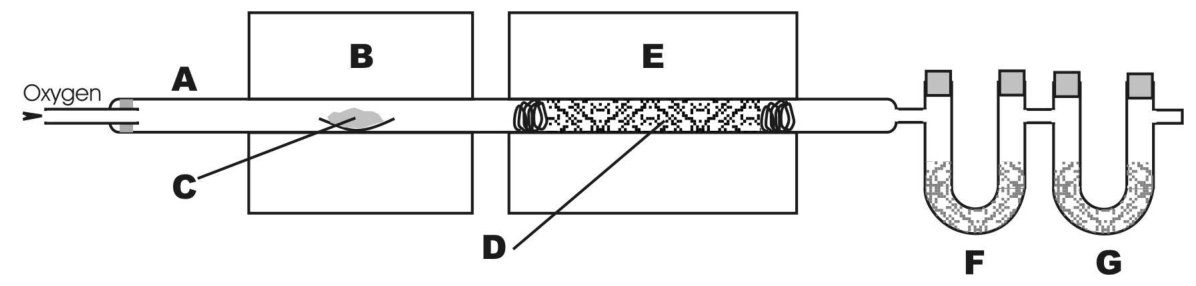
Quantitative analysis for carbon and hydrogen was originally carried out using a technique and apparatus (see figure) originally developed in 1831 by the famous chemist Justus Liebig. A carefully weighed sample of organic compound (C) is placed in a combustion tube (A) and vaporized by heating in a furnace (B). The vapours are swept by a stream of oxygen through a heated copper oxide packing (D) and through another furnace (E), which ensures the quantitative oxidation of carbon and hydrogen to carbon dioxide and water. The water vapour is absorbed in a weighed tube (F) containing magnesium perchlorate and the carbon dioxide in another weighed tube (G) containing asbestos impregnated with sodium hydroxide.
A pure liquid sample containing only carbon, hydrogen and oxygen is placed in a 0.57148 g platinum boat, which on reweighing weights 0.61227 g. The sample is ignited and the previously weighed absorption tubes are reweighed. The mass of the water absorption tube has increased from 6.47002 g to 6.50359 g, and the mass of the carbon dioxide tube has increased from 5.46311 g to 5.54466 g.
2.1 Calculate the mass composition of the compound.
2.2 Give the empirical formula of the compound.
To estimate the molar mass of the compound, 1.0045 g was gasified. The volume, measured at a temperature of 350 K and a pressure of 35.0 kPa, was 0.95 dm\(^3\).
2.3 Give the molar mass and the molecular formula of the compound.
2.4 Draw possible structures corresponding to the molecular formula excluding cyclic structures, stereo isomers, peroxides and unsaturated compounds. There are about 15 possibilities. Give 10 of them.
When the compound is heated with a sodium hydroxide solution, two products are formed. Fractional distillation of the reaction mixture yields one of the substances. The other substance is purified by distillation after acidification and appears to be an acid.
2.5 What structures are possible for compound C?
0.1005 g of the acid are dissolved in water and titrated with a sodium hydroxide solution with a concentration of 0.1000 mol dm\(^{-3}\). The indicator changes colour on addition of 16.75 cm\(^3\) of hydroxide solution.
2.6 What was the original substance C?
Official English text of the problem.
Problem 3: Analysis of methanol-formaldehyde solutions with dichromate and iodine
In a chemical factory in which formaldehyde is produced by oxidation of methanol, aqueous solutions containing methanol and formaldehyde are to be analyzed. In order to test the method, experiments are first carried out with known amounts of both methanol and formaldehyde. The following aqueous solutions are used:
Methanol, \(5.00\ \mathrm{g\,dm^{-3}}\)
Formaldehyde, \(5.00\ \mathrm{g\,dm^{-3}}\)
Potassium dichromate, \(3.000 \times 10^{-2}\ \mathrm{mol\,dm^{-3}}\)
Ammonium iron(II) sulphate, \(0.2000\ \mathrm{mol\,dm^{-3}}\)
Iodine, \(0.1000\ \mathrm{mol\,dm^{-3}}\)
Sodium thiosulphate, \(0.2000\ \mathrm{mol\,dm^{-3}}\).I. \(10.00\ \mathrm{cm^3}\) methanol solution and \(100.00\ \mathrm{cm^3}\) potassium dichromate solution are mixed, approximately \(100\ \mathrm{cm^3}\) concentrated sulphuric acid is added and the solution is allowed to stand for about 30 minutes. Excess dichromate ions are then titrated with iron(II) ions with diphenylamine sulphonic acid as a redox indicator (colour change from red-violet to pale green). The volume of the iron(II) solution consumed is \(43.5\ \mathrm{cm^3}\).
II. \(10.00\ \mathrm{cm^3}\) of formaldehyde solution and \(50.00\ \mathrm{cm^3}\) of iodine solution are mixed. Sodium hydroxide solution is added to alkaline reaction and the mixture is left standing for about 10 minutes. Hydrochloric acid is then added to a neutral reaction, and the excess iodine is determined by titration with thiosulphate, with starch as an indicator. The volume of the thiosulphate solution required is \(33.3\ \mathrm{cm^{-3}}\).
3.1 Using the analysis data in I and II calculate the reacting amounts and the molar ratios of methanol/dichromate ions and formaldehyde/iodine.
3.2 Write balanced equations for all reactions described in experiments I and II.
III. It is checked that iodine does not react with methanol. From a solution containing both methanol and formaldehyde, two \(10.00\ \mathrm{cm^3}\) samples are taken.
One sample is mixed with \(100.00\ \mathrm{cm^3}\) of potassium dichromate solution and concentrated sulphuric acid as in I. Excess dichromate ions consume \(4.8\ \mathrm{cm^3}\) of iron(II) solution.
The other sample is mixed with \(50.00\ \mathrm{cm^3}\) of iodine solution and treated as in II. Excess iodine consumes \(16.50\ \mathrm{cm^3}\) of thiosulphate solution.
3.3 Give balanced equations for the reactions and calculate the contents of methanol and formaldehyde in the solution. Give your answer in \(\mathrm{g\,dm^{-3}}\).
Official English text of the problem.
Problem 4: Coordination compounds of chromium(III): glycinato complex isomers and a chromium chloride hydrate
A transition metal atom or ion may be directly bonded to a number of atoms or molecules that surround it (ligands), forming a characteristic pattern. This is the essential structural feature of an important class of so-called coordination or complex compounds. If two or more atoms from one individual ligand form bonds to the same central atom then the ligand is said to form a chelate (Greek chele = crab' claw).
The glycinate ion, \(\ce{NH2-CH2-COO^-}\), is a bidentate chelate ligand which can form, for instance, tris-glycinato-chromium(III) complexes. The figure shows one possible structure of such a complex. Oxygen and nitrogen are forced to coordinate to adjacent octahedral positions, as the \(\ce{N-C-C-O}\) chain is too short to "embrace" the chromium ion.
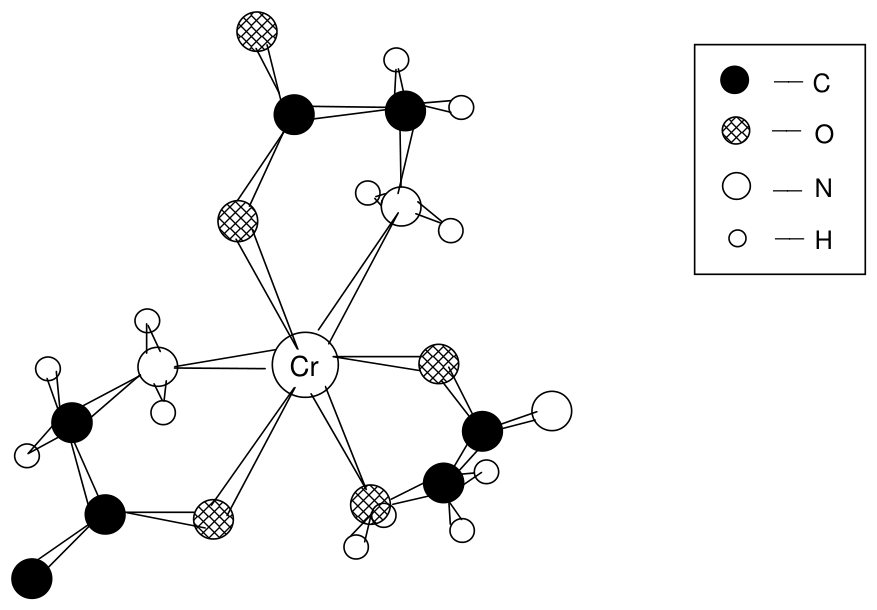
4.1 How many different configurational isomers of the complex are possible, not counting optical isomers?
4.2 Which of these isomers can be further resolved into optical isomers?
Another coordination compound of chromium was analyzed and found to have the following mass composition: 19.5 % \(\ce{Cr}\), 40.0 % \(\ce{Cl}\), 4.5 % \(\ce{H}\), and 36.0 % \(\ce{O}\). A 0.533 g sample of the compound was dissolved in \(100\ \mathrm{cm^3}\) of water, and \(10\ \mathrm{cm^3}\) of nitric acid \((2\ \mathrm{mol\,dm^{-3}})\) was added. Excess of silver nitrate solution was then added and the precipitate formed was then filtered, washed, dried and weighed. Its mass was found to be 0.287 g.
When a 1.06 g sample was gently heated to \(100\ ^\circ\mathrm{C}\) in a stream of dry air, 0.144 of water was driven off.
The freezing point of a solution prepared from 1.33 g of the compound and \(100\ \mathrm{cm^3}\) of water, was found to be \(-0.18\ ^\circ\mathrm{C}\). (Molar freezing point depression of water is \(1.82\ \mathrm{K\,kg\,mol^{-1}}\)).
Use all the experimental information to solve the following problems:
4.3 Derive the empirical formula of the compound.
4.4 Deduce formula for the compound showing the ligands of the chromium ion. Give molar ratios to support your result.
4.5 Sketch all possible steric arrangements of the ligands about the chromium ion.
Official English text of the problem.
Problem 5: Solubility of iodine in potassium iodide solutions
Iodine is soluble to a certain extent in pure water. It is, however, more soluble in solutions containing iodide ions. By studying the total solubility of iodine as a function of iodide concentration, the equilibrium constants of the following reactions can be determined:
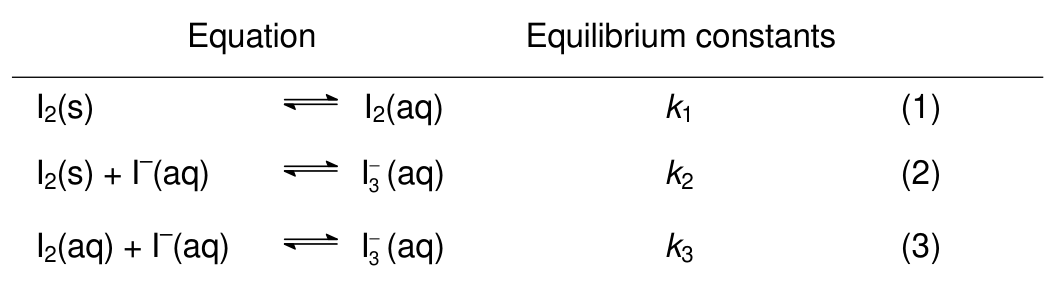
5.1 Give the equilibrium equations for (1) – (3).
Solutions of known potassium iodide concentration \([\ce{I^-}]_{\mathrm{tot}}\) were equilibrated with solid iodine. Subsequent titration with sodium thiosulphate solution served to determine the total solubility of iodine \([\ce{I2}]_{\mathrm{tot}}\).
The experiments yielded the following results:
\([\ce{I^-}]_{\mathrm{tot}}\,/\,\mathrm{mmol\,dm^{-3}}\) 10.00 20.00 30.00 40.00 50.00 \([\ce{I^-}]_{\mathrm{tot}}\,/\,\mathrm{mmol\,dm^{-3}}\) 5.85 10.53 15.11 19.96 24.82 5.2 Plot \([\ce{I2}]_{\mathrm{tot}}\) versus \([\ce{I^-}]_{\mathrm{tot}}\) in a diagram.
5.3 Derive a suitable algebraic expression relating \([\ce{I2}]_{\mathrm{tot}}\) and \([\ce{I^-}]_{\mathrm{tot}}\).
5.4 Use the graph to determine values of the equilibrium constants \(k_1\), \(k_2\), and \(k_3\).
Official English text of the problem.
Problem 6: Identification of organic compounds A-D from analytical data
A white solid organic acid, A, contains only carbon, hydrogen and oxygen. To obtain an approximate value for the molar mass, 10.0 g of the acid were dissolved in water. Crushed ice was added and vigorous shaking caused a decrease in temperature to −2.5 °C. The ice was quickly removed. The mass of the solution was 76.1 g, and its pH value was determined to be 1.4. In a handbook the molar freezing point depression constant for water was found to be 1.86 \(\mathrm{K\,kg\,mol^{-1}}\). A more precise determination of the molar mass of the acid was then carried out. 0.120 g of the acid was titrated with a sodium hydroxide solution with a concentration of 0.100 \(\mathrm{mol\,dm^{-3}}\). Phenolphthalein was used as an indicator, and when 23.4 \(\mathrm{cm^3}\) of hydroxide solution was added the indicator turned red.
6.1 Give the molar mass and the structure of acid A.
Liquid B dissolves in water up to 10 %. The pH value of the solution is about 4. B is not easily oxidized, but following the iodoform reaction and subsequent acidification it is oxidized to acid A. 0.10 g of B consumes 1.5 g of iodine.
When B reacts with sodium, hydrogen is evolved and a metal organic compound is formed. The molar mass of B is approximately 100 \(\mathrm{g\,mol^{-1}}\).
6.2 Write the chemical equation for the iodoform reaction and for the reaction with sodium. For the organic molecules structural formulas should be used.
Compound C in aqueous solution has a conductivity which differs very little from that of pure water. Alkaline hydrolysis of C yields ammonia. 0.120 g of C was treated with hot, dilute sodium hydroxide solution and the gas formed was led into 50.0 \(\mathrm{cm^3}\) hydrochloric acid with a concentration of 0.100 \(\mathrm{mol\,dm^{-3}}\). The excess acid was titrated with 10.0 \(\mathrm{cm^3}\) sodium hydroxide solution with a concentration of 0.100 \(\mathrm{mol\,dm^{-3}}\).
Acid hydrolysis of C yields carbon dioxide. From the freezing point depression, the molar mass of C is estimated to be between 40 \(\mathrm{g\,mol^{-1}}\) and 70 \(\mathrm{g\,mol^{-1}}\).
6.3 Give the structure of C. Write reaction equations for both the alkaline and the acid hydrolysis.
If C is allowed to react with the ethyl ester of acid A in the presence of a strong alkaline catalyst, ethanol and compound D are formed. The composition of D is 37.5 % C, 3.1 % H, 21.9 % N, and the reminder is oxygen. The compound is an acid.
6.4 Give the structure for D. Which is the "acid" hydrogen atom? Mark it with * in the structure.
Official English text of the problem.
Problem 7: Solubility of calcium oxalate and protolysis of oxalate
Calcium oxalate, \(\ce{CaC2O4.H2O}\), is a sparingly soluble salt of analytical and physiological importance. The solubility product is \(2.1\times10^{-9}\) at 25 °C. Oxalate ions can protolyse to form hydrogen oxalate ions and oxalic acid. The \(pK_a\) values at 25 °C are 1.23 (\(\ce{H2C2O4}\)) and 4.28 (\(\ce{HC2O4-}\)). At 25 °C the ionic product of water is \(1.0\times10^{-14}\).
7.1 State those expressions for the equilibrium conditions which are of interest for the calculation of the solubility of calcium oxalate monohydrate.
7.2 State the concentration conditions which are necessary for the calculation of the solubility \(s\) (in \(\mathrm{mol\,dm^{-3}}\)) of calcium oxalate in a strong acid of concentration \(C\).
7.3 Calculate the solubility (in \(\mathrm{g\,dm^{-3}}\)) of calcium oxalate monohydrate in a plant cell in which the buffer system regulates the pH to 6.5.
7.4 Calculate the solubility (in \(\mathrm{g\,dm^{-3}}\)) of calcium oxalate monohydrate in hydrochloric acid with a concentration of \(0.010\ \mathrm{mol\,dm^{-3}}\). Give the concentration of hydrogen ions in the solution.
7.5 Calculate the equilibrium concentrations of all other species in solution d).
Official English text of the problem.
Internationale Chemie-Olympiade
IChO 1982
Stockholm, Schweden · 7 Theorieaufgaben mit vollständigen Lösungen
Aufgabe 1: Zehn kurze Fragen A-K (überwiegend Multiple-Choice-Fragen)
A. Der IUPAC-Name der Verbindung \(\ce{[Co(NH3)6]Cl2}\) lautet
a) Cobalt(II)-hexaammoniakdichlor,
b) Cobalt(II)-hexaammoniakdichlorid,
c) Hexaammincobalt(II)-chlorid.
d) Hexaammindichlorocobalt(II)
e) Cobalt(II)-chlorid-HexaammoniakB. Der IUPAC-Name der Verbindung
lautet:
a) 5-Brom-1-hexansäure
b) 5-Brom-2-hydroxy-1-hexanal
c) 2-Brom-5-hydroxy-6-hexanal
d) 2-Brom-2-hydroxy-1-hexanal
e) 5-Brom-2-hydroxy-1-hexanonC. Welches der folgenden Säure-Base-Paare eignet sich am besten, um den pH-Wert einer wässrigen Lösung konstant bei 9 zu halten?
a) \(\ce{CH3COOH}\) — \(\ce{CH3COO-}\)
b) \(\ce{NH4+}\) — \(\ce{NH3}\)
c) \(\ce{H2CO3}\) — \(\ce{HCO3-}\)
d) \(\ce{H2PO4-}\) — \(\ce{HPO4^2-}\)
e) \(\ce{H2C2O4}\) — \(\ce{HC2O4-}\)D. Eine der folgenden Aussagen kann nicht richtig sein. Geben Sie an, welche.
a) Ein wasserlöslicher Feststoff enthält \(\ce{Mg^2+}\), \(\ce{Cr^3+}\) und \(\ce{Br-}\).
b) Ein in Natronlauge löslicher Feststoff enthält \(\ce{Al^3+}\), \(\ce{K+}\) und \(\ce{SO4^2-}\).
c) Ein in wässriger Ammoniaklösung löslicher Feststoff enthält \(\ce{Ag+}\), \(\ce{Cu^2+}\) und \(\ce{Cl-}\).
d) Ein in Salpetersäure löslicher Feststoff enthält \(\ce{Ba^2+}\), \(\ce{Fe^2+}\) und \(\ce{CO3^2-}\).
e) Eine gegenüber Lackmus neutrale Lösung enthält \(\ce{Na+}\), \(\ce{Ca^2+}\) und \(\ce{PO4^3-}\).E. Vervollständigen Sie die folgende Gleichung:
Die Reaktion wird in saurer Lösung durchgeführt. Ergänzen Sie die fehlenden Teilchen und gleichen Sie die Reaktionsgleichung aus.
F. Geben Sie den Protolysegrad von Essigsäure mit einer Konzentration von \(0.25\ \mathrm{mol\,dm^{-3}}\) an.
\(K_{\mathrm a}(\ce{HAc})=1.8\times10^{-5}\).
a) \(0.021\ \%\); b) \(0.21\ \%\); c) \(0.84\ \%\); d) \(1.3\ \%\); e) \(8.4\ \%\)
G. Eine Lösung mit einem Volumen von \(1.00\ \mathrm{dm^3}\) ist mit Bleiiodid, \(\ce{PbI2}\), gesättigt. Die Konzentration der Iodidionen beträgt \(2.7\ \mathrm{mol\,dm^{-3}}\). Bestimmen Sie das Löslichkeitsprodukt von \(\ce{PbI2}\).
a) \(3.6\times10^{-6}\); b) \(2.0\times10^{-8}\); c) \(9.8\times10^{-9}\); d) \(2.5\times10^{-9}\); e) \(4.9\times10^{-9}\).
H. Folgende Standardbildungsenthalpien sind gegeben:
Verbindung \(\Delta H^0\) Essigsäure \(-0.50\ \mathrm{MJ\,mol^{-1}}\) Kohlenstoffdioxid \(-0.40\ \mathrm{MJ\,mol^{-1}}\) Wasser \(-0.30\ \mathrm{MJ\,mol^{-1}}\) Die Verbrennungsenthalpie \(\Delta H^0\) von Essigsäure beträgt:
a) \(0.90\ \mathrm{MJ\,mol^{-1}}\); b) \(-0.90\ \mathrm{MJ\,mol^{-1}}\); c) \(-0.20\ \mathrm{MJ\,mol^{-1}}\);
d) \(-2.1\ \mathrm{MJ\,mol^{-1}}\); e) \(0.20\ \mathrm{MJ\,mol^{-1}}\)I. \(\ce{COCl2(g)}\) wird bei einem Druck von \(a\) in ein leeres Gefäß eingebracht. Es dissoziiert, und bei konstanter Temperatur stellt sich das folgende Gleichgewicht ein:
Wenn \(x\) den Partialdruck von \(\ce{CO2(g)}\) im Gleichgewicht bezeichnet, wie lautet dann der Gleichgewichtsausdruck?
a) \(\displaystyle \frac{4x^3}{(a-2x)^2}=K_p\)
b) \(\displaystyle \frac{2x^4}{(a-2x)^2}=K_p\)
c) \(\displaystyle \frac{2x^3}{(a-x)^2}=K_p\)
d) \(\displaystyle \frac{4x^3}{(a-x)^2}=K_p\)
e) \(\displaystyle \frac{x^3}{(a-3x)^2}=K_p\)K. Für ein Metall M sind die folgenden Redoxdaten bekannt:
Das \(E^0\) für \(\ce{M^4+(aq) + 3e- -> M+(aq)}\) beträgt dann:
a) \(-0.20\ \mathrm V\) b) \(-1.00\ \mathrm V\) c) \(1.00\ \mathrm V\) d) \(0.07\ \mathrm V\) e) \(-0.07\ \mathrm V\)
Aufgabentext aus dem offiziellen englischen Text übersetzt.
Aufgabe 2: Liebigsche Verbrennungsanalyse und Identifizierung einer organischen Flüssigkeit C
Die quantitative Analyse auf Kohlenstoff und Wasserstoff wurde ursprünglich mit einem Verfahren und einer Apparatur (siehe Abbildung) durchgeführt, die der berühmte Chemiker Justus Liebig im Jahr 1831 entwickelt hatte. Eine sorgfältig eingewogene Probe der organischen Verbindung (C) wird in ein Verbrennungsrohr (A) eingebracht und durch Erhitzen in einem Ofen (B) verdampft. Die Dämpfe werden von einem Sauerstoffstrom durch eine erhitzte Kupferoxidfüllung (D) und durch einen weiteren Ofen (E) geleitet, der die quantitative Oxidation von Kohlenstoff und Wasserstoff zu Kohlenstoffdioxid und Wasser gewährleistet. Der Wasserdampf wird in einem gewogenen Rohr (F) mit Magnesiumperchlorat absorbiert, das Kohlenstoffdioxid in einem weiteren gewogenen Rohr (G), das mit Natriumhydroxid imprägnierten Asbest enthält.
Eine reine flüssige Probe, die nur Kohlenstoff, Wasserstoff und Sauerstoff enthält, wird in ein 0.57148 g schweres Platinschiffchen eingebracht, das bei erneuter Wägung 0.61227 g wiegt. Die Probe wird entzündet, und die zuvor gewogenen Absorptionsrohre werden erneut gewogen. Die Masse des Wasserabsorptionsrohrs hat von 6.47002 g auf 6.50359 g zugenommen, und die Masse des Kohlenstoffdioxidabsorptionsrohrs ist von 5.46311 g auf 5.54466 g gestiegen.
2.1 Berechnen Sie die Massenanteile der Elemente in der Verbindung.
2.2 Geben Sie die Verhältnisformel der Verbindung an.
Zur Abschätzung der molaren Masse der Verbindung wurden 1.0045 g verdampft. Das bei einer Temperatur von 350 K und einem Druck von 35.0 kPa gemessene Volumen betrug 0.95 dm\(^3\).
2.3 Geben Sie die molare Masse und die Summenformel der Verbindung an.
2.4 Zeichnen Sie mögliche Strukturen, die der Summenformel entsprechen, unter Ausschluss cyclischer Strukturen, von Stereoisomeren, Peroxiden und ungesättigten Verbindungen. Es gibt etwa 15 Möglichkeiten. Geben Sie 10 davon an.
Beim Erhitzen der Verbindung mit Natronlauge entstehen zwei Produkte. Durch fraktionierte Destillation des Reaktionsgemischs wird eine der Substanzen gewonnen. Die andere Substanz wird nach dem Ansäuern durch Destillation gereinigt und erweist sich als Säure.
2.5 Welche Strukturen kommen für die Verbindung C infrage?
0.1005 g der Säure werden in Wasser gelöst und mit Natronlauge der Konzentration 0.1000 mol dm\(^{-3}\) titriert. Nach Zugabe von 16.75 cm\(^3\) Natronlauge schlägt der Indikator um.
2.6 Was war die ursprüngliche Substanz C?
Aufgabentext aus dem offiziellen englischen Text übersetzt.
Aufgabe 3: Analyse von Methanol-Formaldehyd-Lösungen mit Dichromat und Iod
In einer chemischen Fabrik, in der Formaldehyd durch Oxidation von Methanol hergestellt wird, sollen wässrige Lösungen analysiert werden, die Methanol und Formaldehyd enthalten. Zur Überprüfung des Verfahrens werden zunächst Versuche mit bekannten Mengen an Methanol und Formaldehyd durchgeführt. Folgende wässrige Lösungen werden verwendet:
Methanol, \(5.00\ \mathrm{g\,dm^{-3}}\)
Formaldehyd, \(5.00\ \mathrm{g\,dm^{-3}}\)
Kaliumdichromat, \(3.000 \times 10^{-2}\ \mathrm{mol\,dm^{-3}}\)
Ammoniumeisen(II)-sulfat, \(0.2000\ \mathrm{mol\,dm^{-3}}\)
Iod, \(0.1000\ \mathrm{mol\,dm^{-3}}\)
Natriumthiosulfat, \(0.2000\ \mathrm{mol\,dm^{-3}}\).I. \(10.00\ \mathrm{cm^3}\) Methanollösung und \(100.00\ \mathrm{cm^3}\) Kaliumdichromatlösung werden gemischt, etwa \(100\ \mathrm{cm^3}\) konzentrierte Schwefelsäure werden zugegeben, und die Lösung wird etwa 30 Minuten stehen gelassen. Anschließend werden die überschüssigen Dichromationen mit Eisen(II)-Ionen titriert, wobei Diphenylaminsulfonsäure als Redoxindikator verwendet wird (Farbumschlag von Rotviolett nach Hellgrün). Das verbrauchte Volumen der Eisen(II)-Lösung beträgt \(43.5\ \mathrm{cm^3}\).
II. \(10.00\ \mathrm{cm^3}\) Formaldehydlösung und \(50.00\ \mathrm{cm^3}\) Iodlösung werden gemischt. Natronlauge wird bis zur alkalischen Reaktion zugegeben, und das Gemisch wird etwa 10 Minuten stehen gelassen. Anschließend wird Salzsäure bis zur neutralen Reaktion zugegeben und das überschüssige Iod durch Titration mit Thiosulfat unter Verwendung von Stärke als Indikator bestimmt. Das benötigte Volumen der Thiosulfatlösung beträgt \(33.3\ \mathrm{cm^{-3}}\).
3.1 Berechnen Sie anhand der Analysendaten aus I und II die umgesetzten Stoffmengen und die Stoffmengenverhältnisse von Methanol zu Dichromationen und von Formaldehyd zu Iod.
3.2 Stellen Sie ausgeglichene Gleichungen für alle in den Versuchen I und II beschriebenen Reaktionen auf.
III. Es wird überprüft, dass Iod nicht mit Methanol reagiert. Einer Lösung, die sowohl Methanol als auch Formaldehyd enthält, werden zwei Proben von jeweils \(10.00\ \mathrm{cm^3}\) entnommen.
Eine Probe wird wie in I mit \(100.00\ \mathrm{cm^3}\) Kaliumdichromatlösung und konzentrierter Schwefelsäure gemischt. Die überschüssigen Dichromationen verbrauchen \(4.8\ \mathrm{cm^3}\) Eisen(II)-Lösung.
Die andere Probe wird mit \(50.00\ \mathrm{cm^3}\) Iodlösung gemischt und wie in II behandelt. Das überschüssige Iod verbraucht \(16.50\ \mathrm{cm^3}\) Thiosulfatlösung.
3.3 Geben Sie ausgeglichene Gleichungen für die Reaktionen an und berechnen Sie die Gehalte an Methanol und Formaldehyd in der Lösung. Geben Sie Ihr Ergebnis in \(\mathrm{g\,dm^{-3}}\) an.
Aufgabentext aus dem offiziellen englischen Text übersetzt.
Aufgabe 4: Koordinationsverbindungen des Chroms(III): Isomere des Glycinato-Komplexes und ein Chromchlorid-Hydrat
Ein Übergangsmetallatom oder -ion kann unmittelbar an mehrere Atome oder Moleküle gebunden sein, die es umgeben (Liganden) und dabei eine charakteristische Anordnung bilden. Dies ist das wesentliche Strukturmerkmal einer wichtigen Klasse sogenannter Koordinations- oder Komplexverbindungen. Bilden zwei oder mehr Atome eines einzelnen Liganden Bindungen zum selben Zentralatom aus, so spricht man davon, dass der Ligand ein Chelat bildet (griechisch chele = Krebsschere).
Das Glycinat-Ion, \(\ce{NH2-CH2-COO^-}\), ist ein zweizähniger Chelatligand, der beispielsweise Tris(glycinato)chrom(III)-Komplexe bilden kann. Die Abbildung zeigt eine mögliche Struktur eines solchen Komplexes. Sauerstoff und Stickstoff müssen benachbarte Oktaederpositionen besetzen, da die \(\ce{N-C-C-O}\)-Kette zu kurz ist, um das Chromion zu „umgreifen“.
4.1 Wie viele verschiedene Konfigurationsisomere des Komplexes sind möglich, wenn optische Isomere nicht mitgezählt werden?
4.2 Welche dieser Isomere lassen sich weiter in optische Isomere auftrennen?
Eine andere Koordinationsverbindung des Chroms wurde analysiert und wies die folgende Massenzusammensetzung auf: 19.5 % \(\ce{Cr}\), 40.0 % \(\ce{Cl}\), 4.5 % \(\ce{H}\) und 36.0 % \(\ce{O}\). Eine Probe von 0.533 g der Verbindung wurde in \(100\ \mathrm{cm^3}\) Wasser gelöst, und \(10\ \mathrm{cm^3}\) Salpetersäure \((2\ \mathrm{mol\,dm^{-3}})\) wurden zugegeben. Anschließend wurde Silbernitratlösung im Überschuss zugesetzt; der entstandene Niederschlag wurde abfiltriert, gewaschen, getrocknet und gewogen. Seine Masse betrug 0.287 g.
Als eine Probe von 1.06 g in einem Strom trockener Luft schonend auf \(100\ ^\circ\mathrm{C}\) erhitzt wurde, wurden 0.144 Wasser ausgetrieben.
Der Gefrierpunkt einer Lösung aus 1.33 g der Verbindung und \(100\ \mathrm{cm^3}\) Wasser betrug \(-0.18\ ^\circ\mathrm{C}\). (Die molale Gefrierpunktserniedrigung von Wasser beträgt \(1.82\ \mathrm{K\,kg\,mol^{-1}}\)).
Verwenden Sie alle experimentellen Angaben, um die folgenden Aufgaben zu lösen:
4.3 Leiten Sie die Verhältnisformel der Verbindung her.
4.4 Leiten Sie eine Formel für die Verbindung ab, aus der die Liganden des Chromions hervorgehen. Geben Sie zur Begründung Ihres Ergebnisses Stoffmengenverhältnisse an.
4.5 Skizzieren Sie alle möglichen räumlichen Anordnungen der Liganden um das Chromion.
Aufgabentext aus dem offiziellen englischen Text übersetzt.
Aufgabe 5: Löslichkeit von Iod in Kaliumiodidlösungen
Iod ist in reinem Wasser in gewissem Umfang löslich. In Lösungen, die Iodidionen enthalten, ist es jedoch besser löslich. Durch Untersuchung der Gesamtlöslichkeit von Iod in Abhängigkeit von der Iodidkonzentration lassen sich die Gleichgewichtskonstanten der folgenden Reaktionen bestimmen:
5.1 Geben Sie die Gleichgewichtsausdrücke für (1) – (3) an.
Lösungen bekannter Kaliumiodidkonzentration \([\ce{I^-}]_{\mathrm{tot}}\) wurden mit festem Iod ins Gleichgewicht gebracht. Eine anschließende Titration mit Natriumthiosulfatlösung diente zur Bestimmung der Gesamtlöslichkeit von Iod \([\ce{I2}]_{\mathrm{tot}}\).
Die Versuche ergaben die folgenden Ergebnisse:
\([\ce{I^-}]_{\mathrm{tot}}\,/\,\mathrm{mmol\,dm^{-3}}\) 10.00 20.00 30.00 40.00 50.00 \([\ce{I^-}]_{\mathrm{tot}}\,/\,\mathrm{mmol\,dm^{-3}}\) 5.85 10.53 15.11 19.96 24.82 5.2 Tragen Sie \([\ce{I2}]_{\mathrm{tot}}\) gegen \([\ce{I^-}]_{\mathrm{tot}}\) in einem Diagramm auf.
5.3 Leiten Sie einen geeigneten algebraischen Ausdruck her, der \([\ce{I2}]_{\mathrm{tot}}\) und \([\ce{I^-}]_{\mathrm{tot}}\) miteinander verknüpft.
5.4 Bestimmen Sie mithilfe des Diagramms die Werte der Gleichgewichtskonstanten \(k_1\), \(k_2\) und \(k_3\).
Aufgabentext aus dem offiziellen englischen Text übersetzt.
Aufgabe 6: Identifizierung der organischen Verbindungen A-D anhand analytischer Daten
Eine weiße, feste organische Säure, A, enthält nur Kohlenstoff, Wasserstoff und Sauerstoff. Zur näherungsweisen Bestimmung der molaren Masse wurden 10.0 g der Säure in Wasser gelöst. Zerstoßenes Eis wurde zugegeben, und kräftiges Schütteln führte zu einer Temperaturabnahme auf −2.5 °C. Das Eis wurde rasch entfernt. Die Masse der Lösung betrug 76.1 g, und ihr pH-Wert wurde zu 1.4 bestimmt. In einem Handbuch wurde die molare Gefrierpunktserniedrigungskonstante für Wasser mit 1.86 \(\mathrm{K\,kg\,mol^{-1}}\) angegeben. Anschließend wurde die molare Masse der Säure genauer bestimmt. 0.120 g der Säure wurden mit einer Natriumhydroxidlösung der Konzentration 0.100 \(\mathrm{mol\,dm^{-3}}\) titriert. Als Indikator wurde Phenolphthalein verwendet; nach Zugabe von 23.4 \(\mathrm{cm^3}\) Hydroxidlösung färbte sich der Indikator rot.
6.1 Geben Sie die molare Masse und die Struktur der Säure A an.
Die Flüssigkeit B löst sich in Wasser bis zu einem Anteil von 10 %. Der pH-Wert der Lösung beträgt etwa 4. B lässt sich nicht leicht oxidieren, wird jedoch durch die Iodoformreaktion mit anschließendem Ansäuern zur Säure A oxidiert. 0.10 g B verbrauchen 1.5 g Iod.
Bei der Reaktion von B mit Natrium wird Wasserstoff freigesetzt, und es entsteht eine metallorganische Verbindung. Die molare Masse von B beträgt ungefähr 100 \(\mathrm{g\,mol^{-1}}\).
6.2 Stellen Sie die Reaktionsgleichungen für die Iodoformreaktion und für die Reaktion mit Natrium auf. Verwenden Sie für die organischen Moleküle Strukturformeln.
Die Verbindung C weist in wässriger Lösung eine Leitfähigkeit auf, die sich nur sehr wenig von derjenigen reinen Wassers unterscheidet. Bei der alkalischen Hydrolyse von C entsteht Ammoniak. 0.120 g C wurden mit heißer, verdünnter Natriumhydroxidlösung behandelt, und das entstandene Gas wurde in 50.0 \(\mathrm{cm^3}\) Salzsäure der Konzentration 0.100 \(\mathrm{mol\,dm^{-3}}\) geleitet. Die überschüssige Säure wurde mit 10.0 \(\mathrm{cm^3}\) Natriumhydroxidlösung der Konzentration 0.100 \(\mathrm{mol\,dm^{-3}}\) titriert.
Bei der sauren Hydrolyse von C entsteht Kohlenstoffdioxid. Aus der Gefrierpunktserniedrigung wird die molare Masse von C auf einen Wert zwischen 40 \(\mathrm{g\,mol^{-1}}\) und 70 \(\mathrm{g\,mol^{-1}}\) geschätzt.
6.3 Geben Sie die Struktur von C an. Stellen Sie die Reaktionsgleichungen sowohl für die alkalische als auch für die saure Hydrolyse auf.
Lässt man C in Gegenwart eines stark basischen Katalysators mit dem Ethylester der Säure A reagieren, entstehen Ethanol und die Verbindung D. Die Zusammensetzung von D beträgt 37.5 % C, 3.1 % H und 21.9 % N; der Rest ist Sauerstoff. Die Verbindung ist eine Säure.
6.4 Geben Sie die Struktur von D an. Welches ist das „saure“ Wasserstoffatom? Markieren Sie es in der Struktur mit *.
Aufgabentext aus dem offiziellen englischen Text übersetzt.
Aufgabe 7: Löslichkeit von Calciumoxalat und Protolyse von Oxalat
Calciumoxalat, \(\ce{CaC2O4.H2O}\), ist ein schwer lösliches Salz von analytischer und physiologischer Bedeutung. Das Löslichkeitsprodukt beträgt bei 25 °C \(2.1\times10^{-9}\). Oxalat-Ionen können durch Protolyse Hydrogenoxalat-Ionen und Oxalsäure bilden. Die \(pK_a\)-Werte bei 25 °C betragen 1.23 (\(\ce{H2C2O4}\)) und 4.28 (\(\ce{HC2O4-}\)). Bei 25 °C beträgt das Ionenprodukt des Wassers \(1.0\times10^{-14}\).
7.1 Geben Sie die Ausdrücke für die Gleichgewichtsbedingungen an, die für die Berechnung der Löslichkeit von Calciumoxalat-Monohydrat von Bedeutung sind.
7.2 Geben Sie die Konzentrationsbedingungen an, die zur Berechnung der Löslichkeit \(s\) (in \(\mathrm{mol\,dm^{-3}}\)) von Calciumoxalat in einer starken Säure der Konzentration \(C\) erforderlich sind.
7.3 Berechnen Sie die Löslichkeit (in \(\mathrm{g\,dm^{-3}}\)) von Calciumoxalat-Monohydrat in einer Pflanzenzelle, in der das Puffersystem den pH-Wert auf 6.5 reguliert.
7.4 Berechnen Sie die Löslichkeit (in \(\mathrm{g\,dm^{-3}}\)) von Calciumoxalat-Monohydrat in Salzsäure mit einer Konzentration von \(0.010\ \mathrm{mol\,dm^{-3}}\). Geben Sie die Konzentration der Wasserstoff-Ionen in der Lösung an.
7.5 Berechnen Sie die Gleichgewichtskonzentrationen aller anderen Spezies in Lösung d).
Aufgabentext aus dem offiziellen englischen Text übersetzt.
Uluslararası Kimya Olimpiyatı
IChO 1982
Stockholm, İsveç · 7 teori sorusu, tam çözümleriyle
Soru 1: A-K arasında on kısa soru (çoğunlukla çoktan seçmeli)
A. \(\ce{[Co(NH3)6]Cl2}\) bileşiğinin IUPAC adı aşağıdakilerden hangisidir?
a) kobalt(II) hekzaamonyak diklor,
b) kobalt(II) hekzaamonyak diklorür,
c) hekzaamminkobalt(II) klorür.
d) hekzaamindiklorokobalt(II)
e) kobalt(II) klorür-hekzaamonyakB. Aşağıdaki bileşiğin
IUPAC adı aşağıdakilerden hangisidir?
a) 5-bromo-1-heksanoik asit
b) 5-bromo-2-hidroksi-1-heksanal
c) 2-bromo-5-hidroksi-6-heksanal
d) 2-bromo-2-hidroksi-1-heksanal
e) 5-bromo-2-hidroksi-1-heksanonC. Aşağıdaki asit-baz çiftlerinden hangisi sulu bir çözeltinin pH değerini 9'da sabit tutmak için en uygundur?
a) \(\ce{CH3COOH}\) — \(\ce{CH3COO-}\)
b) \(\ce{NH4+}\) — \(\ce{NH3}\)
c) \(\ce{H2CO3}\) — \(\ce{HCO3-}\)
d) \(\ce{H2PO4-}\) — \(\ce{HPO4^2-}\)
e) \(\ce{H2C2O4}\) — \(\ce{HC2O4-}\)D. Aşağıdaki ifadelerden biri doğru olamaz. Hangisi olduğunu belirtiniz.
a) Suda çözünen bir katı \(\ce{Mg^2+}\), \(\ce{Cr^3+}\) ve \(\ce{Br-}\) içerir.
b) Sodyum hidroksit çözeltisinde çözünen bir katı \(\ce{Al^3+}\), \(\ce{K+}\) ve \(\ce{SO4^2-}\) içerir.
c) Sulu amonyak çözeltisinde çözünen bir katı \(\ce{Ag+}\), \(\ce{Cu^2+}\) ve \(\ce{Cl-}\) içerir.
d) Nitrik asitte çözünen bir katı \(\ce{Ba^2+}\), \(\ce{Fe^2+}\) ve \(\ce{CO3^2-}\) içerir.
e) Turnusole karşı nötr olan bir çözelti \(\ce{Na+}\), \(\ce{Ca^2+}\) ve \(\ce{PO4^3-}\) içerir.E. Aşağıdaki denklemi tamamlayınız:
Tepkime asidik bir çözeltide gerçekleştirilir. Eksik tanecikleri yazınız ve tepkime denklemini denkleştiriniz.
F. Derişimi \(0.25\ \mathrm{mol\,dm^{-3}}\) olan asetik asidin protoliz derecesini belirtiniz.
\(K_{\mathrm a}(\ce{HAc})=1.8\times10^{-5}\).
a) \(0.021\ \%\); b) \(0.21\ \%\); c) \(0.84\ \%\); d) \(1.3\ \%\); e) \(8.4\ \%\)
G. Hacmi \(1.00\ \mathrm{dm^3}\) olan bir çözelti kurşun iyodür, \(\ce{PbI2}\), ile doymuştur. İyodür iyonlarının derişimi \(2.7\ \mathrm{mol\,dm^{-3}}\)'tür. \(\ce{PbI2}\)'nin çözünürlük çarpımını belirleyiniz.
a) \(3.6\times10^{-6}\); b) \(2.0\times10^{-8}\); c) \(9.8\times10^{-9}\); d) \(2.5\times10^{-9}\); e) \(4.9\times10^{-9}\).
H. Aşağıdaki standart oluşum entalpileri verilmiştir:
Bileşik \(\Delta H^0\) Asetik asit \(-0.50\ \mathrm{MJ\,mol^{-1}}\) Karbondioksit \(-0.40\ \mathrm{MJ\,mol^{-1}}\) Su \(-0.30\ \mathrm{MJ\,mol^{-1}}\) Asetik asidin yanma tepkimesinin \(\Delta H^0\) değeri aşağıdakilerden hangisidir?
a) \(0.90\ \mathrm{MJ\,mol^{-1}}\); b) \(-0.90\ \mathrm{MJ\,mol^{-1}}\); c) \(-0.20\ \mathrm{MJ\,mol^{-1}}\);
d) \(-2.1\ \mathrm{MJ\,mol^{-1}}\); e) \(0.20\ \mathrm{MJ\,mol^{-1}}\)I. Boş bir kaba \(a\) basıncında \(\ce{COCl2(g)}\) konur. Bu madde ayrışır ve sabit sıcaklıkta aşağıdaki denge kurulur:
\(x\), dengedeki \(\ce{CO2(g)}\)'nin kısmi basıncını gösteriyorsa denge ifadesi nedir?
a) \(\displaystyle \frac{4x^3}{(a-2x)^2}=K_p\)
b) \(\displaystyle \frac{2x^4}{(a-2x)^2}=K_p\)
c) \(\displaystyle \frac{2x^3}{(a-x)^2}=K_p\)
d) \(\displaystyle \frac{4x^3}{(a-x)^2}=K_p\)
e) \(\displaystyle \frac{x^3}{(a-3x)^2}=K_p\)K. Bir M metali için aşağıdaki redoks verileri bilinmektedir:
Buna göre \(\ce{M^4+(aq) + 3e- -> M+(aq)}\) için \(E^0\) değeri aşağıdakilerden hangisidir?
a) \(-0.20\ \mathrm V\) b) \(-1.00\ \mathrm V\) c) \(1.00\ \mathrm V\) d) \(0.07\ \mathrm V\) e) \(-0.07\ \mathrm V\)
Soru metni resmi İngilizce metinden çevrilmiştir.
Soru 2: Liebig yanma analizi ve organik bir C sıvısının tanımlanması
Karbon ve hidrojenin nicel analizi ilk olarak, ünlü kimyager Justus Liebig tarafından 1831 yılında geliştirilen bir teknik ve düzenek (şekle bakınız) kullanılarak gerçekleştirilmiştir. Organik bileşiğin (C) dikkatle tartılmış bir örneği bir yanma tüpüne (A) yerleştirilir ve bir fırında (B) ısıtılarak buharlaştırılır. Buharlar, bir oksijen akımıyla ısıtılmış bakır oksit dolgusundan (D) ve başka bir fırından (E) geçirilir; böylece karbon ve hidrojenin nicel olarak karbon dioksit ve suya yükseltgenmesi sağlanır. Su buharı, magnezyum perklorat içeren ve önceden tartılmış bir tüpte (F); karbon dioksit ise sodyum hidroksit emdirilmiş asbest içeren ve önceden tartılmış başka bir tüpte (G) soğurulur.
Yalnızca karbon, hidrojen ve oksijen içeren saf bir sıvı örneği, kütlesi 0.57148 g olan platin bir kayıkçığa konur; yeniden tartıldığında kayıkçığın örnekle birlikte kütlesi 0.61227 g olur. Örnek yakılır ve önceden tartılmış soğurma tüpleri yeniden tartılır. Su soğurma tüpünün kütlesi 6.47002 g'dan 6.50359 g'a, karbon dioksit tüpünün kütlesi ise 5.46311 g'dan 5.54466 g'a yükselmiştir.
2.1 Bileşiğin kütlece bileşimini hesaplayınız.
2.2 Bileşiğin basit formülünü veriniz.
Bileşiğin molar kütlesini tahmin etmek için 1.0045 g örnek gaz hâline getirilmiştir. 350 K sıcaklıkta ve 35.0 kPa basınçta ölçülen hacim 0.95 dm\(^3\) olmuştur.
2.3 Bileşiğin molar kütlesini ve molekül formülünü veriniz.
2.4 Halkalı yapılar, stereoizomerler, peroksitler ve doymamış bileşikler hariç olmak üzere, molekül formülüne karşılık gelen olası yapıları çiziniz. Yaklaşık 15 olasılık vardır. Bunlardan 10 tanesini veriniz.
Bileşik bir sodyum hidroksit çözeltisiyle ısıtıldığında iki ürün oluşur. Tepkime karışımının ayrımsal damıtılmasıyla maddelerden biri elde edilir. Diğer madde, asitlendirmeden sonra damıtılarak saflaştırılır ve bir asit olduğu anlaşılır.
2.5 C bileşiği için hangi yapılar mümkündür?
Asidin 0.1005 g'ı suda çözülür ve derişimi 0.1000 mol dm\(^{-3}\) olan bir sodyum hidroksit çözeltisiyle titre edilir. 16.75 cm\(^3\) hidroksit çözeltisi eklendiğinde indikatör renk değiştirir.
2.6 Başlangıçtaki C maddesi nedir?
Soru metni resmi İngilizce metinden çevrilmiştir.
Soru 3: Metanol-formaldehit çözeltilerinin dikromat ve iyot ile analizi
Formaldehitin metanolün yükseltgenmesiyle üretildiği bir kimya fabrikasında, metanol ve formaldehit içeren sulu çözeltiler analiz edilecektir. Yöntemi sınamak amacıyla önce hem metanolün hem de formaldehitin bilinen miktarlarıyla deneyler yapılır. Aşağıdaki sulu çözeltiler kullanılır:
Metanol, \(5.00\ \mathrm{g\,dm^{-3}}\)
Formaldehit, \(5.00\ \mathrm{g\,dm^{-3}}\)
Potasyum dikromat, \(3.000 \times 10^{-2}\ \mathrm{mol\,dm^{-3}}\)
Amonyum demir(II) sülfat, \(0.2000\ \mathrm{mol\,dm^{-3}}\)
İyot, \(0.1000\ \mathrm{mol\,dm^{-3}}\)
Sodyum tiyosülfat, \(0.2000\ \mathrm{mol\,dm^{-3}}\).I. \(10.00\ \mathrm{cm^3}\) metanol çözeltisi ile \(100.00\ \mathrm{cm^3}\) potasyum dikromat çözeltisi karıştırılır, yaklaşık \(100\ \mathrm{cm^3}\) derişik sülfürik asit eklenir ve çözelti yaklaşık 30 dakika bekletilir. Ardından fazla dikromat iyonları, redoks indikatörü olarak difenilamin sülfonik asit kullanılarak demir(II) iyonlarıyla titre edilir (renk kırmızı-mordan açık yeşile döner). Harcanan demir(II) çözeltisinin hacmi \(43.5\ \mathrm{cm^3}\) olur.
II. \(10.00\ \mathrm{cm^3}\) formaldehit çözeltisi ile \(50.00\ \mathrm{cm^3}\) iyot çözeltisi karıştırılır. Ortam bazik oluncaya kadar sodyum hidroksit çözeltisi eklenir ve karışım yaklaşık 10 dakika bekletilir. Ardından ortam nötr oluncaya kadar hidroklorik asit eklenir ve fazla iyot, indikatör olarak nişasta kullanılarak tiyosülfatla titrasyon yoluyla belirlenir. Gereken tiyosülfat çözeltisinin hacmi \(33.3\ \mathrm{cm^{-3}}\) olur.
3.1 I ve II'deki analiz verilerini kullanarak tepkimeye giren madde miktarlarını ve metanol/dikromat iyonları ile formaldehit/iyot mol oranlarını hesaplayınız.
3.2 I ve II deneylerinde açıklanan tüm tepkimelerin denkleştirilmiş denklemlerini yazınız.
III. İyodun metanol ile tepkimeye girmediği doğrulanır. Hem metanol hem de formaldehit içeren bir çözeltiden, her biri \(10.00\ \mathrm{cm^3}\) olan iki örnek alınır.
Örneklerden biri, I'de olduğu gibi \(100.00\ \mathrm{cm^3}\) potasyum dikromat çözeltisi ve derişik sülfürik asit ile karıştırılır. Fazla dikromat iyonları \(4.8\ \mathrm{cm^3}\) demir(II) çözeltisi harcar.
Diğer örnek \(50.00\ \mathrm{cm^3}\) iyot çözeltisi ile karıştırılır ve II'deki gibi işleme tabi tutulur. Fazla iyot \(16.50\ \mathrm{cm^3}\) tiyosülfat çözeltisi harcar.
3.3 Tepkimelerin denkleştirilmiş denklemlerini veriniz ve çözeltinin metanol ve formaldehit içeriklerini hesaplayınız. Cevabınızı \(\mathrm{g\,dm^{-3}}\) cinsinden veriniz.
Soru metni resmi İngilizce metinden çevrilmiştir.
Soru 4: Krom(III) koordinasyon bileşikleri: glisinato kompleksi izomerleri ve bir krom klorür hidratı
Bir geçiş metali atomu veya iyonu, kendisini çevreleyen belirli sayıda atom veya moleküle (ligandlara) doğrudan bağlanarak karakteristik bir düzen oluşturabilir. Bu, koordinasyon veya kompleks bileşikleri olarak adlandırılan önemli bir bileşik sınıfının temel yapısal özelliğidir. Tek bir ligandın iki veya daha fazla atomu aynı merkez atomuna bağlanırsa ligandın bir şelat oluşturduğu söylenir (Yunanca chele = yengeç kıskacı).
Glisinat iyonu, \(\ce{NH2-CH2-COO^-}\), örneğin tris-glisinato-krom(III) kompleksleri oluşturabilen iki dişli bir şelat ligandıdır. Şekilde böyle bir kompleksin olası yapılarından biri gösterilmektedir. \(\ce{N-C-C-O}\) zinciri krom iyonunu "kucaklayamayacak" kadar kısa olduğundan, oksijen ve azot oktahedral düzende komşu konumlara koordine olmak zorundadır.
4.1 Optik izomerler sayılmadığında, kompleksin kaç farklı konfigürasyon izomeri mümkündür?
4.2 Bu izomerlerden hangileri ayrıca optik izomerlerine ayrılabilir?
Kromun başka bir koordinasyon bileşiği analiz edilmiş ve kütlece bileşiminin şöyle olduğu bulunmuştur: % 19.5 \(\ce{Cr}\), % 40.0 \(\ce{Cl}\), % 4.5 \(\ce{H}\) ve % 36.0 \(\ce{O}\). Bileşiğin 0.533 g'lık bir örneği \(100\ \mathrm{cm^3}\) suda çözülmüş ve \(10\ \mathrm{cm^3}\) nitrik asit \((2\ \mathrm{mol\,dm^{-3}})\) eklenmiştir. Ardından aşırı miktarda gümüş nitrat çözeltisi eklenmiş ve oluşan çökelek süzülmüş, yıkanmış, kurutulmuş ve tartılmıştır. Kütlesi 0.287 g olarak bulunmuştur.
1.06 g'lık bir örnek kuru hava akımı altında \(100\ ^\circ\mathrm{C}\)'ye hafifçe ısıtıldığında, 0.144 su uzaklaşmıştır.
Bileşiğin 1.33 g'ı ve \(100\ \mathrm{cm^3}\) su ile hazırlanan bir çözeltinin donma noktası \(-0.18\ ^\circ\mathrm{C}\) olarak bulunmuştur. (Suyun molal donma noktası alçalması sabiti \(1.82\ \mathrm{K\,kg\,mol^{-1}}\)'dir).
Aşağıdaki soruları çözmek için deneysel bilgilerin tümünü kullanın:
4.3 Bileşiğin basit formülünü türetin.
4.4 Krom iyonunun ligandlarını gösteren bileşik formülünü belirleyin. Sonucunuzu destekleyen mol oranlarını verin.
4.5 Ligandların krom iyonu çevresindeki olası tüm uzaysal düzenlenişlerini çizerek gösterin.
Soru metni resmi İngilizce metinden çevrilmiştir.
Soru 5: İyodun potasyum iyodür çözeltilerindeki çözünürlüğü
İyot, saf suda belirli bir ölçüde çözünür. Ancak iyodür iyonları içeren çözeltilerde daha fazla çözünür. İyodun toplam çözünürlüğünün iyodür derişimine bağlı olarak incelenmesiyle aşağıdaki tepkimelerin denge sabitleri belirlenebilir:
5.1 (1) – (3) için denge bağıntılarını yazınız.
Potasyum iyodür derişimi \([\ce{I^-}]_{\mathrm{tot}}\) bilinen çözeltiler, katı iyot ile dengeye getirildi. Ardından sodyum tiyosülfat çözeltisiyle yapılan titrasyonla iyodun toplam çözünürlüğü \([\ce{I2}]_{\mathrm{tot}}\) belirlendi.
Deneylerde aşağıdaki sonuçlar elde edildi:
\([\ce{I^-}]_{\mathrm{tot}}\,/\,\mathrm{mmol\,dm^{-3}}\) 10.00 20.00 30.00 40.00 50.00 \([\ce{I^-}]_{\mathrm{tot}}\,/\,\mathrm{mmol\,dm^{-3}}\) 5.85 10.53 15.11 19.96 24.82 5.2 \([\ce{I2}]_{\mathrm{tot}}\)'un \([\ce{I^-}]_{\mathrm{tot}}\)'a karşı grafiğini çiziniz.
5.3 \([\ce{I2}]_{\mathrm{tot}}\) ile \([\ce{I^-}]_{\mathrm{tot}}\) arasındaki ilişkiyi veren uygun bir cebirsel ifade türetiniz.
5.4 Grafiği kullanarak \(k_1\), \(k_2\) ve \(k_3\) denge sabitlerinin değerlerini belirleyiniz.
Soru metni resmi İngilizce metinden çevrilmiştir.
Soru 6: Organik A-D bileşiklerinin analitik verilerden belirlenmesi
Beyaz, katı bir organik asit olan A, yalnızca karbon, hidrojen ve oksijen içerir. Mol kütlesinin yaklaşık bir değerini elde etmek için asidin 10.0 g'ı suda çözüldü. Kırılmış buz eklendi ve kuvvetlice çalkalama sonucunda sıcaklık −2.5 °C'ye düştü. Buz hızla uzaklaştırıldı. Çözeltinin kütlesi 76.1 g idi ve pH değeri 1.4 olarak belirlendi. Bir el kitabında suyun molal donma noktası alçalması sabitinin 1.86 \(\mathrm{K\,kg\,mol^{-1}}\) olduğu bulundu. Daha sonra asidin mol kütlesi daha hassas olarak belirlendi. Asidin 0.120 g'ı, derişimi 0.100 \(\mathrm{mol\,dm^{-3}}\) olan bir sodyum hidroksit çözeltisiyle titre edildi. İndikatör olarak fenolftalein kullanıldı ve 23.4 \(\mathrm{cm^3}\) hidroksit çözeltisi eklendiğinde indikatör kırmızıya döndü.
6.1 A asidinin mol kütlesini ve yapısını veriniz.
B sıvısı suda % 10'a kadar çözünür. Çözeltinin pH değeri yaklaşık 4'tür. B kolayca yükseltgenmez; ancak iyodoform tepkimesi ve ardından asitlendirme sonucunda A asidine yükseltgenir. 0.10 g B, 1.5 g iyot tüketir.
B sodyumla tepkimeye girdiğinde hidrojen açığa çıkar ve bir organometalik bileşik oluşur. B'nin mol kütlesi yaklaşık 100 \(\mathrm{g\,mol^{-1}}\)'dir.
6.2 İyodoform tepkimesinin ve sodyumla tepkimenin kimyasal denklemlerini yazınız. Organik moleküller için yapı formülleri kullanılmalıdır.
C bileşiğinin sulu çözeltisinin iletkenliği, saf suyun iletkenliğinden çok az farklıdır. C'nin bazik hidrolizi amonyak verir. 0.120 g C, sıcak ve seyreltik sodyum hidroksit çözeltisiyle muamele edildi ve oluşan gaz, derişimi 0.100 \(\mathrm{mol\,dm^{-3}}\) olan 50.0 \(\mathrm{cm^3}\) hidroklorik asit çözeltisinin içine gönderildi. Artan asit, derişimi 0.100 \(\mathrm{mol\,dm^{-3}}\) olan 10.0 \(\mathrm{cm^3}\) sodyum hidroksit çözeltisiyle titre edildi.
C'nin asidik hidrolizi karbondioksit verir. Donma noktası alçalmasından C'nin mol kütlesinin 40 \(\mathrm{g\,mol^{-1}}\) ile 70 \(\mathrm{g\,mol^{-1}}\) arasında olduğu tahmin edilmektedir.
6.3 C'nin yapısını veriniz. Hem bazik hem de asidik hidroliz için tepkime denklemlerini yazınız.
C, kuvvetli bir bazik katalizör varlığında A asidinin etil esteriyle tepkimeye sokulursa etanol ve D bileşiği oluşur. D'nin bileşimi % 37.5 C, % 3.1 H, % 21.9 N olup geri kalanı oksijendir. Bileşik bir asittir.
6.4 D'nin yapısını veriniz. "Asidik" hidrojen atomu hangisidir? Yapıda bu atomu * ile işaretleyiniz.
Soru metni resmi İngilizce metinden çevrilmiştir.
Soru 7: Kalsiyum oksalatın çözünürlüğü ve oksalatın protolizi
Kalsiyum oksalat, \(\ce{CaC2O4.H2O}\), analitik ve fizyolojik öneme sahip, az çözünen bir tuzdur. Çözünürlük çarpımı 25 °C'de \(2.1\times10^{-9}\)'dur. Oksalat iyonları protolize uğrayarak hidrojen oksalat iyonları ve oksalik asit oluşturabilir. 25 °C'deki \(pK_a\) değerleri 1.23 (\(\ce{H2C2O4}\)) ve 4.28 (\(\ce{HC2O4-}\))'dir. 25 °C'de suyun iyon çarpımı \(1.0\times10^{-14}\)'tür.
7.1 Kalsiyum oksalat monohidratın çözünürlüğünün hesaplanmasıyla ilgili denge koşullarını veren bağıntıları yazınız.
7.2 Kalsiyum oksalatın, derişimi \(C\) olan kuvvetli bir asitteki çözünürlüğünün \(s\) (\(\mathrm{mol\,dm^{-3}}\) cinsinden) hesaplanması için gerekli derişim koşullarını yazınız.
7.3 Tampon sisteminin pH'ı 6.5 değerinde tuttuğu bir bitki hücresinde kalsiyum oksalat monohidratın çözünürlüğünü (\(\mathrm{g\,dm^{-3}}\) cinsinden) hesaplayınız.
7.4 Derişimi \(0.010\ \mathrm{mol\,dm^{-3}}\) olan hidroklorik asitte kalsiyum oksalat monohidratın çözünürlüğünü (\(\mathrm{g\,dm^{-3}}\) cinsinden) hesaplayınız. Çözeltideki hidrojen iyonlarının derişimini veriniz.
7.5 d) çözeltisindeki diğer tüm türlerin denge derişimlerini hesaplayınız.
Soru metni resmi İngilizce metinden çevrilmiştir.
Olimpiada Internacional de Química
IChO 1982
Estocolmo, Suecia · 7 problemas teóricos con soluciones completas
Problema 1: Diez preguntas breves A-K (en su mayoría de opción múltiple)
A. El nombre IUPAC del compuesto \(\ce{[Co(NH3)6]Cl2}\) es
a) dicloro de hexaamoníaco de cobalto(II),
b) dicloruro de hexaamoníaco de cobalto(II),
c) cloruro de hexaaminocobalto(II).
d) hexaaminodiclorocobalto(II)
e) cloruro de cobalto(II)-hexaamoníacoB. El nombre IUPAC del compuesto
es:
a) ácido 5-bromo-1-hexanoico
b) 5-bromo-2-hidroxi-1-hexanal
c) 2-bromo-5-hidroxi-6-hexanal
d) 2-bromo-2-hidroxi-1-hexanal
e) 5-bromo-2-hidroxi-1-hexanonaC. ¿Cuál de los siguientes pares ácido-base es el más adecuado para mantener el pH constante en 9 en una disolución acuosa?
a) \(\ce{CH3COOH}\) — \(\ce{CH3COO-}\)
b) \(\ce{NH4+}\) — \(\ce{NH3}\)
c) \(\ce{H2CO3}\) — \(\ce{HCO3-}\)
d) \(\ce{H2PO4-}\) — \(\ce{HPO4^2-}\)
e) \(\ce{H2C2O4}\) — \(\ce{HC2O4-}\)D. Una de las siguientes afirmaciones no puede ser correcta. Indique cuál.
a) Un sólido soluble en agua contiene \(\ce{Mg^2+}\), \(\ce{Cr^3+}\) y \(\ce{Br-}\).
b) Un sólido soluble en una disolución de hidróxido de sodio contiene \(\ce{Al^3+}\), \(\ce{K+}\) y \(\ce{SO4^2-}\).
c) Un sólido soluble en una disolución acuosa de amoníaco contiene \(\ce{Ag+}\), \(\ce{Cu^2+}\) y \(\ce{Cl-}\).
d) Un sólido soluble en ácido nítrico contiene \(\ce{Ba^2+}\), \(\ce{Fe^2+}\) y \(\ce{CO3^2-}\).
e) Una disolución neutra frente al tornasol contiene \(\ce{Na+}\), \(\ce{Ca^2+}\) y \(\ce{PO4^3-}\).E. Complete la siguiente ecuación:
La reacción se lleva a cabo en una disolución ácida. Añada las partículas que faltan y ajuste la ecuación de la reacción.
F. Indique el grado de protólisis del ácido acético de concentración \(0.25\ \mathrm{mol\,dm^{-3}}\).
\(K_{\mathrm a}(\ce{HAc})=1.8\times10^{-5}\).
a) \(0.021\ \%\); b) \(0.21\ \%\); c) \(0.84\ \%\); d) \(1.3\ \%\); e) \(8.4\ \%\)
G. Una disolución de volumen \(1.00\ \mathrm{dm^3}\) está saturada de yoduro de plomo, \(\ce{PbI2}\). La concentración de iones yoduro es \(2.7\ \mathrm{mol\,dm^{-3}}\). Determine el producto de solubilidad del \(\ce{PbI2}\).
a) \(3.6\times10^{-6}\); b) \(2.0\times10^{-8}\); c) \(9.8\times10^{-9}\); d) \(2.5\times10^{-9}\); e) \(4.9\times10^{-9}\).
H. Se dan las siguientes entalpías estándar de formación:
Compuesto \(\Delta H^0\) Ácido acético \(-0.50\ \mathrm{MJ\,mol^{-1}}\) Dióxido de carbono \(-0.40\ \mathrm{MJ\,mol^{-1}}\) Agua \(-0.30\ \mathrm{MJ\,mol^{-1}}\) La \(\Delta H^0\) de combustión del ácido acético es:
a) \(0.90\ \mathrm{MJ\,mol^{-1}}\); b) \(-0.90\ \mathrm{MJ\,mol^{-1}}\); c) \(-0.20\ \mathrm{MJ\,mol^{-1}}\);
d) \(-2.1\ \mathrm{MJ\,mol^{-1}}\); e) \(0.20\ \mathrm{MJ\,mol^{-1}}\)I. Se introduce \(\ce{COCl2(g)}\) en un recipiente vacío a una presión de \(a\). Se disocia y se establece el siguiente equilibrio a temperatura constante:
Si \(x\) representa la presión parcial del \(\ce{CO2(g)}\) en el equilibrio, ¿cuál es la expresión de equilibrio?
a) \(\displaystyle \frac{4x^3}{(a-2x)^2}=K_p\)
b) \(\displaystyle \frac{2x^4}{(a-2x)^2}=K_p\)
c) \(\displaystyle \frac{2x^3}{(a-x)^2}=K_p\)
d) \(\displaystyle \frac{4x^3}{(a-x)^2}=K_p\)
e) \(\displaystyle \frac{x^3}{(a-3x)^2}=K_p\)K. Para un metal M se conocen los siguientes datos redox:
El \(E^0\) para \(\ce{M^4+(aq) + 3e- -> M+(aq)}\) es entonces:
a) \(-0.20\ \mathrm V\) b) \(-1.00\ \mathrm V\) c) \(1.00\ \mathrm V\) d) \(0.07\ \mathrm V\) e) \(-0.07\ \mathrm V\)
Enunciado traducido del texto oficial en inglés.
Problema 2: Análisis por combustión de Liebig e identificación de un líquido orgánico C
El análisis cuantitativo de carbono e hidrógeno se realizaba inicialmente mediante una técnica y un aparato (véase la figura) desarrollados en 1831 por el célebre químico Justus Liebig. Una muestra cuidadosamente pesada del compuesto orgánico (C) se coloca en un tubo de combustión (A) y se vaporiza calentándola en un horno (B). Una corriente de oxígeno arrastra los vapores a través de un lecho de óxido de cobre calentado (D) y de otro horno (E), que garantiza la oxidación cuantitativa del carbono y el hidrógeno a dióxido de carbono y agua. El vapor de agua se absorbe en un tubo previamente pesado (F) que contiene perclorato de magnesio, y el dióxido de carbono, en otro tubo previamente pesado (G) que contiene amianto impregnado de hidróxido de sodio.
Una muestra líquida pura que contiene únicamente carbono, hidrógeno y oxígeno se coloca en una navecilla de platino de 0.57148 g, que, al volver a pesarse, pesa 0.61227 g. Se quema la muestra y se vuelven a pesar los tubos de absorción, previamente pesados. La masa del tubo de absorción de agua ha aumentado de 6.47002 g a 6.50359 g, y la masa del tubo de dióxido de carbono ha aumentado de 5.46311 g a 5.54466 g.
2.1 Calcule la composición en masa del compuesto.
2.2 Indique la fórmula empírica del compuesto.
Para estimar la masa molar del compuesto, se vaporizaron 1.0045 g. El volumen, medido a una temperatura de 350 K y una presión de 35.0 kPa, fue de 0.95 dm\(^3\).
2.3 Indique la masa molar y la fórmula molecular del compuesto.
2.4 Dibuje posibles estructuras correspondientes a la fórmula molecular, excluyendo las estructuras cíclicas, los estereoisómeros, los peróxidos y los compuestos insaturados. Hay unas 15 posibilidades. Indique 10 de ellas.
Cuando el compuesto se calienta con una disolución de hidróxido de sodio, se forman dos productos. La destilación fraccionada de la mezcla de reacción permite obtener una de las sustancias. La otra sustancia se purifica por destilación tras la acidificación y resulta ser un ácido.
2.5 ¿Qué estructuras son posibles para el compuesto C?
Se disuelven 0.1005 g del ácido en agua y se valoran con una disolución de hidróxido de sodio de concentración 0.1000 mol dm\(^{-3}\). El indicador cambia de color al añadir 16.75 cm\(^3\) de disolución de hidróxido.
2.6 ¿Cuál era la sustancia original C?
Enunciado traducido del texto oficial en inglés.
Problema 3: Análisis de disoluciones de metanol y formaldehído con dicromato y yodo
En una fábrica química en la que se produce formaldehído por oxidación del metanol, se deben analizar disoluciones acuosas que contienen metanol y formaldehído. Para comprobar el método, primero se realizan experimentos con cantidades conocidas tanto de metanol como de formaldehído. Se utilizan las siguientes disoluciones acuosas:
Metanol, \(5.00\ \mathrm{g\,dm^{-3}}\)
Formaldehído, \(5.00\ \mathrm{g\,dm^{-3}}\)
Dicromato de potasio, \(3.000 \times 10^{-2}\ \mathrm{mol\,dm^{-3}}\)
Sulfato de amonio y hierro(II), \(0.2000\ \mathrm{mol\,dm^{-3}}\)
Yodo, \(0.1000\ \mathrm{mol\,dm^{-3}}\)
Tiosulfato de sodio, \(0.2000\ \mathrm{mol\,dm^{-3}}\).I. Se mezclan \(10.00\ \mathrm{cm^3}\) de disolución de metanol y \(100.00\ \mathrm{cm^3}\) de disolución de dicromato de potasio, se añaden aproximadamente \(100\ \mathrm{cm^3}\) de ácido sulfúrico concentrado y se deja reposar la disolución durante unos 30 minutos. A continuación, se valoran los iones dicromato en exceso con iones hierro(II), utilizando ácido difenilaminosulfónico como indicador redox (cambio de color de rojo violáceo a verde pálido). El volumen de disolución de hierro(II) consumido es de \(43.5\ \mathrm{cm^3}\).
II. Se mezclan \(10.00\ \mathrm{cm^3}\) de disolución de formaldehído y \(50.00\ \mathrm{cm^3}\) de disolución de yodo. Se añade disolución de hidróxido de sodio hasta que el medio sea alcalino y se deja reposar la mezcla durante unos 10 minutos. Después se añade ácido clorhídrico hasta que el medio sea neutro y se determina el exceso de yodo mediante valoración con tiosulfato, utilizando almidón como indicador. El volumen de disolución de tiosulfato necesario es de \(33.3\ \mathrm{cm^{-3}}\).
3.1 Utilizando los datos de los análisis I y II, calcule las cantidades que reaccionan y las relaciones molares metanol/iones dicromato y formaldehído/yodo.
3.2 Escriba las ecuaciones ajustadas de todas las reacciones descritas en los experimentos I y II.
III. Se comprueba que el yodo no reacciona con el metanol. De una disolución que contiene tanto metanol como formaldehído, se toman dos muestras de \(10.00\ \mathrm{cm^3}\).
Una muestra se mezcla con \(100.00\ \mathrm{cm^3}\) de disolución de dicromato de potasio y ácido sulfúrico concentrado, como en I. Los iones dicromato en exceso consumen \(4.8\ \mathrm{cm^3}\) de disolución de hierro(II).
La otra muestra se mezcla con \(50.00\ \mathrm{cm^3}\) de disolución de yodo y se trata como en II. El exceso de yodo consume \(16.50\ \mathrm{cm^3}\) de disolución de tiosulfato.
3.3 Escriba las ecuaciones ajustadas de las reacciones y calcule los contenidos de metanol y formaldehído en la disolución. Exprese su respuesta en \(\mathrm{g\,dm^{-3}}\).
Enunciado traducido del texto oficial en inglés.
Problema 4: Compuestos de coordinación de cromo(III): isómeros del complejo de glicinato y un hidrato de cloruro de cromo
Un átomo o ion de un metal de transición puede estar unido directamente a varios átomos o moléculas que lo rodean (ligandos), formando una disposición característica. Esta es la característica estructural esencial de una importante clase de los llamados compuestos de coordinación o complejos. Si dos o más átomos de un mismo ligando forman enlaces con el mismo átomo central, se dice que el ligando forma un quelato (del griego chele = pinza de cangrejo).
El ion glicinato, \(\ce{NH2-CH2-COO^-}\), es un ligando quelante bidentado que puede formar, por ejemplo, complejos de tris(glicinato)cromo(III). La figura muestra una posible estructura de uno de estos complejos. El oxígeno y el nitrógeno se ven obligados a coordinarse en posiciones octaédricas adyacentes, ya que la cadena \(\ce{N-C-C-O}\) es demasiado corta para «abrazar» al ion cromo.
4.1 ¿Cuántos isómeros configuracionales diferentes del complejo son posibles, sin contar los isómeros ópticos?
4.2 ¿Cuáles de estos isómeros pueden resolverse, a su vez, en isómeros ópticos?
Se analizó otro compuesto de coordinación de cromo y se determinó que tenía la siguiente composición en masa: 19.5 % de \(\ce{Cr}\), 40.0 % de \(\ce{Cl}\), 4.5 % de \(\ce{H}\) y 36.0 % de \(\ce{O}\). Se disolvió una muestra de 0.533 g del compuesto en \(100\ \mathrm{cm^3}\) de agua y se añadieron \(10\ \mathrm{cm^3}\) de ácido nítrico \((2\ \mathrm{mol\,dm^{-3}})\). A continuación, se añadió un exceso de disolución de nitrato de plata y el precipitado formado se filtró, se lavó, se secó y se pesó. Su masa resultó ser de 0.287 g.
Cuando se calentó suavemente una muestra de 1.06 g a \(100\ ^\circ\mathrm{C}\) en una corriente de aire seco, se desprendieron 0.144 de agua.
Se determinó que el punto de congelación de una disolución preparada con 1.33 g del compuesto y \(100\ \mathrm{cm^3}\) de agua era de \(-0.18\ ^\circ\mathrm{C}\). (La constante crioscópica del agua es \(1.82\ \mathrm{K\,kg\,mol^{-1}}\)).
Utilice toda la información experimental para resolver los siguientes problemas:
4.3 Deduzca la fórmula empírica del compuesto.
4.4 Deduzca una fórmula del compuesto que muestre los ligandos del ion cromo. Indique las relaciones molares que respaldan su resultado.
4.5 Dibuje esquemáticamente todas las disposiciones espaciales posibles de los ligandos alrededor del ion cromo.
Enunciado traducido del texto oficial en inglés.
Problema 5: Solubilidad del yodo en disoluciones de yoduro de potasio
El yodo es soluble hasta cierto punto en agua pura. Sin embargo, es más soluble en disoluciones que contienen iones yoduro. Al estudiar la solubilidad total del yodo en función de la concentración de yoduro, pueden determinarse las constantes de equilibrio de las siguientes reacciones:
5.1 Escriba las expresiones de equilibrio de (1) – (3).
Se equilibraron disoluciones de concentración conocida de yoduro de potasio \([\ce{I^-}]_{\mathrm{tot}}\) con yodo sólido. La posterior valoración con una disolución de tiosulfato de sodio permitió determinar la solubilidad total del yodo \([\ce{I2}]_{\mathrm{tot}}\).
Los experimentos dieron los siguientes resultados:
\([\ce{I^-}]_{\mathrm{tot}}\,/\,\mathrm{mmol\,dm^{-3}}\) 10.00 20.00 30.00 40.00 50.00 \([\ce{I^-}]_{\mathrm{tot}}\,/\,\mathrm{mmol\,dm^{-3}}\) 5.85 10.53 15.11 19.96 24.82 5.2 Represente gráficamente \([\ce{I2}]_{\mathrm{tot}}\) frente a \([\ce{I^-}]_{\mathrm{tot}}\).
5.3 Deduzca una expresión algebraica adecuada que relacione \([\ce{I2}]_{\mathrm{tot}}\) y \([\ce{I^-}]_{\mathrm{tot}}\).
5.4 Utilice la gráfica para determinar los valores de las constantes de equilibrio \(k_1\), \(k_2\) y \(k_3\).
Enunciado traducido del texto oficial en inglés.
Problema 6: Identificación de los compuestos orgánicos A-D a partir de datos analíticos
Un ácido orgánico sólido de color blanco, A, contiene únicamente carbono, hidrógeno y oxígeno. Para obtener un valor aproximado de la masa molar, se disolvieron 10.0 g del ácido en agua. Se añadió hielo triturado y, al agitar enérgicamente, la temperatura descendió hasta −2.5 °C. El hielo se retiró rápidamente. La masa de la disolución era de 76.1 g y se determinó que su pH era de 1.4. En un manual se encontró que la constante crioscópica molal del agua era de 1.86 \(\mathrm{K\,kg\,mol^{-1}}\). A continuación se realizó una determinación más precisa de la masa molar del ácido. Se valoraron 0.120 g del ácido con una disolución de hidróxido de sodio de concentración 0.100 \(\mathrm{mol\,dm^{-3}}\). Se utilizó fenolftaleína como indicador y, al añadir 23.4 \(\mathrm{cm^3}\) de disolución de hidróxido, el indicador viró a rojo.
6.1 Indique la masa molar y la estructura del ácido A.
El líquido B se disuelve en agua hasta un 10 %. El pH de la disolución es aproximadamente 4. B no se oxida fácilmente, pero mediante la reacción del yodoformo y la posterior acidificación se oxida al ácido A. 0.10 g de B consumen 1.5 g de yodo.
Cuando B reacciona con sodio, se desprende hidrógeno y se forma un compuesto organometálico. La masa molar de B es aproximadamente 100 \(\mathrm{g\,mol^{-1}}\).
6.2 Escriba la ecuación química de la reacción del yodoformo y de la reacción con sodio. Para las moléculas orgánicas deben utilizarse fórmulas estructurales.
El compuesto C en disolución acuosa presenta una conductividad que difiere muy poco de la del agua pura. La hidrólisis alcalina de C produce amoníaco. Se trataron 0.120 g de C con una disolución diluida y caliente de hidróxido de sodio, y el gas formado se hizo pasar a través de 50.0 \(\mathrm{cm^3}\) de ácido clorhídrico de concentración 0.100 \(\mathrm{mol\,dm^{-3}}\). El exceso de ácido se valoró con 10.0 \(\mathrm{cm^3}\) de disolución de hidróxido de sodio de concentración 0.100 \(\mathrm{mol\,dm^{-3}}\).
La hidrólisis ácida de C produce dióxido de carbono. A partir del descenso crioscópico, se estima que la masa molar de C está comprendida entre 40 \(\mathrm{g\,mol^{-1}}\) y 70 \(\mathrm{g\,mol^{-1}}\).
6.3 Indique la estructura de C. Escriba las ecuaciones de reacción tanto de la hidrólisis alcalina como de la ácida.
Si se hace reaccionar C con el éster etílico del ácido A en presencia de un catalizador alcalino fuerte, se forman etanol y el compuesto D. La composición de D es 37.5 % de C, 3.1 % de H y 21.9 % de N, y el resto es oxígeno. El compuesto es un ácido.
6.4 Indique la estructura de D. ¿Cuál es el átomo de hidrógeno «ácido»? Márquelo con * en la estructura.
Enunciado traducido del texto oficial en inglés.
Problema 7: Solubilidad del oxalato de calcio y protólisis del oxalato
El oxalato de calcio, \(\ce{CaC2O4.H2O}\), es una sal poco soluble de importancia analítica y fisiológica. El producto de solubilidad es \(2.1\times10^{-9}\) a 25 °C. Los iones oxalato pueden experimentar protólisis para formar iones hidrogenoxalato y ácido oxálico. Los valores de \(pK_a\) a 25 °C son 1.23 (\(\ce{H2C2O4}\)) y 4.28 (\(\ce{HC2O4-}\)). A 25 °C, el producto iónico del agua es \(1.0\times10^{-14}\).
7.1 Escriba las expresiones de las condiciones de equilibrio que son de interés para el cálculo de la solubilidad del oxalato de calcio monohidratado.
7.2 Escriba las condiciones sobre las concentraciones necesarias para el cálculo de la solubilidad \(s\) (en \(\mathrm{mol\,dm^{-3}}\)) del oxalato de calcio en un ácido fuerte de concentración \(C\).
7.3 Calcule la solubilidad (en \(\mathrm{g\,dm^{-3}}\)) del oxalato de calcio monohidratado en una célula vegetal cuyo sistema amortiguador regula el pH a 6.5.
7.4 Calcule la solubilidad (en \(\mathrm{g\,dm^{-3}}\)) del oxalato de calcio monohidratado en ácido clorhídrico de concentración \(0.010\ \mathrm{mol\,dm^{-3}}\). Indique la concentración de iones hidrógeno en la disolución.
7.5 Calcule las concentraciones de equilibrio de todas las demás especies en la disolución d).
Enunciado traducido del texto oficial en inglés.
国际化学奥林匹克
IChO 1982
瑞典斯德哥尔摩 · 7 道理论题及完整解答
题目 1:十道简答题 A-K(主要为选择题)
A. 化合物 \(\ce{[Co(NH3)6]Cl2}\) 的 IUPAC 名称是
a) 二氯六氨钴(II),
b) 二氯化六氨钴(II),
c) 氯化六氨合钴(II)。
d) 六氨二氯合钴(II)
e) 氯化钴(II)-六氨B. 下列化合物
的 IUPAC 名称是:
a) 5-溴-1-己酸
b) 5-溴-2-羟基-1-己醛
c) 2-溴-5-羟基-6-己醛
d) 2-溴-2-羟基-1-己醛
e) 5-溴-2-羟基-1-己酮C. 下列哪一对酸碱最适合使水溶液的 pH 保持恒定为 9?
a) \(\ce{CH3COOH}\) — \(\ce{CH3COO-}\)
b) \(\ce{NH4+}\) — \(\ce{NH3}\)
c) \(\ce{H2CO3}\) — \(\ce{HCO3-}\)
d) \(\ce{H2PO4-}\) — \(\ce{HPO4^2-}\)
e) \(\ce{H2C2O4}\) — \(\ce{HC2O4-}\)D. 下列陈述中有一项不可能正确。指出是哪一项。
a) 一种可溶于水的固体含有 \(\ce{Mg^2+}\)、\(\ce{Cr^3+}\) 和 \(\ce{Br-}\)。
b) 一种可溶于氢氧化钠溶液的固体含有 \(\ce{Al^3+}\)、\(\ce{K+}\) 和 \(\ce{SO4^2-}\)。
c) 一种可溶于氨水的固体含有 \(\ce{Ag+}\)、\(\ce{Cu^2+}\) 和 \(\ce{Cl-}\)。
d) 一种可溶于硝酸的固体含有 \(\ce{Ba^2+}\)、\(\ce{Fe^2+}\) 和 \(\ce{CO3^2-}\)。
e) 一种对石蕊呈中性的溶液含有 \(\ce{Na+}\)、\(\ce{Ca^2+}\) 和 \(\ce{PO4^3-}\)。E. 补全下列方程式:
该反应在酸性溶液中进行。填入缺失的粒子,并配平反应方程式。
F. 求浓度为 \(0.25\ \mathrm{mol\,dm^{-3}}\) 的乙酸的电离度。
\(K_{\mathrm a}(\ce{HAc})=1.8\times10^{-5}\)。
a) \(0.021\ \%\); b) \(0.21\ \%\); c) \(0.84\ \%\); d) \(1.3\ \%\); e) \(8.4\ \%\)
G. 体积为 \(1.00\ \mathrm{dm^3}\) 的溶液是碘化铅 \(\ce{PbI2}\) 的饱和溶液。碘离子浓度为 \(2.7\ \mathrm{mol\,dm^{-3}}\)。求 \(\ce{PbI2}\) 的溶度积。
a) \(3.6\times10^{-6}\); b) \(2.0\times10^{-8}\); c) \(9.8\times10^{-9}\); d) \(2.5\times10^{-9}\); e) \(4.9\times10^{-9}\)。
H. 已知下列标准生成焓:
化合物 \(\Delta H^0\) 乙酸 \(-0.50\ \mathrm{MJ\,mol^{-1}}\) 二氧化碳 \(-0.40\ \mathrm{MJ\,mol^{-1}}\) 水 \(-0.30\ \mathrm{MJ\,mol^{-1}}\) 乙酸燃烧的 \(\Delta H^0\) 为:
a) \(0.90\ \mathrm{MJ\,mol^{-1}}\); b) \(-0.90\ \mathrm{MJ\,mol^{-1}}\); c) \(-0.20\ \mathrm{MJ\,mol^{-1}}\);
d) \(-2.1\ \mathrm{MJ\,mol^{-1}}\); e) \(0.20\ \mathrm{MJ\,mol^{-1}}\)I. 向一个空容器中通入 \(\ce{COCl2(g)}\),使其压强为 \(a\)。它发生分解,并在恒温下建立如下平衡:
若 \(x\) 表示平衡时 \(\ce{CO2(g)}\) 的分压,则平衡常数表达式是什么?
a) \(\displaystyle \frac{4x^3}{(a-2x)^2}=K_p\)
b) \(\displaystyle \frac{2x^4}{(a-2x)^2}=K_p\)
c) \(\displaystyle \frac{2x^3}{(a-x)^2}=K_p\)
d) \(\displaystyle \frac{4x^3}{(a-x)^2}=K_p\)
e) \(\displaystyle \frac{x^3}{(a-3x)^2}=K_p\)K. 已知金属 M 的下列氧化还原数据:
则 \(\ce{M^4+(aq) + 3e- -> M+(aq)}\) 的 \(E^0\) 为:
a) \(-0.20\ \mathrm V\) b) \(-1.00\ \mathrm V\) c) \(1.00\ \mathrm V\) d) \(0.07\ \mathrm V\) e) \(-0.07\ \mathrm V\)
题目译自官方英文原文。
题目 2:李比希燃烧分析法与有机液体 C 的鉴定
碳和氢的定量分析最初采用的是著名化学家尤斯图斯·李比希于 1831 年首创的技术和装置(见图)。将准确称量的有机化合物样品 (C) 放入燃烧管 (A) 中,在炉 (B) 中加热使其汽化。蒸气由氧气流携带,依次通过加热的氧化铜填料 (D) 和另一座炉 (E),以确保碳和氢定量氧化为二氧化碳和水。水蒸气由装有高氯酸镁的已称量吸收管 (F) 吸收,二氧化碳则由另一根装有浸渍了氢氧化钠的石棉的已称量吸收管 (G) 吸收。
将一份仅含碳、氢和氧的纯液体样品放入质量为 0.57148 g 的铂舟中,再次称量时质量为 0.61227 g。点燃样品,并重新称量预先称量过的吸收管。水吸收管的质量由 6.47002 g 增至 6.50359 g,二氧化碳吸收管的质量由 5.46311 g 增至 5.54466 g。
2.1 计算该化合物的质量组成。
2.2 给出该化合物的实验式。
为估算该化合物的摩尔质量,将 1.0045 g 该化合物汽化。在温度为 350 K、压强为 35.0 kPa 时,测得体积为 0.95 dm\(^3\)。
2.3 给出该化合物的摩尔质量和分子式。
2.4 画出与该分子式相符的可能结构,不包括环状结构、立体异构体、过氧化物和不饱和化合物。约有 15 种可能的结构。给出其中的 10 种。
将该化合物与氢氧化钠溶液一起加热时,会生成两种产物。对反应混合物进行分馏可得到其中一种物质。另一种物质经酸化后通过蒸馏提纯,发现它是一种酸。
2.5 化合物 C 可能具有哪些结构?
将 0.1005 g 该酸溶于水,用浓度为 0.1000 mol dm\(^{-3}\) 的氢氧化钠溶液滴定。加入 16.75 cm\(^3\) 氢氧化钠溶液时,指示剂变色。
2.6 原来的物质 C 是什么?
题目译自官方英文原文。
题目 3:用重铬酸盐和碘分析甲醇–甲醛溶液
在一家通过氧化甲醇生产甲醛的化工厂中,需要分析含有甲醇和甲醛的水溶液。为检验分析方法,首先用已知量的甲醇和甲醛进行实验。使用下列水溶液:
甲醇,\(5.00\ \mathrm{g\,dm^{-3}}\)
甲醛,\(5.00\ \mathrm{g\,dm^{-3}}\)
重铬酸钾,\(3.000 \times 10^{-2}\ \mathrm{mol\,dm^{-3}}\)
硫酸亚铁铵,\(0.2000\ \mathrm{mol\,dm^{-3}}\)
碘,\(0.1000\ \mathrm{mol\,dm^{-3}}\)
硫代硫酸钠,\(0.2000\ \mathrm{mol\,dm^{-3}}\)。I. 将 \(10.00\ \mathrm{cm^3}\) 甲醇溶液与 \(100.00\ \mathrm{cm^3}\) 重铬酸钾溶液混合,加入约 \(100\ \mathrm{cm^3}\) 浓硫酸,使溶液静置约 30 分钟。然后以二苯胺磺酸为氧化还原指示剂,用亚铁离子滴定过量的重铬酸根离子(颜色由紫红色变为浅绿色)。消耗的亚铁离子溶液体积为 \(43.5\ \mathrm{cm^3}\)。
II. 将 \(10.00\ \mathrm{cm^3}\) 甲醛溶液与 \(50.00\ \mathrm{cm^3}\) 碘溶液混合。加入氢氧化钠溶液至呈碱性,将混合液静置约 10 分钟。然后加入盐酸至呈中性,以淀粉为指示剂,用硫代硫酸盐滴定测定过量的碘。所需硫代硫酸盐溶液的体积为 \(33.3\ \mathrm{cm^{-3}}\)。
3.1 利用 I 和 II 中的分析数据,计算参与反应的物质的量,以及甲醇与重铬酸根离子、甲醛与碘的物质的量之比。
3.2 写出实验 I 和 II 中所述所有反应的配平反应方程式。
III. 经检验,碘不与甲醇反应。从同时含有甲醇和甲醛的溶液中取两份各为 \(10.00\ \mathrm{cm^3}\) 的试样。
将其中一份试样与 \(100.00\ \mathrm{cm^3}\) 重铬酸钾溶液及浓硫酸混合,操作同 I。过量的重铬酸根离子消耗 \(4.8\ \mathrm{cm^3}\) 亚铁离子溶液。
将另一份试样与 \(50.00\ \mathrm{cm^3}\) 碘溶液混合,按 II 的方法处理。过量的碘消耗 \(16.50\ \mathrm{cm^3}\) 硫代硫酸盐溶液。
3.3 写出配平的反应方程式,并计算溶液中甲醇和甲醛的含量。答案以 \(\mathrm{g\,dm^{-3}}\) 为单位。
题目译自官方英文原文。
题目 4:铬(III)的配位化合物:甘氨酸根配合物的异构体与氯化铬水合物
过渡金属原子或离子可以与周围的若干原子或分子(配体)直接成键,形成特定的排列方式。这是一类重要化合物——所谓配位化合物或配合物——的基本结构特征。如果同一个配体中的两个或更多原子与同一个中心原子成键,就称该配体形成了螯合物(希腊语 chele = 蟹钳)。
甘氨酸根离子 \(\ce{NH2-CH2-COO^-}\) 是一种双齿螯合配体,例如,它可以形成三(甘氨酸根)合铬(III)配合物。图中给出了这种配合物的一种可能结构。氧和氮只能配位于八面体中彼此相邻的位置,因为 \(\ce{N-C-C-O}\) 链太短,无法“环抱”铬离子。
4.1 不计光学异构体,该配合物可能有多少种不同的构型异构体?
4.2 这些异构体中,哪些还可以进一步拆分为光学异构体?
对铬的另一种配位化合物进行分析,测得其质量组成为:19.5 % \(\ce{Cr}\)、40.0 % \(\ce{Cl}\)、4.5 % \(\ce{H}\) 和 36.0 % \(\ce{O}\)。将 0.533 g 该化合物样品溶于 \(100\ \mathrm{cm^3}\) 水中,加入 \(10\ \mathrm{cm^3}\) 硝酸 \((2\ \mathrm{mol\,dm^{-3}})\)。然后加入过量硝酸银溶液,将生成的沉淀过滤、洗涤、干燥并称量,测得其质量为 0.287 g。
将 1.06 g 样品在干燥空气流中缓缓加热至 \(100\ ^\circ\mathrm{C}\) 时,逸出了 0.144 的水。
用 1.33 g 该化合物和 \(100\ \mathrm{cm^3}\) 水配制溶液,测得其凝固点为 \(-0.18\ ^\circ\mathrm{C}\)。(水的摩尔凝固点降低常数为 \(1.82\ \mathrm{K\,kg\,mol^{-1}}\)。)
利用全部实验信息,解答下列问题:
4.3 推导该化合物的实验式。
4.4 推断该化合物的化学式,明确表示铬离子的配体。给出摩尔比以支持你的结论。
4.5 画出铬离子周围配体所有可能的空间排列示意图。
题目译自官方英文原文。
题目 5:碘在碘化钾溶液中的溶解度
碘在纯水中有一定的溶解度。然而,在含有碘离子的溶液中,碘的溶解度更大。通过研究碘的总溶解度随碘离子浓度的变化关系,可以确定下列反应的平衡常数:
5.1 写出反应 (1) – (3) 的平衡关系式。
将已知碘化钾浓度 \([\ce{I^-}]_{\mathrm{tot}}\) 的溶液与固体碘达到平衡。随后用硫代硫酸钠溶液滴定,以测定碘的总溶解度 \([\ce{I2}]_{\mathrm{tot}}\)。
实验得到以下结果:
\([\ce{I^-}]_{\mathrm{tot}}\,/\,\mathrm{mmol\,dm^{-3}}\) 10.00 20.00 30.00 40.00 50.00 \([\ce{I^-}]_{\mathrm{tot}}\,/\,\mathrm{mmol\,dm^{-3}}\) 5.85 10.53 15.11 19.96 24.82 5.2 绘制 \([\ce{I2}]_{\mathrm{tot}}\) 随 \([\ce{I^-}]_{\mathrm{tot}}\) 变化的图像。
5.3 推导一个适当的代数表达式,将 \([\ce{I2}]_{\mathrm{tot}}\) 与 \([\ce{I^-}]_{\mathrm{tot}}\) 联系起来。
5.4 利用图像确定平衡常数 \(k_1\)、\(k_2\) 和 \(k_3\) 的值。
题目译自官方英文原文。
题目 6:根据分析数据鉴定有机化合物 A-D
白色固体有机酸 A 仅含碳、氢和氧。为测得其摩尔质量的近似值,将 10.0 g 该酸溶于水中。加入碎冰并剧烈振荡,使温度降至 −2.5 °C。迅速除去冰。溶液的质量为 76.1 g,测得其 pH 值为 1.4。从手册中查得水的摩尔凝固点降低常数为 1.86 \(\mathrm{K\,kg\,mol^{-1}}\)。随后对该酸的摩尔质量进行了更精确的测定。用浓度为 0.100 \(\mathrm{mol\,dm^{-3}}\) 的氢氧化钠溶液滴定 0.120 g 该酸。以酚酞为指示剂,当加入 23.4 \(\mathrm{cm^3}\) 氢氧化钠溶液时,指示剂变红。
6.1 给出酸 A 的摩尔质量和结构。
液体 B 在水中的溶解度可达 10 %。该溶液的 pH 值约为 4。B 不易被氧化,但经过碘仿反应及随后的酸化后,被氧化为酸 A。0.10 g B 消耗 1.5 g 碘。
B 与钠反应时,放出氢气并生成一种金属有机化合物。B 的摩尔质量约为 100 \(\mathrm{g\,mol^{-1}}\)。
6.2 写出碘仿反应以及与钠反应的化学方程式。有机分子应使用结构式表示。
化合物 C 的水溶液的电导率与纯水的电导率相差甚微。C 在碱性条件下水解生成氨。用热的稀氢氧化钠溶液处理 0.120 g C,将生成的气体通入 50.0 \(\mathrm{cm^3}\)、浓度为 0.100 \(\mathrm{mol\,dm^{-3}}\) 的盐酸中。滴定过量的酸消耗了 10.0 \(\mathrm{cm^3}\)、浓度为 0.100 \(\mathrm{mol\,dm^{-3}}\) 的氢氧化钠溶液。
C 在酸性条件下水解生成二氧化碳。根据凝固点降低值,估计 C 的摩尔质量介于 40 \(\mathrm{g\,mol^{-1}}\) 和 70 \(\mathrm{g\,mol^{-1}}\) 之间。
6.3 给出 C 的结构。分别写出碱性和酸性条件下水解的反应方程式。
若使 C 在强碱催化剂存在下与酸 A 的乙酯反应,则生成乙醇和化合物 D。D 的组成为 37.5 % C、3.1 % H、21.9 % N,其余为氧。该化合物是一种酸。
6.4 给出 D 的结构。哪个氢原子是“酸性”氢原子?在结构中用 * 标出。
题目译自官方英文原文。
题目 7:草酸钙的溶解度与草酸根的质子转移反应
草酸钙 \(\ce{CaC2O4.H2O}\) 是一种在分析化学和生理学中具有重要意义的难溶盐。其在 25 °C 时的溶度积为 \(2.1\times10^{-9}\)。草酸根离子可通过质子转移反应形成草酸氢根离子和草酸。25 °C 时的 \(pK_a\) 值分别为 1.23(\(\ce{H2C2O4}\))和 4.28(\(\ce{HC2O4-}\))。25 °C 时水的离子积为 \(1.0\times10^{-14}\)。
7.1 写出计算一水合草酸钙的溶解度所需的平衡条件表达式。
7.2 写出计算草酸钙在浓度为 \(C\) 的强酸中的溶解度 \(s\)(单位为 \(\mathrm{mol\,dm^{-3}}\))所需的浓度关系式。
7.3 计算一水合草酸钙在植物细胞中的溶解度(单位为 \(\mathrm{g\,dm^{-3}}\)),该细胞中的缓冲体系将 pH 调节为 6.5。
7.4 计算一水合草酸钙在浓度为 \(0.010\ \mathrm{mol\,dm^{-3}}\) 的盐酸中的溶解度(单位为 \(\mathrm{g\,dm^{-3}}\))。给出溶液中氢离子的浓度。
7.5 计算溶液 d) 中所有其他物种的平衡浓度。
题目译自官方英文原文。
Международная химическая олимпиада
IChO 1982
Стокгольм, Швеция · 7 теоретических задач с полными решениями
Задача 1: Десять коротких вопросов A-K (преимущественно с выбором ответа)
A. Название соединения \(\ce{[Co(NH3)6]Cl2}\) по номенклатуре ИЮПАК:
a) гексааммиак-дихлор кобальта(II),
b) гексааммиак-дихлорид кобальта(II),
c) хлорид гексаамминкобальта(II).
d) гексаамминдихлорокобальт(II)
e) хлорид кобальта(II) — гексааммиакB. Название соединения
по номенклатуре ИЮПАК:
a) 5-бром-1-гексановая кислота
b) 5-бром-2-гидрокси-1-гексаналь
c) 2-бром-5-гидрокси-6-гексаналь
d) 2-бром-2-гидрокси-1-гексаналь
e) 5-бром-2-гидрокси-1-гексанонC. Какая из следующих кислотно-основных пар наиболее подходит для поддержания постоянного значения pH, равного 9, в водном растворе?
a) \(\ce{CH3COOH}\) — \(\ce{CH3COO-}\)
b) \(\ce{NH4+}\) — \(\ce{NH3}\)
c) \(\ce{H2CO3}\) — \(\ce{HCO3-}\)
d) \(\ce{H2PO4-}\) — \(\ce{HPO4^2-}\)
e) \(\ce{H2C2O4}\) — \(\ce{HC2O4-}\)D. Одно из следующих утверждений не может быть верным. Укажите, какое именно.
a) Растворимое в воде твёрдое вещество содержит \(\ce{Mg^2+}\), \(\ce{Cr^3+}\) и \(\ce{Br-}\).
b) Твёрдое вещество, растворимое в растворе гидроксида натрия, содержит \(\ce{Al^3+}\), \(\ce{K+}\) и \(\ce{SO4^2-}\).
c) Твёрдое вещество, растворимое в водном растворе аммиака, содержит \(\ce{Ag+}\), \(\ce{Cu^2+}\) и \(\ce{Cl-}\).
d) Твёрдое вещество, растворимое в азотной кислоте, содержит \(\ce{Ba^2+}\), \(\ce{Fe^2+}\) и \(\ce{CO3^2-}\).
e) Раствор с нейтральной реакцией на лакмус содержит \(\ce{Na+}\), \(\ce{Ca^2+}\) и \(\ce{PO4^3-}\).E. Дополните следующее уравнение:
Реакция проводится в кислом растворе. Впишите недостающие частицы и расставьте коэффициенты в уравнении реакции.
F. Укажите степень протолиза уксусной кислоты при концентрации \(0.25\ \mathrm{mol\,dm^{-3}}\).
\(K_{\mathrm a}(\ce{HAc})=1.8\times10^{-5}\).
a) \(0.021\ \%\); b) \(0.21\ \%\); c) \(0.84\ \%\); d) \(1.3\ \%\); e) \(8.4\ \%\)
G. Раствор объёмом \(1.00\ \mathrm{dm^3}\) насыщен иодидом свинца \(\ce{PbI2}\). Концентрация иодид-ионов составляет \(2.7\ \mathrm{mol\,dm^{-3}}\). Определите произведение растворимости \(\ce{PbI2}\).
a) \(3.6\times10^{-6}\); b) \(2.0\times10^{-8}\); c) \(9.8\times10^{-9}\); d) \(2.5\times10^{-9}\); e) \(4.9\times10^{-9}\).
H. Даны следующие стандартные энтальпии образования:
Соединение \(\Delta H^0\) Уксусная кислота \(-0.50\ \mathrm{MJ\,mol^{-1}}\) Диоксид углерода \(-0.40\ \mathrm{MJ\,mol^{-1}}\) Вода \(-0.30\ \mathrm{MJ\,mol^{-1}}\) \(\Delta H^0\) сгорания уксусной кислоты равна:
a) \(0.90\ \mathrm{MJ\,mol^{-1}}\); b) \(-0.90\ \mathrm{MJ\,mol^{-1}}\); c) \(-0.20\ \mathrm{MJ\,mol^{-1}}\);
d) \(-2.1\ \mathrm{MJ\,mol^{-1}}\); e) \(0.20\ \mathrm{MJ\,mol^{-1}}\)I. В пустой сосуд вводят \(\ce{COCl2(g)}\) под давлением \(a\). Он диссоциирует, и при постоянной температуре устанавливается следующее равновесие:
Если \(x\) обозначает парциальное давление \(\ce{CO2(g)}\) при равновесии, каково выражение для константы равновесия?
a) \(\displaystyle \frac{4x^3}{(a-2x)^2}=K_p\)
b) \(\displaystyle \frac{2x^4}{(a-2x)^2}=K_p\)
c) \(\displaystyle \frac{2x^3}{(a-x)^2}=K_p\)
d) \(\displaystyle \frac{4x^3}{(a-x)^2}=K_p\)
e) \(\displaystyle \frac{x^3}{(a-3x)^2}=K_p\)K. Для металла M известны следующие окислительно-восстановительные данные:
Тогда \(E^0\) для \(\ce{M^4+(aq) + 3e- -> M+(aq)}\) равен:
a) \(-0.20\ \mathrm V\) b) \(-1.00\ \mathrm V\) c) \(1.00\ \mathrm V\) d) \(0.07\ \mathrm V\) e) \(-0.07\ \mathrm V\)
Условие переведено с официального английского текста.
Задача 2: Анализ сжиганием по Либиху и идентификация органической жидкости C
Количественный анализ на углерод и водород первоначально проводили с использованием метода и прибора (см. рисунок), разработанных в 1831 году знаменитым химиком Юстусом Либихом. Тщательно взвешенную навеску органического соединения (C) помещают в трубку для сжигания (A) и испаряют, нагревая в печи (B). Пары потоком кислорода переносятся через нагретый слой оксида меди (D) и через другую печь (E), что обеспечивает количественное окисление углерода и водорода до диоксида углерода и воды. Водяной пар поглощается во взвешенной трубке (F), содержащей перхлорат магния, а диоксид углерода — в другой взвешенной трубке (G), содержащей асбест, пропитанный гидроксидом натрия.
Образец чистой жидкости, содержащей только углерод, водород и кислород, помещают в платиновую лодочку массой 0.57148 г, которая при повторном взвешивании имеет массу 0.61227 г. Образец сжигают, а предварительно взвешенные поглотительные трубки взвешивают повторно. Масса трубки для поглощения воды увеличилась с 6.47002 г до 6.50359 г, а масса трубки для поглощения диоксида углерода — с 5.46311 г до 5.54466 г.
2.1 Рассчитайте массовый состав соединения.
2.2 Укажите простейшую формулу соединения.
Для оценки молярной массы соединения 1.0045 г вещества перевели в газообразное состояние. Объём, измеренный при температуре 350 К и давлении 35.0 кПа, составил 0.95 дм\(^3\).
2.3 Укажите молярную массу и молекулярную формулу соединения.
2.4 Изобразите возможные структуры, соответствующие молекулярной формуле, исключая циклические структуры, стереоизомеры, пероксиды и ненасыщенные соединения. Существует около 15 вариантов. Приведите 10 из них.
При нагревании соединения с раствором гидроксида натрия образуются два продукта. Фракционной перегонкой реакционной смеси получают одно из веществ. Другое вещество очищают перегонкой после подкисления; оно оказывается кислотой.
2.5 Какие структуры возможны для соединения C?
0.1005 г кислоты растворяют в воде и титруют раствором гидроксида натрия с концентрацией 0.1000 моль дм\(^{-3}\). Индикатор изменяет окраску при добавлении 16.75 см\(^3\) раствора гидроксида.
2.6 Какое вещество представляло собой исходное соединение C?
Условие переведено с официального английского текста.
Задача 3: Анализ растворов метанола и формальдегида с помощью дихромата и иода
На химическом заводе, где формальдегид получают окислением метанола, необходимо анализировать водные растворы, содержащие метанол и формальдегид. Для проверки метода сначала проводят опыты с известными количествами метанола и формальдегида. Используют следующие водные растворы:
Метанол, \(5.00\ \mathrm{g\,dm^{-3}}\)
Формальдегид, \(5.00\ \mathrm{g\,dm^{-3}}\)
Дихромат калия, \(3.000 \times 10^{-2}\ \mathrm{mol\,dm^{-3}}\)
Сульфат аммония-железа(II), \(0.2000\ \mathrm{mol\,dm^{-3}}\)
Иод, \(0.1000\ \mathrm{mol\,dm^{-3}}\)
Тиосульфат натрия, \(0.2000\ \mathrm{mol\,dm^{-3}}\).I. Смешивают \(10.00\ \mathrm{cm^3}\) раствора метанола и \(100.00\ \mathrm{cm^3}\) раствора дихромата калия, добавляют приблизительно \(100\ \mathrm{cm^3}\) концентрированной серной кислоты и оставляют раствор примерно на 30 минут. Затем избыток дихромат-ионов титруют ионами железа(II), используя дифениламинсульфокислоту в качестве окислительно-восстановительного индикатора (изменение окраски с красно-фиолетовой на бледно-зелёную). Объём израсходованного раствора железа(II) составляет \(43.5\ \mathrm{cm^3}\).
II. Смешивают \(10.00\ \mathrm{cm^3}\) раствора формальдегида и \(50.00\ \mathrm{cm^3}\) раствора иода. Добавляют раствор гидроксида натрия до щелочной реакции среды и оставляют смесь примерно на 10 минут. Затем добавляют соляную кислоту до нейтральной реакции среды и определяют избыток иода титрованием тиосульфатом, используя крахмал в качестве индикатора. Необходимый объём раствора тиосульфата составляет \(33.3\ \mathrm{cm^{-3}}\).
3.1 Используя данные анализа в I и II, рассчитайте количества прореагировавших веществ и молярные соотношения метанол/дихромат-ионы и формальдегид/иод.
3.2 Запишите уравнения всех реакций, описанных в опытах I и II, и расставьте коэффициенты.
III. Установлено, что иод не реагирует с метанолом. Из раствора, содержащего метанол и формальдегид, отбирают две пробы по \(10.00\ \mathrm{cm^3}\).
Одну пробу смешивают со \(100.00\ \mathrm{cm^3}\) раствора дихромата калия и концентрированной серной кислотой, как в I. На титрование избытка дихромат-ионов расходуется \(4.8\ \mathrm{cm^3}\) раствора железа(II).
Другую пробу смешивают с \(50.00\ \mathrm{cm^3}\) раствора иода и обрабатывают, как в II. На титрование избытка иода расходуется \(16.50\ \mathrm{cm^3}\) раствора тиосульфата.
3.3 Приведите уравнения реакций с расставленными коэффициентами и рассчитайте содержание метанола и формальдегида в растворе. Выразите ответ в \(\mathrm{g\,dm^{-3}}\).
Условие переведено с официального английского текста.
Задача 4: Координационные соединения хрома(III): изомеры глицинатного комплекса и гидрат хлорида хрома
Атом или ион переходного металла может быть непосредственно связан с некоторым числом окружающих его атомов или молекул (лигандов), образующих характерную пространственную структуру. Это основная структурная особенность важного класса так называемых координационных, или комплексных, соединений. Если два или более атома одного и того же лиганда образуют связи с одним и тем же центральным атомом, говорят, что лиганд образует хелат (от греческого chele — клешня краба).
Глицинат-ион, \(\ce{NH2-CH2-COO^-}\), — бидентатный хелатный лиганд, который может образовывать, например, комплексы трис(глицинато)хрома(III). На рисунке показана одна из возможных структур такого комплекса. Кислород и азот вынуждены занимать соседние позиции в октаэдре, поскольку цепь \(\ce{N-C-C-O}\) слишком коротка, чтобы «охватить» ион хрома.
4.1 Сколько различных конфигурационных изомеров этого комплекса возможно, если не учитывать оптические изомеры?
4.2 Какие из этих изомеров могут быть далее разделены на оптические изомеры?
При анализе другого координационного соединения хрома был установлен следующий массовый состав: 19.5 % \(\ce{Cr}\), 40.0 % \(\ce{Cl}\), 4.5 % \(\ce{H}\) и 36.0 % \(\ce{O}\). Образец соединения массой 0.533 г растворили в \(100\ \mathrm{cm^3}\) воды и добавили \(10\ \mathrm{cm^3}\) азотной кислоты \((2\ \mathrm{mol\,dm^{-3}})\). Затем добавили избыток раствора нитрата серебра, после чего образовавшийся осадок отфильтровали, промыли, высушили и взвесили. Его масса составила 0.287 г.
При осторожном нагревании образца массой 1.06 г до \(100\ ^\circ\mathrm{C}\) в потоке сухого воздуха выделилось 0.144 воды.
Температура замерзания раствора, приготовленного из 1.33 г соединения и \(100\ \mathrm{cm^3}\) воды, составила \(-0.18\ ^\circ\mathrm{C}\). (Криоскопическая постоянная воды равна \(1.82\ \mathrm{K\,kg\,mol^{-1}}\)).
Используя все экспериментальные данные, выполните следующие задания:
4.3 Выведите эмпирическую формулу соединения.
4.4 Установите формулу соединения, указывающую лиганды иона хрома. Приведите мольные отношения, подтверждающие ваш результат.
4.5 Изобразите все возможные пространственные расположения лигандов вокруг иона хрома.
Условие переведено с официального английского текста.
Задача 5: Растворимость йода в растворах йодида калия
Йод в некоторой степени растворим в чистой воде. Однако в растворах, содержащих йодид-ионы, его растворимость выше. Изучая зависимость общей растворимости йода от концентрации йодид-ионов, можно определить константы равновесия следующих реакций:
5.1 Запишите выражения для констант равновесия реакций (1) – (3).
Растворы с известной концентрацией йодида калия \([\ce{I^-}]_{\mathrm{tot}}\) приводили в равновесие с твёрдым йодом. Последующим титрованием раствором тиосульфата натрия определяли общую растворимость йода \([\ce{I2}]_{\mathrm{tot}}\).
В экспериментах были получены следующие результаты:
\([\ce{I^-}]_{\mathrm{tot}}\,/\,\mathrm{mmol\,dm^{-3}}\) 10.00 20.00 30.00 40.00 50.00 \([\ce{I^-}]_{\mathrm{tot}}\,/\,\mathrm{mmol\,dm^{-3}}\) 5.85 10.53 15.11 19.96 24.82 5.2 Постройте график зависимости \([\ce{I2}]_{\mathrm{tot}}\) от \([\ce{I^-}]_{\mathrm{tot}}\).
5.3 Выведите подходящее алгебраическое выражение, связывающее \([\ce{I2}]_{\mathrm{tot}}\) и \([\ce{I^-}]_{\mathrm{tot}}\).
5.4 Используя график, определите значения констант равновесия \(k_1\), \(k_2\) и \(k_3\).
Условие переведено с официального английского текста.
Задача 6: Идентификация органических соединений A-D по аналитическим данным
Органическая кислота A, представляющая собой белое твёрдое вещество, содержит только углерод, водород и кислород. Для приближённого определения молярной массы 10.0 г кислоты растворили в воде. Добавили измельчённый лёд, и при интенсивном встряхивании температура понизилась до −2.5 °C. Лёд быстро удалили. Масса раствора составила 76.1 г, а измеренное значение его pH — 1.4. В справочнике было найдено значение моляльной криоскопической постоянной воды: 1.86 \(\mathrm{K\,kg\,mol^{-1}}\). Затем было проведено более точное определение молярной массы кислоты. Навеску кислоты массой 0.120 г титровали раствором гидроксида натрия с концентрацией 0.100 \(\mathrm{mol\,dm^{-3}}\). В качестве индикатора использовали фенолфталеин; после добавления 23.4 \(\mathrm{cm^3}\) раствора гидроксида индикатор приобрёл красную окраску.
6.1 Укажите молярную массу и строение кислоты A.
Жидкость B растворяется в воде до концентрации 10 %. Значение pH раствора составляет около 4. B трудно окисляется, но в ходе йодоформной реакции с последующим подкислением окисляется до кислоты A. На реакцию с 0.10 г B расходуется 1.5 г йода.
При взаимодействии B с натрием выделяется водород и образуется металлоорганическое соединение. Молярная масса B составляет приблизительно 100 \(\mathrm{g\,mol^{-1}}\).
6.2 Напишите химические уравнения йодоформной реакции и реакции с натрием. Для органических молекул следует использовать структурные формулы.
Электропроводность водного раствора соединения C очень мало отличается от электропроводности чистой воды. При щелочном гидролизе C образуется аммиак. Навеску C массой 0.120 г обработали горячим разбавленным раствором гидроксида натрия, а образовавшийся газ пропустили в 50.0 \(\mathrm{cm^3}\) соляной кислоты с концентрацией 0.100 \(\mathrm{mol\,dm^{-3}}\). На титрование избытка кислоты израсходовали 10.0 \(\mathrm{cm^3}\) раствора гидроксида натрия с концентрацией 0.100 \(\mathrm{mol\,dm^{-3}}\).
При кислотном гидролизе C образуется углекислый газ. По понижению температуры замерзания молярная масса C оценена как лежащая в пределах от 40 \(\mathrm{g\,mol^{-1}}\) до 70 \(\mathrm{g\,mol^{-1}}\).
6.3 Укажите строение C. Напишите уравнения реакций как щелочного, так и кислотного гидролиза.
При взаимодействии C с этиловым эфиром кислоты A в присутствии сильного щелочного катализатора образуются этанол и соединение D. Состав D: 37.5 % C, 3.1 % H, 21.9 % N, остальное — кислород. Соединение является кислотой.
6.4 Укажите строение D. Какой атом водорода является «кислотным»? Отметьте его знаком * в структурной формуле.
Условие переведено с официального английского текста.
Задача 7: Растворимость оксалата кальция и протолиз оксалата
Оксалат кальция, \(\ce{CaC2O4.H2O}\), — малорастворимая соль, имеющая аналитическое и физиологическое значение. Произведение растворимости при 25 °C равно \(2.1\times10^{-9}\). Оксалат-ионы могут подвергаться протолизу с образованием гидрооксалат-ионов и щавелевой кислоты. Значения \(pK_a\) при 25 °C составляют 1.23 (\(\ce{H2C2O4}\)) и 4.28 (\(\ce{HC2O4-}\)). При 25 °C ионное произведение воды равно \(1.0\times10^{-14}\).
7.1 Запишите выражения для условий равновесия, необходимые для расчёта растворимости моногидрата оксалата кальция.
7.2 Запишите соотношения между концентрациями, необходимые для расчёта растворимости \(s\) (в \(\mathrm{mol\,dm^{-3}}\)) оксалата кальция в сильной кислоте с концентрацией \(C\).
7.3 Рассчитайте растворимость (в \(\mathrm{g\,dm^{-3}}\)) моногидрата оксалата кальция в растительной клетке, в которой буферная система поддерживает pH на уровне 6.5.
7.4 Рассчитайте растворимость (в \(\mathrm{g\,dm^{-3}}\)) моногидрата оксалата кальция в соляной кислоте с концентрацией \(0.010\ \mathrm{mol\,dm^{-3}}\). Укажите концентрацию ионов водорода в растворе.
7.5 Рассчитайте равновесные концентрации всех остальных частиц в растворе d).
Условие переведено с официального английского текста.
الأولمبياد الدولي للكيمياء
IChO 1982
ستوكهولم، السويد · 7 مسائل نظرية مع حلول كاملة
المسألة 1: عشرة أسئلة قصيرة A-K (معظمها من نوع الاختيار من متعدد)
A. اسم المركب \(\ce{[Co(NH3)6]Cl2}\) وفق تسمية IUPAC هو
a) ثنائي الكلور سداسي الأمونيا للكوبالت(II)،
b) ثنائي الكلوريد سداسي الأمونيا للكوبالت(II)،
c) كلوريد سداسي أمين الكوبالت(II).
d) سداسي أمين ثنائي كلورو الكوبالت(II)
e) كلوريد الكوبالت(II)-سداسي الأمونياB. اسم المركب
وفق تسمية IUPAC هو:
a) حمض 5-برومو-1-هكسانويك
b) 5-برومو-2-هيدروكسي-1-هكسانال
c) 2-برومو-5-هيدروكسي-6-هكسانال
d) 2-برومو-2-هيدروكسي-1-هكسانال
e) 5-برومو-2-هيدروكسي-1-هكسانونC. أي أزواج الحمض والقاعدة الآتية هو الأنسب للحفاظ على قيمة pH ثابتة عند 9 في محلول مائي؟
a) \(\ce{CH3COOH}\) — \(\ce{CH3COO-}\)
b) \(\ce{NH4+}\) — \(\ce{NH3}\)
c) \(\ce{H2CO3}\) — \(\ce{HCO3-}\)
d) \(\ce{H2PO4-}\) — \(\ce{HPO4^2-}\)
e) \(\ce{H2C2O4}\) — \(\ce{HC2O4-}\)D. لا يمكن أن تكون إحدى العبارات الآتية صحيحة. حدّد هذه العبارة.
a) تحتوي مادة صلبة قابلة للذوبان في الماء على \(\ce{Mg^2+}\) و\(\ce{Cr^3+}\) و\(\ce{Br-}\).
b) تحتوي مادة صلبة قابلة للذوبان في محلول هيدروكسيد الصوديوم على \(\ce{Al^3+}\) و\(\ce{K+}\) و\(\ce{SO4^2-}\).
c) تحتوي مادة صلبة قابلة للذوبان في محلول الأمونيا المائي على \(\ce{Ag+}\) و\(\ce{Cu^2+}\) و\(\ce{Cl-}\).
d) تحتوي مادة صلبة قابلة للذوبان في حمض النتريك على \(\ce{Ba^2+}\) و\(\ce{Fe^2+}\) و\(\ce{CO3^2-}\).
e) يحتوي محلول متعادل تجاه تباع الشمس على \(\ce{Na+}\) و\(\ce{Ca^2+}\) و\(\ce{PO4^3-}\).E. أكمل المعادلة الآتية:
يُجرى التفاعل في محلول حمضي. أضف الجسيمات الناقصة ووازن معادلة التفاعل.
F. حدّد درجة التفكك البروتوني لحمض الخليك بتركيز \(0.25\ \mathrm{mol\,dm^{-3}}\).
\(K_{\mathrm a}(\ce{HAc})=1.8\times10^{-5}\).
a) \(0.021\ \%\); b) \(0.21\ \%\); c) \(0.84\ \%\); d) \(1.3\ \%\); e) \(8.4\ \%\)
G. محلول حجمه \(1.00\ \mathrm{dm^3}\) مشبع بيوديد الرصاص، \(\ce{PbI2}\). تركيز أيونات اليوديد هو \(2.7\ \mathrm{mol\,dm^{-3}}\). حدّد حاصل الإذابة للمركب \(\ce{PbI2}\).
a) \(3.6\times10^{-6}\); b) \(2.0\times10^{-8}\); c) \(9.8\times10^{-9}\); d) \(2.5\times10^{-9}\); e) \(4.9\times10^{-9}\).
H. أُعطيت قيم إنثالبي التكوين القياسية الآتية:
المركب \(\Delta H^0\) حمض الخليك \(-0.50\ \mathrm{MJ\,mol^{-1}}\) ثنائي أكسيد الكربون \(-0.40\ \mathrm{MJ\,mol^{-1}}\) الماء \(-0.30\ \mathrm{MJ\,mol^{-1}}\) قيمة \(\Delta H^0\) لاحتراق حمض الخليك هي:
a) \(0.90\ \mathrm{MJ\,mol^{-1}}\); b) \(-0.90\ \mathrm{MJ\,mol^{-1}}\); c) \(-0.20\ \mathrm{MJ\,mol^{-1}}\);
d) \(-2.1\ \mathrm{MJ\,mol^{-1}}\); e) \(0.20\ \mathrm{MJ\,mol^{-1}}\)I. يُدخَل \(\ce{COCl2(g)}\) في وعاء فارغ عند ضغط مقداره \(a\). ويتفكك، وينشأ الاتزان الآتي عند درجة حرارة ثابتة:
إذا كان \(x\) يمثّل الضغط الجزئي للمركب \(\ce{CO2(g)}\) عند الاتزان، فما تعبير ثابت الاتزان؟
a) \(\displaystyle \frac{4x^3}{(a-2x)^2}=K_p\)
b) \(\displaystyle \frac{2x^4}{(a-2x)^2}=K_p\)
c) \(\displaystyle \frac{2x^3}{(a-x)^2}=K_p\)
d) \(\displaystyle \frac{4x^3}{(a-x)^2}=K_p\)
e) \(\displaystyle \frac{x^3}{(a-3x)^2}=K_p\)K. تُعرف بيانات الأكسدة والاختزال الآتية لفلز M:
تكون قيمة \(E^0\) للتفاعل \(\ce{M^4+(aq) + 3e- -> M+(aq)}\) عندئذ:
a) \(-0.20\ \mathrm V\) b) \(-1.00\ \mathrm V\) c) \(1.00\ \mathrm V\) d) \(0.07\ \mathrm V\) e) \(-0.07\ \mathrm V\)
نص المسألة مترجم عن النص الإنجليزي الرسمي.
المسألة 2: تحليل الاحتراق بطريقة ليبيغ وتحديد هوية سائل عضوي C
كان التحليل الكمي للكربون والهيدروجين يُجرى في الأصل باستخدام تقنية وجهاز (انظر الشكل) طوّرهما الكيميائي الشهير يوستوس ليبيغ عام 1831. توضع عينة موزونة بدقة من المركب العضوي (C) في أنبوب احتراق (A)، وتُبخّر بتسخينها في فرن (B). يحمل تيار من الأكسجين الأبخرة عبر حشوة مسخّنة من أكسيد النحاس (D) وعبر فرن آخر (E)، مما يضمن الأكسدة الكمية للكربون والهيدروجين إلى ثاني أكسيد الكربون والماء. يُمتص بخار الماء في أنبوب موزون (F) يحتوي على بيركلورات المغنيسيوم، ويُمتص ثاني أكسيد الكربون في أنبوب موزون آخر (G) يحتوي على الأسبستوس المشبّع بهيدروكسيد الصوديوم.
توضع عينة سائلة نقية لا تحتوي إلا على الكربون والهيدروجين والأكسجين في قارب من البلاتين كتلته 0.57148 g، وتصبح كتلته عند إعادة وزنه 0.61227 g. تُحرق العينة، ويُعاد وزن أنابيب الامتصاص التي سبق وزنها. ازدادت كتلة أنبوب امتصاص الماء من 6.47002 g إلى 6.50359 g، وازدادت كتلة أنبوب ثاني أكسيد الكربون من 5.46311 g إلى 5.54466 g.
2.1 احسب التركيب الكتلي للمركب.
2.2 أعطِ الصيغة الأولية للمركب.
لتقدير الكتلة المولية للمركب، حُوّلت كمية منه كتلتها 1.0045 g إلى الحالة الغازية. بلغ الحجم، المقيس عند درجة حرارة 350 K وضغط 35.0 kPa، مقدار 0.95 dm\(^3\).
2.3 أعطِ الكتلة المولية والصيغة الجزيئية للمركب.
2.4 ارسم البنى الممكنة الموافقة للصيغة الجزيئية، مع استبعاد البنى الحلقية والمتماكبات الفراغية والبيروكسيدات والمركبات غير المشبعة. يوجد نحو 15 احتمالًا. أعطِ 10 منها.
عند تسخين المركب مع محلول هيدروكسيد الصوديوم، يتكوّن ناتجان. يتيح التقطير التجزيئي لمزيج التفاعل الحصول على إحدى المادتين. وتُنقّى المادة الأخرى بالتقطير بعد التحميض، ويتبيّن أنها حمض.
2.5 ما البنى الممكنة للمركب C؟
تُذاب كمية من الحمض كتلتها 0.1005 g في الماء، وتُعايَر بمحلول هيدروكسيد الصوديوم تركيزه 0.1000 mol dm\(^{-3}\). يتغيّر لون الدليل عند إضافة 16.75 cm\(^3\) من محلول الهيدروكسيد.
2.6 ما المادة الأصلية C؟
نص المسألة مترجم عن النص الإنجليزي الرسمي.
المسألة 3: تحليل محاليل الميثانول والفورمالدهيد باستخدام ثنائي الكرومات واليود
في مصنع كيميائي يُنتَج فيه الفورمالدهيد بأكسدة الميثانول، يُراد تحليل محاليل مائية تحتوي على الميثانول والفورمالدهيد. ولاختبار الطريقة، تُجرى التجارب أولًا باستخدام كميات معلومة من كلٍّ من الميثانول والفورمالدهيد. وتُستخدم المحاليل المائية الآتية:
الميثانول، \(5.00\ \mathrm{g\,dm^{-3}}\)
الفورمالدهيد، \(5.00\ \mathrm{g\,dm^{-3}}\)
ثنائي كرومات البوتاسيوم، \(3.000 \times 10^{-2}\ \mathrm{mol\,dm^{-3}}\)
كبريتات الأمونيوم والحديد(II)، \(0.2000\ \mathrm{mol\,dm^{-3}}\)
اليود، \(0.1000\ \mathrm{mol\,dm^{-3}}\)
ثيوكبريتات الصوديوم، \(0.2000\ \mathrm{mol\,dm^{-3}}\).I. يُمزج \(10.00\ \mathrm{cm^3}\) من محلول الميثانول مع \(100.00\ \mathrm{cm^3}\) من محلول ثنائي كرومات البوتاسيوم، ويُضاف نحو \(100\ \mathrm{cm^3}\) من حمض الكبريتيك المركز، ثم يُترك المحلول نحو 30 دقيقة. بعد ذلك، تُعايَر أيونات ثنائي الكرومات الزائدة بأيونات الحديد(II)، باستخدام حمض ثنائي فينيل أمين السلفونيك دليلًا للأكسدة والاختزال (يتغير اللون من الأحمر البنفسجي إلى الأخضر الباهت). ويبلغ حجم محلول الحديد(II) المستهلك \(43.5\ \mathrm{cm^3}\).
II. يُمزج \(10.00\ \mathrm{cm^3}\) من محلول الفورمالدهيد مع \(50.00\ \mathrm{cm^3}\) من محلول اليود. يُضاف محلول هيدروكسيد الصوديوم حتى يصبح الوسط قلويًا، ويُترك المزيج نحو 10 دقائق. ثم يُضاف حمض الهيدروكلوريك حتى يصبح الوسط متعادلًا، وتُحدَّد كمية اليود الزائد بالمعايرة بثيوكبريتات، باستخدام النشا دليلًا. ويبلغ حجم محلول الثيوكبريتات اللازم \(33.3\ \mathrm{cm^{-3}}\).
3.1 باستخدام بيانات التحليل في I وII، احسب كميات المادة المتفاعلة والنسب المولية للميثانول/أيونات ثنائي الكرومات وللفورمالدهيد/اليود.
3.2 اكتب معادلات موزونة لجميع التفاعلات الموصوفة في التجربتين I وII.
III. يُتحقَّق من أن اليود لا يتفاعل مع الميثانول. وتُؤخذ من محلول يحتوي على كلٍّ من الميثانول والفورمالدهيد عينتان، حجم كلٍّ منهما \(10.00\ \mathrm{cm^3}\).
تُمزج إحدى العينتين مع \(100.00\ \mathrm{cm^3}\) من محلول ثنائي كرومات البوتاسيوم وحمض الكبريتيك المركز كما في I. وتستهلك أيونات ثنائي الكرومات الزائدة \(4.8\ \mathrm{cm^3}\) من محلول الحديد(II).
تُمزج العينة الأخرى مع \(50.00\ \mathrm{cm^3}\) من محلول اليود، وتُعالَج كما في II. ويستهلك اليود الزائد \(16.50\ \mathrm{cm^3}\) من محلول الثيوكبريتات.
3.3 اكتب معادلات موزونة للتفاعلات، واحسب محتوى المحلول من الميثانول والفورمالدهيد. عبّر عن إجابتك بوحدة \(\mathrm{g\,dm^{-3}}\).
نص المسألة مترجم عن النص الإنجليزي الرسمي.
المسألة 4: مركبات الكروم(III) التناسقية: متماكبات معقد الغليسيناتو وهيدرات كلوريد الكروم
قد ترتبط ذرة فلز انتقالي أو أيونه مباشرةً بعدد من الذرات أو الجزيئات المحيطة به (الربيطات)، فتشكّل ترتيبًا مميزًا. وهذه هي السمة البنيوية الأساسية لفئة مهمة من المركبات التي تُسمّى المركبات التناسقية أو المعقدة. وإذا كوّنت ذرتان أو أكثر من ربيطة واحدة روابط مع الذرة المركزية نفسها، قيل إن الربيطة تكوّن مخلّبًا (من الكلمة اليونانية chele، أي مخلب السلطعون).
أيون الغليسينات، \(\ce{NH2-CH2-COO^-}\)، ربيطة مخلّبية ثنائية السن، يمكنها أن تكوّن، على سبيل المثال، معقدات ثلاثي(غليسيناتو)الكروم(III). يبيّن الشكل إحدى البنى الممكنة لمثل هذا المعقد. ويُضطر الأكسجين والنيتروجين إلى التناسق في موضعين متجاورين من ثماني السطوح، لأن السلسلة \(\ce{N-C-C-O}\) أقصر من أن «تحتضن» أيون الكروم.
4.1 كم عدد المتماكبات التكوينية المختلفة الممكنة للمعقد، دون احتساب المتماكبات الضوئية؟
4.2 أيّ هذه المتماكبات يمكن فصله أيضًا إلى متماكبات ضوئية؟
حُلّل مركب تناسقي آخر للكروم، فوُجد أن تركيبه الكتلي هو: 19.5 % \(\ce{Cr}\)، و40.0 % \(\ce{Cl}\)، و4.5 % \(\ce{H}\)، و36.0 % \(\ce{O}\). أُذيبت عينة كتلتها 0.533 g من المركب في \(100\ \mathrm{cm^3}\) من الماء، وأُضيف إليها \(10\ \mathrm{cm^3}\) من حمض النتريك \((2\ \mathrm{mol\,dm^{-3}})\). ثم أُضيف فائض من محلول نترات الفضة، ورُشّح الراسب المتكوّن وغُسل وجُفّف ووُزن. فوُجد أن كتلته 0.287 g.
عندما سُخّنت عينة كتلتها 1.06 g برفق إلى \(100\ ^\circ\mathrm{C}\) في تيار من الهواء الجاف، طُرد منها 0.144 من الماء.
وُجد أن درجة تجمّد محلول حُضّر من 1.33 g من المركب و\(100\ \mathrm{cm^3}\) من الماء تساوي \(-0.18\ ^\circ\mathrm{C}\). (ثابت الانخفاض المولي في درجة تجمّد الماء هو \(1.82\ \mathrm{K\,kg\,mol^{-1}}\)).
استخدم جميع المعلومات التجريبية لحل المسائل الآتية:
4.3 استنتج الصيغة الأولية للمركب.
4.4 استنتج صيغة للمركب تبيّن ربيطات أيون الكروم. وقدّم النسب المولية التي تدعم نتيجتك.
4.5 ارسم جميع الترتيبات الفراغية الممكنة للربيطات حول أيون الكروم.
نص المسألة مترجم عن النص الإنجليزي الرسمي.
المسألة 5: ذوبانية اليود في محاليل يوديد البوتاسيوم
يذوب اليود إلى حد معين في الماء النقي. لكنه أكثر ذوبانًا في المحاليل المحتوية على أيونات اليوديد. ومن خلال دراسة الذوبانية الكلية لليود بدلالة تركيز اليوديد، يمكن تحديد ثوابت الاتزان للتفاعلات الآتية:
5.1 اكتب معادلات الاتزان للتفاعلات (1) – (3).
تُركت محاليل ذات تركيز معلوم من يوديد البوتاسيوم \([\ce{I^-}]_{\mathrm{tot}}\) حتى وصلت إلى الاتزان مع اليود الصلب. ثم استُخدمت معايرتها بمحلول ثيوكبريتات الصوديوم لتحديد الذوبانية الكلية لليود \([\ce{I2}]_{\mathrm{tot}}\).
أسفرت التجارب عن النتائج الآتية:
\([\ce{I^-}]_{\mathrm{tot}}\,/\,\mathrm{mmol\,dm^{-3}}\) 10.00 20.00 30.00 40.00 50.00 \([\ce{I^-}]_{\mathrm{tot}}\,/\,\mathrm{mmol\,dm^{-3}}\) 5.85 10.53 15.11 19.96 24.82 5.2 ارسم \([\ce{I2}]_{\mathrm{tot}}\) بدلالة \([\ce{I^-}]_{\mathrm{tot}}\) في مخطط بياني.
5.3 اشتق تعبيرًا جبريًا مناسبًا يربط بين \([\ce{I2}]_{\mathrm{tot}}\) و\([\ce{I^-}]_{\mathrm{tot}}\).
5.4 استخدم الرسم البياني لتحديد قيم ثوابت الاتزان \(k_1\) و\(k_2\) و\(k_3\).
نص المسألة مترجم عن النص الإنجليزي الرسمي.
المسألة 6: تعيين المركبات العضوية A-D من البيانات التحليلية
حمض عضوي صلب أبيض، A، لا يحتوي إلا على الكربون والهيدروجين والأكسجين. للحصول على قيمة تقريبية للكتلة المولية، أُذيب 10.0 g من الحمض في الماء. أُضيف ثلج مجروش، وأدى الرجّ الشديد إلى انخفاض درجة الحرارة إلى −2.5 °C. أُزيل الثلج بسرعة. كانت كتلة المحلول 76.1 g، وحُدّدت قيمة pH له فكانت 1.4. وُجد في أحد المراجع أن ثابت الانخفاض المولي لدرجة تجمد الماء يساوي 1.86 \(\mathrm{K\,kg\,mol^{-1}}\). ثم أُجري تعيين أدق للكتلة المولية للحمض. عُويِر 0.120 g من الحمض بمحلول هيدروكسيد الصوديوم تركيزه 0.100 \(\mathrm{mol\,dm^{-3}}\). استُخدم الفينولفثالين دليلًا، وعند إضافة 23.4 \(\mathrm{cm^3}\) من محلول الهيدروكسيد تحول لون الدليل إلى الأحمر.
6.1 أعطِ الكتلة المولية للحمض A وبنيته.
يذوب السائل B في الماء بنسبة تصل إلى 10 %. تبلغ قيمة pH للمحلول نحو 4. لا يتأكسد B بسهولة، لكنه يتأكسد إلى الحمض A عند إجراء تفاعل اليودوفورم ثم التحميض. يستهلك 0.10 g من B مقدارًا قدره 1.5 g من اليود.
عندما يتفاعل B مع الصوديوم، ينطلق الهيدروجين ويتكون مركب عضوي فلزي. تبلغ الكتلة المولية لـ B نحو 100 \(\mathrm{g\,mol^{-1}}\).
6.2 اكتب المعادلة الكيميائية لتفاعل اليودوفورم وللتفاعل مع الصوديوم. يجب استخدام الصيغ البنائية للجزيئات العضوية.
للمركب C في المحلول المائي موصلية لا تختلف إلا قليلًا جدًا عن موصلية الماء النقي. ينتج عن التحلل المائي القلوي لـ C الأمونيا. عولج 0.120 g من C بمحلول ساخن ومخفف من هيدروكسيد الصوديوم، ومُرّر الغاز المتكوّن في 50.0 \(\mathrm{cm^3}\) من حمض الهيدروكلوريك تركيزه 0.100 \(\mathrm{mol\,dm^{-3}}\). عُويِر الحمض الزائد باستخدام 10.0 \(\mathrm{cm^3}\) من محلول هيدروكسيد الصوديوم تركيزه 0.100 \(\mathrm{mol\,dm^{-3}}\).
ينتج عن التحلل المائي الحمضي لـ C ثاني أكسيد الكربون. ويُقدَّر من انخفاض درجة التجمد أن الكتلة المولية لـ C تقع بين 40 \(\mathrm{g\,mol^{-1}}\) و70 \(\mathrm{g\,mol^{-1}}\).
6.3 أعطِ بنية C. اكتب معادلتي تفاعل التحلل المائي القلوي والتحلل المائي الحمضي.
إذا تُرك C ليتفاعل مع إستر الإيثيل للحمض A بوجود حفاز قلوي قوي، يتكون الإيثانول والمركب D. يتكون D من 37.5 % C و3.1 % H و21.9 % N، والباقي أكسجين. هذا المركب حمض.
6.4 أعطِ بنية D. ما ذرة الهيدروجين «الحمضية»؟ علّمها بالرمز * في البنية.
نص المسألة مترجم عن النص الإنجليزي الرسمي.
المسألة 7: ذوبانية أكسالات الكالسيوم وانتقال البروتونات إلى الأكسالات
أكسالات الكالسيوم، \(\ce{CaC2O4.H2O}\)، ملح شحيح الذوبان ذو أهمية تحليلية وفسيولوجية. يبلغ حاصل ضرب الذوبانية \(2.1\times10^{-9}\) عند 25 °C. يمكن لأيونات الأكسالات أن تتفاعل بانتقال البروتونات إليها لتكوين أيونات هيدروجين الأكسالات وحمض الأكساليك. وتبلغ قيم \(pK_a\) عند 25 °C مقدار 1.23 (\(\ce{H2C2O4}\)) و4.28 (\(\ce{HC2O4-}\)). وعند 25 °C يبلغ الحاصل الأيوني للماء \(1.0\times10^{-14}\).
7.1 اكتب تعبيرات شروط الاتزان ذات الصلة بحساب ذوبانية أكسالات الكالسيوم أحادية الهيدرات.
7.2 اكتب شروط التراكيز اللازمة لحساب ذوبانية \(s\) (بوحدة \(\mathrm{mol\,dm^{-3}}\)) لأكسالات الكالسيوم في حمض قوي تركيزه \(C\).
7.3 احسب ذوبانية أكسالات الكالسيوم أحادية الهيدرات (بوحدة \(\mathrm{g\,dm^{-3}}\)) في خلية نباتية يضبط فيها النظام المنظِّم الأس الهيدروجيني عند 6.5.
7.4 احسب ذوبانية أكسالات الكالسيوم أحادية الهيدرات (بوحدة \(\mathrm{g\,dm^{-3}}\)) في حمض الهيدروكلوريك بتركيز \(0.010\ \mathrm{mol\,dm^{-3}}\). أعطِ تركيز أيونات الهيدروجين في المحلول.
7.5 احسب تراكيز الاتزان لجميع الأنواع الكيميائية الأخرى في المحلول d).
نص المسألة مترجم عن النص الإنجليزي الرسمي.