IChO 1982 · Theory problem 4
Coordination compounds of chromium(III): glycinato complex isomers and a chromium chloride hydrate
A transition metal atom or ion may be directly bonded to a number of atoms or molecules that surround it (ligands), forming a characteristic pattern. This is the essential structural feature of an important class of so-called coordination or complex compounds. If two or more atoms from one individual ligand form bonds to the same central atom then the ligand is said to form a chelate (Greek chele = crab' claw).
The glycinate ion, \(\ce{NH2-CH2-COO^-}\), is a bidentate chelate ligand which can form, for instance, tris-glycinato-chromium(III) complexes. The figure shows one possible structure of such a complex. Oxygen and nitrogen are forced to coordinate to adjacent octahedral positions, as the \(\ce{N-C-C-O}\) chain is too short to "embrace" the chromium ion.
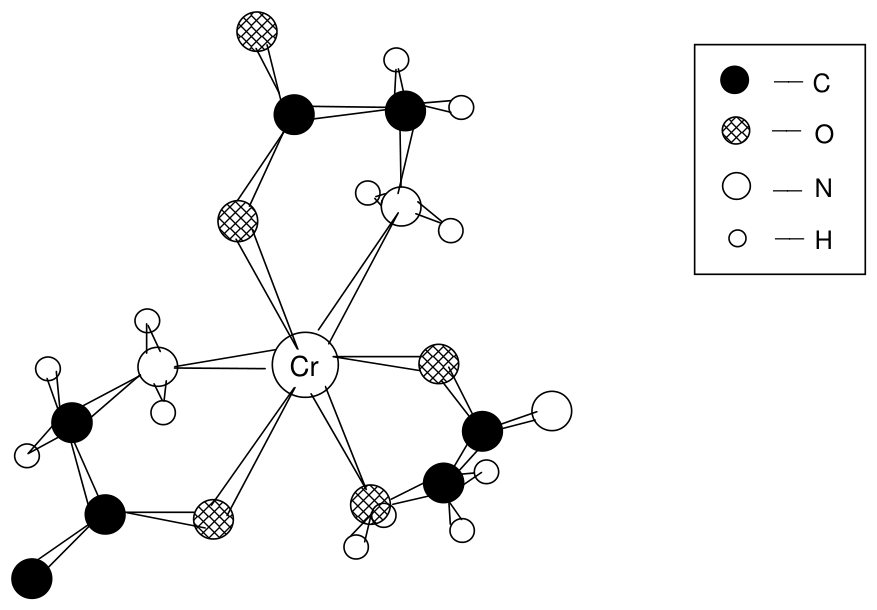
4.1 How many different configurational isomers of the complex are possible, not counting optical isomers?
4.2 Which of these isomers can be further resolved into optical isomers?
Another coordination compound of chromium was analyzed and found to have the following mass composition: 19.5 % \(\ce{Cr}\), 40.0 % \(\ce{Cl}\), 4.5 % \(\ce{H}\), and 36.0 % \(\ce{O}\). A 0.533 g sample of the compound was dissolved in \(100\ \mathrm{cm^3}\) of water, and \(10\ \mathrm{cm^3}\) of nitric acid \((2\ \mathrm{mol\,dm^{-3}})\) was added. Excess of silver nitrate solution was then added and the precipitate formed was then filtered, washed, dried and weighed. Its mass was found to be 0.287 g.
When a 1.06 g sample was gently heated to \(100\ ^\circ\mathrm{C}\) in a stream of dry air, 0.144 of water was driven off.
The freezing point of a solution prepared from 1.33 g of the compound and \(100\ \mathrm{cm^3}\) of water, was found to be \(-0.18\ ^\circ\mathrm{C}\). (Molar freezing point depression of water is \(1.82\ \mathrm{K\,kg\,mol^{-1}}\)).
Use all the experimental information to solve the following problems:
4.3 Derive the empirical formula of the compound.
4.4 Deduce formula for the compound showing the ligands of the chromium ion. Give molar ratios to support your result.
4.5 Sketch all possible steric arrangements of the ligands about the chromium ion.
Official English text of the problem.
Answers
- 4.1: Two geometrical isomers: fac and mer tris(glycinato)chromium(III).
- 4.2: Both have an enantiomeric pair, conventionally designated \(\Delta\) and \(\Lambda\). Thus there are four configurational stereoisomers altogether.
- 4.3: \(\boxed{\ce{CrCl3H12O6}}\), conventionally written \(\boxed{\ce{CrCl3.6H2O}}\), chromium(III) chloride hexahydrate.
- 4.4: \(\boxed{\ce{[CrCl2(H2O)4]Cl.2H2O}}\), tetraaquadichloridochromium(III) chloride dihydrate. Per chromium there are two coordinated chloride ions, four coordinated waters, one chloride counterion, and two waters of crystallization.
- 4.5: cis and trans arrangements of \(\ce{[CrCl2(H2O)4]+}\); both are achiral.
Names, structural SMILES, and precise descriptions of the arrangements follow.
Solution
The coordination structures below use extended SMILES, with dative-bond arrows pointing toward the metal and @OH tags specifying octahedral stereochemistry. These specify connectivity and configuration, but do not fix chelate-ring conformations or crystal packing.
4.1 — Geometrical isomers of the glycinato complex
Glycinate, or 2-aminoacetate, \(\ce{NH2CH2COO^-}\), has SMILES NCC(=O)[O-]. Each ligand binds the chromium(III) ion, \(\ce{Cr^3+}\), SMILES [Cr+3], through its nitrogen and one carboxylate oxygen at adjacent octahedral positions.
The three nitrogen donors can occupy only two distinct types of arrangement:
| Isomer | Arrangement of the nitrogen donors | Trans donor pairs |
|---|---|---|
| fac-tris(glycinato)chromium(III) | All three occupy one triangular face; every nitrogen pair is cis. | Three nitrogen–oxygen pairs |
| mer-tris(glycinato)chromium(III) | Two are opposite; the three lie in a plane through chromium. | One nitrogen–nitrogen, one oxygen–oxygen, and one nitrogen–oxygen pair |
Three nitrogen donors can contain either zero or one trans pair. Accounting for the connections within each chelate gives no further geometrical class when mirror images are counted together.
Therefore, the answer is two.
4.2 — Optical isomerism
In both geometrical isomers, the three chelate rings form a handed arrangement around chromium. Reflection reverses this handedness, and no rotation superimposes the resulting structures while preserving the three nitrogen–oxygen chelate connections.
Thus both fac and mer forms occur as \(\Delta/\Lambda\) enantiomeric pairs. The mer donor positions alone must not be used to judge chirality: which nitrogen is connected to which oxygen also matters.
The following SMILES give both members of each pair; “first” and “mirror” do not assign an absolute \(\Delta/\Lambda\) label.
| Tris(glycinato)chromium(III) configuration | Extended stereochemical SMILES |
|---|---|
| fac, first enantiomer | [Cr@OH15+3]123(<-[NH2]CC(=O)[O-]->1)(<-[NH2]CC(=O)[O-]->2)<-[NH2]CC(=O)[O-]->3 |
| fac, mirror image | [Cr@OH5+3]123(<-[NH2]CC(=O)[O-]->1)(<-[NH2]CC(=O)[O-]->2)<-[NH2]CC(=O)[O-]->3 |
| mer, first enantiomer | [Cr@OH8+3]123(<-[NH2]CC(=O)[O-]->1)(<-[NH2]CC(=O)[O-]->2)<-[NH2]CC(=O)[O-]->3 |
| mer, mirror image | [Cr@OH10+3]123(<-[NH2]CC(=O)[O-]->1)(<-[NH2]CC(=O)[O-]->2)<-[NH2]CC(=O)[O-]->3 |
There are therefore \(2\times2=\boxed{4}\) configurational stereoisomers, excluding differences in ring conformation.
4.3 — Empirical formula
Use the rounded atomic molar masses \(52.0,\ 35.5,\ 1.0,\ 16.0,\ 108.0\ \mathrm{g\,mol^{-1}}\) for \(\ce{Cr}\), \(\ce{Cl}\), \(\ce{H}\), \(\ce{O}\), and \(\ce{Ag}\), respectively.
For a \(100\ \mathrm{g}\) sample:
| Element | Amount / mol | Ratio relative to chromium |
|---|---|---|
| \(\ce{Cr}\) | \(19.5/52.0=0.375\) | \(1\) |
| \(\ce{Cl}\) | \(40.0/35.5=1.127\) | \(3.00\) |
| \(\ce{H}\) | \(4.5/1.0=4.5\) | \(12\) |
| \(\ce{O}\) | \(36.0/16.0=2.25\) | \(6.00\) |
Hence the empirical formula is
\[ \boxed{\ce{CrCl3H12O6}}. \]
The hydrogen and oxygen correspond to six molecules of water, \(\ce{H2O}\), SMILES O, per chromium:
\[ \boxed{\ce{CrCl3.6H2O}}. \]
This composition alone does not distinguish coordinated water from water of crystallization. Its formula molar mass is
\[ M=52.0+3(35.5)+6(18.0) =\boxed{266.5\ \mathrm{g\,mol^{-1}}}. \]
4.4 — Coordination formula
Chloride precipitation. The precipitate is silver(I) chloride, \(\ce{AgCl}\), with ionic formula-unit SMILES [Ag+].[Cl-]. Silver(I) ions, [Ag+], precipitate free chloride ions, [Cl-]:
\[ \ce{Ag+(aq) + Cl-(aq) -> AgCl(s)}. \]
The amount precipitated is
\[ n(\ce{AgCl}) =\frac{0.287\ \mathrm{g}}{143.5\ \mathrm{g\,mol^{-1}}} =2.00\times10^{-3}\ \mathrm{mol}. \]
The sample contains
\[ n(\text{formula units}) =\frac{0.533\ \mathrm{g}}{266.5\ \mathrm{g\,mol^{-1}}} =2.00\times10^{-3}\ \mathrm{mol}. \]
Consequently,
\[ \frac{n(\text{precipitable chloride})}{n(\ce{Cr})}=1.00. \]
Under the intended precipitation conditions, this measures chloride outside the coordination sphere. Therefore, one of the three chlorides is a counterion, and two are coordinated.
Water lost on heating. Interpreting the printed “0.144” as \(0.144\ \mathrm{g}\),
\[ n(\text{water lost}) =\frac{0.144\ \mathrm{g}}{18.0\ \mathrm{g\,mol^{-1}}} =8.00\times10^{-3}\ \mathrm{mol}, \]
whereas
\[ n(\text{formula units}) =\frac{1.06\ \mathrm{g}}{266.5\ \mathrm{g\,mol^{-1}}} =3.98\times10^{-3}\ \mathrm{mol}. \]
Thus
\[ \frac{n(\text{water lost})}{n(\ce{Cr})} =2.01\simeq2. \]
Gentle heating therefore removes two waters of crystallization per chromium. Of the six waters in total, four remain as aqua ligands.
The resulting octahedral coordination sphere contains four aqua ligands and two chlorido ligands. Its charge is
\[ +3+2(-1)+4(0)=+1. \]
The compound is therefore tetraaquadichloridochromium(III) chloride dihydrate:
\[ \boxed{\ce{[CrCl2(H2O)4]Cl.2H2O}}. \]
Its extended SMILES, leaving cis/trans geometry unspecified, is:
[Cr+3](<-[OH2])(<-[OH2])(<-[OH2])(<-[OH2])(<-[Cl-])<-[Cl-].[Cl-].O.O
The corresponding loss of lattice water is
\[ \ce{[CrCl2(H2O)4]Cl.2H2O(s) ->[\text{100 °C, dry air}] [CrCl2(H2O)4]Cl(s) + 2H2O(g)}. \]
Freezing-point confirmation. Taking \(100\ \mathrm{cm^3}\) of water as \(0.100\ \mathrm{kg}\), the analytical molality is
\[ m =\frac{1.33/266.5\ \mathrm{mol}}{0.100\ \mathrm{kg}} =4.99\times10^{-2}\ \mathrm{mol\,kg^{-1}}. \]
Using \(\Delta T_f=iK_fm\),
\[ i =\frac{0.18\ \mathrm{K}} {(1.82\ \mathrm{K\,kg\,mol^{-1}}) (4.99\times10^{-2}\ \mathrm{mol\,kg^{-1}})} =1.98\simeq2. \]
Thus each formula unit produces approximately two dissolved solute particles, consistent with
\[ \ce{[CrCl2(H2O)4]Cl.2H2O(s) -> [CrCl2(H2O)4]+(aq) + Cl-(aq) + 2H2O(l)}. \]
These particles are the tetraaquadichloridochromium(III) cation and the chloride counterion. The lattice water joins the solvent.
All three experimental ratios agree:
\[ \boxed{ \frac{n(\text{free chloride})}{n(\ce{Cr})}=1.00,\qquad \frac{n(\text{lattice water})}{n(\ce{Cr})}=2.01,\qquad \frac{n(\text{solute particles})}{n(\ce{Cr})}=1.98 }. \]
4.5 — All ligand arrangements
For an octahedral complex with four identical aqua ligands and two identical chlorido ligands, the chlorido ligands can be either adjacent or opposite.
To describe the required sketches precisely, place chromium at the origin and the six donor atoms along \(+x,-x,+y,-y,+z,-z\).
| Cation | Precise spatial arrangement | Extended stereochemical SMILES |
|---|---|---|
| cis-tetraaquadichloridochromium(III) | Chlorido ligands at \(+y\) and \(+z\), making a \(90^\circ\) angle. Aqua ligands occupy \(+x,-x,-y,-z\). | [Cr@OH25+3](<-[OH2])(<-[OH2])(<-[OH2])(<-[OH2])(<-[Cl-])<-[Cl-] |
| trans-tetraaquadichloridochromium(III) | Chlorido ligands at \(+z\) and \(-z\), making a \(180^\circ\) angle. Aqua ligands occupy \(+x,-x,+y,-y\). | [Cr@OH27+3](<-[OH2])(<-[OH2])(<-[OH2])(<-[OH2])(<-[Cl-])<-[Cl-] |
Both arrangements possess mirror symmetry and are achiral. The analytical data do not distinguish which of these two geometrical isomers was present.
The solution was checked against the official solution.
IChO 1982 · Theorieaufgabe 4
Koordinationsverbindungen des Chroms(III): Isomere des Glycinato-Komplexes und ein Chromchlorid-Hydrat
Ein Übergangsmetallatom oder -ion kann unmittelbar an mehrere Atome oder Moleküle gebunden sein, die es umgeben (Liganden) und dabei eine charakteristische Anordnung bilden. Dies ist das wesentliche Strukturmerkmal einer wichtigen Klasse sogenannter Koordinations- oder Komplexverbindungen. Bilden zwei oder mehr Atome eines einzelnen Liganden Bindungen zum selben Zentralatom aus, so spricht man davon, dass der Ligand ein Chelat bildet (griechisch chele = Krebsschere).
Das Glycinat-Ion, \(\ce{NH2-CH2-COO^-}\), ist ein zweizähniger Chelatligand, der beispielsweise Tris(glycinato)chrom(III)-Komplexe bilden kann. Die Abbildung zeigt eine mögliche Struktur eines solchen Komplexes. Sauerstoff und Stickstoff müssen benachbarte Oktaederpositionen besetzen, da die \(\ce{N-C-C-O}\)-Kette zu kurz ist, um das Chromion zu „umgreifen“.
4.1 Wie viele verschiedene Konfigurationsisomere des Komplexes sind möglich, wenn optische Isomere nicht mitgezählt werden?
4.2 Welche dieser Isomere lassen sich weiter in optische Isomere auftrennen?
Eine andere Koordinationsverbindung des Chroms wurde analysiert und wies die folgende Massenzusammensetzung auf: 19.5 % \(\ce{Cr}\), 40.0 % \(\ce{Cl}\), 4.5 % \(\ce{H}\) und 36.0 % \(\ce{O}\). Eine Probe von 0.533 g der Verbindung wurde in \(100\ \mathrm{cm^3}\) Wasser gelöst, und \(10\ \mathrm{cm^3}\) Salpetersäure \((2\ \mathrm{mol\,dm^{-3}})\) wurden zugegeben. Anschließend wurde Silbernitratlösung im Überschuss zugesetzt; der entstandene Niederschlag wurde abfiltriert, gewaschen, getrocknet und gewogen. Seine Masse betrug 0.287 g.
Als eine Probe von 1.06 g in einem Strom trockener Luft schonend auf \(100\ ^\circ\mathrm{C}\) erhitzt wurde, wurden 0.144 Wasser ausgetrieben.
Der Gefrierpunkt einer Lösung aus 1.33 g der Verbindung und \(100\ \mathrm{cm^3}\) Wasser betrug \(-0.18\ ^\circ\mathrm{C}\). (Die molale Gefrierpunktserniedrigung von Wasser beträgt \(1.82\ \mathrm{K\,kg\,mol^{-1}}\)).
Verwenden Sie alle experimentellen Angaben, um die folgenden Aufgaben zu lösen:
4.3 Leiten Sie die Verhältnisformel der Verbindung her.
4.4 Leiten Sie eine Formel für die Verbindung ab, aus der die Liganden des Chromions hervorgehen. Geben Sie zur Begründung Ihres Ergebnisses Stoffmengenverhältnisse an.
4.5 Skizzieren Sie alle möglichen räumlichen Anordnungen der Liganden um das Chromion.
Aufgabentext aus dem offiziellen englischen Text übersetzt.
Antworten
- 4.1: Zwei geometrische Isomere: fac- und mer-Tris(glycinato)chrom(III).
- 4.2: Beide bilden ein Enantiomerenpaar, dessen Mitglieder üblicherweise mit \(\Delta\) und \(\Lambda\) bezeichnet werden. Insgesamt gibt es somit vier Konfigurationsstereoisomere.
- 4.3: \(\boxed{\ce{CrCl3H12O6}}\), üblicherweise als \(\boxed{\ce{CrCl3.6H2O}}\) geschrieben, Chrom(III)-chlorid-Hexahydrat.
- 4.4: \(\boxed{\ce{[CrCl2(H2O)4]Cl.2H2O}}\), Tetraaquadichloridochrom(III)-chlorid-Dihydrat. Auf jedes Chromatom entfallen zwei koordinierte Chloridionen, vier koordinierte Wassermoleküle, ein Chlorid-Gegenion und zwei Kristallwassermoleküle.
- 4.5: cis- und trans-Anordnungen von \(\ce{[CrCl2(H2O)4]+}\); beide sind achiral.
Im Folgenden werden Namen, Struktur-SMILES und genaue Beschreibungen der Anordnungen angegeben.
Lösung
Die nachstehenden Koordinationsstrukturen verwenden erweiterte SMILES, wobei die Pfeile für koordinative Bindungen zum Metall zeigen und @OH-Kennzeichnungen die oktaedrische Stereochemie angeben. Sie legen die Konnektivität und Konfiguration fest, jedoch nicht die Konformationen der Chelatringe oder die Kristallpackung.
4.1 — Geometrische Isomere des Glycinato-Komplexes
Glycinat oder 2-Aminoacetat, \(\ce{NH2CH2COO^-}\), hat die SMILES-Darstellung NCC(=O)[O-]. Jeder Ligand bindet über sein Stickstoffatom und ein Carboxylat-Sauerstoffatom an benachbarten Oktaederpositionen an das Chrom(III)-Ion, \(\ce{Cr^3+}\), SMILES [Cr+3].
Die drei Stickstoffdonoren können nur zwei unterschiedliche Anordnungstypen einnehmen:
| Isomer | Anordnung der Stickstoffdonoren | Trans-Donorpaare |
|---|---|---|
| fac-Tris(glycinato)chrom(III) | Alle drei besetzen eine Dreiecksfläche; jedes Stickstoffpaar steht cis zueinander. | Drei Stickstoff–Sauerstoff-Paare |
| mer-Tris(glycinato)chrom(III) | Zwei stehen einander gegenüber; die drei liegen in einer Ebene durch das Chromatom. | Ein Stickstoff–Stickstoff-, ein Sauerstoff–Sauerstoff- und ein Stickstoff–Sauerstoff-Paar |
Drei Stickstoffdonoren können entweder kein oder ein Trans-Paar bilden. Die Berücksichtigung der Verknüpfungen innerhalb jedes Chelats ergibt keine weitere geometrische Klasse, wenn Spiegelbilder gemeinsam gezählt werden.
Die Antwort lautet daher zwei.
4.2 — Optische Isomerie
Bei beiden geometrischen Isomeren bilden die drei Chelatringe eine Anordnung mit einem bestimmten Drehsinn um das Chromatom. Eine Spiegelung kehrt diesen Drehsinn um, und keine Drehung bringt die entstehenden Strukturen zur Deckung, wenn die drei Stickstoff–Sauerstoff-Chelatverknüpfungen erhalten bleiben.
Somit treten sowohl die fac- als auch die mer-Form als \(\Delta/\Lambda\)-Enantiomerenpaare auf. Die Donorpositionen der mer-Form allein dürfen nicht zur Beurteilung der Chiralität herangezogen werden: Es ist auch entscheidend, welches Stickstoffatom mit welchem Sauerstoffatom verbunden ist.
Die folgenden SMILES geben beide Mitglieder jedes Paares an; „erstes“ und „Spiegelbild“ weisen keine absolute \(\Delta/\Lambda\)-Bezeichnung zu.
| Konfiguration von Tris(glycinato)chrom(III) | Erweiterte stereochemische SMILES |
|---|---|
| fac, erstes Enantiomer | [Cr@OH15+3]123(<-[NH2]CC(=O)[O-]->1)(<-[NH2]CC(=O)[O-]->2)<-[NH2]CC(=O)[O-]->3 |
| fac, Spiegelbild | [Cr@OH5+3]123(<-[NH2]CC(=O)[O-]->1)(<-[NH2]CC(=O)[O-]->2)<-[NH2]CC(=O)[O-]->3 |
| mer, erstes Enantiomer | [Cr@OH8+3]123(<-[NH2]CC(=O)[O-]->1)(<-[NH2]CC(=O)[O-]->2)<-[NH2]CC(=O)[O-]->3 |
| mer, Spiegelbild | [Cr@OH10+3]123(<-[NH2]CC(=O)[O-]->1)(<-[NH2]CC(=O)[O-]->2)<-[NH2]CC(=O)[O-]->3 |
Es gibt daher \(2\times2=\boxed{4}\) Konfigurationsstereoisomere, wobei Unterschiede in der Ringkonformation nicht berücksichtigt werden.
4.3 — Verhältnisformel
Verwendet werden die gerundeten molaren Atommassen \(52.0,\ 35.5,\ 1.0,\ 16.0,\ 108.0\ \mathrm{g\,mol^{-1}}\) für \(\ce{Cr}\), \(\ce{Cl}\), \(\ce{H}\), \(\ce{O}\) beziehungsweise \(\ce{Ag}\).
Für eine Probe von \(100\ \mathrm{g}\):
| Element | Stoffmenge / mol | Verhältnis bezogen auf Chrom |
|---|---|---|
| \(\ce{Cr}\) | \(19.5/52.0=0.375\) | \(1\) |
| \(\ce{Cl}\) | \(40.0/35.5=1.127\) | \(3.00\) |
| \(\ce{H}\) | \(4.5/1.0=4.5\) | \(12\) |
| \(\ce{O}\) | \(36.0/16.0=2.25\) | \(6.00\) |
Damit lautet die Verhältnisformel
\[ \boxed{\ce{CrCl3H12O6}}. \]
Wasserstoff und Sauerstoff entsprechen sechs Molekülen Wasser, \(\ce{H2O}\), SMILES O, pro Chromatom:
\[ \boxed{\ce{CrCl3.6H2O}}. \]
Diese Zusammensetzung allein erlaubt keine Unterscheidung zwischen koordiniertem Wasser und Kristallwasser. Die molare Masse der Formeleinheit beträgt
\[ M=52.0+3(35.5)+6(18.0) =\boxed{266.5\ \mathrm{g\,mol^{-1}}}. \]
4.4 — Koordinationsformel
Chloridfällung. Der Niederschlag ist Silber(I)-chlorid, \(\ce{AgCl}\), mit der ionischen SMILES-Darstellung der Formeleinheit [Ag+].[Cl-]. Silber(I)-Ionen, [Ag+], fällen freie Chloridionen, [Cl-]:
\[ \ce{Ag+(aq) + Cl-(aq) -> AgCl(s)}. \]
Die ausgefällte Stoffmenge beträgt
\[ n(\ce{AgCl}) =\frac{0.287\ \mathrm{g}}{143.5\ \mathrm{g\,mol^{-1}}} =2.00\times10^{-3}\ \mathrm{mol}. \]
Die Probe enthält
\[ n(\text{Formeleinheiten}) =\frac{0.533\ \mathrm{g}}{266.5\ \mathrm{g\,mol^{-1}}} =2.00\times10^{-3}\ \mathrm{mol}. \]
Folglich gilt
\[ \frac{n(\text{fällbares Chlorid})}{n(\ce{Cr})}=1.00. \]
Unter den vorgesehenen Fällungsbedingungen wird damit das Chlorid außerhalb der Koordinationssphäre erfasst. Daher ist eines der drei Chloridionen ein Gegenion, und zwei sind koordiniert.
Wasserverlust beim Erhitzen. Wird die gedruckte Angabe „0.144“ als \(0.144\ \mathrm{g}\) interpretiert, so gilt
\[ n(\text{abgegebenes Wasser}) =\frac{0.144\ \mathrm{g}}{18.0\ \mathrm{g\,mol^{-1}}} =8.00\times10^{-3}\ \mathrm{mol}, \]
während
\[ n(\text{Formeleinheiten}) =\frac{1.06\ \mathrm{g}}{266.5\ \mathrm{g\,mol^{-1}}} =3.98\times10^{-3}\ \mathrm{mol}. \]
Somit gilt
\[ \frac{n(\text{abgegebenes Wasser})}{n(\ce{Cr})} =2.01\simeq2. \]
Durch schonendes Erhitzen werden daher zwei Kristallwassermoleküle pro Chromatom entfernt. Von den insgesamt sechs Wassermolekülen verbleiben vier als Aqualiganden.
Die sich daraus ergebende oktaedrische Koordinationssphäre enthält vier Aqualiganden und zwei Chloridoliganden. Ihre Ladung beträgt
\[ +3+2(-1)+4(0)=+1. \]
Die Verbindung ist daher Tetraaquadichloridochrom(III)-chlorid-Dihydrat:
\[ \boxed{\ce{[CrCl2(H2O)4]Cl.2H2O}}. \]
Ihre erweiterte SMILES-Darstellung ohne Festlegung der cis/trans-Geometrie lautet:
[Cr+3](<-[OH2])(<-[OH2])(<-[OH2])(<-[OH2])(<-[Cl-])<-[Cl-].[Cl-].O.O
Die entsprechende Abgabe von Gitterwasser ist
\[ \ce{[CrCl2(H2O)4]Cl.2H2O(s) ->[\text{100 °C, trockene Luft}] [CrCl2(H2O)4]Cl(s) + 2H2O(g)}. \]
Bestätigung durch den Gefrierpunkt. Setzt man \(100\ \mathrm{cm^3}\) Wasser mit \(0.100\ \mathrm{kg}\) gleich, so beträgt die analytische Molalität
\[ m =\frac{1.33/266.5\ \mathrm{mol}}{0.100\ \mathrm{kg}} =4.99\times10^{-2}\ \mathrm{mol\,kg^{-1}}. \]
Mit \(\Delta T_f=iK_fm\) ergibt sich
\[ i =\frac{0.18\ \mathrm{K}} {(1.82\ \mathrm{K\,kg\,mol^{-1}}) (4.99\times10^{-2}\ \mathrm{mol\,kg^{-1}})} =1.98\simeq2. \]
Jede Formeleinheit liefert somit ungefähr zwei gelöste Stoffteilchen, in Übereinstimmung mit
\[ \ce{[CrCl2(H2O)4]Cl.2H2O(s) -> [CrCl2(H2O)4]+(aq) + Cl-(aq) + 2H2O(l)}. \]
Diese Teilchen sind das Tetraaquadichloridochrom(III)-Kation und das Chlorid-Gegenion. Das Gitterwasser geht in das Lösungsmittel über.
Alle drei experimentellen Verhältnisse stimmen überein:
\[ \boxed{ \frac{n(\text{freies Chlorid})}{n(\ce{Cr})}=1.00,\qquad \frac{n(\text{Gitterwasser})}{n(\ce{Cr})}=2.01,\qquad \frac{n(\text{gelöste Stoffteilchen})}{n(\ce{Cr})}=1.98 }. \]
4.5 — Alle Ligandenanordnungen
Bei einem oktaedrischen Komplex mit vier identischen Aqualiganden und zwei identischen Chloridoliganden können die Chloridoliganden entweder benachbart oder einander gegenüber angeordnet sein.
Zur genauen Beschreibung der geforderten Skizzen wird das Chromatom in den Ursprung und werden die sechs Donoratome entlang \(+x,-x,+y,-y,+z,-z\) gesetzt.
| Kation | Genaue räumliche Anordnung | Erweiterte stereochemische SMILES |
|---|---|---|
| cis-Tetraaquadichloridochrom(III) | Chloridoliganden bei \(+y\) und \(+z\), die einen Winkel von \(90^\circ\) bilden. Aqualiganden besetzen \(+x,-x,-y,-z\). | [Cr@OH25+3](<-[OH2])(<-[OH2])(<-[OH2])(<-[OH2])(<-[Cl-])<-[Cl-] |
| trans-Tetraaquadichloridochrom(III) | Chloridoliganden bei \(+z\) und \(-z\), die einen Winkel von \(180^\circ\) bilden. Aqualiganden besetzen \(+x,-x,+y,-y\). | [Cr@OH27+3](<-[OH2])(<-[OH2])(<-[OH2])(<-[OH2])(<-[Cl-])<-[Cl-] |
Beide Anordnungen besitzen Spiegelsymmetrie und sind achiral. Die Analysedaten erlauben keine Unterscheidung, welches dieser beiden geometrischen Isomere vorlag.
Die Lösung wurde mit der offiziellen Lösung abgeglichen.
IChO 1982 · Teori sorusu 4
Krom(III) koordinasyon bileşikleri: glisinato kompleksi izomerleri ve bir krom klorür hidratı
Bir geçiş metali atomu veya iyonu, kendisini çevreleyen belirli sayıda atom veya moleküle (ligandlara) doğrudan bağlanarak karakteristik bir düzen oluşturabilir. Bu, koordinasyon veya kompleks bileşikleri olarak adlandırılan önemli bir bileşik sınıfının temel yapısal özelliğidir. Tek bir ligandın iki veya daha fazla atomu aynı merkez atomuna bağlanırsa ligandın bir şelat oluşturduğu söylenir (Yunanca chele = yengeç kıskacı).
Glisinat iyonu, \(\ce{NH2-CH2-COO^-}\), örneğin tris-glisinato-krom(III) kompleksleri oluşturabilen iki dişli bir şelat ligandıdır. Şekilde böyle bir kompleksin olası yapılarından biri gösterilmektedir. \(\ce{N-C-C-O}\) zinciri krom iyonunu "kucaklayamayacak" kadar kısa olduğundan, oksijen ve azot oktahedral düzende komşu konumlara koordine olmak zorundadır.
4.1 Optik izomerler sayılmadığında, kompleksin kaç farklı konfigürasyon izomeri mümkündür?
4.2 Bu izomerlerden hangileri ayrıca optik izomerlerine ayrılabilir?
Kromun başka bir koordinasyon bileşiği analiz edilmiş ve kütlece bileşiminin şöyle olduğu bulunmuştur: % 19.5 \(\ce{Cr}\), % 40.0 \(\ce{Cl}\), % 4.5 \(\ce{H}\) ve % 36.0 \(\ce{O}\). Bileşiğin 0.533 g'lık bir örneği \(100\ \mathrm{cm^3}\) suda çözülmüş ve \(10\ \mathrm{cm^3}\) nitrik asit \((2\ \mathrm{mol\,dm^{-3}})\) eklenmiştir. Ardından aşırı miktarda gümüş nitrat çözeltisi eklenmiş ve oluşan çökelek süzülmüş, yıkanmış, kurutulmuş ve tartılmıştır. Kütlesi 0.287 g olarak bulunmuştur.
1.06 g'lık bir örnek kuru hava akımı altında \(100\ ^\circ\mathrm{C}\)'ye hafifçe ısıtıldığında, 0.144 su uzaklaşmıştır.
Bileşiğin 1.33 g'ı ve \(100\ \mathrm{cm^3}\) su ile hazırlanan bir çözeltinin donma noktası \(-0.18\ ^\circ\mathrm{C}\) olarak bulunmuştur. (Suyun molal donma noktası alçalması sabiti \(1.82\ \mathrm{K\,kg\,mol^{-1}}\)'dir).
Aşağıdaki soruları çözmek için deneysel bilgilerin tümünü kullanın:
4.3 Bileşiğin basit formülünü türetin.
4.4 Krom iyonunun ligandlarını gösteren bileşik formülünü belirleyin. Sonucunuzu destekleyen mol oranlarını verin.
4.5 Ligandların krom iyonu çevresindeki olası tüm uzaysal düzenlenişlerini çizerek gösterin.
Soru metni resmi İngilizce metinden çevrilmiştir.
Cevaplar
- 4.1: İki geometrik izomer: fac ve mer tris(glisinato)krom(III).
- 4.2: Her ikisi de, geleneksel olarak \(\Delta\) ve \(\Lambda\) ile gösterilen bir enantiyomer çiftine sahiptir. Dolayısıyla toplam dört konfigürasyon stereoizomeri vardır.
- 4.3: \(\boxed{\ce{CrCl3H12O6}}\), geleneksel yazımıyla \(\boxed{\ce{CrCl3.6H2O}}\), krom(III) klorür hekzahidrat.
- 4.4: \(\boxed{\ce{[CrCl2(H2O)4]Cl.2H2O}}\), tetraakuadikloridokrom(III) klorür dihidrat. Krom başına iki koordine klorür iyonu, dört koordine su molekülü, bir klorür karşı iyonu ve iki kristal suyu molekülü bulunur.
- 4.5: \(\ce{[CrCl2(H2O)4]+}\) iyonunun cis ve trans düzenlenişleri; her ikisi de akiraldir.
Adlar, yapısal SMILES gösterimleri ve düzenlenişlerin kesin tanımları aşağıda verilmiştir.
Çözüm
Aşağıdaki koordinasyon yapılarında, koordinatif bağ oklarının metale doğru yöneldiği ve @OH etiketlerinin oktahedral stereokimyayı belirttiği genişletilmiş SMILES kullanılmıştır. Bunlar bağlanma düzenini ve konfigürasyonu belirtir, ancak şelat halkalarının konformasyonlarını veya kristal paketlenmesini sabitlemez.
4.1 — Glisinato kompleksinin geometrik izomerleri
Glisinatın, diğer adıyla 2-aminoasetatın, \(\ce{NH2CH2COO^-}\), SMILES gösterimi NCC(=O)[O-] şeklindedir. Her ligand, krom(III) iyonuna, \(\ce{Cr^3+}\), SMILES gösterimi [Cr+3], azotu ve bir karboksilat oksijeni üzerinden komşu oktahedral konumlarda bağlanır.
Üç azot donörü yalnızca iki farklı türde düzenlenebilir:
| İzomer | Azot donörlerinin düzenlenişi | Trans donör çiftleri |
|---|---|---|
| fac-tris(glisinato)krom(III) | Üçü de aynı üçgen yüzü işgal eder; her azot çifti cis konumundadır. | Üç azot–oksijen çifti |
| mer-tris(glisinato)krom(III) | İkisi karşılıklı konumdadır; üçü de kromdan geçen bir düzlemde bulunur. | Bir azot–azot, bir oksijen–oksijen ve bir azot–oksijen çifti |
Üç azot donörü ya hiç trans çifti içermez ya da bir trans çifti içerir. Ayna görüntüleri birlikte sayıldığında, her şelatın kendi içindeki bağlantılarının hesaba katılması ek bir geometrik sınıf oluşturmaz.
Dolayısıyla cevap ikidir.
4.2 — Optik izomerlik
Her iki geometrik izomerde de üç şelat halkası, kromun çevresinde sağ veya sol ellilik gösteren bir düzen oluşturur. Yansıma bu elliliği tersine çevirir ve üç azot–oksijen şelat bağlantısını koruyan hiçbir döndürme işlemi, ortaya çıkan yapıları üst üste çakıştıramaz.
Dolayısıyla hem fac hem de mer biçimleri \(\Delta/\Lambda\) enantiyomer çiftleri olarak bulunur. Kiralliğe karar vermek için yalnızca mer biçimindeki donör konumları kullanılmamalıdır: hangi azotun hangi oksijene bağlı olduğu da önemlidir.
Aşağıdaki SMILES gösterimleri her çiftin iki üyesini de verir; “birinci” ve “ayna görüntüsü” ifadeleri mutlak bir \(\Delta/\Lambda\) etiketi atamaz.
| Tris(glisinato)krom(III) konfigürasyonu | Genişletilmiş stereokimyasal SMILES |
|---|---|
| fac, birinci enantiyomer | [Cr@OH15+3]123(<-[NH2]CC(=O)[O-]->1)(<-[NH2]CC(=O)[O-]->2)<-[NH2]CC(=O)[O-]->3 |
| fac, ayna görüntüsü | [Cr@OH5+3]123(<-[NH2]CC(=O)[O-]->1)(<-[NH2]CC(=O)[O-]->2)<-[NH2]CC(=O)[O-]->3 |
| mer, birinci enantiyomer | [Cr@OH8+3]123(<-[NH2]CC(=O)[O-]->1)(<-[NH2]CC(=O)[O-]->2)<-[NH2]CC(=O)[O-]->3 |
| mer, ayna görüntüsü | [Cr@OH10+3]123(<-[NH2]CC(=O)[O-]->1)(<-[NH2]CC(=O)[O-]->2)<-[NH2]CC(=O)[O-]->3 |
Dolayısıyla halka konformasyonundaki farklılıklar hariç tutulduğunda \(2\times2=\boxed{4}\) konfigürasyon stereoizomeri vardır.
4.3 — Basit formül
\(\ce{Cr}\), \(\ce{Cl}\), \(\ce{H}\), \(\ce{O}\) ve \(\ce{Ag}\) için sırasıyla \(52.0,\ 35.5,\ 1.0,\ 16.0,\ 108.0\ \mathrm{g\,mol^{-1}}\) yuvarlatılmış atomik mol kütlelerini kullanın.
\(100\ \mathrm{g}\)'lık bir örnek için:
| Element | Madde miktarı / mol | Kroma göre oran |
|---|---|---|
| \(\ce{Cr}\) | \(19.5/52.0=0.375\) | \(1\) |
| \(\ce{Cl}\) | \(40.0/35.5=1.127\) | \(3.00\) |
| \(\ce{H}\) | \(4.5/1.0=4.5\) | \(12\) |
| \(\ce{O}\) | \(36.0/16.0=2.25\) | \(6.00\) |
Buna göre basit formül
\[ \boxed{\ce{CrCl3H12O6}}. \]
Hidrojen ve oksijen, krom başına altı su molekülüne, \(\ce{H2O}\), SMILES gösterimi O, karşılık gelir:
\[ \boxed{\ce{CrCl3.6H2O}}. \]
Bu bileşim tek başına koordine suyu kristal suyundan ayırt etmez. Formülün mol kütlesi
\[ M=52.0+3(35.5)+6(18.0) =\boxed{266.5\ \mathrm{g\,mol^{-1}}}. \]
4.4 — Koordinasyon formülü
Klorürün çöktürülmesi. Çökelek, iyonik formül biriminin SMILES gösterimi [Ag+].[Cl-] olan gümüş(I) klorürdür, \(\ce{AgCl}\). Gümüş(I) iyonları, [Ag+], serbest klorür iyonlarını, [Cl-], çöktürür:
\[ \ce{Ag+(aq) + Cl-(aq) -> AgCl(s)}. \]
Çöken madde miktarı
\[ n(\ce{AgCl}) =\frac{0.287\ \mathrm{g}}{143.5\ \mathrm{g\,mol^{-1}}} =2.00\times10^{-3}\ \mathrm{mol}. \]
Örneğin içerdiği formül birimlerinin madde miktarı
\[ n(\text{formül birimleri}) =\frac{0.533\ \mathrm{g}}{266.5\ \mathrm{g\,mol^{-1}}} =2.00\times10^{-3}\ \mathrm{mol}. \]
Sonuç olarak,
\[ \frac{n(\text{çöktürülebilir klorür})}{n(\ce{Cr})}=1.00. \]
Amaçlanan çöktürme koşullarında bu ölçüm, koordinasyon küresinin dışındaki klorürü belirler. Dolayısıyla üç klorürden biri karşı iyondur, ikisi ise koordinedir.
Isıtma sırasında kaybedilen su. Basılı metindeki “0.144” değeri \(0.144\ \mathrm{g}\) olarak yorumlandığında,
\[ n(\text{kaybedilen su}) =\frac{0.144\ \mathrm{g}}{18.0\ \mathrm{g\,mol^{-1}}} =8.00\times10^{-3}\ \mathrm{mol}, \]
buna karşılık
\[ n(\text{formül birimleri}) =\frac{1.06\ \mathrm{g}}{266.5\ \mathrm{g\,mol^{-1}}} =3.98\times10^{-3}\ \mathrm{mol}. \]
Böylece
\[ \frac{n(\text{kaybedilen su})}{n(\ce{Cr})} =2.01\simeq2. \]
Dolayısıyla hafif ısıtma, krom başına iki kristal suyu molekülünü uzaklaştırır. Toplam altı su molekülünün dördü akua ligandı olarak kalır.
Ortaya çıkan oktahedral koordinasyon küresi dört akua ligandı ve iki klorido ligandı içerir. Yükü
\[ +3+2(-1)+4(0)=+1. \]
Dolayısıyla bileşik tetraakuadikloridokrom(III) klorür dihidrattır:
\[ \boxed{\ce{[CrCl2(H2O)4]Cl.2H2O}}. \]
Cis/trans geometrisi belirtilmeden genişletilmiş SMILES gösterimi şöyledir:
[Cr+3](<-[OH2])(<-[OH2])(<-[OH2])(<-[OH2])(<-[Cl-])<-[Cl-].[Cl-].O.O
Buna karşılık gelen kristal örgü suyunun kaybı
\[ \ce{[CrCl2(H2O)4]Cl.2H2O(s) ->[\text{100 °C, kuru hava}] [CrCl2(H2O)4]Cl(s) + 2H2O(g)}. \]
Donma noktasıyla doğrulama. \(100\ \mathrm{cm^3}\) su \(0.100\ \mathrm{kg}\) olarak alındığında, analitik molalite
\[ m =\frac{1.33/266.5\ \mathrm{mol}}{0.100\ \mathrm{kg}} =4.99\times10^{-2}\ \mathrm{mol\,kg^{-1}}. \]
\(\Delta T_f=iK_fm\) kullanılarak,
\[ i =\frac{0.18\ \mathrm{K}} {(1.82\ \mathrm{K\,kg\,mol^{-1}}) (4.99\times10^{-2}\ \mathrm{mol\,kg^{-1}})} =1.98\simeq2. \]
Dolayısıyla her formül birimi yaklaşık iki çözünmüş madde taneciği oluşturur; bu, aşağıdaki denklemle uyumludur:
\[ \ce{[CrCl2(H2O)4]Cl.2H2O(s) -> [CrCl2(H2O)4]+(aq) + Cl-(aq) + 2H2O(l)}. \]
Bu tanecikler tetraakuadikloridokrom(III) katyonu ve klorür karşı iyonudur. Kristal örgü suyu çözücüye katılır.
Üç deneysel oranın tümü birbiriyle uyumludur:
\[ \boxed{ \frac{n(\text{serbest klorür})}{n(\ce{Cr})}=1.00,\qquad \frac{n(\text{kristal örgü suyu})}{n(\ce{Cr})}=2.01,\qquad \frac{n(\text{çözünmüş madde tanecikleri})}{n(\ce{Cr})}=1.98 }. \]
4.5 — Tüm ligand düzenlenişleri
Dört özdeş akua ligandı ve iki özdeş klorido ligandı içeren oktahedral bir komplekste, klorido ligandları ya komşu ya da karşılıklı konumlarda bulunabilir.
İstenen çizimleri kesin biçimde tanımlamak için kromu orijine, altı donör atomu da \(+x,-x,+y,-y,+z,-z\) doğrultularına yerleştirin.
| Katyon | Kesin uzaysal düzenleniş | Genişletilmiş stereokimyasal SMILES |
|---|---|---|
| cis-tetraakuadikloridokrom(III) | Klorido ligandları \(+y\) ve \(+z\) konumlarında olup \(90^\circ\)'lik bir açı oluşturur. Akua ligandları \(+x,-x,-y,-z\) konumlarını işgal eder. | [Cr@OH25+3](<-[OH2])(<-[OH2])(<-[OH2])(<-[OH2])(<-[Cl-])<-[Cl-] |
| trans-tetraakuadikloridokrom(III) | Klorido ligandları \(+z\) ve \(-z\) konumlarında olup \(180^\circ\)'lik bir açı oluşturur. Akua ligandları \(+x,-x,+y,-y\) konumlarını işgal eder. | [Cr@OH27+3](<-[OH2])(<-[OH2])(<-[OH2])(<-[OH2])(<-[Cl-])<-[Cl-] |
Her iki düzenleniş de ayna simetrisine sahiptir ve akiraldir. Analiz verileri, bu iki geometrik izomerden hangisinin mevcut olduğunu ayırt etmez.
Çözüm, resmi çözümle karşılaştırılarak kontrol edildi.
IChO 1982 · Problema teórico 4
Compuestos de coordinación de cromo(III): isómeros del complejo de glicinato y un hidrato de cloruro de cromo
Un átomo o ion de un metal de transición puede estar unido directamente a varios átomos o moléculas que lo rodean (ligandos), formando una disposición característica. Esta es la característica estructural esencial de una importante clase de los llamados compuestos de coordinación o complejos. Si dos o más átomos de un mismo ligando forman enlaces con el mismo átomo central, se dice que el ligando forma un quelato (del griego chele = pinza de cangrejo).
El ion glicinato, \(\ce{NH2-CH2-COO^-}\), es un ligando quelante bidentado que puede formar, por ejemplo, complejos de tris(glicinato)cromo(III). La figura muestra una posible estructura de uno de estos complejos. El oxígeno y el nitrógeno se ven obligados a coordinarse en posiciones octaédricas adyacentes, ya que la cadena \(\ce{N-C-C-O}\) es demasiado corta para «abrazar» al ion cromo.
4.1 ¿Cuántos isómeros configuracionales diferentes del complejo son posibles, sin contar los isómeros ópticos?
4.2 ¿Cuáles de estos isómeros pueden resolverse, a su vez, en isómeros ópticos?
Se analizó otro compuesto de coordinación de cromo y se determinó que tenía la siguiente composición en masa: 19.5 % de \(\ce{Cr}\), 40.0 % de \(\ce{Cl}\), 4.5 % de \(\ce{H}\) y 36.0 % de \(\ce{O}\). Se disolvió una muestra de 0.533 g del compuesto en \(100\ \mathrm{cm^3}\) de agua y se añadieron \(10\ \mathrm{cm^3}\) de ácido nítrico \((2\ \mathrm{mol\,dm^{-3}})\). A continuación, se añadió un exceso de disolución de nitrato de plata y el precipitado formado se filtró, se lavó, se secó y se pesó. Su masa resultó ser de 0.287 g.
Cuando se calentó suavemente una muestra de 1.06 g a \(100\ ^\circ\mathrm{C}\) en una corriente de aire seco, se desprendieron 0.144 de agua.
Se determinó que el punto de congelación de una disolución preparada con 1.33 g del compuesto y \(100\ \mathrm{cm^3}\) de agua era de \(-0.18\ ^\circ\mathrm{C}\). (La constante crioscópica del agua es \(1.82\ \mathrm{K\,kg\,mol^{-1}}\)).
Utilice toda la información experimental para resolver los siguientes problemas:
4.3 Deduzca la fórmula empírica del compuesto.
4.4 Deduzca una fórmula del compuesto que muestre los ligandos del ion cromo. Indique las relaciones molares que respaldan su resultado.
4.5 Dibuje esquemáticamente todas las disposiciones espaciales posibles de los ligandos alrededor del ion cromo.
Enunciado traducido del texto oficial en inglés.
Respuestas
- 4.1: Dos isómeros geométricos: fac y mer del tris(glicinato)cromo(III).
- 4.2: Ambos presentan un par de enantiómeros, designados convencionalmente como \(\Delta\) y \(\Lambda\). Por tanto, hay cuatro estereoisómeros configuracionales en total.
- 4.3: \(\boxed{\ce{CrCl3H12O6}}\), que se escribe convencionalmente como \(\boxed{\ce{CrCl3.6H2O}}\), cloruro de cromo(III) hexahidrato.
- 4.4: \(\boxed{\ce{[CrCl2(H2O)4]Cl.2H2O}}\), cloruro de tetraaquadicloridocromo(III) dihidrato. Por cada cromo hay dos iones cloruro coordinados, cuatro moléculas de agua coordinadas, un contraión cloruro y dos moléculas de agua de cristalización.
- 4.5: Disposiciones cis y trans de \(\ce{[CrCl2(H2O)4]+}\); ambas son aquirales.
A continuación se presentan los nombres, los SMILES estructurales y las descripciones precisas de las disposiciones.
Solución
Las estructuras de coordinación que se presentan a continuación utilizan SMILES extendidos, con flechas de enlace dativo dirigidas hacia el metal y etiquetas @OH que especifican la estereoquímica octaédrica. Estos especifican la conectividad y la configuración, pero no fijan las conformaciones de los anillos quelato ni el empaquetamiento cristalino.
4.1 — Isómeros geométricos del complejo de glicinato
El glicinato, o 2-aminoacetato, \(\ce{NH2CH2COO^-}\), tiene el SMILES NCC(=O)[O-]. Cada ligando se une al ion cromo(III), \(\ce{Cr^3+}\), de SMILES [Cr+3], a través de su nitrógeno y de uno de los oxígenos del carboxilato en posiciones octaédricas adyacentes.
Los tres átomos donadores de nitrógeno solo pueden adoptar dos tipos distintos de disposición:
| Isómero | Disposición de los átomos donadores de nitrógeno | Pares de átomos donadores en trans |
|---|---|---|
| fac-tris(glicinato)cromo(III) | Los tres ocupan una misma cara triangular; todos los pares de nitrógenos están en cis. | Tres pares nitrógeno–oxígeno |
| mer-tris(glicinato)cromo(III) | Dos están en posiciones opuestas; los tres se encuentran en un plano que pasa por el cromo. | Un par nitrógeno–nitrógeno, uno oxígeno–oxígeno y uno nitrógeno–oxígeno |
Tres átomos donadores de nitrógeno pueden contener cero o un par en trans. Al tener en cuenta las conexiones dentro de cada quelato, no se obtiene ninguna clase geométrica adicional si las imágenes especulares se cuentan conjuntamente.
Por tanto, la respuesta es dos.
4.2 — Isomería óptica
En ambos isómeros geométricos, los tres anillos quelato forman una disposición quiral alrededor del cromo. La reflexión invierte el sentido de esta disposición, y ninguna rotación superpone las estructuras resultantes conservando las tres conexiones quelantes nitrógeno–oxígeno.
Por tanto, tanto la forma fac como la mer existen como pares de enantiómeros \(\Delta/\Lambda\). Las posiciones de los átomos donadores en la forma mer no deben utilizarse por sí solas para determinar la quiralidad: también importa qué nitrógeno está conectado a qué oxígeno.
Los siguientes SMILES representan ambos miembros de cada par; «primero» e «imagen especular» no asignan una etiqueta absoluta \(\Delta/\Lambda\).
| Configuración del tris(glicinato)cromo(III) | SMILES estereoquímico extendido |
|---|---|
| fac, primer enantiómero | [Cr@OH15+3]123(<-[NH2]CC(=O)[O-]->1)(<-[NH2]CC(=O)[O-]->2)<-[NH2]CC(=O)[O-]->3 |
| fac, imagen especular | [Cr@OH5+3]123(<-[NH2]CC(=O)[O-]->1)(<-[NH2]CC(=O)[O-]->2)<-[NH2]CC(=O)[O-]->3 |
| mer, primer enantiómero | [Cr@OH8+3]123(<-[NH2]CC(=O)[O-]->1)(<-[NH2]CC(=O)[O-]->2)<-[NH2]CC(=O)[O-]->3 |
| mer, imagen especular | [Cr@OH10+3]123(<-[NH2]CC(=O)[O-]->1)(<-[NH2]CC(=O)[O-]->2)<-[NH2]CC(=O)[O-]->3 |
Por tanto, hay \(2\times2=\boxed{4}\) estereoisómeros configuracionales, sin contar las diferencias de conformación de los anillos.
4.3 — Fórmula empírica
Utilizamos las masas molares atómicas redondeadas \(52.0,\ 35.5,\ 1.0,\ 16.0,\ 108.0\ \mathrm{g\,mol^{-1}}\) para \(\ce{Cr}\), \(\ce{Cl}\), \(\ce{H}\), \(\ce{O}\) y \(\ce{Ag}\), respectivamente.
Para una muestra de \(100\ \mathrm{g}\):
| Elemento | Cantidad de sustancia / mol | Relación respecto al cromo |
|---|---|---|
| \(\ce{Cr}\) | \(19.5/52.0=0.375\) | \(1\) |
| \(\ce{Cl}\) | \(40.0/35.5=1.127\) | \(3.00\) |
| \(\ce{H}\) | \(4.5/1.0=4.5\) | \(12\) |
| \(\ce{O}\) | \(36.0/16.0=2.25\) | \(6.00\) |
Así pues, la fórmula empírica es
\[ \boxed{\ce{CrCl3H12O6}}. \]
El hidrógeno y el oxígeno corresponden a seis moléculas de agua, \(\ce{H2O}\), de SMILES O, por cada cromo:
\[ \boxed{\ce{CrCl3.6H2O}}. \]
Esta composición por sí sola no permite distinguir el agua coordinada del agua de cristalización. La masa molar correspondiente a esta fórmula es
\[ M=52.0+3(35.5)+6(18.0) =\boxed{266.5\ \mathrm{g\,mol^{-1}}}. \]
4.4 — Fórmula de coordinación
Precipitación del cloruro. El precipitado es cloruro de plata(I), \(\ce{AgCl}\), cuyo SMILES de unidad fórmula iónica es [Ag+].[Cl-]. Los iones plata(I), [Ag+], precipitan los iones cloruro libres, [Cl-]:
\[ \ce{Ag+(aq) + Cl-(aq) -> AgCl(s)}. \]
La cantidad de sustancia precipitada es
\[ n(\ce{AgCl}) =\frac{0.287\ \mathrm{g}}{143.5\ \mathrm{g\,mol^{-1}}} =2.00\times10^{-3}\ \mathrm{mol}. \]
La muestra contiene
\[ n(\text{unidades fórmula}) =\frac{0.533\ \mathrm{g}}{266.5\ \mathrm{g\,mol^{-1}}} =2.00\times10^{-3}\ \mathrm{mol}. \]
En consecuencia,
\[ \frac{n(\text{cloruro precipitable})}{n(\ce{Cr})}=1.00. \]
En las condiciones de precipitación previstas, esta medida corresponde al cloruro situado fuera de la esfera de coordinación. Por tanto, uno de los tres cloruros es un contraión y dos están coordinados.
Agua perdida al calentar. Interpretando el valor impreso «0.144» como \(0.144\ \mathrm{g}\),
\[ n(\text{agua perdida}) =\frac{0.144\ \mathrm{g}}{18.0\ \mathrm{g\,mol^{-1}}} =8.00\times10^{-3}\ \mathrm{mol}, \]
mientras que
\[ n(\text{unidades fórmula}) =\frac{1.06\ \mathrm{g}}{266.5\ \mathrm{g\,mol^{-1}}} =3.98\times10^{-3}\ \mathrm{mol}. \]
Por tanto,
\[ \frac{n(\text{agua perdida})}{n(\ce{Cr})} =2.01\simeq2. \]
El calentamiento suave elimina, por tanto, dos moléculas de agua de cristalización por cada cromo. De las seis moléculas de agua totales, cuatro permanecen como ligandos aqua.
La esfera de coordinación octaédrica resultante contiene cuatro ligandos aqua y dos ligandos clorido. Su carga es
\[ +3+2(-1)+4(0)=+1. \]
El compuesto es, por tanto, cloruro de tetraaquadicloridocromo(III) dihidrato:
\[ \boxed{\ce{[CrCl2(H2O)4]Cl.2H2O}}. \]
Su SMILES extendido, sin especificar la geometría cis/trans, es:
[Cr+3](<-[OH2])(<-[OH2])(<-[OH2])(<-[OH2])(<-[Cl-])<-[Cl-].[Cl-].O.O
La pérdida correspondiente de agua de la red cristalina es
\[ \ce{[CrCl2(H2O)4]Cl.2H2O(s) ->[\text{100 °C, aire seco}] [CrCl2(H2O)4]Cl(s) + 2H2O(g)}. \]
Confirmación mediante el punto de congelación. Tomando \(100\ \mathrm{cm^3}\) de agua como \(0.100\ \mathrm{kg}\), la molalidad analítica es
\[ m =\frac{1.33/266.5\ \mathrm{mol}}{0.100\ \mathrm{kg}} =4.99\times10^{-2}\ \mathrm{mol\,kg^{-1}}. \]
Utilizando \(\Delta T_f=iK_fm\),
\[ i =\frac{0.18\ \mathrm{K}} {(1.82\ \mathrm{K\,kg\,mol^{-1}}) (4.99\times10^{-2}\ \mathrm{mol\,kg^{-1}})} =1.98\simeq2. \]
Así, cada unidad fórmula produce aproximadamente dos partículas de soluto disueltas, en concordancia con
\[ \ce{[CrCl2(H2O)4]Cl.2H2O(s) -> [CrCl2(H2O)4]+(aq) + Cl-(aq) + 2H2O(l)}. \]
Estas partículas son el catión tetraaquadicloridocromo(III) y el contraión cloruro. El agua de la red cristalina se incorpora al disolvente.
Las tres relaciones experimentales concuerdan:
\[ \boxed{ \frac{n(\text{cloruro libre})}{n(\ce{Cr})}=1.00,\qquad \frac{n(\text{agua de la red cristalina})}{n(\ce{Cr})}=2.01,\qquad \frac{n(\text{partículas de soluto})}{n(\ce{Cr})}=1.98 }. \]
4.5 — Todas las disposiciones de los ligandos
En un complejo octaédrico con cuatro ligandos aqua idénticos y dos ligandos clorido idénticos, los ligandos clorido pueden estar en posiciones adyacentes u opuestas.
Para describir con precisión los esquemas solicitados, situamos el cromo en el origen y los seis átomos donadores a lo largo de \(+x,-x,+y,-y,+z,-z\).
| Catión | Disposición espacial precisa | SMILES estereoquímico extendido |
|---|---|---|
| cis-tetraaquadicloridocromo(III) | Ligandos clorido en \(+y\) y \(+z\), formando un ángulo de \(90^\circ\). Los ligandos aqua ocupan \(+x,-x,-y,-z\). | [Cr@OH25+3](<-[OH2])(<-[OH2])(<-[OH2])(<-[OH2])(<-[Cl-])<-[Cl-] |
| trans-tetraaquadicloridocromo(III) | Ligandos clorido en \(+z\) y \(-z\), formando un ángulo de \(180^\circ\). Los ligandos aqua ocupan \(+x,-x,+y,-y\). | [Cr@OH27+3](<-[OH2])(<-[OH2])(<-[OH2])(<-[OH2])(<-[Cl-])<-[Cl-] |
Ambas disposiciones poseen simetría especular y son aquirales. Los datos analíticos no permiten distinguir cuál de estos dos isómeros geométricos estaba presente.
La solución se comprobó con la solución oficial.
IChO 1982 · 理论题 4
铬(III)的配位化合物:甘氨酸根配合物的异构体与氯化铬水合物
过渡金属原子或离子可以与周围的若干原子或分子(配体)直接成键,形成特定的排列方式。这是一类重要化合物——所谓配位化合物或配合物——的基本结构特征。如果同一个配体中的两个或更多原子与同一个中心原子成键,就称该配体形成了螯合物(希腊语 chele = 蟹钳)。
甘氨酸根离子 \(\ce{NH2-CH2-COO^-}\) 是一种双齿螯合配体,例如,它可以形成三(甘氨酸根)合铬(III)配合物。图中给出了这种配合物的一种可能结构。氧和氮只能配位于八面体中彼此相邻的位置,因为 \(\ce{N-C-C-O}\) 链太短,无法“环抱”铬离子。
4.1 不计光学异构体,该配合物可能有多少种不同的构型异构体?
4.2 这些异构体中,哪些还可以进一步拆分为光学异构体?
对铬的另一种配位化合物进行分析,测得其质量组成为:19.5 % \(\ce{Cr}\)、40.0 % \(\ce{Cl}\)、4.5 % \(\ce{H}\) 和 36.0 % \(\ce{O}\)。将 0.533 g 该化合物样品溶于 \(100\ \mathrm{cm^3}\) 水中,加入 \(10\ \mathrm{cm^3}\) 硝酸 \((2\ \mathrm{mol\,dm^{-3}})\)。然后加入过量硝酸银溶液,将生成的沉淀过滤、洗涤、干燥并称量,测得其质量为 0.287 g。
将 1.06 g 样品在干燥空气流中缓缓加热至 \(100\ ^\circ\mathrm{C}\) 时,逸出了 0.144 的水。
用 1.33 g 该化合物和 \(100\ \mathrm{cm^3}\) 水配制溶液,测得其凝固点为 \(-0.18\ ^\circ\mathrm{C}\)。(水的摩尔凝固点降低常数为 \(1.82\ \mathrm{K\,kg\,mol^{-1}}\)。)
利用全部实验信息,解答下列问题:
4.3 推导该化合物的实验式。
4.4 推断该化合物的化学式,明确表示铬离子的配体。给出摩尔比以支持你的结论。
4.5 画出铬离子周围配体所有可能的空间排列示意图。
题目译自官方英文原文。
答案
- 4.1: 两种几何异构体:三(甘氨酸根)合铬(III)的面式(fac)和经式(mer)。
- 4.2: 两者各有一对对映异构体,通常分别标记为 \(\Delta\) 和 \(\Lambda\)。因此总共有四种构型立体异构体。
- 4.3: \(\boxed{\ce{CrCl3H12O6}}\),通常写作 \(\boxed{\ce{CrCl3.6H2O}}\),即六水合氯化铬(III)。
- 4.4: \(\boxed{\ce{[CrCl2(H2O)4]Cl.2H2O}}\),即二水合氯化四水二氯合铬(III)。每个铬对应两个配位氯离子、四个配位水分子、一个氯反离子和两个结晶水分子。
- 4.5: \(\ce{[CrCl2(H2O)4]+}\) 的顺式(cis)和反式(trans)排列;两者均无手性。
下面给出名称、结构 SMILES 以及对各排列方式的精确描述。
解答
下列配位结构使用扩展 SMILES,其中配位键箭头指向金属,@OH 标记指定八面体立体化学。这些表示法明确了连接关系和构型,但并不确定螯合环的构象或晶体堆积方式。
4.1 — 甘氨酸根配合物的几何异构体
甘氨酸根,即 2-氨基乙酸根,\(\ce{NH2CH2COO^-}\),其 SMILES 为 NCC(=O)[O-]。每个配体通过其氮原子和一个羧酸根氧原子,在八面体中彼此相邻的位置与铬(III)离子 \(\ce{Cr^3+}\)(SMILES 为 [Cr+3])配位。
三个氮配位原子只能采取两种不同类型的排列:
| 异构体 | 氮配位原子的排列 | 互为反式的配位原子对 |
|---|---|---|
| 面式-三(甘氨酸根)合铬(III) | 三者均位于同一个三角形面上;任意两个氮原子均互为顺式。 | 三对氮–氧 |
| 经式-三(甘氨酸根)合铬(III) | 其中两个彼此相对;三个氮原子位于一个通过铬原子的平面内。 | 一对氮–氮、一对氧–氧和一对氮–氧 |
三个氮配位原子之间,互为反式的原子对只能为零对或一对。将镜像视为同一种时,考虑各螯合配体内部的连接关系也不会产生其他几何异构类型。
因此,答案为两种。
4.2 — 光学异构
在这两种几何异构体中,三个螯合环都在铬周围形成具有手性的排列。镜面反射会使这种手性反转,而在保持三组氮–氧螯合连接关系的前提下,无论怎样旋转,所得结构都无法彼此重合。
因此,面式和经式均各自存在一对 \(\Delta/\Lambda\) 对映异构体。不能仅凭经式异构体中配位原子的位置来判断手性:哪个氮与哪个氧相连同样重要。
下列 SMILES 给出了每对对映异构体的两个成员;“第一个”和“镜像”并不指定绝对的 \(\Delta/\Lambda\) 标记。
| 三(甘氨酸根)合铬(III)的构型 | 扩展立体化学 SMILES |
|---|---|
| 面式,第一个对映异构体 | [Cr@OH15+3]123(<-[NH2]CC(=O)[O-]->1)(<-[NH2]CC(=O)[O-]->2)<-[NH2]CC(=O)[O-]->3 |
| 面式,镜像 | [Cr@OH5+3]123(<-[NH2]CC(=O)[O-]->1)(<-[NH2]CC(=O)[O-]->2)<-[NH2]CC(=O)[O-]->3 |
| 经式,第一个对映异构体 | [Cr@OH8+3]123(<-[NH2]CC(=O)[O-]->1)(<-[NH2]CC(=O)[O-]->2)<-[NH2]CC(=O)[O-]->3 |
| 经式,镜像 | [Cr@OH10+3]123(<-[NH2]CC(=O)[O-]->1)(<-[NH2]CC(=O)[O-]->2)<-[NH2]CC(=O)[O-]->3 |
因此,不计环构象的差异,共有 \(2\times2=\boxed{4}\) 种构型立体异构体。
4.3 — 实验式
分别采用 \(52.0,\ 35.5,\ 1.0,\ 16.0,\ 108.0\ \mathrm{g\,mol^{-1}}\) 作为 \(\ce{Cr}\)、\(\ce{Cl}\)、\(\ce{H}\)、\(\ce{O}\) 和 \(\ce{Ag}\) 的取整原子摩尔质量。
对于 \(100\ \mathrm{g}\) 样品:
| 元素 | 物质的量 / mol | 相对于铬的比值 |
|---|---|---|
| \(\ce{Cr}\) | \(19.5/52.0=0.375\) | \(1\) |
| \(\ce{Cl}\) | \(40.0/35.5=1.127\) | \(3.00\) |
| \(\ce{H}\) | \(4.5/1.0=4.5\) | \(12\) |
| \(\ce{O}\) | \(36.0/16.0=2.25\) | \(6.00\) |
因此,实验式为
\[ \boxed{\ce{CrCl3H12O6}}. \]
氢和氧的含量对应于每个铬有六个水分子 \(\ce{H2O}\)(SMILES 为 O):
\[ \boxed{\ce{CrCl3.6H2O}}. \]
仅凭这一组成无法区分配位水和结晶水。其化学式的摩尔质量为
\[ M=52.0+3(35.5)+6(18.0) =\boxed{266.5\ \mathrm{g\,mol^{-1}}}. \]
4.4 — 配位化学式
氯离子的沉淀。 沉淀为氯化银(I),\(\ce{AgCl}\),其离子式单元的 SMILES 为 [Ag+].[Cl-]。银(I)离子 [Ag+] 使游离氯离子 [Cl-] 沉淀:
\[ \ce{Ag+(aq) + Cl-(aq) -> AgCl(s)}. \]
沉淀的物质的量为
\[ n(\ce{AgCl}) =\frac{0.287\ \mathrm{g}}{143.5\ \mathrm{g\,mol^{-1}}} =2.00\times10^{-3}\ \mathrm{mol}. \]
样品中含有
\[ n(\text{化学式单元}) =\frac{0.533\ \mathrm{g}}{266.5\ \mathrm{g\,mol^{-1}}} =2.00\times10^{-3}\ \mathrm{mol}. \]
因此,
\[ \frac{n(\text{可沉淀的氯离子})}{n(\ce{Cr})}=1.00. \]
在题目设定的沉淀条件下,测得的是配位层外的氯离子。因此,三个氯离子中,一个是反离子,两个参与配位。
加热时失去的水。 将原文印出的“0.144”理解为 \(0.144\ \mathrm{g}\),
\[ n(\text{失去的水}) =\frac{0.144\ \mathrm{g}}{18.0\ \mathrm{g\,mol^{-1}}} =8.00\times10^{-3}\ \mathrm{mol}, \]
而
\[ n(\text{化学式单元}) =\frac{1.06\ \mathrm{g}}{266.5\ \mathrm{g\,mol^{-1}}} =3.98\times10^{-3}\ \mathrm{mol}. \]
所以
\[ \frac{n(\text{失去的水})}{n(\ce{Cr})} =2.01\simeq2. \]
因此,缓缓加热时,每个铬失去两个结晶水分子。总共六个水分子中,四个仍作为水配体保留。
由此得到的八面体配位层包含四个水配体和两个氯配体。其电荷为
\[ +3+2(-1)+4(0)=+1. \]
因此,该化合物为二水合氯化四水二氯合铬(III):
\[ \boxed{\ce{[CrCl2(H2O)4]Cl.2H2O}}. \]
在不指定顺式/反式几何构型的情况下,其扩展 SMILES 为:
[Cr+3](<-[OH2])(<-[OH2])(<-[OH2])(<-[OH2])(<-[Cl-])<-[Cl-].[Cl-].O.O
相应的晶格水脱除过程为
\[ \ce{[CrCl2(H2O)4]Cl.2H2O(s) ->[\text{100 °C, 干燥空气}] [CrCl2(H2O)4]Cl(s) + 2H2O(g)}. \]
凝固点验证。 将 \(100\ \mathrm{cm^3}\) 水视为 \(0.100\ \mathrm{kg}\),则分析质量摩尔浓度为
\[ m =\frac{1.33/266.5\ \mathrm{mol}}{0.100\ \mathrm{kg}} =4.99\times10^{-2}\ \mathrm{mol\,kg^{-1}}. \]
利用 \(\Delta T_f=iK_fm\),
\[ i =\frac{0.18\ \mathrm{K}} {(1.82\ \mathrm{K\,kg\,mol^{-1}}) (4.99\times10^{-2}\ \mathrm{mol\,kg^{-1}})} =1.98\simeq2. \]
因此,每个化学式单元约产生两个溶解的溶质粒子,这与下式一致:
\[ \ce{[CrCl2(H2O)4]Cl.2H2O(s) -> [CrCl2(H2O)4]+(aq) + Cl-(aq) + 2H2O(l)}. \]
这些粒子分别为四水二氯合铬(III)阳离子和氯反离子。晶格水则成为溶剂的一部分。
三个实验比值均相互吻合:
\[ \boxed{ \frac{n(\text{游离氯离子})}{n(\ce{Cr})}=1.00,\qquad \frac{n(\text{晶格水})}{n(\ce{Cr})}=2.01,\qquad \frac{n(\text{溶质粒子})}{n(\ce{Cr})}=1.98 }. \]
4.5 — 所有配体排列方式
对于含有四个相同水配体和两个相同氯配体的八面体配合物,两个氯配体可以相邻或相对。
为精确描述所需的示意图,将铬置于原点,六个配位原子分别沿 \(+x,-x,+y,-y,+z,-z\) 方向排列。
| 阳离子 | 精确的空间排列 | 扩展立体化学 SMILES |
|---|---|---|
| 顺式-四水二氯合铬(III) | 氯配体位于 \(+y\) 和 \(+z\) 方向,夹角为 \(90^\circ\)。水配体占据 \(+x,-x,-y,-z\) 方向。 | [Cr@OH25+3](<-[OH2])(<-[OH2])(<-[OH2])(<-[OH2])(<-[Cl-])<-[Cl-] |
| 反式-四水二氯合铬(III) | 氯配体位于 \(+z\) 和 \(-z\) 方向,夹角为 \(180^\circ\)。水配体占据 \(+x,-x,+y,-y\) 方向。 | [Cr@OH27+3](<-[OH2])(<-[OH2])(<-[OH2])(<-[OH2])(<-[Cl-])<-[Cl-] |
两种排列均具有镜面对称性,因而均无手性。这些分析数据无法区分样品中存在的是这两种几何异构体中的哪一种。
解答已与官方解答核对。
IChO 1982 · Теоретическая задача 4
Координационные соединения хрома(III): изомеры глицинатного комплекса и гидрат хлорида хрома
Атом или ион переходного металла может быть непосредственно связан с некоторым числом окружающих его атомов или молекул (лигандов), образующих характерную пространственную структуру. Это основная структурная особенность важного класса так называемых координационных, или комплексных, соединений. Если два или более атома одного и того же лиганда образуют связи с одним и тем же центральным атомом, говорят, что лиганд образует хелат (от греческого chele — клешня краба).
Глицинат-ион, \(\ce{NH2-CH2-COO^-}\), — бидентатный хелатный лиганд, который может образовывать, например, комплексы трис(глицинато)хрома(III). На рисунке показана одна из возможных структур такого комплекса. Кислород и азот вынуждены занимать соседние позиции в октаэдре, поскольку цепь \(\ce{N-C-C-O}\) слишком коротка, чтобы «охватить» ион хрома.
4.1 Сколько различных конфигурационных изомеров этого комплекса возможно, если не учитывать оптические изомеры?
4.2 Какие из этих изомеров могут быть далее разделены на оптические изомеры?
При анализе другого координационного соединения хрома был установлен следующий массовый состав: 19.5 % \(\ce{Cr}\), 40.0 % \(\ce{Cl}\), 4.5 % \(\ce{H}\) и 36.0 % \(\ce{O}\). Образец соединения массой 0.533 г растворили в \(100\ \mathrm{cm^3}\) воды и добавили \(10\ \mathrm{cm^3}\) азотной кислоты \((2\ \mathrm{mol\,dm^{-3}})\). Затем добавили избыток раствора нитрата серебра, после чего образовавшийся осадок отфильтровали, промыли, высушили и взвесили. Его масса составила 0.287 г.
При осторожном нагревании образца массой 1.06 г до \(100\ ^\circ\mathrm{C}\) в потоке сухого воздуха выделилось 0.144 воды.
Температура замерзания раствора, приготовленного из 1.33 г соединения и \(100\ \mathrm{cm^3}\) воды, составила \(-0.18\ ^\circ\mathrm{C}\). (Криоскопическая постоянная воды равна \(1.82\ \mathrm{K\,kg\,mol^{-1}}\)).
Используя все экспериментальные данные, выполните следующие задания:
4.3 Выведите эмпирическую формулу соединения.
4.4 Установите формулу соединения, указывающую лиганды иона хрома. Приведите мольные отношения, подтверждающие ваш результат.
4.5 Изобразите все возможные пространственные расположения лигандов вокруг иона хрома.
Условие переведено с официального английского текста.
Ответы
- 4.1: Два геометрических изомера: fac- и mer-трис(глицинато)хром(III).
- 4.2: Оба существуют в виде пары энантиомеров, обычно обозначаемых \(\Delta\) и \(\Lambda\). Таким образом, всего имеется четыре конфигурационных стереоизомера.
- 4.3: \(\boxed{\ce{CrCl3H12O6}}\), обычно записываемая как \(\boxed{\ce{CrCl3.6H2O}}\), гексагидрат хлорида хрома(III).
- 4.4: \(\boxed{\ce{[CrCl2(H2O)4]Cl.2H2O}}\), дигидрат хлорида тетрааквадихлоридохрома(III). На один атом хрома приходятся два координированных хлорид-иона, четыре координированные молекулы воды, один хлорид-ион в качестве противоиона и две молекулы кристаллизационной воды.
- 4.5: цис- и транс-расположения лигандов в \(\ce{[CrCl2(H2O)4]+}\); оба ахиральны.
Ниже приведены названия, структурные записи SMILES и точные описания пространственного расположения лигандов.
Решение
Для приведённых ниже координационных структур используется расширенная нотация SMILES: стрелки донорно-акцепторных связей направлены к металлу, а метки @OH задают октаэдрическую стереохимию. Эти записи определяют связность и конфигурацию, но не фиксируют конформации хелатных циклов или упаковку в кристалле.
4.1 — Геометрические изомеры глицинатного комплекса
Глицинат, или 2-аминоацетат, \(\ce{NH2CH2COO^-}\), имеет запись SMILES NCC(=O)[O-]. Каждый лиганд связывается с ионом хрома(III), \(\ce{Cr^3+}\), SMILES [Cr+3], через свой атом азота и один карбоксилатный атом кислорода, занимающие соседние позиции в октаэдре.
Для трёх донорных атомов азота возможны лишь два различных типа расположения:
| Изомер | Расположение донорных атомов азота | Пары донорных атомов в транс-положении |
|---|---|---|
| fac-трис(глицинато)хром(III) | Все три занимают одну треугольную грань; в каждой паре атомы азота находятся в цис-положении. | Три пары азот–кислород |
| mer-трис(глицинато)хром(III) | Два находятся друг напротив друга; все три лежат в плоскости, проходящей через атом хрома. | Одна пара азот–азот, одна кислород–кислород и одна азот–кислород |
Среди трёх донорных атомов азота может быть либо ни одной, либо одна пара в транс-положении. Учёт связей внутри каждого хелата не даёт дополнительного геометрического типа, если зеркальные изображения считать одним типом.
Следовательно, ответ — два.
4.2 — Оптическая изомерия
В обоих геометрических изомерах три хелатных цикла образуют вокруг хрома расположение с определённой спиральностью. При зеркальном отражении направление этой спиральности меняется на противоположное, и никаким вращением нельзя совместить полученные структуры, сохранив все три хелатные связи между азотом и кислородом.
Таким образом, и fac-, и mer-формы существуют в виде пар энантиомеров \(\Delta/\Lambda\). Нельзя судить о хиральности mer-формы только по положениям донорных атомов: важно также, какой атом азота связан с каким атомом кислорода.
Следующие записи SMILES представляют оба члена каждой пары; обозначения «первый» и «зеркальное изображение» не задают абсолютного обозначения \(\Delta/\Lambda\).
| Конфигурация трис(глицинато)хрома(III) | Расширенная стереохимическая запись SMILES |
|---|---|
| fac, первый энантиомер | [Cr@OH15+3]123(<-[NH2]CC(=O)[O-]->1)(<-[NH2]CC(=O)[O-]->2)<-[NH2]CC(=O)[O-]->3 |
| fac, зеркальное изображение | [Cr@OH5+3]123(<-[NH2]CC(=O)[O-]->1)(<-[NH2]CC(=O)[O-]->2)<-[NH2]CC(=O)[O-]->3 |
| mer, первый энантиомер | [Cr@OH8+3]123(<-[NH2]CC(=O)[O-]->1)(<-[NH2]CC(=O)[O-]->2)<-[NH2]CC(=O)[O-]->3 |
| mer, зеркальное изображение | [Cr@OH10+3]123(<-[NH2]CC(=O)[O-]->1)(<-[NH2]CC(=O)[O-]->2)<-[NH2]CC(=O)[O-]->3 |
Следовательно, имеется \(2\times2=\boxed{4}\) конфигурационных стереоизомера без учёта различий в конформации циклов.
4.3 — Эмпирическая формула
Используем округлённые молярные массы атомов \(52.0,\ 35.5,\ 1.0,\ 16.0,\ 108.0\ \mathrm{g\,mol^{-1}}\) для \(\ce{Cr}\), \(\ce{Cl}\), \(\ce{H}\), \(\ce{O}\) и \(\ce{Ag}\) соответственно.
Для образца массой \(100\ \mathrm{g}\):
| Элемент | Количество вещества / моль | Отношение к количеству хрома |
|---|---|---|
| \(\ce{Cr}\) | \(19.5/52.0=0.375\) | \(1\) |
| \(\ce{Cl}\) | \(40.0/35.5=1.127\) | \(3.00\) |
| \(\ce{H}\) | \(4.5/1.0=4.5\) | \(12\) |
| \(\ce{O}\) | \(36.0/16.0=2.25\) | \(6.00\) |
Следовательно, эмпирическая формула имеет вид
\[ \boxed{\ce{CrCl3H12O6}}. \]
Содержание водорода и кислорода соответствует шести молекулам воды, \(\ce{H2O}\), SMILES O, на один атом хрома:
\[ \boxed{\ce{CrCl3.6H2O}}. \]
Сам по себе этот состав не позволяет отличить координированную воду от кристаллизационной. Молярная масса формульной единицы равна
\[ M=52.0+3(35.5)+6(18.0) =\boxed{266.5\ \mathrm{g\,mol^{-1}}}. \]
4.4 — Координационная формула
Осаждение хлорид-ионов. Осадок представляет собой хлорид серебра(I), \(\ce{AgCl}\), с ионной записью формульной единицы в нотации SMILES [Ag+].[Cl-]. Ионы серебра(I), [Ag+], осаждают свободные хлорид-ионы, [Cl-]:
\[ \ce{Ag+(aq) + Cl-(aq) -> AgCl(s)}. \]
Количество вещества осадка равно
\[ n(\ce{AgCl}) =\frac{0.287\ \mathrm{g}}{143.5\ \mathrm{g\,mol^{-1}}} =2.00\times10^{-3}\ \mathrm{mol}. \]
Образец содержит
\[ n(\text{формульных единиц}) =\frac{0.533\ \mathrm{g}}{266.5\ \mathrm{g\,mol^{-1}}} =2.00\times10^{-3}\ \mathrm{mol}. \]
Следовательно,
\[ \frac{n(\text{осаждаемого хлорида})}{n(\ce{Cr})}=1.00. \]
В предполагаемых условиях осаждения таким способом определяется хлорид, находящийся вне координационной сферы. Поэтому один из трёх хлорид-ионов является противоионом, а два координированы.
Потеря воды при нагревании. Считая, что напечатанное значение «0.144» означает \(0.144\ \mathrm{g}\), получаем
\[ n(\text{выделившейся воды}) =\frac{0.144\ \mathrm{g}}{18.0\ \mathrm{g\,mol^{-1}}} =8.00\times10^{-3}\ \mathrm{mol}, \]
тогда как
\[ n(\text{формульных единиц}) =\frac{1.06\ \mathrm{g}}{266.5\ \mathrm{g\,mol^{-1}}} =3.98\times10^{-3}\ \mathrm{mol}. \]
Таким образом,
\[ \frac{n(\text{выделившейся воды})}{n(\ce{Cr})} =2.01\simeq2. \]
Следовательно, при осторожном нагревании удаляются две молекулы кристаллизационной воды на один атом хрома. Из шести молекул воды четыре остаются в качестве аквалигандов.
Полученная октаэдрическая координационная сфера содержит четыре аквалиганда и два хлоридолиганда. Её заряд равен
\[ +3+2(-1)+4(0)=+1. \]
Следовательно, соединение представляет собой дигидрат хлорида тетрааквадихлоридохрома(III):
\[ \boxed{\ce{[CrCl2(H2O)4]Cl.2H2O}}. \]
Его расширенная запись SMILES без указания цис/транс-геометрии имеет вид:
[Cr+3](<-[OH2])(<-[OH2])(<-[OH2])(<-[OH2])(<-[Cl-])<-[Cl-].[Cl-].O.O
Соответствующая потеря кристаллизационной воды описывается уравнением
\[ \ce{[CrCl2(H2O)4]Cl.2H2O(s) ->[\text{100 °C, сухой воздух}] [CrCl2(H2O)4]Cl(s) + 2H2O(g)}. \]
Подтверждение по температуре замерзания. Принимая массу \(100\ \mathrm{cm^3}\) воды равной \(0.100\ \mathrm{kg}\), получаем аналитическую моляльность
\[ m =\frac{1.33/266.5\ \mathrm{mol}}{0.100\ \mathrm{kg}} =4.99\times10^{-2}\ \mathrm{mol\,kg^{-1}}. \]
Используя \(\Delta T_f=iK_fm\), получаем
\[ i =\frac{0.18\ \mathrm{K}} {(1.82\ \mathrm{K\,kg\,mol^{-1}}) (4.99\times10^{-2}\ \mathrm{mol\,kg^{-1}})} =1.98\simeq2. \]
Таким образом, каждая формульная единица даёт приблизительно две частицы растворённого вещества, что согласуется с уравнением
\[ \ce{[CrCl2(H2O)4]Cl.2H2O(s) -> [CrCl2(H2O)4]+(aq) + Cl-(aq) + 2H2O(l)}. \]
Эти частицы — катион тетрааквадихлоридохрома(III) и хлорид-ион в качестве противоиона. Кристаллизационная вода переходит в растворитель.
Все три экспериментальных отношения согласуются между собой:
\[ \boxed{ \frac{n(\text{свободного хлорида})}{n(\ce{Cr})}=1.00,\qquad \frac{n(\text{кристаллизационной воды})}{n(\ce{Cr})}=2.01,\qquad \frac{n(\text{частиц растворённого вещества})}{n(\ce{Cr})}=1.98 }. \]
4.5 — Все расположения лигандов
В октаэдрическом комплексе с четырьмя одинаковыми аквалигандами и двумя одинаковыми хлоридолигандами хлоридолиганды могут находиться либо рядом, либо друг напротив друга.
Чтобы точно описать требуемые рисунки, поместим атом хрома в начало координат, а шесть донорных атомов — вдоль направлений \(+x,-x,+y,-y,+z,-z\).
| Катион | Точное пространственное расположение | Расширенная стереохимическая запись SMILES |
|---|---|---|
| цис-тетрааквадихлоридохром(III) | Хлоридолиганды находятся в положениях \(+y\) и \(+z\), образуя угол \(90^\circ\). Аквалиганды занимают положения \(+x,-x,-y,-z\). | [Cr@OH25+3](<-[OH2])(<-[OH2])(<-[OH2])(<-[OH2])(<-[Cl-])<-[Cl-] |
| транс-тетрааквадихлоридохром(III) | Хлоридолиганды находятся в положениях \(+z\) и \(-z\), образуя угол \(180^\circ\). Аквалиганды занимают положения \(+x,-x,+y,-y\). | [Cr@OH27+3](<-[OH2])(<-[OH2])(<-[OH2])(<-[OH2])(<-[Cl-])<-[Cl-] |
Оба расположения обладают зеркальной симметрией и ахиральны. Аналитические данные не позволяют определить, какой из этих двух геометрических изомеров присутствовал в образце.
Решение проверено по официальному решению.
IChO 1982 · مسألة نظرية 4
مركبات الكروم(III) التناسقية: متماكبات معقد الغليسيناتو وهيدرات كلوريد الكروم
قد ترتبط ذرة فلز انتقالي أو أيونه مباشرةً بعدد من الذرات أو الجزيئات المحيطة به (الربيطات)، فتشكّل ترتيبًا مميزًا. وهذه هي السمة البنيوية الأساسية لفئة مهمة من المركبات التي تُسمّى المركبات التناسقية أو المعقدة. وإذا كوّنت ذرتان أو أكثر من ربيطة واحدة روابط مع الذرة المركزية نفسها، قيل إن الربيطة تكوّن مخلّبًا (من الكلمة اليونانية chele، أي مخلب السلطعون).
أيون الغليسينات، \(\ce{NH2-CH2-COO^-}\)، ربيطة مخلّبية ثنائية السن، يمكنها أن تكوّن، على سبيل المثال، معقدات ثلاثي(غليسيناتو)الكروم(III). يبيّن الشكل إحدى البنى الممكنة لمثل هذا المعقد. ويُضطر الأكسجين والنيتروجين إلى التناسق في موضعين متجاورين من ثماني السطوح، لأن السلسلة \(\ce{N-C-C-O}\) أقصر من أن «تحتضن» أيون الكروم.
4.1 كم عدد المتماكبات التكوينية المختلفة الممكنة للمعقد، دون احتساب المتماكبات الضوئية؟
4.2 أيّ هذه المتماكبات يمكن فصله أيضًا إلى متماكبات ضوئية؟
حُلّل مركب تناسقي آخر للكروم، فوُجد أن تركيبه الكتلي هو: 19.5 % \(\ce{Cr}\)، و40.0 % \(\ce{Cl}\)، و4.5 % \(\ce{H}\)، و36.0 % \(\ce{O}\). أُذيبت عينة كتلتها 0.533 g من المركب في \(100\ \mathrm{cm^3}\) من الماء، وأُضيف إليها \(10\ \mathrm{cm^3}\) من حمض النتريك \((2\ \mathrm{mol\,dm^{-3}})\). ثم أُضيف فائض من محلول نترات الفضة، ورُشّح الراسب المتكوّن وغُسل وجُفّف ووُزن. فوُجد أن كتلته 0.287 g.
عندما سُخّنت عينة كتلتها 1.06 g برفق إلى \(100\ ^\circ\mathrm{C}\) في تيار من الهواء الجاف، طُرد منها 0.144 من الماء.
وُجد أن درجة تجمّد محلول حُضّر من 1.33 g من المركب و\(100\ \mathrm{cm^3}\) من الماء تساوي \(-0.18\ ^\circ\mathrm{C}\). (ثابت الانخفاض المولي في درجة تجمّد الماء هو \(1.82\ \mathrm{K\,kg\,mol^{-1}}\)).
استخدم جميع المعلومات التجريبية لحل المسائل الآتية:
4.3 استنتج الصيغة الأولية للمركب.
4.4 استنتج صيغة للمركب تبيّن ربيطات أيون الكروم. وقدّم النسب المولية التي تدعم نتيجتك.
4.5 ارسم جميع الترتيبات الفراغية الممكنة للربيطات حول أيون الكروم.
نص المسألة مترجم عن النص الإنجليزي الرسمي.
الإجابات
- 4.1: متماكبان هندسيان اثنان: fac وmer لثلاثي(غليسيناتو)الكروم(III).
- 4.2: لكليهما زوج من المتماكبات المرآتية، يُرمز إليهما اصطلاحًا بـ\(\Delta\) و\(\Lambda\). ومن ثم يوجد إجمالًا أربعة متماكبات فراغية تكوينية.
- 4.3: \(\boxed{\ce{CrCl3H12O6}}\)، وتُكتب اصطلاحًا \(\boxed{\ce{CrCl3.6H2O}}\)، وهي كلوريد الكروم(III) سداسي الهيدرات.
- 4.4: \(\boxed{\ce{[CrCl2(H2O)4]Cl.2H2O}}\)، كلوريد رباعي أكوا ثنائي كلوريدو الكروم(III) ثنائي الهيدرات. توجد لكل ذرة كروم أيونَا كلوريد متناسقان، وأربعة جزيئات ماء متناسقة، وأيون كلوريد مقابل واحد، وجزيئا ماء تبلور.
- 4.5: الترتيبان cis وtrans لـ\(\ce{[CrCl2(H2O)4]+}\)؛ وكلاهما غير كيرالي.
ترد فيما يلي الأسماء، وتمثيلات SMILES البنيوية، والأوصاف الدقيقة للترتيبات.
الحل
تستخدم البنى التناسقية أدناه تمثيلات SMILES الموسّعة، مع أسهم للروابط التناسقية تتجه نحو الفلز، ووسوم @OH تحدّد الكيمياء الفراغية ثمانية السطوح. وهذه تحدّد كيفية اتصال الذرات والتكوين الفراغي، لكنها لا تحدّد هيئات الحلقات المخلّبية أو التراصّ البلوري.
4.1 — المتماكبات الهندسية لمعقد الغليسيناتو
لأيون الغليسينات، أو 2-أمينوأسيتات، \(\ce{NH2CH2COO^-}\)، تمثيل SMILES هو NCC(=O)[O-]. ترتبط كل ربيطة بأيون الكروم(III)، \(\ce{Cr^3+}\)، ذي تمثيل SMILES [Cr+3]، عبر ذرة النيتروجين فيها وإحدى ذرتي أكسجين الكربوكسيلات، في موضعين متجاورين من ثماني السطوح.
لا يمكن لذرات النيتروجين المانحة الثلاث أن تتخذ إلا نوعين مختلفين من الترتيب:
| المتماكب | ترتيب ذرات النيتروجين المانحة | أزواج الذرات المانحة المتقابلة trans |
|---|---|---|
| fac-ثلاثي(غليسيناتو)الكروم(III) | تشغل الذرات الثلاث جميعها وجهًا مثلثًا واحدًا؛ ويكون كل زوج من ذرات النيتروجين في وضع cis. | ثلاثة أزواج نيتروجين–أكسجين |
| mer-ثلاثي(غليسيناتو)الكروم(III) | تكون ذرتان متقابلتين؛ وتقع الذرات الثلاث في مستوى يمرّ بالكروم. | زوج نيتروجين–نيتروجين، وزوج أكسجين–أكسجين، وزوج نيتروجين–أكسجين |
يمكن أن تتضمن ذرات النيتروجين المانحة الثلاث صفرًا أو زوجًا واحدًا من أزواج trans. ولا تؤدي مراعاة الروابط داخل كل مخلّب إلى فئة هندسية إضافية عند احتساب الصور المرآتية معًا.
وعليه، فالإجابة هي اثنان.
4.2 — التماكب الضوئي
في كلا المتماكبين الهندسيين، تشكّل الحلقات المخلّبية الثلاث ترتيبًا ذا كيرالية حول الكروم. ويعكس الانعكاس المرآتي هذه الكيرالية، ولا يمكن لأي دوران أن يطابق البنى الناتجة مع الحفاظ على الروابط المخلّبية الثلاث بين النيتروجين والأكسجين.
إذًا يوجد كل من الشكلين fac وmer على هيئة زوج من المتماكبات المرآتية \(\Delta/\Lambda\). ولا يجوز الاعتماد على مواضع الذرات المانحة في الشكل mer وحدها للحكم على الكيرالية؛ إذ يهمّ أيضًا تحديد أي ذرة نيتروجين تتصل بأي ذرة أكسجين.
تعطي تمثيلات SMILES التالية كلا عضوي كل زوج؛ ولا تدلّ تسميتا «الأول» و«الصورة المرآتية» على تعيين مطلق للرمز \(\Delta/\Lambda\).
| تكوين ثلاثي(غليسيناتو)الكروم(III) | تمثيل SMILES الموسّع للكيمياء الفراغية |
|---|---|
| fac، المتماكب المرآتي الأول | [Cr@OH15+3]123(<-[NH2]CC(=O)[O-]->1)(<-[NH2]CC(=O)[O-]->2)<-[NH2]CC(=O)[O-]->3 |
| fac، الصورة المرآتية | [Cr@OH5+3]123(<-[NH2]CC(=O)[O-]->1)(<-[NH2]CC(=O)[O-]->2)<-[NH2]CC(=O)[O-]->3 |
| mer، المتماكب المرآتي الأول | [Cr@OH8+3]123(<-[NH2]CC(=O)[O-]->1)(<-[NH2]CC(=O)[O-]->2)<-[NH2]CC(=O)[O-]->3 |
| mer، الصورة المرآتية | [Cr@OH10+3]123(<-[NH2]CC(=O)[O-]->1)(<-[NH2]CC(=O)[O-]->2)<-[NH2]CC(=O)[O-]->3 |
ومن ثم يوجد \(2\times2=\boxed{4}\) متماكبات فراغية تكوينية، باستثناء الاختلافات في هيئة الحلقات.
4.3 — الصيغة الأولية
نستخدم الكتل المولية الذرية المقرّبة \(52.0,\ 35.5,\ 1.0,\ 16.0,\ 108.0\ \mathrm{g\,mol^{-1}}\) لكل من \(\ce{Cr}\)، و\(\ce{Cl}\)، و\(\ce{H}\)، و\(\ce{O}\)، و\(\ce{Ag}\)، على الترتيب.
لعينة كتلتها \(100\ \mathrm{g}\):
| العنصر | كمية المادة / mol | النسبة إلى الكروم |
|---|---|---|
| \(\ce{Cr}\) | \(19.5/52.0=0.375\) | \(1\) |
| \(\ce{Cl}\) | \(40.0/35.5=1.127\) | \(3.00\) |
| \(\ce{H}\) | \(4.5/1.0=4.5\) | \(12\) |
| \(\ce{O}\) | \(36.0/16.0=2.25\) | \(6.00\) |
إذن الصيغة الأولية هي
\[ \boxed{\ce{CrCl3H12O6}}. \]
يقابل الهيدروجين والأكسجين ستة جزيئات ماء، \(\ce{H2O}\)، ذات تمثيل SMILES O، لكل ذرة كروم:
\[ \boxed{\ce{CrCl3.6H2O}}. \]
لا يميّز هذا التركيب وحده بين الماء المتناسق وماء التبلور. وتبلغ الكتلة المولية لوحدة الصيغة
\[ M=52.0+3(35.5)+6(18.0) =\boxed{266.5\ \mathrm{g\,mol^{-1}}}. \]
4.4 — الصيغة التناسقية
ترسيب الكلوريد. الراسب هو كلوريد الفضة(I)، \(\ce{AgCl}\)، وتمثيل SMILES لوحدة صيغته الأيونية هو [Ag+].[Cl-]. ترسّب أيونات الفضة(I)، [Ag+]، أيونات الكلوريد الحرة، [Cl-]:
\[ \ce{Ag+(aq) + Cl-(aq) -> AgCl(s)}. \]
كمية المادة المترسّبة هي
\[ n(\ce{AgCl}) =\frac{0.287\ \mathrm{g}}{143.5\ \mathrm{g\,mol^{-1}}} =2.00\times10^{-3}\ \mathrm{mol}. \]
تحتوي العينة على
\[ n(\text{وحدات الصيغة}) =\frac{0.533\ \mathrm{g}}{266.5\ \mathrm{g\,mol^{-1}}} =2.00\times10^{-3}\ \mathrm{mol}. \]
وبناءً عليه،
\[ \frac{n(\text{الكلوريد القابل للترسيب})}{n(\ce{Cr})}=1.00. \]
في ظروف الترسيب المقصودة، يقيس هذا الكلوريد الموجود خارج كرة التناسق. لذلك، يكون أحد أيونات الكلوريد الثلاثة أيونًا مقابلًا، ويكون الآخران متناسقين.
الماء المفقود بالتسخين. بتفسير القيمة المطبوعة «0.144» على أنها \(0.144\ \mathrm{g}\)،
\[ n(\text{الماء المفقود}) =\frac{0.144\ \mathrm{g}}{18.0\ \mathrm{g\,mol^{-1}}} =8.00\times10^{-3}\ \mathrm{mol}, \]
بينما
\[ n(\text{وحدات الصيغة}) =\frac{1.06\ \mathrm{g}}{266.5\ \mathrm{g\,mol^{-1}}} =3.98\times10^{-3}\ \mathrm{mol}. \]
إذًا
\[ \frac{n(\text{الماء المفقود})}{n(\ce{Cr})} =2.01\simeq2. \]
ومن ثم يزيل التسخين اللطيف جزيئَي ماء تبلور لكل ذرة كروم. ومن مجموع جزيئات الماء الستة، تبقى أربعة بوصفها ربيطات أكوا.
تحتوي كرة التناسق ثمانية السطوح الناتجة على أربع ربيطات أكوا وربيطتَي كلوريدو. وتبلغ شحنتها
\[ +3+2(-1)+4(0)=+1. \]
إذن المركب هو كلوريد رباعي أكوا ثنائي كلوريدو الكروم(III) ثنائي الهيدرات:
\[ \boxed{\ce{[CrCl2(H2O)4]Cl.2H2O}}. \]
وتمثيل SMILES الموسّع له، مع ترك الهندسة cis/trans دون تحديد، هو:
[Cr+3](<-[OH2])(<-[OH2])(<-[OH2])(<-[OH2])(<-[Cl-])<-[Cl-].[Cl-].O.O
ويكون فقد ماء الشبكة البلورية الموافق لذلك
\[ \ce{[CrCl2(H2O)4]Cl.2H2O(s) ->[\text{100 °C, هواء جاف}] [CrCl2(H2O)4]Cl(s) + 2H2O(g)}. \]
التحقّق بواسطة درجة التجمّد. باعتبار \(100\ \mathrm{cm^3}\) من الماء مساويةً لـ\(0.100\ \mathrm{kg}\)، يكون التركيز المولالي التحليلي
\[ m =\frac{1.33/266.5\ \mathrm{mol}}{0.100\ \mathrm{kg}} =4.99\times10^{-2}\ \mathrm{mol\,kg^{-1}}. \]
وباستخدام \(\Delta T_f=iK_fm\)،
\[ i =\frac{0.18\ \mathrm{K}} {(1.82\ \mathrm{K\,kg\,mol^{-1}}) (4.99\times10^{-2}\ \mathrm{mol\,kg^{-1}})} =1.98\simeq2. \]
إذًا تنتج كل وحدة صيغة تقريبًا جسيمين من المذاب في المحلول، بما يتفق مع
\[ \ce{[CrCl2(H2O)4]Cl.2H2O(s) -> [CrCl2(H2O)4]+(aq) + Cl-(aq) + 2H2O(l)}. \]
هذان الجسيمان هما كاتيون رباعي أكوا ثنائي كلوريدو الكروم(III) وأيون الكلوريد المقابل. وينضمّ ماء الشبكة البلورية إلى المذيب.
تتفق النسب التجريبية الثلاث جميعها:
\[ \boxed{ \frac{n(\text{الكلوريد الحر})}{n(\ce{Cr})}=1.00,\qquad \frac{n(\text{ماء الشبكة البلورية})}{n(\ce{Cr})}=2.01,\qquad \frac{n(\text{جسيمات المذاب})}{n(\ce{Cr})}=1.98 }. \]
4.5 — جميع ترتيبات الربيطات
في معقد ثماني السطوح يحوي أربع ربيطات أكوا متماثلة وربيطتَي كلوريدو متماثلتين، يمكن أن تكون ربيطتا الكلوريدو إما متجاورتين أو متقابلتين.
لوصف الرسوم المطلوبة بدقة، نضع الكروم عند نقطة الأصل والذرات المانحة الست على امتداد \(+x,-x,+y,-y,+z,-z\).
| الكاتيون | الترتيب الفراغي الدقيق | تمثيل SMILES الموسّع للكيمياء الفراغية |
|---|---|---|
| cis-رباعي أكوا ثنائي كلوريدو الكروم(III) | ربيطتا الكلوريدو عند \(+y\) و\(+z\)، فتشكّلان زاوية مقدارها \(90^\circ\). وتشغل ربيطات أكوا المواضع \(+x,-x,-y,-z\). | [Cr@OH25+3](<-[OH2])(<-[OH2])(<-[OH2])(<-[OH2])(<-[Cl-])<-[Cl-] |
| trans-رباعي أكوا ثنائي كلوريدو الكروم(III) | ربيطتا الكلوريدو عند \(+z\) و\(-z\)، فتشكّلان زاوية مقدارها \(180^\circ\). وتشغل ربيطات أكوا المواضع \(+x,-x,+y,-y\). | [Cr@OH27+3](<-[OH2])(<-[OH2])(<-[OH2])(<-[OH2])(<-[Cl-])<-[Cl-] |
يمتلك كلا الترتيبين تناظرًا مرآتيًا، وهما غير كيراليين. ولا تميّز البيانات التحليلية أيًّا من هذين المتماكبين الهندسيين كان موجودًا.
تمت مراجعة الحل بمقارنته بالحل الرسمي.