IChO 1982 · Theory problem 2
Liebig combustion analysis and identification of an organic liquid C
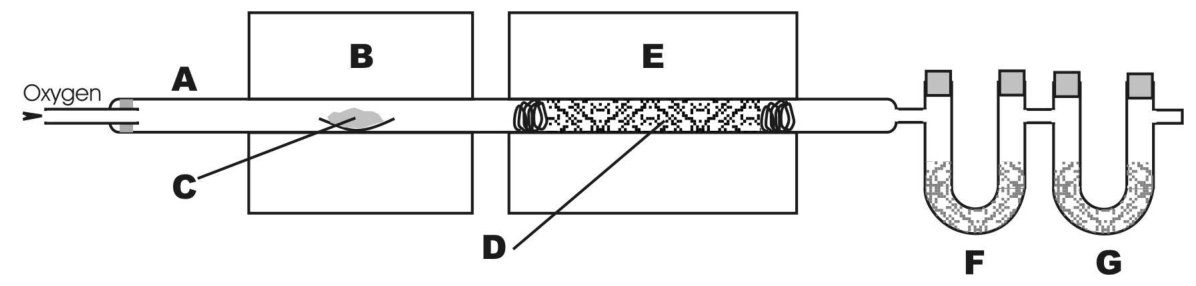
Quantitative analysis for carbon and hydrogen was originally carried out using a technique and apparatus (see figure) originally developed in 1831 by the famous chemist Justus Liebig. A carefully weighed sample of organic compound (C) is placed in a combustion tube (A) and vaporized by heating in a furnace (B). The vapours are swept by a stream of oxygen through a heated copper oxide packing (D) and through another furnace (E), which ensures the quantitative oxidation of carbon and hydrogen to carbon dioxide and water. The water vapour is absorbed in a weighed tube (F) containing magnesium perchlorate and the carbon dioxide in another weighed tube (G) containing asbestos impregnated with sodium hydroxide.
A pure liquid sample containing only carbon, hydrogen and oxygen is placed in a 0.57148 g platinum boat, which on reweighing weights 0.61227 g. The sample is ignited and the previously weighed absorption tubes are reweighed. The mass of the water absorption tube has increased from 6.47002 g to 6.50359 g, and the mass of the carbon dioxide tube has increased from 5.46311 g to 5.54466 g.
2.1 Calculate the mass composition of the compound.
2.2 Give the empirical formula of the compound.
To estimate the molar mass of the compound, 1.0045 g was gasified. The volume, measured at a temperature of 350 K and a pressure of 35.0 kPa, was 0.95 dm\(^3\).
2.3 Give the molar mass and the molecular formula of the compound.
2.4 Draw possible structures corresponding to the molecular formula excluding cyclic structures, stereo isomers, peroxides and unsaturated compounds. There are about 15 possibilities. Give 10 of them.
When the compound is heated with a sodium hydroxide solution, two products are formed. Fractional distillation of the reaction mixture yields one of the substances. The other substance is purified by distillation after acidification and appears to be an acid.
2.5 What structures are possible for compound C?
0.1005 g of the acid are dissolved in water and titrated with a sodium hydroxide solution with a concentration of 0.1000 mol dm\(^{-3}\). The indicator changes colour on addition of 16.75 cm\(^3\) of hydroxide solution.
2.6 What was the original substance C?
Official English text of the problem.
Answers
- 2.1: Carbon 54.56%, hydrogen 9.21%, oxygen 36.23% by mass.
- 2.2: Empirical formula: \(\boxed{\ce{C2H4O}}\).
- 2.3: Molar mass: \(\boxed{88\ \mathrm{g\,mol^{-1}}}\); molecular formula: \(\boxed{\ce{C4H8O2}}\).
- 2.4: Ten acceptable constitutional structures are listed below. Stereochemistry is unspecified because stereoisomers are excluded from the count.
| Name | Condensed structure | SMILES |
|---|---|---|
| Butanoic acid | \(\ce{CH3CH2CH2C(=O)OH}\) | CCCC(=O)O |
| 2-Methylpropanoic acid | \(\ce{(CH3)2CHC(=O)OH}\) | CC(C)C(=O)O |
| Methyl propanoate | \(\ce{CH3CH2C(=O)OCH3}\) | CCC(=O)OC |
| Ethyl ethanoate | \(\ce{CH3C(=O)OCH2CH3}\) | CC(=O)OCC |
| Propyl methanoate | \(\ce{HC(=O)OCH2CH2CH3}\) | CCCOC=O |
| Propan-2-yl methanoate | \(\ce{HC(=O)OCH(CH3)2}\) | CC(C)OC=O |
| 2-Hydroxybutanal | \(\ce{CH3CH2CH(OH)CHO}\) | CCC(O)C=O |
| 3-Hydroxybutanal | \(\ce{CH3CH(OH)CH2CHO}\) | CC(O)CC=O |
| 1-Hydroxybutan-2-one | \(\ce{HOCH2C(=O)CH2CH3}\) | CCC(=O)CO |
| 3-Hydroxybutan-2-one | \(\ce{CH3C(=O)CH(OH)CH3}\) | CC(=O)C(O)C |
- 2.5: The four ester candidates are methyl propanoate
CCC(=O)OC, ethyl ethanoateCC(=O)OCC, propyl methanoateCCCOC=O, and propan-2-yl methanoateCC(C)OC=O. - 2.6: The original substance is ethyl ethanoate (ethyl acetate), \(\ce{CH3COOCH2CH3}\), SMILES
CC(=O)OCC.
Solution
2.1 — Mass composition
The mass of the sample is
\[ m_{\text{sample}}=0.61227-0.57148 =0.04079\ \mathrm{g}. \]
The absorber mass increases give the amounts of water O and carbon dioxide O=C=O:
\[ m(\ce{H2O})=6.50359-6.47002 =0.03357\ \mathrm{g}, \]
\[ m(\ce{CO2})=5.54466-5.46311 =0.08155\ \mathrm{g}. \]
Using atomic molar masses of \(12.01\), \(1.008\), and \(16.00\ \mathrm{g\,mol^{-1}}\) for carbon, hydrogen, and oxygen, respectively,
\[ m(\ce{C}) =m(\ce{CO2})\frac{12.01}{44.01} =0.0222544\ \mathrm{g}, \]
\[ m(\ce{H}) =m(\ce{H2O})\frac{2(1.008)}{18.016} =0.00375650\ \mathrm{g}. \]
Because the compound contains only carbon, hydrogen, and oxygen, the oxygen mass follows by difference:
\[ m(\ce{O}) =0.04079-0.0222544-0.00375650 =0.0147791\ \mathrm{g}. \]
Therefore,
\[ \boxed{ \begin{aligned} w(\ce{C})&=\frac{0.0222544}{0.04079}\times100\%=54.56\%,\\ w(\ce{H})&=\frac{0.00375650}{0.04079}\times100\%=9.21\%,\\ w(\ce{O})&=\frac{0.0147791}{0.04079}\times100\%=36.23\%. \end{aligned}} \]
2.2 — Empirical formula
The amounts of atoms in the sample are
\[ \begin{aligned} n(\ce{C})&=\frac{0.0222544}{12.01} =1.85299\times10^{-3}\ \mathrm{mol},\\ n(\ce{H})&=\frac{0.00375650}{1.008} =3.72669\times10^{-3}\ \mathrm{mol},\\ n(\ce{O})&=\frac{0.0147791}{16.00} =9.23695\times10^{-4}\ \mathrm{mol}. \end{aligned} \]
Dividing by the smallest amount gives
\[ n(\ce{C}):n(\ce{H}):n(\ce{O}) =2.006:4.035:1 \approx2:4:1. \]
Thus the empirical formula is
\[ \boxed{\ce{C2H4O}}. \]
2.3 — Molar mass and molecular formula
Treating the vapour as an ideal gas,
\[ pV=nRT,\qquad M=\frac{mRT}{pV}. \]
With \(R=8.314\ \mathrm{kPa\,dm^3\,mol^{-1}\,K^{-1}}\),
\[ M= \frac{ (1.0045\ \mathrm{g}) (8.314\ \mathrm{kPa\,dm^3\,mol^{-1}\,K^{-1}}) (350\ \mathrm{K}) }{ (35.0\ \mathrm{kPa})(0.95\ \mathrm{dm^3}) } =87.91\ \mathrm{g\,mol^{-1}}. \]
The volume has two significant figures, so the reported result is
\[ \boxed{M\approx88\ \mathrm{g\,mol^{-1}}}. \]
The empirical formula mass is
\[ M_{\mathrm{emp}} =2(12.01)+4(1.008)+16.00 =44.052\ \mathrm{g\,mol^{-1}}. \]
Hence
\[ \frac{M}{M_{\mathrm{emp}}} =\frac{87.91}{44.052} \approx2, \]
and the molecular formula is
\[ \boxed{\ce{C4H8O2}}. \]
Its complete combustion with oxygen O=O is balanced as
\[ \ce{C4H8O2 + 5O2 -> 4CO2 + 4H2O}. \]
2.4 — Ten possible structures
The degree of unsaturation is
\[ \mathrm{DBE}=\frac{2(4)+2-8}{2}=1. \]
With rings and carbon–carbon multiple bonds excluded, this requires one carbonyl group. The second oxygen can occur in a carboxylic acid, ester, hydroxyl, or ether group.
The ten structures in the Answers table comprise two carboxylic acids, four esters, two hydroxyaldehydes, and two hydroxyketones. Each has exactly four carbon atoms, eight hydrogen atoms, and two oxygen atoms, with no ring or peroxide bond.
For the requested drawings, the condensed formulas specify the connectivity: every bond is single except the indicated carbonyl double bond. The terminal aldehyde group \(\ce{-CHO}\) contains a carbonyl carbon bonded to hydrogen. In the hydroxyaldehydes, numbering begins at this aldehyde carbon; in the hydroxyketones, the carbonyl is at carbon 2. No separate stereoisomers are counted.
2.5 — Structures consistent with alkaline hydrolysis
Heating an ester with sodium hydroxide [Na+].[OH-] produces an alcohol and a sodium carboxylate. The neutral alcohol can be distilled from the reaction mixture. The carboxylate remains in solution until acidification releases the corresponding carboxylic acid.
For an ester with four carbon atoms, the distribution between the acid and alcohol portions can be \(3+1\), \(2+2\), or \(1+3\). The three-carbon alcohol portion has two possible connectivities. This gives four ester candidates:
| Possible compound C | Alcohol obtained | Acid obtained after acidification |
|---|---|---|
Methyl propanoate CCC(=O)OC |
Methanol CO |
Propanoic acid CCC(=O)O |
Ethyl ethanoate CC(=O)OCC |
Ethanol CCO |
Ethanoic acid CC(=O)O |
Propyl methanoate CCCOC=O |
Propan-1-ol CCCO |
Methanoic acid O=CO |
Propan-2-yl methanoate CC(C)OC=O |
Propan-2-ol CC(O)C |
Methanoic acid O=CO |
The balanced hydrolysis equations, written ionically, are
\[ \ce{CH3CH2COOCH3 + OH- -> CH3CH2COO- + CH3OH}, \]
\[ \ce{CH3COOCH2CH3 + OH- -> CH3COO- + CH3CH2OH}, \]
\[ \ce{HCOOCH2CH2CH3 + OH- -> HCOO- + CH3CH2CH2OH}, \]
\[ \ce{HCOOCH(CH3)2 + OH- -> HCOO- + (CH3)2CHOH}. \]
Here the ions are hydroxide [OH-], propanoate CCC(=O)[O-], ethanoate CC(=O)[O-], and methanoate [O-]C=O.
2.6 — Identification of the original substance
All three candidate acids are monocarboxylic and consume one mole of hydroxide per mole of acid. Thus
\[ \begin{aligned} n_{\mathrm{acid}} &=n_{\mathrm{NaOH}}\\ &=(0.1000\ \mathrm{mol\,dm^{-3}}) (16.75\times10^{-3}\ \mathrm{dm^3})\\ &=1.675\times10^{-3}\ \mathrm{mol}. \end{aligned} \]
The acid’s experimental molar mass is therefore
\[ M_{\mathrm{acid}} =\frac{0.1005\ \mathrm{g}} {1.675\times10^{-3}\ \mathrm{mol}} =\boxed{60.00\ \mathrm{g\,mol^{-1}}}. \]
This identifies ethanoic acid (acetic acid) CC(=O)O, whose formula is \(\ce{CH3COOH}\) and whose formula molar mass is approximately \(60.05\ \mathrm{g\,mol^{-1}}\).
Its titration reaction is
\[ \ce{CH3COOH + OH- -> CH3COO- + H2O}. \]
The ethanoate portion contains two carbon atoms, leaving two of the original four carbon atoms for the alcohol portion. That alcohol is therefore ethanol CCO, and the original ester is
\[ \boxed{\text{ethyl ethanoate (ethyl acetate), }\ce{CH3COOCH2CH3}} \]
with SMILES CC(=O)OCC.
Its alkaline hydrolysis is
\[ \ce{CH3COOCH2CH3 + NaOH -> CH3COONa + CH3CH2OH}, \]
where sodium ethanoate has SMILES [Na+].CC(=O)[O-]. Ethanol is the first distilled product.
Acidification protonates ethanoate; using hydronium [OH3+] to represent the acidifying solution,
\[ \ce{CH3COO- + H3O+ -> CH3COOH + H2O}. \]
The resulting ethanoic acid is the second isolated product.
The answers were checked against the official answers published by the organisers.
IChO 1982 · Theorieaufgabe 2
Liebigsche Verbrennungsanalyse und Identifizierung einer organischen Flüssigkeit C
Die quantitative Analyse auf Kohlenstoff und Wasserstoff wurde ursprünglich mit einem Verfahren und einer Apparatur (siehe Abbildung) durchgeführt, die der berühmte Chemiker Justus Liebig im Jahr 1831 entwickelt hatte. Eine sorgfältig eingewogene Probe der organischen Verbindung (C) wird in ein Verbrennungsrohr (A) eingebracht und durch Erhitzen in einem Ofen (B) verdampft. Die Dämpfe werden von einem Sauerstoffstrom durch eine erhitzte Kupferoxidfüllung (D) und durch einen weiteren Ofen (E) geleitet, der die quantitative Oxidation von Kohlenstoff und Wasserstoff zu Kohlenstoffdioxid und Wasser gewährleistet. Der Wasserdampf wird in einem gewogenen Rohr (F) mit Magnesiumperchlorat absorbiert, das Kohlenstoffdioxid in einem weiteren gewogenen Rohr (G), das mit Natriumhydroxid imprägnierten Asbest enthält.
Eine reine flüssige Probe, die nur Kohlenstoff, Wasserstoff und Sauerstoff enthält, wird in ein 0.57148 g schweres Platinschiffchen eingebracht, das bei erneuter Wägung 0.61227 g wiegt. Die Probe wird entzündet, und die zuvor gewogenen Absorptionsrohre werden erneut gewogen. Die Masse des Wasserabsorptionsrohrs hat von 6.47002 g auf 6.50359 g zugenommen, und die Masse des Kohlenstoffdioxidabsorptionsrohrs ist von 5.46311 g auf 5.54466 g gestiegen.
2.1 Berechnen Sie die Massenanteile der Elemente in der Verbindung.
2.2 Geben Sie die Verhältnisformel der Verbindung an.
Zur Abschätzung der molaren Masse der Verbindung wurden 1.0045 g verdampft. Das bei einer Temperatur von 350 K und einem Druck von 35.0 kPa gemessene Volumen betrug 0.95 dm\(^3\).
2.3 Geben Sie die molare Masse und die Summenformel der Verbindung an.
2.4 Zeichnen Sie mögliche Strukturen, die der Summenformel entsprechen, unter Ausschluss cyclischer Strukturen, von Stereoisomeren, Peroxiden und ungesättigten Verbindungen. Es gibt etwa 15 Möglichkeiten. Geben Sie 10 davon an.
Beim Erhitzen der Verbindung mit Natronlauge entstehen zwei Produkte. Durch fraktionierte Destillation des Reaktionsgemischs wird eine der Substanzen gewonnen. Die andere Substanz wird nach dem Ansäuern durch Destillation gereinigt und erweist sich als Säure.
2.5 Welche Strukturen kommen für die Verbindung C infrage?
0.1005 g der Säure werden in Wasser gelöst und mit Natronlauge der Konzentration 0.1000 mol dm\(^{-3}\) titriert. Nach Zugabe von 16.75 cm\(^3\) Natronlauge schlägt der Indikator um.
2.6 Was war die ursprüngliche Substanz C?
Aufgabentext aus dem offiziellen englischen Text übersetzt.
Antworten
- 2.1: Die Massenanteile betragen für Kohlenstoff 54.56%, für Wasserstoff 9.21% und für Sauerstoff 36.23%.
- 2.2: Verhältnisformel: \(\boxed{\ce{C2H4O}}\).
- 2.3: Molare Masse: \(\boxed{88\ \mathrm{g\,mol^{-1}}}\); Summenformel: \(\boxed{\ce{C4H8O2}}\).
- 2.4: Zehn zulässige Konstitutionsstrukturen sind nachstehend aufgeführt. Die Stereochemie ist nicht angegeben, da Stereoisomere bei der Zählung ausgeschlossen sind.
| Name | Halbstrukturformel | SMILES |
|---|---|---|
| Butansäure | \(\ce{CH3CH2CH2C(=O)OH}\) | CCCC(=O)O |
| 2-Methylpropansäure | \(\ce{(CH3)2CHC(=O)OH}\) | CC(C)C(=O)O |
| Methylpropanoat | \(\ce{CH3CH2C(=O)OCH3}\) | CCC(=O)OC |
| Ethylethanoat | \(\ce{CH3C(=O)OCH2CH3}\) | CC(=O)OCC |
| Propylmethanoat | \(\ce{HC(=O)OCH2CH2CH3}\) | CCCOC=O |
| Propan-2-yl-methanoat | \(\ce{HC(=O)OCH(CH3)2}\) | CC(C)OC=O |
| 2-Hydroxybutanal | \(\ce{CH3CH2CH(OH)CHO}\) | CCC(O)C=O |
| 3-Hydroxybutanal | \(\ce{CH3CH(OH)CH2CHO}\) | CC(O)CC=O |
| 1-Hydroxybutan-2-on | \(\ce{HOCH2C(=O)CH2CH3}\) | CCC(=O)CO |
| 3-Hydroxybutan-2-on | \(\ce{CH3C(=O)CH(OH)CH3}\) | CC(=O)C(O)C |
- 2.5: Die vier infrage kommenden Ester sind Methylpropanoat
CCC(=O)OC, EthylethanoatCC(=O)OCC, PropylmethanoatCCCOC=Ound Propan-2-yl-methanoatCC(C)OC=O. - 2.6: Die ursprüngliche Substanz ist Ethylethanoat (Ethylacetat), \(\ce{CH3COOCH2CH3}\), SMILES
CC(=O)OCC.
Lösung
2.1 — Massenanteile
Die Masse der Probe beträgt
\[ m_{\text{Probe}}=0.61227-0.57148 =0.04079\ \mathrm{g}. \]
Aus den Massenzunahmen der Absorptionsrohre ergeben sich die Massen von Wasser O und Kohlenstoffdioxid O=C=O:
\[ m(\ce{H2O})=6.50359-6.47002 =0.03357\ \mathrm{g}, \]
\[ m(\ce{CO2})=5.54466-5.46311 =0.08155\ \mathrm{g}. \]
Mit den molaren Atommassen von \(12.01\), \(1.008\) und \(16.00\ \mathrm{g\,mol^{-1}}\) für Kohlenstoff, Wasserstoff bzw. Sauerstoff ergibt sich
\[ m(\ce{C}) =m(\ce{CO2})\frac{12.01}{44.01} =0.0222544\ \mathrm{g}, \]
\[ m(\ce{H}) =m(\ce{H2O})\frac{2(1.008)}{18.016} =0.00375650\ \mathrm{g}. \]
Da die Verbindung nur Kohlenstoff, Wasserstoff und Sauerstoff enthält, ergibt sich die Sauerstoffmasse aus der Differenz:
\[ m(\ce{O}) =0.04079-0.0222544-0.00375650 =0.0147791\ \mathrm{g}. \]
Damit gilt
\[ \boxed{ \begin{aligned} w(\ce{C})&=\frac{0.0222544}{0.04079}\times100\%=54.56\%,\\ w(\ce{H})&=\frac{0.00375650}{0.04079}\times100\%=9.21\%,\\ w(\ce{O})&=\frac{0.0147791}{0.04079}\times100\%=36.23\%. \end{aligned}} \]
2.2 — Verhältnisformel
Die Stoffmengen der Atome in der Probe betragen
\[ \begin{aligned} n(\ce{C})&=\frac{0.0222544}{12.01} =1.85299\times10^{-3}\ \mathrm{mol},\\ n(\ce{H})&=\frac{0.00375650}{1.008} =3.72669\times10^{-3}\ \mathrm{mol},\\ n(\ce{O})&=\frac{0.0147791}{16.00} =9.23695\times10^{-4}\ \mathrm{mol}. \end{aligned} \]
Division durch die kleinste Stoffmenge ergibt
\[ n(\ce{C}):n(\ce{H}):n(\ce{O}) =2.006:4.035:1 \approx2:4:1. \]
Die Verhältnisformel lautet somit
\[ \boxed{\ce{C2H4O}}. \]
2.3 — Molare Masse und Summenformel
Wird der Dampf als ideales Gas behandelt, gilt
\[ pV=nRT,\qquad M=\frac{mRT}{pV}. \]
Mit \(R=8.314\ \mathrm{kPa\,dm^3\,mol^{-1}\,K^{-1}}\) ergibt sich
\[ M= \frac{ (1.0045\ \mathrm{g}) (8.314\ \mathrm{kPa\,dm^3\,mol^{-1}\,K^{-1}}) (350\ \mathrm{K}) }{ (35.0\ \mathrm{kPa})(0.95\ \mathrm{dm^3}) } =87.91\ \mathrm{g\,mol^{-1}}. \]
Das Volumen ist mit zwei signifikanten Stellen angegeben, daher wird das Ergebnis angegeben als
\[ \boxed{M\approx88\ \mathrm{g\,mol^{-1}}}. \]
Die molare Masse der Verhältnisformel beträgt
\[ M_{\mathrm{emp}} =2(12.01)+4(1.008)+16.00 =44.052\ \mathrm{g\,mol^{-1}}. \]
Daraus folgt
\[ \frac{M}{M_{\mathrm{emp}}} =\frac{87.91}{44.052} \approx2, \]
und die Summenformel lautet
\[ \boxed{\ce{C4H8O2}}. \]
Die ausgeglichene Gleichung ihrer vollständigen Verbrennung mit Sauerstoff O=O lautet
\[ \ce{C4H8O2 + 5O2 -> 4CO2 + 4H2O}. \]
2.4 — Zehn mögliche Strukturen
Der Ungesättigtheitsgrad beträgt
\[ \mathrm{DBE}=\frac{2(4)+2-8}{2}=1. \]
Da Ringe und Kohlenstoff–Kohlenstoff-Mehrfachbindungen ausgeschlossen sind, ist eine Carbonylgruppe erforderlich. Das zweite Sauerstoffatom kann in einer Carbonsäure-, Ester-, Hydroxy- oder Ethergruppe vorkommen.
Die zehn Strukturen in der Tabelle unter „Antworten“ umfassen zwei Carbonsäuren, vier Ester, zwei Hydroxyaldehyde und zwei Hydroxyketone. Jede enthält genau vier Kohlenstoffatome, acht Wasserstoffatome und zwei Sauerstoffatome, ohne Ring oder Peroxidbindung.
Für die geforderten Zeichnungen geben die Halbstrukturformeln die Verknüpfung der Atome an: Alle Bindungen sind Einfachbindungen, mit Ausnahme der angegebenen Carbonyl-Doppelbindung. Die endständige Aldehydgruppe \(\ce{-CHO}\) enthält ein Carbonyl-Kohlenstoffatom, das an Wasserstoff gebunden ist. Bei den Hydroxyaldehyden beginnt die Nummerierung an diesem Aldehyd-Kohlenstoffatom; bei den Hydroxyketonen befindet sich die Carbonylgruppe am Kohlenstoffatom 2. Stereoisomere werden nicht gesondert gezählt.
2.5 — Mit der alkalischen Hydrolyse vereinbare Strukturen
Beim Erhitzen eines Esters mit Natriumhydroxid [Na+].[OH-] entstehen ein Alkohol und ein Natriumcarboxylat. Der neutrale Alkohol kann aus dem Reaktionsgemisch abdestilliert werden. Das Carboxylat verbleibt in Lösung, bis durch Ansäuern die entsprechende Carbonsäure freigesetzt wird.
Bei einem Ester mit vier Kohlenstoffatomen kann die Verteilung auf den Säure- und den Alkoholrest \(3+1\), \(2+2\) oder \(1+3\) betragen. Für den Alkoholrest mit drei Kohlenstoffatomen gibt es zwei mögliche Verknüpfungen. Daraus ergeben sich vier infrage kommende Ester:
| Mögliche Verbindung C | Erhaltener Alkohol | Nach dem Ansäuern erhaltene Säure |
|---|---|---|
Methylpropanoat CCC(=O)OC |
Methanol CO |
Propansäure CCC(=O)O |
Ethylethanoat CC(=O)OCC |
Ethanol CCO |
Ethansäure CC(=O)O |
Propylmethanoat CCCOC=O |
Propan-1-ol CCCO |
Methansäure O=CO |
Propan-2-yl-methanoat CC(C)OC=O |
Propan-2-ol CC(O)C |
Methansäure O=CO |
Die ausgeglichenen Hydrolysegleichungen in Ionenschreibweise lauten
\[ \ce{CH3CH2COOCH3 + OH- -> CH3CH2COO- + CH3OH}, \]
\[ \ce{CH3COOCH2CH3 + OH- -> CH3COO- + CH3CH2OH}, \]
\[ \ce{HCOOCH2CH2CH3 + OH- -> HCOO- + CH3CH2CH2OH}, \]
\[ \ce{HCOOCH(CH3)2 + OH- -> HCOO- + (CH3)2CHOH}. \]
Die hier vorkommenden Ionen sind Hydroxid [OH-], Propanoat CCC(=O)[O-], Ethanoat CC(=O)[O-] und Methanoat [O-]C=O.
2.6 — Identifizierung der ursprünglichen Substanz
Alle drei infrage kommenden Säuren sind Monocarbonsäuren und verbrauchen ein Mol Hydroxid pro Mol Säure. Somit gilt
\[ \begin{aligned} n_{\mathrm{acid}} &=n_{\mathrm{NaOH}}\\ &=(0.1000\ \mathrm{mol\,dm^{-3}}) (16.75\times10^{-3}\ \mathrm{dm^3})\\ &=1.675\times10^{-3}\ \mathrm{mol}. \end{aligned} \]
Die experimentell bestimmte molare Masse der Säure beträgt daher
\[ M_{\mathrm{acid}} =\frac{0.1005\ \mathrm{g}} {1.675\times10^{-3}\ \mathrm{mol}} =\boxed{60.00\ \mathrm{g\,mol^{-1}}}. \]
Damit ist die Säure als Ethansäure (Essigsäure) CC(=O)O identifiziert; ihre Formel lautet \(\ce{CH3COOH}\), und ihre aus der Formel berechnete molare Masse beträgt ungefähr \(60.05\ \mathrm{g\,mol^{-1}}\).
Die Titrationsreaktion lautet
\[ \ce{CH3COOH + OH- -> CH3COO- + H2O}. \]
Der Ethanoatrest enthält zwei Kohlenstoffatome, sodass von den ursprünglichen vier Kohlenstoffatomen zwei für den Alkoholrest verbleiben. Dieser Alkohol ist daher Ethanol CCO, und der ursprüngliche Ester ist
\[ \boxed{\text{Ethylethanoat (Ethylacetat), }\ce{CH3COOCH2CH3}} \]
mit dem SMILES-Code CC(=O)OCC.
Seine alkalische Hydrolyse lautet
\[ \ce{CH3COOCH2CH3 + NaOH -> CH3COONa + CH3CH2OH}, \]
wobei Natriumethanoat den SMILES-Code [Na+].CC(=O)[O-] hat. Ethanol ist das erste abdestillierte Produkt.
Beim Ansäuern wird Ethanoat protoniert; mit Oxonium [OH3+] als Darstellung der zum Ansäuern verwendeten Lösung gilt
\[ \ce{CH3COO- + H3O+ -> CH3COOH + H2O}. \]
Die entstandene Ethansäure ist das zweite isolierte Produkt.
Die Ergebnisse wurden mit den von den Veranstaltern veröffentlichten offiziellen Ergebnissen abgeglichen.
IChO 1982 · Teori sorusu 2
Liebig yanma analizi ve organik bir C sıvısının tanımlanması
Karbon ve hidrojenin nicel analizi ilk olarak, ünlü kimyager Justus Liebig tarafından 1831 yılında geliştirilen bir teknik ve düzenek (şekle bakınız) kullanılarak gerçekleştirilmiştir. Organik bileşiğin (C) dikkatle tartılmış bir örneği bir yanma tüpüne (A) yerleştirilir ve bir fırında (B) ısıtılarak buharlaştırılır. Buharlar, bir oksijen akımıyla ısıtılmış bakır oksit dolgusundan (D) ve başka bir fırından (E) geçirilir; böylece karbon ve hidrojenin nicel olarak karbon dioksit ve suya yükseltgenmesi sağlanır. Su buharı, magnezyum perklorat içeren ve önceden tartılmış bir tüpte (F); karbon dioksit ise sodyum hidroksit emdirilmiş asbest içeren ve önceden tartılmış başka bir tüpte (G) soğurulur.
Yalnızca karbon, hidrojen ve oksijen içeren saf bir sıvı örneği, kütlesi 0.57148 g olan platin bir kayıkçığa konur; yeniden tartıldığında kayıkçığın örnekle birlikte kütlesi 0.61227 g olur. Örnek yakılır ve önceden tartılmış soğurma tüpleri yeniden tartılır. Su soğurma tüpünün kütlesi 6.47002 g'dan 6.50359 g'a, karbon dioksit tüpünün kütlesi ise 5.46311 g'dan 5.54466 g'a yükselmiştir.
2.1 Bileşiğin kütlece bileşimini hesaplayınız.
2.2 Bileşiğin basit formülünü veriniz.
Bileşiğin molar kütlesini tahmin etmek için 1.0045 g örnek gaz hâline getirilmiştir. 350 K sıcaklıkta ve 35.0 kPa basınçta ölçülen hacim 0.95 dm\(^3\) olmuştur.
2.3 Bileşiğin molar kütlesini ve molekül formülünü veriniz.
2.4 Halkalı yapılar, stereoizomerler, peroksitler ve doymamış bileşikler hariç olmak üzere, molekül formülüne karşılık gelen olası yapıları çiziniz. Yaklaşık 15 olasılık vardır. Bunlardan 10 tanesini veriniz.
Bileşik bir sodyum hidroksit çözeltisiyle ısıtıldığında iki ürün oluşur. Tepkime karışımının ayrımsal damıtılmasıyla maddelerden biri elde edilir. Diğer madde, asitlendirmeden sonra damıtılarak saflaştırılır ve bir asit olduğu anlaşılır.
2.5 C bileşiği için hangi yapılar mümkündür?
Asidin 0.1005 g'ı suda çözülür ve derişimi 0.1000 mol dm\(^{-3}\) olan bir sodyum hidroksit çözeltisiyle titre edilir. 16.75 cm\(^3\) hidroksit çözeltisi eklendiğinde indikatör renk değiştirir.
2.6 Başlangıçtaki C maddesi nedir?
Soru metni resmi İngilizce metinden çevrilmiştir.
Cevaplar
- 2.1: Kütlece karbon %54.56, hidrojen %9.21, oksijen %36.23.
- 2.2: Basit formül: \(\boxed{\ce{C2H4O}}\).
- 2.3: Molar kütle: \(\boxed{88\ \mathrm{g\,mol^{-1}}}\); molekül formülü: \(\boxed{\ce{C4H8O2}}\).
- 2.4: Kabul edilebilir on yapı aşağıda listelenmiştir. Stereoizomerler sayıya dâhil edilmediğinden stereokimya belirtilmemiştir.
| Adı | Yoğunlaştırılmış yapı | SMILES |
|---|---|---|
| Bütanoik asit | \(\ce{CH3CH2CH2C(=O)OH}\) | CCCC(=O)O |
| 2-Metilpropanoik asit | \(\ce{(CH3)2CHC(=O)OH}\) | CC(C)C(=O)O |
| Metil propanoat | \(\ce{CH3CH2C(=O)OCH3}\) | CCC(=O)OC |
| Etil etanoat | \(\ce{CH3C(=O)OCH2CH3}\) | CC(=O)OCC |
| Propil metanoat | \(\ce{HC(=O)OCH2CH2CH3}\) | CCCOC=O |
| Propan-2-il metanoat | \(\ce{HC(=O)OCH(CH3)2}\) | CC(C)OC=O |
| 2-Hidroksibütanal | \(\ce{CH3CH2CH(OH)CHO}\) | CCC(O)C=O |
| 3-Hidroksibütanal | \(\ce{CH3CH(OH)CH2CHO}\) | CC(O)CC=O |
| 1-Hidroksibütan-2-on | \(\ce{HOCH2C(=O)CH2CH3}\) | CCC(=O)CO |
| 3-Hidroksibütan-2-on | \(\ce{CH3C(=O)CH(OH)CH3}\) | CC(=O)C(O)C |
- 2.5: Dört ester adayı metil propanoat
CCC(=O)OC, etil etanoatCC(=O)OCC, propil metanoatCCCOC=Ove propan-2-il metanoatCC(C)OC=Obileşikleridir. - 2.6: Başlangıçtaki madde etil etanoat (etil asetat), \(\ce{CH3COOCH2CH3}\), SMILES
CC(=O)OCCbileşiğidir.
Çözüm
2.1 — Kütlece bileşim
Örneğin kütlesi
\[ m_{\text{örnek}}=0.61227-0.57148 =0.04079\ \mathrm{g}. \]
Soğurucuların kütle artışları, su O ve karbon dioksit O=C=O miktarlarını verir:
\[ m(\ce{H2O})=6.50359-6.47002 =0.03357\ \mathrm{g}, \]
\[ m(\ce{CO2})=5.54466-5.46311 =0.08155\ \mathrm{g}. \]
Karbon, hidrojen ve oksijen için sırasıyla \(12.01\), \(1.008\) ve \(16.00\ \mathrm{g\,mol^{-1}}\) atomik molar kütleleri kullanılırsa,
\[ m(\ce{C}) =m(\ce{CO2})\frac{12.01}{44.01} =0.0222544\ \mathrm{g}, \]
\[ m(\ce{H}) =m(\ce{H2O})\frac{2(1.008)}{18.016} =0.00375650\ \mathrm{g}. \]
Bileşik yalnızca karbon, hidrojen ve oksijen içerdiğinden oksijenin kütlesi farktan bulunur:
\[ m(\ce{O}) =0.04079-0.0222544-0.00375650 =0.0147791\ \mathrm{g}. \]
Dolayısıyla,
\[ \boxed{ \begin{aligned} w(\ce{C})&=\frac{0.0222544}{0.04079}\times100\%=54.56\%,\\ w(\ce{H})&=\frac{0.00375650}{0.04079}\times100\%=9.21\%,\\ w(\ce{O})&=\frac{0.0147791}{0.04079}\times100\%=36.23\%. \end{aligned}} \]
2.2 — Basit formül
Örnekteki atomların madde miktarları
\[ \begin{aligned} n(\ce{C})&=\frac{0.0222544}{12.01} =1.85299\times10^{-3}\ \mathrm{mol},\\ n(\ce{H})&=\frac{0.00375650}{1.008} =3.72669\times10^{-3}\ \mathrm{mol},\\ n(\ce{O})&=\frac{0.0147791}{16.00} =9.23695\times10^{-4}\ \mathrm{mol}. \end{aligned} \]
En küçük madde miktarına bölündüğünde
\[ n(\ce{C}):n(\ce{H}):n(\ce{O}) =2.006:4.035:1 \approx2:4:1. \]
Böylece basit formül
\[ \boxed{\ce{C2H4O}}. \]
2.3 — Molar kütle ve molekül formülü
Buhar ideal gaz olarak ele alınırsa,
\[ pV=nRT,\qquad M=\frac{mRT}{pV}. \]
\(R=8.314\ \mathrm{kPa\,dm^3\,mol^{-1}\,K^{-1}}\) kullanılarak,
\[ M= \frac{ (1.0045\ \mathrm{g}) (8.314\ \mathrm{kPa\,dm^3\,mol^{-1}\,K^{-1}}) (350\ \mathrm{K}) }{ (35.0\ \mathrm{kPa})(0.95\ \mathrm{dm^3}) } =87.91\ \mathrm{g\,mol^{-1}}. \]
Hacim iki anlamlı basamakla verildiğinden sonuç
\[ \boxed{M\approx88\ \mathrm{g\,mol^{-1}}}. \]
Basit formülün molar kütlesi
\[ M_{\mathrm{emp}} =2(12.01)+4(1.008)+16.00 =44.052\ \mathrm{g\,mol^{-1}}. \]
Buna göre
\[ \frac{M}{M_{\mathrm{emp}}} =\frac{87.91}{44.052} \approx2, \]
ve molekül formülü
\[ \boxed{\ce{C4H8O2}}. \]
Oksijen O=O ile tam yanmasının denkleştirilmiş tepkimesi şöyledir:
\[ \ce{C4H8O2 + 5O2 -> 4CO2 + 4H2O}. \]
2.4 — On olası yapı
Doymamışlık derecesi
\[ \mathrm{DBE}=\frac{2(4)+2-8}{2}=1. \]
Halkalar ve karbon–karbon çoklu bağları hariç tutulduğunda bu durum bir karbonil grubu bulunmasını gerektirir. İkinci oksijen, bir karboksilik asit, ester, hidroksil veya eter grubunda bulunabilir.
Cevaplar tablosundaki on yapı; iki karboksilik asit, dört ester, iki hidroksialdehit ve iki hidroksiketondan oluşur. Her biri tam olarak dört karbon atomu, sekiz hidrojen atomu ve iki oksijen atomu içerir; hiçbirinde halka veya peroksit bağı bulunmaz.
İstenen çizimler için yoğunlaştırılmış formüller atomların bağlanma düzenini belirtir: gösterilen karbonil çift bağı dışında tüm bağlar tek bağdır. Uçtaki aldehit grubu \(\ce{-CHO}\), hidrojene bağlı bir karbonil karbonu içerir. Hidroksialdehitlerde numaralandırma bu aldehit karbonundan başlar; hidroksiketonlarda ise karbonil grubu 2 numaralı karbondadır. Stereoizomerler ayrı ayrı sayılmaz.
2.5 — Bazik hidrolizle uyumlu yapılar
Bir esterin sodyum hidroksit [Na+].[OH-] ile ısıtılması bir alkol ve bir sodyum karboksilat oluşturur. Nötr alkol, tepkime karışımından damıtılarak ayrılabilir. Karboksilat, asitlendirmeyle karşılık gelen karboksilik asit açığa çıkana kadar çözeltide kalır.
Dört karbon atomu içeren bir esterde karbonların asit ve alkol kısımları arasındaki dağılımı \(3+1\), \(2+2\) veya \(1+3\) olabilir. Üç karbonlu alkol kısmı için iki olası bağlanma düzeni vardır. Böylece dört ester adayı elde edilir:
| Olası C bileşiği | Elde edilen alkol | Asitlendirmeden sonra elde edilen asit |
|---|---|---|
Metil propanoat CCC(=O)OC |
Metanol CO |
Propanoik asit CCC(=O)O |
Etil etanoat CC(=O)OCC |
Etanol CCO |
Etanoik asit CC(=O)O |
Propil metanoat CCCOC=O |
Propan-1-ol CCCO |
Metanoik asit O=CO |
Propan-2-il metanoat CC(C)OC=O |
Propan-2-ol CC(O)C |
Metanoik asit O=CO |
İyonik biçimde yazılmış denkleştirilmiş hidroliz denklemleri şöyledir:
\[ \ce{CH3CH2COOCH3 + OH- -> CH3CH2COO- + CH3OH}, \]
\[ \ce{CH3COOCH2CH3 + OH- -> CH3COO- + CH3CH2OH}, \]
\[ \ce{HCOOCH2CH2CH3 + OH- -> HCOO- + CH3CH2CH2OH}, \]
\[ \ce{HCOOCH(CH3)2 + OH- -> HCOO- + (CH3)2CHOH}. \]
Buradaki iyonlar hidroksit [OH-], propanoat CCC(=O)[O-], etanoat CC(=O)[O-] ve metanoat [O-]C=O iyonlarıdır.
2.6 — Başlangıçtaki maddenin tanımlanması
Üç aday asidin tümü monokarboksilik asittir ve asidin her molü için bir mol hidroksit tüketir. Dolayısıyla
\[ \begin{aligned} n_{\mathrm{acid}} &=n_{\mathrm{NaOH}}\\ &=(0.1000\ \mathrm{mol\,dm^{-3}}) (16.75\times10^{-3}\ \mathrm{dm^3})\\ &=1.675\times10^{-3}\ \mathrm{mol}. \end{aligned} \]
Buna göre asidin deneysel molar kütlesi
\[ M_{\mathrm{acid}} =\frac{0.1005\ \mathrm{g}} {1.675\times10^{-3}\ \mathrm{mol}} =\boxed{60.00\ \mathrm{g\,mol^{-1}}}. \]
Bu sonuç, asidin etanoik asit (asetik asit) CC(=O)O olduğunu gösterir; bu asidin formülü \(\ce{CH3COOH}\), formülünden hesaplanan molar kütlesi ise yaklaşık \(60.05\ \mathrm{g\,mol^{-1}}\) değerindedir.
Titrasyon tepkimesi şöyledir:
\[ \ce{CH3COOH + OH- -> CH3COO- + H2O}. \]
Etanoat kısmı iki karbon atomu içerdiğinden başlangıçtaki dört karbon atomunun ikisi alkol kısmına kalır. Dolayısıyla bu alkol etanol CCO ve başlangıçtaki ester
\[ \boxed{\text{etil etanoat (etil asetat), }\ce{CH3COOCH2CH3}} \]
olup SMILES gösterimi CC(=O)OCC şeklindedir.
Bazik hidrolizi şöyledir:
\[ \ce{CH3COOCH2CH3 + NaOH -> CH3COONa + CH3CH2OH}, \]
burada sodyum etanoatın SMILES gösterimi [Na+].CC(=O)[O-] şeklindedir. Etanol, damıtılarak elde edilen ilk üründür.
Asitlendirme etanoatı protonlar; asitlendirme çözeltisini temsil etmek için hidronyum [OH3+] kullanıldığında,
\[ \ce{CH3COO- + H3O+ -> CH3COOH + H2O}. \]
Oluşan etanoik asit, izole edilen ikinci üründür.
Sonuçlar, düzenleyicilerin yayımladığı resmi sonuçlarla karşılaştırılarak kontrol edildi.
IChO 1982 · Problema teórico 2
Análisis por combustión de Liebig e identificación de un líquido orgánico C
El análisis cuantitativo de carbono e hidrógeno se realizaba inicialmente mediante una técnica y un aparato (véase la figura) desarrollados en 1831 por el célebre químico Justus Liebig. Una muestra cuidadosamente pesada del compuesto orgánico (C) se coloca en un tubo de combustión (A) y se vaporiza calentándola en un horno (B). Una corriente de oxígeno arrastra los vapores a través de un lecho de óxido de cobre calentado (D) y de otro horno (E), que garantiza la oxidación cuantitativa del carbono y el hidrógeno a dióxido de carbono y agua. El vapor de agua se absorbe en un tubo previamente pesado (F) que contiene perclorato de magnesio, y el dióxido de carbono, en otro tubo previamente pesado (G) que contiene amianto impregnado de hidróxido de sodio.
Una muestra líquida pura que contiene únicamente carbono, hidrógeno y oxígeno se coloca en una navecilla de platino de 0.57148 g, que, al volver a pesarse, pesa 0.61227 g. Se quema la muestra y se vuelven a pesar los tubos de absorción, previamente pesados. La masa del tubo de absorción de agua ha aumentado de 6.47002 g a 6.50359 g, y la masa del tubo de dióxido de carbono ha aumentado de 5.46311 g a 5.54466 g.
2.1 Calcule la composición en masa del compuesto.
2.2 Indique la fórmula empírica del compuesto.
Para estimar la masa molar del compuesto, se vaporizaron 1.0045 g. El volumen, medido a una temperatura de 350 K y una presión de 35.0 kPa, fue de 0.95 dm\(^3\).
2.3 Indique la masa molar y la fórmula molecular del compuesto.
2.4 Dibuje posibles estructuras correspondientes a la fórmula molecular, excluyendo las estructuras cíclicas, los estereoisómeros, los peróxidos y los compuestos insaturados. Hay unas 15 posibilidades. Indique 10 de ellas.
Cuando el compuesto se calienta con una disolución de hidróxido de sodio, se forman dos productos. La destilación fraccionada de la mezcla de reacción permite obtener una de las sustancias. La otra sustancia se purifica por destilación tras la acidificación y resulta ser un ácido.
2.5 ¿Qué estructuras son posibles para el compuesto C?
Se disuelven 0.1005 g del ácido en agua y se valoran con una disolución de hidróxido de sodio de concentración 0.1000 mol dm\(^{-3}\). El indicador cambia de color al añadir 16.75 cm\(^3\) de disolución de hidróxido.
2.6 ¿Cuál era la sustancia original C?
Enunciado traducido del texto oficial en inglés.
Respuestas
- 2.1: Carbono 54.56%, hidrógeno 9.21%, oxígeno 36.23% en masa.
- 2.2: Fórmula empírica: \(\boxed{\ce{C2H4O}}\).
- 2.3: Masa molar: \(\boxed{88\ \mathrm{g\,mol^{-1}}}\); fórmula molecular: \(\boxed{\ce{C4H8O2}}\).
- 2.4: A continuación se enumeran diez estructuras constitucionales aceptables. No se especifica la estereoquímica porque los estereoisómeros se excluyen del recuento.
| Nombre | Estructura condensada | SMILES |
|---|---|---|
| Ácido butanoico | \(\ce{CH3CH2CH2C(=O)OH}\) | CCCC(=O)O |
| Ácido 2-metilpropanoico | \(\ce{(CH3)2CHC(=O)OH}\) | CC(C)C(=O)O |
| Propanoato de metilo | \(\ce{CH3CH2C(=O)OCH3}\) | CCC(=O)OC |
| Etanoato de etilo | \(\ce{CH3C(=O)OCH2CH3}\) | CC(=O)OCC |
| Metanoato de propilo | \(\ce{HC(=O)OCH2CH2CH3}\) | CCCOC=O |
| Metanoato de propan-2-ilo | \(\ce{HC(=O)OCH(CH3)2}\) | CC(C)OC=O |
| 2-Hidroxibutanal | \(\ce{CH3CH2CH(OH)CHO}\) | CCC(O)C=O |
| 3-Hidroxibutanal | \(\ce{CH3CH(OH)CH2CHO}\) | CC(O)CC=O |
| 1-Hidroxibutan-2-ona | \(\ce{HOCH2C(=O)CH2CH3}\) | CCC(=O)CO |
| 3-Hidroxibutan-2-ona | \(\ce{CH3C(=O)CH(OH)CH3}\) | CC(=O)C(O)C |
- 2.5: Los cuatro ésteres candidatos son propanoato de metilo
CCC(=O)OC, etanoato de etiloCC(=O)OCC, metanoato de propiloCCCOC=Oy metanoato de propan-2-iloCC(C)OC=O. - 2.6: La sustancia original es etanoato de etilo (acetato de etilo), \(\ce{CH3COOCH2CH3}\), SMILES
CC(=O)OCC.
Solución
2.1 — Composición en masa
La masa de la muestra es
\[ m_{\text{muestra}}=0.61227-0.57148 =0.04079\ \mathrm{g}. \]
Los aumentos de masa de los tubos de absorción proporcionan las cantidades de agua O y dióxido de carbono O=C=O:
\[ m(\ce{H2O})=6.50359-6.47002 =0.03357\ \mathrm{g}, \]
\[ m(\ce{CO2})=5.54466-5.46311 =0.08155\ \mathrm{g}. \]
Utilizando masas molares atómicas de \(12.01\), \(1.008\) y \(16.00\ \mathrm{g\,mol^{-1}}\) para el carbono, el hidrógeno y el oxígeno, respectivamente,
\[ m(\ce{C}) =m(\ce{CO2})\frac{12.01}{44.01} =0.0222544\ \mathrm{g}, \]
\[ m(\ce{H}) =m(\ce{H2O})\frac{2(1.008)}{18.016} =0.00375650\ \mathrm{g}. \]
Como el compuesto contiene únicamente carbono, hidrógeno y oxígeno, la masa de oxígeno se obtiene por diferencia:
\[ m(\ce{O}) =0.04079-0.0222544-0.00375650 =0.0147791\ \mathrm{g}. \]
Por tanto,
\[ \boxed{ \begin{aligned} w(\ce{C})&=\frac{0.0222544}{0.04079}\times100\%=54.56\%,\\ w(\ce{H})&=\frac{0.00375650}{0.04079}\times100\%=9.21\%,\\ w(\ce{O})&=\frac{0.0147791}{0.04079}\times100\%=36.23\%. \end{aligned}} \]
2.2 — Fórmula empírica
Las cantidades de sustancia de los átomos presentes en la muestra son
\[ \begin{aligned} n(\ce{C})&=\frac{0.0222544}{12.01} =1.85299\times10^{-3}\ \mathrm{mol},\\ n(\ce{H})&=\frac{0.00375650}{1.008} =3.72669\times10^{-3}\ \mathrm{mol},\\ n(\ce{O})&=\frac{0.0147791}{16.00} =9.23695\times10^{-4}\ \mathrm{mol}. \end{aligned} \]
Al dividir por la menor cantidad se obtiene
\[ n(\ce{C}):n(\ce{H}):n(\ce{O}) =2.006:4.035:1 \approx2:4:1. \]
Así, la fórmula empírica es
\[ \boxed{\ce{C2H4O}}. \]
2.3 — Masa molar y fórmula molecular
Tratando el vapor como un gas ideal,
\[ pV=nRT,\qquad M=\frac{mRT}{pV}. \]
Con \(R=8.314\ \mathrm{kPa\,dm^3\,mol^{-1}\,K^{-1}}\),
\[ M= \frac{ (1.0045\ \mathrm{g}) (8.314\ \mathrm{kPa\,dm^3\,mol^{-1}\,K^{-1}}) (350\ \mathrm{K}) }{ (35.0\ \mathrm{kPa})(0.95\ \mathrm{dm^3}) } =87.91\ \mathrm{g\,mol^{-1}}. \]
El volumen tiene dos cifras significativas, por lo que el resultado se expresa como
\[ \boxed{M\approx88\ \mathrm{g\,mol^{-1}}}. \]
La masa molar correspondiente a la fórmula empírica es
\[ M_{\mathrm{emp}} =2(12.01)+4(1.008)+16.00 =44.052\ \mathrm{g\,mol^{-1}}. \]
Por consiguiente,
\[ \frac{M}{M_{\mathrm{emp}}} =\frac{87.91}{44.052} \approx2, \]
y la fórmula molecular es
\[ \boxed{\ce{C4H8O2}}. \]
La ecuación ajustada de su combustión completa con oxígeno O=O es
\[ \ce{C4H8O2 + 5O2 -> 4CO2 + 4H2O}. \]
2.4 — Diez estructuras posibles
El grado de insaturación es
\[ \mathrm{DBE}=\frac{2(4)+2-8}{2}=1. \]
Al excluir los anillos y los enlaces múltiples carbono–carbono, se requiere un grupo carbonilo. El segundo oxígeno puede formar parte de un grupo carboxilo, éster, hidroxilo o éter.
Las diez estructuras de la tabla de Respuestas comprenden dos ácidos carboxílicos, cuatro ésteres, dos hidroxialdehídos y dos hidroxicetonas. Cada una tiene exactamente cuatro átomos de carbono, ocho átomos de hidrógeno y dos átomos de oxígeno, sin anillos ni enlaces peróxido.
Para los dibujos solicitados, las fórmulas condensadas especifican la conectividad: todos los enlaces son simples, excepto el doble enlace del carbonilo indicado. El grupo aldehído terminal \(\ce{-CHO}\) contiene un carbono carbonílico unido a un hidrógeno. En los hidroxialdehídos, la numeración comienza en este carbono del aldehído; en las hidroxicetonas, el carbonilo se encuentra en el carbono 2. Los estereoisómeros no se cuentan por separado.
2.5 — Estructuras compatibles con la hidrólisis alcalina
Al calentar un éster con hidróxido de sodio [Na+].[OH-], se producen un alcohol y un carboxilato de sodio. El alcohol neutro puede separarse de la mezcla de reacción por destilación. El carboxilato permanece en disolución hasta que la acidificación libera el ácido carboxílico correspondiente.
Para un éster con cuatro átomos de carbono, la distribución entre las porciones procedentes del ácido y del alcohol puede ser \(3+1\), \(2+2\) o \(1+3\). La porción procedente del alcohol de tres carbonos tiene dos conectividades posibles. Esto da lugar a cuatro ésteres candidatos:
| Posible compuesto C | Alcohol obtenido | Ácido obtenido tras la acidificación |
|---|---|---|
Propanoato de metilo CCC(=O)OC |
Metanol CO |
Ácido propanoico CCC(=O)O |
Etanoato de etilo CC(=O)OCC |
Etanol CCO |
Ácido etanoico CC(=O)O |
Metanoato de propilo CCCOC=O |
Propan-1-ol CCCO |
Ácido metanoico O=CO |
Metanoato de propan-2-ilo CC(C)OC=O |
Propan-2-ol CC(O)C |
Ácido metanoico O=CO |
Las ecuaciones ajustadas de hidrólisis, escritas en forma iónica, son
\[ \ce{CH3CH2COOCH3 + OH- -> CH3CH2COO- + CH3OH}, \]
\[ \ce{CH3COOCH2CH3 + OH- -> CH3COO- + CH3CH2OH}, \]
\[ \ce{HCOOCH2CH2CH3 + OH- -> HCOO- + CH3CH2CH2OH}, \]
\[ \ce{HCOOCH(CH3)2 + OH- -> HCOO- + (CH3)2CHOH}. \]
Aquí, los iones son hidróxido [OH-], propanoato CCC(=O)[O-], etanoato CC(=O)[O-] y metanoato [O-]C=O.
2.6 — Identificación de la sustancia original
Los tres ácidos candidatos son monocarboxílicos y consumen un mol de hidróxido por mol de ácido. Así,
\[ \begin{aligned} n_{\mathrm{acid}} &=n_{\mathrm{NaOH}}\\ &=(0.1000\ \mathrm{mol\,dm^{-3}}) (16.75\times10^{-3}\ \mathrm{dm^3})\\ &=1.675\times10^{-3}\ \mathrm{mol}. \end{aligned} \]
Por tanto, la masa molar experimental del ácido es
\[ M_{\mathrm{acid}} =\frac{0.1005\ \mathrm{g}} {1.675\times10^{-3}\ \mathrm{mol}} =\boxed{60.00\ \mathrm{g\,mol^{-1}}}. \]
Esto identifica al ácido etanoico (ácido acético) CC(=O)O, cuya fórmula es \(\ce{CH3COOH}\) y cuya masa molar calculada a partir de la fórmula es aproximadamente \(60.05\ \mathrm{g\,mol^{-1}}\).
Su reacción de valoración es
\[ \ce{CH3COOH + OH- -> CH3COO- + H2O}. \]
La porción de etanoato contiene dos átomos de carbono, lo que deja dos de los cuatro átomos de carbono originales para la porción procedente del alcohol. Por tanto, ese alcohol es etanol CCO, y el éster original es
\[ \boxed{\text{etanoato de etilo (acetato de etilo), }\ce{CH3COOCH2CH3}} \]
con SMILES CC(=O)OCC.
Su hidrólisis alcalina es
\[ \ce{CH3COOCH2CH3 + NaOH -> CH3COONa + CH3CH2OH}, \]
donde el etanoato de sodio tiene el SMILES [Na+].CC(=O)[O-]. El etanol es el primer producto destilado.
La acidificación protona el etanoato; utilizando el ion hidronio [OH3+] para representar la disolución acidificante,
\[ \ce{CH3COO- + H3O+ -> CH3COOH + H2O}. \]
El ácido etanoico resultante es el segundo producto aislado.
Los resultados se comprobaron con los resultados oficiales publicados por los organizadores.
IChO 1982 · 理论题 2
李比希燃烧分析法与有机液体 C 的鉴定
碳和氢的定量分析最初采用的是著名化学家尤斯图斯·李比希于 1831 年首创的技术和装置(见图)。将准确称量的有机化合物样品 (C) 放入燃烧管 (A) 中,在炉 (B) 中加热使其汽化。蒸气由氧气流携带,依次通过加热的氧化铜填料 (D) 和另一座炉 (E),以确保碳和氢定量氧化为二氧化碳和水。水蒸气由装有高氯酸镁的已称量吸收管 (F) 吸收,二氧化碳则由另一根装有浸渍了氢氧化钠的石棉的已称量吸收管 (G) 吸收。
将一份仅含碳、氢和氧的纯液体样品放入质量为 0.57148 g 的铂舟中,再次称量时质量为 0.61227 g。点燃样品,并重新称量预先称量过的吸收管。水吸收管的质量由 6.47002 g 增至 6.50359 g,二氧化碳吸收管的质量由 5.46311 g 增至 5.54466 g。
2.1 计算该化合物的质量组成。
2.2 给出该化合物的实验式。
为估算该化合物的摩尔质量,将 1.0045 g 该化合物汽化。在温度为 350 K、压强为 35.0 kPa 时,测得体积为 0.95 dm\(^3\)。
2.3 给出该化合物的摩尔质量和分子式。
2.4 画出与该分子式相符的可能结构,不包括环状结构、立体异构体、过氧化物和不饱和化合物。约有 15 种可能的结构。给出其中的 10 种。
将该化合物与氢氧化钠溶液一起加热时,会生成两种产物。对反应混合物进行分馏可得到其中一种物质。另一种物质经酸化后通过蒸馏提纯,发现它是一种酸。
2.5 化合物 C 可能具有哪些结构?
将 0.1005 g 该酸溶于水,用浓度为 0.1000 mol dm\(^{-3}\) 的氢氧化钠溶液滴定。加入 16.75 cm\(^3\) 氢氧化钠溶液时,指示剂变色。
2.6 原来的物质 C 是什么?
题目译自官方英文原文。
答案
- 2.1: 碳、氢、氧的质量分数分别为 54.56%、9.21%、36.23%。
- 2.2: 实验式:\(\boxed{\ce{C2H4O}}\)。
- 2.3: 摩尔质量:\(\boxed{88\ \mathrm{g\,mol^{-1}}}\);分子式:\(\boxed{\ce{C4H8O2}}\)。
- 2.4: 下表列出了十种符合要求的构造。由于立体异构体不计入数目,因此未指定立体化学构型。
| 名称 | 结构简式 | SMILES |
|---|---|---|
| 丁酸 | \(\ce{CH3CH2CH2C(=O)OH}\) | CCCC(=O)O |
| 2-甲基丙酸 | \(\ce{(CH3)2CHC(=O)OH}\) | CC(C)C(=O)O |
| 丙酸甲酯 | \(\ce{CH3CH2C(=O)OCH3}\) | CCC(=O)OC |
| 乙酸乙酯 | \(\ce{CH3C(=O)OCH2CH3}\) | CC(=O)OCC |
| 甲酸丙酯 | \(\ce{HC(=O)OCH2CH2CH3}\) | CCCOC=O |
| 甲酸异丙酯 | \(\ce{HC(=O)OCH(CH3)2}\) | CC(C)OC=O |
| 2-羟基丁醛 | \(\ce{CH3CH2CH(OH)CHO}\) | CCC(O)C=O |
| 3-羟基丁醛 | \(\ce{CH3CH(OH)CH2CHO}\) | CC(O)CC=O |
| 1-羟基-2-丁酮 | \(\ce{HOCH2C(=O)CH2CH3}\) | CCC(=O)CO |
| 3-羟基-2-丁酮 | \(\ce{CH3C(=O)CH(OH)CH3}\) | CC(=O)C(O)C |
- 2.5: 四种候选酯为丙酸甲酯
CCC(=O)OC、乙酸乙酯CC(=O)OCC、甲酸丙酯CCCOC=O和甲酸异丙酯CC(C)OC=O。 - 2.6: 原来的物质是乙酸乙酯(醋酸乙酯),\(\ce{CH3COOCH2CH3}\),SMILES 为
CC(=O)OCC。
解答
2.1 — 质量组成
样品的质量为
\[ m_{\text{样品}}=0.61227-0.57148 =0.04079\ \mathrm{g}. \]
由吸收管的质量增量可得水 O 和二氧化碳 O=C=O 的质量:
\[ m(\ce{H2O})=6.50359-6.47002 =0.03357\ \mathrm{g}, \]
\[ m(\ce{CO2})=5.54466-5.46311 =0.08155\ \mathrm{g}. \]
碳、氢和氧原子的摩尔质量分别取 \(12.01\)、\(1.008\) 和 \(16.00\ \mathrm{g\,mol^{-1}}\),则
\[ m(\ce{C}) =m(\ce{CO2})\frac{12.01}{44.01} =0.0222544\ \mathrm{g}, \]
\[ m(\ce{H}) =m(\ce{H2O})\frac{2(1.008)}{18.016} =0.00375650\ \mathrm{g}. \]
由于该化合物仅含碳、氢和氧,氧的质量可由差减法求得:
\[ m(\ce{O}) =0.04079-0.0222544-0.00375650 =0.0147791\ \mathrm{g}. \]
因此,
\[ \boxed{ \begin{aligned} w(\ce{C})&=\frac{0.0222544}{0.04079}\times100\%=54.56\%,\\ w(\ce{H})&=\frac{0.00375650}{0.04079}\times100\%=9.21\%,\\ w(\ce{O})&=\frac{0.0147791}{0.04079}\times100\%=36.23\%. \end{aligned}} \]
2.2 — 实验式
样品中各元素原子的物质的量为
\[ \begin{aligned} n(\ce{C})&=\frac{0.0222544}{12.01} =1.85299\times10^{-3}\ \mathrm{mol},\\ n(\ce{H})&=\frac{0.00375650}{1.008} =3.72669\times10^{-3}\ \mathrm{mol},\\ n(\ce{O})&=\frac{0.0147791}{16.00} =9.23695\times10^{-4}\ \mathrm{mol}. \end{aligned} \]
各自除以其中最小的物质的量,得到
\[ n(\ce{C}):n(\ce{H}):n(\ce{O}) =2.006:4.035:1 \approx2:4:1. \]
因此,实验式为
\[ \boxed{\ce{C2H4O}}. \]
2.3 — 摩尔质量和分子式
将蒸气视为理想气体,
\[ pV=nRT,\qquad M=\frac{mRT}{pV}. \]
取 \(R=8.314\ \mathrm{kPa\,dm^3\,mol^{-1}\,K^{-1}}\),
\[ M= \frac{ (1.0045\ \mathrm{g}) (8.314\ \mathrm{kPa\,dm^3\,mol^{-1}\,K^{-1}}) (350\ \mathrm{K}) }{ (35.0\ \mathrm{kPa})(0.95\ \mathrm{dm^3}) } =87.91\ \mathrm{g\,mol^{-1}}. \]
体积具有两位有效数字,因此结果应报告为
\[ \boxed{M\approx88\ \mathrm{g\,mol^{-1}}}. \]
实验式对应的摩尔质量为
\[ M_{\mathrm{emp}} =2(12.01)+4(1.008)+16.00 =44.052\ \mathrm{g\,mol^{-1}}. \]
于是
\[ \frac{M}{M_{\mathrm{emp}}} =\frac{87.91}{44.052} \approx2, \]
因此,分子式为
\[ \boxed{\ce{C4H8O2}}. \]
它与氧气 O=O 完全燃烧的配平方程式为
\[ \ce{C4H8O2 + 5O2 -> 4CO2 + 4H2O}. \]
2.4 — 十种可能的结构
不饱和度为
\[ \mathrm{DBE}=\frac{2(4)+2-8}{2}=1. \]
排除环和碳碳多重键后,这要求分子中含有一个羰基。第二个氧原子可以存在于羧基、酯基、羟基或醚基中。
答案表中的十种结构包括两种羧酸、四种酯、两种羟基醛和两种羟基酮。每种结构都恰好含有四个碳原子、八个氢原子和两个氧原子,且不含环或过氧键。
对于题目要求画出的结构,结构简式已明确表示了各原子的连接方式:除标出的羰基双键外,所有键均为单键。末端醛基 \(\ce{-CHO}\) 含有一个与氢相连的羰基碳原子。在羟基醛中,编号从该醛基碳原子开始;在羟基酮中,羰基位于 2 号碳原子处。立体异构体不分别计数。
2.5 — 符合碱性水解条件的结构
将酯与氢氧化钠 [Na+].[OH-] 一起加热,会生成醇和羧酸钠盐。中性的醇可从反应混合物中蒸馏出来。羧酸根留在溶液中,直至酸化后生成相应的羧酸。
对于含有四个碳原子的酯,酸部分与醇部分的碳原子数分配可以是 \(3+1\)、\(2+2\) 或 \(1+3\)。含三个碳原子的醇部分有两种可能的连接方式。因此得到四种候选酯:
| 可能的化合物 C | 得到的醇 | 酸化后得到的酸 |
|---|---|---|
丙酸甲酯 CCC(=O)OC |
甲醇 CO |
丙酸 CCC(=O)O |
乙酸乙酯 CC(=O)OCC |
乙醇 CCO |
乙酸 CC(=O)O |
甲酸丙酯 CCCOC=O |
1-丙醇 CCCO |
甲酸 O=CO |
甲酸异丙酯 CC(C)OC=O |
2-丙醇 CC(O)C |
甲酸 O=CO |
配平后的水解反应离子方程式为
\[ \ce{CH3CH2COOCH3 + OH- -> CH3CH2COO- + CH3OH}, \]
\[ \ce{CH3COOCH2CH3 + OH- -> CH3COO- + CH3CH2OH}, \]
\[ \ce{HCOOCH2CH2CH3 + OH- -> HCOO- + CH3CH2CH2OH}, \]
\[ \ce{HCOOCH(CH3)2 + OH- -> HCOO- + (CH3)2CHOH}. \]
这里的离子分别为氢氧根 [OH-]、丙酸根 CCC(=O)[O-]、乙酸根 CC(=O)[O-] 和甲酸根 [O-]C=O。
2.6 — 原物质的鉴定
三种候选酸均为一元羧酸,每摩尔酸消耗一摩尔氢氧根。因此
\[ \begin{aligned} n_{\mathrm{acid}} &=n_{\mathrm{NaOH}}\\ &=(0.1000\ \mathrm{mol\,dm^{-3}}) (16.75\times10^{-3}\ \mathrm{dm^3})\\ &=1.675\times10^{-3}\ \mathrm{mol}. \end{aligned} \]
因此,实验测得的酸的摩尔质量为
\[ M_{\mathrm{acid}} =\frac{0.1005\ \mathrm{g}} {1.675\times10^{-3}\ \mathrm{mol}} =\boxed{60.00\ \mathrm{g\,mol^{-1}}}. \]
由此确定该酸为乙酸(醋酸) CC(=O)O,其化学式为 \(\ce{CH3COOH}\),按化学式计算的摩尔质量约为 \(60.05\ \mathrm{g\,mol^{-1}}\)。
其滴定反应为
\[ \ce{CH3COOH + OH- -> CH3COO- + H2O}. \]
乙酸酯的酸部分含有两个碳原子,因此原来四个碳原子中的另外两个属于醇部分。该醇因而是乙醇 CCO,原来的酯为
\[ \boxed{\text{乙酸乙酯 (醋酸乙酯), }\ce{CH3COOCH2CH3}} \]
其 SMILES 为 CC(=O)OCC。
其碱性水解反应为
\[ \ce{CH3COOCH2CH3 + NaOH -> CH3COONa + CH3CH2OH}, \]
其中乙酸钠的 SMILES 为 [Na+].CC(=O)[O-]。乙醇是首先蒸馏出的产物。
酸化使乙酸根质子化;用水合氢离子 [OH3+] 表示酸化溶液中的酸,
\[ \ce{CH3COO- + H3O+ -> CH3COOH + H2O}. \]
生成的乙酸是第二种分离得到的产物。
结果已与主办方公布的官方答案核对。
IChO 1982 · Теоретическая задача 2
Анализ сжиганием по Либиху и идентификация органической жидкости C
Количественный анализ на углерод и водород первоначально проводили с использованием метода и прибора (см. рисунок), разработанных в 1831 году знаменитым химиком Юстусом Либихом. Тщательно взвешенную навеску органического соединения (C) помещают в трубку для сжигания (A) и испаряют, нагревая в печи (B). Пары потоком кислорода переносятся через нагретый слой оксида меди (D) и через другую печь (E), что обеспечивает количественное окисление углерода и водорода до диоксида углерода и воды. Водяной пар поглощается во взвешенной трубке (F), содержащей перхлорат магния, а диоксид углерода — в другой взвешенной трубке (G), содержащей асбест, пропитанный гидроксидом натрия.
Образец чистой жидкости, содержащей только углерод, водород и кислород, помещают в платиновую лодочку массой 0.57148 г, которая при повторном взвешивании имеет массу 0.61227 г. Образец сжигают, а предварительно взвешенные поглотительные трубки взвешивают повторно. Масса трубки для поглощения воды увеличилась с 6.47002 г до 6.50359 г, а масса трубки для поглощения диоксида углерода — с 5.46311 г до 5.54466 г.
2.1 Рассчитайте массовый состав соединения.
2.2 Укажите простейшую формулу соединения.
Для оценки молярной массы соединения 1.0045 г вещества перевели в газообразное состояние. Объём, измеренный при температуре 350 К и давлении 35.0 кПа, составил 0.95 дм\(^3\).
2.3 Укажите молярную массу и молекулярную формулу соединения.
2.4 Изобразите возможные структуры, соответствующие молекулярной формуле, исключая циклические структуры, стереоизомеры, пероксиды и ненасыщенные соединения. Существует около 15 вариантов. Приведите 10 из них.
При нагревании соединения с раствором гидроксида натрия образуются два продукта. Фракционной перегонкой реакционной смеси получают одно из веществ. Другое вещество очищают перегонкой после подкисления; оно оказывается кислотой.
2.5 Какие структуры возможны для соединения C?
0.1005 г кислоты растворяют в воде и титруют раствором гидроксида натрия с концентрацией 0.1000 моль дм\(^{-3}\). Индикатор изменяет окраску при добавлении 16.75 см\(^3\) раствора гидроксида.
2.6 Какое вещество представляло собой исходное соединение C?
Условие переведено с официального английского текста.
Ответы
- 2.1: Углерод 54.56%, водород 9.21%, кислород 36.23% по массе.
- 2.2: Простейшая формула: \(\boxed{\ce{C2H4O}}\).
- 2.3: Молярная масса: \(\boxed{88\ \mathrm{g\,mol^{-1}}}\); молекулярная формула: \(\boxed{\ce{C4H8O2}}\).
- 2.4: Ниже приведены десять допустимых структурных формул. Стереохимия не указана, поскольку стереоизомеры не учитываются при подсчёте.
| Название | Сокращённая структурная формула | SMILES |
|---|---|---|
| Бутановая кислота | \(\ce{CH3CH2CH2C(=O)OH}\) | CCCC(=O)O |
| 2-Метилпропановая кислота | \(\ce{(CH3)2CHC(=O)OH}\) | CC(C)C(=O)O |
| Метилпропаноат | \(\ce{CH3CH2C(=O)OCH3}\) | CCC(=O)OC |
| Этилэтаноат | \(\ce{CH3C(=O)OCH2CH3}\) | CC(=O)OCC |
| Пропилметаноат | \(\ce{HC(=O)OCH2CH2CH3}\) | CCCOC=O |
| Пропан-2-илметаноат | \(\ce{HC(=O)OCH(CH3)2}\) | CC(C)OC=O |
| 2-Гидроксибутаналь | \(\ce{CH3CH2CH(OH)CHO}\) | CCC(O)C=O |
| 3-Гидроксибутаналь | \(\ce{CH3CH(OH)CH2CHO}\) | CC(O)CC=O |
| 1-Гидроксибутан-2-он | \(\ce{HOCH2C(=O)CH2CH3}\) | CCC(=O)CO |
| 3-Гидроксибутан-2-он | \(\ce{CH3C(=O)CH(OH)CH3}\) | CC(=O)C(O)C |
- 2.5: Четыре возможных сложных эфира: метилпропаноат
CCC(=O)OC, этилэтаноатCC(=O)OCC, пропилметаноатCCCOC=Oи пропан-2-илметаноатCC(C)OC=O. - 2.6: Исходное вещество — этилэтаноат (этилацетат), \(\ce{CH3COOCH2CH3}\), SMILES
CC(=O)OCC.
Решение
2.1 — Массовый состав
Масса навески равна
\[ m_{\text{навески}}=0.61227-0.57148 =0.04079\ \mathrm{g}. \]
Приросты масс поглотителей дают массы воды O и диоксида углерода O=C=O:
\[ m(\ce{H2O})=6.50359-6.47002 =0.03357\ \mathrm{g}, \]
\[ m(\ce{CO2})=5.54466-5.46311 =0.08155\ \mathrm{g}. \]
Используя молярные массы атомов углерода, водорода и кислорода, равные соответственно \(12.01\), \(1.008\) и \(16.00\ \mathrm{g\,mol^{-1}}\), получаем
\[ m(\ce{C}) =m(\ce{CO2})\frac{12.01}{44.01} =0.0222544\ \mathrm{g}, \]
\[ m(\ce{H}) =m(\ce{H2O})\frac{2(1.008)}{18.016} =0.00375650\ \mathrm{g}. \]
Поскольку соединение содержит только углерод, водород и кислород, массу кислорода находят по разности:
\[ m(\ce{O}) =0.04079-0.0222544-0.00375650 =0.0147791\ \mathrm{g}. \]
Следовательно,
\[ \boxed{ \begin{aligned} w(\ce{C})&=\frac{0.0222544}{0.04079}\times100\%=54.56\%,\\ w(\ce{H})&=\frac{0.00375650}{0.04079}\times100\%=9.21\%,\\ w(\ce{O})&=\frac{0.0147791}{0.04079}\times100\%=36.23\%. \end{aligned}} \]
2.2 — Простейшая формула
Количества вещества атомов в навеске равны
\[ \begin{aligned} n(\ce{C})&=\frac{0.0222544}{12.01} =1.85299\times10^{-3}\ \mathrm{mol},\\ n(\ce{H})&=\frac{0.00375650}{1.008} =3.72669\times10^{-3}\ \mathrm{mol},\\ n(\ce{O})&=\frac{0.0147791}{16.00} =9.23695\times10^{-4}\ \mathrm{mol}. \end{aligned} \]
Разделив на наименьшее количество вещества, получаем
\[ n(\ce{C}):n(\ce{H}):n(\ce{O}) =2.006:4.035:1 \approx2:4:1. \]
Таким образом, простейшая формула имеет вид
\[ \boxed{\ce{C2H4O}}. \]
2.3 — Молярная масса и молекулярная формула
Считая пар идеальным газом, получаем
\[ pV=nRT,\qquad M=\frac{mRT}{pV}. \]
При \(R=8.314\ \mathrm{kPa\,dm^3\,mol^{-1}\,K^{-1}}\)
\[ M= \frac{ (1.0045\ \mathrm{g}) (8.314\ \mathrm{kPa\,dm^3\,mol^{-1}\,K^{-1}}) (350\ \mathrm{K}) }{ (35.0\ \mathrm{kPa})(0.95\ \mathrm{dm^3}) } =87.91\ \mathrm{g\,mol^{-1}}. \]
Объём задан с двумя значащими цифрами, поэтому результат записываем в виде
\[ \boxed{M\approx88\ \mathrm{g\,mol^{-1}}}. \]
Молярная масса, соответствующая простейшей формуле, равна
\[ M_{\mathrm{emp}} =2(12.01)+4(1.008)+16.00 =44.052\ \mathrm{g\,mol^{-1}}. \]
Отсюда
\[ \frac{M}{M_{\mathrm{emp}}} =\frac{87.91}{44.052} \approx2, \]
и молекулярная формула имеет вид
\[ \boxed{\ce{C4H8O2}}. \]
Уравнение полного сгорания этого соединения в кислороде O=O с расставленными коэффициентами имеет вид
\[ \ce{C4H8O2 + 5O2 -> 4CO2 + 4H2O}. \]
2.4 — Десять возможных структур
Степень ненасыщенности равна
\[ \mathrm{DBE}=\frac{2(4)+2-8}{2}=1. \]
Поскольку циклы и кратные связи углерод–углерод исключены, это требует наличия одной карбонильной группы. Второй атом кислорода может входить в состав карбоксильной, сложноэфирной, гидроксильной или простой эфирной группы.
Десять структур в таблице раздела «Ответы» включают две карбоновые кислоты, четыре сложных эфира, два гидроксиальдегида и два гидроксикетона. Каждая содержит ровно четыре атома углерода, восемь атомов водорода и два атома кислорода, не имея ни цикла, ни пероксидной связи.
Для требуемых изображений структур сокращённые формулы задают порядок соединения атомов: все связи одинарные, кроме указанной двойной связи карбонильной группы. Концевая альдегидная группа \(\ce{-CHO}\) содержит карбонильный атом углерода, связанный с водородом. В гидроксиальдегидах нумерация начинается с этого альдегидного атома углерода; в гидроксикетонах карбонильная группа находится у атома углерода 2. Отдельные стереоизомеры не учитываются.
2.5 — Структуры, согласующиеся со щелочным гидролизом
При нагревании сложного эфира с гидроксидом натрия [Na+].[OH-] образуются спирт и натриевая соль карбоновой кислоты. Нейтральный спирт можно отогнать из реакционной смеси. Карбоксилат остаётся в растворе до подкисления, при котором выделяется соответствующая карбоновая кислота.
Для сложного эфира с четырьмя атомами углерода распределение этих атомов между кислотной и спиртовой частями может быть \(3+1\), \(2+2\) или \(1+3\). Спиртовая часть с тремя атомами углерода имеет два возможных варианта строения. Это даёт четыре возможных сложных эфира:
| Возможное соединение C | Получаемый спирт | Кислота, получаемая после подкисления |
|---|---|---|
Метилпропаноат CCC(=O)OC |
Метанол CO |
Пропановая кислота CCC(=O)O |
Этилэтаноат CC(=O)OCC |
Этанол CCO |
Этановая кислота CC(=O)O |
Пропилметаноат CCCOC=O |
Пропан-1-ол CCCO |
Метановая кислота O=CO |
Пропан-2-илметаноат CC(C)OC=O |
Пропан-2-ол CC(O)C |
Метановая кислота O=CO |
Уравнения гидролиза с расставленными коэффициентами в ионной форме имеют вид
\[ \ce{CH3CH2COOCH3 + OH- -> CH3CH2COO- + CH3OH}, \]
\[ \ce{CH3COOCH2CH3 + OH- -> CH3COO- + CH3CH2OH}, \]
\[ \ce{HCOOCH2CH2CH3 + OH- -> HCOO- + CH3CH2CH2OH}, \]
\[ \ce{HCOOCH(CH3)2 + OH- -> HCOO- + (CH3)2CHOH}. \]
Здесь представлены гидроксид-ион [OH-], пропаноат-ион CCC(=O)[O-], этаноат-ион CC(=O)[O-] и метаноат-ион [O-]C=O.
2.6 — Идентификация исходного вещества
Все три возможные кислоты являются монокарбоновыми и расходуют один моль гидроксид-ионов на моль кислоты. Таким образом,
\[ \begin{aligned} n_{\mathrm{acid}} &=n_{\mathrm{NaOH}}\\ &=(0.1000\ \mathrm{mol\,dm^{-3}}) (16.75\times10^{-3}\ \mathrm{dm^3})\\ &=1.675\times10^{-3}\ \mathrm{mol}. \end{aligned} \]
Следовательно, экспериментальная молярная масса кислоты равна
\[ M_{\mathrm{acid}} =\frac{0.1005\ \mathrm{g}} {1.675\times10^{-3}\ \mathrm{mol}} =\boxed{60.00\ \mathrm{g\,mol^{-1}}}. \]
Это позволяет идентифицировать этановую кислоту (уксусную кислоту) CC(=O)O, формула которой — \(\ce{CH3COOH}\), а молярная масса, рассчитанная по формуле, составляет приблизительно \(60.05\ \mathrm{g\,mol^{-1}}\).
Реакция её титрования имеет вид
\[ \ce{CH3COOH + OH- -> CH3COO- + H2O}. \]
Этаноатная часть содержит два атома углерода, поэтому на спиртовую часть остаются два из исходных четырёх атомов углерода. Следовательно, этот спирт — этанол CCO, а исходный сложный эфир —
\[ \boxed{\text{этилэтаноат (этилацетат), }\ce{CH3COOCH2CH3}} \]
со SMILES CC(=O)OCC.
Его щелочной гидролиз протекает по уравнению
\[ \ce{CH3COOCH2CH3 + NaOH -> CH3COONa + CH3CH2OH}, \]
где этаноат натрия имеет SMILES [Na+].CC(=O)[O-]. Этанол является первым отгоняемым продуктом.
При подкислении этаноат-ион протонируется; используя ион гидроксония [OH3+] для обозначения подкисляющего раствора, получаем
\[ \ce{CH3COO- + H3O+ -> CH3COOH + H2O}. \]
Образующаяся этановая кислота является вторым выделенным продуктом.
Ответы проверены по официальным ответам, опубликованным организаторами.
IChO 1982 · مسألة نظرية 2
تحليل الاحتراق بطريقة ليبيغ وتحديد هوية سائل عضوي C
كان التحليل الكمي للكربون والهيدروجين يُجرى في الأصل باستخدام تقنية وجهاز (انظر الشكل) طوّرهما الكيميائي الشهير يوستوس ليبيغ عام 1831. توضع عينة موزونة بدقة من المركب العضوي (C) في أنبوب احتراق (A)، وتُبخّر بتسخينها في فرن (B). يحمل تيار من الأكسجين الأبخرة عبر حشوة مسخّنة من أكسيد النحاس (D) وعبر فرن آخر (E)، مما يضمن الأكسدة الكمية للكربون والهيدروجين إلى ثاني أكسيد الكربون والماء. يُمتص بخار الماء في أنبوب موزون (F) يحتوي على بيركلورات المغنيسيوم، ويُمتص ثاني أكسيد الكربون في أنبوب موزون آخر (G) يحتوي على الأسبستوس المشبّع بهيدروكسيد الصوديوم.
توضع عينة سائلة نقية لا تحتوي إلا على الكربون والهيدروجين والأكسجين في قارب من البلاتين كتلته 0.57148 g، وتصبح كتلته عند إعادة وزنه 0.61227 g. تُحرق العينة، ويُعاد وزن أنابيب الامتصاص التي سبق وزنها. ازدادت كتلة أنبوب امتصاص الماء من 6.47002 g إلى 6.50359 g، وازدادت كتلة أنبوب ثاني أكسيد الكربون من 5.46311 g إلى 5.54466 g.
2.1 احسب التركيب الكتلي للمركب.
2.2 أعطِ الصيغة الأولية للمركب.
لتقدير الكتلة المولية للمركب، حُوّلت كمية منه كتلتها 1.0045 g إلى الحالة الغازية. بلغ الحجم، المقيس عند درجة حرارة 350 K وضغط 35.0 kPa، مقدار 0.95 dm\(^3\).
2.3 أعطِ الكتلة المولية والصيغة الجزيئية للمركب.
2.4 ارسم البنى الممكنة الموافقة للصيغة الجزيئية، مع استبعاد البنى الحلقية والمتماكبات الفراغية والبيروكسيدات والمركبات غير المشبعة. يوجد نحو 15 احتمالًا. أعطِ 10 منها.
عند تسخين المركب مع محلول هيدروكسيد الصوديوم، يتكوّن ناتجان. يتيح التقطير التجزيئي لمزيج التفاعل الحصول على إحدى المادتين. وتُنقّى المادة الأخرى بالتقطير بعد التحميض، ويتبيّن أنها حمض.
2.5 ما البنى الممكنة للمركب C؟
تُذاب كمية من الحمض كتلتها 0.1005 g في الماء، وتُعايَر بمحلول هيدروكسيد الصوديوم تركيزه 0.1000 mol dm\(^{-3}\). يتغيّر لون الدليل عند إضافة 16.75 cm\(^3\) من محلول الهيدروكسيد.
2.6 ما المادة الأصلية C؟
نص المسألة مترجم عن النص الإنجليزي الرسمي.
الإجابات
- 2.1: الكربون 54.56%، والهيدروجين 9.21%، والأكسجين 36.23% كتليًا.
- 2.2: الصيغة الأولية: \(\boxed{\ce{C2H4O}}\).
- 2.3: الكتلة المولية: \(\boxed{88\ \mathrm{g\,mol^{-1}}}\)؛ الصيغة الجزيئية: \(\boxed{\ce{C4H8O2}}\).
- 2.4: ترد أدناه عشر بنى بنائية مقبولة. لم تُحدَّد الكيمياء الفراغية لأن المتماكبات الفراغية مستبعدة من العدّ.
| الاسم | البنية المكثفة | SMILES |
|---|---|---|
| حمض البوتانويك | \(\ce{CH3CH2CH2C(=O)OH}\) | CCCC(=O)O |
| حمض 2-ميثيل بروبانويك | \(\ce{(CH3)2CHC(=O)OH}\) | CC(C)C(=O)O |
| بروبانوات الميثيل | \(\ce{CH3CH2C(=O)OCH3}\) | CCC(=O)OC |
| إيثانوات الإيثيل | \(\ce{CH3C(=O)OCH2CH3}\) | CC(=O)OCC |
| ميثانوات البروبيل | \(\ce{HC(=O)OCH2CH2CH3}\) | CCCOC=O |
| ميثانوات البروبان-2-يل | \(\ce{HC(=O)OCH(CH3)2}\) | CC(C)OC=O |
| 2-هيدروكسي بوتانال | \(\ce{CH3CH2CH(OH)CHO}\) | CCC(O)C=O |
| 3-هيدروكسي بوتانال | \(\ce{CH3CH(OH)CH2CHO}\) | CC(O)CC=O |
| 1-هيدروكسي بوتان-2-ون | \(\ce{HOCH2C(=O)CH2CH3}\) | CCC(=O)CO |
| 3-هيدروكسي بوتان-2-ون | \(\ce{CH3C(=O)CH(OH)CH3}\) | CC(=O)C(O)C |
- 2.5: الإسترات الأربعة المرشحة هي بروبانوات الميثيل
CCC(=O)OC، وإيثانوات الإيثيلCC(=O)OCC، وميثانوات البروبيلCCCOC=O، وميثانوات البروبان-2-يلCC(C)OC=O. - 2.6: المادة الأصلية هي إيثانوات الإيثيل (أسيتات الإيثيل)، \(\ce{CH3COOCH2CH3}\)، وصيغة SMILES لها هي
CC(=O)OCC.
الحل
2.1 — التركيب الكتلي
كتلة العينة هي
\[ m_{\text{العينة}}=0.61227-0.57148 =0.04079\ \mathrm{g}. \]
تعطي الزيادتان في كتلتي أنبوبي الامتصاص كميتي الماء O وثاني أكسيد الكربون O=C=O:
\[ m(\ce{H2O})=6.50359-6.47002 =0.03357\ \mathrm{g}, \]
\[ m(\ce{CO2})=5.54466-5.46311 =0.08155\ \mathrm{g}. \]
باستخدام الكتل المولية الذرية \(12.01\)، و\(1.008\)، و\(16.00\ \mathrm{g\,mol^{-1}}\) للكربون والهيدروجين والأكسجين، على الترتيب،
\[ m(\ce{C}) =m(\ce{CO2})\frac{12.01}{44.01} =0.0222544\ \mathrm{g}, \]
\[ m(\ce{H}) =m(\ce{H2O})\frac{2(1.008)}{18.016} =0.00375650\ \mathrm{g}. \]
لأن المركب لا يحتوي إلا على الكربون والهيدروجين والأكسجين، تُحسب كتلة الأكسجين بالفرق:
\[ m(\ce{O}) =0.04079-0.0222544-0.00375650 =0.0147791\ \mathrm{g}. \]
إذن،
\[ \boxed{ \begin{aligned} w(\ce{C})&=\frac{0.0222544}{0.04079}\times100\%=54.56\%,\\ w(\ce{H})&=\frac{0.00375650}{0.04079}\times100\%=9.21\%,\\ w(\ce{O})&=\frac{0.0147791}{0.04079}\times100\%=36.23\%. \end{aligned}} \]
2.2 — الصيغة الأولية
كميات مادة الذرات في العينة هي
\[ \begin{aligned} n(\ce{C})&=\frac{0.0222544}{12.01} =1.85299\times10^{-3}\ \mathrm{mol},\\ n(\ce{H})&=\frac{0.00375650}{1.008} =3.72669\times10^{-3}\ \mathrm{mol},\\ n(\ce{O})&=\frac{0.0147791}{16.00} =9.23695\times10^{-4}\ \mathrm{mol}. \end{aligned} \]
بالقسمة على أصغر كمية نحصل على
\[ n(\ce{C}):n(\ce{H}):n(\ce{O}) =2.006:4.035:1 \approx2:4:1. \]
وعليه، فإن الصيغة الأولية هي
\[ \boxed{\ce{C2H4O}}. \]
2.3 — الكتلة المولية والصيغة الجزيئية
بمعاملة البخار بوصفه غازًا مثاليًا،
\[ pV=nRT,\qquad M=\frac{mRT}{pV}. \]
باستخدام \(R=8.314\ \mathrm{kPa\,dm^3\,mol^{-1}\,K^{-1}}\)،
\[ M= \frac{ (1.0045\ \mathrm{g}) (8.314\ \mathrm{kPa\,dm^3\,mol^{-1}\,K^{-1}}) (350\ \mathrm{K}) }{ (35.0\ \mathrm{kPa})(0.95\ \mathrm{dm^3}) } =87.91\ \mathrm{g\,mol^{-1}}. \]
للحجم رقمان معنويان، لذا تُكتب النتيجة على الصورة
\[ \boxed{M\approx88\ \mathrm{g\,mol^{-1}}}. \]
الكتلة المولية للصيغة الأولية هي
\[ M_{\mathrm{emp}} =2(12.01)+4(1.008)+16.00 =44.052\ \mathrm{g\,mol^{-1}}. \]
ومن ثمّ
\[ \frac{M}{M_{\mathrm{emp}}} =\frac{87.91}{44.052} \approx2, \]
وتكون الصيغة الجزيئية
\[ \boxed{\ce{C4H8O2}}. \]
تُكتب المعادلة الموزونة لاحتراقه الكامل بالأكسجين O=O كما يلي
\[ \ce{C4H8O2 + 5O2 -> 4CO2 + 4H2O}. \]
2.4 — عشر بنى ممكنة
درجة عدم الإشباع هي
\[ \mathrm{DBE}=\frac{2(4)+2-8}{2}=1. \]
مع استبعاد الحلقات والروابط المتعددة بين ذرات الكربون، يستلزم ذلك وجود مجموعة كربونيل واحدة. ويمكن أن توجد ذرة الأكسجين الثانية ضمن مجموعة حمض كربوكسيلي أو إستر أو هيدروكسيل أو إيثر.
تشمل البنى العشر الواردة في جدول الإجابات حمضين كربوكسيليين، وأربعة إسترات، وألدهيدين هيدروكسيليين، وكيتونين هيدروكسيليين. ويحتوي كل منها على أربع ذرات كربون وثماني ذرات هيدروجين وذرتي أكسجين بالضبط، دون حلقة أو رابطة بيروكسيدية.
بالنسبة إلى الرسوم المطلوبة، تحدّد الصيغ المكثفة كيفية اتصال الذرات: جميع الروابط أحادية باستثناء الرابطة الثنائية لمجموعة الكربونيل المبيّنة. تحتوي مجموعة الألدهيد الطرفية \(\ce{-CHO}\) على ذرة كربون كربونيلية مرتبطة بالهيدروجين. وفي الألدهيدات الهيدروكسيلية، يبدأ الترقيم من ذرة كربون الألدهيد هذه؛ أما في الكيتونات الهيدروكسيلية، فتقع مجموعة الكربونيل عند ذرة الكربون 2. ولا تُعدّ المتماكبات الفراغية بنى منفصلة.
2.5 — البنى المتوافقة مع التحلّل المائي القلوي
ينتج عن تسخين إستر مع هيدروكسيد الصوديوم [Na+].[OH-] كحول وكربوكسيلات الصوديوم. ويمكن تقطير الكحول المتعادل من مزيج التفاعل. وتبقى الكربوكسيلات في المحلول إلى أن يحرّر التحميض الحمض الكربوكسيلي الموافق.
بالنسبة إلى إستر يحتوي على أربع ذرات كربون، يمكن أن يكون توزيعها بين جزأي الحمض والكحول \(3+1\)، أو \(2+2\)، أو \(1+3\). ولجزء الكحول ذي ذرات الكربون الثلاث طريقتان ممكنتان لاتصال الذرات. ويعطي ذلك أربعة إسترات مرشحة:
| المركب C المحتمل | الكحول الناتج | الحمض الناتج بعد التحميض |
|---|---|---|
بروبانوات الميثيل CCC(=O)OC |
الميثانول CO |
حمض البروبانويك CCC(=O)O |
إيثانوات الإيثيل CC(=O)OCC |
الإيثانول CCO |
حمض الإيثانويك CC(=O)O |
ميثانوات البروبيل CCCOC=O |
بروبان-1-ول CCCO |
حمض الميثانويك O=CO |
ميثانوات البروبان-2-يل CC(C)OC=O |
بروبان-2-ول CC(O)C |
حمض الميثانويك O=CO |
معادلات التحلّل المائي الموزونة، مكتوبةً بالصورة الأيونية، هي
\[ \ce{CH3CH2COOCH3 + OH- -> CH3CH2COO- + CH3OH}, \]
\[ \ce{CH3COOCH2CH3 + OH- -> CH3COO- + CH3CH2OH}, \]
\[ \ce{HCOOCH2CH2CH3 + OH- -> HCOO- + CH3CH2CH2OH}, \]
\[ \ce{HCOOCH(CH3)2 + OH- -> HCOO- + (CH3)2CHOH}. \]
الأيونات هنا هي الهيدروكسيد [OH-]، والبروبانوات CCC(=O)[O-]، والإيثانوات CC(=O)[O-]، والميثانوات [O-]C=O.
2.6 — تحديد هوية المادة الأصلية
جميع الأحماض الثلاثة المرشحة أحادية الكربوكسيل، وتستهلك مولًا واحدًا من الهيدروكسيد لكل مول من الحمض. ومن ثمّ
\[ \begin{aligned} n_{\mathrm{acid}} &=n_{\mathrm{NaOH}}\\ &=(0.1000\ \mathrm{mol\,dm^{-3}}) (16.75\times10^{-3}\ \mathrm{dm^3})\\ &=1.675\times10^{-3}\ \mathrm{mol}. \end{aligned} \]
وعليه، فإن الكتلة المولية التجريبية للحمض هي
\[ M_{\mathrm{acid}} =\frac{0.1005\ \mathrm{g}} {1.675\times10^{-3}\ \mathrm{mol}} =\boxed{60.00\ \mathrm{g\,mol^{-1}}}. \]
وهذا يحدّد هوية الحمض بأنه حمض الإيثانويك (حمض الأسيتيك) CC(=O)O، وصيغته \(\ce{CH3COOH}\)، وكتلته المولية المحسوبة من صيغته تساوي تقريبًا \(60.05\ \mathrm{g\,mol^{-1}}\).
تفاعل معايرته هو
\[ \ce{CH3COOH + OH- -> CH3COO- + H2O}. \]
يحتوي جزء الإيثانوات على ذرتي كربون، فتتبقى ذرتان من ذرات الكربون الأربع الأصلية لجزء الكحول. لذا فإن هذا الكحول هو الإيثانول CCO، والإستر الأصلي هو
\[ \boxed{\text{إيثانوات الإيثيل (أسيتات الإيثيل)، }\ce{CH3COOCH2CH3}} \]
وصيغة SMILES له هي CC(=O)OCC.
تحلّله المائي القلوي هو
\[ \ce{CH3COOCH2CH3 + NaOH -> CH3COONa + CH3CH2OH}, \]
حيث تكون صيغة SMILES لإيثانوات الصوديوم هي [Na+].CC(=O)[O-]. والإيثانول هو الناتج الأول الذي يُفصل بالتقطير.
يؤدي التحميض إلى بروتنة الإيثانوات؛ وباستخدام الهيدرونيوم [OH3+] لتمثيل محلول التحميض،
\[ \ce{CH3COO- + H3O+ -> CH3COOH + H2O}. \]
حمض الإيثانويك الناتج هو الناتج الثاني المعزول.
تمت مراجعة النتائج بمقارنتها بالنتائج الرسمية التي نشرها المنظمون.