IChO 1982 · Theory problem 1
Ten short questions A-K (mostly multiple choice)
A. The IUPAC name of the compound \(\ce{[Co(NH3)6]Cl2}\) is
a) cobalt(II) hexaammonia dichlorine,
b) cobalt(II) hexaammonia dichloride,
c) hexaamminecobalt(II) chloride.
d) hexaamminedichlorocobalt(II)
e) cobalt(II) chloride-hexaammonia
B. The IUPAC name of the compound
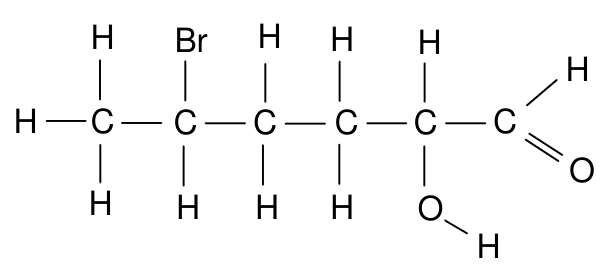
is:
a) 5-bromo-1-hexanoic acid
b) 5-bromo-2-hydroxy-1-hexanal
c) 2-bromo-5-hydroxy-6-hexanal
d) 2-bromo-2-hydroxy-1-hexanal
e) 5-bromo-2-hydroxy-1-hexanone
C. Which of the following acid-base pairs is most suitable for keeping the pH constant at 9 in an aqueous solution?
a) \(\ce{CH3COOH}\) — \(\ce{CH3COO-}\)
b) \(\ce{NH4+}\) — \(\ce{NH3}\)
c) \(\ce{H2CO3}\) — \(\ce{HCO3-}\)
d) \(\ce{H2PO4-}\) — \(\ce{HPO4^2-}\)
e) \(\ce{H2C2O4}\) — \(\ce{HC2O4-}\)
D. One of the following statements cannot be correct. State which one.
a) A water-soluble solid contains \(\ce{Mg^2+}\), \(\ce{Cr^3+}\), and \(\ce{Br-}\).
b) A solid soluble in a sodium hydroxide solution contains \(\ce{Al^3+}\), \(\ce{K+}\), and \(\ce{SO4^2-}\).
c) A solid soluble in aqueous ammonia solution contains \(\ce{Ag+}\), \(\ce{Cu^2+}\), and \(\ce{Cl-}\).
d) A solid soluble in nitric acid contains \(\ce{Ba^2+}\), \(\ce{Fe^2+}\), and \(\ce{CO3^2-}\).
e) A solution neutral to litmus contains \(\ce{Na+}\), \(\ce{Ca^2+}\), and \(\ce{PO4^3-}\).
E. Complete the following equation:

The reaction is carried out in an acid solution. Fill in the missing particles and balance the reaction equation.
F. State the degree of protolysis of acetic acid with concentration of \(0.25\ \mathrm{mol\,dm^{-3}}\).
\(K_{\mathrm a}(\ce{HAc})=1.8\times10^{-5}\).
a) \(0.021\ \%\); b) \(0.21\ \%\); c) \(0.84\ \%\); d) \(1.3\ \%\); e) \(8.4\ \%\)
G. A solution with a volume of \(1.00\ \mathrm{dm^3}\) is saturated with lead iodide, \(\ce{PbI2}\). The concentration of iodide ions is \(2.7\ \mathrm{mol\,dm^{-3}}\). Determine the solubility product of \(\ce{PbI2}\).
a) \(3.6\times10^{-6}\); b) \(2.0\times10^{-8}\); c) \(9.8\times10^{-9}\); d) \(2.5\times10^{-9}\); e) \(4.9\times10^{-9}\).
H. The following standard enthalpies of formation are given:
| Compound | \(\Delta H^0\) |
|---|---|
| Acetic acid | \(-0.50\ \mathrm{MJ\,mol^{-1}}\) |
| Carbon dioxide | \(-0.40\ \mathrm{MJ\,mol^{-1}}\) |
| Water | \(-0.30\ \mathrm{MJ\,mol^{-1}}\) |
The \(\Delta H^0\) of combustion of acetic acid is:
a) \(0.90\ \mathrm{MJ\,mol^{-1}}\); b) \(-0.90\ \mathrm{MJ\,mol^{-1}}\); c) \(-0.20\ \mathrm{MJ\,mol^{-1}}\);
d) \(-2.1\ \mathrm{MJ\,mol^{-1}}\); e) \(0.20\ \mathrm{MJ\,mol^{-1}}\)
I. \(\ce{COCl2(g)}\) is introduced in an empty vessel at a pressure of \(a\). It dissociates and the following equilibrium is established at constant temperature:

If \(x\) represents the partial pressure of \(\ce{CO2(g)}\) at equilibrium, what is the equilibrium expression?
a) \(\displaystyle \frac{4x^3}{(a-2x)^2}=K_p\)
b) \(\displaystyle \frac{2x^4}{(a-2x)^2}=K_p\)
c) \(\displaystyle \frac{2x^3}{(a-x)^2}=K_p\)
d) \(\displaystyle \frac{4x^3}{(a-x)^2}=K_p\)
e) \(\displaystyle \frac{x^3}{(a-3x)^2}=K_p\)
K. For a metal M the following redox data are known:

The \(E^0\) for \(\ce{M^4+(aq) + 3e- -> M+(aq)}\) is then:
a) \(-0.20\ \mathrm V\) b) \(-1.00\ \mathrm V\) c) \(1.00\ \mathrm V\) d) \(0.07\ \mathrm V\) e) \(-0.07\ \mathrm V\)
Official English text of the problem.
Answers
- A. c) Hexaamminecobalt(II) chloride,
[NH3]->[Co+2](<-[NH3])(<-[NH3])(<-[NH3])(<-[NH3])<-[NH3].[Cl-].[Cl-]. - B. b) 5-Bromo-2-hydroxyhexanal,
CC(Br)CCC(O)C=O; stereochemistry is unspecified. - C. b) Ammonium
[NH4+]/ ammoniaN. - D. e) The statement about the solution neutral to litmus.
- E. \(\boxed{\ce{H3AsO4 + 4Zn + 8H+ -> AsH3 + 4Zn^2+ + 4H2O}}\).
- F. c) \(\boxed{\alpha=0.84\%}\).
- G. As printed, the concentration product is \(\boxed{9.8\ \mathrm{mol^3\,dm^{-9}}}\), matching none of the options. If the intended iodide concentration is \(2.7\times10^{-3}\ \mathrm{mol\,dm^{-3}}\), the answer is c), \(\boxed{9.8\times10^{-9}\ \mathrm{mol^3\,dm^{-9}}}\).
- H. b) \(\boxed{\Delta_\mathrm cH^\circ=-0.90\ \mathrm{MJ\,mol^{-1}}}\).
- I. a) \(\boxed{K_p=\dfrac{4x^3}{(a-2x)^2}}\), using the pressure convention of the choices.
- K. d) \(\boxed{E^\circ=+0.07\ \mathrm V}\).
Solution
SMILES for salts specify their ionic components, rather than their crystal lattices. The coordination-complex SMILES use the dative-bond extension, with arrows pointing from ligand to metal.
A. Coordination-compound nomenclature
The two chloride counterions, chloride [Cl-], require the complex cation to carry charge \(+2\). Each ammonia ligand, ammonia N, is neutral, so cobalt has oxidation state \(+2\):
\[ z_{\mathrm{Co}}+6(0)+2(-1)=0 \quad\Longrightarrow\quad z_{\mathrm{Co}}=+2. \]
Coordinated ammonia is named ammine. Six such ligands give hexaammine; the metal name and oxidation state follow, and the counterion is named last. Thus the name is hexaamminecobalt(II) chloride, option c.
The six nitrogen donors form an octahedral coordination sphere. The chloride ions lie outside that sphere; the SMILES does not itself specify its octahedral geometry.
B. Organic nomenclature
The structure is
\[ \ce{CH3-CH(Br)-CH2-CH2-CH(OH)-CHO}. \]
The aldehyde group has priority over the alcohol group and determines the suffix -al. Its carbon is carbon 1. The six-carbon chain is therefore numbered as follows:
- C1: aldehyde carbon;
- C2: hydroxy substituent;
- C5: bromo substituent.
The prefixes are written alphabetically, giving 5-bromo-2-hydroxyhexanal, CC(Br)CCC(O)C=O.
This corresponds to option b, whose wording includes the unnecessary aldehyde locant “1”. Both C2 and C5 are stereogenic, but the drawing specifies neither configuration; consequently, no stereochemical markers belong in the SMILES.
C. Buffer selection
For a weak acid and its conjugate base,
\[ \mathrm{pH}=pK_{\mathrm a} +\log_{10}\!\left( \frac{[\text{conjugate base}]}{[\text{acid}]} \right). \]
A buffer works most effectively when both forms are present in substantial amounts, which occurs near \(\mathrm{pH}=pK_{\mathrm a}\).
Of the listed pairs, ammonium/ammonia has its acid \(pK_{\mathrm a}\) nearest pH 9. Ammonia consumes added acid, while ammonium consumes added base. Therefore the best choice is b.
D. Compatibility of the stated ions
The intended answer is e, under the usual qualitative-analysis assumption that the named ions are present in appreciable concentrations.
The other statements are chemically possible:
-
a) Magnesium(II)
[Mg+2], chromium(III)[Cr+3], and bromide[Br-]can occur in water-soluble bromide salts. -
b) Aluminium(III)
[Al+3], potassium[K+], and sulfate[O-]S(=O)(=O)[O-]can occur together in a sulfate salt. In excess hydroxide, hydroxide[OH-], aluminium forms soluble tetrahydroxoaluminate(III),O[Al-](O)(O)O:
\[ \ce{Al^3+ + 4OH- -> [Al(OH)4]-}. \]
The aluminate ion has tetrahedral coordination.
- c) Silver(I)
[Ag+]and copper(II)[Cu+2]form soluble ammine complexes in excess ammonia:
\[ \ce{AgCl(s) + 2NH3(aq) <=> [Ag(NH3)2]+(aq) + Cl-(aq)}, \]
\[ \ce{Cu^2+(aq) + 4NH3(aq) <=> [Cu(NH3)4]^2+(aq)}. \]
The complexes are diammine silver(I), [NH3]->[Ag+]<-[NH3], and tetraamminecopper(II), [NH3]->[Cu+2](<-[NH3])(<-[NH3])<-[NH3]. The silver complex is linear. In the aqueous copper complex, the four ammonia donors occupy approximately square equatorial positions, with water ligands completing the coordination sphere; these waters are omitted from the abbreviated formula and SMILES.
- d) Barium(II)
[Ba+2]and iron(II)[Fe+2]carbonates dissolve in acid because carbonate,[O-]C(=O)[O-], is protonated:
\[ \ce{CO3^2- + 2H+ -> CO2(g) + H2O}. \]
Here hydrogen ion is [H+], carbon dioxide is O=C=O, and water is O. Nitric acid, O=[N+]([O-])O, may also oxidize iron(II), but this does not contradict the composition of the original solid or its dissolution.
For e, sodium [Na+] is a spectator, but orthophosphate, [O-]P(=O)([O-])[O-], hydrolyses to produce hydroxide:
\[ \ce{PO4^3- + H2O <=> HPO4^2- + OH-}. \]
The hydrogen phosphate ion is OP(=O)([O-])[O-]. Appreciable orthophosphate therefore makes the solution alkaline. Furthermore, calcium(II), [Ca+2], precipitates phosphate:
\[ \ce{3Ca^2+ + 2PO4^3- -> Ca3(PO4)2(s)}. \]
These properties conflict with the proposed neutral solution containing appreciable amounts of both calcium and orthophosphate ions.
E. Redox balancing in acidic solution
The arsenic-containing species are arsenic acid, O=[As](O)(O)O, and arsine, [AsH3].
Arsenic changes from oxidation state \(+5\) in \(\ce{H3AsO4}\) to \(-3\) in \(\ce{AsH3}\), gaining eight electrons. Balancing oxygen with water and hydrogen with hydrogen ions gives
\[ \ce{H3AsO4 + 8H+ + 8e- -> AsH3 + 4H2O}. \]
Zinc is oxidized to zinc(II), [Zn+2]:
\[ \ce{Zn -> Zn^2+ + 2e-}. \]
Multiply this oxidation half-equation by four and add:
\[ \boxed{\ce{H3AsO4 + 4Zn + 8H+ -> AsH3 + 4Zn^2+ + 4H2O}}. \]
Both sides contain one arsenic, four zinc, four oxygen, and eleven hydrogen atoms. Both sides have total charge \(+8\).
F. Degree of protolysis of acetic acid
Acetic acid, CC(=O)O, dissociates into acetate, CC(=O)[O-], and hydrogen ions:
\[ \ce{CH3COOH <=> CH3COO- + H+}. \]
Let \(c_0=0.25\ \mathrm{mol\,dm^{-3}}\), and let \(x\) be the concentration dissociated. Neglecting water’s contribution to hydrogen-ion concentration,
\[ [\ce{H+}]=[\ce{CH3COO-}]=x, \qquad [\ce{CH3COOH}]=c_0-x. \]
Using the usual concentration expression,
\[ K_{\mathrm a}=\frac{x^2}{c_0-x}. \]
Solving the quadratic gives
\[ x=\frac{-K_{\mathrm a} +\sqrt{K_{\mathrm a}^{\,2}+4K_{\mathrm a}c_0}}{2} =2.1123\times10^{-3}\ \mathrm{mol\,dm^{-3}}. \]
Thus the fraction dissociated is
\[ \alpha=\frac{x}{c_0} =\frac{2.1123\times10^{-3}}{0.25} =0.0084494, \]
and the percentage is
\[ \boxed{100\alpha=0.84494\%\approx0.84\%}. \]
Therefore the answer is c.
G. Solubility product of lead iodide
Lead(II) iodide, ionic SMILES [Pb+2].[I-].[I-], dissolves according to
\[ \ce{PbI2(s) <=> Pb^2+(aq) + 2I-(aq)}. \]
The ions are lead(II), [Pb+2], and iodide, [I-]. Assuming dissolution is their only source,
\[ [\ce{Pb^2+}]=\frac{[\ce{I-}]}{2}. \]
Therefore the concentration-based solubility product is
\[ K_{\mathrm{sp},c} =[\ce{Pb^2+}][\ce{I-}]^2 =\frac{[\ce{I-}]^3}{2}. \]
Using the concentration actually printed, \(2.7\ \mathrm{mol\,dm^{-3}}\),
\[ K_{\mathrm{sp},c} =\frac{(2.7)^3}{2} =9.8415 \approx \boxed{9.8\ \mathrm{mol^3\,dm^{-9}}}. \]
No option matches.
If the intended concentration was \(2.7\times10^{-3}\ \mathrm{mol\,dm^{-3}}\), then
\[ K_{\mathrm{sp},c} =\frac{(2.7\times10^{-3})^3}{2} =\boxed{9.8\times10^{-9}\ \mathrm{mol^3\,dm^{-9}}}, \]
which is option c.
The stated solution volume is unnecessary because the ionic concentration is already given. These calculations use the concentration-product convention implicit in the question; a thermodynamic solubility product would instead use activities.
H. Enthalpy of combustion
Complete combustion of acetic acid is
\[ \ce{CH3COOH + 2O2 -> 2CO2 + 2H2O}. \]
The species are acetic acid CC(=O)O, oxygen O=O, carbon dioxide O=C=O, and water O.
By Hess’s law,
\[ \Delta_\mathrm cH^\circ = \sum_{\text{products}}\nu\Delta_\mathrm fH^\circ - \sum_{\text{reactants}}\nu\Delta_\mathrm fH^\circ. \]
The standard formation enthalpy of elemental oxygen in its standard state is zero. Hence
\[ \begin{aligned} \Delta_\mathrm cH^\circ &=2(-0.40)+2(-0.30)-[-0.50+2(0)]\\ &=\boxed{-0.90\ \mathrm{MJ\,mol^{-1}}}. \end{aligned} \]
This is per mole of acetic acid burned, giving option b.
I. Equilibrium expression
The reaction is
\[ \ce{2COCl2(g) <=> C(graphite) + CO2(g) + 2Cl2(g)}. \]
The molecular species are phosgene (carbonyl dichloride), O=C(Cl)Cl; carbon dioxide, O=C=O; and chlorine, ClCl. Graphite is an extended solid, whose lattice cannot be represented by a single molecular SMILES.
For a fixed-volume vessel at constant temperature, partial-pressure changes follow the stoichiometric mole changes. Since the equilibrium carbon dioxide pressure is \(x\),
| Gas | Initial partial pressure | Change | Equilibrium partial pressure |
|---|---|---|---|
| \(\ce{COCl2}\) | \(a\) | \(-2x\) | \(a-2x\) |
| \(\ce{CO2}\) | \(0\) | \(+x\) | \(x\) |
| \(\ce{Cl2}\) | \(0\) | \(+2x\) | \(2x\) |
Pure graphite has unit activity and does not appear in the pressure expression. Thus, in the convention of the choices,
\[ K_p =\frac{p_{\ce{CO2}}\left(p_{\ce{Cl2}}\right)^2} {\left(p_{\ce{COCl2}}\right)^2} =\frac{x(2x)^2}{(a-2x)^2}. \]
Therefore
\[ \boxed{K_p=\frac{4x^3}{(a-2x)^2}}, \]
which is option a.
K. Combining standard reduction potentials
The given reductions are
\[ \ce{M^2+(aq) + e- -> M+(aq)}, \qquad E_1^\circ=-0.60\ \mathrm V, \]
\[ \ce{M^4+(aq) + 2e- -> M^2+(aq)}, \qquad E_2^\circ=+0.40\ \mathrm V. \]
Adding them gives
\[ \ce{M^4+(aq) + 3e- -> M+(aq)}. \]
Potentials cannot be added directly. The additive quantities are the standard Gibbs energy changes:
\[ \Delta G^\circ=-nFE^\circ. \]
Consequently,
\[ -3FE^\circ =-F(-0.60\ \mathrm V)-2F(0.40\ \mathrm V), \]
so
\[ E^\circ =\frac{1(-0.60)+2(0.40)}{3}\ \mathrm V =+0.0667\ \mathrm V. \]
Thus
\[ \boxed{E^\circ\approx+0.07\ \mathrm V}, \]
giving option d.
Because the metal is unspecified, element-specific SMILES cannot be assigned. Generic charged-atom placeholders for the metal(IV), metal(II), and metal(I) ions are [*+4], [*+2], and [*+], respectively; these encode only an unspecified atom and its charge.
The answers were checked against the official answers published by the organisers.
IChO 1982 · Theorieaufgabe 1
Zehn kurze Fragen A-K (überwiegend Multiple-Choice-Fragen)
A. Der IUPAC-Name der Verbindung \(\ce{[Co(NH3)6]Cl2}\) lautet
a) Cobalt(II)-hexaammoniakdichlor,
b) Cobalt(II)-hexaammoniakdichlorid,
c) Hexaammincobalt(II)-chlorid.
d) Hexaammindichlorocobalt(II)
e) Cobalt(II)-chlorid-Hexaammoniak
B. Der IUPAC-Name der Verbindung
lautet:
a) 5-Brom-1-hexansäure
b) 5-Brom-2-hydroxy-1-hexanal
c) 2-Brom-5-hydroxy-6-hexanal
d) 2-Brom-2-hydroxy-1-hexanal
e) 5-Brom-2-hydroxy-1-hexanon
C. Welches der folgenden Säure-Base-Paare eignet sich am besten, um den pH-Wert einer wässrigen Lösung konstant bei 9 zu halten?
a) \(\ce{CH3COOH}\) — \(\ce{CH3COO-}\)
b) \(\ce{NH4+}\) — \(\ce{NH3}\)
c) \(\ce{H2CO3}\) — \(\ce{HCO3-}\)
d) \(\ce{H2PO4-}\) — \(\ce{HPO4^2-}\)
e) \(\ce{H2C2O4}\) — \(\ce{HC2O4-}\)
D. Eine der folgenden Aussagen kann nicht richtig sein. Geben Sie an, welche.
a) Ein wasserlöslicher Feststoff enthält \(\ce{Mg^2+}\), \(\ce{Cr^3+}\) und \(\ce{Br-}\).
b) Ein in Natronlauge löslicher Feststoff enthält \(\ce{Al^3+}\), \(\ce{K+}\) und \(\ce{SO4^2-}\).
c) Ein in wässriger Ammoniaklösung löslicher Feststoff enthält \(\ce{Ag+}\), \(\ce{Cu^2+}\) und \(\ce{Cl-}\).
d) Ein in Salpetersäure löslicher Feststoff enthält \(\ce{Ba^2+}\), \(\ce{Fe^2+}\) und \(\ce{CO3^2-}\).
e) Eine gegenüber Lackmus neutrale Lösung enthält \(\ce{Na+}\), \(\ce{Ca^2+}\) und \(\ce{PO4^3-}\).
E. Vervollständigen Sie die folgende Gleichung:
Die Reaktion wird in saurer Lösung durchgeführt. Ergänzen Sie die fehlenden Teilchen und gleichen Sie die Reaktionsgleichung aus.
F. Geben Sie den Protolysegrad von Essigsäure mit einer Konzentration von \(0.25\ \mathrm{mol\,dm^{-3}}\) an.
\(K_{\mathrm a}(\ce{HAc})=1.8\times10^{-5}\).
a) \(0.021\ \%\); b) \(0.21\ \%\); c) \(0.84\ \%\); d) \(1.3\ \%\); e) \(8.4\ \%\)
G. Eine Lösung mit einem Volumen von \(1.00\ \mathrm{dm^3}\) ist mit Bleiiodid, \(\ce{PbI2}\), gesättigt. Die Konzentration der Iodidionen beträgt \(2.7\ \mathrm{mol\,dm^{-3}}\). Bestimmen Sie das Löslichkeitsprodukt von \(\ce{PbI2}\).
a) \(3.6\times10^{-6}\); b) \(2.0\times10^{-8}\); c) \(9.8\times10^{-9}\); d) \(2.5\times10^{-9}\); e) \(4.9\times10^{-9}\).
H. Folgende Standardbildungsenthalpien sind gegeben:
| Verbindung | \(\Delta H^0\) |
|---|---|
| Essigsäure | \(-0.50\ \mathrm{MJ\,mol^{-1}}\) |
| Kohlenstoffdioxid | \(-0.40\ \mathrm{MJ\,mol^{-1}}\) |
| Wasser | \(-0.30\ \mathrm{MJ\,mol^{-1}}\) |
Die Verbrennungsenthalpie \(\Delta H^0\) von Essigsäure beträgt:
a) \(0.90\ \mathrm{MJ\,mol^{-1}}\); b) \(-0.90\ \mathrm{MJ\,mol^{-1}}\); c) \(-0.20\ \mathrm{MJ\,mol^{-1}}\);
d) \(-2.1\ \mathrm{MJ\,mol^{-1}}\); e) \(0.20\ \mathrm{MJ\,mol^{-1}}\)
I. \(\ce{COCl2(g)}\) wird bei einem Druck von \(a\) in ein leeres Gefäß eingebracht. Es dissoziiert, und bei konstanter Temperatur stellt sich das folgende Gleichgewicht ein:
Wenn \(x\) den Partialdruck von \(\ce{CO2(g)}\) im Gleichgewicht bezeichnet, wie lautet dann der Gleichgewichtsausdruck?
a) \(\displaystyle \frac{4x^3}{(a-2x)^2}=K_p\)
b) \(\displaystyle \frac{2x^4}{(a-2x)^2}=K_p\)
c) \(\displaystyle \frac{2x^3}{(a-x)^2}=K_p\)
d) \(\displaystyle \frac{4x^3}{(a-x)^2}=K_p\)
e) \(\displaystyle \frac{x^3}{(a-3x)^2}=K_p\)
K. Für ein Metall M sind die folgenden Redoxdaten bekannt:
Das \(E^0\) für \(\ce{M^4+(aq) + 3e- -> M+(aq)}\) beträgt dann:
a) \(-0.20\ \mathrm V\) b) \(-1.00\ \mathrm V\) c) \(1.00\ \mathrm V\) d) \(0.07\ \mathrm V\) e) \(-0.07\ \mathrm V\)
Aufgabentext aus dem offiziellen englischen Text übersetzt.
Antworten
- A. c) Hexaammincobalt(II)-chlorid,
[NH3]->[Co+2](<-[NH3])(<-[NH3])(<-[NH3])(<-[NH3])<-[NH3].[Cl-].[Cl-]. - B. b) 5-Brom-2-hydroxyhexanal,
CC(Br)CCC(O)C=O; die Stereochemie ist nicht angegeben. - C. b) Ammonium
[NH4+]/ AmmoniakN. - D. e) Die Aussage über die gegenüber Lackmus neutrale Lösung.
- E. \(\boxed{\ce{H3AsO4 + 4Zn + 8H+ -> AsH3 + 4Zn^2+ + 4H2O}}\).
- F. c) \(\boxed{\alpha=0.84\%}\).
- G. Mit der gedruckten Angabe beträgt das Konzentrationsprodukt \(\boxed{9.8\ \mathrm{mol^3\,dm^{-9}}}\), was keiner der Antwortmöglichkeiten entspricht. Falls die beabsichtigte Iodidkonzentration \(2.7\times10^{-3}\ \mathrm{mol\,dm^{-3}}\) beträgt, lautet die Antwort c), \(\boxed{9.8\times10^{-9}\ \mathrm{mol^3\,dm^{-9}}}\).
- H. b) \(\boxed{\Delta_\mathrm cH^\circ=-0.90\ \mathrm{MJ\,mol^{-1}}}\).
- I. a) \(\boxed{K_p=\dfrac{4x^3}{(a-2x)^2}}\), unter Verwendung der Druckkonvention der Antwortmöglichkeiten.
- K. d) \(\boxed{E^\circ=+0.07\ \mathrm V}\).
Lösung
SMILES für Salze geben deren ionische Bestandteile und nicht deren Kristallgitter an. Die SMILES der Koordinationskomplexe verwenden die Erweiterung für koordinative Bindungen, wobei die Pfeile vom Liganden zum Metall zeigen.
A. Nomenklatur von Koordinationsverbindungen
Die beiden Chlorid-Gegenionen, Chlorid [Cl-], erfordern, dass das Komplexkation die Ladung \(+2\) trägt. Jeder Ammoniakligand, Ammoniak N, ist neutral, sodass Cobalt die Oxidationszahl \(+2\) hat:
\[ z_{\mathrm{Co}}+6(0)+2(-1)=0 \quad\Longrightarrow\quad z_{\mathrm{Co}}=+2. \]
Koordinierter Ammoniak wird als Ammin bezeichnet. Sechs solche Liganden ergeben Hexaammin; darauf folgen der Metallname und die Oxidationszahl, und zuletzt wird das Gegenion genannt. Somit lautet der Name Hexaammincobalt(II)-chlorid, Antwort c.
Die sechs Stickstoffdonoren bilden eine oktaedrische Koordinationssphäre. Die Chloridionen befinden sich außerhalb dieser Sphäre; der SMILES selbst legt deren oktaedrische Geometrie nicht fest.
B. Organische Nomenklatur
Die Struktur lautet
\[ \ce{CH3-CH(Br)-CH2-CH2-CH(OH)-CHO}. \]
Die Aldehydgruppe hat Vorrang vor der Alkoholgruppe und bestimmt das Suffix -al. Ihr Kohlenstoffatom ist Kohlenstoff 1. Die Kette aus sechs Kohlenstoffatomen wird daher wie folgt nummeriert:
- C1: Aldehyd-Kohlenstoffatom;
- C2: Hydroxysubstituent;
- C5: Bromsubstituent.
Die Präfixe werden in alphabetischer Reihenfolge geschrieben, woraus sich 5-Brom-2-hydroxyhexanal, CC(Br)CCC(O)C=O, ergibt.
Dies entspricht Antwort b, deren Formulierung den unnötigen Aldehyd-Lokanten „1“ enthält. Sowohl C2 als auch C5 sind stereogen, doch die Zeichnung legt keine der beiden Konfigurationen fest; daher gehören keine stereochemischen Kennzeichnungen in den SMILES.
C. Auswahl des Puffers
Für eine schwache Säure und ihre konjugierte Base gilt
\[ \mathrm{pH}=pK_{\mathrm a} +\log_{10}\!\left( \frac{[\text{konjugierte Base}]}{[\text{Säure}]} \right). \]
Ein Puffer wirkt am wirksamsten, wenn beide Formen in nennenswerten Mengen vorliegen; dies ist in der Nähe von \(\mathrm{pH}=pK_{\mathrm a}\) der Fall.
Unter den aufgeführten Paaren liegt der \(pK_{\mathrm a}\)-Wert der Säure des Paares Ammonium/Ammoniak am nächsten bei pH 9. Ammoniak verbraucht zugegebene Säure, während Ammonium zugegebene Base verbraucht. Daher ist b die beste Wahl.
D. Verträglichkeit der angegebenen Ionen
Die beabsichtigte Antwort ist e, unter der in der qualitativen Analyse üblichen Annahme, dass die genannten Ionen in nennenswerten Konzentrationen vorliegen.
Die übrigen Aussagen sind chemisch möglich:
-
a) Magnesium(II)
[Mg+2], Chrom(III)[Cr+3]und Bromid[Br-]können in wasserlöslichen Bromidsalzen vorkommen. -
b) Aluminium(III)
[Al+3], Kalium[K+]und Sulfat[O-]S(=O)(=O)[O-]können gemeinsam in einem Sulfatsalz vorkommen. Bei einem Überschuss an Hydroxid, Hydroxid[OH-], bildet Aluminium lösliches Tetrahydroxoaluminat(III),O[Al-](O)(O)O:
\[ \ce{Al^3+ + 4OH- -> [Al(OH)4]-}. \]
Das Aluminat-Ion weist eine tetraedrische Koordination auf.
- c) Silber(I)
[Ag+]und Kupfer(II)[Cu+2]bilden in überschüssigem Ammoniak lösliche Amminkomplexe:
\[ \ce{AgCl(s) + 2NH3(aq) <=> [Ag(NH3)2]+(aq) + Cl-(aq)}, \]
\[ \ce{Cu^2+(aq) + 4NH3(aq) <=> [Cu(NH3)4]^2+(aq)}. \]
Die Komplexe sind Diamminsilber(I), [NH3]->[Ag+]<-[NH3], und Tetraamminkupfer(II), [NH3]->[Cu+2](<-[NH3])(<-[NH3])<-[NH3]. Der Silberkomplex ist linear. Im wässrigen Kupferkomplex besetzen die vier Ammoniakdonoren annähernd quadratisch angeordnete äquatoriale Positionen, wobei Wasserliganden die Koordinationssphäre vervollständigen; diese Wassermoleküle werden in der verkürzten Formel und im SMILES weggelassen.
- d) Barium(II)-
[Ba+2]und Eisen(II)-Carbonate[Fe+2]lösen sich in Säure, weil Carbonat,[O-]C(=O)[O-], protoniert wird:
\[ \ce{CO3^2- + 2H+ -> CO2(g) + H2O}. \]
Hier steht [H+] für das Wasserstoffion, O=C=O für Kohlenstoffdioxid und O für Wasser. Salpetersäure, O=[N+]([O-])O, kann außerdem Eisen(II) oxidieren, doch dies widerspricht weder der Zusammensetzung des ursprünglichen Feststoffs noch seiner Auflösung.
Bei e ist Natrium [Na+] ein Zuschauerion, doch Orthophosphat, [O-]P(=O)([O-])[O-], hydrolysiert unter Bildung von Hydroxid:
\[ \ce{PO4^3- + H2O <=> HPO4^2- + OH-}. \]
Das Hydrogenphosphat-Ion ist OP(=O)([O-])[O-]. Nennenswerte Mengen an Orthophosphat machen die Lösung daher alkalisch. Außerdem fällt Calcium(II), [Ca+2], Phosphat aus:
\[ \ce{3Ca^2+ + 2PO4^3- -> Ca3(PO4)2(s)}. \]
Diese Eigenschaften stehen im Widerspruch zu der beschriebenen neutralen Lösung, die nennenswerte Mengen sowohl an Calcium- als auch an Orthophosphat-Ionen enthalten soll.
E. Ausgleichen der Redoxgleichung in saurer Lösung
Die arsenhaltigen Spezies sind Arsensäure, O=[As](O)(O)O, und Arsan, [AsH3].
Arsen geht von der Oxidationszahl \(+5\) in \(\ce{H3AsO4}\) zu \(-3\) in \(\ce{AsH3}\) über und nimmt dabei acht Elektronen auf. Der Ausgleich von Sauerstoff mit Wasser und von Wasserstoff mit Wasserstoffionen ergibt
\[ \ce{H3AsO4 + 8H+ + 8e- -> AsH3 + 4H2O}. \]
Zink wird zu Zink(II), [Zn+2], oxidiert:
\[ \ce{Zn -> Zn^2+ + 2e-}. \]
Diese Oxidationsteilgleichung wird mit vier multipliziert und addiert:
\[ \boxed{\ce{H3AsO4 + 4Zn + 8H+ -> AsH3 + 4Zn^2+ + 4H2O}}. \]
Beide Seiten enthalten ein Arsenatom, vier Zinkatome, vier Sauerstoffatome und elf Wasserstoffatome. Beide Seiten haben die Gesamtladung \(+8\).
F. Protolysegrad von Essigsäure
Essigsäure, CC(=O)O, dissoziiert in Acetat, CC(=O)[O-], und Wasserstoffionen:
\[ \ce{CH3COOH <=> CH3COO- + H+}. \]
Es sei \(c_0=0.25\ \mathrm{mol\,dm^{-3}}\), und \(x\) sei die Konzentration des dissoziierten Anteils. Unter Vernachlässigung des Beitrags des Wassers zur Wasserstoffionenkonzentration gilt
\[ [\ce{H+}]=[\ce{CH3COO-}]=x, \qquad [\ce{CH3COOH}]=c_0-x. \]
Mit dem üblichen Konzentrationsausdruck gilt
\[ K_{\mathrm a}=\frac{x^2}{c_0-x}. \]
Die Lösung der quadratischen Gleichung ergibt
\[ x=\frac{-K_{\mathrm a} +\sqrt{K_{\mathrm a}^{\,2}+4K_{\mathrm a}c_0}}{2} =2.1123\times10^{-3}\ \mathrm{mol\,dm^{-3}}. \]
Damit beträgt der dissoziierte Anteil
\[ \alpha=\frac{x}{c_0} =\frac{2.1123\times10^{-3}}{0.25} =0.0084494, \]
und der Prozentsatz beträgt
\[ \boxed{100\alpha=0.84494\%\approx0.84\%}. \]
Die Antwort ist daher c.
G. Löslichkeitsprodukt von Bleiiodid
Blei(II)-iodid, ionischer SMILES [Pb+2].[I-].[I-], löst sich gemäß
\[ \ce{PbI2(s) <=> Pb^2+(aq) + 2I-(aq)}. \]
Die Ionen sind Blei(II), [Pb+2], und Iodid, [I-]. Unter der Annahme, dass sie ausschließlich aus dem Lösungsvorgang stammen, gilt
\[ [\ce{Pb^2+}]=\frac{[\ce{I-}]}{2}. \]
Das konzentrationsbezogene Löslichkeitsprodukt ist daher
\[ K_{\mathrm{sp},c} =[\ce{Pb^2+}][\ce{I-}]^2 =\frac{[\ce{I-}]^3}{2}. \]
Mit der tatsächlich gedruckten Konzentration, \(2.7\ \mathrm{mol\,dm^{-3}}\), gilt
\[ K_{\mathrm{sp},c} =\frac{(2.7)^3}{2} =9.8415 \approx \boxed{9.8\ \mathrm{mol^3\,dm^{-9}}}. \]
Keine Antwortmöglichkeit stimmt damit überein.
Falls als Konzentration beabsichtigt war: \(2.7\times10^{-3}\ \mathrm{mol\,dm^{-3}}\), dann gilt
\[ K_{\mathrm{sp},c} =\frac{(2.7\times10^{-3})^3}{2} =\boxed{9.8\times10^{-9}\ \mathrm{mol^3\,dm^{-9}}}, \]
was Antwort c entspricht.
Das angegebene Lösungsvolumen ist nicht erforderlich, da die Ionenkonzentration bereits gegeben ist. Diese Berechnungen verwenden die in der Frage implizierte Konvention des Konzentrationsprodukts; ein thermodynamisches Löslichkeitsprodukt würde stattdessen Aktivitäten verwenden.
H. Verbrennungsenthalpie
Die vollständige Verbrennung von Essigsäure lautet
\[ \ce{CH3COOH + 2O2 -> 2CO2 + 2H2O}. \]
Die Spezies sind Essigsäure CC(=O)O, Sauerstoff O=O, Kohlenstoffdioxid O=C=O und Wasser O.
Nach dem Hess’schen Satz gilt
\[ \Delta_\mathrm cH^\circ = \sum_{\text{Produkte}}\nu\Delta_\mathrm fH^\circ - \sum_{\text{Edukte}}\nu\Delta_\mathrm fH^\circ. \]
Die Standardbildungsenthalpie von elementarem Sauerstoff in seinem Standardzustand ist null. Daher gilt
\[ \begin{aligned} \Delta_\mathrm cH^\circ &=2(-0.40)+2(-0.30)-[-0.50+2(0)]\\ &=\boxed{-0.90\ \mathrm{MJ\,mol^{-1}}}. \end{aligned} \]
Dies gilt pro Mol verbrannter Essigsäure und ergibt Antwort b.
I. Gleichgewichtsausdruck
Die Reaktion lautet
\[ \ce{2COCl2(g) <=> C(graphite) + CO2(g) + 2Cl2(g)}. \]
Die molekularen Spezies sind Phosgen (Carbonyldichlorid), O=C(Cl)Cl; Kohlenstoffdioxid, O=C=O; und Chlor, ClCl. Graphit ist ein ausgedehnter Festkörper, dessen Gitter nicht durch einen einzelnen molekularen SMILES dargestellt werden kann.
In einem Gefäß mit festem Volumen bei konstanter Temperatur folgen die Partialdruckänderungen den stöchiometrischen Stoffmengenänderungen. Da der Kohlenstoffdioxiddruck im Gleichgewicht \(x\) beträgt, gilt
| Gas | Anfangspartialdruck | Änderung | Gleichgewichtspartialdruck |
|---|---|---|---|
| \(\ce{COCl2}\) | \(a\) | \(-2x\) | \(a-2x\) |
| \(\ce{CO2}\) | \(0\) | \(+x\) | \(x\) |
| \(\ce{Cl2}\) | \(0\) | \(+2x\) | \(2x\) |
Reiner Graphit hat die Aktivität eins und erscheint nicht im Druckausdruck. Somit gilt in der Konvention der Antwortmöglichkeiten
\[ K_p =\frac{p_{\ce{CO2}}\left(p_{\ce{Cl2}}\right)^2} {\left(p_{\ce{COCl2}}\right)^2} =\frac{x(2x)^2}{(a-2x)^2}. \]
Daher gilt
\[ \boxed{K_p=\frac{4x^3}{(a-2x)^2}}, \]
was Antwort a entspricht.
K. Kombination von Standardreduktionspotentialen
Die gegebenen Reduktionen lauten
\[ \ce{M^2+(aq) + e- -> M+(aq)}, \qquad E_1^\circ=-0.60\ \mathrm V, \]
\[ \ce{M^4+(aq) + 2e- -> M^2+(aq)}, \qquad E_2^\circ=+0.40\ \mathrm V. \]
Ihre Addition ergibt
\[ \ce{M^4+(aq) + 3e- -> M+(aq)}. \]
Potentiale können nicht direkt addiert werden. Die additiven Größen sind die Änderungen der Gibbs-Energie unter Standardbedingungen:
\[ \Delta G^\circ=-nFE^\circ. \]
Folglich gilt
\[ -3FE^\circ =-F(-0.60\ \mathrm V)-2F(0.40\ \mathrm V), \]
also
\[ E^\circ =\frac{1(-0.60)+2(0.40)}{3}\ \mathrm V =+0.0667\ \mathrm V. \]
Somit gilt
\[ \boxed{E^\circ\approx+0.07\ \mathrm V}, \]
woraus sich Antwort d ergibt.
Da das Metall nicht näher angegeben ist, können keine elementspezifischen SMILES zugeordnet werden. Allgemeine Platzhalter für geladene Atome für die Metall(IV)-, Metall(II)- und Metall(I)-Ionen sind [*+4], [*+2] bzw. [*+]; diese codieren lediglich ein nicht näher angegebenes Atom und seine Ladung.
Die Ergebnisse wurden mit den von den Veranstaltern veröffentlichten offiziellen Ergebnissen abgeglichen.
IChO 1982 · Teori sorusu 1
A-K arasında on kısa soru (çoğunlukla çoktan seçmeli)
A. \(\ce{[Co(NH3)6]Cl2}\) bileşiğinin IUPAC adı aşağıdakilerden hangisidir?
a) kobalt(II) hekzaamonyak diklor,
b) kobalt(II) hekzaamonyak diklorür,
c) hekzaamminkobalt(II) klorür.
d) hekzaamindiklorokobalt(II)
e) kobalt(II) klorür-hekzaamonyak
B. Aşağıdaki bileşiğin
IUPAC adı aşağıdakilerden hangisidir?
a) 5-bromo-1-heksanoik asit
b) 5-bromo-2-hidroksi-1-heksanal
c) 2-bromo-5-hidroksi-6-heksanal
d) 2-bromo-2-hidroksi-1-heksanal
e) 5-bromo-2-hidroksi-1-heksanon
C. Aşağıdaki asit-baz çiftlerinden hangisi sulu bir çözeltinin pH değerini 9'da sabit tutmak için en uygundur?
a) \(\ce{CH3COOH}\) — \(\ce{CH3COO-}\)
b) \(\ce{NH4+}\) — \(\ce{NH3}\)
c) \(\ce{H2CO3}\) — \(\ce{HCO3-}\)
d) \(\ce{H2PO4-}\) — \(\ce{HPO4^2-}\)
e) \(\ce{H2C2O4}\) — \(\ce{HC2O4-}\)
D. Aşağıdaki ifadelerden biri doğru olamaz. Hangisi olduğunu belirtiniz.
a) Suda çözünen bir katı \(\ce{Mg^2+}\), \(\ce{Cr^3+}\) ve \(\ce{Br-}\) içerir.
b) Sodyum hidroksit çözeltisinde çözünen bir katı \(\ce{Al^3+}\), \(\ce{K+}\) ve \(\ce{SO4^2-}\) içerir.
c) Sulu amonyak çözeltisinde çözünen bir katı \(\ce{Ag+}\), \(\ce{Cu^2+}\) ve \(\ce{Cl-}\) içerir.
d) Nitrik asitte çözünen bir katı \(\ce{Ba^2+}\), \(\ce{Fe^2+}\) ve \(\ce{CO3^2-}\) içerir.
e) Turnusole karşı nötr olan bir çözelti \(\ce{Na+}\), \(\ce{Ca^2+}\) ve \(\ce{PO4^3-}\) içerir.
E. Aşağıdaki denklemi tamamlayınız:
Tepkime asidik bir çözeltide gerçekleştirilir. Eksik tanecikleri yazınız ve tepkime denklemini denkleştiriniz.
F. Derişimi \(0.25\ \mathrm{mol\,dm^{-3}}\) olan asetik asidin protoliz derecesini belirtiniz.
\(K_{\mathrm a}(\ce{HAc})=1.8\times10^{-5}\).
a) \(0.021\ \%\); b) \(0.21\ \%\); c) \(0.84\ \%\); d) \(1.3\ \%\); e) \(8.4\ \%\)
G. Hacmi \(1.00\ \mathrm{dm^3}\) olan bir çözelti kurşun iyodür, \(\ce{PbI2}\), ile doymuştur. İyodür iyonlarının derişimi \(2.7\ \mathrm{mol\,dm^{-3}}\)'tür. \(\ce{PbI2}\)'nin çözünürlük çarpımını belirleyiniz.
a) \(3.6\times10^{-6}\); b) \(2.0\times10^{-8}\); c) \(9.8\times10^{-9}\); d) \(2.5\times10^{-9}\); e) \(4.9\times10^{-9}\).
H. Aşağıdaki standart oluşum entalpileri verilmiştir:
| Bileşik | \(\Delta H^0\) |
|---|---|
| Asetik asit | \(-0.50\ \mathrm{MJ\,mol^{-1}}\) |
| Karbondioksit | \(-0.40\ \mathrm{MJ\,mol^{-1}}\) |
| Su | \(-0.30\ \mathrm{MJ\,mol^{-1}}\) |
Asetik asidin yanma tepkimesinin \(\Delta H^0\) değeri aşağıdakilerden hangisidir?
a) \(0.90\ \mathrm{MJ\,mol^{-1}}\); b) \(-0.90\ \mathrm{MJ\,mol^{-1}}\); c) \(-0.20\ \mathrm{MJ\,mol^{-1}}\);
d) \(-2.1\ \mathrm{MJ\,mol^{-1}}\); e) \(0.20\ \mathrm{MJ\,mol^{-1}}\)
I. Boş bir kaba \(a\) basıncında \(\ce{COCl2(g)}\) konur. Bu madde ayrışır ve sabit sıcaklıkta aşağıdaki denge kurulur:
\(x\), dengedeki \(\ce{CO2(g)}\)'nin kısmi basıncını gösteriyorsa denge ifadesi nedir?
a) \(\displaystyle \frac{4x^3}{(a-2x)^2}=K_p\)
b) \(\displaystyle \frac{2x^4}{(a-2x)^2}=K_p\)
c) \(\displaystyle \frac{2x^3}{(a-x)^2}=K_p\)
d) \(\displaystyle \frac{4x^3}{(a-x)^2}=K_p\)
e) \(\displaystyle \frac{x^3}{(a-3x)^2}=K_p\)
K. Bir M metali için aşağıdaki redoks verileri bilinmektedir:
Buna göre \(\ce{M^4+(aq) + 3e- -> M+(aq)}\) için \(E^0\) değeri aşağıdakilerden hangisidir?
a) \(-0.20\ \mathrm V\) b) \(-1.00\ \mathrm V\) c) \(1.00\ \mathrm V\) d) \(0.07\ \mathrm V\) e) \(-0.07\ \mathrm V\)
Soru metni resmi İngilizce metinden çevrilmiştir.
Cevaplar
- A. c) Hekzaamminkobalt(II) klorür,
[NH3]->[Co+2](<-[NH3])(<-[NH3])(<-[NH3])(<-[NH3])<-[NH3].[Cl-].[Cl-]. - B. b) 5-Bromo-2-hidroksiheksanal,
CC(Br)CCC(O)C=O; stereokimya belirtilmemiştir. - C. b) Amonyum
[NH4+]/ amonyakN. - D. e) Turnusole karşı nötr olan çözeltiyle ilgili ifade.
- E. \(\boxed{\ce{H3AsO4 + 4Zn + 8H+ -> AsH3 + 4Zn^2+ + 4H2O}}\).
- F. c) \(\boxed{\alpha=0.84\%}\).
- G. Basılı hâliyle derişim çarpımı \(\boxed{9.8\ \mathrm{mol^3\,dm^{-9}}}\) olup seçeneklerin hiçbiriyle eşleşmez. Kastedilen iyodür derişimi \(2.7\times10^{-3}\ \mathrm{mol\,dm^{-3}}\) ise cevap c), \(\boxed{9.8\times10^{-9}\ \mathrm{mol^3\,dm^{-9}}}\) olur.
- H. b) \(\boxed{\Delta_\mathrm cH^\circ=-0.90\ \mathrm{MJ\,mol^{-1}}}\).
- I. a) Seçeneklerdeki basınç tanımı kullanıldığında \(\boxed{K_p=\dfrac{4x^3}{(a-2x)^2}}\).
- K. d) \(\boxed{E^\circ=+0.07\ \mathrm V}\).
Çözüm
Tuzların SMILES gösterimleri kristal örgülerini değil, iyonik bileşenlerini belirtir. Koordinasyon komplekslerinin SMILES gösterimlerinde, okların liganddan metale yöneldiği koordinatif bağ uzantısı kullanılır.
A. Koordinasyon bileşiklerinin adlandırılması
İki klorür karşı iyonu, klorür [Cl-], kompleks katyonunun \(+2\) yük taşımasını gerektirir. Her bir amonyak ligandı, amonyak N, nötr olduğundan kobaltın yükseltgenme basamağı \(+2\)'dir:
\[ z_{\mathrm{Co}}+6(0)+2(-1)=0 \quad\Longrightarrow\quad z_{\mathrm{Co}}=+2. \]
Koordine olmuş amonyak ammin olarak adlandırılır. Böyle altı ligand hekzaammin adını verir; ardından metalin adı ve yükseltgenme basamağı gelir, karşı iyon ise en son adlandırılır. Dolayısıyla adı hekzaamminkobalt(II) klorür olup cevap c seçeneğidir.
Altı azot donörü oktahedral bir koordinasyon küresi oluşturur. Klorür iyonları bu kürenin dışındadır; SMILES gösterimi tek başına kürenin oktahedral geometrisini belirtmez.
B. Organik bileşiklerin adlandırılması
Yapı şöyledir:
\[ \ce{CH3-CH(Br)-CH2-CH2-CH(OH)-CHO}. \]
Aldehit grubu alkol grubuna göre önceliklidir ve -al son ekini belirler. Bu grubun karbonu 1 numaralı karbondur. Dolayısıyla altı karbonlu zincir aşağıdaki gibi numaralandırılır:
- C1: aldehit karbonu;
- C2: hidroksi sübstitüenti;
- C5: bromo sübstitüenti.
Ön ekler alfabetik sırayla yazılır ve 5-bromo-2-hidroksiheksanal, CC(Br)CCC(O)C=O, adı elde edilir.
Bu, adlandırmada gereksiz aldehit konum numarası “1”in yer aldığı b seçeneğine karşılık gelir. Hem C2 hem de C5 stereojeniktir; ancak çizimde bu merkezlerin hiçbirinin konfigürasyonu belirtilmemiştir. Bu nedenle SMILES gösteriminde stereokimyasal işaretler bulunmamalıdır.
C. Tampon seçimi
Zayıf bir asit ve onun eşlenik bazı için
\[ \mathrm{pH}=pK_{\mathrm a} +\log_{10}\!\left( \frac{[\text{eşlenik baz}]}{[\text{asit}]} \right). \]
Bir tampon, her iki tür de kayda değer miktarlarda bulunduğunda en etkili biçimde çalışır; bu durum \(\mathrm{pH}=pK_{\mathrm a}\) civarında gerçekleşir.
Verilen çiftler arasında asidinin \(pK_{\mathrm a}\) değeri pH 9'a en yakın olan çift amonyum/amonyak çiftidir. Amonyak eklenen asidi, amonyum ise eklenen bazı tüketir. Bu nedenle en uygun seçim b'dir.
D. Belirtilen iyonların bir arada bulunabilirliği
Adı geçen iyonların kayda değer derişimlerde bulunduğu yönündeki olağan nitel analiz varsayımı altında beklenen cevap e'dir.
Diğer ifadeler kimyasal açıdan mümkündür:
-
a) Magnezyum(II)
[Mg+2], krom(III)[Cr+3]ve bromür[Br-], suda çözünen bromür tuzlarında bulunabilir. -
b) Alüminyum(III)
[Al+3], potasyum[K+]ve sülfat[O-]S(=O)(=O)[O-], bir sülfat tuzunda birlikte bulunabilir. Hidroksit,[OH-], fazlasında alüminyum, çözünebilen tetrahidroksoalüminat(III),O[Al-](O)(O)O, oluşturur:
\[ \ce{Al^3+ + 4OH- -> [Al(OH)4]-}. \]
Alüminat iyonu tetrahedral koordinasyona sahiptir.
- c) Gümüş(I)
[Ag+]ve bakır(II)[Cu+2], amonyak fazlasında çözünebilen ammin kompleksleri oluşturur:
\[ \ce{AgCl(s) + 2NH3(aq) <=> [Ag(NH3)2]+(aq) + Cl-(aq)}, \]
\[ \ce{Cu^2+(aq) + 4NH3(aq) <=> [Cu(NH3)4]^2+(aq)}. \]
Bu kompleksler diammin gümüş(I), [NH3]->[Ag+]<-[NH3], ve tetraamminbakır(II), [NH3]->[Cu+2](<-[NH3])(<-[NH3])<-[NH3], kompleksleridir. Gümüş kompleksi doğrusaldır. Sulu bakır kompleksinde dört amonyak donörü yaklaşık olarak kare biçiminde ekvatoryal konumlarda bulunur ve su ligandları koordinasyon küresini tamamlar; bu su molekülleri kısaltılmış formülde ve SMILES gösteriminde yer almaz.
- d) Baryum(II)
[Ba+2]ve demir(II)[Fe+2]karbonatlar, karbonatın,[O-]C(=O)[O-], protonlanması nedeniyle asitte çözünür:
\[ \ce{CO3^2- + 2H+ -> CO2(g) + H2O}. \]
Burada hidrojen iyonu [H+], karbondioksit O=C=O ve su O ile gösterilir. Nitrik asit, O=[N+]([O-])O, demir(II)'yi de yükseltgeyebilir; ancak bu, başlangıçtaki katının bileşimiyle veya çözünmesiyle çelişmez.
e için sodyum [Na+] seyirci iyondur; ancak ortofosfat, [O-]P(=O)([O-])[O-], hidrolize uğrayarak hidroksit oluşturur:
\[ \ce{PO4^3- + H2O <=> HPO4^2- + OH-}. \]
Hidrojen fosfat iyonu OP(=O)([O-])[O-] ile gösterilir. Bu nedenle kayda değer miktarda ortofosfat bulunması çözeltiyi bazik yapar. Ayrıca kalsiyum(II), [Ca+2], fosfatı çöktürür:
\[ \ce{3Ca^2+ + 2PO4^3- -> Ca3(PO4)2(s)}. \]
Bu özellikler, hem kalsiyum hem de ortofosfat iyonlarını kayda değer miktarlarda içerdiği öne sürülen nötr bir çözeltiyle bağdaşmaz.
E. Asidik çözeltide redoks denkleştirmesi
Arsenik içeren türler arsenik asit, O=[As](O)(O)O, ve arsin, [AsH3], türleridir.
Arseniğin yükseltgenme basamağı, sekiz elektron almasıyla \(\ce{H3AsO4}\)'teki \(+5\)'ten \(\ce{AsH3}\)'teki \(-3\)'e değişir. Oksijen suyla, hidrojen ise hidrojen iyonlarıyla denkleştirildiğinde
\[ \ce{H3AsO4 + 8H+ + 8e- -> AsH3 + 4H2O}. \]
elde edilir. Çinko, çinko(II)'ye, [Zn+2], yükseltgenir:
\[ \ce{Zn -> Zn^2+ + 2e-}. \]
Bu yükseltgenme yarı denklemi dört ile çarpılıp diğer yarı denklemle toplanır:
\[ \boxed{\ce{H3AsO4 + 4Zn + 8H+ -> AsH3 + 4Zn^2+ + 4H2O}}. \]
Her iki tarafta bir arsenik, dört çinko, dört oksijen ve on bir hidrojen atomu bulunur. Her iki tarafın toplam yükü \(+8\)'dir.
F. Asetik asidin protoliz derecesi
Asetik asit, CC(=O)O, asetat, CC(=O)[O-], ve hidrojen iyonlarına ayrışır:
\[ \ce{CH3COOH <=> CH3COO- + H+}. \]
\(c_0=0.25\ \mathrm{mol\,dm^{-3}}\) olsun ve \(x\) ayrışan kısmın derişimini göstersin. Suyun hidrojen iyonu derişimine katkısı ihmal edildiğinde
\[ [\ce{H+}]=[\ce{CH3COO-}]=x, \qquad [\ce{CH3COOH}]=c_0-x. \]
Olağan derişim ifadesi kullanıldığında
\[ K_{\mathrm a}=\frac{x^2}{c_0-x}. \]
İkinci dereceden denklem çözüldüğünde
\[ x=\frac{-K_{\mathrm a} +\sqrt{K_{\mathrm a}^{\,2}+4K_{\mathrm a}c_0}}{2} =2.1123\times10^{-3}\ \mathrm{mol\,dm^{-3}}. \]
Böylece ayrışan kesir
\[ \alpha=\frac{x}{c_0} =\frac{2.1123\times10^{-3}}{0.25} =0.0084494, \]
ve yüzde değeri
\[ \boxed{100\alpha=0.84494\%\approx0.84\%}. \]
olur. Dolayısıyla cevap c'dir.
G. Kurşun iyodürün çözünürlük çarpımı
İyonik SMILES gösterimi [Pb+2].[I-].[I-] olan kurşun(II) iyodür aşağıdaki denkleme göre çözünür:
\[ \ce{PbI2(s) <=> Pb^2+(aq) + 2I-(aq)}. \]
İyonlar kurşun(II), [Pb+2], ve iyodür, [I-], iyonlarıdır. Bu iyonların tek kaynağının çözünme olduğu varsayılırsa
\[ [\ce{Pb^2+}]=\frac{[\ce{I-}]}{2}. \]
Dolayısıyla derişime dayalı çözünürlük çarpımı
\[ K_{\mathrm{sp},c} =[\ce{Pb^2+}][\ce{I-}]^2 =\frac{[\ce{I-}]^3}{2}. \]
Basılı metinde verilen derişim kullanıldığında, \(2.7\ \mathrm{mol\,dm^{-3}}\),
\[ K_{\mathrm{sp},c} =\frac{(2.7)^3}{2} =9.8415 \approx \boxed{9.8\ \mathrm{mol^3\,dm^{-9}}}. \]
Hiçbir seçenek bu değerle eşleşmez.
Kastedilen derişim \(2.7\times10^{-3}\ \mathrm{mol\,dm^{-3}}\) ise
\[ K_{\mathrm{sp},c} =\frac{(2.7\times10^{-3})^3}{2} =\boxed{9.8\times10^{-9}\ \mathrm{mol^3\,dm^{-9}}}, \]
olur ve bu, c seçeneğidir.
İyon derişimi zaten verildiğinden belirtilen çözelti hacmine gerek yoktur. Bu hesaplamalarda soruda örtük olarak kullanılan derişim çarpımı tanımı esas alınmıştır; termodinamik bir çözünürlük çarpımında ise aktiviteler kullanılır.
H. Yanma entalpisi
Asetik asidin tam yanması şöyledir:
\[ \ce{CH3COOH + 2O2 -> 2CO2 + 2H2O}. \]
Türler asetik asit CC(=O)O, oksijen O=O, karbondioksit O=C=O ve su O'dur.
Hess yasasına göre
\[ \Delta_\mathrm cH^\circ = \sum_{\text{ürünler}}\nu\Delta_\mathrm fH^\circ - \sum_{\text{girenler}}\nu\Delta_\mathrm fH^\circ. \]
Standart hâlindeki elementel oksijenin standart oluşum entalpisi sıfırdır. Dolayısıyla
\[ \begin{aligned} \Delta_\mathrm cH^\circ &=2(-0.40)+2(-0.30)-[-0.50+2(0)]\\ &=\boxed{-0.90\ \mathrm{MJ\,mol^{-1}}}. \end{aligned} \]
Bu değer, yanan bir mol asetik asit başınadır ve b seçeneğini verir.
I. Denge ifadesi
Tepkime şöyledir:
\[ \ce{2COCl2(g) <=> C(graphite) + CO2(g) + 2Cl2(g)}. \]
Moleküler türler fosgen (karbonil diklorür), O=C(Cl)Cl; karbondioksit, O=C=O; ve klor, ClCl, türleridir. Grafit, örgüsü tek bir moleküler SMILES gösterimiyle temsil edilemeyen, sürekli örgü yapısına sahip bir katıdır.
Sabit sıcaklıkta ve sabit hacimli bir kapta, kısmi basınç değişimleri stokiyometrik mol değişimleriyle orantılıdır. Dengedeki karbondioksit basıncı \(x\) olduğundan
| Gaz | Başlangıç kısmi basıncı | Değişim | Dengedeki kısmi basınç |
|---|---|---|---|
| \(\ce{COCl2}\) | \(a\) | \(-2x\) | \(a-2x\) |
| \(\ce{CO2}\) | \(0\) | \(+x\) | \(x\) |
| \(\ce{Cl2}\) | \(0\) | \(+2x\) | \(2x\) |
Saf grafitin aktivitesi birdir ve basınç ifadesinde yer almaz. Böylece, seçeneklerde kullanılan tanıma göre
\[ K_p =\frac{p_{\ce{CO2}}\left(p_{\ce{Cl2}}\right)^2} {\left(p_{\ce{COCl2}}\right)^2} =\frac{x(2x)^2}{(a-2x)^2}. \]
Dolayısıyla
\[ \boxed{K_p=\frac{4x^3}{(a-2x)^2}}, \]
olur ve bu, a seçeneğidir.
K. Standart indirgenme potansiyellerinin birleştirilmesi
Verilen indirgenmeler şöyledir:
\[ \ce{M^2+(aq) + e- -> M+(aq)}, \qquad E_1^\circ=-0.60\ \mathrm V, \]
\[ \ce{M^4+(aq) + 2e- -> M^2+(aq)}, \qquad E_2^\circ=+0.40\ \mathrm V. \]
Toplandıklarında
\[ \ce{M^4+(aq) + 3e- -> M+(aq)}. \]
elde edilir. Potansiyeller doğrudan toplanamaz. Toplanabilen nicelikler standart Gibbs enerjisi değişimleridir:
\[ \Delta G^\circ=-nFE^\circ. \]
Buna göre
\[ -3FE^\circ =-F(-0.60\ \mathrm V)-2F(0.40\ \mathrm V), \]
dolayısıyla
\[ E^\circ =\frac{1(-0.60)+2(0.40)}{3}\ \mathrm V =+0.0667\ \mathrm V. \]
Böylece
\[ \boxed{E^\circ\approx+0.07\ \mathrm V}, \]
elde edilir ve cevap d seçeneğidir.
Metal belirtilmediğinden elemente özgü SMILES gösterimleri atanamaz. Metal(IV), metal(II) ve metal(I) iyonları için genel yüklü atom yer tutucuları sırasıyla [*+4], [*+2] ve [*+]'dır; bunlar yalnızca türü belirtilmemiş bir atomu ve yükünü kodlar.
Sonuçlar, düzenleyicilerin yayımladığı resmi sonuçlarla karşılaştırılarak kontrol edildi.
IChO 1982 · Problema teórico 1
Diez preguntas breves A-K (en su mayoría de opción múltiple)
A. El nombre IUPAC del compuesto \(\ce{[Co(NH3)6]Cl2}\) es
a) dicloro de hexaamoníaco de cobalto(II),
b) dicloruro de hexaamoníaco de cobalto(II),
c) cloruro de hexaaminocobalto(II).
d) hexaaminodiclorocobalto(II)
e) cloruro de cobalto(II)-hexaamoníaco
B. El nombre IUPAC del compuesto
es:
a) ácido 5-bromo-1-hexanoico
b) 5-bromo-2-hidroxi-1-hexanal
c) 2-bromo-5-hidroxi-6-hexanal
d) 2-bromo-2-hidroxi-1-hexanal
e) 5-bromo-2-hidroxi-1-hexanona
C. ¿Cuál de los siguientes pares ácido-base es el más adecuado para mantener el pH constante en 9 en una disolución acuosa?
a) \(\ce{CH3COOH}\) — \(\ce{CH3COO-}\)
b) \(\ce{NH4+}\) — \(\ce{NH3}\)
c) \(\ce{H2CO3}\) — \(\ce{HCO3-}\)
d) \(\ce{H2PO4-}\) — \(\ce{HPO4^2-}\)
e) \(\ce{H2C2O4}\) — \(\ce{HC2O4-}\)
D. Una de las siguientes afirmaciones no puede ser correcta. Indique cuál.
a) Un sólido soluble en agua contiene \(\ce{Mg^2+}\), \(\ce{Cr^3+}\) y \(\ce{Br-}\).
b) Un sólido soluble en una disolución de hidróxido de sodio contiene \(\ce{Al^3+}\), \(\ce{K+}\) y \(\ce{SO4^2-}\).
c) Un sólido soluble en una disolución acuosa de amoníaco contiene \(\ce{Ag+}\), \(\ce{Cu^2+}\) y \(\ce{Cl-}\).
d) Un sólido soluble en ácido nítrico contiene \(\ce{Ba^2+}\), \(\ce{Fe^2+}\) y \(\ce{CO3^2-}\).
e) Una disolución neutra frente al tornasol contiene \(\ce{Na+}\), \(\ce{Ca^2+}\) y \(\ce{PO4^3-}\).
E. Complete la siguiente ecuación:
La reacción se lleva a cabo en una disolución ácida. Añada las partículas que faltan y ajuste la ecuación de la reacción.
F. Indique el grado de protólisis del ácido acético de concentración \(0.25\ \mathrm{mol\,dm^{-3}}\).
\(K_{\mathrm a}(\ce{HAc})=1.8\times10^{-5}\).
a) \(0.021\ \%\); b) \(0.21\ \%\); c) \(0.84\ \%\); d) \(1.3\ \%\); e) \(8.4\ \%\)
G. Una disolución de volumen \(1.00\ \mathrm{dm^3}\) está saturada de yoduro de plomo, \(\ce{PbI2}\). La concentración de iones yoduro es \(2.7\ \mathrm{mol\,dm^{-3}}\). Determine el producto de solubilidad del \(\ce{PbI2}\).
a) \(3.6\times10^{-6}\); b) \(2.0\times10^{-8}\); c) \(9.8\times10^{-9}\); d) \(2.5\times10^{-9}\); e) \(4.9\times10^{-9}\).
H. Se dan las siguientes entalpías estándar de formación:
| Compuesto | \(\Delta H^0\) |
|---|---|
| Ácido acético | \(-0.50\ \mathrm{MJ\,mol^{-1}}\) |
| Dióxido de carbono | \(-0.40\ \mathrm{MJ\,mol^{-1}}\) |
| Agua | \(-0.30\ \mathrm{MJ\,mol^{-1}}\) |
La \(\Delta H^0\) de combustión del ácido acético es:
a) \(0.90\ \mathrm{MJ\,mol^{-1}}\); b) \(-0.90\ \mathrm{MJ\,mol^{-1}}\); c) \(-0.20\ \mathrm{MJ\,mol^{-1}}\);
d) \(-2.1\ \mathrm{MJ\,mol^{-1}}\); e) \(0.20\ \mathrm{MJ\,mol^{-1}}\)
I. Se introduce \(\ce{COCl2(g)}\) en un recipiente vacío a una presión de \(a\). Se disocia y se establece el siguiente equilibrio a temperatura constante:
Si \(x\) representa la presión parcial del \(\ce{CO2(g)}\) en el equilibrio, ¿cuál es la expresión de equilibrio?
a) \(\displaystyle \frac{4x^3}{(a-2x)^2}=K_p\)
b) \(\displaystyle \frac{2x^4}{(a-2x)^2}=K_p\)
c) \(\displaystyle \frac{2x^3}{(a-x)^2}=K_p\)
d) \(\displaystyle \frac{4x^3}{(a-x)^2}=K_p\)
e) \(\displaystyle \frac{x^3}{(a-3x)^2}=K_p\)
K. Para un metal M se conocen los siguientes datos redox:
El \(E^0\) para \(\ce{M^4+(aq) + 3e- -> M+(aq)}\) es entonces:
a) \(-0.20\ \mathrm V\) b) \(-1.00\ \mathrm V\) c) \(1.00\ \mathrm V\) d) \(0.07\ \mathrm V\) e) \(-0.07\ \mathrm V\)
Enunciado traducido del texto oficial en inglés.
Respuestas
- A. c) Cloruro de hexaaminocobalto(II),
[NH3]->[Co+2](<-[NH3])(<-[NH3])(<-[NH3])(<-[NH3])<-[NH3].[Cl-].[Cl-]. - B. b) 5-Bromo-2-hidroxihexanal,
CC(Br)CCC(O)C=O; la estereoquímica no está especificada. - C. b) Amonio
[NH4+]/ amoníacoN. - D. e) La afirmación sobre la disolución neutra frente al tornasol.
- E. \(\boxed{\ce{H3AsO4 + 4Zn + 8H+ -> AsH3 + 4Zn^2+ + 4H2O}}\).
- F. c) \(\boxed{\alpha=0.84\%}\).
- G. Tal como está impresa, el producto de concentraciones es \(\boxed{9.8\ \mathrm{mol^3\,dm^{-9}}}\), que no coincide con ninguna de las opciones. Si la concentración de yoduro que se pretendía indicar es \(2.7\times10^{-3}\ \mathrm{mol\,dm^{-3}}\), la respuesta es c), \(\boxed{9.8\times10^{-9}\ \mathrm{mol^3\,dm^{-9}}}\).
- H. b) \(\boxed{\Delta_\mathrm cH^\circ=-0.90\ \mathrm{MJ\,mol^{-1}}}\).
- I. a) \(\boxed{K_p=\dfrac{4x^3}{(a-2x)^2}}\), utilizando la convención de presiones de las opciones.
- K. d) \(\boxed{E^\circ=+0.07\ \mathrm V}\).
Solución
Los SMILES de las sales especifican sus componentes iónicos, en lugar de sus redes cristalinas. Los SMILES de los complejos de coordinación utilizan la extensión de enlace dativo, con flechas que apuntan del ligando al metal.
A. Nomenclatura de los compuestos de coordinación
Los dos contraiones cloruro, cloruro [Cl-], requieren que el catión complejo tenga carga \(+2\). Cada ligando amoníaco, amoníaco N, es neutro, por lo que el cobalto tiene estado de oxidación \(+2\):
\[ z_{\mathrm{Co}}+6(0)+2(-1)=0 \quad\Longrightarrow\quad z_{\mathrm{Co}}=+2. \]
El amoníaco coordinado recibe el nombre de amino. Seis ligandos de este tipo dan hexaamino; a continuación se indican el nombre del metal y su estado de oxidación, y el contraión se nombra al final. Por tanto, el nombre es cloruro de hexaaminocobalto(II), opción c.
Los seis átomos donadores de nitrógeno forman una esfera de coordinación octaédrica. Los iones cloruro se encuentran fuera de esa esfera; el SMILES no especifica por sí mismo su geometría octaédrica.
B. Nomenclatura orgánica
La estructura es
\[ \ce{CH3-CH(Br)-CH2-CH2-CH(OH)-CHO}. \]
El grupo aldehído tiene prioridad sobre el grupo alcohol y determina el sufijo -al. Su carbono es el carbono 1. Por tanto, la cadena de seis carbonos se numera de la siguiente manera:
- C1: carbono del aldehído;
- C2: sustituyente hidroxi;
- C5: sustituyente bromo.
Los prefijos se escriben por orden alfabético, lo que da 5-bromo-2-hidroxihexanal, CC(Br)CCC(O)C=O.
Esto corresponde a la opción b, cuya formulación incluye el localizador innecesario «1» para el aldehído. Tanto C2 como C5 son estereogénicos, pero el dibujo no especifica ninguna de las dos configuraciones; por consiguiente, no deben incluirse marcadores estereoquímicos en el SMILES.
C. Selección de una disolución reguladora
Para un ácido débil y su base conjugada,
\[ \mathrm{pH}=pK_{\mathrm a} +\log_{10}\!\left( \frac{[\text{base conjugada}]}{[\text{ácido}]} \right). \]
Una disolución reguladora actúa con la máxima eficacia cuando ambas formas están presentes en cantidades considerables, lo que ocurre cerca de \(\mathrm{pH}=pK_{\mathrm a}\).
De los pares enumerados, amonio/amoníaco es el que tiene el \(pK_{\mathrm a}\) de su ácido más próximo a pH 9. El amoníaco consume el ácido añadido, mientras que el amonio consume la base añadida. Por tanto, la mejor elección es b.
D. Compatibilidad de los iones indicados
La respuesta prevista es e, bajo el supuesto habitual del análisis cualitativo de que los iones mencionados están presentes en concentraciones apreciables.
Las demás afirmaciones son químicamente posibles:
-
a) El magnesio(II)
[Mg+2], el cromo(III)[Cr+3]y el bromuro[Br-]pueden encontrarse en sales de bromuro solubles en agua. -
b) El aluminio(III)
[Al+3], el potasio[K+]y el sulfato[O-]S(=O)(=O)[O-]pueden encontrarse juntos en una sal de sulfato. En exceso de hidróxido, hidróxido[OH-], el aluminio forma tetrahidroxoaluminato(III) soluble,O[Al-](O)(O)O:
\[ \ce{Al^3+ + 4OH- -> [Al(OH)4]-}. \]
El ion aluminato presenta coordinación tetraédrica.
- c) La plata(I)
[Ag+]y el cobre(II)[Cu+2]forman complejos amínicos solubles en exceso de amoníaco:
\[ \ce{AgCl(s) + 2NH3(aq) <=> [Ag(NH3)2]+(aq) + Cl-(aq)}, \]
\[ \ce{Cu^2+(aq) + 4NH3(aq) <=> [Cu(NH3)4]^2+(aq)}. \]
Los complejos son diaminoplata(I), [NH3]->[Ag+]<-[NH3], y tetraaminocobre(II), [NH3]->[Cu+2](<-[NH3])(<-[NH3])<-[NH3]. El complejo de plata es lineal. En el complejo acuoso de cobre, los cuatro ligandos donadores de amoníaco ocupan posiciones ecuatoriales aproximadamente cuadradas, y los ligandos de agua completan la esfera de coordinación; estas moléculas de agua se omiten en la fórmula abreviada y en el SMILES.
- d) Los carbonatos de bario(II)
[Ba+2]y de hierro(II)[Fe+2]se disuelven en ácido porque el carbonato,[O-]C(=O)[O-], se protona:
\[ \ce{CO3^2- + 2H+ -> CO2(g) + H2O}. \]
Aquí el ion hidrógeno es [H+], el dióxido de carbono es O=C=O y el agua es O. El ácido nítrico, O=[N+]([O-])O, también puede oxidar el hierro(II), pero esto no contradice la composición del sólido original ni su disolución.
En e, el sodio [Na+] es un ion espectador, pero el ortofosfato, [O-]P(=O)([O-])[O-], se hidroliza y produce hidróxido:
\[ \ce{PO4^3- + H2O <=> HPO4^2- + OH-}. \]
El ion hidrogenofosfato es OP(=O)([O-])[O-]. Por tanto, una cantidad apreciable de ortofosfato hace que la disolución sea alcalina. Además, el calcio(II), [Ca+2], precipita el fosfato:
\[ \ce{3Ca^2+ + 2PO4^3- -> Ca3(PO4)2(s)}. \]
Estas propiedades son incompatibles con la disolución neutra propuesta, que contiene cantidades apreciables tanto de iones calcio como de iones ortofosfato.
E. Ajuste redox en disolución ácida
Las especies que contienen arsénico son el ácido arsénico, O=[As](O)(O)O, y la arsina, [AsH3].
El arsénico pasa del estado de oxidación \(+5\) en \(\ce{H3AsO4}\) a \(-3\) en \(\ce{AsH3}\), ganando ocho electrones. Al ajustar el oxígeno con agua y el hidrógeno con iones hidrógeno se obtiene
\[ \ce{H3AsO4 + 8H+ + 8e- -> AsH3 + 4H2O}. \]
El zinc se oxida a zinc(II), [Zn+2]:
\[ \ce{Zn -> Zn^2+ + 2e-}. \]
Multiplicamos esta semirreacción de oxidación por cuatro y sumamos:
\[ \boxed{\ce{H3AsO4 + 4Zn + 8H+ -> AsH3 + 4Zn^2+ + 4H2O}}. \]
Ambos miembros contienen un átomo de arsénico, cuatro de zinc, cuatro de oxígeno y once de hidrógeno. Ambos miembros tienen una carga total de \(+8\).
F. Grado de protólisis del ácido acético
El ácido acético, CC(=O)O, se disocia en acetato, CC(=O)[O-], e iones hidrógeno:
\[ \ce{CH3COOH <=> CH3COO- + H+}. \]
Sea \(c_0=0.25\ \mathrm{mol\,dm^{-3}}\), y sea \(x\) la concentración disociada. Despreciando la contribución del agua a la concentración de iones hidrógeno,
\[ [\ce{H+}]=[\ce{CH3COO-}]=x, \qquad [\ce{CH3COOH}]=c_0-x. \]
Utilizando la expresión habitual en términos de concentraciones,
\[ K_{\mathrm a}=\frac{x^2}{c_0-x}. \]
Al resolver la ecuación de segundo grado se obtiene
\[ x=\frac{-K_{\mathrm a} +\sqrt{K_{\mathrm a}^{\,2}+4K_{\mathrm a}c_0}}{2} =2.1123\times10^{-3}\ \mathrm{mol\,dm^{-3}}. \]
Por tanto, la fracción disociada es
\[ \alpha=\frac{x}{c_0} =\frac{2.1123\times10^{-3}}{0.25} =0.0084494, \]
y el porcentaje es
\[ \boxed{100\alpha=0.84494\%\approx0.84\%}. \]
Por tanto, la respuesta es c.
G. Producto de solubilidad del yoduro de plomo
El yoduro de plomo(II), de SMILES iónico [Pb+2].[I-].[I-], se disuelve según
\[ \ce{PbI2(s) <=> Pb^2+(aq) + 2I-(aq)}. \]
Los iones son plomo(II), [Pb+2], y yoduro, [I-]. Suponiendo que la disolución del sólido es su única fuente,
\[ [\ce{Pb^2+}]=\frac{[\ce{I-}]}{2}. \]
Por tanto, el producto de solubilidad basado en concentraciones es
\[ K_{\mathrm{sp},c} =[\ce{Pb^2+}][\ce{I-}]^2 =\frac{[\ce{I-}]^3}{2}. \]
Utilizando la concentración que figura realmente impresa, \(2.7\ \mathrm{mol\,dm^{-3}}\),
\[ K_{\mathrm{sp},c} =\frac{(2.7)^3}{2} =9.8415 \approx \boxed{9.8\ \mathrm{mol^3\,dm^{-9}}}. \]
Ninguna opción coincide.
Si la concentración que se pretendía indicar era \(2.7\times10^{-3}\ \mathrm{mol\,dm^{-3}}\), entonces
\[ K_{\mathrm{sp},c} =\frac{(2.7\times10^{-3})^3}{2} =\boxed{9.8\times10^{-9}\ \mathrm{mol^3\,dm^{-9}}}, \]
que corresponde a la opción c.
El volumen de disolución indicado es innecesario porque ya se proporciona la concentración iónica. Estos cálculos utilizan la convención del producto de concentraciones implícita en la pregunta; un producto de solubilidad termodinámico utilizaría, en cambio, actividades.
H. Entalpía de combustión
La combustión completa del ácido acético es
\[ \ce{CH3COOH + 2O2 -> 2CO2 + 2H2O}. \]
Las especies son ácido acético CC(=O)O, oxígeno O=O, dióxido de carbono O=C=O y agua O.
Según la ley de Hess,
\[ \Delta_\mathrm cH^\circ = \sum_{\text{productos}}\nu\Delta_\mathrm fH^\circ - \sum_{\text{reactivos}}\nu\Delta_\mathrm fH^\circ. \]
La entalpía estándar de formación del oxígeno elemental en su estado estándar es cero. Por tanto,
\[ \begin{aligned} \Delta_\mathrm cH^\circ &=2(-0.40)+2(-0.30)-[-0.50+2(0)]\\ &=\boxed{-0.90\ \mathrm{MJ\,mol^{-1}}}. \end{aligned} \]
Este valor corresponde a un mol de ácido acético quemado, lo que da la opción b.
I. Expresión de equilibrio
La reacción es
\[ \ce{2COCl2(g) <=> C(graphite) + CO2(g) + 2Cl2(g)}. \]
Las especies moleculares son fosgeno (dicloruro de carbonilo), O=C(Cl)Cl; dióxido de carbono, O=C=O; y cloro, ClCl. El grafito es un sólido de estructura extendida, cuya red no puede representarse mediante un único SMILES molecular.
En un recipiente de volumen fijo a temperatura constante, los cambios de presión parcial siguen los cambios estequiométricos en el número de moles. Puesto que la presión del dióxido de carbono en el equilibrio es \(x\),
| Gas | Presión parcial inicial | Cambio | Presión parcial en el equilibrio |
|---|---|---|---|
| \(\ce{COCl2}\) | \(a\) | \(-2x\) | \(a-2x\) |
| \(\ce{CO2}\) | \(0\) | \(+x\) | \(x\) |
| \(\ce{Cl2}\) | \(0\) | \(+2x\) | \(2x\) |
El grafito puro tiene actividad unidad y no aparece en la expresión en términos de presiones. Así, según la convención de las opciones,
\[ K_p =\frac{p_{\ce{CO2}}\left(p_{\ce{Cl2}}\right)^2} {\left(p_{\ce{COCl2}}\right)^2} =\frac{x(2x)^2}{(a-2x)^2}. \]
Por tanto,
\[ \boxed{K_p=\frac{4x^3}{(a-2x)^2}}, \]
que corresponde a la opción a.
K. Combinación de potenciales estándar de reducción
Las reducciones dadas son
\[ \ce{M^2+(aq) + e- -> M+(aq)}, \qquad E_1^\circ=-0.60\ \mathrm V, \]
\[ \ce{M^4+(aq) + 2e- -> M^2+(aq)}, \qquad E_2^\circ=+0.40\ \mathrm V. \]
Al sumarlas se obtiene
\[ \ce{M^4+(aq) + 3e- -> M+(aq)}. \]
Los potenciales no se pueden sumar directamente. Las magnitudes aditivas son las variaciones de energía de Gibbs estándar:
\[ \Delta G^\circ=-nFE^\circ. \]
En consecuencia,
\[ -3FE^\circ =-F(-0.60\ \mathrm V)-2F(0.40\ \mathrm V), \]
de modo que
\[ E^\circ =\frac{1(-0.60)+2(0.40)}{3}\ \mathrm V =+0.0667\ \mathrm V. \]
Así,
\[ \boxed{E^\circ\approx+0.07\ \mathrm V}, \]
lo que da la opción d.
Como no se especifica el metal, no se pueden asignar SMILES específicos de un elemento. Los símbolos genéricos de átomos con carga para los iones de metal(IV), metal(II) y metal(I) son [*+4], [*+2] y [*+], respectivamente; estos solo codifican un átomo no especificado y su carga.
Los resultados se comprobaron con los resultados oficiales publicados por los organizadores.
IChO 1982 · 理论题 1
十道简答题 A-K(主要为选择题)
A. 化合物 \(\ce{[Co(NH3)6]Cl2}\) 的 IUPAC 名称是
a) 二氯六氨钴(II),
b) 二氯化六氨钴(II),
c) 氯化六氨合钴(II)。
d) 六氨二氯合钴(II)
e) 氯化钴(II)-六氨
B. 下列化合物
的 IUPAC 名称是:
a) 5-溴-1-己酸
b) 5-溴-2-羟基-1-己醛
c) 2-溴-5-羟基-6-己醛
d) 2-溴-2-羟基-1-己醛
e) 5-溴-2-羟基-1-己酮
C. 下列哪一对酸碱最适合使水溶液的 pH 保持恒定为 9?
a) \(\ce{CH3COOH}\) — \(\ce{CH3COO-}\)
b) \(\ce{NH4+}\) — \(\ce{NH3}\)
c) \(\ce{H2CO3}\) — \(\ce{HCO3-}\)
d) \(\ce{H2PO4-}\) — \(\ce{HPO4^2-}\)
e) \(\ce{H2C2O4}\) — \(\ce{HC2O4-}\)
D. 下列陈述中有一项不可能正确。指出是哪一项。
a) 一种可溶于水的固体含有 \(\ce{Mg^2+}\)、\(\ce{Cr^3+}\) 和 \(\ce{Br-}\)。
b) 一种可溶于氢氧化钠溶液的固体含有 \(\ce{Al^3+}\)、\(\ce{K+}\) 和 \(\ce{SO4^2-}\)。
c) 一种可溶于氨水的固体含有 \(\ce{Ag+}\)、\(\ce{Cu^2+}\) 和 \(\ce{Cl-}\)。
d) 一种可溶于硝酸的固体含有 \(\ce{Ba^2+}\)、\(\ce{Fe^2+}\) 和 \(\ce{CO3^2-}\)。
e) 一种对石蕊呈中性的溶液含有 \(\ce{Na+}\)、\(\ce{Ca^2+}\) 和 \(\ce{PO4^3-}\)。
E. 补全下列方程式:
该反应在酸性溶液中进行。填入缺失的粒子,并配平反应方程式。
F. 求浓度为 \(0.25\ \mathrm{mol\,dm^{-3}}\) 的乙酸的电离度。
\(K_{\mathrm a}(\ce{HAc})=1.8\times10^{-5}\)。
a) \(0.021\ \%\); b) \(0.21\ \%\); c) \(0.84\ \%\); d) \(1.3\ \%\); e) \(8.4\ \%\)
G. 体积为 \(1.00\ \mathrm{dm^3}\) 的溶液是碘化铅 \(\ce{PbI2}\) 的饱和溶液。碘离子浓度为 \(2.7\ \mathrm{mol\,dm^{-3}}\)。求 \(\ce{PbI2}\) 的溶度积。
a) \(3.6\times10^{-6}\); b) \(2.0\times10^{-8}\); c) \(9.8\times10^{-9}\); d) \(2.5\times10^{-9}\); e) \(4.9\times10^{-9}\)。
H. 已知下列标准生成焓:
| 化合物 | \(\Delta H^0\) |
|---|---|
| 乙酸 | \(-0.50\ \mathrm{MJ\,mol^{-1}}\) |
| 二氧化碳 | \(-0.40\ \mathrm{MJ\,mol^{-1}}\) |
| 水 | \(-0.30\ \mathrm{MJ\,mol^{-1}}\) |
乙酸燃烧的 \(\Delta H^0\) 为:
a) \(0.90\ \mathrm{MJ\,mol^{-1}}\); b) \(-0.90\ \mathrm{MJ\,mol^{-1}}\); c) \(-0.20\ \mathrm{MJ\,mol^{-1}}\);
d) \(-2.1\ \mathrm{MJ\,mol^{-1}}\); e) \(0.20\ \mathrm{MJ\,mol^{-1}}\)
I. 向一个空容器中通入 \(\ce{COCl2(g)}\),使其压强为 \(a\)。它发生分解,并在恒温下建立如下平衡:
若 \(x\) 表示平衡时 \(\ce{CO2(g)}\) 的分压,则平衡常数表达式是什么?
a) \(\displaystyle \frac{4x^3}{(a-2x)^2}=K_p\)
b) \(\displaystyle \frac{2x^4}{(a-2x)^2}=K_p\)
c) \(\displaystyle \frac{2x^3}{(a-x)^2}=K_p\)
d) \(\displaystyle \frac{4x^3}{(a-x)^2}=K_p\)
e) \(\displaystyle \frac{x^3}{(a-3x)^2}=K_p\)
K. 已知金属 M 的下列氧化还原数据:
则 \(\ce{M^4+(aq) + 3e- -> M+(aq)}\) 的 \(E^0\) 为:
a) \(-0.20\ \mathrm V\) b) \(-1.00\ \mathrm V\) c) \(1.00\ \mathrm V\) d) \(0.07\ \mathrm V\) e) \(-0.07\ \mathrm V\)
题目译自官方英文原文。
答案
- A. c) 氯化六氨合钴(II),
[NH3]->[Co+2](<-[NH3])(<-[NH3])(<-[NH3])(<-[NH3])<-[NH3].[Cl-].[Cl-]。 - B. b) 5-溴-2-羟基己醛,
CC(Br)CCC(O)C=O;立体化学未指定。 - C. b) 铵离子
[NH4+]/ 氨N。 - D. e) 关于对石蕊呈中性的溶液的陈述。
- E. \(\boxed{\ce{H3AsO4 + 4Zn + 8H+ -> AsH3 + 4Zn^2+ + 4H2O}}\)。
- F. c) \(\boxed{\alpha=0.84\%}\)。
- G. 按题面印出的数据,浓度积为 \(\boxed{9.8\ \mathrm{mol^3\,dm^{-9}}}\),与所有选项均不相符。若原本要给出的碘离子浓度为 \(2.7\times10^{-3}\ \mathrm{mol\,dm^{-3}}\),则答案为 c),\(\boxed{9.8\times10^{-9}\ \mathrm{mol^3\,dm^{-9}}}\)。
- H. b) \(\boxed{\Delta_\mathrm cH^\circ=-0.90\ \mathrm{MJ\,mol^{-1}}}\)。
- I. a) \(\boxed{K_p=\dfrac{4x^3}{(a-2x)^2}}\),采用选项中的压强约定。
- K. d) \(\boxed{E^\circ=+0.07\ \mathrm V}\)。
解答
盐的 SMILES 表示其离子组分,而不表示其晶格。配位化合物的 SMILES 使用配位键扩展表示法,箭头由配体指向金属。
A. 配位化合物的命名
两个作为反离子的氯离子 [Cl-] 要求配阳离子带有 \(+2\) 电荷。每个氨配体(氨为 N)均为中性,因此钴的氧化态为 \(+2\):
\[ z_{\mathrm{Co}}+6(0)+2(-1)=0 \quad\Longrightarrow\quad z_{\mathrm{Co}}=+2. \]
配位的氨称为氨配体。六个这样的配体构成六氨合;随后写出金属名称和氧化态,英文命名中最后写出反离子的名称。因此,名称为氯化六氨合钴(II),即选项 c。
六个氮配位原子构成八面体配位层。氯离子位于该配位层之外;SMILES 本身并未指定其八面体几何构型。
B. 有机化合物的命名
其结构为
\[ \ce{CH3-CH(Br)-CH2-CH2-CH(OH)-CHO}. \]
醛基的优先级高于醇羟基,并决定名称以醛为后缀。醛基的碳原子为 1 号碳。因此,六碳链的编号如下:
- C1:醛基碳原子;
- C2:羟基取代基;
- C5:溴取代基。
前缀按英文字母顺序排列,得到名称 5-溴-2-羟基己醛,CC(Br)CCC(O)C=O。
这对应于选项 b,其名称中包含了不必要的醛基位次“1”。C2 和 C5 均为立体中心,但图中未指定任何一个中心的构型;因此,SMILES 中不应加入立体化学标记。
C. 缓冲体系的选择
对于弱酸及其共轭碱,
\[ \mathrm{pH}=pK_{\mathrm a} +\log_{10}\!\left( \frac{[\text{共轭碱}]}{[\text{酸}]} \right). \]
当两种形式均以相当的量存在时,缓冲溶液的缓冲效果最佳,这种情况发生在 \(\mathrm{pH}=pK_{\mathrm a}\) 附近。
在所列酸碱对中,铵离子/氨的酸的 \(pK_{\mathrm a}\) 最接近 pH 9。氨消耗加入的酸,而铵离子消耗加入的碱。因此,最佳选择是 b。
D. 所述离子的相容性
按照定性分析中的通常假设,即所列离子均以可观的浓度存在,预期答案为 e。
其余陈述在化学上均有可能成立:
-
a) 镁(II)离子
[Mg+2]、铬(III)离子[Cr+3]和溴离子[Br-]可以存在于可溶于水的溴化物盐中。 -
b) 铝(III)离子
[Al+3]、钾离子[K+]和硫酸根离子[O-]S(=O)(=O)[O-]可以共存于一种硫酸盐中。在过量氢氧根离子(氢氧根为[OH-])存在时,铝形成可溶性的四羟基合铝(III)酸根离子O[Al-](O)(O)O:
\[ \ce{Al^3+ + 4OH- -> [Al(OH)4]-}. \]
该铝酸根离子具有四面体配位构型。
- c) 银(I)离子
[Ag+]和铜(II)离子[Cu+2]在过量氨中形成可溶性的氨配合物:
\[ \ce{AgCl(s) + 2NH3(aq) <=> [Ag(NH3)2]+(aq) + Cl-(aq)}, \]
\[ \ce{Cu^2+(aq) + 4NH3(aq) <=> [Cu(NH3)4]^2+(aq)}. \]
这些配合物分别是二氨合银(I)离子 [NH3]->[Ag+]<-[NH3] 和四氨合铜(II)离子 [NH3]->[Cu+2](<-[NH3])(<-[NH3])<-[NH3]。银配合物呈直线形。在水溶液中的铜配合物内,四个氨配体的配位原子占据近似正方形的赤道位置,水配体补全其配位层;这些水分子在简写的化学式和 SMILES 中被省略。
- d) 钡(II)离子
[Ba+2]和铁(II)离子[Fe+2]的碳酸盐能溶于酸,因为碳酸根离子[O-]C(=O)[O-]会被质子化:
\[ \ce{CO3^2- + 2H+ -> CO2(g) + H2O}. \]
这里,氢离子为 [H+],二氧化碳为 O=C=O,水为 O。硝酸 O=[N+]([O-])O 还可能氧化铁(II),但这并不与原固体的组成或其溶解相矛盾。
对于 e,钠离子 [Na+] 是旁观离子,但正磷酸根离子 [O-]P(=O)([O-])[O-] 会水解生成氢氧根离子:
\[ \ce{PO4^3- + H2O <=> HPO4^2- + OH-}. \]
磷酸氢根离子为 OP(=O)([O-])[O-]。因此,可观浓度的正磷酸根离子会使溶液呈碱性。此外,钙(II)离子 [Ca+2] 会使磷酸根形成沉淀:
\[ \ce{3Ca^2+ + 2PO4^3- -> Ca3(PO4)2(s)}. \]
这些性质与所述同时含有可观浓度的钙离子和正磷酸根离子的中性溶液相矛盾。
E. 酸性溶液中氧化还原反应的配平
含砷物种为砷酸 O=[As](O)(O)O 和砷化氢 [AsH3]。
砷的氧化态由 \(\ce{H3AsO4}\) 中的 \(+5\) 变为 \(\ce{AsH3}\) 中的 \(-3\),得到八个电子。用水配平氧,用氢离子配平氢,得到
\[ \ce{H3AsO4 + 8H+ + 8e- -> AsH3 + 4H2O}. \]
锌被氧化为锌(II)离子 [Zn+2]:
\[ \ce{Zn -> Zn^2+ + 2e-}. \]
将该氧化半反应方程式乘以四,再相加:
\[ \boxed{\ce{H3AsO4 + 4Zn + 8H+ -> AsH3 + 4Zn^2+ + 4H2O}}. \]
两边均含有一个砷原子、四个锌原子、四个氧原子和十一个氢原子。两边的总电荷均为 \(+8\)。
F. 乙酸的电离度
乙酸 CC(=O)O 电离生成乙酸根离子 CC(=O)[O-] 和氢离子:
\[ \ce{CH3COOH <=> CH3COO- + H+}. \]
设 \(c_0=0.25\ \mathrm{mol\,dm^{-3}}\),并以 \(x\) 表示已电离部分的浓度。忽略水对氢离子浓度的贡献,
\[ [\ce{H+}]=[\ce{CH3COO-}]=x, \qquad [\ce{CH3COOH}]=c_0-x. \]
采用通常的浓度表达式,
\[ K_{\mathrm a}=\frac{x^2}{c_0-x}. \]
解此二次方程,得到
\[ x=\frac{-K_{\mathrm a} +\sqrt{K_{\mathrm a}^{\,2}+4K_{\mathrm a}c_0}}{2} =2.1123\times10^{-3}\ \mathrm{mol\,dm^{-3}}. \]
因此,已电离的分数为
\[ \alpha=\frac{x}{c_0} =\frac{2.1123\times10^{-3}}{0.25} =0.0084494, \]
相应的百分数为
\[ \boxed{100\alpha=0.84494\%\approx0.84\%}. \]
因此,答案为 c。
G. 碘化铅的溶度积
碘化铅(II)的离子 SMILES 为 [Pb+2].[I-].[I-],其溶解反应为
\[ \ce{PbI2(s) <=> Pb^2+(aq) + 2I-(aq)}. \]
这些离子分别为铅(II)离子 [Pb+2] 和碘离子 [I-]。假设溶解是它们的唯一来源,
\[ [\ce{Pb^2+}]=\frac{[\ce{I-}]}{2}. \]
因此,以浓度表示的溶度积为
\[ K_{\mathrm{sp},c} =[\ce{Pb^2+}][\ce{I-}]^2 =\frac{[\ce{I-}]^3}{2}. \]
采用题面实际印出的浓度 \(2.7\ \mathrm{mol\,dm^{-3}}\),
\[ K_{\mathrm{sp},c} =\frac{(2.7)^3}{2} =9.8415 \approx \boxed{9.8\ \mathrm{mol^3\,dm^{-9}}}. \]
没有选项与之相符。
若原本要给出的浓度为 \(2.7\times10^{-3}\ \mathrm{mol\,dm^{-3}}\),则
\[ K_{\mathrm{sp},c} =\frac{(2.7\times10^{-3})^3}{2} =\boxed{9.8\times10^{-9}\ \mathrm{mol^3\,dm^{-9}}}, \]
即选项 c。
由于已经给出了离子浓度,题目所给的溶液体积并非必需。这些计算采用了题目隐含的浓度积约定;热力学溶度积则应使用活度。
H. 燃烧焓
乙酸的完全燃烧反应为
\[ \ce{CH3COOH + 2O2 -> 2CO2 + 2H2O}. \]
各物种分别为乙酸 CC(=O)O、氧气 O=O、二氧化碳 O=C=O 和水 O。
根据盖斯定律,
\[ \Delta_\mathrm cH^\circ = \sum_{\text{产物}}\nu\Delta_\mathrm fH^\circ - \sum_{\text{反应物}}\nu\Delta_\mathrm fH^\circ. \]
处于标准态的氧单质的标准生成焓为零。因此
\[ \begin{aligned} \Delta_\mathrm cH^\circ &=2(-0.40)+2(-0.30)-[-0.50+2(0)]\\ &=\boxed{-0.90\ \mathrm{MJ\,mol^{-1}}}. \end{aligned} \]
这是每摩尔乙酸燃烧时的焓变,对应选项 b。
I. 平衡常数表达式
反应为
\[ \ce{2COCl2(g) <=> C(graphite) + CO2(g) + 2Cl2(g)}. \]
分子物种分别为光气(碳酰二氯)O=C(Cl)Cl、二氧化碳 O=C=O 和氯气 ClCl。石墨是具有延展结构的固体,其晶格无法用单个分子的 SMILES 表示。
对于恒温下的定容容器,分压的变化与化学计量关系所确定的物质的量变化相对应。由于平衡时二氧化碳的分压为 \(x\),
| 气体 | 初始分压 | 变化量 | 平衡分压 |
|---|---|---|---|
| \(\ce{COCl2}\) | \(a\) | \(-2x\) | \(a-2x\) |
| \(\ce{CO2}\) | \(0\) | \(+x\) | \(x\) |
| \(\ce{Cl2}\) | \(0\) | \(+2x\) | \(2x\) |
纯石墨的活度为一,不出现在压强表达式中。因此,按照选项中的约定,
\[ K_p =\frac{p_{\ce{CO2}}\left(p_{\ce{Cl2}}\right)^2} {\left(p_{\ce{COCl2}}\right)^2} =\frac{x(2x)^2}{(a-2x)^2}. \]
因此
\[ \boxed{K_p=\frac{4x^3}{(a-2x)^2}}, \]
即选项 a。
K. 标准还原电势的组合
已知的还原反应为
\[ \ce{M^2+(aq) + e- -> M+(aq)}, \qquad E_1^\circ=-0.60\ \mathrm V, \]
\[ \ce{M^4+(aq) + 2e- -> M^2+(aq)}, \qquad E_2^\circ=+0.40\ \mathrm V. \]
将两者相加,得到
\[ \ce{M^4+(aq) + 3e- -> M+(aq)}. \]
电势不能直接相加。具有加和性的量是标准吉布斯能变:
\[ \Delta G^\circ=-nFE^\circ. \]
因此,
\[ -3FE^\circ =-F(-0.60\ \mathrm V)-2F(0.40\ \mathrm V), \]
所以
\[ E^\circ =\frac{1(-0.60)+2(0.40)}{3}\ \mathrm V =+0.0667\ \mathrm V. \]
于是
\[ \boxed{E^\circ\approx+0.07\ \mathrm V}, \]
对应选项 d。
由于金属种类未指定,无法给出特定元素的 SMILES。金属(IV)、金属(II)和金属(I)离子的通用带电原子占位符分别为 [*+4]、[*+2] 和 [*+];这些表示仅编码了一个未指定的原子及其电荷。
结果已与主办方公布的官方答案核对。
IChO 1982 · Теоретическая задача 1
Десять коротких вопросов A-K (преимущественно с выбором ответа)
A. Название соединения \(\ce{[Co(NH3)6]Cl2}\) по номенклатуре ИЮПАК:
a) гексааммиак-дихлор кобальта(II),
b) гексааммиак-дихлорид кобальта(II),
c) хлорид гексаамминкобальта(II).
d) гексаамминдихлорокобальт(II)
e) хлорид кобальта(II) — гексааммиак
B. Название соединения
по номенклатуре ИЮПАК:
a) 5-бром-1-гексановая кислота
b) 5-бром-2-гидрокси-1-гексаналь
c) 2-бром-5-гидрокси-6-гексаналь
d) 2-бром-2-гидрокси-1-гексаналь
e) 5-бром-2-гидрокси-1-гексанон
C. Какая из следующих кислотно-основных пар наиболее подходит для поддержания постоянного значения pH, равного 9, в водном растворе?
a) \(\ce{CH3COOH}\) — \(\ce{CH3COO-}\)
b) \(\ce{NH4+}\) — \(\ce{NH3}\)
c) \(\ce{H2CO3}\) — \(\ce{HCO3-}\)
d) \(\ce{H2PO4-}\) — \(\ce{HPO4^2-}\)
e) \(\ce{H2C2O4}\) — \(\ce{HC2O4-}\)
D. Одно из следующих утверждений не может быть верным. Укажите, какое именно.
a) Растворимое в воде твёрдое вещество содержит \(\ce{Mg^2+}\), \(\ce{Cr^3+}\) и \(\ce{Br-}\).
b) Твёрдое вещество, растворимое в растворе гидроксида натрия, содержит \(\ce{Al^3+}\), \(\ce{K+}\) и \(\ce{SO4^2-}\).
c) Твёрдое вещество, растворимое в водном растворе аммиака, содержит \(\ce{Ag+}\), \(\ce{Cu^2+}\) и \(\ce{Cl-}\).
d) Твёрдое вещество, растворимое в азотной кислоте, содержит \(\ce{Ba^2+}\), \(\ce{Fe^2+}\) и \(\ce{CO3^2-}\).
e) Раствор с нейтральной реакцией на лакмус содержит \(\ce{Na+}\), \(\ce{Ca^2+}\) и \(\ce{PO4^3-}\).
E. Дополните следующее уравнение:
Реакция проводится в кислом растворе. Впишите недостающие частицы и расставьте коэффициенты в уравнении реакции.
F. Укажите степень протолиза уксусной кислоты при концентрации \(0.25\ \mathrm{mol\,dm^{-3}}\).
\(K_{\mathrm a}(\ce{HAc})=1.8\times10^{-5}\).
a) \(0.021\ \%\); b) \(0.21\ \%\); c) \(0.84\ \%\); d) \(1.3\ \%\); e) \(8.4\ \%\)
G. Раствор объёмом \(1.00\ \mathrm{dm^3}\) насыщен иодидом свинца \(\ce{PbI2}\). Концентрация иодид-ионов составляет \(2.7\ \mathrm{mol\,dm^{-3}}\). Определите произведение растворимости \(\ce{PbI2}\).
a) \(3.6\times10^{-6}\); b) \(2.0\times10^{-8}\); c) \(9.8\times10^{-9}\); d) \(2.5\times10^{-9}\); e) \(4.9\times10^{-9}\).
H. Даны следующие стандартные энтальпии образования:
| Соединение | \(\Delta H^0\) |
|---|---|
| Уксусная кислота | \(-0.50\ \mathrm{MJ\,mol^{-1}}\) |
| Диоксид углерода | \(-0.40\ \mathrm{MJ\,mol^{-1}}\) |
| Вода | \(-0.30\ \mathrm{MJ\,mol^{-1}}\) |
\(\Delta H^0\) сгорания уксусной кислоты равна:
a) \(0.90\ \mathrm{MJ\,mol^{-1}}\); b) \(-0.90\ \mathrm{MJ\,mol^{-1}}\); c) \(-0.20\ \mathrm{MJ\,mol^{-1}}\);
d) \(-2.1\ \mathrm{MJ\,mol^{-1}}\); e) \(0.20\ \mathrm{MJ\,mol^{-1}}\)
I. В пустой сосуд вводят \(\ce{COCl2(g)}\) под давлением \(a\). Он диссоциирует, и при постоянной температуре устанавливается следующее равновесие:
Если \(x\) обозначает парциальное давление \(\ce{CO2(g)}\) при равновесии, каково выражение для константы равновесия?
a) \(\displaystyle \frac{4x^3}{(a-2x)^2}=K_p\)
b) \(\displaystyle \frac{2x^4}{(a-2x)^2}=K_p\)
c) \(\displaystyle \frac{2x^3}{(a-x)^2}=K_p\)
d) \(\displaystyle \frac{4x^3}{(a-x)^2}=K_p\)
e) \(\displaystyle \frac{x^3}{(a-3x)^2}=K_p\)
K. Для металла M известны следующие окислительно-восстановительные данные:
Тогда \(E^0\) для \(\ce{M^4+(aq) + 3e- -> M+(aq)}\) равен:
a) \(-0.20\ \mathrm V\) b) \(-1.00\ \mathrm V\) c) \(1.00\ \mathrm V\) d) \(0.07\ \mathrm V\) e) \(-0.07\ \mathrm V\)
Условие переведено с официального английского текста.
Ответы
- A. c) Хлорид гексаамминкобальта(II),
[NH3]->[Co+2](<-[NH3])(<-[NH3])(<-[NH3])(<-[NH3])<-[NH3].[Cl-].[Cl-]. - B. b) 5-Бром-2-гидроксигексаналь,
CC(Br)CCC(O)C=O; стереохимия не указана. - C. b) Ион аммония
[NH4+]/ аммиакN. - D. e) Утверждение о растворе с нейтральной реакцией на лакмус.
- E. \(\boxed{\ce{H3AsO4 + 4Zn + 8H+ -> AsH3 + 4Zn^2+ + 4H2O}}\).
- F. c) \(\boxed{\alpha=0.84\%}\).
- G. При концентрации, указанной в условии, произведение концентраций равно \(\boxed{9.8\ \mathrm{mol^3\,dm^{-9}}}\), что не соответствует ни одному из вариантов. Если подразумевалась концентрация иодид-ионов \(2.7\times10^{-3}\ \mathrm{mol\,dm^{-3}}\), ответ — c), \(\boxed{9.8\times10^{-9}\ \mathrm{mol^3\,dm^{-9}}}\).
- H. b) \(\boxed{\Delta_\mathrm cH^\circ=-0.90\ \mathrm{MJ\,mol^{-1}}}\).
- I. a) \(\boxed{K_p=\dfrac{4x^3}{(a-2x)^2}}\), при использовании принятой в вариантах ответа формы записи через давления.
- K. d) \(\boxed{E^\circ=+0.07\ \mathrm V}\).
Решение
Записи SMILES для солей указывают их ионные компоненты, а не кристаллические решётки. В записях SMILES для координационных комплексов используется расширение для обозначения донорно-акцепторных связей со стрелками, направленными от лиганда к металлу.
A. Номенклатура координационных соединений
Наличие двух хлоридных противоионов, хлорид-ионов [Cl-], требует, чтобы комплексный катион имел заряд \(+2\). Каждый аммиачный лиганд, аммиак N, нейтрален, поэтому степень окисления кобальта равна \(+2\):
\[ z_{\mathrm{Co}}+6(0)+2(-1)=0 \quad\Longrightarrow\quad z_{\mathrm{Co}}=+2. \]
Координированный аммиак обозначается в названии как аммин. Шесть таких лигандов дают гексааммин; далее следуют название металла и степень окисления, а противоион называется последним. Таким образом, название — хлорид гексаамминкобальта(II), вариант c.
Шесть донорных атомов азота образуют октаэдрическую координационную сферу. Хлорид-ионы находятся вне этой сферы; сама запись SMILES не задаёт её октаэдрическую геометрию.
B. Органическая номенклатура
Структура имеет вид
\[ \ce{CH3-CH(Br)-CH2-CH2-CH(OH)-CHO}. \]
Альдегидная группа имеет приоритет перед спиртовой группой и определяет суффикс -аль. Её атом углерода получает номер 1. Поэтому цепь из шести атомов углерода нумеруется следующим образом:
- C1: альдегидный атом углерода;
- C2: гидроксильный заместитель;
- C5: бромзаместитель.
Приставки записываются в алфавитном порядке, что даёт название 5-бром-2-гидроксигексаналь, CC(Br)CCC(O)C=O.
Это соответствует варианту b, в формулировке которого присутствует избыточный локант альдегидной группы «1». И C2, и C5 являются стереогенными центрами, но на рисунке не указана конфигурация ни одного из них; следовательно, в SMILES не должно быть стереохимических обозначений.
C. Выбор буферной системы
Для слабой кислоты и сопряжённого с ней основания
\[ \mathrm{pH}=pK_{\mathrm a} +\log_{10}\!\left( \frac{[\text{сопряжённое основание}]}{[\text{кислота}]} \right). \]
Буферная система наиболее эффективна, когда обе формы присутствуют в значительных количествах, что достигается вблизи \(\mathrm{pH}=pK_{\mathrm a}\).
Из перечисленных пар у пары ион аммония/аммиак значение \(pK_{\mathrm a}\) кислоты ближе всего к pH 9. Аммиак связывает добавленную кислоту, а ион аммония — добавленное основание. Поэтому лучший выбор — b.
D. Совместимость указанных ионов
Предполагаемый ответ — e, при обычном для качественного анализа допущении, что названные ионы присутствуют в существенных концентрациях.
Остальные утверждения химически возможны:
-
a) Ионы магния(II)
[Mg+2], хрома(III)[Cr+3]и бромид-ионы[Br-]могут входить в состав растворимых в воде бромидов. -
b) Ионы алюминия(III)
[Al+3], калия[K+]и сульфат-ионы[O-]S(=O)(=O)[O-]могут совместно входить в состав сульфатной соли. В избытке гидроксид-ионов, гидроксид[OH-], алюминий образует растворимый тетрагидроксоалюминат(III),O[Al-](O)(O)O:
\[ \ce{Al^3+ + 4OH- -> [Al(OH)4]-}. \]
Алюминат-ион имеет тетраэдрическое координационное окружение.
- c) Ионы серебра(I)
[Ag+]и меди(II)[Cu+2]образуют растворимые аммиачные комплексы в избытке аммиака:
\[ \ce{AgCl(s) + 2NH3(aq) <=> [Ag(NH3)2]+(aq) + Cl-(aq)}, \]
\[ \ce{Cu^2+(aq) + 4NH3(aq) <=> [Cu(NH3)4]^2+(aq)}. \]
Эти комплексы — диамминсеребро(I), [NH3]->[Ag+]<-[NH3], и тетраамминмедь(II), [NH3]->[Cu+2](<-[NH3])(<-[NH3])<-[NH3]. Комплекс серебра имеет линейное строение. В комплексе меди в водном растворе четыре донорных атома аммиачных лигандов занимают экваториальные положения, образуя приблизительно квадрат, а лиганды воды дополняют координационную сферу; эти молекулы воды опущены в сокращённой формуле и записи SMILES.
- d) Карбонаты бария(II)
[Ba+2]и железа(II)[Fe+2]растворяются в кислоте, поскольку карбонат-ион,[O-]C(=O)[O-], протонируется:
\[ \ce{CO3^2- + 2H+ -> CO2(g) + H2O}. \]
Здесь ион водорода обозначается [H+], диоксид углерода — O=C=O, а вода — O. Азотная кислота, O=[N+]([O-])O, может также окислять железо(II), но это не противоречит ни составу исходного твёрдого вещества, ни его растворению.
В случае e ион натрия [Na+] является ионом-наблюдателем, но ортофосфат-ион, [O-]P(=O)([O-])[O-], гидролизуется с образованием гидроксид-ионов:
\[ \ce{PO4^3- + H2O <=> HPO4^2- + OH-}. \]
Гидрофосфат-ион имеет запись OP(=O)([O-])[O-]. Поэтому существенное содержание ортофосфат-ионов делает раствор щелочным. Кроме того, кальций(II), [Ca+2], осаждает фосфат:
\[ \ce{3Ca^2+ + 2PO4^3- -> Ca3(PO4)2(s)}. \]
Эти свойства противоречат предположению о нейтральном растворе, содержащем существенные количества как ионов кальция, так и ортофосфат-ионов.
E. Расстановка коэффициентов в окислительно-восстановительной реакции в кислом растворе
Мышьяксодержащие частицы — мышьяковая кислота, O=[As](O)(O)O, и арсин, [AsH3].
Мышьяк переходит из степени окисления \(+5\) в \(\ce{H3AsO4}\) в степень окисления \(-3\) в \(\ce{AsH3}\), принимая восемь электронов. Уравнивание кислорода с помощью воды и водорода с помощью ионов водорода даёт
\[ \ce{H3AsO4 + 8H+ + 8e- -> AsH3 + 4H2O}. \]
Цинк окисляется до цинка(II), [Zn+2]:
\[ \ce{Zn -> Zn^2+ + 2e-}. \]
Умножим это уравнение полуреакции окисления на четыре и сложим:
\[ \boxed{\ce{H3AsO4 + 4Zn + 8H+ -> AsH3 + 4Zn^2+ + 4H2O}}. \]
В обеих частях содержится по одному атому мышьяка, четыре атома цинка, четыре атома кислорода и одиннадцать атомов водорода. Суммарный заряд обеих частей равен \(+8\).
F. Степень протолиза уксусной кислоты
Уксусная кислота, CC(=O)O, диссоциирует на ацетат-ионы, CC(=O)[O-], и ионы водорода:
\[ \ce{CH3COOH <=> CH3COO- + H+}. \]
Пусть \(c_0=0.25\ \mathrm{mol\,dm^{-3}}\), а \(x\) — концентрация диссоциировавшей кислоты. Пренебрегая вкладом воды в концентрацию ионов водорода, получаем
\[ [\ce{H+}]=[\ce{CH3COO-}]=x, \qquad [\ce{CH3COOH}]=c_0-x. \]
Используя обычное выражение через концентрации, получаем
\[ K_{\mathrm a}=\frac{x^2}{c_0-x}. \]
Решение квадратного уравнения даёт
\[ x=\frac{-K_{\mathrm a} +\sqrt{K_{\mathrm a}^{\,2}+4K_{\mathrm a}c_0}}{2} =2.1123\times10^{-3}\ \mathrm{mol\,dm^{-3}}. \]
Таким образом, доля диссоциировавшей кислоты равна
\[ \alpha=\frac{x}{c_0} =\frac{2.1123\times10^{-3}}{0.25} =0.0084494, \]
а в процентах
\[ \boxed{100\alpha=0.84494\%\approx0.84\%}. \]
Следовательно, ответ — c.
G. Произведение растворимости иодида свинца
Иодид свинца(II), ионная запись SMILES [Pb+2].[I-].[I-], растворяется согласно уравнению
\[ \ce{PbI2(s) <=> Pb^2+(aq) + 2I-(aq)}. \]
Образующиеся ионы — свинец(II), [Pb+2], и иодид, [I-]. Если предположить, что растворение является их единственным источником,
\[ [\ce{Pb^2+}]=\frac{[\ce{I-}]}{2}. \]
Следовательно, концентрационное произведение растворимости равно
\[ K_{\mathrm{sp},c} =[\ce{Pb^2+}][\ce{I-}]^2 =\frac{[\ce{I-}]^3}{2}. \]
При использовании концентрации, фактически указанной в условии, \(2.7\ \mathrm{mol\,dm^{-3}}\),
\[ K_{\mathrm{sp},c} =\frac{(2.7)^3}{2} =9.8415 \approx \boxed{9.8\ \mathrm{mol^3\,dm^{-9}}}. \]
Ни один вариант не подходит.
Если подразумевалась концентрация \(2.7\times10^{-3}\ \mathrm{mol\,dm^{-3}}\), то
\[ K_{\mathrm{sp},c} =\frac{(2.7\times10^{-3})^3}{2} =\boxed{9.8\times10^{-9}\ \mathrm{mol^3\,dm^{-9}}}, \]
что соответствует варианту c.
Указанный объём раствора не нужен, поскольку концентрация ионов уже дана. В этих расчётах используется произведение концентраций, подразумеваемое в вопросе; в термодинамическом произведении растворимости вместо них использовались бы активности.
H. Энтальпия сгорания
Полное сгорание уксусной кислоты описывается уравнением
\[ \ce{CH3COOH + 2O2 -> 2CO2 + 2H2O}. \]
Участвующие вещества — уксусная кислота CC(=O)O, кислород O=O, диоксид углерода O=C=O и вода O.
По закону Гесса,
\[ \Delta_\mathrm cH^\circ = \sum_{\text{продукты}}\nu\Delta_\mathrm fH^\circ - \sum_{\text{реагенты}}\nu\Delta_\mathrm fH^\circ. \]
Стандартная энтальпия образования простого вещества кислорода в его стандартном состоянии равна нулю. Следовательно,
\[ \begin{aligned} \Delta_\mathrm cH^\circ &=2(-0.40)+2(-0.30)-[-0.50+2(0)]\\ &=\boxed{-0.90\ \mathrm{MJ\,mol^{-1}}}. \end{aligned} \]
Это значение относится к одному молю сгоревшей уксусной кислоты и соответствует варианту b.
I. Выражение для константы равновесия
Реакция имеет вид
\[ \ce{2COCl2(g) <=> C(graphite) + CO2(g) + 2Cl2(g)}. \]
Молекулярные вещества — фосген (дихлорид карбонила), O=C(Cl)Cl; диоксид углерода, O=C=O; и хлор, ClCl. Графит — немолекулярное твёрдое вещество, решётку которого нельзя представить одной молекулярной записью SMILES.
В сосуде постоянного объёма при постоянной температуре изменения парциальных давлений соответствуют стехиометрическим изменениям количеств веществ. Поскольку равновесное давление диоксида углерода равно \(x\),
| Газ | Начальное парциальное давление | Изменение | Равновесное парциальное давление |
|---|---|---|---|
| \(\ce{COCl2}\) | \(a\) | \(-2x\) | \(a-2x\) |
| \(\ce{CO2}\) | \(0\) | \(+x\) | \(x\) |
| \(\ce{Cl2}\) | \(0\) | \(+2x\) | \(2x\) |
Активность чистого графита равна единице, и он не входит в выражение через давления. Таким образом, в форме, принятой в вариантах ответа,
\[ K_p =\frac{p_{\ce{CO2}}\left(p_{\ce{Cl2}}\right)^2} {\left(p_{\ce{COCl2}}\right)^2} =\frac{x(2x)^2}{(a-2x)^2}. \]
Следовательно,
\[ \boxed{K_p=\frac{4x^3}{(a-2x)^2}}, \]
что соответствует варианту a.
K. Объединение стандартных потенциалов восстановления
Даны следующие полуреакции восстановления:
\[ \ce{M^2+(aq) + e- -> M+(aq)}, \qquad E_1^\circ=-0.60\ \mathrm V, \]
\[ \ce{M^4+(aq) + 2e- -> M^2+(aq)}, \qquad E_2^\circ=+0.40\ \mathrm V. \]
Их сложение даёт
\[ \ce{M^4+(aq) + 3e- -> M+(aq)}. \]
Потенциалы нельзя складывать непосредственно. Аддитивными величинами являются стандартные изменения энергии Гиббса:
\[ \Delta G^\circ=-nFE^\circ. \]
Следовательно,
\[ -3FE^\circ =-F(-0.60\ \mathrm V)-2F(0.40\ \mathrm V), \]
откуда
\[ E^\circ =\frac{1(-0.60)+2(0.40)}{3}\ \mathrm V =+0.0667\ \mathrm V. \]
Таким образом,
\[ \boxed{E^\circ\approx+0.07\ \mathrm V}, \]
что даёт вариант d.
Поскольку металл не указан, нельзя задать SMILES с обозначением конкретного элемента. Обобщённые обозначения заряженного атома для ионов металла(IV), металла(II) и металла(I) — соответственно [*+4], [*+2] и [*+]; они кодируют только неопределённый атом и его заряд.
Ответы проверены по официальным ответам, опубликованным организаторами.
IChO 1982 · مسألة نظرية 1
عشرة أسئلة قصيرة A-K (معظمها من نوع الاختيار من متعدد)
A. اسم المركب \(\ce{[Co(NH3)6]Cl2}\) وفق تسمية IUPAC هو
a) ثنائي الكلور سداسي الأمونيا للكوبالت(II)،
b) ثنائي الكلوريد سداسي الأمونيا للكوبالت(II)،
c) كلوريد سداسي أمين الكوبالت(II).
d) سداسي أمين ثنائي كلورو الكوبالت(II)
e) كلوريد الكوبالت(II)-سداسي الأمونيا
B. اسم المركب
وفق تسمية IUPAC هو:
a) حمض 5-برومو-1-هكسانويك
b) 5-برومو-2-هيدروكسي-1-هكسانال
c) 2-برومو-5-هيدروكسي-6-هكسانال
d) 2-برومو-2-هيدروكسي-1-هكسانال
e) 5-برومو-2-هيدروكسي-1-هكسانون
C. أي أزواج الحمض والقاعدة الآتية هو الأنسب للحفاظ على قيمة pH ثابتة عند 9 في محلول مائي؟
a) \(\ce{CH3COOH}\) — \(\ce{CH3COO-}\)
b) \(\ce{NH4+}\) — \(\ce{NH3}\)
c) \(\ce{H2CO3}\) — \(\ce{HCO3-}\)
d) \(\ce{H2PO4-}\) — \(\ce{HPO4^2-}\)
e) \(\ce{H2C2O4}\) — \(\ce{HC2O4-}\)
D. لا يمكن أن تكون إحدى العبارات الآتية صحيحة. حدّد هذه العبارة.
a) تحتوي مادة صلبة قابلة للذوبان في الماء على \(\ce{Mg^2+}\) و\(\ce{Cr^3+}\) و\(\ce{Br-}\).
b) تحتوي مادة صلبة قابلة للذوبان في محلول هيدروكسيد الصوديوم على \(\ce{Al^3+}\) و\(\ce{K+}\) و\(\ce{SO4^2-}\).
c) تحتوي مادة صلبة قابلة للذوبان في محلول الأمونيا المائي على \(\ce{Ag+}\) و\(\ce{Cu^2+}\) و\(\ce{Cl-}\).
d) تحتوي مادة صلبة قابلة للذوبان في حمض النتريك على \(\ce{Ba^2+}\) و\(\ce{Fe^2+}\) و\(\ce{CO3^2-}\).
e) يحتوي محلول متعادل تجاه تباع الشمس على \(\ce{Na+}\) و\(\ce{Ca^2+}\) و\(\ce{PO4^3-}\).
E. أكمل المعادلة الآتية:
يُجرى التفاعل في محلول حمضي. أضف الجسيمات الناقصة ووازن معادلة التفاعل.
F. حدّد درجة التفكك البروتوني لحمض الخليك بتركيز \(0.25\ \mathrm{mol\,dm^{-3}}\).
\(K_{\mathrm a}(\ce{HAc})=1.8\times10^{-5}\).
a) \(0.021\ \%\); b) \(0.21\ \%\); c) \(0.84\ \%\); d) \(1.3\ \%\); e) \(8.4\ \%\)
G. محلول حجمه \(1.00\ \mathrm{dm^3}\) مشبع بيوديد الرصاص، \(\ce{PbI2}\). تركيز أيونات اليوديد هو \(2.7\ \mathrm{mol\,dm^{-3}}\). حدّد حاصل الإذابة للمركب \(\ce{PbI2}\).
a) \(3.6\times10^{-6}\); b) \(2.0\times10^{-8}\); c) \(9.8\times10^{-9}\); d) \(2.5\times10^{-9}\); e) \(4.9\times10^{-9}\).
H. أُعطيت قيم إنثالبي التكوين القياسية الآتية:
| المركب | \(\Delta H^0\) |
|---|---|
| حمض الخليك | \(-0.50\ \mathrm{MJ\,mol^{-1}}\) |
| ثنائي أكسيد الكربون | \(-0.40\ \mathrm{MJ\,mol^{-1}}\) |
| الماء | \(-0.30\ \mathrm{MJ\,mol^{-1}}\) |
قيمة \(\Delta H^0\) لاحتراق حمض الخليك هي:
a) \(0.90\ \mathrm{MJ\,mol^{-1}}\); b) \(-0.90\ \mathrm{MJ\,mol^{-1}}\); c) \(-0.20\ \mathrm{MJ\,mol^{-1}}\);
d) \(-2.1\ \mathrm{MJ\,mol^{-1}}\); e) \(0.20\ \mathrm{MJ\,mol^{-1}}\)
I. يُدخَل \(\ce{COCl2(g)}\) في وعاء فارغ عند ضغط مقداره \(a\). ويتفكك، وينشأ الاتزان الآتي عند درجة حرارة ثابتة:
إذا كان \(x\) يمثّل الضغط الجزئي للمركب \(\ce{CO2(g)}\) عند الاتزان، فما تعبير ثابت الاتزان؟
a) \(\displaystyle \frac{4x^3}{(a-2x)^2}=K_p\)
b) \(\displaystyle \frac{2x^4}{(a-2x)^2}=K_p\)
c) \(\displaystyle \frac{2x^3}{(a-x)^2}=K_p\)
d) \(\displaystyle \frac{4x^3}{(a-x)^2}=K_p\)
e) \(\displaystyle \frac{x^3}{(a-3x)^2}=K_p\)
K. تُعرف بيانات الأكسدة والاختزال الآتية لفلز M:
تكون قيمة \(E^0\) للتفاعل \(\ce{M^4+(aq) + 3e- -> M+(aq)}\) عندئذ:
a) \(-0.20\ \mathrm V\) b) \(-1.00\ \mathrm V\) c) \(1.00\ \mathrm V\) d) \(0.07\ \mathrm V\) e) \(-0.07\ \mathrm V\)
نص المسألة مترجم عن النص الإنجليزي الرسمي.
الإجابات
- A. c) كلوريد سداسي أمين الكوبالت(II)،
[NH3]->[Co+2](<-[NH3])(<-[NH3])(<-[NH3])(<-[NH3])<-[NH3].[Cl-].[Cl-]. - B. b) 5-برومو-2-هيدروكسي هكسانال،
CC(Br)CCC(O)C=O؛ الكيمياء الفراغية غير محدّدة. - C. b) الأمونيوم
[NH4+]/ الأمونياN. - D. e) العبارة المتعلقة بالمحلول المتعادل تجاه تباع الشمس.
- E. \(\boxed{\ce{H3AsO4 + 4Zn + 8H+ -> AsH3 + 4Zn^2+ + 4H2O}}\).
- F. c) \(\boxed{\alpha=0.84\%}\).
- G. وفق القيمة المطبوعة، يكون حاصل ضرب التراكيز \(\boxed{9.8\ \mathrm{mol^3\,dm^{-9}}}\)، وهو لا يطابق أيًّا من الخيارات. إذا كان تركيز اليوديد المقصود هو \(2.7\times10^{-3}\ \mathrm{mol\,dm^{-3}}\)، فالإجابة هي c)، \(\boxed{9.8\times10^{-9}\ \mathrm{mol^3\,dm^{-9}}}\).
- H. b) \(\boxed{\Delta_\mathrm cH^\circ=-0.90\ \mathrm{MJ\,mol^{-1}}}\).
- I. a) \(\boxed{K_p=\dfrac{4x^3}{(a-2x)^2}}\)، باستخدام الاصطلاح المتّبع للضغط في الخيارات.
- K. d) \(\boxed{E^\circ=+0.07\ \mathrm V}\).
الحل
تحدّد صيغ SMILES للأملاح مكوّناتها الأيونية، لا شبكاتها البلورية. وتستخدم صيغ SMILES للمعقّدات التناسقية امتداد الروابط التناسقية، بأسهم تتجه من الربيطة إلى الفلز.
A. تسمية المركّبات التناسقية
يقتضي وجود أيوني الكلوريد المقابلين، الكلوريد [Cl-]، أن يحمل الكاتيون المعقّد شحنة \(+2\). وكل ربيطة أمونيا، الأمونيا N، متعادلة، لذا تكون حالة أكسدة الكوبالت \(+2\):
\[ z_{\mathrm{Co}}+6(0)+2(-1)=0 \quad\Longrightarrow\quad z_{\mathrm{Co}}=+2. \]
تُسمّى الأمونيا المرتبطة تناسقيًا أمين. وتعطي ست ربيطات من هذا النوع سداسي أمين؛ يلي ذلك اسم الفلز وحالة أكسدته، ثم يُسمّى الأيون المقابل أخيرًا. ومن ثم فالاسم هو كلوريد سداسي أمين الكوبالت(II)، الخيار c.
تشكّل ذرات النيتروجين المانحة الست كرة تناسقية ثمانية السطوح. وتقع أيونات الكلوريد خارج هذه الكرة؛ ولا تحدّد صيغة SMILES بحد ذاتها هندستها ثمانية السطوح.
B. التسمية العضوية
البنية هي
\[ \ce{CH3-CH(Br)-CH2-CH2-CH(OH)-CHO}. \]
لمجموعة الألدهيد أولوية على مجموعة الكحول، وهي التي تحدّد اللاحقة -ال. وذرة الكربون فيها هي الكربون 1. لذلك تُرقّم السلسلة ذات ذرات الكربون الست كما يأتي:
- C1: كربون الألدهيد؛
- C2: مستبدَل هيدروكسي؛
- C5: مستبدَل برومو.
تُكتب البادئات بالترتيب الأبجدي، فيكون الاسم 5-برومو-2-هيدروكسي هكسانال، CC(Br)CCC(O)C=O.
وهذا يوافق الخيار b، الذي تتضمن صياغته رقم الموضع «1» للألدهيد، وهو غير ضروري. كل من C2 وC5 مركز مولّد للتصاوغ الفراغي، لكن الرسم لا يحدّد التشكيل الفراغي لأيٍّ منهما؛ ولذلك لا ينبغي إدراج أي علامات للكيمياء الفراغية في صيغة SMILES.
C. اختيار المحلول المنظّم
لحمض ضعيف وقاعدته المرافقة،
\[ \mathrm{pH}=pK_{\mathrm a} +\log_{10}\!\left( \frac{[\text{القاعدة المرافقة}]}{[\text{الحمض}]} \right). \]
يعمل المحلول المنظّم بأعلى كفاءة عندما يوجد الشكلان بكميتين معتبرتين، وهو ما يحدث بالقرب من \(\mathrm{pH}=pK_{\mathrm a}\).
من بين الأزواج المذكورة، تكون قيمة \(pK_{\mathrm a}\) للحمض في زوج الأمونيوم/الأمونيا هي الأقرب إلى pH 9. تستهلك الأمونيا الحمض المضاف، بينما يستهلك الأمونيوم القاعدة المضافة. لذلك فإن أفضل اختيار هو b.
D. توافق الأيونات المذكورة
الإجابة المقصودة هي e، وفق الافتراض المعتاد في التحليل النوعي بأن الأيونات المذكورة موجودة بتراكيز معتبرة.
أما العبارات الأخرى فممكنة كيميائيًا:
-
a) يمكن أن يوجد المغنيسيوم(II)
[Mg+2]والكروم(III)[Cr+3]والبروميد[Br-]في أملاح بروميد قابلة للذوبان في الماء. -
b) يمكن أن يوجد الألومنيوم(III)
[Al+3]والبوتاسيوم[K+]والكبريتات[O-]S(=O)(=O)[O-]معًا في ملح كبريتات. وفي فائض من الهيدروكسيد، الهيدروكسيد[OH-]، يشكّل الألومنيوم رباعي هيدروكسو ألومينات(III) القابل للذوبان،O[Al-](O)(O)O:
\[ \ce{Al^3+ + 4OH- -> [Al(OH)4]-}. \]
لأيون الألومينات تناسق رباعي السطوح.
- c) يشكّل كلٌّ من الفضة(I)
[Ag+]والنحاس(II)[Cu+2]معقّدات أمينية قابلة للذوبان في فائض من الأمونيا:
\[ \ce{AgCl(s) + 2NH3(aq) <=> [Ag(NH3)2]+(aq) + Cl-(aq)}, \]
\[ \ce{Cu^2+(aq) + 4NH3(aq) <=> [Cu(NH3)4]^2+(aq)}. \]
المعقّدان هما ثنائي أمين الفضة(I)، [NH3]->[Ag+]<-[NH3]، ورباعي أمين النحاس(II)، [NH3]->[Cu+2](<-[NH3])(<-[NH3])<-[NH3]. معقّد الفضة خطّي. وفي معقّد النحاس المائي، تشغل ربيطات الأمونيا المانحة الأربع مواضع استوائية مربعة تقريبًا، وتُكمل ربيطات الماء الكرة التناسقية؛ وتُحذف جزيئات الماء هذه من الصيغة المختصرة وصيغة SMILES.
- d) تذوب كربونات الباريوم(II)
[Ba+2]والحديد(II)[Fe+2]في الحمض لأن الكربونات،[O-]C(=O)[O-]، تكتسب بروتونات:
\[ \ce{CO3^2- + 2H+ -> CO2(g) + H2O}. \]
هنا يكون أيون الهيدروجين [H+]، وثنائي أكسيد الكربون O=C=O، والماء O. وقد يؤكسد حمض النتريك، O=[N+]([O-])O، الحديد(II) أيضًا، لكن ذلك لا يتعارض مع تركيب المادة الصلبة الأصلية أو ذوبانها.
بالنسبة إلى e، فإن الصوديوم [Na+] أيون متفرّج، لكن الأورثوفوسفات، [O-]P(=O)([O-])[O-]، يخضع للتحلّل المائي منتجًا الهيدروكسيد:
\[ \ce{PO4^3- + H2O <=> HPO4^2- + OH-}. \]
أيون هيدروجين الفوسفات هو OP(=O)([O-])[O-]. ولذلك فإن وجود الأورثوفوسفات بكمية معتبرة يجعل المحلول قلويًا. فضلًا عن ذلك، يُرسّب الكالسيوم(II)، [Ca+2]، الفوسفات:
\[ \ce{3Ca^2+ + 2PO4^3- -> Ca3(PO4)2(s)}. \]
تتعارض هذه الخواص مع المحلول المتعادل المفترض الذي يحتوي على كميات معتبرة من أيونات الكالسيوم والأورثوفوسفات معًا.
E. موازنة الأكسدة والاختزال في محلول حمضي
النوعان الكيميائيان المحتويان على الزرنيخ هما حمض الزرنيخيك، O=[As](O)(O)O، والأرسين، [AsH3].
ينتقل الزرنيخ من حالة الأكسدة \(+5\) في \(\ce{H3AsO4}\) إلى \(-3\) في \(\ce{AsH3}\)، مكتسبًا ثمانية إلكترونات. وتؤدي موازنة الأكسجين بالماء والهيدروجين بأيونات الهيدروجين إلى
\[ \ce{H3AsO4 + 8H+ + 8e- -> AsH3 + 4H2O}. \]
يتأكسد الزنك إلى الزنك(II)، [Zn+2]:
\[ \ce{Zn -> Zn^2+ + 2e-}. \]
نضرب نصف معادلة الأكسدة هذا في أربعة ثم نجمع:
\[ \boxed{\ce{H3AsO4 + 4Zn + 8H+ -> AsH3 + 4Zn^2+ + 4H2O}}. \]
يحتوي كل طرف على ذرة زرنيخ واحدة، وأربع ذرات زنك، وأربع ذرات أكسجين، وإحدى عشرة ذرة هيدروجين. والشحنة الكلية لكل طرف هي \(+8\).
F. درجة التفكك البروتوني لحمض الخليك
يتفكك حمض الخليك، CC(=O)O، إلى أسيتات، CC(=O)[O-]، وأيونات هيدروجين:
\[ \ce{CH3COOH <=> CH3COO- + H+}. \]
لنفرض أن \(c_0=0.25\ \mathrm{mol\,dm^{-3}}\)، وأن \(x\) هو التركيز الذي تفكك. وبإهمال مساهمة الماء في تركيز أيونات الهيدروجين،
\[ [\ce{H+}]=[\ce{CH3COO-}]=x, \qquad [\ce{CH3COOH}]=c_0-x. \]
باستخدام التعبير المعتاد بدلالة التراكيز،
\[ K_{\mathrm a}=\frac{x^2}{c_0-x}. \]
يعطي حل المعادلة التربيعية
\[ x=\frac{-K_{\mathrm a} +\sqrt{K_{\mathrm a}^{\,2}+4K_{\mathrm a}c_0}}{2} =2.1123\times10^{-3}\ \mathrm{mol\,dm^{-3}}. \]
إذن الكسر المتفكك هو
\[ \alpha=\frac{x}{c_0} =\frac{2.1123\times10^{-3}}{0.25} =0.0084494, \]
والنسبة المئوية هي
\[ \boxed{100\alpha=0.84494\%\approx0.84\%}. \]
لذلك فالإجابة هي c.
G. حاصل الإذابة ليوديد الرصاص
يذوب يوديد الرصاص(II)، ذو صيغة SMILES الأيونية [Pb+2].[I-].[I-]، وفقًا للمعادلة
\[ \ce{PbI2(s) <=> Pb^2+(aq) + 2I-(aq)}. \]
الأيونان هما الرصاص(II)، [Pb+2]، واليوديد، [I-]. وبافتراض أن الذوبان هو مصدرهما الوحيد،
\[ [\ce{Pb^2+}]=\frac{[\ce{I-}]}{2}. \]
لذلك يكون حاصل الإذابة المعتمد على التراكيز
\[ K_{\mathrm{sp},c} =[\ce{Pb^2+}][\ce{I-}]^2 =\frac{[\ce{I-}]^3}{2}. \]
باستخدام التركيز المطبوع فعلًا، \(2.7\ \mathrm{mol\,dm^{-3}}\)،
\[ K_{\mathrm{sp},c} =\frac{(2.7)^3}{2} =9.8415 \approx \boxed{9.8\ \mathrm{mol^3\,dm^{-9}}}. \]
لا يطابق ذلك أي خيار.
إذا كان التركيز المقصود هو \(2.7\times10^{-3}\ \mathrm{mol\,dm^{-3}}\)، فعندئذ
\[ K_{\mathrm{sp},c} =\frac{(2.7\times10^{-3})^3}{2} =\boxed{9.8\times10^{-9}\ \mathrm{mol^3\,dm^{-9}}}, \]
وهو الخيار c.
لا حاجة إلى حجم المحلول المذكور لأن التركيز الأيوني مُعطى بالفعل. وتستخدم هذه الحسابات اصطلاح حاصل ضرب التراكيز الضمني في السؤال؛ أما حاصل الإذابة الديناميكي الحراري فيستخدم الفعاليات بدلًا من ذلك.
H. إنثالبي الاحتراق
الاحتراق التام لحمض الخليك هو
\[ \ce{CH3COOH + 2O2 -> 2CO2 + 2H2O}. \]
الأنواع الكيميائية هي حمض الخليك CC(=O)O، والأكسجين O=O، وثنائي أكسيد الكربون O=C=O، والماء O.
وفق قانون هس،
\[ \Delta_\mathrm cH^\circ = \sum_{\text{النواتج}}\nu\Delta_\mathrm fH^\circ - \sum_{\text{المتفاعلات}}\nu\Delta_\mathrm fH^\circ. \]
إنثالبي التكوين القياسي لعنصر الأكسجين في حالته القياسية يساوي صفرًا. ومن ثم
\[ \begin{aligned} \Delta_\mathrm cH^\circ &=2(-0.40)+2(-0.30)-[-0.50+2(0)]\\ &=\boxed{-0.90\ \mathrm{MJ\,mol^{-1}}}. \end{aligned} \]
هذه القيمة لكل مول من حمض الخليك المحترق، مما يعطي الخيار b.
I. تعبير ثابت الاتزان
التفاعل هو
\[ \ce{2COCl2(g) <=> C(graphite) + CO2(g) + 2Cl2(g)}. \]
الأنواع الجزيئية هي الفوسجين (ثنائي كلوريد الكربونيل)، O=C(Cl)Cl؛ وثنائي أكسيد الكربون، O=C=O؛ والكلور، ClCl. والغرافيت مادة صلبة ذات بنية ممتدة، لا يمكن تمثيل شبكتها بصيغة SMILES جزيئية واحدة.
في وعاء ثابت الحجم عند درجة حرارة ثابتة، تتبع تغيّرات الضغط الجزئي التغيّرات الستوكيومترية في عدد المولات. وبما أن ضغط ثنائي أكسيد الكربون عند الاتزان هو \(x\)،
| الغاز | الضغط الجزئي الابتدائي | التغيّر | الضغط الجزئي عند الاتزان |
|---|---|---|---|
| \(\ce{COCl2}\) | \(a\) | \(-2x\) | \(a-2x\) |
| \(\ce{CO2}\) | \(0\) | \(+x\) | \(x\) |
| \(\ce{Cl2}\) | \(0\) | \(+2x\) | \(2x\) |
فعالية الغرافيت النقي تساوي الواحد، ولا يظهر في التعبير بدلالة الضغط. لذا، وفق الاصطلاح المتّبع في الخيارات،
\[ K_p =\frac{p_{\ce{CO2}}\left(p_{\ce{Cl2}}\right)^2} {\left(p_{\ce{COCl2}}\right)^2} =\frac{x(2x)^2}{(a-2x)^2}. \]
لذلك
\[ \boxed{K_p=\frac{4x^3}{(a-2x)^2}}, \]
وهو الخيار a.
K. دمج جهود الاختزال القياسية
تفاعلا الاختزال المعطيان هما
\[ \ce{M^2+(aq) + e- -> M+(aq)}, \qquad E_1^\circ=-0.60\ \mathrm V, \]
\[ \ce{M^4+(aq) + 2e- -> M^2+(aq)}, \qquad E_2^\circ=+0.40\ \mathrm V. \]
بجمعهما نحصل على
\[ \ce{M^4+(aq) + 3e- -> M+(aq)}. \]
لا يمكن جمع الجهود مباشرة. فالكميات القابلة للجمع هي التغيّرات القياسية في طاقة غيبس:
\[ \Delta G^\circ=-nFE^\circ. \]
وبناءً على ذلك،
\[ -3FE^\circ =-F(-0.60\ \mathrm V)-2F(0.40\ \mathrm V), \]
ومن ثم
\[ E^\circ =\frac{1(-0.60)+2(0.40)}{3}\ \mathrm V =+0.0667\ \mathrm V. \]
إذن
\[ \boxed{E^\circ\approx+0.07\ \mathrm V}, \]
مما يعطي الخيار d.
لأن الفلز غير محدّد، لا يمكن تعيين صيغ SMILES خاصة بعنصر بعينه. والرموز النائبة العامة للذرات المشحونة لأيونات الفلز(IV) والفلز(II) والفلز(I) هي [*+4] و[*+2] و[*+]، على الترتيب؛ وهي لا ترمّز إلا ذرة غير محدّدة وشحنتها.
تمت مراجعة النتائج بمقارنتها بالنتائج الرسمية التي نشرها المنظمون.