International Chemistry Olympiad
IChO 1981
Burgas, Bulgaria · 6 theory problems with complete solutions
Problem 1: Reaction scheme of a substance A and its compounds (substances A-L)
The sample A participates in the transformations in scheme 1. Only the products containing A are shown in the scheme 1.
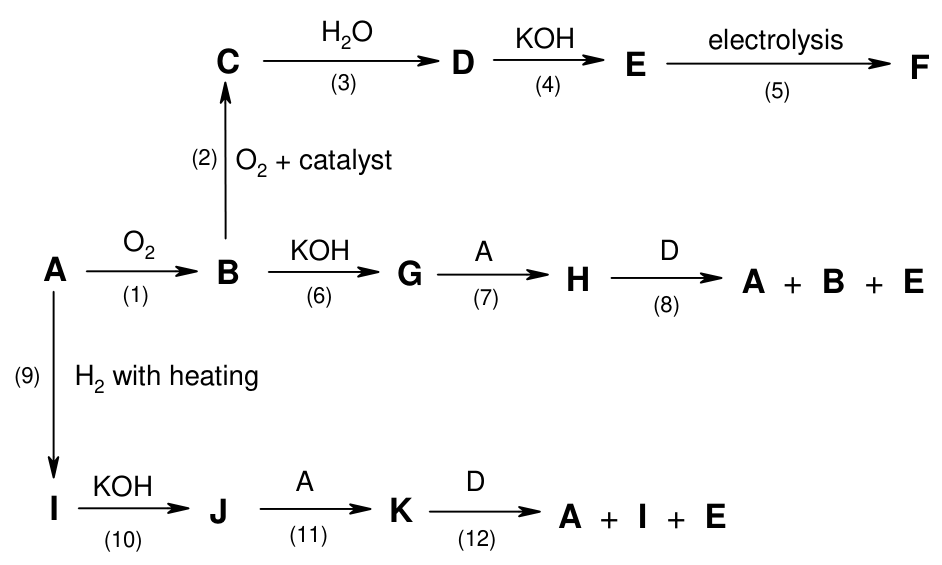
Scheme 1
a) Substance A is a solid and is insoluble in water.
b) Substances B and I are gases soluble in water.
c) Substances E, F, J and K are solid and soluble in water.
d) Aqueous solutions of B, G, H, I, J and K react with F, the products in all cases being E and D.
e) The following transformations occur during the interaction with an aqueous solution of iodine:
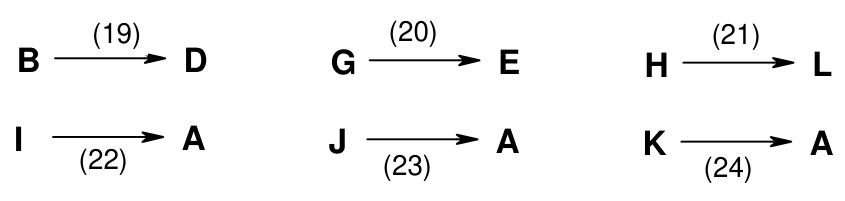
Write the chemical equations for the above interactions and balance them.
Official English text of the problem.
Problem 2: Dissociation of maleic acid and the choice of acid-base indicators
Maleic acid (\(\ce{H2A}\)) is a weak dibasic acid. The correlation between the relative quantities of \(\ce{H2A}\), \(\ce{HA^-}\), \(\ce{A^{2-}}\):
\[ \alpha_0=\frac{c(\ce{H2A})}{c} \qquad \alpha_1=\frac{c(\ce{HA^-})}{c} \qquad \alpha_2=\frac{c(\ce{A^{2-}})}{c} \]
and pH values of the solution show that:
a) \(\alpha_0=\alpha_1\) for pH = 1.92
b) \(\alpha_1=\alpha_2\) for pH = 6.22
Find:
2.1 The values of the dissociation constants of maleic acid for the first (\(K_1\)) and the second (\(K_2\)) degree of dissociation.
2.2 The values of \(\alpha_0\), \(\alpha_1\), and \(\alpha_2\) for pH = 1.92 and pH = 6.22.
2.3 What is the value of pH when \(\alpha_1\) attains a maximum value? Find the maximum value of \(\alpha\).
2.4 Which of the acid-base indicators in the table are suitable for titration of a 0.1 M solution of maleic acid (as a monobasic and as a dibasic acid) with 0.1 M \(\ce{NaOH}\)?
Fill in the table 1 with the correct answers.
All the activity coefficients should be considered equal to 1.
Indicator pH interval Methyl green 0.1 – 2.0 Tropeolin 00 1.4 – 3.2 β-Dinitrophenol 2.4 – 4.0 Bromphenol blue 3.0 – 4.6 Congo red 3.0 – 5.2 Methyl red 4.4 – 6.2 Bromphenol red 5.0 – 6.8 Bromthymol blue 6.0 – 7.6 Phenol red 6.8 – 8.0 Cresol red 7.2 – 8.8 Thymol blue 8.0 – 9.6 Phenolphthalein 8.2 – 10.0 Alizarine yellow 10.1 – 12.1 Tropeolin 0 11.0 – 13.0 1,3,5-Trinitrobenzene 12.2 – 14.0 Table 1
2.1 \(K_1=\) \(K_2=\) 2.2 pH = 1.92 \(\alpha_0=\) \(\alpha_1=\) \(\alpha_2=\) pH = 6.22 \(\alpha_0=\) \(\alpha_1=\) \(\alpha_2=\) 2.3 pH = \(\alpha_1=\) 2.4 First indicator equivalence point pH = 1.
2.
3.
4.Second indicator equivalence point pH = 1.
2.
3.
4.Official English text of the problem.
Problem 3: Structure of a natural compound X from its reactions
Compound X has been isolated from a neutral product. Different reagents have been used to establish the structure of X. The following results were obtained:
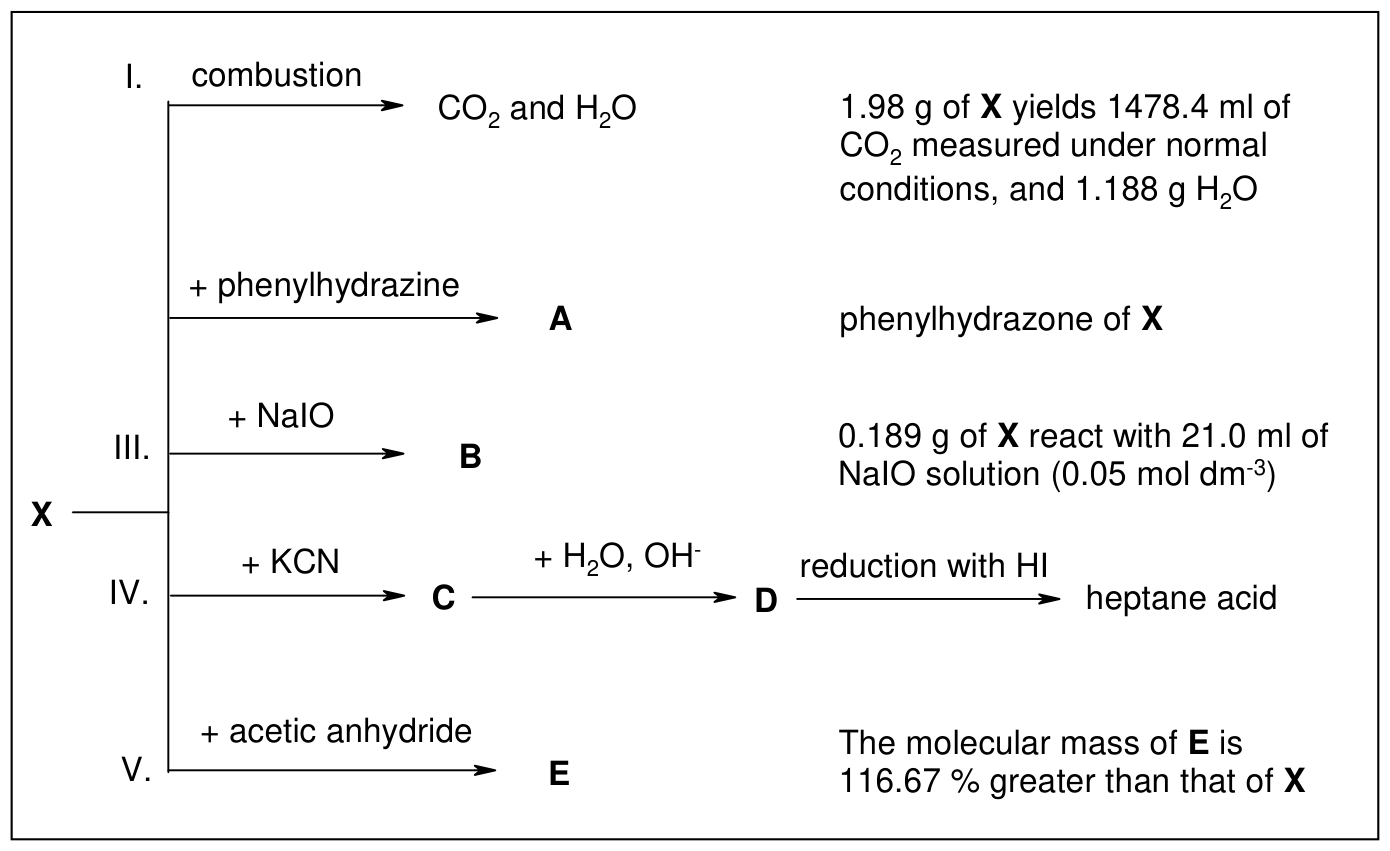
3.1 What conclusions can be drawn on the composition and the structure of X on the basis of the data obtained from each of the above interactions. The conclusions should be formulated in the most concise and clear way. Fill in the table without describing how you reached your conclusions.
I. ........................................ II. ........................................ III. ........................................ IV. ........................................ V. ........................................ 3.2 Write the formula of substance X on the basis of the data about the composition and structure obtained in point 1.
3.3 Write the formulae of substances A, B, C, D, and E and the formula for heptane acid.
3.4 To what natural substances could this structure correspond? Write the name of the substance and draw the structural formula which best describes its structure properties.
3.5 Give three properties of this compound that do not correspond to the structure found in point 2.
Official English text of the problem.
Problem 4: Thermochemical cycle for the decomposition of water at moderate temperature
The thermal decomposition of water
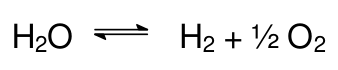
can be traced (\(\alpha = 10^{-3}\)) at temperature above 1700 K. This process can be realized at temperatures 800 – 900 K as well as through subsequent stages carried out in a cycle. Suggest such a process on the basis of the reactions:

and

satisfying the following requirements:
a) Only water should be consumed during the process.
b) Oxygen and hydrogen alone should be the end products of the process.
c) In addition to the above substances, a 25 % ammonia solution is needed for the cycle.
d) The temperature for each step in the cycle should not exceed 840 K.
Official English text of the problem.
Problem 5: Chlorination of hydrocarbon A: intermediates for nylon and chloroprene rubber
Compounds B and C are structural isomers. They can be obtained when hydrocarbon A interacts with chlorine. Hydrocarbon A is a basic product of an industrial organic synthesis. It can react with ozone, yielding an ozonide.
Isomer B can be used for the technical production of compounds D and E that are the initial compounds in the production of the fibre nylon:

Compound D is soluble in bases, E in acids.
The reaction between isomer C and an alcohol solution of an alkaline base yields monomer F which is used for the production of chloroprene (neoprene) rubber

This method has a technical application.
5.1 Write down the structural formulae of A, B, C, D, E, F and their names in the IUPAC nomenclature.
5.2 Write down the mechanism of the reaction between hydrocarbon A and chlorine. What type of reaction is it in terms of its mechanism? Which of the two isomers is obtained in larger quantities under ordinary conditions?
5.3 Write down the equations for:
– the production of D and E from isomer B,
– the production of monomer F from isomer C,
– the ozonolysis of hydrocarbon A and hydrolysis of the ozonide.5.4 Write down the chemical scheme for an industrial production of hydrocarbon A from the hydrocarbon which is main component of natural gas.
5.5 For chloroprene rubber, write down the formulae of the possible steric forms of the elementary unit.
Official English text of the problem.
Problem 6: Kinetics of the catalytic decomposition of isopropanol on V2O5
The catalytic decomposition of isopropanol on the surface of a \(\ce{V2O5}\) catalyst, leading to the products in the scheme, satisfies a first order kinetic equation.
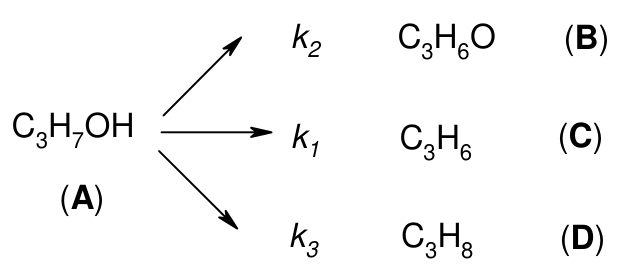
Five seconds after initiation of the reaction at 590 K, the concentrations of the components in the reaction mixture are:
\[ \begin{aligned} c_{\mathrm A}&=28.2\ \mathrm{mmol\,dm^{-3}}\\ c_{\mathrm B}&=7.8\ \mathrm{mmol\,dm^{-3}}\\ c_{\mathrm C}&=8.3\ \mathrm{mmol\,dm^{-3}}\\ c_{\mathrm D}&=1.8\ \mathrm{mmol\,dm^{-3}} \end{aligned} \]
6.1 What is the initial concentration \(c_0\) of \(\ce{C3H7OH}\) in the system?
6.2 What is the value of the rate constant \(k\) for the process:

6.3 What is the interval of time \((\tau_{1/2})\) in which the concentration of \(\ce{C3H7OH}\) will reach the value \(c=c_0/2\)?
6.4 What are the values of rate constants \(k_1\), \(k_2\), and \(k_3\)?
6.5 What are the values of concentrations \(c_{\mathrm B}\), \(c_{\mathrm C}\), \(c_{\mathrm D}\) at \(t=\tau_{1/2}\)?
The equation describing the concentration changes of A with time \(t\) for the first order reaction has the form:
\[ c_{\mathrm A}=c_0\exp(-kt) \]
or
\[ \log(c_0/c_{\mathrm A})=0.4343\,kt \]
or
\[ \ln(c_0/c_{\mathrm A})=kt \]
Fill in the table with the answers obtained.
1 \(c_0=\) 2 \(k=\) 3 \(\tau_{1/2}\) 4 \(k_1=\) \(k_2=\) \(k_3=\) 5 \(c_{\mathrm B}=\) \(c_{\mathrm C}=\) \(c_{\mathrm D}=\) Official English text of the problem.
Internationale Chemie-Olympiade
IChO 1981
Burgas, Bulgarien · 6 Theorieaufgaben mit vollständigen Lösungen
Aufgabe 1: Reaktionsschema eines Stoffes A und seiner Verbindungen (Stoffe A-L)
Die Probe A nimmt an den Umwandlungen in Schema 1 teil. In Schema 1 sind nur die Produkte dargestellt, die A enthalten.
Schema 1
a) Stoff A ist ein Feststoff und in Wasser unlöslich.
b) Die Stoffe B und I sind wasserlösliche Gase.
c) Die Stoffe E, F, J und K sind fest und wasserlöslich.
d) Wässrige Lösungen von B, G, H, I, J und K reagieren mit F, wobei in allen Fällen E und D als Produkte entstehen.
e) Bei der Reaktion mit einer wässrigen Iodlösung finden die folgenden Umwandlungen statt:
Stellen Sie die chemischen Gleichungen für die obigen Reaktionen auf und gleichen Sie sie aus.
Aufgabentext aus dem offiziellen englischen Text übersetzt.
Aufgabe 2: Dissoziation von Maleinsäure und Auswahl von Säure-Base-Indikatoren
Maleinsäure (\(\ce{H2A}\)) ist eine schwache zweiprotonige Säure. Der Zusammenhang zwischen den relativen Anteilen von \(\ce{H2A}\), \(\ce{HA^-}\), \(\ce{A^{2-}}\):
\[ \alpha_0=\frac{c(\ce{H2A})}{c} \qquad \alpha_1=\frac{c(\ce{HA^-})}{c} \qquad \alpha_2=\frac{c(\ce{A^{2-}})}{c} \]
und den pH-Werten der Lösung zeigt, dass:
a) \(\alpha_0=\alpha_1\) für pH = 1.92
b) \(\alpha_1=\alpha_2\) für pH = 6.22
Bestimmen Sie:
2.1 Die Werte der Dissoziationskonstanten der Maleinsäure für die erste (\(K_1\)) und die zweite (\(K_2\)) Dissoziationsstufe.
2.2 Die Werte von \(\alpha_0\), \(\alpha_1\) und \(\alpha_2\) bei pH = 1.92 und pH = 6.22.
2.3 Welchen Wert hat der pH-Wert, wenn \(\alpha_1\) seinen maximalen Wert erreicht? Bestimmen Sie den maximalen Wert von \(\alpha\).
2.4 Welche der Säure-Base-Indikatoren in der Tabelle eignen sich zur Titration einer 0.1 M Maleinsäurelösung (als einprotonige und als zweiprotonige Säure) mit 0.1 M \(\ce{NaOH}\)?
Tragen Sie die richtigen Antworten in Tabelle 1 ein.
Alle Aktivitätskoeffizienten sind als gleich 1 anzunehmen.
Indikator pH-Bereich Methylgrün 0.1 – 2.0 Tropäolin 00 1.4 – 3.2 β-Dinitrophenol 2.4 – 4.0 Bromphenolblau 3.0 – 4.6 Kongorot 3.0 – 5.2 Methylrot 4.4 – 6.2 Bromphenolrot 5.0 – 6.8 Bromthymolblau 6.0 – 7.6 Phenolrot 6.8 – 8.0 Kresolrot 7.2 – 8.8 Thymolblau 8.0 – 9.6 Phenolphthalein 8.2 – 10.0 Alizaringelb 10.1 – 12.1 Tropäolin 0 11.0 – 13.0 1,3,5-Trinitrobenzol 12.2 – 14.0 Tabelle 1
2.1 \(K_1=\) \(K_2=\) 2.2 pH = 1.92 \(\alpha_0=\) \(\alpha_1=\) \(\alpha_2=\) pH = 6.22 \(\alpha_0=\) \(\alpha_1=\) \(\alpha_2=\) 2.3 pH = \(\alpha_1=\) 2.4 Indikatoren für den ersten Äquivalenzpunkt pH = 1.
2.
3.
4.Indikatoren für den zweiten Äquivalenzpunkt pH = 1.
2.
3.
4.Aufgabentext aus dem offiziellen englischen Text übersetzt.
Aufgabe 3: Struktur einer natürlichen Verbindung X anhand ihrer Reaktionen
Die Verbindung X wurde aus einem neutralen Produkt isoliert. Zur Aufklärung der Struktur von X wurden verschiedene Reagenzien verwendet. Dabei wurden die folgenden Ergebnisse erhalten:
3.1 Welche Schlussfolgerungen lassen sich aus den bei jeder der oben genannten Reaktionen erhaltenen Daten über die Zusammensetzung und die Struktur von X ziehen? Die Schlussfolgerungen sollen möglichst knapp und klar formuliert werden. Füllen Sie die Tabelle aus, ohne zu beschreiben, wie Sie zu Ihren Schlussfolgerungen gelangt sind.
I. ........................................ II. ........................................ III. ........................................ IV. ........................................ V. ........................................ 3.2 Geben Sie die Formel der Substanz X anhand der in Punkt 1 erhaltenen Daten über ihre Zusammensetzung und Struktur an.
3.3 Geben Sie die Formeln der Substanzen A, B, C, D, und E sowie die Formel der Heptansäure an.
3.4 Welchen natürlichen Substanzen könnte diese Struktur entsprechen? Geben Sie den Namen der Substanz an und zeichnen Sie die Strukturformel, die ihre strukturellen Eigenschaften am besten beschreibt.
3.5 Nennen Sie drei Eigenschaften dieser Verbindung, die nicht mit der in Punkt 2 ermittelten Struktur übereinstimmen.
Aufgabentext aus dem offiziellen englischen Text übersetzt.
Aufgabe 4: Thermochemischer Kreisprozess zur Zersetzung von Wasser bei mäßiger Temperatur
Die thermische Zersetzung von Wasser
ist bei Temperaturen über 1700 K nachweisbar (\(\alpha = 10^{-3}\)). Dieser Prozess lässt sich auch bei Temperaturen von 800 – 900 K durch aufeinanderfolgende Schritte verwirklichen, die in einem Kreisprozess durchgeführt werden. Schlagen Sie einen solchen Prozess auf der Grundlage der Reaktionen
und
vor, der die folgenden Anforderungen erfüllt:
a) Während des Prozesses soll nur Wasser verbraucht werden.
b) Die einzigen Endprodukte des Prozesses sollen Sauerstoff und Wasserstoff sein.
c) Zusätzlich zu den oben genannten Stoffen wird für den Kreisprozess eine 25%ige Ammoniaklösung benötigt.
d) Die Temperatur darf bei keinem Schritt des Kreisprozesses 840 K überschreiten.
Aufgabentext aus dem offiziellen englischen Text übersetzt.
Aufgabe 5: Chlorierung des Kohlenwasserstoffs A: Zwischenprodukte für Nylon und Chloroprenkautschuk
Die Verbindungen B und C sind Strukturisomere. Sie können durch die Reaktion des Kohlenwasserstoffs A mit Chlor erhalten werden. Der Kohlenwasserstoff A ist ein Grundprodukt einer industriellen organischen Synthese. Er kann mit Ozon unter Bildung eines Ozonids reagieren.
Das Isomer B kann zur technischen Herstellung der Verbindungen D und E verwendet werden, die als Ausgangsverbindungen für die Herstellung der Faser Nylon dienen:
Die Verbindung D ist in Basen löslich, E in Säuren.
Die Reaktion des Isomers C mit einer alkoholischen Lösung einer Alkalibase liefert das Monomer F, das zur Herstellung von Chloroprenkautschuk (Neopren) verwendet wird
Dieses Verfahren wird technisch angewendet.
5.1 Geben Sie die Strukturformeln von A, B, C, D, E, F und ihre Namen nach der IUPAC-Nomenklatur an.
5.2 Geben Sie den Mechanismus der Reaktion zwischen dem Kohlenwasserstoff A und Chlor an. Um welchen Reaktionstyp handelt es sich hinsichtlich des Mechanismus? Welches der beiden Isomere entsteht unter üblichen Bedingungen in größerer Menge?
5.3 Geben Sie die Reaktionsgleichungen an für:
– die Herstellung von D und E aus dem Isomer B,
– die Herstellung des Monomers F aus dem Isomer C,
– die Ozonolyse des Kohlenwasserstoffs A und die Hydrolyse des Ozonids.5.4 Geben Sie das Reaktionsschema für eine industrielle Herstellung des Kohlenwasserstoffs A aus dem Kohlenwasserstoff an, der den Hauptbestandteil von Erdgas bildet.
5.5 Geben Sie für Chloroprenkautschuk die Formeln der möglichen räumlichen Formen der Wiederholungseinheit an.
Aufgabentext aus dem offiziellen englischen Text übersetzt.
Aufgabe 6: Kinetik der katalytischen Zersetzung von Isopropanol an V2O5
Die katalytische Zersetzung von Isopropanol an der Oberfläche eines \(\ce{V2O5}\)-Katalysators, bei der die im Schema dargestellten Produkte entstehen, folgt einem Geschwindigkeitsgesetz erster Ordnung.
Fünf Sekunden nach Beginn der Reaktion bei 590 K betragen die Konzentrationen der Komponenten im Reaktionsgemisch:
\[ \begin{aligned} c_{\mathrm A}&=28.2\ \mathrm{mmol\,dm^{-3}}\\ c_{\mathrm B}&=7.8\ \mathrm{mmol\,dm^{-3}}\\ c_{\mathrm C}&=8.3\ \mathrm{mmol\,dm^{-3}}\\ c_{\mathrm D}&=1.8\ \mathrm{mmol\,dm^{-3}} \end{aligned} \]
6.1 Wie groß ist die Anfangskonzentration \(c_0\) von \(\ce{C3H7OH}\) im System?
6.2 Welchen Wert hat die Geschwindigkeitskonstante \(k\) für den folgenden Vorgang:
6.3 Wie groß ist die Zeitspanne \((\tau_{1/2})\), innerhalb derer die Konzentration von \(\ce{C3H7OH}\) den Wert \(c=c_0/2\) erreicht?
6.4 Welche Werte haben die Geschwindigkeitskonstanten \(k_1\), \(k_2\) und \(k_3\)?
6.5 Welche Werte haben die Konzentrationen \(c_{\mathrm B}\), \(c_{\mathrm C}\), \(c_{\mathrm D}\) bei \(t=\tau_{1/2}\)?
Die Gleichung, die die Änderung der Konzentration von A mit der Zeit \(t\) für die Reaktion erster Ordnung beschreibt, hat die Form:
\[ c_{\mathrm A}=c_0\exp(-kt) \]
oder
\[ \log(c_0/c_{\mathrm A})=0.4343\,kt \]
oder
\[ \ln(c_0/c_{\mathrm A})=kt \]
Tragen Sie die erhaltenen Antworten in die Tabelle ein.
1 \(c_0=\) 2 \(k=\) 3 \(\tau_{1/2}\) 4 \(k_1=\) \(k_2=\) \(k_3=\) 5 \(c_{\mathrm B}=\) \(c_{\mathrm C}=\) \(c_{\mathrm D}=\) Aufgabentext aus dem offiziellen englischen Text übersetzt.
Uluslararası Kimya Olimpiyatı
IChO 1981
Burgaz, Bulgaristan · 6 teori sorusu, tam çözümleriyle
Soru 1: A maddesinin ve bileşiklerinin tepkime şeması (A-L maddeleri)
A numunesi, şema 1'deki dönüşümlere katılır. Şema 1'de yalnızca A içeren ürünler gösterilmiştir.
Şema 1
a) A maddesi katıdır ve suda çözünmez.
b) B ve I maddeleri suda çözünen gazlardır.
c) E, F, J ve K maddeleri katıdır ve suda çözünür.
d) B, G, H, I, J ve K maddelerinin sulu çözeltileri F ile tepkimeye girer; her durumda ürünler E ve D olur.
e) Sulu iyot çözeltisiyle etkileşim sırasında aşağıdaki dönüşümler gerçekleşir:
Yukarıdaki etkileşimlerin kimyasal denklemlerini yazınız ve denkleştiriniz.
Soru metni resmi İngilizce metinden çevrilmiştir.
Soru 2: Maleik asidin ayrışması ve asit-baz indikatörlerinin seçimi
Maleik asit (\(\ce{H2A}\)) zayıf bir dibazik asittir. \(\ce{H2A}\), \(\ce{HA^-}\), \(\ce{A^{2-}}\) türlerinin bağıl miktarları:
\[ \alpha_0=\frac{c(\ce{H2A})}{c} \qquad \alpha_1=\frac{c(\ce{HA^-})}{c} \qquad \alpha_2=\frac{c(\ce{A^{2-}})}{c} \]
ile çözeltinin pH değerleri arasındaki ilişki şunları göstermektedir:
a) pH = 1.92 için \(\alpha_0=\alpha_1\)
b) pH = 6.22 için \(\alpha_1=\alpha_2\)
Aşağıdakileri bulun:
2.1 Maleik asidin birinci (\(K_1\)) ve ikinci (\(K_2\)) ayrışma basamağına ait ayrışma sabitlerinin değerleri.
2.2 pH = 1.92 ve pH = 6.22 için \(\alpha_0\), \(\alpha_1\) ve \(\alpha_2\) değerleri.
2.3 \(\alpha_1\) maksimum değerine ulaştığında pH değeri kaçtır? \(\alpha\)'nın maksimum değerini bulun.
2.4 Tablodaki asit-baz indikatörlerinden hangileri, 0.1 M maleik asit çözeltisinin (monobazik ve dibazik asit olarak) 0.1 M \(\ce{NaOH}\) ile titrasyonu için uygundur?
Tablo 1'i doğru cevaplarla doldurun.
Tüm aktivite katsayıları 1'e eşit kabul edilmelidir.
İndikatör pH aralığı Metil yeşili 0.1 – 2.0 Tropeolin 00 1.4 – 3.2 β-Dinitrofenol 2.4 – 4.0 Bromfenol mavisi 3.0 – 4.6 Kongo kırmızısı 3.0 – 5.2 Metil kırmızısı 4.4 – 6.2 Bromfenol kırmızısı 5.0 – 6.8 Bromtimol mavisi 6.0 – 7.6 Fenol kırmızısı 6.8 – 8.0 Krezol kırmızısı 7.2 – 8.8 Timol mavisi 8.0 – 9.6 Fenolftalein 8.2 – 10.0 Alizarin sarısı 10.1 – 12.1 Tropeolin 0 11.0 – 13.0 1,3,5-Trinitrobenzen 12.2 – 14.0 Tablo 1
2.1 \(K_1=\) \(K_2=\) 2.2 pH = 1.92 \(\alpha_0=\) \(\alpha_1=\) \(\alpha_2=\) pH = 6.22 \(\alpha_0=\) \(\alpha_1=\) \(\alpha_2=\) 2.3 pH = \(\alpha_1=\) 2.4 Birinci indikatör eşdeğerlik noktası pH = 1.
2.
3.
4.İkinci indikatör eşdeğerlik noktası pH = 1.
2.
3.
4.Soru metni resmi İngilizce metinden çevrilmiştir.
Soru 3: Doğal bir X bileşiğinin tepkimelerinden yapısının belirlenmesi
X bileşiği nötr bir üründen izole edilmiştir. X'in yapısını belirlemek için farklı reaktifler kullanılmıştır. Aşağıdaki sonuçlar elde edilmiştir:
3.1 Yukarıdaki etkileşimlerin her birinden elde edilen verilere dayanarak X'in bileşimi ve yapısı hakkında hangi sonuçlara varılabilir? Sonuçlar olabildiğince kısa ve açık biçimde ifade edilmelidir. Sonuçlara nasıl ulaştığınızı açıklamadan tabloyu doldurunuz.
I. ........................................ II. ........................................ III. ........................................ IV. ........................................ V. ........................................ 3.2 1. maddede elde edilen bileşim ve yapı verilerine dayanarak X maddesinin formülünü yazınız.
3.3 A, B, C, D ve E maddelerinin formüllerini ve heptan asidinin formülünü yazınız.
3.4 Bu yapı hangi doğal maddelere karşılık gelebilir? Maddenin adını yazınız ve yapısal özelliklerini en iyi açıklayan yapı formülünü çiziniz.
3.5 Bu bileşiğin, 2. maddede bulunan yapıyla uyuşmayan üç özelliğini belirtiniz.
Soru metni resmi İngilizce metinden çevrilmiştir.
Soru 4: Suyun orta sıcaklıkta ayrışması için termokimyasal çevrim
Suyun ısıl ayrışması
1700 K'nin üzerindeki sıcaklıklarda gözlenebilir (\(\alpha = 10^{-3}\)). Bu süreç, bir çevrim içinde gerçekleştirilen ardışık aşamalar yoluyla 800 – 900 K sıcaklıklarda da gerçekleştirilebilir. Aşağıdaki tepkimelere dayanarak böyle bir süreç öneriniz:
ve
Süreç aşağıdaki koşulları sağlamalıdır:
a) Süreç boyunca yalnızca su tüketilmelidir.
b) Sürecin son ürünleri yalnızca oksijen ve hidrojen olmalıdır.
c) Çevrim için yukarıdaki maddelere ek olarak %25'lik bir amonyak çözeltisi gereklidir.
d) Çevrimin her bir basamağındaki sıcaklık 840 K'yi aşmamalıdır.
Soru metni resmi İngilizce metinden çevrilmiştir.
Soru 5: A hidrokarbonunun klorlanması: naylon ve kloropren kauçuğu için ara ürünler
B ve C bileşikleri yapı izomerleridir. A hidrokarbonunun klorla tepkimesinden elde edilebilirler. A hidrokarbonu, endüstriyel bir organik sentezin temel ürünüdür. Ozonla tepkimeye girerek bir ozonür oluşturabilir.
B izomeri, naylon lifinin üretiminde başlangıç maddeleri olan D ve E bileşiklerinin endüstriyel üretiminde kullanılabilir:
D bileşiği bazlarda, E bileşiği ise asitlerde çözünür.
C izomeri ile bir alkali bazın alkoldeki çözeltisi arasındaki tepkime, kloropren (neopren) kauçuğu üretiminde kullanılan F monomerini verir
Bu yöntemin endüstriyel uygulaması vardır.
5.1 A, B, C, D, E, F bileşiklerinin yapı formüllerini ve IUPAC adlandırmasına göre adlarını yazınız.
5.2 A hidrokarbonu ile klor arasındaki tepkimenin mekanizmasını yazınız. Mekanizması bakımından bu tepkime hangi türdendir? Olağan koşullarda iki izomerden hangisi daha fazla miktarda elde edilir?
5.3 Aşağıdakilerin tepkime denklemlerini yazınız:
– B izomerinden D ve E üretimi,
– C izomerinden F monomerinin üretimi,
– A hidrokarbonunun ozonolizi ve ozonürün hidrolizi.5.4 Doğal gazın ana bileşeni olan hidrokarbondan A hidrokarbonunun endüstriyel üretimine ilişkin kimyasal tepkime şemasını yazınız.
5.5 Kloropren kauçuğunun temel biriminin olası uzaysal biçimlerinin formüllerini yazınız.
Soru metni resmi İngilizce metinden çevrilmiştir.
Soru 6: İzopropanolün V2O5 üzerinde katalitik bozunmasının kinetiği
İzopropanolün bir \(\ce{V2O5}\) katalizörünün yüzeyinde, şemada gösterilen ürünleri oluşturarak katalitik bozunması, birinci dereceden bir kinetik denkleme uyar.
Tepkimenin 590 K'de başlatılmasından beş saniye sonra, tepkime karışımındaki bileşenlerin derişimleri şöyledir:
\[ \begin{aligned} c_{\mathrm A}&=28.2\ \mathrm{mmol\,dm^{-3}}\\ c_{\mathrm B}&=7.8\ \mathrm{mmol\,dm^{-3}}\\ c_{\mathrm C}&=8.3\ \mathrm{mmol\,dm^{-3}}\\ c_{\mathrm D}&=1.8\ \mathrm{mmol\,dm^{-3}} \end{aligned} \]
6.1 Sistemdeki \(\ce{C3H7OH}\)'ın başlangıç derişimi \(c_0\) nedir?
6.2 Aşağıdaki süreç için hız sabiti \(k\)'nın değeri nedir?
6.3 \(\ce{C3H7OH}\)'ın derişiminin \(c=c_0/2\) değerine ulaşması için gereken süre \((\tau_{1/2})\) nedir?
6.4 \(k_1\), \(k_2\) ve \(k_3\) hız sabitlerinin değerleri nedir?
6.5 \(t=\tau_{1/2}\) anında \(c_{\mathrm B}\), \(c_{\mathrm C}\), \(c_{\mathrm D}\) derişimlerinin değerleri nedir?
Birinci dereceden tepkime için A'nın derişiminin \(t\) zamanıyla değişimini tanımlayan denklem şu biçimdedir:
\[ c_{\mathrm A}=c_0\exp(-kt) \]
veya
\[ \log(c_0/c_{\mathrm A})=0.4343\,kt \]
veya
\[ \ln(c_0/c_{\mathrm A})=kt \]
Tabloyu elde ettiğiniz cevaplarla doldurunuz.
1 \(c_0=\) 2 \(k=\) 3 \(\tau_{1/2}\) 4 \(k_1=\) \(k_2=\) \(k_3=\) 5 \(c_{\mathrm B}=\) \(c_{\mathrm C}=\) \(c_{\mathrm D}=\) Soru metni resmi İngilizce metinden çevrilmiştir.
Olimpiada Internacional de Química
IChO 1981
Burgas, Bulgaria · 6 problemas teóricos con soluciones completas
Problema 1: Esquema de reacciones de una sustancia A y sus compuestos (sustancias A-L)
La muestra A participa en las transformaciones del esquema 1. En el esquema 1 solo se muestran los productos que contienen A.
Esquema 1
a) La sustancia A es sólida e insoluble en agua.
b) Las sustancias B e I son gases solubles en agua.
c) Las sustancias E, F, J y K son sólidas y solubles en agua.
d) Las disoluciones acuosas de B, G, H, I, J y K reaccionan con F, y los productos son en todos los casos E y D.
e) Durante la interacción con una disolución acuosa de yodo se producen las siguientes transformaciones:
Escriba las ecuaciones químicas de las interacciones anteriores y ajústelas.
Enunciado traducido del texto oficial en inglés.
Problema 2: Disociación del ácido maleico y elección de indicadores ácido-base
El ácido maleico (\(\ce{H2A}\)) es un ácido dibásico débil. La correlación entre las cantidades relativas de \(\ce{H2A}\), \(\ce{HA^-}\), \(\ce{A^{2-}}\):
\[ \alpha_0=\frac{c(\ce{H2A})}{c} \qquad \alpha_1=\frac{c(\ce{HA^-})}{c} \qquad \alpha_2=\frac{c(\ce{A^{2-}})}{c} \]
y los valores de pH de la disolución muestra que:
a) \(\alpha_0=\alpha_1\) para pH = 1.92
b) \(\alpha_1=\alpha_2\) para pH = 6.22
Determine:
2.1 Los valores de las constantes de disociación del ácido maleico para la primera (\(K_1\)) y la segunda (\(K_2\)) etapa de disociación.
2.2 Los valores de \(\alpha_0\), \(\alpha_1\) y \(\alpha_2\) para pH = 1.92 y pH = 6.22.
2.3 ¿Cuál es el valor del pH cuando \(\alpha_1\) alcanza su valor máximo? Determine el valor máximo de \(\alpha\).
2.4 ¿Cuáles de los indicadores ácido-base de la tabla son adecuados para la valoración de una disolución 0.1 M de ácido maleico (como ácido monobásico y como ácido dibásico) con \(\ce{NaOH}\) 0.1 M?
Complete la tabla 1 con las respuestas correctas.
Todos los coeficientes de actividad deben considerarse iguales a 1.
Indicador Intervalo de pH Verde de metilo 0.1 – 2.0 Tropeolina 00 1.4 – 3.2 β-Dinitrofenol 2.4 – 4.0 Azul de bromofenol 3.0 – 4.6 Rojo Congo 3.0 – 5.2 Rojo de metilo 4.4 – 6.2 Rojo de bromofenol 5.0 – 6.8 Azul de bromotimol 6.0 – 7.6 Rojo de fenol 6.8 – 8.0 Rojo de cresol 7.2 – 8.8 Azul de timol 8.0 – 9.6 Fenolftaleína 8.2 – 10.0 Amarillo de alizarina 10.1 – 12.1 Tropeolina 0 11.0 – 13.0 1,3,5-Trinitrobenceno 12.2 – 14.0 Tabla 1
2.1 \(K_1=\) \(K_2=\) 2.2 pH = 1.92 \(\alpha_0=\) \(\alpha_1=\) \(\alpha_2=\) pH = 6.22 \(\alpha_0=\) \(\alpha_1=\) \(\alpha_2=\) 2.3 pH = \(\alpha_1=\) 2.4 Primer punto de equivalencia: indicadores pH = 1.
2.
3.
4.Segundo punto de equivalencia: indicadores pH = 1.
2.
3.
4.Enunciado traducido del texto oficial en inglés.
Problema 3: Estructura de un compuesto natural X a partir de sus reacciones
El compuesto X se ha aislado de un producto neutro. Se han utilizado diferentes reactivos para establecer la estructura de X. Se obtuvieron los siguientes resultados:
3.1 ¿Qué conclusiones pueden extraerse sobre la composición y la estructura de X a partir de los datos obtenidos en cada una de las interacciones anteriores? Las conclusiones deben formularse de la manera más concisa y clara posible. Complete la tabla sin describir cómo llegó a sus conclusiones.
I. ........................................ II. ........................................ III. ........................................ IV. ........................................ V. ........................................ 3.2 Escriba la fórmula de la sustancia X a partir de los datos sobre su composición y estructura obtenidos en el punto 1.
3.3 Escriba las fórmulas de las sustancias A, B, C, D, y E y la fórmula del ácido heptanoico.
3.4 ¿A qué sustancias naturales podría corresponder esta estructura? Escriba el nombre de la sustancia y dibuje la fórmula estructural que mejor describa sus propiedades estructurales.
3.5 Indique tres propiedades de este compuesto que no correspondan a la estructura obtenida en el punto 2.
Enunciado traducido del texto oficial en inglés.
Problema 4: Ciclo termoquímico para la descomposición del agua a temperatura moderada
La descomposición térmica del agua
puede detectarse (\(\alpha = 10^{-3}\)) a temperaturas superiores a 1700 K. Este proceso también puede llevarse a cabo a temperaturas de 800 – 900 K mediante etapas sucesivas que forman un ciclo. Proponga un proceso de este tipo basándose en las reacciones:
y
que satisfaga los siguientes requisitos:
a) Durante el proceso solo debe consumirse agua.
b) Los únicos productos finales del proceso deben ser oxígeno e hidrógeno.
c) Además de las sustancias anteriores, se necesita una disolución de amoníaco al 25 % para el ciclo.
d) La temperatura de cada etapa del ciclo no debe superar los 840 K.
Enunciado traducido del texto oficial en inglés.
Problema 5: Cloración del hidrocarburo A: intermediarios para el nailon y el caucho de cloropreno
Los compuestos B y C son isómeros estructurales. Pueden obtenerse cuando el hidrocarburo A reacciona con cloro. El hidrocarburo A es un producto básico de una síntesis orgánica industrial. Puede reaccionar con ozono y dar un ozónido.
El isómero B puede utilizarse para la producción industrial de los compuestos D y E, que son los compuestos de partida para la producción de la fibra de nailon:
El compuesto D es soluble en bases, y E, en ácidos.
La reacción entre el isómero C y una disolución alcohólica de una base alcalina da el monómero F, que se utiliza para la producción de caucho de cloropreno (neopreno)
Este método tiene aplicación industrial.
5.1 Escriba las fórmulas estructurales de A, B, C, D, E, F y sus nombres según la nomenclatura IUPAC.
5.2 Escriba el mecanismo de la reacción entre el hidrocarburo A y el cloro. ¿De qué tipo de reacción se trata según su mecanismo? ¿Cuál de los dos isómeros se obtiene en mayor cantidad en condiciones ordinarias?
5.3 Escriba las ecuaciones de:
– la producción de D y E a partir del isómero B,
– la producción del monómero F a partir del isómero C,
– la ozonólisis del hidrocarburo A y la hidrólisis del ozónido.5.4 Escriba el esquema químico de una producción industrial del hidrocarburo A a partir del hidrocarburo que es el componente principal del gas natural.
5.5 Para el caucho de cloropreno, escriba las fórmulas de las posibles formas estéricas de la unidad elemental.
Enunciado traducido del texto oficial en inglés.
Problema 6: Cinética de la descomposición catalítica del isopropanol sobre V2O5
La descomposición catalítica del isopropanol sobre la superficie de un catalizador de \(\ce{V2O5}\), que da lugar a los productos del esquema, obedece a una ecuación cinética de primer orden.
Cinco segundos después del inicio de la reacción a 590 K, las concentraciones de los componentes de la mezcla de reacción son:
\[ \begin{aligned} c_{\mathrm A}&=28.2\ \mathrm{mmol\,dm^{-3}}\\ c_{\mathrm B}&=7.8\ \mathrm{mmol\,dm^{-3}}\\ c_{\mathrm C}&=8.3\ \mathrm{mmol\,dm^{-3}}\\ c_{\mathrm D}&=1.8\ \mathrm{mmol\,dm^{-3}} \end{aligned} \]
6.1 ¿Cuál es la concentración inicial \(c_0\) de \(\ce{C3H7OH}\) en el sistema?
6.2 ¿Cuál es el valor de la constante de velocidad \(k\) para el proceso:
6.3 ¿Cuál es el intervalo de tiempo \((\tau_{1/2})\) en el que la concentración de \(\ce{C3H7OH}\) alcanzará el valor \(c=c_0/2\)?
6.4 ¿Cuáles son los valores de las constantes de velocidad \(k_1\), \(k_2\) y \(k_3\)?
6.5 ¿Cuáles son los valores de las concentraciones \(c_{\mathrm B}\), \(c_{\mathrm C}\), \(c_{\mathrm D}\) en \(t=\tau_{1/2}\)?
La ecuación que describe la variación de la concentración de A con el tiempo \(t\) para la reacción de primer orden tiene la forma:
\[ c_{\mathrm A}=c_0\exp(-kt) \]
o
\[ \log(c_0/c_{\mathrm A})=0.4343\,kt \]
o
\[ \ln(c_0/c_{\mathrm A})=kt \]
Complete la tabla con las respuestas obtenidas.
1 \(c_0=\) 2 \(k=\) 3 \(\tau_{1/2}\) 4 \(k_1=\) \(k_2=\) \(k_3=\) 5 \(c_{\mathrm B}=\) \(c_{\mathrm C}=\) \(c_{\mathrm D}=\) Enunciado traducido del texto oficial en inglés.
国际化学奥林匹克
IChO 1981
保加利亚布尔加斯 · 6 道理论题及完整解答
题目 1:物质 A 及其化合物的反应示意图(物质 A-L)
样品 A 参与示意图 1 中的转化。示意图 1 中仅列出了含有 A 的产物。
示意图 1
a) 物质 A 是固体,不溶于水。
b) 物质 B 和 I 是可溶于水的气体。
c) 物质 E、F、J 和 K 是可溶于水的固体。
d) B、G、H、I、J 和 K 的水溶液均能与 F 反应,所有情况下的产物均为 E 和 D。
e) 与碘的水溶液反应时,发生以下转化:
写出上述反应的化学方程式并配平。
题目译自官方英文原文。
题目 2:马来酸的解离与酸碱指示剂的选择
马来酸(\(\ce{H2A}\))是一种二元弱酸。\(\ce{H2A}\)、\(\ce{HA^-}\)、\(\ce{A^{2-}}\) 的相对含量:
\[ \alpha_0=\frac{c(\ce{H2A})}{c} \qquad \alpha_1=\frac{c(\ce{HA^-})}{c} \qquad \alpha_2=\frac{c(\ce{A^{2-}})}{c} \]
与溶液 pH 值之间的关系表明:
a) 当 pH = 1.92 时,\(\alpha_0=\alpha_1\)
b) 当 pH = 6.22 时,\(\alpha_1=\alpha_2\)
求:
2.1 马来酸的一级(\(K_1\))和二级(\(K_2\))解离常数的值。
2.2 pH = 1.92 和 pH = 6.22 时,\(\alpha_0\)、\(\alpha_1\) 和 \(\alpha_2\) 的值。
2.3 当 \(\alpha_1\) 达到最大值时,pH 为多少?求 \(\alpha\) 的最大值。
2.4 用 0.1 M \(\ce{NaOH}\) 滴定 0.1 M 马来酸溶液(分别将其作为一元酸和二元酸)时,表中的哪些酸碱指示剂适用?
将正确答案填入表 1。
所有活度系数均视为等于 1。
指示剂 pH 范围 甲基绿 0.1 – 2.0 橙黄 00 1.4 – 3.2 β-二硝基苯酚 2.4 – 4.0 溴酚蓝 3.0 – 4.6 刚果红 3.0 – 5.2 甲基红 4.4 – 6.2 溴酚红 5.0 – 6.8 溴百里酚蓝 6.0 – 7.6 酚红 6.8 – 8.0 甲酚红 7.2 – 8.8 百里酚蓝 8.0 – 9.6 酚酞 8.2 – 10.0 茜素黄 10.1 – 12.1 橙黄 0 11.0 – 13.0 1,3,5-三硝基苯 12.2 – 14.0 表 1
2.1 \(K_1=\) \(K_2=\) 2.2 pH = 1.92 \(\alpha_0=\) \(\alpha_1=\) \(\alpha_2=\) pH = 6.22 \(\alpha_0=\) \(\alpha_1=\) \(\alpha_2=\) 2.3 pH = \(\alpha_1=\) 2.4 第一等当点及其指示剂 pH = 1.
2.
3.
4.第二等当点及其指示剂 pH = 1.
2.
3.
4.题目译自官方英文原文。
题目 3:根据反应推断天然化合物 X 的结构
从一种中性产物中分离出了化合物 X。为确定 X 的结构,使用了不同的试剂,得到如下结果:
3.1 根据上述各反应所得的数据,可以对 X 的组成和结构得出哪些结论?结论应尽可能简明、清晰。填写下表,无须说明得出结论的过程。
I. ........................................ II. ........................................ III. ........................................ IV. ........................................ V. ........................................ 3.2 根据第 1 问所得的组成和结构信息,写出物质 X 的结构式。
3.3 写出物质 A、B、C、D 和 E 的结构式,以及庚酸的结构式。
3.4 这一结构可能对应哪些天然物质?写出物质的名称,并画出最能描述其结构特征的结构式。
3.5 列举该化合物的三种与第 2 问所得结构不相符的性质。
题目译自官方英文原文。
题目 4:在中等温度下分解水的热化学循环
水的热分解
在高于 1700 K 的温度下可被检测到(\(\alpha = 10^{-3}\))。通过在一个循环中依次进行各个阶段,这一过程也可以在 800 – 900 K 的温度下实现。根据下列反应提出这样一个过程:
以及
并满足以下要求:
a) 过程中应只消耗水。
b) 过程的最终产物应只有氧气和氢气。
c) 除上述物质外,该循环还需要 25 % 的氨水。
d) 循环中每一步的温度均不得超过 840 K。
题目译自官方英文原文。
题目 5:烃 A 的氯化:尼龙和氯丁橡胶的中间体
化合物 B 和 C 是构造异构体。它们可由烃 A 与氯气反应制得。烃 A 是工业有机合成中的一种基础产品。它能与臭氧反应,生成臭氧化物。
异构体 B 可用于工业生产化合物 D 和 E,这两种化合物是生产尼龙纤维的起始原料:
化合物 D 溶于碱,E 溶于酸。
异构体 C 与碱的醇溶液反应,生成用于生产氯丁橡胶(neoprene)的单体 F
此方法已有工业应用。
5.1 写出 A, B, C, D, E, F 的结构式及其 IUPAC 名称。
5.2 写出烃 A 与氯气反应的机理。按反应机理分类,这属于哪一类反应?在通常条件下,两种异构体中哪一种的生成量较大?
5.3 写出下列反应的方程式:
– 由异构体 B 制备 D 和 E,
– 由异构体 C 制备单体 F,
– 烃 A 的臭氧分解及臭氧化物的水解。5.4 写出以天然气主要成分的烃为原料,工业生产烃 A 的化学反应流程。
5.5 对于氯丁橡胶,写出其重复单元可能的立体形式的结构式。
题目译自官方英文原文。
题目 6:异丙醇在 V2O5 上催化分解的动力学
异丙醇在 \(\ce{V2O5}\) 催化剂表面催化分解,生成反应示意图所示的产物,该反应遵循一级反应动力学方程。
在 590 K 下,反应开始五秒后,反应混合物中各组分的浓度为:
\[ \begin{aligned} c_{\mathrm A}&=28.2\ \mathrm{mmol\,dm^{-3}}\\ c_{\mathrm B}&=7.8\ \mathrm{mmol\,dm^{-3}}\\ c_{\mathrm C}&=8.3\ \mathrm{mmol\,dm^{-3}}\\ c_{\mathrm D}&=1.8\ \mathrm{mmol\,dm^{-3}} \end{aligned} \]
6.1 体系中 \(\ce{C3H7OH}\) 的初始浓度 \(c_0\) 是多少?
6.2 下列过程的速率常数 \(k\) 是多少?
6.3 \(\ce{C3H7OH}\) 的浓度达到 \(c=c_0/2\) 所需的时间 \((\tau_{1/2})\) 是多少?
6.4 速率常数 \(k_1\)、\(k_2\) 和 \(k_3\) 的值分别是多少?
6.5 在 \(t=\tau_{1/2}\) 时,浓度 \(c_{\mathrm B}\)、\(c_{\mathrm C}\)、\(c_{\mathrm D}\) 的值分别是多少?
对于一级反应,描述 A 的浓度随时间 \(t\) 变化的方程形式如下:
\[ c_{\mathrm A}=c_0\exp(-kt) \]
或
\[ \log(c_0/c_{\mathrm A})=0.4343\,kt \]
或
\[ \ln(c_0/c_{\mathrm A})=kt \]
将所得答案填入表中。
1 \(c_0=\) 2 \(k=\) 3 \(\tau_{1/2}\) 4 \(k_1=\) \(k_2=\) \(k_3=\) 5 \(c_{\mathrm B}=\) \(c_{\mathrm C}=\) \(c_{\mathrm D}=\) 题目译自官方英文原文。
Международная химическая олимпиада
IChO 1981
Бургас, Болгария · 6 теоретических задач с полными решениями
Задача 1: Схема превращений вещества A и его соединений (вещества A-L)
Образец A участвует в превращениях, представленных на схеме 1. На схеме 1 показаны только продукты, содержащие A.
Схема 1
a) Вещество A — твёрдое и нерастворимо в воде.
b) Вещества B и I — газы, растворимые в воде.
c) Вещества E, F, J и K — твёрдые и растворимы в воде.
d) Водные растворы B, G, H, I, J и K реагируют с F, причём во всех случаях продуктами являются E и D.
e) При взаимодействии с водным раствором иода происходят следующие превращения:
Напишите уравнения приведённых выше химических реакций и расставьте коэффициенты.
Условие переведено с официального английского текста.
Задача 2: Диссоциация малеиновой кислоты и выбор кислотно-основных индикаторов
Малеиновая кислота (\(\ce{H2A}\)) — слабая двухосновная кислота. Зависимость относительных количеств \(\ce{H2A}\), \(\ce{HA^-}\), \(\ce{A^{2-}}\):
\[ \alpha_0=\frac{c(\ce{H2A})}{c} \qquad \alpha_1=\frac{c(\ce{HA^-})}{c} \qquad \alpha_2=\frac{c(\ce{A^{2-}})}{c} \]
от значений pH раствора показывает, что:
a) \(\alpha_0=\alpha_1\) при pH = 1.92
b) \(\alpha_1=\alpha_2\) при pH = 6.22
Найдите:
2.1 Значения констант диссоциации малеиновой кислоты по первой (\(K_1\)) и второй (\(K_2\)) ступеням.
2.2 Значения \(\alpha_0\), \(\alpha_1\) и \(\alpha_2\) при pH = 1.92 и pH = 6.22.
2.3 При каком значении pH величина \(\alpha_1\) достигает максимума? Найдите максимальное значение \(\alpha\).
2.4 Какие из кислотно-основных индикаторов, приведённых в таблице, подходят для титрования 0.1 М раствора малеиновой кислоты (как одноосновной и как двухосновной кислоты) 0.1 М раствором \(\ce{NaOH}\)?
Заполните таблицу 1 правильными ответами.
Все коэффициенты активности следует считать равными 1.
Индикатор Интервал pH Метиловый зелёный 0.1 – 2.0 Тропеолин 00 1.4 – 3.2 β-Динитрофенол 2.4 – 4.0 Бромфеноловый синий 3.0 – 4.6 Конго красный 3.0 – 5.2 Метиловый красный 4.4 – 6.2 Бромфеноловый красный 5.0 – 6.8 Бромтимоловый синий 6.0 – 7.6 Феноловый красный 6.8 – 8.0 Крезоловый красный 7.2 – 8.8 Тимоловый синий 8.0 – 9.6 Фенолфталеин 8.2 – 10.0 Ализариновый жёлтый 10.1 – 12.1 Тропеолин 0 11.0 – 13.0 1,3,5-Тринитробензол 12.2 – 14.0 Таблица 1
2.1 \(K_1=\) \(K_2=\) 2.2 pH = 1.92 \(\alpha_0=\) \(\alpha_1=\) \(\alpha_2=\) pH = 6.22 \(\alpha_0=\) \(\alpha_1=\) \(\alpha_2=\) 2.3 pH = \(\alpha_1=\) 2.4 Первая точка эквивалентности: индикаторы pH = 1.
2.
3.
4.Вторая точка эквивалентности: индикаторы pH = 1.
2.
3.
4.Условие переведено с официального английского текста.
Задача 3: Установление строения природного соединения X по его реакциям
Соединение X было выделено из нейтрального продукта. Для установления строения X использовали различные реагенты. Были получены следующие результаты:
3.1 Какие выводы о составе и строении X можно сделать на основании данных, полученных в каждой из приведённых выше реакций? Выводы следует сформулировать как можно более кратко и ясно. Заполните таблицу, не описывая, как вы пришли к своим выводам.
I. ........................................ II. ........................................ III. ........................................ IV. ........................................ V. ........................................ 3.2 Напишите формулу вещества X на основании данных о составе и строении, полученных в пункте 1.
3.3 Напишите формулы веществ A, B, C, D, и E, а также формулу гептановой кислоты.
3.4 Каким природным веществам может соответствовать это строение? Напишите название вещества и изобразите структурную формулу, которая наилучшим образом описывает особенности его строения.
3.5 Укажите три свойства этого соединения, которые не соответствуют строению, установленному в пункте 2.
Условие переведено с официального английского текста.
Задача 4: Термохимический цикл разложения воды при умеренной температуре
Термическое разложение воды
можно обнаружить (\(\alpha = 10^{-3}\)) при температуре выше 1700 K. Этот процесс можно осуществить и при температурах 800 – 900 K посредством последовательных стадий, образующих цикл. Предложите такой процесс на основе реакций:
и
удовлетворяющий следующим требованиям:
a) В ходе процесса должна расходоваться только вода.
b) Конечными продуктами процесса должны быть только кислород и водород.
c) Помимо указанных выше веществ, для осуществления цикла необходим 25 % раствор аммиака.
d) Температура на каждой стадии цикла не должна превышать 840 K.
Условие переведено с официального английского текста.
Задача 5: Хлорирование углеводорода A: промежуточные соединения для получения нейлона и хлоропренового каучука
Соединения B и C являются структурными изомерами. Их можно получить при взаимодействии углеводорода A с хлором. Углеводород A — один из основных продуктов промышленного органического синтеза. Он может реагировать с озоном с образованием озонида.
Изомер B можно использовать для промышленного получения соединений D и E, служащих исходными веществами при производстве волокна нейлон:
Соединение D растворимо в основаниях, а E — в кислотах.
При реакции изомера C со спиртовым раствором щёлочи образуется мономер F, который используют для производства хлоропренового (неопренового) каучука
Этот метод имеет промышленное применение.
5.1 Напишите структурные формулы A, B, C, D, E, F и их названия по номенклатуре ИЮПАК.
5.2 Напишите механизм реакции углеводорода A с хлором. К какому типу относится эта реакция по механизму? Какой из двух изомеров образуется в большем количестве в обычных условиях?
5.3 Напишите уравнения:
– получения D и E из изомера B,
– получения мономера F из изомера C,
– озонолиза углеводорода A и гидролиза озонида.5.4 Напишите химическую схему промышленного получения углеводорода A из углеводорода, являющегося основным компонентом природного газа.
5.5 Для хлоропренового каучука напишите формулы возможных пространственных форм элементарного звена.
Условие переведено с официального английского текста.
Задача 6: Кинетика каталитического разложения изопропанола на V2O5
Каталитическое разложение изопропанола на поверхности катализатора \(\ce{V2O5}\), приводящее к образованию продуктов, указанных на схеме, подчиняется кинетическому уравнению первого порядка.
Через пять секунд после начала реакции при 590 K концентрации компонентов в реакционной смеси составляют:
\[ \begin{aligned} c_{\mathrm A}&=28.2\ \mathrm{mmol\,dm^{-3}}\\ c_{\mathrm B}&=7.8\ \mathrm{mmol\,dm^{-3}}\\ c_{\mathrm C}&=8.3\ \mathrm{mmol\,dm^{-3}}\\ c_{\mathrm D}&=1.8\ \mathrm{mmol\,dm^{-3}} \end{aligned} \]
6.1 Какова начальная концентрация \(c_0\) соединения \(\ce{C3H7OH}\) в системе?
6.2 Каково значение константы скорости \(k\) процесса:
6.3 За какой промежуток времени \((\tau_{1/2})\) концентрация \(\ce{C3H7OH}\) достигнет значения \(c=c_0/2\)?
6.4 Каковы значения констант скорости \(k_1\), \(k_2\) и \(k_3\)?
6.5 Каковы значения концентраций \(c_{\mathrm B}\), \(c_{\mathrm C}\), \(c_{\mathrm D}\) при \(t=\tau_{1/2}\)?
Уравнение, описывающее изменение концентрации A со временем \(t\) для реакции первого порядка, имеет вид:
\[ c_{\mathrm A}=c_0\exp(-kt) \]
или
\[ \log(c_0/c_{\mathrm A})=0.4343\,kt \]
или
\[ \ln(c_0/c_{\mathrm A})=kt \]
Заполните таблицу полученными ответами.
1 \(c_0=\) 2 \(k=\) 3 \(\tau_{1/2}\) 4 \(k_1=\) \(k_2=\) \(k_3=\) 5 \(c_{\mathrm B}=\) \(c_{\mathrm C}=\) \(c_{\mathrm D}=\) Условие переведено с официального английского текста.
الأولمبياد الدولي للكيمياء
IChO 1981
بورغاس، بلغاريا · 6 مسائل نظرية مع حلول كاملة
المسألة 1: مخطط تفاعلات مادة A ومركباتها (المواد A-L)
تشارك العينة A في التحولات الواردة في المخطط 1. ولا يُظهر المخطط 1 إلا النواتج التي تحتوي على A.
المخطط 1
a) المادة A صلبة وغير قابلة للذوبان في الماء.
b) المادتان B وI غازان قابلان للذوبان في الماء.
c) المواد E, F, J وK صلبة وقابلة للذوبان في الماء.
d) تتفاعل المحاليل المائية للمواد B, G, H, I, J وK مع F، وتكون النواتج في جميع الحالات E وD.
e) تحدث التحولات الآتية عند التفاعل مع محلول مائي لليود:
اكتب المعادلات الكيميائية للتفاعلات السابقة ووازنها.
نص المسألة مترجم عن النص الإنجليزي الرسمي.
المسألة 2: تفكك حمض المالييك واختيار كواشف الأحماض والقواعد
حمض المالييك (\(\ce{H2A}\)) حمض ضعيف ثنائي البروتون. تُبيّن العلاقة بين الكميات النسبية لكل من \(\ce{H2A}\)، و\(\ce{HA^-}\)، و\(\ce{A^{2-}}\):
\[ \alpha_0=\frac{c(\ce{H2A})}{c} \qquad \alpha_1=\frac{c(\ce{HA^-})}{c} \qquad \alpha_2=\frac{c(\ce{A^{2-}})}{c} \]
وقيم pH للمحلول أن:
a) \(\alpha_0=\alpha_1\) عند pH = 1.92
b) \(\alpha_1=\alpha_2\) عند pH = 6.22
أوجد:
2.1 قيمتي ثابتي تفكك حمض المالييك للمرحلة الأولى (\(K_1\)) والمرحلة الثانية (\(K_2\)) من التفكك.
2.2 قيم \(\alpha_0\)، و\(\alpha_1\)، و\(\alpha_2\) عند pH = 1.92 وعند pH = 6.22.
2.3 ما قيمة pH عندما تبلغ \(\alpha_1\) قيمتها العظمى؟ أوجد القيمة العظمى لـ\(\alpha\).
2.4 أيّ كواشف الأحماض والقواعد الواردة في الجدول مناسب لمعايرة محلول من حمض المالييك تركيزه 0.1 M (بوصفه حمضًا أحادي البروتون وبوصفه حمضًا ثنائي البروتون) باستخدام \(\ce{NaOH}\) بتركيز 0.1 M؟
املأ الجدول 1 بالإجابات الصحيحة.
اعتبر جميع معاملات الفعالية مساوية لـ1.
الكاشف مجال pH أخضر الميثيل 0.1 – 2.0 تروبيولين 00 1.4 – 3.2 β-ثنائي نيتروفينول 2.4 – 4.0 أزرق البروموفينول 3.0 – 4.6 أحمر الكونغو 3.0 – 5.2 أحمر الميثيل 4.4 – 6.2 أحمر البروموفينول 5.0 – 6.8 أزرق البروموثيمول 6.0 – 7.6 أحمر الفينول 6.8 – 8.0 أحمر الكريزول 7.2 – 8.8 أزرق الثيمول 8.0 – 9.6 الفينولفثالين 8.2 – 10.0 أصفر الأليزارين 10.1 – 12.1 تروبيولين 0 11.0 – 13.0 1,3,5-ثلاثي نيتروبنزين 12.2 – 14.0 الجدول 1
2.1 \(K_1=\) \(K_2=\) 2.2 pH = 1.92 \(\alpha_0=\) \(\alpha_1=\) \(\alpha_2=\) pH = 6.22 \(\alpha_0=\) \(\alpha_1=\) \(\alpha_2=\) 2.3 pH = \(\alpha_1=\) 2.4 نقطة التكافؤ الأولى للكاشف pH = 1.
2.
3.
4.نقطة التكافؤ الثانية للكاشف pH = 1.
2.
3.
4.نص المسألة مترجم عن النص الإنجليزي الرسمي.
المسألة 3: بنية مركب طبيعي X استنادًا إلى تفاعلاته
عُزل المركب X من ناتج متعادل. واستُخدمت كواشف مختلفة لتحديد بنية X. وقد حُصل على النتائج الآتية:
3.1 ما الاستنتاجات التي يمكن استخلاصها بشأن تركيب X وبنيته استنادًا إلى البيانات الناتجة عن كل تفاعل من التفاعلات السابقة؟ ينبغي صياغة الاستنتاجات بأقصى قدر من الإيجاز والوضوح. املأ الجدول دون وصف كيفية توصلك إلى استنتاجاتك.
I. ........................................ II. ........................................ III. ........................................ IV. ........................................ V. ........................................ 3.2 اكتب صيغة المادة X استنادًا إلى بيانات التركيب والبنية التي حُصل عليها في البند 1.
3.3 اكتب صيغ المواد A, B, C, D, وE وصيغة حمض الهبتان.
3.4 ما المواد الطبيعية التي يمكن أن توافقها هذه البنية؟ اكتب اسم المادة وارسم الصيغة البنائية التي تصف خصائص بنيتها بأفضل صورة.
3.5 اذكر ثلاث خواص لهذا المركب لا تتوافق مع البنية التي حُددت في البند 2.
نص المسألة مترجم عن النص الإنجليزي الرسمي.
المسألة 4: دورة كيميائية حرارية لتحلل الماء عند درجة حرارة معتدلة
يمكن رصد التحلل الحراري للماء
بدرجة تفكك (\(\alpha = 10^{-3}\)) عند درجة حرارة أعلى من 1700 K. ويمكن أيضًا إجراء هذه العملية عند درجات حرارة 800 – 900 K من خلال مراحل متتابعة تُنفَّذ ضمن دورة. اقترح عملية من هذا النوع استنادًا إلى التفاعلين:
و
بحيث تستوفي المتطلبات الآتية:
a) يجب ألا يُستهلك أثناء العملية سوى الماء.
b) يجب أن يكون الأكسجين والهيدروجين وحدهما الناتجين النهائيين للعملية.
c) بالإضافة إلى المواد المذكورة أعلاه، تتطلب الدورة محلول أمونيا بتركيز 25 %.
d) يجب ألا تتجاوز درجة الحرارة في أي خطوة من خطوات الدورة 840 K.
نص المسألة مترجم عن النص الإنجليزي الرسمي.
المسألة 5: كلورة الهيدروكربون A: مركبات وسيطة لإنتاج النايلون ومطاط الكلوروبرين
المركبان B وC متماكبان بنيويان. ويمكن الحصول عليهما عند تفاعل الهيدروكربون A مع الكلور. والهيدروكربون A منتج أساسي في عملية تخليق عضوي صناعية. ويمكنه التفاعل مع الأوزون ليعطي أوزونيدًا.
يمكن استخدام المتماكب B في الإنتاج الصناعي للمركبين D وE، اللذين يمثلان المادتين الأوليتين في إنتاج ألياف النايلون:
المركب D قابل للذوبان في القواعد، والمركب E قابل للذوبان في الأحماض.
ينتج عن تفاعل المتماكب C مع محلول كحولي لقاعدة قلوية المونومر F، الذي يُستخدم في إنتاج مطاط الكلوروبرين (النيوبرين)
لهذه الطريقة تطبيق صناعي.
5.1 اكتب الصيغ البنائية للمركبات A, B, C, D, E, F وأسماءها وفق تسمية IUPAC.
5.2 اكتب آلية التفاعل بين الهيدروكربون A والكلور. ما نوع هذا التفاعل من حيث آليته؟ وأي المتماكبين يُحصل عليه بكميات أكبر في الظروف العادية؟
5.3 اكتب معادلات:
– إنتاج D وE من المتماكب B،
– إنتاج المونومر F من المتماكب C،
– التحلل بالأوزون للهيدروكربون A والتحلل المائي للأوزونيد.5.4 اكتب مخططًا كيميائيًا لإنتاج الهيدروكربون A صناعيًا انطلاقًا من الهيدروكربون الذي يمثل المكوّن الرئيسي للغاز الطبيعي.
5.5 اكتب صيغ الأشكال الفراغية الممكنة للوحدة الأساسية لمطاط الكلوروبرين.
نص المسألة مترجم عن النص الإنجليزي الرسمي.
المسألة 6: حركية التحلل الحفزي للأيزوبروبانول على V2O5
يخضع التحلل الحفزي للأيزوبروبانول على سطح حفاز من \(\ce{V2O5}\)، الذي يؤدي إلى النواتج المبينة في المخطط، لمعادلة حركية من الرتبة الأولى.
بعد خمس ثوانٍ من بدء التفاعل عند 590 K، تكون تراكيز مكونات مزيج التفاعل كما يلي:
\[ \begin{aligned} c_{\mathrm A}&=28.2\ \mathrm{mmol\,dm^{-3}}\\ c_{\mathrm B}&=7.8\ \mathrm{mmol\,dm^{-3}}\\ c_{\mathrm C}&=8.3\ \mathrm{mmol\,dm^{-3}}\\ c_{\mathrm D}&=1.8\ \mathrm{mmol\,dm^{-3}} \end{aligned} \]
6.1 ما التركيز الابتدائي \(c_0\) للمركب \(\ce{C3H7OH}\) في النظام؟
6.2 ما قيمة ثابت السرعة \(k\) للعملية التالية:
6.3 ما الفترة الزمنية \((\tau_{1/2})\) التي يصل خلالها تركيز \(\ce{C3H7OH}\) إلى القيمة \(c=c_0/2\)؟
6.4 ما قيم ثوابت السرعة \(k_1\)، و\(k_2\)، و\(k_3\)؟
6.5 ما قيم التراكيز \(c_{\mathrm B}\)، و\(c_{\mathrm C}\)، و\(c_{\mathrm D}\) عند \(t=\tau_{1/2}\)؟
تأخذ المعادلة التي تصف تغير تركيز A مع الزمن \(t\) لتفاعل من الرتبة الأولى الشكل التالي:
\[ c_{\mathrm A}=c_0\exp(-kt) \]
أو
\[ \log(c_0/c_{\mathrm A})=0.4343\,kt \]
أو
\[ \ln(c_0/c_{\mathrm A})=kt \]
املأ الجدول بالإجابات التي حصلت عليها.
1 \(c_0=\) 2 \(k=\) 3 \(\tau_{1/2}\) 4 \(k_1=\) \(k_2=\) \(k_3=\) 5 \(c_{\mathrm B}=\) \(c_{\mathrm C}=\) \(c_{\mathrm D}=\) نص المسألة مترجم عن النص الإنجليزي الرسمي.