IChO 1981 · Theory problem 6
Kinetics of the catalytic decomposition of isopropanol on V2O5
The catalytic decomposition of isopropanol on the surface of a \(\ce{V2O5}\) catalyst, leading to the products in the scheme, satisfies a first order kinetic equation.
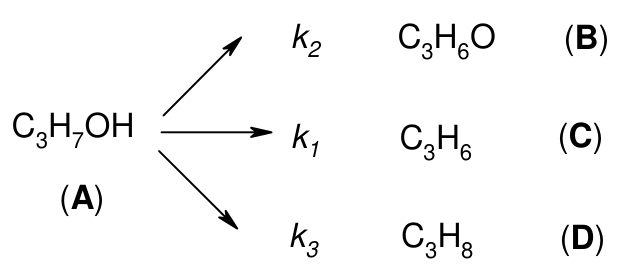
Five seconds after initiation of the reaction at 590 K, the concentrations of the components in the reaction mixture are:
\[ \begin{aligned} c_{\mathrm A}&=28.2\ \mathrm{mmol\,dm^{-3}}\\ c_{\mathrm B}&=7.8\ \mathrm{mmol\,dm^{-3}}\\ c_{\mathrm C}&=8.3\ \mathrm{mmol\,dm^{-3}}\\ c_{\mathrm D}&=1.8\ \mathrm{mmol\,dm^{-3}} \end{aligned} \]
6.1 What is the initial concentration \(c_0\) of \(\ce{C3H7OH}\) in the system?
6.2 What is the value of the rate constant \(k\) for the process:

6.3 What is the interval of time \((\tau_{1/2})\) in which the concentration of \(\ce{C3H7OH}\) will reach the value \(c=c_0/2\)?
6.4 What are the values of rate constants \(k_1\), \(k_2\), and \(k_3\)?
6.5 What are the values of concentrations \(c_{\mathrm B}\), \(c_{\mathrm C}\), \(c_{\mathrm D}\) at \(t=\tau_{1/2}\)?
The equation describing the concentration changes of A with time \(t\) for the first order reaction has the form:
\[ c_{\mathrm A}=c_0\exp(-kt) \]
or
\[ \log(c_0/c_{\mathrm A})=0.4343\,kt \]
or
\[ \ln(c_0/c_{\mathrm A})=kt \]
Fill in the table with the answers obtained.
| 1 | \(c_0=\) |
| 2 | \(k=\) |
| 3 | \(\tau_{1/2}\) |
| 4 | \(k_1=\) |
| \(k_2=\) | |
| \(k_3=\) | |
| 5 | \(c_{\mathrm B}=\) |
| \(c_{\mathrm C}=\) | |
| \(c_{\mathrm D}=\) |
Official English text of the problem.
Answers
- 6.1: \(c_0=\boxed{46.1\ \mathrm{mmol\,dm^{-3}}}\).
- 6.2: \(k=\boxed{9.83\times10^{-2}\ \mathrm{s^{-1}}}\).
- 6.3: \(\tau_{1/2}=\boxed{7.05\ \mathrm{s}}\), measured from initiation.
- 6.4: \(\boxed{k_1=4.56\times10^{-2}\ \mathrm{s^{-1}}}\), \(\boxed{k_2=4.28\times10^{-2}\ \mathrm{s^{-1}}}\), \(\boxed{k_3=9.88\times10^{-3}\ \mathrm{s^{-1}}}\).
- 6.5: At \(t=\tau_{1/2}\), \(\boxed{c_{\mathrm B}=10.0\ \mathrm{mmol\,dm^{-3}}}\), \(\boxed{c_{\mathrm C}=10.7\ \mathrm{mmol\,dm^{-3}}}\), and \(\boxed{c_{\mathrm D}=2.32\ \mathrm{mmol\,dm^{-3}}}\).
Solution
6.1 — Initial concentration
The substrate \(A\) is isopropanol (propan-2-ol), CC(O)C. Dehydrogenation of this secondary alcohol gives the ketone \(B\), acetone (propan-2-one), CC(=O)C; dehydration gives the alkene \(C\), propene, C=CC. The saturated product \(D\), \(\ce{C3H8}\), is propane, CCC.
The stated kinetic scheme consists of three parallel, irreversible pathways. Initially the products are absent. Each molecule of \(A\) consumed yields one molecule of \(B\), \(C\), or \(D\), retaining all three carbon atoms. Thus, at constant volume,
\[ c_0=c_{\mathrm A}+c_{\mathrm B}+c_{\mathrm C}+c_{\mathrm D}. \]
Using the concentrations at \(t=5\ \mathrm{s}\),
\[ c_0=(28.2+7.8+8.3+1.8)\ \mathrm{mmol\,dm^{-3}} =\boxed{46.1\ \mathrm{mmol\,dm^{-3}}}. \]
6.2 — Overall rate constant
The three pathways contribute additively to the disappearance of \(A\):
\[ -\frac{dc_{\mathrm A}}{dt} =(k_1+k_2+k_3)c_{\mathrm A} =kc_{\mathrm A}. \]
Therefore,
\[ k=k_1+k_2+k_3. \]
The integrated first-order equation gives
\[ k=\frac{1}{t}\ln\!\left(\frac{c_0}{c_{\mathrm A}}\right). \]
Hence, at \(590\ \mathrm K\),
\[ k=\frac{1}{5\ \mathrm{s}} \ln\!\left(\frac{46.1}{28.2}\right) =0.0982982\ \mathrm{s^{-1}} \approx\boxed{9.83\times10^{-2}\ \mathrm{s^{-1}}}. \]
6.3 — Half-life
At the half-life, \(c_{\mathrm A}=c_0/2\), so
\[ \frac{c_0}{2}=c_0e^{-k\tau_{1/2}}. \]
Consequently,
\[ \tau_{1/2}=\frac{\ln 2}{k} =\frac{0.693147}{0.0982982\ \mathrm{s^{-1}}} =\boxed{7.05\ \mathrm{s}}. \]
This is the elapsed time from the start of the reaction.
6.4 — Individual rate constants
The diagram assigns \(k_2\) to \(B\), \(k_1\) to \(C\), and \(k_3\) to \(D\). Their formation rates are therefore
\[ \frac{dc_{\mathrm B}}{dt}=k_2c_{\mathrm A}, \qquad \frac{dc_{\mathrm C}}{dt}=k_1c_{\mathrm A}, \qquad \frac{dc_{\mathrm D}}{dt}=k_3c_{\mathrm A}. \]
For example, integrating the first equation with \(c_{\mathrm B}(0)=0\) gives
\[ c_{\mathrm B}(t) =k_2\int_0^t c_0e^{-kt'}\,dt' =\frac{k_2}{k}c_0(1-e^{-kt}) =\frac{k_2}{k}(c_0-c_{\mathrm A}). \]
Similarly,
\[ c_{\mathrm C}=\frac{k_1}{k}(c_0-c_{\mathrm A}), \qquad c_{\mathrm D}=\frac{k_3}{k}(c_0-c_{\mathrm A}). \]
The concentration of \(A\) consumed after five seconds is
\[ c_0-c_{\mathrm A}=46.1-28.2 =17.9\ \mathrm{mmol\,dm^{-3}}. \]
Thus,
\[ \begin{aligned} k_1 &=k\frac{c_{\mathrm C}}{c_0-c_{\mathrm A}} =(0.0982982)\frac{8.3}{17.9}\ \mathrm{s^{-1}} \approx\boxed{4.56\times10^{-2}\ \mathrm{s^{-1}}},\\[4pt] k_2 &=k\frac{c_{\mathrm B}}{c_0-c_{\mathrm A}} =(0.0982982)\frac{7.8}{17.9}\ \mathrm{s^{-1}} \approx\boxed{4.28\times10^{-2}\ \mathrm{s^{-1}}},\\[4pt] k_3 &=k\frac{c_{\mathrm D}}{c_0-c_{\mathrm A}} =(0.0982982)\frac{1.8}{17.9}\ \mathrm{s^{-1}} \approx\boxed{9.88\times10^{-3}\ \mathrm{s^{-1}}}. \end{aligned} \]
The unrounded values satisfy \(k_1+k_2+k_3=k\).
6.5 — Product concentrations at the half-life
At \(t=\tau_{1/2}\), the concentration of \(A\) consumed is
\[ c_0-c_{\mathrm A}=\frac{c_0}{2} =23.05\ \mathrm{mmol\,dm^{-3}}. \]
Because all three products form directly from the same reactant by first-order pathways, their proportions remain constant:
\[ c_{\mathrm B}:c_{\mathrm C}:c_{\mathrm D} =k_2:k_1:k_3 =7.8:8.3:1.8. \]
Therefore,
\[ \begin{aligned} c_{\mathrm B}(\tau_{1/2}) &=\frac{7.8}{17.9}(23.05) =10.0441\ \mathrm{mmol\,dm^{-3}} \approx\boxed{10.0\ \mathrm{mmol\,dm^{-3}}},\\[4pt] c_{\mathrm C}(\tau_{1/2}) &=\frac{8.3}{17.9}(23.05) =10.6880\ \mathrm{mmol\,dm^{-3}} \approx\boxed{10.7\ \mathrm{mmol\,dm^{-3}}},\\[4pt] c_{\mathrm D}(\tau_{1/2}) &=\frac{1.8}{17.9}(23.05) =2.31788\ \mathrm{mmol\,dm^{-3}} \approx\boxed{2.32\ \mathrm{mmol\,dm^{-3}}}. \end{aligned} \]
The unrounded product concentrations sum to \(23.05\ \mathrm{mmol\,dm^{-3}}=c_0/2\), as required.
The solution was checked against the official solution. Where this solution differs from the official solution, the official solution contains an error or a misprint.
IChO 1981 · Theorieaufgabe 6
Kinetik der katalytischen Zersetzung von Isopropanol an V2O5
Die katalytische Zersetzung von Isopropanol an der Oberfläche eines \(\ce{V2O5}\)-Katalysators, bei der die im Schema dargestellten Produkte entstehen, folgt einem Geschwindigkeitsgesetz erster Ordnung.
Fünf Sekunden nach Beginn der Reaktion bei 590 K betragen die Konzentrationen der Komponenten im Reaktionsgemisch:
\[ \begin{aligned} c_{\mathrm A}&=28.2\ \mathrm{mmol\,dm^{-3}}\\ c_{\mathrm B}&=7.8\ \mathrm{mmol\,dm^{-3}}\\ c_{\mathrm C}&=8.3\ \mathrm{mmol\,dm^{-3}}\\ c_{\mathrm D}&=1.8\ \mathrm{mmol\,dm^{-3}} \end{aligned} \]
6.1 Wie groß ist die Anfangskonzentration \(c_0\) von \(\ce{C3H7OH}\) im System?
6.2 Welchen Wert hat die Geschwindigkeitskonstante \(k\) für den folgenden Vorgang:
6.3 Wie groß ist die Zeitspanne \((\tau_{1/2})\), innerhalb derer die Konzentration von \(\ce{C3H7OH}\) den Wert \(c=c_0/2\) erreicht?
6.4 Welche Werte haben die Geschwindigkeitskonstanten \(k_1\), \(k_2\) und \(k_3\)?
6.5 Welche Werte haben die Konzentrationen \(c_{\mathrm B}\), \(c_{\mathrm C}\), \(c_{\mathrm D}\) bei \(t=\tau_{1/2}\)?
Die Gleichung, die die Änderung der Konzentration von A mit der Zeit \(t\) für die Reaktion erster Ordnung beschreibt, hat die Form:
\[ c_{\mathrm A}=c_0\exp(-kt) \]
oder
\[ \log(c_0/c_{\mathrm A})=0.4343\,kt \]
oder
\[ \ln(c_0/c_{\mathrm A})=kt \]
Tragen Sie die erhaltenen Antworten in die Tabelle ein.
| 1 | \(c_0=\) |
| 2 | \(k=\) |
| 3 | \(\tau_{1/2}\) |
| 4 | \(k_1=\) |
| \(k_2=\) | |
| \(k_3=\) | |
| 5 | \(c_{\mathrm B}=\) |
| \(c_{\mathrm C}=\) | |
| \(c_{\mathrm D}=\) |
Aufgabentext aus dem offiziellen englischen Text übersetzt.
Antworten
- 6.1: \(c_0=\boxed{46.1\ \mathrm{mmol\,dm^{-3}}}\).
- 6.2: \(k=\boxed{9.83\times10^{-2}\ \mathrm{s^{-1}}}\).
- 6.3: \(\tau_{1/2}=\boxed{7.05\ \mathrm{s}}\), gemessen ab Reaktionsbeginn.
- 6.4: \(\boxed{k_1=4.56\times10^{-2}\ \mathrm{s^{-1}}}\), \(\boxed{k_2=4.28\times10^{-2}\ \mathrm{s^{-1}}}\), \(\boxed{k_3=9.88\times10^{-3}\ \mathrm{s^{-1}}}\).
- 6.5: Bei \(t=\tau_{1/2}\) gilt \(\boxed{c_{\mathrm B}=10.0\ \mathrm{mmol\,dm^{-3}}}\), \(\boxed{c_{\mathrm C}=10.7\ \mathrm{mmol\,dm^{-3}}}\) und \(\boxed{c_{\mathrm D}=2.32\ \mathrm{mmol\,dm^{-3}}}\).
Lösung
6.1 — Anfangskonzentration
Das Substrat \(A\) ist Isopropanol (Propan-2-ol), CC(O)C. Durch Dehydrierung dieses sekundären Alkohols entsteht das Keton \(B\), Aceton (Propan-2-on), CC(=O)C; durch Dehydratisierung entsteht das Alken \(C\), Propen, C=CC. Das gesättigte Produkt \(D\), \(\ce{C3H8}\), ist Propan, CCC.
Das angegebene kinetische Schema besteht aus drei parallelen, irreversiblen Reaktionswegen. Zu Beginn sind keine Produkte vorhanden. Jedes verbrauchte Molekül \(A\) liefert ein Molekül \(B\), \(C\) oder \(D\), wobei alle drei Kohlenstoffatome erhalten bleiben. Bei konstantem Volumen gilt somit
\[ c_0=c_{\mathrm A}+c_{\mathrm B}+c_{\mathrm C}+c_{\mathrm D}. \]
Mit den Konzentrationen bei \(t=5\ \mathrm{s}\) ergibt sich
\[ c_0=(28.2+7.8+8.3+1.8)\ \mathrm{mmol\,dm^{-3}} =\boxed{46.1\ \mathrm{mmol\,dm^{-3}}}. \]
6.2 — Gesamtgeschwindigkeitskonstante
Die drei Reaktionswege tragen additiv zum Verbrauch von \(A\) bei:
\[ -\frac{dc_{\mathrm A}}{dt} =(k_1+k_2+k_3)c_{\mathrm A} =kc_{\mathrm A}. \]
Daher gilt
\[ k=k_1+k_2+k_3. \]
Das integrierte Geschwindigkeitsgesetz erster Ordnung liefert
\[ k=\frac{1}{t}\ln\!\left(\frac{c_0}{c_{\mathrm A}}\right). \]
Somit ergibt sich bei \(590\ \mathrm K\)
\[ k=\frac{1}{5\ \mathrm{s}} \ln\!\left(\frac{46.1}{28.2}\right) =0.0982982\ \mathrm{s^{-1}} \approx\boxed{9.83\times10^{-2}\ \mathrm{s^{-1}}}. \]
6.3 — Halbwertszeit
Nach Ablauf der Halbwertszeit gilt \(c_{\mathrm A}=c_0/2\), also
\[ \frac{c_0}{2}=c_0e^{-k\tau_{1/2}}. \]
Folglich gilt
\[ \tau_{1/2}=\frac{\ln 2}{k} =\frac{0.693147}{0.0982982\ \mathrm{s^{-1}}} =\boxed{7.05\ \mathrm{s}}. \]
Dies ist die seit Beginn der Reaktion verstrichene Zeit.
6.4 — Einzelne Geschwindigkeitskonstanten
Das Schema ordnet \(k_2\) dem Produkt \(B\), \(k_1\) dem Produkt \(C\) und \(k_3\) dem Produkt \(D\) zu. Ihre Bildungsgeschwindigkeiten sind daher
\[ \frac{dc_{\mathrm B}}{dt}=k_2c_{\mathrm A}, \qquad \frac{dc_{\mathrm C}}{dt}=k_1c_{\mathrm A}, \qquad \frac{dc_{\mathrm D}}{dt}=k_3c_{\mathrm A}. \]
Beispielsweise ergibt die Integration der ersten Gleichung mit \(c_{\mathrm B}(0)=0\)
\[ c_{\mathrm B}(t) =k_2\int_0^t c_0e^{-kt'}\,dt' =\frac{k_2}{k}c_0(1-e^{-kt}) =\frac{k_2}{k}(c_0-c_{\mathrm A}). \]
Analog gilt
\[ c_{\mathrm C}=\frac{k_1}{k}(c_0-c_{\mathrm A}), \qquad c_{\mathrm D}=\frac{k_3}{k}(c_0-c_{\mathrm A}). \]
Die Konzentration des nach fünf Sekunden verbrauchten \(A\) beträgt
\[ c_0-c_{\mathrm A}=46.1-28.2 =17.9\ \mathrm{mmol\,dm^{-3}}. \]
Somit gilt
\[ \begin{aligned} k_1 &=k\frac{c_{\mathrm C}}{c_0-c_{\mathrm A}} =(0.0982982)\frac{8.3}{17.9}\ \mathrm{s^{-1}} \approx\boxed{4.56\times10^{-2}\ \mathrm{s^{-1}}},\\[4pt] k_2 &=k\frac{c_{\mathrm B}}{c_0-c_{\mathrm A}} =(0.0982982)\frac{7.8}{17.9}\ \mathrm{s^{-1}} \approx\boxed{4.28\times10^{-2}\ \mathrm{s^{-1}}},\\[4pt] k_3 &=k\frac{c_{\mathrm D}}{c_0-c_{\mathrm A}} =(0.0982982)\frac{1.8}{17.9}\ \mathrm{s^{-1}} \approx\boxed{9.88\times10^{-3}\ \mathrm{s^{-1}}}. \end{aligned} \]
Die ungerundeten Werte erfüllen \(k_1+k_2+k_3=k\).
6.5 — Produktkonzentrationen nach Ablauf der Halbwertszeit
Bei \(t=\tau_{1/2}\) beträgt die Konzentration des verbrauchten \(A\)
\[ c_0-c_{\mathrm A}=\frac{c_0}{2} =23.05\ \mathrm{mmol\,dm^{-3}}. \]
Da alle drei Produkte direkt aus demselben Edukt über Reaktionswege erster Ordnung entstehen, bleiben ihre Mengenverhältnisse konstant:
\[ c_{\mathrm B}:c_{\mathrm C}:c_{\mathrm D} =k_2:k_1:k_3 =7.8:8.3:1.8. \]
Daher gilt
\[ \begin{aligned} c_{\mathrm B}(\tau_{1/2}) &=\frac{7.8}{17.9}(23.05) =10.0441\ \mathrm{mmol\,dm^{-3}} \approx\boxed{10.0\ \mathrm{mmol\,dm^{-3}}},\\[4pt] c_{\mathrm C}(\tau_{1/2}) &=\frac{8.3}{17.9}(23.05) =10.6880\ \mathrm{mmol\,dm^{-3}} \approx\boxed{10.7\ \mathrm{mmol\,dm^{-3}}},\\[4pt] c_{\mathrm D}(\tau_{1/2}) &=\frac{1.8}{17.9}(23.05) =2.31788\ \mathrm{mmol\,dm^{-3}} \approx\boxed{2.32\ \mathrm{mmol\,dm^{-3}}}. \end{aligned} \]
Die Summe der ungerundeten Produktkonzentrationen beträgt wie gefordert \(23.05\ \mathrm{mmol\,dm^{-3}}=c_0/2\).
Die Lösung wurde mit der offiziellen Lösung abgeglichen. Wo diese Lösung von der offiziellen Lösung abweicht, enthält die offizielle Lösung einen Fehler oder Druckfehler.
IChO 1981 · Teori sorusu 6
İzopropanolün V2O5 üzerinde katalitik bozunmasının kinetiği
İzopropanolün bir \(\ce{V2O5}\) katalizörünün yüzeyinde, şemada gösterilen ürünleri oluşturarak katalitik bozunması, birinci dereceden bir kinetik denkleme uyar.
Tepkimenin 590 K'de başlatılmasından beş saniye sonra, tepkime karışımındaki bileşenlerin derişimleri şöyledir:
\[ \begin{aligned} c_{\mathrm A}&=28.2\ \mathrm{mmol\,dm^{-3}}\\ c_{\mathrm B}&=7.8\ \mathrm{mmol\,dm^{-3}}\\ c_{\mathrm C}&=8.3\ \mathrm{mmol\,dm^{-3}}\\ c_{\mathrm D}&=1.8\ \mathrm{mmol\,dm^{-3}} \end{aligned} \]
6.1 Sistemdeki \(\ce{C3H7OH}\)'ın başlangıç derişimi \(c_0\) nedir?
6.2 Aşağıdaki süreç için hız sabiti \(k\)'nın değeri nedir?
6.3 \(\ce{C3H7OH}\)'ın derişiminin \(c=c_0/2\) değerine ulaşması için gereken süre \((\tau_{1/2})\) nedir?
6.4 \(k_1\), \(k_2\) ve \(k_3\) hız sabitlerinin değerleri nedir?
6.5 \(t=\tau_{1/2}\) anında \(c_{\mathrm B}\), \(c_{\mathrm C}\), \(c_{\mathrm D}\) derişimlerinin değerleri nedir?
Birinci dereceden tepkime için A'nın derişiminin \(t\) zamanıyla değişimini tanımlayan denklem şu biçimdedir:
\[ c_{\mathrm A}=c_0\exp(-kt) \]
veya
\[ \log(c_0/c_{\mathrm A})=0.4343\,kt \]
veya
\[ \ln(c_0/c_{\mathrm A})=kt \]
Tabloyu elde ettiğiniz cevaplarla doldurunuz.
| 1 | \(c_0=\) |
| 2 | \(k=\) |
| 3 | \(\tau_{1/2}\) |
| 4 | \(k_1=\) |
| \(k_2=\) | |
| \(k_3=\) | |
| 5 | \(c_{\mathrm B}=\) |
| \(c_{\mathrm C}=\) | |
| \(c_{\mathrm D}=\) |
Soru metni resmi İngilizce metinden çevrilmiştir.
Cevaplar
- 6.1: \(c_0=\boxed{46.1\ \mathrm{mmol\,dm^{-3}}}\).
- 6.2: \(k=\boxed{9.83\times10^{-2}\ \mathrm{s^{-1}}}\).
- 6.3: Başlangıçtan itibaren ölçülen süre \(\tau_{1/2}=\boxed{7.05\ \mathrm{s}}\).
- 6.4: \(\boxed{k_1=4.56\times10^{-2}\ \mathrm{s^{-1}}}\), \(\boxed{k_2=4.28\times10^{-2}\ \mathrm{s^{-1}}}\), \(\boxed{k_3=9.88\times10^{-3}\ \mathrm{s^{-1}}}\).
- 6.5: \(t=\tau_{1/2}\) anında \(\boxed{c_{\mathrm B}=10.0\ \mathrm{mmol\,dm^{-3}}}\), \(\boxed{c_{\mathrm C}=10.7\ \mathrm{mmol\,dm^{-3}}}\) ve \(\boxed{c_{\mathrm D}=2.32\ \mathrm{mmol\,dm^{-3}}}\).
Çözüm
6.1 — Başlangıç derişimi
Substrat \(A\), izopropanoldür (propan-2-ol), CC(O)C. Bu sekonder alkolün dehidrojenasyonu sonucunda keton \(B\), aseton (propan-2-on), CC(=O)C; dehidrasyonu sonucunda ise alken \(C\), propen, C=CC oluşur. Doymuş ürün \(D\), \(\ce{C3H8}\), propandır, CCC.
Verilen kinetik şema, üç paralel, tersinmez tepkime yolundan oluşur. Başlangıçta ürünler bulunmaz. Tüketilen her bir \(A\) molekülü, üç karbon atomunun tamamını koruyarak bir \(B\), \(C\) veya \(D\) molekülü oluşturur. Dolayısıyla, sabit hacimde,
\[ c_0=c_{\mathrm A}+c_{\mathrm B}+c_{\mathrm C}+c_{\mathrm D}. \]
\(t=5\ \mathrm{s}\) anındaki derişimler kullanıldığında,
\[ c_0=(28.2+7.8+8.3+1.8)\ \mathrm{mmol\,dm^{-3}} =\boxed{46.1\ \mathrm{mmol\,dm^{-3}}}. \]
6.2 — Toplam hız sabiti
Üç tepkime yolunun \(A\)'nın tükenmesine katkıları toplanır:
\[ -\frac{dc_{\mathrm A}}{dt} =(k_1+k_2+k_3)c_{\mathrm A} =kc_{\mathrm A}. \]
Dolayısıyla,
\[ k=k_1+k_2+k_3. \]
İntegrali alınmış birinci dereceden hız denklemi şu sonucu verir:
\[ k=\frac{1}{t}\ln\!\left(\frac{c_0}{c_{\mathrm A}}\right). \]
Böylece, \(590\ \mathrm K\)'de,
\[ k=\frac{1}{5\ \mathrm{s}} \ln\!\left(\frac{46.1}{28.2}\right) =0.0982982\ \mathrm{s^{-1}} \approx\boxed{9.83\times10^{-2}\ \mathrm{s^{-1}}}. \]
6.3 — Yarı ömür
Yarı ömür sonunda \(c_{\mathrm A}=c_0/2\) olduğundan,
\[ \frac{c_0}{2}=c_0e^{-k\tau_{1/2}}. \]
Bunun sonucunda,
\[ \tau_{1/2}=\frac{\ln 2}{k} =\frac{0.693147}{0.0982982\ \mathrm{s^{-1}}} =\boxed{7.05\ \mathrm{s}}. \]
Bu, tepkimenin başlangıcından itibaren geçen süredir.
6.4 — Her bir tepkime yolunun hız sabiti
Şemada \(B\) için \(k_2\), \(C\) için \(k_1\) ve \(D\) için \(k_3\) verilmiştir. Dolayısıyla oluşum hızları şöyledir:
\[ \frac{dc_{\mathrm B}}{dt}=k_2c_{\mathrm A}, \qquad \frac{dc_{\mathrm C}}{dt}=k_1c_{\mathrm A}, \qquad \frac{dc_{\mathrm D}}{dt}=k_3c_{\mathrm A}. \]
Örneğin, ilk denklemin \(c_{\mathrm B}(0)=0\) koşuluyla integrali alındığında,
\[ c_{\mathrm B}(t) =k_2\int_0^t c_0e^{-kt'}\,dt' =\frac{k_2}{k}c_0(1-e^{-kt}) =\frac{k_2}{k}(c_0-c_{\mathrm A}). \]
Benzer şekilde,
\[ c_{\mathrm C}=\frac{k_1}{k}(c_0-c_{\mathrm A}), \qquad c_{\mathrm D}=\frac{k_3}{k}(c_0-c_{\mathrm A}). \]
Beş saniye sonunda tüketilen \(A\)'nın derişimi şöyledir:
\[ c_0-c_{\mathrm A}=46.1-28.2 =17.9\ \mathrm{mmol\,dm^{-3}}. \]
Böylece,
\[ \begin{aligned} k_1 &=k\frac{c_{\mathrm C}}{c_0-c_{\mathrm A}} =(0.0982982)\frac{8.3}{17.9}\ \mathrm{s^{-1}} \approx\boxed{4.56\times10^{-2}\ \mathrm{s^{-1}}},\\[4pt] k_2 &=k\frac{c_{\mathrm B}}{c_0-c_{\mathrm A}} =(0.0982982)\frac{7.8}{17.9}\ \mathrm{s^{-1}} \approx\boxed{4.28\times10^{-2}\ \mathrm{s^{-1}}},\\[4pt] k_3 &=k\frac{c_{\mathrm D}}{c_0-c_{\mathrm A}} =(0.0982982)\frac{1.8}{17.9}\ \mathrm{s^{-1}} \approx\boxed{9.88\times10^{-3}\ \mathrm{s^{-1}}}. \end{aligned} \]
Yuvarlanmamış değerler \(k_1+k_2+k_3=k\) eşitliğini sağlar.
6.5 — Yarı ömür sonundaki ürün derişimleri
\(t=\tau_{1/2}\) anında tüketilen \(A\)'nın derişimi şöyledir:
\[ c_0-c_{\mathrm A}=\frac{c_0}{2} =23.05\ \mathrm{mmol\,dm^{-3}}. \]
Üç ürünün tamamı aynı reaktandan birinci dereceden tepkime yollarıyla doğrudan oluştuğu için oranları sabit kalır:
\[ c_{\mathrm B}:c_{\mathrm C}:c_{\mathrm D} =k_2:k_1:k_3 =7.8:8.3:1.8. \]
Dolayısıyla,
\[ \begin{aligned} c_{\mathrm B}(\tau_{1/2}) &=\frac{7.8}{17.9}(23.05) =10.0441\ \mathrm{mmol\,dm^{-3}} \approx\boxed{10.0\ \mathrm{mmol\,dm^{-3}}},\\[4pt] c_{\mathrm C}(\tau_{1/2}) &=\frac{8.3}{17.9}(23.05) =10.6880\ \mathrm{mmol\,dm^{-3}} \approx\boxed{10.7\ \mathrm{mmol\,dm^{-3}}},\\[4pt] c_{\mathrm D}(\tau_{1/2}) &=\frac{1.8}{17.9}(23.05) =2.31788\ \mathrm{mmol\,dm^{-3}} \approx\boxed{2.32\ \mathrm{mmol\,dm^{-3}}}. \end{aligned} \]
Yuvarlanmamış ürün derişimlerinin toplamı, beklendiği gibi \(23.05\ \mathrm{mmol\,dm^{-3}}=c_0/2\) olur.
Çözüm, resmi çözümle karşılaştırılarak kontrol edildi. Bu çözümün resmi çözümden ayrıldığı yerlerde resmi çözümde bir hata ya da baskı hatası vardır.
IChO 1981 · Problema teórico 6
Cinética de la descomposición catalítica del isopropanol sobre V2O5
La descomposición catalítica del isopropanol sobre la superficie de un catalizador de \(\ce{V2O5}\), que da lugar a los productos del esquema, obedece a una ecuación cinética de primer orden.
Cinco segundos después del inicio de la reacción a 590 K, las concentraciones de los componentes de la mezcla de reacción son:
\[ \begin{aligned} c_{\mathrm A}&=28.2\ \mathrm{mmol\,dm^{-3}}\\ c_{\mathrm B}&=7.8\ \mathrm{mmol\,dm^{-3}}\\ c_{\mathrm C}&=8.3\ \mathrm{mmol\,dm^{-3}}\\ c_{\mathrm D}&=1.8\ \mathrm{mmol\,dm^{-3}} \end{aligned} \]
6.1 ¿Cuál es la concentración inicial \(c_0\) de \(\ce{C3H7OH}\) en el sistema?
6.2 ¿Cuál es el valor de la constante de velocidad \(k\) para el proceso:
6.3 ¿Cuál es el intervalo de tiempo \((\tau_{1/2})\) en el que la concentración de \(\ce{C3H7OH}\) alcanzará el valor \(c=c_0/2\)?
6.4 ¿Cuáles son los valores de las constantes de velocidad \(k_1\), \(k_2\) y \(k_3\)?
6.5 ¿Cuáles son los valores de las concentraciones \(c_{\mathrm B}\), \(c_{\mathrm C}\), \(c_{\mathrm D}\) en \(t=\tau_{1/2}\)?
La ecuación que describe la variación de la concentración de A con el tiempo \(t\) para la reacción de primer orden tiene la forma:
\[ c_{\mathrm A}=c_0\exp(-kt) \]
o
\[ \log(c_0/c_{\mathrm A})=0.4343\,kt \]
o
\[ \ln(c_0/c_{\mathrm A})=kt \]
Complete la tabla con las respuestas obtenidas.
| 1 | \(c_0=\) |
| 2 | \(k=\) |
| 3 | \(\tau_{1/2}\) |
| 4 | \(k_1=\) |
| \(k_2=\) | |
| \(k_3=\) | |
| 5 | \(c_{\mathrm B}=\) |
| \(c_{\mathrm C}=\) | |
| \(c_{\mathrm D}=\) |
Enunciado traducido del texto oficial en inglés.
Respuestas
- 6.1: \(c_0=\boxed{46.1\ \mathrm{mmol\,dm^{-3}}}\).
- 6.2: \(k=\boxed{9.83\times10^{-2}\ \mathrm{s^{-1}}}\).
- 6.3: \(\tau_{1/2}=\boxed{7.05\ \mathrm{s}}\), medido desde el inicio.
- 6.4: \(\boxed{k_1=4.56\times10^{-2}\ \mathrm{s^{-1}}}\), \(\boxed{k_2=4.28\times10^{-2}\ \mathrm{s^{-1}}}\), \(\boxed{k_3=9.88\times10^{-3}\ \mathrm{s^{-1}}}\).
- 6.5: En \(t=\tau_{1/2}\), \(\boxed{c_{\mathrm B}=10.0\ \mathrm{mmol\,dm^{-3}}}\), \(\boxed{c_{\mathrm C}=10.7\ \mathrm{mmol\,dm^{-3}}}\) y \(\boxed{c_{\mathrm D}=2.32\ \mathrm{mmol\,dm^{-3}}}\).
Solución
6.1 — Concentración inicial
El sustrato \(A\) es el isopropanol (propan-2-ol), CC(O)C. La deshidrogenación de este alcohol secundario da la cetona \(B\), acetona (propan-2-ona), CC(=O)C; la deshidratación da el alqueno \(C\), propeno, C=CC. El producto saturado \(D\), \(\ce{C3H8}\), es el propano, CCC.
El esquema cinético indicado consta de tres vías paralelas e irreversibles. Inicialmente no hay productos. Cada molécula de \(A\) consumida produce una molécula de \(B\), \(C\) o \(D\), conservando los tres átomos de carbono. Por tanto, a volumen constante,
\[ c_0=c_{\mathrm A}+c_{\mathrm B}+c_{\mathrm C}+c_{\mathrm D}. \]
Utilizando las concentraciones en \(t=5\ \mathrm{s}\),
\[ c_0=(28.2+7.8+8.3+1.8)\ \mathrm{mmol\,dm^{-3}} =\boxed{46.1\ \mathrm{mmol\,dm^{-3}}}. \]
6.2 — Constante de velocidad global
Las tres vías contribuyen de forma aditiva a la desaparición de \(A\):
\[ -\frac{dc_{\mathrm A}}{dt} =(k_1+k_2+k_3)c_{\mathrm A} =kc_{\mathrm A}. \]
Por tanto,
\[ k=k_1+k_2+k_3. \]
La ecuación integrada de primer orden da
\[ k=\frac{1}{t}\ln\!\left(\frac{c_0}{c_{\mathrm A}}\right). \]
Así, a \(590\ \mathrm K\),
\[ k=\frac{1}{5\ \mathrm{s}} \ln\!\left(\frac{46.1}{28.2}\right) =0.0982982\ \mathrm{s^{-1}} \approx\boxed{9.83\times10^{-2}\ \mathrm{s^{-1}}}. \]
6.3 — Tiempo de semirreacción
Al cumplirse el tiempo de semirreacción, \(c_{\mathrm A}=c_0/2\), por lo que
\[ \frac{c_0}{2}=c_0e^{-k\tau_{1/2}}. \]
En consecuencia,
\[ \tau_{1/2}=\frac{\ln 2}{k} =\frac{0.693147}{0.0982982\ \mathrm{s^{-1}}} =\boxed{7.05\ \mathrm{s}}. \]
Este es el tiempo transcurrido desde el inicio de la reacción.
6.4 — Constantes de velocidad individuales
El diagrama asigna \(k_2\) a \(B\), \(k_1\) a \(C\) y \(k_3\) a \(D\). Por tanto, sus velocidades de formación son
\[ \frac{dc_{\mathrm B}}{dt}=k_2c_{\mathrm A}, \qquad \frac{dc_{\mathrm C}}{dt}=k_1c_{\mathrm A}, \qquad \frac{dc_{\mathrm D}}{dt}=k_3c_{\mathrm A}. \]
Por ejemplo, al integrar la primera ecuación con \(c_{\mathrm B}(0)=0\) se obtiene
\[ c_{\mathrm B}(t) =k_2\int_0^t c_0e^{-kt'}\,dt' =\frac{k_2}{k}c_0(1-e^{-kt}) =\frac{k_2}{k}(c_0-c_{\mathrm A}). \]
Análogamente,
\[ c_{\mathrm C}=\frac{k_1}{k}(c_0-c_{\mathrm A}), \qquad c_{\mathrm D}=\frac{k_3}{k}(c_0-c_{\mathrm A}). \]
La concentración de \(A\) consumida al cabo de cinco segundos es
\[ c_0-c_{\mathrm A}=46.1-28.2 =17.9\ \mathrm{mmol\,dm^{-3}}. \]
Por tanto,
\[ \begin{aligned} k_1 &=k\frac{c_{\mathrm C}}{c_0-c_{\mathrm A}} =(0.0982982)\frac{8.3}{17.9}\ \mathrm{s^{-1}} \approx\boxed{4.56\times10^{-2}\ \mathrm{s^{-1}}},\\[4pt] k_2 &=k\frac{c_{\mathrm B}}{c_0-c_{\mathrm A}} =(0.0982982)\frac{7.8}{17.9}\ \mathrm{s^{-1}} \approx\boxed{4.28\times10^{-2}\ \mathrm{s^{-1}}},\\[4pt] k_3 &=k\frac{c_{\mathrm D}}{c_0-c_{\mathrm A}} =(0.0982982)\frac{1.8}{17.9}\ \mathrm{s^{-1}} \approx\boxed{9.88\times10^{-3}\ \mathrm{s^{-1}}}. \end{aligned} \]
Los valores sin redondear satisfacen \(k_1+k_2+k_3=k\).
6.5 — Concentraciones de los productos al cumplirse el tiempo de semirreacción
En \(t=\tau_{1/2}\), la concentración de \(A\) consumida es
\[ c_0-c_{\mathrm A}=\frac{c_0}{2} =23.05\ \mathrm{mmol\,dm^{-3}}. \]
Como los tres productos se forman directamente a partir del mismo reactivo por vías de primer orden, sus proporciones permanecen constantes:
\[ c_{\mathrm B}:c_{\mathrm C}:c_{\mathrm D} =k_2:k_1:k_3 =7.8:8.3:1.8. \]
Por tanto,
\[ \begin{aligned} c_{\mathrm B}(\tau_{1/2}) &=\frac{7.8}{17.9}(23.05) =10.0441\ \mathrm{mmol\,dm^{-3}} \approx\boxed{10.0\ \mathrm{mmol\,dm^{-3}}},\\[4pt] c_{\mathrm C}(\tau_{1/2}) &=\frac{8.3}{17.9}(23.05) =10.6880\ \mathrm{mmol\,dm^{-3}} \approx\boxed{10.7\ \mathrm{mmol\,dm^{-3}}},\\[4pt] c_{\mathrm D}(\tau_{1/2}) &=\frac{1.8}{17.9}(23.05) =2.31788\ \mathrm{mmol\,dm^{-3}} \approx\boxed{2.32\ \mathrm{mmol\,dm^{-3}}}. \end{aligned} \]
Las concentraciones de los productos sin redondear suman \(23.05\ \mathrm{mmol\,dm^{-3}}=c_0/2\), como debe ser.
La solución se comprobó con la solución oficial. Donde esta solución difiere de la solución oficial, la solución oficial contiene un error o una errata.
IChO 1981 · 理论题 6
异丙醇在 V2O5 上催化分解的动力学
异丙醇在 \(\ce{V2O5}\) 催化剂表面催化分解,生成反应示意图所示的产物,该反应遵循一级反应动力学方程。
在 590 K 下,反应开始五秒后,反应混合物中各组分的浓度为:
\[ \begin{aligned} c_{\mathrm A}&=28.2\ \mathrm{mmol\,dm^{-3}}\\ c_{\mathrm B}&=7.8\ \mathrm{mmol\,dm^{-3}}\\ c_{\mathrm C}&=8.3\ \mathrm{mmol\,dm^{-3}}\\ c_{\mathrm D}&=1.8\ \mathrm{mmol\,dm^{-3}} \end{aligned} \]
6.1 体系中 \(\ce{C3H7OH}\) 的初始浓度 \(c_0\) 是多少?
6.2 下列过程的速率常数 \(k\) 是多少?
6.3 \(\ce{C3H7OH}\) 的浓度达到 \(c=c_0/2\) 所需的时间 \((\tau_{1/2})\) 是多少?
6.4 速率常数 \(k_1\)、\(k_2\) 和 \(k_3\) 的值分别是多少?
6.5 在 \(t=\tau_{1/2}\) 时,浓度 \(c_{\mathrm B}\)、\(c_{\mathrm C}\)、\(c_{\mathrm D}\) 的值分别是多少?
对于一级反应,描述 A 的浓度随时间 \(t\) 变化的方程形式如下:
\[ c_{\mathrm A}=c_0\exp(-kt) \]
或
\[ \log(c_0/c_{\mathrm A})=0.4343\,kt \]
或
\[ \ln(c_0/c_{\mathrm A})=kt \]
将所得答案填入表中。
| 1 | \(c_0=\) |
| 2 | \(k=\) |
| 3 | \(\tau_{1/2}\) |
| 4 | \(k_1=\) |
| \(k_2=\) | |
| \(k_3=\) | |
| 5 | \(c_{\mathrm B}=\) |
| \(c_{\mathrm C}=\) | |
| \(c_{\mathrm D}=\) |
题目译自官方英文原文。
答案
- 6.1: \(c_0=\boxed{46.1\ \mathrm{mmol\,dm^{-3}}}\)。
- 6.2: \(k=\boxed{9.83\times10^{-2}\ \mathrm{s^{-1}}}\)。
- 6.3: \(\tau_{1/2}=\boxed{7.05\ \mathrm{s}}\),从反应开始时计时。
- 6.4: \(\boxed{k_1=4.56\times10^{-2}\ \mathrm{s^{-1}}}\)、\(\boxed{k_2=4.28\times10^{-2}\ \mathrm{s^{-1}}}\)、\(\boxed{k_3=9.88\times10^{-3}\ \mathrm{s^{-1}}}\)。
- 6.5: 在 \(t=\tau_{1/2}\) 时,\(\boxed{c_{\mathrm B}=10.0\ \mathrm{mmol\,dm^{-3}}}\)、\(\boxed{c_{\mathrm C}=10.7\ \mathrm{mmol\,dm^{-3}}}\) 和 \(\boxed{c_{\mathrm D}=2.32\ \mathrm{mmol\,dm^{-3}}}\)。
解答
6.1 — 初始浓度
底物 \(A\) 是异丙醇(2-丙醇),CC(O)C。这种仲醇脱氢生成酮 \(B\),即丙酮(2-丙酮),CC(=O)C;脱水生成烯烃 \(C\),即丙烯,C=CC。饱和产物 \(D\),\(\ce{C3H8}\),是丙烷,CCC。
题给动力学反应示意图包含三条平行的不可逆反应途径。初始时不存在产物。每消耗一个 \(A\) 分子,就生成一个 \(B\)、\(C\) 或 \(D\) 分子,且保留全部三个碳原子。因此,在体积恒定时,
\[ c_0=c_{\mathrm A}+c_{\mathrm B}+c_{\mathrm C}+c_{\mathrm D}. \]
代入 \(t=5\ \mathrm{s}\) 时的浓度,
\[ c_0=(28.2+7.8+8.3+1.8)\ \mathrm{mmol\,dm^{-3}} =\boxed{46.1\ \mathrm{mmol\,dm^{-3}}}. \]
6.2 — 总速率常数
三条反应途径对 \(A\) 消耗速率的贡献相加:
\[ -\frac{dc_{\mathrm A}}{dt} =(k_1+k_2+k_3)c_{\mathrm A} =kc_{\mathrm A}. \]
因此,
\[ k=k_1+k_2+k_3. \]
由一级反应的积分速率方程可得
\[ k=\frac{1}{t}\ln\!\left(\frac{c_0}{c_{\mathrm A}}\right). \]
所以,在 \(590\ \mathrm K\) 下,
\[ k=\frac{1}{5\ \mathrm{s}} \ln\!\left(\frac{46.1}{28.2}\right) =0.0982982\ \mathrm{s^{-1}} \approx\boxed{9.83\times10^{-2}\ \mathrm{s^{-1}}}. \]
6.3 — 半衰期
经过一个半衰期时,\(c_{\mathrm A}=c_0/2\),因此
\[ \frac{c_0}{2}=c_0e^{-k\tau_{1/2}}. \]
由此可得,
\[ \tau_{1/2}=\frac{\ln 2}{k} =\frac{0.693147}{0.0982982\ \mathrm{s^{-1}}} =\boxed{7.05\ \mathrm{s}}. \]
这是从反应开始时起所经过的时间。
6.4 — 各反应途径的速率常数
图中,生成 \(B\) 的速率常数为 \(k_2\),生成 \(C\) 的速率常数为 \(k_1\),生成 \(D\) 的速率常数为 \(k_3\)。因此,它们的生成速率为
\[ \frac{dc_{\mathrm B}}{dt}=k_2c_{\mathrm A}, \qquad \frac{dc_{\mathrm C}}{dt}=k_1c_{\mathrm A}, \qquad \frac{dc_{\mathrm D}}{dt}=k_3c_{\mathrm A}. \]
例如,在初始条件 \(c_{\mathrm B}(0)=0\) 下对第一个方程积分,得到
\[ c_{\mathrm B}(t) =k_2\int_0^t c_0e^{-kt'}\,dt' =\frac{k_2}{k}c_0(1-e^{-kt}) =\frac{k_2}{k}(c_0-c_{\mathrm A}). \]
类似地,
\[ c_{\mathrm C}=\frac{k_1}{k}(c_0-c_{\mathrm A}), \qquad c_{\mathrm D}=\frac{k_3}{k}(c_0-c_{\mathrm A}). \]
五秒后,已消耗的 \(A\) 所对应的浓度为
\[ c_0-c_{\mathrm A}=46.1-28.2 =17.9\ \mathrm{mmol\,dm^{-3}}. \]
因此,
\[ \begin{aligned} k_1 &=k\frac{c_{\mathrm C}}{c_0-c_{\mathrm A}} =(0.0982982)\frac{8.3}{17.9}\ \mathrm{s^{-1}} \approx\boxed{4.56\times10^{-2}\ \mathrm{s^{-1}}},\\[4pt] k_2 &=k\frac{c_{\mathrm B}}{c_0-c_{\mathrm A}} =(0.0982982)\frac{7.8}{17.9}\ \mathrm{s^{-1}} \approx\boxed{4.28\times10^{-2}\ \mathrm{s^{-1}}},\\[4pt] k_3 &=k\frac{c_{\mathrm D}}{c_0-c_{\mathrm A}} =(0.0982982)\frac{1.8}{17.9}\ \mathrm{s^{-1}} \approx\boxed{9.88\times10^{-3}\ \mathrm{s^{-1}}}. \end{aligned} \]
未经舍入的数值满足 \(k_1+k_2+k_3=k\)。
6.5 — 半衰期时的产物浓度
在 \(t=\tau_{1/2}\) 时,已消耗的 \(A\) 所对应的浓度为
\[ c_0-c_{\mathrm A}=\frac{c_0}{2} =23.05\ \mathrm{mmol\,dm^{-3}}. \]
由于三种产物均通过一级反应途径由同一反应物直接生成,它们的比例保持不变:
\[ c_{\mathrm B}:c_{\mathrm C}:c_{\mathrm D} =k_2:k_1:k_3 =7.8:8.3:1.8. \]
因此,
\[ \begin{aligned} c_{\mathrm B}(\tau_{1/2}) &=\frac{7.8}{17.9}(23.05) =10.0441\ \mathrm{mmol\,dm^{-3}} \approx\boxed{10.0\ \mathrm{mmol\,dm^{-3}}},\\[4pt] c_{\mathrm C}(\tau_{1/2}) &=\frac{8.3}{17.9}(23.05) =10.6880\ \mathrm{mmol\,dm^{-3}} \approx\boxed{10.7\ \mathrm{mmol\,dm^{-3}}},\\[4pt] c_{\mathrm D}(\tau_{1/2}) &=\frac{1.8}{17.9}(23.05) =2.31788\ \mathrm{mmol\,dm^{-3}} \approx\boxed{2.32\ \mathrm{mmol\,dm^{-3}}}. \end{aligned} \]
未经舍入的产物浓度之和为 \(23.05\ \mathrm{mmol\,dm^{-3}}=c_0/2\),符合要求。
解答已与官方解答核对。本解答与官方解答不同之处,均为官方解答中的错误或印刷错误。
IChO 1981 · Теоретическая задача 6
Кинетика каталитического разложения изопропанола на V2O5
Каталитическое разложение изопропанола на поверхности катализатора \(\ce{V2O5}\), приводящее к образованию продуктов, указанных на схеме, подчиняется кинетическому уравнению первого порядка.
Через пять секунд после начала реакции при 590 K концентрации компонентов в реакционной смеси составляют:
\[ \begin{aligned} c_{\mathrm A}&=28.2\ \mathrm{mmol\,dm^{-3}}\\ c_{\mathrm B}&=7.8\ \mathrm{mmol\,dm^{-3}}\\ c_{\mathrm C}&=8.3\ \mathrm{mmol\,dm^{-3}}\\ c_{\mathrm D}&=1.8\ \mathrm{mmol\,dm^{-3}} \end{aligned} \]
6.1 Какова начальная концентрация \(c_0\) соединения \(\ce{C3H7OH}\) в системе?
6.2 Каково значение константы скорости \(k\) процесса:
6.3 За какой промежуток времени \((\tau_{1/2})\) концентрация \(\ce{C3H7OH}\) достигнет значения \(c=c_0/2\)?
6.4 Каковы значения констант скорости \(k_1\), \(k_2\) и \(k_3\)?
6.5 Каковы значения концентраций \(c_{\mathrm B}\), \(c_{\mathrm C}\), \(c_{\mathrm D}\) при \(t=\tau_{1/2}\)?
Уравнение, описывающее изменение концентрации A со временем \(t\) для реакции первого порядка, имеет вид:
\[ c_{\mathrm A}=c_0\exp(-kt) \]
или
\[ \log(c_0/c_{\mathrm A})=0.4343\,kt \]
или
\[ \ln(c_0/c_{\mathrm A})=kt \]
Заполните таблицу полученными ответами.
| 1 | \(c_0=\) |
| 2 | \(k=\) |
| 3 | \(\tau_{1/2}\) |
| 4 | \(k_1=\) |
| \(k_2=\) | |
| \(k_3=\) | |
| 5 | \(c_{\mathrm B}=\) |
| \(c_{\mathrm C}=\) | |
| \(c_{\mathrm D}=\) |
Условие переведено с официального английского текста.
Ответы
- 6.1: \(c_0=\boxed{46.1\ \mathrm{mmol\,dm^{-3}}}\).
- 6.2: \(k=\boxed{9.83\times10^{-2}\ \mathrm{s^{-1}}}\).
- 6.3: \(\tau_{1/2}=\boxed{7.05\ \mathrm{s}}\), считая от начала реакции.
- 6.4: \(\boxed{k_1=4.56\times10^{-2}\ \mathrm{s^{-1}}}\), \(\boxed{k_2=4.28\times10^{-2}\ \mathrm{s^{-1}}}\), \(\boxed{k_3=9.88\times10^{-3}\ \mathrm{s^{-1}}}\).
- 6.5: При \(t=\tau_{1/2}\) \(\boxed{c_{\mathrm B}=10.0\ \mathrm{mmol\,dm^{-3}}}\), \(\boxed{c_{\mathrm C}=10.7\ \mathrm{mmol\,dm^{-3}}}\) и \(\boxed{c_{\mathrm D}=2.32\ \mathrm{mmol\,dm^{-3}}}\).
Решение
6.1 — Начальная концентрация
Исходное вещество \(A\) — изопропанол (пропан-2-ол), CC(O)C. При дегидрировании этого вторичного спирта образуется кетон \(B\), ацетон (пропан-2-он), CC(=O)C; при дегидратации образуется алкен \(C\), пропен, C=CC. Насыщенный продукт \(D\), \(\ce{C3H8}\), — пропан, CCC.
Приведённая кинетическая схема включает три параллельных необратимых пути реакции. В начальный момент продукты отсутствуют. Из каждой израсходованной молекулы \(A\) образуется одна молекула \(B\), \(C\) или \(D\) с сохранением всех трёх атомов углерода. Следовательно, при постоянном объёме
\[ c_0=c_{\mathrm A}+c_{\mathrm B}+c_{\mathrm C}+c_{\mathrm D}. \]
Используя концентрации при \(t=5\ \mathrm{s}\), получаем
\[ c_0=(28.2+7.8+8.3+1.8)\ \mathrm{mmol\,dm^{-3}} =\boxed{46.1\ \mathrm{mmol\,dm^{-3}}}. \]
6.2 — Общая константа скорости
Вклады трёх путей реакции в скорость расходования \(A\) складываются:
\[ -\frac{dc_{\mathrm A}}{dt} =(k_1+k_2+k_3)c_{\mathrm A} =kc_{\mathrm A}. \]
Следовательно,
\[ k=k_1+k_2+k_3. \]
Интегральное кинетическое уравнение первого порядка даёт
\[ k=\frac{1}{t}\ln\!\left(\frac{c_0}{c_{\mathrm A}}\right). \]
Таким образом, при \(590\ \mathrm K\)
\[ k=\frac{1}{5\ \mathrm{s}} \ln\!\left(\frac{46.1}{28.2}\right) =0.0982982\ \mathrm{s^{-1}} \approx\boxed{9.83\times10^{-2}\ \mathrm{s^{-1}}}. \]
6.3 — Период полупревращения
По истечении периода полупревращения \(c_{\mathrm A}=c_0/2\), поэтому
\[ \frac{c_0}{2}=c_0e^{-k\tau_{1/2}}. \]
Следовательно,
\[ \tau_{1/2}=\frac{\ln 2}{k} =\frac{0.693147}{0.0982982\ \mathrm{s^{-1}}} =\boxed{7.05\ \mathrm{s}}. \]
Это время, прошедшее с начала реакции.
6.4 — Константы скорости отдельных реакций
На схеме константа \(k_2\) соответствует образованию \(B\), \(k_1\) — образованию \(C\), а \(k_3\) — образованию \(D\). Поэтому скорости их образования равны
\[ \frac{dc_{\mathrm B}}{dt}=k_2c_{\mathrm A}, \qquad \frac{dc_{\mathrm C}}{dt}=k_1c_{\mathrm A}, \qquad \frac{dc_{\mathrm D}}{dt}=k_3c_{\mathrm A}. \]
Например, интегрирование первого уравнения при условии \(c_{\mathrm B}(0)=0\) даёт
\[ c_{\mathrm B}(t) =k_2\int_0^t c_0e^{-kt'}\,dt' =\frac{k_2}{k}c_0(1-e^{-kt}) =\frac{k_2}{k}(c_0-c_{\mathrm A}). \]
Аналогично,
\[ c_{\mathrm C}=\frac{k_1}{k}(c_0-c_{\mathrm A}), \qquad c_{\mathrm D}=\frac{k_3}{k}(c_0-c_{\mathrm A}). \]
Уменьшение концентрации \(A\) за пять секунд составляет
\[ c_0-c_{\mathrm A}=46.1-28.2 =17.9\ \mathrm{mmol\,dm^{-3}}. \]
Таким образом,
\[ \begin{aligned} k_1 &=k\frac{c_{\mathrm C}}{c_0-c_{\mathrm A}} =(0.0982982)\frac{8.3}{17.9}\ \mathrm{s^{-1}} \approx\boxed{4.56\times10^{-2}\ \mathrm{s^{-1}}},\\[4pt] k_2 &=k\frac{c_{\mathrm B}}{c_0-c_{\mathrm A}} =(0.0982982)\frac{7.8}{17.9}\ \mathrm{s^{-1}} \approx\boxed{4.28\times10^{-2}\ \mathrm{s^{-1}}},\\[4pt] k_3 &=k\frac{c_{\mathrm D}}{c_0-c_{\mathrm A}} =(0.0982982)\frac{1.8}{17.9}\ \mathrm{s^{-1}} \approx\boxed{9.88\times10^{-3}\ \mathrm{s^{-1}}}. \end{aligned} \]
Неокруглённые значения удовлетворяют равенству \(k_1+k_2+k_3=k\).
6.5 — Концентрации продуктов по истечении периода полупревращения
При \(t=\tau_{1/2}\) уменьшение концентрации \(A\) составляет
\[ c_0-c_{\mathrm A}=\frac{c_0}{2} =23.05\ \mathrm{mmol\,dm^{-3}}. \]
Поскольку все три продукта образуются непосредственно из одного и того же реагента по реакциям первого порядка, соотношение их концентраций остаётся постоянным:
\[ c_{\mathrm B}:c_{\mathrm C}:c_{\mathrm D} =k_2:k_1:k_3 =7.8:8.3:1.8. \]
Следовательно,
\[ \begin{aligned} c_{\mathrm B}(\tau_{1/2}) &=\frac{7.8}{17.9}(23.05) =10.0441\ \mathrm{mmol\,dm^{-3}} \approx\boxed{10.0\ \mathrm{mmol\,dm^{-3}}},\\[4pt] c_{\mathrm C}(\tau_{1/2}) &=\frac{8.3}{17.9}(23.05) =10.6880\ \mathrm{mmol\,dm^{-3}} \approx\boxed{10.7\ \mathrm{mmol\,dm^{-3}}},\\[4pt] c_{\mathrm D}(\tau_{1/2}) &=\frac{1.8}{17.9}(23.05) =2.31788\ \mathrm{mmol\,dm^{-3}} \approx\boxed{2.32\ \mathrm{mmol\,dm^{-3}}}. \end{aligned} \]
Сумма неокруглённых концентраций продуктов равна \(23.05\ \mathrm{mmol\,dm^{-3}}=c_0/2\), как и должно быть.
Решение проверено по официальному решению. Там, где это решение расходится с официальным, в официальном решении есть ошибка или опечатка.
IChO 1981 · مسألة نظرية 6
حركية التحلل الحفزي للأيزوبروبانول على V2O5
يخضع التحلل الحفزي للأيزوبروبانول على سطح حفاز من \(\ce{V2O5}\)، الذي يؤدي إلى النواتج المبينة في المخطط، لمعادلة حركية من الرتبة الأولى.
بعد خمس ثوانٍ من بدء التفاعل عند 590 K، تكون تراكيز مكونات مزيج التفاعل كما يلي:
\[ \begin{aligned} c_{\mathrm A}&=28.2\ \mathrm{mmol\,dm^{-3}}\\ c_{\mathrm B}&=7.8\ \mathrm{mmol\,dm^{-3}}\\ c_{\mathrm C}&=8.3\ \mathrm{mmol\,dm^{-3}}\\ c_{\mathrm D}&=1.8\ \mathrm{mmol\,dm^{-3}} \end{aligned} \]
6.1 ما التركيز الابتدائي \(c_0\) للمركب \(\ce{C3H7OH}\) في النظام؟
6.2 ما قيمة ثابت السرعة \(k\) للعملية التالية:
6.3 ما الفترة الزمنية \((\tau_{1/2})\) التي يصل خلالها تركيز \(\ce{C3H7OH}\) إلى القيمة \(c=c_0/2\)؟
6.4 ما قيم ثوابت السرعة \(k_1\)، و\(k_2\)، و\(k_3\)؟
6.5 ما قيم التراكيز \(c_{\mathrm B}\)، و\(c_{\mathrm C}\)، و\(c_{\mathrm D}\) عند \(t=\tau_{1/2}\)؟
تأخذ المعادلة التي تصف تغير تركيز A مع الزمن \(t\) لتفاعل من الرتبة الأولى الشكل التالي:
\[ c_{\mathrm A}=c_0\exp(-kt) \]
أو
\[ \log(c_0/c_{\mathrm A})=0.4343\,kt \]
أو
\[ \ln(c_0/c_{\mathrm A})=kt \]
املأ الجدول بالإجابات التي حصلت عليها.
| 1 | \(c_0=\) |
| 2 | \(k=\) |
| 3 | \(\tau_{1/2}\) |
| 4 | \(k_1=\) |
| \(k_2=\) | |
| \(k_3=\) | |
| 5 | \(c_{\mathrm B}=\) |
| \(c_{\mathrm C}=\) | |
| \(c_{\mathrm D}=\) |
نص المسألة مترجم عن النص الإنجليزي الرسمي.
الإجابات
- 6.1: \(c_0=\boxed{46.1\ \mathrm{mmol\,dm^{-3}}}\).
- 6.2: \(k=\boxed{9.83\times10^{-2}\ \mathrm{s^{-1}}}\).
- 6.3: \(\tau_{1/2}=\boxed{7.05\ \mathrm{s}}\)، مقيسًا من بدء التفاعل.
- 6.4: \(\boxed{k_1=4.56\times10^{-2}\ \mathrm{s^{-1}}}\)، \(\boxed{k_2=4.28\times10^{-2}\ \mathrm{s^{-1}}}\)، \(\boxed{k_3=9.88\times10^{-3}\ \mathrm{s^{-1}}}\).
- 6.5: عند \(t=\tau_{1/2}\)، \(\boxed{c_{\mathrm B}=10.0\ \mathrm{mmol\,dm^{-3}}}\)، و\(\boxed{c_{\mathrm C}=10.7\ \mathrm{mmol\,dm^{-3}}}\)، و\(\boxed{c_{\mathrm D}=2.32\ \mathrm{mmol\,dm^{-3}}}\).
الحل
6.1 — التركيز الابتدائي
الركيزة \(A\) هي الأيزوبروبانول (بروبان-2-ول)، CC(O)C. يؤدي نزع الهيدروجين من هذا الكحول الثانوي إلى الكيتون \(B\)، الأسيتون (بروبان-2-ون)، CC(=O)C؛ ويؤدي نزع الماء إلى الألكين \(C\)، البروبين، C=CC. أما الناتج المشبع \(D\)، \(\ce{C3H8}\)، فهو البروبان، CCC.
يتكون المخطط الحركي المعطى من ثلاثة مسارات متوازية غير عكوسة. تكون النواتج غائبة في البداية. وينتج عن كل جزيء مستهلك من \(A\) جزيء واحد من \(B\) أو \(C\) أو \(D\)، مع الاحتفاظ بذرات الكربون الثلاث جميعها. ومن ثم، عند ثبوت الحجم،
\[ c_0=c_{\mathrm A}+c_{\mathrm B}+c_{\mathrm C}+c_{\mathrm D}. \]
باستخدام التراكيز عند \(t=5\ \mathrm{s}\)،
\[ c_0=(28.2+7.8+8.3+1.8)\ \mathrm{mmol\,dm^{-3}} =\boxed{46.1\ \mathrm{mmol\,dm^{-3}}}. \]
6.2 — ثابت السرعة الكلي
تتجمع مساهمات المسارات الثلاثة في اختفاء \(A\):
\[ -\frac{dc_{\mathrm A}}{dt} =(k_1+k_2+k_3)c_{\mathrm A} =kc_{\mathrm A}. \]
لذلك،
\[ k=k_1+k_2+k_3. \]
تعطي المعادلة المتكاملة للرتبة الأولى
\[ k=\frac{1}{t}\ln\!\left(\frac{c_0}{c_{\mathrm A}}\right). \]
وعليه، عند \(590\ \mathrm K\)،
\[ k=\frac{1}{5\ \mathrm{s}} \ln\!\left(\frac{46.1}{28.2}\right) =0.0982982\ \mathrm{s^{-1}} \approx\boxed{9.83\times10^{-2}\ \mathrm{s^{-1}}}. \]
6.3 — عمر النصف
عند عمر النصف، يكون \(c_{\mathrm A}=c_0/2\)، ومن ثم
\[ \frac{c_0}{2}=c_0e^{-k\tau_{1/2}}. \]
وبالتالي،
\[ \tau_{1/2}=\frac{\ln 2}{k} =\frac{0.693147}{0.0982982\ \mathrm{s^{-1}}} =\boxed{7.05\ \mathrm{s}}. \]
هذا هو الزمن المنقضي منذ بدء التفاعل.
6.4 — ثوابت السرعة لكل مسار
يُسنِد المخطط \(k_2\) إلى \(B\)، و\(k_1\) إلى \(C\)، و\(k_3\) إلى \(D\). لذلك تكون سرعات تكوّنها
\[ \frac{dc_{\mathrm B}}{dt}=k_2c_{\mathrm A}, \qquad \frac{dc_{\mathrm C}}{dt}=k_1c_{\mathrm A}, \qquad \frac{dc_{\mathrm D}}{dt}=k_3c_{\mathrm A}. \]
على سبيل المثال، يعطي تكامل المعادلة الأولى مع \(c_{\mathrm B}(0)=0\)
\[ c_{\mathrm B}(t) =k_2\int_0^t c_0e^{-kt'}\,dt' =\frac{k_2}{k}c_0(1-e^{-kt}) =\frac{k_2}{k}(c_0-c_{\mathrm A}). \]
وبالمثل،
\[ c_{\mathrm C}=\frac{k_1}{k}(c_0-c_{\mathrm A}), \qquad c_{\mathrm D}=\frac{k_3}{k}(c_0-c_{\mathrm A}). \]
يبلغ تركيز الكمية المستهلكة من \(A\) بعد خمس ثوانٍ
\[ c_0-c_{\mathrm A}=46.1-28.2 =17.9\ \mathrm{mmol\,dm^{-3}}. \]
إذن،
\[ \begin{aligned} k_1 &=k\frac{c_{\mathrm C}}{c_0-c_{\mathrm A}} =(0.0982982)\frac{8.3}{17.9}\ \mathrm{s^{-1}} \approx\boxed{4.56\times10^{-2}\ \mathrm{s^{-1}}},\\[4pt] k_2 &=k\frac{c_{\mathrm B}}{c_0-c_{\mathrm A}} =(0.0982982)\frac{7.8}{17.9}\ \mathrm{s^{-1}} \approx\boxed{4.28\times10^{-2}\ \mathrm{s^{-1}}},\\[4pt] k_3 &=k\frac{c_{\mathrm D}}{c_0-c_{\mathrm A}} =(0.0982982)\frac{1.8}{17.9}\ \mathrm{s^{-1}} \approx\boxed{9.88\times10^{-3}\ \mathrm{s^{-1}}}. \end{aligned} \]
تحقق القيم غير المقربة العلاقة \(k_1+k_2+k_3=k\).
6.5 — تراكيز النواتج عند عمر النصف
عند \(t=\tau_{1/2}\)، يكون تركيز الكمية المستهلكة من \(A\)
\[ c_0-c_{\mathrm A}=\frac{c_0}{2} =23.05\ \mathrm{mmol\,dm^{-3}}. \]
نظرًا إلى أن النواتج الثلاثة جميعها تتكون مباشرةً من المتفاعل نفسه عبر مسارات من الرتبة الأولى، فإن نسبها تبقى ثابتة:
\[ c_{\mathrm B}:c_{\mathrm C}:c_{\mathrm D} =k_2:k_1:k_3 =7.8:8.3:1.8. \]
لذلك،
\[ \begin{aligned} c_{\mathrm B}(\tau_{1/2}) &=\frac{7.8}{17.9}(23.05) =10.0441\ \mathrm{mmol\,dm^{-3}} \approx\boxed{10.0\ \mathrm{mmol\,dm^{-3}}},\\[4pt] c_{\mathrm C}(\tau_{1/2}) &=\frac{8.3}{17.9}(23.05) =10.6880\ \mathrm{mmol\,dm^{-3}} \approx\boxed{10.7\ \mathrm{mmol\,dm^{-3}}},\\[4pt] c_{\mathrm D}(\tau_{1/2}) &=\frac{1.8}{17.9}(23.05) =2.31788\ \mathrm{mmol\,dm^{-3}} \approx\boxed{2.32\ \mathrm{mmol\,dm^{-3}}}. \end{aligned} \]
مجموع تراكيز النواتج غير المقربة يساوي \(23.05\ \mathrm{mmol\,dm^{-3}}=c_0/2\)، كما هو مطلوب.
تمت مراجعة الحل بمقارنته بالحل الرسمي. حيثما يختلف هذا الحل عن الحل الرسمي، يحتوي الحل الرسمي على خطأ أو خطأ مطبعي.