IChO 1981 · Theory problem 1
Reaction scheme of a substance A and its compounds (substances A-L)
The sample A participates in the transformations in scheme 1. Only the products containing A are shown in the scheme 1.
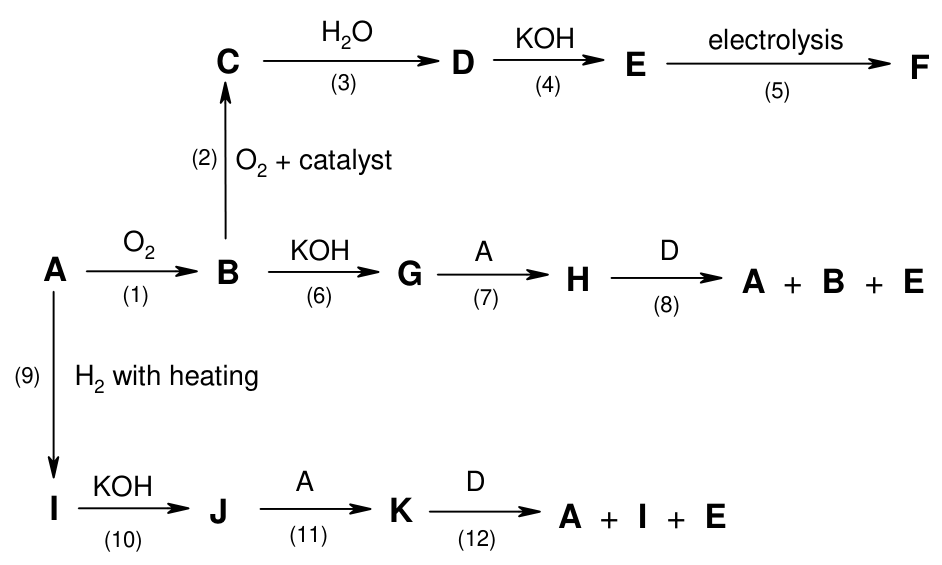
Scheme 1
a) Substance A is a solid and is insoluble in water.
b) Substances B and I are gases soluble in water.
c) Substances E, F, J and K are solid and soluble in water.
d) Aqueous solutions of B, G, H, I, J and K react with F, the products in all cases being E and D.
e) The following transformations occur during the interaction with an aqueous solution of iodine:
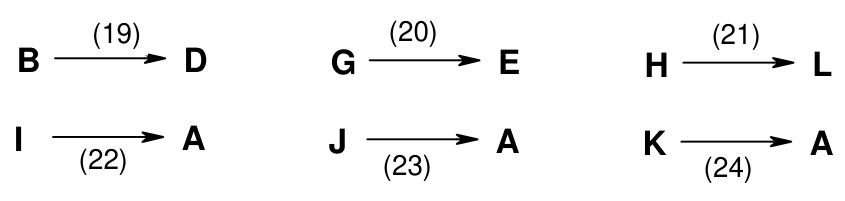
Write the chemical equations for the above interactions and balance them.
Official English text of the problem.
Answers
The substances are identified below. K is a potassium polysulfide, \(\ce{K2S_n}\), with \(n\geq2\); its exact chain length is not specified.
| Label | Formula | Name and SMILES |
|---|---|---|
| A | \(\ce{S}\), ordinarily molecular \(\ce{S8}\) | Sulfur; cyclooctasulfur: S1SSSSSSS1 |
| B | \(\ce{SO2}\) | Sulfur dioxide: O=S=O |
| C | \(\ce{SO3}\) | Sulfur trioxide: O=S(=O)=O |
| D | \(\ce{H2SO4}\) | Sulfuric acid: OS(=O)(=O)O |
| E | \(\ce{K2SO4}\) | Potassium sulfate: [K+].[K+].[O-]S(=O)(=O)[O-] |
| F | \(\ce{K2S2O8}\) | Potassium peroxodisulfate, also called potassium persulfate: [K+].[K+].[O-]S(=O)(=O)OOS(=O)(=O)[O-] |
| G | \(\ce{K2SO3}\) | Potassium sulfite: [K+].[K+].[O-]S(=O)[O-] |
| H | \(\ce{K2S2O3}\) | Potassium thiosulfate: [K+].[K+].[O-]S(=O)(=O)[S-] |
| I | \(\ce{H2S}\) | Hydrogen sulfide: [SH2] |
| J | \(\ce{K2S}\) | Potassium sulfide: [K+].[K+].[S-2] |
| K | \(\ce{K2S_n}\) | Potassium polysulfide; for \(n=2\), potassium disulfide: [K+].[K+].[S-][S-] |
| L | \(\ce{K2S4O6}\) | Potassium tetrathionate: [K+].[K+].[O-]S(=O)(=O)SSS(=O)(=O)[O-] |
For a general polysulfide, insert \(n-2\) neutral S atoms between the two terminal [S-] atoms in K’s SMILES. The disconnected ionic SMILES do not describe crystal lattices. The sulfur-ring SMILES does not specify the usual crown conformation of \(\ce{S8}\).
Other species appearing in the equations are water O, dioxygen O=O, dihydrogen [H][H], potassium hydroxide [K+].[OH-], iodine II, hydrogen iodide [H]I (hydroiodic acid in aqueous solution), and potassium iodide [K+].[I-].
Elemental sulfur is written conventionally as \(\ce{S}\) in the equations, so its coefficients count sulfur atom equivalents.
Scheme 1: reactions (1)–(12)
- (1) \(\ce{S + O2 -> SO2}\)
- (2) \(\ce{2SO2 + O2 ->[catalyst] 2SO3}\)
- (3) \(\ce{SO3 + H2O -> H2SO4}\)
- (4) \(\ce{H2SO4 + 2KOH -> K2SO4 + 2H2O}\)
- (5) \(\ce{2K2SO4 + 2H2O ->[electrolysis] K2S2O8 + 2KOH + H2}\)
- (6) \(\ce{SO2 + 2KOH -> K2SO3 + H2O}\)
- (7) \(\ce{K2SO3 + S -> K2S2O3}\)
- (8) \(\ce{K2S2O3 + H2SO4 -> S + SO2 + K2SO4 + H2O}\)
- (9) \(\ce{S + H2 ->[\Delta] H2S}\)
- (10) \(\ce{H2S + 2KOH -> K2S + 2H2O}\)
- (11) \(\ce{K2S}+(n-1)\,\ce{S -> K2S_n}\)
- (12) \(\ce{K2S_n + H2SO4 ->} (n-1)\,\ce{S}+\ce{H2S + K2SO4}\)
d): reactions with F
The six interactions are numbered (13)–(18) below in the printed order B, G, H, I, J, K.
- (13) \(\ce{SO2 + K2S2O8 + 2H2O -> K2SO4 + 2H2SO4}\)
- (14) \(\ce{K2SO3 + K2S2O8 + H2O -> 2K2SO4 + H2SO4}\)
- (15) \(\ce{K2S2O3 + 4K2S2O8 + 5H2O -> 5K2SO4 + 5H2SO4}\)
- (16) \(\ce{H2S + 4K2S2O8 + 4H2O -> 4K2SO4 + 5H2SO4}\)
- (17) \(\ce{K2S + 4K2S2O8 + 4H2O -> 5K2SO4 + 4H2SO4}\)
- (18) \[ \ce{K2S_n}+(3n+1)\,\ce{K2S2O8}+4n\,\ce{H2O} \ce{->} (3n+2)\,\ce{K2SO4}+4n\,\ce{H2SO4}. \]
e): reactions with aqueous iodine
- (19) \(\ce{SO2 + I2 + 2H2O -> H2SO4 + 2HI}\)
- (20) \(\ce{K2SO3 + I2 + H2O -> K2SO4 + 2HI}\)
- (21) \(\ce{2K2S2O3 + I2 -> K2S4O6 + 2KI}\)
- (22) \(\ce{H2S + I2 -> S + 2HI}\)
- (23) \(\ce{K2S + I2 -> S + 2KI}\)
- (24) \(\ce{K2S_n + I2 ->} n\,\ce{S}+\ce{2KI}\)
Solution
a)–c): identification of A and its compounds
The combination of an insoluble solid element, a water-soluble gaseous oxide, and a water-soluble gaseous hydrogen compound identifies A as sulfur. Its combustion product B is sulfur dioxide, while its product with heated hydrogen, I, is hydrogen sulfide.
(1)–(4). Burning sulfur produces sulfur dioxide. Catalytic oxidation raises sulfur’s oxidation state from \(+4\) to \(+6\), identifying C as sulfur trioxide. Hydration then gives D, sulfuric acid. Complete neutralization with potassium hydroxide gives E, potassium sulfate.
(5). Electrolysis can oxidatively couple sulfate ions to form F, potassium peroxodisulfate. Under conditions favoring this anodic reaction, the half-equations are
\[ \ce{2SO4^{2-} -> S2O8^{2-} + 2e-} \]
and, for reduction of water at the cathode,
\[ \ce{2H2O + 2e- -> H2 + 2OH-}. \]
Here sulfate ion has SMILES [O-]S(=O)(=O)[O-], peroxodisulfate ion has SMILES [O-]S(=O)(=O)OOS(=O)(=O)[O-], and hydroxide ion has SMILES [OH-].
Adding these half-equations and restoring potassium ions, [K+], gives equation (5). Hydrogen and potassium hydroxide are absent from the scheme because they contain no sulfur.
(6)–(8). Complete neutralization of sulfur dioxide gives G, potassium sulfite. Sulfite combines with elemental sulfur to form H, potassium thiosulfate. Its acid decomposition produces sulfur and sulfur dioxide:
\[ \ce{K2S2O3 + H2SO4 -> S + SO2 + K2SO4 + H2O}. \]
This accounts exactly for the three sulfur-containing products shown in reaction (8): A + B + E.
(9)–(12). Hydrogen and heated sulfur form I, hydrogen sulfide. Complete neutralization gives J, potassium sulfide. Incorporating additional sulfur produces K, potassium polysulfide:
\[ \ce{K2S}+(n-1)\,\ce{S -> K2S_n}. \]
Acidification liberates one equivalent of hydrogen sulfide and leaves the remaining \(n-1\) sulfur equivalents as elemental sulfur. Potassium forms potassium sulfate. Thus reaction (12) gives precisely A + I + E.
For the simplest representative, \(n=2\), reactions (11) and (12) become
\[ \ce{K2S + S -> K2S2}, \]
\[ \ce{K2S2 + H2SO4 -> S + H2S + K2SO4}. \]
The identified potassium salts are consistent with the solid, water-soluble substances specified in c).
d), (13)–(18): oxidation by peroxodisulfate
Peroxodisulfate contains an \(\ce{O-O}\) bond. Its two peroxide oxygen atoms have oxidation state \(-1\), while its sulfur atoms remain at \(+6\). Reduction breaks the peroxide linkage and produces sulfate:
\[ \ce{S2O8^{2-} + 2e- -> 2SO4^{2-}}. \]
Thus each formula unit of F accepts two electrons. All sulfur in the reacting compounds is oxidized to sulfate, giving the following electron balances:
| Reaction | Reactant | Initial sum of sulfur oxidation states | Final sum | Electrons released | Required equivalents of F |
|---|---|---|---|---|---|
| (13) | B, \(\ce{SO2}\) | \(+4\) | \(+6\) | \(2\) | \(1\) |
| (14) | G, \(\ce{K2SO3}\) | \(+4\) | \(+6\) | \(2\) | \(1\) |
| (15) | H, \(\ce{K2S2O3}\) | \(+4\) | \(+12\) | \(8\) | \(4\) |
| (16) | I, \(\ce{H2S}\) | \(-2\) | \(+6\) | \(8\) | \(4\) |
| (17) | J, \(\ce{K2S}\) | \(-2\) | \(+6\) | \(8\) | \(4\) |
| (18) | K, \(\ce{K2S_n}\) | \(-2\) | \(+6n\) | \(6n+2\) | \(3n+1\) |
For thiosulfate, the two sulfur atoms have oxidation states \(+5\) and \(-1\). Their combined increase to \(+6,+6\) releases eight electrons, explaining the coefficient \(4\) for peroxodisulfate in (15).
After fixing the oxidant coefficient, potassium balance determines the amount of E, sulfur balance determines the amount of D, and hydrogen and oxygen balances determine the water coefficient. For example, in (15):
- One thiosulfate and four peroxodisulfates supply ten potassium atoms, requiring five potassium sulfates.
- They supply ten sulfur atoms altogether, leaving five sulfur atoms for five sulfuric acids.
- Five water molecules supply the required ten hydrogen atoms and complete the oxygen balance.
For general polysulfide in (18), the required oxidant amount is
\[ \frac{6n+2}{2}=3n+1. \]
Potassium balance then gives \(3n+2\) potassium sulfates; the remaining sulfur gives \(4n\) sulfuric acids, requiring \(4n\) waters. In particular, for potassium disulfide,
\[ \ce{K2S2 + 7K2S2O8 + 8H2O -> 8K2SO4 + 8H2SO4}. \]
These balances produce E and D in every case, as required.
e), (19)–(24): oxidation by iodine
Each iodine molecule accepts two electrons to form two iodide ions, whose SMILES is [I-].
(19)–(20). Sulfur dioxide and sulfite both contain sulfur at \(+4\). Oxidation to sulfate, with sulfur at \(+6\), releases two electrons per sulfur atom. Consequently, each consumes one iodine molecule. Balancing hydrogen and oxygen with water gives equations (19) and (20).
(21). Iodine converts thiosulfate into L, potassium tetrathionate:
\[ \ce{2K2S2O3 + I2 -> K2S4O6 + 2KI}. \]
The terminal sulfur atoms of two thiosulfate ions form a new sulfur–sulfur bond. Each changes oxidation state from \(-1\) to \(0\), releasing two electrons in total. The oxygen-bearing sulfur atoms remain at \(+5\).
Tetrathionate therefore has a chain of four sulfur atoms, with each terminal sulfur bonded to three oxygen atoms. This connectivity is represented by L’s SMILES in the identification table.
(22)–(23). Iodine oxidizes sulfur in hydrogen sulfide or potassium sulfide from \(-2\) to elemental sulfur at \(0\). Each formula unit releases two electrons and therefore consumes one iodine molecule. Hydrogen iodide or potassium iodide supplies the corresponding nonsulfur product.
(24). A polysulfide chain has a total sulfur oxidation-state sum of \(-2\), regardless of its length. Converting all \(n\) sulfur atoms to elemental sulfur therefore releases only two electrons per polysulfide ion. Hence one iodine molecule produces \(n\) sulfur equivalents:
\[ \ce{K2S_n + I2 ->}n\,\ce{S}+\ce{2KI}. \]
The solution was checked against the official solution. Where this solution differs from the official solution, the official solution contains an error or a misprint.
IChO 1981 · Theorieaufgabe 1
Reaktionsschema eines Stoffes A und seiner Verbindungen (Stoffe A-L)
Die Probe A nimmt an den Umwandlungen in Schema 1 teil. In Schema 1 sind nur die Produkte dargestellt, die A enthalten.
Schema 1
a) Stoff A ist ein Feststoff und in Wasser unlöslich.
b) Die Stoffe B und I sind wasserlösliche Gase.
c) Die Stoffe E, F, J und K sind fest und wasserlöslich.
d) Wässrige Lösungen von B, G, H, I, J und K reagieren mit F, wobei in allen Fällen E und D als Produkte entstehen.
e) Bei der Reaktion mit einer wässrigen Iodlösung finden die folgenden Umwandlungen statt:
Stellen Sie die chemischen Gleichungen für die obigen Reaktionen auf und gleichen Sie sie aus.
Aufgabentext aus dem offiziellen englischen Text übersetzt.
Antworten
Die Stoffe werden im Folgenden identifiziert. K ist ein Kaliumpolysulfid, \(\ce{K2S_n}\), mit \(n\geq2\); seine genaue Kettenlänge ist nicht angegeben.
| Bezeichnung | Formel | Name und SMILES |
|---|---|---|
| A | \(\ce{S}\), gewöhnlich molekularer \(\ce{S8}\) | Schwefel; Cyclooctaschwefel: S1SSSSSSS1 |
| B | \(\ce{SO2}\) | Schwefeldioxid: O=S=O |
| C | \(\ce{SO3}\) | Schwefeltrioxid: O=S(=O)=O |
| D | \(\ce{H2SO4}\) | Schwefelsäure: OS(=O)(=O)O |
| E | \(\ce{K2SO4}\) | Kaliumsulfat: [K+].[K+].[O-]S(=O)(=O)[O-] |
| F | \(\ce{K2S2O8}\) | Kaliumperoxodisulfat, auch Kaliumpersulfat genannt: [K+].[K+].[O-]S(=O)(=O)OOS(=O)(=O)[O-] |
| G | \(\ce{K2SO3}\) | Kaliumsulfit: [K+].[K+].[O-]S(=O)[O-] |
| H | \(\ce{K2S2O3}\) | Kaliumthiosulfat: [K+].[K+].[O-]S(=O)(=O)[S-] |
| I | \(\ce{H2S}\) | Schwefelwasserstoff: [SH2] |
| J | \(\ce{K2S}\) | Kaliumsulfid: [K+].[K+].[S-2] |
| K | \(\ce{K2S_n}\) | Kaliumpolysulfid; für \(n=2\), Kaliumdisulfid: [K+].[K+].[S-][S-] |
| L | \(\ce{K2S4O6}\) | Kaliumtetrathionat: [K+].[K+].[O-]S(=O)(=O)SSS(=O)(=O)[O-] |
Für ein allgemeines Polysulfid werden \(n-2\) neutrale S-Atome zwischen den beiden endständigen [S-]-Atomen in der SMILES-Darstellung von K eingefügt. Die SMILES-Darstellungen mit getrennten Ionen beschreiben keine Kristallgitter. Die SMILES-Darstellung des Schwefelrings legt die übliche Kronenkonformation von \(\ce{S8}\) nicht fest.
Weitere in den Gleichungen vorkommende Spezies sind Wasser O, Disauerstoff O=O, Diwasserstoff [H][H], Kaliumhydroxid [K+].[OH-], Iod II, Iodwasserstoff [H]I (Iodwasserstoffsäure in wässriger Lösung) und Kaliumiodid [K+].[I-].
Elementarer Schwefel wird in den Gleichungen konventionell als \(\ce{S}\) geschrieben, sodass seine Koeffizienten Schwefelatomäquivalente zählen.
Schema 1: Reaktionen (1)–(12)
- (1) \(\ce{S + O2 -> SO2}\)
- (2) \(\ce{2SO2 + O2 ->[catalyst] 2SO3}\)
- (3) \(\ce{SO3 + H2O -> H2SO4}\)
- (4) \(\ce{H2SO4 + 2KOH -> K2SO4 + 2H2O}\)
- (5) \(\ce{2K2SO4 + 2H2O ->[electrolysis] K2S2O8 + 2KOH + H2}\)
- (6) \(\ce{SO2 + 2KOH -> K2SO3 + H2O}\)
- (7) \(\ce{K2SO3 + S -> K2S2O3}\)
- (8) \(\ce{K2S2O3 + H2SO4 -> S + SO2 + K2SO4 + H2O}\)
- (9) \(\ce{S + H2 ->[\Delta] H2S}\)
- (10) \(\ce{H2S + 2KOH -> K2S + 2H2O}\)
- (11) \(\ce{K2S}+(n-1)\,\ce{S -> K2S_n}\)
- (12) \(\ce{K2S_n + H2SO4 ->} (n-1)\,\ce{S}+\ce{H2S + K2SO4}\)
d): Reaktionen mit F
Die sechs Reaktionen sind im Folgenden in der angegebenen Reihenfolge B, G, H, I, J, K mit (13)–(18) nummeriert.
- (13) \(\ce{SO2 + K2S2O8 + 2H2O -> K2SO4 + 2H2SO4}\)
- (14) \(\ce{K2SO3 + K2S2O8 + H2O -> 2K2SO4 + H2SO4}\)
- (15) \(\ce{K2S2O3 + 4K2S2O8 + 5H2O -> 5K2SO4 + 5H2SO4}\)
- (16) \(\ce{H2S + 4K2S2O8 + 4H2O -> 4K2SO4 + 5H2SO4}\)
- (17) \(\ce{K2S + 4K2S2O8 + 4H2O -> 5K2SO4 + 4H2SO4}\)
- (18) \[ \ce{K2S_n}+(3n+1)\,\ce{K2S2O8}+4n\,\ce{H2O} \ce{->} (3n+2)\,\ce{K2SO4}+4n\,\ce{H2SO4}. \]
e): Reaktionen mit wässriger Iodlösung
- (19) \(\ce{SO2 + I2 + 2H2O -> H2SO4 + 2HI}\)
- (20) \(\ce{K2SO3 + I2 + H2O -> K2SO4 + 2HI}\)
- (21) \(\ce{2K2S2O3 + I2 -> K2S4O6 + 2KI}\)
- (22) \(\ce{H2S + I2 -> S + 2HI}\)
- (23) \(\ce{K2S + I2 -> S + 2KI}\)
- (24) \(\ce{K2S_n + I2 ->} n\,\ce{S}+\ce{2KI}\)
Lösung
a)–c): Identifizierung von A und seinen Verbindungen
Die Kombination aus einem unlöslichen festen Element, einem wasserlöslichen gasförmigen Oxid und einer wasserlöslichen gasförmigen Wasserstoffverbindung identifiziert A als Schwefel. Sein Verbrennungsprodukt B ist Schwefeldioxid, während sein bei der Reaktion mit Wasserstoff unter Erhitzen entstehendes Produkt I Schwefelwasserstoff ist.
(1)–(4). Bei der Verbrennung von Schwefel entsteht Schwefeldioxid. Die katalytische Oxidation erhöht die Oxidationszahl des Schwefels von \(+4\) auf \(+6\), wodurch C als Schwefeltrioxid identifiziert wird. Durch Hydratation entsteht anschließend D, Schwefelsäure. Vollständige Neutralisation mit Kaliumhydroxid ergibt E, Kaliumsulfat.
(5). Durch Elektrolyse können Sulfationen oxidativ gekoppelt werden, wobei F, Kaliumperoxodisulfat, entsteht. Unter Bedingungen, die diese anodische Reaktion begünstigen, lauten die Teilgleichungen
\[ \ce{2SO4^{2-} -> S2O8^{2-} + 2e-} \]
und für die Reduktion von Wasser an der Kathode
\[ \ce{2H2O + 2e- -> H2 + 2OH-}. \]
Hier hat das Sulfation die SMILES-Darstellung [O-]S(=O)(=O)[O-], das Peroxodisulfation die SMILES-Darstellung [O-]S(=O)(=O)OOS(=O)(=O)[O-] und das Hydroxidion die SMILES-Darstellung [OH-].
Durch Addition dieser Teilgleichungen und Wiedereinfügen der Kaliumionen, [K+], erhält man Gleichung (5). Wasserstoff und Kaliumhydroxid fehlen im Schema, weil sie keinen Schwefel enthalten.
(6)–(8). Die vollständige Neutralisation von Schwefeldioxid ergibt G, Kaliumsulfit. Sulfit verbindet sich mit elementarem Schwefel zu H, Kaliumthiosulfat. Bei dessen Zersetzung durch Säure entstehen Schwefel und Schwefeldioxid:
\[ \ce{K2S2O3 + H2SO4 -> S + SO2 + K2SO4 + H2O}. \]
Dies erklärt genau die drei schwefelhaltigen Produkte, die in Reaktion (8) dargestellt sind: A + B + E.
(9)–(12). Wasserstoff und erhitzter Schwefel bilden I, Schwefelwasserstoff. Vollständige Neutralisation ergibt J, Kaliumsulfid. Durch Einbau von zusätzlichem Schwefel entsteht K, Kaliumpolysulfid:
\[ \ce{K2S}+(n-1)\,\ce{S -> K2S_n}. \]
Beim Ansäuern wird ein Äquivalent Schwefelwasserstoff freigesetzt, und die verbleibenden \(n-1\) Schwefeläquivalente bleiben als elementarer Schwefel zurück. Kalium bildet Kaliumsulfat. Somit liefert Reaktion (12) genau A + I + E.
Für den einfachsten Vertreter, \(n=2\), werden die Reaktionen (11) und (12) zu
\[ \ce{K2S + S -> K2S2}, \]
\[ \ce{K2S2 + H2SO4 -> S + H2S + K2SO4}. \]
Die identifizierten Kaliumsalze stimmen mit den in c) angegebenen festen, wasserlöslichen Stoffen überein.
d), (13)–(18): Oxidation durch Peroxodisulfat
Peroxodisulfat enthält eine \(\ce{O-O}\)-Bindung. Seine beiden Peroxidsauerstoffatome haben die Oxidationszahl \(-1\), während seine Schwefelatome bei \(+6\) bleiben. Bei der Reduktion wird die Peroxidbindung gespalten, und es entsteht Sulfat:
\[ \ce{S2O8^{2-} + 2e- -> 2SO4^{2-}}. \]
Somit nimmt jede Formeleinheit von F zwei Elektronen auf. Der gesamte Schwefel in den reagierenden Verbindungen wird zu Sulfat oxidiert, woraus sich die folgenden Elektronenbilanzen ergeben:
| Reaktion | Edukt | Anfängliche Summe der Oxidationszahlen des Schwefels | Endsumme | Abgegebene Elektronen | Erforderliche Äquivalente von F |
|---|---|---|---|---|---|
| (13) | B, \(\ce{SO2}\) | \(+4\) | \(+6\) | \(2\) | \(1\) |
| (14) | G, \(\ce{K2SO3}\) | \(+4\) | \(+6\) | \(2\) | \(1\) |
| (15) | H, \(\ce{K2S2O3}\) | \(+4\) | \(+12\) | \(8\) | \(4\) |
| (16) | I, \(\ce{H2S}\) | \(-2\) | \(+6\) | \(8\) | \(4\) |
| (17) | J, \(\ce{K2S}\) | \(-2\) | \(+6\) | \(8\) | \(4\) |
| (18) | K, \(\ce{K2S_n}\) | \(-2\) | \(+6n\) | \(6n+2\) | \(3n+1\) |
Im Thiosulfat haben die beiden Schwefelatome die Oxidationszahlen \(+5\) und \(-1\). Bei ihrer gemeinsamen Erhöhung auf \(+6,+6\) werden acht Elektronen abgegeben, was den Koeffizienten \(4\) für Peroxodisulfat in (15) erklärt.
Nach Festlegung des Koeffizienten des Oxidationsmittels bestimmt die Kaliumbilanz die Menge an E, die Schwefelbilanz die Menge an D, und die Wasserstoff- und Sauerstoffbilanzen bestimmen den Koeffizienten des Wassers. Zum Beispiel in (15):
- Ein Thiosulfat und vier Peroxodisulfate liefern zehn Kaliumatome, sodass fünf Kaliumsulfate erforderlich sind.
- Sie liefern insgesamt zehn Schwefelatome, sodass fünf Schwefelatome für fünf Schwefelsäuremoleküle verbleiben.
- Fünf Wassermoleküle liefern die erforderlichen zehn Wasserstoffatome und vervollständigen die Sauerstoffbilanz.
Für ein allgemeines Polysulfid in (18) beträgt die erforderliche Menge an Oxidationsmittel
\[ \frac{6n+2}{2}=3n+1. \]
Die Kaliumbilanz ergibt dann \(3n+2\) Kaliumsulfate; der verbleibende Schwefel ergibt \(4n\) Schwefelsäuremoleküle, wofür \(4n\) Wassermoleküle erforderlich sind. Insbesondere gilt für Kaliumdisulfid:
\[ \ce{K2S2 + 7K2S2O8 + 8H2O -> 8K2SO4 + 8H2SO4}. \]
Diese Bilanzen ergeben in jedem Fall E und D, wie gefordert.
e), (19)–(24): Oxidation durch Iod
Jedes Iodmolekül nimmt zwei Elektronen auf und bildet zwei Iodidionen, deren SMILES-Darstellung [I-] lautet.
(19)–(20). Sowohl Schwefeldioxid als auch Sulfit enthalten Schwefel mit der Oxidationszahl \(+4\). Bei der Oxidation zu Sulfat, in dem Schwefel die Oxidationszahl \(+6\) hat, werden zwei Elektronen pro Schwefelatom abgegeben. Folglich verbraucht jedes ein Iodmolekül. Der Ausgleich von Wasserstoff und Sauerstoff mithilfe von Wasser ergibt die Gleichungen (19) und (20).
(21). Iod wandelt Thiosulfat in L, Kaliumtetrathionat, um:
\[ \ce{2K2S2O3 + I2 -> K2S4O6 + 2KI}. \]
Die endständigen Schwefelatome zweier Thiosulfationen bilden eine neue Schwefel–Schwefel-Bindung. Dabei ändert sich die Oxidationszahl jedes dieser Atome von \(-1\) auf \(0\), wobei insgesamt zwei Elektronen abgegeben werden. Die sauerstofftragenden Schwefelatome bleiben bei \(+5\).
Tetrathionat besitzt daher eine Kette aus vier Schwefelatomen, wobei jedes endständige Schwefelatom an drei Sauerstoffatome gebunden ist. Diese Verknüpfung wird durch die SMILES-Darstellung von L in der Identifizierungstabelle wiedergegeben.
(22)–(23). Iod oxidiert Schwefel in Schwefelwasserstoff oder Kaliumsulfid von \(-2\) zu elementarem Schwefel mit der Oxidationszahl \(0\). Jede Formeleinheit gibt zwei Elektronen ab und verbraucht daher ein Iodmolekül. Iodwasserstoff beziehungsweise Kaliumiodid bildet das entsprechende schwefelfreie Produkt.
(24). Eine Polysulfidkette hat unabhängig von ihrer Länge eine Gesamtsumme der Oxidationszahlen des Schwefels von \(-2\). Bei der Umwandlung aller \(n\) Schwefelatome in elementaren Schwefel werden daher nur zwei Elektronen pro Polysulfidion abgegeben. Somit ergibt ein Iodmolekül \(n\) Schwefeläquivalente:
\[ \ce{K2S_n + I2 ->}n\,\ce{S}+\ce{2KI}. \]
Die Lösung wurde mit der offiziellen Lösung abgeglichen. Wo diese Lösung von der offiziellen Lösung abweicht, enthält die offizielle Lösung einen Fehler oder Druckfehler.
IChO 1981 · Teori sorusu 1
A maddesinin ve bileşiklerinin tepkime şeması (A-L maddeleri)
A numunesi, şema 1'deki dönüşümlere katılır. Şema 1'de yalnızca A içeren ürünler gösterilmiştir.
Şema 1
a) A maddesi katıdır ve suda çözünmez.
b) B ve I maddeleri suda çözünen gazlardır.
c) E, F, J ve K maddeleri katıdır ve suda çözünür.
d) B, G, H, I, J ve K maddelerinin sulu çözeltileri F ile tepkimeye girer; her durumda ürünler E ve D olur.
e) Sulu iyot çözeltisiyle etkileşim sırasında aşağıdaki dönüşümler gerçekleşir:
Yukarıdaki etkileşimlerin kimyasal denklemlerini yazınız ve denkleştiriniz.
Soru metni resmi İngilizce metinden çevrilmiştir.
Cevaplar
Maddeler aşağıda tanımlanmıştır. K, \(\ce{K2S_n}\) formülüne sahip bir potasyum polisülfürdür ve \(n\geq2\)'dir; kesin zincir uzunluğu belirtilmemiştir.
| Etiket | Formül | Adı ve SMILES gösterimi |
|---|---|---|
| A | \(\ce{S}\), genellikle moleküler \(\ce{S8}\) | Kükürt; siklooktakükürt: S1SSSSSSS1 |
| B | \(\ce{SO2}\) | Kükürt dioksit: O=S=O |
| C | \(\ce{SO3}\) | Kükürt trioksit: O=S(=O)=O |
| D | \(\ce{H2SO4}\) | Sülfürik asit: OS(=O)(=O)O |
| E | \(\ce{K2SO4}\) | Potasyum sülfat: [K+].[K+].[O-]S(=O)(=O)[O-] |
| F | \(\ce{K2S2O8}\) | Potasyum peroksodisülfat, diğer adıyla potasyum persülfat: [K+].[K+].[O-]S(=O)(=O)OOS(=O)(=O)[O-] |
| G | \(\ce{K2SO3}\) | Potasyum sülfit: [K+].[K+].[O-]S(=O)[O-] |
| H | \(\ce{K2S2O3}\) | Potasyum tiyosülfat: [K+].[K+].[O-]S(=O)(=O)[S-] |
| I | \(\ce{H2S}\) | Hidrojen sülfür: [SH2] |
| J | \(\ce{K2S}\) | Potasyum sülfür: [K+].[K+].[S-2] |
| K | \(\ce{K2S_n}\) | Potasyum polisülfür; \(n=2\) için potasyum disülfür: [K+].[K+].[S-][S-] |
| L | \(\ce{K2S4O6}\) | Potasyum tetratiyonat: [K+].[K+].[O-]S(=O)(=O)SSS(=O)(=O)[O-] |
Genel bir polisülfür için K'nin SMILES gösterimindeki iki uç [S-] atomunun arasına \(n-2\) tane nötr S atomu ekleyiniz. Birbirinden ayrık iyonlar içeren SMILES gösterimleri kristal örgülerini betimlemez. Kükürt halkasının SMILES gösterimi, \(\ce{S8}\)'in olağan taç konformasyonunu belirtmez.
Denklemlerde yer alan diğer türler su O, dioksijen O=O, dihidrojen [H][H], potasyum hidroksit [K+].[OH-], iyot II, hidrojen iyodür [H]I (sulu çözeltide hidroiyodik asit) ve potasyum iyodür [K+].[I-] türleridir.
Elementel kükürt, denklemlerde geleneksel olarak \(\ce{S}\) biçiminde yazılmıştır; dolayısıyla katsayıları kükürt atomu eşdeğerlerini sayar.
Şema 1: (1)–(12) tepkimeleri
- (1) \(\ce{S + O2 -> SO2}\)
- (2) \(\ce{2SO2 + O2 ->[catalyst] 2SO3}\)
- (3) \(\ce{SO3 + H2O -> H2SO4}\)
- (4) \(\ce{H2SO4 + 2KOH -> K2SO4 + 2H2O}\)
- (5) \(\ce{2K2SO4 + 2H2O ->[electrolysis] K2S2O8 + 2KOH + H2}\)
- (6) \(\ce{SO2 + 2KOH -> K2SO3 + H2O}\)
- (7) \(\ce{K2SO3 + S -> K2S2O3}\)
- (8) \(\ce{K2S2O3 + H2SO4 -> S + SO2 + K2SO4 + H2O}\)
- (9) \(\ce{S + H2 ->[\Delta] H2S}\)
- (10) \(\ce{H2S + 2KOH -> K2S + 2H2O}\)
- (11) \(\ce{K2S}+(n-1)\,\ce{S -> K2S_n}\)
- (12) \(\ce{K2S_n + H2SO4 ->} (n-1)\,\ce{S}+\ce{H2S + K2SO4}\)
d): F ile tepkimeler
Altı etkileşim, aşağıda metindeki B, G, H, I, J, K sırasına göre (13)–(18) olarak numaralandırılmıştır.
- (13) \(\ce{SO2 + K2S2O8 + 2H2O -> K2SO4 + 2H2SO4}\)
- (14) \(\ce{K2SO3 + K2S2O8 + H2O -> 2K2SO4 + H2SO4}\)
- (15) \(\ce{K2S2O3 + 4K2S2O8 + 5H2O -> 5K2SO4 + 5H2SO4}\)
- (16) \(\ce{H2S + 4K2S2O8 + 4H2O -> 4K2SO4 + 5H2SO4}\)
- (17) \(\ce{K2S + 4K2S2O8 + 4H2O -> 5K2SO4 + 4H2SO4}\)
- (18) \[ \ce{K2S_n}+(3n+1)\,\ce{K2S2O8}+4n\,\ce{H2O} \ce{->} (3n+2)\,\ce{K2SO4}+4n\,\ce{H2SO4}. \]
e): sulu iyot çözeltisiyle tepkimeler
- (19) \(\ce{SO2 + I2 + 2H2O -> H2SO4 + 2HI}\)
- (20) \(\ce{K2SO3 + I2 + H2O -> K2SO4 + 2HI}\)
- (21) \(\ce{2K2S2O3 + I2 -> K2S4O6 + 2KI}\)
- (22) \(\ce{H2S + I2 -> S + 2HI}\)
- (23) \(\ce{K2S + I2 -> S + 2KI}\)
- (24) \(\ce{K2S_n + I2 ->} n\,\ce{S}+\ce{2KI}\)
Çözüm
a)–c): A'nın ve bileşiklerinin belirlenmesi
Suda çözünmeyen katı bir elementin, suda çözünen gaz hâlinde bir oksidin ve suda çözünen gaz hâlinde bir hidrojen bileşiğinin bir arada bulunması, A'nın kükürt olduğunu gösterir. Yanma ürünü B, kükürt dioksit; ısıtılarak hidrojenle tepkimesinden oluşan ürün I ise hidrojen sülfürdür.
(1)–(4). Kükürdün yanması kükürt dioksit oluşturur. Katalitik yükseltgenme, kükürdün yükseltgenme basamağını \(+4\)'ten \(+6\)'ya çıkarır; böylece C'nin kükürt trioksit olduğu belirlenir. Ardından hidratasyonla D, sülfürik asit elde edilir. Potasyum hidroksitle tam nötralleşme, E, potasyum sülfatı verir.
(5). Elektroliz, sülfat iyonlarını yükseltgenme yoluyla birbirine bağlayarak F, potasyum peroksodisülfatı oluşturabilir. Bu anodik tepkimeyi destekleyen koşullarda yarı tepkime denklemleri şöyledir:
\[ \ce{2SO4^{2-} -> S2O8^{2-} + 2e-} \]
ve suyun katotta indirgenmesi için,
\[ \ce{2H2O + 2e- -> H2 + 2OH-}. \]
Burada sülfat iyonunun SMILES gösterimi [O-]S(=O)(=O)[O-], peroksodisülfat iyonunun SMILES gösterimi [O-]S(=O)(=O)OOS(=O)(=O)[O-] ve hidroksit iyonunun SMILES gösterimi [OH-] şeklindedir.
Bu yarı tepkime denklemleri toplanıp potasyum iyonları, [K+], yeniden eklendiğinde (5) denklemi elde edilir. Hidrojen ve potasyum hidroksit, kükürt içermedikleri için şemada yer almaz.
(6)–(8). Kükürt dioksidin tam nötralleşmesi, G, potasyum sülfit verir. Sülfit, elementel kükürtle birleşerek H, potasyum tiyosülfatı oluşturur. Bunun asitle bozunması kükürt ve kükürt dioksit oluşturur:
\[ \ce{K2S2O3 + H2SO4 -> S + SO2 + K2SO4 + H2O}. \]
Bu, (8) tepkimesinde gösterilen kükürt içeren üç ürünü tam olarak açıklar: A + B + E.
(9)–(12). Hidrojen ve ısıtılmış kükürt, I, hidrojen sülfürü oluşturur. Tam nötralleşme, J, potasyum sülfür verir. Yapıya ilave kükürt katılması, K, potasyum polisülfürü oluşturur:
\[ \ce{K2S}+(n-1)\,\ce{S -> K2S_n}. \]
Asitlendirme, bir eşdeğer hidrojen sülfür açığa çıkarır ve kalan \(n-1\) kükürt eşdeğerini elementel kükürt olarak bırakır. Potasyum, potasyum sülfat oluşturur. Böylece (12) tepkimesi tam olarak A + I + E ürünlerini verir.
En basit örnek olan \(n=2\) için (11) ve (12) tepkimeleri şu hâli alır:
\[ \ce{K2S + S -> K2S2}, \]
\[ \ce{K2S2 + H2SO4 -> S + H2S + K2SO4}. \]
Belirlenen potasyum tuzları, c)'de belirtilen katı ve suda çözünen maddelerle uyumludur.
d), (13)–(18): peroksodisülfatla yükseltgenme
Peroksodisülfat bir \(\ce{O-O}\) bağı içerir. İki peroksit oksijen atomunun yükseltgenme basamağı \(-1\) iken kükürt atomlarınınki \(+6\) olarak kalır. İndirgenme, peroksit bağını koparır ve sülfat oluşturur:
\[ \ce{S2O8^{2-} + 2e- -> 2SO4^{2-}}. \]
Dolayısıyla F'nin her formül birimi iki elektron alır. Tepkimeye giren bileşiklerdeki kükürdün tamamı sülfata yükseltgenir ve aşağıdaki elektron denklikleri elde edilir:
| Tepkime | Tepkimeye giren madde | Kükürdün başlangıçtaki yükseltgenme basamakları toplamı | Son toplam | Verilen elektron sayısı | Gereken F eşdeğeri |
|---|---|---|---|---|---|
| (13) | B, \(\ce{SO2}\) | \(+4\) | \(+6\) | \(2\) | \(1\) |
| (14) | G, \(\ce{K2SO3}\) | \(+4\) | \(+6\) | \(2\) | \(1\) |
| (15) | H, \(\ce{K2S2O3}\) | \(+4\) | \(+12\) | \(8\) | \(4\) |
| (16) | I, \(\ce{H2S}\) | \(-2\) | \(+6\) | \(8\) | \(4\) |
| (17) | J, \(\ce{K2S}\) | \(-2\) | \(+6\) | \(8\) | \(4\) |
| (18) | K, \(\ce{K2S_n}\) | \(-2\) | \(+6n\) | \(6n+2\) | \(3n+1\) |
Tiyosülfattaki iki kükürt atomunun yükseltgenme basamakları \(+5\) ve \(-1\)'dir. Bunların birlikte \(+6,+6\)'ya yükselmesiyle sekiz elektron verilir; bu da (15)'te peroksodisülfatın katsayısının \(4\) olmasını açıklar.
Yükseltgenin katsayısı belirlendikten sonra potasyum denkliği E'nin miktarını, kükürt denkliği D'nin miktarını, hidrojen ve oksijen denklikleri ise suyun katsayısını belirler. Örneğin (15)'te:
- Bir tiyosülfat ve dört peroksodisülfat on potasyum atomu sağlar; bu da beş potasyum sülfat gerektirir.
- Bunlar toplam on kükürt atomu sağlar; beş sülfürik asit için beş kükürt atomu kalır.
- Beş su molekülü, gereken on hidrojen atomunu sağlar ve oksijen denkliğini tamamlar.
(18)'deki genel polisülfür için gereken yükseltgen miktarı şöyledir:
\[ \frac{6n+2}{2}=3n+1. \]
Potasyum denkliği böylece \(3n+2\) potasyum sülfat verir; kalan kükürt ise \(4n\) sülfürik asit verir ve bunun için \(4n\) su gerekir. Özellikle potasyum disülfür için,
\[ \ce{K2S2 + 7K2S2O8 + 8H2O -> 8K2SO4 + 8H2SO4}. \]
Bu denklikler, istendiği gibi her durumda E ve D ürünlerini verir.
e), (19)–(24): iyotla yükseltgenme
Her iyot molekülü iki elektron alarak SMILES gösterimi [I-] olan iki iyodür iyonu oluşturur.
(19)–(20). Kükürt dioksit ve sülfitin her ikisinde de kükürdün yükseltgenme basamağı \(+4\)'tür. Kükürdün yükseltgenme basamağının \(+6\) olduğu sülfata yükseltgenme, kükürt atomu başına iki elektron verilmesini sağlar. Dolayısıyla her biri bir iyot molekülü tüketir. Hidrojen ve oksijenin su kullanılarak denkleştirilmesiyle (19) ve (20) denklemleri elde edilir.
(21). İyot, tiyosülfatı L, potasyum tetratiyonata dönüştürür:
\[ \ce{2K2S2O3 + I2 -> K2S4O6 + 2KI}. \]
İki tiyosülfat iyonunun uç kükürt atomları yeni bir kükürt–kükürt bağı oluşturur. Her birinin yükseltgenme basamağı \(-1\)'den \(0\)'a değişir ve toplam iki elektron verilir. Oksijen atomlarına bağlı kükürt atomları \(+5\)'te kalır.
Dolayısıyla tetratiyonat, her uç kükürt atomunun üç oksijen atomuna bağlı olduğu dört kükürt atomlu bir zincire sahiptir. Bu bağlanma düzeni, maddelerin tanımlandığı tabloda L'nin SMILES gösterimiyle temsil edilmiştir.
(22)–(23). İyot, hidrojen sülfürdeki veya potasyum sülfürdeki kükürdü \(-2\)'den yükseltgenme basamağı \(0\) olan elementel kükürde yükseltger. Her formül birimi iki elektron verir ve dolayısıyla bir iyot molekülü tüketir. Kükürt içermeyen karşılık gelen ürün, hidrojen iyodür veya potasyum iyodürdür.
(24). Bir polisülfür zincirindeki kükürt atomlarının yükseltgenme basamakları toplamı, zincir uzunluğundan bağımsız olarak \(-2\)'dir. Bu nedenle \(n\) kükürt atomunun tamamının elementel kükürde dönüştürülmesi, polisülfür iyonu başına yalnızca iki elektron verilmesini sağlar. Dolayısıyla bir iyot molekülü \(n\) kükürt eşdeğeri oluşturur:
\[ \ce{K2S_n + I2 ->}n\,\ce{S}+\ce{2KI}. \]
Çözüm, resmi çözümle karşılaştırılarak kontrol edildi. Bu çözümün resmi çözümden ayrıldığı yerlerde resmi çözümde bir hata ya da baskı hatası vardır.
IChO 1981 · Problema teórico 1
Esquema de reacciones de una sustancia A y sus compuestos (sustancias A-L)
La muestra A participa en las transformaciones del esquema 1. En el esquema 1 solo se muestran los productos que contienen A.
Esquema 1
a) La sustancia A es sólida e insoluble en agua.
b) Las sustancias B e I son gases solubles en agua.
c) Las sustancias E, F, J y K son sólidas y solubles en agua.
d) Las disoluciones acuosas de B, G, H, I, J y K reaccionan con F, y los productos son en todos los casos E y D.
e) Durante la interacción con una disolución acuosa de yodo se producen las siguientes transformaciones:
Escriba las ecuaciones químicas de las interacciones anteriores y ajústelas.
Enunciado traducido del texto oficial en inglés.
Respuestas
Las sustancias se identifican a continuación. K es un polisulfuro de potasio, \(\ce{K2S_n}\), con \(n\geq2\); no se especifica la longitud exacta de su cadena.
| Etiqueta | Fórmula | Nombre y SMILES |
|---|---|---|
| A | \(\ce{S}\), habitualmente en forma molecular \(\ce{S8}\) | Azufre; ciclooctaazufre: S1SSSSSSS1 |
| B | \(\ce{SO2}\) | Dióxido de azufre: O=S=O |
| C | \(\ce{SO3}\) | Trióxido de azufre: O=S(=O)=O |
| D | \(\ce{H2SO4}\) | Ácido sulfúrico: OS(=O)(=O)O |
| E | \(\ce{K2SO4}\) | Sulfato de potasio: [K+].[K+].[O-]S(=O)(=O)[O-] |
| F | \(\ce{K2S2O8}\) | Peroxodisulfato de potasio, también llamado persulfato de potasio: [K+].[K+].[O-]S(=O)(=O)OOS(=O)(=O)[O-] |
| G | \(\ce{K2SO3}\) | Sulfito de potasio: [K+].[K+].[O-]S(=O)[O-] |
| H | \(\ce{K2S2O3}\) | Tiosulfato de potasio: [K+].[K+].[O-]S(=O)(=O)[S-] |
| I | \(\ce{H2S}\) | Sulfuro de hidrógeno: [SH2] |
| J | \(\ce{K2S}\) | Sulfuro de potasio: [K+].[K+].[S-2] |
| K | \(\ce{K2S_n}\) | Polisulfuro de potasio; para \(n=2\), disulfuro de potasio: [K+].[K+].[S-][S-] |
| L | \(\ce{K2S4O6}\) | Tetrationato de potasio: [K+].[K+].[O-]S(=O)(=O)SSS(=O)(=O)[O-] |
Para un polisulfuro general, inserte \(n-2\) átomos neutros S entre los dos átomos terminales [S-] en el SMILES de K. Los SMILES iónicos con fragmentos desconectados no describen redes cristalinas. El SMILES del anillo de azufre no especifica la conformación habitual de corona de \(\ce{S8}\).
Otras especies que aparecen en las ecuaciones son agua O, dioxígeno O=O, dihidrógeno [H][H], hidróxido de potasio [K+].[OH-], yodo II, yoduro de hidrógeno [H]I (ácido yodhídrico en disolución acuosa) y yoduro de potasio [K+].[I-].
El azufre elemental se escribe convencionalmente como \(\ce{S}\) en las ecuaciones, por lo que sus coeficientes cuentan equivalentes de átomos de azufre.
Esquema 1: reacciones (1)–(12)
- (1) \(\ce{S + O2 -> SO2}\)
- (2) \(\ce{2SO2 + O2 ->[catalyst] 2SO3}\)
- (3) \(\ce{SO3 + H2O -> H2SO4}\)
- (4) \(\ce{H2SO4 + 2KOH -> K2SO4 + 2H2O}\)
- (5) \(\ce{2K2SO4 + 2H2O ->[electrolysis] K2S2O8 + 2KOH + H2}\)
- (6) \(\ce{SO2 + 2KOH -> K2SO3 + H2O}\)
- (7) \(\ce{K2SO3 + S -> K2S2O3}\)
- (8) \(\ce{K2S2O3 + H2SO4 -> S + SO2 + K2SO4 + H2O}\)
- (9) \(\ce{S + H2 ->[\Delta] H2S}\)
- (10) \(\ce{H2S + 2KOH -> K2S + 2H2O}\)
- (11) \(\ce{K2S}+(n-1)\,\ce{S -> K2S_n}\)
- (12) \(\ce{K2S_n + H2SO4 ->} (n-1)\,\ce{S}+\ce{H2S + K2SO4}\)
d): reacciones con F
Las seis interacciones se numeran (13)–(18) a continuación en el orden en que aparecen impresas: B, G, H, I, J, K.
- (13) \(\ce{SO2 + K2S2O8 + 2H2O -> K2SO4 + 2H2SO4}\)
- (14) \(\ce{K2SO3 + K2S2O8 + H2O -> 2K2SO4 + H2SO4}\)
- (15) \(\ce{K2S2O3 + 4K2S2O8 + 5H2O -> 5K2SO4 + 5H2SO4}\)
- (16) \(\ce{H2S + 4K2S2O8 + 4H2O -> 4K2SO4 + 5H2SO4}\)
- (17) \(\ce{K2S + 4K2S2O8 + 4H2O -> 5K2SO4 + 4H2SO4}\)
- (18) \[ \ce{K2S_n}+(3n+1)\,\ce{K2S2O8}+4n\,\ce{H2O} \ce{->} (3n+2)\,\ce{K2SO4}+4n\,\ce{H2SO4}. \]
e): reacciones con yodo en disolución acuosa
- (19) \(\ce{SO2 + I2 + 2H2O -> H2SO4 + 2HI}\)
- (20) \(\ce{K2SO3 + I2 + H2O -> K2SO4 + 2HI}\)
- (21) \(\ce{2K2S2O3 + I2 -> K2S4O6 + 2KI}\)
- (22) \(\ce{H2S + I2 -> S + 2HI}\)
- (23) \(\ce{K2S + I2 -> S + 2KI}\)
- (24) \(\ce{K2S_n + I2 ->} n\,\ce{S}+\ce{2KI}\)
Solución
a)–c): identificación de A y sus compuestos
La combinación de un elemento sólido insoluble, un óxido gaseoso soluble en agua y un compuesto gaseoso de hidrógeno soluble en agua permite identificar A como azufre. Su producto de combustión B es dióxido de azufre, mientras que el producto de su reacción con hidrógeno al calentar, I, es sulfuro de hidrógeno.
(1)–(4). La combustión del azufre produce dióxido de azufre. La oxidación catalítica eleva el estado de oxidación del azufre de \(+4\) a \(+6\), lo que permite identificar C como trióxido de azufre. La hidratación da entonces D, ácido sulfúrico. La neutralización completa con hidróxido de potasio da E, sulfato de potasio.
(5). La electrólisis puede acoplar oxidativamente los iones sulfato para formar F, peroxodisulfato de potasio. En condiciones que favorecen esta reacción anódica, las semiecuaciones son
\[ \ce{2SO4^{2-} -> S2O8^{2-} + 2e-} \]
y, para la reducción del agua en el cátodo,
\[ \ce{2H2O + 2e- -> H2 + 2OH-}. \]
Aquí, el ion sulfato tiene el SMILES [O-]S(=O)(=O)[O-], el ion peroxodisulfato tiene el SMILES [O-]S(=O)(=O)OOS(=O)(=O)[O-] y el ion hidróxido tiene el SMILES [OH-].
Al sumar estas semiecuaciones y reincorporar los iones potasio, [K+], se obtiene la ecuación (5). El hidrógeno y el hidróxido de potasio no aparecen en el esquema porque no contienen azufre.
(6)–(8). La neutralización completa del dióxido de azufre da G, sulfito de potasio. El sulfito se combina con azufre elemental para formar H, tiosulfato de potasio. Su descomposición en medio ácido produce azufre y dióxido de azufre:
\[ \ce{K2S2O3 + H2SO4 -> S + SO2 + K2SO4 + H2O}. \]
Esto explica exactamente los tres productos que contienen azufre mostrados en la reacción (8): A + B + E.
(9)–(12). El hidrógeno y el azufre calentado forman I, sulfuro de hidrógeno. La neutralización completa da J, sulfuro de potasio. La incorporación de más azufre produce K, polisulfuro de potasio:
\[ \ce{K2S}+(n-1)\,\ce{S -> K2S_n}. \]
La acidificación libera un equivalente de sulfuro de hidrógeno y deja los \(n-1\) equivalentes de azufre restantes como azufre elemental. El potasio forma sulfato de potasio. Así, la reacción (12) da precisamente A + I + E.
Para el representante más sencillo, \(n=2\), las reacciones (11) y (12) se convierten en
\[ \ce{K2S + S -> K2S2}, \]
\[ \ce{K2S2 + H2SO4 -> S + H2S + K2SO4}. \]
Las sales de potasio identificadas concuerdan con las sustancias sólidas y solubles en agua especificadas en c).
d), (13)–(18): oxidación por peroxodisulfato
El peroxodisulfato contiene un enlace \(\ce{O-O}\). Sus dos átomos de oxígeno peroxídico tienen un estado de oxidación de \(-1\), mientras que sus átomos de azufre permanecen en \(+6\). La reducción rompe el enlace peroxídico y produce sulfato:
\[ \ce{S2O8^{2-} + 2e- -> 2SO4^{2-}}. \]
Por tanto, cada unidad fórmula de F acepta dos electrones. Todo el azufre de los compuestos que reaccionan se oxida a sulfato, lo que da los siguientes balances de electrones:
| Reacción | Reactivo | Suma inicial de los estados de oxidación del azufre | Suma final | Electrones liberados | Equivalentes necesarios de F |
|---|---|---|---|---|---|
| (13) | B, \(\ce{SO2}\) | \(+4\) | \(+6\) | \(2\) | \(1\) |
| (14) | G, \(\ce{K2SO3}\) | \(+4\) | \(+6\) | \(2\) | \(1\) |
| (15) | H, \(\ce{K2S2O3}\) | \(+4\) | \(+12\) | \(8\) | \(4\) |
| (16) | I, \(\ce{H2S}\) | \(-2\) | \(+6\) | \(8\) | \(4\) |
| (17) | J, \(\ce{K2S}\) | \(-2\) | \(+6\) | \(8\) | \(4\) |
| (18) | K, \(\ce{K2S_n}\) | \(-2\) | \(+6n\) | \(6n+2\) | \(3n+1\) |
En el tiosulfato, los dos átomos de azufre tienen estados de oxidación de \(+5\) y \(-1\). Su aumento conjunto a \(+6,+6\) libera ocho electrones, lo que explica el coeficiente \(4\) del peroxodisulfato en (15).
Una vez fijado el coeficiente del oxidante, el balance de potasio determina la cantidad de E, el balance de azufre determina la cantidad de D y los balances de hidrógeno y oxígeno determinan el coeficiente del agua. Por ejemplo, en (15):
- Un tiosulfato y cuatro peroxodisulfatos aportan diez átomos de potasio, por lo que se requieren cinco sulfatos de potasio.
- Aportan diez átomos de azufre en total, lo que deja cinco átomos de azufre para cinco ácidos sulfúricos.
- Cinco moléculas de agua aportan los diez átomos de hidrógeno necesarios y completan el balance de oxígeno.
Para un polisulfuro general en (18), la cantidad de oxidante necesaria es
\[ \frac{6n+2}{2}=3n+1. \]
El balance de potasio da entonces \(3n+2\) sulfatos de potasio; el azufre restante da \(4n\) ácidos sulfúricos, lo que requiere \(4n\) moléculas de agua. En particular, para el disulfuro de potasio,
\[ \ce{K2S2 + 7K2S2O8 + 8H2O -> 8K2SO4 + 8H2SO4}. \]
Estos balances producen E y D en todos los casos, tal como se requiere.
e), (19)–(24): oxidación por yodo
Cada molécula de yodo acepta dos electrones para formar dos iones yoduro, cuyo SMILES es [I-].
(19)–(20). Tanto el dióxido de azufre como el sulfito contienen azufre en \(+4\). La oxidación a sulfato, con azufre en \(+6\), libera dos electrones por átomo de azufre. En consecuencia, cada uno consume una molécula de yodo. El ajuste del hidrógeno y del oxígeno con agua da las ecuaciones (19) y (20).
(21). El yodo convierte el tiosulfato en L, tetrationato de potasio:
\[ \ce{2K2S2O3 + I2 -> K2S4O6 + 2KI}. \]
Los átomos de azufre terminales de dos iones tiosulfato forman un nuevo enlace azufre–azufre. Cada uno cambia su estado de oxidación de \(-1\) a \(0\), liberando dos electrones en total. Los átomos de azufre unidos a oxígeno permanecen en \(+5\).
Por tanto, el tetrationato tiene una cadena de cuatro átomos de azufre, con cada azufre terminal unido a tres átomos de oxígeno. Esta conectividad está representada por el SMILES de L en la tabla de identificación.
(22)–(23). El yodo oxida el azufre del sulfuro de hidrógeno o del sulfuro de potasio de \(-2\) a azufre elemental en \(0\). Cada unidad fórmula libera dos electrones y, por tanto, consume una molécula de yodo. El yoduro de hidrógeno o el yoduro de potasio constituye el producto correspondiente que no contiene azufre.
(24). Una cadena de polisulfuro tiene una suma total de los estados de oxidación del azufre de \(-2\), independientemente de su longitud. Por tanto, la conversión de los \(n\) átomos de azufre en azufre elemental libera solo dos electrones por ion polisulfuro. Así, una molécula de yodo produce \(n\) equivalentes de azufre:
\[ \ce{K2S_n + I2 ->}n\,\ce{S}+\ce{2KI}. \]
La solución se comprobó con la solución oficial. Donde esta solución difiere de la solución oficial, la solución oficial contiene un error o una errata.
IChO 1981 · 理论题 1
物质 A 及其化合物的反应示意图(物质 A-L)
样品 A 参与示意图 1 中的转化。示意图 1 中仅列出了含有 A 的产物。
示意图 1
a) 物质 A 是固体,不溶于水。
b) 物质 B 和 I 是可溶于水的气体。
c) 物质 E、F、J 和 K 是可溶于水的固体。
d) B、G、H、I、J 和 K 的水溶液均能与 F 反应,所有情况下的产物均为 E 和 D。
e) 与碘的水溶液反应时,发生以下转化:
写出上述反应的化学方程式并配平。
题目译自官方英文原文。
答案
各物质的鉴定结果如下。K 是多硫化钾,\(\ce{K2S_n}\),其中 \(n\geq2\);其确切链长未作规定。
| 标号 | 化学式 | 名称及 SMILES |
|---|---|---|
| A | \(\ce{S}\),通常以分子 \(\ce{S8}\) 的形式存在 | 硫;环八硫:S1SSSSSSS1 |
| B | \(\ce{SO2}\) | 二氧化硫:O=S=O |
| C | \(\ce{SO3}\) | 三氧化硫:O=S(=O)=O |
| D | \(\ce{H2SO4}\) | 硫酸:OS(=O)(=O)O |
| E | \(\ce{K2SO4}\) | 硫酸钾:[K+].[K+].[O-]S(=O)(=O)[O-] |
| F | \(\ce{K2S2O8}\) | 过二硫酸钾,又称过硫酸钾:[K+].[K+].[O-]S(=O)(=O)OOS(=O)(=O)[O-] |
| G | \(\ce{K2SO3}\) | 亚硫酸钾:[K+].[K+].[O-]S(=O)[O-] |
| H | \(\ce{K2S2O3}\) | 硫代硫酸钾:[K+].[K+].[O-]S(=O)(=O)[S-] |
| I | \(\ce{H2S}\) | 硫化氢:[SH2] |
| J | \(\ce{K2S}\) | 硫化钾:[K+].[K+].[S-2] |
| K | \(\ce{K2S_n}\) | 多硫化钾;当 \(n=2\) 时为二硫化钾:[K+].[K+].[S-][S-] |
| L | \(\ce{K2S4O6}\) | 连四硫酸钾:[K+].[K+].[O-]S(=O)(=O)SSS(=O)(=O)[O-] |
对于一般的多硫化物,在 K 的 SMILES 中两个末端 [S-] 原子之间插入 \(n-2\) 个中性 S 原子。这些以不相连的离子表示的 SMILES 并不描述晶格。硫环的 SMILES 未指明 \(\ce{S8}\) 通常具有的冠式构象。
方程式中出现的其他物种包括水 O、氧气 O=O、氢气 [H][H]、氢氧化钾 [K+].[OH-]、碘 II、碘化氢 [H]I(其水溶液为氢碘酸)以及碘化钾 [K+].[I-]。
在方程式中,单质硫按惯例写作 \(\ce{S}\),因此其系数按硫原子当量计。
示意图 1:反应 (1)–(12)
- (1) \(\ce{S + O2 -> SO2}\)
- (2) \(\ce{2SO2 + O2 ->[catalyst] 2SO3}\)
- (3) \(\ce{SO3 + H2O -> H2SO4}\)
- (4) \(\ce{H2SO4 + 2KOH -> K2SO4 + 2H2O}\)
- (5) \(\ce{2K2SO4 + 2H2O ->[electrolysis] K2S2O8 + 2KOH + H2}\)
- (6) \(\ce{SO2 + 2KOH -> K2SO3 + H2O}\)
- (7) \(\ce{K2SO3 + S -> K2S2O3}\)
- (8) \(\ce{K2S2O3 + H2SO4 -> S + SO2 + K2SO4 + H2O}\)
- (9) \(\ce{S + H2 ->[\Delta] H2S}\)
- (10) \(\ce{H2S + 2KOH -> K2S + 2H2O}\)
- (11) \(\ce{K2S}+(n-1)\,\ce{S -> K2S_n}\)
- (12) \(\ce{K2S_n + H2SO4 ->} (n-1)\,\ce{S}+\ce{H2S + K2SO4}\)
d):与 F 的反应
以下按题中列出的顺序 B、G、H、I、J、K,将这六个反应编号为 (13)–(18)。
- (13) \(\ce{SO2 + K2S2O8 + 2H2O -> K2SO4 + 2H2SO4}\)
- (14) \(\ce{K2SO3 + K2S2O8 + H2O -> 2K2SO4 + H2SO4}\)
- (15) \(\ce{K2S2O3 + 4K2S2O8 + 5H2O -> 5K2SO4 + 5H2SO4}\)
- (16) \(\ce{H2S + 4K2S2O8 + 4H2O -> 4K2SO4 + 5H2SO4}\)
- (17) \(\ce{K2S + 4K2S2O8 + 4H2O -> 5K2SO4 + 4H2SO4}\)
- (18) \[ \ce{K2S_n}+(3n+1)\,\ce{K2S2O8}+4n\,\ce{H2O} \ce{->} (3n+2)\,\ce{K2SO4}+4n\,\ce{H2SO4}. \]
e):与碘水的反应
- (19) \(\ce{SO2 + I2 + 2H2O -> H2SO4 + 2HI}\)
- (20) \(\ce{K2SO3 + I2 + H2O -> K2SO4 + 2HI}\)
- (21) \(\ce{2K2S2O3 + I2 -> K2S4O6 + 2KI}\)
- (22) \(\ce{H2S + I2 -> S + 2HI}\)
- (23) \(\ce{K2S + I2 -> S + 2KI}\)
- (24) \(\ce{K2S_n + I2 ->} n\,\ce{S}+\ce{2KI}\)
解答
a)–c):鉴定 A 及其化合物
结合单质为不溶于水的固体、其氧化物为可溶于水的气体、其氢化物也为可溶于水的气体这几项特征,可以确定 A 为硫。其燃烧产物 B 为二氧化硫,而其与氢气在加热条件下反应的产物 I 为硫化氢。
(1)–(4)。 硫燃烧生成二氧化硫。催化氧化使硫的氧化数由 \(+4\) 升高到 \(+6\),由此确定 C 为三氧化硫。随后与水反应生成 D,即硫酸。用氢氧化钾完全中和后得到 E,即硫酸钾。
(5)。 电解可使硫酸根离子发生氧化偶联,形成 F,即过二硫酸钾。在有利于这一阳极反应的条件下,半反应方程式为
\[ \ce{2SO4^{2-} -> S2O8^{2-} + 2e-} \]
而水在阴极还原的半反应方程式为
\[ \ce{2H2O + 2e- -> H2 + 2OH-}. \]
这里,硫酸根离子的 SMILES 为 [O-]S(=O)(=O)[O-],过二硫酸根离子的 SMILES 为 [O-]S(=O)(=O)OOS(=O)(=O)[O-],氢氧根离子的 SMILES 为 [OH-]。
将这些半反应方程式相加,并补回钾离子 [K+],即可得到方程式 (5)。氢气和氢氧化钾不含硫,因此未在示意图中列出。
(6)–(8)。 将二氧化硫完全中和,得到 G,即亚硫酸钾。亚硫酸盐与单质硫结合,形成 H,即硫代硫酸钾。它在酸性条件下分解,生成硫和二氧化硫:
\[ \ce{K2S2O3 + H2SO4 -> S + SO2 + K2SO4 + H2O}. \]
这恰好解释了反应 (8) 中所示的三种含硫产物:A + B + E。
(9)–(12)。 氢气与硫在加热条件下反应,形成 I,即硫化氢。完全中和后得到 J,即硫化钾。进一步结合硫,生成 K,即多硫化钾:
\[ \ce{K2S}+(n-1)\,\ce{S -> K2S_n}. \]
酸化时释放出一当量的硫化氢,其余 \(n-1\) 个硫当量以单质硫的形式留下。钾则形成硫酸钾。因此,反应 (12) 的产物恰好为 A + I + E。
对于最简单的代表物,即 \(n=2\) 时,反应 (11) 和 (12) 变为
\[ \ce{K2S + S -> K2S2}, \]
\[ \ce{K2S2 + H2SO4 -> S + H2S + K2SO4}. \]
所鉴定出的钾盐符合 c) 中所述的固态且可溶于水的性质。
d),(13)–(18):过二硫酸盐的氧化作用
过二硫酸根含有一个 \(\ce{O-O}\) 键。其中两个过氧氧原子的氧化数为 \(-1\),而硫原子的氧化数仍为 \(+6\)。还原时,过氧键断裂,生成硫酸根:
\[ \ce{S2O8^{2-} + 2e- -> 2SO4^{2-}}. \]
因此,每个 F 化学式单位接受两个电子。反应物中各化合物的所有硫均被氧化为硫酸根,电子守恒关系如下:
| 反应 | 反应物 | 硫的初始氧化数之和 | 最终氧化数之和 | 释放的电子数 | 所需 F 的当量数 |
|---|---|---|---|---|---|
| (13) | B,\(\ce{SO2}\) | \(+4\) | \(+6\) | \(2\) | \(1\) |
| (14) | G,\(\ce{K2SO3}\) | \(+4\) | \(+6\) | \(2\) | \(1\) |
| (15) | H,\(\ce{K2S2O3}\) | \(+4\) | \(+12\) | \(8\) | \(4\) |
| (16) | I,\(\ce{H2S}\) | \(-2\) | \(+6\) | \(8\) | \(4\) |
| (17) | J,\(\ce{K2S}\) | \(-2\) | \(+6\) | \(8\) | \(4\) |
| (18) | K,\(\ce{K2S_n}\) | \(-2\) | \(+6n\) | \(6n+2\) | \(3n+1\) |
在硫代硫酸根中,两个硫原子的氧化数分别为 \(+5\) 和 \(-1\)。二者的氧化数均升高至 \(+6,+6\),共释放八个电子,这说明了 (15) 中过二硫酸盐的系数为何为 \(4\)。
确定氧化剂的系数后,由钾守恒确定 E 的量,由硫守恒确定 D 的量,再由氢、氧守恒确定水的系数。例如,在 (15) 中:
- 一个硫代硫酸钾化学式单位和四个过二硫酸钾化学式单位共提供十个钾原子,因此需要生成五个硫酸钾化学式单位。
- 它们总共提供十个硫原子,余下五个硫原子用于形成五个硫酸分子。
- 五个水分子提供所需的十个氢原子,并使氧也达到平衡。
对于 (18) 中的一般多硫化物,所需氧化剂的量为
\[ \frac{6n+2}{2}=3n+1. \]
随后由钾守恒可知,生成 \(3n+2\) 个硫酸钾化学式单位;其余的硫形成 \(4n\) 个硫酸分子,因而需要 \(4n\) 个水分子。特别地,对于二硫化钾,有
\[ \ce{K2S2 + 7K2S2O8 + 8H2O -> 8K2SO4 + 8H2SO4}. \]
这些配平后的反应在所有情况下均生成 E 和 D,符合题目要求。
e),(19)–(24):碘的氧化作用
每个碘分子接受两个电子,形成两个碘离子,其 SMILES 为 [I-]。
(19)–(20)。 二氧化硫和亚硫酸根中的硫均为 \(+4\) 价。氧化为硫酸根后,硫为 \(+6\) 价,每个硫原子释放两个电子。因此,二者均各消耗一个碘分子。用水配平氢和氧后,得到方程式 (19) 和 (20)。
(21)。 碘将硫代硫酸钾转化为 L,即连四硫酸钾:
\[ \ce{2K2S2O3 + I2 -> K2S4O6 + 2KI}. \]
两个硫代硫酸根离子的末端硫原子之间形成一个新的硫—硫键。每个末端硫原子的氧化数均由 \(-1\) 变为 \(0\),总共释放两个电子。与氧相连的硫原子的氧化数仍为 \(+5\)。
因此,连四硫酸根具有一条由四个硫原子组成的链,链两端的硫原子各与三个氧原子成键。鉴定表中 L 的 SMILES 表示了这种连接关系。
(22)–(23)。 碘将硫化氢或硫化钾中氧化数为 \(-2\) 的硫氧化为氧化数为 \(0\) 的单质硫。每个化学式单位释放两个电子,因此消耗一个碘分子。相应的不含硫产物为碘化氢或碘化钾。
(24)。 无论链长如何,多硫化物链中所有硫原子的氧化数之和均为 \(-2\)。因此,将全部 \(n\) 个硫原子转化为单质硫时,每个多硫离子仅释放两个电子。所以,一个碘分子可生成 \(n\) 个硫当量:
\[ \ce{K2S_n + I2 ->}n\,\ce{S}+\ce{2KI}. \]
解答已与官方解答核对。本解答与官方解答不同之处,均为官方解答中的错误或印刷错误。
IChO 1981 · Теоретическая задача 1
Схема превращений вещества A и его соединений (вещества A-L)
Образец A участвует в превращениях, представленных на схеме 1. На схеме 1 показаны только продукты, содержащие A.
Схема 1
a) Вещество A — твёрдое и нерастворимо в воде.
b) Вещества B и I — газы, растворимые в воде.
c) Вещества E, F, J и K — твёрдые и растворимы в воде.
d) Водные растворы B, G, H, I, J и K реагируют с F, причём во всех случаях продуктами являются E и D.
e) При взаимодействии с водным раствором иода происходят следующие превращения:
Напишите уравнения приведённых выше химических реакций и расставьте коэффициенты.
Условие переведено с официального английского текста.
Ответы
Ниже приведены установленные вещества. K — полисульфид калия, \(\ce{K2S_n}\), где \(n\geq2\); точная длина его цепи не указана.
| Обозначение | Формула | Название и SMILES |
|---|---|---|
| A | \(\ce{S}\), обычно в виде молекул \(\ce{S8}\) | Сера; циклооктасера: S1SSSSSSS1 |
| B | \(\ce{SO2}\) | Диоксид серы: O=S=O |
| C | \(\ce{SO3}\) | Триоксид серы: O=S(=O)=O |
| D | \(\ce{H2SO4}\) | Серная кислота: OS(=O)(=O)O |
| E | \(\ce{K2SO4}\) | Сульфат калия: [K+].[K+].[O-]S(=O)(=O)[O-] |
| F | \(\ce{K2S2O8}\) | Пероксодисульфат калия, также называемый персульфатом калия: [K+].[K+].[O-]S(=O)(=O)OOS(=O)(=O)[O-] |
| G | \(\ce{K2SO3}\) | Сульфит калия: [K+].[K+].[O-]S(=O)[O-] |
| H | \(\ce{K2S2O3}\) | Тиосульфат калия: [K+].[K+].[O-]S(=O)(=O)[S-] |
| I | \(\ce{H2S}\) | Сероводород: [SH2] |
| J | \(\ce{K2S}\) | Сульфид калия: [K+].[K+].[S-2] |
| K | \(\ce{K2S_n}\) | Полисульфид калия; при \(n=2\) — дисульфид калия: [K+].[K+].[S-][S-] |
| L | \(\ce{K2S4O6}\) | Тетратионат калия: [K+].[K+].[O-]S(=O)(=O)SSS(=O)(=O)[O-] |
Для полисульфида в общем случае следует вставить \(n-2\) нейтральных атомов S между двумя концевыми атомами [S-] в SMILES вещества K. Записи SMILES с раздельно представленными ионами не описывают кристаллические решётки. SMILES серного кольца не задаёт обычную для \(\ce{S8}\) конформацию короны.
Другие вещества, встречающиеся в уравнениях: вода O, кислород O=O, водород [H][H], гидроксид калия [K+].[OH-], иод II, иодоводород [H]I (иодоводородная кислота в водном растворе) и иодид калия [K+].[I-].
В уравнениях простое вещество сера условно записано как \(\ce{S}\), поэтому коэффициенты перед ним соответствуют числу атомов серы.
Схема 1: реакции (1)–(12)
- (1) \(\ce{S + O2 -> SO2}\)
- (2) \(\ce{2SO2 + O2 ->[catalyst] 2SO3}\)
- (3) \(\ce{SO3 + H2O -> H2SO4}\)
- (4) \(\ce{H2SO4 + 2KOH -> K2SO4 + 2H2O}\)
- (5) \(\ce{2K2SO4 + 2H2O ->[electrolysis] K2S2O8 + 2KOH + H2}\)
- (6) \(\ce{SO2 + 2KOH -> K2SO3 + H2O}\)
- (7) \(\ce{K2SO3 + S -> K2S2O3}\)
- (8) \(\ce{K2S2O3 + H2SO4 -> S + SO2 + K2SO4 + H2O}\)
- (9) \(\ce{S + H2 ->[\Delta] H2S}\)
- (10) \(\ce{H2S + 2KOH -> K2S + 2H2O}\)
- (11) \(\ce{K2S}+(n-1)\,\ce{S -> K2S_n}\)
- (12) \(\ce{K2S_n + H2SO4 ->} (n-1)\,\ce{S}+\ce{H2S + K2SO4}\)
d): реакции с F
Ниже шесть взаимодействий пронумерованы (13)–(18) в порядке, указанном в условии: B, G, H, I, J, K.
- (13) \(\ce{SO2 + K2S2O8 + 2H2O -> K2SO4 + 2H2SO4}\)
- (14) \(\ce{K2SO3 + K2S2O8 + H2O -> 2K2SO4 + H2SO4}\)
- (15) \(\ce{K2S2O3 + 4K2S2O8 + 5H2O -> 5K2SO4 + 5H2SO4}\)
- (16) \(\ce{H2S + 4K2S2O8 + 4H2O -> 4K2SO4 + 5H2SO4}\)
- (17) \(\ce{K2S + 4K2S2O8 + 4H2O -> 5K2SO4 + 4H2SO4}\)
- (18) \[ \ce{K2S_n}+(3n+1)\,\ce{K2S2O8}+4n\,\ce{H2O} \ce{->} (3n+2)\,\ce{K2SO4}+4n\,\ce{H2SO4}. \]
e): реакции с водным раствором иода
- (19) \(\ce{SO2 + I2 + 2H2O -> H2SO4 + 2HI}\)
- (20) \(\ce{K2SO3 + I2 + H2O -> K2SO4 + 2HI}\)
- (21) \(\ce{2K2S2O3 + I2 -> K2S4O6 + 2KI}\)
- (22) \(\ce{H2S + I2 -> S + 2HI}\)
- (23) \(\ce{K2S + I2 -> S + 2KI}\)
- (24) \(\ce{K2S_n + I2 ->} n\,\ce{S}+\ce{2KI}\)
Решение
a)–c): определение A и его соединений
Сочетание нерастворимого твёрдого простого вещества, растворимого в воде газообразного оксида и растворимого в воде газообразного водородного соединения позволяет установить, что A — сера. Продукт её сгорания B — диоксид серы, а продукт её взаимодействия с водородом при нагревании, I, — сероводород.
(1)–(4). При сгорании серы образуется диоксид серы. Каталитическое окисление повышает степень окисления серы с \(+4\) до \(+6\), что позволяет определить C как триоксид серы. Последующая гидратация даёт D — серную кислоту. Полная нейтрализация гидроксидом калия даёт E — сульфат калия.
(5). При электролизе возможно окислительное соединение сульфат-ионов с образованием F — пероксодисульфата калия. В условиях, благоприятствующих этой анодной реакции, уравнения полуреакций имеют вид
\[ \ce{2SO4^{2-} -> S2O8^{2-} + 2e-} \]
и, для восстановления воды на катоде,
\[ \ce{2H2O + 2e- -> H2 + 2OH-}. \]
Здесь сульфат-ион имеет SMILES [O-]S(=O)(=O)[O-], пероксодисульфат-ион — SMILES [O-]S(=O)(=O)OOS(=O)(=O)[O-], а гидроксид-ион — SMILES [OH-].
Сложение этих уравнений полуреакций и добавление ионов калия, [K+], даёт уравнение (5). Водород и гидроксид калия отсутствуют на схеме, поскольку не содержат серы.
(6)–(8). Полная нейтрализация диоксида серы даёт G — сульфит калия. Сульфит соединяется с элементарной серой, образуя H — тиосульфат калия. При его разложении под действием кислоты образуются сера и диоксид серы:
\[ \ce{K2S2O3 + H2SO4 -> S + SO2 + K2SO4 + H2O}. \]
Это в точности объясняет образование трёх серосодержащих продуктов, показанных в реакции (8): A + B + E.
(9)–(12). Водород и сера при нагревании образуют I — сероводород. Полная нейтрализация даёт J — сульфид калия. Присоединение дополнительного количества серы приводит к образованию K — полисульфида калия:
\[ \ce{K2S}+(n-1)\,\ce{S -> K2S_n}. \]
При подкислении выделяется один эквивалент сероводорода, а оставшиеся \(n-1\) эквивалентов серы выделяются в виде простого вещества. Калий образует сульфат калия. Таким образом, в реакции (12) образуются именно A + I + E.
Для простейшего представителя, \(n=2\), реакции (11) и (12) принимают вид
\[ \ce{K2S + S -> K2S2}, \]
\[ \ce{K2S2 + H2SO4 -> S + H2S + K2SO4}. \]
Установленные соли калия соответствуют твёрдым, растворимым в воде веществам, указанным в c).
d), (13)–(18): окисление пероксодисульфатом
Пероксодисульфат содержит связь \(\ce{O-O}\). Два атома кислорода в его пероксидной группе имеют степень окисления \(-1\), тогда как атомы серы сохраняют степень окисления \(+6\). При восстановлении пероксидная связь разрывается и образуется сульфат:
\[ \ce{S2O8^{2-} + 2e- -> 2SO4^{2-}}. \]
Таким образом, каждая формульная единица F принимает два электрона. Вся сера в реагирующих соединениях окисляется до сульфата, что даёт следующие электронные балансы:
| Реакция | Реагент | Исходная сумма степеней окисления серы | Конечная сумма | Число отданных электронов | Необходимое число эквивалентов F |
|---|---|---|---|---|---|
| (13) | B, \(\ce{SO2}\) | \(+4\) | \(+6\) | \(2\) | \(1\) |
| (14) | G, \(\ce{K2SO3}\) | \(+4\) | \(+6\) | \(2\) | \(1\) |
| (15) | H, \(\ce{K2S2O3}\) | \(+4\) | \(+12\) | \(8\) | \(4\) |
| (16) | I, \(\ce{H2S}\) | \(-2\) | \(+6\) | \(8\) | \(4\) |
| (17) | J, \(\ce{K2S}\) | \(-2\) | \(+6\) | \(8\) | \(4\) |
| (18) | K, \(\ce{K2S_n}\) | \(-2\) | \(+6n\) | \(6n+2\) | \(3n+1\) |
В тиосульфате два атома серы имеют степени окисления \(+5\) и \(-1\). Их одновременное повышение до \(+6,+6\) сопровождается отдачей восьми электронов, что объясняет коэффициент \(4\) перед пероксодисульфатом в (15).
После определения коэффициента перед окислителем баланс калия определяет количество E, баланс серы — количество D, а балансы водорода и кислорода — коэффициент перед водой. Например, в (15):
- Одна формульная единица тиосульфата и четыре формульные единицы пероксодисульфата содержат десять атомов калия, что требует образования пяти формульных единиц сульфата калия.
- Всего они содержат десять атомов серы, из которых пять остаются для образования пяти молекул серной кислоты.
- Пять молекул воды обеспечивают необходимые десять атомов водорода и завершают баланс кислорода.
Для полисульфида в общем случае в (18) необходимое количество окислителя составляет
\[ \frac{6n+2}{2}=3n+1. \]
Баланс калия затем даёт \(3n+2\) формульных единиц сульфата калия; оставшаяся сера даёт \(4n\) молекул серной кислоты, для чего требуется \(4n\) молекул воды. В частности, для дисульфида калия:
\[ \ce{K2S2 + 7K2S2O8 + 8H2O -> 8K2SO4 + 8H2SO4}. \]
Согласно этим балансам, во всех случаях образуются E и D, как и требуется.
e), (19)–(24): окисление иодом
Каждая молекула иода принимает два электрона с образованием двух иодид-ионов, SMILES которых — [I-].
(19)–(20). И диоксид серы, и сульфит содержат серу в степени окисления \(+4\). Окисление до сульфата, в котором сера имеет степень окисления \(+6\), сопровождается отдачей двух электронов на каждый атом серы. Следовательно, каждый из них расходует одну молекулу иода. Уравнивание водорода и кислорода с помощью воды даёт уравнения (19) и (20).
(21). Иод превращает тиосульфат в L — тетратионат калия:
\[ \ce{2K2S2O3 + I2 -> K2S4O6 + 2KI}. \]
Концевые атомы серы двух тиосульфат-ионов образуют новую связь сера–сера. Степень окисления каждого из них изменяется с \(-1\) до \(0\), при этом в сумме отдаются два электрона. Атомы серы, связанные с кислородом, сохраняют степень окисления \(+5\).
Таким образом, тетратионат содержит цепь из четырёх атомов серы, причём каждый концевой атом серы связан с тремя атомами кислорода. Этот порядок соединения атомов представлен в SMILES вещества L в таблице идентифицированных веществ.
(22)–(23). Иод окисляет серу в сероводороде или сульфиде калия из степени окисления \(-2\) до элементарной серы со степенью окисления \(0\). Каждая формульная единица отдаёт два электрона и поэтому расходует одну молекулу иода. Соответствующим продуктом, не содержащим серы, является иодоводород или иодид калия.
(24). Сумма степеней окисления всех атомов серы в полисульфидной цепи равна \(-2\), независимо от её длины. Поэтому превращение всех \(n\) атомов серы в простое вещество сопровождается отдачей всего двух электронов на один полисульфид-ион. Следовательно, одна молекула иода даёт \(n\) эквивалентов серы:
\[ \ce{K2S_n + I2 ->}n\,\ce{S}+\ce{2KI}. \]
Решение проверено по официальному решению. Там, где это решение расходится с официальным, в официальном решении есть ошибка или опечатка.
IChO 1981 · مسألة نظرية 1
مخطط تفاعلات مادة A ومركباتها (المواد A-L)
تشارك العينة A في التحولات الواردة في المخطط 1. ولا يُظهر المخطط 1 إلا النواتج التي تحتوي على A.
المخطط 1
a) المادة A صلبة وغير قابلة للذوبان في الماء.
b) المادتان B وI غازان قابلان للذوبان في الماء.
c) المواد E, F, J وK صلبة وقابلة للذوبان في الماء.
d) تتفاعل المحاليل المائية للمواد B, G, H, I, J وK مع F، وتكون النواتج في جميع الحالات E وD.
e) تحدث التحولات الآتية عند التفاعل مع محلول مائي لليود:
اكتب المعادلات الكيميائية للتفاعلات السابقة ووازنها.
نص المسألة مترجم عن النص الإنجليزي الرسمي.
الإجابات
تُحدَّد هوية المواد أدناه. المادة K هي متعدد كبريتيد البوتاسيوم، \(\ce{K2S_n}\)، حيث \(n\geq2\)؛ ولم يُحدَّد طول سلسلتها بدقة.
| الرمز | الصيغة | الاسم وتمثيل SMILES |
|---|---|---|
| A | \(\ce{S}\)، ويكون عادةً جزيئيًّا بصيغة \(\ce{S8}\) | الكبريت؛ ثماني الكبريت الحلقي: S1SSSSSSS1 |
| B | \(\ce{SO2}\) | ثاني أكسيد الكبريت: O=S=O |
| C | \(\ce{SO3}\) | ثالث أكسيد الكبريت: O=S(=O)=O |
| D | \(\ce{H2SO4}\) | حمض الكبريتيك: OS(=O)(=O)O |
| E | \(\ce{K2SO4}\) | كبريتات البوتاسيوم: [K+].[K+].[O-]S(=O)(=O)[O-] |
| F | \(\ce{K2S2O8}\) | بيروكسوثنائي كبريتات البوتاسيوم، وتُسمّى أيضًا بيركبريتات البوتاسيوم: [K+].[K+].[O-]S(=O)(=O)OOS(=O)(=O)[O-] |
| G | \(\ce{K2SO3}\) | كبريتيت البوتاسيوم: [K+].[K+].[O-]S(=O)[O-] |
| H | \(\ce{K2S2O3}\) | ثيوكبريتات البوتاسيوم: [K+].[K+].[O-]S(=O)(=O)[S-] |
| I | \(\ce{H2S}\) | كبريتيد الهيدروجين: [SH2] |
| J | \(\ce{K2S}\) | كبريتيد البوتاسيوم: [K+].[K+].[S-2] |
| K | \(\ce{K2S_n}\) | متعدد كبريتيد البوتاسيوم؛ وعند \(n=2\)، ثنائي كبريتيد البوتاسيوم: [K+].[K+].[S-][S-] |
| L | \(\ce{K2S4O6}\) | رباعي ثيونات البوتاسيوم: [K+].[K+].[O-]S(=O)(=O)SSS(=O)(=O)[O-] |
لتمثيل متعدد كبريتيد عام، أدرج \(n-2\) ذرة متعادلة من S بين ذرتَي [S-] الطرفيتين في تمثيل SMILES للمادة K. لا تصف تمثيلات SMILES الأيونية ذات الأجزاء المنفصلة الشبكات البلورية. ولا يحدّد تمثيل SMILES لحلقة الكبريت الهيئة التاجية المعتادة لجزيء \(\ce{S8}\).
الأنواع الكيميائية الأخرى التي تظهر في المعادلات هي الماء O، وثنائي الأكسجين O=O، وثنائي الهيدروجين [H][H]، وهيدروكسيد البوتاسيوم [K+].[OH-]، واليود II، ويوديد الهيدروجين [H]I (حمض الهيدرويوديك في المحلول المائي)، ويوديد البوتاسيوم [K+].[I-].
يُكتب الكبريت العنصري اصطلاحًا بالصيغة \(\ce{S}\) في المعادلات، لذا تعبّر معاملاته عن عدد مكافئات ذرات الكبريت.
المخطط 1: التفاعلات (1)–(12)
- (1) \(\ce{S + O2 -> SO2}\)
- (2) \(\ce{2SO2 + O2 ->[catalyst] 2SO3}\)
- (3) \(\ce{SO3 + H2O -> H2SO4}\)
- (4) \(\ce{H2SO4 + 2KOH -> K2SO4 + 2H2O}\)
- (5) \(\ce{2K2SO4 + 2H2O ->[electrolysis] K2S2O8 + 2KOH + H2}\)
- (6) \(\ce{SO2 + 2KOH -> K2SO3 + H2O}\)
- (7) \(\ce{K2SO3 + S -> K2S2O3}\)
- (8) \(\ce{K2S2O3 + H2SO4 -> S + SO2 + K2SO4 + H2O}\)
- (9) \(\ce{S + H2 ->[\Delta] H2S}\)
- (10) \(\ce{H2S + 2KOH -> K2S + 2H2O}\)
- (11) \(\ce{K2S}+(n-1)\,\ce{S -> K2S_n}\)
- (12) \(\ce{K2S_n + H2SO4 ->} (n-1)\,\ce{S}+\ce{H2S + K2SO4}\)
d): التفاعلات مع F
رُقّمت التفاعلات الستة أدناه بالأرقام (13)–(18) وفق الترتيب المطبوع B, G, H, I, J, K.
- (13) \(\ce{SO2 + K2S2O8 + 2H2O -> K2SO4 + 2H2SO4}\)
- (14) \(\ce{K2SO3 + K2S2O8 + H2O -> 2K2SO4 + H2SO4}\)
- (15) \(\ce{K2S2O3 + 4K2S2O8 + 5H2O -> 5K2SO4 + 5H2SO4}\)
- (16) \(\ce{H2S + 4K2S2O8 + 4H2O -> 4K2SO4 + 5H2SO4}\)
- (17) \(\ce{K2S + 4K2S2O8 + 4H2O -> 5K2SO4 + 4H2SO4}\)
- (18) \[ \ce{K2S_n}+(3n+1)\,\ce{K2S2O8}+4n\,\ce{H2O} \ce{->} (3n+2)\,\ce{K2SO4}+4n\,\ce{H2SO4}. \]
e): التفاعلات مع محلول اليود المائي
- (19) \(\ce{SO2 + I2 + 2H2O -> H2SO4 + 2HI}\)
- (20) \(\ce{K2SO3 + I2 + H2O -> K2SO4 + 2HI}\)
- (21) \(\ce{2K2S2O3 + I2 -> K2S4O6 + 2KI}\)
- (22) \(\ce{H2S + I2 -> S + 2HI}\)
- (23) \(\ce{K2S + I2 -> S + 2KI}\)
- (24) \(\ce{K2S_n + I2 ->} n\,\ce{S}+\ce{2KI}\)
الحل
a)–c): تحديد هوية A ومركباتها
إن اجتماع صفات عنصر صلب غير قابل للذوبان، وأكسيد غازي قابل للذوبان في الماء، ومركّب هيدروجيني غازي قابل للذوبان في الماء، يحدّد A بوصفها الكبريت. فناتج احتراقها B هو ثاني أكسيد الكبريت، بينما ناتج تفاعلها مع الهيدروجين عند التسخين، I، هو كبريتيد الهيدروجين.
(1)–(4). ينتج عن احتراق الكبريت ثاني أكسيد الكبريت. وترفع الأكسدة الحفزية حالة أكسدة الكبريت من \(+4\) إلى \(+6\)، مما يحدّد C بوصفها ثالث أكسيد الكبريت. ثم تعطي الإماهة D، حمض الكبريتيك. ويعطي التعادل التام مع هيدروكسيد البوتاسيوم E، كبريتات البوتاسيوم.
(5). يمكن للتحليل الكهربائي أن يقرن أيونات الكبريتات تأكسديًّا لتكوين F، بيروكسوثنائي كبريتات البوتاسيوم. وفي الظروف التي ترجّح حدوث هذا التفاعل المصعدي، تكون معادلتَا نصفي التفاعل كما يأتي:
\[ \ce{2SO4^{2-} -> S2O8^{2-} + 2e-} \]
ولِاختزال الماء عند المهبط،
\[ \ce{2H2O + 2e- -> H2 + 2OH-}. \]
هنا، تمثيل SMILES لأيون الكبريتات هو [O-]S(=O)(=O)[O-]، ولأيون بيروكسوثنائي الكبريتات هو [O-]S(=O)(=O)OOS(=O)(=O)[O-]، ولأيون الهيدروكسيد هو [OH-].
إن جمع معادلتَي نصفي التفاعل هاتين وإعادة إدراج أيونات البوتاسيوم، [K+]، يعطي المعادلة (5). ولا يظهر الهيدروجين وهيدروكسيد البوتاسيوم في المخطط لأنهما لا يحتويان على الكبريت.
(6)–(8). يعطي التعادل التام لثاني أكسيد الكبريت G، كبريتيت البوتاسيوم. ويتّحد الكبريتيت مع الكبريت العنصري لتكوين H، ثيوكبريتات البوتاسيوم. وينتج عن تفككها في الوسط الحمضي الكبريت وثاني أكسيد الكبريت:
\[ \ce{K2S2O3 + H2SO4 -> S + SO2 + K2SO4 + H2O}. \]
وهذا يفسّر تمامًا النواتج الثلاثة المحتوية على الكبريت والمبيّنة في التفاعل (8): A + B + E.
(9)–(12). يُكوّن الهيدروجين والكبريت المُسخَّن I، كبريتيد الهيدروجين. ويعطي التعادل التام J، كبريتيد البوتاسيوم. وتؤدي إضافة مزيد من الكبريت إلى تكوين K، متعدد كبريتيد البوتاسيوم:
\[ \ce{K2S}+(n-1)\,\ce{S -> K2S_n}. \]
يحرّر التحميض مكافئًا واحدًا من كبريتيد الهيدروجين، ويترك مكافئات الكبريت المتبقية، وعددها \(n-1\)، على هيئة كبريت عنصري. ويُكوّن البوتاسيوم كبريتات البوتاسيوم. ومن ثم يعطي التفاعل (12) بالضبط A + I + E.
بالنسبة إلى أبسط ممثّل، حيث \(n=2\)، يصبح التفاعلان (11) و(12) كما يأتي:
\[ \ce{K2S + S -> K2S2}, \]
\[ \ce{K2S2 + H2SO4 -> S + H2S + K2SO4}. \]
تتوافق أملاح البوتاسيوم التي حُدّدت هويتها مع وصف المواد الصلبة القابلة للذوبان في الماء الوارد في c).
d), (13)–(18): الأكسدة ببيروكسوثنائي الكبريتات
يحتوي بيروكسوثنائي الكبريتات على رابطة \(\ce{O-O}\). وتكون حالة أكسدة ذرتَي الأكسجين البيروكسيديتين فيه \(-1\)، بينما تبقى ذرات الكبريت فيه عند \(+6\). ويكسر الاختزال الرابطة البيروكسيدية ويُنتج الكبريتات:
\[ \ce{S2O8^{2-} + 2e- -> 2SO4^{2-}}. \]
وهكذا تستقبل كل وحدة صيغة من F إلكترونين. ويتأكسد كل الكبريت في المركّبات المتفاعلة إلى كبريتات، مما يعطي موازنات الإلكترونات الآتية:
| التفاعل | المتفاعل | المجموع الابتدائي لحالات أكسدة الكبريت | المجموع النهائي | الإلكترونات المتحرّرة | المكافئات المطلوبة من F |
|---|---|---|---|---|---|
| (13) | B, \(\ce{SO2}\) | \(+4\) | \(+6\) | \(2\) | \(1\) |
| (14) | G, \(\ce{K2SO3}\) | \(+4\) | \(+6\) | \(2\) | \(1\) |
| (15) | H, \(\ce{K2S2O3}\) | \(+4\) | \(+12\) | \(8\) | \(4\) |
| (16) | I, \(\ce{H2S}\) | \(-2\) | \(+6\) | \(8\) | \(4\) |
| (17) | J, \(\ce{K2S}\) | \(-2\) | \(+6\) | \(8\) | \(4\) |
| (18) | K, \(\ce{K2S_n}\) | \(-2\) | \(+6n\) | \(6n+2\) | \(3n+1\) |
في الثيوكبريتات، تكون حالتا أكسدة ذرتَي الكبريت \(+5\) و\(-1\). وتؤدي زيادتهما معًا إلى \(+6,+6\) إلى تحرير ثمانية إلكترونات، وهو ما يفسّر المعامل \(4\) لبيروكسوثنائي الكبريتات في (15).
بعد تحديد معامل العامل المؤكسد، تحدّد موازنة البوتاسيوم كمية E، وتحدّد موازنة الكبريت كمية D، وتحدّد موازنتا الهيدروجين والأكسجين معامل الماء. فعلى سبيل المثال، في (15):
- توفّر وحدة واحدة من الثيوكبريتات وأربع وحدات من بيروكسوثنائي الكبريتات عشر ذرات بوتاسيوم، مما يستلزم خمس وحدات من كبريتات البوتاسيوم.
- وتوفّر هذه الوحدات عشر ذرات كبريت إجمالًا، فتتبقى خمس ذرات كبريت لتكوين خمسة جزيئات من حمض الكبريتيك.
- توفّر خمسة جزيئات ماء ذرات الهيدروجين العشر المطلوبة وتُكمل موازنة الأكسجين.
بالنسبة إلى متعدد الكبريتيد العام في (18)، تكون كمية العامل المؤكسد المطلوبة:
\[ \frac{6n+2}{2}=3n+1. \]
ثم تعطي موازنة البوتاسيوم \(3n+2\) وحدة من كبريتات البوتاسيوم؛ ويعطي الكبريت المتبقي \(4n\) جزيئًا من حمض الكبريتيك، مما يستلزم \(4n\) جزيئًا من الماء. وعلى وجه الخصوص، بالنسبة إلى ثنائي كبريتيد البوتاسيوم،
\[ \ce{K2S2 + 7K2S2O8 + 8H2O -> 8K2SO4 + 8H2SO4}. \]
تُنتج هذه الموازنات E وD في كل حالة، كما هو مطلوب.
e), (19)–(24): الأكسدة باليود
يستقبل كل جزيء يود إلكترونين لتكوين أيونَي يوديد، وتمثيل SMILES لأيون اليوديد هو [I-].
(19)–(20). يحتوي كلٌّ من ثاني أكسيد الكبريت والكبريتيت على الكبريت في حالة الأكسدة \(+4\). وتحرّر الأكسدة إلى كبريتات، حيث يكون الكبريت عند \(+6\)، إلكترونين لكل ذرة كبريت. ومن ثم يستهلك كلٌّ منهما جزيء يود واحدًا. وتعطي موازنة الهيدروجين والأكسجين باستخدام الماء المعادلتين (19) و(20).
(21). يحوّل اليود الثيوكبريتات إلى L، رباعي ثيونات البوتاسيوم:
\[ \ce{2K2S2O3 + I2 -> K2S4O6 + 2KI}. \]
تُكوّن ذرتا الكبريت الطرفيتان في أيونَي ثيوكبريتات رابطة جديدة بين الكبريت والكبريت. وتتغيّر حالة أكسدة كلٍّ منهما من \(-1\) إلى \(0\)، فيتحرّر إلكترونان إجمالًا. وتبقى ذرات الكبريت المرتبطة بالأكسجين عند \(+5\).
لذلك يتكوّن رباعي الثيونات من سلسلة تضم أربع ذرات كبريت، ترتبط كل ذرة كبريت طرفية فيها بثلاث ذرات أكسجين. ويمثّل تمثيل SMILES للمادة L في جدول تحديد الهوية نمط الترابط هذا.
(22)–(23). يؤكسد اليود الكبريت في كبريتيد الهيدروجين أو كبريتيد البوتاسيوم من \(-2\) إلى كبريت عنصري عند \(0\). وتحرّر كل وحدة صيغة إلكترونين، ولذلك تستهلك جزيء يود واحدًا. ويكون يوديد الهيدروجين أو يوديد البوتاسيوم هو الناتج الموافق الذي لا يحتوي على الكبريت.
(24). يبلغ المجموع الكلي لحالات أكسدة الكبريت في سلسلة متعدد الكبريتيد \(-2\)، بغضّ النظر عن طولها. ولذلك فإن تحويل جميع ذرات الكبريت البالغ عددها \(n\) إلى كبريت عنصري يحرّر إلكترونين فقط لكل أيون متعدد كبريتيد. ومن ثم يُنتج جزيء يود واحد \(n\) مكافئًا من الكبريت:
\[ \ce{K2S_n + I2 ->}n\,\ce{S}+\ce{2KI}. \]
تمت مراجعة الحل بمقارنته بالحل الرسمي. حيثما يختلف هذا الحل عن الحل الرسمي، يحتوي الحل الرسمي على خطأ أو خطأ مطبعي.