IChO 1981 · Theory problem 3
Structure of a natural compound X from its reactions
Compound X has been isolated from a neutral product. Different reagents have been used to establish the structure of X. The following results were obtained:
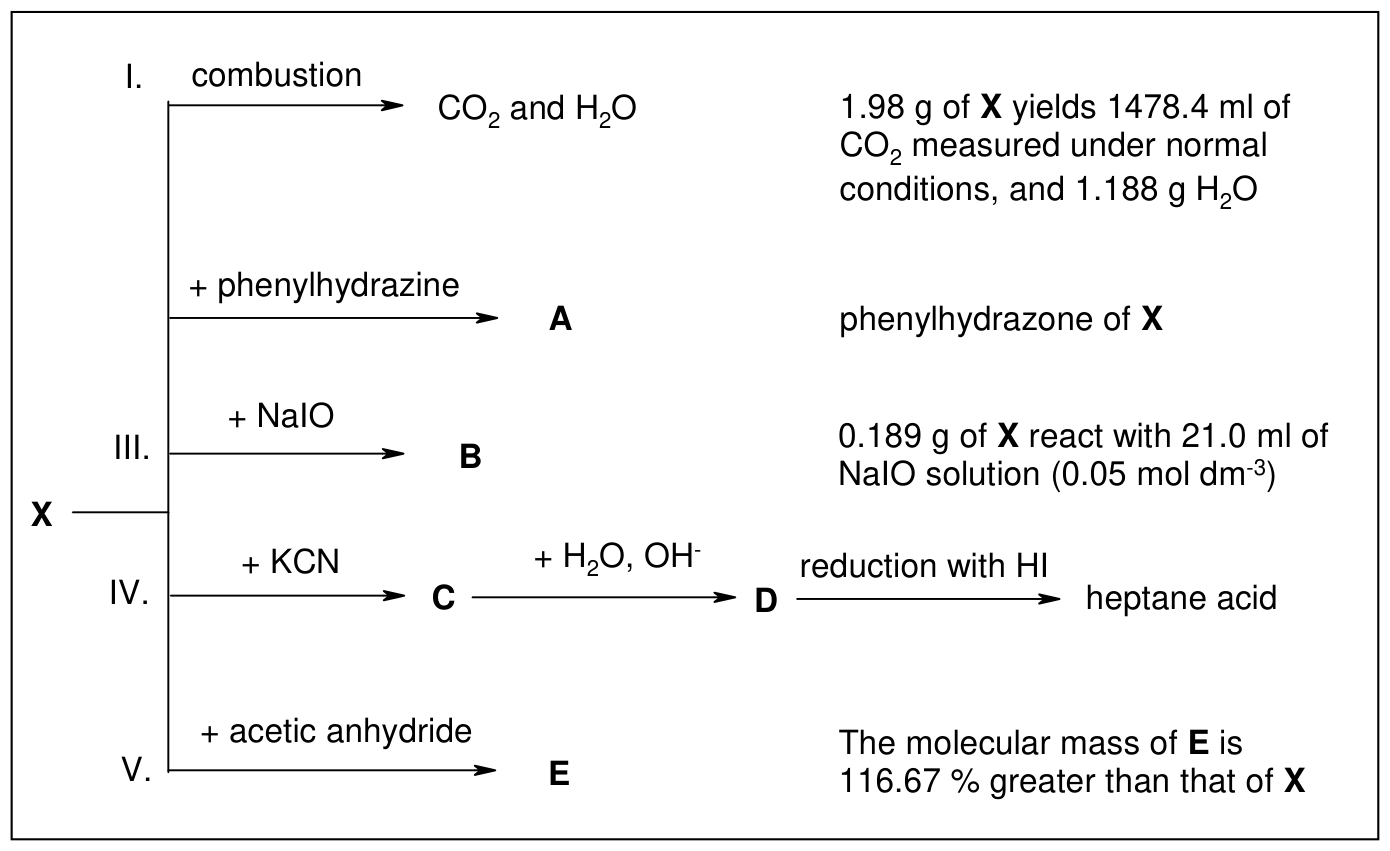
3.1 What conclusions can be drawn on the composition and the structure of X on the basis of the data obtained from each of the above interactions. The conclusions should be formulated in the most concise and clear way. Fill in the table without describing how you reached your conclusions.
| I. | ........................................ |
| II. | ........................................ |
| III. | ........................................ |
| IV. | ........................................ |
| V. | ........................................ |
3.2 Write the formula of substance X on the basis of the data about the composition and structure obtained in point 1.
3.3 Write the formulae of substances A, B, C, D, and E and the formula for heptane acid.
3.4 To what natural substances could this structure correspond? Write the name of the substance and draw the structural formula which best describes its structure properties.
3.5 Give three properties of this compound that do not correspond to the structure found in point 2.
Official English text of the problem.
Answers
- 3.1
| Interaction | Conclusion |
|---|---|
| I | Empirical formula: \(\ce{CH2O}\). |
| II | X contains a reactive carbonyl group. |
| III | X has one aldehyde group; its molar mass is \(180\ \mathrm{g\,mol^{-1}}\), giving \(\ce{C6H12O6}\). |
| IV | X has an unbranched six-carbon skeleton, with the carbonyl group at an end. |
| V | X has five acetylatable hydroxyl groups. |
-
3.2 The open-chain structure is an aldohexose, 2,3,4,5,6-pentahydroxyhexanal: \[ \boxed{\ce{CHO-(CHOH)4-CH2OH}},\qquad \boxed{\ce{C6H12O6}}. \] SMILES:
O=CC(O)C(O)C(O)C(O)CO. The configuration is not determined by the experiments. -
3.3 The products are as follows. Neutral parent acids are shown for B and D; their carboxylates occur under alkaline conditions. Stereochemistry unspecified by the data is deliberately omitted.
| Product | Name and molecular formula | SMILES |
|---|---|---|
| A | Aldohexose phenylhydrazone, \(\ce{C12H18N2O5}\) | OCC(O)C(O)C(O)C(O)C=NNc1ccccc1 |
| B | 2,3,4,5,6-Pentahydroxyhexanoic acid, an aldonic acid, \(\ce{C6H12O7}\) | O=C(O)C(O)C(O)C(O)C(O)CO |
| C | Aldohexose cyanohydrin, 2,3,4,5,6,7-hexahydroxyheptanenitrile, \(\ce{C7H13NO6}\) | N#CC(O)C(O)C(O)C(O)C(O)CO |
| D | 2,3,4,5,6,7-Hexahydroxyheptanoic acid, \(\ce{C7H14O8}\) | O=C(O)C(O)C(O)C(O)C(O)C(O)CO |
| E | Penta-\(O\)-acetyl derivative, \(\ce{C16H22O11}\); shown here as 1,2,3,4,6-penta-\(O\)-acetyl-D-glucopyranose, with its anomer unspecified | CC(=O)OC[C@H]1OC(OC(C)=O)[C@H](OC(C)=O)[C@@H](OC(C)=O)[C@@H]1OC(C)=O |
| “Heptane acid” | Heptanoic acid, \(\ce{CH3(CH2)5COOH}\), \(\ce{C7H14O2}\) | CCCCCCC(=O)O |
The provisional open-chain drawing of E is discussed in the solution.
- 3.4 Natural compounds consistent with the open-chain connectivity include:
| Compound | Open-chain stereochemical SMILES |
|---|---|
| D-Glucose | O=C[C@H](O)[C@@H](O)[C@H](O)[C@H](O)CO |
| D-Mannose | O=C[C@@H](O)[C@@H](O)[C@H](O)[C@H](O)CO |
| D-Galactose | O=C[C@H](O)[C@@H](O)[C@@H](O)[C@H](O)CO |
Taking D-glucose as the representative, its predominant structures are the cyclic hemiacetals:
- α-D-Glucopyranose:
OC[C@H]1O[C@H](O)[C@H](O)[C@@H](O)[C@@H]1O - β-D-Glucopyranose:
OC[C@H]1O[C@@H](O)[C@H](O)[C@@H](O)[C@@H]1O
In a conventional Haworth drawing, the hydroxyl groups at C2, C3 and C4 point down, up and down, respectively; the C5 hydroxymethyl group points up. The anomeric C1 hydroxyl points down in α and up in β.
- 3.5 Three properties unexplained by the open-chain formula alone are:
1. The existence of distinct α and β anomers.
2. Mutarotation in aqueous solution.
3. The failure of glucose pentaacetate to form an oxime with hydroxylamine,
NO, showing that it has no free aldehyde group.
Solution
3.1 — Conclusions from the individual reactions
Use the conventional values \(V_m=22.4\ \mathrm{L\,mol^{-1}}\) at normal conditions and atomic masses \(12,\ 1,\ 16\) for carbon, hydrogen and oxygen.
I. Combustion analysis
The amounts of carbon dioxide, O=C=O, and water, O, are
\[ n(\ce{CO2}) =\frac{1.4784\ \mathrm{L}}{22.4\ \mathrm{L\,mol^{-1}}} =0.0660\ \mathrm{mol}, \]
\[ n(\ce{H2O}) =\frac{1.188\ \mathrm{g}}{18.0\ \mathrm{g\,mol^{-1}}} =0.0660\ \mathrm{mol}. \]
Consequently,
\[ n(\ce{C})=0.0660\ \mathrm{mol}, \qquad n(\ce{H})=2(0.0660)=0.132\ \mathrm{mol}. \]
Their masses are
\[ m_{\ce C}=0.792\ \mathrm{g}, \qquad m_{\ce H}=0.132\ \mathrm{g}. \]
Taking the remaining mass as oxygen,
\[ m_{\ce O}=1.980-0.792-0.132=1.056\ \mathrm{g}, \]
\[ n(\ce O)=\frac{1.056}{16.0}=0.0660\ \mathrm{mol}. \]
Thus
\[ n_{\ce C}:n_{\ce H}:n_{\ce O}=1:2:1, \]
giving the empirical formula \(\boxed{\ce{CH2O}}\). The mass percentages are \(40.0\%\) carbon, \(6.67\%\) hydrogen and \(53.3\%\) oxygen.
II. Phenylhydrazone formation
Phenylhydrazine, NNc1ccccc1, condenses with an aldehyde or ketone carbonyl group, replacing its oxygen by a phenylhydrazone group with elimination of water.
Therefore this experiment establishes a reactive carbonyl group, but by itself does not distinguish an aldehyde from a ketone.
III. Oxidation by sodium hypoiodite
The reagent is sodium hypoiodite, [Na+].[O-]I, \(\ce{NaIO}\). In the intended aldehyde oxidation, one mole of hypoiodite oxidizes one mole of aldehyde groups to carboxyl groups.
\[ n(\ce{NaIO}) =(0.05\ \mathrm{mol\,L^{-1}}) (21.0\times10^{-3}\ \mathrm{L}) =1.05\times10^{-3}\ \mathrm{mol}. \]
For one aldehyde group per molecule,
\[ M_X =\frac{0.189\ \mathrm{g}}{1.05\times10^{-3}\ \mathrm{mol}} =180\ \mathrm{g\,mol^{-1}}. \]
Since the empirical-formula mass is \(30\ \mathrm{g\,mol^{-1}}\),
\[ \frac{180}{30}=6, \qquad \boxed{X:\ \ce{C6H12O6}}. \]
The unbranched chain-extension result in IV independently supports the terminal aldehyde assignment.
IV. Cyanide addition, hydrolysis and reduction
Cyanide addition introduces one additional carbon atom at the original carbonyl carbon. Hydrolysis converts the nitrile carbon into a carboxyl carbon. Subsequent reduction removes the alcoholic oxygen atoms without changing the carbon skeleton.
The final product is unbranched seven-carbon heptanoic acid. Hence X has an unbranched six-carbon skeleton, and its carbonyl group is terminal. An internal ketone would give a branched carboxylic-acid skeleton after this sequence.
V. Acetylation
Each hydroxyl hydrogen replaced by an acetyl group increases the molar mass by
\[ \Delta M_{\text{per OH}}=43-1=42\ \mathrm{g\,mol^{-1}}. \]
The stated increase is \(116.67\%\), so
\[ M_E=2.1667M_X\approx390\ \mathrm{g\,mol^{-1}}. \]
Therefore the number of acetylated hydroxyl groups is
\[ N_{\ce{OH}} =\frac{390-180}{42} =\boxed{5}. \]
The reagent, acetic anhydride, CC(=O)OC(C)=O, therefore converts X into a pentaacetate.
3.2 — Structure of X
The combined evidence gives:
- Six carbons in an unbranched chain.
- One terminal aldehyde group.
- Five hydroxyl groups.
- Molecular formula \(\ce{C6H12O6}\).
The corresponding ordinary polyhydroxyaldehyde structure is
\[ \boxed{\ce{CHO-CH(OH)-CH(OH)-CH(OH)-CH(OH)-CH2OH}}. \]
This is the open-chain connectivity of an aldohexose. Its four stereogenic centres are not assigned by the experiments.
The balanced combustion equation, using dioxygen, O=O, is
\[ \ce{C6H12O6 + 6O2 -> 6CO2 + 6H2O}. \]
3.3 — Products and balanced equations
A: phenylhydrazone
Condensation occurs at the aldehyde group:
\[ \ce{C6H12O6 + C6H5NHNH2 -> C12H18N2O5 + H2O}. \]
The product has the connectivity
\[ \ce{C6H5-NH-N=CH-(CHOH)4-CH2OH}. \]
The problem explicitly identifies a phenylhydrazone; no further reaction with excess phenylhydrazine is required.
B: aldonic acid or aldonate
Only the aldehyde group is oxidized:
\[ \ce{CHO-(CHOH)4-CH2OH ->[oxidation] COOH-(CHOH)4-CH2OH}. \]
The balanced equation written with the neutral acid product is
\[ \ce{C6H12O6 + NaIO -> C6H12O7 + NaI}, \]
where sodium iodide is [Na+].[I-].
If the solution is maintained alkaline, the product is the aldonate ion, O=C([O-])C(O)C(O)C(O)C(O)CO, and the balanced ionic equation is
\[ \ce{C6H12O6 + IO- + OH- -> C6H11O7- + I- + H2O}. \]
Here hypoiodite, hydroxide and iodide have SMILES [O-]I, [OH-] and [I-], respectively.
C: cyanohydrin
The cyanide ion, [C-]#N, attacks the carbonyl carbon; protonation gives
\[ \ce{N#C-CH(OH)-(CHOH)4-CH2OH}. \]
For aqueous potassium cyanide, [K+].[C-]#N, a balanced representation is
\[ \ce{C6H12O6 + KCN + H2O <=> C7H13NO6 + KOH}, \]
where potassium hydroxide is [K+].[OH-].
Addition creates a new stereogenic centre at the former aldehyde carbon. The data do not specify its configuration, so two epimeric cyanohydrins are possible.
D: chain-extended hydroxy acid
Alkaline nitrile hydrolysis gives the 2,3,4,5,6,7-hexahydroxyheptanoate ion, O=C([O-])C(O)C(O)C(O)C(O)C(O)CO, and ammonia, N:
\[ \ce{C7H13NO6 + H2O + OH- -> C7H13O8- + NH3}. \]
The corresponding neutral acid is
\[ \ce{HOOC-(CHOH)5-CH2OH}. \]
On treatment with hydrogen iodide, I, the carboxylate is first protonated:
\[ \ce{C7H13O8- + HI -> C7H14O8 + I-}. \]
Vigorous reduction replaces all six alcoholic hydroxyl groups by hydrogen:
\[ \boxed{\ce{C7H14O8 + 12HI -> C7H14O2 + 6I2 + 6H2O}}, \]
where iodine is II.
The product is therefore
\[ \boxed{\ce{CH3-(CH2)5-COOH}}, \]
heptanoic acid. This explains both the additional carbon and the unbranched skeleton.
E: pentaacetate
The balanced acetylation equation is
\[ \ce{C6H12O6 + 5(CH3CO)2O -> C16H22O11 + 5CH3COOH}, \]
with acetic acid, CC(=O)O, as the coproduct.
Mechanical acetylation of the provisional open-chain drawing gives the open-chain penta-\(O\)-acetyl aldohexose:
\[ \ce{CHO-[CH(OCOCH3)]4-CH2OCOCH3}, \]
SMILES: O=CC(OC(=O)C)C(OC(=O)C)C(OC(=O)C)C(OC(=O)C)COC(=O)C.
However, actual glucose normally gives a cyclic glucopyranose pentaacetate, as represented in the answer table. Both drawings have molecular formula \(\ce{C16H22O11}\); consequently, the mass increase alone cannot distinguish them.
3.4 — Natural compounds and the appropriate structural drawing
The reactions establish the aldohexose connectivity, which fits D-glucose, D-mannose, D-galactose and other aldohexoses. They do not select a particular configuration.
For representative D-glucose, the open-chain Fischer configuration has the hydroxyl groups at C2–C5 arranged right, left, right, right, with the aldehyde at the top.
Its predominant molecular structures are six-membered cyclic hemiacetals. The C5 hydroxyl oxygen adds intramolecularly to the C1 aldehyde carbon:
- The C5 oxygen becomes the ring oxygen.
- The former carbonyl oxygen becomes the C1 hydroxyl group.
- C1 becomes a new stereogenic centre, producing the α and β anomers.
- No water is eliminated during hemiacetal formation.
For the requested drawing, place the ring oxygen at the upper right of a Haworth hexagon, followed clockwise by C1, C2, C3, C4 and C5. Draw:
| Position | Substituent direction |
|---|---|
| C1 | Hydroxyl down for α; up for β |
| C2 | Hydroxyl down |
| C3 | Hydroxyl up |
| C4 | Hydroxyl down |
| C5 | Hydroxymethyl up |
The hydrogen at each position points in the opposite direction.
Both anomers predominantly adopt the \(^{4}C_{1}\) chair conformation. In β-D-glucopyranose, all hydroxyl and hydroxymethyl substituents are equatorial; in α-D-glucopyranose, the anomeric hydroxyl is axial. The SMILES specify configuration but do not themselves specify this preferred chair conformation.
3.5 — Three properties requiring the cyclic structure
-
Two anomeric forms.
The α and β forms have the same configurations at C2–C5 but differ at C1. The open-chain aldehyde carbon is planar and cannot supply this additional stereogenic centre. Hemiacetal formation does. -
Mutarotation.
A solution prepared from either pure anomer changes its optical rotation as the anomers interconvert through the small equilibrium population of the open-chain form: \[ \underset{\alpha\text{ anomer}}{\ce{C6H12O6}} \;\ce{<=>}\; \underset{\text{open chain}}{\ce{C6H12O6}} \;\ce{<=>}\; \underset{\beta\text{ anomer}}{\ce{C6H12O6}}. \] The rotation becomes constant when equilibrium is reached. -
The pentaacetate does not form an oxime with hydroxylamine.
Acetylation of five hydroxyl groups in the open-chain model would leave an aldehyde group available for oxime formation. In the actual cyclic pentaacetate, the anomeric carbon is an acetal carbon, and there is no free aldehyde group. This explains the negative reaction.
The solution was checked against the official solution. Where this solution differs from the official solution, the official solution contains an error or a misprint.
IChO 1981 · Theorieaufgabe 3
Struktur einer natürlichen Verbindung X anhand ihrer Reaktionen
Die Verbindung X wurde aus einem neutralen Produkt isoliert. Zur Aufklärung der Struktur von X wurden verschiedene Reagenzien verwendet. Dabei wurden die folgenden Ergebnisse erhalten:
3.1 Welche Schlussfolgerungen lassen sich aus den bei jeder der oben genannten Reaktionen erhaltenen Daten über die Zusammensetzung und die Struktur von X ziehen? Die Schlussfolgerungen sollen möglichst knapp und klar formuliert werden. Füllen Sie die Tabelle aus, ohne zu beschreiben, wie Sie zu Ihren Schlussfolgerungen gelangt sind.
| I. | ........................................ |
| II. | ........................................ |
| III. | ........................................ |
| IV. | ........................................ |
| V. | ........................................ |
3.2 Geben Sie die Formel der Substanz X anhand der in Punkt 1 erhaltenen Daten über ihre Zusammensetzung und Struktur an.
3.3 Geben Sie die Formeln der Substanzen A, B, C, D, und E sowie die Formel der Heptansäure an.
3.4 Welchen natürlichen Substanzen könnte diese Struktur entsprechen? Geben Sie den Namen der Substanz an und zeichnen Sie die Strukturformel, die ihre strukturellen Eigenschaften am besten beschreibt.
3.5 Nennen Sie drei Eigenschaften dieser Verbindung, die nicht mit der in Punkt 2 ermittelten Struktur übereinstimmen.
Aufgabentext aus dem offiziellen englischen Text übersetzt.
Antworten
- 3.1
| Reaktion | Schlussfolgerung |
|---|---|
| I | Verhältnisformel: \(\ce{CH2O}\). |
| II | X enthält eine reaktionsfähige Carbonylgruppe. |
| III | X besitzt eine Aldehydgruppe; seine molare Masse beträgt \(180\ \mathrm{g\,mol^{-1}}\), woraus sich \(\ce{C6H12O6}\) ergibt. |
| IV | X besitzt ein unverzweigtes Gerüst aus sechs Kohlenstoffatomen mit einer endständigen Carbonylgruppe. |
| V | X besitzt fünf acetylierbare Hydroxygruppen. |
-
3.2 Die offenkettige Struktur ist eine Aldohexose, 2,3,4,5,6-Pentahydroxyhexanal: \[ \boxed{\ce{CHO-(CHOH)4-CH2OH}},\qquad \boxed{\ce{C6H12O6}}. \] SMILES:
O=CC(O)C(O)C(O)C(O)CO. Die Konfiguration wird durch die Versuche nicht bestimmt. -
3.3 Die Produkte sind nachstehend aufgeführt. Für B und D sind die entsprechenden neutralen Säuren dargestellt; unter alkalischen Bedingungen liegen ihre Carboxylate vor. Stereochemische Angaben, die aus den Daten nicht hervorgehen, werden bewusst weggelassen.
| Produkt | Name und Summenformel | SMILES |
|---|---|---|
| A | Aldohexosephenylhydrazon, \(\ce{C12H18N2O5}\) | OCC(O)C(O)C(O)C(O)C=NNc1ccccc1 |
| B | 2,3,4,5,6-Pentahydroxyhexansäure, eine Aldonsäure, \(\ce{C6H12O7}\) | O=C(O)C(O)C(O)C(O)C(O)CO |
| C | Aldohexosecyanhydrin, 2,3,4,5,6,7-Hexahydroxyheptannitril, \(\ce{C7H13NO6}\) | N#CC(O)C(O)C(O)C(O)C(O)CO |
| D | 2,3,4,5,6,7-Hexahydroxyheptansäure, \(\ce{C7H14O8}\) | O=C(O)C(O)C(O)C(O)C(O)C(O)CO |
| E | Penta-\(O\)-acetylderivat, \(\ce{C16H22O11}\); hier als 1,2,3,4,6-Penta-\(O\)-acetyl-D-glucopyranose dargestellt, ohne Festlegung des Anomers | CC(=O)OC[C@H]1OC(OC(C)=O)[C@H](OC(C)=O)[C@@H](OC(C)=O)[C@@H]1OC(C)=O |
| „Heptansäure“ | Heptansäure, \(\ce{CH3(CH2)5COOH}\), \(\ce{C7H14O2}\) | CCCCCCC(=O)O |
Die vorläufige offenkettige Darstellung von E wird in der Lösung besprochen.
- 3.4 Zu den natürlichen Verbindungen, die mit der offenkettigen Konnektivität vereinbar sind, gehören:
| Verbindung | Stereochemischer SMILES der offenkettigen Form |
|---|---|
| D-Glucose | O=C[C@H](O)[C@@H](O)[C@H](O)[C@H](O)CO |
| D-Mannose | O=C[C@@H](O)[C@@H](O)[C@H](O)[C@H](O)CO |
| D-Galactose | O=C[C@H](O)[C@@H](O)[C@@H](O)[C@H](O)CO |
Wählt man D-Glucose als Vertreter, so sind ihre vorherrschenden Strukturen die cyclischen Halbacetale:
- α-D-Glucopyranose:
OC[C@H]1O[C@H](O)[C@H](O)[C@@H](O)[C@@H]1O - β-D-Glucopyranose:
OC[C@H]1O[C@@H](O)[C@H](O)[C@@H](O)[C@@H]1O
In einer konventionellen Haworth-Darstellung zeigen die Hydroxygruppen an C2, C3 und C4 nach unten, nach oben bzw. nach unten; die Hydroxymethylgruppe an C5 zeigt nach oben. Die anomere Hydroxygruppe an C1 zeigt bei α nach unten und bei β nach oben.
- 3.5 Drei Eigenschaften, die sich durch die offenkettige Formel allein nicht erklären lassen, sind:
1. Die Existenz unterschiedlicher α- und β-Anomere.
2. Mutarotation in wässriger Lösung.
3. Die Tatsache, dass Glucosepentaacetat mit Hydroxylamin,
NO, kein Oxim bildet, was zeigt, dass es keine freie Aldehydgruppe besitzt.
Lösung
3.1 — Schlussfolgerungen aus den einzelnen Reaktionen
Verwenden Sie die üblichen Werte \(V_m=22.4\ \mathrm{L\,mol^{-1}}\) unter Normalbedingungen und die Atommassen \(12,\ 1,\ 16\) für Kohlenstoff, Wasserstoff und Sauerstoff.
I. Verbrennungsanalyse
Die Stoffmengen von Kohlenstoffdioxid, O=C=O, und Wasser, O, betragen
\[ n(\ce{CO2}) =\frac{1.4784\ \mathrm{L}}{22.4\ \mathrm{L\,mol^{-1}}} =0.0660\ \mathrm{mol}, \]
\[ n(\ce{H2O}) =\frac{1.188\ \mathrm{g}}{18.0\ \mathrm{g\,mol^{-1}}} =0.0660\ \mathrm{mol}. \]
Folglich gilt
\[ n(\ce{C})=0.0660\ \mathrm{mol}, \qquad n(\ce{H})=2(0.0660)=0.132\ \mathrm{mol}. \]
Ihre Massen betragen
\[ m_{\ce C}=0.792\ \mathrm{g}, \qquad m_{\ce H}=0.132\ \mathrm{g}. \]
Wird die verbleibende Masse dem Sauerstoff zugerechnet, ergibt sich
\[ m_{\ce O}=1.980-0.792-0.132=1.056\ \mathrm{g}, \]
\[ n(\ce O)=\frac{1.056}{16.0}=0.0660\ \mathrm{mol}. \]
Somit gilt
\[ n_{\ce C}:n_{\ce H}:n_{\ce O}=1:2:1, \]
woraus sich die Verhältnisformel \(\boxed{\ce{CH2O}}\) ergibt. Die Massenanteile betragen \(40.0\%\) Kohlenstoff, \(6.67\%\) Wasserstoff und \(53.3\%\) Sauerstoff.
II. Phenylhydrazonbildung
Phenylhydrazin, NNc1ccccc1, kondensiert mit der Carbonylgruppe eines Aldehyds oder Ketons, wobei unter Wasserabspaltung deren Sauerstoff durch eine Phenylhydrazongruppe ersetzt wird.
Dieser Versuch weist somit eine reaktionsfähige Carbonylgruppe nach, unterscheidet für sich allein jedoch nicht zwischen einem Aldehyd und einem Keton.
III. Oxidation mit Natriumhypoiodit
Das Reagenz ist Natriumhypoiodit, [Na+].[O-]I, \(\ce{NaIO}\). Bei der vorgesehenen Aldehydoxidation oxidiert ein Mol Hypoiodit ein Mol Aldehydgruppen zu Carboxygruppen.
\[ n(\ce{NaIO}) =(0.05\ \mathrm{mol\,L^{-1}}) (21.0\times10^{-3}\ \mathrm{L}) =1.05\times10^{-3}\ \mathrm{mol}. \]
Für eine Aldehydgruppe pro Molekül gilt
\[ M_X =\frac{0.189\ \mathrm{g}}{1.05\times10^{-3}\ \mathrm{mol}} =180\ \mathrm{g\,mol^{-1}}. \]
Da die molare Masse der Verhältnisformeleinheit \(30\ \mathrm{g\,mol^{-1}}\) beträgt, gilt
\[ \frac{180}{30}=6, \qquad \boxed{X:\ \ce{C6H12O6}}. \]
Das Ergebnis der Kettenverlängerung in IV, bei der eine unverzweigte Kette entsteht, stützt unabhängig davon die Zuordnung einer endständigen Aldehydgruppe.
IV. Cyanidaddition, Hydrolyse und Reduktion
Die Cyanidaddition führt ein zusätzliches Kohlenstoffatom am ursprünglichen Carbonylkohlenstoff ein. Durch Hydrolyse wird der Nitrilkohlenstoff in einen Carboxylkohlenstoff umgewandelt. Die anschließende Reduktion entfernt die alkoholischen Sauerstoffatome, ohne das Kohlenstoffgerüst zu verändern.
Das Endprodukt ist unverzweigte Heptansäure mit sieben Kohlenstoffatomen. Daher besitzt X ein unverzweigtes Gerüst aus sechs Kohlenstoffatomen und eine endständige Carbonylgruppe. Ein Keton mit innenständiger Carbonylgruppe würde nach dieser Reaktionsfolge ein verzweigtes Carbonsäuregerüst ergeben.
V. Acetylierung
Jedes Hydroxywasserstoffatom, das durch eine Acetylgruppe ersetzt wird, erhöht die molare Masse um
\[ \Delta M_{\text{pro OH}}=43-1=42\ \mathrm{g\,mol^{-1}}. \]
Die angegebene Zunahme beträgt \(116.67\%\), also gilt
\[ M_E=2.1667M_X\approx390\ \mathrm{g\,mol^{-1}}. \]
Die Anzahl der acetylierten Hydroxygruppen beträgt daher
\[ N_{\ce{OH}} =\frac{390-180}{42} =\boxed{5}. \]
Das Reagenz, Essigsäureanhydrid, CC(=O)OC(C)=O, wandelt X somit in ein Pentaacetat um.
3.2 — Struktur von X
Aus den Befunden ergibt sich insgesamt:
- Sechs Kohlenstoffatome in einer unverzweigten Kette.
- Eine endständige Aldehydgruppe.
- Fünf Hydroxygruppen.
- Summenformel \(\ce{C6H12O6}\).
Die entsprechende übliche Polyhydroxyaldehydstruktur lautet
\[ \boxed{\ce{CHO-CH(OH)-CH(OH)-CH(OH)-CH(OH)-CH2OH}}. \]
Dies ist die offenkettige Konnektivität einer Aldohexose. Die Konfiguration ihrer vier stereogenen Zentren wird durch die Versuche nicht festgelegt.
Die ausgeglichene Verbrennungsgleichung mit Disauerstoff, O=O, lautet
\[ \ce{C6H12O6 + 6O2 -> 6CO2 + 6H2O}. \]
3.3 — Produkte und ausgeglichene Gleichungen
A: Phenylhydrazon
Die Kondensation erfolgt an der Aldehydgruppe:
\[ \ce{C6H12O6 + C6H5NHNH2 -> C12H18N2O5 + H2O}. \]
Das Produkt besitzt die Konnektivität
\[ \ce{C6H5-NH-N=CH-(CHOH)4-CH2OH}. \]
Die Aufgabe nennt ausdrücklich ein Phenylhydrazon; eine weitere Reaktion mit überschüssigem Phenylhydrazin ist nicht erforderlich.
B: Aldonsäure oder Aldonat
Nur die Aldehydgruppe wird oxidiert:
\[ \ce{CHO-(CHOH)4-CH2OH ->[oxidation] COOH-(CHOH)4-CH2OH}. \]
Die ausgeglichene Gleichung mit der neutralen Säure als Produkt lautet
\[ \ce{C6H12O6 + NaIO -> C6H12O7 + NaI}, \]
wobei Natriumiodid durch [Na+].[I-] dargestellt wird.
Wird die Lösung alkalisch gehalten, ist das Produkt das Aldonat-Ion, O=C([O-])C(O)C(O)C(O)C(O)CO, und die ausgeglichene Ionengleichung lautet
\[ \ce{C6H12O6 + IO- + OH- -> C6H11O7- + I- + H2O}. \]
Hier haben Hypoiodit, Hydroxid und Iodid die SMILES [O-]I, [OH-] bzw. [I-].
C: Cyanhydrin
Das Cyanid-Ion, [C-]#N, greift den Carbonylkohlenstoff an; durch Protonierung entsteht
\[ \ce{N#C-CH(OH)-(CHOH)4-CH2OH}. \]
Für wässriges Kaliumcyanid, [K+].[C-]#N, lautet eine ausgeglichene Darstellung
\[ \ce{C6H12O6 + KCN + H2O <=> C7H13NO6 + KOH}, \]
wobei Kaliumhydroxid durch [K+].[OH-] dargestellt wird.
Durch die Addition entsteht am ehemaligen Aldehydkohlenstoff ein neues stereogenes Zentrum. Die Daten legen dessen Konfiguration nicht fest, sodass zwei epimere Cyanhydrine möglich sind.
D: kettenverlängerte Hydroxysäure
Die alkalische Nitrilhydrolyse liefert das 2,3,4,5,6,7-Hexahydroxyheptanoat-Ion, O=C([O-])C(O)C(O)C(O)C(O)C(O)CO, und Ammoniak, N:
\[ \ce{C7H13NO6 + H2O + OH- -> C7H13O8- + NH3}. \]
Die entsprechende neutrale Säure lautet
\[ \ce{HOOC-(CHOH)5-CH2OH}. \]
Bei der Behandlung mit Iodwasserstoff, I, wird das Carboxylat zunächst protoniert:
\[ \ce{C7H13O8- + HI -> C7H14O8 + I-}. \]
Eine energische Reduktion ersetzt alle sechs alkoholischen Hydroxygruppen durch Wasserstoff:
\[ \boxed{\ce{C7H14O8 + 12HI -> C7H14O2 + 6I2 + 6H2O}}, \]
wobei Iod durch II dargestellt wird.
Das Produkt ist daher
\[ \boxed{\ce{CH3-(CH2)5-COOH}}, \]
Heptansäure. Dies erklärt sowohl das zusätzliche Kohlenstoffatom als auch das unverzweigte Gerüst.
E: Pentaacetat
Die ausgeglichene Acetylierungsgleichung lautet
\[ \ce{C6H12O6 + 5(CH3CO)2O -> C16H22O11 + 5CH3COOH}, \]
mit Essigsäure, CC(=O)O, als Koppelprodukt.
Die rein formale Acetylierung der vorläufigen offenkettigen Darstellung ergibt die offenkettige Penta-\(O\)-acetylaldohexose:
\[ \ce{CHO-[CH(OCOCH3)]4-CH2OCOCH3}, \]
SMILES: O=CC(OC(=O)C)C(OC(=O)C)C(OC(=O)C)C(OC(=O)C)COC(=O)C.
Tatsächlich liefert Glucose jedoch normalerweise ein cyclisches Glucopyranosepentaacetat, wie in der Antworttabelle dargestellt. Beide Darstellungen haben die Summenformel \(\ce{C16H22O11}\); die Massenzunahme allein erlaubt daher keine Unterscheidung zwischen ihnen.
3.4 — Natürliche Verbindungen und die geeignete Strukturdarstellung
Die Reaktionen belegen die Konnektivität einer Aldohexose, die zu D-Glucose, D-Mannose, D-Galactose und weiteren Aldohexosen passt. Sie legen keine bestimmte Konfiguration fest.
Bei D-Glucose als Vertreter sind in der offenkettigen Fischer-Projektion die Hydroxygruppen an C2–C5 rechts, links, rechts, rechts angeordnet, wobei die Aldehydgruppe oben steht.
Ihre vorherrschenden Molekülstrukturen sind sechsgliedrige cyclische Halbacetale. Der Sauerstoff der Hydroxygruppe an C5 addiert intramolekular an den Aldehydkohlenstoff C1:
- Der Sauerstoff an C5 wird zum Ringsauerstoff.
- Der ehemalige Carbonylsauerstoff wird zur Hydroxygruppe an C1.
- C1 wird zu einem neuen stereogenen Zentrum, wodurch die α- und β-Anomere entstehen.
- Bei der Halbacetalbildung wird kein Wasser abgespalten.
Platzieren Sie für die geforderte Zeichnung den Ringsauerstoff oben rechts in einem Haworth-Sechseck, gefolgt im Uhrzeigersinn von C1, C2, C3, C4 und C5. Zeichnen Sie:
| Position | Richtung des Substituenten |
|---|---|
| C1 | Hydroxygruppe bei α nach unten; bei β nach oben |
| C2 | Hydroxygruppe nach unten |
| C3 | Hydroxygruppe nach oben |
| C4 | Hydroxygruppe nach unten |
| C5 | Hydroxymethylgruppe nach oben |
Das Wasserstoffatom an jeder Position zeigt in die entgegengesetzte Richtung.
Beide Anomere nehmen überwiegend die \(^{4}C_{1}\)-Sesselkonformation ein. In β-D-Glucopyranose stehen alle Hydroxy- und Hydroxymethylsubstituenten äquatorial; in α-D-Glucopyranose steht die anomere Hydroxygruppe axial. Die SMILES legen die Konfiguration fest, geben aber selbst diese bevorzugte Sesselkonformation nicht an.
3.5 — Drei Eigenschaften, die die cyclische Struktur erfordern
-
Zwei anomere Formen.
Die α- und β-Formen haben an C2–C5 dieselben Konfigurationen, unterscheiden sich aber an C1. Der offenkettige Aldehydkohlenstoff ist planar und kann dieses zusätzliche stereogene Zentrum nicht bereitstellen. Durch Halbacetalbildung entsteht es. -
Mutarotation.
Eine aus einem der beiden reinen Anomere hergestellte Lösung ändert ihren optischen Drehwinkel, während die Anomere über den geringen Gleichgewichtsanteil der offenkettigen Form ineinander übergehen: \[ \underset{\alpha\text{-Anomer}}{\ce{C6H12O6}} \;\ce{<=>}\; \underset{\text{offene Kette}}{\ce{C6H12O6}} \;\ce{<=>}\; \underset{\beta\text{-Anomer}}{\ce{C6H12O6}}. \] Der Drehwinkel wird konstant, sobald das Gleichgewicht erreicht ist. -
Das Pentaacetat bildet mit Hydroxylamin kein Oxim.
Die Acetylierung von fünf Hydroxygruppen im offenkettigen Modell würde eine Aldehydgruppe zurücklassen, die für die Oximbildung zur Verfügung stünde. Im tatsächlichen cyclischen Pentaacetat ist der anomere Kohlenstoff ein Acetalkohlenstoff, und es gibt keine freie Aldehydgruppe. Dies erklärt das Ausbleiben der Reaktion.
Die Lösung wurde mit der offiziellen Lösung abgeglichen. Wo diese Lösung von der offiziellen Lösung abweicht, enthält die offizielle Lösung einen Fehler oder Druckfehler.
IChO 1981 · Teori sorusu 3
Doğal bir X bileşiğinin tepkimelerinden yapısının belirlenmesi
X bileşiği nötr bir üründen izole edilmiştir. X'in yapısını belirlemek için farklı reaktifler kullanılmıştır. Aşağıdaki sonuçlar elde edilmiştir:
3.1 Yukarıdaki etkileşimlerin her birinden elde edilen verilere dayanarak X'in bileşimi ve yapısı hakkında hangi sonuçlara varılabilir? Sonuçlar olabildiğince kısa ve açık biçimde ifade edilmelidir. Sonuçlara nasıl ulaştığınızı açıklamadan tabloyu doldurunuz.
| I. | ........................................ |
| II. | ........................................ |
| III. | ........................................ |
| IV. | ........................................ |
| V. | ........................................ |
3.2 1. maddede elde edilen bileşim ve yapı verilerine dayanarak X maddesinin formülünü yazınız.
3.3 A, B, C, D ve E maddelerinin formüllerini ve heptan asidinin formülünü yazınız.
3.4 Bu yapı hangi doğal maddelere karşılık gelebilir? Maddenin adını yazınız ve yapısal özelliklerini en iyi açıklayan yapı formülünü çiziniz.
3.5 Bu bileşiğin, 2. maddede bulunan yapıyla uyuşmayan üç özelliğini belirtiniz.
Soru metni resmi İngilizce metinden çevrilmiştir.
Cevaplar
- 3.1
| Etkileşim | Sonuç |
|---|---|
| I | Basit formül: \(\ce{CH2O}\). |
| II | X, tepkimeye girebilen bir karbonil grubu içerir. |
| III | X bir aldehit grubuna sahiptir; molar kütlesi \(180\ \mathrm{g\,mol^{-1}}\) olup buradan \(\ce{C6H12O6}\) elde edilir. |
| IV | X, karbonil grubu uçta bulunan, dallanmamış altı karbonlu bir iskelete sahiptir. |
| V | X, asetillenebilen beş hidroksil grubuna sahiptir. |
-
3.2 Açık zincirli yapı bir aldoheksoz, 2,3,4,5,6-pentahidroksihekzanaldir: \[ \boxed{\ce{CHO-(CHOH)4-CH2OH}},\qquad \boxed{\ce{C6H12O6}}. \] SMILES:
O=CC(O)C(O)C(O)C(O)CO. Deneyler konfigürasyonu belirlememektedir. -
3.3 Ürünler aşağıdaki gibidir. B ve D için nötr asit biçimleri gösterilmiştir; bazik koşullarda bunların karboksilatları bulunur. Verilerin belirlemediği stereokimya bilinçli olarak gösterilmemiştir.
| Ürün | Adı ve molekül formülü | SMILES |
|---|---|---|
| A | Aldoheksoz fenilhidrazonu, \(\ce{C12H18N2O5}\) | OCC(O)C(O)C(O)C(O)C=NNc1ccccc1 |
| B | Bir aldonik asit olan 2,3,4,5,6-pentahidroksihekzanoik asit, \(\ce{C6H12O7}\) | O=C(O)C(O)C(O)C(O)C(O)CO |
| C | Aldoheksoz siyanohidrini, 2,3,4,5,6,7-hekzahidroksiheptannitril, \(\ce{C7H13NO6}\) | N#CC(O)C(O)C(O)C(O)C(O)CO |
| D | 2,3,4,5,6,7-Hekzahidroksiheptanoik asit, \(\ce{C7H14O8}\) | O=C(O)C(O)C(O)C(O)C(O)C(O)CO |
| E | Penta-\(O\)-asetil türevi, \(\ce{C16H22O11}\); burada anomeri belirtilmemiş 1,2,3,4,6-penta-\(O\)-asetil-D-glukopiranoz olarak gösterilmiştir | CC(=O)OC[C@H]1OC(OC(C)=O)[C@H](OC(C)=O)[C@@H](OC(C)=O)[C@@H]1OC(C)=O |
| “Heptan asidi” | Heptanoik asit, \(\ce{CH3(CH2)5COOH}\), \(\ce{C7H14O2}\) | CCCCCCC(=O)O |
E'nin geçici olarak kullanılan açık zincirli çizimi çözümde ele alınmıştır.
- 3.4 Açık zincirli yapıdaki atomların bağlanma düzeniyle uyumlu doğal bileşikler şunları içerir:
| Bileşik | Açık zincirli stereokimyasal SMILES |
|---|---|
| D-Glukoz | O=C[C@H](O)[C@@H](O)[C@H](O)[C@H](O)CO |
| D-Mannoz | O=C[C@@H](O)[C@@H](O)[C@H](O)[C@H](O)CO |
| D-Galaktoz | O=C[C@H](O)[C@@H](O)[C@@H](O)[C@H](O)CO |
Temsilci olarak D-glukoz alındığında, baskın yapıları halkalı hemiasetallerdir:
- α-D-Glukopiranoz:
OC[C@H]1O[C@H](O)[C@H](O)[C@@H](O)[C@@H]1O - β-D-Glukopiranoz:
OC[C@H]1O[C@@H](O)[C@H](O)[C@@H](O)[C@@H]1O
Geleneksel bir Haworth çiziminde C2, C3 ve C4'teki hidroksil grupları sırasıyla aşağı, yukarı ve aşağı yönelmiştir; C5'teki hidroksimetil grubu yukarı yönelmiştir. Anomerik C1 hidroksili α'da aşağı, β'de yukarı yönelmiştir.
- 3.5 Yalnızca açık zincirli formülle açıklanamayan üç özellik şunlardır:
1. Birbirinden farklı α ve β anomerlerinin varlığı.
2. Sulu çözeltide mutarotasyon.
3. Glukoz pentaasetatın hidroksilamin,
NO, ile oksim oluşturmaması; bu, serbest aldehit grubu bulunmadığını gösterir.
Çözüm
3.1 — Her bir tepkimeden çıkarılan sonuçlar
Normal koşullarda \(V_m=22.4\ \mathrm{L\,mol^{-1}}\) değerini ve karbon, hidrojen ve oksijen için sırasıyla \(12,\ 1,\ 16\) atom kütlelerini kullanınız.
I. Yanma analizi
Karbondioksit, O=C=O, ve su, O, miktarları şöyledir:
\[ n(\ce{CO2}) =\frac{1.4784\ \mathrm{L}}{22.4\ \mathrm{L\,mol^{-1}}} =0.0660\ \mathrm{mol}, \]
\[ n(\ce{H2O}) =\frac{1.188\ \mathrm{g}}{18.0\ \mathrm{g\,mol^{-1}}} =0.0660\ \mathrm{mol}. \]
Dolayısıyla,
\[ n(\ce{C})=0.0660\ \mathrm{mol}, \qquad n(\ce{H})=2(0.0660)=0.132\ \mathrm{mol}. \]
Bunların kütleleri şöyledir:
\[ m_{\ce C}=0.792\ \mathrm{g}, \qquad m_{\ce H}=0.132\ \mathrm{g}. \]
Kalan kütle oksijene ait kabul edilirse,
\[ m_{\ce O}=1.980-0.792-0.132=1.056\ \mathrm{g}, \]
\[ n(\ce O)=\frac{1.056}{16.0}=0.0660\ \mathrm{mol}. \]
Böylece
\[ n_{\ce C}:n_{\ce H}:n_{\ce O}=1:2:1, \]
oranı elde edilir ve basit formül \(\boxed{\ce{CH2O}}\) olur. Kütlece yüzdeler karbon için \(40.0\%\), hidrojen için \(6.67\%\) ve oksijen için \(53.3\%\)'tür.
II. Fenilhidrazon oluşumu
Fenilhidrazin, NNc1ccccc1, bir aldehit veya ketonun karbonil grubuyla kondenzasyona girer; su ayrılmasıyla karbonil oksijeninin yerini bir fenilhidrazon grubu alır.
Dolayısıyla bu deney, tepkimeye girebilen bir karbonil grubunun varlığını ortaya koyar; ancak tek başına aldehit ile ketonu birbirinden ayırt etmez.
III. Sodyum hipoiyodit ile yükseltgenme
Reaktif sodyum hipoiyodit, [Na+].[O-]I, \(\ce{NaIO}\)'tir. Burada söz konusu olan aldehit yükseltgenmesinde, bir mol hipoiyodit bir mol aldehit grubunu karboksil gruplarına yükseltger.
\[ n(\ce{NaIO}) =(0.05\ \mathrm{mol\,L^{-1}}) (21.0\times10^{-3}\ \mathrm{L}) =1.05\times10^{-3}\ \mathrm{mol}. \]
Molekül başına bir aldehit grubu için,
\[ M_X =\frac{0.189\ \mathrm{g}}{1.05\times10^{-3}\ \mathrm{mol}} =180\ \mathrm{g\,mol^{-1}}. \]
Basit formülün molar kütlesi \(30\ \mathrm{g\,mol^{-1}}\) olduğundan,
\[ \frac{180}{30}=6, \qquad \boxed{X:\ \ce{C6H12O6}}. \]
IV'te dallanmamış bir zincirin uzamasıyla elde edilen sonuç, uçta bir aldehit grubu bulunduğu sonucunu bağımsız olarak destekler.
IV. Siyanür katılması, hidroliz ve indirgenme
Siyanür katılması, başlangıçtaki karbonil karbonuna bir ek karbon atomu bağlar. Hidroliz, nitril karbonunu karboksil karbonuna dönüştürür. Ardından gerçekleşen indirgenme, karbon iskeletini değiştirmeden alkol gruplarındaki oksijen atomlarını uzaklaştırır.
Son ürün, dallanmamış yedi karbonlu heptanoik asittir. Bu nedenle X, dallanmamış altı karbonlu bir iskelete sahiptir ve karbonil grubu uçtadır. Zincir içindeki bir keton grubu, bu tepkime dizisinin sonunda dallanmış bir karboksilik asit iskeleti verirdi.
V. Asetilleme
Bir asetil grubuyla yer değiştiren her hidroksil hidrojeni, molar kütleyi şu kadar artırır:
\[ \Delta M_{\text{OH başına}}=43-1=42\ \mathrm{g\,mol^{-1}}. \]
Belirtilen artış \(116.67\%\) olduğundan,
\[ M_E=2.1667M_X\approx390\ \mathrm{g\,mol^{-1}}. \]
Dolayısıyla asetillenen hidroksil gruplarının sayısı şöyledir:
\[ N_{\ce{OH}} =\frac{390-180}{42} =\boxed{5}. \]
Buna göre reaktif olan asetik anhidrit, CC(=O)OC(C)=O, X'i bir pentaasetata dönüştürür.
3.2 — X'in yapısı
Kanıtlar birlikte değerlendirildiğinde şu sonuçlar elde edilir:
- Dallanmamış bir zincirde altı karbon.
- Uçta bir aldehit grubu.
- Beş hidroksil grubu.
- \(\ce{C6H12O6}\) molekül formülü.
Bunlara karşılık gelen olağan polihidroksialdehit yapısı şöyledir:
\[ \boxed{\ce{CHO-CH(OH)-CH(OH)-CH(OH)-CH(OH)-CH2OH}}. \]
Bu, bir aldoheksozun açık zincirli bağlanma düzenidir. Dört stereojenik merkezinin konfigürasyonları deneylerle belirlenmemiştir.
Dioksijen, O=O, kullanılarak yazılan denkleştirilmiş yanma denklemi şöyledir:
\[ \ce{C6H12O6 + 6O2 -> 6CO2 + 6H2O}. \]
3.3 — Ürünler ve denkleştirilmiş denklemler
A: fenilhidrazon
Kondenzasyon aldehit grubunda gerçekleşir:
\[ \ce{C6H12O6 + C6H5NHNH2 -> C12H18N2O5 + H2O}. \]
Üründeki atomların bağlanma düzeni şöyledir:
\[ \ce{C6H5-NH-N=CH-(CHOH)4-CH2OH}. \]
Soruda ürünün bir fenilhidrazon olduğu açıkça belirtilmiştir; fazla fenilhidrazinle daha ileri bir tepkime gerekmez.
B: aldonik asit veya aldonat
Yalnızca aldehit grubu yükseltgenir:
\[ \ce{CHO-(CHOH)4-CH2OH ->[oxidation] COOH-(CHOH)4-CH2OH}. \]
Ürünün nötr asit biçimiyle yazılan denkleştirilmiş denklem şöyledir:
\[ \ce{C6H12O6 + NaIO -> C6H12O7 + NaI}, \]
burada sodyum iyodür [Na+].[I-] ile gösterilir.
Çözelti bazik tutulursa ürün aldonat iyonu, O=C([O-])C(O)C(O)C(O)C(O)CO, olur ve denkleştirilmiş iyonik denklem şöyledir:
\[ \ce{C6H12O6 + IO- + OH- -> C6H11O7- + I- + H2O}. \]
Burada hipoiyodit, hidroksit ve iyodür için SMILES gösterimleri sırasıyla [O-]I, [OH-] ve [I-] şeklindedir.
C: siyanohidrin
Siyanür iyonu, [C-]#N, karbonil karbonuna saldırır; protonlanma sonucunda şu yapı oluşur:
\[ \ce{N#C-CH(OH)-(CHOH)4-CH2OH}. \]
Sulu potasyum siyanür, [K+].[C-]#N, için denkleştirilmiş bir gösterim şöyledir:
\[ \ce{C6H12O6 + KCN + H2O <=> C7H13NO6 + KOH}, \]
burada potasyum hidroksit [K+].[OH-] ile gösterilir.
Katılma, başlangıçtaki aldehit karbonunda yeni bir stereojenik merkez oluşturur. Veriler bu merkezin konfigürasyonunu belirtmediğinden, iki epimerik siyanohidrin mümkündür.
D: zinciri uzatılmış hidroksi asit
Bazik ortamda nitril hidrolizi, 2,3,4,5,6,7-hekzahidroksiheptanoat iyonunu, O=C([O-])C(O)C(O)C(O)C(O)C(O)CO, ve amonyak, N, verir:
\[ \ce{C7H13NO6 + H2O + OH- -> C7H13O8- + NH3}. \]
Buna karşılık gelen nötr asit şöyledir:
\[ \ce{HOOC-(CHOH)5-CH2OH}. \]
Hidrojen iyodür, I, ile muamele edildiğinde karboksilat önce protonlanır:
\[ \ce{C7H13O8- + HI -> C7H14O8 + I-}. \]
Kuvvetli indirgeme koşullarında altı alkol hidroksil grubunun tamamı hidrojenle yer değiştirir:
\[ \boxed{\ce{C7H14O8 + 12HI -> C7H14O2 + 6I2 + 6H2O}}, \]
burada iyot II ile gösterilir.
Dolayısıyla ürün
\[ \boxed{\ce{CH3-(CH2)5-COOH}}, \]
yani heptanoik asittir. Bu, hem ek karbonu hem de dallanmamış iskeleti açıklar.
E: pentaasetat
Denkleştirilmiş asetilleme denklemi şöyledir:
\[ \ce{C6H12O6 + 5(CH3CO)2O -> C16H22O11 + 5CH3COOH}, \]
birlikte oluşan diğer ürün asetik asit, CC(=O)O, olur.
Geçici olarak kullanılan açık zincirli çizime doğrudan asetilleme uygulanması, açık zincirli penta-\(O\)-asetil aldoheksozu verir:
\[ \ce{CHO-[CH(OCOCH3)]4-CH2OCOCH3}, \]
SMILES: O=CC(OC(=O)C)C(OC(=O)C)C(OC(=O)C)C(OC(=O)C)COC(=O)C.
Ancak gerçekte glukoz normalde, cevap tablosunda gösterildiği gibi halkalı bir glukopiranoz pentaasetat verir. Her iki çizimin de molekül formülü \(\ce{C16H22O11}\)'dir; dolayısıyla yalnızca kütle artışı bunları birbirinden ayırt edemez.
3.4 — Doğal bileşikler ve uygun yapı çizimi
Tepkimeler, D-glukoz, D-mannoz, D-galaktoz ve diğer aldoheksozlarla uyumlu olan aldoheksoz bağlanma düzenini ortaya koyar. Belirli bir konfigürasyonu seçmezler.
Temsilci olarak alınan D-glukozun açık zincirli Fischer konfigürasyonunda, aldehit üstte olacak şekilde C2–C5'teki hidroksil grupları sağ, sol, sağ, sağ olarak sıralanır.
Baskın molekül yapıları altı üyeli halkalı hemiasetallerdir. C5 hidroksil oksijeni, molekül içi katılmayla C1 aldehit karbonuna bağlanır:
- C5 oksijeni halka oksijeni olur.
- Önceki karbonil oksijeni C1 hidroksil grubunu oluşturur.
- C1, yeni bir stereojenik merkez hâline gelerek α ve β anomerlerini oluşturur.
- Hemiasetal oluşumu sırasında su ayrılmaz.
İstenen çizim için halka oksijenini bir Haworth altıgeninin sağ üst köşesine yerleştiriniz; ardından saat yönünde C1, C2, C3, C4 ve C5'i sıralayınız. Şöyle çiziniz:
| Konum | Sübstitüentin yönü |
|---|---|
| C1 | Hidroksil α için aşağı; β için yukarı |
| C2 | Hidroksil aşağı |
| C3 | Hidroksil yukarı |
| C4 | Hidroksil aşağı |
| C5 | Hidroksimetil yukarı |
Her konumdaki hidrojen zıt yöne bakar.
Her iki anomer de ağırlıklı olarak \(^{4}C_{1}\) sandalye konformasyonunu benimser. β-D-glukopiranozda tüm hidroksil ve hidroksimetil sübstitüentleri ekvatoryaldir; α-D-glukopiranozda ise anomerik hidroksil aksiyaldir. SMILES gösterimleri konfigürasyonu belirtir, ancak tek başlarına tercih edilen bu sandalye konformasyonunu belirtmez.
3.5 — Halkalı yapıyı gerektiren üç özellik
-
İki anomerik biçim.
α ve β biçimleri C2–C5'te aynı konfigürasyonlara sahiptir, ancak C1'de farklılık gösterir. Açık zincirli aldehit karbonu düzlemseldir ve bu ek stereojenik merkezi sağlayamaz. Hemiasetal oluşumu ise bunu sağlar. -
Mutarotasyon.
Saf anomerlerden herhangi biriyle hazırlanan bir çözeltide, anomerler dengede az miktarda bulunan açık zincirli biçim üzerinden birbirine dönüşürken optik dönme değişir: \[ \underset{\alpha\text{ anomeri}}{\ce{C6H12O6}} \;\ce{<=>}\; \underset{\text{açık zincir}}{\ce{C6H12O6}} \;\ce{<=>}\; \underset{\beta\text{ anomeri}}{\ce{C6H12O6}}. \] Dengeye ulaşıldığında optik dönme sabitlenir. -
Pentaasetat, hidroksilaminle oksim oluşturmaz.
Açık zincirli modeldeki beş hidroksil grubunun asetillenmesi, oksim oluşumuna elverişli bir aldehit grubunu serbest bırakırdı. Gerçekteki halkalı pentaasetatta anomerik karbon bir asetal karbonudur ve serbest aldehit grubu yoktur. Bu durum, tepkimenin gerçekleşmemesini açıklar.
Çözüm, resmi çözümle karşılaştırılarak kontrol edildi. Bu çözümün resmi çözümden ayrıldığı yerlerde resmi çözümde bir hata ya da baskı hatası vardır.
IChO 1981 · Problema teórico 3
Estructura de un compuesto natural X a partir de sus reacciones
El compuesto X se ha aislado de un producto neutro. Se han utilizado diferentes reactivos para establecer la estructura de X. Se obtuvieron los siguientes resultados:
3.1 ¿Qué conclusiones pueden extraerse sobre la composición y la estructura de X a partir de los datos obtenidos en cada una de las interacciones anteriores? Las conclusiones deben formularse de la manera más concisa y clara posible. Complete la tabla sin describir cómo llegó a sus conclusiones.
| I. | ........................................ |
| II. | ........................................ |
| III. | ........................................ |
| IV. | ........................................ |
| V. | ........................................ |
3.2 Escriba la fórmula de la sustancia X a partir de los datos sobre su composición y estructura obtenidos en el punto 1.
3.3 Escriba las fórmulas de las sustancias A, B, C, D, y E y la fórmula del ácido heptanoico.
3.4 ¿A qué sustancias naturales podría corresponder esta estructura? Escriba el nombre de la sustancia y dibuje la fórmula estructural que mejor describa sus propiedades estructurales.
3.5 Indique tres propiedades de este compuesto que no correspondan a la estructura obtenida en el punto 2.
Enunciado traducido del texto oficial en inglés.
Respuestas
- 3.1
| Interacción | Conclusión |
|---|---|
| I | Fórmula empírica: \(\ce{CH2O}\). |
| II | X contiene un grupo carbonilo reactivo. |
| III | X tiene un grupo aldehído; su masa molar es \(180\ \mathrm{g\,mol^{-1}}\), lo que da \(\ce{C6H12O6}\). |
| IV | X tiene un esqueleto no ramificado de seis carbonos, con el grupo carbonilo en un extremo. |
| V | X tiene cinco grupos hidroxilo acetilables. |
-
3.2 La estructura de cadena abierta es una aldohexosa, el 2,3,4,5,6-pentahidroxihexanal: \[ \boxed{\ce{CHO-(CHOH)4-CH2OH}},\qquad \boxed{\ce{C6H12O6}}. \] SMILES:
O=CC(O)C(O)C(O)C(O)CO. Los experimentos no determinan la configuración. -
3.3 Los productos son los siguientes. Para B y D se muestran los ácidos neutros correspondientes; en condiciones alcalinas están presentes sus carboxilatos. Se omite deliberadamente la estereoquímica que los datos no especifican.
| Producto | Nombre y fórmula molecular | SMILES |
|---|---|---|
| A | Fenilhidrazona de aldohexosa, \(\ce{C12H18N2O5}\) | OCC(O)C(O)C(O)C(O)C=NNc1ccccc1 |
| B | Ácido 2,3,4,5,6-pentahidroxihexanoico, un ácido aldónico, \(\ce{C6H12O7}\) | O=C(O)C(O)C(O)C(O)C(O)CO |
| C | Cianohidrina de aldohexosa, 2,3,4,5,6,7-hexahidroxiheptanonitrilo, \(\ce{C7H13NO6}\) | N#CC(O)C(O)C(O)C(O)C(O)CO |
| D | Ácido 2,3,4,5,6,7-hexahidroxiheptanoico, \(\ce{C7H14O8}\) | O=C(O)C(O)C(O)C(O)C(O)C(O)CO |
| E | Derivado penta-\(O\)-acetilado, \(\ce{C16H22O11}\); se muestra aquí como 1,2,3,4,6-penta-\(O\)-acetil-D-glucopiranosa, sin especificar su anómero | CC(=O)OC[C@H]1OC(OC(C)=O)[C@H](OC(C)=O)[C@@H](OC(C)=O)[C@@H]1OC(C)=O |
| «Ácido heptanoico» | Ácido heptanoico, \(\ce{CH3(CH2)5COOH}\), \(\ce{C7H14O2}\) | CCCCCCC(=O)O |
La representación provisional de cadena abierta de E se analiza en la solución.
- 3.4 Entre los compuestos naturales compatibles con la conectividad de cadena abierta se encuentran:
| Compuesto | SMILES estereoquímico de cadena abierta |
|---|---|
| D-Glucosa | O=C[C@H](O)[C@@H](O)[C@H](O)[C@H](O)CO |
| D-Manosa | O=C[C@@H](O)[C@@H](O)[C@H](O)[C@H](O)CO |
| D-Galactosa | O=C[C@H](O)[C@@H](O)[C@@H](O)[C@H](O)CO |
Tomando la D-glucosa como representante, sus estructuras predominantes son los hemiacetales cíclicos:
- α-D-Glucopiranosa:
OC[C@H]1O[C@H](O)[C@H](O)[C@@H](O)[C@@H]1O - β-D-Glucopiranosa:
OC[C@H]1O[C@@H](O)[C@H](O)[C@@H](O)[C@@H]1O
En una representación convencional de Haworth, los grupos hidroxilo de C2, C3 y C4 apuntan hacia abajo, hacia arriba y hacia abajo, respectivamente; el grupo hidroximetilo de C5 apunta hacia arriba. El hidroxilo anomérico de C1 apunta hacia abajo en α y hacia arriba en β.
- 3.5 Tres propiedades que la fórmula de cadena abierta por sí sola no explica son:
1. La existencia de anómeros α y β distintos.
2. La mutarrotación en disolución acuosa.
3. La incapacidad del pentaacetato de glucosa para formar una oxima con hidroxilamina,
NO, lo que demuestra que no tiene ningún grupo aldehído libre.
Solución
3.1 — Conclusiones a partir de las reacciones individuales
Utilice los valores convencionales \(V_m=22.4\ \mathrm{L\,mol^{-1}}\) en condiciones normales y las masas atómicas \(12,\ 1,\ 16\) para el carbono, el hidrógeno y el oxígeno.
I. Análisis por combustión
Las cantidades de dióxido de carbono, O=C=O, y de agua, O, son
\[ n(\ce{CO2}) =\frac{1.4784\ \mathrm{L}}{22.4\ \mathrm{L\,mol^{-1}}} =0.0660\ \mathrm{mol}, \]
\[ n(\ce{H2O}) =\frac{1.188\ \mathrm{g}}{18.0\ \mathrm{g\,mol^{-1}}} =0.0660\ \mathrm{mol}. \]
Por consiguiente,
\[ n(\ce{C})=0.0660\ \mathrm{mol}, \qquad n(\ce{H})=2(0.0660)=0.132\ \mathrm{mol}. \]
Sus masas son
\[ m_{\ce C}=0.792\ \mathrm{g}, \qquad m_{\ce H}=0.132\ \mathrm{g}. \]
Atribuyendo la masa restante al oxígeno,
\[ m_{\ce O}=1.980-0.792-0.132=1.056\ \mathrm{g}, \]
\[ n(\ce O)=\frac{1.056}{16.0}=0.0660\ \mathrm{mol}. \]
Así,
\[ n_{\ce C}:n_{\ce H}:n_{\ce O}=1:2:1, \]
lo que da la fórmula empírica \(\boxed{\ce{CH2O}}\). Los porcentajes en masa son \(40.0\%\) de carbono, \(6.67\%\) de hidrógeno y \(53.3\%\) de oxígeno.
II. Formación de una fenilhidrazona
La fenilhidrazina, NNc1ccccc1, se condensa con un grupo carbonilo de aldehído o cetona, sustituyendo su oxígeno por un grupo fenilhidrazona con eliminación de agua.
Por tanto, este experimento demuestra la presencia de un grupo carbonilo reactivo, pero por sí solo no permite distinguir un aldehído de una cetona.
III. Oxidación con hipoyodito de sodio
El reactivo es hipoyodito de sodio, [Na+].[O-]I, \(\ce{NaIO}\). En la oxidación del aldehído considerada, un mol de hipoyodito oxida un mol de grupos aldehído a grupos carboxilo.
\[ n(\ce{NaIO}) =(0.05\ \mathrm{mol\,L^{-1}}) (21.0\times10^{-3}\ \mathrm{L}) =1.05\times10^{-3}\ \mathrm{mol}. \]
Para un grupo aldehído por molécula,
\[ M_X =\frac{0.189\ \mathrm{g}}{1.05\times10^{-3}\ \mathrm{mol}} =180\ \mathrm{g\,mol^{-1}}. \]
Puesto que la masa molar correspondiente a la fórmula empírica es \(30\ \mathrm{g\,mol^{-1}}\),
\[ \frac{180}{30}=6, \qquad \boxed{X:\ \ce{C6H12O6}}. \]
El resultado de la prolongación de la cadena no ramificada en IV respalda de forma independiente la asignación de un aldehído terminal.
IV. Adición de cianuro, hidrólisis y reducción
La adición de cianuro introduce un átomo de carbono adicional en el carbono carbonílico original. La hidrólisis convierte el carbono del nitrilo en un carbono carboxílico. La reducción posterior elimina los átomos de oxígeno de los grupos alcohólicos sin modificar el esqueleto carbonado.
El producto final es el ácido heptanoico, no ramificado y de siete carbonos. Por tanto, X tiene un esqueleto no ramificado de seis carbonos y su grupo carbonilo es terminal. Una cetona interna daría un esqueleto de ácido carboxílico ramificado tras esta secuencia.
V. Acetilación
Cada hidrógeno de un grupo hidroxilo que se sustituye por un grupo acetilo aumenta la masa molar en
\[ \Delta M_{\text{por OH}}=43-1=42\ \mathrm{g\,mol^{-1}}. \]
El aumento indicado es del \(116.67\%\), por lo que
\[ M_E=2.1667M_X\approx390\ \mathrm{g\,mol^{-1}}. \]
Por tanto, el número de grupos hidroxilo acetilados es
\[ N_{\ce{OH}} =\frac{390-180}{42} =\boxed{5}. \]
El reactivo, anhídrido acético, CC(=O)OC(C)=O, convierte, por tanto, X en un pentaacetato.
3.2 — Estructura de X
El conjunto de las pruebas indica:
- Seis carbonos en una cadena no ramificada.
- Un grupo aldehído terminal.
- Cinco grupos hidroxilo.
- Fórmula molecular \(\ce{C6H12O6}\).
La estructura habitual de polihidroxialdehído correspondiente es
\[ \boxed{\ce{CHO-CH(OH)-CH(OH)-CH(OH)-CH(OH)-CH2OH}}. \]
Esta es la conectividad de cadena abierta de una aldohexosa. Los experimentos no permiten asignar la configuración de sus cuatro centros estereogénicos.
La ecuación de combustión ajustada, utilizando dioxígeno, O=O, es
\[ \ce{C6H12O6 + 6O2 -> 6CO2 + 6H2O}. \]
3.3 — Productos y ecuaciones ajustadas
A: fenilhidrazona
La condensación tiene lugar en el grupo aldehído:
\[ \ce{C6H12O6 + C6H5NHNH2 -> C12H18N2O5 + H2O}. \]
El producto tiene la conectividad
\[ \ce{C6H5-NH-N=CH-(CHOH)4-CH2OH}. \]
El problema identifica explícitamente una fenilhidrazona; no se requiere ninguna reacción posterior con fenilhidrazina en exceso.
B: ácido aldónico o aldonato
Solo se oxida el grupo aldehído:
\[ \ce{CHO-(CHOH)4-CH2OH ->[oxidation] COOH-(CHOH)4-CH2OH}. \]
La ecuación ajustada escrita con el ácido neutro como producto es
\[ \ce{C6H12O6 + NaIO -> C6H12O7 + NaI}, \]
donde el yoduro de sodio es [Na+].[I-].
Si la disolución se mantiene alcalina, el producto es el ion aldonato, O=C([O-])C(O)C(O)C(O)C(O)CO, y la ecuación iónica ajustada es
\[ \ce{C6H12O6 + IO- + OH- -> C6H11O7- + I- + H2O}. \]
Aquí, el hipoyodito, el hidróxido y el yoduro tienen los SMILES [O-]I, [OH-] y [I-], respectivamente.
C: cianohidrina
El ion cianuro, [C-]#N, ataca al carbono carbonílico; la protonación da
\[ \ce{N#C-CH(OH)-(CHOH)4-CH2OH}. \]
Para el cianuro de potasio acuoso, [K+].[C-]#N, una representación ajustada es
\[ \ce{C6H12O6 + KCN + H2O <=> C7H13NO6 + KOH}, \]
donde el hidróxido de potasio es [K+].[OH-].
La adición crea un nuevo centro estereogénico en el antiguo carbono aldehídico. Los datos no especifican su configuración, por lo que son posibles dos cianohidrinas epímeras.
D: hidroxiácido de cadena prolongada
La hidrólisis alcalina del nitrilo da el ion 2,3,4,5,6,7-hexahidroxiheptanoato, O=C([O-])C(O)C(O)C(O)C(O)C(O)CO, y amoníaco, N:
\[ \ce{C7H13NO6 + H2O + OH- -> C7H13O8- + NH3}. \]
El ácido neutro correspondiente es
\[ \ce{HOOC-(CHOH)5-CH2OH}. \]
Al tratarlo con yoduro de hidrógeno, I, el carboxilato se protona primero:
\[ \ce{C7H13O8- + HI -> C7H14O8 + I-}. \]
Una reducción enérgica sustituye los seis grupos hidroxilo alcohólicos por hidrógeno:
\[ \boxed{\ce{C7H14O8 + 12HI -> C7H14O2 + 6I2 + 6H2O}}, \]
donde el yodo es II.
El producto es, por tanto,
\[ \boxed{\ce{CH3-(CH2)5-COOH}}, \]
ácido heptanoico. Esto explica tanto el carbono adicional como el esqueleto no ramificado.
E: pentaacetato
La ecuación de acetilación ajustada es
\[ \ce{C6H12O6 + 5(CH3CO)2O -> C16H22O11 + 5CH3COOH}, \]
con ácido acético, CC(=O)O, como coproducto.
La acetilación mecánica de la representación provisional de cadena abierta da la penta-\(O\)-acetilaldohexosa de cadena abierta:
\[ \ce{CHO-[CH(OCOCH3)]4-CH2OCOCH3}, \]
SMILES: O=CC(OC(=O)C)C(OC(=O)C)C(OC(=O)C)C(OC(=O)C)COC(=O)C.
Sin embargo, en la práctica, la glucosa suele dar un pentaacetato de glucopiranosa cíclico, como se representa en la tabla de respuestas. Ambas representaciones tienen la fórmula molecular \(\ce{C16H22O11}\); por consiguiente, el aumento de masa por sí solo no permite distinguirlas.
3.4 — Compuestos naturales y la representación estructural adecuada
Las reacciones establecen la conectividad de una aldohexosa, compatible con la D-glucosa, la D-manosa, la D-galactosa y otras aldohexosas. No permiten seleccionar una configuración particular.
Para la D-glucosa tomada como representante, la configuración de Fischer de cadena abierta presenta los grupos hidroxilo de C2–C5 dispuestos a la derecha, izquierda, derecha, derecha, con el aldehído en la parte superior.
Sus estructuras moleculares predominantes son hemiacetales cíclicos de seis miembros. El oxígeno del hidroxilo de C5 se adiciona intramolecularmente al carbono aldehídico C1:
- El oxígeno de C5 se convierte en el oxígeno del anillo.
- El antiguo oxígeno carbonílico se convierte en el grupo hidroxilo de C1.
- C1 se convierte en un nuevo centro estereogénico, dando lugar a los anómeros α y β.
- No se elimina agua durante la formación del hemiacetal.
Para la representación solicitada, sitúe el oxígeno del anillo en el vértice superior derecho de un hexágono de Haworth, seguido, en sentido horario, de C1, C2, C3, C4 y C5. Dibuje:
| Posición | Dirección del sustituyente |
|---|---|
| C1 | Hidroxilo hacia abajo para α; hacia arriba para β |
| C2 | Hidroxilo hacia abajo |
| C3 | Hidroxilo hacia arriba |
| C4 | Hidroxilo hacia abajo |
| C5 | Hidroximetilo hacia arriba |
El hidrógeno de cada posición apunta en la dirección opuesta.
Ambos anómeros adoptan predominantemente la conformación de silla \(^{4}C_{1}\). En la β-D-glucopiranosa, todos los sustituyentes hidroxilo e hidroximetilo son ecuatoriales; en la α-D-glucopiranosa, el hidroxilo anomérico es axial. Los SMILES especifican la configuración, pero no especifican por sí mismos esta conformación de silla preferida.
3.5 — Tres propiedades que requieren la estructura cíclica
-
Dos formas anoméricas.
Las formas α y β tienen las mismas configuraciones en C2–C5, pero difieren en C1. El carbono aldehídico de la cadena abierta es plano y no puede proporcionar este centro estereogénico adicional. La formación del hemiacetal sí lo proporciona. -
Mutarrotación.
Una disolución preparada a partir de cualquiera de los anómeros puros cambia su rotación óptica a medida que los anómeros se interconvierten a través de la pequeña proporción de la forma de cadena abierta presente en el equilibrio: \[ \underset{\alpha\text{ anómero}}{\ce{C6H12O6}} \;\ce{<=>}\; \underset{\text{cadena abierta}}{\ce{C6H12O6}} \;\ce{<=>}\; \underset{\beta\text{ anómero}}{\ce{C6H12O6}}. \] La rotación se vuelve constante cuando se alcanza el equilibrio. -
El pentaacetato no forma una oxima con hidroxilamina.
La acetilación de cinco grupos hidroxilo en el modelo de cadena abierta dejaría un grupo aldehído disponible para la formación de una oxima. En el pentaacetato cíclico real, el carbono anomérico es un carbono acetálico y no hay ningún grupo aldehído libre. Esto explica el resultado negativo de la reacción.
La solución se comprobó con la solución oficial. Donde esta solución difiere de la solución oficial, la solución oficial contiene un error o una errata.
IChO 1981 · 理论题 3
根据反应推断天然化合物 X 的结构
从一种中性产物中分离出了化合物 X。为确定 X 的结构,使用了不同的试剂,得到如下结果:
3.1 根据上述各反应所得的数据,可以对 X 的组成和结构得出哪些结论?结论应尽可能简明、清晰。填写下表,无须说明得出结论的过程。
| I. | ........................................ |
| II. | ........................................ |
| III. | ........................................ |
| IV. | ........................................ |
| V. | ........................................ |
3.2 根据第 1 问所得的组成和结构信息,写出物质 X 的结构式。
3.3 写出物质 A、B、C、D 和 E 的结构式,以及庚酸的结构式。
3.4 这一结构可能对应哪些天然物质?写出物质的名称,并画出最能描述其结构特征的结构式。
3.5 列举该化合物的三种与第 2 问所得结构不相符的性质。
题目译自官方英文原文。
答案
- 3.1
| 反应 | 结论 |
|---|---|
| I | 最简式:\(\ce{CH2O}\)。 |
| II | X 含有一个具有反应活性的羰基。 |
| III | X 含有一个醛基;其摩尔质量为 \(180\ \mathrm{g\,mol^{-1}}\),由此得到分子式 \(\ce{C6H12O6}\)。 |
| IV | X 具有无支链的六碳骨架,羰基位于链端。 |
| V | X 含有五个可乙酰化的羟基。 |
-
3.2 开链结构为一种己醛糖,即 2,3,4,5,6-五羟基己醛: \[ \boxed{\ce{CHO-(CHOH)4-CH2OH}},\qquad \boxed{\ce{C6H12O6}}. \] SMILES:
O=CC(O)C(O)C(O)C(O)CO。这些实验不能确定其构型。 -
3.3 产物如下。B 和 D 以相应的中性酸形式表示;在碱性条件下,它们以羧酸根形式存在。数据未明确的立体化学信息在此有意省略。
| 产物 | 名称和分子式 | SMILES |
|---|---|---|
| A | 己醛糖苯腙,\(\ce{C12H18N2O5}\) | OCC(O)C(O)C(O)C(O)C=NNc1ccccc1 |
| B | 2,3,4,5,6-五羟基己酸,一种醛糖酸,\(\ce{C6H12O7}\) | O=C(O)C(O)C(O)C(O)C(O)CO |
| C | 己醛糖氰醇,即 2,3,4,5,6,7-六羟基庚腈,\(\ce{C7H13NO6}\) | N#CC(O)C(O)C(O)C(O)C(O)CO |
| D | 2,3,4,5,6,7-六羟基庚酸,\(\ce{C7H14O8}\) | O=C(O)C(O)C(O)C(O)C(O)C(O)CO |
| E | 五-\(O\)-乙酰基衍生物,\(\ce{C16H22O11}\);此处以 1,2,3,4,6-五-\(O\)-乙酰基-D-吡喃葡萄糖表示,未指定其异头体 | CC(=O)OC[C@H]1OC(OC(C)=O)[C@H](OC(C)=O)[C@@H](OC(C)=O)[C@@H]1OC(C)=O |
| “庚酸” | 庚酸,\(\ce{CH3(CH2)5COOH}\),\(\ce{C7H14O2}\) | CCCCCCC(=O)O |
E 的暂定开链结构式将在解答中讨论。
- 3.4 与该开链连接方式相符的天然化合物包括:
| 化合物 | 表示开链立体化学的 SMILES |
|---|---|
| D-葡萄糖 | O=C[C@H](O)[C@@H](O)[C@H](O)[C@H](O)CO |
| D-甘露糖 | O=C[C@@H](O)[C@@H](O)[C@H](O)[C@H](O)CO |
| D-半乳糖 | O=C[C@H](O)[C@@H](O)[C@@H](O)[C@H](O)CO |
以 D-葡萄糖为代表,其主要结构为环状半缩醛:
- α-D-吡喃葡萄糖:
OC[C@H]1O[C@H](O)[C@H](O)[C@@H](O)[C@@H]1O - β-D-吡喃葡萄糖:
OC[C@H]1O[C@@H](O)[C@H](O)[C@@H](O)[C@@H]1O
在常规的霍沃思式中,C2、C3 和 C4 上的羟基分别向下、向上和向下;C5 上的羟甲基向上。异头碳 C1 上的羟基在 α 异头体中向下,在 β 异头体中向上。
- 3.5 仅凭开链结构式无法解释的三种性质是:
1. 存在不同的 α 和 β 异头体。
2. 在水溶液中发生变旋现象。
3. 葡萄糖五乙酸酯不能与羟胺
NO反应生成肟,表明其不含游离醛基。
解答
3.1 — 由各反应得出的结论
采用标准状况下的常用值 \(V_m=22.4\ \mathrm{L\,mol^{-1}}\),以及碳、氢、氧的原子量 \(12,\ 1,\ 16\)。
I. 燃烧分析
二氧化碳 O=C=O 和水 O 的物质的量分别为
\[ n(\ce{CO2}) =\frac{1.4784\ \mathrm{L}}{22.4\ \mathrm{L\,mol^{-1}}} =0.0660\ \mathrm{mol}, \]
\[ n(\ce{H2O}) =\frac{1.188\ \mathrm{g}}{18.0\ \mathrm{g\,mol^{-1}}} =0.0660\ \mathrm{mol}. \]
因此,
\[ n(\ce{C})=0.0660\ \mathrm{mol}, \qquad n(\ce{H})=2(0.0660)=0.132\ \mathrm{mol}. \]
它们的质量分别为
\[ m_{\ce C}=0.792\ \mathrm{g}, \qquad m_{\ce H}=0.132\ \mathrm{g}. \]
将剩余质量归于氧,得到
\[ m_{\ce O}=1.980-0.792-0.132=1.056\ \mathrm{g}, \]
\[ n(\ce O)=\frac{1.056}{16.0}=0.0660\ \mathrm{mol}. \]
于是
\[ n_{\ce C}:n_{\ce H}:n_{\ce O}=1:2:1, \]
得到最简式 \(\boxed{\ce{CH2O}}\)。碳、氢、氧的质量分数分别为 \(40.0\%\)、\(6.67\%\) 和 \(53.3\%\)。
II. 苯腙的生成
苯肼 NNc1ccccc1 与醛或酮的羰基发生缩合,以苯腙基团取代羰基氧,并脱去水。
因此,该实验证明存在具有反应活性的羰基,但仅凭此实验不能区分醛和酮。
III. 次碘酸钠氧化
所用试剂为次碘酸钠 [Na+].[O-]I,\(\ce{NaIO}\)。在题目所涉及的醛氧化反应中,一摩尔次碘酸根将一摩尔醛基氧化为羧基。
\[ n(\ce{NaIO}) =(0.05\ \mathrm{mol\,L^{-1}}) (21.0\times10^{-3}\ \mathrm{L}) =1.05\times10^{-3}\ \mathrm{mol}. \]
若每个分子含有一个醛基,则
\[ M_X =\frac{0.189\ \mathrm{g}}{1.05\times10^{-3}\ \mathrm{mol}} =180\ \mathrm{g\,mol^{-1}}. \]
由于最简式对应的摩尔质量为 \(30\ \mathrm{g\,mol^{-1}}\),
\[ \frac{180}{30}=6, \qquad \boxed{X:\ \ce{C6H12O6}}. \]
IV 中碳链增长后仍无支链的结果,也独立支持链端存在醛基这一判断。
IV. 氰根加成、水解和还原
氰根加成在原羰基碳处引入一个额外的碳原子。水解将腈基碳转化为羧基碳。随后的还原除去醇羟基中的氧原子,而不改变碳骨架。
最终产物是无支链的七碳庚酸。因此,X 具有无支链的六碳骨架,且羰基位于链端。若为链内酮羰基,经过这一系列反应后将得到具有支链碳骨架的羧酸。
V. 乙酰化
每以一个乙酰基取代一个羟基氢,摩尔质量增加
\[ \Delta M_{\text{每个 OH}}=43-1=42\ \mathrm{g\,mol^{-1}}. \]
题给增幅为 \(116.67\%\),因此
\[ M_E=2.1667M_X\approx390\ \mathrm{g\,mol^{-1}}. \]
所以,被乙酰化的羟基数为
\[ N_{\ce{OH}} =\frac{390-180}{42} =\boxed{5}. \]
因此,试剂乙酸酐 CC(=O)OC(C)=O 将 X 转化为五乙酸酯。
3.2 — X 的结构
综合上述证据可知:
- 六个碳原子构成无支链碳链。
- 链端有一个醛基。
- 含有五个羟基。
- 分子式为 \(\ce{C6H12O6}\)。
相应的常规多羟基醛结构为
\[ \boxed{\ce{CHO-CH(OH)-CH(OH)-CH(OH)-CH(OH)-CH2OH}}. \]
这是己醛糖的开链连接方式。这些实验不能确定其四个立体中心的构型。
与氧气 O=O 反应的配平燃烧方程式为
\[ \ce{C6H12O6 + 6O2 -> 6CO2 + 6H2O}. \]
3.3 — 产物及配平的反应方程式
A:苯腙
缩合发生在醛基处:
\[ \ce{C6H12O6 + C6H5NHNH2 -> C12H18N2O5 + H2O}. \]
产物的连接方式为
\[ \ce{C6H5-NH-N=CH-(CHOH)4-CH2OH}. \]
题目明确指出产物为苯腙,无须考虑与过量苯肼进一步反应。
B:醛糖酸或醛糖酸盐
只有醛基被氧化:
\[ \ce{CHO-(CHOH)4-CH2OH ->[oxidation] COOH-(CHOH)4-CH2OH}. \]
以中性酸为产物写出的配平方程式为
\[ \ce{C6H12O6 + NaIO -> C6H12O7 + NaI}, \]
其中碘化钠为 [Na+].[I-]。
若溶液保持碱性,则产物为醛糖酸根离子 O=C([O-])C(O)C(O)C(O)C(O)CO,配平的离子方程式为
\[ \ce{C6H12O6 + IO- + OH- -> C6H11O7- + I- + H2O}. \]
这里,次碘酸根、氢氧根和碘离子的 SMILES 分别为 [O-]I、[OH-] 和 [I-]。
C:氰醇
氰根离子 [C-]#N 进攻羰基碳;质子化后得到
\[ \ce{N#C-CH(OH)-(CHOH)4-CH2OH}. \]
对于氰化钾 [K+].[C-]#N 水溶液,可以用如下配平的方程式表示:
\[ \ce{C6H12O6 + KCN + H2O <=> C7H13NO6 + KOH}, \]
其中氢氧化钾为 [K+].[OH-]。
加成在原醛基碳处产生一个新的立体中心。数据未指明其构型,因此可能生成两种互为差向异构体的氰醇。
D:碳链增长的羟基酸
腈在碱性条件下水解,生成 2,3,4,5,6,7-六羟基庚酸根离子 O=C([O-])C(O)C(O)C(O)C(O)C(O)CO 和氨 N:
\[ \ce{C7H13NO6 + H2O + OH- -> C7H13O8- + NH3}. \]
相应的中性酸为
\[ \ce{HOOC-(CHOH)5-CH2OH}. \]
用碘化氢 I 处理时,羧酸根首先被质子化:
\[ \ce{C7H13O8- + HI -> C7H14O8 + I-}. \]
强烈还原使全部六个醇羟基被氢取代:
\[ \boxed{\ce{C7H14O8 + 12HI -> C7H14O2 + 6I2 + 6H2O}}, \]
其中碘为 II。
因此,产物为
\[ \boxed{\ce{CH3-(CH2)5-COOH}}, \]
即庚酸。这同时解释了多出的一个碳原子和无支链的碳骨架。
E:五乙酸酯
配平的乙酰化反应方程式为
\[ \ce{C6H12O6 + 5(CH3CO)2O -> C16H22O11 + 5CH3COOH}, \]
同时生成乙酸 CC(=O)O。
若机械地对暂定开链结构式中的羟基进行乙酰化,会得到开链五-\(O\)-乙酰基己醛糖:
\[ \ce{CHO-[CH(OCOCH3)]4-CH2OCOCH3}, \]
SMILES:O=CC(OC(=O)C)C(OC(=O)C)C(OC(=O)C)C(OC(=O)C)COC(=O)C。
然而,实际的葡萄糖通常生成环状吡喃葡萄糖五乙酸酯,如答案表中所示。两种结构式的分子式均为 \(\ce{C16H22O11}\);因此,仅凭质量增幅不能区分二者。
3.4 — 天然化合物及适当的结构式
这些反应确定了己醛糖的连接方式,与 D-葡萄糖、D-甘露糖、D-半乳糖及其他己醛糖相符,但不能确定某一种特定构型。
以 D-葡萄糖为代表,在其开链费歇尔投影式中,醛基位于顶端,C2–C5 上的羟基依次位于右、左、右、右侧。
其主要分子结构为六元环状半缩醛。C5 羟基的氧原子在分子内加成到 C1 醛基碳上:
- C5 上的氧原子成为环氧原子。
- 原羰基氧成为 C1 羟基中的氧。
- C1 成为新的立体中心,产生 α 和 β 异头体。
- 半缩醛形成过程中不脱去水。
绘制所要求的结构式时,将环氧原子置于霍沃思六边形的右上方,沿顺时针方向依次为 C1、C2、C3、C4 和 C5。按下表绘制:
| 位置 | 取代基方向 |
|---|---|
| C1 | α 异头体的羟基向下;β 异头体的羟基向上 |
| C2 | 羟基向下 |
| C3 | 羟基向上 |
| C4 | 羟基向下 |
| C5 | 羟甲基向上 |
各位置的氢原子指向相反方向。
两种异头体均主要采取 \(^{4}C_{1}\) 椅式构象。在 β-D-吡喃葡萄糖中,所有羟基和羟甲基取代基均处于平伏键位置;在 α-D-吡喃葡萄糖中,异头羟基处于直立键位置。SMILES 指定了构型,但其本身并不指定这一优势椅式构象。
3.5 — 需要用环状结构解释的三种性质
-
两种异头体形式。
α 和 β 形式在 C2–C5 处的构型相同,但在 C1 处不同。开链醛基碳为平面结构,无法提供这一额外的立体中心,而半缩醛的形成可以产生该立体中心。 -
变旋现象。
由任一种纯异头体配制的溶液,其旋光度会随异头体经由平衡体系中少量存在的开链形式相互转化而改变: \[ \underset{\alpha\text{ 异头体}}{\ce{C6H12O6}} \;\ce{<=>}\; \underset{\text{开链形式}}{\ce{C6H12O6}} \;\ce{<=>}\; \underset{\beta\text{ 异头体}}{\ce{C6H12O6}}. \] 达到平衡时,旋光度变为恒定值。 -
五乙酸酯不能与羟胺反应生成肟。
若按开链模型将五个羟基乙酰化,仍会留下一个可形成肟的醛基。在实际的环状五乙酸酯中,异头碳是缩醛碳,不存在游离醛基。这解释了该反应的阴性结果。
解答已与官方解答核对。本解答与官方解答不同之处,均为官方解答中的错误或印刷错误。
IChO 1981 · Теоретическая задача 3
Установление строения природного соединения X по его реакциям
Соединение X было выделено из нейтрального продукта. Для установления строения X использовали различные реагенты. Были получены следующие результаты:
3.1 Какие выводы о составе и строении X можно сделать на основании данных, полученных в каждой из приведённых выше реакций? Выводы следует сформулировать как можно более кратко и ясно. Заполните таблицу, не описывая, как вы пришли к своим выводам.
| I. | ........................................ |
| II. | ........................................ |
| III. | ........................................ |
| IV. | ........................................ |
| V. | ........................................ |
3.2 Напишите формулу вещества X на основании данных о составе и строении, полученных в пункте 1.
3.3 Напишите формулы веществ A, B, C, D, и E, а также формулу гептановой кислоты.
3.4 Каким природным веществам может соответствовать это строение? Напишите название вещества и изобразите структурную формулу, которая наилучшим образом описывает особенности его строения.
3.5 Укажите три свойства этого соединения, которые не соответствуют строению, установленному в пункте 2.
Условие переведено с официального английского текста.
Ответы
- 3.1
| Реакция | Вывод |
|---|---|
| I | Простейшая формула: \(\ce{CH2O}\). |
| II | X содержит реакционноспособную карбонильную группу. |
| III | X содержит одну альдегидную группу; его молярная масса равна \(180\ \mathrm{g\,mol^{-1}}\), что даёт формулу \(\ce{C6H12O6}\). |
| IV | X имеет неразветвлённый скелет из шести атомов углерода с карбонильной группой на конце цепи. |
| V | X содержит пять гидроксильных групп, способных к ацетилированию. |
-
3.2 Структура с открытой цепью представляет собой альдогексозу, 2,3,4,5,6-пентагидроксигексаналь: \[ \boxed{\ce{CHO-(CHOH)4-CH2OH}},\qquad \boxed{\ce{C6H12O6}}. \] SMILES:
O=CC(O)C(O)C(O)C(O)CO. Конфигурация этими опытами не определяется. -
3.3 Продукты приведены ниже. Для B и D показаны соответствующие нейтральные кислоты; в щелочной среде присутствуют их карбоксилаты. Стереохимия, не установленная по имеющимся данным, намеренно не указана.
| Продукт | Название и молекулярная формула | SMILES |
|---|---|---|
| A | Фенилгидразон альдогексозы, \(\ce{C12H18N2O5}\) | OCC(O)C(O)C(O)C(O)C=NNc1ccccc1 |
| B | 2,3,4,5,6-Пентагидроксигексановая кислота, альдоновая кислота, \(\ce{C6H12O7}\) | O=C(O)C(O)C(O)C(O)C(O)CO |
| C | Циангидрин альдогексозы, 2,3,4,5,6,7-гексагидроксигептаннитрил, \(\ce{C7H13NO6}\) | N#CC(O)C(O)C(O)C(O)C(O)CO |
| D | 2,3,4,5,6,7-Гексагидроксигептановая кислота, \(\ce{C7H14O8}\) | O=C(O)C(O)C(O)C(O)C(O)C(O)CO |
| E | Пента-\(O\)-ацетильное производное, \(\ce{C16H22O11}\); здесь показано в виде 1,2,3,4,6-пента-\(O\)-ацетил-D-глюкопиранозы без указания аномера | CC(=O)OC[C@H]1OC(OC(C)=O)[C@H](OC(C)=O)[C@@H](OC(C)=O)[C@@H]1OC(C)=O |
| «Гептановая кислота» | Гептановая кислота, \(\ce{CH3(CH2)5COOH}\), \(\ce{C7H14O2}\) | CCCCCCC(=O)O |
Предварительная формула E с открытой цепью обсуждается в решении.
- 3.4 К природным соединениям, согласующимся с установленным порядком соединения атомов в открытой цепи, относятся:
| Соединение | Стереохимическая запись SMILES для открытой цепи |
|---|---|
| D-Глюкоза | O=C[C@H](O)[C@@H](O)[C@H](O)[C@H](O)CO |
| D-Манноза | O=C[C@@H](O)[C@@H](O)[C@H](O)[C@H](O)CO |
| D-Галактоза | O=C[C@H](O)[C@@H](O)[C@@H](O)[C@H](O)CO |
Если взять в качестве представителя D-глюкозу, то её преобладающими структурами являются циклические полуацетали:
- α-D-Глюкопираноза:
OC[C@H]1O[C@H](O)[C@H](O)[C@@H](O)[C@@H]1O - β-D-Глюкопираноза:
OC[C@H]1O[C@@H](O)[C@H](O)[C@@H](O)[C@@H]1O
В стандартной проекции Хеуорса гидроксильные группы при C2, C3 и C4 направлены соответственно вниз, вверх и вниз; гидроксиметильная группа при C5 направлена вверх. Аномерная гидроксильная группа при C1 направлена вниз в α-форме и вверх в β-форме.
- 3.5 Три свойства, которые нельзя объяснить одной лишь формулой с открытой цепью:
1. Существование различных α- и β-аномеров.
2. Мутаротация в водном растворе.
3. Неспособность пентаацетата глюкозы образовывать оксим с гидроксиламином,
NO, что свидетельствует об отсутствии у него свободной альдегидной группы.
Решение
3.1 — Выводы из отдельных реакций
Используем общепринятые значения \(V_m=22.4\ \mathrm{L\,mol^{-1}}\) при нормальных условиях и атомные массы \(12,\ 1,\ 16\) для углерода, водорода и кислорода.
I. Анализ продуктов сгорания
Количества вещества диоксида углерода, O=C=O, и воды, O, равны
\[ n(\ce{CO2}) =\frac{1.4784\ \mathrm{L}}{22.4\ \mathrm{L\,mol^{-1}}} =0.0660\ \mathrm{mol}, \]
\[ n(\ce{H2O}) =\frac{1.188\ \mathrm{g}}{18.0\ \mathrm{g\,mol^{-1}}} =0.0660\ \mathrm{mol}. \]
Следовательно,
\[ n(\ce{C})=0.0660\ \mathrm{mol}, \qquad n(\ce{H})=2(0.0660)=0.132\ \mathrm{mol}. \]
Их массы равны
\[ m_{\ce C}=0.792\ \mathrm{g}, \qquad m_{\ce H}=0.132\ \mathrm{g}. \]
Считая, что оставшаяся масса приходится на кислород, получаем
\[ m_{\ce O}=1.980-0.792-0.132=1.056\ \mathrm{g}, \]
\[ n(\ce O)=\frac{1.056}{16.0}=0.0660\ \mathrm{mol}. \]
Таким образом,
\[ n_{\ce C}:n_{\ce H}:n_{\ce O}=1:2:1, \]
что даёт простейшую формулу \(\boxed{\ce{CH2O}}\). Массовые доли составляют \(40.0\%\) углерода, \(6.67\%\) водорода и \(53.3\%\) кислорода.
II. Образование фенилгидразона
Фенилгидразин, NNc1ccccc1, конденсируется с карбонильной группой альдегида или кетона, замещая её кислород фенилгидразонной группой с отщеплением воды.
Таким образом, этот опыт устанавливает наличие реакционноспособной карбонильной группы, но сам по себе не позволяет отличить альдегид от кетона.
III. Окисление гипоиодитом натрия
Реагентом является гипоиодит натрия, [Na+].[O-]I, \(\ce{NaIO}\). В предполагаемой реакции окисления альдегида один моль гипоиодита окисляет один моль альдегидных групп до карбоксильных групп.
\[ n(\ce{NaIO}) =(0.05\ \mathrm{mol\,L^{-1}}) (21.0\times10^{-3}\ \mathrm{L}) =1.05\times10^{-3}\ \mathrm{mol}. \]
При наличии одной альдегидной группы в молекуле
\[ M_X =\frac{0.189\ \mathrm{g}}{1.05\times10^{-3}\ \mathrm{mol}} =180\ \mathrm{g\,mol^{-1}}. \]
Поскольку молярная масса, соответствующая простейшей формуле, равна \(30\ \mathrm{g\,mol^{-1}}\),
\[ \frac{180}{30}=6, \qquad \boxed{X:\ \ce{C6H12O6}}. \]
Получение неразветвлённой удлинённой цепи в IV независимо подтверждает наличие концевой альдегидной группы.
IV. Присоединение цианида, гидролиз и восстановление
Присоединение цианида вводит один дополнительный атом углерода при исходном карбонильном атоме углерода. Гидролиз превращает нитрильный атом углерода в карбоксильный. Последующее восстановление удаляет атомы кислорода спиртовых групп, не изменяя углеродного скелета.
Конечным продуктом является неразветвлённая гептановая кислота с семью атомами углерода. Следовательно, X имеет неразветвлённый скелет из шести атомов углерода, а его карбонильная группа является концевой. Кетон с карбонильной группой внутри цепи после этой последовательности реакций дал бы карбоновую кислоту с разветвлённым скелетом.
V. Ацетилирование
Замещение каждого атома водорода гидроксильной группы ацетильной группой увеличивает молярную массу на
\[ \Delta M_{\text{на одну OH}}=43-1=42\ \mathrm{g\,mol^{-1}}. \]
Указанное увеличение составляет \(116.67\%\), поэтому
\[ M_E=2.1667M_X\approx390\ \mathrm{g\,mol^{-1}}. \]
Следовательно, число ацетилированных гидроксильных групп равно
\[ N_{\ce{OH}} =\frac{390-180}{42} =\boxed{5}. \]
Таким образом, реагент уксусный ангидрид, CC(=O)OC(C)=O, превращает X в пентаацетат.
3.2 — Строение X
Совокупность данных позволяет установить:
- Шесть атомов углерода в неразветвлённой цепи.
- Одну концевую альдегидную группу.
- Пять гидроксильных групп.
- Молекулярную формулу \(\ce{C6H12O6}\).
Соответствующая обычная структура полигидроксиальдегида имеет вид
\[ \boxed{\ce{CHO-CH(OH)-CH(OH)-CH(OH)-CH(OH)-CH2OH}}. \]
Это порядок соединения атомов в открытой цепи альдогексозы. Конфигурации её четырёх стереогенных центров этими опытами не устанавливаются.
Уравнение горения с расставленными коэффициентами, в котором используется молекулярный кислород, O=O, имеет вид
\[ \ce{C6H12O6 + 6O2 -> 6CO2 + 6H2O}. \]
3.3 — Продукты и уравнения реакций с расставленными коэффициентами
A: фенилгидразон
Конденсация происходит по альдегидной группе:
\[ \ce{C6H12O6 + C6H5NHNH2 -> C12H18N2O5 + H2O}. \]
Продукт имеет следующий порядок соединения атомов:
\[ \ce{C6H5-NH-N=CH-(CHOH)4-CH2OH}. \]
В условии явно указан фенилгидразон; дальнейшая реакция с избытком фенилгидразина не требуется.
B: альдоновая кислота или альдонат
Окисляется только альдегидная группа:
\[ \ce{CHO-(CHOH)4-CH2OH ->[oxidation] COOH-(CHOH)4-CH2OH}. \]
Уравнение с расставленными коэффициентами, в котором продукт записан в виде нейтральной кислоты, имеет вид
\[ \ce{C6H12O6 + NaIO -> C6H12O7 + NaI}, \]
где иодид натрия имеет запись [Na+].[I-].
Если в растворе поддерживается щелочная среда, продуктом является альдонат-ион, O=C([O-])C(O)C(O)C(O)C(O)CO, а ионное уравнение с расставленными коэффициентами имеет вид
\[ \ce{C6H12O6 + IO- + OH- -> C6H11O7- + I- + H2O}. \]
Здесь гипоиодит-ион, гидроксид-ион и иодид-ион имеют записи SMILES [O-]I, [OH-] и [I-] соответственно.
C: циангидрин
Цианид-ион, [C-]#N, атакует карбонильный атом углерода; протонирование даёт
\[ \ce{N#C-CH(OH)-(CHOH)4-CH2OH}. \]
Для водного раствора цианида калия, [K+].[C-]#N, уравнение с расставленными коэффициентами можно записать следующим образом:
\[ \ce{C6H12O6 + KCN + H2O <=> C7H13NO6 + KOH}, \]
где гидроксид калия имеет запись [K+].[OH-].
Присоединение создаёт новый стереогенный центр на месте бывшего альдегидного атома углерода. Данные не определяют его конфигурацию, поэтому возможны два эпимерных циангидрина.
D: гидроксикислота с удлинённой цепью
Щелочной гидролиз нитрила даёт 2,3,4,5,6,7-гексагидроксигептаноат-ион, O=C([O-])C(O)C(O)C(O)C(O)C(O)CO, и аммиак, N:
\[ \ce{C7H13NO6 + H2O + OH- -> C7H13O8- + NH3}. \]
Соответствующая нейтральная кислота имеет вид
\[ \ce{HOOC-(CHOH)5-CH2OH}. \]
При обработке иодоводородом, I, карбоксилат сначала протонируется:
\[ \ce{C7H13O8- + HI -> C7H14O8 + I-}. \]
Восстановление в жёстких условиях заменяет все шесть спиртовых гидроксильных групп атомами водорода:
\[ \boxed{\ce{C7H14O8 + 12HI -> C7H14O2 + 6I2 + 6H2O}}, \]
где иод имеет запись II.
Таким образом, продуктом является
\[ \boxed{\ce{CH3-(CH2)5-COOH}}, \]
гептановая кислота. Это объясняет как появление дополнительного атома углерода, так и неразветвлённость скелета.
E: пентаацетат
Уравнение ацетилирования с расставленными коэффициентами имеет вид
\[ \ce{C6H12O6 + 5(CH3CO)2O -> C16H22O11 + 5CH3COOH}, \]
при этом сопутствующим продуктом является уксусная кислота, CC(=O)O.
Формальное ацетилирование предварительной структуры с открытой цепью даёт пента-\(O\)-ацетилальдогексозу с открытой цепью:
\[ \ce{CHO-[CH(OCOCH3)]4-CH2OCOCH3}, \]
SMILES: O=CC(OC(=O)C)C(OC(=O)C)C(OC(=O)C)C(OC(=O)C)COC(=O)C.
Однако в действительности глюкоза обычно даёт циклический пентаацетат глюкопиранозы, как показано в таблице ответов. Обе структуры имеют молекулярную формулу \(\ce{C16H22O11}\); следовательно, одно лишь увеличение массы не позволяет их различить.
3.4 — Природные соединения и соответствующее изображение структуры
Реакции устанавливают порядок соединения атомов, характерный для альдогексозы, которому соответствуют D-глюкоза, D-манноза, D-галактоза и другие альдогексозы. Они не позволяют выбрать определённую конфигурацию.
Для D-глюкозы, взятой в качестве представителя, в проекции Фишера открытой цепи гидроксильные группы при C2–C5 расположены справа, слева, справа, справа, а альдегидная группа находится вверху.
Её преобладающие молекулярные структуры представляют собой шестичленные циклические полуацетали. Атом кислорода гидроксильной группы при C5 внутримолекулярно присоединяется к альдегидному атому углерода C1:
- Атом кислорода при C5 становится атомом кислорода цикла.
- Бывший карбонильный атом кислорода становится атомом кислорода гидроксильной группы при C1.
- C1 становится новым стереогенным центром, что приводит к образованию α- и β-аномеров.
- При образовании полуацеталя вода не отщепляется.
Для требуемого рисунка поместите атом кислорода цикла в правую верхнюю вершину шестиугольника Хеуорса, а далее по часовой стрелке расположите C1, C2, C3, C4 и C5. Изобразите заместители следующим образом:
| Положение | Направление заместителя |
|---|---|
| C1 | Гидроксильная группа вниз для α; вверх для β |
| C2 | Гидроксильная группа вниз |
| C3 | Гидроксильная группа вверх |
| C4 | Гидроксильная группа вниз |
| C5 | Гидроксиметильная группа вверх |
Атом водорода в каждом положении направлен в противоположную сторону.
Оба аномера преимущественно принимают конформацию кресла \(^{4}C_{1}\). В β-D-глюкопиранозе все гидроксильные и гидроксиметильный заместители находятся в экваториальных положениях; в α-D-глюкопиранозе аномерная гидроксильная группа находится в аксиальном положении. Записи SMILES задают конфигурацию, но сами по себе не задают эту предпочтительную конформацию кресла.
3.5 — Три свойства, для объяснения которых необходима циклическая структура
-
Две аномерные формы.
α- и β-формы имеют одинаковые конфигурации при C2–C5, но различаются конфигурацией при C1. Альдегидный атом углерода в открытой цепи имеет плоское окружение и не может служить таким дополнительным стереогенным центром. Этот центр возникает при образовании полуацеталя. -
Мутаротация.
Раствор, приготовленный из любого чистого аномера, изменяет своё оптическое вращение по мере взаимопревращения аномеров через присутствующую в малом равновесном количестве форму с открытой цепью: \[ \underset{\alpha\text{ аномер}}{\ce{C6H12O6}} \;\ce{<=>}\; \underset{\text{открытая цепь}}{\ce{C6H12O6}} \;\ce{<=>}\; \underset{\beta\text{ аномер}}{\ce{C6H12O6}}. \] При достижении равновесия оптическое вращение становится постоянным. -
Пентаацетат не образует оксим с гидроксиламином.
Ацетилирование пяти гидроксильных групп в модели с открытой цепью оставило бы альдегидную группу, способную к образованию оксима. В реальном циклическом пентаацетате аномерный атом углерода является ацетальным атомом углерода, а свободная альдегидная группа отсутствует. Это объясняет отрицательный результат реакции.
Решение проверено по официальному решению. Там, где это решение расходится с официальным, в официальном решении есть ошибка или опечатка.
IChO 1981 · مسألة نظرية 3
بنية مركب طبيعي X استنادًا إلى تفاعلاته
عُزل المركب X من ناتج متعادل. واستُخدمت كواشف مختلفة لتحديد بنية X. وقد حُصل على النتائج الآتية:
3.1 ما الاستنتاجات التي يمكن استخلاصها بشأن تركيب X وبنيته استنادًا إلى البيانات الناتجة عن كل تفاعل من التفاعلات السابقة؟ ينبغي صياغة الاستنتاجات بأقصى قدر من الإيجاز والوضوح. املأ الجدول دون وصف كيفية توصلك إلى استنتاجاتك.
| I. | ........................................ |
| II. | ........................................ |
| III. | ........................................ |
| IV. | ........................................ |
| V. | ........................................ |
3.2 اكتب صيغة المادة X استنادًا إلى بيانات التركيب والبنية التي حُصل عليها في البند 1.
3.3 اكتب صيغ المواد A, B, C, D, وE وصيغة حمض الهبتان.
3.4 ما المواد الطبيعية التي يمكن أن توافقها هذه البنية؟ اكتب اسم المادة وارسم الصيغة البنائية التي تصف خصائص بنيتها بأفضل صورة.
3.5 اذكر ثلاث خواص لهذا المركب لا تتوافق مع البنية التي حُددت في البند 2.
نص المسألة مترجم عن النص الإنجليزي الرسمي.
الإجابات
- 3.1
| التفاعل | الاستنتاج |
|---|---|
| I | الصيغة الأولية: \(\ce{CH2O}\). |
| II | يحتوي X على مجموعة كربونيل قابلة للتفاعل. |
| III | يحتوي X على مجموعة ألدهيد واحدة؛ وكتلته المولية \(180\ \mathrm{g\,mol^{-1}}\)، مما يعطي الصيغة \(\ce{C6H12O6}\). |
| IV | يمتلك X هيكلًا كربونيًا غير متفرع مكوّنًا من ست ذرات كربون، وتقع مجموعة الكربونيل عند أحد طرفيه. |
| V | يحتوي X على خمس مجموعات هيدروكسيل قابلة للأستلة. |
-
3.2 البنية ذات السلسلة المفتوحة هي ألدوهكسوز، أي 2,3,4,5,6-خماسي هيدروكسي هكسانال: \[ \boxed{\ce{CHO-(CHOH)4-CH2OH}},\qquad \boxed{\ce{C6H12O6}}. \] SMILES:
O=CC(O)C(O)C(O)C(O)CO. لا تحدد التجارب التكوين الفراغي. -
3.3 النواتج كما يأتي. تُعرض الأحماض الأصلية المتعادلة لكل من B وD؛ وتوجد كربوكسيلاتها في الظروف القلوية. وقد أُغفلت عمدًا التفاصيل الكيميائية الفراغية التي لا تحددها البيانات.
| الناتج | الاسم والصيغة الجزيئية | SMILES |
|---|---|---|
| A | فينيل هيدرازون الألدوهكسوز، \(\ce{C12H18N2O5}\) | OCC(O)C(O)C(O)C(O)C=NNc1ccccc1 |
| B | حمض 2,3,4,5,6-خماسي هيدروكسي الهكسانويك، وهو حمض ألدوني، \(\ce{C6H12O7}\) | O=C(O)C(O)C(O)C(O)C(O)CO |
| C | سيانوهيدرين الألدوهكسوز، 2,3,4,5,6,7-سداسي هيدروكسي هبتان نيتريل، \(\ce{C7H13NO6}\) | N#CC(O)C(O)C(O)C(O)C(O)CO |
| D | حمض 2,3,4,5,6,7-سداسي هيدروكسي الهبتانويك، \(\ce{C7H14O8}\) | O=C(O)C(O)C(O)C(O)C(O)C(O)CO |
| E | مشتق خماسي-\(O\)-أسيتيل، \(\ce{C16H22O11}\)؛ يُمثَّل هنا بصيغة 1,2,3,4,6-خماسي-\(O\)-أسيتيل-D-غلوكوبيرانوز، دون تحديد أنوميره | CC(=O)OC[C@H]1OC(OC(C)=O)[C@H](OC(C)=O)[C@@H](OC(C)=O)[C@@H]1OC(C)=O |
| «حمض الهبتان» | حمض الهبتانويك، \(\ce{CH3(CH2)5COOH}\)، \(\ce{C7H14O2}\) | CCCCCCC(=O)O |
يُناقَش الرسم المبدئي ذي السلسلة المفتوحة للمركب E في الحل.
- 3.4 تشمل المركبات الطبيعية المتوافقة مع ترابط الذرات في السلسلة المفتوحة ما يأتي:
| المركب | SMILES يبيّن الكيمياء الفراغية للسلسلة المفتوحة |
|---|---|
| D-غلوكوز | O=C[C@H](O)[C@@H](O)[C@H](O)[C@H](O)CO |
| D-مانوز | O=C[C@@H](O)[C@@H](O)[C@H](O)[C@H](O)CO |
| D-غالاكتوز | O=C[C@H](O)[C@@H](O)[C@@H](O)[C@H](O)CO |
باتخاذ D-غلوكوز مثالًا ممثلًا، تكون بُناه السائدة أنصاف أسيتالات حلقية:
- α-D-غلوكوبيرانوز:
OC[C@H]1O[C@H](O)[C@H](O)[C@@H](O)[C@@H]1O - β-D-غلوكوبيرانوز:
OC[C@H]1O[C@@H](O)[C@H](O)[C@@H](O)[C@@H]1O
في رسم هاوورث التقليدي، تتجه مجموعات الهيدروكسيل عند C2 وC3 وC4 إلى الأسفل، وإلى الأعلى، وإلى الأسفل، على الترتيب؛ وتتجه مجموعة الهيدروكسي ميثيل عند C5 إلى الأعلى. أما مجموعة الهيدروكسيل الأنوميرية عند C1 فتتجه إلى الأسفل في α وإلى الأعلى في β.
- 3.5 ثلاث خواص لا تفسرها صيغة السلسلة المفتوحة وحدها هي:
1. وجود أنوميرين متميزين α وβ.
2. التدوير المتبدل في المحلول المائي.
3. عدم تكوّن أوكسيم عند تفاعل خماسي أسيتات الغلوكوز مع الهيدروكسيل أمين،
NO، مما يدل على عدم احتوائه على مجموعة ألدهيد حرة.
الحل
3.1 — الاستنتاجات المستخلصة من التفاعلات المنفردة
نستخدم القيمة المتعارف عليها \(V_m=22.4\ \mathrm{L\,mol^{-1}}\) في الظروف النظامية والكتل الذرية \(12,\ 1,\ 16\) للكربون والهيدروجين والأكسجين.
I. التحليل بالاحتراق
كميتا مادة ثاني أكسيد الكربون، O=C=O، والماء، O، هما
\[ n(\ce{CO2}) =\frac{1.4784\ \mathrm{L}}{22.4\ \mathrm{L\,mol^{-1}}} =0.0660\ \mathrm{mol}, \]
\[ n(\ce{H2O}) =\frac{1.188\ \mathrm{g}}{18.0\ \mathrm{g\,mol^{-1}}} =0.0660\ \mathrm{mol}. \]
وعليه،
\[ n(\ce{C})=0.0660\ \mathrm{mol}, \qquad n(\ce{H})=2(0.0660)=0.132\ \mathrm{mol}. \]
كتلتاهما هما
\[ m_{\ce C}=0.792\ \mathrm{g}, \qquad m_{\ce H}=0.132\ \mathrm{g}. \]
باعتبار الكتلة المتبقية كتلة الأكسجين،
\[ m_{\ce O}=1.980-0.792-0.132=1.056\ \mathrm{g}, \]
\[ n(\ce O)=\frac{1.056}{16.0}=0.0660\ \mathrm{mol}. \]
إذن
\[ n_{\ce C}:n_{\ce H}:n_{\ce O}=1:2:1, \]
فتكون الصيغة الأولية \(\boxed{\ce{CH2O}}\). والنسب المئوية الكتلية هي \(40.0\%\) للكربون، و\(6.67\%\) للهيدروجين، و\(53.3\%\) للأكسجين.
II. تكوّن الفينيل هيدرازون
يتكاثف الفينيل هيدرازين، NNc1ccccc1، مع مجموعة كربونيل ألدهيدية أو كيتونية، ويستبدل أكسجينها بمجموعة فينيل هيدرازون مع خروج الماء.
لذلك تثبت هذه التجربة وجود مجموعة كربونيل قابلة للتفاعل، لكنها لا تميز بمفردها بين الألدهيد والكيتون.
III. الأكسدة بهيبو يوديت الصوديوم
الكاشف هو هيبو يوديت الصوديوم، [Na+].[O-]I، \(\ce{NaIO}\). في أكسدة الألدهيد المقصودة، يؤكسد مول واحد من الهيبو يوديت مولًا واحدًا من مجموعات الألدهيد إلى مجموعات كربوكسيل.
\[ n(\ce{NaIO}) =(0.05\ \mathrm{mol\,L^{-1}}) (21.0\times10^{-3}\ \mathrm{L}) =1.05\times10^{-3}\ \mathrm{mol}. \]
عند وجود مجموعة ألدهيد واحدة في كل جزيء،
\[ M_X =\frac{0.189\ \mathrm{g}}{1.05\times10^{-3}\ \mathrm{mol}} =180\ \mathrm{g\,mol^{-1}}. \]
بما أن الكتلة المولية للصيغة الأولية هي \(30\ \mathrm{g\,mol^{-1}}\)،
\[ \frac{180}{30}=6, \qquad \boxed{X:\ \ce{C6H12O6}}. \]
تدعم نتيجة إطالة السلسلة غير المتفرعة في IV، بصورة مستقلة، تعيين مجموعة الألدهيد الطرفية.
IV. إضافة السيانيد والتحلل المائي والاختزال
تُدخل إضافة السيانيد ذرة كربون إضافية واحدة عند ذرة كربون الكربونيل الأصلية. ويحوّل التحلل المائي كربون النتريل إلى كربون كربوكسيل. ثم يزيل الاختزال اللاحق ذرات الأكسجين الكحولية دون تغيير الهيكل الكربوني.
الناتج النهائي هو حمض الهبتانويك غير المتفرع ذو ذرات الكربون السبع. ومن ثم يمتلك X هيكلًا كربونيًا غير متفرع مكوّنًا من ست ذرات كربون، وتكون مجموعة الكربونيل فيه طرفية. أما الكيتون الداخلي فيعطي هيكل حمض كربوكسيلي متفرعًا بعد هذه السلسلة من التفاعلات.
V. الأستلة
كل ذرة هيدروجين هيدروكسيلية تُستبدل بمجموعة أسيتيل تزيد الكتلة المولية بمقدار
\[ \Delta M_{\text{لكل OH}}=43-1=42\ \mathrm{g\,mol^{-1}}. \]
الزيادة المذكورة هي \(116.67\%\)، ومن ثم
\[ M_E=2.1667M_X\approx390\ \mathrm{g\,mol^{-1}}. \]
لذلك يكون عدد مجموعات الهيدروكسيل التي خضعت للأستلة
\[ N_{\ce{OH}} =\frac{390-180}{42} =\boxed{5}. \]
وعليه يحوّل الكاشف، أنهيدريد الأسيتيك، CC(=O)OC(C)=O، المركب X إلى خماسي الأسيتات.
3.2 — بنية X
تعطي الأدلة مجتمعة ما يأتي:
- ست ذرات كربون في سلسلة غير متفرعة.
- مجموعة ألدهيد طرفية واحدة.
- خمس مجموعات هيدروكسيل.
- الصيغة الجزيئية \(\ce{C6H12O6}\).
البنية المعتادة الموافقة لألدهيد متعدد الهيدروكسيل هي
\[ \boxed{\ce{CHO-CH(OH)-CH(OH)-CH(OH)-CH(OH)-CH2OH}}. \]
هذا هو ترابط الذرات في السلسلة المفتوحة لألدوهكسوز. ولا تحدد التجارب التكوين الفراغي لمراكزه الأربعة المولِّدة للتصاوغ الفراغي.
معادلة الاحتراق الموزونة باستخدام ثنائي الأكسجين، O=O، هي
\[ \ce{C6H12O6 + 6O2 -> 6CO2 + 6H2O}. \]
3.3 — النواتج والمعادلات الموزونة
A: فينيل هيدرازون
يحدث التكاثف عند مجموعة الألدهيد:
\[ \ce{C6H12O6 + C6H5NHNH2 -> C12H18N2O5 + H2O}. \]
يكون ترابط الذرات في الناتج كما يأتي
\[ \ce{C6H5-NH-N=CH-(CHOH)4-CH2OH}. \]
تحدد المسألة صراحةً أن الناتج فينيل هيدرازون؛ ولا يلزم أي تفاعل إضافي مع فائض من الفينيل هيدرازين.
B: حمض ألدوني أو ألدونات
تتأكسد مجموعة الألدهيد وحدها:
\[ \ce{CHO-(CHOH)4-CH2OH ->[oxidation] COOH-(CHOH)4-CH2OH}. \]
المعادلة الموزونة المكتوبة مع تمثيل الناتج بالحمض المتعادل هي
\[ \ce{C6H12O6 + NaIO -> C6H12O7 + NaI}, \]
حيث يوديد الصوديوم هو [Na+].[I-].
إذا أُبقي المحلول قلويًا، يكون الناتج أيون الألدونات، O=C([O-])C(O)C(O)C(O)C(O)CO، وتكون المعادلة الأيونية الموزونة
\[ \ce{C6H12O6 + IO- + OH- -> C6H11O7- + I- + H2O}. \]
هنا تُمثَّل أيونات الهيبو يوديت والهيدروكسيد واليوديد بترميز SMILES بالصيغ [O-]I و[OH-] و[I-]، على الترتيب.
C: سيانوهيدرين
يهاجم أيون السيانيد، [C-]#N، كربون الكربونيل؛ وتعطي البروتنة
\[ \ce{N#C-CH(OH)-(CHOH)4-CH2OH}. \]
في حالة سيانيد البوتاسيوم المائي، [K+].[C-]#N، يكون التمثيل الموزون
\[ \ce{C6H12O6 + KCN + H2O <=> C7H13NO6 + KOH}, \]
حيث هيدروكسيد البوتاسيوم هو [K+].[OH-].
تنشئ الإضافة مركزًا جديدًا مولِّدًا للتصاوغ الفراغي عند ذرة كربون الألدهيد السابقة. ولا تحدد البيانات تكوينه الفراغي، ولذلك يمكن تكوّن سيانوهيدرينين إبيمريين.
D: حمض هيدروكسي أُطيلت سلسلته
يعطي التحلل المائي القلوي للنتريل أيون 2,3,4,5,6,7-سداسي هيدروكسي الهبتانوات، O=C([O-])C(O)C(O)C(O)C(O)C(O)CO، والأمونيا، N:
\[ \ce{C7H13NO6 + H2O + OH- -> C7H13O8- + NH3}. \]
الحمض المتعادل الموافق هو
\[ \ce{HOOC-(CHOH)5-CH2OH}. \]
عند المعالجة بـيوديد الهيدروجين، I، تُبرتن الكربوكسيلات أولًا:
\[ \ce{C7H13O8- + HI -> C7H14O8 + I-}. \]
يستبدل الاختزال الشديد مجموعات الهيدروكسيل الكحولية الست جميعها بالهيدروجين:
\[ \boxed{\ce{C7H14O8 + 12HI -> C7H14O2 + 6I2 + 6H2O}}, \]
حيث اليود هو II.
لذلك يكون الناتج
\[ \boxed{\ce{CH3-(CH2)5-COOH}}, \]
وهو حمض الهبتانويك. وهذا يفسر ذرة الكربون الإضافية والهيكل غير المتفرع معًا.
E: خماسي الأسيتات
معادلة الأستلة الموزونة هي
\[ \ce{C6H12O6 + 5(CH3CO)2O -> C16H22O11 + 5CH3COOH}, \]
مع حمض الأسيتيك، CC(=O)O، بوصفه الناتج المرافق.
يعطي التطبيق الآلي للأستلة على الرسم المبدئي ذي السلسلة المفتوحة ألدوهكسوز خماسي-\(O\)-أسيتيل ذا سلسلة مفتوحة:
\[ \ce{CHO-[CH(OCOCH3)]4-CH2OCOCH3}, \]
SMILES: O=CC(OC(=O)C)C(OC(=O)C)C(OC(=O)C)C(OC(=O)C)COC(=O)C.
لكن الغلوكوز الفعلي يعطي عادةً خماسي أسيتات الغلوكوبيرانوز الحلقي، كما هو ممثَّل في جدول الإجابات. ولكلا الرسمين الصيغة الجزيئية \(\ce{C16H22O11}\)؛ ومن ثم لا يمكن للزيادة في الكتلة وحدها أن تميز بينهما.
3.4 — المركبات الطبيعية والرسم البنائي المناسب
تثبت التفاعلات ترابط الذرات الخاص بالألدوهكسوز، وهو ما ينطبق على D-غلوكوز وD-مانوز وD-غالاكتوز وغيرها من الألدوهكسوزات. لكنها لا تعيّن تكوينًا فراغيًا بعينه.
في D-غلوكوز المتخذ مثالًا ممثلًا، يُظهر إسقاط فيشر للسلسلة المفتوحة مجموعات الهيدروكسيل عند C2–C5 مرتبة يمينًا، يسارًا، يمينًا، يمينًا، مع وجود الألدهيد في الأعلى.
بُناه الجزيئية السائدة هي أنصاف أسيتالات حلقية سداسية الأعضاء. ويُضاف أكسجين مجموعة الهيدروكسيل عند C5، داخل الجزيء، إلى كربون الألدهيد عند C1:
- يصبح أكسجين C5 أكسجين الحلقة.
- يصبح أكسجين الكربونيل السابق جزءًا من مجموعة الهيدروكسيل عند C1.
- يصبح C1 مركزًا جديدًا مولِّدًا للتصاوغ الفراغي، مما ينتج الأنوميرين α وβ.
- لا يخرج ماء أثناء تكوّن نصف الأسيتال.
للرسم المطلوب، ضع أكسجين الحلقة في أعلى يمين شكل هاوورث السداسي، وتليه باتجاه عقارب الساعة C1 ثم C2 ثم C3 ثم C4 ثم C5. ارسم ما يأتي:
| الموضع | اتجاه المستبدَل |
|---|---|
| C1 | الهيدروكسيل إلى الأسفل في α؛ وإلى الأعلى في β |
| C2 | الهيدروكسيل إلى الأسفل |
| C3 | الهيدروكسيل إلى الأعلى |
| C4 | الهيدروكسيل إلى الأسفل |
| C5 | الهيدروكسي ميثيل إلى الأعلى |
يتجه الهيدروجين عند كل موضع في الاتجاه المعاكس.
يتخذ كلا الأنوميرين في الغالب التشكل الكرسي \(^{4}C_{1}\). في β-D-غلوكوبيرانوز، تكون جميع مستبدَلات الهيدروكسيل والهيدروكسي ميثيل استوائية؛ أما في α-D-غلوكوبيرانوز، فتكون مجموعة الهيدروكسيل الأنوميرية محورية. تحدد صيغ SMILES التكوين الفراغي، لكنها لا تحدد بحد ذاتها هذا التشكل الكرسي المفضَّل.
3.5 — ثلاث خواص تتطلب البنية الحلقية
-
شكلان أنوميريان.
للشكلين α وβ التكوينات الفراغية نفسها عند C2–C5، لكنهما يختلفان عند C1. كربون الألدهيد في السلسلة المفتوحة مستوٍ، ولا يمكنه توفير هذا المركز الإضافي المولِّد للتصاوغ الفراغي. أما تكوّن نصف الأسيتال فيوفّره. -
التدوير المتبدل.
يتغير الدوران الضوئي لمحلول محضَّر من أيٍّ من الأنوميرين النقيين مع تحوّل الأنوميرين أحدهما إلى الآخر عبر النسبة الصغيرة من شكل السلسلة المفتوحة الموجودة عند الاتزان: \[ \underset{\alpha\text{ أنومير}}{\ce{C6H12O6}} \;\ce{<=>}\; \underset{\text{سلسلة مفتوحة}}{\ce{C6H12O6}} \;\ce{<=>}\; \underset{\beta\text{ أنومير}}{\ce{C6H12O6}}. \] يصبح الدوران ثابتًا عند بلوغ الاتزان. -
لا يشكّل خماسي الأسيتات أوكسيمًا مع الهيدروكسيل أمين.
من شأن أستلة خمس مجموعات هيدروكسيل في نموذج السلسلة المفتوحة أن تترك مجموعة ألدهيد متاحة لتكوين الأوكسيم. أما في خماسي الأسيتات الحلقي الفعلي، فإن الكربون الأنوميري هو كربون أسيتال، ولا توجد مجموعة ألدهيد حرة. وهذا يفسر النتيجة السلبية للتفاعل.
تمت مراجعة الحل بمقارنته بالحل الرسمي. حيثما يختلف هذا الحل عن الحل الرسمي، يحتوي الحل الرسمي على خطأ أو خطأ مطبعي.