IChO 1981 · Theory problem 4
Thermochemical cycle for the decomposition of water at moderate temperature
The thermal decomposition of water
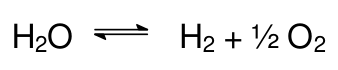
can be traced (\(\alpha = 10^{-3}\)) at temperature above 1700 K. This process can be realized at temperatures 800 – 900 K as well as through subsequent stages carried out in a cycle. Suggest such a process on the basis of the reactions:

and

satisfying the following requirements:
a) Only water should be consumed during the process.
b) Oxygen and hydrogen alone should be the end products of the process.
c) In addition to the above substances, a 25 % ammonia solution is needed for the cycle.
d) The temperature for each step in the cycle should not exceed 840 K.
Official English text of the problem.
Answers
- a) Regenerate the copper(II) oxide, magnesium chloride, silver, and ammonia using the cycle below. Its net reaction is \[ \boxed{\ce{2H2O -> 2H2 + O2}}. \]
- b) The only net products are hydrogen,
[H][H], and oxygen,O=O, in the molar ratio \(2:1\). - c) Aqueous ammonia,
N, enables copper(I) chloride to reduce silver chloride to silver, forming a copper(II) ammine complex. Removing ammonia in the presence of magnesium oxide regenerates the copper oxide and magnesium chloride. - d) Use \(840\,\mathrm{K}\) for the first supplied reaction and \(430\,\mathrm{K}\) for the second. Complex formation and the regeneration operations can be conducted below \(840\,\mathrm{K}\).
Names and SMILES for the remaining species are collected in the solution.
Solution
a) Constructing a closed cycle
First balance the supplied oxygen-producing reaction:
\[ \ce{4CuO(s) + 4MgCl2(s) + 2H2O(g) -> 4CuCl(s) + 4MgO(s) + 4HCl(g) + O2(g)}. \tag{1} \]
This step takes place at \(840\,\mathrm{K}\). Four copper centres change from oxidation state \(+2\) to \(+1\), accepting four electrons in total. Formation of one molecule of oxygen from oxygen in oxidation state \(-2\) releases four electrons.
Separate the hydrogen chloride from the oxygen and use it in the second supplied reaction, at \(430\,\mathrm{K}\):
\[ \ce{2Ag(s) + 2HCl(g) -> 2AgCl(s) + H2(g)}. \tag{2} \]
To close the cycle, the copper(I) chloride and silver chloride must regenerate copper(II) and metallic silver. Their reaction in aqueous ammonia accomplishes this:
\[ \ce{CuCl(s) + AgCl(s) + 4NH3(aq) -> [Cu(NH3)4]Cl2(aq) + Ag(s)}. \tag{3} \]
Here copper(I) supplies the electron needed to reduce silver(I); ammonia stabilizes the resulting copper(II) complex.
Next add the magnesium oxide from reaction (1) and remove ammonia by warming. As the ammine complex dissociates, magnesium oxide supplies the basic conditions needed to precipitate copper(II) hydroxide. The overall equation is
\[ \ce{[Cu(NH3)4]Cl2(aq) + MgO(s) + H2O(l) -> Cu(OH)2(s) + MgCl2(aq) + 4NH3(g)}. \tag{4} \]
Capture the ammonia in recycled water to restore the ammonia solution. On warming, copper(II) hydroxide gives copper(II) oxide:
\[ \ce{Cu(OH)2(s) -> CuO(s) + H2O(l)}. \tag{5} \]
Filter off the copper(II) oxide and recover magnesium chloride from the solution. For its return as an anhydrous solid, dehydration should use a circulating hydrogen chloride atmosphere to suppress hydrolysis. Hydrogen chloride is already an intermediate in the cycle and is recovered for reuse.
Thus reactions (4) and (5), taken together, regenerate both oxides/chlorides needed for closure:
\[ \ce{[Cu(NH3)4]Cl2 + MgO -> CuO + MgCl2 + 4NH3}. \]
Add the reactions in the proportions
\[ (1)+2(2)+4(3)+4(4)+4(5). \]
After ammonia recovery and the solvent/phase-recovery operations, every auxiliary substance cancels:
\[ \boxed{\ce{2H2O -> 2H2 + O2}}. \]
Only water is consumed.
b) Identifying the final products
Reaction (1) releases oxygen; reaction (2) releases hydrogen. Collect these streams separately, retaining hydrogen chloride and ammonia within the process.
For every \(2\,\mathrm{mol}\) of water consumed,
\[ n(\ce{H2})=2\,\mathrm{mol}, \qquad n(\ce{O2})=1\,\mathrm{mol}. \]
Silver, copper compounds, magnesium compounds, chloride, and ammonia all circulate within the cycle.
c) Explaining the role of the 25 % ammonia solution
Ammonia dissolves the sparingly soluble copper(I) and silver(I) chlorides through ammine-complex formation:
\[ \ce{CuCl(s) + 2NH3(aq) <=> [Cu(NH3)2]+(aq) + Cl-(aq)}, \]
\[ \ce{AgCl(s) + 2NH3(aq) <=> [Ag(NH3)2]+(aq) + Cl-(aq)}. \]
The dissolved complexes undergo the electron-transfer reaction
\[ \ce{[Cu(NH3)2]+ + [Ag(NH3)2]+ -> [Cu(NH3)4]^2+ + Ag(s)}. \]
The copper centre changes from \(+1\) to \(+2\), while the silver centre changes from \(+1\) to \(0\). Ligand redistribution provides four ammonia ligands around copper(II). Adding the two dissolution equations gives reaction (3).
Ammonia therefore enables silver regeneration and stabilizes the copper(II) intermediate. It is subsequently released in reaction (4), captured, and reused.
d) Meeting the temperature limit
| Operation | Temperature or suitable condition |
|---|---|
| Oxygen evolution, reaction (1) | \(840\,\mathrm{K}\), as supplied |
| Hydrogen evolution, reaction (2) | \(430\,\mathrm{K}\), as supplied |
| Ammine formation and silver recovery, reaction (3) | Ordinary temperature |
| Ammonia removal and hydroxide precipitation, reaction (4) | Warming the aqueous mixture |
| Copper(II) hydroxide decomposition, reaction (5) | Gentle heating, readily below \(840\,\mathrm{K}\) |
| Magnesium chloride recovery | Evaporation and dehydration below \(840\,\mathrm{K}\), with recycled hydrogen chloride suppressing hydrolysis |
The ammonia and water vapours are recovered by cooling and absorption. No step requires a temperature above the stated maximum.
The following SMILES identify the species used. For ionic solids, disconnected-ion SMILES represent composition and formal charges, not the crystal lattice.
| Species | Name | SMILES |
|---|---|---|
| \(\ce{H2O}\) | Water | O |
| \(\ce{H2}\) | Hydrogen | [H][H] |
| \(\ce{O2}\) | Oxygen | O=O |
| \(\ce{HCl}\) | Hydrogen chloride | Cl |
| \(\ce{NH3}\) | Ammonia | N |
| \(\ce{CuO}\) | Copper(II) oxide | [Cu+2].[O-2] |
| \(\ce{CuCl}\) | Copper(I) chloride | [Cu+].[Cl-] |
| \(\ce{MgO}\) | Magnesium oxide | [Mg+2].[O-2] |
| \(\ce{MgCl2}\) | Magnesium chloride | [Mg+2].[Cl-].[Cl-] |
| \(\ce{Ag}\) | Silver | [Ag] |
| \(\ce{AgCl}\) | Silver chloride | [Ag+].[Cl-] |
| \(\ce{Cu(OH)2}\) | Copper(II) hydroxide | [Cu+2].[OH-].[OH-] |
| \(\ce{Cl-}\) | Chloride ion | [Cl-] |
| \(\ce{[Cu(NH3)2]+}\) | Diamminecopper(I) ion | [NH3]->[Cu+]<-[NH3] |
| \(\ce{[Ag(NH3)2]+}\) | Diamminesilver(I) ion | [NH3]->[Ag+]<-[NH3] |
| \(\ce{[Cu(NH3)4]^2+}\) | Tetraamminecopper(II) ion | [NH3]->[Cu+2](<-[NH3])(<-[NH3])<-[NH3] |
| \(\ce{[Cu(NH3)4]Cl2}\) | Tetraamminecopper(II) chloride | [NH3]->[Cu+2](<-[NH3])(<-[NH3])<-[NH3].[Cl-].[Cl-] |
The two-coordinate copper(I) and silver(I) ammine complexes are approximately linear. In aqueous copper(II) solution, the four ammonia ligands occupy approximately equatorial positions, with axial water coordination omitted from the shorthand formula. The SMILES do not specify these coordination geometries or oxygen’s triplet electronic ground state.
The solution was checked against the official solution. Where this solution differs from the official solution, the official solution contains an error or a misprint.
IChO 1981 · Theorieaufgabe 4
Thermochemischer Kreisprozess zur Zersetzung von Wasser bei mäßiger Temperatur
Die thermische Zersetzung von Wasser
ist bei Temperaturen über 1700 K nachweisbar (\(\alpha = 10^{-3}\)). Dieser Prozess lässt sich auch bei Temperaturen von 800 – 900 K durch aufeinanderfolgende Schritte verwirklichen, die in einem Kreisprozess durchgeführt werden. Schlagen Sie einen solchen Prozess auf der Grundlage der Reaktionen
und
vor, der die folgenden Anforderungen erfüllt:
a) Während des Prozesses soll nur Wasser verbraucht werden.
b) Die einzigen Endprodukte des Prozesses sollen Sauerstoff und Wasserstoff sein.
c) Zusätzlich zu den oben genannten Stoffen wird für den Kreisprozess eine 25%ige Ammoniaklösung benötigt.
d) Die Temperatur darf bei keinem Schritt des Kreisprozesses 840 K überschreiten.
Aufgabentext aus dem offiziellen englischen Text übersetzt.
Antworten
- a) Regenerieren Sie Kupfer(II)-oxid, Magnesiumchlorid, Silber und Ammoniak mithilfe des unten beschriebenen Kreisprozesses. Seine Nettoreaktion lautet \[ \boxed{\ce{2H2O -> 2H2 + O2}}. \]
- b) Die einzigen Nettoprodukte sind Wasserstoff,
[H][H], und Sauerstoff,O=O, im Stoffmengenverhältnis \(2:1\). - c) Wässrige Ammoniaklösung,
N, ermöglicht es Kupfer(I)-chlorid, Silberchlorid zu Silber zu reduzieren, wobei ein Kupfer(II)-Amminkomplex entsteht. Durch Entfernen des Ammoniaks in Gegenwart von Magnesiumoxid werden das Kupferoxid und das Magnesiumchlorid regeneriert. - d) Verwenden Sie \(840\,\mathrm{K}\) für die erste vorgegebene Reaktion und \(430\,\mathrm{K}\) für die zweite. Die Komplexbildung und die Regenerationsschritte können unterhalb von \(840\,\mathrm{K}\) durchgeführt werden.
Die Namen und SMILES der übrigen Spezies sind in der Lösung zusammengestellt.
Lösung
a) Aufstellen eines geschlossenen Kreisprozesses
Gleichen Sie zunächst die vorgegebene Reaktion aus, bei der Sauerstoff entsteht:
\[ \ce{4CuO(s) + 4MgCl2(s) + 2H2O(g) -> 4CuCl(s) + 4MgO(s) + 4HCl(g) + O2(g)}. \tag{1} \]
Dieser Schritt findet bei \(840\,\mathrm{K}\) statt. Vier Kupferzentren wechseln von der Oxidationsstufe \(+2\) zu \(+1\) und nehmen dabei insgesamt vier Elektronen auf. Bei der Bildung eines Sauerstoffmoleküls aus Sauerstoff in der Oxidationsstufe \(-2\) werden vier Elektronen abgegeben.
Trennen Sie den Chlorwasserstoff vom Sauerstoff ab und verwenden Sie ihn in der zweiten vorgegebenen Reaktion bei \(430\,\mathrm{K}\):
\[ \ce{2Ag(s) + 2HCl(g) -> 2AgCl(s) + H2(g)}. \tag{2} \]
Um den Kreisprozess zu schließen, müssen aus Kupfer(I)-chlorid und Silberchlorid wieder Kupfer(II) und metallisches Silber entstehen. Ihre Reaktion in wässriger Ammoniaklösung bewirkt dies:
\[ \ce{CuCl(s) + AgCl(s) + 4NH3(aq) -> [Cu(NH3)4]Cl2(aq) + Ag(s)}. \tag{3} \]
Hier liefert Kupfer(I) das zur Reduktion von Silber(I) benötigte Elektron; Ammoniak stabilisiert den entstehenden Kupfer(II)-Komplex.
Geben Sie als Nächstes das Magnesiumoxid aus Reaktion (1) hinzu und entfernen Sie Ammoniak durch Erwärmen. Während der Amminkomplex dissoziiert, schafft Magnesiumoxid die basischen Bedingungen, die zur Fällung von Kupfer(II)-hydroxid benötigt werden. Die Gesamtgleichung lautet
\[ \ce{[Cu(NH3)4]Cl2(aq) + MgO(s) + H2O(l) -> Cu(OH)2(s) + MgCl2(aq) + 4NH3(g)}. \tag{4} \]
Fangen Sie den Ammoniak in zurückgeführtem Wasser auf, um die Ammoniaklösung wiederherzustellen. Beim Erwärmen entsteht aus Kupfer(II)-hydroxid Kupfer(II)-oxid:
\[ \ce{Cu(OH)2(s) -> CuO(s) + H2O(l)}. \tag{5} \]
Filtrieren Sie das Kupfer(II)-oxid ab und gewinnen Sie Magnesiumchlorid aus der Lösung zurück. Um es als wasserfreien Feststoff zurückzuführen, sollte die Entwässerung in einer zirkulierenden Chlorwasserstoffatmosphäre erfolgen, um die Hydrolyse zu unterdrücken. Chlorwasserstoff ist bereits ein Zwischenprodukt des Kreisprozesses und wird zur Wiederverwendung zurückgewonnen.
Somit regenerieren die Reaktionen (4) und (5) zusammengenommen die beiden zum Schließen des Kreisprozesses benötigten Oxide bzw. Chloride:
\[ \ce{[Cu(NH3)4]Cl2 + MgO -> CuO + MgCl2 + 4NH3}. \]
Addieren Sie die Reaktionen mit den folgenden Faktoren:
\[ (1)+2(2)+4(3)+4(4)+4(5). \]
Nach der Ammoniakrückgewinnung und den Schritten zur Rückgewinnung des Lösungsmittels und der Phasen kürzen sich sämtliche Hilfsstoffe heraus:
\[ \boxed{\ce{2H2O -> 2H2 + O2}}. \]
Nur Wasser wird verbraucht.
b) Bestimmung der Endprodukte
Reaktion (1) setzt Sauerstoff frei; Reaktion (2) setzt Wasserstoff frei. Sammeln Sie diese Gasströme getrennt und halten Sie Chlorwasserstoff und Ammoniak im Prozess zurück.
Für jeweils \(2\,\mathrm{mol}\) verbrauchtes Wasser gilt:
\[ n(\ce{H2})=2\,\mathrm{mol}, \qquad n(\ce{O2})=1\,\mathrm{mol}. \]
Silber, Kupferverbindungen, Magnesiumverbindungen, Chlorid und Ammoniak werden alle innerhalb des Kreisprozesses im Kreislauf geführt.
c) Erläuterung der Rolle der 25%igen Ammoniaklösung
Ammoniak löst die schwer löslichen Kupfer(I)- und Silber(I)-chloride durch Bildung von Amminkomplexen:
\[ \ce{CuCl(s) + 2NH3(aq) <=> [Cu(NH3)2]+(aq) + Cl-(aq)}, \]
\[ \ce{AgCl(s) + 2NH3(aq) <=> [Ag(NH3)2]+(aq) + Cl-(aq)}. \]
Die gelösten Komplexe gehen die folgende Elektronenübertragungsreaktion ein:
\[ \ce{[Cu(NH3)2]+ + [Ag(NH3)2]+ -> [Cu(NH3)4]^2+ + Ag(s)}. \]
Das Kupferzentrum wechselt von \(+1\) zu \(+2\), während das Silberzentrum von \(+1\) zu \(0\) wechselt. Durch Umverteilung der Liganden wird Kupfer(II) von vier Ammoniakliganden umgeben. Durch Addition der beiden Auflösungsgleichungen ergibt sich Reaktion (3).
Ammoniak ermöglicht somit die Regeneration von Silber und stabilisiert das Kupfer(II)-Zwischenprodukt. Anschließend wird es in Reaktion (4) freigesetzt, aufgefangen und wiederverwendet.
d) Einhaltung der Temperaturgrenze
| Vorgang | Temperatur oder geeignete Bedingung |
|---|---|
| Sauerstoffentwicklung, Reaktion (1) | \(840\,\mathrm{K}\), wie vorgegeben |
| Wasserstoffentwicklung, Reaktion (2) | \(430\,\mathrm{K}\), wie vorgegeben |
| Amminkomplexbildung und Silberrückgewinnung, Reaktion (3) | Raumtemperatur |
| Ammoniakentfernung und Hydroxidfällung, Reaktion (4) | Erwärmen des wässrigen Gemisches |
| Zersetzung von Kupfer(II)-hydroxid, Reaktion (5) | Schonendes Erhitzen, problemlos unterhalb von \(840\,\mathrm{K}\) |
| Magnesiumchloridrückgewinnung | Eindampfen und Entwässern unterhalb von \(840\,\mathrm{K}\), wobei zurückgeführter Chlorwasserstoff die Hydrolyse unterdrückt |
Die Ammoniak- und Wasserdämpfe werden durch Abkühlen und Absorption zurückgewonnen. Kein Schritt erfordert eine Temperatur oberhalb des angegebenen Höchstwerts.
Die folgenden SMILES kennzeichnen die verwendeten Spezies. Bei ionischen Feststoffen geben SMILES mit nicht miteinander verbundenen Ionen die Zusammensetzung und die Formalladungen wieder, nicht das Kristallgitter.
| Spezies | Name | SMILES |
|---|---|---|
| \(\ce{H2O}\) | Wasser | O |
| \(\ce{H2}\) | Wasserstoff | [H][H] |
| \(\ce{O2}\) | Sauerstoff | O=O |
| \(\ce{HCl}\) | Chlorwasserstoff | Cl |
| \(\ce{NH3}\) | Ammoniak | N |
| \(\ce{CuO}\) | Kupfer(II)-oxid | [Cu+2].[O-2] |
| \(\ce{CuCl}\) | Kupfer(I)-chlorid | [Cu+].[Cl-] |
| \(\ce{MgO}\) | Magnesiumoxid | [Mg+2].[O-2] |
| \(\ce{MgCl2}\) | Magnesiumchlorid | [Mg+2].[Cl-].[Cl-] |
| \(\ce{Ag}\) | Silber | [Ag] |
| \(\ce{AgCl}\) | Silberchlorid | [Ag+].[Cl-] |
| \(\ce{Cu(OH)2}\) | Kupfer(II)-hydroxid | [Cu+2].[OH-].[OH-] |
| \(\ce{Cl-}\) | Chloridion | [Cl-] |
| \(\ce{[Cu(NH3)2]+}\) | Diamminkupfer(I)-Ion | [NH3]->[Cu+]<-[NH3] |
| \(\ce{[Ag(NH3)2]+}\) | Diamminsilber(I)-Ion | [NH3]->[Ag+]<-[NH3] |
| \(\ce{[Cu(NH3)4]^2+}\) | Tetraamminkupfer(II)-Ion | [NH3]->[Cu+2](<-[NH3])(<-[NH3])<-[NH3] |
| \(\ce{[Cu(NH3)4]Cl2}\) | Tetraamminkupfer(II)-chlorid | [NH3]->[Cu+2](<-[NH3])(<-[NH3])<-[NH3].[Cl-].[Cl-] |
Die zweifach koordinierten Kupfer(I)- und Silber(I)-Amminkomplexe sind annähernd linear. In wässriger Kupfer(II)-Lösung besetzen die vier Ammoniakliganden annähernd äquatoriale Positionen, wobei die axiale Koordination von Wasser in der Kurzformel weggelassen wird. Die SMILES geben weder diese Koordinationsgeometrien noch den elektronischen Triplettgrundzustand von Sauerstoff an.
Die Lösung wurde mit der offiziellen Lösung abgeglichen. Wo diese Lösung von der offiziellen Lösung abweicht, enthält die offizielle Lösung einen Fehler oder Druckfehler.
IChO 1981 · Teori sorusu 4
Suyun orta sıcaklıkta ayrışması için termokimyasal çevrim
Suyun ısıl ayrışması
1700 K'nin üzerindeki sıcaklıklarda gözlenebilir (\(\alpha = 10^{-3}\)). Bu süreç, bir çevrim içinde gerçekleştirilen ardışık aşamalar yoluyla 800 – 900 K sıcaklıklarda da gerçekleştirilebilir. Aşağıdaki tepkimelere dayanarak böyle bir süreç öneriniz:
ve
Süreç aşağıdaki koşulları sağlamalıdır:
a) Süreç boyunca yalnızca su tüketilmelidir.
b) Sürecin son ürünleri yalnızca oksijen ve hidrojen olmalıdır.
c) Çevrim için yukarıdaki maddelere ek olarak %25'lik bir amonyak çözeltisi gereklidir.
d) Çevrimin her bir basamağındaki sıcaklık 840 K'yi aşmamalıdır.
Soru metni resmi İngilizce metinden çevrilmiştir.
Cevaplar
- a) Aşağıdaki çevrimi kullanarak bakır(II) oksidi, magnezyum klorürü, gümüşü ve amonyağı yeniden elde ediniz. Çevrimin net tepkimesi şöyledir: \[ \boxed{\ce{2H2O -> 2H2 + O2}}. \]
- b) Net ürünler yalnızca \(2:1\) mol oranında hidrojen,
[H][H], ve oksijendir,O=O. - c) Sulu amonyak,
N, bakır(I) klorürün gümüş klorürü gümüşe indirgemesini ve bir bakır(II) ammin kompleksi oluşmasını sağlar. Magnezyum oksit varlığında amonyağın uzaklaştırılması, bakır oksit ve magnezyum klorürün yeniden elde edilmesini sağlar. - d) Verilen ilk tepkime için \(840\,\mathrm{K}\), ikinci tepkime için ise \(430\,\mathrm{K}\) kullanınız. Kompleks oluşumu ve maddelerin yeniden elde edilmesine yönelik işlemler \(840\,\mathrm{K}\)'nin altında gerçekleştirilebilir.
Diğer türlerin adları ve SMILES gösterimleri çözümde bir araya getirilmiştir.
Çözüm
a) Kapalı bir çevrimin oluşturulması
Önce, verilen oksijen üreten tepkimeyi denkleştirelim:
\[ \ce{4CuO(s) + 4MgCl2(s) + 2H2O(g) -> 4CuCl(s) + 4MgO(s) + 4HCl(g) + O2(g)}. \tag{1} \]
Bu basamak \(840\,\mathrm{K}\)'de gerçekleşir. Dört bakır merkezi, toplam dört elektron alarak \(+2\) yükseltgenme basamağından \(+1\) yükseltgenme basamağına geçer. \(-2\) yükseltgenme basamağındaki oksijenden bir oksijen molekülünün oluşmasıyla dört elektron açığa çıkar.
Hidrojen klorürü oksijenden ayırıp verilen ikinci tepkimede, \(430\,\mathrm{K}\)'de kullanalım:
\[ \ce{2Ag(s) + 2HCl(g) -> 2AgCl(s) + H2(g)}. \tag{2} \]
Çevrimi kapatmak için bakır(I) klorür ve gümüş klorürden yeniden bakır(II) ve metalik gümüş elde edilmelidir. Bu maddelerin sulu amonyak içindeki tepkimesi bunu sağlar:
\[ \ce{CuCl(s) + AgCl(s) + 4NH3(aq) -> [Cu(NH3)4]Cl2(aq) + Ag(s)}. \tag{3} \]
Burada bakır(I), gümüş(I)'i indirgemek için gereken elektronu sağlar; amonyak ise oluşan bakır(II) kompleksini kararlı hâle getirir.
Ardından (1) tepkimesinden elde edilen magnezyum oksidi ekleyip ısıtarak amonyağı uzaklaştıralım. Ammin kompleksi ayrışırken magnezyum oksit, bakır(II) hidroksidin çöktürülmesi için gereken bazik ortamı sağlar. Toplam denklem şöyledir:
\[ \ce{[Cu(NH3)4]Cl2(aq) + MgO(s) + H2O(l) -> Cu(OH)2(s) + MgCl2(aq) + 4NH3(g)}. \tag{4} \]
Amonyak çözeltisini yeniden elde etmek için amonyağı geri kazanılan suda tutalım. Bakır(II) hidroksit ısıtıldığında bakır(II) oksit verir:
\[ \ce{Cu(OH)2(s) -> CuO(s) + H2O(l)}. \tag{5} \]
Bakır(II) oksidi süzerek ayıralım ve çözeltiden magnezyum klorürü geri kazanalım. Magnezyum klorürün susuz bir katı olarak çevrime geri döndürülmesi için, hidrolizi baskılamak amacıyla su giderme işlemi dolaşımdaki hidrojen klorür atmosferinde yapılmalıdır. Hidrojen klorür zaten çevrimin bir ara ürünüdür ve yeniden kullanılmak üzere geri kazanılır.
Böylece (4) ve (5) tepkimeleri birlikte ele alındığında, çevrimin kapanması için gereken hem oksit hem de klorür yeniden elde edilir:
\[ \ce{[Cu(NH3)4]Cl2 + MgO -> CuO + MgCl2 + 4NH3}. \]
Tepkimeleri şu oranlarda toplayalım:
\[ (1)+2(2)+4(3)+4(4)+4(5). \]
Amonyak geri kazanımı ve çözücü/faz geri kazanımı işlemlerinden sonra tüm yardımcı maddeler sadeleşir:
\[ \boxed{\ce{2H2O -> 2H2 + O2}}. \]
Yalnızca su tüketilir.
b) Son ürünlerin belirlenmesi
(1) tepkimesinde oksijen, (2) tepkimesinde ise hidrojen açığa çıkar. Hidrojen klorürü ve amonyağı süreç içinde tutarak bu gaz akımlarını ayrı ayrı toplayalım.
Tüketilen her \(2\,\mathrm{mol}\) su için,
\[ n(\ce{H2})=2\,\mathrm{mol}, \qquad n(\ce{O2})=1\,\mathrm{mol}. \]
Gümüş, bakır bileşikleri, magnezyum bileşikleri, klorür ve amonyağın tümü çevrim içinde dolaşır.
c) %25'lik amonyak çözeltisinin rolünün açıklanması
Amonyak, az çözünen bakır(I) ve gümüş(I) klorürleri ammin kompleksi oluşumu yoluyla çözer:
\[ \ce{CuCl(s) + 2NH3(aq) <=> [Cu(NH3)2]+(aq) + Cl-(aq)}, \]
\[ \ce{AgCl(s) + 2NH3(aq) <=> [Ag(NH3)2]+(aq) + Cl-(aq)}. \]
Çözünmüş kompleksler şu elektron aktarım tepkimesine girer:
\[ \ce{[Cu(NH3)2]+ + [Ag(NH3)2]+ -> [Cu(NH3)4]^2+ + Ag(s)}. \]
Bakır merkezinin yükseltgenme basamağı \(+1\)'den \(+2\)'ye çıkarken gümüş merkezinin yükseltgenme basamağı \(+1\)'den \(0\)'a iner. Ligandların yeniden dağılımı, bakır(II) çevresinde dört amonyak ligandının bulunmasını sağlar. İki çözünme denkleminin toplanmasıyla (3) tepkimesi elde edilir.
Dolayısıyla amonyak, gümüşün yeniden elde edilmesini sağlar ve bakır(II) ara ürününü kararlı hâle getirir. Daha sonra (4) tepkimesinde açığa çıkar, tutulur ve yeniden kullanılır.
d) Sıcaklık sınırının sağlanması
| İşlem | Sıcaklık veya uygun koşul |
|---|---|
| Oksijen çıkışı, (1) tepkimesi | Verildiği gibi, \(840\,\mathrm{K}\) |
| Hidrojen çıkışı, (2) tepkimesi | Verildiği gibi, \(430\,\mathrm{K}\) |
| Ammin oluşumu ve gümüşün geri kazanılması, (3) tepkimesi | Oda sıcaklığı |
| Amonyağın uzaklaştırılması ve hidroksidin çöktürülmesi, (4) tepkimesi | Sulu karışımın ısıtılması |
| Bakır(II) hidroksidin ayrışması, (5) tepkimesi | \(840\,\mathrm{K}\)'nin rahatlıkla altında, hafifçe ısıtma |
| Magnezyum klorürün geri kazanılması | Geri kazanılan hidrojen klorürle hidroliz baskılanarak \(840\,\mathrm{K}\)'nin altında buharlaştırma ve su giderme |
Amonyak ve su buharları soğutma ve absorpsiyon yoluyla geri kazanılır. Hiçbir basamak, belirtilen en yüksek sıcaklığın üzerinde bir sıcaklık gerektirmez.
Aşağıdaki SMILES gösterimleri kullanılan türleri tanımlar. İyonik katılar için birbirine bağlı olmayan iyonlardan oluşan SMILES gösterimleri, kristal örgüyü değil, bileşimi ve formal yükleri temsil eder.
| Tür | Adı | SMILES |
|---|---|---|
| \(\ce{H2O}\) | Su | O |
| \(\ce{H2}\) | Hidrojen | [H][H] |
| \(\ce{O2}\) | Oksijen | O=O |
| \(\ce{HCl}\) | Hidrojen klorür | Cl |
| \(\ce{NH3}\) | Amonyak | N |
| \(\ce{CuO}\) | Bakır(II) oksit | [Cu+2].[O-2] |
| \(\ce{CuCl}\) | Bakır(I) klorür | [Cu+].[Cl-] |
| \(\ce{MgO}\) | Magnezyum oksit | [Mg+2].[O-2] |
| \(\ce{MgCl2}\) | Magnezyum klorür | [Mg+2].[Cl-].[Cl-] |
| \(\ce{Ag}\) | Gümüş | [Ag] |
| \(\ce{AgCl}\) | Gümüş klorür | [Ag+].[Cl-] |
| \(\ce{Cu(OH)2}\) | Bakır(II) hidroksit | [Cu+2].[OH-].[OH-] |
| \(\ce{Cl-}\) | Klorür iyonu | [Cl-] |
| \(\ce{[Cu(NH3)2]+}\) | Diamminbakır(I) iyonu | [NH3]->[Cu+]<-[NH3] |
| \(\ce{[Ag(NH3)2]+}\) | Diammingümüş(I) iyonu | [NH3]->[Ag+]<-[NH3] |
| \(\ce{[Cu(NH3)4]^2+}\) | Tetraamminbakır(II) iyonu | [NH3]->[Cu+2](<-[NH3])(<-[NH3])<-[NH3] |
| \(\ce{[Cu(NH3)4]Cl2}\) | Tetraamminbakır(II) klorür | [NH3]->[Cu+2](<-[NH3])(<-[NH3])<-[NH3].[Cl-].[Cl-] |
Koordinasyon sayısı iki olan bakır(I) ve gümüş(I) ammin kompleksleri yaklaşık olarak doğrusaldır. Sulu bakır(II) çözeltisinde dört amonyak ligandı yaklaşık olarak ekvatoryal konumları işgal eder; eksenel konumlardaki su koordinasyonu kısaltılmış formülde gösterilmez. SMILES gösterimleri, bu koordinasyon geometrilerini veya oksijenin triplet elektronik temel hâlini belirtmez.
Çözüm, resmi çözümle karşılaştırılarak kontrol edildi. Bu çözümün resmi çözümden ayrıldığı yerlerde resmi çözümde bir hata ya da baskı hatası vardır.
IChO 1981 · Problema teórico 4
Ciclo termoquímico para la descomposición del agua a temperatura moderada
La descomposición térmica del agua
puede detectarse (\(\alpha = 10^{-3}\)) a temperaturas superiores a 1700 K. Este proceso también puede llevarse a cabo a temperaturas de 800 – 900 K mediante etapas sucesivas que forman un ciclo. Proponga un proceso de este tipo basándose en las reacciones:
y
que satisfaga los siguientes requisitos:
a) Durante el proceso solo debe consumirse agua.
b) Los únicos productos finales del proceso deben ser oxígeno e hidrógeno.
c) Además de las sustancias anteriores, se necesita una disolución de amoníaco al 25 % para el ciclo.
d) La temperatura de cada etapa del ciclo no debe superar los 840 K.
Enunciado traducido del texto oficial en inglés.
Respuestas
- a) Regenere el óxido de cobre(II), el cloruro de magnesio, la plata y el amoníaco mediante el ciclo que se presenta a continuación. Su reacción neta es \[ \boxed{\ce{2H2O -> 2H2 + O2}}. \]
- b) Los únicos productos netos son hidrógeno,
[H][H], y oxígeno,O=O, en la proporción molar \(2:1\). - c) El amoníaco acuoso,
N, permite que el cloruro de cobre(I) reduzca el cloruro de plata a plata, formando un complejo amminado de cobre(II). La eliminación del amoníaco en presencia de óxido de magnesio regenera el óxido de cobre y el cloruro de magnesio. - d) Utilice \(840\,\mathrm{K}\) para la primera reacción proporcionada y \(430\,\mathrm{K}\) para la segunda. La formación del complejo y las operaciones de regeneración pueden realizarse por debajo de \(840\,\mathrm{K}\).
Los nombres y los SMILES de las demás especies se recogen en la solución.
Solución
a) Construcción de un ciclo cerrado
Primero, ajuste la reacción proporcionada que produce oxígeno:
\[ \ce{4CuO(s) + 4MgCl2(s) + 2H2O(g) -> 4CuCl(s) + 4MgO(s) + 4HCl(g) + O2(g)}. \tag{1} \]
Esta etapa tiene lugar a \(840\,\mathrm{K}\). Cuatro centros de cobre pasan del estado de oxidación \(+2\) al \(+1\), aceptando cuatro electrones en total. La formación de una molécula de oxígeno a partir de oxígeno en estado de oxidación \(-2\) libera cuatro electrones.
Separe el cloruro de hidrógeno del oxígeno y utilícelo en la segunda reacción proporcionada, a \(430\,\mathrm{K}\):
\[ \ce{2Ag(s) + 2HCl(g) -> 2AgCl(s) + H2(g)}. \tag{2} \]
Para cerrar el ciclo, el cloruro de cobre(I) y el cloruro de plata deben regenerar cobre(II) y plata metálica. Su reacción en amoníaco acuoso permite lograrlo:
\[ \ce{CuCl(s) + AgCl(s) + 4NH3(aq) -> [Cu(NH3)4]Cl2(aq) + Ag(s)}. \tag{3} \]
Aquí, el cobre(I) aporta el electrón necesario para reducir la plata(I); el amoníaco estabiliza el complejo de cobre(II) resultante.
A continuación, añada el óxido de magnesio de la reacción (1) y elimine el amoníaco mediante calentamiento. A medida que el complejo amminado se disocia, el óxido de magnesio proporciona las condiciones básicas necesarias para precipitar el hidróxido de cobre(II). La ecuación global es
\[ \ce{[Cu(NH3)4]Cl2(aq) + MgO(s) + H2O(l) -> Cu(OH)2(s) + MgCl2(aq) + 4NH3(g)}. \tag{4} \]
Recoja el amoníaco en agua reciclada para reconstituir la disolución de amoníaco. Al calentarse, el hidróxido de cobre(II) da óxido de cobre(II):
\[ \ce{Cu(OH)2(s) -> CuO(s) + H2O(l)}. \tag{5} \]
Separe por filtración el óxido de cobre(II) y recupere el cloruro de magnesio de la disolución. Para reincorporarlo como sólido anhidro, la deshidratación debe realizarse en una atmósfera circulante de cloruro de hidrógeno para inhibir la hidrólisis. El cloruro de hidrógeno ya es un intermediario del ciclo y se recupera para su reutilización.
Así, las reacciones (4) y (5), consideradas conjuntamente, regeneran tanto el óxido como el cloruro necesarios para cerrar el ciclo:
\[ \ce{[Cu(NH3)4]Cl2 + MgO -> CuO + MgCl2 + 4NH3}. \]
Sume las reacciones en las proporciones
\[ (1)+2(2)+4(3)+4(4)+4(5). \]
Tras la recuperación del amoníaco y las operaciones de recuperación del disolvente y de las fases, todas las sustancias auxiliares se cancelan:
\[ \boxed{\ce{2H2O -> 2H2 + O2}}. \]
Solo se consume agua.
b) Identificación de los productos finales
La reacción (1) libera oxígeno; la reacción (2) libera hidrógeno. Recoja estas corrientes por separado, manteniendo el cloruro de hidrógeno y el amoníaco dentro del proceso.
Por cada \(2\,\mathrm{mol}\) de agua consumidos,
\[ n(\ce{H2})=2\,\mathrm{mol}, \qquad n(\ce{O2})=1\,\mathrm{mol}. \]
La plata, los compuestos de cobre, los compuestos de magnesio, el cloruro y el amoníaco circulan todos dentro del ciclo.
c) Explicación del papel de la disolución de amoníaco al 25 %
El amoníaco disuelve los cloruros de cobre(I) y de plata(I), poco solubles, mediante la formación de complejos amminados:
\[ \ce{CuCl(s) + 2NH3(aq) <=> [Cu(NH3)2]+(aq) + Cl-(aq)}, \]
\[ \ce{AgCl(s) + 2NH3(aq) <=> [Ag(NH3)2]+(aq) + Cl-(aq)}. \]
Los complejos disueltos experimentan la reacción de transferencia electrónica
\[ \ce{[Cu(NH3)2]+ + [Ag(NH3)2]+ -> [Cu(NH3)4]^2+ + Ag(s)}. \]
El centro de cobre pasa de \(+1\) a \(+2\), mientras que el centro de plata pasa de \(+1\) a \(0\). La redistribución de los ligandos proporciona cuatro ligandos de amoníaco alrededor del cobre(II). Al sumar las dos ecuaciones de disolución se obtiene la reacción (3).
Por tanto, el amoníaco permite regenerar la plata y estabiliza el intermediario de cobre(II). Posteriormente se libera en la reacción (4), se recoge y se reutiliza.
d) Cumplimiento del límite de temperatura
| Operación | Temperatura o condición adecuada |
|---|---|
| Desprendimiento de oxígeno, reacción (1) | \(840\,\mathrm{K}\), según los datos proporcionados |
| Desprendimiento de hidrógeno, reacción (2) | \(430\,\mathrm{K}\), según los datos proporcionados |
| Formación de complejos amminados y recuperación de plata, reacción (3) | Temperatura ambiente |
| Eliminación de amoníaco y precipitación del hidróxido, reacción (4) | Calentamiento de la mezcla acuosa |
| Descomposición del hidróxido de cobre(II), reacción (5) | Calentamiento suave, fácilmente por debajo de \(840\,\mathrm{K}\) |
| Recuperación del cloruro de magnesio | Evaporación y deshidratación por debajo de \(840\,\mathrm{K}\), con cloruro de hidrógeno reciclado para inhibir la hidrólisis |
Los vapores de amoníaco y de agua se recuperan mediante enfriamiento y absorción. Ninguna etapa requiere una temperatura superior al máximo indicado.
Los siguientes SMILES identifican las especies utilizadas. En el caso de los sólidos iónicos, los SMILES con iones desconectados representan la composición y las cargas formales, no la red cristalina.
| Especie | Nombre | SMILES |
|---|---|---|
| \(\ce{H2O}\) | Agua | O |
| \(\ce{H2}\) | Hidrógeno | [H][H] |
| \(\ce{O2}\) | Oxígeno | O=O |
| \(\ce{HCl}\) | Cloruro de hidrógeno | Cl |
| \(\ce{NH3}\) | Amoníaco | N |
| \(\ce{CuO}\) | Óxido de cobre(II) | [Cu+2].[O-2] |
| \(\ce{CuCl}\) | Cloruro de cobre(I) | [Cu+].[Cl-] |
| \(\ce{MgO}\) | Óxido de magnesio | [Mg+2].[O-2] |
| \(\ce{MgCl2}\) | Cloruro de magnesio | [Mg+2].[Cl-].[Cl-] |
| \(\ce{Ag}\) | Plata | [Ag] |
| \(\ce{AgCl}\) | Cloruro de plata | [Ag+].[Cl-] |
| \(\ce{Cu(OH)2}\) | Hidróxido de cobre(II) | [Cu+2].[OH-].[OH-] |
| \(\ce{Cl-}\) | Ion cloruro | [Cl-] |
| \(\ce{[Cu(NH3)2]+}\) | Ion diamminocobre(I) | [NH3]->[Cu+]<-[NH3] |
| \(\ce{[Ag(NH3)2]+}\) | Ion diamminoplata(I) | [NH3]->[Ag+]<-[NH3] |
| \(\ce{[Cu(NH3)4]^2+}\) | Ion tetraamminocobre(II) | [NH3]->[Cu+2](<-[NH3])(<-[NH3])<-[NH3] |
| \(\ce{[Cu(NH3)4]Cl2}\) | Cloruro de tetraamminocobre(II) | [NH3]->[Cu+2](<-[NH3])(<-[NH3])<-[NH3].[Cl-].[Cl-] |
Los complejos amminados de cobre(I) y plata(I), con número de coordinación dos, son aproximadamente lineales. En disolución acuosa de cobre(II), los cuatro ligandos de amoníaco ocupan posiciones aproximadamente ecuatoriales, y la coordinación axial de moléculas de agua se omite en la fórmula abreviada. Los SMILES no especifican estas geometrías de coordinación ni el estado electrónico fundamental triplete del oxígeno.
La solución se comprobó con la solución oficial. Donde esta solución difiere de la solución oficial, la solución oficial contiene un error o una errata.
IChO 1981 · 理论题 4
在中等温度下分解水的热化学循环
水的热分解
在高于 1700 K 的温度下可被检测到(\(\alpha = 10^{-3}\))。通过在一个循环中依次进行各个阶段,这一过程也可以在 800 – 900 K 的温度下实现。根据下列反应提出这样一个过程:
以及
并满足以下要求:
a) 过程中应只消耗水。
b) 过程的最终产物应只有氧气和氢气。
c) 除上述物质外,该循环还需要 25 % 的氨水。
d) 循环中每一步的温度均不得超过 840 K。
题目译自官方英文原文。
答案
- a) 利用下述循环再生氧化铜、氯化镁、银和氨。其净反应为 \[ \boxed{\ce{2H2O -> 2H2 + O2}}. \]
- b) 净产物只有氢气
[H][H]和氧气O=O,两者的物质的量之比为 \(2:1\)。 - c) 氨水
N使氯化亚铜能够将氯化银还原为银,同时形成铜(II)氨配合物。在氧化镁存在的条件下除去氨,可再生氧化铜和氯化镁。 - d) 第一个给定反应采用 \(840\,\mathrm{K}\),第二个采用 \(430\,\mathrm{K}\)。配合物的形成及各项再生操作均可在低于 \(840\,\mathrm{K}\) 的温度下进行。
其余物种的名称和 SMILES 汇总于解答中。
解答
a) 构建闭合循环
首先配平给定的产氧反应:
\[ \ce{4CuO(s) + 4MgCl2(s) + 2H2O(g) -> 4CuCl(s) + 4MgO(s) + 4HCl(g) + O2(g)}. \tag{1} \]
这一步在 \(840\,\mathrm{K}\) 下进行。四个铜中心的氧化态从 \(+2\) 变为 \(+1\),共接受四个电子。氧化态为 \(-2\) 的氧形成一个氧分子时释放四个电子。
将氯化氢与氧气分离,并将其用于第二个给定反应,反应温度为 \(430\,\mathrm{K}\):
\[ \ce{2Ag(s) + 2HCl(g) -> 2AgCl(s) + H2(g)}. \tag{2} \]
为使循环闭合,必须由氯化亚铜和氯化银再生铜(II)和金属银。它们在氨水中的反应可实现这一目的:
\[ \ce{CuCl(s) + AgCl(s) + 4NH3(aq) -> [Cu(NH3)4]Cl2(aq) + Ag(s)}. \tag{3} \]
在此,铜(I)提供还原银(I)所需的电子;氨使生成的铜(II)配合物稳定。
接着加入反应 (1) 中生成的氧化镁,并通过温热除去氨。随着氨配合物解离,氧化镁提供使氢氧化铜沉淀所需的碱性条件。总反应式为
\[ \ce{[Cu(NH3)4]Cl2(aq) + MgO(s) + H2O(l) -> Cu(OH)2(s) + MgCl2(aq) + 4NH3(g)}. \tag{4} \]
用循环使用的水吸收氨,以恢复氨水。温热时,氢氧化铜生成氧化铜:
\[ \ce{Cu(OH)2(s) -> CuO(s) + H2O(l)}. \tag{5} \]
过滤分离氧化铜,并从溶液中回收氯化镁。为使氯化镁以无水固体形式返回循环,脱水时应使用循环氯化氢气氛,以抑制水解。氯化氢本来就是循环中的中间产物,可回收再用。
因此,将反应 (4) 和 (5) 合并,即可再生使循环闭合所需的氧化物和氯化物:
\[ \ce{[Cu(NH3)4]Cl2 + MgO -> CuO + MgCl2 + 4NH3}. \]
按以下比例将各反应相加
\[ (1)+2(2)+4(3)+4(4)+4(5). \]
在回收氨并完成溶剂回收和物相恢复操作后,所有辅助物质均相互抵消:
\[ \boxed{\ce{2H2O -> 2H2 + O2}}. \]
只消耗水。
b) 确定最终产物
反应 (1) 释放氧气;反应 (2) 释放氢气。分别收集这两股气流,并将氯化氢和氨保留在工艺循环中。
每消耗 \(2\,\mathrm{mol}\) 水,
\[ n(\ce{H2})=2\,\mathrm{mol}, \qquad n(\ce{O2})=1\,\mathrm{mol}. \]
银、铜化合物、镁化合物、氯离子和氨均在循环内循环使用。
c) 解释 25 % 氨水的作用
氨通过形成氨配合物,使难溶的氯化亚铜和氯化银溶解:
\[ \ce{CuCl(s) + 2NH3(aq) <=> [Cu(NH3)2]+(aq) + Cl-(aq)}, \]
\[ \ce{AgCl(s) + 2NH3(aq) <=> [Ag(NH3)2]+(aq) + Cl-(aq)}. \]
溶解的配合物发生电子转移反应
\[ \ce{[Cu(NH3)2]+ + [Ag(NH3)2]+ -> [Cu(NH3)4]^2+ + Ag(s)}. \]
铜中心的氧化态从 \(+1\) 变为 \(+2\),而银中心的氧化态从 \(+1\) 变为 \(0\)。配体重新分配,使铜(II)周围具有四个氨配体。将两个溶解反应式相加,即得反应 (3)。
因此,氨使银得以再生,并稳定铜(II)中间产物。随后,氨在反应 (4) 中释放,被吸收并再次使用。
d) 满足温度限制
| 操作 | 温度或适宜条件 |
|---|---|
| 析出氧气,反应 (1) | \(840\,\mathrm{K}\),如题目所给 |
| 析出氢气,反应 (2) | \(430\,\mathrm{K}\),如题目所给 |
| 形成氨配合物并回收银,反应 (3) | 常温 |
| 除去氨并沉淀氢氧化物,反应 (4) | 温热水相混合物 |
| 氢氧化铜分解,反应 (5) | 缓慢加热,在低于 \(840\,\mathrm{K}\) 时即可容易地进行 |
| 回收氯化镁 | 在低于 \(840\,\mathrm{K}\) 时蒸发、脱水,利用循环使用的氯化氢抑制水解 |
通过冷却和吸收回收氨和水蒸气。没有任何一步需要高于规定上限的温度。
以下 SMILES 用于标识所用物种。对于离子固体,以断开的离子表示的 SMILES 描述的是组成和形式电荷,而非晶格。
| 物种 | 名称 | SMILES |
|---|---|---|
| \(\ce{H2O}\) | 水 | O |
| \(\ce{H2}\) | 氢气 | [H][H] |
| \(\ce{O2}\) | 氧气 | O=O |
| \(\ce{HCl}\) | 氯化氢 | Cl |
| \(\ce{NH3}\) | 氨 | N |
| \(\ce{CuO}\) | 氧化铜 | [Cu+2].[O-2] |
| \(\ce{CuCl}\) | 氯化亚铜 | [Cu+].[Cl-] |
| \(\ce{MgO}\) | 氧化镁 | [Mg+2].[O-2] |
| \(\ce{MgCl2}\) | 氯化镁 | [Mg+2].[Cl-].[Cl-] |
| \(\ce{Ag}\) | 银 | [Ag] |
| \(\ce{AgCl}\) | 氯化银 | [Ag+].[Cl-] |
| \(\ce{Cu(OH)2}\) | 氢氧化铜 | [Cu+2].[OH-].[OH-] |
| \(\ce{Cl-}\) | 氯离子 | [Cl-] |
| \(\ce{[Cu(NH3)2]+}\) | 二氨合铜(I)离子 | [NH3]->[Cu+]<-[NH3] |
| \(\ce{[Ag(NH3)2]+}\) | 二氨合银(I)离子 | [NH3]->[Ag+]<-[NH3] |
| \(\ce{[Cu(NH3)4]^2+}\) | 四氨合铜(II)离子 | [NH3]->[Cu+2](<-[NH3])(<-[NH3])<-[NH3] |
| \(\ce{[Cu(NH3)4]Cl2}\) | 氯化四氨合铜(II) | [NH3]->[Cu+2](<-[NH3])(<-[NH3])<-[NH3].[Cl-].[Cl-] |
二配位的铜(I)和银(I)氨配合物近似呈直线形。在铜(II)水溶液中,四个氨配体大致占据赤道位置,简式中省略了轴向配位的水分子。这些 SMILES 未指明上述配位几何构型,也未指明氧气的三重态电子基态。
解答已与官方解答核对。本解答与官方解答不同之处,均为官方解答中的错误或印刷错误。
IChO 1981 · Теоретическая задача 4
Термохимический цикл разложения воды при умеренной температуре
Термическое разложение воды
можно обнаружить (\(\alpha = 10^{-3}\)) при температуре выше 1700 K. Этот процесс можно осуществить и при температурах 800 – 900 K посредством последовательных стадий, образующих цикл. Предложите такой процесс на основе реакций:
и
удовлетворяющий следующим требованиям:
a) В ходе процесса должна расходоваться только вода.
b) Конечными продуктами процесса должны быть только кислород и водород.
c) Помимо указанных выше веществ, для осуществления цикла необходим 25 % раствор аммиака.
d) Температура на каждой стадии цикла не должна превышать 840 K.
Условие переведено с официального английского текста.
Ответы
- a) Регенерируйте оксид меди(II), хлорид магния, серебро и аммиак с помощью приведённого ниже цикла. Его суммарная реакция имеет вид \[ \boxed{\ce{2H2O -> 2H2 + O2}}. \]
- b) Единственными конечными продуктами являются водород,
[H][H], и кислород,O=O, в молярном соотношении \(2:1\). - c) Водный раствор аммиака,
N, позволяет хлориду меди(I) восстанавливать хлорид серебра до серебра с образованием амминного комплекса меди(II). Удаление аммиака в присутствии оксида магния регенерирует оксид меди и хлорид магния. - d) Проводите первую из заданных реакций при \(840\,\mathrm{K}\), а вторую — при \(430\,\mathrm{K}\). Комплексообразование и операции регенерации можно проводить при температуре ниже \(840\,\mathrm{K}\).
Названия и SMILES остальных химических частиц приведены в решении.
Решение
a) Построение замкнутого цикла
Сначала расставим коэффициенты в заданном уравнении реакции выделения кислорода:
\[ \ce{4CuO(s) + 4MgCl2(s) + 2H2O(g) -> 4CuCl(s) + 4MgO(s) + 4HCl(g) + O2(g)}. \tag{1} \]
Эта стадия протекает при \(840\,\mathrm{K}\). Четыре атома меди изменяют степень окисления с \(+2\) на \(+1\), принимая в общей сложности четыре электрона. Образование одной молекулы кислорода из кислорода в степени окисления \(-2\) сопровождается отдачей четырёх электронов.
Отделим хлороводород от кислорода и используем его во второй заданной реакции при \(430\,\mathrm{K}\):
\[ \ce{2Ag(s) + 2HCl(g) -> 2AgCl(s) + H2(g)}. \tag{2} \]
Для замыкания цикла хлорид меди(I) и хлорид серебра должны регенерировать медь(II) и металлическое серебро. Это достигается их реакцией в водном растворе аммиака:
\[ \ce{CuCl(s) + AgCl(s) + 4NH3(aq) -> [Cu(NH3)4]Cl2(aq) + Ag(s)}. \tag{3} \]
Здесь медь(I) отдаёт электрон, необходимый для восстановления серебра(I); аммиак стабилизирует образующийся комплекс меди(II).
Затем добавим оксид магния из реакции (1) и удалим аммиак нагреванием. По мере диссоциации амминного комплекса оксид магния создаёт щелочную среду, необходимую для осаждения гидроксида меди(II). Суммарное уравнение имеет вид
\[ \ce{[Cu(NH3)4]Cl2(aq) + MgO(s) + H2O(l) -> Cu(OH)2(s) + MgCl2(aq) + 4NH3(g)}. \tag{4} \]
Уловим аммиак водой, возвращаемой в цикл, чтобы восстановить раствор аммиака. При нагревании гидроксид меди(II) образует оксид меди(II):
\[ \ce{Cu(OH)2(s) -> CuO(s) + H2O(l)}. \tag{5} \]
Отфильтруем оксид меди(II) и выделим хлорид магния из раствора. Для его возвращения в цикл в виде безводного твёрдого вещества обезвоживание следует проводить в атмосфере циркулирующего хлороводорода, чтобы подавить гидролиз. Хлороводород уже является промежуточным веществом цикла и улавливается для повторного использования.
Таким образом, реакции (4) и (5), взятые вместе, регенерируют и оксид, и хлорид, необходимые для замыкания цикла:
\[ \ce{[Cu(NH3)4]Cl2 + MgO -> CuO + MgCl2 + 4NH3}. \]
Сложим реакции в соотношении
\[ (1)+2(2)+4(3)+4(4)+4(5). \]
После улавливания аммиака и операций по возврату растворителя и восстановлению фазового состояния веществ все вспомогательные вещества сокращаются:
\[ \boxed{\ce{2H2O -> 2H2 + O2}}. \]
Расходуется только вода.
b) Определение конечных продуктов
В реакции (1) выделяется кислород; в реакции (2) выделяется водород. Собирайте эти газовые потоки раздельно, удерживая хлороводород и аммиак внутри процесса.
На каждые \(2\,\mathrm{mol}\) израсходованной воды
\[ n(\ce{H2})=2\,\mathrm{mol}, \qquad n(\ce{O2})=1\,\mathrm{mol}. \]
Серебро, соединения меди, соединения магния, хлорид-ионы и аммиак циркулируют внутри цикла.
c) Объяснение роли 25 % раствора аммиака
Аммиак растворяет малорастворимые хлориды меди(I) и серебра(I) за счёт образования амминных комплексов:
\[ \ce{CuCl(s) + 2NH3(aq) <=> [Cu(NH3)2]+(aq) + Cl-(aq)}, \]
\[ \ce{AgCl(s) + 2NH3(aq) <=> [Ag(NH3)2]+(aq) + Cl-(aq)}. \]
Растворённые комплексы вступают в реакцию переноса электрона
\[ \ce{[Cu(NH3)2]+ + [Ag(NH3)2]+ -> [Cu(NH3)4]^2+ + Ag(s)}. \]
Степень окисления центрального атома меди изменяется с \(+1\) на \(+2\), а центрального атома серебра — с \(+1\) на \(0\). В результате перераспределения лигандов вокруг меди(II) оказываются четыре аммиачных лиганда. Добавление двух уравнений растворения даёт реакцию (3).
Таким образом, аммиак обеспечивает регенерацию серебра и стабилизирует промежуточный комплекс меди(II). Затем он выделяется в реакции (4), улавливается и используется повторно.
d) Соблюдение ограничения по температуре
| Операция | Температура или подходящие условия |
|---|---|
| Выделение кислорода, реакция (1) | \(840\,\mathrm{K}\), согласно условию |
| Выделение водорода, реакция (2) | \(430\,\mathrm{K}\), согласно условию |
| Образование амминного комплекса и регенерация серебра, реакция (3) | Обычная температура |
| Удаление аммиака и осаждение гидроксида, реакция (4) | Нагревание водной смеси |
| Разложение гидроксида меди(II), реакция (5) | Слабое нагревание; легко осуществимо при температуре ниже \(840\,\mathrm{K}\) |
| Выделение хлорида магния | Выпаривание и обезвоживание при температуре ниже \(840\,\mathrm{K}\), с подавлением гидролиза циркулирующим хлороводородом |
Аммиак и водяной пар улавливают посредством охлаждения и абсорбции. Ни одна стадия не требует температуры выше указанного предела.
Приведённые ниже SMILES идентифицируют используемые химические частицы. Для ионных твёрдых веществ SMILES с раздельно записанными ионами отражают состав и формальные заряды, а не кристаллическую решётку.
| Химическая частица | Название | SMILES |
|---|---|---|
| \(\ce{H2O}\) | Вода | O |
| \(\ce{H2}\) | Водород | [H][H] |
| \(\ce{O2}\) | Кислород | O=O |
| \(\ce{HCl}\) | Хлороводород | Cl |
| \(\ce{NH3}\) | Аммиак | N |
| \(\ce{CuO}\) | Оксид меди(II) | [Cu+2].[O-2] |
| \(\ce{CuCl}\) | Хлорид меди(I) | [Cu+].[Cl-] |
| \(\ce{MgO}\) | Оксид магния | [Mg+2].[O-2] |
| \(\ce{MgCl2}\) | Хлорид магния | [Mg+2].[Cl-].[Cl-] |
| \(\ce{Ag}\) | Серебро | [Ag] |
| \(\ce{AgCl}\) | Хлорид серебра | [Ag+].[Cl-] |
| \(\ce{Cu(OH)2}\) | Гидроксид меди(II) | [Cu+2].[OH-].[OH-] |
| \(\ce{Cl-}\) | Хлорид-ион | [Cl-] |
| \(\ce{[Cu(NH3)2]+}\) | Ион диамминмеди(I) | [NH3]->[Cu+]<-[NH3] |
| \(\ce{[Ag(NH3)2]+}\) | Ион диамминсеребра(I) | [NH3]->[Ag+]<-[NH3] |
| \(\ce{[Cu(NH3)4]^2+}\) | Ион тетраамминмеди(II) | [NH3]->[Cu+2](<-[NH3])(<-[NH3])<-[NH3] |
| \(\ce{[Cu(NH3)4]Cl2}\) | Хлорид тетраамминмеди(II) | [NH3]->[Cu+2](<-[NH3])(<-[NH3])<-[NH3].[Cl-].[Cl-] |
Амминные комплексы меди(I) и серебра(I) с координационным числом два имеют приблизительно линейное строение. В водном растворе меди(II) четыре аммиачных лиганда занимают приблизительно экваториальные положения, причём координация молекул воды в аксиальных положениях в сокращённой формуле не показана. SMILES не задают ни эту координационную геометрию, ни триплетное основное электронное состояние кислорода.
Решение проверено по официальному решению. Там, где это решение расходится с официальным, в официальном решении есть ошибка или опечатка.
IChO 1981 · مسألة نظرية 4
دورة كيميائية حرارية لتحلل الماء عند درجة حرارة معتدلة
يمكن رصد التحلل الحراري للماء
بدرجة تفكك (\(\alpha = 10^{-3}\)) عند درجة حرارة أعلى من 1700 K. ويمكن أيضًا إجراء هذه العملية عند درجات حرارة 800 – 900 K من خلال مراحل متتابعة تُنفَّذ ضمن دورة. اقترح عملية من هذا النوع استنادًا إلى التفاعلين:
و
بحيث تستوفي المتطلبات الآتية:
a) يجب ألا يُستهلك أثناء العملية سوى الماء.
b) يجب أن يكون الأكسجين والهيدروجين وحدهما الناتجين النهائيين للعملية.
c) بالإضافة إلى المواد المذكورة أعلاه، تتطلب الدورة محلول أمونيا بتركيز 25 %.
d) يجب ألا تتجاوز درجة الحرارة في أي خطوة من خطوات الدورة 840 K.
نص المسألة مترجم عن النص الإنجليزي الرسمي.
الإجابات
- a) أعد توليد أكسيد النحاس(II) وكلوريد المغنيسيوم والفضة والأمونيا باستخدام الدورة أدناه. وتفاعلها الصافي هو \[ \boxed{\ce{2H2O -> 2H2 + O2}}. \]
- b) الناتجان الصافيان الوحيدان هما الهيدروجين،
[H][H]، والأكسجين،O=O، بنسبة مولية \(2:1\). - c) تتيح الأمونيا المائية،
N، لكلوريد النحاس(I) اختزال كلوريد الفضة إلى فضة، مع تكوين معقّد أميني للنحاس(II). وتؤدي إزالة الأمونيا في وجود أكسيد المغنيسيوم إلى إعادة توليد أكسيد النحاس وكلوريد المغنيسيوم. - d) استخدم \(840\,\mathrm{K}\) للتفاعل الأول المعطى و\(430\,\mathrm{K}\) للتفاعل الثاني. ويمكن إجراء تكوين المعقّد وعمليات إعادة التوليد عند درجات حرارة أقل من \(840\,\mathrm{K}\).
جُمعت أسماء الأنواع الكيميائية المتبقية وتمثيلاتها بصيغة SMILES في الحل.
الحل
a) بناء دورة مغلقة
وازن أولًا التفاعل المعطى المنتج للأكسجين:
\[ \ce{4CuO(s) + 4MgCl2(s) + 2H2O(g) -> 4CuCl(s) + 4MgO(s) + 4HCl(g) + O2(g)}. \tag{1} \]
تجري هذه الخطوة عند \(840\,\mathrm{K}\). تتغير حالة الأكسدة لأربعة مراكز نحاس من \(+2\) إلى \(+1\)، فتكتسب أربعة إلكترونات إجمالًا. ويؤدي تكوين جزيء واحد من الأكسجين انطلاقًا من أكسجين في حالة الأكسدة \(-2\) إلى تحرير أربعة إلكترونات.
افصل كلوريد الهيدروجين عن الأكسجين واستخدمه في التفاعل الثاني المعطى، عند \(430\,\mathrm{K}\):
\[ \ce{2Ag(s) + 2HCl(g) -> 2AgCl(s) + H2(g)}. \tag{2} \]
لإغلاق الدورة، يجب أن يعيد كلوريد النحاس(I) وكلوريد الفضة توليد النحاس(II) والفضة الفلزية. ويحقق تفاعلهما في الأمونيا المائية ذلك:
\[ \ce{CuCl(s) + AgCl(s) + 4NH3(aq) -> [Cu(NH3)4]Cl2(aq) + Ag(s)}. \tag{3} \]
هنا يزوّد النحاس(I) الفضة(I) بالإلكترون اللازم لاختزالها؛ وتثبّت الأمونيا معقّد النحاس(II) الناتج.
أضف بعد ذلك أكسيد المغنيسيوم الناتج من التفاعل (1)، وأزل الأمونيا بالتدفئة. ومع تفكك المعقّد الأميني، يوفّر أكسيد المغنيسيوم الوسط القاعدي اللازم لترسيب هيدروكسيد النحاس(II). والمعادلة الإجمالية هي
\[ \ce{[Cu(NH3)4]Cl2(aq) + MgO(s) + H2O(l) -> Cu(OH)2(s) + MgCl2(aq) + 4NH3(g)}. \tag{4} \]
اجمع الأمونيا بامتصاصها في الماء المعاد تدويره لاستعادة محلول الأمونيا. وعند التدفئة، يعطي هيدروكسيد النحاس(II) أكسيد النحاس(II):
\[ \ce{Cu(OH)2(s) -> CuO(s) + H2O(l)}. \tag{5} \]
افصل أكسيد النحاس(II) بالترشيح واسترجع كلوريد المغنيسيوم من المحلول. ولإعادته في صورة صلب لامائي، ينبغي إجراء نزع الماء في جو من كلوريد الهيدروجين يُعاد تدويره للحد من التحلل المائي. وكلوريد الهيدروجين مادة وسيطة موجودة أصلًا في الدورة، ويُسترجع لإعادة استخدامه.
وهكذا، يعيد التفاعلان (4) و(5) معًا توليد كلٍّ من الأكسيد والكلوريد اللازمين لإغلاق الدورة:
\[ \ce{[Cu(NH3)4]Cl2 + MgO -> CuO + MgCl2 + 4NH3}. \]
اجمع التفاعلات بالنسب
\[ (1)+2(2)+4(3)+4(4)+4(5). \]
بعد استرجاع الأمونيا وعمليات استرجاع المذيب والأطوار، تُختزل جميع المواد المساعدة من طرفي المعادلة:
\[ \boxed{\ce{2H2O -> 2H2 + O2}}. \]
لا يُستهلك سوى الماء.
b) تحديد النواتج النهائية
يحرّر التفاعل (1) الأكسجين؛ ويحرّر التفاعل (2) الهيدروجين. اجمع هذين التيارين كلًّا على حدة، مع الاحتفاظ بكلوريد الهيدروجين والأمونيا داخل العملية.
لكل \(2\,\mathrm{mol}\) من الماء المستهلك،
\[ n(\ce{H2})=2\,\mathrm{mol}, \qquad n(\ce{O2})=1\,\mathrm{mol}. \]
تدور الفضة ومركبات النحاس ومركبات المغنيسيوم والكلوريد والأمونيا جميعًا داخل الدورة.
c) توضيح دور محلول الأمونيا بتركيز 25 %
تُذيب الأمونيا كلوريدَي النحاس(I) والفضة(I) شحيحي الذوبان من خلال تكوين معقّدات أمينية:
\[ \ce{CuCl(s) + 2NH3(aq) <=> [Cu(NH3)2]+(aq) + Cl-(aq)}, \]
\[ \ce{AgCl(s) + 2NH3(aq) <=> [Ag(NH3)2]+(aq) + Cl-(aq)}. \]
تخضع المعقّدات الذائبة لتفاعل انتقال الإلكترون
\[ \ce{[Cu(NH3)2]+ + [Ag(NH3)2]+ -> [Cu(NH3)4]^2+ + Ag(s)}. \]
تتغير حالة أكسدة مركز النحاس من \(+1\) إلى \(+2\)، بينما تتغير حالة أكسدة مركز الفضة من \(+1\) إلى \(0\). وتوفّر إعادة توزيع الربيطات أربع ربيطات أمونيا حول النحاس(II). وتعطي إضافة معادلتَي الذوبان التفاعل (3).
وبذلك تتيح الأمونيا إعادة توليد الفضة وتثبّت المركّب الوسيط للنحاس(II). ثم تتحرر في التفاعل (4)، وتُجمع وتُعاد الاستفادة منها.
d) الالتزام بالحد الأقصى لدرجة الحرارة
| العملية | درجة الحرارة أو الشرط المناسب |
|---|---|
| تصاعد الأكسجين، التفاعل (1) | \(840\,\mathrm{K}\)، كما هو معطى |
| تصاعد الهيدروجين، التفاعل (2) | \(430\,\mathrm{K}\)، كما هو معطى |
| تكوين المعقّد الأميني واسترجاع الفضة، التفاعل (3) | درجة الحرارة العادية |
| إزالة الأمونيا وترسيب الهيدروكسيد، التفاعل (4) | تدفئة المزيج المائي |
| تحلل هيدروكسيد النحاس(II)، التفاعل (5) | تسخين لطيف، ويمكن إجراؤه بسهولة عند درجة حرارة أقل من \(840\,\mathrm{K}\) |
| استرجاع كلوريد المغنيسيوم | التبخير ونزع الماء عند درجة حرارة أقل من \(840\,\mathrm{K}\)، مع الحد من التحلل المائي باستخدام كلوريد الهيدروجين المعاد تدويره |
تُسترجع أبخرة الأمونيا والماء بالتبريد والامتصاص. ولا تتطلب أي خطوة درجة حرارة أعلى من الحد الأقصى المحدد.
تحدّد تمثيلات SMILES الآتية الأنواع الكيميائية المستخدمة. وبالنسبة إلى المواد الصلبة الأيونية، تمثّل صيغ SMILES ذات الأيونات المنفصلة التركيب والشحنات الشكلية، ولا تمثّل الشبكة البلورية.
| النوع الكيميائي | الاسم | SMILES |
|---|---|---|
| \(\ce{H2O}\) | الماء | O |
| \(\ce{H2}\) | الهيدروجين | [H][H] |
| \(\ce{O2}\) | الأكسجين | O=O |
| \(\ce{HCl}\) | كلوريد الهيدروجين | Cl |
| \(\ce{NH3}\) | الأمونيا | N |
| \(\ce{CuO}\) | أكسيد النحاس(II) | [Cu+2].[O-2] |
| \(\ce{CuCl}\) | كلوريد النحاس(I) | [Cu+].[Cl-] |
| \(\ce{MgO}\) | أكسيد المغنيسيوم | [Mg+2].[O-2] |
| \(\ce{MgCl2}\) | كلوريد المغنيسيوم | [Mg+2].[Cl-].[Cl-] |
| \(\ce{Ag}\) | الفضة | [Ag] |
| \(\ce{AgCl}\) | كلوريد الفضة | [Ag+].[Cl-] |
| \(\ce{Cu(OH)2}\) | هيدروكسيد النحاس(II) | [Cu+2].[OH-].[OH-] |
| \(\ce{Cl-}\) | أيون الكلوريد | [Cl-] |
| \(\ce{[Cu(NH3)2]+}\) | أيون ثنائي أمين النحاس(I) | [NH3]->[Cu+]<-[NH3] |
| \(\ce{[Ag(NH3)2]+}\) | أيون ثنائي أمين الفضة(I) | [NH3]->[Ag+]<-[NH3] |
| \(\ce{[Cu(NH3)4]^2+}\) | أيون رباعي أمين النحاس(II) | [NH3]->[Cu+2](<-[NH3])(<-[NH3])<-[NH3] |
| \(\ce{[Cu(NH3)4]Cl2}\) | كلوريد رباعي أمين النحاس(II) | [NH3]->[Cu+2](<-[NH3])(<-[NH3])<-[NH3].[Cl-].[Cl-] |
المعقّدان الأمينيان للنحاس(I) والفضة(I)، اللذان يبلغ عدد التناسق في كل منهما اثنين، خطيّان تقريبًا. وفي محلول النحاس(II) المائي، تشغل ربيطات الأمونيا الأربع مواضع استوائية تقريبًا، مع إغفال تناسق الماء المحوري في الصيغة المختصرة. ولا تحدّد تمثيلات SMILES هذه الأشكال الهندسية التناسقية أو الحالة الإلكترونية الأرضية الثلاثية للأكسجين.
تمت مراجعة الحل بمقارنته بالحل الرسمي. حيثما يختلف هذا الحل عن الحل الرسمي، يحتوي الحل الرسمي على خطأ أو خطأ مطبعي.