IChO 1984 · Theory problem 2
Metal carbonyls and the eighteen-electron rule
Ludwig Mond discovered before the turn of this century that finely divided nickel reacts with carbon monoxide forming tetracarbonylnickel, \(\ce{Ni(CO)4}\), a colourless, very volatile liquid. The composition of \(\ce{Ni(CO)4}\) provides an example of the noble gas rule ("EAN rule").
Problems:
2.1 Use the eighteen-electron rule (noble gas rule) to predict the formula of the binary carbonyls of \(\ce{Fe(0)}\) and \(\ce{Cr(0)}\).
2.2 What composition would the eighteen-electron rule predict for the most simple binary chromium(0)-nitrosyl compound?
2.3 Explain why \(\ce{Mn(0)}\) and \(\ce{Co(0)}\) do not form so-called mononuclear carbonyl complexes of the type \(\ce{M(CO)_{x}}\) (M = metal), but rather compounds with metal-metal bonding.
2.4 Suggest structures of \(\ce{Ni(CO)4}\), \(\ce{Mn2(CO)10}\) and \(\ce{Co2(CO)8}\).
2.5 State whether \(\ce{V(CO)6}\) and the compounds mentioned in a) and d) are diamagnetic or paramagnetic.
2.6 Why are the carbon monoxide ligands bound to metals much more strongly than to boron in borane adducts (e.g. \(\ce{R3B-CO}\); R = alkyl)?
2.7 Determine the composition of the compounds labeled A - F in the following reaction scheme:
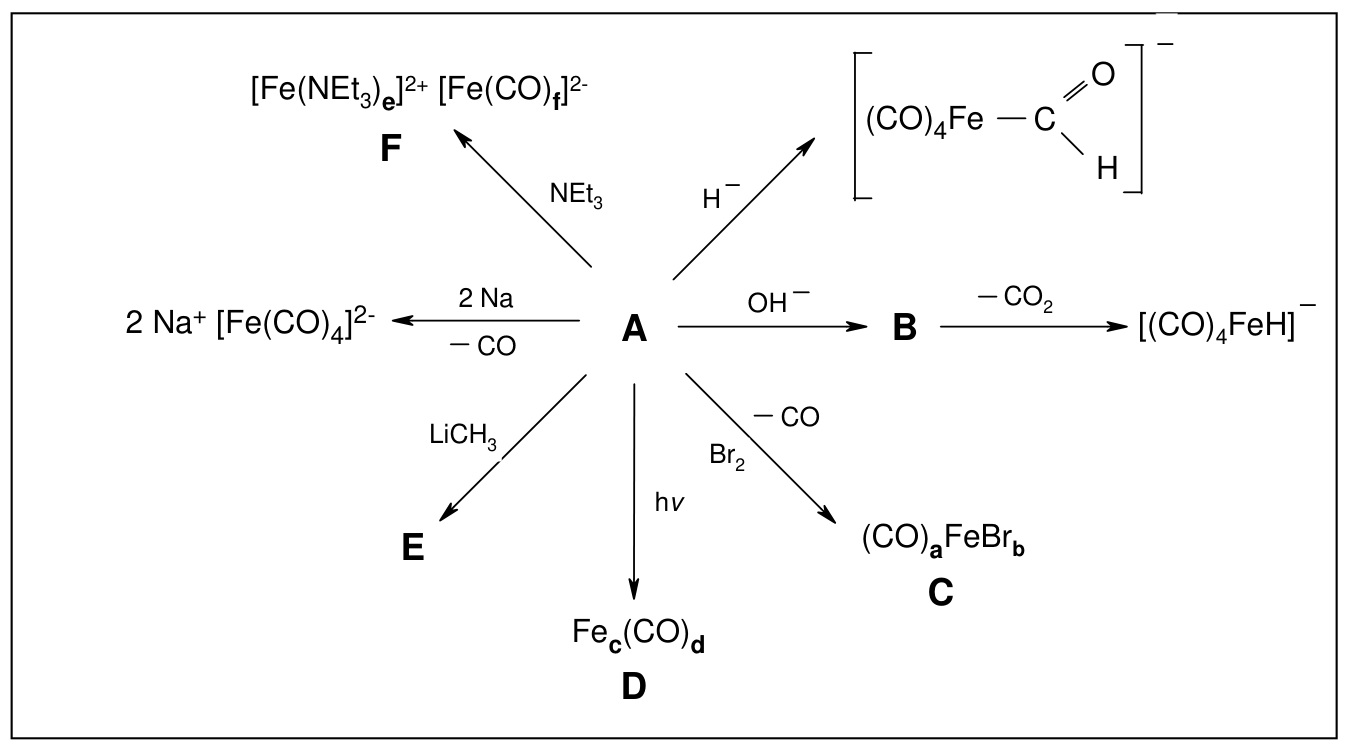
Hints:
a) C has the following analysis: \(\ce{C}\), 14.75 % ; \(\ce{Br}\), 48.90 % .
b) D contains 30.70 % \(\ce{Fe}\); the molecular mass is 363.8 a.m.u.
c) Excess triethylamine is used for the synthesis of F. F contains 5.782 % \(\ce{C}\) and 10.11 % \(\ce{N}\).
2.8 Why is the compound F formed in the disproportional reaction (given in g)), and not the compositional isomer \(\ce{[Fe(CO)_{f}]^{2+}[Fe(NEt3)_{e}]^{2-}}\)?
2.9 The eighteen-electron rule is also satisfied by a compound prepared from elementary chromium and benzene.
i) Draw the formula of this complex.
ii) Which complex with the analogous structure is prepared by the reaction of iron powder with cyclopentadiene? Write the chemical equation for its formation.
Official English text of the problem.
Answers
Names, SMILES, and detailed structural descriptions are supplied in the corresponding solution parts.
- 2.1: Iron pentacarbonyl, \(\ce{Fe(CO)5}\), and chromium hexacarbonyl, \(\ce{Cr(CO)6}\).
- 2.2: Tetranitrosylchromium, \(\ce{Cr(NO)4}\), counting each linear nitrosyl as a three-electron donor.
- 2.3: Their odd metal-electron counts cannot reach 18 by adding two-electron carbonyl ligands. Metal–metal bonding supplies the additional electron counted at each metal.
- 2.4: \(\ce{Ni(CO)4}\) is tetrahedral. \(\ce{Mn2(CO)10}\) has an Mn–Mn bond and ten terminal carbonyls. The usual bridged structure of \(\ce{Co2(CO)8}\) has a Co–Co bond, six terminal carbonyls, and two bridging carbonyls; an unbridged isomer also exists.
- 2.5: \(\ce{V(CO)6}\) is paramagnetic, with one unpaired electron. \(\ce{Fe(CO)5}\), \(\ce{Cr(CO)6}\), \(\ce{Ni(CO)4}\), \(\ce{Mn2(CO)10}\), and \(\ce{Co2(CO)8}\) are diamagnetic.
- 2.6: Metal–carbonyl bonding combines carbon-to-metal \(\sigma\) donation with metal-to-carbonyl \(\pi\) back-donation. Trialkylboranes cannot provide comparable back-donation.
- 2.7:
| Label | Composition |
|---|---|
| A | \(\ce{Fe(CO)5}\) |
| B | \(\ce{[Fe(CO)4(COOH)]^-}\), with an Fe–C bond to the hydroxycarbonyl group |
| C | \(\ce{Fe(CO)4Br2}\): \(a=4,\ b=2\) |
| D | \(\ce{Fe2(CO)9}\): \(c=2,\ d=9\) |
| E | \(\ce{Li[Fe(CO)4(COCH3)]}\), the lithium salt of an acetyl complex |
| F | \(\ce{[Fe(NEt3)6]^{2+}[Fe(CO)4]^{2-}}\): \(e=6,\ f=4\) |
The identification of F requires recognizing that its printed carbon percentage is inconsistent; the calculated value is 57.82%, not 5.782%.
- 2.8: F places \(\pi\)-accepting carbonyls on electron-rich iron(−II) and amine donors on iron(II). Both ions have 18 electrons; reversing the ligand allocation gives 14- and 22-electron ions.
- 2.9(i): Bis(benzene)chromium, \(\ce{Cr(C6H6)2}\), an \(\eta^6,\eta^6\) sandwich complex.
- 2.9(ii): Ferrocene, \(\ce{Fe(C5H5)2}\), an \(\eta^5,\eta^5\) sandwich complex: \[ \ce{Fe + 2C5H6 -> Fe(C5H5)2 + H2}. \]
Solution
Coordination SMILES below use -> and <- for dative bonds. Formal charges in a SMILES are not, by themselves, metal oxidation states. Bridging carbonyls are represented by carbon atoms bonded to both metals, with a double bond to oxygen. For sandwich complexes, component SMILES are accompanied by explicit descriptions of the haptic bonding, which ordinary SMILES cannot adequately express.
For numerical checks, conventional atomic molar masses are used: C, 12.011; H, 1.008; N, 14.007; O, 15.999; Fe, 55.845; and Br, 79.904, all in \(\mathrm{g\,mol^{-1}}\).
2.1
In neutral-atom electron counting, a metal contributes its group number and each terminal carbon monoxide ligand contributes two electrons. Carbon monoxide, \(\ce{CO}\), has SMILES [C-]#[O+] and coordinates through carbon.
For iron: \[ 8+2n=18 \quad\Longrightarrow\quad n=5. \]
Thus the compound is iron pentacarbonyl, \(\ce{Fe(CO)5}\), SMILES [Fe](<-[C-]#[O+])(<-[C-]#[O+])(<-[C-]#[O+])(<-[C-]#[O+])<-[C-]#[O+].
Its usual coordination geometry is trigonal bipyramidal.
For chromium: \[ 6+2n=18 \quad\Longrightarrow\quad n=6. \]
Thus the compound is chromium hexacarbonyl, \(\ce{Cr(CO)6}\), SMILES [Cr](<-[C-]#[O+])(<-[C-]#[O+])(<-[C-]#[O+])(<-[C-]#[O+])(<-[C-]#[O+])<-[C-]#[O+].
Its coordination geometry is octahedral.
2.2
Nitrogen monoxide, or nitric oxide, \(\ce{NO}\), SMILES [N]=O, is an odd-electron molecule. A linear, N-bound nitrosyl ligand contributes three electrons in neutral-fragment counting.
Consequently, \[ 6+3n=18 \quad\Longrightarrow\quad n=4. \]
The predicted compound is tetranitrosylchromium, \(\ce{Cr(NO)4}\), connectivity SMILES O=N[Cr](N=O)(N=O)N=O.
The electron count assumes linear Cr–N–O units; their bond angles are not encoded by this SMILES.
2.3
Manganese and cobalt contribute seven and nine electrons, respectively. For neutral mononuclear carbonyls, the required numbers of ligands would be \[ \begin{aligned} \text{Mn:}\qquad 7+2n&=18 &&\Longrightarrow n=5.5,\\ \text{Co:}\qquad 9+2n&=18 &&\Longrightarrow n=4.5. \end{aligned} \]
Neither is an integer. Adding two-electron donors to an odd metal-electron count always leaves an odd total.
A metal–metal single bond contributes one electron to the count at each metal. Thus the dimers can satisfy \[ \begin{aligned} \ce{Mn2(CO)10}:&\quad 7+5(2)+1=18 &&\text{at each Mn},\\ \text{unbridged }\ce{Co2(CO)8}:&\quad 9+4(2)+1=18 &&\text{at each Co}. \end{aligned} \]
2.4
- Tetracarbonylnickel, \(\ce{Ni(CO)4}\), SMILES
[Ni](<-[C-]#[O+])(<-[C-]#[O+])(<-[C-]#[O+])<-[C-]#[O+].
Place nickel at the centre of a tetrahedron and four carbon-bound carbonyl ligands at its vertices. The Ni–C–O units are approximately linear. Its electron count is \(10+4(2)=18\).
- Dimanganese decacarbonyl, \(\ce{Mn2(CO)10}\), SMILES
[Mn](<-[C-]#[O+])(<-[C-]#[O+])(<-[C-]#[O+])(<-[C-]#[O+])(<-[C-]#[O+])[Mn](<-[C-]#[O+])(<-[C-]#[O+])(<-[C-]#[O+])(<-[C-]#[O+])<-[C-]#[O+].
Draw an Mn–Mn single bond, with five terminal carbonyl ligands on each manganese. Counting the other manganese as a coordination partner, each metal has approximately octahedral coordination: four equatorial carbonyls and one axial carbonyl opposite the Mn–Mn bond. The two equatorial sets are staggered, approximately \(45^\circ\) apart when viewed along that bond. There are no bridging carbonyls.
- Dicobalt octacarbonyl, bridged form, \(\ce{Co2(CO)8}\), SMILES
[Co]12(<-[C-]#[O+])(<-[C-]#[O+])(<-[C-]#[O+])[Co](<-[C-]#[O+])(<-[C-]#[O+])(<-[C-]#[O+])(C1=O)C2=O.
Draw a Co–Co bond, three terminal carbonyls on each cobalt, and two carbonyl groups whose carbon atoms each bridge both cobalt atoms. Each bridging carbonyl contributes one electron to each metal in neutral counting: \[ 9+3(2)+2(1)+1=18. \]
An unbridged isomer of dicobalt octacarbonyl also occurs, particularly in solution. Its SMILES is [Co](<-[C-]#[O+])(<-[C-]#[O+])(<-[C-]#[O+])(<-[C-]#[O+])[Co](<-[C-]#[O+])(<-[C-]#[O+])(<-[C-]#[O+])<-[C-]#[O+].
It has four terminal carbonyls per cobalt and a Co–Co bond. Counting the other cobalt, each metal has approximately trigonal-bipyramidal coordination. Both arrangements satisfy the eighteen-electron rule.
2.5
The references to a) and d) are interpreted as 2.1 and 2.4.
Vanadium hexacarbonyl, \(\ce{V(CO)6}\), has SMILES [V](<-[C-]#[O+])(<-[C-]#[O+])(<-[C-]#[O+])(<-[C-]#[O+])(<-[C-]#[O+])<-[C-]#[O+].
Its electron count is \[ 5+6(2)=17. \] It has one unpaired electron and is therefore paramagnetic.
| Compound | Electron count per metal | Magnetic behaviour |
|---|---|---|
| \(\ce{V(CO)6}\) | 17 | Paramagnetic; one unpaired electron |
| \(\ce{Fe(CO)5}\) | 18 | Diamagnetic |
| \(\ce{Cr(CO)6}\) | 18 | Diamagnetic |
| \(\ce{Ni(CO)4}\) | 18 | Diamagnetic |
| \(\ce{Mn2(CO)10}\) | 18, including the Mn–Mn bond | Diamagnetic |
| \(\ce{Co2(CO)8}\) | 18, including the Co–Co bond and any bridges | Diamagnetic |
The latter carbonyls have paired-electron ground states; in the dimers, the metal–metal bond pairs the electrons associated with the otherwise odd-electron fragments.
2.6
Metal–carbonyl bonding has two mutually reinforcing components:
- \(\sigma\) donation: the carbon-centred lone pair of the carbonyl ligand donates into a suitable vacant metal orbital.
- \(\pi\) back-donation: occupied metal orbitals donate electron density into the carbonyl ligand’s vacant antibonding \(\pi^\ast\) orbitals.
Back-donation strengthens the metal–carbon bond while weakening the carbon–oxygen bond.
A trialkylborane–carbon monoxide adduct, \(\ce{R3B-CO}\), can be represented generically by SMILES *[B-](*)(*)C#[O+], where each * denotes an alkyl group.
The electron-deficient boron atom accepts \(\sigma\) donation, but it lacks the suitable occupied orbitals needed for comparable back-donation. The additional stabilization present in transition-metal carbonyls is therefore largely absent.
2.7
A — iron pentacarbonyl
The hydride-addition branch retains four unchanged carbonyl ligands and converts one carbonyl into a formyl ligand. The sodium branch likewise produces a tetracarbonyl anion while releasing one carbon monoxide molecule. Both identify \[ \boxed{\ce{A = Fe(CO)5}}. \]
Its name and SMILES are given in 2.1.
B — tetracarbonyl(hydroxycarbonyl)ferrate(0)
Hydroxide attacks the carbon atom of a coordinated carbonyl, producing a hydroxycarbonyl ligand: \[ \boxed{\ce{B = [Fe(CO)4(COOH)]^-}}. \]
Its SMILES is OC(=O)[Fe-](<-[C-]#[O+])(<-[C-]#[O+])(<-[C-]#[O+])<-[C-]#[O+].
The connectivity is Fe–C(=O)–OH, rather than an oxygen-bound formate group. Loss of carbon dioxide, accompanied by transfer of hydrogen to iron, gives the hydride shown in the scheme.
C — dibromidotetracarbonyliron(II)
For \(\ce{Fe(CO)_{a}Br_{b}}\), the analytical carbon-to-bromine atomic ratio is \[ \frac{a}{b} = \frac{14.75/12.011}{48.90/79.904} = 2.007 \approx 2. \]
Thus \(a\approx2b\). Since carbonyl is neutral and each bromido ligand has charge \(-1\), iron has oxidation state \(+b\). The eighteen-electron condition is \[ (8-b)+2a+2b=18, \] or \[ 2a+b=10. \]
Together these give \[ \boxed{a=4,\qquad b=2,\qquad \ce{C = Fe(CO)4Br2}}. \]
Its SMILES is [Fe](Br)(Br)(<-[C-]#[O+])(<-[C-]#[O+])(<-[C-]#[O+])<-[C-]#[O+].
The coordination is octahedral; the stated composition data do not establish a cis/trans arrangement.
The calculated molar mass and percentages are \[ M=55.845+4(28.010)+2(79.904) =327.693\ \mathrm{g\,mol^{-1}}, \] \[ w_{\mathrm C}=14.66\%,\qquad w_{\mathrm{Br}}=48.77\%. \]
These differ slightly from the printed values, although the analytical ratio and electron count support the formula above.
D — diiron nonacarbonyl
The given molecular mass corresponds to a molar mass of \(363.8\ \mathrm{g\,mol^{-1}}\). The number of iron atoms is \[ c= \frac{0.3070(363.8\ \mathrm{g\,mol^{-1}})} {55.845\ \mathrm{g\,mol^{-1}}} =1.99994 \approx2. \]
The remaining mass determines the number of carbonyls: \[ d= \frac{363.8-2(55.845)}{28.010} =9.0007 \approx9. \]
Therefore \[ \boxed{\ce{D = Fe2(CO)9}}. \]
A SMILES for the usual structure is [Fe]123(<-[C-]#[O+])(<-[C-]#[O+])(<-[C-]#[O+])[Fe](<-[C-]#[O+])(<-[C-]#[O+])(<-[C-]#[O+])(C1=O)(C2=O)C3=O.
This structure has an Fe–Fe bond, six terminal carbonyls, and three bridging carbonyls. Each iron has \[ 8+3(2)+3(1)+1=18 \] electrons.
E — lithium acetyl(tetracarbonyl)ferrate(0)
The methyl nucleophile attacks a coordinated carbonyl carbon, just as hydride gives the formyl complex. It produces an acetyl ligand: \[ \boxed{\ce{E = Li[Fe(CO)4(COCH3)]}}. \]
Its SMILES is [Li+].CC(=O)[Fe-](<-[C-]#[O+])(<-[C-]#[O+])(<-[C-]#[O+])<-[C-]#[O+].
The acetyl group is attached through its carbonyl carbon: Fe–C(=O)–CH\(_3\).
F — hexakis(triethylamine)iron(II) tetracarbonylferrate(−II)
For the carbonyl anion, the electron count is \[ 8+2+2f=18, \] giving \(f=4\).
For the iron(II) amine cation, \[ 8-2+2e=18, \] giving \(e=6\).
Thus the expected salt is \[ \boxed{\ce{F = [Fe(NEt3)6]^{2+}[Fe(CO)4]^{2-}}}. \]
Its SMILES is [Fe+2](<-N(CC)(CC)CC)(<-N(CC)(CC)CC)(<-N(CC)(CC)CC)(<-N(CC)(CC)CC)(<-N(CC)(CC)CC)<-N(CC)(CC)CC.[Fe-2](<-[C-]#[O+])(<-[C-]#[O+])(<-[C-]#[O+])<-[C-]#[O+].
The ions are hexakis(triethylamine)iron(II) and tetracarbonylferrate(−II). Their expected coordination geometries are octahedral and tetrahedral, respectively.
The nitrogen analysis independently checks \(e\). Triethylamine has molar mass \[ M(\ce{NEt3})=101.193\ \mathrm{g\,mol^{-1}}. \] With \(f=4\), \[ M_F=223.730+101.193e\quad\mathrm{g\,mol^{-1}}, \] so \[ \frac{14.007e}{223.730+101.193e}=0.1011 \quad\Longrightarrow\quad e=5.9896\approx6. \]
For the resulting formula, \[ M_F=830.888\ \mathrm{g\,mol^{-1}}, \] \[ w_{\mathrm C} =\frac{40(12.011)}{830.888}\times100 =57.82\%, \] \[ w_{\mathrm N} =\frac{6(14.007)}{830.888}\times100 =10.11\%. \]
The printed 5.782% carbon is impossible for the stated ligand composition. Every triethylamine nitrogen already requires six carbon atoms, whereas the printed percentages imply \[ \frac{n_{\mathrm C}}{n_{\mathrm N}} = \frac{5.782/12.011}{10.11/14.007} \approx0.667<6. \] Additional carbonyl ligands would only increase this ratio. The intended carbon percentage is evidently 57.82%.
The other species needed to describe the reaction scheme are:
| Species | Name | SMILES |
|---|---|---|
| \(\ce{NEt3}\) | Triethylamine | CCN(CC)CC |
| \(\ce{LiCH3}\) | Methyllithium, ionic representation | [Li+].[CH3-] |
| \(\ce{Br2}\) | Bromine | BrBr |
| \(\ce{OH-}\) | Hydroxide ion | [OH-] |
| \(\ce{H-}\) | Hydride ion | [H-] |
| \(\ce{Na+}\) | Sodium ion | [Na+] |
| \(\ce{CO2}\) | Carbon dioxide | O=C=O |
| \(\ce{[Fe(CO)4(CHO)]^-}\) | Tetracarbonyl(formyl)ferrate(0) | O=C[Fe-](<-[C-]#[O+])(<-[C-]#[O+])(<-[C-]#[O+])<-[C-]#[O+] |
| \(\ce{[HFe(CO)4]^-}\) | Tetracarbonylhydridoferrate(0) | [H][Fe-](<-[C-]#[O+])(<-[C-]#[O+])(<-[C-]#[O+])<-[C-]#[O+] |
The complete balanced reactions are:
\[ \ce{Fe(CO)5 + 2Na -> 2Na+ + [Fe(CO)4]^2- + CO} \]
\[ \ce{Fe(CO)5 + H- -> [Fe(CO)4(CHO)]^-} \]
\[ \ce{Fe(CO)5 + OH- -> [Fe(CO)4(COOH)]^-} \]
\[ \ce{[Fe(CO)4(COOH)]^- -> [HFe(CO)4]^- + CO2} \]
\[ \ce{Fe(CO)5 + Br2 -> Fe(CO)4Br2 + CO} \]
\[ \ce{2Fe(CO)5 ->[h\nu] Fe2(CO)9 + CO} \]
\[ \ce{Fe(CO)5 + LiCH3 -> Li[Fe(CO)4(COCH3)]} \]
\[ \ce{2Fe(CO)5 + 6NEt3 -> [Fe(NEt3)6]^2+ + [Fe(CO)4]^2- + 6CO} \]
All conserve both atoms and charge.
2.8
The disproportionation converts two iron(0) centres into iron(II) and iron(−II).
Carbon monoxide is a strong \(\pi\)-acceptor ligand. It stabilizes electron-rich iron(−II) through substantial back-donation into its \(\pi^\ast\) orbitals. Triethylamine is predominantly a \(\sigma\)-donor and preferentially stabilizes the electron-poor iron(II) centre.
The observed ligand allocation also gives 18 electrons to both ions: \[ \begin{aligned} \ce{[Fe(NEt3)6]^2+}:&\quad 8-2+6(2)=18,\\ \ce{[Fe(CO)4]^2-}:&\quad 8+2+4(2)=18. \end{aligned} \]
The proposed reversal would instead give:
-
Hypothetical tetracarbonyliron(II) cation, \(\ce{[Fe(CO)4]^2+}\), SMILES
[Fe+2](<-[C-]#[O+])(<-[C-]#[O+])(<-[C-]#[O+])<-[C-]#[O+]: \[ 8-2+4(2)=14. \] -
Hypothetical hexakis(triethylamine)ferrate(−II) anion, \(\ce{[Fe(NEt3)6]^2-}\), SMILES
[Fe-2](<-N(CC)(CC)CC)(<-N(CC)(CC)CC)(<-N(CC)(CC)CC)(<-N(CC)(CC)CC)(<-N(CC)(CC)CC)<-N(CC)(CC)CC: \[ 8+2+6(2)=22. \]
Thus both ligand electronic preferences and electron counting favour F.
2.9(i)
Benzene, \(\ce{C6H6}\), SMILES c1ccccc1, contributes six electrons when coordinated through all six ring carbon atoms.
Chromium contributes six electrons, so two benzene ligands give \[ 6+2(6)=18. \]
The complex is bis(\(\eta^6\)-benzene)chromium(0), \(\ce{Cr(C6H6)2}\), component SMILES [Cr].c1ccccc1.c1ccccc1.
To draw it, place chromium midway between two parallel, planar benzene rings, with the metal and both ring centres on one perpendicular axis. Each ring binds through its entire six-carbon \(\pi\) system. The component SMILES does not encode these \(\eta^6\) interactions.
The formal formation equation is \[ \ce{Cr + 2C6H6 -> Cr(C6H6)2}. \]
2.9(ii)
Cyclopenta-1,3-diene, \(\ce{C5H6}\), has SMILES C1C=CC=C1. Its deprotonated ligand is the cyclopentadienyl anion, \(\ce{C5H5-}\), SMILES [cH-]1cccc1, a six-\(\pi\)-electron donor.
The analogous sandwich complex is ferrocene, or bis(\(\eta^5\)-cyclopentadienyl)iron(II): \[ \ce{Fe(C5H5)2}. \]
Its component SMILES is [Fe+2].[cH-]1cccc1.[cH-]1cccc1.
Draw iron between two parallel, planar five-membered rings, with the metal on the line joining their centres. Each ring coordinates through all five carbon atoms. The question does not require a particular relative rotational orientation of the rings.
With two anionic ligands, iron is formally iron(II), giving \[ (8-2)+2(6)=18 \] electrons.
The balanced formation equation is \[ \boxed{\ce{Fe + 2C5H6 -> Fe(C5H5)2 + H2}}. \]
The gaseous coproduct is molecular hydrogen, \(\ce{H2}\), SMILES [H][H].
The solution was checked against the official solution.
IChO 1984 · Theorieaufgabe 2
Metallcarbonyle und die Achtzehnelektronenregel
Ludwig Mond entdeckte noch vor der Wende zu diesem Jahrhundert, dass fein verteiltes Nickel mit Kohlenstoffmonoxid unter Bildung von Tetracarbonylnickel, \(\ce{Ni(CO)4}\), einer farblosen, sehr flüchtigen Flüssigkeit, reagiert. Die Zusammensetzung von \(\ce{Ni(CO)4}\) liefert ein Beispiel für die Edelgasregel („EAN-Regel“).
Aufgaben:
2.1 Sagen Sie mithilfe der Achtzehnelektronenregel (Edelgasregel) die Formeln der binären Carbonyle von \(\ce{Fe(0)}\) und \(\ce{Cr(0)}\) voraus.
2.2 Welche Zusammensetzung würde die Achtzehnelektronenregel für die einfachste binäre Chrom(0)-Nitrosylverbindung vorhersagen?
2.3 Erklären Sie, warum \(\ce{Mn(0)}\) und \(\ce{Co(0)}\) keine sogenannten einkernigen Carbonylkomplexe des Typs \(\ce{M(CO)_{x}}\) (M = Metall), sondern Verbindungen mit Metall–Metall-Bindungen bilden.
2.4 Schlagen Sie Strukturen für \(\ce{Ni(CO)4}\), \(\ce{Mn2(CO)10}\) und \(\ce{Co2(CO)8}\) vor.
2.5 Geben Sie an, ob \(\ce{V(CO)6}\) und die in a) und d) genannten Verbindungen diamagnetisch oder paramagnetisch sind.
2.6 Warum sind Kohlenstoffmonoxidliganden an Metalle viel stärker gebunden als an Bor in Boranaddukten (z. B. \(\ce{R3B-CO}\); R = Alkyl)?
2.7 Bestimmen Sie die Zusammensetzung der im folgenden Reaktionsschema mit A - F bezeichneten Verbindungen:
Hinweise:
a) C weist die folgende Analyse auf: \(\ce{C}\), 14.75 % ; \(\ce{Br}\), 48.90 % .
b) D enthält 30.70 % \(\ce{Fe}\); die Molekülmasse beträgt 363.8 atomare Masseneinheiten.
c) Für die Synthese von F wird Triethylamin im Überschuss verwendet. F enthält 5.782 % \(\ce{C}\) und 10.11 % \(\ce{N}\).
2.8 Warum entsteht bei der Disproportionierungsreaktion (in g) angegeben) die Verbindung F und nicht das Verteilungsisomer \(\ce{[Fe(CO)_{f}]^{2+}[Fe(NEt3)_{e}]^{2-}}\)?
2.9 Die Achtzehnelektronenregel wird auch von einer Verbindung erfüllt, die aus elementarem Chrom und Benzol hergestellt wird.
i) Zeichnen Sie die Formel dieses Komplexes.
ii) Welcher Komplex mit analoger Struktur wird durch die Reaktion von Eisenpulver mit Cyclopentadien hergestellt? Geben Sie die chemische Gleichung für seine Bildung an.
Aufgabentext aus dem offiziellen englischen Text übersetzt.
Antworten
Namen, SMILES und ausführliche Strukturbeschreibungen sind in den entsprechenden Lösungsteilen angegeben.
- 2.1: Eisenpentacarbonyl, \(\ce{Fe(CO)5}\), und Chromhexacarbonyl, \(\ce{Cr(CO)6}\).
- 2.2: Tetranitrosylchrom, \(\ce{Cr(NO)4}\), wobei jeder lineare Nitrosylligand als Dreielektronendonor gezählt wird.
- 2.3: Ihre ungeraden Metallelektronenzahlen können durch Hinzufügen von Carbonylliganden als Zweielektronendonoren nicht 18 erreichen. Eine Metall–Metall-Bindung liefert das zusätzliche Elektron, das an jedem Metall gezählt wird.
- 2.4: \(\ce{Ni(CO)4}\) ist tetraedrisch. \(\ce{Mn2(CO)10}\) besitzt eine Mn–Mn-Bindung und zehn terminale Carbonylliganden. Die übliche verbrückte Struktur von \(\ce{Co2(CO)8}\) besitzt eine Co–Co-Bindung, sechs terminale Carbonylliganden und zwei verbrückende Carbonylliganden; es existiert auch ein unverbrücktes Isomer.
- 2.5: \(\ce{V(CO)6}\) ist paramagnetisch und besitzt ein ungepaartes Elektron. \(\ce{Fe(CO)5}\), \(\ce{Cr(CO)6}\), \(\ce{Ni(CO)4}\), \(\ce{Mn2(CO)10}\) und \(\ce{Co2(CO)8}\) sind diamagnetisch.
- 2.6: Die Metall–Carbonyl-Bindung kombiniert eine \(\sigma\)-Donation vom Kohlenstoff zum Metall mit einer \(\pi\)-Rückbindung vom Metall zum Carbonylliganden. Trialkylborane können keine vergleichbare Rückbindung ausbilden.
- 2.7:
| Bezeichnung | Zusammensetzung |
|---|---|
| A | \(\ce{Fe(CO)5}\) |
| B | \(\ce{[Fe(CO)4(COOH)]^-}\), mit einer Fe–C-Bindung zur Hydroxycarbonylgruppe |
| C | \(\ce{Fe(CO)4Br2}\): \(a=4,\ b=2\) |
| D | \(\ce{Fe2(CO)9}\): \(c=2,\ d=9\) |
| E | \(\ce{Li[Fe(CO)4(COCH3)]}\), das Lithiumsalz eines Acetylkomplexes |
| F | \(\ce{[Fe(NEt3)6]^{2+}[Fe(CO)4]^{2-}}\): \(e=6,\ f=4\) |
Zur Identifizierung von F muss erkannt werden, dass der gedruckte Kohlenstoffanteil inkonsistent ist; der berechnete Wert beträgt 57.82%, nicht 5.782%.
- 2.8: In F sind die \(\pi\)-akzeptierenden Carbonylliganden dem elektronenreichen Eisen(−II) und die Amindonoren dem Eisen(II) zugeordnet. Beide Ionen besitzen 18 Elektronen; eine Umkehrung der Ligandenzuordnung ergibt Ionen mit 14 beziehungsweise 22 Elektronen.
- 2.9(i): Bis(benzol)chrom, \(\ce{Cr(C6H6)2}\), ein \(\eta^6,\eta^6\)-Sandwichkomplex.
- 2.9(ii): Ferrocen, \(\ce{Fe(C5H5)2}\), ein \(\eta^5,\eta^5\)-Sandwichkomplex: \[ \ce{Fe + 2C5H6 -> Fe(C5H5)2 + H2}. \]
Lösung
Die nachstehenden Koordinations-SMILES verwenden -> und <- für koordinative Bindungen. Formalladungen in einem SMILES sind für sich genommen keine Oxidationsstufen des Metalls. Verbrückende Carbonylliganden werden durch Kohlenstoffatome dargestellt, die an beide Metalle gebunden sind und eine Doppelbindung zum Sauerstoff aufweisen. Für Sandwichkomplexe werden Komponenten-SMILES durch ausdrückliche Beschreibungen der haptischen Bindung ergänzt, die gewöhnliche SMILES nicht angemessen wiedergeben können.
Für die numerischen Überprüfungen werden konventionelle molare Atommassen verwendet: C, 12.011; H, 1.008; N, 14.007; O, 15.999; Fe, 55.845; und Br, 79.904, jeweils in \(\mathrm{g\,mol^{-1}}\).
2.1
Bei der Elektronenzählung nach der Neutralatommethode steuert ein Metall seine Gruppennummer und jeder terminale Kohlenstoffmonoxidligand zwei Elektronen bei. Kohlenstoffmonoxid, \(\ce{CO}\), hat das SMILES [C-]#[O+] und koordiniert über Kohlenstoff.
Für Eisen: \[ 8+2n=18 \quad\Longrightarrow\quad n=5. \]
Die Verbindung ist somit Eisenpentacarbonyl, \(\ce{Fe(CO)5}\), SMILES [Fe](<-[C-]#[O+])(<-[C-]#[O+])(<-[C-]#[O+])(<-[C-]#[O+])<-[C-]#[O+].
Seine übliche Koordinationsgeometrie ist trigonal-bipyramidal.
Für Chrom: \[ 6+2n=18 \quad\Longrightarrow\quad n=6. \]
Die Verbindung ist somit Chromhexacarbonyl, \(\ce{Cr(CO)6}\), SMILES [Cr](<-[C-]#[O+])(<-[C-]#[O+])(<-[C-]#[O+])(<-[C-]#[O+])(<-[C-]#[O+])<-[C-]#[O+].
Seine Koordinationsgeometrie ist oktaedrisch.
2.2
Stickstoffmonoxid, auch als Stickoxid bezeichnet, \(\ce{NO}\), SMILES [N]=O, ist ein Molekül mit ungerader Elektronenzahl. Ein linearer, über N gebundener Nitrosylligand steuert bei der Elektronenzählung mit neutralen Fragmenten drei Elektronen bei.
Folglich gilt \[ 6+3n=18 \quad\Longrightarrow\quad n=4. \]
Die vorhergesagte Verbindung ist Tetranitrosylchrom, \(\ce{Cr(NO)4}\), Konnektivitäts-SMILES O=N[Cr](N=O)(N=O)N=O.
Die Elektronenzählung setzt lineare Cr–N–O-Einheiten voraus; ihre Bindungswinkel werden durch dieses SMILES nicht codiert.
2.3
Mangan und Cobalt steuern sieben beziehungsweise neun Elektronen bei. Für neutrale einkernige Carbonyle wären die erforderlichen Ligandenzahlen \[ \begin{aligned} \text{Mn:}\qquad 7+2n&=18 &&\Longrightarrow n=5.5,\\ \text{Co:}\qquad 9+2n&=18 &&\Longrightarrow n=4.5. \end{aligned} \]
Keine der beiden Zahlen ist ganzzahlig. Das Hinzufügen von Zweielektronendonoren zu einer ungeraden Metallelektronenzahl ergibt stets eine ungerade Gesamtzahl.
Eine Metall–Metall-Einfachbindung trägt zur Elektronenzahl an jedem Metall ein Elektron bei. Die Dimere können daher die folgenden Bedingungen erfüllen: \[ \begin{aligned} \ce{Mn2(CO)10}:&\quad 7+5(2)+1=18 &&\text{an jedem Mn},\\ \text{unverbrücktes }\ce{Co2(CO)8}:&\quad 9+4(2)+1=18 &&\text{an jedem Co}. \end{aligned} \]
2.4
- Tetracarbonylnickel, \(\ce{Ni(CO)4}\), SMILES
[Ni](<-[C-]#[O+])(<-[C-]#[O+])(<-[C-]#[O+])<-[C-]#[O+].
Platzieren Sie Nickel im Zentrum eines Tetraeders und vier über Kohlenstoff gebundene Carbonylliganden an dessen Ecken. Die Ni–C–O-Einheiten sind annähernd linear. Seine Elektronenzahl beträgt \(10+4(2)=18\).
- Dimangandecacarbonyl, \(\ce{Mn2(CO)10}\), SMILES
[Mn](<-[C-]#[O+])(<-[C-]#[O+])(<-[C-]#[O+])(<-[C-]#[O+])(<-[C-]#[O+])[Mn](<-[C-]#[O+])(<-[C-]#[O+])(<-[C-]#[O+])(<-[C-]#[O+])<-[C-]#[O+].
Zeichnen Sie eine Mn–Mn-Einfachbindung mit fünf terminalen Carbonylliganden an jedem Manganatom. Zählt man das jeweils andere Manganatom als Koordinationspartner mit, so ist jedes Metall annähernd oktaedrisch koordiniert: vier äquatoriale Carbonylliganden und ein axialer Carbonylligand gegenüber der Mn–Mn-Bindung. Die beiden äquatorialen Ligandensätze sind gestaffelt und bei Betrachtung entlang dieser Bindung um etwa \(45^\circ\) gegeneinander verdreht. Es gibt keine verbrückenden Carbonylliganden.
- Dicobaltoctacarbonyl, verbrückte Form, \(\ce{Co2(CO)8}\), SMILES
[Co]12(<-[C-]#[O+])(<-[C-]#[O+])(<-[C-]#[O+])[Co](<-[C-]#[O+])(<-[C-]#[O+])(<-[C-]#[O+])(C1=O)C2=O.
Zeichnen Sie eine Co–Co-Bindung, drei terminale Carbonylliganden an jedem Cobaltatom und zwei Carbonylgruppen, deren Kohlenstoffatome jeweils beide Cobaltatome verbrücken. Jeder verbrückende Carbonylligand steuert bei der neutralen Zählweise ein Elektron zu jedem Metall bei: \[ 9+3(2)+2(1)+1=18. \]
Es kommt auch ein unverbrücktes Isomer von Dicobaltoctacarbonyl vor, insbesondere in Lösung. Sein SMILES lautet [Co](<-[C-]#[O+])(<-[C-]#[O+])(<-[C-]#[O+])(<-[C-]#[O+])[Co](<-[C-]#[O+])(<-[C-]#[O+])(<-[C-]#[O+])<-[C-]#[O+].
Es besitzt vier terminale Carbonylliganden pro Cobaltatom und eine Co–Co-Bindung. Zählt man das jeweils andere Cobaltatom mit, so ist jedes Metall annähernd trigonal-bipyramidal koordiniert. Beide Anordnungen erfüllen die Achtzehnelektronenregel.
2.5
Die Verweise auf a) und d) werden als 2.1 und 2.4 interpretiert.
Vanadiumhexacarbonyl, \(\ce{V(CO)6}\), hat das SMILES [V](<-[C-]#[O+])(<-[C-]#[O+])(<-[C-]#[O+])(<-[C-]#[O+])(<-[C-]#[O+])<-[C-]#[O+].
Seine Elektronenzahl beträgt \[ 5+6(2)=17. \] Es besitzt ein ungepaartes Elektron und ist daher paramagnetisch.
| Verbindung | Elektronenzahl pro Metall | Magnetisches Verhalten |
|---|---|---|
| \(\ce{V(CO)6}\) | 17 | Paramagnetisch; ein ungepaartes Elektron |
| \(\ce{Fe(CO)5}\) | 18 | Diamagnetisch |
| \(\ce{Cr(CO)6}\) | 18 | Diamagnetisch |
| \(\ce{Ni(CO)4}\) | 18 | Diamagnetisch |
| \(\ce{Mn2(CO)10}\) | 18, einschließlich der Mn–Mn-Bindung | Diamagnetisch |
| \(\ce{Co2(CO)8}\) | 18, einschließlich der Co–Co-Bindung und etwaiger Brücken | Diamagnetisch |
Die letztgenannten Carbonyle besitzen Grundzustände mit gepaarten Elektronen; in den Dimeren paart die Metall–Metall-Bindung die Elektronen der Fragmente, die ansonsten eine ungerade Elektronenzahl aufweisen würden.
2.6
Die Metall–Carbonyl-Bindung besitzt zwei sich gegenseitig verstärkende Komponenten:
- \(\sigma\)-Donation: Das am Kohlenstoff lokalisierte freie Elektronenpaar des Carbonylliganden wird in ein geeignetes unbesetztes Metallorbital doniert.
- \(\pi\)-Rückbindung: Besetzte Metallorbitale donieren Elektronendichte in die unbesetzten antibindenden \(\pi^\ast\)-Orbitale des Carbonylliganden.
Die Rückbindung stärkt die Metall–Kohlenstoff-Bindung und schwächt zugleich die Kohlenstoff–Sauerstoff-Bindung.
Ein Trialkylboran–Kohlenstoffmonoxid-Addukt, \(\ce{R3B-CO}\), kann allgemein durch das SMILES *[B-](*)(*)C#[O+] dargestellt werden, wobei jedes * eine Alkylgruppe bezeichnet.
Das elektronenarme Boratom nimmt eine \(\sigma\)-Donation auf, verfügt jedoch nicht über die geeigneten besetzten Orbitale, die für eine vergleichbare Rückbindung erforderlich sind. Die zusätzliche Stabilisierung, die in Übergangsmetallcarbonylen vorliegt, fehlt daher weitgehend.
2.7
A — Eisenpentacarbonyl
Im Reaktionszweig der Hydridaddition bleiben vier Carbonylliganden unverändert erhalten, während ein Carbonylligand in einen Formylliganden umgewandelt wird. Der Reaktionszweig mit Natrium erzeugt ebenfalls ein Tetracarbonylanion unter Freisetzung eines Kohlenstoffmonoxidmoleküls. Beide identifizieren \[ \boxed{\ce{A = Fe(CO)5}}. \]
Sein Name und sein SMILES sind in 2.1 angegeben.
B — Tetracarbonyl(hydroxycarbonyl)ferrat(0)
Hydroxid greift das Kohlenstoffatom eines koordinierten Carbonylliganden an, wobei ein Hydroxycarbonylligand entsteht: \[ \boxed{\ce{B = [Fe(CO)4(COOH)]^-}}. \]
Sein SMILES lautet OC(=O)[Fe-](<-[C-]#[O+])(<-[C-]#[O+])(<-[C-]#[O+])<-[C-]#[O+].
Die Verknüpfung ist Fe–C(=O)–OH und entspricht somit keiner über Sauerstoff gebundenen Formiatgruppe. Die Abspaltung von Kohlenstoffdioxid, begleitet von der Übertragung von Wasserstoff auf Eisen, ergibt das im Schema gezeigte Hydrid.
C — Dibromidotetracarbonyleisen(II)
Für \(\ce{Fe(CO)_{a}Br_{b}}\) beträgt das analytische Atomzahlverhältnis von Kohlenstoff zu Brom \[ \frac{a}{b} = \frac{14.75/12.011}{48.90/79.904} = 2.007 \approx 2. \]
Somit gilt \(a\approx2b\). Da Carbonyl neutral ist und jeder Bromidoligand die Ladung \(-1\) besitzt, hat Eisen die Oxidationsstufe \(+b\). Die Bedingung für achtzehn Elektronen lautet \[ (8-b)+2a+2b=18, \] oder \[ 2a+b=10. \]
Zusammen ergibt dies \[ \boxed{a=4,\qquad b=2,\qquad \ce{C = Fe(CO)4Br2}}. \]
Sein SMILES lautet [Fe](Br)(Br)(<-[C-]#[O+])(<-[C-]#[O+])(<-[C-]#[O+])<-[C-]#[O+].
Die Koordination ist oktaedrisch; die angegebenen Zusammensetzungsdaten legen keine cis/trans-Anordnung fest.
Die berechnete molare Masse und die Massenanteile betragen \[ M=55.845+4(28.010)+2(79.904) =327.693\ \mathrm{g\,mol^{-1}}, \] \[ w_{\mathrm C}=14.66\%,\qquad w_{\mathrm{Br}}=48.77\%. \]
Diese weichen geringfügig von den gedruckten Werten ab, obwohl das analytische Verhältnis und die Elektronenzählung die obige Formel stützen.
D — Dieisennonacarbonyl
Die angegebene Molekülmasse entspricht einer molaren Masse von \(363.8\ \mathrm{g\,mol^{-1}}\). Die Anzahl der Eisenatome beträgt \[ c= \frac{0.3070(363.8\ \mathrm{g\,mol^{-1}})} {55.845\ \mathrm{g\,mol^{-1}}} =1.99994 \approx2. \]
Die verbleibende Masse bestimmt die Anzahl der Carbonylliganden: \[ d= \frac{363.8-2(55.845)}{28.010} =9.0007 \approx9. \]
Daher gilt \[ \boxed{\ce{D = Fe2(CO)9}}. \]
Ein SMILES für die übliche Struktur lautet [Fe]123(<-[C-]#[O+])(<-[C-]#[O+])(<-[C-]#[O+])[Fe](<-[C-]#[O+])(<-[C-]#[O+])(<-[C-]#[O+])(C1=O)(C2=O)C3=O.
Diese Struktur besitzt eine Fe–Fe-Bindung, sechs terminale Carbonylliganden und drei verbrückende Carbonylliganden. Jedes Eisenatom besitzt \[ 8+3(2)+3(1)+1=18 \] Elektronen.
E — Lithiumacetyl(tetracarbonyl)ferrat(0)
Das Methylnucleophil greift das Kohlenstoffatom eines koordinierten Carbonylliganden an, ebenso wie Hydrid den Formylkomplex ergibt. Dabei entsteht ein Acetylligand: \[ \boxed{\ce{E = Li[Fe(CO)4(COCH3)]}}. \]
Sein SMILES lautet [Li+].CC(=O)[Fe-](<-[C-]#[O+])(<-[C-]#[O+])(<-[C-]#[O+])<-[C-]#[O+].
Die Acetylgruppe ist über ihr Carbonylkohlenstoffatom gebunden: Fe–C(=O)–CH\(_3\).
F — Hexakis(triethylamin)eisen(II)-tetracarbonylferrat(−II)
Für das Carbonylanion beträgt die Elektronenzahl \[ 8+2+2f=18, \] woraus \(f=4\) folgt.
Für das Eisen(II)-Aminkation gilt \[ 8-2+2e=18, \] woraus \(e=6\) folgt.
Das erwartete Salz ist somit \[ \boxed{\ce{F = [Fe(NEt3)6]^{2+}[Fe(CO)4]^{2-}}}. \]
Sein SMILES lautet [Fe+2](<-N(CC)(CC)CC)(<-N(CC)(CC)CC)(<-N(CC)(CC)CC)(<-N(CC)(CC)CC)(<-N(CC)(CC)CC)<-N(CC)(CC)CC.[Fe-2](<-[C-]#[O+])(<-[C-]#[O+])(<-[C-]#[O+])<-[C-]#[O+].
Die Ionen sind Hexakis(triethylamin)eisen(II) und Tetracarbonylferrat(−II). Ihre erwarteten Koordinationsgeometrien sind oktaedrisch beziehungsweise tetraedrisch.
Die Stickstoffanalyse ermöglicht eine unabhängige Überprüfung von \(e\). Triethylamin besitzt die molare Masse \[ M(\ce{NEt3})=101.193\ \mathrm{g\,mol^{-1}}. \] Mit \(f=4\) gilt \[ M_F=223.730+101.193e\quad\mathrm{g\,mol^{-1}}, \] also \[ \frac{14.007e}{223.730+101.193e}=0.1011 \quad\Longrightarrow\quad e=5.9896\approx6. \]
Für die resultierende Formel gilt \[ M_F=830.888\ \mathrm{g\,mol^{-1}}, \] \[ w_{\mathrm C} =\frac{40(12.011)}{830.888}\times100 =57.82\%, \] \[ w_{\mathrm N} =\frac{6(14.007)}{830.888}\times100 =10.11\%. \]
Der gedruckte Wert von 5.782% Kohlenstoff ist unmöglich für die angegebene Ligandenzusammensetzung. Jedes Stickstoffatom des Triethylamins erfordert bereits sechs Kohlenstoffatome, während die gedruckten Massenanteile implizieren, dass \[ \frac{n_{\mathrm C}}{n_{\mathrm N}} = \frac{5.782/12.011}{10.11/14.007} \approx0.667<6. \] Zusätzliche Carbonylliganden würden dieses Verhältnis nur erhöhen. Der beabsichtigte Kohlenstoffanteil beträgt offensichtlich 57.82%.
Die weiteren zur Beschreibung des Reaktionsschemas benötigten Spezies sind:
| Spezies | Name | SMILES |
|---|---|---|
| \(\ce{NEt3}\) | Triethylamin | CCN(CC)CC |
| \(\ce{LiCH3}\) | Methyllithium, ionische Darstellung | [Li+].[CH3-] |
| \(\ce{Br2}\) | Brom | BrBr |
| \(\ce{OH-}\) | Hydroxidion | [OH-] |
| \(\ce{H-}\) | Hydridion | [H-] |
| \(\ce{Na+}\) | Natriumion | [Na+] |
| \(\ce{CO2}\) | Kohlenstoffdioxid | O=C=O |
| \(\ce{[Fe(CO)4(CHO)]^-}\) | Tetracarbonyl(formyl)ferrat(0) | O=C[Fe-](<-[C-]#[O+])(<-[C-]#[O+])(<-[C-]#[O+])<-[C-]#[O+] |
| \(\ce{[HFe(CO)4]^-}\) | Tetracarbonylhydridoferrat(0) | [H][Fe-](<-[C-]#[O+])(<-[C-]#[O+])(<-[C-]#[O+])<-[C-]#[O+] |
Die vollständigen ausgeglichenen Reaktionsgleichungen lauten:
\[ \ce{Fe(CO)5 + 2Na -> 2Na+ + [Fe(CO)4]^2- + CO} \]
\[ \ce{Fe(CO)5 + H- -> [Fe(CO)4(CHO)]^-} \]
\[ \ce{Fe(CO)5 + OH- -> [Fe(CO)4(COOH)]^-} \]
\[ \ce{[Fe(CO)4(COOH)]^- -> [HFe(CO)4]^- + CO2} \]
\[ \ce{Fe(CO)5 + Br2 -> Fe(CO)4Br2 + CO} \]
\[ \ce{2Fe(CO)5 ->[h\nu] Fe2(CO)9 + CO} \]
\[ \ce{Fe(CO)5 + LiCH3 -> Li[Fe(CO)4(COCH3)]} \]
\[ \ce{2Fe(CO)5 + 6NEt3 -> [Fe(NEt3)6]^2+ + [Fe(CO)4]^2- + 6CO} \]
Bei allen sind sowohl die Atombilanz als auch die Ladungsbilanz ausgeglichen.
2.8
Die Disproportionierung wandelt zwei Eisen(0)-Zentren in Eisen(II) und Eisen(−II) um.
Kohlenstoffmonoxid ist ein starker \(\pi\)-Akzeptorligand. Es stabilisiert elektronenreiches Eisen(−II) durch ausgeprägte Rückbindung in seine \(\pi^\ast\)-Orbitale. Triethylamin ist überwiegend ein \(\sigma\)-Donor und stabilisiert bevorzugt das elektronenarme Eisen(II)-Zentrum.
Die beobachtete Ligandenzuordnung ergibt zudem für beide Ionen 18 Elektronen: \[ \begin{aligned} \ce{[Fe(NEt3)6]^2+}:&\quad 8-2+6(2)=18,\\ \ce{[Fe(CO)4]^2-}:&\quad 8+2+4(2)=18. \end{aligned} \]
Die vorgeschlagene Umkehrung würde stattdessen Folgendes ergeben:
-
Hypothetisches Tetracarbonyleisen(II)-Kation, \(\ce{[Fe(CO)4]^2+}\), SMILES
[Fe+2](<-[C-]#[O+])(<-[C-]#[O+])(<-[C-]#[O+])<-[C-]#[O+]: \[ 8-2+4(2)=14. \] -
Hypothetisches Hexakis(triethylamin)ferrat(−II)-Anion, \(\ce{[Fe(NEt3)6]^2-}\), SMILES
[Fe-2](<-N(CC)(CC)CC)(<-N(CC)(CC)CC)(<-N(CC)(CC)CC)(<-N(CC)(CC)CC)(<-N(CC)(CC)CC)<-N(CC)(CC)CC: \[ 8+2+6(2)=22. \]
Somit begünstigen sowohl die elektronischen Präferenzen der Liganden als auch die Elektronenzählung F.
2.9(i)
Benzol, \(\ce{C6H6}\), SMILES c1ccccc1, steuert sechs Elektronen bei, wenn es über alle sechs Kohlenstoffatome des Rings koordiniert.
Chrom steuert sechs Elektronen bei, sodass sich mit zwei Benzolliganden folgende Elektronenzahl ergibt: \[ 6+2(6)=18. \]
Der Komplex ist Bis(\(\eta^6\)-benzol)chrom(0), \(\ce{Cr(C6H6)2}\), Komponenten-SMILES [Cr].c1ccccc1.c1ccccc1.
Um ihn zu zeichnen, platzieren Sie Chrom mittig zwischen zwei parallelen, ebenen Benzolringen, wobei das Metall und beide Ringmittelpunkte auf einer gemeinsamen senkrechten Achse liegen. Jeder Ring bindet über sein gesamtes \(\pi\)-System aus sechs Kohlenstoffatomen. Das Komponenten-SMILES codiert diese \(\eta^6\)-Wechselwirkungen nicht.
Die formale Bildungsgleichung lautet \[ \ce{Cr + 2C6H6 -> Cr(C6H6)2}. \]
2.9(ii)
Cyclopenta-1,3-dien, \(\ce{C5H6}\), hat das SMILES C1C=CC=C1. Sein deprotonierter Ligand ist das Cyclopentadienylanion, \(\ce{C5H5-}\), SMILES [cH-]1cccc1, ein Sechs-\(\pi\)-Elektronendonor.
Der analoge Sandwichkomplex ist Ferrocen oder Bis(\(\eta^5\)-cyclopentadienyl)eisen(II): \[ \ce{Fe(C5H5)2}. \]
Sein Komponenten-SMILES lautet [Fe+2].[cH-]1cccc1.[cH-]1cccc1.
Zeichnen Sie Eisen zwischen zwei parallelen, ebenen fünfgliedrigen Ringen, wobei das Metall auf der Verbindungslinie ihrer Mittelpunkte liegt. Jeder Ring koordiniert über alle fünf Kohlenstoffatome. Die Aufgabe verlangt keine bestimmte relative Drehstellung der Ringe.
Mit zwei anionischen Liganden liegt Eisen formal als Eisen(II) vor, was \[ (8-2)+2(6)=18 \] Elektronen ergibt.
Die ausgeglichene Bildungsgleichung lautet \[ \boxed{\ce{Fe + 2C5H6 -> Fe(C5H5)2 + H2}}. \]
Das gasförmige Nebenprodukt ist molekularer Wasserstoff, \(\ce{H2}\), SMILES [H][H].
Die Lösung wurde mit der offiziellen Lösung abgeglichen.
IChO 1984 · Teori sorusu 2
Metal karboniller ve on sekiz elektron kuralı
Ludwig Mond, bu yüzyılın başından önce, ince toz hâlindeki nikelin karbon monoksitle tepkimeye girerek renksiz, çok uçucu bir sıvı olan tetrakarbonilnikel, \(\ce{Ni(CO)4}\), oluşturduğunu keşfetmiştir. \(\ce{Ni(CO)4}\) bileşimi, soy gaz kuralına ("EAN kuralı") bir örnektir.
Sorular:
2.1 On sekiz elektron kuralını (soy gaz kuralını) kullanarak \(\ce{Fe(0)}\) ve \(\ce{Cr(0)}\)'ın ikili karbonil bileşiklerinin formüllerini öngörünüz.
2.2 On sekiz elektron kuralı, en basit ikili krom(0)-nitrozil bileşiği için hangi bileşimi öngörür?
2.3 \(\ce{Mn(0)}\) ve \(\ce{Co(0)}\)'ın neden \(\ce{M(CO)_{x}}\) (M = metal) türünde tek çekirdekli karbonil kompleksleri olarak adlandırılan bileşikler yerine metal-metal bağı içeren bileşikler oluşturduğunu açıklayınız.
2.4 \(\ce{Ni(CO)4}\), \(\ce{Mn2(CO)10}\) ve \(\ce{Co2(CO)8}\) için yapılar öneriniz.
2.5 \(\ce{V(CO)6}\) ile a) ve d)'de belirtilen bileşiklerin diyamanyetik mi yoksa paramanyetik mi olduğunu belirtiniz.
2.6 Karbon monoksit ligandları neden metallere, boran katılma bileşiklerindeki bora (örneğin \(\ce{R3B-CO}\); R = alkil) bağlandıklarından çok daha güçlü bağlanır?
2.7 Aşağıdaki tepkime şemasında A - F ile gösterilen bileşiklerin bileşimlerini belirleyiniz:
İpuçları:
a) C'nin analiz sonuçları şöyledir: \(\ce{C}\), 14.75 % ; \(\ce{Br}\), 48.90 % .
b) D, 30.70 % \(\ce{Fe}\) içerir; molekül kütlesi 363.8 atomik kütle birimidir.
c) F'nin sentezinde aşırı miktarda trietilamin kullanılır. F, 5.782 % \(\ce{C}\) ve 10.11 % \(\ce{N}\) içerir.
2.8 Disproporsiyonlaşma tepkimesinde (g)'de verilen) neden bileşim izomeri \(\ce{[Fe(CO)_{f}]^{2+}[Fe(NEt3)_{e}]^{2-}}\) yerine F bileşiği oluşur?
2.9 Elementel krom ve benzenden hazırlanan bir bileşik de on sekiz elektron kuralını sağlar.
i) Bu kompleksin formülünü çiziniz.
ii) Demir tozunun siklopentadienle tepkimesinden benzer yapıya sahip hangi kompleks elde edilir? Oluşum tepkimesinin kimyasal denklemini yazınız.
Soru metni resmi İngilizce metinden çevrilmiştir.
Cevaplar
Adlar, SMILES gösterimleri ve ayrıntılı yapı açıklamaları çözümün ilgili kısımlarında verilmiştir.
- 2.1: Demir pentakarbonil, \(\ce{Fe(CO)5}\), ve krom heksakarbonil, \(\ce{Cr(CO)6}\).
- 2.2: Her doğrusal nitrozil üç elektron verici olarak sayıldığında tetranitrozilkrom, \(\ce{Cr(NO)4}\).
- 2.3: Metallerin tek sayıdaki elektron sayıları, iki elektron veren karbonil ligandları eklenerek 18'e ulaşamaz. Metal–metal bağı, her metal için sayılan ek elektronu sağlar.
- 2.4: \(\ce{Ni(CO)4}\) tetrahedraldir. \(\ce{Mn2(CO)10}\), bir Mn–Mn bağı ve on uç karbonil içerir. \(\ce{Co2(CO)8}\)'in yaygın köprülü yapısında bir Co–Co bağı, altı uç karbonil ve iki köprü karbonil bulunur; köprüsüz bir izomeri de vardır.
- 2.5: \(\ce{V(CO)6}\), bir eşleşmemiş elektron içerdiğinden paramanyetiktir. \(\ce{Fe(CO)5}\), \(\ce{Cr(CO)6}\), \(\ce{Ni(CO)4}\), \(\ce{Mn2(CO)10}\) ve \(\ce{Co2(CO)8}\) diyamanyetiktir.
- 2.6: Metal–karbonil bağı, karbondan metale \(\sigma\) elektron bağışını ve metalden karbonile \(\pi\) geri bağışını bir araya getirir. Trialkilboranlar, benzer düzeyde geri bağış sağlayamaz.
- 2.7:
| Etiket | Bileşim |
|---|---|
| A | \(\ce{Fe(CO)5}\) |
| B | \(\ce{[Fe(CO)4(COOH)]^-}\), hidroksikarbonil grubuna bir Fe–C bağıyla bağlı |
| C | \(\ce{Fe(CO)4Br2}\): \(a=4,\ b=2\) |
| D | \(\ce{Fe2(CO)9}\): \(c=2,\ d=9\) |
| E | \(\ce{Li[Fe(CO)4(COCH3)]}\), bir asetil kompleksinin lityum tuzu |
| F | \(\ce{[Fe(NEt3)6]^{2+}[Fe(CO)4]^{2-}}\): \(e=6,\ f=4\) |
F'nin belirlenmesi, basılı karbon yüzdesinin tutarsız olduğunun fark edilmesini gerektirir; hesaplanan değer 5.782% değil, 57.82%'dir.
- 2.8: F'de \(\pi\)-alıcı karboniller elektronca zengin demir(−II)'ye, amin vericiler ise demir(II)'ye bağlanır. Her iki iyon da 18 elektrona sahiptir; ligand dağılımının tersine çevrilmesi 14 ve 22 elektronlu iyonlar verir.
- 2.9(i): Bis(benzen)krom, \(\ce{Cr(C6H6)2}\), bir \(\eta^6,\eta^6\) sandviç kompleksidir.
- 2.9(ii): Ferrosen, \(\ce{Fe(C5H5)2}\), bir \(\eta^5,\eta^5\) sandviç kompleksidir: \[ \ce{Fe + 2C5H6 -> Fe(C5H5)2 + H2}. \]
Çözüm
Aşağıdaki koordinasyon SMILES gösterimlerinde koordinatif bağlar için -> ve <- kullanılmıştır. Bir SMILES gösterimindeki formal yükler, tek başlarına metalin yükseltgenme basamaklarını belirtmez. Köprü karboniller, her iki metale de bağlı ve oksijene çift bağla bağlanmış karbon atomlarıyla gösterilmiştir. Sandviç kompleksler için bileşen SMILES gösterimlerine, sıradan SMILES gösterimlerinin yeterince ifade edemediği haptik bağlanmanın açık betimlemeleri eşlik etmektedir.
Sayısal kontroller için geleneksel atomik molar kütleler kullanılmıştır: C, 12.011; H, 1.008; N, 14.007; O, 15.999; Fe, 55.845 ve Br, 79.904; tümü \(\mathrm{g\,mol^{-1}}\) birimindedir.
2.1
Nötr atom yöntemiyle elektron sayımında bir metal, grup numarası kadar elektron; her uç karbon monoksit ligandı ise iki elektron sağlar. Karbon monoksitin, \(\ce{CO}\), SMILES gösterimi [C-]#[O+] olup karbon üzerinden koordine olur.
Demir için: \[ 8+2n=18 \quad\Longrightarrow\quad n=5. \]
Dolayısıyla bileşik demir pentakarbonil, \(\ce{Fe(CO)5}\), olup SMILES gösterimi [Fe](<-[C-]#[O+])(<-[C-]#[O+])(<-[C-]#[O+])(<-[C-]#[O+])<-[C-]#[O+] şeklindedir.
Yaygın koordinasyon geometrisi üçgen çift piramittir.
Krom için: \[ 6+2n=18 \quad\Longrightarrow\quad n=6. \]
Dolayısıyla bileşik krom heksakarbonil, \(\ce{Cr(CO)6}\), olup SMILES gösterimi [Cr](<-[C-]#[O+])(<-[C-]#[O+])(<-[C-]#[O+])(<-[C-]#[O+])(<-[C-]#[O+])<-[C-]#[O+] şeklindedir.
Koordinasyon geometrisi oktahedraldir.
2.2
Azot monoksit veya nitrik oksit, \(\ce{NO}\), SMILES gösterimi [N]=O olan, tek sayıda elektron içeren bir moleküldür. Doğrusal, N üzerinden bağlanmış bir nitrozil ligandı, nötr fragman yöntemiyle sayımda üç elektron sağlar.
Dolayısıyla, \[ 6+3n=18 \quad\Longrightarrow\quad n=4. \]
Öngörülen bileşik tetranitrozilkrom, \(\ce{Cr(NO)4}\), olup bağlanma düzenini gösteren SMILES ifadesi O=N[Cr](N=O)(N=O)N=O şeklindedir.
Elektron sayımı, Cr–N–O birimlerinin doğrusal olduğunu varsayar; bu birimlerin bağ açıları bu SMILES gösteriminde kodlanmaz.
2.3
Mangan ve kobalt sırasıyla yedi ve dokuz elektron sağlar. Nötr, tek çekirdekli karboniller için gereken ligand sayıları şöyle olurdu: \[ \begin{aligned} \text{Mn:}\qquad 7+2n&=18 &&\Longrightarrow n=5.5,\\ \text{Co:}\qquad 9+2n&=18 &&\Longrightarrow n=4.5. \end{aligned} \]
Bu sayıların hiçbiri tam sayı değildir. Tek sayıdaki metal elektronlarına iki elektron vericiler eklenmesi, toplamı her zaman tek sayı olarak bırakır.
Bir metal–metal tek bağı, her bir metalin elektron sayımına bir elektron katkıda bulunur. Böylece dimerler şu koşulları sağlayabilir: \[ \begin{aligned} \ce{Mn2(CO)10}:&\quad 7+5(2)+1=18 &&\text{her Mn için},\\ \text{köprüsüz }\ce{Co2(CO)8}:&\quad 9+4(2)+1=18 &&\text{her Co için}. \end{aligned} \]
2.4
- Tetrakarbonilnikel, \(\ce{Ni(CO)4}\), SMILES gösterimi
[Ni](<-[C-]#[O+])(<-[C-]#[O+])(<-[C-]#[O+])<-[C-]#[O+].
Nikeli bir tetrahedronun merkezine, karbon üzerinden bağlanan dört karbonil ligandını ise köşelerine yerleştiriniz. Ni–C–O birimleri yaklaşık olarak doğrusaldır. Elektron sayısı \(10+4(2)=18\)'dir.
- Dimangan dekakarbonil, \(\ce{Mn2(CO)10}\), SMILES gösterimi
[Mn](<-[C-]#[O+])(<-[C-]#[O+])(<-[C-]#[O+])(<-[C-]#[O+])(<-[C-]#[O+])[Mn](<-[C-]#[O+])(<-[C-]#[O+])(<-[C-]#[O+])(<-[C-]#[O+])<-[C-]#[O+].
Her mangana beş uç karbonil ligandı bağlanacak biçimde bir Mn–Mn tek bağı çiziniz. Diğer mangan da bir koordinasyon ortağı olarak sayıldığında her metal yaklaşık oktahedral koordinasyona sahiptir: dört ekvatoryal karbonil ve Mn–Mn bağının karşısında bir aksiyal karbonil. İki ekvatoryal ligand kümesi şaşırtmalı konumdadır; bu bağ doğrultusunda bakıldığında aralarında yaklaşık \(45^\circ\) vardır. Köprü karbonil bulunmaz.
- Dikobalt oktakarbonil, köprülü biçim, \(\ce{Co2(CO)8}\), SMILES gösterimi
[Co]12(<-[C-]#[O+])(<-[C-]#[O+])(<-[C-]#[O+])[Co](<-[C-]#[O+])(<-[C-]#[O+])(<-[C-]#[O+])(C1=O)C2=O.
Bir Co–Co bağı, her kobalta bağlı üç uç karbonil ve karbon atomları her iki kobalt atomu arasında köprü oluşturan iki karbonil grubu çiziniz. Nötr sayımda her köprü karbonil, her metale bir elektron sağlar: \[ 9+3(2)+2(1)+1=18. \]
Özellikle çözeltide, dikobalt oktakarbonilin köprüsüz bir izomeri de bulunur. SMILES gösterimi [Co](<-[C-]#[O+])(<-[C-]#[O+])(<-[C-]#[O+])(<-[C-]#[O+])[Co](<-[C-]#[O+])(<-[C-]#[O+])(<-[C-]#[O+])<-[C-]#[O+] şeklindedir.
Her kobalt başına dört uç karbonil ve bir Co–Co bağı içerir. Diğer kobalt da sayıldığında, her metal yaklaşık üçgen çift piramit koordinasyonuna sahiptir. Her iki düzenleme de on sekiz elektron kuralını sağlar.
2.5
a) ve d)'ye yapılan göndermeler 2.1 ve 2.4 olarak yorumlanmıştır.
Vanadyum heksakarbonilin, \(\ce{V(CO)6}\), SMILES gösterimi [V](<-[C-]#[O+])(<-[C-]#[O+])(<-[C-]#[O+])(<-[C-]#[O+])(<-[C-]#[O+])<-[C-]#[O+] şeklindedir.
Elektron sayısı şöyledir: \[ 5+6(2)=17. \] Bir eşleşmemiş elektronu vardır ve bu nedenle paramanyetiktir.
| Bileşik | Metal başına elektron sayısı | Manyetik davranış |
|---|---|---|
| \(\ce{V(CO)6}\) | 17 | Paramanyetik; bir eşleşmemiş elektron |
| \(\ce{Fe(CO)5}\) | 18 | Diyamanyetik |
| \(\ce{Cr(CO)6}\) | 18 | Diyamanyetik |
| \(\ce{Ni(CO)4}\) | 18 | Diyamanyetik |
| \(\ce{Mn2(CO)10}\) | Mn–Mn bağı dâhil 18 | Diyamanyetik |
| \(\ce{Co2(CO)8}\) | Co–Co bağı ve varsa köprüler dâhil 18 | Diyamanyetik |
Son beş karbonilin temel hâllerinde elektronlar eşleşmiştir; dimerlerde metal–metal bağı, aksi hâlde tek sayıda elektron içeren fragmanlara ait elektronları eşleştirir.
2.6
Metal–karbonil bağlanmasının birbirini güçlendiren iki bileşeni vardır:
- \(\sigma\) bağışı: karbonil ligandının karbon üzerindeki ortaklanmamış elektron çifti, metalin uygun bir boş orbitaline bağışlanır.
- \(\pi\) geri bağışı: dolu metal orbitallerinden karbonil ligandının boş karşıt bağlayıcı \(\pi^\ast\) orbitallerine elektron yoğunluğu aktarılır.
Geri bağış, metal–karbon bağını güçlendirirken karbon–oksijen bağını zayıflatır.
Bir trialkilboran–karbon monoksit katılma bileşiği, \(\ce{R3B-CO}\), genel olarak *[B-](*)(*)C#[O+] SMILES gösterimiyle ifade edilebilir; burada her * bir alkil grubunu belirtir.
Elektronca eksik bor atomu \(\sigma\) bağışını kabul eder, ancak benzer düzeyde geri bağış için gereken uygun dolu orbitallere sahip değildir. Bu nedenle, geçiş metali karbonillerinde bulunan ek kararlılık burada büyük ölçüde yoktur.
2.7
A — demir pentakarbonil
Hidrür katılma kolunda dört karbonil ligandı değişmeden kalırken bir karbonil, formil ligandına dönüşür. Sodyum kolunda da bir karbon monoksit molekülü açığa çıkarken bir tetrakarbonil anyonu oluşur. Her ikisi de şu bileşiği belirler: \[ \boxed{\ce{A = Fe(CO)5}}. \]
Adı ve SMILES gösterimi 2.1'de verilmiştir.
B — tetrakarbonil(hidroksikarbonil)ferrat(0)
Hidroksit, koordine olmuş bir karbonilin karbon atomuna saldırarak bir hidroksikarbonil ligandı oluşturur: \[ \boxed{\ce{B = [Fe(CO)4(COOH)]^-}}. \]
SMILES gösterimi OC(=O)[Fe-](<-[C-]#[O+])(<-[C-]#[O+])(<-[C-]#[O+])<-[C-]#[O+] şeklindedir.
Bağlanma düzeni, oksijen üzerinden bağlanmış bir format grubu yerine Fe–C(=O)–OH şeklindedir. Hidrojenin demire aktarılması eşliğinde karbon dioksit ayrılması, şemada gösterilen hidrürü verir.
C — dibromidotetrakarbonildemir(II)
\(\ce{Fe(CO)_{a}Br_{b}}\) için analizden elde edilen karbon/brom atom oranı şöyledir: \[ \frac{a}{b} = \frac{14.75/12.011}{48.90/79.904} = 2.007 \approx 2. \]
Dolayısıyla \(a\approx2b\) olur. Karbonil nötr ve her bromido ligandının yükü \(-1\) olduğundan, demirin yükseltgenme basamağı \(+b\)'dir. On sekiz elektron koşulu şöyledir: \[ (8-b)+2a+2b=18, \] veya \[ 2a+b=10. \]
Bu bağıntılar birlikte şu sonucu verir: \[ \boxed{a=4,\qquad b=2,\qquad \ce{C = Fe(CO)4Br2}}. \]
SMILES gösterimi [Fe](Br)(Br)(<-[C-]#[O+])(<-[C-]#[O+])(<-[C-]#[O+])<-[C-]#[O+] şeklindedir.
Koordinasyon oktahedraldir; verilen bileşim verileri cis/trans düzenini belirlemez.
Hesaplanan molar kütle ve yüzdeler şöyledir: \[ M=55.845+4(28.010)+2(79.904) =327.693\ \mathrm{g\,mol^{-1}}, \] \[ w_{\mathrm C}=14.66\%,\qquad w_{\mathrm{Br}}=48.77\%. \]
Analizden elde edilen oran ve elektron sayısı yukarıdaki formülü desteklemekle birlikte, bu değerler basılı değerlerden biraz farklıdır.
D — didemir nonakarbonil
Verilen molekül kütlesi, \(363.8\ \mathrm{g\,mol^{-1}}\) molar kütleye karşılık gelir. Demir atomlarının sayısı şöyledir: \[ c= \frac{0.3070(363.8\ \mathrm{g\,mol^{-1}})} {55.845\ \mathrm{g\,mol^{-1}}} =1.99994 \approx2. \]
Kalan kütle, karbonillerin sayısını belirler: \[ d= \frac{363.8-2(55.845)}{28.010} =9.0007 \approx9. \]
Bu nedenle \[ \boxed{\ce{D = Fe2(CO)9}}. \]
Yaygın yapının bir SMILES gösterimi [Fe]123(<-[C-]#[O+])(<-[C-]#[O+])(<-[C-]#[O+])[Fe](<-[C-]#[O+])(<-[C-]#[O+])(<-[C-]#[O+])(C1=O)(C2=O)C3=O şeklindedir.
Bu yapı bir Fe–Fe bağı, altı uç karbonil ve üç köprü karbonil içerir. Her demirin \[ 8+3(2)+3(1)+1=18 \] elektronu vardır.
E — lityum asetil(tetrakarbonil)ferrat(0)
Metil nükleofili, hidrürün formil kompleksini vermesine benzer biçimde, koordine olmuş bir karbonilin karbonuna saldırır. Bir asetil ligandı oluşturur: \[ \boxed{\ce{E = Li[Fe(CO)4(COCH3)]}}. \]
SMILES gösterimi [Li+].CC(=O)[Fe-](<-[C-]#[O+])(<-[C-]#[O+])(<-[C-]#[O+])<-[C-]#[O+] şeklindedir.
Asetil grubu, karbonil karbonu üzerinden bağlanır: Fe–C(=O)–CH\(_3\).
F — heksakis(trietilamin)demir(II) tetrakarbonilferrat(−II)
Karbonil anyonu için elektron sayımı şöyledir: \[ 8+2+2f=18, \] buradan \(f=4\) bulunur.
Demir(II) amin katyonu için, \[ 8-2+2e=18, \] buradan \(e=6\) bulunur.
Dolayısıyla beklenen tuz şöyledir: \[ \boxed{\ce{F = [Fe(NEt3)6]^{2+}[Fe(CO)4]^{2-}}}. \]
SMILES gösterimi [Fe+2](<-N(CC)(CC)CC)(<-N(CC)(CC)CC)(<-N(CC)(CC)CC)(<-N(CC)(CC)CC)(<-N(CC)(CC)CC)<-N(CC)(CC)CC.[Fe-2](<-[C-]#[O+])(<-[C-]#[O+])(<-[C-]#[O+])<-[C-]#[O+] şeklindedir.
İyonlar heksakis(trietilamin)demir(II) ve tetrakarbonilferrat(−II)'dir. Beklenen koordinasyon geometrileri sırasıyla oktahedral ve tetrahedraldir.
Azot analizi, \(e\) değerini bağımsız olarak kontrol eder. Trietilaminin molar kütlesi şöyledir: \[ M(\ce{NEt3})=101.193\ \mathrm{g\,mol^{-1}}. \] \(f=4\) için, \[ M_F=223.730+101.193e\quad\mathrm{g\,mol^{-1}}, \] dolayısıyla \[ \frac{14.007e}{223.730+101.193e}=0.1011 \quad\Longrightarrow\quad e=5.9896\approx6. \]
Elde edilen formül için, \[ M_F=830.888\ \mathrm{g\,mol^{-1}}, \] \[ w_{\mathrm C} =\frac{40(12.011)}{830.888}\times100 =57.82\%, \] \[ w_{\mathrm N} =\frac{6(14.007)}{830.888}\times100 =10.11\%. \]
Basılı 5.782% karbon değeri, belirtilen ligand bileşimi için olanaksızdır. Her trietilamin azotu zaten altı karbon atomu gerektirirken, basılı yüzdeler şu sonucu verir: \[ \frac{n_{\mathrm C}}{n_{\mathrm N}} = \frac{5.782/12.011}{10.11/14.007} \approx0.667<6. \] Ek karbonil ligandları bu oranı yalnızca artırır. Amaçlanan karbon yüzdesinin 57.82% olduğu açıktır.
Tepkime şemasını betimlemek için gereken diğer türler şunlardır:
| Tür | Ad | SMILES |
|---|---|---|
| \(\ce{NEt3}\) | Trietilamin | CCN(CC)CC |
| \(\ce{LiCH3}\) | Metillityum, iyonik gösterim | [Li+].[CH3-] |
| \(\ce{Br2}\) | Brom | BrBr |
| \(\ce{OH-}\) | Hidroksit iyonu | [OH-] |
| \(\ce{H-}\) | Hidrür iyonu | [H-] |
| \(\ce{Na+}\) | Sodyum iyonu | [Na+] |
| \(\ce{CO2}\) | Karbon dioksit | O=C=O |
| \(\ce{[Fe(CO)4(CHO)]^-}\) | Tetrakarbonil(formil)ferrat(0) | O=C[Fe-](<-[C-]#[O+])(<-[C-]#[O+])(<-[C-]#[O+])<-[C-]#[O+] |
| \(\ce{[HFe(CO)4]^-}\) | Tetrakarbonilhidridoferrat(0) | [H][Fe-](<-[C-]#[O+])(<-[C-]#[O+])(<-[C-]#[O+])<-[C-]#[O+] |
Tam denkleştirilmiş tepkimeler şöyledir:
\[ \ce{Fe(CO)5 + 2Na -> 2Na+ + [Fe(CO)4]^2- + CO} \]
\[ \ce{Fe(CO)5 + H- -> [Fe(CO)4(CHO)]^-} \]
\[ \ce{Fe(CO)5 + OH- -> [Fe(CO)4(COOH)]^-} \]
\[ \ce{[Fe(CO)4(COOH)]^- -> [HFe(CO)4]^- + CO2} \]
\[ \ce{Fe(CO)5 + Br2 -> Fe(CO)4Br2 + CO} \]
\[ \ce{2Fe(CO)5 ->[h\nu] Fe2(CO)9 + CO} \]
\[ \ce{Fe(CO)5 + LiCH3 -> Li[Fe(CO)4(COCH3)]} \]
\[ \ce{2Fe(CO)5 + 6NEt3 -> [Fe(NEt3)6]^2+ + [Fe(CO)4]^2- + 6CO} \]
Tümünde hem atomlar hem de yük korunur.
2.8
Disproporsiyonlaşma, iki demir(0) merkezini demir(II) ve demir(−II)'ye dönüştürür.
Karbon monoksit güçlü bir \(\pi\)-alıcı liganddır. Kendi \(\pi^\ast\) orbitallerine gerçekleşen önemli ölçüde geri bağış yoluyla elektronca zengin demir(−II)'yi kararlı kılar. Trietilamin ağırlıklı olarak bir \(\sigma\)-vericidir ve tercihen elektronca fakir demir(II) merkezini kararlı kılar.
Gözlenen ligand dağılımı ayrıca her iki iyona da 18 elektron sağlar: \[ \begin{aligned} \ce{[Fe(NEt3)6]^2+}:&\quad 8-2+6(2)=18,\\ \ce{[Fe(CO)4]^2-}:&\quad 8+2+4(2)=18. \end{aligned} \]
Önerilen ters dağılım ise şu sonuçları verirdi:
-
Varsayımsal tetrakarbonildemir(II) katyonu, \(\ce{[Fe(CO)4]^2+}\), SMILES gösterimi
[Fe+2](<-[C-]#[O+])(<-[C-]#[O+])(<-[C-]#[O+])<-[C-]#[O+]: \[ 8-2+4(2)=14. \] -
Varsayımsal heksakis(trietilamin)ferrat(−II) anyonu, \(\ce{[Fe(NEt3)6]^2-}\), SMILES gösterimi
[Fe-2](<-N(CC)(CC)CC)(<-N(CC)(CC)CC)(<-N(CC)(CC)CC)(<-N(CC)(CC)CC)(<-N(CC)(CC)CC)<-N(CC)(CC)CC: \[ 8+2+6(2)=22. \]
Dolayısıyla hem ligandların elektronik tercihleri hem de elektron sayımı F'yi destekler.
2.9(i)
SMILES gösterimi c1ccccc1 olan benzen, \(\ce{C6H6}\), halkadaki altı karbon atomunun tamamı üzerinden koordine olduğunda altı elektron sağlar.
Krom altı elektron sağlar; dolayısıyla iki benzen ligandı şu toplamı verir: \[ 6+2(6)=18. \]
Kompleks bis(\(\eta^6\)-benzen)krom(0), \(\ce{Cr(C6H6)2}\), olup bileşen SMILES gösterimi [Cr].c1ccccc1.c1ccccc1 şeklindedir.
Çizmek için kromu birbirine paralel, düzlemsel iki benzen halkasının tam ortasına, metal ve her iki halkanın merkezi halkalara dik tek bir eksen üzerinde olacak biçimde yerleştiriniz. Her halka, altı karbonlu \(\pi\) sisteminin tamamı üzerinden bağlanır. Bileşen SMILES gösterimi bu \(\eta^6\) etkileşimlerini kodlamaz.
Biçimsel oluşum denklemi şöyledir: \[ \ce{Cr + 2C6H6 -> Cr(C6H6)2}. \]
2.9(ii)
Siklopenta-1,3-dienin, \(\ce{C5H6}\), SMILES gösterimi C1C=CC=C1 şeklindedir. Protonunu kaybetmiş ligandı, altı \(\pi\) elektronu veren siklopentadienil anyonu, \(\ce{C5H5-}\), olup SMILES gösterimi [cH-]1cccc1 şeklindedir.
Benzer sandviç kompleks ferrosen veya bis(\(\eta^5\)-siklopentadienil)demir(II)'dir: \[ \ce{Fe(C5H5)2}. \]
Bileşen SMILES gösterimi [Fe+2].[cH-]1cccc1.[cH-]1cccc1 şeklindedir.
Demiri birbirine paralel, düzlemsel, beş üyeli iki halkanın arasına, metal halkaların merkezlerini birleştiren doğru üzerinde olacak biçimde çiziniz. Her halka, beş karbon atomunun tamamı üzerinden koordine olur. Soru, halkaların birbirlerine göre belirli bir dönme yöneliminde olmasını gerektirmez.
İki anyonik ligand bulunduğundan demir biçimsel olarak demir(II)'dir; böylece \[ (8-2)+2(6)=18 \] elektron elde edilir.
Denkleştirilmiş oluşum denklemi şöyledir: \[ \boxed{\ce{Fe + 2C5H6 -> Fe(C5H5)2 + H2}}. \]
Gaz hâlindeki yan ürün moleküler hidrojen, \(\ce{H2}\), olup SMILES gösterimi [H][H] şeklindedir.
Çözüm, resmi çözümle karşılaştırılarak kontrol edildi.
IChO 1984 · Problema teórico 2
Carbonilos metálicos y la regla de los dieciocho electrones
Ludwig Mond descubrió antes del comienzo de este siglo que el níquel finamente dividido reacciona con el monóxido de carbono formando tetracarbonilníquel, \(\ce{Ni(CO)4}\), un líquido incoloro y muy volátil. La composición de \(\ce{Ni(CO)4}\) constituye un ejemplo de la regla del gas noble («regla EAN»).
Problemas:
2.1 Utilice la regla de los dieciocho electrones (regla del gas noble) para predecir la fórmula de los carbonilos binarios de \(\ce{Fe(0)}\) y \(\ce{Cr(0)}\).
2.2 ¿Qué composición predeciría la regla de los dieciocho electrones para el compuesto binario de nitrosilo de cromo(0) más sencillo?
2.3 Explique por qué \(\ce{Mn(0)}\) y \(\ce{Co(0)}\) no forman los denominados complejos carbonílicos mononucleares del tipo \(\ce{M(CO)_{x}}\) (M = metal), sino compuestos con enlaces metal-metal.
2.4 Proponga estructuras para \(\ce{Ni(CO)4}\), \(\ce{Mn2(CO)10}\) y \(\ce{Co2(CO)8}\).
2.5 Indique si \(\ce{V(CO)6}\) y los compuestos mencionados en a) y d) son diamagnéticos o paramagnéticos.
2.6 ¿Por qué los ligandos de monóxido de carbono se unen a los metales con mucha más fuerza que al boro en los aductos de borano (p. ej., \(\ce{R3B-CO}\); R = alquilo)?
2.7 Determine la composición de los compuestos designados como A - F en el siguiente esquema de reacción:
Indicaciones:
a) C presenta el siguiente análisis: \(\ce{C}\), 14.75 % ; \(\ce{Br}\), 48.90 % .
b) D contiene un 30.70 % de \(\ce{Fe}\); la masa molecular es de 363.8 u.m.a.
c) Para la síntesis de F se utiliza trietilamina en exceso. F contiene un 5.782 % de \(\ce{C}\) y un 10.11 % de \(\ce{N}\).
2.8 ¿Por qué en la reacción de desproporción (indicada en g)) se forma el compuesto F, y no el isómero de composición \(\ce{[Fe(CO)_{f}]^{2+}[Fe(NEt3)_{e}]^{2-}}\)?
2.9 Un compuesto preparado a partir de cromo elemental y benceno también cumple la regla de los dieciocho electrones.
i) Dibuje la fórmula de este complejo.
ii) ¿Qué complejo de estructura análoga se prepara mediante la reacción de hierro en polvo con ciclopentadieno? Escriba la ecuación química de su formación.
Enunciado traducido del texto oficial en inglés.
Respuestas
Los nombres, los SMILES y las descripciones estructurales detalladas se proporcionan en los apartados correspondientes de la solución.
- 2.1: Pentacarbonilhierro, \(\ce{Fe(CO)5}\), y hexacarbonilcromo, \(\ce{Cr(CO)6}\).
- 2.2: Tetranitrosilcromo, \(\ce{Cr(NO)4}\), contando cada nitrosilo lineal como un donador de tres electrones.
- 2.3: Sus recuentos impares de electrones metálicos no pueden alcanzar 18 mediante la adición de ligandos carbonilo que aportan dos electrones. El enlace metal–metal aporta el electrón adicional que se cuenta en cada metal.
- 2.4: \(\ce{Ni(CO)4}\) es tetraédrico. \(\ce{Mn2(CO)10}\) tiene un enlace Mn–Mn y diez carbonilos terminales. La estructura habitual con puentes de \(\ce{Co2(CO)8}\) tiene un enlace Co–Co, seis carbonilos terminales y dos carbonilos puente; también existe un isómero sin puentes.
- 2.5: \(\ce{V(CO)6}\) es paramagnético, con un electrón desapareado. \(\ce{Fe(CO)5}\), \(\ce{Cr(CO)6}\), \(\ce{Ni(CO)4}\), \(\ce{Mn2(CO)10}\) y \(\ce{Co2(CO)8}\) son diamagnéticos.
- 2.6: El enlace metal–carbonilo combina la donación \(\sigma\) del carbono al metal con la retrodonación \(\pi\) del metal al carbonilo. Los trialquilboranos no pueden proporcionar una retrodonación comparable.
- 2.7:
| Designación | Composición |
|---|---|
| A | \(\ce{Fe(CO)5}\) |
| B | \(\ce{[Fe(CO)4(COOH)]^-}\), con un enlace Fe–C al grupo hidroxicarbonilo |
| C | \(\ce{Fe(CO)4Br2}\): \(a=4,\ b=2\) |
| D | \(\ce{Fe2(CO)9}\): \(c=2,\ d=9\) |
| E | \(\ce{Li[Fe(CO)4(COCH3)]}\), la sal de litio de un complejo de acetilo |
| F | \(\ce{[Fe(NEt3)6]^{2+}[Fe(CO)4]^{2-}}\): \(e=6,\ f=4\) |
La identificación de F requiere reconocer que el porcentaje de carbono impreso es incoherente; el valor calculado es 57.82%, no 5.782%.
- 2.8: En F, los carbonilos aceptores \(\pi\) se sitúan en el hierro(−II), rico en electrones, y los donadores amina en el hierro(II). Ambos iones tienen 18 electrones; invertir la distribución de los ligandos da lugar a iones de 14 y 22 electrones.
- 2.9(i): Bis(benceno)cromo, \(\ce{Cr(C6H6)2}\), un complejo sándwich \(\eta^6,\eta^6\).
- 2.9(ii): Ferroceno, \(\ce{Fe(C5H5)2}\), un complejo sándwich \(\eta^5,\eta^5\): \[ \ce{Fe + 2C5H6 -> Fe(C5H5)2 + H2}. \]
Solución
Los SMILES de coordinación que se presentan a continuación utilizan -> y <- para los enlaces dativos. Las cargas formales en un SMILES no son, por sí solas, estados de oxidación del metal. Los carbonilos puente se representan mediante átomos de carbono enlazados a ambos metales, con un doble enlace al oxígeno. Para los complejos sándwich, los SMILES de los componentes se acompañan de descripciones explícitas del enlace háptico, que los SMILES ordinarios no pueden expresar adecuadamente.
Para las comprobaciones numéricas se utilizan las masas molares atómicas convencionales: C, 12.011; H, 1.008; N, 14.007; O, 15.999; Fe, 55.845; y Br, 79.904, todas en \(\mathrm{g\,mol^{-1}}\).
2.1
En el recuento electrónico por el método del átomo neutro, un metal aporta su número de grupo y cada ligando terminal de monóxido de carbono aporta dos electrones. El monóxido de carbono, \(\ce{CO}\), tiene el SMILES [C-]#[O+] y se coordina a través del carbono.
Para el hierro: \[ 8+2n=18 \quad\Longrightarrow\quad n=5. \]
Por tanto, el compuesto es pentacarbonilhierro, \(\ce{Fe(CO)5}\), SMILES [Fe](<-[C-]#[O+])(<-[C-]#[O+])(<-[C-]#[O+])(<-[C-]#[O+])<-[C-]#[O+].
Su geometría de coordinación habitual es bipiramidal trigonal.
Para el cromo: \[ 6+2n=18 \quad\Longrightarrow\quad n=6. \]
Por tanto, el compuesto es hexacarbonilcromo, \(\ce{Cr(CO)6}\), SMILES [Cr](<-[C-]#[O+])(<-[C-]#[O+])(<-[C-]#[O+])(<-[C-]#[O+])(<-[C-]#[O+])<-[C-]#[O+].
Su geometría de coordinación es octaédrica.
2.2
El monóxido de nitrógeno, u óxido nítrico, \(\ce{NO}\), SMILES [N]=O, es una molécula con un número impar de electrones. Un ligando nitrosilo lineal, unido a través del N, aporta tres electrones en el recuento por fragmentos neutros.
En consecuencia, \[ 6+3n=18 \quad\Longrightarrow\quad n=4. \]
El compuesto predicho es tetranitrosilcromo, \(\ce{Cr(NO)4}\), SMILES de conectividad O=N[Cr](N=O)(N=O)N=O.
El recuento electrónico supone unidades Cr–N–O lineales; sus ángulos de enlace no están codificados en este SMILES.
2.3
El manganeso y el cobalto aportan siete y nueve electrones, respectivamente. Para los carbonilos mononucleares neutros, los números de ligandos necesarios serían \[ \begin{aligned} \text{Mn:}\qquad 7+2n&=18 &&\Longrightarrow n=5.5,\\ \text{Co:}\qquad 9+2n&=18 &&\Longrightarrow n=4.5. \end{aligned} \]
Ninguno es un número entero. Añadir donadores de dos electrones a un recuento impar de electrones metálicos siempre deja un total impar.
Un enlace sencillo metal–metal aporta un electrón al recuento de cada metal. Así, los dímeros pueden satisfacer \[ \begin{aligned} \ce{Mn2(CO)10}:&\quad 7+5(2)+1=18 &&\text{en cada Mn},\\ \text{sin puentes }\ce{Co2(CO)8}:&\quad 9+4(2)+1=18 &&\text{en cada Co}. \end{aligned} \]
2.4
- Tetracarbonilníquel, \(\ce{Ni(CO)4}\), SMILES
[Ni](<-[C-]#[O+])(<-[C-]#[O+])(<-[C-]#[O+])<-[C-]#[O+].
Sitúe el níquel en el centro de un tetraedro y cuatro ligandos carbonilo unidos por el carbono en sus vértices. Las unidades Ni–C–O son aproximadamente lineales. Su recuento electrónico es \(10+4(2)=18\).
- Decacarbonildimanganeso, \(\ce{Mn2(CO)10}\), SMILES
[Mn](<-[C-]#[O+])(<-[C-]#[O+])(<-[C-]#[O+])(<-[C-]#[O+])(<-[C-]#[O+])[Mn](<-[C-]#[O+])(<-[C-]#[O+])(<-[C-]#[O+])(<-[C-]#[O+])<-[C-]#[O+].
Dibuje un enlace sencillo Mn–Mn, con cinco ligandos carbonilo terminales en cada manganeso. Contando el otro manganeso como participante en la coordinación, cada metal presenta una coordinación aproximadamente octaédrica: cuatro carbonilos ecuatoriales y un carbonilo axial opuesto al enlace Mn–Mn. Los dos conjuntos ecuatoriales están alternados, separados aproximadamente \(45^\circ\) al observarlos a lo largo de ese enlace. No hay carbonilos puente.
- Octacarbonildicobalto, forma con puentes, \(\ce{Co2(CO)8}\), SMILES
[Co]12(<-[C-]#[O+])(<-[C-]#[O+])(<-[C-]#[O+])[Co](<-[C-]#[O+])(<-[C-]#[O+])(<-[C-]#[O+])(C1=O)C2=O.
Dibuje un enlace Co–Co, tres carbonilos terminales en cada cobalto y dos grupos carbonilo cuyos átomos de carbono forman, cada uno, un puente entre ambos átomos de cobalto. Cada carbonilo puente aporta un electrón a cada metal en el recuento por el método neutro: \[ 9+3(2)+2(1)+1=18. \]
También existe un isómero sin puentes del octacarbonildicobalto, especialmente en disolución. Su SMILES es [Co](<-[C-]#[O+])(<-[C-]#[O+])(<-[C-]#[O+])(<-[C-]#[O+])[Co](<-[C-]#[O+])(<-[C-]#[O+])(<-[C-]#[O+])<-[C-]#[O+].
Tiene cuatro carbonilos terminales por cobalto y un enlace Co–Co. Contando el otro cobalto, cada metal presenta una coordinación aproximadamente bipiramidal trigonal. Ambas disposiciones satisfacen la regla de los dieciocho electrones.
2.5
Las referencias a a) y d) se interpretan como 2.1 y 2.4.
El hexacarbonilvanadio, \(\ce{V(CO)6}\), tiene el SMILES [V](<-[C-]#[O+])(<-[C-]#[O+])(<-[C-]#[O+])(<-[C-]#[O+])(<-[C-]#[O+])<-[C-]#[O+].
Su recuento electrónico es \[ 5+6(2)=17. \] Tiene un electrón desapareado y, por tanto, es paramagnético.
| Compuesto | Recuento electrónico por metal | Comportamiento magnético |
|---|---|---|
| \(\ce{V(CO)6}\) | 17 | Paramagnético; un electrón desapareado |
| \(\ce{Fe(CO)5}\) | 18 | Diamagnético |
| \(\ce{Cr(CO)6}\) | 18 | Diamagnético |
| \(\ce{Ni(CO)4}\) | 18 | Diamagnético |
| \(\ce{Mn2(CO)10}\) | 18, incluido el enlace Mn–Mn | Diamagnético |
| \(\ce{Co2(CO)8}\) | 18, incluidos el enlace Co–Co y los puentes que pueda haber | Diamagnético |
Estos últimos carbonilos tienen estados fundamentales con los electrones apareados; en los dímeros, el enlace metal–metal aparea los electrones asociados a los fragmentos que, de otro modo, tendrían un número impar de electrones.
2.6
El enlace metal–carbonilo tiene dos componentes que se refuerzan mutuamente:
- Donación \(\sigma\): el par solitario centrado en el carbono del ligando carbonilo se dona a un orbital metálico vacío adecuado.
- Retrodonación \(\pi\): los orbitales metálicos ocupados donan densidad electrónica a los orbitales antienlazantes \(\pi^\ast\) vacíos del ligando carbonilo.
La retrodonación fortalece el enlace metal–carbono y, al mismo tiempo, debilita el enlace carbono–oxígeno.
Un aducto trialquilborano–monóxido de carbono, \(\ce{R3B-CO}\), puede representarse de forma genérica mediante el SMILES *[B-](*)(*)C#[O+], donde cada * representa un grupo alquilo.
El átomo de boro, deficiente en electrones, acepta donación \(\sigma\), pero carece de los orbitales ocupados adecuados necesarios para una retrodonación comparable. Por tanto, la estabilización adicional presente en los carbonilos de metales de transición está en gran medida ausente.
2.7
A — pentacarbonilhierro
La rama de adición de hidruro conserva cuatro ligandos carbonilo sin cambios y convierte un carbonilo en un ligando formilo. La rama del sodio también produce un anión tetracarbonilo y libera una molécula de monóxido de carbono. Ambas identifican \[ \boxed{\ce{A = Fe(CO)5}}. \]
Su nombre y su SMILES se indican en 2.1.
B — tetracarbonil(hidroxicarbonil)ferrato(0)
El hidróxido ataca el átomo de carbono de un carbonilo coordinado y produce un ligando hidroxicarbonilo: \[ \boxed{\ce{B = [Fe(CO)4(COOH)]^-}}. \]
Su SMILES es OC(=O)[Fe-](<-[C-]#[O+])(<-[C-]#[O+])(<-[C-]#[O+])<-[C-]#[O+].
La conectividad es Fe–C(=O)–OH, en lugar de un grupo formiato unido por el oxígeno. La pérdida de dióxido de carbono, acompañada de la transferencia de hidrógeno al hierro, da lugar al hidruro mostrado en el esquema.
C — dibromidotetracarbonilhierro(II)
Para \(\ce{Fe(CO)_{a}Br_{b}}\), la relación atómica entre carbono y bromo obtenida del análisis es \[ \frac{a}{b} = \frac{14.75/12.011}{48.90/79.904} = 2.007 \approx 2. \]
Por tanto, \(a\approx2b\). Dado que el carbonilo es neutro y cada ligando bromido tiene carga \(-1\), el hierro tiene un estado de oxidación \(+b\). La condición de dieciocho electrones es \[ (8-b)+2a+2b=18, \] o bien \[ 2a+b=10. \]
Conjuntamente, estas relaciones dan \[ \boxed{a=4,\qquad b=2,\qquad \ce{C = Fe(CO)4Br2}}. \]
Su SMILES es [Fe](Br)(Br)(<-[C-]#[O+])(<-[C-]#[O+])(<-[C-]#[O+])<-[C-]#[O+].
La coordinación es octaédrica; los datos de composición indicados no permiten establecer una disposición cis/trans.
La masa molar y los porcentajes calculados son \[ M=55.845+4(28.010)+2(79.904) =327.693\ \mathrm{g\,mol^{-1}}, \] \[ w_{\mathrm C}=14.66\%,\qquad w_{\mathrm{Br}}=48.77\%. \]
Estos difieren ligeramente de los valores impresos, aunque la relación analítica y el recuento electrónico respaldan la fórmula anterior.
D — nonacarbonildihierro
La masa molecular dada corresponde a una masa molar de \(363.8\ \mathrm{g\,mol^{-1}}\). El número de átomos de hierro es \[ c= \frac{0.3070(363.8\ \mathrm{g\,mol^{-1}})} {55.845\ \mathrm{g\,mol^{-1}}} =1.99994 \approx2. \]
La masa restante determina el número de carbonilos: \[ d= \frac{363.8-2(55.845)}{28.010} =9.0007 \approx9. \]
Por tanto, \[ \boxed{\ce{D = Fe2(CO)9}}. \]
Un SMILES de la estructura habitual es [Fe]123(<-[C-]#[O+])(<-[C-]#[O+])(<-[C-]#[O+])[Fe](<-[C-]#[O+])(<-[C-]#[O+])(<-[C-]#[O+])(C1=O)(C2=O)C3=O.
Esta estructura tiene un enlace Fe–Fe, seis carbonilos terminales y tres carbonilos puente. Cada hierro tiene \[ 8+3(2)+3(1)+1=18 \] electrones.
E — acetil(tetracarbonil)ferrato(0) de litio
El nucleófilo metilo ataca el carbono de un carbonilo coordinado, del mismo modo que el hidruro da lugar al complejo de formilo. Así se produce un ligando acetilo: \[ \boxed{\ce{E = Li[Fe(CO)4(COCH3)]}}. \]
Su SMILES es [Li+].CC(=O)[Fe-](<-[C-]#[O+])(<-[C-]#[O+])(<-[C-]#[O+])<-[C-]#[O+].
El grupo acetilo está unido a través de su carbono carbonílico: Fe–C(=O)–CH\(_3\).
F — tetracarbonilferrato(−II) de hexakis(trietilamina)hierro(II)
Para el anión carbonílico, el recuento electrónico es \[ 8+2+2f=18, \] lo que da \(f=4\).
Para el catión amínico de hierro(II), \[ 8-2+2e=18, \] lo que da \(e=6\).
Por tanto, la sal esperada es \[ \boxed{\ce{F = [Fe(NEt3)6]^{2+}[Fe(CO)4]^{2-}}}. \]
Su SMILES es [Fe+2](<-N(CC)(CC)CC)(<-N(CC)(CC)CC)(<-N(CC)(CC)CC)(<-N(CC)(CC)CC)(<-N(CC)(CC)CC)<-N(CC)(CC)CC.[Fe-2](<-[C-]#[O+])(<-[C-]#[O+])(<-[C-]#[O+])<-[C-]#[O+].
Los iones son hexakis(trietilamina)hierro(II) y tetracarbonilferrato(−II). Sus geometrías de coordinación esperadas son octaédrica y tetraédrica, respectivamente.
El análisis de nitrógeno permite comprobar \(e\) de forma independiente. La trietilamina tiene una masa molar de \[ M(\ce{NEt3})=101.193\ \mathrm{g\,mol^{-1}}. \] Con \(f=4\), \[ M_F=223.730+101.193e\quad\mathrm{g\,mol^{-1}}, \] de modo que \[ \frac{14.007e}{223.730+101.193e}=0.1011 \quad\Longrightarrow\quad e=5.9896\approx6. \]
Para la fórmula resultante, \[ M_F=830.888\ \mathrm{g\,mol^{-1}}, \] \[ w_{\mathrm C} =\frac{40(12.011)}{830.888}\times100 =57.82\%, \] \[ w_{\mathrm N} =\frac{6(14.007)}{830.888}\times100 =10.11\%. \]
El valor impreso de 5.782% de carbono es imposible para la composición de ligandos indicada. Cada nitrógeno de trietilamina ya requiere seis átomos de carbono, mientras que los porcentajes impresos implican \[ \frac{n_{\mathrm C}}{n_{\mathrm N}} = \frac{5.782/12.011}{10.11/14.007} \approx0.667<6. \] Los ligandos carbonilo adicionales solo aumentarían esta relación. El porcentaje de carbono que se pretendía indicar es, evidentemente, 57.82%.
Las demás especies necesarias para describir el esquema de reacción son:
| Especie | Nombre | SMILES |
|---|---|---|
| \(\ce{NEt3}\) | Trietilamina | CCN(CC)CC |
| \(\ce{LiCH3}\) | Metillitio, representación iónica | [Li+].[CH3-] |
| \(\ce{Br2}\) | Bromo | BrBr |
| \(\ce{OH-}\) | Ion hidróxido | [OH-] |
| \(\ce{H-}\) | Ion hidruro | [H-] |
| \(\ce{Na+}\) | Ion sodio | [Na+] |
| \(\ce{CO2}\) | Dióxido de carbono | O=C=O |
| \(\ce{[Fe(CO)4(CHO)]^-}\) | Tetracarbonil(formil)ferrato(0) | O=C[Fe-](<-[C-]#[O+])(<-[C-]#[O+])(<-[C-]#[O+])<-[C-]#[O+] |
| \(\ce{[HFe(CO)4]^-}\) | Tetracarbonilhidridoferrato(0) | [H][Fe-](<-[C-]#[O+])(<-[C-]#[O+])(<-[C-]#[O+])<-[C-]#[O+] |
Las reacciones completas ajustadas son:
\[ \ce{Fe(CO)5 + 2Na -> 2Na+ + [Fe(CO)4]^2- + CO} \]
\[ \ce{Fe(CO)5 + H- -> [Fe(CO)4(CHO)]^-} \]
\[ \ce{Fe(CO)5 + OH- -> [Fe(CO)4(COOH)]^-} \]
\[ \ce{[Fe(CO)4(COOH)]^- -> [HFe(CO)4]^- + CO2} \]
\[ \ce{Fe(CO)5 + Br2 -> Fe(CO)4Br2 + CO} \]
\[ \ce{2Fe(CO)5 ->[h\nu] Fe2(CO)9 + CO} \]
\[ \ce{Fe(CO)5 + LiCH3 -> Li[Fe(CO)4(COCH3)]} \]
\[ \ce{2Fe(CO)5 + 6NEt3 -> [Fe(NEt3)6]^2+ + [Fe(CO)4]^2- + 6CO} \]
Todas conservan tanto los átomos como la carga.
2.8
La desproporción convierte dos centros de hierro(0) en hierro(II) y hierro(−II).
El monóxido de carbono es un ligando fuertemente aceptor \(\pi\). Estabiliza el hierro(−II), rico en electrones, mediante una retrodonación considerable hacia sus orbitales \(\pi^\ast\). La trietilamina es predominantemente un donador \(\sigma\) y estabiliza preferentemente el centro de hierro(II), pobre en electrones.
La distribución observada de los ligandos también proporciona 18 electrones a ambos iones: \[ \begin{aligned} \ce{[Fe(NEt3)6]^2+}:&\quad 8-2+6(2)=18,\\ \ce{[Fe(CO)4]^2-}:&\quad 8+2+4(2)=18. \end{aligned} \]
En cambio, la inversión propuesta daría:
-
El hipotético catión tetracarbonilhierro(II), \(\ce{[Fe(CO)4]^2+}\), SMILES
[Fe+2](<-[C-]#[O+])(<-[C-]#[O+])(<-[C-]#[O+])<-[C-]#[O+]: \[ 8-2+4(2)=14. \] -
El hipotético anión hexakis(trietilamina)ferrato(−II), \(\ce{[Fe(NEt3)6]^2-}\), SMILES
[Fe-2](<-N(CC)(CC)CC)(<-N(CC)(CC)CC)(<-N(CC)(CC)CC)(<-N(CC)(CC)CC)(<-N(CC)(CC)CC)<-N(CC)(CC)CC: \[ 8+2+6(2)=22. \]
Por tanto, tanto las preferencias electrónicas de los ligandos como el recuento electrónico favorecen F.
2.9(i)
El benceno, \(\ce{C6H6}\), SMILES c1ccccc1, aporta seis electrones cuando se coordina a través de los seis átomos de carbono del anillo.
El cromo aporta seis electrones, de modo que dos ligandos benceno dan \[ 6+2(6)=18. \]
El complejo es bis(\(\eta^6\)-benceno)cromo(0), \(\ce{Cr(C6H6)2}\), SMILES de los componentes [Cr].c1ccccc1.c1ccccc1.
Para dibujarlo, sitúe el cromo a mitad de camino entre dos anillos de benceno planos y paralelos, con el metal y los centros de ambos anillos sobre un mismo eje perpendicular. Cada anillo se une a través de todo su sistema \(\pi\) de seis carbonos. El SMILES de los componentes no codifica estas interacciones \(\eta^6\).
La ecuación formal de formación es \[ \ce{Cr + 2C6H6 -> Cr(C6H6)2}. \]
2.9(ii)
El ciclopenta-1,3-dieno, \(\ce{C5H6}\), tiene el SMILES C1C=CC=C1. Su ligando desprotonado es el anión ciclopentadienilo, \(\ce{C5H5-}\), SMILES [cH-]1cccc1, un donador de seis electrones \(\pi\).
El complejo sándwich análogo es el ferroceno, o bis(\(\eta^5\)-ciclopentadienil)hierro(II): \[ \ce{Fe(C5H5)2}. \]
Su SMILES de los componentes es [Fe+2].[cH-]1cccc1.[cH-]1cccc1.
Dibuje el hierro entre dos anillos planos y paralelos de cinco miembros, con el metal sobre la línea que une sus centros. Cada anillo se coordina a través de los cinco átomos de carbono. La pregunta no exige una orientación de rotación relativa concreta de los anillos.
Con dos ligandos aniónicos, el hierro es formalmente hierro(II), lo que da \[ (8-2)+2(6)=18 \] electrones.
La ecuación de formación ajustada es \[ \boxed{\ce{Fe + 2C5H6 -> Fe(C5H5)2 + H2}}. \]
El coproducto gaseoso es hidrógeno molecular, \(\ce{H2}\), SMILES [H][H].
La solución se comprobó con la solución oficial.
IChO 1984 · 理论题 2
金属羰基化合物与十八电子规则
Ludwig Mond 在本世纪之交以前发现,细分散的镍与一氧化碳反应,生成四羰基镍,\(\ce{Ni(CO)4}\),这是一种无色、极易挥发的液体。\(\ce{Ni(CO)4}\) 的组成是稀有气体规则(“EAN 规则”)的一个实例。
问题:
2.1 利用十八电子规则(稀有气体规则),预测 \(\ce{Fe(0)}\) 和 \(\ce{Cr(0)}\) 的二元羰基化合物的化学式。
2.2 根据十八电子规则,最简单的二元铬(0)亚硝酰化合物应具有怎样的组成?
2.3 解释为什么 \(\ce{Mn(0)}\) 和 \(\ce{Co(0)}\) 不形成所谓的 \(\ce{M(CO)_{x}}\) 型单核羰基配合物(M = 金属),而是形成含有金属—金属键的化合物。
2.4 提出 \(\ce{Ni(CO)4}\)、\(\ce{Mn2(CO)10}\) 和 \(\ce{Co2(CO)8}\) 的结构。
2.5 指出 \(\ce{V(CO)6}\) 以及 a) 和 d) 中提到的化合物是抗磁性的还是顺磁性的。
2.6 为什么一氧化碳配体与金属的结合远强于其在硼烷加合物中与硼的结合(例如 \(\ce{R3B-CO}\);R = 烷基)?
2.7 确定以下反应示意图中标记为 A - F 的化合物的组成:
提示:
a) C 的分析结果如下:\(\ce{C}\),14.75 %;\(\ce{Br}\),48.90 %。
b) D 含有 30.70 % 的 \(\ce{Fe}\);分子质量为 363.8 原子质量单位。
c) 合成 F 时使用过量三乙胺。F 含有 5.782 % 的 \(\ce{C}\) 和 10.11 % 的 \(\ce{N}\)。
2.8 为什么歧化反应(见 g))生成化合物 F,而不是其组成异构体 \(\ce{[Fe(CO)_{f}]^{2+}[Fe(NEt3)_{e}]^{2-}}\)?
2.9 由单质铬和苯制得的一种化合物也满足十八电子规则。
i) 画出该配合物的结构式。
ii) 铁粉与环戊二烯反应可制得哪种具有类似结构的配合物?写出其生成反应的化学方程式。
题目译自官方英文原文。
答案
名称、SMILES 和详细的结构描述见解答中的相应部分。
- 2.1: 五羰基铁,\(\ce{Fe(CO)5}\),以及六羰基铬,\(\ce{Cr(CO)6}\)。
- 2.2: 四亚硝酰铬,\(\ce{Cr(NO)4}\),其中每个直线型亚硝酰配体按三电子给体计数。
- 2.3: 它们的金属电子数为奇数,加入提供两个电子的羰基配体无法使电子数达到 18。金属—金属键为每个金属的电子计数各提供一个额外电子。
- 2.4: \(\ce{Ni(CO)4}\) 为四面体结构。\(\ce{Mn2(CO)10}\) 含有一个 Mn–Mn 键和十个端位羰基。\(\ce{Co2(CO)8}\) 常见的桥联结构含有一个 Co–Co 键、六个端位羰基和两个桥联羰基;也存在非桥联异构体。
- 2.5: \(\ce{V(CO)6}\) 具有顺磁性,含有一个未成对电子。\(\ce{Fe(CO)5}\)、\(\ce{Cr(CO)6}\)、\(\ce{Ni(CO)4}\)、\(\ce{Mn2(CO)10}\) 和 \(\ce{Co2(CO)8}\) 均具有抗磁性。
- 2.6: 金属—羰基成键同时包含碳向金属的 \(\sigma\) 给电子作用和金属向羰基的 \(\pi\) 反馈作用。三烷基硼烷无法提供相当的反馈作用。
- 2.7:
| 标记 | 组成 |
|---|---|
| A | \(\ce{Fe(CO)5}\) |
| B | \(\ce{[Fe(CO)4(COOH)]^-}\),通过 Fe–C 键与羟基羰基相连 |
| C | \(\ce{Fe(CO)4Br2}\):\(a=4,\ b=2\) |
| D | \(\ce{Fe2(CO)9}\):\(c=2,\ d=9\) |
| E | \(\ce{Li[Fe(CO)4(COCH3)]}\),一种乙酰基配合物的锂盐 |
| F | \(\ce{[Fe(NEt3)6]^{2+}[Fe(CO)4]^{2-}}\):\(e=6,\ f=4\) |
确定 F 时,需要认识到题面所印的碳百分含量不一致;计算值为 57.82%,而非 5.782%。
- 2.8: 在 F 中,具有 \(\pi\) 受体性质的羰基与富电子的铁(−II) 配位,胺给体则与铁(II) 配位。两种离子均具有 18 个电子;若将配体分配对调,则得到分别具有 14 个和 22 个电子的离子。
- 2.9(i): 双(苯)铬,\(\ce{Cr(C6H6)2}\),是一种 \(\eta^6,\eta^6\) 夹心配合物。
- 2.9(ii): 二茂铁,\(\ce{Fe(C5H5)2}\),是一种 \(\eta^5,\eta^5\) 夹心配合物: \[ \ce{Fe + 2C5H6 -> Fe(C5H5)2 + H2}. \]
解答
以下配位 SMILES 使用 -> 和 <- 表示配位键。SMILES 中的形式电荷本身并不等同于金属的氧化态。桥联羰基以同时与两个金属成键、并与氧形成双键的碳原子表示。对于夹心配合物,除给出各组分的 SMILES 外,还明确描述其多中心配位方式,因为普通 SMILES 无法充分表达这种成键方式。
数值核验采用常用的原子摩尔质量:C,12.011;H,1.008;N,14.007;O,15.999;Fe,55.845;Br,79.904,单位均为 \(\mathrm{g\,mol^{-1}}\)。
2.1
采用中性原子电子计数法时,金属提供的电子数等于其族序数,每个端位一氧化碳配体提供两个电子。一氧化碳 \(\ce{CO}\) 的 SMILES 为 [C-]#[O+],通过碳原子配位。
对于铁: \[ 8+2n=18 \quad\Longrightarrow\quad n=5. \]
因此,该化合物为五羰基铁,\(\ce{Fe(CO)5}\),SMILES 为 [Fe](<-[C-]#[O+])(<-[C-]#[O+])(<-[C-]#[O+])(<-[C-]#[O+])<-[C-]#[O+]。
其通常的配位构型为三角双锥形。
对于铬: \[ 6+2n=18 \quad\Longrightarrow\quad n=6. \]
因此,该化合物为六羰基铬,\(\ce{Cr(CO)6}\),SMILES 为 [Cr](<-[C-]#[O+])(<-[C-]#[O+])(<-[C-]#[O+])(<-[C-]#[O+])(<-[C-]#[O+])<-[C-]#[O+]。
其配位构型为八面体形。
2.2
一氧化氮,又称氧化氮,\(\ce{NO}\),SMILES 为 [N]=O,是一种奇电子分子。通过 N 原子配位的直线型亚硝酰配体,在中性片段计数法中提供三个电子。
因此, \[ 6+3n=18 \quad\Longrightarrow\quad n=4. \]
预测的化合物为四亚硝酰铬,\(\ce{Cr(NO)4}\),表示连接关系的 SMILES 为 O=N[Cr](N=O)(N=O)N=O。
上述电子计数以 Cr–N–O 单元呈直线型为前提;该 SMILES 并未编码其键角。
2.3
锰和钴分别提供七个和九个电子。对于中性单核羰基化合物,所需的配体数分别为 \[ \begin{aligned} \text{Mn:}\qquad 7+2n&=18 &&\Longrightarrow n=5.5,\\ \text{Co:}\qquad 9+2n&=18 &&\Longrightarrow n=4.5. \end{aligned} \]
两者均不是整数。在奇数的金属电子数基础上加入双电子给体,总电子数始终为奇数。
一个金属—金属单键为每个金属的电子计数各提供一个电子。因此,二聚体可以满足 \[ \begin{aligned} \ce{Mn2(CO)10}:&\quad 7+5(2)+1=18 &&\text{对于每个 Mn},\\ \text{非桥联 }\ce{Co2(CO)8}:&\quad 9+4(2)+1=18 &&\text{对于每个 Co}. \end{aligned} \]
2.4
- 四羰基镍,\(\ce{Ni(CO)4}\),SMILES 为
[Ni](<-[C-]#[O+])(<-[C-]#[O+])(<-[C-]#[O+])<-[C-]#[O+]。
将镍置于四面体中心,将四个通过碳原子配位的羰基配体置于其顶点。Ni–C–O 单元近似呈直线型。其电子计数为 \(10+4(2)=18\)。
- 十羰基二锰,\(\ce{Mn2(CO)10}\),SMILES 为
[Mn](<-[C-]#[O+])(<-[C-]#[O+])(<-[C-]#[O+])(<-[C-]#[O+])(<-[C-]#[O+])[Mn](<-[C-]#[O+])(<-[C-]#[O+])(<-[C-]#[O+])(<-[C-]#[O+])<-[C-]#[O+]。
画出一个 Mn–Mn 单键,每个锰上连接五个端位羰基配体。将另一个锰也视为配位对象时,每个金属均具有近似八面体配位构型:四个赤道位羰基,以及一个与 Mn–Mn 键相对的轴向羰基。两组赤道位羰基呈交错排列,沿该键观察时,彼此约错开 \(45^\circ\)。不存在桥联羰基。
- 八羰基二钴,桥联形式,\(\ce{Co2(CO)8}\),SMILES 为
[Co]12(<-[C-]#[O+])(<-[C-]#[O+])(<-[C-]#[O+])[Co](<-[C-]#[O+])(<-[C-]#[O+])(<-[C-]#[O+])(C1=O)C2=O。
画出一个 Co–Co 键,每个钴上连接三个端位羰基,另有两个羰基,其碳原子各自桥联两个钴原子。在中性计数法中,每个桥联羰基向每个金属各提供一个电子: \[ 9+3(2)+2(1)+1=18. \]
也存在八羰基二钴的非桥联异构体,尤其是在溶液中。其 SMILES 为 [Co](<-[C-]#[O+])(<-[C-]#[O+])(<-[C-]#[O+])(<-[C-]#[O+])[Co](<-[C-]#[O+])(<-[C-]#[O+])(<-[C-]#[O+])<-[C-]#[O+]。
其中每个钴连接四个端位羰基,并含有一个 Co–Co 键。将另一个钴计入配位对象时,每个金属具有近似三角双锥配位构型。两种结构均满足十八电子规则。
2.5
题目中的 a) 和 d) 分别理解为 2.1 和 2.4。
六羰基钒,\(\ce{V(CO)6}\),其 SMILES 为 [V](<-[C-]#[O+])(<-[C-]#[O+])(<-[C-]#[O+])(<-[C-]#[O+])(<-[C-]#[O+])<-[C-]#[O+]。
其电子计数为 \[ 5+6(2)=17. \] 它含有一个未成对电子,因此具有顺磁性。
| 化合物 | 每个金属的电子数 | 磁性 |
|---|---|---|
| \(\ce{V(CO)6}\) | 17 | 顺磁性;一个未成对电子 |
| \(\ce{Fe(CO)5}\) | 18 | 抗磁性 |
| \(\ce{Cr(CO)6}\) | 18 | 抗磁性 |
| \(\ce{Ni(CO)4}\) | 18 | 抗磁性 |
| \(\ce{Mn2(CO)10}\) | 18,包括 Mn–Mn 键的贡献 | 抗磁性 |
| \(\ce{Co2(CO)8}\) | 18,包括 Co–Co 键及所有桥联羰基的贡献 | 抗磁性 |
后面这些羰基化合物的基态电子均已配对;在二聚体中,金属—金属键使原本属于奇电子片段的电子配对。
2.6
金属—羰基成键具有两个相互增强的组成部分:
- \(\sigma\) 给电子作用: 羰基配体上以碳为中心的孤电子对提供给合适的金属空轨道。
- \(\pi\) 反馈作用: 已占据的金属轨道向羰基配体的空反键 \(\pi^\ast\) 轨道提供电子密度。
反馈作用增强金属—碳键,同时削弱碳—氧键。
三烷基硼烷—一氧化碳加合物,\(\ce{R3B-CO}\),可用通式 SMILES *[B-](*)(*)C#[O+] 表示,其中每个 * 代表一个烷基。
缺电子的硼原子接受 \(\sigma\) 给电子作用,但缺乏能够产生相当反馈作用的合适已占据轨道。因此,过渡金属羰基化合物中存在的额外稳定化作用,在此基本不存在。
2.7
A — 五羰基铁
氢负离子加成支路保留四个未变化的羰基配体,并将一个羰基转化为甲酰基配体。与钠反应的支路同样生成四羰基阴离子,同时释放一个一氧化碳分子。两者均确定 \[ \boxed{\ce{A = Fe(CO)5}}. \]
其名称和 SMILES 见 2.1。
B — 四羰基(羟基羰基)合铁(0)酸根
氢氧根进攻已配位羰基的碳原子,生成羟基羰基配体: \[ \boxed{\ce{B = [Fe(CO)4(COOH)]^-}}. \]
其 SMILES 为 OC(=O)[Fe-](<-[C-]#[O+])(<-[C-]#[O+])(<-[C-]#[O+])<-[C-]#[O+]。
其连接关系为 Fe–C(=O)–OH,而不是通过氧配位的甲酸根基团。脱去二氧化碳,同时氢转移至铁,便生成示意图所示的氢化物。
C — 二溴四羰基合铁(II)
对于 \(\ce{Fe(CO)_{a}Br_{b}}\),分析数据给出的碳与溴的原子数比为 \[ \frac{a}{b} = \frac{14.75/12.011}{48.90/79.904} = 2.007 \approx 2. \]
因此 \(a\approx2b\)。由于羰基为中性,而每个溴配体的电荷为 \(-1\),铁的氧化态为 \(+b\)。十八电子条件为 \[ (8-b)+2a+2b=18, \] 即 \[ 2a+b=10. \]
联立可得 \[ \boxed{a=4,\qquad b=2,\qquad \ce{C = Fe(CO)4Br2}}. \]
其 SMILES 为 [Fe](Br)(Br)(<-[C-]#[O+])(<-[C-]#[O+])(<-[C-]#[O+])<-[C-]#[O+]。
其配位构型为八面体形;所给组成数据不能确定其为顺式还是反式排列。
计算得到的摩尔质量和百分含量为 \[ M=55.845+4(28.010)+2(79.904) =327.693\ \mathrm{g\,mol^{-1}}, \] \[ w_{\mathrm C}=14.66\%,\qquad w_{\mathrm{Br}}=48.77\%. \]
这些数值与题面所印数值略有差异,不过分析数据的比值和电子计数均支持上述化学式。
D — 九羰基二铁
给定的分子质量对应的摩尔质量为 \(363.8\ \mathrm{g\,mol^{-1}}\)。铁原子数为 \[ c= \frac{0.3070(363.8\ \mathrm{g\,mol^{-1}})} {55.845\ \mathrm{g\,mol^{-1}}} =1.99994 \approx2. \]
剩余质量决定羰基数: \[ d= \frac{363.8-2(55.845)}{28.010} =9.0007 \approx9. \]
因此 \[ \boxed{\ce{D = Fe2(CO)9}}. \]
其常见结构的一个 SMILES 为 [Fe]123(<-[C-]#[O+])(<-[C-]#[O+])(<-[C-]#[O+])[Fe](<-[C-]#[O+])(<-[C-]#[O+])(<-[C-]#[O+])(C1=O)(C2=O)C3=O。
该结构含有一个 Fe–Fe 键、六个端位羰基和三个桥联羰基。每个铁具有 \[ 8+3(2)+3(1)+1=18 \] 个电子。
E — 乙酰基(四羰基)合铁(0)酸锂
甲基亲核试剂进攻已配位羰基的碳原子,与氢负离子生成甲酰基配合物的情形类似。这一进攻生成乙酰基配体: \[ \boxed{\ce{E = Li[Fe(CO)4(COCH3)]}}. \]
其 SMILES 为 [Li+].CC(=O)[Fe-](<-[C-]#[O+])(<-[C-]#[O+])(<-[C-]#[O+])<-[C-]#[O+]。
乙酰基通过其羰基碳连接:Fe–C(=O)–CH\(_3\)。
F — 四羰基合铁(−II)酸六(三乙胺)合铁(II)
对于羰基阴离子,电子计数为 \[ 8+2+2f=18, \] 得到 \(f=4\)。
对于铁(II)胺配合阳离子, \[ 8-2+2e=18, \] 得到 \(e=6\)。
因此,预期的盐为 \[ \boxed{\ce{F = [Fe(NEt3)6]^{2+}[Fe(CO)4]^{2-}}}. \]
其 SMILES 为 [Fe+2](<-N(CC)(CC)CC)(<-N(CC)(CC)CC)(<-N(CC)(CC)CC)(<-N(CC)(CC)CC)(<-N(CC)(CC)CC)<-N(CC)(CC)CC.[Fe-2](<-[C-]#[O+])(<-[C-]#[O+])(<-[C-]#[O+])<-[C-]#[O+]。
两种离子分别为六(三乙胺)合铁(II)离子和四羰基合铁(−II)酸根。它们预期的配位构型分别为八面体形和四面体形。
氮的分析数据可以独立核验 \(e\)。三乙胺的摩尔质量为 \[ M(\ce{NEt3})=101.193\ \mathrm{g\,mol^{-1}}. \] 取 \(f=4\),则 \[ M_F=223.730+101.193e\quad\mathrm{g\,mol^{-1}}, \] 因此 \[ \frac{14.007e}{223.730+101.193e}=0.1011 \quad\Longrightarrow\quad e=5.9896\approx6. \]
对于所得化学式, \[ M_F=830.888\ \mathrm{g\,mol^{-1}}, \] \[ w_{\mathrm C} =\frac{40(12.011)}{830.888}\times100 =57.82\%, \] \[ w_{\mathrm N} =\frac{6(14.007)}{830.888}\times100 =10.11\%. \]
对于所述配体组成,题面所印的碳含量 5.782% 是不可能的。每个三乙胺氮原子本身就对应六个碳原子,而所印百分含量意味着 \[ \frac{n_{\mathrm C}}{n_{\mathrm N}} = \frac{5.782/12.011}{10.11/14.007} \approx0.667<6. \] 额外的羰基配体只会增大这一比值。原意显然是碳的百分含量为 57.82%。
描述该反应示意图所需的其他物种如下:
| 物种 | 名称 | SMILES |
|---|---|---|
| \(\ce{NEt3}\) | 三乙胺 | CCN(CC)CC |
| \(\ce{LiCH3}\) | 甲基锂,离子形式表示 | [Li+].[CH3-] |
| \(\ce{Br2}\) | 溴 | BrBr |
| \(\ce{OH-}\) | 氢氧根离子 | [OH-] |
| \(\ce{H-}\) | 氢负离子 | [H-] |
| \(\ce{Na+}\) | 钠离子 | [Na+] |
| \(\ce{CO2}\) | 二氧化碳 | O=C=O |
| \(\ce{[Fe(CO)4(CHO)]^-}\) | 四羰基(甲酰基)合铁(0)酸根 | O=C[Fe-](<-[C-]#[O+])(<-[C-]#[O+])(<-[C-]#[O+])<-[C-]#[O+] |
| \(\ce{[HFe(CO)4]^-}\) | 四羰基氢合铁(0)酸根 | [H][Fe-](<-[C-]#[O+])(<-[C-]#[O+])(<-[C-]#[O+])<-[C-]#[O+] |
完整的配平反应如下:
\[ \ce{Fe(CO)5 + 2Na -> 2Na+ + [Fe(CO)4]^2- + CO} \]
\[ \ce{Fe(CO)5 + H- -> [Fe(CO)4(CHO)]^-} \]
\[ \ce{Fe(CO)5 + OH- -> [Fe(CO)4(COOH)]^-} \]
\[ \ce{[Fe(CO)4(COOH)]^- -> [HFe(CO)4]^- + CO2} \]
\[ \ce{Fe(CO)5 + Br2 -> Fe(CO)4Br2 + CO} \]
\[ \ce{2Fe(CO)5 ->[h\nu] Fe2(CO)9 + CO} \]
\[ \ce{Fe(CO)5 + LiCH3 -> Li[Fe(CO)4(COCH3)]} \]
\[ \ce{2Fe(CO)5 + 6NEt3 -> [Fe(NEt3)6]^2+ + [Fe(CO)4]^2- + 6CO} \]
所有反应均满足原子守恒和电荷守恒。
2.8
歧化反应将两个铁(0)中心转化为铁(II)和铁(−II)。
一氧化碳是强 \(\pi\) 受体配体。富电子的铁(−II)向其 \(\pi^\ast\) 轨道提供显著的反馈作用,从而得到稳定。三乙胺主要是 \(\sigma\) 给体,优先稳定缺电子的铁(II)中心。
实际观察到的配体分配也使两种离子均具有 18 个电子: \[ \begin{aligned} \ce{[Fe(NEt3)6]^2+}:&\quad 8-2+6(2)=18,\\ \ce{[Fe(CO)4]^2-}:&\quad 8+2+4(2)=18. \end{aligned} \]
若按题目所提议的方式对调,则得到:
-
假设的四羰基合铁(II)阳离子,\(\ce{[Fe(CO)4]^2+}\),SMILES 为
[Fe+2](<-[C-]#[O+])(<-[C-]#[O+])(<-[C-]#[O+])<-[C-]#[O+]: \[ 8-2+4(2)=14. \] -
假设的六(三乙胺)合铁(−II)酸根阴离子,\(\ce{[Fe(NEt3)6]^2-}\),SMILES 为
[Fe-2](<-N(CC)(CC)CC)(<-N(CC)(CC)CC)(<-N(CC)(CC)CC)(<-N(CC)(CC)CC)(<-N(CC)(CC)CC)<-N(CC)(CC)CC: \[ 8+2+6(2)=22. \]
因此,配体的电子性质偏好和电子计数均有利于 F。
2.9(i)
苯,\(\ce{C6H6}\),SMILES 为 c1ccccc1,通过环上全部六个碳原子配位时提供六个电子。
铬提供六个电子,因此两个苯配体使电子数达到 \[ 6+2(6)=18. \]
该配合物为双(\(\eta^6\)-苯)合铬(0),\(\ce{Cr(C6H6)2}\),组分 SMILES 为 [Cr].c1ccccc1.c1ccccc1。
绘图时,将铬置于两个相互平行的平面苯环的正中间,使金属和两个环的中心位于同一条垂直于环平面的轴线上。每个环均通过其完整的六碳 \(\pi\) 体系成键。该组分 SMILES 未编码这些 \(\eta^6\) 相互作用。
形式上的生成反应方程式为 \[ \ce{Cr + 2C6H6 -> Cr(C6H6)2}. \]
2.9(ii)
1,3-环戊二烯,\(\ce{C5H6}\),其 SMILES 为 C1C=CC=C1。其脱质子后形成的配体为环戊二烯基阴离子,\(\ce{C5H5-}\),SMILES 为 [cH-]1cccc1,是一个六 \(\pi\) 电子给体。
相应的夹心配合物为二茂铁,即双(\(\eta^5\)-环戊二烯基)合铁(II): \[ \ce{Fe(C5H5)2}. \]
其组分 SMILES 为 [Fe+2].[cH-]1cccc1.[cH-]1cccc1。
将铁画在两个相互平行的平面五元环之间,使金属位于两个环中心的连线上。每个环通过全部五个碳原子配位。题目不要求两个环具有特定的相对旋转取向。
由于存在两个阴离子配体,铁的形式氧化态为铁(II),因此具有 \[ (8-2)+2(6)=18 \] 个电子。
配平后的生成反应方程式为 \[ \boxed{\ce{Fe + 2C5H6 -> Fe(C5H5)2 + H2}}. \]
同时生成的气态产物为氢分子,\(\ce{H2}\),SMILES 为 [H][H]。
解答已与官方解答核对。
IChO 1984 · Теоретическая задача 2
Карбонилы металлов и правило восемнадцати электронов
Людвиг Монд ещё до начала этого столетия обнаружил, что мелкодисперсный никель реагирует с монооксидом углерода с образованием тетракарбонила никеля, \(\ce{Ni(CO)4}\), — бесцветной, очень летучей жидкости. Состав \(\ce{Ni(CO)4}\) служит примером выполнения правила благородного газа («правила EAN»).
Вопросы:
2.1 Используя правило восемнадцати электронов (правило благородного газа), предскажите формулы бинарных карбонилов \(\ce{Fe(0)}\) и \(\ce{Cr(0)}\).
2.2 Какой состав предсказывает правило восемнадцати электронов для простейшего бинарного нитрозильного соединения хрома(0)?
2.3 Объясните, почему \(\ce{Mn(0)}\) и \(\ce{Co(0)}\) образуют не так называемые одноядерные карбонильные комплексы типа \(\ce{M(CO)_{x}}\) (M = металл), а соединения со связями металл–металл.
2.4 Предложите структуры \(\ce{Ni(CO)4}\), \(\ce{Mn2(CO)10}\) и \(\ce{Co2(CO)8}\).
2.5 Укажите, являются ли \(\ce{V(CO)6}\) и соединения, упомянутые в a) и d), диамагнитными или парамагнитными.
2.6 Почему лиганды монооксида углерода связаны с металлами гораздо прочнее, чем с бором в аддуктах боранов (например, \(\ce{R3B-CO}\); R = алкил)?
2.7 Определите состав соединений, обозначенных A - F в следующей схеме реакций:
Указания:
a) Для C получены следующие результаты анализа: \(\ce{C}\), 14.75 % ; \(\ce{Br}\), 48.90 % .
b) D содержит 30.70 % \(\ce{Fe}\); молекулярная масса составляет 363.8 а.е.м.
c) Для синтеза F используют избыток триэтиламина. F содержит 5.782 % \(\ce{C}\) и 10.11 % \(\ce{N}\).
2.8 Почему в реакции диспропорционирования (приведённой в g)) образуется соединение F, а не координационный изомер \(\ce{[Fe(CO)_{f}]^{2+}[Fe(NEt3)_{e}]^{2-}}\)?
2.9 Правило восемнадцати электронов выполняется также для соединения, получаемого из элементарного хрома и бензола.
i) Изобразите формулу этого комплекса.
ii) Какой комплекс с аналогичной структурой получают при реакции порошка железа с циклопентадиеном? Напишите химическое уравнение его образования.
Условие переведено с официального английского текста.
Ответы
Названия, SMILES и подробные описания структур приведены в соответствующих частях решения.
- 2.1: Пентакарбонил железа, \(\ce{Fe(CO)5}\), и гексакарбонил хрома, \(\ce{Cr(CO)6}\).
- 2.2: Тетранитрозилхром, \(\ce{Cr(NO)4}\), если считать каждый линейный нитрозильный лиганд донором трёх электронов.
- 2.3: Нечётное число электронов металла не позволяет достичь 18 электронов добавлением двухэлектронных карбонильных лигандов. Связь металл–металл даёт дополнительный электрон, учитываемый у каждого атома металла.
- 2.4: \(\ce{Ni(CO)4}\) имеет тетраэдрическое строение. \(\ce{Mn2(CO)10}\) содержит связь Mn–Mn и десять концевых карбонильных лигандов. Обычная мостиковая структура \(\ce{Co2(CO)8}\) содержит связь Co–Co, шесть концевых и два мостиковых карбонильных лиганда; существует также безмостиковый изомер.
- 2.5: \(\ce{V(CO)6}\) парамагнитен и имеет один неспаренный электрон. \(\ce{Fe(CO)5}\), \(\ce{Cr(CO)6}\), \(\ce{Ni(CO)4}\), \(\ce{Mn2(CO)10}\) и \(\ce{Co2(CO)8}\) диамагнитны.
- 2.6: Связь металл–карбонил сочетает \(\sigma\)-донирование от углерода к металлу с обратным \(\pi\)-донированием от металла к карбонильному лиганду. Триалкилбораны не способны обеспечивать сопоставимое обратное донирование.
- 2.7:
| Обозначение | Состав |
|---|---|
| A | \(\ce{Fe(CO)5}\) |
| B | \(\ce{[Fe(CO)4(COOH)]^-}\), со связью Fe–C с гидроксикарбонильной группой |
| C | \(\ce{Fe(CO)4Br2}\): \(a=4,\ b=2\) |
| D | \(\ce{Fe2(CO)9}\): \(c=2,\ d=9\) |
| E | \(\ce{Li[Fe(CO)4(COCH3)]}\), литиевая соль ацетильного комплекса |
| F | \(\ce{[Fe(NEt3)6]^{2+}[Fe(CO)4]^{2-}}\): \(e=6,\ f=4\) |
Для идентификации F необходимо заметить, что напечатанная массовая доля углерода ошибочна; расчётное значение составляет 57.82%, а не 5.782%.
- 2.8: В F \(\pi\)-акцепторные карбонильные лиганды координированы с богатым электронами железом(−II), а аминные доноры — с железом(II). Оба иона имеют по 18 электронов; обратное распределение лигандов даёт ионы с 14 и 22 электронами.
- 2.9(i): Бис(бензол)хром, \(\ce{Cr(C6H6)2}\), сэндвичевый комплекс типа \(\eta^6,\eta^6\).
- 2.9(ii): Ферроцен, \(\ce{Fe(C5H5)2}\), сэндвичевый комплекс типа \(\eta^5,\eta^5\): \[ \ce{Fe + 2C5H6 -> Fe(C5H5)2 + H2}. \]
Решение
В приведённых ниже координационных SMILES для обозначения донорно-акцепторных связей используются -> и <-. Формальные заряды в SMILES сами по себе не являются степенями окисления металла. Мостиковые карбонильные лиганды представлены атомами углерода, связанными с обоими атомами металла и двойной связью с кислородом. Для сэндвичевых комплексов SMILES компонентов сопровождаются явным описанием гаптосвязей, которые обычные SMILES не могут адекватно передать.
Для численных проверок используются общепринятые атомные молярные массы: C, 12.011; H, 1.008; N, 14.007; O, 15.999; Fe, 55.845; и Br, 79.904, все в \(\mathrm{g\,mol^{-1}}\).
2.1
При подсчёте электронов методом нейтральных атомов металл вносит число электронов, равное номеру его группы, а каждый концевой лиганд монооксида углерода — два электрона. Монооксид углерода, \(\ce{CO}\), имеет SMILES [C-]#[O+] и координируется через атом углерода.
Для железа: \[ 8+2n=18 \quad\Longrightarrow\quad n=5. \]
Следовательно, соединение представляет собой пентакарбонил железа, \(\ce{Fe(CO)5}\), SMILES [Fe](<-[C-]#[O+])(<-[C-]#[O+])(<-[C-]#[O+])(<-[C-]#[O+])<-[C-]#[O+].
Его обычная координационная геометрия — тригональная бипирамида.
Для хрома: \[ 6+2n=18 \quad\Longrightarrow\quad n=6. \]
Следовательно, соединение представляет собой гексакарбонил хрома, \(\ce{Cr(CO)6}\), SMILES [Cr](<-[C-]#[O+])(<-[C-]#[O+])(<-[C-]#[O+])(<-[C-]#[O+])(<-[C-]#[O+])<-[C-]#[O+].
Его координационная геометрия — октаэдрическая.
2.2
Монооксид азота, или оксид азота(II), \(\ce{NO}\), SMILES [N]=O, — молекула с нечётным числом электронов. Линейный нитрозильный лиганд, связанный через атом N, вносит три электрона при подсчёте методом нейтральных фрагментов.
Следовательно, \[ 6+3n=18 \quad\Longrightarrow\quad n=4. \]
Предсказываемое соединение — тетранитрозилхром, \(\ce{Cr(NO)4}\), SMILES, отражающий связность атомов, O=N[Cr](N=O)(N=O)N=O.
Подсчёт электронов предполагает линейность фрагментов Cr–N–O; их валентные углы в этом SMILES не закодированы.
2.3
Марганец и кобальт вносят соответственно семь и девять электронов. Для нейтральных одноядерных карбонилов требуемое число лигандов составило бы \[ \begin{aligned} \text{Mn:}\qquad 7+2n&=18 &&\Longrightarrow n=5.5,\\ \text{Co:}\qquad 9+2n&=18 &&\Longrightarrow n=4.5. \end{aligned} \]
Ни одно из этих чисел не является целым. Добавление двухэлектронных доноров к нечётному числу электронов металла всегда оставляет суммарное число электронов нечётным.
Одинарная связь металл–металл вносит один электрон в подсчёт у каждого атома металла. Поэтому для димеров могут выполняться соотношения \[ \begin{aligned} \ce{Mn2(CO)10}:&\quad 7+5(2)+1=18 &&\text{у каждого Mn},\\ \text{безмостиковый }\ce{Co2(CO)8}:&\quad 9+4(2)+1=18 &&\text{у каждого Co}. \end{aligned} \]
2.4
- Тетракарбонил никеля, \(\ce{Ni(CO)4}\), SMILES
[Ni](<-[C-]#[O+])(<-[C-]#[O+])(<-[C-]#[O+])<-[C-]#[O+].
Поместите никель в центр тетраэдра, а четыре карбонильных лиганда, связанных через углерод, — в его вершины. Фрагменты Ni–C–O приблизительно линейны. Число электронов составляет \(10+4(2)=18\).
- Декакарбонил димарганца, \(\ce{Mn2(CO)10}\), SMILES
[Mn](<-[C-]#[O+])(<-[C-]#[O+])(<-[C-]#[O+])(<-[C-]#[O+])(<-[C-]#[O+])[Mn](<-[C-]#[O+])(<-[C-]#[O+])(<-[C-]#[O+])(<-[C-]#[O+])<-[C-]#[O+].
Изобразите одинарную связь Mn–Mn и по пять концевых карбонильных лигандов у каждого атома марганца. Если учитывать второй атом марганца как координационного партнёра, каждый атом металла имеет приблизительно октаэдрическое окружение: четыре экваториальных карбонильных лиганда и один аксиальный карбонильный лиганд напротив связи Mn–Mn. Два набора экваториальных лигандов находятся в заторможенной конформации, будучи повёрнутыми друг относительно друга приблизительно на \(45^\circ\) при взгляде вдоль этой связи. Мостиковых карбонильных лигандов нет.
- Октакарбонил дикобальта, мостиковая форма, \(\ce{Co2(CO)8}\), SMILES
[Co]12(<-[C-]#[O+])(<-[C-]#[O+])(<-[C-]#[O+])[Co](<-[C-]#[O+])(<-[C-]#[O+])(<-[C-]#[O+])(C1=O)C2=O.
Изобразите связь Co–Co, по три концевых карбонильных лиганда у каждого атома кобальта и две карбонильные группы, атом углерода каждой из которых образует мостик между обоими атомами кобальта. Каждый мостиковый карбонильный лиганд вносит по одному электрону каждому атому металла при подсчёте методом нейтральных атомов: \[ 9+3(2)+2(1)+1=18. \]
Существует также безмостиковый изомер октакарбонила дикобальта, особенно в растворе. Его SMILES — [Co](<-[C-]#[O+])(<-[C-]#[O+])(<-[C-]#[O+])(<-[C-]#[O+])[Co](<-[C-]#[O+])(<-[C-]#[O+])(<-[C-]#[O+])<-[C-]#[O+].
Он содержит по четыре концевых карбонильных лиганда у каждого атома кобальта и связь Co–Co. С учётом второго атома кобальта каждый атом металла имеет координационное окружение, близкое к тригональной бипирамиде. Обе структуры удовлетворяют правилу восемнадцати электронов.
2.5
Ссылки на a) и d) понимаются как ссылки на 2.1 и 2.4.
Гексакарбонил ванадия, \(\ce{V(CO)6}\), имеет SMILES [V](<-[C-]#[O+])(<-[C-]#[O+])(<-[C-]#[O+])(<-[C-]#[O+])(<-[C-]#[O+])<-[C-]#[O+].
Число его электронов составляет \[ 5+6(2)=17. \] Он имеет один неспаренный электрон и поэтому парамагнитен.
| Соединение | Число электронов на атом металла | Магнитные свойства |
|---|---|---|
| \(\ce{V(CO)6}\) | 17 | Парамагнитен; один неспаренный электрон |
| \(\ce{Fe(CO)5}\) | 18 | Диамагнитен |
| \(\ce{Cr(CO)6}\) | 18 | Диамагнитен |
| \(\ce{Ni(CO)4}\) | 18 | Диамагнитен |
| \(\ce{Mn2(CO)10}\) | 18, включая связь Mn–Mn | Диамагнитен |
| \(\ce{Co2(CO)8}\) | 18, включая связь Co–Co и все мостиковые лиганды | Диамагнитен |
У последних перечисленных карбонилов в основном состоянии все электроны спарены; в димерах связь металл–металл спаривает электроны фрагментов, которые без этой связи имели бы нечётное число электронов.
2.6
Связь металл–карбонил включает два взаимно усиливающих компонента:
- \(\sigma\)-донирование: неподелённая пара электронов, локализованная на атоме углерода карбонильного лиганда, передаётся на подходящую вакантную орбиталь металла.
- Обратное \(\pi\)-донирование: с занятых орбиталей металла электронная плотность передаётся на вакантные разрыхляющие \(\pi^\ast\)-орбитали карбонильного лиганда.
Обратное донирование упрочняет связь металл–углерод, одновременно ослабляя связь углерод–кислород.
Аддукт триалкилборана с монооксидом углерода, \(\ce{R3B-CO}\), можно в общем виде представить SMILES *[B-](*)(*)C#[O+], где каждый знак * обозначает алкильную группу.
Электронодефицитный атом бора принимает электронную плотность при \(\sigma\)-донировании, но у него нет подходящих занятых орбиталей, необходимых для сопоставимого обратного донирования. Поэтому дополнительная стабилизация, характерная для карбонилов переходных металлов, здесь в значительной степени отсутствует.
2.7
A — пентакарбонил железа
В ветви схемы с присоединением гидрид-иона сохраняются четыре неизменённых карбонильных лиганда, а один карбонильный лиганд превращается в формильный. В ветви с натрием также образуется тетракарбонильный анион с выделением одной молекулы монооксида углерода. Оба превращения позволяют установить, что \[ \boxed{\ce{A = Fe(CO)5}}. \]
Его название и SMILES приведены в 2.1.
B — тетракарбонил(гидроксикарбонил)феррат(0)
Гидроксид-ион атакует атом углерода координированного карбонильного лиганда с образованием гидроксикарбонильного лиганда: \[ \boxed{\ce{B = [Fe(CO)4(COOH)]^-}}. \]
Его SMILES — OC(=O)[Fe-](<-[C-]#[O+])(<-[C-]#[O+])(<-[C-]#[O+])<-[C-]#[O+].
Последовательность связей имеет вид Fe–C(=O)–OH, а не соответствует формиатной группе, связанной через кислород. Отщепление диоксида углерода, сопровождающееся переносом водорода к железу, даёт гидрид, показанный на схеме.
C — дибромидотетракарбонилжелезо(II)
Для \(\ce{Fe(CO)_{a}Br_{b}}\) атомное отношение углерода к брому по данным анализа составляет \[ \frac{a}{b} = \frac{14.75/12.011}{48.90/79.904} = 2.007 \approx 2. \]
Таким образом, \(a\approx2b\). Поскольку карбонильный лиганд нейтрален, а каждый бромидо-лиганд имеет заряд \(-1\), степень окисления железа равна \(+b\). Условие наличия восемнадцати электронов имеет вид \[ (8-b)+2a+2b=18, \] или \[ 2a+b=10. \]
Совместно эти соотношения дают \[ \boxed{a=4,\qquad b=2,\qquad \ce{C = Fe(CO)4Br2}}. \]
Его SMILES — [Fe](Br)(Br)(<-[C-]#[O+])(<-[C-]#[O+])(<-[C-]#[O+])<-[C-]#[O+].
Координационное окружение октаэдрическое; приведённые данные о составе не позволяют установить цис- или транс-расположение лигандов.
Расчётные молярная масса и массовые доли составляют \[ M=55.845+4(28.010)+2(79.904) =327.693\ \mathrm{g\,mol^{-1}}, \] \[ w_{\mathrm C}=14.66\%,\qquad w_{\mathrm{Br}}=48.77\%. \]
Они немного отличаются от напечатанных значений, хотя отношение по данным анализа и подсчёт электронов подтверждают приведённую выше формулу.
D — нонакарбонил дижелеза
Указанная молекулярная масса соответствует молярной массе \(363.8\ \mathrm{g\,mol^{-1}}\). Число атомов железа равно \[ c= \frac{0.3070(363.8\ \mathrm{g\,mol^{-1}})} {55.845\ \mathrm{g\,mol^{-1}}} =1.99994 \approx2. \]
Оставшаяся масса определяет число карбонильных лигандов: \[ d= \frac{363.8-2(55.845)}{28.010} =9.0007 \approx9. \]
Следовательно, \[ \boxed{\ce{D = Fe2(CO)9}}. \]
SMILES обычной структуры — [Fe]123(<-[C-]#[O+])(<-[C-]#[O+])(<-[C-]#[O+])[Fe](<-[C-]#[O+])(<-[C-]#[O+])(<-[C-]#[O+])(C1=O)(C2=O)C3=O.
Эта структура содержит связь Fe–Fe, шесть концевых и три мостиковых карбонильных лиганда. У каждого атома железа имеется \[ 8+3(2)+3(1)+1=18 \] электронов.
E — ацетил(тетракарбонил)феррат(0) лития
Метильный нуклеофил атакует атом углерода координированного карбонильного лиганда, подобно тому как гидрид-ион даёт формильный комплекс. При этом образуется ацетильный лиганд: \[ \boxed{\ce{E = Li[Fe(CO)4(COCH3)]}}. \]
Его SMILES — [Li+].CC(=O)[Fe-](<-[C-]#[O+])(<-[C-]#[O+])(<-[C-]#[O+])<-[C-]#[O+].
Ацетильная группа присоединена через свой карбонильный атом углерода: Fe–C(=O)–CH\(_3\).
F — тетракарбонилферрат(−II) гексакис(триэтиламин)железа(II)
Для карбонильного аниона число электронов определяется соотношением \[ 8+2+2f=18, \] откуда \(f=4\).
Для аминного катиона железа(II) \[ 8-2+2e=18, \] откуда \(e=6\).
Таким образом, ожидаемая соль имеет формулу \[ \boxed{\ce{F = [Fe(NEt3)6]^{2+}[Fe(CO)4]^{2-}}}. \]
Её SMILES — [Fe+2](<-N(CC)(CC)CC)(<-N(CC)(CC)CC)(<-N(CC)(CC)CC)(<-N(CC)(CC)CC)(<-N(CC)(CC)CC)<-N(CC)(CC)CC.[Fe-2](<-[C-]#[O+])(<-[C-]#[O+])(<-[C-]#[O+])<-[C-]#[O+].
Эти ионы — гексакис(триэтиламин)железо(II) и тетракарбонилферрат(−II). Их ожидаемая координационная геометрия — соответственно октаэдрическая и тетраэдрическая.
Анализ на азот позволяет независимо проверить \(e\). Молярная масса триэтиламина равна \[ M(\ce{NEt3})=101.193\ \mathrm{g\,mol^{-1}}. \] При \(f=4\) \[ M_F=223.730+101.193e\quad\mathrm{g\,mol^{-1}}, \] поэтому \[ \frac{14.007e}{223.730+101.193e}=0.1011 \quad\Longrightarrow\quad e=5.9896\approx6. \]
Для полученной формулы \[ M_F=830.888\ \mathrm{g\,mol^{-1}}, \] \[ w_{\mathrm C} =\frac{40(12.011)}{830.888}\times100 =57.82\%, \] \[ w_{\mathrm N} =\frac{6(14.007)}{830.888}\times100 =10.11\%. \]
Напечатанное содержание углерода 5.782% невозможно для указанного состава лигандов. На каждый атом азота триэтиламина уже приходится шесть атомов углерода, тогда как напечатанные массовые доли дают \[ \frac{n_{\mathrm C}}{n_{\mathrm N}} = \frac{5.782/12.011}{10.11/14.007} \approx0.667<6. \] Дополнительные карбонильные лиганды лишь увеличили бы это отношение. Очевидно, подразумевалось содержание углерода 57.82%.
Другие химические частицы, необходимые для описания схемы реакций:
| Частица | Название | SMILES |
|---|---|---|
| \(\ce{NEt3}\) | Триэтиламин | CCN(CC)CC |
| \(\ce{LiCH3}\) | Метиллитий, ионное представление | [Li+].[CH3-] |
| \(\ce{Br2}\) | Бром | BrBr |
| \(\ce{OH-}\) | Гидроксид-ион | [OH-] |
| \(\ce{H-}\) | Гидрид-ион | [H-] |
| \(\ce{Na+}\) | Ион натрия | [Na+] |
| \(\ce{CO2}\) | Диоксид углерода | O=C=O |
| \(\ce{[Fe(CO)4(CHO)]^-}\) | Тетракарбонил(формил)феррат(0) | O=C[Fe-](<-[C-]#[O+])(<-[C-]#[O+])(<-[C-]#[O+])<-[C-]#[O+] |
| \(\ce{[HFe(CO)4]^-}\) | Тетракарбонилгидридоферрат(0) | [H][Fe-](<-[C-]#[O+])(<-[C-]#[O+])(<-[C-]#[O+])<-[C-]#[O+] |
Полные уравнения реакций с расставленными коэффициентами:
\[ \ce{Fe(CO)5 + 2Na -> 2Na+ + [Fe(CO)4]^2- + CO} \]
\[ \ce{Fe(CO)5 + H- -> [Fe(CO)4(CHO)]^-} \]
\[ \ce{Fe(CO)5 + OH- -> [Fe(CO)4(COOH)]^-} \]
\[ \ce{[Fe(CO)4(COOH)]^- -> [HFe(CO)4]^- + CO2} \]
\[ \ce{Fe(CO)5 + Br2 -> Fe(CO)4Br2 + CO} \]
\[ \ce{2Fe(CO)5 ->[h\nu] Fe2(CO)9 + CO} \]
\[ \ce{Fe(CO)5 + LiCH3 -> Li[Fe(CO)4(COCH3)]} \]
\[ \ce{2Fe(CO)5 + 6NEt3 -> [Fe(NEt3)6]^2+ + [Fe(CO)4]^2- + 6CO} \]
Во всех уравнениях соблюдается баланс как атомов, так и заряда.
2.8
При диспропорционировании два центра железа(0) превращаются в железо(II) и железо(−II).
Монооксид углерода — сильный \(\pi\)-акцепторный лиганд. Он стабилизирует богатое электронами железо(−II) за счёт существенного обратного донирования на свои \(\pi^\ast\)-орбитали. Триэтиламин является преимущественно \(\sigma\)-донором и предпочтительно стабилизирует электронодефицитный центр железа(II).
Наблюдаемое распределение лигандов также обеспечивает по 18 электронов обоим ионам: \[ \begin{aligned} \ce{[Fe(NEt3)6]^2+}:&\quad 8-2+6(2)=18,\\ \ce{[Fe(CO)4]^2-}:&\quad 8+2+4(2)=18. \end{aligned} \]
Предложенное обратное распределение вместо этого дало бы:
-
Гипотетический катион тетракарбонилжелеза(II), \(\ce{[Fe(CO)4]^2+}\), SMILES
[Fe+2](<-[C-]#[O+])(<-[C-]#[O+])(<-[C-]#[O+])<-[C-]#[O+]: \[ 8-2+4(2)=14. \] -
Гипотетический анион гексакис(триэтиламин)феррата(−II), \(\ce{[Fe(NEt3)6]^2-}\), SMILES
[Fe-2](<-N(CC)(CC)CC)(<-N(CC)(CC)CC)(<-N(CC)(CC)CC)(<-N(CC)(CC)CC)(<-N(CC)(CC)CC)<-N(CC)(CC)CC: \[ 8+2+6(2)=22. \]
Таким образом, как электронные свойства лигандов, так и подсчёт электронов благоприятствуют образованию F.
2.9(i)
Бензол, \(\ce{C6H6}\), SMILES c1ccccc1, вносит шесть электронов при координации через все шесть атомов углерода кольца.
Хром вносит шесть электронов, поэтому два бензольных лиганда дают \[ 6+2(6)=18. \]
Этот комплекс — бис(\(\eta^6\)-бензол)хром(0), \(\ce{Cr(C6H6)2}\), SMILES компонентов [Cr].c1ccccc1.c1ccccc1.
Чтобы изобразить его, поместите хром посередине между двумя параллельными плоскими бензольными кольцами так, чтобы атом металла и центры обоих колец лежали на одной перпендикулярной им оси. Каждое кольцо связывается всей своей \(\pi\)-системой из шести атомов углерода. SMILES компонентов не кодирует эти \(\eta^6\)-взаимодействия.
Формальное уравнение образования имеет вид \[ \ce{Cr + 2C6H6 -> Cr(C6H6)2}. \]
2.9(ii)
Циклопента-1,3-диен, \(\ce{C5H6}\), имеет SMILES C1C=CC=C1. Соответствующий депротонированный лиганд — циклопентадиенильный анион, \(\ce{C5H5-}\), SMILES [cH-]1cccc1, донор шести \(\pi\)-электронов.
Аналогичный сэндвичевый комплекс — ферроцен, или бис(\(\eta^5\)-циклопентадиенил)железо(II): \[ \ce{Fe(C5H5)2}. \]
SMILES его компонентов — [Fe+2].[cH-]1cccc1.[cH-]1cccc1.
Изобразите железо между двумя параллельными плоскими пятичленными кольцами так, чтобы атом металла лежал на линии, соединяющей их центры. Каждое кольцо координируется через все пять атомов углерода. Условие не требует определённого угла поворота колец друг относительно друга.
При двух анионных лигандах железо формально имеет степень окисления II, что даёт \[ (8-2)+2(6)=18 \] электронов.
Уравнение образования с расставленными коэффициентами имеет вид \[ \boxed{\ce{Fe + 2C5H6 -> Fe(C5H5)2 + H2}}. \]
Газообразный побочный продукт — молекулярный водород, \(\ce{H2}\), SMILES [H][H].
Решение проверено по официальному решению.
IChO 1984 · مسألة نظرية 2
كربونيلات الفلزات وقاعدة الثمانية عشر إلكترونًا
اكتشف لودفيغ موند قبل مطلع هذا القرن أن النيكل المجزأ تجزئة دقيقة يتفاعل مع أحادي أكسيد الكربون مكوِّنًا رباعي كربونيل النيكل، \(\ce{Ni(CO)4}\)، وهو سائل عديم اللون شديد التطاير. ويقدم تركيب \(\ce{Ni(CO)4}\) مثالًا على قاعدة الغاز النبيل («قاعدة EAN»).
المطلوب:
2.1 استخدم قاعدة الثمانية عشر إلكترونًا (قاعدة الغاز النبيل) للتنبؤ بصيغ الكربونيلات الثنائية لكل من \(\ce{Fe(0)}\) و\(\ce{Cr(0)}\).
2.2 ما التركيب الذي تتنبأ به قاعدة الثمانية عشر إلكترونًا لأبسط مركب ثنائي من الكروم(0) والنيتروسيل؟
2.3 فسّر لماذا لا يُكوِّن \(\ce{Mn(0)}\) و\(\ce{Co(0)}\) ما يُسمّى معقدات الكربونيل أحادية النواة من النوع \(\ce{M(CO)_{x}}\) (M = فلز)، بل يُكوِّنان مركبات ذات روابط فلز–فلز.
2.4 اقترح بُنى لكل من \(\ce{Ni(CO)4}\) و\(\ce{Mn2(CO)10}\) و\(\ce{Co2(CO)8}\).
2.5 بيّن ما إذا كان \(\ce{V(CO)6}\) والمركبات المذكورة في a) وd) ديامغناطيسية أم بارامغناطيسية.
2.6 لماذا ترتبط ربيطات أحادي أكسيد الكربون بالفلزات ارتباطًا أقوى بكثير من ارتباطها بالبورون في نواتج إضافة البوران (مثل \(\ce{R3B-CO}\)؛ R = ألكيل)؟
2.7 حدّد تركيب المركبات المشار إليها بالرموز A - F في مخطط التفاعلات الآتي:
تلميحات:
a) أعطى تحليل C النتائج الآتية: \(\ce{C}\)، 14.75 %؛ \(\ce{Br}\)، 48.90 %.
b) يحتوي D على 30.70 % من \(\ce{Fe}\)؛ وكتلته الجزيئية 363.8 وحدة كتلة ذرية.
c) تُستخدم كمية فائضة من ثلاثي إيثيل الأمين لتحضير F. يحتوي F على 5.782 % من \(\ce{C}\) و10.11 % من \(\ce{N}\).
2.8 لماذا يتكوّن المركب F في تفاعل عدم التناسب (الوارد في g))، ولا يتكوّن المتماكب التركيبي \(\ce{[Fe(CO)_{f}]^{2+}[Fe(NEt3)_{e}]^{2-}}\)؟
2.9 تتحقق قاعدة الثمانية عشر إلكترونًا أيضًا في مركب يُحضّر من الكروم العنصري والبنزين.
i) ارسم صيغة هذا المعقد.
ii) ما المعقد ذو البنية المماثلة الذي يُحضّر بتفاعل مسحوق الحديد مع السيكلوبنتاديين؟ اكتب المعادلة الكيميائية لتكوّنه.
نص المسألة مترجم عن النص الإنجليزي الرسمي.
الإجابات
ترد الأسماء وصيغ SMILES والأوصاف البنيوية المفصلة في الأجزاء المقابلة من الحل.
- 2.1: خماسي كربونيل الحديد، \(\ce{Fe(CO)5}\)، وسداسي كربونيل الكروم، \(\ce{Cr(CO)6}\).
- 2.2: رباعي نيتروسيل الكروم، \(\ce{Cr(NO)4}\)، مع احتساب كل نيتروسيل خطي مانحًا لثلاثة إلكترونات.
- 2.3: لا يمكن لأعداد إلكترونات الفلز الفردية فيهما أن تبلغ 18 بإضافة ربيطات كربونيل مانحة لإلكترونين. ويوفّر الترابط بين الفلزين الإلكترون الإضافي المحتسب عند كل فلز.
- 2.4: يتخذ \(\ce{Ni(CO)4}\) بنية رباعية السطوح. ويحتوي \(\ce{Mn2(CO)10}\) على رابطة Mn–Mn وعشر ربيطات كربونيل طرفية. أما البنية الجسرية المعتادة لـ\(\ce{Co2(CO)8}\) فتحتوي على رابطة Co–Co وست ربيطات كربونيل طرفية وربيطتي كربونيل جسريتين؛ ويوجد أيضًا متماكب غير جسري.
- 2.5: يكون \(\ce{V(CO)6}\) بارامغناطيسيًا، وله إلكترون واحد غير مزدوج. أما \(\ce{Fe(CO)5}\) و\(\ce{Cr(CO)6}\) و\(\ce{Ni(CO)4}\) و\(\ce{Mn2(CO)10}\) و\(\ce{Co2(CO)8}\) فهي ديامغناطيسية.
- 2.6: يجمع الترابط بين الفلز والكربونيل بين منح \(\sigma\) من الكربون إلى الفلز ومنح \(\pi\) رجعي من الفلز إلى الكربونيل. ولا تستطيع مركبات ثلاثي ألكيل البوران توفير منح رجعي مماثل.
- 2.7:
| الرمز | التركيب |
|---|---|
| A | \(\ce{Fe(CO)5}\) |
| B | \(\ce{[Fe(CO)4(COOH)]^-}\)، مع رابطة Fe–C إلى مجموعة الهيدروكسي كربونيل |
| C | \(\ce{Fe(CO)4Br2}\): \(a=4,\ b=2\) |
| D | \(\ce{Fe2(CO)9}\): \(c=2,\ d=9\) |
| E | \(\ce{Li[Fe(CO)4(COCH3)]}\)، ملح الليثيوم لمعقد أسيتيل |
| F | \(\ce{[Fe(NEt3)6]^{2+}[Fe(CO)4]^{2-}}\): \(e=6,\ f=4\) |
يتطلب تعيين F إدراك أن النسبة المئوية المطبوعة للكربون فيه غير متسقة؛ فالقيمة المحسوبة هي 57.82%، وليست 5.782%.
- 2.8: يضع F ربيطات الكربونيل المستقبلة لـ\(\pi\) على الحديد(−II) الغني بالإلكترونات، وربيطات الأمين المانحة على الحديد(II). ويحتوي كلا الأيونين على 18 إلكترونًا؛ أما عكس توزيع الربيطات فيعطي أيونين يحتويان على 14 و22 إلكترونًا.
- 2.9(i): ثنائي(بنزين)الكروم، \(\ce{Cr(C6H6)2}\)، وهو معقد شطيري من النمط \(\eta^6,\eta^6\).
- 2.9(ii): الفيروسين، \(\ce{Fe(C5H5)2}\)، وهو معقد شطيري من النمط \(\eta^5,\eta^5\): \[ \ce{Fe + 2C5H6 -> Fe(C5H5)2 + H2}. \]
الحل
تستخدم صيغ SMILES التناسقية أدناه -> و<- للروابط التناسقية. ولا تمثل الشحنات الشكلية في صيغة SMILES، بحد ذاتها، حالات أكسدة الفلز. وتُمثَّل ربيطات الكربونيل الجسرية بذرات كربون مرتبطة بكلا الفلزين، مع رابطة مزدوجة إلى الأكسجين. وبالنسبة إلى المعقدات الشطيرية، تُرفق صيغ SMILES للمكونات بأوصاف صريحة للترابط متعدد الذرات المتجاورة، الذي لا تستطيع صيغ SMILES المعتادة التعبير عنه على نحو كافٍ.
تُستخدم في عمليات التحقق العددي الكتل المولية الذرية التقليدية الآتية: C، 12.011؛ H، 1.008؛ N، 14.007؛ O، 15.999؛ Fe، 55.845؛ وBr، 79.904، وجميعها بوحدة \(\mathrm{g\,mol^{-1}}\).
2.1
في عدّ الإلكترونات بطريقة الذرات المتعادلة، يساهم الفلز بعدد من الإلكترونات يساوي رقم مجموعته، وتساهم كل ربيطة طرفية من أحادي أكسيد الكربون بإلكترونين. ولأحادي أكسيد الكربون، \(\ce{CO}\)، صيغة SMILES هي [C-]#[O+]، ويتناسق عبر الكربون.
بالنسبة إلى الحديد: \[ 8+2n=18 \quad\Longrightarrow\quad n=5. \]
إذن المركب هو خماسي كربونيل الحديد، \(\ce{Fe(CO)5}\)، وصيغة SMILES له هي [Fe](<-[C-]#[O+])(<-[C-]#[O+])(<-[C-]#[O+])(<-[C-]#[O+])<-[C-]#[O+].
هندسته التناسقية المعتادة هي ثنائي هرم مثلثي.
بالنسبة إلى الكروم: \[ 6+2n=18 \quad\Longrightarrow\quad n=6. \]
إذن المركب هو سداسي كربونيل الكروم، \(\ce{Cr(CO)6}\)، وصيغة SMILES له هي [Cr](<-[C-]#[O+])(<-[C-]#[O+])(<-[C-]#[O+])(<-[C-]#[O+])(<-[C-]#[O+])<-[C-]#[O+].
هندسته التناسقية ثمانية السطوح.
2.2
أحادي أكسيد النيتروجين، أو أكسيد النتريك، \(\ce{NO}\)، وصيغة SMILES له [N]=O، جزيء ذو عدد فردي من الإلكترونات. وتساهم ربيطة النيتروسيل الخطية المرتبطة عبر N بـثلاثة إلكترونات عند العدّ بطريقة الشظايا المتعادلة.
وعليه، \[ 6+3n=18 \quad\Longrightarrow\quad n=4. \]
المركب المتوقع هو رباعي نيتروسيل الكروم، \(\ce{Cr(NO)4}\)، وصيغة SMILES التي تبين اتصالية ذراته هي O=N[Cr](N=O)(N=O)N=O.
يفترض عدّ الإلكترونات أن وحدات Cr–N–O خطية؛ ولا تُرمَّز زوايا روابطها في صيغة SMILES هذه.
2.3
يساهم المنغنيز والكوبالت بسبعة وتسعة إلكترونات، على الترتيب. وبالنسبة إلى الكربونيلات المتعادلة أحادية النواة، يكون العدد المطلوب من الربيطات \[ \begin{aligned} \text{Mn:}\qquad 7+2n&=18 &&\Longrightarrow n=5.5,\\ \text{Co:}\qquad 9+2n&=18 &&\Longrightarrow n=4.5. \end{aligned} \]
ولا يمثّل أي منهما عددًا صحيحًا. فإضافة ربيطات مانحة لإلكترونين إلى عدد فردي من إلكترونات الفلز تُبقي المجموع فرديًا دائمًا.
تساهم الرابطة الأحادية بين فلزين بإلكترون واحد في العدّ عند كل فلز. ولذلك يمكن للثنائيات أن تحقق \[ \begin{aligned} \ce{Mn2(CO)10}:&\quad 7+5(2)+1=18 &&\text{عند كل Mn},\\ \text{غير الجسري }\ce{Co2(CO)8}:&\quad 9+4(2)+1=18 &&\text{عند كل Co}. \end{aligned} \]
2.4
- رباعي كربونيل النيكل، \(\ce{Ni(CO)4}\)، وصيغة SMILES له
[Ni](<-[C-]#[O+])(<-[C-]#[O+])(<-[C-]#[O+])<-[C-]#[O+].
ضع النيكل في مركز رباعي السطوح وأربع ربيطات كربونيل مرتبطة عبر الكربون عند رؤوسه. وتكون وحدات Ni–C–O خطية تقريبًا. وعدد إلكتروناته هو \(10+4(2)=18\).
- عشاري كربونيل ثنائي المنغنيز، \(\ce{Mn2(CO)10}\)، وصيغة SMILES له
[Mn](<-[C-]#[O+])(<-[C-]#[O+])(<-[C-]#[O+])(<-[C-]#[O+])(<-[C-]#[O+])[Mn](<-[C-]#[O+])(<-[C-]#[O+])(<-[C-]#[O+])(<-[C-]#[O+])<-[C-]#[O+].
ارسم رابطة أحادية Mn–Mn، مع خمس ربيطات كربونيل طرفية على كل ذرة منغنيز. وعند احتساب ذرة المنغنيز الأخرى شريكًا تناسقيًا، يكون التناسق حول كل فلز ثماني السطوح تقريبًا: أربع ربيطات كربونيل استوائية وربيطة كربونيل محورية واحدة مقابلة لرابطة Mn–Mn. وتتخذ المجموعتان الاستوائيتان وضعًا متخالفًا، يفصل بينهما نحو \(45^\circ\) عند النظر على امتداد تلك الرابطة. ولا توجد ربيطات كربونيل جسرية.
- ثماني كربونيل ثنائي الكوبالت، الشكل الجسري، \(\ce{Co2(CO)8}\)، وصيغة SMILES له
[Co]12(<-[C-]#[O+])(<-[C-]#[O+])(<-[C-]#[O+])[Co](<-[C-]#[O+])(<-[C-]#[O+])(<-[C-]#[O+])(C1=O)C2=O.
ارسم رابطة Co–Co، وثلاث ربيطات كربونيل طرفية على كل ذرة كوبالت، ومجموعتي كربونيل تصل ذرة الكربون في كل منهما بين ذرتي الكوبالت كجسر. وتساهم كل ربيطة كربونيل جسرية بإلكترون واحد لكل فلز في العدّ بطريقة الذرات المتعادلة: \[ 9+3(2)+2(1)+1=18. \]
يوجد أيضًا متماكب غير جسري لثماني كربونيل ثنائي الكوبالت، ولا سيما في المحلول. وصيغة SMILES له هي [Co](<-[C-]#[O+])(<-[C-]#[O+])(<-[C-]#[O+])(<-[C-]#[O+])[Co](<-[C-]#[O+])(<-[C-]#[O+])(<-[C-]#[O+])<-[C-]#[O+].
يحتوي هذا المتماكب على أربع ربيطات كربونيل طرفية لكل ذرة كوبالت وعلى رابطة Co–Co. وعند احتساب ذرة الكوبالت الأخرى، يكون التناسق حول كل فلز على هيئة ثنائي هرم مثلثي تقريبًا. ويحقق كلا الترتيبين قاعدة الثمانية عشر إلكترونًا.
2.5
تُفسَّر الإشارتان إلى a) وd) على أنهما 2.1 و2.4.
سداسي كربونيل الفاناديوم، \(\ce{V(CO)6}\)، له صيغة SMILES هي [V](<-[C-]#[O+])(<-[C-]#[O+])(<-[C-]#[O+])(<-[C-]#[O+])(<-[C-]#[O+])<-[C-]#[O+].
عدد إلكتروناته هو \[ 5+6(2)=17. \] وله إلكترون واحد غير مزدوج، ولذلك فهو بارامغناطيسي.
| المركب | عدد الإلكترونات لكل فلز | السلوك المغناطيسي |
|---|---|---|
| \(\ce{V(CO)6}\) | 17 | بارامغناطيسي؛ إلكترون واحد غير مزدوج |
| \(\ce{Fe(CO)5}\) | 18 | ديامغناطيسي |
| \(\ce{Cr(CO)6}\) | 18 | ديامغناطيسي |
| \(\ce{Ni(CO)4}\) | 18 | ديامغناطيسي |
| \(\ce{Mn2(CO)10}\) | 18، بما في ذلك رابطة Mn–Mn | ديامغناطيسي |
| \(\ce{Co2(CO)8}\) | 18، بما في ذلك رابطة Co–Co وأي جسور | ديامغناطيسي |
تكون إلكترونات الكربونيلات الأخيرة مزدوجة في حالاتها القاعية؛ وفي الثنائيات، تزاوج رابطة الفلز–الفلز الإلكترونات المرتبطة بالشظايا التي يكون عدد إلكتروناتها فرديًا لولا تلك الرابطة.
2.6
للترابط بين الفلز والكربونيل مكوِّنان يعزز أحدهما الآخر:
- منح \(\sigma\): يمنح الزوج الإلكتروني الوحيد المتمركز على الكربون في ربيطة الكربونيل إلكتروناته إلى مدار فلزي شاغر ملائم.
- منح \(\pi\) الرجعي: تمنح المدارات الفلزية المشغولة كثافة إلكترونية إلى مدارات \(\pi^\ast\) الشاغرة المضادة للترابط في ربيطة الكربونيل.
يقوّي المنح الرجعي رابطة الفلز–الكربون، في حين يضعف رابطة الكربون–الأكسجين.
يمكن تمثيل ناتج إضافة ثلاثي ألكيل البوران–أحادي أكسيد الكربون، \(\ce{R3B-CO}\)، تمثيلًا عامًا بصيغة SMILES هي *[B-](*)(*)C#[O+]، حيث يدل كل * على مجموعة ألكيل.
تستقبل ذرة البورون الفقيرة بالإلكترونات منح \(\sigma\)، لكنها تفتقر إلى المدارات المشغولة الملائمة اللازمة لمنح رجعي مماثل. ولذلك يغيب إلى حد كبير التثبيت الإضافي الموجود في كربونيلات الفلزات الانتقالية.
2.7
A — خماسي كربونيل الحديد
يحتفظ فرع إضافة الهيدريد بأربع ربيطات كربونيل دون تغيير، ويحوّل ربيطة كربونيل واحدة إلى ربيطة فورميل. وينتج فرع الصوديوم كذلك أنيونًا رباعي الكربونيل مع تحرير جزيء واحد من أحادي أكسيد الكربون. ويحدد كلاهما أن \[ \boxed{\ce{A = Fe(CO)5}}. \]
يرد اسمه وصيغة SMILES له في 2.1.
B — رباعي كربونيل(هيدروكسي كربونيل)فيرات(0)
يهاجم الهيدروكسيد ذرة الكربون في ربيطة كربونيل متناسقة، منتجًا ربيطة هيدروكسي كربونيل: \[ \boxed{\ce{B = [Fe(CO)4(COOH)]^-}}. \]
وصيغة SMILES له هي OC(=O)[Fe-](<-[C-]#[O+])(<-[C-]#[O+])(<-[C-]#[O+])<-[C-]#[O+].
يكون اتصال الذرات على النحو Fe–C(=O)–OH، وليس على هيئة مجموعة فورمات مرتبطة عبر الأكسجين. ويؤدي فقدان ثاني أكسيد الكربون، المصحوب بانتقال الهيدروجين إلى الحديد، إلى الهيدريد المبين في المخطط.
C — ثنائي بروميدو رباعي كربونيل الحديد(II)
بالنسبة إلى \(\ce{Fe(CO)_{a}Br_{b}}\)، تكون النسبة الذرية للكربون إلى البروم المستنتجة من التحليل \[ \frac{a}{b} = \frac{14.75/12.011}{48.90/79.904} = 2.007 \approx 2. \]
إذن \(a\approx2b\). ولأن الكربونيل متعادل، ولكل ربيطة بروميدو شحنة \(-1\)، فإن حالة أكسدة الحديد هي \(+b\). وشرط الثمانية عشر إلكترونًا هو \[ (8-b)+2a+2b=18, \] أو \[ 2a+b=10. \]
وتعطي العلاقتان معًا \[ \boxed{a=4,\qquad b=2,\qquad \ce{C = Fe(CO)4Br2}}. \]
وصيغة SMILES له هي [Fe](Br)(Br)(<-[C-]#[O+])(<-[C-]#[O+])(<-[C-]#[O+])<-[C-]#[O+].
التناسق ثماني السطوح؛ ولا تحدد بيانات التركيب المعطاة ما إذا كان الترتيب مقرونًا أم مفروقًا.
الكتلة المولية والنسب المئوية المحسوبة هي \[ M=55.845+4(28.010)+2(79.904) =327.693\ \mathrm{g\,mol^{-1}}, \] \[ w_{\mathrm C}=14.66\%,\qquad w_{\mathrm{Br}}=48.77\%. \]
تختلف هذه القيم قليلًا عن القيم المطبوعة، مع أن النسبة التحليلية وعدّ الإلكترونات يؤيدان الصيغة أعلاه.
D — تساعي كربونيل ثنائي الحديد
تقابل الكتلة الجزيئية المعطاة كتلة مولية مقدارها \(363.8\ \mathrm{g\,mol^{-1}}\). وعدد ذرات الحديد هو \[ c= \frac{0.3070(363.8\ \mathrm{g\,mol^{-1}})} {55.845\ \mathrm{g\,mol^{-1}}} =1.99994 \approx2. \]
تحدد الكتلة المتبقية عدد ربيطات الكربونيل: \[ d= \frac{363.8-2(55.845)}{28.010} =9.0007 \approx9. \]
وعليه \[ \boxed{\ce{D = Fe2(CO)9}}. \]
إحدى صيغ SMILES للبنية المعتادة هي [Fe]123(<-[C-]#[O+])(<-[C-]#[O+])(<-[C-]#[O+])[Fe](<-[C-]#[O+])(<-[C-]#[O+])(<-[C-]#[O+])(C1=O)(C2=O)C3=O.
تحتوي هذه البنية على رابطة Fe–Fe وست ربيطات كربونيل طرفية وثلاث ربيطات كربونيل جسرية. ولكل ذرة حديد \[ 8+3(2)+3(1)+1=18 \] إلكترونًا.
E — أسيتيل(رباعي كربونيل)فيرات(0) الليثيوم
يهاجم الميثيل المحب للنواة ذرة كربون ربيطة كربونيل متناسقة، تمامًا كما يعطي الهيدريد معقد الفورميل. وينتج عن ذلك ربيطة أسيتيل: \[ \boxed{\ce{E = Li[Fe(CO)4(COCH3)]}}. \]
وصيغة SMILES له هي [Li+].CC(=O)[Fe-](<-[C-]#[O+])(<-[C-]#[O+])(<-[C-]#[O+])<-[C-]#[O+].
ترتبط مجموعة الأسيتيل عبر ذرة كربون الكربونيل فيها: Fe–C(=O)–CH\(_3\).
F — رباعي كربونيل فيرات(−II) سداسي(ثلاثي إيثيل الأمين)الحديد(II)
بالنسبة إلى أنيون الكربونيل، يكون عدد الإلكترونات \[ 8+2+2f=18, \] مما يعطي \(f=4\).
وبالنسبة إلى كاتيون أمين الحديد(II)، \[ 8-2+2e=18, \] مما يعطي \(e=6\).
إذن الملح المتوقع هو \[ \boxed{\ce{F = [Fe(NEt3)6]^{2+}[Fe(CO)4]^{2-}}}. \]
وصيغة SMILES له هي [Fe+2](<-N(CC)(CC)CC)(<-N(CC)(CC)CC)(<-N(CC)(CC)CC)(<-N(CC)(CC)CC)(<-N(CC)(CC)CC)<-N(CC)(CC)CC.[Fe-2](<-[C-]#[O+])(<-[C-]#[O+])(<-[C-]#[O+])<-[C-]#[O+].
الأيونان هما سداسي(ثلاثي إيثيل الأمين)الحديد(II) ورباعي كربونيل فيرات(−II). وهندستاهما التناسقيتان المتوقعتان هما ثمانية السطوح ورباعية السطوح، على الترتيب.
يوفر تحليل النيتروجين تحققًا مستقلًا من \(e\). فالكتلة المولية لثلاثي إيثيل الأمين هي \[ M(\ce{NEt3})=101.193\ \mathrm{g\,mol^{-1}}. \] ومع \(f=4\)، \[ M_F=223.730+101.193e\quad\mathrm{g\,mol^{-1}}, \] وبالتالي \[ \frac{14.007e}{223.730+101.193e}=0.1011 \quad\Longrightarrow\quad e=5.9896\approx6. \]
للصيغة الناتجة، \[ M_F=830.888\ \mathrm{g\,mol^{-1}}, \] \[ w_{\mathrm C} =\frac{40(12.011)}{830.888}\times100 =57.82\%, \] \[ w_{\mathrm N} =\frac{6(14.007)}{830.888}\times100 =10.11\%. \]
إن النسبة المطبوعة، 5.782% من الكربون، مستحيلة بالنسبة إلى تركيب الربيطات المذكور. فكل ذرة نيتروجين في ثلاثي إيثيل الأمين تستلزم أصلًا ست ذرات كربون، في حين تعني النسب المئوية المطبوعة أن \[ \frac{n_{\mathrm C}}{n_{\mathrm N}} = \frac{5.782/12.011}{10.11/14.007} \approx0.667<6. \] ولا تؤدي ربيطات الكربونيل الإضافية إلا إلى زيادة هذه النسبة. ومن الواضح أن النسبة المئوية المقصودة للكربون هي 57.82%.
الأنواع الكيميائية الأخرى اللازمة لوصف مخطط التفاعلات هي:
| النوع الكيميائي | الاسم | SMILES |
|---|---|---|
| \(\ce{NEt3}\) | ثلاثي إيثيل الأمين | CCN(CC)CC |
| \(\ce{LiCH3}\) | ميثيل الليثيوم، تمثيل أيوني | [Li+].[CH3-] |
| \(\ce{Br2}\) | البروم | BrBr |
| \(\ce{OH-}\) | أيون الهيدروكسيد | [OH-] |
| \(\ce{H-}\) | أيون الهيدريد | [H-] |
| \(\ce{Na+}\) | أيون الصوديوم | [Na+] |
| \(\ce{CO2}\) | ثاني أكسيد الكربون | O=C=O |
| \(\ce{[Fe(CO)4(CHO)]^-}\) | رباعي كربونيل(فورميل)فيرات(0) | O=C[Fe-](<-[C-]#[O+])(<-[C-]#[O+])(<-[C-]#[O+])<-[C-]#[O+] |
| \(\ce{[HFe(CO)4]^-}\) | رباعي كربونيل هيدريدو فيرات(0) | [H][Fe-](<-[C-]#[O+])(<-[C-]#[O+])(<-[C-]#[O+])<-[C-]#[O+] |
التفاعلات الكاملة الموزونة هي:
\[ \ce{Fe(CO)5 + 2Na -> 2Na+ + [Fe(CO)4]^2- + CO} \]
\[ \ce{Fe(CO)5 + H- -> [Fe(CO)4(CHO)]^-} \]
\[ \ce{Fe(CO)5 + OH- -> [Fe(CO)4(COOH)]^-} \]
\[ \ce{[Fe(CO)4(COOH)]^- -> [HFe(CO)4]^- + CO2} \]
\[ \ce{Fe(CO)5 + Br2 -> Fe(CO)4Br2 + CO} \]
\[ \ce{2Fe(CO)5 ->[h\nu] Fe2(CO)9 + CO} \]
\[ \ce{Fe(CO)5 + LiCH3 -> Li[Fe(CO)4(COCH3)]} \]
\[ \ce{2Fe(CO)5 + 6NEt3 -> [Fe(NEt3)6]^2+ + [Fe(CO)4]^2- + 6CO} \]
تحفظ جميعها الذرات والشحنة معًا.
2.8
يحوّل تفاعل عدم التناسب مركزي حديد(0) إلى حديد(II) وحديد(−II).
أحادي أكسيد الكربون ربيطة قوية الاستقبال لـ\(\pi\). وهو يثبّت الحديد(−II) الغني بالإلكترونات من خلال منح رجعي كبير إلى مداراته \(\pi^\ast\). أما ثلاثي إيثيل الأمين فهو مانح لـ\(\sigma\) بصورة أساسية، ويفضّل تثبيت مركز الحديد(II) الفقير بالإلكترونات.
ويعطي التوزيع المرصود للربيطات أيضًا 18 إلكترونًا لكلا الأيونين: \[ \begin{aligned} \ce{[Fe(NEt3)6]^2+}:&\quad 8-2+6(2)=18,\\ \ce{[Fe(CO)4]^2-}:&\quad 8+2+4(2)=18. \end{aligned} \]
أما عكس التوزيع المقترح فيعطي بدلًا من ذلك:
-
كاتيون رباعي كربونيل الحديد(II) الافتراضي، \(\ce{[Fe(CO)4]^2+}\)، وصيغة SMILES له
[Fe+2](<-[C-]#[O+])(<-[C-]#[O+])(<-[C-]#[O+])<-[C-]#[O+]: \[ 8-2+4(2)=14. \] -
أنيون سداسي(ثلاثي إيثيل الأمين)فيرات(−II) الافتراضي، \(\ce{[Fe(NEt3)6]^2-}\)، وصيغة SMILES له
[Fe-2](<-N(CC)(CC)CC)(<-N(CC)(CC)CC)(<-N(CC)(CC)CC)(<-N(CC)(CC)CC)(<-N(CC)(CC)CC)<-N(CC)(CC)CC: \[ 8+2+6(2)=22. \]
وهكذا ترجّح كل من التفضيلات الإلكترونية للربيطات وعدّ الإلكترونات تكوّن F.
2.9(i)
يساهم البنزين، \(\ce{C6H6}\)، وصيغة SMILES له c1ccccc1، بستة إلكترونات عندما يتناسق عبر ذرات الكربون الست جميعها في الحلقة.
يساهم الكروم بستة إلكترونات، ولذلك تعطي ربيطتا بنزين \[ 6+2(6)=18. \]
المعقد هو ثنائي(\(\eta^6\)-بنزين)الكروم(0)، \(\ce{Cr(C6H6)2}\)، وصيغة SMILES لمكوناته هي [Cr].c1ccccc1.c1ccccc1.
لرسمه، ضع الكروم في منتصف المسافة بين حلقتي بنزين مستويتين متوازيتين، بحيث يقع الفلز ومركزا الحلقتين على محور واحد عمودي عليهما. وترتبط كل حلقة عبر منظومة \(\pi\) الكاملة لذرات الكربون الست فيها. ولا ترمّز صيغة SMILES للمكونات هذه التآثرات من النمط \(\eta^6\).
معادلة التكوّن الشكلية هي \[ \ce{Cr + 2C6H6 -> Cr(C6H6)2}. \]
2.9(ii)
للسيكلوبنتا-1,3-ديين، \(\ce{C5H6}\)، صيغة SMILES هي C1C=CC=C1. وربيطته المنزوعة البروتون هي أنيون السيكلوبنتاديينيل، \(\ce{C5H5-}\)، وصيغة SMILES له [cH-]1cccc1، وهو مانح لستة إلكترونات \(\pi\).
المعقد الشطيري المماثل هو الفيروسين، أو ثنائي(\(\eta^5\)-سيكلوبنتاديينيل)الحديد(II): \[ \ce{Fe(C5H5)2}. \]
وصيغة SMILES لمكوناته هي [Fe+2].[cH-]1cccc1.[cH-]1cccc1.
ارسم الحديد بين حلقتين خماسيتين مستويتين متوازيتين، بحيث يقع الفلز على الخط الواصل بين مركزيهما. وتتناسق كل حلقة عبر ذرات الكربون الخمس جميعها. ولا يتطلب السؤال وضعًا دورانيًا نسبيًا محددًا للحلقتين.
مع وجود ربيطتين أنيونيتين، يكون الحديد شكليًا حديدًا(II)، مما يعطي \[ (8-2)+2(6)=18 \] إلكترونًا.
معادلة التكوّن الموزونة هي \[ \boxed{\ce{Fe + 2C5H6 -> Fe(C5H5)2 + H2}}. \]
الناتج الغازي المصاحب هو الهيدروجين الجزيئي، \(\ce{H2}\)، وصيغة SMILES له [H][H].
تمت مراجعة الحل بمقارنته بالحل الرسمي.