IChO 1986 · Theory problem 3
Particle-in-a-box model of conjugated dyes and retinal
In order to explain why dyes are coloured, they can be considered as rod-like, one-dimensional molecules over which the electrons are distributed. The wave lengths of the electrons should fit to the available space which is the length \(l\). When absorbing light, an electron makes a transition from a lower to a higher energy state. The energy difference is given by:
\[ \Delta E=h\times\mathit{coverlambda}\quad\text{where }\lambda=\frac{h}{p} \]
3.1 Give a general expression for possible wavelengths of the electron as a function of the length \(l\).
In the 'particle in the box' model, only the variations in the kinetic energy of the electrons are considered.
3.2 Give an expression for the possible energies that electrons in the molecule can have (as a function of \(l\)).
3.3 Show that for a chain of length \(l\) with \(k\) electrons, the longest wavelength absorption occurs at:
\[ \lambda=\frac{8mcl^2}{h(k+1)} \qquad\text{for even values of }k \]
3.4 Derive an expression for the wavelength of the first electronic transition as a function of the number of C-atoms for even values of \(n\).
3.5 Calculate the minimum number of C-atoms (conjugated systems) to obtain a visible colour. C-C bond length is 142 pm.
The retina in the human eye contains rhodopsin, a light absorbent.
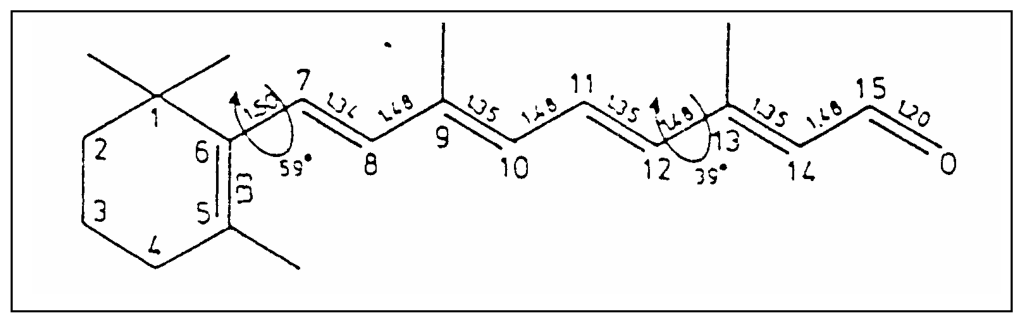
The molecule in the part of C-atoms 7 through 12 is planar. The angle between the bonds C5-C6, C7-C8, C11-C12 and C13-C14 is about 39°. According to the 'particle in the box' theory fragment C7 through C12 should absorb at about 213 nm. In reality the absorption of retinal occurs at 308 nm.
3.6 Give a reason for the longer wavelength that is observed in practice using the above mentioned theories.
3.7 When retinal is bound to opsin to form rhodopsin, the absorption occurs around 600 nm. Which atoms must be forced into one plane by the protein? Show by calculation that it's true.
Official English text of the problem.
Answers
- 3.1 \(\displaystyle \lambda_{\mathrm e,j}=\frac{2l}{j}\), where \(j=1,2,3,\ldots\).
- 3.2 \(\displaystyle E_j=\frac{j^2h^2}{8m_{\mathrm e}l^2}\).
- 3.3 The lowest excitation is \(j=k/2\rightarrow k/2+1\), giving \(\displaystyle \lambda_{\max}=\frac{8m_{\mathrm e}cl^2}{h(k+1)}\).
- 3.4 With \(a\) the carbon–carbon bond length, \(l=(n-1)a\) and \(k=n\), so \[ \boxed{\lambda_{\mathrm{first}}=\frac{8m_{\mathrm e}ca^2}{h}\frac{(n-1)^2}{n+1}}. \]
- 3.5 \(\boxed{n_{\min}=10}\) conjugated carbon atoms. The predicted absorption is approximately \(490\,\mathrm{nm}\); eight carbon atoms give \(362\,\mathrm{nm}\).
- 3.6 Twisting reduces, but does not eliminate, orbital overlap. Delocalization therefore extends beyond C7–C12, lowering the excitation energy and increasing the absorption wavelength.
- 3.7 Within the stated model, the entire conjugated skeleton—C5 through C15 and the terminal oxygen in the drawing—must be coplanar. It contains \(12\) conjugated electrons over approximately \(1.54\,\mathrm{nm}\), giving \(\boxed{\lambda\approx600\,\mathrm{nm}}\).
Solution
Write \(\lambda_{\mathrm e}\) for an electron’s de Broglie wavelength and \(\lambda_{\mathrm{ph}}\) for the absorbed photon’s wavelength. The two relevant relations are
\[ p=\frac{h}{\lambda_{\mathrm e}}, \qquad \Delta E=\frac{hc}{\lambda_{\mathrm{ph}}}. \]
For numerical calculations, use
\[ h=6.626\times10^{-34}\,\mathrm{J\,s},\qquad m_{\mathrm e}=9.109\times10^{-31}\,\mathrm{kg},\qquad c=2.998\times10^8\,\mathrm{m\,s^{-1}}. \]
3.1
For a particle confined by impenetrable ends at \(x=0\) and \(x=l\), the wavefunction must vanish at both ends. Thus an integral number of half-wavelengths fits into the box:
\[ l=j\frac{\lambda_{\mathrm e,j}}{2}. \]
Consequently,
\[ \boxed{\lambda_{\mathrm e,j}=\frac{2l}{j}}, \qquad j=1,2,3,\ldots. \]
The corresponding standing waves are proportional to \(\sin(j\pi x/l)\). The value \(j=0\) would give an identically zero wavefunction and is excluded.
3.2
The permitted momentum magnitudes are
\[ p_j=\frac{h}{\lambda_{\mathrm e,j}}=\frac{jh}{2l}. \]
Taking the potential energy inside the box as zero, the energy is entirely kinetic:
\[ E_j=\frac{p_j^2}{2m_{\mathrm e}}. \]
Therefore,
\[ \boxed{E_j=\frac{j^2h^2}{8m_{\mathrm e}l^2}}, \qquad j=1,2,3,\ldots. \]
3.3
Each spatial energy level accommodates two electrons with opposite spins. For an even number \(k\) of electrons in the ground state, the occupied levels are
\[ j=1,2,\ldots,\frac{k}{2}. \]
The smallest possible excitation promotes an electron from the highest occupied level to the lowest unoccupied level:
\[ \frac{k}{2}\longrightarrow\frac{k}{2}+1. \]
This adjacent-level transition is dipole allowed. Its energy is
\[ \begin{aligned} \Delta E_{\min} &=E_{k/2+1}-E_{k/2}\\ &=\frac{h^2}{8m_{\mathrm e}l^2} \left[\left(\frac{k}{2}+1\right)^2-\left(\frac{k}{2}\right)^2\right]\\ &=\frac{h^2(k+1)}{8m_{\mathrm e}l^2}. \end{aligned} \]
Since the longest photon wavelength corresponds to the smallest excitation energy,
\[ \boxed{\lambda_{\max} =\frac{hc}{\Delta E_{\min}} =\frac{8m_{\mathrm e}cl^2}{h(k+1)}}. \]
3.4
An unbranched conjugated chain containing \(n\) carbon atoms has \(n-1\) bonds along its backbone. Using the chain’s contour length as the one-dimensional box length,
\[ l=(n-1)a, \]
where \(a\) is the common carbon–carbon bond length. Each conjugated carbon supplies one \(\pi\) electron, so \(k=n\).
Substitution into the result of 3.3 gives
\[ \boxed{\lambda_{\mathrm{first}}(n) =\frac{8m_{\mathrm e}ca^2(n-1)^2}{h(n+1)}}, \qquad n\text{ even}. \]
For \(a=142\,\mathrm{pm}=1.42\times10^{-10}\,\mathrm m\),
\[ \frac{8m_{\mathrm e}ca^2}{h} =6.648\times10^{-8}\,\mathrm m =66.48\,\mathrm{nm}. \]
Hence
\[ \boxed{\lambda_{\mathrm{first}}(n) =(66.48\,\mathrm{nm})\frac{(n-1)^2}{n+1}}. \]
3.5
Taking approximately \(400\,\mathrm{nm}\) as the short-wavelength boundary of visible light requires
\[ 66.48\frac{(n-1)^2}{n+1}\geq400. \]
The equality gives \(n\approx8.60\). Because \(n\) must be even, the first candidate is \(n=10\). Checking the neighboring even values:
| Conjugated carbon atoms \(n\) | Box length \(l\) | First absorption wavelength |
|---|---|---|
| 8 | \(994\,\mathrm{pm}\) | \(362\,\mathrm{nm}\) |
| 10 | \(1278\,\mathrm{pm}\) | \(490\,\mathrm{nm}\) |
Thus eight carbon atoms still give ultraviolet absorption, whereas ten give visible absorption:
\[ \boxed{n_{\min}=10}. \]
Using \(380\,\mathrm{nm}\) instead of \(400\,\mathrm{nm}\) for the visible boundary gives the same minimum.
3.6
The molecule drawn is retinal, with an all-trans polyene configuration, represented by the SMILES
O=C/C=C(\C)/C=C/C=C(\C)/C=C/C1=C(C)CCCC1(C)C.
This SMILES specifies connectivity and double-bond configuration; it does not specify the single-bond torsion angles shown in the figure.
Restricting the box to C7–C12 assumes that the conjugated electrons cannot extend beyond that fragment. However, the neighboring double bonds are separated from it by single bonds about which the molecule is twisted. A twist of the stated magnitude reduces the overlap of neighboring \(p\) orbitals but does not make that overlap zero.
Consequently, the electronic states extend beyond C7–C12 into the neighboring conjugated groups. The greater effective delocalization length lowers the first excitation energy, so
\[ \Delta E\downarrow \quad\Longrightarrow\quad \lambda_{\mathrm{ph}}=\frac{hc}{\Delta E}\uparrow. \]
This explains qualitatively why the observed \(308\,\mathrm{nm}\) is longer than the stated isolated-fragment prediction of \(213\,\mathrm{nm}\). The simple model and torsion angles alone do not determine the precise observed wavelength.
3.7
To maximize conjugation in the model, the protein must bring the complete conjugated skeleton into one plane:
- the ring double bond, C5=C6;
- the chain carbons C7–C15;
- the terminal carbonyl oxygen in the supplied drawing.
Thus the relevant plane contains C5–C15 and O. The saturated ring carbons C1–C4 and the methyl carbons do not belong to this conjugated electron system.
There are six conjugated double bonds: five carbon–carbon double bonds and one carbon–oxygen double bond. Therefore,
\[ k=6\times2=12\text{ electrons}. \]
Adding the labelled bond lengths along the conjugated path from C5 to O gives approximately
\[ l=l_{5,6}+l_{6,7}+\cdots+l_{14,15}+l_{15,\mathrm O} \simeq1.54\,\mathrm{nm}. \]
The predicted absorption is therefore
\[ \begin{aligned} \lambda_{\max} &=\frac{8m_{\mathrm e}cl^2}{h(k+1)}\\ &\simeq \frac{ 8(9.109\times10^{-31}\,\mathrm{kg}) (2.998\times10^8\,\mathrm{m\,s^{-1}}) (1.54\times10^{-9}\,\mathrm m)^2 }{ (6.626\times10^{-34}\,\mathrm{J\,s})(13) }\\ &\simeq6.0\times10^{-7}\,\mathrm m\\ &=\boxed{6.0\times10^2\,\mathrm{nm}}. \end{aligned} \]
This agrees with the problem’s value of about \(600\,\mathrm{nm}\).
The solution was checked against the official solution.
IChO 1986 · Theorieaufgabe 3
Teilchen-im-Kasten-Modell konjugierter Farbstoffe und Retinal
Um zu erklären, warum Farbstoffe farbig sind, kann man sie als stabförmige, eindimensionale Moleküle betrachten, über die die Elektronen verteilt sind. Die Wellenlängen der Elektronen müssen in den verfügbaren Raum der Länge \(l\) passen. Bei der Absorption von Licht geht ein Elektron von einem niedrigeren in einen höheren Energiezustand über. Die Energiedifferenz ist gegeben durch:
\[ \Delta E=h\times\mathit{coverlambda}\quad\text{wobei }\lambda=\frac{h}{p} \]
3.1 Geben Sie einen allgemeinen Ausdruck für die möglichen Wellenlängen des Elektrons in Abhängigkeit von der Länge \(l\) an.
Im Modell „Teilchen im Kasten“ werden nur die Änderungen der kinetischen Energie der Elektronen berücksichtigt.
3.2 Geben Sie einen Ausdruck für die möglichen Energien an, die Elektronen im Molekül haben können (in Abhängigkeit von \(l\)).
3.3 Zeigen Sie, dass bei einer Kette der Länge \(l\) mit \(k\) Elektronen die Absorption mit der größten Wellenlänge bei folgendem Wert auftritt:
\[ \lambda=\frac{8mcl^2}{h(k+1)} \qquad\text{für gerade Werte von }k \]
3.4 Leiten Sie einen Ausdruck für die Wellenlänge des ersten elektronischen Übergangs in Abhängigkeit von der Anzahl der C-Atome für gerade Werte von \(n\) her.
3.5 Berechnen Sie die Mindestanzahl an C-Atomen (konjugierte Systeme), die erforderlich ist, um eine sichtbare Farbe zu erhalten. Die C-C-Bindungslänge beträgt 142 pm.
Die Netzhaut des menschlichen Auges enthält Rhodopsin, eine lichtabsorbierende Substanz.
Das Molekül ist im Bereich der C-Atome 7 bis 12 planar. Der Winkel zwischen den Bindungen C5-C6, C7-C8, C11-C12 und C13-C14 beträgt etwa 39°. Nach der Theorie des „Teilchens im Kasten“ sollte das Fragment C7 bis C12 bei etwa 213 nm absorbieren. Tatsächlich erfolgt die Absorption von Retinal bei 308 nm.
3.6 Geben Sie mithilfe der oben genannten Theorien einen Grund für die in der Praxis beobachtete größere Wellenlänge an.
3.7 Wenn Retinal an Opsin gebunden wird und dadurch Rhodopsin entsteht, erfolgt die Absorption bei etwa 600 nm. Welche Atome müssen durch das Protein in eine gemeinsame Ebene gezwungen werden? Bestätigen Sie dies durch eine Berechnung.
Aufgabentext aus dem offiziellen englischen Text übersetzt.
Antworten
- 3.1 \(\displaystyle \lambda_{\mathrm e,j}=\frac{2l}{j}\), wobei \(j=1,2,3,\ldots\).
- 3.2 \(\displaystyle E_j=\frac{j^2h^2}{8m_{\mathrm e}l^2}\).
- 3.3 Die Anregung mit der geringsten Energie ist \(j=k/2\rightarrow k/2+1\); daraus ergibt sich \(\displaystyle \lambda_{\max}=\frac{8m_{\mathrm e}cl^2}{h(k+1)}\).
- 3.4 Mit \(a\) als Kohlenstoff–Kohlenstoff-Bindungslänge gilt \(l=(n-1)a\) und \(k=n\), sodass \[ \boxed{\lambda_{\mathrm{first}}=\frac{8m_{\mathrm e}ca^2}{h}\frac{(n-1)^2}{n+1}}. \]
- 3.5 \(\boxed{n_{\min}=10}\) konjugierte Kohlenstoffatome. Die vorhergesagte Absorption liegt bei ungefähr \(490\,\mathrm{nm}\); acht Kohlenstoffatome ergeben \(362\,\mathrm{nm}\).
- 3.6 Eine Verdrillung verringert die Orbitalüberlappung, hebt sie jedoch nicht vollständig auf. Die Delokalisierung erstreckt sich daher über C7–C12 hinaus, wodurch die Anregungsenergie sinkt und die Absorptionswellenlänge zunimmt.
- 3.7 Im Rahmen des angegebenen Modells muss das gesamte konjugierte Gerüst – C5 bis C15 und der endständige Sauerstoff in der Zeichnung – in einer Ebene liegen. Es enthält \(12\) konjugierte Elektronen über eine Länge von ungefähr \(1.54\,\mathrm{nm}\), woraus sich \(\boxed{\lambda\approx600\,\mathrm{nm}}\) ergibt.
Lösung
Wir bezeichnen die De-Broglie-Wellenlänge eines Elektrons mit \(\lambda_{\mathrm e}\) und die Wellenlänge des absorbierten Photons mit \(\lambda_{\mathrm{ph}}\). Die beiden relevanten Beziehungen lauten
\[ p=\frac{h}{\lambda_{\mathrm e}}, \qquad \Delta E=\frac{hc}{\lambda_{\mathrm{ph}}}. \]
Für numerische Berechnungen verwenden wir
\[ h=6.626\times10^{-34}\,\mathrm{J\,s},\qquad m_{\mathrm e}=9.109\times10^{-31}\,\mathrm{kg},\qquad c=2.998\times10^8\,\mathrm{m\,s^{-1}}. \]
3.1
Für ein Teilchen, das durch undurchdringliche Begrenzungen bei \(x=0\) und \(x=l\) eingeschlossen ist, muss die Wellenfunktion an beiden Enden verschwinden. Daher passt eine ganzzahlige Anzahl halber Wellenlängen in den Kasten:
\[ l=j\frac{\lambda_{\mathrm e,j}}{2}. \]
Folglich gilt
\[ \boxed{\lambda_{\mathrm e,j}=\frac{2l}{j}}, \qquad j=1,2,3,\ldots. \]
Die entsprechenden stehenden Wellen sind proportional zu \(\sin(j\pi x/l)\). Der Wert \(j=0\) würde eine identisch verschwindende Wellenfunktion ergeben und ist ausgeschlossen.
3.2
Die zulässigen Impulsbeträge sind
\[ p_j=\frac{h}{\lambda_{\mathrm e,j}}=\frac{jh}{2l}. \]
Setzt man die potenzielle Energie im Inneren des Kastens gleich null, so ist die Energie rein kinetisch:
\[ E_j=\frac{p_j^2}{2m_{\mathrm e}}. \]
Daher gilt
\[ \boxed{E_j=\frac{j^2h^2}{8m_{\mathrm e}l^2}}, \qquad j=1,2,3,\ldots. \]
3.3
Jedes räumliche Energieniveau kann zwei Elektronen mit entgegengesetztem Spin aufnehmen. Bei einer geraden Anzahl \(k\) von Elektronen im Grundzustand sind die folgenden Niveaus besetzt:
\[ j=1,2,\ldots,\frac{k}{2}. \]
Bei der kleinstmöglichen Anregung wird ein Elektron vom höchsten besetzten Niveau auf das niedrigste unbesetzte Niveau angehoben:
\[ \frac{k}{2}\longrightarrow\frac{k}{2}+1. \]
Dieser Übergang zwischen benachbarten Niveaus ist dipolerlaubt. Seine Energie beträgt
\[ \begin{aligned} \Delta E_{\min} &=E_{k/2+1}-E_{k/2}\\ &=\frac{h^2}{8m_{\mathrm e}l^2} \left[\left(\frac{k}{2}+1\right)^2-\left(\frac{k}{2}\right)^2\right]\\ &=\frac{h^2(k+1)}{8m_{\mathrm e}l^2}. \end{aligned} \]
Da die größte Photonenwellenlänge der kleinsten Anregungsenergie entspricht, gilt
\[ \boxed{\lambda_{\max} =\frac{hc}{\Delta E_{\min}} =\frac{8m_{\mathrm e}cl^2}{h(k+1)}}. \]
3.4
Eine unverzweigte konjugierte Kette mit \(n\) Kohlenstoffatomen besitzt \(n-1\) Bindungen entlang ihres Gerüsts. Verwendet man die Konturlänge der Kette als Länge des eindimensionalen Kastens, so gilt
\[ l=(n-1)a, \]
wobei \(a\) die einheitliche Kohlenstoff–Kohlenstoff-Bindungslänge ist. Jedes konjugierte Kohlenstoffatom liefert ein \(\pi\)-Elektron, sodass \(k=n\) gilt.
Einsetzen in das Ergebnis von 3.3 ergibt
\[ \boxed{\lambda_{\mathrm{first}}(n) =\frac{8m_{\mathrm e}ca^2(n-1)^2}{h(n+1)}}, \qquad n\text{ gerade}. \]
Für \(a=142\,\mathrm{pm}=1.42\times10^{-10}\,\mathrm m\) gilt
\[ \frac{8m_{\mathrm e}ca^2}{h} =6.648\times10^{-8}\,\mathrm m =66.48\,\mathrm{nm}. \]
Somit ergibt sich
\[ \boxed{\lambda_{\mathrm{first}}(n) =(66.48\,\mathrm{nm})\frac{(n-1)^2}{n+1}}. \]
3.5
Setzt man ungefähr \(400\,\mathrm{nm}\) als kurzwellige Grenze des sichtbaren Lichts an, so muss gelten
\[ 66.48\frac{(n-1)^2}{n+1}\geq400. \]
Die Gleichheit ergibt \(n\approx8.60\). Da \(n\) gerade sein muss, ist der erste Kandidat \(n=10\). Die Überprüfung der benachbarten geraden Werte ergibt:
| Konjugierte Kohlenstoffatome \(n\) | Kastenlänge \(l\) | Erste Absorptionswellenlänge |
|---|---|---|
| 8 | \(994\,\mathrm{pm}\) | \(362\,\mathrm{nm}\) |
| 10 | \(1278\,\mathrm{pm}\) | \(490\,\mathrm{nm}\) |
Acht Kohlenstoffatome führen also noch zu einer Absorption im ultravioletten Bereich, während zehn eine Absorption im sichtbaren Bereich ergeben:
\[ \boxed{n_{\min}=10}. \]
Verwendet man \(380\,\mathrm{nm}\) anstelle von \(400\,\mathrm{nm}\) als Grenze des sichtbaren Bereichs, erhält man dieselbe Mindestanzahl.
3.6
Das dargestellte Molekül ist Retinal mit einer all-trans-Polyenkonfiguration, dargestellt durch die SMILES-Zeichenfolge
O=C/C=C(\C)/C=C/C=C(\C)/C=C/C1=C(C)CCCC1(C)C.
Diese SMILES-Zeichenfolge legt die Verknüpfung der Atome und die Konfiguration der Doppelbindungen fest; sie legt nicht die in der Abbildung gezeigten Torsionswinkel um die Einfachbindungen fest.
Die Beschränkung des Kastens auf C7–C12 setzt voraus, dass sich die konjugierten Elektronen nicht über dieses Fragment hinaus erstrecken können. Die benachbarten Doppelbindungen sind jedoch durch Einfachbindungen davon getrennt, um die das Molekül verdrillt ist. Eine Verdrillung der angegebenen Größenordnung verringert die Überlappung benachbarter \(p\)-Orbitale, lässt diese Überlappung jedoch nicht null werden.
Folglich erstrecken sich die elektronischen Zustände über C7–C12 hinaus in die benachbarten konjugierten Gruppen. Die größere effektive Delokalisierungslänge senkt die erste Anregungsenergie, sodass
\[ \Delta E\downarrow \quad\Longrightarrow\quad \lambda_{\mathrm{ph}}=\frac{hc}{\Delta E}\uparrow. \]
Dies erklärt qualitativ, warum die beobachtete Wellenlänge von \(308\,\mathrm{nm}\) größer ist als der angegebene, für das isolierte Fragment vorhergesagte Wert von \(213\,\mathrm{nm}\). Das einfache Modell und die Torsionswinkel allein bestimmen die genaue beobachtete Wellenlänge nicht.
3.7
Um die Konjugation im Modell zu maximieren, muss das Protein das gesamte konjugierte Gerüst in eine Ebene bringen:
- die Doppelbindung im Ring, C5=C6;
- die Kohlenstoffatome C7–C15 der Kette;
- den endständigen Carbonylsauerstoff in der vorgegebenen Zeichnung.
Die betreffende Ebene enthält somit C5–C15 und O. Die gesättigten Ringkohlenstoffatome C1–C4 und die Methylkohlenstoffatome gehören nicht zu diesem konjugierten Elektronensystem.
Es gibt sechs konjugierte Doppelbindungen: fünf Kohlenstoff–Kohlenstoff-Doppelbindungen und eine Kohlenstoff–Sauerstoff-Doppelbindung. Daher gilt
\[ k=6\times2=12\text{ Elektronen}. \]
Die Addition der angegebenen Bindungslängen entlang des konjugierten Pfads von C5 bis O ergibt ungefähr
\[ l=l_{5,6}+l_{6,7}+\cdots+l_{14,15}+l_{15,\mathrm O} \simeq1.54\,\mathrm{nm}. \]
Die vorhergesagte Absorption liegt daher bei
\[ \begin{aligned} \lambda_{\max} &=\frac{8m_{\mathrm e}cl^2}{h(k+1)}\\ &\simeq \frac{ 8(9.109\times10^{-31}\,\mathrm{kg}) (2.998\times10^8\,\mathrm{m\,s^{-1}}) (1.54\times10^{-9}\,\mathrm m)^2 }{ (6.626\times10^{-34}\,\mathrm{J\,s})(13) }\\ &\simeq6.0\times10^{-7}\,\mathrm m\\ &=\boxed{6.0\times10^2\,\mathrm{nm}}. \end{aligned} \]
Dies stimmt mit dem in der Aufgabe angegebenen Wert von etwa \(600\,\mathrm{nm}\) überein.
Die Lösung wurde mit der offiziellen Lösung abgeglichen.
IChO 1986 · Teori sorusu 3
Konjuge boyaların ve retinalin kutudaki parçacık modeli
Boyaların neden renkli olduğunu açıklamak için, bunlar elektronların üzerlerine dağıldığı çubuk benzeri, tek boyutlu moleküller olarak düşünülebilir. Elektronların dalga boyları, uzunluğu \(l\) olan kullanılabilir alana sığmalıdır. Işık soğurulduğunda bir elektron daha düşük bir enerji durumundan daha yüksek bir enerji durumuna geçiş yapar. Enerji farkı şu şekilde verilir:
\[ \Delta E=h\times\mathit{coverlambda}\quad\text{burada }\lambda=\frac{h}{p} \]
3.1 Elektronun olası dalga boyları için \(l\) uzunluğunun fonksiyonu olarak genel bir ifade veriniz.
“Kutudaki parçacık” modelinde elektronların yalnızca kinetik enerjilerindeki değişimler dikkate alınır.
3.2 Moleküldeki elektronların sahip olabileceği olası enerjiler için (\(l\)'nin fonksiyonu olarak) bir ifade veriniz.
3.3 Uzunluğu \(l\) olan ve \(k\) elektron içeren bir zincir için en uzun dalga boylu soğurmanın aşağıdaki dalga boyunda gerçekleştiğini gösteriniz:
\[ \lambda=\frac{8mcl^2}{h(k+1)} \qquad\text{çift değerli }k \]
3.4 \(n\)'nin çift değerleri için, ilk elektronik geçişin dalga boyunu C atomlarının sayısının fonksiyonu olarak veren bir ifade türetiniz.
3.5 Görünür bir renk elde etmek için gereken en az C atomu sayısını (konjuge sistemler) hesaplayınız. C-C bağ uzunluğu 142 pm'dir.
İnsan gözündeki retina, ışık soğuran bir madde olan rodopsin içerir.
Molekülün 7 ile 12 arasındaki C atomlarını içeren kısmı düzlemseldir. C5-C6, C7-C8, C11-C12 ve C13-C14 bağları arasındaki açı yaklaşık 39°'dir. “Kutudaki parçacık” kuramına göre C7 ile C12 arasındaki parça yaklaşık 213 nm'de soğurma yapmalıdır. Gerçekte retinalin soğurması 308 nm'de gerçekleşir.
3.6 Yukarıda belirtilen kuramları kullanarak uygulamada gözlenen daha uzun dalga boyunun bir nedenini belirtiniz.
3.7 Retinal, rodopsini oluşturmak üzere opsine bağlandığında soğurma yaklaşık 600 nm'de gerçekleşir. Protein hangi atomları aynı düzlemde bulunmaya zorlamalıdır? Bunun doğru olduğunu hesaplama yaparak gösteriniz.
Soru metni resmi İngilizce metinden çevrilmiştir.
Cevaplar
- 3.1 \(\displaystyle \lambda_{\mathrm e,j}=\frac{2l}{j}\), burada \(j=1,2,3,\ldots\).
- 3.2 \(\displaystyle E_j=\frac{j^2h^2}{8m_{\mathrm e}l^2}\).
- 3.3 En düşük enerjili uyarılma \(j=k/2\rightarrow k/2+1\) geçişidir ve \(\displaystyle \lambda_{\max}=\frac{8m_{\mathrm e}cl^2}{h(k+1)}\) sonucunu verir.
- 3.4 \(a\) karbon–karbon bağ uzunluğu olmak üzere, \(l=(n-1)a\) ve \(k=n\) olduğundan \[ \boxed{\lambda_{\mathrm{first}}=\frac{8m_{\mathrm e}ca^2}{h}\frac{(n-1)^2}{n+1}}. \]
- 3.5 \(\boxed{n_{\min}=10}\) konjuge karbon atomu. Öngörülen soğurma dalga boyu yaklaşık \(490\,\mathrm{nm}\)'dir; sekiz karbon atomu \(362\,\mathrm{nm}\) verir.
- 3.6 Burulma, orbital örtüşmesini azaltır ancak ortadan kaldırmaz. Bu nedenle delokalizasyon C7–C12'nin ötesine uzanır; uyarılma enerjisini düşürür ve soğurma dalga boyunu artırır.
- 3.7 Belirtilen model çerçevesinde konjuge iskeletin tamamı —C5'ten C15'e kadar olan atomlar ve çizimdeki uç oksijen atomu— aynı düzlemde bulunmalıdır. Yaklaşık \(1.54\,\mathrm{nm}\) boyunca \(12\) konjuge elektron içerir ve \(\boxed{\lambda\approx600\,\mathrm{nm}}\) sonucunu verir.
Çözüm
Bir elektronun de Broglie dalga boyunu \(\lambda_{\mathrm e}\), soğurulan fotonun dalga boyunu ise \(\lambda_{\mathrm{ph}}\) ile gösterelim. İlgili iki bağıntı şunlardır:
\[ p=\frac{h}{\lambda_{\mathrm e}}, \qquad \Delta E=\frac{hc}{\lambda_{\mathrm{ph}}}. \]
Sayısal hesaplamalarda şu değerleri kullanalım:
\[ h=6.626\times10^{-34}\,\mathrm{J\,s},\qquad m_{\mathrm e}=9.109\times10^{-31}\,\mathrm{kg},\qquad c=2.998\times10^8\,\mathrm{m\,s^{-1}}. \]
3.1
\(x=0\) ve \(x=l\) noktalarındaki geçirimsiz uçlarla sınırlandırılmış bir parçacık için dalga fonksiyonu her iki uçta da sıfır olmalıdır. Dolayısıyla kutuya tam sayı kadar yarım dalga boyu sığar:
\[ l=j\frac{\lambda_{\mathrm e,j}}{2}. \]
Bunun sonucunda,
\[ \boxed{\lambda_{\mathrm e,j}=\frac{2l}{j}}, \qquad j=1,2,3,\ldots. \]
Bunlara karşılık gelen duran dalgalar \(\sin(j\pi x/l)\) ile orantılıdır. \(j=0\) değeri özdeş olarak sıfır olan bir dalga fonksiyonu vereceğinden dışlanır.
3.2
İzin verilen momentum büyüklükleri şunlardır:
\[ p_j=\frac{h}{\lambda_{\mathrm e,j}}=\frac{jh}{2l}. \]
Kutu içindeki potansiyel enerji sıfır alındığında enerji bütünüyle kinetiktir:
\[ E_j=\frac{p_j^2}{2m_{\mathrm e}}. \]
Dolayısıyla,
\[ \boxed{E_j=\frac{j^2h^2}{8m_{\mathrm e}l^2}}, \qquad j=1,2,3,\ldots. \]
3.3
Her uzaysal enerji düzeyine zıt spinli iki elektron yerleşebilir. Temel durumda çift sayıda \(k\) elektron için dolu düzeyler şunlardır:
\[ j=1,2,\ldots,\frac{k}{2}. \]
Olası en düşük enerjili uyarılma, bir elektronu en yüksek dolu düzeyden en düşük boş düzeye çıkarır:
\[ \frac{k}{2}\longrightarrow\frac{k}{2}+1. \]
Bu komşu düzeyler arasındaki geçiş, dipol seçim kurallarına göre izinlidir. Enerjisi şöyledir:
\[ \begin{aligned} \Delta E_{\min} &=E_{k/2+1}-E_{k/2}\\ &=\frac{h^2}{8m_{\mathrm e}l^2} \left[\left(\frac{k}{2}+1\right)^2-\left(\frac{k}{2}\right)^2\right]\\ &=\frac{h^2(k+1)}{8m_{\mathrm e}l^2}. \end{aligned} \]
En uzun foton dalga boyu en düşük uyarılma enerjisine karşılık geldiğinden,
\[ \boxed{\lambda_{\max} =\frac{hc}{\Delta E_{\min}} =\frac{8m_{\mathrm e}cl^2}{h(k+1)}}. \]
3.4
\(n\) karbon atomu içeren dallanmamış bir konjuge zincirin ana iskeleti boyunca \(n-1\) bağ bulunur. Zincirin kontur uzunluğu tek boyutlu kutunun uzunluğu olarak kullanıldığında,
\[ l=(n-1)a, \]
burada \(a\), tüm karbon–karbon bağları için ortak bağ uzunluğudur. Her konjuge karbon bir \(\pi\) elektronu sağladığından \(k=n\) olur.
3.3'teki sonuçta yerine koyarsak
\[ \boxed{\lambda_{\mathrm{first}}(n) =\frac{8m_{\mathrm e}ca^2(n-1)^2}{h(n+1)}}, \qquad n\text{ çift}. \]
\(a=142\,\mathrm{pm}=1.42\times10^{-10}\,\mathrm m\) için,
\[ \frac{8m_{\mathrm e}ca^2}{h} =6.648\times10^{-8}\,\mathrm m =66.48\,\mathrm{nm}. \]
Böylece
\[ \boxed{\lambda_{\mathrm{first}}(n) =(66.48\,\mathrm{nm})\frac{(n-1)^2}{n+1}}. \]
3.5
Görünür ışığın kısa dalga boyu sınırı yaklaşık \(400\,\mathrm{nm}\) alındığında şu koşul gerekir:
\[ 66.48\frac{(n-1)^2}{n+1}\geq400. \]
Eşitlik \(n\approx8.60\) sonucunu verir. \(n\) çift olmak zorunda olduğundan ilk aday \(n=10\)'dur. Komşu çift değerleri kontrol edelim:
| Konjuge karbon atomu sayısı \(n\) | Kutu uzunluğu \(l\) | İlk soğurmanın dalga boyu |
|---|---|---|
| 8 | \(994\,\mathrm{pm}\) | \(362\,\mathrm{nm}\) |
| 10 | \(1278\,\mathrm{pm}\) | \(490\,\mathrm{nm}\) |
Dolayısıyla sekiz karbon atomu hâlâ morötesi bölgede soğurma verirken on karbon atomu görünür bölgede soğurma verir:
\[ \boxed{n_{\min}=10}. \]
Görünür bölgenin sınırı için \(400\,\mathrm{nm}\) yerine \(380\,\mathrm{nm}\) kullanılması da aynı minimumu verir.
3.6
Çizilen molekül, tümü trans polien konfigürasyonuna sahip retinal olup şu SMILES ile gösterilir:
O=C/C=C(\C)/C=C/C=C(\C)/C=C/C1=C(C)CCCC1(C)C.
Bu SMILES, atomların bağlanma düzenini ve çift bağ konfigürasyonunu belirtir; şekilde gösterilen tek bağ burulma açılarını belirtmez.
Kutuyu C7–C12 ile sınırlamak, konjuge elektronların bu parçanın ötesine uzanamadığını varsayar. Ancak komşu çift bağlar bu parçadan, molekülün etraflarında burulduğu tek bağlarla ayrılır. Belirtilen büyüklükte bir burulma, komşu \(p\) orbitallerinin örtüşmesini azaltır ancak bu örtüşmeyi sıfıra indirmez.
Bunun sonucunda elektronik durumlar C7–C12'nin ötesine, komşu konjuge gruplara uzanır. Daha büyük etkin delokalizasyon uzunluğu ilk uyarılma enerjisini düşürür; dolayısıyla
\[ \Delta E\downarrow \quad\Longrightarrow\quad \lambda_{\mathrm{ph}}=\frac{hc}{\Delta E}\uparrow. \]
Bu, gözlenen \(308\,\mathrm{nm}\) dalga boyunun neden yalıtılmış parça için belirtilen \(213\,\mathrm{nm}\) öngörüsünden daha uzun olduğunu nitel olarak açıklar. Basit model ve burulma açıları tek başlarına gözlenen dalga boyunun kesin değerini belirlemez.
3.7
Modelde konjugasyonu en üst düzeye çıkarmak için protein, konjuge iskeletin tamamını tek bir düzleme getirmelidir:
- halkadaki çift bağ, C5=C6;
- zincirdeki C7–C15 karbonları;
- verilen çizimdeki uç karbonil oksijeni.
Dolayısıyla ilgili düzlem C5–C15 ve O atomlarını içerir. Halkadaki doymuş C1–C4 karbonları ve metil karbonları bu konjuge elektron sistemine ait değildir.
Altı konjuge çift bağ vardır: beş karbon–karbon çift bağı ve bir karbon–oksijen çift bağı. Bu nedenle,
\[ k=6\times2=12\text{ elektron}. \]
C5'ten O'ya uzanan konjuge yol boyunca belirtilen bağ uzunluklarının toplanması yaklaşık olarak şu sonucu verir:
\[ l=l_{5,6}+l_{6,7}+\cdots+l_{14,15}+l_{15,\mathrm O} \simeq1.54\,\mathrm{nm}. \]
Dolayısıyla öngörülen soğurma dalga boyu şöyledir:
\[ \begin{aligned} \lambda_{\max} &=\frac{8m_{\mathrm e}cl^2}{h(k+1)}\\ &\simeq \frac{ 8(9.109\times10^{-31}\,\mathrm{kg}) (2.998\times10^8\,\mathrm{m\,s^{-1}}) (1.54\times10^{-9}\,\mathrm m)^2 }{ (6.626\times10^{-34}\,\mathrm{J\,s})(13) }\\ &\simeq6.0\times10^{-7}\,\mathrm m\\ &=\boxed{6.0\times10^2\,\mathrm{nm}}. \end{aligned} \]
Bu, soruda verilen yaklaşık \(600\,\mathrm{nm}\) değeriyle uyumludur.
Çözüm, resmi çözümle karşılaştırılarak kontrol edildi.
IChO 1986 · Problema teórico 3
Modelo de partícula en una caja para colorantes conjugados y retinal
Para explicar por qué los colorantes tienen color, pueden considerarse moléculas unidimensionales en forma de varilla en las que se distribuyen los electrones. Las longitudes de onda de los electrones deben ajustarse al espacio disponible, cuya longitud es \(l\). Al absorber luz, un electrón realiza una transición de un estado de menor energía a otro de mayor energía. La diferencia de energía viene dada por:
\[ \Delta E=h\times\mathit{coverlambda}\quad\text{donde }\lambda=\frac{h}{p} \]
3.1 Dé una expresión general para las longitudes de onda posibles del electrón en función de la longitud \(l\).
En el modelo de «partícula en una caja», solo se consideran las variaciones de la energía cinética de los electrones.
3.2 Dé una expresión para las energías posibles que pueden tener los electrones de la molécula (en función de \(l\)).
3.3 Demuestre que, para una cadena de longitud \(l\) con \(k\) electrones, la absorción de mayor longitud de onda se produce a:
\[ \lambda=\frac{8mcl^2}{h(k+1)} \qquad\text{para valores pares de }k \]
3.4 Deduzca una expresión para la longitud de onda de la primera transición electrónica en función del número de átomos de C para valores pares de \(n\).
3.5 Calcule el número mínimo de átomos de C (sistemas conjugados) necesario para obtener un color visible. La longitud del enlace C-C es de 142 pm.
La retina del ojo humano contiene rodopsina, una sustancia que absorbe luz.
La molécula es plana en la región que comprende los átomos de C del 7 al 12. El ángulo entre los enlaces C5-C6, C7-C8, C11-C12 y C13-C14 es de unos 39°. Según la teoría de la «partícula en una caja», el fragmento de C7 a C12 debería absorber a unos 213 nm. En realidad, la absorción del retinal se produce a 308 nm.
3.6 Explique por qué la longitud de onda observada en la práctica es mayor, utilizando las teorías mencionadas anteriormente.
3.7 Cuando el retinal se une a la opsina para formar rodopsina, la absorción se produce alrededor de 600 nm. ¿Qué átomos debe forzar la proteína a situarse en un mismo plano? Demuéstrelo mediante un cálculo.
Enunciado traducido del texto oficial en inglés.
Respuestas
- 3.1 \(\displaystyle \lambda_{\mathrm e,j}=\frac{2l}{j}\), donde \(j=1,2,3,\ldots\).
- 3.2 \(\displaystyle E_j=\frac{j^2h^2}{8m_{\mathrm e}l^2}\).
- 3.3 La excitación de menor energía es \(j=k/2\rightarrow k/2+1\), lo que da \(\displaystyle \lambda_{\max}=\frac{8m_{\mathrm e}cl^2}{h(k+1)}\).
- 3.4 Si \(a\) es la longitud del enlace carbono–carbono, \(l=(n-1)a\) y \(k=n\), por lo que \[ \boxed{\lambda_{\mathrm{first}}=\frac{8m_{\mathrm e}ca^2}{h}\frac{(n-1)^2}{n+1}}. \]
- 3.5 \(\boxed{n_{\min}=10}\) átomos de carbono conjugados. La absorción predicha es de aproximadamente \(490\,\mathrm{nm}\); ocho átomos de carbono dan \(362\,\mathrm{nm}\).
- 3.6 La torsión reduce el solapamiento orbital, pero no lo elimina. Por tanto, la deslocalización se extiende más allá de C7–C12, lo que reduce la energía de excitación y aumenta la longitud de onda de absorción.
- 3.7 Dentro del modelo indicado, todo el esqueleto conjugado —de C5 a C15 y el oxígeno terminal del dibujo— debe ser coplanario. Contiene \(12\) electrones conjugados distribuidos a lo largo de aproximadamente \(1.54\,\mathrm{nm}\), lo que da \(\boxed{\lambda\approx600\,\mathrm{nm}}\).
Solución
Denotemos por \(\lambda_{\mathrm e}\) la longitud de onda de de Broglie de un electrón y por \(\lambda_{\mathrm{ph}}\) la longitud de onda del fotón absorbido. Las dos relaciones pertinentes son
\[ p=\frac{h}{\lambda_{\mathrm e}}, \qquad \Delta E=\frac{hc}{\lambda_{\mathrm{ph}}}. \]
Para los cálculos numéricos, utilice
\[ h=6.626\times10^{-34}\,\mathrm{J\,s},\qquad m_{\mathrm e}=9.109\times10^{-31}\,\mathrm{kg},\qquad c=2.998\times10^8\,\mathrm{m\,s^{-1}}. \]
3.1
Para una partícula confinada entre extremos impenetrables situados en \(x=0\) y \(x=l\), la función de onda debe anularse en ambos extremos. Por tanto, en la caja cabe un número entero de semilongitudes de onda:
\[ l=j\frac{\lambda_{\mathrm e,j}}{2}. \]
En consecuencia,
\[ \boxed{\lambda_{\mathrm e,j}=\frac{2l}{j}}, \qquad j=1,2,3,\ldots. \]
Las ondas estacionarias correspondientes son proporcionales a \(\sin(j\pi x/l)\). El valor \(j=0\) daría una función de onda idénticamente nula y queda excluido.
3.2
Los módulos permitidos del momento lineal son
\[ p_j=\frac{h}{\lambda_{\mathrm e,j}}=\frac{jh}{2l}. \]
Tomando como cero la energía potencial dentro de la caja, la energía es enteramente cinética:
\[ E_j=\frac{p_j^2}{2m_{\mathrm e}}. \]
Por tanto,
\[ \boxed{E_j=\frac{j^2h^2}{8m_{\mathrm e}l^2}}, \qquad j=1,2,3,\ldots. \]
3.3
Cada nivel de energía espacial admite dos electrones con espines opuestos. Para un número par \(k\) de electrones en el estado fundamental, los niveles ocupados son
\[ j=1,2,\ldots,\frac{k}{2}. \]
La excitación de menor energía posible promueve un electrón del nivel ocupado de mayor energía al nivel desocupado de menor energía:
\[ \frac{k}{2}\longrightarrow\frac{k}{2}+1. \]
Esta transición entre niveles adyacentes está permitida por las reglas de selección dipolares. Su energía es
\[ \begin{aligned} \Delta E_{\min} &=E_{k/2+1}-E_{k/2}\\ &=\frac{h^2}{8m_{\mathrm e}l^2} \left[\left(\frac{k}{2}+1\right)^2-\left(\frac{k}{2}\right)^2\right]\\ &=\frac{h^2(k+1)}{8m_{\mathrm e}l^2}. \end{aligned} \]
Puesto que la mayor longitud de onda del fotón corresponde a la menor energía de excitación,
\[ \boxed{\lambda_{\max} =\frac{hc}{\Delta E_{\min}} =\frac{8m_{\mathrm e}cl^2}{h(k+1)}}. \]
3.4
Una cadena conjugada no ramificada que contiene \(n\) átomos de carbono tiene \(n-1\) enlaces a lo largo de su esqueleto. Utilizando la longitud del contorno de la cadena como longitud de la caja unidimensional,
\[ l=(n-1)a, \]
donde \(a\) es la longitud común de los enlaces carbono–carbono. Cada carbono conjugado aporta un electrón \(\pi\), por lo que \(k=n\).
Al sustituir en el resultado de 3.3 se obtiene
\[ \boxed{\lambda_{\mathrm{first}}(n) =\frac{8m_{\mathrm e}ca^2(n-1)^2}{h(n+1)}}, \qquad n\text{ par}. \]
Para \(a=142\,\mathrm{pm}=1.42\times10^{-10}\,\mathrm m\),
\[ \frac{8m_{\mathrm e}ca^2}{h} =6.648\times10^{-8}\,\mathrm m =66.48\,\mathrm{nm}. \]
Por tanto,
\[ \boxed{\lambda_{\mathrm{first}}(n) =(66.48\,\mathrm{nm})\frac{(n-1)^2}{n+1}}. \]
3.5
Tomar aproximadamente \(400\,\mathrm{nm}\) como límite de menor longitud de onda de la luz visible exige
\[ 66.48\frac{(n-1)^2}{n+1}\geq400. \]
La igualdad da \(n\approx8.60\). Como \(n\) debe ser par, el primer candidato es \(n=10\). Al comprobar los valores pares vecinos:
| Átomos de carbono conjugados \(n\) | Longitud de la caja \(l\) | Longitud de onda de la primera absorción |
|---|---|---|
| 8 | \(994\,\mathrm{pm}\) | \(362\,\mathrm{nm}\) |
| 10 | \(1278\,\mathrm{pm}\) | \(490\,\mathrm{nm}\) |
Así, ocho átomos de carbono todavía dan una absorción ultravioleta, mientras que diez dan una absorción visible:
\[ \boxed{n_{\min}=10}. \]
Utilizar \(380\,\mathrm{nm}\) en lugar de \(400\,\mathrm{nm}\) como límite de la región visible da el mismo mínimo.
3.6
La molécula dibujada es retinal, con una configuración poliénica todo-trans, representada por el SMILES
O=C/C=C(\C)/C=C/C=C(\C)/C=C/C1=C(C)CCCC1(C)C.
Este SMILES especifica la conectividad y la configuración de los dobles enlaces; no especifica los ángulos de torsión de los enlaces simples mostrados en la figura.
Restringir la caja a C7–C12 supone que los electrones conjugados no pueden extenderse más allá de ese fragmento. Sin embargo, los dobles enlaces vecinos están separados de él por enlaces simples en torno a los cuales la molécula presenta torsión. Una torsión de la magnitud indicada reduce el solapamiento de los orbitales \(p\) vecinos, pero no lo anula.
En consecuencia, los estados electrónicos se extienden más allá de C7–C12 hacia los grupos conjugados vecinos. La mayor longitud efectiva de deslocalización reduce la energía de la primera excitación, de modo que
\[ \Delta E\downarrow \quad\Longrightarrow\quad \lambda_{\mathrm{ph}}=\frac{hc}{\Delta E}\uparrow. \]
Esto explica cualitativamente por qué la longitud de onda observada de \(308\,\mathrm{nm}\) es mayor que la predicción indicada de \(213\,\mathrm{nm}\) para el fragmento aislado. El modelo sencillo y los ángulos de torsión, por sí solos, no determinan la longitud de onda exacta observada.
3.7
Para maximizar la conjugación en el modelo, la proteína debe situar todo el esqueleto conjugado en un mismo plano:
- el doble enlace del anillo, C5=C6;
- los carbonos de la cadena C7–C15;
- el oxígeno carbonílico terminal del dibujo proporcionado.
Por tanto, el plano pertinente contiene C5–C15 y O. Los carbonos saturados del anillo C1–C4 y los carbonos de los grupos metilo no pertenecen a este sistema de electrones conjugados.
Hay seis dobles enlaces conjugados: cinco dobles enlaces carbono–carbono y un doble enlace carbono–oxígeno. Por tanto,
\[ k=6\times2=12\text{ electrones}. \]
Al sumar las longitudes de enlace indicadas a lo largo del recorrido conjugado desde C5 hasta O se obtiene aproximadamente
\[ l=l_{5,6}+l_{6,7}+\cdots+l_{14,15}+l_{15,\mathrm O} \simeq1.54\,\mathrm{nm}. \]
La absorción predicha es, por tanto,
\[ \begin{aligned} \lambda_{\max} &=\frac{8m_{\mathrm e}cl^2}{h(k+1)}\\ &\simeq \frac{ 8(9.109\times10^{-31}\,\mathrm{kg}) (2.998\times10^8\,\mathrm{m\,s^{-1}}) (1.54\times10^{-9}\,\mathrm m)^2 }{ (6.626\times10^{-34}\,\mathrm{J\,s})(13) }\\ &\simeq6.0\times10^{-7}\,\mathrm m\\ &=\boxed{6.0\times10^2\,\mathrm{nm}}. \end{aligned} \]
Esto concuerda con el valor de unos \(600\,\mathrm{nm}\) del enunciado.
La solución se comprobó con la solución oficial.
IChO 1986 · 理论题 3
共轭染料和视黄醛的箱中粒子模型
为了解释染料为何有颜色,可以将其视为棒状的一维分子,电子分布在整个分子上。电子的波长应与可用空间相适应,这一空间的长度为 \(l\)。吸收光时,电子从较低能态跃迁到较高能态。能量差由下式给出:
\[ \Delta E=h\times\mathit{coverlambda}\quad\text{其中 }\lambda=\frac{h}{p} \]
3.1 给出电子可能具有的波长随长度 \(l\) 变化的一般表达式。
在“箱中粒子”模型中,只考虑电子动能的变化。
3.2 给出分子中电子可能具有的能量的表达式(作为 \(l\) 的函数)。
3.3 证明:对于长度为 \(l\)、含有 \(k\) 个电子的链,最长吸收波长为:
\[ \lambda=\frac{8mcl^2}{h(k+1)} \qquad\text{对于偶数 }k \]
3.4 对于偶数 \(n\),推导第一次电子跃迁的波长随碳原子数变化的表达式。
3.5 计算使体系呈现可见颜色所需的最少碳原子数(共轭体系)。C-C 键长为 142 pm。
人眼视网膜含有一种吸光物质——视紫红质。
分子中从碳原子 7 到碳原子 12 的部分为平面结构。C5-C6、C7-C8、C11-C12 和 C13-C14 键之间的夹角约为 39°。根据“箱中粒子”理论,C7 到 C12 片段应在约 213 nm 处吸收。实际上,视黄醛的吸收发生在 308 nm 处。
3.6 利用上述理论,说明实际观测到的波长较长的原因。
3.7 当视黄醛与视蛋白结合形成视紫红质时,吸收发生在约 600 nm 处。蛋白质必须使哪些原子处于同一平面内?通过计算证明这一点。
题目译自官方英文原文。
答案
- 3.1 \(\displaystyle \lambda_{\mathrm e,j}=\frac{2l}{j}\),其中 \(j=1,2,3,\ldots\)。
- 3.2 \(\displaystyle E_j=\frac{j^2h^2}{8m_{\mathrm e}l^2}\)。
- 3.3 最低能量的激发为 \(j=k/2\rightarrow k/2+1\),由此得到 \(\displaystyle \lambda_{\max}=\frac{8m_{\mathrm e}cl^2}{h(k+1)}\)。
- 3.4 设 \(a\) 为碳—碳键长,则 \(l=(n-1)a\),且 \(k=n\),因此 \[ \boxed{\lambda_{\mathrm{first}}=\frac{8m_{\mathrm e}ca^2}{h}\frac{(n-1)^2}{n+1}}. \]
- 3.5 \(\boxed{n_{\min}=10}\) 个共轭碳原子。预测的吸收波长约为 \(490\,\mathrm{nm}\);八个碳原子给出的波长为 \(362\,\mathrm{nm}\)。
- 3.6 扭转使轨道重叠减弱,但不会将其完全消除。因此,离域范围超出 C7–C12,使激发能降低,吸收波长增大。
- 3.7 在所述模型中,整个共轭骨架——图中的 C5 到 C15 以及末端氧原子——必须共平面。该骨架含有 \(12\) 个共轭电子,分布在约 \(1.54\,\mathrm{nm}\) 的长度上,由此得到 \(\boxed{\lambda\approx600\,\mathrm{nm}}\)。
解答
用 \(\lambda_{\mathrm e}\) 表示电子的德布罗意波长,用 \(\lambda_{\mathrm{ph}}\) 表示被吸收光子的波长。两个相关的关系式为
\[ p=\frac{h}{\lambda_{\mathrm e}}, \qquad \Delta E=\frac{hc}{\lambda_{\mathrm{ph}}}. \]
数值计算采用
\[ h=6.626\times10^{-34}\,\mathrm{J\,s},\qquad m_{\mathrm e}=9.109\times10^{-31}\,\mathrm{kg},\qquad c=2.998\times10^8\,\mathrm{m\,s^{-1}}. \]
3.1
对于被限制在 \(x=0\) 和 \(x=l\) 两个不可穿透的端点之间的粒子,波函数在两端都必须为零。因此,箱内恰好容纳整数个半波长:
\[ l=j\frac{\lambda_{\mathrm e,j}}{2}. \]
因此,
\[ \boxed{\lambda_{\mathrm e,j}=\frac{2l}{j}}, \qquad j=1,2,3,\ldots. \]
相应的驻波正比于 \(\sin(j\pi x/l)\)。取 \(j=0\) 会使波函数恒为零,因此排除这一取值。
3.2
允许的动量大小为
\[ p_j=\frac{h}{\lambda_{\mathrm e,j}}=\frac{jh}{2l}. \]
取箱内势能为零,则能量全部为动能:
\[ E_j=\frac{p_j^2}{2m_{\mathrm e}}. \]
因此,
\[ \boxed{E_j=\frac{j^2h^2}{8m_{\mathrm e}l^2}}, \qquad j=1,2,3,\ldots. \]
3.3
每个空间能级可容纳两个自旋相反的电子。当基态电子数 \(k\) 为偶数时,被占据的能级为
\[ j=1,2,\ldots,\frac{k}{2}. \]
能量最小的可能激发是将一个电子从最高占据能级激发到最低未占据能级:
\[ \frac{k}{2}\longrightarrow\frac{k}{2}+1. \]
这一相邻能级间的跃迁是电偶极允许跃迁。其能量为
\[ \begin{aligned} \Delta E_{\min} &=E_{k/2+1}-E_{k/2}\\ &=\frac{h^2}{8m_{\mathrm e}l^2} \left[\left(\frac{k}{2}+1\right)^2-\left(\frac{k}{2}\right)^2\right]\\ &=\frac{h^2(k+1)}{8m_{\mathrm e}l^2}. \end{aligned} \]
由于最长光子波长对应于最小激发能,
\[ \boxed{\lambda_{\max} =\frac{hc}{\Delta E_{\min}} =\frac{8m_{\mathrm e}cl^2}{h(k+1)}}. \]
3.4
含有 \(n\) 个碳原子的无支链共轭链沿主链有 \(n-1\) 个键。以链的轮廓长度作为一维箱长,
\[ l=(n-1)a, \]
其中 \(a\) 为各碳—碳键共有的键长。每个共轭碳原子提供一个 \(\pi\) 电子,因此 \(k=n\)。
代入 3.3 的结果,得到
\[ \boxed{\lambda_{\mathrm{first}}(n) =\frac{8m_{\mathrm e}ca^2(n-1)^2}{h(n+1)}}, \qquad n\text{ 为偶数}. \]
当 \(a=142\,\mathrm{pm}=1.42\times10^{-10}\,\mathrm m\) 时,
\[ \frac{8m_{\mathrm e}ca^2}{h} =6.648\times10^{-8}\,\mathrm m =66.48\,\mathrm{nm}. \]
因此
\[ \boxed{\lambda_{\mathrm{first}}(n) =(66.48\,\mathrm{nm})\frac{(n-1)^2}{n+1}}. \]
3.5
取约 \(400\,\mathrm{nm}\) 为可见光的短波边界,则要求
\[ 66.48\frac{(n-1)^2}{n+1}\geq400. \]
等号成立时,得到 \(n\approx8.60\)。由于 \(n\) 必须为偶数,第一个候选值为 \(n=10\)。检验相邻的偶数值:
| 共轭碳原子数 \(n\) | 箱长 \(l\) | 第一次吸收的波长 |
|---|---|---|
| 8 | \(994\,\mathrm{pm}\) | \(362\,\mathrm{nm}\) |
| 10 | \(1278\,\mathrm{pm}\) | \(490\,\mathrm{nm}\) |
因此,八个碳原子仍产生紫外吸收,而十个碳原子则产生可见光吸收:
\[ \boxed{n_{\min}=10}. \]
若将可见光边界从 \(400\,\mathrm{nm}\) 改为 \(380\,\mathrm{nm}\),得到的最小值相同。
3.6
图示分子为视黄醛,具有全反式多烯构型,其 SMILES 表示为
O=C/C=C(\C)/C=C/C=C(\C)/C=C/C1=C(C)CCCC1(C)C。
这一 SMILES 指定了原子连接关系和双键构型,但未指定图中所示的单键扭转角。
将箱的范围限制在 C7–C12,相当于假定共轭电子不能延伸到该片段之外。然而,相邻的双键与这一片段之间以单键相连,分子绕这些单键发生扭转。所述幅度的扭转会减弱相邻 \(p\) 轨道的重叠,但不会使这种重叠降为零。
因此,电子态超出 C7–C12,延伸至相邻的共轭基团。有效离域长度的增大使第一次激发能降低,因此
\[ \Delta E\downarrow \quad\Longrightarrow\quad \lambda_{\mathrm{ph}}=\frac{hc}{\Delta E}\uparrow. \]
这定性地解释了为何观测到的 \(308\,\mathrm{nm}\) 比题目给出的孤立片段预测值 \(213\,\mathrm{nm}\) 更长。仅凭这一简单模型和扭转角,无法确定精确的观测波长。
3.7
为使模型中的共轭程度达到最大,蛋白质必须使完整的共轭骨架处于同一平面内:
- 环内双键 C5=C6;
- 链上的碳原子 C7–C15;
- 所给图中的末端羰基氧原子。
因此,相关平面包含 C5–C15 和 O。饱和环碳原子 C1–C4 以及甲基碳原子不属于这一共轭电子体系。
其中有六个共轭双键:五个碳—碳双键和一个碳—氧双键。因此,
\[ k=6\times2=12\text{ 个电子}. \]
将从 C5 到 O 的共轭路径上标注的键长相加,近似得到
\[ l=l_{5,6}+l_{6,7}+\cdots+l_{14,15}+l_{15,\mathrm O} \simeq1.54\,\mathrm{nm}. \]
因此,预测的吸收波长为
\[ \begin{aligned} \lambda_{\max} &=\frac{8m_{\mathrm e}cl^2}{h(k+1)}\\ &\simeq \frac{ 8(9.109\times10^{-31}\,\mathrm{kg}) (2.998\times10^8\,\mathrm{m\,s^{-1}}) (1.54\times10^{-9}\,\mathrm m)^2 }{ (6.626\times10^{-34}\,\mathrm{J\,s})(13) }\\ &\simeq6.0\times10^{-7}\,\mathrm m\\ &=\boxed{6.0\times10^2\,\mathrm{nm}}. \end{aligned} \]
这与题目给出的约 \(600\,\mathrm{nm}\) 一致。
解答已与官方解答核对。
IChO 1986 · Теоретическая задача 3
Модель «частица в ящике» для сопряжённых красителей и ретиналя
Чтобы объяснить, почему красители имеют окраску, их можно рассматривать как стержнеобразные одномерные молекулы, вдоль которых распределены электроны. Длины волн электронов должны соответствовать доступному пространству длиной \(l\). При поглощении света электрон переходит из состояния с более низкой энергией в состояние с более высокой энергией. Разность энергий задаётся выражением:
\[ \Delta E=h\times\mathit{coverlambda}\quad\text{где }\lambda=\frac{h}{p} \]
3.1 Приведите общее выражение для возможных длин волн электрона как функции длины \(l\).
В модели «частица в ящике» рассматриваются только изменения кинетической энергии электронов.
3.2 Приведите выражение для возможных энергий электронов в молекуле (как функции \(l\)).
3.3 Покажите, что для цепи длиной \(l\), содержащей \(k\) электронов, поглощение с наибольшей длиной волны происходит при:
\[ \lambda=\frac{8mcl^2}{h(k+1)} \qquad\text{для чётных значений }k \]
3.4 Выведите выражение для длины волны первого электронного перехода как функции числа атомов C для чётных значений \(n\).
3.5 Рассчитайте минимальное число атомов C (в сопряжённых системах), необходимое для появления видимой окраски. Длина связи C-C составляет 142 пм.
Сетчатка глаза человека содержит родопсин — вещество, поглощающее свет.
Участок молекулы, включающий атомы C с 7 по 12, является плоским. Угол между связями C5-C6, C7-C8, C11-C12 и C13-C14 составляет около 39°. Согласно теории «частица в ящике», фрагмент с C7 по C12 должен поглощать свет с длиной волны около 213 нм. В действительности поглощение ретиналя происходит при 308 нм.
3.6 Используя упомянутые выше теории, объясните причину большей длины волны, наблюдаемой на практике.
3.7 Когда ретиналь связывается с опсином с образованием родопсина, поглощение происходит при длине волны около 600 нм. Какие атомы белок должен принудительно расположить в одной плоскости? Подтвердите это расчётом.
Условие переведено с официального английского текста.
Ответы
- 3.1 \(\displaystyle \lambda_{\mathrm e,j}=\frac{2l}{j}\), где \(j=1,2,3,\ldots\).
- 3.2 \(\displaystyle E_j=\frac{j^2h^2}{8m_{\mathrm e}l^2}\).
- 3.3 Возбуждению с наименьшей энергией соответствует переход \(j=k/2\rightarrow k/2+1\), что даёт \(\displaystyle \lambda_{\max}=\frac{8m_{\mathrm e}cl^2}{h(k+1)}\).
- 3.4 Если \(a\) — длина связи углерод–углерод, то \(l=(n-1)a\) и \(k=n\), поэтому \[ \boxed{\lambda_{\mathrm{first}}=\frac{8m_{\mathrm e}ca^2}{h}\frac{(n-1)^2}{n+1}}. \]
- 3.5 \(\boxed{n_{\min}=10}\) атомов углерода в сопряжённой системе. Предсказанная длина волны поглощения составляет приблизительно \(490\,\mathrm{nm}\); восемь атомов углерода дают \(362\,\mathrm{nm}\).
- 3.6 Скручивание уменьшает, но не устраняет перекрывание орбиталей. Поэтому делокализация распространяется за пределы C7–C12, понижая энергию возбуждения и увеличивая длину волны поглощения.
- 3.7 В рамках указанной модели весь сопряжённый скелет — атомы с C5 по C15 и концевой атом кислорода на рисунке — должен лежать в одной плоскости. Он содержит \(12\) электронов сопряжённой системы, распределённых на протяжении приблизительно \(1.54\,\mathrm{nm}\), что даёт \(\boxed{\lambda\approx600\,\mathrm{nm}}\).
Решение
Обозначим через \(\lambda_{\mathrm e}\) длину волны де Бройля электрона, а через \(\lambda_{\mathrm{ph}}\) — длину волны поглощённого фотона. Два необходимых соотношения имеют вид
\[ p=\frac{h}{\lambda_{\mathrm e}}, \qquad \Delta E=\frac{hc}{\lambda_{\mathrm{ph}}}. \]
Для численных расчётов используем
\[ h=6.626\times10^{-34}\,\mathrm{J\,s},\qquad m_{\mathrm e}=9.109\times10^{-31}\,\mathrm{kg},\qquad c=2.998\times10^8\,\mathrm{m\,s^{-1}}. \]
3.1
Для частицы, ограниченной непроницаемыми стенками при \(x=0\) и \(x=l\), волновая функция должна обращаться в нуль на обеих границах. Таким образом, в ящике укладывается целое число полуволн:
\[ l=j\frac{\lambda_{\mathrm e,j}}{2}. \]
Следовательно,
\[ \boxed{\lambda_{\mathrm e,j}=\frac{2l}{j}}, \qquad j=1,2,3,\ldots. \]
Соответствующие стоячие волны пропорциональны \(\sin(j\pi x/l)\). Значение \(j=0\) дало бы тождественно нулевую волновую функцию и поэтому исключается.
3.2
Разрешённые значения модуля импульса равны
\[ p_j=\frac{h}{\lambda_{\mathrm e,j}}=\frac{jh}{2l}. \]
Если принять потенциальную энергию внутри ящика равной нулю, энергия будет полностью кинетической:
\[ E_j=\frac{p_j^2}{2m_{\mathrm e}}. \]
Следовательно,
\[ \boxed{E_j=\frac{j^2h^2}{8m_{\mathrm e}l^2}}, \qquad j=1,2,3,\ldots. \]
3.3
На каждом пространственном энергетическом уровне могут находиться два электрона с противоположными спинами. Для чётного числа \(k\) электронов в основном состоянии заняты уровни
\[ j=1,2,\ldots,\frac{k}{2}. \]
При возбуждении с наименьшей возможной энергией электрон переходит с высшего занятого уровня на низший незанятый уровень:
\[ \frac{k}{2}\longrightarrow\frac{k}{2}+1. \]
Этот переход между соседними уровнями является дипольно разрешённым. Его энергия равна
\[ \begin{aligned} \Delta E_{\min} &=E_{k/2+1}-E_{k/2}\\ &=\frac{h^2}{8m_{\mathrm e}l^2} \left[\left(\frac{k}{2}+1\right)^2-\left(\frac{k}{2}\right)^2\right]\\ &=\frac{h^2(k+1)}{8m_{\mathrm e}l^2}. \end{aligned} \]
Поскольку наибольшая длина волны фотона соответствует наименьшей энергии возбуждения,
\[ \boxed{\lambda_{\max} =\frac{hc}{\Delta E_{\min}} =\frac{8m_{\mathrm e}cl^2}{h(k+1)}}. \]
3.4
Неразветвлённая сопряжённая цепь, содержащая \(n\) атомов углерода, имеет \(n-1\) связей вдоль своего скелета. Используя контурную длину цепи в качестве длины одномерного ящика, получаем
\[ l=(n-1)a, \]
где \(a\) — одинаковая для всех связей длина связи углерод–углерод. Каждый атом углерода сопряжённой системы даёт один \(\pi\)-электрон, поэтому \(k=n\).
Подстановка в результат пункта 3.3 даёт
\[ \boxed{\lambda_{\mathrm{first}}(n) =\frac{8m_{\mathrm e}ca^2(n-1)^2}{h(n+1)}}, \qquad n\text{ чётное}. \]
При \(a=142\,\mathrm{pm}=1.42\times10^{-10}\,\mathrm m\)
\[ \frac{8m_{\mathrm e}ca^2}{h} =6.648\times10^{-8}\,\mathrm m =66.48\,\mathrm{nm}. \]
Отсюда
\[ \boxed{\lambda_{\mathrm{first}}(n) =(66.48\,\mathrm{nm})\frac{(n-1)^2}{n+1}}. \]
3.5
Если принять приблизительно \(400\,\mathrm{nm}\) за коротковолновую границу видимого света, необходимо выполнение условия
\[ 66.48\frac{(n-1)^2}{n+1}\geq400. \]
Равенство даёт \(n\approx8.60\). Поскольку \(n\) должно быть чётным, первое подходящее значение — \(n=10\). Проверим соседние чётные значения:
| Число атомов углерода в сопряжённой системе \(n\) | Длина ящика \(l\) | Длина волны первого поглощения |
|---|---|---|
| 8 | \(994\,\mathrm{pm}\) | \(362\,\mathrm{nm}\) |
| 10 | \(1278\,\mathrm{pm}\) | \(490\,\mathrm{nm}\) |
Таким образом, восемь атомов углерода всё ещё дают поглощение в ультрафиолетовой области, а десять — в видимой:
\[ \boxed{n_{\min}=10}. \]
Использование \(380\,\mathrm{nm}\) вместо \(400\,\mathrm{nm}\) в качестве границы видимой области даёт то же минимальное значение.
3.6
На рисунке изображён ретиналь со всеми двойными связями полиеновой цепи в транс-конфигурации, представленный записью SMILES
O=C/C=C(\C)/C=C/C=C(\C)/C=C/C1=C(C)CCCC1(C)C.
Эта запись SMILES задаёт порядок соединения атомов и конфигурацию двойных связей; она не задаёт показанные на рисунке торсионные углы вокруг одинарных связей.
Ограничение ящика участком C7–C12 предполагает, что электроны сопряжённой системы не могут выходить за пределы этого фрагмента. Однако соседние двойные связи отделены от него одинарными связями, вокруг которых молекула скручена. Скручивание на указанный угол уменьшает перекрывание соседних \(p\)-орбиталей, но не сводит его к нулю.
Следовательно, электронные состояния распространяются за пределы C7–C12 на соседние сопряжённые группы. Большая эффективная длина делокализации понижает энергию первого возбуждения, поэтому
\[ \Delta E\downarrow \quad\Longrightarrow\quad \lambda_{\mathrm{ph}}=\frac{hc}{\Delta E}\uparrow. \]
Это качественно объясняет, почему наблюдаемая длина волны \(308\,\mathrm{nm}\) больше указанного предсказанного значения \(213\,\mathrm{nm}\) для изолированного фрагмента. Одна лишь простая модель и значения торсионных углов не позволяют определить точную наблюдаемую длину волны.
3.7
Чтобы обеспечить максимальное сопряжение в рамках модели, белок должен расположить весь сопряжённый скелет в одной плоскости:
- двойную связь кольца C5=C6;
- атомы углерода цепи C7–C15;
- концевой карбонильный атом кислорода на приведённом рисунке.
Таким образом, в соответствующей плоскости находятся C5–C15 и O. Насыщенные атомы углерода кольца C1–C4 и атомы углерода метильных групп не принадлежат этой сопряжённой электронной системе.
Имеется шесть сопряжённых двойных связей: пять двойных связей углерод–углерод и одна двойная связь углерод–кислород. Поэтому
\[ k=6\times2=12\text{ электронов}. \]
Суммирование обозначенных длин связей вдоль сопряжённой цепи от C5 до O даёт приблизительно
\[ l=l_{5,6}+l_{6,7}+\cdots+l_{14,15}+l_{15,\mathrm O} \simeq1.54\,\mathrm{nm}. \]
Следовательно, предсказанная длина волны поглощения равна
\[ \begin{aligned} \lambda_{\max} &=\frac{8m_{\mathrm e}cl^2}{h(k+1)}\\ &\simeq \frac{ 8(9.109\times10^{-31}\,\mathrm{kg}) (2.998\times10^8\,\mathrm{m\,s^{-1}}) (1.54\times10^{-9}\,\mathrm m)^2 }{ (6.626\times10^{-34}\,\mathrm{J\,s})(13) }\\ &\simeq6.0\times10^{-7}\,\mathrm m\\ &=\boxed{6.0\times10^2\,\mathrm{nm}}. \end{aligned} \]
Это согласуется с приведённым в условии значением около \(600\,\mathrm{nm}\).
Решение проверено по официальному решению.
IChO 1986 · مسألة نظرية 3
نموذج الجسيم في صندوق للأصباغ المترافقة والريتينال
لتفسير سبب تلوّن الأصباغ، يمكن اعتبارها جزيئات أحادية البعد شبيهة بالقضبان تتوزّع الإلكترونات على امتدادها. وينبغي أن تتلاءم الأطوال الموجية للإلكترونات مع الحيّز المتاح، الذي يبلغ طوله \(l\). عند امتصاص الضوء، ينتقل إلكترون من حالة طاقة أدنى إلى حالة طاقة أعلى. ويُعطى فرق الطاقة بالعلاقة:
\[ \Delta E=h\times\mathit{coverlambda}\quad\text{حيث }\lambda=\frac{h}{p} \]
3.1 أعطِ تعبيرًا عامًا للأطوال الموجية الممكنة للإلكترون بدلالة الطول \(l\).
في نموذج «الجسيم في صندوق»، لا تُؤخذ في الحسبان إلا التغيّرات في الطاقة الحركية للإلكترونات.
3.2 أعطِ تعبيرًا للطاقات الممكنة التي يمكن أن تمتلكها الإلكترونات في الجزيء (بدلالة \(l\)).
3.3 بيّن أنه في سلسلة طولها \(l\) وتحتوي على \(k\) إلكترونًا، يحدث الامتصاص ذو أطول طول موجي عند:
\[ \lambda=\frac{8mcl^2}{h(k+1)} \qquad\text{للقيم الزوجية لـ }k \]
3.4 اشتقّ تعبيرًا للطول الموجي للانتقال الإلكتروني الأول بدلالة عدد ذرات الكربون، وذلك للقيم الزوجية لـ \(n\).
3.5 احسب الحد الأدنى لعدد ذرات الكربون (في الأنظمة المترافقة) اللازم للحصول على لون مرئي. طول الرابطة C-C هو 142 pm.
تحتوي شبكية العين البشرية على الرودوبسين، وهو مادة ماصّة للضوء.
يكون الجزيء مستويًا في الجزء الممتد من ذرة الكربون 7 إلى ذرة الكربون 12. وتبلغ الزاوية بين الروابط C5-C6 وC7-C8 وC11-C12 وC13-C14 نحو 39°. ووفقًا لنظرية «الجسيم في صندوق»، ينبغي أن يمتص الجزء الممتد من C7 إلى C12 عند نحو 213 nm. لكن امتصاص الريتينال يحدث في الواقع عند 308 nm.
3.6 أعطِ سببًا للطول الموجي الأطول الذي يُلاحظ عمليًا، مستعينًا بالنظريات المذكورة أعلاه.
3.7 عندما يرتبط الريتينال بالأوبسين لتكوين الرودوبسين، يحدث الامتصاص عند نحو 600 nm. ما الذرات التي يجب أن يُجبرها البروتين على الوقوع في مستوى واحد؟ أثبت صحة ذلك بالحساب.
نص المسألة مترجم عن النص الإنجليزي الرسمي.
الإجابات
- 3.1 \(\displaystyle \lambda_{\mathrm e,j}=\frac{2l}{j}\)، حيث \(j=1,2,3,\ldots\).
- 3.2 \(\displaystyle E_j=\frac{j^2h^2}{8m_{\mathrm e}l^2}\).
- 3.3 أدنى إثارة هي \(j=k/2\rightarrow k/2+1\)، ومنها نحصل على \(\displaystyle \lambda_{\max}=\frac{8m_{\mathrm e}cl^2}{h(k+1)}\).
- 3.4 إذا كان \(a\) طول الرابطة بين ذرتي كربون، فإن \(l=(n-1)a\) و\(k=n\)، ومن ثم \[ \boxed{\lambda_{\mathrm{first}}=\frac{8m_{\mathrm e}ca^2}{h}\frac{(n-1)^2}{n+1}}. \]
- 3.5 \(\boxed{n_{\min}=10}\) ذرات كربون مترافقة. يقع الامتصاص المتوقع عند نحو \(490\,\mathrm{nm}\)؛ أما ثماني ذرات كربون فتعطي \(362\,\mathrm{nm}\).
- 3.6 يقلّل الالتواء من تداخل المدارات، لكنه لا يلغيه. ولذلك يمتد عدم تمركز الإلكترونات إلى ما وراء C7–C12، مما يخفض طاقة الإثارة ويزيد الطول الموجي للامتصاص.
- 3.7 ضمن النموذج المذكور، يجب أن يقع الهيكل المترافق بأكمله — من C5 إلى C15 وذرة الأكسجين الطرفية في الرسم — في مستوى واحد. ويحتوي هذا الهيكل على \(12\) إلكترونًا مترافقًا على امتداد نحو \(1.54\,\mathrm{nm}\)، مما يعطي \(\boxed{\lambda\approx600\,\mathrm{nm}}\).
الحل
لنرمز بـ \(\lambda_{\mathrm e}\) إلى طول موجة دي برولي للإلكترون، وبـ \(\lambda_{\mathrm{ph}}\) إلى الطول الموجي للفوتون الممتص. والعلاقتان المعنيتان هما
\[ p=\frac{h}{\lambda_{\mathrm e}}, \qquad \Delta E=\frac{hc}{\lambda_{\mathrm{ph}}}. \]
لإجراء الحسابات العددية، نستخدم
\[ h=6.626\times10^{-34}\,\mathrm{J\,s},\qquad m_{\mathrm e}=9.109\times10^{-31}\,\mathrm{kg},\qquad c=2.998\times10^8\,\mathrm{m\,s^{-1}}. \]
3.1
بالنسبة إلى جسيم محصور بين حدّين لا يمكن اختراقهما عند \(x=0\) و\(x=l\)، يجب أن تنعدم الدالة الموجية عند كلا الحدّين. ولذلك يتّسع الصندوق لعدد صحيح من أنصاف الأطوال الموجية:
\[ l=j\frac{\lambda_{\mathrm e,j}}{2}. \]
وبالتالي،
\[ \boxed{\lambda_{\mathrm e,j}=\frac{2l}{j}}, \qquad j=1,2,3,\ldots. \]
تتناسب الموجات الواقفة المقابلة مع \(\sin(j\pi x/l)\). أما القيمة \(j=0\) فتعطي دالة موجية منعدمة تطابقيًا، ولذلك تُستبعد.
3.2
مقادير كمية الحركة المسموح بها هي
\[ p_j=\frac{h}{\lambda_{\mathrm e,j}}=\frac{jh}{2l}. \]
باعتبار طاقة الوضع داخل الصندوق مساوية للصفر، تكون الطاقة حركية بالكامل:
\[ E_j=\frac{p_j^2}{2m_{\mathrm e}}. \]
وعليه،
\[ \boxed{E_j=\frac{j^2h^2}{8m_{\mathrm e}l^2}}, \qquad j=1,2,3,\ldots. \]
3.3
يتّسع كل مستوى طاقة مكاني لإلكترونين ذوي لفّين مغزليين متعاكسين. ولعدد زوجي \(k\) من الإلكترونات في الحالة القاعية، تكون المستويات المشغولة هي
\[ j=1,2,\ldots,\frac{k}{2}. \]
تنقل أصغر إثارة ممكنة إلكترونًا من أعلى مستوى مشغول إلى أدنى مستوى غير مشغول:
\[ \frac{k}{2}\longrightarrow\frac{k}{2}+1. \]
هذا الانتقال بين مستويين متجاورين مسموح به وفق قواعد الانتقاء لثنائي القطب. وطاقته هي
\[ \begin{aligned} \Delta E_{\min} &=E_{k/2+1}-E_{k/2}\\ &=\frac{h^2}{8m_{\mathrm e}l^2} \left[\left(\frac{k}{2}+1\right)^2-\left(\frac{k}{2}\right)^2\right]\\ &=\frac{h^2(k+1)}{8m_{\mathrm e}l^2}. \end{aligned} \]
بما أن أطول طول موجي للفوتون يقابل أصغر طاقة إثارة، فإن
\[ \boxed{\lambda_{\max} =\frac{hc}{\Delta E_{\min}} =\frac{8m_{\mathrm e}cl^2}{h(k+1)}}. \]
3.4
تحتوي سلسلة مترافقة غير متفرعة تضم \(n\) ذرة كربون على \(n-1\) رابطة على امتداد هيكلها الأساسي. وباستخدام الطول المقاس على امتداد مسار السلسلة بوصفه طول الصندوق أحادي البعد، نحصل على
\[ l=(n-1)a, \]
حيث \(a\) هو الطول الموحّد للرابطة بين ذرتي كربون. وتُسهم كل ذرة كربون مترافقة بإلكترون \(\pi\) واحد، لذا فإن \(k=n\).
بالتعويض في نتيجة 3.3 نحصل على
\[ \boxed{\lambda_{\mathrm{first}}(n) =\frac{8m_{\mathrm e}ca^2(n-1)^2}{h(n+1)}}, \qquad n\text{ زوجي}. \]
عند \(a=142\,\mathrm{pm}=1.42\times10^{-10}\,\mathrm m\)،
\[ \frac{8m_{\mathrm e}ca^2}{h} =6.648\times10^{-8}\,\mathrm m =66.48\,\mathrm{nm}. \]
ومن ثم
\[ \boxed{\lambda_{\mathrm{first}}(n) =(66.48\,\mathrm{nm})\frac{(n-1)^2}{n+1}}. \]
3.5
إن اعتبار نحو \(400\,\mathrm{nm}\) حدّ الضوء المرئي من جهة الأطوال الموجية القصيرة يقتضي
\[ 66.48\frac{(n-1)^2}{n+1}\geq400. \]
تعطي المساواة \(n\approx8.60\). وبما أن \(n\) يجب أن يكون زوجيًا، فإن أول قيمة مرشّحة هي \(n=10\). وبفحص القيم الزوجية المتجاورة:
| عدد ذرات الكربون المترافقة \(n\) | طول الصندوق \(l\) | الطول الموجي للامتصاص الأول |
|---|---|---|
| 8 | \(994\,\mathrm{pm}\) | \(362\,\mathrm{nm}\) |
| 10 | \(1278\,\mathrm{pm}\) | \(490\,\mathrm{nm}\) |
إذن يظل الامتصاص الناتج عن ثماني ذرات كربون في نطاق الأشعة فوق البنفسجية، بينما تعطي عشر ذرات امتصاصًا في النطاق المرئي:
\[ \boxed{n_{\min}=10}. \]
إن استخدام \(380\,\mathrm{nm}\) بدلًا من \(400\,\mathrm{nm}\) حدًّا للنطاق المرئي يعطي الحد الأدنى نفسه.
3.6
الجزيء المرسوم هو الريتينال، ذو بنية متعددة الألكينات تكون فيها جميع الروابط المزدوجة في التشكيل المفروق، ويمثّله ترميز SMILES الآتي:
O=C/C=C(\C)/C=C/C=C(\C)/C=C/C1=C(C)CCCC1(C)C.
يحدّد ترميز SMILES هذا كيفية اتصال الذرات وتشكيل الروابط المزدوجة؛ لكنه لا يحدّد زوايا الالتواء حول الروابط الأحادية الموضّحة في الشكل.
إن قصر الصندوق على C7–C12 يفترض أن الإلكترونات المترافقة لا تستطيع الامتداد إلى ما وراء هذا الجزء. غير أن الروابط المزدوجة المجاورة تفصلها عنه روابط أحادية يلتوي الجزيء حولها. ويقلّل الالتواء بالمقدار المذكور من تداخل مدارات \(p\) المتجاورة، لكنه لا يجعل هذا التداخل منعدمًا.
وبالتالي، تمتد الحالات الإلكترونية إلى ما وراء C7–C12 لتشمل المجموعات المترافقة المجاورة. وتؤدي زيادة الطول الفعّال لعدم تمركز الإلكترونات إلى خفض طاقة الإثارة الأولى، ولذلك
\[ \Delta E\downarrow \quad\Longrightarrow\quad \lambda_{\mathrm{ph}}=\frac{hc}{\Delta E}\uparrow. \]
وهذا يفسّر نوعيًا سبب كون الطول الموجي المرصود، \(308\,\mathrm{nm}\)، أطول من القيمة المذكورة المتوقعة للجزء المعزول، وهي \(213\,\mathrm{nm}\). ولا يكفي النموذج البسيط وزوايا الالتواء وحدهما لتحديد الطول الموجي المرصود بدقة.
3.7
لبلوغ أقصى ترافق في هذا النموذج، يجب أن يجعل البروتين الهيكل المترافق كاملًا واقعًا في مستوى واحد:
- الرابطة المزدوجة في الحلقة، C5=C6؛
- ذرات كربون السلسلة C7–C15؛
- ذرة أكسجين الكربونيل الطرفية في الرسم المعطى.
إذن يحتوي المستوى المعني على C5–C15 وO. ولا تنتمي ذرات الكربون المشبعة في الحلقة C1–C4 ولا ذرات كربون مجموعات الميثيل إلى هذا النظام الإلكتروني المترافق.
توجد ست روابط مزدوجة مترافقة: خمس روابط مزدوجة بين ذرات الكربون ورابطة مزدوجة واحدة بين الكربون والأكسجين. وعليه،
\[ k=6\times2=12\text{ إلكترونًا}. \]
بجمع أطوال الروابط المبيّنة على امتداد المسار المترافق من C5 إلى O نحصل تقريبًا على
\[ l=l_{5,6}+l_{6,7}+\cdots+l_{14,15}+l_{15,\mathrm O} \simeq1.54\,\mathrm{nm}. \]
ومن ثم يكون الامتصاص المتوقع عند
\[ \begin{aligned} \lambda_{\max} &=\frac{8m_{\mathrm e}cl^2}{h(k+1)}\\ &\simeq \frac{ 8(9.109\times10^{-31}\,\mathrm{kg}) (2.998\times10^8\,\mathrm{m\,s^{-1}}) (1.54\times10^{-9}\,\mathrm m)^2 }{ (6.626\times10^{-34}\,\mathrm{J\,s})(13) }\\ &\simeq6.0\times10^{-7}\,\mathrm m\\ &=\boxed{6.0\times10^2\,\mathrm{nm}}. \end{aligned} \]
وهذا يتفق مع القيمة المذكورة في المسألة، وهي نحو \(600\,\mathrm{nm}\).
تمت مراجعة الحل بمقارنته بالحل الرسمي.