IChO 1986 · Theory problem 7
Continuous process A + 2 B <=> 2 C: flow sheet and energy balance
The equilibrium constant of the reaction \(\ce{A(g) + 2B(g) <=> 2C(g)}\) is \(K_p = 10.0\ \mathrm{MPa^{-1}}\). The starting materials are supplied at 25 °C and heated to 100 °C where complete equilibration takes place. Below 100 °C the reaction rate is negligibly small. The whole process is executed continuously in a stationary state. The boiling points at 0.1 MPa of \(\ce{A}\), \(\ce{B}\), and \(\ce{C}\) are 40 °C, 80 °C, and 60 °C, respectively. The three compounds have the same heat of evaporation: \(q\ \mathrm{J\,mol^{-1}}\). The heat capacities of \(\ce{A}\), \(\ce{B}\), and \(\ce{C}\) may be neglected. A schematic diagram of a distillation is shown below (Fig. 1).
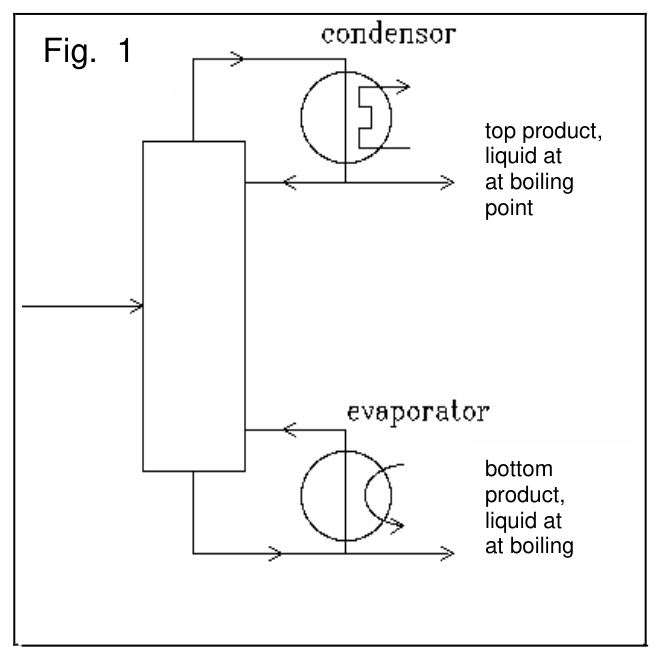
The total heat used at each of the two distillations is \(3q\ \mathrm{J\,mol^{-1}}\) (of the top product). Apart from distillation columns (each with its own evaporator and condenser) the pieces of apparatus shown of Fig. 2 are available.
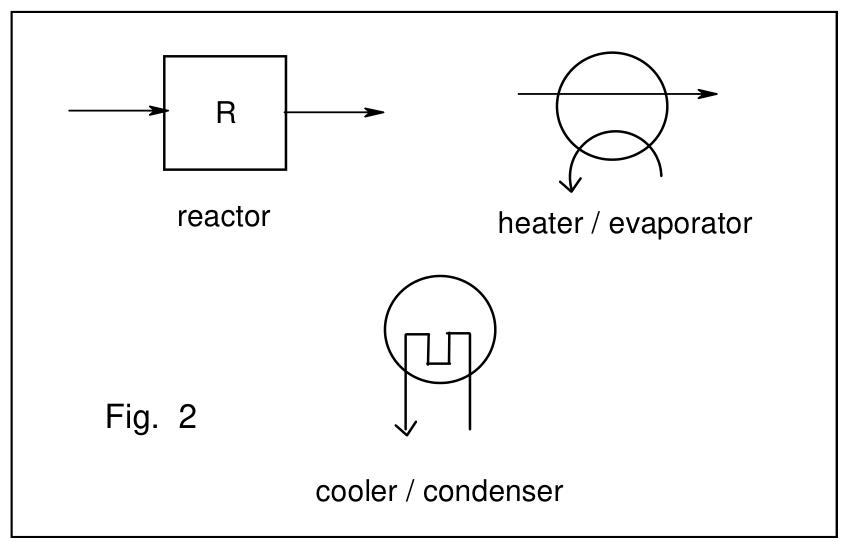
7.1 Draw a flow diagram of the process in which all flows are given (flow sheet) and in which the starting materials are used as efficiently as possible using as few pieces of apparatus as possible.
7.2 Express the equilibrium constant in terms of the degree of conversion and of total pressure for the case that the feed to the reactor is stoichiometric. What is the value of the degree of conversion when total pressure is 0.100 MPa?
7.3 Number all flows. Calculate the composition of each flow in \(\mathrm{mol\,s^{-1}}\) for a rate of production of 1 mole of \(\ce{C}\) per second under the conditions of part b.
7.4 In what respect can the reaction conditions influence the composition of the mixture that leaves the reactor? (Refer to question b.)
7.5 The process requires energy. For the conditions of b explain where energy should be supplied in the flow diagram drawn in part a. Derive an expression for the total energy needed.
Official English text of the problem.
Answers
- 7.1: Combine fresh and recycled reactants in one evaporator, feed the vapor to the reactor, then separate the outlet in two columns: first take \(\ce{A}\) overhead; then take \(\ce{C}\) overhead from the remaining \(\ce{B}/\ce{C}\) mixture. Recycle all separated \(\ce{A}\) and \(\ce{B}\). A separate reactor-outlet condenser can be omitted if the first column accepts vapor feed.
- 7.2: \[ \boxed{K_p=\frac{\alpha^2(3-\alpha)}{P(1-\alpha)^3}}, \qquad \boxed{\alpha=\frac13=33.3\%}. \]
- 7.3: In \(\mathrm{mol\,s^{-1}}\), fresh feed is \(0.500\ \ce{A}+1.00\ \ce{B}\); recycle is \(1.00\ \ce{A}+2.00\ \ce{B}\); reactor feed is \(1.50\ \ce{A}+3.00\ \ce{B}\); reactor outlet is \(1.00\ \ce{A}+2.00\ \ce{B}+1.00\ \ce{C}\). The complete numbered stream table appears below.
- 7.4: Higher pressure increases equilibrium conversion. The effect of temperature depends on the unspecified reaction enthalpy. Below 100 °C, the composition is effectively frozen by the negligible reaction rate.
- 7.5: Vaporization requires \(4.50q\ \mathrm{J\,s^{-1}}\), and each column requires \(3.00q\ \mathrm{J\,s^{-1}}\): \[ \boxed{\dot Q_{\mathrm{vaporization+distillation}}=10.5q\ \mathrm{J\,s^{-1}}}. \] The additional signed reactor duty is \[ \boxed{\dot Q_R=(0.500\ \mathrm{mol\,s^{-1}})\Delta_{\mathrm r}H_g}, \] where \(\Delta_{\mathrm r}H_g\) is the enthalpy of the gas-phase reaction as written.
Solution
The symbols \(\ce{A}\), \(\ce{B}\), and \(\ce{C}\) denote unspecified compounds. Their chemical names and SMILES cannot be inferred from the data.
7.1 — Flow sheet
At 0.100 MPa, the volatility order indicated by the boiling points is
\[ \ce{A}\;(40\,^\circ\mathrm C) \;>\; \ce{C}\;(60\,^\circ\mathrm C) \;>\; \ce{B}\;(80\,^\circ\mathrm C). \]
Use the following arrangement, with the stream numbers also used in part 7.3:
- Join fresh liquid \(\ce{A}\), stream 1, and fresh liquid \(\ce{B}\), stream 2, with the two liquid recycle streams 6 and 9.
- Send the combined liquid, stream 3, through one common heater/evaporator. Its gaseous outlet, stream 4, enters the reactor at 100 °C.
- Send the equilibrium reactor outlet, stream 5, to the first distillation column.
- In the first column, obtain pure \(\ce{A}\) as the liquid top product, stream 6, and recycle it to the feed junction. Send the bottom product containing \(\ce{B}\) and \(\ce{C}\), stream 7, to the second column.
- In the second column, withdraw pure liquid \(\ce{C}\) as the top product, stream 8, and recycle pure liquid \(\ce{B}\), the bottom product, as stream 9.
Thus the pure liquid outlet temperatures are 40 °C for recycled \(\ce{A}\), 60 °C for product \(\ce{C}\), and 80 °C for recycled \(\ce{B}\).
Complete recycling gives complete overall utilization of the starting materials, despite incomplete conversion during each reactor passage. Two ordinary columns with top and bottom products provide the required separation of the intermediate-boiling product.
For the fewest separate units, stream 5 can enter the first column as vapor: its built-in condenser supplies the necessary condensation duty. If liquid feed to that column is required, insert one cooler/condenser between the reactor and the first column. Its inlet and outlet have identical molar compositions.
Removing \(\ce{A}\) first also gives the smaller distillation heating requirement, as shown in part 7.5.
7.2 — Equilibrium conversion
Let \(\alpha\) be the fraction of the entering \(\ce{A}\) converted. For a stoichiometric reactor feed initially containing \(n_0\) mol of \(\ce{A}\), \(2n_0\) mol of \(\ce{B}\), and no \(\ce{C}\),
\[ \ce{A(g) + 2B(g) <=> 2C(g)} \]
gives the equilibrium amounts
\[ n_A=n_0(1-\alpha),\qquad n_B=2n_0(1-\alpha),\qquad n_C=2n_0\alpha. \]
The total is
\[ n_{\mathrm{tot}}=n_0(3-\alpha). \]
Consequently,
\[ p_A=P\frac{1-\alpha}{3-\alpha},\qquad p_B=P\frac{2(1-\alpha)}{3-\alpha},\qquad p_C=P\frac{2\alpha}{3-\alpha}. \]
Substitution into the equilibrium expression gives
\[ K_p=\frac{p_C^2}{p_Ap_B^2} =\boxed{\frac{\alpha^2(3-\alpha)} {P(1-\alpha)^3}}. \]
At \(P=0.100\ \mathrm{MPa}\),
\[ K_pP=(10.0\ \mathrm{MPa^{-1}})(0.100\ \mathrm{MPa})=1.00. \]
Therefore,
\[ \alpha^2(3-\alpha)=(1-\alpha)^3, \]
\[ 3\alpha^2-\alpha^3 =1-3\alpha+3\alpha^2-\alpha^3, \]
and hence
\[ \boxed{\alpha=\frac13=33.3\%}. \]
The equilibrium mole fractions are \(y_A=1/4\), \(y_B=1/2\), and \(y_C=1/4\). As a check,
\[ K_p= \frac{(0.0250)^2}{(0.0250)(0.0500)^2} =10.0\ \mathrm{MPa^{-1}}. \]
7.3 — Numbered material balances
Producing \(1.00\ \mathrm{mol\,s^{-1}}\) of \(\ce{C}\) requires a reaction extent rate
\[ \dot\xi=\frac{\dot n_C}{2} =0.500\ \mathrm{mol\,s^{-1}}. \]
Since one-third of the entering \(\ce{A}\) reacts,
\[ \dot n_{A,\mathrm{in}} =\frac{\dot\xi}{\alpha} =\frac{0.500}{1/3} =1.50\ \mathrm{mol\,s^{-1}}, \]
and the stoichiometric feed contains
\[ \dot n_{B,\mathrm{in}}=3.00\ \mathrm{mol\,s^{-1}}. \]
The reactor therefore discharges
\[ \dot n_{A,\mathrm{out}}=1.50-0.500=1.00, \]
\[ \dot n_{B,\mathrm{out}}=3.00-2(0.500)=2.00, \]
\[ \dot n_{C,\mathrm{out}}=2(0.500)=1.00, \]
all in \(\mathrm{mol\,s^{-1}}\).
The complete external stream table is:
| Stream | Description | \(\ce{A}\), \(\mathrm{mol\,s^{-1}}\) | \(\ce{B}\), \(\mathrm{mol\,s^{-1}}\) | \(\ce{C}\), \(\mathrm{mol\,s^{-1}}\) |
|---|---|---|---|---|
| 1 | Fresh liquid \(\ce{A}\) | 0.500 | 0 | 0 |
| 2 | Fresh liquid \(\ce{B}\) | 0 | 1.00 | 0 |
| 3 | Combined liquid feed to evaporator | 1.50 | 3.00 | 0 |
| 4 | Gaseous feed to reactor | 1.50 | 3.00 | 0 |
| 5 | Reactor outlet to first column | 1.00 | 2.00 | 1.00 |
| 6 | First-column top product; \(\ce{A}\) recycle | 1.00 | 0 | 0 |
| 7 | First-column bottom product to second column | 0 | 2.00 | 1.00 |
| 8 | Second-column top product; final \(\ce{C}\) | 0 | 0 | 1.00 |
| 9 | Second-column bottom product; \(\ce{B}\) recycle | 0 | 2.00 | 0 |
The fresh feed exactly replaces the reactants consumed. Thus the overall material balance corresponds to
\[ \ce{A + 2B -> 2C}, \]
with no reactants discarded.
7.4 — Influence of reaction conditions
For the specified stoichiometric feed,
\[ K_pP=\frac{\alpha^2(3-\alpha)}{(1-\alpha)^3}. \]
The right-hand side increases with \(\alpha\) over \(0<\alpha<1\). Therefore, at fixed temperature, increasing pressure increases conversion. This agrees with the reduction from three gaseous reactant molecules to two gaseous product molecules.
Temperature changes \(K_p\). The van ’t Hoff relation is
\[ \frac{d\ln K_p}{dT} =\frac{\Delta_{\mathrm r}H_g}{RT^2}. \]
Accordingly:
- If the forward reaction is endothermic, increasing temperature increases equilibrium conversion.
- If it is exothermic, decreasing temperature increases equilibrium conversion.
The reaction enthalpy is not supplied, so the applicable direction cannot be determined. Moreover, below 100 °C the reaction is negligibly slow: cooling the outlet preserves its composition during separation.
Changing the reactant ratio also changes the equilibrium composition; an excess of one reactant generally increases the fractional conversion of the other. A catalyst or additional residence time cannot change the final equilibrium composition once equilibrium has been reached.
7.5 — Energy requirements
Let the molar latent heat be
\[ L=q\ \mathrm{J\,mol^{-1}}. \]
Because heat capacities are neglected, there is no sensible-heating contribution from raising the feeds to 100 °C.
The common evaporator vaporizes all fresh and recycled reactants:
\[ \dot Q_E =(1.50+3.00)\ \mathrm{mol\,s^{-1}}\,L =\boxed{4.50q\ \mathrm{J\,s^{-1}}}. \]
The first column produces \(1.00\ \mathrm{mol\,s^{-1}}\) of overhead \(\ce{A}\), so its reboiler requires
\[ \dot Q_{D1} =(1.00\ \mathrm{mol\,s^{-1}})(3L) =\boxed{3.00q\ \mathrm{J\,s^{-1}}}. \]
The second column produces \(1.00\ \mathrm{mol\,s^{-1}}\) of overhead \(\ce{C}\):
\[ \dot Q_{D2} =\boxed{3.00q\ \mathrm{J\,s^{-1}}}. \]
Thus the specified vaporization and distillation heating duties total
\[ \boxed{ \dot Q_{\mathrm{physical}} =(4.50+3.00+3.00)q =10.5q\ \mathrm{J\,s^{-1}} }. \]
Equivalently, these operations require \(10.5q\ \mathrm J\) per mole of \(\ce{C}\).
The alternative separation order—first taking \(\ce{A}+\ce{C}\) overhead, then separating them—would have overhead rates of \(2.00\) and \(1.00\ \mathrm{mol\,s^{-1}}\). Its distillation duties would total \(9.00q\), compared with \(6.00q\ \mathrm{J\,s^{-1}}\) for the chosen order.
The reactor must also be maintained at 100 °C. Define \(\Delta_{\mathrm r}H_g\) as the molar enthalpy of
\[ \ce{A(g) + 2B(g) -> 2C(g)}. \]
Its signed heat requirement is
\[ \boxed{ \dot Q_R =\dot\xi\,\Delta_{\mathrm r}H_g =(0.500\ \mathrm{mol\,s^{-1}})\Delta_{\mathrm r}H_g }. \]
The algebraic sum of the evaporator, reboiler, and reactor duties is therefore
\[ \boxed{ \dot Q_E+\dot Q_{D1}+\dot Q_{D2}+\dot Q_R = 10.5q\ \mathrm{J\,s^{-1}} +(0.500\ \mathrm{mol\,s^{-1}})\Delta_{\mathrm r}H_g }. \]
An endothermic reaction requires additional heat at the reactor; an exothermic reaction requires heat removal there. With no heat recovery, the total positive heating demand is
\[ \boxed{ \dot Q_{\mathrm{heating}} = 10.5q\ \mathrm{J\,s^{-1}} +\max\!\left[0,\, (0.500\ \mathrm{mol\,s^{-1}})\Delta_{\mathrm r}H_g \right] }. \]
For an energy-balance check, the reactor outlet contains \(4.00\ \mathrm{mol\,s^{-1}}\) of vapor. In the vapor-fed layout, the first column’s condenser rejects \(7.00q\ \mathrm{J\,s^{-1}}\): \(4.00q\) from condensation of that feed plus its \(3.00q\) reboiler input. The second condenser rejects \(3.00q\ \mathrm{J\,s^{-1}}\). A separate effluent condenser would divide the first \(7.00q\) into \(4.00q+3.00q\), leaving the total unchanged.
After subtracting condenser cooling, the overall net heat exchange is consequently
\[ \dot Q_{\mathrm{net}} = 0.500q\ \mathrm{J\,s^{-1}} +(0.500\ \mathrm{mol\,s^{-1}})\Delta_{\mathrm r}H_g. \]
The solution was checked against the official solution.
IChO 1986 · Theorieaufgabe 7
Kontinuierlicher Prozess A + 2 B <=> 2 C: Fließbild und Energiebilanz
Die Gleichgewichtskonstante der Reaktion \(\ce{A(g) + 2B(g) <=> 2C(g)}\) beträgt \(K_p = 10.0\ \mathrm{MPa^{-1}}\). Die Ausgangsstoffe werden bei 25 °C zugeführt und auf 100 °C erhitzt, wobei sich das Gleichgewicht vollständig einstellt. Unterhalb von 100 °C ist die Reaktionsgeschwindigkeit vernachlässigbar klein. Der gesamte Prozess wird kontinuierlich im stationären Zustand durchgeführt. Die Siedepunkte von \(\ce{A}\), \(\ce{B}\) und \(\ce{C}\) bei 0.1 MPa betragen 40 °C, 80 °C bzw. 60 °C. Die drei Verbindungen haben dieselbe Verdampfungswärme: \(q\ \mathrm{J\,mol^{-1}}\). Die Wärmekapazitäten von \(\ce{A}\), \(\ce{B}\) und \(\ce{C}\) können vernachlässigt werden. Eine schematische Darstellung einer Destillation ist unten gezeigt (Abb. 1).
Die bei jeder der beiden Destillationen insgesamt eingesetzte Wärme beträgt \(3q\ \mathrm{J\,mol^{-1}}\) (bezogen auf das Kopfprodukt). Neben Destillationskolonnen (jeweils mit eigenem Verdampfer und Kondensator) stehen die in Abb. 2 gezeigten Apparate zur Verfügung.
7.1 Zeichnen Sie ein Fließbild des Prozesses, in dem alle Stoffströme angegeben sind und in dem die Ausgangsstoffe unter Verwendung möglichst weniger Apparate möglichst effizient genutzt werden.
7.2 Drücken Sie die Gleichgewichtskonstante für den Fall eines stöchiometrischen Reaktorzulaufs durch den Umsatzgrad und den Gesamtdruck aus. Welchen Wert hat der Umsatzgrad bei einem Gesamtdruck von 0.100 MPa?
7.3 Nummerieren Sie alle Stoffströme. Berechnen Sie die Zusammensetzung jedes Stoffstroms in \(\mathrm{mol\,s^{-1}}\) für eine Produktionsrate von 1 Mol \(\ce{C}\) pro Sekunde unter den Bedingungen von Teil b.
7.4 In welcher Hinsicht können die Reaktionsbedingungen die Zusammensetzung des Gemisches beeinflussen, das den Reaktor verlässt? (Beziehen Sie sich auf Frage b.)
7.5 Der Prozess benötigt Energie. Erläutern Sie für die Bedingungen von b, an welchen Stellen des in Teil a gezeichneten Fließbildes Energie zugeführt werden muss. Leiten Sie einen Ausdruck für die insgesamt benötigte Energie her.
Aufgabentext aus dem offiziellen englischen Text übersetzt.
Antworten
- 7.1: Führen Sie frische und zurückgeführte Edukte in einem Verdampfer zusammen, leiten Sie den Dampf in den Reaktor und trennen Sie anschließend den austretenden Stoffstrom in zwei Kolonnen: Ziehen Sie zunächst \(\ce{A}\) als Kopfprodukt ab; ziehen Sie danach \(\ce{C}\) als Kopfprodukt aus dem verbleibenden \(\ce{B}/\ce{C}\)-Gemisch ab. Führen Sie das gesamte abgetrennte \(\ce{A}\) und \(\ce{B}\) zurück. Ein separater Kondensator am Reaktorausgang kann entfallen, wenn die erste Kolonne einen dampfförmigen Zulauf aufnehmen kann.
- 7.2: \[ \boxed{K_p=\frac{\alpha^2(3-\alpha)}{P(1-\alpha)^3}}, \qquad \boxed{\alpha=\frac13=33.3\%}. \]
- 7.3: In \(\mathrm{mol\,s^{-1}}\) beträgt der Frischzulauf \(0.500\ \ce{A}+1.00\ \ce{B}\); der Rückführstrom beträgt \(1.00\ \ce{A}+2.00\ \ce{B}\); der Reaktorzulauf beträgt \(1.50\ \ce{A}+3.00\ \ce{B}\); der Reaktoraustrittsstrom beträgt \(1.00\ \ce{A}+2.00\ \ce{B}+1.00\ \ce{C}\). Die vollständige Tabelle der nummerierten Stoffströme folgt weiter unten.
- 7.4: Ein höherer Druck erhöht den Gleichgewichtsumsatz. Der Einfluss der Temperatur hängt von der nicht angegebenen Reaktionsenthalpie ab. Unterhalb von 100 °C ist die Zusammensetzung aufgrund der vernachlässigbaren Reaktionsgeschwindigkeit praktisch eingefroren.
- 7.5: Die Verdampfung benötigt \(4.50q\ \mathrm{J\,s^{-1}}\), und jede Kolonne benötigt \(3.00q\ \mathrm{J\,s^{-1}}\): \[ \boxed{\dot Q_{\mathrm{vaporization+distillation}}=10.5q\ \mathrm{J\,s^{-1}}}. \] Die zusätzliche, vorzeichenbehaftete Wärmeleistung des Reaktors beträgt \[ \boxed{\dot Q_R=(0.500\ \mathrm{mol\,s^{-1}})\Delta_{\mathrm r}H_g}, \] wobei \(\Delta_{\mathrm r}H_g\) die Enthalpie der Gasphasenreaktion in der angegebenen Form ist.
Lösung
Die Symbole \(\ce{A}\), \(\ce{B}\) und \(\ce{C}\) bezeichnen nicht näher spezifizierte Verbindungen. Ihre chemischen Namen und SMILES lassen sich aus den Angaben nicht ableiten.
7.1 — Fließbild
Bei 0.100 MPa ergibt sich aus den Siedepunkten die folgende Reihenfolge der Flüchtigkeit:
\[ \ce{A}\;(40\,^\circ\mathrm C) \;>\; \ce{C}\;(60\,^\circ\mathrm C) \;>\; \ce{B}\;(80\,^\circ\mathrm C). \]
Verwenden Sie die folgende Anordnung mit den auch in Teil 7.3 verwendeten Stoffstromnummern:
- Führen Sie frisches flüssiges \(\ce{A}\), Stoffstrom 1, und frisches flüssiges \(\ce{B}\), Stoffstrom 2, mit den beiden flüssigen Rückführströmen 6 und 9 zusammen.
- Leiten Sie die vereinigte Flüssigkeit, Stoffstrom 3, durch einen gemeinsamen Erhitzer/Verdampfer. Dessen gasförmiger Austrittsstrom, Stoffstrom 4, tritt bei 100 °C in den Reaktor ein.
- Leiten Sie den im Gleichgewicht befindlichen Reaktoraustrittsstrom, Stoffstrom 5, in die erste Destillationskolonne.
- Gewinnen Sie in der ersten Kolonne reines \(\ce{A}\) als flüssiges Kopfprodukt, Stoffstrom 6, und führen Sie es zur Zusammenführungsstelle der Zuläufe zurück. Leiten Sie das \(\ce{B}\) und \(\ce{C}\) enthaltende Sumpfprodukt, Stoffstrom 7, in die zweite Kolonne.
- Ziehen Sie in der zweiten Kolonne reines flüssiges \(\ce{C}\) als Kopfprodukt, Stoffstrom 8, ab und führen Sie reines flüssiges \(\ce{B}\), das Sumpfprodukt, als Stoffstrom 9 zurück.
Die Austrittstemperaturen der reinen Flüssigkeiten betragen somit 40 °C für zurückgeführtes \(\ce{A}\), 60 °C für das Produkt \(\ce{C}\) und 80 °C für zurückgeführtes \(\ce{B}\).
Die vollständige Rückführung ermöglicht insgesamt eine vollständige Nutzung der Ausgangsstoffe, obwohl der Umsatz bei jedem Reaktordurchgang unvollständig ist. Zwei gewöhnliche Kolonnen mit Kopf- und Sumpfprodukten ermöglichen die erforderliche Abtrennung des mittelsiedenden Produkts.
Um die Anzahl separater Apparate möglichst gering zu halten, kann Stoffstrom 5 dampfförmig in die erste Kolonne eintreten: Ihr integrierter Kondensator übernimmt die erforderliche Kondensationsleistung. Falls für diese Kolonne ein flüssiger Zulauf erforderlich ist, wird zwischen Reaktor und erster Kolonne ein Kühler/Kondensator eingefügt. Sein Zulauf und sein Ablauf haben identische molare Zusammensetzungen.
Die Abtrennung von \(\ce{A}\) im ersten Schritt ergibt außerdem den geringeren Heizbedarf für die Destillation, wie in Teil 7.5 gezeigt wird.
7.2 — Gleichgewichtsumsatz
Sei \(\alpha\) der Anteil des eintretenden \(\ce{A}\), der umgesetzt wird. Für einen stöchiometrischen Reaktorzulauf, der anfangs \(n_0\) mol \(\ce{A}\), \(2n_0\) mol \(\ce{B}\) und kein \(\ce{C}\) enthält, ergibt
\[ \ce{A(g) + 2B(g) <=> 2C(g)} \]
die folgenden Stoffmengen im Gleichgewicht:
\[ n_A=n_0(1-\alpha),\qquad n_B=2n_0(1-\alpha),\qquad n_C=2n_0\alpha. \]
Die Gesamtstoffmenge beträgt
\[ n_{\mathrm{tot}}=n_0(3-\alpha). \]
Folglich gilt
\[ p_A=P\frac{1-\alpha}{3-\alpha},\qquad p_B=P\frac{2(1-\alpha)}{3-\alpha},\qquad p_C=P\frac{2\alpha}{3-\alpha}. \]
Einsetzen in den Ausdruck für die Gleichgewichtskonstante ergibt
\[ K_p=\frac{p_C^2}{p_Ap_B^2} =\boxed{\frac{\alpha^2(3-\alpha)} {P(1-\alpha)^3}}. \]
Bei \(P=0.100\ \mathrm{MPa}\) gilt
\[ K_pP=(10.0\ \mathrm{MPa^{-1}})(0.100\ \mathrm{MPa})=1.00. \]
Daher ist
\[ \alpha^2(3-\alpha)=(1-\alpha)^3, \]
\[ 3\alpha^2-\alpha^3 =1-3\alpha+3\alpha^2-\alpha^3, \]
und somit
\[ \boxed{\alpha=\frac13=33.3\%}. \]
Die Stoffmengenanteile im Gleichgewicht sind \(y_A=1/4\), \(y_B=1/2\) und \(y_C=1/4\). Zur Kontrolle:
\[ K_p= \frac{(0.0250)^2}{(0.0250)(0.0500)^2} =10.0\ \mathrm{MPa^{-1}}. \]
7.3 — Stoffbilanzen mit nummerierten Stoffströmen
Die Produktion von \(1.00\ \mathrm{mol\,s^{-1}}\) \(\ce{C}\) erfordert eine zeitliche Änderung der Reaktionslaufzahl von
\[ \dot\xi=\frac{\dot n_C}{2} =0.500\ \mathrm{mol\,s^{-1}}. \]
Da ein Drittel des eintretenden \(\ce{A}\) reagiert, gilt
\[ \dot n_{A,\mathrm{in}} =\frac{\dot\xi}{\alpha} =\frac{0.500}{1/3} =1.50\ \mathrm{mol\,s^{-1}}, \]
und der stöchiometrische Zulauf enthält
\[ \dot n_{B,\mathrm{in}}=3.00\ \mathrm{mol\,s^{-1}}. \]
Aus dem Reaktor treten daher die folgenden Stoffmengenströme aus:
\[ \dot n_{A,\mathrm{out}}=1.50-0.500=1.00, \]
\[ \dot n_{B,\mathrm{out}}=3.00-2(0.500)=2.00, \]
\[ \dot n_{C,\mathrm{out}}=2(0.500)=1.00, \]
jeweils in \(\mathrm{mol\,s^{-1}}\).
Die vollständige Tabelle der externen Stoffströme lautet:
| Stoffstrom | Beschreibung | \(\ce{A}\), \(\mathrm{mol\,s^{-1}}\) | \(\ce{B}\), \(\mathrm{mol\,s^{-1}}\) | \(\ce{C}\), \(\mathrm{mol\,s^{-1}}\) |
|---|---|---|---|---|
| 1 | Frisches flüssiges \(\ce{A}\) | 0.500 | 0 | 0 |
| 2 | Frisches flüssiges \(\ce{B}\) | 0 | 1.00 | 0 |
| 3 | Vereinigter flüssiger Zulauf zum Verdampfer | 1.50 | 3.00 | 0 |
| 4 | Gasförmiger Zulauf zum Reaktor | 1.50 | 3.00 | 0 |
| 5 | Reaktoraustrittsstrom zur ersten Kolonne | 1.00 | 2.00 | 1.00 |
| 6 | Kopfprodukt der ersten Kolonne; Rückführung von \(\ce{A}\) | 1.00 | 0 | 0 |
| 7 | Sumpfprodukt der ersten Kolonne zur zweiten Kolonne | 0 | 2.00 | 1.00 |
| 8 | Kopfprodukt der zweiten Kolonne; Endprodukt \(\ce{C}\) | 0 | 0 | 1.00 |
| 9 | Sumpfprodukt der zweiten Kolonne; Rückführung von \(\ce{B}\) | 0 | 2.00 | 0 |
Der Frischzulauf ersetzt genau die verbrauchten Edukte. Somit entspricht die Gesamtstoffbilanz
\[ \ce{A + 2B -> 2C}, \]
ohne dass Edukte verworfen werden.
7.4 — Einfluss der Reaktionsbedingungen
Für den angegebenen stöchiometrischen Zulauf gilt
\[ K_pP=\frac{\alpha^2(3-\alpha)}{(1-\alpha)^3}. \]
Die rechte Seite steigt im Bereich \(0<\alpha<1\) mit \(\alpha\) an. Daher erhöht eine Druckerhöhung bei konstanter Temperatur den Umsatz. Dies steht im Einklang mit der Verringerung von drei gasförmigen Eduktmolekülen auf zwei gasförmige Produktmoleküle.
Die Temperatur verändert \(K_p\). Die van-’t-Hoff-Gleichung lautet
\[ \frac{d\ln K_p}{dT} =\frac{\Delta_{\mathrm r}H_g}{RT^2}. \]
Dementsprechend gilt:
- Ist die Hinreaktion endotherm, erhöht eine Temperaturerhöhung den Gleichgewichtsumsatz.
- Ist sie exotherm, erhöht eine Temperatursenkung den Gleichgewichtsumsatz.
Die Reaktionsenthalpie ist nicht angegeben, sodass sich nicht bestimmen lässt, welche Richtung zutrifft. Außerdem ist die Reaktion unterhalb von 100 °C vernachlässigbar langsam: Durch Abkühlen des Austrittsstroms bleibt seine Zusammensetzung während der Trennung erhalten.
Eine Änderung des Eduktverhältnisses verändert ebenfalls die Gleichgewichtszusammensetzung; ein Überschuss eines Edukts erhöht im Allgemeinen den Umsatzgrad des anderen. Ein Katalysator oder eine längere Verweilzeit kann die endgültige Gleichgewichtszusammensetzung nicht verändern, sobald das Gleichgewicht erreicht ist.
7.5 — Energiebedarf
Die molare latente Wärme sei
\[ L=q\ \mathrm{J\,mol^{-1}}. \]
Da die Wärmekapazitäten vernachlässigt werden, liefert die Erwärmung der Zuläufe auf 100 °C keinen Beitrag in Form sensibler Wärme.
Der gemeinsame Verdampfer verdampft alle frischen und zurückgeführten Edukte:
\[ \dot Q_E =(1.50+3.00)\ \mathrm{mol\,s^{-1}}\,L =\boxed{4.50q\ \mathrm{J\,s^{-1}}}. \]
Die erste Kolonne liefert \(1.00\ \mathrm{mol\,s^{-1}}\) \(\ce{A}\) als Kopfprodukt, sodass ihr Sumpfverdampfer die folgende Wärmeleistung benötigt:
\[ \dot Q_{D1} =(1.00\ \mathrm{mol\,s^{-1}})(3L) =\boxed{3.00q\ \mathrm{J\,s^{-1}}}. \]
Die zweite Kolonne liefert \(1.00\ \mathrm{mol\,s^{-1}}\) \(\ce{C}\) als Kopfprodukt:
\[ \dot Q_{D2} =\boxed{3.00q\ \mathrm{J\,s^{-1}}}. \]
Damit beträgt die Summe der angegebenen Heizleistungen für Verdampfung und Destillation
\[ \boxed{ \dot Q_{\mathrm{physical}} =(4.50+3.00+3.00)q =10.5q\ \mathrm{J\,s^{-1}} }. \]
Gleichwertig ausgedrückt benötigen diese Verfahrensschritte \(10.5q\ \mathrm J\) pro Mol \(\ce{C}\).
Die alternative Trennreihenfolge — zunächst \(\ce{A}+\ce{C}\) als Kopfprodukt abzuziehen und anschließend voneinander zu trennen — hätte Kopfproduktströme von \(2.00\) und \(1.00\ \mathrm{mol\,s^{-1}}\). Die Heizleistungen für die Destillation würden sich dabei auf \(9.00q\) summieren, verglichen mit \(6.00q\ \mathrm{J\,s^{-1}}\) für die gewählte Reihenfolge.
Der Reaktor muss ebenfalls auf 100 °C gehalten werden. Definieren wir \(\Delta_{\mathrm r}H_g\) als die molare Enthalpie der Reaktion
\[ \ce{A(g) + 2B(g) -> 2C(g)}. \]
Sein vorzeichenbehafteter Wärmebedarf beträgt
\[ \boxed{ \dot Q_R =\dot\xi\,\Delta_{\mathrm r}H_g =(0.500\ \mathrm{mol\,s^{-1}})\Delta_{\mathrm r}H_g }. \]
Die algebraische Summe der Wärmeleistungen von Verdampfer, Sumpfverdampfern und Reaktor beträgt daher
\[ \boxed{ \dot Q_E+\dot Q_{D1}+\dot Q_{D2}+\dot Q_R = 10.5q\ \mathrm{J\,s^{-1}} +(0.500\ \mathrm{mol\,s^{-1}})\Delta_{\mathrm r}H_g }. \]
Eine endotherme Reaktion erfordert zusätzliche Wärmezufuhr am Reaktor; eine exotherme Reaktion erfordert dort Wärmeabfuhr. Ohne Wärmerückgewinnung beträgt der gesamte positive Heizbedarf
\[ \boxed{ \dot Q_{\mathrm{heating}} = 10.5q\ \mathrm{J\,s^{-1}} +\max\!\left[0,\, (0.500\ \mathrm{mol\,s^{-1}})\Delta_{\mathrm r}H_g \right] }. \]
Zur Kontrolle der Energiebilanz: Der Reaktoraustrittsstrom enthält \(4.00\ \mathrm{mol\,s^{-1}}\) Dampf. Bei der Anordnung mit dampfförmigem Zulauf führt der Kondensator der ersten Kolonne \(7.00q\ \mathrm{J\,s^{-1}}\) ab: \(4.00q\) aus der Kondensation dieses Zulaufs zuzüglich der Wärmezufuhr von \(3.00q\) durch ihren Sumpfverdampfer. Der zweite Kondensator führt \(3.00q\ \mathrm{J\,s^{-1}}\) ab. Ein separater Kondensator für den Reaktoraustrittsstrom würde die ersten \(7.00q\) in \(4.00q+3.00q\) aufteilen, ohne die Gesamtsumme zu verändern.
Nach Abzug der durch die Kondensatoren abgeführten Wärme beträgt der gesamte Nettowärmestrom folglich
\[ \dot Q_{\mathrm{net}} = 0.500q\ \mathrm{J\,s^{-1}} +(0.500\ \mathrm{mol\,s^{-1}})\Delta_{\mathrm r}H_g. \]
Die Lösung wurde mit der offiziellen Lösung abgeglichen.
IChO 1986 · Teori sorusu 7
Sürekli A + 2 B <=> 2 C prosesi: akım şeması ve enerji dengesi
\(\ce{A(g) + 2B(g) <=> 2C(g)}\) tepkimesinin denge sabiti \(K_p = 10.0\ \mathrm{MPa^{-1}}\)'dir. Başlangıç maddeleri 25 °C'de beslenir ve dengeye tam olarak ulaşılan 100 °C'ye ısıtılır. 100 °C'nin altında tepkime hızı ihmal edilebilecek kadar küçüktür. Prosesin tamamı sürekli olarak kararlı hâlde yürütülür. \(\ce{A}\), \(\ce{B}\) ve \(\ce{C}\)'nin 0.1 MPa'daki kaynama noktaları sırasıyla 40 °C, 80 °C ve 60 °C'dir. Üç bileşiğin buharlaşma ısıları aynıdır: \(q\ \mathrm{J\,mol^{-1}}\). \(\ce{A}\), \(\ce{B}\) ve \(\ce{C}\)'nin ısı kapasiteleri ihmal edilebilir. Bir damıtma işleminin şematik gösterimi aşağıda verilmiştir (Şekil 1).
İki damıtma işleminin her birinde kullanılan toplam ısı, tepe ürününün molü başına \(3q\ \mathrm{J\,mol^{-1}}\)'dir. Damıtma kolonlarının (her birinin kendi buharlaştırıcısı ve yoğuşturucusu vardır) yanı sıra Şekil 2'de gösterilen cihazlar da mevcuttur.
7.1 Başlangıç maddelerinin mümkün olduğunca verimli kullanıldığı, mümkün olan en az sayıda cihazı içeren ve tüm akımların gösterildiği bir proses akım diyagramı (akım şeması) çiziniz.
7.2 Reaktöre yapılan beslemenin stokiyometrik olduğu durum için denge sabitini dönüşüm derecesi ve toplam basınç cinsinden ifade ediniz. Toplam basınç 0.100 MPa olduğunda dönüşüm derecesi kaçtır?
7.3 Tüm akımları numaralandırınız. b kısmındaki koşullarda saniyede 1 mol \(\ce{C}\) üretim hızı için her akımın bileşimini \(\mathrm{mol\,s^{-1}}\) cinsinden hesaplayınız.
7.4 Tepkime koşulları, reaktörden çıkan karışımın bileşimini hangi yönden etkileyebilir? (b sorusuna bakınız.)
7.5 Proses enerji gerektirir. b'deki koşullar için, a kısmında çizdiğiniz akım diyagramında enerjinin nerelerde sağlanması gerektiğini açıklayınız. Gereken toplam enerji için bir ifade türetiniz.
Soru metni resmi İngilizce metinden çevrilmiştir.
Cevaplar
- 7.1: Taze ve geri döndürülen reaktanları tek bir buharlaştırıcıda birleştirin, buharı reaktöre besleyin ve ardından çıkış akımını iki kolonda ayırın: önce \(\ce{A}\)'yı tepe ürünü olarak alın; sonra kalan \(\ce{B}/\ce{C}\) karışımından \(\ce{C}\)'yi tepe ürünü olarak alın. Ayrılan \(\ce{A}\) ve \(\ce{B}\)'nin tamamını geri döndürün. İlk kolon buhar beslemesini kabul ediyorsa reaktör çıkışında ayrı bir yoğuşturucu kullanılmayabilir.
- 7.2: \[ \boxed{K_p=\frac{\alpha^2(3-\alpha)}{P(1-\alpha)^3}}, \qquad \boxed{\alpha=\frac13=33.3\%}. \]
- 7.3: \(\mathrm{mol\,s^{-1}}\) cinsinden taze besleme \(0.500\ \ce{A}+1.00\ \ce{B}\); geri dönen akım \(1.00\ \ce{A}+2.00\ \ce{B}\); reaktör beslemesi \(1.50\ \ce{A}+3.00\ \ce{B}\); reaktör çıkışı ise \(1.00\ \ce{A}+2.00\ \ce{B}+1.00\ \ce{C}\)'dir. Numaralandırılmış akımların tam tablosu aşağıda verilmiştir.
- 7.4: Basıncın artması denge dönüşümünü artırır. Sıcaklığın etkisi, değeri belirtilmemiş olan tepkime entalpisine bağlıdır. 100 °C'nin altında tepkime hızının ihmal edilebilir olması nedeniyle bileşim pratikte sabit kalır.
- 7.5: Buharlaştırma için \(4.50q\ \mathrm{J\,s^{-1}}\), her bir kolon için ise \(3.00q\ \mathrm{J\,s^{-1}}\) gerekir: \[ \boxed{\dot Q_{\mathrm{vaporization+distillation}}=10.5q\ \mathrm{J\,s^{-1}}}. \] Reaktörün ek ısı yükü, işaretiyle birlikte, \[ \boxed{\dot Q_R=(0.500\ \mathrm{mol\,s^{-1}})\Delta_{\mathrm r}H_g}, \] şeklindedir; burada \(\Delta_{\mathrm r}H_g\), yazıldığı biçimiyle gaz fazındaki tepkimenin entalpisidir.
Çözüm
\(\ce{A}\), \(\ce{B}\) ve \(\ce{C}\) sembolleri, kimlikleri belirtilmemiş bileşikleri gösterir. Kimyasal adları ve SMILES gösterimleri verilen bilgilerden çıkarılamaz.
7.1 — Akım şeması
0.100 MPa'da kaynama noktalarının gösterdiği uçuculuk sıralaması şöyledir:
\[ \ce{A}\;(40\,^\circ\mathrm C) \;>\; \ce{C}\;(60\,^\circ\mathrm C) \;>\; \ce{B}\;(80\,^\circ\mathrm C). \]
7.3 kısmında da kullanılan akım numaralarıyla aşağıdaki düzenlemeyi kullanın:
- Taze sıvı \(\ce{A}\)'yı, yani 1 numaralı akımı, ve taze sıvı \(\ce{B}\)'yi, yani 2 numaralı akımı, 6 ve 9 numaralı iki sıvı geri dönüş akımıyla birleştirin.
- Birleştirilmiş sıvıyı, yani 3 numaralı akımı, ortak bir ısıtıcı/buharlaştırıcıdan geçirin. Bunun gaz hâlindeki çıkışı olan 4 numaralı akım, reaktöre 100 °C'de girer.
- Dengedeki reaktör çıkışını, yani 5 numaralı akımı, ilk damıtma kolonuna gönderin.
- İlk kolonda saf \(\ce{A}\)'yı sıvı tepe ürünü olan 6 numaralı akım olarak elde edin ve besleme akımlarının birleşme noktasına geri döndürün. \(\ce{B}\) ve \(\ce{C}\) içeren dip ürününü, yani 7 numaralı akımı, ikinci kolona gönderin.
- İkinci kolonda saf sıvı \(\ce{C}\)'yi tepe ürünü olan 8 numaralı akım olarak alın ve dip ürünü olan saf sıvı \(\ce{B}\)'yi 9 numaralı akım olarak geri döndürün.
Böylece saf sıvı çıkış sıcaklıkları, geri döndürülen \(\ce{A}\) için 40 °C, ürün \(\ce{C}\) için 60 °C ve geri döndürülen \(\ce{B}\) için 80 °C'dir.
Tam geri dönüş, reaktörden her geçişte dönüşüm tamamlanmasa da başlangıç maddelerinin proses genelinde tamamen kullanılmasını sağlar. Tepe ve dip ürünleri veren iki sıradan kolon, kaynama noktası diğer ikisinin arasında olan ürünün gerekli ayrılmasını sağlar.
Ayrı ünitelerin sayısını en aza indirmek için 5 numaralı akım ilk kolona buhar olarak girebilir: kolonun kendi yoğuşturucusu gerekli yoğuşturma yükünü karşılar. Bu kolona sıvı besleme gerekiyorsa reaktör ile ilk kolon arasına bir soğutucu/yoğuşturucu yerleştirin. Bunun giriş ve çıkış akımlarının molar bileşimleri aynıdır.
7.5 kısmında gösterildiği gibi, önce \(\ce{A}\)'nın ayrılması damıtma için gereken ısıyı da azaltır.
7.2 — Denge dönüşümü
\(\alpha\), giren \(\ce{A}\)'nın dönüşen kesri olsun. Başlangıçta \(n_0\) mol \(\ce{A}\), \(2n_0\) mol \(\ce{B}\) içeren ve hiç \(\ce{C}\) içermeyen stokiyometrik bir reaktör beslemesi için
\[ \ce{A(g) + 2B(g) <=> 2C(g)} \]
tepkimesi, dengede aşağıdaki miktarları verir:
\[ n_A=n_0(1-\alpha),\qquad n_B=2n_0(1-\alpha),\qquad n_C=2n_0\alpha. \]
Toplam miktar şöyledir:
\[ n_{\mathrm{tot}}=n_0(3-\alpha). \]
Dolayısıyla,
\[ p_A=P\frac{1-\alpha}{3-\alpha},\qquad p_B=P\frac{2(1-\alpha)}{3-\alpha},\qquad p_C=P\frac{2\alpha}{3-\alpha}. \]
Denge ifadesinde yerlerine konulduğunda
\[ K_p=\frac{p_C^2}{p_Ap_B^2} =\boxed{\frac{\alpha^2(3-\alpha)} {P(1-\alpha)^3}}. \]
elde edilir. \(P=0.100\ \mathrm{MPa}\) için,
\[ K_pP=(10.0\ \mathrm{MPa^{-1}})(0.100\ \mathrm{MPa})=1.00. \]
Bu nedenle,
\[ \alpha^2(3-\alpha)=(1-\alpha)^3, \]
\[ 3\alpha^2-\alpha^3 =1-3\alpha+3\alpha^2-\alpha^3, \]
ve buradan
\[ \boxed{\alpha=\frac13=33.3\%}. \]
bulunur. Dengedeki mol kesirleri \(y_A=1/4\), \(y_B=1/2\) ve \(y_C=1/4\)'tür. Kontrol amacıyla,
\[ K_p= \frac{(0.0250)^2}{(0.0250)(0.0500)^2} =10.0\ \mathrm{MPa^{-1}}. \]
7.3 — Numaralandırılmış madde dengeleri
\(1.00\ \mathrm{mol\,s^{-1}}\) hızında \(\ce{C}\) üretmek için gereken tepkime ilerleme hızı şöyledir:
\[ \dot\xi=\frac{\dot n_C}{2} =0.500\ \mathrm{mol\,s^{-1}}. \]
Giren \(\ce{A}\)'nın üçte biri tepkimeye girdiğinden,
\[ \dot n_{A,\mathrm{in}} =\frac{\dot\xi}{\alpha} =\frac{0.500}{1/3} =1.50\ \mathrm{mol\,s^{-1}}, \]
ve stokiyometrik beslemenin içerdiği miktar şöyledir:
\[ \dot n_{B,\mathrm{in}}=3.00\ \mathrm{mol\,s^{-1}}. \]
Dolayısıyla reaktörden çıkan miktarlar
\[ \dot n_{A,\mathrm{out}}=1.50-0.500=1.00, \]
\[ \dot n_{B,\mathrm{out}}=3.00-2(0.500)=2.00, \]
\[ \dot n_{C,\mathrm{out}}=2(0.500)=1.00, \]
olup hepsi \(\mathrm{mol\,s^{-1}}\) cinsindendir.
Ünitelerin dışındaki akımların tam tablosu şöyledir:
| Akım | Açıklama | \(\ce{A}\), \(\mathrm{mol\,s^{-1}}\) | \(\ce{B}\), \(\mathrm{mol\,s^{-1}}\) | \(\ce{C}\), \(\mathrm{mol\,s^{-1}}\) |
|---|---|---|---|---|
| 1 | Taze sıvı \(\ce{A}\) | 0.500 | 0 | 0 |
| 2 | Taze sıvı \(\ce{B}\) | 0 | 1.00 | 0 |
| 3 | Buharlaştırıcıya giren birleştirilmiş sıvı besleme | 1.50 | 3.00 | 0 |
| 4 | Reaktöre giren gaz besleme | 1.50 | 3.00 | 0 |
| 5 | İlk kolona giden reaktör çıkışı | 1.00 | 2.00 | 1.00 |
| 6 | İlk kolonun tepe ürünü; \(\ce{A}\) geri dönüşü | 1.00 | 0 | 0 |
| 7 | İkinci kolona giden ilk kolon dip ürünü | 0 | 2.00 | 1.00 |
| 8 | İkinci kolonun tepe ürünü; nihai \(\ce{C}\) ürünü | 0 | 0 | 1.00 |
| 9 | İkinci kolonun dip ürünü; \(\ce{B}\) geri dönüşü | 0 | 2.00 | 0 |
Taze besleme, tüketilen reaktanları tam olarak yerine koyar. Böylece genel madde dengesi
\[ \ce{A + 2B -> 2C}, \]
tepkimesine karşılık gelir ve hiçbir reaktan atılmaz.
7.4 — Tepkime koşullarının etkisi
Belirtilen stokiyometrik besleme için,
\[ K_pP=\frac{\alpha^2(3-\alpha)}{(1-\alpha)^3}. \]
Sağ taraf, \(0<\alpha<1\) aralığında \(\alpha\) arttıkça artar. Bu nedenle sabit sıcaklıkta basıncın artması dönüşümü artırır. Bu sonuç, gaz hâlindeki üç reaktan molekülünün gaz hâlindeki iki ürün molekülüne dönüşmesiyle molekül sayısının azalmasıyla uyumludur.
Sıcaklık, \(K_p\)'yi değiştirir. van ’t Hoff bağıntısı şöyledir:
\[ \frac{d\ln K_p}{dT} =\frac{\Delta_{\mathrm r}H_g}{RT^2}. \]
Buna göre:
- İleri yöndeki tepkime endotermikse sıcaklığın artırılması denge dönüşümünü artırır.
- Tepkime ekzotermikse sıcaklığın düşürülmesi denge dönüşümünü artırır.
Tepkime entalpisi verilmediğinden hangi yönün geçerli olduğu belirlenemez. Ayrıca 100 °C'nin altında tepkime ihmal edilebilecek kadar yavaştır: çıkış akımının soğutulması, ayırma sırasında bileşimini korur.
Reaktan oranının değiştirilmesi de denge bileşimini değiştirir; bir reaktanın fazla miktarda bulunması genellikle diğerinin dönüşen kesrini artırır. Dengeye ulaşıldıktan sonra bir katalizör veya ek kalma süresi, son denge bileşimini değiştiremez.
7.5 — Enerji gereksinimleri
Molar gizli ısı
\[ L=q\ \mathrm{J\,mol^{-1}}. \]
olsun. Isı kapasiteleri ihmal edildiğinden beslemelerin sıcaklığının 100 °C'ye yükseltilmesinden kaynaklanan bir duyulur ısı katkısı yoktur.
Ortak buharlaştırıcı, taze ve geri döndürülen reaktanların tamamını buharlaştırır:
\[ \dot Q_E =(1.50+3.00)\ \mathrm{mol\,s^{-1}}\,L =\boxed{4.50q\ \mathrm{J\,s^{-1}}}. \]
İlk kolon, tepe ürünü olarak \(1.00\ \mathrm{mol\,s^{-1}}\) hızında \(\ce{A}\) üretir; dolayısıyla yeniden kaynatıcısının ısı gereksinimi şöyledir:
\[ \dot Q_{D1} =(1.00\ \mathrm{mol\,s^{-1}})(3L) =\boxed{3.00q\ \mathrm{J\,s^{-1}}}. \]
İkinci kolon, tepe ürünü olarak \(1.00\ \mathrm{mol\,s^{-1}}\) hızında \(\ce{C}\) üretir:
\[ \dot Q_{D2} =\boxed{3.00q\ \mathrm{J\,s^{-1}}}. \]
Böylece belirtilen buharlaştırma ve damıtma işlemlerinin toplam ısıtma yükü şöyledir:
\[ \boxed{ \dot Q_{\mathrm{physical}} =(4.50+3.00+3.00)q =10.5q\ \mathrm{J\,s^{-1}} }. \]
Eşdeğer olarak, bu işlemler \(\ce{C}\)'nin molü başına \(10.5q\ \mathrm J\) gerektirir.
Alternatif ayırma sıralamasında — önce \(\ce{A}+\ce{C}\)'nin tepe ürünü olarak alınması, ardından bunların birbirinden ayrılması — tepe ürünü debileri \(2.00\) ve \(1.00\ \mathrm{mol\,s^{-1}}\) olurdu. Bu sıralamada toplam damıtma ısı yükü \(9.00q\) olurken seçilen sıralamada bu değer \(6.00q\ \mathrm{J\,s^{-1}}\)'dir.
Reaktör de 100 °C'de tutulmalıdır. \(\Delta_{\mathrm r}H_g\),
\[ \ce{A(g) + 2B(g) -> 2C(g)}. \]
tepkimesinin molar entalpisi olarak tanımlansın. Reaktörün işaretli ısı gereksinimi şöyledir:
\[ \boxed{ \dot Q_R =\dot\xi\,\Delta_{\mathrm r}H_g =(0.500\ \mathrm{mol\,s^{-1}})\Delta_{\mathrm r}H_g }. \]
Dolayısıyla buharlaştırıcı, yeniden kaynatıcılar ve reaktörün ısı yüklerinin cebirsel toplamı şöyledir:
\[ \boxed{ \dot Q_E+\dot Q_{D1}+\dot Q_{D2}+\dot Q_R = 10.5q\ \mathrm{J\,s^{-1}} +(0.500\ \mathrm{mol\,s^{-1}})\Delta_{\mathrm r}H_g }. \]
Endotermik bir tepkime, reaktöre ek ısı verilmesini; ekzotermik bir tepkime ise reaktörden ısı uzaklaştırılmasını gerektirir. Isı geri kazanımı olmadığında toplam pozitif ısıtma gereksinimi şöyledir:
\[ \boxed{ \dot Q_{\mathrm{heating}} = 10.5q\ \mathrm{J\,s^{-1}} +\max\!\left[0,\, (0.500\ \mathrm{mol\,s^{-1}})\Delta_{\mathrm r}H_g \right] }. \]
Enerji dengesini kontrol etmek için, reaktör çıkışının \(4.00\ \mathrm{mol\,s^{-1}}\) buhar içerdiğini dikkate alalım. Buhar beslemeli düzenlemede ilk kolonun yoğuşturucusu \(7.00q\ \mathrm{J\,s^{-1}}\) ısı uzaklaştırır: bu beslemenin yoğuşmasından gelen \(4.00q\) ile yeniden kaynatıcıya verilen \(3.00q\) ısının toplamı. İkinci yoğuşturucu \(3.00q\ \mathrm{J\,s^{-1}}\) ısı uzaklaştırır. Çıkış akımı için ayrı bir yoğuşturucu kullanılması, ilk \(7.00q\) değerini \(4.00q+3.00q\) olarak böler ve toplamı değiştirmez.
Yoğuşturucularda uzaklaştırılan ısı çıkarıldıktan sonra, sonuç olarak prosesin toplam net ısı alışverişi şöyledir:
\[ \dot Q_{\mathrm{net}} = 0.500q\ \mathrm{J\,s^{-1}} +(0.500\ \mathrm{mol\,s^{-1}})\Delta_{\mathrm r}H_g. \]
Çözüm, resmi çözümle karşılaştırılarak kontrol edildi.
IChO 1986 · Problema teórico 7
Proceso continuo A + 2 B <=> 2 C: diagrama de flujo y balance de energía
La constante de equilibrio de la reacción \(\ce{A(g) + 2B(g) <=> 2C(g)}\) es \(K_p = 10.0\ \mathrm{MPa^{-1}}\). Las materias primas se suministran a 25 °C y se calientan hasta 100 °C, temperatura a la que se alcanza plenamente el equilibrio. Por debajo de 100 °C, la velocidad de reacción es despreciable. Todo el proceso se lleva a cabo de forma continua en estado estacionario. Los puntos de ebullición a 0.1 MPa de \(\ce{A}\), \(\ce{B}\) y \(\ce{C}\) son 40 °C, 80 °C y 60 °C, respectivamente. Los tres compuestos tienen el mismo calor de vaporización: \(q\ \mathrm{J\,mol^{-1}}\). Las capacidades caloríficas de \(\ce{A}\), \(\ce{B}\) y \(\ce{C}\) pueden despreciarse. A continuación se muestra un esquema de una destilación (Fig. 1).
El calor total utilizado en cada una de las dos destilaciones es \(3q\ \mathrm{J\,mol^{-1}}\) (de producto de cabeza). Además de las columnas de destilación (cada una con su propio evaporador y condensador), se dispone de los equipos mostrados en la Fig. 2.
7.1 Dibuje un diagrama de flujo del proceso en el que se indiquen todas las corrientes y en el que las materias primas se utilicen con la máxima eficiencia posible, empleando el menor número posible de equipos.
7.2 Exprese la constante de equilibrio en función del grado de conversión y de la presión total para el caso en que la alimentación al reactor sea estequiométrica. ¿Cuál es el valor del grado de conversión cuando la presión total es 0.100 MPa?
7.3 Numere todas las corrientes. Calcule la composición de cada corriente en \(\mathrm{mol\,s^{-1}}\) para una velocidad de producción de 1 mol de \(\ce{C}\) por segundo en las condiciones de la parte b.
7.4 ¿De qué manera pueden influir las condiciones de reacción en la composición de la mezcla que sale del reactor? (Consulte la pregunta b.)
7.5 El proceso requiere energía. Para las condiciones de b, explique dónde debe suministrarse energía en el diagrama de flujo dibujado en la parte a. Deduzca una expresión para la energía total necesaria.
Enunciado traducido del texto oficial en inglés.
Respuestas
- 7.1: Combine los reactivos frescos y recirculados en un único evaporador, alimente el reactor con el vapor y, a continuación, separe la corriente de salida en dos columnas: primero obtenga \(\ce{A}\) por cabeza; después obtenga \(\ce{C}\) por cabeza a partir de la mezcla restante de \(\ce{B}/\ce{C}\). Recircule todo el \(\ce{A}\) y el \(\ce{B}\) separados. Puede omitirse un condensador independiente a la salida del reactor si la primera columna admite alimentación en fase vapor.
- 7.2: \[ \boxed{K_p=\frac{\alpha^2(3-\alpha)}{P(1-\alpha)^3}}, \qquad \boxed{\alpha=\frac13=33.3\%}. \]
- 7.3: En \(\mathrm{mol\,s^{-1}}\), la alimentación fresca es \(0.500\ \ce{A}+1.00\ \ce{B}\); la recirculación es \(1.00\ \ce{A}+2.00\ \ce{B}\); la alimentación al reactor es \(1.50\ \ce{A}+3.00\ \ce{B}\); la salida del reactor es \(1.00\ \ce{A}+2.00\ \ce{B}+1.00\ \ce{C}\). La tabla completa de corrientes numeradas aparece más abajo.
- 7.4: Una mayor presión aumenta la conversión de equilibrio. El efecto de la temperatura depende de la entalpía de reacción, que no se especifica. Por debajo de 100 °C, la composición queda prácticamente fijada debido a la velocidad de reacción despreciable.
- 7.5: La vaporización requiere \(4.50q\ \mathrm{J\,s^{-1}}\), y cada columna requiere \(3.00q\ \mathrm{J\,s^{-1}}\): \[ \boxed{\dot Q_{\mathrm{vaporization+distillation}}=10.5q\ \mathrm{J\,s^{-1}}}. \] La carga térmica adicional del reactor, con su signo, es \[ \boxed{\dot Q_R=(0.500\ \mathrm{mol\,s^{-1}})\Delta_{\mathrm r}H_g}, \] donde \(\Delta_{\mathrm r}H_g\) es la entalpía de la reacción en fase gaseosa tal como está escrita.
Solución
Los símbolos \(\ce{A}\), \(\ce{B}\) y \(\ce{C}\) representan compuestos no especificados. Sus nombres químicos y sus SMILES no pueden deducirse de los datos.
7.1 — Diagrama de flujo
A 0.100 MPa, el orden de volatilidad indicado por los puntos de ebullición es
\[ \ce{A}\;(40\,^\circ\mathrm C) \;>\; \ce{C}\;(60\,^\circ\mathrm C) \;>\; \ce{B}\;(80\,^\circ\mathrm C). \]
Utilice la siguiente disposición, con los números de corriente que también se emplean en la parte 7.3:
- Una el \(\ce{A}\) líquido fresco, corriente 1, y el \(\ce{B}\) líquido fresco, corriente 2, con las dos corrientes líquidas de recirculación 6 y 9.
- Haga pasar el líquido combinado, corriente 3, por un único calentador/evaporador común. Su salida gaseosa, corriente 4, entra en el reactor a 100 °C.
- Envíe la corriente de salida del reactor en equilibrio, corriente 5, a la primera columna de destilación.
- En la primera columna, obtenga \(\ce{A}\) puro como producto líquido de cabeza, corriente 6, y recircúlelo al punto de unión de las alimentaciones. Envíe el producto de fondo que contiene \(\ce{B}\) y \(\ce{C}\), corriente 7, a la segunda columna.
- En la segunda columna, retire \(\ce{C}\) líquido puro como producto de cabeza, corriente 8, y recircule el \(\ce{B}\) líquido puro, producto de fondo, como corriente 9.
Por tanto, las temperaturas de salida de los líquidos puros son 40 °C para el \(\ce{A}\) recirculado, 60 °C para el producto \(\ce{C}\) y 80 °C para el \(\ce{B}\) recirculado.
La recirculación completa permite un aprovechamiento global completo de las materias primas, pese a la conversión incompleta en cada paso por el reactor. Dos columnas convencionales con productos de cabeza y de fondo proporcionan la separación requerida del producto de punto de ebullición intermedio.
Para utilizar el menor número de unidades independientes, la corriente 5 puede entrar en la primera columna como vapor: el condensador integrado en ella proporciona la capacidad de condensación necesaria. Si se requiere una alimentación líquida a esa columna, inserte un enfriador/condensador entre el reactor y la primera columna. Su entrada y su salida tienen composiciones molares idénticas.
Separar primero \(\ce{A}\) también permite reducir el calor necesario para la destilación, como se muestra en la parte 7.5.
7.2 — Conversión de equilibrio
Sea \(\alpha\) la fracción del \(\ce{A}\) entrante que se convierte. Para una alimentación estequiométrica al reactor que inicialmente contiene \(n_0\) mol de \(\ce{A}\), \(2n_0\) mol de \(\ce{B}\) y nada de \(\ce{C}\),
\[ \ce{A(g) + 2B(g) <=> 2C(g)} \]
da las cantidades de equilibrio
\[ n_A=n_0(1-\alpha),\qquad n_B=2n_0(1-\alpha),\qquad n_C=2n_0\alpha. \]
El total es
\[ n_{\mathrm{tot}}=n_0(3-\alpha). \]
En consecuencia,
\[ p_A=P\frac{1-\alpha}{3-\alpha},\qquad p_B=P\frac{2(1-\alpha)}{3-\alpha},\qquad p_C=P\frac{2\alpha}{3-\alpha}. \]
La sustitución en la expresión de equilibrio da
\[ K_p=\frac{p_C^2}{p_Ap_B^2} =\boxed{\frac{\alpha^2(3-\alpha)} {P(1-\alpha)^3}}. \]
A \(P=0.100\ \mathrm{MPa}\),
\[ K_pP=(10.0\ \mathrm{MPa^{-1}})(0.100\ \mathrm{MPa})=1.00. \]
Por tanto,
\[ \alpha^2(3-\alpha)=(1-\alpha)^3, \]
\[ 3\alpha^2-\alpha^3 =1-3\alpha+3\alpha^2-\alpha^3, \]
y, por consiguiente,
\[ \boxed{\alpha=\frac13=33.3\%}. \]
Las fracciones molares de equilibrio son \(y_A=1/4\), \(y_B=1/2\) y \(y_C=1/4\). Como comprobación,
\[ K_p= \frac{(0.0250)^2}{(0.0250)(0.0500)^2} =10.0\ \mathrm{MPa^{-1}}. \]
7.3 — Balances de materia con corrientes numeradas
Producir \(1.00\ \mathrm{mol\,s^{-1}}\) de \(\ce{C}\) requiere una velocidad de avance de reacción
\[ \dot\xi=\frac{\dot n_C}{2} =0.500\ \mathrm{mol\,s^{-1}}. \]
Como reacciona un tercio del \(\ce{A}\) entrante,
\[ \dot n_{A,\mathrm{in}} =\frac{\dot\xi}{\alpha} =\frac{0.500}{1/3} =1.50\ \mathrm{mol\,s^{-1}}, \]
y la alimentación estequiométrica contiene
\[ \dot n_{B,\mathrm{in}}=3.00\ \mathrm{mol\,s^{-1}}. \]
Por tanto, del reactor salen
\[ \dot n_{A,\mathrm{out}}=1.50-0.500=1.00, \]
\[ \dot n_{B,\mathrm{out}}=3.00-2(0.500)=2.00, \]
\[ \dot n_{C,\mathrm{out}}=2(0.500)=1.00, \]
todos ellos en \(\mathrm{mol\,s^{-1}}\).
La tabla completa de corrientes externas es:
| Corriente | Descripción | \(\ce{A}\), \(\mathrm{mol\,s^{-1}}\) | \(\ce{B}\), \(\mathrm{mol\,s^{-1}}\) | \(\ce{C}\), \(\mathrm{mol\,s^{-1}}\) |
|---|---|---|---|---|
| 1 | \(\ce{A}\) líquido fresco | 0.500 | 0 | 0 |
| 2 | \(\ce{B}\) líquido fresco | 0 | 1.00 | 0 |
| 3 | Alimentación líquida combinada al evaporador | 1.50 | 3.00 | 0 |
| 4 | Alimentación gaseosa al reactor | 1.50 | 3.00 | 0 |
| 5 | Salida del reactor a la primera columna | 1.00 | 2.00 | 1.00 |
| 6 | Producto de cabeza de la primera columna; recirculación de \(\ce{A}\) | 1.00 | 0 | 0 |
| 7 | Producto de fondo de la primera columna a la segunda columna | 0 | 2.00 | 1.00 |
| 8 | Producto de cabeza de la segunda columna; \(\ce{C}\) final | 0 | 0 | 1.00 |
| 9 | Producto de fondo de la segunda columna; recirculación de \(\ce{B}\) | 0 | 2.00 | 0 |
La alimentación fresca repone exactamente los reactivos consumidos. Así, el balance global de materia corresponde a
\[ \ce{A + 2B -> 2C}, \]
sin que se desechen reactivos.
7.4 — Influencia de las condiciones de reacción
Para la alimentación estequiométrica especificada,
\[ K_pP=\frac{\alpha^2(3-\alpha)}{(1-\alpha)^3}. \]
El miembro derecho aumenta con \(\alpha\) en el intervalo \(0<\alpha<1\). Por tanto, a temperatura constante, aumentar la presión aumenta la conversión. Esto concuerda con la reducción de tres moléculas gaseosas de reactivos a dos moléculas gaseosas de producto.
La temperatura modifica \(K_p\). La relación de van ’t Hoff es
\[ \frac{d\ln K_p}{dT} =\frac{\Delta_{\mathrm r}H_g}{RT^2}. \]
En consecuencia:
- Si la reacción directa es endotérmica, aumentar la temperatura aumenta la conversión de equilibrio.
- Si es exotérmica, disminuir la temperatura aumenta la conversión de equilibrio.
No se proporciona la entalpía de reacción, por lo que no puede determinarse cuál de estos casos se aplica. Además, por debajo de 100 °C la reacción es tan lenta que resulta despreciable: enfriar la corriente de salida conserva su composición durante la separación.
Modificar la proporción de reactivos también modifica la composición de equilibrio; un exceso de uno de los reactivos generalmente aumenta la conversión fraccionaria del otro. Un catalizador o un tiempo de residencia adicional no pueden modificar la composición final de equilibrio una vez que se ha alcanzado el equilibrio.
7.5 — Necesidades energéticas
Sea el calor latente molar
\[ L=q\ \mathrm{J\,mol^{-1}}. \]
Como se desprecian las capacidades caloríficas, no hay contribución de calor sensible al elevar la temperatura de las alimentaciones hasta 100 °C.
El evaporador común vaporiza todos los reactivos frescos y recirculados:
\[ \dot Q_E =(1.50+3.00)\ \mathrm{mol\,s^{-1}}\,L =\boxed{4.50q\ \mathrm{J\,s^{-1}}}. \]
La primera columna produce \(1.00\ \mathrm{mol\,s^{-1}}\) de \(\ce{A}\) por cabeza, por lo que su rehervidor requiere
\[ \dot Q_{D1} =(1.00\ \mathrm{mol\,s^{-1}})(3L) =\boxed{3.00q\ \mathrm{J\,s^{-1}}}. \]
La segunda columna produce \(1.00\ \mathrm{mol\,s^{-1}}\) de \(\ce{C}\) por cabeza:
\[ \dot Q_{D2} =\boxed{3.00q\ \mathrm{J\,s^{-1}}}. \]
Por tanto, las cargas térmicas especificadas para la vaporización y la destilación suman
\[ \boxed{ \dot Q_{\mathrm{physical}} =(4.50+3.00+3.00)q =10.5q\ \mathrm{J\,s^{-1}} }. \]
De forma equivalente, estas operaciones requieren \(10.5q\ \mathrm J\) por mol de \(\ce{C}\).
El orden alternativo de separación —obtener primero \(\ce{A}+\ce{C}\) por cabeza y separarlos después— tendría caudales de cabeza de \(2.00\) y \(1.00\ \mathrm{mol\,s^{-1}}\). Sus cargas térmicas de destilación sumarían \(9.00q\), frente a \(6.00q\ \mathrm{J\,s^{-1}}\) para el orden elegido.
El reactor también debe mantenerse a 100 °C. Definamos \(\Delta_{\mathrm r}H_g\) como la entalpía molar de
\[ \ce{A(g) + 2B(g) -> 2C(g)}. \]
Su necesidad de calor, con su signo, es
\[ \boxed{ \dot Q_R =\dot\xi\,\Delta_{\mathrm r}H_g =(0.500\ \mathrm{mol\,s^{-1}})\Delta_{\mathrm r}H_g }. \]
La suma algebraica de las cargas térmicas del evaporador, los rehervidores y el reactor es, por tanto,
\[ \boxed{ \dot Q_E+\dot Q_{D1}+\dot Q_{D2}+\dot Q_R = 10.5q\ \mathrm{J\,s^{-1}} +(0.500\ \mathrm{mol\,s^{-1}})\Delta_{\mathrm r}H_g }. \]
Una reacción endotérmica requiere calor adicional en el reactor; una reacción exotérmica requiere extraer calor de él. Sin recuperación de calor, la demanda total positiva de calentamiento es
\[ \boxed{ \dot Q_{\mathrm{heating}} = 10.5q\ \mathrm{J\,s^{-1}} +\max\!\left[0,\, (0.500\ \mathrm{mol\,s^{-1}})\Delta_{\mathrm r}H_g \right] }. \]
Para comprobar el balance de energía, la salida del reactor contiene \(4.00\ \mathrm{mol\,s^{-1}}\) de vapor. En la disposición con alimentación en fase vapor, el condensador de la primera columna evacua \(7.00q\ \mathrm{J\,s^{-1}}\): \(4.00q\) procedentes de la condensación de esa alimentación más los \(3.00q\) aportados por su rehervidor. El segundo condensador evacua \(3.00q\ \mathrm{J\,s^{-1}}\). Un condensador independiente del efluente repartiría los primeros \(7.00q\) en \(4.00q+3.00q\), sin modificar el total.
Tras restar el calor extraído por los condensadores, el intercambio neto global de calor es, en consecuencia,
\[ \dot Q_{\mathrm{net}} = 0.500q\ \mathrm{J\,s^{-1}} +(0.500\ \mathrm{mol\,s^{-1}})\Delta_{\mathrm r}H_g. \]
La solución se comprobó con la solución oficial.
IChO 1986 · 理论题 7
连续过程 A + 2 B <=> 2 C:工艺流程图与能量衡算
反应 \(\ce{A(g) + 2B(g) <=> 2C(g)}\) 的平衡常数为 \(K_p = 10.0\ \mathrm{MPa^{-1}}\)。原料在 25 °C 下供入,并加热至 100 °C,在此温度下反应充分达到平衡。低于 100 °C 时,反应速率小到可以忽略不计。整个过程在稳态下连续进行。\(\ce{A}\)、\(\ce{B}\) 和 \(\ce{C}\) 在 0.1 MPa 下的沸点分别为 40 °C、80 °C 和 60 °C。这三种化合物具有相同的汽化热:\(q\ \mathrm{J\,mol^{-1}}\)。\(\ce{A}\)、\(\ce{B}\) 和 \(\ce{C}\) 的热容可忽略不计。下图为蒸馏示意图(图 1)。
两次蒸馏中,每次蒸馏所消耗的总热量均为 \(3q\ \mathrm{J\,mol^{-1}}\)(以塔顶产品计)。除蒸馏塔(各自配有蒸发器和冷凝器)外,还可使用图 2 所示的设备。
7.1 绘制该过程的流程图,标出所有物流(工艺流程图),使原料得到尽可能高效的利用,同时使用尽可能少的设备。
7.2 对于反应器进料符合化学计量比的情况,用转化率和总压表示平衡常数。当总压为 0.100 MPa 时,转化率是多少?
7.3 为所有物流编号。在 b 部分的条件下,当 \(\ce{C}\) 的生产速率为每秒 1 摩尔时,计算各物流的组成,以 \(\mathrm{mol\,s^{-1}}\) 表示。
7.4 反应条件可以在哪些方面影响离开反应器的混合物的组成?(参见问题 b。)
7.5 该过程需要能量。对于 b 的条件,说明在 a 部分所绘制的流程图中应在哪些位置供能。推导所需总能量的表达式。
题目译自官方英文原文。
答案
- 7.1: 将新鲜反应物与循环反应物合并送入同一蒸发器,将蒸气送入反应器,然后用两座塔分离出口物流:先从塔顶采出 \(\ce{A}\);再从剩余的 \(\ce{B}/\ce{C}\) 混合物中将 \(\ce{C}\) 作为塔顶产品采出。将分离出的全部 \(\ce{A}\) 和 \(\ce{B}\) 循环使用。如果第一座塔允许蒸气进料,则可省去单独设置的反应器出口冷凝器。
- 7.2: \[ \boxed{K_p=\frac{\alpha^2(3-\alpha)}{P(1-\alpha)^3}}, \qquad \boxed{\alpha=\frac13=33.3\%}. \]
- 7.3: 以 \(\mathrm{mol\,s^{-1}}\) 为单位,新鲜进料为 \(0.500\ \ce{A}+1.00\ \ce{B}\);循环物流为 \(1.00\ \ce{A}+2.00\ \ce{B}\);反应器进料为 \(1.50\ \ce{A}+3.00\ \ce{B}\);反应器出口物流为 \(1.00\ \ce{A}+2.00\ \ce{B}+1.00\ \ce{C}\)。完整的编号物流表见下文。
- 7.4: 提高压力会提高平衡转化率。温度的影响取决于题目未给出的反应焓。低于 100 °C 时,由于反应速率可忽略不计,组成实际上保持不变。
- 7.5: 汽化需要 \(4.50q\ \mathrm{J\,s^{-1}}\),每座塔均需要 \(3.00q\ \mathrm{J\,s^{-1}}\): \[ \boxed{\dot Q_{\mathrm{vaporization+distillation}}=10.5q\ \mathrm{J\,s^{-1}}}. \] 反应器额外所需的带符号热负荷为 \[ \boxed{\dot Q_R=(0.500\ \mathrm{mol\,s^{-1}})\Delta_{\mathrm r}H_g}, \] 其中,\(\Delta_{\mathrm r}H_g\) 为按所写反应式计的气相反应焓。
解答
符号 \(\ce{A}\)、\(\ce{B}\) 和 \(\ce{C}\) 表示未明确指定的化合物。无法根据所给数据推断其化学名称和 SMILES。
7.1 — 工艺流程图
在 0.100 MPa 下,由沸点可知,挥发性顺序为
\[ \ce{A}\;(40\,^\circ\mathrm C) \;>\; \ce{C}\;(60\,^\circ\mathrm C) \;>\; \ce{B}\;(80\,^\circ\mathrm C). \]
采用以下布置,物流编号也用于 7.3 部分:
- 将新鲜液态 \(\ce{A}\)(物流 1)和新鲜液态 \(\ce{B}\)(物流 2)与两股液态循环物流 6 和 9 合并。
- 将合并后的液体(物流 3)送入同一台加热器/蒸发器。其气相出口物流 4 在 100 °C 下进入反应器。
- 将达到平衡的反应器出口物流 5 送入第一座蒸馏塔。
- 在第一座塔中,得到纯 \(\ce{A}\) 作为液态塔顶产品(物流 6),并将其循环送回进料汇合处。将含有 \(\ce{B}\) 和 \(\ce{C}\) 的塔底产品(物流 7)送入第二座塔。
- 在第二座塔中,采出纯液态 \(\ce{C}\) 作为塔顶产品(物流 8),并将纯液态 \(\ce{B}\) 塔底产品作为物流 9 循环使用。
因此,各纯液体出口的温度为:循环 \(\ce{A}\) 为 40 °C,产品 \(\ce{C}\) 为 60 °C,循环 \(\ce{B}\) 为 80 °C。
尽管每次通过反应器时的转化并不完全,但全部循环使用可使原料在整个过程中得到完全利用。两座具有塔顶产品和塔底产品的普通蒸馏塔即可实现所需的分离,得到沸点居中的产品。
为使独立设备的数量最少,物流 5 可作为蒸气进入第一座塔:该塔自带的冷凝器承担所需的冷凝负荷。如果该塔要求液态进料,则在反应器与第一座塔之间增设一台冷却器/冷凝器。其入口与出口的摩尔组成相同。
先分离出 \(\ce{A}\) 还可降低蒸馏所需的加热量,如 7.5 部分所示。
7.2 — 平衡转化率
令 \(\alpha\) 为进入反应器的 \(\ce{A}\) 中已转化的比例。对于最初含有 \(n_0\) mol \(\ce{A}\)、\(2n_0\) mol \(\ce{B}\) 且不含 \(\ce{C}\) 的化学计量比反应器进料,
\[ \ce{A(g) + 2B(g) <=> 2C(g)} \]
达到平衡时,各物质的量为
\[ n_A=n_0(1-\alpha),\qquad n_B=2n_0(1-\alpha),\qquad n_C=2n_0\alpha. \]
总物质的量为
\[ n_{\mathrm{tot}}=n_0(3-\alpha). \]
因此,
\[ p_A=P\frac{1-\alpha}{3-\alpha},\qquad p_B=P\frac{2(1-\alpha)}{3-\alpha},\qquad p_C=P\frac{2\alpha}{3-\alpha}. \]
代入平衡常数表达式,得
\[ K_p=\frac{p_C^2}{p_Ap_B^2} =\boxed{\frac{\alpha^2(3-\alpha)} {P(1-\alpha)^3}}. \]
在 \(P=0.100\ \mathrm{MPa}\) 时,
\[ K_pP=(10.0\ \mathrm{MPa^{-1}})(0.100\ \mathrm{MPa})=1.00. \]
所以,
\[ \alpha^2(3-\alpha)=(1-\alpha)^3, \]
\[ 3\alpha^2-\alpha^3 =1-3\alpha+3\alpha^2-\alpha^3, \]
由此得到
\[ \boxed{\alpha=\frac13=33.3\%}. \]
平衡时的摩尔分数为 \(y_A=1/4\)、\(y_B=1/2\) 和 \(y_C=1/4\)。验算如下:
\[ K_p= \frac{(0.0250)^2}{(0.0250)(0.0500)^2} =10.0\ \mathrm{MPa^{-1}}. \]
7.3 — 各编号物流的物料衡算
以 \(1.00\ \mathrm{mol\,s^{-1}}\) 的速率生产 \(\ce{C}\),所需的反应进度速率为
\[ \dot\xi=\frac{\dot n_C}{2} =0.500\ \mathrm{mol\,s^{-1}}. \]
由于进入反应器的 \(\ce{A}\) 有三分之一发生反应,
\[ \dot n_{A,\mathrm{in}} =\frac{\dot\xi}{\alpha} =\frac{0.500}{1/3} =1.50\ \mathrm{mol\,s^{-1}}, \]
而按化学计量比配制的进料含有
\[ \dot n_{B,\mathrm{in}}=3.00\ \mathrm{mol\,s^{-1}}. \]
因此,反应器排出的各组分流量为
\[ \dot n_{A,\mathrm{out}}=1.50-0.500=1.00, \]
\[ \dot n_{B,\mathrm{out}}=3.00-2(0.500)=2.00, \]
\[ \dot n_{C,\mathrm{out}}=2(0.500)=1.00, \]
单位均为 \(\mathrm{mol\,s^{-1}}\)。
完整的设备外部物流表如下:
| 物流 | 说明 | \(\ce{A}\), \(\mathrm{mol\,s^{-1}}\) | \(\ce{B}\), \(\mathrm{mol\,s^{-1}}\) | \(\ce{C}\), \(\mathrm{mol\,s^{-1}}\) |
|---|---|---|---|---|
| 1 | 新鲜液态 \(\ce{A}\) | 0.500 | 0 | 0 |
| 2 | 新鲜液态 \(\ce{B}\) | 0 | 1.00 | 0 |
| 3 | 进入蒸发器的合并液态进料 | 1.50 | 3.00 | 0 |
| 4 | 进入反应器的气态进料 | 1.50 | 3.00 | 0 |
| 5 | 进入第一座塔的反应器出口物流 | 1.00 | 2.00 | 1.00 |
| 6 | 第一座塔的塔顶产品;\(\ce{A}\) 循环物流 | 1.00 | 0 | 0 |
| 7 | 进入第二座塔的第一座塔塔底产品 | 0 | 2.00 | 1.00 |
| 8 | 第二座塔的塔顶产品;最终产品 \(\ce{C}\) | 0 | 0 | 1.00 |
| 9 | 第二座塔的塔底产品;\(\ce{B}\) 循环物流 | 0 | 2.00 | 0 |
新鲜进料恰好补充所消耗的反应物。因此,总物料衡算对应于
\[ \ce{A + 2B -> 2C}, \]
且没有反应物被废弃。
7.4 — 反应条件的影响
对于给定的化学计量比进料,
\[ K_pP=\frac{\alpha^2(3-\alpha)}{(1-\alpha)^3}. \]
在 \(0<\alpha<1\) 范围内,右端随 \(\alpha\) 增大而增大。因此,在温度不变时,提高压力会提高转化率。这与反应中气态分子数从三个反应物分子减少为两个产物分子相一致。
温度会改变 \(K_p\)。范特霍夫关系式为
\[ \frac{d\ln K_p}{dT} =\frac{\Delta_{\mathrm r}H_g}{RT^2}. \]
据此:
- 如果正反应为吸热反应,提高温度会提高平衡转化率。
- 如果正反应为放热反应,降低温度会提高平衡转化率。
题目未提供反应焓,因此无法判断应采用哪一种温度变化方向。此外,低于 100 °C 时,反应速率小到可以忽略不计:将出口物流冷却,可使其在分离过程中保持组成不变。
改变反应物配比也会改变平衡组成;一种反应物过量通常会提高另一种反应物的转化率。一旦达到平衡,使用催化剂或延长停留时间都不能改变最终的平衡组成。
7.5 — 能量需求
设摩尔汽化潜热为
\[ L=q\ \mathrm{J\,mol^{-1}}. \]
由于忽略热容,将进料升温至 100 °C 不产生显热加热需求。
共用蒸发器将全部新鲜反应物和循环反应物汽化:
\[ \dot Q_E =(1.50+3.00)\ \mathrm{mol\,s^{-1}}\,L =\boxed{4.50q\ \mathrm{J\,s^{-1}}}. \]
第一座塔以 \(1.00\ \mathrm{mol\,s^{-1}}\) 的速率产出塔顶产品 \(\ce{A}\),因此其再沸器需要
\[ \dot Q_{D1} =(1.00\ \mathrm{mol\,s^{-1}})(3L) =\boxed{3.00q\ \mathrm{J\,s^{-1}}}. \]
第二座塔以 \(1.00\ \mathrm{mol\,s^{-1}}\) 的速率产出塔顶产品 \(\ce{C}\):
\[ \dot Q_{D2} =\boxed{3.00q\ \mathrm{J\,s^{-1}}}. \]
因此,指定的汽化和蒸馏加热负荷总计为
\[ \boxed{ \dot Q_{\mathrm{physical}} =(4.50+3.00+3.00)q =10.5q\ \mathrm{J\,s^{-1}} }. \]
等价地,这些操作每生产一摩尔 \(\ce{C}\) 需要 \(10.5q\ \mathrm J\)。
另一种分离顺序是先将 \(\ce{A}+\ce{C}\) 作为塔顶产品采出,再将二者分离;此时两座塔的塔顶产品流量分别为 \(2.00\) 和 \(1.00\ \mathrm{mol\,s^{-1}}\)。其蒸馏热负荷总计为 \(9.00q\),而所选顺序的总负荷为 \(6.00q\ \mathrm{J\,s^{-1}}\)。
反应器也必须维持在 100 °C。将 \(\Delta_{\mathrm r}H_g\) 定义为以下反应的摩尔反应焓:
\[ \ce{A(g) + 2B(g) -> 2C(g)}. \]
其带符号的需热量为
\[ \boxed{ \dot Q_R =\dot\xi\,\Delta_{\mathrm r}H_g =(0.500\ \mathrm{mol\,s^{-1}})\Delta_{\mathrm r}H_g }. \]
因此,蒸发器、再沸器和反应器热负荷的代数和为
\[ \boxed{ \dot Q_E+\dot Q_{D1}+\dot Q_{D2}+\dot Q_R = 10.5q\ \mathrm{J\,s^{-1}} +(0.500\ \mathrm{mol\,s^{-1}})\Delta_{\mathrm r}H_g }. \]
吸热反应需要在反应器处额外供热;放热反应则需要在该处移走热量。不进行热回收时,总的正值加热需求为
\[ \boxed{ \dot Q_{\mathrm{heating}} = 10.5q\ \mathrm{J\,s^{-1}} +\max\!\left[0,\, (0.500\ \mathrm{mol\,s^{-1}})\Delta_{\mathrm r}H_g \right] }. \]
为核查能量衡算,反应器出口含有 \(4.00\ \mathrm{mol\,s^{-1}}\) 的蒸气。在蒸气进料的布置中,第一座塔的冷凝器移走 \(7.00q\ \mathrm{J\,s^{-1}}\) 的热量:其中 \(4.00q\) 来自该进料的冷凝,另有 \(3.00q\) 来自其再沸器的热量输入。第二座冷凝器移走 \(3.00q\ \mathrm{J\,s^{-1}}\) 的热量。若单独设置出口物流冷凝器,则会将前述 \(7.00q\) 分为 \(4.00q+3.00q\),而总量保持不变。
因此,扣除冷凝器移走的热量后,整个过程的净换热量为
\[ \dot Q_{\mathrm{net}} = 0.500q\ \mathrm{J\,s^{-1}} +(0.500\ \mathrm{mol\,s^{-1}})\Delta_{\mathrm r}H_g. \]
解答已与官方解答核对。
IChO 1986 · Теоретическая задача 7
Непрерывный процесс A + 2 B <=> 2 C: технологическая схема и энергетический баланс
Константа равновесия реакции \(\ce{A(g) + 2B(g) <=> 2C(g)}\) равна \(K_p = 10.0\ \mathrm{MPa^{-1}}\). Исходные вещества подают при 25 °C и нагревают до 100 °C, при которой полностью устанавливается равновесие. Ниже 100 °C скорость реакции пренебрежимо мала. Весь процесс осуществляется непрерывно в стационарном режиме. Температуры кипения \(\ce{A}\), \(\ce{B}\) и \(\ce{C}\) при 0.1 MPa составляют соответственно 40 °C, 80 °C и 60 °C. Все три соединения имеют одинаковую теплоту испарения: \(q\ \mathrm{J\,mol^{-1}}\). Теплоёмкостями \(\ce{A}\), \(\ce{B}\) и \(\ce{C}\) можно пренебречь. Ниже приведена принципиальная схема ректификации (рис. 1).
Общее количество теплоты, затрачиваемое на каждую из двух ректификаций, составляет \(3q\ \mathrm{J\,mol^{-1}}\) (верхнего продукта). Помимо ректификационных колонн (каждая со своим испарителем и конденсатором), имеются аппараты, показанные на рис. 2.
7.1 Нарисуйте технологическую схему процесса с указанием всех потоков, обеспечивающую максимально эффективное использование исходных веществ при минимально возможном числе аппаратов.
7.2 Выразите константу равновесия через степень превращения и общее давление для случая, когда питание реактора имеет стехиометрический состав. Чему равна степень превращения при общем давлении 0.100 MPa?
7.3 Пронумеруйте все потоки. Рассчитайте состав каждого потока в \(\mathrm{mol\,s^{-1}}\) при скорости получения 1 моля \(\ce{C}\) в секунду в условиях части b.
7.4 Каким образом условия реакции могут влиять на состав смеси, выходящей из реактора? (См. вопрос b.)
7.5 Процесс требует затрат энергии. Для условий b объясните, в каких местах технологической схемы, нарисованной в части a, следует подводить энергию. Выведите выражение для общего количества необходимой энергии.
Условие переведено с официального английского текста.
Ответы
- 7.1: Объедините свежие и возвращаемые реагенты в одном испарителе, подайте пар в реактор, затем разделите выходящий поток в двух колоннах: сначала отберите \(\ce{A}\) в качестве верхнего продукта; затем отберите \(\ce{C}\) в качестве верхнего продукта из оставшейся смеси \(\ce{B}/\ce{C}\). Верните в процесс все выделенные \(\ce{A}\) и \(\ce{B}\). Отдельный конденсатор на выходе из реактора можно исключить, если первая колонна допускает подачу парового питания.
- 7.2: \[ \boxed{K_p=\frac{\alpha^2(3-\alpha)}{P(1-\alpha)^3}}, \qquad \boxed{\alpha=\frac13=33.3\%}. \]
- 7.3: В \(\mathrm{mol\,s^{-1}}\) свежее питание составляет \(0.500\ \ce{A}+1.00\ \ce{B}\); рециркуляционный поток — \(1.00\ \ce{A}+2.00\ \ce{B}\); питание реактора — \(1.50\ \ce{A}+3.00\ \ce{B}\); выходящий из реактора поток — \(1.00\ \ce{A}+2.00\ \ce{B}+1.00\ \ce{C}\). Полная таблица пронумерованных потоков приведена ниже.
- 7.4: Повышение давления увеличивает равновесную степень превращения. Влияние температуры зависит от энтальпии реакции, которая не указана. Ниже 100 °C состав практически фиксируется вследствие пренебрежимо малой скорости реакции.
- 7.5: Для испарения требуется \(4.50q\ \mathrm{J\,s^{-1}}\), а для каждой колонны — \(3.00q\ \mathrm{J\,s^{-1}}\): \[ \boxed{\dot Q_{\mathrm{vaporization+distillation}}=10.5q\ \mathrm{J\,s^{-1}}}. \] Дополнительная тепловая нагрузка реактора с учётом знака равна \[ \boxed{\dot Q_R=(0.500\ \mathrm{mol\,s^{-1}})\Delta_{\mathrm r}H_g}, \] где \(\Delta_{\mathrm r}H_g\) — энтальпия газофазной реакции в соответствии с записанным уравнением.
Решение
Символы \(\ce{A}\), \(\ce{B}\) и \(\ce{C}\) обозначают неуказанные соединения. Их химические названия и SMILES нельзя определить по приведённым данным.
7.1 — Технологическая схема
При 0.100 MPa температуры кипения указывают на следующий порядок летучести:
\[ \ce{A}\;(40\,^\circ\mathrm C) \;>\; \ce{C}\;(60\,^\circ\mathrm C) \;>\; \ce{B}\;(80\,^\circ\mathrm C). \]
Используем следующую схему с номерами потоков, которые также используются в части 7.3:
- Объединим свежее жидкое \(\ce{A}\), поток 1, и свежее жидкое \(\ce{B}\), поток 2, с двумя жидкими рециркуляционными потоками 6 и 9.
- Направим объединённый жидкий поток 3 через один общий нагреватель-испаритель. Выходящий из него газообразный поток 4 поступает в реактор при 100 °C.
- Направим равновесный поток 5, выходящий из реактора, в первую ректификационную колонну.
- В первой колонне получим чистое \(\ce{A}\) в качестве жидкого верхнего продукта, потока 6, и вернём его в узел смешения питания. Кубовый продукт, содержащий \(\ce{B}\) и \(\ce{C}\), поток 7, направим во вторую колонну.
- Во второй колонне отберём чистое жидкое \(\ce{C}\) в качестве верхнего продукта, потока 8, и вернём в процесс чистое жидкое \(\ce{B}\), кубовый продукт, в виде потока 9.
Таким образом, температуры чистых жидких потоков на выходе составляют 40 °C для возвращаемого \(\ce{A}\), 60 °C для продукта \(\ce{C}\) и 80 °C для возвращаемого \(\ce{B}\).
Полная рециркуляция обеспечивает полное суммарное использование исходных веществ, несмотря на неполное превращение при каждом проходе через реактор. Две обычные колонны с верхним и кубовым продуктами обеспечивают необходимое выделение продукта с промежуточной температурой кипения.
Для минимизации числа отдельных аппаратов поток 5 можно подавать в первую колонну в виде пара: её встроенный конденсатор обеспечивает необходимый отвод теплоты конденсации. Если для этой колонны требуется жидкое питание, между реактором и первой колонной следует установить один холодильник-конденсатор. Его входной и выходной потоки имеют одинаковый молярный состав.
Выделение \(\ce{A}\) на первой стадии также обеспечивает меньшие затраты теплоты на ректификацию, как показано в части 7.5.
7.2 — Равновесная степень превращения
Пусть \(\alpha\) — доля поступающего \(\ce{A}\), подвергшаяся превращению. Для стехиометрического питания реактора, первоначально содержащего \(n_0\) моль \(\ce{A}\), \(2n_0\) моль \(\ce{B}\) и не содержащего \(\ce{C}\),
\[ \ce{A(g) + 2B(g) <=> 2C(g)} \]
даёт следующие равновесные количества веществ:
\[ n_A=n_0(1-\alpha),\qquad n_B=2n_0(1-\alpha),\qquad n_C=2n_0\alpha. \]
Суммарное количество равно
\[ n_{\mathrm{tot}}=n_0(3-\alpha). \]
Следовательно,
\[ p_A=P\frac{1-\alpha}{3-\alpha},\qquad p_B=P\frac{2(1-\alpha)}{3-\alpha},\qquad p_C=P\frac{2\alpha}{3-\alpha}. \]
Подстановка в выражение для константы равновесия даёт
\[ K_p=\frac{p_C^2}{p_Ap_B^2} =\boxed{\frac{\alpha^2(3-\alpha)} {P(1-\alpha)^3}}. \]
При \(P=0.100\ \mathrm{MPa}\)
\[ K_pP=(10.0\ \mathrm{MPa^{-1}})(0.100\ \mathrm{MPa})=1.00. \]
Поэтому
\[ \alpha^2(3-\alpha)=(1-\alpha)^3, \]
\[ 3\alpha^2-\alpha^3 =1-3\alpha+3\alpha^2-\alpha^3, \]
и, следовательно,
\[ \boxed{\alpha=\frac13=33.3\%}. \]
Равновесные мольные доли равны \(y_A=1/4\), \(y_B=1/2\) и \(y_C=1/4\). Для проверки:
\[ K_p= \frac{(0.0250)^2}{(0.0250)(0.0500)^2} =10.0\ \mathrm{MPa^{-1}}. \]
7.3 — Материальные балансы пронумерованных потоков
Получение \(1.00\ \mathrm{mol\,s^{-1}}\) вещества \(\ce{C}\) требует следующей скорости изменения глубины реакции:
\[ \dot\xi=\frac{\dot n_C}{2} =0.500\ \mathrm{mol\,s^{-1}}. \]
Поскольку реагирует одна треть поступающего \(\ce{A}\),
\[ \dot n_{A,\mathrm{in}} =\frac{\dot\xi}{\alpha} =\frac{0.500}{1/3} =1.50\ \mathrm{mol\,s^{-1}}, \]
а стехиометрическое питание содержит
\[ \dot n_{B,\mathrm{in}}=3.00\ \mathrm{mol\,s^{-1}}. \]
Следовательно, из реактора выходит
\[ \dot n_{A,\mathrm{out}}=1.50-0.500=1.00, \]
\[ \dot n_{B,\mathrm{out}}=3.00-2(0.500)=2.00, \]
\[ \dot n_{C,\mathrm{out}}=2(0.500)=1.00, \]
все значения приведены в \(\mathrm{mol\,s^{-1}}\).
Полная таблица внешних потоков:
| Поток | Описание | \(\ce{A}\), \(\mathrm{mol\,s^{-1}}\) | \(\ce{B}\), \(\mathrm{mol\,s^{-1}}\) | \(\ce{C}\), \(\mathrm{mol\,s^{-1}}\) |
|---|---|---|---|---|
| 1 | Свежее жидкое \(\ce{A}\) | 0.500 | 0 | 0 |
| 2 | Свежее жидкое \(\ce{B}\) | 0 | 1.00 | 0 |
| 3 | Объединённое жидкое питание испарителя | 1.50 | 3.00 | 0 |
| 4 | Газообразное питание реактора | 1.50 | 3.00 | 0 |
| 5 | Выходящий из реактора поток в первую колонну | 1.00 | 2.00 | 1.00 |
| 6 | Верхний продукт первой колонны; рециркуляция \(\ce{A}\) | 1.00 | 0 | 0 |
| 7 | Кубовый продукт первой колонны, поступающий во вторую колонну | 0 | 2.00 | 1.00 |
| 8 | Верхний продукт второй колонны; конечный продукт \(\ce{C}\) | 0 | 0 | 1.00 |
| 9 | Кубовый продукт второй колонны; рециркуляция \(\ce{B}\) | 0 | 2.00 | 0 |
Свежее питание в точности восполняет израсходованные реагенты. Таким образом, общий материальный баланс соответствует
\[ \ce{A + 2B -> 2C}, \]
причём реагенты не выводятся из процесса в отходы.
7.4 — Влияние условий реакции
Для заданного стехиометрического питания
\[ K_pP=\frac{\alpha^2(3-\alpha)}{(1-\alpha)^3}. \]
Правая часть возрастает с увеличением \(\alpha\) в интервале \(0<\alpha<1\). Поэтому при постоянной температуре повышение давления увеличивает степень превращения. Это согласуется с уменьшением числа молекул газообразных веществ с трёх молекул реагентов до двух молекул продукта.
Температура изменяет \(K_p\). Уравнение Вант-Гоффа имеет вид
\[ \frac{d\ln K_p}{dT} =\frac{\Delta_{\mathrm r}H_g}{RT^2}. \]
Соответственно:
- Если прямая реакция эндотермическая, повышение температуры увеличивает равновесную степень превращения.
- Если она экзотермическая, понижение температуры увеличивает равновесную степень превращения.
Энтальпия реакции не указана, поэтому определить, какое из этих направлений изменения температуры применимо, невозможно. Кроме того, ниже 100 °C реакция протекает пренебрежимо медленно: охлаждение выходящего потока сохраняет его состав при разделении.
Изменение соотношения реагентов также изменяет равновесный состав; избыток одного реагента, как правило, повышает степень превращения другого. Катализатор или увеличение времени пребывания не могут изменить конечный равновесный состав после достижения равновесия.
7.5 — Потребность в энергии
Обозначим молярную теплоту испарения как
\[ L=q\ \mathrm{J\,mol^{-1}}. \]
Поскольку теплоёмкостями пренебрегают, нагрев потоков питания до 100 °C не даёт вклада в затраты теплоты.
В общем испарителе испаряются все свежие и возвращаемые реагенты:
\[ \dot Q_E =(1.50+3.00)\ \mathrm{mol\,s^{-1}}\,L =\boxed{4.50q\ \mathrm{J\,s^{-1}}}. \]
Первая колонна даёт \(1.00\ \mathrm{mol\,s^{-1}}\) верхнего продукта \(\ce{A}\), поэтому её кипятильнику требуется
\[ \dot Q_{D1} =(1.00\ \mathrm{mol\,s^{-1}})(3L) =\boxed{3.00q\ \mathrm{J\,s^{-1}}}. \]
Вторая колонна даёт \(1.00\ \mathrm{mol\,s^{-1}}\) верхнего продукта \(\ce{C}\):
\[ \dot Q_{D2} =\boxed{3.00q\ \mathrm{J\,s^{-1}}}. \]
Таким образом, заданные тепловые нагрузки испарения и ректификации в сумме составляют
\[ \boxed{ \dot Q_{\mathrm{physical}} =(4.50+3.00+3.00)q =10.5q\ \mathrm{J\,s^{-1}} }. \]
Иными словами, эти операции требуют \(10.5q\ \mathrm J\) на моль \(\ce{C}\).
При альтернативной последовательности разделения — сначала отборе \(\ce{A}+\ce{C}\) в качестве верхнего продукта, затем их разделении — расходы верхних продуктов составили бы \(2.00\) и \(1.00\ \mathrm{mol\,s^{-1}}\). Суммарные тепловые нагрузки ректификации составили бы \(9.00q\) по сравнению с \(6.00q\ \mathrm{J\,s^{-1}}\) для выбранной последовательности.
В реакторе также необходимо поддерживать температуру 100 °C. Определим \(\Delta_{\mathrm r}H_g\) как молярную энтальпию реакции
\[ \ce{A(g) + 2B(g) -> 2C(g)}. \]
Его потребность в теплоте с учётом знака равна
\[ \boxed{ \dot Q_R =\dot\xi\,\Delta_{\mathrm r}H_g =(0.500\ \mathrm{mol\,s^{-1}})\Delta_{\mathrm r}H_g }. \]
Следовательно, алгебраическая сумма тепловых нагрузок испарителя, кипятильников и реактора равна
\[ \boxed{ \dot Q_E+\dot Q_{D1}+\dot Q_{D2}+\dot Q_R = 10.5q\ \mathrm{J\,s^{-1}} +(0.500\ \mathrm{mol\,s^{-1}})\Delta_{\mathrm r}H_g }. \]
Эндотермическая реакция требует дополнительного подвода теплоты к реактору; экзотермическая реакция требует отвода теплоты из него. При отсутствии рекуперации теплоты суммарная потребность в подводимой теплоте составляет
\[ \boxed{ \dot Q_{\mathrm{heating}} = 10.5q\ \mathrm{J\,s^{-1}} +\max\!\left[0,\, (0.500\ \mathrm{mol\,s^{-1}})\Delta_{\mathrm r}H_g \right] }. \]
Для проверки энергетического баланса отметим, что выходящий из реактора поток содержит \(4.00\ \mathrm{mol\,s^{-1}}\) пара. В схеме с паровым питанием конденсатор первой колонны отводит \(7.00q\ \mathrm{J\,s^{-1}}\): \(4.00q\) за счёт конденсации этого питания плюс \(3.00q\), подведённые в её кипятильнике. Второй конденсатор отводит \(3.00q\ \mathrm{J\,s^{-1}}\). Отдельный конденсатор выходящего потока разделил бы первые \(7.00q\) на \(4.00q+3.00q\), не изменив суммарного значения.
Следовательно, после вычитания теплоты, отводимой в конденсаторах, общий результирующий теплообмен составляет
\[ \dot Q_{\mathrm{net}} = 0.500q\ \mathrm{J\,s^{-1}} +(0.500\ \mathrm{mol\,s^{-1}})\Delta_{\mathrm r}H_g. \]
Решение проверено по официальному решению.
IChO 1986 · مسألة نظرية 7
العملية المستمرة A + 2 B <=> 2 C: مخطط التدفق وميزان الطاقة
ثابت اتزان التفاعل \(\ce{A(g) + 2B(g) <=> 2C(g)}\) هو \(K_p = 10.0\ \mathrm{MPa^{-1}}\). تُزوَّد المواد الأولية عند 25 °C وتُسخَّن إلى 100 °C، حيث يتحقق الاتزان التام. وتكون سرعة التفاعل دون 100 °C ضئيلة إلى حد يمكن إهمالها. تُجرى العملية بأكملها بصورة مستمرة في حالة مستقرة. درجات غليان \(\ce{A}\) و\(\ce{B}\) و\(\ce{C}\) عند 0.1 MPa هي 40 °C و80 °C و60 °C، على الترتيب. وللمركبات الثلاثة حرارة التبخر نفسها: \(q\ \mathrm{J\,mol^{-1}}\). ويمكن إهمال السعات الحرارية لكل من \(\ce{A}\) و\(\ce{B}\) و\(\ce{C}\). يوضّح الشكل أدناه رسمًا تخطيطيًا لعملية تقطير (الشكل 1).
الحرارة الكلية المستخدمة في كل من عمليتي التقطير هي \(3q\ \mathrm{J\,mol^{-1}}\) (من الناتج العلوي). وبالإضافة إلى عمودي التقطير (ولكل منهما مبخّر ومكثّف خاصان به)، تتوافر الأجهزة الموضّحة في الشكل 2.
7.1 ارسم مخطط تدفق للعملية يُبيّن جميع التيارات (مخطط انسيابي)، وتُستخدم فيه المواد الأولية بأعلى كفاءة ممكنة وبأقل عدد ممكن من الأجهزة.
7.2 عبّر عن ثابت الاتزان بدلالة درجة التحول والضغط الكلي في الحالة التي تكون فيها تغذية المفاعل ذات نسب ستوكيومترية. ما قيمة درجة التحول عندما يكون الضغط الكلي 0.100 MPa؟
7.3 رقّم جميع التيارات. احسب تركيب كل تيار بوحدة \(\mathrm{mol\,s^{-1}}\) عند معدل إنتاج مقداره 1 مول من \(\ce{C}\) في الثانية، في ظل شروط الجزء b.
7.4 كيف يمكن أن تؤثر شروط التفاعل في تركيب المزيج الخارج من المفاعل؟ (ارجع إلى السؤال b.)
7.5 تتطلب العملية طاقة. في ظل شروط b، وضّح مواضع تزويد الطاقة في مخطط التدفق المرسوم في الجزء a. اشتق تعبيرًا للطاقة الكلية اللازمة.
نص المسألة مترجم عن النص الإنجليزي الرسمي.
الإجابات
- 7.1: اجمع المتفاعلات الجديدة والمعاد تدويرها في مبخّر واحد، ثم أدخل البخار إلى المفاعل، وافصل التيار الخارج بعد ذلك في عمودين: اسحب أولًا \(\ce{A}\) من قمة العمود؛ ثم اسحب \(\ce{C}\) من قمة العمود الثاني من مزيج \(\ce{B}/\ce{C}\) المتبقي. أعد تدوير كل ما فُصل من \(\ce{A}\) و\(\ce{B}\). ويمكن الاستغناء عن مكثّف منفصل عند مخرج المفاعل إذا كان العمود الأول يقبل التغذية البخارية.
- 7.2: \[ \boxed{K_p=\frac{\alpha^2(3-\alpha)}{P(1-\alpha)^3}}, \qquad \boxed{\alpha=\frac13=33.3\%}. \]
- 7.3: بوحدة \(\mathrm{mol\,s^{-1}}\)، تكون التغذية الجديدة \(0.500\ \ce{A}+1.00\ \ce{B}\)؛ والتيار المعاد تدويره \(1.00\ \ce{A}+2.00\ \ce{B}\)؛ وتغذية المفاعل \(1.50\ \ce{A}+3.00\ \ce{B}\)؛ والتيار الخارج من المفاعل \(1.00\ \ce{A}+2.00\ \ce{B}+1.00\ \ce{C}\). ويرد أدناه الجدول الكامل للتيارات المرقّمة.
- 7.4: تؤدي زيادة الضغط إلى زيادة درجة التحول عند الاتزان. ويعتمد تأثير درجة الحرارة على إنثالبي التفاعل غير المعطى. ودون 100 °C، يظل التركيب ثابتًا عمليًا بسبب ضآلة سرعة التفاعل.
- 7.5: يتطلب التبخير \(4.50q\ \mathrm{J\,s^{-1}}\)، ويتطلب كل عمود \(3.00q\ \mathrm{J\,s^{-1}}\): \[ \boxed{\dot Q_{\mathrm{vaporization+distillation}}=10.5q\ \mathrm{J\,s^{-1}}}. \] أما الحمل الحراري الإضافي للمفاعل، مع مراعاة إشارته، فهو \[ \boxed{\dot Q_R=(0.500\ \mathrm{mol\,s^{-1}})\Delta_{\mathrm r}H_g}, \] حيث \(\Delta_{\mathrm r}H_g\) هو إنثالبي تفاعل الطور الغازي كما كُتب.
الحل
تشير الرموز \(\ce{A}\) و\(\ce{B}\) و\(\ce{C}\) إلى مركبات غير محددة. ولا يمكن استنتاج أسمائها الكيميائية أو تمثيلاتها بصيغة SMILES من المعطيات.
7.1 — مخطط التدفق
عند 0.100 MPa، يكون ترتيب التطايرية الذي تشير إليه درجات الغليان كما يأتي:
\[ \ce{A}\;(40\,^\circ\mathrm C) \;>\; \ce{C}\;(60\,^\circ\mathrm C) \;>\; \ce{B}\;(80\,^\circ\mathrm C). \]
استخدم الترتيب الآتي، مع أرقام التيارات التي ستُستخدم أيضًا في الجزء 7.3:
- اجمع \(\ce{A}\) السائل الجديد، التيار 1، و\(\ce{B}\) السائل الجديد، التيار 2، مع تياري إعادة التدوير السائلين 6 و9.
- مرّر السائل المجمّع، التيار 3، عبر مسخّن/مبخّر مشترك واحد. ويدخل التيار الغازي الخارج منه، التيار 4، إلى المفاعل عند 100 °C.
- وجّه التيار الخارج من المفاعل عند الاتزان، التيار 5، إلى عمود التقطير الأول.
- احصل في العمود الأول على \(\ce{A}\) النقي بوصفه الناتج العلوي السائل، التيار 6، وأعد تدويره إلى نقطة التقاء تيارات التغذية. ووجّه الناتج السفلي المحتوي على \(\ce{B}\) و\(\ce{C}\)، التيار 7، إلى العمود الثاني.
- اسحب في العمود الثاني \(\ce{C}\) السائل النقي بوصفه الناتج العلوي، التيار 8، وأعد تدوير \(\ce{B}\) السائل النقي، وهو الناتج السفلي، بوصفه التيار 9.
وعليه، تكون درجات حرارة التيارات السائلة النقية الخارجة 40 °C لـ\(\ce{A}\) المعاد تدويره، و60 °C للناتج \(\ce{C}\)، و80 °C لـ\(\ce{B}\) المعاد تدويره.
تؤدي إعادة التدوير الكاملة إلى الاستفادة الكلية التامة من المواد الأولية، على الرغم من عدم اكتمال التحول في كل مرور عبر المفاعل. ويوفر عمودان عاديان، لكل منهما ناتج علوي وناتج سفلي، الفصل المطلوب للناتج ذي درجة الغليان المتوسطة.
للحصول على أقل عدد من الوحدات المنفصلة، يمكن إدخال التيار 5 إلى العمود الأول على هيئة بخار؛ إذ يتولى المكثّف المدمج فيه حمل التكثيف اللازم. وإذا تطلب ذلك العمود تغذية سائلة، فأدرج مبرّدًا/مكثّفًا واحدًا بين المفاعل والعمود الأول. ويكون التركيب المولي عند مدخله ومخرجه متماثلًا.
كما أن فصل \(\ce{A}\) أولًا يؤدي إلى احتياج أقل لحرارة التقطير، كما هو موضّح في الجزء 7.5.
7.2 — درجة التحول عند الاتزان
لتكن \(\alpha\) الكسر المتحوّل من \(\ce{A}\) الداخل. بالنسبة إلى تغذية مفاعل ذات نسب ستوكيومترية تحتوي في البداية على \(n_0\) مول من \(\ce{A}\)، و\(2n_0\) مول من \(\ce{B}\)، ولا تحتوي على \(\ce{C}\)، فإن التفاعل
\[ \ce{A(g) + 2B(g) <=> 2C(g)} \]
يعطي الكميات الآتية عند الاتزان:
\[ n_A=n_0(1-\alpha),\qquad n_B=2n_0(1-\alpha),\qquad n_C=2n_0\alpha. \]
ويكون المجموع
\[ n_{\mathrm{tot}}=n_0(3-\alpha). \]
وبالتالي،
\[ p_A=P\frac{1-\alpha}{3-\alpha},\qquad p_B=P\frac{2(1-\alpha)}{3-\alpha},\qquad p_C=P\frac{2\alpha}{3-\alpha}. \]
بالتعويض في تعبير الاتزان نحصل على
\[ K_p=\frac{p_C^2}{p_Ap_B^2} =\boxed{\frac{\alpha^2(3-\alpha)} {P(1-\alpha)^3}}. \]
عند \(P=0.100\ \mathrm{MPa}\)،
\[ K_pP=(10.0\ \mathrm{MPa^{-1}})(0.100\ \mathrm{MPa})=1.00. \]
إذن،
\[ \alpha^2(3-\alpha)=(1-\alpha)^3, \]
\[ 3\alpha^2-\alpha^3 =1-3\alpha+3\alpha^2-\alpha^3, \]
ومن ثم
\[ \boxed{\alpha=\frac13=33.3\%}. \]
الكسور المولية عند الاتزان هي \(y_A=1/4\) و\(y_B=1/2\) و\(y_C=1/4\). وللتحقق،
\[ K_p= \frac{(0.0250)^2}{(0.0250)(0.0500)^2} =10.0\ \mathrm{MPa^{-1}}. \]
7.3 — موازين المادة للتيارات المرقّمة
يتطلب إنتاج \(1.00\ \mathrm{mol\,s^{-1}}\) من \(\ce{C}\) معدل تقدّم للتفاعل مقداره
\[ \dot\xi=\frac{\dot n_C}{2} =0.500\ \mathrm{mol\,s^{-1}}. \]
وبما أن ثلث \(\ce{A}\) الداخل يتفاعل، فإن
\[ \dot n_{A,\mathrm{in}} =\frac{\dot\xi}{\alpha} =\frac{0.500}{1/3} =1.50\ \mathrm{mol\,s^{-1}}, \]
وتحتوي التغذية ذات النسب الستوكيومترية على
\[ \dot n_{B,\mathrm{in}}=3.00\ \mathrm{mol\,s^{-1}}. \]
ومن ثم يُخرج المفاعل
\[ \dot n_{A,\mathrm{out}}=1.50-0.500=1.00, \]
\[ \dot n_{B,\mathrm{out}}=3.00-2(0.500)=2.00, \]
\[ \dot n_{C,\mathrm{out}}=2(0.500)=1.00, \]
وجميعها بوحدة \(\mathrm{mol\,s^{-1}}\).
الجدول الكامل للتيارات الخارجية هو:
| التيار | الوصف | \(\ce{A}\)، \(\mathrm{mol\,s^{-1}}\) | \(\ce{B}\)، \(\mathrm{mol\,s^{-1}}\) | \(\ce{C}\)، \(\mathrm{mol\,s^{-1}}\) |
|---|---|---|---|---|
| 1 | \(\ce{A}\) السائل الجديد | 0.500 | 0 | 0 |
| 2 | \(\ce{B}\) السائل الجديد | 0 | 1.00 | 0 |
| 3 | التغذية السائلة المجمّعة إلى المبخّر | 1.50 | 3.00 | 0 |
| 4 | التغذية الغازية إلى المفاعل | 1.50 | 3.00 | 0 |
| 5 | التيار الخارج من المفاعل إلى العمود الأول | 1.00 | 2.00 | 1.00 |
| 6 | الناتج العلوي للعمود الأول؛ إعادة تدوير \(\ce{A}\) | 1.00 | 0 | 0 |
| 7 | الناتج السفلي للعمود الأول إلى العمود الثاني | 0 | 2.00 | 1.00 |
| 8 | الناتج العلوي للعمود الثاني؛ \(\ce{C}\) النهائي | 0 | 0 | 1.00 |
| 9 | الناتج السفلي للعمود الثاني؛ إعادة تدوير \(\ce{B}\) | 0 | 2.00 | 0 |
تعوّض التغذية الجديدة المتفاعلات المستهلكة تمامًا. ومن ثم يتوافق ميزان المادة الكلي مع
\[ \ce{A + 2B -> 2C}, \]
دون طرح أي من المتفاعلات.
7.4 — تأثير شروط التفاعل
بالنسبة إلى التغذية المحددة ذات النسب الستوكيومترية،
\[ K_pP=\frac{\alpha^2(3-\alpha)}{(1-\alpha)^3}. \]
يزداد الطرف الأيمن بزيادة \(\alpha\) في المجال \(0<\alpha<1\). لذلك، عند ثبات درجة الحرارة، تؤدي زيادة الضغط إلى زيادة درجة التحول. ويتفق ذلك مع الانخفاض من ثلاثة جزيئات غازية من المتفاعلات إلى جزيئين غازيين من الناتج.
تغيّر درجة الحرارة قيمة \(K_p\). وعلاقة فانت هوف هي
\[ \frac{d\ln K_p}{dT} =\frac{\Delta_{\mathrm r}H_g}{RT^2}. \]
وبناءً على ذلك:
- إذا كان التفاعل الأمامي ماصًا للحرارة، فإن زيادة درجة الحرارة تزيد درجة التحول عند الاتزان.
- إذا كان طاردًا للحرارة، فإن خفض درجة الحرارة يزيد درجة التحول عند الاتزان.
لم يُعطَ إنثالبي التفاعل، لذا لا يمكن تحديد اتجاه التأثير المنطبق. وعلاوة على ذلك، يكون التفاعل دون 100 °C بطيئًا إلى حد يمكن إهماله: فتَبريد التيار الخارج يحافظ على تركيبه أثناء الفصل.
كما أن تغيير نسبة المتفاعلات يغيّر تركيب الاتزان؛ إذ تؤدي زيادة أحد المتفاعلات عن النسبة الستوكيومترية عمومًا إلى زيادة الكسر المتحوّل من المتفاعل الآخر. ولا يستطيع حفّاز أو زمن مكوث إضافي تغيير تركيب الاتزان النهائي بعد بلوغ الاتزان.
7.5 — متطلبات الطاقة
لتكن الحرارة الكامنة المولية
\[ L=q\ \mathrm{J\,mol^{-1}}. \]
بما أن السعات الحرارية مُهملة، فلا توجد مساهمة للحرارة المحسوسة ناتجة عن رفع درجة حرارة تيارات التغذية إلى 100 °C.
يبخّر المبخّر المشترك جميع المتفاعلات الجديدة والمعاد تدويرها:
\[ \dot Q_E =(1.50+3.00)\ \mathrm{mol\,s^{-1}}\,L =\boxed{4.50q\ \mathrm{J\,s^{-1}}}. \]
ينتج العمود الأول \(1.00\ \mathrm{mol\,s^{-1}}\) من \(\ce{A}\) ناتجًا علويًا، لذا يتطلب معيد الغليان فيه
\[ \dot Q_{D1} =(1.00\ \mathrm{mol\,s^{-1}})(3L) =\boxed{3.00q\ \mathrm{J\,s^{-1}}}. \]
ينتج العمود الثاني \(1.00\ \mathrm{mol\,s^{-1}}\) من \(\ce{C}\) ناتجًا علويًا:
\[ \dot Q_{D2} =\boxed{3.00q\ \mathrm{J\,s^{-1}}}. \]
وعليه، فإن مجموع أحمال التسخين المحددة للتبخير والتقطير هو
\[ \boxed{ \dot Q_{\mathrm{physical}} =(4.50+3.00+3.00)q =10.5q\ \mathrm{J\,s^{-1}} }. \]
وبصورة مكافئة، تتطلب هذه العمليات \(10.5q\ \mathrm J\) لكل مول من \(\ce{C}\).
أما ترتيب الفصل البديل، أي سحب \(\ce{A}+\ce{C}\) أولًا ناتجًا علويًا ثم فصلهما، فستكون فيه معدلات تدفق النواتج العلوية \(2.00\) و\(1.00\ \mathrm{mol\,s^{-1}}\). وسيبلغ مجموع أحمال التقطير فيه \(9.00q\)، مقارنةً بـ\(6.00q\ \mathrm{J\,s^{-1}}\) للترتيب المختار.
يجب أيضًا الحفاظ على المفاعل عند 100 °C. نعرّف \(\Delta_{\mathrm r}H_g\) بأنه الإنثالبي المولي للتفاعل
\[ \ce{A(g) + 2B(g) -> 2C(g)}. \]
ويكون احتياجه الحراري، مع مراعاة الإشارة،
\[ \boxed{ \dot Q_R =\dot\xi\,\Delta_{\mathrm r}H_g =(0.500\ \mathrm{mol\,s^{-1}})\Delta_{\mathrm r}H_g }. \]
إذن، يكون المجموع الجبري للأحمال الحرارية للمبخّر ومعيدي الغليان والمفاعل
\[ \boxed{ \dot Q_E+\dot Q_{D1}+\dot Q_{D2}+\dot Q_R = 10.5q\ \mathrm{J\,s^{-1}} +(0.500\ \mathrm{mol\,s^{-1}})\Delta_{\mathrm r}H_g }. \]
يتطلب التفاعل الماص للحرارة تزويد المفاعل بحرارة إضافية؛ ويتطلب التفاعل الطارد للحرارة سحب الحرارة منه. وفي غياب استرجاع الحرارة، يكون إجمالي الطلب الموجب على التسخين
\[ \boxed{ \dot Q_{\mathrm{heating}} = 10.5q\ \mathrm{J\,s^{-1}} +\max\!\left[0,\, (0.500\ \mathrm{mol\,s^{-1}})\Delta_{\mathrm r}H_g \right] }. \]
للتحقق من ميزان الطاقة، يحتوي التيار الخارج من المفاعل على \(4.00\ \mathrm{mol\,s^{-1}}\) من البخار. وفي الترتيب ذي التغذية البخارية، يطرح مكثّف العمود الأول \(7.00q\ \mathrm{J\,s^{-1}}\): مقدار \(4.00q\) من تكثيف تلك التغذية مضافًا إليه مقدار \(3.00q\) الداخل من معيد الغليان. ويطرح المكثّف الثاني \(3.00q\ \mathrm{J\,s^{-1}}\). وإذا استُخدم مكثّف منفصل للتيار الخارج، فسيتوزع المقدار الأول \(7.00q\) إلى \(4.00q+3.00q\)، مع بقاء المجموع دون تغيير.
بعد طرح التبريد بالمكثّفين، يكون صافي التبادل الحراري الكلي بالتالي
\[ \dot Q_{\mathrm{net}} = 0.500q\ \mathrm{J\,s^{-1}} +(0.500\ \mathrm{mol\,s^{-1}})\Delta_{\mathrm r}H_g. \]
تمت مراجعة الحل بمقارنته بالحل الرسمي.