IChO 1987 · Theory problem 4
Reaction sequence leading to indene (compounds A-I)
Write the structural formulae of the compounds A to I in the following reaction sequence.
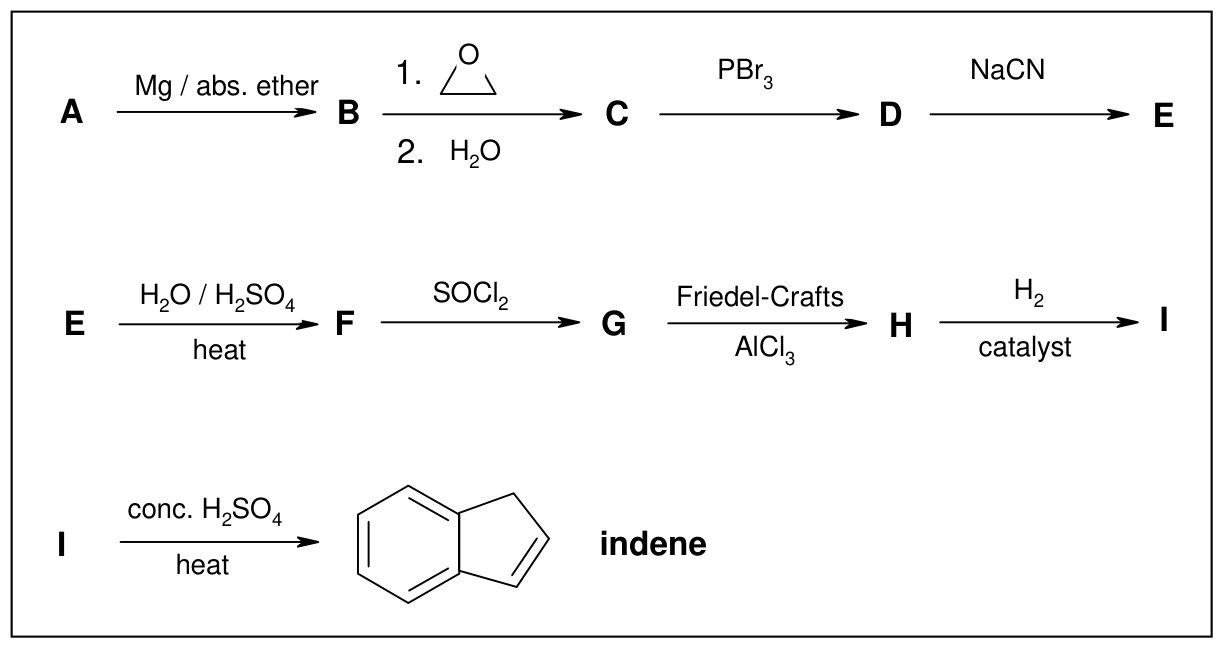
Official English text of the problem.
Answers
Problem 4 — compounds A–I. Taking bromobenzene as the starting halide:
- A: Bromobenzene, \(\ce{C6H5Br}\). SMILES:
Brc1ccccc1. - B: Phenylmagnesium bromide, \(\ce{C6H5MgBr}\). SMILES:
Br[Mg]c1ccccc1. - C: 2-Phenylethan-1-ol, \(\ce{C6H5CH2CH2OH}\). SMILES:
OCCc1ccccc1. - D: (2-Bromoethyl)benzene, \(\ce{C6H5CH2CH2Br}\). SMILES:
BrCCc1ccccc1. - E: 3-Phenylpropanenitrile, \(\ce{C6H5CH2CH2CN}\). SMILES:
N#CCCc1ccccc1. - F: 3-Phenylpropanoic acid, \(\ce{C6H5CH2CH2COOH}\). SMILES:
O=C(O)CCc1ccccc1. - G: 3-Phenylpropanoyl chloride, \(\ce{C6H5CH2CH2COCl}\). SMILES:
O=C(Cl)CCc1ccccc1. - H: Indan-1-one, \(\ce{C9H8O}\). SMILES:
O=C1CCc2ccccc21. - I: Indan-1-ol, \(\ce{C9H10O}\). SMILES with stereochemistry unspecified:
OC1CCc2ccccc21. With an achiral hydrogenation catalyst, it is a racemic mixture ofO[C@H]1CCc2ccccc21andO[C@@H]1CCc2ccccc21.
The starting halogen is not uniquely specified; the bromide choice gives a consistent complete sequence.
Solution
Problem 4
The final product is indene, SMILES C1C=Cc2ccccc21. Its five-membered ring contains three carbons in addition to the two shared with the aromatic ring. The indicated Friedel–Crafts cyclization therefore requires an aromatic ring bearing the chain \(\ce{-CH2CH2COCl}\). The ethylene oxide reaction supplies two side-chain carbons, and cyanide supplies the third.
A → B: Grignard reagent formation
Magnesium inserts into the carbon–bromine bond of bromobenzene in anhydrous ether:
\[ \ce{C6H5Br + Mg ->[anhydrous ether] C6H5MgBr} \]
Thus A is bromobenzene and B is phenylmagnesium bromide.
The SMILES for B represents formal connectivity. In ether, the magnesium centre is coordinated by solvent, and the reagent can exist as associated species.
B → C: addition of two carbons using ethylene oxide
The three-membered oxygen-containing ring is ethylene oxide (oxirane), SMILES C1CO1. The phenyl group attacks a ring carbon, opening the ring and forming a magnesium alkoxide:
\[ \ce{C6H5MgBr + C2H4O -> C6H5CH2CH2OMgBr} \]
The intermediate is magnesium bromide 2-phenylethanolate, represented formally by SMILES Br[Mg]OCCc1ccccc1. Water protonates its oxygen:
\[ \ce{C6H5CH2CH2OMgBr + H2O -> C6H5CH2CH2OH + Mg(OH)Br} \]
Consequently, C is 2-phenylethan-1-ol. The two equivalent carbons of ethylene oxide become the two methylene groups between the phenyl group and the hydroxyl group.
C → D: replacement of hydroxyl by bromine
Phosphorus tribromide converts the primary alcohol into the corresponding bromide:
\[ \ce{3 C6H5CH2CH2OH + PBr3 -> 3 C6H5CH2CH2Br + H3PO3} \]
Thus D is (2-bromoethyl)benzene.
D → E: substitution by cyanide
Cyanide attacks through carbon and displaces bromide by an \(S_\mathrm{N}2\) reaction:
\[ \ce{C6H5CH2CH2Br + NaCN -> C6H5CH2CH2CN + NaBr} \]
This adds one carbon to the side chain. Therefore, E is 3-phenylpropanenitrile.
E → F: acidic hydrolysis of the nitrile
Heating with aqueous sulfuric acid hydrolyses the nitrile to a carboxylic acid. The balanced net ionic equation is:
\[ \ce{C6H5CH2CH2CN + 2 H2O + H+ -> [\Delta] C6H5CH2CH2COOH + NH4+} \]
The nitrile carbon becomes the carboxyl carbon, while nitrogen becomes ammonium, SMILES [NH4+], in the acidic solution. Hence F is 3-phenylpropanoic acid.
F → G: formation of the acyl chloride
Thionyl chloride converts the carboxylic acid into its acyl chloride:
\[ \ce{C6H5CH2CH2COOH + SOCl2 -> C6H5CH2CH2COCl + SO2 + HCl} \]
Thus G is 3-phenylpropanoyl chloride.
G → H: intramolecular Friedel–Crafts acylation
Aluminium chloride activates the acyl chloride. The aromatic ring forms a bond to the acyl carbon at a position ortho to the existing side chain, closing a five-membered ring:
\[ \ce{C6H5CH2CH2COCl ->[AlCl3] C9H8O + HCl} \]
The new ring comprises the carbonyl carbon, the two methylene carbons, and two adjacent aromatic carbons. Its carbonyl carbon lies directly next to an aromatic fusion carbon, identifying H as indan-1-one.
The two available ortho positions are equivalent and give the same product.
H → I: reduction of the ketone
Catalytic hydrogenation reduces the carbonyl group to a secondary alcohol:
\[ \ce{C9H8O + H2 ->[catalyst] C9H10O} \]
Therefore, I is indan-1-ol. The alcohol-bearing carbon is stereogenic. With an achiral catalyst, hydrogenation of either face of the carbonyl gives the two enantiomers in equal amounts.
I → indene: dehydration
Heating indan-1-ol with concentrated sulfuric acid eliminates water:
\[ \ce{C9H10O ->[conc. H2SO4,\ heat] C9H8 + H2O} \]
The hydroxyl group is removed from carbon 1 and a hydrogen from the neighbouring methylene carbon, forming the double bond between carbons 1 and 2. This produces the indene structure shown in the problem.
The answers were checked against the official answers published by the organisers.
IChO 1987 · Theorieaufgabe 4
Reaktionsfolge zur Herstellung von Inden (Verbindungen A-I)
Geben Sie die Strukturformeln der Verbindungen A bis I in der folgenden Reaktionsfolge an.
Aufgabentext aus dem offiziellen englischen Text übersetzt.
Antworten
Aufgabe 4 — Verbindungen A–I. Bei Verwendung von Brombenzol als Ausgangshalogenid:
- A: Brombenzol, \(\ce{C6H5Br}\). SMILES:
Brc1ccccc1. - B: Phenylmagnesiumbromid, \(\ce{C6H5MgBr}\). SMILES:
Br[Mg]c1ccccc1. - C: 2-Phenylethan-1-ol, \(\ce{C6H5CH2CH2OH}\). SMILES:
OCCc1ccccc1. - D: (2-Bromethyl)benzol, \(\ce{C6H5CH2CH2Br}\). SMILES:
BrCCc1ccccc1. - E: 3-Phenylpropannitril, \(\ce{C6H5CH2CH2CN}\). SMILES:
N#CCCc1ccccc1. - F: 3-Phenylpropansäure, \(\ce{C6H5CH2CH2COOH}\). SMILES:
O=C(O)CCc1ccccc1. - G: 3-Phenylpropanoylchlorid, \(\ce{C6H5CH2CH2COCl}\). SMILES:
O=C(Cl)CCc1ccccc1. - H: Indan-1-on, \(\ce{C9H8O}\). SMILES:
O=C1CCc2ccccc21. - I: Indan-1-ol, \(\ce{C9H10O}\). SMILES ohne Angabe der Stereochemie:
OC1CCc2ccccc21. Bei Verwendung eines achiralen Hydrierkatalysators liegt ein racemisches Gemisch ausO[C@H]1CCc2ccccc21undO[C@@H]1CCc2ccccc21vor.
Das Halogen der Ausgangsverbindung ist nicht eindeutig festgelegt; die Wahl des Bromids ergibt eine in sich stimmige vollständige Reaktionsfolge.
Lösung
Aufgabe 4
Das Endprodukt ist Inden, SMILES C1C=Cc2ccccc21. Sein Fünfring enthält neben den beiden mit dem aromatischen Ring gemeinsamen Kohlenstoffatomen drei weitere Kohlenstoffatome. Die angegebene Friedel–Crafts-Cyclisierung erfordert daher einen aromatischen Ring, der die Kette \(\ce{-CH2CH2COCl}\) trägt. Die Reaktion mit Ethylenoxid liefert zwei Kohlenstoffatome der Seitenkette, Cyanid liefert das dritte.
A → B: Bildung des Grignard-Reagenzes
Magnesium wird in wasserfreiem Ether in die Kohlenstoff–Brom-Bindung von Brombenzol eingeschoben:
\[ \ce{C6H5Br + Mg ->[anhydrous ether] C6H5MgBr} \]
Somit ist A Brombenzol und B Phenylmagnesiumbromid.
Der SMILES-Ausdruck für B stellt die formale Bindungsverknüpfung dar. In Ether ist das Magnesiumzentrum von Lösungsmittelmolekülen koordiniert, und das Reagenz kann in Form assoziierter Spezies vorliegen.
B → C: Verlängerung um zwei Kohlenstoffatome mithilfe von Ethylenoxid
Der dreigliedrige sauerstoffhaltige Ring ist Ethylenoxid (Oxiran), SMILES C1CO1. Die Phenylgruppe greift ein Kohlenstoffatom des Rings an, wobei sich der Ring öffnet und ein Magnesiumalkoholat entsteht:
\[ \ce{C6H5MgBr + C2H4O -> C6H5CH2CH2OMgBr} \]
Das Zwischenprodukt ist Magnesiumbromid-2-phenylethanolat, formal dargestellt durch den SMILES-Ausdruck Br[Mg]OCCc1ccccc1. Wasser protoniert dessen Sauerstoffatom:
\[ \ce{C6H5CH2CH2OMgBr + H2O -> C6H5CH2CH2OH + Mg(OH)Br} \]
Folglich ist C 2-Phenylethan-1-ol. Die beiden äquivalenten Kohlenstoffatome des Ethylenoxids bilden die beiden Methylengruppen zwischen der Phenylgruppe und der Hydroxygruppe.
C → D: Ersatz der Hydroxygruppe durch Brom
Phosphortribromid wandelt den primären Alkohol in das entsprechende Bromid um:
\[ \ce{3 C6H5CH2CH2OH + PBr3 -> 3 C6H5CH2CH2Br + H3PO3} \]
Somit ist D (2-Bromethyl)benzol.
D → E: Substitution durch Cyanid
Das Cyanidion greift über sein Kohlenstoffatom an und verdrängt Bromid in einer \(S_\mathrm{N}2\)-Reaktion:
\[ \ce{C6H5CH2CH2Br + NaCN -> C6H5CH2CH2CN + NaBr} \]
Dadurch wird die Seitenkette um ein Kohlenstoffatom verlängert. Daher ist E 3-Phenylpropannitril.
E → F: saure Hydrolyse des Nitrils
Beim Erhitzen mit wässriger Schwefelsäure wird das Nitril zu einer Carbonsäure hydrolysiert. Die ausgeglichene Netto-Ionengleichung lautet:
\[ \ce{C6H5CH2CH2CN + 2 H2O + H+ -> [\Delta] C6H5CH2CH2COOH + NH4+} \]
Das Kohlenstoffatom der Nitrilgruppe wird zum Kohlenstoffatom der Carboxygruppe, während der Stickstoff in der sauren Lösung als Ammonium, SMILES [NH4+], vorliegt. Somit ist F 3-Phenylpropansäure.
F → G: Bildung des Carbonsäurechlorids
Thionylchlorid wandelt die Carbonsäure in ihr Carbonsäurechlorid um:
\[ \ce{C6H5CH2CH2COOH + SOCl2 -> C6H5CH2CH2COCl + SO2 + HCl} \]
Somit ist G 3-Phenylpropanoylchlorid.
G → H: intramolekulare Friedel–Crafts-Acylierung
Aluminiumchlorid aktiviert das Carbonsäurechlorid. Der aromatische Ring bildet an einer Position ortho zur vorhandenen Seitenkette eine Bindung zum Acylkohlenstoffatom, wodurch sich ein Fünfring schließt:
\[ \ce{C6H5CH2CH2COCl ->[AlCl3] C9H8O + HCl} \]
Der neue Ring umfasst das Carbonylkohlenstoffatom, die beiden Methylenkohlenstoffatome und zwei benachbarte aromatische Kohlenstoffatome. Sein Carbonylkohlenstoffatom liegt unmittelbar neben einem aromatischen Kohlenstoffatom an der Ringverknüpfungsstelle, wodurch H als Indan-1-on identifiziert wird.
Die beiden verfügbaren ortho-Positionen sind äquivalent und ergeben dasselbe Produkt.
H → I: Reduktion des Ketons
Durch katalytische Hydrierung wird die Carbonylgruppe zu einem sekundären Alkohol reduziert:
\[ \ce{C9H8O + H2 ->[catalyst] C9H10O} \]
Daher ist I Indan-1-ol. Das Kohlenstoffatom, das die Hydroxygruppe trägt, ist stereogen. Bei Verwendung eines achiralen Katalysators liefert die Hydrierung von beiden Seiten der Carbonylgruppe die beiden Enantiomere in gleichen Mengen.
I → Inden: Dehydratisierung
Beim Erhitzen von Indan-1-ol mit konzentrierter Schwefelsäure wird Wasser abgespalten:
\[ \ce{C9H10O ->[conc. H2SO4,\ heat] C9H8 + H2O} \]
Die Hydroxygruppe wird vom Kohlenstoffatom 1 und ein Wasserstoffatom vom benachbarten Methylenkohlenstoffatom abgespalten, wodurch die Doppelbindung zwischen den Kohlenstoffatomen 1 und 2 entsteht. Dabei bildet sich die in der Aufgabe gezeigte Indenstruktur.
Die Ergebnisse wurden mit den von den Veranstaltern veröffentlichten offiziellen Ergebnissen abgeglichen.
IChO 1987 · Teori sorusu 4
İndene götüren tepkime dizisi (A-I bileşikleri)
Aşağıdaki tepkime dizisinde A ile I arasındaki bileşiklerin yapı formüllerini yazınız.
Soru metni resmi İngilizce metinden çevrilmiştir.
Cevaplar
Soru 4 — A–I bileşikleri. Başlangıç halojenürü olarak bromobenzen alındığında:
- A: Bromobenzen, \(\ce{C6H5Br}\). SMILES:
Brc1ccccc1. - B: Fenilmagnezyum bromür, \(\ce{C6H5MgBr}\). SMILES:
Br[Mg]c1ccccc1. - C: 2-Feniletan-1-ol, \(\ce{C6H5CH2CH2OH}\). SMILES:
OCCc1ccccc1. - D: (2-Bromoetil)benzen, \(\ce{C6H5CH2CH2Br}\). SMILES:
BrCCc1ccccc1. - E: 3-Fenilpropannitril, \(\ce{C6H5CH2CH2CN}\). SMILES:
N#CCCc1ccccc1. - F: 3-Fenilpropanoik asit, \(\ce{C6H5CH2CH2COOH}\). SMILES:
O=C(O)CCc1ccccc1. - G: 3-Fenilpropanoil klorür, \(\ce{C6H5CH2CH2COCl}\). SMILES:
O=C(Cl)CCc1ccccc1. - H: İndan-1-on, \(\ce{C9H8O}\). SMILES:
O=C1CCc2ccccc21. - I: İndan-1-ol, \(\ce{C9H10O}\). Stereokimyası belirtilmemiş SMILES:
OC1CCc2ccccc21. Akiral bir hidrojenasyon katalizörü kullanıldığında,O[C@H]1CCc2ccccc21veO[C@@H]1CCc2ccccc21bileşiklerinin rasemik bir karışımıdır.
Başlangıçtaki halojen tek bir seçenekle sınırlandırılmamıştır; bromür seçimi tutarlı ve eksiksiz bir tepkime dizisi verir.
Çözüm
Soru 4
Son ürün indendir; SMILES gösterimi C1C=Cc2ccccc21 şeklindedir. Beş üyeli halkası, aromatik halkayla ortak olan iki karbonun yanı sıra üç karbon daha içerir. Bu nedenle, belirtilen Friedel–Crafts halkalaşması, \(\ce{-CH2CH2COCl}\) zincirini taşıyan bir aromatik halka gerektirir. Etilen oksit tepkimesi yan zincirin iki karbonunu, siyanür ise üçüncü karbonunu sağlar.
A → B: Grignard reaktifinin oluşumu
Magnezyum, susuz eterde bromobenzenin karbon–brom bağına katılır:
\[ \ce{C6H5Br + Mg ->[anhydrous ether] C6H5MgBr} \]
Böylece A bromobenzen, B ise fenilmagnezyum bromürdür.
B için verilen SMILES gösterimi, biçimsel bağlanma düzenini temsil eder. Eterde magnezyum merkezine çözücü molekülleri koordine olur ve reaktif, birbirleriyle birleşmiş türler hâlinde bulunabilir.
B → C: etilen oksit kullanılarak iki karbon eklenmesi
Oksijen içeren üç üyeli halka etilen oksit (oksiran) olup SMILES gösterimi C1CO1 şeklindedir. Fenil grubu bir halka karbonuna saldırarak halkayı açar ve bir magnezyum alkoksit oluşturur:
\[ \ce{C6H5MgBr + C2H4O -> C6H5CH2CH2OMgBr} \]
Ara ürün, biçimsel olarak Br[Mg]OCCc1ccccc1 SMILES gösterimiyle temsil edilen magnezyum bromür 2-feniletanolattır. Su, bu ara ürünün oksijenini protonlar:
\[ \ce{C6H5CH2CH2OMgBr + H2O -> C6H5CH2CH2OH + Mg(OH)Br} \]
Sonuç olarak C, 2-feniletan-1-oldür. Etilen oksidin eşdeğer iki karbonu, fenil grubu ile hidroksil grubu arasındaki iki metilen grubunu oluşturur.
C → D: hidroksilin bromla yer değiştirmesi
Fosfor tribromür, birincil alkolü karşılık gelen bromüre dönüştürür:
\[ \ce{3 C6H5CH2CH2OH + PBr3 -> 3 C6H5CH2CH2Br + H3PO3} \]
Böylece D, (2-bromoetil)benzendir.
D → E: siyanürle yer değiştirme
Siyanür, karbon atomu üzerinden saldırır ve bir \(S_\mathrm{N}2\) tepkimesiyle bromürün yerini alır:
\[ \ce{C6H5CH2CH2Br + NaCN -> C6H5CH2CH2CN + NaBr} \]
Bu işlem yan zincire bir karbon ekler. Dolayısıyla E, 3-fenilpropannitrildir.
E → F: nitrilin asidik hidrolizi
Sulu sülfürik asitle ısıtma, nitrili hidroliz ederek bir karboksilik aside dönüştürür. Denkleştirilmiş net iyon denklemi şöyledir:
\[ \ce{C6H5CH2CH2CN + 2 H2O + H+ -> [\Delta] C6H5CH2CH2COOH + NH4+} \]
Nitril karbonu karboksil karbonuna dönüşürken azot, asidik çözeltide SMILES gösterimi [NH4+] olan amonyuma dönüşür. Bu nedenle F, 3-fenilpropanoik asittir.
F → G: açil klorürün oluşumu
Tiyonil klorür, karboksilik asidi karşılık gelen açil klorüre dönüştürür:
\[ \ce{C6H5CH2CH2COOH + SOCl2 -> C6H5CH2CH2COCl + SO2 + HCl} \]
Böylece G, 3-fenilpropanoil klorürdür.
G → H: molekül içi Friedel–Crafts açillenmesi
Alüminyum klorür, açil klorürü etkinleştirir. Aromatik halka, mevcut yan zincire göre orto konumundan açil karbonuna bir bağ oluşturarak beş üyeli bir halkayı kapatır:
\[ \ce{C6H5CH2CH2COCl ->[AlCl3] C9H8O + HCl} \]
Yeni halka; karbonil karbonunu, iki metilen karbonunu ve birbirine komşu iki aromatik karbonu içerir. Karbonil karbonu, halkaların kaynaştığı aromatik karbonlardan birinin hemen yanında bulunur; bu da H'nin indan-1-on olduğunu gösterir.
Tepkimeye girebilecek iki orto konumu eşdeğerdir ve aynı ürünü verir.
H → I: ketonun indirgenmesi
Katalitik hidrojenasyon, karbonil grubunu ikincil bir alkole indirger:
\[ \ce{C9H8O + H2 ->[catalyst] C9H10O} \]
Dolayısıyla I, indan-1-oldür. Alkol grubunu taşıyan karbon stereojeniktir. Akiral bir katalizör kullanıldığında, karbonilin her iki yüzünden gerçekleşen hidrojenasyon, iki enantiyomeri eşit miktarlarda verir.
I → inden: dehidrasyon
İndan-1-olün derişik sülfürik asitle ısıtılması su ayrılmasına yol açar:
\[ \ce{C9H10O ->[conc. H2SO4,\ heat] C9H8 + H2O} \]
Hidroksil grubu 1 numaralı karbondan, bir hidrojen ise komşu metilen karbonundan ayrılır ve 1 ile 2 numaralı karbonlar arasında çift bağ oluşur. Böylece soruda gösterilen inden yapısı elde edilir.
Sonuçlar, düzenleyicilerin yayımladığı resmi sonuçlarla karşılaştırılarak kontrol edildi.
IChO 1987 · Problema teórico 4
Secuencia de reacciones que conduce al indeno (compuestos A-I)
Escriba las fórmulas estructurales de los compuestos A a I de la siguiente secuencia de reacciones.
Enunciado traducido del texto oficial en inglés.
Respuestas
Problema 4 — compuestos A–I. Tomando el bromobenceno como haluro de partida:
- A: Bromobenceno, \(\ce{C6H5Br}\). SMILES:
Brc1ccccc1. - B: Bromuro de fenilmagnesio, \(\ce{C6H5MgBr}\). SMILES:
Br[Mg]c1ccccc1. - C: 2-Feniletan-1-ol, \(\ce{C6H5CH2CH2OH}\). SMILES:
OCCc1ccccc1. - D: (2-Bromoetil)benceno, \(\ce{C6H5CH2CH2Br}\). SMILES:
BrCCc1ccccc1. - E: 3-Fenilpropanonitrilo, \(\ce{C6H5CH2CH2CN}\). SMILES:
N#CCCc1ccccc1. - F: Ácido 3-fenilpropanoico, \(\ce{C6H5CH2CH2COOH}\). SMILES:
O=C(O)CCc1ccccc1. - G: Cloruro de 3-fenilpropanoilo, \(\ce{C6H5CH2CH2COCl}\). SMILES:
O=C(Cl)CCc1ccccc1. - H: Indan-1-ona, \(\ce{C9H8O}\). SMILES:
O=C1CCc2ccccc21. - I: Indan-1-ol, \(\ce{C9H10O}\). SMILES sin especificar la estereoquímica:
OC1CCc2ccccc21. Con un catalizador de hidrogenación aquiral, es una mezcla racémica deO[C@H]1CCc2ccccc21yO[C@@H]1CCc2ccccc21.
El halógeno de partida no está especificado de forma unívoca; la elección del bromuro proporciona una secuencia completa coherente.
Solución
Problema 4
El producto final es el indeno, SMILES C1C=Cc2ccccc21. Su anillo de cinco miembros contiene tres carbonos además de los dos compartidos con el anillo aromático. Por tanto, la ciclación de Friedel–Crafts indicada requiere un anillo aromático que lleve la cadena \(\ce{-CH2CH2COCl}\). La reacción con óxido de etileno aporta dos carbonos a la cadena lateral, y el cianuro aporta el tercero.
A → B: formación del reactivo de Grignard
El magnesio se inserta en el enlace carbono–bromo del bromobenceno en éter anhidro:
\[ \ce{C6H5Br + Mg ->[anhydrous ether] C6H5MgBr} \]
Así, A es bromobenceno y B es bromuro de fenilmagnesio.
El SMILES de B representa la conectividad formal. En éter, el centro de magnesio está coordinado por el disolvente, y el reactivo puede existir en forma de especies asociadas.
B → C: adición de dos carbonos mediante óxido de etileno
El anillo de tres miembros que contiene oxígeno es el óxido de etileno (oxirano), SMILES C1CO1. El grupo fenilo ataca a un carbono del anillo, abriéndolo y formando un alcóxido de magnesio:
\[ \ce{C6H5MgBr + C2H4O -> C6H5CH2CH2OMgBr} \]
El intermedio es bromuro de 2-feniletanolato de magnesio, representado formalmente por el SMILES Br[Mg]OCCc1ccccc1. El agua protona su oxígeno:
\[ \ce{C6H5CH2CH2OMgBr + H2O -> C6H5CH2CH2OH + Mg(OH)Br} \]
Por consiguiente, C es 2-feniletan-1-ol. Los dos carbonos equivalentes del óxido de etileno se convierten en los dos grupos metileno situados entre el grupo fenilo y el grupo hidroxilo.
C → D: sustitución del hidroxilo por bromo
El tribromuro de fósforo convierte el alcohol primario en el bromuro correspondiente:
\[ \ce{3 C6H5CH2CH2OH + PBr3 -> 3 C6H5CH2CH2Br + H3PO3} \]
Así, D es (2-bromoetil)benceno.
D → E: sustitución por cianuro
El cianuro ataca a través del carbono y desplaza al bromuro mediante una reacción \(S_\mathrm{N}2\):
\[ \ce{C6H5CH2CH2Br + NaCN -> C6H5CH2CH2CN + NaBr} \]
Esto añade un carbono a la cadena lateral. Por tanto, E es 3-fenilpropanonitrilo.
E → F: hidrólisis ácida del nitrilo
El calentamiento con ácido sulfúrico acuoso hidroliza el nitrilo para dar un ácido carboxílico. La ecuación iónica neta ajustada es:
\[ \ce{C6H5CH2CH2CN + 2 H2O + H+ -> [\Delta] C6H5CH2CH2COOH + NH4+} \]
El carbono del nitrilo se convierte en el carbono del carboxilo, mientras que el nitrógeno se convierte en amonio, SMILES [NH4+], en la disolución ácida. Por ello, F es ácido 3-fenilpropanoico.
F → G: formación del cloruro de acilo
El cloruro de tionilo convierte el ácido carboxílico en su cloruro de acilo:
\[ \ce{C6H5CH2CH2COOH + SOCl2 -> C6H5CH2CH2COCl + SO2 + HCl} \]
Así, G es cloruro de 3-fenilpropanoilo.
G → H: acilación intramolecular de Friedel–Crafts
El cloruro de aluminio activa el cloruro de acilo. El anillo aromático forma un enlace con el carbono del acilo en una posición orto respecto a la cadena lateral existente, cerrando un anillo de cinco miembros:
\[ \ce{C6H5CH2CH2COCl ->[AlCl3] C9H8O + HCl} \]
El nuevo anillo comprende el carbono del carbonilo, los dos carbonos metilénicos y dos carbonos aromáticos adyacentes. Su carbono carbonílico se encuentra directamente junto a un carbono aromático de fusión, lo que permite identificar H como indan-1-ona.
Las dos posiciones orto disponibles son equivalentes y dan el mismo producto.
H → I: reducción de la cetona
La hidrogenación catalítica reduce el grupo carbonilo a un alcohol secundario:
\[ \ce{C9H8O + H2 ->[catalyst] C9H10O} \]
Por tanto, I es indan-1-ol. El carbono que lleva el grupo alcohol es estereogénico. Con un catalizador aquiral, la hidrogenación por cualquiera de las dos caras del carbonilo da los dos enantiómeros en cantidades iguales.
I → indeno: deshidratación
El calentamiento del indan-1-ol con ácido sulfúrico concentrado elimina agua:
\[ \ce{C9H10O ->[conc. H2SO4,\ heat] C9H8 + H2O} \]
Se elimina el grupo hidroxilo del carbono 1 y un hidrógeno del carbono metilénico vecino, formando el doble enlace entre los carbonos 1 y 2. Esto produce la estructura del indeno mostrada en el enunciado.
Los resultados se comprobaron con los resultados oficiales publicados por los organizadores.
IChO 1987 · 理论题 4
制备茚的反应序列(化合物 A-I)
写出下列反应序列中化合物 A 至 I 的结构式。
题目译自官方英文原文。
答案
题目 4 — 化合物 A–I。 以溴苯作为起始卤代物:
- A: 溴苯,\(\ce{C6H5Br}\)。SMILES:
Brc1ccccc1。 - B: 苯基溴化镁,\(\ce{C6H5MgBr}\)。SMILES:
Br[Mg]c1ccccc1。 - C: 2-苯基乙-1-醇,\(\ce{C6H5CH2CH2OH}\)。SMILES:
OCCc1ccccc1。 - D: (2-溴乙基)苯,\(\ce{C6H5CH2CH2Br}\)。SMILES:
BrCCc1ccccc1。 - E: 3-苯基丙腈,\(\ce{C6H5CH2CH2CN}\)。SMILES:
N#CCCc1ccccc1。 - F: 3-苯基丙酸,\(\ce{C6H5CH2CH2COOH}\)。SMILES:
O=C(O)CCc1ccccc1。 - G: 3-苯基丙酰氯,\(\ce{C6H5CH2CH2COCl}\)。SMILES:
O=C(Cl)CCc1ccccc1。 - H: 茚满-1-酮,\(\ce{C9H8O}\)。SMILES:
O=C1CCc2ccccc21。 - I: 茚满-1-醇,\(\ce{C9H10O}\)。未指定立体化学的 SMILES:
OC1CCc2ccccc21。使用非手性氢化催化剂时,所得产物为O[C@H]1CCc2ccccc21和O[C@@H]1CCc2ccccc21的外消旋混合物。
起始卤代物中的卤素并未被唯一确定;选择溴代物可以得到一套前后一致的完整反应序列。
解答
题目 4
最终产物为茚,SMILES 为 C1C=Cc2ccccc21。其五元环除与芳环共用的两个碳原子外,还含有三个碳原子。因此,图示的傅里德尔–克拉夫茨环化反应要求芳环上连有 \(\ce{-CH2CH2COCl}\) 链。环氧乙烷参与的反应提供侧链中的两个碳原子,氰化物提供第三个碳原子。
A → B: 格氏试剂的生成
在无水乙醚中,镁插入溴苯的碳–溴键:
\[ \ce{C6H5Br + Mg ->[anhydrous ether] C6H5MgBr} \]
因此,A 为溴苯,B 为苯基溴化镁。
B 的 SMILES 表示形式上的连接关系。在乙醚中,镁中心与溶剂配位,该试剂可以缔合物的形式存在。
B → C: 利用环氧乙烷引入两个碳原子
该含氧三元环为环氧乙烷(氧杂环丙烷),SMILES 为 C1CO1。苯基进攻环上的一个碳原子,使环打开并生成醇镁盐:
\[ \ce{C6H5MgBr + C2H4O -> C6H5CH2CH2OMgBr} \]
中间体为2-苯基乙氧基溴化镁,其形式上的 SMILES 表示为 Br[Mg]OCCc1ccccc1。水使其氧原子质子化:
\[ \ce{C6H5CH2CH2OMgBr + H2O -> C6H5CH2CH2OH + Mg(OH)Br} \]
因此,C 为 2-苯基乙-1-醇。环氧乙烷中两个等价的碳原子成为苯基与羟基之间的两个亚甲基。
C → D: 用溴取代羟基
三溴化磷将伯醇转化为相应的溴代物:
\[ \ce{3 C6H5CH2CH2OH + PBr3 -> 3 C6H5CH2CH2Br + H3PO3} \]
因此,D 为 (2-溴乙基)苯。
D → E: 氰根的取代反应
氰根通过碳原子进攻,经 \(S_\mathrm{N}2\) 反应置换出溴离子:
\[ \ce{C6H5CH2CH2Br + NaCN -> C6H5CH2CH2CN + NaBr} \]
这使侧链增加一个碳原子。因此,E 为 3-苯基丙腈。
E → F: 腈的酸性水解
与硫酸水溶液一起加热,使腈水解为羧酸。配平后的净离子方程式为:
\[ \ce{C6H5CH2CH2CN + 2 H2O + H+ -> [\Delta] C6H5CH2CH2COOH + NH4+} \]
腈基的碳原子成为羧基的碳原子,而氮在酸性溶液中转化为铵离子,SMILES 为 [NH4+]。因此,F 为 3-苯基丙酸。
F → G: 酰氯的生成
氯化亚砜将羧酸转化为相应的酰氯:
\[ \ce{C6H5CH2CH2COOH + SOCl2 -> C6H5CH2CH2COCl + SO2 + HCl} \]
因此,G 为 3-苯基丙酰氯。
G → H: 分子内傅里德尔–克拉夫茨酰基化反应
氯化铝活化酰氯。芳环在已有侧链的邻位与酰基碳原子形成化学键,闭合成五元环:
\[ \ce{C6H5CH2CH2COCl ->[AlCl3] C9H8O + HCl} \]
新形成的环由羰基碳原子、两个亚甲基碳原子和两个相邻的芳环碳原子组成。其羰基碳原子与芳环的一个稠合碳原子直接相邻,由此确定 H 为茚满-1-酮。
两个可反应的邻位等价,生成相同的产物。
H → I: 酮的还原
催化氢化将羰基还原为仲醇:
\[ \ce{C9H8O + H2 ->[catalyst] C9H10O} \]
因此,I 为茚满-1-醇。连接羟基的碳原子是手性中心。使用非手性催化剂时,从羰基的两面进行氢化会生成等量的两种对映异构体。
I → 茚: 脱水
将茚满-1-醇与浓硫酸一起加热,消去水:
\[ \ce{C9H10O ->[conc. H2SO4,\ heat] C9H8 + H2O} \]
从 1 号碳原子上脱去羟基,同时从相邻的亚甲基碳原子上脱去一个氢原子,在 1 号与 2 号碳原子之间形成双键。由此生成题目所示的茚结构。
结果已与主办方公布的官方答案核对。
IChO 1987 · Теоретическая задача 4
Последовательность реакций, приводящая к индену (соединения A-I)
Напишите структурные формулы соединений от A до I в следующей последовательности реакций.
Условие переведено с официального английского текста.
Ответы
Задача 4 — соединения A–I. Если в качестве исходного галогенпроизводного взять бромбензол:
- A: Бромбензол, \(\ce{C6H5Br}\). SMILES:
Brc1ccccc1. - B: Фенилмагнийбромид, \(\ce{C6H5MgBr}\). SMILES:
Br[Mg]c1ccccc1. - C: 2-Фенилэтан-1-ол, \(\ce{C6H5CH2CH2OH}\). SMILES:
OCCc1ccccc1. - D: (2-Бромэтил)бензол, \(\ce{C6H5CH2CH2Br}\). SMILES:
BrCCc1ccccc1. - E: 3-Фенилпропаннитрил, \(\ce{C6H5CH2CH2CN}\). SMILES:
N#CCCc1ccccc1. - F: 3-Фенилпропановая кислота, \(\ce{C6H5CH2CH2COOH}\). SMILES:
O=C(O)CCc1ccccc1. - G: Хлорангидрид 3-фенилпропановой кислоты, \(\ce{C6H5CH2CH2COCl}\). SMILES:
O=C(Cl)CCc1ccccc1. - H: Индан-1-он, \(\ce{C9H8O}\). SMILES:
O=C1CCc2ccccc21. - I: Индан-1-ол, \(\ce{C9H10O}\). SMILES без указания стереохимии:
OC1CCc2ccccc21. При использовании ахирального катализатора гидрирования он представляет собой рацемическую смесьO[C@H]1CCc2ccccc21иO[C@@H]1CCc2ccccc21.
Исходный галоген не задан однозначно; выбор бромпроизводного позволяет получить полную согласованную последовательность превращений.
Решение
Задача 4
Конечный продукт — инден, SMILES C1C=Cc2ccccc21. Его пятичленный цикл содержит три атома углерода помимо двух общих с ароматическим кольцом. Поэтому для указанной циклизации по Фриделю–Крафтсу необходимо ароматическое кольцо с цепью \(\ce{-CH2CH2COCl}\). Реакция с оксидом этилена вводит два атома углерода боковой цепи, а цианид — третий.
A → B: получение реактива Гриньяра
В среде безводного эфира магний внедряется по связи углерод–бром в бромбензоле:
\[ \ce{C6H5Br + Mg ->[anhydrous ether] C6H5MgBr} \]
Таким образом, A — бромбензол, а B — фенилмагнийбромид.
SMILES для B отражает формальную связность атомов. В эфире магниевый центр координирован молекулами растворителя, и реактив может существовать в виде ассоциатов.
B → C: присоединение двух атомов углерода с помощью оксида этилена
Трёхчленный кислородсодержащий цикл — это оксид этилена (оксиран), SMILES C1CO1. Фенильная группа атакует атом углерода цикла, раскрывая цикл и образуя алкоголят магния:
\[ \ce{C6H5MgBr + C2H4O -> C6H5CH2CH2OMgBr} \]
Промежуточное соединение — 2-фенилэтанолят-бромид магния, формально представляемый SMILES Br[Mg]OCCc1ccccc1. Вода протонирует его атом кислорода:
\[ \ce{C6H5CH2CH2OMgBr + H2O -> C6H5CH2CH2OH + Mg(OH)Br} \]
Следовательно, C — 2-фенилэтан-1-ол. Два эквивалентных атома углерода оксида этилена становятся двумя метиленовыми группами между фенильной и гидроксильной группами.
C → D: замещение гидроксильной группы бромом
Трибромид фосфора превращает первичный спирт в соответствующее бромпроизводное:
\[ \ce{3 C6H5CH2CH2OH + PBr3 -> 3 C6H5CH2CH2Br + H3PO3} \]
Таким образом, D — (2-бромэтил)бензол.
D → E: замещение цианид-ионом
Цианид-ион атакует атомом углерода и вытесняет бромид-ион по механизму \(S_\mathrm{N}2\):
\[ \ce{C6H5CH2CH2Br + NaCN -> C6H5CH2CH2CN + NaBr} \]
При этом боковая цепь удлиняется на один атом углерода. Поэтому E — 3-фенилпропаннитрил.
E → F: кислотный гидролиз нитрила
При нагревании с водным раствором серной кислоты нитрил гидролизуется до карбоновой кислоты. Уравнение реакции в сокращённой ионной форме с расставленными коэффициентами:
\[ \ce{C6H5CH2CH2CN + 2 H2O + H+ -> [\Delta] C6H5CH2CH2COOH + NH4+} \]
Атом углерода нитрильной группы становится атомом углерода карбоксильной группы, а азот в кислом растворе переходит в ион аммония, SMILES [NH4+]. Следовательно, F — 3-фенилпропановая кислота.
F → G: образование хлорангидрида
Тионилхлорид превращает карбоновую кислоту в её хлорангидрид:
\[ \ce{C6H5CH2CH2COOH + SOCl2 -> C6H5CH2CH2COCl + SO2 + HCl} \]
Таким образом, G — хлорангидрид 3-фенилпропановой кислоты.
G → H: внутримолекулярное ацилирование по Фриделю–Крафтсу
Хлорид алюминия активирует хлорангидрид. Ароматическое кольцо образует связь с атомом углерода ацильной группы в орто-положении к имеющейся боковой цепи, замыкая пятичленный цикл:
\[ \ce{C6H5CH2CH2COCl ->[AlCl3] C9H8O + HCl} \]
Новый цикл включает карбонильный атом углерода, два метиленовых атома углерода и два соседних атома углерода ароматического кольца. Его карбонильный атом углерода расположен непосредственно рядом с атомом углерода ароматического кольца, общим для обоих циклов, что позволяет определить H как индан-1-он.
Два доступных орто-положения эквивалентны и дают один и тот же продукт.
H → I: восстановление кетона
При каталитическом гидрировании карбонильная группа восстанавливается до вторичной спиртовой группы:
\[ \ce{C9H8O + H2 ->[catalyst] C9H10O} \]
Следовательно, I — индан-1-ол. Атом углерода, несущий гидроксильную группу, является стереогенным центром. При использовании ахирального катализатора гидрирование с обеих сторон карбонильной группы даёт два энантиомера в равных количествах.
I → инден: дегидратация
При нагревании индан-1-ола с концентрированной серной кислотой отщепляется вода:
\[ \ce{C9H10O ->[conc. H2SO4,\ heat] C9H8 + H2O} \]
От атома углерода 1 отщепляется гидроксильная группа, а от соседнего метиленового атома углерода — атом водорода, в результате чего между атомами углерода 1 и 2 образуется двойная связь. Так получается структура индена, показанная в условии задачи.
Ответы проверены по официальным ответам, опубликованным организаторами.
IChO 1987 · مسألة نظرية 4
سلسلة تفاعلات تؤدي إلى الإندين (المركبات A-I)
اكتب الصيغ البنائية للمركبات من A إلى I في سلسلة التفاعلات الآتية.
نص المسألة مترجم عن النص الإنجليزي الرسمي.
الإجابات
المسألة 4 — المركبات A–I. باعتماد البروموبنزين هاليدًا ابتدائيًا:
- A: بروموبنزين، \(\ce{C6H5Br}\). SMILES:
Brc1ccccc1. - B: بروميد فينيل المغنيسيوم، \(\ce{C6H5MgBr}\). SMILES:
Br[Mg]c1ccccc1. - C: 2-فينيل إيثان-1-ول، \(\ce{C6H5CH2CH2OH}\). SMILES:
OCCc1ccccc1. - D: (2-بروموإيثيل)بنزين، \(\ce{C6H5CH2CH2Br}\). SMILES:
BrCCc1ccccc1. - E: 3-فينيل بروبان نتريل، \(\ce{C6H5CH2CH2CN}\). SMILES:
N#CCCc1ccccc1. - F: حمض 3-فينيل بروبانويك، \(\ce{C6H5CH2CH2COOH}\). SMILES:
O=C(O)CCc1ccccc1. - G: كلوريد 3-فينيل بروبانويل، \(\ce{C6H5CH2CH2COCl}\). SMILES:
O=C(Cl)CCc1ccccc1. - H: إندان-1-ون، \(\ce{C9H8O}\). SMILES:
O=C1CCc2ccccc21. - I: إندان-1-ول، \(\ce{C9H10O}\). SMILES دون تحديد الكيمياء الفراغية:
OC1CCc2ccccc21. عند استخدام حفاز هدرجة غير كيرالي، يكون مزيجًا راسيميًا منO[C@H]1CCc2ccccc21وO[C@@H]1CCc2ccccc21.
لم يُحدَّد الهالوجين الابتدائي تحديدًا فريدًا؛ ويعطي اختيار البروميد سلسلة كاملة متسقة.
الحل
المسألة 4
الناتج النهائي هو الإندين، وصيغة SMILES له هي C1C=Cc2ccccc21. تحتوي حلقته الخماسية على ثلاث ذرات كربون بالإضافة إلى ذرتي الكربون المشتركتين مع الحلقة العطرية. ولذلك يتطلب تفاعل فريدل–كرافتس المؤدي إلى تكوّن الحلقة والمبيَّن في المخطط حلقة عطرية تحمل السلسلة \(\ce{-CH2CH2COCl}\). ويوفّر تفاعل أكسيد الإيثيلين ذرتي كربون للسلسلة الجانبية، بينما يوفّر السيانيد الذرة الثالثة.
A → B: تكوين كاشف غرينيار
يندرج المغنيسيوم في الرابطة بين الكربون والبروم في البروموبنزين في إيثر لامائي:
\[ \ce{C6H5Br + Mg ->[anhydrous ether] C6H5MgBr} \]
إذن A هو البروموبنزين وB هو بروميد فينيل المغنيسيوم.
تمثّل صيغة SMILES للمركب B الترابط الشكلي بين الذرات. وفي الإيثر، تتناسق جزيئات المذيب مع مركز المغنيسيوم، ويمكن أن يوجد الكاشف على هيئة أنواع كيميائية متجمعة.
B → C: إضافة ذرتي كربون باستخدام أكسيد الإيثيلين
الحلقة الثلاثية المحتوية على الأكسجين هي أكسيد الإيثيلين (الأوكسيران)، وصيغة SMILES لها هي C1CO1. تهاجم مجموعة الفينيل إحدى ذرات كربون الحلقة، فتفتح الحلقة وتكوّن ألكوكسيد المغنيسيوم:
\[ \ce{C6H5MgBr + C2H4O -> C6H5CH2CH2OMgBr} \]
المركب الوسيط هو بروميد (2-فينيل إيثانولات) المغنيسيوم، ويُمثَّل شكليًا بصيغة SMILES Br[Mg]OCCc1ccccc1. يمنح الماء بروتونًا لذرة الأكسجين فيه:
\[ \ce{C6H5CH2CH2OMgBr + H2O -> C6H5CH2CH2OH + Mg(OH)Br} \]
وعليه، فإن C هو 2-فينيل إيثان-1-ول. وتصبح ذرتا الكربون المتكافئتان في أكسيد الإيثيلين مجموعتي الميثيلين الواقعتين بين مجموعة الفينيل ومجموعة الهيدروكسيل.
C → D: إحلال البروم محل الهيدروكسيل
يحوّل ثلاثي بروميد الفوسفور الكحول الأولي إلى البروميد الموافق:
\[ \ce{3 C6H5CH2CH2OH + PBr3 -> 3 C6H5CH2CH2Br + H3PO3} \]
إذن D هو (2-بروموإيثيل)بنزين.
D → E: الإحلال بالسيانيد
يهاجم السيانيد عبر ذرة الكربون ويزيح البروميد بتفاعل \(S_\mathrm{N}2\):
\[ \ce{C6H5CH2CH2Br + NaCN -> C6H5CH2CH2CN + NaBr} \]
يضيف هذا ذرة كربون واحدة إلى السلسلة الجانبية. لذلك فإن E هو 3-فينيل بروبان نتريل.
E → F: التحلل المائي الحمضي للنتريل
يؤدي التسخين مع محلول مائي لحمض الكبريتيك إلى التحلل المائي للنتريل وتحويله إلى حمض كربوكسيلي. والمعادلة الأيونية الصافية الموزونة هي:
\[ \ce{C6H5CH2CH2CN + 2 H2O + H+ -> [\Delta] C6H5CH2CH2COOH + NH4+} \]
تصبح ذرة كربون النتريل ذرة كربون الكربوكسيل، بينما يتحول النيتروجين إلى أمونيوم، وصيغة SMILES له هي [NH4+]، في المحلول الحمضي. ومن ثم فإن F هو حمض 3-فينيل بروبانويك.
F → G: تكوين كلوريد الأسيل
يحوّل كلوريد الثيونيل الحمض الكربوكسيلي إلى كلوريد الأسيل الموافق له:
\[ \ce{C6H5CH2CH2COOH + SOCl2 -> C6H5CH2CH2COCl + SO2 + HCl} \]
إذن G هو كلوريد 3-فينيل بروبانويل.
G → H: أسيلة فريدل–كرافتس داخل الجزيء
ينشّط كلوريد الألومنيوم كلوريد الأسيل. وتكوّن الحلقة العطرية رابطة مع ذرة كربون الأسيل في موضع أورثو بالنسبة إلى السلسلة الجانبية الموجودة، فتُغلق حلقة خماسية:
\[ \ce{C6H5CH2CH2COCl ->[AlCl3] C9H8O + HCl} \]
تتألف الحلقة الجديدة من ذرة كربون الكربونيل، وذرتي كربون الميثيلين، وذرتي كربون عطريتين متجاورتين. وتقع ذرة كربون الكربونيل فيها بجوار إحدى ذرتي الكربون العطريتين عند موضع اندماج الحلقتين مباشرة، مما يحدّد H بوصفه إندان-1-ون.
موضعا أورثو المتاحان متكافئان ويعطيان الناتج نفسه.
H → I: اختزال الكيتون
تختزل الهدرجة الحفزية مجموعة الكربونيل إلى كحول ثانوي:
\[ \ce{C9H8O + H2 ->[catalyst] C9H10O} \]
لذلك فإن I هو إندان-1-ول. وذرة الكربون الحاملة لمجموعة الهيدروكسيل مركز مولّد للتصاوغ الفراغي. وباستخدام حفاز غير كيرالي، تعطي هدرجة وجهي مجموعة الكربونيل المتماكبين المرآتيين بكميتين متساويتين.
I → الإندين: نزع الماء
يؤدي تسخين إندان-1-ول مع حمض الكبريتيك المركّز إلى حذف الماء:
\[ \ce{C9H10O ->[conc. H2SO4,\ heat] C9H8 + H2O} \]
تُزال مجموعة الهيدروكسيل من ذرة الكربون 1 وذرة هيدروجين من ذرة كربون الميثيلين المجاورة، فتتكوّن الرابطة المزدوجة بين ذرتي الكربون 1 و2. وينتج عن ذلك تركيب الإندين المبيَّن في المسألة.
تمت مراجعة النتائج بمقارنتها بالنتائج الرسمية التي نشرها المنظمون.