IChO 1987 · Theory problem 3
Potentiometric titration of a chloride-cyanide mixture with silver nitrate
25.00 \(\mathrm{cm^3}\) of a neutral solution containing potassium chloride and potassium cyanide are potentiometrically titrated with a standard 0.1000 molar silver nitrate solution at \(25\,^\circ\mathrm{C}\) using a silver electrode and a normal calomel half-cell with \(\ce{KNO3}\) - salt bridge. The protonation of cyanide ions is negligible. The potentiometric curve obtained (emf (V)) vs. burette readings (in \(\mathrm{cm^3}\)) is shown in Fig. 1.
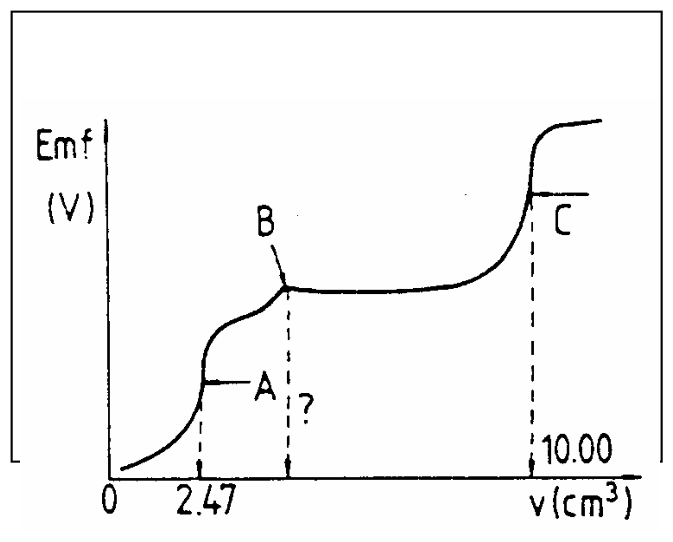
Fig. 1
3.1 The end points of the reactions taking place during the titration, are marked with A, B and C. Write the balanced ionic equation for each reaction.
3.2 What volume of the titrant is required to reach point B?
3.3 Calculate the concentrations of \(\ce{KCl}\) and \(\ce{KCN}\) (in \(\mathrm{mol\,dm^{-3}}\)) in the sample solution.
3.4 Calculate the emf readings at the points A and C in volts.
3.5 What is the molar ratio \(\ce{Cl-}/\ce{CN-}\) in the solution and in the precipitate at point C?
Data:
\[ E^\circ(\ce{Ag+}/\ce{Ag})=0.800\ \mathrm{V} \]
\[ E^\circ(\text{Calomel})=0.285\ \mathrm{V} \]
\[ K_{\mathrm{sp}}(\ce{AgCN})=10^{-15.8} \]
\[ K_{\mathrm{sp}}(\ce{AgCl})=10^{-9.75} \]
\[ \beta_2= \frac{[\ce{[Ag(CN)2]-}]}{[\ce{Ag+}][\ce{CN-}]^2} =10^{21.1} \]
Official English text of the problem.
Answers
-
3.1 \[ \begin{aligned} \text{A:}\quad&\ce{Ag+ + 2CN- -> [Ag(CN)2]-}\\ \text{B:}\quad&\ce{[Ag(CN)2]- + Ag+ -> 2AgCN(s)}\\ \text{C:}\quad&\ce{Ag+ + Cl- -> AgCl(s)} \end{aligned} \]
-
3.2 \(\boxed{V_B=4.94\ \mathrm{cm^3}}\).
-
3.3 The calculated concentrations are \[ \boxed{c(\ce{KCl})=0.02024\ \mathrm{mol\,dm^{-3}} \approx0.0202\ \mathrm{mol\,dm^{-3}}} \] \[ \boxed{c(\ce{KCN})=0.01976\ \mathrm{mol\,dm^{-3}} \approx0.0198\ \mathrm{mol\,dm^{-3}}}. \]
-
3.4 \[ \boxed{E_A=0.0467\ \mathrm{V}\approx0.047\ \mathrm{V}}, \qquad \boxed{E_C=0.2287\ \mathrm{V}\approx0.229\ \mathrm{V}}. \]
-
3.5 At C:
- Free-ion ratio in solution: \(\boxed{[\ce{Cl-}]/[\ce{CN-}]=1.12\times10^6}\).
- Total dissolved chloride/cyanide ratio, including complexed cyanide: \(\boxed{2.81}\).
- Chloride/cyanide ratio in the precipitate: \(\boxed{\approx1.024\approx1.02}\).
Solution
The chemical species used below have the following names and SMILES:
| Species | Name | SMILES |
|---|---|---|
| \(\ce{Ag+}\) | Silver(I) ion | [Ag+] |
| \(\ce{Cl-}\) | Chloride ion | [Cl-] |
| \(\ce{CN-}\) | Cyanide ion | [C-]#N |
| \(\ce{[Ag(CN)2]-}\) | Dicyanoargentate(I) ion | N#[C-]->[Ag+]<-[C-]#N |
| \(\ce{AgCN}\) | Silver cyanide | [Ag+].[C-]#N |
| \(\ce{AgCl}\) | Silver chloride | [Ag+].[Cl-] |
| \(\ce{KCN}\) | Potassium cyanide | [K+].[C-]#N |
| \(\ce{KCl}\) | Potassium chloride | [K+].[Cl-] |
| \(\ce{AgNO3}\) | Silver nitrate | [Ag+].[O-][N+](=O)[O-] |
| \(\ce{KNO3}\) | Potassium nitrate | [K+].[O-][N+](=O)[O-] |
The complex’s SMILES uses arrows for coordination bonds; its two cyanide ligands bind through carbon, giving linear coordination at silver. The disconnected salt SMILES specify ionic formula units, not crystal lattices. The electrode materials are silver, [Ag], and calomel (mercury(I) chloride), [Cl-].[Hg+][Hg+].[Cl-]; these representations likewise do not describe their extended solids.
3.1 — Identification of the reactions
The large formation constant of dicyanoargentate(I) means that, while cyanide is available, added silver is strongly bound in the soluble complex:
\[ \boxed{\ce{Ag+ + 2CN- -> [Ag(CN)2]-}}. \]
In the intended stoichiometric interpretation, A marks conversion of the original cyanide into this complex. One mole of silver has then been added per two moles of original cyanide.
Further silver converts the complex into insoluble silver cyanide:
\[ \boxed{\ce{[Ag(CN)2]- + Ag+ -> 2AgCN(s)}}. \]
The equilibrium constant for this reaction is
\[ K=\frac{1}{\beta_2K_{\mathrm{sp}}(\ce{AgCN})^2} =\frac{1}{10^{21.1}(10^{-15.8})^2} =10^{10.5}, \]
so precipitation is strongly favoured. B is its stoichiometric endpoint: all original cyanide is counted as silver cyanide.
The remaining silver precipitates chloride:
\[ \boxed{\ce{Ag+ + Cl- -> AgCl(s)}}. \]
C marks completion of this final precipitation.
3.2 — Volume at B
Let the original amount of cyanide be \(n_{\mathrm{CN},0}\), and let the titrant concentration be \(c_t\). At A,
\[ c_tV_A=\frac{n_{\mathrm{CN},0}}{2}. \]
The second reaction requires another equal amount of silver. Therefore,
\[ \boxed{V_B=2V_A=2(2.47)=4.94\ \mathrm{cm^3}}. \]
3.3 — Initial concentrations
From A,
\[ n_{\mathrm{CN},0} =2c_tV_A =2(0.1000)(2.47\times10^{-3}) =4.94\times10^{-4}\ \mathrm{mol}. \]
At C, one mole of silver has been consumed per mole of original cyanide or chloride:
\[ n_{\mathrm{CN},0}+n_{\mathrm{Cl},0} =c_tV_C =(0.1000)(10.00\times10^{-3}) =1.000\times10^{-3}\ \mathrm{mol}. \]
Consequently,
\[ n_{\mathrm{Cl},0} =1.000\times10^{-3}-4.94\times10^{-4} =5.06\times10^{-4}\ \mathrm{mol}. \]
Dividing by the original sample volume gives
\[ \boxed{ c(\ce{KCl}) =\frac{5.06\times10^{-4}}{25.00\times10^{-3}} =0.02024\ \mathrm{mol\,dm^{-3}} \approx0.0202\ \mathrm{mol\,dm^{-3}} } \]
and
\[ \boxed{ c(\ce{KCN}) =\frac{4.94\times10^{-4}}{25.00\times10^{-3}} =0.01976\ \mathrm{mol\,dm^{-3}} \approx0.0198\ \mathrm{mol\,dm^{-3}} }. \]
3.4 — Electromotive forces
At \(25\,^\circ\mathrm{C}\), using concentrations as ideal activities,
\[ E_{\mathrm{cell}} =E^\circ(\ce{Ag+}/\ce{Ag})-E_{\mathrm{calomel}} +(0.05916\ \mathrm{V}) \log_{10}\!\left( \frac{[\ce{Ag+}]}{1\ \mathrm{mol\,dm^{-3}}} \right). \]
Thus,
\[ E_{\mathrm{cell}} =0.515\ \mathrm{V} +(0.05916\ \mathrm{V}) \log_{10}\!\left( \frac{[\ce{Ag+}]}{1\ \mathrm{mol\,dm^{-3}}} \right). \]
At A.
In the idealised treatment of the titration curve, no precipitate is assumed at A. The complex concentration is taken as the amount of silver added divided by the total volume:
\[ D_A=[\ce{[Ag(CN)2]-}]_A \approx \frac{(0.1000)(2.47\times10^{-3})} {(25.00+2.47)\times10^{-3}} =8.9916\times10^{-3}\ \mathrm{mol\,dm^{-3}}. \]
Dissociation occurs according to
\[ \ce{[Ag(CN)2]- <=> Ag+ + 2CN-}. \]
Writing \(s_A=[\ce{Ag+}]_A\), the stoichiometric balance gives
\[ [\ce{CN-}]_A=2s_A. \]
Therefore,
\[ \beta_2=\frac{D_A}{s_A(2s_A)^2} =\frac{D_A}{4s_A^3}, \]
and hence
\[ s_A= \left(\frac{8.9916\times10^{-3}}{4\times10^{21.1}}\right)^{1/3} =1.2132\times10^{-8}\ \mathrm{mol\,dm^{-3}}. \]
Substitution into the Nernst equation gives
\[ \boxed{ E_A=0.515+0.05916\log_{10}(1.2132\times10^{-8}) =0.0467\ \mathrm{V} }. \]
At C.
Both precipitates are present, so both solubility-product relations apply. Define
\[ s=[\ce{Ag+}],\qquad \ell=[\ce{Cl-}],\qquad c=[\ce{CN-}],\qquad d=[\ce{[Ag(CN)2]-}]. \]
Then
\[ \ell=\frac{K_{\mathrm{sp}}(\ce{AgCl})}{s}, \qquad c=\frac{K_{\mathrm{sp}}(\ce{AgCN})}{s}, \]
and
\[ d=\beta_2sc^2 =\frac{\beta_2K_{\mathrm{sp}}(\ce{AgCN})^2}{s}. \]
At the overall stoichiometric endpoint, the spectator-ion charges cancel. Electroneutrality therefore requires
\[ s=\ell+c+d. \]
Notice that the complex contributes one negative charge, although it contains two cyanide ligands. Substitution gives
\[ s^2= K_{\mathrm{sp}}(\ce{AgCl}) +K_{\mathrm{sp}}(\ce{AgCN}) +\beta_2K_{\mathrm{sp}}(\ce{AgCN})^2. \]
Numerically,
\[ s= \sqrt{10^{-9.75}+10^{-15.8}+10^{21.1-31.6}} =1.4472\times10^{-5}\ \mathrm{mol\,dm^{-3}}. \]
Thus,
\[ \boxed{ E_C=0.515+0.05916\log_{10}(1.4472\times10^{-5}) =0.2287\ \mathrm{V} }. \]
3.5 — Chloride/cyanide ratios at C
For the free ions, division of the two solubility-product equations eliminates the silver concentration:
\[ \boxed{ \frac{[\ce{Cl-}]}{[\ce{CN-}]} = \frac{K_{\mathrm{sp}}(\ce{AgCl})} {K_{\mathrm{sp}}(\ce{AgCN})} =10^{-9.75+15.8} =10^{6.05} =1.12\times10^6 }. \]
However, most dissolved cyanide is complexed. The concentrations calculated above give
\[ \begin{aligned} [\ce{Cl-}]&=1.2287\times10^{-5}\ \mathrm{mol\,dm^{-3}},\\ [\ce{CN-}]&=1.0951\times10^{-11}\ \mathrm{mol\,dm^{-3}},\\ [\ce{[Ag(CN)2]-}]&=2.1850\times10^{-6}\ \mathrm{mol\,dm^{-3}}. \end{aligned} \]
If the requested solution ratio counts all dissolved cyanide, each complex must contribute two cyanide units:
\[ \begin{aligned} R_{\mathrm{dissolved}} &=\frac{[\ce{Cl-}]} {[\ce{CN-}]+2[\ce{[Ag(CN)2]-}]}\\ &=\frac{K_{\mathrm{sp}}(\ce{AgCl})} {K_{\mathrm{sp}}(\ce{AgCN}) +2\beta_2K_{\mathrm{sp}}(\ce{AgCN})^2}\\ &=\boxed{2.81}. \end{aligned} \]
In the precipitate, each formula unit of silver chloride contains one chloride, and each formula unit of silver cyanide contains one cyanide. Neglecting the small dissolved fractions, as in the intended stoichiometric treatment,
\[ \boxed{ R_{\mathrm{precipitate}} \approx \frac{n_{\mathrm{Cl},0}}{n_{\mathrm{CN},0}} = \frac{5.06\times10^{-4}}{4.94\times10^{-4}} =1.0243 \approx1.02 }. \]
Subtracting the calculated dissolved amounts would give \(1.02374\), which rounds to the same result.
The solution was checked against the official solution.
IChO 1987 · Theorieaufgabe 3
Potentiometrische Titration eines Chlorid-Cyanid-Gemisches mit Silbernitrat
25.00 \(\mathrm{cm^3}\) einer neutralen Lösung, die Kaliumchlorid und Kaliumcyanid enthält, werden bei \(25\,^\circ\mathrm{C}\) mit einer 0.1000-molaren Silbernitrat-Maßlösung unter Verwendung einer Silberelektrode und einer Normalkalomelelektrode mit einer \(\ce{KNO3}\)-Salzbrücke potentiometrisch titriert. Die Protonierung der Cyanidionen ist vernachlässigbar. Die erhaltene potentiometrische Kurve (EMK (V)) in Abhängigkeit vom Bürettenstand (in \(\mathrm{cm^3}\)) ist in Abb. 1 dargestellt.
Abb. 1
3.1 Die Endpunkte der während der Titration ablaufenden Reaktionen sind mit A, B und C gekennzeichnet. Geben Sie für jede Reaktion die ausgeglichene Ionengleichung an.
3.2 Welches Volumen der Maßlösung ist erforderlich, um Punkt B zu erreichen?
3.3 Berechnen Sie die Konzentrationen von \(\ce{KCl}\) und \(\ce{KCN}\) (in \(\mathrm{mol\,dm^{-3}}\)) in der Probelösung.
3.4 Berechnen Sie die EMK-Messwerte an den Punkten A und C in Volt.
3.5 Wie groß ist das Stoffmengenverhältnis \(\ce{Cl-}/\ce{CN-}\) in der Lösung und im Niederschlag am Punkt C?
Daten:
\[ E^\circ(\ce{Ag+}/\ce{Ag})=0.800\ \mathrm{V} \]
\[ E^\circ(\text{Kalomel})=0.285\ \mathrm{V} \]
\[ K_{\mathrm{sp}}(\ce{AgCN})=10^{-15.8} \]
\[ K_{\mathrm{sp}}(\ce{AgCl})=10^{-9.75} \]
\[ \beta_2= \frac{[\ce{[Ag(CN)2]-}]}{[\ce{Ag+}][\ce{CN-}]^2} =10^{21.1} \]
Aufgabentext aus dem offiziellen englischen Text übersetzt.
Antworten
-
3.1 \[ \begin{aligned} \text{A:}\quad&\ce{Ag+ + 2CN- -> [Ag(CN)2]-}\\ \text{B:}\quad&\ce{[Ag(CN)2]- + Ag+ -> 2AgCN(s)}\\ \text{C:}\quad&\ce{Ag+ + Cl- -> AgCl(s)} \end{aligned} \]
-
3.2 \(\boxed{V_B=4.94\ \mathrm{cm^3}}\).
-
3.3 Die berechneten Konzentrationen betragen \[ \boxed{c(\ce{KCl})=0.02024\ \mathrm{mol\,dm^{-3}} \approx0.0202\ \mathrm{mol\,dm^{-3}}} \] \[ \boxed{c(\ce{KCN})=0.01976\ \mathrm{mol\,dm^{-3}} \approx0.0198\ \mathrm{mol\,dm^{-3}}}. \]
-
3.4 \[ \boxed{E_A=0.0467\ \mathrm{V}\approx0.047\ \mathrm{V}}, \qquad \boxed{E_C=0.2287\ \mathrm{V}\approx0.229\ \mathrm{V}}. \]
-
3.5 Bei C:
- Verhältnis der freien Ionen in Lösung: \(\boxed{[\ce{Cl-}]/[\ce{CN-}]=1.12\times10^6}\).
- Verhältnis von insgesamt gelöstem Chlorid zu insgesamt gelöstem Cyanid, einschließlich des komplex gebundenen Cyanids: \(\boxed{2.81}\).
- Chlorid/Cyanid-Verhältnis im Niederschlag: \(\boxed{\approx1.024\approx1.02}\).
Lösung
Die im Folgenden verwendeten chemischen Spezies haben die folgenden Namen und SMILES:
| Spezies | Name | SMILES |
|---|---|---|
| \(\ce{Ag+}\) | Silber(I)-Ion | [Ag+] |
| \(\ce{Cl-}\) | Chloridion | [Cl-] |
| \(\ce{CN-}\) | Cyanidion | [C-]#N |
| \(\ce{[Ag(CN)2]-}\) | Dicyanoargentat(I)-Ion | N#[C-]->[Ag+]<-[C-]#N |
| \(\ce{AgCN}\) | Silbercyanid | [Ag+].[C-]#N |
| \(\ce{AgCl}\) | Silberchlorid | [Ag+].[Cl-] |
| \(\ce{KCN}\) | Kaliumcyanid | [K+].[C-]#N |
| \(\ce{KCl}\) | Kaliumchlorid | [K+].[Cl-] |
| \(\ce{AgNO3}\) | Silbernitrat | [Ag+].[O-][N+](=O)[O-] |
| \(\ce{KNO3}\) | Kaliumnitrat | [K+].[O-][N+](=O)[O-] |
Die SMILES des Komplexes verwendet Pfeile für koordinative Bindungen; seine beiden Cyanidliganden binden über Kohlenstoff, wodurch sich am Silber eine lineare Koordination ergibt. Die SMILES der Salze mit getrennten Komponenten geben ionische Formeleinheiten an, keine Kristallgitter. Die Elektrodenmaterialien sind Silber, [Ag], und Kalomel (Quecksilber(I)-chlorid), [Cl-].[Hg+][Hg+].[Cl-]; auch diese Darstellungen beschreiben nicht die ausgedehnten Festkörperstrukturen.
3.1 — Identifizierung der Reaktionen
Die große Bildungskonstante von Dicyanoargentat(I) bedeutet, dass zugesetztes Silber stark im löslichen Komplex gebunden wird, solange Cyanid verfügbar ist:
\[ \boxed{\ce{Ag+ + 2CN- -> [Ag(CN)2]-}}. \]
In der vorgesehenen stöchiometrischen Interpretation kennzeichnet A die Umwandlung des ursprünglich vorhandenen Cyanids in diesen Komplex. Dann wurde pro zwei Mol ursprünglich vorhandenem Cyanid ein Mol Silber zugesetzt.
Weiteres Silber wandelt den Komplex in unlösliches Silbercyanid um:
\[ \boxed{\ce{[Ag(CN)2]- + Ag+ -> 2AgCN(s)}}. \]
Die Gleichgewichtskonstante dieser Reaktion beträgt
\[ K=\frac{1}{\beta_2K_{\mathrm{sp}}(\ce{AgCN})^2} =\frac{1}{10^{21.1}(10^{-15.8})^2} =10^{10.5}, \]
sodass die Fällung stark begünstigt ist. B ist ihr stöchiometrischer Endpunkt: Das gesamte ursprünglich vorhandene Cyanid wird als Silbercyanid bilanziert.
Das verbleibende Silber fällt Chlorid aus:
\[ \boxed{\ce{Ag+ + Cl- -> AgCl(s)}}. \]
C kennzeichnet den Abschluss dieser letzten Fällung.
3.2 — Volumen bei B
Die ursprüngliche Stoffmenge an Cyanid sei \(n_{\mathrm{CN},0}\), und die Konzentration der Maßlösung sei \(c_t\). Bei A gilt
\[ c_tV_A=\frac{n_{\mathrm{CN},0}}{2}. \]
Die zweite Reaktion erfordert nochmals die gleiche Stoffmenge an Silber. Daher gilt
\[ \boxed{V_B=2V_A=2(2.47)=4.94\ \mathrm{cm^3}}. \]
3.3 — Anfangskonzentrationen
Aus A folgt
\[ n_{\mathrm{CN},0} =2c_tV_A =2(0.1000)(2.47\times10^{-3}) =4.94\times10^{-4}\ \mathrm{mol}. \]
Bei C wurde pro Mol ursprünglich vorhandenem Cyanid oder Chlorid ein Mol Silber verbraucht:
\[ n_{\mathrm{CN},0}+n_{\mathrm{Cl},0} =c_tV_C =(0.1000)(10.00\times10^{-3}) =1.000\times10^{-3}\ \mathrm{mol}. \]
Folglich gilt
\[ n_{\mathrm{Cl},0} =1.000\times10^{-3}-4.94\times10^{-4} =5.06\times10^{-4}\ \mathrm{mol}. \]
Division durch das ursprüngliche Probenvolumen ergibt
\[ \boxed{ c(\ce{KCl}) =\frac{5.06\times10^{-4}}{25.00\times10^{-3}} =0.02024\ \mathrm{mol\,dm^{-3}} \approx0.0202\ \mathrm{mol\,dm^{-3}} } \]
und
\[ \boxed{ c(\ce{KCN}) =\frac{4.94\times10^{-4}}{25.00\times10^{-3}} =0.01976\ \mathrm{mol\,dm^{-3}} \approx0.0198\ \mathrm{mol\,dm^{-3}} }. \]
3.4 — Elektromotorische Kräfte
Bei \(25\,^\circ\mathrm{C}\) gilt unter Verwendung der Konzentrationen als ideale Aktivitäten
\[ E_{\mathrm{cell}} =E^\circ(\ce{Ag+}/\ce{Ag})-E_{\mathrm{calomel}} +(0.05916\ \mathrm{V}) \log_{10}\!\left( \frac{[\ce{Ag+}]}{1\ \mathrm{mol\,dm^{-3}}} \right). \]
Somit gilt
\[ E_{\mathrm{cell}} =0.515\ \mathrm{V} +(0.05916\ \mathrm{V}) \log_{10}\!\left( \frac{[\ce{Ag+}]}{1\ \mathrm{mol\,dm^{-3}}} \right). \]
Bei A.
Bei der idealisierten Behandlung der Titrationskurve wird angenommen, dass bei A kein Niederschlag vorliegt. Die Komplexkonzentration wird als die zugesetzte Stoffmenge an Silber dividiert durch das Gesamtvolumen angesetzt:
\[ D_A=[\ce{[Ag(CN)2]-}]_A \approx \frac{(0.1000)(2.47\times10^{-3})} {(25.00+2.47)\times10^{-3}} =8.9916\times10^{-3}\ \mathrm{mol\,dm^{-3}}. \]
Die Dissoziation erfolgt gemäß
\[ \ce{[Ag(CN)2]- <=> Ag+ + 2CN-}. \]
Mit \(s_A=[\ce{Ag+}]_A\) ergibt die stöchiometrische Bilanz
\[ [\ce{CN-}]_A=2s_A. \]
Daher gilt
\[ \beta_2=\frac{D_A}{s_A(2s_A)^2} =\frac{D_A}{4s_A^3}, \]
und somit
\[ s_A= \left(\frac{8.9916\times10^{-3}}{4\times10^{21.1}}\right)^{1/3} =1.2132\times10^{-8}\ \mathrm{mol\,dm^{-3}}. \]
Einsetzen in die Nernst-Gleichung ergibt
\[ \boxed{ E_A=0.515+0.05916\log_{10}(1.2132\times10^{-8}) =0.0467\ \mathrm{V} }. \]
Bei C.
Beide Niederschläge liegen vor, sodass beide Löslichkeitsproduktbeziehungen gelten. Wir definieren
\[ s=[\ce{Ag+}],\qquad \ell=[\ce{Cl-}],\qquad c=[\ce{CN-}],\qquad d=[\ce{[Ag(CN)2]-}]. \]
Dann gilt
\[ \ell=\frac{K_{\mathrm{sp}}(\ce{AgCl})}{s}, \qquad c=\frac{K_{\mathrm{sp}}(\ce{AgCN})}{s}, \]
und
\[ d=\beta_2sc^2 =\frac{\beta_2K_{\mathrm{sp}}(\ce{AgCN})^2}{s}. \]
Am stöchiometrischen Gesamtendpunkt heben sich die Ladungen der Zuschauerionen auf. Die Elektroneutralität erfordert daher
\[ s=\ell+c+d. \]
Beachten Sie, dass der Komplex eine negative Ladung beiträgt, obwohl er zwei Cyanidliganden enthält. Einsetzen ergibt
\[ s^2= K_{\mathrm{sp}}(\ce{AgCl}) +K_{\mathrm{sp}}(\ce{AgCN}) +\beta_2K_{\mathrm{sp}}(\ce{AgCN})^2. \]
Numerisch ergibt sich
\[ s= \sqrt{10^{-9.75}+10^{-15.8}+10^{21.1-31.6}} =1.4472\times10^{-5}\ \mathrm{mol\,dm^{-3}}. \]
Somit gilt
\[ \boxed{ E_C=0.515+0.05916\log_{10}(1.4472\times10^{-5}) =0.2287\ \mathrm{V} }. \]
3.5 — Chlorid/Cyanid-Verhältnisse bei C
Für die freien Ionen wird durch Division der beiden Löslichkeitsproduktgleichungen die Silberkonzentration eliminiert:
\[ \boxed{ \frac{[\ce{Cl-}]}{[\ce{CN-}]} = \frac{K_{\mathrm{sp}}(\ce{AgCl})} {K_{\mathrm{sp}}(\ce{AgCN})} =10^{-9.75+15.8} =10^{6.05} =1.12\times10^6 }. \]
Der größte Teil des gelösten Cyanids ist jedoch komplex gebunden. Die oben berechneten Konzentrationen ergeben
\[ \begin{aligned} [\ce{Cl-}]&=1.2287\times10^{-5}\ \mathrm{mol\,dm^{-3}},\\ [\ce{CN-}]&=1.0951\times10^{-11}\ \mathrm{mol\,dm^{-3}},\\ [\ce{[Ag(CN)2]-}]&=2.1850\times10^{-6}\ \mathrm{mol\,dm^{-3}}. \end{aligned} \]
Wenn das gesuchte Verhältnis in Lösung das gesamte gelöste Cyanid berücksichtigt, muss jeder Komplex zwei Cyanideinheiten beitragen:
\[ \begin{aligned} R_{\mathrm{dissolved}} &=\frac{[\ce{Cl-}]} {[\ce{CN-}]+2[\ce{[Ag(CN)2]-}]}\\ &=\frac{K_{\mathrm{sp}}(\ce{AgCl})} {K_{\mathrm{sp}}(\ce{AgCN}) +2\beta_2K_{\mathrm{sp}}(\ce{AgCN})^2}\\ &=\boxed{2.81}. \end{aligned} \]
Im Niederschlag enthält jede Formeleinheit Silberchlorid ein Chloridion und jede Formeleinheit Silbercyanid ein Cyanidion. Unter Vernachlässigung der kleinen gelösten Anteile, wie in der vorgesehenen stöchiometrischen Behandlung, gilt
\[ \boxed{ R_{\mathrm{precipitate}} \approx \frac{n_{\mathrm{Cl},0}}{n_{\mathrm{CN},0}} = \frac{5.06\times10^{-4}}{4.94\times10^{-4}} =1.0243 \approx1.02 }. \]
Durch Subtraktion der berechneten gelösten Stoffmengen würde man \(1.02374\) erhalten, was gerundet dasselbe Ergebnis ergibt.
Die Lösung wurde mit der offiziellen Lösung abgeglichen.
IChO 1987 · Teori sorusu 3
Klorür-siyanür karışımının gümüş nitratla potansiyometrik titrasyonu
Potasyum klorür ve potasyum siyanür içeren nötr bir çözeltinin 25.00 \(\mathrm{cm^3}\) hacmindeki örneği, \(25\,^\circ\mathrm{C}\)'de bir gümüş elektrot ve \(\ce{KNO3}\) tuz köprüsüne sahip normal kalomel yarı hücresi kullanılarak standart 0.1000 molar gümüş nitrat çözeltisiyle potansiyometrik olarak titre edilmektedir. Siyanür iyonlarının protonlanması ihmal edilebilir düzeydedir. Elde edilen potansiyometrik eğri (emk (V) ile büret okumaları (\(\mathrm{cm^3}\) cinsinden) arasındaki ilişki) Şekil 1'de gösterilmiştir.
Şekil 1
3.1 Titrasyon sırasında gerçekleşen tepkimelerin dönüm noktaları A, B ve C ile işaretlenmiştir. Her tepkime için denkleştirilmiş iyon denklemini yazınız.
3.2 B noktasına ulaşmak için gereken titrant hacmi nedir?
3.3 Örnek çözeltideki \(\ce{KCl}\) ve \(\ce{KCN}\) derişimlerini (\(\mathrm{mol\,dm^{-3}}\) cinsinden) hesaplayınız.
3.4 A ve C noktalarındaki emk okumalarını volt cinsinden hesaplayınız.
3.5 C noktasında çözeltideki ve çökelekteki \(\ce{Cl-}/\ce{CN-}\) mol oranı nedir?
Veriler:
\[ E^\circ(\ce{Ag+}/\ce{Ag})=0.800\ \mathrm{V} \]
\[ E^\circ(\text{Kalomel})=0.285\ \mathrm{V} \]
\[ K_{\mathrm{sp}}(\ce{AgCN})=10^{-15.8} \]
\[ K_{\mathrm{sp}}(\ce{AgCl})=10^{-9.75} \]
\[ \beta_2= \frac{[\ce{[Ag(CN)2]-}]}{[\ce{Ag+}][\ce{CN-}]^2} =10^{21.1} \]
Soru metni resmi İngilizce metinden çevrilmiştir.
Cevaplar
-
3.1 \[ \begin{aligned} \text{A:}\quad&\ce{Ag+ + 2CN- -> [Ag(CN)2]-}\\ \text{B:}\quad&\ce{[Ag(CN)2]- + Ag+ -> 2AgCN(s)}\\ \text{C:}\quad&\ce{Ag+ + Cl- -> AgCl(s)} \end{aligned} \]
-
3.2 \(\boxed{V_B=4.94\ \mathrm{cm^3}}\).
-
3.3 Hesaplanan derişimler şöyledir: \[ \boxed{c(\ce{KCl})=0.02024\ \mathrm{mol\,dm^{-3}} \approx0.0202\ \mathrm{mol\,dm^{-3}}} \] \[ \boxed{c(\ce{KCN})=0.01976\ \mathrm{mol\,dm^{-3}} \approx0.0198\ \mathrm{mol\,dm^{-3}}}. \]
-
3.4 \[ \boxed{E_A=0.0467\ \mathrm{V}\approx0.047\ \mathrm{V}}, \qquad \boxed{E_C=0.2287\ \mathrm{V}\approx0.229\ \mathrm{V}}. \]
-
3.5 C noktasında:
- Çözeltideki serbest iyonların oranı: \(\boxed{[\ce{Cl-}]/[\ce{CN-}]=1.12\times10^6}\).
- Kompleks hâlindeki siyanür de dâhil olmak üzere toplam çözünmüş klorür/siyanür oranı: \(\boxed{2.81}\).
- Çökelekteki klorür/siyanür oranı: \(\boxed{\approx1.024\approx1.02}\).
Çözüm
Aşağıda kullanılan kimyasal türlerin adları ve SMILES gösterimleri şöyledir:
| Tür | Adı | SMILES |
|---|---|---|
| \(\ce{Ag+}\) | Gümüş(I) iyonu | [Ag+] |
| \(\ce{Cl-}\) | Klorür iyonu | [Cl-] |
| \(\ce{CN-}\) | Siyanür iyonu | [C-]#N |
| \(\ce{[Ag(CN)2]-}\) | Disiyanoarjentat(I) iyonu | N#[C-]->[Ag+]<-[C-]#N |
| \(\ce{AgCN}\) | Gümüş siyanür | [Ag+].[C-]#N |
| \(\ce{AgCl}\) | Gümüş klorür | [Ag+].[Cl-] |
| \(\ce{KCN}\) | Potasyum siyanür | [K+].[C-]#N |
| \(\ce{KCl}\) | Potasyum klorür | [K+].[Cl-] |
| \(\ce{AgNO3}\) | Gümüş nitrat | [Ag+].[O-][N+](=O)[O-] |
| \(\ce{KNO3}\) | Potasyum nitrat | [K+].[O-][N+](=O)[O-] |
Kompleksin SMILES gösteriminde koordinasyon bağları için oklar kullanılır; iki siyanür ligandı karbon üzerinden bağlanarak gümüş çevresinde doğrusal koordinasyon oluşturur. Tuzların bağlantısız SMILES gösterimleri kristal örgüleri değil, iyonik formül birimlerini belirtir. Elektrot malzemeleri gümüş, [Ag], ve kalomeldir (cıva(I) klorür), [Cl-].[Hg+][Hg+].[Cl-]; bu gösterimler de söz konusu maddelerin uzanımlı katı yapılarını betimlemez.
3.1 — Tepkimelerin belirlenmesi
Disiyanoarjentat(I) iyonunun oluşum sabitinin büyük olması, siyanür bulunduğu sürece eklenen gümüşün çözünür kompleks içinde kuvvetle bağlanması anlamına gelir:
\[ \boxed{\ce{Ag+ + 2CN- -> [Ag(CN)2]-}}. \]
Amaçlanan stokiyometrik yorumda A, başlangıçtaki siyanürün bu komplekse dönüşümünü gösterir. Bu noktada başlangıçtaki her iki mol siyanür başına bir mol gümüş eklenmiş olur.
Daha fazla gümüş eklenmesi, kompleksi çözünmeyen gümüş siyanüre dönüştürür:
\[ \boxed{\ce{[Ag(CN)2]- + Ag+ -> 2AgCN(s)}}. \]
Bu tepkimenin denge sabiti
\[ K=\frac{1}{\beta_2K_{\mathrm{sp}}(\ce{AgCN})^2} =\frac{1}{10^{21.1}(10^{-15.8})^2} =10^{10.5}, \]
olduğundan denge kuvvetle çökelme yönündedir. B, bu tepkimenin stokiyometrik dönüm noktasıdır: başlangıçtaki siyanürün tamamı gümüş siyanür olarak kabul edilir.
Geriye kalan gümüş, klorürü çöktürür:
\[ \boxed{\ce{Ag+ + Cl- -> AgCl(s)}}. \]
C, bu son çökelmenin tamamlandığı noktayı gösterir.
3.2 — B noktasındaki hacim
Başlangıçtaki siyanür miktarı \(n_{\mathrm{CN},0}\), titrant derişimi ise \(c_t\) olsun. A noktasında,
\[ c_tV_A=\frac{n_{\mathrm{CN},0}}{2}. \]
İkinci tepkime için aynı miktarda gümüşün bir kez daha eklenmesi gerekir. Dolayısıyla,
\[ \boxed{V_B=2V_A=2(2.47)=4.94\ \mathrm{cm^3}}. \]
3.3 — Başlangıç derişimleri
A noktasından,
\[ n_{\mathrm{CN},0} =2c_tV_A =2(0.1000)(2.47\times10^{-3}) =4.94\times10^{-4}\ \mathrm{mol}. \]
C noktasında, başlangıçtaki her bir mol siyanür veya klorür başına bir mol gümüş tüketilmiştir:
\[ n_{\mathrm{CN},0}+n_{\mathrm{Cl},0} =c_tV_C =(0.1000)(10.00\times10^{-3}) =1.000\times10^{-3}\ \mathrm{mol}. \]
Buna göre,
\[ n_{\mathrm{Cl},0} =1.000\times10^{-3}-4.94\times10^{-4} =5.06\times10^{-4}\ \mathrm{mol}. \]
Başlangıçtaki örnek hacmine bölündüğünde şu derişimler elde edilir:
\[ \boxed{ c(\ce{KCl}) =\frac{5.06\times10^{-4}}{25.00\times10^{-3}} =0.02024\ \mathrm{mol\,dm^{-3}} \approx0.0202\ \mathrm{mol\,dm^{-3}} } \]
ve
\[ \boxed{ c(\ce{KCN}) =\frac{4.94\times10^{-4}}{25.00\times10^{-3}} =0.01976\ \mathrm{mol\,dm^{-3}} \approx0.0198\ \mathrm{mol\,dm^{-3}} } \]
3.4 — Elektromotor kuvvetler
\(25\,^\circ\mathrm{C}\)'de, derişimler ideal aktiviteler olarak kullanıldığında,
\[ E_{\mathrm{cell}} =E^\circ(\ce{Ag+}/\ce{Ag})-E_{\mathrm{calomel}} +(0.05916\ \mathrm{V}) \log_{10}\!\left( \frac{[\ce{Ag+}]}{1\ \mathrm{mol\,dm^{-3}}} \right). \]
Böylece,
\[ E_{\mathrm{cell}} =0.515\ \mathrm{V} +(0.05916\ \mathrm{V}) \log_{10}\!\left( \frac{[\ce{Ag+}]}{1\ \mathrm{mol\,dm^{-3}}} \right). \]
A noktasında.
Titrasyon eğrisinin idealleştirilmiş ele alınışında, A noktasında çökelek bulunmadığı varsayılır. Kompleks derişimi, eklenen gümüş miktarının toplam hacme bölümü olarak alınır:
\[ D_A=[\ce{[Ag(CN)2]-}]_A \approx \frac{(0.1000)(2.47\times10^{-3})} {(25.00+2.47)\times10^{-3}} =8.9916\times10^{-3}\ \mathrm{mol\,dm^{-3}}. \]
Ayrışma şu denkleme göre gerçekleşir:
\[ \ce{[Ag(CN)2]- <=> Ag+ + 2CN-}. \]
\(s_A=[\ce{Ag+}]_A\) yazıldığında, stokiyometrik denklikten şu sonuç elde edilir:
\[ [\ce{CN-}]_A=2s_A. \]
Dolayısıyla,
\[ \beta_2=\frac{D_A}{s_A(2s_A)^2} =\frac{D_A}{4s_A^3}, \]
ve buradan
\[ s_A= \left(\frac{8.9916\times10^{-3}}{4\times10^{21.1}}\right)^{1/3} =1.2132\times10^{-8}\ \mathrm{mol\,dm^{-3}}. \]
Nernst denkleminde yerine konulduğunda şu değer elde edilir:
\[ \boxed{ E_A=0.515+0.05916\log_{10}(1.2132\times10^{-8}) =0.0467\ \mathrm{V} } \]
C noktasında.
Her iki çökelek de bulunduğundan her iki çözünürlük çarpımı bağıntısı da geçerlidir. Şu tanımları yapalım:
\[ s=[\ce{Ag+}],\qquad \ell=[\ce{Cl-}],\qquad c=[\ce{CN-}],\qquad d=[\ce{[Ag(CN)2]-}]. \]
O hâlde
\[ \ell=\frac{K_{\mathrm{sp}}(\ce{AgCl})}{s}, \qquad c=\frac{K_{\mathrm{sp}}(\ce{AgCN})}{s}, \]
ve
\[ d=\beta_2sc^2 =\frac{\beta_2K_{\mathrm{sp}}(\ce{AgCN})^2}{s}. \]
Toplam stokiyometrik dönüm noktasında seyirci iyonların yükleri birbirini dengeler. Bu nedenle elektronötrlük şu koşulu gerektirir:
\[ s=\ell+c+d. \]
Kompleksin iki siyanür ligandı içermesine rağmen bir negatif yük katkısı yaptığına dikkat ediniz. Yerine koyma işlemiyle şu bağıntı elde edilir:
\[ s^2= K_{\mathrm{sp}}(\ce{AgCl}) +K_{\mathrm{sp}}(\ce{AgCN}) +\beta_2K_{\mathrm{sp}}(\ce{AgCN})^2. \]
Sayısal olarak,
\[ s= \sqrt{10^{-9.75}+10^{-15.8}+10^{21.1-31.6}} =1.4472\times10^{-5}\ \mathrm{mol\,dm^{-3}}. \]
Böylece,
\[ \boxed{ E_C=0.515+0.05916\log_{10}(1.4472\times10^{-5}) =0.2287\ \mathrm{V} }. \]
3.5 — C noktasındaki klorür/siyanür oranları
Serbest iyonlar için, iki çözünürlük çarpımı denklemi birbirine bölündüğünde gümüş derişimi sadeleşir:
\[ \boxed{ \frac{[\ce{Cl-}]}{[\ce{CN-}]} = \frac{K_{\mathrm{sp}}(\ce{AgCl})} {K_{\mathrm{sp}}(\ce{AgCN})} =10^{-9.75+15.8} =10^{6.05} =1.12\times10^6 }. \]
Ancak çözünmüş siyanürün büyük bölümü kompleks hâlindedir. Yukarıda hesaplanan derişimler şöyledir:
\[ \begin{aligned} [\ce{Cl-}]&=1.2287\times10^{-5}\ \mathrm{mol\,dm^{-3}},\\ [\ce{CN-}]&=1.0951\times10^{-11}\ \mathrm{mol\,dm^{-3}},\\ [\ce{[Ag(CN)2]-}]&=2.1850\times10^{-6}\ \mathrm{mol\,dm^{-3}}. \end{aligned} \]
İstenen çözelti oranında çözünmüş siyanürün tamamı hesaba katılıyorsa her kompleks iki siyanür birimi katkısında bulunmalıdır:
\[ \begin{aligned} R_{\mathrm{dissolved}} &=\frac{[\ce{Cl-}]} {[\ce{CN-}]+2[\ce{[Ag(CN)2]-}]}\\ &=\frac{K_{\mathrm{sp}}(\ce{AgCl})} {K_{\mathrm{sp}}(\ce{AgCN}) +2\beta_2K_{\mathrm{sp}}(\ce{AgCN})^2}\\ &=\boxed{2.81}. \end{aligned} \]
Çökelekte, gümüş klorürün her formül birimi bir klorür, gümüş siyanürün her formül birimi ise bir siyanür içerir. Amaçlanan stokiyometrik yaklaşımda olduğu gibi çözünmüş küçük kesirler ihmal edildiğinde,
\[ \boxed{ R_{\mathrm{precipitate}} \approx \frac{n_{\mathrm{Cl},0}}{n_{\mathrm{CN},0}} = \frac{5.06\times10^{-4}}{4.94\times10^{-4}} =1.0243 \approx1.02 }. \]
Hesaplanan çözünmüş miktarlar çıkarılırsa \(1.02374\) elde edilir; bu değer yuvarlandığında aynı sonucu verir.
Çözüm, resmi çözümle karşılaştırılarak kontrol edildi.
IChO 1987 · Problema teórico 3
Valoración potenciométrica de una mezcla de cloruro y cianuro con nitrato de plata
Se valoran potenciométricamente 25.00 \(\mathrm{cm^3}\) de una disolución neutra que contiene cloruro de potasio y cianuro de potasio con una disolución patrón de nitrato de plata 0.1000 molar a \(25\,^\circ\mathrm{C}\), utilizando un electrodo de plata y una semicelda normal de calomelanos con un puente salino de \(\ce{KNO3}\). La protonación de los iones cianuro es despreciable. La curva potenciométrica obtenida (fem (V)) frente a las lecturas de la bureta (en \(\mathrm{cm^3}\)) se muestra en la Fig. 1.
Fig. 1
3.1 Los puntos finales de las reacciones que tienen lugar durante la valoración están marcados con A, B y C. Escriba la ecuación iónica ajustada de cada reacción.
3.2 ¿Qué volumen de valorante se necesita para alcanzar el punto B?
3.3 Calcule las concentraciones de \(\ce{KCl}\) y \(\ce{KCN}\) (en \(\mathrm{mol\,dm^{-3}}\)) en la disolución de la muestra.
3.4 Calcule las lecturas de fem en los puntos A y C en voltios.
3.5 ¿Cuál es la relación molar \(\ce{Cl-}/\ce{CN-}\) en la disolución y en el precipitado en el punto C?
Datos:
\[ E^\circ(\ce{Ag+}/\ce{Ag})=0.800\ \mathrm{V} \]
\[ E^\circ(\text{Calomelanos})=0.285\ \mathrm{V} \]
\[ K_{\mathrm{sp}}(\ce{AgCN})=10^{-15.8} \]
\[ K_{\mathrm{sp}}(\ce{AgCl})=10^{-9.75} \]
\[ \beta_2= \frac{[\ce{[Ag(CN)2]-}]}{[\ce{Ag+}][\ce{CN-}]^2} =10^{21.1} \]
Enunciado traducido del texto oficial en inglés.
Respuestas
-
3.1 \[ \begin{aligned} \text{A:}\quad&\ce{Ag+ + 2CN- -> [Ag(CN)2]-}\\ \text{B:}\quad&\ce{[Ag(CN)2]- + Ag+ -> 2AgCN(s)}\\ \text{C:}\quad&\ce{Ag+ + Cl- -> AgCl(s)} \end{aligned} \]
-
3.2 \(\boxed{V_B=4.94\ \mathrm{cm^3}}\).
-
3.3 Las concentraciones calculadas son \[ \boxed{c(\ce{KCl})=0.02024\ \mathrm{mol\,dm^{-3}} \approx0.0202\ \mathrm{mol\,dm^{-3}}} \] \[ \boxed{c(\ce{KCN})=0.01976\ \mathrm{mol\,dm^{-3}} \approx0.0198\ \mathrm{mol\,dm^{-3}}}. \]
-
3.4 \[ \boxed{E_A=0.0467\ \mathrm{V}\approx0.047\ \mathrm{V}}, \qquad \boxed{E_C=0.2287\ \mathrm{V}\approx0.229\ \mathrm{V}}. \]
-
3.5 En C:
- Relación de iones libres en disolución: \(\boxed{[\ce{Cl-}]/[\ce{CN-}]=1.12\times10^6}\).
- Relación cloruro/cianuro total disuelto, incluido el cianuro complejado: \(\boxed{2.81}\).
- Relación cloruro/cianuro en el precipitado: \(\boxed{\approx1.024\approx1.02}\).
Solución
Las especies químicas utilizadas a continuación tienen los siguientes nombres y SMILES:
| Especie | Nombre | SMILES |
|---|---|---|
| \(\ce{Ag+}\) | Ion plata(I) | [Ag+] |
| \(\ce{Cl-}\) | Ion cloruro | [Cl-] |
| \(\ce{CN-}\) | Ion cianuro | [C-]#N |
| \(\ce{[Ag(CN)2]-}\) | Ion dicianoargentato(I) | N#[C-]->[Ag+]<-[C-]#N |
| \(\ce{AgCN}\) | Cianuro de plata | [Ag+].[C-]#N |
| \(\ce{AgCl}\) | Cloruro de plata | [Ag+].[Cl-] |
| \(\ce{KCN}\) | Cianuro de potasio | [K+].[C-]#N |
| \(\ce{KCl}\) | Cloruro de potasio | [K+].[Cl-] |
| \(\ce{AgNO3}\) | Nitrato de plata | [Ag+].[O-][N+](=O)[O-] |
| \(\ce{KNO3}\) | Nitrato de potasio | [K+].[O-][N+](=O)[O-] |
El SMILES del complejo utiliza flechas para los enlaces de coordinación; sus dos ligandos cianuro se unen a través del carbono, dando lugar a una coordinación lineal en torno a la plata. Los SMILES de las sales, con componentes desconectados, especifican unidades fórmula iónicas, no redes cristalinas. Los materiales de los electrodos son plata, [Ag], y calomelanos (cloruro de mercurio(I)), [Cl-].[Hg+][Hg+].[Cl-]; estas representaciones tampoco describen sus estructuras sólidas extendidas.
3.1 — Identificación de las reacciones
La elevada constante de formación del dicianoargentato(I) implica que, mientras haya cianuro disponible, la plata añadida queda fuertemente unida en el complejo soluble:
\[ \boxed{\ce{Ag+ + 2CN- -> [Ag(CN)2]-}}. \]
En la interpretación estequiométrica prevista, A señala la conversión del cianuro inicial en este complejo. En ese momento se ha añadido un mol de plata por cada dos moles de cianuro inicial.
La adición de más plata convierte el complejo en cianuro de plata insoluble:
\[ \boxed{\ce{[Ag(CN)2]- + Ag+ -> 2AgCN(s)}}. \]
La constante de equilibrio de esta reacción es
\[ K=\frac{1}{\beta_2K_{\mathrm{sp}}(\ce{AgCN})^2} =\frac{1}{10^{21.1}(10^{-15.8})^2} =10^{10.5}, \]
por lo que la precipitación está muy favorecida. B es su punto final estequiométrico: todo el cianuro inicial se contabiliza como cianuro de plata.
La plata restante precipita el cloruro:
\[ \boxed{\ce{Ag+ + Cl- -> AgCl(s)}}. \]
C señala la finalización de esta última precipitación.
3.2 — Volumen en B
Sea \(n_{\mathrm{CN},0}\) la cantidad inicial de cianuro y \(c_t\) la concentración del valorante. En A,
\[ c_tV_A=\frac{n_{\mathrm{CN},0}}{2}. \]
La segunda reacción requiere otra cantidad igual de plata. Por tanto,
\[ \boxed{V_B=2V_A=2(2.47)=4.94\ \mathrm{cm^3}}. \]
3.3 — Concentraciones iniciales
A partir de A,
\[ n_{\mathrm{CN},0} =2c_tV_A =2(0.1000)(2.47\times10^{-3}) =4.94\times10^{-4}\ \mathrm{mol}. \]
En C, se ha consumido un mol de plata por cada mol de cianuro o cloruro inicial:
\[ n_{\mathrm{CN},0}+n_{\mathrm{Cl},0} =c_tV_C =(0.1000)(10.00\times10^{-3}) =1.000\times10^{-3}\ \mathrm{mol}. \]
En consecuencia,
\[ n_{\mathrm{Cl},0} =1.000\times10^{-3}-4.94\times10^{-4} =5.06\times10^{-4}\ \mathrm{mol}. \]
Al dividir por el volumen inicial de la muestra se obtiene
\[ \boxed{ c(\ce{KCl}) =\frac{5.06\times10^{-4}}{25.00\times10^{-3}} =0.02024\ \mathrm{mol\,dm^{-3}} \approx0.0202\ \mathrm{mol\,dm^{-3}} } \]
y
\[ \boxed{ c(\ce{KCN}) =\frac{4.94\times10^{-4}}{25.00\times10^{-3}} =0.01976\ \mathrm{mol\,dm^{-3}} \approx0.0198\ \mathrm{mol\,dm^{-3}} }. \]
3.4 — Fuerzas electromotrices
A \(25\,^\circ\mathrm{C}\), utilizando las concentraciones como actividades ideales,
\[ E_{\mathrm{cell}} =E^\circ(\ce{Ag+}/\ce{Ag})-E_{\mathrm{calomel}} +(0.05916\ \mathrm{V}) \log_{10}\!\left( \frac{[\ce{Ag+}]}{1\ \mathrm{mol\,dm^{-3}}} \right). \]
Así,
\[ E_{\mathrm{cell}} =0.515\ \mathrm{V} +(0.05916\ \mathrm{V}) \log_{10}\!\left( \frac{[\ce{Ag+}]}{1\ \mathrm{mol\,dm^{-3}}} \right). \]
En A.
En el tratamiento idealizado de la curva de valoración, se supone que no hay precipitado en A. La concentración del complejo se toma como la cantidad de plata añadida dividida por el volumen total:
\[ D_A=[\ce{[Ag(CN)2]-}]_A \approx \frac{(0.1000)(2.47\times10^{-3})} {(25.00+2.47)\times10^{-3}} =8.9916\times10^{-3}\ \mathrm{mol\,dm^{-3}}. \]
La disociación tiene lugar según
\[ \ce{[Ag(CN)2]- <=> Ag+ + 2CN-}. \]
Escribiendo \(s_A=[\ce{Ag+}]_A\), el balance estequiométrico da
\[ [\ce{CN-}]_A=2s_A. \]
Por tanto,
\[ \beta_2=\frac{D_A}{s_A(2s_A)^2} =\frac{D_A}{4s_A^3}, \]
y, en consecuencia,
\[ s_A= \left(\frac{8.9916\times10^{-3}}{4\times10^{21.1}}\right)^{1/3} =1.2132\times10^{-8}\ \mathrm{mol\,dm^{-3}}. \]
La sustitución en la ecuación de Nernst da
\[ \boxed{ E_A=0.515+0.05916\log_{10}(1.2132\times10^{-8}) =0.0467\ \mathrm{V} }. \]
En C.
Ambos precipitados están presentes, por lo que se aplican las dos relaciones del producto de solubilidad. Definamos
\[ s=[\ce{Ag+}],\qquad \ell=[\ce{Cl-}],\qquad c=[\ce{CN-}],\qquad d=[\ce{[Ag(CN)2]-}]. \]
Entonces
\[ \ell=\frac{K_{\mathrm{sp}}(\ce{AgCl})}{s}, \qquad c=\frac{K_{\mathrm{sp}}(\ce{AgCN})}{s}, \]
y
\[ d=\beta_2sc^2 =\frac{\beta_2K_{\mathrm{sp}}(\ce{AgCN})^2}{s}. \]
En el punto final estequiométrico global, las cargas de los iones espectadores se cancelan. Por tanto, la electroneutralidad exige
\[ s=\ell+c+d. \]
Obsérvese que el complejo aporta una carga negativa, aunque contiene dos ligandos cianuro. La sustitución da
\[ s^2= K_{\mathrm{sp}}(\ce{AgCl}) +K_{\mathrm{sp}}(\ce{AgCN}) +\beta_2K_{\mathrm{sp}}(\ce{AgCN})^2. \]
Numéricamente,
\[ s= \sqrt{10^{-9.75}+10^{-15.8}+10^{21.1-31.6}} =1.4472\times10^{-5}\ \mathrm{mol\,dm^{-3}}. \]
Así,
\[ \boxed{ E_C=0.515+0.05916\log_{10}(1.4472\times10^{-5}) =0.2287\ \mathrm{V} }. \]
3.5 — Relaciones cloruro/cianuro en C
Para los iones libres, al dividir las dos ecuaciones del producto de solubilidad se elimina la concentración de plata:
\[ \boxed{ \frac{[\ce{Cl-}]}{[\ce{CN-}]} = \frac{K_{\mathrm{sp}}(\ce{AgCl})} {K_{\mathrm{sp}}(\ce{AgCN})} =10^{-9.75+15.8} =10^{6.05} =1.12\times10^6 }. \]
Sin embargo, la mayor parte del cianuro disuelto está complejado. Las concentraciones calculadas anteriormente dan
\[ \begin{aligned} [\ce{Cl-}]&=1.2287\times10^{-5}\ \mathrm{mol\,dm^{-3}},\\ [\ce{CN-}]&=1.0951\times10^{-11}\ \mathrm{mol\,dm^{-3}},\\ [\ce{[Ag(CN)2]-}]&=2.1850\times10^{-6}\ \mathrm{mol\,dm^{-3}}. \end{aligned} \]
Si la relación solicitada en disolución contabiliza todo el cianuro disuelto, cada complejo debe aportar dos unidades de cianuro:
\[ \begin{aligned} R_{\mathrm{dissolved}} &=\frac{[\ce{Cl-}]} {[\ce{CN-}]+2[\ce{[Ag(CN)2]-}]}\\ &=\frac{K_{\mathrm{sp}}(\ce{AgCl})} {K_{\mathrm{sp}}(\ce{AgCN}) +2\beta_2K_{\mathrm{sp}}(\ce{AgCN})^2}\\ &=\boxed{2.81}. \end{aligned} \]
En el precipitado, cada unidad fórmula de cloruro de plata contiene un cloruro y cada unidad fórmula de cianuro de plata contiene un cianuro. Despreciando las pequeñas fracciones disueltas, como en el tratamiento estequiométrico previsto,
\[ \boxed{ R_{\mathrm{precipitate}} \approx \frac{n_{\mathrm{Cl},0}}{n_{\mathrm{CN},0}} = \frac{5.06\times10^{-4}}{4.94\times10^{-4}} =1.0243 \approx1.02 }. \]
Si se restaran las cantidades disueltas calculadas, se obtendría \(1.02374\), que se redondea al mismo resultado.
La solución se comprobó con la solución oficial.
IChO 1987 · 理论题 3
用硝酸银电位滴定氯化物与氰化物的混合物
在 \(25\,^\circ\mathrm{C}\) 下,以银电极和配有 \(\ce{KNO3}\) 盐桥的当量甘汞半电池,用 0.1000 摩尔浓度的硝酸银标准溶液对 25.00 \(\mathrm{cm^3}\) 含有氯化钾和氰化钾的中性溶液进行电位滴定。氰离子的质子化可忽略不计。所得电位滴定曲线(电动势(V)对滴定管读数(以 \(\mathrm{cm^3}\) 为单位))如图 1 所示。
图 1
3.1 滴定过程中各反应的终点以 A、B 和 C 标出。写出每个反应配平后的离子方程式。
3.2 达到 B 点所需的滴定剂体积是多少?
3.3 计算试样溶液中 \(\ce{KCl}\) 和 \(\ce{KCN}\) 的浓度(以 \(\mathrm{mol\,dm^{-3}}\) 为单位)。
3.4 计算 A 点和 C 点的电动势读数,以伏特为单位。
3.5 在 C 点,溶液中和沉淀中的 \(\ce{Cl-}/\ce{CN-}\) 摩尔比分别是多少?
数据:
\[ E^\circ(\ce{Ag+}/\ce{Ag})=0.800\ \mathrm{V} \]
\[ E^\circ(\text{甘汞})=0.285\ \mathrm{V} \]
\[ K_{\mathrm{sp}}(\ce{AgCN})=10^{-15.8} \]
\[ K_{\mathrm{sp}}(\ce{AgCl})=10^{-9.75} \]
\[ \beta_2= \frac{[\ce{[Ag(CN)2]-}]}{[\ce{Ag+}][\ce{CN-}]^2} =10^{21.1} \]
题目译自官方英文原文。
答案
-
3.1 \[ \begin{aligned} \text{A:}\quad&\ce{Ag+ + 2CN- -> [Ag(CN)2]-}\\ \text{B:}\quad&\ce{[Ag(CN)2]- + Ag+ -> 2AgCN(s)}\\ \text{C:}\quad&\ce{Ag+ + Cl- -> AgCl(s)} \end{aligned} \]
-
3.2 \(\boxed{V_B=4.94\ \mathrm{cm^3}}\)。
-
3.3 计算所得浓度为 \[ \boxed{c(\ce{KCl})=0.02024\ \mathrm{mol\,dm^{-3}} \approx0.0202\ \mathrm{mol\,dm^{-3}}} \] \[ \boxed{c(\ce{KCN})=0.01976\ \mathrm{mol\,dm^{-3}} \approx0.0198\ \mathrm{mol\,dm^{-3}}}. \]
-
3.4 \[ \boxed{E_A=0.0467\ \mathrm{V}\approx0.047\ \mathrm{V}}, \qquad \boxed{E_C=0.2287\ \mathrm{V}\approx0.229\ \mathrm{V}}. \]
-
3.5 在 C 点:
- 溶液中游离离子的比值:\(\boxed{[\ce{Cl-}]/[\ce{CN-}]=1.12\times10^6}\)。
- 包括配合态氰化物在内的总溶解态氯化物与氰化物之比:\(\boxed{2.81}\)。
- 沉淀中氯化物与氰化物之比:\(\boxed{\approx1.024\approx1.02}\)。
解答
下文所用化学物种的名称和 SMILES 如下:
| 物种 | 名称 | SMILES |
|---|---|---|
| \(\ce{Ag+}\) | 银(I)离子 | [Ag+] |
| \(\ce{Cl-}\) | 氯离子 | [Cl-] |
| \(\ce{CN-}\) | 氰离子 | [C-]#N |
| \(\ce{[Ag(CN)2]-}\) | 二氰合银(I)离子 | N#[C-]->[Ag+]<-[C-]#N |
| \(\ce{AgCN}\) | 氰化银 | [Ag+].[C-]#N |
| \(\ce{AgCl}\) | 氯化银 | [Ag+].[Cl-] |
| \(\ce{KCN}\) | 氰化钾 | [K+].[C-]#N |
| \(\ce{KCl}\) | 氯化钾 | [K+].[Cl-] |
| \(\ce{AgNO3}\) | 硝酸银 | [Ag+].[O-][N+](=O)[O-] |
| \(\ce{KNO3}\) | 硝酸钾 | [K+].[O-][N+](=O)[O-] |
配离子的 SMILES 用箭头表示配位键;其中两个氰根配体通过碳原子配位,使银的配位构型呈直线形。盐的 SMILES 中各离子以点号分隔,表示的是离子式量单位,而非晶格。电极材料为银,[Ag],以及甘汞(氯化汞(I)),[Cl-].[Hg+][Hg+].[Cl-];这些表示法同样不描述其延展的固体结构。
3.1 — 反应的确定
二氰合银(I)离子的生成常数很大,这意味着只要还有氰离子,加入的银离子就会牢固地结合在可溶性配离子中:
\[ \boxed{\ce{Ag+ + 2CN- -> [Ag(CN)2]-}}. \]
按照本题预期采用的化学计量解释,A 表示初始氰离子已全部转化为该配离子。此时,每两摩尔初始氰离子对应加入了一摩尔银离子。
继续加入银离子会使配离子转化为难溶的氰化银:
\[ \boxed{\ce{[Ag(CN)2]- + Ag+ -> 2AgCN(s)}}. \]
该反应的平衡常数为
\[ K=\frac{1}{\beta_2K_{\mathrm{sp}}(\ce{AgCN})^2} =\frac{1}{10^{21.1}(10^{-15.8})^2} =10^{10.5}, \]
因此极有利于沉淀生成。B 是该反应的化学计量终点:将所有初始氰离子均计为氰化银。
其余银离子使氯离子沉淀:
\[ \boxed{\ce{Ag+ + Cl- -> AgCl(s)}}. \]
C 表示这一最后的沉淀反应完成。
3.2 — B 点的体积
设初始氰离子的物质的量为 \(n_{\mathrm{CN},0}\),滴定剂浓度为 \(c_t\)。在 A 点,
\[ c_tV_A=\frac{n_{\mathrm{CN},0}}{2}. \]
第二个反应还需要等量的银离子。因此,
\[ \boxed{V_B=2V_A=2(2.47)=4.94\ \mathrm{cm^3}}. \]
3.3 — 初始浓度
由 A 点可得,
\[ n_{\mathrm{CN},0} =2c_tV_A =2(0.1000)(2.47\times10^{-3}) =4.94\times10^{-4}\ \mathrm{mol}. \]
在 C 点,每摩尔初始氰离子或氯离子均已消耗一摩尔银离子:
\[ n_{\mathrm{CN},0}+n_{\mathrm{Cl},0} =c_tV_C =(0.1000)(10.00\times10^{-3}) =1.000\times10^{-3}\ \mathrm{mol}. \]
因此,
\[ n_{\mathrm{Cl},0} =1.000\times10^{-3}-4.94\times10^{-4} =5.06\times10^{-4}\ \mathrm{mol}. \]
除以原试样体积,得到
\[ \boxed{ c(\ce{KCl}) =\frac{5.06\times10^{-4}}{25.00\times10^{-3}} =0.02024\ \mathrm{mol\,dm^{-3}} \approx0.0202\ \mathrm{mol\,dm^{-3}} } \]
以及
\[ \boxed{ c(\ce{KCN}) =\frac{4.94\times10^{-4}}{25.00\times10^{-3}} =0.01976\ \mathrm{mol\,dm^{-3}} \approx0.0198\ \mathrm{mol\,dm^{-3}} }. \]
3.4 — 电动势
在 \(25\,^\circ\mathrm{C}\) 下,以浓度作为理想情况下的活度,
\[ E_{\mathrm{cell}} =E^\circ(\ce{Ag+}/\ce{Ag})-E_{\mathrm{calomel}} +(0.05916\ \mathrm{V}) \log_{10}\!\left( \frac{[\ce{Ag+}]}{1\ \mathrm{mol\,dm^{-3}}} \right). \]
因此,
\[ E_{\mathrm{cell}} =0.515\ \mathrm{V} +(0.05916\ \mathrm{V}) \log_{10}\!\left( \frac{[\ce{Ag+}]}{1\ \mathrm{mol\,dm^{-3}}} \right). \]
在 A 点。
在对滴定曲线的理想化处理中,假设 A 点无沉淀。配离子浓度取为加入银离子的物质的量除以总体积:
\[ D_A=[\ce{[Ag(CN)2]-}]_A \approx \frac{(0.1000)(2.47\times10^{-3})} {(25.00+2.47)\times10^{-3}} =8.9916\times10^{-3}\ \mathrm{mol\,dm^{-3}}. \]
解离反应如下:
\[ \ce{[Ag(CN)2]- <=> Ag+ + 2CN-}. \]
令 \(s_A=[\ce{Ag+}]_A\),由化学计量守恒关系可得
\[ [\ce{CN-}]_A=2s_A. \]
因此,
\[ \beta_2=\frac{D_A}{s_A(2s_A)^2} =\frac{D_A}{4s_A^3}, \]
从而
\[ s_A= \left(\frac{8.9916\times10^{-3}}{4\times10^{21.1}}\right)^{1/3} =1.2132\times10^{-8}\ \mathrm{mol\,dm^{-3}}. \]
代入能斯特方程,得到
\[ \boxed{ E_A=0.515+0.05916\log_{10}(1.2132\times10^{-8}) =0.0467\ \mathrm{V} }. \]
在 C 点。
两种沉淀均存在,因此两个溶度积关系均适用。定义
\[ s=[\ce{Ag+}],\qquad \ell=[\ce{Cl-}],\qquad c=[\ce{CN-}],\qquad d=[\ce{[Ag(CN)2]-}]. \]
则
\[ \ell=\frac{K_{\mathrm{sp}}(\ce{AgCl})}{s}, \qquad c=\frac{K_{\mathrm{sp}}(\ce{AgCN})}{s}, \]
并且
\[ d=\beta_2sc^2 =\frac{\beta_2K_{\mathrm{sp}}(\ce{AgCN})^2}{s}. \]
在总反应的化学计量终点,旁观离子的电荷相互抵消。因此,电中性条件要求
\[ s=\ell+c+d. \]
注意,尽管配离子含有两个氰根配体,但它仅贡献一个负电荷。代入可得
\[ s^2= K_{\mathrm{sp}}(\ce{AgCl}) +K_{\mathrm{sp}}(\ce{AgCN}) +\beta_2K_{\mathrm{sp}}(\ce{AgCN})^2. \]
代入数值,
\[ s= \sqrt{10^{-9.75}+10^{-15.8}+10^{21.1-31.6}} =1.4472\times10^{-5}\ \mathrm{mol\,dm^{-3}}. \]
因此,
\[ \boxed{ E_C=0.515+0.05916\log_{10}(1.4472\times10^{-5}) =0.2287\ \mathrm{V} }. \]
3.5 — C 点的氯化物与氰化物之比
对于游离离子,将两个溶度积方程相除即可消去银离子浓度:
\[ \boxed{ \frac{[\ce{Cl-}]}{[\ce{CN-}]} = \frac{K_{\mathrm{sp}}(\ce{AgCl})} {K_{\mathrm{sp}}(\ce{AgCN})} =10^{-9.75+15.8} =10^{6.05} =1.12\times10^6 }. \]
然而,大部分溶解态氰化物以配合态存在。由上述计算得到的浓度为
\[ \begin{aligned} [\ce{Cl-}]&=1.2287\times10^{-5}\ \mathrm{mol\,dm^{-3}},\\ [\ce{CN-}]&=1.0951\times10^{-11}\ \mathrm{mol\,dm^{-3}},\\ [\ce{[Ag(CN)2]-}]&=2.1850\times10^{-6}\ \mathrm{mol\,dm^{-3}}. \end{aligned} \]
如果所求的溶液中比值计入所有溶解态氰化物,则每个配离子必须计入两个氰根单元:
\[ \begin{aligned} R_{\mathrm{dissolved}} &=\frac{[\ce{Cl-}]} {[\ce{CN-}]+2[\ce{[Ag(CN)2]-}]}\\ &=\frac{K_{\mathrm{sp}}(\ce{AgCl})} {K_{\mathrm{sp}}(\ce{AgCN}) +2\beta_2K_{\mathrm{sp}}(\ce{AgCN})^2}\\ &=\boxed{2.81}. \end{aligned} \]
在沉淀中,每个氯化银式量单位含有一个氯离子,每个氰化银式量单位含有一个氰离子。按照本题预期采用的化学计量处理方法,忽略少量溶解的部分,
\[ \boxed{ R_{\mathrm{precipitate}} \approx \frac{n_{\mathrm{Cl},0}}{n_{\mathrm{CN},0}} = \frac{5.06\times10^{-4}}{4.94\times10^{-4}} =1.0243 \approx1.02 }. \]
扣除计算得到的溶解量后,比值为 \(1.02374\),舍入后得到相同结果。
解答已与官方解答核对。
IChO 1987 · Теоретическая задача 3
Потенциометрическое титрование смеси хлорида и цианида нитратом серебра
25.00 \(\mathrm{cm^3}\) нейтрального раствора, содержащего хлорид калия и цианид калия, потенциометрически титруют стандартным 0.1000-молярным раствором нитрата серебра при \(25\,^\circ\mathrm{C}\), используя серебряный электрод и нормальный каломельный полуэлемент с солевым мостиком, содержащим \(\ce{KNO3}\). Протонированием цианид-ионов можно пренебречь. Полученная потенциометрическая кривая — зависимость ЭДС (В) от показаний бюретки (в \(\mathrm{cm^3}\)) — приведена на рис. 1.
Рис. 1
3.1 Конечные точки реакций, протекающих при титровании, обозначены A, B и C. Запишите уравнение каждой реакции в ионной форме, расставив коэффициенты.
3.2 Какой объём титранта необходим для достижения точки B?
3.3 Рассчитайте концентрации \(\ce{KCl}\) и \(\ce{KCN}\) (в \(\mathrm{mol\,dm^{-3}}\)) в исследуемом растворе.
3.4 Рассчитайте значения ЭДС в точках A и C в вольтах.
3.5 Каково молярное отношение \(\ce{Cl-}/\ce{CN-}\) в растворе и в осадке в точке C?
Данные:
\[ E^\circ(\ce{Ag+}/\ce{Ag})=0.800\ \mathrm{V} \]
\[ E^\circ(\text{Каломель})=0.285\ \mathrm{V} \]
\[ K_{\mathrm{sp}}(\ce{AgCN})=10^{-15.8} \]
\[ K_{\mathrm{sp}}(\ce{AgCl})=10^{-9.75} \]
\[ \beta_2= \frac{[\ce{[Ag(CN)2]-}]}{[\ce{Ag+}][\ce{CN-}]^2} =10^{21.1} \]
Условие переведено с официального английского текста.
Ответы
-
3.1 \[ \begin{aligned} \text{A:}\quad&\ce{Ag+ + 2CN- -> [Ag(CN)2]-}\\ \text{B:}\quad&\ce{[Ag(CN)2]- + Ag+ -> 2AgCN(s)}\\ \text{C:}\quad&\ce{Ag+ + Cl- -> AgCl(s)} \end{aligned} \]
-
3.2 \(\boxed{V_B=4.94\ \mathrm{cm^3}}\).
-
3.3 Рассчитанные концентрации равны \[ \boxed{c(\ce{KCl})=0.02024\ \mathrm{mol\,dm^{-3}} \approx0.0202\ \mathrm{mol\,dm^{-3}}} \] \[ \boxed{c(\ce{KCN})=0.01976\ \mathrm{mol\,dm^{-3}} \approx0.0198\ \mathrm{mol\,dm^{-3}}}. \]
-
3.4 \[ \boxed{E_A=0.0467\ \mathrm{V}\approx0.047\ \mathrm{V}}, \qquad \boxed{E_C=0.2287\ \mathrm{V}\approx0.229\ \mathrm{V}}. \]
-
3.5 В точке C:
- Отношение концентраций свободных ионов в растворе: \(\boxed{[\ce{Cl-}]/[\ce{CN-}]=1.12\times10^6}\).
- Отношение общего содержания растворённого хлорида к общему содержанию растворённого цианида, включая цианид в составе комплекса: \(\boxed{2.81}\).
- Отношение содержания хлорида к содержанию цианида в осадке: \(\boxed{\approx1.024\approx1.02}\).
Решение
Используемые ниже химические частицы и вещества имеют следующие названия и записи SMILES:
| Частица или вещество | Название | SMILES |
|---|---|---|
| \(\ce{Ag+}\) | Ион серебра(I) | [Ag+] |
| \(\ce{Cl-}\) | Хлорид-ион | [Cl-] |
| \(\ce{CN-}\) | Цианид-ион | [C-]#N |
| \(\ce{[Ag(CN)2]-}\) | Дицианоаргентат(I)-ион | N#[C-]->[Ag+]<-[C-]#N |
| \(\ce{AgCN}\) | Цианид серебра | [Ag+].[C-]#N |
| \(\ce{AgCl}\) | Хлорид серебра | [Ag+].[Cl-] |
| \(\ce{KCN}\) | Цианид калия | [K+].[C-]#N |
| \(\ce{KCl}\) | Хлорид калия | [K+].[Cl-] |
| \(\ce{AgNO3}\) | Нитрат серебра | [Ag+].[O-][N+](=O)[O-] |
| \(\ce{KNO3}\) | Нитрат калия | [K+].[O-][N+](=O)[O-] |
В записи SMILES комплекса координационные связи обозначены стрелками; оба цианидных лиганда связываются через атомы углерода, образуя линейное координационное окружение серебра. Записи SMILES солей с несвязанными фрагментами задают ионные формульные единицы, а не кристаллические решётки. Электродными материалами служат серебро, [Ag], и каломель (хлорид ртути(I)), [Cl-].[Hg+][Hg+].[Cl-]; эти представления также не описывают протяжённую структуру соответствующих твёрдых веществ.
3.1 — Определение реакций
Большая константа образования дицианоаргентата(I) означает, что, пока в растворе присутствует доступный цианид, добавляемое серебро прочно связывается в растворимый комплекс:
\[ \boxed{\ce{Ag+ + 2CN- -> [Ag(CN)2]-}}. \]
В предполагаемой стехиометрической интерпретации точка A соответствует превращению исходного цианида в этот комплекс. К этому моменту на каждые два моля исходного цианида добавлен один моль серебра.
При дальнейшем добавлении серебра комплекс превращается в нерастворимый цианид серебра:
\[ \boxed{\ce{[Ag(CN)2]- + Ag+ -> 2AgCN(s)}}. \]
Константа равновесия этой реакции равна
\[ K=\frac{1}{\beta_2K_{\mathrm{sp}}(\ce{AgCN})^2} =\frac{1}{10^{21.1}(10^{-15.8})^2} =10^{10.5}, \]
поэтому равновесие сильно смещено в сторону образования осадка. B — стехиометрическая конечная точка этой реакции: весь исходный цианид учитывается как цианид серебра.
Оставшееся серебро осаждает хлорид:
\[ \boxed{\ce{Ag+ + Cl- -> AgCl(s)}}. \]
Точка C соответствует завершению этой последней реакции осаждения.
3.2 — Объём в точке B
Обозначим исходное количество цианида через \(n_{\mathrm{CN},0}\), а концентрацию титранта — через \(c_t\). В точке A
\[ c_tV_A=\frac{n_{\mathrm{CN},0}}{2}. \]
Для второй реакции требуется ещё такое же количество серебра. Следовательно,
\[ \boxed{V_B=2V_A=2(2.47)=4.94\ \mathrm{cm^3}}. \]
3.3 — Исходные концентрации
Из данных для точки A получаем
\[ n_{\mathrm{CN},0} =2c_tV_A =2(0.1000)(2.47\times10^{-3}) =4.94\times10^{-4}\ \mathrm{mol}. \]
В точке C на каждый моль исходного цианида или хлорида израсходован один моль серебра:
\[ n_{\mathrm{CN},0}+n_{\mathrm{Cl},0} =c_tV_C =(0.1000)(10.00\times10^{-3}) =1.000\times10^{-3}\ \mathrm{mol}. \]
Следовательно,
\[ n_{\mathrm{Cl},0} =1.000\times10^{-3}-4.94\times10^{-4} =5.06\times10^{-4}\ \mathrm{mol}. \]
Разделив на исходный объём пробы, получаем
\[ \boxed{ c(\ce{KCl}) =\frac{5.06\times10^{-4}}{25.00\times10^{-3}} =0.02024\ \mathrm{mol\,dm^{-3}} \approx0.0202\ \mathrm{mol\,dm^{-3}} } \]
и
\[ \boxed{ c(\ce{KCN}) =\frac{4.94\times10^{-4}}{25.00\times10^{-3}} =0.01976\ \mathrm{mol\,dm^{-3}} \approx0.0198\ \mathrm{mol\,dm^{-3}} }. \]
3.4 — Электродвижущие силы
При \(25\,^\circ\mathrm{C}\), используя концентрации вместо активностей в приближении идеального раствора, получаем
\[ E_{\mathrm{cell}} =E^\circ(\ce{Ag+}/\ce{Ag})-E_{\mathrm{calomel}} +(0.05916\ \mathrm{V}) \log_{10}\!\left( \frac{[\ce{Ag+}]}{1\ \mathrm{mol\,dm^{-3}}} \right). \]
Таким образом,
\[ E_{\mathrm{cell}} =0.515\ \mathrm{V} +(0.05916\ \mathrm{V}) \log_{10}\!\left( \frac{[\ce{Ag+}]}{1\ \mathrm{mol\,dm^{-3}}} \right). \]
В точке A.
При идеализированном рассмотрении кривой титрования предполагается, что в точке A осадок отсутствует. Концентрацию комплекса принимают равной количеству добавленного серебра, делённому на общий объём:
\[ D_A=[\ce{[Ag(CN)2]-}]_A \approx \frac{(0.1000)(2.47\times10^{-3})} {(25.00+2.47)\times10^{-3}} =8.9916\times10^{-3}\ \mathrm{mol\,dm^{-3}}. \]
Диссоциация протекает по уравнению
\[ \ce{[Ag(CN)2]- <=> Ag+ + 2CN-}. \]
Обозначая \(s_A=[\ce{Ag+}]_A\), из стехиометрического баланса получаем
\[ [\ce{CN-}]_A=2s_A. \]
Следовательно,
\[ \beta_2=\frac{D_A}{s_A(2s_A)^2} =\frac{D_A}{4s_A^3}, \]
откуда
\[ s_A= \left(\frac{8.9916\times10^{-3}}{4\times10^{21.1}}\right)^{1/3} =1.2132\times10^{-8}\ \mathrm{mol\,dm^{-3}}. \]
Подстановка в уравнение Нернста даёт
\[ \boxed{ E_A=0.515+0.05916\log_{10}(1.2132\times10^{-8}) =0.0467\ \mathrm{V} }. \]
В точке C.
Присутствуют оба осадка, поэтому выполняются оба соотношения для произведений растворимости. Введём обозначения
\[ s=[\ce{Ag+}],\qquad \ell=[\ce{Cl-}],\qquad c=[\ce{CN-}],\qquad d=[\ce{[Ag(CN)2]-}]. \]
Тогда
\[ \ell=\frac{K_{\mathrm{sp}}(\ce{AgCl})}{s}, \qquad c=\frac{K_{\mathrm{sp}}(\ce{AgCN})}{s}, \]
и
\[ d=\beta_2sc^2 =\frac{\beta_2K_{\mathrm{sp}}(\ce{AgCN})^2}{s}. \]
В общей стехиометрической конечной точке заряды ионов, не участвующих в реакциях, взаимно компенсируются. Поэтому условие электронейтральности требует
\[ s=\ell+c+d. \]
Обратите внимание, что комплекс вносит один отрицательный заряд, хотя содержит два цианидных лиганда. Подстановка даёт
\[ s^2= K_{\mathrm{sp}}(\ce{AgCl}) +K_{\mathrm{sp}}(\ce{AgCN}) +\beta_2K_{\mathrm{sp}}(\ce{AgCN})^2. \]
Численно получаем
\[ s= \sqrt{10^{-9.75}+10^{-15.8}+10^{21.1-31.6}} =1.4472\times10^{-5}\ \mathrm{mol\,dm^{-3}}. \]
Таким образом,
\[ \boxed{ E_C=0.515+0.05916\log_{10}(1.4472\times10^{-5}) =0.2287\ \mathrm{V} }. \]
3.5 — Отношения содержания хлорида к содержанию цианида в точке C
Для свободных ионов деление двух уравнений для произведений растворимости позволяет исключить концентрацию серебра:
\[ \boxed{ \frac{[\ce{Cl-}]}{[\ce{CN-}]} = \frac{K_{\mathrm{sp}}(\ce{AgCl})} {K_{\mathrm{sp}}(\ce{AgCN})} =10^{-9.75+15.8} =10^{6.05} =1.12\times10^6 }. \]
Однако большая часть растворённого цианида связана в комплекс. Рассчитанные выше концентрации составляют
\[ \begin{aligned} [\ce{Cl-}]&=1.2287\times10^{-5}\ \mathrm{mol\,dm^{-3}},\\ [\ce{CN-}]&=1.0951\times10^{-11}\ \mathrm{mol\,dm^{-3}},\\ [\ce{[Ag(CN)2]-}]&=2.1850\times10^{-6}\ \mathrm{mol\,dm^{-3}}. \end{aligned} \]
Если искомое отношение в растворе учитывает весь растворённый цианид, каждый комплекс должен давать вклад в две цианидные группы:
\[ \begin{aligned} R_{\mathrm{dissolved}} &=\frac{[\ce{Cl-}]} {[\ce{CN-}]+2[\ce{[Ag(CN)2]-}]}\\ &=\frac{K_{\mathrm{sp}}(\ce{AgCl})} {K_{\mathrm{sp}}(\ce{AgCN}) +2\beta_2K_{\mathrm{sp}}(\ce{AgCN})^2}\\ &=\boxed{2.81}. \end{aligned} \]
В осадке каждая формульная единица хлорида серебра содержит один хлорид-ион, а каждая формульная единица цианида серебра — один цианид-ион. Пренебрегая небольшими растворёнными долями, как и в предполагаемом стехиометрическом рассмотрении, получаем
\[ \boxed{ R_{\mathrm{precipitate}} \approx \frac{n_{\mathrm{Cl},0}}{n_{\mathrm{CN},0}} = \frac{5.06\times10^{-4}}{4.94\times10^{-4}} =1.0243 \approx1.02 }. \]
Вычитание рассчитанных количеств растворённых веществ дало бы \(1.02374\), что после округления приводит к тому же результату.
Решение проверено по официальному решению.
IChO 1987 · مسألة نظرية 3
المعايرة الجهدية لمزيج من الكلوريد والسيانيد بنترات الفضة
تُعايَر جهديًا كمية حجمها 25.00 \(\mathrm{cm^3}\) من محلول متعادل يحتوي على كلوريد البوتاسيوم وسيانيد البوتاسيوم بمحلول قياسي من نترات الفضة تركيزه 0.1000 مولاري عند \(25\,^\circ\mathrm{C}\)، باستخدام قطب فضة ونصف خلية كالوميل عيارية ذات جسر ملحي من \(\ce{KNO3}\). تُهمَل بروتنة أيونات السيانيد. يوضّح الشكل 1 منحنى المعايرة الجهدية الناتج، أي القوة الدافعة الكهربائية (V) بدلالة قراءات السحاحة (بوحدة \(\mathrm{cm^3}\)).
الشكل 1
3.1 تُشار إلى نقاط نهاية التفاعلات التي تحدث أثناء المعايرة بالرموز A وB وC. اكتب المعادلة الأيونية الموزونة لكل تفاعل.
3.2 ما حجم المحلول المُعايِر اللازم للوصول إلى النقطة B؟
3.3 احسب تركيزي \(\ce{KCl}\) و\(\ce{KCN}\) (بوحدة \(\mathrm{mol\,dm^{-3}}\)) في محلول العينة.
3.4 احسب قراءتي القوة الدافعة الكهربائية عند النقطتين A وC بالفولت.
3.5 ما النسبة المولية \(\ce{Cl-}/\ce{CN-}\) في المحلول وفي الراسب عند النقطة C؟
المعطيات:
\[ E^\circ(\ce{Ag+}/\ce{Ag})=0.800\ \mathrm{V} \]
\[ E^\circ(\text{الكالوميل})=0.285\ \mathrm{V} \]
\[ K_{\mathrm{sp}}(\ce{AgCN})=10^{-15.8} \]
\[ K_{\mathrm{sp}}(\ce{AgCl})=10^{-9.75} \]
\[ \beta_2= \frac{[\ce{[Ag(CN)2]-}]}{[\ce{Ag+}][\ce{CN-}]^2} =10^{21.1} \]
نص المسألة مترجم عن النص الإنجليزي الرسمي.
الإجابات
-
3.1 \[ \begin{aligned} \text{A:}\quad&\ce{Ag+ + 2CN- -> [Ag(CN)2]-}\\ \text{B:}\quad&\ce{[Ag(CN)2]- + Ag+ -> 2AgCN(s)}\\ \text{C:}\quad&\ce{Ag+ + Cl- -> AgCl(s)} \end{aligned} \]
-
3.2 \(\boxed{V_B=4.94\ \mathrm{cm^3}}\).
-
3.3 التركيزان المحسوبان هما \[ \boxed{c(\ce{KCl})=0.02024\ \mathrm{mol\,dm^{-3}} \approx0.0202\ \mathrm{mol\,dm^{-3}}} \] \[ \boxed{c(\ce{KCN})=0.01976\ \mathrm{mol\,dm^{-3}} \approx0.0198\ \mathrm{mol\,dm^{-3}}}. \]
-
3.4 \[ \boxed{E_A=0.0467\ \mathrm{V}\approx0.047\ \mathrm{V}}, \qquad \boxed{E_C=0.2287\ \mathrm{V}\approx0.229\ \mathrm{V}}. \]
-
3.5 عند C:
- نسبة الأيونات الحرة في المحلول: \(\boxed{[\ce{Cl-}]/[\ce{CN-}]=1.12\times10^6}\).
- نسبة الكلوريد إلى السيانيد الكليين الذائبين، بما في ذلك السيانيد المرتبط في المعقّد: \(\boxed{2.81}\).
- نسبة الكلوريد إلى السيانيد في الراسب: \(\boxed{\approx1.024\approx1.02}\).
الحل
للأنواع الكيميائية المستخدمة أدناه الأسماء وتمثيلات SMILES الآتية:
| النوع الكيميائي | الاسم | SMILES |
|---|---|---|
| \(\ce{Ag+}\) | أيون الفضة(I) | [Ag+] |
| \(\ce{Cl-}\) | أيون الكلوريد | [Cl-] |
| \(\ce{CN-}\) | أيون السيانيد | [C-]#N |
| \(\ce{[Ag(CN)2]-}\) | أيون ثنائي سيانوأرجنتات(I) | N#[C-]->[Ag+]<-[C-]#N |
| \(\ce{AgCN}\) | سيانيد الفضة | [Ag+].[C-]#N |
| \(\ce{AgCl}\) | كلوريد الفضة | [Ag+].[Cl-] |
| \(\ce{KCN}\) | سيانيد البوتاسيوم | [K+].[C-]#N |
| \(\ce{KCl}\) | كلوريد البوتاسيوم | [K+].[Cl-] |
| \(\ce{AgNO3}\) | نترات الفضة | [Ag+].[O-][N+](=O)[O-] |
| \(\ce{KNO3}\) | نترات البوتاسيوم | [K+].[O-][N+](=O)[O-] |
يستخدم تمثيل SMILES للمعقّد أسهمًا للدلالة على الروابط التناسقية؛ وترتبط ربيطتا السيانيد فيه عبر الكربون، مما يعطي تناسقًا خطيًا حول الفضة. وتحدّد تمثيلات SMILES للأملاح ذات المكوّنات المنفصلة وحدات الصيغة الأيونية، لا الشبكات البلورية. ومادتا القطبين هما الفضة، [Ag]، والكالوميل (كلوريد الزئبق(I))، [Cl-].[Hg+][Hg+].[Cl-]؛ وهذه التمثيلات كذلك لا تصف بُناها الصلبة الممتدة.
3.1 — تحديد التفاعلات
يعني كِبَر ثابت تكوين ثنائي سيانوأرجنتات(I) أن الفضة المضافة، ما دام السيانيد متاحًا، ترتبط بقوة في المعقّد الذائب:
\[ \boxed{\ce{Ag+ + 2CN- -> [Ag(CN)2]-}}. \]
في التفسير الستوكيومتري المقصود، تشير A إلى تحوّل السيانيد الأصلي إلى هذا المعقّد. ويكون قد أُضيف عندئذ مول واحد من الفضة لكل مولين من السيانيد الأصلي.
تحوّل إضافة المزيد من الفضة المعقّد إلى سيانيد الفضة غير الذائب:
\[ \boxed{\ce{[Ag(CN)2]- + Ag+ -> 2AgCN(s)}}. \]
ثابت الاتزان لهذا التفاعل هو
\[ K=\frac{1}{\beta_2K_{\mathrm{sp}}(\ce{AgCN})^2} =\frac{1}{10^{21.1}(10^{-15.8})^2} =10^{10.5}, \]
ولذلك يكون الترسيب مرجّحًا بشدة. وتمثّل B نقطة نهايته الستوكيومترية: إذ يُحسب كل السيانيد الأصلي على هيئة سيانيد الفضة.
ترسّب الفضة المتبقية الكلوريد:
\[ \boxed{\ce{Ag+ + Cl- -> AgCl(s)}}. \]
تشير C إلى اكتمال هذا الترسيب الأخير.
3.2 — الحجم عند B
لتكن كمية مادة السيانيد الأصلية \(n_{\mathrm{CN},0}\)، وليكن تركيز المحلول المُعايِر \(c_t\). عند A،
\[ c_tV_A=\frac{n_{\mathrm{CN},0}}{2}. \]
يتطلب التفاعل الثاني كمية إضافية مساوية من الفضة. ومن ثم،
\[ \boxed{V_B=2V_A=2(2.47)=4.94\ \mathrm{cm^3}}. \]
3.3 — التركيزان الابتدائيان
من A،
\[ n_{\mathrm{CN},0} =2c_tV_A =2(0.1000)(2.47\times10^{-3}) =4.94\times10^{-4}\ \mathrm{mol}. \]
عند C، يكون قد استُهلك مول واحد من الفضة لكل مول من السيانيد أو الكلوريد الأصليين:
\[ n_{\mathrm{CN},0}+n_{\mathrm{Cl},0} =c_tV_C =(0.1000)(10.00\times10^{-3}) =1.000\times10^{-3}\ \mathrm{mol}. \]
وعليه،
\[ n_{\mathrm{Cl},0} =1.000\times10^{-3}-4.94\times10^{-4} =5.06\times10^{-4}\ \mathrm{mol}. \]
تعطي القسمة على حجم العينة الأصلي
\[ \boxed{ c(\ce{KCl}) =\frac{5.06\times10^{-4}}{25.00\times10^{-3}} =0.02024\ \mathrm{mol\,dm^{-3}} \approx0.0202\ \mathrm{mol\,dm^{-3}} } \]
و
\[ \boxed{ c(\ce{KCN}) =\frac{4.94\times10^{-4}}{25.00\times10^{-3}} =0.01976\ \mathrm{mol\,dm^{-3}} \approx0.0198\ \mathrm{mol\,dm^{-3}} }. \]
3.4 — القوتان الدافعتان الكهربائيتان
عند \(25\,^\circ\mathrm{C}\)، باستخدام التراكيز بوصفها فعاليات مثالية،
\[ E_{\mathrm{cell}} =E^\circ(\ce{Ag+}/\ce{Ag})-E_{\mathrm{calomel}} +(0.05916\ \mathrm{V}) \log_{10}\!\left( \frac{[\ce{Ag+}]}{1\ \mathrm{mol\,dm^{-3}}} \right). \]
إذن،
\[ E_{\mathrm{cell}} =0.515\ \mathrm{V} +(0.05916\ \mathrm{V}) \log_{10}\!\left( \frac{[\ce{Ag+}]}{1\ \mathrm{mol\,dm^{-3}}} \right). \]
عند A.
في المعالجة المثالية لمنحنى المعايرة، يُفترض عدم وجود راسب عند A. ويُؤخذ تركيز المعقّد مساويًا لكمية مادة الفضة المضافة مقسومة على الحجم الكلي:
\[ D_A=[\ce{[Ag(CN)2]-}]_A \approx \frac{(0.1000)(2.47\times10^{-3})} {(25.00+2.47)\times10^{-3}} =8.9916\times10^{-3}\ \mathrm{mol\,dm^{-3}}. \]
يحدث التفكك وفقًا للمعادلة
\[ \ce{[Ag(CN)2]- <=> Ag+ + 2CN-}. \]
بوضع \(s_A=[\ce{Ag+}]_A\)، يعطي الميزان الستوكيومتري
\[ [\ce{CN-}]_A=2s_A. \]
ومن ثم،
\[ \beta_2=\frac{D_A}{s_A(2s_A)^2} =\frac{D_A}{4s_A^3}, \]
وبالتالي
\[ s_A= \left(\frac{8.9916\times10^{-3}}{4\times10^{21.1}}\right)^{1/3} =1.2132\times10^{-8}\ \mathrm{mol\,dm^{-3}}. \]
يعطي التعويض في معادلة نرنست
\[ \boxed{ E_A=0.515+0.05916\log_{10}(1.2132\times10^{-8}) =0.0467\ \mathrm{V} }. \]
عند C.
يوجد كلا الراسبين، لذا تنطبق علاقتا حاصل ضرب الذوبانية. نعرّف
\[ s=[\ce{Ag+}],\qquad \ell=[\ce{Cl-}],\qquad c=[\ce{CN-}],\qquad d=[\ce{[Ag(CN)2]-}]. \]
عندئذ
\[ \ell=\frac{K_{\mathrm{sp}}(\ce{AgCl})}{s}, \qquad c=\frac{K_{\mathrm{sp}}(\ce{AgCN})}{s}, \]
و
\[ d=\beta_2sc^2 =\frac{\beta_2K_{\mathrm{sp}}(\ce{AgCN})^2}{s}. \]
عند نقطة النهاية الستوكيومترية الكلية، تتعادل شحنات الأيونات المتفرجة. ولذلك يقتضي التعادل الكهربائي أن
\[ s=\ell+c+d. \]
لاحظ أن المعقّد يسهم بشحنة سالبة واحدة، على الرغم من احتوائه على ربيطتي سيانيد. يعطي التعويض
\[ s^2= K_{\mathrm{sp}}(\ce{AgCl}) +K_{\mathrm{sp}}(\ce{AgCN}) +\beta_2K_{\mathrm{sp}}(\ce{AgCN})^2. \]
عدديًا،
\[ s= \sqrt{10^{-9.75}+10^{-15.8}+10^{21.1-31.6}} =1.4472\times10^{-5}\ \mathrm{mol\,dm^{-3}}. \]
إذن،
\[ \boxed{ E_C=0.515+0.05916\log_{10}(1.4472\times10^{-5}) =0.2287\ \mathrm{V} }. \]
3.5 — نسب الكلوريد إلى السيانيد عند C
بالنسبة إلى الأيونات الحرة، تؤدي قسمة معادلتي حاصل ضرب الذوبانية إحداهما على الأخرى إلى حذف تركيز الفضة:
\[ \boxed{ \frac{[\ce{Cl-}]}{[\ce{CN-}]} = \frac{K_{\mathrm{sp}}(\ce{AgCl})} {K_{\mathrm{sp}}(\ce{AgCN})} =10^{-9.75+15.8} =10^{6.05} =1.12\times10^6 }. \]
إلا أن معظم السيانيد الذائب مرتبط في المعقّد. وتعطي التراكيز المحسوبة أعلاه
\[ \begin{aligned} [\ce{Cl-}]&=1.2287\times10^{-5}\ \mathrm{mol\,dm^{-3}},\\ [\ce{CN-}]&=1.0951\times10^{-11}\ \mathrm{mol\,dm^{-3}},\\ [\ce{[Ag(CN)2]-}]&=2.1850\times10^{-6}\ \mathrm{mol\,dm^{-3}}. \end{aligned} \]
إذا كانت النسبة المطلوبة في المحلول تشمل كل السيانيد الذائب، فيجب احتساب وحدتي سيانيد لكل معقّد:
\[ \begin{aligned} R_{\mathrm{dissolved}} &=\frac{[\ce{Cl-}]} {[\ce{CN-}]+2[\ce{[Ag(CN)2]-}]}\\ &=\frac{K_{\mathrm{sp}}(\ce{AgCl})} {K_{\mathrm{sp}}(\ce{AgCN}) +2\beta_2K_{\mathrm{sp}}(\ce{AgCN})^2}\\ &=\boxed{2.81}. \end{aligned} \]
في الراسب، تحتوي كل وحدة صيغة من كلوريد الفضة على أيون كلوريد واحد، وتحتوي كل وحدة صيغة من سيانيد الفضة على أيون سيانيد واحد. وبإهمال الأجزاء الصغيرة الذائبة، كما في المعالجة الستوكيومترية المقصودة،
\[ \boxed{ R_{\mathrm{precipitate}} \approx \frac{n_{\mathrm{Cl},0}}{n_{\mathrm{CN},0}} = \frac{5.06\times10^{-4}}{4.94\times10^{-4}} =1.0243 \approx1.02 }. \]
يعطي طرح كميات المادة الذائبة المحسوبة \(1.02374\)، وهو ما يُقرَّب إلى النتيجة نفسها.
تمت مراجعة الحل بمقارنته بالحل الرسمي.