IChO 1987 · Theory problem 5
Organic chemistry questions: chlorination, alcohols, aldohexoses, C4H8 isomers, lecithin, citric acid cycle, NAD+
5.1 What ratio of primary / secondary / tertiary products can statistically be expected in the high temperature chlorination of methyl butane? Assume that the reaction rate of the substitution is equal for all C-H bonds.
5.2 Which of the following alcohols: pentan-1-ol, pentan-2-ol and 2-methyl-butan-2-ol react with the following reagents listed below?
1) cold, concentrated sulphuric acid; 2) \(\ce{CrO3 / H2SO4}\); 3) \(\ce{ZnCl2 / HCl}\); 4) \(\ce{I2 / NaOH}\)
5.3 Which of the following aldohexose structures are:
1) enantiomer pairs, 2) diastereomer pairs?
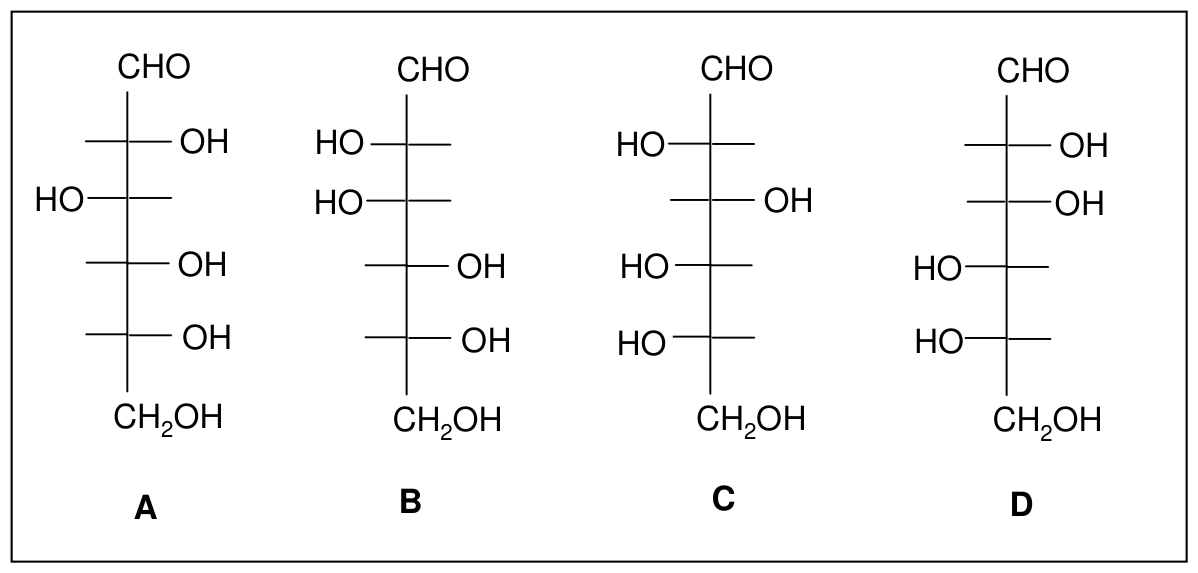
5.4 Two hydrocarbon compounds of the same molecular formula, \(\ce{C4H8}\), easily react with hydrogen in the presence of a platinum catalyst. During ozonolysis only ethanal (acetaldehyde) is formed in both cases. The \(\ce{^1H}\)-NMR spectra of the two compounds show two types of protons in a ratio of 3 to 1. Draw the structures of the described compounds.
5.5 Select the components of the group listed below that can be obtained during complete hydrolysis of lecithin (a phospholipid): serine, phosphoric acid, sphingosine, choline, glycerol, myo-inositol, phosphatidic acid and fatty acids).
5.6 Which of the following carboxylic acid can be formed in the tricarboxylic acid cycle (Krebs' citric acid cycle):
maleic acid (cis-butenedioic acid), mandelic acid (a-hydroxy-phenylethanoic acid), malic acid (2-hydroxy-butanedioic acid), tricarb-allylic acid (propane-1,2,3-tricarboxylic acid), oxalacetic acid (2-oxo-butanedioic acid), keto-glutaric acid (2-oxo-pentanedioic acid), fumaric acid (trans-butenedioic acid) and acetoacetic acid (3-oxo-butanoic acid).
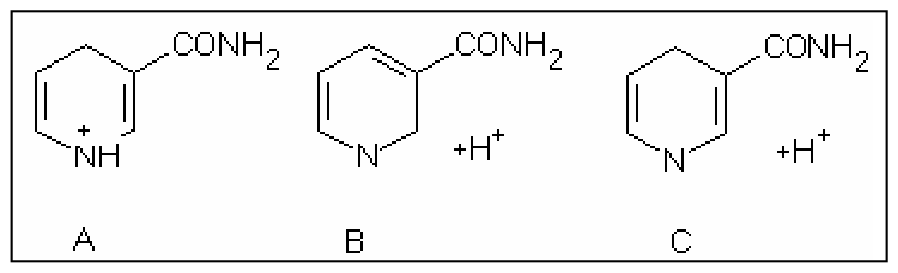
5.7 To which structures is the nicotinamide moiety (part) of \(\ce{NAD+}\) converted during the uptake of hydrogen to form \(\ce{NADH}\) (A, B or C)?
Official English text of the problem.
Answers
-
5.1: Primary : secondary : tertiary monochlorination products \(=\boxed{9:2:1}\), corresponding to \(75.0\%\), \(16.7\%\), and \(8.33\%\).
-
5.2: The results are:
| Alcohol | 1) Cold, concentrated \(\ce{H2SO4}\) | 2) \(\ce{CrO3/H2SO4}\) | 3) \(\ce{ZnCl2/HCl}\), ordinary room-temperature Lucas test | 4) \(\ce{I2/NaOH}\) |
|---|---|---|---|---|
Pentan-1-ol CCCCCO |
Reacts | Reacts | No observable reaction within the usual test time; reacts on heating | Negative |
Pentan-2-ol CC(O)CCC |
Reacts | Reacts | Reacts more slowly | Positive |
2-Methylbutan-2-ol CC(O)(C)CC |
Reacts | No normal oxidation | Reacts rapidly | Negative |
-
5.3: Enantiomer pairs: A–C and B–D. Diastereomer pairs: A–B, A–D, B–C and C–D.
-
5.4: cis-(Z)-But-2-ene
C/C=C\Cand trans-(E)-but-2-eneC/C=C/C. -
5.5: Phosphoric acid
OP(=O)(O)O, cholineC[N+](C)(C)CCO, glycerolOCC(O)CO, and fatty acids[*]C(=O)O. Here[*]denotes an unspecified fatty-acid hydrocarbon residue. -
5.6: L-(S)-Malic acid
O=C(O)[C@@H](O)CC(=O)O, oxaloacetic acidO=C(O)C(=O)CC(=O)O, 2-oxoglutaric acidO=C(O)C(=O)CCC(=O)O, and fumaric acidO=C(O)/C=C/C(=O)O. -
5.7: C, the 1,4-dihydronicotinamide moiety of \(\ce{NADH}\),
[*]N1C=C(C(=O)N)CC=C1. Here[*]represents the unchanged substituent connecting the ring nitrogen to the rest of the cofactor.
Solution
5.1 — Statistical chlorination
Methyl butane is 2-methylbutane, CC(C)CC, with condensed structure \(\ce{(CH3)2CHCH2CH3}\).
With equal substitution rates for every \(\ce{C-H}\) bond, the probability of substitution at a particular kind of carbon is proportional to the number of hydrogens attached to that kind of carbon.
| Carbon environment | Number of attached hydrogens | Product class |
|---|---|---|
| Three methyl groups | \(3\times3=9\) | Primary |
| One methylene group | \(2\) | Secondary |
| One methine group | \(1\) | Tertiary |
| Total | 12 |
Therefore, \[ \boxed{n(1^\circ):n(2^\circ):n(3^\circ)=9:2:1}. \]
The corresponding fractions are \[ \frac{9}{12}=75.0\%,\qquad \frac{2}{12}=16.7\%,\qquad \frac{1}{12}=8.33\%. \]
The balanced monochlorination equation is
\[
\ce{C5H12 + Cl2 ->[\Delta] C5H11Cl + HCl}.
\]
Chlorine has SMILES ClCl; hydrogen chloride has SMILES Cl.
There are four constitutional monochlorination products:
| Product | SMILES | Statistical weight |
|---|---|---|
| Racemic 1-chloro-2-methylbutane | ClC[C@H](C)CC and ClC[C@@H](C)CC |
6 |
| 1-Chloro-3-methylbutane | ClCCC(C)C |
3 |
| Racemic 2-chloro-3-methylbutane | C[C@H](Cl)C(C)C and C[C@@H](Cl)C(C)C |
2 |
| 2-Chloro-2-methylbutane | CC(Cl)(C)CC |
1 |
The two primary products together account for \(6+3=9\) hydrogens. The enantiomers within each racemic product have equal statistical yields.
5.2 — Reactions of the alcohols
The three alcohols are respectively primary, secondary and tertiary. Their differing oxidation and substitution behaviour follows from the substitution of the carbon bearing the hydroxyl group.
1) Cold, concentrated sulphuric acid
All three alcohols react with sulphuric acid, OS(=O)(=O)O. Protonation and formation of alkyl hydrogen sulfates are possible:
\[
\ce{ROH + H2SO4 <=> ROSO3H + H2O}.
\]
Water has SMILES O.
For the three alcohols, the corresponding sulfate ester structures are:
| Alcohol-derived sulfate ester | SMILES |
|---|---|
| Pentyl hydrogen sulfate | CCCCCOS(=O)(=O)O |
| Pentan-2-yl hydrogen sulfate | CC(OS(=O)(=O)O)CCC |
| 2-Methylbutan-2-yl hydrogen sulfate | CC(C)(OS(=O)(=O)O)CC |
These structures do not imply that a single sulfate ester is the exclusive product under every acid concentration and temperature. In particular, the tertiary alcohol also undergoes facile acid-catalysed dehydration: \[ \ce{(CH3)2C(OH)CH2CH3 ->[H2SO4] (CH3)2C=CHCH3 + H2O}, \] \[ \ce{(CH3)2C(OH)CH2CH3 ->[H2SO4] CH2=C(CH3)CH2CH3 + H2O}. \]
The alkenes are 2-methylbut-2-ene, CC(C)=CC, and 2-methylbut-1-ene, C=C(C)CC. Thus the qualitative answer is positive for all three alcohols.
2) Chromium trioxide in sulphuric acid
Chromium trioxide, O=[Cr](=O)=O, oxidizes the primary and secondary alcohols under the usual aqueous acidic conditions.
Pentan-1-ol is oxidized through pentanal, CCCCC=O, to pentanoic acid, CCCCC(=O)O. The overall balanced ionic equation is
\[
\ce{3CH3(CH2)4OH + 4CrO3 + 12H+ ->
3CH3(CH2)3COOH + 4Cr^3+ + 9H2O}.
\]
Pentan-2-ol is oxidized to pentan-2-one, CC(=O)CCC:
\[
\ce{3CH3CH(OH)CH2CH2CH3 + 2CrO3 + 6H+ ->
3CH3COCH2CH2CH3 + 2Cr^3+ + 6H2O}.
\]
Here the hydrogen ion is [H+] and the chromium(III) ion is [Cr+3]; sulfate spectator ions have been omitted.
The tertiary alcohol has no hydrogen on its hydroxyl-bearing carbon. It therefore does not undergo the normal alcohol-to-carbonyl oxidation without breaking carbon–carbon bonds.
3) Zinc chloride and hydrochloric acid: the Lucas reagent
Zinc chloride, [Zn+2].[Cl-].[Cl-], promotes replacement of the hydroxyl group by chloride:
\[
\ce{ROH + HCl ->[ZnCl2] RCl + H2O}.
\]
The corresponding chlorides are:
| Starting alcohol | Chloride product | SMILES |
|---|---|---|
| Pentan-1-ol | 1-Chloropentane | CCCCCCl |
| Pentan-2-ol | 2-Chloropentane | CC(Cl)CCC |
| 2-Methylbutan-2-ol | 2-Chloro-2-methylbutane | CC(Cl)(C)CC |
The tertiary alcohol reacts rapidly because formation of a tertiary carbocation is relatively favourable. The secondary alcohol reacts more slowly. The primary alcohol does not give the usual positive room-temperature Lucas test; its substitution is much slower and can be achieved on heating.
The problem specifies no configuration for pentan-2-ol, so the SMILES for its derivatives leave that stereochemistry unspecified.
4) Iodine and sodium hydroxide: the iodoform reaction
Iodine, II, and sodium hydroxide, [Na+].[OH-], give a positive iodoform reaction with a methyl ketone or an alcohol that can be oxidized to one.
Only pentan-2-ol has the required \(\ce{CH3CH(OH)-}\) group. It first forms pentan-2-one; iodination and cleavage then produce iodoform, IC(I)I, and sodium butanoate, CCCC(=O)[O-].[Na+].
The balanced overall equation is
\[
\ce{CH3CH(OH)CH2CH2CH3 + 4I2 + 6NaOH ->
CH3CH2CH2COONa + CHI3 + 5NaI + 5H2O}.
\]
Sodium iodide has SMILES [Na+].[I-].
The positive observation is a yellow iodoform precipitate. Pentan-1-ol does not have the required carbon skeleton, and the tertiary alcohol cannot undergo the necessary oxidation to a methyl ketone.
5.3 — Enantiomers and diastereomers
Read each Fischer projection from the aldehyde end, recording the hydroxyl positions at C2, C3, C4 and C5. Horizontal Fischer bonds point towards the viewer; vertical bonds point away.
| Structure | Hydroxyl positions, C2 to C5 | Identity | Open-chain stereochemical SMILES |
|---|---|---|---|
| A | Right, left, right, right | D-Glucose | O=C[C@H](O)[C@@H](O)[C@H](O)[C@H](O)CO |
| B | Left, left, right, right | D-Mannose | O=C[C@@H](O)[C@@H](O)[C@H](O)[C@H](O)CO |
| C | Left, right, left, left | L-Glucose | O=C[C@@H](O)[C@H](O)[C@@H](O)[C@@H](O)CO |
| D | Right, right, left, left | L-Mannose | O=C[C@H](O)[C@H](O)[C@@H](O)[C@@H](O)CO |
Enantiomers have opposite configurations at every stereogenic centre. Accordingly, \[ \boxed{\text{Enantiomers: A–C and B–D}}. \]
Diastereomers differ at some, but not all, stereogenic centres: \[ \boxed{\text{Diastereomers: A–B,\ A–D,\ B–C,\ C–D}}. \]
More specifically, A–B and C–D differ only at C2 and are C2 epimers. A–D and B–C differ at C3, C4 and C5.
5.4 — Identification of the two hydrocarbons
The molecular formula gives one degree of unsaturation: \[ \mathrm{DBE}=\frac{2(4)+2-8}{2}=1. \]
Hydrogenation and ozonolysis identify this unsaturation as a carbon–carbon double bond. Since ozonolysis gives only ethanal, CC=O, each double-bond carbon must carry one methyl group and one hydrogen. The connectivity is therefore
\[
\ce{CH3CH=CHCH3}.
\]
This connectivity has two geometrical isomers:
- cis-(Z)-But-2-ene,
C/C=C\C: draw the two methyl groups on the same side of the double bond. - trans-(E)-But-2-ene,
C/C=C/C: draw the two methyl groups on opposite sides of the double bond.
In each drawing, each alkene carbon also bears one hydrogen.
Both compounds hydrogenate to butane, CCCC:
\[
\ce{CH3CH=CHCH3 + H2 ->[Pt] CH3CH2CH2CH3}.
\]
Hydrogen has SMILES [H][H]; platinum is represented by [Pt].
For example, with a reductive zinc work-up, their ozonolysis can be written:
\[
\ce{CH3CH=CHCH3 + O3 + Zn -> 2CH3CHO + ZnO}.
\]
The additional species are ozone, [O-][O+]=O; zinc, [Zn]; and zinc oxide, [Zn+2].[O-2].
In either isomer, symmetry makes the two methyl groups equivalent and the two alkene hydrogens equivalent. The integrated proton counts are therefore \[ 6:2=\boxed{3:1}, \] as required.
5.5 — Complete hydrolysis of lecithin
Lecithin here means phosphatidylcholine. It contains a glycerol backbone, two fatty-acid ester groups, and a phosphate diester connecting glycerol to choline.
A generic connectivity SMILES is
C[N+](C)(C)CCOP(=O)([O-])OCC(OC(=O)[*:2])COC(=O)[*:1].
The mapped wildcards represent the two unspecified hydrocarbon residues. Glycerol stereochemistry is immaterial to identifying the complete-hydrolysis products.
Complete hydrolysis breaks the two carboxylic ester bonds and both phosphate ester bonds. Consequently, one mole of lecithin yields:
| Component | Amount per mole of lecithin |
|---|---|
| Glycerol | \(1\ \mathrm{mol}\) |
| Fatty acids | \(2\ \mathrm{mol}\) |
| Phosphoric acid | \(1\ \mathrm{mol}\) |
| Choline | \(1\ \mathrm{mol}\) |
Writing the neutral zwitterionic phosphatidylcholine as PC, a balanced acid-hydrolysis equation is \[ \ce{PC + 4H2O + H+ -> C3H8O3 + R^1COOH + R^2COOH + H3PO4 + C5H14NO+}. \]
The proton on the left accounts for the charge of the choline cation when the phosphorus-containing product is written as neutral phosphoric acid.
Phosphatidic acid, with generic neutral-acid SMILES
O=P(O)(O)OCC(OC(=O)[*:2])COC(=O)[*:1],
can arise during partial hydrolysis. It still contains ester bonds and is therefore not an end product of complete hydrolysis.
5.6 — Acids belonging to the citric acid cycle
Four of the listed acids correspond to cycle intermediates:
| Selected acid | Reason |
|---|---|
| L-(S)-Malic acid | Its conjugate base, L-malate, is formed by stereospecific hydration of fumarate. |
| Oxaloacetic acid | Oxaloacetate is formed by oxidation of malate and regenerated at the end of the cycle. |
| 2-Oxoglutaric acid | Also called \(\alpha\)-ketoglutaric acid; it is the cycle’s five-carbon 2-oxo dicarboxylic acid intermediate. |
| Fumaric acid | Its conjugate base, fumarate, is the cycle’s trans-unsaturated dicarboxylate. |
For example, using the acid forms to display their carbon skeletons, the hydration is \[ \ce{HOOC-CH=CH-COOH + H2O -> HOOC-CH(OH)-CH2-COOH}, \] where the substrate is trans and the product has the L-(S) configuration.
The subsequent oxidation is \[ \ce{HOOC-CH(OH)-CH2-COOH + NAD+ -> HOOC-C(=O)-CH2-COOH + NADH + H+}. \]
The other choices are excluded as follows:
| Excluded acid | SMILES | Reason |
|---|---|---|
| Maleic acid | O=C(O)/C=C\C(=O)O |
It has cis geometry; the cycle contains trans-fumarate. |
| Mandelic acid | O=C(O)C(O)c1ccccc1 |
This aromatic hydroxy acid is not a cycle intermediate. |
| Tricarb-allylic acid | O=C(O)CC(CC(=O)O)C(=O)O |
It is not a cycle intermediate; unlike citric acid, it lacks the hydroxyl group. |
| Acetoacetic acid | CC(=O)CC(=O)O |
It belongs to ketone-body metabolism, rather than being an intermediate of the cycle itself. |
For comparison, citric acid has SMILES O=C(O)CC(O)(CC(=O)O)C(=O)O.
5.7 — Reduction of the nicotinamide ring
The correct structure is C.
Number the nicotinamide ring nitrogen as position 1. During reduction, a hydride equivalent—one hydrogen nucleus together with two electrons—is transferred to C4, the carbon opposite the nitrogen.
The balanced reduction half-equation is
\[
\ce{NAD+ + H+ + 2e- -> NADH}.
\]
Equivalently, the hydride-transfer bookkeeping is
\[
\ce{NAD+ + H- -> NADH},
\]
where hydride has SMILES [H-]; this notation does not imply a free hydride ion in aqueous solution.
The relevant ring structures are:
| State | Nicotinamide-moiety SMILES |
|---|---|
| Oxidized pyridinium moiety of \(\ce{NAD+}\) | [*][n+]1cc(C(=O)N)ccc1 |
| Reduced 1,4-dihydronicotinamide moiety of \(\ce{NADH}\) | [*]N1C=C(C(=O)N)CC=C1 |
Here [*] represents the unchanged ribosyl linkage to the remainder of the cofactor.
Hydride addition and rearrangement of the ring’s \(\pi\) electrons neutralize the nitrogen. C4 becomes a methylene carbon, and the remaining double bonds are C2=C3 and C5=C6. These are precisely the features shown in C.
In a substrate dehydrogenation, such as malate oxidation above, the second hydrogen is released to the medium as \(\ce{H+}\), explaining the proton drawn alongside C. Structure A instead shows a protonated, positively charged nitrogen; B has the wrong double-bond arrangement.
The solution was checked against the official solution. Where this solution differs from the official solution, the official solution contains an error or a misprint.
IChO 1987 · Theorieaufgabe 5
Fragen zur organischen Chemie: Chlorierung, Alkohole, Aldohexosen, C4H8-Isomere, Lecithin, Citratzyklus, NAD+
5.1 Welches Verhältnis von primären / sekundären / tertiären Produkten ist bei der Hochtemperaturchlorierung von Methylbutan statistisch zu erwarten? Nehmen Sie an, dass die Reaktionsgeschwindigkeit der Substitution für alle C-H-Bindungen gleich ist.
5.2 Welche der folgenden Alkohole: Pentan-1-ol, Pentan-2-ol und 2-Methylbutan-2-ol reagieren mit den nachstehend aufgeführten Reagenzien?
1) kalte, konzentrierte Schwefelsäure; 2) \(\ce{CrO3 / H2SO4}\); 3) \(\ce{ZnCl2 / HCl}\); 4) \(\ce{I2 / NaOH}\)
5.3 Welche der folgenden Aldohexosestrukturen bilden:
1) Enantiomerenpaare, 2) Diastereomerenpaare?
5.4 Zwei Kohlenwasserstoffverbindungen mit derselben Summenformel, \(\ce{C4H8}\), reagieren in Gegenwart eines Platinkatalysators leicht mit Wasserstoff. Bei der Ozonolyse entsteht in beiden Fällen ausschließlich Ethanal (Acetaldehyd). Die \(\ce{^1H}\)-NMR-Spektren der beiden Verbindungen zeigen zwei Arten von Protonen im Verhältnis 3 zu 1. Zeichnen Sie die Strukturen der beschriebenen Verbindungen.
5.5 Wählen Sie aus der nachstehenden Gruppe diejenigen Bestandteile aus, die bei der vollständigen Hydrolyse von Lecithin (einem Phospholipid) erhalten werden können: Serin, Phosphorsäure, Sphingosin, Cholin, Glycerin, myo-Inositol, Phosphatidsäure und Fettsäuren).
5.6 Welche der folgenden Carbonsäuren können im Tricarbonsäurezyklus (Krebs-Citratzyklus) gebildet werden:
Maleinsäure (cis-Butendisäure), Mandelsäure (α-Hydroxyphenylessigsäure), Äpfelsäure (2-Hydroxybutandisäure), Tricarballylsäure (Propan-1,2,3-tricarbonsäure), Oxalessigsäure (2-Oxobutandisäure), Ketoglutarsäure (2-Oxopentandisäure), Fumarsäure (trans-Butendisäure) und Acetessigsäure (3-Oxobutansäure).
5.7 In welche Struktur wird der Nicotinamidrest (Teil) von \(\ce{NAD+}\) bei der Aufnahme von Wasserstoff unter Bildung von \(\ce{NADH}\) umgewandelt (A, B oder C)?
Aufgabentext aus dem offiziellen englischen Text übersetzt.
Antworten
-
5.1: Primäre : sekundäre : tertiäre Monochlorierungsprodukte \(=\boxed{9:2:1}\), entsprechend \(75.0\%\), \(16.7\%\) und \(8.33\%\).
-
5.2: Die Ergebnisse sind:
| Alkohol | 1) Kalte, konzentrierte \(\ce{H2SO4}\) | 2) \(\ce{CrO3/H2SO4}\) | 3) \(\ce{ZnCl2/HCl}\), übliche Lucas-Probe bei Raumtemperatur | 4) \(\ce{I2/NaOH}\) |
|---|---|---|---|---|
Pentan-1-ol CCCCCO |
Reagiert | Reagiert | Keine beobachtbare Reaktion innerhalb der üblichen Prüfzeit; reagiert beim Erhitzen | Negativ |
Pentan-2-ol CC(O)CCC |
Reagiert | Reagiert | Reagiert langsamer | Positiv |
2-Methylbutan-2-ol CC(O)(C)CC |
Reagiert | Keine normale Oxidation | Reagiert rasch | Negativ |
-
5.3: Enantiomerenpaare: A–C und B–D. Diastereomerenpaare: A–B, A–D, B–C und C–D.
-
5.4: cis-(Z)-But-2-en
C/C=C\Cund trans-(E)-But-2-enC/C=C/C. -
5.5: Phosphorsäure
OP(=O)(O)O, CholinC[N+](C)(C)CCO, GlycerinOCC(O)COund Fettsäuren[*]C(=O)O. Dabei bezeichnet[*]einen nicht näher bestimmten Kohlenwasserstoffrest einer Fettsäure. -
5.6: L-(S)-Äpfelsäure
O=C(O)[C@@H](O)CC(=O)O, OxalessigsäureO=C(O)C(=O)CC(=O)O, 2-OxoglutarsäureO=C(O)C(=O)CCC(=O)Ound FumarsäureO=C(O)/C=C/C(=O)O. -
5.7: C, der 1,4-Dihydronicotinamidrest von \(\ce{NADH}\),
[*]N1C=C(C(=O)N)CC=C1. Dabei steht[*]für den unveränderten Substituenten, der den Ringstickstoff mit dem übrigen Cofaktor verbindet.
Lösung
5.1 — Statistische Chlorierung
Methylbutan ist 2-Methylbutan, CC(C)CC, mit der Halbstrukturformel \(\ce{(CH3)2CHCH2CH3}\).
Bei gleicher Substitutionsgeschwindigkeit für jede \(\ce{C-H}\)-Bindung ist die Wahrscheinlichkeit einer Substitution an einer bestimmten Art von Kohlenstoffatom proportional zur Anzahl der an diese Art von Kohlenstoffatom gebundenen Wasserstoffatome.
| Kohlenstoffumgebung | Anzahl der gebundenen Wasserstoffatome | Produktklasse |
|---|---|---|
| Drei Methylgruppen | \(3\times3=9\) | Primär |
| Eine Methylengruppe | \(2\) | Sekundär |
| Eine Methingruppe | \(1\) | Tertiär |
| Insgesamt | 12 |
Daher gilt: \[ \boxed{n(1^\circ):n(2^\circ):n(3^\circ)=9:2:1}. \]
Die entsprechenden Anteile sind \[ \frac{9}{12}=75.0\%,\qquad \frac{2}{12}=16.7\%,\qquad \frac{1}{12}=8.33\%. \]
Die ausgeglichene Gleichung der Monochlorierung lautet
\[
\ce{C5H12 + Cl2 ->[\Delta] C5H11Cl + HCl}.
\]
Chlor hat den SMILES-Code ClCl; Chlorwasserstoff hat den SMILES-Code Cl.
Es gibt vier konstitutionsisomere Monochlorierungsprodukte:
| Produkt | SMILES | Statistisches Gewicht |
|---|---|---|
| Racemisches 1-Chlor-2-methylbutan | ClC[C@H](C)CC und ClC[C@@H](C)CC |
6 |
| 1-Chlor-3-methylbutan | ClCCC(C)C |
3 |
| Racemisches 2-Chlor-3-methylbutan | C[C@H](Cl)C(C)C und C[C@@H](Cl)C(C)C |
2 |
| 2-Chlor-2-methylbutan | CC(Cl)(C)CC |
1 |
Auf die beiden primären Produkte entfallen zusammen \(6+3=9\) Wasserstoffatome. Die Enantiomere innerhalb jedes racemischen Produkts haben gleiche statistische Ausbeuten.
5.2 — Reaktionen der Alkohole
Die drei Alkohole sind in der angegebenen Reihenfolge primär, sekundär und tertiär. Ihr unterschiedliches Oxidations- und Substitutionsverhalten ergibt sich aus dem Substitutionsgrad des Kohlenstoffatoms, das die Hydroxygruppe trägt.
1) Kalte, konzentrierte Schwefelsäure
Alle drei Alkohole reagieren mit Schwefelsäure, OS(=O)(=O)O. Protonierung und die Bildung von Alkylhydrogensulfaten sind möglich:
\[
\ce{ROH + H2SO4 <=> ROSO3H + H2O}.
\]
Wasser hat den SMILES-Code O.
Für die drei Alkohole lauten die entsprechenden Sulfatesterstrukturen:
| Vom Alkohol abgeleiteter Sulfatester | SMILES |
|---|---|
| Pentylhydrogensulfat | CCCCCOS(=O)(=O)O |
| Pentan-2-ylhydrogensulfat | CC(OS(=O)(=O)O)CCC |
| 2-Methylbutan-2-ylhydrogensulfat | CC(C)(OS(=O)(=O)O)CC |
Diese Strukturen bedeuten nicht, dass bei jeder Säurekonzentration und Temperatur ein einzelner Sulfatester das ausschließliche Produkt ist. Insbesondere wird der tertiäre Alkohol auch leicht säurekatalysiert dehydratisiert: \[ \ce{(CH3)2C(OH)CH2CH3 ->[H2SO4] (CH3)2C=CHCH3 + H2O}, \] \[ \ce{(CH3)2C(OH)CH2CH3 ->[H2SO4] CH2=C(CH3)CH2CH3 + H2O}. \]
Die Alkene sind 2-Methylbut-2-en, CC(C)=CC, und 2-Methylbut-1-en, C=C(C)CC. Somit fällt die qualitative Antwort für alle drei Alkohole positiv aus.
2) Chromtrioxid in Schwefelsäure
Chromtrioxid, O=[Cr](=O)=O, oxidiert unter den üblichen wässrig-sauren Bedingungen die primären und sekundären Alkohole.
Pentan-1-ol wird über Pentanal, CCCCC=O, zu Pentansäure, CCCCC(=O)O, oxidiert. Die ausgeglichene Gesamtgleichung in Ionenschreibweise lautet
\[
\ce{3CH3(CH2)4OH + 4CrO3 + 12H+ ->
3CH3(CH2)3COOH + 4Cr^3+ + 9H2O}.
\]
Pentan-2-ol wird zu Pentan-2-on, CC(=O)CCC, oxidiert:
\[
\ce{3CH3CH(OH)CH2CH2CH3 + 2CrO3 + 6H+ ->
3CH3COCH2CH2CH3 + 2Cr^3+ + 6H2O}.
\]
Dabei ist das Wasserstoffion [H+] und das Chrom(III)-Ion [Cr+3]; Sulfationen als Zuschauerionen wurden weggelassen.
Der tertiäre Alkohol besitzt kein Wasserstoffatom an seinem hydroxygruppentragenden Kohlenstoffatom. Daher kann er die normale Oxidation eines Alkohols zur Carbonylverbindung nicht ohne Spaltung von Kohlenstoff–Kohlenstoff-Bindungen eingehen.
3) Zinkchlorid und Salzsäure: das Lucas-Reagenz
Zinkchlorid, [Zn+2].[Cl-].[Cl-], fördert den Ersatz der Hydroxygruppe durch Chlorid:
\[
\ce{ROH + HCl ->[ZnCl2] RCl + H2O}.
\]
Die entsprechenden Chloride sind:
| Ausgangsalkohol | Chloridprodukt | SMILES |
|---|---|---|
| Pentan-1-ol | 1-Chlorpentan | CCCCCCl |
| Pentan-2-ol | 2-Chlorpentan | CC(Cl)CCC |
| 2-Methylbutan-2-ol | 2-Chlor-2-methylbutan | CC(Cl)(C)CC |
Der tertiäre Alkohol reagiert rasch, da die Bildung eines tertiären Carbokations relativ günstig ist. Der sekundäre Alkohol reagiert langsamer. Der primäre Alkohol ergibt bei Raumtemperatur nicht die übliche positive Lucas-Probe; seine Substitution verläuft wesentlich langsamer und lässt sich durch Erhitzen erreichen.
Die Aufgabe gibt für Pentan-2-ol keine Konfiguration vor; daher bleibt diese Stereochemie in den SMILES-Codes seiner Derivate unbestimmt.
4) Iod und Natriumhydroxid: die Iodoformreaktion
Iod, II, und Natriumhydroxid, [Na+].[OH-], ergeben mit einem Methylketon oder einem Alkohol, der zu einem solchen oxidiert werden kann, eine positive Iodoformreaktion.
Nur Pentan-2-ol besitzt die erforderliche \(\ce{CH3CH(OH)-}\)-Gruppe. Es bildet zunächst Pentan-2-on; durch Iodierung und Spaltung entstehen anschließend Iodoform, IC(I)I, und Natriumbutanoat, CCCC(=O)[O-].[Na+].
Die ausgeglichene Gesamtgleichung lautet
\[
\ce{CH3CH(OH)CH2CH2CH3 + 4I2 + 6NaOH ->
CH3CH2CH2COONa + CHI3 + 5NaI + 5H2O}.
\]
Natriumiodid hat den SMILES-Code [Na+].[I-].
Ein positiver Nachweis zeigt sich durch einen gelben Iodoformniederschlag. Pentan-1-ol besitzt nicht das erforderliche Kohlenstoffgerüst, und der tertiäre Alkohol kann die notwendige Oxidation zu einem Methylketon nicht eingehen.
5.3 — Enantiomere und Diastereomere
Lesen Sie jede Fischer-Projektion vom Aldehydende aus und notieren Sie die Positionen der Hydroxygruppen an C2, C3, C4 und C5. Horizontale Bindungen in der Fischer-Projektion zeigen zum Betrachter hin; vertikale Bindungen zeigen von ihm weg.
| Struktur | Positionen der Hydroxygruppen, C2 bis C5 | Identität | Stereochemischer SMILES-Code der offenkettigen Form |
|---|---|---|---|
| A | Rechts, links, rechts, rechts | D-Glucose | O=C[C@H](O)[C@@H](O)[C@H](O)[C@H](O)CO |
| B | Links, links, rechts, rechts | D-Mannose | O=C[C@@H](O)[C@@H](O)[C@H](O)[C@H](O)CO |
| C | Links, rechts, links, links | L-Glucose | O=C[C@@H](O)[C@H](O)[C@@H](O)[C@@H](O)CO |
| D | Rechts, rechts, links, links | L-Mannose | O=C[C@H](O)[C@H](O)[C@@H](O)[C@@H](O)CO |
Enantiomere haben an jedem stereogenen Zentrum entgegengesetzte Konfigurationen. Dementsprechend gilt: \[ \boxed{\text{Enantiomere: A–C und B–D}}. \]
Diastereomere unterscheiden sich an einigen, aber nicht allen stereogenen Zentren: \[ \boxed{\text{Diastereomere: A–B,\ A–D,\ B–C,\ C–D}}. \]
Genauer gesagt unterscheiden sich A–B und C–D nur an C2 und sind C2-Epimere. A–D und B–C unterscheiden sich an C3, C4 und C5.
5.4 — Identifizierung der beiden Kohlenwasserstoffe
Aus der Summenformel ergibt sich ein Doppelbindungsäquivalent: \[ \mathrm{DBE}=\frac{2(4)+2-8}{2}=1. \]
Hydrierung und Ozonolyse zeigen, dass diese Ungesättigtheit auf eine Kohlenstoff–Kohlenstoff-Doppelbindung zurückgeht. Da die Ozonolyse nur Ethanal, CC=O, liefert, muss jedes Doppelbindungskohlenstoffatom eine Methylgruppe und ein Wasserstoffatom tragen. Die Verknüpfung der Atome ist daher
\[
\ce{CH3CH=CHCH3}.
\]
Bei dieser Verknüpfung gibt es zwei geometrische Isomere:
- cis-(Z)-But-2-en,
C/C=C\C: Zeichnen Sie die beiden Methylgruppen auf derselben Seite der Doppelbindung. - trans-(E)-But-2-en,
C/C=C/C: Zeichnen Sie die beiden Methylgruppen auf gegenüberliegenden Seiten der Doppelbindung.
In jeder Zeichnung trägt jedes Alkenkohlenstoffatom außerdem ein Wasserstoffatom.
Beide Verbindungen werden zu Butan, CCCC, hydriert:
\[
\ce{CH3CH=CHCH3 + H2 ->[Pt] CH3CH2CH2CH3}.
\]
Wasserstoff hat den SMILES-Code [H][H]; Platin wird durch [Pt] dargestellt.
Beispielsweise lässt sich ihre Ozonolyse bei reduktiver Aufarbeitung mit Zink wie folgt schreiben:
\[
\ce{CH3CH=CHCH3 + O3 + Zn -> 2CH3CHO + ZnO}.
\]
Die zusätzlichen Spezies sind Ozon, [O-][O+]=O; Zink, [Zn]; und Zinkoxid, [Zn+2].[O-2].
In beiden Isomeren sind aufgrund der Symmetrie die beiden Methylgruppen untereinander und die beiden Alkenwasserstoffatome untereinander äquivalent. Die durch Integration bestimmten Protonenzahlen stehen daher im Verhältnis \[ 6:2=\boxed{3:1}, \] wie gefordert.
5.5 — Vollständige Hydrolyse von Lecithin
Mit Lecithin ist hier Phosphatidylcholin gemeint. Es enthält ein Glyceringerüst, zwei Fettsäureestergruppen und einen Phosphatdiester, der Glycerin mit Cholin verbindet.
Ein allgemeiner SMILES-Code für die Verknüpfung der Atome lautet
C[N+](C)(C)CCOP(=O)([O-])OCC(OC(=O)[*:2])COC(=O)[*:1].
Die nummerierten Platzhalter stehen für die beiden nicht näher bestimmten Kohlenwasserstoffreste. Die Stereochemie des Glycerins ist für die Identifizierung der Produkte der vollständigen Hydrolyse unerheblich.
Bei der vollständigen Hydrolyse werden die beiden Carbonsäureesterbindungen und beide Phosphatesterbindungen gespalten. Folglich liefert ein Mol Lecithin:
| Bestandteil | Stoffmenge pro Mol Lecithin |
|---|---|
| Glycerin | \(1\ \mathrm{mol}\) |
| Fettsäuren | \(2\ \mathrm{mol}\) |
| Phosphorsäure | \(1\ \mathrm{mol}\) |
| Cholin | \(1\ \mathrm{mol}\) |
Bezeichnet man das neutrale zwitterionische Phosphatidylcholin als PC, so lautet eine ausgeglichene Gleichung der sauren Hydrolyse \[ \ce{PC + 4H2O + H+ -> C3H8O3 + R^1COOH + R^2COOH + H3PO4 + C5H14NO+}. \]
Das Proton auf der linken Seite berücksichtigt die Ladung des Cholinkations, wenn das phosphorhaltige Produkt als neutrale Phosphorsäure geschrieben wird.
Phosphatidsäure, mit dem allgemeinen SMILES-Code der neutralen Säure
O=P(O)(O)OCC(OC(=O)[*:2])COC(=O)[*:1],
kann bei partieller Hydrolyse entstehen. Sie enthält noch Esterbindungen und ist daher kein Endprodukt der vollständigen Hydrolyse.
5.6 — Säuren des Citratzyklus
Vier der aufgeführten Säuren entsprechen Zwischenprodukten des Zyklus:
| Ausgewählte Säure | Begründung |
|---|---|
| L-(S)-Äpfelsäure | Ihre konjugierte Base, L-Malat, entsteht durch stereospezifische Hydratisierung von Fumarat. |
| Oxalessigsäure | Oxalacetat entsteht durch Oxidation von Malat und wird am Ende des Zyklus regeneriert. |
| 2-Oxoglutarsäure | Auch als \(\alpha\)-Ketoglutarsäure bezeichnet; sie ist das 2-Oxodicarbonsäure-Zwischenprodukt des Zyklus mit fünf Kohlenstoffatomen. |
| Fumarsäure | Ihre konjugierte Base, Fumarat, ist das trans-ungesättigte Dicarboxylat des Zyklus. |
Verwendet man beispielsweise die Säureformen zur Darstellung ihrer Kohlenstoffgerüste, so lautet die Hydratisierung \[ \ce{HOOC-CH=CH-COOH + H2O -> HOOC-CH(OH)-CH2-COOH}, \] wobei das Substrat trans-konfiguriert ist und das Produkt die L-(S)-Konfiguration besitzt.
Die anschließende Oxidation lautet \[ \ce{HOOC-CH(OH)-CH2-COOH + NAD+ -> HOOC-C(=O)-CH2-COOH + NADH + H+}. \]
Die übrigen Auswahlmöglichkeiten werden aus folgenden Gründen ausgeschlossen:
| Ausgeschlossene Säure | SMILES | Begründung |
|---|---|---|
| Maleinsäure | O=C(O)/C=C\C(=O)O |
Sie besitzt cis-Geometrie; der Zyklus enthält trans-Fumarat. |
| Mandelsäure | O=C(O)C(O)c1ccccc1 |
Diese aromatische Hydroxysäure ist kein Zwischenprodukt des Zyklus. |
| Tricarballylsäure | O=C(O)CC(CC(=O)O)C(=O)O |
Sie ist kein Zwischenprodukt des Zyklus; im Gegensatz zu Citronensäure fehlt ihr die Hydroxygruppe. |
| Acetessigsäure | CC(=O)CC(=O)O |
Sie gehört zum Ketonkörperstoffwechsel und ist kein Zwischenprodukt des Zyklus selbst. |
Zum Vergleich: Citronensäure hat den SMILES-Code O=C(O)CC(O)(CC(=O)O)C(=O)O.
5.7 — Reduktion des Nicotinamidrings
Die richtige Struktur ist C.
Nummerieren Sie den Ringstickstoff des Nicotinamids als Position 1. Bei der Reduktion wird ein Hydridäquivalent — ein Wasserstoffkern zusammen mit zwei Elektronen — auf C4, das dem Stickstoff gegenüberliegende Kohlenstoffatom, übertragen.
Die ausgeglichene Reduktionshalbreaktion lautet
\[
\ce{NAD+ + H+ + 2e- -> NADH}.
\]
Gleichwertig lässt sich die Hydridübertragung formal wie folgt bilanzieren:
\[
\ce{NAD+ + H- -> NADH},
\]
wobei Hydrid den SMILES-Code [H-] hat; diese Schreibweise impliziert kein freies Hydridion in wässriger Lösung.
Die relevanten Ringstrukturen sind:
| Zustand | SMILES-Code des Nicotinamidrests |
|---|---|
| Oxidierter Pyridiniumrest von \(\ce{NAD+}\) | [*][n+]1cc(C(=O)N)ccc1 |
| Reduzierter 1,4-Dihydronicotinamidrest von \(\ce{NADH}\) | [*]N1C=C(C(=O)N)CC=C1 |
Dabei steht [*] für die unveränderte Ribosylverknüpfung mit dem übrigen Cofaktor.
Die Hydridaddition und die Umlagerung der \(\pi\)-Elektronen des Rings neutralisieren den Stickstoff. C4 wird zu einem Methylenkohlenstoffatom, und die verbleibenden Doppelbindungen sind C2=C3 und C5=C6. Genau diese Merkmale sind in C dargestellt.
Bei einer Substratdehydrierung, wie der obigen Malatoxidation, wird das zweite Wasserstoffatom als \(\ce{H+}\) an das Medium abgegeben; dies erklärt das neben C eingezeichnete Proton. Struktur A zeigt stattdessen einen protonierten, positiv geladenen Stickstoff; B weist die falsche Anordnung der Doppelbindungen auf.
Die Lösung wurde mit der offiziellen Lösung abgeglichen. Wo diese Lösung von der offiziellen Lösung abweicht, enthält die offizielle Lösung einen Fehler oder Druckfehler.
IChO 1987 · Teori sorusu 5
Organik kimya soruları: klorlama, alkoller, aldoheksozlar, C4H8 izomerleri, lesitin, sitrik asit döngüsü, NAD+
5.1 Metilbütanın yüksek sıcaklıkta klorlanmasında istatistiksel olarak birincil / ikincil / üçüncül ürünlerin hangi oranda oluşması beklenir? Yer değiştirme tepkimesinin hızının tüm C-H bağları için eşit olduğunu varsayın.
5.2 Şu alkollerden hangileri aşağıda sıralanan reaktiflerle tepkimeye girer: pentan-1-ol, pentan-2-ol ve 2-metilbütan-2-ol?
1) soğuk, derişik sülfürik asit; 2) \(\ce{CrO3 / H2SO4}\); 3) \(\ce{ZnCl2 / HCl}\); 4) \(\ce{I2 / NaOH}\)
5.3 Aşağıdaki aldoheksoz yapılarından hangileri:
1) enantiyomer çiftleri, 2) diastereomer çiftleridir?
5.4 Aynı molekül formülüne, \(\ce{C4H8}\), sahip iki hidrokarbon bileşiği, platin katalizör varlığında hidrojenle kolayca tepkimeye girer. Ozonoliz sırasında her iki durumda da yalnızca etanal (asetaldehit) oluşur. İki bileşiğin \(\ce{^1H}\)-NMR spektrumları, 3'e 1 oranında iki tür proton gösterir. Tanımlanan bileşiklerin yapılarını çiziniz.
5.5 Aşağıda sıralanan gruptan, lesitinin (bir fosfolipit) tam hidrolizi sırasında elde edilebilen bileşenleri seçiniz: serin, fosforik asit, sfingozin, kolin, gliserol, miyo-inositol, fosfatidik asit ve yağ asitleri).
5.6 Aşağıdaki karboksilik asitlerden hangileri trikarboksilik asit döngüsünde (Krebs'in sitrik asit döngüsü) oluşabilir:
maleik asit (cis-bütendioik asit), mandelik asit (a-hidroksifeniletanoik asit), malik asit (2-hidroksibütandioik asit), trikarb alilik asit (propan-1,2,3-trikarboksilik asit), oksaloasetik asit (2-oksobütandioik asit), ketoglutarik asit (2-oksopentandioik asit), fumarik asit (trans-bütendioik asit) ve asetoasetik asit (3-oksobütanoik asit).
5.7 \(\ce{NAD+}\)'ın nikotinamid kısmı (bölümü), hidrojen alarak \(\ce{NADH}\) oluştururken hangi yapılara dönüşür (A, B veya C)?
Soru metni resmi İngilizce metinden çevrilmiştir.
Cevaplar
-
5.1: Birincil : ikincil : üçüncül monoklorlama ürünleri \(=\boxed{9:2:1}\); bunlar sırasıyla \(75.0\%\), \(16.7\%\) ve \(8.33\%\)'e karşılık gelir.
-
5.2: Sonuçlar şöyledir:
| Alkol | 1) Soğuk, derişik \(\ce{H2SO4}\) | 2) \(\ce{CrO3/H2SO4}\) | 3) \(\ce{ZnCl2/HCl}\), oda sıcaklığında standart Lucas testi | 4) \(\ce{I2/NaOH}\) |
|---|---|---|---|---|
Pentan-1-ol CCCCCO |
Tepkime verir | Tepkime verir | Olağan test süresi içinde gözlenebilir bir tepkime vermez; ısıtıldığında tepkime verir | Negatif |
Pentan-2-ol CC(O)CCC |
Tepkime verir | Tepkime verir | Daha yavaş tepkime verir | Pozitif |
2-Metilbütan-2-ol CC(O)(C)CC |
Tepkime verir | Normal yükseltgenme gerçekleşmez | Hızla tepkime verir | Negatif |
-
5.3: Enantiyomer çiftleri: A–C ve B–D. Diastereomer çiftleri: A–B, A–D, B–C ve C–D.
-
5.4: cis-(Z)-Büt-2-en
C/C=C\Cve trans-(E)-büt-2-enC/C=C/C. -
5.5: Fosforik asit
OP(=O)(O)O, kolinC[N+](C)(C)CCO, gliserolOCC(O)COve yağ asitleri[*]C(=O)O. Burada[*], bir yağ asidinin belirtilmemiş hidrokarbon kalıntısını gösterir. -
5.6: L-(S)-Malik asit
O=C(O)[C@@H](O)CC(=O)O, oksaloasetik asitO=C(O)C(=O)CC(=O)O, 2-oksoglutarik asitO=C(O)C(=O)CCC(=O)Ove fumarik asitO=C(O)/C=C/C(=O)O. -
5.7: C, \(\ce{NADH}\)'ın 1,4-dihidronikotinamid kısmı,
[*]N1C=C(C(=O)N)CC=C1. Burada[*], halka azotunu kofaktörün geri kalanına bağlayan, değişmeden kalan sübstitüenti temsil eder.
Çözüm
5.1 — İstatistiksel klorlama
Metilbütan, yoğunlaştırılmış yapı formülü \(\ce{(CH3)2CHCH2CH3}\) olan 2-metilbütandır, CC(C)CC.
Her \(\ce{C-H}\) bağı için yer değiştirme hızları eşit olduğunda, belirli bir karbon türünde yer değiştirme olasılığı, o tür karbona bağlı hidrojenlerin sayısıyla orantılıdır.
| Karbonun kimyasal çevresi | Bağlı hidrojen sayısı | Ürün sınıfı |
|---|---|---|
| Üç metil grubu | \(3\times3=9\) | Birincil |
| Bir metilen grubu | \(2\) | İkincil |
| Bir metin grubu | \(1\) | Üçüncül |
| Toplam | 12 |
Dolayısıyla, \[ \boxed{n(1^\circ):n(2^\circ):n(3^\circ)=9:2:1}. \]
Bunlara karşılık gelen kesirler şöyledir: \[ \frac{9}{12}=75.0\%,\qquad \frac{2}{12}=16.7\%,\qquad \frac{1}{12}=8.33\%. \]
Denkleştirilmiş monoklorlama denklemi şöyledir:
\[
\ce{C5H12 + Cl2 ->[\Delta] C5H11Cl + HCl}.
\]
Klorun SMILES gösterimi ClCl; hidrojen klorürün SMILES gösterimi Cl şeklindedir.
Birbirinin yapı izomeri olan dört monoklorlama ürünü vardır:
| Ürün | SMILES | İstatistiksel ağırlık |
|---|---|---|
| Rasemik 1-kloro-2-metilbütan | ClC[C@H](C)CC ve ClC[C@@H](C)CC |
6 |
| 1-Kloro-3-metilbütan | ClCCC(C)C |
3 |
| Rasemik 2-kloro-3-metilbütan | C[C@H](Cl)C(C)C ve C[C@@H](Cl)C(C)C |
2 |
| 2-Kloro-2-metilbütan | CC(Cl)(C)CC |
1 |
İki birincil ürün birlikte \(6+3=9\) hidrojene karşılık gelir. Her bir rasemik üründeki enantiyomerlerin istatistiksel verimleri eşittir.
5.2 — Alkollerin tepkimeleri
Üç alkol sırasıyla birincil, ikincil ve üçüncüldür. Yükseltgenme ve yer değiştirme davranışlarındaki farklılıklar, hidroksil grubunu taşıyan karbonun sübstitüsyon derecesinden kaynaklanır.
1) Soğuk, derişik sülfürik asit
Üç alkol de sülfürik asitle, OS(=O)(=O)O, tepkimeye girer. Protonlanma ve alkil hidrojen sülfat oluşumu mümkündür:
\[
\ce{ROH + H2SO4 <=> ROSO3H + H2O}.
\]
Suyun SMILES gösterimi O şeklindedir.
Üç alkol için karşılık gelen sülfat esteri yapıları şöyledir:
| Alkolden türeyen sülfat esteri | SMILES |
|---|---|
| Pentil hidrojen sülfat | CCCCCOS(=O)(=O)O |
| Pentan-2-il hidrojen sülfat | CC(OS(=O)(=O)O)CCC |
| 2-Metilbütan-2-il hidrojen sülfat | CC(C)(OS(=O)(=O)O)CC |
Bu yapılar, her asit derişiminde ve sıcaklıkta yalnızca tek bir sülfat esterinin oluştuğu anlamına gelmez. Özellikle üçüncül alkol, asit katalizli dehidrasyona da kolayca uğrar: \[ \ce{(CH3)2C(OH)CH2CH3 ->[H2SO4] (CH3)2C=CHCH3 + H2O}, \] \[ \ce{(CH3)2C(OH)CH2CH3 ->[H2SO4] CH2=C(CH3)CH2CH3 + H2O}. \]
Alkenler 2-metilbüt-2-en, CC(C)=CC ve 2-metilbüt-1-en, C=C(C)CC bileşikleridir. Dolayısıyla nitel cevap üç alkol için de pozitiftir.
2) Sülfürik asit içinde krom trioksit
Krom trioksit, O=[Cr](=O)=O, olağan sulu asidik koşullarda birincil ve ikincil alkolleri yükseltger.
Pentan-1-ol, pentanal, CCCCC=O, üzerinden pentanoik aside, CCCCC(=O)O, yükseltgenir. Denkleştirilmiş toplam iyonik denklem şöyledir:
\[
\ce{3CH3(CH2)4OH + 4CrO3 + 12H+ ->
3CH3(CH2)3COOH + 4Cr^3+ + 9H2O}.
\]
Pentan-2-ol, pentan-2-ona, CC(=O)CCC, yükseltgenir:
\[
\ce{3CH3CH(OH)CH2CH2CH3 + 2CrO3 + 6H+ ->
3CH3COCH2CH2CH3 + 2Cr^3+ + 6H2O}.
\]
Burada hidrojen iyonu [H+], krom(III) iyonu ise [Cr+3] şeklindedir; seyirci sülfat iyonları gösterilmemiştir.
Üçüncül alkolün hidroksil grubunu taşıyan karbonunda hidrojen yoktur. Bu nedenle karbon–karbon bağları kırılmadan, alkolü karbonil bileşiğine dönüştüren normal yükseltgenmeye uğramaz.
3) Çinko klorür ve hidroklorik asit: Lucas reaktifi
Çinko klorür, [Zn+2].[Cl-].[Cl-], hidroksil grubunun klorürle yer değiştirmesini kolaylaştırır:
\[
\ce{ROH + HCl ->[ZnCl2] RCl + H2O}.
\]
Karşılık gelen klorürler şöyledir:
| Başlangıç alkolü | Klorür ürünü | SMILES |
|---|---|---|
| Pentan-1-ol | 1-Kloropentan | CCCCCCl |
| Pentan-2-ol | 2-Kloropentan | CC(Cl)CCC |
| 2-Metilbütan-2-ol | 2-Kloro-2-metilbütan | CC(Cl)(C)CC |
Üçüncül karbokatyon oluşumu görece elverişli olduğundan üçüncül alkol hızla tepkimeye girer. İkincil alkol daha yavaş tepkimeye girer. Birincil alkol, oda sıcaklığındaki standart Lucas testinde pozitif sonuç vermez; yer değiştirme tepkimesi çok daha yavaştır ve ısıtmayla gerçekleştirilebilir.
Soruda pentan-2-ol için herhangi bir konfigürasyon belirtilmediğinden, türevlerinin SMILES gösterimlerinde bu stereokimya belirtilmemiştir.
4) İyot ve sodyum hidroksit: iyodoform tepkimesi
İyot, II ve sodyum hidroksit, [Na+].[OH-], bir metil ketonla veya metil ketona yükseltgenebilen bir alkolle pozitif iyodoform tepkimesi verir.
Gerekli \(\ce{CH3CH(OH)-}\) grubuna yalnızca pentan-2-ol sahiptir. Önce pentan-2-on oluşur; ardından iyotlanma ve parçalanma sonucunda iyodoform, IC(I)I ve sodyum bütanoat, CCCC(=O)[O-].[Na+], oluşur.
Denkleştirilmiş toplam denklem şöyledir:
\[
\ce{CH3CH(OH)CH2CH2CH3 + 4I2 + 6NaOH ->
CH3CH2CH2COONa + CHI3 + 5NaI + 5H2O}.
\]
Sodyum iyodürün SMILES gösterimi [Na+].[I-] şeklindedir.
Pozitif sonuç, sarı bir iyodoform çökeltisinin gözlenmesidir. Pentan-1-ol gerekli karbon iskeletine sahip değildir; üçüncül alkol ise metil ketona dönüşmek için gerekli yükseltgenmeye uğrayamaz.
5.3 — Enantiyomerler ve diastereomerler
Her Fischer projeksiyonunu aldehit ucundan başlayarak okuyun ve C2, C3, C4 ve C5'teki hidroksil gruplarının konumlarını kaydedin. Fischer projeksiyonundaki yatay bağlar gözlemciye doğru, düşey bağlar ise gözlemciden uzağa yönelir.
| Yapı | C2'den C5'e hidroksil konumları | Bileşiğin adı | Açık zincirli stereokimyasal SMILES |
|---|---|---|---|
| A | Sağ, sol, sağ, sağ | D-Glikoz | O=C[C@H](O)[C@@H](O)[C@H](O)[C@H](O)CO |
| B | Sol, sol, sağ, sağ | D-Mannoz | O=C[C@@H](O)[C@@H](O)[C@H](O)[C@H](O)CO |
| C | Sol, sağ, sol, sol | L-Glikoz | O=C[C@@H](O)[C@H](O)[C@@H](O)[C@@H](O)CO |
| D | Sağ, sağ, sol, sol | L-Mannoz | O=C[C@H](O)[C@H](O)[C@@H](O)[C@@H](O)CO |
Enantiyomerler, her stereojenik merkezde zıt konfigürasyonlara sahiptir. Buna göre, \[ \boxed{\text{Enantiyomerler: A–C ve B–D}}. \]
Diastereomerler, stereojenik merkezlerin bazılarında farklılık gösterir, ancak hepsinde değil: \[ \boxed{\text{Diastereomerler: A–B,\ A–D,\ B–C,\ C–D}}. \]
Daha özel olarak, A–B ve C–D yalnızca C2'de farklılık gösterir ve C2 epimerleridir. A–D ve B–C ise C3, C4 ve C5'te farklılık gösterir.
5.4 — İki hidrokarbonun belirlenmesi
Molekül formülü, doymamışlık derecesinin bir olduğunu gösterir: \[ \mathrm{DBE}=\frac{2(4)+2-8}{2}=1. \]
Hidrojenasyon ve ozonoliz, bu doymamışlığın bir karbon–karbon çift bağı olduğunu ortaya koyar. Ozonoliz yalnızca etanal, CC=O, verdiğinden çift bağdaki her karbon bir metil grubu ve bir hidrojen taşımalıdır. Dolayısıyla atomların bağlanma düzeni şöyledir:
\[
\ce{CH3CH=CHCH3}.
\]
Bu bağlanma düzenine sahip iki geometrik izomer vardır:
- cis-(Z)-Büt-2-en,
C/C=C\C: iki metil grubunu çift bağın aynı tarafında çizin. - trans-(E)-Büt-2-en,
C/C=C/C: iki metil grubunu çift bağın karşı taraflarında çizin.
Her çizimde, alken karbonlarının her biri ayrıca bir hidrojen taşır.
Her iki bileşik de hidrojenasyonla bütana, CCCC, dönüşür:
\[
\ce{CH3CH=CHCH3 + H2 ->[Pt] CH3CH2CH2CH3}.
\]
Hidrojenin SMILES gösterimi [H][H] şeklindedir; platin [Pt] ile gösterilir.
Örneğin, son aşamada çinkoyla indirgeme uygulandığında, ozonolizleri şöyle yazılabilir:
\[
\ce{CH3CH=CHCH3 + O3 + Zn -> 2CH3CHO + ZnO}.
\]
Diğer türler ozon, [O-][O+]=O; çinko, [Zn] ve çinko oksit, [Zn+2].[O-2] şeklindedir.
Her iki izomerde de simetri, iki metil grubunu birbirine eşdeğer ve iki alken hidrojenini birbirine eşdeğer kılar. Bu nedenle integrasyondan elde edilen proton sayılarının oranı, istendiği gibi, \[ 6:2=\boxed{3:1}, \] olur.
5.5 — Lesitinin tam hidrolizi
Burada lesitin, fosfatidilkolin anlamında kullanılmıştır. Bir gliserol iskeleti, iki yağ asidi ester grubu ve gliserolü koline bağlayan bir fosfat diesteri içerir.
Genel bağlanma düzenini gösteren bir SMILES şöyledir:
C[N+](C)(C)CCOP(=O)([O-])OCC(OC(=O)[*:2])COC(=O)[*:1].
Eşleme numaraları taşıyan joker atomlar, belirtilmemiş iki hidrokarbon kalıntısını temsil eder. Gliserolün stereokimyası, tam hidroliz ürünlerinin belirlenmesi açısından önemli değildir.
Tam hidroliz, iki karboksilik ester bağını ve her iki fosfat ester bağını kırar. Sonuç olarak, bir mol lesitinden şunlar elde edilir:
| Bileşen | Bir mol lesitin başına miktar |
|---|---|
| Gliserol | \(1\ \mathrm{mol}\) |
| Yağ asitleri | \(2\ \mathrm{mol}\) |
| Fosforik asit | \(1\ \mathrm{mol}\) |
| Kolin | \(1\ \mathrm{mol}\) |
Nötr zwitteriyonik fosfatidilkolin PC ile gösterildiğinde, denkleştirilmiş bir asidik hidroliz denklemi şöyledir: \[ \ce{PC + 4H2O + H+ -> C3H8O3 + R^1COOH + R^2COOH + H3PO4 + C5H14NO+}. \]
Fosfor içeren ürün nötr fosforik asit olarak yazıldığında, sol taraftaki proton kolin katyonunun yükünü dengeler.
Nötr asit biçiminin genel SMILES gösterimi
O=P(O)(O)OCC(OC(=O)[*:2])COC(=O)[*:1]
olan fosfatidik asit, kısmi hidroliz sırasında oluşabilir. Hâlâ ester bağları içerdiğinden tam hidrolizin son ürünü değildir.
5.6 — Sitrik asit döngüsünde yer alan asitler
Listelenen asitlerden dördü, döngünün ara ürünlerine karşılık gelir:
| Seçilen asit | Gerekçe |
|---|---|
| L-(S)-Malik asit | Eşlenik bazı olan L-malat, fumaratın stereospesifik hidratasyonuyla oluşur. |
| Oksaloasetik asit | Oksaloasetat, malatın yükseltgenmesiyle oluşur ve döngünün sonunda yeniden meydana gelir. |
| 2-Oksoglutarik asit | \(\alpha\)-ketoglutarik asit olarak da adlandırılır; döngünün beş karbonlu 2-okso dikarboksilik asit ara ürünüdür. |
| Fumarik asit | Eşlenik bazı olan fumarat, döngünün trans-doymamış dikarboksilatıdır. |
Örneğin, karbon iskeletlerini göstermek için asit biçimleri kullanıldığında, hidratasyon şöyledir: \[ \ce{HOOC-CH=CH-COOH + H2O -> HOOC-CH(OH)-CH2-COOH}, \] burada substrat trans biçimindedir ve ürün L-(S) konfigürasyonuna sahiptir.
Ardından gerçekleşen yükseltgenme şöyledir: \[ \ce{HOOC-CH(OH)-CH2-COOH + NAD+ -> HOOC-C(=O)-CH2-COOH + NADH + H+}. \]
Diğer seçenekler aşağıdaki nedenlerle elenir:
| Elenen asit | SMILES | Gerekçe |
|---|---|---|
| Maleik asit | O=C(O)/C=C\C(=O)O |
cis geometrisine sahiptir; döngüde trans-fumarat bulunur. |
| Mandelik asit | O=C(O)C(O)c1ccccc1 |
Bu aromatik hidroksi asit, döngünün bir ara ürünü değildir. |
| Trikarb alilik asit | O=C(O)CC(CC(=O)O)C(=O)O |
Döngünün bir ara ürünü değildir; sitrik asitten farklı olarak hidroksil grubu içermez. |
| Asetoasetik asit | CC(=O)CC(=O)O |
Döngünün kendisinin bir ara ürünü olmaktan ziyade keton cisimleri metabolizmasında yer alır. |
Karşılaştırma için, sitrik asidin SMILES gösterimi O=C(O)CC(O)(CC(=O)O)C(=O)O şeklindedir.
5.7 — Nikotinamid halkasının indirgenmesi
Doğru yapı C'dir.
Nikotinamid halkasındaki azotu 1 konumu olarak numaralandırın. İndirgenme sırasında, bir hidrit eşdeğeri—iki elektronla birlikte bir hidrojen çekirdeği—azotun karşısındaki karbon olan C4'e aktarılır.
Denkleştirilmiş indirgenme yarı tepkimesi şöyledir:
\[
\ce{NAD+ + H+ + 2e- -> NADH}.
\]
Eşdeğer olarak, hidrit aktarımının biçimsel gösterimi şöyledir:
\[
\ce{NAD+ + H- -> NADH},
\]
burada hidritin SMILES gösterimi [H-] şeklindedir; bu gösterim, sulu çözeltide serbest bir hidrit iyonu bulunduğu anlamına gelmez.
İlgili halka yapıları şöyledir:
| Durum | Nikotinamid kısmının SMILES gösterimi |
|---|---|
| \(\ce{NAD+}\)'ın yükseltgenmiş piridinyum kısmı | [*][n+]1cc(C(=O)N)ccc1 |
| \(\ce{NADH}\)'ın indirgenmiş 1,4-dihidronikotinamid kısmı | [*]N1C=C(C(=O)N)CC=C1 |
Burada [*], kofaktörün geri kalanına uzanan, değişmeden kalan ribozil bağlantısını temsil eder.
Hidrit katılması ve halkanın \(\pi\) elektronlarının yeniden düzenlenmesi azotu nötrleştirir. C4 bir metilen karbonuna dönüşür; geriye kalan çift bağlar C2=C3 ve C5=C6 olur. Bunlar, C'de gösterilen özelliklerle tam olarak aynıdır.
Yukarıdaki malat yükseltgenmesi gibi bir substrat dehidrojenasyonunda, ikinci hidrojen ortama \(\ce{H+}\) olarak salınır; bu da C'nin yanında gösterilen protonu açıklar. Buna karşılık A yapısında protonlanmış, pozitif yüklü bir azot gösterilmiştir; B'de ise çift bağların düzeni yanlıştır.
Çözüm, resmi çözümle karşılaştırılarak kontrol edildi. Bu çözümün resmi çözümden ayrıldığı yerlerde resmi çözümde bir hata ya da baskı hatası vardır.
IChO 1987 · Problema teórico 5
Cuestiones de química orgánica: cloración, alcoholes, aldohexosas, isómeros de C4H8, lecitina, ciclo del ácido cítrico, NAD+
5.1 ¿Qué proporción de productos primarios / secundarios / terciarios cabe esperar estadísticamente en la cloración del metilbutano a alta temperatura? Suponga que la velocidad de la reacción de sustitución es igual para todos los enlaces C-H.
5.2 ¿Cuáles de los siguientes alcoholes: pentan-1-ol, pentan-2-ol y 2-metilbutan-2-ol reaccionan con los reactivos que se indican a continuación?
1) ácido sulfúrico concentrado y frío; 2) \(\ce{CrO3 / H2SO4}\); 3) \(\ce{ZnCl2 / HCl}\); 4) \(\ce{I2 / NaOH}\)
5.3 ¿Cuáles de las siguientes estructuras de aldohexosas son:
1) pares de enantiómeros, 2) pares de diastereómeros?
5.4 Dos hidrocarburos de la misma fórmula molecular, \(\ce{C4H8}\), reaccionan fácilmente con hidrógeno en presencia de un catalizador de platino. Durante la ozonólisis se forma únicamente etanal (acetaldehído) en ambos casos. Los espectros de RMN de \(\ce{^1H}\) de los dos compuestos muestran dos tipos de protones en una proporción de 3 a 1. Dibuje las estructuras de los compuestos descritos.
5.5 Seleccione los componentes del grupo que se indica a continuación que pueden obtenerse durante la hidrólisis completa de la lecitina (un fosfolípido): serina, ácido fosfórico, esfingosina, colina, glicerol, mio-inositol, ácido fosfatídico y ácidos grasos).
5.6 ¿Cuáles de los siguientes ácidos carboxílicos pueden formarse en el ciclo de los ácidos tricarboxílicos (ciclo del ácido cítrico de Krebs):
ácido maleico (ácido cis-butenodioico), ácido mandélico (ácido α-hidroxifeniletanoico), ácido málico (ácido 2-hidroxibutanodioico), ácido tricarbalílico (ácido propano-1,2,3-tricarboxílico), ácido oxalacético (ácido 2-oxobutanodioico), ácido cetoglutárico (ácido 2-oxopentanodioico), ácido fumárico (ácido trans-butenodioico) y ácido acetoacético (ácido 3-oxobutanoico).
5.7 ¿En cuál de las estructuras (A, B o C) se convierte la porción (parte) de nicotinamida del \(\ce{NAD+}\) durante la captación de hidrógeno para formar \(\ce{NADH}\)?
Enunciado traducido del texto oficial en inglés.
Respuestas
-
5.1: Productos de monocloración primarios : secundarios : terciarios \(=\boxed{9:2:1}\), correspondientes al \(75.0\%\), \(16.7\%\) y \(8.33\%\).
-
5.2: Los resultados son:
| Alcohol | 1) \(\ce{H2SO4}\) concentrado y frío | 2) \(\ce{CrO3/H2SO4}\) | 3) \(\ce{ZnCl2/HCl}\), prueba de Lucas habitual a temperatura ambiente | 4) \(\ce{I2/NaOH}\) |
|---|---|---|---|---|
Pentan-1-ol CCCCCO |
Reacciona | Reacciona | No se observa reacción durante el tiempo habitual de la prueba; reacciona al calentar | Negativa |
Pentan-2-ol CC(O)CCC |
Reacciona | Reacciona | Reacciona más lentamente | Positiva |
2-Metilbutan-2-ol CC(O)(C)CC |
Reacciona | No presenta la oxidación habitual | Reacciona rápidamente | Negativa |
-
5.3: Pares de enantiómeros: A–C y B–D. Pares de diastereómeros: A–B, A–D, B–C y C–D.
-
5.4: cis-(Z)-But-2-eno
C/C=C\Cy trans-(E)-but-2-enoC/C=C/C. -
5.5: Ácido fosfórico
OP(=O)(O)O, colinaC[N+](C)(C)CCO, glicerolOCC(O)COy ácidos grasos[*]C(=O)O. Aquí[*]denota un resto hidrocarbonado de ácido graso no especificado. -
5.6: Ácido L-(S)-málico
O=C(O)[C@@H](O)CC(=O)O, ácido oxaloacéticoO=C(O)C(=O)CC(=O)O, ácido 2-oxoglutáricoO=C(O)C(=O)CCC(=O)Oy ácido fumáricoO=C(O)/C=C/C(=O)O. -
5.7: C, la porción de 1,4-dihidronicotinamida del \(\ce{NADH}\),
[*]N1C=C(C(=O)N)CC=C1. Aquí[*]representa el sustituyente que conecta el nitrógeno del anillo con el resto del cofactor y que permanece inalterado.
Solución
5.1 — Cloración estadística
El metilbutano es el 2-metilbutano, CC(C)CC, cuya estructura condensada es \(\ce{(CH3)2CHCH2CH3}\).
Si las velocidades de sustitución son iguales para todos los enlaces \(\ce{C-H}\), la probabilidad de sustitución en un tipo concreto de carbono es proporcional al número de hidrógenos unidos a ese tipo de carbono.
| Entorno del carbono | Número de hidrógenos unidos | Clase de producto |
|---|---|---|
| Tres grupos metilo | \(3\times3=9\) | Primario |
| Un grupo metileno | \(2\) | Secundario |
| Un grupo metino | \(1\) | Terciario |
| Total | 12 |
Por tanto, \[ \boxed{n(1^\circ):n(2^\circ):n(3^\circ)=9:2:1}. \]
Las fracciones correspondientes son \[ \frac{9}{12}=75.0\%,\qquad \frac{2}{12}=16.7\%,\qquad \frac{1}{12}=8.33\%. \]
La ecuación ajustada de la monocloración es
\[
\ce{C5H12 + Cl2 ->[\Delta] C5H11Cl + HCl}.
\]
El cloro tiene el SMILES ClCl; el cloruro de hidrógeno tiene el SMILES Cl.
Hay cuatro productos de monocloración constitucionalmente distintos:
| Producto | SMILES | Peso estadístico |
|---|---|---|
| 1-Cloro-2-metilbutano racémico | ClC[C@H](C)CC y ClC[C@@H](C)CC |
6 |
| 1-Cloro-3-metilbutano | ClCCC(C)C |
3 |
| 2-Cloro-3-metilbutano racémico | C[C@H](Cl)C(C)C y C[C@@H](Cl)C(C)C |
2 |
| 2-Cloro-2-metilbutano | CC(Cl)(C)CC |
1 |
Los dos productos primarios corresponden, en conjunto, a \(6+3=9\) hidrógenos. Los enantiómeros de cada producto racémico tienen rendimientos estadísticos iguales.
5.2 — Reacciones de los alcoholes
Los tres alcoholes son, respectivamente, primario, secundario y terciario. Sus diferencias de comportamiento en la oxidación y la sustitución se deben al grado de sustitución del carbono que porta el grupo hidroxilo.
1) Ácido sulfúrico concentrado y frío
Los tres alcoholes reaccionan con el ácido sulfúrico, OS(=O)(=O)O. Son posibles la protonación y la formación de hidrogenosulfatos de alquilo:
\[
\ce{ROH + H2SO4 <=> ROSO3H + H2O}.
\]
El agua tiene el SMILES O.
Para los tres alcoholes, las estructuras de los ésteres sulfúricos correspondientes son:
| Éster sulfúrico derivado del alcohol | SMILES |
|---|---|
| Hidrogenosulfato de pentilo | CCCCCOS(=O)(=O)O |
| Hidrogenosulfato de pentan-2-ilo | CC(OS(=O)(=O)O)CCC |
| Hidrogenosulfato de 2-metilbutan-2-ilo | CC(C)(OS(=O)(=O)O)CC |
Estas estructuras no implican que un único éster sulfúrico sea el producto exclusivo a cualquier concentración de ácido y temperatura. En particular, el alcohol terciario también experimenta con facilidad una deshidratación catalizada por ácido: \[ \ce{(CH3)2C(OH)CH2CH3 ->[H2SO4] (CH3)2C=CHCH3 + H2O}, \] \[ \ce{(CH3)2C(OH)CH2CH3 ->[H2SO4] CH2=C(CH3)CH2CH3 + H2O}. \]
Los alquenos son el 2-metilbut-2-eno, CC(C)=CC, y el 2-metilbut-1-eno, C=C(C)CC. Por tanto, la respuesta cualitativa es positiva para los tres alcoholes.
2) Trióxido de cromo en ácido sulfúrico
El trióxido de cromo, O=[Cr](=O)=O, oxida los alcoholes primarios y secundarios en las condiciones habituales de medio acuoso ácido.
El pentan-1-ol se oxida, pasando por pentanal, CCCCC=O, hasta ácido pentanoico, CCCCC(=O)O. La ecuación iónica global ajustada es
\[
\ce{3CH3(CH2)4OH + 4CrO3 + 12H+ ->
3CH3(CH2)3COOH + 4Cr^3+ + 9H2O}.
\]
El pentan-2-ol se oxida a pentan-2-ona, CC(=O)CCC:
\[
\ce{3CH3CH(OH)CH2CH2CH3 + 2CrO3 + 6H+ ->
3CH3COCH2CH2CH3 + 2Cr^3+ + 6H2O}.
\]
Aquí el ion hidrógeno es [H+] y el ion cromo(III) es [Cr+3]; se han omitido los iones sulfato espectadores.
El alcohol terciario no tiene ningún hidrógeno en el carbono que porta el grupo hidroxilo. Por ello, no experimenta la oxidación habitual de alcohol a compuesto carbonílico sin que se rompan enlaces carbono–carbono.
3) Cloruro de zinc y ácido clorhídrico: el reactivo de Lucas
El cloruro de zinc, [Zn+2].[Cl-].[Cl-], favorece la sustitución del grupo hidroxilo por cloruro:
\[
\ce{ROH + HCl ->[ZnCl2] RCl + H2O}.
\]
Los cloruros correspondientes son:
| Alcohol de partida | Cloruro obtenido | SMILES |
|---|---|---|
| Pentan-1-ol | 1-Cloropentano | CCCCCCl |
| Pentan-2-ol | 2-Cloropentano | CC(Cl)CCC |
| 2-Metilbutan-2-ol | 2-Cloro-2-metilbutano | CC(Cl)(C)CC |
El alcohol terciario reacciona rápidamente porque la formación de un carbocatión terciario es relativamente favorable. El alcohol secundario reacciona más lentamente. El alcohol primario no da el resultado positivo habitual en la prueba de Lucas a temperatura ambiente; su sustitución es mucho más lenta y puede lograrse al calentar.
El problema no especifica ninguna configuración para el pentan-2-ol, por lo que los SMILES de sus derivados dejan esa estereoquímica sin especificar.
4) Yodo e hidróxido de sodio: la reacción del yodoformo
El yodo, II, y el hidróxido de sodio, [Na+].[OH-], dan una reacción del yodoformo positiva con una metilcetona o con un alcohol que pueda oxidarse a una metilcetona.
Solo el pentan-2-ol posee el grupo \(\ce{CH3CH(OH)-}\) necesario. Primero forma pentan-2-ona; la yodación y la escisión posteriores producen yodoformo, IC(I)I, y butanoato de sodio, CCCC(=O)[O-].[Na+].
La ecuación global ajustada es
\[
\ce{CH3CH(OH)CH2CH2CH3 + 4I2 + 6NaOH ->
CH3CH2CH2COONa + CHI3 + 5NaI + 5H2O}.
\]
El yoduro de sodio tiene el SMILES [Na+].[I-].
El resultado positivo se observa como un precipitado amarillo de yodoformo. El pentan-1-ol no posee el esqueleto carbonado necesario, y el alcohol terciario no puede experimentar la oxidación necesaria a una metilcetona.
5.3 — Enantiómeros y diastereómeros
Lea cada proyección de Fischer desde el extremo aldehído y anote las posiciones de los grupos hidroxilo en C2, C3, C4 y C5. Los enlaces horizontales de Fischer apuntan hacia el observador; los verticales se alejan de él.
| Estructura | Posiciones de los grupos hidroxilo, de C2 a C5 | Identidad | SMILES estereoquímico de cadena abierta |
|---|---|---|---|
| A | Derecha, izquierda, derecha, derecha | D-Glucosa | O=C[C@H](O)[C@@H](O)[C@H](O)[C@H](O)CO |
| B | Izquierda, izquierda, derecha, derecha | D-Manosa | O=C[C@@H](O)[C@@H](O)[C@H](O)[C@H](O)CO |
| C | Izquierda, derecha, izquierda, izquierda | L-Glucosa | O=C[C@@H](O)[C@H](O)[C@@H](O)[C@@H](O)CO |
| D | Derecha, derecha, izquierda, izquierda | L-Manosa | O=C[C@H](O)[C@H](O)[C@@H](O)[C@@H](O)CO |
Los enantiómeros tienen configuraciones opuestas en todos los centros estereogénicos. Por consiguiente, \[ \boxed{\text{Enantiómeros: A–C y B–D}}. \]
Los diastereómeros difieren en algunos centros estereogénicos, pero no en todos: \[ \boxed{\text{Diastereómeros: A–B,\ A–D,\ B–C,\ C–D}}. \]
Más concretamente, A–B y C–D difieren solo en C2 y son epímeros en C2. A–D y B–C difieren en C3, C4 y C5.
5.4 — Identificación de los dos hidrocarburos
La fórmula molecular indica un grado de insaturación: \[ \mathrm{DBE}=\frac{2(4)+2-8}{2}=1. \]
La hidrogenación y la ozonólisis permiten identificar esta insaturación como un doble enlace carbono–carbono. Puesto que la ozonólisis produce únicamente etanal, CC=O, cada carbono del doble enlace debe portar un grupo metilo y un hidrógeno. Por tanto, la conectividad es
\[
\ce{CH3CH=CHCH3}.
\]
Esta conectividad presenta dos isómeros geométricos:
- cis-(Z)-But-2-eno,
C/C=C\C: dibuje los dos grupos metilo en el mismo lado del doble enlace. - trans-(E)-But-2-eno,
C/C=C/C: dibuje los dos grupos metilo en lados opuestos del doble enlace.
En cada dibujo, cada carbono del alqueno también porta un hidrógeno.
Ambos compuestos se hidrogenan a butano, CCCC:
\[
\ce{CH3CH=CHCH3 + H2 ->[Pt] CH3CH2CH2CH3}.
\]
El hidrógeno tiene el SMILES [H][H]; el platino se representa mediante [Pt].
Por ejemplo, con un tratamiento reductor posterior con zinc, su ozonólisis puede escribirse:
\[
\ce{CH3CH=CHCH3 + O3 + Zn -> 2CH3CHO + ZnO}.
\]
Las especies adicionales son el ozono, [O-][O+]=O; el zinc, [Zn]; y el óxido de zinc, [Zn+2].[O-2].
En cualquiera de los dos isómeros, la simetría hace equivalentes los dos grupos metilo y equivalentes los dos hidrógenos del alqueno. Por tanto, los números de protones obtenidos por integración son \[ 6:2=\boxed{3:1}, \] tal como se requiere.
5.5 — Hidrólisis completa de la lecitina
Aquí, lecitina significa fosfatidilcolina. Contiene un esqueleto de glicerol, dos grupos éster de ácidos grasos y un diéster fosfórico que conecta el glicerol con la colina.
Un SMILES genérico de su conectividad es
C[N+](C)(C)CCOP(=O)([O-])OCC(OC(=O)[*:2])COC(=O)[*:1].
Los comodines con etiquetas de mapeo representan los dos restos hidrocarbonados no especificados. La estereoquímica del glicerol es irrelevante para identificar los productos de la hidrólisis completa.
La hidrólisis completa rompe los dos enlaces éster carboxílicos y los dos enlaces éster fosfóricos. En consecuencia, un mol de lecitina produce:
| Componente | Cantidad por mol de lecitina |
|---|---|
| Glicerol | \(1\ \mathrm{mol}\) |
| Ácidos grasos | \(2\ \mathrm{mol}\) |
| Ácido fosfórico | \(1\ \mathrm{mol}\) |
| Colina | \(1\ \mathrm{mol}\) |
Representando la fosfatidilcolina zwitteriónica neutra como PC, una ecuación ajustada de la hidrólisis ácida es \[ \ce{PC + 4H2O + H+ -> C3H8O3 + R^1COOH + R^2COOH + H3PO4 + C5H14NO+}. \]
El protón del miembro izquierdo permite equilibrar la carga del catión colina cuando el producto que contiene fósforo se escribe como ácido fosfórico neutro.
El ácido fosfatídico, cuyo SMILES genérico en la forma de ácido neutro es
O=P(O)(O)OCC(OC(=O)[*:2])COC(=O)[*:1],
puede formarse durante la hidrólisis parcial. Todavía contiene enlaces éster y, por tanto, no es un producto final de la hidrólisis completa.
5.6 — Ácidos que pertenecen al ciclo del ácido cítrico
Cuatro de los ácidos enumerados corresponden a intermediarios del ciclo:
| Ácido seleccionado | Motivo |
|---|---|
| Ácido L-(S)-málico | Su base conjugada, el L-malato, se forma por hidratación estereoespecífica del fumarato. |
| Ácido oxaloacético | El oxaloacetato se forma por oxidación del malato y se regenera al final del ciclo. |
| Ácido 2-oxoglutárico | También se denomina ácido \(\alpha\)-cetoglutárico; es el intermediario del ciclo que consiste en un ácido dicarboxílico de cinco carbonos con un grupo 2-oxo. |
| Ácido fumárico | Su base conjugada, el fumarato, es el dicarboxilato del ciclo con insaturación trans. |
Por ejemplo, utilizando las formas ácidas para mostrar sus esqueletos carbonados, la hidratación es \[ \ce{HOOC-CH=CH-COOH + H2O -> HOOC-CH(OH)-CH2-COOH}, \] donde el sustrato es trans y el producto tiene la configuración L-(S).
La oxidación posterior es \[ \ce{HOOC-CH(OH)-CH2-COOH + NAD+ -> HOOC-C(=O)-CH2-COOH + NADH + H+}. \]
Las demás opciones se excluyen por los siguientes motivos:
| Ácido excluido | SMILES | Motivo |
|---|---|---|
| Ácido maleico | O=C(O)/C=C\C(=O)O |
Tiene geometría cis; el ciclo contiene trans-fumarato. |
| Ácido mandélico | O=C(O)C(O)c1ccccc1 |
Este hidroxiácido aromático no es un intermediario del ciclo. |
| Ácido tricarbalílico | O=C(O)CC(CC(=O)O)C(=O)O |
No es un intermediario del ciclo; a diferencia del ácido cítrico, carece del grupo hidroxilo. |
| Ácido acetoacético | CC(=O)CC(=O)O |
Pertenece al metabolismo de los cuerpos cetónicos, en lugar de ser un intermediario del propio ciclo. |
Como comparación, el ácido cítrico tiene el SMILES O=C(O)CC(O)(CC(=O)O)C(=O)O.
5.7 — Reducción del anillo de nicotinamida
La estructura correcta es C.
Asigne la posición 1 al nitrógeno del anillo de nicotinamida. Durante la reducción, se transfiere un equivalente de hidruro —un núcleo de hidrógeno junto con dos electrones— a C4, el carbono situado frente al nitrógeno.
La semirreacción de reducción ajustada es
\[
\ce{NAD+ + H+ + 2e- -> NADH}.
\]
De forma equivalente, el balance formal de la transferencia de hidruro es
\[
\ce{NAD+ + H- -> NADH},
\]
donde el hidruro tiene el SMILES [H-]; esta notación no implica la existencia de un ion hidruro libre en disolución acuosa.
Las estructuras relevantes del anillo son:
| Estado | SMILES de la porción de nicotinamida |
|---|---|
| Porción de piridinio oxidada del \(\ce{NAD+}\) | [*][n+]1cc(C(=O)N)ccc1 |
| Porción de 1,4-dihidronicotinamida reducida del \(\ce{NADH}\) | [*]N1C=C(C(=O)N)CC=C1 |
Aquí [*] representa el enlace ribosilo con el resto del cofactor, que permanece inalterado.
La adición de hidruro y la reorganización de los electrones \(\pi\) del anillo neutralizan el nitrógeno. C4 se convierte en un carbono metilénico, y los dobles enlaces restantes son C2=C3 y C5=C6. Estas son precisamente las características que se muestran en C.
En una deshidrogenación de un sustrato, como la oxidación del malato descrita anteriormente, el segundo hidrógeno se libera al medio como \(\ce{H+}\), lo que explica el protón dibujado junto a C. La estructura A, en cambio, muestra un nitrógeno protonado con carga positiva; B tiene una disposición incorrecta de los dobles enlaces.
La solución se comprobó con la solución oficial. Donde esta solución difiere de la solución oficial, la solución oficial contiene un error o una errata.
IChO 1987 · 理论题 5
有机化学问题:氯化、醇、己醛糖、C4H8 异构体、卵磷脂、柠檬酸循环、NAD+
5.1 从统计角度看,甲基丁烷高温氯化时,预计生成的伯 / 仲 / 叔产物的比例是多少?假设所有 C-H 键的取代反应速率相同。
5.2 下列醇中,哪些能与下面列出的各试剂反应:1-戊醇、2-戊醇和 2-甲基-2-丁醇?
1) 冷的浓硫酸;2) \(\ce{CrO3 / H2SO4}\);3) \(\ce{ZnCl2 / HCl}\);4) \(\ce{I2 / NaOH}\)
5.3 下列己醛糖结构中,哪些是:
1) 成对的对映异构体,2) 成对的非对映异构体?
5.4 两种分子式同为 \(\ce{C4H8}\) 的烃类化合物,在铂催化剂存在下均容易与氢气反应。两者臭氧分解时都只生成乙醛。这两种化合物的 \(\ce{^1H}\)-NMR 谱均显示两类质子,其比例为 3 比 1。画出上述化合物的结构。
5.5 从下列物质中选出卵磷脂(一种磷脂)完全水解时可得到的组分:丝氨酸、磷酸、鞘氨醇、胆碱、甘油、肌醇、磷脂酸和脂肪酸)。
5.6 下列羧酸中,哪些可以在三羧酸循环(Krebs 柠檬酸循环)中形成:
马来酸(顺丁烯二酸)、扁桃酸(α-羟基苯乙酸)、苹果酸(2-羟基丁二酸)、丙三羧酸(丙烷-1,2,3-三羧酸)、草酰乙酸(2-氧代丁二酸)、酮戊二酸(2-氧代戊二酸)、富马酸(反丁烯二酸)和乙酰乙酸(3-氧代丁酸)。
5.7 \(\ce{NAD+}\) 摄取氢形成 \(\ce{NADH}\) 时,其烟酰胺部分转化为哪一种结构(A、B 或 C)?
题目译自官方英文原文。
答案
-
5.1: 伯 : 仲 : 叔一氯取代产物 \(=\boxed{9:2:1}\),分别对应于 \(75.0\%\)、\(16.7\%\) 和 \(8.33\%\)。
-
5.2: 结果如下:
| 醇 | 1) 冷的浓 \(\ce{H2SO4}\) | 2) \(\ce{CrO3/H2SO4}\) | 3) \(\ce{ZnCl2/HCl}\),常规室温卢卡斯试验 | 4) \(\ce{I2/NaOH}\) |
|---|---|---|---|---|
1-戊醇 CCCCCO |
反应 | 反应 | 在通常的试验时间内无可观察到的反应;加热时反应 | 阴性 |
2-戊醇 CC(O)CCC |
反应 | 反应 | 反应较慢 | 阳性 |
2-甲基-2-丁醇 CC(O)(C)CC |
反应 | 不发生通常的氧化反应 | 迅速反应 | 阴性 |
-
5.3: 对映异构体对:A–C 和 B–D。非对映异构体对:A–B、A–D、B–C 和 C–D。
-
5.4: 顺-(Z)-2-丁烯
C/C=C\C和 反-(E)-2-丁烯C/C=C/C。 -
5.5: 磷酸
OP(=O)(O)O、胆碱C[N+](C)(C)CCO、甘油OCC(O)CO和脂肪酸[*]C(=O)O。这里的[*]表示未指定的脂肪酸烃基残基。 -
5.6: L-(S)-苹果酸
O=C(O)[C@@H](O)CC(=O)O、草酰乙酸O=C(O)C(=O)CC(=O)O、2-氧代戊二酸O=C(O)C(=O)CCC(=O)O和富马酸O=C(O)/C=C/C(=O)O。 -
5.7: C,即 \(\ce{NADH}\) 的 1,4-二氢烟酰胺部分,
[*]N1C=C(C(=O)N)CC=C1。这里的[*]表示将环上氮原子连接到辅因子其余部分的、保持不变的取代基。
解答
5.1 — 氯化反应的统计分析
甲基丁烷即 2-甲基丁烷,CC(C)CC,其结构简式为 \(\ce{(CH3)2CHCH2CH3}\)。
当每个 \(\ce{C-H}\) 键的取代速率相同时,在某一类碳原子上发生取代的概率与该类碳原子所连接的氢原子数成正比。
| 碳原子的化学环境 | 所连接的氢原子数 | 产物类别 |
|---|---|---|
| 三个甲基 | \(3\times3=9\) | 伯 |
| 一个亚甲基 | \(2\) | 仲 |
| 一个次甲基 | \(1\) | 叔 |
| 总计 | 12 |
因此, \[ \boxed{n(1^\circ):n(2^\circ):n(3^\circ)=9:2:1}. \]
相应的比例为 \[ \frac{9}{12}=75.0\%,\qquad \frac{2}{12}=16.7\%,\qquad \frac{1}{12}=8.33\%. \]
配平的一氯取代反应方程式为
\[
\ce{C5H12 + Cl2 ->[\Delta] C5H11Cl + HCl}.
\]
氯气的 SMILES 为 ClCl;氯化氢的 SMILES 为 Cl。
一氯取代产物共有四种构造异构体:
| 产物 | SMILES | 统计权重 |
|---|---|---|
| 外消旋 1-氯-2-甲基丁烷 | ClC[C@H](C)CC 和 ClC[C@@H](C)CC |
6 |
| 1-氯-3-甲基丁烷 | ClCCC(C)C |
3 |
| 外消旋 2-氯-3-甲基丁烷 | C[C@H](Cl)C(C)C 和 C[C@@H](Cl)C(C)C |
2 |
| 2-氯-2-甲基丁烷 | CC(Cl)(C)CC |
1 |
两种伯产物合计对应于 \(6+3=9\) 个氢原子。每种外消旋产物中的两个对映异构体具有相同的统计产率。
5.2 — 醇的反应
这三种醇依次为伯醇、仲醇和叔醇。它们在氧化反应和取代反应中的不同行为取决于连接羟基的碳原子的取代情况。
1) 冷的浓硫酸
三种醇均与硫酸 OS(=O)(=O)O 反应。可发生质子化并形成硫酸氢烷基酯:
\[
\ce{ROH + H2SO4 <=> ROSO3H + H2O}.
\]
水的 SMILES 为 O。
这三种醇所对应的硫酸酯结构如下:
| 由醇形成的硫酸酯 | SMILES |
|---|---|
| 硫酸氢正戊酯 | CCCCCOS(=O)(=O)O |
| 硫酸氢戊-2-基酯 | CC(OS(=O)(=O)O)CCC |
| 硫酸氢-2-甲基丁-2-基酯 | CC(C)(OS(=O)(=O)O)CC |
这些结构并不意味着在所有酸浓度和温度条件下,都只生成单一的硫酸酯。特别是,叔醇还容易发生酸催化脱水: \[ \ce{(CH3)2C(OH)CH2CH3 ->[H2SO4] (CH3)2C=CHCH3 + H2O}, \] \[ \ce{(CH3)2C(OH)CH2CH3 ->[H2SO4] CH2=C(CH3)CH2CH3 + H2O}. \]
生成的烯烃为 2-甲基-2-丁烯 CC(C)=CC 和 2-甲基-1-丁烯 C=C(C)CC。因此,定性判断为三种醇均可反应。
2) 硫酸中的三氧化铬
三氧化铬 O=[Cr](=O)=O 在通常的酸性水溶液条件下可氧化伯醇和仲醇。
1-戊醇经戊醛 CCCCC=O 氧化为戊酸 CCCCC(=O)O。配平的总离子方程式为
\[
\ce{3CH3(CH2)4OH + 4CrO3 + 12H+ ->
3CH3(CH2)3COOH + 4Cr^3+ + 9H2O}.
\]
2-戊醇被氧化为 2-戊酮 CC(=O)CCC:
\[
\ce{3CH3CH(OH)CH2CH2CH3 + 2CrO3 + 6H+ ->
3CH3COCH2CH2CH3 + 2Cr^3+ + 6H2O}.
\]
这里氢离子为 [H+],铬(III)离子为 [Cr+3];旁观离子硫酸根已省略。
叔醇连接羟基的碳原子上没有氢。因此,在不断裂碳–碳键的情况下,它不能发生通常的由醇生成羰基化合物的氧化反应。
3) 氯化锌和盐酸:卢卡斯试剂
氯化锌 [Zn+2].[Cl-].[Cl-] 促进氯离子取代羟基:
\[
\ce{ROH + HCl ->[ZnCl2] RCl + H2O}.
\]
相应的氯代产物为:
| 起始醇 | 氯代产物 | SMILES |
|---|---|---|
| 1-戊醇 | 1-氯戊烷 | CCCCCCl |
| 2-戊醇 | 2-氯戊烷 | CC(Cl)CCC |
| 2-甲基-2-丁醇 | 2-氯-2-甲基丁烷 | CC(Cl)(C)CC |
叔醇反应迅速,因为形成叔碳正离子相对有利。仲醇反应较慢。伯醇在通常的室温卢卡斯试验中不呈阳性;其取代反应慢得多,加热时可以实现。
题目未指定 2-戊醇的构型,因此其衍生物的 SMILES 也不指定该处的立体化学。
4) 碘和氢氧化钠:碘仿反应
碘 II 和氢氧化钠 [Na+].[OH-] 与甲基酮或能被氧化为甲基酮的醇发生阳性的碘仿反应。
只有 2-戊醇具有所需的 \(\ce{CH3CH(OH)-}\) 基团。它首先形成 2-戊酮,随后经碘化和断裂生成碘仿 IC(I)I 和丁酸钠 CCCC(=O)[O-].[Na+]。
配平的总反应方程式为
\[
\ce{CH3CH(OH)CH2CH2CH3 + 4I2 + 6NaOH ->
CH3CH2CH2COONa + CHI3 + 5NaI + 5H2O}.
\]
碘化钠的 SMILES 为 [Na+].[I-]。
阳性现象是生成黄色碘仿沉淀。1-戊醇不具有所需的碳骨架,而叔醇不能发生生成甲基酮所必需的氧化反应。
5.3 — 对映异构体与非对映异构体
从醛基端开始读取各 Fischer 投影式,记录 C2、C3、C4 和 C5 上羟基的位置。Fischer 投影式中的水平键指向观察者,竖直键背向观察者。
| 结构 | C2 至 C5 的羟基位置 | 名称 | 开链形式的立体化学 SMILES |
|---|---|---|---|
| A | 右、左、右、右 | D-葡萄糖 | O=C[C@H](O)[C@@H](O)[C@H](O)[C@H](O)CO |
| B | 左、左、右、右 | D-甘露糖 | O=C[C@@H](O)[C@@H](O)[C@H](O)[C@H](O)CO |
| C | 左、右、左、左 | L-葡萄糖 | O=C[C@@H](O)[C@H](O)[C@@H](O)[C@@H](O)CO |
| D | 右、右、左、左 | L-甘露糖 | O=C[C@H](O)[C@H](O)[C@@H](O)[C@@H](O)CO |
对映异构体在每一个立体中心上的构型均相反。因此, \[ \boxed{\text{对映异构体:A–C 和 B–D}}. \]
非对映异构体在部分而非全部立体中心上的构型不同: \[ \boxed{\text{非对映异构体:A–B,\ A–D,\ B–C,\ C–D}}. \]
更具体地说,A–B 和 C–D 仅在 C2 上不同,属于 C2 差向异构体。A–D 和 B–C 则在 C3、C4 和 C5 上不同。
5.4 — 两种烃的鉴定
由分子式可得不饱和度为 1: \[ \mathrm{DBE}=\frac{2(4)+2-8}{2}=1. \]
氢化反应和臭氧分解反应表明,该不饱和结构为碳–碳双键。由于臭氧分解只生成乙醛 CC=O,每个双键碳原子必定连接一个甲基和一个氢原子。因此,其连接方式为
\[
\ce{CH3CH=CHCH3}.
\]
这种连接方式具有两种几何异构体:
- 顺-(Z)-2-丁烯,
C/C=C\C:将两个甲基画在双键的同侧。 - 反-(E)-2-丁烯,
C/C=C/C:将两个甲基画在双键的两侧。
在每幅结构图中,每个烯碳原子还连接一个氢原子。
两种化合物均可氢化生成丁烷 CCCC:
\[
\ce{CH3CH=CHCH3 + H2 ->[Pt] CH3CH2CH2CH3}.
\]
氢气的 SMILES 为 [H][H];铂以 [Pt] 表示。
例如,采用锌还原后处理时,它们的臭氧分解反应可写为:
\[
\ce{CH3CH=CHCH3 + O3 + Zn -> 2CH3CHO + ZnO}.
\]
其中另外几种物质为臭氧 [O-][O+]=O、锌 [Zn] 和氧化锌 [Zn+2].[O-2]。
在任一异构体中,对称性使两个甲基等价,也使两个烯氢等价。因此,积分所对应的质子数之比为 \[ 6:2=\boxed{3:1}, \] 符合题目要求。
5.5 — 卵磷脂的完全水解
这里的卵磷脂指磷脂酰胆碱。它含有甘油骨架、两个脂肪酸酯基,以及连接甘油与胆碱的磷酸二酯基。
表示其一般连接方式的 SMILES 为
C[N+](C)(C)CCOP(=O)([O-])OCC(OC(=O)[*:2])COC(=O)[*:1]。
带映射编号的通配符表示两个未指定的烃基残基。甘油部分的立体化学不影响完全水解产物的确定。
完全水解会断裂两个羧酸酯键和两个磷酸酯键。因此,一摩尔卵磷脂生成:
| 组分 | 每摩尔卵磷脂生成的物质的量 |
|---|---|
| 甘油 | \(1\ \mathrm{mol}\) |
| 脂肪酸 | \(2\ \mathrm{mol}\) |
| 磷酸 | \(1\ \mathrm{mol}\) |
| 胆碱 | \(1\ \mathrm{mol}\) |
将呈电中性的两性离子形式的磷脂酰胆碱记为 PC,则配平的酸性水解方程式为 \[ \ce{PC + 4H2O + H+ -> C3H8O3 + R^1COOH + R^2COOH + H3PO4 + C5H14NO+}. \]
当含磷产物写成中性磷酸时,左侧的质子用于平衡胆碱阳离子的电荷。
磷脂酸的中性酸形式的一般 SMILES 为
O=P(O)(O)OCC(OC(=O)[*:2])COC(=O)[*:1],
它可在部分水解过程中生成。它仍含有酯键,因此不是完全水解的最终产物。
5.6 — 属于柠檬酸循环的酸
所列酸中,有四种对应于该循环的中间体:
| 选出的酸 | 原因 |
|---|---|
| L-(S)-苹果酸 | 其共轭碱 L-苹果酸根由富马酸根经立体专一性水合形成。 |
| 草酰乙酸 | 草酰乙酸根由苹果酸根氧化形成,并在循环结束时再生。 |
| 2-氧代戊二酸 | 又称 \(\alpha\)-酮戊二酸;它是该循环中含五个碳原子的 2-氧代二羧酸中间体。 |
| 富马酸 | 其共轭碱富马酸根是该循环中的反式不饱和二羧酸根。 |
例如,用酸的形式表示其碳骨架,水合反应为 \[ \ce{HOOC-CH=CH-COOH + H2O -> HOOC-CH(OH)-CH2-COOH}, \] 其中底物为反式,产物具有 L-(S) 构型。
随后的氧化反应为 \[ \ce{HOOC-CH(OH)-CH2-COOH + NAD+ -> HOOC-C(=O)-CH2-COOH + NADH + H+}. \]
其他选项排除如下:
| 排除的酸 | SMILES | 原因 |
|---|---|---|
| 马来酸 | O=C(O)/C=C\C(=O)O |
它具有顺式构型;循环中存在的是反式的富马酸根。 |
| 扁桃酸 | O=C(O)C(O)c1ccccc1 |
这种芳香族羟基酸不是循环中间体。 |
| 丙三羧酸 | O=C(O)CC(CC(=O)O)C(=O)O |
它不是循环中间体;与柠檬酸相比,它缺少羟基。 |
| 乙酰乙酸 | CC(=O)CC(=O)O |
它属于酮体代谢途径,而非该循环本身的中间体。 |
作为比较,柠檬酸的 SMILES 为 O=C(O)CC(O)(CC(=O)O)C(=O)O。
5.7 — 烟酰胺环的还原
正确结构为 C。
将烟酰胺环上的氮原子编号为 1 位。还原过程中,一个氢负离子当量——即一个氢原子核连同两个电子——转移到 C4,也就是与氮原子相对的碳原子上。
配平的还原半反应方程式为
\[
\ce{NAD+ + H+ + 2e- -> NADH}.
\]
等价地,按氢负离子转移进行形式上的计量可写为
\[
\ce{NAD+ + H- -> NADH},
\]
其中氢负离子的 SMILES 为 [H-];这一记法并不意味着水溶液中存在游离的氢负离子。
相关的环结构如下:
| 状态 | 烟酰胺部分的 SMILES |
|---|---|
| \(\ce{NAD+}\) 的氧化态吡啶鎓部分 | [*][n+]1cc(C(=O)N)ccc1 |
| \(\ce{NADH}\) 的还原态 1,4-二氢烟酰胺部分 | [*]N1C=C(C(=O)N)CC=C1 |
这里的 [*] 表示与辅因子其余部分相连的、保持不变的核糖基连接部分。
氢负离子的加成及环上 \(\pi\) 电子的重排使氮原子变为电中性。C4 变为亚甲基碳原子,剩余的双键为 C2=C3 和 C5=C6。这些特征正是 C 所示的特征。
在底物脱氢反应中,例如上述苹果酸根的氧化,第二个氢以 \(\ce{H+}\) 的形式释放到介质中,这解释了为何在 C 旁边画有一个质子。相比之下,结构 A 显示的是质子化的带正电荷的氮;B 的双键排列则不正确。
解答已与官方解答核对。本解答与官方解答不同之处,均为官方解答中的错误或印刷错误。
IChO 1987 · Теоретическая задача 5
Вопросы по органической химии: хлорирование, спирты, альдогексозы, изомеры C4H8, лецитин, цикл лимонной кислоты, NAD+
5.1 Какое соотношение первичных / вторичных / третичных продуктов можно статистически ожидать при высокотемпературном хлорировании метилбутана? Считайте, что скорость реакции замещения одинакова для всех связей C-H.
5.2 Какие из следующих спиртов: пентан-1-ол, пентан-2-ол и 2-метилбутан-2-ол — реагируют с перечисленными ниже реагентами?
1) холодная концентрированная серная кислота; 2) \(\ce{CrO3 / H2SO4}\); 3) \(\ce{ZnCl2 / HCl}\); 4) \(\ce{I2 / NaOH}\)
5.3 Какие из следующих структур альдогексоз образуют:
1) пары энантиомеров, 2) пары диастереомеров?
5.4 Два углеводорода с одинаковой молекулярной формулой \(\ce{C4H8}\) легко реагируют с водородом в присутствии платинового катализатора. При озонолизе в обоих случаях образуется только этаналь (ацетальдегид). В спектрах ЯМР \(\ce{^1H}\) обоих соединений наблюдаются два типа протонов в соотношении 3 к 1. Изобразите структуры описанных соединений.
5.5 Выберите из приведённого ниже перечня компоненты, которые могут быть получены при полном гидролизе лецитина (фосфолипида): серин, фосфорная кислота, сфингозин, холин, глицерин, мио-инозитол, фосфатидная кислота и жирные кислоты.
5.6 Какие из следующих карбоновых кислот могут образовываться в цикле трикарбоновых кислот (цикле лимонной кислоты Кребса):
малеиновая кислота (цис-бутендиовая кислота), миндальная кислота (α-гидроксифенилэтановая кислота), яблочная кислота (2-гидроксибутандиовая кислота), трикарбаллиловая кислота (пропан-1,2,3-трикарбоновая кислота), щавелевоуксусная кислота (2-оксобутандиовая кислота), кетоглутаровая кислота (2-оксопентандиовая кислота), фумаровая кислота (транс-бутендиовая кислота) и ацетоуксусная кислота (3-оксобутановая кислота).
5.7 В какую из структур превращается никотинамидный фрагмент (часть) \(\ce{NAD+}\) при присоединении водорода с образованием \(\ce{NADH}\) (A, B или C)?
Условие переведено с официального английского текста.
Ответы
-
5.1: Соотношение первичных : вторичных : третичных продуктов монохлорирования \(=\boxed{9:2:1}\), что соответствует \(75.0\%\), \(16.7\%\) и \(8.33\%\).
-
5.2: Результаты:
| Спирт | 1) Холодная концентрированная \(\ce{H2SO4}\) | 2) \(\ce{CrO3/H2SO4}\) | 3) \(\ce{ZnCl2/HCl}\), обычная проба Лукаса при комнатной температуре | 4) \(\ce{I2/NaOH}\) |
|---|---|---|---|---|
Пентан-1-ол CCCCCO |
Реагирует | Реагирует | В течение обычного времени проведения пробы видимая реакция отсутствует; реагирует при нагревании | Отрицательная проба |
Пентан-2-ол CC(O)CCC |
Реагирует | Реагирует | Реагирует медленнее | Положительная проба |
2-Метилбутан-2-ол CC(O)(C)CC |
Реагирует | Обычное окисление не происходит | Реагирует быстро | Отрицательная проба |
-
5.3: Пары энантиомеров: A–C и B–D. Пары диастереомеров: A–B, A–D, B–C и C–D.
-
5.4: цис-(Z)-Бут-2-ен
C/C=C\Cи транс-(E)-бут-2-енC/C=C/C. -
5.5: Фосфорная кислота
OP(=O)(O)O, холинC[N+](C)(C)CCO, глицеринOCC(O)COи жирные кислоты[*]C(=O)O. Здесь[*]обозначает неуточнённый углеводородный остаток жирной кислоты. -
5.6: L-(S)-Яблочная кислота
O=C(O)[C@@H](O)CC(=O)O, щавелевоуксусная кислотаO=C(O)C(=O)CC(=O)O, 2-оксоглутаровая кислотаO=C(O)C(=O)CCC(=O)Oи фумаровая кислотаO=C(O)/C=C/C(=O)O. -
5.7: C, 1,4-дигидроникотинамидный фрагмент \(\ce{NADH}\),
[*]N1C=C(C(=O)N)CC=C1. Здесь[*]обозначает неизменившийся заместитель, соединяющий атом азота кольца с остальной частью кофактора.
Решение
5.1 — Статистическое соотношение продуктов хлорирования
Метилбутан — это 2-метилбутан, CC(C)CC, с сокращённой структурной формулой \(\ce{(CH3)2CHCH2CH3}\).
При одинаковых скоростях замещения для каждой связи \(\ce{C-H}\) вероятность замещения при атоме углерода определённого типа пропорциональна числу атомов водорода, связанных с атомами углерода этого типа.
| Окружение атома углерода | Число связанных атомов водорода | Класс продукта |
|---|---|---|
| Три метильные группы | \(3\times3=9\) | Первичный |
| Одна метиленовая группа | \(2\) | Вторичный |
| Одна метиновая группа | \(1\) | Третичный |
| Всего | 12 |
Следовательно, \[ \boxed{n(1^\circ):n(2^\circ):n(3^\circ)=9:2:1}. \]
Соответствующие доли составляют \[ \frac{9}{12}=75.0\%,\qquad \frac{2}{12}=16.7\%,\qquad \frac{1}{12}=8.33\%. \]
Уравнение монохлорирования с расставленными коэффициентами имеет вид
\[
\ce{C5H12 + Cl2 ->[\Delta] C5H11Cl + HCl}.
\]
SMILES хлора — ClCl; SMILES хлороводорода — Cl.
Существуют четыре структурных изомера — продукта монохлорирования:
| Продукт | SMILES | Статистический вес |
|---|---|---|
| Рацемический 1-хлор-2-метилбутан | ClC[C@H](C)CC и ClC[C@@H](C)CC |
6 |
| 1-Хлор-3-метилбутан | ClCCC(C)C |
3 |
| Рацемический 2-хлор-3-метилбутан | C[C@H](Cl)C(C)C и C[C@@H](Cl)C(C)C |
2 |
| 2-Хлор-2-метилбутан | CC(Cl)(C)CC |
1 |
На два первичных продукта в сумме приходится \(6+3=9\) атомов водорода. Энантиомеры в составе каждого рацемического продукта имеют одинаковые статистические выходы.
5.2 — Реакции спиртов
Эти три спирта являются соответственно первичным, вторичным и третичным. Различия в их поведении в реакциях окисления и замещения обусловлены степенью замещения атома углерода, несущего гидроксильную группу.
1) Холодная концентрированная серная кислота
Все три спирта реагируют с серной кислотой, OS(=O)(=O)O. Возможны протонирование и образование алкилгидросульфатов:
\[
\ce{ROH + H2SO4 <=> ROSO3H + H2O}.
\]
SMILES воды — O.
Для этих трёх спиртов структуры соответствующих сложных эфиров серной кислоты имеют вид:
| Сложный эфир серной кислоты, образующийся из спирта | SMILES |
|---|---|
| Пентилгидросульфат | CCCCCOS(=O)(=O)O |
| Пентан-2-илгидросульфат | CC(OS(=O)(=O)O)CCC |
| 2-Метилбутан-2-илгидросульфат | CC(C)(OS(=O)(=O)O)CC |
Эти структуры не означают, что при любой концентрации кислоты и любой температуре единственным продуктом является один сложный эфир серной кислоты. В частности, третичный спирт также легко подвергается дегидратации, катализируемой кислотой: \[ \ce{(CH3)2C(OH)CH2CH3 ->[H2SO4] (CH3)2C=CHCH3 + H2O}, \] \[ \ce{(CH3)2C(OH)CH2CH3 ->[H2SO4] CH2=C(CH3)CH2CH3 + H2O}. \]
Эти алкены — 2-метилбут-2-ен, CC(C)=CC, и 2-метилбут-1-ен, C=C(C)CC. Таким образом, качественный ответ положителен для всех трёх спиртов.
2) Триоксид хрома в серной кислоте
Триоксид хрома, O=[Cr](=O)=O, окисляет первичный и вторичный спирты в обычных условиях водной кислой среды.
Пентан-1-ол окисляется через пентаналь, CCCCC=O, до пентановой кислоты, CCCCC(=O)O. Суммарное ионное уравнение с расставленными коэффициентами имеет вид
\[
\ce{3CH3(CH2)4OH + 4CrO3 + 12H+ ->
3CH3(CH2)3COOH + 4Cr^3+ + 9H2O}.
\]
Пентан-2-ол окисляется до пентан-2-она, CC(=O)CCC:
\[
\ce{3CH3CH(OH)CH2CH2CH3 + 2CrO3 + 6H+ ->
3CH3COCH2CH2CH3 + 2Cr^3+ + 6H2O}.
\]
Здесь ион водорода обозначается [H+], а ион хрома(III) — [Cr+3]; сульфат-ионы, не участвующие в реакции, опущены.
У третичного спирта при атоме углерода, несущем гидроксильную группу, нет атома водорода. Поэтому он не подвергается обычному окислению спирта до карбонильного соединения без разрыва связей углерод–углерод.
3) Хлорид цинка и соляная кислота: реактив Лукаса
Хлорид цинка, [Zn+2].[Cl-].[Cl-], способствует замещению гидроксильной группы на хлор:
\[
\ce{ROH + HCl ->[ZnCl2] RCl + H2O}.
\]
Соответствующие хлорпроизводные:
| Исходный спирт | Хлорпроизводное | SMILES |
|---|---|---|
| Пентан-1-ол | 1-Хлорпентан | CCCCCCl |
| Пентан-2-ол | 2-Хлорпентан | CC(Cl)CCC |
| 2-Метилбутан-2-ол | 2-Хлор-2-метилбутан | CC(Cl)(C)CC |
Третичный спирт реагирует быстро, поскольку образование третичного карбокатиона относительно благоприятно. Вторичный спирт реагирует медленнее. Первичный спирт не даёт обычной положительной пробы Лукаса при комнатной температуре; замещение у него протекает гораздо медленнее и может быть осуществлено при нагревании.
В условии задачи конфигурация пентан-2-ола не указана, поэтому в SMILES его производных эта стереохимия также не определена.
4) Иод и гидроксид натрия: иодоформная реакция
Иод, II, и гидроксид натрия, [Na+].[OH-], дают положительную иодоформную реакцию с метилкетоном или спиртом, который может быть окислен до метилкетона.
Только пентан-2-ол содержит необходимую группу \(\ce{CH3CH(OH)-}\). Сначала из него образуется пентан-2-он; затем иодирование и расщепление приводят к образованию иодоформа, IC(I)I, и бутаноата натрия, CCCC(=O)[O-].[Na+].
Суммарное уравнение с расставленными коэффициентами имеет вид
\[
\ce{CH3CH(OH)CH2CH2CH3 + 4I2 + 6NaOH ->
CH3CH2CH2COONa + CHI3 + 5NaI + 5H2O}.
\]
SMILES иодида натрия — [Na+].[I-].
Признаком положительной реакции служит жёлтый осадок иодоформа. Пентан-1-ол не имеет необходимого углеродного скелета, а третичный спирт не может подвергнуться необходимому окислению до метилкетона.
5.3 — Энантиомеры и диастереомеры
Рассмотрите каждую проекцию Фишера, начиная с альдегидного конца, и запишите положения гидроксильных групп при C2, C3, C4 и C5. Горизонтальные связи в проекции Фишера направлены к наблюдателю, а вертикальные — от него.
| Структура | Положения гидроксильных групп от C2 до C5 | Название | Стереохимический SMILES открытой цепи |
|---|---|---|---|
| A | Справа, слева, справа, справа | D-Глюкоза | O=C[C@H](O)[C@@H](O)[C@H](O)[C@H](O)CO |
| B | Слева, слева, справа, справа | D-Манноза | O=C[C@@H](O)[C@@H](O)[C@H](O)[C@H](O)CO |
| C | Слева, справа, слева, слева | L-Глюкоза | O=C[C@@H](O)[C@H](O)[C@@H](O)[C@@H](O)CO |
| D | Справа, справа, слева, слева | L-Манноза | O=C[C@H](O)[C@H](O)[C@@H](O)[C@@H](O)CO |
Энантиомеры имеют противоположные конфигурации каждого стереогенного центра. Следовательно, \[ \boxed{\text{Энантиомеры: A–C и B–D}}. \]
Диастереомеры различаются конфигурациями некоторых, но не всех стереогенных центров: \[ \boxed{\text{Диастереомеры: A–B,\ A–D,\ B–C,\ C–D}}. \]
Точнее, A–B и C–D различаются только конфигурацией C2 и являются эпимерами по C2. A–D и B–C различаются конфигурациями C3, C4 и C5.
5.4 — Установление строения двух углеводородов
Молекулярная формула соответствует одной степени ненасыщенности: \[ \mathrm{DBE}=\frac{2(4)+2-8}{2}=1. \]
Гидрирование и озонолиз показывают, что эта ненасыщенность обусловлена двойной связью углерод–углерод. Поскольку при озонолизе образуется только этаналь, CC=O, каждый атом углерода двойной связи должен нести одну метильную группу и один атом водорода. Поэтому последовательность соединения атомов имеет вид
\[
\ce{CH3CH=CHCH3}.
\]
Такому порядку соединения атомов соответствуют два геометрических изомера:
- цис-(Z)-Бут-2-ен,
C/C=C\C: изобразите две метильные группы по одну сторону двойной связи. - транс-(E)-Бут-2-ен,
C/C=C/C: изобразите две метильные группы по разные стороны двойной связи.
На каждом рисунке каждый атом углерода двойной связи также несёт один атом водорода.
Оба соединения гидрируются до бутана, CCCC:
\[
\ce{CH3CH=CHCH3 + H2 ->[Pt] CH3CH2CH2CH3}.
\]
SMILES водорода — [H][H]; платина обозначается [Pt].
Например, при восстановительной обработке цинком их озонолиз можно записать так:
\[
\ce{CH3CH=CHCH3 + O3 + Zn -> 2CH3CHO + ZnO}.
\]
Дополнительные вещества — озон, [O-][O+]=O; цинк, [Zn]; и оксид цинка, [Zn+2].[O-2].
В каждом изомере благодаря симметрии две метильные группы эквивалентны, как и два атома водорода при двойной связи. Поэтому соотношение чисел протонов, определяемое по интегральным интенсивностям сигналов, составляет \[ 6:2=\boxed{3:1}, \] как и требуется.
5.5 — Полный гидролиз лецитина
Под лецитином здесь понимается фосфатидилхолин. Он содержит глицериновый остов, две сложноэфирные группы жирных кислот и фосфатную диэфирную группу, соединяющую глицерин с холином.
Обобщённая запись SMILES, показывающая порядок соединения атомов:
C[N+](C)(C)CCOP(=O)([O-])OCC(OC(=O)[*:2])COC(=O)[*:1].
Пронумерованные символы неопределённых атомов обозначают два неуточнённых углеводородных остатка. Стереохимия глицеринового фрагмента несущественна для определения продуктов полного гидролиза.
При полном гидролизе разрываются две сложноэфирные связи карбоновых кислот и обе сложноэфирные связи фосфорной кислоты. Следовательно, из одного моля лецитина образуются:
| Компонент | Количество на моль лецитина |
|---|---|
| Глицерин | \(1\ \mathrm{mol}\) |
| Жирные кислоты | \(2\ \mathrm{mol}\) |
| Фосфорная кислота | \(1\ \mathrm{mol}\) |
| Холин | \(1\ \mathrm{mol}\) |
Если обозначить нейтральный цвиттер-ионный фосфатидилхолин как PC, уравнение кислотного гидролиза с расставленными коэффициентами имеет вид \[ \ce{PC + 4H2O + H+ -> C3H8O3 + R^1COOH + R^2COOH + H3PO4 + C5H14NO+}. \]
Протон в левой части уравнения учитывает заряд катиона холина, когда фосфорсодержащий продукт записан в виде нейтральной фосфорной кислоты.
Фосфатидная кислота, обобщённый SMILES нейтральной кислотной формы которой имеет вид
O=P(O)(O)OCC(OC(=O)[*:2])COC(=O)[*:1],
может образовываться при частичном гидролизе. Она по-прежнему содержит сложноэфирные связи и поэтому не является конечным продуктом полного гидролиза.
5.6 — Кислоты, участвующие в цикле лимонной кислоты
Четыре из перечисленных кислот соответствуют промежуточным соединениям цикла:
| Выбранная кислота | Обоснование |
|---|---|
| L-(S)-Яблочная кислота | Её сопряжённое основание, L-малат, образуется при стереоспецифической гидратации фумарата. |
| Щавелевоуксусная кислота | Оксалоацетат образуется при окислении малата и регенерируется в конце цикла. |
| 2-Оксоглутаровая кислота | Также называется \(\alpha\)-кетоглутаровой кислотой; это промежуточное соединение цикла — пятиуглеродная 2-оксодикарбоновая кислота. |
| Фумаровая кислота | Её сопряжённое основание, фумарат, представляет собой транс-ненасыщенный дикарбоксилат, участвующий в цикле. |
Например, если для изображения углеродных скелетов использовать кислотные формы, гидратация записывается так: \[ \ce{HOOC-CH=CH-COOH + H2O -> HOOC-CH(OH)-CH2-COOH}, \] где субстрат имеет транс-конфигурацию, а продукт — L-(S)-конфигурацию.
Последующее окисление имеет вид \[ \ce{HOOC-CH(OH)-CH2-COOH + NAD+ -> HOOC-C(=O)-CH2-COOH + NADH + H+}. \]
Остальные варианты исключаются по следующим причинам:
| Исключённая кислота | SMILES | Обоснование |
|---|---|---|
| Малеиновая кислота | O=C(O)/C=C\C(=O)O |
Имеет цис-конфигурацию; в цикле участвует транс-фумарат. |
| Миндальная кислота | O=C(O)C(O)c1ccccc1 |
Эта ароматическая гидроксикислота не является промежуточным соединением цикла. |
| Трикарбаллиловая кислота | O=C(O)CC(CC(=O)O)C(=O)O |
Не является промежуточным соединением цикла; в отличие от лимонной кислоты, не содержит гидроксильной группы. |
| Ацетоуксусная кислота | CC(=O)CC(=O)O |
Участвует в обмене кетоновых тел, а не является промежуточным соединением самого цикла. |
Для сравнения, SMILES лимонной кислоты — O=C(O)CC(O)(CC(=O)O)C(=O)O.
5.7 — Восстановление никотинамидного кольца
Правильная структура — C.
Примите атом азота никотинамидного кольца за положение 1. При восстановлении гидридный эквивалент — одно ядро водорода вместе с двумя электронами — переносится на C4, атом углерода напротив атома азота.
Полуреакция восстановления с расставленными коэффициентами имеет вид
\[
\ce{NAD+ + H+ + 2e- -> NADH}.
\]
Эквивалентная формальная запись переноса гидрид-иона:
\[
\ce{NAD+ + H- -> NADH},
\]
где SMILES гидрид-иона — [H-]; эта запись не подразумевает наличия свободного гидрид-иона в водном растворе.
Соответствующие структуры кольца:
| Состояние | SMILES никотинамидного фрагмента |
|---|---|
| Окисленный пиридиниевый фрагмент \(\ce{NAD+}\) | [*][n+]1cc(C(=O)N)ccc1 |
| Восстановленный 1,4-дигидроникотинамидный фрагмент \(\ce{NADH}\) | [*]N1C=C(C(=O)N)CC=C1 |
Здесь [*] обозначает неизменившуюся связь с остальной частью кофактора через рибозильный фрагмент.
Присоединение гидрид-иона и перераспределение \(\pi\)-электронов кольца нейтрализуют заряд атома азота. C4 становится метиленовым атомом углерода, а оставшиеся двойные связи — C2=C3 и C5=C6. Именно эти особенности показаны в структуре C.
При дегидрировании субстрата, например при рассмотренном выше окислении малата, второй атом водорода выделяется в среду в виде \(\ce{H+}\), что объясняет протон, изображённый рядом с C. В структуре A, напротив, показан протонированный положительно заряженный атом азота; в B двойные связи расположены неправильно.
Решение проверено по официальному решению. Там, где это решение расходится с официальным, в официальном решении есть ошибка или опечатка.
IChO 1987 · مسألة نظرية 5
أسئلة في الكيمياء العضوية: الكلورة، والكحولات، والألدهكسوزات، ومتماكبات C4H8، والليسيثين، ودورة حمض الستريك، وNAD+
5.1 ما النسبة التي يمكن توقعها إحصائيًا بين النواتج الأولية / الثانوية / الثالثية عند كلورة ميثيل بيوتان في درجة حرارة مرتفعة؟ افترض أن سرعة تفاعل الاستبدال متساوية لجميع روابط C-H.
5.2 أي من الكحولات الآتية: بنتان-1-ول، وبنتان-2-ول، و2-ميثيل بيوتان-2-ول، يتفاعل مع الكواشف المذكورة أدناه؟
1) حمض الكبريتيك المركز البارد؛ 2) \(\ce{CrO3 / H2SO4}\)؛ 3) \(\ce{ZnCl2 / HCl}\)؛ 4) \(\ce{I2 / NaOH}\)
5.3 أي من بُنى الألدهكسوزات الآتية تشكّل:
1) أزواجًا من المتماكبات المرآتية، 2) أزواجًا من المتماكبات الفراغية غير المرآتية؟
5.4 يتفاعل مركبان هيدروكربونيان لهما الصيغة الجزيئية نفسها، \(\ce{C4H8}\)، بسهولة مع الهيدروجين بوجود حفاز من البلاتين. وعند التحلل بالأوزون، لا يتكوّن في كلتا الحالتين إلا الإيثانال (الأسيتالدهيد). وتُظهر أطياف الرنين المغناطيسي النووي \(\ce{^1H}\)-NMR للمركبين نوعين من البروتونات بنسبة 3 إلى 1. ارسم بُنيتي المركبين الموصوفين.
5.5 اختر من المجموعة المذكورة أدناه المكوّنات التي يمكن الحصول عليها عند التحلل المائي الكامل لليسيثين (وهو دهن فوسفوري): السيرين، وحمض الفوسفوريك، والسفينغوزين، والكولين، والغليسرول، وميو-إينوزيتول، وحمض الفوسفاتيديك، والأحماض الدهنية).
5.6 أي من الأحماض الكربوكسيلية الآتية يمكن أن يتكوّن في دورة الأحماض ثلاثية الكربوكسيل (دورة كريبس لحمض الستريك):
حمض المالييك (حمض سيس-بيوتينديويك)، وحمض الماندليك (حمض a-هيدروكسي-فينيل إيثانويك)، وحمض الماليك (حمض 2-هيدروكسي-بيوتانديويك)، وحمض التريكاربالّيليك (حمض بروبان-1,2,3-ثلاثي الكربوكسيل)، وحمض الأوكسالو أسيتيك (حمض 2-أوكسو-بيوتانديويك)، وحمض الكيتوغلوتاريك (حمض 2-أوكسو-بنتانديويك)، وحمض الفوماريك (حمض ترانس-بيوتينديويك)، وحمض الأسيتو أسيتيك (حمض 3-أوكسو-بيوتانويك).
5.7 إلى أي من البُنى (A أو B أو C) يتحول جزء النيكوتيناميد من \(\ce{NAD+}\) أثناء اكتساب الهيدروجين لتكوين \(\ce{NADH}\)؟
نص المسألة مترجم عن النص الإنجليزي الرسمي.
الإجابات
-
5.1: نواتج أحادية الكلورة الأولية : الثانوية : الثالثية \(=\boxed{9:2:1}\)، وهو ما يقابل \(75.0\%\)، و\(16.7\%\)، و\(8.33\%\).
-
5.2: النتائج هي:
| الكحول | 1) \(\ce{H2SO4}\) المركز البارد | 2) \(\ce{CrO3/H2SO4}\) | 3) \(\ce{ZnCl2/HCl}\)، اختبار لوكاس المعتاد في درجة حرارة الغرفة | 4) \(\ce{I2/NaOH}\) |
|---|---|---|---|---|
بنتان-1-ول CCCCCO |
يتفاعل | يتفاعل | لا يُلاحظ تفاعل خلال الزمن المعتاد للاختبار؛ يتفاعل عند التسخين | سلبي |
بنتان-2-ول CC(O)CCC |
يتفاعل | يتفاعل | يتفاعل ببطء أكبر | إيجابي |
2-ميثيل بيوتان-2-ول CC(O)(C)CC |
يتفاعل | لا تحدث أكسدة اعتيادية | يتفاعل بسرعة | سلبي |
-
5.3: أزواج المتماكبات المرآتية: A–C وB–D. أزواج المتماكبات الفراغية غير المرآتية: A–B، وA–D، وB–C، وC–D.
-
5.4: سيس-(Z)-بيوت-2-ين
C/C=C\Cوترانس-(E)-بيوت-2-ينC/C=C/C. -
5.5: حمض الفوسفوريك
OP(=O)(O)O، والكولينC[N+](C)(C)CCO، والغليسرولOCC(O)CO، والأحماض الدهنية[*]C(=O)O. يرمز[*]هنا إلى بقية هيدروكربونية غير محددة لحمض دهني. -
5.6: حمض L-(S)-الماليك
O=C(O)[C@@H](O)CC(=O)O، وحمض الأوكسالو أسيتيكO=C(O)C(=O)CC(=O)O، وحمض 2-أوكسوغلوتاريكO=C(O)C(=O)CCC(=O)O، وحمض الفوماريكO=C(O)/C=C/C(=O)O. -
5.7: C، وهو جزء 1,4-ثنائي هيدرو النيكوتيناميد في \(\ce{NADH}\)،
[*]N1C=C(C(=O)N)CC=C1. يمثّل[*]هنا المستبدَل الذي يربط نيتروجين الحلقة ببقية العامل المساعد، والذي يبقى دون تغيير.
الحل
5.1 — الكلورة الإحصائية
ميثيل بيوتان هو 2-ميثيل بيوتان، CC(C)CC، وبنيته المكثفة هي \(\ce{(CH3)2CHCH2CH3}\).
عندما تتساوى سرعات الاستبدال لجميع روابط \(\ce{C-H}\)، يكون احتمال الاستبدال عند نوع معين من ذرات الكربون متناسبًا مع عدد ذرات الهيدروجين المرتبطة بذلك النوع من ذرات الكربون.
| بيئة ذرة الكربون | عدد ذرات الهيدروجين المرتبطة | فئة الناتج |
|---|---|---|
| ثلاث مجموعات ميثيل | \(3\times3=9\) | أولي |
| مجموعة ميثيلين واحدة | \(2\) | ثانوي |
| مجموعة ميثين واحدة | \(1\) | ثالثي |
| المجموع | 12 |
وعليه، \[ \boxed{n(1^\circ):n(2^\circ):n(3^\circ)=9:2:1}. \]
والكسور المقابلة هي \[ \frac{9}{12}=75.0\%,\qquad \frac{2}{12}=16.7\%,\qquad \frac{1}{12}=8.33\%. \]
المعادلة الموزونة لأحادية الكلورة هي
\[
\ce{C5H12 + Cl2 ->[\Delta] C5H11Cl + HCl}.
\]
تمثيل الكلور بصيغة SMILES هو ClCl؛ وتمثيل كلوريد الهيدروجين بصيغة SMILES هو Cl.
توجد أربعة نواتج متماكبة بنيويًا لأحادية الكلورة:
| الناتج | SMILES | الوزن الإحصائي |
|---|---|---|
| 1-كلورو-2-ميثيل بيوتان الراسيمي | ClC[C@H](C)CC وClC[C@@H](C)CC |
6 |
| 1-كلورو-3-ميثيل بيوتان | ClCCC(C)C |
3 |
| 2-كلورو-3-ميثيل بيوتان الراسيمي | C[C@H](Cl)C(C)C وC[C@@H](Cl)C(C)C |
2 |
| 2-كلورو-2-ميثيل بيوتان | CC(Cl)(C)CC |
1 |
يقابل الناتجان الأوليان معًا \(6+3=9\) ذرات هيدروجين. وللمتماكبات المرآتية في كل ناتج راسيمي مردودات إحصائية متساوية.
5.2 — تفاعلات الكحولات
الكحولات الثلاثة أولي وثانوي وثالثي، على الترتيب. وينشأ اختلاف سلوكها في الأكسدة والاستبدال من درجة استبدال ذرة الكربون الحاملة لمجموعة الهيدروكسيل.
1) حمض الكبريتيك المركز البارد
تتفاعل الكحولات الثلاثة جميعها مع حمض الكبريتيك، OS(=O)(=O)O. ويمكن أن تحدث البروتنة وتتكوّن كبريتات الألكيل الهيدروجينية:
\[
\ce{ROH + H2SO4 <=> ROSO3H + H2O}.
\]
تمثيل الماء بصيغة SMILES هو O.
بُنى إسترات الكبريتات المقابلة للكحولات الثلاثة هي:
| إستر الكبريتات المشتق من الكحول | SMILES |
|---|---|
| كبريتات البنتيل الهيدروجينية | CCCCCOS(=O)(=O)O |
| كبريتات البنتان-2-يل الهيدروجينية | CC(OS(=O)(=O)O)CCC |
| كبريتات 2-ميثيل بيوتان-2-يل الهيدروجينية | CC(C)(OS(=O)(=O)O)CC |
لا تعني هذه البُنى أن إستر كبريتات واحدًا هو الناتج الحصري عند كل تركيز للحمض وكل درجة حرارة. وعلى وجه الخصوص، يخضع الكحول الثالثي أيضًا بسهولة لنزع الماء المحفَّز بالحمض: \[ \ce{(CH3)2C(OH)CH2CH3 ->[H2SO4] (CH3)2C=CHCH3 + H2O}, \] \[ \ce{(CH3)2C(OH)CH2CH3 ->[H2SO4] CH2=C(CH3)CH2CH3 + H2O}. \]
الألكينان هما 2-ميثيل بيوت-2-ين، CC(C)=CC، و2-ميثيل بيوت-1-ين، C=C(C)CC. ولذلك تكون الإجابة النوعية إيجابية للكحولات الثلاثة جميعها.
2) ثالث أكسيد الكروم في حمض الكبريتيك
يؤكسد ثالث أكسيد الكروم، O=[Cr](=O)=O، الكحولين الأولي والثانوي في الظروف المائية الحمضية المعتادة.
يتأكسد بنتان-1-ول عبر البنتانال، CCCCC=O، إلى حمض البنتانويك، CCCCC(=O)O. والمعادلة الأيونية الكلية الموزونة هي
\[
\ce{3CH3(CH2)4OH + 4CrO3 + 12H+ ->
3CH3(CH2)3COOH + 4Cr^3+ + 9H2O}.
\]
يتأكسد بنتان-2-ول إلى بنتان-2-ون، CC(=O)CCC:
\[
\ce{3CH3CH(OH)CH2CH2CH3 + 2CrO3 + 6H+ ->
3CH3COCH2CH2CH3 + 2Cr^3+ + 6H2O}.
\]
أيون الهيدروجين هنا هو [H+] وأيون الكروم(III) هو [Cr+3]؛ وقد حُذفت أيونات الكبريتات المتفرجة.
لا توجد ذرة هيدروجين على ذرة الكربون الحاملة للهيدروكسيل في الكحول الثالثي. ولذلك لا يخضع للأكسدة الاعتيادية من كحول إلى مركب كربونيل دون كسر روابط كربون–كربون.
3) كلوريد الزنك وحمض الهيدروكلوريك: كاشف لوكاس
يسهّل كلوريد الزنك، [Zn+2].[Cl-].[Cl-]، إحلال الكلوريد محل مجموعة الهيدروكسيل:
\[
\ce{ROH + HCl ->[ZnCl2] RCl + H2O}.
\]
الكلوريدات المقابلة هي:
| الكحول الابتدائي | ناتج الكلوريد | SMILES |
|---|---|---|
| بنتان-1-ول | 1-كلوروبنتان | CCCCCCl |
| بنتان-2-ول | 2-كلوروبنتان | CC(Cl)CCC |
| 2-ميثيل بيوتان-2-ول | 2-كلورو-2-ميثيل بيوتان | CC(Cl)(C)CC |
يتفاعل الكحول الثالثي بسرعة لأن تكوّن كربوكاتيون ثالثي ملائم نسبيًا. ويتفاعل الكحول الثانوي ببطء أكبر. أما الكحول الأولي فلا يعطي النتيجة الإيجابية المعتادة لاختبار لوكاس في درجة حرارة الغرفة؛ إذ يكون استبداله أبطأ بكثير ويمكن تحقيقه بالتسخين.
لا تحدد المسألة أي تهيئة فراغية لبنتان-2-ول، ولذلك تترك صيغ SMILES لمشتقاته تلك الكيمياء الفراغية دون تحديد.
4) اليود وهيدروكسيد الصوديوم: تفاعل اليودوفورم
يعطي اليود، II، وهيدروكسيد الصوديوم، [Na+].[OH-]، تفاعل يودوفورم إيجابيًا مع كيتون ميثيلي أو كحول يمكن أن يتأكسد إلى كيتون ميثيلي.
يمتلك بنتان-2-ول وحده المجموعة المطلوبة \(\ce{CH3CH(OH)-}\). وهو يكوّن أولًا بنتان-2-ون؛ ثم تُنتج اليودنة والشطر اليودوفورم، IC(I)I، وبيوتانوات الصوديوم، CCCC(=O)[O-].[Na+].
المعادلة الكلية الموزونة هي
\[
\ce{CH3CH(OH)CH2CH2CH3 + 4I2 + 6NaOH ->
CH3CH2CH2COONa + CHI3 + 5NaI + 5H2O}.
\]
تمثيل يوديد الصوديوم بصيغة SMILES هو [Na+].[I-].
الملاحظة الدالة على النتيجة الإيجابية هي راسب أصفر من اليودوفورم. ولا يمتلك بنتان-1-ول الهيكل الكربوني المطلوب، ولا يستطيع الكحول الثالثي الخضوع للأكسدة اللازمة إلى كيتون ميثيلي.
5.3 — المتماكبات المرآتية والمتماكبات الفراغية غير المرآتية
اقرأ كل إسقاط من إسقاطات فيشر بدءًا من طرف الألدهيد، مسجّلًا مواضع الهيدروكسيل عند C2 وC3 وC4 وC5. تتجه الروابط الأفقية في إسقاط فيشر نحو الناظر؛ وتتجه الروابط الرأسية بعيدًا عنه.
| البنية | مواضع الهيدروكسيل، من C2 إلى C5 | الهوية | صيغة SMILES الفراغية للسلسلة المفتوحة |
|---|---|---|---|
| A | يمين، يسار، يمين، يمين | D-غلوكوز | O=C[C@H](O)[C@@H](O)[C@H](O)[C@H](O)CO |
| B | يسار، يسار، يمين، يمين | D-مانوز | O=C[C@@H](O)[C@@H](O)[C@H](O)[C@H](O)CO |
| C | يسار، يمين، يسار، يسار | L-غلوكوز | O=C[C@@H](O)[C@H](O)[C@@H](O)[C@@H](O)CO |
| D | يمين، يمين، يسار، يسار | L-مانوز | O=C[C@H](O)[C@H](O)[C@@H](O)[C@@H](O)CO |
للمتماكبات المرآتية تهيئات متعاكسة عند كل مركز مولِّد للتصاوغ الفراغي. وبناءً على ذلك، \[ \boxed{\text{المتماكبات المرآتية: A–C وB–D}}. \]
تختلف المتماكبات الفراغية غير المرآتية عند بعض المراكز المولِّدة للتصاوغ الفراغي، ولكن ليس عند جميعها: \[ \boxed{\text{المتماكبات الفراغية غير المرآتية: A–B,\ A–D,\ B–C,\ C–D}}. \]
وبصورة أدق، يختلف الزوجان A–B وC–D عند C2 فقط، وهما إبيمران عند C2. ويختلف الزوجان A–D وB–C عند C3 وC4 وC5.
5.4 — تعيين الهيدروكربونين
تعطي الصيغة الجزيئية درجة عدم تشبع واحدة: \[ \mathrm{DBE}=\frac{2(4)+2-8}{2}=1. \]
تحدد الهدرجة والتحلل بالأوزون عدم التشبع هذا بوصفه رابطة كربون–كربون مزدوجة. ولأن التحلل بالأوزون لا يعطي إلا الإيثانال، CC=O، فلا بد أن تحمل كل ذرة كربون في الرابطة المزدوجة مجموعة ميثيل واحدة وذرة هيدروجين واحدة. ولذلك يكون ترتيب اتصال الذرات
\[
\ce{CH3CH=CHCH3}.
\]
لهذا الترتيب من اتصال الذرات متماكبان هندسيان:
- سيس-(Z)-بيوت-2-ين،
C/C=C\C: ارسم مجموعتي الميثيل على الجانب نفسه من الرابطة المزدوجة. - ترانس-(E)-بيوت-2-ين،
C/C=C/C: ارسم مجموعتي الميثيل على جانبين متقابلين من الرابطة المزدوجة.
في كل رسم، تحمل كل ذرة كربون ألكينية أيضًا ذرة هيدروجين واحدة.
تؤدي هدرجة كلا المركبين إلى البيوتان، CCCC:
\[
\ce{CH3CH=CHCH3 + H2 ->[Pt] CH3CH2CH2CH3}.
\]
تمثيل الهيدروجين بصيغة SMILES هو [H][H]؛ ويُمثَّل البلاتين بالصيغة [Pt].
على سبيل المثال، عند إجراء معالجة اختزالية لاحقة بالزنك، يمكن كتابة تحللهما بالأوزون كما يأتي:
\[
\ce{CH3CH=CHCH3 + O3 + Zn -> 2CH3CHO + ZnO}.
\]
الأنواع الكيميائية الإضافية هي الأوزون، [O-][O+]=O؛ والزنك، [Zn]؛ وأكسيد الزنك، [Zn+2].[O-2].
في كل من المتماكبين، يجعل التناظر مجموعتي الميثيل متكافئتين وذرتي الهيدروجين الألكينيتين متكافئتين. ولذلك تكون أعداد البروتونات المستنتجة من تكامل الإشارات \[ 6:2=\boxed{3:1}, \] كما هو مطلوب.
5.5 — التحلل المائي الكامل لليسيثين
يُقصد بالليسيثين هنا الفوسفاتيديل كولين. وهو يحتوي على هيكل أساسي من الغليسرول، ومجموعتي إستر لحمضين دهنيين، وثنائي إستر فوسفات يصل الغليسرول بالكولين.
صيغة SMILES عامة لترتيب اتصال الذرات هي
C[N+](C)(C)CCOP(=O)([O-])OCC(OC(=O)[*:2])COC(=O)[*:1].
تمثّل الرموز البديلة ذات أرقام تعيين الذرات البقيتين الهيدروكربونيتين غير المحددتين. ولا تؤثر الكيمياء الفراغية للغليسرول في تعيين نواتج التحلل المائي الكامل.
يكسر التحلل المائي الكامل رابطتي الإستر الكربوكسيلي وكلتا رابطتي إستر الفوسفات. وبناءً عليه، يعطي مول واحد من الليسيثين:
| المكوّن | الكمية لكل مول من الليسيثين |
|---|---|
| الغليسرول | \(1\ \mathrm{mol}\) |
| الأحماض الدهنية | \(2\ \mathrm{mol}\) |
| حمض الفوسفوريك | \(1\ \mathrm{mol}\) |
| الكولين | \(1\ \mathrm{mol}\) |
إذا رمزنا إلى الفوسفاتيديل كولين المتعادل ذي البنية الأيونية المزدوجة بالرمز PC، فإن معادلة موزونة للتحلل المائي الحمضي هي \[ \ce{PC + 4H2O + H+ -> C3H8O3 + R^1COOH + R^2COOH + H3PO4 + C5H14NO+}. \]
يوازن البروتون في الطرف الأيسر شحنة كاتيون الكولين عندما يُكتب الناتج المحتوي على الفوسفور في صورة حمض الفوسفوريك المتعادل.
يمكن أن ينشأ حمض الفوسفاتيديك، الذي تكون صيغة SMILES العامة لصورته الحمضية المتعادلة
O=P(O)(O)OCC(OC(=O)[*:2])COC(=O)[*:1]،
أثناء التحلل المائي الجزئي. وهو لا يزال يحتوي على روابط إستر، ولذلك ليس ناتجًا نهائيًا للتحلل المائي الكامل.
5.6 — الأحماض المنتمية إلى دورة حمض الستريك
تقابل أربعة من الأحماض المذكورة مركبات وسيطة في الدورة:
| الحمض المختار | السبب |
|---|---|
| حمض L-(S)-الماليك | تتكوّن قاعدته المرافقة، L-مالات، بإماهة نوعية فراغيًا للفومارات. |
| حمض الأوكسالو أسيتيك | تتكوّن الأوكسالو أسيتات بأكسدة المالات وتتجدد في نهاية الدورة. |
| حمض 2-أوكسوغلوتاريك | يُسمّى أيضًا حمض \(\alpha\)-كيتوغلوتاريك؛ وهو المركب الوسيط في الدورة الذي يتألف من حمض ثنائي الكربوكسيل ذي خمس ذرات كربون ومجموعة 2-أوكسو. |
| حمض الفوماريك | قاعدته المرافقة، الفومارات، هي ثنائي الكربوكسيلات غير المشبع ذو التهيئة ترانس في الدورة. |
على سبيل المثال، باستخدام الصور الحمضية لإظهار هياكلها الكربونية، تكون الإماهة \[ \ce{HOOC-CH=CH-COOH + H2O -> HOOC-CH(OH)-CH2-COOH}, \] حيث تكون الركيزة ذات تهيئة ترانس ويكون الناتج ذا تهيئة L-(S).
الأكسدة اللاحقة هي \[ \ce{HOOC-CH(OH)-CH2-COOH + NAD+ -> HOOC-C(=O)-CH2-COOH + NADH + H+}. \]
تُستبعَد الخيارات الأخرى على النحو الآتي:
| الحمض المستبعَد | SMILES | السبب |
|---|---|---|
| حمض المالييك | O=C(O)/C=C\C(=O)O |
له تهيئة هندسية سيس؛ وتحتوي الدورة على ترانس-فومارات. |
| حمض الماندليك | O=C(O)C(O)c1ccccc1 |
هذا الحمض الهيدروكسي العطري ليس مركبًا وسيطًا في الدورة. |
| حمض التريكاربالّيليك | O=C(O)CC(CC(=O)O)C(=O)O |
ليس مركبًا وسيطًا في الدورة؛ وهو يفتقر إلى مجموعة الهيدروكسيل، بخلاف حمض الستريك. |
| حمض الأسيتو أسيتيك | CC(=O)CC(=O)O |
ينتمي إلى أيض الأجسام الكيتونية، وليس مركبًا وسيطًا في الدورة نفسها. |
للمقارنة، تمثيل حمض الستريك بصيغة SMILES هو O=C(O)CC(O)(CC(=O)O)C(=O)O.
5.7 — اختزال حلقة النيكوتيناميد
البنية الصحيحة هي C.
رقّم نيتروجين حلقة النيكوتيناميد بالموضع 1. أثناء الاختزال، ينتقل مكافئ هيدريد—نواة هيدروجين واحدة مع إلكترونين—إلى C4، وهي ذرة الكربون المقابلة للنيتروجين.
نصف معادلة الاختزال الموزونة هو
\[
\ce{NAD+ + H+ + 2e- -> NADH}.
\]
وبصورة مكافئة، يكون التمثيل الحسابي لانتقال الهيدريد
\[
\ce{NAD+ + H- -> NADH},
\]
حيث تكون صيغة SMILES للهيدريد هي [H-]؛ ولا يعني هذا الترميز وجود أيون هيدريد حر في المحلول المائي.
بُنى الحلقة ذات الصلة هي:
| الحالة | صيغة SMILES لجزء النيكوتيناميد |
|---|---|
| جزء البيريدينيوم المؤكسَد في \(\ce{NAD+}\) | [*][n+]1cc(C(=O)N)ccc1 |
| جزء 1,4-ثنائي هيدرو النيكوتيناميد المختزَل في \(\ce{NADH}\) | [*]N1C=C(C(=O)N)CC=C1 |
يمثّل [*] هنا الرابطة الريبوزيلية ببقية العامل المساعد، التي تبقى دون تغيير.
تؤدي إضافة الهيدريد وإعادة ترتيب إلكترونات \(\pi\) في الحلقة إلى تعادل شحنة النيتروجين. وتصبح C4 ذرة كربون ميثيلينية، وتكون الرابطتان المزدوجتان المتبقيتان C2=C3 وC5=C6. وهذه هي بالضبط السمات الموضحة في C.
في تفاعل نزع الهيدروجين من ركيزة، مثل أكسدة المالات أعلاه، ينطلق الهيدروجين الثاني إلى الوسط على هيئة \(\ce{H+}\)، مما يفسر البروتون المرسوم إلى جانب C. أما البنية A فتُظهر نيتروجينًا مُبروتنًا موجب الشحنة؛ وللبنية B ترتيب غير صحيح للروابط المزدوجة.
تمت مراجعة الحل بمقارنته بالحل الرسمي. حيثما يختلف هذا الحل عن الحل الرسمي، يحتوي الحل الرسمي على خطأ أو خطأ مطبعي.