IChO 1990 · Theory problem 5
Chemical kinetics
Nitramide \(\ce{NO2NH2}\) decomposes slowly in aqueous solution according to the reaction:

The experimental kinetic law is as follows:
\[ \frac{d[\ce{N2O}]}{dt} =k\frac{[\ce{NO2NH2}]}{[\ce{H3O+}]} \]
5.1 What is the apparent order of this reaction in a buffered solution?
5.2 Which of the following mechanisms is the most appropriate for the interpretation of this kinetic law? Justify your answer.

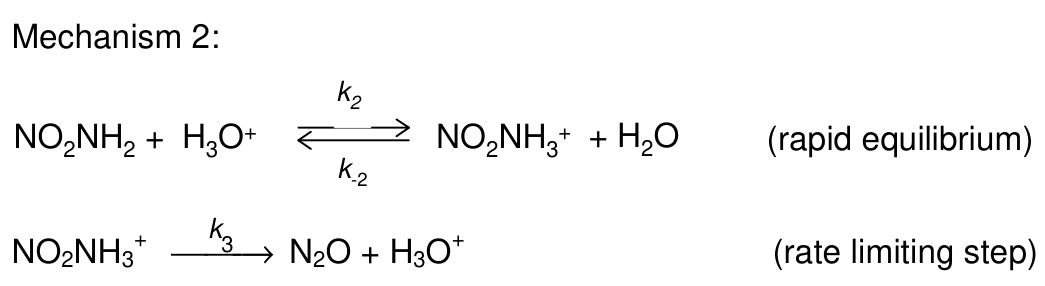
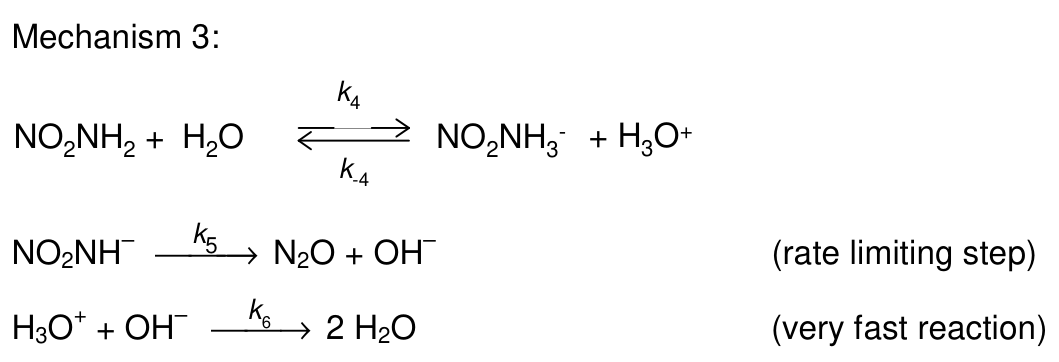
5.3 Show the relationship between the experimentally observed rate constant and the rate constants of the selected mechanism.
5.4 Show that hydroxyl ions catalyze the decomposition of nitramide.
The decomposition is studied in a buffered solution of a constant volume \(V\) at a constant temperature by measuring the partial pressure of the gas \(\ce{N2O}\), considered to be insoluble in water, in a constant volume of the same value \(V\) above the solution. The following results are obtained:
| \(t\)(min) | 0 | 5 | 10 | 15 | 20 | 25 |
|---|---|---|---|---|---|---|
| \(p\)(Pa) | 0 | 6800 | 12400 | 17200 | 20800 | 24000 |
After a sufficiently long time, the pressure stabilises at 40000 Pa.
5.5 Express the pressure \(p\) as a function of time and the constant \(k'\) such that
\[ k'=\frac{k}{[\ce{H3O+}]}. \]
5.6 Verify graphically that the kinetic law is confirmed by these experimental results.
5.7 Calculate \(k'\) giving its units.
Official English text of the problem.
Answers
- 5.1: First order, with the constant apparent rate coefficient \(k'=k/[\ce{H3O+}]\).
- 5.2: Mechanism 3, involving the nitramidate ion
[NH-][N+](=O)[O-]. - 5.3: With elementary mass-action constants for the reactions as written, \[ \boxed{k=\frac{k_4k_5}{k_{-4}}[\ce{H2O}]}. \] If water concentration is absorbed into \(\widetilde{k}_4=k_4[\ce{H2O}]\), then \(k=\widetilde{k}_4k_5/k_{-4}\).
- 5.4: Hydroxide ions
[OH-]accelerate the reaction and are regenerated: \[ v=\frac{k}{K_w}[\ce{NO2NH2}][\ce{OH-}]. \] - 5.5: \[ \boxed{p(t)=(40000\ \mathrm{Pa})\left(1-e^{-k't}\right)}. \]
- 5.6: Plotting \(\ln[p_\infty/(p_\infty-p)]\) against time gives an approximately straight line through the origin, as predicted.
- 5.7: \[ \boxed{k'\approx3.7\times10^{-2}\ \mathrm{min^{-1}} \approx6.1\times10^{-4}\ \mathrm{s^{-1}}}. \]
Solution
The species used below have the following names and SMILES. No stereochemistry is involved.
| Formula | Name | SMILES |
|---|---|---|
| \(\ce{NO2NH2}\) | Nitramide | N[N+](=O)[O-] |
| \(\ce{NO2NH-}\) | Nitramidate ion, the conjugate base of nitramide | [NH-][N+](=O)[O-] |
| \(\ce{NO2NH3+}\) | N-protonated nitramide | [NH3+][N+](=O)[O-] |
| \(\ce{N2O}\) | Nitrous oxide, or dinitrogen monoxide | N#[N+][O-] |
| \(\ce{H2O}\) | Water | O |
| \(\ce{H3O+}\) | Hydronium ion | [OH3+] |
| \(\ce{OH-}\) | Hydroxide ion | [OH-] |
5.1 — Apparent reaction order
A buffer maintains approximately constant \([\ce{H3O+}]\). Consequently,
\[ v=\frac{d[\ce{N2O}]}{dt} =\underbrace{\frac{k}{[\ce{H3O+}]}}_{k'} [\ce{NO2NH2}]. \]
The rate is proportional to the first power of the nitramide concentration. Thus the reaction is apparently first order, or pseudo-first-order, with rate coefficient \(k'\).
5.2 — Selection of the mechanism
For Mechanism 1, the single elementary step is
\[ \ce{NO2NH2 -> N2O + H2O}. \]
It predicts
\[ v=k_1[\ce{NO2NH2}], \]
which does not account for the experimentally observed inverse dependence on \([\ce{H3O+}]\).
For Mechanism 2, the steps are
\[ \ce{NO2NH2 + H3O+ <=> NO2NH3+ + H2O}, \]
\[ \ce{NO2NH3+ -> N2O + H3O+}. \]
The first step is a rapid equilibrium. At constant water concentration,
\[ [\ce{NO2NH3+}] \propto[\ce{NO2NH2}][\ce{H3O+}]. \]
The slow second step therefore gives
\[ v=k_3[\ce{NO2NH3+}] \propto[\ce{NO2NH2}][\ce{H3O+}], \]
predicting a positive first-order dependence on hydronium concentration. This contradicts the observed inverse dependence.
For Mechanism 3, the balanced steps are
\[ \ce{NO2NH2 + H2O <=> NO2NH- + H3O+}, \]
\[ \ce{NO2NH- -> N2O + OH-}, \]
\[ \ce{H3O+ + OH- -> 2H2O}. \]
Here the first equilibrium has been corrected to contain \(\ce{NO2NH-}\).
The rapid acid–base equilibrium gives, at constant water concentration,
\[ [\ce{NO2NH-}] \propto\frac{[\ce{NO2NH2}]}{[\ce{H3O+}]}. \]
Since decomposition of this anion is the rate-limiting step,
\[ v=k_5[\ce{NO2NH-}] \propto\frac{[\ce{NO2NH2}]}{[\ce{H3O+}]}. \]
Thus Mechanism 3 reproduces the experimental rate law. Adding its three steps and cancelling intermediates also gives the correct overall reaction:
\[ \ce{NO2NH2 -> N2O + H2O}. \]
5.3 — Relationship between the rate constants
Applying the rapid-pre-equilibrium approximation to the first step of Mechanism 3,
\[ k_4[\ce{NO2NH2}][\ce{H2O}] =k_{-4}[\ce{NO2NH-}][\ce{H3O+}]. \]
Therefore,
\[ [\ce{NO2NH-}] =\frac{k_4[\ce{H2O}]}{k_{-4}} \frac{[\ce{NO2NH2}]}{[\ce{H3O+}]}. \]
Substitution into the rate expression for the slow step gives
\[ v=k_5[\ce{NO2NH-}] =\frac{k_4k_5[\ce{H2O}]}{k_{-4}} \frac{[\ce{NO2NH2}]}{[\ce{H3O+}]}. \]
Comparison with the experimental law yields
\[ \boxed{k=\frac{k_4k_5[\ce{H2O}]}{k_{-4}}}. \]
Water is the solvent, so its concentration is effectively constant. If it is already included in the forward coefficient, defined by
\[ \widetilde{k}_4=k_4[\ce{H2O}], \]
the same result is written
\[ \boxed{k=\frac{\widetilde{k}_4k_5}{k_{-4}}}. \]
The rapid neutralization constant \(k_6\) does not enter the rate law.
5.4 — Catalysis by hydroxide ions
At constant temperature, using the concentration form of the water ion product,
\[ K_w=[\ce{H3O+}][\ce{OH-}]. \]
Hence
\[ \frac{1}{[\ce{H3O+}]}=\frac{[\ce{OH-}]}{K_w}, \]
and the experimental law becomes
\[ \boxed{v=\frac{k}{K_w}[\ce{NO2NH2}][\ce{OH-}]}. \]
Increasing hydroxide concentration therefore increases the rate.
The catalytic cycle can be expressed as
\[ \ce{NO2NH2 + OH- <=> NO2NH- + H2O}, \]
followed by
\[ \ce{NO2NH- -> N2O + OH-}. \]
In the first step, hydroxide accepts a proton from the amino nitrogen of nitramide; the electron pair of the broken N–H bond remains on nitrogen. The resulting nitramidate ion decomposes in the slow step, regenerating hydroxide. These proton-transfer and regeneration events are not encoded by the SMILES alone.
Cancelling hydroxide and nitramidate gives
\[ \ce{NO2NH2 -> N2O + H2O}. \]
Hydroxide accelerates the reaction while being regenerated, establishing its catalytic role.
5.5 — Pressure as a function of time
Let \(a(t)\) be the concentration of undecomposed nitramide and \(a_0\) its initial value. In the buffered solution,
\[ -\frac{da}{dt}=k'a, \]
so
\[ a(t)=a_0e^{-k't}. \]
One mole of nitramide produces one mole of nitrous oxide. Using the ideal-gas relation, with equal liquid and gas volumes \(V\),
\[ \frac{p(t)V}{RT}=V\bigl(a_0-a(t)\bigr). \]
At complete decomposition,
\[ \frac{p_\infty V}{RT}=Va_0. \]
Dividing gives
\[ \frac{p(t)}{p_\infty} =1-\frac{a(t)}{a_0} =1-e^{-k't}. \]
Therefore,
\[ \boxed{p(t)=p_\infty\left(1-e^{-k't}\right) =(40000\ \mathrm{Pa})\left(1-e^{-k't}\right)}. \]
The units of \(t\) must correspond to those used for \(k'\).
5.6 — Graphical verification
Rearranging the pressure equation gives
\[ \frac{p_\infty-p}{p_\infty}=e^{-k't}, \]
and hence
\[ \boxed{ y=\ln\!\left(\frac{p_\infty}{p_\infty-p}\right)=k't }. \]
The logarithm has a dimensionless argument. From the measurements:
| \(t\) / min | \(p_\infty-p\) / Pa | \(y=\ln[p_\infty/(p_\infty-p)]\) |
|---|---|---|
| 0 | 40000 | 0.00000 |
| 5 | 33200 | 0.18633 |
| 10 | 27600 | 0.37106 |
| 15 | 22800 | 0.56212 |
| 20 | 19200 | 0.73397 |
| 25 | 16000 | 0.91629 |
On the graph, put time in minutes on the horizontal axis and \(y\) on the vertical axis. The six points lie very close to a straight line rising from the origin to approximately \((25,\ 0.916)\).
An unconstrained least-squares fit gives
\[ y=0.00338+(0.03666\ \mathrm{min^{-1}})t, \qquad R^2=0.9998. \]
The small intercept and nearly linear data support the predicted first-order law to the precision of the measurements.
5.7 — Numerical value of \(k'\)
The slope of the graph is \(k'\). Using the initial and final measurements,
\[ k' =\frac{\ln\!\left(\dfrac{40000}{40000-24000}\right)}{25\ \mathrm{min}} =\frac{\ln(2.5)}{25\ \mathrm{min}} =0.03665\ \mathrm{min^{-1}}. \]
This agrees with the slope obtained from all six measurements. Converting to seconds,
\[ k'=\frac{0.03665}{60}\ \mathrm{s^{-1}} =6.109\times10^{-4}\ \mathrm{s^{-1}}. \]
To sensible significant figures,
\[ \boxed{k'\approx3.7\times10^{-2}\ \mathrm{min^{-1}} \approx6.1\times10^{-4}\ \mathrm{s^{-1}}}. \]
The solution was checked against the official solution.
IChO 1990 · Theorieaufgabe 5
Chemische Kinetik
Nitramid \(\ce{NO2NH2}\) zersetzt sich in wässriger Lösung langsam gemäß der Reaktion:
Das experimentell ermittelte Geschwindigkeitsgesetz lautet:
\[ \frac{d[\ce{N2O}]}{dt} =k\frac{[\ce{NO2NH2}]}{[\ce{H3O+}]} \]
5.1 Welche scheinbare Ordnung hat diese Reaktion in einer gepufferten Lösung?
5.2 Welcher der folgenden Mechanismen eignet sich am besten zur Erklärung dieses Geschwindigkeitsgesetzes? Begründen Sie Ihre Antwort.
5.3 Zeigen Sie den Zusammenhang zwischen der experimentell beobachteten Geschwindigkeitskonstante und den Geschwindigkeitskonstanten des gewählten Mechanismus auf.
5.4 Zeigen Sie, dass Hydroxidionen die Zersetzung von Nitramid katalysieren.
Die Zersetzung wird in einer gepufferten Lösung mit konstantem Volumen \(V\) bei konstanter Temperatur untersucht, indem der Partialdruck des Gases \(\ce{N2O}\), das als in Wasser unlöslich betrachtet wird, in einem konstanten Gasvolumen desselben Wertes \(V\) über der Lösung gemessen wird. Dabei werden folgende Ergebnisse erhalten:
| \(t\)(min) | 0 | 5 | 10 | 15 | 20 | 25 |
|---|---|---|---|---|---|---|
| \(p\)(Pa) | 0 | 6800 | 12400 | 17200 | 20800 | 24000 |
Nach hinreichend langer Zeit stabilisiert sich der Druck bei 40000 Pa.
5.5 Drücken Sie den Druck \(p\) als Funktion der Zeit und der Konstante \(k'\) aus, wobei
\[ k'=\frac{k}{[\ce{H3O+}]}. \]
5.6 Überprüfen Sie grafisch, dass diese experimentellen Ergebnisse das Geschwindigkeitsgesetz bestätigen.
5.7 Berechnen Sie \(k'\) und geben Sie die Einheiten an.
Aufgabentext aus dem offiziellen englischen Text übersetzt.
Antworten
- 5.1: Erste Ordnung mit dem konstanten scheinbaren Geschwindigkeitskoeffizienten \(k'=k/[\ce{H3O+}]\).
- 5.2: Mechanismus 3, an dem das Nitramidat-Ion
[NH-][N+](=O)[O-]beteiligt ist. - 5.3: Mit den Geschwindigkeitskonstanten der Elementarreaktionen gemäß dem Massenwirkungsgesetz für die Reaktionen in der angegebenen Form gilt \[ \boxed{k=\frac{k_4k_5}{k_{-4}}[\ce{H2O}]}. \] Wird die Wasserkonzentration in \(\widetilde{k}_4=k_4[\ce{H2O}]\) einbezogen, so gilt \(k=\widetilde{k}_4k_5/k_{-4}\).
- 5.4: Hydroxidionen
[OH-]beschleunigen die Reaktion und werden regeneriert: \[ v=\frac{k}{K_w}[\ce{NO2NH2}][\ce{OH-}]. \] - 5.5: \[ \boxed{p(t)=(40000\ \mathrm{Pa})\left(1-e^{-k't}\right)}. \]
- 5.6: Die Auftragung von \(\ln[p_\infty/(p_\infty-p)]\) gegen die Zeit ergibt wie vorhergesagt näherungsweise eine Gerade durch den Ursprung.
- 5.7: \[ \boxed{k'\approx3.7\times10^{-2}\ \mathrm{min^{-1}} \approx6.1\times10^{-4}\ \mathrm{s^{-1}}}. \]
Lösung
Die im Folgenden verwendeten Spezies haben die folgenden Namen und SMILES. Stereochemie spielt hierbei keine Rolle.
| Formel | Name | SMILES |
|---|---|---|
| \(\ce{NO2NH2}\) | Nitramid | N[N+](=O)[O-] |
| \(\ce{NO2NH-}\) | Nitramidat-Ion, die konjugierte Base von Nitramid | [NH-][N+](=O)[O-] |
| \(\ce{NO2NH3+}\) | N-protoniertes Nitramid | [NH3+][N+](=O)[O-] |
| \(\ce{N2O}\) | Lachgas oder Distickstoffmonoxid | N#[N+][O-] |
| \(\ce{H2O}\) | Wasser | O |
| \(\ce{H3O+}\) | Oxoniumion | [OH3+] |
| \(\ce{OH-}\) | Hydroxidion | [OH-] |
5.1 — Scheinbare Reaktionsordnung
Ein Puffer hält \([\ce{H3O+}]\) annähernd konstant. Folglich gilt
\[ v=\frac{d[\ce{N2O}]}{dt} =\underbrace{\frac{k}{[\ce{H3O+}]}}_{k'} [\ce{NO2NH2}]. \]
Die Geschwindigkeit ist proportional zur ersten Potenz der Nitramidkonzentration. Die Reaktion ist somit scheinbar erster Ordnung, also pseudo-erster Ordnung, mit dem Geschwindigkeitskoeffizienten \(k'\).
5.2 — Auswahl des Mechanismus
Bei Mechanismus 1 lautet der einzige Elementarschritt
\[ \ce{NO2NH2 -> N2O + H2O}. \]
Er sagt
\[ v=k_1[\ce{NO2NH2}], \]
voraus, was die experimentell beobachtete umgekehrte Proportionalität zu \([\ce{H3O+}]\) nicht berücksichtigt.
Bei Mechanismus 2 lauten die Schritte
\[ \ce{NO2NH2 + H3O+ <=> NO2NH3+ + H2O}, \]
\[ \ce{NO2NH3+ -> N2O + H3O+}. \]
Der erste Schritt ist ein sich rasch einstellendes Gleichgewicht. Bei konstanter Wasserkonzentration gilt
\[ [\ce{NO2NH3+}] \propto[\ce{NO2NH2}][\ce{H3O+}]. \]
Der langsame zweite Schritt ergibt daher
\[ v=k_3[\ce{NO2NH3+}] \propto[\ce{NO2NH2}][\ce{H3O+}], \]
womit eine positive Abhängigkeit erster Ordnung von der Oxoniumionenkonzentration vorhergesagt wird. Dies widerspricht der beobachteten umgekehrten Proportionalität.
Bei Mechanismus 3 lauten die ausgeglichenen Reaktionsschritte
\[ \ce{NO2NH2 + H2O <=> NO2NH- + H3O+}, \]
\[ \ce{NO2NH- -> N2O + OH-}, \]
\[ \ce{H3O+ + OH- -> 2H2O}. \]
Hier wurde das erste Gleichgewicht so korrigiert, dass es \(\ce{NO2NH-}\) enthält.
Das sich rasch einstellende Säure-Base-Gleichgewicht ergibt bei konstanter Wasserkonzentration
\[ [\ce{NO2NH-}] \propto\frac{[\ce{NO2NH2}]}{[\ce{H3O+}]}. \]
Da die Zersetzung dieses Anions der geschwindigkeitsbestimmende Schritt ist, gilt
\[ v=k_5[\ce{NO2NH-}] \propto\frac{[\ce{NO2NH2}]}{[\ce{H3O+}]}. \]
Somit gibt Mechanismus 3 das experimentelle Geschwindigkeitsgesetz wieder. Die Addition seiner drei Schritte und das Kürzen der Zwischenprodukte ergeben außerdem die richtige Gesamtreaktion:
\[ \ce{NO2NH2 -> N2O + H2O}. \]
5.3 — Zusammenhang zwischen den Geschwindigkeitskonstanten
Die Anwendung der Näherung eines sich rasch einstellenden vorgelagerten Gleichgewichts auf den ersten Schritt von Mechanismus 3 ergibt
\[ k_4[\ce{NO2NH2}][\ce{H2O}] =k_{-4}[\ce{NO2NH-}][\ce{H3O+}]. \]
Daher gilt
\[ [\ce{NO2NH-}] =\frac{k_4[\ce{H2O}]}{k_{-4}} \frac{[\ce{NO2NH2}]}{[\ce{H3O+}]}. \]
Einsetzen in den Geschwindigkeitsausdruck für den langsamen Schritt ergibt
\[ v=k_5[\ce{NO2NH-}] =\frac{k_4k_5[\ce{H2O}]}{k_{-4}} \frac{[\ce{NO2NH2}]}{[\ce{H3O+}]}. \]
Der Vergleich mit dem experimentellen Gesetz liefert
\[ \boxed{k=\frac{k_4k_5[\ce{H2O}]}{k_{-4}}}. \]
Wasser ist das Lösungsmittel, sodass seine Konzentration praktisch konstant ist. Ist sie bereits im Koeffizienten der Hinreaktion enthalten, der durch
\[ \widetilde{k}_4=k_4[\ce{H2O}], \]
definiert ist, so schreibt man dasselbe Ergebnis als
\[ \boxed{k=\frac{\widetilde{k}_4k_5}{k_{-4}}}. \]
Die Geschwindigkeitskonstante \(k_6\) der schnellen Neutralisation geht nicht in das Geschwindigkeitsgesetz ein.
5.4 — Katalyse durch Hydroxidionen
Bei konstanter Temperatur gilt für das Ionenprodukt des Wassers in seiner konzentrationsbasierten Form
\[ K_w=[\ce{H3O+}][\ce{OH-}]. \]
Somit gilt
\[ \frac{1}{[\ce{H3O+}]}=\frac{[\ce{OH-}]}{K_w}, \]
und das experimentelle Gesetz wird zu
\[ \boxed{v=\frac{k}{K_w}[\ce{NO2NH2}][\ce{OH-}]}. \]
Eine Erhöhung der Hydroxidionenkonzentration erhöht daher die Geschwindigkeit.
Der katalytische Zyklus lässt sich ausdrücken als
\[ \ce{NO2NH2 + OH- <=> NO2NH- + H2O}, \]
gefolgt von
\[ \ce{NO2NH- -> N2O + OH-}. \]
Im ersten Schritt nimmt das Hydroxidion ein Proton vom Aminostickstoff des Nitramids auf; das Elektronenpaar der gespaltenen N–H-Bindung verbleibt am Stickstoff. Das entstandene Nitramidat-Ion zersetzt sich im langsamen Schritt, wobei das Hydroxidion regeneriert wird. Diese Protonenübertragungs- und Regenerationsvorgänge werden durch die SMILES allein nicht wiedergegeben.
Das Kürzen von Hydroxid und Nitramidat ergibt
\[ \ce{NO2NH2 -> N2O + H2O}. \]
Hydroxid beschleunigt die Reaktion und wird dabei regeneriert, womit seine katalytische Rolle nachgewiesen ist.
5.5 — Druck als Funktion der Zeit
Sei \(a(t)\) die Konzentration des unzersetzten Nitramids und \(a_0\) ihr Anfangswert. In der gepufferten Lösung gilt
\[ -\frac{da}{dt}=k'a, \]
also
\[ a(t)=a_0e^{-k't}. \]
Ein Mol Nitramid ergibt ein Mol Distickstoffmonoxid. Mit der idealen Gasgleichung und gleichen Flüssigkeits- und Gasvolumina \(V\) gilt
\[ \frac{p(t)V}{RT}=V\bigl(a_0-a(t)\bigr). \]
Bei vollständiger Zersetzung gilt
\[ \frac{p_\infty V}{RT}=Va_0. \]
Durch Division erhält man
\[ \frac{p(t)}{p_\infty} =1-\frac{a(t)}{a_0} =1-e^{-k't}. \]
Daher gilt
\[ \boxed{p(t)=p_\infty\left(1-e^{-k't}\right) =(40000\ \mathrm{Pa})\left(1-e^{-k't}\right)}. \]
Die Einheiten von \(t\) müssen zu den für \(k'\) verwendeten Einheiten passen.
5.6 — Grafische Überprüfung
Durch Umstellen der Druckgleichung erhält man
\[ \frac{p_\infty-p}{p_\infty}=e^{-k't}, \]
und somit
\[ \boxed{ y=\ln\!\left(\frac{p_\infty}{p_\infty-p}\right)=k't }. \]
Das Argument des Logarithmus ist dimensionslos. Aus den Messwerten ergibt sich:
| \(t\) / min | \(p_\infty-p\) / Pa | \(y=\ln[p_\infty/(p_\infty-p)]\) |
|---|---|---|
| 0 | 40000 | 0.00000 |
| 5 | 33200 | 0.18633 |
| 10 | 27600 | 0.37106 |
| 15 | 22800 | 0.56212 |
| 20 | 19200 | 0.73397 |
| 25 | 16000 | 0.91629 |
Tragen Sie im Diagramm die Zeit in Minuten auf der horizontalen Achse und \(y\) auf der vertikalen Achse auf. Die sechs Punkte liegen sehr nahe an einer Geraden, die vom Ursprung bis ungefähr \((25,\ 0.916)\) ansteigt.
Eine Ausgleichsrechnung nach der Methode der kleinsten Quadrate ohne Nebenbedingungen ergibt
\[ y=0.00338+(0.03666\ \mathrm{min^{-1}})t, \qquad R^2=0.9998. \]
Der kleine Achsenabschnitt und der nahezu lineare Verlauf der Daten stützen das vorhergesagte Geschwindigkeitsgesetz erster Ordnung im Rahmen der Messgenauigkeit.
5.7 — Zahlenwert von \(k'\)
Die Steigung der Geraden ist \(k'\). Mit dem ersten und dem letzten Messwert erhält man
\[ k' =\frac{\ln\!\left(\dfrac{40000}{40000-24000}\right)}{25\ \mathrm{min}} =\frac{\ln(2.5)}{25\ \mathrm{min}} =0.03665\ \mathrm{min^{-1}}. \]
Dies stimmt mit der aus allen sechs Messwerten ermittelten Steigung überein. Die Umrechnung auf Sekunden ergibt
\[ k'=\frac{0.03665}{60}\ \mathrm{s^{-1}} =6.109\times10^{-4}\ \mathrm{s^{-1}}. \]
Auf eine sinnvolle Anzahl signifikanter Stellen gerundet gilt
\[ \boxed{k'\approx3.7\times10^{-2}\ \mathrm{min^{-1}} \approx6.1\times10^{-4}\ \mathrm{s^{-1}}}. \]
Die Lösung wurde mit der offiziellen Lösung abgeglichen.
IChO 1990 · Teori sorusu 5
Kimyasal kinetik
Nitramid \(\ce{NO2NH2}\), sulu çözeltide aşağıdaki tepkimeye göre yavaşça bozunur:
Deneysel hız yasası şöyledir:
\[ \frac{d[\ce{N2O}]}{dt} =k\frac{[\ce{NO2NH2}]}{[\ce{H3O+}]} \]
5.1 Tamponlanmış bir çözeltide bu tepkimenin görünür derecesi nedir?
5.2 Aşağıdaki mekanizmalardan hangisi bu hız yasasını açıklamak için en uygundur? Yanıtınızı gerekçelendirin.
5.3 Deneysel olarak gözlenen hız sabiti ile seçilen mekanizmanın hız sabitleri arasındaki ilişkiyi gösterin.
5.4 Hidroksil iyonlarının nitramidin bozunmasını katalizlediğini gösterin.
Bozunma, sabit sıcaklıkta ve sabit \(V\) hacmindeki tamponlanmış bir çözeltide, suda çözünmediği kabul edilen \(\ce{N2O}\) gazının çözeltinin üzerindeki aynı \(V\) değerine sahip sabit hacimdeki kısmi basıncı ölçülerek incelenir. Aşağıdaki sonuçlar elde edilir:
| \(t\)(min) | 0 | 5 | 10 | 15 | 20 | 25 |
|---|---|---|---|---|---|---|
| \(p\)(Pa) | 0 | 6800 | 12400 | 17200 | 20800 | 24000 |
Yeterince uzun bir süre sonra basınç 40000 Pa değerinde sabitlenir.
5.5 \(p\) basıncını, zamanın ve aşağıdaki gibi tanımlanan \(k'\) sabitinin bir fonksiyonu olarak ifade edin:
\[ k'=\frac{k}{[\ce{H3O+}]}. \]
5.6 Bu deneysel sonuçların hız yasasını doğruladığını grafiksel olarak gösterin.
5.7 \(k'\) değerini birimlerini belirterek hesaplayın.
Soru metni resmi İngilizce metinden çevrilmiştir.
Cevaplar
- 5.1: Birinci derecedir; sabit görünür hız katsayısı \(k'=k/[\ce{H3O+}]\) şeklindedir.
- 5.2: Nitramidat iyonunu
[NH-][N+](=O)[O-]içeren Mekanizma 3. - 5.3: Tepkimelerin yazıldığı biçim için elementer kütle etkisi yasası sabitleri kullanıldığında, \[ \boxed{k=\frac{k_4k_5}{k_{-4}}[\ce{H2O}]}. \] Su derişimi \(\widetilde{k}_4=k_4[\ce{H2O}]\) tanımıyla katsayıya dahil edilirse, \(k=\widetilde{k}_4k_5/k_{-4}\) olur.
- 5.4: Hidroksit iyonları
[OH-]tepkimeyi hızlandırır ve yeniden oluşur: \[ v=\frac{k}{K_w}[\ce{NO2NH2}][\ce{OH-}]. \] - 5.5: \[ \boxed{p(t)=(40000\ \mathrm{Pa})\left(1-e^{-k't}\right)}. \]
- 5.6: \(\ln[p_\infty/(p_\infty-p)]\) değerinin zamana karşı grafiği çizildiğinde, öngörüldüğü gibi yaklaşık olarak orijinden geçen bir doğru elde edilir.
- 5.7: \[ \boxed{k'\approx3.7\times10^{-2}\ \mathrm{min^{-1}} \approx6.1\times10^{-4}\ \mathrm{s^{-1}}}. \]
Çözüm
Aşağıda kullanılan türlerin adları ve SMILES gösterimleri şöyledir. Herhangi bir stereokimya söz konusu değildir.
| Formül | Ad | SMILES |
|---|---|---|
| \(\ce{NO2NH2}\) | Nitramid | N[N+](=O)[O-] |
| \(\ce{NO2NH-}\) | Nitramidat iyonu, nitramidin eşlenik bazı | [NH-][N+](=O)[O-] |
| \(\ce{NO2NH3+}\) | N-protonlanmış nitramid | [NH3+][N+](=O)[O-] |
| \(\ce{N2O}\) | Nitröz oksit veya diazot monoksit | N#[N+][O-] |
| \(\ce{H2O}\) | Su | O |
| \(\ce{H3O+}\) | Hidronyum iyonu | [OH3+] |
| \(\ce{OH-}\) | Hidroksit iyonu | [OH-] |
5.1 — Görünür tepkime derecesi
Bir tampon, \([\ce{H3O+}]\) derişimini yaklaşık olarak sabit tutar. Dolayısıyla,
\[ v=\frac{d[\ce{N2O}]}{dt} =\underbrace{\frac{k}{[\ce{H3O+}]}}_{k'} [\ce{NO2NH2}]. \]
Hız, nitramid derişiminin birinci kuvvetiyle orantılıdır. Dolayısıyla tepkime, hız katsayısı \(k'\) olmak üzere görünür olarak birinci dereceden, yani yalancı birinci derecedendir.
5.2 — Mekanizmanın seçimi
Mekanizma 1 için tek elementer basamak şöyledir:
\[ \ce{NO2NH2 -> N2O + H2O}. \]
Bu mekanizma,
\[ v=k_1[\ce{NO2NH2}], \]
ifadesini öngörür; bu ifade, deneysel olarak gözlenen \([\ce{H3O+}]\) ile ters orantılı bağımlılığı açıklamaz.
Mekanizma 2 için basamaklar şöyledir:
\[ \ce{NO2NH2 + H3O+ <=> NO2NH3+ + H2O}, \]
\[ \ce{NO2NH3+ -> N2O + H3O+}. \]
İlk basamak hızlı bir dengedir. Sabit su derişiminde,
\[ [\ce{NO2NH3+}] \propto[\ce{NO2NH2}][\ce{H3O+}]. \]
Bu nedenle yavaş olan ikinci basamak,
\[ v=k_3[\ce{NO2NH3+}] \propto[\ce{NO2NH2}][\ce{H3O+}], \]
ifadesini verir ve hidronyum derişimine pozitif birinci dereceden bir bağımlılık öngörür. Bu, gözlenen ters orantılı bağımlılıkla çelişir.
Mekanizma 3 için denkleştirilmiş basamaklar şöyledir:
\[ \ce{NO2NH2 + H2O <=> NO2NH- + H3O+}, \]
\[ \ce{NO2NH- -> N2O + OH-}, \]
\[ \ce{H3O+ + OH- -> 2H2O}. \]
Burada ilk denge, \(\ce{NO2NH-}\) içerecek şekilde düzeltilmiştir.
Hızlı asit–baz dengesi, sabit su derişiminde şu ilişkiyi verir:
\[ [\ce{NO2NH-}] \propto\frac{[\ce{NO2NH2}]}{[\ce{H3O+}]}. \]
Bu anyonun bozunması hız sınırlayıcı basamak olduğundan,
\[ v=k_5[\ce{NO2NH-}] \propto\frac{[\ce{NO2NH2}]}{[\ce{H3O+}]}. \]
Dolayısıyla Mekanizma 3 deneysel hız yasasını verir. Üç basamağı toplanıp ara türler sadeleştirildiğinde de doğru toplam tepkime elde edilir:
\[ \ce{NO2NH2 -> N2O + H2O}. \]
5.3 — Hız sabitleri arasındaki ilişki
Mekanizma 3'ün ilk basamağına hızlı ön denge yaklaşımı uygulandığında,
\[ k_4[\ce{NO2NH2}][\ce{H2O}] =k_{-4}[\ce{NO2NH-}][\ce{H3O+}]. \]
Dolayısıyla,
\[ [\ce{NO2NH-}] =\frac{k_4[\ce{H2O}]}{k_{-4}} \frac{[\ce{NO2NH2}]}{[\ce{H3O+}]}. \]
Bu ifade yavaş basamağın hız ifadesinde yerine konulduğunda,
\[ v=k_5[\ce{NO2NH-}] =\frac{k_4k_5[\ce{H2O}]}{k_{-4}} \frac{[\ce{NO2NH2}]}{[\ce{H3O+}]}. \]
Deneysel yasayla karşılaştırıldığında şu sonuç elde edilir:
\[ \boxed{k=\frac{k_4k_5[\ce{H2O}]}{k_{-4}}}. \]
Su çözücü olduğundan derişimi pratikte sabittir. Su derişimi,
\[ \widetilde{k}_4=k_4[\ce{H2O}], \]
ile tanımlanan ileri yön hız katsayısına zaten dahil edilmişse, aynı sonuç şöyle yazılır:
\[ \boxed{k=\frac{\widetilde{k}_4k_5}{k_{-4}}}. \]
Hızlı nötralleşme basamağının hız sabiti \(k_6\), hız yasasında yer almaz.
5.4 — Hidroksit iyonlarıyla kataliz
Sabit sıcaklıkta, suyun iyonlar çarpımının derişim cinsinden ifadesi kullanıldığında,
\[ K_w=[\ce{H3O+}][\ce{OH-}]. \]
Böylece,
\[ \frac{1}{[\ce{H3O+}]}=\frac{[\ce{OH-}]}{K_w}, \]
ve deneysel yasa şu hâle gelir:
\[ \boxed{v=\frac{k}{K_w}[\ce{NO2NH2}][\ce{OH-}]}. \]
Dolayısıyla hidroksit derişiminin artırılması hızı artırır.
Katalitik çevrim şu şekilde ifade edilebilir:
\[ \ce{NO2NH2 + OH- <=> NO2NH- + H2O}, \]
Bu basamağı aşağıdaki basamak izler:
\[ \ce{NO2NH- -> N2O + OH-}. \]
İlk basamakta hidroksit, nitramidin amino azotundan bir proton alır; kırılan N–H bağının elektron çifti azot üzerinde kalır. Oluşan nitramidat iyonu yavaş basamakta bozunarak hidroksiti yeniden oluşturur. Bu proton aktarımı ve yeniden oluşum olayları yalnızca SMILES gösterimleriyle kodlanmaz.
Hidroksit ve nitramidat sadeleştirildiğinde şu tepkime elde edilir:
\[ \ce{NO2NH2 -> N2O + H2O}. \]
Hidroksit, yeniden oluşurken tepkimeyi hızlandırır; bu da katalitik rolünü ortaya koyar.
5.5 — Zamanın fonksiyonu olarak basınç
Bozunmamış nitramidin derişimi \(a(t)\), başlangıç değeri ise \(a_0\) olsun. Tamponlanmış çözeltide,
\[ -\frac{da}{dt}=k'a, \]
olduğundan,
\[ a(t)=a_0e^{-k't}. \]
Bir mol nitramid bir mol nitröz oksit üretir. İdeal gaz bağıntısı, birbirine eşit \(V\) sıvı ve gaz hacimleriyle kullanıldığında,
\[ \frac{p(t)V}{RT}=V\bigl(a_0-a(t)\bigr). \]
Bozunma tamamlandığında,
\[ \frac{p_\infty V}{RT}=Va_0. \]
Bu ifadeler birbirine bölündüğünde,
\[ \frac{p(t)}{p_\infty} =1-\frac{a(t)}{a_0} =1-e^{-k't}. \]
Dolayısıyla,
\[ \boxed{p(t)=p_\infty\left(1-e^{-k't}\right) =(40000\ \mathrm{Pa})\left(1-e^{-k't}\right)}. \]
\(t\) için kullanılan birimler, \(k'\) için kullanılan birimlerle uyumlu olmalıdır.
5.6 — Grafiksel doğrulama
Basınç denklemi yeniden düzenlendiğinde,
\[ \frac{p_\infty-p}{p_\infty}=e^{-k't}, \]
ve dolayısıyla,
\[ \boxed{ y=\ln\!\left(\frac{p_\infty}{p_\infty-p}\right)=k't }. \]
Logaritmanın argümanı boyutsuzdur. Ölçümlerden şu değerler elde edilir:
| \(t\) / min | \(p_\infty-p\) / Pa | \(y=\ln[p_\infty/(p_\infty-p)]\) |
|---|---|---|
| 0 | 40000 | 0.00000 |
| 5 | 33200 | 0.18633 |
| 10 | 27600 | 0.37106 |
| 15 | 22800 | 0.56212 |
| 20 | 19200 | 0.73397 |
| 25 | 16000 | 0.91629 |
Grafikte yatay eksene dakika cinsinden zamanı, düşey eksene ise \(y\) değerini yerleştirin. Altı nokta, orijinden yaklaşık \((25,\ 0.916)\) noktasına yükselen bir doğruya çok yakın konumlanır.
Kısıt uygulanmadan yapılan bir en küçük kareler uyumu şu sonucu verir:
\[ y=0.00338+(0.03666\ \mathrm{min^{-1}})t, \qquad R^2=0.9998. \]
Düşey ekseni kesim değerinin küçük olması ve verilerin neredeyse doğrusal olması, ölçümlerin hassasiyeti çerçevesinde öngörülen birinci dereceden hız yasasını destekler.
5.7 — \(k'\) sabitinin sayısal değeri
Grafiğin eğimi \(k'\) değeridir. İlk ve son ölçümler kullanıldığında,
\[ k' =\frac{\ln\!\left(\dfrac{40000}{40000-24000}\right)}{25\ \mathrm{min}} =\frac{\ln(2.5)}{25\ \mathrm{min}} =0.03665\ \mathrm{min^{-1}}. \]
Bu değer, altı ölçümün tümünden elde edilen eğimle uyumludur. Saniye cinsine dönüştürüldüğünde,
\[ k'=\frac{0.03665}{60}\ \mathrm{s^{-1}} =6.109\times10^{-4}\ \mathrm{s^{-1}}. \]
Uygun sayıda anlamlı basamakla,
\[ \boxed{k'\approx3.7\times10^{-2}\ \mathrm{min^{-1}} \approx6.1\times10^{-4}\ \mathrm{s^{-1}}}. \]
Çözüm, resmi çözümle karşılaştırılarak kontrol edildi.
IChO 1990 · Problema teórico 5
Cinética química
La nitramida \(\ce{NO2NH2}\) se descompone lentamente en disolución acuosa según la reacción:
La ley cinética experimental es la siguiente:
\[ \frac{d[\ce{N2O}]}{dt} =k\frac{[\ce{NO2NH2}]}{[\ce{H3O+}]} \]
5.1 ¿Cuál es el orden aparente de esta reacción en una disolución amortiguadora?
5.2 ¿Cuál de los siguientes mecanismos es el más adecuado para interpretar esta ley cinética? Justifique su respuesta.
5.3 Muestre la relación entre la constante de velocidad observada experimentalmente y las constantes de velocidad del mecanismo seleccionado.
5.4 Demuestre que los iones hidróxido catalizan la descomposición de la nitramida.
La descomposición se estudia en una disolución amortiguadora de volumen constante \(V\) a temperatura constante, midiendo la presión parcial del gas \(\ce{N2O}\), considerado insoluble en agua, en un volumen constante del mismo valor \(V\) situado por encima de la disolución. Se obtienen los siguientes resultados:
| \(t\)(min) | 0 | 5 | 10 | 15 | 20 | 25 |
|---|---|---|---|---|---|---|
| \(p\)(Pa) | 0 | 6800 | 12400 | 17200 | 20800 | 24000 |
Tras un tiempo suficientemente largo, la presión se estabiliza en 40000 Pa.
5.5 Exprese la presión \(p\) en función del tiempo y de la constante \(k'\), tal que
\[ k'=\frac{k}{[\ce{H3O+}]}. \]
5.6 Verifique gráficamente que estos resultados experimentales confirman la ley cinética.
5.7 Calcule \(k'\) e indique sus unidades.
Enunciado traducido del texto oficial en inglés.
Respuestas
- 5.1: De primer orden, con la constante aparente de velocidad \(k'=k/[\ce{H3O+}]\).
- 5.2: Mecanismo 3, en el que interviene el ion nitramidato
[NH-][N+](=O)[O-]. - 5.3: Con las constantes de acción de masas de las etapas elementales para las reacciones tal como están escritas, \[ \boxed{k=\frac{k_4k_5}{k_{-4}}[\ce{H2O}]}. \] Si la concentración de agua se incorpora en \(\widetilde{k}_4=k_4[\ce{H2O}]\), entonces \(k=\widetilde{k}_4k_5/k_{-4}\).
- 5.4: Los iones hidróxido
[OH-]aceleran la reacción y se regeneran: \[ v=\frac{k}{K_w}[\ce{NO2NH2}][\ce{OH-}]. \] - 5.5: \[ \boxed{p(t)=(40000\ \mathrm{Pa})\left(1-e^{-k't}\right)}. \]
- 5.6: La representación de \(\ln[p_\infty/(p_\infty-p)]\) frente al tiempo da una línea aproximadamente recta que pasa por el origen, tal como se predice.
- 5.7: \[ \boxed{k'\approx3.7\times10^{-2}\ \mathrm{min^{-1}} \approx6.1\times10^{-4}\ \mathrm{s^{-1}}}. \]
Solución
Las especies utilizadas a continuación tienen los siguientes nombres y SMILES. No interviene la estereoquímica.
| Fórmula | Nombre | SMILES |
|---|---|---|
| \(\ce{NO2NH2}\) | Nitramida | N[N+](=O)[O-] |
| \(\ce{NO2NH-}\) | Ion nitramidato, la base conjugada de la nitramida | [NH-][N+](=O)[O-] |
| \(\ce{NO2NH3+}\) | Nitramida protonada en N | [NH3+][N+](=O)[O-] |
| \(\ce{N2O}\) | Óxido nitroso, o monóxido de dinitrógeno | N#[N+][O-] |
| \(\ce{H2O}\) | Agua | O |
| \(\ce{H3O+}\) | Ion hidronio | [OH3+] |
| \(\ce{OH-}\) | Ion hidróxido | [OH-] |
5.1 — Orden aparente de reacción
Una disolución amortiguadora mantiene aproximadamente constante \([\ce{H3O+}]\). En consecuencia,
\[ v=\frac{d[\ce{N2O}]}{dt} =\underbrace{\frac{k}{[\ce{H3O+}]}}_{k'} [\ce{NO2NH2}]. \]
La velocidad es proporcional a la primera potencia de la concentración de nitramida. Por tanto, la reacción es aparentemente de primer orden, o de pseudoprimer orden, con una constante de velocidad \(k'\).
5.2 — Selección del mecanismo
Para el Mecanismo 1, la única etapa elemental es
\[ \ce{NO2NH2 -> N2O + H2O}. \]
Este predice
\[ v=k_1[\ce{NO2NH2}], \]
lo cual no explica la dependencia inversa respecto de \([\ce{H3O+}]\) observada experimentalmente.
Para el Mecanismo 2, las etapas son
\[ \ce{NO2NH2 + H3O+ <=> NO2NH3+ + H2O}, \]
\[ \ce{NO2NH3+ -> N2O + H3O+}. \]
La primera etapa es un equilibrio rápido. A concentración de agua constante,
\[ [\ce{NO2NH3+}] \propto[\ce{NO2NH2}][\ce{H3O+}]. \]
Por tanto, la segunda etapa, que es lenta, da
\[ v=k_3[\ce{NO2NH3+}] \propto[\ce{NO2NH2}][\ce{H3O+}], \]
lo que predice una dependencia de primer orden positivo respecto de la concentración de hidronio. Esto contradice la dependencia inversa observada.
Para el Mecanismo 3, las etapas ajustadas son
\[ \ce{NO2NH2 + H2O <=> NO2NH- + H3O+}, \]
\[ \ce{NO2NH- -> N2O + OH-}, \]
\[ \ce{H3O+ + OH- -> 2H2O}. \]
Aquí se ha corregido el primer equilibrio para que contenga \(\ce{NO2NH-}\).
El equilibrio ácido–base rápido da, a concentración de agua constante,
\[ [\ce{NO2NH-}] \propto\frac{[\ce{NO2NH2}]}{[\ce{H3O+}]}. \]
Como la descomposición de este anión es la etapa limitante de la velocidad,
\[ v=k_5[\ce{NO2NH-}] \propto\frac{[\ce{NO2NH2}]}{[\ce{H3O+}]}. \]
Por tanto, el Mecanismo 3 reproduce la ley de velocidad experimental. Al sumar sus tres etapas y cancelar los intermedios, también se obtiene la reacción global correcta:
\[ \ce{NO2NH2 -> N2O + H2O}. \]
5.3 — Relación entre las constantes de velocidad
Aplicando la aproximación de preequilibrio rápido a la primera etapa del Mecanismo 3,
\[ k_4[\ce{NO2NH2}][\ce{H2O}] =k_{-4}[\ce{NO2NH-}][\ce{H3O+}]. \]
Por tanto,
\[ [\ce{NO2NH-}] =\frac{k_4[\ce{H2O}]}{k_{-4}} \frac{[\ce{NO2NH2}]}{[\ce{H3O+}]}. \]
La sustitución en la expresión de la velocidad de la etapa lenta da
\[ v=k_5[\ce{NO2NH-}] =\frac{k_4k_5[\ce{H2O}]}{k_{-4}} \frac{[\ce{NO2NH2}]}{[\ce{H3O+}]}. \]
La comparación con la ley experimental permite obtener
\[ \boxed{k=\frac{k_4k_5[\ce{H2O}]}{k_{-4}}}. \]
El agua es el disolvente, por lo que su concentración es prácticamente constante. Si ya está incluida en la constante de la reacción directa, definida por
\[ \widetilde{k}_4=k_4[\ce{H2O}], \]
el mismo resultado se escribe
\[ \boxed{k=\frac{\widetilde{k}_4k_5}{k_{-4}}}. \]
La constante de la neutralización rápida \(k_6\) no interviene en la ley de velocidad.
5.4 — Catálisis por iones hidróxido
A temperatura constante, utilizando la forma del producto iónico del agua expresada en concentraciones,
\[ K_w=[\ce{H3O+}][\ce{OH-}]. \]
Por consiguiente,
\[ \frac{1}{[\ce{H3O+}]}=\frac{[\ce{OH-}]}{K_w}, \]
y la ley experimental se convierte en
\[ \boxed{v=\frac{k}{K_w}[\ce{NO2NH2}][\ce{OH-}]}. \]
Por tanto, un aumento de la concentración de hidróxido aumenta la velocidad.
El ciclo catalítico puede expresarse como
\[ \ce{NO2NH2 + OH- <=> NO2NH- + H2O}, \]
seguido de
\[ \ce{NO2NH- -> N2O + OH-}. \]
En la primera etapa, el hidróxido acepta un protón del nitrógeno del grupo amino de la nitramida; el par de electrones del enlace N–H que se rompe permanece en el nitrógeno. El ion nitramidato resultante se descompone en la etapa lenta, regenerando el hidróxido. Estos procesos de transferencia de protones y regeneración no están codificados únicamente por los SMILES.
Al cancelar el hidróxido y el nitramidato se obtiene
\[ \ce{NO2NH2 -> N2O + H2O}. \]
El hidróxido acelera la reacción y se regenera, lo que demuestra su función catalítica.
5.5 — Presión en función del tiempo
Sea \(a(t)\) la concentración de nitramida sin descomponer y \(a_0\) su valor inicial. En la disolución amortiguadora,
\[ -\frac{da}{dt}=k'a, \]
por lo que
\[ a(t)=a_0e^{-k't}. \]
Un mol de nitramida produce un mol de óxido nitroso. Utilizando la ecuación de los gases ideales, con volúmenes iguales \(V\) de líquido y de gas,
\[ \frac{p(t)V}{RT}=V\bigl(a_0-a(t)\bigr). \]
Cuando la descomposición es completa,
\[ \frac{p_\infty V}{RT}=Va_0. \]
Al dividir se obtiene
\[ \frac{p(t)}{p_\infty} =1-\frac{a(t)}{a_0} =1-e^{-k't}. \]
Por tanto,
\[ \boxed{p(t)=p_\infty\left(1-e^{-k't}\right) =(40000\ \mathrm{Pa})\left(1-e^{-k't}\right)}. \]
Las unidades de \(t\) deben corresponder a las utilizadas para \(k'\).
5.6 — Verificación gráfica
Al reordenar la ecuación de la presión se obtiene
\[ \frac{p_\infty-p}{p_\infty}=e^{-k't}, \]
y, por consiguiente,
\[ \boxed{ y=\ln\!\left(\frac{p_\infty}{p_\infty-p}\right)=k't }. \]
El argumento del logaritmo es adimensional. A partir de las mediciones:
| \(t\) / min | \(p_\infty-p\) / Pa | \(y=\ln[p_\infty/(p_\infty-p)]\) |
|---|---|---|
| 0 | 40000 | 0.00000 |
| 5 | 33200 | 0.18633 |
| 10 | 27600 | 0.37106 |
| 15 | 22800 | 0.56212 |
| 20 | 19200 | 0.73397 |
| 25 | 16000 | 0.91629 |
En la gráfica, sitúe el tiempo en minutos en el eje horizontal y \(y\) en el eje vertical. Los seis puntos se encuentran muy cerca de una línea recta que asciende desde el origen hasta aproximadamente \((25,\ 0.916)\).
Un ajuste por mínimos cuadrados sin restricciones da
\[ y=0.00338+(0.03666\ \mathrm{min^{-1}})t, \qquad R^2=0.9998. \]
La pequeña ordenada en el origen y la disposición casi lineal de los datos respaldan la ley de primer orden predicha dentro de la precisión de las mediciones.
5.7 — Valor numérico de \(k'\)
La pendiente de la gráfica es \(k'\). Utilizando las mediciones inicial y final,
\[ k' =\frac{\ln\!\left(\dfrac{40000}{40000-24000}\right)}{25\ \mathrm{min}} =\frac{\ln(2.5)}{25\ \mathrm{min}} =0.03665\ \mathrm{min^{-1}}. \]
Esto concuerda con la pendiente obtenida a partir de las seis mediciones. Al convertir a segundos,
\[ k'=\frac{0.03665}{60}\ \mathrm{s^{-1}} =6.109\times10^{-4}\ \mathrm{s^{-1}}. \]
Con un número razonable de cifras significativas,
\[ \boxed{k'\approx3.7\times10^{-2}\ \mathrm{min^{-1}} \approx6.1\times10^{-4}\ \mathrm{s^{-1}}}. \]
La solución se comprobó con la solución oficial.
IChO 1990 · 理论题 5
化学动力学
硝酰胺 \(\ce{NO2NH2}\) 在水溶液中按下列反应缓慢分解:
实验测得的速率方程如下:
\[ \frac{d[\ce{N2O}]}{dt} =k\frac{[\ce{NO2NH2}]}{[\ce{H3O+}]} \]
5.1 在缓冲溶液中,该反应的表观反应级数是多少?
5.2 下列哪种机理最适合解释这一速率方程?请说明理由。
5.3 推导实验测得的速率常数与所选机理中各速率常数之间的关系。
5.4 证明氢氧根离子能催化硝酰胺的分解。
在恒温下,对体积恒定为 \(V\) 的缓冲溶液中的分解反应进行研究,方法是测量溶液上方气体 \(\ce{N2O}\) 的分压。假定该气体不溶于水,其所占体积也恒定为 \(V\)。得到以下结果:
| \(t\)(min) | 0 | 5 | 10 | 15 | 20 | 25 |
|---|---|---|---|---|---|---|
| \(p\)(Pa) | 0 | 6800 | 12400 | 17200 | 20800 | 24000 |
经过足够长的时间后,压力稳定在 40000 Pa。
5.5 将压力 \(p\) 表示为时间和常数 \(k'\) 的函数,其中
\[ k'=\frac{k}{[\ce{H3O+}]}. \]
5.6 用作图法验证这些实验结果符合该速率方程。
5.7 计算 \(k'\),并给出其单位。
题目译自官方英文原文。
答案
- 5.1: 一级反应,其表观速率系数 \(k'=k/[\ce{H3O+}]\) 为常数。
- 5.2: 机理 3,涉及硝酰胺负离子
[NH-][N+](=O)[O-]。 - 5.3: 按所写反应式采用基元反应的质量作用定律速率常数,有 \[ \boxed{k=\frac{k_4k_5}{k_{-4}}[\ce{H2O}]}. \] 若将水的浓度并入 \(\widetilde{k}_4=k_4[\ce{H2O}]\),则 \(k=\widetilde{k}_4k_5/k_{-4}\)。
- 5.4: 氢氧根离子
[OH-]加快反应并得到再生: \[ v=\frac{k}{K_w}[\ce{NO2NH2}][\ce{OH-}]. \] - 5.5: \[ \boxed{p(t)=(40000\ \mathrm{Pa})\left(1-e^{-k't}\right)}. \]
- 5.6: 将 \(\ln[p_\infty/(p_\infty-p)]\) 对时间作图,得到一条近似通过原点的直线,与预测一致。
- 5.7: \[ \boxed{k'\approx3.7\times10^{-2}\ \mathrm{min^{-1}} \approx6.1\times10^{-4}\ \mathrm{s^{-1}}}. \]
解答
下文所用物种的名称和 SMILES 如下。不涉及立体化学。
| 化学式 | 名称 | SMILES |
|---|---|---|
| \(\ce{NO2NH2}\) | 硝酰胺 | N[N+](=O)[O-] |
| \(\ce{NO2NH-}\) | 硝酰胺负离子,即硝酰胺的共轭碱 | [NH-][N+](=O)[O-] |
| \(\ce{NO2NH3+}\) | N-质子化硝酰胺 | [NH3+][N+](=O)[O-] |
| \(\ce{N2O}\) | 氧化亚氮,又称一氧化二氮 | N#[N+][O-] |
| \(\ce{H2O}\) | 水 | O |
| \(\ce{H3O+}\) | 水合氢离子 | [OH3+] |
| \(\ce{OH-}\) | 氢氧根离子 | [OH-] |
5.1 — 表观反应级数
缓冲溶液使 \([\ce{H3O+}]\) 保持近似恒定。因此,
\[ v=\frac{d[\ce{N2O}]}{dt} =\underbrace{\frac{k}{[\ce{H3O+}]}}_{k'} [\ce{NO2NH2}]. \]
反应速率与硝酰胺浓度的一次方成正比。因此,该反应为表观一级反应,或称准一级反应,其速率系数为 \(k'\)。
5.2 — 机理的选择
对于机理 1,唯一的基元步骤为
\[ \ce{NO2NH2 -> N2O + H2O}. \]
由此预测
\[ v=k_1[\ce{NO2NH2}], \]
这无法解释实验观察到的速率与 \([\ce{H3O+}]\) 成反比的关系。
对于机理 2,各步骤为
\[ \ce{NO2NH2 + H3O+ <=> NO2NH3+ + H2O}, \]
\[ \ce{NO2NH3+ -> N2O + H3O+}. \]
第一步为快速平衡。在水的浓度恒定时,
\[ [\ce{NO2NH3+}] \propto[\ce{NO2NH2}][\ce{H3O+}]. \]
因此,由缓慢的第二步可得
\[ v=k_3[\ce{NO2NH3+}] \propto[\ce{NO2NH2}][\ce{H3O+}], \]
这预测了速率对水合氢离子浓度呈正一级依赖关系,与观察到的反比关系相矛盾。
对于机理 3,配平后的各步骤为
\[ \ce{NO2NH2 + H2O <=> NO2NH- + H3O+}, \]
\[ \ce{NO2NH- -> N2O + OH-}, \]
\[ \ce{H3O+ + OH- -> 2H2O}. \]
此处已将第一个平衡修正为含有 \(\ce{NO2NH-}\) 的形式。
在水的浓度恒定时,由快速酸碱平衡可得
\[ [\ce{NO2NH-}] \propto\frac{[\ce{NO2NH2}]}{[\ce{H3O+}]}. \]
由于该阴离子的分解是决速步骤,
\[ v=k_5[\ce{NO2NH-}] \propto\frac{[\ce{NO2NH2}]}{[\ce{H3O+}]}. \]
因此,机理 3 能够给出与实验一致的速率方程。将其三个步骤相加并消去中间体,也可得到正确的总反应:
\[ \ce{NO2NH2 -> N2O + H2O}. \]
5.3 — 速率常数之间的关系
对机理 3 的第一步应用快速预平衡近似,
\[ k_4[\ce{NO2NH2}][\ce{H2O}] =k_{-4}[\ce{NO2NH-}][\ce{H3O+}]. \]
因此,
\[ [\ce{NO2NH-}] =\frac{k_4[\ce{H2O}]}{k_{-4}} \frac{[\ce{NO2NH2}]}{[\ce{H3O+}]}. \]
代入慢步骤的速率表达式可得
\[ v=k_5[\ce{NO2NH-}] =\frac{k_4k_5[\ce{H2O}]}{k_{-4}} \frac{[\ce{NO2NH2}]}{[\ce{H3O+}]}. \]
与实验速率方程比较可得
\[ \boxed{k=\frac{k_4k_5[\ce{H2O}]}{k_{-4}}}. \]
水是溶剂,因此其浓度可视为恒定。若已将其并入正向速率系数,并定义
\[ \widetilde{k}_4=k_4[\ce{H2O}], \]
则同一结果可写为
\[ \boxed{k=\frac{\widetilde{k}_4k_5}{k_{-4}}}. \]
快速中和反应的速率常数 \(k_6\) 不出现在速率方程中。
5.4 — 氢氧根离子的催化作用
在恒温下,采用水的离子积的浓度形式,
\[ K_w=[\ce{H3O+}][\ce{OH-}]. \]
因此
\[ \frac{1}{[\ce{H3O+}]}=\frac{[\ce{OH-}]}{K_w}, \]
实验速率方程变为
\[ \boxed{v=\frac{k}{K_w}[\ce{NO2NH2}][\ce{OH-}]}. \]
因此,增大氢氧根离子浓度会使反应速率增大。
催化循环可表示为
\[ \ce{NO2NH2 + OH- <=> NO2NH- + H2O}, \]
随后发生
\[ \ce{NO2NH- -> N2O + OH-}. \]
在第一步中,氢氧根离子从硝酰胺的氨基氮原子上接受一个质子;断裂的 N–H 键的电子对留在氮原子上。生成的硝酰胺负离子在慢步骤中分解,使氢氧根离子再生。仅凭 SMILES 并不能表示这些质子转移和再生过程。
消去氢氧根离子和硝酰胺负离子可得
\[ \ce{NO2NH2 -> N2O + H2O}. \]
氢氧根离子加快反应的同时又得到再生,这证明了其催化作用。
5.5 — 压力随时间的变化关系
设 \(a(t)\) 为未分解的硝酰胺的浓度,\(a_0\) 为其初始值。在缓冲溶液中,
\[ -\frac{da}{dt}=k'a, \]
所以
\[ a(t)=a_0e^{-k't}. \]
一摩尔硝酰胺生成一摩尔氧化亚氮。利用理想气体状态方程,且液体和气体的体积均为 \(V\),可得
\[ \frac{p(t)V}{RT}=V\bigl(a_0-a(t)\bigr). \]
完全分解时,
\[ \frac{p_\infty V}{RT}=Va_0. \]
两式相除可得
\[ \frac{p(t)}{p_\infty} =1-\frac{a(t)}{a_0} =1-e^{-k't}. \]
因此,
\[ \boxed{p(t)=p_\infty\left(1-e^{-k't}\right) =(40000\ \mathrm{Pa})\left(1-e^{-k't}\right)}. \]
\(t\) 的单位必须与 \(k'\) 所采用的单位相对应。
5.6 — 作图验证
将压力方程变形可得
\[ \frac{p_\infty-p}{p_\infty}=e^{-k't}, \]
从而
\[ \boxed{ y=\ln\!\left(\frac{p_\infty}{p_\infty-p}\right)=k't }. \]
对数的真数是无量纲的。根据测量值可得:
| \(t\) / min | \(p_\infty-p\) / Pa | \(y=\ln[p_\infty/(p_\infty-p)]\) |
|---|---|---|
| 0 | 40000 | 0.00000 |
| 5 | 33200 | 0.18633 |
| 10 | 27600 | 0.37106 |
| 15 | 22800 | 0.56212 |
| 20 | 19200 | 0.73397 |
| 25 | 16000 | 0.91629 |
作图时,以时间(单位为分钟)为横轴,以 \(y\) 为纵轴。六个点非常接近一条从原点上升至约 \((25,\ 0.916)\) 的直线。
无约束最小二乘拟合给出
\[ y=0.00338+(0.03666\ \mathrm{min^{-1}})t, \qquad R^2=0.9998. \]
截距很小,且数据近似呈线性关系,说明在测量精度范围内,实验结果支持所预测的一级反应速率方程。
5.7 — \(k'\) 的数值
图线的斜率为 \(k'\)。利用初始和最终测量值,
\[ k' =\frac{\ln\!\left(\dfrac{40000}{40000-24000}\right)}{25\ \mathrm{min}} =\frac{\ln(2.5)}{25\ \mathrm{min}} =0.03665\ \mathrm{min^{-1}}. \]
这与由全部六个测量值求得的斜率一致。换算为以秒为时间单位,
\[ k'=\frac{0.03665}{60}\ \mathrm{s^{-1}} =6.109\times10^{-4}\ \mathrm{s^{-1}}. \]
保留合理的有效数字,
\[ \boxed{k'\approx3.7\times10^{-2}\ \mathrm{min^{-1}} \approx6.1\times10^{-4}\ \mathrm{s^{-1}}}. \]
解答已与官方解答核对。
IChO 1990 · Теоретическая задача 5
Химическая кинетика
Нитрамид \(\ce{NO2NH2}\) медленно разлагается в водном растворе по реакции:
Экспериментально установленное кинетическое уравнение имеет следующий вид:
\[ \frac{d[\ce{N2O}]}{dt} =k\frac{[\ce{NO2NH2}]}{[\ce{H3O+}]} \]
5.1 Каков кажущийся порядок этой реакции в буферном растворе?
5.2 Какой из следующих механизмов наиболее подходит для объяснения этого кинетического уравнения? Обоснуйте свой ответ.
5.3 Установите связь между экспериментально наблюдаемой константой скорости и константами скоростей выбранного механизма.
5.4 Покажите, что гидроксид-ионы катализируют разложение нитрамида.
Разложение изучают в буферном растворе постоянного объёма \(V\) при постоянной температуре, измеряя парциальное давление газа \(\ce{N2O}\), который считают нерастворимым в воде, в постоянном объёме над раствором, равном тому же значению \(V\). Получены следующие результаты:
| \(t\)(мин) | 0 | 5 | 10 | 15 | 20 | 25 |
|---|---|---|---|---|---|---|
| \(p\)(Па) | 0 | 6800 | 12400 | 17200 | 20800 | 24000 |
По истечении достаточно длительного времени давление стабилизируется на уровне 40000 Па.
5.5 Выразите давление \(p\) как функцию времени и константы \(k'\), определяемой соотношением
\[ k'=\frac{k}{[\ce{H3O+}]}. \]
5.6 Проверьте графически, что эти экспериментальные результаты подтверждают кинетическое уравнение.
5.7 Вычислите \(k'\), указав единицы измерения.
Условие переведено с официального английского текста.
Ответы
- 5.1: Первый порядок с постоянной кажущейся константой скорости \(k'=k/[\ce{H3O+}]\).
- 5.2: Механизм 3, включающий нитрамидат-ион
[NH-][N+](=O)[O-]. - 5.3: Если использовать константы скоростей элементарных реакций по закону действующих масс для реакций в записанном виде, \[ \boxed{k=\frac{k_4k_5}{k_{-4}}[\ce{H2O}]}. \] Если концентрация воды включена в \(\widetilde{k}_4=k_4[\ce{H2O}]\), то \(k=\widetilde{k}_4k_5/k_{-4}\).
- 5.4: Гидроксид-ионы
[OH-]ускоряют реакцию и регенерируются: \[ v=\frac{k}{K_w}[\ce{NO2NH2}][\ce{OH-}]. \] - 5.5: \[ \boxed{p(t)=(40000\ \mathrm{Pa})\left(1-e^{-k't}\right)}. \]
- 5.6: График зависимости \(\ln[p_\infty/(p_\infty-p)]\) от времени представляет собой приблизительно прямую линию, проходящую через начало координат, как и предсказывается.
- 5.7: \[ \boxed{k'\approx3.7\times10^{-2}\ \mathrm{min^{-1}} \approx6.1\times10^{-4}\ \mathrm{s^{-1}}}. \]
Решение
Используемые ниже химические частицы имеют следующие названия и записи SMILES. Стереохимия здесь не рассматривается.
| Формула | Название | SMILES |
|---|---|---|
| \(\ce{NO2NH2}\) | Нитрамид | N[N+](=O)[O-] |
| \(\ce{NO2NH-}\) | Нитрамидат-ион, сопряжённое основание нитрамида | [NH-][N+](=O)[O-] |
| \(\ce{NO2NH3+}\) | N-протонированный нитрамид | [NH3+][N+](=O)[O-] |
| \(\ce{N2O}\) | Закись азота, или монооксид диазота | N#[N+][O-] |
| \(\ce{H2O}\) | Вода | O |
| \(\ce{H3O+}\) | Ион гидроксония | [OH3+] |
| \(\ce{OH-}\) | Гидроксид-ион | [OH-] |
5.1 — Кажущийся порядок реакции
Буфер поддерживает приблизительно постоянную концентрацию \([\ce{H3O+}]\). Следовательно,
\[ v=\frac{d[\ce{N2O}]}{dt} =\underbrace{\frac{k}{[\ce{H3O+}]}}_{k'} [\ce{NO2NH2}]. \]
Скорость пропорциональна первой степени концентрации нитрамида. Таким образом, реакция имеет кажущийся первый порядок, или псевдопервый порядок, с константой скорости \(k'\).
5.2 — Выбор механизма
В механизме 1 единственная элементарная стадия имеет вид
\[ \ce{NO2NH2 -> N2O + H2O}. \]
Из неё следует
\[ v=k_1[\ce{NO2NH2}], \]
что не объясняет экспериментально наблюдаемую обратную зависимость от \([\ce{H3O+}]\).
В механизме 2 стадии имеют вид
\[ \ce{NO2NH2 + H3O+ <=> NO2NH3+ + H2O}, \]
\[ \ce{NO2NH3+ -> N2O + H3O+}. \]
На первой стадии быстро устанавливается равновесие. При постоянной концентрации воды
\[ [\ce{NO2NH3+}] \propto[\ce{NO2NH2}][\ce{H3O+}]. \]
Поэтому для медленной второй стадии получаем
\[ v=k_3[\ce{NO2NH3+}] \propto[\ce{NO2NH2}][\ce{H3O+}], \]
что предсказывает положительный первый порядок по концентрации ионов гидроксония. Это противоречит наблюдаемой обратной зависимости.
В механизме 3 уравнения стадий с расставленными коэффициентами имеют вид
\[ \ce{NO2NH2 + H2O <=> NO2NH- + H3O+}, \]
\[ \ce{NO2NH- -> N2O + OH-}, \]
\[ \ce{H3O+ + OH- -> 2H2O}. \]
Здесь первое равновесие исправлено так, чтобы оно содержало \(\ce{NO2NH-}\).
Быстро устанавливающееся кислотно-основное равновесие при постоянной концентрации воды даёт
\[ [\ce{NO2NH-}] \propto\frac{[\ce{NO2NH2}]}{[\ce{H3O+}]}. \]
Поскольку разложение этого аниона является лимитирующей стадией,
\[ v=k_5[\ce{NO2NH-}] \propto\frac{[\ce{NO2NH2}]}{[\ce{H3O+}]}. \]
Таким образом, механизм 3 воспроизводит экспериментальное кинетическое уравнение. Сложение трёх его стадий и сокращение промежуточных частиц также даёт правильное суммарное уравнение реакции:
\[ \ce{NO2NH2 -> N2O + H2O}. \]
5.3 — Связь между константами скоростей
Применяя приближение быстрого предравновесия к первой стадии механизма 3, получаем
\[ k_4[\ce{NO2NH2}][\ce{H2O}] =k_{-4}[\ce{NO2NH-}][\ce{H3O+}]. \]
Следовательно,
\[ [\ce{NO2NH-}] =\frac{k_4[\ce{H2O}]}{k_{-4}} \frac{[\ce{NO2NH2}]}{[\ce{H3O+}]}. \]
Подстановка в выражение для скорости медленной стадии даёт
\[ v=k_5[\ce{NO2NH-}] =\frac{k_4k_5[\ce{H2O}]}{k_{-4}} \frac{[\ce{NO2NH2}]}{[\ce{H3O+}]}. \]
Сравнение с экспериментальным уравнением даёт
\[ \boxed{k=\frac{k_4k_5[\ce{H2O}]}{k_{-4}}}. \]
Вода является растворителем, поэтому её концентрация практически постоянна. Если она уже включена в константу скорости прямой реакции, определённую как
\[ \widetilde{k}_4=k_4[\ce{H2O}], \]
то тот же результат записывается в виде
\[ \boxed{k=\frac{\widetilde{k}_4k_5}{k_{-4}}}. \]
Константа скорости быстрой нейтрализации \(k_6\) не входит в кинетическое уравнение.
5.4 — Катализ гидроксид-ионами
При постоянной температуре, используя выражение ионного произведения воды через концентрации, получаем
\[ K_w=[\ce{H3O+}][\ce{OH-}]. \]
Отсюда
\[ \frac{1}{[\ce{H3O+}]}=\frac{[\ce{OH-}]}{K_w}, \]
и экспериментальное уравнение принимает вид
\[ \boxed{v=\frac{k}{K_w}[\ce{NO2NH2}][\ce{OH-}]}. \]
Следовательно, увеличение концентрации гидроксид-ионов увеличивает скорость.
Каталитический цикл можно представить как
\[ \ce{NO2NH2 + OH- <=> NO2NH- + H2O}, \]
после чего следует
\[ \ce{NO2NH- -> N2O + OH-}. \]
На первой стадии гидроксид-ион принимает протон от атома азота аминогруппы нитрамида; электронная пара разрываемой связи N–H остаётся на атоме азота. Образовавшийся нитрамидат-ион разлагается на медленной стадии, регенерируя гидроксид-ион. Сами по себе записи SMILES не отражают эти процессы переноса протона и регенерации.
Сокращение гидроксид-иона и нитрамидат-иона даёт
\[ \ce{NO2NH2 -> N2O + H2O}. \]
Гидроксид-ион ускоряет реакцию и при этом регенерируется, что подтверждает его каталитическую роль.
5.5 — Давление как функция времени
Пусть \(a(t)\) — концентрация неразложившегося нитрамида, а \(a_0\) — её начальное значение. В буферном растворе
\[ -\frac{da}{dt}=k'a, \]
поэтому
\[ a(t)=a_0e^{-k't}. \]
Из одного моля нитрамида образуется один моль закиси азота. Используя уравнение идеального газа при одинаковых объёмах жидкости и газа \(V\), получаем
\[ \frac{p(t)V}{RT}=V\bigl(a_0-a(t)\bigr). \]
При полном разложении
\[ \frac{p_\infty V}{RT}=Va_0. \]
Деление даёт
\[ \frac{p(t)}{p_\infty} =1-\frac{a(t)}{a_0} =1-e^{-k't}. \]
Следовательно,
\[ \boxed{p(t)=p_\infty\left(1-e^{-k't}\right) =(40000\ \mathrm{Pa})\left(1-e^{-k't}\right)}. \]
Единицы измерения \(t\) должны соответствовать единицам, используемым для \(k'\).
5.6 — Графическая проверка
Преобразование уравнения для давления даёт
\[ \frac{p_\infty-p}{p_\infty}=e^{-k't}, \]
откуда
\[ \boxed{ y=\ln\!\left(\frac{p_\infty}{p_\infty-p}\right)=k't }. \]
Аргумент логарифма безразмерен. По результатам измерений:
| \(t\) / мин | \(p_\infty-p\) / Па | \(y=\ln[p_\infty/(p_\infty-p)]\) |
|---|---|---|
| 0 | 40000 | 0.00000 |
| 5 | 33200 | 0.18633 |
| 10 | 27600 | 0.37106 |
| 15 | 22800 | 0.56212 |
| 20 | 19200 | 0.73397 |
| 25 | 16000 | 0.91629 |
На графике отложите время в минутах по горизонтальной оси и \(y\) по вертикальной оси. Шесть точек лежат очень близко к прямой, поднимающейся от начала координат примерно до точки \((25,\ 0.916)\).
Аппроксимация методом наименьших квадратов без ограничений даёт
\[ y=0.00338+(0.03666\ \mathrm{min^{-1}})t, \qquad R^2=0.9998. \]
Малый свободный член и почти линейная зависимость подтверждают предсказанное кинетическое уравнение первого порядка в пределах точности измерений.
5.7 — Численное значение \(k'\)
Угловой коэффициент графика равен \(k'\). Используя начальное и конечное измерения, получаем
\[ k' =\frac{\ln\!\left(\dfrac{40000}{40000-24000}\right)}{25\ \mathrm{min}} =\frac{\ln(2.5)}{25\ \mathrm{min}} =0.03665\ \mathrm{min^{-1}}. \]
Это согласуется с угловым коэффициентом, полученным по всем шести измерениям. При переходе к секундам
\[ k'=\frac{0.03665}{60}\ \mathrm{s^{-1}} =6.109\times10^{-4}\ \mathrm{s^{-1}}. \]
С разумным числом значащих цифр
\[ \boxed{k'\approx3.7\times10^{-2}\ \mathrm{min^{-1}} \approx6.1\times10^{-4}\ \mathrm{s^{-1}}}. \]
Решение проверено по официальному решению.
IChO 1990 · مسألة نظرية 5
الحركية الكيميائية
يتفكك النترامايد \(\ce{NO2NH2}\) ببطء في المحلول المائي وفقًا للتفاعل:
قانون السرعة التجريبي هو كما يلي:
\[ \frac{d[\ce{N2O}]}{dt} =k\frac{[\ce{NO2NH2}]}{[\ce{H3O+}]} \]
5.1 ما الرتبة الظاهرية لهذا التفاعل في محلول منظم؟
5.2 أي الآليات الآتية هي الأنسب لتفسير قانون السرعة هذا؟ علّل إجابتك.
5.3 بيّن العلاقة بين ثابت السرعة المرصود تجريبيًا وثوابت سرعة الآلية المختارة.
5.4 بيّن أن أيونات الهيدروكسيد تحفّز تفكك النترامايد.
يُدرس التفكك في محلول منظم ذي حجم ثابت \(V\) عند درجة حرارة ثابتة، وذلك بقياس الضغط الجزئي لغاز \(\ce{N2O}\)، الذي يُعدّ غير قابل للذوبان في الماء، في حيز ثابت الحجم فوق المحلول له القيمة نفسها \(V\). حُصل على النتائج الآتية:
| \(t\)(min) | 0 | 5 | 10 | 15 | 20 | 25 |
|---|---|---|---|---|---|---|
| \(p\)(Pa) | 0 | 6800 | 12400 | 17200 | 20800 | 24000 |
بعد زمن طويل بما يكفي، يستقر الضغط عند 40000 Pa.
5.5 عبّر عن الضغط \(p\) بدلالة الزمن والثابت \(k'\) بحيث
\[ k'=\frac{k}{[\ce{H3O+}]}. \]
5.6 تحقّق بيانيًا من أن هذه النتائج التجريبية تؤكد قانون السرعة.
5.7 احسب \(k'\) مع بيان وحداته.
نص المسألة مترجم عن النص الإنجليزي الرسمي.
الإجابات
- 5.1: من الرتبة الأولى، بمعامل سرعة ظاهري ثابت \(k'=k/[\ce{H3O+}]\).
- 5.2: الآلية 3، التي تتضمن أيون النتراميدات
[NH-][N+](=O)[O-]. - 5.3: باستخدام ثوابت قانون فعل الكتلة للخطوات الأولية للتفاعلات كما كُتبت، \[ \boxed{k=\frac{k_4k_5}{k_{-4}}[\ce{H2O}]}. \] إذا أُدرج تركيز الماء في \(\widetilde{k}_4=k_4[\ce{H2O}]\)، فإن \(k=\widetilde{k}_4k_5/k_{-4}\).
- 5.4: تُسرّع أيونات الهيدروكسيد
[OH-]التفاعل وتتجدد: \[ v=\frac{k}{K_w}[\ce{NO2NH2}][\ce{OH-}]. \] - 5.5: \[ \boxed{p(t)=(40000\ \mathrm{Pa})\left(1-e^{-k't}\right)}. \]
- 5.6: يعطي رسم \(\ln[p_\infty/(p_\infty-p)]\) بدلالة الزمن خطًا مستقيمًا تقريبًا يمر بنقطة الأصل، كما هو متوقع.
- 5.7: \[ \boxed{k'\approx3.7\times10^{-2}\ \mathrm{min^{-1}} \approx6.1\times10^{-4}\ \mathrm{s^{-1}}}. \]
الحل
للأنواع الكيميائية المستخدمة أدناه الأسماء وتمثيلات SMILES الآتية. ولا تنطوي على أي كيمياء فراغية.
| الصيغة | الاسم | SMILES |
|---|---|---|
| \(\ce{NO2NH2}\) | النترامايد | N[N+](=O)[O-] |
| \(\ce{NO2NH-}\) | أيون النتراميدات، القاعدة المرافقة للنترامايد | [NH-][N+](=O)[O-] |
| \(\ce{NO2NH3+}\) | النترامايد المُبرتن عند N | [NH3+][N+](=O)[O-] |
| \(\ce{N2O}\) | أكسيد النيتروز، أو أحادي أكسيد ثنائي النيتروجين | N#[N+][O-] |
| \(\ce{H2O}\) | الماء | O |
| \(\ce{H3O+}\) | أيون الهيدرونيوم | [OH3+] |
| \(\ce{OH-}\) | أيون الهيدروكسيد | [OH-] |
5.1 — رتبة التفاعل الظاهرية
يحافظ المحلول المنظم على قيمة ثابتة تقريبًا لـ \([\ce{H3O+}]\). وبناءً على ذلك،
\[ v=\frac{d[\ce{N2O}]}{dt} =\underbrace{\frac{k}{[\ce{H3O+}]}}_{k'} [\ce{NO2NH2}]. \]
تتناسب السرعة طرديًا مع القوة الأولى لتركيز النترامايد. ومن ثم فإن التفاعل من الرتبة الأولى ظاهريًا، أو من الرتبة الأولى الكاذبة، بمعامل سرعة \(k'\).
5.2 — اختيار الآلية
في الآلية 1، تكون الخطوة الأولية الوحيدة هي
\[ \ce{NO2NH2 -> N2O + H2O}. \]
وهي تتنبأ بالعلاقة
\[ v=k_1[\ce{NO2NH2}], \]
التي لا تفسّر الاعتماد العكسي على \([\ce{H3O+}]\) المرصود تجريبيًا.
في الآلية 2، تكون الخطوات هي
\[ \ce{NO2NH2 + H3O+ <=> NO2NH3+ + H2O}, \]
\[ \ce{NO2NH3+ -> N2O + H3O+}. \]
الخطوة الأولى اتزان سريع. وعند ثبات تركيز الماء،
\[ [\ce{NO2NH3+}] \propto[\ce{NO2NH2}][\ce{H3O+}]. \]
ولذلك تعطي الخطوة الثانية البطيئة
\[ v=k_3[\ce{NO2NH3+}] \propto[\ce{NO2NH2}][\ce{H3O+}], \]
مما يتنبأ باعتماد طردي من الرتبة الأولى على تركيز الهيدرونيوم. وهذا يناقض الاعتماد العكسي المرصود.
في الآلية 3، تكون الخطوات الموزونة هي
\[ \ce{NO2NH2 + H2O <=> NO2NH- + H3O+}, \]
\[ \ce{NO2NH- -> N2O + OH-}, \]
\[ \ce{H3O+ + OH- -> 2H2O}. \]
صُحّح الاتزان الأول هنا ليحتوي على \(\ce{NO2NH-}\).
يعطي الاتزان الحمضي–القاعدي السريع، عند ثبات تركيز الماء،
\[ [\ce{NO2NH-}] \propto\frac{[\ce{NO2NH2}]}{[\ce{H3O+}]}. \]
وبما أن تفكك هذا الأنيون هو الخطوة المحدِّدة للسرعة،
\[ v=k_5[\ce{NO2NH-}] \propto\frac{[\ce{NO2NH2}]}{[\ce{H3O+}]}. \]
إذن تعطي الآلية 3 قانون السرعة التجريبي نفسه. كما أن جمع خطواتها الثلاث وحذف الأنواع الوسيطة يعطي التفاعل الكلي الصحيح:
\[ \ce{NO2NH2 -> N2O + H2O}. \]
5.3 — العلاقة بين ثوابت السرعة
بتطبيق تقريب الاتزان المسبق السريع على الخطوة الأولى من الآلية 3،
\[ k_4[\ce{NO2NH2}][\ce{H2O}] =k_{-4}[\ce{NO2NH-}][\ce{H3O+}]. \]
ومن ثم،
\[ [\ce{NO2NH-}] =\frac{k_4[\ce{H2O}]}{k_{-4}} \frac{[\ce{NO2NH2}]}{[\ce{H3O+}]}. \]
بالتعويض في تعبير سرعة الخطوة البطيئة نحصل على
\[ v=k_5[\ce{NO2NH-}] =\frac{k_4k_5[\ce{H2O}]}{k_{-4}} \frac{[\ce{NO2NH2}]}{[\ce{H3O+}]}. \]
وبالمقارنة مع القانون التجريبي نجد
\[ \boxed{k=\frac{k_4k_5[\ce{H2O}]}{k_{-4}}}. \]
الماء هو المذيب، لذا فإن تركيزه ثابت عمليًا. وإذا كان مدرجًا بالفعل في معامل السرعة الأمامي، المعرّف بالعلاقة
\[ \widetilde{k}_4=k_4[\ce{H2O}], \]
تُكتب النتيجة نفسها على الصورة
\[ \boxed{k=\frac{\widetilde{k}_4k_5}{k_{-4}}}. \]
لا يدخل ثابت التعادل السريع \(k_6\) في قانون السرعة.
5.4 — التحفيز بأيونات الهيدروكسيد
عند درجة حرارة ثابتة، وباستخدام صيغة حاصل الضرب الأيوني للماء بدلالة التراكيز،
\[ K_w=[\ce{H3O+}][\ce{OH-}]. \]
ومن ثم
\[ \frac{1}{[\ce{H3O+}]}=\frac{[\ce{OH-}]}{K_w}, \]
ويصبح القانون التجريبي
\[ \boxed{v=\frac{k}{K_w}[\ce{NO2NH2}][\ce{OH-}]}. \]
لذلك تؤدي زيادة تركيز الهيدروكسيد إلى زيادة السرعة.
يمكن التعبير عن الدورة التحفيزية بالخطوة
\[ \ce{NO2NH2 + OH- <=> NO2NH- + H2O}, \]
تليها الخطوة
\[ \ce{NO2NH- -> N2O + OH-}. \]
في الخطوة الأولى، يستقبل الهيدروكسيد بروتونًا من ذرة نيتروجين المجموعة الأمينية في النترامايد؛ ويبقى الزوج الإلكتروني للرابطة N–H المكسورة على ذرة النيتروجين. ويتفكك أيون النتراميدات الناتج في الخطوة البطيئة، مجددًا الهيدروكسيد. ولا تُمثَّل عمليات انتقال البروتون والتجدد هذه بترميز SMILES وحده.
بحذف الهيدروكسيد والنتراميدات نحصل على
\[ \ce{NO2NH2 -> N2O + H2O}. \]
يُسرّع الهيدروكسيد التفاعل مع تجدده، مما يثبت دوره التحفيزي.
5.5 — الضغط بدلالة الزمن
ليكن \(a(t)\) تركيز النترامايد غير المتفكك و\(a_0\) قيمته الابتدائية. في المحلول المنظم،
\[ -\frac{da}{dt}=k'a, \]
ومن ثم
\[ a(t)=a_0e^{-k't}. \]
ينتج مول واحد من النترامايد مولًا واحدًا من أكسيد النيتروز. وباستخدام علاقة الغاز المثالي، مع تساوي حجمي السائل والغاز \(V\)،
\[ \frac{p(t)V}{RT}=V\bigl(a_0-a(t)\bigr). \]
عند اكتمال التفكك،
\[ \frac{p_\infty V}{RT}=Va_0. \]
وبالقسمة نحصل على
\[ \frac{p(t)}{p_\infty} =1-\frac{a(t)}{a_0} =1-e^{-k't}. \]
إذن،
\[ \boxed{p(t)=p_\infty\left(1-e^{-k't}\right) =(40000\ \mathrm{Pa})\left(1-e^{-k't}\right)}. \]
يجب أن تتوافق وحدات \(t\) مع الوحدات المستخدمة لـ \(k'\).
5.6 — التحقق البياني
بإعادة ترتيب معادلة الضغط نحصل على
\[ \frac{p_\infty-p}{p_\infty}=e^{-k't}, \]
ومن ثم
\[ \boxed{ y=\ln\!\left(\frac{p_\infty}{p_\infty-p}\right)=k't }. \]
المقدار داخل اللوغاريتم عديم الأبعاد. ومن القياسات:
| \(t\) / min | \(p_\infty-p\) / Pa | \(y=\ln[p_\infty/(p_\infty-p)]\) |
|---|---|---|
| 0 | 40000 | 0.00000 |
| 5 | 33200 | 0.18633 |
| 10 | 27600 | 0.37106 |
| 15 | 22800 | 0.56212 |
| 20 | 19200 | 0.73397 |
| 25 | 16000 | 0.91629 |
في الرسم البياني، ضع الزمن بالدقائق على المحور الأفقي و\(y\) على المحور الرأسي. تقع النقاط الست قريبة جدًا من خط مستقيم صاعد من نقطة الأصل إلى النقطة \((25,\ 0.916)\) تقريبًا.
تعطي مواءمة غير مقيّدة بطريقة المربعات الصغرى
\[ y=0.00338+(0.03666\ \mathrm{min^{-1}})t, \qquad R^2=0.9998. \]
يدعم الجزء المقطوع الصغير والبيانات شبه الخطية قانون الرتبة الأولى المتوقع، ضمن دقة القياسات.
5.7 — القيمة العددية لـ \(k'\)
ميل الرسم البياني هو \(k'\). وباستخدام القياسين الابتدائي والنهائي،
\[ k' =\frac{\ln\!\left(\dfrac{40000}{40000-24000}\right)}{25\ \mathrm{min}} =\frac{\ln(2.5)}{25\ \mathrm{min}} =0.03665\ \mathrm{min^{-1}}. \]
تتفق هذه القيمة مع الميل المستخلص من القياسات الست جميعها. وبالتحويل إلى الثواني،
\[ k'=\frac{0.03665}{60}\ \mathrm{s^{-1}} =6.109\times10^{-4}\ \mathrm{s^{-1}}. \]
وبالتقريب إلى عدد مناسب من الأرقام المعنوية،
\[ \boxed{k'\approx3.7\times10^{-2}\ \mathrm{min^{-1}} \approx6.1\times10^{-4}\ \mathrm{s^{-1}}}. \]
تمت مراجعة الحل بمقارنته بالحل الرسمي.