IChO 1990 · Theory problem 7
Hydrogenation of benzene in continuous reactors
In this problem tick the appropriate box in the tables of the answer sheet.
Hydrogenation of benzene to cyclohexane is performed in continuous reactors. The reaction is as follows:

Two basic types of continuous reactors are examined: a continuous plug flow reactor and a continuous stirred reactor.
The continuous plug flow reactor (Fig. 1)
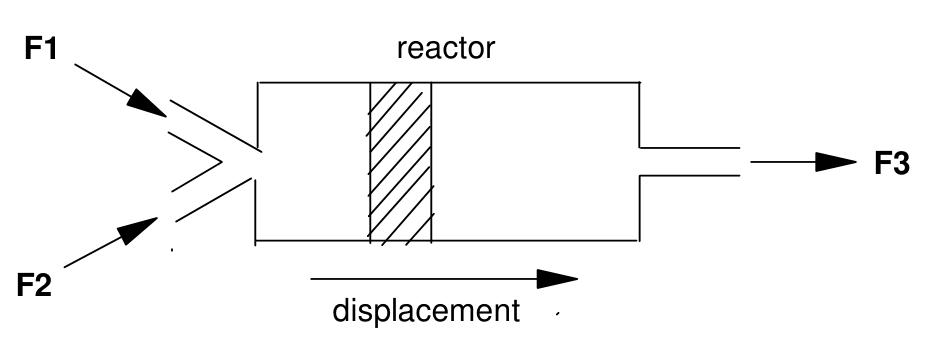
Fig. 1
The reagents are introduced and mixed at the inlet of the reactor (flow F1 and F2). Each slice of the reaction medium (marked zone in the diagram) moves along inside the plug flow reactor without mixing with the others and exits from the reactor (flow F3). When the flow has stabilized, concentrations and conditions are time-independent but dependent on the location in the reactor.
The continuous stirred reactor (Fig. 2)
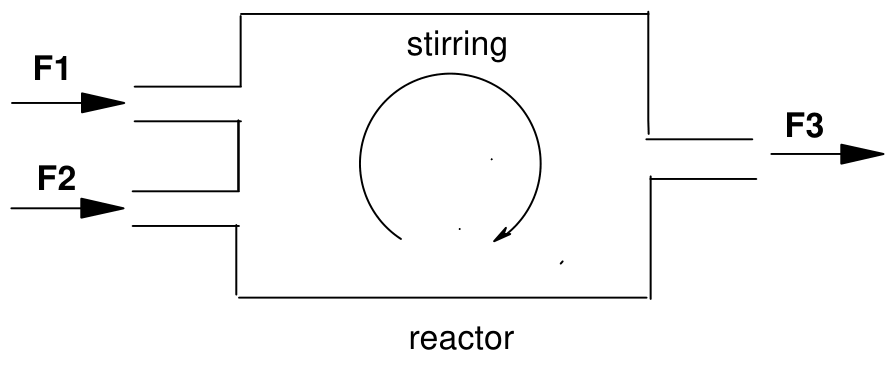
Fig. 2
The reagents are introduced into the reactor (flows F1 and F2). Inside the reactor they are stirred perfectly and instantaneously. When the flow is stabilized, concentrations and conditions are time-independent and identical at every point of the reactor.
The differential yield of hydrogenation (\(Y\)) is given by \[ Y=-\frac{\mathrm{d}([\ce{C6H12}])}{\mathrm{d}([\ce{C6H6}])}. \]
The proportion of benzene already hydrogenated is given by \[ p=\frac{[\ce{C6H12}]}{[\ce{C6H12}]+[\ce{C6H6}]}. \]
The relationship between \(p\) and \(Y\) is shown in Fig. 3.
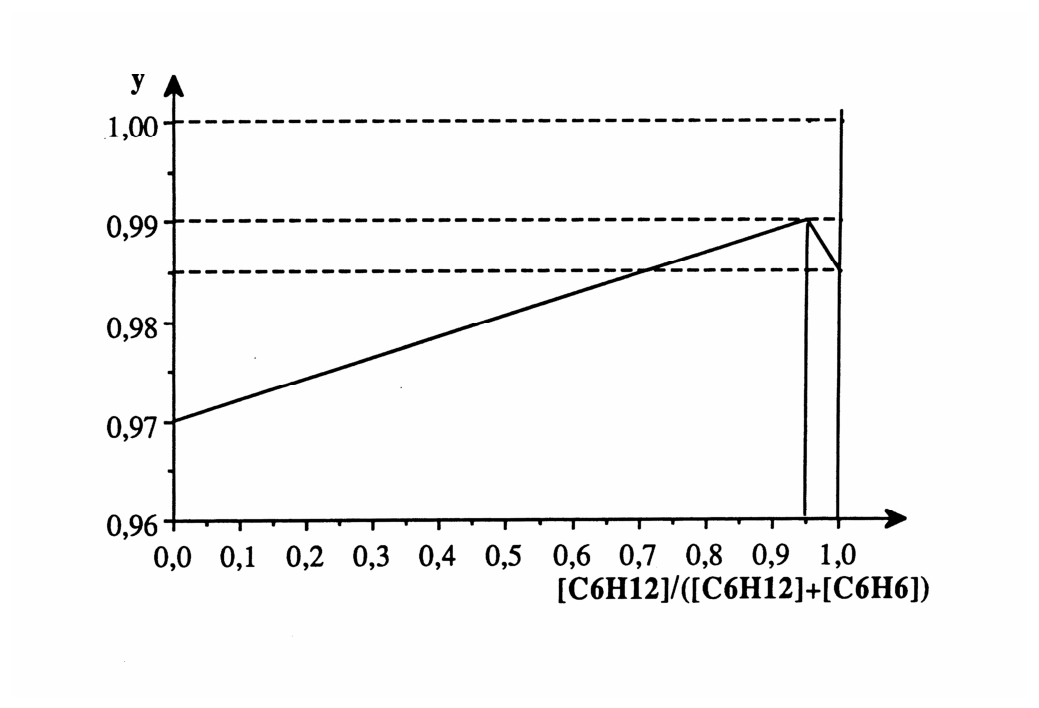
Fig. 3
The aim is to hydrogenate almost all the benzene, i.e. \(0.9\le p\le1\) with the best mean yield \[ Y=-\frac{\Delta[\ce{C6H12}]}{\Delta[\ce{C6H6}]}. \]
7.1 What is the value of \(p\) in a continuous stirred reactor leading to the maximal mean yield of hydrogenation? What is the maximal value of \(Y\)?
7.2 For a continuous plug flow reactor, give a rough value of \(Y\) for \(0.9\le p\le1\):
\(Y=0.97,\ 0.98,\ 0.99\) or \(1.00\) ?
7.3 Represent by grey shading in the graph (Fig. 3) the quantities of benzene lost in installation P (plug flow reactor) and installation MP (stirred reactor + plug flow reactor).
7.4 Give the amount of annual benzene lost in installation P and MP assuming an annual consumption of 100 000 tons of benzene.
Official English text of the problem.
Answers
- 7.1: \(p\approx0.95\); maximal mean yield \(Y_{\max}\approx0.99\), or 99%.
- 7.2: \(Y\approx0.98\), or 98%.
- 7.3: For P, shade between \(Y=1\) and the plotted curve over \(0\le p\le1\). For MP, shade between \(Y=1\) and \(Y=0.99\) over \(0\le p\le0.95\), then between \(Y=1\) and the descending plotted curve over \(0.95\le p\le1\).
- 7.4: Annual benzene losses are approximately \(2.0\times10^3\) tons for P and \(1.0\times10^3\) tons for MP.
Solution
The desired reaction is \[ \ce{C6H6 + 3H2 <=> C6H12} \qquad\text{(catalyst)}. \]
The species are benzene c1ccccc1, hydrogen [H][H], and cyclohexane C1CCCCC1. One mole of benzene gives one mole of cyclohexane in the desired reaction. Thus a differential yield below unity means that some consumed benzene does not appear as cyclohexane.
We write \(\overline Y\) for the mean yield, distinguishing it from the differential yield \(Y(p)\).
7.1
In a perfectly stirred reactor, the composition is uniform. All reaction therefore occurs at the same \(p\), with the same differential yield. Consequently, \[ \overline Y_{\mathrm{stirred}}=Y(p). \]
The maximum of the plotted curve occurs at approximately \[ \boxed{p=0.95,\qquad \overline Y_{\max}=0.99.} \]
7.2
In a plug flow reactor, each slice of material passes successively through compositions ranging from the inlet value \(p=0\) to the outlet value. Its mean yield therefore averages the differential yields encountered along that path.
More precisely, if \(X\) is the fraction of inlet benzene consumed, \[ \overline Y_{\mathrm P} =\frac{1}{X_f}\int_0^{X_f}Y\bigl(p(X)\bigr)\,\mathrm dX. \]
Because the yields are close to unity, \(p\approx X\) is adequate for the graphical estimate requested. Over the principal rising section, the average yield is approximately \[ \overline Y_{\mathrm P} \approx\frac{0.97+0.99}{2} =0.98. \]
Moving the outlet within \(0.9\le p\le1\) changes this only slightly. Hence the appropriate choice is \[ \boxed{\overline Y_{\mathrm P}\approx0.98.} \]
7.3
The quantity \(1-Y\) represents the fraction of an increment of consumed benzene that fails to give cyclohexane. Using \(p\approx X\), its integral is the graphical estimate of the benzene loss.
For the comparison, take both installations to finish at \(p=1\), with the stirred stage of MP operated at its optimum \(p=0.95\).
- Installation P: Shade the entire region below the horizontal line \(Y=1\) and above the original yield curve, from \(p=0\) to \(p=1\). Its lower boundary rises from \((0,0.97)\) to \((0.95,0.99)\), then falls to \((1,0.985)\).
- Installation MP: The stirred stage performs its reaction at \(Y=0.99\), so shade the rectangle bounded by \(p=0\), \(p=0.95\), \(Y=0.99\), and \(Y=1\). For the subsequent plug flow stage, add the region between \(Y=1\) and the descending curve from \(p=0.95\) to \(p=1\).
Equivalently, the MP shading is a strip of height \(0.01\) across the full interval \(0\le p\le1\), together with a small triangle beneath it over \(0.95\le p\le1\).
7.4
Reading the graph gives \[ Y(0)\approx0.970,\qquad Y(0.95)\approx0.990,\qquad Y(1)\approx0.985. \]
For P, the shaded area consists of two trapezoids: \[ \begin{aligned} A_{\mathrm P} &=\frac{(1-0.970)+(1-0.990)}{2}(0.95)\\ &\quad+\frac{(1-0.990)+(1-0.985)}{2}(0.05)\\ &=0.019+0.000625\\ &=0.019625. \end{aligned} \]
The graphical estimate of the annual loss is therefore \[ m_{\mathrm{loss,P}} \approx100\,000\ \mathrm{t\,yr^{-1}}\times0.019625 =1962.5\ \mathrm{t\,yr^{-1}}. \]
At the accuracy warranted by the graph, \[ \boxed{m_{\mathrm{loss,P}}\approx2.0\times10^3\ \mathrm{t\,yr^{-1}}.} \]
For MP, the shaded area is a rectangle followed by the same final trapezoid: \[ \begin{aligned} A_{\mathrm{MP}} &=(1-0.990)(0.95) +\frac{(1-0.990)+(1-0.985)}{2}(0.05)\\ &=0.0095+0.000625\\ &=0.010125. \end{aligned} \]
Thus \[ m_{\mathrm{loss,MP}} \approx100\,000\ \mathrm{t\,yr^{-1}}\times0.010125 =1012.5\ \mathrm{t\,yr^{-1}}, \] or appropriately rounded, \[ \boxed{m_{\mathrm{loss,MP}}\approx1.0\times10^3\ \mathrm{t\,yr^{-1}}.} \]
These are masses of benzene lost, so no benzene-to-cyclohexane molar-mass conversion is required.
The shaded-area method is a small-loss approximation: strictly, \(p\) excludes material lost to other products and therefore differs slightly from the actual benzene conversion \(X\). This distinction does not change the quoted rounded answers.
The solution was checked against the official solution.
IChO 1990 · Theorieaufgabe 7
Hydrierung von Benzol in kontinuierlich betriebenen Reaktoren
Kreuzen Sie bei dieser Aufgabe das entsprechende Kästchen in den Tabellen des Antwortbogens an.
Die Hydrierung von Benzol zu Cyclohexan wird in kontinuierlich betriebenen Reaktoren durchgeführt. Die Reaktion lautet wie folgt:
Zwei grundlegende Typen kontinuierlich betriebener Reaktoren werden untersucht: ein kontinuierlicher Rohrreaktor mit Pfropfenströmung und ein kontinuierlicher Rührkesselreaktor.
Der kontinuierliche Rohrreaktor mit Pfropfenströmung (Abb. 1)
Abb. 1
Die Reaktanten werden am Einlass des Reaktors zugeführt und gemischt (Ströme F1 und F2). Jede Schicht des Reaktionsmediums (markierter Bereich in der Abbildung) bewegt sich durch den Rohrreaktor, ohne sich mit den anderen Schichten zu vermischen, und verlässt den Reaktor (Strom F3). Sobald sich ein stationärer Strömungszustand eingestellt hat, sind die Konzentrationen und Bedingungen zeitunabhängig, hängen jedoch vom Ort im Reaktor ab.
Der kontinuierliche Rührkesselreaktor (Abb. 2)
Abb. 2
Die Reaktanten werden dem Reaktor zugeführt (Ströme F1 und F2). Im Reaktor werden sie augenblicklich und vollständig durchmischt. Sobald sich ein stationärer Strömungszustand eingestellt hat, sind die Konzentrationen und Bedingungen zeitunabhängig und an jedem Ort im Reaktor gleich.
Die differentielle Ausbeute der Hydrierung (\(Y\)) ist gegeben durch \[ Y=-\frac{\mathrm{d}([\ce{C6H12}])}{\mathrm{d}([\ce{C6H6}])}. \]
Der Anteil des bereits hydrierten Benzols ist gegeben durch \[ p=\frac{[\ce{C6H12}]}{[\ce{C6H12}]+[\ce{C6H6}]}. \]
Der Zusammenhang zwischen \(p\) und \(Y\) ist in Abb. 3 dargestellt.
Abb. 3
Ziel ist es, nahezu das gesamte Benzol zu hydrieren, d. h. \(0.9\le p\le1\), und dabei die bestmögliche mittlere Ausbeute zu erzielen: \[ Y=-\frac{\Delta[\ce{C6H12}]}{\Delta[\ce{C6H6}]}. \]
7.1 Bei welchem Wert von \(p\) erreicht ein kontinuierlicher Rührkesselreaktor die maximale mittlere Ausbeute der Hydrierung? Wie groß ist der maximale Wert von \(Y\)?
7.2 Geben Sie für einen kontinuierlichen Rohrreaktor mit Pfropfenströmung einen ungefähren Wert von \(Y\) für \(0.9\le p\le1\) an:
\(Y=0.97,\ 0.98,\ 0.99\) oder \(1.00\) ?
7.3 Stellen Sie im Diagramm (Abb. 3) durch graue Schattierung die Benzolmengen dar, die in Anlage P (Rohrreaktor mit Pfropfenströmung) und Anlage MP (Rührkesselreaktor + Rohrreaktor mit Pfropfenströmung) verloren gehen.
7.4 Geben Sie die jährlichen Benzolverluste in den Anlagen P und MP bei einem angenommenen jährlichen Verbrauch von 100 000 Tonnen Benzol an.
Aufgabentext aus dem offiziellen englischen Text übersetzt.
Antworten
- 7.1: \(p\approx0.95\); maximale mittlere Ausbeute \(Y_{\max}\approx0.99\), oder 99%.
- 7.2: \(Y\approx0.98\), oder 98%.
- 7.3: Schattieren Sie für P die Fläche zwischen \(Y=1\) und der eingezeichneten Kurve im Bereich \(0\le p\le1\). Schattieren Sie für MP die Fläche zwischen \(Y=1\) und \(Y=0.99\) im Bereich \(0\le p\le0.95\) und anschließend die Fläche zwischen \(Y=1\) und dem abfallenden Abschnitt der eingezeichneten Kurve im Bereich \(0.95\le p\le1\).
- 7.4: Die jährlichen Benzolverluste betragen ungefähr \(2.0\times10^3\) Tonnen für P und \(1.0\times10^3\) Tonnen für MP.
Lösung
Die gewünschte Reaktion lautet \[ \ce{C6H6 + 3H2 <=> C6H12} \qquad\text{(Katalysator)}. \]
Die beteiligten Stoffe sind Benzol c1ccccc1, Wasserstoff [H][H] und Cyclohexan C1CCCCC1. Ein Mol Benzol ergibt bei der gewünschten Reaktion ein Mol Cyclohexan. Eine differentielle Ausbeute unter eins bedeutet daher, dass ein Teil des verbrauchten Benzols nicht als Cyclohexan vorliegt.
Wir verwenden \(\overline Y\) für die mittlere Ausbeute, um sie von der differentiellen Ausbeute \(Y(p)\) zu unterscheiden.
7.1
In einem ideal durchmischten Rührkesselreaktor ist die Zusammensetzung einheitlich. Die gesamte Reaktion findet daher bei demselben \(p\) und mit derselben differentiellen Ausbeute statt. Folglich gilt \[ \overline Y_{\mathrm{stirred}}=Y(p). \]
Das Maximum der eingezeichneten Kurve liegt ungefähr bei \[ \boxed{p=0.95,\qquad \overline Y_{\max}=0.99.} \]
7.2
In einem Rohrreaktor mit Pfropfenströmung durchläuft jede Materialschicht nacheinander Zusammensetzungen vom Eintrittswert \(p=0\) bis zum Austrittswert. Ihre mittlere Ausbeute ergibt sich daher als Mittelwert der differentiellen Ausbeuten entlang dieses Weges.
Genauer gilt, wenn \(X\) der Anteil des zugeführten Benzols ist, der verbraucht wurde, \[ \overline Y_{\mathrm P} =\frac{1}{X_f}\int_0^{X_f}Y\bigl(p(X)\bigr)\,\mathrm dX. \]
Da die Ausbeuten nahe bei eins liegen, ist \(p\approx X\) für die geforderte grafische Abschätzung ausreichend. Über den wesentlichen ansteigenden Abschnitt beträgt die mittlere Ausbeute ungefähr \[ \overline Y_{\mathrm P} \approx\frac{0.97+0.99}{2} =0.98. \]
Eine Verschiebung des Austrittswertes innerhalb von \(0.9\le p\le1\) ändert dies nur geringfügig. Die passende Auswahl ist daher \[ \boxed{\overline Y_{\mathrm P}\approx0.98.} \]
7.3
Die Größe \(1-Y\) gibt den Anteil einer zusätzlich verbrauchten Benzolmenge an, aus dem kein Cyclohexan entsteht. Mit \(p\approx X\) liefert ihr Integral die grafische Abschätzung des Benzolverlustes.
Für den Vergleich wird angenommen, dass beide Anlagen bei \(p=1\) enden und die Rührkesselstufe von MP bei ihrem optimalen Wert \(p=0.95\) betrieben wird.
- Anlage P: Schattieren Sie die gesamte Fläche unterhalb der horizontalen Geraden \(Y=1\) und oberhalb der ursprünglichen Ausbeutekurve von \(p=0\) bis \(p=1\). Ihre untere Begrenzung steigt von \((0,0.97)\) auf \((0.95,0.99)\) an und fällt dann auf \((1,0.985)\) ab.
- Anlage MP: In der Rührkesselstufe läuft die Reaktion bei \(Y=0.99\) ab; schattieren Sie daher das durch \(p=0\), \(p=0.95\), \(Y=0.99\) und \(Y=1\) begrenzte Rechteck. Ergänzen Sie für die anschließende Rohrreaktorstufe mit Pfropfenströmung die Fläche zwischen \(Y=1\) und der abfallenden Kurve von \(p=0.95\) bis \(p=1\).
Gleichwertig lässt sich die Schattierung für MP als Streifen der Höhe \(0.01\) über das gesamte Intervall \(0\le p\le1\) zusammen mit einem kleinen Dreieck darunter im Bereich \(0.95\le p\le1\) darstellen.
7.4
Aus dem Diagramm liest man ab: \[ Y(0)\approx0.970,\qquad Y(0.95)\approx0.990,\qquad Y(1)\approx0.985. \]
Für P besteht die schattierte Fläche aus zwei Trapezen: \[ \begin{aligned} A_{\mathrm P} &=\frac{(1-0.970)+(1-0.990)}{2}(0.95)\\ &\quad+\frac{(1-0.990)+(1-0.985)}{2}(0.05)\\ &=0.019+0.000625\\ &=0.019625. \end{aligned} \]
Die grafische Abschätzung des jährlichen Verlustes ergibt daher \[ m_{\mathrm{loss,P}} \approx100\,000\ \mathrm{t\,yr^{-1}}\times0.019625 =1962.5\ \mathrm{t\,yr^{-1}}. \]
Mit der durch das Diagramm gerechtfertigten Genauigkeit gilt \[ \boxed{m_{\mathrm{loss,P}}\approx2.0\times10^3\ \mathrm{t\,yr^{-1}}.} \]
Für MP besteht die schattierte Fläche aus einem Rechteck, gefolgt von demselben abschließenden Trapez: \[ \begin{aligned} A_{\mathrm{MP}} &=(1-0.990)(0.95) +\frac{(1-0.990)+(1-0.985)}{2}(0.05)\\ &=0.0095+0.000625\\ &=0.010125. \end{aligned} \]
Somit gilt \[ m_{\mathrm{loss,MP}} \approx100\,000\ \mathrm{t\,yr^{-1}}\times0.010125 =1012.5\ \mathrm{t\,yr^{-1}}, \] oder, angemessen gerundet, \[ \boxed{m_{\mathrm{loss,MP}}\approx1.0\times10^3\ \mathrm{t\,yr^{-1}}.} \]
Dabei handelt es sich um Massen an verlorenem Benzol, sodass keine Umrechnung von Benzol zu Cyclohexan anhand der molaren Massen erforderlich ist.
Die Methode der schattierten Flächen ist eine Näherung für kleine Verluste: Streng genommen berücksichtigt \(p\) das durch die Bildung anderer Produkte verlorene Material nicht und unterscheidet sich daher geringfügig vom tatsächlichen Benzolumsatz \(X\). Dieser Unterschied ändert die angegebenen gerundeten Antworten nicht.
Die Lösung wurde mit der offiziellen Lösung abgeglichen.
IChO 1990 · Teori sorusu 7
Sürekli reaktörlerde benzenin hidrojenasyonu
Bu soruda cevap kâğıdındaki tablolarda uygun kutuyu işaretleyiniz.
Benzenin siklohekzana hidrojenasyonu sürekli reaktörlerde gerçekleştirilir. Tepkime aşağıdaki gibidir:
İki temel sürekli reaktör türü incelenmektedir: sürekli piston akışlı reaktör ve sürekli karıştırmalı reaktör.
Sürekli piston akışlı reaktör (Şekil 1)
Şekil 1
Tepkimeye giren maddeler reaktörün girişinden beslenir ve karıştırılır (F1 ve F2 akımları). Tepkime ortamının her bir dilimi (şemada işaretlenmiş bölge), diğer dilimlerle karışmadan piston akışlı reaktörün içinde ilerler ve reaktörden çıkar (F3 akımı). Akış kararlı hâle geldiğinde derişimler ve koşullar zamandan bağımsızdır, ancak reaktör içindeki konuma bağlıdır.
Sürekli karıştırmalı reaktör (Şekil 2)
Şekil 2
Tepkimeye giren maddeler reaktöre beslenir (F1 ve F2 akımları). Reaktörün içinde anında ve tam olarak karıştırılırlar. Akış kararlı hâle geldiğinde derişimler ve koşullar zamandan bağımsızdır ve reaktörün her noktasında aynıdır.
Hidrojenasyonun diferansiyel verimi (\(Y\)) şu şekilde verilir: \[ Y=-\frac{\mathrm{d}([\ce{C6H12}])}{\mathrm{d}([\ce{C6H6}])}. \]
Benzenin hidrojenasyona uğramış kısmının oranı şu şekilde verilir: \[ p=\frac{[\ce{C6H12}]}{[\ce{C6H12}]+[\ce{C6H6}]}. \]
\(p\) ile \(Y\) arasındaki ilişki Şekil 3'te gösterilmiştir.
Şekil 3
Amaç, benzenin hemen hemen tamamını, yani \(0.9\le p\le1\) olacak şekilde, en yüksek ortalama verimle hidrojenasyona uğratmaktır: \[ Y=-\frac{\Delta[\ce{C6H12}]}{\Delta[\ce{C6H6}]}. \]
7.1 Sürekli karıştırmalı bir reaktörde en yüksek ortalama hidrojenasyon verimini sağlayan \(p\) değeri nedir? \(Y\)'nin en yüksek değeri nedir?
7.2 Sürekli piston akışlı bir reaktör için \(0.9\le p\le1\) aralığında \(Y\)'nin yaklaşık değerini belirtiniz:
\(Y=0.97,\ 0.98,\ 0.99\) veya \(1.00\) ?
7.3 P tesisinde (piston akışlı reaktör) ve MP tesisinde (karıştırmalı reaktör + piston akışlı reaktör) kaybedilen benzen miktarlarını grafikte (Şekil 3) gri tarama ile gösteriniz.
7.4 Yıllık benzen tüketiminin 100 000 ton olduğunu varsayarak P ve MP tesislerinde yıllık kaybedilen benzen miktarını belirtiniz.
Soru metni resmi İngilizce metinden çevrilmiştir.
Cevaplar
- 7.1: \(p\approx0.95\); en yüksek ortalama verim \(Y_{\max}\approx0.99\), yani %99.
- 7.2: \(Y\approx0.98\), yani %98.
- 7.3: P için, \(0\le p\le1\) aralığında \(Y=1\) ile çizilen eğri arasını tarayınız. MP için, \(0\le p\le0.95\) aralığında \(Y=1\) ile \(Y=0.99\) arasını, ardından \(0.95\le p\le1\) aralığında \(Y=1\) ile çizilen eğrinin azalan kısmı arasını tarayınız.
- 7.4: Yıllık benzen kayıpları yaklaşık olarak P için \(2.0\times10^3\) ton ve MP için \(1.0\times10^3\) tondur.
Çözüm
İstenen tepkime şöyledir: \[ \ce{C6H6 + 3H2 <=> C6H12} \qquad\text{(katalizör)}. \]
Kimyasal türler benzen c1ccccc1, hidrojen [H][H] ve siklohekzandır C1CCCCC1. İstenen tepkimede bir mol benzen bir mol siklohekzan verir. Dolayısıyla diferansiyel verimin birden küçük olması, tüketilen benzenin bir kısmının siklohekzana dönüşmediği anlamına gelir.
Ortalama verimi, diferansiyel verim \(Y(p)\)'den ayırt etmek için \(\overline Y\) ile gösteriyoruz.
7.1
Tam karışmalı bir reaktörde bileşim her yerde aynıdır. Bu nedenle tepkimenin tamamı aynı \(p\) değerinde ve aynı diferansiyel verimle gerçekleşir. Sonuç olarak, \[ \overline Y_{\mathrm{stirred}}=Y(p). \]
Çizilen eğrinin maksimumu yaklaşık olarak şu değerlerde elde edilir: \[ \boxed{p=0.95,\qquad \overline Y_{\max}=0.99.} \]
7.2
Piston akışlı bir reaktörde her bir madde dilimi, giriş değeri \(p=0\)'dan çıkış değerine kadar değişen bileşimlerden art arda geçer. Dolayısıyla ortalama verimi, bu yol boyunca karşılaşılan diferansiyel verimlerin ortalamasıdır.
Daha kesin olarak, \(X\) girişteki benzenin tüketilen kesri ise, \[ \overline Y_{\mathrm P} =\frac{1}{X_f}\int_0^{X_f}Y\bigl(p(X)\bigr)\,\mathrm dX. \]
Verimler bire yakın olduğundan, istenen grafiksel tahmin için \(p\approx X\) yaklaşımı yeterlidir. Eğrinin ana yükselen kısmında ortalama verim yaklaşık olarak şöyledir: \[ \overline Y_{\mathrm P} \approx\frac{0.97+0.99}{2} =0.98. \]
Çıkış değerinin \(0.9\le p\le1\) aralığında değiştirilmesi bu değeri yalnızca çok az değiştirir. Dolayısıyla uygun seçim şudur: \[ \boxed{\overline Y_{\mathrm P}\approx0.98.} \]
7.3
\(1-Y\) büyüklüğü, tüketilen benzen miktarındaki küçük bir artışın siklohekzan vermeyen kesrini ifade eder. \(p\approx X\) yaklaşımı kullanıldığında, bu büyüklüğün integrali benzen kaybının grafiksel tahminini verir.
Karşılaştırma için her iki tesiste de son değerin \(p=1\) olduğunu ve MP'nin karıştırmalı kademesinin en uygun değer olan \(p=0.95\)'te işletildiğini kabul ediniz.
- P tesisi: \(p=0\)'dan \(p=1\)'e kadar, \(Y=1\) yatay doğrusunun altında ve verilen verim eğrisinin üstünde kalan bölgenin tamamını tarayınız. Bu bölgenin alt sınırı \((0,0.97)\)'den \((0.95,0.99)\)'a yükselir, ardından \((1,0.985)\)'e düşer.
- MP tesisi: Karıştırmalı kademede tepkime \(Y=0.99\) verimiyle gerçekleşir; bu nedenle \(p=0\), \(p=0.95\), \(Y=0.99\) ve \(Y=1\) ile sınırlanan dikdörtgeni tarayınız. Ardından gelen piston akışlı kademe için, \(p=0.95\)'ten \(p=1\)'e kadar \(Y=1\) ile azalan eğri arasındaki bölgeyi ekleyiniz.
Eşdeğer bir gösterimle, MP için taranan bölge, \(0\le p\le1\) aralığının tamamı boyunca yüksekliği \(0.01\) olan bir şerit ile \(0.95\le p\le1\) aralığında bu şeridin altında kalan küçük bir üçgenden oluşur.
7.4
Grafikten okunan değerler şöyledir: \[ Y(0)\approx0.970,\qquad Y(0.95)\approx0.990,\qquad Y(1)\approx0.985. \]
P için taranan alan iki yamuktan oluşur: \[ \begin{aligned} A_{\mathrm P} &=\frac{(1-0.970)+(1-0.990)}{2}(0.95)\\ &\quad+\frac{(1-0.990)+(1-0.985)}{2}(0.05)\\ &=0.019+0.000625\\ &=0.019625. \end{aligned} \]
Dolayısıyla yıllık kaybın grafiksel tahmini şöyledir: \[ m_{\mathrm{loss,P}} \approx100\,000\ \mathrm{t\,yr^{-1}}\times0.019625 =1962.5\ \mathrm{t\,yr^{-1}}. \]
Grafiğin elverdiği doğruluk düzeyinde, \[ \boxed{m_{\mathrm{loss,P}}\approx2.0\times10^3\ \mathrm{t\,yr^{-1}}.} \]
MP için taranan alan, bir dikdörtgen ile onun ardından gelen, P'dekiyle aynı son yamuktan oluşur: \[ \begin{aligned} A_{\mathrm{MP}} &=(1-0.990)(0.95) +\frac{(1-0.990)+(1-0.985)}{2}(0.05)\\ &=0.0095+0.000625\\ &=0.010125. \end{aligned} \]
Böylece \[ m_{\mathrm{loss,MP}} \approx100\,000\ \mathrm{t\,yr^{-1}}\times0.010125 =1012.5\ \mathrm{t\,yr^{-1}}, \] ya da uygun biçimde yuvarlandığında, \[ \boxed{m_{\mathrm{loss,MP}}\approx1.0\times10^3\ \mathrm{t\,yr^{-1}}.} \]
Bunlar kaybedilen benzenin kütleleridir; dolayısıyla benzen ile siklohekzan arasında mol kütlelerine dayalı bir dönüşüm yapılması gerekmez.
Taranan alan yöntemi, kaybın küçük olduğu durumlar için bir yaklaşımdır: kesin olarak ele alındığında, \(p\) başka ürünlere dönüşerek kaybedilen maddeyi içermez ve bu nedenle gerçek benzen dönüşümü \(X\)'ten biraz farklıdır. Bu ayrım, verilen yuvarlanmış cevapları değiştirmez.
Çözüm, resmi çözümle karşılaştırılarak kontrol edildi.
IChO 1990 · Problema teórico 7
Hidrogenación del benceno en reactores continuos
En este problema, marque la casilla correspondiente en las tablas de la hoja de respuestas.
La hidrogenación del benceno a ciclohexano se lleva a cabo en reactores continuos. La reacción es la siguiente:
Se examinan dos tipos básicos de reactores continuos: un reactor continuo de flujo pistón y un reactor continuo de tanque agitado.
El reactor continuo de flujo pistón (Fig. 1)
Fig. 1
Los reactivos se introducen y se mezclan en la entrada del reactor (corrientes F1 y F2). Cada porción del medio de reacción (zona marcada en el esquema) se desplaza por el interior del reactor de flujo pistón sin mezclarse con las demás y sale del reactor (corriente F3). Cuando el flujo se ha estabilizado, las concentraciones y las condiciones son independientes del tiempo, pero dependen de la posición en el reactor.
El reactor continuo de tanque agitado (Fig. 2)
Fig. 2
Los reactivos se introducen en el reactor (corrientes F1 y F2). En el interior del reactor se mezclan de manera perfecta e instantánea. Cuando el flujo se ha estabilizado, las concentraciones y las condiciones son independientes del tiempo e idénticas en todos los puntos del reactor.
El rendimiento diferencial de la hidrogenación (\(Y\)) viene dado por \[ Y=-\frac{\mathrm{d}([\ce{C6H12}])}{\mathrm{d}([\ce{C6H6}])}. \]
La proporción de benceno ya hidrogenado viene dada por \[ p=\frac{[\ce{C6H12}]}{[\ce{C6H12}]+[\ce{C6H6}]}. \]
La relación entre \(p\) e \(Y\) se muestra en la Fig. 3.
Fig. 3
El objetivo es hidrogenar casi todo el benceno, es decir, \(0.9\le p\le1\), con el mejor rendimiento medio \[ Y=-\frac{\Delta[\ce{C6H12}]}{\Delta[\ce{C6H6}]}. \]
7.1 ¿Cuál es el valor de \(p\) en un reactor continuo de tanque agitado que permite obtener el máximo rendimiento medio de hidrogenación? ¿Cuál es el valor máximo de \(Y\)?
7.2 Para un reactor continuo de flujo pistón, indique un valor aproximado de \(Y\) para \(0.9\le p\le1\):
¿\(Y=0.97,\ 0.98,\ 0.99\) o \(1.00\)?
7.3 Represente mediante sombreado gris en la gráfica (Fig. 3) las cantidades de benceno perdidas en la instalación P (reactor de flujo pistón) y en la instalación MP (reactor de tanque agitado + reactor de flujo pistón).
7.4 Indique la cantidad de benceno perdida anualmente en las instalaciones P y MP, suponiendo un consumo anual de 100 000 toneladas de benceno.
Enunciado traducido del texto oficial en inglés.
Respuestas
- 7.1: \(p\approx0.95\); rendimiento medio máximo \(Y_{\max}\approx0.99\), o 99%.
- 7.2: \(Y\approx0.98\), o 98%.
- 7.3: Para P, sombree entre \(Y=1\) y la curva representada en el intervalo \(0\le p\le1\). Para MP, sombree entre \(Y=1\) e \(Y=0.99\) en el intervalo \(0\le p\le0.95\), y después entre \(Y=1\) y la curva descendente representada en el intervalo \(0.95\le p\le1\).
- 7.4: Las pérdidas anuales de benceno son aproximadamente \(2.0\times10^3\) toneladas para P y \(1.0\times10^3\) toneladas para MP.
Solución
La reacción deseada es \[ \ce{C6H6 + 3H2 <=> C6H12} \qquad\text{(catalizador)}. \]
Las especies son benceno c1ccccc1, hidrógeno [H][H] y ciclohexano C1CCCCC1. Un mol de benceno produce un mol de ciclohexano en la reacción deseada. Por tanto, un rendimiento diferencial inferior a la unidad significa que parte del benceno consumido no se transforma en ciclohexano.
Escribimos \(\overline Y\) para el rendimiento medio, distinguiéndolo del rendimiento diferencial \(Y(p)\).
7.1
En un reactor de tanque perfectamente agitado, la composición es uniforme. Por tanto, toda la reacción tiene lugar al mismo valor de \(p\), con el mismo rendimiento diferencial. En consecuencia, \[ \overline Y_{\mathrm{stirred}}=Y(p). \]
El máximo de la curva representada se encuentra aproximadamente en \[ \boxed{p=0.95,\qquad \overline Y_{\max}=0.99.} \]
7.2
En un reactor de flujo pistón, cada porción de materia pasa sucesivamente por composiciones que van desde el valor de entrada \(p=0\) hasta el valor de salida. Por tanto, su rendimiento medio es un promedio de los rendimientos diferenciales encontrados a lo largo de ese recorrido.
Más precisamente, si \(X\) es la fracción del benceno de entrada que se ha consumido, \[ \overline Y_{\mathrm P} =\frac{1}{X_f}\int_0^{X_f}Y\bigl(p(X)\bigr)\,\mathrm dX. \]
Como los rendimientos son próximos a la unidad, \(p\approx X\) es una aproximación adecuada para la estimación gráfica solicitada. En el tramo ascendente principal, el rendimiento medio es aproximadamente \[ \overline Y_{\mathrm P} \approx\frac{0.97+0.99}{2} =0.98. \]
Variar el valor de salida dentro del intervalo \(0.9\le p\le1\) solo modifica ligeramente este resultado. Por tanto, la opción adecuada es \[ \boxed{\overline Y_{\mathrm P}\approx0.98.} \]
7.3
La cantidad \(1-Y\) representa la fracción de un incremento de benceno consumido que no produce ciclohexano. Utilizando \(p\approx X\), su integral es la estimación gráfica de la pérdida de benceno.
Para la comparación, considere que ambas instalaciones terminan en \(p=1\), con la etapa de tanque agitado de MP funcionando en su valor óptimo \(p=0.95\).
- Instalación P: Sombree toda la región situada por debajo de la recta horizontal \(Y=1\) y por encima de la curva de rendimiento original, desde \(p=0\) hasta \(p=1\). Su límite inferior asciende desde \((0,0.97)\) hasta \((0.95,0.99)\) y después desciende hasta \((1,0.985)\).
- Instalación MP: La reacción en la etapa de tanque agitado tiene lugar con \(Y=0.99\), por lo que debe sombrearse el rectángulo delimitado por \(p=0\), \(p=0.95\), \(Y=0.99\) e \(Y=1\). Para la etapa posterior de flujo pistón, añada la región comprendida entre \(Y=1\) y la curva descendente desde \(p=0.95\) hasta \(p=1\).
De manera equivalente, el sombreado de MP es una franja de altura \(0.01\) que abarca todo el intervalo \(0\le p\le1\), junto con un pequeño triángulo situado debajo de ella en el intervalo \(0.95\le p\le1\).
7.4
La lectura de la gráfica da \[ Y(0)\approx0.970,\qquad Y(0.95)\approx0.990,\qquad Y(1)\approx0.985. \]
Para P, el área sombreada consta de dos trapecios: \[ \begin{aligned} A_{\mathrm P} &=\frac{(1-0.970)+(1-0.990)}{2}(0.95)\\ &\quad+\frac{(1-0.990)+(1-0.985)}{2}(0.05)\\ &=0.019+0.000625\\ &=0.019625. \end{aligned} \]
Por tanto, la estimación gráfica de la pérdida anual es \[ m_{\mathrm{loss,P}} \approx100\,000\ \mathrm{t\,yr^{-1}}\times0.019625 =1962.5\ \mathrm{t\,yr^{-1}}. \]
Con la precisión que permite la gráfica, \[ \boxed{m_{\mathrm{loss,P}}\approx2.0\times10^3\ \mathrm{t\,yr^{-1}}.} \]
Para MP, el área sombreada es un rectángulo seguido del mismo trapecio final: \[ \begin{aligned} A_{\mathrm{MP}} &=(1-0.990)(0.95) +\frac{(1-0.990)+(1-0.985)}{2}(0.05)\\ &=0.0095+0.000625\\ &=0.010125. \end{aligned} \]
Así, \[ m_{\mathrm{loss,MP}} \approx100\,000\ \mathrm{t\,yr^{-1}}\times0.010125 =1012.5\ \mathrm{t\,yr^{-1}}, \] o, redondeando adecuadamente, \[ \boxed{m_{\mathrm{loss,MP}}\approx1.0\times10^3\ \mathrm{t\,yr^{-1}}.} \]
Estas son masas de benceno perdido, por lo que no se requiere ninguna conversión mediante las masas molares del benceno y del ciclohexano.
El método del área sombreada es una aproximación válida para pérdidas pequeñas: estrictamente, \(p\) excluye la materia perdida en forma de otros productos y, por tanto, difiere ligeramente de la conversión real del benceno \(X\). Esta distinción no modifica las respuestas redondeadas indicadas.
La solución se comprobó con la solución oficial.
IChO 1990 · 理论题 7
连续反应器中的苯加氢
本题请在答题纸表格中相应的方框内打勾。
苯加氢生成环己烷的反应在连续反应器中进行。反应如下:
现考察两种基本类型的连续反应器:连续平推流反应器和连续搅拌反应器。
连续平推流反应器(图 1)
图 1
反应物在反应器入口处加入并混合(物流 F1 和 F2)。反应介质的每一薄层(图中的标记区域)沿平推流反应器内部移动,不与其他薄层混合,最后流出反应器(物流 F3)。当流动达到稳定状态时,浓度和条件不随时间变化,但随反应器内的位置而变化。
连续搅拌反应器(图 2)
图 2
反应物加入反应器(物流 F1 和 F2)。它们在反应器内通过搅拌瞬间完全混合。当流动达到稳定状态时,浓度和条件不随时间变化,且在反应器内各处均相同。
加氢反应的微分收率(\(Y\))由下式给出: \[ Y=-\frac{\mathrm{d}([\ce{C6H12}])}{\mathrm{d}([\ce{C6H6}])}. \]
已加氢的苯所占的比例由下式给出: \[ p=\frac{[\ce{C6H12}]}{[\ce{C6H12}]+[\ce{C6H6}]}. \]
\(p\) 与 \(Y\) 的关系如图 3 所示。
图 3
目标是使几乎所有的苯加氢,即 \(0.9\le p\le1\),同时获得最高的平均收率: \[ Y=-\frac{\Delta[\ce{C6H12}]}{\Delta[\ce{C6H6}]}. \]
7.1 在连续搅拌反应器中,使加氢反应的平均收率达到最大时,\(p\) 的值是多少?\(Y\) 的最大值是多少?
7.2 对于连续平推流反应器,给出 \(0.9\le p\le1\) 时 \(Y\) 的近似值:
\(Y=0.97,\ 0.98,\ 0.99\) 或 \(1.00\)?
7.3 在图(图 3)中用灰色阴影表示装置 P(平推流反应器)和装置 MP(搅拌反应器 + 平推流反应器)中苯的损失量。
7.4 假设苯的年消耗量为 100 000 吨,给出装置 P 和 MP 中苯的年损失量。
题目译自官方英文原文。
答案
- 7.1: \(p\approx0.95\);最大平均收率 \(Y_{\max}\approx0.99\),即 99%。
- 7.2: \(Y\approx0.98\),即 98%。
- 7.3: 对于 P,在 \(0\le p\le1\) 范围内,将 \(Y=1\) 与图中曲线之间的区域涂上阴影。对于 MP,在 \(0\le p\le0.95\) 范围内,将 \(Y=1\) 与 \(Y=0.99\) 之间的区域涂上阴影,然后在 \(0.95\le p\le1\) 范围内,将 \(Y=1\) 与图中下降曲线之间的区域涂上阴影。
- 7.4: 苯的年损失量约为 P 中 \(2.0\times10^3\) 吨和 MP 中 \(1.0\times10^3\) 吨。
解答
目标反应为 \[ \ce{C6H6 + 3H2 <=> C6H12} \qquad\text{(催化剂)}. \]
各物种分别为苯 c1ccccc1、氢气 [H][H] 和环己烷 C1CCCCC1。在目标反应中,一摩尔苯生成一摩尔环己烷。因此,微分收率小于一意味着部分已消耗的苯未转化为环己烷。
我们用 \(\overline Y\) 表示平均收率,以区别于微分收率 \(Y(p)\)。
7.1
在完全混合的搅拌反应器中,各处组成均匀。因此,所有反应都在相同的 \(p\) 下发生,具有相同的微分收率。因而, \[ \overline Y_{\mathrm{stirred}}=Y(p). \]
图中曲线的最大值大致出现在 \[ \boxed{p=0.95,\qquad \overline Y_{\max}=0.99.} \]
7.2
在平推流反应器中,每一薄层物料依次经历从入口值 \(p=0\) 到出口值的各种组成。因此,其平均收率是沿该路径所经历的微分收率的平均值。
更准确地说,若 \(X\) 为入口苯被消耗的比例,则 \[ \overline Y_{\mathrm P} =\frac{1}{X_f}\int_0^{X_f}Y\bigl(p(X)\bigr)\,\mathrm dX. \]
由于收率接近一,采用 \(p\approx X\) 足以满足题目要求的图解估算。在主要的上升段,平均收率约为 \[ \overline Y_{\mathrm P} \approx\frac{0.97+0.99}{2} =0.98. \]
在 \(0.9\le p\le1\) 范围内改变出口值,只会使这一结果发生轻微变化。因此,恰当的选项为 \[ \boxed{\overline Y_{\mathrm P}\approx0.98.} \]
7.3
\(1-Y\) 表示在所消耗苯的一个增量中,未生成环己烷的部分所占的比例。采用 \(p\approx X\),其积分即为苯损失量的图解估算值。
为进行比较,取两套装置的终点均为 \(p=1\),并使 MP 的搅拌反应阶段在最佳值 \(p=0.95\) 下运行。
- 装置 P: 将从 \(p=0\) 到 \(p=1\) 的整个区间内,水平线 \(Y=1\) 下方、原收率曲线上方的区域涂上阴影。其下边界从 \((0,0.97)\) 上升至 \((0.95,0.99)\),然后下降至 \((1,0.985)\)。
- 装置 MP: 搅拌反应阶段的反应在 \(Y=0.99\) 下进行,因此将由 \(p=0\)、\(p=0.95\)、\(Y=0.99\) 和 \(Y=1\) 围成的矩形涂上阴影。对于随后的平推流阶段,再将从 \(p=0.95\) 到 \(p=1\) 的区间内,\(Y=1\) 与下降曲线之间的区域涂上阴影。
等价地,MP 的阴影区域由横跨整个区间 \(0\le p\le1\)、高度为 \(0.01\) 的条带,以及在 \(0.95\le p\le1\) 范围内位于该条带下方的一个小三角形组成。
7.4
从图中读得 \[ Y(0)\approx0.970,\qquad Y(0.95)\approx0.990,\qquad Y(1)\approx0.985. \]
对于 P,阴影区域由两个梯形组成: \[ \begin{aligned} A_{\mathrm P} &=\frac{(1-0.970)+(1-0.990)}{2}(0.95)\\ &\quad+\frac{(1-0.990)+(1-0.985)}{2}(0.05)\\ &=0.019+0.000625\\ &=0.019625. \end{aligned} \]
因此,年损失量的图解估算值为 \[ m_{\mathrm{loss,P}} \approx100\,000\ \mathrm{t\,yr^{-1}}\times0.019625 =1962.5\ \mathrm{t\,yr^{-1}}. \]
按照该图所能支持的精度, \[ \boxed{m_{\mathrm{loss,P}}\approx2.0\times10^3\ \mathrm{t\,yr^{-1}}.} \]
对于 MP,阴影区域由一个矩形及其后相同的末段梯形组成: \[ \begin{aligned} A_{\mathrm{MP}} &=(1-0.990)(0.95) +\frac{(1-0.990)+(1-0.985)}{2}(0.05)\\ &=0.0095+0.000625\\ &=0.010125. \end{aligned} \]
因此, \[ m_{\mathrm{loss,MP}} \approx100\,000\ \mathrm{t\,yr^{-1}}\times0.010125 =1012.5\ \mathrm{t\,yr^{-1}}, \] 或经适当舍入后, \[ \boxed{m_{\mathrm{loss,MP}}\approx1.0\times10^3\ \mathrm{t\,yr^{-1}}.} \]
这些是损失的苯的质量,因此无需根据苯与环己烷的摩尔质量进行换算。
阴影面积法是一种适用于损失较小时的近似方法:严格地说,\(p\) 不包含转化为其他产物而损失的物料,因此与实际的苯转化率 \(X\) 略有差异。这一区别不影响所给出的舍入后答案。
解答已与官方解答核对。
IChO 1990 · Теоретическая задача 7
Гидрирование бензола в реакторах непрерывного действия
В этой задаче отметьте соответствующую клетку в таблицах бланка ответов.
Гидрирование бензола до циклогексана проводят в реакторах непрерывного действия. Реакция протекает следующим образом:
Рассматриваются два основных типа реакторов непрерывного действия: проточный реактор идеального вытеснения и проточный реактор идеального смешения.
Проточный реактор идеального вытеснения (рис. 1)
Рис. 1
Реагенты подают и смешивают на входе в реактор (потоки F1 и F2). Каждый слой реакционной среды (выделенная область на схеме) движется вдоль реактора идеального вытеснения, не смешиваясь с другими слоями, и выходит из реактора (поток F3). После установления стационарного режима течения концентрации и условия не зависят от времени, но зависят от положения в реакторе.
Проточный реактор идеального смешения (рис. 2)
Рис. 2
Реагенты подают в реактор (потоки F1 и F2). Внутри реактора они мгновенно и полностью перемешиваются. После установления стационарного режима течения концентрации и условия не зависят от времени и одинаковы во всех точках реактора.
Дифференциальный выход гидрирования (\(Y\)) определяется выражением \[ Y=-\frac{\mathrm{d}([\ce{C6H12}])}{\mathrm{d}([\ce{C6H6}])}. \]
Доля уже гидрированного бензола определяется выражением \[ p=\frac{[\ce{C6H12}]}{[\ce{C6H12}]+[\ce{C6H6}]}. \]
Зависимость между \(p\) и \(Y\) показана на рис. 3.
Рис. 3
Цель состоит в том, чтобы гидрировать почти весь бензол, т. е. достичь \(0.9\le p\le1\), с наилучшим средним выходом \[ Y=-\frac{\Delta[\ce{C6H12}]}{\Delta[\ce{C6H6}]}. \]
7.1 При каком значении \(p\) в проточном реакторе идеального смешения достигается максимальный средний выход гидрирования? Чему равно максимальное значение \(Y\)?
7.2 Для проточного реактора идеального вытеснения укажите приближённое значение \(Y\) при \(0.9\le p\le1\):
\(Y=0.97,\ 0.98,\ 0.99\) или \(1.00\)?
7.3 Покажите серой заливкой на графике (рис. 3) количества бензола, теряемого в установке P (реактор идеального вытеснения) и установке MP (реактор идеального смешения + реактор идеального вытеснения).
7.4 Укажите годовые потери бензола в установках P и MP, предполагая, что годовой расход бензола составляет 100 000 тонн.
Условие переведено с официального английского текста.
Ответы
- 7.1: \(p\approx0.95\); максимальный средний выход \(Y_{\max}\approx0.99\), или 99%.
- 7.2: \(Y\approx0.98\), или 98%.
- 7.3: Для P закрасьте область между \(Y=1\) и изображённой на графике кривой на интервале \(0\le p\le1\). Для MP закрасьте область между \(Y=1\) и \(Y=0.99\) на интервале \(0\le p\le0.95\), а затем между \(Y=1\) и нисходящим участком изображённой на графике кривой на интервале \(0.95\le p\le1\).
- 7.4: Годовые потери бензола составляют приблизительно \(2.0\times10^3\) тонн для P и \(1.0\times10^3\) тонн для MP.
Решение
Целевая реакция имеет вид \[ \ce{C6H6 + 3H2 <=> C6H12} \qquad\text{(катализатор)}. \]
Участвующие вещества — бензол c1ccccc1, водород [H][H] и циклогексан C1CCCCC1. В целевой реакции из одного моля бензола образуется один моль циклогексана. Поэтому дифференциальный выход ниже единицы означает, что часть израсходованного бензола не превращается в циклогексан.
Будем обозначать средний выход через \(\overline Y\), отличая его от дифференциального выхода \(Y(p)\).
7.1
В реакторе идеального смешения состав однороден. Поэтому вся реакция протекает при одном и том же \(p\), с одним и тем же дифференциальным выходом. Следовательно, \[ \overline Y_{\mathrm{stirred}}=Y(p). \]
Максимум изображённой на графике кривой достигается приблизительно при \[ \boxed{p=0.95,\qquad \overline Y_{\max}=0.99.} \]
7.2
В реакторе идеального вытеснения каждый слой вещества последовательно проходит через состояния с составами от входного значения \(p=0\) до выходного значения. Поэтому его средний выход представляет собой усреднение дифференциальных выходов на этом пути.
Точнее, если \(X\) — доля израсходованного бензола от его количества на входе, то \[ \overline Y_{\mathrm P} =\frac{1}{X_f}\int_0^{X_f}Y\bigl(p(X)\bigr)\,\mathrm dX. \]
Поскольку выходы близки к единице, приближение \(p\approx X\) достаточно для требуемой графической оценки. На основном восходящем участке средний выход составляет приблизительно \[ \overline Y_{\mathrm P} \approx\frac{0.97+0.99}{2} =0.98. \]
Изменение выходного значения в пределах \(0.9\le p\le1\) лишь незначительно влияет на этот результат. Следовательно, следует выбрать \[ \boxed{\overline Y_{\mathrm P}\approx0.98.} \]
7.3
Величина \(1-Y\) представляет собой долю малого приращения количества израсходованного бензола, которая не даёт циклогексана. При использовании приближения \(p\approx X\) её интеграл служит графической оценкой потерь бензола.
Для сравнения примем, что в обеих установках конечное значение составляет \(p=1\), а ступень идеального смешения в установке MP работает при оптимальном значении \(p=0.95\).
- Установка P: Закрасьте всю область под горизонтальной прямой \(Y=1\) и над исходной кривой выхода, от \(p=0\) до \(p=1\). Её нижняя граница поднимается от \((0,0.97)\) до \((0.95,0.99)\), затем опускается до \((1,0.985)\).
- Установка MP: На ступени идеального смешения реакция протекает при \(Y=0.99\), поэтому закрасьте прямоугольник, ограниченный прямыми \(p=0\), \(p=0.95\), \(Y=0.99\) и \(Y=1\). Для последующей ступени идеального вытеснения добавьте область между \(Y=1\) и нисходящим участком кривой от \(p=0.95\) до \(p=1\).
Иными словами, закрашенная область для MP представляет собой полосу высотой \(0.01\) на всём интервале \(0\le p\le1\) вместе с небольшим треугольником под ней на интервале \(0.95\le p\le1\).
7.4
Считывание значений с графика даёт \[ Y(0)\approx0.970,\qquad Y(0.95)\approx0.990,\qquad Y(1)\approx0.985. \]
Для P закрашенная область состоит из двух трапеций: \[ \begin{aligned} A_{\mathrm P} &=\frac{(1-0.970)+(1-0.990)}{2}(0.95)\\ &\quad+\frac{(1-0.990)+(1-0.985)}{2}(0.05)\\ &=0.019+0.000625\\ &=0.019625. \end{aligned} \]
Поэтому графическая оценка годовых потерь составляет \[ m_{\mathrm{loss,P}} \approx100\,000\ \mathrm{t\,yr^{-1}}\times0.019625 =1962.5\ \mathrm{t\,yr^{-1}}. \]
С точностью, которую позволяет график, \[ \boxed{m_{\mathrm{loss,P}}\approx2.0\times10^3\ \mathrm{t\,yr^{-1}}.} \]
Для MP закрашенная область представляет собой прямоугольник, за которым следует та же конечная трапеция: \[ \begin{aligned} A_{\mathrm{MP}} &=(1-0.990)(0.95) +\frac{(1-0.990)+(1-0.985)}{2}(0.05)\\ &=0.0095+0.000625\\ &=0.010125. \end{aligned} \]
Таким образом, \[ m_{\mathrm{loss,MP}} \approx100\,000\ \mathrm{t\,yr^{-1}}\times0.010125 =1012.5\ \mathrm{t\,yr^{-1}}, \] или после соответствующего округления, \[ \boxed{m_{\mathrm{loss,MP}}\approx1.0\times10^3\ \mathrm{t\,yr^{-1}}.} \]
Это массы потерянного бензола, поэтому пересчёт с использованием отношения молярных масс бензола и циклогексана не требуется.
Метод закрашенных площадей является приближением для малых потерь: строго говоря, \(p\) не учитывает вещество, потерянное вследствие образования других продуктов, и поэтому немного отличается от фактической степени превращения бензола \(X\). Это различие не меняет приведённых округлённых ответов.
Решение проверено по официальному решению.
IChO 1990 · مسألة نظرية 7
هدرجة البنزين في المفاعلات المستمرة
في هذه المسألة، ضع علامة في الخانة المناسبة في جداول ورقة الإجابة.
تُجرى هدرجة البنزين إلى الهكسان الحلقي في مفاعلات مستمرة. ويكون التفاعل كما يأتي:
يُدرَس نوعان أساسيان من المفاعلات المستمرة: مفاعل الجريان السدادي المستمر ومفاعل التقليب المستمر.
مفاعل الجريان السدادي المستمر (الشكل 1)
الشكل 1
تُدخَل المتفاعلات وتُمزَج عند مدخل المفاعل (التياران F1 وF2). تتحرك كل شريحة من وسط التفاعل (المنطقة المحددة في الرسم) داخل مفاعل الجريان السدادي من دون أن تختلط بالشرائح الأخرى، ثم تخرج من المفاعل (التيار F3). عندما يستقر الجريان، تصبح التراكيز والظروف مستقلة عن الزمن، لكنها تعتمد على الموضع داخل المفاعل.
مفاعل التقليب المستمر (الشكل 2)
الشكل 2
تُدخَل المتفاعلات إلى المفاعل (التياران F1 وF2). وتُخلَط داخله خلطًا تامًا ولحظيًا بالتقليب. عندما يستقر الجريان، تصبح التراكيز والظروف مستقلة عن الزمن ومتماثلة عند كل نقطة من المفاعل.
يُعطى المردود التفاضلي للهدرجة (\(Y\)) بالعلاقة \[ Y=-\frac{\mathrm{d}([\ce{C6H12}])}{\mathrm{d}([\ce{C6H6}])}. \]
تُعطى نسبة البنزين الذي جرت هدرجته بالفعل بالعلاقة \[ p=\frac{[\ce{C6H12}]}{[\ce{C6H12}]+[\ce{C6H6}]}. \]
يوضح الشكل 3 العلاقة بين \(p\) و\(Y\).
الشكل 3
الهدف هو هدرجة البنزين كله تقريبًا، أي \(0.9\le p\le1\)، بأفضل مردود متوسط \[ Y=-\frac{\Delta[\ce{C6H12}]}{\Delta[\ce{C6H6}]}. \]
7.1 ما قيمة \(p\) في مفاعل التقليب المستمر التي تؤدي إلى أعلى مردود متوسط للهدرجة؟ وما القيمة العظمى لـ \(Y\)؟
7.2 لمفاعل الجريان السدادي المستمر، أعطِ قيمة تقريبية لـ \(Y\) عندما \(0.9\le p\le1\):
\(Y=0.97,\ 0.98,\ 0.99\) أم \(1.00\) ؟
7.3 مثّل بالتظليل الرمادي على الرسم البياني (الشكل 3) كميات البنزين المفقودة في المنظومة P (مفاعل الجريان السدادي) والمنظومة MP (مفاعل التقليب + مفاعل الجريان السدادي).
7.4 أعطِ كمية البنزين المفقودة سنويًا في المنظومتين P وMP، بافتراض استهلاك سنوي قدره 100 000 طن من البنزين.
نص المسألة مترجم عن النص الإنجليزي الرسمي.
الإجابات
- 7.1: \(p\approx0.95\)؛ المردود المتوسط الأعظمي \(Y_{\max}\approx0.99\)، أو 99%.
- 7.2: \(Y\approx0.98\)، أو 98%.
- 7.3: بالنسبة إلى P، ظلّل المنطقة بين \(Y=1\) والمنحنى المرسوم على المجال \(0\le p\le1\). وبالنسبة إلى MP، ظلّل المنطقة بين \(Y=1\) و\(Y=0.99\) على المجال \(0\le p\le0.95\)، ثم المنطقة بين \(Y=1\) والجزء الهابط من المنحنى المرسوم على المجال \(0.95\le p\le1\).
- 7.4: تبلغ خسائر البنزين السنوية نحو \(2.0\times10^3\) طن للمنظومة P و\(1.0\times10^3\) طن للمنظومة MP.
الحل
التفاعل المرغوب هو \[ \ce{C6H6 + 3H2 <=> C6H12} \qquad\text{(حفّاز)}. \]
الأنواع الكيميائية هي البنزين c1ccccc1، والهيدروجين [H][H]، والهكسان الحلقي C1CCCCC1. يعطي مول واحد من البنزين مولًا واحدًا من الهكسان الحلقي في التفاعل المرغوب. ومن ثم، فإن كون المردود التفاضلي أقل من الواحد يعني أن جزءًا من البنزين المستهلَك لا يظهر على هيئة هكسان حلقي.
نرمز إلى المردود المتوسط بـ \(\overline Y\)، تمييزًا له عن المردود التفاضلي \(Y(p)\).
7.1
في مفاعل ذي تقليب تام، يكون التركيب متجانسًا. ولذلك يجري التفاعل كله عند القيمة نفسها لـ \(p\)، وبالمردود التفاضلي نفسه. وبناءً عليه، \[ \overline Y_{\mathrm{stirred}}=Y(p). \]
تبلغ قيمة المنحنى المرسوم أقصاها تقريبًا عند \[ \boxed{p=0.95,\qquad \overline Y_{\max}=0.99.} \]
7.2
في مفاعل الجريان السدادي، تمر كل شريحة من المادة تباعًا بتراكيب تتراوح من قيمة المدخل \(p=0\) إلى قيمة المخرج. ولذلك يكون مردودها المتوسط متوسطًا للمردودات التفاضلية التي تصادفها على طول ذلك المسار.
وبصورة أدق، إذا كان \(X\) هو الكسر المستهلَك من البنزين الداخل، فإن \[ \overline Y_{\mathrm P} =\frac{1}{X_f}\int_0^{X_f}Y\bigl(p(X)\bigr)\,\mathrm dX. \]
نظرًا إلى أن المردودات قريبة من الواحد، فإن التقريب \(p\approx X\) كافٍ للتقدير البياني المطلوب. وعلى الجزء الصاعد الرئيسي، يكون المردود المتوسط تقريبًا \[ \overline Y_{\mathrm P} \approx\frac{0.97+0.99}{2} =0.98. \]
لا يؤدي تغيير قيمة المخرج ضمن المجال \(0.9\le p\le1\) إلا إلى تغير طفيف في هذه النتيجة. ومن ثم، فالاختيار المناسب هو \[ \boxed{\overline Y_{\mathrm P}\approx0.98.} \]
7.3
تمثل الكمية \(1-Y\) الكسر الذي لا يعطي هكسانًا حلقيًا من زيادة تفاضلية في كمية البنزين المستهلَك. وباستخدام \(p\approx X\)، يكون تكاملها التقدير البياني لخسارة البنزين.
لإجراء المقارنة، نفترض أن كلتا المنظومتين تنتهيان عند \(p=1\)، مع تشغيل مرحلة التقليب في MP عند قيمتها المثلى \(p=0.95\).
- المنظومة P: ظلّل كامل المنطقة الواقعة أسفل الخط الأفقي \(Y=1\) وأعلى منحنى المردود الأصلي، من \(p=0\) إلى \(p=1\). يرتفع حدها السفلي من \((0,0.97)\) إلى \((0.95,0.99)\)، ثم يهبط إلى \((1,0.985)\).
- المنظومة MP: يجري التفاعل في مرحلة التقليب عند \(Y=0.99\)، لذا ظلّل المستطيل المحدود بـ \(p=0\)، و\(p=0.95\)، و\(Y=0.99\)، و\(Y=1\). أما لمرحلة الجريان السدادي اللاحقة، فأضف المنطقة بين \(Y=1\) والمنحنى الهابط من \(p=0.95\) إلى \(p=1\).
وبصورة مكافئة، يتكون تظليل MP من شريط ارتفاعه \(0.01\) يمتد على كامل المجال \(0\le p\le1\)، مع مثلث صغير أسفله على المجال \(0.95\le p\le1\).
7.4
تعطي قراءة الرسم البياني \[ Y(0)\approx0.970,\qquad Y(0.95)\approx0.990,\qquad Y(1)\approx0.985. \]
بالنسبة إلى P، تتكون المساحة المظللة من شبهَي منحرف: \[ \begin{aligned} A_{\mathrm P} &=\frac{(1-0.970)+(1-0.990)}{2}(0.95)\\ &\quad+\frac{(1-0.990)+(1-0.985)}{2}(0.05)\\ &=0.019+0.000625\\ &=0.019625. \end{aligned} \]
وعليه، فإن التقدير البياني للخسارة السنوية هو \[ m_{\mathrm{loss,P}} \approx100\,000\ \mathrm{t\,yr^{-1}}\times0.019625 =1962.5\ \mathrm{t\,yr^{-1}}. \]
وبالدقة التي يتيحها الرسم البياني، \[ \boxed{m_{\mathrm{loss,P}}\approx2.0\times10^3\ \mathrm{t\,yr^{-1}}.} \]
بالنسبة إلى MP، تتكون المساحة المظللة من مستطيل يتبعه شبه المنحرف الأخير نفسه: \[ \begin{aligned} A_{\mathrm{MP}} &=(1-0.990)(0.95) +\frac{(1-0.990)+(1-0.985)}{2}(0.05)\\ &=0.0095+0.000625\\ &=0.010125. \end{aligned} \]
إذن \[ m_{\mathrm{loss,MP}} \approx100\,000\ \mathrm{t\,yr^{-1}}\times0.010125 =1012.5\ \mathrm{t\,yr^{-1}}, \] أو، بعد التقريب المناسب، \[ \boxed{m_{\mathrm{loss,MP}}\approx1.0\times10^3\ \mathrm{t\,yr^{-1}}.} \]
هذه كتل البنزين المفقود، لذا لا يلزم إجراء تحويل باستخدام الكتلتين الموليتين للبنزين والهكسان الحلقي.
طريقة المساحة المظللة تقريب صالح عندما تكون الخسائر صغيرة: فعلى وجه الدقة، يستبعد \(p\) المادة المفقودة بتكوّن نواتج أخرى، ولذلك يختلف قليلًا عن التحول الفعلي للبنزين \(X\). ولا يؤثر هذا الفرق في الإجابات المقربة المذكورة.
تمت مراجعة الحل بمقارنته بالحل الرسمي.