IPhO 1986 · Theory problem 3
Normal modes of masses joined by springs (ring and chain)
Three particles, each of mass \(m\), are in equilibrium and joined by unstretched massless springs, each with Hooke’s Law spring constant \(k\). They are constrained to move in a circular path as indicated in Figure 3.1.
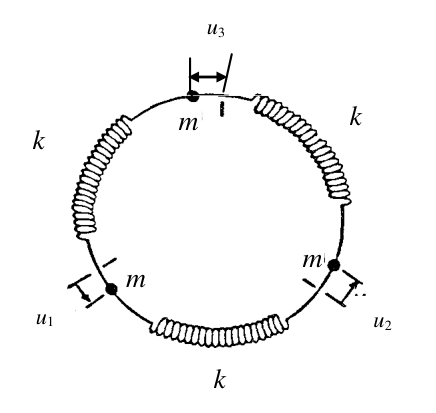
Figure 3.1
(i) If each mass is displaced from equilibrium by small displacements \(u_1\), \(u_2\) and \(u_3\) respectively, write down the equation of motion for each mass.
(ii) Verify that the system has simple harmonic solutions of the form
\[ u_n=a_n\cos\omega t, \]
with accelerations, \((-\omega^2u_n)\) where \(a_n\) \((n=1,2,3)\) are constant amplitudes, and \(\omega\), the angular frequency, can have 3 possible values,
\[ \omega_o\sqrt{3},\ \omega_o\sqrt{3}\text{ and }0. \quad\text{where }\omega_o^2=\frac{k}{m}. \]
(iii) The system of alternate springs and masses is extended to \(N\) particles, each mass \(m\) is joined by springs to its neighbouring masses. Initially the springs are unstretched and in equilibrium. Write down the equation of motion of the \(n\)th mass \((n=1,2...N)\) in terms of its displacement and those of the adjacent masses when the particles are displaced from equilibrium.
\[ u_n(t)=a_s\sin\left(\frac{2ns\pi}{N}+\phi\right)\cos\omega_s t, \]
are oscillatory solutions where \(s=1,2,\ldots N\), \(n=1,2,\ldots N\) and where \(\phi\) is an arbitrary phase, providing the angular frequencies are given by
\[ \omega_s=2\omega_o\sin\left(\frac{s\pi}{N}\right), \]
where \(a_s\ (s=1,......N)\) are constant amplitudes independent of \(n\).
State the range of possible frequencies for a chain containing an infinite number of masses.
(iv) Determine the ratio
\[ u_n/u_{n+1} \]
for large \(N\), in the two cases:
(a) low frequency solutions
(b) \(\omega=\omega_{\max}\), where \(\omega_{\max}\) is the maximum frequency solution.
Sketch typical graphs indicating the displacements of the particles against particle number along the chain at time \(t\) for cases (a) and (b).
(v) If one of the masses is replaced by a mass \(m'\ll m\) estimate any major change one would expect to occur to the angular frequency distribution.
Describe qualitatively the form of the frequency spectrum one would predict for a diatomic chain with alternate masses \(m\) and \(m'\) on the basis of the previous result.
Reminder
\[ \sin(A+B)=\sin A\cos B+\cos A\sin B \]
\[ \sin A+\sin B =2\sin\left(\frac{A+B}{2}\right) \cos\left(\frac{A-B}{2}\right) \]
\[ 2\sin^2A=1-\cos2A \]
Official English text of the problem.
Answers
-
(i) \[ \boxed{ \begin{aligned} m\ddot u_1&=k(u_2+u_3-2u_1),\\ m\ddot u_2&=k(u_3+u_1-2u_2),\\ m\ddot u_3&=k(u_1+u_2-2u_3). \end{aligned}} \]
-
(ii) \[ \boxed{\omega=\sqrt{\frac{3k}{m}},\quad \sqrt{\frac{3k}{m}},\quad 0.} \] The nonzero frequency has two independent modes satisfying \(a_1+a_2+a_3=0\). The zero mode has \(a_1=a_2=a_3\).
-
(iii) \[ \boxed{m\ddot u_n=k(u_{n+1}+u_{n-1}-2u_n),\qquad u_{n+N}=u_n,} \] \[ \boxed{\omega_s=2\sqrt{\frac{k}{m}}\sin\left(\frac{s\pi}{N}\right).} \] For an infinite chain, \[ \boxed{0\leq\omega\leq2\sqrt{\frac{k}{m}}.} \] In ordinary frequency, \(0\leq f\leq\sqrt{k/m}/\pi\).
-
(iv)
(a) \(\boxed{u_n/u_{n+1}\simeq+1}\), away from displacement nodes. The graph is a slowly varying sinusoid sampled at the particle positions.
(b) \(\boxed{u_n/u_{n+1}=-1}\) at the upper band edge. Displacements alternate between equal positive and negative values. This is exact for even \(N\); an odd ring approaches this behaviour locally for large \(N\). -
(v) A single light mass produces one high-frequency mode, concentrated on that mass: \[ \boxed{\omega_{\mathrm{defect}}\simeq\sqrt{\frac{2k}{m'}} \gg2\sqrt{\frac{k}{m}}.} \] An alternating chain has an acoustic band and an optical band separated by a gap. For \(m'<m\), their exact limiting ranges are \[ \boxed{ \begin{aligned} \text{Acoustic:}\quad& 0\leq\omega\leq\sqrt{\frac{2k}{m}},\\ \text{Optical:}\quad& \sqrt{\frac{2k}{m'}} \leq\omega\leq \sqrt{2k\left(\frac1m+\frac1{m'}\right)}. \end{aligned}} \]
Solution
(i)
Measure all displacements as arc lengths in the same sense around the ring. In the small-displacement approximation, a spring’s extension is the difference between the displacements of its ends. Hooke’s law therefore gives a tangential restoring force proportional to that difference. The constraint force has no tangential component.
For particle 1, the two springs exert forces \(k(u_2-u_1)\) and \(k(u_3-u_1)\). Newton’s second law gives
\[ m\ddot u_1=k(u_2-u_1)+k(u_3-u_1). \]
Applying the same reasoning to particles 2 and 3,
\[ \boxed{ \begin{aligned} m\ddot u_1&=k(u_2+u_3-2u_1),\\ m\ddot u_2&=k(u_3+u_1-2u_2),\\ m\ddot u_3&=k(u_1+u_2-2u_3). \end{aligned}} \]
(ii)
Substitute \(u_n=a_n\cos\omega t\), so that \(\ddot u_n=-\omega^2u_n\). Define
\[ \lambda=\frac{\omega^2}{\omega_o^2}, \qquad \omega_o^2=\frac{k}{m}, \qquad S=a_1+a_2+a_3. \]
Each equation becomes
\[ \lambda a_n=3a_n-S. \]
Adding the three equations gives
\[ \lambda S=0. \]
There are two possibilities.
If \(\lambda=0\), the individual equations require
\[ a_1=a_2=a_3. \]
All masses move through the same arc length, so no spring changes its length. Thus
\[ \boxed{\omega=0.} \]
This is the rigid-rotation mode. Strictly, it is not an oscillation: its general motion is \(u_1=u_2=u_3=A+Bt\). The prescribed cosine form represents its static-displacement case.
If \(\lambda\neq0\), then \(S=0\), and a nonzero amplitude requires
\[ \lambda=3. \]
Therefore
\[ \boxed{\omega=\sqrt{3}\,\omega_o=\sqrt{\frac{3k}{m}}.} \]
The condition \(a_1+a_2+a_3=0\) leaves two independent amplitudes. For example, two independent mode shapes are
\[ (a_1,a_2,a_3)\propto(1,-1,0), \qquad (a_1,a_2,a_3)\propto(1,1,-2). \]
Consequently, the three normal modes have frequencies
\[ \boxed{\sqrt{3}\,\omega_o,\quad\sqrt{3}\,\omega_o,\quad0,} \]
with the nonzero frequency occurring twice.
(iii)
Particle \(n\) experiences the forces
\[ k(u_{n+1}-u_n) \quad\text{and}\quad -k(u_n-u_{n-1}). \]
Hence
\[ \boxed{m\ddot u_n=k(u_{n+1}+u_{n-1}-2u_n).} \]
The ring imposes periodic boundary conditions,
\[ u_0=u_N,\qquad u_{N+1}=u_1. \]
Write
\[ q=\frac{2\pi s}{N}, \qquad u_n=a_s\sin(nq+\phi)\cos\omega_s t. \]
This expression is periodic because \(Nq=2\pi s\). Using the supplied addition identity,
\[ \begin{aligned} u_{n+1}+u_{n-1} &=a_s\bigl[\sin(nq+\phi+q)+\sin(nq+\phi-q)\bigr] \cos\omega_s t\\ &=2\cos q\,u_n. \end{aligned} \]
The equation of motion therefore becomes
\[ -m\omega_s^2u_n =2k(\cos q-1)u_n =-4k\sin^2\left(\frac q2\right)u_n. \]
For a nontrivial mode,
\[ \omega_s^2 =4\frac{k}{m}\sin^2\left(\frac{\pi s}{N}\right). \]
Since \(\sin(\pi s/N)\geq0\) for the stated range \(s=1,\ldots,N\),
\[ \boxed{\omega_s=2\omega_o\sin\left(\frac{\pi s}{N}\right).} \]
As the chain becomes infinite, the allowed wave numbers become continuous. The sine factor takes every value between zero and one, giving
\[ \boxed{0\leq\omega\leq2\omega_o=2\sqrt{\frac{k}{m}}.} \]
Zero is the rigid-displacement endpoint; genuine oscillations have \(\omega>0\). Since \(f=\omega/(2\pi)\),
\[ \boxed{0\leq f\leq\frac1\pi\sqrt{\frac{k}{m}}.} \]
With SI values of \(k\) and \(m\), angular frequencies are in \(\mathrm{rad\,s^{-1}}\), and ordinary frequencies are in \(\mathrm{Hz}\).
(iv)
At times and positions where the denominator is nonzero, the common time factor cancels:
\[ \frac{u_n}{u_{n+1}} = \frac{\sin(nq+\phi)}{\sin(nq+\phi+q)}. \]
The same expression applies directly to the ratio of modal amplitudes.
(a) Low frequency
Choose the representative of \(q\) close to zero. Then
\[ \omega=2\omega_o\left|\sin\frac q2\right| \simeq\omega_o|q|, \]
so low frequency means \(|q|\ll1\). Writing \(\theta=nq+\phi\),
\[ \frac{u_n}{u_{n+1}} =\frac{1}{\cos q+\cot\theta\sin q} \simeq1-q\cot\theta. \]
Thus, away from nodes,
\[ \boxed{\frac{u_n}{u_{n+1}}\simeq+1.} \]
Neighbouring masses have almost equal displacements and move approximately in phase. Near a node, the displacements themselves are small, so their ratio need not be close to one.
For the requested sketch, plot a sinusoid with wavelength \(L\gg1\), measured in particle spacings, and mark its values at integer particle numbers. A representative profile is
\[ u_n=C(t)\sin\left(\frac{2\pi(n-n_0)}{L}\right). \]
Its key values are:
| \(n-n_0\) | \(0\) | \(L/4\) | \(L/2\) | \(3L/4\) | \(L\) |
|---|---|---|---|---|---|
| \(u_n/C(t)\) | \(0\) | \(+1\) | \(0\) | \(-1\) | \(0\) |
There are many particles between successive nodes, and neighbouring points usually have very similar heights.
(b) Maximum frequency
At the upper band edge, \(q=\pi\), giving
\[ \omega_{\max}=2\omega_o. \]
The displacement is
\[ u_n=a_s\sin(n\pi+\phi)\cos\omega_{\max}t =(-1)^n a_s\sin\phi\cos\omega_{\max}t. \]
Consequently,
\[ \boxed{u_{n+1}=-u_n,\qquad \frac{u_n}{u_{n+1}}=-1.} \]
Every neighbouring pair moves in opposite directions with equal amplitudes.
The sketch consists of alternating points at \(+C(t)\) and \(-C(t)\):
| \(n-n_0\) | \(0\) | \(1\) | \(2\) | \(3\) | \(4\) |
|---|---|---|---|---|---|
| \(u_n/C(t)\) | \(+1\) | \(-1\) | \(+1\) | \(-1\) | \(+1\) |
The spatial period is two particle spacings. If neighbouring points are connected as a visual guide, they form a zigzag.
This pattern fits an even ring exactly. For odd finite \(N\), the largest allowed wave number is \(\pi\pm\pi/N\), and
\[ \omega_{\max} =2\omega_o\cos\left(\frac{\pi}{2N}\right). \]
Its displacement pattern alternates in sign with a slowly varying envelope. For large \(N\), the neighbouring-displacement ratio is approximately \(-1\) away from envelope nodes.
(v)
First replace just one mass by \(m'\ll m\). A rapid vibration of this light mass causes comparatively little motion of its heavy neighbours. To leading order, treat those neighbours as fixed.
Displacing the light mass by \(x\) produces a restoring force \(-kx\) from each spring. Therefore
\[ m'\ddot x\simeq-2kx, \]
giving
\[ \boxed{\omega_{\mathrm{defect}}\simeq\sqrt{\frac{2k}{m'}}.} \]
Relative to the original upper band edge,
\[ \frac{\omega_{\mathrm{defect}}}{2\omega_o} \simeq\sqrt{\frac{m}{2m'}}\gg1. \]
The approximation is self-consistent. For a neighbouring heavy mass with amplitude \(u_1\), the leading high-frequency balance is
\[ -m\omega_{\mathrm{defect}}^2u_1\simeq kx, \]
so
\[ \frac{u_1}{x}\simeq-\frac{m'}{2m}. \]
Its motion is small and opposite to that of the light mass. Motion farther away is smaller still: the high-frequency mode is localized around the defect.
Thus one mode moves far above the original frequency band. The other frequencies are perturbed but remain on the scale \(\sqrt{k/m}\); in an infinite chain the extended-mode band remains \(0\leq\omega\leq2\omega_o\). The zero-frequency rigid-displacement mode also remains.
For an alternating chain, the repeated light masses give a whole high-frequency band. The spectrum separates into:
- An acoustic band, containing low-frequency collective motion. At long wavelengths, neighbouring heavy and light masses move approximately together.
- An optical band, in which the light masses oscillate rapidly, with much smaller motion of the heavy masses. At long wavelengths, the two types of mass move in opposite directions.
The band edges can be derived directly. Let \(x_j\) be the displacement of heavy mass \(j\), and \(y_j\) that of the light mass between \(x_j\) and \(x_{j+1}\). Then
\[ \begin{aligned} m\ddot x_j&=k(y_{j-1}+y_j-2x_j),\\ m'\ddot y_j&=k(x_j+x_{j+1}-2y_j). \end{aligned} \]
For a mode with phase change \(Q\) per two-particle cell, use
\[ \begin{aligned} x_j&=X\cos(jQ+\phi)\cos\omega t,\\ y_j&=Y\cos\left((j+\tfrac12)Q+\phi\right)\cos\omega t. \end{aligned} \]
The amplitude equations are
\[ \begin{aligned} (2k-m\omega^2)X&=2k\cos(Q/2)Y,\\ (2k-m'\omega^2)Y&=2k\cos(Q/2)X. \end{aligned} \]
A nonzero solution requires
\[ (2k-m\omega^2)(2k-m'\omega^2) =4k^2\cos^2(Q/2), \]
or
\[ mm'\omega^4-2k(m+m')\omega^2 +4k^2\sin^2(Q/2)=0. \]
Its two roots are
\[ \omega_\pm^2 = k\left(\frac1m+\frac1{m'}\right) \pm k\sqrt{ \left(\frac1m+\frac1{m'}\right)^2 -\frac{4}{mm'}\sin^2(Q/2) }. \]
As \(|Q|\) increases from \(0\) to \(\pi\), the lower root increases and the upper root decreases. For \(m'<m\), their ranges are therefore
\[ \boxed{ 0\leq\omega_-\leq\sqrt{\frac{2k}{m}}, } \]
and
\[ \boxed{ \sqrt{\frac{2k}{m'}} \leq\omega_+\leq \sqrt{2k\left(\frac1m+\frac1{m'}\right)}. } \]
There are no modes in the gap
\[ \boxed{ \sqrt{\frac{2k}{m}} <\omega< \sqrt{\frac{2k}{m'}}. } \]
For \(m'\ll m\), the optical band is narrow relative to its high frequency, approximately \(\sqrt{2k/m'}\), and is widely separated from the acoustic band. A finite periodic chain has discrete frequencies within these bands; they become continuous in the infinite-chain limit.
The solution was checked against the official solution.
IPhO 1986 · Theorieaufgabe 3
Eigenschwingungen von durch Federn verbundenen Massen (Ring und Kette)
Drei Teilchen mit jeweils der Masse \(m\) befinden sich im Gleichgewicht und sind durch ungedehnte, masselose Federn verbunden, die jeweils die Federkonstante \(k\) gemäß dem Hooke’schen Gesetz haben. Sie können sich nur auf einer Kreisbahn bewegen, wie in Abbildung 3.1 dargestellt.
Abbildung 3.1
(i) Wenn die Massen jeweils um die kleinen Auslenkungen \(u_1\), \(u_2\) bzw. \(u_3\) aus ihrer Gleichgewichtslage verschoben werden, geben Sie die Bewegungsgleichung für jede Masse an.
(ii) Zeigen Sie, dass das System harmonische Lösungen der Form
\[ u_n=a_n\cos\omega t, \]
mit den Beschleunigungen \((-\omega^2u_n)\) besitzt, wobei \(a_n\) \((n=1,2,3)\) konstante Amplituden sind und die Kreisfrequenz \(\omega\) drei mögliche Werte annehmen kann:
\[ \omega_o\sqrt{3},\ \omega_o\sqrt{3}\text{ und }0. \quad\text{wobei }\omega_o^2=\frac{k}{m}. \]
(iii) Das System aus abwechselnd angeordneten Federn und Massen wird auf \(N\) Teilchen erweitert; jede Masse \(m\) ist durch Federn mit ihren benachbarten Massen verbunden. Anfangs sind die Federn ungedehnt und im Gleichgewicht. Geben Sie die Bewegungsgleichung der \(n\)-ten Masse \((n=1,2...N)\) in Abhängigkeit von ihrer Auslenkung und den Auslenkungen der benachbarten Massen an, wenn die Teilchen aus ihrer Gleichgewichtslage verschoben werden.
\[ u_n(t)=a_s\sin\left(\frac{2ns\pi}{N}+\phi\right)\cos\omega_s t, \]
sind Schwingungslösungen, wobei \(s=1,2,\ldots N\), \(n=1,2,\ldots N\) und \(\phi\) eine beliebige Phase ist, sofern die Kreisfrequenzen durch
\[ \omega_s=2\omega_o\sin\left(\frac{s\pi}{N}\right), \]
gegeben sind, wobei \(a_s\ (s=1,......N)\) konstante, von \(n\) unabhängige Amplituden sind.
Geben Sie den Bereich der möglichen Frequenzen für eine Kette mit unendlich vielen Massen an.
(iv) Bestimmen Sie das Verhältnis
\[ u_n/u_{n+1} \]
für große \(N\) in den beiden Fällen:
(a) Lösungen mit niedriger Frequenz
(b) \(\omega=\omega_{\max}\), wobei \(\omega_{\max}\) die maximale Frequenz einer Lösung ist.
Skizzieren Sie für die Fälle (a) und (b) typische Diagramme, in denen die Auslenkungen der Teilchen zum Zeitpunkt \(t\) gegen die Teilchennummer entlang der Kette aufgetragen sind.
(v) Wenn eine der Massen durch eine Masse \(m'\ll m\) ersetzt wird, schätzen Sie ab, welche wesentliche Änderung der Kreisfrequenzverteilung zu erwarten ist.
Beschreiben Sie auf der Grundlage des vorherigen Ergebnisses qualitativ die Form des Frequenzspektrums, das Sie für eine zweiatomige Kette mit abwechselnden Massen \(m\) und \(m'\) vorhersagen würden.
Zur Erinnerung
\[ \sin(A+B)=\sin A\cos B+\cos A\sin B \]
\[ \sin A+\sin B =2\sin\left(\frac{A+B}{2}\right) \cos\left(\frac{A-B}{2}\right) \]
\[ 2\sin^2A=1-\cos2A \]
Aufgabentext aus dem offiziellen englischen Text übersetzt.
Antworten
-
(i) \[ \boxed{ \begin{aligned} m\ddot u_1&=k(u_2+u_3-2u_1),\\ m\ddot u_2&=k(u_3+u_1-2u_2),\\ m\ddot u_3&=k(u_1+u_2-2u_3). \end{aligned}} \]
-
(ii) \[ \boxed{\omega=\sqrt{\frac{3k}{m}},\quad \sqrt{\frac{3k}{m}},\quad 0.} \] Zur von null verschiedenen Frequenz gehören zwei unabhängige Moden, die \(a_1+a_2+a_3=0\) erfüllen. Für die Nullmode gilt \(a_1=a_2=a_3\).
-
(iii) \[ \boxed{m\ddot u_n=k(u_{n+1}+u_{n-1}-2u_n),\qquad u_{n+N}=u_n,} \] \[ \boxed{\omega_s=2\sqrt{\frac{k}{m}}\sin\left(\frac{s\pi}{N}\right).} \] Für eine unendliche Kette gilt \[ \boxed{0\leq\omega\leq2\sqrt{\frac{k}{m}}.} \] Für die gewöhnliche Frequenz gilt \(0\leq f\leq\sqrt{k/m}/\pi\).
-
(iv)
(a) \(\boxed{u_n/u_{n+1}\simeq+1}\), abseits der Schwingungsknoten. Das Diagramm zeigt eine langsam veränderliche Sinuskurve, deren Werte an den Teilchenpositionen abgetastet werden.
(b) \(\boxed{u_n/u_{n+1}=-1}\) am oberen Bandrand. Die Auslenkungen wechseln zwischen gleich großen positiven und negativen Werten. Dies gilt für gerade \(N\) exakt; ein Ring mit ungerader Teilchenzahl nähert sich diesem Verhalten für große \(N\) lokal an. -
(v) Eine einzelne leichte Masse erzeugt eine hochfrequente Mode, die auf diese Masse konzentriert ist: \[ \boxed{\omega_{\mathrm{defect}}\simeq\sqrt{\frac{2k}{m'}} \gg2\sqrt{\frac{k}{m}}.} \] Eine alternierende Kette besitzt ein akustisches und ein optisches Band, die durch eine Lücke getrennt sind. Für \(m'<m\) lauten ihre exakten Grenzbereiche \[ \boxed{ \begin{aligned} \text{Akustisch:}\quad& 0\leq\omega\leq\sqrt{\frac{2k}{m}},\\ \text{Optisch:}\quad& \sqrt{\frac{2k}{m'}} \leq\omega\leq \sqrt{2k\left(\frac1m+\frac1{m'}\right)}. \end{aligned}} \]
Lösung
(i)
Alle Auslenkungen werden als Bogenlängen in derselben Umlaufrichtung entlang des Rings gemessen. In der Näherung kleiner Auslenkungen ist die Dehnung einer Feder gleich der Differenz der Auslenkungen ihrer Enden. Nach dem Hooke’schen Gesetz ergibt sich daher eine tangentiale Rückstellkraft, die proportional zu dieser Differenz ist. Die Zwangskraft besitzt keine tangentiale Komponente.
Auf Teilchen 1 üben die beiden Federn die Kräfte \(k(u_2-u_1)\) und \(k(u_3-u_1)\) aus. Das zweite Newton’sche Gesetz liefert
\[ m\ddot u_1=k(u_2-u_1)+k(u_3-u_1). \]
Dieselbe Überlegung ergibt für die Teilchen 2 und 3
\[ \boxed{ \begin{aligned} m\ddot u_1&=k(u_2+u_3-2u_1),\\ m\ddot u_2&=k(u_3+u_1-2u_2),\\ m\ddot u_3&=k(u_1+u_2-2u_3). \end{aligned}} \]
(ii)
Wir setzen \(u_n=a_n\cos\omega t\) ein, sodass \(\ddot u_n=-\omega^2u_n\) gilt. Wir definieren
\[ \lambda=\frac{\omega^2}{\omega_o^2}, \qquad \omega_o^2=\frac{k}{m}, \qquad S=a_1+a_2+a_3. \]
Jede Gleichung wird zu
\[ \lambda a_n=3a_n-S. \]
Die Addition der drei Gleichungen ergibt
\[ \lambda S=0. \]
Es gibt zwei Möglichkeiten.
Falls \(\lambda=0\) ist, verlangen die einzelnen Gleichungen
\[ a_1=a_2=a_3. \]
Alle Massen bewegen sich um dieselbe Bogenlänge, sodass keine Feder ihre Länge ändert. Somit gilt
\[ \boxed{\omega=0.} \]
Dies ist die Mode der starren Rotation. Streng genommen handelt es sich nicht um eine Schwingung: Ihre allgemeine Bewegung lautet \(u_1=u_2=u_3=A+Bt\). Die vorgegebene Kosinusform beschreibt den Fall einer statischen Auslenkung.
Falls \(\lambda\neq0\) ist, gilt \(S=0\), und eine von null verschiedene Amplitude erfordert
\[ \lambda=3. \]
Daher gilt
\[ \boxed{\omega=\sqrt{3}\,\omega_o=\sqrt{\frac{3k}{m}}.} \]
Die Bedingung \(a_1+a_2+a_3=0\) lässt zwei unabhängige Amplituden übrig. Zwei unabhängige Schwingungsformen sind beispielsweise
\[ (a_1,a_2,a_3)\propto(1,-1,0), \qquad (a_1,a_2,a_3)\propto(1,1,-2). \]
Folglich haben die drei Eigenschwingungen die Frequenzen
\[ \boxed{\sqrt{3}\,\omega_o,\quad\sqrt{3}\,\omega_o,\quad0,} \]
wobei die von null verschiedene Frequenz zweimal auftritt.
(iii)
Auf Teilchen \(n\) wirken die Kräfte
\[ k(u_{n+1}-u_n) \quad\text{und}\quad -k(u_n-u_{n-1}). \]
Daraus folgt
\[ \boxed{m\ddot u_n=k(u_{n+1}+u_{n-1}-2u_n).} \]
Der Ring erzwingt periodische Randbedingungen:
\[ u_0=u_N,\qquad u_{N+1}=u_1. \]
Wir schreiben
\[ q=\frac{2\pi s}{N}, \qquad u_n=a_s\sin(nq+\phi)\cos\omega_s t. \]
Dieser Ausdruck ist periodisch, da \(Nq=2\pi s\) gilt. Mit dem angegebenen Additionstheorem erhalten wir
\[ \begin{aligned} u_{n+1}+u_{n-1} &=a_s\bigl[\sin(nq+\phi+q)+\sin(nq+\phi-q)\bigr] \cos\omega_s t\\ &=2\cos q\,u_n. \end{aligned} \]
Die Bewegungsgleichung wird daher zu
\[ -m\omega_s^2u_n =2k(\cos q-1)u_n =-4k\sin^2\left(\frac q2\right)u_n. \]
Für eine nichttriviale Mode gilt
\[ \omega_s^2 =4\frac{k}{m}\sin^2\left(\frac{\pi s}{N}\right). \]
Da \(\sin(\pi s/N)\geq0\) im angegebenen Bereich \(s=1,\ldots,N\) gilt, folgt
\[ \boxed{\omega_s=2\omega_o\sin\left(\frac{\pi s}{N}\right).} \]
Im Grenzfall einer unendlichen Kette werden die zulässigen Wellenzahlen kontinuierlich. Der Sinusfaktor nimmt jeden Wert zwischen null und eins an, sodass
\[ \boxed{0\leq\omega\leq2\omega_o=2\sqrt{\frac{k}{m}}.} \]
Der Endpunkt null entspricht einer starren Verschiebung; für echte Schwingungen gilt \(\omega>0\). Wegen \(f=\omega/(2\pi)\) gilt
\[ \boxed{0\leq f\leq\frac1\pi\sqrt{\frac{k}{m}}.} \]
Werden für \(k\) und \(m\) SI-Werte eingesetzt, so ergeben sich Kreisfrequenzen in \(\mathrm{rad\,s^{-1}}\) und gewöhnliche Frequenzen in \(\mathrm{Hz}\).
(iv)
Zu Zeiten und an Orten, an denen der Nenner nicht null ist, kürzt sich der gemeinsame Zeitfaktor heraus:
\[ \frac{u_n}{u_{n+1}} = \frac{\sin(nq+\phi)}{\sin(nq+\phi+q)}. \]
Derselbe Ausdruck gilt unmittelbar für das Verhältnis der Modenamplituden.
(a) Niedrige Frequenz
Wir wählen den Repräsentanten von \(q\) nahe null. Dann gilt
\[ \omega=2\omega_o\left|\sin\frac q2\right| \simeq\omega_o|q|, \]
eine niedrige Frequenz bedeutet also \(|q|\ll1\). Mit \(\theta=nq+\phi\) erhalten wir
\[ \frac{u_n}{u_{n+1}} =\frac{1}{\cos q+\cot\theta\sin q} \simeq1-q\cot\theta. \]
Somit gilt abseits der Knoten
\[ \boxed{\frac{u_n}{u_{n+1}}\simeq+1.} \]
Benachbarte Massen haben nahezu gleiche Auslenkungen und bewegen sich annähernd gleichphasig. In der Nähe eines Knotens sind die Auslenkungen selbst klein, sodass ihr Verhältnis nicht nahe eins liegen muss.
Für die verlangte Skizze zeichnet man eine Sinuskurve mit der in Teilchenabständen gemessenen Wellenlänge \(L\gg1\) und markiert ihre Werte bei ganzzahligen Teilchennummern. Ein repräsentatives Profil ist
\[ u_n=C(t)\sin\left(\frac{2\pi(n-n_0)}{L}\right). \]
Seine charakteristischen Werte sind:
| \(n-n_0\) | \(0\) | \(L/4\) | \(L/2\) | \(3L/4\) | \(L\) |
|---|---|---|---|---|---|
| \(u_n/C(t)\) | \(0\) | \(+1\) | \(0\) | \(-1\) | \(0\) |
Zwischen aufeinanderfolgenden Knoten liegen viele Teilchen, und benachbarte Punkte haben meist sehr ähnliche Höhen.
(b) Maximale Frequenz
Am oberen Bandrand gilt \(q=\pi\), woraus folgt
\[ \omega_{\max}=2\omega_o. \]
Die Auslenkung lautet
\[ u_n=a_s\sin(n\pi+\phi)\cos\omega_{\max}t =(-1)^n a_s\sin\phi\cos\omega_{\max}t. \]
Folglich gilt
\[ \boxed{u_{n+1}=-u_n,\qquad \frac{u_n}{u_{n+1}}=-1.} \]
Jedes Paar benachbarter Massen bewegt sich mit gleichen Amplituden in entgegengesetzte Richtungen.
Die Skizze besteht aus Punkten, die abwechselnd bei \(+C(t)\) und \(-C(t)\) liegen:
| \(n-n_0\) | \(0\) | \(1\) | \(2\) | \(3\) | \(4\) |
|---|---|---|---|---|---|
| \(u_n/C(t)\) | \(+1\) | \(-1\) | \(+1\) | \(-1\) | \(+1\) |
Die räumliche Periode beträgt zwei Teilchenabstände. Verbindet man benachbarte Punkte zur Veranschaulichung, entsteht eine Zickzacklinie.
Dieses Muster passt exakt auf einen Ring mit gerader Teilchenzahl. Für ungerade, endliche \(N\) ist die größte zulässige Wellenzahl \(\pi\pm\pi/N\), und es gilt
\[ \omega_{\max} =2\omega_o\cos\left(\frac{\pi}{2N}\right). \]
Das Auslenkungsmuster wechselt im Vorzeichen und besitzt eine langsam veränderliche Einhüllende. Für große \(N\) ist das Verhältnis benachbarter Auslenkungen abseits der Knoten der Einhüllenden näherungsweise \(-1\).
(v)
Zunächst ersetzen wir nur eine Masse durch \(m'\ll m\). Eine schnelle Schwingung dieser leichten Masse bewirkt eine vergleichsweise geringe Bewegung ihrer schweren Nachbarn. In führender Näherung betrachten wir diese Nachbarn als festgehalten.
Eine Auslenkung der leichten Masse um \(x\) erzeugt durch jede Feder eine Rückstellkraft \(-kx\). Daher gilt
\[ m'\ddot x\simeq-2kx, \]
woraus folgt
\[ \boxed{\omega_{\mathrm{defect}}\simeq\sqrt{\frac{2k}{m'}}.} \]
Im Verhältnis zum ursprünglichen oberen Bandrand gilt
\[ \frac{\omega_{\mathrm{defect}}}{2\omega_o} \simeq\sqrt{\frac{m}{2m'}}\gg1. \]
Die Näherung ist selbstkonsistent. Für eine benachbarte schwere Masse mit der Amplitude \(u_1\) lautet die führende Bilanz bei hoher Frequenz
\[ -m\omega_{\mathrm{defect}}^2u_1\simeq kx, \]
sodass
\[ \frac{u_1}{x}\simeq-\frac{m'}{2m}. \]
Ihre Bewegung ist klein und derjenigen der leichten Masse entgegengerichtet. Weiter entfernt ist die Bewegung noch kleiner: Die hochfrequente Mode ist um die Fehlstelle herum lokalisiert.
Somit verschiebt sich eine Mode weit über das ursprüngliche Frequenzband hinaus. Die anderen Frequenzen werden gestört, bleiben aber von der Größenordnung \(\sqrt{k/m}\); in einer unendlichen Kette bleibt das Band der ausgedehnten Moden bei \(0\leq\omega\leq2\omega_o\). Auch die Mode der starren Verschiebung mit der Frequenz null bleibt erhalten.
Bei einer alternierenden Kette erzeugen die wiederholt auftretenden leichten Massen ein ganzes hochfrequentes Band. Das Spektrum teilt sich auf in:
- Ein akustisches Band, das niederfrequente kollektive Bewegungen umfasst. Bei großen Wellenlängen bewegen sich benachbarte schwere und leichte Massen annähernd gemeinsam.
- Ein optisches Band, in dem die leichten Massen schnell schwingen, während die Bewegung der schweren Massen wesentlich kleiner ist. Bei großen Wellenlängen bewegen sich die beiden Massentypen in entgegengesetzte Richtungen.
Die Bandränder lassen sich direkt herleiten. Sei \(x_j\) die Auslenkung der schweren Masse \(j\) und \(y_j\) diejenige der leichten Masse zwischen \(x_j\) und \(x_{j+1}\). Dann gilt
\[ \begin{aligned} m\ddot x_j&=k(y_{j-1}+y_j-2x_j),\\ m'\ddot y_j&=k(x_j+x_{j+1}-2y_j). \end{aligned} \]
Für eine Mode mit der Phasenänderung \(Q\) pro Zweiteilchenzelle verwenden wir den Ansatz
\[ \begin{aligned} x_j&=X\cos(jQ+\phi)\cos\omega t,\\ y_j&=Y\cos\left((j+\tfrac12)Q+\phi\right)\cos\omega t. \end{aligned} \]
Die Amplitudengleichungen lauten
\[ \begin{aligned} (2k-m\omega^2)X&=2k\cos(Q/2)Y,\\ (2k-m'\omega^2)Y&=2k\cos(Q/2)X. \end{aligned} \]
Eine von null verschiedene Lösung erfordert
\[ (2k-m\omega^2)(2k-m'\omega^2) =4k^2\cos^2(Q/2), \]
oder
\[ mm'\omega^4-2k(m+m')\omega^2 +4k^2\sin^2(Q/2)=0. \]
Die beiden Lösungen sind
\[ \omega_\pm^2 = k\left(\frac1m+\frac1{m'}\right) \pm k\sqrt{ \left(\frac1m+\frac1{m'}\right)^2 -\frac{4}{mm'}\sin^2(Q/2) }. \]
Wenn \(|Q|\) von \(0\) auf \(\pi\) zunimmt, wächst die untere Lösung, während die obere abnimmt. Für \(m'<m\) lauten ihre Bereiche daher
\[ \boxed{ 0\leq\omega_-\leq\sqrt{\frac{2k}{m}}, } \]
und
\[ \boxed{ \sqrt{\frac{2k}{m'}} \leq\omega_+\leq \sqrt{2k\left(\frac1m+\frac1{m'}\right)}. } \]
Es gibt keine Moden in der Lücke
\[ \boxed{ \sqrt{\frac{2k}{m}} <\omega< \sqrt{\frac{2k}{m'}}. } \]
Für \(m'\ll m\) ist das optische Band im Verhältnis zu seiner hohen Frequenz von näherungsweise \(\sqrt{2k/m'}\) schmal und vom akustischen Band weit getrennt. Eine endliche periodische Kette besitzt innerhalb dieser Bänder diskrete Frequenzen; im Grenzfall einer unendlichen Kette werden sie kontinuierlich.
Die Lösung wurde mit der offiziellen Lösung abgeglichen.
IPhO 1986 · Teori sorusu 3
Yaylarla birbirine bağlı kütlelerin normal modları (halka ve zincir)
Her biri \(m\) kütleli üç parçacık dengededir ve her birinin Hooke yasasındaki yay sabiti \(k\) olan, uzamamış, kütlesiz yaylarla birbirine bağlanmıştır. Parçacıklar, Şekil 3.1'de gösterildiği gibi çembersel bir yörüngede hareket edecek biçimde kısıtlanmıştır.
Şekil 3.1
(i) Her bir kütle denge konumundan sırasıyla \(u_1\), \(u_2\) ve \(u_3\) kadar küçük yer değiştirmeler yaparsa, her kütlenin hareket denklemini yazınız.
(ii) Sistemin
\[ u_n=a_n\cos\omega t, \]
biçiminde, ivmeleri \((-\omega^2u_n)\) olan basit harmonik çözümlere sahip olduğunu doğrulayınız. Burada \(a_n\) \((n=1,2,3)\) sabit genliklerdir ve açısal frekans \(\omega\), şu 3 değeri alabilir:
\[ \omega_o\sqrt{3},\ \omega_o\sqrt{3}\text{ ve }0. \quad\text{burada }\omega_o^2=\frac{k}{m}. \]
(iii) Dönüşümlü olarak sıralanmış yay ve kütlelerden oluşan sistem \(N\) parçacığa genişletilmiştir; her \(m\) kütlesi, komşu kütlelere yaylarla bağlıdır. Başlangıçta yaylar uzamamıştır ve dengededir. Parçacıklar denge konumlarından uzaklaştırıldığında, \(n\). kütlenin \((n=1,2...N)\) hareket denklemini, kendi yer değiştirmesi ve komşu kütlelerin yer değiştirmeleri cinsinden yazınız.
\[ u_n(t)=a_s\sin\left(\frac{2ns\pi}{N}+\phi\right)\cos\omega_s t, \]
ifadeleri, \(s=1,2,\ldots N\), \(n=1,2,\ldots N\) ve \(\phi\) keyfî bir faz olmak üzere, açısal frekansların
\[ \omega_s=2\omega_o\sin\left(\frac{s\pi}{N}\right), \]
ile verilmesi koşuluyla salınımlı çözümlerdir; burada \(a_s\ (s=1,......N)\), \(n\)'den bağımsız sabit genliklerdir.
Sonsuz sayıda kütle içeren bir zincir için mümkün frekans aralığını belirtiniz.
(iv) Büyük \(N\) için
\[ u_n/u_{n+1} \]
oranını şu iki durumda belirleyiniz:
(a) düşük frekanslı çözümler
(b) \(\omega=\omega_{\max}\); burada \(\omega_{\max}\), maksimum frekanslı çözümün frekansıdır.
(a) ve (b) durumları için, \(t\) anında parçacıkların yer değiştirmelerinin zincir boyunca parçacık numarasına göre değişimini gösteren tipik grafikler çiziniz.
(v) Kütlelerden biri \(m'\ll m\) kütlesiyle değiştirilirse, açısal frekans dağılımında ortaya çıkması beklenen herhangi bir önemli değişikliği tahmin ediniz.
Önceki sonuca dayanarak, \(m\) ve \(m'\) kütlelerinin dönüşümlü olarak sıralandığı iki atomlu bir zincir için öngöreceğiniz frekans spektrumunun biçimini nitel olarak açıklayınız.
Hatırlatma
\[ \sin(A+B)=\sin A\cos B+\cos A\sin B \]
\[ \sin A+\sin B =2\sin\left(\frac{A+B}{2}\right) \cos\left(\frac{A-B}{2}\right) \]
\[ 2\sin^2A=1-\cos2A \]
Soru metni resmi İngilizce metinden çevrilmiştir.
Cevaplar
-
(i) \[ \boxed{ \begin{aligned} m\ddot u_1&=k(u_2+u_3-2u_1),\\ m\ddot u_2&=k(u_3+u_1-2u_2),\\ m\ddot u_3&=k(u_1+u_2-2u_3). \end{aligned}} \]
-
(ii) \[ \boxed{\omega=\sqrt{\frac{3k}{m}},\quad \sqrt{\frac{3k}{m}},\quad 0.} \] Sıfırdan farklı frekansa ait, \(a_1+a_2+a_3=0\) koşulunu sağlayan iki bağımsız mod vardır. Sıfır modunda \(a_1=a_2=a_3\) olur.
-
(iii) \[ \boxed{m\ddot u_n=k(u_{n+1}+u_{n-1}-2u_n),\qquad u_{n+N}=u_n,} \] \[ \boxed{\omega_s=2\sqrt{\frac{k}{m}}\sin\left(\frac{s\pi}{N}\right).} \] Sonsuz bir zincir için, \[ \boxed{0\leq\omega\leq2\sqrt{\frac{k}{m}}.} \] Olağan frekans cinsinden, \(0\leq f\leq\sqrt{k/m}/\pi\).
-
(iv)
(a) Yer değiştirme düğümlerinden uzakta, \(\boxed{u_n/u_{n+1}\simeq+1}\). Grafik, parçacık konumlarında örneklenmiş, yavaş değişen bir sinüzoiddir.
(b) Üst bant kenarında \(\boxed{u_n/u_{n+1}=-1}\). Yer değiştirmeler, büyüklükleri eşit pozitif ve negatif değerler arasında dönüşümlü olarak değişir. Bu, çift \(N\) için tam olarak geçerlidir; tek sayıda parçacık içeren bir halka, büyük \(N\) için yerel olarak bu davranışa yaklaşır. -
(v) Tek bir hafif kütle, bu kütle üzerinde yoğunlaşan bir yüksek frekanslı mod oluşturur: \[ \boxed{\omega_{\mathrm{defect}}\simeq\sqrt{\frac{2k}{m'}} \gg2\sqrt{\frac{k}{m}}.} \] Kütlelerin dönüşümlü sıralandığı bir zincirde, aralarında bir boşluk bulunan bir akustik bant ve bir optik bant vardır. \(m'<m\) için bunların kesin sınır aralıkları şöyledir: \[ \boxed{ \begin{aligned} \text{Akustik:}\quad& 0\leq\omega\leq\sqrt{\frac{2k}{m}},\\ \text{Optik:}\quad& \sqrt{\frac{2k}{m'}} \leq\omega\leq \sqrt{2k\left(\frac1m+\frac1{m'}\right)}. \end{aligned}} \]
Çözüm
(i)
Tüm yer değiştirmeleri, halka çevresinde aynı yönde ölçülen yay uzunlukları olarak alalım. Küçük yer değiştirme yaklaşımında, bir yayın uzaması uçlarının yer değiştirmeleri arasındaki farktır. Dolayısıyla Hooke yasası, bu farkla orantılı teğetsel bir geri çağırıcı kuvvet verir. Kısıt kuvvetinin teğetsel bileşeni yoktur.
1 numaralı parçacığa iki yay, \(k(u_2-u_1)\) ve \(k(u_3-u_1)\) kuvvetlerini uygular. Newton'ın ikinci yasası şu sonucu verir:
\[ m\ddot u_1=k(u_2-u_1)+k(u_3-u_1). \]
Aynı akıl yürütmeyi 2 ve 3 numaralı parçacıklara uygularsak,
\[ \boxed{ \begin{aligned} m\ddot u_1&=k(u_2+u_3-2u_1),\\ m\ddot u_2&=k(u_3+u_1-2u_2),\\ m\ddot u_3&=k(u_1+u_2-2u_3). \end{aligned}} \]
(ii)
\(u_n=a_n\cos\omega t\) ifadesini yerine koyalım; böylece \(\ddot u_n=-\omega^2u_n\) olur. Şu tanımları yapalım:
\[ \lambda=\frac{\omega^2}{\omega_o^2}, \qquad \omega_o^2=\frac{k}{m}, \qquad S=a_1+a_2+a_3. \]
Her denklem şu hâle gelir:
\[ \lambda a_n=3a_n-S. \]
Üç denklemi toplarsak,
\[ \lambda S=0. \]
İki olasılık vardır.
\(\lambda=0\) ise, denklemler ayrı ayrı şu koşulu gerektirir:
\[ a_1=a_2=a_3. \]
Tüm kütleler aynı yay uzunluğu kadar yer değiştirir, dolayısıyla hiçbir yayın uzunluğu değişmez. Böylece
\[ \boxed{\omega=0.} \]
Bu, rijit dönme modudur. Tam anlamıyla bir salınım değildir: genel hareketi \(u_1=u_2=u_3=A+Bt\) biçimindedir. Verilen kosinüs biçimi, bu modun statik yer değiştirme durumunu temsil eder.
\(\lambda\neq0\) ise \(S=0\) olur ve sıfırdan farklı bir genlik için
\[ \lambda=3. \]
Dolayısıyla
\[ \boxed{\omega=\sqrt{3}\,\omega_o=\sqrt{\frac{3k}{m}}.} \]
\(a_1+a_2+a_3=0\) koşulu, iki bağımsız genlik bırakır. Örneğin, iki bağımsız mod biçimi şöyledir:
\[ (a_1,a_2,a_3)\propto(1,-1,0), \qquad (a_1,a_2,a_3)\propto(1,1,-2). \]
Sonuç olarak, üç normal modun frekansları
\[ \boxed{\sqrt{3}\,\omega_o,\quad\sqrt{3}\,\omega_o,\quad0,} \]
olup sıfırdan farklı frekans iki kez ortaya çıkar.
(iii)
\(n\) numaralı parçacığa etki eden kuvvetler şunlardır:
\[ k(u_{n+1}-u_n) \quad\text{ve}\quad -k(u_n-u_{n-1}). \]
Böylece
\[ \boxed{m\ddot u_n=k(u_{n+1}+u_{n-1}-2u_n).} \]
Halka, periyodik sınır koşulları gerektirir:
\[ u_0=u_N,\qquad u_{N+1}=u_1. \]
Şöyle yazalım:
\[ q=\frac{2\pi s}{N}, \qquad u_n=a_s\sin(nq+\phi)\cos\omega_s t. \]
\(Nq=2\pi s\) olduğundan bu ifade periyodiktir. Verilen toplam özdeşliğini kullanırsak,
\[ \begin{aligned} u_{n+1}+u_{n-1} &=a_s\bigl[\sin(nq+\phi+q)+\sin(nq+\phi-q)\bigr] \cos\omega_s t\\ &=2\cos q\,u_n. \end{aligned} \]
Dolayısıyla hareket denklemi şu hâle gelir:
\[ -m\omega_s^2u_n =2k(\cos q-1)u_n =-4k\sin^2\left(\frac q2\right)u_n. \]
Özdeş olarak sıfır olmayan bir mod için,
\[ \omega_s^2 =4\frac{k}{m}\sin^2\left(\frac{\pi s}{N}\right). \]
Belirtilen \(s=1,\ldots,N\) aralığında \(\sin(\pi s/N)\geq0\) olduğundan,
\[ \boxed{\omega_s=2\omega_o\sin\left(\frac{\pi s}{N}\right).} \]
Zincir sonsuz hâle geldikçe izinli dalga sayıları sürekli hâle gelir. Sinüs çarpanı sıfır ile bir arasındaki her değeri alır ve şu sonucu verir:
\[ \boxed{0\leq\omega\leq2\omega_o=2\sqrt{\frac{k}{m}}.} \]
Sıfır, rijit yer değiştirmeye karşılık gelen uç noktadır; gerçek salınımlarda \(\omega>0\) olur. \(f=\omega/(2\pi)\) olduğundan,
\[ \boxed{0\leq f\leq\frac1\pi\sqrt{\frac{k}{m}}.} \]
\(k\) ve \(m\)'nin SI birimlerindeki değerleri kullanıldığında açısal frekanslar \(\mathrm{rad\,s^{-1}}\), olağan frekanslar ise \(\mathrm{Hz}\) birimindedir.
(iv)
Paydanın sıfırdan farklı olduğu zaman ve konumlarda ortak zaman çarpanı sadeleşir:
\[ \frac{u_n}{u_{n+1}} = \frac{\sin(nq+\phi)}{\sin(nq+\phi+q)}. \]
Aynı ifade, mod genliklerinin oranı için de doğrudan geçerlidir.
(a) Düşük frekans
\(q\)'nun sıfıra yakın temsilcisini seçelim. Bu durumda
\[ \omega=2\omega_o\left|\sin\frac q2\right| \simeq\omega_o|q|, \]
dolayısıyla düşük frekans, \(|q|\ll1\) anlamına gelir. \(\theta=nq+\phi\) yazarsak,
\[ \frac{u_n}{u_{n+1}} =\frac{1}{\cos q+\cot\theta\sin q} \simeq1-q\cot\theta. \]
Böylece, düğümlerden uzakta,
\[ \boxed{\frac{u_n}{u_{n+1}}\simeq+1.} \]
Komşu kütlelerin yer değiştirmeleri hemen hemen eşittir ve yaklaşık olarak aynı fazda hareket ederler. Bir düğümün yakınında yer değiştirmelerin kendileri küçük olduğundan, oranlarının bire yakın olması gerekmez.
İstenen çizim için, parçacıklar arası uzaklık biriminde ölçülen dalga boyu \(L\gg1\) olan bir sinüzoid çiziniz ve tam sayı parçacık numaralarındaki değerlerini işaretleyiniz. Temsilî bir profil şöyledir:
\[ u_n=C(t)\sin\left(\frac{2\pi(n-n_0)}{L}\right). \]
Temel değerleri şunlardır:
| \(n-n_0\) | \(0\) | \(L/4\) | \(L/2\) | \(3L/4\) | \(L\) |
|---|---|---|---|---|---|
| \(u_n/C(t)\) | \(0\) | \(+1\) | \(0\) | \(-1\) | \(0\) |
Ardışık düğümler arasında çok sayıda parçacık bulunur ve komşu noktaların yükseklikleri genellikle birbirine çok yakındır.
(b) Maksimum frekans
Üst bant kenarında \(q=\pi\) olur ve bu da
\[ \omega_{\max}=2\omega_o. \]
sonucunu verir. Yer değiştirme şöyledir:
\[ u_n=a_s\sin(n\pi+\phi)\cos\omega_{\max}t =(-1)^n a_s\sin\phi\cos\omega_{\max}t. \]
Sonuç olarak,
\[ \boxed{u_{n+1}=-u_n,\qquad \frac{u_n}{u_{n+1}}=-1.} \]
Her komşu çift, eşit genliklerle zıt yönlerde hareket eder.
Çizim, dönüşümlü olarak \(+C(t)\) ve \(-C(t)\) değerlerinde bulunan noktalardan oluşur:
| \(n-n_0\) | \(0\) | \(1\) | \(2\) | \(3\) | \(4\) |
|---|---|---|---|---|---|
| \(u_n/C(t)\) | \(+1\) | \(-1\) | \(+1\) | \(-1\) | \(+1\) |
Uzaysal periyot, parçacıklar arası uzaklığın iki katıdır. Görsel bir kılavuz olarak komşu noktalar birleştirilirse bir zikzak oluştururlar.
Bu örüntü, çift sayıda parçacık içeren bir halkaya tam olarak uyar. Tek ve sonlu \(N\) için, izin verilen en büyük dalga sayısı \(\pi\pm\pi/N\) olur ve
\[ \omega_{\max} =2\omega_o\cos\left(\frac{\pi}{2N}\right). \]
Buna ait yer değiştirme örüntüsü, yavaş değişen bir zarf altında dönüşümlü olarak işaret değiştirir. Büyük \(N\) için, zarfın düğümlerinden uzakta komşu yer değiştirmelerin oranı yaklaşık olarak \(-1\)'dir.
(v)
Önce yalnızca bir kütleyi \(m'\ll m\) ile değiştirelim. Bu hafif kütlenin hızlı bir titreşimi, ağır komşularında görece küçük bir harekete yol açar. En düşük mertebeli yaklaşımda bu komşuları sabit kabul edelim.
Hafif kütlenin \(x\) kadar yer değiştirmesi, her yayın \(-kx\) geri çağırıcı kuvvetini uygulamasına yol açar. Dolayısıyla
\[ m'\ddot x\simeq-2kx, \]
ve buradan
\[ \boxed{\omega_{\mathrm{defect}}\simeq\sqrt{\frac{2k}{m'}}.} \]
Başlangıçtaki üst bant kenarına oranı,
\[ \frac{\omega_{\mathrm{defect}}}{2\omega_o} \simeq\sqrt{\frac{m}{2m'}}\gg1. \]
Yaklaşım kendi içinde tutarlıdır. Genliği \(u_1\) olan komşu bir ağır kütle için, yüksek frekansta baskın terimler arasındaki denge şöyledir:
\[ -m\omega_{\mathrm{defect}}^2u_1\simeq kx, \]
dolayısıyla
\[ \frac{u_1}{x}\simeq-\frac{m'}{2m}. \]
Hareketi küçük ve hafif kütleninkine zıt yöndedir. Daha uzaktaki hareket daha da küçüktür: yüksek frekanslı mod, kusurun çevresinde yerelleşmiştir.
Böylece bir mod, başlangıçtaki frekans bandının çok üstüne çıkar. Diğer frekanslar değişime uğrar, ancak \(\sqrt{k/m}\) ölçeğinde kalır; sonsuz bir zincirde uzanımlı modların bandı \(0\leq\omega\leq2\omega_o\) olarak kalır. Sıfır frekanslı rijit yer değiştirme modu da varlığını korur.
Kütlelerin dönüşümlü sıralandığı bir zincirde, tekrarlanan hafif kütleler tam bir yüksek frekans bandı oluşturur. Spektrum şu bantlara ayrılır:
- Düşük frekanslı ortak hareketi içeren bir akustik bant. Uzun dalga boylarında, komşu ağır ve hafif kütleler yaklaşık olarak birlikte hareket eder.
- Hafif kütlelerin hızla salındığı, ağır kütlelerin hareketinin ise çok daha küçük olduğu bir optik bant. Uzun dalga boylarında iki tür kütle zıt yönlerde hareket eder.
Bant kenarları doğrudan türetilebilir. \(x_j\), \(j\) numaralı ağır kütlenin yer değiştirmesi; \(y_j\) ise \(x_j\) ile \(x_{j+1}\) arasındaki hafif kütlenin yer değiştirmesi olsun. Bu durumda
\[ \begin{aligned} m\ddot x_j&=k(y_{j-1}+y_j-2x_j),\\ m'\ddot y_j&=k(x_j+x_{j+1}-2y_j). \end{aligned} \]
İki parçacıklı hücre başına faz değişimi \(Q\) olan bir mod için şu ifadeleri kullanalım:
\[ \begin{aligned} x_j&=X\cos(jQ+\phi)\cos\omega t,\\ y_j&=Y\cos\left((j+\tfrac12)Q+\phi\right)\cos\omega t. \end{aligned} \]
Genlik denklemleri şöyledir:
\[ \begin{aligned} (2k-m\omega^2)X&=2k\cos(Q/2)Y,\\ (2k-m'\omega^2)Y&=2k\cos(Q/2)X. \end{aligned} \]
Sıfırdan farklı bir çözüm için
\[ (2k-m\omega^2)(2k-m'\omega^2) =4k^2\cos^2(Q/2), \]
ya da
\[ mm'\omega^4-2k(m+m')\omega^2 +4k^2\sin^2(Q/2)=0. \]
Bu denklemin iki kökü şöyledir:
\[ \omega_\pm^2 = k\left(\frac1m+\frac1{m'}\right) \pm k\sqrt{ \left(\frac1m+\frac1{m'}\right)^2 -\frac{4}{mm'}\sin^2(Q/2) }. \]
\(|Q|\), \(0\)'dan \(\pi\)'ye artarken küçük kök artar, büyük kök ise azalır. Dolayısıyla \(m'<m\) için bunların aralıkları
\[ \boxed{ 0\leq\omega_-\leq\sqrt{\frac{2k}{m}}, } \]
ve
\[ \boxed{ \sqrt{\frac{2k}{m'}} \leq\omega_+\leq \sqrt{2k\left(\frac1m+\frac1{m'}\right)}. } \]
Şu boşlukta hiçbir mod yoktur:
\[ \boxed{ \sqrt{\frac{2k}{m}} <\omega< \sqrt{\frac{2k}{m'}}. } \]
\(m'\ll m\) için optik bant, yaklaşık \(\sqrt{2k/m'}\) olan yüksek frekansına kıyasla dardır ve akustik banttan büyük ölçüde ayrılmıştır. Sonlu bir periyodik zincirde bu bantlar içinde ayrık frekanslar bulunur; sonsuz zincir limitinde bunlar sürekli hâle gelir.
Çözüm, resmi çözümle karşılaştırılarak kontrol edildi.
IPhO 1986 · Problema teórico 3
Modos normales de masas unidas por resortes (anillo y cadena)
Tres partículas, cada una de masa \(m\), están en equilibrio y unidas por resortes sin estirar y sin masa, cada uno con constante elástica \(k\) según la ley de Hooke. Están obligadas a moverse en una trayectoria circular, como se indica en la Figura 3.1.
Figura 3.1
(i) Si cada masa se desplaza de su posición de equilibrio una pequeña distancia \(u_1\), \(u_2\) y \(u_3\), respectivamente, escriba la ecuación de movimiento de cada masa.
(ii) Verifique que el sistema tiene soluciones armónicas simples de la forma
\[ u_n=a_n\cos\omega t, \]
con aceleraciones \((-\omega^2u_n)\), donde \(a_n\) \((n=1,2,3)\) son amplitudes constantes, y \(\omega\), la frecuencia angular, puede tomar 3 valores posibles,
\[ \omega_o\sqrt{3},\ \omega_o\sqrt{3}\text{ y }0. \quad\text{donde }\omega_o^2=\frac{k}{m}. \]
(iii) El sistema de resortes y masas alternados se amplía a \(N\) partículas; cada masa \(m\) está unida mediante resortes a sus masas vecinas. Inicialmente, los resortes están sin estirar y en equilibrio. Escriba la ecuación de movimiento de la masa \(n\)-ésima \((n=1,2...N)\) en función de su desplazamiento y de los de las masas adyacentes cuando las partículas se desplazan del equilibrio.
\[ u_n(t)=a_s\sin\left(\frac{2ns\pi}{N}+\phi\right)\cos\omega_s t, \]
son soluciones oscilatorias donde \(s=1,2,\ldots N\), \(n=1,2,\ldots N\) y donde \(\phi\) es una fase arbitraria, siempre que las frecuencias angulares estén dadas por
\[ \omega_s=2\omega_o\sin\left(\frac{s\pi}{N}\right), \]
donde \(a_s\ (s=1,......N)\) son amplitudes constantes independientes de \(n\).
Indique el intervalo de frecuencias posibles para una cadena que contiene un número infinito de masas.
(iv) Determine el cociente
\[ u_n/u_{n+1} \]
para \(N\) grande, en los dos casos:
(a) soluciones de baja frecuencia
(b) \(\omega=\omega_{\max}\), donde \(\omega_{\max}\) es la frecuencia máxima de las soluciones.
Esboce gráficas típicas que indiquen los desplazamientos de las partículas en función del número de partícula a lo largo de la cadena en el instante \(t\), para los casos (a) y (b).
(v) Si una de las masas se sustituye por una masa \(m'\ll m\), estime cualquier cambio importante que cabría esperar en la distribución de frecuencias angulares.
Describa cualitativamente la forma del espectro de frecuencias que se predeciría para una cadena diatómica con masas alternadas \(m\) y \(m'\), basándose en el resultado anterior.
Recordatorio
\[ \sin(A+B)=\sin A\cos B+\cos A\sin B \]
\[ \sin A+\sin B =2\sin\left(\frac{A+B}{2}\right) \cos\left(\frac{A-B}{2}\right) \]
\[ 2\sin^2A=1-\cos2A \]
Enunciado traducido del texto oficial en inglés.
Respuestas
-
(i) \[ \boxed{ \begin{aligned} m\ddot u_1&=k(u_2+u_3-2u_1),\\ m\ddot u_2&=k(u_3+u_1-2u_2),\\ m\ddot u_3&=k(u_1+u_2-2u_3). \end{aligned}} \]
-
(ii) \[ \boxed{\omega=\sqrt{\frac{3k}{m}},\quad \sqrt{\frac{3k}{m}},\quad 0.} \] La frecuencia no nula tiene dos modos independientes que satisfacen \(a_1+a_2+a_3=0\). El modo de frecuencia cero tiene \(a_1=a_2=a_3\).
-
(iii) \[ \boxed{m\ddot u_n=k(u_{n+1}+u_{n-1}-2u_n),\qquad u_{n+N}=u_n,} \] \[ \boxed{\omega_s=2\sqrt{\frac{k}{m}}\sin\left(\frac{s\pi}{N}\right).} \] Para una cadena infinita, \[ \boxed{0\leq\omega\leq2\sqrt{\frac{k}{m}}.} \] En términos de frecuencia ordinaria, \(0\leq f\leq\sqrt{k/m}/\pi\).
-
(iv)
(a) \(\boxed{u_n/u_{n+1}\simeq+1}\), lejos de los nodos de desplazamiento. La gráfica es una sinusoide que varía lentamente, muestreada en las posiciones de las partículas.
(b) \(\boxed{u_n/u_{n+1}=-1}\) en el borde superior de la banda. Los desplazamientos alternan entre valores positivos y negativos de igual magnitud. Esto es exacto para \(N\) par; un anillo con un número impar de partículas se aproxima localmente a este comportamiento para \(N\) grande. -
(v) Una sola masa ligera produce un modo de alta frecuencia, concentrado en esa masa: \[ \boxed{\omega_{\mathrm{defect}}\simeq\sqrt{\frac{2k}{m'}} \gg2\sqrt{\frac{k}{m}}.} \] Una cadena alternada tiene una banda acústica y una banda óptica separadas por una brecha. Para \(m'<m\), sus intervalos límite exactos son \[ \boxed{ \begin{aligned} \text{Acústica:}\quad& 0\leq\omega\leq\sqrt{\frac{2k}{m}},\\ \text{Óptica:}\quad& \sqrt{\frac{2k}{m'}} \leq\omega\leq \sqrt{2k\left(\frac1m+\frac1{m'}\right)}. \end{aligned}} \]
Solución
(i)
Midamos todos los desplazamientos como longitudes de arco en el mismo sentido alrededor del anillo. En la aproximación de pequeños desplazamientos, el alargamiento de un resorte es la diferencia entre los desplazamientos de sus extremos. Por tanto, la ley de Hooke da una fuerza recuperadora tangencial proporcional a esa diferencia. La fuerza de ligadura no tiene componente tangencial.
Sobre la partícula 1, los dos resortes ejercen fuerzas \(k(u_2-u_1)\) y \(k(u_3-u_1)\). La segunda ley de Newton da
\[ m\ddot u_1=k(u_2-u_1)+k(u_3-u_1). \]
Aplicando el mismo razonamiento a las partículas 2 y 3,
\[ \boxed{ \begin{aligned} m\ddot u_1&=k(u_2+u_3-2u_1),\\ m\ddot u_2&=k(u_3+u_1-2u_2),\\ m\ddot u_3&=k(u_1+u_2-2u_3). \end{aligned}} \]
(ii)
Sustituimos \(u_n=a_n\cos\omega t\), de modo que \(\ddot u_n=-\omega^2u_n\). Definimos
\[ \lambda=\frac{\omega^2}{\omega_o^2}, \qquad \omega_o^2=\frac{k}{m}, \qquad S=a_1+a_2+a_3. \]
Cada ecuación se convierte en
\[ \lambda a_n=3a_n-S. \]
Al sumar las tres ecuaciones se obtiene
\[ \lambda S=0. \]
Hay dos posibilidades.
Si \(\lambda=0\), las ecuaciones individuales exigen
\[ a_1=a_2=a_3. \]
Todas las masas recorren la misma longitud de arco, por lo que ningún resorte cambia de longitud. Así,
\[ \boxed{\omega=0.} \]
Este es el modo de rotación rígida. Estrictamente, no es una oscilación: su movimiento general es \(u_1=u_2=u_3=A+Bt\). La forma cosenoidal prescrita representa el caso de desplazamiento estático.
Si \(\lambda\neq0\), entonces \(S=0\), y una amplitud no nula exige
\[ \lambda=3. \]
Por tanto,
\[ \boxed{\omega=\sqrt{3}\,\omega_o=\sqrt{\frac{3k}{m}}.} \]
La condición \(a_1+a_2+a_3=0\) deja dos amplitudes independientes. Por ejemplo, dos formas modales independientes son
\[ (a_1,a_2,a_3)\propto(1,-1,0), \qquad (a_1,a_2,a_3)\propto(1,1,-2). \]
En consecuencia, los tres modos normales tienen frecuencias
\[ \boxed{\sqrt{3}\,\omega_o,\quad\sqrt{3}\,\omega_o,\quad0,} \]
y la frecuencia no nula aparece dos veces.
(iii)
La partícula \(n\) experimenta las fuerzas
\[ k(u_{n+1}-u_n) \quad\text{y}\quad -k(u_n-u_{n-1}). \]
Por consiguiente,
\[ \boxed{m\ddot u_n=k(u_{n+1}+u_{n-1}-2u_n).} \]
El anillo impone condiciones de contorno periódicas,
\[ u_0=u_N,\qquad u_{N+1}=u_1. \]
Escribimos
\[ q=\frac{2\pi s}{N}, \qquad u_n=a_s\sin(nq+\phi)\cos\omega_s t. \]
Esta expresión es periódica porque \(Nq=2\pi s\). Usando la identidad de adición proporcionada,
\[ \begin{aligned} u_{n+1}+u_{n-1} &=a_s\bigl[\sin(nq+\phi+q)+\sin(nq+\phi-q)\bigr] \cos\omega_s t\\ &=2\cos q\,u_n. \end{aligned} \]
Por tanto, la ecuación de movimiento se convierte en
\[ -m\omega_s^2u_n =2k(\cos q-1)u_n =-4k\sin^2\left(\frac q2\right)u_n. \]
Para un modo no trivial,
\[ \omega_s^2 =4\frac{k}{m}\sin^2\left(\frac{\pi s}{N}\right). \]
Como \(\sin(\pi s/N)\geq0\) para el intervalo indicado \(s=1,\ldots,N\),
\[ \boxed{\omega_s=2\omega_o\sin\left(\frac{\pi s}{N}\right).} \]
Cuando la cadena se hace infinita, los números de onda permitidos forman un continuo. El factor seno toma todos los valores entre cero y uno, lo que da
\[ \boxed{0\leq\omega\leq2\omega_o=2\sqrt{\frac{k}{m}}.} \]
El cero es el extremo correspondiente al desplazamiento rígido; las oscilaciones propiamente dichas tienen \(\omega>0\). Como \(f=\omega/(2\pi)\),
\[ \boxed{0\leq f\leq\frac1\pi\sqrt{\frac{k}{m}}.} \]
Con valores de \(k\) y \(m\) en el SI, las frecuencias angulares se expresan en \(\mathrm{rad\,s^{-1}}\), y las frecuencias ordinarias en \(\mathrm{Hz}\).
(iv)
En los instantes y posiciones en que el denominador no es nulo, el factor temporal común se cancela:
\[ \frac{u_n}{u_{n+1}} = \frac{\sin(nq+\phi)}{\sin(nq+\phi+q)}. \]
La misma expresión se aplica directamente al cociente de las amplitudes modales.
(a) Baja frecuencia
Elegimos el representante de \(q\) próximo a cero. Entonces
\[ \omega=2\omega_o\left|\sin\frac q2\right| \simeq\omega_o|q|, \]
de modo que una frecuencia baja implica \(|q|\ll1\). Escribiendo \(\theta=nq+\phi\),
\[ \frac{u_n}{u_{n+1}} =\frac{1}{\cos q+\cot\theta\sin q} \simeq1-q\cot\theta. \]
Así, lejos de los nodos,
\[ \boxed{\frac{u_n}{u_{n+1}}\simeq+1.} \]
Las masas vecinas tienen desplazamientos casi iguales y se mueven aproximadamente en fase. Cerca de un nodo, los propios desplazamientos son pequeños, por lo que su cociente no tiene por qué ser próximo a uno.
Para el esbozo solicitado, se traza una sinusoide de longitud de onda \(L\gg1\), medida en separaciones entre partículas, y se marcan sus valores en los números enteros de partícula. Un perfil representativo es
\[ u_n=C(t)\sin\left(\frac{2\pi(n-n_0)}{L}\right). \]
Sus valores principales son:
| \(n-n_0\) | \(0\) | \(L/4\) | \(L/2\) | \(3L/4\) | \(L\) |
|---|---|---|---|---|---|
| \(u_n/C(t)\) | \(0\) | \(+1\) | \(0\) | \(-1\) | \(0\) |
Hay muchas partículas entre nodos sucesivos, y los puntos vecinos suelen tener alturas muy similares.
(b) Frecuencia máxima
En el borde superior de la banda, \(q=\pi\), lo que da
\[ \omega_{\max}=2\omega_o. \]
El desplazamiento es
\[ u_n=a_s\sin(n\pi+\phi)\cos\omega_{\max}t =(-1)^n a_s\sin\phi\cos\omega_{\max}t. \]
En consecuencia,
\[ \boxed{u_{n+1}=-u_n,\qquad \frac{u_n}{u_{n+1}}=-1.} \]
Cada par de masas vecinas se mueve en sentidos opuestos con amplitudes iguales.
El esbozo consiste en puntos que alternan entre \(+C(t)\) y \(-C(t)\):
| \(n-n_0\) | \(0\) | \(1\) | \(2\) | \(3\) | \(4\) |
|---|---|---|---|---|---|
| \(u_n/C(t)\) | \(+1\) | \(-1\) | \(+1\) | \(-1\) | \(+1\) |
El período espacial es de dos separaciones entre partículas. Si se conectan los puntos vecinos como guía visual, forman un zigzag.
Este patrón encaja exactamente en un anillo con un número par de partículas. Para \(N\) finito e impar, el mayor número de onda permitido es \(\pi\pm\pi/N\), y
\[ \omega_{\max} =2\omega_o\cos\left(\frac{\pi}{2N}\right). \]
Su patrón de desplazamientos alterna de signo con una envolvente que varía lentamente. Para \(N\) grande, el cociente entre desplazamientos vecinos es aproximadamente \(-1\) lejos de los nodos de la envolvente.
(v)
Primero sustituimos una sola masa por \(m'\ll m\). Una vibración rápida de esta masa ligera provoca un movimiento comparativamente pequeño de sus vecinas pesadas. En la aproximación dominante, consideramos fijas esas vecinas.
Desplazar la masa ligera una distancia \(x\) produce una fuerza recuperadora \(-kx\) debida a cada resorte. Por tanto,
\[ m'\ddot x\simeq-2kx, \]
lo que da
\[ \boxed{\omega_{\mathrm{defect}}\simeq\sqrt{\frac{2k}{m'}}.} \]
Con respecto al borde superior de la banda original,
\[ \frac{\omega_{\mathrm{defect}}}{2\omega_o} \simeq\sqrt{\frac{m}{2m'}}\gg1. \]
La aproximación es autoconsistente. Para una masa pesada vecina con amplitud \(u_1\), el balance dominante a alta frecuencia es
\[ -m\omega_{\mathrm{defect}}^2u_1\simeq kx, \]
por lo que
\[ \frac{u_1}{x}\simeq-\frac{m'}{2m}. \]
Su movimiento es pequeño y opuesto al de la masa ligera. Más lejos, el movimiento es aún menor: el modo de alta frecuencia está localizado alrededor del defecto.
Así, un modo se desplaza muy por encima de la banda de frecuencias original. Las demás frecuencias se perturban, pero siguen siendo del orden de \(\sqrt{k/m}\); en una cadena infinita, la banda de modos extendidos sigue siendo \(0\leq\omega\leq2\omega_o\). También se conserva el modo de desplazamiento rígido de frecuencia cero.
Para una cadena alternada, la repetición de masas ligeras da lugar a toda una banda de alta frecuencia. El espectro se divide en:
- Una banda acústica, que contiene movimiento colectivo de baja frecuencia. A longitudes de onda grandes, las masas pesadas y ligeras vecinas se mueven aproximadamente juntas.
- Una banda óptica, en la que las masas ligeras oscilan rápidamente, con un movimiento mucho menor de las masas pesadas. A longitudes de onda grandes, los dos tipos de masa se mueven en sentidos opuestos.
Los bordes de las bandas pueden deducirse directamente. Sea \(x_j\) el desplazamiento de la masa pesada \(j\), e \(y_j\) el de la masa ligera situada entre \(x_j\) y \(x_{j+1}\). Entonces
\[ \begin{aligned} m\ddot x_j&=k(y_{j-1}+y_j-2x_j),\\ m'\ddot y_j&=k(x_j+x_{j+1}-2y_j). \end{aligned} \]
Para un modo con un cambio de fase \(Q\) por celda de dos partículas, usamos
\[ \begin{aligned} x_j&=X\cos(jQ+\phi)\cos\omega t,\\ y_j&=Y\cos\left((j+\tfrac12)Q+\phi\right)\cos\omega t. \end{aligned} \]
Las ecuaciones de las amplitudes son
\[ \begin{aligned} (2k-m\omega^2)X&=2k\cos(Q/2)Y,\\ (2k-m'\omega^2)Y&=2k\cos(Q/2)X. \end{aligned} \]
Una solución no nula exige
\[ (2k-m\omega^2)(2k-m'\omega^2) =4k^2\cos^2(Q/2), \]
o bien
\[ mm'\omega^4-2k(m+m')\omega^2 +4k^2\sin^2(Q/2)=0. \]
Sus dos raíces son
\[ \omega_\pm^2 = k\left(\frac1m+\frac1{m'}\right) \pm k\sqrt{ \left(\frac1m+\frac1{m'}\right)^2 -\frac{4}{mm'}\sin^2(Q/2) }. \]
A medida que \(|Q|\) aumenta de \(0\) a \(\pi\), la raíz inferior aumenta y la superior disminuye. Para \(m'<m\), sus intervalos son, por tanto,
\[ \boxed{ 0\leq\omega_-\leq\sqrt{\frac{2k}{m}}, } \]
y
\[ \boxed{ \sqrt{\frac{2k}{m'}} \leq\omega_+\leq \sqrt{2k\left(\frac1m+\frac1{m'}\right)}. } \]
No hay modos en la brecha
\[ \boxed{ \sqrt{\frac{2k}{m}} <\omega< \sqrt{\frac{2k}{m'}}. } \]
Para \(m'\ll m\), la banda óptica es estrecha en relación con su alta frecuencia, aproximadamente \(\sqrt{2k/m'}\), y está muy separada de la banda acústica. Una cadena periódica finita tiene frecuencias discretas dentro de estas bandas; estas se vuelven continuas en el límite de una cadena infinita.
La solución se comprobó con la solución oficial.
IPhO 1986 · 理论题 3
弹簧连接的质点的简正模(环与链)
三个质量均为 \(m\) 的质点处于平衡状态,由未伸长的无质量弹簧连接,每根弹簧的胡克定律劲度系数均为 \(k\)。它们被约束在圆形路径上运动,如图 3.1 所示。
图 3.1
(i) 若各质点分别偏离平衡位置一个微小位移 \(u_1\)、\(u_2\) 和 \(u_3\),写出每个质点的运动方程。
(ii) 验证该系统具有如下形式的简谐解
\[ u_n=a_n\cos\omega t, \]
其加速度为 \((-\omega^2u_n)\),其中 \(a_n\) \((n=1,2,3)\) 为恒定振幅,角频率 \(\omega\) 可以取以下 3 个值,
\[ \omega_o\sqrt{3},\ \omega_o\sqrt{3}\text{ 和 }0. \quad\text{其中 }\omega_o^2=\frac{k}{m}. \]
(iii) 将弹簧与质点交替排列的系统扩展到 \(N\) 个质点,每个质量为 \(m\) 的质点都通过弹簧与其相邻质点相连。初始时,弹簧均未伸长,系统处于平衡状态。当各质点偏离平衡位置时,用第 \(n\) 个质点 \((n=1,2...N)\) 及其相邻质点的位移写出该质点的运动方程。
\[ u_n(t)=a_s\sin\left(\frac{2ns\pi}{N}+\phi\right)\cos\omega_s t, \]
是振动解,其中 \(s=1,2,\ldots N\)、\(n=1,2,\ldots N\),\(\phi\) 为任意相位,条件是角频率满足
\[ \omega_s=2\omega_o\sin\left(\frac{s\pi}{N}\right), \]
其中 \(a_s\ (s=1,......N)\) 是与 \(n\) 无关的恒定振幅。
指出包含无穷多个质点的链所允许的频率范围。
(iv) 对于较大的 \(N\),求比值
\[ u_n/u_{n+1} \]
在以下两种情况下的值:
(a) 低频解
(b) \(\omega=\omega_{\max}\),其中 \(\omega_{\max}\) 为解的最大频率。
对于情况 (a) 和 (b),画出典型示意图,表示时刻 \(t\) 各质点的位移随沿链的质点编号的变化。
(v) 若将其中一个质点替换为质量为 \(m'\ll m\) 的质点,估计角频率分布可能发生的任何重大变化。
根据上述结果,定性描述质量为 \(m\) 和 \(m'\) 的质点交替排列的双原子链预期具有的频谱形式。
提示
\[ \sin(A+B)=\sin A\cos B+\cos A\sin B \]
\[ \sin A+\sin B =2\sin\left(\frac{A+B}{2}\right) \cos\left(\frac{A-B}{2}\right) \]
\[ 2\sin^2A=1-\cos2A \]
题目译自官方英文原文。
答案
-
(i) \[ \boxed{ \begin{aligned} m\ddot u_1&=k(u_2+u_3-2u_1),\\ m\ddot u_2&=k(u_3+u_1-2u_2),\\ m\ddot u_3&=k(u_1+u_2-2u_3). \end{aligned}} \]
-
(ii) \[ \boxed{\omega=\sqrt{\frac{3k}{m}},\quad \sqrt{\frac{3k}{m}},\quad 0.} \] 非零频率对应两个满足 \(a_1+a_2+a_3=0\) 的独立模。零频模满足 \(a_1=a_2=a_3\)。
-
(iii) \[ \boxed{m\ddot u_n=k(u_{n+1}+u_{n-1}-2u_n),\qquad u_{n+N}=u_n,} \] \[ \boxed{\omega_s=2\sqrt{\frac{k}{m}}\sin\left(\frac{s\pi}{N}\right).} \] 对于无限长链, \[ \boxed{0\leq\omega\leq2\sqrt{\frac{k}{m}}.} \] 用普通频率表示,\(0\leq f\leq\sqrt{k/m}/\pi\)。
-
(iv)
(a) 远离位移波节处,\(\boxed{u_n/u_{n+1}\simeq+1}\)。图像是在各质点位置对一条缓慢变化的正弦曲线取样得到的。
(b) 在频带上边缘处,\(\boxed{u_n/u_{n+1}=-1}\)。位移在大小相等的正值与负值之间交替。对于偶数 \(N\),这一结果精确成立;对于奇数个质点组成的环,当 \(N\) 很大时,局部趋近于这一行为。 -
(v) 单个轻质点会产生一个集中在该质点上的高频模: \[ \boxed{\omega_{\mathrm{defect}}\simeq\sqrt{\frac{2k}{m'}} \gg2\sqrt{\frac{k}{m}}.} \] 交替链具有声学频带和光学频带,两者之间存在禁带。对于 \(m'<m\),它们精确的极限范围为 \[ \boxed{ \begin{aligned} \text{声学:}\quad& 0\leq\omega\leq\sqrt{\frac{2k}{m}},\\ \text{光学:}\quad& \sqrt{\frac{2k}{m'}} \leq\omega\leq \sqrt{2k\left(\frac1m+\frac1{m'}\right)}. \end{aligned}} \]
解答
(i)
所有位移均沿环的同一方向以弧长度量。在小位移近似下,弹簧的伸长量等于其两端的位移之差。因此,根据胡克定律,切向回复力与该位移差成正比。约束力没有切向分量。
对于质点 1,两根弹簧施加的力分别为 \(k(u_2-u_1)\) 和 \(k(u_3-u_1)\)。由牛顿第二定律得
\[ m\ddot u_1=k(u_2-u_1)+k(u_3-u_1). \]
对质点 2 和 3 作同样的推理,得到
\[ \boxed{ \begin{aligned} m\ddot u_1&=k(u_2+u_3-2u_1),\\ m\ddot u_2&=k(u_3+u_1-2u_2),\\ m\ddot u_3&=k(u_1+u_2-2u_3). \end{aligned}} \]
(ii)
代入 \(u_n=a_n\cos\omega t\),于是 \(\ddot u_n=-\omega^2u_n\)。定义
\[ \lambda=\frac{\omega^2}{\omega_o^2}, \qquad \omega_o^2=\frac{k}{m}, \qquad S=a_1+a_2+a_3. \]
各方程变为
\[ \lambda a_n=3a_n-S. \]
将三个方程相加,得到
\[ \lambda S=0. \]
有两种可能。
若 \(\lambda=0\),则各方程要求
\[ a_1=a_2=a_3. \]
所有质点移动的弧长相同,因此所有弹簧的长度均不变。于是
\[ \boxed{\omega=0.} \]
这就是刚体转动模。严格来说,它不是振动:其一般运动为 \(u_1=u_2=u_3=A+Bt\)。题设的余弦形式表示其静态位移的情况。
若 \(\lambda\neq0\),则 \(S=0\),而非零振幅要求
\[ \lambda=3. \]
因此
\[ \boxed{\omega=\sqrt{3}\,\omega_o=\sqrt{\frac{3k}{m}}.} \]
条件 \(a_1+a_2+a_3=0\) 留下两个独立振幅。例如,两个独立的振型为
\[ (a_1,a_2,a_3)\propto(1,-1,0), \qquad (a_1,a_2,a_3)\propto(1,1,-2). \]
因此,三个简正模的频率为
\[ \boxed{\sqrt{3}\,\omega_o,\quad\sqrt{3}\,\omega_o,\quad0,} \]
其中非零频率出现两次。
(iii)
质点 \(n\) 所受的力为
\[ k(u_{n+1}-u_n) \quad\text{和}\quad -k(u_n-u_{n-1}). \]
因此
\[ \boxed{m\ddot u_n=k(u_{n+1}+u_{n-1}-2u_n).} \]
环形结构要求满足周期性边界条件,
\[ u_0=u_N,\qquad u_{N+1}=u_1. \]
令
\[ q=\frac{2\pi s}{N}, \qquad u_n=a_s\sin(nq+\phi)\cos\omega_s t. \]
由于 \(Nq=2\pi s\),此表达式满足周期性。利用题给的和差化积恒等式,
\[ \begin{aligned} u_{n+1}+u_{n-1} &=a_s\bigl[\sin(nq+\phi+q)+\sin(nq+\phi-q)\bigr] \cos\omega_s t\\ &=2\cos q\,u_n. \end{aligned} \]
因此,运动方程变为
\[ -m\omega_s^2u_n =2k(\cos q-1)u_n =-4k\sin^2\left(\frac q2\right)u_n. \]
对于非平凡模,
\[ \omega_s^2 =4\frac{k}{m}\sin^2\left(\frac{\pi s}{N}\right). \]
由于在给定范围 \(s=1,\ldots,N\) 内有 \(\sin(\pi s/N)\geq0\),
\[ \boxed{\omega_s=2\omega_o\sin\left(\frac{\pi s}{N}\right).} \]
当链变为无限长时,允许的波数变为连续值。正弦因子可以取零与一之间的所有值,因此
\[ \boxed{0\leq\omega\leq2\omega_o=2\sqrt{\frac{k}{m}}.} \]
零频率是对应整体刚性位移的端点;真正的振动满足 \(\omega>0\)。由于 \(f=\omega/(2\pi)\),
\[ \boxed{0\leq f\leq\frac1\pi\sqrt{\frac{k}{m}}.} \]
当 \(k\) 和 \(m\) 采用国际单位制数值时,角频率的单位为 \(\mathrm{rad\,s^{-1}}\),普通频率的单位为 \(\mathrm{Hz}\)。
(iv)
在分母非零的时刻和位置,公共的时间因子可以约去:
\[ \frac{u_n}{u_{n+1}} = \frac{\sin(nq+\phi)}{\sin(nq+\phi+q)}. \]
同一表达式也直接适用于模态振幅之比。
(a) 低频
选取接近零的 \(q\) 的代表值。于是
\[ \omega=2\omega_o\left|\sin\frac q2\right| \simeq\omega_o|q|, \]
因此低频意味着 \(|q|\ll1\)。令 \(\theta=nq+\phi\),
\[ \frac{u_n}{u_{n+1}} =\frac{1}{\cos q+\cot\theta\sin q} \simeq1-q\cot\theta. \]
因此,远离波节处,
\[ \boxed{\frac{u_n}{u_{n+1}}\simeq+1.} \]
相邻质点的位移几乎相等,运动近似同相。在波节附近,位移本身很小,因此其比值不一定接近一。
对于题目要求的示意图,画出一条以质点间距为单位、波长为 \(L\gg1\) 的正弦曲线,并在整数质点编号处标出其值。一个代表性的位移分布为
\[ u_n=C(t)\sin\left(\frac{2\pi(n-n_0)}{L}\right). \]
其关键位置的值为:
| \(n-n_0\) | \(0\) | \(L/4\) | \(L/2\) | \(3L/4\) | \(L\) |
|---|---|---|---|---|---|
| \(u_n/C(t)\) | \(0\) | \(+1\) | \(0\) | \(-1\) | \(0\) |
相邻波节之间有许多质点,相邻点的高度通常非常接近。
(b) 最大频率
在频带上边缘处,\(q=\pi\),因此
\[ \omega_{\max}=2\omega_o. \]
位移为
\[ u_n=a_s\sin(n\pi+\phi)\cos\omega_{\max}t =(-1)^n a_s\sin\phi\cos\omega_{\max}t. \]
因此,
\[ \boxed{u_{n+1}=-u_n,\qquad \frac{u_n}{u_{n+1}}=-1.} \]
每一对相邻质点都以相等的振幅沿相反方向运动。
示意图由交替位于 \(+C(t)\) 和 \(-C(t)\) 处的点组成:
| \(n-n_0\) | \(0\) | \(1\) | \(2\) | \(3\) | \(4\) |
|---|---|---|---|---|---|
| \(u_n/C(t)\) | \(+1\) | \(-1\) | \(+1\) | \(-1\) | \(+1\) |
空间周期为两个质点间距。若为便于观察而将相邻点连接起来,就会形成锯齿状折线。
这一模式恰好适用于偶数个质点组成的环。对于有限的奇数 \(N\),最大的允许波数为 \(\pi\pm\pi/N\),并且
\[ \omega_{\max} =2\omega_o\cos\left(\frac{\pi}{2N}\right). \]
其位移分布的符号交替变化,并具有缓慢变化的包络。当 \(N\) 很大时,远离包络波节处的相邻位移之比近似为 \(-1\)。
(v)
先只将一个质点替换为 \(m'\ll m\)。这个轻质点的快速振动只会使相邻的重质点产生相对较小的运动。在最低阶近似下,将这些相邻质点视为固定不动。
将轻质点移动 \(x\),每根弹簧都会产生回复力 \(-kx\)。因此
\[ m'\ddot x\simeq-2kx, \]
得到
\[ \boxed{\omega_{\mathrm{defect}}\simeq\sqrt{\frac{2k}{m'}}.} \]
相对于原来的频带上边缘,
\[ \frac{\omega_{\mathrm{defect}}}{2\omega_o} \simeq\sqrt{\frac{m}{2m'}}\gg1. \]
这一近似是自洽的。对于振幅为 \(u_1\) 的相邻重质点,高频下的主导平衡关系为
\[ -m\omega_{\mathrm{defect}}^2u_1\simeq kx, \]
所以
\[ \frac{u_1}{x}\simeq-\frac{m'}{2m}. \]
它的运动幅度很小,且方向与轻质点相反。更远处的运动幅度还要小:这个高频模局域在缺陷附近。
因此,有一个模的频率移至远高于原频带的位置。其他频率受到扰动,但仍保持在 \(\sqrt{k/m}\) 的量级;在无限长链中,扩展模的频带仍为 \(0\leq\omega\leq2\omega_o\)。零频率的整体刚性位移模也仍然存在。
对于交替链,重复排列的轻质点产生一整条高频带。频谱分为:
- 声学频带,包含低频集体运动。在长波长下,相邻的重质点与轻质点近似一起运动。
- 光学频带,其中轻质点快速振动,而重质点的运动幅度小得多。在长波长下,两类质点沿相反方向运动。
频带边缘可以直接推导。令 \(x_j\) 为第 \(j\) 个重质点的位移,\(y_j\) 为位于 \(x_j\) 与 \(x_{j+1}\) 之间的轻质点的位移。则
\[ \begin{aligned} m\ddot x_j&=k(y_{j-1}+y_j-2x_j),\\ m'\ddot y_j&=k(x_j+x_{j+1}-2y_j). \end{aligned} \]
对于每经过一个含两个质点的原胞相位就改变 \(Q\) 的模,取
\[ \begin{aligned} x_j&=X\cos(jQ+\phi)\cos\omega t,\\ y_j&=Y\cos\left((j+\tfrac12)Q+\phi\right)\cos\omega t. \end{aligned} \]
振幅方程为
\[ \begin{aligned} (2k-m\omega^2)X&=2k\cos(Q/2)Y,\\ (2k-m'\omega^2)Y&=2k\cos(Q/2)X. \end{aligned} \]
存在非零解要求
\[ (2k-m\omega^2)(2k-m'\omega^2) =4k^2\cos^2(Q/2), \]
即
\[ mm'\omega^4-2k(m+m')\omega^2 +4k^2\sin^2(Q/2)=0. \]
它的两个根为
\[ \omega_\pm^2 = k\left(\frac1m+\frac1{m'}\right) \pm k\sqrt{ \left(\frac1m+\frac1{m'}\right)^2 -\frac{4}{mm'}\sin^2(Q/2) }. \]
当 \(|Q|\) 从 \(0\) 增大到 \(\pi\) 时,较小的根增大,较大的根减小。因此,对于 \(m'<m\),它们的范围为
\[ \boxed{ 0\leq\omega_-\leq\sqrt{\frac{2k}{m}}, } \]
和
\[ \boxed{ \sqrt{\frac{2k}{m'}} \leq\omega_+\leq \sqrt{2k\left(\frac1m+\frac1{m'}\right)}. } \]
在以下禁带内不存在任何模
\[ \boxed{ \sqrt{\frac{2k}{m}} <\omega< \sqrt{\frac{2k}{m'}}. } \]
对于 \(m'\ll m\),光学频带的宽度相对于其约为 \(\sqrt{2k/m'}\) 的高频率很窄,且与声学频带相隔很远。有限周期链在这些频带内具有离散频率;在无限长链的极限下,这些频率变为连续分布。
解答已与官方解答核对。
IPhO 1986 · Теоретическая задача 3
Нормальные моды системы грузов, соединённых пружинами (кольцо и цепочка)
Три частицы, каждая массой \(m\), находятся в равновесии и соединены нерастянутыми невесомыми пружинами, каждая из которых имеет жёсткость \(k\) и подчиняется закону Гука. Частицы могут двигаться только по окружности, как показано на рисунке 3.1.
Рисунок 3.1
(i) Если каждый груз сместить из положения равновесия на малые величины \(u_1\), \(u_2\) и \(u_3\) соответственно, запишите уравнение движения для каждого груза.
(ii) Убедитесь, что система имеет решения, описывающие простые гармонические колебания вида
\[ u_n=a_n\cos\omega t, \]
с ускорениями \((-\omega^2u_n)\), где \(a_n\) \((n=1,2,3)\) — постоянные амплитуды, а \(\omega\) — угловая частота, которая может принимать 3 возможных значения:
\[ \omega_o\sqrt{3},\ \omega_o\sqrt{3}\text{ и }0. \quad\text{где }\omega_o^2=\frac{k}{m}. \]
(iii) Система чередующихся пружин и грузов расширена до \(N\) частиц; каждый груз массой \(m\) соединён пружинами с соседними грузами. Вначале пружины не растянуты и система находится в равновесии. Запишите уравнение движения \(n\)-го груза \((n=1,2...N)\) через его смещение и смещения соседних грузов при отклонении частиц от положения равновесия.
\[ u_n(t)=a_s\sin\left(\frac{2ns\pi}{N}+\phi\right)\cos\omega_s t, \]
являются колебательными решениями, где \(s=1,2,\ldots N\), \(n=1,2,\ldots N\), а \(\phi\) — произвольная фаза, при условии, что угловые частоты задаются выражением
\[ \omega_s=2\omega_o\sin\left(\frac{s\pi}{N}\right), \]
где \(a_s\ (s=1,......N)\) — постоянные амплитуды, не зависящие от \(n\).
Укажите диапазон возможных частот для цепочки, содержащей бесконечное число грузов.
(iv) Определите отношение
\[ u_n/u_{n+1} \]
при больших \(N\) в двух случаях:
(a) решения с низкой частотой
(b) \(\omega=\omega_{\max}\), где \(\omega_{\max}\) — максимальная частота решения.
Схематически изобразите характерные графики зависимости смещений частиц от номера частицы вдоль цепочки в момент времени \(t\) для случаев (a) и (b).
(v) Если один из грузов заменить грузом массой \(m'\ll m\), оцените, какое существенное изменение следует ожидать в распределении угловых частот.
На основании предыдущего результата качественно опишите вид частотного спектра, который следует ожидать для двухатомной цепочки с чередующимися массами \(m\) и \(m'\).
Напоминание
\[ \sin(A+B)=\sin A\cos B+\cos A\sin B \]
\[ \sin A+\sin B =2\sin\left(\frac{A+B}{2}\right) \cos\left(\frac{A-B}{2}\right) \]
\[ 2\sin^2A=1-\cos2A \]
Условие переведено с официального английского текста.
Ответы
-
(i) \[ \boxed{ \begin{aligned} m\ddot u_1&=k(u_2+u_3-2u_1),\\ m\ddot u_2&=k(u_3+u_1-2u_2),\\ m\ddot u_3&=k(u_1+u_2-2u_3). \end{aligned}} \]
-
(ii) \[ \boxed{\omega=\sqrt{\frac{3k}{m}},\quad \sqrt{\frac{3k}{m}},\quad 0.} \] Ненулевой частоте соответствуют две независимые моды, удовлетворяющие условию \(a_1+a_2+a_3=0\). Для нулевой моды \(a_1=a_2=a_3\).
-
(iii) \[ \boxed{m\ddot u_n=k(u_{n+1}+u_{n-1}-2u_n),\qquad u_{n+N}=u_n,} \] \[ \boxed{\omega_s=2\sqrt{\frac{k}{m}}\sin\left(\frac{s\pi}{N}\right).} \] Для бесконечной цепочки \[ \boxed{0\leq\omega\leq2\sqrt{\frac{k}{m}}.} \] Для обычной частоты \(0\leq f\leq\sqrt{k/m}/\pi\).
-
(iv)
(a) \(\boxed{u_n/u_{n+1}\simeq+1}\) вдали от узлов смещения. График представляет собой медленно меняющуюся синусоиду, значения которой берутся в положениях частиц.
(b) \(\boxed{u_n/u_{n+1}=-1}\) на верхней границе полосы частот. Смещения чередуются между равными по модулю положительными и отрицательными значениями. Это точно выполняется для чётного \(N\); в кольце с нечётным числом частиц такое поведение локально достигается в пределе больших \(N\). -
(v) Один лёгкий груз создаёт одну высокочастотную моду, сосредоточенную на этом грузе: \[ \boxed{\omega_{\mathrm{defect}}\simeq\sqrt{\frac{2k}{m'}} \gg2\sqrt{\frac{k}{m}}.} \] Цепочка с чередующимися массами имеет акустическую и оптическую полосы частот, разделённые запрещённой зоной. При \(m'<m\) их точные предельные диапазоны имеют вид \[ \boxed{ \begin{aligned} \text{Акустическая:}\quad& 0\leq\omega\leq\sqrt{\frac{2k}{m}},\\ \text{Оптическая:}\quad& \sqrt{\frac{2k}{m'}} \leq\omega\leq \sqrt{2k\left(\frac1m+\frac1{m'}\right)}. \end{aligned}} \]
Решение
(i)
Будем измерять все смещения как длины дуг в одном и том же направлении обхода кольца. В приближении малых смещений удлинение пружины равно разности смещений её концов. Поэтому закон Гука даёт тангенциальную возвращающую силу, пропорциональную этой разности. Сила реакции связи не имеет тангенциальной составляющей.
На частицу 1 две пружины действуют с силами \(k(u_2-u_1)\) и \(k(u_3-u_1)\). По второму закону Ньютона
\[ m\ddot u_1=k(u_2-u_1)+k(u_3-u_1). \]
Применяя те же рассуждения к частицам 2 и 3, получаем
\[ \boxed{ \begin{aligned} m\ddot u_1&=k(u_2+u_3-2u_1),\\ m\ddot u_2&=k(u_3+u_1-2u_2),\\ m\ddot u_3&=k(u_1+u_2-2u_3). \end{aligned}} \]
(ii)
Подставим \(u_n=a_n\cos\omega t\), так что \(\ddot u_n=-\omega^2u_n\). Введём обозначения
\[ \lambda=\frac{\omega^2}{\omega_o^2}, \qquad \omega_o^2=\frac{k}{m}, \qquad S=a_1+a_2+a_3. \]
Каждое уравнение принимает вид
\[ \lambda a_n=3a_n-S. \]
Складывая три уравнения, получаем
\[ \lambda S=0. \]
Возможны два случая.
Если \(\lambda=0\), то из отдельных уравнений следует
\[ a_1=a_2=a_3. \]
Все грузы перемещаются на одинаковую длину дуги, поэтому ни одна пружина не меняет своей длины. Следовательно,
\[ \boxed{\omega=0.} \]
Это мода вращения системы как жёсткого целого. Строго говоря, она не является колебанием: соответствующее общее движение имеет вид \(u_1=u_2=u_3=A+Bt\). Заданный вид решения с косинусом описывает случай статического смещения.
Если \(\lambda\neq0\), то \(S=0\), и для ненулевой амплитуды необходимо
\[ \lambda=3. \]
Поэтому
\[ \boxed{\omega=\sqrt{3}\,\omega_o=\sqrt{\frac{3k}{m}}.} \]
Условие \(a_1+a_2+a_3=0\) оставляет две независимые амплитуды. Например, две независимые формы мод задаются соотношениями
\[ (a_1,a_2,a_3)\propto(1,-1,0), \qquad (a_1,a_2,a_3)\propto(1,1,-2). \]
Таким образом, три нормальные моды имеют частоты
\[ \boxed{\sqrt{3}\,\omega_o,\quad\sqrt{3}\,\omega_o,\quad0,} \]
причём ненулевая частота встречается дважды.
(iii)
На частицу \(n\) действуют силы
\[ k(u_{n+1}-u_n) \quad\text{и}\quad -k(u_n-u_{n-1}). \]
Следовательно,
\[ \boxed{m\ddot u_n=k(u_{n+1}+u_{n-1}-2u_n).} \]
Замкнутость кольца задаёт периодические граничные условия:
\[ u_0=u_N,\qquad u_{N+1}=u_1. \]
Запишем
\[ q=\frac{2\pi s}{N}, \qquad u_n=a_s\sin(nq+\phi)\cos\omega_s t. \]
Это выражение периодично, поскольку \(Nq=2\pi s\). Используя приведённую формулу сложения, получаем
\[ \begin{aligned} u_{n+1}+u_{n-1} &=a_s\bigl[\sin(nq+\phi+q)+\sin(nq+\phi-q)\bigr] \cos\omega_s t\\ &=2\cos q\,u_n. \end{aligned} \]
Поэтому уравнение движения принимает вид
\[ -m\omega_s^2u_n =2k(\cos q-1)u_n =-4k\sin^2\left(\frac q2\right)u_n. \]
Для нетривиальной моды
\[ \omega_s^2 =4\frac{k}{m}\sin^2\left(\frac{\pi s}{N}\right). \]
Поскольку \(\sin(\pi s/N)\geq0\) в указанном диапазоне \(s=1,\ldots,N\),
\[ \boxed{\omega_s=2\omega_o\sin\left(\frac{\pi s}{N}\right).} \]
При переходе к бесконечной цепочке допустимые волновые числа образуют непрерывный набор. Синус принимает все значения от нуля до единицы, что даёт
\[ \boxed{0\leq\omega\leq2\omega_o=2\sqrt{\frac{k}{m}}.} \]
Нулевая граничная частота соответствует смещению системы как жёсткого целого; собственно колебания имеют \(\omega>0\). Поскольку \(f=\omega/(2\pi)\),
\[ \boxed{0\leq f\leq\frac1\pi\sqrt{\frac{k}{m}}.} \]
Если значения \(k\) и \(m\) выражены в единицах СИ, угловые частоты выражаются в \(\mathrm{rad\,s^{-1}}\), а обычные частоты — в \(\mathrm{Hz}\).
(iv)
В те моменты времени и в тех положениях, где знаменатель отличен от нуля, общий временной множитель сокращается:
\[ \frac{u_n}{u_{n+1}} = \frac{\sin(nq+\phi)}{\sin(nq+\phi+q)}. \]
Это же выражение непосредственно применимо к отношению амплитуд моды.
(a) Низкая частота
Выберем эквивалентное значение \(q\), близкое к нулю. Тогда
\[ \omega=2\omega_o\left|\sin\frac q2\right| \simeq\omega_o|q|, \]
так что низкая частота означает \(|q|\ll1\). Обозначив \(\theta=nq+\phi\), получаем
\[ \frac{u_n}{u_{n+1}} =\frac{1}{\cos q+\cot\theta\sin q} \simeq1-q\cot\theta. \]
Таким образом, вдали от узлов
\[ \boxed{\frac{u_n}{u_{n+1}}\simeq+1.} \]
Соседние грузы имеют почти одинаковые смещения и движутся приблизительно в фазе. Вблизи узла сами смещения малы, поэтому их отношение не обязательно близко к единице.
Чтобы построить требуемый эскиз, изобразите синусоиду с длиной волны \(L\gg1\), измеренной в расстояниях между частицами, и отметьте её значения при целочисленных номерах частиц. Характерный профиль имеет вид
\[ u_n=C(t)\sin\left(\frac{2\pi(n-n_0)}{L}\right). \]
Его основные значения:
| \(n-n_0\) | \(0\) | \(L/4\) | \(L/2\) | \(3L/4\) | \(L\) |
|---|---|---|---|---|---|
| \(u_n/C(t)\) | \(0\) | \(+1\) | \(0\) | \(-1\) | \(0\) |
Между соседними узлами находится много частиц, и ординаты соседних точек обычно очень близки.
(b) Максимальная частота
На верхней границе полосы частот \(q=\pi\), откуда
\[ \omega_{\max}=2\omega_o. \]
Смещение имеет вид
\[ u_n=a_s\sin(n\pi+\phi)\cos\omega_{\max}t =(-1)^n a_s\sin\phi\cos\omega_{\max}t. \]
Следовательно,
\[ \boxed{u_{n+1}=-u_n,\qquad \frac{u_n}{u_{n+1}}=-1.} \]
В каждой паре соседние частицы движутся в противоположных направлениях с одинаковыми амплитудами.
Эскиз состоит из чередующихся точек на уровнях \(+C(t)\) и \(-C(t)\):
| \(n-n_0\) | \(0\) | \(1\) | \(2\) | \(3\) | \(4\) |
|---|---|---|---|---|---|
| \(u_n/C(t)\) | \(+1\) | \(-1\) | \(+1\) | \(-1\) | \(+1\) |
Пространственный период равен двум расстояниям между частицами. Если для наглядности соединить соседние точки, получится зигзаг.
Такая картина точно согласуется с кольцом, содержащим чётное число частиц. При нечётном конечном \(N\) наибольшее допустимое волновое число равно \(\pi\pm\pi/N\), и
\[ \omega_{\max} =2\omega_o\cos\left(\frac{\pi}{2N}\right). \]
Соответствующие смещения чередуются по знаку и имеют медленно меняющуюся огибающую. При больших \(N\) отношение смещений соседних частиц приблизительно равно \(-1\) вдали от узлов огибающей.
(v)
Сначала заменим только один груз грузом массой \(m'\ll m\). Быстрые колебания этого лёгкого груза вызывают сравнительно малое движение его тяжёлых соседей. В главном приближении будем считать этих соседей неподвижными.
Смещение лёгкого груза на \(x\) создаёт со стороны каждой пружины возвращающую силу \(-kx\). Поэтому
\[ m'\ddot x\simeq-2kx, \]
откуда
\[ \boxed{\omega_{\mathrm{defect}}\simeq\sqrt{\frac{2k}{m'}}.} \]
По отношению к исходной верхней границе полосы частот
\[ \frac{\omega_{\mathrm{defect}}}{2\omega_o} \simeq\sqrt{\frac{m}{2m'}}\gg1. \]
Приближение самосогласованно. Для соседнего тяжёлого груза с амплитудой \(u_1\) основной баланс сил при высокой частоте имеет вид
\[ -m\omega_{\mathrm{defect}}^2u_1\simeq kx, \]
так что
\[ \frac{u_1}{x}\simeq-\frac{m'}{2m}. \]
Его движение мало и противоположно движению лёгкого груза. На большем удалении движение ещё слабее: высокочастотная мода локализована вблизи дефекта.
Таким образом, одна мода оказывается далеко выше исходной полосы частот. Остальные частоты изменяются, но остаются порядка \(\sqrt{k/m}\); в бесконечной цепочке полоса частот протяжённых мод остаётся \(0\leq\omega\leq2\omega_o\). Сохраняется и мода смещения системы как жёсткого целого с нулевой частотой.
В цепочке с чередующимися массами повторяющиеся лёгкие грузы создают целую высокочастотную полосу. Спектр разделяется на:
- Акустическую полосу, содержащую низкочастотные коллективные движения. При больших длинах волн соседние тяжёлые и лёгкие грузы движутся приблизительно вместе.
- Оптическую полосу, в которой лёгкие грузы быстро колеблются, а движение тяжёлых грузов значительно слабее. При больших длинах волн грузы двух типов движутся в противоположных направлениях.
Границы полос можно вывести непосредственно. Пусть \(x_j\) — смещение тяжёлого груза \(j\), а \(y_j\) — смещение лёгкого груза между \(x_j\) и \(x_{j+1}\). Тогда
\[ \begin{aligned} m\ddot x_j&=k(y_{j-1}+y_j-2x_j),\\ m'\ddot y_j&=k(x_j+x_{j+1}-2y_j). \end{aligned} \]
Для моды с изменением фазы на \(Q\) при переходе на одну ячейку из двух частиц используем
\[ \begin{aligned} x_j&=X\cos(jQ+\phi)\cos\omega t,\\ y_j&=Y\cos\left((j+\tfrac12)Q+\phi\right)\cos\omega t. \end{aligned} \]
Уравнения для амплитуд имеют вид
\[ \begin{aligned} (2k-m\omega^2)X&=2k\cos(Q/2)Y,\\ (2k-m'\omega^2)Y&=2k\cos(Q/2)X. \end{aligned} \]
Для существования ненулевого решения необходимо
\[ (2k-m\omega^2)(2k-m'\omega^2) =4k^2\cos^2(Q/2), \]
или
\[ mm'\omega^4-2k(m+m')\omega^2 +4k^2\sin^2(Q/2)=0. \]
Два корня этого уравнения:
\[ \omega_\pm^2 = k\left(\frac1m+\frac1{m'}\right) \pm k\sqrt{ \left(\frac1m+\frac1{m'}\right)^2 -\frac{4}{mm'}\sin^2(Q/2) }. \]
При увеличении \(|Q|\) от \(0\) до \(\pi\) меньший корень возрастает, а больший убывает. Поэтому при \(m'<m\) их диапазоны имеют вид
\[ \boxed{ 0\leq\omega_-\leq\sqrt{\frac{2k}{m}}, } \]
и
\[ \boxed{ \sqrt{\frac{2k}{m'}} \leq\omega_+\leq \sqrt{2k\left(\frac1m+\frac1{m'}\right)}. } \]
В запрещённой зоне мод нет:
\[ \boxed{ \sqrt{\frac{2k}{m}} <\omega< \sqrt{\frac{2k}{m'}}. } \]
При \(m'\ll m\) оптическая полоса узка по сравнению с её высокой частотой, приблизительно равной \(\sqrt{2k/m'}\), и далеко отстоит от акустической полосы. Конечная периодическая цепочка имеет дискретные частоты внутри этих полос; в пределе бесконечной цепочки они образуют непрерывный спектр.
Решение проверено по официальному решению.
IPhO 1986 · مسألة نظرية 3
الأنماط الطبيعية لكتل موصولة بنوابض (حلقة وسلسلة)
ثلاثة جسيمات، كتلة كل منها \(m\)، في حالة اتزان وموصولة بنوابض عديمة الكتلة وغير مستطالة، ثابت النابض لكل منها وفق قانون هوك هو \(k\). وهي مقيدة بالحركة في مسار دائري كما هو موضح في الشكل 3.1.
الشكل 3.1
(i) إذا أُزيحت كل كتلة عن موضع اتزانها بإزاحات صغيرة \(u_1\) و\(u_2\) و\(u_3\) على الترتيب، فاكتب معادلة الحركة لكل كتلة.
(ii) تحقق من أن للنظام حلولًا توافقية بسيطة على الصورة
\[ u_n=a_n\cos\omega t, \]
بتسارعات \((-\omega^2u_n)\)، حيث \(a_n\) \((n=1,2,3)\) سعات ثابتة، ويمكن للتردد الزاوي \(\omega\) أن يأخذ 3 قيم ممكنة، هي
\[ \omega_o\sqrt{3},\ \omega_o\sqrt{3}\text{ و }0. \quad\text{حيث }\omega_o^2=\frac{k}{m}. \]
(iii) يُوسَّع نظام النوابض والكتل المتناوبة ليضم \(N\) جسيمًا، وتُوصَل كل كتلة \(m\) بالكتل المجاورة لها بواسطة نوابض. تكون النوابض في البداية غير مستطالة وفي حالة اتزان. اكتب معادلة حركة الكتلة ذات الرقم \(n\) \((n=1,2...N)\) بدلالة إزاحتها وإزاحات الكتل المجاورة عندما تُزاح الجسيمات عن مواضع اتزانها.
\[ u_n(t)=a_s\sin\left(\frac{2ns\pi}{N}+\phi\right)\cos\omega_s t, \]
هي حلول اهتزازية، حيث \(s=1,2,\ldots N\) و\(n=1,2,\ldots N\)، وحيث \(\phi\) طور اختياري، شريطة أن تكون الترددات الزاوية معطاة بالعلاقة
\[ \omega_s=2\omega_o\sin\left(\frac{s\pi}{N}\right), \]
حيث \(a_s\ (s=1,......N)\) سعات ثابتة مستقلة عن \(n\).
اذكر مجال الترددات الممكنة لسلسلة تحتوي على عدد لا نهائي من الكتل.
(iv) حدد النسبة
\[ u_n/u_{n+1} \]
عندما تكون \(N\) كبيرة، في الحالتين:
(a) الحلول ذات التردد المنخفض
(b) \(\omega=\omega_{\max}\)، حيث \(\omega_{\max}\) هو التردد الأعظمي للحلول.
ارسم رسومًا بيانية نموذجية توضح إزاحات الجسيمات بدلالة رقم الجسيم على امتداد السلسلة عند الزمن \(t\) للحالتين (a) و(b).
(v) إذا استُبدلت إحدى الكتل بكتلة \(m'\ll m\)، فقدّر أي تغير كبير يُتوقع حدوثه في توزيع الترددات الزاوية.
صف وصفًا نوعيًا شكل طيف الترددات المتوقع لسلسلة ثنائية الذرة ذات كتل متناوبة \(m\) و\(m'\)، استنادًا إلى النتيجة السابقة.
تذكير
\[ \sin(A+B)=\sin A\cos B+\cos A\sin B \]
\[ \sin A+\sin B =2\sin\left(\frac{A+B}{2}\right) \cos\left(\frac{A-B}{2}\right) \]
\[ 2\sin^2A=1-\cos2A \]
نص المسألة مترجم عن النص الإنجليزي الرسمي.
الإجابات
-
(i) \[ \boxed{ \begin{aligned} m\ddot u_1&=k(u_2+u_3-2u_1),\\ m\ddot u_2&=k(u_3+u_1-2u_2),\\ m\ddot u_3&=k(u_1+u_2-2u_3). \end{aligned}} \]
-
(ii) \[ \boxed{\omega=\sqrt{\frac{3k}{m}},\quad \sqrt{\frac{3k}{m}},\quad 0.} \] للتردد غير الصفري نمطان مستقلان يحققان \(a_1+a_2+a_3=0\). أما النمط الصفري فيحقق \(a_1=a_2=a_3\).
-
(iii) \[ \boxed{m\ddot u_n=k(u_{n+1}+u_{n-1}-2u_n),\qquad u_{n+N}=u_n,} \] \[ \boxed{\omega_s=2\sqrt{\frac{k}{m}}\sin\left(\frac{s\pi}{N}\right).} \] لسلسلة لا نهائية، \[ \boxed{0\leq\omega\leq2\sqrt{\frac{k}{m}}.} \] وبدلالة التردد العادي، \(0\leq f\leq\sqrt{k/m}/\pi\).
-
(iv)
(a) \(\boxed{u_n/u_{n+1}\simeq+1}\)، بعيدًا عن عقد الإزاحة. الرسم البياني منحنى جيبي بطيء التغير تؤخذ قيمه عند مواضع الجسيمات.
(b) \(\boxed{u_n/u_{n+1}=-1}\) عند الحافة العليا للنطاق. تتناوب الإزاحات بين قيم موجبة وسالبة متساوية في المقدار. وتكون هذه النتيجة دقيقة عندما تكون \(N\) زوجية؛ أما الحلقة ذات العدد الفردي من الجسيمات فتقترب من هذا السلوك محليًا عندما تكون \(N\) كبيرة. -
(v) تُنتج كتلة خفيفة واحدة نمطًا واحدًا عالي التردد، يتركز على تلك الكتلة: \[ \boxed{\omega_{\mathrm{defect}}\simeq\sqrt{\frac{2k}{m'}} \gg2\sqrt{\frac{k}{m}}.} \] للسلسلة المتناوبة نطاق صوتي ونطاق بصري تفصل بينهما فجوة. وعندما يكون \(m'<m\)، يكون المجالان الحديان الدقيقان لهما \[ \boxed{ \begin{aligned} \text{الصوتي:}\quad& 0\leq\omega\leq\sqrt{\frac{2k}{m}},\\ \text{البصري:}\quad& \sqrt{\frac{2k}{m'}} \leq\omega\leq \sqrt{2k\left(\frac1m+\frac1{m'}\right)}. \end{aligned}} \]
الحل
(i)
نقيس جميع الإزاحات بوصفها أطوال أقواس في الاتجاه نفسه حول الحلقة. في تقريب الإزاحات الصغيرة، تكون استطالة النابض هي الفرق بين إزاحتي طرفيه. ومن ثم يعطي قانون هوك قوة إرجاع مماسية تتناسب مع هذا الفرق. وليس لقوة القيد مركبة مماسية.
بالنسبة إلى الجسيم 1، يؤثر النابضان بالقوتين \(k(u_2-u_1)\) و\(k(u_3-u_1)\). ويعطي قانون نيوتن الثاني
\[ m\ddot u_1=k(u_2-u_1)+k(u_3-u_1). \]
وبتطبيق الاستدلال نفسه على الجسيمين 2 و3،
\[ \boxed{ \begin{aligned} m\ddot u_1&=k(u_2+u_3-2u_1),\\ m\ddot u_2&=k(u_3+u_1-2u_2),\\ m\ddot u_3&=k(u_1+u_2-2u_3). \end{aligned}} \]
(ii)
نعوّض \(u_n=a_n\cos\omega t\)، بحيث يكون \(\ddot u_n=-\omega^2u_n\). ونعرّف
\[ \lambda=\frac{\omega^2}{\omega_o^2}, \qquad \omega_o^2=\frac{k}{m}, \qquad S=a_1+a_2+a_3. \]
تصبح كل معادلة
\[ \lambda a_n=3a_n-S. \]
وبجمع المعادلات الثلاث نحصل على
\[ \lambda S=0. \]
هناك احتمالان.
إذا كان \(\lambda=0\)، فإن المعادلات المنفردة تقتضي
\[ a_1=a_2=a_3. \]
تتحرك جميع الكتل بمقدار طول القوس نفسه، فلا يتغير طول أي نابض. ومن ثم
\[ \boxed{\omega=0.} \]
هذا هو نمط الدوران كجسم صلب. وهو، بالمعنى الدقيق، ليس اهتزازًا: فحركته العامة هي \(u_1=u_2=u_3=A+Bt\). وتمثل صيغة جيب التمام المعطاة حالة الإزاحة الساكنة لهذا النمط.
إذا كان \(\lambda\neq0\)، فإن \(S=0\)، وتتطلب السعة غير الصفرية أن يكون
\[ \lambda=3. \]
ولذلك
\[ \boxed{\omega=\sqrt{3}\,\omega_o=\sqrt{\frac{3k}{m}}.} \]
يترك الشرط \(a_1+a_2+a_3=0\) سعتين مستقلتين. فعلى سبيل المثال، شكلان مستقلان للأنماط هما
\[ (a_1,a_2,a_3)\propto(1,-1,0), \qquad (a_1,a_2,a_3)\propto(1,1,-2). \]
وبالتالي، تكون ترددات الأنماط الطبيعية الثلاثة
\[ \boxed{\sqrt{3}\,\omega_o,\quad\sqrt{3}\,\omega_o,\quad0,} \]
حيث يتكرر التردد غير الصفري مرتين.
(iii)
تؤثر في الجسيم \(n\) القوتان
\[ k(u_{n+1}-u_n) \quad\text{و}\quad -k(u_n-u_{n-1}). \]
ومن ثم
\[ \boxed{m\ddot u_n=k(u_{n+1}+u_{n-1}-2u_n).} \]
تفرض الحلقة شروطًا حدية دورية،
\[ u_0=u_N,\qquad u_{N+1}=u_1. \]
نكتب
\[ q=\frac{2\pi s}{N}, \qquad u_n=a_s\sin(nq+\phi)\cos\omega_s t. \]
هذا التعبير دوري لأن \(Nq=2\pi s\). وباستخدام متطابقة الجمع المعطاة،
\[ \begin{aligned} u_{n+1}+u_{n-1} &=a_s\bigl[\sin(nq+\phi+q)+\sin(nq+\phi-q)\bigr] \cos\omega_s t\\ &=2\cos q\,u_n. \end{aligned} \]
ومن ثم تصبح معادلة الحركة
\[ -m\omega_s^2u_n =2k(\cos q-1)u_n =-4k\sin^2\left(\frac q2\right)u_n. \]
لنمط غير صفري،
\[ \omega_s^2 =4\frac{k}{m}\sin^2\left(\frac{\pi s}{N}\right). \]
بما أن \(\sin(\pi s/N)\geq0\) في المجال المحدد \(s=1,\ldots,N\)،
\[ \boxed{\omega_s=2\omega_o\sin\left(\frac{\pi s}{N}\right).} \]
عندما تصبح السلسلة لا نهائية، تصبح الأعداد الموجية المسموح بها متصلة. ويأخذ عامل الجيب جميع القيم بين الصفر والواحد، فنحصل على
\[ \boxed{0\leq\omega\leq2\omega_o=2\sqrt{\frac{k}{m}}.} \]
يمثل الصفر الطرف الموافق للإزاحة كجسم صلب؛ أما الاهتزازات الفعلية فتكون فيها \(\omega>0\). وبما أن \(f=\omega/(2\pi)\)،
\[ \boxed{0\leq f\leq\frac1\pi\sqrt{\frac{k}{m}}.} \]
عند التعبير عن \(k\) و\(m\) بوحدات النظام الدولي، تكون الترددات الزاوية بوحدة \(\mathrm{rad\,s^{-1}}\)، والترددات العادية بوحدة \(\mathrm{Hz}\).
(iv)
عند الأزمنة والمواضع التي يكون فيها المقام غير صفري، يُختزل العامل الزمني المشترك:
\[ \frac{u_n}{u_{n+1}} = \frac{\sin(nq+\phi)}{\sin(nq+\phi+q)}. \]
ينطبق التعبير نفسه مباشرة على نسبة سعات النمط.
(a) التردد المنخفض
نختار القيمة الممثلة لـ \(q\) قريبة من الصفر. عندئذ
\[ \omega=2\omega_o\left|\sin\frac q2\right| \simeq\omega_o|q|, \]
ومن ثم فإن التردد المنخفض يعني \(|q|\ll1\). وبكتابة \(\theta=nq+\phi\)،
\[ \frac{u_n}{u_{n+1}} =\frac{1}{\cos q+\cot\theta\sin q} \simeq1-q\cot\theta. \]
إذن، بعيدًا عن العقد،
\[ \boxed{\frac{u_n}{u_{n+1}}\simeq+1.} \]
تكون إزاحات الكتل المتجاورة متساوية تقريبًا، وتتحرك تقريبًا بالطور نفسه. وبالقرب من العقدة، تكون الإزاحات نفسها صغيرة، ولذلك لا يلزم أن تكون نسبتها قريبة من الواحد.
لإعداد الرسم المطلوب، ارسم منحنى جيبيًا ذا طول موجي \(L\gg1\)، مقيسًا بوحدات المسافة بين الجسيمات، وعلّم قيمه عند الأرقام الصحيحة للجسيمات. ومن أشكال الإزاحة الممثلة
\[ u_n=C(t)\sin\left(\frac{2\pi(n-n_0)}{L}\right). \]
قيمه الأساسية هي:
| \(n-n_0\) | \(0\) | \(L/4\) | \(L/2\) | \(3L/4\) | \(L\) |
|---|---|---|---|---|---|
| \(u_n/C(t)\) | \(0\) | \(+1\) | \(0\) | \(-1\) | \(0\) |
توجد جسيمات كثيرة بين كل عقدتين متتاليتين، وعادةً ما تكون ارتفاعات النقاط المتجاورة متقاربة جدًا.
(b) التردد الأعظمي
عند الحافة العليا للنطاق، يكون \(q=\pi\)، مما يعطي
\[ \omega_{\max}=2\omega_o. \]
الإزاحة هي
\[ u_n=a_s\sin(n\pi+\phi)\cos\omega_{\max}t =(-1)^n a_s\sin\phi\cos\omega_{\max}t. \]
وبالتالي،
\[ \boxed{u_{n+1}=-u_n,\qquad \frac{u_n}{u_{n+1}}=-1.} \]
يتحرك كل زوج من الكتل المتجاورة في اتجاهين متعاكسين وبسعتين متساويتين.
يتكون الرسم من نقاط تتناوب عند \(+C(t)\) و\(-C(t)\):
| \(n-n_0\) | \(0\) | \(1\) | \(2\) | \(3\) | \(4\) |
|---|---|---|---|---|---|
| \(u_n/C(t)\) | \(+1\) | \(-1\) | \(+1\) | \(-1\) | \(+1\) |
الدور المكاني يساوي ضعفي المسافة بين الجسيمات. وإذا وُصلت النقاط المتجاورة للمساعدة على التصور، فإنها تشكل خطًا متعرجًا.
يلائم هذا النمط حلقة ذات عدد زوجي من الجسيمات تمامًا. أما عندما تكون \(N\) فردية ومحدودة، فإن أكبر عدد موجي مسموح به هو \(\pi\pm\pi/N\)، ويكون
\[ \omega_{\max} =2\omega_o\cos\left(\frac{\pi}{2N}\right). \]
تتناوب إشارة نمط إزاحته ضمن غلاف بطيء التغير. وعندما تكون \(N\) كبيرة، تكون نسبة إزاحتي الجسيمين المتجاورين مساوية تقريبًا لـ \(-1\) بعيدًا عن عقد الغلاف.
(v)
نستبدل أولًا كتلة واحدة فقط بكتلة \(m'\ll m\). يسبب الاهتزاز السريع لهذه الكتلة الخفيفة حركة ضئيلة نسبيًا للكتل الثقيلة المجاورة لها. وفي التقريب عند الرتبة الرئيسية، نعامل تلك الكتل المجاورة على أنها ثابتة.
تُنتج إزاحة الكتلة الخفيفة بمقدار \(x\) قوة إرجاع \(-kx\) من كل نابض. ولذلك
\[ m'\ddot x\simeq-2kx, \]
مما يعطي
\[ \boxed{\omega_{\mathrm{defect}}\simeq\sqrt{\frac{2k}{m'}}.} \]
وبالنسبة إلى الحافة العليا الأصلية للنطاق،
\[ \frac{\omega_{\mathrm{defect}}}{2\omega_o} \simeq\sqrt{\frac{m}{2m'}}\gg1. \]
هذا التقريب متسق ذاتيًا. فلكتلة ثقيلة مجاورة ذات سعة \(u_1\)، يكون التوازن المهيمن عند التردد العالي
\[ -m\omega_{\mathrm{defect}}^2u_1\simeq kx, \]
ومن ثم
\[ \frac{u_1}{x}\simeq-\frac{m'}{2m}. \]
تكون حركتها صغيرة ومعاكسة لحركة الكتلة الخفيفة. وتكون الحركة على مسافات أبعد أصغر من ذلك: فالنمط عالي التردد متمركز حول العيب.
وهكذا ينتقل نمط واحد إلى تردد أعلى بكثير من نطاق الترددات الأصلي. وتتأثر الترددات الأخرى بهذا الاضطراب، لكنها تظل من رتبة \(\sqrt{k/m}\)؛ وفي سلسلة لا نهائية، يظل نطاق الأنماط الممتدة \(0\leq\omega\leq2\omega_o\). كما يبقى نمط الإزاحة كجسم صلب ذو التردد الصفري.
في سلسلة متناوبة، تُنتج الكتل الخفيفة المتكررة نطاقًا كاملًا عالي التردد. وينقسم الطيف إلى:
- نطاق صوتي، يضم حركة جماعية منخفضة التردد. وعند الأطوال الموجية الكبيرة، تتحرك الكتل الثقيلة والخفيفة المتجاورة معًا تقريبًا.
- نطاق بصري، تهتز فيه الكتل الخفيفة بسرعة، بينما تكون حركة الكتل الثقيلة أصغر بكثير. وعند الأطوال الموجية الكبيرة، يتحرك نوعا الكتل في اتجاهين متعاكسين.
يمكن اشتقاق حواف النطاقين مباشرة. لتكن \(x_j\) إزاحة الكتلة الثقيلة \(j\)، و\(y_j\) إزاحة الكتلة الخفيفة الواقعة بين \(x_j\) و\(x_{j+1}\). عندئذ
\[ \begin{aligned} m\ddot x_j&=k(y_{j-1}+y_j-2x_j),\\ m'\ddot y_j&=k(x_j+x_{j+1}-2y_j). \end{aligned} \]
لنمط ذي تغير في الطور مقداره \(Q\) لكل خلية مكونة من جسيمين، نستخدم
\[ \begin{aligned} x_j&=X\cos(jQ+\phi)\cos\omega t,\\ y_j&=Y\cos\left((j+\tfrac12)Q+\phi\right)\cos\omega t. \end{aligned} \]
معادلات السعات هي
\[ \begin{aligned} (2k-m\omega^2)X&=2k\cos(Q/2)Y,\\ (2k-m'\omega^2)Y&=2k\cos(Q/2)X. \end{aligned} \]
يتطلب وجود حل غير صفري أن يكون
\[ (2k-m\omega^2)(2k-m'\omega^2) =4k^2\cos^2(Q/2), \]
أو
\[ mm'\omega^4-2k(m+m')\omega^2 +4k^2\sin^2(Q/2)=0. \]
جذرا هذه المعادلة هما
\[ \omega_\pm^2 = k\left(\frac1m+\frac1{m'}\right) \pm k\sqrt{ \left(\frac1m+\frac1{m'}\right)^2 -\frac{4}{mm'}\sin^2(Q/2) }. \]
عندما تزداد \(|Q|\) من \(0\) إلى \(\pi\)، يزداد الجذر الأدنى وينخفض الجذر الأعلى. ولذلك، عندما يكون \(m'<m\)، يكون مجالاهما
\[ \boxed{ 0\leq\omega_-\leq\sqrt{\frac{2k}{m}}, } \]
و
\[ \boxed{ \sqrt{\frac{2k}{m'}} \leq\omega_+\leq \sqrt{2k\left(\frac1m+\frac1{m'}\right)}. } \]
لا توجد أنماط في الفجوة
\[ \boxed{ \sqrt{\frac{2k}{m}} <\omega< \sqrt{\frac{2k}{m'}}. } \]
عندما يكون \(m'\ll m\)، يكون النطاق البصري ضيقًا مقارنة بتردده العالي، الذي يساوي تقريبًا \(\sqrt{2k/m'}\)، وتفصله مسافة كبيرة عن النطاق الصوتي. وللسلسلة الدورية المحدودة ترددات منفصلة داخل هذين النطاقين؛ وتصبح هذه الترددات متصلة في حد السلسلة اللانهائية.
تمت مراجعة الحل بمقارنته بالحل الرسمي.