IPhO 1986 · Theory problem 1
Two slits and a diffraction grating: vector addition of amplitudes
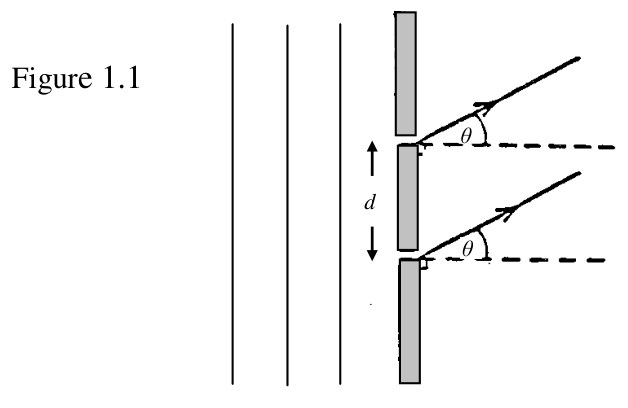
Figure 1.1
A plane monochromatic light wave, wavelength \(\lambda\) and frequency \(f\), is incident normally on two identical narrow slits, separated by a distance \(d\), as indicated in Figure 1.1. The light wave emerging at each slit is given, at a distance \(x\) in a direction \(\theta\) at time \(t\), by
\[ y=a\cos[2\pi(ft-x/\lambda)] \]
where the amplitude \(a\) is the same for both waves. (Assume \(x\) is much larger than \(d\)).
(i) Show that the two waves observed at an angle \(\theta\) to a normal to the slits, have a resultant amplitude \(A\) which can be obtained by adding two vectors, each having magnitude \(a\), and each with an associated direction determined by the phase of the light wave.
Verify geometrically, from the vector diagram, that
\[ A=2a\cos\theta \]
where
\[ \beta=\frac{\pi}{\lambda}d\sin\theta \]
(ii) The double slit is replaced by a diffraction grating with \(N\) equally spaced slits, adjacent slits being separated by a distance \(d\). Use the vector method of adding amplitudes to show that the vector amplitudes, each of magnitude \(a\), form a part of a regular polygon with vertices on a circle of radius \(R\) given by
\[ R=\frac{a}{2\sin\beta}, \]
Deduce that the resultant amplitude is
\[ \frac{a\sin N\beta}{\sin\beta} \]
and obtain the resultant phase difference relative to that of the light from the slit at the edge of the grating.
(iii) Sketch, in the same graph, \(\sin N\beta\) and \((1/\sin\beta)\) as a function of \(\beta\). On a separate graph show how the intensity of the resultant wave varies as a function of \(\beta\).
(iv) Determine the intensities of the principal intensity maxima.
(v) Show that the number of principal maxima cannot exceed
\[ \left(\frac{2d}{\lambda}+1\right) \]
(vi) Show that two wavelengths \(\lambda\) and \(\lambda+\delta\lambda\), where \(\delta\lambda\ll\lambda\), produce principal maxima with an angular separation given by
\[ \Delta\theta=\frac{n\Delta\lambda}{d\cos\theta} \qquad\text{where }n=0,\ \pm1,\ \pm2\ldots\text{etc} \]
Calculate this angular separation for the sodium D lines for which
\[ \lambda=589.0\,\mathrm{nm},\quad \lambda+\Delta\lambda=589.6\,\mathrm{nm},\quad n=2,\quad\text{and }d=1.2\times10^{-6}\,\mathrm{m}. \]
\[ \left[ \text{reminder:}\quad \cos A+\cos B = 2\cos\left(\frac{A+B}{2}\right)\cdot \cos\left(\frac{A-B}{2}\right) \right] \]
Official English text of the problem.
Answers
Let \(I_1\) be the intensity from one slit alone, and let \[ \beta=\frac{\pi d\sin\theta}{\lambda}. \] A signed amplitude coefficient is denoted by \(A_{\mathrm s}\); its absolute value is the physical amplitude.
-
(i) The phase difference is \(2\beta\), giving \[ \boxed{A_{\mathrm s}=2a\cos\beta,\qquad A=2a|\cos\beta|.} \] The printed \(\cos\theta\) should be \(\cos\beta\).
-
(ii) \[ \boxed{R=\frac{a}{2\sin\beta}\quad(0<\beta<\pi),\qquad A_{\mathrm s}=a\frac{\sin N\beta}{\sin\beta}.} \] Generally, \(R=a/(2|\sin\beta|)\). For slit phases increasing by \(2\beta\), the resultant phase relative to the first edge slit is \((N-1)\beta\) with the signed coefficient above. Using a positive amplitude adds \(\pi\) wherever that coefficient is negative. At \(\beta=m\pi\), the physical amplitude is \(Na\).
-
(iii) \(\sin N\beta\) has amplitude \(1\) and period \(2\pi/N\); \(1/\sin\beta\) has vertical asymptotes at \(\beta=m\pi\). The intensity is \[ \boxed{I(\beta)=I_1\left(\frac{\sin N\beta}{\sin\beta}\right)^2.} \] It is even and has period \(\pi\), with principal peaks at \(m\pi\). Between consecutive principal peaks are \(N-1\) zeros and \(N-2\) secondary maxima.
-
(iv) \[ \boxed{I_{\mathrm{principal}}=N^2I_1,\qquad d\sin\theta=n\lambda.} \]
-
(v) Counting grazing orders as limiting directions, \[ \boxed{M=2\left\lfloor\frac d\lambda\right\rfloor+1 \leq\frac{2d}{\lambda}+1.} \]
-
(vi) To first order, \[ \boxed{\Delta\theta\simeq\frac{n\Delta\lambda}{d\cos\theta}.} \] The angular separation is the magnitude of this signed shift. For the specified sodium lines in second order, \[ \boxed{\Delta\theta\simeq5.2\times10^{-3}\,\mathrm{rad} \simeq0.30^\circ.} \]
Solution
(i)
Normal incidence gives the same incident phase at both slits. The emerging waves are coherent, so their instantaneous displacements add.
In the far field, the rays reaching the observation point are effectively parallel. The difference between the two path lengths is therefore \[ \Delta x=d\sin\theta. \] Consequently, the phase difference has magnitude \[ \delta=\frac{2\pi\Delta x}{\lambda} =\frac{2\pi d\sin\theta}{\lambda} =2\beta. \]
Choose the reference slit so that the other wave advances in phase by \(2\beta\). Writing the reference phase as \(\psi\), the two waves are \[ y_0=a\cos\psi,\qquad y_1=a\cos(\psi+2\beta). \] The given identity gives \[ y_0+y_1 =2a\cos\beta\cos(\psi+\beta). \]
To interpret this geometrically, represent each wave by a vector of length \(a\), whose direction equals its phase. Its projection on a fixed axis is the instantaneous wave displacement. Both vectors rotate with angular speed \(2\pi f\), maintaining their angular separation \(2\beta\). Since projections add, their vector sum represents the resultant wave.
For the vector diagram, draw the two arrows from a common origin, making angles \(-\beta\) and \(+\beta\) with their phase bisector. Their components perpendicular to this bisector cancel; their components along it add: \[ A_{\mathrm s}=a\cos\beta+a\cos\beta=2a\cos\beta. \] Thus \[ \boxed{A=2a|\cos\beta|}. \] A negative signed coefficient simply represents a reversal of the resultant vector, or an additional phase of \(\pi\).
The \(\theta\) in the printed amplitude formula must therefore be replaced by \(\beta\).
(ii)
Apply the same far-field approximation to the whole grating, neglecting amplitude variation and wavefront curvature across it. Label the slits from one edge so that their phases are \[ \psi,\ \psi+2\beta,\ \ldots,\ \psi+2(N-1)\beta. \]
Draw the \(N\) amplitude vectors head to tail. Every vector has length \(a\), and each turns through the same angle \(2\beta\) relative to its predecessor. Their endpoints consequently form an equal-chord polygonal chain on a circle.
For the diagram, label the successive endpoints \(P_0,P_1,\ldots,P_N\) and the circle centre \(O\). Each side \(P_jP_{j+1}\) has length \(a\) and subtends a directed central angle \(2\beta\). Bisecting the corresponding isosceles triangle gives, for \(0<\beta<\pi\), \[ \frac a2=R\sin\beta. \] Hence \[ \boxed{R=\frac{a}{2\sin\beta}}. \] For arbitrary \(\beta\), the positive radius is \(a/(2|\sin\beta|)\). The chain need not close after the \(N\) vectors.
The resultant vector runs directly from \(P_0\) to \(P_N\). These endpoints are separated by a total directed central angle \(2N\beta\), so its length is \[ A_N=2R|\sin N\beta| =a\left|\frac{\sin N\beta}{\sin\beta}\right|. \] Thus the requested signed coefficient is \[ \boxed{A_{\mathrm s}=a\frac{\sin N\beta}{\sin\beta}}. \]
The phase follows from the chord directions. The first small chord has a midpoint radius at angular position \(\beta\), while the resultant chord has a midpoint radius at \(N\beta\). Each chord is perpendicular to its midpoint radius, so their angular difference is \[ N\beta-\beta=(N-1)\beta, \] up to a reversal of the resultant.
Equivalently, the complete resultant wave is \[ \boxed{ y_{\mathrm{tot}} = a\frac{\sin N\beta}{\sin\beta} \cos\!\left[\psi+(N-1)\beta\right]. } \] Therefore, with the chosen edge convention, the phase relative to that edge slit is \((N-1)\beta\) when the signed coefficient is retained. With a nonnegative amplitude, it is \[ \phi= \begin{cases} (N-1)\beta,&\sin N\beta/\sin\beta>0,\\[2mm] (N-1)\beta+\pi,&\sin N\beta/\sin\beta<0, \end{cases} \qquad(\bmod\,2\pi). \] Referencing the opposite edge reverses the relative phase modulo \(2\pi\). At a zero resultant, phase is undefined.
When \(\beta=m\pi\), adjacent phases differ by \(2m\pi\). All vectors point in the same direction, giving \(A_N=Na\) and zero relative phase modulo \(2\pi\). The circle construction then has infinite limiting radius.
(iii)
The time-averaged intensity is proportional to the square of the physical amplitude. Since the one-slit amplitude is \(a\), \[ \frac{I}{I_1}=\frac{A_N^2}{a^2}, \] and hence \[ \boxed{\frac{I(\beta)}{I_1} =\left(\frac{\sin N\beta}{\sin\beta}\right)^2}. \]
For the first graph, use common horizontal \(\beta\) and vertical function-value axes:
- \(\sin N\beta\) oscillates between \(-1\) and \(+1\), with period \(2\pi/N\). Its zeros are at \(\beta=k\pi/N\), and its extrema occur at \(\beta=(2k+1)\pi/(2N)\), with values \((-1)^k\).
- \(1/\sin\beta\) has period \(2\pi\), no zeros, and vertical asymptotes at \(\beta=m\pi\). Between \(0\) and \(\pi\), it falls from \(+\infty\) to its minimum \(1\) at \(\pi/2\), then rises to \(+\infty\). The next branch, between \(\pi\) and \(2\pi\), is negative, reaching \(-1\) at \(3\pi/2\) and tending to \(-\infty\) at both ends. These branches repeat.
Although the reciprocal sine diverges at \(m\pi\), the product with \(\sin N\beta\) has a finite limiting magnitude \(N\).
For the intensity graph, plot \(I/I_1\). Its principal features are:
| Position | \(I/I_1\) |
|---|---|
| \(\beta=m\pi\) | \(N^2\) |
| \(\beta=m\pi+r\pi/N,\quad r=1,\ldots,N-1\) | \(0\) |
| \(\beta=m\pi+\pi/2\), \(N\) even | \(0\) |
| \(\beta=m\pi+\pi/2\), \(N\) odd | \(1\) |
The curve is nonnegative, even, and periodic with period \(\pi\). Each principal peak is symmetric about \(\beta=m\pi\). Its nearest zeros are \[ \beta=m\pi\pm\frac{\pi}{N}, \] so its width between these zeros is \(2\pi/N\).
Between neighboring principal peaks there are \(N-1\) zeros, with \(N-2\) smaller secondary peaks between successive zeros. Their exact positions satisfy \[ \boxed{N\cot(N\beta)=\cot\beta}, \] obtained by differentiating the intensity away from its zeros. Away from the asymptotes, the curve lies beneath the envelope \[ I=\frac{I_1}{\sin^2\beta}. \]
(iv)
The largest possible resultant of \(N\) vectors of length \(a\) has length \(Na\). This occurs when all vectors point in the same direction: \[ 2\beta=2n\pi. \] Thus the principal maxima satisfy \[ \beta=n\pi \quad\Longleftrightarrow\quad \boxed{d\sin\theta=n\lambda}. \]
At these directions, \[ A_N=Na, \] so \[ \boxed{I_{\mathrm{principal}}=N^2I_1}. \] Under the stated equal-amplitude model, all principal maxima have this intensity.
The same result follows by taking the limit: \[ \lim_{\beta\to n\pi} \frac{\sin N\beta}{\sin\beta} =N(-1)^{n(N-1)}, \] whose square is \(N^2\).
(v)
A principal maximum of order \(n\) requires \[ \sin\theta=\frac{n\lambda}{d}. \] Since \(|\sin\theta|\leq1\), \[ |n|\leq\frac d\lambda. \]
The allowed integer orders therefore run from \[ -\left\lfloor\frac d\lambda\right\rfloor \quad\text{to}\quad +\left\lfloor\frac d\lambda\right\rfloor. \] Counting the zero order gives \[ M=2\left\lfloor\frac d\lambda\right\rfloor+1. \] Because \(\lfloor u\rfloor\leq u\), \[ \boxed{M\leq\frac{2d}{\lambda}+1}. \]
This count includes any orders exactly at grazing incidence, \(\theta=\pm90^\circ\), as limiting directions. Excluding such directions can only reduce the number.
(vi)
Consider the principal maxima of the same order \(n\) for the two wavelengths. Writing \(\Delta\lambda=\delta\lambda\), their grating equations are \[ d\sin\theta=n\lambda, \] \[ d\sin(\theta+\Delta\theta) =n(\lambda+\Delta\lambda). \]
For a small angular shift, measured in radians, \[ \sin(\theta+\Delta\theta) \simeq\sin\theta+\Delta\theta\cos\theta. \] Subtracting the first grating equation from the second gives \[ d\cos\theta\,\Delta\theta\simeq n\Delta\lambda, \] hence \[ \boxed{\Delta\theta\simeq\frac{n\Delta\lambda}{d\cos\theta}}. \] This is a first-order result for existing, nongrazing maxima. For negative \(n\), the signed shift is negative; the angular separation is its absolute value. The zero-order maxima coincide.
For the sodium lines, \[ \Delta\lambda=(589.6-589.0)\,\mathrm{nm} =0.6\times10^{-9}\,\mathrm m. \] At \(\lambda=589.0\,\mathrm{nm}\) in second order, \[ \sin\theta =\frac{2(589.0\times10^{-9})}{1.2\times10^{-6}} =0.9816667, \] so \[ \theta\simeq79.01^\circ,\qquad \cos\theta\simeq0.19061. \] Therefore, \[ \Delta\theta \simeq \frac{2(0.6\times10^{-9})} {(1.2\times10^{-6})(0.19061)} =5.246\times10^{-3}\,\mathrm{rad}. \] To sensible precision, \[ \boxed{\Delta\theta\simeq5.2\times10^{-3}\,\mathrm{rad} \simeq0.30^\circ}. \]
As a numerical check, subtracting the two angles from the unexpanded grating equation gives \(5.32\times10^{-3}\,\mathrm{rad}\), about \(1.4\%\) above the first-order estimate.
The solution was checked against the official solution. Where this solution differs from the official solution, the official solution contains an error or a misprint.
IPhO 1986 · Theorieaufgabe 1
Zwei Spalte und ein Beugungsgitter: Vektoraddition von Amplituden
Abbildung 1.1
Eine ebene monochromatische Lichtwelle mit der Wellenlänge \(\lambda\) und der Frequenz \(f\) fällt senkrecht auf zwei identische schmale Spalte, deren Abstand \(d\) beträgt, wie in Abbildung 1.1 dargestellt. Die an jedem Spalt austretende Lichtwelle ist im Abstand \(x\) in einer Richtung \(\theta\) zum Zeitpunkt \(t\) gegeben durch
\[ y=a\cos[2\pi(ft-x/\lambda)] \]
wobei die Amplitude \(a\) für beide Wellen gleich ist. (Es sei angenommen, dass \(x\) viel größer als \(d\) ist.)
(i) Zeigen Sie, dass die beiden Wellen, die unter einem Winkel \(\theta\) zur Normalen auf die Spalte beobachtet werden, eine resultierende Amplitude \(A\) haben, die durch Addition zweier Vektoren ermittelt werden kann, deren Betrag jeweils \(a\) ist und deren jeweilige Richtung durch die Phase der Lichtwelle bestimmt wird.
Bestätigen Sie anhand des Vektordiagramms geometrisch, dass
\[ A=2a\cos\theta \]
wobei
\[ \beta=\frac{\pi}{\lambda}d\sin\theta \]
(ii) Der Doppelspalt wird durch ein Beugungsgitter mit \(N\) äquidistanten Spalten ersetzt, wobei benachbarte Spalte den Abstand \(d\) haben. Zeigen Sie mithilfe der Vektormethode zur Addition von Amplituden, dass die Amplitudenvektoren, deren Betrag jeweils \(a\) ist, einen Teil eines regelmäßigen Vielecks bilden, dessen Eckpunkte auf einem Kreis mit dem Radius \(R\) liegen, der gegeben ist durch
\[ R=\frac{a}{2\sin\beta}, \]
Leiten Sie daraus ab, dass die resultierende Amplitude
\[ \frac{a\sin N\beta}{\sin\beta} \]
beträgt, und bestimmen Sie die resultierende Phasendifferenz gegenüber dem Licht aus dem Spalt am Rand des Gitters.
(iii) Skizzieren Sie in demselben Diagramm \(\sin N\beta\) und \((1/\sin\beta)\) als Funktionen von \(\beta\). Zeigen Sie in einem gesonderten Diagramm, wie die Intensität der resultierenden Welle von \(\beta\) abhängt.
(iv) Bestimmen Sie die Intensitäten der Hauptmaxima.
(v) Zeigen Sie, dass die Anzahl der Hauptmaxima nicht größer sein kann als
\[ \left(\frac{2d}{\lambda}+1\right) \]
(vi) Zeigen Sie, dass zwei Wellenlängen \(\lambda\) und \(\lambda+\delta\lambda\), wobei \(\delta\lambda\ll\lambda\), Hauptmaxima mit einem Winkelabstand erzeugen, der gegeben ist durch
\[ \Delta\theta=\frac{n\Delta\lambda}{d\cos\theta} \qquad\text{wobei }n=0,\ \pm1,\ \pm2\ldots\text{usw.} \]
Berechnen Sie diesen Winkelabstand für die Natrium-D-Linien, für die gilt:
\[ \lambda=589.0\,\mathrm{nm},\quad \lambda+\Delta\lambda=589.6\,\mathrm{nm},\quad n=2,\quad\text{und }d=1.2\times10^{-6}\,\mathrm{m}. \]
\[ \left[ \text{Zur Erinnerung:}\quad \cos A+\cos B = 2\cos\left(\frac{A+B}{2}\right)\cdot \cos\left(\frac{A-B}{2}\right) \right] \]
Aufgabentext aus dem offiziellen englischen Text übersetzt.
Antworten
Es sei \(I_1\) die Intensität eines einzelnen Spalts, und es sei \[ \beta=\frac{\pi d\sin\theta}{\lambda}. \] Ein vorzeichenbehafteter Amplitudenkoeffizient wird mit \(A_{\mathrm s}\) bezeichnet; sein Betrag ist die physikalische Amplitude.
-
(i) Die Phasendifferenz beträgt \(2\beta\), woraus folgt: \[ \boxed{A_{\mathrm s}=2a\cos\beta,\qquad A=2a|\cos\beta|.} \] Das gedruckte \(\cos\theta\) muss \(\cos\beta\) lauten.
-
(ii) \[ \boxed{R=\frac{a}{2\sin\beta}\quad(0<\beta<\pi),\qquad A_{\mathrm s}=a\frac{\sin N\beta}{\sin\beta}.} \] Allgemein gilt \(R=a/(2|\sin\beta|)\). Wenn die Phasen der Spalte jeweils um \(2\beta\) zunehmen, beträgt die resultierende Phase relativ zum ersten Randspalt bei Verwendung des obigen vorzeichenbehafteten Koeffizienten \((N-1)\beta\). Bei Verwendung einer positiven Amplitude kommt überall dort \(\pi\) hinzu, wo dieser Koeffizient negativ ist. Bei \(\beta=m\pi\) beträgt die physikalische Amplitude \(Na\).
-
(iii) \(\sin N\beta\) hat die Amplitude \(1\) und die Periode \(2\pi/N\); \(1/\sin\beta\) hat senkrechte Asymptoten bei \(\beta=m\pi\). Die Intensität ist \[ \boxed{I(\beta)=I_1\left(\frac{\sin N\beta}{\sin\beta}\right)^2.} \] Sie ist eine gerade Funktion mit der Periode \(\pi\) und Hauptmaxima bei \(m\pi\). Zwischen aufeinanderfolgenden Hauptmaxima liegen \(N-1\) Nullstellen und \(N-2\) Nebenmaxima.
-
(iv) \[ \boxed{I_{\mathrm{principal}}=N^2I_1,\qquad d\sin\theta=n\lambda.} \]
-
(v) Zählt man streifende Beugungsordnungen als Grenzrichtungen mit, so gilt \[ \boxed{M=2\left\lfloor\frac d\lambda\right\rfloor+1 \leq\frac{2d}{\lambda}+1.} \]
-
(vi) In erster Ordnung gilt \[ \boxed{\Delta\theta\simeq\frac{n\Delta\lambda}{d\cos\theta}.} \] Der Winkelabstand ist der Betrag dieser vorzeichenbehafteten Verschiebung. Für die angegebenen Natriumlinien in zweiter Beugungsordnung gilt \[ \boxed{\Delta\theta\simeq5.2\times10^{-3}\,\mathrm{rad} \simeq0.30^\circ.} \]
Lösung
(i)
Bei senkrechtem Einfall ist die Phase der einfallenden Welle an beiden Spalten gleich. Die austretenden Wellen sind kohärent, sodass sich ihre momentanen Auslenkungen addieren.
Im Fernfeld sind die Strahlen, die den Beobachtungspunkt erreichen, praktisch parallel. Der Gangunterschied zwischen den beiden Strahlen beträgt daher \[ \Delta x=d\sin\theta. \] Somit hat die Phasendifferenz den Betrag \[ \delta=\frac{2\pi\Delta x}{\lambda} =\frac{2\pi d\sin\theta}{\lambda} =2\beta. \]
Wählen wir den Referenzspalt so, dass die andere Welle einen Phasenvorsprung von \(2\beta\) hat. Bezeichnen wir die Referenzphase mit \(\psi\), so lauten die beiden Wellen \[ y_0=a\cos\psi,\qquad y_1=a\cos(\psi+2\beta). \] Mit der angegebenen Identität folgt \[ y_0+y_1 =2a\cos\beta\cos(\psi+\beta). \]
Zur geometrischen Deutung stellen wir jede Welle durch einen Vektor der Länge \(a\) dar, dessen Richtung ihrer Phase entspricht. Seine Projektion auf eine feste Achse ist die momentane Auslenkung der Welle. Beide Vektoren rotieren mit der Winkelgeschwindigkeit \(2\pi f\), wobei ihr Winkelabstand \(2\beta\) konstant bleibt. Da sich die Projektionen addieren, stellt ihre Vektorsumme die resultierende Welle dar.
Für das Vektordiagramm zeichnen wir die beiden Pfeile von einem gemeinsamen Ursprung aus, sodass sie mit der Winkelhalbierenden ihrer Phasenrichtungen die Winkel \(-\beta\) und \(+\beta\) bilden. Ihre Komponenten senkrecht zu dieser Winkelhalbierenden heben sich auf; ihre Komponenten entlang der Winkelhalbierenden addieren sich: \[ A_{\mathrm s}=a\cos\beta+a\cos\beta=2a\cos\beta. \] Damit gilt \[ \boxed{A=2a|\cos\beta|}. \] Ein negativer vorzeichenbehafteter Koeffizient bedeutet lediglich eine Umkehrung des resultierenden Vektors oder eine zusätzliche Phase von \(\pi\).
Das \(\theta\) in der gedruckten Amplitudenformel muss daher durch \(\beta\) ersetzt werden.
(ii)
Wir wenden dieselbe Fernfeldnäherung auf das gesamte Gitter an und vernachlässigen dabei die Amplitudenänderung und die Krümmung der Wellenfront über das Gitter hinweg. Wir nummerieren die Spalte von einem Rand aus so, dass ihre Phasen \[ \psi,\ \psi+2\beta,\ \ldots,\ \psi+2(N-1)\beta. \] betragen.
Wir zeichnen die \(N\) Amplitudenvektoren so aneinander, dass jeweils der Anfang eines Vektors an der Spitze des vorhergehenden liegt. Jeder Vektor hat die Länge \(a\), und jeder ist gegenüber seinem Vorgänger um denselben Winkel \(2\beta\) gedreht. Ihre Endpunkte bilden folglich einen Polygonzug aus gleich langen Sehnen auf einem Kreis.
Im Diagramm bezeichnen wir die aufeinanderfolgenden Endpunkte mit \(P_0,P_1,\ldots,P_N\) und den Kreismittelpunkt mit \(O\). Jede Seite \(P_jP_{j+1}\) hat die Länge \(a\) und spannt einen orientierten Mittelpunktswinkel \(2\beta\) auf. Die Halbierung des entsprechenden gleichschenkligen Dreiecks ergibt für \(0<\beta<\pi\) \[ \frac a2=R\sin\beta. \] Daraus folgt \[ \boxed{R=\frac{a}{2\sin\beta}}. \] Für beliebiges \(\beta\) beträgt der positive Radius \(a/(2|\sin\beta|)\). Der Polygonzug muss sich nach den \(N\) Vektoren nicht schließen.
Der resultierende Vektor verläuft direkt von \(P_0\) nach \(P_N\). Zwischen diesen Endpunkten liegt ein gesamter orientierter Mittelpunktswinkel von \(2N\beta\), sodass seine Länge \[ A_N=2R|\sin N\beta| =a\left|\frac{\sin N\beta}{\sin\beta}\right|. \] beträgt. Der gesuchte vorzeichenbehaftete Koeffizient ist somit \[ \boxed{A_{\mathrm s}=a\frac{\sin N\beta}{\sin\beta}}. \]
Die Phase ergibt sich aus den Richtungen der Sehnen. Der durch die Mitte der ersten kleinen Sehne verlaufende Radius hat die Winkellage \(\beta\), während der durch die Mitte der resultierenden Sehne verlaufende Radius die Winkellage \(N\beta\) hat. Jede Sehne steht senkrecht auf dem durch ihre Mitte verlaufenden Radius, sodass ihr Winkelunterschied \[ N\beta-\beta=(N-1)\beta, \] beträgt, bis auf eine Umkehrung der Resultierenden.
Gleichwertig dazu lautet die vollständige resultierende Welle \[ \boxed{ y_{\mathrm{tot}} = a\frac{\sin N\beta}{\sin\beta} \cos\!\left[\psi+(N-1)\beta\right]. } \] Mit der gewählten Randkonvention beträgt die Phase relativ zu diesem Randspalt daher \((N-1)\beta\), wenn der vorzeichenbehaftete Koeffizient beibehalten wird. Bei einer nichtnegativen Amplitude beträgt sie \[ \phi= \begin{cases} (N-1)\beta,&\sin N\beta/\sin\beta>0,\\[2mm] (N-1)\beta+\pi,&\sin N\beta/\sin\beta<0, \end{cases} \qquad(\bmod\,2\pi). \] Bei Bezug auf den gegenüberliegenden Rand kehrt sich das Vorzeichen der relativen Phase modulo \(2\pi\) um. Bei verschwindender Resultierender ist die Phase nicht definiert.
Für \(\beta=m\pi\) unterscheiden sich benachbarte Phasen um \(2m\pi\). Alle Vektoren zeigen in dieselbe Richtung, sodass \(A_N=Na\) gilt und die relative Phase modulo \(2\pi\) null ist. Der Radius der Kreiskonstruktion wird dann im Grenzfall unendlich groß.
(iii)
Die zeitlich gemittelte Intensität ist proportional zum Quadrat der physikalischen Amplitude. Da die Amplitude eines einzelnen Spalts \(a\) beträgt, gilt \[ \frac{I}{I_1}=\frac{A_N^2}{a^2}, \] und somit \[ \boxed{\frac{I(\beta)}{I_1} =\left(\frac{\sin N\beta}{\sin\beta}\right)^2}. \]
Für das erste Diagramm verwenden wir eine gemeinsame waagerechte \(\beta\)-Achse und eine gemeinsame senkrechte Achse für die Funktionswerte:
- \(\sin N\beta\) oszilliert zwischen \(-1\) und \(+1\) mit der Periode \(2\pi/N\). Seine Nullstellen liegen bei \(\beta=k\pi/N\), und seine Extremstellen liegen bei \(\beta=(2k+1)\pi/(2N)\) mit den Werten \((-1)^k\).
- \(1/\sin\beta\) hat die Periode \(2\pi\), keine Nullstellen und senkrechte Asymptoten bei \(\beta=m\pi\). Zwischen \(0\) und \(\pi\) fällt die Funktion von \(+\infty\) auf ihr Minimum \(1\) bei \(\pi/2\) und steigt dann wieder auf \(+\infty\). Der nächste Ast zwischen \(\pi\) und \(2\pi\) ist negativ, erreicht bei \(3\pi/2\) den Wert \(-1\) und strebt an beiden Enden gegen \(-\infty\). Diese Äste wiederholen sich.
Obwohl der Kehrwert des Sinus bei \(m\pi\) divergiert, hat das Produkt mit \(\sin N\beta\) einen endlichen Grenzbetrag \(N\).
Für das Intensitätsdiagramm tragen wir \(I/I_1\) auf. Seine wesentlichen Merkmale sind:
| Position | \(I/I_1\) |
|---|---|
| \(\beta=m\pi\) | \(N^2\) |
| \(\beta=m\pi+r\pi/N,\quad r=1,\ldots,N-1\) | \(0\) |
| \(\beta=m\pi+\pi/2\), \(N\) gerade | \(0\) |
| \(\beta=m\pi+\pi/2\), \(N\) ungerade | \(1\) |
Die Kurve ist nichtnegativ, gerade und periodisch mit der Periode \(\pi\). Jedes Hauptmaximum ist symmetrisch um \(\beta=m\pi\). Seine nächstgelegenen Nullstellen sind \[ \beta=m\pi\pm\frac{\pi}{N}, \] sodass seine Breite zwischen diesen Nullstellen \(2\pi/N\) beträgt.
Zwischen benachbarten Hauptmaxima liegen \(N-1\) Nullstellen und zwischen aufeinanderfolgenden Nullstellen \(N-2\) kleinere Nebenmaxima. Ihre genauen Positionen erfüllen \[ \boxed{N\cot(N\beta)=\cot\beta}, \] was sich durch Differenzieren der Intensität außerhalb ihrer Nullstellen ergibt. Abseits der Asymptoten liegt die Kurve unterhalb der Einhüllenden \[ I=\frac{I_1}{\sin^2\beta}. \]
(iv)
Die größtmögliche Resultierende von \(N\) Vektoren der Länge \(a\) hat die Länge \(Na\). Dies tritt ein, wenn alle Vektoren in dieselbe Richtung zeigen: \[ 2\beta=2n\pi. \] Die Hauptmaxima erfüllen somit \[ \beta=n\pi \quad\Longleftrightarrow\quad \boxed{d\sin\theta=n\lambda}. \]
In diesen Richtungen gilt \[ A_N=Na, \] also \[ \boxed{I_{\mathrm{principal}}=N^2I_1}. \] Im angegebenen Modell gleicher Amplituden haben alle Hauptmaxima diese Intensität.
Dasselbe Ergebnis folgt durch den Grenzübergang: \[ \lim_{\beta\to n\pi} \frac{\sin N\beta}{\sin\beta} =N(-1)^{n(N-1)}, \] dessen Quadrat \(N^2\) ist.
(v)
Ein Hauptmaximum der Ordnung \(n\) erfordert \[ \sin\theta=\frac{n\lambda}{d}. \] Da \(|\sin\theta|\leq1\), gilt \[ |n|\leq\frac d\lambda. \]
Die zulässigen ganzzahligen Ordnungen reichen daher von \[ -\left\lfloor\frac d\lambda\right\rfloor \quad\text{bis}\quad +\left\lfloor\frac d\lambda\right\rfloor. \] Zählt man die nullte Ordnung mit, so ergibt sich \[ M=2\left\lfloor\frac d\lambda\right\rfloor+1. \] Wegen \(\lfloor u\rfloor\leq u\) gilt \[ \boxed{M\leq\frac{2d}{\lambda}+1}. \]
Diese Zählung schließt etwaige Ordnungen bei exakt streifendem Einfall, \(\theta=\pm90^\circ\), als Grenzrichtungen ein. Werden solche Richtungen ausgeschlossen, kann sich die Anzahl nur verringern.
(vi)
Wir betrachten die Hauptmaxima derselben Ordnung \(n\) für die beiden Wellenlängen. Mit \(\Delta\lambda=\delta\lambda\) lauten ihre Gittergleichungen \[ d\sin\theta=n\lambda, \] \[ d\sin(\theta+\Delta\theta) =n(\lambda+\Delta\lambda). \]
Für eine kleine, im Bogenmaß gemessene Winkelverschiebung gilt \[ \sin(\theta+\Delta\theta) \simeq\sin\theta+\Delta\theta\cos\theta. \] Subtraktion der ersten Gittergleichung von der zweiten ergibt \[ d\cos\theta\,\Delta\theta\simeq n\Delta\lambda, \] also \[ \boxed{\Delta\theta\simeq\frac{n\Delta\lambda}{d\cos\theta}}. \] Dies ist ein Ergebnis erster Ordnung für existierende, nicht streifende Maxima. Für negatives \(n\) ist die vorzeichenbehaftete Verschiebung negativ; der Winkelabstand ist ihr Betrag. Die Maxima nullter Ordnung fallen zusammen.
Für die Natriumlinien gilt \[ \Delta\lambda=(589.6-589.0)\,\mathrm{nm} =0.6\times10^{-9}\,\mathrm m. \] Bei \(\lambda=589.0\,\mathrm{nm}\) in zweiter Beugungsordnung ist \[ \sin\theta =\frac{2(589.0\times10^{-9})}{1.2\times10^{-6}} =0.9816667, \] also \[ \theta\simeq79.01^\circ,\qquad \cos\theta\simeq0.19061. \] Daher gilt \[ \Delta\theta \simeq \frac{2(0.6\times10^{-9})} {(1.2\times10^{-6})(0.19061)} =5.246\times10^{-3}\,\mathrm{rad}. \] Mit sinnvoller Genauigkeit ergibt sich \[ \boxed{\Delta\theta\simeq5.2\times10^{-3}\,\mathrm{rad} \simeq0.30^\circ}. \]
Als numerische Kontrolle ergibt die Subtraktion der beiden Winkel aus der nicht entwickelten Gittergleichung \(5.32\times10^{-3}\,\mathrm{rad}\), etwa \(1.4\%\) mehr als die Näherung erster Ordnung.
Die Lösung wurde mit der offiziellen Lösung abgeglichen. Wo diese Lösung von der offiziellen Lösung abweicht, enthält die offizielle Lösung einen Fehler oder Druckfehler.
IPhO 1986 · Teori sorusu 1
İki yarık ve bir kırınım ağı: genliklerin vektörel toplamı
Şekil 1.1
Dalga boyu \(\lambda\) ve frekansı \(f\) olan düzlem, tek renkli bir ışık dalgası, Şekil 1.1'de gösterildiği gibi aralarında \(d\) uzaklığı bulunan özdeş iki dar yarığa dik olarak gelmektedir. Her bir yarıktan çıkan ışık dalgası, \(\theta\) doğrultusunda \(x\) uzaklıkta ve \(t\) anında
\[ y=a\cos[2\pi(ft-x/\lambda)] \]
ile verilir; burada \(a\) genliği her iki dalga için aynıdır. (\(x\)'in \(d\)'den çok daha büyük olduğunu varsayın.)
(i) Yarıklara dik doğrultuyla \(\theta\) açısı yapan bir doğrultuda gözlenen iki dalganın bileşke genliği \(A\)'nın, her birinin büyüklüğü \(a\) olan ve doğrultusu ilgili ışık dalgasının fazıyla belirlenen iki vektörün toplanmasıyla elde edilebileceğini gösterin.
Vektör diyagramından geometrik olarak
\[ A=2a\cos\theta \]
olduğunu doğrulayın; burada
\[ \beta=\frac{\pi}{\lambda}d\sin\theta \]
(ii) Çift yarığın yerine, komşu yarıkları arasındaki uzaklık \(d\) olan, eşit aralıklarla yerleştirilmiş \(N\) yarıktan oluşan bir kırınım ağı konuluyor. Genlikleri vektörel olarak toplama yöntemini kullanarak, her birinin büyüklüğü \(a\) olan genlik vektörlerinin, köşeleri yarıçapı \(R\)
\[ R=\frac{a}{2\sin\beta}, \]
ile verilen bir çember üzerinde bulunan düzgün bir çokgenin bir parçasını oluşturduğunu gösterin. Bileşke genliğin
\[ \frac{a\sin N\beta}{\sin\beta} \]
olduğunu çıkarın ve bileşkenin, ağın kenarındaki yarıktan gelen ışığa göre faz farkını elde edin.
(iii) Aynı grafikte \(\sin N\beta\) ve \((1/\sin\beta)\) fonksiyonlarının \(\beta\)'ya bağlı değişimini kabaca çizin. Ayrı bir grafikte bileşke dalganın şiddetinin \(\beta\)'ya bağlı olarak nasıl değiştiğini gösterin.
(iv) Ana şiddet maksimumlarının şiddetlerini belirleyin.
(v) Ana maksimumların sayısının
\[ \left(\frac{2d}{\lambda}+1\right) \]
değerini aşamayacağını gösterin.
(vi) \(\delta\lambda\ll\lambda\) olmak üzere, \(\lambda\) ve \(\lambda+\delta\lambda\) dalga boylarının oluşturduğu ana maksimumlar arasındaki açısal ayrımın
\[ \Delta\theta=\frac{n\Delta\lambda}{d\cos\theta} \qquad\text{burada }n=0,\ \pm1,\ \pm2\ldots\text{vb.} \]
ile verildiğini gösterin. Aşağıdaki değerler için sodyum D çizgilerinin bu açısal ayrımını hesaplayın:
\[ \lambda=589.0\,\mathrm{nm},\quad \lambda+\Delta\lambda=589.6\,\mathrm{nm},\quad n=2,\quad\text{ve }d=1.2\times10^{-6}\,\mathrm{m}. \]
\[ \left[ \text{hatırlatma:}\quad \cos A+\cos B = 2\cos\left(\frac{A+B}{2}\right)\cdot \cos\left(\frac{A-B}{2}\right) \right] \]
Soru metni resmi İngilizce metinden çevrilmiştir.
Cevaplar
Yalnızca tek bir yarıktan gelen ışığın şiddeti \(I_1\) olsun ve \[ \beta=\frac{\pi d\sin\theta}{\lambda}. \] İşaretli genlik katsayısı \(A_{\mathrm s}\) ile gösterilir; bunun mutlak değeri fiziksel genliktir.
-
(i) Faz farkı \(2\beta\) olduğundan \[ \boxed{A_{\mathrm s}=2a\cos\beta,\qquad A=2a|\cos\beta|.} \] Basılı metindeki \(\cos\theta\) ifadesi \(\cos\beta\) olmalıdır.
-
(ii) \[ \boxed{R=\frac{a}{2\sin\beta}\quad(0<\beta<\pi),\qquad A_{\mathrm s}=a\frac{\sin N\beta}{\sin\beta}.} \] Genel olarak \(R=a/(2|\sin\beta|)\) olur. Yarık fazları \(2\beta\) kadar artıyorsa, yukarıdaki işaretli katsayı kullanıldığında bileşkenin ilk kenar yarığına göre fazı \((N-1)\beta\)'dır. Pozitif genlik kullanıldığında, bu katsayının negatif olduğu her yerde faza \(\pi\) eklenir. \(\beta=m\pi\) olduğunda fiziksel genlik \(Na\)'dır.
-
(iii) \(\sin N\beta\)'nın genliği \(1\), periyodu \(2\pi/N\)'dir; \(1/\sin\beta\)'nın \(\beta=m\pi\) noktalarında düşey asimptotları vardır. Şiddet \[ \boxed{I(\beta)=I_1\left(\frac{\sin N\beta}{\sin\beta}\right)^2.} \] ile verilir. Çift bir fonksiyondur ve periyodu \(\pi\)'dir; ana tepeleri \(m\pi\) noktalarındadır. Ardışık ana tepeler arasında \(N-1\) sıfır ve \(N-2\) ikincil maksimum bulunur.
-
(iv) \[ \boxed{I_{\mathrm{principal}}=N^2I_1,\qquad d\sin\theta=n\lambda.} \]
-
(v) Yüzeye teğet mertebeler sınır doğrultuları olarak sayıldığında, \[ \boxed{M=2\left\lfloor\frac d\lambda\right\rfloor+1 \leq\frac{2d}{\lambda}+1.} \]
-
(vi) Birinci mertebeden yaklaşımla, \[ \boxed{\Delta\theta\simeq\frac{n\Delta\lambda}{d\cos\theta}.} \] Açısal ayrım, bu işaretli kaymanın büyüklüğüdür. Verilen sodyum çizgileri için ikinci mertebede, \[ \boxed{\Delta\theta\simeq5.2\times10^{-3}\,\mathrm{rad} \simeq0.30^\circ.} \]
Çözüm
(i)
Dik gelme durumunda, gelen dalganın fazı her iki yarıkta aynıdır. Yarıklardan çıkan dalgalar eşevrelidir; dolayısıyla anlık yer değiştirmeleri toplanır.
Uzak alanda, gözlem noktasına ulaşan ışınlar pratik olarak paraleldir. Bu nedenle iki yol uzunluğu arasındaki fark \[ \Delta x=d\sin\theta. \] olur. Dolayısıyla faz farkının büyüklüğü \[ \delta=\frac{2\pi\Delta x}{\lambda} =\frac{2\pi d\sin\theta}{\lambda} =2\beta. \] olur.
Referans yarığını, diğer dalga faz bakımından \(2\beta\) kadar ileride olacak şekilde seçelim. Referans fazını \(\psi\) ile gösterirsek iki dalga \[ y_0=a\cos\psi,\qquad y_1=a\cos(\psi+2\beta). \] şeklindedir. Verilen özdeşlikten \[ y_0+y_1 =2a\cos\beta\cos(\psi+\beta). \] elde edilir.
Bunu geometrik olarak yorumlamak için her dalgayı, uzunluğu \(a\) olan ve yön açısı dalganın fazına eşit olan bir vektörle temsil edelim. Bu vektörün sabit bir eksen üzerindeki izdüşümü, dalganın anlık yer değiştirmesidir. Her iki vektör de aralarındaki \(2\beta\) açısal ayrımı koruyarak \(2\pi f\) açısal hızıyla döner. İzdüşümler toplandığından, vektörel toplamları bileşke dalgayı temsil eder.
Vektör diyagramı için iki oku ortak bir başlangıç noktasından, aralarındaki faz açısının açıortayıyla \(-\beta\) ve \(+\beta\) açıları yapacak şekilde çizelim. Bu açıortaya dik bileşenleri birbirini götürür; açıortay boyunca olan bileşenleri ise toplanır: \[ A_{\mathrm s}=a\cos\beta+a\cos\beta=2a\cos\beta. \] Böylece \[ \boxed{A=2a|\cos\beta|}. \] Negatif bir işaretli katsayı, yalnızca bileşke vektörün yönünün tersine dönmesini ya da \(\pi\) kadar ek bir fazı temsil eder.
Dolayısıyla basılı genlik formülündeki \(\theta\), \(\beta\) ile değiştirilmelidir.
(ii)
Aynı uzak alan yaklaşımını, ağ boyunca genlik değişimini ve dalga cephesinin eğriliğini ihmal ederek tüm ağa uygulayalım. Yarıkları bir kenardan başlayarak, fazları \[ \psi,\ \psi+2\beta,\ \ldots,\ \psi+2(N-1)\beta. \] olacak şekilde numaralandıralım.
\(N\) genlik vektörünü uç uca çizelim. Her vektörün uzunluğu \(a\)'dır ve her biri bir öncekine göre aynı \(2\beta\) açısı kadar döner. Dolayısıyla uç noktaları, bir çember üzerinde eşit kirişlerden oluşan bir çokgen zinciri oluşturur.
Diyagramda ardışık uç noktaları \(P_0,P_1,\ldots,P_N\), çemberin merkezini ise \(O\) ile gösterelim. Her \(P_jP_{j+1}\) kenarının uzunluğu \(a\)'dır ve gördüğü yönlü merkez açı \(2\beta\)'dır. Karşılık gelen ikizkenar üçgeni iki eş parçaya bölersek, \(0<\beta<\pi\) için \[ \frac a2=R\sin\beta. \] elde edilir. Buradan \[ \boxed{R=\frac{a}{2\sin\beta}}. \] elde edilir. Herhangi bir \(\beta\) için pozitif yarıçap \(a/(2|\sin\beta|)\)'dır. Zincirin \(N\) vektörden sonra kapanması gerekmez.
Bileşke vektör doğrudan \(P_0\)'dan \(P_N\)'ye uzanır. Bu uç noktalar arasındaki toplam yönlü merkez açı \(2N\beta\) olduğundan, bileşkenin uzunluğu \[ A_N=2R|\sin N\beta| =a\left|\frac{\sin N\beta}{\sin\beta}\right|. \] olur. Böylece istenen işaretli katsayı \[ \boxed{A_{\mathrm s}=a\frac{\sin N\beta}{\sin\beta}}. \] olur.
Faz, kirişlerin doğrultularından bulunur. İlk küçük kirişin orta noktasından geçen yarıçapın açısal konumu \(\beta\) iken, bileşke kirişin orta noktasından geçen yarıçapın açısal konumu \(N\beta\)'dır. Her kiriş, orta noktasından geçen yarıçapa dik olduğundan, aralarındaki açısal fark \[ N\beta-\beta=(N-1)\beta, \] olur; bileşkenin yönü tersine dönebilir.
Eşdeğer olarak, bileşke dalganın tam ifadesi \[ \boxed{ y_{\mathrm{tot}} = a\frac{\sin N\beta}{\sin\beta} \cos\!\left[\psi+(N-1)\beta\right]. } \] şeklindedir. Dolayısıyla seçilen kenar kabulüyle, işaretli katsayı korunduğunda bu kenar yarığına göre faz \((N-1)\beta\)'dır. Negatif olmayan bir genlik kullanıldığında ise \[ \phi= \begin{cases} (N-1)\beta,&\sin N\beta/\sin\beta>0,\\[2mm] (N-1)\beta+\pi,&\sin N\beta/\sin\beta<0, \end{cases} \qquad(\bmod\,2\pi). \] olur. Karşı kenarın referans alınması, bağıl fazın işaretini \(2\pi\) modülünde tersine çevirir. Bileşke sıfır olduğunda faz tanımsızdır.
\(\beta=m\pi\) olduğunda komşu fazlar arasındaki fark \(2m\pi\)'dir. Tüm vektörler aynı yönü gösterir; böylece \(A_N=Na\) olur ve bağıl faz \(2\pi\) modülünde sıfırdır. Bu durumda çemberin yarıçapı limitte sonsuza gider.
(iii)
Zaman ortalamalı şiddet, fiziksel genliğin karesiyle orantılıdır. Tek yarığın genliği \(a\) olduğundan, \[ \frac{I}{I_1}=\frac{A_N^2}{a^2}, \] ve dolayısıyla \[ \boxed{\frac{I(\beta)}{I_1} =\left(\frac{\sin N\beta}{\sin\beta}\right)^2}. \]
İlk grafik için ortak bir yatay \(\beta\) ekseni ve düşey fonksiyon değeri ekseni kullanın:
- \(\sin N\beta\), \(-1\) ile \(+1\) arasında \(2\pi/N\) periyoduyla salınır. Sıfırları \(\beta=k\pi/N\) noktalarındadır; ekstremumları ise \(\beta=(2k+1)\pi/(2N)\) noktalarında oluşur ve değerleri \((-1)^k\)'dır.
- \(1/\sin\beta\)'nın periyodu \(2\pi\)'dir, sıfırı yoktur ve \(\beta=m\pi\) noktalarında düşey asimptotları vardır. \(0\) ile \(\pi\) arasında, \(+\infty\)'den başlayarak \(\pi/2\)'deki minimum değeri olan \(1\)'e düşer, ardından \(+\infty\)'ye yükselir. \(\pi\) ile \(2\pi\) arasındaki bir sonraki kol negatiftir; \(3\pi/2\)'de \(-1\)'e ulaşır ve her iki uçta \(-\infty\)'ye yaklaşır. Bu kollar tekrarlanır.
Sinüsün çarpmaya göre tersi \(m\pi\) noktalarında ıraksasa da, \(\sin N\beta\) ile çarpımının büyüklüğü sonlu olan \(N\) limitine sahiptir.
Şiddet grafiği için \(I/I_1\)'i çizin. Başlıca özellikleri şunlardır:
| Konum | \(I/I_1\) |
|---|---|
| \(\beta=m\pi\) | \(N^2\) |
| \(\beta=m\pi+r\pi/N,\quad r=1,\ldots,N-1\) | \(0\) |
| \(\beta=m\pi+\pi/2\), \(N\) çift | \(0\) |
| \(\beta=m\pi+\pi/2\), \(N\) tek | \(1\) |
Eğri negatif değer almaz, çift bir fonksiyondur ve \(\pi\) periyoduyla tekrarlanır. Her ana tepe \(\beta=m\pi\)'ye göre simetriktir. Ona en yakın sıfırlar \[ \beta=m\pi\pm\frac{\pi}{N}, \] noktalarında olduğundan, bu sıfırlar arasındaki genişliği \(2\pi/N\)'dir.
Komşu ana tepeler arasında \(N-1\) sıfır bulunur; ardışık sıfırlar arasında da \(N-2\) daha küçük ikincil tepe vardır. Bunların tam konumları, \[ \boxed{N\cot(N\beta)=\cot\beta}, \] denklemini sağlar; bu denklem, şiddetin sıfırlarından uzakta türevi alınarak elde edilir. Asimptotlardan uzakta eğri, \[ I=\frac{I_1}{\sin^2\beta}. \] zarfının altında kalır.
(iv)
Uzunlukları \(a\) olan \(N\) vektörün mümkün olan en büyük bileşkesinin uzunluğu \(Na\)'dır. Bu durum, tüm vektörler aynı yönü gösterdiğinde gerçekleşir: \[ 2\beta=2n\pi. \] Dolayısıyla ana maksimumlar \[ \beta=n\pi \quad\Longleftrightarrow\quad \boxed{d\sin\theta=n\lambda}. \] koşulunu sağlar.
Bu doğrultularda, \[ A_N=Na, \] olduğundan \[ \boxed{I_{\mathrm{principal}}=N^2I_1}. \] Verilen eşit genlikli modelde, tüm ana maksimumlar bu şiddete sahiptir.
Aynı sonuç limit alınarak da elde edilir: \[ \lim_{\beta\to n\pi} \frac{\sin N\beta}{\sin\beta} =N(-1)^{n(N-1)}, \] bu ifadenin karesi \(N^2\)'dir.
(v)
\(n\). mertebeden bir ana maksimum için \[ \sin\theta=\frac{n\lambda}{d}. \] olmalıdır. \(|\sin\theta|\leq1\) olduğundan, \[ |n|\leq\frac d\lambda. \]
Dolayısıyla izin verilen tam sayı mertebeler \[ -\left\lfloor\frac d\lambda\right\rfloor \quad\text{ile}\quad +\left\lfloor\frac d\lambda\right\rfloor. \] arasında değişir. Sıfırıncı mertebe de sayıldığında \[ M=2\left\lfloor\frac d\lambda\right\rfloor+1. \] elde edilir. \(\lfloor u\rfloor\leq u\) olduğundan, \[ \boxed{M\leq\frac{2d}{\lambda}+1}. \]
Bu sayım, tam olarak yüzeye teğet olan \(\theta=\pm90^\circ\) doğrultularındaki mertebeleri de sınır doğrultuları olarak içerir. Bu doğrultuların dışarıda bırakılması sayıyı yalnızca azaltabilir.
(vi)
İki dalga boyu için aynı \(n\) mertebesindeki ana maksimumları ele alalım. \(\Delta\lambda=\delta\lambda\) yazarsak bunların kırınım ağı denklemleri \[ d\sin\theta=n\lambda, \] \[ d\sin(\theta+\Delta\theta) =n(\lambda+\Delta\lambda). \] olur.
Radyan cinsinden ölçülen küçük bir açısal kayma için, \[ \sin(\theta+\Delta\theta) \simeq\sin\theta+\Delta\theta\cos\theta. \] Birinci kırınım ağı denklemini ikinciden çıkarırsak \[ d\cos\theta\,\Delta\theta\simeq n\Delta\lambda, \] ve buradan \[ \boxed{\Delta\theta\simeq\frac{n\Delta\lambda}{d\cos\theta}}. \] elde edilir. Bu, mevcut olan ve yüzeye teğet olmayan maksimumlar için birinci mertebeden bir sonuçtur. Negatif \(n\) için işaretli kayma negatiftir; açısal ayrım bunun mutlak değeridir. Sıfırıncı mertebe maksimumları çakışır.
Sodyum çizgileri için, \[ \Delta\lambda=(589.6-589.0)\,\mathrm{nm} =0.6\times10^{-9}\,\mathrm m. \] \(\lambda=589.0\,\mathrm{nm}\) için ikinci mertebede, \[ \sin\theta =\frac{2(589.0\times10^{-9})}{1.2\times10^{-6}} =0.9816667, \] olduğundan \[ \theta\simeq79.01^\circ,\qquad \cos\theta\simeq0.19061. \] Dolayısıyla, \[ \Delta\theta \simeq \frac{2(0.6\times10^{-9})} {(1.2\times10^{-6})(0.19061)} =5.246\times10^{-3}\,\mathrm{rad}. \] Uygun bir hassasiyetle, \[ \boxed{\Delta\theta\simeq5.2\times10^{-3}\,\mathrm{rad} \simeq0.30^\circ}. \]
Sayısal bir kontrol olarak, açılım yapılmamış kırınım ağı denkleminden elde edilen iki açı birbirinden çıkarıldığında \(5.32\times10^{-3}\,\mathrm{rad}\) bulunur; bu, birinci mertebeden tahminden yaklaşık \(1.4\%\) daha büyüktür.
Çözüm, resmi çözümle karşılaştırılarak kontrol edildi. Bu çözümün resmi çözümden ayrıldığı yerlerde resmi çözümde bir hata ya da baskı hatası vardır.
IPhO 1986 · Problema teórico 1
Dos rendijas y una red de difracción: suma vectorial de amplitudes
Figura 1.1
Una onda luminosa plana y monocromática, de longitud de onda \(\lambda\) y frecuencia \(f\), incide normalmente sobre dos rendijas estrechas idénticas, separadas por una distancia \(d\), como se indica en la Figura 1.1. La onda luminosa que emerge de cada rendija viene dada, a una distancia \(x\) en una dirección \(\theta\) en el instante \(t\), por
\[ y=a\cos[2\pi(ft-x/\lambda)] \]
donde la amplitud \(a\) es la misma para ambas ondas. (Suponga que \(x\) es mucho mayor que \(d\)).
(i) Demuestre que las dos ondas observadas formando un ángulo \(\theta\) con la normal a las rendijas tienen una amplitud resultante \(A\) que puede obtenerse sumando dos vectores, cada uno de módulo \(a\) y con una dirección asociada determinada por la fase de la onda luminosa.
Verifique geométricamente, a partir del diagrama vectorial, que
\[ A=2a\cos\theta \]
donde
\[ \beta=\frac{\pi}{\lambda}d\sin\theta \]
(ii) Se sustituye la doble rendija por una red de difracción con \(N\) rendijas equiespaciadas, cuyas rendijas adyacentes están separadas por una distancia \(d\). Utilice el método vectorial de suma de amplitudes para demostrar que los vectores de amplitud, cada uno de módulo \(a\), forman parte de un polígono regular con vértices sobre una circunferencia de radio \(R\) dado por
\[ R=\frac{a}{2\sin\beta}, \]
Deduzca que la amplitud resultante es
\[ \frac{a\sin N\beta}{\sin\beta} \]
y obtenga la diferencia de fase de la onda resultante respecto a la de la luz procedente de la rendija situada en el borde de la red.
(iii) Represente esquemáticamente, en una misma gráfica, \(\sin N\beta\) y \((1/\sin\beta)\) en función de \(\beta\). En una gráfica aparte, muestre cómo varía la intensidad de la onda resultante en función de \(\beta\).
(iv) Determine las intensidades de los máximos principales de intensidad.
(v) Demuestre que el número de máximos principales no puede superar
\[ \left(\frac{2d}{\lambda}+1\right) \]
(vi) Demuestre que dos longitudes de onda \(\lambda\) y \(\lambda+\delta\lambda\), donde \(\delta\lambda\ll\lambda\), producen máximos principales con una separación angular dada por
\[ \Delta\theta=\frac{n\Delta\lambda}{d\cos\theta} \qquad\text{donde }n=0,\ \pm1,\ \pm2\ldots\text{etc.} \]
Calcule esta separación angular para las líneas D del sodio, para las que
\[ \lambda=589.0\,\mathrm{nm},\quad \lambda+\Delta\lambda=589.6\,\mathrm{nm},\quad n=2,\quad\text{y }d=1.2\times10^{-6}\,\mathrm{m}. \]
\[ \left[ \text{recordatorio:}\quad \cos A+\cos B = 2\cos\left(\frac{A+B}{2}\right)\cdot \cos\left(\frac{A-B}{2}\right) \right] \]
Enunciado traducido del texto oficial en inglés.
Respuestas
Sea \(I_1\) la intensidad debida a una sola rendija, y sea \[ \beta=\frac{\pi d\sin\theta}{\lambda}. \] El coeficiente de amplitud con signo se denota por \(A_{\mathrm s}\); su valor absoluto es la amplitud física.
-
(i) La diferencia de fase es \(2\beta\), lo que da \[ \boxed{A_{\mathrm s}=2a\cos\beta,\qquad A=2a|\cos\beta|.} \] El \(\cos\theta\) impreso debería ser \(\cos\beta\).
-
(ii) \[ \boxed{R=\frac{a}{2\sin\beta}\quad(0<\beta<\pi),\qquad A_{\mathrm s}=a\frac{\sin N\beta}{\sin\beta}.} \] En general, \(R=a/(2|\sin\beta|)\). Si las fases de las rendijas aumentan en \(2\beta\), la fase resultante respecto a la primera rendija del borde es \((N-1)\beta\) con el coeficiente con signo anterior. Al utilizar una amplitud positiva, se añade \(\pi\) siempre que ese coeficiente sea negativo. En \(\beta=m\pi\), la amplitud física es \(Na\).
-
(iii) \(\sin N\beta\) tiene amplitud \(1\) y período \(2\pi/N\); \(1/\sin\beta\) tiene asíntotas verticales en \(\beta=m\pi\). La intensidad es \[ \boxed{I(\beta)=I_1\left(\frac{\sin N\beta}{\sin\beta}\right)^2.} \] Es una función par y tiene período \(\pi\), con picos principales en \(m\pi\). Entre dos picos principales consecutivos hay \(N-1\) ceros y \(N-2\) máximos secundarios.
-
(iv) \[ \boxed{I_{\mathrm{principal}}=N^2I_1,\qquad d\sin\theta=n\lambda.} \]
-
(v) Contando los órdenes rasantes como direcciones límite, \[ \boxed{M=2\left\lfloor\frac d\lambda\right\rfloor+1 \leq\frac{2d}{\lambda}+1.} \]
-
(vi) A primer orden, \[ \boxed{\Delta\theta\simeq\frac{n\Delta\lambda}{d\cos\theta}.} \] La separación angular es el valor absoluto de este desplazamiento con signo. Para las líneas de sodio especificadas en segundo orden, \[ \boxed{\Delta\theta\simeq5.2\times10^{-3}\,\mathrm{rad} \simeq0.30^\circ.} \]
Solución
(i)
La incidencia normal hace que la fase incidente sea la misma en ambas rendijas. Las ondas emergentes son coherentes, por lo que sus desplazamientos instantáneos se suman.
En el campo lejano, los rayos que alcanzan el punto de observación son prácticamente paralelos. Por tanto, la diferencia entre las dos longitudes de recorrido es \[ \Delta x=d\sin\theta. \] En consecuencia, la diferencia de fase tiene módulo \[ \delta=\frac{2\pi\Delta x}{\lambda} =\frac{2\pi d\sin\theta}{\lambda} =2\beta. \]
Elijamos la rendija de referencia de modo que la otra onda esté adelantada en fase en \(2\beta\). Denotando la fase de referencia por \(\psi\), las dos ondas son \[ y_0=a\cos\psi,\qquad y_1=a\cos(\psi+2\beta). \] La identidad dada permite obtener \[ y_0+y_1 =2a\cos\beta\cos(\psi+\beta). \]
Para interpretar esto geométricamente, representemos cada onda mediante un vector de longitud \(a\), cuya dirección angular sea igual a su fase. Su proyección sobre un eje fijo es el desplazamiento instantáneo de la onda. Ambos vectores giran con velocidad angular \(2\pi f\), manteniendo su separación angular \(2\beta\). Como las proyecciones se suman, su suma vectorial representa la onda resultante.
Para el diagrama vectorial, dibujemos las dos flechas desde un origen común, formando ángulos \(-\beta\) y \(+\beta\) con la bisectriz de sus fases. Sus componentes perpendiculares a esta bisectriz se anulan; sus componentes a lo largo de ella se suman: \[ A_{\mathrm s}=a\cos\beta+a\cos\beta=2a\cos\beta. \] Por tanto, \[ \boxed{A=2a|\cos\beta|}. \] Un coeficiente con signo negativo representa simplemente una inversión del vector resultante, o una fase adicional de \(\pi\).
Por tanto, la \(\theta\) de la fórmula de amplitud impresa debe sustituirse por \(\beta\).
(ii)
Apliquemos la misma aproximación de campo lejano a toda la red, despreciando la variación de amplitud y la curvatura del frente de onda a lo largo de ella. Numeremos las rendijas desde un borde de modo que sus fases sean \[ \psi,\ \psi+2\beta,\ \ldots,\ \psi+2(N-1)\beta. \]
Dibujemos los \(N\) vectores de amplitud colocando el origen de cada uno en el extremo del anterior. Cada vector tiene longitud \(a\), y cada uno gira el mismo ángulo \(2\beta\) respecto a su predecesor. En consecuencia, sus extremos forman una cadena poligonal de cuerdas iguales sobre una circunferencia.
Para el diagrama, designemos los extremos sucesivos por \(P_0,P_1,\ldots,P_N\) y el centro de la circunferencia por \(O\). Cada lado \(P_jP_{j+1}\) tiene longitud \(a\) y subtiende un ángulo central orientado \(2\beta\). Al dividir por la mitad el triángulo isósceles correspondiente se obtiene, para \(0<\beta<\pi\), \[ \frac a2=R\sin\beta. \] De ahí, \[ \boxed{R=\frac{a}{2\sin\beta}}. \] Para un \(\beta\) arbitrario, el radio positivo es \(a/(2|\sin\beta|)\). La cadena no tiene por qué cerrarse después de los \(N\) vectores.
El vector resultante va directamente de \(P_0\) a \(P_N\). Estos extremos están separados por un ángulo central orientado total \(2N\beta\), por lo que su longitud es \[ A_N=2R|\sin N\beta| =a\left|\frac{\sin N\beta}{\sin\beta}\right|. \] Así, el coeficiente con signo solicitado es \[ \boxed{A_{\mathrm s}=a\frac{\sin N\beta}{\sin\beta}}. \]
La fase se deduce de las direcciones de las cuerdas. El radio que pasa por el punto medio de la primera cuerda pequeña tiene posición angular \(\beta\), mientras que el que pasa por el punto medio de la cuerda resultante tiene posición angular \(N\beta\). Cada cuerda es perpendicular al radio que pasa por su punto medio, por lo que su diferencia angular es \[ N\beta-\beta=(N-1)\beta, \] salvo una posible inversión de la resultante.
De forma equivalente, la onda resultante completa es \[ \boxed{ y_{\mathrm{tot}} = a\frac{\sin N\beta}{\sin\beta} \cos\!\left[\psi+(N-1)\beta\right]. } \] Por tanto, con la convención de borde elegida, la fase respecto a esa rendija del borde es \((N-1)\beta\) cuando se conserva el coeficiente con signo. Con una amplitud no negativa, es \[ \phi= \begin{cases} (N-1)\beta,&\sin N\beta/\sin\beta>0,\\[2mm] (N-1)\beta+\pi,&\sin N\beta/\sin\beta<0, \end{cases} \qquad(\bmod\,2\pi). \] Tomar como referencia el borde opuesto invierte la fase relativa módulo \(2\pi\). Cuando la resultante es nula, la fase no está definida.
Cuando \(\beta=m\pi\), las fases adyacentes difieren en \(2m\pi\). Todos los vectores apuntan en la misma dirección, dando \(A_N=Na\) y una fase relativa nula módulo \(2\pi\). La construcción circular tiene entonces un radio límite infinito.
(iii)
La intensidad promediada en el tiempo es proporcional al cuadrado de la amplitud física. Como la amplitud de una sola rendija es \(a\), \[ \frac{I}{I_1}=\frac{A_N^2}{a^2}, \] y, por tanto, \[ \boxed{\frac{I(\beta)}{I_1} =\left(\frac{\sin N\beta}{\sin\beta}\right)^2}. \]
Para la primera gráfica, utilicemos unos ejes comunes: \(\beta\) en el eje horizontal y el valor de la función en el vertical:
- \(\sin N\beta\) oscila entre \(-1\) y \(+1\), con período \(2\pi/N\). Sus ceros están en \(\beta=k\pi/N\), y sus extremos se encuentran en \(\beta=(2k+1)\pi/(2N)\), con valores \((-1)^k\).
- \(1/\sin\beta\) tiene período \(2\pi\), no tiene ceros y presenta asíntotas verticales en \(\beta=m\pi\). Entre \(0\) y \(\pi\), desciende desde \(+\infty\) hasta su mínimo \(1\) en \(\pi/2\), y después asciende hasta \(+\infty\). La siguiente rama, entre \(\pi\) y \(2\pi\), es negativa, alcanza \(-1\) en \(3\pi/2\) y tiende a \(-\infty\) en ambos extremos. Estas ramas se repiten.
Aunque el inverso del seno diverge en \(m\pi\), su producto por \(\sin N\beta\) tiene un valor absoluto límite finito \(N\).
Para la gráfica de intensidad, representemos \(I/I_1\). Sus características principales son:
| Posición | \(I/I_1\) |
|---|---|
| \(\beta=m\pi\) | \(N^2\) |
| \(\beta=m\pi+r\pi/N,\quad r=1,\ldots,N-1\) | \(0\) |
| \(\beta=m\pi+\pi/2\), \(N\) par | \(0\) |
| \(\beta=m\pi+\pi/2\), \(N\) impar | \(1\) |
La curva es no negativa, par y periódica con período \(\pi\). Cada pico principal es simétrico respecto a \(\beta=m\pi\). Sus ceros más próximos son \[ \beta=m\pi\pm\frac{\pi}{N}, \] por lo que su anchura entre estos ceros es \(2\pi/N\).
Entre picos principales vecinos hay \(N-1\) ceros, con \(N-2\) picos secundarios más pequeños entre ceros sucesivos. Sus posiciones exactas satisfacen \[ \boxed{N\cot(N\beta)=\cot\beta}, \] relación que se obtiene derivando la intensidad fuera de sus ceros. Lejos de las asíntotas, la curva queda por debajo de la envolvente \[ I=\frac{I_1}{\sin^2\beta}. \]
(iv)
La mayor resultante posible de \(N\) vectores de longitud \(a\) tiene longitud \(Na\). Esto ocurre cuando todos los vectores apuntan en la misma dirección: \[ 2\beta=2n\pi. \] Así, los máximos principales satisfacen \[ \beta=n\pi \quad\Longleftrightarrow\quad \boxed{d\sin\theta=n\lambda}. \]
En estas direcciones, \[ A_N=Na, \] por lo que \[ \boxed{I_{\mathrm{principal}}=N^2I_1}. \] En el modelo de amplitudes iguales indicado, todos los máximos principales tienen esta intensidad.
El mismo resultado se obtiene tomando el límite: \[ \lim_{\beta\to n\pi} \frac{\sin N\beta}{\sin\beta} =N(-1)^{n(N-1)}, \] cuyo cuadrado es \(N^2\).
(v)
Un máximo principal de orden \(n\) requiere \[ \sin\theta=\frac{n\lambda}{d}. \] Como \(|\sin\theta|\leq1\), \[ |n|\leq\frac d\lambda. \]
Por tanto, los órdenes enteros permitidos van desde \[ -\left\lfloor\frac d\lambda\right\rfloor \quad\text{hasta}\quad +\left\lfloor\frac d\lambda\right\rfloor. \] Contando el orden cero se obtiene \[ M=2\left\lfloor\frac d\lambda\right\rfloor+1. \] Como \(\lfloor u\rfloor\leq u\), \[ \boxed{M\leq\frac{2d}{\lambda}+1}. \]
Este recuento incluye como direcciones límite los órdenes que se encuentran exactamente en incidencia rasante, \(\theta=\pm90^\circ\). Excluir dichas direcciones solo puede reducir el número.
(vi)
Consideremos los máximos principales del mismo orden \(n\) para las dos longitudes de onda. Escribiendo \(\Delta\lambda=\delta\lambda\), sus ecuaciones de la red son \[ d\sin\theta=n\lambda, \] \[ d\sin(\theta+\Delta\theta) =n(\lambda+\Delta\lambda). \]
Para un desplazamiento angular pequeño, medido en radianes, \[ \sin(\theta+\Delta\theta) \simeq\sin\theta+\Delta\theta\cos\theta. \] Al restar la primera ecuación de la red de la segunda se obtiene \[ d\cos\theta\,\Delta\theta\simeq n\Delta\lambda, \] de donde \[ \boxed{\Delta\theta\simeq\frac{n\Delta\lambda}{d\cos\theta}}. \] Este es un resultado de primer orden para máximos existentes y no rasantes. Para \(n\) negativo, el desplazamiento con signo es negativo; la separación angular es su valor absoluto. Los máximos de orden cero coinciden.
Para las líneas del sodio, \[ \Delta\lambda=(589.6-589.0)\,\mathrm{nm} =0.6\times10^{-9}\,\mathrm m. \] Para \(\lambda=589.0\,\mathrm{nm}\) en segundo orden, \[ \sin\theta =\frac{2(589.0\times10^{-9})}{1.2\times10^{-6}} =0.9816667, \] por lo que \[ \theta\simeq79.01^\circ,\qquad \cos\theta\simeq0.19061. \] Por tanto, \[ \Delta\theta \simeq \frac{2(0.6\times10^{-9})} {(1.2\times10^{-6})(0.19061)} =5.246\times10^{-3}\,\mathrm{rad}. \] Con una precisión razonable, \[ \boxed{\Delta\theta\simeq5.2\times10^{-3}\,\mathrm{rad} \simeq0.30^\circ}. \]
Como comprobación numérica, al restar los dos ángulos obtenidos de la ecuación de la red sin desarrollar se obtiene \(5.32\times10^{-3}\,\mathrm{rad}\), aproximadamente un \(1.4\%\) por encima de la estimación de primer orden.
La solución se comprobó con la solución oficial. Donde esta solución difiere de la solución oficial, la solución oficial contiene un error o una errata.
IPhO 1986 · 理论题 1
双缝与衍射光栅:振幅的矢量叠加
图 1.1
一束波长为 \(\lambda\)、频率为 \(f\) 的平面单色光波垂直入射到两条相同的狭缝上,两缝间距为 \(d\),如图 1.1 所示。每条狭缝出射的光波,在沿 \(\theta\) 方向距离狭缝 \(x\) 处、时刻 \(t\) 的表达式为
\[ y=a\cos[2\pi(ft-x/\lambda)] \]
其中,两列波的振幅 \(a\) 相同。(假设 \(x\) 远大于 \(d\)。)
(i) 证明:在与狭缝法线成 \(\theta\) 角的方向上观察到的两列波,其合振幅 \(A\) 可以通过两个矢量相加得到;每个矢量的大小均为 \(a\),其方向由相应光波的相位决定。
根据矢量图,用几何方法验证
\[ A=2a\cos\theta \]
其中
\[ \beta=\frac{\pi}{\lambda}d\sin\theta \]
(ii) 将双缝替换为具有 \(N\) 条等间距狭缝的衍射光栅,相邻狭缝间距为 \(d\)。利用振幅的矢量叠加法证明:大小均为 \(a\) 的振幅矢量构成一个正多边形的一部分,其顶点位于半径为 \(R\) 的圆上,且
\[ R=\frac{a}{2\sin\beta}, \]
由此推导出合振幅为
\[ \frac{a\sin N\beta}{\sin\beta} \]
并求出合成波相对于光栅边缘狭缝出射光的相位差。
(iii) 在同一张图中画出 \(\sin N\beta\) 和 \((1/\sin\beta)\) 随 \(\beta\) 变化的示意曲线。另画一张图,表示合成波的光强随 \(\beta\) 的变化。
(iv) 求各主极大的光强。
(v) 证明主极大的数目不能超过
\[ \left(\frac{2d}{\lambda}+1\right) \]
(vi) 证明:波长分别为 \(\lambda\) 和 \(\lambda+\delta\lambda\) 的两种光,其中 \(\delta\lambda\ll\lambda\),所产生的主极大之间的角间隔为
\[ \Delta\theta=\frac{n\Delta\lambda}{d\cos\theta} \qquad\text{其中 }n=0,\ \pm1,\ \pm2\ldots\text{等} \]
计算钠 D 线的这一角间隔,已知
\[ \lambda=589.0\,\mathrm{nm},\quad \lambda+\Delta\lambda=589.6\,\mathrm{nm},\quad n=2,\quad\text{且 }d=1.2\times10^{-6}\,\mathrm{m}. \]
\[ \left[ \text{提示:}\quad \cos A+\cos B = 2\cos\left(\frac{A+B}{2}\right)\cdot \cos\left(\frac{A-B}{2}\right) \right] \]
题目译自官方英文原文。
答案
设 \(I_1\) 为仅有一条狭缝时的光强,并令 \[ \beta=\frac{\pi d\sin\theta}{\lambda}. \] 用 \(A_{\mathrm s}\) 表示带符号的振幅系数;其绝对值为实际振幅。
-
(i) 相位差为 \(2\beta\),因此 \[ \boxed{A_{\mathrm s}=2a\cos\beta,\qquad A=2a|\cos\beta|.} \] 原题印出的 \(\cos\theta\) 应为 \(\cos\beta\)。
-
(ii) \[ \boxed{R=\frac{a}{2\sin\beta}\quad(0<\beta<\pi),\qquad A_{\mathrm s}=a\frac{\sin N\beta}{\sin\beta}.} \] 一般地,\(R=a/(2|\sin\beta|)\)。当各狭缝的相位依次增加 \(2\beta\) 时,采用上述带符号系数,合成波相对于第一条边缘狭缝的相位为 \((N-1)\beta\)。若采用正振幅,则在该系数为负的所有位置,相位须加上 \(\pi\)。在 \(\beta=m\pi\) 处,实际振幅为 \(Na\)。
-
(iii) \(\sin N\beta\) 的振幅为 \(1\),周期为 \(2\pi/N\);\(1/\sin\beta\) 在 \(\beta=m\pi\) 处有竖直渐近线。光强为 \[ \boxed{I(\beta)=I_1\left(\frac{\sin N\beta}{\sin\beta}\right)^2.} \] 它是周期为 \(\pi\) 的偶函数,主峰位于 \(m\pi\) 处。相邻主峰之间有 \(N-1\) 个零点和 \(N-2\) 个次极大。
-
(iv) \[ \boxed{I_{\mathrm{principal}}=N^2I_1,\qquad d\sin\theta=n\lambda.} \]
-
(v) 将掠射级次作为极限方向计入,则 \[ \boxed{M=2\left\lfloor\frac d\lambda\right\rfloor+1 \leq\frac{2d}{\lambda}+1.} \]
-
(vi) 在一阶近似下, \[ \boxed{\Delta\theta\simeq\frac{n\Delta\lambda}{d\cos\theta}.} \] 角间隔为这一带符号偏移量的绝对值。对于给定钠谱线的二级主极大, \[ \boxed{\Delta\theta\simeq5.2\times10^{-3}\,\mathrm{rad} \simeq0.30^\circ.} \]
解答
(i)
垂直入射使两条狭缝处的入射光相位相同。出射波是相干的,因此它们的瞬时位移相加。
在远场,到达观察点的光线可视为平行。因此,两条路径的长度之差为 \[ \Delta x=d\sin\theta. \] 所以,相位差的大小为 \[ \delta=\frac{2\pi\Delta x}{\lambda} =\frac{2\pi d\sin\theta}{\lambda} =2\beta. \]
选择参考狭缝,使另一列波的相位超前 \(2\beta\)。将参考相位记为 \(\psi\),则两列波为 \[ y_0=a\cos\psi,\qquad y_1=a\cos(\psi+2\beta). \] 利用给出的恒等式可得 \[ y_0+y_1 =2a\cos\beta\cos(\psi+\beta). \]
为了从几何上解释这一结果,用长度为 \(a\) 的矢量表示每列波,其方向角等于该波的相位。矢量在某一固定轴上的投影就是波的瞬时位移。两个矢量均以角速度 \(2\pi f\) 旋转,并保持 \(2\beta\) 的夹角。由于投影可以相加,它们的矢量和就表示合成波。
绘制矢量图时,从同一原点画出两个箭头,使它们与相位角平分线分别成 \(-\beta\) 和 \(+\beta\) 角。垂直于该角平分线的分量相互抵消,沿角平分线的分量相加: \[ A_{\mathrm s}=a\cos\beta+a\cos\beta=2a\cos\beta. \] 因此 \[ \boxed{A=2a|\cos\beta|}. \] 带符号系数为负,仅表示合矢量反向,或相位额外增加 \(\pi\)。
因此,原题印出的振幅公式中的 \(\theta\) 必须替换为 \(\beta\)。
(ii)
对整个光栅采用同样的远场近似,忽略光栅各处的振幅变化和波前曲率。从一侧边缘开始给狭缝编号,使其相位依次为 \[ \psi,\ \psi+2\beta,\ \ldots,\ \psi+2(N-1)\beta. \]
将 \(N\) 个振幅矢量首尾相接画出。每个矢量的长度均为 \(a\),且相对于前一个矢量均转过相同的角度 \(2\beta\)。因此,它们的端点在一个圆上构成等弦长的折线。
在图中,将依次相连的端点标为 \(P_0,P_1,\ldots,P_N\),圆心标为 \(O\)。每条边 \(P_jP_{j+1}\) 的长度为 \(a\),所对的有向圆心角为 \(2\beta\)。将相应的等腰三角形平分,对于 \(0<\beta<\pi\),可得 \[ \frac a2=R\sin\beta. \] 因此 \[ \boxed{R=\frac{a}{2\sin\beta}}. \] 对于任意 \(\beta\),正值半径为 \(a/(2|\sin\beta|)\)。这条折线在连接完 \(N\) 个矢量后不一定闭合。
合矢量直接从 \(P_0\) 指向 \(P_N\)。这两个端点之间的总有向圆心角为 \(2N\beta\),因此其长度为 \[ A_N=2R|\sin N\beta| =a\left|\frac{\sin N\beta}{\sin\beta}\right|. \] 于是,所求的带符号系数为 \[ \boxed{A_{\mathrm s}=a\frac{\sin N\beta}{\sin\beta}}. \]
相位可以由弦的方向得到。指向第一条小弦中点的半径位于角位置 \(\beta\),而指向合成弦中点的半径位于 \(N\beta\)。每条弦均垂直于指向其中点的半径,因此两条弦的方向角之差为 \[ N\beta-\beta=(N-1)\beta, \] 但须考虑合矢量可能反向的情况。
等价地,完整的合成波表达式为 \[ \boxed{ y_{\mathrm{tot}} = a\frac{\sin N\beta}{\sin\beta} \cos\!\left[\psi+(N-1)\beta\right]. } \] 因此,按照所选的边缘约定,保留带符号系数时,相对于该边缘狭缝的相位为 \((N-1)\beta\)。若采用非负振幅,则相位为 \[ \phi= \begin{cases} (N-1)\beta,&\sin N\beta/\sin\beta>0,\\[2mm] (N-1)\beta+\pi,&\sin N\beta/\sin\beta<0, \end{cases} \qquad(\bmod\,2\pi). \] 若以另一侧边缘为参考,则相对相位在模 \(2\pi\) 意义下变号。合振幅为零时,相位无定义。
当 \(\beta=m\pi\) 时,相邻狭缝的相位相差 \(2m\pi\)。所有矢量均指向同一方向,因此 \(A_N=Na\),且相对相位在模 \(2\pi\) 意义下为零。此时,圆形构图的半径在极限下趋于无穷大。
(iii)
时间平均光强与实际振幅的平方成正比。由于单缝振幅为 \(a\), \[ \frac{I}{I_1}=\frac{A_N^2}{a^2}, \] 因而 \[ \boxed{\frac{I(\beta)}{I_1} =\left(\frac{\sin N\beta}{\sin\beta}\right)^2}. \]
第一张图采用共同的横轴 \(\beta\) 和表示函数值的纵轴:
- \(\sin N\beta\) 在 \(-1\) 与 \(+1\) 之间振荡,周期为 \(2\pi/N\)。其零点位于 \(\beta=k\pi/N\),极值出现在 \(\beta=(2k+1)\pi/(2N)\),极值为 \((-1)^k\)。
- \(1/\sin\beta\) 的周期为 \(2\pi\),没有零点,并在 \(\beta=m\pi\) 处有竖直渐近线。在 \(0\) 与 \(\pi\) 之间,它从 \(+\infty\) 下降,在 \(\pi/2\) 处达到最小值 \(1\),随后上升至 \(+\infty\)。接下来位于 \(\pi\) 与 \(2\pi\) 之间的分支为负,在 \(3\pi/2\) 处达到 \(-1\),并在两端趋于 \(-\infty\)。这些分支重复出现。
虽然正弦的倒数在 \(m\pi\) 处发散,但它与 \(\sin N\beta\) 的乘积的绝对值具有有限极限 \(N\)。
对于光强图,绘制 \(I/I_1\)。其主要特征为:
| 位置 | \(I/I_1\) |
|---|---|
| \(\beta=m\pi\) | \(N^2\) |
| \(\beta=m\pi+r\pi/N,\quad r=1,\ldots,N-1\) | \(0\) |
| \(\beta=m\pi+\pi/2\),\(N\) 为偶数 | \(0\) |
| \(\beta=m\pi+\pi/2\),\(N\) 为奇数 | \(1\) |
该曲线非负,是偶函数,且以 \(\pi\) 为周期。每个主峰都关于 \(\beta=m\pi\) 对称。其最近的零点为 \[ \beta=m\pi\pm\frac{\pi}{N}, \] 因此,这两个零点之间的宽度为 \(2\pi/N\)。
相邻主峰之间有 \(N-1\) 个零点,相邻零点之间共有 \(N-2\) 个较小的次峰。它们的精确位置满足 \[ \boxed{N\cot(N\beta)=\cot\beta}, \] 此式通过在非零点处对光强求导得到。远离渐近线时,曲线位于下列包络线之下: \[ I=\frac{I_1}{\sin^2\beta}. \]
(iv)
\(N\) 个长度为 \(a\) 的矢量,其合矢量的最大可能长度为 \(Na\)。当所有矢量指向同一方向时达到这一值: \[ 2\beta=2n\pi. \] 因此,主极大满足 \[ \beta=n\pi \quad\Longleftrightarrow\quad \boxed{d\sin\theta=n\lambda}. \]
在这些方向上, \[ A_N=Na, \] 所以 \[ \boxed{I_{\mathrm{principal}}=N^2I_1}. \] 在题设的等振幅模型下,所有主极大的光强均为此值。
取极限也能得到相同结果: \[ \lim_{\beta\to n\pi} \frac{\sin N\beta}{\sin\beta} =N(-1)^{n(N-1)}, \] 其平方为 \(N^2\)。
(v)
第 \(n\) 级主极大要求 \[ \sin\theta=\frac{n\lambda}{d}. \] 由于 \(|\sin\theta|\leq1\), \[ |n|\leq\frac d\lambda. \]
因此,允许的整数级次范围为 \[ -\left\lfloor\frac d\lambda\right\rfloor \quad\text{至}\quad +\left\lfloor\frac d\lambda\right\rfloor. \] 将零级计入,得到 \[ M=2\left\lfloor\frac d\lambda\right\rfloor+1. \] 因为 \(\lfloor u\rfloor\leq u\), \[ \boxed{M\leq\frac{2d}{\lambda}+1}. \]
这一计数将恰好位于掠射方向 \(\theta=\pm90^\circ\) 的级次也作为极限方向计入。排除这些方向只会使数目减少。
(vi)
考虑两种波长的同一级次 \(n\) 的主极大。记 \(\Delta\lambda=\delta\lambda\),则它们的光栅方程为 \[ d\sin\theta=n\lambda, \] \[ d\sin(\theta+\Delta\theta) =n(\lambda+\Delta\lambda). \]
对于以弧度表示的小角度偏移, \[ \sin(\theta+\Delta\theta) \simeq\sin\theta+\Delta\theta\cos\theta. \] 将第二个光栅方程减去第一个,得到 \[ d\cos\theta\,\Delta\theta\simeq n\Delta\lambda, \] 因此 \[ \boxed{\Delta\theta\simeq\frac{n\Delta\lambda}{d\cos\theta}}. \] 这是对实际存在且不处于掠射方向的主极大成立的一阶近似结果。当 \(n\) 为负时,带符号的偏移量为负;角间隔为其绝对值。零级主极大重合。
对于钠谱线, \[ \Delta\lambda=(589.6-589.0)\,\mathrm{nm} =0.6\times10^{-9}\,\mathrm m. \] 当 \(\lambda=589.0\,\mathrm{nm}\) 且取二级时, \[ \sin\theta =\frac{2(589.0\times10^{-9})}{1.2\times10^{-6}} =0.9816667, \] 所以 \[ \theta\simeq79.01^\circ,\qquad \cos\theta\simeq0.19061. \] 因此, \[ \Delta\theta \simeq \frac{2(0.6\times10^{-9})} {(1.2\times10^{-6})(0.19061)} =5.246\times10^{-3}\,\mathrm{rad}. \] 取合理精度, \[ \boxed{\Delta\theta\simeq5.2\times10^{-3}\,\mathrm{rad} \simeq0.30^\circ}. \]
作为数值核验,利用未展开的光栅方程求出两个角度后相减,得到 \(5.32\times10^{-3}\,\mathrm{rad}\),比一阶估计值约高 \(1.4\%\)。
解答已与官方解答核对。本解答与官方解答不同之处,均为官方解答中的错误或印刷错误。
IPhO 1986 · Теоретическая задача 1
Две щели и дифракционная решётка: векторное сложение амплитуд
Рисунок 1.1
Плоская монохроматическая световая волна с длиной волны \(\lambda\) и частотой \(f\) падает нормально на две одинаковые узкие щели, расположенные на расстоянии \(d\) друг от друга, как показано на рисунке 1.1. Световая волна, выходящая из каждой щели, на расстоянии \(x\) в направлении \(\theta\) в момент времени \(t\) описывается выражением
\[ y=a\cos[2\pi(ft-x/\lambda)] \]
где амплитуда \(a\) одинакова для обеих волн. (Считайте, что \(x\) значительно больше \(d\)).
(i) Покажите, что результирующую амплитуду \(A\) двух волн, наблюдаемых под углом \(\theta\) к нормали к плоскости щелей, можно получить сложением двух векторов, каждый из которых имеет модуль \(a\) и направление, определяемое фазой соответствующей световой волны.
Используя векторную диаграмму, геометрически убедитесь, что
\[ A=2a\cos\theta \]
где
\[ \beta=\frac{\pi}{\lambda}d\sin\theta \]
(ii) Две щели заменяют дифракционной решёткой с \(N\) равноотстоящими щелями; расстояние между соседними щелями равно \(d\). Используя векторный метод сложения амплитуд, покажите, что векторы амплитуд, каждый из которых имеет модуль \(a\), образуют часть правильного многоугольника с вершинами на окружности радиуса \(R\), определяемого выражением
\[ R=\frac{a}{2\sin\beta}, \]
Выведите отсюда, что результирующая амплитуда равна
\[ \frac{a\sin N\beta}{\sin\beta} \]
и найдите разность фаз результирующей волны и света от щели, расположенной на краю решётки.
(iii) Изобразите схематически на одном графике \(\sin N\beta\) и \((1/\sin\beta)\) как функции \(\beta\). На отдельном графике покажите, как интенсивность результирующей волны зависит от \(\beta\).
(iv) Определите интенсивности главных максимумов.
(v) Покажите, что число главных максимумов не может превышать
\[ \left(\frac{2d}{\lambda}+1\right) \]
(vi) Покажите, что для двух длин волн \(\lambda\) и \(\lambda+\delta\lambda\), где \(\delta\lambda\ll\lambda\), угловое расстояние между главными максимумами определяется выражением
\[ \Delta\theta=\frac{n\Delta\lambda}{d\cos\theta} \qquad\text{где }n=0,\ \pm1,\ \pm2\ldots\text{и т. д.} \]
Вычислите это угловое расстояние для D-линий натрия, для которых
\[ \lambda=589.0\,\mathrm{nm},\quad \lambda+\Delta\lambda=589.6\,\mathrm{nm},\quad n=2,\quad\text{и }d=1.2\times10^{-6}\,\mathrm{m}. \]
\[ \left[ \text{напоминание:}\quad \cos A+\cos B = 2\cos\left(\frac{A+B}{2}\right)\cdot \cos\left(\frac{A-B}{2}\right) \right] \]
Условие переведено с официального английского текста.
Ответы
Пусть \(I_1\) — интенсивность света от одной щели, и пусть \[ \beta=\frac{\pi d\sin\theta}{\lambda}. \] Амплитудный коэффициент с учётом знака обозначается через \(A_{\mathrm s}\); его модуль является физической амплитудой.
-
(i) Разность фаз равна \(2\beta\), откуда \[ \boxed{A_{\mathrm s}=2a\cos\beta,\qquad A=2a|\cos\beta|.} \] Вместо напечатанного \(\cos\theta\) должно быть \(\cos\beta\).
-
(ii) \[ \boxed{R=\frac{a}{2\sin\beta}\quad(0<\beta<\pi),\qquad A_{\mathrm s}=a\frac{\sin N\beta}{\sin\beta}.} \] В общем случае \(R=a/(2|\sin\beta|)\). Если фазы волн от последовательных щелей возрастают на \(2\beta\), фаза результирующей волны относительно первой крайней щели равна \((N-1)\beta\) при использовании указанного выше коэффициента с учётом знака. При использовании положительной амплитуды к фазе добавляется \(\pi\) везде, где этот коэффициент отрицателен. При \(\beta=m\pi\) физическая амплитуда равна \(Na\).
-
(iii) Функция \(\sin N\beta\) имеет амплитуду \(1\) и период \(2\pi/N\); функция \(1/\sin\beta\) имеет вертикальные асимптоты при \(\beta=m\pi\). Интенсивность равна \[ \boxed{I(\beta)=I_1\left(\frac{\sin N\beta}{\sin\beta}\right)^2.} \] Это чётная функция с периодом \(\pi\) и главными максимумами при \(m\pi\). Между последовательными главными максимумами находятся \(N-1\) нулей и \(N-2\) побочных максимумов.
-
(iv) \[ \boxed{I_{\mathrm{principal}}=N^2I_1,\qquad d\sin\theta=n\lambda.} \]
-
(v) Если учитывать скользящие порядки как предельные направления, \[ \boxed{M=2\left\lfloor\frac d\lambda\right\rfloor+1 \leq\frac{2d}{\lambda}+1.} \]
-
(vi) В первом приближении \[ \boxed{\Delta\theta\simeq\frac{n\Delta\lambda}{d\cos\theta}.} \] Угловое расстояние равно модулю этого смещения с учётом знака. Для указанных линий натрия во втором порядке \[ \boxed{\Delta\theta\simeq5.2\times10^{-3}\,\mathrm{rad} \simeq0.30^\circ.} \]
Решение
(i)
При нормальном падении фаза падающей волны одинакова у обеих щелей. Выходящие волны когерентны, поэтому их мгновенные смещения складываются.
В дальней зоне лучи, приходящие в точку наблюдения, можно считать параллельными. Поэтому разность длин двух путей равна \[ \Delta x=d\sin\theta. \] Следовательно, величина разности фаз составляет \[ \delta=\frac{2\pi\Delta x}{\lambda} =\frac{2\pi d\sin\theta}{\lambda} =2\beta. \]
Выберем щель, от которой отсчитывается фаза, так, чтобы другая волна опережала её по фазе на \(2\beta\). Обозначив опорную фазу через \(\psi\), запишем обе волны в виде \[ y_0=a\cos\psi,\qquad y_1=a\cos(\psi+2\beta). \] Приведённое в условии тождество даёт \[ y_0+y_1 =2a\cos\beta\cos(\psi+\beta). \]
Для геометрической интерпретации представим каждую волну вектором длины \(a\), угол направления которого равен её фазе. Его проекция на неподвижную ось равна мгновенному смещению волны. Оба вектора вращаются с угловой скоростью \(2\pi f\), сохраняя угол \(2\beta\) между собой. Поскольку проекции складываются, векторная сумма представляет результирующую волну.
На векторной диаграмме проведём два вектора из общего начала под углами \(-\beta\) и \(+\beta\) к биссектрисе угла между ними. Их составляющие, перпендикулярные этой биссектрисе, взаимно компенсируются, а составляющие вдоль неё складываются: \[ A_{\mathrm s}=a\cos\beta+a\cos\beta=2a\cos\beta. \] Таким образом, \[ \boxed{A=2a|\cos\beta|}. \] Отрицательный знак амплитудного коэффициента означает лишь изменение направления результирующего вектора на противоположное, или дополнительный сдвиг фазы на \(\pi\).
Следовательно, в напечатанной формуле амплитуды \(\theta\) необходимо заменить на \(\beta\).
(ii)
Применим то же приближение дальней зоны ко всей решётке, пренебрегая изменением амплитуды и кривизной волнового фронта в её пределах. Пронумеруем щели от одного края так, чтобы их фазы были равны \[ \psi,\ \psi+2\beta,\ \ldots,\ \psi+2(N-1)\beta. \]
Построим \(N\) векторов амплитуд, прикладывая начало каждого к концу предыдущего. Каждый вектор имеет длину \(a\) и повёрнут относительно предыдущего на один и тот же угол \(2\beta\). Поэтому их концы образуют вписанную в окружность ломаную с равными хордами.
На диаграмме обозначим последовательные концы векторов через \(P_0,P_1,\ldots,P_N\), а центр окружности — через \(O\). Каждая сторона \(P_jP_{j+1}\) имеет длину \(a\) и стягивает ориентированный центральный угол \(2\beta\). Разделив соответствующий равнобедренный треугольник пополам, при \(0<\beta<\pi\) получаем \[ \frac a2=R\sin\beta. \] Отсюда \[ \boxed{R=\frac{a}{2\sin\beta}}. \] При произвольном \(\beta\) положительный радиус равен \(a/(2|\sin\beta|)\). Ломаная не обязательно замыкается после \(N\) векторов.
Результирующий вектор направлен непосредственно из \(P_0\) в \(P_N\). Эти концы разделены суммарным ориентированным центральным углом \(2N\beta\), поэтому его длина равна \[ A_N=2R|\sin N\beta| =a\left|\frac{\sin N\beta}{\sin\beta}\right|. \] Таким образом, искомый коэффициент с учётом знака равен \[ \boxed{A_{\mathrm s}=a\frac{\sin N\beta}{\sin\beta}}. \]
Фаза определяется направлениями хорд. Радиус, проходящий через середину первой малой хорды, имеет угловое положение \(\beta\), а радиус, проходящий через середину результирующей хорды, — \(N\beta\). Каждая хорда перпендикулярна радиусу, проходящему через её середину, поэтому угол между ними равен \[ N\beta-\beta=(N-1)\beta, \] с точностью до изменения направления результирующего вектора на противоположное.
Эквивалентно, полное выражение для результирующей волны имеет вид \[ \boxed{ y_{\mathrm{tot}} = a\frac{\sin N\beta}{\sin\beta} \cos\!\left[\psi+(N-1)\beta\right]. } \] Следовательно, при выбранном порядке отсчёта от края фаза относительно этой крайней щели равна \((N-1)\beta\), если сохраняется коэффициент с учётом знака. При неотрицательной амплитуде она равна \[ \phi= \begin{cases} (N-1)\beta,&\sin N\beta/\sin\beta>0,\\[2mm] (N-1)\beta+\pi,&\sin N\beta/\sin\beta<0, \end{cases} \qquad(\bmod\,2\pi). \] При отсчёте от противоположного края относительная фаза меняет знак по модулю \(2\pi\). При нулевой результирующей амплитуде фаза не определена.
Когда \(\beta=m\pi\), фазы соседних волн различаются на \(2m\pi\). Все векторы направлены одинаково, что даёт \(A_N=Na\) и нулевую относительную фазу по модулю \(2\pi\). Радиус окружности в таком построении в пределе становится бесконечным.
(iii)
Усреднённая по времени интенсивность пропорциональна квадрату физической амплитуды. Поскольку амплитуда волны от одной щели равна \(a\), \[ \frac{I}{I_1}=\frac{A_N^2}{a^2}, \] и, следовательно, \[ \boxed{\frac{I(\beta)}{I_1} =\left(\frac{\sin N\beta}{\sin\beta}\right)^2}. \]
Для первого графика используем общие оси: горизонтальную ось \(\beta\) и вертикальную ось значений функций:
- \(\sin N\beta\) колеблется между \(-1\) и \(+1\) с периодом \(2\pi/N\). Её нули находятся при \(\beta=k\pi/N\), а экстремумы — при \(\beta=(2k+1)\pi/(2N)\) и имеют значения \((-1)^k\).
- \(1/\sin\beta\) имеет период \(2\pi\), не имеет нулей и имеет вертикальные асимптоты при \(\beta=m\pi\). Между \(0\) и \(\pi\) она убывает от \(+\infty\) до своего минимума \(1\) при \(\pi/2\), затем возрастает до \(+\infty\). Следующая ветвь, между \(\pi\) и \(2\pi\), отрицательна, достигает \(-1\) при \(3\pi/2\) и стремится к \(-\infty\) на обоих концах. Эти ветви повторяются.
Хотя обратная величина синуса расходится при \(m\pi\), модуль её произведения на \(\sin N\beta\) имеет конечный предел \(N\).
Для графика интенсивности построим \(I/I_1\). Его основные особенности:
| Положение | \(I/I_1\) |
|---|---|
| \(\beta=m\pi\) | \(N^2\) |
| \(\beta=m\pi+r\pi/N,\quad r=1,\ldots,N-1\) | \(0\) |
| \(\beta=m\pi+\pi/2\), \(N\) чётное | \(0\) |
| \(\beta=m\pi+\pi/2\), \(N\) нечётное | \(1\) |
Функция неотрицательна, чётна и периодична с периодом \(\pi\). Каждый главный максимум симметричен относительно \(\beta=m\pi\). Ближайшие к нему нули находятся при \[ \beta=m\pi\pm\frac{\pi}{N}, \] поэтому его ширина между этими нулями равна \(2\pi/N\).
Между соседними главными максимумами находятся \(N-1\) нулей, а между последовательными нулями — \(N-2\) меньших побочных максимумов. Их точные положения удовлетворяют уравнению \[ \boxed{N\cot(N\beta)=\cot\beta}, \] полученному дифференцированием интенсивности вне её нулей. Вне асимптот кривая лежит ниже огибающей \[ I=\frac{I_1}{\sin^2\beta}. \]
(iv)
Наибольшая возможная длина суммы \(N\) векторов длины \(a\) равна \(Na\). Она достигается, когда все векторы направлены одинаково: \[ 2\beta=2n\pi. \] Таким образом, главные максимумы удовлетворяют условию \[ \beta=n\pi \quad\Longleftrightarrow\quad \boxed{d\sin\theta=n\lambda}. \]
В этих направлениях \[ A_N=Na, \] поэтому \[ \boxed{I_{\mathrm{principal}}=N^2I_1}. \] В рамках заданной модели с одинаковыми амплитудами все главные максимумы имеют эту интенсивность.
Тот же результат получается при переходе к пределу: \[ \lim_{\beta\to n\pi} \frac{\sin N\beta}{\sin\beta} =N(-1)^{n(N-1)}, \] квадрат которого равен \(N^2\).
(v)
Для главного максимума порядка \(n\) необходимо, чтобы \[ \sin\theta=\frac{n\lambda}{d}. \] Поскольку \(|\sin\theta|\leq1\), \[ |n|\leq\frac d\lambda. \]
Поэтому допустимые целые порядки лежат в диапазоне от \[ -\left\lfloor\frac d\lambda\right\rfloor \quad\text{до}\quad +\left\lfloor\frac d\lambda\right\rfloor. \] С учётом нулевого порядка получаем \[ M=2\left\lfloor\frac d\lambda\right\rfloor+1. \] Поскольку \(\lfloor u\rfloor\leq u\), \[ \boxed{M\leq\frac{2d}{\lambda}+1}. \]
Этот подсчёт включает все порядки, соответствующие точно скользящим направлениям, \(\theta=\pm90^\circ\), как предельные направления. Исключение таких направлений может лишь уменьшить их число.
(vi)
Рассмотрим главные максимумы одного и того же порядка \(n\) для двух длин волн. Обозначив \(\Delta\lambda=\delta\lambda\), запишем для них уравнения дифракционной решётки: \[ d\sin\theta=n\lambda, \] \[ d\sin(\theta+\Delta\theta) =n(\lambda+\Delta\lambda). \]
При малом угловом смещении, измеряемом в радианах, \[ \sin(\theta+\Delta\theta) \simeq\sin\theta+\Delta\theta\cos\theta. \] Вычитая первое уравнение решётки из второго, получаем \[ d\cos\theta\,\Delta\theta\simeq n\Delta\lambda, \] откуда \[ \boxed{\Delta\theta\simeq\frac{n\Delta\lambda}{d\cos\theta}}. \] Это результат первого порядка для существующих максимумов, не соответствующих скользящим направлениям. При отрицательном \(n\) смещение с учётом знака отрицательно; угловое расстояние равно его модулю. Максимумы нулевого порядка совпадают.
Для линий натрия \[ \Delta\lambda=(589.6-589.0)\,\mathrm{nm} =0.6\times10^{-9}\,\mathrm m. \] При \(\lambda=589.0\,\mathrm{nm}\) во втором порядке \[ \sin\theta =\frac{2(589.0\times10^{-9})}{1.2\times10^{-6}} =0.9816667, \] поэтому \[ \theta\simeq79.01^\circ,\qquad \cos\theta\simeq0.19061. \] Следовательно, \[ \Delta\theta \simeq \frac{2(0.6\times10^{-9})} {(1.2\times10^{-6})(0.19061)} =5.246\times10^{-3}\,\mathrm{rad}. \] С разумной точностью \[ \boxed{\Delta\theta\simeq5.2\times10^{-3}\,\mathrm{rad} \simeq0.30^\circ}. \]
Для численной проверки: разность двух углов, найденных из уравнения решётки без разложения, равна \(5.32\times10^{-3}\,\mathrm{rad}\), что примерно на \(1.4\%\) больше оценки первого порядка.
Решение проверено по официальному решению. Там, где это решение расходится с официальным, в официальном решении есть ошибка или опечатка.
IPhO 1986 · مسألة نظرية 1
شقّان ومحزوز حيود: الجمع المتجهي للسعات
الشكل 1.1
تسقط موجة ضوئية مستوية أحادية اللون، طولها الموجي \(\lambda\) وترددها \(f\)، سقوطًا عموديًا على شقّين ضيقين متماثلين، تفصل بينهما مسافة \(d\)، كما هو موضح في الشكل 1.1. وتُعطى الموجة الضوئية الخارجة من كل شق، على مسافة \(x\) في اتجاه \(\theta\) عند الزمن \(t\)، بالعلاقة
\[ y=a\cos[2\pi(ft-x/\lambda)] \]
حيث السعة \(a\) متساوية للموجتين. (افترض أن \(x\) أكبر بكثير من \(d\)).
(i) بيّن أن الموجتين المرصودتين عند زاوية \(\theta\) مع العمود على الشقّين لهما سعة محصلة \(A\) يمكن الحصول عليها بجمع متجهين، مقدار كل منهما \(a\)، ولكل منهما اتجاه يحدده طور الموجة الضوئية.
تحقق هندسيًا، باستخدام مخطط المتجهات، من أن
\[ A=2a\cos\theta \]
حيث
\[ \beta=\frac{\pi}{\lambda}d\sin\theta \]
(ii) يُستبدل بالشقّين محزوز حيود يحتوي على \(N\) شقوق متساوية التباعد، تفصل بين كل شقّين متجاورين مسافة \(d\). استخدم الطريقة المتجهية لجمع السعات لتبيّن أن متجهات السعة، ومقدار كل منها \(a\)، تشكّل جزءًا من مضلع منتظم تقع رؤوسه على دائرة نصف قطرها \(R\) يُعطى بالعلاقة
\[ R=\frac{a}{2\sin\beta}, \]
استنتج أن السعة المحصلة هي
\[ \frac{a\sin N\beta}{\sin\beta} \]
وأوجد فرق طور المحصلة بالنسبة إلى طور الضوء الصادر من الشق الواقع عند حافة المحزوز.
(iii) ارسم تخطيطيًا، في الرسم البياني نفسه، \(\sin N\beta\) و\((1/\sin\beta)\) بدلالة \(\beta\). وبيّن في رسم بياني منفصل كيف تتغير شدة الموجة المحصلة بدلالة \(\beta\).
(iv) حدّد شدات القيم العظمى الرئيسية للشدة.
(v) بيّن أن عدد القيم العظمى الرئيسية لا يمكن أن يتجاوز
\[ \left(\frac{2d}{\lambda}+1\right) \]
(vi) بيّن أن طولين موجيين \(\lambda\) و\(\lambda+\delta\lambda\)، حيث \(\delta\lambda\ll\lambda\)، ينتجان قيمًا عظمى رئيسية يُعطى الفصل الزاوي بينها بالعلاقة
\[ \Delta\theta=\frac{n\Delta\lambda}{d\cos\theta} \qquad\text{حيث }n=0,\ \pm1,\ \pm2\ldots\text{إلخ} \]
احسب هذا الفصل الزاوي لخطّي الصوديوم D اللذين تكون لهما
\[ \lambda=589.0\,\mathrm{nm},\quad \lambda+\Delta\lambda=589.6\,\mathrm{nm},\quad n=2,\quad\text{و }d=1.2\times10^{-6}\,\mathrm{m}. \]
\[ \left[ \text{تذكير:}\quad \cos A+\cos B = 2\cos\left(\frac{A+B}{2}\right)\cdot \cos\left(\frac{A-B}{2}\right) \right] \]
نص المسألة مترجم عن النص الإنجليزي الرسمي.
الإجابات
لتكن \(I_1\) شدة الضوء الصادر من شق واحد فقط، ولتكن \[ \beta=\frac{\pi d\sin\theta}{\lambda}. \] يُرمز إلى معامل السعة ذي الإشارة بالرمز \(A_{\mathrm s}\)؛ وقيمته المطلقة هي السعة الفيزيائية.
-
(i) فرق الطور هو \(2\beta\)، ومنه \[ \boxed{A_{\mathrm s}=2a\cos\beta,\qquad A=2a|\cos\beta|.} \] ينبغي أن تكون \(\cos\theta\) الواردة في النص المطبوع \(\cos\beta\).
-
(ii) \[ \boxed{R=\frac{a}{2\sin\beta}\quad(0<\beta<\pi),\qquad A_{\mathrm s}=a\frac{\sin N\beta}{\sin\beta}.} \] بوجه عام، \(R=a/(2|\sin\beta|)\). إذا كانت أطوار الشقوق تتزايد بمقدار \(2\beta\)، فإن طور المحصلة بالنسبة إلى شق الحافة الأول هو \((N-1)\beta\) عند استخدام المعامل ذي الإشارة أعلاه. ويؤدي استخدام سعة موجبة إلى إضافة \(\pi\) حيثما يكون ذلك المعامل سالبًا. وعند \(\beta=m\pi\)، تكون السعة الفيزيائية \(Na\).
-
(iii) سعة \(\sin N\beta\) هي \(1\) ودورها \(2\pi/N\)؛ وللدالة \(1/\sin\beta\) خطوط تقارب رأسية عند \(\beta=m\pi\). وتكون الشدة \[ \boxed{I(\beta)=I_1\left(\frac{\sin N\beta}{\sin\beta}\right)^2.} \] وهي دالة زوجية دورها \(\pi\)، ولها قمم رئيسية عند \(m\pi\). وبين كل قمتين رئيسيتين متتاليتين يوجد \(N-1\) صفرًا و\(N-2\) قيمة عظمى ثانوية.
-
(iv) \[ \boxed{I_{\mathrm{principal}}=N^2I_1,\qquad d\sin\theta=n\lambda.} \]
-
(v) باحتساب الرتب المماسية بوصفها اتجاهات حدّية، \[ \boxed{M=2\left\lfloor\frac d\lambda\right\rfloor+1 \leq\frac{2d}{\lambda}+1.} \]
-
(vi) إلى الرتبة الأولى، \[ \boxed{\Delta\theta\simeq\frac{n\Delta\lambda}{d\cos\theta}.} \] الفصل الزاوي هو مقدار هذه الإزاحة ذات الإشارة. ولخطّي الصوديوم المحددين في الرتبة الثانية، \[ \boxed{\Delta\theta\simeq5.2\times10^{-3}\,\mathrm{rad} \simeq0.30^\circ.} \]
الحل
(i)
يؤدي السقوط العمودي إلى تساوي طور الموجة الساقطة عند الشقّين. والموجتان الخارجتان مترابطتان، لذا تُجمع إزاحتاهما اللحظيتان.
في المجال البعيد، تكون الأشعة الواصلة إلى نقطة الرصد متوازية عمليًا. ولذلك يكون الفرق بين طولي المسارين \[ \Delta x=d\sin\theta. \] وبالتالي، يكون مقدار فرق الطور \[ \delta=\frac{2\pi\Delta x}{\lambda} =\frac{2\pi d\sin\theta}{\lambda} =2\beta. \]
اختر الشق المرجعي بحيث تتقدم الموجة الأخرى في الطور بمقدار \(2\beta\). وبكتابة الطور المرجعي على الصورة \(\psi\)، تكون الموجتان \[ y_0=a\cos\psi,\qquad y_1=a\cos(\psi+2\beta). \] تعطي المتطابقة المعطاة \[ y_0+y_1 =2a\cos\beta\cos(\psi+\beta). \]
لتفسير ذلك هندسيًا، مثّل كل موجة بمتجه طوله \(a\)، يساوي اتجاهه طورها. ويكون مسقطه على محور ثابت هو الإزاحة اللحظية للموجة. يدور كلا المتجهين بسرعة زاوية \(2\pi f\)، مع الحفاظ على الفصل الزاوي بينهما \(2\beta\). ولأن المساقط تُجمع، فإن مجموعهما المتجهي يمثّل الموجة المحصلة.
لرسم مخطط المتجهات، ارسم السهمين من مبدأ مشترك، بحيث يصنعان الزاويتين \(-\beta\) و\(+\beta\) مع منصف زاوية الطور بينهما. تتلاشى مركبتاهما العموديتان على هذا المنصف، وتُجمع مركبتاهما على امتداده: \[ A_{\mathrm s}=a\cos\beta+a\cos\beta=2a\cos\beta. \] إذن \[ \boxed{A=2a|\cos\beta|}. \] ولا يمثّل المعامل ذو الإشارة السالبة إلا انعكاس اتجاه المتجه المحصل، أو طورًا إضافيًا مقداره \(\pi\).
لذلك يجب استبدال \(\theta\) في صيغة السعة المطبوعة بالرمز \(\beta\).
(ii)
طبّق تقريب المجال البعيد نفسه على المحزوز كله، مع إهمال تغير السعة وتقوس جبهة الموجة عبره. رقّم الشقوق بدءًا من إحدى الحافتين بحيث تكون أطوارها \[ \psi,\ \psi+2\beta,\ \ldots,\ \psi+2(N-1)\beta. \]
ارسم متجهات السعة البالغ عددها \(N\) بحيث يبدأ ذيل كل متجه عند رأس سابقه. طول كل متجه \(a\)، ويدور كل منها بالزاوية نفسها \(2\beta\) بالنسبة إلى سابقه. ولذلك تشكّل نقاط نهاياتها سلسلة مضلعة ذات أوتار متساوية على دائرة.
في المخطط، سمّ نقاط النهايات المتتابعة \(P_0,P_1,\ldots,P_N\)، ومركز الدائرة \(O\). طول كل ضلع \(P_jP_{j+1}\) هو \(a\)، ويقابل زاوية مركزية موجهة \(2\beta\). ويعطي تنصيف المثلث المتساوي الساقين الموافق، عندما \(0<\beta<\pi\)، \[ \frac a2=R\sin\beta. \] ومن ثم \[ \boxed{R=\frac{a}{2\sin\beta}}. \] لأي قيمة لـ\(\beta\)، يكون نصف القطر الموجب \(a/(2|\sin\beta|)\). وليس من الضروري أن تنغلق السلسلة بعد المتجهات البالغ عددها \(N\).
يمتد المتجه المحصل مباشرة من \(P_0\) إلى \(P_N\). وتفصل بين نقطتي النهاية هاتين زاوية مركزية موجهة كلية \(2N\beta\)، لذا يكون طوله \[ A_N=2R|\sin N\beta| =a\left|\frac{\sin N\beta}{\sin\beta}\right|. \] إذن المعامل ذو الإشارة المطلوب هو \[ \boxed{A_{\mathrm s}=a\frac{\sin N\beta}{\sin\beta}}. \]
يُستنتج الطور من اتجاهات الأوتار. فنصف القطر المار بمنتصف الوتر الصغير الأول يقع عند الموضع الزاوي \(\beta\)، بينما يقع نصف القطر المار بمنتصف الوتر المحصل عند \(N\beta\). وكل وتر عمودي على نصف القطر المار بمنتصفه، لذا يكون الفرق الزاوي بينهما \[ N\beta-\beta=(N-1)\beta, \] مع احتمال انعكاس اتجاه المحصلة.
وبصورة مكافئة، تكون الموجة المحصلة الكاملة \[ \boxed{ y_{\mathrm{tot}} = a\frac{\sin N\beta}{\sin\beta} \cos\!\left[\psi+(N-1)\beta\right]. } \] وعليه، وفق اصطلاح الحافة المختار، يكون الطور بالنسبة إلى شق تلك الحافة \((N-1)\beta\) عند الإبقاء على المعامل ذي الإشارة. أما عند استخدام سعة غير سالبة، فيكون \[ \phi= \begin{cases} (N-1)\beta,&\sin N\beta/\sin\beta>0,\\[2mm] (N-1)\beta+\pi,&\sin N\beta/\sin\beta<0, \end{cases} \qquad(\bmod\,2\pi). \] يؤدي اتخاذ الحافة المقابلة مرجعًا إلى عكس إشارة الطور النسبي بترديد \(2\pi\). وعندما تكون المحصلة صفرًا، يكون الطور غير معرّف.
عندما \(\beta=m\pi\)، تختلف أطوار الشقوق المتجاورة بمقدار \(2m\pi\). وتشير جميع المتجهات في الاتجاه نفسه، مما يعطي \(A_N=Na\) وطورًا نسبيًا صفريًا بترديد \(2\pi\). وعندئذ يؤول نصف قطر الدائرة في الإنشاء الهندسي إلى اللانهاية.
(iii)
تتناسب الشدة المتوسطة زمنيًا مع مربع السعة الفيزيائية. ولأن سعة الشق الواحد هي \(a\)، فإن \[ \frac{I}{I_1}=\frac{A_N^2}{a^2}, \] ومن ثم \[ \boxed{\frac{I(\beta)}{I_1} =\left(\frac{\sin N\beta}{\sin\beta}\right)^2}. \]
في الرسم البياني الأول، استخدم محورًا أفقيًا مشتركًا لـ\(\beta\) ومحورًا رأسيًا مشتركًا لقيمة الدالة:
- تتذبذب \(\sin N\beta\) بين \(-1\) و\(+1\)، بدور \(2\pi/N\). وتقع أصفارها عند \(\beta=k\pi/N\)، وتحدث قيمها القصوى عند \(\beta=(2k+1)\pi/(2N)\)، وتساوي \((-1)^k\).
- للدالة \(1/\sin\beta\) دور \(2\pi\)، وليس لها أصفار، ولها خطوط تقارب رأسية عند \(\beta=m\pi\). وبين \(0\) و\(\pi\)، تنخفض من \(+\infty\) إلى قيمتها الصغرى \(1\) عند \(\pi/2\)، ثم ترتفع إلى \(+\infty\). أما الفرع التالي، بين \(\pi\) و\(2\pi\)، فهو سالب، ويبلغ \(-1\) عند \(3\pi/2\)، ويؤول إلى \(-\infty\) عند كلا الطرفين. وتتكرر هذه الفروع.
على الرغم من أن مقلوب الجيب يتباعد عند \(m\pi\)، فإن حاصل ضربه في \(\sin N\beta\) له مقدار حدّي منتهٍ يساوي \(N\).
في الرسم البياني للشدة، ارسم \(I/I_1\). وخصائصه الرئيسية هي:
| الموضع | \(I/I_1\) |
|---|---|
| \(\beta=m\pi\) | \(N^2\) |
| \(\beta=m\pi+r\pi/N,\quad r=1,\ldots,N-1\) | \(0\) |
| \(\beta=m\pi+\pi/2\)، \(N\) زوجي | \(0\) |
| \(\beta=m\pi+\pi/2\)، \(N\) فردي | \(1\) |
المنحنى غير سالب، وزوجي، ودوري بدور \(\pi\). وتتناظر كل قمة رئيسية حول \(\beta=m\pi\). وأقرب أصفارها هي \[ \beta=m\pi\pm\frac{\pi}{N}, \] لذا يكون عرضها بين هذين الصفرين \(2\pi/N\).
بين كل قمتين رئيسيتين متجاورتين يوجد \(N-1\) صفرًا، وبين الأصفار المتتالية توجد \(N-2\) قمة ثانوية أصغر. وتحقق مواضعها الدقيقة \[ \boxed{N\cot(N\beta)=\cot\beta}, \] وهي علاقة نحصل عليها باشتقاق الشدة بعيدًا عن أصفارها. وبعيدًا عن خطوط التقارب، يقع المنحنى أسفل الغلاف \[ I=\frac{I_1}{\sin^2\beta}. \]
(iv)
أكبر طول ممكن لمحصلة \(N\) متجهًا طول كل منها \(a\) هو \(Na\). ويحدث ذلك عندما تشير جميع المتجهات في الاتجاه نفسه: \[ 2\beta=2n\pi. \] لذلك تحقق القيم العظمى الرئيسية \[ \beta=n\pi \quad\Longleftrightarrow\quad \boxed{d\sin\theta=n\lambda}. \]
في هذه الاتجاهات، \[ A_N=Na, \] ومن ثم \[ \boxed{I_{\mathrm{principal}}=N^2I_1}. \] وفق نموذج السعات المتساوية المذكور، تكون لجميع القيم العظمى الرئيسية هذه الشدة.
ويمكن الحصول على النتيجة نفسها بأخذ النهاية: \[ \lim_{\beta\to n\pi} \frac{\sin N\beta}{\sin\beta} =N(-1)^{n(N-1)}, \] التي يساوي مربعها \(N^2\).
(v)
تتطلب القيمة العظمى الرئيسية من الرتبة \(n\) أن يكون \[ \sin\theta=\frac{n\lambda}{d}. \] ولأن \(|\sin\theta|\leq1\)، فإن \[ |n|\leq\frac d\lambda. \]
لذلك تمتد الرتب الصحيحة المسموح بها من \[ -\left\lfloor\frac d\lambda\right\rfloor \quad\text{إلى}\quad +\left\lfloor\frac d\lambda\right\rfloor. \] وباحتساب الرتبة الصفرية نحصل على \[ M=2\left\lfloor\frac d\lambda\right\rfloor+1. \] ولأن \(\lfloor u\rfloor\leq u\)، فإن \[ \boxed{M\leq\frac{2d}{\lambda}+1}. \]
يشمل هذا العدّ أي رتب تقع تمامًا عند السقوط المماسي، \(\theta=\pm90^\circ\)، بوصفها اتجاهات حدّية. ولا يمكن لاستبعاد هذه الاتجاهات إلا أن يقلل العدد.
(vi)
لننظر في القيم العظمى الرئيسية ذات الرتبة نفسها \(n\) للطولين الموجيين. وبكتابة \(\Delta\lambda=\delta\lambda\)، تكون معادلتا المحزوز لهما \[ d\sin\theta=n\lambda, \] \[ d\sin(\theta+\Delta\theta) =n(\lambda+\Delta\lambda). \]
لإزاحة زاوية صغيرة، مقيسة بالراديان، \[ \sin(\theta+\Delta\theta) \simeq\sin\theta+\Delta\theta\cos\theta. \] بطرح معادلة المحزوز الأولى من الثانية نحصل على \[ d\cos\theta\,\Delta\theta\simeq n\Delta\lambda, \] ومن ثم \[ \boxed{\Delta\theta\simeq\frac{n\Delta\lambda}{d\cos\theta}}. \] هذه نتيجة من الرتبة الأولى للقيم العظمى الموجودة وغير المماسية. وعندما تكون \(n\) سالبة، تكون الإزاحة ذات الإشارة سالبة؛ والفصل الزاوي هو قيمتها المطلقة. وتتطابق القيم العظمى من الرتبة الصفرية.
بالنسبة إلى خطّي الصوديوم، \[ \Delta\lambda=(589.6-589.0)\,\mathrm{nm} =0.6\times10^{-9}\,\mathrm m. \] عند \(\lambda=589.0\,\mathrm{nm}\) في الرتبة الثانية، \[ \sin\theta =\frac{2(589.0\times10^{-9})}{1.2\times10^{-6}} =0.9816667, \] ومن ثم \[ \theta\simeq79.01^\circ,\qquad \cos\theta\simeq0.19061. \] وعليه، \[ \Delta\theta \simeq \frac{2(0.6\times10^{-9})} {(1.2\times10^{-6})(0.19061)} =5.246\times10^{-3}\,\mathrm{rad}. \] وبدقة مناسبة، \[ \boxed{\Delta\theta\simeq5.2\times10^{-3}\,\mathrm{rad} \simeq0.30^\circ}. \]
للتحقق عدديًا، يعطي طرح الزاويتين المحسوبتين من معادلة المحزوز دون توسيع \(5.32\times10^{-3}\,\mathrm{rad}\)، وهي قيمة أعلى بنحو \(1.4\%\) من تقدير الرتبة الأولى.
تمت مراجعة الحل بمقارنته بالحل الرسمي. حيثما يختلف هذا الحل عن الحل الرسمي، يحتوي الحل الرسمي على خطأ أو خطأ مطبعي.