IPhO 1983 · Theory problem 3
Prisms
Two dispersive prisms having apex angles \(\hat A_1=60^\circ\) and \(\hat A_2=30^\circ\) are glued as in the figure below \((\hat C=90^\circ)\). The dependences of refraction indexes of the prisms on the wavelength are given by the relations
\[ n_1(\lambda)=a_1+\frac{b_1}{\lambda^2}; \]
\[ n_2(\lambda)=a_2+\frac{b_2}{\lambda^2} \]
were
\[ a_1=1{,}1,\quad b_1=1\cdot10^5\,nm^2,\quad a_2=1{,}3,\quad b_2=5\cdot10^4\,nm^2. \]
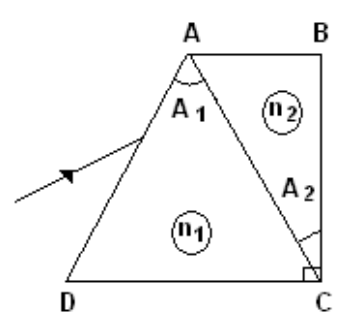
a. Determine the wavelength \(\lambda_0\) of the incident radiation that pass through the prisms without refraction on \(AC\) face at any incident angle; determine the corresponding refraction indexes of the prisms.
b. Draw the ray path in the system of prisms for three different radiations \(\lambda_{red},\lambda_0,\lambda_{violet}\) incident on the system at the same angle.
c. Determine the minimum deviation angle in the system for a ray having the wavelength \(\lambda_0\).
d. Calculate the wavelength of the ray that penetrates and exits the system along directions parallel to \(DC\).
Official English text of the problem.
Answers
- a. \(\boxed{\lambda_0=500\,\mathrm{nm}}\), with \(\boxed{n_1(\lambda_0)=n_2(\lambda_0)=1.5}\).
- b. At \(AC\), red bends toward the normal, \(\lambda_0\) continues straight, and violet bends away from the normal. For a common horizontal incident beam, the emerging rays are ordered red, \(\lambda_0\), violet from top to bottom, with increasing downward deviation.
- c. \(\boxed{\delta_{\min}=2\arcsin(1.5\sin15^\circ)-30^\circ\approx15.69^\circ}\).
- d. \(\boxed{\lambda\approx1.18\times10^3\,\mathrm{nm}=1.18\,\mu\mathrm m}\), in the infrared.
Solution
We use geometrical optics and Snell’s law, taking the refractive index of the surrounding air as \(1\) and neglecting any optical effect of the glue. No small-angle approximation is used.
The geometry gives \[ \angle ACD=90^\circ-A_2=60^\circ, \qquad \angle ADC=180^\circ-A_1-\angle ACD=60^\circ. \] Consequently, measured relative to the rightward direction parallel to \(DC\):
- the inward normal to \(AD\) points \(30^\circ\) downward;
- the normal to \(AC\), directed from prism 1 into prism 2, points \(30^\circ\) upward;
- the outward normal to \(BC\) is horizontal.
a. Wavelength with no refraction at \(AC\)
At the common face, Snell’s law is \[ n_1(\lambda)\sin i=n_2(\lambda)\sin t. \] For the direction to remain unchanged, \(t=i\). Requiring this for every incidence angle, rather than just normal incidence, gives \[ n_1(\lambda_0)=n_2(\lambda_0). \] Thus \[ a_1+\frac{b_1}{\lambda_0^2} =a_2+\frac{b_2}{\lambda_0^2}, \] and therefore \[ \lambda_0^2 =\frac{b_1-b_2}{a_2-a_1} =\frac{5\times10^4\,\mathrm{nm}^2}{0.2} =2.5\times10^5\,\mathrm{nm}^2. \] Taking the positive wavelength, \[ \boxed{\lambda_0=500\,\mathrm{nm}}. \]
The corresponding indices are \[ n_1(\lambda_0)=1.1+\frac{10^5}{500^2}=1.5, \qquad n_2(\lambda_0)=1.3+\frac{5\times10^4}{500^2}=1.5. \]
b. Ray paths
Both indices decrease with increasing wavelength. Hence, at the entrance face \(AD\), violet bends toward the normal more strongly than \(\lambda_0\), while red bends less strongly.
At the common face, the relevant index difference is \[ n_1(\lambda)-n_2(\lambda) =-0.2+\frac{5\times10^4\,\mathrm{nm}^2}{\lambda^2}. \] Since \[ \lambda_{\mathrm{violet}}<500\,\mathrm{nm}<\lambda_{\mathrm{red}}, \] the refractions at \(AC\) are:
| Radiation | Index comparison | Behaviour at \(AC\) |
|---|---|---|
| Red | \(n_1<n_2\) | Bends toward the normal |
| \(\lambda_0\) | \(n_1=n_2\) | Continues straight |
| Violet | \(n_1>n_2\) | Bends away from the normal |
A precise verbal sketch can use a common horizontal incident beam, whose incidence angle at \(AD\) is \(30^\circ\). Choose its entry point sufficiently high that all three rays reach \(BC\).
- At \(AD\), all three rays bend downward toward the inward normal. Inside prism 1, red is the upper ray, \(\lambda_0\) the middle ray, and violet the lower ray.
- At \(AC\), draw its normal pointing \(30^\circ\) above horizontal. Red turns upward toward this normal, \(\lambda_0\) remains straight, and violet turns farther downward away from the normal.
- At \(BC\), the normal is horizontal. The visible rays bend farther downward as they pass into air, away from this normal.
The emerging order is therefore red above \(\lambda_0\), with violet below, and violet has the greatest total deviation.
c. Minimum deviation for \(\lambda_0\)
For this wavelength, both prisms have index \(n=1.5\), so the internal face \(AC\) has no optical effect. The entrance and exit faces \(AD\) and \(BC\) act as the faces of a single prism with effective apex angle \[ \alpha=A_1-A_2=30^\circ. \]
Let \(i,e\) be the external incidence and emergence angles, and \(r,r'\) the corresponding internal angles. Prism geometry and Snell’s law give \[ r+r'=\alpha,\qquad \delta=i+e-\alpha, \] \[ \sin i=n\sin r,\qquad \sin e=n\sin r'. \] Therefore \[ \delta(r)= \arcsin(n\sin r) +\arcsin\!\bigl(n\sin(\alpha-r)\bigr)-\alpha. \]
The minimum occurs for the symmetric path, \[ r=r'=\frac{\alpha}{2},\qquad i=e. \] For example, differentiating the preceding expression gives \[ \frac{d\delta}{dr} = \frac{n\cos r}{\sqrt{1-n^2\sin^2r}} - \frac{n\cos(\alpha-r)} {\sqrt{1-n^2\sin^2(\alpha-r)}}. \] This vanishes at \(r=\alpha/2\) and changes from negative to positive there.
Thus \[ i_{\min} =\arcsin\!\left(n\sin\frac{\alpha}{2}\right) =\arcsin(1.5\sin15^\circ) \approx22.8443^\circ, \] and \[ \boxed{\delta_{\min} =2i_{\min}-\alpha \approx15.6886^\circ \approx15.69^\circ}. \]
d. Parallel incident and emerging rays
The incident ray is horizontal, so its incidence angle at \(AD\) is \(30^\circ\). If its refracted angle there is \(r\), Snell’s law gives \[ n_1\sin r=\sin30^\circ=\frac12. \tag{1} \]
The emerging ray must also be horizontal. Since \(BC\) is vertical, emergence is normal to \(BC\). Snell’s law then requires the ray inside prism 2 to be horizontal as well.
The ray in prism 1 travels at angle \(r-30^\circ\) to the horizontal. Its incidence angle at \(AC\) is consequently \[ i_{AC}=30^\circ-(r-30^\circ)=60^\circ-r. \] The horizontal ray in prism 2 makes \(30^\circ\) with the normal to \(AC\). Hence \[ n_1\sin(60^\circ-r)=n_2\sin30^\circ=\frac{n_2}{2}. \tag{2} \]
Expanding equation (2) and using equation (1), \[ n_2=\sqrt3\,n_1\cos r-n_1\sin r =\sqrt3\sqrt{n_1^2-\frac14}-\frac12. \] Squaring and simplifying gives \[ \boxed{3n_1^2=n_2^2+n_2+1}. \tag{3} \]
Introduce the positive, dimensionless quantity \[ u=\frac{5\times10^4\,\mathrm{nm}^2}{\lambda^2}. \] Then \[ n_1=1.1+2u,\qquad n_2=1.3+u. \] Substitution into equation (3) yields \[ 3(1.1+2u)^2=(1.3+u)^2+(1.3+u)+1, \] or \[ 11u^2+9.6u-0.36=0. \] Only the positive root is physical: \[ u=\frac{-9.6+\sqrt{108}}{22} \approx0.0360139. \] Therefore \[ \lambda =\sqrt{\frac{5\times10^4\,\mathrm{nm}^2}{u}} \approx1178.28\,\mathrm{nm}, \] so \[ \boxed{\lambda\approx1.18\times10^3\,\mathrm{nm} =1.18\,\mu\mathrm m}. \]
As a check, this wavelength gives \[ n_1\approx1.17203,\qquad n_2\approx1.33601, \] and \(r\approx25.2527^\circ\). The incidence angle at \(AC\) is then \(34.7473^\circ\), which refracts to exactly \(30^\circ\); the ray subsequently reaches \(BC\) normally and exits horizontally.
The solution was checked against the official solution. Where this solution differs from the official solution, the official solution contains an error or a misprint.
IPhO 1983 · Theorieaufgabe 3
Prismen
Zwei dispergierende Prismen mit den brechenden Winkeln \(\hat A_1=60^\circ\) und \(\hat A_2=30^\circ\) sind wie in der folgenden Abbildung miteinander verklebt \((\hat C=90^\circ)\). Die Abhängigkeiten der Brechungsindizes der Prismen von der Wellenlänge sind durch die Beziehungen
\[ n_1(\lambda)=a_1+\frac{b_1}{\lambda^2}; \]
\[ n_2(\lambda)=a_2+\frac{b_2}{\lambda^2} \]
gegeben, wobei
\[ a_1=1{,}1,\quad b_1=1\cdot10^5\,nm^2,\quad a_2=1{,}3,\quad b_2=5\cdot10^4\,nm^2. \]
a. Bestimmen Sie die Wellenlänge \(\lambda_0\) der einfallenden Strahlung, die bei jedem Einfallswinkel ohne Brechung an der Fläche \(AC\) durch die Prismen hindurchtritt; bestimmen Sie die zugehörigen Brechungsindizes der Prismen.
b. Zeichnen Sie den Strahlengang im Prismensystem für drei verschiedene Strahlungen \(\lambda_{red},\lambda_0,\lambda_{violet}\), die unter demselben Winkel auf das System einfallen.
c. Bestimmen Sie den minimalen Ablenkwinkel im System für einen Strahl mit der Wellenlänge \(\lambda_0\).
d. Berechnen Sie die Wellenlänge des Strahls, der in Richtungen parallel zu \(DC\) in das System eintritt und aus ihm austritt.
Aufgabentext aus dem offiziellen englischen Text übersetzt.
Antworten
- a. \(\boxed{\lambda_0=500\,\mathrm{nm}}\), mit \(\boxed{n_1(\lambda_0)=n_2(\lambda_0)=1.5}\).
- b. An \(AC\) wird Rot zum Lot hin gebrochen, \(\lambda_0\) setzt seinen Weg geradlinig fort, und Violett wird vom Lot weg gebrochen. Bei einem gemeinsamen horizontalen einfallenden Strahl sind die austretenden Strahlen von oben nach unten in der Reihenfolge Rot, \(\lambda_0\), Violett angeordnet, mit zunehmender Ablenkung nach unten.
- c. \(\boxed{\delta_{\min}=2\arcsin(1.5\sin15^\circ)-30^\circ\approx15.69^\circ}\).
- d. \(\boxed{\lambda\approx1.18\times10^3\,\mathrm{nm}=1.18\,\mu\mathrm m}\), im Infrarotbereich.
Lösung
Wir verwenden die geometrische Optik und das Snelliussche Brechungsgesetz, setzen den Brechungsindex der umgebenden Luft gleich \(1\) und vernachlässigen jegliche optische Wirkung des Klebstoffs. Es wird keine Kleinwinkelnäherung verwendet.
Aus der Geometrie folgt \[ \angle ACD=90^\circ-A_2=60^\circ, \qquad \angle ADC=180^\circ-A_1-\angle ACD=60^\circ. \] Bezogen auf die nach rechts gerichtete, zu \(DC\) parallele Richtung gilt somit:
- Die nach innen gerichtete Normale auf \(AD\) zeigt unter einem Winkel von \(30^\circ\) nach unten;
- die von Prisma 1 in Prisma 2 gerichtete Normale auf \(AC\) zeigt unter einem Winkel von \(30^\circ\) nach oben;
- die nach außen gerichtete Normale auf \(BC\) ist horizontal.
a. Wellenlänge ohne Brechung an \(AC\)
An der gemeinsamen Grenzfläche lautet das Snelliussche Brechungsgesetz \[ n_1(\lambda)\sin i=n_2(\lambda)\sin t. \] Damit die Richtung unverändert bleibt, muss \(t=i\) gelten. Fordert man dies für jeden Einfallswinkel und nicht nur für senkrechten Einfall, ergibt sich \[ n_1(\lambda_0)=n_2(\lambda_0). \] Somit gilt \[ a_1+\frac{b_1}{\lambda_0^2} =a_2+\frac{b_2}{\lambda_0^2}, \] und daher \[ \lambda_0^2 =\frac{b_1-b_2}{a_2-a_1} =\frac{5\times10^4\,\mathrm{nm}^2}{0.2} =2.5\times10^5\,\mathrm{nm}^2. \] Für die positive Wellenlänge erhält man \[ \boxed{\lambda_0=500\,\mathrm{nm}}. \]
Die zugehörigen Brechungsindizes sind \[ n_1(\lambda_0)=1.1+\frac{10^5}{500^2}=1.5, \qquad n_2(\lambda_0)=1.3+\frac{5\times10^4}{500^2}=1.5. \]
b. Strahlengänge
Beide Brechungsindizes nehmen mit zunehmender Wellenlänge ab. Daher wird Violett an der Eintrittsfläche \(AD\) stärker zum Lot hin gebrochen als \(\lambda_0\), während Rot schwächer gebrochen wird.
An der gemeinsamen Grenzfläche ist die maßgebliche Differenz der Brechungsindizes \[ n_1(\lambda)-n_2(\lambda) =-0.2+\frac{5\times10^4\,\mathrm{nm}^2}{\lambda^2}. \] Da \[ \lambda_{\mathrm{violet}}<500\,\mathrm{nm}<\lambda_{\mathrm{red}}, \] ergeben sich an \(AC\) folgende Brechungen:
| Strahlung | Vergleich der Brechungsindizes | Verhalten an \(AC\) |
|---|---|---|
| Rot | \(n_1<n_2\) | Wird zum Lot hin gebrochen |
| \(\lambda_0\) | \(n_1=n_2\) | Setzt seinen Weg geradlinig fort |
| Violett | \(n_1>n_2\) | Wird vom Lot weg gebrochen |
Für eine genaue Beschreibung der Skizze kann man einen gemeinsamen horizontalen einfallenden Strahl verwenden, dessen Einfallswinkel an \(AD\) \(30^\circ\) beträgt. Wählen Sie seinen Eintrittspunkt so hoch, dass alle drei Strahlen \(BC\) erreichen.
- An \(AD\) werden alle drei Strahlen nach unten zur nach innen gerichteten Normalen hin gebrochen. Im Inneren von Prisma 1 ist Rot der obere Strahl, \(\lambda_0\) der mittlere und Violett der untere.
- Zeichnen Sie an \(AC\) die Normale so ein, dass sie \(30^\circ\) oberhalb der Horizontalen zeigt. Rot wird nach oben zu dieser Normalen hin abgelenkt, \(\lambda_0\) verläuft weiterhin geradlinig, und Violett wird weiter nach unten von der Normalen weg abgelenkt.
- An \(BC\) ist die Normale horizontal. Beim Übergang in die Luft werden die sichtbaren Strahlen weiter nach unten, von dieser Normalen weg, gebrochen.
Die Reihenfolge beim Austritt ist daher Rot oberhalb von \(\lambda_0\), Violett darunter, und Violett weist die größte Gesamtablenkung auf.
c. Minimale Ablenkung für \(\lambda_0\)
Bei dieser Wellenlänge haben beide Prismen den Brechungsindex \(n=1.5\), sodass die innere Grenzfläche \(AC\) keine optische Wirkung hat. Die Eintritts- und Austrittsflächen \(AD\) und \(BC\) wirken wie die Flächen eines einzigen Prismas mit dem effektiven brechenden Winkel \[ \alpha=A_1-A_2=30^\circ. \]
Es seien \(i,e\) die äußeren Einfalls- und Austrittswinkel und \(r,r'\) die entsprechenden inneren Winkel. Aus der Prismengeometrie und dem Snelliusschen Brechungsgesetz folgt \[ r+r'=\alpha,\qquad \delta=i+e-\alpha, \] \[ \sin i=n\sin r,\qquad \sin e=n\sin r'. \] Daher gilt \[ \delta(r)= \arcsin(n\sin r) +\arcsin\!\bigl(n\sin(\alpha-r)\bigr)-\alpha. \]
Das Minimum tritt beim symmetrischen Strahlengang auf, \[ r=r'=\frac{\alpha}{2},\qquad i=e. \] Beispielsweise ergibt die Ableitung des vorstehenden Ausdrucks \[ \frac{d\delta}{dr} = \frac{n\cos r}{\sqrt{1-n^2\sin^2r}} - \frac{n\cos(\alpha-r)} {\sqrt{1-n^2\sin^2(\alpha-r)}}. \] Diese verschwindet bei \(r=\alpha/2\) und wechselt dort von negativen zu positiven Werten.
Somit gilt \[ i_{\min} =\arcsin\!\left(n\sin\frac{\alpha}{2}\right) =\arcsin(1.5\sin15^\circ) \approx22.8443^\circ, \] und \[ \boxed{\delta_{\min} =2i_{\min}-\alpha \approx15.6886^\circ \approx15.69^\circ}. \]
d. Parallele einfallende und austretende Strahlen
Der einfallende Strahl ist horizontal, sein Einfallswinkel an \(AD\) beträgt also \(30^\circ\). Ist sein Brechungswinkel dort \(r\), so ergibt das Snelliussche Brechungsgesetz \[ n_1\sin r=\sin30^\circ=\frac12. \tag{1} \]
Der austretende Strahl muss ebenfalls horizontal sein. Da \(BC\) vertikal ist, erfolgt der Austritt senkrecht zu \(BC\). Nach dem Snelliusschen Brechungsgesetz muss dann auch der Strahl im Inneren von Prisma 2 horizontal verlaufen.
Der Strahl in Prisma 1 verläuft unter dem Winkel \(r-30^\circ\) zur Horizontalen. Sein Einfallswinkel an \(AC\) ist folglich \[ i_{AC}=30^\circ-(r-30^\circ)=60^\circ-r. \] Der horizontale Strahl in Prisma 2 bildet mit dem Lot auf \(AC\) einen Winkel von \(30^\circ\). Daher gilt \[ n_1\sin(60^\circ-r)=n_2\sin30^\circ=\frac{n_2}{2}. \tag{2} \]
Durch Anwendung des Additionstheorems auf Gleichung (2) und Verwendung von Gleichung (1) erhält man \[ n_2=\sqrt3\,n_1\cos r-n_1\sin r =\sqrt3\sqrt{n_1^2-\frac14}-\frac12. \] Quadrieren und Vereinfachen ergibt \[ \boxed{3n_1^2=n_2^2+n_2+1}. \tag{3} \]
Wir führen die positive, dimensionslose Größe \[ u=\frac{5\times10^4\,\mathrm{nm}^2}{\lambda^2} \] ein. Dann gilt \[ n_1=1.1+2u,\qquad n_2=1.3+u. \] Einsetzen in Gleichung (3) liefert \[ 3(1.1+2u)^2=(1.3+u)^2+(1.3+u)+1, \] oder \[ 11u^2+9.6u-0.36=0. \] Nur die positive Lösung ist physikalisch sinnvoll: \[ u=\frac{-9.6+\sqrt{108}}{22} \approx0.0360139. \] Daher ist \[ \lambda =\sqrt{\frac{5\times10^4\,\mathrm{nm}^2}{u}} \approx1178.28\,\mathrm{nm}, \] also \[ \boxed{\lambda\approx1.18\times10^3\,\mathrm{nm} =1.18\,\mu\mathrm m}. \]
Zur Kontrolle erhält man bei dieser Wellenlänge \[ n_1\approx1.17203,\qquad n_2\approx1.33601, \] und \(r\approx25.2527^\circ\). Der Einfallswinkel an \(AC\) beträgt dann \(34.7473^\circ\), woraus sich durch Brechung ein Winkel von genau \(30^\circ\) ergibt; der Strahl trifft anschließend senkrecht auf \(BC\) und tritt horizontal aus.
Die Lösung wurde mit der offiziellen Lösung abgeglichen. Wo diese Lösung von der offiziellen Lösung abweicht, enthält die offizielle Lösung einen Fehler oder Druckfehler.
IPhO 1983 · Teori sorusu 3
Prizmalar
Tepe açıları \(\hat A_1=60^\circ\) ve \(\hat A_2=30^\circ\) olan, ışığı renklerine ayıran iki prizma, aşağıdaki şekilde gösterildiği gibi birbirine yapıştırılmıştır \((\hat C=90^\circ)\). Prizmaların kırılma indislerinin dalga boyuna bağlılığı şu bağıntılarla verilmektedir:
\[ n_1(\lambda)=a_1+\frac{b_1}{\lambda^2}; \]
\[ n_2(\lambda)=a_2+\frac{b_2}{\lambda^2} \]
burada
\[ a_1=1{,}1,\quad b_1=1\cdot10^5\,nm^2,\quad a_2=1{,}3,\quad b_2=5\cdot10^4\,nm^2. \]
a. Herhangi bir gelme açısında \(AC\) yüzeyinde kırılmadan prizmalardan geçen ışınımın \(\lambda_0\) dalga boyunu belirleyiniz; prizmaların bu dalga boyuna karşılık gelen kırılma indislerini belirleyiniz.
b. Sisteme aynı açıyla gelen \(\lambda_{red},\lambda_0,\lambda_{violet}\) dalga boylarındaki üç farklı ışınım için ışınların prizma sisteminde izlediği yolları çiziniz.
c. Dalga boyu \(\lambda_0\) olan bir ışın için sistemdeki en küçük sapma açısını belirleyiniz.
d. Sisteme \(DC\)'ye paralel doğrultuda girip sistemden yine \(DC\)'ye paralel doğrultuda çıkan ışının dalga boyunu hesaplayınız.
Soru metni resmi İngilizce metinden çevrilmiştir.
Cevaplar
- a. \(\boxed{\lambda_0=500\,\mathrm{nm}}\), bu dalga boyunda \(\boxed{n_1(\lambda_0)=n_2(\lambda_0)=1.5}\).
- b. \(AC\) yüzeyinde kırmızı ışın normale yaklaşarak kırılır, \(\lambda_0\) doğrultusunu değiştirmeden ilerler ve mor ışın normalden uzaklaşarak kırılır. Yatay doğrultuda gelen ortak bir ışık demeti için çıkan ışınlar, aşağı yönlü sapmaları artacak biçimde, yukarıdan aşağıya kırmızı, \(\lambda_0\), mor olarak sıralanır.
- c. \(\boxed{\delta_{\min}=2\arcsin(1.5\sin15^\circ)-30^\circ\approx15.69^\circ}\).
- d. \(\boxed{\lambda\approx1.18\times10^3\,\mathrm{nm}=1.18\,\mu\mathrm m}\), kızılötesi bölgededir.
Çözüm
Çevredeki havanın kırılma indisini \(1\) alıp yapıştırıcının tüm optik etkilerini ihmal ederek geometrik optiği ve Snell yasasını kullanıyoruz. Küçük açı yaklaşımı kullanılmamaktadır.
Geometriden \[ \angle ACD=90^\circ-A_2=60^\circ, \qquad \angle ADC=180^\circ-A_1-\angle ACD=60^\circ. \] elde edilir. Dolayısıyla, \(DC\)'ye paralel ve sağa doğru olan yön referans alındığında:
- \(AD\)'nin içeriye yönelen normali \(30^\circ\) aşağıya yönelir;
- \(AC\)'nin prizma 1'den prizma 2'ye yönelen normali \(30^\circ\) yukarıya yönelir;
- \(BC\)'nin dışarıya yönelen normali yataydır.
a. \(AC\)'de kırılmanın olmadığı dalga boyu
Ortak yüzeyde Snell yasası \[ n_1(\lambda)\sin i=n_2(\lambda)\sin t. \] şeklindedir. Doğrultunun değişmemesi için \(t=i\) olmalıdır. Bunun yalnızca dik gelme durumunda değil, her gelme açısında sağlanmasını istemek \[ n_1(\lambda_0)=n_2(\lambda_0). \] koşulunu verir. Böylece \[ a_1+\frac{b_1}{\lambda_0^2} =a_2+\frac{b_2}{\lambda_0^2}, \] ve dolayısıyla \[ \lambda_0^2 =\frac{b_1-b_2}{a_2-a_1} =\frac{5\times10^4\,\mathrm{nm}^2}{0.2} =2.5\times10^5\,\mathrm{nm}^2. \] Pozitif dalga boyunu alırsak, \[ \boxed{\lambda_0=500\,\mathrm{nm}}. \]
Bu dalga boyuna karşılık gelen indisler \[ n_1(\lambda_0)=1.1+\frac{10^5}{500^2}=1.5, \qquad n_2(\lambda_0)=1.3+\frac{5\times10^4}{500^2}=1.5. \] olur.
b. Işın yolları
Her iki indis de dalga boyu arttıkça azalır. Bu nedenle, giriş yüzeyi \(AD\)'de mor ışın normale \(\lambda_0\)'dan daha fazla yaklaşarak kırılırken kırmızı ışın daha az yaklaşarak kırılır.
Ortak yüzeyde, ilgili indis farkı \[ n_1(\lambda)-n_2(\lambda) =-0.2+\frac{5\times10^4\,\mathrm{nm}^2}{\lambda^2}. \] şeklindedir. \[ \lambda_{\mathrm{violet}}<500\,\mathrm{nm}<\lambda_{\mathrm{red}}, \] olduğundan, \(AC\)'deki kırılmalar şöyledir:
| Işınım | İndislerin karşılaştırılması | \(AC\)'deki davranışı |
|---|---|---|
| Kırmızı | \(n_1<n_2\) | Normale yaklaşarak kırılır |
| \(\lambda_0\) | \(n_1=n_2\) | Doğrultusunu değiştirmeden ilerler |
| Mor | \(n_1>n_2\) | Normalden uzaklaşarak kırılır |
Işın yollarını kesin biçimde sözle betimlemek için \(AD\)'deki gelme açısı \(30^\circ\) olan, yatay doğrultuda gelen ortak bir ışık demeti kullanılabilir. Giriş noktasını, üç ışının da \(BC\)'ye ulaşabileceği kadar yüksekte seçiniz.
- \(AD\)'de üç ışın da içeriye yönelen normale yaklaşarak aşağıya doğru kırılır. Prizma 1 içinde kırmızı ışın üstte, \(\lambda_0\) ortada ve mor ışın alttadır.
- \(AC\)'de normali yatayın \(30^\circ\) yukarısına yönelmiş olarak çiziniz. Kırmızı ışın bu normale yaklaşarak yukarıya döner, \(\lambda_0\) doğrultusunu değiştirmez ve mor ışın normalden uzaklaşarak daha da aşağıya döner.
- \(BC\)'de normal yataydır. Görünür ışınlar havaya geçerken bu normalden uzaklaşarak daha da aşağıya doğru kırılır.
Dolayısıyla çıkıştaki sıralamada kırmızı \(\lambda_0\)'ın üstünde, mor ise altındadır ve en büyük toplam sapma mor ışında görülür.
c. \(\lambda_0\) için en küçük sapma
Bu dalga boyunda her iki prizmanın indisi de \(n=1.5\) olduğundan iç yüzey \(AC\)'nin optik bir etkisi yoktur. Giriş ve çıkış yüzeyleri \(AD\) ile \(BC\), etkin tepe açısı \[ \alpha=A_1-A_2=30^\circ. \] olan tek bir prizmanın yüzeyleri gibi davranır.
Dış ortamdaki gelme ve çıkış açıları \(i,e\), bunlara karşılık gelen iç açılar ise \(r,r'\) olsun. Prizmanın geometrisi ve Snell yasası \[ r+r'=\alpha,\qquad \delta=i+e-\alpha, \] \[ \sin i=n\sin r,\qquad \sin e=n\sin r'. \] bağıntılarını verir. Dolayısıyla \[ \delta(r)= \arcsin(n\sin r) +\arcsin\!\bigl(n\sin(\alpha-r)\bigr)-\alpha. \]
En küçük sapma, simetrik ışın yolu için gerçekleşir: \[ r=r'=\frac{\alpha}{2},\qquad i=e. \] Örneğin, önceki ifadenin türevi alınırsa \[ \frac{d\delta}{dr} = \frac{n\cos r}{\sqrt{1-n^2\sin^2r}} - \frac{n\cos(\alpha-r)} {\sqrt{1-n^2\sin^2(\alpha-r)}}. \] elde edilir. Bu türev \(r=\alpha/2\)'de sıfır olur ve burada negatiften pozitife geçer.
Böylece \[ i_{\min} =\arcsin\!\left(n\sin\frac{\alpha}{2}\right) =\arcsin(1.5\sin15^\circ) \approx22.8443^\circ, \] ve \[ \boxed{\delta_{\min} =2i_{\min}-\alpha \approx15.6886^\circ \approx15.69^\circ}. \]
d. Gelen ve çıkan ışınların paralel olması
Gelen ışın yatay olduğundan \(AD\)'deki gelme açısı \(30^\circ\)'dir. Buradaki kırılma açısı \(r\) ise Snell yasası \[ n_1\sin r=\sin30^\circ=\frac12. \tag{1} \] bağıntısını verir.
Çıkan ışın da yatay olmalıdır. \(BC\) düşey olduğundan çıkış \(BC\)'ye diktir. Bu durumda Snell yasası, prizma 2 içindeki ışının da yatay olmasını gerektirir.
Prizma 1 içindeki ışın, yatayla \(r-30^\circ\) açı yaparak ilerler. Dolayısıyla \(AC\)'deki gelme açısı \[ i_{AC}=30^\circ-(r-30^\circ)=60^\circ-r. \] olur. Prizma 2 içindeki yatay ışın, \(AC\)'nin normaliyle \(30^\circ\) açı yapar. Bu nedenle \[ n_1\sin(60^\circ-r)=n_2\sin30^\circ=\frac{n_2}{2}. \tag{2} \]
Denklem (2)'yi açıp denklem (1)'i kullanırsak, \[ n_2=\sqrt3\,n_1\cos r-n_1\sin r =\sqrt3\sqrt{n_1^2-\frac14}-\frac12. \] Karesini alıp sadeleştirince \[ \boxed{3n_1^2=n_2^2+n_2+1}. \tag{3} \] elde edilir.
Pozitif ve boyutsuz \[ u=\frac{5\times10^4\,\mathrm{nm}^2}{\lambda^2}. \] niceliğini tanımlayalım. Bu durumda \[ n_1=1.1+2u,\qquad n_2=1.3+u. \] Denklem (3)'te yerine koymak \[ 3(1.1+2u)^2=(1.3+u)^2+(1.3+u)+1, \] ya da \[ 11u^2+9.6u-0.36=0. \] sonucunu verir. Yalnızca pozitif kök fiziksel olarak anlamlıdır: \[ u=\frac{-9.6+\sqrt{108}}{22} \approx0.0360139. \] Dolayısıyla \[ \lambda =\sqrt{\frac{5\times10^4\,\mathrm{nm}^2}{u}} \approx1178.28\,\mathrm{nm}, \] böylece \[ \boxed{\lambda\approx1.18\times10^3\,\mathrm{nm} =1.18\,\mu\mathrm m}. \]
Kontrol amacıyla, bu dalga boyu için \[ n_1\approx1.17203,\qquad n_2\approx1.33601, \] ve \(r\approx25.2527^\circ\) elde edilir. Bu durumda \(AC\)'deki gelme açısı \(34.7473^\circ\) olur ve kırılma açısı tam olarak \(30^\circ\)'dir; ışın daha sonra \(BC\)'ye dik olarak ulaşır ve yatay olarak çıkar.
Çözüm, resmi çözümle karşılaştırılarak kontrol edildi. Bu çözümün resmi çözümden ayrıldığı yerlerde resmi çözümde bir hata ya da baskı hatası vardır.
IPhO 1983 · Problema teórico 3
Prismas
Dos prismas dispersivos con ángulos de vértice \(\hat A_1=60^\circ\) y \(\hat A_2=30^\circ\) están pegados como se muestra en la figura siguiente \((\hat C=90^\circ)\). La dependencia de los índices de refracción de los prismas con la longitud de onda viene dada por las relaciones
\[ n_1(\lambda)=a_1+\frac{b_1}{\lambda^2}; \]
\[ n_2(\lambda)=a_2+\frac{b_2}{\lambda^2} \]
donde
\[ a_1=1{,}1,\quad b_1=1\cdot10^5\,nm^2,\quad a_2=1{,}3,\quad b_2=5\cdot10^4\,nm^2. \]
a. Determine la longitud de onda \(\lambda_0\) de la radiación incidente que atraviesa los prismas sin refractarse en la cara \(AC\) para cualquier ángulo de incidencia; determine los índices de refracción correspondientes de los prismas.
b. Dibuje la trayectoria de los rayos en el sistema de prismas para tres radiaciones distintas \(\lambda_{red},\lambda_0,\lambda_{violet}\) que inciden sobre el sistema con el mismo ángulo.
c. Determine el ángulo de desviación mínima en el sistema para un rayo de longitud de onda \(\lambda_0\).
d. Calcule la longitud de onda del rayo que entra en el sistema y sale de él en direcciones paralelas a \(DC\).
Enunciado traducido del texto oficial en inglés.
Respuestas
- a. \(\boxed{\lambda_0=500\,\mathrm{nm}}\), con \(\boxed{n_1(\lambda_0)=n_2(\lambda_0)=1.5}\).
- b. En \(AC\), el rojo se desvía hacia la normal, \(\lambda_0\) continúa en línea recta y el violeta se desvía alejándose de la normal. Para un haz incidente horizontal común, los rayos emergentes se ordenan rojo, \(\lambda_0\), violeta de arriba abajo, con una desviación hacia abajo cada vez mayor.
- c. \(\boxed{\delta_{\min}=2\arcsin(1.5\sin15^\circ)-30^\circ\approx15.69^\circ}\).
- d. \(\boxed{\lambda\approx1.18\times10^3\,\mathrm{nm}=1.18\,\mu\mathrm m}\), en el infrarrojo.
Solución
Utilizamos la óptica geométrica y la ley de Snell, tomando como \(1\) el índice de refracción del aire circundante y despreciando cualquier efecto óptico del adhesivo. No se utiliza ninguna aproximación de ángulos pequeños.
La geometría da \[ \angle ACD=90^\circ-A_2=60^\circ, \qquad \angle ADC=180^\circ-A_1-\angle ACD=60^\circ. \] Por consiguiente, tomando como referencia la dirección hacia la derecha paralela a \(DC\):
- la normal a \(AD\) orientada hacia el interior apunta \(30^\circ\) hacia abajo;
- la normal a \(AC\), dirigida del prisma 1 al prisma 2, apunta \(30^\circ\) hacia arriba;
- la normal a \(BC\) orientada hacia el exterior es horizontal.
a. Longitud de onda sin refracción en \(AC\)
En la cara común, la ley de Snell es \[ n_1(\lambda)\sin i=n_2(\lambda)\sin t. \] Para que la dirección no cambie, debe cumplirse \(t=i\). Exigir que esto se cumpla para todos los ángulos de incidencia, y no solo para la incidencia normal, da \[ n_1(\lambda_0)=n_2(\lambda_0). \] Así, \[ a_1+\frac{b_1}{\lambda_0^2} =a_2+\frac{b_2}{\lambda_0^2}, \] y, por tanto, \[ \lambda_0^2 =\frac{b_1-b_2}{a_2-a_1} =\frac{5\times10^4\,\mathrm{nm}^2}{0.2} =2.5\times10^5\,\mathrm{nm}^2. \] Tomando la longitud de onda positiva, \[ \boxed{\lambda_0=500\,\mathrm{nm}}. \]
Los índices correspondientes son \[ n_1(\lambda_0)=1.1+\frac{10^5}{500^2}=1.5, \qquad n_2(\lambda_0)=1.3+\frac{5\times10^4}{500^2}=1.5. \]
b. Trayectorias de los rayos
Ambos índices disminuyen al aumentar la longitud de onda. Por ello, en la cara de entrada \(AD\), el violeta se desvía hacia la normal más que \(\lambda_0\), mientras que el rojo se desvía menos.
En la cara común, la diferencia de índices relevante es \[ n_1(\lambda)-n_2(\lambda) =-0.2+\frac{5\times10^4\,\mathrm{nm}^2}{\lambda^2}. \] Puesto que \[ \lambda_{\mathrm{violet}}<500\,\mathrm{nm}<\lambda_{\mathrm{red}}, \] las refracciones en \(AC\) son:
| Radiación | Comparación de índices | Comportamiento en \(AC\) |
|---|---|---|
| Rojo | \(n_1<n_2\) | Se desvía hacia la normal |
| \(\lambda_0\) | \(n_1=n_2\) | Continúa en línea recta |
| Violeta | \(n_1>n_2\) | Se desvía alejándose de la normal |
Para describir con precisión el trazado, se puede utilizar un haz incidente horizontal común, cuyo ángulo de incidencia en \(AD\) es \(30^\circ\). Elija su punto de entrada lo suficientemente alto para que los tres rayos alcancen \(BC\).
- En \(AD\), los tres rayos se desvían hacia abajo, acercándose a la normal orientada hacia el interior. Dentro del prisma 1, el rojo es el rayo superior, \(\lambda_0\) el intermedio y el violeta el inferior.
- En \(AC\), dibuje la normal apuntando \(30^\circ\) por encima de la horizontal. El rojo gira hacia arriba, acercándose a esta normal, \(\lambda_0\) sigue en línea recta y el violeta gira aún más hacia abajo, alejándose de la normal.
- En \(BC\), la normal es horizontal. Los rayos visibles se desvían aún más hacia abajo al pasar al aire, alejándose de esta normal.
Por tanto, el orden de los rayos emergentes es rojo por encima de \(\lambda_0\), con el violeta por debajo, y el violeta presenta la mayor desviación total.
c. Desviación mínima para \(\lambda_0\)
Para esta longitud de onda, ambos prismas tienen índice \(n=1.5\), por lo que la cara interna \(AC\) no tiene ningún efecto óptico. Las caras de entrada y salida \(AD\) y \(BC\) actúan como las caras de un único prisma con un ángulo de vértice efectivo \[ \alpha=A_1-A_2=30^\circ. \]
Sean \(i,e\) los ángulos externos de incidencia y emergencia, y \(r,r'\) los ángulos internos correspondientes. La geometría del prisma y la ley de Snell dan \[ r+r'=\alpha,\qquad \delta=i+e-\alpha, \] \[ \sin i=n\sin r,\qquad \sin e=n\sin r'. \] Por tanto, \[ \delta(r)= \arcsin(n\sin r) +\arcsin\!\bigl(n\sin(\alpha-r)\bigr)-\alpha. \]
El mínimo se alcanza para la trayectoria simétrica, \[ r=r'=\frac{\alpha}{2},\qquad i=e. \] Por ejemplo, al derivar la expresión anterior se obtiene \[ \frac{d\delta}{dr} = \frac{n\cos r}{\sqrt{1-n^2\sin^2r}} - \frac{n\cos(\alpha-r)} {\sqrt{1-n^2\sin^2(\alpha-r)}}. \] Esta derivada se anula en \(r=\alpha/2\) y pasa de negativa a positiva en ese punto.
Así, \[ i_{\min} =\arcsin\!\left(n\sin\frac{\alpha}{2}\right) =\arcsin(1.5\sin15^\circ) \approx22.8443^\circ, \] y \[ \boxed{\delta_{\min} =2i_{\min}-\alpha \approx15.6886^\circ \approx15.69^\circ}. \]
d. Rayos incidente y emergente paralelos
El rayo incidente es horizontal, de modo que su ángulo de incidencia en \(AD\) es \(30^\circ\). Si su ángulo de refracción allí es \(r\), la ley de Snell da \[ n_1\sin r=\sin30^\circ=\frac12. \tag{1} \]
El rayo emergente también debe ser horizontal. Como \(BC\) es vertical, la emergencia es normal a \(BC\). La ley de Snell exige entonces que el rayo dentro del prisma 2 también sea horizontal.
El rayo en el prisma 1 se propaga formando un ángulo \(r-30^\circ\) con la horizontal. Por consiguiente, su ángulo de incidencia en \(AC\) es \[ i_{AC}=30^\circ-(r-30^\circ)=60^\circ-r. \] El rayo horizontal en el prisma 2 forma \(30^\circ\) con la normal a \(AC\). Por ello, \[ n_1\sin(60^\circ-r)=n_2\sin30^\circ=\frac{n_2}{2}. \tag{2} \]
Desarrollando la ecuación (2) y utilizando la ecuación (1), \[ n_2=\sqrt3\,n_1\cos r-n_1\sin r =\sqrt3\sqrt{n_1^2-\frac14}-\frac12. \] Al elevar al cuadrado y simplificar se obtiene \[ \boxed{3n_1^2=n_2^2+n_2+1}. \tag{3} \]
Introduzcamos la magnitud positiva y adimensional \[ u=\frac{5\times10^4\,\mathrm{nm}^2}{\lambda^2}. \] Entonces \[ n_1=1.1+2u,\qquad n_2=1.3+u. \] La sustitución en la ecuación (3) da \[ 3(1.1+2u)^2=(1.3+u)^2+(1.3+u)+1, \] o bien \[ 11u^2+9.6u-0.36=0. \] Solo la raíz positiva tiene sentido físico: \[ u=\frac{-9.6+\sqrt{108}}{22} \approx0.0360139. \] Por tanto, \[ \lambda =\sqrt{\frac{5\times10^4\,\mathrm{nm}^2}{u}} \approx1178.28\,\mathrm{nm}, \] de modo que \[ \boxed{\lambda\approx1.18\times10^3\,\mathrm{nm} =1.18\,\mu\mathrm m}. \]
Como comprobación, esta longitud de onda da \[ n_1\approx1.17203,\qquad n_2\approx1.33601, \] y \(r\approx25.2527^\circ\). El ángulo de incidencia en \(AC\) es entonces \(34.7473^\circ\), y el ángulo de refracción es exactamente \(30^\circ\); a continuación, el rayo alcanza \(BC\) perpendicularmente y sale horizontalmente.
La solución se comprobó con la solución oficial. Donde esta solución difiere de la solución oficial, la solución oficial contiene un error o una errata.
IPhO 1983 · 理论题 3
棱镜
两个色散棱镜的顶角分别为 \(\hat A_1=60^\circ\) 和 \(\hat A_2=30^\circ\),如下面的图所示胶合在一起 \((\hat C=90^\circ)\)。两棱镜的折射率随波长变化的关系为
\[ n_1(\lambda)=a_1+\frac{b_1}{\lambda^2}; \]
\[ n_2(\lambda)=a_2+\frac{b_2}{\lambda^2} \]
其中
\[ a_1=1{,}1,\quad b_1=1\cdot10^5\,nm^2,\quad a_2=1{,}3,\quad b_2=5\cdot10^4\,nm^2. \]
a. 求入射光的波长 \(\lambda_0\),使其以任意入射角通过棱镜时,在 \(AC\) 面上均不发生折射偏转;并求两棱镜对应的折射率。
b. 画出波长分别为 \(\lambda_{red},\lambda_0,\lambda_{violet}\) 的三种光以相同角度入射该棱镜系统时,在系统中的光路。
c. 求波长为 \(\lambda_0\) 的光线在该系统中的最小偏向角。
d. 计算入射方向和出射方向均平行于 \(DC\) 的光线的波长。
题目译自官方英文原文。
答案
- a. \(\boxed{\lambda_0=500\,\mathrm{nm}}\),对应的折射率为 \(\boxed{n_1(\lambda_0)=n_2(\lambda_0)=1.5}\)。
- b. 在 \(AC\) 面上,红光向法线偏折,\(\lambda_0\) 的光沿直线传播,紫光则偏离法线。对于同一水平入射光束,出射光线从上到下依次为红光、\(\lambda_0\) 的光、紫光,向下的偏折程度依次增大。
- c. \(\boxed{\delta_{\min}=2\arcsin(1.5\sin15^\circ)-30^\circ\approx15.69^\circ}\)。
- d. \(\boxed{\lambda\approx1.18\times10^3\,\mathrm{nm}=1.18\,\mu\mathrm m}\),位于红外波段。
解答
我们采用几何光学和斯涅尔定律,将周围空气的折射率取为 \(1\),并忽略胶合剂的任何光学效应。全程不使用小角度近似。
由几何关系可得 \[ \angle ACD=90^\circ-A_2=60^\circ, \qquad \angle ADC=180^\circ-A_1-\angle ACD=60^\circ. \] 因此,以平行于 \(DC\) 的向右方向为基准:
- \(AD\) 面指向棱镜内部的法线向下倾斜 \(30^\circ\);
- \(AC\) 面由棱镜 1 指向棱镜 2 的法线向上倾斜 \(30^\circ\);
- \(BC\) 面指向棱镜外部的法线沿水平方向。
a. 在 \(AC\) 面上不发生折射偏转的波长
在公共界面上,斯涅尔定律为 \[ n_1(\lambda)\sin i=n_2(\lambda)\sin t. \] 要使传播方向保持不变,必须有 \(t=i\)。要求这一条件对所有入射角都成立,而不仅仅是在垂直入射时成立,便得到 \[ n_1(\lambda_0)=n_2(\lambda_0). \] 于是 \[ a_1+\frac{b_1}{\lambda_0^2} =a_2+\frac{b_2}{\lambda_0^2}, \] 因此 \[ \lambda_0^2 =\frac{b_1-b_2}{a_2-a_1} =\frac{5\times10^4\,\mathrm{nm}^2}{0.2} =2.5\times10^5\,\mathrm{nm}^2. \] 波长取正值,得 \[ \boxed{\lambda_0=500\,\mathrm{nm}}. \]
对应的折射率为 \[ n_1(\lambda_0)=1.1+\frac{10^5}{500^2}=1.5, \qquad n_2(\lambda_0)=1.3+\frac{5\times10^4}{500^2}=1.5. \]
b. 光路
两棱镜的折射率都随波长增大而减小。因此,在入射面 \(AD\) 上,紫光向法线偏折的程度比 \(\lambda_0\) 的光更大,而红光的偏折程度更小。
在公共界面上,相关的折射率差为 \[ n_1(\lambda)-n_2(\lambda) =-0.2+\frac{5\times10^4\,\mathrm{nm}^2}{\lambda^2}. \] 由于 \[ \lambda_{\mathrm{violet}}<500\,\mathrm{nm}<\lambda_{\mathrm{red}}, \] 在 \(AC\) 面上的折射情况如下:
| 光 | 折射率比较 | 在 \(AC\) 面上的传播情况 |
|---|---|---|
| 红光 | \(n_1<n_2\) | 向法线偏折 |
| \(\lambda_0\) | \(n_1=n_2\) | 沿直线传播 |
| 紫光 | \(n_1>n_2\) | 偏离法线 |
为准确地用文字描述光路图,可以取同一水平入射光束,其在 \(AD\) 面上的入射角为 \(30^\circ\)。选择足够高的入射点,使三条光线都能到达 \(BC\) 面。
- 在 \(AD\) 面上,三条光线均向下偏折,靠近指向棱镜内部的法线。在棱镜 1 内,红光在上,\(\lambda_0\) 的光居中,紫光在下。
- 在 \(AC\) 面上,画出其法线,方向为水平向上倾斜 \(30^\circ\)。红光向上转向这条法线,\(\lambda_0\) 的光保持直线传播,紫光则进一步向下偏折,远离法线。
- 在 \(BC\) 面上,法线沿水平方向。这些可见光线进入空气时均进一步向下偏折,远离这条法线。
因此,出射光线的排列为红光在 \(\lambda_0\) 的光上方,紫光在下方,且紫光的总偏向角最大。
c. \(\lambda_0\) 的光的最小偏向角
对于这一波长,两棱镜的折射率均为 \(n=1.5\),因此内部界面 \(AC\) 不产生光学效应。入射面 \(AD\) 和出射面 \(BC\) 相当于一个棱镜的两个折射面,其等效顶角为 \[ \alpha=A_1-A_2=30^\circ. \]
设 \(i,e\) 为外部的入射角和出射角,\(r,r'\) 为相应的内部角度。由棱镜的几何关系和斯涅尔定律可得 \[ r+r'=\alpha,\qquad \delta=i+e-\alpha, \] \[ \sin i=n\sin r,\qquad \sin e=n\sin r'. \] 因此 \[ \delta(r)= \arcsin(n\sin r) +\arcsin\!\bigl(n\sin(\alpha-r)\bigr)-\alpha. \]
当光路对称时,偏向角取得最小值,此时 \[ r=r'=\frac{\alpha}{2},\qquad i=e. \] 例如,对上式求导得 \[ \frac{d\delta}{dr} = \frac{n\cos r}{\sqrt{1-n^2\sin^2r}} - \frac{n\cos(\alpha-r)} {\sqrt{1-n^2\sin^2(\alpha-r)}}. \] 该导数在 \(r=\alpha/2\) 处为零,并在该处由负变正。
于是 \[ i_{\min} =\arcsin\!\left(n\sin\frac{\alpha}{2}\right) =\arcsin(1.5\sin15^\circ) \approx22.8443^\circ, \] 并且 \[ \boxed{\delta_{\min} =2i_{\min}-\alpha \approx15.6886^\circ \approx15.69^\circ}. \]
d. 入射光线与出射光线平行
入射光线沿水平方向,因此它在 \(AD\) 面上的入射角为 \(30^\circ\)。若该处的折射角为 \(r\),则由斯涅尔定律得 \[ n_1\sin r=\sin30^\circ=\frac12. \tag{1} \]
出射光线也必须沿水平方向。由于 \(BC\) 面竖直,光线垂直于 \(BC\) 面出射。根据斯涅尔定律,棱镜 2 内的光线也必须沿水平方向传播。
棱镜 1 内的光线与水平方向成 \(r-30^\circ\) 角。因此,它在 \(AC\) 面上的入射角为 \[ i_{AC}=30^\circ-(r-30^\circ)=60^\circ-r. \] 棱镜 2 内的水平光线与 \(AC\) 面的法线成 \(30^\circ\) 角。因此 \[ n_1\sin(60^\circ-r)=n_2\sin30^\circ=\frac{n_2}{2}. \tag{2} \]
展开式 (2),并利用式 (1),得 \[ n_2=\sqrt3\,n_1\cos r-n_1\sin r =\sqrt3\sqrt{n_1^2-\frac14}-\frac12. \] 平方并化简,得 \[ \boxed{3n_1^2=n_2^2+n_2+1}. \tag{3} \]
引入正的无量纲量 \[ u=\frac{5\times10^4\,\mathrm{nm}^2}{\lambda^2}. \] 则 \[ n_1=1.1+2u,\qquad n_2=1.3+u. \] 代入式 (3),得 \[ 3(1.1+2u)^2=(1.3+u)^2+(1.3+u)+1, \] 即 \[ 11u^2+9.6u-0.36=0. \] 只有正根具有物理意义: \[ u=\frac{-9.6+\sqrt{108}}{22} \approx0.0360139. \] 因此 \[ \lambda =\sqrt{\frac{5\times10^4\,\mathrm{nm}^2}{u}} \approx1178.28\,\mathrm{nm}, \] 所以 \[ \boxed{\lambda\approx1.18\times10^3\,\mathrm{nm} =1.18\,\mu\mathrm m}. \]
作为检验,这一波长对应 \[ n_1\approx1.17203,\qquad n_2\approx1.33601, \] 且 \(r\approx25.2527^\circ\)。此时在 \(AC\) 面上的入射角为 \(34.7473^\circ\),折射角恰为 \(30^\circ\);随后光线垂直入射 \(BC\) 面,并沿水平方向出射。
解答已与官方解答核对。本解答与官方解答不同之处,均为官方解答中的错误或印刷错误。
IPhO 1983 · Теоретическая задача 3
Призмы
Две призмы, обладающие дисперсией и имеющие преломляющие углы \(\hat A_1=60^\circ\) и \(\hat A_2=30^\circ\), склеены, как показано на рисунке ниже \((\hat C=90^\circ)\). Зависимости показателей преломления призм от длины волны задаются соотношениями
\[ n_1(\lambda)=a_1+\frac{b_1}{\lambda^2}; \]
\[ n_2(\lambda)=a_2+\frac{b_2}{\lambda^2} \]
где
\[ a_1=1{,}1,\quad b_1=1\cdot10^5\,nm^2,\quad a_2=1{,}3,\quad b_2=5\cdot10^4\,nm^2. \]
a. Определите длину волны \(\lambda_0\) падающего излучения, которое проходит через призмы без преломления на грани \(AC\) при любом угле падения; определите соответствующие показатели преломления призм.
b. Постройте ход лучей в системе призм для трёх различных излучений \(\lambda_{red},\lambda_0,\lambda_{violet}\), падающих на систему под одним и тем же углом.
c. Определите угол наименьшего отклонения в системе для луча с длиной волны \(\lambda_0\).
d. Вычислите длину волны луча, который входит в систему и выходит из неё по направлениям, параллельным \(DC\).
Условие переведено с официального английского текста.
Ответы
- a. \(\boxed{\lambda_0=500\,\mathrm{nm}}\), при этом \(\boxed{n_1(\lambda_0)=n_2(\lambda_0)=1.5}\).
- b. На грани \(AC\) красный луч отклоняется к нормали, луч с длиной волны \(\lambda_0\) продолжает идти прямо, а фиолетовый отклоняется от нормали. Для общего горизонтального падающего пучка выходящие лучи располагаются сверху вниз в порядке красный, \(\lambda_0\), фиолетовый, причём отклонение вниз возрастает.
- c. \(\boxed{\delta_{\min}=2\arcsin(1.5\sin15^\circ)-30^\circ\approx15.69^\circ}\).
- d. \(\boxed{\lambda\approx1.18\times10^3\,\mathrm{nm}=1.18\,\mu\mathrm m}\), в инфракрасной области.
Решение
Используем геометрическую оптику и закон Снеллиуса, принимая показатель преломления окружающего воздуха равным \(1\) и пренебрегая любым оптическим влиянием клея. Приближение малых углов не используется.
Из геометрии следует \[ \angle ACD=90^\circ-A_2=60^\circ, \qquad \angle ADC=180^\circ-A_1-\angle ACD=60^\circ. \] Следовательно, относительно направления вправо, параллельного \(DC\):
- нормаль к \(AD\), направленная внутрь призмы, наклонена на \(30^\circ\) вниз;
- нормаль к \(AC\), направленная из призмы 1 в призму 2, наклонена на \(30^\circ\) вверх;
- внешняя нормаль к \(BC\) горизонтальна.
a. Длина волны, при которой отсутствует преломление на \(AC\)
На общей грани закон Снеллиуса имеет вид \[ n_1(\lambda)\sin i=n_2(\lambda)\sin t. \] Чтобы направление оставалось неизменным, необходимо \(t=i\). Требование выполнения этого условия при любом угле падения, а не только при нормальном падении, даёт \[ n_1(\lambda_0)=n_2(\lambda_0). \] Таким образом, \[ a_1+\frac{b_1}{\lambda_0^2} =a_2+\frac{b_2}{\lambda_0^2}, \] и поэтому \[ \lambda_0^2 =\frac{b_1-b_2}{a_2-a_1} =\frac{5\times10^4\,\mathrm{nm}^2}{0.2} =2.5\times10^5\,\mathrm{nm}^2. \] Выбирая положительное значение длины волны, получаем \[ \boxed{\lambda_0=500\,\mathrm{nm}}. \]
Соответствующие показатели преломления равны \[ n_1(\lambda_0)=1.1+\frac{10^5}{500^2}=1.5, \qquad n_2(\lambda_0)=1.3+\frac{5\times10^4}{500^2}=1.5. \]
b. Ход лучей
Оба показателя преломления уменьшаются с увеличением длины волны. Поэтому на входной грани \(AD\) фиолетовый луч отклоняется к нормали сильнее, чем луч с длиной волны \(\lambda_0\), а красный — слабее.
На общей грани определяющую роль играет разность показателей преломления \[ n_1(\lambda)-n_2(\lambda) =-0.2+\frac{5\times10^4\,\mathrm{nm}^2}{\lambda^2}. \] Поскольку \[ \lambda_{\mathrm{violet}}<500\,\mathrm{nm}<\lambda_{\mathrm{red}}, \] преломление на \(AC\) происходит следующим образом:
| Излучение | Сравнение показателей преломления | Поведение на \(AC\) |
|---|---|---|
| Красное | \(n_1<n_2\) | Отклоняется к нормали |
| \(\lambda_0\) | \(n_1=n_2\) | Продолжает идти прямо |
| Фиолетовое | \(n_1>n_2\) | Отклоняется от нормали |
Для точного словесного описания построения можно взять общий горизонтальный падающий пучок, угол падения которого на \(AD\) равен \(30^\circ\). Выберем точку его входа достаточно высоко, чтобы все три луча достигали \(BC\).
- На \(AD\) все три луча отклоняются вниз к нормали, направленной внутрь призмы. Внутри призмы 1 красный луч идёт сверху, луч с длиной волны \(\lambda_0\) — посередине, а фиолетовый — снизу.
- На \(AC\) проведём нормаль под углом \(30^\circ\) вверх от горизонтали. Красный луч поворачивает вверх к этой нормали, луч с длиной волны \(\lambda_0\) продолжает идти прямо, а фиолетовый поворачивает ещё дальше вниз, удаляясь от нормали.
- На \(BC\) нормаль горизонтальна. При переходе в воздух лучи видимого излучения отклоняются ещё дальше вниз, удаляясь от этой нормали.
Таким образом, выходящие лучи располагаются в порядке красный выше \(\lambda_0\), а фиолетовый ниже, причём фиолетовый луч имеет наибольшее полное отклонение.
c. Наименьшее отклонение для \(\lambda_0\)
Для этой длины волны обе призмы имеют показатель преломления \(n=1.5\), поэтому внутренняя грань \(AC\) не оказывает оптического влияния. Входная и выходная грани \(AD\) и \(BC\) действуют как грани одной призмы с эффективным преломляющим углом \[ \alpha=A_1-A_2=30^\circ. \]
Пусть \(i,e\) — внешние углы падения и выхода, а \(r,r'\) — соответствующие внутренние углы. Из геометрии призмы и закона Снеллиуса следует \[ r+r'=\alpha,\qquad \delta=i+e-\alpha, \] \[ \sin i=n\sin r,\qquad \sin e=n\sin r'. \] Следовательно, \[ \delta(r)= \arcsin(n\sin r) +\arcsin\!\bigl(n\sin(\alpha-r)\bigr)-\alpha. \]
Минимум достигается при симметричном ходе луча, \[ r=r'=\frac{\alpha}{2},\qquad i=e. \] Например, дифференцируя предыдущее выражение, получаем \[ \frac{d\delta}{dr} = \frac{n\cos r}{\sqrt{1-n^2\sin^2r}} - \frac{n\cos(\alpha-r)} {\sqrt{1-n^2\sin^2(\alpha-r)}}. \] Эта производная обращается в нуль при \(r=\alpha/2\) и в этой точке меняет знак с отрицательного на положительный.
Таким образом, \[ i_{\min} =\arcsin\!\left(n\sin\frac{\alpha}{2}\right) =\arcsin(1.5\sin15^\circ) \approx22.8443^\circ, \] и \[ \boxed{\delta_{\min} =2i_{\min}-\alpha \approx15.6886^\circ \approx15.69^\circ}. \]
d. Параллельные падающий и выходящий лучи
Падающий луч горизонтален, поэтому угол его падения на \(AD\) равен \(30^\circ\). Если угол преломления на этой грани равен \(r\), то по закону Снеллиуса \[ n_1\sin r=\sin30^\circ=\frac12. \tag{1} \]
Выходящий луч также должен быть горизонтальным. Поскольку \(BC\) вертикальна, луч выходит перпендикулярно \(BC\). Тогда из закона Снеллиуса следует, что луч внутри призмы 2 тоже должен быть горизонтальным.
Луч в призме 1 распространяется под углом \(r-30^\circ\) к горизонтали. Следовательно, угол его падения на \(AC\) равен \[ i_{AC}=30^\circ-(r-30^\circ)=60^\circ-r. \] Горизонтальный луч в призме 2 составляет угол \(30^\circ\) с нормалью к \(AC\). Поэтому \[ n_1\sin(60^\circ-r)=n_2\sin30^\circ=\frac{n_2}{2}. \tag{2} \]
Раскрывая синус разности в уравнении (2) и используя уравнение (1), получаем \[ n_2=\sqrt3\,n_1\cos r-n_1\sin r =\sqrt3\sqrt{n_1^2-\frac14}-\frac12. \] Возведение в квадрат и упрощение дают \[ \boxed{3n_1^2=n_2^2+n_2+1}. \tag{3} \]
Введём положительную безразмерную величину \[ u=\frac{5\times10^4\,\mathrm{nm}^2}{\lambda^2}. \] Тогда \[ n_1=1.1+2u,\qquad n_2=1.3+u. \] Подстановка в уравнение (3) даёт \[ 3(1.1+2u)^2=(1.3+u)^2+(1.3+u)+1, \] или \[ 11u^2+9.6u-0.36=0. \] Физический смысл имеет только положительный корень: \[ u=\frac{-9.6+\sqrt{108}}{22} \approx0.0360139. \] Следовательно, \[ \lambda =\sqrt{\frac{5\times10^4\,\mathrm{nm}^2}{u}} \approx1178.28\,\mathrm{nm}, \] так что \[ \boxed{\lambda\approx1.18\times10^3\,\mathrm{nm} =1.18\,\mu\mathrm m}. \]
Для проверки отметим, что при этой длине волны \[ n_1\approx1.17203,\qquad n_2\approx1.33601, \] и \(r\approx25.2527^\circ\). Тогда угол падения на \(AC\) равен \(34.7473^\circ\), а угол преломления — в точности \(30^\circ\); затем луч достигает \(BC\) по нормали и выходит горизонтально.
Решение проверено по официальному решению. Там, где это решение расходится с официальным, в официальном решении есть ошибка или опечатка.
IPhO 1983 · مسألة نظرية 3
الموشورات
أُلصق موشوران مشتِّتان للضوء، زاويتا رأسيهما \(\hat A_1=60^\circ\) و\(\hat A_2=30^\circ\)، كما في الشكل أدناه \((\hat C=90^\circ)\). يُعطى اعتماد معاملي انكسار الموشورين على الطول الموجي بالعلاقتين
\[ n_1(\lambda)=a_1+\frac{b_1}{\lambda^2}; \]
\[ n_2(\lambda)=a_2+\frac{b_2}{\lambda^2} \]
حيث
\[ a_1=1{,}1,\quad b_1=1\cdot10^5\,nm^2,\quad a_2=1{,}3,\quad b_2=5\cdot10^4\,nm^2. \]
a. حدِّد الطول الموجي \(\lambda_0\) للإشعاع الساقط الذي يمر عبر الموشورين دون انكسار عند الوجه \(AC\)، مهما كانت زاوية السقوط؛ وحدِّد معاملي انكسار الموشورين الموافقين له.
b. ارسم مسار الأشعة في منظومة الموشورين لثلاثة إشعاعات مختلفة \(\lambda_{red},\lambda_0,\lambda_{violet}\) تسقط على المنظومة بالزاوية نفسها.
c. حدِّد زاوية الانحراف الدنيا في المنظومة لشعاع ذي طول موجي \(\lambda_0\).
d. احسب الطول الموجي للشعاع الذي يدخل المنظومة ويخرج منها في اتجاهين موازيين لـ\(DC\).
نص المسألة مترجم عن النص الإنجليزي الرسمي.
الإجابات
- a. \(\boxed{\lambda_0=500\,\mathrm{nm}}\)، ويكون \(\boxed{n_1(\lambda_0)=n_2(\lambda_0)=1.5}\).
- b. عند \(AC\)، ينكسر الأحمر مقتربًا من العمود المقام، ويستمر \(\lambda_0\) في خط مستقيم، وينكسر البنفسجي مبتعدًا عن العمود المقام. ولحزمة ساقطة أفقية مشتركة، يكون ترتيب الأشعة الخارجة من الأعلى إلى الأسفل الأحمر، \(\lambda_0\)، البنفسجي، مع تزايد الانحراف نحو الأسفل.
- c. \(\boxed{\delta_{\min}=2\arcsin(1.5\sin15^\circ)-30^\circ\approx15.69^\circ}\).
- d. \(\boxed{\lambda\approx1.18\times10^3\,\mathrm{nm}=1.18\,\mu\mathrm m}\)، في نطاق الأشعة تحت الحمراء.
الحل
نستخدم البصريات الهندسية وقانون سنيل، مع اعتبار معامل انكسار الهواء المحيط مساويًا لـ\(1\)، وإهمال أي تأثير بصري للمادة اللاصقة. ولا نستخدم أي تقريب للزوايا الصغيرة.
تعطي هندسة الشكل \[ \angle ACD=90^\circ-A_2=60^\circ, \qquad \angle ADC=180^\circ-A_1-\angle ACD=60^\circ. \] ومن ثم، عند قياس الاتجاهات بالنسبة إلى الاتجاه نحو اليمين الموازي لـ\(DC\):
- يتجه العمود المقام على \(AD\) نحو الداخل بزاوية \(30^\circ\) إلى الأسفل؛
- يتجه العمود المقام على \(AC\)، الموجَّه من الموشور 1 إلى الموشور 2، بزاوية \(30^\circ\) إلى الأعلى؛
- يكون العمود المقام على \(BC\) نحو الخارج أفقيًا.
a. الطول الموجي الذي لا يحدث عنده انكسار عند \(AC\)
عند الوجه المشترك، يكون قانون سنيل \[ n_1(\lambda)\sin i=n_2(\lambda)\sin t. \] ولكي يبقى الاتجاه دون تغيير، يجب أن يكون \(t=i\). واشتراط ذلك لجميع زوايا السقوط، لا للسقوط العمودي وحده، يعطي \[ n_1(\lambda_0)=n_2(\lambda_0). \] إذن \[ a_1+\frac{b_1}{\lambda_0^2} =a_2+\frac{b_2}{\lambda_0^2}, \] وبالتالي \[ \lambda_0^2 =\frac{b_1-b_2}{a_2-a_1} =\frac{5\times10^4\,\mathrm{nm}^2}{0.2} =2.5\times10^5\,\mathrm{nm}^2. \] وبأخذ القيمة الموجبة للطول الموجي، \[ \boxed{\lambda_0=500\,\mathrm{nm}}. \]
ويكون معاملا الانكسار الموافقان \[ n_1(\lambda_0)=1.1+\frac{10^5}{500^2}=1.5, \qquad n_2(\lambda_0)=1.3+\frac{5\times10^4}{500^2}=1.5. \]
b. مسارات الأشعة
يتناقص كلا معاملي الانكسار بزيادة الطول الموجي. لذلك، عند وجه الدخول \(AD\)، ينكسر البنفسجي نحو العمود المقام بدرجة أكبر من \(\lambda_0\)، بينما ينكسر الأحمر بدرجة أقل.
عند الوجه المشترك، يكون فرق معاملي الانكسار المعني \[ n_1(\lambda)-n_2(\lambda) =-0.2+\frac{5\times10^4\,\mathrm{nm}^2}{\lambda^2}. \] وبما أن \[ \lambda_{\mathrm{violet}}<500\,\mathrm{nm}<\lambda_{\mathrm{red}}, \] فإن حالات الانكسار عند \(AC\) هي:
| الإشعاع | مقارنة معاملي الانكسار | السلوك عند \(AC\) |
|---|---|---|
| الأحمر | \(n_1<n_2\) | ينكسر مقتربًا من العمود المقام |
| \(\lambda_0\) | \(n_1=n_2\) | يستمر في خط مستقيم |
| البنفسجي | \(n_1>n_2\) | ينكسر مبتعدًا عن العمود المقام |
يمكن تقديم وصف لفظي دقيق للرسم باستخدام حزمة ساقطة أفقية مشتركة، تكون زاوية سقوطها عند \(AD\) مساوية لـ\(30^\circ\). اختر نقطة دخولها على ارتفاع كافٍ لتصل الأشعة الثلاثة كلها إلى \(BC\).
- عند \(AD\)، تنكسر الأشعة الثلاثة جميعها إلى الأسفل نحو العمود المقام المتجه إلى الداخل. وداخل الموشور 1، يكون الأحمر هو الشعاع العلوي، و\(\lambda_0\) هو الشعاع الأوسط، والبنفسجي هو الشعاع السفلي.
- عند \(AC\)، ارسم العمود المقام عليه متجهًا بزاوية \(30^\circ\) فوق الأفقي. يتجه الأحمر إلى الأعلى مقتربًا من هذا العمود، ويستمر \(\lambda_0\) في خط مستقيم، ويتجه البنفسجي أكثر إلى الأسفل مبتعدًا عن العمود.
- عند \(BC\)، يكون العمود المقام أفقيًا. وتنحرف الأشعة المرئية أكثر إلى الأسفل عند انتقالها إلى الهواء، مبتعدةً عن هذا العمود.
لذلك يكون ترتيب الأشعة الخارجة الأحمر فوق \(\lambda_0\)، والبنفسجي أسفله، ويكون للبنفسجي أكبر انحراف كلي.
c. الانحراف الأدنى لـ\(\lambda_0\)
عند هذا الطول الموجي، يكون معامل انكسار كلا الموشورين \(n=1.5\)، فلا يكون للوجه الداخلي \(AC\) أي تأثير بصري. ويعمل وجها الدخول والخروج \(AD\) و\(BC\) بوصفهما وجهي موشور واحد ذي زاوية رأس فعّالة \[ \alpha=A_1-A_2=30^\circ. \]
لتكن \(i,e\) زاويتي السقوط والخروج الخارجيتين، و\(r,r'\) الزاويتين الداخليتين الموافقتين لهما. تعطي هندسة الموشور وقانون سنيل \[ r+r'=\alpha,\qquad \delta=i+e-\alpha, \] \[ \sin i=n\sin r,\qquad \sin e=n\sin r'. \] وعليه \[ \delta(r)= \arcsin(n\sin r) +\arcsin\!\bigl(n\sin(\alpha-r)\bigr)-\alpha. \]
تتحقق القيمة الدنيا عند المسار المتناظر، \[ r=r'=\frac{\alpha}{2},\qquad i=e. \] فعلى سبيل المثال، يعطي اشتقاق العبارة السابقة \[ \frac{d\delta}{dr} = \frac{n\cos r}{\sqrt{1-n^2\sin^2r}} - \frac{n\cos(\alpha-r)} {\sqrt{1-n^2\sin^2(\alpha-r)}}. \] تنعدم هذه المشتقة عند \(r=\alpha/2\)، وتتغير إشارتها هناك من السالب إلى الموجب.
إذن \[ i_{\min} =\arcsin\!\left(n\sin\frac{\alpha}{2}\right) =\arcsin(1.5\sin15^\circ) \approx22.8443^\circ, \] و \[ \boxed{\delta_{\min} =2i_{\min}-\alpha \approx15.6886^\circ \approx15.69^\circ}. \]
d. توازي الشعاعين الساقط والخارج
الشعاع الساقط أفقي، لذا فإن زاوية سقوطه عند \(AD\) تساوي \(30^\circ\). وإذا كانت زاوية انكساره هناك \(r\)، فإن قانون سنيل يعطي \[ n_1\sin r=\sin30^\circ=\frac12. \tag{1} \]
يجب أن يكون الشعاع الخارج أفقيًا أيضًا. وبما أن \(BC\) رأسي، يكون الخروج عموديًا على \(BC\). وعندئذ يقتضي قانون سنيل أن يكون الشعاع داخل الموشور 2 أفقيًا كذلك.
يسير الشعاع في الموشور 1 بزاوية \(r-30^\circ\) مع الأفقي. ومن ثم تكون زاوية سقوطه عند \(AC\) \[ i_{AC}=30^\circ-(r-30^\circ)=60^\circ-r. \] ويصنع الشعاع الأفقي في الموشور 2 زاوية \(30^\circ\) مع العمود المقام على \(AC\). لذلك \[ n_1\sin(60^\circ-r)=n_2\sin30^\circ=\frac{n_2}{2}. \tag{2} \]
بتوسيع المعادلة (2) واستخدام المعادلة (1)، \[ n_2=\sqrt3\,n_1\cos r-n_1\sin r =\sqrt3\sqrt{n_1^2-\frac14}-\frac12. \] وبالتربيع والتبسيط نحصل على \[ \boxed{3n_1^2=n_2^2+n_2+1}. \tag{3} \]
نُعرِّف الكمية الموجبة عديمة الأبعاد \[ u=\frac{5\times10^4\,\mathrm{nm}^2}{\lambda^2}. \] وعندئذ \[ n_1=1.1+2u,\qquad n_2=1.3+u. \] وبالتعويض في المعادلة (3) نحصل على \[ 3(1.1+2u)^2=(1.3+u)^2+(1.3+u)+1, \] أو \[ 11u^2+9.6u-0.36=0. \] الجذر الموجب وحده مقبول فيزيائيًا: \[ u=\frac{-9.6+\sqrt{108}}{22} \approx0.0360139. \] وعليه \[ \lambda =\sqrt{\frac{5\times10^4\,\mathrm{nm}^2}{u}} \approx1178.28\,\mathrm{nm}, \] ومن ثم \[ \boxed{\lambda\approx1.18\times10^3\,\mathrm{nm} =1.18\,\mu\mathrm m}. \]
للتحقق، يعطي هذا الطول الموجي \[ n_1\approx1.17203,\qquad n_2\approx1.33601, \] و\(r\approx25.2527^\circ\). وتكون زاوية السقوط عند \(AC\) حينئذ \(34.7473^\circ\)، فتكون زاوية الانكسار \(30^\circ\) تمامًا؛ ثم يصل الشعاع إلى \(BC\) عموديًا عليه ويخرج أفقيًا.
تمت مراجعة الحل بمقارنته بالحل الرسمي. حيثما يختلف هذا الحل عن الحل الرسمي، يحتوي الحل الرسمي على خطأ أو خطأ مطبعي.