IPhO 1983 · Theory problem 1
Jumping particle
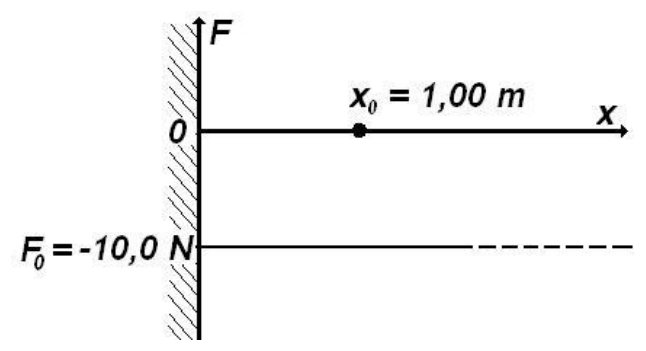
A particle moves along the positive axis \(Ox\) (one-dimensional situation) under a force that’s projection on \(Ox\) is \(F_x=F_0\) as represented in the figure below (as function of \(x\)). At the origin of \(Ox\) axis is placed a perfectly reflecting wall.
A friction force of constant modulus \(F_f=1{,}00\,N\) acts anywhere the particle is situated.
The particle starts from the point \(x=x_0=1{,}00\,m\) having the kinetic energy \(E_c=10{,}0\,J\).
a. Find the length of the path of the particle before it comes to a final stop
b. Sketch the potential energy \(U(x)\) of the particle in the force field \(F_x\).
c. Draw qualitatively the dependence of the particle speed as function of his coordinate \(x\).
Official English text of the problem.
Answers
- a. The total path length is \(\boxed{L=20.0\,\mathrm m}\). The final resting position is the wall, \(x=0\).
- b. Choosing \(U(0)=0\), \[ \boxed{U(x)=(10.0\,\mathrm N)x,\qquad x\ge0.} \] Its graph is a straight line through the origin with slope \(10.0\,\mathrm{J\,m^{-1}}\).
- c. The speed–position graph consists of square-root branches representing successive outward and inward passages. Each successive outer turning distance is \(9/11\) times the preceding one; successive wall speeds decrease by \(\sqrt{9/11}\). The branches converge to \((x,v)=(0,0)\). For initial motion toward \(+x\), the outer turning points are \[ \boxed{a_n=\frac{21}{11}\left(\frac9{11}\right)^n\mathrm m,\qquad n=0,1,2,\ldots.} \] If the initial motion is toward the wall, replace \(21/11\) by \(19/11\), after the initial inward passage.
Solution
Write the field force as \(F_x=-F\), where \[ F=10.0\,\mathrm N,\qquad f=F_f=1.00\,\mathrm N. \] Friction opposes the motion. Consequently, the net force is \(-(F+f)\) during outward motion and \(-(F-f)\) during inward motion. A perfectly reflecting wall reverses the velocity without changing the kinetic energy.
a. Total path length
Since \(F>f\), the particle cannot remain at rest at any \(x>0\): whenever it reaches an outer turning point, it starts moving back toward the wall.
To establish the eventual resting position, consider a turning point at distance \(A\) from the wall. During the inward trip, the field does work \(FA\) and friction does work \(-fA\). Thus the kinetic energy on reaching the wall is \[ K_{\mathrm w}=(F-f)A. \] After reflection, this energy is spent moving outward against both the field and friction. The next turning distance \(A'\) therefore satisfies \[ (F+f)A'=(F-f)A, \] so \[ \frac{A'}A=\frac{F-f}{F+f}=\frac9{11}<1. \] The turning distances and wall speeds tend to zero. The final resting position is therefore \(x_f=0\). Moreover, each half-trip takes a time proportional to the square root of its turning distance; the remaining times form convergent geometric sums. Thus, in this idealized model, infinitely many reflections accumulate in a finite time.
Now apply the work–energy theorem to the entire motion. The total work of the constant field depends only on the endpoints: \[ W_x=F_x(x_f-x_0)=(-10.0\,\mathrm N)(-1.00\,\mathrm m) =10.0\,\mathrm J. \] Friction does work \(-fL\), while the elastic reflections cause no kinetic-energy loss. Hence \[ 0-E_c=W_x-fL. \] Therefore \[ \boxed{ L=\frac{E_c+Fx_0}{f} =\frac{10.0\,\mathrm J+10.0\,\mathrm J}{1.00\,\mathrm N} =20.0\,\mathrm m. } \] This result is independent of the initial direction of motion.
b. Potential energy
The potential energy associated with the field obeys \[ F_x=-\frac{dU}{dx}. \] Since \(F_x=-F\), \[ \frac{dU}{dx}=F, \qquad U(x)=Fx+C. \] With \(U(0)=0\), \[ \boxed{U(x)=(10.0\,\mathrm N)x,\qquad x\ge0.} \]
The sketch is a straight, rising line through \((0,0)\), passing through \[ (x,U)=(1.00\,\mathrm m,10.0\,\mathrm J) \] and \[ (x,U)=(2.00\,\mathrm m,20.0\,\mathrm J). \] The wall restricts the accessible region to \(x\ge0\). Friction is dissipative and is not included in this potential.
c. Speed as a function of position
Let the particle mass be \(m\), and define its initial speed by \[ v_0=\sqrt{\frac{2E_c}{m}}. \] Since no mass is supplied, \(v_0\) provides a convenient vertical scale.
First take the initial velocity to point toward \(+x\). On the initial outward passage, work–energy gives \[ \frac12mv^2=E_c-(F+f)(x-x_0). \] The first turning point is consequently \[ a_0=x_0+\frac{E_c}{F+f} =1.00\,\mathrm m+\frac{10.0\,\mathrm J}{11.0\,\mathrm N} =\frac{21}{11}\,\mathrm m \approx1.91\,\mathrm m. \]
Using the ratio found in part a, all subsequent turning points are \[ a_n=a_0r^n,\qquad r=\frac9{11}. \]
For an outward passage ending at \(a_n\), the remaining kinetic energy equals the work needed to reach that turning point: \[ \boxed{ v_{\rightarrow,n}(x) =\sqrt{\frac{2(F+f)}m(a_n-x)}. } \] For \(n=0\), only \(x_0\le x\le a_0\) is traversed. For \(n\ge1\), the full interval \(0\le x\le a_n\) is traversed.
On the inward passage from \(a_n\), the net force toward the wall has magnitude \(F-f\), giving \[ \boxed{ v_{\leftarrow,n}(x) =\sqrt{\frac{2(F-f)}m(a_n-x)}, \qquad 0\le x\le a_n. } \] Both expressions denote speed, so both are nonnegative.
At the wall, the inward branch from \(a_n\) joins the next outward branch continuously in speed: \[ v_{\mathrm w,n} =\sqrt{\frac{2(F-f)a_n}{m}} =\sqrt{\frac{2(F+f)a_{n+1}}{m}}. \] Thus \[ \frac{v_{\mathrm w,n+1}}{v_{\mathrm w,n}} =\sqrt{\frac9{11}}. \]
The qualitative sketch can be constructed as follows:
- Start at \((x,v)=(1.00\,\mathrm m,v_0)\). Follow a decreasing, concave-down square-root curve to \((1.91\,\mathrm m,0)\).
- Return along the inward branch, moving left and upward on the graph, to \[ (x,v)=\left(0,\sqrt{\frac{189}{110}}\,v_0\right) \approx(0,1.31v_0). \]
- After reflection, follow the next outward branch to \[ (x,v)=(a_1,0),\qquad a_1=\frac{189}{121}\,\mathrm m\approx1.56\,\mathrm m. \]
- Repeat with successively smaller turning distances. Every branch has a vertical tangent at its outer turning point. For the same turning distance, the outward branch lies above the inward branch.
- The sequence converges to the final point \((0,0)\).
There are generally several speeds at the same position, corresponding to different passages; the complete graph is therefore not a single-valued function of \(x\).
If the initial velocity instead points toward the wall, the initial branch is \[ v(x)=\sqrt{\frac2m\left[E_c+(F-f)(x_0-x)\right]}, \qquad 0\le x\le x_0. \] The first wall encounter has kinetic energy \[ E_c+(F-f)x_0=19.0\,\mathrm J, \] so its speed is \(\sqrt{1.90}\,v_0\). After this reflection, the turning points are \[ b_n=\frac{19}{11}\left(\frac9{11}\right)^n\mathrm m. \] The same outward and inward branch formulas apply with \(a_n\) replaced by \(b_n\).
The solution was checked against the official solution.
IPhO 1983 · Theorieaufgabe 1
Springendes Teilchen
Ein Teilchen bewegt sich entlang der positiven Achse \(Ox\) (eindimensionale Situation) unter dem Einfluss einer Kraft, deren Komponente entlang \(Ox\) \(F_x=F_0\) beträgt und in der folgenden Abbildung (als Funktion von \(x\)) dargestellt ist. Am Ursprung der Achse \(Ox\) befindet sich eine vollkommen reflektierende Wand.
Überall, wo sich das Teilchen befindet, wirkt eine Reibungskraft mit dem konstanten Betrag \(F_f=1{,}00\,N\).
Das Teilchen startet am Punkt \(x=x_0=1{,}00\,m\) mit der kinetischen Energie \(E_c=10{,}0\,J\).
a. Bestimmen Sie die Länge des Weges, den das Teilchen zurücklegt, bevor es endgültig zum Stillstand kommt
b. Skizzieren Sie die potenzielle Energie \(U(x)\) des Teilchens im Kraftfeld \(F_x\).
c. Zeichnen Sie qualitativ den Betrag der Geschwindigkeit des Teilchens als Funktion seiner Koordinate \(x\).
Aufgabentext aus dem offiziellen englischen Text übersetzt.
Antworten
- a. Die gesamte Weglänge beträgt \(\boxed{L=20.0\,\mathrm m}\). Die endgültige Ruhelage befindet sich an der Wand, bei \(x=0\).
- b. Mit der Wahl \(U(0)=0\) gilt \[ \boxed{U(x)=(10.0\,\mathrm N)x,\qquad x\ge0.} \] Der Graph ist eine Gerade durch den Ursprung mit der Steigung \(10.0\,\mathrm{J\,m^{-1}}\).
- c. Der Graph des Geschwindigkeitsbetrags in Abhängigkeit vom Ort besteht aus Wurzelkurvenästen, die aufeinanderfolgende Bewegungen nach außen und nach innen darstellen. Jeder nachfolgende Abstand des äußeren Umkehrpunkts von der Wand beträgt das \(9/11\)-Fache des vorhergehenden; die aufeinanderfolgenden Geschwindigkeitsbeträge an der Wand nehmen jeweils um den Faktor \(\sqrt{9/11}\) ab. Die Äste konvergieren gegen \((x,v)=(0,0)\). Bei einer anfänglichen Bewegung in Richtung \(+x\) liegen die äußeren Umkehrpunkte bei \[ \boxed{a_n=\frac{21}{11}\left(\frac9{11}\right)^n\mathrm m,\qquad n=0,1,2,\ldots.} \] Wenn die anfängliche Bewegung zur Wand hin gerichtet ist, ist nach der anfänglichen Bewegung nach innen \(21/11\) durch \(19/11\) zu ersetzen.
Lösung
Wir schreiben die Feldkraft als \(F_x=-F\), wobei \[ F=10.0\,\mathrm N,\qquad f=F_f=1.00\,\mathrm N. \] Die Reibung wirkt der Bewegung entgegen. Folglich beträgt die resultierende Kraft bei der Bewegung nach außen \(-(F+f)\) und bei der Bewegung nach innen \(-(F-f)\). Eine vollkommen reflektierende Wand kehrt die Geschwindigkeit um, ohne die kinetische Energie zu ändern.
a. Gesamte Weglänge
Da \(F>f\) gilt, kann das Teilchen an keinem Ort \(x>0\) in Ruhe bleiben: Sobald es einen äußeren Umkehrpunkt erreicht, setzt es sich wieder in Richtung der Wand in Bewegung.
Um die endgültige Ruhelage zu bestimmen, betrachten wir einen Umkehrpunkt im Abstand \(A\) von der Wand. Während der Bewegung nach innen verrichtet das Feld die Arbeit \(FA\) und die Reibung die Arbeit \(-fA\). Somit beträgt die kinetische Energie beim Erreichen der Wand \[ K_{\mathrm w}=(F-f)A. \] Nach der Reflexion wird diese Energie bei der Bewegung nach außen gegen das Feld und die Reibung aufgebraucht. Der nächste Umkehrabstand \(A'\) erfüllt daher \[ (F+f)A'=(F-f)A, \] also \[ \frac{A'}A=\frac{F-f}{F+f}=\frac9{11}<1. \] Die Umkehrabstände und die Geschwindigkeitsbeträge an der Wand streben gegen null. Die endgültige Ruhelage ist daher \(x_f=0\). Außerdem benötigt jede halbe Hin- und Herbewegung eine Zeit, die proportional zur Quadratwurzel ihres Umkehrabstands ist; die verbleibenden Zeiten bilden konvergente geometrische Summen. Somit häufen sich in diesem idealisierten Modell unendlich viele Reflexionen innerhalb einer endlichen Zeit.
Nun wenden wir den Arbeit-Energie-Satz auf die gesamte Bewegung an. Die gesamte Arbeit des konstanten Feldes hängt nur von den Endpunkten ab: \[ W_x=F_x(x_f-x_0)=(-10.0\,\mathrm N)(-1.00\,\mathrm m) =10.0\,\mathrm J. \] Die Reibung verrichtet die Arbeit \(-fL\), während die elastischen Reflexionen keinen Verlust an kinetischer Energie verursachen. Daher gilt \[ 0-E_c=W_x-fL. \] Somit ergibt sich \[ \boxed{ L=\frac{E_c+Fx_0}{f} =\frac{10.0\,\mathrm J+10.0\,\mathrm J}{1.00\,\mathrm N} =20.0\,\mathrm m. } \] Dieses Ergebnis ist unabhängig von der anfänglichen Bewegungsrichtung.
b. Potenzielle Energie
Die zum Feld gehörende potenzielle Energie erfüllt \[ F_x=-\frac{dU}{dx}. \] Da \(F_x=-F\) gilt, folgt \[ \frac{dU}{dx}=F, \qquad U(x)=Fx+C. \] Mit \(U(0)=0\) ergibt sich \[ \boxed{U(x)=(10.0\,\mathrm N)x,\qquad x\ge0.} \]
Die Skizze ist eine ansteigende Gerade durch \((0,0)\), die durch \[ (x,U)=(1.00\,\mathrm m,10.0\,\mathrm J) \] und \[ (x,U)=(2.00\,\mathrm m,20.0\,\mathrm J) \] verläuft. Die Wand beschränkt den zugänglichen Bereich auf \(x\ge0\). Die Reibung ist dissipativ und wird in diesem Potenzial nicht berücksichtigt.
c. Geschwindigkeitsbetrag als Funktion des Ortes
Die Masse des Teilchens sei \(m\), und wir definieren seinen anfänglichen Geschwindigkeitsbetrag durch \[ v_0=\sqrt{\frac{2E_c}{m}}. \] Da keine Masse angegeben ist, bietet \(v_0\) einen zweckmäßigen Maßstab für die vertikale Achse.
Zunächst sei die Anfangsgeschwindigkeit in Richtung \(+x\) gerichtet. Für die anfängliche Bewegung nach außen liefert der Arbeit-Energie-Satz \[ \frac12mv^2=E_c-(F+f)(x-x_0). \] Der erste Umkehrpunkt liegt folglich bei \[ a_0=x_0+\frac{E_c}{F+f} =1.00\,\mathrm m+\frac{10.0\,\mathrm J}{11.0\,\mathrm N} =\frac{21}{11}\,\mathrm m \approx1.91\,\mathrm m. \]
Mit dem in Teil a gefundenen Verhältnis ergeben sich alle nachfolgenden Umkehrpunkte zu \[ a_n=a_0r^n,\qquad r=\frac9{11}. \]
Bei einer Bewegung nach außen, die bei \(a_n\) endet, ist die verbleibende kinetische Energie gleich der Arbeit, die zum Erreichen dieses Umkehrpunkts erforderlich ist: \[ \boxed{ v_{\rightarrow,n}(x) =\sqrt{\frac{2(F+f)}m(a_n-x)}. } \] Für \(n=0\) wird nur \(x_0\le x\le a_0\) durchlaufen. Für \(n\ge1\) wird das gesamte Intervall \(0\le x\le a_n\) durchlaufen.
Bei der Bewegung von \(a_n\) nach innen hat die resultierende Kraft zur Wand hin den Betrag \(F-f\), woraus folgt: \[ \boxed{ v_{\leftarrow,n}(x) =\sqrt{\frac{2(F-f)}m(a_n-x)}, \qquad 0\le x\le a_n. } \] Beide Ausdrücke bezeichnen den Geschwindigkeitsbetrag, sind also beide nichtnegativ.
An der Wand schließt der nächste nach außen gerichtete Ast hinsichtlich des Geschwindigkeitsbetrags stetig an den von \(a_n\) nach innen gerichteten Ast an: \[ v_{\mathrm w,n} =\sqrt{\frac{2(F-f)a_n}{m}} =\sqrt{\frac{2(F+f)a_{n+1}}{m}}. \] Somit gilt \[ \frac{v_{\mathrm w,n+1}}{v_{\mathrm w,n}} =\sqrt{\frac9{11}}. \]
Die qualitative Skizze lässt sich wie folgt konstruieren:
- Beginnen Sie bei \((x,v)=(1.00\,\mathrm m,v_0)\). Folgen Sie einer fallenden, nach unten gekrümmten Wurzelkurve bis \((1.91\,\mathrm m,0)\).
- Kehren Sie entlang des nach innen gerichteten Astes zurück, wobei Sie sich im Graphen nach links und oben bewegen, bis \[ (x,v)=\left(0,\sqrt{\frac{189}{110}}\,v_0\right) \approx(0,1.31v_0). \]
- Folgen Sie nach der Reflexion dem nächsten nach außen gerichteten Ast bis \[ (x,v)=(a_1,0),\qquad a_1=\frac{189}{121}\,\mathrm m\approx1.56\,\mathrm m. \]
- Wiederholen Sie dies mit zunehmend kleineren Umkehrabständen. Jeder Ast besitzt an seinem äußeren Umkehrpunkt eine vertikale Tangente. Bei gleichem Umkehrabstand liegt der nach außen gerichtete Ast oberhalb des nach innen gerichteten Astes.
- Die Folge konvergiert gegen den Endpunkt \((0,0)\).
Im Allgemeinen gibt es am selben Ort mehrere Geschwindigkeitsbeträge, die verschiedenen Durchläufen entsprechen; der vollständige Graph stellt daher keine eindeutige Funktion von \(x\) dar.
Wenn die Anfangsgeschwindigkeit stattdessen zur Wand hin gerichtet ist, lautet der anfängliche Ast \[ v(x)=\sqrt{\frac2m\left[E_c+(F-f)(x_0-x)\right]}, \qquad 0\le x\le x_0. \] Beim ersten Auftreffen auf die Wand beträgt die kinetische Energie \[ E_c+(F-f)x_0=19.0\,\mathrm J, \] also beträgt der Geschwindigkeitsbetrag \(\sqrt{1.90}\,v_0\). Nach dieser Reflexion liegen die Umkehrpunkte bei \[ b_n=\frac{19}{11}\left(\frac9{11}\right)^n\mathrm m. \] Dieselben Formeln für die nach außen und nach innen gerichteten Äste gelten, wenn \(a_n\) durch \(b_n\) ersetzt wird.
Die Lösung wurde mit der offiziellen Lösung abgeglichen.
IPhO 1983 · Teori sorusu 1
Sıçrayan parçacık
Bir parçacık, aşağıdaki şekilde (\(x\)'in fonksiyonu olarak) gösterildiği gibi, \(Ox\) üzerindeki bileşeni \(F_x=F_0\) olan bir kuvvetin etkisi altında pozitif \(Ox\) ekseni boyunca (tek boyutlu durumda) hareket etmektedir. \(Ox\) ekseninin başlangıç noktasına tam yansıtıcı bir duvar yerleştirilmiştir.
Parçacığa, bulunduğu her yerde, büyüklüğü sabit ve \(F_f=1{,}00\,N\) olan bir sürtünme kuvveti etki etmektedir.
Parçacık, \(x=x_0=1{,}00\,m\) noktasından \(E_c=10{,}0\,J\) kinetik enerjiyle harekete başlamaktadır.
a. Parçacığın tamamen durana kadar aldığı toplam yolun uzunluğunu bulun
b. \(F_x\) kuvvet alanındaki parçacığın \(U(x)\) potansiyel enerjisinin grafiğini kabaca çizin.
c. Parçacığın süratinin \(x\) koordinatına bağlılığını nitel olarak çizin.
Soru metni resmi İngilizce metinden çevrilmiştir.
Cevaplar
- a. Alınan toplam yolun uzunluğu \(\boxed{L=20.0\,\mathrm m}\) olur. Son durma konumu duvar, yani \(x=0\) noktasıdır.
- b. \(U(0)=0\) seçilirse, \[ \boxed{U(x)=(10.0\,\mathrm N)x,\qquad x\ge0.} \] Grafiği, başlangıç noktasından geçen ve eğimi \(10.0\,\mathrm{J\,m^{-1}}\) olan bir doğrudur.
- c. Sürat–konum grafiği, art arda duvardan uzaklaşma ve duvara yaklaşma hareketlerini temsil eden karekök eğrisi kollarından oluşur. Her bir sonraki dış dönüş uzaklığı, bir öncekinin \(9/11\) katıdır; duvardaki ardışık süratler \(\sqrt{9/11}\) çarpanıyla azalır. Kollar \((x,v)=(0,0)\) noktasına yakınsar. Başlangıç hareketi \(+x\) yönündeyse dış dönüş noktaları \[ \boxed{a_n=\frac{21}{11}\left(\frac9{11}\right)^n\mathrm m,\qquad n=0,1,2,\ldots.} \] olur. Başlangıç hareketi duvara doğruysa, ilk yaklaşma hareketinden sonra \(21/11\) yerine \(19/11\) kullanın.
Çözüm
Alan kuvvetini \(F_x=-F\) biçiminde yazalım; burada \[ F=10.0\,\mathrm N,\qquad f=F_f=1.00\,\mathrm N. \] Sürtünme harekete karşı koyar. Dolayısıyla net kuvvet, duvardan uzaklaşırken \(-(F+f)\), duvara yaklaşırken ise \(-(F-f)\) olur. Tam yansıtıcı bir duvar, kinetik enerjiyi değiştirmeden hızın yönünü tersine çevirir.
a. Toplam yol uzunluğu
\(F>f\) olduğundan, parçacık herhangi bir \(x>0\) noktasında durgun kalamaz: bir dış dönüş noktasına her ulaştığında duvara doğru geri hareket etmeye başlar.
Son durma konumunu belirlemek için duvardan \(A\) uzaklıktaki bir dönüş noktasını ele alalım. Duvara yaklaşma hareketi sırasında alanın yaptığı iş \(FA\), sürtünmenin yaptığı iş ise \(-fA\) olur. Böylece duvara ulaşıldığında kinetik enerji \[ K_{\mathrm w}=(F-f)A. \] olur. Yansımadan sonra bu enerji, hem alana hem de sürtünmeye karşı duvardan uzaklaşmak için harcanır. Bu nedenle bir sonraki dönüş uzaklığı \(A'\), \[ (F+f)A'=(F-f)A, \] bağıntısını sağlar; dolayısıyla \[ \frac{A'}A=\frac{F-f}{F+f}=\frac9{11}<1. \] Dönüş uzaklıkları ve duvardaki süratler sıfıra yaklaşır. Bu nedenle son durma konumu \(x_f=0\) olur. Ayrıca, her yarım yolculuğun süresi, ilgili dönüş uzaklığının kareköküyle orantılıdır; kalan süreler yakınsak geometrik toplamlar oluşturur. Dolayısıyla bu idealleştirilmiş modelde sonsuz sayıda yansıma sonlu bir süre içinde gerçekleşir.
Şimdi iş–enerji teoremini hareketin tamamına uygulayalım. Sabit alanın yaptığı toplam iş yalnızca başlangıç ve bitiş noktalarına bağlıdır: \[ W_x=F_x(x_f-x_0)=(-10.0\,\mathrm N)(-1.00\,\mathrm m) =10.0\,\mathrm J. \] Sürtünme \(-fL\) kadar iş yaparken, esnek yansımalar kinetik enerji kaybına neden olmaz. Bu yüzden \[ 0-E_c=W_x-fL. \] Böylece \[ \boxed{ L=\frac{E_c+Fx_0}{f} =\frac{10.0\,\mathrm J+10.0\,\mathrm J}{1.00\,\mathrm N} =20.0\,\mathrm m. } \] Bu sonuç, başlangıçtaki hareket yönünden bağımsızdır.
b. Potansiyel enerji
Alanla ilişkili potansiyel enerji \[ F_x=-\frac{dU}{dx}. \] bağıntısını sağlar. \(F_x=-F\) olduğundan, \[ \frac{dU}{dx}=F, \qquad U(x)=Fx+C. \] \(U(0)=0\) seçimiyle, \[ \boxed{U(x)=(10.0\,\mathrm N)x,\qquad x\ge0.} \]
Grafik, \((0,0)\) noktasından geçen, yükselen bir doğru olup \[ (x,U)=(1.00\,\mathrm m,10.0\,\mathrm J) \] ve \[ (x,U)=(2.00\,\mathrm m,20.0\,\mathrm J). \] noktalarından geçer. Duvar, erişilebilir bölgeyi \(x\ge0\) ile sınırlar. Sürtünme enerji kaybına yol açar ve bu potansiyele dahil edilmez.
c. Konumun fonksiyonu olarak sürat
Parçacığın kütlesi \(m\) olsun ve başlangıç süratini \[ v_0=\sqrt{\frac{2E_c}{m}}. \] ile tanımlayalım. Kütle verilmediği için \(v_0\), düşey eksende uygun bir ölçek sağlar.
Önce başlangıç hızının \(+x\) yönünde olduğunu kabul edelim. İlk uzaklaşma hareketinde iş–enerji teoremi \[ \frac12mv^2=E_c-(F+f)(x-x_0). \] bağıntısını verir. Dolayısıyla ilk dönüş noktası \[ a_0=x_0+\frac{E_c}{F+f} =1.00\,\mathrm m+\frac{10.0\,\mathrm J}{11.0\,\mathrm N} =\frac{21}{11}\,\mathrm m \approx1.91\,\mathrm m. \] olur.
a kısmında bulunan oran kullanıldığında sonraki tüm dönüş noktaları \[ a_n=a_0r^n,\qquad r=\frac9{11}. \] ile verilir.
\(a_n\) noktasında sona eren bir uzaklaşma hareketi için kalan kinetik enerji, bu dönüş noktasına ulaşmak için gereken işe eşittir: \[ \boxed{ v_{\rightarrow,n}(x) =\sqrt{\frac{2(F+f)}m(a_n-x)}. } \] \(n=0\) için yalnızca \(x_0\le x\le a_0\) aralığı kat edilir. \(n\ge1\) için \(0\le x\le a_n\) aralığının tamamı kat edilir.
\(a_n\) noktasından duvara yaklaşma hareketinde, duvara doğru olan net kuvvetin büyüklüğü \(F-f\) olur ve buradan \[ \boxed{ v_{\leftarrow,n}(x) =\sqrt{\frac{2(F-f)}m(a_n-x)}, \qquad 0\le x\le a_n. } \] elde edilir. Her iki ifade de sürati belirtir; dolayısıyla ikisi de negatif değildir.
Duvarda, \(a_n\) noktasından gelen yaklaşma kolu, sürat bakımından süreklilik gösterecek biçimde bir sonraki uzaklaşma koluyla birleşir: \[ v_{\mathrm w,n} =\sqrt{\frac{2(F-f)a_n}{m}} =\sqrt{\frac{2(F+f)a_{n+1}}{m}}. \] Böylece \[ \frac{v_{\mathrm w,n+1}}{v_{\mathrm w,n}} =\sqrt{\frac9{11}}. \]
Nitel grafik şu şekilde çizilebilir:
- \((x,v)=(1.00\,\mathrm m,v_0)\) noktasından başlayın. Azalan, aşağı doğru içbükey bir karekök eğrisini izleyerek \((1.91\,\mathrm m,0)\) noktasına gidin.
- Yaklaşma kolu boyunca geri dönerek grafikte sola ve yukarı doğru ilerleyin ve \[ (x,v)=\left(0,\sqrt{\frac{189}{110}}\,v_0\right) \approx(0,1.31v_0). \] noktasına ulaşın.
- Yansımadan sonra bir sonraki uzaklaşma kolunu izleyerek \[ (x,v)=(a_1,0),\qquad a_1=\frac{189}{121}\,\mathrm m\approx1.56\,\mathrm m. \] noktasına gidin.
- Giderek küçülen dönüş uzaklıklarıyla bunu tekrarlayın. Her kolun dış dönüş noktasındaki teğeti düşeydir. Aynı dönüş uzaklığı için uzaklaşma kolu, yaklaşma kolunun üzerinde yer alır.
- Bu dizi, son nokta olan \((0,0)\)'a yakınsar.
Aynı konumda genellikle farklı geçişlere karşılık gelen birden fazla sürat vardır; bu nedenle grafiğin tamamı, \(x\)'in tek değerli bir fonksiyonu değildir.
Başlangıç hızı bunun yerine duvara doğru yönelmişse başlangıç kolu \[ v(x)=\sqrt{\frac2m\left[E_c+(F-f)(x_0-x)\right]}, \qquad 0\le x\le x_0. \] olur. Duvarla ilk karşılaşmadaki kinetik enerji \[ E_c+(F-f)x_0=19.0\,\mathrm J, \] olduğundan, sürati \(\sqrt{1.90}\,v_0\) olur. Bu yansımadan sonra dönüş noktaları \[ b_n=\frac{19}{11}\left(\frac9{11}\right)^n\mathrm m. \] ile verilir. Aynı uzaklaşma ve yaklaşma kolu formülleri, \(a_n\) yerine \(b_n\) konularak geçerliliğini korur.
Çözüm, resmi çözümle karşılaştırılarak kontrol edildi.
IPhO 1983 · Problema teórico 1
Partícula saltarina
Una partícula se mueve a lo largo del semieje positivo \(Ox\) (situación unidimensional) bajo la acción de una fuerza cuya proyección sobre \(Ox\) es \(F_x=F_0\), tal como se representa en la figura siguiente (en función de \(x\)). En el origen del eje \(Ox\) hay una pared perfectamente reflectante.
Una fuerza de rozamiento de módulo constante \(F_f=1{,}00\,N\) actúa en cualquier posición en la que se encuentre la partícula.
La partícula parte del punto \(x=x_0=1{,}00\,m\) con una energía cinética \(E_c=10{,}0\,J\).
a. Halle la longitud del recorrido de la partícula antes de que se detenga definitivamente
b. Esboce la energía potencial \(U(x)\) de la partícula en el campo de fuerzas \(F_x\).
c. Represente cualitativamente la rapidez de la partícula en función de su coordenada \(x\).
Enunciado traducido del texto oficial en inglés.
Respuestas
- a. La longitud total del recorrido es \(\boxed{L=20.0\,\mathrm m}\). La posición final de reposo es la pared, \(x=0\).
- b. Eligiendo \(U(0)=0\), \[ \boxed{U(x)=(10.0\,\mathrm N)x,\qquad x\ge0.} \] Su gráfica es una recta que pasa por el origen con pendiente \(10.0\,\mathrm{J\,m^{-1}}\).
- c. La gráfica de rapidez frente a posición consta de ramas de raíz cuadrada que representan los sucesivos trayectos de alejamiento y acercamiento a la pared. Cada distancia de retorno exterior es \(9/11\) veces la anterior; las rapideces sucesivas en la pared disminuyen por un factor \(\sqrt{9/11}\). Las ramas convergen a \((x,v)=(0,0)\). Para un movimiento inicial hacia \(+x\), los puntos de retorno exteriores son \[ \boxed{a_n=\frac{21}{11}\left(\frac9{11}\right)^n\mathrm m,\qquad n=0,1,2,\ldots.} \] Si el movimiento inicial es hacia la pared, sustituya \(21/11\) por \(19/11\), después del trayecto inicial de acercamiento.
Solución
Escribamos la fuerza del campo como \(F_x=-F\), donde \[ F=10.0\,\mathrm N,\qquad f=F_f=1.00\,\mathrm N. \] El rozamiento se opone al movimiento. Por consiguiente, la fuerza neta es \(-(F+f)\) durante el movimiento de alejamiento y \(-(F-f)\) durante el movimiento de acercamiento. Una pared perfectamente reflectante invierte la velocidad sin cambiar la energía cinética.
a. Longitud total del recorrido
Como \(F>f\), la partícula no puede permanecer en reposo en ningún punto \(x>0\): cada vez que alcanza un punto de retorno exterior, comienza a moverse de nuevo hacia la pared.
Para establecer la posición final de reposo, consideremos un punto de retorno a una distancia \(A\) de la pared. Durante el trayecto de acercamiento, el campo realiza un trabajo \(FA\) y el rozamiento realiza un trabajo \(-fA\). Por tanto, la energía cinética al llegar a la pared es \[ K_{\mathrm w}=(F-f)A. \] Después de la reflexión, esta energía se emplea en alejarse de la pared contra la acción tanto del campo como del rozamiento. Por ello, la siguiente distancia de retorno \(A'\) satisface \[ (F+f)A'=(F-f)A, \] de modo que \[ \frac{A'}A=\frac{F-f}{F+f}=\frac9{11}<1. \] Las distancias de retorno y las rapideces en la pared tienden a cero. Por tanto, la posición final de reposo es \(x_f=0\). Además, cada medio trayecto dura un tiempo proporcional a la raíz cuadrada de su distancia de retorno; los tiempos restantes forman sumas geométricas convergentes. Así, en este modelo idealizado, un número infinito de reflexiones se acumula en un tiempo finito.
Apliquemos ahora el teorema del trabajo y la energía cinética al movimiento completo. El trabajo total del campo constante depende únicamente de los puntos inicial y final: \[ W_x=F_x(x_f-x_0)=(-10.0\,\mathrm N)(-1.00\,\mathrm m) =10.0\,\mathrm J. \] El rozamiento realiza un trabajo \(-fL\), mientras que las reflexiones elásticas no causan pérdida de energía cinética. Por tanto, \[ 0-E_c=W_x-fL. \] En consecuencia, \[ \boxed{ L=\frac{E_c+Fx_0}{f} =\frac{10.0\,\mathrm J+10.0\,\mathrm J}{1.00\,\mathrm N} =20.0\,\mathrm m. } \] Este resultado es independiente del sentido inicial del movimiento.
b. Energía potencial
La energía potencial asociada al campo satisface \[ F_x=-\frac{dU}{dx}. \] Como \(F_x=-F\), \[ \frac{dU}{dx}=F, \qquad U(x)=Fx+C. \] Con \(U(0)=0\), \[ \boxed{U(x)=(10.0\,\mathrm N)x,\qquad x\ge0.} \]
El esbozo es una recta creciente que pasa por \((0,0)\) y por los puntos \[ (x,U)=(1.00\,\mathrm m,10.0\,\mathrm J) \] y \[ (x,U)=(2.00\,\mathrm m,20.0\,\mathrm J). \] La pared restringe la región accesible a \(x\ge0\). El rozamiento es disipativo y no se incluye en este potencial.
c. Rapidez en función de la posición
Sea \(m\) la masa de la partícula, y definamos su rapidez inicial mediante \[ v_0=\sqrt{\frac{2E_c}{m}}. \] Como no se proporciona la masa, \(v_0\) ofrece una escala vertical conveniente.
Supongamos primero que la velocidad inicial apunta hacia \(+x\). En el trayecto inicial de alejamiento, el teorema del trabajo y la energía cinética da \[ \frac12mv^2=E_c-(F+f)(x-x_0). \] Por consiguiente, el primer punto de retorno es \[ a_0=x_0+\frac{E_c}{F+f} =1.00\,\mathrm m+\frac{10.0\,\mathrm J}{11.0\,\mathrm N} =\frac{21}{11}\,\mathrm m \approx1.91\,\mathrm m. \]
Utilizando la razón hallada en el apartado a, todos los puntos de retorno posteriores son \[ a_n=a_0r^n,\qquad r=\frac9{11}. \]
Para un trayecto de alejamiento que termina en \(a_n\), la energía cinética restante es igual al trabajo necesario para alcanzar ese punto de retorno: \[ \boxed{ v_{\rightarrow,n}(x) =\sqrt{\frac{2(F+f)}m(a_n-x)}. } \] Para \(n=0\), solo se recorre \(x_0\le x\le a_0\). Para \(n\ge1\), se recorre el intervalo completo \(0\le x\le a_n\).
En el trayecto de acercamiento desde \(a_n\), la fuerza neta hacia la pared tiene módulo \(F-f\), lo que da \[ \boxed{ v_{\leftarrow,n}(x) =\sqrt{\frac{2(F-f)}m(a_n-x)}, \qquad 0\le x\le a_n. } \] Ambas expresiones representan la rapidez, por lo que ambas son no negativas.
En la pared, la rama de acercamiento desde \(a_n\) se une a la siguiente rama de alejamiento de forma continua en la rapidez: \[ v_{\mathrm w,n} =\sqrt{\frac{2(F-f)a_n}{m}} =\sqrt{\frac{2(F+f)a_{n+1}}{m}}. \] Por tanto, \[ \frac{v_{\mathrm w,n+1}}{v_{\mathrm w,n}} =\sqrt{\frac9{11}}. \]
El esbozo cualitativo puede construirse de la siguiente manera:
- Comience en \((x,v)=(1.00\,\mathrm m,v_0)\). Siga una curva de raíz cuadrada decreciente y cóncava hacia abajo hasta \((1.91\,\mathrm m,0)\).
- Regrese por la rama de acercamiento, desplazándose hacia la izquierda y hacia arriba en la gráfica, hasta \[ (x,v)=\left(0,\sqrt{\frac{189}{110}}\,v_0\right) \approx(0,1.31v_0). \]
- Después de la reflexión, siga la siguiente rama de alejamiento hasta \[ (x,v)=(a_1,0),\qquad a_1=\frac{189}{121}\,\mathrm m\approx1.56\,\mathrm m. \]
- Repita con distancias de retorno cada vez menores. Cada rama tiene una tangente vertical en su punto de retorno exterior. Para una misma distancia de retorno, la rama de alejamiento se sitúa por encima de la rama de acercamiento.
- La sucesión converge al punto final \((0,0)\).
En general, hay varias rapideces en una misma posición, correspondientes a distintos pasos por ella; por tanto, la gráfica completa no es una función unívoca de \(x\).
Si, en cambio, la velocidad inicial apunta hacia la pared, la rama inicial es \[ v(x)=\sqrt{\frac2m\left[E_c+(F-f)(x_0-x)\right]}, \qquad 0\le x\le x_0. \] En el primer encuentro con la pared, la energía cinética es \[ E_c+(F-f)x_0=19.0\,\mathrm J, \] por lo que su rapidez es \(\sqrt{1.90}\,v_0\). Después de esta reflexión, los puntos de retorno son \[ b_n=\frac{19}{11}\left(\frac9{11}\right)^n\mathrm m. \] Se aplican las mismas fórmulas para las ramas de alejamiento y acercamiento, sustituyendo \(a_n\) por \(b_n\).
La solución se comprobó con la solución oficial.
IPhO 1983 · 理论题 1
跳跃的粒子
一个粒子在一个力的作用下沿正半轴 \(Ox\) 运动(一维情形),该力在 \(Ox\) 轴上的投影为 \(F_x=F_0\),如下图所示(表示为 \(x\) 的函数)。在 \(Ox\) 轴的原点处放置了一面完全反射壁。
无论粒子位于何处,都受到大小恒为 \(F_f=1{,}00\,N\) 的摩擦力作用。
粒子从 \(x=x_0=1{,}00\,m\) 处出发,初动能为 \(E_c=10{,}0\,J\)。
a. 求粒子最终停止前所经过的路程
b. 画出粒子在力场 \(F_x\) 中的势能 \(U(x)\) 的示意图。
c. 定性画出粒子速率随其坐标 \(x\) 变化的关系图。
题目译自官方英文原文。
答案
- a. 总路程为 \(\boxed{L=20.0\,\mathrm m}\)。最终静止位置在壁面处,即 \(x=0\)。
- b. 取 \(U(0)=0\),则 \[ \boxed{U(x)=(10.0\,\mathrm N)x,\qquad x\ge0.} \] 其图像是一条过原点的直线,斜率为 \(10.0\,\mathrm{J\,m^{-1}}\)。
- c. 速率—位置图由若干平方根曲线分支组成,分别表示粒子逐次向外和向内运动的过程。每次外侧转向点到壁面的距离都是前一次的 \(9/11\);相邻两次到达壁面时的速率之比为 \(\sqrt{9/11}\)。这些分支收敛于 \((x,v)=(0,0)\)。若初始运动方向为 \(+x\) 方向,则外侧转向点为 \[ \boxed{a_n=\frac{21}{11}\left(\frac9{11}\right)^n\mathrm m,\qquad n=0,1,2,\ldots.} \] 若初始运动方向朝向壁面,则在最初的向内运动之后,将 \(21/11\) 替换为 \(19/11\)。
解答
将力场作用力写为 \(F_x=-F\),其中 \[ F=10.0\,\mathrm N,\qquad f=F_f=1.00\,\mathrm N. \] 摩擦力与运动方向相反。因此,向外运动时的合力为 \(-(F+f)\),向内运动时的合力为 \(-(F-f)\)。完全反射壁使速度反向,但不改变动能。
a. 总路程
由于 \(F>f\),粒子不可能在任何 \(x>0\) 的位置保持静止:每当它到达外侧转向点时,都会开始向壁面返回。
为确定最终静止位置,考虑一个距壁面为 \(A\) 的转向点。在向内运动的过程中,力场作用力做功 \(FA\),摩擦力做功 \(-fA\)。因此,到达壁面时的动能为 \[ K_{\mathrm w}=(F-f)A. \] 反射后,这部分能量用于克服力场作用力和摩擦力向外运动。因此,下一次转向点到壁面的距离 \(A'\) 满足 \[ (F+f)A'=(F-f)A, \] 所以 \[ \frac{A'}A=\frac{F-f}{F+f}=\frac9{11}<1. \] 转向点到壁面的距离以及到达壁面时的速率都趋于零。因此,最终静止位置为 \(x_f=0\)。此外,每个单程所需的时间都与相应转向点到壁面距离的平方根成正比;余下各段运动的时间构成收敛的等比级数。因此,在这一理想化模型中,无穷多次反射在有限时间内累积发生。
现在对整个运动过程应用动能定理。恒定的力场作用力所做的总功只取决于起点和终点: \[ W_x=F_x(x_f-x_0)=(-10.0\,\mathrm N)(-1.00\,\mathrm m) =10.0\,\mathrm J. \] 摩擦力做功 \(-fL\),而弹性反射不造成动能损失。因此 \[ 0-E_c=W_x-fL. \] 所以 \[ \boxed{ L=\frac{E_c+Fx_0}{f} =\frac{10.0\,\mathrm J+10.0\,\mathrm J}{1.00\,\mathrm N} =20.0\,\mathrm m. } \] 这一结果与初始运动方向无关。
b. 势能
与该力场对应的势能满足 \[ F_x=-\frac{dU}{dx}. \] 由于 \(F_x=-F\),有 \[ \frac{dU}{dx}=F, \qquad U(x)=Fx+C. \] 取 \(U(0)=0\),得 \[ \boxed{U(x)=(10.0\,\mathrm N)x,\qquad x\ge0.} \]
其示意图是一条通过 \((0,0)\) 的上升直线,并经过 \[ (x,U)=(1.00\,\mathrm m,10.0\,\mathrm J) \] 和 \[ (x,U)=(2.00\,\mathrm m,20.0\,\mathrm J). \] 壁面将粒子可到达的区域限制为 \(x\ge0\)。摩擦力是耗散力,不包含在这一势能中。
c. 速率与位置的关系
设粒子的质量为 \(m\),并将其初速率定义为 \[ v_0=\sqrt{\frac{2E_c}{m}}. \] 由于题目没有给出质量,采用 \(v_0\) 作为纵轴的标度较为方便。
先考虑初速度指向 \(+x\) 方向的情况。在最初向外运动的过程中,由动能定理得 \[ \frac12mv^2=E_c-(F+f)(x-x_0). \] 因此,第一个转向点为 \[ a_0=x_0+\frac{E_c}{F+f} =1.00\,\mathrm m+\frac{10.0\,\mathrm J}{11.0\,\mathrm N} =\frac{21}{11}\,\mathrm m \approx1.91\,\mathrm m. \]
利用 a 部分求得的比值,所有后续转向点为 \[ a_n=a_0r^n,\qquad r=\frac9{11}. \]
对于终止于 \(a_n\) 的一次向外运动,剩余动能等于到达该转向点所需克服阻力做的功: \[ \boxed{ v_{\rightarrow,n}(x) =\sqrt{\frac{2(F+f)}m(a_n-x)}. } \] 当 \(n=0\) 时,粒子只经过 \(x_0\le x\le a_0\) 这一段。当 \(n\ge1\) 时,粒子经过整个区间 \(0\le x\le a_n\)。
从 \(a_n\) 向内运动时,指向壁面的合力大小为 \(F-f\),因此 \[ \boxed{ v_{\leftarrow,n}(x) =\sqrt{\frac{2(F-f)}m(a_n-x)}, \qquad 0\le x\le a_n. } \] 这两个表达式表示的都是速率,因此均为非负值。
在壁面处,从 \(a_n\) 出发的向内运动分支与下一个向外运动分支的速率连续衔接: \[ v_{\mathrm w,n} =\sqrt{\frac{2(F-f)a_n}{m}} =\sqrt{\frac{2(F+f)a_{n+1}}{m}}. \] 因此 \[ \frac{v_{\mathrm w,n+1}}{v_{\mathrm w,n}} =\sqrt{\frac9{11}}. \]
可以按以下步骤绘制定性示意图:
- 从 \((x,v)=(1.00\,\mathrm m,v_0)\) 出发,沿一条递减且凹向下的平方根曲线到达 \((1.91\,\mathrm m,0)\)。
- 沿向内运动分支返回,在图上向左上方移动,到达 \[ (x,v)=\left(0,\sqrt{\frac{189}{110}}\,v_0\right) \approx(0,1.31v_0). \]
- 反射后,沿下一个向外运动分支到达 \[ (x,v)=(a_1,0),\qquad a_1=\frac{189}{121}\,\mathrm m\approx1.56\,\mathrm m. \]
- 重复上述过程,转向点到壁面的距离逐次减小。每个分支在其外侧转向点处都有一条竖直切线。对于相同的转向距离,向外运动分支位于向内运动分支的上方。
- 这一序列收敛于最终点 \((0,0)\)。
同一位置通常对应多个速率,分别属于不同次的运动过程;因此,完整图像并不是 \(x\) 的单值函数。
若初速度改为指向壁面,则最初的分支为 \[ v(x)=\sqrt{\frac2m\left[E_c+(F-f)(x_0-x)\right]}, \qquad 0\le x\le x_0. \] 第一次到达壁面时的动能为 \[ E_c+(F-f)x_0=19.0\,\mathrm J, \] 所以此时的速率为 \(\sqrt{1.90}\,v_0\)。这次反射之后,转向点为 \[ b_n=\frac{19}{11}\left(\frac9{11}\right)^n\mathrm m. \] 将 \(a_n\) 替换为 \(b_n\) 后,同样的向外和向内运动分支公式仍然适用。
解答已与官方解答核对。
IPhO 1983 · Теоретическая задача 1
Прыгающая частица
Частица движется вдоль положительной полуоси \(Ox\) (одномерное движение) под действием силы, проекция которой на \(Ox\) равна \(F_x=F_0\) и показана на рисунке ниже как функция \(x\). В начале координат оси \(Ox\) расположена идеально отражающая стенка.
В любой точке, где находится частица, на неё действует сила трения постоянного модуля \(F_f=1{,}00\,N\).
Частица начинает движение из точки \(x=x_0=1{,}00\,m\), обладая кинетической энергией \(E_c=10{,}0\,J\).
a. Найдите длину пути, пройденного частицей до окончательной остановки
b. Изобразите схематически график потенциальной энергии \(U(x)\) частицы в поле силы \(F_x\).
c. Постройте качественный график зависимости модуля скорости частицы от её координаты \(x\).
Условие переведено с официального английского текста.
Ответы
- a. Полная длина пути равна \(\boxed{L=20.0\,\mathrm m}\). Окончательное положение покоя — у стенки, \(x=0\).
- b. Выбирая \(U(0)=0\), получаем \[ \boxed{U(x)=(10.0\,\mathrm N)x,\qquad x\ge0.} \] График представляет собой прямую, проходящую через начало координат, с угловым коэффициентом \(10.0\,\mathrm{J\,m^{-1}}\).
- c. График зависимости модуля скорости от координаты состоит из ветвей с корневой зависимостью, соответствующих последовательным движениям от стенки и к стенке. Расстояние до каждой следующей дальней точки поворота составляет \(9/11\) предыдущего; модули скорости у стенки при каждом следующем отражении умножаются на \(\sqrt{9/11}\). Ветви сходятся к точке \((x,v)=(0,0)\). Если начальное движение направлено в сторону \(+x\), дальние точки поворота имеют координаты \[ \boxed{a_n=\frac{21}{11}\left(\frac9{11}\right)^n\mathrm m,\qquad n=0,1,2,\ldots.} \] Если начальное движение направлено к стенке, после начального участка движения к стенке следует заменить \(21/11\) на \(19/11\).
Решение
Запишем силу поля в виде \(F_x=-F\), где \[ F=10.0\,\mathrm N,\qquad f=F_f=1.00\,\mathrm N. \] Трение направлено против движения. Следовательно, результирующая сила равна \(-(F+f)\) при движении от стенки и \(-(F-f)\) при движении к стенке. Идеально отражающая стенка меняет направление скорости на противоположное, не изменяя кинетическую энергию.
a. Полная длина пути
Поскольку \(F>f\), частица не может оставаться в покое ни при каком \(x>0\): всякий раз, достигая дальней точки поворота, она начинает двигаться обратно к стенке.
Чтобы определить окончательное положение покоя, рассмотрим точку поворота на расстоянии \(A\) от стенки. При движении к стенке поле совершает работу \(FA\), а трение — работу \(-fA\). Поэтому кинетическая энергия при достижении стенки равна \[ K_{\mathrm w}=(F-f)A. \] После отражения эта энергия расходуется на движение от стенки против силы поля и силы трения. Поэтому расстояние до следующей точки поворота \(A'\) удовлетворяет соотношению \[ (F+f)A'=(F-f)A, \] откуда \[ \frac{A'}A=\frac{F-f}{F+f}=\frac9{11}<1. \] Расстояния до точек поворота и модули скорости у стенки стремятся к нулю. Следовательно, окончательное положение покоя — \(x_f=0\). Кроме того, каждый участок движения между стенкой и точкой поворота занимает время, пропорциональное квадратному корню из расстояния до этой точки; суммы оставшихся промежутков времени представляют собой сходящиеся геометрические ряды. Таким образом, в этой идеализированной модели бесконечно много отражений происходит за конечное время.
Теперь применим теорему об изменении кинетической энергии ко всему движению. Полная работа постоянной силы поля зависит только от начальной и конечной точек: \[ W_x=F_x(x_f-x_0)=(-10.0\,\mathrm N)(-1.00\,\mathrm m) =10.0\,\mathrm J. \] Трение совершает работу \(-fL\), а упругие отражения не приводят к потерям кинетической энергии. Следовательно, \[ 0-E_c=W_x-fL. \] Поэтому \[ \boxed{ L=\frac{E_c+Fx_0}{f} =\frac{10.0\,\mathrm J+10.0\,\mathrm J}{1.00\,\mathrm N} =20.0\,\mathrm m. } \] Этот результат не зависит от начального направления движения.
b. Потенциальная энергия
Потенциальная энергия, связанная с полем, удовлетворяет соотношению \[ F_x=-\frac{dU}{dx}. \] Поскольку \(F_x=-F\), \[ \frac{dU}{dx}=F, \qquad U(x)=Fx+C. \] При \(U(0)=0\) получаем \[ \boxed{U(x)=(10.0\,\mathrm N)x,\qquad x\ge0.} \]
График представляет собой возрастающую прямую, проходящую через \((0,0)\) и точки \[ (x,U)=(1.00\,\mathrm m,10.0\,\mathrm J) \] и \[ (x,U)=(2.00\,\mathrm m,20.0\,\mathrm J). \] Стенка ограничивает доступную область условием \(x\ge0\). Трение является диссипативной силой и не учитывается в этой потенциальной энергии.
c. Модуль скорости как функция координаты
Пусть масса частицы равна \(m\), а её начальный модуль скорости определим как \[ v_0=\sqrt{\frac{2E_c}{m}}. \] Поскольку масса не задана, \(v_0\) удобно использовать в качестве масштаба по вертикальной оси.
Сначала предположим, что начальная скорость направлена в сторону \(+x\). На начальном участке движения от стенки теорема об изменении кинетической энергии даёт \[ \frac12mv^2=E_c-(F+f)(x-x_0). \] Следовательно, первая точка поворота имеет координату \[ a_0=x_0+\frac{E_c}{F+f} =1.00\,\mathrm m+\frac{10.0\,\mathrm J}{11.0\,\mathrm N} =\frac{21}{11}\,\mathrm m \approx1.91\,\mathrm m. \]
Используя отношение, найденное в пункте a, получаем координаты всех последующих точек поворота: \[ a_n=a_0r^n,\qquad r=\frac9{11}. \]
При движении от стенки, заканчивающемся в точке \(a_n\), оставшаяся кинетическая энергия равна работе, необходимой для достижения этой точки поворота: \[ \boxed{ v_{\rightarrow,n}(x) =\sqrt{\frac{2(F+f)}m(a_n-x)}. } \] При \(n=0\) частица проходит только участок \(x_0\le x\le a_0\). При \(n\ge1\) она проходит весь интервал \(0\le x\le a_n\).
При движении к стенке из точки \(a_n\) модуль результирующей силы, направленной к стенке, равен \(F-f\), что даёт \[ \boxed{ v_{\leftarrow,n}(x) =\sqrt{\frac{2(F-f)}m(a_n-x)}, \qquad 0\le x\le a_n. } \] Оба выражения обозначают модуль скорости, поэтому оба неотрицательны.
У стенки ветвь движения к стенке из точки \(a_n\) непрерывно по модулю скорости соединяется со следующей ветвью движения от стенки: \[ v_{\mathrm w,n} =\sqrt{\frac{2(F-f)a_n}{m}} =\sqrt{\frac{2(F+f)a_{n+1}}{m}}. \] Таким образом, \[ \frac{v_{\mathrm w,n+1}}{v_{\mathrm w,n}} =\sqrt{\frac9{11}}. \]
Качественный график можно построить следующим образом:
- Начните в точке \((x,v)=(1.00\,\mathrm m,v_0)\). Следуйте по убывающей корневой кривой, выпуклой вверх, до точки \((1.91\,\mathrm m,0)\).
- Возвращайтесь по ветви движения к стенке, перемещаясь на графике влево и вверх, до точки \[ (x,v)=\left(0,\sqrt{\frac{189}{110}}\,v_0\right) \approx(0,1.31v_0). \]
- После отражения следуйте по следующей ветви движения от стенки до точки \[ (x,v)=(a_1,0),\qquad a_1=\frac{189}{121}\,\mathrm m\approx1.56\,\mathrm m. \]
- Повторяйте построение с последовательно уменьшающимися расстояниями до точек поворота. Каждая ветвь имеет вертикальную касательную в своей дальней точке поворота. При одном и том же расстоянии до точки поворота ветвь движения от стенки лежит выше ветви движения к стенке.
- Последовательность сходится к конечной точке \((0,0)\).
В общем случае одной и той же координате соответствуют несколько значений модуля скорости при разных прохождениях; поэтому полный график не является графиком однозначной функции \(x\).
Если же начальная скорость направлена к стенке, начальная ветвь имеет вид \[ v(x)=\sqrt{\frac2m\left[E_c+(F-f)(x_0-x)\right]}, \qquad 0\le x\le x_0. \] При первом столкновении со стенкой кинетическая энергия равна \[ E_c+(F-f)x_0=19.0\,\mathrm J, \] поэтому модуль скорости равен \(\sqrt{1.90}\,v_0\). После этого отражения точки поворота имеют координаты \[ b_n=\frac{19}{11}\left(\frac9{11}\right)^n\mathrm m. \] Те же формулы для ветвей движения от стенки и к стенке применимы при замене \(a_n\) на \(b_n\).
Решение проверено по официальному решению.
IPhO 1983 · مسألة نظرية 1
جسيم قافز
يتحرك جسيم على الجزء الموجب من المحور \(Ox\) (حالة أحادية البعد) تحت تأثير قوة مركبتها على \(Ox\) هي \(F_x=F_0\)، كما هو مبين في الشكل أدناه (بدلالة \(x\)). ويوجد عند مبدأ المحور \(Ox\) جدار عاكس تمامًا.
تؤثر قوة احتكاك ذات مقدار ثابت \(F_f=1{,}00\,N\) في الجسيم أينما كان موضعه.
ينطلق الجسيم من النقطة \(x=x_0=1{,}00\,m\) بطاقة حركية \(E_c=10{,}0\,J\).
a. أوجد طول المسار الذي يقطعه الجسيم قبل أن يتوقف نهائيًا
b. ارسم رسمًا تخطيطيًا لطاقة الوضع \(U(x)\) للجسيم في مجال القوة \(F_x\).
c. ارسم رسمًا نوعيًا يبين اعتماد مقدار سرعة الجسيم على إحداثيه \(x\).
نص المسألة مترجم عن النص الإنجليزي الرسمي.
الإجابات
- a. طول المسار الكلي هو \(\boxed{L=20.0\,\mathrm m}\). وموضع السكون النهائي هو الجدار، \(x=0\).
- b. باختيار \(U(0)=0\)، \[ \boxed{U(x)=(10.0\,\mathrm N)x,\qquad x\ge0.} \] يكون منحناها خطًا مستقيمًا يمر بنقطة الأصل وميله \(10.0\,\mathrm{J\,m^{-1}}\).
- c. يتكون منحنى مقدار السرعة بدلالة الموضع من فروع جذرية تمثل مرات الحركة المتعاقبة بعيدًا عن الجدار ونحوه. وتساوي مسافة كل نقطة انقلاب خارجية متعاقبة \(9/11\) من المسافة السابقة؛ وتتناقص مقادير السرعة المتعاقبة عند الجدار بعامل \(\sqrt{9/11}\). وتتقارب الفروع إلى \((x,v)=(0,0)\). إذا كانت الحركة الابتدائية في اتجاه \(+x\)، فإن نقاط الانقلاب الخارجية هي \[ \boxed{a_n=\frac{21}{11}\left(\frac9{11}\right)^n\mathrm m,\qquad n=0,1,2,\ldots.} \] وإذا كانت الحركة الابتدائية نحو الجدار، فاستبدل \(21/11\) بـ \(19/11\)، بعد الحركة الابتدائية نحو الجدار.
الحل
نكتب قوة المجال على الصورة \(F_x=-F\)، حيث \[ F=10.0\,\mathrm N,\qquad f=F_f=1.00\,\mathrm N. \] يعاكس الاحتكاك الحركة. ومن ثم تكون القوة المحصلة \(-(F+f)\) أثناء الحركة بعيدًا عن الجدار، و\(-(F-f)\) أثناء الحركة نحوه. ويعكس الجدار العاكس تمامًا اتجاه السرعة المتجهة دون أن يغير الطاقة الحركية.
a. طول المسار الكلي
بما أن \(F>f\)، فلا يمكن للجسيم أن يبقى ساكنًا عند أي \(x>0\): فكلما بلغ نقطة انقلاب خارجية، بدأ بالعودة نحو الجدار.
لتحديد موضع السكون النهائي، نعتبر نقطة انقلاب تبعد مسافة \(A\) عن الجدار. أثناء الرحلة نحو الجدار، يبذل المجال شغلًا \(FA\)، ويبذل الاحتكاك شغلًا \(-fA\). ومن ثم تكون الطاقة الحركية عند بلوغ الجدار \[ K_{\mathrm w}=(F-f)A. \] بعد الانعكاس، تُستهلك هذه الطاقة في الحركة بعيدًا عن الجدار ضد كل من المجال والاحتكاك. ولذلك تحقق مسافة الانقلاب التالية \(A'\) العلاقة \[ (F+f)A'=(F-f)A, \] ومن ثم \[ \frac{A'}A=\frac{F-f}{F+f}=\frac9{11}<1. \] تؤول مسافات الانقلاب ومقادير السرعة عند الجدار إلى الصفر. ولذلك يكون موضع السكون النهائي \(x_f=0\). وعلاوة على ذلك، يستغرق كل نصف رحلة زمنًا يتناسب مع الجذر التربيعي لمسافة الانقلاب الخاصة به؛ وتشكل الأزمنة المتبقية مجاميع هندسية متقاربة. وهكذا، في هذا النموذج المثالي، يتراكم عدد لا نهائي من الانعكاسات خلال زمن محدود.
نطبق الآن مبرهنة الشغل والطاقة على الحركة بأكملها. لا يعتمد الشغل الكلي للمجال الثابت إلا على موضعي البداية والنهاية: \[ W_x=F_x(x_f-x_0)=(-10.0\,\mathrm N)(-1.00\,\mathrm m) =10.0\,\mathrm J. \] يبذل الاحتكاك شغلًا \(-fL\)، بينما لا تتسبب الانعكاسات المرنة في أي فقد للطاقة الحركية. ومن ثم \[ 0-E_c=W_x-fL. \] وعليه \[ \boxed{ L=\frac{E_c+Fx_0}{f} =\frac{10.0\,\mathrm J+10.0\,\mathrm J}{1.00\,\mathrm N} =20.0\,\mathrm m. } \] لا تعتمد هذه النتيجة على الاتجاه الابتدائي للحركة.
b. طاقة الوضع
تخضع طاقة الوضع المرتبطة بالمجال للعلاقة \[ F_x=-\frac{dU}{dx}. \] بما أن \(F_x=-F\)، \[ \frac{dU}{dx}=F, \qquad U(x)=Fx+C. \] وباختيار \(U(0)=0\)، \[ \boxed{U(x)=(10.0\,\mathrm N)x,\qquad x\ge0.} \]
الرسم التخطيطي خط مستقيم صاعد يمر بالنقطة \((0,0)\)، ويمر بالنقطتين \[ (x,U)=(1.00\,\mathrm m,10.0\,\mathrm J) \] و \[ (x,U)=(2.00\,\mathrm m,20.0\,\mathrm J). \] يقصر الجدار المنطقة المتاحة للحركة على \(x\ge0\). والاحتكاك قوة مبددة للطاقة، ولا يدخل في طاقة الوضع هذه.
c. مقدار السرعة بدلالة الموضع
لتكن كتلة الجسيم \(m\)، ولنعرّف مقدار سرعته الابتدائية بالعلاقة \[ v_0=\sqrt{\frac{2E_c}{m}}. \] بما أن الكتلة غير معطاة، فإن \(v_0\) يوفر مقياسًا مناسبًا للمحور الرأسي.
نأخذ أولًا السرعة المتجهة الابتدائية في اتجاه \(+x\). في الحركة الابتدائية بعيدًا عن الجدار، تعطي مبرهنة الشغل والطاقة \[ \frac12mv^2=E_c-(F+f)(x-x_0). \] وعليه تكون نقطة الانقلاب الأولى \[ a_0=x_0+\frac{E_c}{F+f} =1.00\,\mathrm m+\frac{10.0\,\mathrm J}{11.0\,\mathrm N} =\frac{21}{11}\,\mathrm m \approx1.91\,\mathrm m. \]
باستخدام النسبة التي أوجدناها في الجزء a، تكون جميع نقاط الانقلاب اللاحقة \[ a_n=a_0r^n,\qquad r=\frac9{11}. \]
في حركة بعيدًا عن الجدار تنتهي عند \(a_n\)، تساوي الطاقة الحركية المتبقية الشغل اللازم للوصول إلى نقطة الانقلاب تلك: \[ \boxed{ v_{\rightarrow,n}(x) =\sqrt{\frac{2(F+f)}m(a_n-x)}. } \] عندما \(n=0\)، يُقطع المجال \(x_0\le x\le a_0\) فقط. وعندما \(n\ge1\)، يُقطع المجال الكامل \(0\le x\le a_n\).
أثناء الحركة نحو الجدار انطلاقًا من \(a_n\)، يكون مقدار القوة المحصلة المتجهة نحو الجدار \(F-f\)، مما يعطي \[ \boxed{ v_{\leftarrow,n}(x) =\sqrt{\frac{2(F-f)}m(a_n-x)}, \qquad 0\le x\le a_n. } \] يمثل كلا التعبيرين مقدار السرعة، ولذلك فكلاهما غير سالب.
عند الجدار، يتصل فرع الحركة نحوه انطلاقًا من \(a_n\) بفرع الحركة التالي بعيدًا عنه اتصالًا مستمرًا من حيث مقدار السرعة: \[ v_{\mathrm w,n} =\sqrt{\frac{2(F-f)a_n}{m}} =\sqrt{\frac{2(F+f)a_{n+1}}{m}}. \] ومن ثم \[ \frac{v_{\mathrm w,n+1}}{v_{\mathrm w,n}} =\sqrt{\frac9{11}}. \]
يمكن إنشاء الرسم النوعي كما يأتي:
- ابدأ عند \((x,v)=(1.00\,\mathrm m,v_0)\). اتبع منحنى جذر تربيعي متناقصًا ومقعرًا إلى أسفل حتى \((1.91\,\mathrm m,0)\).
- عُد على امتداد فرع الحركة نحو الجدار، متجهًا إلى اليسار وإلى أعلى على الرسم، حتى \[ (x,v)=\left(0,\sqrt{\frac{189}{110}}\,v_0\right) \approx(0,1.31v_0). \]
- بعد الانعكاس، اتبع فرع الحركة التالي بعيدًا عن الجدار حتى \[ (x,v)=(a_1,0),\qquad a_1=\frac{189}{121}\,\mathrm m\approx1.56\,\mathrm m. \]
- كرر ذلك مع مسافات انقلاب تتناقص تباعًا. لكل فرع مماس رأسي عند نقطة انقلابه الخارجية. وعند تساوي مسافة الانقلاب، يقع فرع الحركة بعيدًا عن الجدار فوق فرع الحركة نحوه.
- يتقارب هذا التتابع إلى النقطة النهائية \((0,0)\).
توجد عمومًا عدة مقادير للسرعة عند الموضع نفسه، تقابل مرات مرور مختلفة؛ ولذلك لا يمثل الرسم الكامل دالة وحيدة القيمة في \(x\).
أما إذا كانت السرعة المتجهة الابتدائية نحو الجدار، فإن الفرع الابتدائي هو \[ v(x)=\sqrt{\frac2m\left[E_c+(F-f)(x_0-x)\right]}, \qquad 0\le x\le x_0. \] عند الوصول إلى الجدار للمرة الأولى، تكون الطاقة الحركية \[ E_c+(F-f)x_0=19.0\,\mathrm J, \] ومن ثم يكون مقدار السرعة \(\sqrt{1.90}\,v_0\). وبعد هذا الانعكاس، تكون نقاط الانقلاب \[ b_n=\frac{19}{11}\left(\frac9{11}\right)^n\mathrm m. \] تنطبق الصيغ نفسها لفرعي الحركة بعيدًا عن الجدار ونحوه، مع استبدال \(a_n\) بـ \(b_n\).
تمت مراجعة الحل بمقارنته بالحل الرسمي.