International Chemistry Olympiad
IChO 2000
Copenhagen, Denmark · 6 theory problems with complete solutions
Problem 1: Synthesis of Compounds with Wound Healing Properties
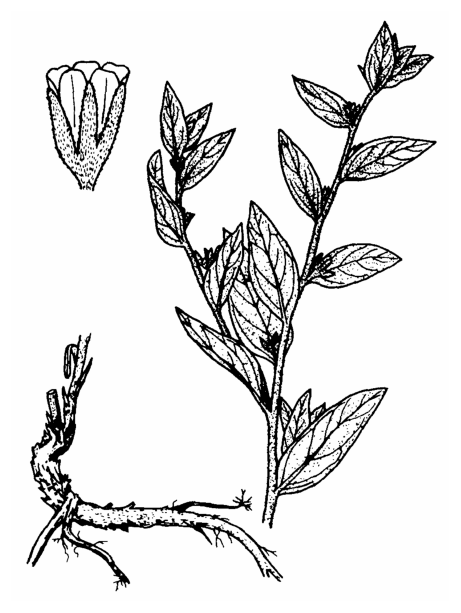
Shikonin is a red compound found in the roots of the plant Lithospermum erythrorhizon which grows in Asia. Extracts of the root have been used for centuries in folk medicine and are used today in ointments for healing of wounds.
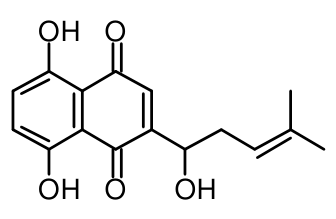
Shikonin
1.1 How many stereoisomers of Shikonin are possible ?
1.2 Do all stereoisomers of Shikonin have the same melting point? Mark with an X.
yes no The following sequence is part of a synthetic route to Shikonin:
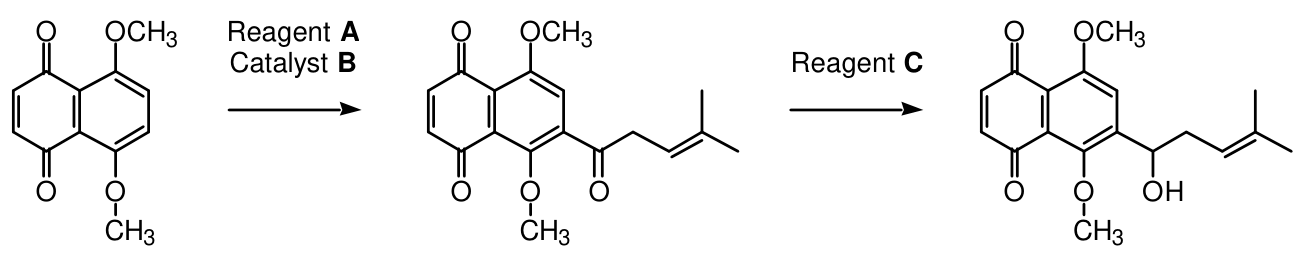
1.3 Draw the structural formula of reagent A.
1.4 Indicate (by means of an X in the appropriate check-box) the correct IUPAC name for reagent A.
2-Methyl-2-pentenoyl chloride ☐ 1-Chloro-4-methyl-3-pentene ☐ 4-Methyl-3-pentenoyl chloride ☐ 4-Methyl-3-pentene-1-ol ☐ 4,4-Dimethyl-3-butenoyl chloride ☐ 1.5 Write the molecular formula of reagent C.
Numerous Shikonin analogues have been synthesized with a view to obtaining more potent compounds. One reaction sequence is shown below:

1.6 Draw the structural formula of compound E.
1.7 How many stereoisomers of compound E, if any, are possible
Another route to useful Shikonin analogues is the following:
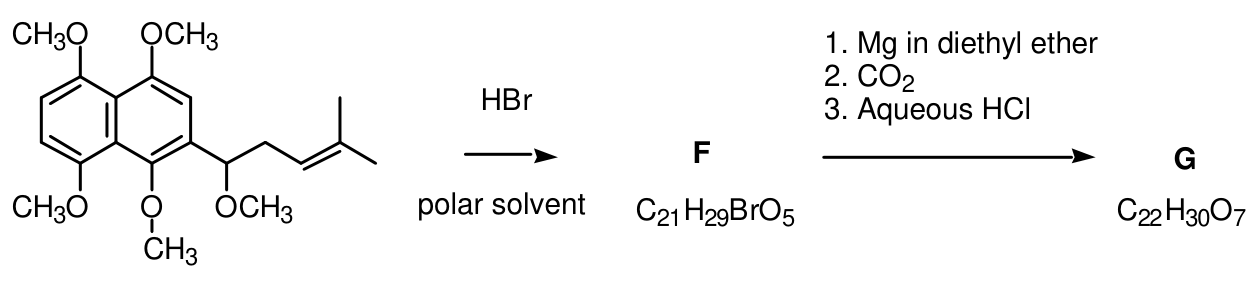
1.8 Draw the structural formula of compound F.
1.9 Draw the structural formula of compound G.
Official English text of the problem.
Problem 2: Bridge between Denmark and Sweden
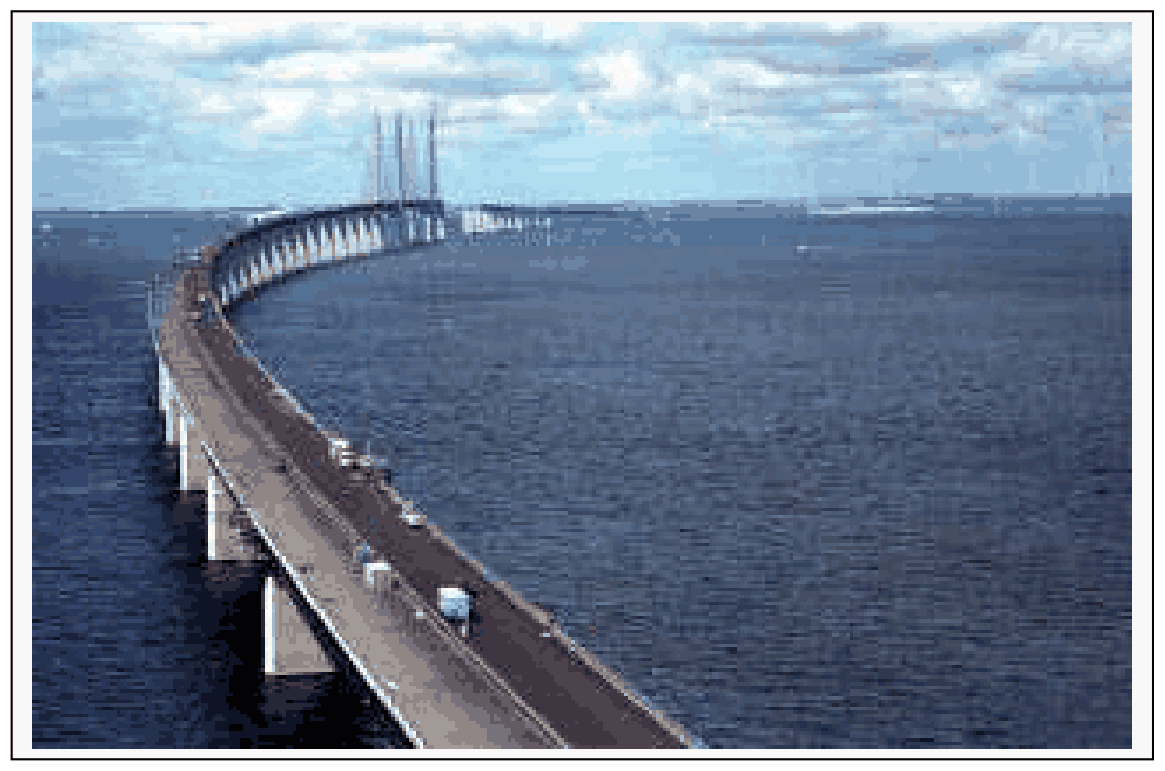
On July 1, 2000, the combined tunnel and bridge connecting Denmark and Sweden was officially opened. It consists of a tunnel from Copenhagen to an artificial island, and a bridge from the island to Malmö in Sweden. The major construction materials employed are concrete and steel. This problem deals with chemical reactions relating to production and degradation of such materials.
Concrete is produced from a mixture of cement, water, sand and small stones. Cement consists primarily of calcium silicates and calcium aluminates formed by heating and grinding of clay and limestone. In the later steps of cement production a small amount of gypsum, \(\ce{CaSO4 * 2H2O}\), is added to improve subsequent hardening of the concrete. The use of elevated temperatures during the final production may lead to formation of unwanted hemihydrate, \(\ce{CaSO4 * 1/2H2O}\). Consider the following reaction:

The following thermodynamic data apply at 25 °C, standard pressure: 1.00 bar:
Compound \(\Delta_{\mathrm f}H^\circ\) (\(\mathrm{kJ\,mol^{-1}}\)) \(S^\circ\) (\(\mathrm{J\,K^{-1}\,mol^{-1}}\)) \(\ce{CaSO4 * 2H2O(s)}\) −2021.0 194.0 \(\ce{CaSO4 * 1/2H2O(s)}\) −1575.0 130.5 \(\ce{H2O(g)}\) −241.8 188.6 Gas constant: \(R=8.314\ \mathrm{J\,mol^{-1}\,K^{-1}}=0.08314\ \mathrm{L\,bar\,mol^{-1}\,K^{-1}}\)
\(0\ ^\circ\mathrm C=273.15\ \mathrm K.\)
2.1 Calculate \(\Delta H^\circ\) (in kJ) for transformation of 1.00 kg of \(\ce{CaSO4 * 2H2O(s)}\) to hemihydrate \(\ce{CaSO4 * 1/2H2O(s)}\). Is this reaction endothermic or is it exothermic?
2.2 Calculate the equilibrium pressure (in bar) of water vapour in a closed vessel containing \(\ce{CaSO4 * 2H2O(s)}\), \(\ce{CaSO4 * 1/2H2O(s)}\) and \(\ce{H2O(g)}\) at 25 °C.
2.3 Calculate the temperature at which the equilibrium water vapour pressure is 1.00 bar in the system described in problem 2-2. Assume that \(\Delta H^\circ\) and \(\Delta S^\circ\) are temperature independent.
Corrosion of metals is associated with electrochemical reactions. This also applies for the formation of rust on iron surfaces, where the initial electrode reactions usually are:

An electrochemical cell in which these electrode reactions take place is constructed. The temperature is 25 °C. The cell is represented by the following cell diagram:

Standard electrode potentials (at 25 °C):

Nernst factor: \(RT\ln 10/F=0.05916\) volt (at 25 °C)
Faraday constant: \(F=96485\ \mathrm{C\,mol^{-1}}\)
2.4 Calculate the standard electromotive force (the standard cell voltage), \(E^\circ\), at 25 °C.
2.5 Write down the overall reaction which takes place during discharge of the cell under standard conditions.
2.6 Calculate the equilibrium constant at 25 °C for the overall cell reaction.
2.7 The overall reaction referred to above is allowed to proceed for 24 hours under standard conditions and at a constant current of 0.12 A. Calculate the mass of \(\ce{Fe}\) converted to \(\ce{Fe^2+}\) after 24 hours. Oxygen and water may be assumed to be present in excess.
2.8 Calculate \(E\) for the cell at 25 °C for the following conditions :
\[ [\ce{Fe^2+}]=0.015\ \mathrm M,\quad \mathrm{pH}_{\text{right-hand half-cell}}=9.00,\quad p(\ce{O2})=0.700\ \mathrm{bar}. \]
Official English text of the problem.
Problem 3: Bioinorganic Chemistry
The square planar complex cis-diammine dichloroplatinum(II) is an important drug for the treatment of certain cancers.
3.1 Draw the structures of cis- and trans-diammine dichloroplatinum(II) and label each structure as cis or trans.
A number of ionic compounds also have the empirical formula \(\ce{Pt(NH3)2Cl2}\).
3.2 Write molecular formulas for all possible ionic compounds which comply with the following conditions: each compound has
1) empirical formula \(\ce{Pt(NH3)2Cl2}\), 2) an anion and a cation and is composed of discrete, monomeric square planar platinum(II) complex, 3) only one type of cation and one type of anion. The answer must clearly reveal the composition of each discrete platinum(II) complex entity in each compound
3.3 How many \(5d\) electrons are there in the platinum(II) ion?
The valence d-orbital energy splitting diagram for a square planar complex can be regarded as being derived from that for an octahedral complex in which the metal-ligand interactions due to the two ligands coordinated along the \(z\) axis vanish, while the bonds to the four remaining ligands (coordinated along the \(x\) and \(y\) axes) become stronger.
3.4 Which of the five \(5d\) orbitals attain the highest energy (i. e. is the least likely to be occupied by electrons) in the general case of a square-planar \(\ce{Pt(II)}\) complex?
Serum transferrin (abbreviated: Tf) is a monomeric protein whose main function in the human body is the transport of iron(III). Each transferrin molecule can bind up to two iron(III) ions with stepwise binding constants \(K_1\) and \(K_2\) at biological conditions except that the temperature is \(25\,^\circ\mathrm{C}\) corresponding to the reactions:

In the diferric protein, \(\ce{(Fe^{III})2Tf}\), the two iron(III) ions are bound at two similar, but non-identical sites, and the two possible monoferric protein products, \(\ce{(Fe^{III})Tf}\), can be denoted \(\{\ce{Fe^{III} . Tf}\}\) and \(\{\ce{Tf . Fe^{III}}\}\). Their relative abundance at equilibrium is given by the constant
\[ K=[\{\ce{Tf . Fe^{III}}\}]\,[\{\ce{Fe^{III} . Tf}\}]^{-1}=5.9. \]
3.5 Calculate the values of the two constants \(K_1'=[\{\ce{Fe^{III} . Tf}\}]\,[\ce{Fe^{III}}]^{-1}[\ce{Tf}]^{-1}\) and \(K_1''=[\{\ce{Tf . Fe^{III}}\}]\,[\ce{Fe^{III}}]^{-1}[\ce{Tf}]^{-1}\), respectively, corresponding to the formation of each monoferric form of transferrin.
3.6 Calculate the values of the two constants \(K_2'=[\ce{(Fe^{III})2Tf}]\,[\ce{Fe^{III}}]^{-1}[\{\ce{Fe^{III} . Tf}\}]^{-1}\) and \(K_2''=[\ce{(Fe^{III})2Tf}]\,[\ce{Fe^{III}}]^{-1}[\{\ce{Tf . Fe^{III}}\}]^{-1}\) respectively, corresponding to the formation of diferric transferrin from each of the monoferric forms.
The bound iron(III) ion at each binding site is surrounded by six donor atoms from various ligands. Thus, two oxygen atoms of a carbonate anion coordinate to the metal, and the following amino acid side chains from the protein primary structure also coordinate to the iron(III) ion with one potential donor atom each: one aspartate, one histidine and two tyrosine residues.
3.7 What is the total number of oxygen donor atoms that surround a 6-coordinate iron(III) ion in transferrin?
Official English text of the problem.
Problem 4: A Naturally Occurring Compound
A naturally occurring compound A containing only \(\ce{C}\), \(\ce{H}\) and \(\ce{O}\) has the following elemental composition, percentage mass,
\(\ce{C}\): 63.2 %, \(\ce{H}\): 5.3%, \(\ce{O}\): 31.5%.
4.1 Derive the empirical formula of compound A.
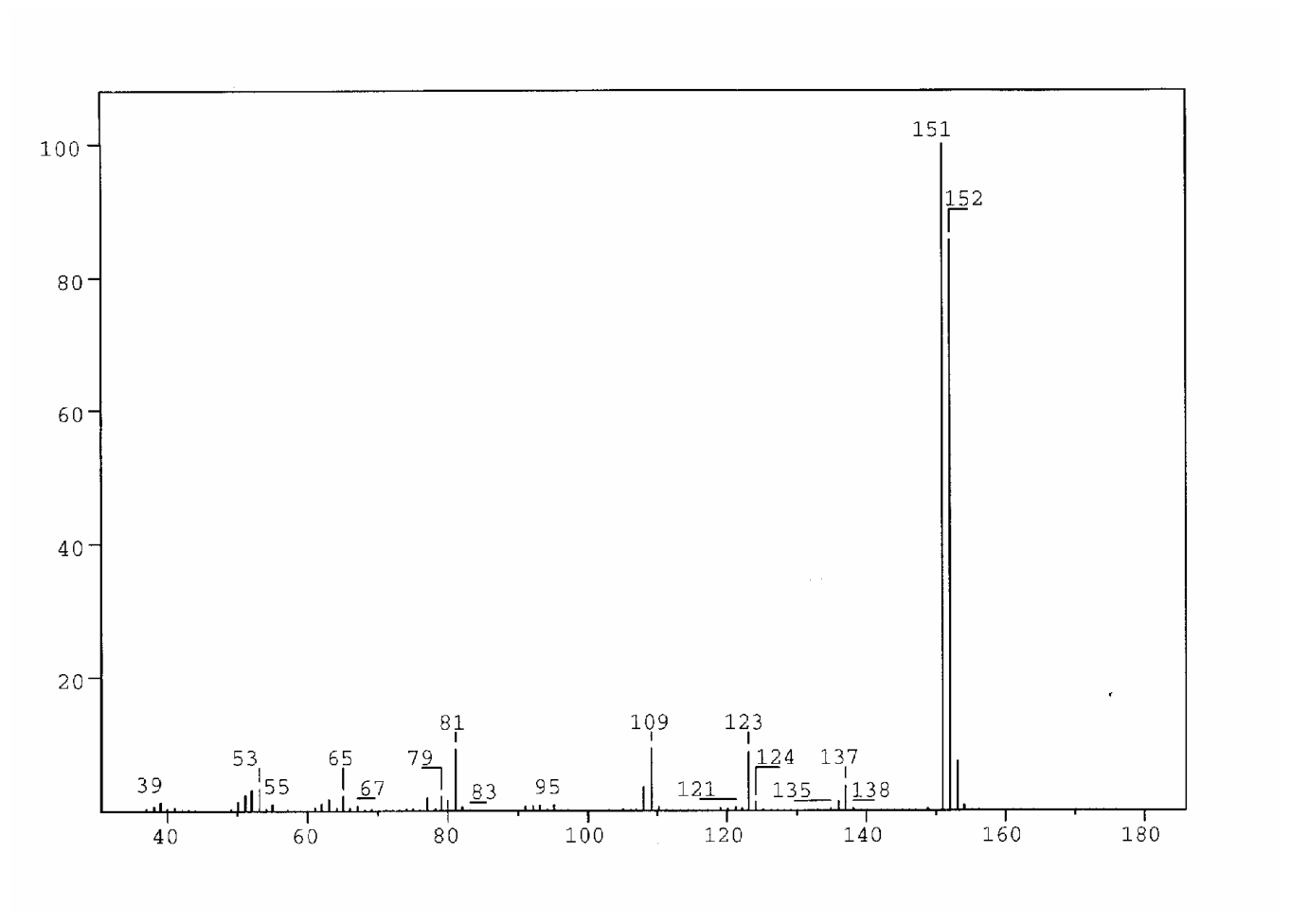
Figure 1
The mass spectrum of compound A is shown in Figure 1.
4.2 What is the molecular formula for compound A?
A solution of A in ether is shaken with an aqueous solution of \(\ce{NaOH}\). After this, no A remains in the ether phase. Another solution of A in ether is shaken with an aqueous solution of \(\ce{NaHCO3}\). A remains in the ether phase.
4.3 Which of the following classes of compounds does A belong to according to these experiments? Mark with an X.
alcohol □ phenol □ aldehyde □ ketone □ acid □ ester □ ether □ Compound A gave rise to formation of a silver mirror with Tollens’ reagent (\(\ce{Ag(NH3)2+}\)).
4-1 Which of the following functional groups does this indicate the presence of in A? Mark with an X.
hydroxy group of an alcohol □ hydroxy group of a phenol □ carbonyl group of an aldehyde □ carbonyl group of a ketone □ carboxylic group □ ester group □ alkoxy group of an ether □ 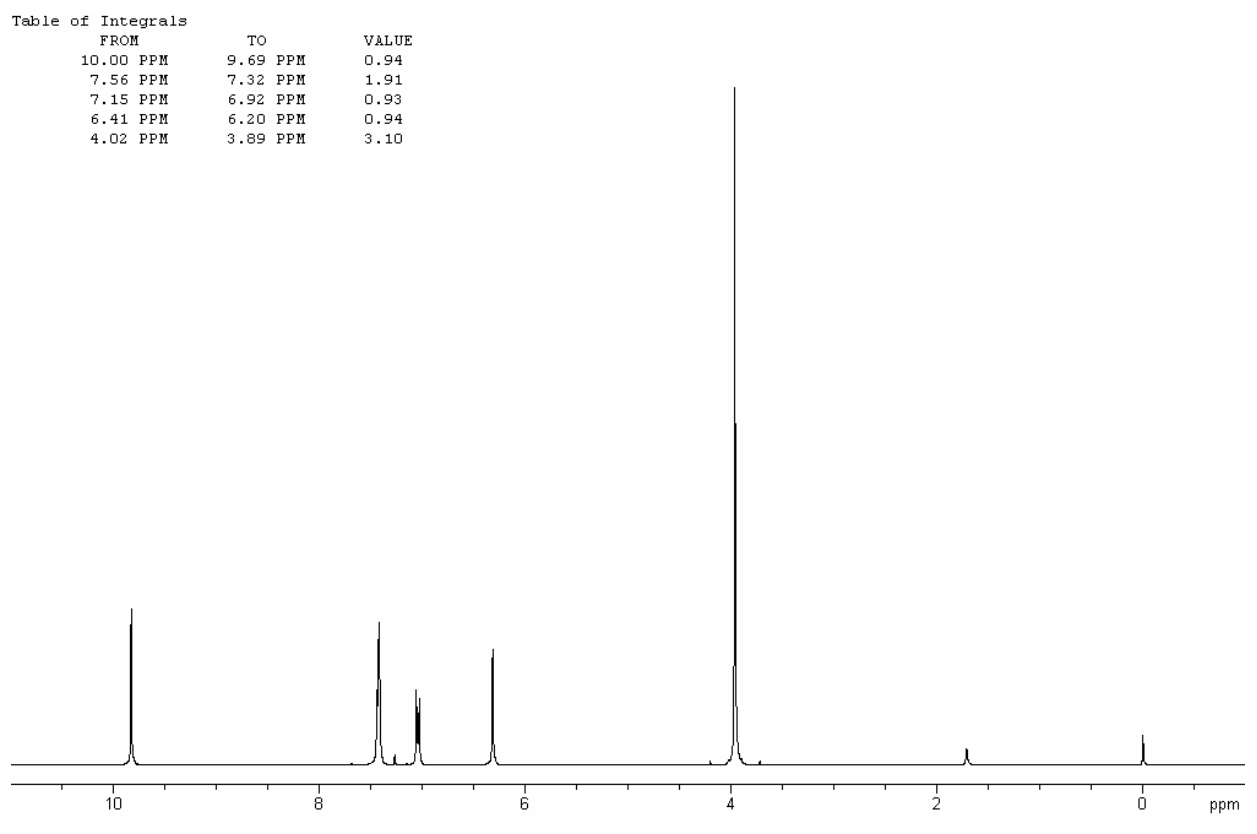
Figure 2a
The \({}^{1}\mathrm{H}\) NMR spectrum of compound A recorded at 300 MHz is shown in Figure 2a (solvent \(\ce{CDCl3}\) (7.27 ppm), reference tetramethylsilane). The signals at 3.9, 6.3 and 9.8 ppm are singlets. Figure 2b is an expansion of the region 6.9 – 7.6 ppm.
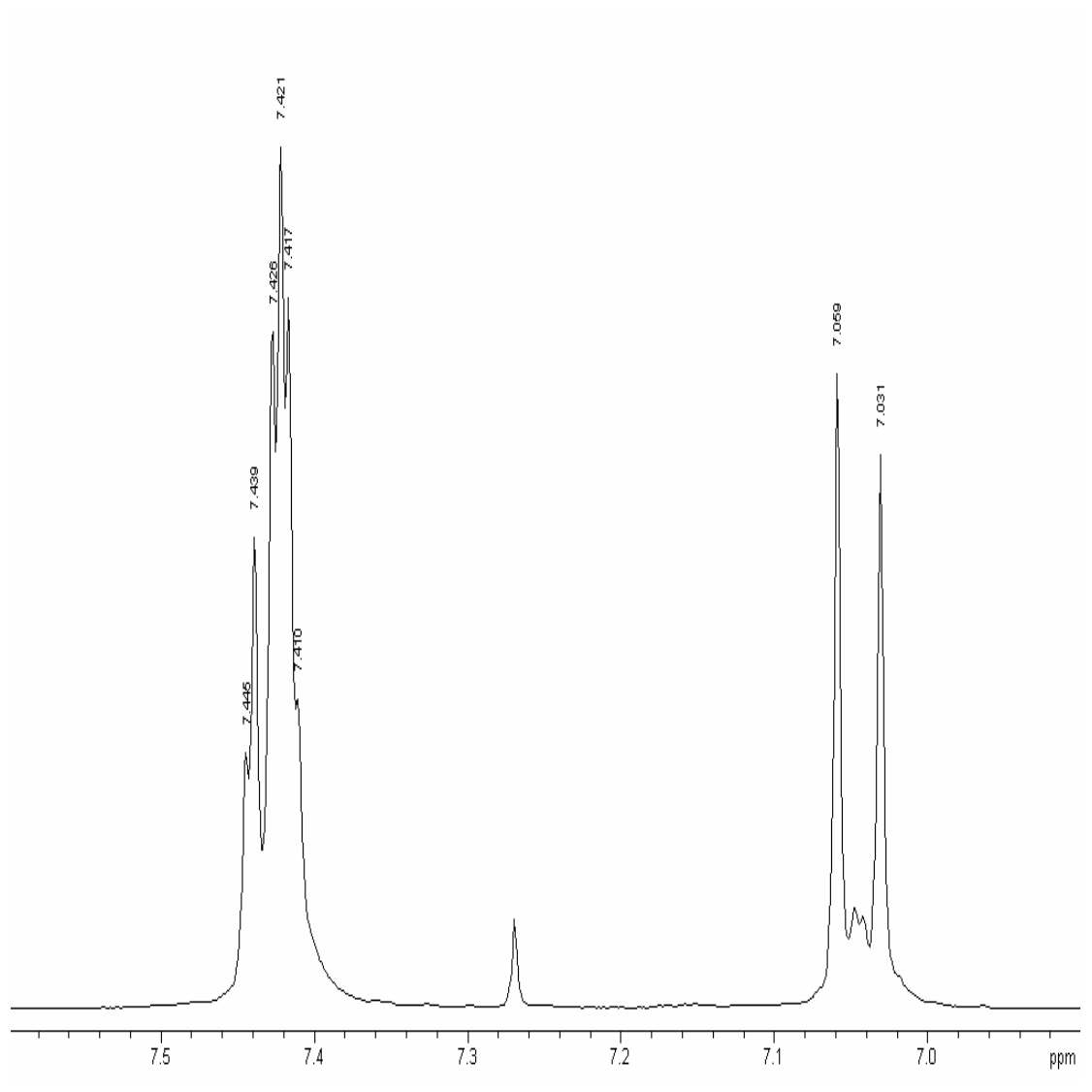
Figure 2b
Selected chemical shift and coupling constant values are given in Table 1.
The signal at 6.3 ppm disappears when a drop of \(\ce{D2O}\) is added.
4.5 Which of the following does this indicate? Mark with an X.
- Exchange of carbon-bonded hydrogen □
- Exchange of oxygen-bonded hydrogen □
- Dilution effect □
- Hydrolysis □
The same signal moves to a lower ppm value upon dilution with \(\ce{CDCl3}\).
4.6 Which of the following does this indicate?
Indicate the true statements (more than one).
- Increased hydrogen bonding □
- Decrease in hydrogen bonding □
- Intermolecular hydrogen bonding □
- Intramolecular hydrogen bonding □
- No hydrogen bonding □
4.7 Draw the four possible structural formulas for compound A based on the information given above
4.8 Give structural formulas for the fragments lost corresponding to the peaks at 137 and 123 mass units in the mass spectrum.
4.9 Two of the isomers have a lower \(pK_a\) value than the others. Write the formulas for those.
Table 1. \({}^{1}\mathrm{H}\) Chemical Shift \(\delta\)
Hydrogens attached to carbon
Methyl \(\ce{CH3-C-}\)
\(\ce{CH3-C=O-}\)
\(\ce{CH3-O-R}\)
\(\ce{CH3-OCOR}\)0.9 – 1.6 ppm
2.0 – 2.4 ppm
3.3 – 3.8 ppm
3.7 – 4.0 ppmMethylene \(\ce{CH2-C-}\)
\(\ce{CH2-C=O-}\)
\(\ce{CH2-OR}\)
\(\ce{CH2-OCOR}\)1.4 – 2.7 ppm
2.2 – 2.9 ppm
3.4 – 4.1 ppm
4.3 – 4.4 ppmMethine \(\ce{CH-}\) 1.5 – 5.0 ppm
depending on the substituents. Generally higher than for methyl and methyleneAlkene 4.0 – 7.3 ppm
depending on the substituentAldehyde \(\ce{R-CHO}\) 9.0 – 10.0 ppm Table 1 (continued) \({}^{1}\mathrm{H}\) Chemical Shift \(\delta\)
Hydrogens attached to oxygen
Alcohols \(\ce{ROH}\) 0.5 – 5.0 ppm Phenols \(\ce{ArOH}\) 4.0 – 7.0 ppm Carboxylic acids \(\ce{RCOOH}\) 10.0 – 13.0 ppm Selected spin-spin coupling constants
Alkanes
(free rotation)\(\ce{H-C-C-H}\) vicinal 6 – 8 Hz Alkenes trans
cis
geminal11 – 18 Hz
6 – 12 Hz
0 – 3 HzAromates ortho
meta
para6 – 10 Hz
1 – 4 Hz
0 – 2 HzOfficial English text of the problem.
Problem 5: Protein and DNA
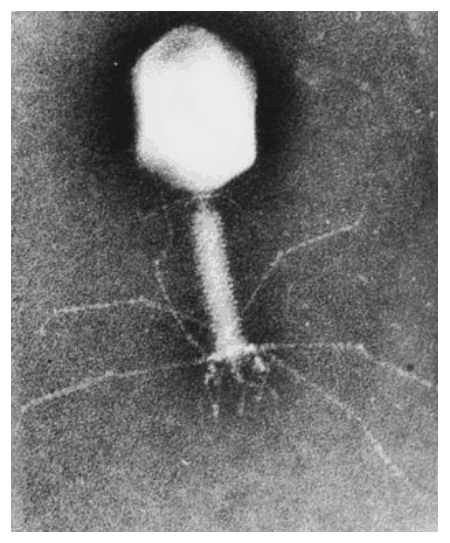
DNA is composed of 2’-deoxy-nucleotides carrying the bases adenine (A), guanine (G), cytosine (C) and thymine (T). The molar mass of the 2’-deoxy-nucleotide-5’-triphosphates is given in table 2:
Table 2
dNTP Molar mass /g mol\(^{-1}\) dATP 487 dGTP 503 dCTP 464 dTTP 478 5.1 Calculate the molar mass of a double stranded DNA fragment consisting of 1000 base pairs with a uniform distribution of the four bases.
This DNA fragment can be isolated and cloned by using the PCR method (polymerase chain reaction), in which a heat stable DNA polymerase enzyme multiplies the number of molecules of a specific piece of DNA in a cyclic process. Under optimal conditions the number of double-stranded DNA copies doubles in each cycle. Using the PCR method you perform 30 cycles starting from a single double stranded DNA molecule.
5.2 Calculate the approximate mass of the DNA you obtain from this experiment.
The bacteria-virus T4 enzyme - polynucleotide kinase (PNK) catalyzes the transfer of the terminal phosphate of ATP (\(\gamma\)-orthophosphate) to the 5'-hydroxyl termini of ribo- and deoxyribonucleotides:
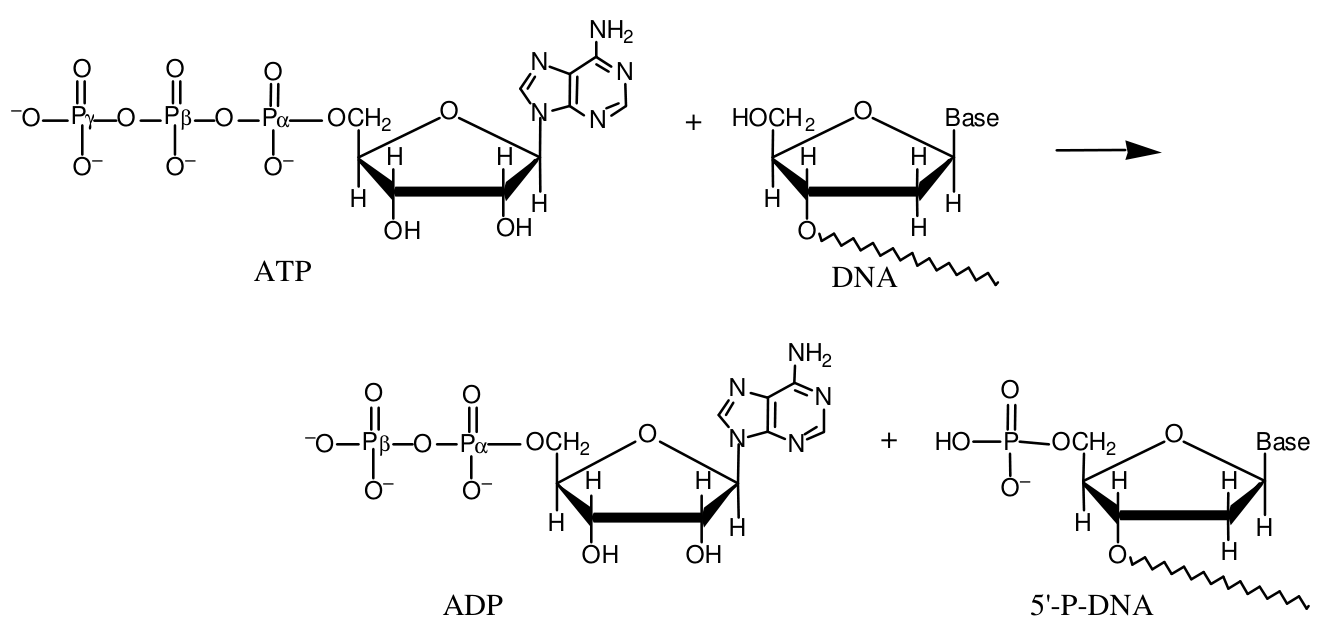
PNK is commonly used to label DNA at the 5’-end with the radioactive phosphorus isotope \(\ce{^{32}P}\) using ATP in which the \(\gamma\)-P (the outermost of the phosphorus atoms) is replaced with \(\ce{^{32}P}\). The amount of \(\ce{^{32}P}\) and thus the amount of labeled DNA can be measured.
A 10 µL solution containing double stranded DNA is labelled 100 % with \([\gamma\text{-}\ce{^{32}P}]\mathrm{ATP}\) by PNK. 37 days ago, the specific activity of \([\gamma\text{-}\ce{^{32}P}]\mathrm{ATP}\) was 10 Ci/mmol or \(370\cdot10^9\) Bq/mmol. \(\ce{^{32}P}\) has a half-life of 14.2 days, and during the decay a \(\beta\)-particle is emitted. Now the labelled DNA emits 40000 \(\beta\)-particles/s.
5-3 Calculate the concentration of the DNA solution.
In an experiment in which PNK is incubated with \([\gamma\text{-}\ce{^{32}P}]\mathrm{ATP}\) and single stranded DNA, the reaction can be monitored by isolating labeled DNA and measuring the \(\beta\)-particle emission. Using this kind of measurements in a 1 cm\(^{3}\) experimental mixture, a labeling of 9 nmol DNA/min was calculated. PNK has a catalytic rate constant (turnover number) of 0.05 s\(^{-1}\) and molar mass of 34620 g mol\(^{-1}\).
5.4 Calculate the concentration (in mg/cm\(^{3}\)) of PNK in the experimental mixture.
Aromatic amino acids, tryptophan, tyrosine and phenylalanine absorb UV light of a wavelength between 240 nm and 300 nm. In a protein containing several aromatic amino acids, the sum of the molar absorptivity per amino acid \(\Sigma\varepsilon_{\text{amino acid}}\), is approximately equal to the molar absorptivity, \(\varepsilon_{\text{protein}}\), for the protein. The molar absorptivity, \(\varepsilon_{\text{amino acid}}\), at 280 nm for tyrosine, tryptophan and phenylalanine is 1400 M\(^{-1}\) cm\(^{-1}\), 5600 M\(^{-1}\) cm\(^{-1}\) and 5 M\(^{-1}\) cm\(^{-1}\), respectively. The absorbance of a 10 µM solution of PNK is 0.644 at 280 nm and with 1.00 cm light path. The amino acid sequence of PNK contains 14 tyrosines and 9 phenylalanines.
\((\mathrm{M}=\mathrm{mol\,dm^{-3}})\)
5.5 Calculate the number of tryptophan residues in a PNK molecule.
Official English text of the problem.
Problem 6: Hard Water
In Denmark the subsoil consists mainly of limestone. In contact with ground water containing carbon dioxide some of the calcium carbonate dissolves as calcium hydrogen carbonate. As a result, such ground water is hard, and when used as tap water the high content of calcium hydrogen carbonate causes problems due to precipitation of calcium carbonate in, for example, kitchen and bathroom environments.
Carbon dioxide, \(\ce{CO2}\), is a diprotic acid in aqueous solution. The \(pK_a\)-values at \(0~^\circ\mathrm{C}\) are:

The liquid volume change associated with dissolution of \(\ce{CO2}\) may be neglected for all of the following problems. The temperature is to be taken as being \(0~^\circ\mathrm{C}\).
6.1 The total concentration of carbon dioxide in water which is saturated with carbon dioxide at a carbon dioxide partial pressure of \(1.00~\mathrm{bar}\) is \(0.0752~\mathrm{mol\,dm^{-3}}\). Calculate the volume of carbon dioxide gas which can be dissolved in one litre of water under these conditions.
The gas constant \[ R=8.314~\mathrm{J\,mol^{-1}\,K^{-1}} =0.08314~\mathrm{L\,bar\,mol^{-1}\,K^{-1}} \]
6.2 Calculate the equilibrium concentration of hydrogen ions and the equilibrium concentration of \(\ce{CO2}\) in water saturated with carbon dioxide at a carbon dioxide partial pressure of \(1.00~\mathrm{bar}\).
6.3 Calculate the equilibrium concentration of hydrogen ions in a \(0.0100~\mathrm{M}\) aqueous solution of sodium hydrogen carbonate saturated with carbon dioxide at a carbon dioxide partial pressure of \(1.00~\mathrm{bar}\).
6.4 Calculate the equilibrium concentration of hydrogen ions in a \(0.0100~\mathrm{M}\) aqueous solution of sodium carbonate saturated with carbon dioxide at a carbon dioxide partial pressure of \(1.00~\mathrm{bar}\). Ignore water dissociation effects.
6.5 The solubility of calcium carbonate in water at \(0~^\circ\mathrm{C}\) is \(0.0012~\mathrm{g}\) per \(100~\mathrm{cm^3}\) of water. Calculate the concentration of calcium ions in a saturated solution of calcium carbonate in water.
The hard groundwater in Denmark is formed via contact of water with limestone in the subsoil which reacts with carbon dioxide dissolved in the groundwater according to the equilibrium equation:

The equilibrium constant, \(K\), for this reaction is \(10^{-4.25}\) at \(0~^\circ\mathrm{C}\).
6.6 Calculate the concentration of calcium ions in water in equilibrium with calcium carbonate in an atmosphere with a partial pressure of carbon dioxide of \(1.00~\mathrm{bar}\).
6.7 A \(0.0150~\mathrm{M}\) solution of calcium hydroxide is saturated with carbon dioxide gas at a partial pressure of \(1.00~\mathrm{bar}\). Calculate the concentration of calcium ions in the solution by considering the equilibrium equation given above in connection with problem 6.6.
6.8 The calcium hydroxide solution referred to in problem 6.7 is diluted to twice the volume with water before saturation with carbon dioxide gas at a partial pressure of \(1.00~\mathrm{bar}\). Calculate the concentration of calcium ions in the resulting solution saturated with \(\ce{CO2}\).
6.9 Calculate the solubility product constant for calcium carbonate from the data given above.
Official English text of the problem.
Internationale Chemie-Olympiade
IChO 2000
Kopenhagen, Dänemark · 6 Theorieaufgaben mit vollständigen Lösungen
Aufgabe 1: Synthese von Verbindungen mit wundheilenden Eigenschaften
Shikonin ist eine rote Verbindung, die in den Wurzeln der in Asien wachsenden Pflanze Lithospermum erythrorhizon vorkommt. Extrakte aus der Wurzel werden seit Jahrhunderten in der Volksmedizin verwendet und kommen heute in Salben zur Wundheilung zum Einsatz.
Shikonin
1.1 Wie viele Stereoisomere von Shikonin sind möglich?
1.2 Haben alle Stereoisomere von Shikonin denselben Schmelzpunkt? Kreuzen Sie mit einem X an.
ja nein Die folgende Reaktionsfolge ist Teil eines Synthesewegs zu Shikonin:
1.3 Zeichnen Sie die Strukturformel des Reagenzes A.
1.4 Kennzeichnen Sie den korrekten IUPAC-Namen des Reagenzes A durch ein X im entsprechenden Kästchen.
2-Methyl-2-pentenoylchlorid ☐ 1-Chlor-4-methyl-3-penten ☐ 4-Methyl-3-pentenoylchlorid ☐ 4-Methyl-3-penten-1-ol ☐ 4,4-Dimethyl-3-butenoylchlorid ☐ 1.5 Geben Sie die Summenformel des Reagenzes C an.
Zahlreiche Shikonin-Analoga wurden synthetisiert, um wirksamere Verbindungen zu erhalten. Eine Reaktionsfolge ist nachstehend gezeigt:
1.6 Zeichnen Sie die Strukturformel der Verbindung E.
1.7 Wie viele Stereoisomere der Verbindung E sind gegebenenfalls möglich
Ein weiterer Weg zu nützlichen Shikonin-Analoga ist der folgende:
1.8 Zeichnen Sie die Strukturformel der Verbindung F.
1.9 Zeichnen Sie die Strukturformel der Verbindung G.
Aufgabentext aus dem offiziellen englischen Text übersetzt.
Aufgabe 2: Brücke zwischen Dänemark und Schweden
Am 1. Juli 2000 wurde die kombinierte Tunnel- und Brückenverbindung zwischen Dänemark und Schweden offiziell eröffnet. Sie besteht aus einem Tunnel von Kopenhagen zu einer künstlichen Insel und einer Brücke von der Insel nach Malmö in Schweden. Die hauptsächlich verwendeten Baustoffe sind Beton und Stahl. Diese Aufgabe behandelt chemische Reaktionen im Zusammenhang mit der Herstellung und dem Abbau solcher Materialien.
Beton wird aus einer Mischung aus Zement, Wasser, Sand und kleinen Steinen hergestellt. Zement besteht hauptsächlich aus Calciumsilicaten und Calciumaluminaten, die durch Erhitzen und Mahlen von Ton und Kalkstein gebildet werden. In den späteren Schritten der Zementherstellung wird eine geringe Menge Gips, \(\ce{CaSO4 * 2H2O}\), zugesetzt, um die anschließende Erhärtung des Betons zu verbessern. Erhöhte Temperaturen in der abschließenden Herstellungsphase können zur Bildung von unerwünschtem Halbhydrat, \(\ce{CaSO4 * 1/2H2O}\), führen. Betrachten Sie die folgende Reaktion:
Die folgenden thermodynamischen Daten gelten bei 25 °C und einem Standarddruck von 1.00 bar:
Verbindung \(\Delta_{\mathrm f}H^\circ\) (\(\mathrm{kJ\,mol^{-1}}\)) \(S^\circ\) (\(\mathrm{J\,K^{-1}\,mol^{-1}}\)) \(\ce{CaSO4 * 2H2O(s)}\) −2021.0 194.0 \(\ce{CaSO4 * 1/2H2O(s)}\) −1575.0 130.5 \(\ce{H2O(g)}\) −241.8 188.6 Gaskonstante: \(R=8.314\ \mathrm{J\,mol^{-1}\,K^{-1}}=0.08314\ \mathrm{L\,bar\,mol^{-1}\,K^{-1}}\)
\(0\ ^\circ\mathrm C=273.15\ \mathrm K.\)
2.1 Berechnen Sie \(\Delta H^\circ\) (in kJ) für die Umwandlung von 1.00 kg \(\ce{CaSO4 * 2H2O(s)}\) in das Halbhydrat \(\ce{CaSO4 * 1/2H2O(s)}\). Ist diese Reaktion endotherm oder exotherm?
2.2 Berechnen Sie den Gleichgewichtsdruck (in bar) des Wasserdampfs in einem geschlossenen Gefäß, das bei 25 °C \(\ce{CaSO4 * 2H2O(s)}\), \(\ce{CaSO4 * 1/2H2O(s)}\) und \(\ce{H2O(g)}\) enthält.
2.3 Berechnen Sie die Temperatur, bei der der Gleichgewichtsdruck des Wasserdampfs in dem in Aufgabe 2-2 beschriebenen System 1.00 bar beträgt. Nehmen Sie an, dass \(\Delta H^\circ\) und \(\Delta S^\circ\) temperaturunabhängig sind.
Die Korrosion von Metallen ist mit elektrochemischen Reaktionen verbunden. Dies gilt auch für die Rostbildung auf Eisenoberflächen, bei der die anfänglichen Elektrodenreaktionen gewöhnlich wie folgt lauten:
Es wird eine elektrochemische Zelle aufgebaut, in der diese Elektrodenreaktionen ablaufen. Die Temperatur beträgt 25 °C. Die Zelle wird durch das folgende Zellendiagramm dargestellt:
Standardelektrodenpotentiale (bei 25 °C):
Nernst-Faktor: \(RT\ln 10/F=0.05916\) Volt (bei 25 °C)
Faraday-Konstante: \(F=96485\ \mathrm{C\,mol^{-1}}\)
2.4 Berechnen Sie die elektromotorische Kraft unter Standardbedingungen (die Standardzellspannung), \(E^\circ\), bei 25 °C.
2.5 Geben Sie die Gesamtreaktion an, die bei der Entladung der Zelle unter Standardbedingungen abläuft.
2.6 Berechnen Sie die Gleichgewichtskonstante der Gesamtreaktion der Zelle bei 25 °C.
2.7 Die oben genannte Gesamtreaktion läuft 24 Stunden lang unter Standardbedingungen und bei einer konstanten Stromstärke von 0.12 A ab. Berechnen Sie die Masse an \(\ce{Fe}\), die nach 24 Stunden in \(\ce{Fe^2+}\) umgewandelt worden ist. Sauerstoff und Wasser können als im Überschuss vorhanden angenommen werden.
2.8 Berechnen Sie \(E\) für die Zelle bei 25 °C unter den folgenden Bedingungen:
\[ [\ce{Fe^2+}]=0.015\ \mathrm M,\quad \mathrm{pH}_{\text{rechte Halbzelle}}=9.00,\quad p(\ce{O2})=0.700\ \mathrm{bar}. \]
Aufgabentext aus dem offiziellen englischen Text übersetzt.
Aufgabe 3: Bioanorganische Chemie
Der quadratisch-planare Komplex cis-Diammindichloridoplatin(II) ist ein wichtiges Arzneimittel zur Behandlung bestimmter Krebserkrankungen.
3.1 Zeichnen Sie die Strukturen von cis- und trans-Diammindichloridoplatin(II) und kennzeichnen Sie jede Struktur als cis oder trans.
Eine Reihe ionischer Verbindungen besitzt ebenfalls die Verhältnisformel \(\ce{Pt(NH3)2Cl2}\).
3.2 Geben Sie die Formeln aller möglichen ionischen Verbindungen an, die die folgenden Bedingungen erfüllen: Jede Verbindung hat
1) die Verhältnisformel \(\ce{Pt(NH3)2Cl2}\), 2) ein Anion und ein Kation und besteht aus diskreten, monomeren, quadratisch-planaren Platin(II)-Komplexen, 3) nur eine Art von Kation und eine Art von Anion. Aus der Antwort muss die Zusammensetzung jeder diskreten Platin(II)-Komplexeinheit in jeder Verbindung eindeutig hervorgehen
3.3 Wie viele \(5d\)-Elektronen besitzt das Platin(II)-Ion?
Das Energieaufspaltungsdiagramm der Valenz-d-Orbitale eines quadratisch-planaren Komplexes lässt sich aus dem eines oktaedrischen Komplexes ableiten, indem die Metall-Ligand-Wechselwirkungen mit den beiden entlang der \(z\)-Achse koordinierten Liganden verschwinden, während die Bindungen zu den vier verbleibenden Liganden (die entlang der \(x\)- und \(y\)-Achse koordiniert sind) stärker werden.
3.4 Welches der fünf \(5d\)-Orbitale besitzt im allgemeinen Fall eines quadratisch-planaren \(\ce{Pt(II)}\)-Komplexes die höchste Energie (d. h. wird am wenigsten wahrscheinlich mit Elektronen besetzt)?
Serumtransferrin (abgekürzt: Tf) ist ein monomeres Protein, dessen Hauptfunktion im menschlichen Körper der Transport von Eisen(III) ist. Jedes Transferrinmolekül kann unter biologischen Bedingungen, jedoch bei einer Temperatur von \(25\,^\circ\mathrm{C}\), bis zu zwei Eisen(III)-Ionen mit den stufenweisen Bindungskonstanten \(K_1\) und \(K_2\) entsprechend den folgenden Reaktionen binden:
Im zweifach mit Eisen(III) beladenen Protein, \(\ce{(Fe^{III})2Tf}\), sind die beiden Eisen(III)-Ionen an zwei ähnlichen, aber nicht identischen Bindungsstellen gebunden, und die beiden möglichen einfach mit Eisen(III) beladenen Proteinprodukte, \(\ce{(Fe^{III})Tf}\), lassen sich als \(\{\ce{Fe^{III} . Tf}\}\) und \(\{\ce{Tf . Fe^{III}}\}\) bezeichnen. Ihr Mengenverhältnis im Gleichgewicht ist durch die folgende Konstante gegeben:
\[ K=[\{\ce{Tf . Fe^{III}}\}]\,[\{\ce{Fe^{III} . Tf}\}]^{-1}=5.9. \]
3.5 Berechnen Sie die Werte der beiden Konstanten \(K_1'=[\{\ce{Fe^{III} . Tf}\}]\,[\ce{Fe^{III}}]^{-1}[\ce{Tf}]^{-1}\) und \(K_1''=[\{\ce{Tf . Fe^{III}}\}]\,[\ce{Fe^{III}}]^{-1}[\ce{Tf}]^{-1}\), die jeweils der Bildung einer der beiden einfach mit Eisen(III) beladenen Formen von Transferrin entsprechen.
3.6 Berechnen Sie die Werte der beiden Konstanten \(K_2'=[\ce{(Fe^{III})2Tf}]\,[\ce{Fe^{III}}]^{-1}[\{\ce{Fe^{III} . Tf}\}]^{-1}\) und \(K_2''=[\ce{(Fe^{III})2Tf}]\,[\ce{Fe^{III}}]^{-1}[\{\ce{Tf . Fe^{III}}\}]^{-1}\), die jeweils der Bildung von zweifach mit Eisen(III) beladenem Transferrin aus einer der beiden einfach beladenen Formen entsprechen.
Das an jeder Bindungsstelle gebundene Eisen(III)-Ion ist von sechs Donoratomen verschiedener Liganden umgeben. Dabei koordinieren zwei Sauerstoffatome eines Carbonatanions an das Metall, und die folgenden Aminosäureseitenketten aus der Primärstruktur des Proteins koordinieren ebenfalls mit jeweils einem potenziellen Donoratom an das Eisen(III)-Ion: ein Aspartatrest, ein Histidinrest und zwei Tyrosinreste.
3.7 Wie groß ist die Gesamtzahl der Sauerstoffdonoratome, die ein sechsfach koordiniertes Eisen(III)-Ion im Transferrin umgeben?
Aufgabentext aus dem offiziellen englischen Text übersetzt.
Aufgabe 4: Eine natürlich vorkommende Verbindung
Eine natürlich vorkommende Verbindung A, die nur \(\ce{C}\), \(\ce{H}\) und \(\ce{O}\) enthält, weist die folgende Elementzusammensetzung in Massenprozent auf:
\(\ce{C}\): 63.2 %, \(\ce{H}\): 5.3%, \(\ce{O}\): 31.5%.
4.1 Leiten Sie die Verhältnisformel der Verbindung A her.
Abbildung 1
Das Massenspektrum der Verbindung A ist in Abbildung 1 dargestellt.
4.2 Wie lautet die Summenformel der Verbindung A?
Eine Lösung von A in Ether wird mit einer wässrigen Lösung von \(\ce{NaOH}\) ausgeschüttelt. Danach verbleibt kein A in der Etherphase. Eine weitere Lösung von A in Ether wird mit einer wässrigen Lösung von \(\ce{NaHCO3}\) ausgeschüttelt. A verbleibt in der Etherphase.
4.3 Zu welcher der folgenden Verbindungsklassen gehört A gemäß diesen Experimenten? Kreuzen Sie mit einem X an.
Alkohol □ Phenol □ Aldehyd □ Keton □ Säure □ Ester □ Ether □ Verbindung A führte mit Tollens-Reagenz (\(\ce{Ag(NH3)2+}\)) zur Bildung eines Silberspiegels.
4-1 Auf das Vorhandensein welcher der folgenden funktionellen Gruppen in A deutet dies hin? Kreuzen Sie mit einem X an.
Hydroxygruppe eines Alkohols □ Hydroxygruppe eines Phenols □ Carbonylgruppe eines Aldehyds □ Carbonylgruppe eines Ketons □ Carboxygruppe □ Estergruppe □ Alkoxygruppe eines Ethers □ Abbildung 2a
Das bei 300 MHz aufgenommene \({}^{1}\mathrm{H}\)-NMR-Spektrum der Verbindung A ist in Abbildung 2a dargestellt (Lösungsmittel \(\ce{CDCl3}\) (7.27 ppm), Referenz Tetramethylsilan). Die Signale bei 3.9, 6.3 und 9.8 ppm sind Singuletts. Abbildung 2b zeigt eine Vergrößerung des Bereichs 6.9 – 7.6 ppm.
Abbildung 2b
Ausgewählte Werte für chemische Verschiebungen und Kopplungskonstanten sind in Tabelle 1 angegeben.
Das Signal bei 6.3 ppm verschwindet, wenn ein Tropfen \(\ce{D2O}\) zugegeben wird.
4.5 Worauf deutet dies hin? Kreuzen Sie mit einem X an.
- Austausch von an Kohlenstoff gebundenem Wasserstoff □
- Austausch von an Sauerstoff gebundenem Wasserstoff □
- Verdünnungseffekt □
- Hydrolyse □
Dasselbe Signal verschiebt sich beim Verdünnen mit \(\ce{CDCl3}\) zu einem niedrigeren ppm-Wert.
4.6 Worauf deutet dies hin?
Kennzeichnen Sie die zutreffenden Aussagen (mehr als eine).
- Zunahme der Wasserstoffbrückenbindung □
- Abnahme der Wasserstoffbrückenbindung □
- Intermolekulare Wasserstoffbrückenbindung □
- Intramolekulare Wasserstoffbrückenbindung □
- Keine Wasserstoffbrückenbindung □
4.7 Zeichnen Sie anhand der oben angegebenen Informationen die vier möglichen Strukturformeln der Verbindung A
4.8 Geben Sie die Strukturformeln der abgespaltenen Fragmente an, die den Peaks bei 137 und 123 Masseneinheiten im Massenspektrum entsprechen.
4.9 Zwei der Isomere haben einen niedrigeren \(pK_a\)-Wert als die anderen. Schreiben Sie deren Formeln auf.
Tabelle 1. \({}^{1}\mathrm{H}\): Chemische Verschiebung \(\delta\)
An Kohlenstoff gebundene Wasserstoffatome
Methyl \(\ce{CH3-C-}\)
\(\ce{CH3-C=O-}\)
\(\ce{CH3-O-R}\)
\(\ce{CH3-OCOR}\)0.9 – 1.6 ppm
2.0 – 2.4 ppm
3.3 – 3.8 ppm
3.7 – 4.0 ppmMethylen \(\ce{CH2-C-}\)
\(\ce{CH2-C=O-}\)
\(\ce{CH2-OR}\)
\(\ce{CH2-OCOR}\)1.4 – 2.7 ppm
2.2 – 2.9 ppm
3.4 – 4.1 ppm
4.3 – 4.4 ppmMethin \(\ce{CH-}\) 1.5 – 5.0 ppm
abhängig von den Substituenten. Im Allgemeinen höher als bei Methyl und MethylenAlkene 4.0 – 7.3 ppm
abhängig vom SubstituentenAldehyd \(\ce{R-CHO}\) 9.0 – 10.0 ppm Tabelle 1 (Fortsetzung) \({}^{1}\mathrm{H}\): Chemische Verschiebung \(\delta\)
An Sauerstoff gebundene Wasserstoffatome
Alkohole \(\ce{ROH}\) 0.5 – 5.0 ppm Phenole \(\ce{ArOH}\) 4.0 – 7.0 ppm Carbonsäuren \(\ce{RCOOH}\) 10.0 – 13.0 ppm Ausgewählte Spin-Spin-Kopplungskonstanten
Alkane
(freie Rotation)\(\ce{H-C-C-H}\) vicinal 6 – 8 Hz Alkene trans
cis
geminal11 – 18 Hz
6 – 12 Hz
0 – 3 HzAromaten ortho
meta
para6 – 10 Hz
1 – 4 Hz
0 – 2 HzAufgabentext aus dem offiziellen englischen Text übersetzt.
Aufgabe 5: Protein und DNA
DNA besteht aus 2’-Desoxynukleotiden mit den Basen Adenin (A), Guanin (G), Cytosin (C) und Thymin (T). Die molaren Massen der 2’-Desoxynukleotid-5’-triphosphate sind in Tabelle 2 angegeben:
Tabelle 2
dNTP Molare Masse /g mol\(^{-1}\) dATP 487 dGTP 503 dCTP 464 dTTP 478 5.1 Berechnen Sie die molare Masse eines doppelsträngigen DNA-Fragments aus 1000 Basenpaaren mit einer gleichmäßigen Verteilung der vier Basen.
Dieses DNA-Fragment kann mithilfe der PCR-Methode (Polymerase-Kettenreaktion) isoliert und kloniert werden. Dabei vervielfältigt eine thermostabile DNA-Polymerase die Anzahl der Moleküle eines bestimmten DNA-Abschnitts in einem zyklischen Prozess. Unter optimalen Bedingungen verdoppelt sich die Anzahl der doppelsträngigen DNA-Kopien in jedem Zyklus. Ausgehend von einem einzigen doppelsträngigen DNA-Molekül führen Sie mit der PCR-Methode 30 Zyklen durch.
5.2 Berechnen Sie die ungefähre Masse der DNA, die Sie bei diesem Experiment erhalten.
Das Enzym Polynukleotidkinase (PNK) des Bakteriophagen T4 katalysiert die Übertragung der endständigen Phosphatgruppe von ATP (\(\gamma\)-Orthophosphat) auf die 5'-Hydroxylenden von Ribo- und Desoxyribonukleotiden:
PNK wird häufig verwendet, um DNA am 5’-Ende mit dem radioaktiven Phosphorisotop \(\ce{^{32}P}\) zu markieren. Dazu wird ATP eingesetzt, in dem das \(\gamma\)-P (das äußerste der Phosphoratome) durch \(\ce{^{32}P}\) ersetzt ist. Die Menge an \(\ce{^{32}P}\) und damit die Menge an markierter DNA kann gemessen werden.
Eine 10 µL große Lösung, die doppelsträngige DNA enthält, wird durch PNK mit \([\gamma\text{-}\ce{^{32}P}]\mathrm{ATP}\) zu 100 % markiert. Vor 37 Tagen betrug die spezifische Aktivität von \([\gamma\text{-}\ce{^{32}P}]\mathrm{ATP}\) 10 Ci/mmol oder \(370\cdot10^9\) Bq/mmol. \(\ce{^{32}P}\) hat eine Halbwertszeit von 14.2 Tagen, und beim Zerfall wird ein \(\beta\)-Teilchen emittiert. Jetzt emittiert die markierte DNA 40000 \(\beta\)-Teilchen/s.
5-3 Berechnen Sie die Konzentration der DNA-Lösung.
In einem Experiment, bei dem PNK mit \([\gamma\text{-}\ce{^{32}P}]\mathrm{ATP}\) und einzelsträngiger DNA inkubiert wird, kann die Reaktion verfolgt werden, indem die markierte DNA isoliert und die Emission von \(\beta\)-Teilchen gemessen wird. Aus solchen Messungen in einem Reaktionsansatz von 1 cm\(^{3}\) wurde eine Markierungsrate von 9 nmol DNA/min berechnet. PNK hat eine katalytische Geschwindigkeitskonstante (Wechselzahl) von 0.05 s\(^{-1}\) und eine molare Masse von 34620 g mol\(^{-1}\).
5.4 Berechnen Sie die Konzentration (in mg/cm\(^{3}\)) von PNK im Reaktionsansatz.
Die aromatischen Aminosäuren Tryptophan, Tyrosin und Phenylalanin absorbieren UV-Licht mit einer Wellenlänge zwischen 240 nm und 300 nm. Bei einem Protein, das mehrere aromatische Aminosäuren enthält, ist die Summe der molaren Absorptionskoeffizienten der einzelnen Aminosäuren, \(\Sigma\varepsilon_{\text{Aminosäure}}\), näherungsweise gleich dem molaren Absorptionskoeffizienten \(\varepsilon_{\text{Protein}}\) des Proteins. Der molare Absorptionskoeffizient \(\varepsilon_{\text{Aminosäure}}\) bei 280 nm beträgt für Tyrosin, Tryptophan und Phenylalanin 1400 M\(^{-1}\) cm\(^{-1}\), 5600 M\(^{-1}\) cm\(^{-1}\) bzw. 5 M\(^{-1}\) cm\(^{-1}\). Die Extinktion einer 10 µM PNK-Lösung beträgt bei 280 nm und einer Schichtdicke von 1.00 cm 0.644. Die Aminosäuresequenz von PNK enthält 14 Tyrosinreste und 9 Phenylalaninreste.
\((\mathrm{M}=\mathrm{mol\,dm^{-3}})\)
5.5 Berechnen Sie die Anzahl der Tryptophanreste in einem PNK-Molekül.
Aufgabentext aus dem offiziellen englischen Text übersetzt.
Aufgabe 6: Hartes Wasser
In Dänemark besteht der Untergrund hauptsächlich aus Kalkstein. Bei Kontakt mit kohlenstoffdioxidhaltigem Grundwasser löst sich ein Teil des Calciumcarbonats als Calciumhydrogencarbonat. Dadurch ist solches Grundwasser hart, und bei seiner Verwendung als Leitungswasser verursacht der hohe Gehalt an Calciumhydrogencarbonat Probleme durch die Ausfällung von Calciumcarbonat, beispielsweise in Küche und Bad.
Kohlenstoffdioxid, \(\ce{CO2}\), ist in wässriger Lösung eine zweiprotonige Säure. Die \(pK_a\)-Werte bei \(0~^\circ\mathrm{C}\) sind:
Die mit dem Lösen von \(\ce{CO2}\) verbundene Änderung des Flüssigkeitsvolumens darf bei allen folgenden Aufgaben vernachlässigt werden. Die Temperatur ist mit \(0~^\circ\mathrm{C}\) anzusetzen.
6.1 Die Gesamtkonzentration von Kohlenstoffdioxid in Wasser, das bei einem Kohlenstoffdioxidpartialdruck von \(1.00~\mathrm{bar}\) mit Kohlenstoffdioxid gesättigt ist, beträgt \(0.0752~\mathrm{mol\,dm^{-3}}\). Berechnen Sie das Volumen an gasförmigem Kohlenstoffdioxid, das unter diesen Bedingungen in einem Liter Wasser gelöst werden kann.
Die Gaskonstante ist \[ R=8.314~\mathrm{J\,mol^{-1}\,K^{-1}} =0.08314~\mathrm{L\,bar\,mol^{-1}\,K^{-1}} \]
6.2 Berechnen Sie die Gleichgewichtskonzentration der Wasserstoffionen und die Gleichgewichtskonzentration von \(\ce{CO2}\) in Wasser, das bei einem Kohlenstoffdioxidpartialdruck von \(1.00~\mathrm{bar}\) mit Kohlenstoffdioxid gesättigt ist.
6.3 Berechnen Sie die Gleichgewichtskonzentration der Wasserstoffionen in einer \(0.0100~\mathrm{M}\) wässrigen Natriumhydrogencarbonatlösung, die bei einem Kohlenstoffdioxidpartialdruck von \(1.00~\mathrm{bar}\) mit Kohlenstoffdioxid gesättigt ist.
6.4 Berechnen Sie die Gleichgewichtskonzentration der Wasserstoffionen in einer \(0.0100~\mathrm{M}\) wässrigen Natriumcarbonatlösung, die bei einem Kohlenstoffdioxidpartialdruck von \(1.00~\mathrm{bar}\) mit Kohlenstoffdioxid gesättigt ist. Vernachlässigen Sie die Auswirkungen der Dissoziation des Wassers.
6.5 Die Löslichkeit von Calciumcarbonat in Wasser bei \(0~^\circ\mathrm{C}\) beträgt \(0.0012~\mathrm{g}\) pro \(100~\mathrm{cm^3}\) Wasser. Berechnen Sie die Konzentration der Calciumionen in einer gesättigten Lösung von Calciumcarbonat in Wasser.
Das harte Grundwasser in Dänemark entsteht durch den Kontakt von Wasser mit Kalkstein im Untergrund, der mit dem im Grundwasser gelösten Kohlenstoffdioxid gemäß folgender Gleichgewichtsgleichung reagiert:
Die Gleichgewichtskonstante \(K\) dieser Reaktion beträgt bei \(0~^\circ\mathrm{C}\) \(10^{-4.25}\).
6.6 Berechnen Sie die Konzentration der Calciumionen in Wasser, das in einer Atmosphäre mit einem Kohlenstoffdioxidpartialdruck von \(1.00~\mathrm{bar}\) mit Calciumcarbonat im Gleichgewicht steht.
6.7 Eine \(0.0150~\mathrm{M}\) Calciumhydroxidlösung wird bei einem Partialdruck von \(1.00~\mathrm{bar}\) mit gasförmigem Kohlenstoffdioxid gesättigt. Berechnen Sie die Konzentration der Calciumionen in der Lösung unter Berücksichtigung der oben im Zusammenhang mit Aufgabe 6.6 angegebenen Gleichgewichtsgleichung.
6.8 Die in Aufgabe 6.7 genannte Calciumhydroxidlösung wird vor der Sättigung mit gasförmigem Kohlenstoffdioxid bei einem Partialdruck von \(1.00~\mathrm{bar}\) mit Wasser auf das doppelte Volumen verdünnt. Berechnen Sie die Konzentration der Calciumionen in der entstehenden, mit \(\ce{CO2}\) gesättigten Lösung.
6.9 Berechnen Sie die Löslichkeitsproduktkonstante von Calciumcarbonat aus den oben angegebenen Daten.
Aufgabentext aus dem offiziellen englischen Text übersetzt.
Uluslararası Kimya Olimpiyatı
IChO 2000
Kopenhag, Danimarka · 6 teori sorusu, tam çözümleriyle
Soru 1: Yara İyileştirici Özelliklere Sahip Bileşiklerin Sentezi
Şikonin, Asya'da yetişen Lithospermum erythrorhizon bitkisinin köklerinde bulunan kırmızı bir bileşiktir. Kökün özütleri yüzyıllardır halk hekimliğinde kullanılmaktadır ve günümüzde yaraların iyileştirilmesine yönelik merhemlerde kullanılmaktadır.
Şikonin
1.1 Şikoninin kaç stereoizomeri mümkündür?
1.2 Şikoninin tüm stereoizomerleri aynı erime noktasına mı sahiptir? X ile işaretleyiniz.
evet hayır Aşağıdaki tepkime dizisi, şikoninin bir sentez yolunun parçasıdır:
1.3 A reaktifinin yapı formülünü çiziniz.
1.4 A reaktifinin doğru IUPAC adını (uygun kutucuğa X koyarak) belirtiniz.
2-Metil-2-pentenoil klorür ☐ 1-Kloro-4-metil-3-penten ☐ 4-Metil-3-pentenoil klorür ☐ 4-Metil-3-penten-1-ol ☐ 4,4-Dimetil-3-bütenoil klorür ☐ 1.5 C reaktifinin molekül formülünü yazınız.
Daha etkili bileşikler elde etmek amacıyla çok sayıda şikonin analoğu sentezlenmiştir. Bir tepkime dizisi aşağıda gösterilmiştir:
1.6 E bileşiğinin yapı formülünü çiziniz.
1.7 E bileşiğinin stereoizomerleri varsa, kaç tanesi mümkündür
Yararlı şikonin analoglarına ulaşmak için başka bir yol da aşağıdaki gibidir:
1.8 F bileşiğinin yapı formülünü çiziniz.
1.9 G bileşiğinin yapı formülünü çiziniz.
Soru metni resmi İngilizce metinden çevrilmiştir.
Soru 2: Danimarka ile İsveç arasındaki köprü
1 Temmuz 2000 tarihinde, Danimarka ile İsveç'i birbirine bağlayan tünel ve köprü bağlantısı resmen açılmıştır. Bu bağlantı, Kopenhag'dan yapay bir adaya uzanan bir tünelden ve bu adadan İsveç'teki Malmö'ye uzanan bir köprüden oluşmaktadır. Kullanılan başlıca yapı malzemeleri beton ve çeliktir. Bu soru, bu malzemelerin üretimi ve bozunmasıyla ilgili kimyasal tepkimeleri ele almaktadır.
Beton; çimento, su, kum ve küçük taşların karışımından üretilir. Çimento esas olarak kil ve kireç taşının ısıtılması ve öğütülmesiyle oluşan kalsiyum silikatlar ve kalsiyum alüminatlardan oluşur. Çimento üretiminin sonraki aşamalarında, betonun daha sonraki sertleşmesini iyileştirmek amacıyla az miktarda jips, \(\ce{CaSO4 * 2H2O}\), eklenir. Üretimin son aşamasında yüksek sıcaklıkların kullanılması, istenmeyen hemihidratın, \(\ce{CaSO4 * 1/2H2O}\), oluşmasına yol açabilir. Aşağıdaki tepkimeyi ele alınız:
Aşağıdaki termodinamik veriler 25 °C'de ve 1.00 bar standart basınçta geçerlidir:
Bileşik \(\Delta_{\mathrm f}H^\circ\) (\(\mathrm{kJ\,mol^{-1}}\)) \(S^\circ\) (\(\mathrm{J\,K^{-1}\,mol^{-1}}\)) \(\ce{CaSO4 * 2H2O(s)}\) −2021.0 194.0 \(\ce{CaSO4 * 1/2H2O(s)}\) −1575.0 130.5 \(\ce{H2O(g)}\) −241.8 188.6 Gaz sabiti: \(R=8.314\ \mathrm{J\,mol^{-1}\,K^{-1}}=0.08314\ \mathrm{L\,bar\,mol^{-1}\,K^{-1}}\)
\(0\ ^\circ\mathrm C=273.15\ \mathrm K.\)
2.1 1.00 kg \(\ce{CaSO4 * 2H2O(s)}\)'ın hemihidrata, \(\ce{CaSO4 * 1/2H2O(s)}\), dönüşümü için \(\Delta H^\circ\) değerini (kJ cinsinden) hesaplayınız. Bu tepkime endotermik midir, yoksa ekzotermik midir?
2.2 25 °C'de \(\ce{CaSO4 * 2H2O(s)}\), \(\ce{CaSO4 * 1/2H2O(s)}\) ve \(\ce{H2O(g)}\) içeren kapalı bir kaptaki su buharının denge basıncını (bar cinsinden) hesaplayınız.
2.3 2-2 numaralı soruda tanımlanan sistemde, su buharının denge basıncının 1.00 bar olduğu sıcaklığı hesaplayınız. \(\Delta H^\circ\) ve \(\Delta S^\circ\) değerlerinin sıcaklıktan bağımsız olduğunu varsayınız.
Metallerin korozyonu elektrokimyasal tepkimelerle ilişkilidir. Bu durum, demir yüzeylerinde pas oluşumu için de geçerlidir; burada başlangıçtaki elektrot tepkimeleri genellikle şöyledir:
Bu elektrot tepkimelerinin gerçekleştiği bir elektrokimyasal hücre kurulmuştur. Sıcaklık 25 °C'dir. Hücre, aşağıdaki hücre şemasıyla gösterilmektedir:
Standart elektrot potansiyelleri (25 °C'de):
Nernst çarpanı: \(RT\ln 10/F=0.05916\) volt (25 °C'de)
Faraday sabiti: \(F=96485\ \mathrm{C\,mol^{-1}}\)
2.4 25 °C'deki standart elektromotor kuvveti (standart hücre gerilimini), \(E^\circ\), hesaplayınız.
2.5 Hücrenin standart koşullar altında boşalması sırasında gerçekleşen toplam tepkimeyi yazınız.
2.6 Toplam hücre tepkimesi için 25 °C'deki denge sabitini hesaplayınız.
2.7 Yukarıda belirtilen toplam tepkimenin standart koşullar altında ve 0.12 A sabit akımla 24 saat boyunca gerçekleşmesine izin verilmektedir. 24 saat sonunda \(\ce{Fe^2+}\)'ye dönüşen \(\ce{Fe}\)'in kütlesini hesaplayınız. Oksijen ve suyun aşırı miktarda bulunduğu varsayılabilir.
2.8 Aşağıdaki koşullarda, 25 °C'deki hücre için \(E\) değerini hesaplayınız:
\[ [\ce{Fe^2+}]=0.015\ \mathrm M,\quad \mathrm{pH}_{\text{sağ yarı hücre}}=9.00,\quad p(\ce{O2})=0.700\ \mathrm{bar}. \]
Soru metni resmi İngilizce metinden çevrilmiştir.
Soru 3: Biyoanorganik Kimya
Kare düzlemsel cis-diammin dikloroplatin(II) kompleksi, bazı kanserlerin tedavisinde kullanılan önemli bir ilaçtır.
3.1 cis- ve trans-diammin dikloroplatin(II)'nin yapılarını çiziniz ve her bir yapıyı cis veya trans olarak etiketleyiniz.
Bazı iyonik bileşikler de \(\ce{Pt(NH3)2Cl2}\) basit formülüne sahiptir.
3.2 Aşağıdaki koşullara uyan tüm olası iyonik bileşiklerin molekül formüllerini yazınız: her bileşik
1) \(\ce{Pt(NH3)2Cl2}\) basit formülüne sahiptir, 2) bir anyon ve bir katyon içerir ve ayrı, monomerik kare düzlemsel platin(II) komplekslerinden oluşur, 3) yalnızca bir tür katyon ve bir tür anyon içerir. Cevap, her bileşikteki her bir ayrı platin(II) kompleks biriminin bileşimini açıkça göstermelidir.
3.3 Platin(II) iyonunda kaç \(5d\) elektronu vardır?
Kare düzlemsel bir kompleksin değerlik d-orbitallerinin enerji yarılma diyagramı, \(z\) ekseni boyunca koordine olan iki ligandın neden olduğu metal–ligand etkileşimlerinin ortadan kalktığı, geriye kalan dört liganda (\(x\) ve \(y\) eksenleri boyunca koordine olan) ait bağların ise güçlendiği bir oktahedral kompleksin diyagramından türetilmiş olarak düşünülebilir.
3.4 Genel olarak kare düzlemsel bir \(\ce{Pt(II)}\) kompleksinde beş \(5d\) orbitalinden hangisi en yüksek enerjiye ulaşır (yani elektronlar tarafından işgal edilme olasılığı en düşüktür)?
Serum transferrini (kısaltması: Tf), insan vücudundaki temel işlevi demir(III) taşımak olan monomerik bir proteindir. Her transferrin molekülü, sıcaklığın \(25\,^\circ\mathrm{C}\) olması dışında biyolojik koşullarda, aşağıdaki tepkimelere karşılık gelen \(K_1\) ve \(K_2\) basamaklı bağlanma sabitleriyle en fazla iki demir(III) iyonu bağlayabilir:
İki demir içeren proteinde, \(\ce{(Fe^{III})2Tf}\), iki demir(III) iyonu birbirine benzer, ancak özdeş olmayan iki bölgeye bağlanır ve tek demir içeren iki olası protein ürünü, \(\ce{(Fe^{III})Tf}\), \(\{\ce{Fe^{III} . Tf}\}\) ve \(\{\ce{Tf . Fe^{III}}\}\) olarak gösterilebilir. Bunların dengedeki bağıl bollukları şu sabitle verilir:
\[ K=[\{\ce{Tf . Fe^{III}}\}]\,[\{\ce{Fe^{III} . Tf}\}]^{-1}=5.9. \]
3.5 Transferrinin tek demir içeren biçimlerinin her birinin oluşumuna sırasıyla karşılık gelen \(K_1'=[\{\ce{Fe^{III} . Tf}\}]\,[\ce{Fe^{III}}]^{-1}[\ce{Tf}]^{-1}\) ve \(K_1''=[\{\ce{Tf . Fe^{III}}\}]\,[\ce{Fe^{III}}]^{-1}[\ce{Tf}]^{-1}\) sabitlerinin değerlerini hesaplayınız.
3.6 Tek demir içeren biçimlerin her birinden iki demir içeren transferrinin oluşumuna sırasıyla karşılık gelen \(K_2'=[\ce{(Fe^{III})2Tf}]\,[\ce{Fe^{III}}]^{-1}[\{\ce{Fe^{III} . Tf}\}]^{-1}\) ve \(K_2''=[\ce{(Fe^{III})2Tf}]\,[\ce{Fe^{III}}]^{-1}[\{\ce{Tf . Fe^{III}}\}]^{-1}\) sabitlerinin değerlerini hesaplayınız.
Her bağlanma bölgesindeki bağlı demir(III) iyonu, çeşitli ligandlardan gelen altı donör atomla çevrilidir. Buna göre, bir karbonat anyonunun iki oksijen atomu metale koordine olur; proteinin birincil yapısındaki şu amino asit yan zincirleri de her biri bir potansiyel donör atomla demir(III) iyonuna koordine olur: bir aspartat, bir histidin ve iki tirozin kalıntısı.
3.7 Transferrinde koordinasyon sayısı 6 olan bir demir(III) iyonunu çevreleyen oksijen donör atomlarının toplam sayısı kaçtır?
Soru metni resmi İngilizce metinden çevrilmiştir.
Soru 4: Doğada Bulunan Bir Bileşik
Yalnızca \(\ce{C}\), \(\ce{H}\) ve \(\ce{O}\) içeren, doğada bulunan bir A bileşiğinin kütlece yüzde element bileşimi şöyledir:
\(\ce{C}\): 63.2 %, \(\ce{H}\): 5.3%, \(\ce{O}\): 31.5%.
4.1 A bileşiğinin basit formülünü bulunuz.
Şekil 1
A bileşiğinin kütle spektrumu Şekil 1'de gösterilmiştir.
4.2 A bileşiğinin molekül formülü nedir?
A bileşiğinin eterdeki bir çözeltisi, sulu \(\ce{NaOH}\) çözeltisiyle çalkalanır. Bu işlemden sonra eter fazında hiç A kalmaz. A bileşiğinin eterdeki başka bir çözeltisi, sulu \(\ce{NaHCO3}\) çözeltisiyle çalkalanır. A, eter fazında kalır.
4.3 Bu deneylere göre A, aşağıdaki bileşik sınıflarından hangisine aittir? X ile işaretleyiniz.
alkol □ fenol □ aldehit □ keton □ asit □ ester □ eter □ A bileşiği, Tollens ayıracı (\(\ce{Ag(NH3)2+}\)) ile gümüş aynası oluşumuna yol açmıştır.
4-1 Bu, A bileşiğinde aşağıdaki fonksiyonel gruplardan hangisinin bulunduğunu gösterir? X ile işaretleyiniz.
bir alkolün hidroksi grubu □ bir fenolün hidroksi grubu □ bir aldehidin karbonil grubu □ bir ketonun karbonil grubu □ karboksil grubu □ ester grubu □ bir eterin alkoksi grubu □ Şekil 2a
A bileşiğinin 300 MHz'de kaydedilen \({}^{1}\mathrm{H}\) NMR spektrumu Şekil 2a'da gösterilmiştir (çözücü \(\ce{CDCl3}\) (7.27 ppm), referans tetrametilsilan). 3.9, 6.3 ve 9.8 ppm'deki sinyaller singlettir. Şekil 2b, 6.9 – 7.6 ppm bölgesinin büyütülmüş görünümüdür.
Şekil 2b
Seçilmiş kimyasal kayma ve eşleşme sabiti değerleri Tablo 1'de verilmiştir.
Bir damla \(\ce{D2O}\) eklendiğinde 6.3 ppm'deki sinyal kaybolur.
4.5 Bu, aşağıdakilerden hangisini gösterir? X ile işaretleyiniz.
- Karbona bağlı hidrojenin değişimi □
- Oksijene bağlı hidrojenin değişimi □
- Seyreltme etkisi □
- Hidroliz □
Aynı sinyal, \(\ce{CDCl3}\) ile seyreltildiğinde daha düşük bir ppm değerine kayar.
4.6 Bu, aşağıdakilerden hangisini gösterir?
Doğru ifadeleri belirtiniz (birden fazla).
- Hidrojen bağlarının artması □
- Hidrojen bağlarının azalması □
- Moleküller arası hidrojen bağı □
- Molekül içi hidrojen bağı □
- Hidrojen bağı bulunmaması □
4.7 Yukarıda verilen bilgilere dayanarak A bileşiği için olası dört yapı formülünü çiziniz
4.8 Kütle spektrumunda 137 ve 123 kütle birimindeki piklere karşılık gelen, kaybedilen parçaların yapı formüllerini veriniz.
4.9 İzomerlerden ikisinin \(pK_a\) değeri diğerlerinden daha düşüktür. Bunların formüllerini yazınız.
Tablo 1. \({}^{1}\mathrm{H}\) Kimyasal Kayması \(\delta\)
Karbona bağlı hidrojenler
Metil \(\ce{CH3-C-}\)
\(\ce{CH3-C=O-}\)
\(\ce{CH3-O-R}\)
\(\ce{CH3-OCOR}\)0.9 – 1.6 ppm
2.0 – 2.4 ppm
3.3 – 3.8 ppm
3.7 – 4.0 ppmMetilen \(\ce{CH2-C-}\)
\(\ce{CH2-C=O-}\)
\(\ce{CH2-OR}\)
\(\ce{CH2-OCOR}\)1.4 – 2.7 ppm
2.2 – 2.9 ppm
3.4 – 4.1 ppm
4.3 – 4.4 ppmMetin \(\ce{CH-}\) 1.5 – 5.0 ppm
sübstitüentlere bağlıdır. Genellikle metil ve metilen için olan değerlerden daha yüksektirAlken 4.0 – 7.3 ppm
sübstitüente bağlıdırAldehit \(\ce{R-CHO}\) 9.0 – 10.0 ppm Tablo 1 (devamı) \({}^{1}\mathrm{H}\) Kimyasal Kayması \(\delta\)
Oksijene bağlı hidrojenler
Alkoller \(\ce{ROH}\) 0.5 – 5.0 ppm Fenoller \(\ce{ArOH}\) 4.0 – 7.0 ppm Karboksilik asitler \(\ce{RCOOH}\) 10.0 – 13.0 ppm Seçilmiş spin-spin eşleşme sabitleri
Alkanlar
(serbest dönme)\(\ce{H-C-C-H}\) visinal 6 – 8 Hz Alkenler trans
cis
geminal11 – 18 Hz
6 – 12 Hz
0 – 3 HzAromatik bileşikler orto
meta
para6 – 10 Hz
1 – 4 Hz
0 – 2 HzSoru metni resmi İngilizce metinden çevrilmiştir.
Soru 5: Protein ve DNA
DNA, adenin (A), guanin (G), sitozin (C) ve timin (T) bazlarını taşıyan 2’-deoksinükleotitlerden oluşur. 2’-deoksinükleotit-5’-trifosfatların molar kütleleri tablo 2’de verilmiştir:
Tablo 2
dNTP Molar kütle /g mol\(^{-1}\) dATP 487 dGTP 503 dCTP 464 dTTP 478 5.1 Dört bazın eşit dağıldığı, 1000 baz çiftinden oluşan çift zincirli bir DNA parçasının molar kütlesini hesaplayınız.
Bu DNA parçası, ısıya dayanıklı bir DNA polimeraz enziminin döngüsel bir süreçte belirli bir DNA parçasına ait moleküllerin sayısını artırdığı PCR (polimeraz zincir reaksiyonu) yöntemi kullanılarak izole edilebilir ve klonlanabilir. En uygun koşullarda çift zincirli DNA kopyalarının sayısı her döngüde iki katına çıkar. Tek bir çift zincirli DNA molekülünden başlayarak PCR yöntemiyle 30 döngü gerçekleştiriyorsunuz.
5.2 Bu deneyden elde ettiğiniz DNA’nın yaklaşık kütlesini hesaplayınız.
Bakteriyofaj T4’ün polinükleotit kinaz (PNK) enzimi, ATP’nin uç fosfatının (\(\gamma\)-ortofosfat) ribonükleotitlerin ve deoksiribonükleotitlerin 5'-hidroksil uçlarına aktarılmasını katalizler:
PNK, DNA’yı 5’ ucunda radyoaktif fosfor izotopu \(\ce{^{32}P}\) ile işaretlemek için yaygın olarak kullanılır; bunun için \(\gamma\)-P’nin (fosfor atomlarının en dışta olanının) \(\ce{^{32}P}\) ile değiştirildiği ATP kullanılır. \(\ce{^{32}P}\) miktarı ve dolayısıyla işaretli DNA miktarı ölçülebilir.
Çift zincirli DNA içeren 10 µL’lik bir çözelti, PNK aracılığıyla \([\gamma\text{-}\ce{^{32}P}]\mathrm{ATP}\) kullanılarak %100 oranında işaretlenmiştir. 37 gün önce \([\gamma\text{-}\ce{^{32}P}]\mathrm{ATP}\)’nin özgül aktivitesi 10 Ci/mmol veya \(370\cdot10^9\) Bq/mmol idi. \(\ce{^{32}P}\)’nin yarı ömrü 14.2 gündür ve bozunma sırasında bir \(\beta\) parçacığı yayılır. Şu anda işaretli DNA saniyede 40000 \(\beta\) parçacığı yaymaktadır.
5-3 DNA çözeltisinin derişimini hesaplayınız.
PNK’nin \([\gamma\text{-}\ce{^{32}P}]\mathrm{ATP}\) ve tek zincirli DNA ile inkübe edildiği bir deneyde, işaretli DNA izole edilip \(\beta\) parçacığı yayımı ölçülerek tepkime izlenebilir. 1 cm\(^{3}\)’lük bir deney karışımında bu tür ölçümler kullanılarak işaretleme hızı 9 nmol DNA/min olarak hesaplanmıştır. PNK’nin katalitik hız sabiti (çevrim sayısı) 0.05 s\(^{-1}\), molar kütlesi ise 34620 g mol\(^{-1}\)’dir.
5.4 Deney karışımındaki PNK derişimini (mg/cm\(^{3}\) cinsinden) hesaplayınız.
Aromatik amino asitler olan triptofan, tirozin ve fenilalanin, dalga boyu 240 nm ile 300 nm arasında olan UV ışığını soğurur. Birden fazla aromatik amino asit içeren bir proteinde, her bir amino asidin molar soğurma katsayılarının toplamı olan \(\Sigma\varepsilon_{\text{amino asit}}\), proteinin molar soğurma katsayısı \(\varepsilon_{\text{protein}}\)’e yaklaşık olarak eşittir. Tirozin, triptofan ve fenilalaninin 280 nm’deki molar soğurma katsayıları \(\varepsilon_{\text{amino asit}}\), sırasıyla 1400 M\(^{-1}\) cm\(^{-1}\), 5600 M\(^{-1}\) cm\(^{-1}\) ve 5 M\(^{-1}\) cm\(^{-1}\)’dir. 10 µM’lık bir PNK çözeltisinin absorbansı, 280 nm’de ve 1.00 cm optik yol uzunluğunda 0.644’tür. PNK’nin amino asit dizisi 14 tirozin ve 9 fenilalanin içerir.
\((\mathrm{M}=\mathrm{mol\,dm^{-3}})\)
5.5 Bir PNK molekülündeki triptofan kalıntılarının sayısını hesaplayınız.
Soru metni resmi İngilizce metinden çevrilmiştir.
Soru 6: Sert Su
Danimarka'da toprak altındaki tabakalar esas olarak kireç taşından oluşur. Karbondioksit içeren yer altı suyuyla temas ettiğinde kalsiyum karbonatın bir kısmı kalsiyum hidrojen karbonat olarak çözünür. Bunun sonucunda bu tür yer altı suları serttir ve musluk suyu olarak kullanıldıklarında yüksek kalsiyum hidrojen karbonat içerikleri, örneğin mutfak ve banyo gibi ortamlarda kalsiyum karbonatın çökelmesi nedeniyle sorunlara yol açar.
Karbondioksit, \(\ce{CO2}\), sulu çözeltide diprotik bir asittir. \(0~^\circ\mathrm{C}\) sıcaklıktaki \(pK_a\) değerleri şöyledir:
Aşağıdaki soruların tümünde \(\ce{CO2}\)'nin çözünmesine eşlik eden sıvı hacmi değişimi ihmal edilebilir. Sıcaklık \(0~^\circ\mathrm{C}\) olarak alınacaktır.
6.1 Karbondioksitin kısmi basıncı \(1.00~\mathrm{bar}\) iken karbondioksitle doymuş sudaki toplam karbondioksit derişimi \(0.0752~\mathrm{mol\,dm^{-3}}\)'tür. Bu koşullarda bir litre suda çözünebilen karbondioksit gazının hacmini hesaplayınız.
Gaz sabiti \[ R=8.314~\mathrm{J\,mol^{-1}\,K^{-1}} =0.08314~\mathrm{L\,bar\,mol^{-1}\,K^{-1}} \]
6.2 Karbondioksitin kısmi basıncı \(1.00~\mathrm{bar}\) iken karbondioksitle doymuş sudaki hidrojen iyonlarının denge derişimini ve \(\ce{CO2}\)'nin denge derişimini hesaplayınız.
6.3 Karbondioksitin kısmi basıncı \(1.00~\mathrm{bar}\) iken karbondioksitle doymuş \(0.0100~\mathrm{M}\) sulu sodyum hidrojen karbonat çözeltisindeki hidrojen iyonlarının denge derişimini hesaplayınız.
6.4 Karbondioksitin kısmi basıncı \(1.00~\mathrm{bar}\) iken karbondioksitle doymuş \(0.0100~\mathrm{M}\) sulu sodyum karbonat çözeltisindeki hidrojen iyonlarının denge derişimini hesaplayınız. Suyun ayrışmasının etkilerini ihmal ediniz.
6.5 Kalsiyum karbonatın \(0~^\circ\mathrm{C}\) sıcaklıkta sudaki çözünürlüğü, \(100~\mathrm{cm^3}\) su başına \(0.0012~\mathrm{g}\)'dır. Kalsiyum karbonatın sudaki doymuş çözeltisinde kalsiyum iyonlarının derişimini hesaplayınız.
Danimarka'daki sert yer altı suları, suyun toprak altındaki kireç taşıyla teması sonucunda oluşur; kireç taşı, yer altı suyunda çözünmüş karbondioksitle aşağıdaki denge denklemine göre tepkimeye girer:
Bu tepkimenin denge sabiti \(K\), \(0~^\circ\mathrm{C}\) sıcaklıkta \(10^{-4.25}\)'tir.
6.6 Karbondioksitin kısmi basıncının \(1.00~\mathrm{bar}\) olduğu bir atmosferde, kalsiyum karbonatla dengede bulunan sudaki kalsiyum iyonlarının derişimini hesaplayınız.
6.7 \(0.0150~\mathrm{M}\) kalsiyum hidroksit çözeltisi, \(1.00~\mathrm{bar}\) kısmi basınçta karbondioksit gazıyla doyurulmaktadır. Yukarıda 6.6 sorusuyla bağlantılı olarak verilen denge denklemini dikkate alarak çözeltideki kalsiyum iyonlarının derişimini hesaplayınız.
6.8 6.7 sorusunda belirtilen kalsiyum hidroksit çözeltisi, \(1.00~\mathrm{bar}\) kısmi basınçta karbondioksit gazıyla doyurulmadan önce suyla hacminin iki katına seyreltilmektedir. Oluşan \(\ce{CO2}\) ile doymuş çözeltideki kalsiyum iyonlarının derişimini hesaplayınız.
6.9 Yukarıda verilen verilerden kalsiyum karbonatın çözünürlük çarpımı sabitini hesaplayınız.
Soru metni resmi İngilizce metinden çevrilmiştir.
Olimpiada Internacional de Química
IChO 2000
Copenhague, Dinamarca · 6 problemas teóricos con soluciones completas
Problema 1: Síntesis de compuestos con propiedades cicatrizantes
La shikonina es un compuesto rojo que se encuentra en las raíces de la planta Lithospermum erythrorhizon, que crece en Asia. Los extractos de la raíz se han utilizado durante siglos en la medicina popular y hoy se emplean en pomadas para la cicatrización de heridas.
Shikonina
1.1 ¿Cuántos estereoisómeros de la shikonina son posibles?
1.2 ¿Tienen todos los estereoisómeros de la shikonina el mismo punto de fusión? Marque con una X.
sí no La siguiente secuencia forma parte de una ruta de síntesis de la shikonina:
1.3 Dibuje la fórmula estructural del reactivo A.
1.4 Indique (mediante una X en la casilla correspondiente) el nombre IUPAC correcto del reactivo A.
Cloruro de 2-metil-2-pentenoilo ☐ 1-Cloro-4-metil-3-penteno ☐ Cloruro de 4-metil-3-pentenoilo ☐ 4-Metil-3-penten-1-ol ☐ Cloruro de 4,4-dimetil-3-butenoilo ☐ 1.5 Escriba la fórmula molecular del reactivo C.
Se han sintetizado numerosos análogos de la shikonina con el fin de obtener compuestos más potentes. A continuación se muestra una secuencia de reacciones:
1.6 Dibuje la fórmula estructural del compuesto E.
1.7 ¿Cuántos estereoisómeros del compuesto E son posibles, si los hay?
Otra ruta para obtener análogos útiles de la shikonina es la siguiente:
1.8 Dibuje la fórmula estructural del compuesto F.
1.9 Dibuje la fórmula estructural del compuesto G.
Enunciado traducido del texto oficial en inglés.
Problema 2: Puente entre Dinamarca y Suecia
El 1 de julio de 2000 se inauguró oficialmente la conexión mediante túnel y puente entre Dinamarca y Suecia. Consta de un túnel desde Copenhague hasta una isla artificial y de un puente desde la isla hasta Malmö, en Suecia. Los principales materiales de construcción empleados son el hormigón y el acero. Este problema trata de las reacciones químicas relacionadas con la producción y la degradación de estos materiales.
El hormigón se produce a partir de una mezcla de cemento, agua, arena y piedras pequeñas. El cemento está compuesto principalmente por silicatos de calcio y aluminatos de calcio formados mediante el calentamiento y la molienda de arcilla y piedra caliza. En las últimas etapas de la producción del cemento se añade una pequeña cantidad de yeso, \(\ce{CaSO4 * 2H2O}\), para mejorar el posterior endurecimiento del hormigón. El uso de temperaturas elevadas durante la fase final de producción puede dar lugar a la formación no deseada del hemihidrato, \(\ce{CaSO4 * 1/2H2O}\). Considere la siguiente reacción:
Los siguientes datos termodinámicos corresponden a 25 °C y una presión estándar de 1.00 bar:
Compuesto \(\Delta_{\mathrm f}H^\circ\) (\(\mathrm{kJ\,mol^{-1}}\)) \(S^\circ\) (\(\mathrm{J\,K^{-1}\,mol^{-1}}\)) \(\ce{CaSO4 * 2H2O(s)}\) −2021.0 194.0 \(\ce{CaSO4 * 1/2H2O(s)}\) −1575.0 130.5 \(\ce{H2O(g)}\) −241.8 188.6 Constante de los gases: \(R=8.314\ \mathrm{J\,mol^{-1}\,K^{-1}}=0.08314\ \mathrm{L\,bar\,mol^{-1}\,K^{-1}}\)
\(0\ ^\circ\mathrm C=273.15\ \mathrm K.\)
2.1 Calcule \(\Delta H^\circ\) (en kJ) para la transformación de 1.00 kg de \(\ce{CaSO4 * 2H2O(s)}\) en el hemihidrato \(\ce{CaSO4 * 1/2H2O(s)}\). ¿Es esta reacción endotérmica o exotérmica?
2.2 Calcule la presión de equilibrio (en bar) del vapor de agua en un recipiente cerrado que contiene \(\ce{CaSO4 * 2H2O(s)}\), \(\ce{CaSO4 * 1/2H2O(s)}\) y \(\ce{H2O(g)}\) a 25 °C.
2.3 Calcule la temperatura a la que la presión de equilibrio del vapor de agua es de 1.00 bar en el sistema descrito en el problema 2-2. Suponga que \(\Delta H^\circ\) y \(\Delta S^\circ\) son independientes de la temperatura.
La corrosión de los metales está asociada a reacciones electroquímicas. Esto también se aplica a la formación de herrumbre en las superficies de hierro, donde las reacciones iniciales de los electrodos suelen ser:
Se construye una celda electroquímica en la que tienen lugar estas reacciones de electrodo. La temperatura es de 25 °C. La celda se representa mediante el siguiente diagrama de celda:
Potenciales estándar de electrodo (a 25 °C):
Factor de Nernst: \(RT\ln 10/F=0.05916\) voltios (a 25 °C)
Constante de Faraday: \(F=96485\ \mathrm{C\,mol^{-1}}\)
2.4 Calcule la fuerza electromotriz estándar (la tensión estándar de la celda), \(E^\circ\), a 25 °C.
2.5 Escriba la reacción global que tiene lugar durante la descarga de la celda en condiciones estándar.
2.6 Calcule la constante de equilibrio a 25 °C para la reacción global de la celda.
2.7 Se deja que la reacción global mencionada anteriormente transcurra durante 24 horas en condiciones estándar y con una corriente constante de 0.12 A. Calcule la masa de \(\ce{Fe}\) convertida en \(\ce{Fe^2+}\) después de 24 horas. Puede suponerse que el oxígeno y el agua están presentes en exceso.
2.8 Calcule \(E\) para la celda a 25 °C en las siguientes condiciones:
\[ [\ce{Fe^2+}]=0.015\ \mathrm M,\quad \mathrm{pH}_{\text{semicelda de la derecha}}=9.00,\quad p(\ce{O2})=0.700\ \mathrm{bar}. \]
Enunciado traducido del texto oficial en inglés.
Problema 3: Química bioinorgánica
El complejo plano cuadrado cis-diaminodicloroplatino(II) es un fármaco importante para el tratamiento de determinados tipos de cáncer.
3.1 Dibuje las estructuras del cis- y del trans-diaminodicloroplatino(II) e identifique cada estructura como cis o trans.
Varios compuestos iónicos también tienen la fórmula empírica \(\ce{Pt(NH3)2Cl2}\).
3.2 Escriba las fórmulas moleculares de todos los compuestos iónicos posibles que cumplan las siguientes condiciones: cada compuesto tiene
1) la fórmula empírica \(\ce{Pt(NH3)2Cl2}\), 2) un anión y un catión, y está formado por complejos de platino(II) discretos, monoméricos y planos cuadrados, 3) un solo tipo de catión y un solo tipo de anión. La respuesta debe mostrar claramente la composición de cada entidad compleja discreta de platino(II) en cada compuesto
3.3 ¿Cuántos electrones \(5d\) hay en el ion platino(II)?
El diagrama de desdoblamiento energético de los orbitales d de valencia de un complejo plano cuadrado puede considerarse derivado del correspondiente a un complejo octaédrico en el que desaparecen las interacciones metal-ligando debidas a los dos ligandos coordinados a lo largo del eje \(z\), mientras que los enlaces con los cuatro ligandos restantes (coordinados a lo largo de los ejes \(x\) e \(y\)) se hacen más fuertes.
3.4 ¿Cuál de los cinco orbitales \(5d\) alcanza la mayor energía (es decir, es el que tiene menor probabilidad de estar ocupado por electrones) en el caso general de un complejo plano cuadrado de \(\ce{Pt(II)}\)?
La transferrina sérica (abreviatura: Tf) es una proteína monomérica cuya función principal en el cuerpo humano es el transporte de hierro(III). Cada molécula de transferrina puede unir hasta dos iones hierro(III), con constantes de unión sucesivas \(K_1\) y \(K_2\) en condiciones biológicas, salvo que la temperatura es de \(25\,^\circ\mathrm{C}\), correspondientes a las reacciones:
En la proteína diférrica, \(\ce{(Fe^{III})2Tf}\), los dos iones hierro(III) están unidos en dos sitios similares, pero no idénticos, y los dos posibles productos proteicos monoférricos, \(\ce{(Fe^{III})Tf}\), pueden designarse como \(\{\ce{Fe^{III} . Tf}\}\) y \(\{\ce{Tf . Fe^{III}}\}\). Su abundancia relativa en el equilibrio viene dada por la constante
\[ K=[\{\ce{Tf . Fe^{III}}\}]\,[\{\ce{Fe^{III} . Tf}\}]^{-1}=5.9. \]
3.5 Calcule los valores de las dos constantes \(K_1'=[\{\ce{Fe^{III} . Tf}\}]\,[\ce{Fe^{III}}]^{-1}[\ce{Tf}]^{-1}\) y \(K_1''=[\{\ce{Tf . Fe^{III}}\}]\,[\ce{Fe^{III}}]^{-1}[\ce{Tf}]^{-1}\), respectivamente, correspondientes a la formación de cada forma monoférrica de la transferrina.
3.6 Calcule los valores de las dos constantes \(K_2'=[\ce{(Fe^{III})2Tf}]\,[\ce{Fe^{III}}]^{-1}[\{\ce{Fe^{III} . Tf}\}]^{-1}\) y \(K_2''=[\ce{(Fe^{III})2Tf}]\,[\ce{Fe^{III}}]^{-1}[\{\ce{Tf . Fe^{III}}\}]^{-1}\) respectivamente, correspondientes a la formación de transferrina diférrica a partir de cada una de las formas monoférricas.
El ion hierro(III) unido en cada sitio de unión está rodeado por seis átomos donadores de diversos ligandos. Así, dos átomos de oxígeno de un anión carbonato se coordinan al metal, y las siguientes cadenas laterales de aminoácidos de la estructura primaria de la proteína también se coordinan al ion hierro(III), cada una con un átomo donador potencial: un residuo de aspartato, uno de histidina y dos de tirosina.
3.7 ¿Cuál es el número total de átomos donadores de oxígeno que rodean a un ion hierro(III) con número de coordinación 6 en la transferrina?
Enunciado traducido del texto oficial en inglés.
Problema 4: Un compuesto de origen natural
Un compuesto de origen natural A que contiene únicamente \(\ce{C}\), \(\ce{H}\) y \(\ce{O}\) presenta la siguiente composición elemental, expresada como porcentaje en masa:
\(\ce{C}\): 63.2 %, \(\ce{H}\): 5.3%, \(\ce{O}\): 31.5%.
4.1 Deduzca la fórmula empírica del compuesto A.
Figura 1
El espectro de masas del compuesto A se muestra en la Figura 1.
4.2 ¿Cuál es la fórmula molecular del compuesto A?
Se agita una disolución de A en éter con una disolución acuosa de \(\ce{NaOH}\). Tras ello, no queda A en la fase etérea. Se agita otra disolución de A en éter con una disolución acuosa de \(\ce{NaHCO3}\). A permanece en la fase etérea.
4.3 ¿A cuál de las siguientes clases de compuestos pertenece A según estos experimentos? Marque con una X.
alcohol □ fenol □ aldehído □ cetona □ ácido □ éster □ éter □ El compuesto A dio lugar a la formación de un espejo de plata con el reactivo de Tollens (\(\ce{Ag(NH3)2+}\)).
4-1 ¿La presencia de cuál de los siguientes grupos funcionales en A indica este resultado? Marque con una X.
grupo hidroxilo de un alcohol □ grupo hidroxilo de un fenol □ grupo carbonilo de un aldehído □ grupo carbonilo de una cetona □ grupo carboxilo □ grupo éster □ grupo alcoxi de un éter □ Figura 2a
El espectro de RMN de \({}^{1}\mathrm{H}\) del compuesto A, registrado a 300 MHz, se muestra en la Figura 2a (disolvente: \(\ce{CDCl3}\) (7.27 ppm), referencia: tetrametilsilano). Las señales a 3.9, 6.3 y 9.8 ppm son singletes. La Figura 2b es una ampliación de la región de 6.9 – 7.6 ppm.
Figura 2b
En la Tabla 1 se recogen algunos valores de desplazamiento químico y de constantes de acoplamiento.
La señal a 6.3 ppm desaparece cuando se añade una gota de \(\ce{D2O}\).
4.5 ¿Cuál de las siguientes opciones indica este resultado? Marque con una X.
- Intercambio de hidrógeno unido a carbono □
- Intercambio de hidrógeno unido a oxígeno □
- Efecto de dilución □
- Hidrólisis □
La misma señal se desplaza a un valor menor de ppm al diluir con \(\ce{CDCl3}\).
4.6 ¿Cuál de las siguientes opciones indica este resultado?
Indique las afirmaciones verdaderas (más de una).
- Aumento de los enlaces de hidrógeno □
- Disminución de los enlaces de hidrógeno □
- Enlaces de hidrógeno intermoleculares □
- Enlaces de hidrógeno intramoleculares □
- Ausencia de enlaces de hidrógeno □
4.7 Dibuje las cuatro fórmulas estructurales posibles del compuesto A basándose en la información anterior
4.8 Escriba las fórmulas estructurales de los fragmentos perdidos correspondientes a los picos de 137 y 123 unidades de masa en el espectro de masas.
4.9 Dos de los isómeros tienen un valor de \(pK_a\) menor que los demás. Escriba sus fórmulas.
Tabla 1. Desplazamiento químico de \({}^{1}\mathrm{H}\), \(\delta\)
Hidrógenos unidos a carbono
Metilo \(\ce{CH3-C-}\)
\(\ce{CH3-C=O-}\)
\(\ce{CH3-O-R}\)
\(\ce{CH3-OCOR}\)0.9 – 1.6 ppm
2.0 – 2.4 ppm
3.3 – 3.8 ppm
3.7 – 4.0 ppmMetileno \(\ce{CH2-C-}\)
\(\ce{CH2-C=O-}\)
\(\ce{CH2-OR}\)
\(\ce{CH2-OCOR}\)1.4 – 2.7 ppm
2.2 – 2.9 ppm
3.4 – 4.1 ppm
4.3 – 4.4 ppmMetino \(\ce{CH-}\) 1.5 – 5.0 ppm
según los sustituyentes. Generalmente mayor que para metilo y metilenoAlqueno 4.0 – 7.3 ppm
según el sustituyenteAldehído \(\ce{R-CHO}\) 9.0 – 10.0 ppm Tabla 1 (continuación). Desplazamiento químico de \({}^{1}\mathrm{H}\), \(\delta\)
Hidrógenos unidos a oxígeno
Alcoholes \(\ce{ROH}\) 0.5 – 5.0 ppm Fenoles \(\ce{ArOH}\) 4.0 – 7.0 ppm Ácidos carboxílicos \(\ce{RCOOH}\) 10.0 – 13.0 ppm Algunas constantes de acoplamiento espín-espín
Alcanos
(rotación libre)\(\ce{H-C-C-H}\) vecinal 6 – 8 Hz Alquenos trans
cis
geminal11 – 18 Hz
6 – 12 Hz
0 – 3 HzCompuestos aromáticos orto
meta
para6 – 10 Hz
1 – 4 Hz
0 – 2 HzEnunciado traducido del texto oficial en inglés.
Problema 5: Proteína y ADN
El ADN está compuesto por 2’-desoxinucleótidos que contienen las bases adenina (A), guanina (G), citosina (C) y timina (T). La masa molar de los 2’-desoxinucleótidos-5’-trifosfato se indica en la tabla 2:
Tabla 2
dNTP Masa molar /g mol\(^{-1}\) dATP 487 dGTP 503 dCTP 464 dTTP 478 5.1 Calcule la masa molar de un fragmento de ADN de doble cadena formado por 1000 pares de bases con una distribución uniforme de las cuatro bases.
Este fragmento de ADN puede aislarse y clonarse mediante el método de PCR (reacción en cadena de la polimerasa), en el que una enzima ADN polimerasa termoestable multiplica el número de moléculas de un fragmento específico de ADN en un proceso cíclico. En condiciones óptimas, el número de copias de ADN de doble cadena se duplica en cada ciclo. Utilizando el método de PCR, usted realiza 30 ciclos a partir de una única molécula de ADN de doble cadena.
5.2 Calcule la masa aproximada de ADN que obtiene en este experimento.
La enzima polinucleótido quinasa (PNK) del bacteriófago T4 cataliza la transferencia del fosfato terminal del ATP (\(\gamma\)-ortofosfato) a los grupos hidroxilo de los extremos 5' de ribonucleótidos y desoxirribonucleótidos:
La PNK se utiliza habitualmente para marcar el ADN en el extremo 5’ con el isótopo radiactivo del fósforo \(\ce{^{32}P}\), utilizando ATP en el que el \(\gamma\)-P (el más externo de los átomos de fósforo) se sustituye por \(\ce{^{32}P}\). Se puede medir la cantidad de \(\ce{^{32}P}\) y, por tanto, la cantidad de ADN marcado.
Una disolución de 10 µL que contiene ADN de doble cadena se marca al 100 % con \([\gamma\text{-}\ce{^{32}P}]\mathrm{ATP}\) mediante PNK. Hace 37 días, la actividad específica del \([\gamma\text{-}\ce{^{32}P}]\mathrm{ATP}\) era de 10 Ci/mmol o \(370\cdot10^9\) Bq/mmol. El \(\ce{^{32}P}\) tiene un período de semidesintegración de 14.2 días, y durante la desintegración se emite una partícula \(\beta\). Ahora, el ADN marcado emite 40000 partículas \(\beta\)/s.
5-3 Calcule la concentración de la disolución de ADN.
En un experimento en el que se incuba PNK con \([\gamma\text{-}\ce{^{32}P}]\mathrm{ATP}\) y ADN de cadena sencilla, se puede seguir la reacción aislando el ADN marcado y midiendo la emisión de partículas \(\beta\). Mediante este tipo de mediciones en una mezcla experimental de 1 cm\(^{3}\), se calculó una velocidad de marcaje de 9 nmol de ADN/min. La PNK tiene una constante de velocidad catalítica (número de recambio) de 0.05 s\(^{-1}\) y una masa molar de 34620 g mol\(^{-1}\).
5.4 Calcule la concentración (en mg/cm\(^{3}\)) de PNK en la mezcla experimental.
Los aminoácidos aromáticos triptófano, tirosina y fenilalanina absorben luz UV de longitudes de onda comprendidas entre 240 nm y 300 nm. En una proteína que contiene varios aminoácidos aromáticos, la suma de las absortividades molares de cada aminoácido, \(\Sigma\varepsilon_{\text{aminoácido}}\), es aproximadamente igual a la absortividad molar, \(\varepsilon_{\text{proteína}}\), de la proteína. La absortividad molar, \(\varepsilon_{\text{aminoácido}}\), a 280 nm de la tirosina, el triptófano y la fenilalanina es de 1400 M\(^{-1}\) cm\(^{-1}\), 5600 M\(^{-1}\) cm\(^{-1}\) y 5 M\(^{-1}\) cm\(^{-1}\), respectivamente. La absorbancia de una disolución de PNK de 10 µM es de 0.644 a 280 nm y con un paso óptico de 1.00 cm. La secuencia de aminoácidos de la PNK contiene 14 tirosinas y 9 fenilalaninas.
\((\mathrm{M}=\mathrm{mol\,dm^{-3}})\)
5.5 Calcule el número de residuos de triptófano en una molécula de PNK.
Enunciado traducido del texto oficial en inglés.
Problema 6: Agua dura
En Dinamarca, el subsuelo está formado principalmente por piedra caliza. En contacto con el agua subterránea que contiene dióxido de carbono, parte del carbonato de calcio se disuelve en forma de hidrogenocarbonato de calcio. Como resultado, esta agua subterránea es dura y, cuando se utiliza como agua del grifo, su elevado contenido de hidrogenocarbonato de calcio ocasiona problemas debido a la precipitación de carbonato de calcio, por ejemplo, en cocinas y baños.
El dióxido de carbono, \(\ce{CO2}\), es un ácido diprótico en disolución acuosa. Los valores de \(pK_a\) a \(0~^\circ\mathrm{C}\) son:
El cambio de volumen del líquido asociado a la disolución de \(\ce{CO2}\) puede despreciarse en todos los problemas siguientes. Se debe considerar que la temperatura es de \(0~^\circ\mathrm{C}\).
6.1 La concentración total de dióxido de carbono en agua saturada con dióxido de carbono a una presión parcial de dióxido de carbono de \(1.00~\mathrm{bar}\) es de \(0.0752~\mathrm{mol\,dm^{-3}}\). Calcule el volumen de dióxido de carbono gaseoso que puede disolverse en un litro de agua en estas condiciones.
La constante de los gases \[ R=8.314~\mathrm{J\,mol^{-1}\,K^{-1}} =0.08314~\mathrm{L\,bar\,mol^{-1}\,K^{-1}} \]
6.2 Calcule la concentración de equilibrio de iones hidrógeno y la concentración de equilibrio de \(\ce{CO2}\) en agua saturada con dióxido de carbono a una presión parcial de dióxido de carbono de \(1.00~\mathrm{bar}\).
6.3 Calcule la concentración de equilibrio de iones hidrógeno en una disolución acuosa de hidrogenocarbonato de sodio \(0.0100~\mathrm{M}\) saturada con dióxido de carbono a una presión parcial de dióxido de carbono de \(1.00~\mathrm{bar}\).
6.4 Calcule la concentración de equilibrio de iones hidrógeno en una disolución acuosa de carbonato de sodio \(0.0100~\mathrm{M}\) saturada con dióxido de carbono a una presión parcial de dióxido de carbono de \(1.00~\mathrm{bar}\). Ignore los efectos de la disociación del agua.
6.5 La solubilidad del carbonato de calcio en agua a \(0~^\circ\mathrm{C}\) es de \(0.0012~\mathrm{g}\) por cada \(100~\mathrm{cm^3}\) de agua. Calcule la concentración de iones calcio en una disolución saturada de carbonato de calcio en agua.
El agua subterránea dura de Dinamarca se forma por el contacto del agua con la piedra caliza del subsuelo, que reacciona con el dióxido de carbono disuelto en el agua subterránea según la ecuación de equilibrio:
La constante de equilibrio, \(K\), de esta reacción es \(10^{-4.25}\) a \(0~^\circ\mathrm{C}\).
6.6 Calcule la concentración de iones calcio en agua en equilibrio con carbonato de calcio en una atmósfera con una presión parcial de dióxido de carbono de \(1.00~\mathrm{bar}\).
6.7 Una disolución de hidróxido de calcio \(0.0150~\mathrm{M}\) se satura con dióxido de carbono gaseoso a una presión parcial de \(1.00~\mathrm{bar}\). Calcule la concentración de iones calcio en la disolución considerando la ecuación de equilibrio indicada anteriormente en relación con el problema 6.6.
6.8 La disolución de hidróxido de calcio mencionada en el problema 6.7 se diluye con agua hasta duplicar su volumen antes de saturarla con dióxido de carbono gaseoso a una presión parcial de \(1.00~\mathrm{bar}\). Calcule la concentración de iones calcio en la disolución resultante saturada con \(\ce{CO2}\).
6.9 Calcule la constante del producto de solubilidad del carbonato de calcio a partir de los datos anteriores.
Enunciado traducido del texto oficial en inglés.
国际化学奥林匹克
IChO 2000
丹麦哥本哈根 · 6 道理论题及完整解答
题目 1:具有伤口愈合功效的化合物的合成
紫草素是一种红色化合物,存在于生长在亚洲的植物紫草(Lithospermum erythrorhizon)的根中。数百年来,紫草根的提取物一直用于民间医药,如今也用于促进伤口愈合的软膏中。
紫草素
1.1 紫草素可能有多少种立体异构体?
1.2 紫草素的所有立体异构体是否具有相同的熔点?用 X 标记。
是 否 以下反应序列是紫草素的一条合成路线的一部分:
1.3 画出试剂 A 的结构式。
1.4 在相应的方框中用 X 标出试剂 A 的正确 IUPAC 名称。
2-甲基-2-戊烯酰氯 ☐ 1-氯-4-甲基-3-戊烯 ☐ 4-甲基-3-戊烯酰氯 ☐ 4-甲基-3-戊烯-1-醇 ☐ 4,4-二甲基-3-丁烯酰氯 ☐ 1.5 写出试剂 C 的分子式。
为了获得效力更强的化合物,人们已合成了许多紫草素类似物。下面给出一个反应序列:
1.6 画出化合物 E 的结构式。
1.7 化合物 E 是否存在立体异构体?如果存在,可能有多少种?
合成有用的紫草素类似物的另一条路线如下:
1.8 画出化合物 F 的结构式。
1.9 画出化合物 G 的结构式。
题目译自官方英文原文。
题目 2:连接丹麦与瑞典的桥梁
2000 年 7 月 1 日,连接丹麦与瑞典的隧道与桥梁组合工程正式通车。该工程由一条从哥本哈根通往人工岛的隧道,以及一座从该岛通往瑞典马尔默的桥梁组成。所用的主要建筑材料是混凝土和钢材。本题讨论与这些材料的生产和劣化有关的化学反应。
混凝土由水泥、水、沙子和小石子混合制成。水泥主要由硅酸钙和铝酸钙组成,它们通过加热和研磨黏土与石灰石制得。在水泥生产的后期步骤中,加入少量石膏 \(\ce{CaSO4 * 2H2O}\),以改善混凝土后续的硬化过程。在生产的最后阶段采用较高温度,可能导致不希望生成的半水合物 \(\ce{CaSO4 * 1/2H2O}\) 形成。考虑以下反应:
以下热力学数据适用于 25 °C、标准压力 1.00 bar:
化合物 \(\Delta_{\mathrm f}H^\circ\) (\(\mathrm{kJ\,mol^{-1}}\)) \(S^\circ\) (\(\mathrm{J\,K^{-1}\,mol^{-1}}\)) \(\ce{CaSO4 * 2H2O(s)}\) −2021.0 194.0 \(\ce{CaSO4 * 1/2H2O(s)}\) −1575.0 130.5 \(\ce{H2O(g)}\) −241.8 188.6 气体常数:\(R=8.314\ \mathrm{J\,mol^{-1}\,K^{-1}}=0.08314\ \mathrm{L\,bar\,mol^{-1}\,K^{-1}}\)
\(0\ ^\circ\mathrm C=273.15\ \mathrm K.\)
2.1 计算 1.00 kg 的 \(\ce{CaSO4 * 2H2O(s)}\) 转化为半水合物 \(\ce{CaSO4 * 1/2H2O(s)}\) 时的 \(\Delta H^\circ\)(以 kJ 为单位)。该反应是吸热反应还是放热反应?
2.2 计算 25 °C 时,含有 \(\ce{CaSO4 * 2H2O(s)}\)、\(\ce{CaSO4 * 1/2H2O(s)}\) 和 \(\ce{H2O(g)}\) 的密闭容器中水蒸气的平衡压力(以 bar 为单位)。
2.3 计算第 2-2 问所述体系中水蒸气平衡压力为 1.00 bar 时的温度。假设 \(\Delta H^\circ\) 和 \(\Delta S^\circ\) 均与温度无关。
金属的腐蚀与电化学反应有关。铁表面生锈也属于这种情况,其初始电极反应通常为:
构建一个发生上述电极反应的电化学电池。温度为 25 °C。该电池用下列电池图式表示:
标准电极电势(25 °C 时):
能斯特因子:\(RT\ln 10/F=0.05916\) 伏(25 °C 时)
法拉第常数:\(F=96485\ \mathrm{C\,mol^{-1}}\)
2.4 计算 25 °C 时的标准电动势(标准电池电压)\(E^\circ\)。
2.5 写出该电池在标准条件下放电时发生的总反应。
2.6 计算该电池总反应在 25 °C 时的平衡常数。
2.7 使上述总反应在标准条件下以 0.12 A 的恒定电流进行 24 小时。计算 24 小时后转化为 \(\ce{Fe^2+}\) 的 \(\ce{Fe}\) 的质量。可假设氧气和水均过量。
2.8 计算 25 °C 时,该电池在下列条件下的 \(E\):
\[ [\ce{Fe^2+}]=0.015\ \mathrm M,\quad \mathrm{pH}_{\text{右侧半电池}}=9.00,\quad p(\ce{O2})=0.700\ \mathrm{bar}. \]
题目译自官方英文原文。
题目 3:生物无机化学
平面正方形配合物顺式二氯二氨合铂(II)是治疗某些癌症的重要药物。
3.1 画出顺式和反式二氯二氨合铂(II)的结构,并将各结构标注为顺式或反式。
一些离子化合物也具有实验式 \(\ce{Pt(NH3)2Cl2}\)。
3.2 写出所有符合下列条件的离子化合物的分子式:每种化合物均
1) 具有实验式 \(\ce{Pt(NH3)2Cl2}\), 2) 含有阴离子和阳离子,且由离散的单核平面正方形铂(II)配合物组成, 3) 仅含一种阳离子和一种阴离子。答案必须清楚地表明每种化合物中各个离散铂(II)配合物实体的组成
3.3 铂(II)离子中有多少个 \(5d\) 电子?
平面正方形配合物的价层 d 轨道能级分裂图,可以看作由八面体配合物的能级分裂图推导而来:沿 \(z\) 轴配位的两个配体与金属之间的相互作用消失,而其余四个配体(沿 \(x\) 轴和 \(y\) 轴配位)与金属之间的键增强。
3.4 对于一般的平面正方形 \(\ce{Pt(II)}\) 配合物,五个 \(5d\) 轨道中哪一个的能量最高(即最不容易被电子占据)?
血清转铁蛋白(缩写:Tf)是一种单体蛋白质,在人体内的主要功能是运输铁(III)。在除温度为 \(25\,^\circ\mathrm{C}\) 外的生理条件下,每个转铁蛋白分子最多可结合两个铁(III)离子,其逐级结合常数为 \(K_1\) 和 \(K_2\),对应于下列反应:
在双铁蛋白 \(\ce{(Fe^{III})2Tf}\) 中,两个铁(III)离子结合在两个相似但不完全相同的位点上,两种可能的单铁蛋白产物 \(\ce{(Fe^{III})Tf}\) 可分别表示为 \(\{\ce{Fe^{III} . Tf}\}\) 和 \(\{\ce{Tf . Fe^{III}}\}\)。它们在平衡时的相对丰度由下列常数给出
\[ K=[\{\ce{Tf . Fe^{III}}\}]\,[\{\ce{Fe^{III} . Tf}\}]^{-1}=5.9. \]
3.5 分别计算两个常数 \(K_1'=[\{\ce{Fe^{III} . Tf}\}]\,[\ce{Fe^{III}}]^{-1}[\ce{Tf}]^{-1}\) 和 \(K_1''=[\{\ce{Tf . Fe^{III}}\}]\,[\ce{Fe^{III}}]^{-1}[\ce{Tf}]^{-1}\) 的值,它们分别对应于两种单铁形式转铁蛋白的生成。
3.6 分别计算两个常数 \(K_2'=[\ce{(Fe^{III})2Tf}]\,[\ce{Fe^{III}}]^{-1}[\{\ce{Fe^{III} . Tf}\}]^{-1}\) 和 \(K_2''=[\ce{(Fe^{III})2Tf}]\,[\ce{Fe^{III}}]^{-1}[\{\ce{Tf . Fe^{III}}\}]^{-1}\) 的值,它们分别对应于由两种单铁形式生成双铁转铁蛋白。
每个结合位点上结合的铁(III)离子周围都有来自不同配体的六个配位原子。其中,碳酸根阴离子的两个氧原子与金属配位,蛋白质一级结构中的下列氨基酸侧链也各以一个潜在的配位原子与铁(III)离子配位:一个天冬氨酸残基、一个组氨酸残基和两个酪氨酸残基。
3.7 转铁蛋白中,一个六配位铁(III)离子周围的氧配位原子总数是多少?
题目译自官方英文原文。
题目 4:一种天然化合物
一种仅含 \(\ce{C}\)、\(\ce{H}\) 和 \(\ce{O}\) 的天然化合物 A,其元素组成(质量百分数)如下:
\(\ce{C}\):63.2 %, \(\ce{H}\):5.3%, \(\ce{O}\):31.5%。
4.1 推导化合物 A 的最简式。
图 1
化合物 A 的质谱如图 1 所示。
4.2 化合物 A 的分子式是什么?
将 A 的乙醚溶液与 \(\ce{NaOH}\) 水溶液振荡。此后,乙醚相中不再有 A。将另一份 A 的乙醚溶液与 \(\ce{NaHCO3}\) 水溶液振荡。A 仍留在乙醚相中。
4.3 根据这些实验,A 属于下列哪类化合物?用 X 标记。
醇 □ 酚 □ 醛 □ 酮 □ 酸 □ 酯 □ 醚 □ 化合物 A 与托伦试剂(\(\ce{Ag(NH3)2+}\))反应生成银镜。
4-1 这表明 A 中存在下列哪种官能团?用 X 标记。
醇羟基 □ 酚羟基 □ 醛中的羰基 □ 酮中的羰基 □ 羧基 □ 酯基 □ 醚中的烷氧基 □ 图 2a
在 300 MHz 下测得的化合物 A 的 \({}^{1}\mathrm{H}\) 核磁共振谱如图 2a 所示(溶剂为 \(\ce{CDCl3}\)(7.27 ppm),参照物为四甲基硅烷)。3.9、6.3 和 9.8 ppm 处的信号均为单峰。图 2b 是 6.9 – 7.6 ppm 区域的放大图。
图 2b
部分化学位移和耦合常数值列于表 1。
加入一滴 \(\ce{D2O}\) 后,6.3 ppm 处的信号消失。
4.5 这表明发生了下列哪种情况?用 X 标记。
- 与碳相连的氢发生交换 □
- 与氧相连的氢发生交换 □
- 稀释效应 □
- 水解 □
用 \(\ce{CDCl3}\) 稀释时,同一信号移向较低的 ppm 值。
4.6 这表明下列哪些情况?
指出正确的叙述(不止一项)。
- 氢键作用增强 □
- 氢键作用减弱 □
- 分子间氢键 □
- 分子内氢键 □
- 不存在氢键 □
4.7 根据上述信息,画出化合物 A 的四种可能的结构式
4.8 写出质谱中质量单位为 137 和 123 的峰所对应的丢失碎片的结构式。
4.9 其中两种异构体的 \(pK_a\) 值低于其他异构体。写出这两种异构体的结构式。
表 1. \({}^{1}\mathrm{H}\) 化学位移 \(\delta\)
与碳相连的氢
甲基 \(\ce{CH3-C-}\)
\(\ce{CH3-C=O-}\)
\(\ce{CH3-O-R}\)
\(\ce{CH3-OCOR}\)0.9 – 1.6 ppm
2.0 – 2.4 ppm
3.3 – 3.8 ppm
3.7 – 4.0 ppm亚甲基 \(\ce{CH2-C-}\)
\(\ce{CH2-C=O-}\)
\(\ce{CH2-OR}\)
\(\ce{CH2-OCOR}\)1.4 – 2.7 ppm
2.2 – 2.9 ppm
3.4 – 4.1 ppm
4.3 – 4.4 ppm次甲基 \(\ce{CH-}\) 1.5 – 5.0 ppm
取决于取代基。通常高于甲基和亚甲基的化学位移烯烃 4.0 – 7.3 ppm
取决于取代基醛 \(\ce{R-CHO}\) 9.0 – 10.0 ppm 表 1(续)\({}^{1}\mathrm{H}\) 化学位移 \(\delta\)
与氧相连的氢
醇 \(\ce{ROH}\) 0.5 – 5.0 ppm 酚 \(\ce{ArOH}\) 4.0 – 7.0 ppm 羧酸 \(\ce{RCOOH}\) 10.0 – 13.0 ppm 部分自旋–自旋耦合常数
烷烃
(自由旋转)\(\ce{H-C-C-H}\) 邻位 6 – 8 Hz 烯烃 反式
顺式
同碳11 – 18 Hz
6 – 12 Hz
0 – 3 Hz芳香化合物 邻位
间位
对位6 – 10 Hz
1 – 4 Hz
0 – 2 Hz题目译自官方英文原文。
题目 5:蛋白质与 DNA
DNA 由含有腺嘌呤(A)、鸟嘌呤(G)、胞嘧啶(C)和胸腺嘧啶(T)这些碱基的 2′-脱氧核苷酸组成。2′-脱氧核苷-5′-三磷酸的摩尔质量列于表 2:
表 2
dNTP 摩尔质量 /g mol\(^{-1}\) dATP 487 dGTP 503 dCTP 464 dTTP 478 5.1 计算一个由 1000 个碱基对组成、四种碱基均匀分布的双链 DNA 片段的摩尔质量。
该 DNA 片段可以利用 PCR 法(聚合酶链式反应)进行分离和克隆。在这一方法中,耐热的 DNA 聚合酶通过循环过程增加特定 DNA 片段的分子数。在最佳条件下,双链 DNA 的拷贝数在每个循环中增加一倍。你从一个双链 DNA 分子开始,利用 PCR 法进行 30 个循环。
5.2 计算通过该实验获得的 DNA 的近似质量。
T4 噬菌体的多核苷酸激酶(PNK)催化 ATP 的末端磷酸基团(\(\gamma\)-正磷酸基团)转移至核糖核苷酸和脱氧核糖核苷酸的 5′-羟基末端:
PNK 常用于利用放射性磷同位素 \(\ce{^{32}P}\) 标记 DNA 的 5′ 端,所用的 ATP 中,\(\gamma\)-P(最外侧的磷原子)被 \(\ce{^{32}P}\) 取代。可以测量 \(\ce{^{32}P}\) 的量,从而测定被标记的 DNA 的量。
用 PNK 和 \([\gamma\text{-}\ce{^{32}P}]\mathrm{ATP}\) 对 10 µL 含双链 DNA 的溶液进行 100 % 标记。37 天前,\([\gamma\text{-}\ce{^{32}P}]\mathrm{ATP}\) 的比活度为 10 Ci/mmol,即 \(370\cdot10^9\) Bq/mmol。\(\ce{^{32}P}\) 的半衰期为 14.2 天,衰变时会发射一个 \(\beta\) 粒子。现在,被标记的 DNA 每秒发射 40000 个 \(\beta\) 粒子。
5-3 计算该 DNA 溶液的浓度。
在将 PNK 与 \([\gamma\text{-}\ce{^{32}P}]\mathrm{ATP}\) 及单链 DNA 一同孵育的实验中,可以通过分离被标记的 DNA 并测量其 \(\beta\) 粒子发射速率来监测反应。对体积为 1 cm\(^{3}\) 的实验混合物进行这类测量,计算得到 DNA 的标记速率为 9 nmol DNA/min。PNK 的催化速率常数(转换数)为 0.05 s\(^{-1}\),摩尔质量为 34620 g mol\(^{-1}\)。
5.4 计算实验混合物中 PNK 的浓度(以 mg/cm\(^{3}\) 表示)。
芳香族氨基酸色氨酸、酪氨酸和苯丙氨酸可吸收波长介于 240 nm 和 300 nm 之间的紫外光。对于含有多个芳香族氨基酸的蛋白质,各氨基酸的摩尔吸光系数之和 \(\Sigma\varepsilon_{\text{氨基酸}}\) 近似等于该蛋白质的摩尔吸光系数 \(\varepsilon_{\text{蛋白质}}\)。酪氨酸、色氨酸和苯丙氨酸在 280 nm 处的摩尔吸光系数 \(\varepsilon_{\text{氨基酸}}\) 分别为 1400 M\(^{-1}\) cm\(^{-1}\)、5600 M\(^{-1}\) cm\(^{-1}\) 和 5 M\(^{-1}\) cm\(^{-1}\)。浓度为 10 µM 的 PNK 溶液在 280 nm 处、光程为 1.00 cm 时的吸光度为 0.644。PNK 的氨基酸序列含有 14 个酪氨酸残基和 9 个苯丙氨酸残基。
\((\mathrm{M}=\mathrm{mol\,dm^{-3}})\)
5.5 计算一个 PNK 分子中色氨酸残基的数目。
题目译自官方英文原文。
题目 6:硬水
丹麦的地下土层主要由石灰岩构成。石灰岩与含有二氧化碳的地下水接触时,部分碳酸钙会以碳酸氢钙的形式溶解。因此,这样的地下水属于硬水;将其用作自来水时,由于碳酸氢钙含量较高,会在厨房、浴室等环境中因碳酸钙析出而造成问题。
二氧化碳 \(\ce{CO2}\) 在水溶液中是一种二元酸。其在 \(0~^\circ\mathrm{C}\) 时的 \(pK_a\) 值为:
在以下所有问题中,均可忽略 \(\ce{CO2}\) 溶解所引起的液体体积变化。温度均取 \(0~^\circ\mathrm{C}\)。
6.1 在二氧化碳分压为 \(1.00~\mathrm{bar}\) 时,二氧化碳饱和水溶液中二氧化碳的总浓度为 \(0.0752~\mathrm{mol\,dm^{-3}}\)。计算在这些条件下一升水所能溶解的二氧化碳气体的体积。
气体常数 \[ R=8.314~\mathrm{J\,mol^{-1}\,K^{-1}} =0.08314~\mathrm{L\,bar\,mol^{-1}\,K^{-1}} \]
6.2 计算在二氧化碳分压为 \(1.00~\mathrm{bar}\) 时,二氧化碳饱和水溶液中氢离子的平衡浓度和 \(\ce{CO2}\) 的平衡浓度。
6.3 计算在二氧化碳分压为 \(1.00~\mathrm{bar}\) 时,用二氧化碳饱和的 \(0.0100~\mathrm{M}\) 碳酸氢钠水溶液中氢离子的平衡浓度。
6.4 计算在二氧化碳分压为 \(1.00~\mathrm{bar}\) 时,用二氧化碳饱和的 \(0.0100~\mathrm{M}\) 碳酸钠水溶液中氢离子的平衡浓度。忽略水的电离效应。
6.5 在 \(0~^\circ\mathrm{C}\) 时,碳酸钙在水中的溶解度为每 \(100~\mathrm{cm^3}\) 水中溶解 \(0.0012~\mathrm{g}\)。计算碳酸钙饱和水溶液中钙离子的浓度。
丹麦的地下硬水是水与地下土层中的石灰岩接触而形成的,石灰岩与溶解在地下水中的二氧化碳按照下列平衡方程式反应:
该反应在 \(0~^\circ\mathrm{C}\) 时的平衡常数 \(K\) 为 \(10^{-4.25}\)。
6.6 在二氧化碳分压为 \(1.00~\mathrm{bar}\) 的气氛中,计算与碳酸钙处于平衡的水中钙离子的浓度。
6.7 用分压为 \(1.00~\mathrm{bar}\) 的二氧化碳气体使 \(0.0150~\mathrm{M}\) 氢氧化钙溶液达到饱和。利用上文与问题 6.6 相关的平衡方程式,计算溶液中钙离子的浓度。
6.8 将问题 6.7 中所述的氢氧化钙溶液用水稀释至原体积的两倍,然后用分压为 \(1.00~\mathrm{bar}\) 的二氧化碳气体使其达到饱和。计算所得 \(\ce{CO2}\) 饱和溶液中钙离子的浓度。
6.9 根据上述数据计算碳酸钙的溶度积常数。
题目译自官方英文原文。
Международная химическая олимпиада
IChO 2000
Копенгаген, Дания · 6 теоретических задач с полными решениями
Задача 1: Синтез соединений с ранозаживляющими свойствами
Шиконин — красное соединение, содержащееся в корнях растения Lithospermum erythrorhizon, которое произрастает в Азии. Экстракты корня веками применялись в народной медицине и сегодня используются в мазях для заживления ран.
Шиконин
1.1 Сколько стереоизомеров возможно у шиконина?
1.2 Все ли стереоизомеры шиконина имеют одинаковую температуру плавления? Отметьте знаком X.
да нет Следующая последовательность реакций представляет собой часть пути синтеза шиконина:
1.3 Изобразите структурную формулу реагента A.
1.4 Укажите правильное название реагента A по номенклатуре ИЮПАК (поставьте знак X в соответствующей клетке).
Хлорангидрид 2-метил-2-пентеновой кислоты ☐ 1-Хлор-4-метил-3-пентен ☐ Хлорангидрид 4-метил-3-пентеновой кислоты ☐ 4-Метил-3-пентен-1-ол ☐ Хлорангидрид 4,4-диметил-3-бутеновой кислоты ☐ 1.5 Напишите молекулярную формулу реагента C.
С целью получения более активных соединений было синтезировано множество аналогов шиконина. Одна из последовательностей реакций показана ниже:
1.6 Изобразите структурную формулу соединения E.
1.7 Сколько стереоизомеров возможно у соединения E, если они существуют?
Другой путь получения полезных аналогов шиконина представлен ниже:
1.8 Изобразите структурную формулу соединения F.
1.9 Изобразите структурную формулу соединения G.
Условие переведено с официального английского текста.
Задача 2: Мост между Данией и Швецией
1 июля 2000 года состоялось официальное открытие комплекса из тоннеля и моста, соединяющего Данию и Швецию. Он состоит из тоннеля от Копенгагена до искусственного острова и моста от этого острова до Мальмё в Швеции. Основные использованные строительные материалы — бетон и сталь. Эта задача посвящена химическим реакциям, связанным с производством и разрушением этих материалов.
Бетон получают из смеси цемента, воды, песка и мелких камней. Цемент состоит преимущественно из силикатов и алюминатов кальция, образующихся при нагревании и измельчении глины и известняка. На заключительных стадиях производства цемента добавляют небольшое количество гипса, \(\ce{CaSO4 * 2H2O}\), чтобы улучшить последующее твердение бетона. Использование повышенных температур на заключительной стадии производства может привести к нежелательному образованию полугидрата, \(\ce{CaSO4 * 1/2H2O}\). Рассмотрим следующую реакцию:
Следующие термодинамические данные относятся к температуре 25 °C и стандартному давлению 1.00 бар:
Соединение \(\Delta_{\mathrm f}H^\circ\) (\(\mathrm{kJ\,mol^{-1}}\)) \(S^\circ\) (\(\mathrm{J\,K^{-1}\,mol^{-1}}\)) \(\ce{CaSO4 * 2H2O(s)}\) −2021.0 194.0 \(\ce{CaSO4 * 1/2H2O(s)}\) −1575.0 130.5 \(\ce{H2O(g)}\) −241.8 188.6 Газовая постоянная: \(R=8.314\ \mathrm{J\,mol^{-1}\,K^{-1}}=0.08314\ \mathrm{L\,bar\,mol^{-1}\,K^{-1}}\)
\(0\ ^\circ\mathrm C=273.15\ \mathrm K.\)
2.1 Рассчитайте \(\Delta H^\circ\) (в кДж) для превращения 1.00 кг \(\ce{CaSO4 * 2H2O(s)}\) в полугидрат \(\ce{CaSO4 * 1/2H2O(s)}\). Является ли эта реакция эндотермической или экзотермической?
2.2 Рассчитайте равновесное давление (в барах) водяного пара в закрытом сосуде, содержащем \(\ce{CaSO4 * 2H2O(s)}\), \(\ce{CaSO4 * 1/2H2O(s)}\) и \(\ce{H2O(g)}\), при 25 °C.
2.3 Рассчитайте температуру, при которой равновесное давление водяного пара в системе, описанной в пункте 2-2, составляет 1.00 бар. Считайте, что \(\Delta H^\circ\) и \(\Delta S^\circ\) не зависят от температуры.
Коррозия металлов связана с электрохимическими реакциями. Это относится и к образованию ржавчины на поверхности железа, при котором начальные электродные реакции обычно имеют вид:
Собран гальванический элемент, в котором протекают эти электродные реакции. Температура составляет 25 °C. Элемент представлен следующей электрохимической схемой:
Стандартные электродные потенциалы (при 25 °C):
Коэффициент Нернста: \(RT\ln 10/F=0.05916\) вольт (при 25 °C)
Постоянная Фарадея: \(F=96485\ \mathrm{C\,mol^{-1}}\)
2.4 Рассчитайте стандартную электродвижущую силу (стандартное напряжение элемента), \(E^\circ\), при 25 °C.
2.5 Запишите суммарную реакцию, протекающую при разряде элемента в стандартных условиях.
2.6 Рассчитайте константу равновесия суммарной реакции в элементе при 25 °C.
2.7 Указанная выше суммарная реакция протекает в течение 24 часов в стандартных условиях при постоянной силе тока 0.12 А. Рассчитайте массу \(\ce{Fe}\), превратившегося в \(\ce{Fe^2+}\) за 24 часа. Можно считать, что кислород и вода присутствуют в избытке.
2.8 Рассчитайте \(E\) элемента при 25 °C для следующих условий:
\[ [\ce{Fe^2+}]=0.015\ \mathrm M,\quad \mathrm{pH}_{\text{правого полуэлемента}}=9.00,\quad p(\ce{O2})=0.700\ \mathrm{bar}. \]
Условие переведено с официального английского текста.
Задача 3: Бионеорганическая химия
Квадратноплоский комплекс цис-диамминдихлороплатина(II) является важным лекарственным средством для лечения некоторых видов рака.
3.1 Изобразите структуры цис- и транс-диамминдихлороплатины(II) и обозначьте каждую структуру как цис или транс.
Ряд ионных соединений также имеет эмпирическую формулу \(\ce{Pt(NH3)2Cl2}\).
3.2 Запишите молекулярные формулы всех возможных ионных соединений, удовлетворяющих следующим условиям: каждое соединение
1) имеет эмпирическую формулу \(\ce{Pt(NH3)2Cl2}\), 2) содержит анион и катион и состоит из дискретных мономерных квадратноплоских комплексов платины(II), 3) содержит только один тип катионов и один тип анионов. Ответ должен однозначно показывать состав каждой дискретной комплексной частицы платины(II) в каждом соединении
3.3 Сколько \(5d\)-электронов содержится в ионе платины(II)?
Диаграмму расщепления энергетических уровней валентных d-орбиталей квадратноплоского комплекса можно рассматривать как полученную из диаграммы для октаэдрического комплекса, в котором исчезают взаимодействия металл–лиганд с двумя лигандами, координированными вдоль оси \(z\), а связи с четырьмя оставшимися лигандами (координированными вдоль осей \(x\) и \(y\)) становятся прочнее.
3.4 Какая из пяти \(5d\)-орбиталей имеет наибольшую энергию (т. е. с наименьшей вероятностью занята электронами) в общем случае квадратноплоского комплекса \(\ce{Pt(II)}\)?
Сывороточный трансферрин (сокращённо: Tf) — мономерный белок, основная функция которого в организме человека заключается в переносе железа(III). Каждая молекула трансферрина может связывать до двух ионов железа(III) со ступенчатыми константами связывания \(K_1\) и \(K_2\) в условиях, соответствующих биологическим, за исключением температуры, которая составляет \(25\,^\circ\mathrm{C}\), согласно реакциям:
В белке с двумя ионами железа, \(\ce{(Fe^{III})2Tf}\), два иона железа(III) связаны в двух сходных, но не идентичных центрах, а два возможных белковых продукта, содержащих по одному иону железа, \(\ce{(Fe^{III})Tf}\), можно обозначить как \(\{\ce{Fe^{III} . Tf}\}\) и \(\{\ce{Tf . Fe^{III}}\}\). Соотношение их равновесных концентраций задаётся константой
\[ K=[\{\ce{Tf . Fe^{III}}\}]\,[\{\ce{Fe^{III} . Tf}\}]^{-1}=5.9. \]
3.5 Рассчитайте значения двух констант \(K_1'=[\{\ce{Fe^{III} . Tf}\}]\,[\ce{Fe^{III}}]^{-1}[\ce{Tf}]^{-1}\) и \(K_1''=[\{\ce{Tf . Fe^{III}}\}]\,[\ce{Fe^{III}}]^{-1}[\ce{Tf}]^{-1}\), соответствующих образованию каждой из форм трансферрина с одним ионом железа.
3.6 Рассчитайте значения двух констант \(K_2'=[\ce{(Fe^{III})2Tf}]\,[\ce{Fe^{III}}]^{-1}[\{\ce{Fe^{III} . Tf}\}]^{-1}\) и \(K_2''=[\ce{(Fe^{III})2Tf}]\,[\ce{Fe^{III}}]^{-1}[\{\ce{Tf . Fe^{III}}\}]^{-1}\), соответствующих образованию трансферрина с двумя ионами железа из каждой из форм с одним ионом железа.
Связанный ион железа(III) в каждом центре связывания окружён шестью донорными атомами различных лигандов. Так, два атома кислорода карбонат-аниона координируются с металлом; кроме того, следующие боковые цепи аминокислотных остатков в первичной структуре белка также координируются с ионом железа(III), каждая посредством одного потенциального донорного атома: один остаток аспартата, один остаток гистидина и два остатка тирозина.
3.7 Каково общее число донорных атомов кислорода, окружающих ион железа(III) с координационным числом 6 в трансферрине?
Условие переведено с официального английского текста.
Задача 4: Природное соединение
Природное соединение A, содержащее только \(\ce{C}\), \(\ce{H}\) и \(\ce{O}\), имеет следующий элементный состав, выраженный в массовых процентах:
\(\ce{C}\): 63.2 %, \(\ce{H}\): 5.3%, \(\ce{O}\): 31.5%.
4.1 Определите простейшую формулу соединения A.
Рисунок 1
Масс-спектр соединения A приведён на рисунке 1.
4.2 Какова молекулярная формула соединения A?
Раствор A в эфире встряхивают с водным раствором \(\ce{NaOH}\). После этого в эфирной фазе не остаётся A. Другой раствор A в эфире встряхивают с водным раствором \(\ce{NaHCO3}\). A остаётся в эфирной фазе.
4.3 К какому из следующих классов соединений относится A согласно этим опытам? Отметьте знаком X.
спирт □ фенол □ альдегид □ кетон □ кислота □ сложный эфир □ простой эфир □ Соединение A образует серебряное зеркало при взаимодействии с реактивом Толленса (\(\ce{Ag(NH3)2+}\)).
4-1 На наличие какой из следующих функциональных групп в A это указывает? Отметьте знаком X.
гидроксильная группа спирта □ гидроксильная группа фенола □ карбонильная группа альдегида □ карбонильная группа кетона □ карбоксильная группа □ сложноэфирная группа □ алкоксигруппа простого эфира □ Рисунок 2a
Спектр ЯМР \({}^{1}\mathrm{H}\) соединения A, записанный на частоте 300 МГц, приведён на рисунке 2a (растворитель — \(\ce{CDCl3}\) (7.27 м. д.), стандарт — тетраметилсилан). Сигналы при 3.9, 6.3 и 9.8 м. д. представляют собой синглеты. На рисунке 2b в увеличенном масштабе показана область 6.9 – 7.6 м. д.
Рисунок 2b
Некоторые значения химических сдвигов и констант спин-спинового взаимодействия приведены в таблице 1.
Сигнал при 6.3 м. д. исчезает при добавлении капли \(\ce{D2O}\).
4.5 На что из перечисленного это указывает? Отметьте знаком X.
- Обмен водорода, связанного с углеродом □
- Обмен водорода, связанного с кислородом □
- Эффект разбавления □
- Гидролиз □
При разбавлении \(\ce{CDCl3}\) этот же сигнал смещается в сторону меньших значений химического сдвига.
4.6 На что из перечисленного это указывает?
Отметьте верные утверждения (более одного).
- Усиление образования водородных связей □
- Ослабление образования водородных связей □
- Межмолекулярные водородные связи □
- Внутримолекулярные водородные связи □
- Отсутствие водородных связей □
4.7 На основании приведённой выше информации изобразите четыре возможные структурные формулы соединения A
4.8 Приведите структурные формулы отщепляющихся фрагментов, соответствующих пикам при 137 и 123 единицах массы в масс-спектре.
4.9 Два изомера имеют более низкое значение \(pK_a\), чем остальные. Напишите их формулы.
Таблица 1. Химические сдвиги \({}^{1}\mathrm{H}\), \(\delta\)
Атомы водорода, связанные с углеродом
Метильная группа \(\ce{CH3-C-}\)
\(\ce{CH3-C=O-}\)
\(\ce{CH3-O-R}\)
\(\ce{CH3-OCOR}\)0.9 – 1.6 м. д.
2.0 – 2.4 м. д.
3.3 – 3.8 м. д.
3.7 – 4.0 м. д.Метиленовая группа \(\ce{CH2-C-}\)
\(\ce{CH2-C=O-}\)
\(\ce{CH2-OR}\)
\(\ce{CH2-OCOR}\)1.4 – 2.7 м. д.
2.2 – 2.9 м. д.
3.4 – 4.1 м. д.
4.3 – 4.4 м. д.Метиновая группа \(\ce{CH-}\) 1.5 – 5.0 м. д.
в зависимости от заместителей. Обычно выше, чем для метильной и метиленовой группАлкен 4.0 – 7.3 м. д.
в зависимости от заместителяАльдегид \(\ce{R-CHO}\) 9.0 – 10.0 м. д. Таблица 1 (продолжение). Химические сдвиги \({}^{1}\mathrm{H}\), \(\delta\)
Атомы водорода, связанные с кислородом
Спирты \(\ce{ROH}\) 0.5 – 5.0 м. д. Фенолы \(\ce{ArOH}\) 4.0 – 7.0 м. д. Карбоновые кислоты \(\ce{RCOOH}\) 10.0 – 13.0 м. д. Некоторые константы спин-спинового взаимодействия
Алканы
(свободное вращение)\(\ce{H-C-C-H}\) вицинальное 6 – 8 Гц Алкены транс
цис
геминальное11 – 18 Гц
6 – 12 Гц
0 – 3 ГцАроматические соединения орто
мета
пара6 – 10 Гц
1 – 4 Гц
0 – 2 ГцУсловие переведено с официального английского текста.
Задача 5: Белок и ДНК
ДНК состоит из 2’-дезоксинуклеотидов, содержащих основания аденин (A), гуанин (G), цитозин (C) и тимин (T). Молярные массы 5’-трифосфатов 2’-дезоксинуклеотидов приведены в таблице 2:
Таблица 2
dNTP Молярная масса /г моль\(^{-1}\) dATP 487 dGTP 503 dCTP 464 dTTP 478 5.1 Рассчитайте молярную массу двухцепочечного фрагмента ДНК, состоящего из 1000 пар оснований, при равномерном распределении четырёх оснований.
Этот фрагмент ДНК можно выделить и клонировать с помощью метода ПЦР (полимеразной цепной реакции), в котором термостабильный фермент ДНК-полимераза увеличивает число молекул определённого участка ДНК в ходе циклического процесса. В оптимальных условиях число двухцепочечных копий ДНК удваивается в каждом цикле. Используя метод ПЦР, вы проводите 30 циклов, начиная с одной двухцепочечной молекулы ДНК.
5.2 Рассчитайте приблизительную массу ДНК, полученной в этом эксперименте.
Фермент бактериофага T4 — полинуклеотидкиназа (PNK) — катализирует перенос концевой фосфатной группы АТФ (\(\gamma\)-ортофосфата) на концевые 5'-гидроксильные группы рибо- и дезоксирибонуклеотидов:
PNK обычно используют для мечения ДНК по 5’-концу радиоактивным изотопом фосфора \(\ce{^{32}P}\), применяя АТФ, в которой \(\gamma\)-P (самый удалённый от рибозы атом фосфора) заменён на \(\ce{^{32}P}\). Количество \(\ce{^{32}P}\) и, следовательно, количество меченой ДНК можно измерить.
ДНК в растворе объёмом 10 мкл, содержащем двухцепочечную ДНК, метят на 100 % с помощью \([\gamma\text{-}\ce{^{32}P}]\mathrm{ATP}\) и PNK. 37 дней назад удельная активность \([\gamma\text{-}\ce{^{32}P}]\mathrm{ATP}\) составляла 10 Ки/ммоль, или \(370\cdot10^9\) Бк/ммоль. Период полураспада \(\ce{^{32}P}\) составляет 14.2 суток, и при распаде испускается \(\beta\)-частица. Сейчас меченая ДНК испускает 40000 \(\beta\)-частиц/с.
5-3 Рассчитайте концентрацию раствора ДНК.
В эксперименте, в котором PNK инкубируют с \([\gamma\text{-}\ce{^{32}P}]\mathrm{ATP}\) и одноцепочечной ДНК, за ходом реакции можно следить, выделяя меченую ДНК и измеряя испускание \(\beta\)-частиц. На основе таких измерений для реакционной смеси объёмом 1 см\(^{3}\) была рассчитана скорость мечения ДНК, равная 9 нмоль/мин. Каталитическая константа скорости (число оборотов) PNK составляет 0.05 с\(^{-1}\), а молярная масса — 34620 г моль\(^{-1}\).
5.4 Рассчитайте концентрацию PNK (в мг/см\(^{3}\)) в реакционной смеси.
Ароматические аминокислоты триптофан, тирозин и фенилаланин поглощают УФ-излучение с длиной волны от 240 нм до 300 нм. В белке, содержащем несколько ароматических аминокислот, сумма молярных коэффициентов поглощения отдельных аминокислот \(\Sigma\varepsilon_{\text{аминокислота}}\) приблизительно равна молярному коэффициенту поглощения белка \(\varepsilon_{\text{белок}}\). Молярный коэффициент поглощения \(\varepsilon_{\text{аминокислота}}\) при 280 нм для тирозина, триптофана и фенилаланина составляет соответственно 1400 М\(^{-1}\) см\(^{-1}\), 5600 М\(^{-1}\) см\(^{-1}\) и 5 М\(^{-1}\) см\(^{-1}\). Оптическая плотность раствора PNK с концентрацией 10 мкМ при 280 нм и длине оптического пути 1.00 см равна 0.644. Аминокислотная последовательность PNK содержит 14 остатков тирозина и 9 остатков фенилаланина.
\((\mathrm{M}=\mathrm{mol\,dm^{-3}})\)
5.5 Рассчитайте число остатков триптофана в молекуле PNK.
Условие переведено с официального английского текста.
Задача 6: Жёсткая вода
В Дании подпочвенные породы состоят главным образом из известняка. При контакте с грунтовыми водами, содержащими углекислый газ, часть карбоната кальция растворяется с образованием гидрокарбоната кальция. В результате такие грунтовые воды являются жёсткими, и при их использовании в качестве водопроводной воды высокое содержание гидрокарбоната кальция вызывает проблемы из-за выпадения осадка карбоната кальция, например на кухне и в ванной комнате.
Углекислый газ, \(\ce{CO2}\), в водном растворе проявляет свойства двухосновной кислоты. Значения \(pK_a\) при \(0~^\circ\mathrm{C}\):
Во всех следующих заданиях изменением объёма жидкости при растворении \(\ce{CO2}\) можно пренебречь. Температуру следует считать равной \(0~^\circ\mathrm{C}\).
6.1 Общая концентрация углекислого газа в воде, насыщенной углекислым газом при его парциальном давлении \(1.00~\mathrm{bar}\), составляет \(0.0752~\mathrm{mol\,dm^{-3}}\). Рассчитайте объём газообразного диоксида углерода, который может раствориться в одном литре воды при этих условиях.
Газовая постоянная \[ R=8.314~\mathrm{J\,mol^{-1}\,K^{-1}} =0.08314~\mathrm{L\,bar\,mol^{-1}\,K^{-1}} \]
6.2 Рассчитайте равновесную концентрацию ионов водорода и равновесную концентрацию \(\ce{CO2}\) в воде, насыщенной углекислым газом при его парциальном давлении \(1.00~\mathrm{bar}\).
6.3 Рассчитайте равновесную концентрацию ионов водорода в \(0.0100~\mathrm{M}\) водном растворе гидрокарбоната натрия, насыщенном углекислым газом при его парциальном давлении \(1.00~\mathrm{bar}\).
6.4 Рассчитайте равновесную концентрацию ионов водорода в \(0.0100~\mathrm{M}\) водном растворе карбоната натрия, насыщенном углекислым газом при его парциальном давлении \(1.00~\mathrm{bar}\). Пренебрегите диссоциацией воды.
6.5 Растворимость карбоната кальция в воде при \(0~^\circ\mathrm{C}\) составляет \(0.0012~\mathrm{g}\) на \(100~\mathrm{cm^3}\) воды. Рассчитайте концентрацию ионов кальция в насыщенном водном растворе карбоната кальция.
Жёсткие грунтовые воды в Дании образуются при контакте воды с известняком в подпочвенных породах, который реагирует с углекислым газом, растворённым в грунтовой воде, в соответствии с уравнением равновесия:
Константа равновесия \(K\) этой реакции при \(0~^\circ\mathrm{C}\) равна \(10^{-4.25}\).
6.6 Рассчитайте концентрацию ионов кальция в воде, находящейся в равновесии с карбонатом кальция в атмосфере с парциальным давлением углекислого газа \(1.00~\mathrm{bar}\).
6.7 Раствор гидроксида кальция с концентрацией \(0.0150~\mathrm{M}\) насыщают газообразным диоксидом углерода при его парциальном давлении \(1.00~\mathrm{bar}\). Рассчитайте концентрацию ионов кальция в растворе, рассматривая уравнение равновесия, приведённое выше в связи с заданием 6.6.
6.8 Раствор гидроксида кальция, указанный в задании 6.7, разбавляют водой до удвоенного объёма перед насыщением газообразным диоксидом углерода при его парциальном давлении \(1.00~\mathrm{bar}\). Рассчитайте концентрацию ионов кальция в полученном растворе, насыщенном \(\ce{CO2}\).
6.9 Рассчитайте произведение растворимости карбоната кальция по приведённым выше данным.
Условие переведено с официального английского текста.
الأولمبياد الدولي للكيمياء
IChO 2000
كوبنهاغن، الدنمارك · 6 مسائل نظرية مع حلول كاملة
المسألة 1: اصطناع مركبات ذات خصائص تساعد على التئام الجروح
الشيكونين مركب أحمر يوجد في جذور نبات Lithospermum erythrorhizon الذي ينمو في آسيا. استُخدمت مستخلصات الجذر قرونًا في الطب الشعبي، وتُستخدم اليوم في مراهم لالتئام الجروح.
الشيكونين
1.1 كم عدد المتماكبات الفراغية الممكنة للشيكونين؟
1.2 هل لجميع المتماكبات الفراغية للشيكونين درجة الانصهار نفسها؟ ضع علامة X.
نعم لا يمثل التسلسل الآتي جزءًا من مسار اصطناع الشيكونين:
1.3 ارسم الصيغة البنائية للكاشف A.
1.4 حدِّد الاسم الصحيح للكاشف A وفق تسمية IUPAC (بوضع علامة X في مربع الاختيار المناسب).
كلوريد 2-ميثيل-2-بنتينويل ☐ 1-كلورو-4-ميثيل-3-بنتين ☐ كلوريد 4-ميثيل-3-بنتينويل ☐ 4-ميثيل-3-بنتين-1-ول ☐ كلوريد 4,4-ثنائي ميثيل-3-بيوتينويل ☐ 1.5 اكتب الصيغة الجزيئية للكاشف C.
اصطُنعت نظائر عديدة للشيكونين بهدف الحصول على مركبات أشد فعالية. ويُعرض أدناه أحد تسلسلات التفاعلات:
1.6 ارسم الصيغة البنائية للمركب E.
1.7 كم عدد المتماكبات الفراغية الممكنة للمركب E، إن وُجدت
فيما يأتي مسار آخر للحصول على نظائر مفيدة للشيكونين:
1.8 ارسم الصيغة البنائية للمركب F.
1.9 ارسم الصيغة البنائية للمركب G.
نص المسألة مترجم عن النص الإنجليزي الرسمي.
المسألة 2: جسر بين الدنمارك والسويد
في 1 يوليو 2000، افتُتح رسميًا ممر يجمع بين نفق وجسر ويربط الدنمارك بالسويد. ويتكون من نفق يمتد من كوبنهاغن إلى جزيرة اصطناعية، وجسر يمتد من الجزيرة إلى مالمو في السويد. ومادتا البناء الرئيسيتان المستخدمتان هما الخرسانة والفولاذ. تتناول هذه المسألة التفاعلات الكيميائية المتعلقة بإنتاج هذه المواد وتدهورها.
تُنتَج الخرسانة من خليط من الأسمنت والماء والرمل والحصى الصغير. ويتكون الأسمنت أساسًا من سيليكات الكالسيوم وألومينات الكالسيوم التي تتشكل بتسخين الطين والحجر الجيري وطحنهما. وفي المراحل اللاحقة من إنتاج الأسمنت، تُضاف كمية صغيرة من الجبس، \(\ce{CaSO4 * 2H2O}\)، لتحسين تصلب الخرسانة لاحقًا. وقد يؤدي استخدام درجات حرارة مرتفعة في المرحلة النهائية من الإنتاج إلى تكوّن نصف الهيدرات غير المرغوب فيه، \(\ce{CaSO4 * 1/2H2O}\). تأمل التفاعل الآتي:
تنطبق البيانات الديناميكية الحرارية الآتية عند 25 °C، والضغط القياسي: 1.00 bar:
المركب \(\Delta_{\mathrm f}H^\circ\) (\(\mathrm{kJ\,mol^{-1}}\)) \(S^\circ\) (\(\mathrm{J\,K^{-1}\,mol^{-1}}\)) \(\ce{CaSO4 * 2H2O(s)}\) −2021.0 194.0 \(\ce{CaSO4 * 1/2H2O(s)}\) −1575.0 130.5 \(\ce{H2O(g)}\) −241.8 188.6 ثابت الغازات: \(R=8.314\ \mathrm{J\,mol^{-1}\,K^{-1}}=0.08314\ \mathrm{L\,bar\,mol^{-1}\,K^{-1}}\)
\(0\ ^\circ\mathrm C=273.15\ \mathrm K.\)
2.1 احسب \(\Delta H^\circ\) (بوحدة kJ) لتحول 1.00 kg من \(\ce{CaSO4 * 2H2O(s)}\) إلى نصف الهيدرات \(\ce{CaSO4 * 1/2H2O(s)}\). هل هذا التفاعل ماص للحرارة أم طارد لها؟
2.2 احسب ضغط الاتزان (بوحدة bar) لبخار الماء في وعاء مغلق يحتوي على \(\ce{CaSO4 * 2H2O(s)}\) و\(\ce{CaSO4 * 1/2H2O(s)}\) و\(\ce{H2O(g)}\) عند 25 °C.
2.3 احسب درجة الحرارة التي يكون عندها ضغط بخار الماء عند الاتزان 1.00 bar في النظام الموصوف في المسألة 2-2. افترض أن \(\Delta H^\circ\) و\(\Delta S^\circ\) لا يعتمدان على درجة الحرارة.
يرتبط تآكل الفلزات بتفاعلات كهروكيميائية. وينطبق ذلك أيضًا على تكوّن الصدأ على أسطح الحديد، حيث تكون تفاعلات الأقطاب الأولية عادةً كما يأتي:
أُنشئت خلية كهروكيميائية تجري فيها تفاعلات الأقطاب هذه. ودرجة الحرارة هي 25 °C. تُمثَّل الخلية بمخطط الخلية الآتي:
جهود الأقطاب القياسية (عند 25 °C):
عامل نرنست: \(RT\ln 10/F=0.05916\) فولت (عند 25 °C)
ثابت فاراداي: \(F=96485\ \mathrm{C\,mol^{-1}}\)
2.4 احسب القوة الدافعة الكهربائية القياسية (جهد الخلية القياسي)، \(E^\circ\)، عند 25 °C.
2.5 اكتب التفاعل الكلي الذي يحدث أثناء تفريغ الخلية في الظروف القياسية.
2.6 احسب ثابت الاتزان عند 25 °C للتفاعل الكلي للخلية.
2.7 يُترك التفاعل الكلي المذكور أعلاه ليجري لمدة 24 ساعة في الظروف القياسية وعند تيار ثابت مقداره 0.12 A. احسب كتلة \(\ce{Fe}\) التي تحولت إلى \(\ce{Fe^2+}\) بعد 24 ساعة. يمكن افتراض وجود الأكسجين والماء بوفرة.
2.8 احسب \(E\) للخلية عند 25 °C في الظروف الآتية:
\[ [\ce{Fe^2+}]=0.015\ \mathrm M,\quad \mathrm{pH}_{\text{نصف الخلية الأيمن}}=9.00,\quad p(\ce{O2})=0.700\ \mathrm{bar}. \]
نص المسألة مترجم عن النص الإنجليزي الرسمي.
المسألة 3: الكيمياء الحيوية غير العضوية
يُعدّ المعقّد المربّع المستوي سيس-ثنائي أمين ثنائي كلورو البلاتين(II) دواءً مهمًّا لعلاج بعض أنواع السرطان.
3.1 ارسم بنيتي سيس- وترانس-ثنائي أمين ثنائي كلورو البلاتين(II)، وسمِّ كل بنية بأنها سيس أو ترانس.
يوجد أيضًا عدد من المركّبات الأيونية التي لها الصيغة الأولية \(\ce{Pt(NH3)2Cl2}\).
3.2 اكتب الصيغ الجزيئية لجميع المركّبات الأيونية الممكنة التي تستوفي الشروط الآتية: كل مركّب له
1) الصيغة الأولية \(\ce{Pt(NH3)2Cl2}\)، 2) أنيون وكاتيون، ويتكوّن من معقّدات بلاتين(II) منفصلة أحادية القسيمة ذات هندسة مربّعة مستوية، 3) نوع واحد فقط من الكاتيونات ونوع واحد من الأنيونات. يجب أن تُبيّن الإجابة بوضوح تركيب كل كيان معقّد منفصل من البلاتين(II) في كل مركّب
3.3 كم عدد إلكترونات \(5d\) في أيون البلاتين(II)؟
يمكن اعتبار مخطّط انشطار طاقات مدارات التكافؤ d لمعقّد مربّع مستوٍ مشتقًّا من مخطّط معقّد ثماني السطوح تزول فيه تآثرات الفلز–الربيطة الناشئة عن الربيطتين المتناسقتين على امتداد المحور \(z\)، بينما تصبح الروابط مع الربيطات الأربع المتبقية (المتناسقة على امتداد المحورين \(x\) و\(y\)) أقوى.
3.4 أيّ مدارات \(5d\) الخمسة تكون طاقته الأعلى (أي يكون الأقل احتمالًا لأن تشغله الإلكترونات) في الحالة العامة لمعقّد \(\ce{Pt(II)}\) مربّع مستوٍ؟
ترانسفيرين المصل (اختصاره: Tf) بروتين أحادي القسيمة، وظيفته الرئيسية في جسم الإنسان نقل الحديد(III). يمكن لكل جزيء ترانسفيرين أن يرتبط بأيونَي حديد(III) كحدّ أقصى، بثابتَي ارتباط متتابعين \(K_1\) و\(K_2\) في الظروف الحيوية، باستثناء أن درجة الحرارة هي \(25\,^\circ\mathrm{C}\)، وذلك وفق التفاعلات الآتية:
في البروتين ثنائي الحديد، \(\ce{(Fe^{III})2Tf}\)، يرتبط أيونا الحديد(III) بموقعين متشابهين، لكن غير متطابقين، ويمكن ترميز ناتجَي البروتين أحادي الحديد الممكنين، \(\ce{(Fe^{III})Tf}\)، بالرمزين \(\{\ce{Fe^{III} . Tf}\}\) و\(\{\ce{Tf . Fe^{III}}\}\). ويُعطى تناسب وفرتهما عند الاتزان بالثابت
\[ K=[\{\ce{Tf . Fe^{III}}\}]\,[\{\ce{Fe^{III} . Tf}\}]^{-1}=5.9. \]
3.5 احسب قيمتَي الثابتين \(K_1'=[\{\ce{Fe^{III} . Tf}\}]\,[\ce{Fe^{III}}]^{-1}[\ce{Tf}]^{-1}\) و \(K_1''=[\{\ce{Tf . Fe^{III}}\}]\,[\ce{Fe^{III}}]^{-1}[\ce{Tf}]^{-1}\)، على الترتيب، الموافقين لتكوّن كل صورة أحادية الحديد من الترانسفيرين.
3.6 احسب قيمتَي الثابتين \(K_2'=[\ce{(Fe^{III})2Tf}]\,[\ce{Fe^{III}}]^{-1}[\{\ce{Fe^{III} . Tf}\}]^{-1}\) و \(K_2''=[\ce{(Fe^{III})2Tf}]\,[\ce{Fe^{III}}]^{-1}[\{\ce{Tf . Fe^{III}}\}]^{-1}\) على الترتيب، الموافقين لتكوّن الترانسفيرين ثنائي الحديد من كل صورة من الصورتين أحاديتي الحديد.
تُحيط بأيون الحديد(III) المرتبط في كل موقع ارتباط ست ذرات مانحة من ربيطات مختلفة. إذ تتناسق ذرتا أكسجين من أنيون كربونات مع الفلز، كما تتناسق السلاسل الجانبية للأحماض الأمينية الآتية من البنية الأولية للبروتين مع أيون الحديد(III)، بذرة مانحة محتملة واحدة من كل منها: بقية أسبارتات واحدة، وبقية هستيدين واحدة، وبقيتا تيروزين.
3.7 ما العدد الكلي لذرات الأكسجين المانحة التي تحيط بأيون حديد(III) ذي عدد تناسق 6 في الترانسفيرين؟
نص المسألة مترجم عن النص الإنجليزي الرسمي.
المسألة 4: مركب موجود في الطبيعة
لمركب A موجود في الطبيعة، لا يحتوي إلا على \(\ce{C}\) و\(\ce{H}\) و\(\ce{O}\)، التركيب العنصري الآتي، معبّرًا عنه بالنسب المئوية الكتلية،
\(\ce{C}\): 63.2 %، \(\ce{H}\): 5.3%، \(\ce{O}\): 31.5%.
4.1 استنتج الصيغة الأولية للمركب A.
الشكل 1
يُعرض طيف الكتلة للمركب A في الشكل 1.
4.2 ما الصيغة الجزيئية للمركب A؟
يُرجّ محلول من A في الإيثر مع محلول مائي من \(\ce{NaOH}\). بعد ذلك، لا يبقى أيّ من A في الطور الإيثري. ويُرجّ محلول آخر من A في الإيثر مع محلول مائي من \(\ce{NaHCO3}\). يبقى A في الطور الإيثري.
4.3 إلى أيّ من فئات المركبات الآتية ينتمي A وفقًا لهذه التجارب؟ ضع علامة X.
كحول □ فينول □ ألدهيد □ كيتون □ حمض □ إستر □ إيثر □ أدّى المركب A إلى تكوّن مرآة فضية عند تفاعله مع كاشف تولنس (\(\ce{Ag(NH3)2+}\)).
4-1 على وجود أيّ من المجموعات الوظيفية الآتية في A يدلّ ذلك؟ ضع علامة X.
مجموعة هيدروكسيل كحولية □ مجموعة هيدروكسيل فينولية □ مجموعة كربونيل ألدهيدية □ مجموعة كربونيل كيتونية □ مجموعة كربوكسيل □ مجموعة إستر □ مجموعة ألكوكسي إيثرية □ الشكل 2a
يُعرض طيف الرنين المغناطيسي النووي لـ \({}^{1}\mathrm{H}\) للمركب A، المسجّل عند 300 MHz، في الشكل 2a (المذيب \(\ce{CDCl3}\) (7.27 ppm)، والمرجع رباعي ميثيل السيلان). الإشارات عند 3.9 و6.3 و9.8 ppm أحادية. الشكل 2b تكبير للمنطقة 6.9 – 7.6 ppm.
الشكل 2b
ترد قيم مختارة للإزاحة الكيميائية وثوابت الاقتران في الجدول 1.
تختفي الإشارة عند 6.3 ppm عند إضافة قطرة من \(\ce{D2O}\).
4.5 على أيّ مما يأتي يدلّ ذلك؟ ضع علامة X.
- تبادل الهيدروجين المرتبط بالكربون □
- تبادل الهيدروجين المرتبط بالأكسجين □
- تأثير التخفيف □
- التحلل المائي □
تنتقل الإشارة نفسها إلى قيمة أقل بوحدة ppm عند التخفيف بـ \(\ce{CDCl3}\).
4.6 على أيّ مما يأتي يدلّ ذلك؟
حدّد العبارات الصحيحة (أكثر من واحدة).
- ازدياد الترابط الهيدروجيني □
- انخفاض الترابط الهيدروجيني □
- ترابط هيدروجيني بين الجزيئات □
- ترابط هيدروجيني داخل الجزيء □
- عدم وجود ترابط هيدروجيني □
4.7 ارسم الصيغ البنائية الأربع الممكنة للمركب A استنادًا إلى المعلومات المعطاة أعلاه
4.8 أعطِ الصيغ البنائية للشظايا المفقودة المقابلة للقمتين عند 137 و123 وحدة كتلة في طيف الكتلة.
4.9 لاثنين من المتماكبات قيمة \(pK_a\) أقل من قيمة المتماكبات الأخرى. اكتب صيغتيهما.
الجدول 1. الإزاحة الكيميائية \(\delta\) لـ \({}^{1}\mathrm{H}\)
ذرات الهيدروجين المرتبطة بالكربون
ميثيل \(\ce{CH3-C-}\)
\(\ce{CH3-C=O-}\)
\(\ce{CH3-O-R}\)
\(\ce{CH3-OCOR}\)0.9 – 1.6 ppm
2.0 – 2.4 ppm
3.3 – 3.8 ppm
3.7 – 4.0 ppmميثيلين \(\ce{CH2-C-}\)
\(\ce{CH2-C=O-}\)
\(\ce{CH2-OR}\)
\(\ce{CH2-OCOR}\)1.4 – 2.7 ppm
2.2 – 2.9 ppm
3.4 – 4.1 ppm
4.3 – 4.4 ppmميثين \(\ce{CH-}\) 1.5 – 5.0 ppm
بحسب المستبدلات. وهي عمومًا أعلى منها للميثيل والميثيلينألكين 4.0 – 7.3 ppm
بحسب المستبدلألدهيد \(\ce{R-CHO}\) 9.0 – 10.0 ppm الجدول 1 (تابع) الإزاحة الكيميائية \(\delta\) لـ \({}^{1}\mathrm{H}\)
ذرات الهيدروجين المرتبطة بالأكسجين
الكحولات \(\ce{ROH}\) 0.5 – 5.0 ppm الفينولات \(\ce{ArOH}\) 4.0 – 7.0 ppm الأحماض الكربوكسيلية \(\ce{RCOOH}\) 10.0 – 13.0 ppm قيم مختارة لثوابت اقتران اللف المغزلي–اللف المغزلي
الألكانات
(دوران حر)\(\ce{H-C-C-H}\) متجاور 6 – 8 Hz الألكينات ترانس
سيس
توأمي11 – 18 Hz
6 – 12 Hz
0 – 3 Hzالمركبات العطرية أورثو
ميتا
بارا6 – 10 Hz
1 – 4 Hz
0 – 2 Hzنص المسألة مترجم عن النص الإنجليزي الرسمي.
المسألة 5: البروتين وDNA
يتكوّن DNA من نيوكليوتيدات منزوعة الأكسجين عند الموضع 2’ تحمل القواعد الأدينين (A) والغوانين (G) والسيتوزين (C) والثايمين (T). ترد الكتل المولية لثلاثيات فوسفات النيوكليوتيدات المنزوعة الأكسجين عند الموضع 2’، المرتبطة عند الموضع 5’، في الجدول 2:
الجدول 2
dNTP الكتلة المولية /g mol\(^{-1}\) dATP 487 dGTP 503 dCTP 464 dTTP 478 5.1 احسب الكتلة المولية لقطعة DNA مزدوجة السلسلة تتكوّن من 1000 زوج من القواعد، مع توزّع متساوٍ للقواعد الأربع.
يمكن عزل قطعة DNA هذه واستنساخها باستخدام طريقة PCR (تفاعل البوليميراز المتسلسل)، التي يُضاعف فيها إنزيم بوليميراز DNA المقاوم للحرارة عدد جزيئات قطعة محددة من DNA في عملية دورية. في الظروف المثلى، يتضاعف عدد نسخ DNA المزدوجة السلسلة في كل دورة. باستخدام طريقة PCR، تُجري 30 دورة انطلاقًا من جزيء DNA واحد مزدوج السلسلة.
5.2 احسب الكتلة التقريبية لـDNA الذي تحصل عليه من هذه التجربة.
يحفّز إنزيم كيناز عديد النيوكليوتيد (PNK) الخاص بالعاثية T4 انتقال مجموعة الفوسفات الطرفية في ATP (الأورثوفوسفات \(\gamma\)) إلى نهايات الهيدروكسيل عند الموضع 5' في النيوكليوتيدات الريبية والنيوكليوتيدات الريبية المنزوعة الأكسجين:
يُستخدم PNK عادةً لوسم DNA عند النهاية 5’ بنظير الفوسفور المشع \(\ce{^{32}P}\)، باستخدام ATP استُبدلت فيه ذرة \(\gamma\)-P (أبعد ذرات الفوسفور عن الداخل) بـ\(\ce{^{32}P}\). ويمكن قياس كمية \(\ce{^{32}P}\)، ومن ثم كمية DNA الموسوم.
يُوسم محلول حجمه 10 µL يحتوي على DNA مزدوج السلسلة بنسبة 100 % باستخدام \([\gamma\text{-}\ce{^{32}P}]\mathrm{ATP}\) بوساطة PNK. قبل 37 يومًا، كان النشاط النوعي لـ\([\gamma\text{-}\ce{^{32}P}]\mathrm{ATP}\) يساوي 10 Ci/mmol أو \(370\cdot10^9\) Bq/mmol. يبلغ عمر النصف لـ\(\ce{^{32}P}\) مقدار 14.2 يومًا، وينبعث جسيم \(\beta\) أثناء الاضمحلال. يُصدر DNA الموسوم الآن 40000 جسيم \(\beta\)/s.
5-3 احسب تركيز محلول DNA.
في تجربة يُحضَّن فيها PNK مع \([\gamma\text{-}\ce{^{32}P}]\mathrm{ATP}\) وDNA أحادي السلسلة، يمكن متابعة التفاعل بعزل DNA الموسوم وقياس انبعاث جسيمات \(\beta\). باستخدام هذا النوع من القياسات في مزيج تجريبي حجمه 1 cm\(^{3}\)، حُسب معدل وسم مقداره 9 nmol DNA/min. يبلغ ثابت السرعة التحفيزية (عدد الدوران) لـPNK مقدار 0.05 s\(^{-1}\)، وتبلغ كتلته المولية 34620 g mol\(^{-1}\).
5.4 احسب تركيز PNK (بوحدة mg/cm\(^{3}\)) في المزيج التجريبي.
تمتص الأحماض الأمينية العطرية، التريبتوفان والتيروزين والفينيل ألانين، الأشعة فوق البنفسجية ذات الأطوال الموجية بين 240 nm و300 nm. في بروتين يحتوي على عدة أحماض أمينية عطرية، يكون مجموع معاملات الامتصاص المولية لكل حمض أميني، \(\Sigma\varepsilon_{\text{الحمض الأميني}}\)، مساويًا تقريبًا لمعامل الامتصاص المولي للبروتين، \(\varepsilon_{\text{البروتين}}\). يبلغ معامل الامتصاص المولي، \(\varepsilon_{\text{الحمض الأميني}}\)، عند 280 nm للتيروزين والتريبتوفان والفينيل ألانين 1400 M\(^{-1}\) cm\(^{-1}\) و5600 M\(^{-1}\) cm\(^{-1}\) و5 M\(^{-1}\) cm\(^{-1}\)، على الترتيب. تبلغ امتصاصية محلول PNK بتركيز 10 µM مقدار 0.644 عند 280 nm، وبطول مسار ضوئي 1.00 cm. يحتوي تسلسل الأحماض الأمينية في PNK على 14 وحدة تيروزين و9 وحدات فينيل ألانين.
\((\mathrm{M}=\mathrm{mol\,dm^{-3}})\)
5.5 احسب عدد بقايا التريبتوفان في جزيء PNK.
نص المسألة مترجم عن النص الإنجليزي الرسمي.
المسألة 6: الماء العسر
تتكون الطبقات التحتية للتربة في الدنمارك أساسًا من الحجر الجيري. وعند ملامستها للمياه الجوفية المحتوية على ثاني أكسيد الكربون، يذوب بعض كربونات الكالسيوم على هيئة هيدروجين كربونات الكالسيوم. ونتيجةً لذلك، تكون هذه المياه الجوفية عسرة، وعند استخدامها بوصفها مياه الصنبور، يسبب محتواها المرتفع من هيدروجين كربونات الكالسيوم مشكلات بسبب ترسب كربونات الكالسيوم في أماكن مثل المطابخ والحمامات.
ثاني أكسيد الكربون، \(\ce{CO2}\)، حمض ثنائي البروتون في المحلول المائي. وقيم \(pK_a\) عند \(0~^\circ\mathrm{C}\) هي:
يمكن إهمال تغير حجم السائل المصاحب لذوبان \(\ce{CO2}\) في جميع المسائل الآتية. وتُعد درجة الحرارة مساويةً لـ \(0~^\circ\mathrm{C}\).
6.1 يبلغ التركيز الكلي لثاني أكسيد الكربون في الماء المشبع بثاني أكسيد الكربون عند ضغط جزئي لثاني أكسيد الكربون مقداره \(1.00~\mathrm{bar}\) قيمةً قدرها \(0.0752~\mathrm{mol\,dm^{-3}}\). احسب حجم غاز ثاني أكسيد الكربون الذي يمكن إذابته في لتر واحد من الماء في هذه الظروف.
ثابت الغازات \[ R=8.314~\mathrm{J\,mol^{-1}\,K^{-1}} =0.08314~\mathrm{L\,bar\,mol^{-1}\,K^{-1}} \]
6.2 احسب تركيز أيونات الهيدروجين عند الاتزان وتركيز \(\ce{CO2}\) عند الاتزان في الماء المشبع بثاني أكسيد الكربون عند ضغط جزئي لثاني أكسيد الكربون مقداره \(1.00~\mathrm{bar}\).
6.3 احسب تركيز أيونات الهيدروجين عند الاتزان في محلول مائي من هيدروجين كربونات الصوديوم تركيزه \(0.0100~\mathrm{M}\)، مشبع بثاني أكسيد الكربون عند ضغط جزئي لثاني أكسيد الكربون مقداره \(1.00~\mathrm{bar}\).
6.4 احسب تركيز أيونات الهيدروجين عند الاتزان في محلول مائي من كربونات الصوديوم تركيزه \(0.0100~\mathrm{M}\)، مشبع بثاني أكسيد الكربون عند ضغط جزئي لثاني أكسيد الكربون مقداره \(1.00~\mathrm{bar}\). أهمل تأثيرات تفكك الماء.
6.5 تبلغ ذوبانية كربونات الكالسيوم في الماء عند \(0~^\circ\mathrm{C}\) مقدارًا قدره \(0.0012~\mathrm{g}\) لكل \(100~\mathrm{cm^3}\) من الماء. احسب تركيز أيونات الكالسيوم في محلول مشبع من كربونات الكالسيوم في الماء.
تتكون المياه الجوفية العسرة في الدنمارك من خلال ملامسة الماء للحجر الجيري في الطبقات التحتية للتربة، الذي يتفاعل مع ثاني أكسيد الكربون المذاب في المياه الجوفية وفق معادلة الاتزان:
ثابت الاتزان، \(K\)، لهذا التفاعل هو \(10^{-4.25}\) عند \(0~^\circ\mathrm{C}\).
6.6 احسب تركيز أيونات الكالسيوم في الماء المتزن مع كربونات الكالسيوم في جو يبلغ فيه الضغط الجزئي لثاني أكسيد الكربون \(1.00~\mathrm{bar}\).
6.7 يُشبَع محلول من هيدروكسيد الكالسيوم تركيزه \(0.0150~\mathrm{M}\) بغاز ثاني أكسيد الكربون عند ضغط جزئي مقداره \(1.00~\mathrm{bar}\). احسب تركيز أيونات الكالسيوم في المحلول بالنظر إلى معادلة الاتزان المعطاة أعلاه والمتعلقة بالمسألة 6.6.
6.8 يُخفَّف محلول هيدروكسيد الكالسيوم المشار إليه في المسألة 6.7 بالماء إلى ضعف حجمه قبل إشباعه بغاز ثاني أكسيد الكربون عند ضغط جزئي مقداره \(1.00~\mathrm{bar}\). احسب تركيز أيونات الكالسيوم في المحلول الناتج المشبع بـ \(\ce{CO2}\).
6.9 احسب ثابت حاصل الإذابة لكربونات الكالسيوم من المعطيات الواردة أعلاه.
نص المسألة مترجم عن النص الإنجليزي الرسمي.