IChO 2000 · Theory problem 2
Bridge between Denmark and Sweden
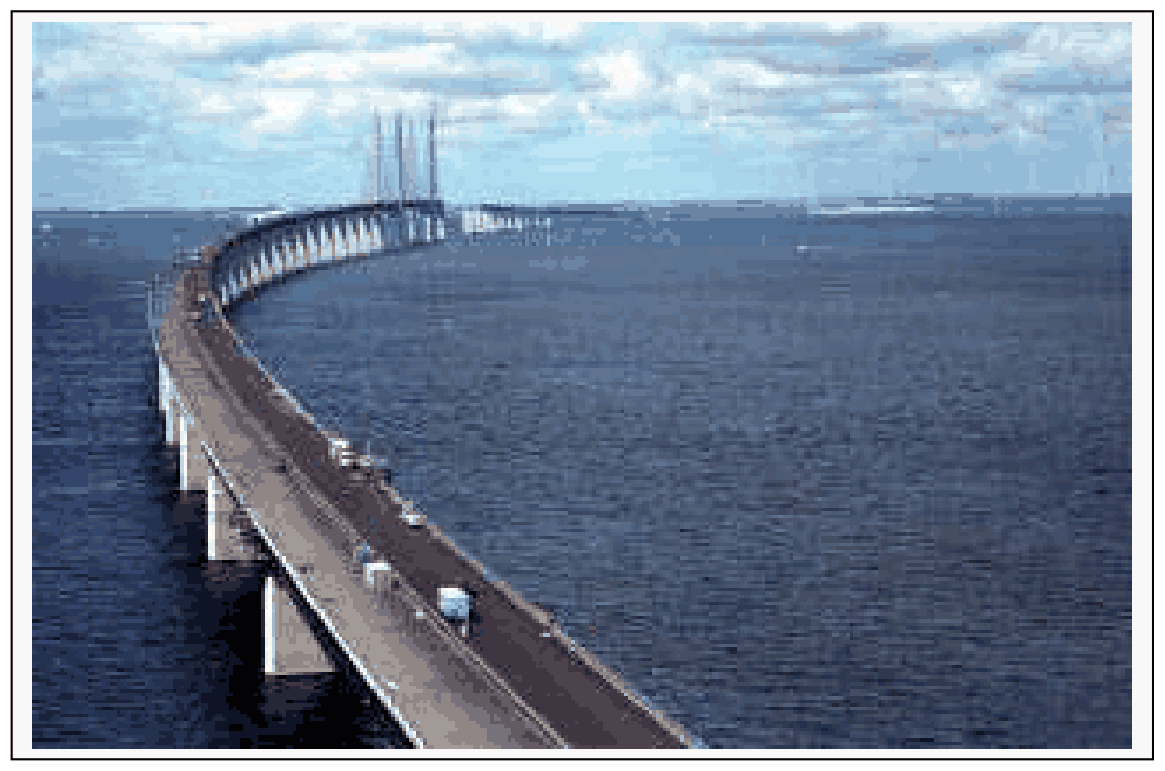
On July 1, 2000, the combined tunnel and bridge connecting Denmark and Sweden was officially opened. It consists of a tunnel from Copenhagen to an artificial island, and a bridge from the island to Malmö in Sweden. The major construction materials employed are concrete and steel. This problem deals with chemical reactions relating to production and degradation of such materials.
Concrete is produced from a mixture of cement, water, sand and small stones. Cement consists primarily of calcium silicates and calcium aluminates formed by heating and grinding of clay and limestone. In the later steps of cement production a small amount of gypsum, \(\ce{CaSO4 * 2H2O}\), is added to improve subsequent hardening of the concrete. The use of elevated temperatures during the final production may lead to formation of unwanted hemihydrate, \(\ce{CaSO4 * 1/2H2O}\). Consider the following reaction:

The following thermodynamic data apply at 25 °C, standard pressure: 1.00 bar:
| Compound | \(\Delta_{\mathrm f}H^\circ\) (\(\mathrm{kJ\,mol^{-1}}\)) | \(S^\circ\) (\(\mathrm{J\,K^{-1}\,mol^{-1}}\)) |
|---|---|---|
| \(\ce{CaSO4 * 2H2O(s)}\) | −2021.0 | 194.0 |
| \(\ce{CaSO4 * 1/2H2O(s)}\) | −1575.0 | 130.5 |
| \(\ce{H2O(g)}\) | −241.8 | 188.6 |
Gas constant: \(R=8.314\ \mathrm{J\,mol^{-1}\,K^{-1}}=0.08314\ \mathrm{L\,bar\,mol^{-1}\,K^{-1}}\)
\(0\ ^\circ\mathrm C=273.15\ \mathrm K.\)
2.1 Calculate \(\Delta H^\circ\) (in kJ) for transformation of 1.00 kg of \(\ce{CaSO4 * 2H2O(s)}\) to hemihydrate \(\ce{CaSO4 * 1/2H2O(s)}\). Is this reaction endothermic or is it exothermic?
2.2 Calculate the equilibrium pressure (in bar) of water vapour in a closed vessel containing \(\ce{CaSO4 * 2H2O(s)}\), \(\ce{CaSO4 * 1/2H2O(s)}\) and \(\ce{H2O(g)}\) at 25 °C.
2.3 Calculate the temperature at which the equilibrium water vapour pressure is 1.00 bar in the system described in problem 2-2. Assume that \(\Delta H^\circ\) and \(\Delta S^\circ\) are temperature independent.
Corrosion of metals is associated with electrochemical reactions. This also applies for the formation of rust on iron surfaces, where the initial electrode reactions usually are:

An electrochemical cell in which these electrode reactions take place is constructed. The temperature is 25 °C. The cell is represented by the following cell diagram:

Standard electrode potentials (at 25 °C):

Nernst factor: \(RT\ln 10/F=0.05916\) volt (at 25 °C)
Faraday constant: \(F=96485\ \mathrm{C\,mol^{-1}}\)
2.4 Calculate the standard electromotive force (the standard cell voltage), \(E^\circ\), at 25 °C.
2.5 Write down the overall reaction which takes place during discharge of the cell under standard conditions.
2.6 Calculate the equilibrium constant at 25 °C for the overall cell reaction.
2.7 The overall reaction referred to above is allowed to proceed for 24 hours under standard conditions and at a constant current of 0.12 A. Calculate the mass of \(\ce{Fe}\) converted to \(\ce{Fe^2+}\) after 24 hours. Oxygen and water may be assumed to be present in excess.
2.8 Calculate \(E\) for the cell at 25 °C for the following conditions :
\[ [\ce{Fe^2+}]=0.015\ \mathrm M,\quad \mathrm{pH}_{\text{right-hand half-cell}}=9.00,\quad p(\ce{O2})=0.700\ \mathrm{bar}. \]
Official English text of the problem.
Answers
- 2.1: \(\boxed{\Delta H^\circ=+484\ \mathrm{kJ}}\) for 1.00 kg of gypsum; the reaction is endothermic.
- 2.2: \(\boxed{p(\ce{H2O})=8.15\times10^{-3}\ \mathrm{bar}}\).
- 2.3: \(\boxed{T=379.7\ \mathrm K=106.5\ ^\circ\mathrm C}\).
- 2.4: \(\boxed{E^\circ=0.84\ \mathrm V}\).
- 2.5: \(\boxed{\ce{2Fe(s) + O2(g) + 2H2O(l) -> 2Fe^2+(aq) + 4OH^-(aq)}}\).
- 2.6: \(\boxed{K=6.2\times10^{56}}\), dimensionless, for the reaction written in 2.5.
- 2.7: \(\boxed{m(\ce{Fe})=3.0\ \mathrm g}\).
- 2.8: \(\boxed{E=1.19\ \mathrm V}\).
Solution
The chemical identities used throughout are:
| Substance or species | Name | SMILES |
|---|---|---|
| \(\ce{CaSO4 * 2H2O}\) | Calcium sulfate dihydrate (gypsum) | [Ca+2].[O-]S(=O)(=O)[O-].O.O |
| \(\ce{CaSO4 * 1/2H2O}\) | Calcium sulfate hemihydrate | [Ca+2].[O-]S(=O)(=O)[O-].[Ca+2].[O-]S(=O)(=O)[O-].O |
| \(\ce{H2O}\) | Water | O |
| \(\ce{O2}\) | Dioxygen | O=O |
| \(\ce{Fe^2+}\) | Iron(II) ion | [Fe+2] |
| \(\ce{OH^-}\) | Hydroxide ion | [OH-] |
| \(\ce{Fe}\) | Iron | [Fe] |
| \(\ce{Pt}\) | Platinum | [Pt] |
The hydrate SMILES specify components, not crystal packing or coordination geometry. The hemihydrate entry represents two formula units, giving one water molecule. Atom SMILES do not describe metallic lattices, and SMILES do not specify physical phases.
2.1
The dehydration reaction is
\[ \ce{CaSO4 * 2H2O(s) -> CaSO4 * 1/2H2O(s) + 3/2 H2O(g)}. \]
Using formation enthalpies,
\[ \begin{aligned} \Delta_{\mathrm r}H^\circ &=\sum\nu\Delta_{\mathrm f}H^\circ_{\text{products}} -\sum\nu\Delta_{\mathrm f}H^\circ_{\text{reactants}}\\ &=(-1575.0)+\frac32(-241.8)-(-2021.0)\\ &=+83.3\ \mathrm{kJ\,mol^{-1}}. \end{aligned} \]
Using conventional atomic molar masses,
\[ M(\ce{CaSO4 * 2H2O}) =40.08+32.06+4(16.00)+2[2(1.008)+16.00] =172.172\ \mathrm{g\,mol^{-1}}. \]
Therefore,
\[ n=\frac{1000\ \mathrm g}{172.172\ \mathrm{g\,mol^{-1}}} =5.808\ \mathrm{mol}, \]
and
\[ \Delta H^\circ =(5.808\ \mathrm{mol})(83.3\ \mathrm{kJ\,mol^{-1}}) =\boxed{+484\ \mathrm{kJ}}. \]
The positive enthalpy change means that heat is absorbed: the reaction is endothermic.
2.2
For the same reaction,
\[ \begin{aligned} \Delta_{\mathrm r}S^\circ &=130.5+\frac32(188.6)-194.0\\ &=219.4\ \mathrm{J\,K^{-1}\,mol^{-1}}. \end{aligned} \]
At \(T=298.15\ \mathrm K\),
\[ \begin{aligned} \Delta_{\mathrm r}G^\circ &=\Delta_{\mathrm r}H^\circ-T\Delta_{\mathrm r}S^\circ\\ &=83300-(298.15)(219.4)\\ &=17885.9\ \mathrm{J\,mol^{-1}}. \end{aligned} \]
Hence the dimensionless equilibrium constant is
\[ K_p=\exp\left(-\frac{\Delta_{\mathrm r}G^\circ}{RT}\right) =\exp\left[-\frac{17885.9}{(8.314)(298.15)}\right] =7.35\times10^{-4}. \]
Both pure solids have unit activity. Treating the vapour as an ideal gas,
\[ K_p=\left(\frac{p(\ce{H2O})}{p^\circ}\right)^{3/2}, \qquad p^\circ=1.00\ \mathrm{bar}. \]
Thus,
\[ p(\ce{H2O}) =p^\circ K_p^{2/3} =(1.00\ \mathrm{bar})(7.35\times10^{-4})^{2/3} =\boxed{8.15\times10^{-3}\ \mathrm{bar}}. \]
2.3
When the equilibrium water vapour pressure equals the standard pressure,
\[ K_p=\left(\frac{1.00\ \mathrm{bar}}{1.00\ \mathrm{bar}}\right)^{3/2}=1. \]
Consequently, \(\Delta_{\mathrm r}G^\circ=-RT\ln K_p=0\). With temperature-independent enthalpy and entropy,
\[ 0=\Delta_{\mathrm r}H^\circ-T\Delta_{\mathrm r}S^\circ, \]
so
\[ T=\frac{\Delta_{\mathrm r}H^\circ}{\Delta_{\mathrm r}S^\circ} =\frac{83300\ \mathrm{J\,mol^{-1}}} {219.4\ \mathrm{J\,K^{-1}\,mol^{-1}}} =379.67\ \mathrm K. \]
Therefore,
\[ \boxed{T=379.7\ \mathrm K=106.5\ ^\circ\mathrm C}. \]
2.4
The oxygen reduction couple has the more positive standard reduction potential, so oxygen is reduced at the cathode:
\[ \ce{O2(g) + 2H2O(l) + 4e^- -> 4OH^-(aq)}, \qquad E^\circ_{\text{cathode}}=+0.40\ \mathrm V. \]
Iron is oxidized at the anode:
\[ \ce{Fe(s) -> Fe^2+(aq) + 2e^-}. \]
The tabulated reduction potential for the iron couple is \(-0.44\ \mathrm V\). Thus,
\[ E^\circ_{\text{cell}} =E^\circ_{\text{cathode}}-E^\circ_{\text{anode, reduction}} =0.40-(-0.44) =\boxed{0.84\ \mathrm V}. \]
Electrode potentials are not multiplied when half-reactions are multiplied to balance electrons.
2.5
Multiplying the iron oxidation half-reaction by two gives
\[ \ce{2Fe(s) -> 2Fe^2+(aq) + 4e^-}. \]
Adding the oxygen reduction half-reaction cancels four electrons:
\[ \boxed{\ce{2Fe(s) + O2(g) + 2H2O(l) -> 2Fe^2+(aq) + 4OH^-(aq)}}. \]
Both atoms and total charge are balanced. The positive standard cell voltage establishes this as the spontaneous discharge direction under standard conditions.
2.6
For the overall reaction as written in 2.5, \(n=4\) mol of electrons are transferred per mole of reaction. Combining
\[ \Delta_{\mathrm r}G^\circ=-nFE^\circ \quad\text{and}\quad \Delta_{\mathrm r}G^\circ=-RT\ln K \]
gives
\[ \log_{10}K =\frac{nFE^\circ}{RT\ln10} =\frac{nE^\circ}{0.05916\ \mathrm V}. \]
Therefore,
\[ \log_{10}K =\frac{4(0.84)}{0.05916} =56.795, \]
and
\[ \boxed{K=10^{56.795}\approx6.2\times10^{56}}. \]
This dimensionless value corresponds specifically to the equation with two iron atoms in 2.5.
2.7
The charge passed is
\[ q=It =(0.12\ \mathrm{C\,s^{-1}})(24\times3600\ \mathrm s) =10368\ \mathrm C. \]
Each mole of iron converted to iron(II) releases two moles of electrons, so
\[ n(\ce{Fe}) =\frac{q}{2F} =\frac{10368\ \mathrm C} {2(96485\ \mathrm{C\,mol^{-1}})} =0.0537286\ \mathrm{mol}. \]
Using \(M(\ce{Fe})=55.85\ \mathrm{g\,mol^{-1}}\),
\[ m(\ce{Fe}) =(0.0537286)(55.85)\ \mathrm g =3.0007\ \mathrm g. \]
To the precision of the current,
\[ \boxed{m(\ce{Fe})=3.0\ \mathrm g}. \]
2.8
At 25 °C, using \(\mathrm{p}K_{\mathrm w}=14.00\),
\[ \mathrm{pOH}=14.00-\mathrm{pH}=14.00-9.00=5.00, \]
so
\[ [\ce{OH^-}]=10^{-5.00}\ \mathrm{mol\,L^{-1}}. \]
For the overall reaction in 2.5, the reaction quotient is
\[ Q= \frac{a(\ce{Fe^2+})^2a(\ce{OH^-})^4} {p(\ce{O2})/p^\circ}. \]
Pure iron and liquid water have unit activity. Approximating dissolved-ion activities by their concentrations divided by \(c^\circ=1\ \mathrm{mol\,L^{-1}}\),
\[ Q=\frac{(0.015)^2(10^{-5})^4}{0.700} =3.2143\times10^{-24}. \]
The Nernst equation, with \(n=4\), gives
\[ \begin{aligned} E &=E^\circ-\frac{0.05916\ \mathrm V}{4}\log_{10}Q\\ &=0.84\ \mathrm V -\frac{0.05916\ \mathrm V}{4} \log_{10}(3.2143\times10^{-24})\\ &=0.84\ \mathrm V+0.34746\ \mathrm V\\ &=1.18746\ \mathrm V. \end{aligned} \]
Thus,
\[ \boxed{E=1.19\ \mathrm V}. \]
The solution was checked against the official solution.
IChO 2000 · Theorieaufgabe 2
Brücke zwischen Dänemark und Schweden
Am 1. Juli 2000 wurde die kombinierte Tunnel- und Brückenverbindung zwischen Dänemark und Schweden offiziell eröffnet. Sie besteht aus einem Tunnel von Kopenhagen zu einer künstlichen Insel und einer Brücke von der Insel nach Malmö in Schweden. Die hauptsächlich verwendeten Baustoffe sind Beton und Stahl. Diese Aufgabe behandelt chemische Reaktionen im Zusammenhang mit der Herstellung und dem Abbau solcher Materialien.
Beton wird aus einer Mischung aus Zement, Wasser, Sand und kleinen Steinen hergestellt. Zement besteht hauptsächlich aus Calciumsilicaten und Calciumaluminaten, die durch Erhitzen und Mahlen von Ton und Kalkstein gebildet werden. In den späteren Schritten der Zementherstellung wird eine geringe Menge Gips, \(\ce{CaSO4 * 2H2O}\), zugesetzt, um die anschließende Erhärtung des Betons zu verbessern. Erhöhte Temperaturen in der abschließenden Herstellungsphase können zur Bildung von unerwünschtem Halbhydrat, \(\ce{CaSO4 * 1/2H2O}\), führen. Betrachten Sie die folgende Reaktion:
Die folgenden thermodynamischen Daten gelten bei 25 °C und einem Standarddruck von 1.00 bar:
| Verbindung | \(\Delta_{\mathrm f}H^\circ\) (\(\mathrm{kJ\,mol^{-1}}\)) | \(S^\circ\) (\(\mathrm{J\,K^{-1}\,mol^{-1}}\)) |
|---|---|---|
| \(\ce{CaSO4 * 2H2O(s)}\) | −2021.0 | 194.0 |
| \(\ce{CaSO4 * 1/2H2O(s)}\) | −1575.0 | 130.5 |
| \(\ce{H2O(g)}\) | −241.8 | 188.6 |
Gaskonstante: \(R=8.314\ \mathrm{J\,mol^{-1}\,K^{-1}}=0.08314\ \mathrm{L\,bar\,mol^{-1}\,K^{-1}}\)
\(0\ ^\circ\mathrm C=273.15\ \mathrm K.\)
2.1 Berechnen Sie \(\Delta H^\circ\) (in kJ) für die Umwandlung von 1.00 kg \(\ce{CaSO4 * 2H2O(s)}\) in das Halbhydrat \(\ce{CaSO4 * 1/2H2O(s)}\). Ist diese Reaktion endotherm oder exotherm?
2.2 Berechnen Sie den Gleichgewichtsdruck (in bar) des Wasserdampfs in einem geschlossenen Gefäß, das bei 25 °C \(\ce{CaSO4 * 2H2O(s)}\), \(\ce{CaSO4 * 1/2H2O(s)}\) und \(\ce{H2O(g)}\) enthält.
2.3 Berechnen Sie die Temperatur, bei der der Gleichgewichtsdruck des Wasserdampfs in dem in Aufgabe 2-2 beschriebenen System 1.00 bar beträgt. Nehmen Sie an, dass \(\Delta H^\circ\) und \(\Delta S^\circ\) temperaturunabhängig sind.
Die Korrosion von Metallen ist mit elektrochemischen Reaktionen verbunden. Dies gilt auch für die Rostbildung auf Eisenoberflächen, bei der die anfänglichen Elektrodenreaktionen gewöhnlich wie folgt lauten:
Es wird eine elektrochemische Zelle aufgebaut, in der diese Elektrodenreaktionen ablaufen. Die Temperatur beträgt 25 °C. Die Zelle wird durch das folgende Zellendiagramm dargestellt:
Standardelektrodenpotentiale (bei 25 °C):
Nernst-Faktor: \(RT\ln 10/F=0.05916\) Volt (bei 25 °C)
Faraday-Konstante: \(F=96485\ \mathrm{C\,mol^{-1}}\)
2.4 Berechnen Sie die elektromotorische Kraft unter Standardbedingungen (die Standardzellspannung), \(E^\circ\), bei 25 °C.
2.5 Geben Sie die Gesamtreaktion an, die bei der Entladung der Zelle unter Standardbedingungen abläuft.
2.6 Berechnen Sie die Gleichgewichtskonstante der Gesamtreaktion der Zelle bei 25 °C.
2.7 Die oben genannte Gesamtreaktion läuft 24 Stunden lang unter Standardbedingungen und bei einer konstanten Stromstärke von 0.12 A ab. Berechnen Sie die Masse an \(\ce{Fe}\), die nach 24 Stunden in \(\ce{Fe^2+}\) umgewandelt worden ist. Sauerstoff und Wasser können als im Überschuss vorhanden angenommen werden.
2.8 Berechnen Sie \(E\) für die Zelle bei 25 °C unter den folgenden Bedingungen:
\[ [\ce{Fe^2+}]=0.015\ \mathrm M,\quad \mathrm{pH}_{\text{rechte Halbzelle}}=9.00,\quad p(\ce{O2})=0.700\ \mathrm{bar}. \]
Aufgabentext aus dem offiziellen englischen Text übersetzt.
Antworten
- 2.1: \(\boxed{\Delta H^\circ=+484\ \mathrm{kJ}}\) für 1.00 kg Gips; die Reaktion ist endotherm.
- 2.2: \(\boxed{p(\ce{H2O})=8.15\times10^{-3}\ \mathrm{bar}}\).
- 2.3: \(\boxed{T=379.7\ \mathrm K=106.5\ ^\circ\mathrm C}\).
- 2.4: \(\boxed{E^\circ=0.84\ \mathrm V}\).
- 2.5: \(\boxed{\ce{2Fe(s) + O2(g) + 2H2O(l) -> 2Fe^2+(aq) + 4OH^-(aq)}}\).
- 2.6: \(\boxed{K=6.2\times10^{56}}\), dimensionslos, für die in 2.5 angegebene Reaktion.
- 2.7: \(\boxed{m(\ce{Fe})=3.0\ \mathrm g}\).
- 2.8: \(\boxed{E=1.19\ \mathrm V}\).
Lösung
Die im gesamten Text verwendeten Stoffe und Spezies sind:
| Stoff oder Spezies | Name | SMILES |
|---|---|---|
| \(\ce{CaSO4 * 2H2O}\) | Calciumsulfat-Dihydrat (Gips) | [Ca+2].[O-]S(=O)(=O)[O-].O.O |
| \(\ce{CaSO4 * 1/2H2O}\) | Calciumsulfat-Halbhydrat | [Ca+2].[O-]S(=O)(=O)[O-].[Ca+2].[O-]S(=O)(=O)[O-].O |
| \(\ce{H2O}\) | Wasser | O |
| \(\ce{O2}\) | Disauerstoff | O=O |
| \(\ce{Fe^2+}\) | Eisen(II)-Ion | [Fe+2] |
| \(\ce{OH^-}\) | Hydroxid-Ion | [OH-] |
| \(\ce{Fe}\) | Eisen | [Fe] |
| \(\ce{Pt}\) | Platin | [Pt] |
Die SMILES der Hydrate geben die Bestandteile an, nicht die Kristallpackung oder die Koordinationsgeometrie. Der Eintrag für das Halbhydrat stellt zwei Formeleinheiten dar, sodass sich ein Wassermolekül ergibt. Atom-SMILES beschreiben keine Metallgitter, und SMILES geben keine physikalischen Phasen an.
2.1
Die Dehydratisierungsreaktion lautet
\[ \ce{CaSO4 * 2H2O(s) -> CaSO4 * 1/2H2O(s) + 3/2 H2O(g)}. \]
Mit den Bildungsenthalpien ergibt sich
\[ \begin{aligned} \Delta_{\mathrm r}H^\circ &=\sum\nu\Delta_{\mathrm f}H^\circ_{\text{Produkte}} -\sum\nu\Delta_{\mathrm f}H^\circ_{\text{Edukte}}\\ &=(-1575.0)+\frac32(-241.8)-(-2021.0)\\ &=+83.3\ \mathrm{kJ\,mol^{-1}}. \end{aligned} \]
Mit den üblichen molaren Atommassen gilt
\[ M(\ce{CaSO4 * 2H2O}) =40.08+32.06+4(16.00)+2[2(1.008)+16.00] =172.172\ \mathrm{g\,mol^{-1}}. \]
Daher ist
\[ n=\frac{1000\ \mathrm g}{172.172\ \mathrm{g\,mol^{-1}}} =5.808\ \mathrm{mol}, \]
und
\[ \Delta H^\circ =(5.808\ \mathrm{mol})(83.3\ \mathrm{kJ\,mol^{-1}}) =\boxed{+484\ \mathrm{kJ}}. \]
Die positive Enthalpieänderung bedeutet, dass Wärme aufgenommen wird: Die Reaktion ist endotherm.
2.2
Für dieselbe Reaktion gilt
\[ \begin{aligned} \Delta_{\mathrm r}S^\circ &=130.5+\frac32(188.6)-194.0\\ &=219.4\ \mathrm{J\,K^{-1}\,mol^{-1}}. \end{aligned} \]
Bei \(T=298.15\ \mathrm K\) gilt
\[ \begin{aligned} \Delta_{\mathrm r}G^\circ &=\Delta_{\mathrm r}H^\circ-T\Delta_{\mathrm r}S^\circ\\ &=83300-(298.15)(219.4)\\ &=17885.9\ \mathrm{J\,mol^{-1}}. \end{aligned} \]
Damit beträgt die dimensionslose Gleichgewichtskonstante
\[ K_p=\exp\left(-\frac{\Delta_{\mathrm r}G^\circ}{RT}\right) =\exp\left[-\frac{17885.9}{(8.314)(298.15)}\right] =7.35\times10^{-4}. \]
Beide reinen Feststoffe haben die Aktivität eins. Wird der Dampf als ideales Gas behandelt, gilt
\[ K_p=\left(\frac{p(\ce{H2O})}{p^\circ}\right)^{3/2}, \qquad p^\circ=1.00\ \mathrm{bar}. \]
Somit ist
\[ p(\ce{H2O}) =p^\circ K_p^{2/3} =(1.00\ \mathrm{bar})(7.35\times10^{-4})^{2/3} =\boxed{8.15\times10^{-3}\ \mathrm{bar}}. \]
2.3
Wenn der Gleichgewichtsdruck des Wasserdampfs dem Standarddruck entspricht, gilt
\[ K_p=\left(\frac{1.00\ \mathrm{bar}}{1.00\ \mathrm{bar}}\right)^{3/2}=1. \]
Folglich ist \(\Delta_{\mathrm r}G^\circ=-RT\ln K_p=0\). Bei temperaturunabhängiger Enthalpie und Entropie gilt
\[ 0=\Delta_{\mathrm r}H^\circ-T\Delta_{\mathrm r}S^\circ, \]
also
\[ T=\frac{\Delta_{\mathrm r}H^\circ}{\Delta_{\mathrm r}S^\circ} =\frac{83300\ \mathrm{J\,mol^{-1}}} {219.4\ \mathrm{J\,K^{-1}\,mol^{-1}}} =379.67\ \mathrm K. \]
Daher ist
\[ \boxed{T=379.7\ \mathrm K=106.5\ ^\circ\mathrm C}. \]
2.4
Das Redoxpaar der Sauerstoffreduktion hat das positivere Standardreduktionspotential, daher wird Sauerstoff an der Kathode reduziert:
\[ \ce{O2(g) + 2H2O(l) + 4e^- -> 4OH^-(aq)}, \qquad E^\circ_{\text{Kathode}}=+0.40\ \mathrm V. \]
Eisen wird an der Anode oxidiert:
\[ \ce{Fe(s) -> Fe^2+(aq) + 2e^-}. \]
Das tabellierte Reduktionspotential des Eisen-Redoxpaars beträgt \(-0.44\ \mathrm V\). Somit gilt
\[ E^\circ_{\text{Zelle}} =E^\circ_{\text{Kathode}}-E^\circ_{\text{Anode, Reduktion}} =0.40-(-0.44) =\boxed{0.84\ \mathrm V}. \]
Elektrodenpotentiale werden nicht mitmultipliziert, wenn Teilreaktionen zum Elektronenausgleich multipliziert werden.
2.5
Die Multiplikation der Teilreaktion der Eisenoxidation mit zwei ergibt
\[ \ce{2Fe(s) -> 2Fe^2+(aq) + 4e^-}. \]
Beim Addieren der Teilreaktion der Sauerstoffreduktion kürzen sich vier Elektronen heraus:
\[ \boxed{\ce{2Fe(s) + O2(g) + 2H2O(l) -> 2Fe^2+(aq) + 4OH^-(aq)}}. \]
Sowohl die Atombilanz als auch die Gesamtladungsbilanz sind ausgeglichen. Die positive Standardzellspannung zeigt, dass dies die spontane Entladungsrichtung unter Standardbedingungen ist.
2.6
Für die in 2.5 angegebene Gesamtreaktion werden pro Mol Reaktionsumsatz \(n=4\) mol Elektronen übertragen. Die Kombination von
\[ \Delta_{\mathrm r}G^\circ=-nFE^\circ \quad\text{und}\quad \Delta_{\mathrm r}G^\circ=-RT\ln K \]
ergibt
\[ \log_{10}K =\frac{nFE^\circ}{RT\ln10} =\frac{nE^\circ}{0.05916\ \mathrm V}. \]
Daher gilt
\[ \log_{10}K =\frac{4(0.84)}{0.05916} =56.795, \]
und
\[ \boxed{K=10^{56.795}\approx6.2\times10^{56}}. \]
Dieser dimensionslose Wert bezieht sich ausdrücklich auf die Gleichung mit zwei Eisenatomen in 2.5.
2.7
Die geflossene Ladung beträgt
\[ q=It =(0.12\ \mathrm{C\,s^{-1}})(24\times3600\ \mathrm s) =10368\ \mathrm C. \]
Jedes Mol Eisen, das in Eisen(II) umgewandelt wird, setzt zwei Mol Elektronen frei, also gilt
\[ n(\ce{Fe}) =\frac{q}{2F} =\frac{10368\ \mathrm C} {2(96485\ \mathrm{C\,mol^{-1}})} =0.0537286\ \mathrm{mol}. \]
Mit \(M(\ce{Fe})=55.85\ \mathrm{g\,mol^{-1}}\) ergibt sich
\[ m(\ce{Fe}) =(0.0537286)(55.85)\ \mathrm g =3.0007\ \mathrm g. \]
Entsprechend der Genauigkeit der Stromstärke ist
\[ \boxed{m(\ce{Fe})=3.0\ \mathrm g}. \]
2.8
Bei 25 °C gilt mit \(\mathrm{p}K_{\mathrm w}=14.00\)
\[ \mathrm{pOH}=14.00-\mathrm{pH}=14.00-9.00=5.00, \]
also
\[ [\ce{OH^-}]=10^{-5.00}\ \mathrm{mol\,L^{-1}}. \]
Für die Gesamtreaktion in 2.5 lautet der Reaktionsquotient
\[ Q= \frac{a(\ce{Fe^2+})^2a(\ce{OH^-})^4} {p(\ce{O2})/p^\circ}. \]
Reines Eisen und flüssiges Wasser haben die Aktivität eins. Werden die Aktivitäten der gelösten Ionen durch ihre Konzentrationen geteilt durch \(c^\circ=1\ \mathrm{mol\,L^{-1}}\) angenähert, ergibt sich
\[ Q=\frac{(0.015)^2(10^{-5})^4}{0.700} =3.2143\times10^{-24}. \]
Die Nernst-Gleichung ergibt mit \(n=4\)
\[ \begin{aligned} E &=E^\circ-\frac{0.05916\ \mathrm V}{4}\log_{10}Q\\ &=0.84\ \mathrm V -\frac{0.05916\ \mathrm V}{4} \log_{10}(3.2143\times10^{-24})\\ &=0.84\ \mathrm V+0.34746\ \mathrm V\\ &=1.18746\ \mathrm V. \end{aligned} \]
Somit ist
\[ \boxed{E=1.19\ \mathrm V}. \]
Die Lösung wurde mit der offiziellen Lösung abgeglichen.
IChO 2000 · Teori sorusu 2
Danimarka ile İsveç arasındaki köprü
1 Temmuz 2000 tarihinde, Danimarka ile İsveç'i birbirine bağlayan tünel ve köprü bağlantısı resmen açılmıştır. Bu bağlantı, Kopenhag'dan yapay bir adaya uzanan bir tünelden ve bu adadan İsveç'teki Malmö'ye uzanan bir köprüden oluşmaktadır. Kullanılan başlıca yapı malzemeleri beton ve çeliktir. Bu soru, bu malzemelerin üretimi ve bozunmasıyla ilgili kimyasal tepkimeleri ele almaktadır.
Beton; çimento, su, kum ve küçük taşların karışımından üretilir. Çimento esas olarak kil ve kireç taşının ısıtılması ve öğütülmesiyle oluşan kalsiyum silikatlar ve kalsiyum alüminatlardan oluşur. Çimento üretiminin sonraki aşamalarında, betonun daha sonraki sertleşmesini iyileştirmek amacıyla az miktarda jips, \(\ce{CaSO4 * 2H2O}\), eklenir. Üretimin son aşamasında yüksek sıcaklıkların kullanılması, istenmeyen hemihidratın, \(\ce{CaSO4 * 1/2H2O}\), oluşmasına yol açabilir. Aşağıdaki tepkimeyi ele alınız:
Aşağıdaki termodinamik veriler 25 °C'de ve 1.00 bar standart basınçta geçerlidir:
| Bileşik | \(\Delta_{\mathrm f}H^\circ\) (\(\mathrm{kJ\,mol^{-1}}\)) | \(S^\circ\) (\(\mathrm{J\,K^{-1}\,mol^{-1}}\)) |
|---|---|---|
| \(\ce{CaSO4 * 2H2O(s)}\) | −2021.0 | 194.0 |
| \(\ce{CaSO4 * 1/2H2O(s)}\) | −1575.0 | 130.5 |
| \(\ce{H2O(g)}\) | −241.8 | 188.6 |
Gaz sabiti: \(R=8.314\ \mathrm{J\,mol^{-1}\,K^{-1}}=0.08314\ \mathrm{L\,bar\,mol^{-1}\,K^{-1}}\)
\(0\ ^\circ\mathrm C=273.15\ \mathrm K.\)
2.1 1.00 kg \(\ce{CaSO4 * 2H2O(s)}\)'ın hemihidrata, \(\ce{CaSO4 * 1/2H2O(s)}\), dönüşümü için \(\Delta H^\circ\) değerini (kJ cinsinden) hesaplayınız. Bu tepkime endotermik midir, yoksa ekzotermik midir?
2.2 25 °C'de \(\ce{CaSO4 * 2H2O(s)}\), \(\ce{CaSO4 * 1/2H2O(s)}\) ve \(\ce{H2O(g)}\) içeren kapalı bir kaptaki su buharının denge basıncını (bar cinsinden) hesaplayınız.
2.3 2-2 numaralı soruda tanımlanan sistemde, su buharının denge basıncının 1.00 bar olduğu sıcaklığı hesaplayınız. \(\Delta H^\circ\) ve \(\Delta S^\circ\) değerlerinin sıcaklıktan bağımsız olduğunu varsayınız.
Metallerin korozyonu elektrokimyasal tepkimelerle ilişkilidir. Bu durum, demir yüzeylerinde pas oluşumu için de geçerlidir; burada başlangıçtaki elektrot tepkimeleri genellikle şöyledir:
Bu elektrot tepkimelerinin gerçekleştiği bir elektrokimyasal hücre kurulmuştur. Sıcaklık 25 °C'dir. Hücre, aşağıdaki hücre şemasıyla gösterilmektedir:
Standart elektrot potansiyelleri (25 °C'de):
Nernst çarpanı: \(RT\ln 10/F=0.05916\) volt (25 °C'de)
Faraday sabiti: \(F=96485\ \mathrm{C\,mol^{-1}}\)
2.4 25 °C'deki standart elektromotor kuvveti (standart hücre gerilimini), \(E^\circ\), hesaplayınız.
2.5 Hücrenin standart koşullar altında boşalması sırasında gerçekleşen toplam tepkimeyi yazınız.
2.6 Toplam hücre tepkimesi için 25 °C'deki denge sabitini hesaplayınız.
2.7 Yukarıda belirtilen toplam tepkimenin standart koşullar altında ve 0.12 A sabit akımla 24 saat boyunca gerçekleşmesine izin verilmektedir. 24 saat sonunda \(\ce{Fe^2+}\)'ye dönüşen \(\ce{Fe}\)'in kütlesini hesaplayınız. Oksijen ve suyun aşırı miktarda bulunduğu varsayılabilir.
2.8 Aşağıdaki koşullarda, 25 °C'deki hücre için \(E\) değerini hesaplayınız:
\[ [\ce{Fe^2+}]=0.015\ \mathrm M,\quad \mathrm{pH}_{\text{sağ yarı hücre}}=9.00,\quad p(\ce{O2})=0.700\ \mathrm{bar}. \]
Soru metni resmi İngilizce metinden çevrilmiştir.
Cevaplar
- 2.1: 1.00 kg jips için \(\boxed{\Delta H^\circ=+484\ \mathrm{kJ}}\); tepkime endotermiktir.
- 2.2: \(\boxed{p(\ce{H2O})=8.15\times10^{-3}\ \mathrm{bar}}\).
- 2.3: \(\boxed{T=379.7\ \mathrm K=106.5\ ^\circ\mathrm C}\).
- 2.4: \(\boxed{E^\circ=0.84\ \mathrm V}\).
- 2.5: \(\boxed{\ce{2Fe(s) + O2(g) + 2H2O(l) -> 2Fe^2+(aq) + 4OH^-(aq)}}\).
- 2.6: 2.5'te yazılan tepkime için boyutsuz denge sabiti \(\boxed{K=6.2\times10^{56}}\).
- 2.7: \(\boxed{m(\ce{Fe})=3.0\ \mathrm g}\).
- 2.8: \(\boxed{E=1.19\ \mathrm V}\).
Çözüm
Metin boyunca kullanılan maddelerin ve türlerin kimyasal kimlikleri şöyledir:
| Madde veya tür | Adı | SMILES |
|---|---|---|
| \(\ce{CaSO4 * 2H2O}\) | Kalsiyum sülfat dihidrat (jips) | [Ca+2].[O-]S(=O)(=O)[O-].O.O |
| \(\ce{CaSO4 * 1/2H2O}\) | Kalsiyum sülfat hemihidrat | [Ca+2].[O-]S(=O)(=O)[O-].[Ca+2].[O-]S(=O)(=O)[O-].O |
| \(\ce{H2O}\) | Su | O |
| \(\ce{O2}\) | Dioksijen | O=O |
| \(\ce{Fe^2+}\) | Demir(II) iyonu | [Fe+2] |
| \(\ce{OH^-}\) | Hidroksit iyonu | [OH-] |
| \(\ce{Fe}\) | Demir | [Fe] |
| \(\ce{Pt}\) | Platin | [Pt] |
Hidratların SMILES gösterimleri, kristal örgüdeki yerleşimi veya koordinasyon geometrisini değil, bileşenleri belirtir. Hemihidrat için verilen gösterim, bir su molekülü içerecek şekilde iki formül birimini temsil eder. Atom SMILES gösterimleri metalik örgüleri tanımlamaz ve SMILES gösterimleri fiziksel fazları belirtmez.
2.1
Dehidrasyon tepkimesi şöyledir:
\[ \ce{CaSO4 * 2H2O(s) -> CaSO4 * 1/2H2O(s) + 3/2 H2O(g)}. \]
Oluşum entalpileri kullanıldığında,
\[ \begin{aligned} \Delta_{\mathrm r}H^\circ &=\sum\nu\Delta_{\mathrm f}H^\circ_{\text{ürünler}} -\sum\nu\Delta_{\mathrm f}H^\circ_{\text{girenler}}\\ &=(-1575.0)+\frac32(-241.8)-(-2021.0)\\ &=+83.3\ \mathrm{kJ\,mol^{-1}}. \end{aligned} \]
Yaygın olarak kullanılan atomik molar kütlelerle,
\[ M(\ce{CaSO4 * 2H2O}) =40.08+32.06+4(16.00)+2[2(1.008)+16.00] =172.172\ \mathrm{g\,mol^{-1}}. \]
Dolayısıyla,
\[ n=\frac{1000\ \mathrm g}{172.172\ \mathrm{g\,mol^{-1}}} =5.808\ \mathrm{mol}, \]
ve
\[ \Delta H^\circ =(5.808\ \mathrm{mol})(83.3\ \mathrm{kJ\,mol^{-1}}) =\boxed{+484\ \mathrm{kJ}}. \]
Entalpi değişiminin pozitif olması, ısı alındığı anlamına gelir: tepkime endotermiktir.
2.2
Aynı tepkime için,
\[ \begin{aligned} \Delta_{\mathrm r}S^\circ &=130.5+\frac32(188.6)-194.0\\ &=219.4\ \mathrm{J\,K^{-1}\,mol^{-1}}. \end{aligned} \]
\(T=298.15\ \mathrm K\) sıcaklığında,
\[ \begin{aligned} \Delta_{\mathrm r}G^\circ &=\Delta_{\mathrm r}H^\circ-T\Delta_{\mathrm r}S^\circ\\ &=83300-(298.15)(219.4)\\ &=17885.9\ \mathrm{J\,mol^{-1}}. \end{aligned} \]
Buna göre boyutsuz denge sabiti şöyledir:
\[ K_p=\exp\left(-\frac{\Delta_{\mathrm r}G^\circ}{RT}\right) =\exp\left[-\frac{17885.9}{(8.314)(298.15)}\right] =7.35\times10^{-4}. \]
Her iki saf katının da aktivitesi birdir. Buhar ideal gaz olarak ele alındığında,
\[ K_p=\left(\frac{p(\ce{H2O})}{p^\circ}\right)^{3/2}, \qquad p^\circ=1.00\ \mathrm{bar}. \]
Böylece,
\[ p(\ce{H2O}) =p^\circ K_p^{2/3} =(1.00\ \mathrm{bar})(7.35\times10^{-4})^{2/3} =\boxed{8.15\times10^{-3}\ \mathrm{bar}}. \]
2.3
Su buharının denge basıncı standart basınca eşit olduğunda,
\[ K_p=\left(\frac{1.00\ \mathrm{bar}}{1.00\ \mathrm{bar}}\right)^{3/2}=1. \]
Dolayısıyla, \(\Delta_{\mathrm r}G^\circ=-RT\ln K_p=0\). Entalpi ve entropinin sıcaklıktan bağımsız olması durumunda,
\[ 0=\Delta_{\mathrm r}H^\circ-T\Delta_{\mathrm r}S^\circ, \]
buradan
\[ T=\frac{\Delta_{\mathrm r}H^\circ}{\Delta_{\mathrm r}S^\circ} =\frac{83300\ \mathrm{J\,mol^{-1}}} {219.4\ \mathrm{J\,K^{-1}\,mol^{-1}}} =379.67\ \mathrm K. \]
Dolayısıyla,
\[ \boxed{T=379.7\ \mathrm K=106.5\ ^\circ\mathrm C}. \]
2.4
Oksijen indirgenme çiftinin standart indirgenme potansiyeli daha pozitiftir; bu nedenle oksijen katotta indirgenir:
\[ \ce{O2(g) + 2H2O(l) + 4e^- -> 4OH^-(aq)}, \qquad E^\circ_{\text{katot}}=+0.40\ \mathrm V. \]
Demir anotta yükseltgenir:
\[ \ce{Fe(s) -> Fe^2+(aq) + 2e^-}. \]
Demir çifti için tabloda verilen indirgenme potansiyeli \(-0.44\ \mathrm V\)'tur. Böylece,
\[ E^\circ_{\text{hücre}} =E^\circ_{\text{katot}}-E^\circ_{\text{anot, indirgenme}} =0.40-(-0.44) =\boxed{0.84\ \mathrm V}. \]
Elektronları denkleştirmek için yarı tepkimeler bir katsayıyla çarpıldığında, elektrot potansiyelleri bu katsayıyla çarpılmaz.
2.5
Demirin yükseltgenme yarı tepkimesi ikiyle çarpıldığında şu elde edilir:
\[ \ce{2Fe(s) -> 2Fe^2+(aq) + 4e^-}. \]
Oksijenin indirgenme yarı tepkimesi eklendiğinde dört elektron sadeleşir:
\[ \boxed{\ce{2Fe(s) + O2(g) + 2H2O(l) -> 2Fe^2+(aq) + 4OH^-(aq)}}. \]
Hem atomlar hem de toplam yük dengededir. Standart hücre geriliminin pozitif olması, standart koşullar altında kendiliğinden gerçekleşen boşalmanın bu yönde olduğunu gösterir.
2.6
2.5'te yazıldığı biçimiyle toplam tepkimede, tepkimenin her bir molü başına \(n=4\) mol elektron aktarılır. Aşağıdaki bağıntılar birleştirildiğinde,
\[ \Delta_{\mathrm r}G^\circ=-nFE^\circ \quad\text{ve}\quad \Delta_{\mathrm r}G^\circ=-RT\ln K \]
şu elde edilir:
\[ \log_{10}K =\frac{nFE^\circ}{RT\ln10} =\frac{nE^\circ}{0.05916\ \mathrm V}. \]
Dolayısıyla,
\[ \log_{10}K =\frac{4(0.84)}{0.05916} =56.795, \]
ve
\[ \boxed{K=10^{56.795}\approx6.2\times10^{56}}. \]
Bu boyutsuz değer, özellikle 2.5'teki iki demir atomu içeren denkleme karşılık gelir.
2.7
Geçen elektrik yükü şöyledir:
\[ q=It =(0.12\ \mathrm{C\,s^{-1}})(24\times3600\ \mathrm s) =10368\ \mathrm C. \]
Demir(II)'ye dönüşen her bir mol demir iki mol elektron verdiğinden,
\[ n(\ce{Fe}) =\frac{q}{2F} =\frac{10368\ \mathrm C} {2(96485\ \mathrm{C\,mol^{-1}})} =0.0537286\ \mathrm{mol}. \]
\(M(\ce{Fe})=55.85\ \mathrm{g\,mol^{-1}}\) kullanıldığında,
\[ m(\ce{Fe}) =(0.0537286)(55.85)\ \mathrm g =3.0007\ \mathrm g. \]
Akım değerinin hassasiyetine göre,
\[ \boxed{m(\ce{Fe})=3.0\ \mathrm g}. \]
2.8
25 °C'de, \(\mathrm{p}K_{\mathrm w}=14.00\) kullanıldığında,
\[ \mathrm{pOH}=14.00-\mathrm{pH}=14.00-9.00=5.00, \]
buradan
\[ [\ce{OH^-}]=10^{-5.00}\ \mathrm{mol\,L^{-1}}. \]
2.5'teki toplam tepkime için tepkime bölümü şöyledir:
\[ Q= \frac{a(\ce{Fe^2+})^2a(\ce{OH^-})^4} {p(\ce{O2})/p^\circ}. \]
Saf demirin ve sıvı suyun aktiviteleri birdir. Çözünmüş iyonların aktiviteleri, derişimlerinin \(c^\circ=1\ \mathrm{mol\,L^{-1}}\) değerine bölümüyle yaklaşık olarak ifade edildiğinde,
\[ Q=\frac{(0.015)^2(10^{-5})^4}{0.700} =3.2143\times10^{-24}. \]
Nernst denklemi, \(n=4\) için şu sonucu verir:
\[ \begin{aligned} E &=E^\circ-\frac{0.05916\ \mathrm V}{4}\log_{10}Q\\ &=0.84\ \mathrm V -\frac{0.05916\ \mathrm V}{4} \log_{10}(3.2143\times10^{-24})\\ &=0.84\ \mathrm V+0.34746\ \mathrm V\\ &=1.18746\ \mathrm V. \end{aligned} \]
Böylece,
\[ \boxed{E=1.19\ \mathrm V}. \]
Çözüm, resmi çözümle karşılaştırılarak kontrol edildi.
IChO 2000 · Problema teórico 2
Puente entre Dinamarca y Suecia
El 1 de julio de 2000 se inauguró oficialmente la conexión mediante túnel y puente entre Dinamarca y Suecia. Consta de un túnel desde Copenhague hasta una isla artificial y de un puente desde la isla hasta Malmö, en Suecia. Los principales materiales de construcción empleados son el hormigón y el acero. Este problema trata de las reacciones químicas relacionadas con la producción y la degradación de estos materiales.
El hormigón se produce a partir de una mezcla de cemento, agua, arena y piedras pequeñas. El cemento está compuesto principalmente por silicatos de calcio y aluminatos de calcio formados mediante el calentamiento y la molienda de arcilla y piedra caliza. En las últimas etapas de la producción del cemento se añade una pequeña cantidad de yeso, \(\ce{CaSO4 * 2H2O}\), para mejorar el posterior endurecimiento del hormigón. El uso de temperaturas elevadas durante la fase final de producción puede dar lugar a la formación no deseada del hemihidrato, \(\ce{CaSO4 * 1/2H2O}\). Considere la siguiente reacción:
Los siguientes datos termodinámicos corresponden a 25 °C y una presión estándar de 1.00 bar:
| Compuesto | \(\Delta_{\mathrm f}H^\circ\) (\(\mathrm{kJ\,mol^{-1}}\)) | \(S^\circ\) (\(\mathrm{J\,K^{-1}\,mol^{-1}}\)) |
|---|---|---|
| \(\ce{CaSO4 * 2H2O(s)}\) | −2021.0 | 194.0 |
| \(\ce{CaSO4 * 1/2H2O(s)}\) | −1575.0 | 130.5 |
| \(\ce{H2O(g)}\) | −241.8 | 188.6 |
Constante de los gases: \(R=8.314\ \mathrm{J\,mol^{-1}\,K^{-1}}=0.08314\ \mathrm{L\,bar\,mol^{-1}\,K^{-1}}\)
\(0\ ^\circ\mathrm C=273.15\ \mathrm K.\)
2.1 Calcule \(\Delta H^\circ\) (en kJ) para la transformación de 1.00 kg de \(\ce{CaSO4 * 2H2O(s)}\) en el hemihidrato \(\ce{CaSO4 * 1/2H2O(s)}\). ¿Es esta reacción endotérmica o exotérmica?
2.2 Calcule la presión de equilibrio (en bar) del vapor de agua en un recipiente cerrado que contiene \(\ce{CaSO4 * 2H2O(s)}\), \(\ce{CaSO4 * 1/2H2O(s)}\) y \(\ce{H2O(g)}\) a 25 °C.
2.3 Calcule la temperatura a la que la presión de equilibrio del vapor de agua es de 1.00 bar en el sistema descrito en el problema 2-2. Suponga que \(\Delta H^\circ\) y \(\Delta S^\circ\) son independientes de la temperatura.
La corrosión de los metales está asociada a reacciones electroquímicas. Esto también se aplica a la formación de herrumbre en las superficies de hierro, donde las reacciones iniciales de los electrodos suelen ser:
Se construye una celda electroquímica en la que tienen lugar estas reacciones de electrodo. La temperatura es de 25 °C. La celda se representa mediante el siguiente diagrama de celda:
Potenciales estándar de electrodo (a 25 °C):
Factor de Nernst: \(RT\ln 10/F=0.05916\) voltios (a 25 °C)
Constante de Faraday: \(F=96485\ \mathrm{C\,mol^{-1}}\)
2.4 Calcule la fuerza electromotriz estándar (la tensión estándar de la celda), \(E^\circ\), a 25 °C.
2.5 Escriba la reacción global que tiene lugar durante la descarga de la celda en condiciones estándar.
2.6 Calcule la constante de equilibrio a 25 °C para la reacción global de la celda.
2.7 Se deja que la reacción global mencionada anteriormente transcurra durante 24 horas en condiciones estándar y con una corriente constante de 0.12 A. Calcule la masa de \(\ce{Fe}\) convertida en \(\ce{Fe^2+}\) después de 24 horas. Puede suponerse que el oxígeno y el agua están presentes en exceso.
2.8 Calcule \(E\) para la celda a 25 °C en las siguientes condiciones:
\[ [\ce{Fe^2+}]=0.015\ \mathrm M,\quad \mathrm{pH}_{\text{semicelda de la derecha}}=9.00,\quad p(\ce{O2})=0.700\ \mathrm{bar}. \]
Enunciado traducido del texto oficial en inglés.
Respuestas
- 2.1: \(\boxed{\Delta H^\circ=+484\ \mathrm{kJ}}\) para 1.00 kg de yeso; la reacción es endotérmica.
- 2.2: \(\boxed{p(\ce{H2O})=8.15\times10^{-3}\ \mathrm{bar}}\).
- 2.3: \(\boxed{T=379.7\ \mathrm K=106.5\ ^\circ\mathrm C}\).
- 2.4: \(\boxed{E^\circ=0.84\ \mathrm V}\).
- 2.5: \(\boxed{\ce{2Fe(s) + O2(g) + 2H2O(l) -> 2Fe^2+(aq) + 4OH^-(aq)}}\).
- 2.6: \(\boxed{K=6.2\times10^{56}}\), adimensional, para la reacción escrita en 2.5.
- 2.7: \(\boxed{m(\ce{Fe})=3.0\ \mathrm g}\).
- 2.8: \(\boxed{E=1.19\ \mathrm V}\).
Solución
Las identidades químicas utilizadas a lo largo del texto son:
| Sustancia o especie | Nombre | SMILES |
|---|---|---|
| \(\ce{CaSO4 * 2H2O}\) | Sulfato de calcio dihidrato (yeso) | [Ca+2].[O-]S(=O)(=O)[O-].O.O |
| \(\ce{CaSO4 * 1/2H2O}\) | Sulfato de calcio hemihidrato | [Ca+2].[O-]S(=O)(=O)[O-].[Ca+2].[O-]S(=O)(=O)[O-].O |
| \(\ce{H2O}\) | Agua | O |
| \(\ce{O2}\) | Dioxígeno | O=O |
| \(\ce{Fe^2+}\) | Ion hierro(II) | [Fe+2] |
| \(\ce{OH^-}\) | Ion hidróxido | [OH-] |
| \(\ce{Fe}\) | Hierro | [Fe] |
| \(\ce{Pt}\) | Platino | [Pt] |
Los SMILES de los hidratos especifican los componentes, no el empaquetamiento cristalino ni la geometría de coordinación. La entrada del hemihidrato representa dos unidades fórmula, que corresponden a una molécula de agua. Los SMILES de los átomos no describen las redes metálicas, y los SMILES no especifican las fases físicas.
2.1
La reacción de deshidratación es
\[ \ce{CaSO4 * 2H2O(s) -> CaSO4 * 1/2H2O(s) + 3/2 H2O(g)}. \]
Utilizando las entalpías de formación,
\[ \begin{aligned} \Delta_{\mathrm r}H^\circ &=\sum\nu\Delta_{\mathrm f}H^\circ_{\text{productos}} -\sum\nu\Delta_{\mathrm f}H^\circ_{\text{reactivos}}\\ &=(-1575.0)+\frac32(-241.8)-(-2021.0)\\ &=+83.3\ \mathrm{kJ\,mol^{-1}}. \end{aligned} \]
Utilizando las masas molares atómicas convencionales,
\[ M(\ce{CaSO4 * 2H2O}) =40.08+32.06+4(16.00)+2[2(1.008)+16.00] =172.172\ \mathrm{g\,mol^{-1}}. \]
Por tanto,
\[ n=\frac{1000\ \mathrm g}{172.172\ \mathrm{g\,mol^{-1}}} =5.808\ \mathrm{mol}, \]
y
\[ \Delta H^\circ =(5.808\ \mathrm{mol})(83.3\ \mathrm{kJ\,mol^{-1}}) =\boxed{+484\ \mathrm{kJ}}. \]
La variación positiva de entalpía significa que se absorbe calor: la reacción es endotérmica.
2.2
Para la misma reacción,
\[ \begin{aligned} \Delta_{\mathrm r}S^\circ &=130.5+\frac32(188.6)-194.0\\ &=219.4\ \mathrm{J\,K^{-1}\,mol^{-1}}. \end{aligned} \]
A \(T=298.15\ \mathrm K\),
\[ \begin{aligned} \Delta_{\mathrm r}G^\circ &=\Delta_{\mathrm r}H^\circ-T\Delta_{\mathrm r}S^\circ\\ &=83300-(298.15)(219.4)\\ &=17885.9\ \mathrm{J\,mol^{-1}}. \end{aligned} \]
De ahí que la constante de equilibrio adimensional sea
\[ K_p=\exp\left(-\frac{\Delta_{\mathrm r}G^\circ}{RT}\right) =\exp\left[-\frac{17885.9}{(8.314)(298.15)}\right] =7.35\times10^{-4}. \]
Ambos sólidos puros tienen actividad unitaria. Tratando el vapor como un gas ideal,
\[ K_p=\left(\frac{p(\ce{H2O})}{p^\circ}\right)^{3/2}, \qquad p^\circ=1.00\ \mathrm{bar}. \]
Así,
\[ p(\ce{H2O}) =p^\circ K_p^{2/3} =(1.00\ \mathrm{bar})(7.35\times10^{-4})^{2/3} =\boxed{8.15\times10^{-3}\ \mathrm{bar}}. \]
2.3
Cuando la presión de equilibrio del vapor de agua es igual a la presión estándar,
\[ K_p=\left(\frac{1.00\ \mathrm{bar}}{1.00\ \mathrm{bar}}\right)^{3/2}=1. \]
En consecuencia, \(\Delta_{\mathrm r}G^\circ=-RT\ln K_p=0\). Con una entalpía y una entropía independientes de la temperatura,
\[ 0=\Delta_{\mathrm r}H^\circ-T\Delta_{\mathrm r}S^\circ, \]
por lo que
\[ T=\frac{\Delta_{\mathrm r}H^\circ}{\Delta_{\mathrm r}S^\circ} =\frac{83300\ \mathrm{J\,mol^{-1}}} {219.4\ \mathrm{J\,K^{-1}\,mol^{-1}}} =379.67\ \mathrm K. \]
Por tanto,
\[ \boxed{T=379.7\ \mathrm K=106.5\ ^\circ\mathrm C}. \]
2.4
El par de reducción del oxígeno tiene el potencial estándar de reducción más positivo, por lo que el oxígeno se reduce en el cátodo:
\[ \ce{O2(g) + 2H2O(l) + 4e^- -> 4OH^-(aq)}, \qquad E^\circ_{\text{cátodo}}=+0.40\ \mathrm V. \]
El hierro se oxida en el ánodo:
\[ \ce{Fe(s) -> Fe^2+(aq) + 2e^-}. \]
El potencial de reducción tabulado para el par del hierro es \(-0.44\ \mathrm V\). Así,
\[ E^\circ_{\text{celda}} =E^\circ_{\text{cátodo}}-E^\circ_{\text{ánodo, reducción}} =0.40-(-0.44) =\boxed{0.84\ \mathrm V}. \]
Los potenciales de electrodo no se multiplican cuando se multiplican las semirreacciones para ajustar los electrones.
2.5
Al multiplicar por dos la semirreacción de oxidación del hierro se obtiene
\[ \ce{2Fe(s) -> 2Fe^2+(aq) + 4e^-}. \]
Al sumar la semirreacción de reducción del oxígeno se cancelan cuatro electrones:
\[ \boxed{\ce{2Fe(s) + O2(g) + 2H2O(l) -> 2Fe^2+(aq) + 4OH^-(aq)}}. \]
Tanto los átomos como la carga total están ajustados. La tensión estándar positiva de la celda establece que este es el sentido espontáneo de descarga en condiciones estándar.
2.6
Para la reacción global tal como está escrita en 2.5, se transfieren \(n=4\) mol de electrones por mol de reacción. Al combinar
\[ \Delta_{\mathrm r}G^\circ=-nFE^\circ \quad\text{y}\quad \Delta_{\mathrm r}G^\circ=-RT\ln K \]
se obtiene
\[ \log_{10}K =\frac{nFE^\circ}{RT\ln10} =\frac{nE^\circ}{0.05916\ \mathrm V}. \]
Por tanto,
\[ \log_{10}K =\frac{4(0.84)}{0.05916} =56.795, \]
y
\[ \boxed{K=10^{56.795}\approx6.2\times10^{56}}. \]
Este valor adimensional corresponde específicamente a la ecuación con dos átomos de hierro de 2.5.
2.7
La carga que ha circulado es
\[ q=It =(0.12\ \mathrm{C\,s^{-1}})(24\times3600\ \mathrm s) =10368\ \mathrm C. \]
Cada mol de hierro convertido en hierro(II) libera dos moles de electrones, por lo que
\[ n(\ce{Fe}) =\frac{q}{2F} =\frac{10368\ \mathrm C} {2(96485\ \mathrm{C\,mol^{-1}})} =0.0537286\ \mathrm{mol}. \]
Utilizando \(M(\ce{Fe})=55.85\ \mathrm{g\,mol^{-1}}\),
\[ m(\ce{Fe}) =(0.0537286)(55.85)\ \mathrm g =3.0007\ \mathrm g. \]
Con la precisión de la corriente,
\[ \boxed{m(\ce{Fe})=3.0\ \mathrm g}. \]
2.8
A 25 °C, utilizando \(\mathrm{p}K_{\mathrm w}=14.00\),
\[ \mathrm{pOH}=14.00-\mathrm{pH}=14.00-9.00=5.00, \]
por lo que
\[ [\ce{OH^-}]=10^{-5.00}\ \mathrm{mol\,L^{-1}}. \]
Para la reacción global de 2.5, el cociente de reacción es
\[ Q= \frac{a(\ce{Fe^2+})^2a(\ce{OH^-})^4} {p(\ce{O2})/p^\circ}. \]
El hierro puro y el agua líquida tienen actividad unitaria. Aproximando las actividades de los iones disueltos por sus concentraciones divididas por \(c^\circ=1\ \mathrm{mol\,L^{-1}}\),
\[ Q=\frac{(0.015)^2(10^{-5})^4}{0.700} =3.2143\times10^{-24}. \]
La ecuación de Nernst, con \(n=4\), da
\[ \begin{aligned} E &=E^\circ-\frac{0.05916\ \mathrm V}{4}\log_{10}Q\\ &=0.84\ \mathrm V -\frac{0.05916\ \mathrm V}{4} \log_{10}(3.2143\times10^{-24})\\ &=0.84\ \mathrm V+0.34746\ \mathrm V\\ &=1.18746\ \mathrm V. \end{aligned} \]
Así,
\[ \boxed{E=1.19\ \mathrm V}. \]
La solución se comprobó con la solución oficial.
IChO 2000 · 理论题 2
连接丹麦与瑞典的桥梁
2000 年 7 月 1 日,连接丹麦与瑞典的隧道与桥梁组合工程正式通车。该工程由一条从哥本哈根通往人工岛的隧道,以及一座从该岛通往瑞典马尔默的桥梁组成。所用的主要建筑材料是混凝土和钢材。本题讨论与这些材料的生产和劣化有关的化学反应。
混凝土由水泥、水、沙子和小石子混合制成。水泥主要由硅酸钙和铝酸钙组成,它们通过加热和研磨黏土与石灰石制得。在水泥生产的后期步骤中,加入少量石膏 \(\ce{CaSO4 * 2H2O}\),以改善混凝土后续的硬化过程。在生产的最后阶段采用较高温度,可能导致不希望生成的半水合物 \(\ce{CaSO4 * 1/2H2O}\) 形成。考虑以下反应:
以下热力学数据适用于 25 °C、标准压力 1.00 bar:
| 化合物 | \(\Delta_{\mathrm f}H^\circ\) (\(\mathrm{kJ\,mol^{-1}}\)) | \(S^\circ\) (\(\mathrm{J\,K^{-1}\,mol^{-1}}\)) |
|---|---|---|
| \(\ce{CaSO4 * 2H2O(s)}\) | −2021.0 | 194.0 |
| \(\ce{CaSO4 * 1/2H2O(s)}\) | −1575.0 | 130.5 |
| \(\ce{H2O(g)}\) | −241.8 | 188.6 |
气体常数:\(R=8.314\ \mathrm{J\,mol^{-1}\,K^{-1}}=0.08314\ \mathrm{L\,bar\,mol^{-1}\,K^{-1}}\)
\(0\ ^\circ\mathrm C=273.15\ \mathrm K.\)
2.1 计算 1.00 kg 的 \(\ce{CaSO4 * 2H2O(s)}\) 转化为半水合物 \(\ce{CaSO4 * 1/2H2O(s)}\) 时的 \(\Delta H^\circ\)(以 kJ 为单位)。该反应是吸热反应还是放热反应?
2.2 计算 25 °C 时,含有 \(\ce{CaSO4 * 2H2O(s)}\)、\(\ce{CaSO4 * 1/2H2O(s)}\) 和 \(\ce{H2O(g)}\) 的密闭容器中水蒸气的平衡压力(以 bar 为单位)。
2.3 计算第 2-2 问所述体系中水蒸气平衡压力为 1.00 bar 时的温度。假设 \(\Delta H^\circ\) 和 \(\Delta S^\circ\) 均与温度无关。
金属的腐蚀与电化学反应有关。铁表面生锈也属于这种情况,其初始电极反应通常为:
构建一个发生上述电极反应的电化学电池。温度为 25 °C。该电池用下列电池图式表示:
标准电极电势(25 °C 时):
能斯特因子:\(RT\ln 10/F=0.05916\) 伏(25 °C 时)
法拉第常数:\(F=96485\ \mathrm{C\,mol^{-1}}\)
2.4 计算 25 °C 时的标准电动势(标准电池电压)\(E^\circ\)。
2.5 写出该电池在标准条件下放电时发生的总反应。
2.6 计算该电池总反应在 25 °C 时的平衡常数。
2.7 使上述总反应在标准条件下以 0.12 A 的恒定电流进行 24 小时。计算 24 小时后转化为 \(\ce{Fe^2+}\) 的 \(\ce{Fe}\) 的质量。可假设氧气和水均过量。
2.8 计算 25 °C 时,该电池在下列条件下的 \(E\):
\[ [\ce{Fe^2+}]=0.015\ \mathrm M,\quad \mathrm{pH}_{\text{右侧半电池}}=9.00,\quad p(\ce{O2})=0.700\ \mathrm{bar}. \]
题目译自官方英文原文。
答案
- 2.1: 对于 1.00 kg 石膏,\(\boxed{\Delta H^\circ=+484\ \mathrm{kJ}}\);该反应为吸热反应。
- 2.2: \(\boxed{p(\ce{H2O})=8.15\times10^{-3}\ \mathrm{bar}}\)。
- 2.3: \(\boxed{T=379.7\ \mathrm K=106.5\ ^\circ\mathrm C}\)。
- 2.4: \(\boxed{E^\circ=0.84\ \mathrm V}\)。
- 2.5: \(\boxed{\ce{2Fe(s) + O2(g) + 2H2O(l) -> 2Fe^2+(aq) + 4OH^-(aq)}}\)。
- 2.6: 对于 2.5 中所写的反应,\(\boxed{K=6.2\times10^{56}}\),为无量纲量。
- 2.7: \(\boxed{m(\ce{Fe})=3.0\ \mathrm g}\)。
- 2.8: \(\boxed{E=1.19\ \mathrm V}\)。
解答
全文涉及的化学物质及物种如下:
| 物质或物种 | 名称 | SMILES |
|---|---|---|
| \(\ce{CaSO4 * 2H2O}\) | 二水合硫酸钙(石膏) | [Ca+2].[O-]S(=O)(=O)[O-].O.O |
| \(\ce{CaSO4 * 1/2H2O}\) | 半水合硫酸钙 | [Ca+2].[O-]S(=O)(=O)[O-].[Ca+2].[O-]S(=O)(=O)[O-].O |
| \(\ce{H2O}\) | 水 | O |
| \(\ce{O2}\) | 氧气 | O=O |
| \(\ce{Fe^2+}\) | 亚铁离子 | [Fe+2] |
| \(\ce{OH^-}\) | 氢氧根离子 | [OH-] |
| \(\ce{Fe}\) | 铁 | [Fe] |
| \(\ce{Pt}\) | 铂 | [Pt] |
水合物的 SMILES 表示其组分,不表示晶体堆积方式或配位几何构型。半水合物条目表示两个化学式单位,因此含有一个水分子。原子的 SMILES 不描述金属晶格,SMILES 也不指定物态。
2.1
脱水反应为
\[ \ce{CaSO4 * 2H2O(s) -> CaSO4 * 1/2H2O(s) + 3/2 H2O(g)}. \]
利用生成焓,
\[ \begin{aligned} \Delta_{\mathrm r}H^\circ &=\sum\nu\Delta_{\mathrm f}H^\circ_{\text{产物}} -\sum\nu\Delta_{\mathrm f}H^\circ_{\text{反应物}}\\ &=(-1575.0)+\frac32(-241.8)-(-2021.0)\\ &=+83.3\ \mathrm{kJ\,mol^{-1}}. \end{aligned} \]
采用常用的原子摩尔质量,
\[ M(\ce{CaSO4 * 2H2O}) =40.08+32.06+4(16.00)+2[2(1.008)+16.00] =172.172\ \mathrm{g\,mol^{-1}}. \]
因此,
\[ n=\frac{1000\ \mathrm g}{172.172\ \mathrm{g\,mol^{-1}}} =5.808\ \mathrm{mol}, \]
且
\[ \Delta H^\circ =(5.808\ \mathrm{mol})(83.3\ \mathrm{kJ\,mol^{-1}}) =\boxed{+484\ \mathrm{kJ}}. \]
焓变为正,意味着吸收热量:该反应为吸热反应。
2.2
对于同一反应,
\[ \begin{aligned} \Delta_{\mathrm r}S^\circ &=130.5+\frac32(188.6)-194.0\\ &=219.4\ \mathrm{J\,K^{-1}\,mol^{-1}}. \end{aligned} \]
在 \(T=298.15\ \mathrm K\) 时,
\[ \begin{aligned} \Delta_{\mathrm r}G^\circ &=\Delta_{\mathrm r}H^\circ-T\Delta_{\mathrm r}S^\circ\\ &=83300-(298.15)(219.4)\\ &=17885.9\ \mathrm{J\,mol^{-1}}. \end{aligned} \]
因此,无量纲平衡常数为
\[ K_p=\exp\left(-\frac{\Delta_{\mathrm r}G^\circ}{RT}\right) =\exp\left[-\frac{17885.9}{(8.314)(298.15)}\right] =7.35\times10^{-4}. \]
两种纯固体的活度均为 1。将水蒸气视为理想气体,
\[ K_p=\left(\frac{p(\ce{H2O})}{p^\circ}\right)^{3/2}, \qquad p^\circ=1.00\ \mathrm{bar}. \]
于是,
\[ p(\ce{H2O}) =p^\circ K_p^{2/3} =(1.00\ \mathrm{bar})(7.35\times10^{-4})^{2/3} =\boxed{8.15\times10^{-3}\ \mathrm{bar}}. \]
2.3
当水蒸气的平衡压力等于标准压力时,
\[ K_p=\left(\frac{1.00\ \mathrm{bar}}{1.00\ \mathrm{bar}}\right)^{3/2}=1. \]
因此,\(\Delta_{\mathrm r}G^\circ=-RT\ln K_p=0\)。由于焓和熵与温度无关,
\[ 0=\Delta_{\mathrm r}H^\circ-T\Delta_{\mathrm r}S^\circ, \]
所以
\[ T=\frac{\Delta_{\mathrm r}H^\circ}{\Delta_{\mathrm r}S^\circ} =\frac{83300\ \mathrm{J\,mol^{-1}}} {219.4\ \mathrm{J\,K^{-1}\,mol^{-1}}} =379.67\ \mathrm K. \]
因此,
\[ \boxed{T=379.7\ \mathrm K=106.5\ ^\circ\mathrm C}. \]
2.4
氧还原电对的标准还原电势更正,因此氧气在阴极被还原:
\[ \ce{O2(g) + 2H2O(l) + 4e^- -> 4OH^-(aq)}, \qquad E^\circ_{\text{阴极}}=+0.40\ \mathrm V. \]
铁在阳极被氧化:
\[ \ce{Fe(s) -> Fe^2+(aq) + 2e^-}. \]
表中所列铁电对的还原电势为 \(-0.44\ \mathrm V\)。于是,
\[ E^\circ_{\text{电池}} =E^\circ_{\text{阴极}}-E^\circ_{\text{阳极,还原}} =0.40-(-0.44) =\boxed{0.84\ \mathrm V}. \]
为配平电子而将半反应乘以某个倍数时,电极电势不乘以该倍数。
2.5
将铁的氧化半反应乘以 2,得到
\[ \ce{2Fe(s) -> 2Fe^2+(aq) + 4e^-}. \]
加上氧的还原半反应,消去四个电子:
\[ \boxed{\ce{2Fe(s) + O2(g) + 2H2O(l) -> 2Fe^2+(aq) + 4OH^-(aq)}}. \]
原子数和总电荷均已配平。标准电池电压为正,表明这就是标准条件下自发放电的方向。
2.6
对于 2.5 中所写的总反应,每进行一摩尔反应,转移 \(n=4\) mol 电子。联立
\[ \Delta_{\mathrm r}G^\circ=-nFE^\circ \quad\text{和}\quad \Delta_{\mathrm r}G^\circ=-RT\ln K \]
得到
\[ \log_{10}K =\frac{nFE^\circ}{RT\ln10} =\frac{nE^\circ}{0.05916\ \mathrm V}. \]
因此,
\[ \log_{10}K =\frac{4(0.84)}{0.05916} =56.795, \]
且
\[ \boxed{K=10^{56.795}\approx6.2\times10^{56}}. \]
这一无量纲数值专门对应于 2.5 中含有两个铁原子的反应方程式。
2.7
通过的电荷量为
\[ q=It =(0.12\ \mathrm{C\,s^{-1}})(24\times3600\ \mathrm s) =10368\ \mathrm C. \]
每摩尔铁转化为亚铁离子时释放两摩尔电子,因此
\[ n(\ce{Fe}) =\frac{q}{2F} =\frac{10368\ \mathrm C} {2(96485\ \mathrm{C\,mol^{-1}})} =0.0537286\ \mathrm{mol}. \]
采用 \(M(\ce{Fe})=55.85\ \mathrm{g\,mol^{-1}}\),
\[ m(\ce{Fe}) =(0.0537286)(55.85)\ \mathrm g =3.0007\ \mathrm g. \]
按电流数值的精度取舍,
\[ \boxed{m(\ce{Fe})=3.0\ \mathrm g}. \]
2.8
在 25 °C 时,采用 \(\mathrm{p}K_{\mathrm w}=14.00\),
\[ \mathrm{pOH}=14.00-\mathrm{pH}=14.00-9.00=5.00, \]
所以
\[ [\ce{OH^-}]=10^{-5.00}\ \mathrm{mol\,L^{-1}}. \]
对于 2.5 中的总反应,反应商为
\[ Q= \frac{a(\ce{Fe^2+})^2a(\ce{OH^-})^4} {p(\ce{O2})/p^\circ}. \]
纯铁和液态水的活度均为 1。将溶解离子的活度近似为其浓度除以 \(c^\circ=1\ \mathrm{mol\,L^{-1}}\),
\[ Q=\frac{(0.015)^2(10^{-5})^4}{0.700} =3.2143\times10^{-24}. \]
由能斯特方程,取 \(n=4\),得到
\[ \begin{aligned} E &=E^\circ-\frac{0.05916\ \mathrm V}{4}\log_{10}Q\\ &=0.84\ \mathrm V -\frac{0.05916\ \mathrm V}{4} \log_{10}(3.2143\times10^{-24})\\ &=0.84\ \mathrm V+0.34746\ \mathrm V\\ &=1.18746\ \mathrm V. \end{aligned} \]
于是,
\[ \boxed{E=1.19\ \mathrm V}. \]
解答已与官方解答核对。
IChO 2000 · Теоретическая задача 2
Мост между Данией и Швецией
1 июля 2000 года состоялось официальное открытие комплекса из тоннеля и моста, соединяющего Данию и Швецию. Он состоит из тоннеля от Копенгагена до искусственного острова и моста от этого острова до Мальмё в Швеции. Основные использованные строительные материалы — бетон и сталь. Эта задача посвящена химическим реакциям, связанным с производством и разрушением этих материалов.
Бетон получают из смеси цемента, воды, песка и мелких камней. Цемент состоит преимущественно из силикатов и алюминатов кальция, образующихся при нагревании и измельчении глины и известняка. На заключительных стадиях производства цемента добавляют небольшое количество гипса, \(\ce{CaSO4 * 2H2O}\), чтобы улучшить последующее твердение бетона. Использование повышенных температур на заключительной стадии производства может привести к нежелательному образованию полугидрата, \(\ce{CaSO4 * 1/2H2O}\). Рассмотрим следующую реакцию:
Следующие термодинамические данные относятся к температуре 25 °C и стандартному давлению 1.00 бар:
| Соединение | \(\Delta_{\mathrm f}H^\circ\) (\(\mathrm{kJ\,mol^{-1}}\)) | \(S^\circ\) (\(\mathrm{J\,K^{-1}\,mol^{-1}}\)) |
|---|---|---|
| \(\ce{CaSO4 * 2H2O(s)}\) | −2021.0 | 194.0 |
| \(\ce{CaSO4 * 1/2H2O(s)}\) | −1575.0 | 130.5 |
| \(\ce{H2O(g)}\) | −241.8 | 188.6 |
Газовая постоянная: \(R=8.314\ \mathrm{J\,mol^{-1}\,K^{-1}}=0.08314\ \mathrm{L\,bar\,mol^{-1}\,K^{-1}}\)
\(0\ ^\circ\mathrm C=273.15\ \mathrm K.\)
2.1 Рассчитайте \(\Delta H^\circ\) (в кДж) для превращения 1.00 кг \(\ce{CaSO4 * 2H2O(s)}\) в полугидрат \(\ce{CaSO4 * 1/2H2O(s)}\). Является ли эта реакция эндотермической или экзотермической?
2.2 Рассчитайте равновесное давление (в барах) водяного пара в закрытом сосуде, содержащем \(\ce{CaSO4 * 2H2O(s)}\), \(\ce{CaSO4 * 1/2H2O(s)}\) и \(\ce{H2O(g)}\), при 25 °C.
2.3 Рассчитайте температуру, при которой равновесное давление водяного пара в системе, описанной в пункте 2-2, составляет 1.00 бар. Считайте, что \(\Delta H^\circ\) и \(\Delta S^\circ\) не зависят от температуры.
Коррозия металлов связана с электрохимическими реакциями. Это относится и к образованию ржавчины на поверхности железа, при котором начальные электродные реакции обычно имеют вид:
Собран гальванический элемент, в котором протекают эти электродные реакции. Температура составляет 25 °C. Элемент представлен следующей электрохимической схемой:
Стандартные электродные потенциалы (при 25 °C):
Коэффициент Нернста: \(RT\ln 10/F=0.05916\) вольт (при 25 °C)
Постоянная Фарадея: \(F=96485\ \mathrm{C\,mol^{-1}}\)
2.4 Рассчитайте стандартную электродвижущую силу (стандартное напряжение элемента), \(E^\circ\), при 25 °C.
2.5 Запишите суммарную реакцию, протекающую при разряде элемента в стандартных условиях.
2.6 Рассчитайте константу равновесия суммарной реакции в элементе при 25 °C.
2.7 Указанная выше суммарная реакция протекает в течение 24 часов в стандартных условиях при постоянной силе тока 0.12 А. Рассчитайте массу \(\ce{Fe}\), превратившегося в \(\ce{Fe^2+}\) за 24 часа. Можно считать, что кислород и вода присутствуют в избытке.
2.8 Рассчитайте \(E\) элемента при 25 °C для следующих условий:
\[ [\ce{Fe^2+}]=0.015\ \mathrm M,\quad \mathrm{pH}_{\text{правого полуэлемента}}=9.00,\quad p(\ce{O2})=0.700\ \mathrm{bar}. \]
Условие переведено с официального английского текста.
Ответы
- 2.1: \(\boxed{\Delta H^\circ=+484\ \mathrm{kJ}}\) для 1.00 кг гипса; реакция эндотермическая.
- 2.2: \(\boxed{p(\ce{H2O})=8.15\times10^{-3}\ \mathrm{bar}}\).
- 2.3: \(\boxed{T=379.7\ \mathrm K=106.5\ ^\circ\mathrm C}\).
- 2.4: \(\boxed{E^\circ=0.84\ \mathrm V}\).
- 2.5: \(\boxed{\ce{2Fe(s) + O2(g) + 2H2O(l) -> 2Fe^2+(aq) + 4OH^-(aq)}}\).
- 2.6: \(\boxed{K=6.2\times10^{56}}\), безразмерная величина, для реакции, записанной в 2.5.
- 2.7: \(\boxed{m(\ce{Fe})=3.0\ \mathrm g}\).
- 2.8: \(\boxed{E=1.19\ \mathrm V}\).
Решение
Используемые далее вещества и химические частицы:
| Вещество или частица | Название | SMILES |
|---|---|---|
| \(\ce{CaSO4 * 2H2O}\) | Дигидрат сульфата кальция (гипс) | [Ca+2].[O-]S(=O)(=O)[O-].O.O |
| \(\ce{CaSO4 * 1/2H2O}\) | Полугидрат сульфата кальция | [Ca+2].[O-]S(=O)(=O)[O-].[Ca+2].[O-]S(=O)(=O)[O-].O |
| \(\ce{H2O}\) | Вода | O |
| \(\ce{O2}\) | Молекулярный кислород | O=O |
| \(\ce{Fe^2+}\) | Ион железа(II) | [Fe+2] |
| \(\ce{OH^-}\) | Гидроксид-ион | [OH-] |
| \(\ce{Fe}\) | Железо | [Fe] |
| \(\ce{Pt}\) | Платина | [Pt] |
Записи SMILES для гидратов указывают компоненты, а не кристаллическую упаковку или координационную геометрию. Запись для полугидрата представляет две формульные единицы, на которые приходится одна молекула воды. Записи SMILES для атомов не описывают металлические решётки; SMILES также не указывают физические фазы.
2.1
Реакция дегидратации имеет вид
\[ \ce{CaSO4 * 2H2O(s) -> CaSO4 * 1/2H2O(s) + 3/2 H2O(g)}. \]
Используя энтальпии образования, получаем
\[ \begin{aligned} \Delta_{\mathrm r}H^\circ &=\sum\nu\Delta_{\mathrm f}H^\circ_{\text{продукты}} -\sum\nu\Delta_{\mathrm f}H^\circ_{\text{реагенты}}\\ &=(-1575.0)+\frac32(-241.8)-(-2021.0)\\ &=+83.3\ \mathrm{kJ\,mol^{-1}}. \end{aligned} \]
Используя общепринятые значения молярных масс атомов, получаем
\[ M(\ce{CaSO4 * 2H2O}) =40.08+32.06+4(16.00)+2[2(1.008)+16.00] =172.172\ \mathrm{g\,mol^{-1}}. \]
Следовательно,
\[ n=\frac{1000\ \mathrm g}{172.172\ \mathrm{g\,mol^{-1}}} =5.808\ \mathrm{mol}, \]
и
\[ \Delta H^\circ =(5.808\ \mathrm{mol})(83.3\ \mathrm{kJ\,mol^{-1}}) =\boxed{+484\ \mathrm{kJ}}. \]
Положительное изменение энтальпии означает поглощение теплоты: реакция эндотермическая.
2.2
Для той же реакции
\[ \begin{aligned} \Delta_{\mathrm r}S^\circ &=130.5+\frac32(188.6)-194.0\\ &=219.4\ \mathrm{J\,K^{-1}\,mol^{-1}}. \end{aligned} \]
При \(T=298.15\ \mathrm K\)
\[ \begin{aligned} \Delta_{\mathrm r}G^\circ &=\Delta_{\mathrm r}H^\circ-T\Delta_{\mathrm r}S^\circ\\ &=83300-(298.15)(219.4)\\ &=17885.9\ \mathrm{J\,mol^{-1}}. \end{aligned} \]
Отсюда безразмерная константа равновесия равна
\[ K_p=\exp\left(-\frac{\Delta_{\mathrm r}G^\circ}{RT}\right) =\exp\left[-\frac{17885.9}{(8.314)(298.15)}\right] =7.35\times10^{-4}. \]
Активности обоих чистых твёрдых веществ равны единице. Считая пар идеальным газом, получаем
\[ K_p=\left(\frac{p(\ce{H2O})}{p^\circ}\right)^{3/2}, \qquad p^\circ=1.00\ \mathrm{bar}. \]
Таким образом,
\[ p(\ce{H2O}) =p^\circ K_p^{2/3} =(1.00\ \mathrm{bar})(7.35\times10^{-4})^{2/3} =\boxed{8.15\times10^{-3}\ \mathrm{bar}}. \]
2.3
Когда равновесное давление водяного пара равно стандартному давлению,
\[ K_p=\left(\frac{1.00\ \mathrm{bar}}{1.00\ \mathrm{bar}}\right)^{3/2}=1. \]
Следовательно, \(\Delta_{\mathrm r}G^\circ=-RT\ln K_p=0\). Если энтальпия и энтропия не зависят от температуры,
\[ 0=\Delta_{\mathrm r}H^\circ-T\Delta_{\mathrm r}S^\circ, \]
поэтому
\[ T=\frac{\Delta_{\mathrm r}H^\circ}{\Delta_{\mathrm r}S^\circ} =\frac{83300\ \mathrm{J\,mol^{-1}}} {219.4\ \mathrm{J\,K^{-1}\,mol^{-1}}} =379.67\ \mathrm K. \]
Следовательно,
\[ \boxed{T=379.7\ \mathrm K=106.5\ ^\circ\mathrm C}. \]
2.4
Кислородная окислительно-восстановительная пара имеет более положительный стандартный потенциал восстановления, поэтому кислород восстанавливается на катоде:
\[ \ce{O2(g) + 2H2O(l) + 4e^- -> 4OH^-(aq)}, \qquad E^\circ_{\text{катод}}=+0.40\ \mathrm V. \]
Железо окисляется на аноде:
\[ \ce{Fe(s) -> Fe^2+(aq) + 2e^-}. \]
Табличный потенциал восстановления для пары железа равен \(-0.44\ \mathrm V\). Таким образом,
\[ E^\circ_{\text{элемент}} =E^\circ_{\text{катод}}-E^\circ_{\text{анод, восстановление}} =0.40-(-0.44) =\boxed{0.84\ \mathrm V}. \]
При умножении полуреакций на коэффициенты для уравнивания числа электронов электродные потенциалы на эти коэффициенты не умножают.
2.5
Умножение полуреакции окисления железа на два даёт
\[ \ce{2Fe(s) -> 2Fe^2+(aq) + 4e^-}. \]
При сложении с полуреакцией восстановления кислорода четыре электрона сокращаются:
\[ \boxed{\ce{2Fe(s) + O2(g) + 2H2O(l) -> 2Fe^2+(aq) + 4OH^-(aq)}}. \]
Соблюдается баланс как атомов, так и суммарного заряда. Положительное стандартное напряжение элемента показывает, что именно в этом направлении самопроизвольно протекает реакция при разряде в стандартных условиях.
2.6
Для суммарной реакции в том виде, как она записана в 2.5, на один моль реакции переносится \(n=4\) моль электронов. Объединяя соотношения
\[ \Delta_{\mathrm r}G^\circ=-nFE^\circ \quad\text{и}\quad \Delta_{\mathrm r}G^\circ=-RT\ln K \]
получаем
\[ \log_{10}K =\frac{nFE^\circ}{RT\ln10} =\frac{nE^\circ}{0.05916\ \mathrm V}. \]
Следовательно,
\[ \log_{10}K =\frac{4(0.84)}{0.05916} =56.795, \]
и
\[ \boxed{K=10^{56.795}\approx6.2\times10^{56}}. \]
Эта безразмерная величина соответствует именно уравнению с двумя атомами железа в 2.5.
2.7
Прошедший электрический заряд равен
\[ q=It =(0.12\ \mathrm{C\,s^{-1}})(24\times3600\ \mathrm s) =10368\ \mathrm C. \]
Каждый моль железа, превращающийся в железо(II), отдаёт два моля электронов, поэтому
\[ n(\ce{Fe}) =\frac{q}{2F} =\frac{10368\ \mathrm C} {2(96485\ \mathrm{C\,mol^{-1}})} =0.0537286\ \mathrm{mol}. \]
Используя \(M(\ce{Fe})=55.85\ \mathrm{g\,mol^{-1}}\), получаем
\[ m(\ce{Fe}) =(0.0537286)(55.85)\ \mathrm g =3.0007\ \mathrm g. \]
С точностью, соответствующей заданной силе тока,
\[ \boxed{m(\ce{Fe})=3.0\ \mathrm g}. \]
2.8
При 25 °C, используя \(\mathrm{p}K_{\mathrm w}=14.00\), получаем
\[ \mathrm{pOH}=14.00-\mathrm{pH}=14.00-9.00=5.00, \]
поэтому
\[ [\ce{OH^-}]=10^{-5.00}\ \mathrm{mol\,L^{-1}}. \]
Для суммарной реакции в 2.5 реакционное отношение равно
\[ Q= \frac{a(\ce{Fe^2+})^2a(\ce{OH^-})^4} {p(\ce{O2})/p^\circ}. \]
Активности чистого железа и жидкой воды равны единице. Приближённо считая активности растворённых ионов равными их концентрациям, делённым на \(c^\circ=1\ \mathrm{mol\,L^{-1}}\), получаем
\[ Q=\frac{(0.015)^2(10^{-5})^4}{0.700} =3.2143\times10^{-24}. \]
Уравнение Нернста при \(n=4\) даёт
\[ \begin{aligned} E &=E^\circ-\frac{0.05916\ \mathrm V}{4}\log_{10}Q\\ &=0.84\ \mathrm V -\frac{0.05916\ \mathrm V}{4} \log_{10}(3.2143\times10^{-24})\\ &=0.84\ \mathrm V+0.34746\ \mathrm V\\ &=1.18746\ \mathrm V. \end{aligned} \]
Таким образом,
\[ \boxed{E=1.19\ \mathrm V}. \]
Решение проверено по официальному решению.
IChO 2000 · مسألة نظرية 2
جسر بين الدنمارك والسويد
في 1 يوليو 2000، افتُتح رسميًا ممر يجمع بين نفق وجسر ويربط الدنمارك بالسويد. ويتكون من نفق يمتد من كوبنهاغن إلى جزيرة اصطناعية، وجسر يمتد من الجزيرة إلى مالمو في السويد. ومادتا البناء الرئيسيتان المستخدمتان هما الخرسانة والفولاذ. تتناول هذه المسألة التفاعلات الكيميائية المتعلقة بإنتاج هذه المواد وتدهورها.
تُنتَج الخرسانة من خليط من الأسمنت والماء والرمل والحصى الصغير. ويتكون الأسمنت أساسًا من سيليكات الكالسيوم وألومينات الكالسيوم التي تتشكل بتسخين الطين والحجر الجيري وطحنهما. وفي المراحل اللاحقة من إنتاج الأسمنت، تُضاف كمية صغيرة من الجبس، \(\ce{CaSO4 * 2H2O}\)، لتحسين تصلب الخرسانة لاحقًا. وقد يؤدي استخدام درجات حرارة مرتفعة في المرحلة النهائية من الإنتاج إلى تكوّن نصف الهيدرات غير المرغوب فيه، \(\ce{CaSO4 * 1/2H2O}\). تأمل التفاعل الآتي:
تنطبق البيانات الديناميكية الحرارية الآتية عند 25 °C، والضغط القياسي: 1.00 bar:
| المركب | \(\Delta_{\mathrm f}H^\circ\) (\(\mathrm{kJ\,mol^{-1}}\)) | \(S^\circ\) (\(\mathrm{J\,K^{-1}\,mol^{-1}}\)) |
|---|---|---|
| \(\ce{CaSO4 * 2H2O(s)}\) | −2021.0 | 194.0 |
| \(\ce{CaSO4 * 1/2H2O(s)}\) | −1575.0 | 130.5 |
| \(\ce{H2O(g)}\) | −241.8 | 188.6 |
ثابت الغازات: \(R=8.314\ \mathrm{J\,mol^{-1}\,K^{-1}}=0.08314\ \mathrm{L\,bar\,mol^{-1}\,K^{-1}}\)
\(0\ ^\circ\mathrm C=273.15\ \mathrm K.\)
2.1 احسب \(\Delta H^\circ\) (بوحدة kJ) لتحول 1.00 kg من \(\ce{CaSO4 * 2H2O(s)}\) إلى نصف الهيدرات \(\ce{CaSO4 * 1/2H2O(s)}\). هل هذا التفاعل ماص للحرارة أم طارد لها؟
2.2 احسب ضغط الاتزان (بوحدة bar) لبخار الماء في وعاء مغلق يحتوي على \(\ce{CaSO4 * 2H2O(s)}\) و\(\ce{CaSO4 * 1/2H2O(s)}\) و\(\ce{H2O(g)}\) عند 25 °C.
2.3 احسب درجة الحرارة التي يكون عندها ضغط بخار الماء عند الاتزان 1.00 bar في النظام الموصوف في المسألة 2-2. افترض أن \(\Delta H^\circ\) و\(\Delta S^\circ\) لا يعتمدان على درجة الحرارة.
يرتبط تآكل الفلزات بتفاعلات كهروكيميائية. وينطبق ذلك أيضًا على تكوّن الصدأ على أسطح الحديد، حيث تكون تفاعلات الأقطاب الأولية عادةً كما يأتي:
أُنشئت خلية كهروكيميائية تجري فيها تفاعلات الأقطاب هذه. ودرجة الحرارة هي 25 °C. تُمثَّل الخلية بمخطط الخلية الآتي:
جهود الأقطاب القياسية (عند 25 °C):
عامل نرنست: \(RT\ln 10/F=0.05916\) فولت (عند 25 °C)
ثابت فاراداي: \(F=96485\ \mathrm{C\,mol^{-1}}\)
2.4 احسب القوة الدافعة الكهربائية القياسية (جهد الخلية القياسي)، \(E^\circ\)، عند 25 °C.
2.5 اكتب التفاعل الكلي الذي يحدث أثناء تفريغ الخلية في الظروف القياسية.
2.6 احسب ثابت الاتزان عند 25 °C للتفاعل الكلي للخلية.
2.7 يُترك التفاعل الكلي المذكور أعلاه ليجري لمدة 24 ساعة في الظروف القياسية وعند تيار ثابت مقداره 0.12 A. احسب كتلة \(\ce{Fe}\) التي تحولت إلى \(\ce{Fe^2+}\) بعد 24 ساعة. يمكن افتراض وجود الأكسجين والماء بوفرة.
2.8 احسب \(E\) للخلية عند 25 °C في الظروف الآتية:
\[ [\ce{Fe^2+}]=0.015\ \mathrm M,\quad \mathrm{pH}_{\text{نصف الخلية الأيمن}}=9.00,\quad p(\ce{O2})=0.700\ \mathrm{bar}. \]
نص المسألة مترجم عن النص الإنجليزي الرسمي.
الإجابات
- 2.1: \(\boxed{\Delta H^\circ=+484\ \mathrm{kJ}}\) لكل 1.00 kg من الجبس؛ التفاعل ماص للحرارة.
- 2.2: \(\boxed{p(\ce{H2O})=8.15\times10^{-3}\ \mathrm{bar}}\).
- 2.3: \(\boxed{T=379.7\ \mathrm K=106.5\ ^\circ\mathrm C}\).
- 2.4: \(\boxed{E^\circ=0.84\ \mathrm V}\).
- 2.5: \(\boxed{\ce{2Fe(s) + O2(g) + 2H2O(l) -> 2Fe^2+(aq) + 4OH^-(aq)}}\).
- 2.6: \(\boxed{K=6.2\times10^{56}}\)، بلا أبعاد، للتفاعل المكتوب في 2.5.
- 2.7: \(\boxed{m(\ce{Fe})=3.0\ \mathrm g}\).
- 2.8: \(\boxed{E=1.19\ \mathrm V}\).
الحل
الهويات الكيميائية المستخدمة في جميع أجزاء الحل هي:
| المادة أو النوع الكيميائي | الاسم | SMILES |
|---|---|---|
| \(\ce{CaSO4 * 2H2O}\) | كبريتات الكالسيوم ثنائية الهيدرات (الجبس) | [Ca+2].[O-]S(=O)(=O)[O-].O.O |
| \(\ce{CaSO4 * 1/2H2O}\) | كبريتات الكالسيوم نصف المائية | [Ca+2].[O-]S(=O)(=O)[O-].[Ca+2].[O-]S(=O)(=O)[O-].O |
| \(\ce{H2O}\) | الماء | O |
| \(\ce{O2}\) | ثنائي الأكسجين | O=O |
| \(\ce{Fe^2+}\) | أيون الحديد الثنائي | [Fe+2] |
| \(\ce{OH^-}\) | أيون الهيدروكسيد | [OH-] |
| \(\ce{Fe}\) | الحديد | [Fe] |
| \(\ce{Pt}\) | البلاتين | [Pt] |
تحدد تمثيلات SMILES للهيدرات المكونات، ولا تحدد التراص البلوري أو الهندسة التناسقية. ويمثل مُدخَل نصف الهيدرات وحدتي صيغة، بما يعطي جزيء ماء واحدًا. ولا تصف تمثيلات SMILES للذرات الشبكات الفلزية، كما لا تحدد تمثيلات SMILES الأطوار الفيزيائية.
2.1
تفاعل نزع ماء التبلور هو
\[ \ce{CaSO4 * 2H2O(s) -> CaSO4 * 1/2H2O(s) + 3/2 H2O(g)}. \]
باستخدام إنثالبيات التكوين،
\[ \begin{aligned} \Delta_{\mathrm r}H^\circ &=\sum\nu\Delta_{\mathrm f}H^\circ_{\text{النواتج}} -\sum\nu\Delta_{\mathrm f}H^\circ_{\text{المتفاعلات}}\\ &=(-1575.0)+\frac32(-241.8)-(-2021.0)\\ &=+83.3\ \mathrm{kJ\,mol^{-1}}. \end{aligned} \]
باستخدام الكتل المولية الذرية المتعارف عليها،
\[ M(\ce{CaSO4 * 2H2O}) =40.08+32.06+4(16.00)+2[2(1.008)+16.00] =172.172\ \mathrm{g\,mol^{-1}}. \]
وعليه،
\[ n=\frac{1000\ \mathrm g}{172.172\ \mathrm{g\,mol^{-1}}} =5.808\ \mathrm{mol}, \]
و
\[ \Delta H^\circ =(5.808\ \mathrm{mol})(83.3\ \mathrm{kJ\,mol^{-1}}) =\boxed{+484\ \mathrm{kJ}}. \]
تعني القيمة الموجبة لتغير الإنثالبي أن الحرارة تُمتص: فالتفاعل ماص للحرارة.
2.2
للتفاعل نفسه،
\[ \begin{aligned} \Delta_{\mathrm r}S^\circ &=130.5+\frac32(188.6)-194.0\\ &=219.4\ \mathrm{J\,K^{-1}\,mol^{-1}}. \end{aligned} \]
عند \(T=298.15\ \mathrm K\)،
\[ \begin{aligned} \Delta_{\mathrm r}G^\circ &=\Delta_{\mathrm r}H^\circ-T\Delta_{\mathrm r}S^\circ\\ &=83300-(298.15)(219.4)\\ &=17885.9\ \mathrm{J\,mol^{-1}}. \end{aligned} \]
ومن ثم يكون ثابت الاتزان اللابُعدي
\[ K_p=\exp\left(-\frac{\Delta_{\mathrm r}G^\circ}{RT}\right) =\exp\left[-\frac{17885.9}{(8.314)(298.15)}\right] =7.35\times10^{-4}. \]
فاعلية كل من المادتين الصلبتين النقيتين تساوي الواحد. وبمعاملة البخار بوصفه غازًا مثاليًا،
\[ K_p=\left(\frac{p(\ce{H2O})}{p^\circ}\right)^{3/2}, \qquad p^\circ=1.00\ \mathrm{bar}. \]
إذن،
\[ p(\ce{H2O}) =p^\circ K_p^{2/3} =(1.00\ \mathrm{bar})(7.35\times10^{-4})^{2/3} =\boxed{8.15\times10^{-3}\ \mathrm{bar}}. \]
2.3
عندما يساوي ضغط بخار الماء عند الاتزان الضغط القياسي،
\[ K_p=\left(\frac{1.00\ \mathrm{bar}}{1.00\ \mathrm{bar}}\right)^{3/2}=1. \]
وبالتالي، \(\Delta_{\mathrm r}G^\circ=-RT\ln K_p=0\). ومع عدم اعتماد الإنثالبي والإنتروبيا على درجة الحرارة،
\[ 0=\Delta_{\mathrm r}H^\circ-T\Delta_{\mathrm r}S^\circ, \]
فيكون
\[ T=\frac{\Delta_{\mathrm r}H^\circ}{\Delta_{\mathrm r}S^\circ} =\frac{83300\ \mathrm{J\,mol^{-1}}} {219.4\ \mathrm{J\,K^{-1}\,mol^{-1}}} =379.67\ \mathrm K. \]
وعليه،
\[ \boxed{T=379.7\ \mathrm K=106.5\ ^\circ\mathrm C}. \]
2.4
للزوج الأكسجيني جهد اختزال قياسي أكثر إيجابية، لذا يُختزل الأكسجين عند المهبط:
\[ \ce{O2(g) + 2H2O(l) + 4e^- -> 4OH^-(aq)}, \qquad E^\circ_{\text{المهبط}}=+0.40\ \mathrm V. \]
يتأكسد الحديد عند المصعد:
\[ \ce{Fe(s) -> Fe^2+(aq) + 2e^-}. \]
جهد الاختزال المُدرج في الجدول لزوج الحديد هو \(-0.44\ \mathrm V\). إذن،
\[ E^\circ_{\text{الخلية}} =E^\circ_{\text{المهبط}}-E^\circ_{\text{المصعد، الاختزال}} =0.40-(-0.44) =\boxed{0.84\ \mathrm V}. \]
لا تُضرب جهود الأقطاب في المعاملات عند ضرب أنصاف التفاعلات لموازنة الإلكترونات.
2.5
بضرب نصف تفاعل أكسدة الحديد في اثنين نحصل على
\[ \ce{2Fe(s) -> 2Fe^2+(aq) + 4e^-}. \]
بإضافة نصف تفاعل اختزال الأكسجين تُلغى الإلكترونات الأربعة من طرفي المعادلة:
\[ \boxed{\ce{2Fe(s) + O2(g) + 2H2O(l) -> 2Fe^2+(aq) + 4OH^-(aq)}}. \]
كل من الذرات والشحنة الكلية متوازن. ويثبت جهد الخلية القياسي الموجب أن هذا هو اتجاه التفريغ التلقائي في الظروف القياسية.
2.6
للتفاعل الكلي كما كُتب في 2.5، ينتقل \(n=4\) مول من الإلكترونات لكل مول من التفاعل. وبالجمع بين
\[ \Delta_{\mathrm r}G^\circ=-nFE^\circ \quad\text{و}\quad \Delta_{\mathrm r}G^\circ=-RT\ln K \]
نحصل على
\[ \log_{10}K =\frac{nFE^\circ}{RT\ln10} =\frac{nE^\circ}{0.05916\ \mathrm V}. \]
وعليه،
\[ \log_{10}K =\frac{4(0.84)}{0.05916} =56.795, \]
و
\[ \boxed{K=10^{56.795}\approx6.2\times10^{56}}. \]
تقابل هذه القيمة اللابُعدية تحديدًا المعادلة التي تتضمن ذرتي حديد في 2.5.
2.7
الشحنة المارة هي
\[ q=It =(0.12\ \mathrm{C\,s^{-1}})(24\times3600\ \mathrm s) =10368\ \mathrm C. \]
يُطلِق كل مول من الحديد يتحول إلى الحديد الثنائي مولين من الإلكترونات، لذا
\[ n(\ce{Fe}) =\frac{q}{2F} =\frac{10368\ \mathrm C} {2(96485\ \mathrm{C\,mol^{-1}})} =0.0537286\ \mathrm{mol}. \]
باستخدام \(M(\ce{Fe})=55.85\ \mathrm{g\,mol^{-1}}\)،
\[ m(\ce{Fe}) =(0.0537286)(55.85)\ \mathrm g =3.0007\ \mathrm g. \]
وبالتقريب وفق دقة قيمة التيار،
\[ \boxed{m(\ce{Fe})=3.0\ \mathrm g}. \]
2.8
عند 25 °C، باستخدام \(\mathrm{p}K_{\mathrm w}=14.00\)،
\[ \mathrm{pOH}=14.00-\mathrm{pH}=14.00-9.00=5.00, \]
فيكون
\[ [\ce{OH^-}]=10^{-5.00}\ \mathrm{mol\,L^{-1}}. \]
للتفاعل الكلي في 2.5، يكون حاصل التفاعل
\[ Q= \frac{a(\ce{Fe^2+})^2a(\ce{OH^-})^4} {p(\ce{O2})/p^\circ}. \]
فاعلية كل من الحديد النقي والماء السائل تساوي الواحد. وبتقريب فاعليات الأيونات المذابة إلى تراكيزها مقسومة على \(c^\circ=1\ \mathrm{mol\,L^{-1}}\)،
\[ Q=\frac{(0.015)^2(10^{-5})^4}{0.700} =3.2143\times10^{-24}. \]
تعطي معادلة نرنست، مع \(n=4\)،
\[ \begin{aligned} E &=E^\circ-\frac{0.05916\ \mathrm V}{4}\log_{10}Q\\ &=0.84\ \mathrm V -\frac{0.05916\ \mathrm V}{4} \log_{10}(3.2143\times10^{-24})\\ &=0.84\ \mathrm V+0.34746\ \mathrm V\\ &=1.18746\ \mathrm V. \end{aligned} \]
إذن،
\[ \boxed{E=1.19\ \mathrm V}. \]
تمت مراجعة الحل بمقارنته بالحل الرسمي.