IChO 2000 · Theory problem 1
Synthesis of Compounds with Wound Healing Properties
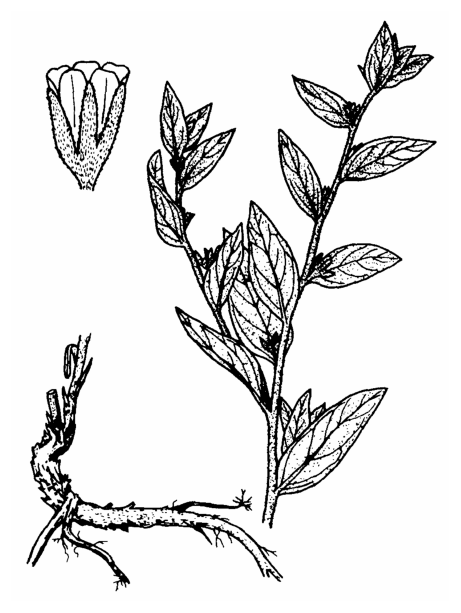
Shikonin is a red compound found in the roots of the plant Lithospermum erythrorhizon which grows in Asia. Extracts of the root have been used for centuries in folk medicine and are used today in ointments for healing of wounds.
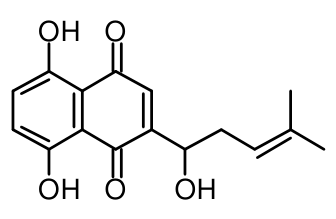
Shikonin
1.1 How many stereoisomers of Shikonin are possible ?
1.2 Do all stereoisomers of Shikonin have the same melting point? Mark with an X.
| yes | no |
|---|---|
The following sequence is part of a synthetic route to Shikonin:
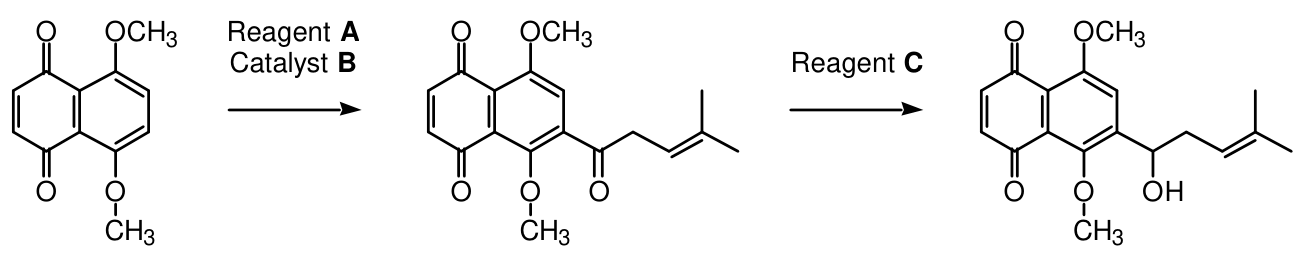
1.3 Draw the structural formula of reagent A.
1.4 Indicate (by means of an X in the appropriate check-box) the correct IUPAC name for reagent A.
| 2-Methyl-2-pentenoyl chloride | ☐ |
| 1-Chloro-4-methyl-3-pentene | ☐ |
| 4-Methyl-3-pentenoyl chloride | ☐ |
| 4-Methyl-3-pentene-1-ol | ☐ |
| 4,4-Dimethyl-3-butenoyl chloride | ☐ |
1.5 Write the molecular formula of reagent C.
Numerous Shikonin analogues have been synthesized with a view to obtaining more potent compounds. One reaction sequence is shown below:

1.6 Draw the structural formula of compound E.
1.7 How many stereoisomers of compound E, if any, are possible
Another route to useful Shikonin analogues is the following:
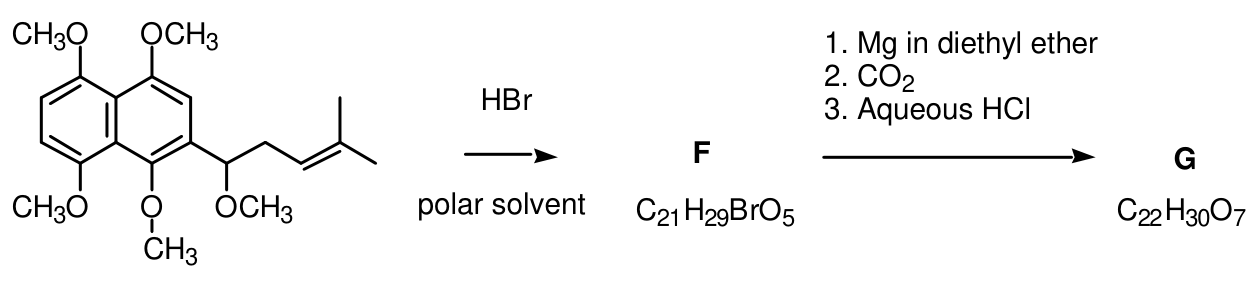
1.8 Draw the structural formula of compound F.
1.9 Draw the structural formula of compound G.
Official English text of the problem.
Answers
- 1.1: 2 stereoisomers, forming an enantiomeric pair.
- 1.2: Yes. Put an X under “yes.”
- 1.3: A is 4-methylpent-3-enoyl chloride, \(\ce{ClC(=O)CH2CH=C(CH3)2}\). SMILES:
CC(C)=CCC(=O)Cl. - 1.4: Mark the third option: 4-Methyl-3-pentenoyl chloride.
- 1.5: C: \(\ce{NaBH4}\), sodium borohydride. SMILES:
[Na+].[BH4-]. - 1.6: E is 5,8-dihydroxy-2-(4-methylpenta-1,3-dien-1-yl)naphthalene-1,4-dione. Its side chain is \(\ce{-CH=CH-CH=C(CH3)2}\). SMILES, with alkene configuration unspecified:
O=C1C(C=CC=C(C)C)=CC(=O)c2c(O)ccc(O)c21. - 1.7: 2 stereoisomers, with \((1E)\) and \((1Z)\) configurations of the side-chain double bond nearest the ring.
- 1.8: F is 2-(4-bromo-1-methoxy-4-methylpentyl)-1,4,5,8-tetramethoxynaphthalene. SMILES:
COc1ccc(OC)c2c(OC)c(C(OC)CCC(Br)(C)C)cc(OC)c12. - 1.9: G is 5-methoxy-2,2-dimethyl-5-(1,4,5,8-tetramethoxynaphthalen-2-yl)pentanoic acid. SMILES:
COc1ccc(OC)c2c(OC)c(C(OC)CCC(C)(C)C(=O)O)cc(OC)c12.
Solution
1.1
The side-chain carbon carrying the alcoholic hydroxyl group has four different substituents:
- A hydroxyl group.
- A hydrogen atom.
- The substituted naphthoquinone ring.
- The remaining chain, \(\ce{-CH2-CH=C(CH3)2}\).
It is therefore a stereogenic centre. There are no other stereogenic centres, and the side-chain alkene cannot have \(E/Z\) isomers because one of its carbons carries two identical methyl groups.
Thus, \[ N_{\text{stereoisomers}}=2^1=\boxed{2}. \]
The two configurations are:
| Stereoisomer | Isomeric SMILES |
|---|---|
| \((R)\)-Shikonin | O=C1C([C@H](O)CC=C(C)C)=CC(=O)c2c(O)ccc(O)c21 |
| \((S)\)-Shikonin, also called alkannin | O=C1C([C@@H](O)CC=C(C)C)=CC(=O)c2c(O)ccc(O)c21 |
1.2
The two stereoisomers are enantiomers. Pure enantiomers have identical melting points under corresponding achiral conditions, so the answer is yes.
A racemic mixture can have a different melting point, but it is a mixture of these stereoisomers rather than an additional stereoisomer.
1.3
The first transformation introduces the group \[ \ce{-C(=O)-CH2-CH=C(CH3)2} \] onto the aromatic ring. This is a Friedel–Crafts acylation, so the required acid chloride is obtained by replacing the bond to the aromatic ring with chlorine:
\[ \boxed{\ce{ClC(=O)CH2CH=C(CH3)2}}. \]
This is 4-methylpent-3-enoyl chloride, A, SMILES CC(C)=CCC(=O)Cl.
The starting material is 5,8-dimethoxynaphthalene-1,4-dione, SMILES O=C1C=CC(=O)c2c(OC)ccc(OC)c21. The acylation product is 5,8-dimethoxy-6-(4-methylpent-3-enoyl)naphthalene-1,4-dione, SMILES O=C1C=CC(=O)c2c(OC)c(C(=O)CC=C(C)C)cc(OC)c21.
The balanced equation is \[ \ce{C12H10O4 + C6H9ClO ->[B] C18H18O5 + HCl}. \]
Catalyst B promotes electrophilic acylation. Replacement of an aromatic hydrogen by the acyl group releases hydrogen chloride, SMILES Cl.
For the requested drawing, show an acid chloride carbonyl bonded to \(\ce{CH2-CH=C(CH3)2}\).
1.4
Number the chain from the acid chloride carbonyl carbon:
\[ \underbrace{\ce{ClC(=O)}}_{1} -\underbrace{\ce{CH2}}_{2} -\underbrace{\ce{CH}}_{3} =\underbrace{\ce{C(CH3)}}_{4} -\underbrace{\ce{CH3}}_{5}. \]
The parent chain has five carbons, the double bond begins at carbon 3, and the methyl substituent is at carbon 4.
Therefore, select 4-Methyl-3-pentenoyl chloride, the third option. Its modern systematic form is 4-methylpent-3-enoyl chloride.
1.5
The indicated net change is reduction of the side-chain ketone to a secondary alcohol:
\[ \ce{-C(=O)-CH2-CH=C(CH3)2} \quad\longrightarrow\quad \ce{-CH(OH)-CH2-CH=C(CH3)2}. \]
The conventional reagent assignment is sodium borohydride:
\[
\boxed{\ce{NaBH4}},
\]
SMILES [Na+].[BH4-].
Hydride addition to the carbonyl carbon gives an alkoxide; protonation gives the alcohol. The balanced organic reduction half-equation is \[ \ce{C18H18O5 + 2H+ + 2e- -> C18H20O5}. \]
The product is 6-(1-hydroxy-4-methylpent-3-en-1-yl)-5,8-dimethoxynaphthalene-1,4-dione, SMILES O=C1C=CC(=O)c2c(OC)c(C(O)CC=C(C)C)cc(OC)c21.
With achiral reagents and conditions, reduction creates a racemic pair at the new alcohol-bearing stereogenic centre.
1.6
Thionyl chloride, \(\ce{SOCl2}\), SMILES O=S(Cl)Cl, replaces the side-chain alcoholic hydroxyl group with chlorine. This agrees with the formula given for D: replacing \(\ce{OH}\) by \(\ce{Cl}\) converts \(\ce{C16H16O5}\) into \(\ce{C16H15ClO4}\).
Thus D is 2-(1-chloro-4-methylpent-3-en-1-yl)-5,8-dihydroxynaphthalene-1,4-dione, SMILES O=C1C(C(Cl)CC=C(C)C)=CC(=O)c2c(O)ccc(O)c21.
The balanced substitution equation is \[ \ce{C16H16O5 + SOCl2 -> C16H15ClO4 + SO2 + HCl}. \]
The gaseous by-products are sulfur dioxide, O=S=O, and hydrogen chloride, Cl.
Heating D with potassium hydroxide, [K+].[OH-], in ethanol, CCO, eliminates hydrogen chloride across the first two side-chain carbons. Chlorine leaves the carbon adjacent to the ring, and hydrogen is removed from the neighbouring methylene carbon:
\[ \ce{-CH(Cl)-CH2-CH=C(CH3)2} \quad\longrightarrow\quad \ce{-CH=CH-CH=C(CH3)2}. \]
The balanced elimination equation is \[ \ce{C16H15ClO4 + KOH -> C16H14O4 + KCl + H2O}. \]
The by-products are potassium chloride, [K+].[Cl-], and water, O.
Therefore, draw E by retaining the naphthoquinone ring and both phenolic hydroxyl groups, and replacing Shikonin’s side chain with \[ \boxed{\ce{-CH=CH-CH=C(CH3)2}}. \]
The complete structure is 5,8-dihydroxy-2-(4-methylpenta-1,3-dien-1-yl)naphthalene-1,4-dione, SMILES O=C1C(C=CC=C(C)C)=CC(=O)c2c(O)ccc(O)c21.
1.7
The newly formed double bond has two different substituents on each carbon:
- On its ring-side carbon: the naphthoquinone group and hydrogen.
- On its other carbon: the remaining unsaturated chain and hydrogen.
It therefore has \(E/Z\) stereoisomerism. The more distant double bond still has two identical methyl groups on one carbon, so it contributes no additional configurations. The original stereogenic centre has become planar.
Hence, \[ \boxed{N_{\text{stereoisomers}}=2}. \]
| Stereoisomer of E | Isomeric SMILES |
|---|---|
| 5,8-Dihydroxy-2-[(1E)-4-methylpenta-1,3-dien-1-yl]naphthalene-1,4-dione | O=C1C(/C=C/C=C(C)C)=CC(=O)c2c(O)ccc(O)c21 |
| 5,8-Dihydroxy-2-[(1Z)-4-methylpenta-1,3-dien-1-yl]naphthalene-1,4-dione | O=C1C(/C=C\C=C(C)C)=CC(=O)c2c(O)ccc(O)c21 |
In the \(E\) drawing, the ring and the remaining chain lie on opposite sides of the new double bond; in the \(Z\) drawing, they lie on the same side. Rotation about the intervening single bond gives conformers, which are not additional configurational stereoisomers.
1.8
Let \(N\) denote the 1,4,5,8-tetramethoxynaphthalen-2-yl group.
The starting compound is 1,4,5,8-tetramethoxy-2-(1-methoxy-4-methylpent-3-en-1-yl)naphthalene, SMILES COc1ccc(OC)c2c(OC)c(C(OC)CC=C(C)C)cc(OC)c12. Its side chain is
\[
\ce{N-CH(OCH3)-CH2-CH=C(CH3)2}.
\]
Hydrogen bromide, Br, adds ionically to the alkene in the stated polar solvent. Protonation places the positive charge on the carbon bearing two methyl groups, giving the more stable tertiary carbocation. Bromide, [Br-], then bonds to that carbon.
The Markovnikov product therefore has the side chain \[ \boxed{\ce{N-CH(OCH3)-CH2-CH2-C(Br)(CH3)2}}. \]
The balanced equation is \[ \ce{C21H28O5 + HBr -> C21H29BrO5}. \]
This matches the supplied formula for F. In particular, the unchanged carbon and oxygen counts support addition of hydrogen bromide with retention of all five methoxy groups.
Thus F is 2-(4-bromo-1-methoxy-4-methylpentyl)-1,4,5,8-tetramethoxynaphthalene, SMILES COc1ccc(OC)c2c(OC)c(C(OC)CCC(Br)(C)C)cc(OC)c12.
For the drawing, replace the original side-chain double bond by a single bond, place bromine on the carbon bearing the two methyl groups, and add hydrogen to the other alkene carbon.
1.9
Magnesium inserts into the carbon–bromine bond to form a Grignard reagent. Reaction with carbon dioxide creates a carbon–carbon bond to the carbon dioxide carbon; aqueous acid then gives the carboxylic acid.
Writing \(R\) for the organic group remaining when bromine is removed from F, the balanced steps are \[ \ce{RBr + Mg -> RMgBr}, \] \[ \ce{RMgBr + CO2 -> RCO2MgBr}, \] \[ \ce{RCO2MgBr + HCl -> RCO2H + MgBrCl}. \]
The relevant intermediates can be represented formally as:
| Intermediate | SMILES |
|---|---|
| The alkylmagnesium bromide derived from F | COc1ccc(OC)c2c(OC)c(C(OC)CCC(C)(C)[Mg]Br)cc(OC)c12 |
| Its magnesium bromide carboxylate | COc1ccc(OC)c2c(OC)c(C(OC)CCC(C)(C)C(=O)O[Mg]Br)cc(OC)c12 |
These SMILES show formal connectivity. They do not specify the ether coordination or aggregation present in a Grignard solution. Diethyl ether is CCOCC; carbon dioxide is O=C=O.
The overall balanced equation is
\[
\ce{C21H29BrO5 + Mg + CO2 + HCl -> C22H30O7 + MgBrCl},
\]
where the mixed magnesium halide can be represented ionically as [Mg+2].[Br-].[Cl-].
Consequently, the product side chain is \[ \boxed{\ce{N-CH(OCH3)-CH2-CH2-C(CH3)2-C(=O)OH}}. \]
The extra carbon and two extra oxygen atoms come from carbon dioxide; protonation supplies the additional hydrogen. This gives precisely the stated formula, \(\ce{C22H30O7}\).
Thus G is 5-methoxy-2,2-dimethyl-5-(1,4,5,8-tetramethoxynaphthalen-2-yl)pentanoic acid, SMILES COc1ccc(OC)c2c(OC)c(C(OC)CCC(C)(C)C(=O)O)cc(OC)c12.
The starting methoxy-bearing stereogenic centre is unspecified in the supplied drawing, so it is also left unspecified in the SMILES for F and G. The carbon bearing two methyl groups is not stereogenic.
The solution was checked against the official solution.
IChO 2000 · Theorieaufgabe 1
Synthese von Verbindungen mit wundheilenden Eigenschaften
Shikonin ist eine rote Verbindung, die in den Wurzeln der in Asien wachsenden Pflanze Lithospermum erythrorhizon vorkommt. Extrakte aus der Wurzel werden seit Jahrhunderten in der Volksmedizin verwendet und kommen heute in Salben zur Wundheilung zum Einsatz.
Shikonin
1.1 Wie viele Stereoisomere von Shikonin sind möglich?
1.2 Haben alle Stereoisomere von Shikonin denselben Schmelzpunkt? Kreuzen Sie mit einem X an.
| ja | nein |
|---|---|
Die folgende Reaktionsfolge ist Teil eines Synthesewegs zu Shikonin:
1.3 Zeichnen Sie die Strukturformel des Reagenzes A.
1.4 Kennzeichnen Sie den korrekten IUPAC-Namen des Reagenzes A durch ein X im entsprechenden Kästchen.
| 2-Methyl-2-pentenoylchlorid | ☐ |
| 1-Chlor-4-methyl-3-penten | ☐ |
| 4-Methyl-3-pentenoylchlorid | ☐ |
| 4-Methyl-3-penten-1-ol | ☐ |
| 4,4-Dimethyl-3-butenoylchlorid | ☐ |
1.5 Geben Sie die Summenformel des Reagenzes C an.
Zahlreiche Shikonin-Analoga wurden synthetisiert, um wirksamere Verbindungen zu erhalten. Eine Reaktionsfolge ist nachstehend gezeigt:
1.6 Zeichnen Sie die Strukturformel der Verbindung E.
1.7 Wie viele Stereoisomere der Verbindung E sind gegebenenfalls möglich
Ein weiterer Weg zu nützlichen Shikonin-Analoga ist der folgende:
1.8 Zeichnen Sie die Strukturformel der Verbindung F.
1.9 Zeichnen Sie die Strukturformel der Verbindung G.
Aufgabentext aus dem offiziellen englischen Text übersetzt.
Antworten
- 1.1: 2 Stereoisomere, die ein Enantiomerenpaar bilden.
- 1.2: Ja. Setzen Sie ein X unter „ja“.
- 1.3: A ist 4-Methylpent-3-enoylchlorid, \(\ce{ClC(=O)CH2CH=C(CH3)2}\). SMILES:
CC(C)=CCC(=O)Cl. - 1.4: Kreuzen Sie die dritte Option: 4-Methyl-3-pentenoylchlorid an.
- 1.5: C: \(\ce{NaBH4}\), Natriumborhydrid. SMILES:
[Na+].[BH4-]. - 1.6: E ist 5,8-Dihydroxy-2-(4-methylpenta-1,3-dien-1-yl)naphthalin-1,4-dion. Seine Seitenkette ist \(\ce{-CH=CH-CH=C(CH3)2}\). SMILES ohne Angabe der Alkenkonfiguration:
O=C1C(C=CC=C(C)C)=CC(=O)c2c(O)ccc(O)c21. - 1.7: 2 Stereoisomere, mit \((1E)\)- und \((1Z)\)-Konfiguration der dem Ring nächstgelegenen Doppelbindung der Seitenkette.
- 1.8: F ist 2-(4-Brom-1-methoxy-4-methylpentyl)-1,4,5,8-tetramethoxynaphthalin. SMILES:
COc1ccc(OC)c2c(OC)c(C(OC)CCC(Br)(C)C)cc(OC)c12. - 1.9: G ist 5-Methoxy-2,2-dimethyl-5-(1,4,5,8-tetramethoxynaphthalin-2-yl)pentansäure. SMILES:
COc1ccc(OC)c2c(OC)c(C(OC)CCC(C)(C)C(=O)O)cc(OC)c12.
Lösung
1.1
Das Kohlenstoffatom der Seitenkette, das die alkoholische Hydroxygruppe trägt, besitzt vier verschiedene Substituenten:
- Eine Hydroxygruppe.
- Ein Wasserstoffatom.
- Den substituierten Naphthochinonring.
- Die restliche Kette, \(\ce{-CH2-CH=C(CH3)2}\).
Es ist daher ein stereogenes Zentrum. Es gibt keine weiteren stereogenen Zentren, und das Alken in der Seitenkette kann keine \(E/Z\)-Isomere bilden, da eines seiner Kohlenstoffatome zwei identische Methylgruppen trägt.
Somit gilt: \[ N_{\text{Stereoisomere}}=2^1=\boxed{2}. \]
Die beiden Konfigurationen sind:
| Stereoisomer | Isomere SMILES |
|---|---|
| \((R)\)-Shikonin | O=C1C([C@H](O)CC=C(C)C)=CC(=O)c2c(O)ccc(O)c21 |
| \((S)\)-Shikonin, auch Alkannin genannt | O=C1C([C@@H](O)CC=C(C)C)=CC(=O)c2c(O)ccc(O)c21 |
1.2
Die beiden Stereoisomere sind Enantiomere. Reine Enantiomere haben unter entsprechenden achiralen Bedingungen identische Schmelzpunkte, daher lautet die Antwort ja.
Ein racemisches Gemisch kann einen anderen Schmelzpunkt haben, ist jedoch ein Gemisch dieser Stereoisomere und kein zusätzliches Stereoisomer.
1.3
Bei der ersten Umsetzung wird die Gruppe \[ \ce{-C(=O)-CH2-CH=C(CH3)2} \] an den aromatischen Ring eingeführt. Es handelt sich um eine Friedel–Crafts-Acylierung; das benötigte Säurechlorid erhält man daher, indem man die Bindung zum aromatischen Ring durch Chlor ersetzt:
\[ \boxed{\ce{ClC(=O)CH2CH=C(CH3)2}}. \]
Dies ist 4-Methylpent-3-enoylchlorid, A, SMILES CC(C)=CCC(=O)Cl.
Die Ausgangsverbindung ist 5,8-Dimethoxynaphthalin-1,4-dion, SMILES O=C1C=CC(=O)c2c(OC)ccc(OC)c21. Das Acylierungsprodukt ist 5,8-Dimethoxy-6-(4-methylpent-3-enoyl)naphthalin-1,4-dion, SMILES O=C1C=CC(=O)c2c(OC)c(C(=O)CC=C(C)C)cc(OC)c21.
Die ausgeglichene Reaktionsgleichung lautet \[ \ce{C12H10O4 + C6H9ClO ->[B] C18H18O5 + HCl}. \]
Katalysator B fördert die elektrophile Acylierung. Beim Ersatz eines aromatischen Wasserstoffatoms durch die Acylgruppe wird Chlorwasserstoff, SMILES Cl, freigesetzt.
Zeichnen Sie für die verlangte Strukturformel eine Säurechlorid-Carbonylgruppe, die an \(\ce{CH2-CH=C(CH3)2}\) gebunden ist.
1.4
Nummerieren Sie die Kette ausgehend vom Carbonylkohlenstoffatom des Säurechlorids:
\[ \underbrace{\ce{ClC(=O)}}_{1} -\underbrace{\ce{CH2}}_{2} -\underbrace{\ce{CH}}_{3} =\underbrace{\ce{C(CH3)}}_{4} -\underbrace{\ce{CH3}}_{5}. \]
Die Stammkette besitzt fünf Kohlenstoffatome, die Doppelbindung beginnt an Kohlenstoffatom 3, und der Methylsubstituent befindet sich an Kohlenstoffatom 4.
Wählen Sie daher 4-Methyl-3-pentenoylchlorid, die dritte Option. Die moderne systematische Form dieses Namens lautet 4-Methylpent-3-enoylchlorid.
1.5
Die angegebene Nettoumwandlung ist die Reduktion des Ketons in der Seitenkette zu einem sekundären Alkohol:
\[ \ce{-C(=O)-CH2-CH=C(CH3)2} \quad\longrightarrow\quad \ce{-CH(OH)-CH2-CH=C(CH3)2}. \]
Das hierfür üblicherweise zugeordnete Reagenz ist Natriumborhydrid:
\[
\boxed{\ce{NaBH4}},
\]
SMILES [Na+].[BH4-].
Die Addition von Hydrid an das Carbonylkohlenstoffatom ergibt ein Alkoholat; durch Protonierung entsteht der Alkohol. Die ausgeglichene Teilgleichung der organischen Reduktion lautet \[ \ce{C18H18O5 + 2H+ + 2e- -> C18H20O5}. \]
Das Produkt ist 6-(1-Hydroxy-4-methylpent-3-en-1-yl)-5,8-dimethoxynaphthalin-1,4-dion, SMILES O=C1C=CC(=O)c2c(OC)c(C(O)CC=C(C)C)cc(OC)c21.
Mit achiralen Reagenzien und unter achiralen Bedingungen entsteht bei der Reduktion am neuen stereogenen Zentrum, das die alkoholische Hydroxygruppe trägt, ein racemisches Enantiomerenpaar.
1.6
Thionylchlorid, \(\ce{SOCl2}\), SMILES O=S(Cl)Cl, ersetzt die alkoholische Hydroxygruppe der Seitenkette durch Chlor. Dies stimmt mit der für D angegebenen Formel überein: Der Ersatz von \(\ce{OH}\) durch \(\ce{Cl}\) überführt \(\ce{C16H16O5}\) in \(\ce{C16H15ClO4}\).
Somit ist D 2-(1-Chlor-4-methylpent-3-en-1-yl)-5,8-dihydroxynaphthalin-1,4-dion, SMILES O=C1C(C(Cl)CC=C(C)C)=CC(=O)c2c(O)ccc(O)c21.
Die ausgeglichene Substitutionsgleichung lautet \[ \ce{C16H16O5 + SOCl2 -> C16H15ClO4 + SO2 + HCl}. \]
Die gasförmigen Nebenprodukte sind Schwefeldioxid, O=S=O, und Chlorwasserstoff, Cl.
Beim Erhitzen von D mit Kaliumhydroxid, [K+].[OH-], in Ethanol, CCO, wird Chlorwasserstoff von den ersten beiden Kohlenstoffatomen der Seitenkette eliminiert. Chlor wird vom Kohlenstoffatom unmittelbar neben dem Ring abgespalten, und Wasserstoff wird vom benachbarten Methylenkohlenstoffatom entfernt:
\[ \ce{-CH(Cl)-CH2-CH=C(CH3)2} \quad\longrightarrow\quad \ce{-CH=CH-CH=C(CH3)2}. \]
Die ausgeglichene Eliminierungsgleichung lautet \[ \ce{C16H15ClO4 + KOH -> C16H14O4 + KCl + H2O}. \]
Die Nebenprodukte sind Kaliumchlorid, [K+].[Cl-], und Wasser, O.
Zeichnen Sie daher E, indem Sie den Naphthochinonring und beide phenolischen Hydroxygruppen beibehalten und die Seitenkette des Shikonins durch \[ \boxed{\ce{-CH=CH-CH=C(CH3)2}} \] ersetzen.
Die vollständige Struktur ist 5,8-Dihydroxy-2-(4-methylpenta-1,3-dien-1-yl)naphthalin-1,4-dion, SMILES O=C1C(C=CC=C(C)C)=CC(=O)c2c(O)ccc(O)c21.
1.7
Die neu gebildete Doppelbindung besitzt an jedem Kohlenstoffatom zwei verschiedene Substituenten:
- An ihrem ringseitigen Kohlenstoffatom: die Naphthochinongruppe und Wasserstoff.
- An ihrem anderen Kohlenstoffatom: die restliche ungesättigte Kette und Wasserstoff.
Sie weist daher \(E/Z\)-Stereoisomerie auf. Die weiter entfernte Doppelbindung besitzt weiterhin zwei identische Methylgruppen an einem Kohlenstoffatom und trägt daher keine zusätzlichen Konfigurationen bei. Das ursprüngliche stereogene Zentrum ist planar geworden.
Folglich gilt: \[ \boxed{N_{\text{Stereoisomere}}=2}. \]
| Stereoisomer von E | Isomere SMILES |
|---|---|
| 5,8-Dihydroxy-2-[(1E)-4-methylpenta-1,3-dien-1-yl]naphthalin-1,4-dion | O=C1C(/C=C/C=C(C)C)=CC(=O)c2c(O)ccc(O)c21 |
| 5,8-Dihydroxy-2-[(1Z)-4-methylpenta-1,3-dien-1-yl]naphthalin-1,4-dion | O=C1C(/C=C\C=C(C)C)=CC(=O)c2c(O)ccc(O)c21 |
In der \(E\)-Zeichnung liegen der Ring und die restliche Kette auf entgegengesetzten Seiten der neuen Doppelbindung; in der \(Z\)-Zeichnung liegen sie auf derselben Seite. Durch Rotation um die dazwischenliegende Einfachbindung entstehen Konformere, die keine zusätzlichen Konfigurationsstereoisomere sind.
1.8
\(N\) bezeichne die 1,4,5,8-Tetramethoxynaphthalin-2-yl-Gruppe.
Die Ausgangsverbindung ist 1,4,5,8-Tetramethoxy-2-(1-methoxy-4-methylpent-3-en-1-yl)naphthalin, SMILES COc1ccc(OC)c2c(OC)c(C(OC)CC=C(C)C)cc(OC)c12. Ihre Seitenkette ist
\[
\ce{N-CH(OCH3)-CH2-CH=C(CH3)2}.
\]
Bromwasserstoff, Br, addiert in dem angegebenen polaren Lösungsmittel nach einem ionischen Mechanismus an das Alken. Durch Protonierung entsteht die positive Ladung an dem Kohlenstoffatom, das zwei Methylgruppen trägt, wodurch sich das stabilere tertiäre Carbokation bildet. Bromid, [Br-], bindet anschließend an dieses Kohlenstoffatom.
Das Markownikow-Produkt besitzt daher die Seitenkette \[ \boxed{\ce{N-CH(OCH3)-CH2-CH2-C(Br)(CH3)2}}. \]
Die ausgeglichene Reaktionsgleichung lautet \[ \ce{C21H28O5 + HBr -> C21H29BrO5}. \]
Dies entspricht der angegebenen Formel für F. Insbesondere stützen die unveränderten Anzahlen der Kohlenstoff- und Sauerstoffatome die Addition von Bromwasserstoff unter Erhalt aller fünf Methoxygruppen.
Somit ist F 2-(4-Brom-1-methoxy-4-methylpentyl)-1,4,5,8-tetramethoxynaphthalin, SMILES COc1ccc(OC)c2c(OC)c(C(OC)CCC(Br)(C)C)cc(OC)c12.
Ersetzen Sie für die Zeichnung die ursprüngliche Doppelbindung der Seitenkette durch eine Einfachbindung, setzen Sie Brom an das Kohlenstoffatom mit den beiden Methylgruppen und fügen Sie dem anderen Alkenkohlenstoffatom ein Wasserstoffatom hinzu.
1.9
Magnesium schiebt sich unter Bildung eines Grignard-Reagenzes in die Kohlenstoff–Brom-Bindung ein. Die Reaktion mit Kohlenstoffdioxid bildet eine Kohlenstoff–Kohlenstoff-Bindung zum Kohlenstoffatom des Kohlenstoffdioxids; wässrige Säure liefert anschließend die Carbonsäure.
Bezeichnet \(R\) die organische Gruppe, die nach Entfernung von Brom aus F verbleibt, so lauten die ausgeglichenen Reaktionsschritte \[ \ce{RBr + Mg -> RMgBr}, \] \[ \ce{RMgBr + CO2 -> RCO2MgBr}, \] \[ \ce{RCO2MgBr + HCl -> RCO2H + MgBrCl}. \]
Die relevanten Zwischenprodukte lassen sich formal wie folgt darstellen:
| Zwischenprodukt | SMILES |
|---|---|
| Das von F abgeleitete Alkylmagnesiumbromid | COc1ccc(OC)c2c(OC)c(C(OC)CCC(C)(C)[Mg]Br)cc(OC)c12 |
| Sein Magnesiumbromidcarboxylat | COc1ccc(OC)c2c(OC)c(C(OC)CCC(C)(C)C(=O)O[Mg]Br)cc(OC)c12 |
Diese SMILES zeigen die formale Konnektivität. Sie geben weder die Etherkoordination noch die Aggregation in einer Grignard-Lösung an. Diethylether ist CCOCC; Kohlenstoffdioxid ist O=C=O.
Die ausgeglichene Gesamtgleichung lautet
\[
\ce{C21H29BrO5 + Mg + CO2 + HCl -> C22H30O7 + MgBrCl},
\]
wobei das gemischte Magnesiumhalogenid ionisch als [Mg+2].[Br-].[Cl-] dargestellt werden kann.
Folglich ist die Seitenkette des Produkts \[ \boxed{\ce{N-CH(OCH3)-CH2-CH2-C(CH3)2-C(=O)OH}}. \]
Das zusätzliche Kohlenstoffatom und die beiden zusätzlichen Sauerstoffatome stammen aus dem Kohlenstoffdioxid; die Protonierung liefert das zusätzliche Wasserstoffatom. Dies ergibt genau die angegebene Formel, \(\ce{C22H30O7}\).
Somit ist G 5-Methoxy-2,2-dimethyl-5-(1,4,5,8-tetramethoxynaphthalin-2-yl)pentansäure, SMILES COc1ccc(OC)c2c(OC)c(C(OC)CCC(C)(C)C(=O)O)cc(OC)c12.
Die Konfiguration des ursprünglichen stereogenen Zentrums, das die Methoxygruppe trägt, ist in der vorgegebenen Zeichnung nicht angegeben; daher bleibt sie auch in den SMILES für F und G unbestimmt. Das Kohlenstoffatom, das zwei Methylgruppen trägt, ist nicht stereogen.
Die Lösung wurde mit der offiziellen Lösung abgeglichen.
IChO 2000 · Teori sorusu 1
Yara İyileştirici Özelliklere Sahip Bileşiklerin Sentezi
Şikonin, Asya'da yetişen Lithospermum erythrorhizon bitkisinin köklerinde bulunan kırmızı bir bileşiktir. Kökün özütleri yüzyıllardır halk hekimliğinde kullanılmaktadır ve günümüzde yaraların iyileştirilmesine yönelik merhemlerde kullanılmaktadır.
Şikonin
1.1 Şikoninin kaç stereoizomeri mümkündür?
1.2 Şikoninin tüm stereoizomerleri aynı erime noktasına mı sahiptir? X ile işaretleyiniz.
| evet | hayır |
|---|---|
Aşağıdaki tepkime dizisi, şikoninin bir sentez yolunun parçasıdır:
1.3 A reaktifinin yapı formülünü çiziniz.
1.4 A reaktifinin doğru IUPAC adını (uygun kutucuğa X koyarak) belirtiniz.
| 2-Metil-2-pentenoil klorür | ☐ |
| 1-Kloro-4-metil-3-penten | ☐ |
| 4-Metil-3-pentenoil klorür | ☐ |
| 4-Metil-3-penten-1-ol | ☐ |
| 4,4-Dimetil-3-bütenoil klorür | ☐ |
1.5 C reaktifinin molekül formülünü yazınız.
Daha etkili bileşikler elde etmek amacıyla çok sayıda şikonin analoğu sentezlenmiştir. Bir tepkime dizisi aşağıda gösterilmiştir:
1.6 E bileşiğinin yapı formülünü çiziniz.
1.7 E bileşiğinin stereoizomerleri varsa, kaç tanesi mümkündür
Yararlı şikonin analoglarına ulaşmak için başka bir yol da aşağıdaki gibidir:
1.8 F bileşiğinin yapı formülünü çiziniz.
1.9 G bileşiğinin yapı formülünü çiziniz.
Soru metni resmi İngilizce metinden çevrilmiştir.
Cevaplar
- 1.1: Bir enantiyomer çifti oluşturan 2 stereoizomer.
- 1.2: Evet. “Evet” sütununa X koyunuz.
- 1.3: A, 4-metilpent-3-enoil klorürdür, \(\ce{ClC(=O)CH2CH=C(CH3)2}\). SMILES:
CC(C)=CCC(=O)Cl. - 1.4: Üçüncü seçeneği: 4-Metil-3-pentenoil klorür işaretleyiniz.
- 1.5: C: \(\ce{NaBH4}\), sodyum borohidrür. SMILES:
[Na+].[BH4-]. - 1.6: E, 5,8-dihidroksi-2-(4-metilpenta-1,3-dien-1-il)naftalen-1,4-diondur. Yan zinciri \(\ce{-CH=CH-CH=C(CH3)2}\) şeklindedir. Alken konfigürasyonu belirtilmemiş SMILES:
O=C1C(C=CC=C(C)C)=CC(=O)c2c(O)ccc(O)c21. - 1.7: Halkaya en yakın yan zincir çift bağının \((1E)\) ve \((1Z)\) konfigürasyonlarına sahip 2 stereoizomer.
- 1.8: F, 2-(4-bromo-1-metoksi-4-metilpentil)-1,4,5,8-tetrametoksinaftalendir. SMILES:
COc1ccc(OC)c2c(OC)c(C(OC)CCC(Br)(C)C)cc(OC)c12. - 1.9: G, 5-metoksi-2,2-dimetil-5-(1,4,5,8-tetrametoksinaftalen-2-il)pentanoik asittir. SMILES:
COc1ccc(OC)c2c(OC)c(C(OC)CCC(C)(C)C(=O)O)cc(OC)c12.
Çözüm
1.1
Alkolik hidroksil grubunu taşıyan yan zincir karbonunda dört farklı sübstitüent bulunur:
- Bir hidroksil grubu.
- Bir hidrojen atomu.
- Sübstitüe naftokinon halkası.
- Zincirin geri kalanı, \(\ce{-CH2-CH=C(CH3)2}\).
Bu nedenle bu karbon bir stereojenik merkezdir. Başka stereojenik merkez yoktur ve yan zincirdeki alkenin karbonlarından biri iki özdeş metil grubu taşıdığı için bu alkenin \(E/Z\) izomerleri olamaz.
Dolayısıyla, \[ N_{\text{stereoizomerler}}=2^1=\boxed{2}. \]
İki konfigürasyon şunlardır:
| Stereoizomer | İzomerik SMILES |
|---|---|
| \((R)\)-Şikonin | O=C1C([C@H](O)CC=C(C)C)=CC(=O)c2c(O)ccc(O)c21 |
| Alkanin olarak da adlandırılan \((S)\)-Şikonin | O=C1C([C@@H](O)CC=C(C)C)=CC(=O)c2c(O)ccc(O)c21 |
1.2
İki stereoizomer birbirinin enantiyomeridir. Saf enantiyomerler, aynı akiral koşullar altında özdeş erime noktalarına sahiptir; dolayısıyla cevap evettir.
Rasemik bir karışımın erime noktası farklı olabilir; ancak bu, ek bir stereoizomer değil, bu stereoizomerlerin bir karışımıdır.
1.3
İlk dönüşümde aromatik halkaya \[ \ce{-C(=O)-CH2-CH=C(CH3)2} \] grubu bağlanır. Bu bir Friedel–Crafts açillemesidir; dolayısıyla gerekli asit klorür, aromatik halkaya olan bağın yerine klor getirilmesiyle elde edilir:
\[ \boxed{\ce{ClC(=O)CH2CH=C(CH3)2}}. \]
Bu, 4-metilpent-3-enoil klorür, A, SMILES CC(C)=CCC(=O)Cl bileşiğidir.
Başlangıç maddesi 5,8-dimetoksinaftalen-1,4-diondur, SMILES O=C1C=CC(=O)c2c(OC)ccc(OC)c21. Açilleme ürünü 5,8-dimetoksi-6-(4-metilpent-3-enoil)naftalen-1,4-diondur, SMILES O=C1C=CC(=O)c2c(OC)c(C(=O)CC=C(C)C)cc(OC)c21.
Denkleştirilmiş denklem şöyledir: \[ \ce{C12H10O4 + C6H9ClO ->[B] C18H18O5 + HCl}. \]
B katalizörü elektrofilik açillemeyi kolaylaştırır. Aromatik bir hidrojenin açil grubuyla yer değiştirmesi sonucunda hidrojen klorür, SMILES Cl, açığa çıkar.
İstenen çizimde, \(\ce{CH2-CH=C(CH3)2}\) grubuna bağlı bir asit klorür karbonili gösteriniz.
1.4
Zinciri asit klorürün karbonil karbonundan başlayarak numaralandırınız:
\[ \underbrace{\ce{ClC(=O)}}_{1} -\underbrace{\ce{CH2}}_{2} -\underbrace{\ce{CH}}_{3} =\underbrace{\ce{C(CH3)}}_{4} -\underbrace{\ce{CH3}}_{5}. \]
Ana zincirde beş karbon bulunur, çift bağ 3 numaralı karbonda başlar ve metil sübstitüenti 4 numaralı karbondadır.
Bu nedenle üçüncü seçenek olan 4-Metil-3-pentenoil klorür seçilmelidir. Bu adın güncel sistematik biçimi 4-metilpent-3-enoil klorürdür.
1.5
Gösterilen net değişim, yan zincirdeki ketonun sekonder bir alkole indirgenmesidir:
\[ \ce{-C(=O)-CH2-CH=C(CH3)2} \quad\longrightarrow\quad \ce{-CH(OH)-CH2-CH=C(CH3)2}. \]
Bu dönüşüm için yaygın olarak kullanılan reaktif sodyum borohidrürdür:
\[
\boxed{\ce{NaBH4}},
\]
SMILES [Na+].[BH4-].
Karbonil karbonuna hidrür katılması bir alkoksit oluşturur; protonlanma sonucunda alkol oluşur. Denkleştirilmiş organik indirgenme yarı denklemi şöyledir: \[ \ce{C18H18O5 + 2H+ + 2e- -> C18H20O5}. \]
Ürün 6-(1-hidroksi-4-metilpent-3-en-1-il)-5,8-dimetoksinaftalen-1,4-diondur, SMILES O=C1C=CC(=O)c2c(OC)c(C(O)CC=C(C)C)cc(OC)c21.
Akiral reaktifler ve koşullar altında indirgenme, alkol grubunu taşıyan yeni stereojenik merkezde rasemik bir çift oluşturur.
1.6
Tiyonil klorür, \(\ce{SOCl2}\), SMILES O=S(Cl)Cl, yan zincirdeki alkolik hidroksil grubunu klorla değiştirir. Bu, D için verilen formülle uyumludur: \(\ce{OH}\) yerine \(\ce{Cl}\) geçmesi, \(\ce{C16H16O5}\) formülünü \(\ce{C16H15ClO4}\) formülüne dönüştürür.
Dolayısıyla D, 2-(1-kloro-4-metilpent-3-en-1-il)-5,8-dihidroksinaftalen-1,4-diondur, SMILES O=C1C(C(Cl)CC=C(C)C)=CC(=O)c2c(O)ccc(O)c21.
Denkleştirilmiş yer değiştirme denklemi şöyledir: \[ \ce{C16H16O5 + SOCl2 -> C16H15ClO4 + SO2 + HCl}. \]
Gaz hâlindeki yan ürünler kükürt dioksit, O=S=O, ve hidrojen klorürdür, Cl.
D'nin etanol, CCO, içinde potasyum hidroksit, [K+].[OH-], ile ısıtılması, yan zincirin ilk iki karbonundan hidrojen klorür eliminasyonuna yol açar. Klor, halkaya komşu karbondan ayrılır ve komşu metilen karbonundan hidrojen uzaklaştırılır:
\[ \ce{-CH(Cl)-CH2-CH=C(CH3)2} \quad\longrightarrow\quad \ce{-CH=CH-CH=C(CH3)2}. \]
Denkleştirilmiş eliminasyon denklemi şöyledir: \[ \ce{C16H15ClO4 + KOH -> C16H14O4 + KCl + H2O}. \]
Yan ürünler potasyum klorür, [K+].[Cl-], ve sudur, O.
Bu nedenle E'yi çizerken naftokinon halkasını ve her iki fenolik hidroksil grubunu koruyunuz ve şikoninin yan zincirini \[ \boxed{\ce{-CH=CH-CH=C(CH3)2}} \] ile değiştiriniz.
Tam yapı 5,8-dihidroksi-2-(4-metilpenta-1,3-dien-1-il)naftalen-1,4-diondur, SMILES O=C1C(C=CC=C(C)C)=CC(=O)c2c(O)ccc(O)c21.
1.7
Yeni oluşan çift bağın her bir karbonunda iki farklı sübstitüent bulunur:
- Halka tarafındaki karbonunda: naftokinon grubu ve hidrojen.
- Diğer karbonunda: doymamış zincirin geri kalanı ve hidrojen.
Bu nedenle \(E/Z\) stereoizomerliği gösterir. Daha uzaktaki çift bağın bir karbonunda hâlâ iki özdeş metil grubu bulunur; bu yüzden ek konfigürasyonlar oluşturmaz. Başlangıçtaki stereojenik merkez düzlemsel hâle gelmiştir.
Böylece, \[ \boxed{N_{\text{stereoizomerler}}=2}. \]
| E'nin stereoizomeri | İzomerik SMILES |
|---|---|
| 5,8-Dihidroksi-2-[(1E)-4-metilpenta-1,3-dien-1-il]naftalen-1,4-dion | O=C1C(/C=C/C=C(C)C)=CC(=O)c2c(O)ccc(O)c21 |
| 5,8-Dihidroksi-2-[(1Z)-4-metilpenta-1,3-dien-1-il]naftalen-1,4-dion | O=C1C(/C=C\C=C(C)C)=CC(=O)c2c(O)ccc(O)c21 |
\(E\) çiziminde halka ve zincirin geri kalanı yeni çift bağın karşı taraflarında; \(Z\) çiziminde ise aynı tarafında yer alır. Aradaki tek bağ etrafında dönme, ek konfigürasyonel stereoizomerler olmayan konformerler oluşturur.
1.8
\(N\), 1,4,5,8-tetrametoksinaftalen-2-il grubunu göstersin.
Başlangıç bileşiği 1,4,5,8-tetrametoksi-2-(1-metoksi-4-metilpent-3-en-1-il)naftalendir, SMILES COc1ccc(OC)c2c(OC)c(C(OC)CC=C(C)C)cc(OC)c12. Yan zinciri şöyledir:
\[
\ce{N-CH(OCH3)-CH2-CH=C(CH3)2}.
\]
Hidrojen bromür, Br, belirtilen polar çözücüde alkene iyonik olarak katılır. Protonlanma, pozitif yükü iki metil grubu taşıyan karbona yerleştirerek daha kararlı tersiyer karbokatyonu oluşturur. Ardından bromür, [Br-], bu karbona bağlanır.
Dolayısıyla Markovnikov ürününün yan zinciri şöyledir: \[ \boxed{\ce{N-CH(OCH3)-CH2-CH2-C(Br)(CH3)2}}. \]
Denkleştirilmiş denklem şöyledir: \[ \ce{C21H28O5 + HBr -> C21H29BrO5}. \]
Bu, F için verilen formülle örtüşür. Özellikle karbon ve oksijen sayılarının değişmemesi, beş metoksi grubunun tümü korunarak hidrojen bromür katılmasını destekler.
Dolayısıyla F, 2-(4-bromo-1-metoksi-4-metilpentil)-1,4,5,8-tetrametoksinaftalendir, SMILES COc1ccc(OC)c2c(OC)c(C(OC)CCC(Br)(C)C)cc(OC)c12.
Çizim için başlangıçtaki yan zincir çift bağını tek bağa dönüştürünüz, bromu iki metil grubunu taşıyan karbona yerleştiriniz ve diğer alken karbonuna hidrojen ekleyiniz.
1.9
Magnezyum, karbon–brom bağına girerek bir Grignard reaktifi oluşturur. Karbon dioksitle tepkime, karbon dioksitin karbonuna bir karbon–karbon bağı oluşturur; ardından sulu asit karboksilik asidi verir.
F'den brom uzaklaştırıldığında geriye kalan organik grubu \(R\) ile gösterirsek, denkleştirilmiş basamaklar şöyledir: \[ \ce{RBr + Mg -> RMgBr}, \] \[ \ce{RMgBr + CO2 -> RCO2MgBr}, \] \[ \ce{RCO2MgBr + HCl -> RCO2H + MgBrCl}. \]
İlgili ara ürünler biçimsel olarak şöyle gösterilebilir:
| Ara ürün | SMILES |
|---|---|
| F'den türetilen alkilmagnezyum bromür | COc1ccc(OC)c2c(OC)c(C(OC)CCC(C)(C)[Mg]Br)cc(OC)c12 |
| Bunun magnezyum bromür karboksilatı | COc1ccc(OC)c2c(OC)c(C(OC)CCC(C)(C)C(=O)O[Mg]Br)cc(OC)c12 |
Bu SMILES gösterimleri biçimsel bağlanma düzenini gösterir. Grignard çözeltisinde bulunan eter koordinasyonunu veya agregasyonu belirtmezler. Dietil eter CCOCC; karbon dioksit O=C=O şeklindedir.
Toplam denkleştirilmiş denklem şöyledir:
\[
\ce{C21H29BrO5 + Mg + CO2 + HCl -> C22H30O7 + MgBrCl},
\]
burada karışık magnezyum halojenür, iyonik olarak [Mg+2].[Br-].[Cl-] şeklinde gösterilebilir.
Sonuç olarak ürünün yan zinciri şöyledir: \[ \boxed{\ce{N-CH(OCH3)-CH2-CH2-C(CH3)2-C(=O)OH}}. \]
Ek karbon ve iki ek oksijen atomu karbon dioksitten gelir; protonlanma ise ek hidrojeni sağlar. Böylece tam olarak belirtilen \(\ce{C22H30O7}\) formülü elde edilir.
Dolayısıyla G, 5-metoksi-2,2-dimetil-5-(1,4,5,8-tetrametoksinaftalen-2-il)pentanoik asittir, SMILES COc1ccc(OC)c2c(OC)c(C(OC)CCC(C)(C)C(=O)O)cc(OC)c12.
Başlangıçtaki metoksi grubunu taşıyan stereojenik merkezin konfigürasyonu verilen çizimde belirtilmemiştir; bu nedenle F ve G için verilen SMILES gösterimlerinde de belirtilmemiştir. İki metil grubu taşıyan karbon stereojenik değildir.
Çözüm, resmi çözümle karşılaştırılarak kontrol edildi.
IChO 2000 · Problema teórico 1
Síntesis de compuestos con propiedades cicatrizantes
La shikonina es un compuesto rojo que se encuentra en las raíces de la planta Lithospermum erythrorhizon, que crece en Asia. Los extractos de la raíz se han utilizado durante siglos en la medicina popular y hoy se emplean en pomadas para la cicatrización de heridas.
Shikonina
1.1 ¿Cuántos estereoisómeros de la shikonina son posibles?
1.2 ¿Tienen todos los estereoisómeros de la shikonina el mismo punto de fusión? Marque con una X.
| sí | no |
|---|---|
La siguiente secuencia forma parte de una ruta de síntesis de la shikonina:
1.3 Dibuje la fórmula estructural del reactivo A.
1.4 Indique (mediante una X en la casilla correspondiente) el nombre IUPAC correcto del reactivo A.
| Cloruro de 2-metil-2-pentenoilo | ☐ |
| 1-Cloro-4-metil-3-penteno | ☐ |
| Cloruro de 4-metil-3-pentenoilo | ☐ |
| 4-Metil-3-penten-1-ol | ☐ |
| Cloruro de 4,4-dimetil-3-butenoilo | ☐ |
1.5 Escriba la fórmula molecular del reactivo C.
Se han sintetizado numerosos análogos de la shikonina con el fin de obtener compuestos más potentes. A continuación se muestra una secuencia de reacciones:
1.6 Dibuje la fórmula estructural del compuesto E.
1.7 ¿Cuántos estereoisómeros del compuesto E son posibles, si los hay?
Otra ruta para obtener análogos útiles de la shikonina es la siguiente:
1.8 Dibuje la fórmula estructural del compuesto F.
1.9 Dibuje la fórmula estructural del compuesto G.
Enunciado traducido del texto oficial en inglés.
Respuestas
- 1.1: 2 estereoisómeros, que forman un par de enantiómeros.
- 1.2: Sí. Ponga una X bajo «sí».
- 1.3: A es el cloruro de 4-metilpent-3-enoilo, \(\ce{ClC(=O)CH2CH=C(CH3)2}\). SMILES:
CC(C)=CCC(=O)Cl. - 1.4: Marque la tercera opción: cloruro de 4-metil-3-pentenoilo.
- 1.5: C: \(\ce{NaBH4}\), borohidruro de sodio. SMILES:
[Na+].[BH4-]. - 1.6: E es la 5,8-dihidroxi-2-(4-metilpenta-1,3-dien-1-il)naftaleno-1,4-diona. Su cadena lateral es \(\ce{-CH=CH-CH=C(CH3)2}\). SMILES, sin especificar la configuración de los alquenos:
O=C1C(C=CC=C(C)C)=CC(=O)c2c(O)ccc(O)c21. - 1.7: 2 estereoisómeros, con configuraciones \((1E)\) y \((1Z)\) del doble enlace de la cadena lateral más próximo al anillo.
- 1.8: F es el 2-(4-bromo-1-metoxi-4-metilpentil)-1,4,5,8-tetrametoxinaftaleno. SMILES:
COc1ccc(OC)c2c(OC)c(C(OC)CCC(Br)(C)C)cc(OC)c12. - 1.9: G es el ácido 5-metoxi-2,2-dimetil-5-(1,4,5,8-tetrametoxinaftalen-2-il)pentanoico. SMILES:
COc1ccc(OC)c2c(OC)c(C(OC)CCC(C)(C)C(=O)O)cc(OC)c12.
Solución
1.1
El carbono de la cadena lateral que porta el grupo hidroxilo alcohólico tiene cuatro sustituyentes diferentes:
- Un grupo hidroxilo.
- Un átomo de hidrógeno.
- El anillo de naftoquinona sustituido.
- El resto de la cadena, \(\ce{-CH2-CH=C(CH3)2}\).
Por tanto, es un centro estereogénico. No hay otros centros estereogénicos, y el alqueno de la cadena lateral no puede presentar isómeros \(E/Z\) porque uno de sus carbonos porta dos grupos metilo idénticos.
Así, \[ N_{\text{estereoisómeros}}=2^1=\boxed{2}. \]
Las dos configuraciones son:
| Estereoisómero | SMILES isomérico |
|---|---|
| \((R)\)-Shikonina | O=C1C([C@H](O)CC=C(C)C)=CC(=O)c2c(O)ccc(O)c21 |
| \((S)\)-Shikonina, también llamada alcanina | O=C1C([C@@H](O)CC=C(C)C)=CC(=O)c2c(O)ccc(O)c21 |
1.2
Los dos estereoisómeros son enantiómeros. Los enantiómeros puros tienen puntos de fusión idénticos en condiciones aquirales equivalentes, por lo que la respuesta es sí.
Una mezcla racémica puede tener un punto de fusión diferente, pero es una mezcla de estos estereoisómeros y no un estereoisómero adicional.
1.3
La primera transformación introduce el grupo \[ \ce{-C(=O)-CH2-CH=C(CH3)2} \] en el anillo aromático. Se trata de una acilación de Friedel–Crafts, por lo que el cloruro de ácido necesario se obtiene sustituyendo el enlace con el anillo aromático por cloro:
\[ \boxed{\ce{ClC(=O)CH2CH=C(CH3)2}}. \]
Este es el cloruro de 4-metilpent-3-enoilo, A, SMILES CC(C)=CCC(=O)Cl.
El compuesto de partida es la 5,8-dimetoxinaftaleno-1,4-diona, SMILES O=C1C=CC(=O)c2c(OC)ccc(OC)c21. El producto de acilación es la 5,8-dimetoxi-6-(4-metilpent-3-enoil)naftaleno-1,4-diona, SMILES O=C1C=CC(=O)c2c(OC)c(C(=O)CC=C(C)C)cc(OC)c21.
La ecuación ajustada es \[ \ce{C12H10O4 + C6H9ClO ->[B] C18H18O5 + HCl}. \]
El catalizador B favorece la acilación electrófila. La sustitución de un hidrógeno aromático por el grupo acilo libera cloruro de hidrógeno, SMILES Cl.
En el dibujo solicitado, represente el carbonilo de un cloruro de ácido unido a \(\ce{CH2-CH=C(CH3)2}\).
1.4
Numere la cadena a partir del carbono carbonílico del cloruro de ácido:
\[ \underbrace{\ce{ClC(=O)}}_{1} -\underbrace{\ce{CH2}}_{2} -\underbrace{\ce{CH}}_{3} =\underbrace{\ce{C(CH3)}}_{4} -\underbrace{\ce{CH3}}_{5}. \]
La cadena principal tiene cinco carbonos, el doble enlace comienza en el carbono 3 y el sustituyente metilo está en el carbono 4.
Por tanto, seleccione cloruro de 4-metil-3-pentenoilo, la tercera opción. Su nombre sistemático moderno es cloruro de 4-metilpent-3-enoilo.
1.5
El cambio neto indicado es la reducción de la cetona de la cadena lateral a un alcohol secundario:
\[ \ce{-C(=O)-CH2-CH=C(CH3)2} \quad\longrightarrow\quad \ce{-CH(OH)-CH2-CH=C(CH3)2}. \]
El reactivo convencionalmente asignado es el borohidruro de sodio:
\[
\boxed{\ce{NaBH4}},
\]
SMILES [Na+].[BH4-].
La adición de hidruro al carbono carbonílico da un alcóxido; la protonación da el alcohol. La semirreacción ajustada de reducción orgánica es \[ \ce{C18H18O5 + 2H+ + 2e- -> C18H20O5}. \]
El producto es la 6-(1-hidroxi-4-metilpent-3-en-1-il)-5,8-dimetoxinaftaleno-1,4-diona, SMILES O=C1C=CC(=O)c2c(OC)c(C(O)CC=C(C)C)cc(OC)c21.
Con reactivos y condiciones aquirales, la reducción genera un par racémico en el nuevo centro estereogénico que porta el grupo alcohólico.
1.6
El cloruro de tionilo, \(\ce{SOCl2}\), SMILES O=S(Cl)Cl, sustituye el grupo hidroxilo alcohólico de la cadena lateral por cloro. Esto concuerda con la fórmula dada para D: sustituir \(\ce{OH}\) por \(\ce{Cl}\) convierte \(\ce{C16H16O5}\) en \(\ce{C16H15ClO4}\).
Así, D es la 2-(1-cloro-4-metilpent-3-en-1-il)-5,8-dihidroxinaftaleno-1,4-diona, SMILES O=C1C(C(Cl)CC=C(C)C)=CC(=O)c2c(O)ccc(O)c21.
La ecuación ajustada de sustitución es \[ \ce{C16H16O5 + SOCl2 -> C16H15ClO4 + SO2 + HCl}. \]
Los subproductos gaseosos son dióxido de azufre, O=S=O, y cloruro de hidrógeno, Cl.
Al calentar D con hidróxido de potasio, [K+].[OH-], en etanol, CCO, se elimina cloruro de hidrógeno entre los dos primeros carbonos de la cadena lateral. El cloro sale del carbono adyacente al anillo y el hidrógeno se elimina del carbono metilénico vecino:
\[ \ce{-CH(Cl)-CH2-CH=C(CH3)2} \quad\longrightarrow\quad \ce{-CH=CH-CH=C(CH3)2}. \]
La ecuación ajustada de eliminación es \[ \ce{C16H15ClO4 + KOH -> C16H14O4 + KCl + H2O}. \]
Los subproductos son cloruro de potasio, [K+].[Cl-], y agua, O.
Por tanto, dibuje E conservando el anillo de naftoquinona y ambos grupos hidroxilo fenólicos, y sustituyendo la cadena lateral de la shikonina por \[ \boxed{\ce{-CH=CH-CH=C(CH3)2}}. \]
La estructura completa es la 5,8-dihidroxi-2-(4-metilpenta-1,3-dien-1-il)naftaleno-1,4-diona, SMILES O=C1C(C=CC=C(C)C)=CC(=O)c2c(O)ccc(O)c21.
1.7
El doble enlace recién formado tiene dos sustituyentes diferentes en cada carbono:
- En el carbono del lado del anillo: el grupo naftoquinona e hidrógeno.
- En el otro carbono: el resto de la cadena insaturada e hidrógeno.
Por tanto, presenta estereoisomería \(E/Z\). El doble enlace más distante sigue teniendo dos grupos metilo idénticos en un carbono, por lo que no aporta configuraciones adicionales. El centro estereogénico original se ha vuelto plano.
Por consiguiente, \[ \boxed{N_{\text{estereoisómeros}}=2}. \]
| Estereoisómero de E | SMILES isomérico |
|---|---|
| 5,8-Dihidroxi-2-[(1E)-4-metilpenta-1,3-dien-1-il]naftaleno-1,4-diona | O=C1C(/C=C/C=C(C)C)=CC(=O)c2c(O)ccc(O)c21 |
| 5,8-Dihidroxi-2-[(1Z)-4-metilpenta-1,3-dien-1-il]naftaleno-1,4-diona | O=C1C(/C=C\C=C(C)C)=CC(=O)c2c(O)ccc(O)c21 |
En el dibujo de \(E\), el anillo y el resto de la cadena están en lados opuestos del nuevo doble enlace; en el dibujo de \(Z\), están en el mismo lado. La rotación alrededor del enlace sencillo intermedio da lugar a confórmeros, que no son estereoisómeros configuracionales adicionales.
1.8
Sea \(N\) el grupo 1,4,5,8-tetrametoxinaftalen-2-il.
El compuesto de partida es el 1,4,5,8-tetrametoxi-2-(1-metoxi-4-metilpent-3-en-1-il)naftaleno, SMILES COc1ccc(OC)c2c(OC)c(C(OC)CC=C(C)C)cc(OC)c12. Su cadena lateral es
\[
\ce{N-CH(OCH3)-CH2-CH=C(CH3)2}.
\]
El bromuro de hidrógeno, Br, se adiciona al alqueno por un mecanismo iónico en el disolvente polar indicado. La protonación sitúa la carga positiva en el carbono que porta dos grupos metilo, dando el carbocatión terciario más estable. A continuación, el bromuro, [Br-], se une a ese carbono.
Por tanto, el producto de Markovnikov tiene la cadena lateral \[ \boxed{\ce{N-CH(OCH3)-CH2-CH2-C(Br)(CH3)2}}. \]
La ecuación ajustada es \[ \ce{C21H28O5 + HBr -> C21H29BrO5}. \]
Esto coincide con la fórmula proporcionada para F. En particular, que el número de átomos de carbono y de oxígeno no cambie respalda la adición de bromuro de hidrógeno con conservación de los cinco grupos metoxi.
Así, F es el 2-(4-bromo-1-metoxi-4-metilpentil)-1,4,5,8-tetrametoxinaftaleno, SMILES COc1ccc(OC)c2c(OC)c(C(OC)CCC(Br)(C)C)cc(OC)c12.
Para el dibujo, sustituya el doble enlace original de la cadena lateral por un enlace sencillo, coloque el bromo en el carbono que porta los dos grupos metilo y añada hidrógeno al otro carbono del alqueno.
1.9
El magnesio se inserta en el enlace carbono–bromo para formar un reactivo de Grignard. La reacción con dióxido de carbono crea un enlace carbono–carbono con el carbono del dióxido de carbono; el tratamiento posterior con ácido acuoso da el ácido carboxílico.
Si se representa por \(R\) el grupo orgánico que queda al retirar el bromo de F, las etapas ajustadas son \[ \ce{RBr + Mg -> RMgBr}, \] \[ \ce{RMgBr + CO2 -> RCO2MgBr}, \] \[ \ce{RCO2MgBr + HCl -> RCO2H + MgBrCl}. \]
Los intermedios pertinentes pueden representarse formalmente como:
| Intermedio | SMILES |
|---|---|
| El bromuro de alquilmagnesio derivado de F | COc1ccc(OC)c2c(OC)c(C(OC)CCC(C)(C)[Mg]Br)cc(OC)c12 |
| Su carboxilato de bromuro de magnesio | COc1ccc(OC)c2c(OC)c(C(OC)CCC(C)(C)C(=O)O[Mg]Br)cc(OC)c12 |
Estos SMILES muestran la conectividad formal. No especifican la coordinación con el éter ni la agregación presentes en una disolución de Grignard. El éter dietílico es CCOCC; el dióxido de carbono es O=C=O.
La ecuación global ajustada es
\[
\ce{C21H29BrO5 + Mg + CO2 + HCl -> C22H30O7 + MgBrCl},
\]
donde el haluro mixto de magnesio puede representarse iónicamente como [Mg+2].[Br-].[Cl-].
En consecuencia, la cadena lateral del producto es \[ \boxed{\ce{N-CH(OCH3)-CH2-CH2-C(CH3)2-C(=O)OH}}. \]
El carbono adicional y los dos átomos de oxígeno adicionales proceden del dióxido de carbono; la protonación aporta el hidrógeno adicional. Esto da exactamente la fórmula indicada, \(\ce{C22H30O7}\).
Así, G es el ácido 5-metoxi-2,2-dimetil-5-(1,4,5,8-tetrametoxinaftalen-2-il)pentanoico, SMILES COc1ccc(OC)c2c(OC)c(C(OC)CCC(C)(C)C(=O)O)cc(OC)c12.
La configuración del centro estereogénico inicial que porta el grupo metoxi no se especifica en el dibujo proporcionado, por lo que también se deja sin especificar en los SMILES de F y G. El carbono que porta dos grupos metilo no es estereogénico.
La solución se comprobó con la solución oficial.
IChO 2000 · 理论题 1
具有伤口愈合功效的化合物的合成
紫草素是一种红色化合物,存在于生长在亚洲的植物紫草(Lithospermum erythrorhizon)的根中。数百年来,紫草根的提取物一直用于民间医药,如今也用于促进伤口愈合的软膏中。
紫草素
1.1 紫草素可能有多少种立体异构体?
1.2 紫草素的所有立体异构体是否具有相同的熔点?用 X 标记。
| 是 | 否 |
|---|---|
以下反应序列是紫草素的一条合成路线的一部分:
1.3 画出试剂 A 的结构式。
1.4 在相应的方框中用 X 标出试剂 A 的正确 IUPAC 名称。
| 2-甲基-2-戊烯酰氯 | ☐ |
| 1-氯-4-甲基-3-戊烯 | ☐ |
| 4-甲基-3-戊烯酰氯 | ☐ |
| 4-甲基-3-戊烯-1-醇 | ☐ |
| 4,4-二甲基-3-丁烯酰氯 | ☐ |
1.5 写出试剂 C 的分子式。
为了获得效力更强的化合物,人们已合成了许多紫草素类似物。下面给出一个反应序列:
1.6 画出化合物 E 的结构式。
1.7 化合物 E 是否存在立体异构体?如果存在,可能有多少种?
合成有用的紫草素类似物的另一条路线如下:
1.8 画出化合物 F 的结构式。
1.9 画出化合物 G 的结构式。
题目译自官方英文原文。
答案
- 1.1: 2 种立体异构体,构成一对对映异构体。
- 1.2: 是。在“是”下方标记 X。
- 1.3: A 是 4-甲基戊-3-烯酰氯,\(\ce{ClC(=O)CH2CH=C(CH3)2}\)。SMILES:
CC(C)=CCC(=O)Cl。 - 1.4: 标记第三个选项:4-甲基-3-戊烯酰氯。
- 1.5: C:\(\ce{NaBH4}\),硼氢化钠。SMILES:
[Na+].[BH4-]。 - 1.6: E 是 5,8-二羟基-2-(4-甲基戊-1,3-二烯-1-基)萘-1,4-二酮。其侧链为 \(\ce{-CH=CH-CH=C(CH3)2}\)。未指定烯烃构型的 SMILES:
O=C1C(C=CC=C(C)C)=CC(=O)c2c(O)ccc(O)c21。 - 1.7: 2 种立体异构体,分别具有侧链上最靠近环的双键的 \((1E)\) 和 \((1Z)\) 构型。
- 1.8: F 是 2-(4-溴-1-甲氧基-4-甲基戊基)-1,4,5,8-四甲氧基萘。SMILES:
COc1ccc(OC)c2c(OC)c(C(OC)CCC(Br)(C)C)cc(OC)c12。 - 1.9: G 是 5-甲氧基-2,2-二甲基-5-(1,4,5,8-四甲氧基萘-2-基)戊酸。SMILES:
COc1ccc(OC)c2c(OC)c(C(OC)CCC(C)(C)C(=O)O)cc(OC)c12。
解答
1.1
侧链上连有醇羟基的碳原子具有四个不同的取代基:
- 一个羟基。
- 一个氢原子。
- 带有取代基的萘醌环。
- 侧链的其余部分,即 \(\ce{-CH2-CH=C(CH3)2}\)。
因此,它是一个立体中心。分子中不存在其他立体中心,且侧链烯烃的一个双键碳原子连有两个相同的甲基,因此不能形成 \(E/Z\) 异构体。
因此, \[ N_{\text{立体异构体}}=2^1=\boxed{2}. \]
两种构型如下:
| 立体异构体 | 异构 SMILES |
|---|---|
| \((R)\)-紫草素 | O=C1C([C@H](O)CC=C(C)C)=CC(=O)c2c(O)ccc(O)c21 |
| \((S)\)-紫草素,又称阿卡宁 | O=C1C([C@@H](O)CC=C(C)C)=CC(=O)c2c(O)ccc(O)c21 |
1.2
这两种立体异构体互为对映异构体。在相应的非手性条件下,纯对映异构体具有相同的熔点,因此答案为是。
外消旋混合物的熔点可能不同,但它是这些立体异构体的混合物,而不是另一种立体异构体。
1.3
第一步转化将基团 \[ \ce{-C(=O)-CH2-CH=C(CH3)2} \] 引入芳环。这是傅–克酰基化反应,因此,将该基团与芳环相连的键改为与氯相连,即可得到所需的酰氯:
\[ \boxed{\ce{ClC(=O)CH2CH=C(CH3)2}}. \]
这就是 4-甲基戊-3-烯酰氯,即 A,SMILES 为 CC(C)=CCC(=O)Cl。
起始原料为 5,8-二甲氧基萘-1,4-二酮,SMILES 为 O=C1C=CC(=O)c2c(OC)ccc(OC)c21。酰基化产物为 5,8-二甲氧基-6-(4-甲基戊-3-烯酰基)萘-1,4-二酮,SMILES 为 O=C1C=CC(=O)c2c(OC)c(C(=O)CC=C(C)C)cc(OC)c21。
配平后的方程式为 \[ \ce{C12H10O4 + C6H9ClO ->[B] C18H18O5 + HCl}. \]
催化剂 B 促进亲电酰基化反应。芳环上的一个氢原子被酰基取代时,会释放氯化氢,其 SMILES 为 Cl。
按题目要求绘图时,应画出酰氯的羰基与 \(\ce{CH2-CH=C(CH3)2}\) 相连的结构。
1.4
从酰氯的羰基碳原子开始对碳链编号:
\[ \underbrace{\ce{ClC(=O)}}_{1} -\underbrace{\ce{CH2}}_{2} -\underbrace{\ce{CH}}_{3} =\underbrace{\ce{C(CH3)}}_{4} -\underbrace{\ce{CH3}}_{5}. \]
母体碳链含有五个碳原子,双键始于 3 号碳原子,甲基取代基位于 4 号碳原子上。
因此,应选择第三个选项 4-甲基-3-戊烯酰氯。其现代系统命名形式为 4-甲基戊-3-烯酰氯。
1.5
图示的净变化是将侧链上的酮还原为仲醇:
\[ \ce{-C(=O)-CH2-CH=C(CH3)2} \quad\longrightarrow\quad \ce{-CH(OH)-CH2-CH=C(CH3)2}. \]
通常选用的试剂是硼氢化钠:
\[
\boxed{\ce{NaBH4}},
\]
SMILES 为 [Na+].[BH4-]。
氢负离子加成到羰基碳原子上,生成醇盐;随后经质子化生成醇。配平后的有机还原半反应方程式为 \[ \ce{C18H18O5 + 2H+ + 2e- -> C18H20O5}. \]
产物为 6-(1-羟基-4-甲基戊-3-烯-1-基)-5,8-二甲氧基萘-1,4-二酮,SMILES 为 O=C1C=CC(=O)c2c(OC)c(C(O)CC=C(C)C)cc(OC)c21。
使用非手性试剂并在非手性条件下进行还原时,新形成的连有醇羟基的立体中心会产生一对外消旋的对映异构体。
1.6
氯化亚砜 \(\ce{SOCl2}\)(SMILES 为 O=S(Cl)Cl)将侧链上的醇羟基替换为氯。这与题目给出的 D 的分子式一致:用 \(\ce{Cl}\) 替换 \(\ce{OH}\),使 \(\ce{C16H16O5}\) 变为 \(\ce{C16H15ClO4}\)。
因此,D 为 2-(1-氯-4-甲基戊-3-烯-1-基)-5,8-二羟基萘-1,4-二酮,SMILES 为 O=C1C(C(Cl)CC=C(C)C)=CC(=O)c2c(O)ccc(O)c21。
配平后的取代反应方程式为 \[ \ce{C16H16O5 + SOCl2 -> C16H15ClO4 + SO2 + HCl}. \]
气态副产物为二氧化硫 O=S=O 和氯化氢 Cl。
将 D 与氢氧化钾 [K+].[OH-] 在乙醇 CCO 中加热,会在侧链的前两个碳原子之间发生消去氯化氢的反应。氯从与环相邻的碳原子上离去,氢则从相邻的亚甲基碳原子上被除去:
\[ \ce{-CH(Cl)-CH2-CH=C(CH3)2} \quad\longrightarrow\quad \ce{-CH=CH-CH=C(CH3)2}. \]
配平后的消去反应方程式为 \[ \ce{C16H15ClO4 + KOH -> C16H14O4 + KCl + H2O}. \]
副产物为氯化钾 [K+].[Cl-] 和水 O。
因此,绘制 E 时,应保留萘醌环和两个酚羟基,并将紫草素的侧链替换为 \[ \boxed{\ce{-CH=CH-CH=C(CH3)2}}. \]
完整结构为 5,8-二羟基-2-(4-甲基戊-1,3-二烯-1-基)萘-1,4-二酮,SMILES 为 O=C1C(C=CC=C(C)C)=CC(=O)c2c(O)ccc(O)c21。
1.7
新形成的双键中,每个碳原子上都连有两个不同的取代基:
- 靠近环一侧的碳原子上:萘醌基团和氢。
- 另一侧的碳原子上:其余的不饱和碳链和氢。
因此,它存在 \(E/Z\) 立体异构。距离环较远的双键仍有一个碳原子连着两个相同的甲基,因此不会产生额外的构型。原来的立体中心已变为平面结构。
所以, \[ \boxed{N_{\text{立体异构体}}=2}. \]
| E 的立体异构体 | 异构 SMILES |
|---|---|
| 5,8-二羟基-2-[(1E)-4-甲基戊-1,3-二烯-1-基]萘-1,4-二酮 | O=C1C(/C=C/C=C(C)C)=CC(=O)c2c(O)ccc(O)c21 |
| 5,8-二羟基-2-[(1Z)-4-甲基戊-1,3-二烯-1-基]萘-1,4-二酮 | O=C1C(/C=C\C=C(C)C)=CC(=O)c2c(O)ccc(O)c21 |
在 \(E\) 构型的图中,环与其余碳链位于新双键的两侧;在 \(Z\) 构型的图中,它们位于同侧。绕两个双键之间的单键旋转会产生不同构象,这些构象不是额外的构型立体异构体。
1.8
令 \(N\) 表示 1,4,5,8-四甲氧基萘-2-基。
起始化合物为 1,4,5,8-四甲氧基-2-(1-甲氧基-4-甲基戊-3-烯-1-基)萘,SMILES 为 COc1ccc(OC)c2c(OC)c(C(OC)CC=C(C)C)cc(OC)c12。其侧链为
\[
\ce{N-CH(OCH3)-CH2-CH=C(CH3)2}.
\]
溴化氢 Br 在所述极性溶剂中以离子机理加成到烯烃上。质子化使正电荷位于连有两个甲基的碳原子上,形成更稳定的叔碳正离子。随后,溴离子 [Br-] 与该碳原子成键。
因此,符合马尔科夫尼科夫规则的产物具有如下侧链: \[ \boxed{\ce{N-CH(OCH3)-CH2-CH2-C(Br)(CH3)2}}. \]
配平后的方程式为 \[ \ce{C21H28O5 + HBr -> C21H29BrO5}. \]
这与题目给出的 F 的分子式一致。尤其是,碳原子数和氧原子数均未改变,支持该反应为保留全部五个甲氧基的溴化氢加成反应。
因此,F 为 2-(4-溴-1-甲氧基-4-甲基戊基)-1,4,5,8-四甲氧基萘,SMILES 为 COc1ccc(OC)c2c(OC)c(C(OC)CCC(Br)(C)C)cc(OC)c12。
绘图时,将原有的侧链双键改为单键,将溴连到带有两个甲基的碳原子上,并在另一个原双键碳原子上加上氢。
1.9
镁插入碳–溴键,形成格氏试剂。格氏试剂与二氧化碳反应,与二氧化碳中的碳原子形成新的碳–碳键;随后经酸性水溶液处理得到羧酸。
用 \(R\) 表示从 F 中除去溴后剩余的有机基团,则各步配平后的方程式为 \[ \ce{RBr + Mg -> RMgBr}, \] \[ \ce{RMgBr + CO2 -> RCO2MgBr}, \] \[ \ce{RCO2MgBr + HCl -> RCO2H + MgBrCl}. \]
相关中间体可形式化地表示为:
| 中间体 | SMILES |
|---|---|
| 由 F 生成的烷基溴化镁 | COc1ccc(OC)c2c(OC)c(C(OC)CCC(C)(C)[Mg]Br)cc(OC)c12 |
| 其相应的羧酸溴化镁盐 | COc1ccc(OC)c2c(OC)c(C(OC)CCC(C)(C)C(=O)O[Mg]Br)cc(OC)c12 |
这些 SMILES 表示形式上的连接关系,并未指定格氏试剂溶液中存在的乙醚配位或聚集状态。乙醚的 SMILES 为 CCOCC;二氧化碳的 SMILES 为 O=C=O。
配平后的总反应方程式为
\[
\ce{C21H29BrO5 + Mg + CO2 + HCl -> C22H30O7 + MgBrCl},
\]
其中,混合卤化镁可用离子形式表示为 [Mg+2].[Br-].[Cl-]。
因此,产物的侧链为 \[ \boxed{\ce{N-CH(OCH3)-CH2-CH2-C(CH3)2-C(=O)OH}}. \]
新增的一个碳原子和两个氧原子来自二氧化碳;质子化提供新增的氢原子。由此得到的分子式恰好为题目所给的 \(\ce{C22H30O7}\)。
因此,G 为 5-甲氧基-2,2-二甲基-5-(1,4,5,8-四甲氧基萘-2-基)戊酸,SMILES 为 COc1ccc(OC)c2c(OC)c(C(OC)CCC(C)(C)C(=O)O)cc(OC)c12。
题目给出的结构图未指定起始分子中连有甲氧基的立体中心的构型,因此 F 和 G 的 SMILES 中也未指定该构型。连有两个甲基的碳原子不是立体中心。
解答已与官方解答核对。
IChO 2000 · Теоретическая задача 1
Синтез соединений с ранозаживляющими свойствами
Шиконин — красное соединение, содержащееся в корнях растения Lithospermum erythrorhizon, которое произрастает в Азии. Экстракты корня веками применялись в народной медицине и сегодня используются в мазях для заживления ран.
Шиконин
1.1 Сколько стереоизомеров возможно у шиконина?
1.2 Все ли стереоизомеры шиконина имеют одинаковую температуру плавления? Отметьте знаком X.
| да | нет |
|---|---|
Следующая последовательность реакций представляет собой часть пути синтеза шиконина:
1.3 Изобразите структурную формулу реагента A.
1.4 Укажите правильное название реагента A по номенклатуре ИЮПАК (поставьте знак X в соответствующей клетке).
| Хлорангидрид 2-метил-2-пентеновой кислоты | ☐ |
| 1-Хлор-4-метил-3-пентен | ☐ |
| Хлорангидрид 4-метил-3-пентеновой кислоты | ☐ |
| 4-Метил-3-пентен-1-ол | ☐ |
| Хлорангидрид 4,4-диметил-3-бутеновой кислоты | ☐ |
1.5 Напишите молекулярную формулу реагента C.
С целью получения более активных соединений было синтезировано множество аналогов шиконина. Одна из последовательностей реакций показана ниже:
1.6 Изобразите структурную формулу соединения E.
1.7 Сколько стереоизомеров возможно у соединения E, если они существуют?
Другой путь получения полезных аналогов шиконина представлен ниже:
1.8 Изобразите структурную формулу соединения F.
1.9 Изобразите структурную формулу соединения G.
Условие переведено с официального английского текста.
Ответы
- 1.1: 2 стереоизомера, образующих пару энантиомеров.
- 1.2: Да. Поставьте знак X в столбце «да».
- 1.3: A — хлорангидрид 4-метилпент-3-еновой кислоты, \(\ce{ClC(=O)CH2CH=C(CH3)2}\). SMILES:
CC(C)=CCC(=O)Cl. - 1.4: Отметьте третий вариант: хлорангидрид 4-метил-3-пентеновой кислоты.
- 1.5: C: \(\ce{NaBH4}\), борогидрид натрия. SMILES:
[Na+].[BH4-]. - 1.6: E — 5,8-дигидрокси-2-(4-метилпента-1,3-диен-1-ил)нафталин-1,4-дион. Его боковая цепь — \(\ce{-CH=CH-CH=C(CH3)2}\). SMILES без указания конфигурации алкена:
O=C1C(C=CC=C(C)C)=CC(=O)c2c(O)ccc(O)c21. - 1.7: 2 стереоизомера, с конфигурациями \((1E)\) и \((1Z)\) ближайшей к кольцу двойной связи боковой цепи.
- 1.8: F — 2-(4-бром-1-метокси-4-метилпентил)-1,4,5,8-тетраметоксинафталин. SMILES:
COc1ccc(OC)c2c(OC)c(C(OC)CCC(Br)(C)C)cc(OC)c12. - 1.9: G — 5-метокси-2,2-диметил-5-(1,4,5,8-тетраметоксинафталин-2-ил)пентановая кислота. SMILES:
COc1ccc(OC)c2c(OC)c(C(OC)CCC(C)(C)C(=O)O)cc(OC)c12.
Решение
1.1
Атом углерода боковой цепи, несущий спиртовую гидроксильную группу, имеет четыре различных заместителя:
- Гидроксильную группу.
- Атом водорода.
- Замещённое нафтохиноновое кольцо.
- Оставшуюся часть цепи, \(\ce{-CH2-CH=C(CH3)2}\).
Следовательно, он является стереогенным центром. Других стереогенных центров нет, а алкеновый фрагмент боковой цепи не может иметь \(E/Z\)-изомеры, поскольку один из его атомов углерода несёт две одинаковые метильные группы.
Таким образом, \[ N_{\text{стереоизомеров}}=2^1=\boxed{2}. \]
Две конфигурации представлены ниже:
| Стереоизомер | Изомерический SMILES |
|---|---|
| \((R)\)-Шиконин | O=C1C([C@H](O)CC=C(C)C)=CC(=O)c2c(O)ccc(O)c21 |
| \((S)\)-Шиконин, также называемый алканнином | O=C1C([C@@H](O)CC=C(C)C)=CC(=O)c2c(O)ccc(O)c21 |
1.2
Эти два стереоизомера являются энантиомерами. Чистые энантиомеры имеют одинаковые температуры плавления в соответствующих ахиральных условиях, поэтому ответ — да.
Рацемическая смесь может иметь другую температуру плавления, но она представляет собой смесь этих стереоизомеров, а не дополнительный стереоизомер.
1.3
В ходе первого превращения группа \[ \ce{-C(=O)-CH2-CH=C(CH3)2} \] вводится в ароматическое кольцо. Это ацилирование по Фриделю — Крафтсу, поэтому необходимый хлорангидрид кислоты получают, заменяя связь с ароматическим кольцом на связь с хлором:
\[ \boxed{\ce{ClC(=O)CH2CH=C(CH3)2}}. \]
Это хлорангидрид 4-метилпент-3-еновой кислоты, A, SMILES CC(C)=CCC(=O)Cl.
Исходное вещество — 5,8-диметоксинафталин-1,4-дион, SMILES O=C1C=CC(=O)c2c(OC)ccc(OC)c21. Продукт ацилирования — 5,8-диметокси-6-(4-метилпент-3-еноил)нафталин-1,4-дион, SMILES O=C1C=CC(=O)c2c(OC)c(C(=O)CC=C(C)C)cc(OC)c21.
Уравнение реакции с расставленными коэффициентами: \[ \ce{C12H10O4 + C6H9ClO ->[B] C18H18O5 + HCl}. \]
Катализатор B способствует электрофильному ацилированию. При замещении атома водорода ароматического кольца ацильной группой выделяется хлороводород, SMILES Cl.
В требуемой структурной формуле изобразите карбонильную группу хлорангидрида, связанную с \(\ce{CH2-CH=C(CH3)2}\).
1.4
Пронумеруем цепь, начиная с карбонильного атома углерода хлорангидрида:
\[ \underbrace{\ce{ClC(=O)}}_{1} -\underbrace{\ce{CH2}}_{2} -\underbrace{\ce{CH}}_{3} =\underbrace{\ce{C(CH3)}}_{4} -\underbrace{\ce{CH3}}_{5}. \]
Основная цепь содержит пять атомов углерода, двойная связь начинается у атома углерода 3, а метильный заместитель находится у атома углерода 4.
Следовательно, следует выбрать хлорангидрид 4-метил-3-пентеновой кислоты, третий вариант. Современная форма его систематического названия — хлорангидрид 4-метилпент-3-еновой кислоты.
1.5
Указанное суммарное превращение представляет собой восстановление кетонной группы боковой цепи до вторичной спиртовой группы:
\[ \ce{-C(=O)-CH2-CH=C(CH3)2} \quad\longrightarrow\quad \ce{-CH(OH)-CH2-CH=C(CH3)2}. \]
Обычно для такого превращения выбирают борогидрид натрия:
\[
\boxed{\ce{NaBH4}},
\]
SMILES [Na+].[BH4-].
Присоединение гидрид-иона к карбонильному атому углерода даёт алкоголят; протонирование приводит к образованию спирта. Полуреакция восстановления органического соединения с расставленными коэффициентами: \[ \ce{C18H18O5 + 2H+ + 2e- -> C18H20O5}. \]
Продукт — 6-(1-гидрокси-4-метилпент-3-ен-1-ил)-5,8-диметоксинафталин-1,4-дион, SMILES O=C1C=CC(=O)c2c(OC)c(C(O)CC=C(C)C)cc(OC)c21.
При использовании ахиральных реагентов и условий восстановление приводит к образованию рацемической пары по новому стереогенному центру, несущему спиртовую группу.
1.6
Тионилхлорид, \(\ce{SOCl2}\), SMILES O=S(Cl)Cl, замещает спиртовую гидроксильную группу боковой цепи на хлор. Это согласуется с формулой, приведённой для D: замена \(\ce{OH}\) на \(\ce{Cl}\) превращает \(\ce{C16H16O5}\) в \(\ce{C16H15ClO4}\).
Таким образом, D — 2-(1-хлор-4-метилпент-3-ен-1-ил)-5,8-дигидроксинафталин-1,4-дион, SMILES O=C1C(C(Cl)CC=C(C)C)=CC(=O)c2c(O)ccc(O)c21.
Уравнение реакции замещения с расставленными коэффициентами: \[ \ce{C16H16O5 + SOCl2 -> C16H15ClO4 + SO2 + HCl}. \]
Газообразные побочные продукты — диоксид серы, O=S=O, и хлороводород, Cl.
При нагревании D с гидроксидом калия, [K+].[OH-], в этаноле, CCO, происходит отщепление хлороводорода от первых двух атомов углерода боковой цепи. Хлор отщепляется от атома углерода, соседнего с кольцом, а водород — от соседнего метиленового атома углерода:
\[ \ce{-CH(Cl)-CH2-CH=C(CH3)2} \quad\longrightarrow\quad \ce{-CH=CH-CH=C(CH3)2}. \]
Уравнение реакции элиминирования с расставленными коэффициентами: \[ \ce{C16H15ClO4 + KOH -> C16H14O4 + KCl + H2O}. \]
Побочные продукты — хлорид калия, [K+].[Cl-], и вода, O.
Следовательно, чтобы изобразить E, нужно сохранить нафтохиноновое кольцо и обе фенольные гидроксильные группы, а боковую цепь шиконина заменить на \[ \boxed{\ce{-CH=CH-CH=C(CH3)2}}. \]
Полная структура — 5,8-дигидрокси-2-(4-метилпента-1,3-диен-1-ил)нафталин-1,4-дион, SMILES O=C1C(C=CC=C(C)C)=CC(=O)c2c(O)ccc(O)c21.
1.7
У вновь образовавшейся двойной связи каждый атом углерода имеет два различных заместителя:
- У атома углерода со стороны кольца: нафтохиноновая группа и водород.
- У другого атома углерода: оставшаяся ненасыщенная цепь и водород.
Поэтому для неё возможна \(E/Z\)-стереоизомерия. Более удалённая двойная связь по-прежнему имеет две одинаковые метильные группы при одном атоме углерода, поэтому она не даёт дополнительных конфигураций. Исходный стереогенный центр приобрёл плоское строение.
Следовательно, \[ \boxed{N_{\text{стереоизомеров}}=2}. \]
| Стереоизомер E | Изомерический SMILES |
|---|---|
| 5,8-Дигидрокси-2-[(1E)-4-метилпента-1,3-диен-1-ил]нафталин-1,4-дион | O=C1C(/C=C/C=C(C)C)=CC(=O)c2c(O)ccc(O)c21 |
| 5,8-Дигидрокси-2-[(1Z)-4-метилпента-1,3-диен-1-ил]нафталин-1,4-дион | O=C1C(/C=C\C=C(C)C)=CC(=O)c2c(O)ccc(O)c21 |
При изображении \(E\)-изомера кольцо и оставшаяся цепь располагаются по разные стороны новой двойной связи; при изображении \(Z\)-изомера они располагаются по одну сторону. Вращение вокруг промежуточной одинарной связи даёт конформеры, которые не являются дополнительными конфигурационными стереоизомерами.
1.8
Обозначим через \(N\) 1,4,5,8-тетраметоксинафталин-2-ильную группу.
Исходное соединение — 1,4,5,8-тетраметокси-2-(1-метокси-4-метилпент-3-ен-1-ил)нафталин, SMILES COc1ccc(OC)c2c(OC)c(C(OC)CC=C(C)C)cc(OC)c12. Его боковая цепь имеет вид
\[
\ce{N-CH(OCH3)-CH2-CH=C(CH3)2}.
\]
Бромоводород, Br, присоединяется к алкену по ионному механизму в указанном полярном растворителе. При протонировании положительный заряд возникает на атоме углерода, несущем две метильные группы, что приводит к образованию более устойчивого третичного карбокатиона. Затем бромид-ион, [Br-], связывается с этим атомом углерода.
Таким образом, продукт присоединения по правилу Марковникова имеет боковую цепь \[ \boxed{\ce{N-CH(OCH3)-CH2-CH2-C(Br)(CH3)2}}. \]
Уравнение реакции с расставленными коэффициентами: \[ \ce{C21H28O5 + HBr -> C21H29BrO5}. \]
Это соответствует приведённой формуле F. В частности, неизменное число атомов углерода и кислорода подтверждает присоединение бромоводорода с сохранением всех пяти метоксигрупп.
Таким образом, F — 2-(4-бром-1-метокси-4-метилпентил)-1,4,5,8-тетраметоксинафталин, SMILES COc1ccc(OC)c2c(OC)c(C(OC)CCC(Br)(C)C)cc(OC)c12.
При изображении структуры замените исходную двойную связь боковой цепи одинарной связью, поместите бром у атома углерода, несущего две метильные группы, и добавьте водород к другому атому углерода алкенового фрагмента.
1.9
Магний внедряется в связь углерод–бром с образованием реактива Гриньяра. При реакции с диоксидом углерода образуется связь углерод–углерод с атомом углерода диоксида углерода; последующая обработка водным раствором кислоты даёт карбоновую кислоту.
Обозначая через \(R\) органическую группу, остающуюся при удалении брома из F, запишем стадии с расставленными коэффициентами: \[ \ce{RBr + Mg -> RMgBr}, \] \[ \ce{RMgBr + CO2 -> RCO2MgBr}, \] \[ \ce{RCO2MgBr + HCl -> RCO2H + MgBrCl}. \]
Соответствующие промежуточные соединения можно формально представить следующим образом:
| Промежуточное соединение | SMILES |
|---|---|
| Алкилмагнийбромид, полученный из F | COc1ccc(OC)c2c(OC)c(C(OC)CCC(C)(C)[Mg]Br)cc(OC)c12 |
| Соответствующий карбоксилат броммагния | COc1ccc(OC)c2c(OC)c(C(OC)CCC(C)(C)C(=O)O[Mg]Br)cc(OC)c12 |
Эти SMILES показывают формальную связность атомов. Они не отражают координацию эфира или агрегацию, имеющие место в растворе реактива Гриньяра. Диэтиловый эфир — CCOCC; диоксид углерода — O=C=O.
Суммарное уравнение реакции с расставленными коэффициентами:
\[
\ce{C21H29BrO5 + Mg + CO2 + HCl -> C22H30O7 + MgBrCl},
\]
где смешанный галогенид магния можно представить в ионной форме как [Mg+2].[Br-].[Cl-].
Следовательно, боковая цепь продукта имеет вид \[ \boxed{\ce{N-CH(OCH3)-CH2-CH2-C(CH3)2-C(=O)OH}}. \]
Дополнительный атом углерода и два дополнительных атома кислорода поступают из диоксида углерода; протонирование добавляет ещё один атом водорода. Это даёт в точности указанную формулу, \(\ce{C22H30O7}\).
Таким образом, G — 5-метокси-2,2-диметил-5-(1,4,5,8-тетраметоксинафталин-2-ил)пентановая кислота, SMILES COc1ccc(OC)c2c(OC)c(C(OC)CCC(C)(C)C(=O)O)cc(OC)c12.
Конфигурация исходного стереогенного центра, несущего метоксигруппу, на приведённом рисунке не указана, поэтому она также не указана в SMILES для F и G. Атом углерода, несущий две метильные группы, не является стереогенным.
Решение проверено по официальному решению.
IChO 2000 · مسألة نظرية 1
اصطناع مركبات ذات خصائص تساعد على التئام الجروح
الشيكونين مركب أحمر يوجد في جذور نبات Lithospermum erythrorhizon الذي ينمو في آسيا. استُخدمت مستخلصات الجذر قرونًا في الطب الشعبي، وتُستخدم اليوم في مراهم لالتئام الجروح.
الشيكونين
1.1 كم عدد المتماكبات الفراغية الممكنة للشيكونين؟
1.2 هل لجميع المتماكبات الفراغية للشيكونين درجة الانصهار نفسها؟ ضع علامة X.
| نعم | لا |
|---|---|
يمثل التسلسل الآتي جزءًا من مسار اصطناع الشيكونين:
1.3 ارسم الصيغة البنائية للكاشف A.
1.4 حدِّد الاسم الصحيح للكاشف A وفق تسمية IUPAC (بوضع علامة X في مربع الاختيار المناسب).
| كلوريد 2-ميثيل-2-بنتينويل | ☐ |
| 1-كلورو-4-ميثيل-3-بنتين | ☐ |
| كلوريد 4-ميثيل-3-بنتينويل | ☐ |
| 4-ميثيل-3-بنتين-1-ول | ☐ |
| كلوريد 4,4-ثنائي ميثيل-3-بيوتينويل | ☐ |
1.5 اكتب الصيغة الجزيئية للكاشف C.
اصطُنعت نظائر عديدة للشيكونين بهدف الحصول على مركبات أشد فعالية. ويُعرض أدناه أحد تسلسلات التفاعلات:
1.6 ارسم الصيغة البنائية للمركب E.
1.7 كم عدد المتماكبات الفراغية الممكنة للمركب E، إن وُجدت
فيما يأتي مسار آخر للحصول على نظائر مفيدة للشيكونين:
1.8 ارسم الصيغة البنائية للمركب F.
1.9 ارسم الصيغة البنائية للمركب G.
نص المسألة مترجم عن النص الإنجليزي الرسمي.
الإجابات
- 1.1: متماكبان فراغيان، يشكّلان زوجًا من المتماكبات المرآتية.
- 1.2: نعم. ضع علامة X تحت «نعم».
- 1.3: A هو كلوريد 4-ميثيل بنت-3-ينويل، \(\ce{ClC(=O)CH2CH=C(CH3)2}\). SMILES:
CC(C)=CCC(=O)Cl. - 1.4: ضع علامة عند الخيار الثالث: كلوريد 4-ميثيل-3-بنتينويل.
- 1.5: C: \(\ce{NaBH4}\)، بوروهيدريد الصوديوم. SMILES:
[Na+].[BH4-]. - 1.6: E هو 5,8-ثنائي هيدروكسي-2-(4-ميثيل بنتا-1,3-ديين-1-يل)نفثالين-1,4-ديون. سلسلته الجانبية هي \(\ce{-CH=CH-CH=C(CH3)2}\). SMILES، مع ترك التشكيل الفراغي للألكين غير محدد:
O=C1C(C=CC=C(C)C)=CC(=O)c2c(O)ccc(O)c21. - 1.7: متماكبان فراغيان، بالتشكيلين \((1E)\) و\((1Z)\) للرابطة المزدوجة في السلسلة الجانبية الأقرب إلى الحلقة.
- 1.8: F هو 2-(4-برومو-1-ميثوكسي-4-ميثيل بنتيل)-1,4,5,8-رباعي ميثوكسي نفثالين. SMILES:
COc1ccc(OC)c2c(OC)c(C(OC)CCC(Br)(C)C)cc(OC)c12. - 1.9: G هو حمض 5-ميثوكسي-2,2-ثنائي ميثيل-5-(1,4,5,8-رباعي ميثوكسي نفثالين-2-يل)البنتانويك. SMILES:
COc1ccc(OC)c2c(OC)c(C(OC)CCC(C)(C)C(=O)O)cc(OC)c12.
الحل
1.1
ترتبط ذرة الكربون الحاملة لمجموعة الهيدروكسيل الكحولية في السلسلة الجانبية بأربع مستبدلات مختلفة:
- مجموعة هيدروكسيل.
- ذرة هيدروجين.
- حلقة النفثوكينون المستبدلة.
- بقية السلسلة، \(\ce{-CH2-CH=C(CH3)2}\).
لذلك فهي مركز مولِّد للتماكب الفراغي. ولا توجد مراكز أخرى مولِّدة للتماكب الفراغي، كما لا يمكن لألكين السلسلة الجانبية أن يُظهر متماكبات \(E/Z\)، لأن إحدى ذرتي الكربون فيه تحمل مجموعتي ميثيل متماثلتين.
وعليه، \[ N_{\text{المتماكبات الفراغية}}=2^1=\boxed{2}. \]
التشكيلان هما:
| المتماكب الفراغي | SMILES المحدِّدة للتماكب |
|---|---|
| \((R)\)-شيكونين | O=C1C([C@H](O)CC=C(C)C)=CC(=O)c2c(O)ccc(O)c21 |
| \((S)\)-شيكونين، ويُسمّى أيضًا الألكانين | O=C1C([C@@H](O)CC=C(C)C)=CC(=O)c2c(O)ccc(O)c21 |
1.2
المتماكبان الفراغيان متماكبان مرآتيان. وتكون درجات انصهار المتماكبات المرآتية النقية متطابقة في ظروف متناظرة غير كيرالية، لذا فالإجابة نعم.
قد تكون للخليط الراسيمي درجة انصهار مختلفة، لكنه خليط من هذين المتماكبين الفراغيين وليس متماكبًا فراغيًا إضافيًا.
1.3
يُدخِل التحول الأول المجموعة \[ \ce{-C(=O)-CH2-CH=C(CH3)2} \] إلى الحلقة العطرية. وهذا تفاعل أسيلة فريدل–كرافتس، لذا يُحصَل على كلوريد الحمض المطلوب باستبدال الكلور بالرابطة المتصلة بالحلقة العطرية:
\[ \boxed{\ce{ClC(=O)CH2CH=C(CH3)2}}. \]
وهذا هو كلوريد 4-ميثيل بنت-3-ينويل، A، وصيغة SMILES له CC(C)=CCC(=O)Cl.
المادة الابتدائية هي 5,8-ثنائي ميثوكسي نفثالين-1,4-ديون، وصيغة SMILES لها O=C1C=CC(=O)c2c(OC)ccc(OC)c21. وناتج الأسيلة هو 5,8-ثنائي ميثوكسي-6-(4-ميثيل بنت-3-ينويل)نفثالين-1,4-ديون، وصيغة SMILES له O=C1C=CC(=O)c2c(OC)c(C(=O)CC=C(C)C)cc(OC)c21.
المعادلة الموزونة هي \[ \ce{C12H10O4 + C6H9ClO ->[B] C18H18O5 + HCl}. \]
يُعزِّز الحفاز B الأسيلة الإلكتروفيلية. ويؤدي إحلال مجموعة الأسيل محل ذرة هيدروجين عطرية إلى تحرير كلوريد الهيدروجين، وصيغة SMILES له Cl.
في الرسم المطلوب، أظهر مجموعة كربونيل كلوريد الحمض مرتبطةً بـ\(\ce{CH2-CH=C(CH3)2}\).
1.4
رقِّم السلسلة بدءًا من ذرة كربون مجموعة الكربونيل في كلوريد الحمض:
\[ \underbrace{\ce{ClC(=O)}}_{1} -\underbrace{\ce{CH2}}_{2} -\underbrace{\ce{CH}}_{3} =\underbrace{\ce{C(CH3)}}_{4} -\underbrace{\ce{CH3}}_{5}. \]
تتكون السلسلة الأم من خمس ذرات كربون، وتبدأ الرابطة المزدوجة عند ذرة الكربون 3، وتقع مجموعة الميثيل المستبدلة عند ذرة الكربون 4.
لذلك اختر كلوريد 4-ميثيل-3-بنتينويل، وهو الخيار الثالث. والصيغة النظامية الحديثة لاسمه هي كلوريد 4-ميثيل بنت-3-ينويل.
1.5
التغير الصافي الموضَّح هو اختزال كيتون السلسلة الجانبية إلى كحول ثانوي:
\[ \ce{-C(=O)-CH2-CH=C(CH3)2} \quad\longrightarrow\quad \ce{-CH(OH)-CH2-CH=C(CH3)2}. \]
الكاشف المعهود لهذا التحول هو بوروهيدريد الصوديوم:
\[
\boxed{\ce{NaBH4}},
\]
وصيغة SMILES له [Na+].[BH4-].
تؤدي إضافة الهيدريد إلى ذرة كربون الكربونيل إلى تكوين ألكوكسيد؛ ثم تؤدي البروتنة إلى تكوين الكحول. ونصف المعادلة الموزون للاختزال العضوي هو \[ \ce{C18H18O5 + 2H+ + 2e- -> C18H20O5}. \]
الناتج هو 6-(1-هيدروكسي-4-ميثيل بنت-3-ين-1-يل)-5,8-ثنائي ميثوكسي نفثالين-1,4-ديون، وصيغة SMILES له O=C1C=CC(=O)c2c(OC)c(C(O)CC=C(C)C)cc(OC)c21.
عند استخدام كواشف وظروف غير كيرالية، يولِّد الاختزال زوجًا راسيميًا عند المركز الجديد المولِّد للتماكب الفراغي والحامل لمجموعة الكحول.
1.6
يُحِلّ كلوريد الثيونيل، \(\ce{SOCl2}\)، وصيغة SMILES له O=S(Cl)Cl، الكلور محل مجموعة الهيدروكسيل الكحولية في السلسلة الجانبية. وهذا يتفق مع الصيغة المعطاة للمركب D: فاستبدال \(\ce{OH}\) بـ\(\ce{Cl}\) يحوِّل \(\ce{C16H16O5}\) إلى \(\ce{C16H15ClO4}\).
وعليه فإن D هو 2-(1-كلورو-4-ميثيل بنت-3-ين-1-يل)-5,8-ثنائي هيدروكسي نفثالين-1,4-ديون، وصيغة SMILES له O=C1C(C(Cl)CC=C(C)C)=CC(=O)c2c(O)ccc(O)c21.
معادلة الاستبدال الموزونة هي \[ \ce{C16H16O5 + SOCl2 -> C16H15ClO4 + SO2 + HCl}. \]
الناتجان الجانبيان الغازيان هما ثنائي أكسيد الكبريت، O=S=O، وكلوريد الهيدروجين، Cl.
يؤدي تسخين D مع هيدروكسيد البوتاسيوم، [K+].[OH-]، في الإيثانول، CCO، إلى حذف كلوريد الهيدروجين من أول ذرتي كربون في السلسلة الجانبية. يغادر الكلور ذرة الكربون المجاورة للحلقة، ويُنتزع الهيدروجين من ذرة كربون مجموعة الميثيلين المجاورة:
\[ \ce{-CH(Cl)-CH2-CH=C(CH3)2} \quad\longrightarrow\quad \ce{-CH=CH-CH=C(CH3)2}. \]
معادلة الحذف الموزونة هي \[ \ce{C16H15ClO4 + KOH -> C16H14O4 + KCl + H2O}. \]
الناتجان الجانبيان هما كلوريد البوتاسيوم، [K+].[Cl-]، والماء، O.
لذلك ارسم E بالإبقاء على حلقة النفثوكينون ومجموعتي الهيدروكسيل الفينوليتين، واستبدال سلسلة الشيكونين الجانبية بالمجموعة \[ \boxed{\ce{-CH=CH-CH=C(CH3)2}}. \]
البنية الكاملة هي 5,8-ثنائي هيدروكسي-2-(4-ميثيل بنتا-1,3-ديين-1-يل)نفثالين-1,4-ديون، وصيغة SMILES لها O=C1C(C=CC=C(C)C)=CC(=O)c2c(O)ccc(O)c21.
1.7
تحمل كل ذرة كربون في الرابطة المزدوجة المتشكِّلة حديثًا مستبدلين مختلفين:
- على ذرة الكربون الأقرب إلى الحلقة: مجموعة النفثوكينون والهيدروجين.
- على ذرة الكربون الأخرى: بقية السلسلة غير المشبعة والهيدروجين.
لذلك فهي تُظهر التماكب الفراغي \(E/Z\). ولا تزال الرابطة المزدوجة الأبعد تحمل مجموعتي ميثيل متماثلتين على إحدى ذرتي الكربون، لذا لا تُسهم بأي تشكيلات إضافية. وقد أصبح المركز الأصلي المولِّد للتماكب الفراغي مستويًا.
ومن ثم، \[ \boxed{N_{\text{المتماكبات الفراغية}}=2}. \]
| المتماكب الفراغي للمركب E | SMILES المحدِّدة للتماكب |
|---|---|
| 5,8-ثنائي هيدروكسي-2-[(1E)-4-ميثيل بنتا-1,3-ديين-1-يل]نفثالين-1,4-ديون | O=C1C(/C=C/C=C(C)C)=CC(=O)c2c(O)ccc(O)c21 |
| 5,8-ثنائي هيدروكسي-2-[(1Z)-4-ميثيل بنتا-1,3-ديين-1-يل]نفثالين-1,4-ديون | O=C1C(/C=C\C=C(C)C)=CC(=O)c2c(O)ccc(O)c21 |
في رسم \(E\)، تقع الحلقة وبقية السلسلة على جانبين متقابلين من الرابطة المزدوجة الجديدة؛ وفي رسم \(Z\)، تقعان على الجانب نفسه. ويؤدي الدوران حول الرابطة الأحادية الفاصلة إلى متماكبات توافقية، وهي ليست متماكبات فراغية تشكيلية إضافية.
1.8
لنرمز بـ\(N\) إلى مجموعة 1,4,5,8-رباعي ميثوكسي نفثالين-2-يل.
المركب الابتدائي هو 1,4,5,8-رباعي ميثوكسي-2-(1-ميثوكسي-4-ميثيل بنت-3-ين-1-يل)نفثالين، وصيغة SMILES له COc1ccc(OC)c2c(OC)c(C(OC)CC=C(C)C)cc(OC)c12. وسلسلته الجانبية هي
\[
\ce{N-CH(OCH3)-CH2-CH=C(CH3)2}.
\]
يُضاف بروميد الهيدروجين، Br، إلى الألكين بآلية أيونية في المذيب القطبي المذكور. وتؤدي البروتنة إلى وضع الشحنة الموجبة على ذرة الكربون الحاملة لمجموعتي الميثيل، فيتكون الكربوكاتيون الثالثي الأكثر استقرارًا. ثم يرتبط البروميد، [Br-]، بتلك الذرة.
لذلك تكون السلسلة الجانبية للناتج الموافق لقاعدة ماركوفنيكوف هي \[ \boxed{\ce{N-CH(OCH3)-CH2-CH2-C(Br)(CH3)2}}. \]
المعادلة الموزونة هي \[ \ce{C21H28O5 + HBr -> C21H29BrO5}. \]
وهذا يطابق الصيغة المعطاة للمركب F. وعلى وجه الخصوص، فإن عدم تغير عدد ذرات الكربون والأكسجين يدعم إضافة بروميد الهيدروجين مع الاحتفاظ بمجموعات الميثوكسي الخمس جميعها.
وعليه فإن F هو 2-(4-برومو-1-ميثوكسي-4-ميثيل بنتيل)-1,4,5,8-رباعي ميثوكسي نفثالين، وصيغة SMILES له COc1ccc(OC)c2c(OC)c(C(OC)CCC(Br)(C)C)cc(OC)c12.
في الرسم، استبدل الرابطة المزدوجة الأصلية في السلسلة الجانبية برابطة أحادية، وضع البروم على ذرة الكربون الحاملة لمجموعتي الميثيل، وأضف الهيدروجين إلى ذرة كربون الألكين الأخرى.
1.9
يندرج المغنيسيوم في الرابطة بين الكربون والبروم لتكوين كاشف غرينيارد. ويُنشئ التفاعل مع ثنائي أكسيد الكربون رابطة بين الكربون والكربون مع ذرة كربون ثنائي أكسيد الكربون؛ ثم تؤدي المعالجة بحمض مائي إلى تكوين الحمض الكربوكسيلي.
إذا رمزنا بـ\(R\) إلى المجموعة العضوية المتبقية عند إزالة البروم من F، فإن الخطوات الموزونة هي \[ \ce{RBr + Mg -> RMgBr}, \] \[ \ce{RMgBr + CO2 -> RCO2MgBr}, \] \[ \ce{RCO2MgBr + HCl -> RCO2H + MgBrCl}. \]
يمكن تمثيل المركبات الوسيطة المعنية تمثيلًا صوريًا كما يأتي:
| المركب الوسيط | SMILES |
|---|---|
| بروميد ألكيل المغنيسيوم المشتق من F | COc1ccc(OC)c2c(OC)c(C(OC)CCC(C)(C)[Mg]Br)cc(OC)c12 |
| كربوكسيلات بروميد المغنيسيوم المقابلة له | COc1ccc(OC)c2c(OC)c(C(OC)CCC(C)(C)C(=O)O[Mg]Br)cc(OC)c12 |
تُظهر صيغ SMILES هذه الاتصال الصوري بين الذرات. وهي لا تحدِّد التناسق مع الإيثر أو التجمع الموجود في محلول غرينيارد. صيغة إيثر ثنائي الإيثيل هي CCOCC؛ وصيغة ثنائي أكسيد الكربون هي O=C=O.
المعادلة الإجمالية الموزونة هي
\[
\ce{C21H29BrO5 + Mg + CO2 + HCl -> C22H30O7 + MgBrCl},
\]
حيث يمكن تمثيل هاليد المغنيسيوم المختلط أيونيًا بالصيغة [Mg+2].[Br-].[Cl-].
وبالتالي تكون السلسلة الجانبية للناتج هي \[ \boxed{\ce{N-CH(OCH3)-CH2-CH2-C(CH3)2-C(=O)OH}}. \]
تأتي ذرة الكربون الإضافية وذرتا الأكسجين الإضافيتان من ثنائي أكسيد الكربون؛ وتوفِّر البروتنة ذرة الهيدروجين الإضافية. وهذا يعطي الصيغة المذكورة تمامًا، \(\ce{C22H30O7}\).
وعليه فإن G هو حمض 5-ميثوكسي-2,2-ثنائي ميثيل-5-(1,4,5,8-رباعي ميثوكسي نفثالين-2-يل)البنتانويك، وصيغة SMILES له COc1ccc(OC)c2c(OC)c(C(OC)CCC(C)(C)C(=O)O)cc(OC)c12.
لم يُحدَّد التشكيل الفراغي للمركز الابتدائي المولِّد للتماكب الفراغي والحامل لمجموعة الميثوكسي في الرسم المعطى، لذا تُرك أيضًا غير محدد في صيغتي SMILES للمركبين F وG. أما ذرة الكربون الحاملة لمجموعتي الميثيل فليست مركزًا مولِّدًا للتماكب الفراغي.
تمت مراجعة الحل بمقارنته بالحل الرسمي.