IChO 2000 · Theory problem 4
A Naturally Occurring Compound
A naturally occurring compound A containing only \(\ce{C}\), \(\ce{H}\) and \(\ce{O}\) has the following elemental composition, percentage mass,
\(\ce{C}\): 63.2 %, \(\ce{H}\): 5.3%, \(\ce{O}\): 31.5%.
4.1 Derive the empirical formula of compound A.
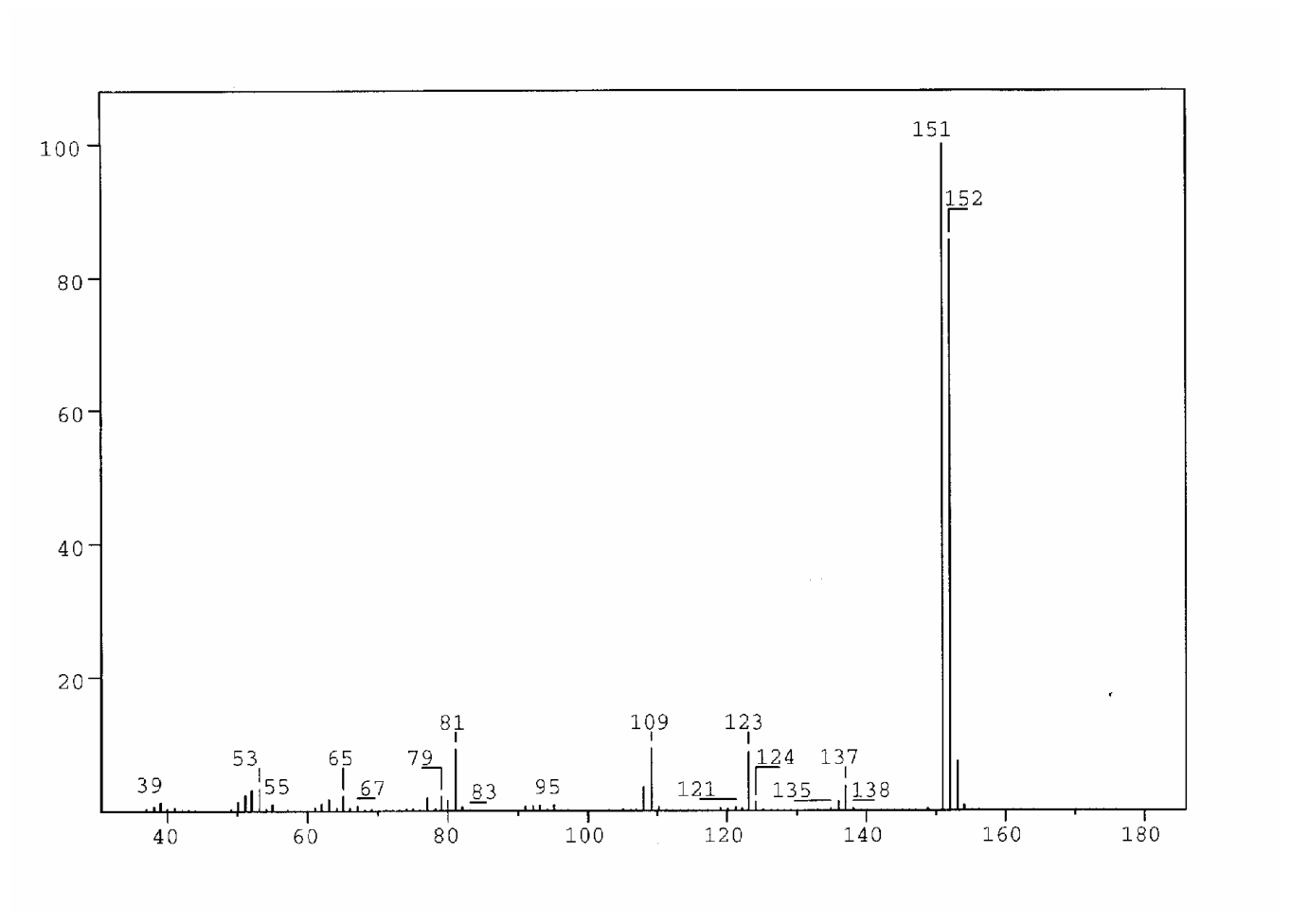
Figure 1
The mass spectrum of compound A is shown in Figure 1.
4.2 What is the molecular formula for compound A?
A solution of A in ether is shaken with an aqueous solution of \(\ce{NaOH}\). After this, no A remains in the ether phase. Another solution of A in ether is shaken with an aqueous solution of \(\ce{NaHCO3}\). A remains in the ether phase.
4.3 Which of the following classes of compounds does A belong to according to these experiments? Mark with an X.
| alcohol □ | phenol □ | aldehyde □ | ketone □ |
| acid □ | ester □ | ether □ |
Compound A gave rise to formation of a silver mirror with Tollens’ reagent (\(\ce{Ag(NH3)2+}\)).
4-1 Which of the following functional groups does this indicate the presence of in A? Mark with an X.
| hydroxy group of an alcohol □ | hydroxy group of a phenol □ |
| carbonyl group of an aldehyde □ | carbonyl group of a ketone □ |
| carboxylic group □ | ester group □ |
| alkoxy group of an ether □ |
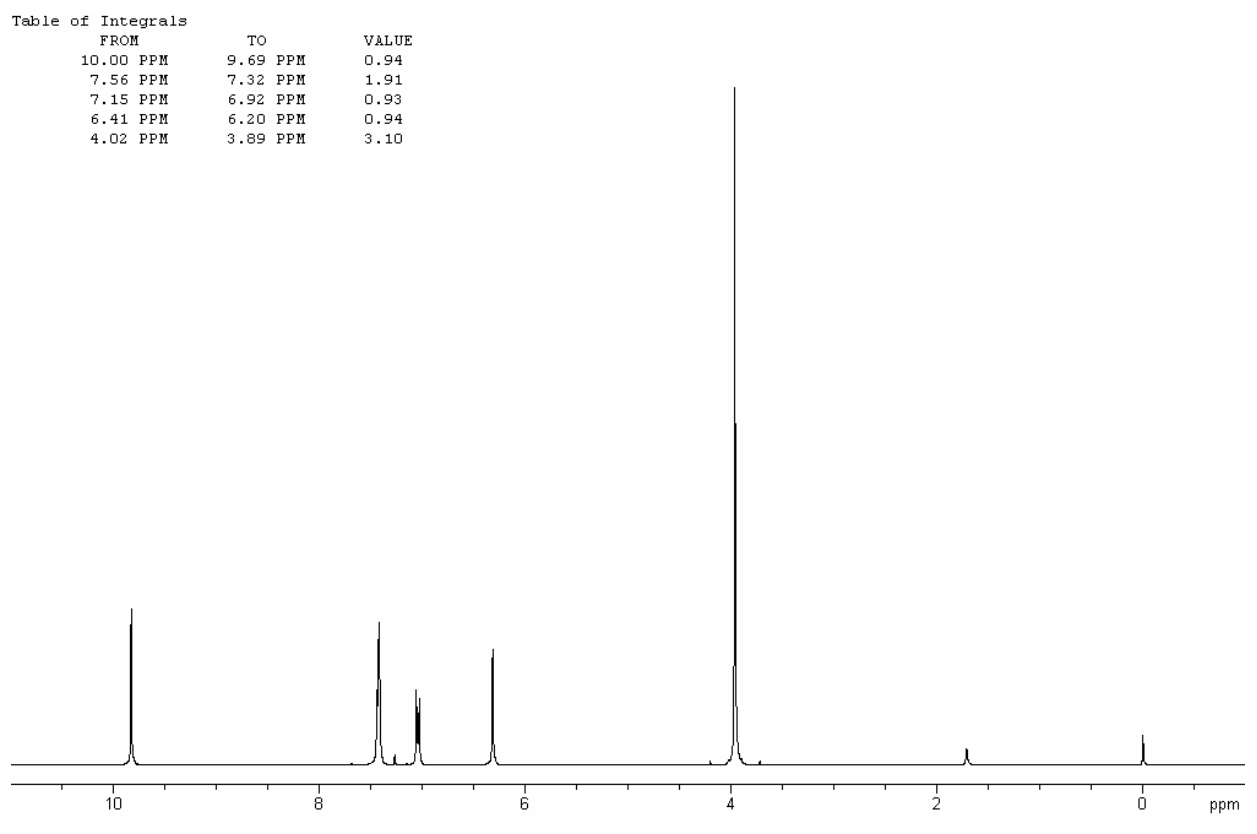
Figure 2a
The \({}^{1}\mathrm{H}\) NMR spectrum of compound A recorded at 300 MHz is shown in Figure 2a (solvent \(\ce{CDCl3}\) (7.27 ppm), reference tetramethylsilane). The signals at 3.9, 6.3 and 9.8 ppm are singlets. Figure 2b is an expansion of the region 6.9 – 7.6 ppm.
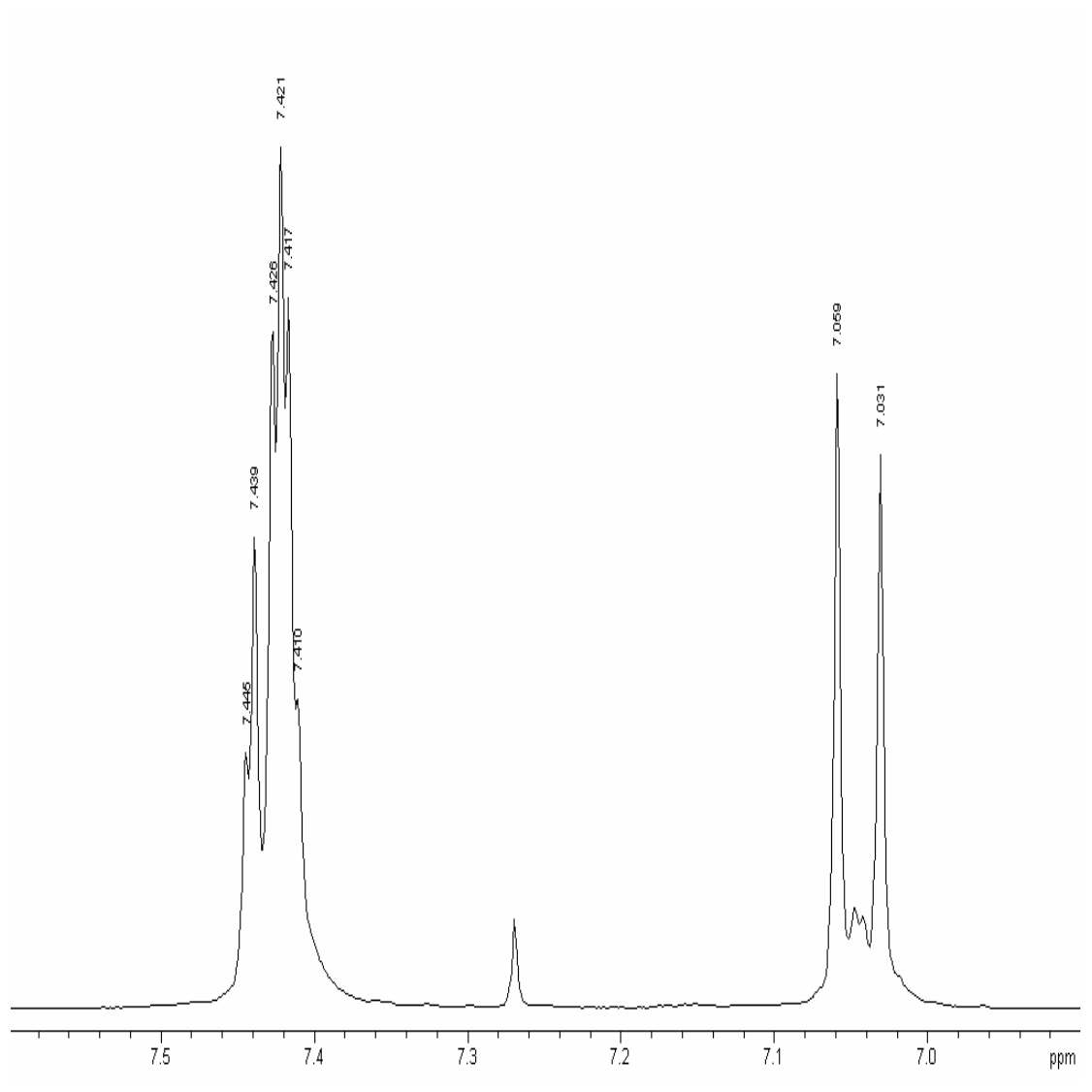
Figure 2b
Selected chemical shift and coupling constant values are given in Table 1.
The signal at 6.3 ppm disappears when a drop of \(\ce{D2O}\) is added.
4.5 Which of the following does this indicate? Mark with an X.
- Exchange of carbon-bonded hydrogen □
- Exchange of oxygen-bonded hydrogen □
- Dilution effect □
- Hydrolysis □
The same signal moves to a lower ppm value upon dilution with \(\ce{CDCl3}\).
4.6 Which of the following does this indicate?
Indicate the true statements (more than one).
- Increased hydrogen bonding □
- Decrease in hydrogen bonding □
- Intermolecular hydrogen bonding □
- Intramolecular hydrogen bonding □
- No hydrogen bonding □
4.7 Draw the four possible structural formulas for compound A based on the information given above
4.8 Give structural formulas for the fragments lost corresponding to the peaks at 137 and 123 mass units in the mass spectrum.
4.9 Two of the isomers have a lower \(pK_a\) value than the others. Write the formulas for those.
Table 1. \({}^{1}\mathrm{H}\) Chemical Shift \(\delta\)
Hydrogens attached to carbon
| Methyl | \(\ce{CH3-C-}\) \(\ce{CH3-C=O-}\) \(\ce{CH3-O-R}\) \(\ce{CH3-OCOR}\) |
0.9 – 1.6 ppm 2.0 – 2.4 ppm 3.3 – 3.8 ppm 3.7 – 4.0 ppm |
| Methylene | \(\ce{CH2-C-}\) \(\ce{CH2-C=O-}\) \(\ce{CH2-OR}\) \(\ce{CH2-OCOR}\) |
1.4 – 2.7 ppm 2.2 – 2.9 ppm 3.4 – 4.1 ppm 4.3 – 4.4 ppm |
| Methine | \(\ce{CH-}\) | 1.5 – 5.0 ppm depending on the substituents. Generally higher than for methyl and methylene |
| Alkene | 4.0 – 7.3 ppm depending on the substituent |
|
| Aldehyde | \(\ce{R-CHO}\) | 9.0 – 10.0 ppm |
Table 1 (continued) \({}^{1}\mathrm{H}\) Chemical Shift \(\delta\)
Hydrogens attached to oxygen
| Alcohols | \(\ce{ROH}\) | 0.5 – 5.0 ppm |
| Phenols | \(\ce{ArOH}\) | 4.0 – 7.0 ppm |
| Carboxylic acids | \(\ce{RCOOH}\) | 10.0 – 13.0 ppm |
Selected spin-spin coupling constants
| Alkanes (free rotation) |
\(\ce{H-C-C-H}\) vicinal | 6 – 8 Hz |
| Alkenes | trans cis geminal |
11 – 18 Hz 6 – 12 Hz 0 – 3 Hz |
| Aromates | ortho meta para |
6 – 10 Hz 1 – 4 Hz 0 – 2 Hz |
Official English text of the problem.
Answers
- 4.1: Empirical formula: \(\boxed{\ce{C8H8O3}}\).
- 4.2: Molecular formula: \(\boxed{\ce{C8H8O3}}\), from the molecular-ion peak at \(m/z=152\).
- 4.3: Mark phenol.
- 4-1 (fourth subquestion): Mark carbonyl group of an aldehyde.
- 4.5: Mark Exchange of oxygen-bonded hydrogen.
- 4.6: Mark Decrease in hydrogen bonding and Intermolecular hydrogen bonding.
- 4.7: The four candidate structures are:
1. 4-Hydroxy-3-methoxybenzaldehyde (vanillin):
O=Cc1cc(OC)c(O)cc12. 3-Hydroxy-4-methoxybenzaldehyde (isovanillin):O=Cc1cc(O)c(OC)cc13. 4-Hydroxy-2-methoxybenzaldehyde:O=Cc1c(OC)cc(O)cc14. 5-Hydroxy-2-methoxybenzaldehyde:O=Cc1c(OC)ccc(O)c1 - 4.8: At \(m/z=137\), loss of a methyl radical, \(\ce{CH3^{.}}\),
[CH3]; at \(m/z=123\), loss of a formyl radical, \(\ce{HCO^{.}}\),[CH]=O. - 4.9: The two lower-\(pK_a\) isomers are 4-hydroxy-3-methoxybenzaldehyde (vanillin),
O=Cc1cc(OC)c(O)cc1, and 4-hydroxy-2-methoxybenzaldehyde,O=Cc1c(OC)cc(O)cc1.
Solution
4.1 — Empirical formula
Take a \(100.0\ \mathrm{g}\) sample. Using atomic molar masses \(12.01\), \(1.008\) and \(16.00\ \mathrm{g\,mol^{-1}}\),
\[ \begin{aligned} n_{\ce C}&=\frac{63.2}{12.01}=5.262\ \mathrm{mol},\\ n_{\ce H}&=\frac{5.3}{1.008}=5.258\ \mathrm{mol},\\ n_{\ce O}&=\frac{31.5}{16.00}=1.969\ \mathrm{mol}. \end{aligned} \]
Dividing by the oxygen amount gives
\[ n_{\ce C}:n_{\ce H}:n_{\ce O} =2.673:2.671:1. \]
Multiplication by three gives approximately \(8:8:3\). Therefore,
\[ \boxed{\text{Empirical formula}=\ce{C8H8O3}}. \]
Its empirical formula mass is
\[ M_{\mathrm{emp}} =8(12.01)+8(1.008)+3(16.00) =152.14\ \mathrm{g\,mol^{-1}}. \]
4.2 — Molecular formula
The molecular-ion peak occurs at \(m/z=152\). For a singly charged molecular ion, this corresponds to a molecular mass of approximately \(152\ \mathrm{u}\), hence a molar mass of approximately \(152\ \mathrm{g\,mol^{-1}}\).
Thus,
\[ \frac{M}{M_{\mathrm{emp}}}\approx\frac{152}{152.14}\approx1, \]
so the molecular and empirical formulas coincide:
\[ \boxed{\ce{C8H8O3}}. \]
The formula alone does not specify connectivity; the possible molecular structures are established in 4.7.
4.3 — Interpretation of the extraction experiments
Hydroxide deprotonates the phenolic group, producing an ionic phenoxide that transfers into the aqueous phase:
\[ \ce{ArOH + OH- -> ArO- + H2O}. \]
Here \(\ce{Ar}\) denotes the substituted aromatic residue. In generic SMILES, with * denoting that residue, the phenol is *O and its phenoxide is *[O-]. Hydroxide is [OH-], and water is O.
Bicarbonate, O=C([O-])O, is too weak a base to produce substantial extraction under the stated conditions. This distinguishes the observed behavior from that expected for an ordinary carboxylic acid, which would react with aqueous bicarbonate.
Therefore, mark phenol. These extraction experiments establish the phenolic group; the other functional groups require the subsequent evidence.
4-1 — Interpretation of Tollens’ test
The silver mirror indicates reduction of silver(I) to metallic silver while the aldehyde is oxidized to a carboxylate:
\[ \ce{ArCHO + 2[Ag(NH3)2]+ + 3OH- -> ArCOO- + 2Ag(s) + 4NH3 + 2H2O}. \]
This equation is balanced in atoms and charge. The aldehyde carbon undergoes a two-electron oxidation, reducing two silver(I) ions.
The generic aldehyde and carboxylate structures are *C=O and *C(=O)[O-], respectively. Diamminesilver(I) has dative-bond SMILES [NH3]->[Ag+]<-[NH3] and approximately linear nitrogen–silver–nitrogen coordination. Ammonia is N.
Thus, mark carbonyl group of an aldehyde. The one-proton singlet at \(9.8\ \mathrm{ppm}\) independently supports this assignment.
4.5 — Disappearance of the 6.3 ppm signal
The phenolic hydrogen exchanges with deuterium:
\[ \ce{ArOH + D2O <=> ArOD + HDO}. \]
Heavy water is [2H]O[2H], the generic oxygen-deuterated phenol is *O[2H], and monodeuterated water is [2H]O.
The resulting oxygen-bound deuterium does not give the original signal in a \({}^{1}\mathrm H\) NMR spectrum. Therefore, mark Exchange of oxygen-bonded hydrogen.
4.6 — Effect of dilution
Hydrogen bonding deshields the phenolic proton, moving its resonance to a higher chemical shift. Dilution reduces association between separate molecules. The resulting decrease in hydrogen bonding increases shielding, moving the signal to a lower ppm value.
Therefore, mark:
- Decrease in hydrogen bonding
- Intermolecular hydrogen bonding
A purely intramolecular hydrogen bond would ordinarily be much less sensitive to concentration.
4.7 — Four possible structures
The degree of unsaturation is
\[ \mathrm{DBE}=\frac{2(8)+2-8}{2}=5. \]
A benzene ring accounts for four degrees of unsaturation, and an aldehyde carbonyl accounts for the fifth.
The NMR integrals give the following assignments:
| Signal or integration region | Integral | Assignment |
|---|---|---|
| \(9.8\ \mathrm{ppm}\) | \(0.94\approx1\) H | Aldehyde hydrogen |
| \(7.56–7.32\ \mathrm{ppm}\) | \(1.91\approx2\) H | Two aromatic hydrogens |
| \(7.15–6.92\ \mathrm{ppm}\) | \(0.93\approx1\) H | One aromatic hydrogen |
| \(6.3\ \mathrm{ppm}\) | \(0.94\approx1\) H | Phenolic hydrogen |
| \(3.9\ \mathrm{ppm}\) | \(3.10\approx3\) H | Methoxy hydrogens |
The phenol and aldehyde account for two oxygen atoms. The remaining oxygen belongs to a methoxy group, \(\ce{-OCH3}\), generic SMILES *OC, which accounts for the three-proton singlet at \(3.9\ \mathrm{ppm}\).
Thus, A is a benzene bearing one hydroxy, one methoxy and one formyl substituent:
\[ \ce{C6H3(OH)(OCH3)(CHO)}. \]
The aromatic splitting constrains their relative positions. For the well-resolved doublet near \(7.04\ \mathrm{ppm}\),
\[ J=(7.059-7.031)\ \mathrm{ppm} \times300\ \mathrm{Hz\,ppm^{-1}} =8.4\ \mathrm{Hz}. \]
This is an ortho coupling according to Table 1. The overlapping resonances near \(7.42\ \mathrm{ppm}\) also show smaller splittings consistent with meta coupling.
The pattern corresponds to three aromatic hydrogens with one ortho relationship, one meta relationship and one para relationship: a 1,2,4-type trisubstituted benzene. In comparison, three consecutive aromatic hydrogens would have two ortho couplings, while the hydrogens of a 1,3,5-trisubstituted ring would have only meta relationships.
The intended additional restriction from the hydrogen-bonding observations is that the hydroxy and formyl groups are not ortho. An ortho arrangement would favor a six-membered intramolecular hydrogen-bonded arrangement between the phenolic hydrogen and aldehyde oxygen.
Applying these restrictions gives four candidates. To draw them, place the formyl group at carbon 1 of a benzene ring and add the other substituents at the positions below. Every remaining ring carbon bears hydrogen.
| Candidate | Hydroxy position | Methoxy position | Name and SMILES |
|---|---|---|---|
| I | 4 | 3 | 4-Hydroxy-3-methoxybenzaldehyde (vanillin) — O=Cc1cc(OC)c(O)cc1 |
| II | 3 | 4 | 3-Hydroxy-4-methoxybenzaldehyde (isovanillin) — O=Cc1cc(O)c(OC)cc1 |
| III | 4 | 2 | 4-Hydroxy-2-methoxybenzaldehyde — O=Cc1c(OC)cc(O)cc1 |
| IV | 5 | 2 | 5-Hydroxy-2-methoxybenzaldehyde — O=Cc1c(OC)ccc(O)c1 |
These structures require no stereochemical specification.
4.8 — Fragments lost in the mass spectrum
Calculate each loss relative to the molecular ion at \(m/z=152\):
| Product peak | Nominal mass lost | Lost fragment and structure |
|---|---|---|
| \(m/z=137\) | \(152-137=15\ \mathrm{u}\) | Methyl radical, \(\ce{CH3^{.}}\), [CH3] |
| \(m/z=123\) | \(152-123=29\ \mathrm{u}\) | Formyl radical, \(\ce{HCO^{.}}\), [CH]=O |
The methyl loss corresponds to cleavage of the oxygen–methyl bond of the methoxy group. The formyl loss corresponds to removal of the aldehyde substituent from the aromatic ring; its unpaired electron is on carbon.
These are the assigned net losses from the molecular ion; the mass differences alone do not establish a unique fragmentation sequence.
4.9 — Isomers with lower \(pK_a\)
The lower-\(pK_a\) isomers have the aldehyde group para to the phenolic hydroxy group:
- I: 4-Hydroxy-3-methoxybenzaldehyde (vanillin) —
O=Cc1cc(OC)c(O)cc1 - III: 4-Hydroxy-2-methoxybenzaldehyde —
O=Cc1c(OC)cc(O)cc1
Their conjugate bases are:
- 4-Formyl-2-methoxyphenolate —
O=Cc1cc(OC)c([O-])cc1 - 4-Formyl-3-methoxyphenolate —
O=Cc1c(OC)cc([O-])cc1
In these phenoxide ions, resonance can distribute negative charge through the ring to the para position and onward onto the aldehyde oxygen. This additional stabilization favors deprotonation and lowers \(pK_a\).
For candidates II and IV, the aldehyde is meta to the phenolic group, so this direct resonance stabilization of the conjugate base is unavailable.
The solution was checked against the official solution.
IChO 2000 · Theorieaufgabe 4
Eine natürlich vorkommende Verbindung
Eine natürlich vorkommende Verbindung A, die nur \(\ce{C}\), \(\ce{H}\) und \(\ce{O}\) enthält, weist die folgende Elementzusammensetzung in Massenprozent auf:
\(\ce{C}\): 63.2 %, \(\ce{H}\): 5.3%, \(\ce{O}\): 31.5%.
4.1 Leiten Sie die Verhältnisformel der Verbindung A her.
Abbildung 1
Das Massenspektrum der Verbindung A ist in Abbildung 1 dargestellt.
4.2 Wie lautet die Summenformel der Verbindung A?
Eine Lösung von A in Ether wird mit einer wässrigen Lösung von \(\ce{NaOH}\) ausgeschüttelt. Danach verbleibt kein A in der Etherphase. Eine weitere Lösung von A in Ether wird mit einer wässrigen Lösung von \(\ce{NaHCO3}\) ausgeschüttelt. A verbleibt in der Etherphase.
4.3 Zu welcher der folgenden Verbindungsklassen gehört A gemäß diesen Experimenten? Kreuzen Sie mit einem X an.
| Alkohol □ | Phenol □ | Aldehyd □ | Keton □ |
| Säure □ | Ester □ | Ether □ |
Verbindung A führte mit Tollens-Reagenz (\(\ce{Ag(NH3)2+}\)) zur Bildung eines Silberspiegels.
4-1 Auf das Vorhandensein welcher der folgenden funktionellen Gruppen in A deutet dies hin? Kreuzen Sie mit einem X an.
| Hydroxygruppe eines Alkohols □ | Hydroxygruppe eines Phenols □ |
| Carbonylgruppe eines Aldehyds □ | Carbonylgruppe eines Ketons □ |
| Carboxygruppe □ | Estergruppe □ |
| Alkoxygruppe eines Ethers □ |
Abbildung 2a
Das bei 300 MHz aufgenommene \({}^{1}\mathrm{H}\)-NMR-Spektrum der Verbindung A ist in Abbildung 2a dargestellt (Lösungsmittel \(\ce{CDCl3}\) (7.27 ppm), Referenz Tetramethylsilan). Die Signale bei 3.9, 6.3 und 9.8 ppm sind Singuletts. Abbildung 2b zeigt eine Vergrößerung des Bereichs 6.9 – 7.6 ppm.
Abbildung 2b
Ausgewählte Werte für chemische Verschiebungen und Kopplungskonstanten sind in Tabelle 1 angegeben.
Das Signal bei 6.3 ppm verschwindet, wenn ein Tropfen \(\ce{D2O}\) zugegeben wird.
4.5 Worauf deutet dies hin? Kreuzen Sie mit einem X an.
- Austausch von an Kohlenstoff gebundenem Wasserstoff □
- Austausch von an Sauerstoff gebundenem Wasserstoff □
- Verdünnungseffekt □
- Hydrolyse □
Dasselbe Signal verschiebt sich beim Verdünnen mit \(\ce{CDCl3}\) zu einem niedrigeren ppm-Wert.
4.6 Worauf deutet dies hin?
Kennzeichnen Sie die zutreffenden Aussagen (mehr als eine).
- Zunahme der Wasserstoffbrückenbindung □
- Abnahme der Wasserstoffbrückenbindung □
- Intermolekulare Wasserstoffbrückenbindung □
- Intramolekulare Wasserstoffbrückenbindung □
- Keine Wasserstoffbrückenbindung □
4.7 Zeichnen Sie anhand der oben angegebenen Informationen die vier möglichen Strukturformeln der Verbindung A
4.8 Geben Sie die Strukturformeln der abgespaltenen Fragmente an, die den Peaks bei 137 und 123 Masseneinheiten im Massenspektrum entsprechen.
4.9 Zwei der Isomere haben einen niedrigeren \(pK_a\)-Wert als die anderen. Schreiben Sie deren Formeln auf.
Tabelle 1. \({}^{1}\mathrm{H}\): Chemische Verschiebung \(\delta\)
An Kohlenstoff gebundene Wasserstoffatome
| Methyl | \(\ce{CH3-C-}\) \(\ce{CH3-C=O-}\) \(\ce{CH3-O-R}\) \(\ce{CH3-OCOR}\) |
0.9 – 1.6 ppm 2.0 – 2.4 ppm 3.3 – 3.8 ppm 3.7 – 4.0 ppm |
| Methylen | \(\ce{CH2-C-}\) \(\ce{CH2-C=O-}\) \(\ce{CH2-OR}\) \(\ce{CH2-OCOR}\) |
1.4 – 2.7 ppm 2.2 – 2.9 ppm 3.4 – 4.1 ppm 4.3 – 4.4 ppm |
| Methin | \(\ce{CH-}\) | 1.5 – 5.0 ppm abhängig von den Substituenten. Im Allgemeinen höher als bei Methyl und Methylen |
| Alkene | 4.0 – 7.3 ppm abhängig vom Substituenten |
|
| Aldehyd | \(\ce{R-CHO}\) | 9.0 – 10.0 ppm |
Tabelle 1 (Fortsetzung) \({}^{1}\mathrm{H}\): Chemische Verschiebung \(\delta\)
An Sauerstoff gebundene Wasserstoffatome
| Alkohole | \(\ce{ROH}\) | 0.5 – 5.0 ppm |
| Phenole | \(\ce{ArOH}\) | 4.0 – 7.0 ppm |
| Carbonsäuren | \(\ce{RCOOH}\) | 10.0 – 13.0 ppm |
Ausgewählte Spin-Spin-Kopplungskonstanten
| Alkane (freie Rotation) |
\(\ce{H-C-C-H}\) vicinal | 6 – 8 Hz |
| Alkene | trans cis geminal |
11 – 18 Hz 6 – 12 Hz 0 – 3 Hz |
| Aromaten | ortho meta para |
6 – 10 Hz 1 – 4 Hz 0 – 2 Hz |
Aufgabentext aus dem offiziellen englischen Text übersetzt.
Antworten
- 4.1: Verhältnisformel: \(\boxed{\ce{C8H8O3}}\).
- 4.2: Summenformel: \(\boxed{\ce{C8H8O3}}\), aus dem Molekülionenpeak bei \(m/z=152\).
- 4.3: Phenol ankreuzen.
- 4-1 (vierte Teilfrage): Carbonylgruppe eines Aldehyds ankreuzen.
- 4.5: Austausch von an Sauerstoff gebundenem Wasserstoff ankreuzen.
- 4.6: Abnahme der Wasserstoffbrückenbindung und Intermolekulare Wasserstoffbrückenbindung ankreuzen.
- 4.7: Die vier möglichen Strukturen sind:
1. 4-Hydroxy-3-methoxybenzaldehyd (Vanillin):
O=Cc1cc(OC)c(O)cc12. 3-Hydroxy-4-methoxybenzaldehyd (Isovanillin):O=Cc1cc(O)c(OC)cc13. 4-Hydroxy-2-methoxybenzaldehyd:O=Cc1c(OC)cc(O)cc14. 5-Hydroxy-2-methoxybenzaldehyd:O=Cc1c(OC)ccc(O)c1 - 4.8: Bei \(m/z=137\) Abspaltung eines Methylradikals, \(\ce{CH3^{.}}\),
[CH3]; bei \(m/z=123\) Abspaltung eines Formylradikals, \(\ce{HCO^{.}}\),[CH]=O. - 4.9: Die beiden Isomere mit niedrigerem \(pK_a\) sind 4-Hydroxy-3-methoxybenzaldehyd (Vanillin),
O=Cc1cc(OC)c(O)cc1, und 4-Hydroxy-2-methoxybenzaldehyd,O=Cc1c(OC)cc(O)cc1.
Lösung
4.1 — Verhältnisformel
Man betrachtet eine Probe von \(100.0\ \mathrm{g}\). Mit den molaren Atommassen \(12.01\), \(1.008\) und \(16.00\ \mathrm{g\,mol^{-1}}\) gilt:
\[ \begin{aligned} n_{\ce C}&=\frac{63.2}{12.01}=5.262\ \mathrm{mol},\\ n_{\ce H}&=\frac{5.3}{1.008}=5.258\ \mathrm{mol},\\ n_{\ce O}&=\frac{31.5}{16.00}=1.969\ \mathrm{mol}. \end{aligned} \]
Division durch die Stoffmenge des Sauerstoffs ergibt
\[ n_{\ce C}:n_{\ce H}:n_{\ce O} =2.673:2.671:1. \]
Multiplikation mit drei ergibt näherungsweise \(8:8:3\). Daher gilt:
\[ \boxed{\text{Verhältnisformel}=\ce{C8H8O3}}. \]
Die zugehörige molare Masse der Verhältnisformel beträgt
\[ M_{\mathrm{emp}} =8(12.01)+8(1.008)+3(16.00) =152.14\ \mathrm{g\,mol^{-1}}. \]
4.2 — Summenformel
Der Molekülionenpeak liegt bei \(m/z=152\). Für ein einfach geladenes Molekülion entspricht dies einer Molekülmasse von ungefähr \(152\ \mathrm{u}\), also einer molaren Masse von ungefähr \(152\ \mathrm{g\,mol^{-1}}\).
Somit gilt
\[ \frac{M}{M_{\mathrm{emp}}}\approx\frac{152}{152.14}\approx1, \]
sodass Summenformel und Verhältnisformel übereinstimmen:
\[ \boxed{\ce{C8H8O3}}. \]
Die Formel allein legt die Verknüpfung der Atome nicht fest; die möglichen Molekülstrukturen werden in 4.7 ermittelt.
4.3 — Deutung der Extraktionsexperimente
Hydroxid deprotoniert die phenolische Gruppe, wobei ein ionisches Phenolat entsteht, das in die wässrige Phase übergeht:
\[ \ce{ArOH + OH- -> ArO- + H2O}. \]
Hier bezeichnet \(\ce{Ar}\) den substituierten aromatischen Rest. In einer allgemeinen SMILES-Darstellung, in der * diesen Rest bezeichnet, ist das Phenol *O und sein Phenolat *[O-]. Hydroxid ist [OH-] und Wasser ist O.
Hydrogencarbonat, O=C([O-])O, ist eine zu schwache Base, um unter den angegebenen Bedingungen eine wesentliche Extraktion zu bewirken. Dies unterscheidet das beobachtete Verhalten von dem einer gewöhnlichen Carbonsäure, die mit wässrigem Hydrogencarbonat reagieren würde.
Daher ist Phenol anzukreuzen. Diese Extraktionsexperimente weisen die phenolische Gruppe nach; für die anderen funktionellen Gruppen sind die nachfolgenden Befunde erforderlich.
4-1 — Deutung der Tollens-Probe
Der Silberspiegel zeigt die Reduktion von Silber(I) zu metallischem Silber an, während der Aldehyd zu einem Carboxylat oxidiert wird:
\[ \ce{ArCHO + 2[Ag(NH3)2]+ + 3OH- -> ArCOO- + 2Ag(s) + 4NH3 + 2H2O}. \]
Diese Gleichung ist hinsichtlich der Atome und der Ladung ausgeglichen. Das Aldehyd-Kohlenstoffatom wird unter Abgabe von zwei Elektronen oxidiert und reduziert dabei zwei Silber(I)-Ionen.
Die allgemeinen Strukturen des Aldehyds und des Carboxylats sind *C=O beziehungsweise *C(=O)[O-]. Diamminsilber(I) hat die SMILES-Darstellung [NH3]->[Ag+]<-[NH3] mit koordinativen Bindungen und eine annähernd lineare Stickstoff–Silber–Stickstoff-Koordination. Ammoniak ist N.
Somit ist Carbonylgruppe eines Aldehyds anzukreuzen. Das Einprotonen-Singulett bei \(9.8\ \mathrm{ppm}\) stützt diese Zuordnung unabhängig davon.
4.5 — Verschwinden des Signals bei 6.3 ppm
Der phenolische Wasserstoff wird gegen Deuterium ausgetauscht:
\[ \ce{ArOH + D2O <=> ArOD + HDO}. \]
Schweres Wasser ist [2H]O[2H], das allgemeine am Sauerstoff deuterierte Phenol ist *O[2H], und einfach deuteriertes Wasser ist [2H]O.
Das dabei entstehende, an Sauerstoff gebundene Deuterium erzeugt das ursprüngliche Signal in einem \({}^{1}\mathrm H\)-NMR-Spektrum nicht. Daher ist Austausch von an Sauerstoff gebundenem Wasserstoff anzukreuzen.
4.6 — Einfluss der Verdünnung
Wasserstoffbrückenbindung entschirmt das phenolische Proton und verschiebt seine Resonanz zu einer höheren chemischen Verschiebung. Verdünnung verringert die Assoziation zwischen einzelnen Molekülen. Die daraus resultierende Abnahme der Wasserstoffbrückenbindung erhöht die Abschirmung und verschiebt das Signal zu einem niedrigeren ppm-Wert.
Daher ist anzukreuzen:
- Abnahme der Wasserstoffbrückenbindung
- Intermolekulare Wasserstoffbrückenbindung
Eine rein intramolekulare Wasserstoffbrücke wäre gewöhnlich wesentlich weniger konzentrationsabhängig.
4.7 — Vier mögliche Strukturen
Der Ungesättigtheitsgrad beträgt
\[ \mathrm{DBE}=\frac{2(8)+2-8}{2}=5. \]
Ein Benzolring trägt vier zum Ungesättigtheitsgrad bei, und eine Aldehyd-Carbonylgruppe liefert den fünften Beitrag.
Die NMR-Integrale ergeben die folgenden Zuordnungen:
| Signal oder Integrationsbereich | Integral | Zuordnung |
|---|---|---|
| \(9.8\ \mathrm{ppm}\) | \(0.94\approx1\) H | Aldehyd-Wasserstoffatom |
| \(7.56–7.32\ \mathrm{ppm}\) | \(1.91\approx2\) H | Zwei aromatische Wasserstoffatome |
| \(7.15–6.92\ \mathrm{ppm}\) | \(0.93\approx1\) H | Ein aromatisches Wasserstoffatom |
| \(6.3\ \mathrm{ppm}\) | \(0.94\approx1\) H | Phenolisches Wasserstoffatom |
| \(3.9\ \mathrm{ppm}\) | \(3.10\approx3\) H | Methoxy-Wasserstoffatome |
Auf die Phenol- und die Aldehydgruppe entfallen zwei Sauerstoffatome. Das verbleibende Sauerstoffatom gehört zu einer Methoxygruppe, \(\ce{-OCH3}\), mit der allgemeinen SMILES-Darstellung *OC, die für das Dreiprotonen-Singulett bei \(3.9\ \mathrm{ppm}\) verantwortlich ist.
Somit ist A ein Benzol mit jeweils einem Hydroxy-, Methoxy- und Formylsubstituenten:
\[ \ce{C6H3(OH)(OCH3)(CHO)}. \]
Die Aufspaltung der aromatischen Signale schränkt deren relative Positionen ein. Für das gut aufgelöste Dublett bei etwa \(7.04\ \mathrm{ppm}\) gilt:
\[ J=(7.059-7.031)\ \mathrm{ppm} \times300\ \mathrm{Hz\,ppm^{-1}} =8.4\ \mathrm{Hz}. \]
Dies ist gemäß Tabelle 1 eine ortho-Kopplung. Die überlappenden Resonanzen bei etwa \(7.42\ \mathrm{ppm}\) zeigen auch kleinere Aufspaltungen, die mit einer meta-Kopplung vereinbar sind.
Das Muster entspricht drei aromatischen Wasserstoffatomen, von denen jeweils ein Paar in ortho-, meta- und para-Stellung zueinander steht: einem trisubstituierten Benzol vom 1,2,4-Typ. Im Vergleich dazu würden drei aufeinanderfolgende aromatische Wasserstoffatome zwei ortho-Kopplungen aufweisen, während die Wasserstoffatome eines 1,3,5-trisubstituierten Rings ausschließlich in meta-Stellung zueinander stünden.
Die aus den Beobachtungen zur Wasserstoffbrückenbindung beabsichtigte zusätzliche Einschränkung besteht darin, dass die Hydroxy- und die Formylgruppe nicht in ortho-Stellung zueinander stehen. Eine ortho-Anordnung würde eine sechsgliedrige, durch eine intramolekulare Wasserstoffbrücke zwischen dem phenolischen Wasserstoff und dem Aldehyd-Sauerstoff gebildete Anordnung begünstigen.
Die Anwendung dieser Einschränkungen ergibt vier Kandidaten. Um sie zu zeichnen, setzt man die Formylgruppe an das Kohlenstoffatom 1 eines Benzolrings und fügt die anderen Substituenten an den unten angegebenen Positionen hinzu. Jedes verbleibende Ringkohlenstoffatom trägt ein Wasserstoffatom.
| Kandidat | Position der Hydroxygruppe | Position der Methoxygruppe | Name und SMILES |
|---|---|---|---|
| I | 4 | 3 | 4-Hydroxy-3-methoxybenzaldehyd (Vanillin) — O=Cc1cc(OC)c(O)cc1 |
| II | 3 | 4 | 3-Hydroxy-4-methoxybenzaldehyd (Isovanillin) — O=Cc1cc(O)c(OC)cc1 |
| III | 4 | 2 | 4-Hydroxy-2-methoxybenzaldehyd — O=Cc1c(OC)cc(O)cc1 |
| IV | 5 | 2 | 5-Hydroxy-2-methoxybenzaldehyd — O=Cc1c(OC)ccc(O)c1 |
Diese Strukturen erfordern keine stereochemische Spezifikation.
4.8 — Im Massenspektrum abgespaltene Fragmente
Jeder Massenverlust wird relativ zum Molekülion bei \(m/z=152\) berechnet:
| Produktpeak | Abgespaltene Nominalmasse | Abgespaltenes Fragment und Struktur |
|---|---|---|
| \(m/z=137\) | \(152-137=15\ \mathrm{u}\) | Methylradikal, \(\ce{CH3^{.}}\), [CH3] |
| \(m/z=123\) | \(152-123=29\ \mathrm{u}\) | Formylradikal, \(\ce{HCO^{.}}\), [CH]=O |
Die Methylabspaltung entspricht der Spaltung der Sauerstoff–Methyl-Bindung der Methoxygruppe. Die Formylabspaltung entspricht der Entfernung des Aldehydsubstituenten vom aromatischen Ring; dessen ungepaartes Elektron befindet sich am Kohlenstoff.
Dies sind die zugeordneten Nettoabspaltungen vom Molekülion; die Massendifferenzen allein legen keine eindeutige Fragmentierungssequenz fest.
4.9 — Isomere mit niedrigerem \(pK_a\)
Bei den Isomeren mit niedrigerem \(pK_a\) steht die Aldehydgruppe in para-Stellung zur phenolischen Hydroxygruppe:
- I: 4-Hydroxy-3-methoxybenzaldehyd (Vanillin) —
O=Cc1cc(OC)c(O)cc1 - III: 4-Hydroxy-2-methoxybenzaldehyd —
O=Cc1c(OC)cc(O)cc1
Ihre konjugierten Basen sind:
- 4-Formyl-2-methoxyphenolat —
O=Cc1cc(OC)c([O-])cc1 - 4-Formyl-3-methoxyphenolat —
O=Cc1c(OC)cc([O-])cc1
In diesen Phenolat-Ionen kann die negative Ladung durch Mesomerie über den Ring bis zur para-Position und weiter auf den Aldehyd-Sauerstoff verteilt werden. Diese zusätzliche Stabilisierung begünstigt die Deprotonierung und senkt den \(pK_a\).
Bei den Kandidaten II und IV steht die Aldehydgruppe in meta-Stellung zur phenolischen Gruppe, sodass diese direkte mesomere Stabilisierung der konjugierten Base nicht möglich ist.
Die Lösung wurde mit der offiziellen Lösung abgeglichen.
IChO 2000 · Teori sorusu 4
Doğada Bulunan Bir Bileşik
Yalnızca \(\ce{C}\), \(\ce{H}\) ve \(\ce{O}\) içeren, doğada bulunan bir A bileşiğinin kütlece yüzde element bileşimi şöyledir:
\(\ce{C}\): 63.2 %, \(\ce{H}\): 5.3%, \(\ce{O}\): 31.5%.
4.1 A bileşiğinin basit formülünü bulunuz.
Şekil 1
A bileşiğinin kütle spektrumu Şekil 1'de gösterilmiştir.
4.2 A bileşiğinin molekül formülü nedir?
A bileşiğinin eterdeki bir çözeltisi, sulu \(\ce{NaOH}\) çözeltisiyle çalkalanır. Bu işlemden sonra eter fazında hiç A kalmaz. A bileşiğinin eterdeki başka bir çözeltisi, sulu \(\ce{NaHCO3}\) çözeltisiyle çalkalanır. A, eter fazında kalır.
4.3 Bu deneylere göre A, aşağıdaki bileşik sınıflarından hangisine aittir? X ile işaretleyiniz.
| alkol □ | fenol □ | aldehit □ | keton □ |
| asit □ | ester □ | eter □ |
A bileşiği, Tollens ayıracı (\(\ce{Ag(NH3)2+}\)) ile gümüş aynası oluşumuna yol açmıştır.
4-1 Bu, A bileşiğinde aşağıdaki fonksiyonel gruplardan hangisinin bulunduğunu gösterir? X ile işaretleyiniz.
| bir alkolün hidroksi grubu □ | bir fenolün hidroksi grubu □ |
| bir aldehidin karbonil grubu □ | bir ketonun karbonil grubu □ |
| karboksil grubu □ | ester grubu □ |
| bir eterin alkoksi grubu □ |
Şekil 2a
A bileşiğinin 300 MHz'de kaydedilen \({}^{1}\mathrm{H}\) NMR spektrumu Şekil 2a'da gösterilmiştir (çözücü \(\ce{CDCl3}\) (7.27 ppm), referans tetrametilsilan). 3.9, 6.3 ve 9.8 ppm'deki sinyaller singlettir. Şekil 2b, 6.9 – 7.6 ppm bölgesinin büyütülmüş görünümüdür.
Şekil 2b
Seçilmiş kimyasal kayma ve eşleşme sabiti değerleri Tablo 1'de verilmiştir.
Bir damla \(\ce{D2O}\) eklendiğinde 6.3 ppm'deki sinyal kaybolur.
4.5 Bu, aşağıdakilerden hangisini gösterir? X ile işaretleyiniz.
- Karbona bağlı hidrojenin değişimi □
- Oksijene bağlı hidrojenin değişimi □
- Seyreltme etkisi □
- Hidroliz □
Aynı sinyal, \(\ce{CDCl3}\) ile seyreltildiğinde daha düşük bir ppm değerine kayar.
4.6 Bu, aşağıdakilerden hangisini gösterir?
Doğru ifadeleri belirtiniz (birden fazla).
- Hidrojen bağlarının artması □
- Hidrojen bağlarının azalması □
- Moleküller arası hidrojen bağı □
- Molekül içi hidrojen bağı □
- Hidrojen bağı bulunmaması □
4.7 Yukarıda verilen bilgilere dayanarak A bileşiği için olası dört yapı formülünü çiziniz
4.8 Kütle spektrumunda 137 ve 123 kütle birimindeki piklere karşılık gelen, kaybedilen parçaların yapı formüllerini veriniz.
4.9 İzomerlerden ikisinin \(pK_a\) değeri diğerlerinden daha düşüktür. Bunların formüllerini yazınız.
Tablo 1. \({}^{1}\mathrm{H}\) Kimyasal Kayması \(\delta\)
Karbona bağlı hidrojenler
| Metil | \(\ce{CH3-C-}\) \(\ce{CH3-C=O-}\) \(\ce{CH3-O-R}\) \(\ce{CH3-OCOR}\) |
0.9 – 1.6 ppm 2.0 – 2.4 ppm 3.3 – 3.8 ppm 3.7 – 4.0 ppm |
| Metilen | \(\ce{CH2-C-}\) \(\ce{CH2-C=O-}\) \(\ce{CH2-OR}\) \(\ce{CH2-OCOR}\) |
1.4 – 2.7 ppm 2.2 – 2.9 ppm 3.4 – 4.1 ppm 4.3 – 4.4 ppm |
| Metin | \(\ce{CH-}\) | 1.5 – 5.0 ppm sübstitüentlere bağlıdır. Genellikle metil ve metilen için olan değerlerden daha yüksektir |
| Alken | 4.0 – 7.3 ppm sübstitüente bağlıdır |
|
| Aldehit | \(\ce{R-CHO}\) | 9.0 – 10.0 ppm |
Tablo 1 (devamı) \({}^{1}\mathrm{H}\) Kimyasal Kayması \(\delta\)
Oksijene bağlı hidrojenler
| Alkoller | \(\ce{ROH}\) | 0.5 – 5.0 ppm |
| Fenoller | \(\ce{ArOH}\) | 4.0 – 7.0 ppm |
| Karboksilik asitler | \(\ce{RCOOH}\) | 10.0 – 13.0 ppm |
Seçilmiş spin-spin eşleşme sabitleri
| Alkanlar (serbest dönme) |
\(\ce{H-C-C-H}\) visinal | 6 – 8 Hz |
| Alkenler | trans cis geminal |
11 – 18 Hz 6 – 12 Hz 0 – 3 Hz |
| Aromatik bileşikler | orto meta para |
6 – 10 Hz 1 – 4 Hz 0 – 2 Hz |
Soru metni resmi İngilizce metinden çevrilmiştir.
Cevaplar
- 4.1: Basit formül: \(\boxed{\ce{C8H8O3}}\).
- 4.2: Molekül formülü: \(\boxed{\ce{C8H8O3}}\); \(m/z=152\) değerindeki molekül iyonu pikinden bulunur.
- 4.3: Fenol seçeneğini işaretleyiniz.
- 4-1 (dördüncü alt soru): Bir aldehidin karbonil grubu seçeneğini işaretleyiniz.
- 4.5: Oksijene bağlı hidrojenin değişimi seçeneğini işaretleyiniz.
- 4.6: Hidrojen bağlarının azalması ve Moleküller arası hidrojen bağı seçeneklerini işaretleyiniz.
- 4.7: Dört aday yapı şunlardır:
1. 4-Hidroksi-3-metoksibenzaldehit (vanilin):
O=Cc1cc(OC)c(O)cc12. 3-Hidroksi-4-metoksibenzaldehit (izovanilin):O=Cc1cc(O)c(OC)cc13. 4-Hidroksi-2-metoksibenzaldehit:O=Cc1c(OC)cc(O)cc14. 5-Hidroksi-2-metoksibenzaldehit:O=Cc1c(OC)ccc(O)c1 - 4.8: \(m/z=137\) değerinde bir metil radikali, \(\ce{CH3^{.}}\),
[CH3]kaybı; \(m/z=123\) değerinde bir formil radikali, \(\ce{HCO^{.}}\),[CH]=Okaybı. - 4.9: \(pK_a\) değeri daha düşük olan iki izomer 4-hidroksi-3-metoksibenzaldehit (vanilin),
O=Cc1cc(OC)c(O)cc1ve 4-hidroksi-2-metoksibenzaldehit,O=Cc1c(OC)cc(O)cc1bileşikleridir.
Çözüm
4.1 — Basit formül
\(100.0\ \mathrm{g}\) numune alalım. Atomların molar kütleleri için \(12.01\), \(1.008\) ve \(16.00\ \mathrm{g\,mol^{-1}}\) değerlerini kullanırsak,
\[ \begin{aligned} n_{\ce C}&=\frac{63.2}{12.01}=5.262\ \mathrm{mol},\\ n_{\ce H}&=\frac{5.3}{1.008}=5.258\ \mathrm{mol},\\ n_{\ce O}&=\frac{31.5}{16.00}=1.969\ \mathrm{mol}. \end{aligned} \]
Oksijenin mol miktarına böldüğümüzde
\[ n_{\ce C}:n_{\ce H}:n_{\ce O} =2.673:2.671:1. \]
Üç ile çarpmak yaklaşık olarak \(8:8:3\) oranını verir. Dolayısıyla,
\[ \boxed{\text{Basit formül}=\ce{C8H8O3}}. \]
Basit formül kütlesi şöyledir:
\[ M_{\mathrm{emp}} =8(12.01)+8(1.008)+3(16.00) =152.14\ \mathrm{g\,mol^{-1}}. \]
4.2 — Molekül formülü
Molekül iyonu piki \(m/z=152\) değerinde görülür. Tek yüklü bir molekül iyonu için bu, yaklaşık \(152\ \mathrm{u}\) molekül kütlesine, dolayısıyla yaklaşık \(152\ \mathrm{g\,mol^{-1}}\) molar kütleye karşılık gelir.
Böylece,
\[ \frac{M}{M_{\mathrm{emp}}}\approx\frac{152}{152.14}\approx1, \]
olduğundan molekül formülü ve basit formül aynıdır:
\[ \boxed{\ce{C8H8O3}}. \]
Formül tek başına atomların birbirine nasıl bağlandığını belirtmez; olası molekül yapıları 4.7'de belirlenmektedir.
4.3 — Ekstraksiyon deneylerinin yorumlanması
Hidroksit, fenolik grubun protonunu uzaklaştırarak sulu faza geçen iyonik bir fenoksit oluşturur:
\[ \ce{ArOH + OH- -> ArO- + H2O}. \]
Burada \(\ce{Ar}\), sübstitüe aromatik kalıntıyı gösterir. Genel SMILES gösteriminde, * bu kalıntıyı temsil etmek üzere, fenol *O, fenoksiti ise *[O-] biçimindedir. Hidroksit [OH-], su ise O ile gösterilir.
Bikarbonat, O=C([O-])O, belirtilen koşullarda kayda değer bir ekstraksiyon sağlayamayacak kadar zayıf bir bazdır. Bu durum, gözlenen davranışı sulu bikarbonatla tepkimeye girecek sıradan bir karboksilik asitten beklenen davranıştan ayırır.
Dolayısıyla fenol seçeneğini işaretleyiniz. Bu ekstraksiyon deneyleri fenolik grubun varlığını ortaya koyar; diğer fonksiyonel grupların belirlenmesi için sonraki bulgular gereklidir.
4-1 — Tollens testinin yorumlanması
Gümüş aynası, aldehit bir karboksilata yükseltgenirken gümüş(I)'in metalik gümüşe indirgendiğini gösterir:
\[ \ce{ArCHO + 2[Ag(NH3)2]+ + 3OH- -> ArCOO- + 2Ag(s) + 4NH3 + 2H2O}. \]
Bu denklem atomlar ve yük bakımından denkleştirilmiştir. Aldehit karbonu iki elektron vererek yükseltgenir ve iki gümüş(I) iyonunu indirger.
Genel aldehit ve karboksilat yapıları sırasıyla *C=O ve *C(=O)[O-] biçimindedir. Diamingümüş(I)'in koordinatif bağ içeren SMILES gösterimi [NH3]->[Ag+]<-[NH3] olup azot–gümüş–azot koordinasyonu yaklaşık doğrusaldır. Amonyak N ile gösterilir.
Bu nedenle bir aldehidin karbonil grubu seçeneğini işaretleyiniz. \(9.8\ \mathrm{ppm}\) değerindeki bir protonluk singlet, bu atamayı bağımsız olarak destekler.
4.5 — 6.3 ppm sinyalinin kaybolması
Fenolik hidrojen, döteryum ile yer değiştirir:
\[ \ce{ArOH + D2O <=> ArOD + HDO}. \]
Ağır su [2H]O[2H], oksijenine döteryum bağlanmış fenolün genel gösterimi *O[2H], tek döteryumlu su ise [2H]O biçimindedir.
Oluşan, oksijene bağlı döteryum, \({}^{1}\mathrm H\) NMR spektrumunda başlangıçtaki sinyali vermez. Dolayısıyla oksijene bağlı hidrojenin değişimi seçeneğini işaretleyiniz.
4.6 — Seyreltmenin etkisi
Hidrojen bağı oluşumu fenolik protonun perdelenmesini azaltarak rezonansını daha yüksek bir kimyasal kayma değerine taşır. Seyreltme, ayrı moleküller arasındaki birleşmeyi azaltır. Bunun sonucunda hidrojen bağlarının azalması perdelenmeyi artırır ve sinyali daha düşük bir ppm değerine kaydırır.
Dolayısıyla şu seçenekleri işaretleyiniz:
- Hidrojen bağlarının azalması
- Moleküller arası hidrojen bağı
Yalnızca molekül içinde oluşan bir hidrojen bağı, normalde derişime çok daha az duyarlı olurdu.
4.7 — Olası dört yapı
Doymamışlık derecesi şöyledir:
\[ \mathrm{DBE}=\frac{2(8)+2-8}{2}=5. \]
Bir benzen halkası dört doymamışlık derecesine, bir aldehit karbonili ise beşinciye karşılık gelir.
NMR integralleri aşağıdaki atamaları verir:
| Sinyal veya integrasyon bölgesi | İntegral | Atama |
|---|---|---|
| \(9.8\ \mathrm{ppm}\) | \(0.94\approx1\) H | Aldehit hidrojeni |
| \(7.56–7.32\ \mathrm{ppm}\) | \(1.91\approx2\) H | İki aromatik hidrojen |
| \(7.15–6.92\ \mathrm{ppm}\) | \(0.93\approx1\) H | Bir aromatik hidrojen |
| \(6.3\ \mathrm{ppm}\) | \(0.94\approx1\) H | Fenolik hidrojen |
| \(3.9\ \mathrm{ppm}\) | \(3.10\approx3\) H | Metoksi hidrojenleri |
Fenol ve aldehit, iki oksijen atomunu açıklar. Geriye kalan oksijen, genel SMILES gösterimi *OC olan bir metoksi grubuna, \(\ce{-OCH3}\), aittir; bu grup \(3.9\ \mathrm{ppm}\) değerindeki üç protonluk singleti açıklar.
Dolayısıyla A, bir hidroksi, bir metoksi ve bir formil sübstitüenti taşıyan bir benzendir:
\[ \ce{C6H3(OH)(OCH3)(CHO)}. \]
Aromatik sinyallerdeki yarılma, bu grupların birbirlerine göre konumlarını sınırlar. \(7.04\ \mathrm{ppm}\) yakınındaki iyi çözünmüş dublet için,
\[ J=(7.059-7.031)\ \mathrm{ppm} \times300\ \mathrm{Hz\,ppm^{-1}} =8.4\ \mathrm{Hz}. \]
Tablo 1'e göre bu, bir orto eşleşmedir. \(7.42\ \mathrm{ppm}\) yakınındaki örtüşen rezonanslar da meta eşleşmeyle uyumlu daha küçük yarılmalar gösterir.
Bu desen, aralarında bir orto, bir meta ve bir para ilişkisi bulunan üç aromatik hidrojene karşılık gelir: 1,2,4-tipi trisübstitüe bir benzen. Buna karşılık, ardışık üç aromatik hidrojen iki orto eşleşmeye sahip olurken 1,3,5-trisübstitüe bir halkanın hidrojenleri arasında yalnızca meta ilişkileri bulunurdu.
Hidrojen bağı gözlemlerinden çıkarılması amaçlanan ek kısıtlama, hidroksi ve formil gruplarının birbirlerine göre orto konumunda olmamasıdır. Orto yerleşim, fenolik hidrojen ile aldehit oksijeni arasında molekül içi hidrojen bağı içeren altı üyeli bir düzenlenmeyi elverişli kılardı.
Bu kısıtlamalar uygulandığında dört aday elde edilir. Bunları çizmek için formil grubunu benzen halkasının 1 numaralı karbonuna yerleştiriniz ve diğer sübstitüentleri aşağıdaki konumlara ekleyiniz. Geriye kalan her halka karbonu bir hidrojen taşır.
| Aday | Hidroksi konumu | Metoksi konumu | Adı ve SMILES gösterimi |
|---|---|---|---|
| I | 4 | 3 | 4-Hidroksi-3-metoksibenzaldehit (vanilin) — O=Cc1cc(OC)c(O)cc1 |
| II | 3 | 4 | 3-Hidroksi-4-metoksibenzaldehit (izovanilin) — O=Cc1cc(O)c(OC)cc1 |
| III | 4 | 2 | 4-Hidroksi-2-metoksibenzaldehit — O=Cc1c(OC)cc(O)cc1 |
| IV | 5 | 2 | 5-Hidroksi-2-metoksibenzaldehit — O=Cc1c(OC)ccc(O)c1 |
Bu yapılar için stereokimyasal bir belirtim gerekli değildir.
4.8 — Kütle spektrumunda kaybedilen parçalar
Her bir kaybı \(m/z=152\) değerindeki molekül iyonuna göre hesaplayınız:
| Ürün piki | Kaybedilen nominal kütle | Kaybedilen parça ve yapısı |
|---|---|---|
| \(m/z=137\) | \(152-137=15\ \mathrm{u}\) | Metil radikali, \(\ce{CH3^{.}}\), [CH3] |
| \(m/z=123\) | \(152-123=29\ \mathrm{u}\) | Formil radikali, \(\ce{HCO^{.}}\), [CH]=O |
Metil kaybı, metoksi grubunun oksijen–metil bağının kopmasına karşılık gelir. Formil kaybı, aldehit sübstitüentinin aromatik halkadan ayrılmasına karşılık gelir; bu parçanın eşleşmemiş elektronu karbon üzerindedir.
Bunlar, molekül iyonundan gerçekleştiği kabul edilen net kayıplardır; kütle farkları tek başına tek bir parçalanma dizisini kesin olarak belirlemez.
4.9 — Daha düşük \(pK_a\) değerine sahip izomerler
\(pK_a\) değeri daha düşük olan izomerlerde aldehit grubu, fenolik hidroksi grubuna göre para konumundadır:
- I: 4-Hidroksi-3-metoksibenzaldehit (vanilin) —
O=Cc1cc(OC)c(O)cc1 - III: 4-Hidroksi-2-metoksibenzaldehit —
O=Cc1c(OC)cc(O)cc1
Bunların eşlenik bazları şunlardır:
- 4-Formil-2-metoksifenolat —
O=Cc1cc(OC)c([O-])cc1 - 4-Formil-3-metoksifenolat —
O=Cc1c(OC)cc([O-])cc1
Bu fenoksit iyonlarında rezonans, negatif yükü halka üzerinden para konumuna ve oradan da aldehit oksijenine dağıtabilir. Bu ek kararlılık, proton kaybını kolaylaştırır ve \(pK_a\) değerini düşürür.
II ve IV adaylarında aldehit, fenolik gruba göre meta konumundadır; bu nedenle eşlenik bazın rezonans yoluyla doğrudan kararlı hâle gelmesi mümkün değildir.
Çözüm, resmi çözümle karşılaştırılarak kontrol edildi.
IChO 2000 · Problema teórico 4
Un compuesto de origen natural
Un compuesto de origen natural A que contiene únicamente \(\ce{C}\), \(\ce{H}\) y \(\ce{O}\) presenta la siguiente composición elemental, expresada como porcentaje en masa:
\(\ce{C}\): 63.2 %, \(\ce{H}\): 5.3%, \(\ce{O}\): 31.5%.
4.1 Deduzca la fórmula empírica del compuesto A.
Figura 1
El espectro de masas del compuesto A se muestra en la Figura 1.
4.2 ¿Cuál es la fórmula molecular del compuesto A?
Se agita una disolución de A en éter con una disolución acuosa de \(\ce{NaOH}\). Tras ello, no queda A en la fase etérea. Se agita otra disolución de A en éter con una disolución acuosa de \(\ce{NaHCO3}\). A permanece en la fase etérea.
4.3 ¿A cuál de las siguientes clases de compuestos pertenece A según estos experimentos? Marque con una X.
| alcohol □ | fenol □ | aldehído □ | cetona □ |
| ácido □ | éster □ | éter □ |
El compuesto A dio lugar a la formación de un espejo de plata con el reactivo de Tollens (\(\ce{Ag(NH3)2+}\)).
4-1 ¿La presencia de cuál de los siguientes grupos funcionales en A indica este resultado? Marque con una X.
| grupo hidroxilo de un alcohol □ | grupo hidroxilo de un fenol □ |
| grupo carbonilo de un aldehído □ | grupo carbonilo de una cetona □ |
| grupo carboxilo □ | grupo éster □ |
| grupo alcoxi de un éter □ |
Figura 2a
El espectro de RMN de \({}^{1}\mathrm{H}\) del compuesto A, registrado a 300 MHz, se muestra en la Figura 2a (disolvente: \(\ce{CDCl3}\) (7.27 ppm), referencia: tetrametilsilano). Las señales a 3.9, 6.3 y 9.8 ppm son singletes. La Figura 2b es una ampliación de la región de 6.9 – 7.6 ppm.
Figura 2b
En la Tabla 1 se recogen algunos valores de desplazamiento químico y de constantes de acoplamiento.
La señal a 6.3 ppm desaparece cuando se añade una gota de \(\ce{D2O}\).
4.5 ¿Cuál de las siguientes opciones indica este resultado? Marque con una X.
- Intercambio de hidrógeno unido a carbono □
- Intercambio de hidrógeno unido a oxígeno □
- Efecto de dilución □
- Hidrólisis □
La misma señal se desplaza a un valor menor de ppm al diluir con \(\ce{CDCl3}\).
4.6 ¿Cuál de las siguientes opciones indica este resultado?
Indique las afirmaciones verdaderas (más de una).
- Aumento de los enlaces de hidrógeno □
- Disminución de los enlaces de hidrógeno □
- Enlaces de hidrógeno intermoleculares □
- Enlaces de hidrógeno intramoleculares □
- Ausencia de enlaces de hidrógeno □
4.7 Dibuje las cuatro fórmulas estructurales posibles del compuesto A basándose en la información anterior
4.8 Escriba las fórmulas estructurales de los fragmentos perdidos correspondientes a los picos de 137 y 123 unidades de masa en el espectro de masas.
4.9 Dos de los isómeros tienen un valor de \(pK_a\) menor que los demás. Escriba sus fórmulas.
Tabla 1. Desplazamiento químico de \({}^{1}\mathrm{H}\), \(\delta\)
Hidrógenos unidos a carbono
| Metilo | \(\ce{CH3-C-}\) \(\ce{CH3-C=O-}\) \(\ce{CH3-O-R}\) \(\ce{CH3-OCOR}\) |
0.9 – 1.6 ppm 2.0 – 2.4 ppm 3.3 – 3.8 ppm 3.7 – 4.0 ppm |
| Metileno | \(\ce{CH2-C-}\) \(\ce{CH2-C=O-}\) \(\ce{CH2-OR}\) \(\ce{CH2-OCOR}\) |
1.4 – 2.7 ppm 2.2 – 2.9 ppm 3.4 – 4.1 ppm 4.3 – 4.4 ppm |
| Metino | \(\ce{CH-}\) | 1.5 – 5.0 ppm según los sustituyentes. Generalmente mayor que para metilo y metileno |
| Alqueno | 4.0 – 7.3 ppm según el sustituyente |
|
| Aldehído | \(\ce{R-CHO}\) | 9.0 – 10.0 ppm |
Tabla 1 (continuación). Desplazamiento químico de \({}^{1}\mathrm{H}\), \(\delta\)
Hidrógenos unidos a oxígeno
| Alcoholes | \(\ce{ROH}\) | 0.5 – 5.0 ppm |
| Fenoles | \(\ce{ArOH}\) | 4.0 – 7.0 ppm |
| Ácidos carboxílicos | \(\ce{RCOOH}\) | 10.0 – 13.0 ppm |
Algunas constantes de acoplamiento espín-espín
| Alcanos (rotación libre) |
\(\ce{H-C-C-H}\) vecinal | 6 – 8 Hz |
| Alquenos | trans cis geminal |
11 – 18 Hz 6 – 12 Hz 0 – 3 Hz |
| Compuestos aromáticos | orto meta para |
6 – 10 Hz 1 – 4 Hz 0 – 2 Hz |
Enunciado traducido del texto oficial en inglés.
Respuestas
- 4.1: Fórmula empírica: \(\boxed{\ce{C8H8O3}}\).
- 4.2: Fórmula molecular: \(\boxed{\ce{C8H8O3}}\), a partir del pico del ion molecular a \(m/z=152\).
- 4.3: Marque fenol.
- 4-1 (cuarta subpregunta): Marque grupo carbonilo de un aldehído.
- 4.5: Marque Intercambio de hidrógeno unido a oxígeno.
- 4.6: Marque Disminución de los enlaces de hidrógeno y Enlaces de hidrógeno intermoleculares.
- 4.7: Las cuatro estructuras candidatas son:
1. 4-Hidroxi-3-metoxibenzaldehído (vainillina):
O=Cc1cc(OC)c(O)cc12. 3-Hidroxi-4-metoxibenzaldehído (isovainillina):O=Cc1cc(O)c(OC)cc13. 4-Hidroxi-2-metoxibenzaldehído:O=Cc1c(OC)cc(O)cc14. 5-Hidroxi-2-metoxibenzaldehído:O=Cc1c(OC)ccc(O)c1 - 4.8: A \(m/z=137\), pérdida de un radical metilo, \(\ce{CH3^{.}}\),
[CH3]; a \(m/z=123\), pérdida de un radical formilo, \(\ce{HCO^{.}}\),[CH]=O. - 4.9: Los dos isómeros de menor \(pK_a\) son el 4-hidroxi-3-metoxibenzaldehído (vainillina),
O=Cc1cc(OC)c(O)cc1, y el 4-hidroxi-2-metoxibenzaldehído,O=Cc1c(OC)cc(O)cc1.
Solución
4.1 — Fórmula empírica
Tomemos una muestra de \(100.0\ \mathrm{g}\). Utilizando las masas molares atómicas \(12.01\), \(1.008\) y \(16.00\ \mathrm{g\,mol^{-1}}\),
\[ \begin{aligned} n_{\ce C}&=\frac{63.2}{12.01}=5.262\ \mathrm{mol},\\ n_{\ce H}&=\frac{5.3}{1.008}=5.258\ \mathrm{mol},\\ n_{\ce O}&=\frac{31.5}{16.00}=1.969\ \mathrm{mol}. \end{aligned} \]
Al dividir por la cantidad de sustancia de oxígeno se obtiene
\[ n_{\ce C}:n_{\ce H}:n_{\ce O} =2.673:2.671:1. \]
Al multiplicar por tres se obtiene aproximadamente \(8:8:3\). Por tanto,
\[ \boxed{\text{Fórmula empírica}=\ce{C8H8O3}}. \]
La masa molar correspondiente a su fórmula empírica es
\[ M_{\mathrm{emp}} =8(12.01)+8(1.008)+3(16.00) =152.14\ \mathrm{g\,mol^{-1}}. \]
4.2 — Fórmula molecular
El pico del ion molecular aparece a \(m/z=152\). Para un ion molecular con una sola carga, esto corresponde a una masa molecular de aproximadamente \(152\ \mathrm{u}\) y, por tanto, a una masa molar de aproximadamente \(152\ \mathrm{g\,mol^{-1}}\).
Así,
\[ \frac{M}{M_{\mathrm{emp}}}\approx\frac{152}{152.14}\approx1, \]
por lo que las fórmulas molecular y empírica coinciden:
\[ \boxed{\ce{C8H8O3}}. \]
La fórmula por sí sola no especifica la conectividad; las posibles estructuras moleculares se establecen en 4.7.
4.3 — Interpretación de los experimentos de extracción
El hidróxido desprotona el grupo fenólico y produce un fenóxido iónico que pasa a la fase acuosa:
\[ \ce{ArOH + OH- -> ArO- + H2O}. \]
Aquí, \(\ce{Ar}\) representa el resto aromático sustituido. En notación SMILES genérica, donde * representa dicho resto, el fenol es *O y su fenóxido es *[O-]. El hidróxido es [OH-] y el agua es O.
El bicarbonato, O=C([O-])O, es una base demasiado débil para producir una extracción considerable en las condiciones indicadas. Esto distingue el comportamiento observado del que se esperaría de un ácido carboxílico común, que reaccionaría con el bicarbonato acuoso.
Por tanto, se debe marcar fenol. Estos experimentos de extracción establecen la presencia del grupo fenólico; los demás grupos funcionales requieren los indicios posteriores.
4-1 — Interpretación del ensayo de Tollens
El espejo de plata indica la reducción de la plata(I) a plata metálica, mientras que el aldehído se oxida a un carboxilato:
\[ \ce{ArCHO + 2[Ag(NH3)2]+ + 3OH- -> ArCOO- + 2Ag(s) + 4NH3 + 2H2O}. \]
Esta ecuación está ajustada tanto en átomos como en carga. El carbono del aldehído experimenta una oxidación de dos electrones y reduce dos iones plata(I).
Las estructuras genéricas del aldehído y del carboxilato son *C=O y *C(=O)[O-], respectivamente. El ion diaminoplata(I) tiene la representación SMILES con enlaces dativos [NH3]->[Ag+]<-[NH3] y una coordinación nitrógeno–plata–nitrógeno aproximadamente lineal. El amoníaco es N.
Por tanto, se debe marcar grupo carbonilo de un aldehído. El singlete de un protón a \(9.8\ \mathrm{ppm}\) respalda de forma independiente esta asignación.
4.5 — Desaparición de la señal a 6.3 ppm
El hidrógeno fenólico se intercambia con deuterio:
\[ \ce{ArOH + D2O <=> ArOD + HDO}. \]
El agua pesada es [2H]O[2H], el fenol genérico deuterado en el oxígeno es *O[2H] y el agua monodeuterada es [2H]O.
El deuterio unido al oxígeno resultante no produce la señal original en un espectro de RMN de \({}^{1}\mathrm H\). Por tanto, se debe marcar Intercambio de hidrógeno unido a oxígeno.
4.6 — Efecto de la dilución
La formación de enlaces de hidrógeno desapantalla el protón fenólico, desplazando su resonancia hacia un desplazamiento químico mayor. La dilución reduce la asociación entre moléculas distintas. La consiguiente disminución de los enlaces de hidrógeno aumenta el apantallamiento y desplaza la señal a un valor menor de ppm.
Por tanto, se debe marcar:
- Disminución de los enlaces de hidrógeno
- Enlaces de hidrógeno intermoleculares
Un enlace de hidrógeno puramente intramolecular sería, por lo general, mucho menos sensible a la concentración.
4.7 — Cuatro estructuras posibles
El grado de insaturación es
\[ \mathrm{DBE}=\frac{2(8)+2-8}{2}=5. \]
Un anillo de benceno aporta cuatro grados de insaturación, y el carbonilo de un aldehído aporta el quinto.
Las integrales de RMN permiten realizar las siguientes asignaciones:
| Señal o región de integración | Integral | Asignación |
|---|---|---|
| \(9.8\ \mathrm{ppm}\) | \(0.94\approx1\) H | Hidrógeno aldehídico |
| \(7.56–7.32\ \mathrm{ppm}\) | \(1.91\approx2\) H | Dos hidrógenos aromáticos |
| \(7.15–6.92\ \mathrm{ppm}\) | \(0.93\approx1\) H | Un hidrógeno aromático |
| \(6.3\ \mathrm{ppm}\) | \(0.94\approx1\) H | Hidrógeno fenólico |
| \(3.9\ \mathrm{ppm}\) | \(3.10\approx3\) H | Hidrógenos del grupo metoxi |
El fenol y el aldehído dan cuenta de dos átomos de oxígeno. El oxígeno restante pertenece a un grupo metoxi, \(\ce{-OCH3}\), con SMILES genérico *OC, que explica el singlete de tres protones a \(3.9\ \mathrm{ppm}\).
Así, A es un benceno que lleva un sustituyente hidroxi, uno metoxi y uno formilo:
\[ \ce{C6H3(OH)(OCH3)(CHO)}. \]
El desdoblamiento de las señales aromáticas restringe sus posiciones relativas. Para el doblete bien resuelto próximo a \(7.04\ \mathrm{ppm}\),
\[ J=(7.059-7.031)\ \mathrm{ppm} \times300\ \mathrm{Hz\,ppm^{-1}} =8.4\ \mathrm{Hz}. \]
Según la Tabla 1, este es un acoplamiento orto. Las resonancias solapadas próximas a \(7.42\ \mathrm{ppm}\) también muestran desdoblamientos menores compatibles con un acoplamiento meta.
El patrón corresponde a tres hidrógenos aromáticos con una relación orto, una relación meta y una relación para: un benceno trisustituido de tipo 1,2,4. En comparación, tres hidrógenos aromáticos consecutivos tendrían dos acoplamientos orto, mientras que los hidrógenos de un anillo 1,3,5-trisustituido solo tendrían relaciones meta.
La restricción adicional que se pretende deducir de las observaciones sobre los enlaces de hidrógeno es que los grupos hidroxi y formilo no están en orto. Una disposición orto favorecería una disposición intramolecular de seis miembros unida por un enlace de hidrógeno entre el hidrógeno fenólico y el oxígeno del aldehído.
La aplicación de estas restricciones da lugar a cuatro candidatos. Para dibujarlos, coloque el grupo formilo en el carbono 1 de un anillo de benceno y añada los demás sustituyentes en las posiciones indicadas a continuación. Cada carbono restante del anillo lleva un hidrógeno.
| Candidato | Posición del hidroxi | Posición del metoxi | Nombre y SMILES |
|---|---|---|---|
| I | 4 | 3 | 4-Hidroxi-3-metoxibenzaldehído (vainillina) — O=Cc1cc(OC)c(O)cc1 |
| II | 3 | 4 | 3-Hidroxi-4-metoxibenzaldehído (isovainillina) — O=Cc1cc(O)c(OC)cc1 |
| III | 4 | 2 | 4-Hidroxi-2-metoxibenzaldehído — O=Cc1c(OC)cc(O)cc1 |
| IV | 5 | 2 | 5-Hidroxi-2-metoxibenzaldehído — O=Cc1c(OC)ccc(O)c1 |
Estas estructuras no requieren ninguna especificación estereoquímica.
4.8 — Fragmentos perdidos en el espectro de masas
Calculamos cada pérdida respecto al ion molecular a \(m/z=152\):
| Pico del producto | Masa nominal perdida | Fragmento perdido y estructura |
|---|---|---|
| \(m/z=137\) | \(152-137=15\ \mathrm{u}\) | Radical metilo, \(\ce{CH3^{.}}\), [CH3] |
| \(m/z=123\) | \(152-123=29\ \mathrm{u}\) | Radical formilo, \(\ce{HCO^{.}}\), [CH]=O |
La pérdida del metilo corresponde a la ruptura del enlace oxígeno–metilo del grupo metoxi. La pérdida del formilo corresponde a la eliminación del sustituyente aldehído del anillo aromático; su electrón desapareado se encuentra en el carbono.
Estas son las pérdidas netas asignadas a partir del ion molecular; las diferencias de masa por sí solas no establecen una secuencia de fragmentación única.
4.9 — Isómeros con menor \(pK_a\)
Los isómeros de menor \(pK_a\) tienen el grupo aldehído en para respecto al grupo hidroxilo fenólico:
- I: 4-Hidroxi-3-metoxibenzaldehído (vainillina) —
O=Cc1cc(OC)c(O)cc1 - III: 4-Hidroxi-2-metoxibenzaldehído —
O=Cc1c(OC)cc(O)cc1
Sus bases conjugadas son:
- 4-Formil-2-metoxifenolato —
O=Cc1cc(OC)c([O-])cc1 - 4-Formil-3-metoxifenolato —
O=Cc1c(OC)cc([O-])cc1
En estos iones fenóxido, la resonancia puede distribuir la carga negativa a través del anillo hasta la posición para y, desde allí, hasta el oxígeno del aldehído. Esta estabilización adicional favorece la desprotonación y disminuye el \(pK_a\).
En los candidatos II y IV, el aldehído está en meta respecto al grupo fenólico, por lo que no es posible esta estabilización directa por resonancia de la base conjugada.
La solución se comprobó con la solución oficial.
IChO 2000 · 理论题 4
一种天然化合物
一种仅含 \(\ce{C}\)、\(\ce{H}\) 和 \(\ce{O}\) 的天然化合物 A,其元素组成(质量百分数)如下:
\(\ce{C}\):63.2 %, \(\ce{H}\):5.3%, \(\ce{O}\):31.5%。
4.1 推导化合物 A 的最简式。
图 1
化合物 A 的质谱如图 1 所示。
4.2 化合物 A 的分子式是什么?
将 A 的乙醚溶液与 \(\ce{NaOH}\) 水溶液振荡。此后,乙醚相中不再有 A。将另一份 A 的乙醚溶液与 \(\ce{NaHCO3}\) 水溶液振荡。A 仍留在乙醚相中。
4.3 根据这些实验,A 属于下列哪类化合物?用 X 标记。
| 醇 □ | 酚 □ | 醛 □ | 酮 □ |
| 酸 □ | 酯 □ | 醚 □ |
化合物 A 与托伦试剂(\(\ce{Ag(NH3)2+}\))反应生成银镜。
4-1 这表明 A 中存在下列哪种官能团?用 X 标记。
| 醇羟基 □ | 酚羟基 □ |
| 醛中的羰基 □ | 酮中的羰基 □ |
| 羧基 □ | 酯基 □ |
| 醚中的烷氧基 □ |
图 2a
在 300 MHz 下测得的化合物 A 的 \({}^{1}\mathrm{H}\) 核磁共振谱如图 2a 所示(溶剂为 \(\ce{CDCl3}\)(7.27 ppm),参照物为四甲基硅烷)。3.9、6.3 和 9.8 ppm 处的信号均为单峰。图 2b 是 6.9 – 7.6 ppm 区域的放大图。
图 2b
部分化学位移和耦合常数值列于表 1。
加入一滴 \(\ce{D2O}\) 后,6.3 ppm 处的信号消失。
4.5 这表明发生了下列哪种情况?用 X 标记。
- 与碳相连的氢发生交换 □
- 与氧相连的氢发生交换 □
- 稀释效应 □
- 水解 □
用 \(\ce{CDCl3}\) 稀释时,同一信号移向较低的 ppm 值。
4.6 这表明下列哪些情况?
指出正确的叙述(不止一项)。
- 氢键作用增强 □
- 氢键作用减弱 □
- 分子间氢键 □
- 分子内氢键 □
- 不存在氢键 □
4.7 根据上述信息,画出化合物 A 的四种可能的结构式
4.8 写出质谱中质量单位为 137 和 123 的峰所对应的丢失碎片的结构式。
4.9 其中两种异构体的 \(pK_a\) 值低于其他异构体。写出这两种异构体的结构式。
表 1. \({}^{1}\mathrm{H}\) 化学位移 \(\delta\)
与碳相连的氢
| 甲基 | \(\ce{CH3-C-}\) \(\ce{CH3-C=O-}\) \(\ce{CH3-O-R}\) \(\ce{CH3-OCOR}\) |
0.9 – 1.6 ppm 2.0 – 2.4 ppm 3.3 – 3.8 ppm 3.7 – 4.0 ppm |
| 亚甲基 | \(\ce{CH2-C-}\) \(\ce{CH2-C=O-}\) \(\ce{CH2-OR}\) \(\ce{CH2-OCOR}\) |
1.4 – 2.7 ppm 2.2 – 2.9 ppm 3.4 – 4.1 ppm 4.3 – 4.4 ppm |
| 次甲基 | \(\ce{CH-}\) | 1.5 – 5.0 ppm 取决于取代基。通常高于甲基和亚甲基的化学位移 |
| 烯烃 | 4.0 – 7.3 ppm 取决于取代基 |
|
| 醛 | \(\ce{R-CHO}\) | 9.0 – 10.0 ppm |
表 1(续)\({}^{1}\mathrm{H}\) 化学位移 \(\delta\)
与氧相连的氢
| 醇 | \(\ce{ROH}\) | 0.5 – 5.0 ppm |
| 酚 | \(\ce{ArOH}\) | 4.0 – 7.0 ppm |
| 羧酸 | \(\ce{RCOOH}\) | 10.0 – 13.0 ppm |
部分自旋–自旋耦合常数
| 烷烃 (自由旋转) |
\(\ce{H-C-C-H}\) 邻位 | 6 – 8 Hz |
| 烯烃 | 反式 顺式 同碳 |
11 – 18 Hz 6 – 12 Hz 0 – 3 Hz |
| 芳香化合物 | 邻位 间位 对位 |
6 – 10 Hz 1 – 4 Hz 0 – 2 Hz |
题目译自官方英文原文。
答案
- 4.1: 最简式:\(\boxed{\ce{C8H8O3}}\)。
- 4.2: 分子式:\(\boxed{\ce{C8H8O3}}\),由 \(m/z=152\) 处的分子离子峰确定。
- 4.3: 标记酚。
- 4-1(第四小问): 标记醛中的羰基。
- 4.5: 标记与氧相连的氢发生交换。
- 4.6: 标记氢键作用减弱和分子间氢键。
- 4.7: 四种候选结构为:
1. 4-羟基-3-甲氧基苯甲醛(香草醛):
O=Cc1cc(OC)c(O)cc12. 3-羟基-4-甲氧基苯甲醛(异香草醛):O=Cc1cc(O)c(OC)cc13. 4-羟基-2-甲氧基苯甲醛:O=Cc1c(OC)cc(O)cc14. 5-羟基-2-甲氧基苯甲醛:O=Cc1c(OC)ccc(O)c1 - 4.8: \(m/z=137\) 处对应失去一个甲基自由基,\(\ce{CH3^{.}}\),
[CH3];\(m/z=123\) 处对应失去一个甲酰基自由基,\(\ce{HCO^{.}}\),[CH]=O。 - 4.9: 两种 \(pK_a\) 较低的异构体为 4-羟基-3-甲氧基苯甲醛(香草醛),
O=Cc1cc(OC)c(O)cc1,以及 4-羟基-2-甲氧基苯甲醛,O=Cc1c(OC)cc(O)cc1。
解答
4.1 — 最简式
取 \(100.0\ \mathrm{g}\) 样品。采用原子摩尔质量 \(12.01\)、\(1.008\) 和 \(16.00\ \mathrm{g\,mol^{-1}}\),
\[ \begin{aligned} n_{\ce C}&=\frac{63.2}{12.01}=5.262\ \mathrm{mol},\\ n_{\ce H}&=\frac{5.3}{1.008}=5.258\ \mathrm{mol},\\ n_{\ce O}&=\frac{31.5}{16.00}=1.969\ \mathrm{mol}. \end{aligned} \]
除以氧的物质的量,得到
\[ n_{\ce C}:n_{\ce H}:n_{\ce O} =2.673:2.671:1. \]
乘以三后约为 \(8:8:3\)。因此,
\[ \boxed{\text{最简式}=\ce{C8H8O3}}. \]
其最简式对应的摩尔质量为
\[ M_{\mathrm{emp}} =8(12.01)+8(1.008)+3(16.00) =152.14\ \mathrm{g\,mol^{-1}}. \]
4.2 — 分子式
分子离子峰位于 \(m/z=152\)。对于带一个单位电荷的分子离子,这对应约 \(152\ \mathrm{u}\) 的分子质量,因而摩尔质量约为 \(152\ \mathrm{g\,mol^{-1}}\)。
因此,
\[ \frac{M}{M_{\mathrm{emp}}}\approx\frac{152}{152.14}\approx1, \]
所以分子式与最简式相同:
\[ \boxed{\ce{C8H8O3}}. \]
仅凭分子式不能确定原子的连接方式;可能的分子结构将在 4.7 中确定。
4.3 — 萃取实验的解释
氢氧根离子使酚羟基去质子化,生成离子型的酚氧负离子,转移至水相:
\[ \ce{ArOH + OH- -> ArO- + H2O}. \]
这里 \(\ce{Ar}\) 表示取代的芳香基团。在通用 SMILES 表示中,用 * 表示该基团,则酚为 *O,其酚氧负离子为 *[O-]。氢氧根离子为 [OH-],水为 O。
碳酸氢根离子 O=C([O-])O 的碱性太弱,在给定条件下不足以使 A 被大量萃取至水相。这使观察到的行为与普通羧酸的预期行为相区别,因为普通羧酸会与碳酸氢盐水溶液反应。
因此,标记酚。这些萃取实验确定了酚羟基的存在;其他官能团需要根据后续证据判断。
4-1 — 托伦试验的解释
银镜表明银(I)被还原为金属银,同时醛被氧化为羧酸根:
\[ \ce{ArCHO + 2[Ag(NH3)2]+ + 3OH- -> ArCOO- + 2Ag(s) + 4NH3 + 2H2O}. \]
该方程式的原子数和电荷均已配平。醛基碳发生失去两个电子的氧化,因而还原两个银(I)离子。
醛和羧酸根的通用结构分别为 *C=O 和 *C(=O)[O-]。二氨合银(I)的配位键 SMILES 为 [NH3]->[Ag+]<-[NH3],其氮–银–氮配位结构近似为直线形。氨为 N。
因此,标记醛中的羰基。\(9.8\ \mathrm{ppm}\) 处对应一个质子的单峰也独立支持这一归属。
4.5 — 6.3 ppm 信号的消失
酚羟基上的氢与氘发生交换:
\[ \ce{ArOH + D2O <=> ArOD + HDO}. \]
重水为 [2H]O[2H],氧上氢被氘取代的酚的通用结构为 *O[2H],单氘代水为 [2H]O。
所形成的与氧相连的氘不会在 \({}^{1}\mathrm H\) 核磁共振谱中产生原来的信号。因此,标记与氧相连的氢发生交换。
4.6 — 稀释的影响
氢键作用使酚羟基质子去屏蔽,使其共振移向较高的化学位移。稀释会减少不同分子之间的缔合。由此导致的氢键作用减弱使屏蔽增强,信号因而移向较低的 ppm 值。
因此,标记:
- 氢键作用减弱
- 分子间氢键
纯粹的分子内氢键通常对浓度变化远不如分子间氢键敏感。
4.7 — 四种可能的结构
不饱和度为
\[ \mathrm{DBE}=\frac{2(8)+2-8}{2}=5. \]
苯环贡献四个不饱和度,醛中的羰基贡献第五个不饱和度。
根据核磁共振积分可作如下归属:
| 信号或积分区域 | 积分值 | 归属 |
|---|---|---|
| \(9.8\ \mathrm{ppm}\) | \(0.94\approx1\) H | 醛基氢 |
| \(7.56–7.32\ \mathrm{ppm}\) | \(1.91\approx2\) H | 两个芳环氢 |
| \(7.15–6.92\ \mathrm{ppm}\) | \(0.93\approx1\) H | 一个芳环氢 |
| \(6.3\ \mathrm{ppm}\) | \(0.94\approx1\) H | 酚羟基氢 |
| \(3.9\ \mathrm{ppm}\) | \(3.10\approx3\) H | 甲氧基氢 |
酚羟基和醛基占用了两个氧原子。剩余的氧属于甲氧基 \(\ce{-OCH3}\),其通用 SMILES 为 *OC,该基团对应 \(3.9\ \mathrm{ppm}\) 处的三质子单峰。
因此,A 是带有一个羟基、一个甲氧基和一个甲酰基取代基的苯:
\[ \ce{C6H3(OH)(OCH3)(CHO)}. \]
芳环氢的裂分对这些取代基的相对位置作出了限制。对于 \(7.04\ \mathrm{ppm}\) 附近分辨良好的双峰,
\[ J=(7.059-7.031)\ \mathrm{ppm} \times300\ \mathrm{Hz\,ppm^{-1}} =8.4\ \mathrm{Hz}. \]
根据表 1,这是邻位耦合。\(7.42\ \mathrm{ppm}\) 附近相互重叠的共振峰也显示出较小的裂分,与间位耦合相符。
这一峰型对应三个芳环氢,彼此之间分别具有一组邻位关系、一组间位关系和一组对位关系,即 1,2,4-型三取代苯。相比之下,三个连续的芳环氢会有两组邻位耦合,而 1,3,5-三取代苯环上的氢彼此之间只有间位关系。
题目意在通过氢键观察结果给出的附加限制是:羟基和甲酰基不处于邻位。邻位排列有利于酚羟基氢与醛基氧之间形成六元环状的分子内氢键结构。
应用这些限制可得到四种候选结构。绘制时,将甲酰基置于苯环的 1 号碳上,并在下列位置添加其他取代基。其余各环碳均连接一个氢。
| 候选结构 | 羟基位置 | 甲氧基位置 | 名称及 SMILES |
|---|---|---|---|
| I | 4 | 3 | 4-羟基-3-甲氧基苯甲醛(香草醛) — O=Cc1cc(OC)c(O)cc1 |
| II | 3 | 4 | 3-羟基-4-甲氧基苯甲醛(异香草醛) — O=Cc1cc(O)c(OC)cc1 |
| III | 4 | 2 | 4-羟基-2-甲氧基苯甲醛 — O=Cc1c(OC)cc(O)cc1 |
| IV | 5 | 2 | 5-羟基-2-甲氧基苯甲醛 — O=Cc1c(OC)ccc(O)c1 |
这些结构无需指定立体化学信息。
4.8 — 质谱中丢失的碎片
以 \(m/z=152\) 处的分子离子为基准,计算每次损失:
| 产物峰 | 损失的标称质量 | 丢失的碎片及结构 |
|---|---|---|
| \(m/z=137\) | \(152-137=15\ \mathrm{u}\) | 甲基自由基,\(\ce{CH3^{.}}\),[CH3] |
| \(m/z=123\) | \(152-123=29\ \mathrm{u}\) | 甲酰基自由基,\(\ce{HCO^{.}}\),[CH]=O |
失去甲基对应甲氧基中氧–甲基键的断裂。失去甲酰基对应从芳环上移除醛基取代基;该碎片的未成对电子位于碳上。
这些是归属给分子离子的净损失;仅凭质量差不能确定唯一的碎裂顺序。
4.9 — \(pK_a\) 较低的异构体
\(pK_a\) 较低的异构体中,醛基位于酚羟基的对位:
- I: 4-羟基-3-甲氧基苯甲醛(香草醛) —
O=Cc1cc(OC)c(O)cc1 - III: 4-羟基-2-甲氧基苯甲醛 —
O=Cc1c(OC)cc(O)cc1
它们的共轭碱为:
- 4-甲酰基-2-甲氧基苯酚根离子 —
O=Cc1cc(OC)c([O-])cc1 - 4-甲酰基-3-甲氧基苯酚根离子 —
O=Cc1c(OC)cc([O-])cc1
在这些酚氧负离子中,共振可使负电荷通过苯环分散至对位,并进一步分散至醛基氧上。这种额外的稳定作用有利于去质子化,使 \(pK_a\) 降低。
对于候选结构 II 和 IV,醛基位于酚羟基的间位,因此其共轭碱无法获得这种直接的共振稳定作用。
解答已与官方解答核对。
IChO 2000 · Теоретическая задача 4
Природное соединение
Природное соединение A, содержащее только \(\ce{C}\), \(\ce{H}\) и \(\ce{O}\), имеет следующий элементный состав, выраженный в массовых процентах:
\(\ce{C}\): 63.2 %, \(\ce{H}\): 5.3%, \(\ce{O}\): 31.5%.
4.1 Определите простейшую формулу соединения A.
Рисунок 1
Масс-спектр соединения A приведён на рисунке 1.
4.2 Какова молекулярная формула соединения A?
Раствор A в эфире встряхивают с водным раствором \(\ce{NaOH}\). После этого в эфирной фазе не остаётся A. Другой раствор A в эфире встряхивают с водным раствором \(\ce{NaHCO3}\). A остаётся в эфирной фазе.
4.3 К какому из следующих классов соединений относится A согласно этим опытам? Отметьте знаком X.
| спирт □ | фенол □ | альдегид □ | кетон □ |
| кислота □ | сложный эфир □ | простой эфир □ |
Соединение A образует серебряное зеркало при взаимодействии с реактивом Толленса (\(\ce{Ag(NH3)2+}\)).
4-1 На наличие какой из следующих функциональных групп в A это указывает? Отметьте знаком X.
| гидроксильная группа спирта □ | гидроксильная группа фенола □ |
| карбонильная группа альдегида □ | карбонильная группа кетона □ |
| карбоксильная группа □ | сложноэфирная группа □ |
| алкоксигруппа простого эфира □ |
Рисунок 2a
Спектр ЯМР \({}^{1}\mathrm{H}\) соединения A, записанный на частоте 300 МГц, приведён на рисунке 2a (растворитель — \(\ce{CDCl3}\) (7.27 м. д.), стандарт — тетраметилсилан). Сигналы при 3.9, 6.3 и 9.8 м. д. представляют собой синглеты. На рисунке 2b в увеличенном масштабе показана область 6.9 – 7.6 м. д.
Рисунок 2b
Некоторые значения химических сдвигов и констант спин-спинового взаимодействия приведены в таблице 1.
Сигнал при 6.3 м. д. исчезает при добавлении капли \(\ce{D2O}\).
4.5 На что из перечисленного это указывает? Отметьте знаком X.
- Обмен водорода, связанного с углеродом □
- Обмен водорода, связанного с кислородом □
- Эффект разбавления □
- Гидролиз □
При разбавлении \(\ce{CDCl3}\) этот же сигнал смещается в сторону меньших значений химического сдвига.
4.6 На что из перечисленного это указывает?
Отметьте верные утверждения (более одного).
- Усиление образования водородных связей □
- Ослабление образования водородных связей □
- Межмолекулярные водородные связи □
- Внутримолекулярные водородные связи □
- Отсутствие водородных связей □
4.7 На основании приведённой выше информации изобразите четыре возможные структурные формулы соединения A
4.8 Приведите структурные формулы отщепляющихся фрагментов, соответствующих пикам при 137 и 123 единицах массы в масс-спектре.
4.9 Два изомера имеют более низкое значение \(pK_a\), чем остальные. Напишите их формулы.
Таблица 1. Химические сдвиги \({}^{1}\mathrm{H}\), \(\delta\)
Атомы водорода, связанные с углеродом
| Метильная группа | \(\ce{CH3-C-}\) \(\ce{CH3-C=O-}\) \(\ce{CH3-O-R}\) \(\ce{CH3-OCOR}\) |
0.9 – 1.6 м. д. 2.0 – 2.4 м. д. 3.3 – 3.8 м. д. 3.7 – 4.0 м. д. |
| Метиленовая группа | \(\ce{CH2-C-}\) \(\ce{CH2-C=O-}\) \(\ce{CH2-OR}\) \(\ce{CH2-OCOR}\) |
1.4 – 2.7 м. д. 2.2 – 2.9 м. д. 3.4 – 4.1 м. д. 4.3 – 4.4 м. д. |
| Метиновая группа | \(\ce{CH-}\) | 1.5 – 5.0 м. д. в зависимости от заместителей. Обычно выше, чем для метильной и метиленовой групп |
| Алкен | 4.0 – 7.3 м. д. в зависимости от заместителя |
|
| Альдегид | \(\ce{R-CHO}\) | 9.0 – 10.0 м. д. |
Таблица 1 (продолжение). Химические сдвиги \({}^{1}\mathrm{H}\), \(\delta\)
Атомы водорода, связанные с кислородом
| Спирты | \(\ce{ROH}\) | 0.5 – 5.0 м. д. |
| Фенолы | \(\ce{ArOH}\) | 4.0 – 7.0 м. д. |
| Карбоновые кислоты | \(\ce{RCOOH}\) | 10.0 – 13.0 м. д. |
Некоторые константы спин-спинового взаимодействия
| Алканы (свободное вращение) |
\(\ce{H-C-C-H}\) вицинальное | 6 – 8 Гц |
| Алкены | транс цис геминальное |
11 – 18 Гц 6 – 12 Гц 0 – 3 Гц |
| Ароматические соединения | орто мета пара |
6 – 10 Гц 1 – 4 Гц 0 – 2 Гц |
Условие переведено с официального английского текста.
Ответы
- 4.1: Простейшая формула: \(\boxed{\ce{C8H8O3}}\).
- 4.2: Молекулярная формула: \(\boxed{\ce{C8H8O3}}\), согласно пику молекулярного иона при \(m/z=152\).
- 4.3: Отметьте фенол.
- 4-1 (четвёртый подпункт): Отметьте карбонильная группа альдегида.
- 4.5: Отметьте Обмен водорода, связанного с кислородом.
- 4.6: Отметьте Ослабление образования водородных связей и Межмолекулярные водородные связи.
- 4.7: Четыре возможные структуры:
1. 4-Гидрокси-3-метоксибензальдегид (ванилин):
O=Cc1cc(OC)c(O)cc12. 3-Гидрокси-4-метоксибензальдегид (изованилин):O=Cc1cc(O)c(OC)cc13. 4-Гидрокси-2-метоксибензальдегид:O=Cc1c(OC)cc(O)cc14. 5-Гидрокси-2-метоксибензальдегид:O=Cc1c(OC)ccc(O)c1 - 4.8: При \(m/z=137\) — отщепление метильного радикала, \(\ce{CH3^{.}}\),
[CH3]; при \(m/z=123\) — отщепление формильного радикала, \(\ce{HCO^{.}}\),[CH]=O. - 4.9: Два изомера с более низким \(pK_a\) — 4-гидрокси-3-метоксибензальдегид (ванилин),
O=Cc1cc(OC)c(O)cc1, и 4-гидрокси-2-метоксибензальдегид,O=Cc1c(OC)cc(O)cc1.
Решение
4.1 — Простейшая формула
Возьмём образец массой \(100.0\ \mathrm{g}\). Используя молярные массы атомов \(12.01\), \(1.008\) и \(16.00\ \mathrm{g\,mol^{-1}}\), получаем:
\[ \begin{aligned} n_{\ce C}&=\frac{63.2}{12.01}=5.262\ \mathrm{mol},\\ n_{\ce H}&=\frac{5.3}{1.008}=5.258\ \mathrm{mol},\\ n_{\ce O}&=\frac{31.5}{16.00}=1.969\ \mathrm{mol}. \end{aligned} \]
Деление на количество вещества кислорода даёт
\[ n_{\ce C}:n_{\ce H}:n_{\ce O} =2.673:2.671:1. \]
Умножение на три даёт приблизительно \(8:8:3\). Следовательно,
\[ \boxed{\text{Простейшая формула}=\ce{C8H8O3}}. \]
Молярная масса, соответствующая простейшей формуле, равна
\[ M_{\mathrm{emp}} =8(12.01)+8(1.008)+3(16.00) =152.14\ \mathrm{g\,mol^{-1}}. \]
4.2 — Молекулярная формула
Пик молекулярного иона находится при \(m/z=152\). Для однозарядного молекулярного иона это соответствует молекулярной массе приблизительно \(152\ \mathrm{u}\), а значит, молярной массе приблизительно \(152\ \mathrm{g\,mol^{-1}}\).
Таким образом,
\[ \frac{M}{M_{\mathrm{emp}}}\approx\frac{152}{152.14}\approx1, \]
поэтому молекулярная и простейшая формулы совпадают:
\[ \boxed{\ce{C8H8O3}}. \]
Сама по себе формула не определяет порядок соединения атомов; возможные структуры молекулы устанавливаются в 4.7.
4.3 — Интерпретация опытов по экстракции
Гидроксид-ион депротонирует фенольную группу с образованием фенолят-иона, который переходит в водную фазу:
\[ \ce{ArOH + OH- -> ArO- + H2O}. \]
Здесь \(\ce{Ar}\) обозначает замещённый ароматический остаток. В обобщённой записи SMILES, где * обозначает этот остаток, фенол записывается как *O, а его фенолят-ион — как *[O-]. Гидроксид-ион записывается как [OH-], а вода — как O.
Гидрокарбонат-ион, O=C([O-])O, является слишком слабым основанием, чтобы обеспечить существенную экстракцию в указанных условиях. Это отличает наблюдаемое поведение от ожидаемого для обычной карбоновой кислоты, которая реагировала бы с водным раствором гидрокарбоната.
Следовательно, отметьте фенол. Эти опыты по экстракции устанавливают наличие фенольной группы; для выявления других функциональных групп необходимы последующие данные.
4-1 — Интерпретация пробы Толленса
Серебряное зеркало указывает на восстановление серебра(I) до металлического серебра, при этом альдегид окисляется до карбоксилат-иона:
\[ \ce{ArCHO + 2[Ag(NH3)2]+ + 3OH- -> ArCOO- + 2Ag(s) + 4NH3 + 2H2O}. \]
В этом уравнении соблюдён баланс атомов и заряда. Атом углерода альдегидной группы подвергается двухэлектронному окислению, восстанавливая два иона серебра(I).
Обобщённые структуры альдегида и карбоксилат-иона записываются как *C=O и *C(=O)[O-] соответственно. Для иона диамминсеребра(I) запись SMILES с координационными связями имеет вид [NH3]->[Ag+]<-[NH3], а координационный фрагмент азот–серебро–азот имеет приблизительно линейную геометрию. Аммиак записывается как N.
Таким образом, отметьте карбонильная группа альдегида. Однопротонный синглет при \(9.8\ \mathrm{ppm}\) независимо подтверждает это отнесение.
4.5 — Исчезновение сигнала при 6.3 м. д.
Фенольный водород обменивается на дейтерий:
\[ \ce{ArOH + D2O <=> ArOD + HDO}. \]
Тяжёлая вода записывается как [2H]O[2H], обобщённая структура фенола, дейтерированного по атому кислорода, — как *O[2H], а монодейтерированная вода — как [2H]O.
Образовавшийся связанный с кислородом дейтерий не даёт исходного сигнала в спектре ЯМР \({}^{1}\mathrm H\). Следовательно, отметьте Обмен водорода, связанного с кислородом.
4.6 — Влияние разбавления
Образование водородных связей дезэкранирует фенольный протон, смещая его резонансный сигнал в сторону большего химического сдвига. Разбавление уменьшает ассоциацию отдельных молекул. Возникающее вследствие этого ослабление образования водородных связей усиливает экранирование, смещая сигнал в сторону меньшего значения химического сдвига.
Следовательно, отметьте:
- Ослабление образования водородных связей
- Межмолекулярные водородные связи
Чисто внутримолекулярная водородная связь обычно была бы гораздо менее чувствительна к концентрации.
4.7 — Четыре возможные структуры
Степень ненасыщенности равна
\[ \mathrm{DBE}=\frac{2(8)+2-8}{2}=5. \]
На бензольное кольцо приходятся четыре единицы ненасыщенности, а на карбонильную группу альдегида — пятая.
Интегральные интенсивности сигналов ЯМР дают следующие отнесения:
| Сигнал или область интегрирования | Интегральная интенсивность | Отнесение |
|---|---|---|
| \(9.8\ \mathrm{ppm}\) | \(0.94\approx1\) H | Альдегидный водород |
| \(7.56–7.32\ \mathrm{ppm}\) | \(1.91\approx2\) H | Два ароматических атома водорода |
| \(7.15–6.92\ \mathrm{ppm}\) | \(0.93\approx1\) H | Один ароматический атом водорода |
| \(6.3\ \mathrm{ppm}\) | \(0.94\approx1\) H | Фенольный водород |
| \(3.9\ \mathrm{ppm}\) | \(3.10\approx3\) H | Атомы водорода метоксигруппы |
На фенольную и альдегидную группы приходятся два атома кислорода. Оставшийся атом кислорода принадлежит метоксигруппе, \(\ce{-OCH3}\), с обобщённой записью SMILES *OC, которая обусловливает трёхпротонный синглет при \(3.9\ \mathrm{ppm}\).
Таким образом, A представляет собой бензол с одной гидроксильной, одной метокси- и одной формильной группой:
\[ \ce{C6H3(OH)(OCH3)(CHO)}. \]
Расщепление ароматических сигналов накладывает ограничения на взаимное расположение этих групп. Для хорошо разрешённого дублета вблизи \(7.04\ \mathrm{ppm}\)
\[ J=(7.059-7.031)\ \mathrm{ppm} \times300\ \mathrm{Hz\,ppm^{-1}} =8.4\ \mathrm{Hz}. \]
Согласно таблице 1, это орто-взаимодействие. Перекрывающиеся резонансные сигналы вблизи \(7.42\ \mathrm{ppm}\) также демонстрируют меньшие расщепления, согласующиеся с мета-взаимодействием.
Эта картина соответствует трём ароматическим атомам водорода, среди которых одна пара находится в орто-положении, одна — в мета-положении и одна — в пара-положении: это тризамещённый бензол типа 1,2,4. Для сравнения, три последовательно расположенных ароматических атома водорода имели бы два орто-взаимодействия, тогда как атомы водорода в 1,3,5-тризамещённом кольце находились бы только в мета-положениях друг к другу.
Предполагаемое дополнительное ограничение, вытекающее из наблюдений за водородными связями, состоит в том, что гидроксильная и формильная группы не находятся в орто-положении друг к другу. Орто-расположение способствовало бы образованию шестичленного внутримолекулярного цикла с водородной связью между фенольным водородом и альдегидным кислородом.
Применение этих ограничений даёт четыре возможные структуры. Чтобы изобразить их, поместите формильную группу у атома углерода 1 бензольного кольца и добавьте остальные заместители в указанные ниже положения. Каждый оставшийся атом углерода кольца несёт атом водорода.
| Возможная структура | Положение гидроксильной группы | Положение метоксигруппы | Название и SMILES |
|---|---|---|---|
| I | 4 | 3 | 4-Гидрокси-3-метоксибензальдегид (ванилин) — O=Cc1cc(OC)c(O)cc1 |
| II | 3 | 4 | 3-Гидрокси-4-метоксибензальдегид (изованилин) — O=Cc1cc(O)c(OC)cc1 |
| III | 4 | 2 | 4-Гидрокси-2-метоксибензальдегид — O=Cc1c(OC)cc(O)cc1 |
| IV | 5 | 2 | 5-Гидрокси-2-метоксибензальдегид — O=Cc1c(OC)ccc(O)c1 |
Эти структуры не требуют указания стереохимии.
4.8 — Фрагменты, отщепляющиеся в масс-спектре
Рассчитаем каждую потерю массы относительно молекулярного иона при \(m/z=152\):
| Пик продукта | Номинальная потеря массы | Отщепляющийся фрагмент и его структура |
|---|---|---|
| \(m/z=137\) | \(152-137=15\ \mathrm{u}\) | Метильный радикал, \(\ce{CH3^{.}}\), [CH3] |
| \(m/z=123\) | \(152-123=29\ \mathrm{u}\) | Формильный радикал, \(\ce{HCO^{.}}\), [CH]=O |
Отщепление метила соответствует разрыву связи кислород–метил в метоксигруппе. Отщепление формила соответствует удалению альдегидного заместителя из ароматического кольца; его неспаренный электрон находится на атоме углерода.
Это приписанные суммарные потери фрагментов молекулярным ионом; сами по себе разности масс не устанавливают однозначную последовательность фрагментации.
4.9 — Изомеры с более низким \(pK_a\)
В изомерах с более низким \(pK_a\) альдегидная группа находится в пара-положении к фенольной гидроксильной группе:
- I: 4-Гидрокси-3-метоксибензальдегид (ванилин) —
O=Cc1cc(OC)c(O)cc1 - III: 4-Гидрокси-2-метоксибензальдегид —
O=Cc1c(OC)cc(O)cc1
Их сопряжённые основания:
- 4-Формил-2-метоксифенолят —
O=Cc1cc(OC)c([O-])cc1 - 4-Формил-3-метоксифенолят —
O=Cc1c(OC)cc([O-])cc1
В этих фенолят-ионах резонанс позволяет делокализовать отрицательный заряд по кольцу до пара-положения и далее на альдегидный кислород. Эта дополнительная стабилизация способствует депротонированию и снижает \(pK_a\).
В структурах II и IV альдегидная группа находится в мета-положении к фенольной группе, поэтому такая прямая резонансная стабилизация сопряжённого основания невозможна.
Решение проверено по официальному решению.
IChO 2000 · مسألة نظرية 4
مركب موجود في الطبيعة
لمركب A موجود في الطبيعة، لا يحتوي إلا على \(\ce{C}\) و\(\ce{H}\) و\(\ce{O}\)، التركيب العنصري الآتي، معبّرًا عنه بالنسب المئوية الكتلية،
\(\ce{C}\): 63.2 %، \(\ce{H}\): 5.3%، \(\ce{O}\): 31.5%.
4.1 استنتج الصيغة الأولية للمركب A.
الشكل 1
يُعرض طيف الكتلة للمركب A في الشكل 1.
4.2 ما الصيغة الجزيئية للمركب A؟
يُرجّ محلول من A في الإيثر مع محلول مائي من \(\ce{NaOH}\). بعد ذلك، لا يبقى أيّ من A في الطور الإيثري. ويُرجّ محلول آخر من A في الإيثر مع محلول مائي من \(\ce{NaHCO3}\). يبقى A في الطور الإيثري.
4.3 إلى أيّ من فئات المركبات الآتية ينتمي A وفقًا لهذه التجارب؟ ضع علامة X.
| كحول □ | فينول □ | ألدهيد □ | كيتون □ |
| حمض □ | إستر □ | إيثر □ |
أدّى المركب A إلى تكوّن مرآة فضية عند تفاعله مع كاشف تولنس (\(\ce{Ag(NH3)2+}\)).
4-1 على وجود أيّ من المجموعات الوظيفية الآتية في A يدلّ ذلك؟ ضع علامة X.
| مجموعة هيدروكسيل كحولية □ | مجموعة هيدروكسيل فينولية □ |
| مجموعة كربونيل ألدهيدية □ | مجموعة كربونيل كيتونية □ |
| مجموعة كربوكسيل □ | مجموعة إستر □ |
| مجموعة ألكوكسي إيثرية □ |
الشكل 2a
يُعرض طيف الرنين المغناطيسي النووي لـ \({}^{1}\mathrm{H}\) للمركب A، المسجّل عند 300 MHz، في الشكل 2a (المذيب \(\ce{CDCl3}\) (7.27 ppm)، والمرجع رباعي ميثيل السيلان). الإشارات عند 3.9 و6.3 و9.8 ppm أحادية. الشكل 2b تكبير للمنطقة 6.9 – 7.6 ppm.
الشكل 2b
ترد قيم مختارة للإزاحة الكيميائية وثوابت الاقتران في الجدول 1.
تختفي الإشارة عند 6.3 ppm عند إضافة قطرة من \(\ce{D2O}\).
4.5 على أيّ مما يأتي يدلّ ذلك؟ ضع علامة X.
- تبادل الهيدروجين المرتبط بالكربون □
- تبادل الهيدروجين المرتبط بالأكسجين □
- تأثير التخفيف □
- التحلل المائي □
تنتقل الإشارة نفسها إلى قيمة أقل بوحدة ppm عند التخفيف بـ \(\ce{CDCl3}\).
4.6 على أيّ مما يأتي يدلّ ذلك؟
حدّد العبارات الصحيحة (أكثر من واحدة).
- ازدياد الترابط الهيدروجيني □
- انخفاض الترابط الهيدروجيني □
- ترابط هيدروجيني بين الجزيئات □
- ترابط هيدروجيني داخل الجزيء □
- عدم وجود ترابط هيدروجيني □
4.7 ارسم الصيغ البنائية الأربع الممكنة للمركب A استنادًا إلى المعلومات المعطاة أعلاه
4.8 أعطِ الصيغ البنائية للشظايا المفقودة المقابلة للقمتين عند 137 و123 وحدة كتلة في طيف الكتلة.
4.9 لاثنين من المتماكبات قيمة \(pK_a\) أقل من قيمة المتماكبات الأخرى. اكتب صيغتيهما.
الجدول 1. الإزاحة الكيميائية \(\delta\) لـ \({}^{1}\mathrm{H}\)
ذرات الهيدروجين المرتبطة بالكربون
| ميثيل | \(\ce{CH3-C-}\) \(\ce{CH3-C=O-}\) \(\ce{CH3-O-R}\) \(\ce{CH3-OCOR}\) |
0.9 – 1.6 ppm 2.0 – 2.4 ppm 3.3 – 3.8 ppm 3.7 – 4.0 ppm |
| ميثيلين | \(\ce{CH2-C-}\) \(\ce{CH2-C=O-}\) \(\ce{CH2-OR}\) \(\ce{CH2-OCOR}\) |
1.4 – 2.7 ppm 2.2 – 2.9 ppm 3.4 – 4.1 ppm 4.3 – 4.4 ppm |
| ميثين | \(\ce{CH-}\) | 1.5 – 5.0 ppm بحسب المستبدلات. وهي عمومًا أعلى منها للميثيل والميثيلين |
| ألكين | 4.0 – 7.3 ppm بحسب المستبدل |
|
| ألدهيد | \(\ce{R-CHO}\) | 9.0 – 10.0 ppm |
الجدول 1 (تابع) الإزاحة الكيميائية \(\delta\) لـ \({}^{1}\mathrm{H}\)
ذرات الهيدروجين المرتبطة بالأكسجين
| الكحولات | \(\ce{ROH}\) | 0.5 – 5.0 ppm |
| الفينولات | \(\ce{ArOH}\) | 4.0 – 7.0 ppm |
| الأحماض الكربوكسيلية | \(\ce{RCOOH}\) | 10.0 – 13.0 ppm |
قيم مختارة لثوابت اقتران اللف المغزلي–اللف المغزلي
| الألكانات (دوران حر) |
\(\ce{H-C-C-H}\) متجاور | 6 – 8 Hz |
| الألكينات | ترانس سيس توأمي |
11 – 18 Hz 6 – 12 Hz 0 – 3 Hz |
| المركبات العطرية | أورثو ميتا بارا |
6 – 10 Hz 1 – 4 Hz 0 – 2 Hz |
نص المسألة مترجم عن النص الإنجليزي الرسمي.
الإجابات
- 4.1: الصيغة الأولية: \(\boxed{\ce{C8H8O3}}\).
- 4.2: الصيغة الجزيئية: \(\boxed{\ce{C8H8O3}}\)، استنادًا إلى قمة الأيون الجزيئي عند \(m/z=152\).
- 4.3: ضع علامة عند فينول.
- 4-1 (السؤال الفرعي الرابع): ضع علامة عند مجموعة كربونيل ألدهيدية.
- 4.5: ضع علامة عند تبادل الهيدروجين المرتبط بالأكسجين.
- 4.6: ضع علامة عند انخفاض الترابط الهيدروجيني وترابط هيدروجيني بين الجزيئات.
- 4.7: البنى الأربع المرشحة هي:
1. 4-هيدروكسي-3-ميثوكسي بنزالدهيد (فانيلين):
O=Cc1cc(OC)c(O)cc12. 3-هيدروكسي-4-ميثوكسي بنزالدهيد (أيزوفانيلين):O=Cc1cc(O)c(OC)cc13. 4-هيدروكسي-2-ميثوكسي بنزالدهيد:O=Cc1c(OC)cc(O)cc14. 5-هيدروكسي-2-ميثوكسي بنزالدهيد:O=Cc1c(OC)ccc(O)c1 - 4.8: عند \(m/z=137\)، فقدان جذر ميثيل حر، \(\ce{CH3^{.}}\)،
[CH3]؛ وعند \(m/z=123\)، فقدان جذر فورميل حر، \(\ce{HCO^{.}}\)،[CH]=O. - 4.9: المتماكبان ذوا قيمة \(pK_a\) الأقل هما 4-هيدروكسي-3-ميثوكسي بنزالدهيد (فانيلين)،
O=Cc1cc(OC)c(O)cc1، و4-هيدروكسي-2-ميثوكسي بنزالدهيد،O=Cc1c(OC)cc(O)cc1.
الحل
4.1 — الصيغة الأولية
نأخذ عينة كتلتها \(100.0\ \mathrm{g}\). باستخدام الكتل المولية الذرية \(12.01\) و\(1.008\) و\(16.00\ \mathrm{g\,mol^{-1}}\)،
\[ \begin{aligned} n_{\ce C}&=\frac{63.2}{12.01}=5.262\ \mathrm{mol},\\ n_{\ce H}&=\frac{5.3}{1.008}=5.258\ \mathrm{mol},\\ n_{\ce O}&=\frac{31.5}{16.00}=1.969\ \mathrm{mol}. \end{aligned} \]
بالقسمة على كمية الأكسجين نحصل على
\[ n_{\ce C}:n_{\ce H}:n_{\ce O} =2.673:2.671:1. \]
الضرب في ثلاثة يعطي تقريبًا \(8:8:3\). ومن ثم،
\[ \boxed{\text{الصيغة الأولية}=\ce{C8H8O3}}. \]
كتلة صيغته الأولية هي
\[ M_{\mathrm{emp}} =8(12.01)+8(1.008)+3(16.00) =152.14\ \mathrm{g\,mol^{-1}}. \]
4.2 — الصيغة الجزيئية
تقع قمة الأيون الجزيئي عند \(m/z=152\). بالنسبة إلى أيون جزيئي أحادي الشحنة، يقابل ذلك كتلة جزيئية تبلغ نحو \(152\ \mathrm{u}\)، ومن ثم كتلة مولية تبلغ نحو \(152\ \mathrm{g\,mol^{-1}}\).
وعليه،
\[ \frac{M}{M_{\mathrm{emp}}}\approx\frac{152}{152.14}\approx1, \]
فتتطابق الصيغة الجزيئية والصيغة الأولية:
\[ \boxed{\ce{C8H8O3}}. \]
لا تحدّد الصيغة وحدها كيفية اتصال الذرات؛ وتُحدَّد البنى الجزيئية الممكنة في 4.7.
4.3 — تفسير تجارب الاستخلاص
ينزع الهيدروكسيد بروتون المجموعة الفينولية، فينتج أيون فينوكسيد ينتقل إلى الطور المائي:
\[ \ce{ArOH + OH- -> ArO- + H2O}. \]
يرمز \(\ce{Ar}\) هنا إلى الجزء العطري المستبدَل. في تمثيل SMILES العام، حيث ترمز * إلى ذلك الجزء، يُمثَّل الفينول بـ *O وأيون الفينوكسيد المشتق منه بـ *[O-]. ويُمثَّل الهيدروكسيد بـ [OH-]، والماء بـ O.
البيكربونات، O=C([O-])O، قاعدة أضعف من أن تُحدث استخلاصًا ملحوظًا في الظروف المذكورة. وهذا يميّز السلوك المرصود عن السلوك المتوقع لحمض كربوكسيلي عادي، الذي يتفاعل مع محلول البيكربونات المائي.
لذلك، نضع علامة عند فينول. تثبت تجارب الاستخلاص هذه وجود المجموعة الفينولية؛ أما المجموعات الوظيفية الأخرى فتتطلب الأدلة اللاحقة.
4-1 — تفسير اختبار تولنس
تدلّ المرآة الفضية على اختزال الفضة(I) إلى فضة فلزية، في حين يتأكسد الألدهيد إلى كربوكسيلات:
\[ \ce{ArCHO + 2[Ag(NH3)2]+ + 3OH- -> ArCOO- + 2Ag(s) + 4NH3 + 2H2O}. \]
هذه المعادلة موزونة من حيث الذرات والشحنة. يتأكسد كربون الألدهيد بفقد إلكترونين، مما يؤدي إلى اختزال أيونين من الفضة(I).
البنيتان العامتان للألدهيد والكربوكسيلات هما *C=O و*C(=O)[O-]، على الترتيب. ولأيون ثنائي أمين الفضة(I) تمثيل SMILES ذو روابط تناسقية هو [NH3]->[Ag+]<-[NH3]، ويكون الترتيب التناسقي نيتروجين–فضة–نيتروجين خطيًا تقريبًا. وتُمثَّل الأمونيا بـ N.
إذن، نضع علامة عند مجموعة كربونيل ألدهيدية. وتدعم الإشارة الأحادية المقابلة لبروتون واحد عند \(9.8\ \mathrm{ppm}\) هذا التعيين بصورة مستقلة.
4.5 — اختفاء الإشارة عند 6.3 ppm
يتبادل الهيدروجين الفينولي مع الديوتيريوم:
\[ \ce{ArOH + D2O <=> ArOD + HDO}. \]
يُمثَّل الماء الثقيل بـ [2H]O[2H]، والفينول العام الذي استُبدل هيدروجينه المرتبط بالأكسجين بالديوتيريوم بـ *O[2H]، والماء أحادي الديوتيريوم بـ [2H]O.
لا يعطي الديوتيريوم الناتج المرتبط بالأكسجين الإشارة الأصلية في طيف الرنين المغناطيسي النووي لـ \({}^{1}\mathrm H\). لذلك، نضع علامة عند تبادل الهيدروجين المرتبط بالأكسجين.
4.6 — تأثير التخفيف
يقلّل الترابط الهيدروجيني حجب البروتون الفينولي، فينقل رنينه إلى إزاحة كيميائية أعلى. ويقلّل التخفيف التجمع بين الجزيئات المنفصلة. ويزيد الانخفاض الناتج في الترابط الهيدروجيني الحجب، فتنتقل الإشارة إلى قيمة أقل بوحدة ppm.
لذلك، نضع علامة عند:
- انخفاض الترابط الهيدروجيني
- ترابط هيدروجيني بين الجزيئات
تكون الرابطة الهيدروجينية المحصورة داخل الجزيء عادةً أقل تأثرًا بكثير بالتركيز.
4.7 — أربع بنى ممكنة
درجة عدم الإشباع هي
\[ \mathrm{DBE}=\frac{2(8)+2-8}{2}=5. \]
تمثّل حلقة البنزين أربع درجات من عدم الإشباع، ويمثّل كربونيل الألدهيد الدرجة الخامسة.
تعطي تكاملات طيف الرنين المغناطيسي النووي التعيينات الآتية:
| الإشارة أو منطقة التكامل | التكامل | التعيين |
|---|---|---|
| \(9.8\ \mathrm{ppm}\) | \(0.94\approx1\) H | هيدروجين الألدهيد |
| \(7.56–7.32\ \mathrm{ppm}\) | \(1.91\approx2\) H | ذرتا هيدروجين عطريتان |
| \(7.15–6.92\ \mathrm{ppm}\) | \(0.93\approx1\) H | ذرة هيدروجين عطرية واحدة |
| \(6.3\ \mathrm{ppm}\) | \(0.94\approx1\) H | الهيدروجين الفينولي |
| \(3.9\ \mathrm{ppm}\) | \(3.10\approx3\) H | ذرات هيدروجين الميثوكسي |
تحتوي مجموعتا الفينول والألدهيد على ذرتي أكسجين. أما ذرة الأكسجين المتبقية فتنتمي إلى مجموعة ميثوكسي، \(\ce{-OCH3}\)، وتمثيلها العام بصيغة SMILES هو *OC، وهي تفسّر الإشارة الأحادية المقابلة لثلاثة بروتونات عند \(3.9\ \mathrm{ppm}\).
إذن، A هو بنزين يحمل مستبدل هيدروكسي واحدًا، ومستبدل ميثوكسي واحدًا، ومستبدل فورميل واحدًا:
\[ \ce{C6H3(OH)(OCH3)(CHO)}. \]
يقيّد انقسام الإشارات العطرية مواضع هذه المستبدلات النسبية. بالنسبة إلى الإشارة الثنائية المفصولة جيدًا قرب \(7.04\ \mathrm{ppm}\)،
\[ J=(7.059-7.031)\ \mathrm{ppm} \times300\ \mathrm{Hz\,ppm^{-1}} =8.4\ \mathrm{Hz}. \]
هذا اقتران أورثو وفقًا للجدول 1. كما تُظهر إشارات الرنين المتراكبة قرب \(7.42\ \mathrm{ppm}\) انقسامات أصغر تتوافق مع اقتران ميتا.
يقابل هذا النمط ثلاث ذرات هيدروجين عطرية بينها علاقة أورثو واحدة، وعلاقة ميتا واحدة، وعلاقة بارا واحدة: أي بنزين ثلاثي الاستبدال من النمط 1,2,4. وبالمقارنة، تكون لثلاث ذرات هيدروجين عطرية متتالية حالتا اقتران أورثو، بينما لا تكون لذرات الهيدروجين في حلقة ثلاثية الاستبدال من النمط 1,3,5 إلا علاقات ميتا.
القيد الإضافي المقصود من ملاحظات الترابط الهيدروجيني هو أن مجموعتي الهيدروكسي والفورميل ليستا في وضع أورثو. فمن شأن ترتيب أورثو أن يرجّح تكوّن ترتيب سداسي الأعضاء برابطة هيدروجينية داخل الجزيء بين الهيدروجين الفينولي وأكسجين الألدهيد.
يؤدي تطبيق هذه القيود إلى أربعة مرشحين. لرسمها، ضع مجموعة الفورميل عند ذرة الكربون 1 في حلقة بنزين، وأضف المستبدلات الأخرى في المواضع أدناه. تحمل كل ذرة كربون متبقية في الحلقة ذرة هيدروجين.
| المرشح | موضع الهيدروكسي | موضع الميثوكسي | الاسم وتمثيل SMILES |
|---|---|---|---|
| I | 4 | 3 | 4-هيدروكسي-3-ميثوكسي بنزالدهيد (فانيلين) — O=Cc1cc(OC)c(O)cc1 |
| II | 3 | 4 | 3-هيدروكسي-4-ميثوكسي بنزالدهيد (أيزوفانيلين) — O=Cc1cc(O)c(OC)cc1 |
| III | 4 | 2 | 4-هيدروكسي-2-ميثوكسي بنزالدهيد — O=Cc1c(OC)cc(O)cc1 |
| IV | 5 | 2 | 5-هيدروكسي-2-ميثوكسي بنزالدهيد — O=Cc1c(OC)ccc(O)c1 |
لا تتطلب هذه البنى أي تحديد للكيمياء الفراغية.
4.8 — الشظايا المفقودة في طيف الكتلة
نحسب كل فقد بالنسبة إلى الأيون الجزيئي عند \(m/z=152\):
| قمة الناتج | الكتلة الاسمية المفقودة | الشظية المفقودة وبنيتها |
|---|---|---|
| \(m/z=137\) | \(152-137=15\ \mathrm{u}\) | جذر ميثيل حر، \(\ce{CH3^{.}}\)، [CH3] |
| \(m/z=123\) | \(152-123=29\ \mathrm{u}\) | جذر فورميل حر، \(\ce{HCO^{.}}\)، [CH]=O |
يقابل فقد الميثيل انشطار رابطة الأكسجين–الميثيل في مجموعة الميثوكسي. ويقابل فقد الفورميل إزالة مستبدل الألدهيد من الحلقة العطرية؛ ويقع إلكترونه المنفرد على الكربون.
هذه هي الفواقد الصافية المعيّنة من الأيون الجزيئي؛ ولا تثبت فروق الكتلة وحدها تسلسلًا وحيدًا للتشظي.
4.9 — المتماكبات ذات قيمة \(pK_a\) الأقل
تكون مجموعة الألدهيد في المتماكبات ذات قيمة \(pK_a\) الأقل في وضع بارا بالنسبة إلى مجموعة الهيدروكسيل الفينولية:
- I: 4-هيدروكسي-3-ميثوكسي بنزالدهيد (فانيلين) —
O=Cc1cc(OC)c(O)cc1 - III: 4-هيدروكسي-2-ميثوكسي بنزالدهيد —
O=Cc1c(OC)cc(O)cc1
قاعدتاهما المرافقتان هما:
- 4-فورميل-2-ميثوكسي فينولات —
O=Cc1cc(OC)c([O-])cc1 - 4-فورميل-3-ميثوكسي فينولات —
O=Cc1c(OC)cc([O-])cc1
في أيونات الفينوكسيد هذه، يمكن للرنين أن يوزّع الشحنة السالبة عبر الحلقة إلى موضع بارا، ثم إلى أكسجين الألدهيد. ويعزّز هذا الاستقرار الإضافي نزع البروتون ويخفض \(pK_a\).
بالنسبة إلى المرشحين II وIV، تقع مجموعة الألدهيد في وضع ميتا بالنسبة إلى المجموعة الفينولية، ولذلك لا يتاح هذا التثبيت الرنيني المباشر للقاعدة المرافقة.
تمت مراجعة الحل بمقارنته بالحل الرسمي.