International Chemistry Olympiad
IChO 1999
Bangkok, Thailand · 6 theory problems with complete solutions
Problem 1: Combustion calorimetry and molecular state of compound Q
A compound Q (molar mass \(122.0\ \mathrm{g\,mol^{-1}}\)) consists of carbon, hydrogen and oxygen.
PART A
The standard enthalpy of formation of \(\ce{CO2(g)}\) and \(\ce{H2O(l)}\) at \(25.00\ ^\circ\mathrm C\) are −393.51 and −285.83 \(\mathrm{kJ\,mol^{-1}}\), respectively. The gas constant, \(R=8.314\ \mathrm{J\,K^{-1}\,mol^{-1}}\).
(Relative atomic masses : H = 1.0; C = 12.0; O = 16.0)
A sample of solid Q that weighs 0.6000 g, is combusted in an excess of oxygen in a bomb calorimeter, which initially contains 710.0 g of water at \(25.000\ ^\circ\mathrm C\). After the reaction is completed, the temperature is observed to be \(27.250\ ^\circ\mathrm C\), and 1.5144 g of \(\ce{CO2(g)}\) and 0.2656 g of \(\ce{H2O(l)}\) are produced.
1.1 Determine the molecular formula and write a balanced equation with correct state of matters for the combustion of Q.
If the specific heat of water is \(4.184\ \mathrm{J\,g^{-1}\,K^{-1}}\) and the internal energy change of the reaction \((\Delta U^0)\) −3079 \(\mathrm{kJ\,mol^{-1}}\).
1.2 Calculate the heat capacity of the calorimeter (excluding the water).
1.3 Calculate the standard enthalpy of formation \((\Delta H_{\mathrm f}^{0})\) of Q.
PART B
The following data refer to the distribution of Q between benzene and water at \(6\ ^\circ\mathrm C\), \(C_{\mathrm B}\) and \(C_{\mathrm W}\) being equilibrium concentrations of the species of Q in the benzene and water layers, respectively:
Assume that there is only one species of Q in benzene independent of concentration and temperature.
Concentration \((\mathrm{mol\,dm^{-3}})\)
\(C_{\mathrm B}\) \(C_{\mathrm W}\) 0.0118 0.00281 0.0478 0.00566 0.0981 0.00812 0.156 0.0102 1.4 Show by calculation whether Q is monomer or dimer in benzene. Assume that Q is a monomer in water.
The freezing point depression, for an ideal dilute solution, is given by
\[ T_{\mathrm f}^{0}-T_{\mathrm f} =\frac{R(T_{\mathrm f}^{0})^{2}X_{\mathrm s}}{\Delta H_{\mathrm f}} \]
where \(T_{\mathrm f}\) is the freezing point of the solution, \(T_{\mathrm f}^{0}\) the freezing point of solvent, \(\Delta H_{\mathrm f}\) the heat of fusion of the solvent, and \(X_{\mathrm s}\) the mole fraction of solute. The molar mass of benzene is \(78.0\ \mathrm{g\,mol^{-1}}\). At 1 atm pure benzene freezes at \(5.40\ ^\circ\mathrm C\). The heat of fusion of benzene is \(9.89\ \mathrm{kJ\,mol^{-1}}\).
1.5 Calculate the freezing point \((T_{\mathrm f})\) of a solution containing 0.244 g of Q in 5.85 g of benzene at 1 atm.
Official English text of the problem.
Problem 2: A diprotic acid and an acid-base indicator
PART A
A diprotic acid , \(\ce{H2A}\) , undergoes the following dissociation reactions :
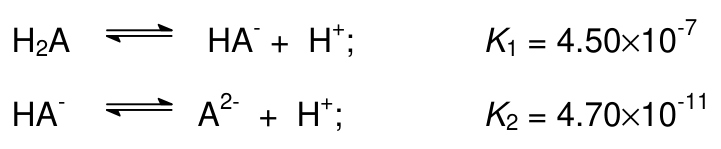
A 20.00 \(\mathrm{cm^3}\) aliquot of a solution containing a mixture of \(\ce{Na2A}\) and \(\ce{NaHA}\) is titrated with 0.300 M hydrochloric acid. The progress of the titration is followed with a glass electrode pH meter. Two points on the titration curve are as follows :
\(\mathrm{cm^3}\) \(\ce{HCl}\) added \(pH\) 1.00 10.33 10.00 8.34 2.1 On adding 1.00 \(\mathrm{cm^3}\) of \(\ce{HCl}\), which species reacts first and what would be the product?
2.2 What is the amount (mmol) of the product formed in (2.1)?
2.3 Write down the main equilibrium of the product from (2.1) reacting with the solvent?
2.4 What are the amounts (mmol) of \(\ce{Na2A}\) and \(\ce{NaHA}\) initially present?
2.5 Calculate the total volume of \(\ce{HCl}\) required to reach the second equivalence point.
PART B
Solutions I, II and III contain a \(pH\) indicator \(\ce{HIn}\) (\(K_{\mathrm{In}}=4.19\times10^{-4}\)) and other reagents as indicated in the table. The absorbance values at 400 nm of the solutions measured in the same cell, are also given in the table. \(K_a\) of \(\ce{CH3COOH}\) is \(1.75\times10^{-5}\).
Table:
Solution I Solution II Solution III Total concentration of indicator \(\ce{HIn}\) \(1.00\times10^{-5}\ \mathrm{M}\) \(1.00\times10^{-5}\ \mathrm{M}\) \(1.00\times10^{-5}\ \mathrm{M}\) Other reagents \(1.00\ \mathrm{M}\) \(\ce{HCl}\) \(0.100\ \mathrm{M}\) \(\ce{NaOH}\) \(1.00\ \mathrm{M}\) \(\ce{CH3COOH}\) Absorbance at 400 0.000 0.300 ? 2.6 Calculate the absorbance at 400 nm of solution III.
2.7 Apart from \(\ce{H2O}\), \(\ce{H+}\) and \(\ce{OH-}\), what are all the chemical species present in the solution resulting from mixing solution II and solution III at 1 : 1 volume ratio?
2.8 What is the absorbance at 400 nm of the solution in (2.7)?
2.9 What is the transmittance at 400 nm of the solution in (2.7)?
Official English text of the problem.
Problem 3: The thorium decay series
One of naturally occurring radioactive decay series begins with \(\ce{^{232}_{90}Th}\) and ends with a stable \(\ce{^{208}_{82}Pb}\).
3.1 How many beta (\(\beta^-\)) decays are there in this series? Show by calculation.
3.2 How much energy in MeV is released in the complete chain?
3.3 Calculate the rate of production of energy (power) in watts (\(1\ \mathrm{W}=\mathrm{J\,s^{-1}}\)) produced by 1.00 kilogram of \(\ce{^{232}Th}\) (\(t_{½}=1.40\times10^{10}\) years).
3.4 \(\ce{^{228}Th}\) is a member of the thorium series. What volume in \(\mathrm{cm^3}\) of helium at \(0\ ^\circ\mathrm{C}\) and 1 atm collected when 1.00 gram of \(\ce{^{228}Th}\) (\(t_{1/2}=1.91\) years) is stored in a container for 20.0 years. The half-lives of all intermediate nuclides are short compared to the half-life of \(\ce{^{228}Th}\).
3.5 One member of thorium series, after isolation, is found to contain \(1.50\times10^{10}\) atoms of the nuclide and decays at the rate of 3440 disintegrations per minute. What is the half-life in years?
The necessary atomic masses are :
\[ \ce{^{4}_{2}He}=4.00260\ \mathrm{u},\quad \ce{^{208}_{82}Pb}=207.97664\ \mathrm{u},\quad \ce{^{232}_{90}Th}=232.03805\ \mathrm{u}; \quad\text{and }1\mathrm{u}=931.5\ \mathrm{MeV} \]
\[ 1\ \mathrm{MeV}=1.602\times10^{-13}\ \mathrm{J} \]
\[ N_A=6.022\times10^{23}\ \mathrm{mol^{-1}} \]
The molar volume of an ideal gas at \(0\ ^\circ\mathrm{C}\) and 1 atm is \(22.4\ \mathrm{dm^3\,mol^{-1}}\).
Official English text of the problem.
Problem 4: Iron and chromium complexes of ligand L
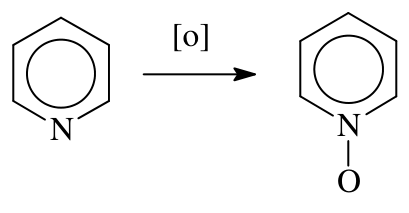
Ligand L can form complexes with many transition metals. L is synthesized by heating a mixture of a bipyridine, glacial acetic acid and hydrogen peroxide to 70 – 80 °C for 3 hrs. The final product L crystallizes out as fine needles and its molecular mass is 188. An analogous reaction with pyridine is ;
Complexes of L with \(\ce{Fe}\) and \(\ce{Cr}\) have the formulae of \(\ce{FeL_m(ClO4)_n * 3H2O}\) (A) and \(\ce{CrL_xCl_y(ClO4)_z * H2O}\) (B), respectively. Their elemental analyses and physical properties are given in Tables 4a and 4b. The relationship of colour and wavelength is given in Table 4c.
Table 4a: Elemental analyses.
Complex Elemental analyses , (wt. %) A Fe 5.740, C 37.030, H 3.090 , Cl 10.940, N 8.640 B Cr 8.440, C 38.930, H 2.920, Cl 17.250, N 9.080 Use the following data:
Atomic number: Cr = 24, Fe = 26
Relative atomic mass: H = 1, C = 12, N = 14, O = 16, Cl = 35.45, Cr = 52, Fe = 55.8
Table 4b: Physical properties
Complex Magnetic moment , \(\mu\) B.M. Colour A 6.13 Yellow B Not measured Purple Table 4c Relationship of wavelength to colour.
Wavelength (nm) and colour absorbed Complementary colour 400 (violet) Yellow Green 450 (blue) Yellow 490 (blue green) Orange 500 (green) Red 570 (yellow green) Violet 580 (yellow) Blue 600 (orange) Blue green 650 (red) Green 4.1 Write down the molecular formula of L.
4.2 If L is a bidentate chelating ligand, draw the structure of the bipyridine used. Also draw the structure of L.
4.3 Does the ligand L have any charge, i. e. net charge?
4.4 Draw the structure when one molecule of L binds to metal ion (M).
4.5 From the data in Table 4a, determine the empirical formula of A. What are the values of m and n in \(\ce{FeL_m(ClO4)_n * 3H2O}\)? Write the complete formula of A in the usual IUPAC notation. What is the ratio of cation to anion when A dissolves in water?
4.6 What is the oxidation number of Fe in A? How many d-electrons are present in Fe ion in the complex? Write the high spin and the low spin configurations that may exist for this complex. Which configuration, high or low spin, is the correct one? What is the best evidence to support your answer?
4.7 From Table 4c, estimate \(\lambda_{\max}\) (nm) of A.
4.8 Detail analysis of B shows that it contains \(\ce{Cr^{3+}}\) ion. Calculate the ‘spin-only’ magnetic moment of this compound.
4.9 Compound B is a 1 : 1 type electrolyte. Determine the empirical formula of B and the values of x, y, z in \(\ce{CrL_xCl_y(ClO4)_z * H2O}\).
Official English text of the problem.
Problem 5: Glycoside A from Rosaceae seeds
Glycoside A (\(\ce{C20H27NO11}\)), found in seeds of Rosaceae gives a negative test with Benedicts’ or Fehling’s solutions. Enzymatic hydrolysis of A yields (-) B, \(\ce{C8H7NO}\) and C, \(\ce{C12H22O11}\), but complete acid hydrolysis gives as organic products, (+) D, \(\ce{C6H12O6}\) and (-) E, \(\ce{C8H8O3}\).
C has a \(\beta\)-glycosidic linkage and gives positive test with Benedicts’ or Fehling’s solution. Methylation of C with \(\ce{MeI/Ag2O}\) gives \(\ce{C20H38O11}\), which upon acidic hydrolysis gives 2,3,4-tri-O-methyl-D-glucopyranose and 2,3,4,6-tetra-O-methyl-D-glucopyranose.
(±)B can be prepared from benzaldehyde and \(\ce{NaHSO3}\) followed by \(\ce{NaCN}\). Acidic hydrolysis of (±)B gives (±)E, \(\ce{C8H8O3}\).
5.1 Write structures of A – D with appropriate stereochemistry in Haworth projection, except for B.
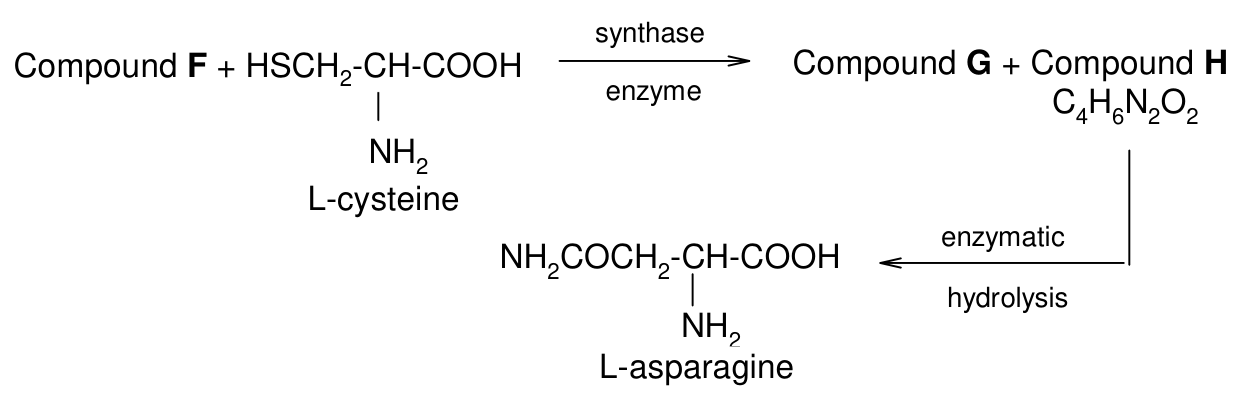
Glycoside A is found to be toxic and believed to be due to extremely toxic compound F, liberated under the hydrolytic conditions. Detoxification of compound F in plant may be accompanied by the reactions (stereochemistry not shown).
A small amount of compound F in human being is believed to be detoxified by a direct reaction with cystine giving L-cysteine and compound I, \(\ce{C4H6N2O2S}\) which is excreted in urine (stereochemistry not shown).
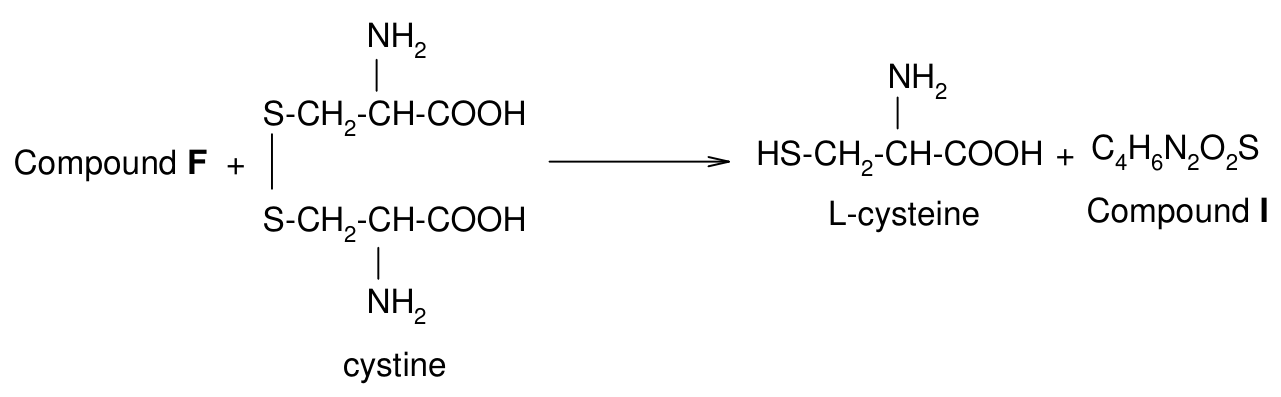
Compound I shows no absorption at 2150-2250 \(\mathrm{cm^{-1}}\) in its IR spectrum but a band at 1640 \(\mathrm{cm^{-1}}\) and the bands of carboxyl group are observed.
5.2 Write molecular formula for compounds F and G, and structural formula for compounds H and I and indicate stereochemistry of H. (Table 5.1 may be useful for structure identification.)
(-)1-Phenylethane-1-d, \(\ce{C6H5CHDCH3}\) can be prepared in optically active form and the magnitude of its rotation has the relatively high value, \([\alpha]_{\mathrm D}\) is equal to -0.6.

The absolute configuration of (-)1-phenylethane-1-d is related to (-) E according to the following reactions.
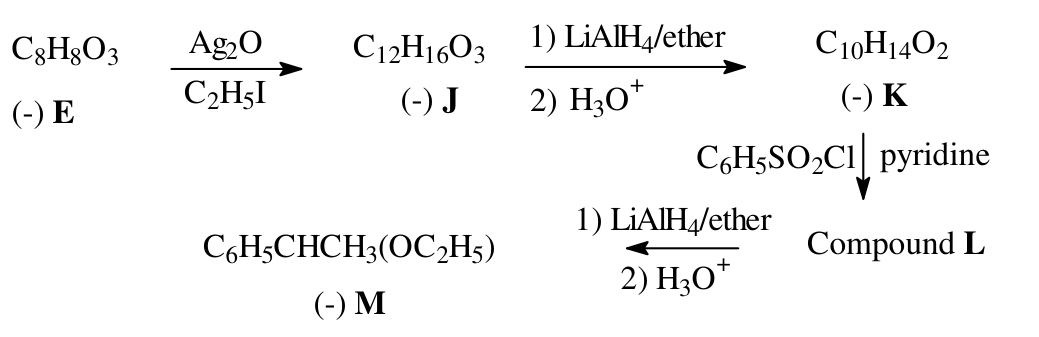
Compound (-) M can also be obtained from compound N as follows.
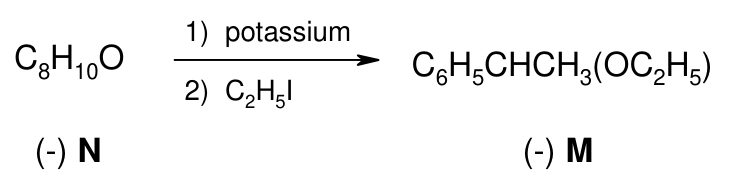
5.3 Deduce the absolute configuration of (-) E and the structure with configuration of each intermediate (J – O) in the sequence with the proper \(R,S\)-assignment as indicated in the answer sheet.
5.4 Choose the mechanism involved in the conversion of compound O to 1-phenylethane-1-d.
Table 5.1 Characteristic Infrared Absorption
Stretching Vibration Region (\(\mathrm{cm^{-1}}\)) Stretching Vibration Region (\(\mathrm{cm^{-1}}\)) \(\ce{C-H}\) (alkane) 2850-2960 \(\ce{O-H}\) (free alcohol) 3400-3600 \(\ce{C-H}\) (alkene) 3020-3100 \(\ce{O-H}\) (H-bonded alcohol) 3300-3500 \(\ce{C=C}\) 1650-1670 \(\ce{O-H}\) (acid) 2500-3100 \(\ce{C-H}\) (alkyne) 3300 \(\ce{C-O}\) 1030-1150 \(\ce{C#C}\) 2100-2260 \(\ce{NH}\), \(\ce{NH2}\) 3310-3550 \(\ce{C-H}\) (aromatics) 3030 \(\ce{C-N}\) 1030, 1230 \(\ce{C=C}\) (aromatics) 1500-1600 \(\ce{C=N}\) 1600-1700 \(\ce{C-H}\) (aldehyde) 2700-2775, 2820-2900 \(\ce{C#N}\) 2210-2260 \(\ce{C=O}\) 1670-1780 Official English text of the problem.
Problem 6: Sequence of peptide A
Peptide A has a molecular weight of 1007. Complete acid hydrolysis gives the following amino acids in equimolar amounts: Asp, Cystine, Glu, Gly, Ile, Leu, Pro, and Tyr (see Table 1). Oxidation of A with \(\ce{HCO2OH}\) gives only B which carries two residues of cysteic acid (Cya which is a cysteine derivative with its thiol group oxidized to sulfonic acid).
6.1 How many sulphonic acid groups are formed from oxidation of a disulfide bond ?
Partial hydrolysis of B gives a number of di and tri-peptides (B1-B6). The sequence of each hydrolysis product is determined in the following ways.
The N-terminal amino acid is identified by treating the peptide with 2,4-dinitrofluorobenzene (DNFB) to give DNP-peptide. After complete acid hydrolysis of the DNP-peptide, a DNP-amino acid is obtained which can be identified readily by comparison with standard DNP-amino acids.
6.2 B1, on treatment with DNFB followed by acid hydrolysis gives a product, DNP-Asp. This suggests that B1 has aspartic acid at the N-terminus. Write down the complete structure of DNP-Asp at its isoelectric point (no stereochemistry required).
Next, the C-terminal amino acid is identified by heating the peptide at \(100\,^\circ\mathrm{C}\) with hydrazine, which cleave all the peptide bonds and convert all except C-terminal amino acids into amino acid hydrazides, leaving the C-terminal carboxyl group intact.
In this way N- and C-terminal amino acids are identified and the complete sequences of B1-B6 are as shown :
B1 Asp-Cya B4 Ile-Glu B2 Cya-Tyr B5 Cya-Pro-Leu B3 Leu-Gly B6 Tyr-Ile-Glu Hydrolysis of B with an enzyme from Bacillus subtilis gives B7-B9 with the following compositions:
B7 \(\ce{Gly-NH2}\) (Glycinamide) B8 Cya, Glu, Ile, Tyr B9 Asp, Cya, Leu, Pro 6.3 Write down the sequence of B8, if DNP-Cya is obtained on treatment of B8 with DNFB followed by complete acid hydrolysis.
6.4 If the N- and C-terminal amino acids of B9 are identified as Asp and Leu respectively, write down the sequence of B9.
6.5 Write down the complete structure of A using abbreviation in Table 1, indicating the position of the disulfide bond.
However, the calculated molecular weight of A based on the above sequence is 2 mass units higher than the experimental value. On careful observation of the mixture from complete acid hydrolysis of A, 3 molar equivalents of ammonia are also produced in addition to the amino acids detected initially.
6.6 Suggest the revised structure of A and circle the site(s) of the structure to indicate all the possible source of ammonia.
6.7 Using the information in Table 2, calculate the isoelectric point of A.
Table 1: Formulae and symbols of common amino acids at isoelectric point
Name Formula Three-letter symbol Alanine \(\ce{CH3CH(NH3+)CO2-}\) Ala Arginine \(\ce{H2NC(=NH)NH(CH2)3CH(NH3+)CO2-}\) Arg Asparagine \(\ce{H2NCOCH2CH(NH3+)CO2-}\) Asn Aspartic Acid \(\ce{HO2CCH2CH(NH3+)CO2-}\) Asp Cysteine \(\ce{HSCH2CH(NH3+)CO2-}\) Cys Cystine \(\ce{[SCH2CH(NH3+)CO2-]2}\) – Glutamic Acid \(\ce{HO2CCH2CH2CH(NH3+)CO2-}\) Glu Glutamine \(\ce{H2NCOCH2CH2CH(NH3+)CO2-}\) Gln Glycine \(\ce{^{+}H3NCH2CO2-}\) Gly Histidine (figure below) His Isoleucine \(\ce{CH3CH2CH(CH3)CH(NH3+)CO2-}\) Ile Leucine \(\ce{(CH3)2CHCH2CH(NH3+)CO2-}\) Leu Lysine \(\ce{H2N(CH2)4CH(NH3+)CO2-}\) Lys 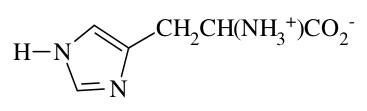
Table 1 (continued)
Name Formula Three-letter symbol Methionine \(\ce{CH3SCH2CH2CH(NH3+)CO2-}\) Met Phenylalanine \(\ce{PhCH2CH(NH3+)CO2-}\) Phe Proline (first figure below) Pro Serine \(\ce{HOCH2CH(NH3+)CO2-}\) Ser Threonine \(\ce{CH3CH(OH)CH(NH3+)CO2-}\) Thr Tryptophan (second figure below) Trp Tyrosine (third figure below) Tyr Valine \(\ce{(CH3)2CHCH(NH3+)CO2-}\) Val 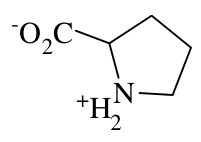
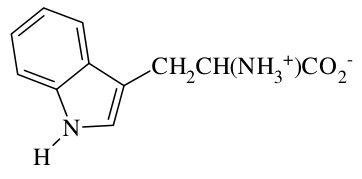
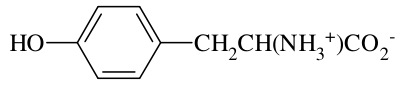
Table 2: \(\mathrm{p}K_\mathrm{a}\) of some important groups in amino acids
Groups Equilibrium \(\mathrm{p}K_\mathrm{a}\) Terminal carboxyl (first figure below) 3.1 Asp /or Glu side-chain carboxyl (second figure below) 4.4 His side-chain (third figure below) 6.5 Terminal amino (fourth figure below) 8.0 Cys side-chain (fifth figure below) 8.5 




Table 2 (continued)
Groups Equilibrium \(\mathrm{p}K_\mathrm{a}\) Tyr side-chain (first figure below) 10.0 Lys side-chain amino (second figure below) 10.0 Arg side-chain (third figure below) 12.0 


Official English text of the problem.
Internationale Chemie-Olympiade
IChO 1999
Bangkok, Thailand · 6 Theorieaufgaben mit vollständigen Lösungen
Aufgabe 1: Verbrennungskalorimetrie und molekularer Zustand der Verbindung Q
Eine Verbindung Q (molare Masse \(122.0\ \mathrm{g\,mol^{-1}}\)) besteht aus Kohlenstoff, Wasserstoff und Sauerstoff.
TEIL A
Die Standardbildungsenthalpien von \(\ce{CO2(g)}\) und \(\ce{H2O(l)}\) bei \(25.00\ ^\circ\mathrm C\) betragen −393.51 bzw. −285.83 \(\mathrm{kJ\,mol^{-1}}\). Die Gaskonstante beträgt \(R=8.314\ \mathrm{J\,K^{-1}\,mol^{-1}}\).
(Relative Atommassen: H = 1.0; C = 12.0; O = 16.0)
Eine Probe der festen Verbindung Q mit einer Masse von 0.6000 g wird in einem Bombenkalorimeter in einem Überschuss an Sauerstoff verbrannt. Das Kalorimeter enthält anfangs 710.0 g Wasser bei \(25.000\ ^\circ\mathrm C\). Nach Abschluss der Reaktion wird eine Temperatur von \(27.250\ ^\circ\mathrm C\) gemessen, und es entstehen 1.5144 g \(\ce{CO2(g)}\) und 0.2656 g \(\ce{H2O(l)}\).
1.1 Bestimmen Sie die Summenformel und stellen Sie eine ausgeglichene Reaktionsgleichung mit den korrekten Aggregatzuständen für die Verbrennung von Q auf.
Die spezifische Wärmekapazität von Wasser beträgt \(4.184\ \mathrm{J\,g^{-1}\,K^{-1}}\), und die Änderung der inneren Energie bei der Reaktion \((\Delta U^0)\) beträgt −3079 \(\mathrm{kJ\,mol^{-1}}\).
1.2 Berechnen Sie die Wärmekapazität des Kalorimeters (ohne das Wasser).
1.3 Berechnen Sie die Standardbildungsenthalpie \((\Delta H_{\mathrm f}^{0})\) von Q.
TEIL B
Die folgenden Daten beziehen sich auf die Verteilung von Q zwischen Benzol und Wasser bei \(6\ ^\circ\mathrm C\). Dabei sind \(C_{\mathrm B}\) und \(C_{\mathrm W}\) die Gleichgewichtskonzentrationen der Spezies von Q in der Benzol- bzw. Wasserphase:
Nehmen Sie an, dass in Benzol unabhängig von Konzentration und Temperatur nur eine Spezies von Q vorliegt.
Konzentration \((\mathrm{mol\,dm^{-3}})\)
\(C_{\mathrm B}\) \(C_{\mathrm W}\) 0.0118 0.00281 0.0478 0.00566 0.0981 0.00812 0.156 0.0102 1.4 Zeigen Sie durch Berechnung, ob Q in Benzol als Monomer oder als Dimer vorliegt. Nehmen Sie an, dass Q in Wasser als Monomer vorliegt.
Die Gefrierpunktserniedrigung einer idealen verdünnten Lösung ist gegeben durch
\[ T_{\mathrm f}^{0}-T_{\mathrm f} =\frac{R(T_{\mathrm f}^{0})^{2}X_{\mathrm s}}{\Delta H_{\mathrm f}} \]
wobei \(T_{\mathrm f}\) der Gefrierpunkt der Lösung, \(T_{\mathrm f}^{0}\) der Gefrierpunkt des Lösungsmittels, \(\Delta H_{\mathrm f}\) die Schmelzenthalpie des Lösungsmittels und \(X_{\mathrm s}\) der Stoffmengenanteil des gelösten Stoffes ist. Die molare Masse von Benzol beträgt \(78.0\ \mathrm{g\,mol^{-1}}\). Bei 1 atm gefriert reines Benzol bei \(5.40\ ^\circ\mathrm C\). Die Schmelzenthalpie von Benzol beträgt \(9.89\ \mathrm{kJ\,mol^{-1}}\).
1.5 Berechnen Sie den Gefrierpunkt \((T_{\mathrm f})\) einer Lösung von 0.244 g Q in 5.85 g Benzol bei 1 atm.
Aufgabentext aus dem offiziellen englischen Text übersetzt.
Aufgabe 2: Eine zweiprotonige Säure und ein Säure-Base-Indikator
TEIL A
Eine zweiprotonige Säure, \(\ce{H2A}\), unterliegt den folgenden Dissoziationsreaktionen:
Ein Aliquot von 20.00 \(\mathrm{cm^3}\) einer Lösung, die eine Mischung aus \(\ce{Na2A}\) und \(\ce{NaHA}\) enthält, wird mit 0.300 M Salzsäure titriert. Der Verlauf der Titration wird mit einem pH-Meter mit Glaselektrode verfolgt. Zwei Punkte auf der Titrationskurve sind wie folgt gegeben:
Zugegebene \(\mathrm{cm^3}\) \(\ce{HCl}\) \(pH\) 1.00 10.33 10.00 8.34 2.1 Welche Spezies reagiert bei der Zugabe von 1.00 \(\mathrm{cm^3}\) \(\ce{HCl}\) zuerst, und welches Produkt entsteht dabei?
2.2 Welche Stoffmenge (mmol) des Produkts aus (2.1) wird gebildet?
2.3 Geben Sie das vorherrschende Gleichgewicht der Reaktion des Produkts aus (2.1) mit dem Lösungsmittel an.
2.4 Welche Stoffmengen (mmol) an \(\ce{Na2A}\) und \(\ce{NaHA}\) waren ursprünglich vorhanden?
2.5 Berechnen Sie das Gesamtvolumen an \(\ce{HCl}\), das zum Erreichen des zweiten Äquivalenzpunkts erforderlich ist.
TEIL B
Die Lösungen I, II und III enthalten einen \(pH\)-Indikator \(\ce{HIn}\) (\(K_{\mathrm{In}}=4.19\times10^{-4}\)) sowie die in der Tabelle angegebenen weiteren Reagenzien. Die in derselben Küvette gemessenen Extinktionswerte der Lösungen bei 400 nm sind ebenfalls in der Tabelle angegeben. \(K_a\) von \(\ce{CH3COOH}\) beträgt \(1.75\times10^{-5}\).
Tabelle:
Lösung I Lösung II Lösung III Gesamtkonzentration des Indikators \(\ce{HIn}\) \(1.00\times10^{-5}\ \mathrm{M}\) \(1.00\times10^{-5}\ \mathrm{M}\) \(1.00\times10^{-5}\ \mathrm{M}\) Weitere Reagenzien \(1.00\ \mathrm{M}\) \(\ce{HCl}\) \(0.100\ \mathrm{M}\) \(\ce{NaOH}\) \(1.00\ \mathrm{M}\) \(\ce{CH3COOH}\) Extinktion bei 400 0.000 0.300 ? 2.6 Berechnen Sie die Extinktion der Lösung III bei 400 nm.
2.7 Welche chemischen Spezies sind außer \(\ce{H2O}\), \(\ce{H+}\) und \(\ce{OH-}\) sämtlich in der Lösung vorhanden, die durch Mischen von Lösung II und Lösung III im Volumenverhältnis 1 : 1 entsteht?
2.8 Wie groß ist die Extinktion der Lösung aus (2.7) bei 400 nm?
2.9 Wie groß ist der Transmissionsgrad der Lösung aus (2.7) bei 400 nm?
Aufgabentext aus dem offiziellen englischen Text übersetzt.
Aufgabe 3: Die Thorium-Zerfallsreihe
Eine der natürlich vorkommenden radioaktiven Zerfallsreihen beginnt mit \(\ce{^{232}_{90}Th}\) und endet mit stabilem \(\ce{^{208}_{82}Pb}\).
3.1 Wie viele Beta-Zerfälle (\(\beta^-\)) treten in dieser Reihe auf? Zeigen Sie dies durch eine Rechnung.
3.2 Wie viel Energie wird in der vollständigen Zerfallskette in MeV freigesetzt?
3.3 Berechnen Sie die pro Zeiteinheit freigesetzte Energie (Leistung) in Watt (\(1\ \mathrm{W}=\mathrm{J\,s^{-1}}\)), die von 1.00 Kilogramm \(\ce{^{232}Th}\) (\(t_{½}=1.40\times10^{10}\) Jahre) erzeugt wird.
3.4 \(\ce{^{228}Th}\) ist ein Glied der Thorium-Zerfallsreihe. Welches Volumen an Helium in \(\mathrm{cm^3}\), gemessen bei \(0\ ^\circ\mathrm{C}\) und 1 atm, wird aufgefangen, wenn 1.00 Gramm \(\ce{^{228}Th}\) (\(t_{1/2}=1.91\) Jahre) 20.0 Jahre lang in einem Behälter aufbewahrt wird? Die Halbwertszeiten aller Zwischennuklide sind im Vergleich zur Halbwertszeit von \(\ce{^{228}Th}\) kurz.
3.5 Bei einem Glied der Thorium-Zerfallsreihe wird nach seiner Isolierung festgestellt, dass es \(1.50\times10^{10}\) Atome des Nuklids enthält und mit einer Rate von 3440 Zerfällen pro Minute zerfällt. Wie groß ist die Halbwertszeit in Jahren?
Die benötigten Atommassen sind:
\[ \ce{^{4}_{2}He}=4.00260\ \mathrm{u},\quad \ce{^{208}_{82}Pb}=207.97664\ \mathrm{u},\quad \ce{^{232}_{90}Th}=232.03805\ \mathrm{u}; \quad\text{und }1\mathrm{u}=931.5\ \mathrm{MeV} \]
\[ 1\ \mathrm{MeV}=1.602\times10^{-13}\ \mathrm{J} \]
\[ N_A=6.022\times10^{23}\ \mathrm{mol^{-1}} \]
Das molare Volumen eines idealen Gases bei \(0\ ^\circ\mathrm{C}\) und 1 atm beträgt \(22.4\ \mathrm{dm^3\,mol^{-1}}\).
Aufgabentext aus dem offiziellen englischen Text übersetzt.
Aufgabe 4: Eisen- und Chromkomplexe des Liganden L
Der Ligand L kann mit vielen Übergangsmetallen Komplexe bilden. L wird synthetisiert, indem ein Gemisch aus einem Bipyridin, Eisessig und Wasserstoffperoxid 3 Stunden lang auf 70 – 80 °C erhitzt wird. Das Endprodukt L kristallisiert in Form feiner Nadeln aus und hat eine Molekülmasse von 188. Eine analoge Reaktion mit Pyridin ist:
Die Komplexe von L mit \(\ce{Fe}\) und \(\ce{Cr}\) haben die Formeln \(\ce{FeL_m(ClO4)_n * 3H2O}\) (A) bzw. \(\ce{CrL_xCl_y(ClO4)_z * H2O}\) (B). Ihre Elementaranalysen und physikalischen Eigenschaften sind in den Tabellen 4a und 4b angegeben. Der Zusammenhang zwischen Farbe und Wellenlänge ist in Tabelle 4c angegeben.
Tabelle 4a: Elementaranalysen.
Komplex Elementaranalysen, (Massen-%) A Fe 5.740, C 37.030, H 3.090 , Cl 10.940, N 8.640 B Cr 8.440, C 38.930, H 2.920, Cl 17.250, N 9.080 Verwenden Sie die folgenden Daten:
Ordnungszahl: Cr = 24, Fe = 26
Relative Atommasse: H = 1, C = 12, N = 14, O = 16, Cl = 35.45, Cr = 52, Fe = 55.8
Tabelle 4b: Physikalische Eigenschaften
Komplex Magnetisches Moment, \(\mu\) B.M. Farbe A 6.13 Gelb B Nicht gemessen Purpur Tabelle 4c Zusammenhang zwischen Wellenlänge und Farbe.
Wellenlänge (nm) und absorbierte Farbe Komplementärfarbe 400 (violett) Gelbgrün 450 (blau) Gelb 490 (blaugrün) Orange 500 (grün) Rot 570 (gelbgrün) Violett 580 (gelb) Blau 600 (orange) Blaugrün 650 (rot) Grün 4.1 Geben Sie die Molekülformel von L an.
4.2 Wenn L ein zweizähniger Chelatligand ist, zeichnen Sie die Struktur des verwendeten Bipyridins. Zeichnen Sie auch die Struktur von L.
4.3 Besitzt der Ligand L eine Ladung, d. h. eine Nettoladung?
4.4 Zeichnen Sie die Struktur, wenn ein Molekül L an ein Metallion (M) bindet.
4.5 Bestimmen Sie aus den Daten in Tabelle 4a die Verhältnisformel von A. Welche Werte haben m und n in \(\ce{FeL_m(ClO4)_n * 3H2O}\)? Schreiben Sie die vollständige Formel von A in der üblichen IUPAC-Notation. Wie ist das Verhältnis von Kationen zu Anionen, wenn sich A in Wasser löst?
4.6 Welche Oxidationszahl hat Fe in A? Wie viele d-Elektronen besitzt das Fe-Ion im Komplex? Geben Sie die High-Spin- und die Low-Spin-Konfiguration an, die für diesen Komplex möglich sind. Welche Konfiguration, High-Spin oder Low-Spin, liegt tatsächlich vor? Welcher Befund stützt Ihre Antwort am besten?
4.7 Schätzen Sie anhand von Tabelle 4c \(\lambda_{\max}\) (nm) von A ab.
4.8 Eine eingehende Analyse von B zeigt, dass es das \(\ce{Cr^{3+}}\)-Ion enthält. Berechnen Sie das magnetische Moment dieser Verbindung unter alleiniger Berücksichtigung des Spins („spin-only“).
4.9 Verbindung B ist ein Elektrolyt vom Typ 1 : 1. Bestimmen Sie die Verhältnisformel von B und die Werte von x, y, z in \(\ce{CrL_xCl_y(ClO4)_z * H2O}\).
Aufgabentext aus dem offiziellen englischen Text übersetzt.
Aufgabe 5: Glykosid A aus den Samen von Rosaceae
Das in den Samen von Rosaceae vorkommende Glykosid A (\(\ce{C20H27NO11}\)) zeigt mit Benedict- oder Fehling-Lösung eine negative Reaktion. Die enzymatische Hydrolyse von A liefert (-) B, \(\ce{C8H7NO}\), und C, \(\ce{C12H22O11}\), während die vollständige saure Hydrolyse als organische Produkte (+) D, \(\ce{C6H12O6}\), und (-) E, \(\ce{C8H8O3}\), ergibt.
C besitzt eine \(\beta\)-glykosidische Bindung und zeigt mit Benedict- oder Fehling-Lösung eine positive Reaktion. Die Methylierung von C mit \(\ce{MeI/Ag2O}\) ergibt \(\ce{C20H38O11}\), das bei saurer Hydrolyse 2,3,4-Tri-O-methyl-D-glucopyranose und 2,3,4,6-Tetra-O-methyl-D-glucopyranose liefert.
(±)B lässt sich aus Benzaldehyd durch Umsetzung mit \(\ce{NaHSO3}\) und anschließend mit \(\ce{NaCN}\) herstellen. Die saure Hydrolyse von (±)B liefert (±)E, \(\ce{C8H8O3}\).
5.1 Zeichnen Sie die Strukturen von A – D mit der entsprechenden Stereochemie, mit Ausnahme von B in der Haworth-Projektion.
Das Glykosid A erweist sich als toxisch. Als Ursache wird die äußerst toxische Verbindung F vermutet, die unter den Hydrolysebedingungen freigesetzt wird. Die Entgiftung der Verbindung F in der Pflanze kann mit den folgenden Reaktionen einhergehen (Stereochemie nicht dargestellt).
Es wird angenommen, dass eine geringe Menge der Verbindung F im Menschen durch direkte Reaktion mit Cystin entgiftet wird, wobei L-Cystein und die Verbindung I, \(\ce{C4H6N2O2S}\), entstehen. Letztere wird mit dem Urin ausgeschieden (Stereochemie nicht dargestellt).
Die Verbindung I zeigt in ihrem IR-Spektrum keine Absorption bei 2150-2250 \(\mathrm{cm^{-1}}\); es werden jedoch eine Bande bei 1640 \(\mathrm{cm^{-1}}\) sowie die Banden der Carboxylgruppe beobachtet.
5.2 Geben Sie die Summenformeln der Verbindungen F und G sowie die Strukturformeln der Verbindungen H und I an und kennzeichnen Sie die Stereochemie von H. (Tabelle 5.1 kann bei der Strukturaufklärung hilfreich sein.)
(-)1-Phenylethan-1-d, \(\ce{C6H5CHDCH3}\), lässt sich in optisch aktiver Form herstellen; der Betrag seiner Drehung ist mit \([\alpha]_{\mathrm D}\) gleich -0.6 vergleichsweise hoch.
Die absolute Konfiguration von (-)1-Phenylethan-1-d steht über die folgenden Reaktionen mit derjenigen von (-) E in Beziehung.
Die Verbindung (-) M kann auch wie folgt aus der Verbindung N erhalten werden.
5.3 Leiten Sie die absolute Konfiguration von (-) E sowie die Struktur einschließlich der Konfiguration jeder Zwischenverbindung (J – O) in der Reaktionsfolge ab und geben Sie die entsprechende \(R,S\)-Zuordnung an, wie auf dem Antwortbogen vorgesehen.
5.4 Wählen Sie den Mechanismus aus, der bei der Umwandlung der Verbindung O in 1-Phenylethan-1-d abläuft.
Tabelle 5.1 Charakteristische Infrarotabsorptionen
Valenzschwingung Bereich (\(\mathrm{cm^{-1}}\)) Valenzschwingung Bereich (\(\mathrm{cm^{-1}}\)) \(\ce{C-H}\) (Alkan) 2850-2960 \(\ce{O-H}\) (freier Alkohol) 3400-3600 \(\ce{C-H}\) (Alken) 3020-3100 \(\ce{O-H}\) (Alkohol mit Wasserstoffbrückenbindungen) 3300-3500 \(\ce{C=C}\) 1650-1670 \(\ce{O-H}\) (Säure) 2500-3100 \(\ce{C-H}\) (Alkin) 3300 \(\ce{C-O}\) 1030-1150 \(\ce{C#C}\) 2100-2260 \(\ce{NH}\), \(\ce{NH2}\) 3310-3550 \(\ce{C-H}\) (Aromaten) 3030 \(\ce{C-N}\) 1030, 1230 \(\ce{C=C}\) (Aromaten) 1500-1600 \(\ce{C=N}\) 1600-1700 \(\ce{C-H}\) (Aldehyd) 2700-2775, 2820-2900 \(\ce{C#N}\) 2210-2260 \(\ce{C=O}\) 1670-1780 Aufgabentext aus dem offiziellen englischen Text übersetzt.
Aufgabe 6: Sequenz von Peptid A
Peptid A hat eine relative Molekülmasse von 1007. Bei vollständiger saurer Hydrolyse entstehen die folgenden Aminosäuren in äquimolaren Mengen: Asp, Cystin, Glu, Gly, Ile, Leu, Pro und Tyr (siehe Tabelle 1). Die Oxidation von A mit \(\ce{HCO2OH}\) ergibt ausschließlich B, das zwei Cysteinsäurereste enthält (Cya, ein Cysteinderivat, dessen Thiolgruppe zur Sulfonsäuregruppe oxidiert ist).
6.1 Wie viele Sulfonsäuregruppen entstehen bei der Oxidation einer Disulfidbindung?
Die partielle Hydrolyse von B ergibt eine Reihe von Di- und Tripeptiden (B1-B6). Die Sequenz jedes Hydrolyseprodukts wird auf die folgenden Arten bestimmt.
Die N-terminale Aminosäure wird identifiziert, indem das Peptid mit 2,4-Dinitrofluorbenzol (DNFB) zum DNP-Peptid umgesetzt wird. Nach vollständiger saurer Hydrolyse des DNP-Peptids erhält man eine DNP-Aminosäure, die sich durch Vergleich mit DNP-Aminosäurestandards leicht identifizieren lässt.
6.2 B1 liefert bei der Umsetzung mit DNFB und anschließender saurer Hydrolyse das Produkt DNP-Asp. Dies deutet darauf hin, dass B1 Asparaginsäure am N-Terminus besitzt. Geben Sie die vollständige Struktur von DNP-Asp an seinem isoelektrischen Punkt an (keine Angabe der Stereochemie erforderlich).
Als Nächstes wird die C-terminale Aminosäure identifiziert, indem das Peptid mit Hydrazin auf \(100\,^\circ\mathrm{C}\) erhitzt wird. Dabei werden alle Peptidbindungen gespalten und alle Aminosäuren mit Ausnahme der C-terminalen Aminosäure in Aminosäurehydrazide umgewandelt; die C-terminale Carboxylgruppe bleibt intakt.
Auf diese Weise werden die N- und C-terminalen Aminosäuren identifiziert; die vollständigen Sequenzen von B1-B6 sind nachstehend angegeben:
B1 Asp-Cya B4 Ile-Glu B2 Cya-Tyr B5 Cya-Pro-Leu B3 Leu-Gly B6 Tyr-Ile-Glu Die Hydrolyse von B mit einem Enzym aus Bacillus subtilis ergibt B7-B9 mit den folgenden Zusammensetzungen:
B7 \(\ce{Gly-NH2}\) (Glycinamid) B8 Cya, Glu, Ile, Tyr B9 Asp, Cya, Leu, Pro 6.3 Geben Sie die Sequenz von B8 an, wenn bei der Umsetzung von B8 mit DNFB und anschließender vollständiger saurer Hydrolyse DNP-Cya erhalten wird.
6.4 Geben Sie die Sequenz von B9 an, wenn dessen N- und C-terminale Aminosäuren als Asp bzw. Leu identifiziert werden.
6.5 Geben Sie die vollständige Struktur von A unter Verwendung der Abkürzungen in Tabelle 1 an und kennzeichnen Sie die Position der Disulfidbindung.
Die auf Grundlage der obigen Sequenz berechnete relative Molekülmasse von A ist jedoch um 2 Masseneinheiten höher als der experimentelle Wert. Bei genauer Untersuchung des Gemischs aus der vollständigen sauren Hydrolyse von A zeigt sich, dass zusätzlich zu den ursprünglich nachgewiesenen Aminosäuren auch 3 molare Äquivalente Ammoniak entstehen.
6.6 Schlagen Sie die korrigierte Struktur von A vor und kreisen Sie die Stellen in der Struktur ein, um alle möglichen Quellen des Ammoniaks zu kennzeichnen.
6.7 Berechnen Sie anhand der Angaben in Tabelle 2 den isoelektrischen Punkt von A.
Tabelle 1: Formeln und Symbole gängiger Aminosäuren am isoelektrischen Punkt
Name Formel Dreibuchstabensymbol Alanin \(\ce{CH3CH(NH3+)CO2-}\) Ala Arginin \(\ce{H2NC(=NH)NH(CH2)3CH(NH3+)CO2-}\) Arg Asparagin \(\ce{H2NCOCH2CH(NH3+)CO2-}\) Asn Asparaginsäure \(\ce{HO2CCH2CH(NH3+)CO2-}\) Asp Cystein \(\ce{HSCH2CH(NH3+)CO2-}\) Cys Cystin \(\ce{[SCH2CH(NH3+)CO2-]2}\) – Glutaminsäure \(\ce{HO2CCH2CH2CH(NH3+)CO2-}\) Glu Glutamin \(\ce{H2NCOCH2CH2CH(NH3+)CO2-}\) Gln Glycin \(\ce{^{+}H3NCH2CO2-}\) Gly Histidin (Abbildung unten) His Isoleucin \(\ce{CH3CH2CH(CH3)CH(NH3+)CO2-}\) Ile Leucin \(\ce{(CH3)2CHCH2CH(NH3+)CO2-}\) Leu Lysin \(\ce{H2N(CH2)4CH(NH3+)CO2-}\) Lys Tabelle 1 (Fortsetzung)
Name Formel Dreibuchstabensymbol Methionin \(\ce{CH3SCH2CH2CH(NH3+)CO2-}\) Met Phenylalanin \(\ce{PhCH2CH(NH3+)CO2-}\) Phe Prolin (erste Abbildung unten) Pro Serin \(\ce{HOCH2CH(NH3+)CO2-}\) Ser Threonin \(\ce{CH3CH(OH)CH(NH3+)CO2-}\) Thr Tryptophan (zweite Abbildung unten) Trp Tyrosin (dritte Abbildung unten) Tyr Valin \(\ce{(CH3)2CHCH(NH3+)CO2-}\) Val Tabelle 2: \(\mathrm{p}K_\mathrm{a}\)-Werte einiger wichtiger Gruppen in Aminosäuren
Gruppen Gleichgewicht \(\mathrm{p}K_\mathrm{a}\) Terminale Carboxylgruppe (erste Abbildung unten) 3.1 Carboxylgruppe der Asp- oder Glu-Seitenkette (zweite Abbildung unten) 4.4 His-Seitenkette (dritte Abbildung unten) 6.5 Terminale Aminogruppe (vierte Abbildung unten) 8.0 Cys-Seitenkette (fünfte Abbildung unten) 8.5 Tabelle 2 (Fortsetzung)
Gruppen Gleichgewicht \(\mathrm{p}K_\mathrm{a}\) Tyr-Seitenkette (erste Abbildung unten) 10.0 Aminogruppe der Lys-Seitenkette (zweite Abbildung unten) 10.0 Arg-Seitenkette (dritte Abbildung unten) 12.0 Aufgabentext aus dem offiziellen englischen Text übersetzt.
Uluslararası Kimya Olimpiyatı
IChO 1999
Bangkok, Tayland · 6 teori sorusu, tam çözümleriyle
Soru 1: Yanma kalorimetrisi ve Q bileşiğinin moleküler hâli
Bir Q bileşiği (molar kütlesi \(122.0\ \mathrm{g\,mol^{-1}}\)) karbon, hidrojen ve oksijenden oluşmaktadır.
BÖLÜM A
\(25.00\ ^\circ\mathrm C\) sıcaklıkta \(\ce{CO2(g)}\) ve \(\ce{H2O(l)}\) için standart oluşum entalpileri sırasıyla −393.51 ve −285.83 \(\mathrm{kJ\,mol^{-1}}\)'dir. Gaz sabiti, \(R=8.314\ \mathrm{J\,K^{-1}\,mol^{-1}}\).
(Bağıl atom kütleleri: H = 1.0; C = 12.0; O = 16.0)
0.6000 g kütleli bir katı Q örneği, başlangıçta \(25.000\ ^\circ\mathrm C\) sıcaklıkta 710.0 g su içeren bir bomba kalorimetresinde, fazla miktarda oksijen ortamında yakılmaktadır. Tepkime tamamlandıktan sonra sıcaklığın \(27.250\ ^\circ\mathrm C\) olduğu gözlenmekte ve 1.5144 g \(\ce{CO2(g)}\) ile 0.2656 g \(\ce{H2O(l)}\) oluşmaktadır.
1.1 Q'nun molekül formülünü belirleyiniz ve yanması için maddelerin fiziksel hâllerini doğru biçimde gösteren denkleştirilmiş bir tepkime denklemi yazınız.
Suyun özgül ısısının \(4.184\ \mathrm{J\,g^{-1}\,K^{-1}}\) ve tepkimenin iç enerji değişiminin \((\Delta U^0)\) −3079 \(\mathrm{kJ\,mol^{-1}}\) olduğunu kabul ediniz.
1.2 Kalorimetrenin ısı kapasitesini (su hariç) hesaplayınız.
1.3 Q'nun standart oluşum entalpisini \((\Delta H_{\mathrm f}^{0})\) hesaplayınız.
BÖLÜM B
Aşağıdaki veriler, Q'nun \(6\ ^\circ\mathrm C\) sıcaklıkta benzen ve su arasındaki dağılımına ilişkindir; \(C_{\mathrm B}\) ve \(C_{\mathrm W}\), sırasıyla benzen ve su tabakalarındaki Q türlerinin denge derişimleridir:
Benzende, derişimden ve sıcaklıktan bağımsız olarak yalnızca tek bir Q türünün bulunduğunu varsayınız.
Derişim \((\mathrm{mol\,dm^{-3}})\)
\(C_{\mathrm B}\) \(C_{\mathrm W}\) 0.0118 0.00281 0.0478 0.00566 0.0981 0.00812 0.156 0.0102 1.4 Q'nun benzende monomer mi yoksa dimer mi olduğunu hesaplamayla gösteriniz. Q'nun suda monomer olduğunu varsayınız.
İdeal seyreltik bir çözelti için donma noktası alçalması şu bağıntıyla verilir:
\[ T_{\mathrm f}^{0}-T_{\mathrm f} =\frac{R(T_{\mathrm f}^{0})^{2}X_{\mathrm s}}{\Delta H_{\mathrm f}} \]
Burada \(T_{\mathrm f}\) çözeltinin donma noktası, \(T_{\mathrm f}^{0}\) çözücünün donma noktası, \(\Delta H_{\mathrm f}\) çözücünün erime ısısı ve \(X_{\mathrm s}\) çözünenin mol kesridir. Benzenin molar kütlesi \(78.0\ \mathrm{g\,mol^{-1}}\)'dir. Saf benzen 1 atm basınçta \(5.40\ ^\circ\mathrm C\) sıcaklıkta donar. Benzenin erime ısısı \(9.89\ \mathrm{kJ\,mol^{-1}}\)'dir.
1.5 5.85 g benzende 0.244 g Q içeren bir çözeltinin 1 atm basınçtaki donma noktasını \((T_{\mathrm f})\) hesaplayınız.
Soru metni resmi İngilizce metinden çevrilmiştir.
Soru 2: Diprotik bir asit ve bir asit-baz indikatörü
BÖLÜM A
Diprotik bir asit olan \(\ce{H2A}\), aşağıdaki ayrışma tepkimelerini verir:
\(\ce{Na2A}\) ve \(\ce{NaHA}\) karışımı içeren bir çözeltiden alınan 20.00 \(\mathrm{cm^3}\) hacmindeki bir örnek, 0.300 M hidroklorik asit ile titre edilir. Titrasyonun ilerleyişi, cam elektrotlu bir pH metre ile izlenir. Titrasyon eğrisi üzerindeki iki nokta aşağıdaki gibidir:
Eklenen \(\ce{HCl}\) hacmi, \(\mathrm{cm^3}\) \(pH\) 1.00 10.33 10.00 8.34 2.1 1.00 \(\mathrm{cm^3}\) \(\ce{HCl}\) eklendiğinde ilk olarak hangi tür tepkimeye girer ve oluşan ürün ne olur?
2.2 (2.1)'de oluşan ürünün miktarı (mmol) nedir?
2.3 (2.1)'deki ürünün çözücüyle tepkimesine ait başlıca dengeyi yazınız.
2.4 Başlangıçta bulunan \(\ce{Na2A}\) ve \(\ce{NaHA}\) miktarları (mmol) nedir?
2.5 İkinci eşdeğerlik noktasına ulaşmak için gereken toplam \(\ce{HCl}\) hacmini hesaplayınız.
BÖLÜM B
I, II ve III çözeltileri, bir \(pH\) indikatörü olan \(\ce{HIn}\) (\(K_{\mathrm{In}}=4.19\times10^{-4}\)) ve tabloda belirtilen diğer reaktifleri içerir. Çözeltilerin aynı küvette ölçülen 400 nm'deki absorbans değerleri de tabloda verilmiştir. \(\ce{CH3COOH}\) için \(K_a\) değeri \(1.75\times10^{-5}\)'tir.
Tablo:
Çözelti I Çözelti II Çözelti III \(\ce{HIn}\) indikatörünün toplam derişimi \(1.00\times10^{-5}\ \mathrm{M}\) \(1.00\times10^{-5}\ \mathrm{M}\) \(1.00\times10^{-5}\ \mathrm{M}\) Diğer reaktifler \(1.00\ \mathrm{M}\) \(\ce{HCl}\) \(0.100\ \mathrm{M}\) \(\ce{NaOH}\) \(1.00\ \mathrm{M}\) \(\ce{CH3COOH}\) 400'deki absorbans 0.000 0.300 ? 2.6 III çözeltisinin 400 nm'deki absorbansını hesaplayınız.
2.7 II ve III çözeltilerinin 1 : 1 hacim oranında karıştırılmasıyla elde edilen çözeltide, \(\ce{H2O}\), \(\ce{H+}\) ve \(\ce{OH-}\) dışında bulunan tüm kimyasal türler nelerdir?
2.8 (2.7)'deki çözeltinin 400 nm'deki absorbansı nedir?
2.9 (2.7)'deki çözeltinin 400 nm'deki geçirgenliği nedir?
Soru metni resmi İngilizce metinden çevrilmiştir.
Soru 3: Toryum bozunma serisi
Doğada bulunan radyoaktif bozunma serilerinden biri \(\ce{^{232}_{90}Th}\) ile başlar ve kararlı \(\ce{^{208}_{82}Pb}\) ile sona erer.
3.1 Bu seride kaç beta (\(\beta^-\)) bozunması vardır? Hesaplayarak gösteriniz.
3.2 Zincirin tamamında MeV cinsinden ne kadar enerji açığa çıkar?
3.3 1.00 kilogram \(\ce{^{232}Th}\) (\(t_{½}=1.40\times10^{10}\) yıl) tarafından üretilen enerjinin üretim hızını (gücü) watt (\(1\ \mathrm{W}=\mathrm{J\,s^{-1}}\)) cinsinden hesaplayınız.
3.4 \(\ce{^{228}Th}\), toryum serisinin bir üyesidir. 1.00 gram \(\ce{^{228}Th}\) (\(t_{1/2}=1.91\) yıl) bir kapta 20.0 yıl boyunca saklandığında toplanan helyumun \(0\ ^\circ\mathrm{C}\) ve 1 atm'deki hacmi \(\mathrm{cm^3}\) cinsinden ne kadardır? Tüm ara nüklitlerin yarı ömürleri, \(\ce{^{228}Th}\)'nin yarı ömrüne kıyasla kısadır.
3.5 Toryum serisinin bir üyesi izole edildikten sonra, bu nüklidin \(1.50\times10^{10}\) atomunu içerdiği ve dakikada 3440 parçalanma hızıyla bozunduğu belirlenmiştir. Yarı ömrü yıl cinsinden ne kadardır?
Gerekli atom kütleleri şunlardır:
\[ \ce{^{4}_{2}He}=4.00260\ \mathrm{u},\quad \ce{^{208}_{82}Pb}=207.97664\ \mathrm{u},\quad \ce{^{232}_{90}Th}=232.03805\ \mathrm{u}; \quad\text{ve }1\mathrm{u}=931.5\ \mathrm{MeV} \]
\[ 1\ \mathrm{MeV}=1.602\times10^{-13}\ \mathrm{J} \]
\[ N_A=6.022\times10^{23}\ \mathrm{mol^{-1}} \]
İdeal bir gazın \(0\ ^\circ\mathrm{C}\) ve 1 atm'deki molar hacmi \(22.4\ \mathrm{dm^3\,mol^{-1}}\)'dir.
Soru metni resmi İngilizce metinden çevrilmiştir.
Soru 4: L ligandının demir ve krom kompleksleri
L ligandı birçok geçiş metaliyle kompleks oluşturabilir. L, bir bipiridin, buzlu asetik asit ve hidrojen peroksit karışımının 70 – 80 °C'ye ısıtılıp bu sıcaklıkta 3 saat tutulmasıyla sentezlenir. Son ürün L, ince iğneler hâlinde kristallenir ve molekül kütlesi 188'dir. Piridin ile gerçekleşen benzer bir tepkime şöyledir:
L'nin \(\ce{Fe}\) ve \(\ce{Cr}\) ile oluşturduğu komplekslerin formülleri sırasıyla \(\ce{FeL_m(ClO4)_n * 3H2O}\) (A) ve \(\ce{CrL_xCl_y(ClO4)_z * H2O}\) (B) şeklindedir. Bunların element analizleri ve fiziksel özellikleri Tablo 4a ve 4b'de verilmiştir. Renk ile dalga boyu arasındaki ilişki Tablo 4c'de verilmiştir.
Tablo 4a: Element analizleri.
Kompleks Element analizleri, (kütlece %) A Fe 5.740, C 37.030, H 3.090 , Cl 10.940, N 8.640 B Cr 8.440, C 38.930, H 2.920, Cl 17.250, N 9.080 Aşağıdaki verileri kullanınız:
Atom numarası: Cr = 24, Fe = 26
Bağıl atom kütlesi: H = 1, C = 12, N = 14, O = 16, Cl = 35.45, Cr = 52, Fe = 55.8
Tablo 4b: Fiziksel özellikler
Kompleks Manyetik moment, \(\mu\) B.M. Renk A 6.13 Sarı B Ölçülmemiş Mor Tablo 4c Dalga boyu ile renk arasındaki ilişki.
Dalga boyu (nm) ve soğurulan renk Tamamlayıcı renk 400 (mor) Sarı yeşil 450 (mavi) Sarı 490 (mavi yeşil) Turuncu 500 (yeşil) Kırmızı 570 (sarı yeşil) Mor 580 (sarı) Mavi 600 (turuncu) Mavi yeşil 650 (kırmızı) Yeşil 4.1 L'nin molekül formülünü yazınız.
4.2 L iki dişli bir şelat ligandı ise kullanılan bipiridinin yapısını çiziniz. L'nin yapısını da çiziniz.
4.3 L ligandının herhangi bir yükü, yani net yükü var mıdır?
4.4 Bir L molekülünün metal iyonuna (M) bağlanmasıyla oluşan yapıyı çiziniz.
4.5 Tablo 4a'daki verilerden A'nın basit formülünü belirleyiniz. \(\ce{FeL_m(ClO4)_n * 3H2O}\) formülündeki m ve n değerleri nedir? A'nın tam formülünü alışılmış IUPAC gösterimiyle yazınız. A suda çözündüğünde katyonun anyona oranı nedir?
4.6 A'daki Fe'nin yükseltgenme basamağı nedir? Kompleksteki Fe iyonunda kaç d-elektronu bulunur? Bu kompleks için mümkün olan yüksek spinli ve düşük spinli elektron dizilimlerini yazınız. Yüksek spinli ve düşük spinli dizilimlerden hangisi doğrudur? Cevabınızı destekleyen en güçlü kanıt nedir?
4.7 Tablo 4c'den A'nın \(\lambda_{\max}\) (nm) değerini tahmin ediniz.
4.8 B'nin ayrıntılı analizi, \(\ce{Cr^{3+}}\) iyonu içerdiğini göstermektedir. Bu bileşiğin ‘yalnızca spinden kaynaklanan’ manyetik momentini hesaplayınız.
4.9 B bileşiği 1 : 1 tipi bir elektrolittir. B'nin basit formülünü ve \(\ce{CrL_xCl_y(ClO4)_z * H2O}\) formülündeki x, y, z değerlerini belirleyiniz.
Soru metni resmi İngilizce metinden çevrilmiştir.
Soru 5: Rosaceae tohumlarından elde edilen glikozit A
Rosaceae tohumlarında bulunan glikozit A (\(\ce{C20H27NO11}\)), Benedict veya Fehling çözeltileriyle negatif sonuç verir. A'nın enzimatik hidrolizi (-) B, \(\ce{C8H7NO}\) ve C, \(\ce{C12H22O11}\) verirken, tam asit hidrolizi organik ürünler olarak (+) D, \(\ce{C6H12O6}\) ve (-) E, \(\ce{C8H8O3}\) verir.
C, bir \(\beta\)-glikozidik bağ içerir ve Benedict veya Fehling çözeltisiyle pozitif sonuç verir. C'nin \(\ce{MeI/Ag2O}\) ile metillenmesiyle \(\ce{C20H38O11}\) elde edilir; bu bileşiğin asidik hidrolizi 2,3,4-tri-O-metil-D-glukopiranoz ve 2,3,4,6-tetra-O-metil-D-glukopiranoz verir.
(±)B, benzaldehidin önce \(\ce{NaHSO3}\), ardından \(\ce{NaCN}\) ile tepkimeye sokulmasıyla hazırlanabilir. (±)B'nin asidik hidrolizi (±)E, \(\ce{C8H8O3}\) verir.
5.1 A – D'nin yapılarını, B hariç Haworth izdüşümünde, uygun stereokimyalarıyla yazınız.
Glikozit A'nın toksik olduğu saptanmıştır ve bu toksisitenin hidroliz koşullarında açığa çıkan, son derece toksik F bileşiğinden kaynaklandığı düşünülmektedir. F bileşiğinin bitkide detoksifikasyonuna aşağıdaki tepkimeler eşlik edebilir (stereokimya gösterilmemiştir).
İnsan vücudundaki az miktarda F bileşiğinin, sistinle doğrudan tepkimeye girerek L-sistein ve idrarla atılan I, \(\ce{C4H6N2O2S}\) bileşiğini oluşturması yoluyla detoksifiye edildiği düşünülmektedir (stereokimya gösterilmemiştir).
I bileşiğinin IR spektrumunda 2150-2250 \(\mathrm{cm^{-1}}\) aralığında soğurma görülmez; ancak 1640 \(\mathrm{cm^{-1}}\)'de bir bant ve karboksil grubuna ait bantlar gözlenir.
5.2 F ve G bileşiklerinin molekül formüllerini, H ve I bileşiklerinin yapı formüllerini yazınız ve H'nin stereokimyasını belirtiniz. (Tablo 5.1, yapının belirlenmesinde yararlı olabilir.)
(-)1-Feniletan-1-d, \(\ce{C6H5CHDCH3}\), optikçe aktif biçimde hazırlanabilir ve optik çevirme değerinin büyüklüğü nispeten yüksektir; \([\alpha]_{\mathrm D}\) değeri -0.6'ya eşittir.
(-)1-Feniletan-1-d'nin mutlak konfigürasyonu, aşağıdaki tepkimeler aracılığıyla (-) E ile ilişkilendirilir.
(-) M bileşiği, N bileşiğinden aşağıdaki şekilde de elde edilebilir.
5.3 (-) E'nin mutlak konfigürasyonunu ve tepkime dizisindeki her ara ürünün (J – O) yapısını ve konfigürasyonunu, cevap kâğıdında belirtildiği gibi uygun \(R,S\) atamasını yaparak belirleyiniz.
5.4 O bileşiğinin 1-feniletan-1-d'ye dönüşümünde rol oynayan mekanizmayı seçiniz.
Tablo 5.1 Karakteristik Kızılötesi Soğurmaları
Gerilme Titreşimi Bölge (\(\mathrm{cm^{-1}}\)) Gerilme Titreşimi Bölge (\(\mathrm{cm^{-1}}\)) \(\ce{C-H}\) (alkan) 2850-2960 \(\ce{O-H}\) (serbest alkol) 3400-3600 \(\ce{C-H}\) (alken) 3020-3100 \(\ce{O-H}\) (H-bağlı alkol) 3300-3500 \(\ce{C=C}\) 1650-1670 \(\ce{O-H}\) (asit) 2500-3100 \(\ce{C-H}\) (alkin) 3300 \(\ce{C-O}\) 1030-1150 \(\ce{C#C}\) 2100-2260 \(\ce{NH}\), \(\ce{NH2}\) 3310-3550 \(\ce{C-H}\) (aromatikler) 3030 \(\ce{C-N}\) 1030, 1230 \(\ce{C=C}\) (aromatikler) 1500-1600 \(\ce{C=N}\) 1600-1700 \(\ce{C-H}\) (aldehit) 2700-2775, 2820-2900 \(\ce{C#N}\) 2210-2260 \(\ce{C=O}\) 1670-1780 Soru metni resmi İngilizce metinden çevrilmiştir.
Soru 6: A peptidinin dizisi
A peptidinin molekül ağırlığı 1007'dir. Tam asit hidrolizi sonucunda şu amino asitler eşmolar miktarlarda elde edilir: Asp, sistin, Glu, Gly, Ile, Leu, Pro ve Tyr (bkz. Tablo 1). A'nın \(\ce{HCO2OH}\) ile yükseltgenmesi, iki sisteik asit kalıntısı (Cya; tiyol grubu sülfonik aside yükseltgenmiş bir sistein türevi) içeren yalnızca B'yi verir.
6.1 Bir disülfit bağının yükseltgenmesi sonucunda kaç sülfonik asit grubu oluşur?
B'nin kısmi hidrolizi bir dizi dipeptit ve tripeptit (B1-B6) verir. Her bir hidroliz ürününün dizisi aşağıdaki yöntemlerle belirlenir.
N-ucundaki amino asit, peptidin 2,4-dinitroflorobenzen (DNFB) ile tepkimeye sokularak DNP-peptit elde edilmesiyle tanımlanır. DNP-peptidin tam asit hidrolizinden sonra, standart DNP-amino asitlerle karşılaştırılarak kolayca tanımlanabilen bir DNP-amino asit elde edilir.
6.2 B1, DNFB ile tepkimeye sokulup ardından asit hidrolizine uğratıldığında DNP-Asp ürünü elde edilir. Bu, B1'in N-ucunda aspartik asit bulunduğunu gösterir. DNP-Asp'nin izoelektrik noktasındaki tam yapısını yazınız (stereokimya gerekli değildir).
Ardından C-ucundaki amino asit, peptidin hidrazin ile \(100\,^\circ\mathrm{C}\)'de ısıtılmasıyla tanımlanır. Hidrazin, tüm peptit bağlarını koparır ve C-ucundaki amino asit dışındaki tüm amino asitleri amino asit hidrazitlerine dönüştürürken C-ucundaki karboksil grubunu olduğu gibi bırakır.
Bu şekilde N- ve C-uçlarındaki amino asitler tanımlanır ve B1-B6'nın tam dizileri aşağıdaki gibi bulunur:
B1 Asp-Cya B4 Ile-Glu B2 Cya-Tyr B5 Cya-Pro-Leu B3 Leu-Gly B6 Tyr-Ile-Glu B'nin Bacillus subtilis'ten elde edilen bir enzimle hidrolizi, aşağıdaki bileşimlere sahip B7-B9'u verir:
B7 \(\ce{Gly-NH2}\) (Glisinamid) B8 Cya, Glu, Ile, Tyr B9 Asp, Cya, Leu, Pro 6.3 B8'in DNFB ile tepkimeye sokulup ardından tam asit hidrolizine uğratılması sonucunda DNP-Cya elde ediliyorsa B8'in dizisini yazınız.
6.4 B9'un N- ve C-uçlarındaki amino asitler sırasıyla Asp ve Leu olarak tanımlanmışsa B9'un dizisini yazınız.
6.5 Tablo 1'deki kısaltmaları kullanarak A'nın tam yapısını, disülfit bağının konumunu belirterek yazınız.
Ancak yukarıdaki diziye dayanılarak hesaplanan A'nın molekül ağırlığı, deneysel değerden 2 kütle birimi daha yüksektir. A'nın tam asit hidrolizinden elde edilen karışım dikkatle incelendiğinde, başlangıçta saptanan amino asitlere ek olarak 3 molar eşdeğer amonyak da oluştuğu görülür.
6.6 A için düzeltilmiş bir yapı öneriniz ve amonyağın tüm olası kaynaklarını belirtmek üzere yapıdaki ilgili bölgeyi veya bölgeleri daire içine alınız.
6.7 Tablo 2'deki bilgileri kullanarak A'nın izoelektrik noktasını hesaplayınız.
Tablo 1: Yaygın amino asitlerin izoelektrik noktadaki formülleri ve simgeleri
Adı Formülü Üç harfli simgesi Alanin \(\ce{CH3CH(NH3+)CO2-}\) Ala Arjinin \(\ce{H2NC(=NH)NH(CH2)3CH(NH3+)CO2-}\) Arg Asparajin \(\ce{H2NCOCH2CH(NH3+)CO2-}\) Asn Aspartik asit \(\ce{HO2CCH2CH(NH3+)CO2-}\) Asp Sistein \(\ce{HSCH2CH(NH3+)CO2-}\) Cys Sistin \(\ce{[SCH2CH(NH3+)CO2-]2}\) – Glutamik asit \(\ce{HO2CCH2CH2CH(NH3+)CO2-}\) Glu Glutamin \(\ce{H2NCOCH2CH2CH(NH3+)CO2-}\) Gln Glisin \(\ce{^{+}H3NCH2CO2-}\) Gly Histidin (aşağıdaki şekil) His İzolösin \(\ce{CH3CH2CH(CH3)CH(NH3+)CO2-}\) Ile Lösin \(\ce{(CH3)2CHCH2CH(NH3+)CO2-}\) Leu Lizin \(\ce{H2N(CH2)4CH(NH3+)CO2-}\) Lys Tablo 1 (devamı)
Adı Formülü Üç harfli simgesi Metiyonin \(\ce{CH3SCH2CH2CH(NH3+)CO2-}\) Met Fenilalanin \(\ce{PhCH2CH(NH3+)CO2-}\) Phe Prolin (aşağıdaki ilk şekil) Pro Serin \(\ce{HOCH2CH(NH3+)CO2-}\) Ser Treonin \(\ce{CH3CH(OH)CH(NH3+)CO2-}\) Thr Triptofan (aşağıdaki ikinci şekil) Trp Tirozin (aşağıdaki üçüncü şekil) Tyr Valin \(\ce{(CH3)2CHCH(NH3+)CO2-}\) Val Tablo 2: Amino asitlerdeki bazı önemli grupların \(\mathrm{p}K_\mathrm{a}\) değerleri
Gruplar Denge \(\mathrm{p}K_\mathrm{a}\) Uç karboksil grubu (aşağıdaki ilk şekil) 3.1 Asp veya Glu yan zincir karboksil grubu (aşağıdaki ikinci şekil) 4.4 His yan zinciri (aşağıdaki üçüncü şekil) 6.5 Uç amino grubu (aşağıdaki dördüncü şekil) 8.0 Cys yan zinciri (aşağıdaki beşinci şekil) 8.5 Tablo 2 (devamı)
Gruplar Denge \(\mathrm{p}K_\mathrm{a}\) Tyr yan zinciri (aşağıdaki ilk şekil) 10.0 Lys yan zincir amino grubu (aşağıdaki ikinci şekil) 10.0 Arg yan zinciri (aşağıdaki üçüncü şekil) 12.0 Soru metni resmi İngilizce metinden çevrilmiştir.
Olimpiada Internacional de Química
IChO 1999
Bangkok, Tailandia · 6 problemas teóricos con soluciones completas
Problema 1: Calorimetría de combustión y estado molecular del compuesto Q
Un compuesto Q (masa molar \(122.0\ \mathrm{g\,mol^{-1}}\)) está constituido por carbono, hidrógeno y oxígeno.
PARTE A
Las entalpías estándar de formación de \(\ce{CO2(g)}\) y \(\ce{H2O(l)}\) a \(25.00\ ^\circ\mathrm C\) son −393.51 y −285.83 \(\mathrm{kJ\,mol^{-1}}\), respectivamente. La constante de los gases es \(R=8.314\ \mathrm{J\,K^{-1}\,mol^{-1}}\).
(Masas atómicas relativas: H = 1.0; C = 12.0; O = 16.0)
Una muestra de Q sólido de 0.6000 g se quema en un exceso de oxígeno en una bomba calorimétrica, que inicialmente contiene 710.0 g de agua a \(25.000\ ^\circ\mathrm C\). Una vez completada la reacción, se observa que la temperatura es de \(27.250\ ^\circ\mathrm C\), y se producen 1.5144 g de \(\ce{CO2(g)}\) y 0.2656 g de \(\ce{H2O(l)}\).
1.1 Determine la fórmula molecular y escriba una ecuación ajustada para la combustión de Q, indicando correctamente los estados de agregación.
Considere que el calor específico del agua es \(4.184\ \mathrm{J\,g^{-1}\,K^{-1}}\) y que la variación de energía interna de la reacción \((\Delta U^0)\) es −3079 \(\mathrm{kJ\,mol^{-1}}\).
1.2 Calcule la capacidad calorífica del calorímetro (sin incluir el agua).
1.3 Calcule la entalpía estándar de formación \((\Delta H_{\mathrm f}^{0})\) de Q.
PARTE B
Los siguientes datos corresponden al reparto de Q entre benceno y agua a \(6\ ^\circ\mathrm C\), siendo \(C_{\mathrm B}\) y \(C_{\mathrm W}\) las concentraciones de equilibrio de las especies de Q en las fases de benceno y agua, respectivamente:
Suponga que en el benceno solo existe una especie de Q, independientemente de la concentración y la temperatura.
Concentración \((\mathrm{mol\,dm^{-3}})\)
\(C_{\mathrm B}\) \(C_{\mathrm W}\) 0.0118 0.00281 0.0478 0.00566 0.0981 0.00812 0.156 0.0102 1.4 Demuestre mediante cálculos si Q es un monómero o un dímero en el benceno. Suponga que Q es un monómero en el agua.
El descenso del punto de congelación de una disolución diluida ideal viene dado por
\[ T_{\mathrm f}^{0}-T_{\mathrm f} =\frac{R(T_{\mathrm f}^{0})^{2}X_{\mathrm s}}{\Delta H_{\mathrm f}} \]
donde \(T_{\mathrm f}\) es el punto de congelación de la disolución, \(T_{\mathrm f}^{0}\) el punto de congelación del disolvente, \(\Delta H_{\mathrm f}\) el calor de fusión del disolvente y \(X_{\mathrm s}\) la fracción molar del soluto. La masa molar del benceno es \(78.0\ \mathrm{g\,mol^{-1}}\). A 1 atm, el benceno puro se congela a \(5.40\ ^\circ\mathrm C\). El calor de fusión del benceno es \(9.89\ \mathrm{kJ\,mol^{-1}}\).
1.5 Calcule el punto de congelación \((T_{\mathrm f})\) de una disolución que contiene 0.244 g de Q en 5.85 g de benceno a 1 atm.
Enunciado traducido del texto oficial en inglés.
Problema 2: Un ácido diprótico y un indicador ácido-base
PARTE A
Un ácido diprótico, \(\ce{H2A}\), experimenta las siguientes reacciones de disociación:
Se valora una alícuota de 20.00 \(\mathrm{cm^3}\) de una disolución que contiene una mezcla de \(\ce{Na2A}\) y \(\ce{NaHA}\) con ácido clorhídrico 0.300 M. El transcurso de la valoración se sigue con un medidor de pH con electrodo de vidrio. Dos puntos de la curva de valoración son los siguientes:
\(\mathrm{cm^3}\) de \(\ce{HCl}\) añadidos \(pH\) 1.00 10.33 10.00 8.34 2.1 Al añadir 1.00 \(\mathrm{cm^3}\) de \(\ce{HCl}\), ¿qué especie reacciona primero y cuál sería el producto?
2.2 ¿Cuál es la cantidad (mmol) del producto formado en (2.1)?
2.3 Escriba el equilibrio principal de la reacción del producto de (2.1) con el disolvente.
2.4 ¿Cuáles son las cantidades (mmol) de \(\ce{Na2A}\) y \(\ce{NaHA}\) presentes inicialmente?
2.5 Calcule el volumen total de \(\ce{HCl}\) necesario para alcanzar el segundo punto de equivalencia.
PARTE B
Las disoluciones I, II y III contienen un indicador de \(pH\), \(\ce{HIn}\) (\(K_{\mathrm{In}}=4.19\times10^{-4}\)), y otros reactivos, según se indica en la tabla. En la tabla también se dan los valores de absorbancia a 400 nm de las disoluciones, medidos en la misma cubeta. El \(K_a\) del \(\ce{CH3COOH}\) es \(1.75\times10^{-5}\).
Tabla:
Disolución I Disolución II Disolución III Concentración total del indicador \(\ce{HIn}\) \(1.00\times10^{-5}\ \mathrm{M}\) \(1.00\times10^{-5}\ \mathrm{M}\) \(1.00\times10^{-5}\ \mathrm{M}\) Otros reactivos \(1.00\ \mathrm{M}\) \(\ce{HCl}\) \(0.100\ \mathrm{M}\) \(\ce{NaOH}\) \(1.00\ \mathrm{M}\) \(\ce{CH3COOH}\) Absorbancia a 400 0.000 0.300 ? 2.6 Calcule la absorbancia a 400 nm de la disolución III.
2.7 Aparte de \(\ce{H2O}\), \(\ce{H+}\) y \(\ce{OH-}\), ¿cuáles son todas las especies químicas presentes en la disolución resultante de mezclar la disolución II y la disolución III en una proporción de volúmenes de 1 : 1?
2.8 ¿Cuál es la absorbancia a 400 nm de la disolución de (2.7)?
2.9 ¿Cuál es la transmitancia a 400 nm de la disolución de (2.7)?
Enunciado traducido del texto oficial en inglés.
Problema 3: La serie de desintegración del torio
Una de las series naturales de desintegración radiactiva comienza con \(\ce{^{232}_{90}Th}\) y termina con \(\ce{^{208}_{82}Pb}\) estable.
3.1 ¿Cuántas desintegraciones beta (\(\beta^-\)) hay en esta serie? Demuéstrelo mediante un cálculo.
3.2 ¿Cuánta energía, en MeV, se libera en la cadena completa?
3.3 Calcule la tasa de producción de energía (potencia), en vatios (\(1\ \mathrm{W}=\mathrm{J\,s^{-1}}\)), producida por 1.00 kilogramo de \(\ce{^{232}Th}\) (\(t_{½}=1.40\times10^{10}\) años).
3.4 El \(\ce{^{228}Th}\) es un miembro de la serie del torio. ¿Qué volumen de helio, en \(\mathrm{cm^3}\), a \(0\ ^\circ\mathrm{C}\) y 1 atm se recoge cuando se almacena 1.00 gramo de \(\ce{^{228}Th}\) (\(t_{1/2}=1.91\) años) en un recipiente durante 20.0 años? Los períodos de semidesintegración de todos los nucleidos intermedios son cortos en comparación con el período de semidesintegración del \(\ce{^{228}Th}\).
3.5 Se determina que uno de los miembros de la serie del torio, tras su aislamiento, contiene \(1.50\times10^{10}\) átomos del nucleido y se desintegra a una tasa de 3440 desintegraciones por minuto. ¿Cuál es su período de semidesintegración en años?
Las masas atómicas necesarias son:
\[ \ce{^{4}_{2}He}=4.00260\ \mathrm{u},\quad \ce{^{208}_{82}Pb}=207.97664\ \mathrm{u},\quad \ce{^{232}_{90}Th}=232.03805\ \mathrm{u}; \quad\text{y }1\mathrm{u}=931.5\ \mathrm{MeV} \]
\[ 1\ \mathrm{MeV}=1.602\times10^{-13}\ \mathrm{J} \]
\[ N_A=6.022\times10^{23}\ \mathrm{mol^{-1}} \]
El volumen molar de un gas ideal a \(0\ ^\circ\mathrm{C}\) y 1 atm es \(22.4\ \mathrm{dm^3\,mol^{-1}}\).
Enunciado traducido del texto oficial en inglés.
Problema 4: Complejos de hierro y cromo del ligando L
El ligando L puede formar complejos con muchos metales de transición. L se sintetiza calentando una mezcla de una bipiridina, ácido acético glacial y peróxido de hidrógeno a 70 – 80 °C durante 3 h. El producto final L cristaliza en forma de agujas finas y su masa molecular es 188. Una reacción análoga con piridina es:
Los complejos de L con \(\ce{Fe}\) y \(\ce{Cr}\) tienen las fórmulas \(\ce{FeL_m(ClO4)_n * 3H2O}\) (A) y \(\ce{CrL_xCl_y(ClO4)_z * H2O}\) (B), respectivamente. Sus análisis elementales y propiedades físicas se presentan en las Tablas 4a y 4b. La relación entre el color y la longitud de onda se presenta en la Tabla 4c.
Tabla 4a: Análisis elementales.
Complejo Análisis elementales, (% en masa) A Fe 5.740, C 37.030, H 3.090 , Cl 10.940, N 8.640 B Cr 8.440, C 38.930, H 2.920, Cl 17.250, N 9.080 Utilice los siguientes datos:
Número atómico: Cr = 24, Fe = 26
Masa atómica relativa: H = 1, C = 12, N = 14, O = 16, Cl = 35.45, Cr = 52, Fe = 55.8
Tabla 4b: Propiedades físicas
Complejo Momento magnético, \(\mu\) B.M. Color A 6.13 Amarillo B No medido Púrpura Tabla 4c Relación entre la longitud de onda y el color.
Longitud de onda (nm) y color absorbido Color complementario 400 (violeta) Verde amarillento 450 (azul) Amarillo 490 (verde azulado) Naranja 500 (verde) Rojo 570 (verde amarillento) Violeta 580 (amarillo) Azul 600 (naranja) Verde azulado 650 (rojo) Verde 4.1 Escriba la fórmula molecular de L.
4.2 Si L es un ligando quelante bidentado, dibuje la estructura de la bipiridina utilizada. Dibuje también la estructura de L.
4.3 ¿Tiene el ligando L alguna carga, es decir, carga neta?
4.4 Dibuje la estructura que se forma cuando una molécula de L se une al ion metálico (M).
4.5 A partir de los datos de la Tabla 4a, determine la fórmula empírica de A. ¿Cuáles son los valores de m y n en \(\ce{FeL_m(ClO4)_n * 3H2O}\)? Escriba la fórmula completa de A en la notación habitual de la IUPAC. ¿Cuál es la proporción entre cationes y aniones cuando A se disuelve en agua?
4.6 ¿Cuál es el número de oxidación del Fe en A? ¿Cuántos electrones d tiene el ion Fe en el complejo? Escriba las configuraciones de espín alto y de espín bajo que pueden existir para este complejo. ¿Qué configuración, de espín alto o de espín bajo, es la correcta? ¿Cuál es la mejor evidencia que respalda su respuesta?
4.7 A partir de la Tabla 4c, estime \(\lambda_{\max}\) (nm) de A.
4.8 Un análisis detallado de B muestra que contiene el ion \(\ce{Cr^{3+}}\). Calcule el momento magnético de este compuesto considerando únicamente la contribución del espín.
4.9 El compuesto B es un electrolito de tipo 1 : 1. Determine la fórmula empírica de B y los valores de x, y, z en \(\ce{CrL_xCl_y(ClO4)_z * H2O}\).
Enunciado traducido del texto oficial en inglés.
Problema 5: Glucósido A de semillas de Rosaceae
El glucósido A (\(\ce{C20H27NO11}\)), presente en semillas de Rosaceae, da una prueba negativa con las disoluciones de Benedict o de Fehling. La hidrólisis enzimática de A produce (-) B, \(\ce{C8H7NO}\), y C, \(\ce{C12H22O11}\), pero la hidrólisis ácida completa da como productos orgánicos (+) D, \(\ce{C6H12O6}\), y (-) E, \(\ce{C8H8O3}\).
C tiene un enlace \(\beta\)-glucosídico y da una prueba positiva con la disolución de Benedict o de Fehling. La metilación de C con \(\ce{MeI/Ag2O}\) da \(\ce{C20H38O11}\), que por hidrólisis ácida produce 2,3,4-tri-O-metil-D-glucopiranosa y 2,3,4,6-tetra-O-metil-D-glucopiranosa.
(±)B puede prepararse a partir de benzaldehído y \(\ce{NaHSO3}\), seguido de \(\ce{NaCN}\). La hidrólisis ácida de (±)B da (±)E, \(\ce{C8H8O3}\).
5.1 Escriba las estructuras de A – D con la estereoquímica apropiada en proyección de Haworth, excepto para B.
Se ha comprobado que el glucósido A es tóxico y se cree que su toxicidad se debe al compuesto extremadamente tóxico F, liberado en las condiciones de hidrólisis. La detoxificación del compuesto F en la planta puede ir acompañada de las siguientes reacciones (no se muestra la estereoquímica).
Se cree que, en el ser humano, una pequeña cantidad del compuesto F se detoxifica mediante una reacción directa con la cistina que da L-cisteína y el compuesto I, \(\ce{C4H6N2O2S}\), que se excreta en la orina (no se muestra la estereoquímica).
El compuesto I no presenta absorción a 2150-2250 \(\mathrm{cm^{-1}}\) en su espectro IR, pero se observan una banda a 1640 \(\mathrm{cm^{-1}}\) y las bandas del grupo carboxilo.
5.2 Escriba la fórmula molecular de los compuestos F y G, y la fórmula estructural de los compuestos H e I, e indique la estereoquímica de H. (La tabla 5.1 puede ser útil para identificar las estructuras.)
El (-)1-feniletano-1-d, \(\ce{C6H5CHDCH3}\), puede prepararse en forma ópticamente activa y la magnitud de su rotación tiene un valor relativamente alto: \([\alpha]_{\mathrm D}\) es igual a -0.6.
La configuración absoluta del (-)1-feniletano-1-d se relaciona con (-) E mediante las siguientes reacciones.
El compuesto (-) M también puede obtenerse a partir del compuesto N del siguiente modo.
5.3 Deduzca la configuración absoluta de (-) E y la estructura con su configuración de cada intermedio (J – O) de la secuencia, con la asignación \(R,S\) apropiada, tal como se indica en la hoja de respuestas.
5.4 Elija el mecanismo que interviene en la conversión del compuesto O en 1-feniletano-1-d.
Tabla 5.1 Absorciones infrarrojas características
Vibración de tensión Región (\(\mathrm{cm^{-1}}\)) Vibración de tensión Región (\(\mathrm{cm^{-1}}\)) \(\ce{C-H}\) (alcano) 2850-2960 \(\ce{O-H}\) (alcohol libre) 3400-3600 \(\ce{C-H}\) (alqueno) 3020-3100 \(\ce{O-H}\) (alcohol con enlaces de hidrógeno) 3300-3500 \(\ce{C=C}\) 1650-1670 \(\ce{O-H}\) (ácido) 2500-3100 \(\ce{C-H}\) (alquino) 3300 \(\ce{C-O}\) 1030-1150 \(\ce{C#C}\) 2100-2260 \(\ce{NH}\), \(\ce{NH2}\) 3310-3550 \(\ce{C-H}\) (aromáticos) 3030 \(\ce{C-N}\) 1030, 1230 \(\ce{C=C}\) (aromáticos) 1500-1600 \(\ce{C=N}\) 1600-1700 \(\ce{C-H}\) (aldehído) 2700-2775, 2820-2900 \(\ce{C#N}\) 2210-2260 \(\ce{C=O}\) 1670-1780 Enunciado traducido del texto oficial en inglés.
Problema 6: Secuencia del péptido A
El péptido A tiene un peso molecular de 1007. Su hidrólisis ácida completa da los siguientes aminoácidos en cantidades equimolares: Asp, cistina, Glu, Gly, Ile, Leu, Pro y Tyr (véase la Tabla 1). La oxidación de A con \(\ce{HCO2OH}\) da únicamente B, que contiene dos residuos de ácido cisteico (Cya, que es un derivado de la cisteína cuyo grupo tiol se ha oxidado a ácido sulfónico).
6.1 ¿Cuántos grupos de ácido sulfónico se forman por oxidación de un enlace disulfuro?
La hidrólisis parcial de B da una serie de dipéptidos y tripéptidos (B1-B6). La secuencia de cada producto de hidrólisis se determina de las siguientes maneras.
El aminoácido N-terminal se identifica tratando el péptido con 2,4-dinitrofluorobenceno (DNFB) para obtener el DNP-péptido. Tras la hidrólisis ácida completa del DNP-péptido, se obtiene un DNP-aminoácido que puede identificarse fácilmente por comparación con DNP-aminoácidos de referencia.
6.2 B1, al tratarse con DNFB y someterse después a hidrólisis ácida, da un producto, DNP-Asp. Esto sugiere que B1 tiene ácido aspártico en el extremo N-terminal. Escriba la estructura completa del DNP-Asp en su punto isoeléctrico (no se requiere indicar la estereoquímica).
A continuación, el aminoácido C-terminal se identifica calentando el péptido a \(100\,^\circ\mathrm{C}\) con hidrazina, que rompe todos los enlaces peptídicos y convierte todos los aminoácidos, excepto el C-terminal, en hidrazidas de aminoácidos, dejando intacto el grupo carboxilo C-terminal.
De esta manera se identifican los aminoácidos N- y C-terminales, y las secuencias completas de B1-B6 son las siguientes:
B1 Asp-Cya B4 Ile-Glu B2 Cya-Tyr B5 Cya-Pro-Leu B3 Leu-Gly B6 Tyr-Ile-Glu La hidrólisis de B con una enzima de Bacillus subtilis da B7-B9 con las siguientes composiciones:
B7 \(\ce{Gly-NH2}\) (glicinamida) B8 Cya, Glu, Ile, Tyr B9 Asp, Cya, Leu, Pro 6.3 Escriba la secuencia de B8 si se obtiene DNP-Cya al tratar B8 con DNFB y someterlo después a hidrólisis ácida completa.
6.4 Si los aminoácidos N- y C-terminales de B9 se identifican como Asp y Leu, respectivamente, escriba la secuencia de B9.
6.5 Escriba la estructura completa de A utilizando las abreviaturas de la Tabla 1 e indicando la posición del enlace disulfuro.
Sin embargo, el peso molecular de A calculado a partir de la secuencia anterior es 2 unidades de masa superior al valor experimental. Al examinar cuidadosamente la mezcla obtenida por hidrólisis ácida completa de A, se observa que también se producen 3 equivalentes molares de amoníaco, además de los aminoácidos detectados inicialmente.
6.6 Proponga la estructura revisada de A y rodee con un círculo los sitios de la estructura que indiquen todas las posibles fuentes de amoníaco.
6.7 Utilizando la información de la Tabla 2, calcule el punto isoeléctrico de A.
Tabla 1: Fórmulas y símbolos de aminoácidos comunes en el punto isoeléctrico
Nombre Fórmula Símbolo de tres letras Alanina \(\ce{CH3CH(NH3+)CO2-}\) Ala Arginina \(\ce{H2NC(=NH)NH(CH2)3CH(NH3+)CO2-}\) Arg Asparagina \(\ce{H2NCOCH2CH(NH3+)CO2-}\) Asn Ácido aspártico \(\ce{HO2CCH2CH(NH3+)CO2-}\) Asp Cisteína \(\ce{HSCH2CH(NH3+)CO2-}\) Cys Cistina \(\ce{[SCH2CH(NH3+)CO2-]2}\) – Ácido glutámico \(\ce{HO2CCH2CH2CH(NH3+)CO2-}\) Glu Glutamina \(\ce{H2NCOCH2CH2CH(NH3+)CO2-}\) Gln Glicina \(\ce{^{+}H3NCH2CO2-}\) Gly Histidina (figura de abajo) His Isoleucina \(\ce{CH3CH2CH(CH3)CH(NH3+)CO2-}\) Ile Leucina \(\ce{(CH3)2CHCH2CH(NH3+)CO2-}\) Leu Lisina \(\ce{H2N(CH2)4CH(NH3+)CO2-}\) Lys Tabla 1 (continuación)
Nombre Fórmula Símbolo de tres letras Metionina \(\ce{CH3SCH2CH2CH(NH3+)CO2-}\) Met Fenilalanina \(\ce{PhCH2CH(NH3+)CO2-}\) Phe Prolina (primera figura de abajo) Pro Serina \(\ce{HOCH2CH(NH3+)CO2-}\) Ser Treonina \(\ce{CH3CH(OH)CH(NH3+)CO2-}\) Thr Triptófano (segunda figura de abajo) Trp Tirosina (tercera figura de abajo) Tyr Valina \(\ce{(CH3)2CHCH(NH3+)CO2-}\) Val Tabla 2: \(\mathrm{p}K_\mathrm{a}\) de algunos grupos importantes de los aminoácidos
Grupos Equilibrio \(\mathrm{p}K_\mathrm{a}\) Carboxilo terminal (primera figura de abajo) 3.1 Carboxilo de la cadena lateral de Asp o Glu (segunda figura de abajo) 4.4 Cadena lateral de His (tercera figura de abajo) 6.5 Amino terminal (cuarta figura de abajo) 8.0 Cadena lateral de Cys (quinta figura de abajo) 8.5 Tabla 2 (continuación)
Grupos Equilibrio \(\mathrm{p}K_\mathrm{a}\) Cadena lateral de Tyr (primera figura de abajo) 10.0 Amino de la cadena lateral de Lys (segunda figura de abajo) 10.0 Cadena lateral de Arg (tercera figura de abajo) 12.0 Enunciado traducido del texto oficial en inglés.
国际化学奥林匹克
IChO 1999
泰国曼谷 · 6 道理论题及完整解答
题目 1:燃烧量热法与化合物 Q 的分子状态
化合物 Q(摩尔质量为 \(122.0\ \mathrm{g\,mol^{-1}}\))由碳、氢、氧三种元素组成。
部分 A
在 \(25.00\ ^\circ\mathrm C\) 时,\(\ce{CO2(g)}\) 和 \(\ce{H2O(l)}\) 的标准生成焓分别为 −393.51 和 −285.83 \(\mathrm{kJ\,mol^{-1}}\)。气体常数为 \(R=8.314\ \mathrm{J\,K^{-1}\,mol^{-1}}\)。
(相对原子质量:H = 1.0;C = 12.0;O = 16.0)
将一份质量为 0.6000 g 的固体 Q 样品置于弹式量热计中,在过量氧气中燃烧。量热计最初装有 710.0 g、温度为 \(25.000\ ^\circ\mathrm C\) 的水。反应完成后,测得温度为 \(27.250\ ^\circ\mathrm C\),并生成了 1.5144 g 的 \(\ce{CO2(g)}\) 和 0.2656 g 的 \(\ce{H2O(l)}\)。
1.1 确定 Q 的分子式,并写出配平的 Q 的燃烧反应方程式,正确标明各物质的物态。
已知水的比热容为 \(4.184\ \mathrm{J\,g^{-1}\,K^{-1}}\),反应的内能变化 \((\Delta U^0)\) 为 −3079 \(\mathrm{kJ\,mol^{-1}}\)。
1.2 计算量热计的热容(不包括水)。
1.3 计算 Q 的标准生成焓 \((\Delta H_{\mathrm f}^{0})\)。
部分 B
以下数据描述了 Q 在 \(6\ ^\circ\mathrm C\) 时在苯和水之间的分配情况,\(C_{\mathrm B}\) 和 \(C_{\mathrm W}\) 分别为 Q 的物种在苯层和水层中的平衡浓度:
假设 Q 在苯中仅以一种物种存在,且不随浓度和温度而改变。
浓度 \((\mathrm{mol\,dm^{-3}})\)
\(C_{\mathrm B}\) \(C_{\mathrm W}\) 0.0118 0.00281 0.0478 0.00566 0.0981 0.00812 0.156 0.0102 1.4 通过计算说明 Q 在苯中是以单体还是二聚体形式存在。假设 Q 在水中以单体形式存在。
对于理想稀溶液,凝固点降低值由下式给出:
\[ T_{\mathrm f}^{0}-T_{\mathrm f} =\frac{R(T_{\mathrm f}^{0})^{2}X_{\mathrm s}}{\Delta H_{\mathrm f}} \]
其中,\(T_{\mathrm f}\) 为溶液的凝固点,\(T_{\mathrm f}^{0}\) 为溶剂的凝固点,\(\Delta H_{\mathrm f}\) 为溶剂的熔化热,\(X_{\mathrm s}\) 为溶质的摩尔分数。苯的摩尔质量为 \(78.0\ \mathrm{g\,mol^{-1}}\)。在 1 atm 下,纯苯的凝固点为 \(5.40\ ^\circ\mathrm C\)。苯的熔化热为 \(9.89\ \mathrm{kJ\,mol^{-1}}\)。
1.5 计算在 1 atm 下,将 0.244 g 的 Q 溶于 5.85 g 苯所形成的溶液的凝固点 \((T_{\mathrm f})\)。
题目译自官方英文原文。
题目 2:二元酸与酸碱指示剂
部分 A
二元酸 \(\ce{H2A}\) 发生如下解离反应:
移取 20.00 \(\mathrm{cm^3}\) 含有 \(\ce{Na2A}\) 和 \(\ce{NaHA}\) 混合物的溶液,用 0.300 M 盐酸滴定。用配有玻璃电极的 pH 计监测滴定过程。滴定曲线上的两个点如下:
加入的 \(\ce{HCl}\) 体积(\(\mathrm{cm^3}\)) \(pH\) 1.00 10.33 10.00 8.34 2.1 加入 1.00 \(\mathrm{cm^3}\) 的 \(\ce{HCl}\) 时,哪一种物种首先发生反应,产物是什么?
2.2 (2.1) 中生成的产物的物质的量(mmol)是多少?
2.3 写出 (2.1) 中的产物与溶剂反应的主要平衡。
2.4 最初存在的 \(\ce{Na2A}\) 和 \(\ce{NaHA}\) 的物质的量(mmol)分别是多少?
2.5 计算达到第二化学计量点所需的 \(\ce{HCl}\) 总体积。
部分 B
溶液 I、II 和 III 含有 \(pH\) 指示剂 \(\ce{HIn}\)(\(K_{\mathrm{In}}=4.19\times10^{-4}\))及表中所列的其他试剂。在同一比色皿中测得的各溶液在 400 nm 处的吸光度也列于表中。\(\ce{CH3COOH}\) 的 \(K_a\) 为 \(1.75\times10^{-5}\)。
表:
溶液 I 溶液 II 溶液 III 指示剂 \(\ce{HIn}\) 的总浓度 \(1.00\times10^{-5}\ \mathrm{M}\) \(1.00\times10^{-5}\ \mathrm{M}\) \(1.00\times10^{-5}\ \mathrm{M}\) 其他试剂 \(1.00\ \mathrm{M}\) \(\ce{HCl}\) \(0.100\ \mathrm{M}\) \(\ce{NaOH}\) \(1.00\ \mathrm{M}\) \(\ce{CH3COOH}\) 400 处的吸光度 0.000 0.300 ? 2.6 计算溶液 III 在 400 nm 处的吸光度。
2.7 将溶液 II 与溶液 III 按 1 : 1 的体积比混合,所得溶液中除 \(\ce{H2O}\)、\(\ce{H+}\) 和 \(\ce{OH-}\) 外,还存在哪些化学物种?
2.8 (2.7) 中的溶液在 400 nm 处的吸光度是多少?
2.9 (2.7) 中的溶液在 400 nm 处的透射比是多少?
题目译自官方英文原文。
题目 3:钍衰变系
天然放射性衰变系之一始于 \(\ce{^{232}_{90}Th}\),终于稳定的 \(\ce{^{208}_{82}Pb}\)。
3.1 该衰变系中有多少次贝塔(\(\beta^-\))衰变?请通过计算说明。
3.2 完整衰变链释放多少能量(以 MeV 为单位)?
3.3 计算 1.00 千克 \(\ce{^{232}Th}\)(\(t_{½}=1.40\times10^{10}\) 年)产生能量的速率(功率),以瓦特(\(1\ \mathrm{W}=\mathrm{J\,s^{-1}}\))为单位。
3.4 \(\ce{^{228}Th}\) 是钍系中的一种核素。将 1.00 克 \(\ce{^{228}Th}\)(\(t_{1/2}=1.91\) 年)在容器中存放 20.0 年后,收集到的氦气在 \(0\ ^\circ\mathrm{C}\)、1 atm 下的体积是多少(以 \(\mathrm{cm^3}\) 为单位)?所有中间核素的半衰期与 \(\ce{^{228}Th}\) 的半衰期相比都很短。
3.5 钍系中的一种核素经分离后,测得含有 \(1.50\times10^{10}\) 个原子,其衰变速率为每分钟 3440 次。其半衰期是多少年?
所需的原子质量如下:
\[ \ce{^{4}_{2}He}=4.00260\ \mathrm{u},\quad \ce{^{208}_{82}Pb}=207.97664\ \mathrm{u},\quad \ce{^{232}_{90}Th}=232.03805\ \mathrm{u}; \quad\text{且 }1\mathrm{u}=931.5\ \mathrm{MeV} \]
\[ 1\ \mathrm{MeV}=1.602\times10^{-13}\ \mathrm{J} \]
\[ N_A=6.022\times10^{23}\ \mathrm{mol^{-1}} \]
理想气体在 \(0\ ^\circ\mathrm{C}\)、1 atm 下的摩尔体积为 \(22.4\ \mathrm{dm^3\,mol^{-1}}\)。
题目译自官方英文原文。
题目 4:配体 L 的铁和铬配合物
配体 L 能与多种过渡金属形成配合物。将一种联吡啶、冰醋酸和过氧化氢的混合物加热至 70 – 80 °C,保持 3 小时,即可合成 L。最终产物 L 以细针状晶体析出,其分子质量为 188。吡啶发生的类似反应如下:
L 与 \(\ce{Fe}\) 和 \(\ce{Cr}\) 形成的配合物的化学式分别为 \(\ce{FeL_m(ClO4)_n * 3H2O}\)(A)和 \(\ce{CrL_xCl_y(ClO4)_z * H2O}\)(B)。其元素分析结果和物理性质列于表 4a 和表 4b。颜色与波长的关系列于表 4c。
表 4a: 元素分析。
配合物 元素分析(质量百分数,%) A Fe 5.740, C 37.030, H 3.090 , Cl 10.940, N 8.640 B Cr 8.440, C 38.930, H 2.920, Cl 17.250, N 9.080 使用以下数据:
原子序数:Cr = 24, Fe = 26
相对原子质量:H = 1, C = 12, N = 14, O = 16, Cl = 35.45, Cr = 52, Fe = 55.8
表 4b: 物理性质
配合物 磁矩,\(\mu\) B.M. 颜色 A 6.13 黄色 B 未测定 紫色 表 4c 波长与颜色的关系。
吸收光的波长(nm)及颜色 互补色 400(紫色) 黄绿色 450(蓝色) 黄色 490(蓝绿色) 橙色 500(绿色) 红色 570(黄绿色) 紫色 580(黄色) 蓝色 600(橙色) 蓝绿色 650(红色) 绿色 4.1 写出 L 的分子式。
4.2 若 L 是双齿螯合配体,画出所用联吡啶的结构,并画出 L 的结构。
4.3 配体 L 是否带有电荷,即净电荷?
4.4 画出一个 L 分子与金属离子(M)结合时的结构。
4.5 根据表 4a 中的数据,确定 A 的实验式。\(\ce{FeL_m(ClO4)_n * 3H2O}\) 中 m 和 n 的值是多少?按通常的 IUPAC 表示法写出 A 的完整化学式。A 溶于水时,阳离子与阴离子的数目比是多少?
4.6 A 中 Fe 的氧化数是多少?该配合物中 Fe 离子有多少个 d 电子?写出该配合物可能具有的高自旋和低自旋电子排布。其实际电子排布是高自旋还是低自旋?支持你答案的最佳证据是什么?
4.7 根据表 4c,估算 A 的 \(\lambda_{\max}\)(nm)。
4.8 对 B 的详细分析表明,其中含有 \(\ce{Cr^{3+}}\) 离子。计算该化合物的“纯自旋”磁矩。
4.9 化合物 B 是 1 : 1 型电解质。确定 B 的实验式以及 \(\ce{CrL_xCl_y(ClO4)_z * H2O}\) 中 x、y、z 的值。
题目译自官方英文原文。
题目 5:蔷薇科植物种子中的糖苷 A
蔷薇科(Rosaceae)植物种子中存在的糖苷 A(\(\ce{C20H27NO11}\))与本尼迪特试剂或斐林试剂反应呈阴性。A 经酶水解生成 (-) B,\(\ce{C8H7NO}\),以及 C,\(\ce{C12H22O11}\);但完全酸水解所得的有机产物为 (+) D,\(\ce{C6H12O6}\),以及 (-) E,\(\ce{C8H8O3}\)。
C 含有一个 \(\beta\)-糖苷键,与本尼迪特试剂或斐林试剂反应呈阳性。用 \(\ce{MeI/Ag2O}\) 对 C 进行甲基化,得到 \(\ce{C20H38O11}\),后者经酸水解生成 2,3,4-三-O-甲基-D-吡喃葡萄糖和 2,3,4,6-四-O-甲基-D-吡喃葡萄糖。
苯甲醛与 \(\ce{NaHSO3}\) 反应后,再与 \(\ce{NaCN}\) 反应,可制得 (±)B。(±)B 经酸水解生成 (±)E,\(\ce{C8H8O3}\)。
5.1 写出 A – D 具有正确立体化学的结构;除 B 外,均用霍沃思投影式表示。
研究发现糖苷 A 有毒,认为其毒性源于水解条件下释放的剧毒化合物 F。植物中化合物 F 的解毒过程可能伴随以下反应(未示出立体化学)。
认为人体内少量的化合物 F 可直接与胱氨酸反应而被解毒,生成 L-半胱氨酸和随尿液排出的化合物 I,\(\ce{C4H6N2O2S}\)(未示出立体化学)。
化合物 I 的红外光谱在 2150-2250 \(\mathrm{cm^{-1}}\) 处无吸收,但在 1640 \(\mathrm{cm^{-1}}\) 处有吸收带,并可观察到羧基的吸收带。
5.2 写出化合物 F 和 G 的分子式,以及化合物 H 和 I 的结构式,并标明 H 的立体化学。(表 5.1 可能有助于结构鉴定。)
(-)1-苯基乙烷-1-d,\(\ce{C6H5CHDCH3}\),可以制得具有旋光性的形式,其旋光度的绝对值相对较高,\([\alpha]_{\mathrm D}\) 等于 -0.6。
通过以下反应,可以将 (-)1-苯基乙烷-1-d 的绝对构型与 (-) E 联系起来。
化合物 (-) M 也可以由化合物 N 按如下反应制得。
5.3 推断 (-) E 的绝对构型,以及该反应序列中各中间体(J – O)的结构和构型,并按答题纸的要求正确标注 \(R,S\) 构型。
5.4 选择化合物 O 转化为 1-苯基乙烷-1-d 所涉及的反应机理。
表 5.1 特征红外吸收
伸缩振动 波数范围(\(\mathrm{cm^{-1}}\)) 伸缩振动 波数范围(\(\mathrm{cm^{-1}}\)) \(\ce{C-H}\)(烷烃) 2850-2960 \(\ce{O-H}\)(游离醇羟基) 3400-3600 \(\ce{C-H}\)(烯烃) 3020-3100 \(\ce{O-H}\)(形成氢键的醇羟基) 3300-3500 \(\ce{C=C}\) 1650-1670 \(\ce{O-H}\)(酸) 2500-3100 \(\ce{C-H}\)(炔烃) 3300 \(\ce{C-O}\) 1030-1150 \(\ce{C#C}\) 2100-2260 \(\ce{NH}\), \(\ce{NH2}\) 3310-3550 \(\ce{C-H}\)(芳香族化合物) 3030 \(\ce{C-N}\) 1030, 1230 \(\ce{C=C}\)(芳香族化合物) 1500-1600 \(\ce{C=N}\) 1600-1700 \(\ce{C-H}\)(醛) 2700-2775, 2820-2900 \(\ce{C#N}\) 2210-2260 \(\ce{C=O}\) 1670-1780 题目译自官方英文原文。
题目 6:肽 A 的序列
肽 A 的分子量为 1007。完全酸水解得到下列等摩尔量的氨基酸:Asp、胱氨酸、Glu、Gly、Ile、Leu、Pro 和 Tyr(见表 1)。用 \(\ce{HCO2OH}\) 氧化 A,仅得到 B,其中含有两个半胱氨酸磺酸残基(Cya,是半胱氨酸的巯基被氧化成磺酸基后形成的衍生物)。
6.1 一个二硫键氧化后形成多少个磺酸基?
B 部分水解得到若干二肽和三肽(B1-B6)。各水解产物的序列按以下方法确定。
用 2,4-二硝基氟苯(DNFB)处理肽,得到 DNP-肽,以鉴定 N 端氨基酸。DNP-肽完全酸水解后,得到一种 DNP-氨基酸,将其与标准 DNP-氨基酸比较即可容易地鉴定。
6.2 B1 经 DNFB 处理后再酸水解,得到产物 DNP-Asp。这表明 B1 的 N 端为天冬氨酸。写出 DNP-Asp 在其等电点时的完整结构(不要求表示立体化学)。
接着,将肽与肼在 \(100\,^\circ\mathrm{C}\) 下加热,以鉴定 C 端氨基酸。肼使所有肽键断裂,将除 C 端氨基酸以外的所有氨基酸转化为氨基酸酰肼,而 C 端羧基保持完整。
用这种方法鉴定 N 端和 C 端氨基酸,得到 B1-B6 的完整序列如下:
B1 Asp-Cya B4 Ile-Glu B2 Cya-Tyr B5 Cya-Pro-Leu B3 Leu-Gly B6 Tyr-Ile-Glu 用来自枯草芽孢杆菌(Bacillus subtilis)的酶水解 B,得到 B7-B9,其组成如下:
B7 \(\ce{Gly-NH2}\)(甘氨酰胺) B8 Cya, Glu, Ile, Tyr B9 Asp, Cya, Leu, Pro 6.3 若 B8 经 DNFB 处理后再完全酸水解,得到 DNP-Cya,写出 B8 的序列。
6.4 若鉴定出 B9 的 N 端和 C 端氨基酸分别为 Asp 和 Leu,写出 B9 的序列。
6.5 用表 1 中的缩写写出 A 的完整结构,并标明二硫键的位置。
然而,根据上述序列计算出的 A 的分子量比实验值高 2 个质量单位。仔细观察 A 完全酸水解所得的混合物,发现除最初检测到的氨基酸外,还生成了 3 摩尔当量的氨。
6.6 提出 A 的修正结构,并在结构中圈出相应部位,以标明氨的所有可能来源。
6.7 利用表 2 中的信息,计算 A 的等电点。
表 1:常见氨基酸在等电点时的化学式及符号
名称 化学式 三字母符号 丙氨酸 \(\ce{CH3CH(NH3+)CO2-}\) Ala 精氨酸 \(\ce{H2NC(=NH)NH(CH2)3CH(NH3+)CO2-}\) Arg 天冬酰胺 \(\ce{H2NCOCH2CH(NH3+)CO2-}\) Asn 天冬氨酸 \(\ce{HO2CCH2CH(NH3+)CO2-}\) Asp 半胱氨酸 \(\ce{HSCH2CH(NH3+)CO2-}\) Cys 胱氨酸 \(\ce{[SCH2CH(NH3+)CO2-]2}\) – 谷氨酸 \(\ce{HO2CCH2CH2CH(NH3+)CO2-}\) Glu 谷氨酰胺 \(\ce{H2NCOCH2CH2CH(NH3+)CO2-}\) Gln 甘氨酸 \(\ce{^{+}H3NCH2CO2-}\) Gly 组氨酸 (下图) His 异亮氨酸 \(\ce{CH3CH2CH(CH3)CH(NH3+)CO2-}\) Ile 亮氨酸 \(\ce{(CH3)2CHCH2CH(NH3+)CO2-}\) Leu 赖氨酸 \(\ce{H2N(CH2)4CH(NH3+)CO2-}\) Lys 表 1(续)
名称 化学式 三字母符号 甲硫氨酸 \(\ce{CH3SCH2CH2CH(NH3+)CO2-}\) Met 苯丙氨酸 \(\ce{PhCH2CH(NH3+)CO2-}\) Phe 脯氨酸 (下方第一幅图) Pro 丝氨酸 \(\ce{HOCH2CH(NH3+)CO2-}\) Ser 苏氨酸 \(\ce{CH3CH(OH)CH(NH3+)CO2-}\) Thr 色氨酸 (下方第二幅图) Trp 酪氨酸 (下方第三幅图) Tyr 缬氨酸 \(\ce{(CH3)2CHCH(NH3+)CO2-}\) Val 表 2:氨基酸中一些重要基团的 \(\mathrm{p}K_\mathrm{a}\)
基团 平衡 \(\mathrm{p}K_\mathrm{a}\) 末端羧基 (下方第一幅图) 3.1 Asp 或 Glu 的侧链羧基 (下方第二幅图) 4.4 His 侧链 (下方第三幅图) 6.5 末端氨基 (下方第四幅图) 8.0 Cys 侧链 (下方第五幅图) 8.5 表 2(续)
基团 平衡 \(\mathrm{p}K_\mathrm{a}\) Tyr 侧链 (下方第一幅图) 10.0 Lys 侧链氨基 (下方第二幅图) 10.0 Arg 侧链 (下方第三幅图) 12.0 题目译自官方英文原文。
Международная химическая олимпиада
IChO 1999
Бангкок, Таиланд · 6 теоретических задач с полными решениями
Задача 1: Калориметрия сгорания и молекулярное состояние соединения Q
Соединение Q (молярная масса \(122.0\ \mathrm{g\,mol^{-1}}\)) состоит из углерода, водорода и кислорода.
ЧАСТЬ A
Стандартные энтальпии образования \(\ce{CO2(g)}\) и \(\ce{H2O(l)}\) при \(25.00\ ^\circ\mathrm C\) равны соответственно −393.51 и −285.83 \(\mathrm{kJ\,mol^{-1}}\). Газовая постоянная \(R=8.314\ \mathrm{J\,K^{-1}\,mol^{-1}}\).
(Относительные атомные массы: H = 1.0; C = 12.0; O = 16.0)
Образец твёрдого Q массой 0.6000 г сжигают в избытке кислорода в бомбовом калориметре, первоначально содержащем 710.0 г воды при \(25.000\ ^\circ\mathrm C\). После завершения реакции температура составляет \(27.250\ ^\circ\mathrm C\), при этом образуются 1.5144 г \(\ce{CO2(g)}\) и 0.2656 г \(\ce{H2O(l)}\).
1.1 Определите молекулярную формулу и запишите уравнение сгорания Q с расставленными коэффициентами и правильным указанием агрегатных состояний.
Пусть удельная теплоёмкость воды равна \(4.184\ \mathrm{J\,g^{-1}\,K^{-1}}\), а изменение внутренней энергии реакции \((\Delta U^0)\) равно −3079 \(\mathrm{kJ\,mol^{-1}}\).
1.2 Рассчитайте теплоёмкость калориметра (без учёта воды).
1.3 Рассчитайте стандартную энтальпию образования \((\Delta H_{\mathrm f}^{0})\) соединения Q.
ЧАСТЬ B
Следующие данные относятся к распределению Q между бензолом и водой при \(6\ ^\circ\mathrm C\), где \(C_{\mathrm B}\) и \(C_{\mathrm W}\) — равновесные концентрации молекулярных форм Q в бензольном и водном слоях соответственно:
Считайте, что в бензоле существует только одна молекулярная форма Q, независимо от концентрации и температуры.
Концентрация \((\mathrm{mol\,dm^{-3}})\)
\(C_{\mathrm B}\) \(C_{\mathrm W}\) 0.0118 0.00281 0.0478 0.00566 0.0981 0.00812 0.156 0.0102 1.4 Покажите расчётом, является ли Q в бензоле мономером или димером. Считайте, что в воде Q является мономером.
Понижение температуры замерзания идеального разбавленного раствора определяется выражением
\[ T_{\mathrm f}^{0}-T_{\mathrm f} =\frac{R(T_{\mathrm f}^{0})^{2}X_{\mathrm s}}{\Delta H_{\mathrm f}} \]
где \(T_{\mathrm f}\) — температура замерзания раствора, \(T_{\mathrm f}^{0}\) — температура замерзания растворителя, \(\Delta H_{\mathrm f}\) — теплота плавления растворителя, а \(X_{\mathrm s}\) — мольная доля растворённого вещества. Молярная масса бензола равна \(78.0\ \mathrm{g\,mol^{-1}}\). При давлении 1 атм чистый бензол замерзает при \(5.40\ ^\circ\mathrm C\). Теплота плавления бензола равна \(9.89\ \mathrm{kJ\,mol^{-1}}\).
1.5 Рассчитайте температуру замерзания \((T_{\mathrm f})\) раствора, содержащего 0.244 г Q в 5.85 г бензола, при давлении 1 атм.
Условие переведено с официального английского текста.
Задача 2: Двухосновная кислота и кислотно-основный индикатор
ЧАСТЬ A
Двухосновная кислота \(\ce{H2A}\) диссоциирует по следующим реакциям:
Аликвоту объёмом 20.00 \(\mathrm{cm^3}\) раствора, содержащего смесь \(\ce{Na2A}\) и \(\ce{NaHA}\), титруют 0.300 M соляной кислотой. Ход титрования контролируют с помощью pH-метра со стеклянным электродом. Две точки на кривой титрования приведены ниже:
Добавлено \(\mathrm{cm^3}\) \(\ce{HCl}\) \(pH\) 1.00 10.33 10.00 8.34 2.1 При добавлении 1.00 \(\mathrm{cm^3}\) \(\ce{HCl}\) какая частица реагирует первой и какой продукт образуется?
2.2 Каково количество (ммоль) продукта, образовавшегося в (2.1)?
2.3 Запишите основное равновесие взаимодействия продукта из (2.1) с растворителем.
2.4 Каковы исходные количества (ммоль) \(\ce{Na2A}\) и \(\ce{NaHA}\)?
2.5 Рассчитайте общий объём \(\ce{HCl}\), необходимый для достижения второй точки эквивалентности.
ЧАСТЬ B
Растворы I, II и III содержат \(pH\)-индикатор \(\ce{HIn}\) (\(K_{\mathrm{In}}=4.19\times10^{-4}\)) и другие реагенты, указанные в таблице. В таблице также приведены значения оптической плотности растворов при 400 нм, измеренные в одной и той же кювете. Значение \(K_a\) для \(\ce{CH3COOH}\) равно \(1.75\times10^{-5}\).
Таблица:
Раствор I Раствор II Раствор III Общая концентрация индикатора \(\ce{HIn}\) \(1.00\times10^{-5}\ \mathrm{M}\) \(1.00\times10^{-5}\ \mathrm{M}\) \(1.00\times10^{-5}\ \mathrm{M}\) Другие реагенты \(1.00\ \mathrm{M}\) \(\ce{HCl}\) \(0.100\ \mathrm{M}\) \(\ce{NaOH}\) \(1.00\ \mathrm{M}\) \(\ce{CH3COOH}\) Оптическая плотность при 400 0.000 0.300 ? 2.6 Рассчитайте оптическую плотность раствора III при 400 нм.
2.7 Какие химические частицы, помимо \(\ce{H2O}\), \(\ce{H+}\) и \(\ce{OH-}\), присутствуют в растворе, полученном при смешении растворов II и III в объёмном соотношении 1 : 1? Перечислите их все.
2.8 Какова оптическая плотность раствора из (2.7) при 400 нм?
2.9 Каков коэффициент пропускания раствора из (2.7) при 400 нм?
Условие переведено с официального английского текста.
Задача 3: Радиоактивный ряд тория
Один из природных радиоактивных рядов начинается с \(\ce{^{232}_{90}Th}\) и заканчивается стабильным \(\ce{^{208}_{82}Pb}\).
3.1 Сколько бета-распадов (\(\beta^-\)) происходит в этом ряду? Подтвердите расчётом.
3.2 Сколько энергии в МэВ выделяется в полной цепочке распадов?
3.3 Рассчитайте скорость выделения энергии (мощность) в ваттах (\(1\ \mathrm{W}=\mathrm{J\,s^{-1}}\)) для 1.00 килограмма \(\ce{^{232}Th}\) (\(t_{½}=1.40\times10^{10}\) лет).
3.4 \(\ce{^{228}Th}\) входит в радиоактивный ряд тория. Какой объём гелия в \(\mathrm{cm^3}\), измеренный при \(0\ ^\circ\mathrm{C}\) и 1 атм, накопится при хранении 1.00 грамма \(\ce{^{228}Th}\) (\(t_{1/2}=1.91\) года) в контейнере в течение 20.0 лет? Периоды полураспада всех промежуточных нуклидов малы по сравнению с периодом полураспада \(\ce{^{228}Th}\).
3.5 После выделения одного из членов радиоактивного ряда тория установлено, что образец содержит \(1.50\times10^{10}\) атомов этого нуклида и распадается со скоростью 3440 распадов в минуту. Каков его период полураспада в годах?
Необходимые атомные массы:
\[ \ce{^{4}_{2}He}=4.00260\ \mathrm{u},\quad \ce{^{208}_{82}Pb}=207.97664\ \mathrm{u},\quad \ce{^{232}_{90}Th}=232.03805\ \mathrm{u}; \quad\text{и }1\mathrm{u}=931.5\ \mathrm{MeV} \]
\[ 1\ \mathrm{MeV}=1.602\times10^{-13}\ \mathrm{J} \]
\[ N_A=6.022\times10^{23}\ \mathrm{mol^{-1}} \]
Молярный объём идеального газа при \(0\ ^\circ\mathrm{C}\) и 1 атм равен \(22.4\ \mathrm{dm^3\,mol^{-1}}\).
Условие переведено с официального английского текста.
Задача 4: Комплексы железа и хрома с лигандом L
Лиганд L может образовывать комплексы со многими переходными металлами. L синтезируют нагреванием смеси бипиридина, ледяной уксусной кислоты и пероксида водорода при 70 – 80 °C в течение 3 ч. Конечный продукт L кристаллизуется в виде тонких игл, и его молекулярная масса равна 188. Аналогичная реакция с пиридином:
Комплексы L с \(\ce{Fe}\) и \(\ce{Cr}\) имеют формулы \(\ce{FeL_m(ClO4)_n * 3H2O}\) (A) и \(\ce{CrL_xCl_y(ClO4)_z * H2O}\) (B) соответственно. Данные их элементного анализа и физические свойства приведены в таблицах 4a и 4b. Соответствие между цветом и длиной волны приведено в таблице 4c.
Таблица 4a: Элементный анализ.
Комплекс Элементный анализ, (масс. %) A Fe 5.740, C 37.030, H 3.090 , Cl 10.940, N 8.640 B Cr 8.440, C 38.930, H 2.920, Cl 17.250, N 9.080 Используйте следующие данные:
Атомный номер: Cr = 24, Fe = 26
Относительная атомная масса: H = 1, C = 12, N = 14, O = 16, Cl = 35.45, Cr = 52, Fe = 55.8
Таблица 4b: Физические свойства
Комплекс Магнитный момент, \(\mu\) B.M. Цвет A 6.13 Жёлтый B Не измерен Пурпурный Таблица 4c Соответствие между длиной волны и цветом.
Длина волны (нм) и цвет поглощаемого света Дополнительный цвет 400 (фиолетовый) Жёлто-зелёный 450 (синий) Жёлтый 490 (сине-зелёный) Оранжевый 500 (зелёный) Красный 570 (жёлто-зелёный) Фиолетовый 580 (жёлтый) Синий 600 (оранжевый) Сине-зелёный 650 (красный) Зелёный 4.1 Запишите молекулярную формулу L.
4.2 Если L является бидентатным хелатирующим лигандом, изобразите структуру использованного бипиридина. Также изобразите структуру L.
4.3 Имеет ли лиганд L какой-либо заряд, то есть суммарный заряд?
4.4 Изобразите структуру, образующуюся при связывании одной молекулы L с ионом металла (M).
4.5 По данным таблицы 4a определите эмпирическую формулу A. Каковы значения m и n в \(\ce{FeL_m(ClO4)_n * 3H2O}\)? Запишите полную формулу A в общепринятой нотации ИЮПАК. Каково соотношение катионов и анионов при растворении A в воде?
4.6 Какова степень окисления Fe в A? Сколько d-электронов имеется у иона Fe в комплексе? Запишите высокоспиновую и низкоспиновую конфигурации, возможные для этого комплекса. Какая конфигурация, высокоспиновая или низкоспиновая, реализуется в действительности? Какое доказательство лучше всего подтверждает ваш ответ?
4.7 По таблице 4c оцените \(\lambda_{\max}\) (нм) для A.
4.8 Подробный анализ B показывает, что он содержит ион \(\ce{Cr^{3+}}\). Рассчитайте магнитный момент этого соединения с учётом только спинового вклада.
4.9 Соединение B является электролитом типа 1 : 1. Определите эмпирическую формулу B и значения x, y, z в \(\ce{CrL_xCl_y(ClO4)_z * H2O}\).
Условие переведено с официального английского текста.
Задача 5: Гликозид A из семян растений семейства Rosaceae
Гликозид A (\(\ce{C20H27NO11}\)), содержащийся в семенах растений семейства Rosaceae, даёт отрицательную пробу с растворами Бенедикта или Фелинга. При ферментативном гидролизе A образуются (-) B, \(\ce{C8H7NO}\), и C, \(\ce{C12H22O11}\), а при полном кислотном гидролизе органическими продуктами являются (+) D, \(\ce{C6H12O6}\), и (-) E, \(\ce{C8H8O3}\).
C содержит \(\beta\)-гликозидную связь и даёт положительную пробу с раствором Бенедикта или Фелинга. Метилирование C с помощью \(\ce{MeI/Ag2O}\) даёт \(\ce{C20H38O11}\), при кислотном гидролизе которого образуются 2,3,4-три-O-метил-D-глюкопираноза и 2,3,4,6-тетра-O-метил-D-глюкопираноза.
(±)B можно получить из бензальдегида действием \(\ce{NaHSO3}\) с последующей обработкой \(\ce{NaCN}\). Кислотный гидролиз (±)B даёт (±)E, \(\ce{C8H8O3}\).
5.1 Напишите структуры A – D с указанием соответствующей стереохимии в проекции Хеуорса, за исключением B.
Установлено, что гликозид A токсичен; предполагается, что это обусловлено чрезвычайно токсичным соединением F, высвобождающимся в условиях гидролиза. Обезвреживание соединения F в растении может сопровождаться следующими реакциями (стереохимия не показана).
Предполагается, что небольшое количество соединения F в организме человека обезвреживается при непосредственной реакции с цистином с образованием L-цистеина и соединения I, \(\ce{C4H6N2O2S}\), которое выводится с мочой (стереохимия не показана).
В ИК-спектре соединения I отсутствует поглощение в области 2150-2250 \(\mathrm{cm^{-1}}\), но наблюдаются полоса при 1640 \(\mathrm{cm^{-1}}\) и полосы карбоксильной группы.
5.2 Напишите молекулярные формулы соединений F и G, структурные формулы соединений H и I и укажите стереохимию H. (Таблица 5.1 может быть полезна для установления структуры.)
(-)1-Фенилэтан-1-d, \(\ce{C6H5CHDCH3}\), можно получить в оптически активной форме, причём величина его оптического вращения относительно велика: \([\alpha]_{\mathrm D}\) равна -0.6.
Абсолютная конфигурация (-)1-фенилэтана-1-d связана с конфигурацией (-) E следующими реакциями.
Соединение (-) M также можно получить из соединения N следующим образом.
5.3 Определите абсолютную конфигурацию (-) E, а также структуру и конфигурацию каждого промежуточного соединения (J – O) в этой последовательности, правильно указав \(R,S\)-обозначения, как предусмотрено в листе ответов.
5.4 Выберите механизм превращения соединения O в 1-фенилэтан-1-d.
Таблица 5.1 Характеристическое инфракрасное поглощение
Валентное колебание Область (\(\mathrm{cm^{-1}}\)) Валентное колебание Область (\(\mathrm{cm^{-1}}\)) \(\ce{C-H}\) (алкан) 2850-2960 \(\ce{O-H}\) (спирт без водородных связей) 3400-3600 \(\ce{C-H}\) (алкен) 3020-3100 \(\ce{O-H}\) (спирт с водородными связями) 3300-3500 \(\ce{C=C}\) 1650-1670 \(\ce{O-H}\) (кислота) 2500-3100 \(\ce{C-H}\) (алкин) 3300 \(\ce{C-O}\) 1030-1150 \(\ce{C#C}\) 2100-2260 \(\ce{NH}\), \(\ce{NH2}\) 3310-3550 \(\ce{C-H}\) (ароматические соединения) 3030 \(\ce{C-N}\) 1030, 1230 \(\ce{C=C}\) (ароматические соединения) 1500-1600 \(\ce{C=N}\) 1600-1700 \(\ce{C-H}\) (альдегид) 2700-2775, 2820-2900 \(\ce{C#N}\) 2210-2260 \(\ce{C=O}\) 1670-1780 Условие переведено с официального английского текста.
Задача 6: Последовательность пептида A
Пептид A имеет молекулярную массу 1007. При полном кислотном гидролизе образуются следующие аминокислоты в эквимолярных количествах: Asp, цистин, Glu, Gly, Ile, Leu, Pro и Tyr (см. таблицу 1). При окислении A с помощью \(\ce{HCO2OH}\) образуется только B, содержащий два остатка цистеиновой кислоты (Cya, производное цистеина, в котором тиольная группа окислена до сульфогруппы).
6.1 Сколько сульфогрупп образуется при окислении одной дисульфидной связи?
При частичном гидролизе B образуется ряд ди- и трипептидов (B1-B6). Последовательность каждого продукта гидролиза определяют следующими способами.
N-концевую аминокислоту идентифицируют, обрабатывая пептид 2,4-динитрофторбензолом (DNFB) с образованием DNP-пептида. После полного кислотного гидролиза DNP-пептида получают DNP-аминокислоту, которую можно легко идентифицировать сравнением со стандартными DNP-аминокислотами.
6.2 При обработке B1 реагентом DNFB с последующим кислотным гидролизом образуется продукт DNP-Asp. Это указывает на то, что на N-конце B1 находится аспарагиновая кислота. Напишите полную структурную формулу DNP-Asp в изоэлектрической точке (указывать стереохимию не требуется).
Затем C-концевую аминокислоту идентифицируют, нагревая пептид при \(100\,^\circ\mathrm{C}\) с гидразином, который расщепляет все пептидные связи и превращает все аминокислоты, кроме C-концевой, в гидразиды аминокислот, оставляя C-концевую карбоксильную группу неизменной.
Таким образом идентифицируют N- и C-концевые аминокислоты; полные последовательности B1-B6 приведены ниже:
B1 Asp-Cya B4 Ile-Glu B2 Cya-Tyr B5 Cya-Pro-Leu B3 Leu-Gly B6 Tyr-Ile-Glu При гидролизе B ферментом из Bacillus subtilis образуются B7-B9 следующего состава:
B7 \(\ce{Gly-NH2}\) (глицинамид) B8 Cya, Glu, Ile, Tyr B9 Asp, Cya, Leu, Pro 6.3 Напишите последовательность B8, если при обработке B8 реагентом DNFB с последующим полным кислотным гидролизом образуется DNP-Cya.
6.4 Если N- и C-концевые аминокислоты B9 идентифицированы как Asp и Leu соответственно, напишите последовательность B9.
6.5 Напишите полную структурную формулу A, используя сокращения из таблицы 1 и указав положение дисульфидной связи.
Однако молекулярная масса A, рассчитанная на основании приведённой выше последовательности, на 2 единицы массы превышает экспериментальное значение. При тщательном исследовании смеси, полученной при полном кислотном гидролизе A, установлено, что помимо первоначально обнаруженных аминокислот образуются также 3 молярных эквивалента аммиака.
6.6 Предложите уточнённую структуру A и обведите на ней кружками все участки, которые могут служить источниками аммиака.
6.7 Используя данные таблицы 2, рассчитайте изоэлектрическую точку A.
Таблица 1: Формулы и обозначения распространённых аминокислот в изоэлектрической точке
Название Формула Трёхбуквенное обозначение Аланин \(\ce{CH3CH(NH3+)CO2-}\) Ala Аргинин \(\ce{H2NC(=NH)NH(CH2)3CH(NH3+)CO2-}\) Arg Аспарагин \(\ce{H2NCOCH2CH(NH3+)CO2-}\) Asn Аспарагиновая кислота \(\ce{HO2CCH2CH(NH3+)CO2-}\) Asp Цистеин \(\ce{HSCH2CH(NH3+)CO2-}\) Cys Цистин \(\ce{[SCH2CH(NH3+)CO2-]2}\) – Глутаминовая кислота \(\ce{HO2CCH2CH2CH(NH3+)CO2-}\) Glu Глутамин \(\ce{H2NCOCH2CH2CH(NH3+)CO2-}\) Gln Глицин \(\ce{^{+}H3NCH2CO2-}\) Gly Гистидин (рисунок ниже) His Изолейцин \(\ce{CH3CH2CH(CH3)CH(NH3+)CO2-}\) Ile Лейцин \(\ce{(CH3)2CHCH2CH(NH3+)CO2-}\) Leu Лизин \(\ce{H2N(CH2)4CH(NH3+)CO2-}\) Lys Таблица 1 (продолжение)
Название Формула Трёхбуквенное обозначение Метионин \(\ce{CH3SCH2CH2CH(NH3+)CO2-}\) Met Фенилаланин \(\ce{PhCH2CH(NH3+)CO2-}\) Phe Пролин (первый рисунок ниже) Pro Серин \(\ce{HOCH2CH(NH3+)CO2-}\) Ser Треонин \(\ce{CH3CH(OH)CH(NH3+)CO2-}\) Thr Триптофан (второй рисунок ниже) Trp Тирозин (третий рисунок ниже) Tyr Валин \(\ce{(CH3)2CHCH(NH3+)CO2-}\) Val Таблица 2: \(\mathrm{p}K_\mathrm{a}\) некоторых важных групп в аминокислотах
Группы Равновесие \(\mathrm{p}K_\mathrm{a}\) Концевая карбоксильная группа (первый рисунок ниже) 3.1 Карбоксильная группа боковой цепи Asp или Glu (второй рисунок ниже) 4.4 Боковая цепь His (третий рисунок ниже) 6.5 Концевая аминогруппа (четвёртый рисунок ниже) 8.0 Боковая цепь Cys (пятый рисунок ниже) 8.5 Таблица 2 (продолжение)
Группы Равновесие \(\mathrm{p}K_\mathrm{a}\) Боковая цепь Tyr (первый рисунок ниже) 10.0 Аминогруппа боковой цепи Lys (второй рисунок ниже) 10.0 Боковая цепь Arg (третий рисунок ниже) 12.0 Условие переведено с официального английского текста.
الأولمبياد الدولي للكيمياء
IChO 1999
بانكوك، تايلاند · 6 مسائل نظرية مع حلول كاملة
المسألة 1: المسعرية الاحتراقية والحالة الجزيئية للمركب Q
يتكون مركب Q (كتلته المولية \(122.0\ \mathrm{g\,mol^{-1}}\)) من الكربون والهيدروجين والأكسجين.
الجزء A
إن إنثالبيتي التكوين القياسيتين لكل من \(\ce{CO2(g)}\) و\(\ce{H2O(l)}\) عند \(25.00\ ^\circ\mathrm C\) هما −393.51 و−285.83 \(\mathrm{kJ\,mol^{-1}}\)، على الترتيب. ثابت الغازات هو \(R=8.314\ \mathrm{J\,K^{-1}\,mol^{-1}}\).
(الكتل الذرية النسبية: H = 1.0; C = 12.0; O = 16.0)
تُحرق عينة من Q الصلب كتلتها 0.6000 g في فائض من الأكسجين داخل مسعر القنبلة، الذي يحتوي في البداية على 710.0 g من الماء عند \(25.000\ ^\circ\mathrm C\). بعد اكتمال التفاعل، تُرصد درجة حرارة مقدارها \(27.250\ ^\circ\mathrm C\)، وينتج 1.5144 g من \(\ce{CO2(g)}\) و0.2656 g من \(\ce{H2O(l)}\).
1.1 حدِّد الصيغة الجزيئية واكتب معادلة موزونة لاحتراق Q مع بيان الحالات الفيزيائية الصحيحة للمواد.
إذا كانت السعة الحرارية النوعية للماء \(4.184\ \mathrm{J\,g^{-1}\,K^{-1}}\)، وكان التغير في الطاقة الداخلية للتفاعل \((\Delta U^0)\) يساوي −3079 \(\mathrm{kJ\,mol^{-1}}\).
1.2 احسب السعة الحرارية للمسعر (باستثناء الماء).
1.3 احسب إنثالبية التكوين القياسية \((\Delta H_{\mathrm f}^{0})\) للمركب Q.
الجزء B
تتعلق البيانات الآتية بتوزع Q بين البنزين والماء عند \(6\ ^\circ\mathrm C\)، حيث يمثل \(C_{\mathrm B}\) و\(C_{\mathrm W}\) تركيزي الاتزان للأنواع الكيميائية للمركب Q في طبقتي البنزين والماء، على الترتيب:
افترض وجود نوع كيميائي واحد فقط من Q في البنزين، بصرف النظر عن التركيز ودرجة الحرارة.
التركيز \((\mathrm{mol\,dm^{-3}})\)
\(C_{\mathrm B}\) \(C_{\mathrm W}\) 0.0118 0.00281 0.0478 0.00566 0.0981 0.00812 0.156 0.0102 1.4 بيِّن بالحساب ما إذا كان Q أحادي القسيمة أم ثنائي القسيمة في البنزين. افترض أن Q أحادي القسيمة في الماء.
يُعطى انخفاض درجة التجمد، لمحلول مثالي مخفف، بالعلاقة
\[ T_{\mathrm f}^{0}-T_{\mathrm f} =\frac{R(T_{\mathrm f}^{0})^{2}X_{\mathrm s}}{\Delta H_{\mathrm f}} \]
حيث \(T_{\mathrm f}\) هي درجة تجمد المحلول، و\(T_{\mathrm f}^{0}\) درجة تجمد المذيب، و\(\Delta H_{\mathrm f}\) حرارة انصهار المذيب، و\(X_{\mathrm s}\) الكسر المولي للمذاب. الكتلة المولية للبنزين هي \(78.0\ \mathrm{g\,mol^{-1}}\). عند ضغط 1 atm، يتجمد البنزين النقي عند \(5.40\ ^\circ\mathrm C\). حرارة انصهار البنزين هي \(9.89\ \mathrm{kJ\,mol^{-1}}\).
1.5 احسب درجة التجمد \((T_{\mathrm f})\) لمحلول يحتوي على 0.244 g من Q في 5.85 g من البنزين عند ضغط 1 atm.
نص المسألة مترجم عن النص الإنجليزي الرسمي.
المسألة 2: حمض ثنائي البروتون ودليل حمضي قاعدي
الجزء A
يخضع حمض ثنائي البروتون، \(\ce{H2A}\)، لتفاعلات التفكك الآتية:
تُعايَر عينة حجمها 20.00 \(\mathrm{cm^3}\) من محلول يحتوي على مزيج من \(\ce{Na2A}\) و\(\ce{NaHA}\) بحمض الهيدروكلوريك بتركيز 0.300 M. ويُتابَع تقدم المعايرة باستخدام جهاز قياس pH ذي قطب زجاجي. فيما يأتي نقطتان على منحنى المعايرة:
\(\mathrm{cm^3}\) من \(\ce{HCl}\) المضاف \(pH\) 1.00 10.33 10.00 8.34 2.1 عند إضافة 1.00 \(\mathrm{cm^3}\) من \(\ce{HCl}\)، أي الأنواع الكيميائية يتفاعل أولًا، وما الناتج؟
2.2 ما كمية (mmol) الناتج المتكوّن في (2.1)؟
2.3 اكتب الاتزان الرئيسي لتفاعل الناتج في (2.1) مع المذيب؟
2.4 ما كميتا (mmol) كل من \(\ce{Na2A}\) و\(\ce{NaHA}\) الموجودتين في البداية؟
2.5 احسب الحجم الكلي من \(\ce{HCl}\) اللازم للوصول إلى نقطة التكافؤ الثانية.
الجزء B
تحتوي المحاليل I وII وIII على دليل \(pH\) هو \(\ce{HIn}\) (\(K_{\mathrm{In}}=4.19\times10^{-4}\)) وعلى كواشف أخرى كما هو موضح في الجدول. ويعرض الجدول أيضًا قيم الامتصاصية للمحاليل عند 400 nm، المقيسة في الخلية نفسها. قيمة \(K_a\) لحمض \(\ce{CH3COOH}\) هي \(1.75\times10^{-5}\).
الجدول:
المحلول I المحلول II المحلول III التركيز الكلي للدليل \(\ce{HIn}\) \(1.00\times10^{-5}\ \mathrm{M}\) \(1.00\times10^{-5}\ \mathrm{M}\) \(1.00\times10^{-5}\ \mathrm{M}\) الكواشف الأخرى \(1.00\ \mathrm{M}\) \(\ce{HCl}\) \(0.100\ \mathrm{M}\) \(\ce{NaOH}\) \(1.00\ \mathrm{M}\) \(\ce{CH3COOH}\) الامتصاصية عند 400 0.000 0.300 ? 2.6 احسب امتصاصية المحلول III عند 400 nm.
2.7 باستثناء \(\ce{H2O}\) و\(\ce{H+}\) و\(\ce{OH-}\)، ما جميع الأنواع الكيميائية الموجودة في المحلول الناتج عن مزج المحلولين II وIII بنسبة حجمية 1 : 1؟
2.8 ما امتصاصية المحلول في (2.7) عند 400 nm؟
2.9 ما نفاذية المحلول في (2.7) عند 400 nm؟
نص المسألة مترجم عن النص الإنجليزي الرسمي.
المسألة 3: سلسلة اضمحلال الثوريوم
تبدأ إحدى سلاسل الاضمحلال الإشعاعي الموجودة في الطبيعة بـ \(\ce{^{232}_{90}Th}\) وتنتهي بـ \(\ce{^{208}_{82}Pb}\) المستقر.
3.1 كم عدد اضمحلالات بيتا (\(\beta^-\)) في هذه السلسلة؟ بيّن ذلك بالحساب.
3.2 ما مقدار الطاقة المنطلقة بوحدة MeV في السلسلة الكاملة؟
3.3 احسب معدل إنتاج الطاقة (القدرة) بالواط (\(1\ \mathrm{W}=\mathrm{J\,s^{-1}}\)) الناتج عن 1.00 كيلوغرام من \(\ce{^{232}Th}\) (\(t_{½}=1.40\times10^{10}\) سنة).
3.4 يُعدّ \(\ce{^{228}Th}\) أحد أفراد سلسلة الثوريوم. ما حجم الهيليوم المتجمع بوحدة \(\mathrm{cm^3}\) عند \(0\ ^\circ\mathrm{C}\) وضغط 1 atm عندما يُحفظ 1.00 غرام من \(\ce{^{228}Th}\) (\(t_{1/2}=1.91\) سنة) في وعاء لمدة 20.0 سنة؟ أعمار النصف لجميع النويدات الوسيطة قصيرة مقارنةً بعمر النصف لـ \(\ce{^{228}Th}\).
3.5 وُجد، بعد عزل أحد أفراد سلسلة الثوريوم، أنه يحتوي على \(1.50\times10^{10}\) ذرة من النويدة، وأنه يضمحل بمعدل 3440 تفككًا في الدقيقة. ما عمر النصف بالسنوات؟
الكتل الذرية اللازمة هي:
\[ \ce{^{4}_{2}He}=4.00260\ \mathrm{u},\quad \ce{^{208}_{82}Pb}=207.97664\ \mathrm{u},\quad \ce{^{232}_{90}Th}=232.03805\ \mathrm{u}; \quad\text{و }1\mathrm{u}=931.5\ \mathrm{MeV} \]
\[ 1\ \mathrm{MeV}=1.602\times10^{-13}\ \mathrm{J} \]
\[ N_A=6.022\times10^{23}\ \mathrm{mol^{-1}} \]
الحجم المولي لغاز مثالي عند \(0\ ^\circ\mathrm{C}\) وضغط 1 atm هو \(22.4\ \mathrm{dm^3\,mol^{-1}}\).
نص المسألة مترجم عن النص الإنجليزي الرسمي.
المسألة 4: معقّدات الحديد والكروم مع الربيطة L
يمكن للربيطة L تكوين معقّدات مع العديد من الفلزات الانتقالية. تُحضَّر L بتسخين مزيج من أحد مركّبات ثنائي البيريدين وحمض الأسيتيك الجليدي وفوق أكسيد الهيدروجين إلى 70 – 80 °C لمدة 3 ساعات. يتبلور الناتج النهائي L على هيئة إبر دقيقة، وتبلغ كتلته الجزيئية 188. والتفاعل المناظر مع البيريدين هو؛
لمعقّدَي L مع \(\ce{Fe}\) و\(\ce{Cr}\) الصيغتان \(\ce{FeL_m(ClO4)_n * 3H2O}\) (A) و\(\ce{CrL_xCl_y(ClO4)_z * H2O}\) (B)، على الترتيب. ترد نتائج تحليلهما العنصري وخواصهما الفيزيائية في الجدولين 4a و4b. وترد العلاقة بين اللون والطول الموجي في الجدول 4c.
الجدول 4a: التحليل العنصري.
المعقّد التحليل العنصري، (% كتليًا) A Fe 5.740, C 37.030, H 3.090 , Cl 10.940, N 8.640 B Cr 8.440, C 38.930, H 2.920, Cl 17.250, N 9.080 استخدم البيانات الآتية:
العدد الذري: Cr = 24, Fe = 26
الكتلة الذرية النسبية: H = 1, C = 12, N = 14, O = 16, Cl = 35.45, Cr = 52, Fe = 55.8
الجدول 4b: الخواص الفيزيائية
المعقّد العزم المغناطيسي، \(\mu\) B.M. اللون A 6.13 أصفر B لم يُقَس أرجواني الجدول 4c العلاقة بين الطول الموجي واللون.
الطول الموجي (nm) واللون الممتص اللون المكمّل 400 (بنفسجي) أخضر مصفرّ 450 (أزرق) أصفر 490 (أخضر مزرقّ) برتقالي 500 (أخضر) أحمر 570 (أخضر مصفرّ) بنفسجي 580 (أصفر) أزرق 600 (برتقالي) أخضر مزرقّ 650 (أحمر) أخضر 4.1 اكتب الصيغة الجزيئية للربيطة L.
4.2 إذا كانت L ربيطة مخلِّبة ثنائية السن، فارسم بنية ثنائي البيريدين المستخدم. وارسم أيضًا بنية L.
4.3 هل تحمل الربيطة L أي شحنة، أي شحنة صافية؟
4.4 ارسم البنية عندما يرتبط جزيء واحد من L بأيون فلزي (M).
4.5 حدّد الصيغة الأولية للمعقّد A من بيانات الجدول 4a. ما قيمتا m وn في \(\ce{FeL_m(ClO4)_n * 3H2O}\)؟ اكتب الصيغة الكاملة للمعقّد A وفق الترميز المعتاد للاتحاد الدولي للكيمياء البحتة والتطبيقية (IUPAC). ما نسبة الكاتيونات إلى الأنيونات عند ذوبان A في الماء؟
4.6 ما عدد تأكسد Fe في A؟ كم عدد إلكترونات d في أيون Fe في المعقّد؟ اكتب التوزيعين الإلكترونيين عالي اللف المغزلي ومنخفض اللف المغزلي اللذين يمكن أن يوجد عليهما هذا المعقّد. أيّ التوزيعين هو الصحيح، عالي اللف المغزلي أم منخفضه؟ ما أفضل دليل يدعم إجابتك؟
4.7 قدّر \(\lambda_{\max}\) (nm) للمعقّد A بالاستعانة بالجدول 4c.
4.8 يُظهر التحليل التفصيلي للمعقّد B أنه يحتوي على أيون \(\ce{Cr^{3+}}\). احسب العزم المغناطيسي لهذا المركّب الناتج عن «اللف المغزلي فقط».
4.9 المركّب B إلكتروليت من النمط 1 : 1. حدّد الصيغة الأولية للمعقّد B وقيم x وy وz في \(\ce{CrL_xCl_y(ClO4)_z * H2O}\).
نص المسألة مترجم عن النص الإنجليزي الرسمي.
المسألة 5: الغليكوسيد A من بذور نباتات الفصيلة الوردية
يعطي الغليكوسيد A (\(\ce{C20H27NO11}\))، الموجود في بذور الفصيلة الوردية، نتيجة سلبية عند اختباره بمحلولي بندكت أو فهلنغ. ينتج عن التحلل المائي الإنزيمي للمركب A المركبان (-) B، \(\ce{C8H7NO}\)، وC، \(\ce{C12H22O11}\)، بينما يعطي التحلل المائي الحمضي الكامل، بوصفها نواتج عضوية، (+) D، \(\ce{C6H12O6}\)، و(-) E، \(\ce{C8H8O3}\).
يحتوي C على رابطة غليكوسيدية من النمط \(\beta\)، ويعطي نتيجة إيجابية عند اختباره بمحلول بندكت أو فهلنغ. تؤدي مثيلة C باستخدام \(\ce{MeI/Ag2O}\) إلى إعطاء \(\ce{C20H38O11}\)، الذي يعطي عند تحلله مائيًا في وسط حمضي 2,3,4-ثلاثي-O-ميثيل-D-غلوكوبيرانوز و2,3,4,6-رباعي-O-ميثيل-D-غلوكوبيرانوز.
يمكن تحضير (±)B من البنزالدهيد و\(\ce{NaHSO3}\)، ثم المعالجة بـ\(\ce{NaCN}\). يعطي التحلل المائي الحمضي للمركب (±)B المركب (±)E، \(\ce{C8H8O3}\).
5.1 اكتب تراكيب A – D مع الكيمياء الفراغية المناسبة بإسقاط هاوورث، باستثناء B.
وُجد أن الغليكوسيد A سام، ويُعتقد أن ذلك يرجع إلى المركب شديد السمية F، الذي يتحرر في ظروف التحلل المائي. قد تصاحب إزالة سمية المركب F في النبات التفاعلات الآتية (الكيمياء الفراغية غير موضحة).
يُعتقد أن إزالة سمية كمية صغيرة من المركب F في الإنسان تتم بتفاعل مباشر مع السيستين الثنائي، فيعطي L-سيستئين والمركب I، \(\ce{C4H6N2O2S}\)، الذي يُطرح في البول (الكيمياء الفراغية غير موضحة).
لا يُظهر المركب I امتصاصًا عند 2150-2250 \(\mathrm{cm^{-1}}\) في طيف الأشعة تحت الحمراء، ولكن تُلاحظ حزمة عند 1640 \(\mathrm{cm^{-1}}\)، إضافة إلى حزم مجموعة الكربوكسيل.
5.2 اكتب الصيغتين الجزيئيتين للمركبين F وG، والصيغتين البنائيتين للمركبين H وI، وبيّن الكيمياء الفراغية للمركب H. (قد يفيد الجدول 5.1 في تعيين التراكيب.)
يمكن تحضير (-)1-فينيل إيثان-1-d، \(\ce{C6H5CHDCH3}\)، في صورة فعالة ضوئيًا، ويكون مقدار دورانه ذا قيمة مرتفعة نسبيًا، إذ إن \([\alpha]_{\mathrm D}\) يساوي -0.6.
يرتبط التشكيل المطلق للمركب (-)1-فينيل إيثان-1-d بالمركب (-) E وفق التفاعلات الآتية.
يمكن أيضًا الحصول على المركب (-) M من المركب N كما يأتي.
5.3 استنتج التشكيل المطلق للمركب (-) E، وبنية كل مركب وسيط (J – O) في التسلسل وتشكيله، مع التعيين الصحيح لـ\(R,S\) كما هو مبين في ورقة الإجابة.
5.4 اختر الآلية المتضمنة في تحويل المركب O إلى 1-فينيل إيثان-1-d.
الجدول 5.1 الامتصاصات المميزة في الأشعة تحت الحمراء
اهتزاز الاستطالة المجال (\(\mathrm{cm^{-1}}\)) اهتزاز الاستطالة المجال (\(\mathrm{cm^{-1}}\)) \(\ce{C-H}\) (ألكان) 2850-2960 \(\ce{O-H}\) (كحول حر) 3400-3600 \(\ce{C-H}\) (ألكين) 3020-3100 \(\ce{O-H}\) (كحول مرتبط بروابط هيدروجينية) 3300-3500 \(\ce{C=C}\) 1650-1670 \(\ce{O-H}\) (حمض) 2500-3100 \(\ce{C-H}\) (ألكاين) 3300 \(\ce{C-O}\) 1030-1150 \(\ce{C#C}\) 2100-2260 \(\ce{NH}\), \(\ce{NH2}\) 3310-3550 \(\ce{C-H}\) (مركبات عطرية) 3030 \(\ce{C-N}\) 1030, 1230 \(\ce{C=C}\) (مركبات عطرية) 1500-1600 \(\ce{C=N}\) 1600-1700 \(\ce{C-H}\) (ألدهيد) 2700-2775, 2820-2900 \(\ce{C#N}\) 2210-2260 \(\ce{C=O}\) 1670-1780 نص المسألة مترجم عن النص الإنجليزي الرسمي.
المسألة 6: تسلسل الببتيد A
للببتيد A وزن جزيئي مقداره 1007. ويعطي التحلل المائي الحمضي الكامل الأحماض الأمينية الآتية بكميات متساوية مولياً: Asp، والسيستين، وGlu، وGly، وIle، وLeu، وPro، وTyr (انظر الجدول 1). وتعطي أكسدة A باستخدام \(\ce{HCO2OH}\) المركب B وحده، الذي يحمل وحدتين متبقيتين من حمض السيستئيك (Cya، وهو مشتق من السيستئين تأكسدت فيه مجموعة الثيول إلى حمض السلفونيك).
6.1 كم مجموعة من مجموعات حمض السلفونيك تتكون عند أكسدة رابطة ثنائي الكبريتيد؟
يعطي التحلل المائي الجزئي للمركب B عدداً من ثنائيات وثلاثيات الببتيد (B1-B6). ويُحدَّد تسلسل كل ناتج من نواتج التحلل المائي بالطرائق الآتية.
يُتعرَّف على الحمض الأميني عند الطرف N بمعالجة الببتيد بمركب 2,4-ثنائي نيترو فلوروبنزين (DNFB) للحصول على ببتيد موسوم بمجموعة DNP. وبعد التحلل المائي الحمضي الكامل للببتيد الموسوم بمجموعة DNP، يُحصَل على حمض أميني موسوم بمجموعة DNP يمكن التعرف عليه بسهولة بمقارنته بأحماض أمينية قياسية موسومة بمجموعة DNP.
6.2 عند معالجة B1 بمركب DNFB ثم إجراء التحلل المائي الحمضي، يتكون الناتج DNP-Asp. ويشير ذلك إلى أن B1 يحتوي على حمض الأسبارتيك عند الطرف N. اكتب البنية الكاملة للمركب DNP-Asp عند نقطة تعادله الكهربي (لا يلزم إظهار الكيمياء الفراغية).
بعد ذلك، يُتعرَّف على الحمض الأميني عند الطرف C بتسخين الببتيد عند \(100\,^\circ\mathrm{C}\) مع الهيدرازين، الذي يشطر جميع الروابط الببتيدية ويحوِّل جميع الأحماض الأمينية، باستثناء الحمض الأميني عند الطرف C، إلى هيدرازيدات الأحماض الأمينية، مع إبقاء مجموعة الكربوكسيل عند الطرف C سليمة.
بهذه الطريقة يُتعرَّف على الأحماض الأمينية عند الطرفين N وC، وتكون التسلسلات الكاملة للمركبات B1-B6 كما يأتي:
B1 Asp-Cya B4 Ile-Glu B2 Cya-Tyr B5 Cya-Pro-Leu B3 Leu-Gly B6 Tyr-Ile-Glu يعطي التحلل المائي للمركب B بإنزيم من Bacillus subtilis المركبات B7-B9 ذات التراكيب الآتية:
B7 \(\ce{Gly-NH2}\) (غليسيناميد) B8 Cya, Glu, Ile, Tyr B9 Asp, Cya, Leu, Pro 6.3 اكتب تسلسل B8، إذا كان DNP-Cya ينتج عند معالجة B8 بمركب DNFB ثم إجراء التحلل المائي الحمضي الكامل.
6.4 إذا تبيَّن أن الحمضين الأمينيين عند الطرفين N وC في B9 هما Asp وLeu على الترتيب، فاكتب تسلسل B9.
6.5 اكتب البنية الكاملة للمركب A باستخدام الاختصارات الواردة في الجدول 1، مع تحديد موضع رابطة ثنائي الكبريتيد.
غير أن الوزن الجزيئي المحسوب للمركب A بناءً على التسلسل أعلاه يزيد بوحدتي كتلة على القيمة التجريبية. وعند الفحص الدقيق للمزيج الناتج عن التحلل المائي الحمضي الكامل للمركب A، يتبيَّن أن 3 مكافئات مولية من الأمونيا تنتج أيضاً، إضافة إلى الأحماض الأمينية التي كُشف عنها في البداية.
6.6 اقترح البنية المنقَّحة للمركب A، وضع دوائر حول المواضع في البنية التي تمثل جميع المصادر المحتملة للأمونيا.
6.7 باستخدام المعلومات الواردة في الجدول 2، احسب نقطة التعادل الكهربي للمركب A.
الجدول 1: صيغ الأحماض الأمينية الشائعة ورموزها عند نقطة التعادل الكهربي
الاسم الصيغة الرمز المكوَّن من ثلاثة أحرف ألانين \(\ce{CH3CH(NH3+)CO2-}\) Ala أرجينين \(\ce{H2NC(=NH)NH(CH2)3CH(NH3+)CO2-}\) Arg أسباراجين \(\ce{H2NCOCH2CH(NH3+)CO2-}\) Asn حمض الأسبارتيك \(\ce{HO2CCH2CH(NH3+)CO2-}\) Asp سيستئين \(\ce{HSCH2CH(NH3+)CO2-}\) Cys سيستين \(\ce{[SCH2CH(NH3+)CO2-]2}\) – حمض الغلوتاميك \(\ce{HO2CCH2CH2CH(NH3+)CO2-}\) Glu غلوتامين \(\ce{H2NCOCH2CH2CH(NH3+)CO2-}\) Gln غليسين \(\ce{^{+}H3NCH2CO2-}\) Gly هيستيدين (الشكل أدناه) His آيزوليوسين \(\ce{CH3CH2CH(CH3)CH(NH3+)CO2-}\) Ile ليوسين \(\ce{(CH3)2CHCH2CH(NH3+)CO2-}\) Leu ليسين \(\ce{H2N(CH2)4CH(NH3+)CO2-}\) Lys الجدول 1 (تابع)
الاسم الصيغة الرمز المكوَّن من ثلاثة أحرف ميثيونين \(\ce{CH3SCH2CH2CH(NH3+)CO2-}\) Met فينيل ألانين \(\ce{PhCH2CH(NH3+)CO2-}\) Phe برولين (الشكل الأول أدناه) Pro سيرين \(\ce{HOCH2CH(NH3+)CO2-}\) Ser ثريونين \(\ce{CH3CH(OH)CH(NH3+)CO2-}\) Thr تريبتوفان (الشكل الثاني أدناه) Trp تيروزين (الشكل الثالث أدناه) Tyr فالين \(\ce{(CH3)2CHCH(NH3+)CO2-}\) Val الجدول 2: قيم \(\mathrm{p}K_\mathrm{a}\) لبعض المجموعات المهمة في الأحماض الأمينية
المجموعات الاتزان \(\mathrm{p}K_\mathrm{a}\) مجموعة الكربوكسيل الطرفية (الشكل الأول أدناه) 3.1 مجموعة الكربوكسيل في السلسلة الجانبية لـ Asp أو Glu (الشكل الثاني أدناه) 4.4 السلسلة الجانبية لـ His (الشكل الثالث أدناه) 6.5 مجموعة الأمين الطرفية (الشكل الرابع أدناه) 8.0 السلسلة الجانبية لـ Cys (الشكل الخامس أدناه) 8.5 الجدول 2 (تابع)
المجموعات الاتزان \(\mathrm{p}K_\mathrm{a}\) السلسلة الجانبية لـ Tyr (الشكل الأول أدناه) 10.0 مجموعة الأمين في السلسلة الجانبية لـ Lys (الشكل الثاني أدناه) 10.0 السلسلة الجانبية لـ Arg (الشكل الثالث أدناه) 12.0 نص المسألة مترجم عن النص الإنجليزي الرسمي.