IChO 1999 · Theory problem 4
Iron and chromium complexes of ligand L
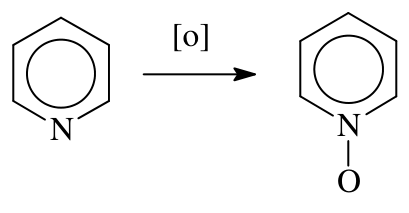
Ligand L can form complexes with many transition metals. L is synthesized by heating a mixture of a bipyridine, glacial acetic acid and hydrogen peroxide to 70 – 80 °C for 3 hrs. The final product L crystallizes out as fine needles and its molecular mass is 188. An analogous reaction with pyridine is ;
Complexes of L with \(\ce{Fe}\) and \(\ce{Cr}\) have the formulae of \(\ce{FeL_m(ClO4)_n * 3H2O}\) (A) and \(\ce{CrL_xCl_y(ClO4)_z * H2O}\) (B), respectively. Their elemental analyses and physical properties are given in Tables 4a and 4b. The relationship of colour and wavelength is given in Table 4c.
Table 4a: Elemental analyses.
| Complex | Elemental analyses , (wt. %) |
|---|---|
| A | Fe 5.740, C 37.030, H 3.090 , Cl 10.940, N 8.640 |
| B | Cr 8.440, C 38.930, H 2.920, Cl 17.250, N 9.080 |
Use the following data:
Atomic number: Cr = 24, Fe = 26
Relative atomic mass: H = 1, C = 12, N = 14, O = 16, Cl = 35.45, Cr = 52, Fe = 55.8
Table 4b: Physical properties
| Complex | Magnetic moment , \(\mu\) B.M. | Colour |
|---|---|---|
| A | 6.13 | Yellow |
| B | Not measured | Purple |
Table 4c Relationship of wavelength to colour.
| Wavelength (nm) and colour absorbed | Complementary colour |
|---|---|
| 400 (violet) | Yellow Green |
| 450 (blue) | Yellow |
| 490 (blue green) | Orange |
| 500 (green) | Red |
| 570 (yellow green) | Violet |
| 580 (yellow) | Blue |
| 600 (orange) | Blue green |
| 650 (red) | Green |
4.1 Write down the molecular formula of L.
4.2 If L is a bidentate chelating ligand, draw the structure of the bipyridine used. Also draw the structure of L.
4.3 Does the ligand L have any charge, i. e. net charge?
4.4 Draw the structure when one molecule of L binds to metal ion (M).
4.5 From the data in Table 4a, determine the empirical formula of A. What are the values of m and n in \(\ce{FeL_m(ClO4)_n * 3H2O}\)? Write the complete formula of A in the usual IUPAC notation. What is the ratio of cation to anion when A dissolves in water?
4.6 What is the oxidation number of Fe in A? How many d-electrons are present in Fe ion in the complex? Write the high spin and the low spin configurations that may exist for this complex. Which configuration, high or low spin, is the correct one? What is the best evidence to support your answer?
4.7 From Table 4c, estimate \(\lambda_{\max}\) (nm) of A.
4.8 Detail analysis of B shows that it contains \(\ce{Cr^{3+}}\) ion. Calculate the ‘spin-only’ magnetic moment of this compound.
4.9 Compound B is a 1 : 1 type electrolyte. Determine the empirical formula of B and the values of x, y, z in \(\ce{CrL_xCl_y(ClO4)_z * H2O}\).
Official English text of the problem.
Answers
Names and SMILES for the structures are supplied in the corresponding solution parts.
- 4.1 \(\boxed{\ce{L = C10H8N2O2}}\).
- 4.2 The precursor is 2,2′-bipyridine; L is 2,2′-bipyridine N,N′-dioxide.
- 4.3 L has zero net charge.
- 4.4 Both N-oxide oxygen atoms coordinate to the same metal ion, giving an \(O,O'\)-chelating ligand and a seven-membered chelate ring.
- 4.5 The empirical formula is \(\ce{C30H30Cl3FeN6O21}\).
\[ \boxed{m=3,\qquad n=3,\qquad \ce{A = [Fe(C10H8N2O2)3](ClO4)3 * 3H2O}} \] The cation-to-anion ratio is \(\boxed{1:3}\). - 4.6 Iron has oxidation number \(\boxed{+3}\) and configuration \(d^5\). The possible octahedral configurations are high-spin \(t_{2g}^{3}e_g^{2}\) and low-spin \(t_{2g}^{5}e_g^{0}\). A is high-spin, supported by its measured magnetic moment of \(6.13\) B.M.
- 4.7 \(\boxed{\lambda_{\max}\approx450\ \mathrm{nm}}\).
- 4.8 \(\boxed{\mu_{\mathrm{so}}=\sqrt{15}\,\mu_{\mathrm B}=3.87\ \mathrm{B.M.}}\).
- 4.9 The empirical formula is \(\ce{C20H18Cl3CrN4O9}\).
\[ \boxed{x=2,\qquad y=2,\qquad z=1,\qquad \ce{B = [Cr(C10H8N2O2)2Cl2]ClO4 * H2O}} \]
Solution
In the coordination SMILES below, -> and <- denote dative bonds directed from the donor atom to the metal. Coordination geometry is described separately.
4.1 — Molecular formula of L
Pyridine, SMILES n1ccccc1, has molecular formula \(\ce{C5H5N}\). Joining two pyridine rings through a carbon–carbon bond replaces one hydrogen on each ring, giving a bipyridine formula of \(\ce{C10H8N2}\).
Its relative molecular mass is
\[ M_r(\text{bipyridine})=10(12)+8(1)+2(14)=156. \]
The illustrated reaction converts pyridine into pyridine N-oxide, SMILES [O-][n+]1ccccc1. The mass increase for the bipyridine is
\[ 188-156=32=2(16), \]
so both nitrogen atoms are oxidized, adding two oxygen atoms:
\[ \boxed{\ce{L = C10H8N2O2}}. \]
The ligand is 2,2′-bipyridine N,N′-dioxide, SMILES [O-][n+]1ccccc1-c1cccc[n+]1[O-].
The overall oxidation is balanced as
\[ \ce{C10H8N2 + 2H2O2 -> C10H8N2O2 + 2H2O}. \]
Here hydrogen peroxide, SMILES OO, is the oxidant; acetic acid, SMILES CC(=O)O, is the reaction medium; and water, SMILES O, is the coproduct.
4.2 — Structures of the precursor and L
The precursor is 2,2′-bipyridine, SMILES n1ccccc1-c1ccccn1.
To draw it:
- Draw two aromatic six-membered pyridine rings.
- Number the nitrogen in each ring as position 1.
- Connect carbon 2 of one ring directly to carbon 2′ of the other.
To draw L, retain that framework and attach one oxygen atom to each ring nitrogen, showing each N-oxide group as \(\ce{N^{+}-O^{-}}\). Its SMILES is [O-][n+]1ccccc1-c1cccc[n+]1[O-].
The 2,2′ linkage allows rotation about the inter-ring bond to bring the two oxygen donors into a conformation suitable for binding the same metal ion.
4.3 — Charge of L
Each N-oxide group contains one formally positive nitrogen and one formally negative oxygen. Thus
\[ q(L)=2(+1)+2(-1)=\boxed{0}. \]
The ligand is electrically neutral overall.
4.4 — Coordination of one L molecule
Both oxygen atoms donate lone pairs to the same metal ion. Thus L is a \(\kappa^2O,O'\) ligand.
A generic metal–L chelate fragment has the dative-bond SMILES:
[*]1<-[O-][n+]2ccccc2-c2cccc[n+]2[O-]->1
The wildcard * represents M; its identity, charge and remaining ligands are unspecified in this generic fragment.
For the drawing, orient the N-oxide groups toward the metal and draw one coordination bond from each oxygen to M. Tracing the closed chelate ring gives:
M → first oxygen → first nitrogen → carbon 2 → carbon 2′ → second nitrogen → second oxygen → M.
There are therefore seven atoms in the chelate ring. The bonds to the metal are through oxygen.
4.5 — Composition and formula of A
Take a \(100.000\ \mathrm g\) sample. The amount of iron is
\[ n_{\ce{Fe}}= \frac{5.740\ \mathrm g}{55.8\ \mathrm{g\,mol^{-1}}} =0.10287\ \mathrm{mol}. \]
Each ligand contains ten carbon atoms, so
\[ n_L= \frac{37.030\ \mathrm g} {10(12)\ \mathrm{g\,mol^{-1}}} =0.30858\ \mathrm{mol}. \]
Consequently,
\[ m=\frac{n_L}{n_{\ce{Fe}}} =\frac{0.30858}{0.10287} \approx\boxed{3}. \]
All chlorine in the stated formula of A belongs to perchlorate:
\[ n= \frac{10.940/35.45}{5.740/55.8} =3.0000 \approx\boxed{3}. \]
For completeness, the oxygen percentage by difference is
\[ w_{\ce O} =100-(5.740+37.030+3.090+10.940+8.640) =34.560\%. \]
Dividing the elemental amounts by the amount of iron gives:
| Element | Atomic ratio relative to Fe |
|---|---|
| Fe | 1.000 |
| C | 29.998 |
| H | 30.039 |
| Cl | 3.000 |
| N | 5.999 |
| O | 20.998 |
Thus the empirical formula is
\[ \boxed{\ce{C30H30Cl3FeN6O21}}. \]
Three bidentate ligands provide six oxygen donors, giving an approximately octahedral complex cation. The complete coordination formula is
\[ \boxed{\ce{[FeL3](ClO4)3 * 3H2O} =\ce{[Fe(C10H8N2O2)3](ClO4)3 * 3H2O}}. \]
Its name is tris(2,2′-bipyridine N,N′-dioxide)iron(III) perchlorate trihydrate, with SMILES:
[Fe+3]123(<-[O-][n+]4ccccc4-c4cccc[n+]4[O-]->1)(<-[O-][n+]4ccccc4-c4cccc[n+]4[O-]->2)<-[O-][n+]4ccccc4-c4cccc[n+]4[O-]->3.[O-]Cl(=O)(=O)=O.[O-]Cl(=O)(=O)=O.[O-]Cl(=O)(=O)=O.O.O.O
The tris(L)iron(III) cation is the first connected component:
[Fe+3]123(<-[O-][n+]4ccccc4-c4cccc[n+]4[O-]->1)(<-[O-][n+]4ccccc4-c4cccc[n+]4[O-]->2)<-[O-][n+]4ccccc4-c4cccc[n+]4[O-]->3
The counterion is perchlorate, \(\ce{ClO4^-}\), SMILES [O-]Cl(=O)(=O)=O.
Dissolution is represented by
\[ \ce{[FeL3](ClO4)3 * 3H2O(s) -> [FeL3]^3+(aq) + 3ClO4^-(aq) + 3H2O(l)}. \]
Therefore,
\[ \boxed{\text{cation : anion}=1:3}. \]
4.6 — Iron oxidation state, electron configuration and spin
The three perchlorate ions have total charge \(-3\). Because each L is neutral, iron must have oxidation number
\[ \boxed{+3}. \]
The metal is iron(III), \(\ce{Fe^{3+}}\), SMILES [Fe+3]. Its \(d\)-electron count is
\[ 26-3-18=5, \]
so it is a \(d^5\) ion.
For the approximately octahedral complex, the possibilities are:
| State | Configuration | \(t_{2g}\) occupancy | \(e_g\) occupancy | Unpaired electrons |
|---|---|---|---|---|
| High spin | \(t_{2g}^{3}e_g^{2}\) | \((\uparrow)(\uparrow)(\uparrow)\) | \((\uparrow)(\uparrow)\) | 5 |
| Low spin | \(t_{2g}^{5}e_g^{0}\) | \((\uparrow\downarrow)(\uparrow\downarrow)(\uparrow)\) | \((\,)(\,)\) | 1 |
For \(u\) unpaired electrons, the spin-only magnetic moment is
\[ \mu_{\mathrm{so}}=\sqrt{u(u+2)}\,\mu_{\mathrm B}. \]
Hence
\[ \mu_{\mathrm{HS}}=\sqrt{5(7)}\,\mu_{\mathrm B} =5.92\ \mathrm{B.M.}, \]
whereas
\[ \mu_{\mathrm{LS}}=\sqrt{1(3)}\,\mu_{\mathrm B} =1.73\ \mathrm{B.M.}. \]
The measured moment, \(6.13\ \mathrm{B.M.}\), is close to the five-unpaired-electron prediction. Therefore,
\[ \boxed{\text{A contains high-spin iron(III), }t_{2g}^{3}e_g^{2}}. \]
The measured magnetic moment is the best evidence.
4.7 — Absorption maximum of A
The observed colour is yellow. Table 4c identifies yellow as the complementary colour to absorbed blue light at \(450\ \mathrm{nm}\). Therefore,
\[ \boxed{\lambda_{\max}\approx450\ \mathrm{nm}}. \]
This is the estimate obtained from the supplied colour table.
4.8 — Spin-only magnetic moment of B
Chromium(III), \(\ce{Cr^{3+}}\), SMILES [Cr+3], has
\[ 24-3-18=3 \]
\(d\)-electrons.
In an octahedral field its configuration is \(t_{2g}^{3}e_g^{0}\), with one electron in each \(t_{2g}\) orbital. Thus there are three unpaired electrons:
\[ \mu_{\mathrm{so}} =\sqrt{3(3+2)}\,\mu_{\mathrm B} =\sqrt{15}\,\mu_{\mathrm B} =\boxed{3.87\ \mathrm{B.M.}}. \]
4.9 — Composition and formula of B
Again using a \(100.000\ \mathrm g\) sample,
\[ n_{\ce{Cr}}=\frac{8.440}{52} =0.16231\ \mathrm{mol}. \]
The ligand-to-chromium ratio from the carbon analysis is
\[ x= \frac{38.930/(10\times12)}{8.440/52} =1.9988 \approx\boxed{2}. \]
The total number of chlorine atoms per chromium atom is
\[ y+z= \frac{17.250/35.45}{8.440/52} =2.9980 \approx3. \]
The oxygen percentage by difference is
\[ w_{\ce O} =100-(8.440+38.930+2.920+17.250+9.080) =23.380\%. \]
The complete elemental ratios are:
| Element | Atomic ratio relative to Cr |
|---|---|
| Cr | 1.000 |
| C | 19.988 |
| H | 17.991 |
| Cl | 2.998 |
| N | 3.996 |
| O | 9.003 |
Thus
\[ \boxed{\text{empirical formula of B}=\ce{C20H18Cl3CrN4O9}}. \]
Two ligands contribute four oxygen atoms and the water contributes one. The remaining four oxygen atoms belong to one perchlorate:
\[ 4+1+4z=9 \quad\Longrightarrow\quad \boxed{z=1}. \]
Since \(y+z=3\),
\[ \boxed{y=2}. \]
This agrees with the electrolyte information. Two neutral ligands and two coordinated chloride ions, SMILES [Cl-], give a complex cation of charge
\[ +3+2(0)+2(-1)=+1. \]
One perchlorate counterion then gives a 1 : 1 electrolyte:
\[ \boxed{\ce{B = [CrL2Cl2]ClO4 * H2O} =\ce{[Cr(C10H8N2O2)2Cl2]ClO4 * H2O}}. \]
The compound is bis(2,2′-bipyridine N,N′-dioxide)dichloridochromium(III) perchlorate monohydrate, with SMILES:
[Cr+3]12(<-[Cl-])(<-[Cl-])(<-[O-][n+]3ccccc3-c3cccc[n+]3[O-]->1)<-[O-][n+]3ccccc3-c3cccc[n+]3[O-]->2.[O-]Cl(=O)(=O)=O.O
Its bis(L)dichloridochromium(III) cation has SMILES:
[Cr+3]12(<-[Cl-])(<-[Cl-])(<-[O-][n+]3ccccc3-c3cccc[n+]3[O-]->1)<-[O-][n+]3ccccc3-c3cccc[n+]3[O-]->2
The four oxygen donors and two chlorido donors give approximately octahedral coordination. The information supplied does not select a cis or trans arrangement of the chlorido ligands.
The dissolution equation is
\[ \ce{[CrL2Cl2]ClO4 * H2O(s) -> [CrL2Cl2]^+(aq) + ClO4^-(aq) + H2O(l)}, \]
confirming the \(1:1\) cation-to-anion ratio.
The solution was checked against the official solution.
IChO 1999 · Theorieaufgabe 4
Eisen- und Chromkomplexe des Liganden L
Der Ligand L kann mit vielen Übergangsmetallen Komplexe bilden. L wird synthetisiert, indem ein Gemisch aus einem Bipyridin, Eisessig und Wasserstoffperoxid 3 Stunden lang auf 70 – 80 °C erhitzt wird. Das Endprodukt L kristallisiert in Form feiner Nadeln aus und hat eine Molekülmasse von 188. Eine analoge Reaktion mit Pyridin ist:
Die Komplexe von L mit \(\ce{Fe}\) und \(\ce{Cr}\) haben die Formeln \(\ce{FeL_m(ClO4)_n * 3H2O}\) (A) bzw. \(\ce{CrL_xCl_y(ClO4)_z * H2O}\) (B). Ihre Elementaranalysen und physikalischen Eigenschaften sind in den Tabellen 4a und 4b angegeben. Der Zusammenhang zwischen Farbe und Wellenlänge ist in Tabelle 4c angegeben.
Tabelle 4a: Elementaranalysen.
| Komplex | Elementaranalysen, (Massen-%) |
|---|---|
| A | Fe 5.740, C 37.030, H 3.090 , Cl 10.940, N 8.640 |
| B | Cr 8.440, C 38.930, H 2.920, Cl 17.250, N 9.080 |
Verwenden Sie die folgenden Daten:
Ordnungszahl: Cr = 24, Fe = 26
Relative Atommasse: H = 1, C = 12, N = 14, O = 16, Cl = 35.45, Cr = 52, Fe = 55.8
Tabelle 4b: Physikalische Eigenschaften
| Komplex | Magnetisches Moment, \(\mu\) B.M. | Farbe |
|---|---|---|
| A | 6.13 | Gelb |
| B | Nicht gemessen | Purpur |
Tabelle 4c Zusammenhang zwischen Wellenlänge und Farbe.
| Wellenlänge (nm) und absorbierte Farbe | Komplementärfarbe |
|---|---|
| 400 (violett) | Gelbgrün |
| 450 (blau) | Gelb |
| 490 (blaugrün) | Orange |
| 500 (grün) | Rot |
| 570 (gelbgrün) | Violett |
| 580 (gelb) | Blau |
| 600 (orange) | Blaugrün |
| 650 (rot) | Grün |
4.1 Geben Sie die Molekülformel von L an.
4.2 Wenn L ein zweizähniger Chelatligand ist, zeichnen Sie die Struktur des verwendeten Bipyridins. Zeichnen Sie auch die Struktur von L.
4.3 Besitzt der Ligand L eine Ladung, d. h. eine Nettoladung?
4.4 Zeichnen Sie die Struktur, wenn ein Molekül L an ein Metallion (M) bindet.
4.5 Bestimmen Sie aus den Daten in Tabelle 4a die Verhältnisformel von A. Welche Werte haben m und n in \(\ce{FeL_m(ClO4)_n * 3H2O}\)? Schreiben Sie die vollständige Formel von A in der üblichen IUPAC-Notation. Wie ist das Verhältnis von Kationen zu Anionen, wenn sich A in Wasser löst?
4.6 Welche Oxidationszahl hat Fe in A? Wie viele d-Elektronen besitzt das Fe-Ion im Komplex? Geben Sie die High-Spin- und die Low-Spin-Konfiguration an, die für diesen Komplex möglich sind. Welche Konfiguration, High-Spin oder Low-Spin, liegt tatsächlich vor? Welcher Befund stützt Ihre Antwort am besten?
4.7 Schätzen Sie anhand von Tabelle 4c \(\lambda_{\max}\) (nm) von A ab.
4.8 Eine eingehende Analyse von B zeigt, dass es das \(\ce{Cr^{3+}}\)-Ion enthält. Berechnen Sie das magnetische Moment dieser Verbindung unter alleiniger Berücksichtigung des Spins („spin-only“).
4.9 Verbindung B ist ein Elektrolyt vom Typ 1 : 1. Bestimmen Sie die Verhältnisformel von B und die Werte von x, y, z in \(\ce{CrL_xCl_y(ClO4)_z * H2O}\).
Aufgabentext aus dem offiziellen englischen Text übersetzt.
Antworten
Namen und SMILES der Strukturen sind in den entsprechenden Lösungsteilen angegeben.
- 4.1 \(\boxed{\ce{L = C10H8N2O2}}\).
- 4.2 Die Ausgangsverbindung ist 2,2′-Bipyridin; L ist 2,2′-Bipyridin-N,N′-dioxid.
- 4.3 L hat die Nettoladung null.
- 4.4 Beide N-Oxid-Sauerstoffatome koordinieren an dasselbe Metallion, wodurch ein \(O,O'\)-Chelatligand und ein siebengliedriger Chelatring entstehen.
- 4.5 Die Verhältnisformel lautet \(\ce{C30H30Cl3FeN6O21}\).
\[ \boxed{m=3,\qquad n=3,\qquad \ce{A = [Fe(C10H8N2O2)3](ClO4)3 * 3H2O}} \] Das Verhältnis von Kationen zu Anionen beträgt \(\boxed{1:3}\). - 4.6 Eisen hat die Oxidationszahl \(\boxed{+3}\) und die Konfiguration \(d^5\). Die möglichen oktaedrischen Konfigurationen sind High-Spin \(t_{2g}^{3}e_g^{2}\) und Low-Spin \(t_{2g}^{5}e_g^{0}\). A ist ein High-Spin-Komplex, was durch sein gemessenes magnetisches Moment von \(6.13\) B.M. gestützt wird.
- 4.7 \(\boxed{\lambda_{\max}\approx450\ \mathrm{nm}}\).
- 4.8 \(\boxed{\mu_{\mathrm{so}}=\sqrt{15}\,\mu_{\mathrm B}=3.87\ \mathrm{B.M.}}\).
- 4.9 Die Verhältnisformel lautet \(\ce{C20H18Cl3CrN4O9}\).
\[ \boxed{x=2,\qquad y=2,\qquad z=1,\qquad \ce{B = [Cr(C10H8N2O2)2Cl2]ClO4 * H2O}} \]
Lösung
In den nachstehenden Koordinations-SMILES bezeichnen -> und <- koordinative Bindungen, die vom Donoratom zum Metall gerichtet sind. Die Koordinationsgeometrie wird gesondert beschrieben.
4.1 — Molekülformel von L
Pyridin, SMILES n1ccccc1, hat die Molekülformel \(\ce{C5H5N}\). Werden zwei Pyridinringe über eine Kohlenstoff–Kohlenstoff-Bindung miteinander verknüpft, wird an jedem Ring ein Wasserstoffatom ersetzt, sodass sich für Bipyridin die Formel \(\ce{C10H8N2}\) ergibt.
Seine relative Molekülmasse beträgt
\[ M_r(\text{Bipyridin})=10(12)+8(1)+2(14)=156. \]
Die abgebildete Reaktion wandelt Pyridin in Pyridin-N-oxid, SMILES [O-][n+]1ccccc1, um. Die Massenzunahme beim Bipyridin beträgt
\[ 188-156=32=2(16), \]
also werden beide Stickstoffatome oxidiert, wobei zwei Sauerstoffatome hinzukommen:
\[ \boxed{\ce{L = C10H8N2O2}}. \]
Der Ligand ist 2,2′-Bipyridin-N,N′-dioxid, SMILES [O-][n+]1ccccc1-c1cccc[n+]1[O-].
Die ausgeglichene Gesamtgleichung der Oxidation lautet
\[ \ce{C10H8N2 + 2H2O2 -> C10H8N2O2 + 2H2O}. \]
Dabei ist Wasserstoffperoxid, SMILES OO, das Oxidationsmittel; Essigsäure, SMILES CC(=O)O, ist das Reaktionsmedium; und Wasser, SMILES O, ist das Nebenprodukt.
4.2 — Strukturen der Ausgangsverbindung und von L
Die Ausgangsverbindung ist 2,2′-Bipyridin, SMILES n1ccccc1-c1ccccn1.
So wird sie gezeichnet:
- Zeichnen Sie zwei aromatische sechsgliedrige Pyridinringe.
- Nummerieren Sie das Stickstoffatom in jedem Ring als Position 1.
- Verbinden Sie das Kohlenstoffatom 2 des einen Rings direkt mit dem Kohlenstoffatom 2′ des anderen.
Um L zu zeichnen, behalten Sie dieses Grundgerüst bei und binden Sie an jedes Ringstickstoffatom ein Sauerstoffatom, wobei jede N-Oxid-Gruppe als \(\ce{N^{+}-O^{-}}\) dargestellt wird. Der SMILES lautet [O-][n+]1ccccc1-c1cccc[n+]1[O-].
Die 2,2′-Verknüpfung ermöglicht eine Drehung um die Bindung zwischen den Ringen, sodass die beiden Sauerstoffdonoren eine Konformation einnehmen können, die für die Bindung an dasselbe Metallion geeignet ist.
4.3 — Ladung von L
Jede N-Oxid-Gruppe enthält ein formal positiv geladenes Stickstoffatom und ein formal negativ geladenes Sauerstoffatom. Somit gilt
\[ q(L)=2(+1)+2(-1)=\boxed{0}. \]
Der Ligand ist insgesamt elektrisch neutral.
4.4 — Koordination eines L-Moleküls
Beide Sauerstoffatome stellen demselben Metallion freie Elektronenpaare zur Verfügung. Somit ist L ein \(\kappa^2O,O'\)-Ligand.
Ein allgemeines Metall–L-Chelatfragment hat den folgenden SMILES mit koordinativen Bindungen:
[*]1<-[O-][n+]2ccccc2-c2cccc[n+]2[O-]->1
Der Platzhalter * steht für M; dessen Identität, Ladung und übrige Liganden sind in diesem allgemeinen Fragment nicht festgelegt.
Richten Sie für die Zeichnung die N-Oxid-Gruppen zum Metall hin aus und zeichnen Sie von jedem Sauerstoffatom eine koordinative Bindung zu M. Verfolgt man den geschlossenen Chelatring, ergibt sich:
M → erstes Sauerstoffatom → erstes Stickstoffatom → Kohlenstoffatom 2 → Kohlenstoffatom 2′ → zweites Stickstoffatom → zweites Sauerstoffatom → M.
Der Chelatring enthält daher sieben Atome. Die Bindungen zum Metall erfolgen über Sauerstoff.
4.5 — Zusammensetzung und Formel von A
Betrachten wir eine Probe von \(100.000\ \mathrm g\). Die Stoffmenge an Eisen beträgt
\[ n_{\ce{Fe}}= \frac{5.740\ \mathrm g}{55.8\ \mathrm{g\,mol^{-1}}} =0.10287\ \mathrm{mol}. \]
Jeder Ligand enthält zehn Kohlenstoffatome, also gilt
\[ n_L= \frac{37.030\ \mathrm g} {10(12)\ \mathrm{g\,mol^{-1}}} =0.30858\ \mathrm{mol}. \]
Folglich ist
\[ m=\frac{n_L}{n_{\ce{Fe}}} =\frac{0.30858}{0.10287} \approx\boxed{3}. \]
Das gesamte Chlor in der angegebenen Formel von A gehört zum Perchlorat:
\[ n= \frac{10.940/35.45}{5.740/55.8} =3.0000 \approx\boxed{3}. \]
Der Vollständigkeit halber ergibt sich der prozentuale Sauerstoffanteil als Differenz zu
\[ w_{\ce O} =100-(5.740+37.030+3.090+10.940+8.640) =34.560\%. \]
Division der Stoffmengen der Elemente durch die Stoffmenge an Eisen ergibt:
| Element | Atomverhältnis bezogen auf Fe |
|---|---|
| Fe | 1.000 |
| C | 29.998 |
| H | 30.039 |
| Cl | 3.000 |
| N | 5.999 |
| O | 20.998 |
Die Verhältnisformel lautet somit
\[ \boxed{\ce{C30H30Cl3FeN6O21}}. \]
Drei zweizähnige Liganden stellen sechs Sauerstoffdonoren bereit, sodass ein annähernd oktaedrisches Komplexkation entsteht. Die vollständige Koordinationsformel lautet
\[ \boxed{\ce{[FeL3](ClO4)3 * 3H2O} =\ce{[Fe(C10H8N2O2)3](ClO4)3 * 3H2O}}. \]
Die Verbindung heißt Tris(2,2′-bipyridin-N,N′-dioxid)eisen(III)-perchlorat-Trihydrat, mit dem SMILES:
[Fe+3]123(<-[O-][n+]4ccccc4-c4cccc[n+]4[O-]->1)(<-[O-][n+]4ccccc4-c4cccc[n+]4[O-]->2)<-[O-][n+]4ccccc4-c4cccc[n+]4[O-]->3.[O-]Cl(=O)(=O)=O.[O-]Cl(=O)(=O)=O.[O-]Cl(=O)(=O)=O.O.O.O
Das Tris(L)eisen(III)-Kation ist die erste zusammenhängende Komponente:
[Fe+3]123(<-[O-][n+]4ccccc4-c4cccc[n+]4[O-]->1)(<-[O-][n+]4ccccc4-c4cccc[n+]4[O-]->2)<-[O-][n+]4ccccc4-c4cccc[n+]4[O-]->3
Das Gegenion ist Perchlorat, \(\ce{ClO4^-}\), SMILES [O-]Cl(=O)(=O)=O.
Der Lösungsvorgang wird dargestellt durch
\[ \ce{[FeL3](ClO4)3 * 3H2O(s) -> [FeL3]^3+(aq) + 3ClO4^-(aq) + 3H2O(l)}. \]
Daher gilt
\[ \boxed{\text{Kation : Anion}=1:3}. \]
4.6 — Oxidationsstufe, Elektronenkonfiguration und Spin des Eisens
Die drei Perchlorationen haben die Gesamtladung \(-3\). Da jeder Ligand L neutral ist, muss Eisen die folgende Oxidationszahl haben:
\[ \boxed{+3}. \]
Das Metall liegt als Eisen(III) vor, \(\ce{Fe^{3+}}\), SMILES [Fe+3]. Die Anzahl seiner \(d\)-Elektronen beträgt
\[ 26-3-18=5, \]
es handelt sich also um ein \(d^5\)-Ion.
Für den annähernd oktaedrischen Komplex bestehen folgende Möglichkeiten:
| Zustand | Konfiguration | \(t_{2g}\)-Besetzung | \(e_g\)-Besetzung | Ungepaarte Elektronen |
|---|---|---|---|---|
| High-Spin | \(t_{2g}^{3}e_g^{2}\) | \((\uparrow)(\uparrow)(\uparrow)\) | \((\uparrow)(\uparrow)\) | 5 |
| Low-Spin | \(t_{2g}^{5}e_g^{0}\) | \((\uparrow\downarrow)(\uparrow\downarrow)(\uparrow)\) | \((\,)(\,)\) | 1 |
Für \(u\) ungepaarte Elektronen beträgt das magnetische Moment unter alleiniger Berücksichtigung des Spins
\[ \mu_{\mathrm{so}}=\sqrt{u(u+2)}\,\mu_{\mathrm B}. \]
Damit gilt
\[ \mu_{\mathrm{HS}}=\sqrt{5(7)}\,\mu_{\mathrm B} =5.92\ \mathrm{B.M.}, \]
während
\[ \mu_{\mathrm{LS}}=\sqrt{1(3)}\,\mu_{\mathrm B} =1.73\ \mathrm{B.M.}. \]
Das gemessene Moment von \(6.13\ \mathrm{B.M.}\) liegt nahe am vorhergesagten Wert für fünf ungepaarte Elektronen. Daher gilt
\[ \boxed{\text{A enthält High-Spin-Eisen(III), }t_{2g}^{3}e_g^{2}}. \]
Das gemessene magnetische Moment ist der beste Beleg.
4.7 — Absorptionsmaximum von A
Die beobachtete Farbe ist Gelb. Tabelle 4c gibt Gelb als Komplementärfarbe zu absorbiertem blauem Licht bei \(450\ \mathrm{nm}\) an. Daher gilt
\[ \boxed{\lambda_{\max}\approx450\ \mathrm{nm}}. \]
Dies ist der Schätzwert, der sich aus der bereitgestellten Farbtabelle ergibt.
4.8 — Magnetisches Moment von B unter alleiniger Berücksichtigung des Spins
Chrom(III), \(\ce{Cr^{3+}}\), SMILES [Cr+3], besitzt
\[ 24-3-18=3 \]
\(d\)-Elektronen.
In einem oktaedrischen Feld hat es die Konfiguration \(t_{2g}^{3}e_g^{0}\), mit einem Elektron in jedem \(t_{2g}\)-Orbital. Es gibt also drei ungepaarte Elektronen:
\[ \mu_{\mathrm{so}} =\sqrt{3(3+2)}\,\mu_{\mathrm B} =\sqrt{15}\,\mu_{\mathrm B} =\boxed{3.87\ \mathrm{B.M.}}. \]
4.9 — Zusammensetzung und Formel von B
Bei erneuter Betrachtung einer Probe von \(100.000\ \mathrm g\) ergibt sich
\[ n_{\ce{Cr}}=\frac{8.440}{52} =0.16231\ \mathrm{mol}. \]
Das aus der Kohlenstoffanalyse erhaltene Verhältnis von Ligand zu Chrom beträgt
\[ x= \frac{38.930/(10\times12)}{8.440/52} =1.9988 \approx\boxed{2}. \]
Die Gesamtzahl der Chloratome pro Chromatom beträgt
\[ y+z= \frac{17.250/35.45}{8.440/52} =2.9980 \approx3. \]
Der prozentuale Sauerstoffanteil ergibt sich als Differenz zu
\[ w_{\ce O} =100-(8.440+38.930+2.920+17.250+9.080) =23.380\%. \]
Die vollständigen Elementverhältnisse lauten:
| Element | Atomverhältnis bezogen auf Cr |
|---|---|
| Cr | 1.000 |
| C | 19.988 |
| H | 17.991 |
| Cl | 2.998 |
| N | 3.996 |
| O | 9.003 |
Somit gilt
\[ \boxed{\text{Verhältnisformel von B}=\ce{C20H18Cl3CrN4O9}}. \]
Zwei Liganden tragen vier Sauerstoffatome bei, und das Wasser trägt eines bei. Die verbleibenden vier Sauerstoffatome gehören zu einem Perchloration:
\[ 4+1+4z=9 \quad\Longrightarrow\quad \boxed{z=1}. \]
Da \(y+z=3\), gilt
\[ \boxed{y=2}. \]
Dies stimmt mit der Angabe zum Elektrolyttyp überein. Zwei neutrale Liganden und zwei koordinierte Chloridionen, SMILES [Cl-], ergeben ein Komplexkation mit der Ladung
\[ +3+2(0)+2(-1)=+1. \]
Ein Perchlorat-Gegenion ergibt dann einen 1 : 1-Elektrolyten:
\[ \boxed{\ce{B = [CrL2Cl2]ClO4 * H2O} =\ce{[Cr(C10H8N2O2)2Cl2]ClO4 * H2O}}. \]
Die Verbindung ist Bis(2,2′-bipyridin-N,N′-dioxid)dichloridochrom(III)-perchlorat-Monohydrat, mit dem SMILES:
[Cr+3]12(<-[Cl-])(<-[Cl-])(<-[O-][n+]3ccccc3-c3cccc[n+]3[O-]->1)<-[O-][n+]3ccccc3-c3cccc[n+]3[O-]->2.[O-]Cl(=O)(=O)=O.O
Ihr Bis(L)dichloridochrom(III)-Kation hat den SMILES:
[Cr+3]12(<-[Cl-])(<-[Cl-])(<-[O-][n+]3ccccc3-c3cccc[n+]3[O-]->1)<-[O-][n+]3ccccc3-c3cccc[n+]3[O-]->2
Die vier Sauerstoffdonoren und zwei Chloridodonoren ergeben eine annähernd oktaedrische Koordination. Anhand der bereitgestellten Informationen lässt sich nicht entscheiden, ob die Chloridoliganden cis oder trans angeordnet sind.
Die Gleichung des Lösungsvorgangs lautet
\[ \ce{[CrL2Cl2]ClO4 * H2O(s) -> [CrL2Cl2]^+(aq) + ClO4^-(aq) + H2O(l)}, \]
was das Verhältnis von Kationen zu Anionen von \(1:1\) bestätigt.
Die Lösung wurde mit der offiziellen Lösung abgeglichen.
IChO 1999 · Teori sorusu 4
L ligandının demir ve krom kompleksleri
L ligandı birçok geçiş metaliyle kompleks oluşturabilir. L, bir bipiridin, buzlu asetik asit ve hidrojen peroksit karışımının 70 – 80 °C'ye ısıtılıp bu sıcaklıkta 3 saat tutulmasıyla sentezlenir. Son ürün L, ince iğneler hâlinde kristallenir ve molekül kütlesi 188'dir. Piridin ile gerçekleşen benzer bir tepkime şöyledir:
L'nin \(\ce{Fe}\) ve \(\ce{Cr}\) ile oluşturduğu komplekslerin formülleri sırasıyla \(\ce{FeL_m(ClO4)_n * 3H2O}\) (A) ve \(\ce{CrL_xCl_y(ClO4)_z * H2O}\) (B) şeklindedir. Bunların element analizleri ve fiziksel özellikleri Tablo 4a ve 4b'de verilmiştir. Renk ile dalga boyu arasındaki ilişki Tablo 4c'de verilmiştir.
Tablo 4a: Element analizleri.
| Kompleks | Element analizleri, (kütlece %) |
|---|---|
| A | Fe 5.740, C 37.030, H 3.090 , Cl 10.940, N 8.640 |
| B | Cr 8.440, C 38.930, H 2.920, Cl 17.250, N 9.080 |
Aşağıdaki verileri kullanınız:
Atom numarası: Cr = 24, Fe = 26
Bağıl atom kütlesi: H = 1, C = 12, N = 14, O = 16, Cl = 35.45, Cr = 52, Fe = 55.8
Tablo 4b: Fiziksel özellikler
| Kompleks | Manyetik moment, \(\mu\) B.M. | Renk |
|---|---|---|
| A | 6.13 | Sarı |
| B | Ölçülmemiş | Mor |
Tablo 4c Dalga boyu ile renk arasındaki ilişki.
| Dalga boyu (nm) ve soğurulan renk | Tamamlayıcı renk |
|---|---|
| 400 (mor) | Sarı yeşil |
| 450 (mavi) | Sarı |
| 490 (mavi yeşil) | Turuncu |
| 500 (yeşil) | Kırmızı |
| 570 (sarı yeşil) | Mor |
| 580 (sarı) | Mavi |
| 600 (turuncu) | Mavi yeşil |
| 650 (kırmızı) | Yeşil |
4.1 L'nin molekül formülünü yazınız.
4.2 L iki dişli bir şelat ligandı ise kullanılan bipiridinin yapısını çiziniz. L'nin yapısını da çiziniz.
4.3 L ligandının herhangi bir yükü, yani net yükü var mıdır?
4.4 Bir L molekülünün metal iyonuna (M) bağlanmasıyla oluşan yapıyı çiziniz.
4.5 Tablo 4a'daki verilerden A'nın basit formülünü belirleyiniz. \(\ce{FeL_m(ClO4)_n * 3H2O}\) formülündeki m ve n değerleri nedir? A'nın tam formülünü alışılmış IUPAC gösterimiyle yazınız. A suda çözündüğünde katyonun anyona oranı nedir?
4.6 A'daki Fe'nin yükseltgenme basamağı nedir? Kompleksteki Fe iyonunda kaç d-elektronu bulunur? Bu kompleks için mümkün olan yüksek spinli ve düşük spinli elektron dizilimlerini yazınız. Yüksek spinli ve düşük spinli dizilimlerden hangisi doğrudur? Cevabınızı destekleyen en güçlü kanıt nedir?
4.7 Tablo 4c'den A'nın \(\lambda_{\max}\) (nm) değerini tahmin ediniz.
4.8 B'nin ayrıntılı analizi, \(\ce{Cr^{3+}}\) iyonu içerdiğini göstermektedir. Bu bileşiğin ‘yalnızca spinden kaynaklanan’ manyetik momentini hesaplayınız.
4.9 B bileşiği 1 : 1 tipi bir elektrolittir. B'nin basit formülünü ve \(\ce{CrL_xCl_y(ClO4)_z * H2O}\) formülündeki x, y, z değerlerini belirleyiniz.
Soru metni resmi İngilizce metinden çevrilmiştir.
Cevaplar
Yapıların adları ve SMILES gösterimleri çözümün ilgili kısımlarında verilmiştir.
- 4.1 \(\boxed{\ce{L = C10H8N2O2}}\).
- 4.2 Başlangıç maddesi 2,2′-bipiridin; L ise 2,2′-bipiridin N,N′-dioksittir.
- 4.3 L'nin net yükü sıfırdır.
- 4.4 Her iki N-oksit oksijen atomu da aynı metal iyonuna koordine olur; böylece \(O,O'\) üzerinden şelat oluşturan bir ligand ve yedi üyeli bir şelat halkası oluşur.
- 4.5 Basit formül \(\ce{C30H30Cl3FeN6O21}\) şeklindedir.
\[ \boxed{m=3,\qquad n=3,\qquad \ce{A = [Fe(C10H8N2O2)3](ClO4)3 * 3H2O}} \] Katyonun anyona oranı \(\boxed{1:3}\) şeklindedir. - 4.6 Demirin yükseltgenme basamağı \(\boxed{+3}\), elektron dizilimi ise \(d^5\) şeklindedir. Mümkün olan oktahedral dizilimler, yüksek spinli \(t_{2g}^{3}e_g^{2}\) ve düşük spinli \(t_{2g}^{5}e_g^{0}\) dizilimleridir. A yüksek spinlidir; ölçülen \(6.13\) B.M. manyetik moment değeri bunu destekler.
- 4.7 \(\boxed{\lambda_{\max}\approx450\ \mathrm{nm}}\).
- 4.8 \(\boxed{\mu_{\mathrm{so}}=\sqrt{15}\,\mu_{\mathrm B}=3.87\ \mathrm{B.M.}}\).
- 4.9 Basit formül \(\ce{C20H18Cl3CrN4O9}\) şeklindedir.
\[ \boxed{x=2,\qquad y=2,\qquad z=1,\qquad \ce{B = [Cr(C10H8N2O2)2Cl2]ClO4 * H2O}} \]
Çözüm
Aşağıdaki koordinasyon SMILES gösterimlerinde -> ve <-, donör atomdan metale yönelen datif bağları belirtir. Koordinasyon geometrisi ayrıca açıklanmıştır.
4.1 — L'nin molekül formülü
SMILES gösterimi n1ccccc1 olan piridinin molekül formülü \(\ce{C5H5N}\) şeklindedir. İki piridin halkasının bir karbon–karbon bağıyla birleştirilmesi, her halkadan bir hidrojenin yerini alarak \(\ce{C10H8N2}\) bipiridin formülünü verir.
Bunun bağıl molekül kütlesi
\[ M_r(\text{bipiridin})=10(12)+8(1)+2(14)=156. \]
Gösterilen tepkime, piridini SMILES gösterimi [O-][n+]1ccccc1 olan piridin N-oksite dönüştürür. Bipiridin için kütle artışı
\[ 188-156=32=2(16), \]
olduğundan her iki azot atomu da yükseltgenir ve iki oksijen atomu eklenir:
\[ \boxed{\ce{L = C10H8N2O2}}. \]
Ligand, SMILES gösterimi [O-][n+]1ccccc1-c1cccc[n+]1[O-] olan 2,2′-bipiridin N,N′-dioksittir.
Toplam yükseltgenme tepkimesi şu şekilde denkleştirilir:
\[ \ce{C10H8N2 + 2H2O2 -> C10H8N2O2 + 2H2O}. \]
Burada SMILES gösterimi OO olan hidrojen peroksit yükseltgen; SMILES gösterimi CC(=O)O olan asetik asit tepkime ortamı; SMILES gösterimi O olan su ise birlikte oluşan üründür.
4.2 — Başlangıç maddesinin ve L'nin yapıları
Başlangıç maddesi, SMILES gösterimi n1ccccc1-c1ccccn1 olan 2,2′-bipiridindir.
Yapısını çizmek için:
- Altı üyeli iki aromatik piridin halkası çiziniz.
- Her halkadaki azotu 1 konumu olarak numaralandırınız.
- Bir halkanın 2 numaralı karbonunu doğrudan diğer halkanın 2′ numaralı karbonuna bağlayınız.
L'yi çizmek için bu iskeleti koruyup her halka azotuna bir oksijen atomu bağlayınız ve her N-oksit grubunu \(\ce{N^{+}-O^{-}}\) şeklinde gösteriniz. SMILES gösterimi [O-][n+]1ccccc1-c1cccc[n+]1[O-] şeklindedir.
2,2′ bağlantısı, halkalar arası bağ etrafında dönmeye olanak tanıyarak iki oksijen donörünün aynı metal iyonuna bağlanmaya uygun bir konformasyona gelmesini sağlar.
4.3 — L'nin yükü
Her N-oksit grubunda formal yükü pozitif olan bir azot ve formal yükü negatif olan bir oksijen bulunur. Dolayısıyla
\[ q(L)=2(+1)+2(-1)=\boxed{0}. \]
Ligand bir bütün olarak elektriksel açıdan nötrdür.
4.4 — Bir L molekülünün koordinasyonu
Her iki oksijen atomu da aynı metal iyonuna ortaklanmamış elektron çiftlerini verir. Dolayısıyla L, bir \(\kappa^2O,O'\) ligandıdır.
Genel bir metal–L şelat parçasının datif bağ içeren SMILES gösterimi şöyledir:
[*]1<-[O-][n+]2ccccc2-c2cccc[n+]2[O-]->1
Joker karakter *, M'yi temsil eder; bu genel parçada metalin kimliği, yükü ve diğer ligandları belirtilmemiştir.
Çizim için N-oksit gruplarını metale doğru yöneltiniz ve her oksijenden M'ye bir koordinasyon bağı çiziniz. Kapalı şelat halkası boyunca ilerlenirse şu sıra elde edilir:
M → birinci oksijen → birinci azot → karbon 2 → karbon 2′ → ikinci azot → ikinci oksijen → M.
Dolayısıyla şelat halkasında yedi atom bulunur. Metale bağlanma oksijen üzerinden gerçekleşir.
4.5 — A'nın bileşimi ve formülü
\(100.000\ \mathrm g\) bir örnek alalım. Demirin madde miktarı
\[ n_{\ce{Fe}}= \frac{5.740\ \mathrm g}{55.8\ \mathrm{g\,mol^{-1}}} =0.10287\ \mathrm{mol}. \]
Her ligand on karbon atomu içerdiğinden
\[ n_L= \frac{37.030\ \mathrm g} {10(12)\ \mathrm{g\,mol^{-1}}} =0.30858\ \mathrm{mol}. \]
Buna göre,
\[ m=\frac{n_L}{n_{\ce{Fe}}} =\frac{0.30858}{0.10287} \approx\boxed{3}. \]
A'nın verilen formülündeki klorun tamamı perklorata aittir:
\[ n= \frac{10.940/35.45}{5.740/55.8} =3.0000 \approx\boxed{3}. \]
Analizi tamamlamak için, farktan hesaplanan oksijen yüzdesi
\[ w_{\ce O} =100-(5.740+37.030+3.090+10.940+8.640) =34.560\%. \]
Elementlerin madde miktarlarının demirin madde miktarına bölünmesiyle şu değerler elde edilir:
| Element | Fe'ye göre atom oranı |
|---|---|
| Fe | 1.000 |
| C | 29.998 |
| H | 30.039 |
| Cl | 3.000 |
| N | 5.999 |
| O | 20.998 |
Böylece basit formül
\[ \boxed{\ce{C30H30Cl3FeN6O21}}. \]
Üç adet iki dişli ligand, altı oksijen donörü sağlayarak yaklaşık oktahedral bir kompleks katyon oluşturur. Tam koordinasyon formülü
\[ \boxed{\ce{[FeL3](ClO4)3 * 3H2O} =\ce{[Fe(C10H8N2O2)3](ClO4)3 * 3H2O}}. \]
Adı tris(2,2′-bipiridin N,N′-dioksit)demir(III) perklorat trihidrat, SMILES gösterimi ise şöyledir:
[Fe+3]123(<-[O-][n+]4ccccc4-c4cccc[n+]4[O-]->1)(<-[O-][n+]4ccccc4-c4cccc[n+]4[O-]->2)<-[O-][n+]4ccccc4-c4cccc[n+]4[O-]->3.[O-]Cl(=O)(=O)=O.[O-]Cl(=O)(=O)=O.[O-]Cl(=O)(=O)=O.O.O.O
Tris(L)demir(III) katyonu, ilk bağlantılı bileşendir:
[Fe+3]123(<-[O-][n+]4ccccc4-c4cccc[n+]4[O-]->1)(<-[O-][n+]4ccccc4-c4cccc[n+]4[O-]->2)<-[O-][n+]4ccccc4-c4cccc[n+]4[O-]->3
Karşı iyon, SMILES gösterimi [O-]Cl(=O)(=O)=O olan perklorat, \(\ce{ClO4^-}\), iyonudur.
Çözünme şu şekilde gösterilir:
\[ \ce{[FeL3](ClO4)3 * 3H2O(s) -> [FeL3]^3+(aq) + 3ClO4^-(aq) + 3H2O(l)}. \]
Dolayısıyla,
\[ \boxed{\text{katyon : anyon}=1:3}. \]
4.6 — Demirin yükseltgenme basamağı, elektron dizilimi ve spini
Üç perklorat iyonunun toplam yükü \(-3\) olur. Her L nötr olduğundan demirin yükseltgenme basamağı
\[ \boxed{+3}. \]
Metal, SMILES gösterimi [Fe+3] olan demir(III), \(\ce{Fe^{3+}}\), iyonudur. \(d\)-elektronlarının sayısı
\[ 26-3-18=5, \]
olduğundan bu bir \(d^5\) iyonudur.
Yaklaşık oktahedral kompleks için olası durumlar şöyledir:
| Durum | Elektron dizilimi | \(t_{2g}\) doluluğu | \(e_g\) doluluğu | Eşleşmemiş elektronlar |
|---|---|---|---|---|
| Yüksek spin | \(t_{2g}^{3}e_g^{2}\) | \((\uparrow)(\uparrow)(\uparrow)\) | \((\uparrow)(\uparrow)\) | 5 |
| Düşük spin | \(t_{2g}^{5}e_g^{0}\) | \((\uparrow\downarrow)(\uparrow\downarrow)(\uparrow)\) | \((\,)(\,)\) | 1 |
\(u\) eşleşmemiş elektron için yalnızca spinden kaynaklanan manyetik moment
\[ \mu_{\mathrm{so}}=\sqrt{u(u+2)}\,\mu_{\mathrm B}. \]
Buna göre
\[ \mu_{\mathrm{HS}}=\sqrt{5(7)}\,\mu_{\mathrm B} =5.92\ \mathrm{B.M.}, \]
iken
\[ \mu_{\mathrm{LS}}=\sqrt{1(3)}\,\mu_{\mathrm B} =1.73\ \mathrm{B.M.}. \]
Ölçülen \(6.13\ \mathrm{B.M.}\) moment değeri, beş eşleşmemiş elektron için öngörülen değere yakındır. Dolayısıyla,
\[ \boxed{\text{A yüksek spinli demir(III) içerir, }t_{2g}^{3}e_g^{2}}. \]
En güçlü kanıt, ölçülen manyetik momenttir.
4.7 — A'nın soğurma maksimumu
Gözlenen renk sarıdır. Tablo 4c, sarının \(450\ \mathrm{nm}\) dalga boyunda soğurulan mavi ışığın tamamlayıcı rengi olduğunu gösterir. Dolayısıyla,
\[ \boxed{\lambda_{\max}\approx450\ \mathrm{nm}}. \]
Bu, verilen renk tablosundan elde edilen tahmini değerdir.
4.8 — B'nin yalnızca spinden kaynaklanan manyetik momenti
SMILES gösterimi [Cr+3] olan krom(III), \(\ce{Cr^{3+}}\), iyonunun
\[ 24-3-18=3 \]
\(d\)-elektronu vardır.
Oktahedral bir alanda elektron dizilimi \(t_{2g}^{3}e_g^{0}\) şeklindedir ve her \(t_{2g}\) orbitalinde bir elektron bulunur. Dolayısıyla üç eşleşmemiş elektron vardır:
\[ \mu_{\mathrm{so}} =\sqrt{3(3+2)}\,\mu_{\mathrm B} =\sqrt{15}\,\mu_{\mathrm B} =\boxed{3.87\ \mathrm{B.M.}}. \]
4.9 — B'nin bileşimi ve formülü
Yine \(100.000\ \mathrm g\) bir örnek kullanıldığında,
\[ n_{\ce{Cr}}=\frac{8.440}{52} =0.16231\ \mathrm{mol}. \]
Karbon analizinden elde edilen ligandın kroma oranı
\[ x= \frac{38.930/(10\times12)}{8.440/52} =1.9988 \approx\boxed{2}. \]
Krom atomu başına toplam klor atomu sayısı
\[ y+z= \frac{17.250/35.45}{8.440/52} =2.9980 \approx3. \]
Farktan hesaplanan oksijen yüzdesi
\[ w_{\ce O} =100-(8.440+38.930+2.920+17.250+9.080) =23.380\%. \]
Tüm elementlerin oranları şöyledir:
| Element | Cr'ye göre atom oranı |
|---|---|
| Cr | 1.000 |
| C | 19.988 |
| H | 17.991 |
| Cl | 2.998 |
| N | 3.996 |
| O | 9.003 |
Böylece
\[ \boxed{\text{B'nin basit formülü}=\ce{C20H18Cl3CrN4O9}}. \]
İki ligand dört oksijen atomu, su ise bir oksijen atomu sağlar. Kalan dört oksijen atomu bir perklorata aittir:
\[ 4+1+4z=9 \quad\Longrightarrow\quad \boxed{z=1}. \]
\(y+z=3\) olduğundan,
\[ \boxed{y=2}. \]
Bu sonuç, elektrolit bilgisiyle uyumludur. İki nötr ligand ve SMILES gösterimi [Cl-] olan koordine olmuş iki klorür iyonu, yükü
\[ +3+2(0)+2(-1)=+1. \]
olan bir kompleks katyon oluşturur. Bir perklorat karşı iyonu ile 1 : 1 tipi bir elektrolit elde edilir:
\[ \boxed{\ce{B = [CrL2Cl2]ClO4 * H2O} =\ce{[Cr(C10H8N2O2)2Cl2]ClO4 * H2O}}. \]
Bileşik, bis(2,2′-bipiridin N,N′-dioksit)dikloridokrom(III) perklorat monohidrat olup SMILES gösterimi şöyledir:
[Cr+3]12(<-[Cl-])(<-[Cl-])(<-[O-][n+]3ccccc3-c3cccc[n+]3[O-]->1)<-[O-][n+]3ccccc3-c3cccc[n+]3[O-]->2.[O-]Cl(=O)(=O)=O.O
Bis(L)dikloridokrom(III) katyonunun SMILES gösterimi şöyledir:
[Cr+3]12(<-[Cl-])(<-[Cl-])(<-[O-][n+]3ccccc3-c3cccc[n+]3[O-]->1)<-[O-][n+]3ccccc3-c3cccc[n+]3[O-]->2
Dört oksijen donörü ve iki klorido donörü yaklaşık oktahedral koordinasyon oluşturur. Verilen bilgiler, klorido ligandlarının cis ya da trans düzenlenmelerinden hangisinin bulunduğunu belirlemez.
Çözünme denklemi
\[ \ce{[CrL2Cl2]ClO4 * H2O(s) -> [CrL2Cl2]^+(aq) + ClO4^-(aq) + H2O(l)}, \]
olup katyonun anyona oranının \(1:1\) olduğunu doğrular.
Çözüm, resmi çözümle karşılaştırılarak kontrol edildi.
IChO 1999 · Problema teórico 4
Complejos de hierro y cromo del ligando L
El ligando L puede formar complejos con muchos metales de transición. L se sintetiza calentando una mezcla de una bipiridina, ácido acético glacial y peróxido de hidrógeno a 70 – 80 °C durante 3 h. El producto final L cristaliza en forma de agujas finas y su masa molecular es 188. Una reacción análoga con piridina es:
Los complejos de L con \(\ce{Fe}\) y \(\ce{Cr}\) tienen las fórmulas \(\ce{FeL_m(ClO4)_n * 3H2O}\) (A) y \(\ce{CrL_xCl_y(ClO4)_z * H2O}\) (B), respectivamente. Sus análisis elementales y propiedades físicas se presentan en las Tablas 4a y 4b. La relación entre el color y la longitud de onda se presenta en la Tabla 4c.
Tabla 4a: Análisis elementales.
| Complejo | Análisis elementales, (% en masa) |
|---|---|
| A | Fe 5.740, C 37.030, H 3.090 , Cl 10.940, N 8.640 |
| B | Cr 8.440, C 38.930, H 2.920, Cl 17.250, N 9.080 |
Utilice los siguientes datos:
Número atómico: Cr = 24, Fe = 26
Masa atómica relativa: H = 1, C = 12, N = 14, O = 16, Cl = 35.45, Cr = 52, Fe = 55.8
Tabla 4b: Propiedades físicas
| Complejo | Momento magnético, \(\mu\) B.M. | Color |
|---|---|---|
| A | 6.13 | Amarillo |
| B | No medido | Púrpura |
Tabla 4c Relación entre la longitud de onda y el color.
| Longitud de onda (nm) y color absorbido | Color complementario |
|---|---|
| 400 (violeta) | Verde amarillento |
| 450 (azul) | Amarillo |
| 490 (verde azulado) | Naranja |
| 500 (verde) | Rojo |
| 570 (verde amarillento) | Violeta |
| 580 (amarillo) | Azul |
| 600 (naranja) | Verde azulado |
| 650 (rojo) | Verde |
4.1 Escriba la fórmula molecular de L.
4.2 Si L es un ligando quelante bidentado, dibuje la estructura de la bipiridina utilizada. Dibuje también la estructura de L.
4.3 ¿Tiene el ligando L alguna carga, es decir, carga neta?
4.4 Dibuje la estructura que se forma cuando una molécula de L se une al ion metálico (M).
4.5 A partir de los datos de la Tabla 4a, determine la fórmula empírica de A. ¿Cuáles son los valores de m y n en \(\ce{FeL_m(ClO4)_n * 3H2O}\)? Escriba la fórmula completa de A en la notación habitual de la IUPAC. ¿Cuál es la proporción entre cationes y aniones cuando A se disuelve en agua?
4.6 ¿Cuál es el número de oxidación del Fe en A? ¿Cuántos electrones d tiene el ion Fe en el complejo? Escriba las configuraciones de espín alto y de espín bajo que pueden existir para este complejo. ¿Qué configuración, de espín alto o de espín bajo, es la correcta? ¿Cuál es la mejor evidencia que respalda su respuesta?
4.7 A partir de la Tabla 4c, estime \(\lambda_{\max}\) (nm) de A.
4.8 Un análisis detallado de B muestra que contiene el ion \(\ce{Cr^{3+}}\). Calcule el momento magnético de este compuesto considerando únicamente la contribución del espín.
4.9 El compuesto B es un electrolito de tipo 1 : 1. Determine la fórmula empírica de B y los valores de x, y, z en \(\ce{CrL_xCl_y(ClO4)_z * H2O}\).
Enunciado traducido del texto oficial en inglés.
Respuestas
Los nombres y los SMILES de las estructuras se proporcionan en los apartados correspondientes de la solución.
- 4.1 \(\boxed{\ce{L = C10H8N2O2}}\).
- 4.2 El precursor es la 2,2′-bipiridina; L es el N,N′-dióxido de 2,2′-bipiridina.
- 4.3 L tiene carga neta nula.
- 4.4 Los dos átomos de oxígeno de los grupos N-óxido se coordinan al mismo ion metálico, dando lugar a un ligando quelante \(O,O'\) y a un anillo quelato de siete miembros.
- 4.5 La fórmula empírica es \(\ce{C30H30Cl3FeN6O21}\).
\[ \boxed{m=3,\qquad n=3,\qquad \ce{A = [Fe(C10H8N2O2)3](ClO4)3 * 3H2O}} \] La proporción entre cationes y aniones es \(\boxed{1:3}\). - 4.6 El hierro tiene número de oxidación \(\boxed{+3}\) y configuración \(d^5\). Las posibles configuraciones octaédricas son la de espín alto \(t_{2g}^{3}e_g^{2}\) y la de espín bajo \(t_{2g}^{5}e_g^{0}\). A es de espín alto, como respalda su momento magnético medido de \(6.13\) B.M.
- 4.7 \(\boxed{\lambda_{\max}\approx450\ \mathrm{nm}}\).
- 4.8 \(\boxed{\mu_{\mathrm{so}}=\sqrt{15}\,\mu_{\mathrm B}=3.87\ \mathrm{B.M.}}\).
- 4.9 La fórmula empírica es \(\ce{C20H18Cl3CrN4O9}\).
\[ \boxed{x=2,\qquad y=2,\qquad z=1,\qquad \ce{B = [Cr(C10H8N2O2)2Cl2]ClO4 * H2O}} \]
Solución
En los SMILES de coordinación que aparecen a continuación, -> y <- denotan enlaces dativos dirigidos desde el átomo donador hacia el metal. La geometría de coordinación se describe por separado.
4.1 — Fórmula molecular de L
La piridina, SMILES n1ccccc1, tiene la fórmula molecular \(\ce{C5H5N}\). La unión de dos anillos de piridina mediante un enlace carbono–carbono sustituye un hidrógeno de cada anillo, dando una bipiridina de fórmula \(\ce{C10H8N2}\).
Su masa molecular relativa es
\[ M_r(\text{bipiridina})=10(12)+8(1)+2(14)=156. \]
La reacción ilustrada convierte la piridina en N-óxido de piridina, SMILES [O-][n+]1ccccc1. El aumento de masa de la bipiridina es
\[ 188-156=32=2(16), \]
por lo que ambos átomos de nitrógeno se oxidan, incorporándose dos átomos de oxígeno:
\[ \boxed{\ce{L = C10H8N2O2}}. \]
El ligando es el N,N′-dióxido de 2,2′-bipiridina, SMILES [O-][n+]1ccccc1-c1cccc[n+]1[O-].
La ecuación ajustada de la oxidación global es
\[ \ce{C10H8N2 + 2H2O2 -> C10H8N2O2 + 2H2O}. \]
Aquí, el peróxido de hidrógeno, SMILES OO, es el oxidante; el ácido acético, SMILES CC(=O)O, es el medio de reacción; y el agua, SMILES O, es el coproducto.
4.2 — Estructuras del precursor y de L
El precursor es la 2,2′-bipiridina, SMILES n1ccccc1-c1ccccn1.
Para dibujarla:
- Dibuje dos anillos aromáticos de piridina de seis miembros.
- Numere el nitrógeno de cada anillo como posición 1.
- Conecte directamente el carbono 2 de un anillo con el carbono 2′ del otro.
Para dibujar L, conserve ese esqueleto y una un átomo de oxígeno al nitrógeno de cada anillo, representando cada grupo N-óxido como \(\ce{N^{+}-O^{-}}\). Su SMILES es [O-][n+]1ccccc1-c1cccc[n+]1[O-].
La unión en las posiciones 2,2′ permite la rotación alrededor del enlace entre los anillos para situar los dos átomos donadores de oxígeno en una conformación adecuada para unirse al mismo ion metálico.
4.3 — Carga de L
Cada grupo N-óxido contiene un nitrógeno con carga formal positiva y un oxígeno con carga formal negativa. Por tanto,
\[ q(L)=2(+1)+2(-1)=\boxed{0}. \]
El ligando es eléctricamente neutro en su conjunto.
4.4 — Coordinación de una molécula de L
Ambos átomos de oxígeno donan pares de electrones no compartidos al mismo ion metálico. Así, L es un ligando \(\kappa^2O,O'\).
Un fragmento quelato metal–L genérico tiene el siguiente SMILES con enlaces dativos:
[*]1<-[O-][n+]2ccccc2-c2cccc[n+]2[O-]->1
El comodín * representa M; su identidad, su carga y sus restantes ligandos no se especifican en este fragmento genérico.
Para el dibujo, oriente los grupos N-óxido hacia el metal y dibuje un enlace de coordinación desde cada oxígeno hasta M. Al recorrer el anillo quelato cerrado se obtiene:
M → primer oxígeno → primer nitrógeno → carbono 2 → carbono 2′ → segundo nitrógeno → segundo oxígeno → M.
Por tanto, hay siete átomos en el anillo quelato. Los enlaces con el metal se establecen a través del oxígeno.
4.5 — Composición y fórmula de A
Se toma una muestra de \(100.000\ \mathrm g\). La cantidad de hierro es
\[ n_{\ce{Fe}}= \frac{5.740\ \mathrm g}{55.8\ \mathrm{g\,mol^{-1}}} =0.10287\ \mathrm{mol}. \]
Cada ligando contiene diez átomos de carbono, por lo que
\[ n_L= \frac{37.030\ \mathrm g} {10(12)\ \mathrm{g\,mol^{-1}}} =0.30858\ \mathrm{mol}. \]
En consecuencia,
\[ m=\frac{n_L}{n_{\ce{Fe}}} =\frac{0.30858}{0.10287} \approx\boxed{3}. \]
Todo el cloro de la fórmula indicada de A pertenece al perclorato:
\[ n= \frac{10.940/35.45}{5.740/55.8} =3.0000 \approx\boxed{3}. \]
Para completar el análisis, el porcentaje de oxígeno por diferencia es
\[ w_{\ce O} =100-(5.740+37.030+3.090+10.940+8.640) =34.560\%. \]
Al dividir las cantidades de los elementos por la cantidad de hierro se obtiene:
| Elemento | Proporción atómica respecto al Fe |
|---|---|
| Fe | 1.000 |
| C | 29.998 |
| H | 30.039 |
| Cl | 3.000 |
| N | 5.999 |
| O | 20.998 |
Por tanto, la fórmula empírica es
\[ \boxed{\ce{C30H30Cl3FeN6O21}}. \]
Tres ligandos bidentados aportan seis átomos donadores de oxígeno, dando lugar a un catión complejo aproximadamente octaédrico. La fórmula de coordinación completa es
\[ \boxed{\ce{[FeL3](ClO4)3 * 3H2O} =\ce{[Fe(C10H8N2O2)3](ClO4)3 * 3H2O}}. \]
Su nombre es perclorato de tris(N,N′-dióxido de 2,2′-bipiridina)hierro(III) trihidrato, con SMILES:
[Fe+3]123(<-[O-][n+]4ccccc4-c4cccc[n+]4[O-]->1)(<-[O-][n+]4ccccc4-c4cccc[n+]4[O-]->2)<-[O-][n+]4ccccc4-c4cccc[n+]4[O-]->3.[O-]Cl(=O)(=O)=O.[O-]Cl(=O)(=O)=O.[O-]Cl(=O)(=O)=O.O.O.O
El catión tris(L)hierro(III) es el primer componente conexo:
[Fe+3]123(<-[O-][n+]4ccccc4-c4cccc[n+]4[O-]->1)(<-[O-][n+]4ccccc4-c4cccc[n+]4[O-]->2)<-[O-][n+]4ccccc4-c4cccc[n+]4[O-]->3
El contraión es el perclorato, \(\ce{ClO4^-}\), SMILES [O-]Cl(=O)(=O)=O.
La disolución se representa mediante
\[ \ce{[FeL3](ClO4)3 * 3H2O(s) -> [FeL3]^3+(aq) + 3ClO4^-(aq) + 3H2O(l)}. \]
Por tanto,
\[ \boxed{\text{catión : anión}=1:3}. \]
4.6 — Estado de oxidación del hierro, configuración electrónica y espín
Los tres iones perclorato tienen una carga total de \(-3\). Como cada L es neutro, el hierro debe tener un número de oxidación de
\[ \boxed{+3}. \]
El metal es hierro(III), \(\ce{Fe^{3+}}\), SMILES [Fe+3]. Su número de electrones \(d\) es
\[ 26-3-18=5, \]
por lo que es un ion \(d^5\).
Para el complejo aproximadamente octaédrico, las posibilidades son:
| Estado | Configuración | Ocupación de \(t_{2g}\) | Ocupación de \(e_g\) | Electrones desapareados |
|---|---|---|---|---|
| Espín alto | \(t_{2g}^{3}e_g^{2}\) | \((\uparrow)(\uparrow)(\uparrow)\) | \((\uparrow)(\uparrow)\) | 5 |
| Espín bajo | \(t_{2g}^{5}e_g^{0}\) | \((\uparrow\downarrow)(\uparrow\downarrow)(\uparrow)\) | \((\,)(\,)\) | 1 |
Para \(u\) electrones desapareados, el momento magnético debido únicamente al espín es
\[ \mu_{\mathrm{so}}=\sqrt{u(u+2)}\,\mu_{\mathrm B}. \]
Así,
\[ \mu_{\mathrm{HS}}=\sqrt{5(7)}\,\mu_{\mathrm B} =5.92\ \mathrm{B.M.}, \]
mientras que
\[ \mu_{\mathrm{LS}}=\sqrt{1(3)}\,\mu_{\mathrm B} =1.73\ \mathrm{B.M.}. \]
El momento medido, \(6.13\ \mathrm{B.M.}\), es próximo al valor predicho para cinco electrones desapareados. Por tanto,
\[ \boxed{\text{A contiene hierro(III) de espín alto, }t_{2g}^{3}e_g^{2}}. \]
El momento magnético medido es la mejor evidencia.
4.7 — Máximo de absorción de A
El color observado es amarillo. La Tabla 4c identifica el amarillo como el color complementario de la luz azul absorbida a \(450\ \mathrm{nm}\). Por tanto,
\[ \boxed{\lambda_{\max}\approx450\ \mathrm{nm}}. \]
Esta es la estimación obtenida a partir de la tabla de colores proporcionada.
4.8 — Momento magnético de B debido únicamente al espín
El cromo(III), \(\ce{Cr^{3+}}\), SMILES [Cr+3], tiene
\[ 24-3-18=3 \]
electrones \(d\).
En un campo octaédrico, su configuración es \(t_{2g}^{3}e_g^{0}\), con un electrón en cada orbital \(t_{2g}\). Por tanto, hay tres electrones desapareados:
\[ \mu_{\mathrm{so}} =\sqrt{3(3+2)}\,\mu_{\mathrm B} =\sqrt{15}\,\mu_{\mathrm B} =\boxed{3.87\ \mathrm{B.M.}}. \]
4.9 — Composición y fórmula de B
Utilizando de nuevo una muestra de \(100.000\ \mathrm g\),
\[ n_{\ce{Cr}}=\frac{8.440}{52} =0.16231\ \mathrm{mol}. \]
La proporción entre ligando y cromo obtenida del análisis de carbono es
\[ x= \frac{38.930/(10\times12)}{8.440/52} =1.9988 \approx\boxed{2}. \]
El número total de átomos de cloro por átomo de cromo es
\[ y+z= \frac{17.250/35.45}{8.440/52} =2.9980 \approx3. \]
El porcentaje de oxígeno por diferencia es
\[ w_{\ce O} =100-(8.440+38.930+2.920+17.250+9.080) =23.380\%. \]
Las proporciones elementales completas son:
| Elemento | Proporción atómica respecto al Cr |
|---|---|
| Cr | 1.000 |
| C | 19.988 |
| H | 17.991 |
| Cl | 2.998 |
| N | 3.996 |
| O | 9.003 |
Por tanto,
\[ \boxed{\text{fórmula empírica de B}=\ce{C20H18Cl3CrN4O9}}. \]
Dos ligandos aportan cuatro átomos de oxígeno y el agua aporta uno. Los cuatro átomos de oxígeno restantes pertenecen a un perclorato:
\[ 4+1+4z=9 \quad\Longrightarrow\quad \boxed{z=1}. \]
Puesto que \(y+z=3\),
\[ \boxed{y=2}. \]
Esto concuerda con la información sobre el electrolito. Dos ligandos neutros y dos iones cloruro coordinados, SMILES [Cl-], dan lugar a un catión complejo de carga
\[ +3+2(0)+2(-1)=+1. \]
Un contraión perclorato da entonces un electrolito 1 : 1:
\[ \boxed{\ce{B = [CrL2Cl2]ClO4 * H2O} =\ce{[Cr(C10H8N2O2)2Cl2]ClO4 * H2O}}. \]
El compuesto es perclorato de bis(N,N′-dióxido de 2,2′-bipiridina)dicloridocromo(III) monohidrato, con SMILES:
[Cr+3]12(<-[Cl-])(<-[Cl-])(<-[O-][n+]3ccccc3-c3cccc[n+]3[O-]->1)<-[O-][n+]3ccccc3-c3cccc[n+]3[O-]->2.[O-]Cl(=O)(=O)=O.O
Su catión bis(L)dicloridocromo(III) tiene el SMILES:
[Cr+3]12(<-[Cl-])(<-[Cl-])(<-[O-][n+]3ccccc3-c3cccc[n+]3[O-]->1)<-[O-][n+]3ccccc3-c3cccc[n+]3[O-]->2
Los cuatro átomos donadores de oxígeno y los dos donadores clorido dan lugar a una coordinación aproximadamente octaédrica. La información proporcionada no permite elegir entre una disposición cis o trans de los ligandos clorido.
La ecuación de disolución es
\[ \ce{[CrL2Cl2]ClO4 * H2O(s) -> [CrL2Cl2]^+(aq) + ClO4^-(aq) + H2O(l)}, \]
lo que confirma la proporción \(1:1\) entre cationes y aniones.
La solución se comprobó con la solución oficial.
IChO 1999 · 理论题 4
配体 L 的铁和铬配合物
配体 L 能与多种过渡金属形成配合物。将一种联吡啶、冰醋酸和过氧化氢的混合物加热至 70 – 80 °C,保持 3 小时,即可合成 L。最终产物 L 以细针状晶体析出,其分子质量为 188。吡啶发生的类似反应如下:
L 与 \(\ce{Fe}\) 和 \(\ce{Cr}\) 形成的配合物的化学式分别为 \(\ce{FeL_m(ClO4)_n * 3H2O}\)(A)和 \(\ce{CrL_xCl_y(ClO4)_z * H2O}\)(B)。其元素分析结果和物理性质列于表 4a 和表 4b。颜色与波长的关系列于表 4c。
表 4a: 元素分析。
| 配合物 | 元素分析(质量百分数,%) |
|---|---|
| A | Fe 5.740, C 37.030, H 3.090 , Cl 10.940, N 8.640 |
| B | Cr 8.440, C 38.930, H 2.920, Cl 17.250, N 9.080 |
使用以下数据:
原子序数:Cr = 24, Fe = 26
相对原子质量:H = 1, C = 12, N = 14, O = 16, Cl = 35.45, Cr = 52, Fe = 55.8
表 4b: 物理性质
| 配合物 | 磁矩,\(\mu\) B.M. | 颜色 |
|---|---|---|
| A | 6.13 | 黄色 |
| B | 未测定 | 紫色 |
表 4c 波长与颜色的关系。
| 吸收光的波长(nm)及颜色 | 互补色 |
|---|---|
| 400(紫色) | 黄绿色 |
| 450(蓝色) | 黄色 |
| 490(蓝绿色) | 橙色 |
| 500(绿色) | 红色 |
| 570(黄绿色) | 紫色 |
| 580(黄色) | 蓝色 |
| 600(橙色) | 蓝绿色 |
| 650(红色) | 绿色 |
4.1 写出 L 的分子式。
4.2 若 L 是双齿螯合配体,画出所用联吡啶的结构,并画出 L 的结构。
4.3 配体 L 是否带有电荷,即净电荷?
4.4 画出一个 L 分子与金属离子(M)结合时的结构。
4.5 根据表 4a 中的数据,确定 A 的实验式。\(\ce{FeL_m(ClO4)_n * 3H2O}\) 中 m 和 n 的值是多少?按通常的 IUPAC 表示法写出 A 的完整化学式。A 溶于水时,阳离子与阴离子的数目比是多少?
4.6 A 中 Fe 的氧化数是多少?该配合物中 Fe 离子有多少个 d 电子?写出该配合物可能具有的高自旋和低自旋电子排布。其实际电子排布是高自旋还是低自旋?支持你答案的最佳证据是什么?
4.7 根据表 4c,估算 A 的 \(\lambda_{\max}\)(nm)。
4.8 对 B 的详细分析表明,其中含有 \(\ce{Cr^{3+}}\) 离子。计算该化合物的“纯自旋”磁矩。
4.9 化合物 B 是 1 : 1 型电解质。确定 B 的实验式以及 \(\ce{CrL_xCl_y(ClO4)_z * H2O}\) 中 x、y、z 的值。
题目译自官方英文原文。
答案
各结构的名称和 SMILES 在相应的解答部分给出。
- 4.1 \(\boxed{\ce{L = C10H8N2O2}}\)。
- 4.2 前体为 2,2′-联吡啶;L 为 2,2′-联吡啶 N,N′-二氧化物。
- 4.3 L 的净电荷为零。
- 4.4 两个 N-氧化物基团中的氧原子均与同一个金属离子配位,形成 \(O,O'\) 螯合配体,并构成一个七元螯合环。
- 4.5 实验式为 \(\ce{C30H30Cl3FeN6O21}\)。
\[ \boxed{m=3,\qquad n=3,\qquad \ce{A = [Fe(C10H8N2O2)3](ClO4)3 * 3H2O}} \] 阳离子与阴离子的数目比为 \(\boxed{1:3}\)。 - 4.6 铁的氧化数为 \(\boxed{+3}\),电子组态为 \(d^5\)。可能的八面体电子排布为高自旋 \(t_{2g}^{3}e_g^{2}\) 和低自旋 \(t_{2g}^{5}e_g^{0}\)。A 为高自旋配合物,实测磁矩 \(6.13\) B.M. 支持这一结论。
- 4.7 \(\boxed{\lambda_{\max}\approx450\ \mathrm{nm}}\)。
- 4.8 \(\boxed{\mu_{\mathrm{so}}=\sqrt{15}\,\mu_{\mathrm B}=3.87\ \mathrm{B.M.}}\)。
- 4.9 实验式为 \(\ce{C20H18Cl3CrN4O9}\)。
\[ \boxed{x=2,\qquad y=2,\qquad z=1,\qquad \ce{B = [Cr(C10H8N2O2)2Cl2]ClO4 * H2O}} \]
解答
在下文表示配位关系的 SMILES 中,-> 和 <- 表示由配位原子指向金属的配位键。配位几何构型另行说明。
4.1 — L 的分子式
吡啶的 SMILES 为 n1ccccc1,分子式为 \(\ce{C5H5N}\)。通过一个碳—碳键连接两个吡啶环时,每个环上各失去一个氢原子,因此联吡啶的分子式为 \(\ce{C10H8N2}\)。
其相对分子质量为
\[ M_r(\text{联吡啶})=10(12)+8(1)+2(14)=156. \]
图示反应将吡啶转化为吡啶 N-氧化物,其 SMILES 为 [O-][n+]1ccccc1。联吡啶的质量增加量为
\[ 188-156=32=2(16), \]
因此,两个氮原子均被氧化,共引入两个氧原子:
\[ \boxed{\ce{L = C10H8N2O2}}. \]
该配体为 2,2′-联吡啶 N,N′-二氧化物,其 SMILES 为 [O-][n+]1ccccc1-c1cccc[n+]1[O-]。
配平后的总氧化反应为
\[ \ce{C10H8N2 + 2H2O2 -> C10H8N2O2 + 2H2O}. \]
其中,过氧化氢(SMILES 为 OO)是氧化剂;乙酸(SMILES 为 CC(=O)O)是反应介质;水(SMILES 为 O)是同时生成的产物。
4.2 — 前体和 L 的结构
前体为 2,2′-联吡啶,其 SMILES 为 n1ccccc1-c1ccccn1。
其结构的画法如下:
- 画出两个芳香性六元吡啶环。
- 将每个环中的氮原子编号为 1 位。
- 将一个环的 2 位碳原子直接连接到另一个环的 2′ 位碳原子。
画 L 的结构时,保留该骨架,并在每个环上的氮原子上连接一个氧原子,将每个 N-氧化物基团表示为 \(\ce{N^{+}-O^{-}}\)。其 SMILES 为 [O-][n+]1ccccc1-c1cccc[n+]1[O-]。
2,2′ 位连接方式使两个环能够绕环间键旋转,从而使两个氧配位原子采取适合与同一金属离子结合的构象。
4.3 — L 的电荷
每个 N-氧化物基团含有一个带形式正电荷的氮原子和一个带形式负电荷的氧原子。因此
\[ q(L)=2(+1)+2(-1)=\boxed{0}. \]
该配体整体呈电中性。
4.4 — 一个 L 分子的配位
两个氧原子均向同一个金属离子提供孤电子对。因此,L 是一个 \(\kappa^2O,O'\) 配体。
通用的金属–L 螯合片段可用含配位键的 SMILES 表示为:
[*]1<-[O-][n+]2ccccc2-c2cccc[n+]2[O-]->1
通配符 * 代表 M;这一通用片段中未指定金属的种类、电荷及其余配体。
作图时,将 N-氧化物基团朝向金属,并从每个氧原子向 M 各画一条配位键。沿闭合的螯合环依次经过:
M → 第一个氧原子 → 第一个氮原子 → 2 位碳原子 → 2′ 位碳原子 → 第二个氮原子 → 第二个氧原子 → M。
因此,螯合环中有七个原子。配体通过氧原子与金属成键。
4.5 — A 的组成和化学式
取 \(100.000\ \mathrm g\) 样品。铁的物质的量为
\[ n_{\ce{Fe}}= \frac{5.740\ \mathrm g}{55.8\ \mathrm{g\,mol^{-1}}} =0.10287\ \mathrm{mol}. \]
每个配体含有十个碳原子,因此
\[ n_L= \frac{37.030\ \mathrm g} {10(12)\ \mathrm{g\,mol^{-1}}} =0.30858\ \mathrm{mol}. \]
所以,
\[ m=\frac{n_L}{n_{\ce{Fe}}} =\frac{0.30858}{0.10287} \approx\boxed{3}. \]
题目所给 A 的化学式中,所有氯均属于高氯酸根:
\[ n= \frac{10.940/35.45}{5.740/55.8} =3.0000 \approx\boxed{3}. \]
为完整起见,用差减法求得氧的质量百分数为
\[ w_{\ce O} =100-(5.740+37.030+3.090+10.940+8.640) =34.560\%. \]
将各元素的物质的量除以铁的物质的量,得到:
| 元素 | 相对于 Fe 的原子数比 |
|---|---|
| Fe | 1.000 |
| C | 29.998 |
| H | 30.039 |
| Cl | 3.000 |
| N | 5.999 |
| O | 20.998 |
因此,实验式为
\[ \boxed{\ce{C30H30Cl3FeN6O21}}. \]
三个双齿配体提供六个氧配位原子,形成近似八面体构型的配阳离子。完整的配位化学式为
\[ \boxed{\ce{[FeL3](ClO4)3 * 3H2O} =\ce{[Fe(C10H8N2O2)3](ClO4)3 * 3H2O}}. \]
其名称为三水合高氯酸三(2,2′-联吡啶 N,N′-二氧化物)合铁(III),SMILES 为:
[Fe+3]123(<-[O-][n+]4ccccc4-c4cccc[n+]4[O-]->1)(<-[O-][n+]4ccccc4-c4cccc[n+]4[O-]->2)<-[O-][n+]4ccccc4-c4cccc[n+]4[O-]->3.[O-]Cl(=O)(=O)=O.[O-]Cl(=O)(=O)=O.[O-]Cl(=O)(=O)=O.O.O.O
三(L)合铁(III)阳离子是其中第一个连通组分:
[Fe+3]123(<-[O-][n+]4ccccc4-c4cccc[n+]4[O-]->1)(<-[O-][n+]4ccccc4-c4cccc[n+]4[O-]->2)<-[O-][n+]4ccccc4-c4cccc[n+]4[O-]->3
抗衡离子为高氯酸根,\(\ce{ClO4^-}\),其 SMILES 为 [O-]Cl(=O)(=O)=O。
溶解过程可表示为
\[ \ce{[FeL3](ClO4)3 * 3H2O(s) -> [FeL3]^3+(aq) + 3ClO4^-(aq) + 3H2O(l)}. \]
因此,
\[ \boxed{\text{阳离子 : 阴离子}=1:3}. \]
4.6 — 铁的氧化态、电子排布和自旋
三个高氯酸根离子的总电荷为 \(-3\)。由于每个 L 均为电中性,铁的氧化数必为
\[ \boxed{+3}. \]
该金属离子为铁(III),\(\ce{Fe^{3+}}\),SMILES 为 [Fe+3]。其 \(d\) 电子数为
\[ 26-3-18=5, \]
因此它是一个 \(d^5\) 离子。
对于近似八面体构型的配合物,可能的情况如下:
| 状态 | 电子排布 | \(t_{2g}\) 轨道占据情况 | \(e_g\) 轨道占据情况 | 未成对电子数 |
|---|---|---|---|---|
| 高自旋 | \(t_{2g}^{3}e_g^{2}\) | \((\uparrow)(\uparrow)(\uparrow)\) | \((\uparrow)(\uparrow)\) | 5 |
| 低自旋 | \(t_{2g}^{5}e_g^{0}\) | \((\uparrow\downarrow)(\uparrow\downarrow)(\uparrow)\) | \((\,)(\,)\) | 1 |
有 \(u\) 个未成对电子时,纯自旋磁矩为
\[ \mu_{\mathrm{so}}=\sqrt{u(u+2)}\,\mu_{\mathrm B}. \]
因此
\[ \mu_{\mathrm{HS}}=\sqrt{5(7)}\,\mu_{\mathrm B} =5.92\ \mathrm{B.M.}, \]
而
\[ \mu_{\mathrm{LS}}=\sqrt{1(3)}\,\mu_{\mathrm B} =1.73\ \mathrm{B.M.}. \]
实测磁矩 \(6.13\ \mathrm{B.M.}\) 接近具有五个未成对电子时的预测值。因此,
\[ \boxed{\text{A 含有高自旋铁(III),}t_{2g}^{3}e_g^{2}}. \]
实测磁矩是最佳证据。
4.7 — A 的最大吸收波长
观察到的颜色为黄色。表 4c 表明,黄色是所吸收的 \(450\ \mathrm{nm}\) 蓝光的互补色。因此,
\[ \boxed{\lambda_{\max}\approx450\ \mathrm{nm}}. \]
这是根据所给颜色表得到的估计值。
4.8 — B 的纯自旋磁矩
铬(III),\(\ce{Cr^{3+}}\),SMILES 为 [Cr+3],具有
\[ 24-3-18=3 \]
个 \(d\) 电子。
在八面体场中,其电子排布为 \(t_{2g}^{3}e_g^{0}\),每个 \(t_{2g}\) 轨道中各有一个电子。因此有三个未成对电子:
\[ \mu_{\mathrm{so}} =\sqrt{3(3+2)}\,\mu_{\mathrm B} =\sqrt{15}\,\mu_{\mathrm B} =\boxed{3.87\ \mathrm{B.M.}}. \]
4.9 — B 的组成和化学式
同样取 \(100.000\ \mathrm g\) 样品,
\[ n_{\ce{Cr}}=\frac{8.440}{52} =0.16231\ \mathrm{mol}. \]
由碳的分析结果求得配体与铬的数目比为
\[ x= \frac{38.930/(10\times12)}{8.440/52} =1.9988 \approx\boxed{2}. \]
每个铬原子对应的氯原子总数为
\[ y+z= \frac{17.250/35.45}{8.440/52} =2.9980 \approx3. \]
用差减法求得氧的质量百分数为
\[ w_{\ce O} =100-(8.440+38.930+2.920+17.250+9.080) =23.380\%. \]
所有元素的原子数比为:
| 元素 | 相对于 Cr 的原子数比 |
|---|---|
| Cr | 1.000 |
| C | 19.988 |
| H | 17.991 |
| Cl | 2.998 |
| N | 3.996 |
| O | 9.003 |
因此
\[ \boxed{\text{B 的实验式}=\ce{C20H18Cl3CrN4O9}}. \]
两个配体贡献四个氧原子,水贡献一个氧原子。剩余四个氧原子属于一个高氯酸根:
\[ 4+1+4z=9 \quad\Longrightarrow\quad \boxed{z=1}. \]
由于 \(y+z=3\),
\[ \boxed{y=2}. \]
这与所给电解质信息一致。两个中性配体和两个配位的氯离子(SMILES 为 [Cl-])使配阳离子的电荷为
\[ +3+2(0)+2(-1)=+1. \]
再配以一个高氯酸根抗衡离子,即得到 1 : 1 型电解质:
\[ \boxed{\ce{B = [CrL2Cl2]ClO4 * H2O} =\ce{[Cr(C10H8N2O2)2Cl2]ClO4 * H2O}}. \]
该化合物为一水合高氯酸二氯二(2,2′-联吡啶 N,N′-二氧化物)合铬(III),其 SMILES 为:
[Cr+3]12(<-[Cl-])(<-[Cl-])(<-[O-][n+]3ccccc3-c3cccc[n+]3[O-]->1)<-[O-][n+]3ccccc3-c3cccc[n+]3[O-]->2.[O-]Cl(=O)(=O)=O.O
其二氯二(L)合铬(III)阳离子的 SMILES 为:
[Cr+3]12(<-[Cl-])(<-[Cl-])(<-[O-][n+]3ccccc3-c3cccc[n+]3[O-]->1)<-[O-][n+]3ccccc3-c3cccc[n+]3[O-]->2
四个氧配位原子和两个氯配位原子形成近似八面体的配位构型。所给信息无法确定氯配体是顺式还是反式排列。
溶解方程式为
\[ \ce{[CrL2Cl2]ClO4 * H2O(s) -> [CrL2Cl2]^+(aq) + ClO4^-(aq) + H2O(l)}, \]
这证实了阳离子与阴离子的数目比为 \(1:1\)。
解答已与官方解答核对。
IChO 1999 · Теоретическая задача 4
Комплексы железа и хрома с лигандом L
Лиганд L может образовывать комплексы со многими переходными металлами. L синтезируют нагреванием смеси бипиридина, ледяной уксусной кислоты и пероксида водорода при 70 – 80 °C в течение 3 ч. Конечный продукт L кристаллизуется в виде тонких игл, и его молекулярная масса равна 188. Аналогичная реакция с пиридином:
Комплексы L с \(\ce{Fe}\) и \(\ce{Cr}\) имеют формулы \(\ce{FeL_m(ClO4)_n * 3H2O}\) (A) и \(\ce{CrL_xCl_y(ClO4)_z * H2O}\) (B) соответственно. Данные их элементного анализа и физические свойства приведены в таблицах 4a и 4b. Соответствие между цветом и длиной волны приведено в таблице 4c.
Таблица 4a: Элементный анализ.
| Комплекс | Элементный анализ, (масс. %) |
|---|---|
| A | Fe 5.740, C 37.030, H 3.090 , Cl 10.940, N 8.640 |
| B | Cr 8.440, C 38.930, H 2.920, Cl 17.250, N 9.080 |
Используйте следующие данные:
Атомный номер: Cr = 24, Fe = 26
Относительная атомная масса: H = 1, C = 12, N = 14, O = 16, Cl = 35.45, Cr = 52, Fe = 55.8
Таблица 4b: Физические свойства
| Комплекс | Магнитный момент, \(\mu\) B.M. | Цвет |
|---|---|---|
| A | 6.13 | Жёлтый |
| B | Не измерен | Пурпурный |
Таблица 4c Соответствие между длиной волны и цветом.
| Длина волны (нм) и цвет поглощаемого света | Дополнительный цвет |
|---|---|
| 400 (фиолетовый) | Жёлто-зелёный |
| 450 (синий) | Жёлтый |
| 490 (сине-зелёный) | Оранжевый |
| 500 (зелёный) | Красный |
| 570 (жёлто-зелёный) | Фиолетовый |
| 580 (жёлтый) | Синий |
| 600 (оранжевый) | Сине-зелёный |
| 650 (красный) | Зелёный |
4.1 Запишите молекулярную формулу L.
4.2 Если L является бидентатным хелатирующим лигандом, изобразите структуру использованного бипиридина. Также изобразите структуру L.
4.3 Имеет ли лиганд L какой-либо заряд, то есть суммарный заряд?
4.4 Изобразите структуру, образующуюся при связывании одной молекулы L с ионом металла (M).
4.5 По данным таблицы 4a определите эмпирическую формулу A. Каковы значения m и n в \(\ce{FeL_m(ClO4)_n * 3H2O}\)? Запишите полную формулу A в общепринятой нотации ИЮПАК. Каково соотношение катионов и анионов при растворении A в воде?
4.6 Какова степень окисления Fe в A? Сколько d-электронов имеется у иона Fe в комплексе? Запишите высокоспиновую и низкоспиновую конфигурации, возможные для этого комплекса. Какая конфигурация, высокоспиновая или низкоспиновая, реализуется в действительности? Какое доказательство лучше всего подтверждает ваш ответ?
4.7 По таблице 4c оцените \(\lambda_{\max}\) (нм) для A.
4.8 Подробный анализ B показывает, что он содержит ион \(\ce{Cr^{3+}}\). Рассчитайте магнитный момент этого соединения с учётом только спинового вклада.
4.9 Соединение B является электролитом типа 1 : 1. Определите эмпирическую формулу B и значения x, y, z в \(\ce{CrL_xCl_y(ClO4)_z * H2O}\).
Условие переведено с официального английского текста.
Ответы
Названия и SMILES структур приведены в соответствующих пунктах решения.
- 4.1 \(\boxed{\ce{L = C10H8N2O2}}\).
- 4.2 Исходное соединение — 2,2′-бипиридин; L — N,N′-диоксид 2,2′-бипиридина.
- 4.3 L имеет нулевой суммарный заряд.
- 4.4 Оба атома кислорода N-оксидных групп координируются с одним и тем же ионом металла, образуя \(O,O'\)-хелатирующий лиганд и семичленный хелатный цикл.
- 4.5 Эмпирическая формула — \(\ce{C30H30Cl3FeN6O21}\).
\[ \boxed{m=3,\qquad n=3,\qquad \ce{A = [Fe(C10H8N2O2)3](ClO4)3 * 3H2O}} \] Соотношение катионов и анионов равно \(\boxed{1:3}\). - 4.6 Железо имеет степень окисления \(\boxed{+3}\) и конфигурацию \(d^5\). Возможные октаэдрические конфигурации: высокоспиновая \(t_{2g}^{3}e_g^{2}\) и низкоспиновая \(t_{2g}^{5}e_g^{0}\). A — высокоспиновый комплекс, что подтверждается измеренным магнитным моментом, равным \(6.13\) B.M.
- 4.7 \(\boxed{\lambda_{\max}\approx450\ \mathrm{nm}}\).
- 4.8 \(\boxed{\mu_{\mathrm{so}}=\sqrt{15}\,\mu_{\mathrm B}=3.87\ \mathrm{B.M.}}\).
- 4.9 Эмпирическая формула — \(\ce{C20H18Cl3CrN4O9}\).
\[ \boxed{x=2,\qquad y=2,\qquad z=1,\qquad \ce{B = [Cr(C10H8N2O2)2Cl2]ClO4 * H2O}} \]
Решение
В приведённых ниже координационных SMILES символы -> и <- обозначают донорно-акцепторные связи, направленные от донорного атома к металлу. Координационная геометрия описана отдельно.
4.1 — Молекулярная формула L
Пиридин, SMILES n1ccccc1, имеет молекулярную формулу \(\ce{C5H5N}\). При соединении двух пиридиновых колец углерод-углеродной связью замещается по одному атому водорода в каждом кольце, что даёт формулу бипиридина \(\ce{C10H8N2}\).
Его относительная молекулярная масса равна
\[ M_r(\text{бипиридин})=10(12)+8(1)+2(14)=156. \]
Показанная реакция превращает пиридин в N-оксид пиридина, SMILES [O-][n+]1ccccc1. Увеличение массы для бипиридина составляет
\[ 188-156=32=2(16), \]
следовательно, окисляются оба атома азота с присоединением двух атомов кислорода:
\[ \boxed{\ce{L = C10H8N2O2}}. \]
Лиганд представляет собой N,N′-диоксид 2,2′-бипиридина, SMILES [O-][n+]1ccccc1-c1cccc[n+]1[O-].
Суммарное уравнение окисления с расставленными коэффициентами имеет вид
\[ \ce{C10H8N2 + 2H2O2 -> C10H8N2O2 + 2H2O}. \]
Здесь пероксид водорода, SMILES OO, является окислителем; уксусная кислота, SMILES CC(=O)O, — реакционной средой; а вода, SMILES O, — сопутствующим продуктом.
4.2 — Структуры исходного соединения и L
Исходное соединение — 2,2′-бипиридин, SMILES n1ccccc1-c1ccccn1.
Чтобы изобразить его:
- Нарисуйте два ароматических шестичленных пиридиновых кольца.
- Присвойте атому азота в каждом кольце номер 1.
- Соедините атом углерода 2 одного кольца непосредственно с атомом углерода 2′ другого.
Чтобы изобразить L, сохраните этот скелет и присоедините по одному атому кислорода к каждому атому азота колец, показывая каждую N-оксидную группу как \(\ce{N^{+}-O^{-}}\). Его SMILES — [O-][n+]1ccccc1-c1cccc[n+]1[O-].
Соединение колец в положениях 2,2′ допускает вращение вокруг межкольцевой связи, позволяющее привести два донорных атома кислорода в конформацию, подходящую для связывания с одним и тем же ионом металла.
4.3 — Заряд L
Каждая N-оксидная группа содержит один атом азота с формальным положительным зарядом и один атом кислорода с формальным отрицательным зарядом. Поэтому
\[ q(L)=2(+1)+2(-1)=\boxed{0}. \]
В целом лиганд электрически нейтрален.
4.4 — Координация одной молекулы L
Оба атома кислорода предоставляют неподелённые электронные пары одному и тому же иону металла. Таким образом, L является \(\kappa^2O,O'\)-лигандом.
Обобщённый хелатный фрагмент металл–L имеет следующую запись SMILES с донорно-акцепторными связями:
[*]1<-[O-][n+]2ccccc2-c2cccc[n+]2[O-]->1
Универсальный символ * обозначает M; в этом обобщённом фрагменте не указаны природа металла, его заряд и остальные лиганды.
При построении рисунка направьте N-оксидные группы к металлу и проведите по одной координационной связи от каждого атома кислорода к M. Обход замкнутого хелатного цикла даёт:
M → первый атом кислорода → первый атом азота → атом углерода 2 → атом углерода 2′ → второй атом азота → второй атом кислорода → M.
Следовательно, хелатный цикл содержит семь атомов. Связи с металлом образуются через атомы кислорода.
4.5 — Состав и формула A
Возьмём образец массой \(100.000\ \mathrm g\). Количество вещества железа равно
\[ n_{\ce{Fe}}= \frac{5.740\ \mathrm g}{55.8\ \mathrm{g\,mol^{-1}}} =0.10287\ \mathrm{mol}. \]
Каждый лиганд содержит десять атомов углерода, поэтому
\[ n_L= \frac{37.030\ \mathrm g} {10(12)\ \mathrm{g\,mol^{-1}}} =0.30858\ \mathrm{mol}. \]
Следовательно,
\[ m=\frac{n_L}{n_{\ce{Fe}}} =\frac{0.30858}{0.10287} \approx\boxed{3}. \]
Весь хлор в указанной формуле A входит в состав перхлората:
\[ n= \frac{10.940/35.45}{5.740/55.8} =3.0000 \approx\boxed{3}. \]
Для полноты определим массовую долю кислорода в процентах по разности:
\[ w_{\ce O} =100-(5.740+37.030+3.090+10.940+8.640) =34.560\%. \]
Деление количеств вещества элементов на количество вещества железа даёт:
| Элемент | Атомное отношение к Fe |
|---|---|
| Fe | 1.000 |
| C | 29.998 |
| H | 30.039 |
| Cl | 3.000 |
| N | 5.999 |
| O | 20.998 |
Таким образом, эмпирическая формула имеет вид
\[ \boxed{\ce{C30H30Cl3FeN6O21}}. \]
Три бидентатных лиганда предоставляют шесть донорных атомов кислорода, образуя комплексный катион с приблизительно октаэдрической геометрией. Полная координационная формула имеет вид
\[ \boxed{\ce{[FeL3](ClO4)3 * 3H2O} =\ce{[Fe(C10H8N2O2)3](ClO4)3 * 3H2O}}. \]
Название соединения — тригидрат перхлората трис(N,N′-диоксид 2,2′-бипиридин)железа(III), его SMILES:
[Fe+3]123(<-[O-][n+]4ccccc4-c4cccc[n+]4[O-]->1)(<-[O-][n+]4ccccc4-c4cccc[n+]4[O-]->2)<-[O-][n+]4ccccc4-c4cccc[n+]4[O-]->3.[O-]Cl(=O)(=O)=O.[O-]Cl(=O)(=O)=O.[O-]Cl(=O)(=O)=O.O.O.O
Катион трис(L)железа(III) является первым связным компонентом:
[Fe+3]123(<-[O-][n+]4ccccc4-c4cccc[n+]4[O-]->1)(<-[O-][n+]4ccccc4-c4cccc[n+]4[O-]->2)<-[O-][n+]4ccccc4-c4cccc[n+]4[O-]->3
Противоион — перхлорат, \(\ce{ClO4^-}\), SMILES [O-]Cl(=O)(=O)=O.
Растворение описывается уравнением
\[ \ce{[FeL3](ClO4)3 * 3H2O(s) -> [FeL3]^3+(aq) + 3ClO4^-(aq) + 3H2O(l)}. \]
Следовательно,
\[ \boxed{\text{катион : анион}=1:3}. \]
4.6 — Степень окисления железа, электронная конфигурация и спин
Три перхлорат-иона имеют суммарный заряд \(-3\). Поскольку каждый лиганд L нейтрален, железо должно иметь степень окисления
\[ \boxed{+3}. \]
Металл представляет собой железо(III), \(\ce{Fe^{3+}}\), SMILES [Fe+3]. Число его \(d\)-электронов равно
\[ 26-3-18=5, \]
то есть это ион с конфигурацией \(d^5\).
Для комплекса с приблизительно октаэдрической геометрией возможны следующие варианты:
| Состояние | Конфигурация | Заполнение \(t_{2g}\) | Заполнение \(e_g\) | Неспаренные электроны |
|---|---|---|---|---|
| Высокоспиновое | \(t_{2g}^{3}e_g^{2}\) | \((\uparrow)(\uparrow)(\uparrow)\) | \((\uparrow)(\uparrow)\) | 5 |
| Низкоспиновое | \(t_{2g}^{5}e_g^{0}\) | \((\uparrow\downarrow)(\uparrow\downarrow)(\uparrow)\) | \((\,)(\,)\) | 1 |
При \(u\) неспаренных электронах магнитный момент с учётом только спинового вклада равен
\[ \mu_{\mathrm{so}}=\sqrt{u(u+2)}\,\mu_{\mathrm B}. \]
Следовательно,
\[ \mu_{\mathrm{HS}}=\sqrt{5(7)}\,\mu_{\mathrm B} =5.92\ \mathrm{B.M.}, \]
тогда как
\[ \mu_{\mathrm{LS}}=\sqrt{1(3)}\,\mu_{\mathrm B} =1.73\ \mathrm{B.M.}. \]
Измеренный момент, \(6.13\ \mathrm{B.M.}\), близок к значению, предсказанному для пяти неспаренных электронов. Поэтому
\[ \boxed{\text{A содержит высокоспиновое железо(III), }t_{2g}^{3}e_g^{2}}. \]
Измеренный магнитный момент служит наилучшим подтверждением.
4.7 — Максимум поглощения A
Наблюдаемый цвет — жёлтый. Согласно таблице 4c, жёлтый является дополнительным цветом к поглощаемому синему свету с длиной волны \(450\ \mathrm{nm}\). Следовательно,
\[ \boxed{\lambda_{\max}\approx450\ \mathrm{nm}}. \]
Это оценка, полученная из приведённой таблицы цветов.
4.8 — Магнитный момент B с учётом только спинового вклада
Хром(III), \(\ce{Cr^{3+}}\), SMILES [Cr+3], имеет
\[ 24-3-18=3 \]
\(d\)-электрона.
В октаэдрическом поле его конфигурация — \(t_{2g}^{3}e_g^{0}\), причём на каждой \(t_{2g}\)-орбитали находится по одному электрону. Таким образом, имеются три неспаренных электрона:
\[ \mu_{\mathrm{so}} =\sqrt{3(3+2)}\,\mu_{\mathrm B} =\sqrt{15}\,\mu_{\mathrm B} =\boxed{3.87\ \mathrm{B.M.}}. \]
4.9 — Состав и формула B
Снова используя образец массой \(100.000\ \mathrm g\), получаем
\[ n_{\ce{Cr}}=\frac{8.440}{52} =0.16231\ \mathrm{mol}. \]
Соотношение лиганда и хрома по данным анализа на углерод равно
\[ x= \frac{38.930/(10\times12)}{8.440/52} =1.9988 \approx\boxed{2}. \]
Общее число атомов хлора на один атом хрома равно
\[ y+z= \frac{17.250/35.45}{8.440/52} =2.9980 \approx3. \]
Массовая доля кислорода в процентах, определённая по разности, равна
\[ w_{\ce O} =100-(8.440+38.930+2.920+17.250+9.080) =23.380\%. \]
Полный набор атомных отношений:
| Элемент | Атомное отношение к Cr |
|---|---|
| Cr | 1.000 |
| C | 19.988 |
| H | 17.991 |
| Cl | 2.998 |
| N | 3.996 |
| O | 9.003 |
Таким образом,
\[ \boxed{\text{эмпирическая формула B}=\ce{C20H18Cl3CrN4O9}}. \]
Два лиганда вносят четыре атома кислорода, а вода — один. Оставшиеся четыре атома кислорода принадлежат одному перхлорат-иону:
\[ 4+1+4z=9 \quad\Longrightarrow\quad \boxed{z=1}. \]
Поскольку \(y+z=3\),
\[ \boxed{y=2}. \]
Это согласуется с данными о типе электролита. Два нейтральных лиганда и два координированных хлорид-иона, SMILES [Cl-], образуют комплексный катион с зарядом
\[ +3+2(0)+2(-1)=+1. \]
Один перхлоратный противоион при этом даёт электролит типа 1 : 1:
\[ \boxed{\ce{B = [CrL2Cl2]ClO4 * H2O} =\ce{[Cr(C10H8N2O2)2Cl2]ClO4 * H2O}}. \]
Соединение представляет собой моногидрат перхлората бис(N,N′-диоксид 2,2′-бипиридин)дихлоридохрома(III), его SMILES:
[Cr+3]12(<-[Cl-])(<-[Cl-])(<-[O-][n+]3ccccc3-c3cccc[n+]3[O-]->1)<-[O-][n+]3ccccc3-c3cccc[n+]3[O-]->2.[O-]Cl(=O)(=O)=O.O
Его катион бис(L)дихлоридохрома(III) имеет SMILES:
[Cr+3]12(<-[Cl-])(<-[Cl-])(<-[O-][n+]3ccccc3-c3cccc[n+]3[O-]->1)<-[O-][n+]3ccccc3-c3cccc[n+]3[O-]->2
Четыре донорных атома кислорода и два донорных атома хлора обеспечивают приблизительно октаэдрическую координацию. Приведённые сведения не позволяют выбрать между цис- и транс-расположением хлоридо-лигандов.
Уравнение растворения имеет вид
\[ \ce{[CrL2Cl2]ClO4 * H2O(s) -> [CrL2Cl2]^+(aq) + ClO4^-(aq) + H2O(l)}, \]
что подтверждает соотношение катионов и анионов \(1:1\).
Решение проверено по официальному решению.
IChO 1999 · مسألة نظرية 4
معقّدات الحديد والكروم مع الربيطة L
يمكن للربيطة L تكوين معقّدات مع العديد من الفلزات الانتقالية. تُحضَّر L بتسخين مزيج من أحد مركّبات ثنائي البيريدين وحمض الأسيتيك الجليدي وفوق أكسيد الهيدروجين إلى 70 – 80 °C لمدة 3 ساعات. يتبلور الناتج النهائي L على هيئة إبر دقيقة، وتبلغ كتلته الجزيئية 188. والتفاعل المناظر مع البيريدين هو؛
لمعقّدَي L مع \(\ce{Fe}\) و\(\ce{Cr}\) الصيغتان \(\ce{FeL_m(ClO4)_n * 3H2O}\) (A) و\(\ce{CrL_xCl_y(ClO4)_z * H2O}\) (B)، على الترتيب. ترد نتائج تحليلهما العنصري وخواصهما الفيزيائية في الجدولين 4a و4b. وترد العلاقة بين اللون والطول الموجي في الجدول 4c.
الجدول 4a: التحليل العنصري.
| المعقّد | التحليل العنصري، (% كتليًا) |
|---|---|
| A | Fe 5.740, C 37.030, H 3.090 , Cl 10.940, N 8.640 |
| B | Cr 8.440, C 38.930, H 2.920, Cl 17.250, N 9.080 |
استخدم البيانات الآتية:
العدد الذري: Cr = 24, Fe = 26
الكتلة الذرية النسبية: H = 1, C = 12, N = 14, O = 16, Cl = 35.45, Cr = 52, Fe = 55.8
الجدول 4b: الخواص الفيزيائية
| المعقّد | العزم المغناطيسي، \(\mu\) B.M. | اللون |
|---|---|---|
| A | 6.13 | أصفر |
| B | لم يُقَس | أرجواني |
الجدول 4c العلاقة بين الطول الموجي واللون.
| الطول الموجي (nm) واللون الممتص | اللون المكمّل |
|---|---|
| 400 (بنفسجي) | أخضر مصفرّ |
| 450 (أزرق) | أصفر |
| 490 (أخضر مزرقّ) | برتقالي |
| 500 (أخضر) | أحمر |
| 570 (أخضر مصفرّ) | بنفسجي |
| 580 (أصفر) | أزرق |
| 600 (برتقالي) | أخضر مزرقّ |
| 650 (أحمر) | أخضر |
4.1 اكتب الصيغة الجزيئية للربيطة L.
4.2 إذا كانت L ربيطة مخلِّبة ثنائية السن، فارسم بنية ثنائي البيريدين المستخدم. وارسم أيضًا بنية L.
4.3 هل تحمل الربيطة L أي شحنة، أي شحنة صافية؟
4.4 ارسم البنية عندما يرتبط جزيء واحد من L بأيون فلزي (M).
4.5 حدّد الصيغة الأولية للمعقّد A من بيانات الجدول 4a. ما قيمتا m وn في \(\ce{FeL_m(ClO4)_n * 3H2O}\)؟ اكتب الصيغة الكاملة للمعقّد A وفق الترميز المعتاد للاتحاد الدولي للكيمياء البحتة والتطبيقية (IUPAC). ما نسبة الكاتيونات إلى الأنيونات عند ذوبان A في الماء؟
4.6 ما عدد تأكسد Fe في A؟ كم عدد إلكترونات d في أيون Fe في المعقّد؟ اكتب التوزيعين الإلكترونيين عالي اللف المغزلي ومنخفض اللف المغزلي اللذين يمكن أن يوجد عليهما هذا المعقّد. أيّ التوزيعين هو الصحيح، عالي اللف المغزلي أم منخفضه؟ ما أفضل دليل يدعم إجابتك؟
4.7 قدّر \(\lambda_{\max}\) (nm) للمعقّد A بالاستعانة بالجدول 4c.
4.8 يُظهر التحليل التفصيلي للمعقّد B أنه يحتوي على أيون \(\ce{Cr^{3+}}\). احسب العزم المغناطيسي لهذا المركّب الناتج عن «اللف المغزلي فقط».
4.9 المركّب B إلكتروليت من النمط 1 : 1. حدّد الصيغة الأولية للمعقّد B وقيم x وy وz في \(\ce{CrL_xCl_y(ClO4)_z * H2O}\).
نص المسألة مترجم عن النص الإنجليزي الرسمي.
الإجابات
ترد أسماء البنى وتمثيلاتها بترميز SMILES في الأجزاء المقابلة من الحل.
- 4.1 \(\boxed{\ce{L = C10H8N2O2}}\).
- 4.2 المركّب الابتدائي هو 2,2′-ثنائي البيريدين؛ وL هي N,N′-ثنائي أكسيد 2,2′-ثنائي البيريدين.
- 4.3 للربيطة L شحنة صافية تساوي صفرًا.
- 4.4 تتناسق ذرتا الأكسجين في مجموعتي N-أكسيد مع الأيون الفلزي نفسه، فتتكوّن ربيطة مخلِّبة من النمط \(O,O'\) وحلقة مخلَّبية سباعية الأعضاء.
- 4.5 الصيغة الأولية هي \(\ce{C30H30Cl3FeN6O21}\).
\[ \boxed{m=3,\qquad n=3,\qquad \ce{A = [Fe(C10H8N2O2)3](ClO4)3 * 3H2O}} \] نسبة الكاتيونات إلى الأنيونات هي \(\boxed{1:3}\). - 4.6 عدد تأكسد الحديد هو \(\boxed{+3}\)، وتوزيعه الإلكتروني هو \(d^5\). والتوزيعان الممكنان في البنية ثمانية السطوح هما عالي اللف المغزلي \(t_{2g}^{3}e_g^{2}\) ومنخفض اللف المغزلي \(t_{2g}^{5}e_g^{0}\). المعقّد A عالي اللف المغزلي، ويدعم ذلك عزمه المغناطيسي المقاس البالغ \(6.13\) B.M.
- 4.7 \(\boxed{\lambda_{\max}\approx450\ \mathrm{nm}}\).
- 4.8 \(\boxed{\mu_{\mathrm{so}}=\sqrt{15}\,\mu_{\mathrm B}=3.87\ \mathrm{B.M.}}\).
- 4.9 الصيغة الأولية هي \(\ce{C20H18Cl3CrN4O9}\).
\[ \boxed{x=2,\qquad y=2,\qquad z=1,\qquad \ce{B = [Cr(C10H8N2O2)2Cl2]ClO4 * H2O}} \]
الحل
في تمثيلات SMILES التناسقية أدناه، يشير -> و<- إلى روابط تناسقية تتجه من الذرة المانحة إلى الفلز. ويُوصَف الشكل الهندسي التناسقي على نحو منفصل.
4.1 — الصيغة الجزيئية للربيطة L
للبيريدين، ذي تمثيل SMILES n1ccccc1، الصيغة الجزيئية \(\ce{C5H5N}\). ويؤدي وصل حلقتَي بيريدين برابطة كربون–كربون إلى استبدال ذرة هيدروجين واحدة من كل حلقة، فتكون صيغة ثنائي البيريدين \(\ce{C10H8N2}\).
كتلته الجزيئية النسبية هي
\[ M_r(\text{ثنائي البيريدين})=10(12)+8(1)+2(14)=156. \]
يحوّل التفاعل الموضَّح البيريدين إلى N-أكسيد البيريدين، ذي تمثيل SMILES [O-][n+]1ccccc1. والزيادة في كتلة ثنائي البيريدين هي
\[ 188-156=32=2(16), \]
لذا تتأكسد ذرتا النيتروجين كلتاهما، مع إضافة ذرتَي أكسجين:
\[ \boxed{\ce{L = C10H8N2O2}}. \]
الربيطة هي N,N′-ثنائي أكسيد 2,2′-ثنائي البيريدين، وتمثيلها بترميز SMILES هو [O-][n+]1ccccc1-c1cccc[n+]1[O-].
تُوازَن معادلة الأكسدة الكلية على النحو الآتي:
\[ \ce{C10H8N2 + 2H2O2 -> C10H8N2O2 + 2H2O}. \]
هنا يكون فوق أكسيد الهيدروجين، ذو تمثيل SMILES OO، هو العامل المؤكسد؛ وحمض الأسيتيك، ذو تمثيل SMILES CC(=O)O، هو وسط التفاعل؛ والماء، ذو تمثيل SMILES O، هو الناتج المصاحب.
4.2 — بنيتا المركّب الابتدائي والربيطة L
المركّب الابتدائي هو 2,2′-ثنائي البيريدين، ذو تمثيل SMILES n1ccccc1-c1ccccn1.
لرسمه:
- ارسم حلقتَي بيريدين عطريتين سداسيتَي الأعضاء.
- رقّم ذرة النيتروجين في كل حلقة بالموضع 1.
- صِل ذرة الكربون 2 في إحدى الحلقتين مباشرةً بذرة الكربون 2′ في الأخرى.
لرسم L، احتفظ بذلك الهيكل واربط ذرة أكسجين واحدة بذرة النيتروجين في كل حلقة، مع إظهار كل مجموعة N-أكسيد بالصورة \(\ce{N^{+}-O^{-}}\). وتمثيلها بترميز SMILES هو [O-][n+]1ccccc1-c1cccc[n+]1[O-].
يتيح الارتباط 2,2′ الدوران حول الرابطة بين الحلقتين، بحيث تتخذ ذرتا الأكسجين المانحتان تشكّلًا فراغيًا مناسبًا للارتباط بالأيون الفلزي نفسه.
4.3 — شحنة الربيطة L
تحتوي كل مجموعة N-أكسيد على ذرة نيتروجين واحدة ذات شحنة شكلية موجبة وذرة أكسجين واحدة ذات شحنة شكلية سالبة. ومن ثم
\[ q(L)=2(+1)+2(-1)=\boxed{0}. \]
الربيطة متعادلة كهربائيًا في مجملها.
4.4 — تناسق جزيء واحد من L
تمنح ذرتا الأكسجين كلتاهما أزواجًا إلكترونية حرة للأيون الفلزي نفسه. لذا فإن L ربيطة من النمط \(\kappa^2O,O'\).
لـجزء مخلَّبي عام من فلز–L تمثيل SMILES الآتي الذي يبيّن الروابط التناسقية:
[*]1<-[O-][n+]2ccccc2-c2cccc[n+]2[O-]->1
يمثّل الرمز البديل * الفلز M؛ ولا تُحدَّد هويته أو شحنته أو ربيطاته المتبقية في هذا الجزء العام.
عند الرسم، وجّه مجموعتَي N-أكسيد نحو الفلز وارسم رابطة تناسقية واحدة من كل ذرة أكسجين إلى M. ويعطي تتبّع الحلقة المخلَّبية المغلقة التسلسل الآتي:
M → ذرة الأكسجين الأولى → ذرة النيتروجين الأولى → ذرة الكربون 2 → ذرة الكربون 2′ → ذرة النيتروجين الثانية → ذرة الأكسجين الثانية → M.
إذًا توجد سبع ذرات في الحلقة المخلَّبية. ويكون الارتباط بالفلز عبر الأكسجين.
4.5 — تركيب المعقّد A وصيغته
نأخذ عينة كتلتها \(100.000\ \mathrm g\). كمية مادة الحديد هي
\[ n_{\ce{Fe}}= \frac{5.740\ \mathrm g}{55.8\ \mathrm{g\,mol^{-1}}} =0.10287\ \mathrm{mol}. \]
تحتوي كل ربيطة على عشر ذرات كربون، لذا
\[ n_L= \frac{37.030\ \mathrm g} {10(12)\ \mathrm{g\,mol^{-1}}} =0.30858\ \mathrm{mol}. \]
وبالتالي،
\[ m=\frac{n_L}{n_{\ce{Fe}}} =\frac{0.30858}{0.10287} \approx\boxed{3}. \]
كل الكلور في الصيغة المعطاة للمعقّد A ينتمي إلى البيركلورات:
\[ n= \frac{10.940/35.45}{5.740/55.8} =3.0000 \approx\boxed{3}. \]
واستكمالًا للتحليل، فإن النسبة المئوية للأكسجين المحسوبة بالفرق هي
\[ w_{\ce O} =100-(5.740+37.030+3.090+10.940+8.640) =34.560\%. \]
تعطي قسمة كميات مادة العناصر على كمية مادة الحديد ما يأتي:
| العنصر | النسبة الذرية بالنسبة إلى Fe |
|---|---|
| Fe | 1.000 |
| C | 29.998 |
| H | 30.039 |
| Cl | 3.000 |
| N | 5.999 |
| O | 20.998 |
إذًا الصيغة الأولية هي
\[ \boxed{\ce{C30H30Cl3FeN6O21}}. \]
توفّر ثلاث ربيطات ثنائية السن ست ذرات أكسجين مانحة، فتكوّن كاتيونًا معقّدًا ذا بنية ثمانية السطوح تقريبًا. والصيغة التناسقية الكاملة هي
\[ \boxed{\ce{[FeL3](ClO4)3 * 3H2O} =\ce{[Fe(C10H8N2O2)3](ClO4)3 * 3H2O}}. \]
اسمه بيركلورات ثلاثي(N,N′-ثنائي أكسيد 2,2′-ثنائي البيريدين)الحديد(III) ثلاثي الهيدرات، وتمثيله بترميز SMILES هو:
[Fe+3]123(<-[O-][n+]4ccccc4-c4cccc[n+]4[O-]->1)(<-[O-][n+]4ccccc4-c4cccc[n+]4[O-]->2)<-[O-][n+]4ccccc4-c4cccc[n+]4[O-]->3.[O-]Cl(=O)(=O)=O.[O-]Cl(=O)(=O)=O.[O-]Cl(=O)(=O)=O.O.O.O
كاتيون ثلاثي(L)الحديد(III) هو المكوّن المتصل الأول:
[Fe+3]123(<-[O-][n+]4ccccc4-c4cccc[n+]4[O-]->1)(<-[O-][n+]4ccccc4-c4cccc[n+]4[O-]->2)<-[O-][n+]4ccccc4-c4cccc[n+]4[O-]->3
الأيون المقابل هو البيركلورات، \(\ce{ClO4^-}\)، وتمثيله بترميز SMILES هو [O-]Cl(=O)(=O)=O.
يُمثَّل الذوبان بالمعادلة
\[ \ce{[FeL3](ClO4)3 * 3H2O(s) -> [FeL3]^3+(aq) + 3ClO4^-(aq) + 3H2O(l)}. \]
وعليه،
\[ \boxed{\text{كاتيون : أنيون}=1:3}. \]
4.6 — حالة تأكسد الحديد وتوزيعه الإلكتروني ولفّه المغزلي
لأيونات البيركلورات الثلاثة شحنة كلية مقدارها \(-3\). ولأن كل ربيطة L متعادلة، فلا بد أن يكون عدد تأكسد الحديد
\[ \boxed{+3}. \]
الفلز هو الحديد(III)، \(\ce{Fe^{3+}}\)، وتمثيله بترميز SMILES هو [Fe+3]. وعدد إلكتروناته من النوع \(d\) هو
\[ 26-3-18=5, \]
لذا فهو أيون ذو توزيع \(d^5\).
للمعقّد ذي البنية ثمانية السطوح تقريبًا، يكون الاحتمالان:
| الحالة | التوزيع الإلكتروني | إشغال \(t_{2g}\) | إشغال \(e_g\) | الإلكترونات غير المزدوجة |
|---|---|---|---|---|
| عالي اللف المغزلي | \(t_{2g}^{3}e_g^{2}\) | \((\uparrow)(\uparrow)(\uparrow)\) | \((\uparrow)(\uparrow)\) | 5 |
| منخفض اللف المغزلي | \(t_{2g}^{5}e_g^{0}\) | \((\uparrow\downarrow)(\uparrow\downarrow)(\uparrow)\) | \((\,)(\,)\) | 1 |
عند وجود \(u\) إلكترونات غير مزدوجة، يكون العزم المغناطيسي الناتج عن اللف المغزلي فقط
\[ \mu_{\mathrm{so}}=\sqrt{u(u+2)}\,\mu_{\mathrm B}. \]
ومن ثم
\[ \mu_{\mathrm{HS}}=\sqrt{5(7)}\,\mu_{\mathrm B} =5.92\ \mathrm{B.M.}, \]
في حين أن
\[ \mu_{\mathrm{LS}}=\sqrt{1(3)}\,\mu_{\mathrm B} =1.73\ \mathrm{B.M.}. \]
العزم المقاس، \(6.13\ \mathrm{B.M.}\)، قريب من القيمة المتوقعة لخمسة إلكترونات غير مزدوجة. وعليه،
\[ \boxed{\text{يحتوي A على الحديد(III) عالي اللف المغزلي، }t_{2g}^{3}e_g^{2}}. \]
العزم المغناطيسي المقاس هو أفضل دليل.
4.7 — الطول الموجي لأقصى امتصاص للمعقّد A
اللون المشاهَد هو الأصفر. ويحدّد الجدول 4c الأصفر بوصفه اللون المكمّل للضوء الأزرق الممتص عند \(450\ \mathrm{nm}\). وعليه،
\[ \boxed{\lambda_{\max}\approx450\ \mathrm{nm}}. \]
هذا هو التقدير المستمد من جدول الألوان المعطى.
4.8 — العزم المغناطيسي للمعقّد B الناتج عن اللف المغزلي فقط
يحتوي الكروم(III)، \(\ce{Cr^{3+}}\)، ذو تمثيل SMILES [Cr+3]، على
\[ 24-3-18=3 \]
إلكترونات من النوع \(d\).
في مجال ثماني السطوح، يكون توزيعه الإلكتروني \(t_{2g}^{3}e_g^{0}\)، مع وجود إلكترون واحد في كل مدار من مدارات \(t_{2g}\). لذا توجد ثلاثة إلكترونات غير مزدوجة:
\[ \mu_{\mathrm{so}} =\sqrt{3(3+2)}\,\mu_{\mathrm B} =\sqrt{15}\,\mu_{\mathrm B} =\boxed{3.87\ \mathrm{B.M.}}. \]
4.9 — تركيب المعقّد B وصيغته
باستخدام عينة كتلتها \(100.000\ \mathrm g\) مرة أخرى،
\[ n_{\ce{Cr}}=\frac{8.440}{52} =0.16231\ \mathrm{mol}. \]
نسبة الربيطة إلى الكروم المستمدة من تحليل الكربون هي
\[ x= \frac{38.930/(10\times12)}{8.440/52} =1.9988 \approx\boxed{2}. \]
العدد الكلي لذرات الكلور لكل ذرة كروم هو
\[ y+z= \frac{17.250/35.45}{8.440/52} =2.9980 \approx3. \]
النسبة المئوية للأكسجين المحسوبة بالفرق هي
\[ w_{\ce O} =100-(8.440+38.930+2.920+17.250+9.080) =23.380\%. \]
النسب العنصرية الكاملة هي:
| العنصر | النسبة الذرية بالنسبة إلى Cr |
|---|---|
| Cr | 1.000 |
| C | 19.988 |
| H | 17.991 |
| Cl | 2.998 |
| N | 3.996 |
| O | 9.003 |
إذًا
\[ \boxed{\text{الصيغة الأولية للمعقّد B}=\ce{C20H18Cl3CrN4O9}}. \]
تسهم الربيطتان بأربع ذرات أكسجين، ويسهم الماء بذرة واحدة. وتنتمي ذرات الأكسجين الأربع المتبقية إلى أيون بيركلورات واحد:
\[ 4+1+4z=9 \quad\Longrightarrow\quad \boxed{z=1}. \]
بما أن \(y+z=3\)،
\[ \boxed{y=2}. \]
يتفق هذا مع المعلومات المتعلقة بالإلكتروليت. فربيطتان متعادلتان وأيونا كلوريد متناسقان، تمثيل كل منهما بترميز SMILES هو [Cl-]، تعطي كاتيونًا معقّدًا شحنته
\[ +3+2(0)+2(-1)=+1. \]
وعندئذ يعطي أيون بيركلورات مقابل واحد إلكتروليتًا من النمط 1 : 1:
\[ \boxed{\ce{B = [CrL2Cl2]ClO4 * H2O} =\ce{[Cr(C10H8N2O2)2Cl2]ClO4 * H2O}}. \]
المركّب هو بيركلورات ثنائي(N,N′-ثنائي أكسيد 2,2′-ثنائي البيريدين)ثنائي كلوريدو الكروم(III) أحادي الهيدرات، وتمثيله بترميز SMILES هو:
[Cr+3]12(<-[Cl-])(<-[Cl-])(<-[O-][n+]3ccccc3-c3cccc[n+]3[O-]->1)<-[O-][n+]3ccccc3-c3cccc[n+]3[O-]->2.[O-]Cl(=O)(=O)=O.O
تمثيل كاتيون ثنائي(L)ثنائي كلوريدو الكروم(III) بترميز SMILES هو:
[Cr+3]12(<-[Cl-])(<-[Cl-])(<-[O-][n+]3ccccc3-c3cccc[n+]3[O-]->1)<-[O-][n+]3ccccc3-c3cccc[n+]3[O-]->2
تعطي ذرات الأكسجين المانحة الأربع وذرتا الكلور المانحتان في ربيطتَي الكلوريدو تناسقًا ثماني السطوح تقريبًا. ولا تحدّد المعلومات المعطاة ما إذا كان ترتيب ربيطتَي الكلوريدو من نوع مقرون أم مفروق.
معادلة الذوبان هي
\[ \ce{[CrL2Cl2]ClO4 * H2O(s) -> [CrL2Cl2]^+(aq) + ClO4^-(aq) + H2O(l)}, \]
مما يؤكد نسبة الكاتيونات إلى الأنيونات البالغة \(1:1\).
تمت مراجعة الحل بمقارنته بالحل الرسمي.