IChO 1999 · Theory problem 2
A diprotic acid and an acid-base indicator
PART A
A diprotic acid , \(\ce{H2A}\) , undergoes the following dissociation reactions :
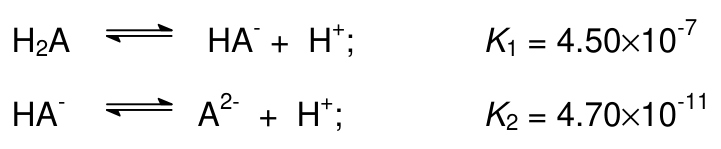
A 20.00 \(\mathrm{cm^3}\) aliquot of a solution containing a mixture of \(\ce{Na2A}\) and \(\ce{NaHA}\) is titrated with 0.300 M hydrochloric acid. The progress of the titration is followed with a glass electrode pH meter. Two points on the titration curve are as follows :
| \(\mathrm{cm^3}\) \(\ce{HCl}\) added | \(pH\) |
|---|---|
| 1.00 | 10.33 |
| 10.00 | 8.34 |
2.1 On adding 1.00 \(\mathrm{cm^3}\) of \(\ce{HCl}\), which species reacts first and what would be the product?
2.2 What is the amount (mmol) of the product formed in (2.1)?
2.3 Write down the main equilibrium of the product from (2.1) reacting with the solvent?
2.4 What are the amounts (mmol) of \(\ce{Na2A}\) and \(\ce{NaHA}\) initially present?
2.5 Calculate the total volume of \(\ce{HCl}\) required to reach the second equivalence point.
PART B
Solutions I, II and III contain a \(pH\) indicator \(\ce{HIn}\) (\(K_{\mathrm{In}}=4.19\times10^{-4}\)) and other reagents as indicated in the table. The absorbance values at 400 nm of the solutions measured in the same cell, are also given in the table. \(K_a\) of \(\ce{CH3COOH}\) is \(1.75\times10^{-5}\).
Table:
| Solution I | Solution II | Solution III | |
|---|---|---|---|
| Total concentration of indicator \(\ce{HIn}\) | \(1.00\times10^{-5}\ \mathrm{M}\) | \(1.00\times10^{-5}\ \mathrm{M}\) | \(1.00\times10^{-5}\ \mathrm{M}\) |
| Other reagents | \(1.00\ \mathrm{M}\) \(\ce{HCl}\) | \(0.100\ \mathrm{M}\) \(\ce{NaOH}\) | \(1.00\ \mathrm{M}\) \(\ce{CH3COOH}\) |
| Absorbance at 400 | 0.000 | 0.300 | ? |
2.6 Calculate the absorbance at 400 nm of solution III.
2.7 Apart from \(\ce{H2O}\), \(\ce{H+}\) and \(\ce{OH-}\), what are all the chemical species present in the solution resulting from mixing solution II and solution III at 1 : 1 volume ratio?
2.8 What is the absorbance at 400 nm of the solution in (2.7)?
2.9 What is the transmittance at 400 nm of the solution in (2.7)?
Official English text of the problem.
Answers
- 2.1: The dianion \(\ce{A^2-}\) reacts first, producing the hydrogen anion \(\ce{HA-}\): \[ \ce{A^2- + H+ -> HA-}. \]
- 2.2: \(0.300\ \mathrm{mmol}\) of \(\ce{HA-}\) is formed stoichiometrically.
- 2.3: \[ \ce{HA- + H2O <=> H2A + OH-}. \]
- 2.4: Initially, \(3.00\ \mathrm{mmol}\) of the disodium salt \(\ce{Na2A}\) and \(2.40\ \mathrm{mmol}\) of the sodium hydrogen salt \(\ce{NaHA}\).
- 2.5: \(28.0\ \mathrm{cm^3}\) of hydrochloric acid in total.
- 2.6: Absorbance \(\mathcal A_{400}\approx0.027\).
- 2.7: Sodium ion \(\ce{Na+}\),
[Na+]; acetic acid \(\ce{CH3COOH}\),CC(=O)O; acetate ion \(\ce{CH3COO-}\),CC(=O)[O-]; acidic indicator \(\ce{HIn}\); and indicator anion \(\ce{In-}\). - 2.8: Absorbance \(\mathcal A_{400}=0.218\).
- 2.9: Transmittance \(T=0.605\), or \(60.5\%\).
The structures represented by \(\ce{A}\) and \(\ce{In}\) are unspecified. Consequently, unique molecular SMILES cannot be assigned to their acid–base forms or the corresponding salts.
Solution
The other structurally specified participants used below are water, O; hydrogen ion, [H+]; hydroxide ion, [OH-]; and chloride ion, [Cl-]. Aqueous hydrochloric acid and sodium hydroxide are represented ionically as [H+].[Cl-] and [Na+].[OH-], respectively.
2.1
The given dissociation constants are
\[ K_1=4.50\times10^{-7}, \qquad K_2=4.70\times10^{-11}. \]
The protonation constants of \(\ce{A^2-}\) and \(\ce{HA-}\) are, respectively,
\[ \frac{1}{K_2}=2.13\times10^{10}, \qquad \frac{1}{K_1}=2.22\times10^6. \]
Thus, \(\ce{A^2-}\) is the stronger base and is protonated preferentially:
\[ \boxed{\ce{A^2- + H+ -> HA-}}. \]
The product is the hydrogen anion \(\ce{HA-}\), the singly deprotonated form of the diprotic acid.
2.2
The amount of hydrogen ion added is
\[ n(\ce{H+}) = 0.300\ \mathrm{mol\,L^{-1}} \times1.00\times10^{-3}\ \mathrm L = 3.00\times10^{-4}\ \mathrm{mol}. \]
The reaction has a 1:1 stoichiometry, so the amount of \(\ce{HA-}\) formed is
\[ \boxed{n(\ce{HA-})_{\mathrm{formed}}=0.300\ \mathrm{mmol}}. \]
2.3
The ion \(\ce{HA-}\) is amphiprotic. Its principal reaction with water is basic hydrolysis:
\[ \boxed{\ce{HA- + H2O <=> H2A + OH-}}. \]
Using the conventional aqueous value \(K_w=1.00\times10^{-14}\),
\[ K_b(\ce{HA-}) = \frac{K_w}{K_1} = \frac{1.00\times10^{-14}}{4.50\times10^{-7}} = 2.22\times10^{-8}. \]
This exceeds its acid-dissociation constant, \(K_2=4.70\times10^{-11}\), by a factor of about 473, explaining why the basic reaction predominates.
2.4
Let the initial amounts in the aliquot be
\[ x=n_0(\ce{Na2A}),\qquad y=n_0(\ce{NaHA}), \]
both expressed in mmol.
At the first equivalence point, the initial dianion has been protonated to \(\ce{HA-}\). For a solution dominated by this amphiprotic ion,
\[ [\ce{H+}]\simeq\sqrt{K_1K_2}, \]
and therefore
\[ pH\simeq\frac{pK_1+pK_2}{2} = \frac{6.3468+10.3279}{2} = 8.3373. \]
This agrees with the measured \(pH=8.34\) after \(10.00\ \mathrm{cm^3}\) of acid. Thus, within the usual titration approximations, this is the first equivalence point:
\[ x = 0.300\ \mathrm{mmol\,cm^{-3}} \times10.00\ \mathrm{cm^3} = 3.00\ \mathrm{mmol}. \]
After adding \(1.00\ \mathrm{cm^3}\), the stoichiometric amounts are
\[ n(\ce{A^2-})=x-0.300, \qquad n(\ce{HA-})=y+0.300. \]
For this buffer,
\[ pH=pK_2+\log_{10}\frac{[\ce{A^2-}]}{[\ce{HA-}]}. \]
Since \(pH=10.33\simeq pK_2\), the two concentrations, and hence their amounts in the same solution, are approximately equal:
\[ x-0.300=y+0.300. \]
Consequently,
\[ y=3.00-0.600=2.40\ \mathrm{mmol}. \]
Thus,
\[ \boxed{n_0(\ce{Na2A})=3.00\ \mathrm{mmol}}, \qquad \boxed{n_0(\ce{NaHA})=2.40\ \mathrm{mmol}}. \]
2.5
At the second equivalence point, protonation to \(\ce{H2A}\) is stoichiometrically complete:
\[ \ce{HA- + H+ -> H2A}. \]
Each initial \(\ce{A^2-}\) requires two hydrogen ions overall, whereas each initial \(\ce{HA-}\) requires one. Hence,
\[ n(\ce{HCl})_{\mathrm{total}} = 2x+y = 2(3.00)+2.40 = 8.40\ \mathrm{mmol}. \]
Therefore,
\[ \boxed{ V_{\mathrm{HCl}} = \frac{8.40\ \mathrm{mmol}} {0.300\ \mathrm{mmol\,cm^{-3}}} = 28.0\ \mathrm{cm^3} }. \]
2.6
The indicator equilibrium is
\[ \ce{HIn <=> H+ + In-}, \qquad K_{\mathrm{In}} = \frac{[\ce{H+}][\ce{In-}]}{[\ce{HIn}]}. \]
Solution I is strongly acidic, so the indicator is almost entirely \(\ce{HIn}\). Its absorbance of 0.000 shows that the acidic form has negligible absorption at 400 nm.
Solution II is strongly basic, so the indicator is essentially entirely \(\ce{In-}\). The Beer–Lambert law therefore gives
\[ \varepsilon_-\ell = \frac{0.300}{1.00\times10^{-5}\ \mathrm{mol\,L^{-1}}} = 3.00\times10^4\ \mathrm{L\,mol^{-1}}, \]
where \(\ell\) is the cell path length.
Writing \(C_{\mathrm{In}}=[\ce{HIn}]+[\ce{In-}]\), the indicator equilibrium gives
\[ [\ce{In-}] = C_{\mathrm{In}} \frac{K_{\mathrm{In}}}{K_{\mathrm{In}}+[\ce{H+}]}. \]
Thus, when \(C_{\mathrm{In}}=1.00\times10^{-5}\ \mathrm M\),
\[ \mathcal A_{400} = 0.300\frac{K_{\mathrm{In}}}{K_{\mathrm{In}}+[\ce{H+}]}. \]
In solution III, acetic acid dissociates according to
\[ \ce{CH3COOH <=> H+ + CH3COO-}. \]
Its concentration is much greater than the indicator concentration, so the indicator’s effect on the pH is negligible. Using the weak-acid approximation,
\[ [\ce{H+}] \simeq \sqrt{K_aC} = \sqrt{(1.75\times10^{-5})(1.00)} = 4.18\times10^{-3}\ \mathrm M. \]
Therefore,
\[ \mathcal A_{\mathrm{III}} = 0.300 \frac{4.19\times10^{-4}} {4.19\times10^{-4}+4.18\times10^{-3}} \simeq0.0273. \]
At the absorbance precision used in the table,
\[ \boxed{\mathcal A_{\mathrm{III}}\approx0.027}. \]
2.7
Hydroxide from solution II neutralizes part of the acetic acid from solution III:
\[ \ce{CH3COOH + OH- -> CH3COO- + H2O}. \]
For equal starting volumes \(V\), the amounts of acetic acid and hydroxide are proportional to \(1.00V\) and \(0.100V\), respectively. Acetic acid remains in excess, and the mixture contains an acetic acid/acetate buffer.
Both indicator forms are present through the equilibrium
\[ \ce{HIn <=> H+ + In-}. \]
Equivalently, their proton exchange with the buffer can be written as
\[ \ce{In- + CH3COOH <=> HIn + CH3COO-}. \]
Excluding the three species specified in the question, the complete list is:
| Species | Name | SMILES |
|---|---|---|
| \(\ce{Na+}\) | Sodium ion | [Na+] |
| \(\ce{CH3COOH}\) | Acetic acid | CC(=O)O |
| \(\ce{CH3COO-}\) | Acetate ion | CC(=O)[O-] |
| \(\ce{HIn}\) | Acidic indicator | Structure unspecified |
| \(\ce{In-}\) | Indicator conjugate-base anion | Structure unspecified |
2.8
After neutralization and dilution to twice the original volume, the buffer concentrations are approximately
\[ [\ce{CH3COOH}] = \frac{1.00-0.100}{2} = 0.450\ \mathrm M, \]
\[ [\ce{CH3COO-}] = \frac{0.100}{2} = 0.0500\ \mathrm M. \]
Their subsequent equilibrium changes are small compared with these concentrations. Hence,
\[ [\ce{H+}] = K_a\frac{[\ce{CH3COOH}]}{[\ce{CH3COO-}]} \simeq 1.75\times10^{-5}\frac{0.450}{0.0500} = 1.575\times10^{-4}\ \mathrm M. \]
Both starting solutions have the same total indicator concentration, so mixing them leaves that concentration unchanged:
\[ C_{\mathrm{In,mix}} = \frac{C_{\mathrm{In}}V+C_{\mathrm{In}}V}{2V} = 1.00\times10^{-5}\ \mathrm M. \]
The absorbing fraction of the indicator is therefore
\[ \frac{[\ce{In-}]}{C_{\mathrm{In,mix}}} = \frac{4.19\times10^{-4}} {4.19\times10^{-4}+1.575\times10^{-4}} = 0.7268. \]
Thus,
\[ \boxed{ \mathcal A_{\mathrm{mix}} = 0.300(0.7268) = 0.218 }. \]
2.9
Absorbance and transmittance are related by
\[ \mathcal A=-\log_{10}T, \qquad T=\frac{I}{I_0}. \]
Using the unrounded absorbance,
\[ T=10^{-0.2180399}=0.605285. \]
Therefore,
\[ \boxed{T=0.605}, \qquad \boxed{\%T=60.5\%}. \]
The solution was checked against the official solution.
IChO 1999 · Theorieaufgabe 2
Eine zweiprotonige Säure und ein Säure-Base-Indikator
TEIL A
Eine zweiprotonige Säure, \(\ce{H2A}\), unterliegt den folgenden Dissoziationsreaktionen:
Ein Aliquot von 20.00 \(\mathrm{cm^3}\) einer Lösung, die eine Mischung aus \(\ce{Na2A}\) und \(\ce{NaHA}\) enthält, wird mit 0.300 M Salzsäure titriert. Der Verlauf der Titration wird mit einem pH-Meter mit Glaselektrode verfolgt. Zwei Punkte auf der Titrationskurve sind wie folgt gegeben:
| Zugegebene \(\mathrm{cm^3}\) \(\ce{HCl}\) | \(pH\) |
|---|---|
| 1.00 | 10.33 |
| 10.00 | 8.34 |
2.1 Welche Spezies reagiert bei der Zugabe von 1.00 \(\mathrm{cm^3}\) \(\ce{HCl}\) zuerst, und welches Produkt entsteht dabei?
2.2 Welche Stoffmenge (mmol) des Produkts aus (2.1) wird gebildet?
2.3 Geben Sie das vorherrschende Gleichgewicht der Reaktion des Produkts aus (2.1) mit dem Lösungsmittel an.
2.4 Welche Stoffmengen (mmol) an \(\ce{Na2A}\) und \(\ce{NaHA}\) waren ursprünglich vorhanden?
2.5 Berechnen Sie das Gesamtvolumen an \(\ce{HCl}\), das zum Erreichen des zweiten Äquivalenzpunkts erforderlich ist.
TEIL B
Die Lösungen I, II und III enthalten einen \(pH\)-Indikator \(\ce{HIn}\) (\(K_{\mathrm{In}}=4.19\times10^{-4}\)) sowie die in der Tabelle angegebenen weiteren Reagenzien. Die in derselben Küvette gemessenen Extinktionswerte der Lösungen bei 400 nm sind ebenfalls in der Tabelle angegeben. \(K_a\) von \(\ce{CH3COOH}\) beträgt \(1.75\times10^{-5}\).
Tabelle:
| Lösung I | Lösung II | Lösung III | |
|---|---|---|---|
| Gesamtkonzentration des Indikators \(\ce{HIn}\) | \(1.00\times10^{-5}\ \mathrm{M}\) | \(1.00\times10^{-5}\ \mathrm{M}\) | \(1.00\times10^{-5}\ \mathrm{M}\) |
| Weitere Reagenzien | \(1.00\ \mathrm{M}\) \(\ce{HCl}\) | \(0.100\ \mathrm{M}\) \(\ce{NaOH}\) | \(1.00\ \mathrm{M}\) \(\ce{CH3COOH}\) |
| Extinktion bei 400 | 0.000 | 0.300 | ? |
2.6 Berechnen Sie die Extinktion der Lösung III bei 400 nm.
2.7 Welche chemischen Spezies sind außer \(\ce{H2O}\), \(\ce{H+}\) und \(\ce{OH-}\) sämtlich in der Lösung vorhanden, die durch Mischen von Lösung II und Lösung III im Volumenverhältnis 1 : 1 entsteht?
2.8 Wie groß ist die Extinktion der Lösung aus (2.7) bei 400 nm?
2.9 Wie groß ist der Transmissionsgrad der Lösung aus (2.7) bei 400 nm?
Aufgabentext aus dem offiziellen englischen Text übersetzt.
Antworten
- 2.1: Das Dianion \(\ce{A^2-}\) reagiert zuerst, wobei das Hydrogenanion \(\ce{HA-}\) entsteht: \[ \ce{A^2- + H+ -> HA-}. \]
- 2.2: Stöchiometrisch werden \(0.300\ \mathrm{mmol}\) \(\ce{HA-}\) gebildet.
- 2.3: \[ \ce{HA- + H2O <=> H2A + OH-}. \]
- 2.4: Anfangs liegen \(3.00\ \mathrm{mmol}\) des Dinatriumsalzes \(\ce{Na2A}\) und \(2.40\ \mathrm{mmol}\) des Natriumhydrogensalzes \(\ce{NaHA}\) vor.
- 2.5: Insgesamt \(28.0\ \mathrm{cm^3}\) Salzsäure.
- 2.6: Extinktion \(\mathcal A_{400}\approx0.027\).
- 2.7: Natriumion \(\ce{Na+}\),
[Na+]; Essigsäure \(\ce{CH3COOH}\),CC(=O)O; Acetation \(\ce{CH3COO-}\),CC(=O)[O-]; saure Indikatorform \(\ce{HIn}\); und Indikatoranion \(\ce{In-}\). - 2.8: Extinktion \(\mathcal A_{400}=0.218\).
- 2.9: Transmissionsgrad \(T=0.605\), also \(60.5\%\).
Die durch \(\ce{A}\) und \(\ce{In}\) dargestellten Strukturen sind nicht angegeben. Daher können ihren Säure-Base-Formen oder den entsprechenden Salzen keine eindeutigen molekularen SMILES zugeordnet werden.
Lösung
Die weiteren im Folgenden verwendeten Reaktionsteilnehmer mit festgelegter Struktur sind Wasser, O; Wasserstoffion, [H+]; Hydroxidion, [OH-]; und Chloridion, [Cl-]. Wässrige Salzsäure und Natriumhydroxid werden in ionischer Form als [H+].[Cl-] bzw. [Na+].[OH-] dargestellt.
2.1
Die gegebenen Dissoziationskonstanten sind
\[ K_1=4.50\times10^{-7}, \qquad K_2=4.70\times10^{-11}. \]
Die Protonierungskonstanten von \(\ce{A^2-}\) bzw. \(\ce{HA-}\) sind
\[ \frac{1}{K_2}=2.13\times10^{10}, \qquad \frac{1}{K_1}=2.22\times10^6. \]
Somit ist \(\ce{A^2-}\) die stärkere Base und wird bevorzugt protoniert:
\[ \boxed{\ce{A^2- + H+ -> HA-}}. \]
Das Produkt ist das Hydrogenanion \(\ce{HA-}\), die einfach deprotonierte Form der zweiprotonigen Säure.
2.2
Die zugegebene Stoffmenge an Wasserstoffionen beträgt
\[ n(\ce{H+}) = 0.300\ \mathrm{mol\,L^{-1}} \times1.00\times10^{-3}\ \mathrm L = 3.00\times10^{-4}\ \mathrm{mol}. \]
Die Reaktion hat eine 1:1-Stöchiometrie, sodass die gebildete Stoffmenge an \(\ce{HA-}\) beträgt:
\[ \boxed{n(\ce{HA-})_{\mathrm{formed}}=0.300\ \mathrm{mmol}}. \]
2.3
Das Ion \(\ce{HA-}\) ist ein Ampholyt. Seine vorherrschende Reaktion mit Wasser ist die basische Hydrolyse:
\[ \boxed{\ce{HA- + H2O <=> H2A + OH-}}. \]
Mit dem üblichen Wert für wässrige Lösungen \(K_w=1.00\times10^{-14}\) ergibt sich
\[ K_b(\ce{HA-}) = \frac{K_w}{K_1} = \frac{1.00\times10^{-14}}{4.50\times10^{-7}} = 2.22\times10^{-8}. \]
Dieser Wert übersteigt seine Säuredissoziationskonstante, \(K_2=4.70\times10^{-11}\), um einen Faktor von etwa 473, was erklärt, warum die basische Reaktion überwiegt.
2.4
Die anfänglichen Stoffmengen im Aliquot seien
\[ x=n_0(\ce{Na2A}),\qquad y=n_0(\ce{NaHA}), \]
beide in mmol angegeben.
Am ersten Äquivalenzpunkt ist das ursprünglich vorhandene Dianion zu \(\ce{HA-}\) protoniert worden. Für eine Lösung, in der dieses amphotere Ion vorherrscht, gilt
\[ [\ce{H+}]\simeq\sqrt{K_1K_2}, \]
und daher
\[ pH\simeq\frac{pK_1+pK_2}{2} = \frac{6.3468+10.3279}{2} = 8.3373. \]
Dies stimmt mit dem gemessenen \(pH=8.34\) nach Zugabe von \(10.00\ \mathrm{cm^3}\) Säure überein. Im Rahmen der üblichen Näherungen für Titrationen ist dies somit der erste Äquivalenzpunkt:
\[ x = 0.300\ \mathrm{mmol\,cm^{-3}} \times10.00\ \mathrm{cm^3} = 3.00\ \mathrm{mmol}. \]
Nach Zugabe von \(1.00\ \mathrm{cm^3}\) betragen die stöchiometrischen Stoffmengen
\[ n(\ce{A^2-})=x-0.300, \qquad n(\ce{HA-})=y+0.300. \]
Für diesen Puffer gilt
\[ pH=pK_2+\log_{10}\frac{[\ce{A^2-}]}{[\ce{HA-}]}. \]
Da \(pH=10.33\simeq pK_2\), sind die beiden Konzentrationen und damit auch ihre Stoffmengen in derselben Lösung näherungsweise gleich:
\[ x-0.300=y+0.300. \]
Folglich gilt
\[ y=3.00-0.600=2.40\ \mathrm{mmol}. \]
Somit ergibt sich
\[ \boxed{n_0(\ce{Na2A})=3.00\ \mathrm{mmol}}, \qquad \boxed{n_0(\ce{NaHA})=2.40\ \mathrm{mmol}}. \]
2.5
Am zweiten Äquivalenzpunkt ist die Protonierung zu \(\ce{H2A}\) stöchiometrisch vollständig:
\[ \ce{HA- + H+ -> H2A}. \]
Jedes ursprünglich vorhandene \(\ce{A^2-}\) benötigt insgesamt zwei Wasserstoffionen, während jedes ursprünglich vorhandene \(\ce{HA-}\) eines benötigt. Daher gilt
\[ n(\ce{HCl})_{\mathrm{total}} = 2x+y = 2(3.00)+2.40 = 8.40\ \mathrm{mmol}. \]
Damit ergibt sich
\[ \boxed{ V_{\mathrm{HCl}} = \frac{8.40\ \mathrm{mmol}} {0.300\ \mathrm{mmol\,cm^{-3}}} = 28.0\ \mathrm{cm^3} }. \]
2.6
Das Indikatorgleichgewicht lautet
\[ \ce{HIn <=> H+ + In-}, \qquad K_{\mathrm{In}} = \frac{[\ce{H+}][\ce{In-}]}{[\ce{HIn}]}. \]
Lösung I ist stark sauer, sodass der Indikator nahezu vollständig als \(\ce{HIn}\) vorliegt. Ihre Extinktion von 0.000 zeigt, dass die saure Form bei 400 nm eine vernachlässigbare Absorption aufweist.
Lösung II ist stark basisch, sodass der Indikator praktisch vollständig als \(\ce{In-}\) vorliegt. Das Lambert-Beer'sche Gesetz liefert daher
\[ \varepsilon_-\ell = \frac{0.300}{1.00\times10^{-5}\ \mathrm{mol\,L^{-1}}} = 3.00\times10^4\ \mathrm{L\,mol^{-1}}, \]
wobei \(\ell\) die optische Weglänge der Küvette ist.
Mit \(C_{\mathrm{In}}=[\ce{HIn}]+[\ce{In-}]\) ergibt sich aus dem Indikatorgleichgewicht
\[ [\ce{In-}] = C_{\mathrm{In}} \frac{K_{\mathrm{In}}}{K_{\mathrm{In}}+[\ce{H+}]}. \]
Für \(C_{\mathrm{In}}=1.00\times10^{-5}\ \mathrm M\) gilt somit
\[ \mathcal A_{400} = 0.300\frac{K_{\mathrm{In}}}{K_{\mathrm{In}}+[\ce{H+}]}. \]
In Lösung III dissoziiert Essigsäure gemäß
\[ \ce{CH3COOH <=> H+ + CH3COO-}. \]
Ihre Konzentration ist wesentlich größer als die Indikatorkonzentration, sodass der Einfluss des Indikators auf den pH-Wert vernachlässigbar ist. Mit der Näherung für schwache Säuren ergibt sich
\[ [\ce{H+}] \simeq \sqrt{K_aC} = \sqrt{(1.75\times10^{-5})(1.00)} = 4.18\times10^{-3}\ \mathrm M. \]
Daher gilt
\[ \mathcal A_{\mathrm{III}} = 0.300 \frac{4.19\times10^{-4}} {4.19\times10^{-4}+4.18\times10^{-3}} \simeq0.0273. \]
Mit der in der Tabelle verwendeten Genauigkeit der Extinktionsangaben ergibt sich
\[ \boxed{\mathcal A_{\mathrm{III}}\approx0.027}. \]
2.7
Hydroxid aus Lösung II neutralisiert einen Teil der Essigsäure aus Lösung III:
\[ \ce{CH3COOH + OH- -> CH3COO- + H2O}. \]
Bei gleichen Ausgangsvolumina \(V\) sind die Stoffmengen an Essigsäure bzw. Hydroxid proportional zu \(1.00V\) bzw. \(0.100V\). Essigsäure bleibt im Überschuss vorhanden, und die Mischung enthält einen Essigsäure/Acetat-Puffer.
Beide Indikatorformen liegen aufgrund des folgenden Gleichgewichts vor:
\[ \ce{HIn <=> H+ + In-}. \]
Gleichwertig lässt sich ihr Protonenaustausch mit dem Puffer wie folgt schreiben:
\[ \ce{In- + CH3COOH <=> HIn + CH3COO-}. \]
Unter Ausschluss der drei in der Frage genannten Spezies lautet die vollständige Liste:
| Spezies | Name | SMILES |
|---|---|---|
| \(\ce{Na+}\) | Natriumion | [Na+] |
| \(\ce{CH3COOH}\) | Essigsäure | CC(=O)O |
| \(\ce{CH3COO-}\) | Acetation | CC(=O)[O-] |
| \(\ce{HIn}\) | Saure Indikatorform | Struktur nicht angegeben |
| \(\ce{In-}\) | Anion der konjugierten Base des Indikators | Struktur nicht angegeben |
2.8
Nach der Neutralisation und Verdünnung auf das Doppelte des ursprünglichen Volumens betragen die Pufferkonzentrationen näherungsweise
\[ [\ce{CH3COOH}] = \frac{1.00-0.100}{2} = 0.450\ \mathrm M, \]
\[ [\ce{CH3COO-}] = \frac{0.100}{2} = 0.0500\ \mathrm M. \]
Die anschließenden Änderungen bei der Gleichgewichtseinstellung sind im Vergleich zu diesen Konzentrationen gering. Daher gilt
\[ [\ce{H+}] = K_a\frac{[\ce{CH3COOH}]}{[\ce{CH3COO-}]} \simeq 1.75\times10^{-5}\frac{0.450}{0.0500} = 1.575\times10^{-4}\ \mathrm M. \]
Beide Ausgangslösungen haben dieselbe Gesamtindikatorkonzentration, sodass diese Konzentration beim Mischen unverändert bleibt:
\[ C_{\mathrm{In,mix}} = \frac{C_{\mathrm{In}}V+C_{\mathrm{In}}V}{2V} = 1.00\times10^{-5}\ \mathrm M. \]
Der absorbierende Anteil des Indikators beträgt daher
\[ \frac{[\ce{In-}]}{C_{\mathrm{In,mix}}} = \frac{4.19\times10^{-4}} {4.19\times10^{-4}+1.575\times10^{-4}} = 0.7268. \]
Somit ergibt sich
\[ \boxed{ \mathcal A_{\mathrm{mix}} = 0.300(0.7268) = 0.218 }. \]
2.9
Extinktion und Transmissionsgrad hängen wie folgt zusammen:
\[ \mathcal A=-\log_{10}T, \qquad T=\frac{I}{I_0}. \]
Mit der ungerundeten Extinktion ergibt sich
\[ T=10^{-0.2180399}=0.605285. \]
Daher gilt
\[ \boxed{T=0.605}, \qquad \boxed{\%T=60.5\%}. \]
Die Lösung wurde mit der offiziellen Lösung abgeglichen.
IChO 1999 · Teori sorusu 2
Diprotik bir asit ve bir asit-baz indikatörü
BÖLÜM A
Diprotik bir asit olan \(\ce{H2A}\), aşağıdaki ayrışma tepkimelerini verir:
\(\ce{Na2A}\) ve \(\ce{NaHA}\) karışımı içeren bir çözeltiden alınan 20.00 \(\mathrm{cm^3}\) hacmindeki bir örnek, 0.300 M hidroklorik asit ile titre edilir. Titrasyonun ilerleyişi, cam elektrotlu bir pH metre ile izlenir. Titrasyon eğrisi üzerindeki iki nokta aşağıdaki gibidir:
| Eklenen \(\ce{HCl}\) hacmi, \(\mathrm{cm^3}\) | \(pH\) |
|---|---|
| 1.00 | 10.33 |
| 10.00 | 8.34 |
2.1 1.00 \(\mathrm{cm^3}\) \(\ce{HCl}\) eklendiğinde ilk olarak hangi tür tepkimeye girer ve oluşan ürün ne olur?
2.2 (2.1)'de oluşan ürünün miktarı (mmol) nedir?
2.3 (2.1)'deki ürünün çözücüyle tepkimesine ait başlıca dengeyi yazınız.
2.4 Başlangıçta bulunan \(\ce{Na2A}\) ve \(\ce{NaHA}\) miktarları (mmol) nedir?
2.5 İkinci eşdeğerlik noktasına ulaşmak için gereken toplam \(\ce{HCl}\) hacmini hesaplayınız.
BÖLÜM B
I, II ve III çözeltileri, bir \(pH\) indikatörü olan \(\ce{HIn}\) (\(K_{\mathrm{In}}=4.19\times10^{-4}\)) ve tabloda belirtilen diğer reaktifleri içerir. Çözeltilerin aynı küvette ölçülen 400 nm'deki absorbans değerleri de tabloda verilmiştir. \(\ce{CH3COOH}\) için \(K_a\) değeri \(1.75\times10^{-5}\)'tir.
Tablo:
| Çözelti I | Çözelti II | Çözelti III | |
|---|---|---|---|
| \(\ce{HIn}\) indikatörünün toplam derişimi | \(1.00\times10^{-5}\ \mathrm{M}\) | \(1.00\times10^{-5}\ \mathrm{M}\) | \(1.00\times10^{-5}\ \mathrm{M}\) |
| Diğer reaktifler | \(1.00\ \mathrm{M}\) \(\ce{HCl}\) | \(0.100\ \mathrm{M}\) \(\ce{NaOH}\) | \(1.00\ \mathrm{M}\) \(\ce{CH3COOH}\) |
| 400'deki absorbans | 0.000 | 0.300 | ? |
2.6 III çözeltisinin 400 nm'deki absorbansını hesaplayınız.
2.7 II ve III çözeltilerinin 1 : 1 hacim oranında karıştırılmasıyla elde edilen çözeltide, \(\ce{H2O}\), \(\ce{H+}\) ve \(\ce{OH-}\) dışında bulunan tüm kimyasal türler nelerdir?
2.8 (2.7)'deki çözeltinin 400 nm'deki absorbansı nedir?
2.9 (2.7)'deki çözeltinin 400 nm'deki geçirgenliği nedir?
Soru metni resmi İngilizce metinden çevrilmiştir.
Cevaplar
- 2.1: Önce \(\ce{A^2-}\) dianyonu tepkimeye girerek hidrojen anyonu \(\ce{HA-}\)'yi oluşturur: \[ \ce{A^2- + H+ -> HA-}. \]
- 2.2: Stokiyometrik olarak \(0.300\ \mathrm{mmol}\) \(\ce{HA-}\) oluşur.
- 2.3: \[ \ce{HA- + H2O <=> H2A + OH-}. \]
- 2.4: Başlangıçta \(3.00\ \mathrm{mmol}\) disodyum tuzu \(\ce{Na2A}\) ve \(2.40\ \mathrm{mmol}\) sodyum hidrojen tuzu \(\ce{NaHA}\) bulunur.
- 2.5: Toplam \(28.0\ \mathrm{cm^3}\) hidroklorik asit.
- 2.6: Absorbans \(\mathcal A_{400}\approx0.027\).
- 2.7: Sodyum iyonu \(\ce{Na+}\),
[Na+]; asetik asit \(\ce{CH3COOH}\),CC(=O)O; asetat iyonu \(\ce{CH3COO-}\),CC(=O)[O-]; indikatörün asidik biçimi \(\ce{HIn}\); ve indikatör anyonu \(\ce{In-}\). - 2.8: Absorbans \(\mathcal A_{400}=0.218\).
- 2.9: Geçirgenlik \(T=0.605\) veya \(60.5\%\).
\(\ce{A}\) ve \(\ce{In}\) ile temsil edilen yapılar belirtilmemiştir. Bu nedenle bunların asit–baz biçimlerine veya karşılık gelen tuzlarına benzersiz moleküler SMILES gösterimleri atanamaz.
Çözüm
Aşağıda kullanılan ve yapıları belirtilmiş olan diğer türler su, O; hidrojen iyonu, [H+]; hidroksit iyonu, [OH-]; ve klorür iyonu, [Cl-]'dir. Sulu hidroklorik asit ve sodyum hidroksit, iyonik olarak sırasıyla [H+].[Cl-] ve [Na+].[OH-] biçiminde gösterilir.
2.1
Verilen ayrışma sabitleri şöyledir:
\[ K_1=4.50\times10^{-7}, \qquad K_2=4.70\times10^{-11}. \]
\(\ce{A^2-}\) ve \(\ce{HA-}\) türlerinin protonlanma sabitleri sırasıyla şöyledir:
\[ \frac{1}{K_2}=2.13\times10^{10}, \qquad \frac{1}{K_1}=2.22\times10^6. \]
Dolayısıyla \(\ce{A^2-}\) daha kuvvetli bazdır ve öncelikli olarak protonlanır:
\[ \boxed{\ce{A^2- + H+ -> HA-}}. \]
Ürün, diprotik asidin bir protonunu kaybetmiş biçimi olan hidrojen anyonu \(\ce{HA-}\)'dir.
2.2
Eklenen hidrojen iyonu miktarı şöyledir:
\[ n(\ce{H+}) = 0.300\ \mathrm{mol\,L^{-1}} \times1.00\times10^{-3}\ \mathrm L = 3.00\times10^{-4}\ \mathrm{mol}. \]
Tepkimenin stokiyometrisi 1:1 olduğundan oluşan \(\ce{HA-}\) miktarı şöyledir:
\[ \boxed{n(\ce{HA-})_{\mathrm{formed}}=0.300\ \mathrm{mmol}}. \]
2.3
\(\ce{HA-}\) iyonu amfiprotiktir. Suyla verdiği başlıca tepkime bazik hidrolizdir:
\[ \boxed{\ce{HA- + H2O <=> H2A + OH-}}. \]
Sulu çözeltiler için yaygın olarak kullanılan \(K_w=1.00\times10^{-14}\) değeriyle,
\[ K_b(\ce{HA-}) = \frac{K_w}{K_1} = \frac{1.00\times10^{-14}}{4.50\times10^{-7}} = 2.22\times10^{-8}. \]
Bu değer, iyonun asit ayrışma sabiti olan \(K_2=4.70\times10^{-11}\)'in yaklaşık 473 katıdır; bu da bazik tepkimenin neden baskın olduğunu açıklar.
2.4
Alınan örnekteki başlangıç miktarları
\[ x=n_0(\ce{Na2A}),\qquad y=n_0(\ce{NaHA}), \]
olsun; her ikisi de mmol cinsinden ifade edilsin.
Birinci eşdeğerlik noktasında, başlangıçtaki dianyon protonlanarak \(\ce{HA-}\)'ye dönüşmüştür. Bu amfiprotik iyonun baskın olduğu bir çözelti için,
\[ [\ce{H+}]\simeq\sqrt{K_1K_2}, \]
ve dolayısıyla
\[ pH\simeq\frac{pK_1+pK_2}{2} = \frac{6.3468+10.3279}{2} = 8.3373. \]
Bu sonuç, \(10.00\ \mathrm{cm^3}\) asit eklendikten sonra ölçülen \(pH=8.34\) değeriyle uyumludur. Dolayısıyla, olağan titrasyon yaklaşımları çerçevesinde bu nokta birinci eşdeğerlik noktasıdır:
\[ x = 0.300\ \mathrm{mmol\,cm^{-3}} \times10.00\ \mathrm{cm^3} = 3.00\ \mathrm{mmol}. \]
\(1.00\ \mathrm{cm^3}\) eklendikten sonra stokiyometrik miktarlar şöyledir:
\[ n(\ce{A^2-})=x-0.300, \qquad n(\ce{HA-})=y+0.300. \]
Bu tampon çözelti için,
\[ pH=pK_2+\log_{10}\frac{[\ce{A^2-}]}{[\ce{HA-}]}. \]
\(pH=10.33\simeq pK_2\) olduğundan iki derişim ve dolayısıyla aynı çözeltideki miktarları yaklaşık olarak eşittir:
\[ x-0.300=y+0.300. \]
Bunun sonucunda,
\[ y=3.00-0.600=2.40\ \mathrm{mmol}. \]
Dolayısıyla,
\[ \boxed{n_0(\ce{Na2A})=3.00\ \mathrm{mmol}}, \qquad \boxed{n_0(\ce{NaHA})=2.40\ \mathrm{mmol}}. \]
2.5
İkinci eşdeğerlik noktasında, \(\ce{H2A}\)'ya kadar protonlanma stokiyometrik olarak tamamlanmıştır:
\[ \ce{HA- + H+ -> H2A}. \]
Başlangıçtaki her bir \(\ce{A^2-}\) için toplam iki hidrojen iyonu gerekirken, başlangıçtaki her bir \(\ce{HA-}\) için bir hidrojen iyonu gerekir. Buna göre,
\[ n(\ce{HCl})_{\mathrm{total}} = 2x+y = 2(3.00)+2.40 = 8.40\ \mathrm{mmol}. \]
Böylece,
\[ \boxed{ V_{\mathrm{HCl}} = \frac{8.40\ \mathrm{mmol}} {0.300\ \mathrm{mmol\,cm^{-3}}} = 28.0\ \mathrm{cm^3} }. \]
2.6
İndikatör dengesi şöyledir:
\[ \ce{HIn <=> H+ + In-}, \qquad K_{\mathrm{In}} = \frac{[\ce{H+}][\ce{In-}]}{[\ce{HIn}]}. \]
I çözeltisi kuvvetli asidik olduğundan indikatör neredeyse tamamen \(\ce{HIn}\) biçimindedir. Absorbansının 0.000 olması, asidik biçimin 400 nm'deki soğurmasının ihmal edilebilir düzeyde olduğunu gösterir.
II çözeltisi kuvvetli bazik olduğundan indikatör hemen hemen tamamen \(\ce{In-}\) biçimindedir. Dolayısıyla Beer–Lambert yasası şu sonucu verir:
\[ \varepsilon_-\ell = \frac{0.300}{1.00\times10^{-5}\ \mathrm{mol\,L^{-1}}} = 3.00\times10^4\ \mathrm{L\,mol^{-1}}, \]
burada \(\ell\), küvetin optik yol uzunluğudur.
\(C_{\mathrm{In}}=[\ce{HIn}]+[\ce{In-}]\) yazıldığında, indikatör dengesi şu sonucu verir:
\[ [\ce{In-}] = C_{\mathrm{In}} \frac{K_{\mathrm{In}}}{K_{\mathrm{In}}+[\ce{H+}]}. \]
Dolayısıyla, \(C_{\mathrm{In}}=1.00\times10^{-5}\ \mathrm M\) olduğunda,
\[ \mathcal A_{400} = 0.300\frac{K_{\mathrm{In}}}{K_{\mathrm{In}}+[\ce{H+}]}. \]
III çözeltisinde asetik asit şu tepkimeye göre ayrışır:
\[ \ce{CH3COOH <=> H+ + CH3COO-}. \]
Asetik asidin derişimi, indikatörün derişiminden çok daha yüksek olduğundan indikatörün pH üzerindeki etkisi ihmal edilebilir. Zayıf asit yaklaşımı kullanıldığında,
\[ [\ce{H+}] \simeq \sqrt{K_aC} = \sqrt{(1.75\times10^{-5})(1.00)} = 4.18\times10^{-3}\ \mathrm M. \]
Böylece,
\[ \mathcal A_{\mathrm{III}} = 0.300 \frac{4.19\times10^{-4}} {4.19\times10^{-4}+4.18\times10^{-3}} \simeq0.0273. \]
Tabloda kullanılan absorbans hassasiyetinde,
\[ \boxed{\mathcal A_{\mathrm{III}}\approx0.027}. \]
2.7
II çözeltisindeki hidroksit, III çözeltisindeki asetik asidin bir kısmını nötrleştirir:
\[ \ce{CH3COOH + OH- -> CH3COO- + H2O}. \]
Başlangıç hacimleri eşit ve \(V\) olduğunda, asetik asit ve hidroksit miktarları sırasıyla \(1.00V\) ve \(0.100V\) ile orantılıdır. Asetik asit fazlası kalır ve karışım bir asetik asit/asetat tamponu içerir.
İndikatörün her iki biçimi de şu denge yoluyla bulunur:
\[ \ce{HIn <=> H+ + In-}. \]
Eşdeğer olarak, bu biçimlerin tamponla proton alışverişi şöyle yazılabilir:
\[ \ce{In- + CH3COOH <=> HIn + CH3COO-}. \]
Soruda belirtilen üç tür dışında, tam liste şöyledir:
| Tür | Adı | SMILES |
|---|---|---|
| \(\ce{Na+}\) | Sodyum iyonu | [Na+] |
| \(\ce{CH3COOH}\) | Asetik asit | CC(=O)O |
| \(\ce{CH3COO-}\) | Asetat iyonu | CC(=O)[O-] |
| \(\ce{HIn}\) | İndikatörün asidik biçimi | Yapısı belirtilmemiş |
| \(\ce{In-}\) | İndikatörün eşlenik baz anyonu | Yapısı belirtilmemiş |
2.8
Nötrleşmenin ve başlangıç hacminin iki katına seyreltilmenin ardından tampon derişimleri yaklaşık olarak şöyledir:
\[ [\ce{CH3COOH}] = \frac{1.00-0.100}{2} = 0.450\ \mathrm M, \]
\[ [\ce{CH3COO-}] = \frac{0.100}{2} = 0.0500\ \mathrm M. \]
Bundan sonra dengeye ulaşılırken meydana gelen değişimler bu derişimlere kıyasla küçüktür. Buna göre,
\[ [\ce{H+}] = K_a\frac{[\ce{CH3COOH}]}{[\ce{CH3COO-}]} \simeq 1.75\times10^{-5}\frac{0.450}{0.0500} = 1.575\times10^{-4}\ \mathrm M. \]
Her iki başlangıç çözeltisinin toplam indikatör derişimi aynı olduğundan karıştırıldıklarında bu derişim değişmez:
\[ C_{\mathrm{In,mix}} = \frac{C_{\mathrm{In}}V+C_{\mathrm{In}}V}{2V} = 1.00\times10^{-5}\ \mathrm M. \]
Dolayısıyla indikatörün ışığı soğuran biçimdeki kesri şöyledir:
\[ \frac{[\ce{In-}]}{C_{\mathrm{In,mix}}} = \frac{4.19\times10^{-4}} {4.19\times10^{-4}+1.575\times10^{-4}} = 0.7268. \]
Böylece,
\[ \boxed{ \mathcal A_{\mathrm{mix}} = 0.300(0.7268) = 0.218 }. \]
2.9
Absorbans ile geçirgenlik arasındaki ilişki şöyledir:
\[ \mathcal A=-\log_{10}T, \qquad T=\frac{I}{I_0}. \]
Yuvarlanmamış absorbans değeri kullanıldığında,
\[ T=10^{-0.2180399}=0.605285. \]
Böylece,
\[ \boxed{T=0.605}, \qquad \boxed{\%T=60.5\%}. \]
Çözüm, resmi çözümle karşılaştırılarak kontrol edildi.
IChO 1999 · Problema teórico 2
Un ácido diprótico y un indicador ácido-base
PARTE A
Un ácido diprótico, \(\ce{H2A}\), experimenta las siguientes reacciones de disociación:
Se valora una alícuota de 20.00 \(\mathrm{cm^3}\) de una disolución que contiene una mezcla de \(\ce{Na2A}\) y \(\ce{NaHA}\) con ácido clorhídrico 0.300 M. El transcurso de la valoración se sigue con un medidor de pH con electrodo de vidrio. Dos puntos de la curva de valoración son los siguientes:
| \(\mathrm{cm^3}\) de \(\ce{HCl}\) añadidos | \(pH\) |
|---|---|
| 1.00 | 10.33 |
| 10.00 | 8.34 |
2.1 Al añadir 1.00 \(\mathrm{cm^3}\) de \(\ce{HCl}\), ¿qué especie reacciona primero y cuál sería el producto?
2.2 ¿Cuál es la cantidad (mmol) del producto formado en (2.1)?
2.3 Escriba el equilibrio principal de la reacción del producto de (2.1) con el disolvente.
2.4 ¿Cuáles son las cantidades (mmol) de \(\ce{Na2A}\) y \(\ce{NaHA}\) presentes inicialmente?
2.5 Calcule el volumen total de \(\ce{HCl}\) necesario para alcanzar el segundo punto de equivalencia.
PARTE B
Las disoluciones I, II y III contienen un indicador de \(pH\), \(\ce{HIn}\) (\(K_{\mathrm{In}}=4.19\times10^{-4}\)), y otros reactivos, según se indica en la tabla. En la tabla también se dan los valores de absorbancia a 400 nm de las disoluciones, medidos en la misma cubeta. El \(K_a\) del \(\ce{CH3COOH}\) es \(1.75\times10^{-5}\).
Tabla:
| Disolución I | Disolución II | Disolución III | |
|---|---|---|---|
| Concentración total del indicador \(\ce{HIn}\) | \(1.00\times10^{-5}\ \mathrm{M}\) | \(1.00\times10^{-5}\ \mathrm{M}\) | \(1.00\times10^{-5}\ \mathrm{M}\) |
| Otros reactivos | \(1.00\ \mathrm{M}\) \(\ce{HCl}\) | \(0.100\ \mathrm{M}\) \(\ce{NaOH}\) | \(1.00\ \mathrm{M}\) \(\ce{CH3COOH}\) |
| Absorbancia a 400 | 0.000 | 0.300 | ? |
2.6 Calcule la absorbancia a 400 nm de la disolución III.
2.7 Aparte de \(\ce{H2O}\), \(\ce{H+}\) y \(\ce{OH-}\), ¿cuáles son todas las especies químicas presentes en la disolución resultante de mezclar la disolución II y la disolución III en una proporción de volúmenes de 1 : 1?
2.8 ¿Cuál es la absorbancia a 400 nm de la disolución de (2.7)?
2.9 ¿Cuál es la transmitancia a 400 nm de la disolución de (2.7)?
Enunciado traducido del texto oficial en inglés.
Respuestas
- 2.1: El dianión \(\ce{A^2-}\) reacciona primero y produce el anión hidrogenado \(\ce{HA-}\): \[ \ce{A^2- + H+ -> HA-}. \]
- 2.2: Se forman estequiométricamente \(0.300\ \mathrm{mmol}\) de \(\ce{HA-}\).
- 2.3: \[ \ce{HA- + H2O <=> H2A + OH-}. \]
- 2.4: Inicialmente, \(3.00\ \mathrm{mmol}\) de la sal disódica \(\ce{Na2A}\) y \(2.40\ \mathrm{mmol}\) de la sal ácida de sodio \(\ce{NaHA}\).
- 2.5: \(28.0\ \mathrm{cm^3}\) de ácido clorhídrico en total.
- 2.6: Absorbancia \(\mathcal A_{400}\approx0.027\).
- 2.7: Ion sodio \(\ce{Na+}\),
[Na+]; ácido acético \(\ce{CH3COOH}\),CC(=O)O; ion acetato \(\ce{CH3COO-}\),CC(=O)[O-]; forma ácida del indicador \(\ce{HIn}\); y anión del indicador \(\ce{In-}\). - 2.8: Absorbancia \(\mathcal A_{400}=0.218\).
- 2.9: Transmitancia \(T=0.605\), o \(60.5\%\).
Las estructuras representadas por \(\ce{A}\) y \(\ce{In}\) no se especifican. Por consiguiente, no se pueden asignar SMILES moleculares únicos a sus formas ácido-base ni a las sales correspondientes.
Solución
Las otras especies que se utilizan a continuación y cuyas estructuras están especificadas son el agua, O; el ion hidrógeno, [H+]; el ion hidróxido, [OH-]; y el ion cloruro, [Cl-]. El ácido clorhídrico y el hidróxido de sodio en disolución acuosa se representan en forma iónica como [H+].[Cl-] y [Na+].[OH-], respectivamente.
2.1
Las constantes de disociación dadas son
\[ K_1=4.50\times10^{-7}, \qquad K_2=4.70\times10^{-11}. \]
Las constantes de protonación de \(\ce{A^2-}\) y \(\ce{HA-}\) son, respectivamente,
\[ \frac{1}{K_2}=2.13\times10^{10}, \qquad \frac{1}{K_1}=2.22\times10^6. \]
Por tanto, \(\ce{A^2-}\) es la base más fuerte y se protona preferentemente:
\[ \boxed{\ce{A^2- + H+ -> HA-}}. \]
El producto es el anión hidrogenado \(\ce{HA-}\), la forma del ácido diprótico que ha perdido un solo protón.
2.2
La cantidad de ion hidrógeno añadida es
\[ n(\ce{H+}) = 0.300\ \mathrm{mol\,L^{-1}} \times1.00\times10^{-3}\ \mathrm L = 3.00\times10^{-4}\ \mathrm{mol}. \]
La reacción tiene una estequiometría 1:1, por lo que la cantidad de \(\ce{HA-}\) formada es
\[ \boxed{n(\ce{HA-})_{\mathrm{formed}}=0.300\ \mathrm{mmol}}. \]
2.3
El ion \(\ce{HA-}\) es anfiprótico. Su reacción principal con el agua es una hidrólisis básica:
\[ \boxed{\ce{HA- + H2O <=> H2A + OH-}}. \]
Utilizando el valor convencional en medio acuoso \(K_w=1.00\times10^{-14}\),
\[ K_b(\ce{HA-}) = \frac{K_w}{K_1} = \frac{1.00\times10^{-14}}{4.50\times10^{-7}} = 2.22\times10^{-8}. \]
Este valor supera su constante de disociación ácida, \(K_2=4.70\times10^{-11}\), en un factor de aproximadamente 473, lo que explica por qué predomina la reacción básica.
2.4
Sean las cantidades iniciales en la alícuota
\[ x=n_0(\ce{Na2A}),\qquad y=n_0(\ce{NaHA}), \]
ambas expresadas en mmol.
En el primer punto de equivalencia, el dianión inicial se ha protonado para dar \(\ce{HA-}\). Para una disolución en la que predomina este ion anfiprótico,
\[ [\ce{H+}]\simeq\sqrt{K_1K_2}, \]
y, por tanto,
\[ pH\simeq\frac{pK_1+pK_2}{2} = \frac{6.3468+10.3279}{2} = 8.3373. \]
Esto concuerda con el \(pH=8.34\) medido tras añadir \(10.00\ \mathrm{cm^3}\) de ácido. Así pues, dentro de las aproximaciones habituales de una valoración, este es el primer punto de equivalencia:
\[ x = 0.300\ \mathrm{mmol\,cm^{-3}} \times10.00\ \mathrm{cm^3} = 3.00\ \mathrm{mmol}. \]
Después de añadir \(1.00\ \mathrm{cm^3}\), las cantidades estequiométricas son
\[ n(\ce{A^2-})=x-0.300, \qquad n(\ce{HA-})=y+0.300. \]
Para esta disolución amortiguadora,
\[ pH=pK_2+\log_{10}\frac{[\ce{A^2-}]}{[\ce{HA-}]}. \]
Como \(pH=10.33\simeq pK_2\), las dos concentraciones y, por tanto, sus cantidades en la misma disolución son aproximadamente iguales:
\[ x-0.300=y+0.300. \]
En consecuencia,
\[ y=3.00-0.600=2.40\ \mathrm{mmol}. \]
Por tanto,
\[ \boxed{n_0(\ce{Na2A})=3.00\ \mathrm{mmol}}, \qquad \boxed{n_0(\ce{NaHA})=2.40\ \mathrm{mmol}}. \]
2.5
En el segundo punto de equivalencia, la protonación para dar \(\ce{H2A}\) es estequiométricamente completa:
\[ \ce{HA- + H+ -> H2A}. \]
Cada \(\ce{A^2-}\) inicial requiere dos iones hidrógeno en total, mientras que cada \(\ce{HA-}\) inicial requiere uno. Por ello,
\[ n(\ce{HCl})_{\mathrm{total}} = 2x+y = 2(3.00)+2.40 = 8.40\ \mathrm{mmol}. \]
Por tanto,
\[ \boxed{ V_{\mathrm{HCl}} = \frac{8.40\ \mathrm{mmol}} {0.300\ \mathrm{mmol\,cm^{-3}}} = 28.0\ \mathrm{cm^3} }. \]
2.6
El equilibrio del indicador es
\[ \ce{HIn <=> H+ + In-}, \qquad K_{\mathrm{In}} = \frac{[\ce{H+}][\ce{In-}]}{[\ce{HIn}]}. \]
La disolución I es fuertemente ácida, por lo que el indicador se encuentra casi por completo como \(\ce{HIn}\). Su absorbancia de 0.000 muestra que la forma ácida presenta una absorción despreciable a 400 nm.
La disolución II es fuertemente básica, por lo que el indicador se encuentra prácticamente por completo como \(\ce{In-}\). Por tanto, la ley de Beer–Lambert da
\[ \varepsilon_-\ell = \frac{0.300}{1.00\times10^{-5}\ \mathrm{mol\,L^{-1}}} = 3.00\times10^4\ \mathrm{L\,mol^{-1}}, \]
donde \(\ell\) es la longitud del trayecto óptico de la cubeta.
Escribiendo \(C_{\mathrm{In}}=[\ce{HIn}]+[\ce{In-}]\), el equilibrio del indicador da
\[ [\ce{In-}] = C_{\mathrm{In}} \frac{K_{\mathrm{In}}}{K_{\mathrm{In}}+[\ce{H+}]}. \]
Así, cuando \(C_{\mathrm{In}}=1.00\times10^{-5}\ \mathrm M\),
\[ \mathcal A_{400} = 0.300\frac{K_{\mathrm{In}}}{K_{\mathrm{In}}+[\ce{H+}]}. \]
En la disolución III, el ácido acético se disocia según
\[ \ce{CH3COOH <=> H+ + CH3COO-}. \]
Su concentración es mucho mayor que la del indicador, por lo que el efecto del indicador sobre el pH es despreciable. Utilizando la aproximación para ácidos débiles,
\[ [\ce{H+}] \simeq \sqrt{K_aC} = \sqrt{(1.75\times10^{-5})(1.00)} = 4.18\times10^{-3}\ \mathrm M. \]
Por tanto,
\[ \mathcal A_{\mathrm{III}} = 0.300 \frac{4.19\times10^{-4}} {4.19\times10^{-4}+4.18\times10^{-3}} \simeq0.0273. \]
Con la precisión de absorbancia utilizada en la tabla,
\[ \boxed{\mathcal A_{\mathrm{III}}\approx0.027}. \]
2.7
El hidróxido de la disolución II neutraliza parte del ácido acético de la disolución III:
\[ \ce{CH3COOH + OH- -> CH3COO- + H2O}. \]
Para volúmenes iniciales iguales \(V\), las cantidades de ácido acético e hidróxido son proporcionales a \(1.00V\) y \(0.100V\), respectivamente. El ácido acético queda en exceso y la mezcla contiene una disolución amortiguadora de ácido acético/acetato.
Ambas formas del indicador están presentes mediante el equilibrio
\[ \ce{HIn <=> H+ + In-}. \]
De manera equivalente, su intercambio de protones con la disolución amortiguadora puede escribirse como
\[ \ce{In- + CH3COOH <=> HIn + CH3COO-}. \]
Excluyendo las tres especies especificadas en la pregunta, la lista completa es:
| Especie | Nombre | SMILES |
|---|---|---|
| \(\ce{Na+}\) | Ion sodio | [Na+] |
| \(\ce{CH3COOH}\) | Ácido acético | CC(=O)O |
| \(\ce{CH3COO-}\) | Ion acetato | CC(=O)[O-] |
| \(\ce{HIn}\) | Forma ácida del indicador | Estructura no especificada |
| \(\ce{In-}\) | Anión de la base conjugada del indicador | Estructura no especificada |
2.8
Tras la neutralización y la dilución hasta el doble del volumen original, las concentraciones de la disolución amortiguadora son aproximadamente
\[ [\ce{CH3COOH}] = \frac{1.00-0.100}{2} = 0.450\ \mathrm M, \]
\[ [\ce{CH3COO-}] = \frac{0.100}{2} = 0.0500\ \mathrm M. \]
Sus cambios posteriores al establecerse el equilibrio son pequeños en comparación con estas concentraciones. Por ello,
\[ [\ce{H+}] = K_a\frac{[\ce{CH3COOH}]}{[\ce{CH3COO-}]} \simeq 1.75\times10^{-5}\frac{0.450}{0.0500} = 1.575\times10^{-4}\ \mathrm M. \]
Ambas disoluciones iniciales tienen la misma concentración total de indicador, por lo que al mezclarlas dicha concentración permanece invariable:
\[ C_{\mathrm{In,mix}} = \frac{C_{\mathrm{In}}V+C_{\mathrm{In}}V}{2V} = 1.00\times10^{-5}\ \mathrm M. \]
La fracción del indicador que absorbe es, por tanto,
\[ \frac{[\ce{In-}]}{C_{\mathrm{In,mix}}} = \frac{4.19\times10^{-4}} {4.19\times10^{-4}+1.575\times10^{-4}} = 0.7268. \]
Así,
\[ \boxed{ \mathcal A_{\mathrm{mix}} = 0.300(0.7268) = 0.218 }. \]
2.9
La absorbancia y la transmitancia se relacionan mediante
\[ \mathcal A=-\log_{10}T, \qquad T=\frac{I}{I_0}. \]
Utilizando la absorbancia sin redondear,
\[ T=10^{-0.2180399}=0.605285. \]
Por tanto,
\[ \boxed{T=0.605}, \qquad \boxed{\%T=60.5\%}. \]
La solución se comprobó con la solución oficial.
IChO 1999 · 理论题 2
二元酸与酸碱指示剂
部分 A
二元酸 \(\ce{H2A}\) 发生如下解离反应:
移取 20.00 \(\mathrm{cm^3}\) 含有 \(\ce{Na2A}\) 和 \(\ce{NaHA}\) 混合物的溶液,用 0.300 M 盐酸滴定。用配有玻璃电极的 pH 计监测滴定过程。滴定曲线上的两个点如下:
| 加入的 \(\ce{HCl}\) 体积(\(\mathrm{cm^3}\)) | \(pH\) |
|---|---|
| 1.00 | 10.33 |
| 10.00 | 8.34 |
2.1 加入 1.00 \(\mathrm{cm^3}\) 的 \(\ce{HCl}\) 时,哪一种物种首先发生反应,产物是什么?
2.2 (2.1) 中生成的产物的物质的量(mmol)是多少?
2.3 写出 (2.1) 中的产物与溶剂反应的主要平衡。
2.4 最初存在的 \(\ce{Na2A}\) 和 \(\ce{NaHA}\) 的物质的量(mmol)分别是多少?
2.5 计算达到第二化学计量点所需的 \(\ce{HCl}\) 总体积。
部分 B
溶液 I、II 和 III 含有 \(pH\) 指示剂 \(\ce{HIn}\)(\(K_{\mathrm{In}}=4.19\times10^{-4}\))及表中所列的其他试剂。在同一比色皿中测得的各溶液在 400 nm 处的吸光度也列于表中。\(\ce{CH3COOH}\) 的 \(K_a\) 为 \(1.75\times10^{-5}\)。
表:
| 溶液 I | 溶液 II | 溶液 III | |
|---|---|---|---|
| 指示剂 \(\ce{HIn}\) 的总浓度 | \(1.00\times10^{-5}\ \mathrm{M}\) | \(1.00\times10^{-5}\ \mathrm{M}\) | \(1.00\times10^{-5}\ \mathrm{M}\) |
| 其他试剂 | \(1.00\ \mathrm{M}\) \(\ce{HCl}\) | \(0.100\ \mathrm{M}\) \(\ce{NaOH}\) | \(1.00\ \mathrm{M}\) \(\ce{CH3COOH}\) |
| 400 处的吸光度 | 0.000 | 0.300 | ? |
2.6 计算溶液 III 在 400 nm 处的吸光度。
2.7 将溶液 II 与溶液 III 按 1 : 1 的体积比混合,所得溶液中除 \(\ce{H2O}\)、\(\ce{H+}\) 和 \(\ce{OH-}\) 外,还存在哪些化学物种?
2.8 (2.7) 中的溶液在 400 nm 处的吸光度是多少?
2.9 (2.7) 中的溶液在 400 nm 处的透射比是多少?
题目译自官方英文原文。
答案
- 2.1: 二价阴离子 \(\ce{A^2-}\) 首先反应,生成含氢酸根离子 \(\ce{HA-}\): \[ \ce{A^2- + H+ -> HA-}. \]
- 2.2: 按化学计量关系生成 \(0.300\ \mathrm{mmol}\) 的 \(\ce{HA-}\)。
- 2.3: \[ \ce{HA- + H2O <=> H2A + OH-}. \]
- 2.4: 最初含有 \(3.00\ \mathrm{mmol}\) 的二钠盐 \(\ce{Na2A}\) 和 \(2.40\ \mathrm{mmol}\) 的酸式钠盐 \(\ce{NaHA}\)。
- 2.5: 盐酸的总体积为 \(28.0\ \mathrm{cm^3}\)。
- 2.6: 吸光度 \(\mathcal A_{400}\approx0.027\)。
- 2.7: 钠离子 \(\ce{Na+}\),
[Na+];乙酸 \(\ce{CH3COOH}\),CC(=O)O;乙酸根离子 \(\ce{CH3COO-}\),CC(=O)[O-];酸式指示剂 \(\ce{HIn}\);以及指示剂阴离子 \(\ce{In-}\)。 - 2.8: 吸光度 \(\mathcal A_{400}=0.218\)。
- 2.9: 透射比 \(T=0.605\),即 \(60.5\%\)。
\(\ce{A}\) 和 \(\ce{In}\) 所代表的结构未给出。因此,无法为其酸碱形态或相应的盐指定唯一的分子 SMILES。
解答
下文涉及的其他结构明确的物种为水,O;氢离子,[H+];氢氧根离子,[OH-];以及氯离子,[Cl-]。水溶液中的盐酸和氢氧化钠分别用离子形式 [H+].[Cl-] 和 [Na+].[OH-] 表示。
2.1
给定的解离常数为
\[ K_1=4.50\times10^{-7}, \qquad K_2=4.70\times10^{-11}. \]
\(\ce{A^2-}\) 和 \(\ce{HA-}\) 的质子化常数分别为
\[ \frac{1}{K_2}=2.13\times10^{10}, \qquad \frac{1}{K_1}=2.22\times10^6. \]
因此,\(\ce{A^2-}\) 的碱性更强,优先发生质子化:
\[ \boxed{\ce{A^2- + H+ -> HA-}}. \]
产物是含氢酸根离子 \(\ce{HA-}\),即该二元酸失去一个质子后的形态。
2.2
加入的氢离子的物质的量为
\[ n(\ce{H+}) = 0.300\ \mathrm{mol\,L^{-1}} \times1.00\times10^{-3}\ \mathrm L = 3.00\times10^{-4}\ \mathrm{mol}. \]
该反应的化学计量比为 1:1,因此生成的 \(\ce{HA-}\) 的物质的量为
\[ \boxed{n(\ce{HA-})_{\mathrm{formed}}=0.300\ \mathrm{mmol}}. \]
2.3
\(\ce{HA-}\) 离子具有两性,既能给出质子,也能接受质子。它与水发生的主要反应是生成碱的水解反应:
\[ \boxed{\ce{HA- + H2O <=> H2A + OH-}}. \]
采用水溶液中通常使用的数值 \(K_w=1.00\times10^{-14}\),
\[ K_b(\ce{HA-}) = \frac{K_w}{K_1} = \frac{1.00\times10^{-14}}{4.50\times10^{-7}} = 2.22\times10^{-8}. \]
该值约为其酸解离常数 \(K_2=4.70\times10^{-11}\) 的 473 倍,这解释了为什么以碱性反应为主。
2.4
设移取的溶液中最初的物质的量为
\[ x=n_0(\ce{Na2A}),\qquad y=n_0(\ce{NaHA}), \]
两者均以 mmol 为单位。
在第一化学计量点,最初的二价阴离子已质子化为 \(\ce{HA-}\)。对于以这种两性离子为主的溶液,
\[ [\ce{H+}]\simeq\sqrt{K_1K_2}, \]
因此
\[ pH\simeq\frac{pK_1+pK_2}{2} = \frac{6.3468+10.3279}{2} = 8.3373. \]
这与加入 \(10.00\ \mathrm{cm^3}\) 酸后测得的 \(pH=8.34\) 一致。因此,在通常的滴定近似条件下,这就是第一化学计量点:
\[ x = 0.300\ \mathrm{mmol\,cm^{-3}} \times10.00\ \mathrm{cm^3} = 3.00\ \mathrm{mmol}. \]
加入 \(1.00\ \mathrm{cm^3}\) 后,按化学计量关系计算的物质的量为
\[ n(\ce{A^2-})=x-0.300, \qquad n(\ce{HA-})=y+0.300. \]
对于这一缓冲溶液,
\[ pH=pK_2+\log_{10}\frac{[\ce{A^2-}]}{[\ce{HA-}]}. \]
由于 \(pH=10.33\simeq pK_2\),两种物种的浓度近似相等,因此它们在同一溶液中的物质的量也近似相等:
\[ x-0.300=y+0.300. \]
由此得到
\[ y=3.00-0.600=2.40\ \mathrm{mmol}. \]
因此,
\[ \boxed{n_0(\ce{Na2A})=3.00\ \mathrm{mmol}}, \qquad \boxed{n_0(\ce{NaHA})=2.40\ \mathrm{mmol}}. \]
2.5
在第二化学计量点,按化学计量关系,质子化生成 \(\ce{H2A}\) 的过程已完成:
\[ \ce{HA- + H+ -> H2A}. \]
最初的每个 \(\ce{A^2-}\) 总共需要两个氢离子,而最初的每个 \(\ce{HA-}\) 需要一个氢离子。因此,
\[ n(\ce{HCl})_{\mathrm{total}} = 2x+y = 2(3.00)+2.40 = 8.40\ \mathrm{mmol}. \]
所以,
\[ \boxed{ V_{\mathrm{HCl}} = \frac{8.40\ \mathrm{mmol}} {0.300\ \mathrm{mmol\,cm^{-3}}} = 28.0\ \mathrm{cm^3} }. \]
2.6
指示剂的平衡为
\[ \ce{HIn <=> H+ + In-}, \qquad K_{\mathrm{In}} = \frac{[\ce{H+}][\ce{In-}]}{[\ce{HIn}]}. \]
溶液 I 呈强酸性,因此指示剂几乎全部以 \(\ce{HIn}\) 形式存在。其吸光度为 0.000,说明酸式形态在 400 nm 处的吸收可以忽略。
溶液 II 呈强碱性,因此指示剂基本上全部以 \(\ce{In-}\) 形式存在。由朗伯–比尔定律可得
\[ \varepsilon_-\ell = \frac{0.300}{1.00\times10^{-5}\ \mathrm{mol\,L^{-1}}} = 3.00\times10^4\ \mathrm{L\,mol^{-1}}, \]
其中 \(\ell\) 为比色皿的光程长度。
记 \(C_{\mathrm{In}}=[\ce{HIn}]+[\ce{In-}]\),由指示剂平衡可得
\[ [\ce{In-}] = C_{\mathrm{In}} \frac{K_{\mathrm{In}}}{K_{\mathrm{In}}+[\ce{H+}]}. \]
因此,当 \(C_{\mathrm{In}}=1.00\times10^{-5}\ \mathrm M\) 时,
\[ \mathcal A_{400} = 0.300\frac{K_{\mathrm{In}}}{K_{\mathrm{In}}+[\ce{H+}]}. \]
在溶液 III 中,乙酸按下式解离:
\[ \ce{CH3COOH <=> H+ + CH3COO-}. \]
其浓度远大于指示剂浓度,因此指示剂对 pH 的影响可以忽略。采用弱酸近似,
\[ [\ce{H+}] \simeq \sqrt{K_aC} = \sqrt{(1.75\times10^{-5})(1.00)} = 4.18\times10^{-3}\ \mathrm M. \]
因此,
\[ \mathcal A_{\mathrm{III}} = 0.300 \frac{4.19\times10^{-4}} {4.19\times10^{-4}+4.18\times10^{-3}} \simeq0.0273. \]
按表中吸光度所采用的精度,
\[ \boxed{\mathcal A_{\mathrm{III}}\approx0.027}. \]
2.7
溶液 II 中的氢氧根离子中和了溶液 III 中的部分乙酸:
\[ \ce{CH3COOH + OH- -> CH3COO- + H2O}. \]
若两种溶液的初始体积均为 \(V\),则乙酸和氢氧根离子的物质的量分别与 \(1.00V\) 和 \(0.100V\) 成正比。乙酸仍然过量,混合溶液中含有乙酸/乙酸根缓冲体系。
由于下列平衡,指示剂的两种形态均存在:
\[ \ce{HIn <=> H+ + In-}. \]
等价地,它们与缓冲体系之间的质子交换可写为
\[ \ce{In- + CH3COOH <=> HIn + CH3COO-}. \]
除去题目指定的三种物种,完整列表如下:
| 物种 | 名称 | SMILES |
|---|---|---|
| \(\ce{Na+}\) | 钠离子 | [Na+] |
| \(\ce{CH3COOH}\) | 乙酸 | CC(=O)O |
| \(\ce{CH3COO-}\) | 乙酸根离子 | CC(=O)[O-] |
| \(\ce{HIn}\) | 酸式指示剂 | 结构未给出 |
| \(\ce{In-}\) | 指示剂的共轭碱阴离子 | 结构未给出 |
2.8
中和并稀释至原体积的两倍后,缓冲体系中各组分的浓度近似为
\[ [\ce{CH3COOH}] = \frac{1.00-0.100}{2} = 0.450\ \mathrm M, \]
\[ [\ce{CH3COO-}] = \frac{0.100}{2} = 0.0500\ \mathrm M. \]
随后建立平衡时的浓度变化相对于这些浓度很小。因此,
\[ [\ce{H+}] = K_a\frac{[\ce{CH3COOH}]}{[\ce{CH3COO-}]} \simeq 1.75\times10^{-5}\frac{0.450}{0.0500} = 1.575\times10^{-4}\ \mathrm M. \]
两种初始溶液的指示剂总浓度相同,因此混合后该浓度保持不变:
\[ C_{\mathrm{In,mix}} = \frac{C_{\mathrm{In}}V+C_{\mathrm{In}}V}{2V} = 1.00\times10^{-5}\ \mathrm M. \]
因此,指示剂中具有吸收的形态所占的比例为
\[ \frac{[\ce{In-}]}{C_{\mathrm{In,mix}}} = \frac{4.19\times10^{-4}} {4.19\times10^{-4}+1.575\times10^{-4}} = 0.7268. \]
于是,
\[ \boxed{ \mathcal A_{\mathrm{mix}} = 0.300(0.7268) = 0.218 }. \]
2.9
吸光度与透射比之间的关系为
\[ \mathcal A=-\log_{10}T, \qquad T=\frac{I}{I_0}. \]
使用未经舍入的吸光度,
\[ T=10^{-0.2180399}=0.605285. \]
因此,
\[ \boxed{T=0.605}, \qquad \boxed{\%T=60.5\%}. \]
解答已与官方解答核对。
IChO 1999 · Теоретическая задача 2
Двухосновная кислота и кислотно-основный индикатор
ЧАСТЬ A
Двухосновная кислота \(\ce{H2A}\) диссоциирует по следующим реакциям:
Аликвоту объёмом 20.00 \(\mathrm{cm^3}\) раствора, содержащего смесь \(\ce{Na2A}\) и \(\ce{NaHA}\), титруют 0.300 M соляной кислотой. Ход титрования контролируют с помощью pH-метра со стеклянным электродом. Две точки на кривой титрования приведены ниже:
| Добавлено \(\mathrm{cm^3}\) \(\ce{HCl}\) | \(pH\) |
|---|---|
| 1.00 | 10.33 |
| 10.00 | 8.34 |
2.1 При добавлении 1.00 \(\mathrm{cm^3}\) \(\ce{HCl}\) какая частица реагирует первой и какой продукт образуется?
2.2 Каково количество (ммоль) продукта, образовавшегося в (2.1)?
2.3 Запишите основное равновесие взаимодействия продукта из (2.1) с растворителем.
2.4 Каковы исходные количества (ммоль) \(\ce{Na2A}\) и \(\ce{NaHA}\)?
2.5 Рассчитайте общий объём \(\ce{HCl}\), необходимый для достижения второй точки эквивалентности.
ЧАСТЬ B
Растворы I, II и III содержат \(pH\)-индикатор \(\ce{HIn}\) (\(K_{\mathrm{In}}=4.19\times10^{-4}\)) и другие реагенты, указанные в таблице. В таблице также приведены значения оптической плотности растворов при 400 нм, измеренные в одной и той же кювете. Значение \(K_a\) для \(\ce{CH3COOH}\) равно \(1.75\times10^{-5}\).
Таблица:
| Раствор I | Раствор II | Раствор III | |
|---|---|---|---|
| Общая концентрация индикатора \(\ce{HIn}\) | \(1.00\times10^{-5}\ \mathrm{M}\) | \(1.00\times10^{-5}\ \mathrm{M}\) | \(1.00\times10^{-5}\ \mathrm{M}\) |
| Другие реагенты | \(1.00\ \mathrm{M}\) \(\ce{HCl}\) | \(0.100\ \mathrm{M}\) \(\ce{NaOH}\) | \(1.00\ \mathrm{M}\) \(\ce{CH3COOH}\) |
| Оптическая плотность при 400 | 0.000 | 0.300 | ? |
2.6 Рассчитайте оптическую плотность раствора III при 400 нм.
2.7 Какие химические частицы, помимо \(\ce{H2O}\), \(\ce{H+}\) и \(\ce{OH-}\), присутствуют в растворе, полученном при смешении растворов II и III в объёмном соотношении 1 : 1? Перечислите их все.
2.8 Какова оптическая плотность раствора из (2.7) при 400 нм?
2.9 Каков коэффициент пропускания раствора из (2.7) при 400 нм?
Условие переведено с официального английского текста.
Ответы
- 2.1: Первым реагирует дианион \(\ce{A^2-}\), образуя гидроанион \(\ce{HA-}\): \[ \ce{A^2- + H+ -> HA-}. \]
- 2.2: По стехиометрии образуется \(0.300\ \mathrm{mmol}\) \(\ce{HA-}\).
- 2.3: \[ \ce{HA- + H2O <=> H2A + OH-}. \]
- 2.4: Исходно присутствуют \(3.00\ \mathrm{mmol}\) динатриевой соли \(\ce{Na2A}\) и \(2.40\ \mathrm{mmol}\) кислой натриевой соли \(\ce{NaHA}\).
- 2.5: Всего \(28.0\ \mathrm{cm^3}\) соляной кислоты.
- 2.6: Оптическая плотность \(\mathcal A_{400}\approx0.027\).
- 2.7: Ион натрия \(\ce{Na+}\),
[Na+]; уксусная кислота \(\ce{CH3COOH}\),CC(=O)O; ацетат-ион \(\ce{CH3COO-}\),CC(=O)[O-]; кислотная форма индикатора \(\ce{HIn}\); и анион индикатора \(\ce{In-}\). - 2.8: Оптическая плотность \(\mathcal A_{400}=0.218\).
- 2.9: Коэффициент пропускания \(T=0.605\), или \(60.5\%\).
Структуры, обозначенные \(\ce{A}\) и \(\ce{In}\), не заданы. Поэтому их кислотно-основным формам и соответствующим солям нельзя однозначно сопоставить молекулярные записи SMILES.
Решение
Другие используемые ниже участники реакций с заданной структурой — вода, O; ион водорода, [H+]; гидроксид-ион, [OH-]; и хлорид-ион, [Cl-]. Соляная кислота и гидроксид натрия в водном растворе представлены в ионном виде как [H+].[Cl-] и [Na+].[OH-] соответственно.
2.1
Даны следующие константы диссоциации:
\[ K_1=4.50\times10^{-7}, \qquad K_2=4.70\times10^{-11}. \]
Константы протонирования \(\ce{A^2-}\) и \(\ce{HA-}\) соответственно равны
\[ \frac{1}{K_2}=2.13\times10^{10}, \qquad \frac{1}{K_1}=2.22\times10^6. \]
Следовательно, \(\ce{A^2-}\) является более сильным основанием и протонируется преимущественно:
\[ \boxed{\ce{A^2- + H+ -> HA-}}. \]
Продуктом является гидроанион \(\ce{HA-}\) — форма двухосновной кислоты, образующаяся при отщеплении одного протона.
2.2
Количество добавленных ионов водорода равно
\[ n(\ce{H+}) = 0.300\ \mathrm{mol\,L^{-1}} \times1.00\times10^{-3}\ \mathrm L = 3.00\times10^{-4}\ \mathrm{mol}. \]
Стехиометрическое соотношение в реакции составляет 1:1, поэтому количество образовавшегося \(\ce{HA-}\) равно
\[ \boxed{n(\ce{HA-})_{\mathrm{formed}}=0.300\ \mathrm{mmol}}. \]
2.3
Ион \(\ce{HA-}\) является амфолитом. Его основная реакция с водой — гидролиз с образованием гидроксид-ионов:
\[ \boxed{\ce{HA- + H2O <=> H2A + OH-}}. \]
Используя общепринятое для водных растворов значение \(K_w=1.00\times10^{-14}\), получаем
\[ K_b(\ce{HA-}) = \frac{K_w}{K_1} = \frac{1.00\times10^{-14}}{4.50\times10^{-7}} = 2.22\times10^{-8}. \]
Это значение примерно в 473 раза превышает его константу кислотной диссоциации \(K_2=4.70\times10^{-11}\), что объясняет преобладание реакции, в которой ион проявляет основные свойства.
2.4
Обозначим исходные количества в аликвоте как
\[ x=n_0(\ce{Na2A}),\qquad y=n_0(\ce{NaHA}), \]
причём оба количества выражены в ммоль.
В первой точке эквивалентности исходный дианион протонирован до \(\ce{HA-}\). Для раствора, в котором преобладает этот амфолит,
\[ [\ce{H+}]\simeq\sqrt{K_1K_2}, \]
и, следовательно,
\[ pH\simeq\frac{pK_1+pK_2}{2} = \frac{6.3468+10.3279}{2} = 8.3373. \]
Это согласуется с измеренным значением \(pH=8.34\) после добавления \(10.00\ \mathrm{cm^3}\) кислоты. Таким образом, в рамках обычных приближений, используемых при расчётах титрования, это первая точка эквивалентности:
\[ x = 0.300\ \mathrm{mmol\,cm^{-3}} \times10.00\ \mathrm{cm^3} = 3.00\ \mathrm{mmol}. \]
После добавления \(1.00\ \mathrm{cm^3}\) стехиометрические количества составляют
\[ n(\ce{A^2-})=x-0.300, \qquad n(\ce{HA-})=y+0.300. \]
Для этого буферного раствора
\[ pH=pK_2+\log_{10}\frac{[\ce{A^2-}]}{[\ce{HA-}]}. \]
Поскольку \(pH=10.33\simeq pK_2\), обе концентрации, а значит, и количества этих частиц в одном и том же растворе приблизительно равны:
\[ x-0.300=y+0.300. \]
Следовательно,
\[ y=3.00-0.600=2.40\ \mathrm{mmol}. \]
Таким образом,
\[ \boxed{n_0(\ce{Na2A})=3.00\ \mathrm{mmol}}, \qquad \boxed{n_0(\ce{NaHA})=2.40\ \mathrm{mmol}}. \]
2.5
Во второй точке эквивалентности протонирование до \(\ce{H2A}\) стехиометрически завершено:
\[ \ce{HA- + H+ -> H2A}. \]
Каждому исходному иону \(\ce{A^2-}\) в общей сложности требуются два иона водорода, а каждому исходному иону \(\ce{HA-}\) — один. Поэтому
\[ n(\ce{HCl})_{\mathrm{total}} = 2x+y = 2(3.00)+2.40 = 8.40\ \mathrm{mmol}. \]
Следовательно,
\[ \boxed{ V_{\mathrm{HCl}} = \frac{8.40\ \mathrm{mmol}} {0.300\ \mathrm{mmol\,cm^{-3}}} = 28.0\ \mathrm{cm^3} }. \]
2.6
Равновесие индикатора имеет вид
\[ \ce{HIn <=> H+ + In-}, \qquad K_{\mathrm{In}} = \frac{[\ce{H+}][\ce{In-}]}{[\ce{HIn}]}. \]
Раствор I имеет сильно кислую среду, поэтому индикатор почти полностью находится в форме \(\ce{HIn}\). Его оптическая плотность 0.000 показывает, что поглощением кислотной формы при 400 нм можно пренебречь.
Раствор II имеет сильно щелочную среду, поэтому индикатор практически полностью находится в форме \(\ce{In-}\). Следовательно, по закону Бугера — Ламберта — Бера
\[ \varepsilon_-\ell = \frac{0.300}{1.00\times10^{-5}\ \mathrm{mol\,L^{-1}}} = 3.00\times10^4\ \mathrm{L\,mol^{-1}}, \]
где \(\ell\) — длина оптического пути в кювете.
Обозначив \(C_{\mathrm{In}}=[\ce{HIn}]+[\ce{In-}]\), из равновесия индикатора получаем
\[ [\ce{In-}] = C_{\mathrm{In}} \frac{K_{\mathrm{In}}}{K_{\mathrm{In}}+[\ce{H+}]}. \]
Таким образом, при \(C_{\mathrm{In}}=1.00\times10^{-5}\ \mathrm M\)
\[ \mathcal A_{400} = 0.300\frac{K_{\mathrm{In}}}{K_{\mathrm{In}}+[\ce{H+}]}. \]
В растворе III уксусная кислота диссоциирует по уравнению
\[ \ce{CH3COOH <=> H+ + CH3COO-}. \]
Её концентрация намного превышает концентрацию индикатора, поэтому влиянием индикатора на pH можно пренебречь. Используя приближение для слабой кислоты, получаем
\[ [\ce{H+}] \simeq \sqrt{K_aC} = \sqrt{(1.75\times10^{-5})(1.00)} = 4.18\times10^{-3}\ \mathrm M. \]
Следовательно,
\[ \mathcal A_{\mathrm{III}} = 0.300 \frac{4.19\times10^{-4}} {4.19\times10^{-4}+4.18\times10^{-3}} \simeq0.0273. \]
С точностью, с которой оптическая плотность приведена в таблице,
\[ \boxed{\mathcal A_{\mathrm{III}}\approx0.027}. \]
2.7
Гидроксид-ионы из раствора II нейтрализуют часть уксусной кислоты из раствора III:
\[ \ce{CH3COOH + OH- -> CH3COO- + H2O}. \]
При одинаковых исходных объёмах \(V\) количества уксусной кислоты и гидроксид-ионов пропорциональны \(1.00V\) и \(0.100V\) соответственно. Уксусная кислота остаётся в избытке, и смесь содержит буферную систему уксусная кислота/ацетат.
Обе формы индикатора присутствуют вследствие равновесия
\[ \ce{HIn <=> H+ + In-}. \]
Эквивалентно, их обмен протоном с буферной системой можно записать как
\[ \ce{In- + CH3COOH <=> HIn + CH3COO-}. \]
Если исключить три частицы, указанные в вопросе, полный список имеет вид:
| Частица | Название | SMILES |
|---|---|---|
| \(\ce{Na+}\) | Ион натрия | [Na+] |
| \(\ce{CH3COOH}\) | Уксусная кислота | CC(=O)O |
| \(\ce{CH3COO-}\) | Ацетат-ион | CC(=O)[O-] |
| \(\ce{HIn}\) | Кислотная форма индикатора | Структура не задана |
| \(\ce{In-}\) | Анион сопряжённого основания индикатора | Структура не задана |
2.8
После нейтрализации и разбавления до удвоенного исходного объёма концентрации компонентов буферной системы приблизительно равны
\[ [\ce{CH3COOH}] = \frac{1.00-0.100}{2} = 0.450\ \mathrm M, \]
\[ [\ce{CH3COO-}] = \frac{0.100}{2} = 0.0500\ \mathrm M. \]
Их последующие изменения при установлении равновесия малы по сравнению с этими концентрациями. Поэтому
\[ [\ce{H+}] = K_a\frac{[\ce{CH3COOH}]}{[\ce{CH3COO-}]} \simeq 1.75\times10^{-5}\frac{0.450}{0.0500} = 1.575\times10^{-4}\ \mathrm M. \]
Оба исходных раствора имеют одинаковую общую концентрацию индикатора, поэтому при смешении эта концентрация не меняется:
\[ C_{\mathrm{In,mix}} = \frac{C_{\mathrm{In}}V+C_{\mathrm{In}}V}{2V} = 1.00\times10^{-5}\ \mathrm M. \]
Следовательно, доля индикатора в поглощающей форме равна
\[ \frac{[\ce{In-}]}{C_{\mathrm{In,mix}}} = \frac{4.19\times10^{-4}} {4.19\times10^{-4}+1.575\times10^{-4}} = 0.7268. \]
Таким образом,
\[ \boxed{ \mathcal A_{\mathrm{mix}} = 0.300(0.7268) = 0.218 }. \]
2.9
Оптическая плотность и коэффициент пропускания связаны соотношениями
\[ \mathcal A=-\log_{10}T, \qquad T=\frac{I}{I_0}. \]
Используя неокруглённое значение оптической плотности, получаем
\[ T=10^{-0.2180399}=0.605285. \]
Следовательно,
\[ \boxed{T=0.605}, \qquad \boxed{\%T=60.5\%}. \]
Решение проверено по официальному решению.
IChO 1999 · مسألة نظرية 2
حمض ثنائي البروتون ودليل حمضي قاعدي
الجزء A
يخضع حمض ثنائي البروتون، \(\ce{H2A}\)، لتفاعلات التفكك الآتية:
تُعايَر عينة حجمها 20.00 \(\mathrm{cm^3}\) من محلول يحتوي على مزيج من \(\ce{Na2A}\) و\(\ce{NaHA}\) بحمض الهيدروكلوريك بتركيز 0.300 M. ويُتابَع تقدم المعايرة باستخدام جهاز قياس pH ذي قطب زجاجي. فيما يأتي نقطتان على منحنى المعايرة:
| \(\mathrm{cm^3}\) من \(\ce{HCl}\) المضاف | \(pH\) |
|---|---|
| 1.00 | 10.33 |
| 10.00 | 8.34 |
2.1 عند إضافة 1.00 \(\mathrm{cm^3}\) من \(\ce{HCl}\)، أي الأنواع الكيميائية يتفاعل أولًا، وما الناتج؟
2.2 ما كمية (mmol) الناتج المتكوّن في (2.1)؟
2.3 اكتب الاتزان الرئيسي لتفاعل الناتج في (2.1) مع المذيب؟
2.4 ما كميتا (mmol) كل من \(\ce{Na2A}\) و\(\ce{NaHA}\) الموجودتين في البداية؟
2.5 احسب الحجم الكلي من \(\ce{HCl}\) اللازم للوصول إلى نقطة التكافؤ الثانية.
الجزء B
تحتوي المحاليل I وII وIII على دليل \(pH\) هو \(\ce{HIn}\) (\(K_{\mathrm{In}}=4.19\times10^{-4}\)) وعلى كواشف أخرى كما هو موضح في الجدول. ويعرض الجدول أيضًا قيم الامتصاصية للمحاليل عند 400 nm، المقيسة في الخلية نفسها. قيمة \(K_a\) لحمض \(\ce{CH3COOH}\) هي \(1.75\times10^{-5}\).
الجدول:
| المحلول I | المحلول II | المحلول III | |
|---|---|---|---|
| التركيز الكلي للدليل \(\ce{HIn}\) | \(1.00\times10^{-5}\ \mathrm{M}\) | \(1.00\times10^{-5}\ \mathrm{M}\) | \(1.00\times10^{-5}\ \mathrm{M}\) |
| الكواشف الأخرى | \(1.00\ \mathrm{M}\) \(\ce{HCl}\) | \(0.100\ \mathrm{M}\) \(\ce{NaOH}\) | \(1.00\ \mathrm{M}\) \(\ce{CH3COOH}\) |
| الامتصاصية عند 400 | 0.000 | 0.300 | ? |
2.6 احسب امتصاصية المحلول III عند 400 nm.
2.7 باستثناء \(\ce{H2O}\) و\(\ce{H+}\) و\(\ce{OH-}\)، ما جميع الأنواع الكيميائية الموجودة في المحلول الناتج عن مزج المحلولين II وIII بنسبة حجمية 1 : 1؟
2.8 ما امتصاصية المحلول في (2.7) عند 400 nm؟
2.9 ما نفاذية المحلول في (2.7) عند 400 nm؟
نص المسألة مترجم عن النص الإنجليزي الرسمي.
الإجابات
- 2.1: يتفاعل الأنيون ثنائي الشحنة \(\ce{A^2-}\) أولًا، منتجًا الأنيون الهيدروجيني \(\ce{HA-}\): \[ \ce{A^2- + H+ -> HA-}. \]
- 2.2: تتكوّن كمية قدرها \(0.300\ \mathrm{mmol}\) من \(\ce{HA-}\) وفقًا لستويكيومترية التفاعل.
- 2.3: \[ \ce{HA- + H2O <=> H2A + OH-}. \]
- 2.4: توجد في البداية كمية قدرها \(3.00\ \mathrm{mmol}\) من ملح ثنائي الصوديوم \(\ce{Na2A}\)، وكمية قدرها \(2.40\ \mathrm{mmol}\) من ملح الصوديوم الهيدروجيني \(\ce{NaHA}\).
- 2.5: حجم كلي قدره \(28.0\ \mathrm{cm^3}\) من حمض الهيدروكلوريك.
- 2.6: الامتصاصية \(\mathcal A_{400}\approx0.027\).
- 2.7: أيون الصوديوم \(\ce{Na+}\)،
[Na+]؛ وحمض الأسيتيك \(\ce{CH3COOH}\)،CC(=O)O؛ وأيون الأسيتات \(\ce{CH3COO-}\)،CC(=O)[O-]؛ والصيغة الحمضية للدليل \(\ce{HIn}\)؛ وأنيون الدليل \(\ce{In-}\). - 2.8: الامتصاصية \(\mathcal A_{400}=0.218\).
- 2.9: النفاذية \(T=0.605\)، أو \(60.5\%\).
البنيتان اللتان يرمز إليهما \(\ce{A}\) و\(\ce{In}\) غير محددتين. ولذلك، لا يمكن تعيين تمثيلات جزيئية فريدة بصيغة SMILES لأشكالهما الحمضية والقاعدية أو للأملاح المقابلة.
الحل
الأنواع الأخرى المحددة البنية والمستخدمة فيما يأتي هي الماء، O؛ وأيون الهيدروجين، [H+]؛ وأيون الهيدروكسيد، [OH-]؛ وأيون الكلوريد، [Cl-]. ويُمثَّل حمض الهيدروكلوريك وهيدروكسيد الصوديوم في المحلول المائي بالصيغة الأيونية [H+].[Cl-] و[Na+].[OH-]، على الترتيب.
2.1
ثابتا التفكك المعطيان هما
\[ K_1=4.50\times10^{-7}, \qquad K_2=4.70\times10^{-11}. \]
ثابتا البروتنة لكل من \(\ce{A^2-}\) و\(\ce{HA-}\) هما، على الترتيب،
\[ \frac{1}{K_2}=2.13\times10^{10}, \qquad \frac{1}{K_1}=2.22\times10^6. \]
إذن، \(\ce{A^2-}\) هو القاعدة الأقوى، وتحدث بروتنته تفضيليًا:
\[ \boxed{\ce{A^2- + H+ -> HA-}}. \]
الناتج هو الأنيون الهيدروجيني \(\ce{HA-}\)، وهو الشكل الناتج عن نزع بروتون واحد من الحمض ثنائي البروتون.
2.2
كمية أيون الهيدروجين المضافة هي
\[ n(\ce{H+}) = 0.300\ \mathrm{mol\,L^{-1}} \times1.00\times10^{-3}\ \mathrm L = 3.00\times10^{-4}\ \mathrm{mol}. \]
النسبة الستويكيومترية للتفاعل هي 1:1، لذا فإن كمية \(\ce{HA-}\) المتكوّنة هي
\[ \boxed{n(\ce{HA-})_{\mathrm{formed}}=0.300\ \mathrm{mmol}}. \]
2.3
الأيون \(\ce{HA-}\) أمفيبروتي. وتفاعله الرئيسي مع الماء هو التحلل المائي القاعدي:
\[ \boxed{\ce{HA- + H2O <=> H2A + OH-}}. \]
باستخدام القيمة المعتادة في الوسط المائي \(K_w=1.00\times10^{-14}\)،
\[ K_b(\ce{HA-}) = \frac{K_w}{K_1} = \frac{1.00\times10^{-14}}{4.50\times10^{-7}} = 2.22\times10^{-8}. \]
تفوق هذه القيمة ثابت تفككه الحمضي، \(K_2=4.70\times10^{-11}\)، بنحو 473 مرة، مما يفسر غلبة التفاعل القاعدي.
2.4
لنفرض أن الكميتين الابتدائيتين في العينة هما
\[ x=n_0(\ce{Na2A}),\qquad y=n_0(\ce{NaHA}), \]
وكلتاهما معبَّر عنها بوحدة mmol.
عند نقطة التكافؤ الأولى، يكون الأنيون ثنائي الشحنة الموجود في البداية قد بُروتن إلى \(\ce{HA-}\). وفي محلول يسود فيه هذا الأيون الأمفيبروتي،
\[ [\ce{H+}]\simeq\sqrt{K_1K_2}, \]
ومن ثم
\[ pH\simeq\frac{pK_1+pK_2}{2} = \frac{6.3468+10.3279}{2} = 8.3373. \]
تتفق هذه القيمة مع القيمة المقيسة \(pH=8.34\) بعد إضافة \(10.00\ \mathrm{cm^3}\) من الحمض. وعليه، ضمن التقريبات المعتادة للمعايرة، تمثل هذه النقطة نقطة التكافؤ الأولى:
\[ x = 0.300\ \mathrm{mmol\,cm^{-3}} \times10.00\ \mathrm{cm^3} = 3.00\ \mathrm{mmol}. \]
بعد إضافة \(1.00\ \mathrm{cm^3}\)، تكون الكميات المحسوبة ستويكيومتريًا
\[ n(\ce{A^2-})=x-0.300, \qquad n(\ce{HA-})=y+0.300. \]
لهذا المحلول المنظِّم،
\[ pH=pK_2+\log_{10}\frac{[\ce{A^2-}]}{[\ce{HA-}]}. \]
بما أن \(pH=10.33\simeq pK_2\)، فإن التركيزين، ومن ثم الكميتين في المحلول نفسه، متساويان تقريبًا:
\[ x-0.300=y+0.300. \]
وبالتالي،
\[ y=3.00-0.600=2.40\ \mathrm{mmol}. \]
إذن،
\[ \boxed{n_0(\ce{Na2A})=3.00\ \mathrm{mmol}}, \qquad \boxed{n_0(\ce{NaHA})=2.40\ \mathrm{mmol}}. \]
2.5
عند نقطة التكافؤ الثانية، تكون البروتنة إلى \(\ce{H2A}\) قد اكتملت ستويكيومتريًا:
\[ \ce{HA- + H+ -> H2A}. \]
يتطلب كل أيون \(\ce{A^2-}\) موجود في البداية أيوني هيدروجين إجمالًا، بينما يتطلب كل أيون \(\ce{HA-}\) موجود في البداية أيون هيدروجين واحدًا. ومن ثم،
\[ n(\ce{HCl})_{\mathrm{total}} = 2x+y = 2(3.00)+2.40 = 8.40\ \mathrm{mmol}. \]
لذلك،
\[ \boxed{ V_{\mathrm{HCl}} = \frac{8.40\ \mathrm{mmol}} {0.300\ \mathrm{mmol\,cm^{-3}}} = 28.0\ \mathrm{cm^3} }. \]
2.6
اتزان الدليل هو
\[ \ce{HIn <=> H+ + In-}, \qquad K_{\mathrm{In}} = \frac{[\ce{H+}][\ce{In-}]}{[\ce{HIn}]}. \]
المحلول I شديد الحموضة، لذا يوجد الدليل فيه بالكامل تقريبًا على هيئة \(\ce{HIn}\). وتدل امتصاصيته البالغة 0.000 على أن امتصاص الصيغة الحمضية عند 400 nm مهمل.
المحلول II شديد القاعدية، لذا يوجد الدليل فيه بالكامل تقريبًا على هيئة \(\ce{In-}\). ولذلك يعطي قانون بير–لامبرت
\[ \varepsilon_-\ell = \frac{0.300}{1.00\times10^{-5}\ \mathrm{mol\,L^{-1}}} = 3.00\times10^4\ \mathrm{L\,mol^{-1}}, \]
حيث \(\ell\) هو طول المسار الضوئي في الخلية.
بكتابة \(C_{\mathrm{In}}=[\ce{HIn}]+[\ce{In-}]\)، يعطي اتزان الدليل
\[ [\ce{In-}] = C_{\mathrm{In}} \frac{K_{\mathrm{In}}}{K_{\mathrm{In}}+[\ce{H+}]}. \]
إذن، عندما يكون \(C_{\mathrm{In}}=1.00\times10^{-5}\ \mathrm M\)،
\[ \mathcal A_{400} = 0.300\frac{K_{\mathrm{In}}}{K_{\mathrm{In}}+[\ce{H+}]}. \]
في المحلول III، يتفكك حمض الأسيتيك وفقًا للمعادلة
\[ \ce{CH3COOH <=> H+ + CH3COO-}. \]
تركيزه أكبر بكثير من تركيز الدليل، لذا فإن تأثير الدليل في pH مهمل. وباستخدام تقريب الحمض الضعيف،
\[ [\ce{H+}] \simeq \sqrt{K_aC} = \sqrt{(1.75\times10^{-5})(1.00)} = 4.18\times10^{-3}\ \mathrm M. \]
لذلك،
\[ \mathcal A_{\mathrm{III}} = 0.300 \frac{4.19\times10^{-4}} {4.19\times10^{-4}+4.18\times10^{-3}} \simeq0.0273. \]
وفق دقة قيم الامتصاصية المستخدمة في الجدول،
\[ \boxed{\mathcal A_{\mathrm{III}}\approx0.027}. \]
2.7
يعادل الهيدروكسيد الموجود في المحلول II جزءًا من حمض الأسيتيك الموجود في المحلول III:
\[ \ce{CH3COOH + OH- -> CH3COO- + H2O}. \]
عند استخدام حجمين ابتدائيين متساويين \(V\)، تتناسب كميتا حمض الأسيتيك والهيدروكسيد مع \(1.00V\) و\(0.100V\)، على الترتيب. ويبقى حمض الأسيتيك فائضًا، ويحتوي المزيج على محلول منظِّم من حمض الأسيتيك والأسيتات.
يوجد كلا شكلي الدليل بفعل الاتزان
\[ \ce{HIn <=> H+ + In-}. \]
وبصورة مكافئة، يمكن كتابة تبادل البروتون بينهما وبين المحلول المنظِّم كما يأتي
\[ \ce{In- + CH3COOH <=> HIn + CH3COO-}. \]
باستثناء الأنواع الثلاثة المحددة في السؤال، تكون القائمة الكاملة كما يأتي:
| النوع الكيميائي | الاسم | SMILES |
|---|---|---|
| \(\ce{Na+}\) | أيون الصوديوم | [Na+] |
| \(\ce{CH3COOH}\) | حمض الأسيتيك | CC(=O)O |
| \(\ce{CH3COO-}\) | أيون الأسيتات | CC(=O)[O-] |
| \(\ce{HIn}\) | الصيغة الحمضية للدليل | البنية غير محددة |
| \(\ce{In-}\) | أنيون القاعدة المرافقة للدليل | البنية غير محددة |
2.8
بعد التعادل والتخفيف إلى ضعف الحجم الأصلي، تكون تراكيز مكوّني المحلول المنظِّم تقريبًا
\[ [\ce{CH3COOH}] = \frac{1.00-0.100}{2} = 0.450\ \mathrm M, \]
\[ [\ce{CH3COO-}] = \frac{0.100}{2} = 0.0500\ \mathrm M. \]
التغيرات اللاحقة فيهما نتيجة الاتزان صغيرة مقارنة بهذين التركيزين. ومن ثم،
\[ [\ce{H+}] = K_a\frac{[\ce{CH3COOH}]}{[\ce{CH3COO-}]} \simeq 1.75\times10^{-5}\frac{0.450}{0.0500} = 1.575\times10^{-4}\ \mathrm M. \]
للمحلولين الابتدائيين التركيز الكلي نفسه من الدليل، لذا يبقى هذا التركيز دون تغيير عند مزجهما:
\[ C_{\mathrm{In,mix}} = \frac{C_{\mathrm{In}}V+C_{\mathrm{In}}V}{2V} = 1.00\times10^{-5}\ \mathrm M. \]
وعليه، فإن الكسر الممتص من الدليل هو
\[ \frac{[\ce{In-}]}{C_{\mathrm{In,mix}}} = \frac{4.19\times10^{-4}} {4.19\times10^{-4}+1.575\times10^{-4}} = 0.7268. \]
إذن،
\[ \boxed{ \mathcal A_{\mathrm{mix}} = 0.300(0.7268) = 0.218 }. \]
2.9
ترتبط الامتصاصية والنفاذية بالعلاقة
\[ \mathcal A=-\log_{10}T, \qquad T=\frac{I}{I_0}. \]
باستخدام قيمة الامتصاصية قبل التقريب،
\[ T=10^{-0.2180399}=0.605285. \]
لذلك،
\[ \boxed{T=0.605}, \qquad \boxed{\%T=60.5\%}. \]
تمت مراجعة الحل بمقارنته بالحل الرسمي.