International Chemistry Olympiad
IChO 1992
Pittsburgh, USA · 9 theory problems with complete solutions
Problem 1: Diatoms, whales and the carbon cycle
Diatoms, microscopic organisms, are an abundant food source in the oceans producing carbohydrates from carbon dioxide and water by photosynthesis:

1.1 During the first five years of life blue whales gain 75 kg of mass per day by feeding on krill. The whale must consume ten times this mass of krill each day. The krill must consume 10.0 kg of diatoms to produce 1.0 kg of krill. Assuming that the mass gain in the first years of a whale's life is due to the consumption of carbohydrates (\(\ce{C6H12O6}\)), calculate the volume of \(\ce{CO2}\) at STP (0 °C, 101 kPa) that must be used by the diatoms to produce the carbohydrates consumed by a blue whale in its first five years of life.
1.2 There is 0.23 cm³ of dissolved \(\ce{CO2}\) per one litre sea water (at 24 °C and 101 kPa).
i) If diatoms can completely remove carbon dioxide from the water they process, what volume of water would they process to produce the carbohydrates required by a blue whale during the first five years of life?
ii) What fraction of the total volume of the oceans will be needed to supply the carbon dioxide for the first five years of growth of 1000 blue whales? The volume of the oceans is \(1.37\times10^{18}\ \mathrm{m^3}\).
1.3 Three percent of the mass of a \(9.1\times10^4\) kg adult whale is nitrogen. When a \(9.1\times10^4\) kg blue whale dies, what is the maximum mass of \(\ce{NH4+}\) that can become available for other marine organisms?
1.4 Eighteen percent of a \(9.1\times10^4\) kg whale's mass is carbon. Carbon can be returned to the atmosphere as \(\ce{CO2}\) and then removed from the atmosphere by weathering of rocks containing calcium silicate.

What are the maximum number of grams of \(\ce{CaSiO3}\) that can be weathered by the carbon dioxide produced from the decomposition of 1000 blue whales, the number estimated to die annually?
Official English text of the problem.
Problem 2: Acid mine drainage: oxidation of pyrite
Many streams drain in areas where coal or metallic ores are mined. These streams have become acidic and contain high concentrations of dissolved iron and sulphate, due to sulphur-containing ores being exposed to the atmosphere or to oxygenated waters. The most common sulphur-containing mineral is pyrite, \(\ce{FeS2}\), in which the oxidation state of iron is +2. As the iron-rich streams mix with other waters, the dissolved iron precipitates as goethite, \(\ce{FeO(OH)}\), which coats the stream bottom while the water remains acidic.
2.1 Draw the electron dot structure that illustrates the bonding in the ion \(\ce{S2^2-}\), showing all valence electrons.
2.2 Write a balanced chemical equation to show how hydrogen ions (\(\ce{H+}\)) are generated during the oxidation of pyrite to form a solution of iron(II) and sulphate ions.
2.3 Write a balanced equation to show how many additional moles of hydrogen are generated when iron(II) ions are oxidized to form the mineral goethite, \(\ce{FeO(OH)}\).
2.4 Calculate how many moles of pyrite would be required to bring \(1.0\ \mathrm{dm^3}\) of pure water to a pH of 3.0 if the pyrite was completely converted into \(\ce{FeO(OH)}\) and \(\ce{H+}\) ions. Neglect the formation of \(\ce{HSO4-}\).
2.5 The concentration of iron as \(\ce{Fe(II)}\) in a stream is 0.00835 M. At a very narrow point in the stream it empties into a large pond, with a flow rate of 20.0 l each minute. The water in this stream is sufficiently aerated that 75 % of the \(\ce{Fe(II)}\) is oxidized to \(\ce{Fe(III)}\). The pH of the pond is high enough (> 7) that the iron(III) precipitates immediately as \(\ce{Fe(OH)3}\) which on aging becomes \(\ce{Fe2O3}\). What mass of \(\ce{Fe2O3}\) will be deposited on the bottom of the pond in two years?
Official English text of the problem.
Problem 3: Coniferyl alcohol: structure and stereoisomers of its dibromide
Coniferyl alcohol has the molecular formula \(\ce{C10H12O3}\). It is isolated from pine trees. Coniferyl alcohol is not soluble in water or aqueous \(\ce{NaHCO3}\). A solution of \(\ce{Br2}\) in \(\ce{CCl4}\) is decolorized when added to coniferyl alcohol forming A (\(\ce{C10H12O3Br2}\)). Upon reductive ozonolysis coniferyl alcohol produces vanillin (4-hydroxy-3-methoxybenzaldehyd) and B (\(\ce{C2H4O2}\)). Coniferyl alcohol reacts with benzoyl chloride (\(\ce{C6H5COCl}\)) in the presence of a base to form C (\(\ce{C24H20O5}\)). This product rapidly decolorizes \(\ce{KMnO4}\) (aq) and is insoluble in dilute \(\ce{NaOH}\).
Coniferyl alcohol reacts with cold \(\ce{HBr}\) to form D (\(\ce{C10H11O2Br}\)). Hot \(\ce{HI}\) converts \(\ce{ArOR}\) to \(\ce{ArOH}\) and \(\ce{RI}\). Coniferyl alcohol reacts with excess hot \(\ce{HI}\) to give E (\(\ce{C9H9O2I}\)) and \(\ce{CH3I}\). \(\ce{CH3I}\) in aqueous base reacts with coniferyl alcohol to form F (\(\ce{C11H14O3}\)), which is not soluble in a strong base, but decolorizes \(\ce{Br2}/\ce{CCl4}\)-solution.
3.1 Draw the structures of coniferyl alcohol and compounds A - F.
3.2 There are a number of stereoisomers of compound A. Draw structure of compound A. Label each chiral centre in compound A with an asterisk (*). For all stereoisomers draw Fischer projections and label each chiral center with the proper \(R\) or \(S\) designation giving the absolute configuration about the chiral centre.
Official English text of the problem.
Problem 4: Geraniol from rose oil
Rose oil is an essential oil obtained from the steam distillation of plant material from roses. It contains a number of terpenes, one of which is geraniol, \(\ce{C10H18O}\) (A). Upon oxidation, geraniol can either give a ten-carbon aldehyde or a ten-carbon carboxylic acid. Reaction with two moles of bromine gives a tetrabromide (\(\ce{C10H18OBr4}\)) (B). Geraniol reacts with \(\ce{HBr}\) to give two bromides of formula \(\ce{C10H17Br}\).
When geraniol is vigorously oxidized, three products are obtained:
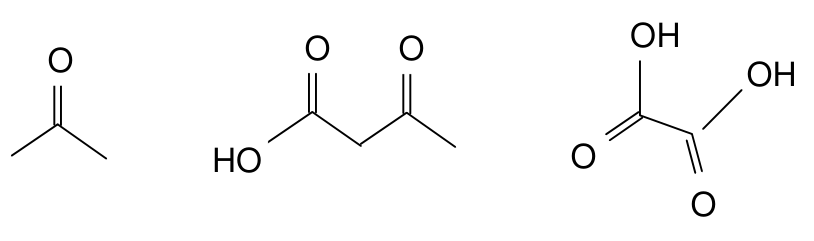
4.1 Give the structure of geraniol A.
4.2 Give the structure of compound B.
4.3 Give the structures of the two bromides of formula \(\ce{C10H17Br}\).
4.4 Indicate which of the two bromides is formed in greater proportions.
Official English text of the problem.
Problem 5: Nitrogen dioxide - dinitrogen tetroxide equilibrium and kinetics
Nitrogen dioxide \(\ce{NO2}\) is one of a number of oxides of nitrogen found in our atmosphere. It can dimerize to give \(\ce{N2O4(g)}\):

5.1 With a diagram, show the bonds present in \(\ce{NO2(g)}\) using the concept of resonance if necessary. Nitrogen dioxide, \(\ce{NO2}\), is paramagnetic.
5.2 Show, with bonding diagrams, how two molecules of \(\ce{NO2(g)}\) combine to give a molecule of \(\ce{N2O4(g)}\) which is not paramagnetic.
5.3 At 298 K, the \(\Delta G^\circ\) of formation for \(\ce{N2O4(g)}\) is 98.28 kJ, whereas for \(\ce{NO2(g)}\) is 51.84 kJ. Starting with one mole of \(\ce{N2O4(g)}\) at 1.0 atm and 298 K, calculate what fraction will be decomposed if the total pressure is kept constant at 1.0 atm and the temperature is maintained at 298 K.
5.4 If \(\Delta H^\circ\) for the reaction

is 58.03 kJ, at what temperature would the fraction of \(\ce{N2O4}\) decomposed be double that calculated in part 5.3?
5.5 The dissociation of \(\ce{N2O4(g)}\) to give \(\ce{NO2(g)}\) is a first order process with a specific rate constant of \(5.3\times10^4\ \mathrm{s^{-1}}\) at 298 K. Starting with an initial concentration of 0.10 M, how many seconds would it take for 20 % of the original \(\ce{N2O4}\) to decompose?
5.6 The association of \(\ce{NO2(g)}\) to give \(\ce{N2O4(g)}\) is a second-order process with a specific rate constant of \(9.8\times10^6\ \mathrm{dm^3\,mol^{-1}\,s^{-1}}\) at 298 K. Calculate the concentration equilibrium constant, \(K_c\), at 298 K for the reaction

Official English text of the problem.
Problem 6: Carbon dioxide in the atmosphere and in water
The concentration of carbon dioxide in the atmosphere has increased substantially during this century and is predicted to continue to increase. The \([\ce{CO2}]\) is expected to be about 440 ppm (\(440\times10^{-6}\ \mathrm{atm}\)) in the year 2020.
6.1 Calculate the concentration (in \(\mathrm{mol\,dm^{-3}}\)) of \(\ce{CO2}\) dissolved in distilled water equilibrated with the atmosphere in the year 2020.
6.2 Calculate the \(pH\)-value of the solution in 6.1.
6.3 Calculate the enthalpy of reaction between \(\ce{CO2(aq)}\) and \(\ce{H2O}\).
6.4 If the temperature of an equilibrated solution of \(\ce{CO2}\) is increased and the concentration of dissolved carbon dioxide is maintained constant, the \(pH\) of the solution may change. Predict whether the \(pH\) will increase or decrease.
Data:
Henry's Law constant for \(\ce{CO2}\) at 298 K: \(0.0343\ \mathrm{dm^3\,mol^{-1}\,atm^{-1}}\)
Thermodynamic values, in kJ/mol at 298 K are:
\(\Delta_{\mathrm f}G^0\) \(\Delta_{\mathrm f}H^0\) \(\ce{CO2(aq)}\) −386.2 −412.9 \(\ce{H2O(l)}\) −237.2 −285.8 \(\ce{HCO3^-(aq)}\) −587.1 −691.2 \(\ce{H+(aq)}\) 0.00 0.00 Official English text of the problem.
Problem 7: Determination of chloride in Chesapeake Bay water
When the fresh-water rivers that run into the Chesapeake Bay flood after heavy rains in the spring, the increase in fresh water in the Bay causes a decrease in the salinity in the areas where oysters grow. The minimum concentration of chloride ions needed in oyster beds for normal growth is 8 ppm (\(8\ \mathrm{mg\,dm^{-3}}\)).
After one week of heavy rain, the following analysis is done on water from the bay. To a \(50.00\ \mathrm{cm^3}\) sample of bay water a few drops of a \(\ce{K2CrO4}\) solution are added. The sample is then titrated with \(16.16\ \mathrm{cm^3}\) of a 0.00164 M \(\ce{AgNO3}\) solution. After \(\ce{AgNO3}\) solution has been added to the sample a bright red-orange precipitate forms.
7.1 What is the molar concentration of chloride in the sample?
7.2 Does the water contain sufficient chloride for the normal growth of oysters? Show your calculation.
7.3 Write a balanced equation for the reaction of the analyte with the titrant.
7.4 Write a balanced net-ionic equation that describes the reaction responsible for the colour change at the endpoint of the titration. Which compound produces the brick-red colour?
7.5 The concentration of chromate at the endpoint is 0.020 M. Calculate the concentration of chloride ions in the solution when the red precipitate forms.
7.6 For this titration to work most effectively, the solution being titrated must be neutral or slightly basic. Write a balanced equation for the competing reaction that would occur in acidic medium that would influence the observed endpoint of this titration.
Typically, a buffer is added to the solution being titrated to control the pH if the initial sample is acidic. Suppose the pH of the sample of bay water was 5.10, thus too acidic to perform the analysis accurately.
7.7 Select a buffer from the list that would enable you to establish and maintain a pH of 7.20 in aqueous medium. Show the calculations which lead to your choice.
Buffer systems \(K_\mathrm{a}\) of weak acid 1. 0.10 M lactic acid / 0.10 M sodium lactate \(1.4\times10^{-4}\) 2. 0.10 M acetic acid / 0.10 M sodium acetate \(1.8\times10^{-5}\) 3. 0.10 M sodium dihydrogen phosphate /
/ 0.10 M sodium hydrogen phosphate\(6.2\times10^{-8}\) 4. 0.10 M ammonium chloride / 0.10 M ammonia \(5.6\times10^{-10}\) 7.8 Using the selected buffer system, calculate the mass (in g) of weak acid and of conjugated base you would need to dissolve in distilled water to prepare \(500\ \mathrm{cm^3}\) of a stock solution buffered at a pH of 7.2.
7.9 The chloride concentration in another \(50.00\ \mathrm{cm^3}\) sample of bay water was determined by the Volhard method. In this method an excess of \(\ce{AgNO3}\) is added to the sample. The excess \(\ce{Ag+}\) is titrated with standardized \(\ce{KSCN}\), forming a precipitate of \(\ce{AgSCN}\). The endpoint is signalled by the formation of the reddish-brown \(\ce{FeSCN^2+}\) complex that forms when \(\ce{Ag+}\) is depleted. If the excess \(\ce{Ag+}\) from the addition of \(50.00\ \mathrm{cm^3}\) of 0.00129 M \(\ce{AgNO3}\) to the water sample required \(27.46\ \mathrm{cm^3}\) of \(1.41\,10^{-3}\) M \(\ce{KSCN}\) for titration, calculate the concentration of chloride in the bay water sample.
In natural waters with much higher concentration of \(\ce{Cl-}\), the \(\ce{Cl-}\) can be determined gravimetrically by precipitating the \(\ce{Cl-}\) as \(\ce{AgCl}\). A complicating feature of this method is the fact that \(\ce{AgCl}\) is susceptible to photodecomposition as shown by the reaction:

Furthermore, if this photodecomposition occurs in the presence of excess \(\ce{Ag+}\), the following additional reaction occurs:

If 0.010 g of a 3.000 g sample of \(\ce{AgCl}\) contaminated with excess \(\ce{Ag+}\) undergoes photodecomposition by the above equations
7.10 Will the apparent weight of \(\ce{AgCl}\) be too high or too low? Explain your answer showing by how many grams the two values will differ.
Data:
\[ K_{\mathrm{sp}}(\ce{AgCl})=1.78\times10^{-10} \]
\[ K_{\mathrm{sp}}(\ce{Ag2CrO4})=1.00\times10^{-12} \]
Official English text of the problem.
Problem 8: Pourbaix diagrams of water, nitrogen and manganese
The Pourbaix diagrams for water, nitrogen and manganese are depicted in Fig. 1.
8.1 Write the formula of the species of nitrogen that is predominant
i) in \(\ce{O2}\)-rich lakes of \(\mathrm{pH}\approx 6\),
ii) in highly \(\ce{O2}\)-depleted lakes that are strongly contaminated with acid rain (\(\mathrm{pH}\approx 3\)),
8.2 Which species of manganese is predominant
i) in \(\ce{O2}\)-rich lakes of \(\mathrm{pH}\approx 6\),
ii) in highly \(\ce{O2}\)-depleted lakes that are strongly contaminated with bases (\(\mathrm{pH}\approx 12\))?
8.3 People often find that clear, slightly acidic (\(\mathrm{pH}\approx 5\)) water drawn from wells deposits a black manganese-containing solid on standing in toilet bowls.
i) Write the chemical formula of the black solid?
ii) Write the formula for the species of manganese found in well water while it is still underground ?
8.4 According to Pourbaix diagrams two species of nitrogen should oxidize \(\ce{Mn(s)}\) to \(\ce{Mn^2+(aq)}\).
i) Write the formulas of these two nitrogen species.
ii) Which of the two species of nitrogen does not oxidize \(\ce{Mn(s)}\) (in practice) at room temperature ?
8.5 According to the Poubaix diagrams, some of the chemical forms of manganese should oxidize \(\ce{NH3(aq)}\) or \(\ce{NH4+(aq)}\) to \(\ce{N2(g)}\).
Choose in the following list the forms of Mn that should do it:
\[ \ce{Mn},\ \ce{Mn(OH)2},\ \ce{Mn^2+},\ \ce{Mn3O4},\ \ce{Mn2O3},\ \ce{MnO2},\ \ce{MnO4^2-},\ \ce{MnO4^-} \]
8.6 Ammonium permanganate, \(\ce{NH4MnO4}\), is a well-known salt, but ammonium manganate, \(\ce{(NH4)2MnO4}\), is a rarely known salt.
i) Is \(\ce{NH4MnO4}\) expected to be thermodynamically stable? (YES or NO)
ii) Is \(\ce{(NH4)2MnO4}\) expected to be thermodynamically stable? (YES or NO)
iii) Write and balance an equation for the decomposition of \(\ce{NH4MnO4}\) to give \(\ce{MnO2}\) a \(\ce{N2}\).
iv) Write and balance an equation for the decomposition of \(\ce{(NH4)2MnO4}\) to give \(\ce{Mn}\) a \(\ce{N2}\).
8.7 According to the Pourbaix diagrams, is it dangerous to grind together in a mortar and pestle
i potassium nitrate and manganese metal,
ii) potassium nitrate and manganese dioxide?
8.8 The standard reduction potential, \(E^0\), for the reduction of \(\ce{MnO4^-}\) to \(\ce{MnO2}\) is \(1.692\ \mathrm{V}\). Applying the Nernst equation calculate the reduction potential, \(E\), for the reduction of \(0.00100\ \mathrm{M}\) \(\ce{MnO4^-}\) solution at a \(\mathrm{pH}=4.0\).
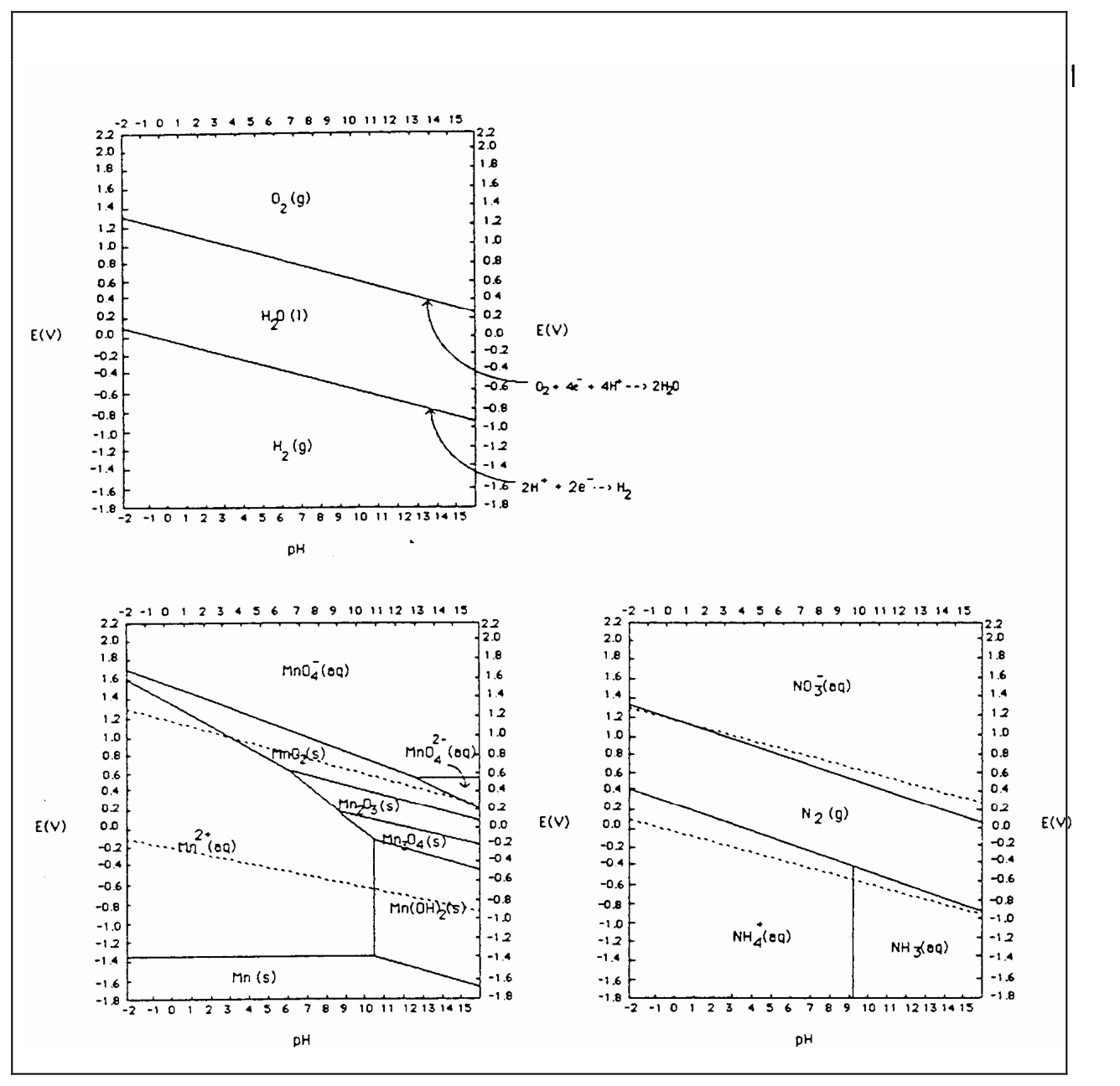
Figure 1
Official English text of the problem.
Problem 9: Reactions of insect pheromones
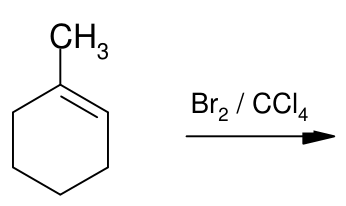
Pheromones are chemicals or mixtures of certain chemicals secreted by insects and some animals for communication. They bring about certain responses in another individual of the same species. In the problem below you will find a number of pheromones undergoing reactions which were used in determining their structures. In each case give the structure or structures of the products produced. Show geometric (cis/trans) isomers where appropriate (in part (9.5). You may ignore other forms of stereoisomerism.
9.1
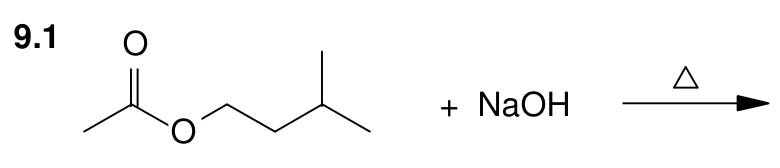
isoamyl acetate,
bee alarm pheromene9.2
i)

2-heptanone
ant alarm pheromoneii)
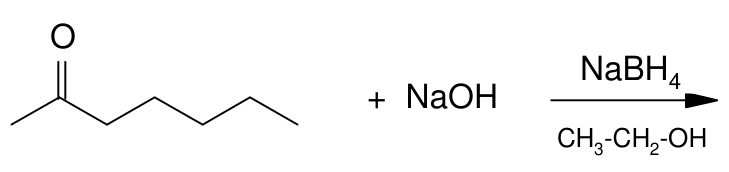
iii)

9.3
i)

green peach -
aphid pheromoneii)

9.4
(i)
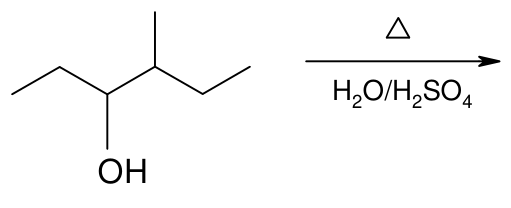
(ii)
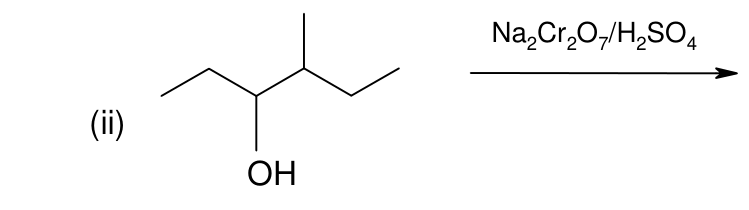
(iii)
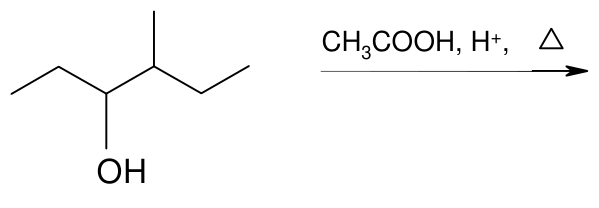
9.5
i)
ii)
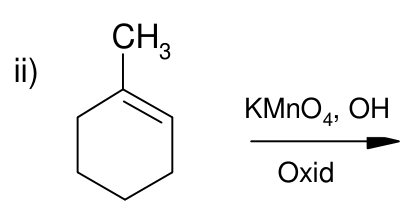
iii)
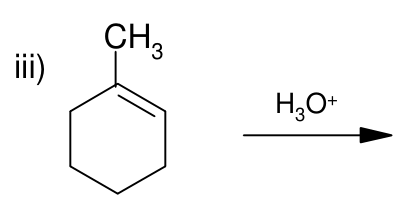
iv)
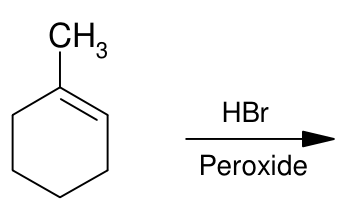
v)
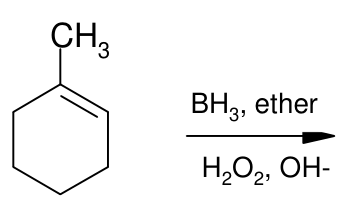
vi)
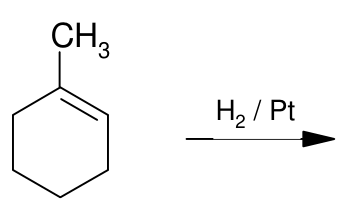
Official English text of the problem.
Internationale Chemie-Olympiade
IChO 1992
Pittsburgh, USA · 9 Theorieaufgaben mit vollständigen Lösungen
Aufgabe 1: Kieselalgen, Wale und der Kohlenstoffkreislauf
Kieselalgen sind mikroskopisch kleine Organismen und eine reichlich vorhandene Nahrungsquelle in den Ozeanen. Sie erzeugen durch Photosynthese Kohlenhydrate aus Kohlenstoffdioxid und Wasser:
1.1 In den ersten fünf Lebensjahren nehmen Blauwale täglich 75 kg an Masse zu, indem sie sich von Krill ernähren. Ein Wal muss jeden Tag die zehnfache Menge dieser Masse an Krill aufnehmen. Der Krill muss 10.0 kg Kieselalgen aufnehmen, um 1.0 kg Krill zu bilden. Berechnen Sie unter der Annahme, dass die Massenzunahme in den ersten Lebensjahren eines Wals auf der Aufnahme von Kohlenhydraten (\(\ce{C6H12O6}\)) beruht, das Volumen an \(\ce{CO2}\) unter Standardbedingungen (STP: 0 °C, 101 kPa), das die Kieselalgen benötigen, um die von einem Blauwal in seinen ersten fünf Lebensjahren aufgenommenen Kohlenhydrate zu erzeugen.
1.2 Pro Liter Meerwasser sind 0.23 cm³ \(\ce{CO2}\) gelöst (bei 24 °C und 101 kPa).
i) Wenn Kieselalgen dem von ihnen verarbeiteten Wasser das Kohlenstoffdioxid vollständig entziehen können, welches Wasservolumen würden sie verarbeiten, um die Kohlenhydrate zu erzeugen, die ein Blauwal in seinen ersten fünf Lebensjahren benötigt?
ii) Welcher Anteil des Gesamtvolumens der Ozeane wird benötigt, um das Kohlenstoffdioxid für die ersten fünf Wachstumsjahre von 1000 Blauwalen bereitzustellen? Das Volumen der Ozeane beträgt \(1.37\times10^{18}\ \mathrm{m^3}\).
1.3 Drei Prozent der Masse eines ausgewachsenen Wals von \(9.1\times10^4\) kg bestehen aus Stickstoff. Wenn ein Blauwal von \(9.1\times10^4\) kg stirbt, welche Masse an \(\ce{NH4+}\) kann anderen Meeresorganismen höchstens zur Verfügung stehen?
1.4 Achtzehn Prozent der Masse eines Wals von \(9.1\times10^4\) kg bestehen aus Kohlenstoff. Kohlenstoff kann als \(\ce{CO2}\) in die Atmosphäre zurückgelangen und ihr anschließend durch die Verwitterung von Gesteinen, die Calciumsilicat enthalten, wieder entzogen werden.
Wie viele Gramm \(\ce{CaSiO3}\) können höchstens durch das Kohlenstoffdioxid verwittert werden, das bei der Zersetzung von 1000 Blauwalen entsteht? Dies entspricht der geschätzten Anzahl jährlich sterbender Blauwale.
Aufgabentext aus dem offiziellen englischen Text übersetzt.
Aufgabe 2: Saure Grubenwässer: Oxidation von Pyrit
Viele Bäche entwässern Gebiete, in denen Kohle oder Metallerze abgebaut werden. Diese Bäche sind sauer geworden und enthalten hohe Konzentrationen an gelöstem Eisen und Sulfat, weil schwefelhaltige Erze der Atmosphäre oder sauerstoffhaltigem Wasser ausgesetzt werden. Das häufigste schwefelhaltige Mineral ist Pyrit, \(\ce{FeS2}\), in dem Eisen die Oxidationszahl +2 hat. Wenn sich die eisenreichen Bäche mit anderen Gewässern mischen, fällt das gelöste Eisen als Goethit, \(\ce{FeO(OH)}\), aus, der den Bachgrund überzieht, während das Wasser sauer bleibt.
2.1 Zeichnen Sie die Elektronenpunktformel, die die Bindungsverhältnisse im Ion \(\ce{S2^2-}\) veranschaulicht, und zeigen Sie dabei alle Valenzelektronen.
2.2 Stellen Sie eine ausgeglichene Reaktionsgleichung auf, die zeigt, wie bei der Oxidation von Pyrit unter Bildung einer Lösung von Eisen(II)- und Sulfat-Ionen Wasserstoff-Ionen (\(\ce{H+}\)) entstehen.
2.3 Stellen Sie eine ausgeglichene Gleichung auf, die zeigt, wie viele zusätzliche Mol Wasserstoff bei der Oxidation von Eisen(II)-Ionen unter Bildung des Minerals Goethit, \(\ce{FeO(OH)}\), entstehen.
2.4 Berechnen Sie, wie viele Mol Pyrit erforderlich wären, um \(1.0\ \mathrm{dm^3}\) reines Wasser auf einen pH-Wert von 3.0 zu bringen, wenn der Pyrit vollständig zu \(\ce{FeO(OH)}\) und \(\ce{H+}\)-Ionen umgesetzt würde. Vernachlässigen Sie die Bildung von \(\ce{HSO4-}\).
2.5 Die Konzentration von Eisen in Form von \(\ce{Fe(II)}\) in einem Bach beträgt 0.00835 M. An einer sehr engen Stelle mündet der Bach mit einem Volumenstrom von 20.0 l pro Minute in einen großen Teich. Das Wasser dieses Bachs ist ausreichend belüftet, sodass 75 % des \(\ce{Fe(II)}\) zu \(\ce{Fe(III)}\) oxidiert werden. Der pH-Wert des Teichs ist hoch genug (> 7), dass das Eisen(III) sofort als \(\ce{Fe(OH)3}\) ausfällt, das bei der Alterung in \(\ce{Fe2O3}\) übergeht. Welche Masse an \(\ce{Fe2O3}\) lagert sich innerhalb von zwei Jahren auf dem Grund des Teichs ab?
Aufgabentext aus dem offiziellen englischen Text übersetzt.
Aufgabe 3: Coniferylalkohol: Struktur und Stereoisomere seines Dibromids
Coniferylalkohol hat die Summenformel \(\ce{C10H12O3}\). Er wird aus Kiefern isoliert. Coniferylalkohol ist weder in Wasser noch in wässrigem \(\ce{NaHCO3}\) löslich. Eine Lösung von \(\ce{Br2}\) in \(\ce{CCl4}\) wird bei Zugabe zu Coniferylalkohol unter Bildung von A (\(\ce{C10H12O3Br2}\)) entfärbt. Bei der reduktiven Ozonolyse liefert Coniferylalkohol Vanillin (4-Hydroxy-3-methoxybenzaldehyd) und B (\(\ce{C2H4O2}\)). Coniferylalkohol reagiert mit Benzoylchlorid (\(\ce{C6H5COCl}\)) in Gegenwart einer Base zu C (\(\ce{C24H20O5}\)). Dieses Produkt entfärbt \(\ce{KMnO4}\) (aq) rasch und ist in verdünnter \(\ce{NaOH}\) unlöslich.
Coniferylalkohol reagiert mit kaltem \(\ce{HBr}\) zu D (\(\ce{C10H11O2Br}\)). Heißes \(\ce{HI}\) wandelt \(\ce{ArOR}\) in \(\ce{ArOH}\) und \(\ce{RI}\) um. Coniferylalkohol reagiert mit überschüssigem heißem \(\ce{HI}\) zu E (\(\ce{C9H9O2I}\)) und \(\ce{CH3I}\). \(\ce{CH3I}\) reagiert in wässriger Base mit Coniferylalkohol zu F (\(\ce{C11H14O3}\)), das in einer starken Base nicht löslich ist, aber eine \(\ce{Br2}/\ce{CCl4}\)-Lösung entfärbt.
3.1 Zeichnen Sie die Strukturen von Coniferylalkohol und den Verbindungen A - F.
3.2 Von Verbindung A gibt es mehrere Stereoisomere. Zeichnen Sie die Struktur von Verbindung A. Kennzeichnen Sie jedes Chiralitätszentrum in Verbindung A mit einem Sternchen (*). Zeichnen Sie für alle Stereoisomere die Fischer-Projektionen und kennzeichnen Sie jedes Chiralitätszentrum mit der entsprechenden Bezeichnung \(R\) oder \(S\), die die absolute Konfiguration am Chiralitätszentrum angibt.
Aufgabentext aus dem offiziellen englischen Text übersetzt.
Aufgabe 4: Geraniol aus Rosenöl
Rosenöl ist ein ätherisches Öl, das durch Wasserdampfdestillation von Pflanzenmaterial von Rosen gewonnen wird. Es enthält eine Reihe von Terpenen, darunter Geraniol, \(\ce{C10H18O}\) (A). Bei der Oxidation kann Geraniol entweder einen Aldehyd mit zehn Kohlenstoffatomen oder eine Carbonsäure mit zehn Kohlenstoffatomen ergeben. Die Reaktion mit zwei Mol Brom ergibt ein Tetrabromid (\(\ce{C10H18OBr4}\)) (B). Geraniol reagiert mit \(\ce{HBr}\) zu zwei Bromiden mit der Formel \(\ce{C10H17Br}\).
Bei der Oxidation von Geraniol unter drastischen Bedingungen entstehen drei Produkte:
4.1 Geben Sie die Struktur von Geraniol A an.
4.2 Geben Sie die Struktur der Verbindung B an.
4.3 Geben Sie die Strukturen der beiden Bromide mit der Formel \(\ce{C10H17Br}\) an.
4.4 Geben Sie an, welches der beiden Bromide in größerem Anteil gebildet wird.
Aufgabentext aus dem offiziellen englischen Text übersetzt.
Aufgabe 5: Stickstoffdioxid-Distickstofftetroxid-Gleichgewicht und Kinetik
Stickstoffdioxid \(\ce{NO2}\) ist eines von mehreren Stickstoffoxiden, die in unserer Atmosphäre vorkommen. Es kann zu \(\ce{N2O4(g)}\) dimerisieren:
5.1 Stellen Sie die Bindungen in \(\ce{NO2(g)}\) in einem Diagramm dar und verwenden Sie dabei, falls erforderlich, das Mesomeriekonzept. Stickstoffdioxid, \(\ce{NO2}\), ist paramagnetisch.
5.2 Zeigen Sie anhand von Bindungsdiagrammen, wie sich zwei Moleküle \(\ce{NO2(g)}\) zu einem Molekül \(\ce{N2O4(g)}\) verbinden, das nicht paramagnetisch ist.
5.3 Bei 298 K beträgt die freie Standardbildungsenthalpie \(\Delta G^\circ\) von \(\ce{N2O4(g)}\) 98.28 kJ, diejenige von \(\ce{NO2(g)}\) hingegen 51.84 kJ. Berechnen Sie ausgehend von einem Mol \(\ce{N2O4(g)}\) bei 1.0 atm und 298 K, welcher Anteil zerfällt, wenn der Gesamtdruck konstant bei 1.0 atm und die Temperatur bei 298 K gehalten werden.
5.4 Wenn \(\Delta H^\circ\) für die Reaktion
58.03 kJ beträgt, bei welcher Temperatur wäre der zerfallene Anteil von \(\ce{N2O4}\) doppelt so groß wie der in Teil 5.3 berechnete?
5.5 Die Dissoziation von \(\ce{N2O4(g)}\) zu \(\ce{NO2(g)}\) ist ein Prozess erster Ordnung mit einer Geschwindigkeitskonstanten von \(5.3\times10^4\ \mathrm{s^{-1}}\) bei 298 K. Wie viele Sekunden würde es bei einer Anfangskonzentration von 0.10 M dauern, bis 20 % des ursprünglichen \(\ce{N2O4}\) zerfallen sind?
5.6 Die Assoziation von \(\ce{NO2(g)}\) zu \(\ce{N2O4(g)}\) ist ein Prozess zweiter Ordnung mit einer Geschwindigkeitskonstanten von \(9.8\times10^6\ \mathrm{dm^3\,mol^{-1}\,s^{-1}}\) bei 298 K. Berechnen Sie die konzentrationsbezogene Gleichgewichtskonstante \(K_c\) bei 298 K für die Reaktion
Aufgabentext aus dem offiziellen englischen Text übersetzt.
Aufgabe 6: Kohlenstoffdioxid in der Atmosphäre und im Wasser
Die Konzentration von Kohlenstoffdioxid in der Atmosphäre ist im Laufe dieses Jahrhunderts erheblich gestiegen und wird voraussichtlich weiter zunehmen. Für das Jahr 2020 wird eine \([\ce{CO2}]\) von etwa 440 ppm (\(440\times10^{-6}\ \mathrm{atm}\)) erwartet.
6.1 Berechnen Sie die Konzentration (in \(\mathrm{mol\,dm^{-3}}\)) von \(\ce{CO2}\), das in destilliertem Wasser gelöst ist, welches sich im Jahr 2020 im Gleichgewicht mit der Atmosphäre befindet.
6.2 Berechnen Sie den \(pH\)-Wert der Lösung aus 6.1.
6.3 Berechnen Sie die Reaktionsenthalpie der Reaktion zwischen \(\ce{CO2(aq)}\) und \(\ce{H2O}\).
6.4 Wenn die Temperatur einer im Gleichgewicht befindlichen Lösung von \(\ce{CO2}\) erhöht und die Konzentration des gelösten Kohlenstoffdioxids konstant gehalten wird, kann sich der \(pH\) der Lösung ändern. Sagen Sie voraus, ob der \(pH\) steigt oder sinkt.
Daten:
Henry-Konstante für \(\ce{CO2}\) bei 298 K: \(0.0343\ \mathrm{dm^3\,mol^{-1}\,atm^{-1}}\)
Die thermodynamischen Werte in kJ/mol bei 298 K sind:
\(\Delta_{\mathrm f}G^0\) \(\Delta_{\mathrm f}H^0\) \(\ce{CO2(aq)}\) −386.2 −412.9 \(\ce{H2O(l)}\) −237.2 −285.8 \(\ce{HCO3^-(aq)}\) −587.1 −691.2 \(\ce{H+(aq)}\) 0.00 0.00 Aufgabentext aus dem offiziellen englischen Text übersetzt.
Aufgabe 7: Bestimmung von Chlorid im Wasser der Chesapeake Bay
Wenn die Süßwasserflüsse, die in die Chesapeake Bay münden, nach starken Regenfällen im Frühjahr Hochwasser führen, bewirkt die Zunahme des Süßwasseranteils in der Bucht eine Abnahme des Salzgehalts in den Gebieten, in denen Austern wachsen. Die für ein normales Wachstum in Austernbänken erforderliche Mindestkonzentration an Chloridionen beträgt 8 ppm (\(8\ \mathrm{mg\,dm^{-3}}\)).
Nach einer Woche mit starken Regenfällen wird Wasser aus der Bucht wie folgt analysiert. Zu einer \(50.00\ \mathrm{cm^3}\)-Probe des Wassers aus der Bucht werden einige Tropfen einer \(\ce{K2CrO4}\)-Lösung gegeben. Anschließend wird die Probe mit \(16.16\ \mathrm{cm^3}\) einer 0.00164 M \(\ce{AgNO3}\)-Lösung titriert. Nach der Zugabe der \(\ce{AgNO3}\)-Lösung zur Probe bildet sich ein leuchtend rotorangefarbener Niederschlag.
7.1 Wie groß ist die Stoffmengenkonzentration von Chlorid in der Probe?
7.2 Enthält das Wasser ausreichend Chlorid für das normale Wachstum von Austern? Zeigen Sie Ihre Berechnung.
7.3 Geben Sie eine ausgeglichene Gleichung für die Reaktion des Analyten mit dem Titrationsmittel an.
7.4 Geben Sie eine ausgeglichene Netto-Ionengleichung für die Reaktion an, die für den Farbumschlag am Endpunkt der Titration verantwortlich ist. Welche Verbindung erzeugt die ziegelrote Farbe?
7.5 Die Chromatkonzentration am Endpunkt beträgt 0.020 M. Berechnen Sie die Konzentration der Chloridionen in der Lösung zum Zeitpunkt der Bildung des roten Niederschlags.
7.6 Damit diese Titration optimal funktioniert, muss die zu titrierende Lösung neutral oder leicht basisch sein. Geben Sie eine ausgeglichene Gleichung für die konkurrierende Reaktion an, die in saurem Medium auftreten und den beobachteten Endpunkt dieser Titration beeinflussen würde.
Ist die ursprüngliche Probe sauer, wird der zu titrierenden Lösung üblicherweise ein Puffer zugesetzt, um den pH-Wert zu kontrollieren. Angenommen, der pH-Wert der Wasserprobe aus der Bucht betrug 5.10; sie war damit zu sauer, um die Analyse genau durchführen zu können.
7.7 Wählen Sie aus der Liste einen Puffer aus, mit dem Sie in wässrigem Medium einen pH-Wert von 7.20 einstellen und aufrechterhalten können. Zeigen Sie die Berechnungen, die zu Ihrer Wahl führen.
Puffersysteme \(K_\mathrm{a}\) der schwachen Säure 1. 0.10 M Milchsäure / 0.10 M Natriumlactat \(1.4\times10^{-4}\) 2. 0.10 M Essigsäure / 0.10 M Natriumacetat \(1.8\times10^{-5}\) 3. 0.10 M Natriumdihydrogenphosphat /
/ 0.10 M Natriumhydrogenphosphat\(6.2\times10^{-8}\) 4. 0.10 M Ammoniumchlorid / 0.10 M Ammoniak \(5.6\times10^{-10}\) 7.8 Berechnen Sie für das ausgewählte Puffersystem die Massen (in g) der schwachen Säure und der konjugierten Base, die Sie in destilliertem Wasser lösen müssten, um \(500\ \mathrm{cm^3}\) einer auf einen pH-Wert von 7.2 gepufferten Stammlösung herzustellen.
7.9 Die Chloridkonzentration in einer weiteren \(50.00\ \mathrm{cm^3}\)-Probe des Wassers aus der Bucht wurde nach der Volhard-Methode bestimmt. Bei dieser Methode wird der Probe ein Überschuss an \(\ce{AgNO3}\) zugesetzt. Das überschüssige \(\ce{Ag+}\) wird mit einer eingestellten \(\ce{KSCN}\)-Maßlösung titriert, wobei sich ein Niederschlag von \(\ce{AgSCN}\) bildet. Der Endpunkt wird durch die Bildung des rotbraunen \(\ce{FeSCN^2+}\)-Komplexes angezeigt, der entsteht, wenn \(\ce{Ag+}\) verbraucht ist. Wenn zur Titration des überschüssigen \(\ce{Ag+}\) nach der Zugabe von \(50.00\ \mathrm{cm^3}\) 0.00129 M \(\ce{AgNO3}\) zur Wasserprobe \(27.46\ \mathrm{cm^3}\) einer \(1.41\,10^{-3}\) M \(\ce{KSCN}\)-Lösung benötigt wurden, berechnen Sie die Chloridkonzentration in der Wasserprobe aus der Bucht.
In natürlichen Gewässern mit wesentlich höherer \(\ce{Cl-}\)-Konzentration kann \(\ce{Cl-}\) gravimetrisch bestimmt werden, indem es als \(\ce{AgCl}\) gefällt wird. Eine Schwierigkeit dieser Methode besteht darin, dass \(\ce{AgCl}\) zur photochemischen Zersetzung neigt, wie die folgende Reaktion zeigt:
Findet diese photochemische Zersetzung in Gegenwart von überschüssigem \(\ce{Ag+}\) statt, läuft außerdem die folgende Reaktion ab:
Wenn 0.010 g einer 3.000 g schweren, mit überschüssigem \(\ce{Ag+}\) verunreinigten \(\ce{AgCl}\)-Probe gemäß den obigen Gleichungen photochemisch zersetzt werden,
7.10 wird die scheinbare Masse von \(\ce{AgCl}\) zu hoch oder zu niedrig sein? Erläutern Sie Ihre Antwort und zeigen Sie, um wie viele Gramm sich die beiden Werte unterscheiden.
Gegebene Daten:
\[ K_{\mathrm{sp}}(\ce{AgCl})=1.78\times10^{-10} \]
\[ K_{\mathrm{sp}}(\ce{Ag2CrO4})=1.00\times10^{-12} \]
Aufgabentext aus dem offiziellen englischen Text übersetzt.
Aufgabe 8: Pourbaix-Diagramme von Wasser, Stickstoff und Mangan
Die Pourbaix-Diagramme für Wasser, Stickstoff und Mangan sind in Abb. 1 dargestellt.
8.1 Geben Sie die Formel der Stickstoffspezies an, die vorherrscht
i) in \(\ce{O2}\)-reichen Seen mit \(\mathrm{pH}\approx 6\),
ii) in stark \(\ce{O2}\)-armen Seen, die stark durch sauren Regen belastet sind (\(\mathrm{pH}\approx 3\)),
8.2 Welche Manganspezies herrscht vor
i) in \(\ce{O2}\)-reichen Seen mit \(\mathrm{pH}\approx 6\),
ii) in stark \(\ce{O2}\)-armen Seen, die stark mit Basen verunreinigt sind (\(\mathrm{pH}\approx 12\))?
8.3 Häufig wird beobachtet, dass klares, leicht saures (\(\mathrm{pH}\approx 5\)) Brunnenwasser beim Stehen in Toilettenschüsseln einen schwarzen, manganhaltigen Feststoff abscheidet.
i) Geben Sie die chemische Formel des schwarzen Feststoffs an.
ii) Geben Sie die Formel der Manganspezies an, die im Brunnenwasser vorliegt, solange es sich noch unter der Erde befindet.
8.4 Gemäß den Pourbaix-Diagrammen sollten zwei Stickstoffspezies \(\ce{Mn(s)}\) zu \(\ce{Mn^2+(aq)}\) oxidieren.
i) Geben Sie die Formeln dieser beiden Stickstoffspezies an.
ii) Welche der beiden Stickstoffspezies oxidiert \(\ce{Mn(s)}\) bei Raumtemperatur (in der Praxis) nicht?
8.5 Gemäß den Pourbaix-Diagrammen sollten einige der chemischen Formen von Mangan \(\ce{NH3(aq)}\) oder \(\ce{NH4+(aq)}\) zu \(\ce{N2(g)}\) oxidieren.
Wählen Sie aus der folgenden Liste die Formen von Mn aus, die dazu in der Lage sein sollten:
\[ \ce{Mn},\ \ce{Mn(OH)2},\ \ce{Mn^2+},\ \ce{Mn3O4},\ \ce{Mn2O3},\ \ce{MnO2},\ \ce{MnO4^2-},\ \ce{MnO4^-} \]
8.6 Ammoniumpermanganat, \(\ce{NH4MnO4}\), ist ein wohlbekanntes Salz, während Ammoniummanganat, \(\ce{(NH4)2MnO4}\), ein wenig bekanntes Salz ist.
i) Ist zu erwarten, dass \(\ce{NH4MnO4}\) thermodynamisch stabil ist? (JA oder NEIN)
ii) Ist zu erwarten, dass \(\ce{(NH4)2MnO4}\) thermodynamisch stabil ist? (JA oder NEIN)
iii) Stellen Sie eine ausgeglichene Reaktionsgleichung für die Zersetzung von \(\ce{NH4MnO4}\) zu \(\ce{MnO2}\) und \(\ce{N2}\) auf.
iv) Stellen Sie eine ausgeglichene Reaktionsgleichung für die Zersetzung von \(\ce{(NH4)2MnO4}\) zu \(\ce{Mn}\) und \(\ce{N2}\) auf.
8.7 Ist es gemäß den Pourbaix-Diagrammen gefährlich, die folgenden Stoffe gemeinsam mit einem Pistill im Mörser zu verreiben:
i Kaliumnitrat und metallisches Mangan,
ii) Kaliumnitrat und Mangandioxid?
8.8 Das Standardreduktionspotential \(E^0\) für die Reduktion von \(\ce{MnO4^-}\) zu \(\ce{MnO2}\) beträgt \(1.692\ \mathrm{V}\). Berechnen Sie mithilfe der Nernst-Gleichung das Reduktionspotential \(E\) für die Reduktion einer \(0.00100\ \mathrm{M}\) \(\ce{MnO4^-}\)-Lösung bei einem \(\mathrm{pH}=4.0\).
Abbildung 1
Aufgabentext aus dem offiziellen englischen Text übersetzt.
Aufgabe 9: Reaktionen von Insektenpheromonen
Pheromone sind chemische Stoffe oder Gemische bestimmter chemischer Stoffe, die von Insekten und einigen anderen Tieren zur Kommunikation abgegeben werden. Sie lösen bei einem anderen Individuum derselben Art bestimmte Reaktionen aus. In der folgenden Aufgabe finden Sie eine Reihe von Pheromonen, die Reaktionen eingehen, welche zur Bestimmung ihrer Strukturen verwendet wurden. Geben Sie jeweils die Struktur oder Strukturen der entstehenden Produkte an. Stellen Sie gegebenenfalls geometrische (cis/trans-)Isomere dar (in Teil (9.5)). Andere Formen der Stereoisomerie können Sie außer Acht lassen.
9.1
Isoamylacetat,
Alarmpheromon der Biene9.2
i)
2-Heptanon
Alarmpheromon der Ameiseii)
iii)
9.3
i)
Pheromon der Grünen
Pfirsichblattlausii)
9.4
(i)
(ii)
(iii)
9.5
i)
ii)
iii)
iv)
v)
vi)
Aufgabentext aus dem offiziellen englischen Text übersetzt.
Uluslararası Kimya Olimpiyatı
IChO 1992
Pittsburgh, ABD · 9 teori sorusu, tam çözümleriyle
Soru 1: Diyatomlar, balinalar ve karbon döngüsü
Mikroskobik organizmalar olan diyatomlar, okyanuslarda bol bulunan bir besin kaynağıdır ve fotosentez yoluyla karbondioksit ve sudan karbonhidrat üretirler:
1.1 Mavi balinalar, yaşamlarının ilk beş yılında kril ile beslenerek günde 75 kg kütle kazanırlar. Balinanın her gün bu kütlenin on katı kadar kril tüketmesi gerekir. Krillerin 1.0 kg kril üretmek için 10.0 kg diyatom tüketmesi gerekir. Bir balinanın yaşamının ilk yıllarındaki kütle artışının karbonhidrat (\(\ce{C6H12O6}\)) tüketiminden kaynaklandığını varsayarak, bir mavi balinanın yaşamının ilk beş yılında tükettiği karbonhidratları üretmek için diyatomların kullanması gereken \(\ce{CO2}\)'nin STP'deki (0 °C, 101 kPa) hacmini hesaplayınız.
1.2 Bir litre deniz suyunda (24 °C ve 101 kPa'da) 0.23 cm³ çözünmüş \(\ce{CO2}\) bulunur.
i) Diyatomlar işledikleri sudaki karbondioksitin tamamını uzaklaştırabiliyorlarsa, bir mavi balinanın yaşamının ilk beş yılında ihtiyaç duyduğu karbonhidratları üretmek için ne kadar hacimde su işlemeleri gerekir?
ii) 1000 mavi balinanın ilk beş yıllık büyümesi için gerekli karbondioksiti sağlamak üzere okyanusların toplam hacminin ne kadarlık bir bölümüne ihtiyaç duyulur? Okyanusların hacmi \(1.37\times10^{18}\ \mathrm{m^3}\)'tür.
1.3 \(9.1\times10^4\) kg kütleli yetişkin bir balinanın kütlesinin yüzde üçü azottur. \(9.1\times10^4\) kg kütleli bir mavi balina öldüğünde, diğer deniz organizmalarının kullanımına sunulabilecek en büyük \(\ce{NH4+}\) kütlesi nedir?
1.4 \(9.1\times10^4\) kg kütleli bir balinanın kütlesinin yüzde on sekizi karbondur. Karbon, atmosfere \(\ce{CO2}\) olarak geri dönebilir ve ardından kalsiyum silikat içeren kayaçların ayrışmasıyla atmosferden uzaklaştırılabilir.
Her yıl öldüğü tahmin edilen 1000 mavi balinanın bozunmasıyla üretilen karbondioksitin ayrıştırabileceği en büyük \(\ce{CaSiO3}\) miktarı kaç gramdır?
Soru metni resmi İngilizce metinden çevrilmiştir.
Soru 2: Asit maden drenajı: piritin yükseltgenmesi
Kömür veya metal cevherlerinin çıkarıldığı bölgelerde birçok akarsu bulunur. Kükürt içeren cevherlerin atmosfere veya oksijenli sulara maruz kalması nedeniyle bu akarsular asidik hâle gelmiş ve yüksek derişimlerde çözünmüş demir ve sülfat içerir duruma gelmiştir. Kükürt içeren en yaygın mineral, demirin yükseltgenme basamağının +2 olduğu pirit, \(\ce{FeS2}\), mineralidir. Demirce zengin akarsular diğer sularla karıştığında, çözünmüş demir götit, \(\ce{FeO(OH)}\), olarak çöker ve akarsu tabanını kaplar; su ise asidik kalır.
2.1 \(\ce{S2^2-}\) iyonundaki bağlanmayı gösteren elektron nokta yapısını, tüm değerlik elektronlarını göstererek çiziniz.
2.2 Piritin yükseltgenerek demir(II) ve sülfat iyonlarını içeren bir çözelti oluşturması sırasında hidrojen iyonlarının (\(\ce{H+}\)) nasıl oluştuğunu gösteren denkleştirilmiş bir kimyasal denklem yazınız.
2.3 Demir(II) iyonları yükseltgenerek götit, \(\ce{FeO(OH)}\), mineralini oluşturduğunda kaç mol ek hidrojen oluştuğunu gösteren denkleştirilmiş bir denklem yazınız.
2.4 Piritin tamamen \(\ce{FeO(OH)}\) ve \(\ce{H+}\) iyonlarına dönüştüğü durumda, \(1.0\ \mathrm{dm^3}\) saf suyun pH değerini 3.0'a getirmek için kaç mol pirit gerektiğini hesaplayınız. \(\ce{HSO4-}\) oluşumunu ihmal ediniz.
2.5 Bir akarsudaki \(\ce{Fe(II)}\) hâlindeki demirin derişimi 0.00835 M'dır. Akarsu, çok dar bir noktasında, dakikada 20.0 l debiyle büyük bir gölete dökülmektedir. Bu akarsudaki su, \(\ce{Fe(II)}\)'nin %75'inin \(\ce{Fe(III)}\)'e yükseltgenmesini sağlayacak kadar havalanmaktadır. Göletin pH değeri, demir(III)'ün hemen \(\ce{Fe(OH)3}\) olarak çökmesine yetecek kadar yüksektir (> 7); bu çökelek zamanla \(\ce{Fe2O3}\)'e dönüşür. İki yılda göletin tabanında hangi kütlede \(\ce{Fe2O3}\) birikir?
Soru metni resmi İngilizce metinden çevrilmiştir.
Soru 3: Koniferil alkol: yapısı ve dibromürünün stereoizomerleri
Koniferil alkolün molekül formülü \(\ce{C10H12O3}\)'tür. Çam ağaçlarından izole edilir. Koniferil alkol suda veya sulu \(\ce{NaHCO3}\) çözeltisinde çözünmez. \(\ce{Br2}\)'nin \(\ce{CCl4}\) içindeki çözeltisi koniferil alkole eklendiğinde rengini kaybeder ve A (\(\ce{C10H12O3Br2}\)) oluşur. İndirgen ozonoliz sonucunda koniferil alkolden vanilin (4-hidroksi-3-metoksibenzaldehit) ve B (\(\ce{C2H4O2}\)) elde edilir. Koniferil alkol, bir baz varlığında benzoil klorür (\(\ce{C6H5COCl}\)) ile tepkimeye girerek C (\(\ce{C24H20O5}\)) oluşturur. Bu ürün, sulu \(\ce{KMnO4}\) çözeltisinin rengini hızla giderir ve seyreltik \(\ce{NaOH}\) çözeltisinde çözünmez.
Koniferil alkol, soğuk \(\ce{HBr}\) ile tepkimeye girerek D (\(\ce{C10H11O2Br}\)) oluşturur. Sıcak \(\ce{HI}\), \(\ce{ArOR}\)'yi \(\ce{ArOH}\) ve \(\ce{RI}\)'ye dönüştürür. Koniferil alkol, aşırı miktarda sıcak \(\ce{HI}\) ile tepkimeye girerek E (\(\ce{C9H9O2I}\)) ve \(\ce{CH3I}\) verir. Sulu baz ortamında \(\ce{CH3I}\), koniferil alkol ile tepkimeye girerek kuvvetli bazda çözünmeyen, ancak \(\ce{Br2}/\ce{CCl4}\) çözeltisinin rengini gideren F (\(\ce{C11H14O3}\)) oluşturur.
3.1 Koniferil alkolün ve A - F bileşiklerinin yapılarını çiziniz.
3.2 A bileşiğinin birden fazla stereoizomeri vardır. A bileşiğinin yapısını çiziniz. A bileşiğindeki her kiral merkezi bir yıldız (*) ile işaretleyiniz. Tüm stereoizomerler için Fischer izdüşümlerini çiziniz ve her kiral merkezi, o merkez etrafındaki mutlak konfigürasyonu gösteren uygun \(R\) veya \(S\) simgesiyle belirtiniz.
Soru metni resmi İngilizce metinden çevrilmiştir.
Soru 4: Gül yağından geraniol
Gül yağı, güllerden elde edilen bitkisel materyalin su buharı damıtmasıyla üretilen bir uçucu yağdır. İçerdiği çeşitli terpenlerden biri geranioldür, \(\ce{C10H18O}\) (A). Geraniol, yükseltgendiğinde on karbonlu bir aldehit veya on karbonlu bir karboksilik asit verebilir. İki mol bromla tepkimesi bir tetrabromür (\(\ce{C10H18OBr4}\)) (B) verir. Geraniol, \(\ce{HBr}\) ile tepkimeye girerek \(\ce{C10H17Br}\) formülüne sahip iki bromür verir.
Geraniol kuvvetli koşullarda yükseltgendiğinde üç ürün elde edilir:
4.1 Geraniol A'nın yapısını veriniz.
4.2 B bileşiğinin yapısını veriniz.
4.3 \(\ce{C10H17Br}\) formülüne sahip iki bromürün yapılarını veriniz.
4.4 İki bromürden hangisinin daha yüksek oranda oluştuğunu belirtiniz.
Soru metni resmi İngilizce metinden çevrilmiştir.
Soru 5: Azot dioksit - diazot tetraoksit dengesi ve kinetiği
Azot dioksit \(\ce{NO2}\), atmosferimizde bulunan çeşitli azot oksitlerinden biridir. Dimerleşerek \(\ce{N2O4(g)}\) oluşturabilir:
5.1 Gerekirse rezonans kavramını kullanarak \(\ce{NO2(g)}\) molekülündeki bağları bir şema ile gösteriniz. Azot dioksit, \(\ce{NO2}\), paramanyetiktir.
5.2 İki \(\ce{NO2(g)}\) molekülünün birleşerek paramanyetik olmayan bir \(\ce{N2O4(g)}\) molekülünü nasıl oluşturduğunu bağ şemalarıyla gösteriniz.
5.3 298 K'de \(\ce{N2O4(g)}\) için oluşum \(\Delta G^\circ\) değeri 98.28 kJ iken, \(\ce{NO2(g)}\) için bu değer 51.84 kJ'dür. 1.0 atm ve 298 K'de bir mol \(\ce{N2O4(g)}\) ile başlandığında, toplam basınç 1.0 atm'de ve sıcaklık 298 K'de sabit tutulursa bunun ne kadarının ayrışacağını kesir olarak hesaplayınız.
5.4 Aşağıdaki tepkime için
\(\Delta H^\circ\) değeri 58.03 kJ ise, hangi sıcaklıkta \(\ce{N2O4}\)'ün ayrışan kesri 5.3 kısmında hesaplanan değerin iki katı olur?
5.5 \(\ce{N2O4(g)}\)'ün \(\ce{NO2(g)}\) oluşturmak üzere ayrışması, 298 K'de özgül hız sabiti \(5.3\times10^4\ \mathrm{s^{-1}}\) olan birinci dereceden bir süreçtir. Başlangıç derişimi 0.10 M olduğunda, başlangıçtaki \(\ce{N2O4}\)'ün %20'sinin ayrışması kaç saniye sürer?
5.6 \(\ce{NO2(g)}\)'nin \(\ce{N2O4(g)}\) oluşturmak üzere birleşmesi, 298 K'de özgül hız sabiti \(9.8\times10^6\ \mathrm{dm^3\,mol^{-1}\,s^{-1}}\) olan ikinci dereceden bir süreçtir. Aşağıdaki tepkime için 298 K'deki derişim cinsinden denge sabitini, \(K_c\), hesaplayınız.
Soru metni resmi İngilizce metinden çevrilmiştir.
Soru 6: Atmosferde ve suda karbondioksit
Atmosferdeki karbondioksit derişimi bu yüzyıl boyunca önemli ölçüde artmıştır ve artmaya devam edeceği öngörülmektedir. 2020 yılında \([\ce{CO2}]\) değerinin yaklaşık 440 ppm (\(440\times10^{-6}\ \mathrm{atm}\)) olması beklenmektedir.
6.1 2020 yılında atmosferle dengede bulunan damıtılmış suda çözünmüş \(\ce{CO2}\) derişimini (\(\mathrm{mol\,dm^{-3}}\) cinsinden) hesaplayınız.
6.2 6.1'deki çözeltinin \(pH\) değerini hesaplayınız.
6.3 \(\ce{CO2(aq)}\) ile \(\ce{H2O}\) arasındaki tepkimenin entalpisini hesaplayınız.
6.4 Dengeye ulaşmış bir \(\ce{CO2}\) çözeltisinin sıcaklığı artırılır ve çözünmüş karbondioksit derişimi sabit tutulursa çözeltinin \(pH\) değeri değişebilir. \(pH\) değerinin artacağını mı yoksa azalacağını mı öngördüğünüzü belirtiniz.
Veriler:
298 K'de \(\ce{CO2}\) için Henry yasası sabiti: \(0.0343\ \mathrm{dm^3\,mol^{-1}\,atm^{-1}}\)
298 K'de kJ/mol cinsinden termodinamik değerler şöyledir:
\(\Delta_{\mathrm f}G^0\) \(\Delta_{\mathrm f}H^0\) \(\ce{CO2(aq)}\) −386.2 −412.9 \(\ce{H2O(l)}\) −237.2 −285.8 \(\ce{HCO3^-(aq)}\) −587.1 −691.2 \(\ce{H+(aq)}\) 0.00 0.00 Soru metni resmi İngilizce metinden çevrilmiştir.
Soru 7: Chesapeake Körfezi suyunda klorür tayini
Chesapeake Körfezi'ne dökülen tatlı su nehirleri ilkbahardaki şiddetli yağmurlardan sonra taştığında, körfezdeki tatlı su miktarının artması istiridyelerin yetiştiği bölgelerde tuzluluğun azalmasına neden olur. İstiridye yataklarında normal büyüme için gereken en düşük klorür iyonu derişimi 8 ppm'dir (\(8\ \mathrm{mg\,dm^{-3}}\)).
Bir hafta süren şiddetli yağmurun ardından körfez suyunda aşağıdaki analiz yapılır. \(50.00\ \mathrm{cm^3}\) hacmindeki bir körfez suyu örneğine birkaç damla \(\ce{K2CrO4}\) çözeltisi eklenir. Ardından örnek, 0.00164 M \(\ce{AgNO3}\) çözeltisinin \(16.16\ \mathrm{cm^3}\)'ü ile titre edilir. Örneğe \(\ce{AgNO3}\) çözeltisi eklendikten sonra parlak kırmızı-turuncu bir çökelek oluşur.
7.1 Örnekteki klorürün molar derişimi nedir?
7.2 Su, istiridyelerin normal büyümesi için yeterli miktarda klorür içeriyor mu? Hesabınızı gösteriniz.
7.3 Analitin titrant ile tepkimesi için denkleştirilmiş bir denklem yazınız.
7.4 Titrasyonun dönüm noktasındaki renk değişimine neden olan tepkimeyi tanımlayan denkleştirilmiş bir net iyon denklemi yazınız. Tuğla kırmızısı rengi hangi bileşik oluşturur?
7.5 Dönüm noktasındaki kromat derişimi 0.020 M'dir. Kırmızı çökelek oluştuğunda çözeltideki klorür iyonlarının derişimini hesaplayınız.
7.6 Bu titrasyonun en etkili biçimde gerçekleşmesi için titre edilen çözelti nötr veya hafif bazik olmalıdır. Asidik ortamda gerçekleşerek bu titrasyonun gözlenen dönüm noktasını etkileyecek rakip tepkime için denkleştirilmiş bir denklem yazınız.
Başlangıçtaki örnek asidikse pH'ı kontrol etmek için genellikle titre edilen çözeltiye bir tampon eklenir. Körfez suyu örneğinin pH'ının 5.10 olduğunu, dolayısıyla analizin doğru biçimde yapılabilmesi için fazla asidik olduğunu varsayınız.
7.7 Sulu ortamda pH'ı 7.20'ye getirmenizi ve bu değerde tutmanızı sağlayacak bir tamponu listeden seçiniz. Seçiminize temel oluşturan hesaplamaları gösteriniz.
Tampon sistemleri Zayıf asidin \(K_\mathrm{a}\) değeri 1. 0.10 M laktik asit / 0.10 M sodyum laktat \(1.4\times10^{-4}\) 2. 0.10 M asetik asit / 0.10 M sodyum asetat \(1.8\times10^{-5}\) 3. 0.10 M sodyum dihidrojen fosfat /
/ 0.10 M sodyum hidrojen fosfat\(6.2\times10^{-8}\) 4. 0.10 M amonyum klorür / 0.10 M amonyak \(5.6\times10^{-10}\) 7.8 Seçilen tampon sistemini kullanarak pH'ı 7.2'ye tamponlanmış \(500\ \mathrm{cm^3}\) hacminde bir stok çözelti hazırlamak için damıtık suda çözmeniz gereken zayıf asidin ve eşlenik bazın kütlelerini (g cinsinden) hesaplayınız.
7.9 Başka bir \(50.00\ \mathrm{cm^3}\) hacmindeki körfez suyu örneğinin klorür derişimi Volhard yöntemiyle belirlenmiştir. Bu yöntemde örneğe fazla miktarda \(\ce{AgNO3}\) eklenir. Artan \(\ce{Ag+}\), derişimi standartlaştırılmış \(\ce{KSCN}\) ile titre edilir ve \(\ce{AgSCN}\) çökeleği oluşur. Dönüm noktası, \(\ce{Ag+}\) tükendiğinde oluşan kırmızımsı kahverengi \(\ce{FeSCN^2+}\) kompleksinin ortaya çıkmasıyla belirlenir. Su örneğine 0.00129 M \(\ce{AgNO3}\) çözeltisinin \(50.00\ \mathrm{cm^3}\)'ü eklendikten sonra artan \(\ce{Ag+}\)'nın titrasyonu için \(1.41\,10^{-3}\) M \(\ce{KSCN}\) çözeltisinden \(27.46\ \mathrm{cm^3}\) gerekmişse körfez suyu örneğindeki klorür derişimini hesaplayınız.
\(\ce{Cl-}\) derişimi çok daha yüksek olan doğal sularda \(\ce{Cl-}\), \(\ce{AgCl}\) olarak çöktürülerek gravimetrik yöntemle tayin edilebilir. Bu yöntemi karmaşıklaştıran bir özellik, \(\ce{AgCl}\)'nin aşağıdaki tepkimede gösterildiği gibi fotobozunmaya yatkın olmasıdır:
Ayrıca, bu fotobozunma fazla miktarda \(\ce{Ag+}\) varlığında gerçekleşirse aşağıdaki ek tepkime meydana gelir:
Fazla miktarda \(\ce{Ag+}\) ile kirlenmiş 3.000 g'lık bir \(\ce{AgCl}\) örneğinin 0.010 g'ı yukarıdaki denklemlere göre fotobozunmaya uğrarsa
7.10 \(\ce{AgCl}\)'nin görünür ağırlığı olması gerekenden yüksek mi yoksa düşük mü olur? İki değer arasında kaç gram fark olacağını göstererek yanıtınızı açıklayınız.
Veriler:
\[ K_{\mathrm{sp}}(\ce{AgCl})=1.78\times10^{-10} \]
\[ K_{\mathrm{sp}}(\ce{Ag2CrO4})=1.00\times10^{-12} \]
Soru metni resmi İngilizce metinden çevrilmiştir.
Soru 8: Su, azot ve manganın Pourbaix diyagramları
Su, azot ve manganın Pourbaix diyagramları Şekil 1'de gösterilmiştir.
8.1 Aşağıdaki koşullarda baskın olan azot türünün formülünü yazınız:
i) \(\mathrm{pH}\approx 6\) olan, \(\ce{O2}\) bakımından zengin göllerde,
ii) Asit yağmurlarıyla ciddi ölçüde kirlenmiş (\(\mathrm{pH}\approx 3\)), \(\ce{O2}\) bakımından çok fakir göllerde,
8.2 Aşağıdaki koşullarda hangi mangan türü baskındır?
i) \(\mathrm{pH}\approx 6\) olan, \(\ce{O2}\) bakımından zengin göllerde,
ii) Bazlarla ciddi ölçüde kirlenmiş (\(\mathrm{pH}\approx 12\)), \(\ce{O2}\) bakımından çok fakir göllerde?
8.3 İnsanlar, kuyulardan çekilen berrak ve hafif asidik (\(\mathrm{pH}\approx 5\)) suyun klozetlerde beklediğinde mangan içeren siyah bir katı çökelttiğini sıklıkla gözlemler.
i) Siyah katının kimyasal formülünü yazınız.
ii) Kuyu suyu henüz yer altındayken suda bulunan mangan türünün formülünü yazınız.
8.4 Pourbaix diyagramlarına göre iki azot türünün \(\ce{Mn(s)}\)'ı \(\ce{Mn^2+(aq)}\)'a yükseltgemesi beklenir.
i) Bu iki azot türünün formüllerini yazınız.
ii) Bu iki azot türünden hangisi oda sıcaklığında (uygulamada) \(\ce{Mn(s)}\)'ı yükseltgemez?
8.5 Pourbaix diyagramlarına göre manganın bazı kimyasal biçimlerinin \(\ce{NH3(aq)}\) veya \(\ce{NH4+(aq)}\)'ı \(\ce{N2(g)}\)'a yükseltgemesi beklenir.
Aşağıdaki listeden bunu yapması beklenen Mn biçimlerini seçiniz:
\[ \ce{Mn},\ \ce{Mn(OH)2},\ \ce{Mn^2+},\ \ce{Mn3O4},\ \ce{Mn2O3},\ \ce{MnO2},\ \ce{MnO4^2-},\ \ce{MnO4^-} \]
8.6 Amonyum permanganat, \(\ce{NH4MnO4}\), iyi bilinen bir tuzdur; ancak amonyum manganat, \(\ce{(NH4)2MnO4}\), pek bilinmeyen bir tuzdur.
i) \(\ce{NH4MnO4}\)'ın termodinamik olarak kararlı olması beklenir mi? (EVET veya HAYIR)
ii) \(\ce{(NH4)2MnO4}\)'ın termodinamik olarak kararlı olması beklenir mi? (EVET veya HAYIR)
iii) \(\ce{NH4MnO4}\)'ın \(\ce{MnO2}\) ve \(\ce{N2}\) oluşturacak şekilde bozunmasına ilişkin bir denklem yazınız ve denkleştiriniz.
iv) \(\ce{(NH4)2MnO4}\)'ın \(\ce{Mn}\) ve \(\ce{N2}\) oluşturacak şekilde bozunmasına ilişkin bir denklem yazınız ve denkleştiriniz.
8.7 Pourbaix diyagramlarına göre aşağıdaki maddeleri bir havanda havaneliyle birlikte öğütmek tehlikeli midir?
i potasyum nitrat ve mangan metali,
ii) potasyum nitrat ve mangan dioksit?
8.8 \(\ce{MnO4^-}\)'ın \(\ce{MnO2}\)'e indirgenmesi için standart indirgenme potansiyeli, \(E^0\), \(1.692\ \mathrm{V}\)'tur. Nernst denklemini uygulayarak \(\mathrm{pH}=4.0\)'da \(0.00100\ \mathrm{M}\) \(\ce{MnO4^-}\) çözeltisinin indirgenmesi için indirgenme potansiyelini, \(E\), hesaplayınız.
Şekil 1
Soru metni resmi İngilizce metinden çevrilmiştir.
Soru 9: Böcek feromonlarının tepkimeleri
Feromonlar, böceklerin ve bazı hayvanların iletişim kurmak için salgıladıkları kimyasal maddeler veya belirli kimyasal maddelerin karışımlarıdır. Aynı türün başka bir bireyinde belirli tepkilere yol açarlar. Aşağıdaki soruda, yapılarının belirlenmesinde kullanılan tepkimelere giren çeşitli feromonlar yer almaktadır. Her durumda oluşan ürünün veya ürünlerin yapısını veriniz. Uygun olduğu durumlarda ((9.5) kısmında) geometrik (cis/trans) izomerleri gösteriniz. Diğer stereoizomerlik türlerini göz ardı edebilirsiniz.
9.1
izoamil asetat,
arı alarm feromonu9.2
i)
2-heptanon
karınca alarm feromonuii)
iii)
9.3
i)
yeşil şeftali
yaprak biti feromonuii)
9.4
(i)
(ii)
(iii)
9.5
i)
ii)
iii)
iv)
v)
vi)
Soru metni resmi İngilizce metinden çevrilmiştir.
Olimpiada Internacional de Química
IChO 1992
Pittsburgh, EE. UU. · 9 problemas teóricos con soluciones completas
Problema 1: Diatomeas, ballenas y el ciclo del carbono
Las diatomeas, organismos microscópicos, constituyen una abundante fuente de alimento en los océanos y producen carbohidratos a partir de dióxido de carbono y agua mediante la fotosíntesis:
1.1 Durante los primeros cinco años de vida, las ballenas azules aumentan su masa en 75 kg al día alimentándose de kril. La ballena debe consumir cada día una masa de kril diez veces mayor. El kril debe consumir 10.0 kg de diatomeas para producir 1.0 kg de kril. Suponiendo que el aumento de masa en los primeros años de vida de una ballena se debe al consumo de carbohidratos (\(\ce{C6H12O6}\)), calcule el volumen de \(\ce{CO2}\) en condiciones estándar de temperatura y presión (STP: 0 °C, 101 kPa) que deben utilizar las diatomeas para producir los carbohidratos consumidos por una ballena azul en sus primeros cinco años de vida.
1.2 Hay 0.23 cm³ de \(\ce{CO2}\) disuelto por cada litro de agua de mar (a 24 °C y 101 kPa).
i) Si las diatomeas pueden eliminar por completo el dióxido de carbono del agua que procesan, ¿qué volumen de agua procesarían para producir los carbohidratos que necesita una ballena azul durante sus primeros cinco años de vida?
ii) ¿Qué fracción del volumen total de los océanos se necesitará para suministrar el dióxido de carbono necesario para los primeros cinco años de crecimiento de 1000 ballenas azules? El volumen de los océanos es \(1.37\times10^{18}\ \mathrm{m^3}\).
1.3 El tres por ciento de la masa de una ballena adulta de \(9.1\times10^4\) kg es nitrógeno. Cuando muere una ballena azul de \(9.1\times10^4\) kg, ¿cuál es la masa máxima de \(\ce{NH4+}\) que puede quedar disponible para otros organismos marinos?
1.4 El dieciocho por ciento de la masa de una ballena de \(9.1\times10^4\) kg es carbono. El carbono puede volver a la atmósfera en forma de \(\ce{CO2}\) y después ser eliminado de ella mediante la meteorización de rocas que contienen silicato de calcio.
¿Cuál es la cantidad máxima de gramos de \(\ce{CaSiO3}\) que pueden sufrir meteorización por acción del dióxido de carbono producido por la descomposición de 1000 ballenas azules, el número estimado de muertes anuales?
Enunciado traducido del texto oficial en inglés.
Problema 2: Drenaje ácido de minas: oxidación de la pirita
Muchos arroyos drenan zonas donde se extraen carbón o minerales metálicos. Estos arroyos se han vuelto ácidos y contienen concentraciones elevadas de hierro disuelto y sulfato, debido a la exposición de los minerales que contienen azufre a la atmósfera o a aguas oxigenadas. El mineral que contiene azufre más común es la pirita, \(\ce{FeS2}\), en la que el estado de oxidación del hierro es +2. Cuando los arroyos ricos en hierro se mezclan con otras aguas, el hierro disuelto precipita en forma de goethita, \(\ce{FeO(OH)}\), que recubre el fondo del arroyo, mientras que el agua sigue siendo ácida.
2.1 Dibuje la estructura de puntos electrónicos que ilustra el enlace en el ion \(\ce{S2^2-}\), mostrando todos los electrones de valencia.
2.2 Escriba una ecuación química ajustada que muestre cómo se generan iones hidrógeno (\(\ce{H+}\)) durante la oxidación de la pirita para formar una disolución de iones hierro(II) y sulfato.
2.3 Escriba una ecuación ajustada que muestre cuántos moles adicionales de hidrógeno se generan cuando los iones hierro(II) se oxidan para formar el mineral goethita, \(\ce{FeO(OH)}\).
2.4 Calcule cuántos moles de pirita serían necesarios para llevar \(1.0\ \mathrm{dm^3}\) de agua pura a un pH de 3.0 si la pirita se convirtiera completamente en \(\ce{FeO(OH)}\) e iones \(\ce{H+}\). Desprecie la formación de \(\ce{HSO4-}\).
2.5 La concentración de hierro en forma de \(\ce{Fe(II)}\) en un arroyo es de 0.00835 M. En un punto muy estrecho, el arroyo desemboca en un gran estanque, con un caudal de 20.0 l por minuto. El agua de este arroyo está suficientemente aireada como para que el 75 % del \(\ce{Fe(II)}\) se oxide a \(\ce{Fe(III)}\). El pH del estanque es lo suficientemente alto (> 7) como para que el hierro(III) precipite inmediatamente en forma de \(\ce{Fe(OH)3}\), que al envejecer se convierte en \(\ce{Fe2O3}\). ¿Qué masa de \(\ce{Fe2O3}\) se depositará en el fondo del estanque en dos años?
Enunciado traducido del texto oficial en inglés.
Problema 3: Alcohol coniferílico: estructura y estereoisómeros de su dibromuro
El alcohol coniferílico tiene la fórmula molecular \(\ce{C10H12O3}\). Se aísla de los pinos. El alcohol coniferílico no es soluble en agua ni en \(\ce{NaHCO3}\) acuoso. Una disolución de \(\ce{Br2}\) en \(\ce{CCl4}\) se decolora al añadirla al alcohol coniferílico, formando A (\(\ce{C10H12O3Br2}\)). Mediante ozonólisis reductora, el alcohol coniferílico produce vainillina (4-hidroxi-3-metoxibenzaldehído) y B (\(\ce{C2H4O2}\)). El alcohol coniferílico reacciona con cloruro de benzoílo (\(\ce{C6H5COCl}\)) en presencia de una base para formar C (\(\ce{C24H20O5}\)). Este producto decolora rápidamente el \(\ce{KMnO4}\) (aq) y es insoluble en \(\ce{NaOH}\) diluido.
El alcohol coniferílico reacciona con \(\ce{HBr}\) en frío para formar D (\(\ce{C10H11O2Br}\)). El \(\ce{HI}\) en caliente convierte \(\ce{ArOR}\) en \(\ce{ArOH}\) y \(\ce{RI}\). El alcohol coniferílico reacciona con un exceso de \(\ce{HI}\) en caliente para dar E (\(\ce{C9H9O2I}\)) y \(\ce{CH3I}\). El \(\ce{CH3I}\) en medio básico acuoso reacciona con el alcohol coniferílico para formar F (\(\ce{C11H14O3}\)), que no es soluble en una base fuerte, pero decolora una disolución de \(\ce{Br2}/\ce{CCl4}\).
3.1 Dibuje las estructuras del alcohol coniferílico y de los compuestos A - F.
3.2 Existen varios estereoisómeros del compuesto A. Dibuje la estructura del compuesto A. Marque cada centro quiral del compuesto A con un asterisco (*). Dibuje las proyecciones de Fischer de todos los estereoisómeros y asigne a cada centro quiral la designación \(R\) o \(S\) adecuada, indicando la configuración absoluta en torno al centro quiral.
Enunciado traducido del texto oficial en inglés.
Problema 4: Geraniol del aceite de rosas
El aceite de rosas es un aceite esencial obtenido por destilación por arrastre de vapor de material vegetal de rosas. Contiene varios terpenos, uno de los cuales es el geraniol, \(\ce{C10H18O}\) (A). Al oxidarse, el geraniol puede dar un aldehído de diez átomos de carbono o un ácido carboxílico de diez átomos de carbono. La reacción con dos moles de bromo da un tetrabromuro (\(\ce{C10H18OBr4}\)) (B). El geraniol reacciona con \(\ce{HBr}\) para dar dos bromuros de fórmula \(\ce{C10H17Br}\).
Cuando el geraniol se somete a una oxidación enérgica, se obtienen tres productos:
4.1 Indique la estructura del geraniol A.
4.2 Indique la estructura del compuesto B.
4.3 Indique las estructuras de los dos bromuros de fórmula \(\ce{C10H17Br}\).
4.4 Indique cuál de los dos bromuros se forma en mayor proporción.
Enunciado traducido del texto oficial en inglés.
Problema 5: Equilibrio y cinética del dióxido de nitrógeno y el tetróxido de dinitrógeno
El dióxido de nitrógeno \(\ce{NO2}\) es uno de los diversos óxidos de nitrógeno presentes en nuestra atmósfera. Puede dimerizarse para dar \(\ce{N2O4(g)}\):
5.1 Mediante un diagrama, muestre los enlaces presentes en \(\ce{NO2(g)}\), utilizando el concepto de resonancia si es necesario. El dióxido de nitrógeno, \(\ce{NO2}\), es paramagnético.
5.2 Muestre, mediante diagramas de enlace, cómo se combinan dos moléculas de \(\ce{NO2(g)}\) para dar una molécula de \(\ce{N2O4(g)}\) que no es paramagnética.
5.3 A 298 K, la \(\Delta G^\circ\) de formación del \(\ce{N2O4(g)}\) es 98.28 kJ, mientras que la del \(\ce{NO2(g)}\) es 51.84 kJ. Partiendo de un mol de \(\ce{N2O4(g)}\) a 1.0 atm y 298 K, calcule qué fracción se habrá descompuesto si la presión total se mantiene constante en 1.0 atm y la temperatura se mantiene en 298 K.
5.4 Si \(\Delta H^\circ\) para la reacción
es 58.03 kJ, ¿a qué temperatura la fracción de \(\ce{N2O4}\) descompuesta sería el doble de la calculada en el apartado 5.3?
5.5 La disociación del \(\ce{N2O4(g)}\) para dar \(\ce{NO2(g)}\) es un proceso de primer orden con una constante específica de velocidad de \(5.3\times10^4\ \mathrm{s^{-1}}\) a 298 K. Partiendo de una concentración inicial de 0.10 M, ¿cuántos segundos tardaría en descomponerse el 20 % del \(\ce{N2O4}\) original?
5.6 La asociación del \(\ce{NO2(g)}\) para dar \(\ce{N2O4(g)}\) es un proceso de segundo orden con una constante específica de velocidad de \(9.8\times10^6\ \mathrm{dm^3\,mol^{-1}\,s^{-1}}\) a 298 K. Calcule la constante de equilibrio en función de las concentraciones, \(K_c\), a 298 K para la reacción
Enunciado traducido del texto oficial en inglés.
Problema 6: Dióxido de carbono en la atmósfera y en el agua
La concentración de dióxido de carbono en la atmósfera ha aumentado considerablemente durante este siglo y se prevé que siga aumentando. Se espera que la \([\ce{CO2}]\) sea de aproximadamente 440 ppm (\(440\times10^{-6}\ \mathrm{atm}\)) en el año 2020.
6.1 Calcule la concentración (en \(\mathrm{mol\,dm^{-3}}\)) de \(\ce{CO2}\) disuelto en agua destilada en equilibrio con la atmósfera en el año 2020.
6.2 Calcule el valor del \(pH\) de la disolución de 6.1.
6.3 Calcule la entalpía de reacción entre \(\ce{CO2(aq)}\) y \(\ce{H2O}\).
6.4 Si se aumenta la temperatura de una disolución de \(\ce{CO2}\) en equilibrio y se mantiene constante la concentración de dióxido de carbono disuelto, el \(pH\) de la disolución puede cambiar. Prediga si el \(pH\) aumentará o disminuirá.
Datos:
Constante de la ley de Henry para el \(\ce{CO2}\) a 298 K: \(0.0343\ \mathrm{dm^3\,mol^{-1}\,atm^{-1}}\)
Los valores termodinámicos, en kJ/mol a 298 K, son:
\(\Delta_{\mathrm f}G^0\) \(\Delta_{\mathrm f}H^0\) \(\ce{CO2(aq)}\) −386.2 −412.9 \(\ce{H2O(l)}\) −237.2 −285.8 \(\ce{HCO3^-(aq)}\) −587.1 −691.2 \(\ce{H+(aq)}\) 0.00 0.00 Enunciado traducido del texto oficial en inglés.
Problema 7: Determinación de cloruro en el agua de la bahía de Chesapeake
Cuando los ríos de agua dulce que desembocan en la bahía de Chesapeake se desbordan tras las intensas lluvias de primavera, el aumento de agua dulce en la bahía provoca una disminución de la salinidad en las zonas donde crecen las ostras. La concentración mínima de iones cloruro necesaria en los bancos de ostras para su crecimiento normal es de 8 ppm (\(8\ \mathrm{mg\,dm^{-3}}\)).
Tras una semana de intensas lluvias, se realiza el siguiente análisis del agua de la bahía. A una muestra de \(50.00\ \mathrm{cm^3}\) de agua de la bahía se le añaden unas gotas de una disolución de \(\ce{K2CrO4}\). A continuación, la muestra se valora con \(16.16\ \mathrm{cm^3}\) de una disolución de \(\ce{AgNO3}\) 0.00164 M. Después de añadir la disolución de \(\ce{AgNO3}\) a la muestra, se forma un precipitado de color rojo anaranjado intenso.
7.1 ¿Cuál es la concentración molar de cloruro en la muestra?
7.2 ¿Contiene el agua suficiente cloruro para el crecimiento normal de las ostras? Muestre el cálculo.
7.3 Escriba una ecuación ajustada para la reacción del analito con el valorante.
7.4 Escriba una ecuación iónica neta ajustada que describa la reacción responsable del cambio de color en el punto final de la valoración. ¿Qué compuesto produce el color rojo ladrillo?
7.5 La concentración de cromato en el punto final es de 0.020 M. Calcule la concentración de iones cloruro en la disolución cuando se forma el precipitado rojo.
7.6 Para que esta valoración funcione de la manera más eficaz, la disolución que se valora debe ser neutra o ligeramente básica. Escriba una ecuación ajustada para la reacción competitiva que tendría lugar en medio ácido y que influiría en el punto final observado de esta valoración.
Habitualmente, si la muestra inicial es ácida, se añade una disolución reguladora a la disolución que se valora para controlar el pH. Suponga que el pH de la muestra de agua de la bahía era de 5.10, por lo que era demasiado ácida para realizar el análisis con exactitud.
7.7 Seleccione de la lista un sistema regulador que permita establecer y mantener un pH de 7.20 en medio acuoso. Muestre los cálculos que justifican su elección.
Sistemas reguladores \(K_\mathrm{a}\) del ácido débil 1. Ácido láctico 0.10 M / lactato de sodio 0.10 M \(1.4\times10^{-4}\) 2. Ácido acético 0.10 M / acetato de sodio 0.10 M \(1.8\times10^{-5}\) 3. Dihidrogenofosfato de sodio 0.10 M /
/ hidrogenofosfato de sodio 0.10 M\(6.2\times10^{-8}\) 4. Cloruro de amonio 0.10 M / amoníaco 0.10 M \(5.6\times10^{-10}\) 7.8 Utilizando el sistema regulador seleccionado, calcule la masa (en g) de ácido débil y de base conjugada que tendría que disolver en agua destilada para preparar \(500\ \mathrm{cm^3}\) de una disolución madre regulada a un pH de 7.2.
7.9 La concentración de cloruro en otra muestra de \(50.00\ \mathrm{cm^3}\) de agua de la bahía se determinó mediante el método de Volhard. En este método se añade un exceso de \(\ce{AgNO3}\) a la muestra. El exceso de \(\ce{Ag+}\) se valora con \(\ce{KSCN}\) estandarizado, formándose un precipitado de \(\ce{AgSCN}\). El punto final se indica por la formación del complejo \(\ce{FeSCN^2+}\) de color pardo rojizo, que se forma cuando se agota el \(\ce{Ag+}\). Si el exceso de \(\ce{Ag+}\) procedente de la adición de \(50.00\ \mathrm{cm^3}\) de una disolución 0.00129 M de \(\ce{AgNO3}\) a la muestra de agua requirió \(27.46\ \mathrm{cm^3}\) de \(1.41\,10^{-3}\) M de \(\ce{KSCN}\) para su valoración, calcule la concentración de cloruro en la muestra de agua de la bahía.
En aguas naturales con una concentración mucho mayor de \(\ce{Cl-}\), el \(\ce{Cl-}\) puede determinarse gravimétricamente precipitando el \(\ce{Cl-}\) como \(\ce{AgCl}\). Una complicación de este método es el hecho de que el \(\ce{AgCl}\) es susceptible de sufrir fotodescomposición, como muestra la reacción:
Además, si esta fotodescomposición tiene lugar en presencia de un exceso de \(\ce{Ag+}\), se produce la siguiente reacción adicional:
Si 0.010 g de una muestra de 3.000 g de \(\ce{AgCl}\) contaminada con un exceso de \(\ce{Ag+}\) sufren fotodescomposición según las ecuaciones anteriores
7.10 ¿Será el peso aparente de \(\ce{AgCl}\) demasiado alto o demasiado bajo? Explique su respuesta mostrando en cuántos gramos diferirán los dos valores.
Datos:
\[ K_{\mathrm{sp}}(\ce{AgCl})=1.78\times10^{-10} \]
\[ K_{\mathrm{sp}}(\ce{Ag2CrO4})=1.00\times10^{-12} \]
Enunciado traducido del texto oficial en inglés.
Problema 8: Diagramas de Pourbaix del agua, el nitrógeno y el manganeso
Los diagramas de Pourbaix del agua, el nitrógeno y el manganeso se muestran en la Fig. 1.
8.1 Escriba la fórmula de la especie de nitrógeno que predomina
i) en lagos ricos en \(\ce{O2}\) con \(\mathrm{pH}\approx 6\),
ii) en lagos con una marcada escasez de \(\ce{O2}\) que están muy contaminados por la lluvia ácida (\(\mathrm{pH}\approx 3\)),
8.2 ¿Qué especie de manganeso predomina
i) en lagos ricos en \(\ce{O2}\) con \(\mathrm{pH}\approx 6\),
ii) en lagos con una marcada escasez de \(\ce{O2}\) que están muy contaminados por bases (\(\mathrm{pH}\approx 12\))?
8.3 A menudo se observa que el agua transparente y ligeramente ácida (\(\mathrm{pH}\approx 5\)) extraída de pozos deposita un sólido negro que contiene manganeso al dejarla reposar en las tazas de los inodoros.
i) Escriba la fórmula química del sólido negro.
ii) Escriba la fórmula de la especie de manganeso presente en el agua de pozo mientras esta se encuentra todavía bajo tierra.
8.4 Según los diagramas de Pourbaix, dos especies de nitrógeno deberían oxidar el \(\ce{Mn(s)}\) a \(\ce{Mn^2+(aq)}\).
i) Escriba las fórmulas de estas dos especies de nitrógeno.
ii) ¿Cuál de las dos especies de nitrógeno no oxida el \(\ce{Mn(s)}\) (en la práctica) a temperatura ambiente?
8.5 Según los diagramas de Pourbaix, algunas de las formas químicas del manganeso deberían oxidar el \(\ce{NH3(aq)}\) o el \(\ce{NH4+(aq)}\) a \(\ce{N2(g)}\).
Seleccione en la siguiente lista las formas de Mn que deberían hacerlo:
\[ \ce{Mn},\ \ce{Mn(OH)2},\ \ce{Mn^2+},\ \ce{Mn3O4},\ \ce{Mn2O3},\ \ce{MnO2},\ \ce{MnO4^2-},\ \ce{MnO4^-} \]
8.6 El permanganato de amonio, \(\ce{NH4MnO4}\), es una sal bien conocida, pero el manganato de amonio, \(\ce{(NH4)2MnO4}\), es una sal poco conocida.
i) ¿Se espera que el \(\ce{NH4MnO4}\) sea termodinámicamente estable? (SÍ o NO)
ii) ¿Se espera que el \(\ce{(NH4)2MnO4}\) sea termodinámicamente estable? (SÍ o NO)
iii) Escriba y ajuste una ecuación para la descomposición del \(\ce{NH4MnO4}\) que produzca \(\ce{MnO2}\) y \(\ce{N2}\).
iv) Escriba y ajuste una ecuación para la descomposición del \(\ce{(NH4)2MnO4}\) que produzca \(\ce{Mn}\) y \(\ce{N2}\).
8.7 Según los diagramas de Pourbaix, ¿es peligroso triturar juntos en un mortero con su mano
i nitrato de potasio y manganeso metálico,
ii) nitrato de potasio y dióxido de manganeso?
8.8 El potencial estándar de reducción, \(E^0\), para la reducción de \(\ce{MnO4^-}\) a \(\ce{MnO2}\) es \(1.692\ \mathrm{V}\). Aplicando la ecuación de Nernst, calcule el potencial de reducción, \(E\), para la reducción de una disolución \(0.00100\ \mathrm{M}\) de \(\ce{MnO4^-}\) a un \(\mathrm{pH}=4.0\).
Figura 1
Enunciado traducido del texto oficial en inglés.
Problema 9: Reacciones de las feromonas de los insectos
Las feromonas son sustancias químicas o mezclas de determinadas sustancias químicas secretadas por los insectos y algunos animales para comunicarse. Provocan determinadas respuestas en otro individuo de la misma especie. En el problema que sigue encontrará varias feromonas sometidas a reacciones que se utilizaron para determinar sus estructuras. En cada caso, indique la estructura o las estructuras de los productos obtenidos. Muestre los isómeros geométricos (cis/trans) cuando corresponda (en el apartado (9.5)). Puede omitir otras formas de estereoisomería.
9.1
acetato de isoamilo,
feromona de alarma de las abejas9.2
i)
2-heptanona
feromona de alarma de las hormigasii)
iii)
9.3
i)
feromona del pulgón verde
del melocotoneroii)
9.4
(i)
(ii)
(iii)
9.5
i)
ii)
iii)
iv)
v)
vi)
Enunciado traducido del texto oficial en inglés.
国际化学奥林匹克
IChO 1992
美国匹兹堡 · 9 道理论题及完整解答
题目 1:硅藻、鲸与碳循环
硅藻是一类微小生物,是海洋中丰富的食物来源,它们通过光合作用由二氧化碳和水生成碳水化合物:
1.1 蓝鲸在出生后的前五年中以磷虾为食,每天体重增加 75 kg。蓝鲸每天必须摄食相当于这一增重量十倍的磷虾。磷虾每增加 1.0 kg 生物量,必须摄食 10.0 kg 硅藻。假设鲸在出生后最初几年的体重增加来自碳水化合物(\(\ce{C6H12O6}\))的摄入,计算硅藻为生产一头蓝鲸在出生后前五年所摄入的碳水化合物,必须利用多少体积的 \(\ce{CO2}\),体积按标准温度和压力(STP,0 °C、101 kPa)计算。
1.2 每升海水中溶解有 0.23 cm³ 的 \(\ce{CO2}\)(在 24 °C、101 kPa 下)。
i) 如果硅藻能够完全除去其所处理的水中的二氧化碳,那么,为生产一头蓝鲸在出生后前五年所需的碳水化合物,它们需要处理多少体积的水?
ii) 为供给 1000 头蓝鲸在出生后前五年生长所需的二氧化碳,需要的海水体积占海洋总体积的多大比例?海洋总体积为 \(1.37\times10^{18}\ \mathrm{m^3}\)。
1.3 一头质量为 \(9.1\times10^4\) kg 的成年鲸,其质量的百分之三为氮。当一头质量为 \(9.1\times10^4\) kg 的蓝鲸死亡时,最多有多少质量的 \(\ce{NH4+}\) 可供其他海洋生物利用?
1.4 一头质量为 \(9.1\times10^4\) kg 的鲸,其质量的百分之十八为碳。碳可作为 \(\ce{CO2}\) 返回大气,随后通过含硅酸钙岩石的风化作用从大气中移除。
1000 头蓝鲸(估计每年死亡的数量)分解产生的二氧化碳最多能使多少克 \(\ce{CaSiO3}\) 风化?
题目译自官方英文原文。
题目 2:酸性矿山排水:黄铁矿的氧化
许多溪流流经煤炭或金属矿石开采区。由于含硫矿石暴露于大气或含氧水体中,这些溪流的水已变为酸性,并含有高浓度的溶解态铁和硫酸根。最常见的含硫矿物是黄铁矿,\(\ce{FeS2}\),其中铁的氧化态为 +2。当富含铁的溪水与其他水体混合时,溶解态铁以针铁矿 \(\ce{FeO(OH)}\) 的形式沉淀,覆盖在溪底,而水仍保持酸性。
2.1 画出表示 \(\ce{S2^2-}\) 离子中成键情况的电子式,标出所有价电子。
2.2 写出配平的化学方程式,说明黄铁矿氧化形成含铁(II)离子和硫酸根离子的溶液时,氢离子(\(\ce{H+}\))是如何生成的。
2.3 写出配平的方程式,说明铁(II)离子氧化形成矿物针铁矿 \(\ce{FeO(OH)}\) 时,会额外生成多少摩尔氢离子。
2.4 若黄铁矿完全转化为 \(\ce{FeO(OH)}\) 和 \(\ce{H+}\) 离子,计算使 \(1.0\ \mathrm{dm^3}\) 纯水的 pH 降至 3.0 所需的黄铁矿的物质的量。忽略 \(\ce{HSO4-}\) 的形成。
2.5 某溪流中以 \(\ce{Fe(II)}\) 形式存在的铁的浓度为 0.00835 M。溪流在一个非常狭窄的位置以每分钟 20.0 l 的流量汇入一个大池塘。溪水与空气充分接触,使其中 75 % 的 \(\ce{Fe(II)}\) 被氧化为 \(\ce{Fe(III)}\)。池塘水的 pH 足够高(> 7),使铁(III)立即以 \(\ce{Fe(OH)3}\) 的形式沉淀,该沉淀在陈化过程中变为 \(\ce{Fe2O3}\)。两年内池塘底部会沉积多大质量的 \(\ce{Fe2O3}\)?
题目译自官方英文原文。
题目 3:松柏醇:结构及其二溴加成产物的立体异构体
松柏醇的分子式为 \(\ce{C10H12O3}\),可从松树中分离得到。松柏醇不溶于水或 \(\ce{NaHCO3}\) 水溶液。向松柏醇中加入 \(\ce{Br2}\) 的 \(\ce{CCl4}\) 溶液时,溶液褪色,生成 A(\(\ce{C10H12O3Br2}\))。松柏醇经还原性臭氧化分解生成香兰素(4-羟基-3-甲氧基苯甲醛)和 B(\(\ce{C2H4O2}\))。松柏醇在碱存在下与苯甲酰氯(\(\ce{C6H5COCl}\))反应,生成 C(\(\ce{C24H20O5}\))。该产物能使 \(\ce{KMnO4}\) 水溶液迅速褪色,且不溶于稀 \(\ce{NaOH}\) 溶液。
松柏醇与冷的 \(\ce{HBr}\) 反应,生成 D(\(\ce{C10H11O2Br}\))。热的 \(\ce{HI}\) 可将 \(\ce{ArOR}\) 转化为 \(\ce{ArOH}\) 和 \(\ce{RI}\)。松柏醇与过量热的 \(\ce{HI}\) 反应,生成 E(\(\ce{C9H9O2I}\))和 \(\ce{CH3I}\)。在碱性水溶液中,\(\ce{CH3I}\) 与松柏醇反应生成 F(\(\ce{C11H14O3}\));F 不溶于强碱溶液,但能使 \(\ce{Br2}/\ce{CCl4}\) 溶液褪色。
3.1 画出松柏醇及化合物 A - F 的结构。
3.2 化合物 A 存在若干立体异构体。画出化合物 A 的结构。用星号()标出化合物 A* 中的每个手性中心。画出所有立体异构体的费歇尔投影式,并用适当的 \(R\) 或 \(S\) 标记每个手性中心,注明其绝对构型。
题目译自官方英文原文。
题目 4:玫瑰油中的香叶醇
玫瑰油是将玫瑰植物材料进行水蒸气蒸馏得到的一种精油。它含有多种萜类化合物,其中一种是香叶醇,\(\ce{C10H18O}\)(A)。香叶醇氧化时,可以生成含十个碳原子的醛或含十个碳原子的羧酸。与两摩尔溴反应时,生成四溴化物(\(\ce{C10H18OBr4}\))(B)。香叶醇与 \(\ce{HBr}\) 反应,生成两种分子式为 \(\ce{C10H17Br}\) 的溴代物。
香叶醇经强烈氧化后,得到三种产物:
4.1 写出香叶醇 A 的结构。
4.2 写出化合物 B 的结构。
4.3 写出两种分子式为 \(\ce{C10H17Br}\) 的溴代物的结构。
4.4 指出这两种溴代物中哪一种的生成比例较大。
题目译自官方英文原文。
题目 5:二氧化氮与四氧化二氮的平衡及反应动力学
二氧化氮 \(\ce{NO2}\) 是大气中存在的多种氮氧化物之一。它可以发生二聚反应,生成 \(\ce{N2O4(g)}\):
5.1 用图表示 \(\ce{NO2(g)}\) 中的化学键,必要时使用共振概念。二氧化氮 \(\ce{NO2}\) 具有顺磁性。
5.2 用成键示意图表示两个 \(\ce{NO2(g)}\) 分子如何结合,生成一个不具有顺磁性的 \(\ce{N2O4(g)}\) 分子。
5.3 在 298 K 时,\(\ce{N2O4(g)}\) 的标准生成吉布斯能 \(\Delta G^\circ\) 为 98.28 kJ,而 \(\ce{NO2(g)}\) 的为 51.84 kJ。从 1.0 atm、298 K 下的一摩尔 \(\ce{N2O4(g)}\) 出发,若总压恒定保持在 1.0 atm,温度保持在 298 K,计算其分解的比例。
5.4 若反应
的 \(\Delta H^\circ\) 为 58.03 kJ,在什么温度下,\(\ce{N2O4}\) 的分解比例将为第 5.3 问计算值的两倍?
5.5 \(\ce{N2O4(g)}\) 解离生成 \(\ce{NO2(g)}\) 是一级过程,其在 298 K 时的反应速率常数为 \(5.3\times10^4\ \mathrm{s^{-1}}\)。若初始浓度为 0.10 M,原有 \(\ce{N2O4}\) 的 20 % 分解需要多少秒?
5.6 \(\ce{NO2(g)}\) 缔合生成 \(\ce{N2O4(g)}\) 是二级过程,其在 298 K 时的反应速率常数为 \(9.8\times10^6\ \mathrm{dm^3\,mol^{-1}\,s^{-1}}\)。计算下列反应在 298 K 时的浓度平衡常数 \(K_c\):
题目译自官方英文原文。
题目 6:大气和水中的二氧化碳
本世纪以来,大气中二氧化碳的浓度已大幅增加,预计还将继续增加。预计到2020年,\([\ce{CO2}]\) 将约为440 ppm(\(440\times10^{-6}\ \mathrm{atm}\))。
6.1 计算2020年与大气达到平衡的蒸馏水中溶解的 \(\ce{CO2}\) 的浓度(以 \(\mathrm{mol\,dm^{-3}}\) 为单位)。
6.2 计算6.1中溶液的 \(pH\) 值。
6.3 计算 \(\ce{CO2(aq)}\) 与 \(\ce{H2O}\) 反应的反应焓。
6.4 如果升高已达到平衡的 \(\ce{CO2}\) 溶液的温度,同时保持溶解的二氧化碳浓度不变,溶液的 \(pH\) 可能发生变化。预测 \(pH\) 将升高还是降低。
数据:
298 K时 \(\ce{CO2}\) 的亨利定律常数:\(0.0343\ \mathrm{dm^3\,mol^{-1}\,atm^{-1}}\)
298 K时的热力学数据如下,单位为kJ/mol:
\(\Delta_{\mathrm f}G^0\) \(\Delta_{\mathrm f}H^0\) \(\ce{CO2(aq)}\) −386.2 −412.9 \(\ce{H2O(l)}\) −237.2 −285.8 \(\ce{HCO3^-(aq)}\) −587.1 −691.2 \(\ce{H+(aq)}\) 0.00 0.00 题目译自官方英文原文。
题目 7:切萨皮克湾水中氯离子的测定
春季大雨过后,流入切萨皮克湾的淡水河流发生洪水,海湾中淡水量的增加导致牡蛎生长区域的盐度下降。牡蛎养殖区中维持牡蛎正常生长所需的最低氯离子浓度为 8 ppm(\(8\ \mathrm{mg\,dm^{-3}}\))。
连续一周大雨后,对海湾水样进行如下分析。向 \(50.00\ \mathrm{cm^3}\) 的海湾水样中加入几滴 \(\ce{K2CrO4}\) 溶液。随后用 0.00164 M 的 \(\ce{AgNO3}\) 溶液滴定水样,消耗体积为 \(16.16\ \mathrm{cm^3}\)。向水样中加入 \(\ce{AgNO3}\) 溶液后,生成鲜艳的橙红色沉淀。
7.1 水样中氯离子的物质的量浓度是多少?
7.2 水中是否含有足够的氯离子以维持牡蛎的正常生长?写出计算过程。
7.3 写出待测组分与滴定剂反应的配平方程式。
7.4 写出描述滴定终点时引起颜色变化的反应的配平净离子方程式。哪种化合物产生砖红色?
7.5 终点时铬酸根的浓度为 0.020 M。计算红色沉淀形成时溶液中氯离子的浓度。
7.6 为使该滴定最有效地进行,被滴定溶液必须呈中性或弱碱性。写出在酸性介质中会发生并影响该滴定所观察到的终点的竞争反应的配平方程式。
如果原始水样呈酸性,通常向被滴定溶液中加入缓冲溶液以控制 pH。假设海湾水样的 pH 为 5.10,其酸性过强,无法准确进行分析。
7.7 从下表中选择一种缓冲体系,使水溶液的 pH 能够达到并维持在 7.20。写出作出选择所依据的计算过程。
缓冲体系 弱酸的 \(K_\mathrm{a}\) 1. 0.10 M 乳酸 / 0.10 M 乳酸钠 \(1.4\times10^{-4}\) 2. 0.10 M 乙酸 / 0.10 M 乙酸钠 \(1.8\times10^{-5}\) 3. 0.10 M 磷酸二氢钠 /
/ 0.10 M 磷酸氢二钠\(6.2\times10^{-8}\) 4. 0.10 M 氯化铵 / 0.10 M 氨 \(5.6\times10^{-10}\) 7.8 使用所选缓冲体系,计算配制 \(500\ \mathrm{cm^3}\)、pH 为 7.2 的缓冲储备液时,需要溶于蒸馏水中的弱酸和共轭碱各自的质量(以 g 为单位)。
7.9 用 Volhard 法测定另一份 \(50.00\ \mathrm{cm^3}\) 海湾水样中的氯离子浓度。在此方法中,向水样中加入过量的 \(\ce{AgNO3}\)。用已标定的 \(\ce{KSCN}\) 溶液滴定过量的 \(\ce{Ag+}\),生成 \(\ce{AgSCN}\) 沉淀。当 \(\ce{Ag+}\) 耗尽时,形成红棕色的 \(\ce{FeSCN^2+}\) 配合物,以此指示终点。若向水样中加入 \(50.00\ \mathrm{cm^3}\) 的 0.00129 M \(\ce{AgNO3}\) 后,滴定过量的 \(\ce{Ag+}\) 需要 \(27.46\ \mathrm{cm^3}\) 的 \(1.41\,10^{-3}\) M \(\ce{KSCN}\),计算该海湾水样中的氯离子浓度。
对于 \(\ce{Cl-}\) 浓度高得多的天然水,可将 \(\ce{Cl-}\) 沉淀为 \(\ce{AgCl}\),用重量分析法测定 \(\ce{Cl-}\)。该方法的一个复杂因素是 \(\ce{AgCl}\) 容易发生光分解,如下列反应所示:
此外,如果此光分解在过量 \(\ce{Ag+}\) 存在的条件下发生,还会发生下列反应:
若一份含有过量 \(\ce{Ag+}\) 杂质的 3.000 g \(\ce{AgCl}\) 样品中,有 0.010 g 按上述方程式发生光分解
7.10 \(\ce{AgCl}\) 的表观质量会偏高还是偏低?解释你的答案,并计算两个数值相差多少克。
数据:
\[ K_{\mathrm{sp}}(\ce{AgCl})=1.78\times10^{-10} \]
\[ K_{\mathrm{sp}}(\ce{Ag2CrO4})=1.00\times10^{-12} \]
题目译自官方英文原文。
题目 8:水、氮和锰的 Pourbaix 图
水、氮和锰的 Pourbaix 图如图 1 所示。
8.1 写出下列条件下占优势的氮物种的化学式
i) 在富含 \(\ce{O2}\)、\(\mathrm{pH}\approx 6\) 的湖泊中,
ii) 在 \(\ce{O2}\) 严重匮乏且受酸雨严重污染(\(\mathrm{pH}\approx 3\))的湖泊中,
8.2 下列条件下哪种锰物种占优势
i) 在富含 \(\ce{O2}\)、\(\mathrm{pH}\approx 6\) 的湖泊中,
ii) 在 \(\ce{O2}\) 严重匮乏且受碱严重污染(\(\mathrm{pH}\approx 12\))的湖泊中?
8.3 人们常发现,从井中抽出的清澈、微酸性(\(\mathrm{pH}\approx 5\))水在抽水马桶内静置后,会析出一种含锰的黑色固体。
i) 写出这种黑色固体的化学式。
ii) 写出井水尚在地下时其中所含锰物种的化学式。
8.4 根据 Pourbaix 图,两种氮物种应能将 \(\ce{Mn(s)}\) 氧化为 \(\ce{Mn^2+(aq)}\)。
i) 写出这两种氮物种的化学式。
ii) 这两种氮物种中的哪一种在室温下(实际上)不能氧化 \(\ce{Mn(s)}\)?
8.5 根据 Pourbaix 图,锰的某些化学形态应能将 \(\ce{NH3(aq)}\) 或 \(\ce{NH4+(aq)}\) 氧化为 \(\ce{N2(g)}\)。
从以下列表中选出应能实现上述氧化的 Mn 的形态:
\[ \ce{Mn},\ \ce{Mn(OH)2},\ \ce{Mn^2+},\ \ce{Mn3O4},\ \ce{Mn2O3},\ \ce{MnO2},\ \ce{MnO4^2-},\ \ce{MnO4^-} \]
8.6 高锰酸铵 \(\ce{NH4MnO4}\) 是一种广为人知的盐,而锰酸铵 \(\ce{(NH4)2MnO4}\) 则是一种鲜为人知的盐。
i) 预计 \(\ce{NH4MnO4}\) 在热力学上稳定吗?(是或否)
ii) 预计 \(\ce{(NH4)2MnO4}\) 在热力学上稳定吗?(是或否)
iii) 写出 \(\ce{NH4MnO4}\) 分解生成 \(\ce{MnO2}\) 和 \(\ce{N2}\) 的反应方程式,并配平。
iv) 写出 \(\ce{(NH4)2MnO4}\) 分解生成 \(\ce{Mn}\) 和 \(\ce{N2}\) 的反应方程式,并配平。
8.7 根据 Pourbaix 图,用研钵和研杵将下列物质一起研磨是否危险
i 硝酸钾和金属锰,
ii) 硝酸钾和二氧化锰?
8.8 \(\ce{MnO4^-}\) 还原为 \(\ce{MnO2}\) 的标准还原电势 \(E^0\) 为 \(1.692\ \mathrm{V}\)。应用能斯特方程,计算 \(\mathrm{pH}=4.0\) 时 \(0.00100\ \mathrm{M}\) 的 \(\ce{MnO4^-}\) 溶液发生该还原反应的还原电势 \(E\)。
图 1
题目译自官方英文原文。
题目 9:昆虫信息素的反应
信息素是昆虫和某些动物为传递信息而分泌的化学物质或某些化学物质的混合物。它们能使同种的另一个个体产生特定的反应。下题列出了一些信息素及其用于确定结构的反应。请在每种情况下给出所生成产物的结构。在适用时标明几何(顺/反)异构体(在第 (9.5) 部分)。其他形式的立体异构可忽略不计。
9.1
乙酸异戊酯,
蜜蜂报警信息素9.2
i)
2-庚酮
蚂蚁报警信息素ii)
iii)
9.3
i)
桃蚜——
信息素ii)
9.4
(i)
(ii)
(iii)
9.5
i)
ii)
iii)
iv)
v)
vi)
题目译自官方英文原文。
Международная химическая олимпиада
IChO 1992
Питтсбург, США · 9 теоретических задач с полными решениями
Задача 1: Диатомовые водоросли, киты и круговорот углерода
Диатомовые водоросли — микроскопические организмы, служащие обильным источником пищи в океанах и образующие углеводы из углекислого газа и воды посредством фотосинтеза:
1.1 В течение первых пяти лет жизни синие киты, питаясь крилем, прибавляют в массе по 75 кг в день. Каждый день кит должен потреблять массу криля, в десять раз превышающую эту прибавку. Для образования 1.0 кг криля необходимо потребление им 10.0 кг диатомовых водорослей. Предполагая, что прибавка массы в первые годы жизни кита обусловлена потреблением углеводов (\(\ce{C6H12O6}\)), рассчитайте объём \(\ce{CO2}\) при стандартных условиях (0 °C, 101 кПа), который должен быть использован диатомовыми водорослями для образования углеводов, потребляемых синим китом за первые пять лет жизни.
1.2 В одном литре морской воды содержится 0.23 см³ растворённого \(\ce{CO2}\) (при 24 °C и 101 кПа).
i) Если диатомовые водоросли способны полностью извлекать углекислый газ из перерабатываемой ими воды, какой объём воды они должны переработать для образования углеводов, необходимых синему киту в течение первых пяти лет жизни?
ii) Какая доля общего объёма океанов потребуется для обеспечения углекислым газом роста 1000 синих китов в течение первых пяти лет жизни? Объём океанов составляет \(1.37\times10^{18}\ \mathrm{m^3}\).
1.3 Три процента массы взрослого кита массой \(9.1\times10^4\) кг составляет азот. Когда синий кит массой \(9.1\times10^4\) кг погибает, какая максимальная масса \(\ce{NH4+}\) может стать доступной другим морским организмам?
1.4 Восемнадцать процентов массы кита массой \(9.1\times10^4\) кг составляет углерод. Углерод может возвращаться в атмосферу в виде \(\ce{CO2}\), а затем удаляться из неё при выветривании горных пород, содержащих силикат кальция.
Какова максимальная масса \(\ce{CaSiO3}\) в граммах, которая может подвергнуться выветриванию под действием углекислого газа, образующегося при разложении 1000 синих китов — их предполагаемого числа, погибающего ежегодно?
Условие переведено с официального английского текста.
Задача 2: Кислотный шахтный дренаж: окисление пирита
Многие ручьи отводят воду из районов добычи угля или металлических руд. Вода в этих ручьях стала кислой и содержит высокие концентрации растворённого железа и сульфатов вследствие контакта серосодержащих руд с атмосферой или с насыщенными кислородом водами. Наиболее распространённый серосодержащий минерал — пирит, \(\ce{FeS2}\), в котором степень окисления железа равна +2. При смешении богатых железом вод ручьёв с другими водами растворённое железо осаждается в виде гётита, \(\ce{FeO(OH)}\), который покрывает дно ручья, тогда как вода остаётся кислой.
2.1 Изобразите электронно-точечную структуру, иллюстрирующую связь в ионе \(\ce{S2^2-}\), показав все валентные электроны.
2.2 Напишите уравнение химической реакции с расставленными коэффициентами, показывающее, как образуются ионы водорода (\(\ce{H+}\)) при окислении пирита с образованием раствора, содержащего ионы железа(II) и сульфат-ионы.
2.3 Напишите уравнение реакции с расставленными коэффициентами, показывающее, сколько дополнительных молей ионов водорода образуется при окислении ионов железа(II) с образованием минерала гётита, \(\ce{FeO(OH)}\).
2.4 Рассчитайте, сколько молей пирита потребовалось бы для доведения pH \(1.0\ \mathrm{dm^3}\) чистой воды до 3.0, если бы пирит полностью превращался в \(\ce{FeO(OH)}\) и ионы \(\ce{H+}\). Пренебрегите образованием \(\ce{HSO4-}\).
2.5 Концентрация железа в форме \(\ce{Fe(II)}\) в ручье составляет 0.00835 М. В очень узком месте ручей впадает в большой пруд с расходом воды 20.0 л в минуту. Вода в этом ручье достаточно насыщена кислородом, так что 75 % \(\ce{Fe(II)}\) окисляется до \(\ce{Fe(III)}\). pH пруда достаточно высок (> 7), чтобы железо(III) немедленно осаждалось в виде \(\ce{Fe(OH)3}\), который при старении превращается в \(\ce{Fe2O3}\). Какая масса \(\ce{Fe2O3}\) отложится на дне пруда за два года?
Условие переведено с официального английского текста.
Задача 3: Конифериловый спирт: строение и стереоизомеры его дибромида
Конифериловый спирт имеет молекулярную формулу \(\ce{C10H12O3}\). Его выделяют из сосен. Конифериловый спирт нерастворим в воде и водном растворе \(\ce{NaHCO3}\). Раствор \(\ce{Br2}\) в \(\ce{CCl4}\) обесцвечивается при добавлении к конифериловому спирту с образованием A (\(\ce{C10H12O3Br2}\)). При восстановительном озонолизе кониферилового спирта образуются ванилин (4-гидрокси-3-метоксибензальдегид) и B (\(\ce{C2H4O2}\)). Конифериловый спирт реагирует с бензоилхлоридом (\(\ce{C6H5COCl}\)) в присутствии основания с образованием C (\(\ce{C24H20O5}\)). Этот продукт быстро обесцвечивает водный раствор \(\ce{KMnO4}\) и нерастворим в разбавленном растворе \(\ce{NaOH}\).
Конифериловый спирт реагирует с холодным \(\ce{HBr}\) с образованием D (\(\ce{C10H11O2Br}\)). Горячий \(\ce{HI}\) превращает \(\ce{ArOR}\) в \(\ce{ArOH}\) и \(\ce{RI}\). Конифериловый спирт реагирует с избытком горячего \(\ce{HI}\) с образованием E (\(\ce{C9H9O2I}\)) и \(\ce{CH3I}\). В водном растворе основания \(\ce{CH3I}\) реагирует с конифериловым спиртом с образованием F (\(\ce{C11H14O3}\)), который нерастворим в растворе сильного основания, но обесцвечивает раствор \(\ce{Br2}/\ce{CCl4}\).
3.1 Изобразите структурные формулы кониферилового спирта и соединений A - F.
3.2 Соединение A имеет несколько стереоизомеров. Изобразите структурную формулу соединения A. Отметьте каждый хиральный центр в соединении A звёздочкой (*). Для всех стереоизомеров изобразите проекции Фишера и обозначьте каждый хиральный центр соответствующим символом \(R\) или \(S\), указывающим его абсолютную конфигурацию.
Условие переведено с официального английского текста.
Задача 4: Гераниол из розового масла
Розовое масло — это эфирное масло, получаемое перегонкой растительного сырья из роз с водяным паром. Оно содержит ряд терпенов, одним из которых является гераниол, \(\ce{C10H18O}\) (A). При окислении гераниола может образоваться либо альдегид с десятью атомами углерода, либо карбоновая кислота с десятью атомами углерода. При реакции с двумя молями брома образуется тетрабромпроизводное (\(\ce{C10H18OBr4}\)) (B). Гераниол реагирует с \(\ce{HBr}\) с образованием двух бромпроизводных состава \(\ce{C10H17Br}\).
При окислении гераниола в жёстких условиях образуются три продукта:
4.1 Приведите структурную формулу гераниола A.
4.2 Приведите структурную формулу соединения B.
4.3 Приведите структурные формулы двух бромпроизводных состава \(\ce{C10H17Br}\).
4.4 Укажите, какое из двух бромпроизводных образуется в большей доле.
Условие переведено с официального английского текста.
Задача 5: Равновесие и кинетика в системе диоксид азота — тетраоксид диазота
Диоксид азота \(\ce{NO2}\) — один из оксидов азота, присутствующих в нашей атмосфере. Он может димеризоваться с образованием \(\ce{N2O4(g)}\):
5.1 С помощью схемы покажите связи в \(\ce{NO2(g)}\), при необходимости используя представление о резонансе. Диоксид азота \(\ce{NO2}\) парамагнитен.
5.2 С помощью схем химических связей покажите, как две молекулы \(\ce{NO2(g)}\) соединяются с образованием молекулы \(\ce{N2O4(g)}\), которая не является парамагнитной.
5.3 При 298 K величина \(\Delta G^\circ\) образования \(\ce{N2O4(g)}\) составляет 98.28 кДж, а для \(\ce{NO2(g)}\) — 51.84 кДж. Исходя из одного моля \(\ce{N2O4(g)}\) при 1.0 атм и 298 K, рассчитайте, какая его доля разложится, если общее давление поддерживается постоянным и равным 1.0 атм, а температура — равной 298 K.
5.4 Если \(\Delta H^\circ\) реакции
составляет 58.03 кДж, при какой температуре доля разложившегося \(\ce{N2O4}\) будет вдвое больше рассчитанной в пункте 5.3?
5.5 Диссоциация \(\ce{N2O4(g)}\) с образованием \(\ce{NO2(g)}\) представляет собой процесс первого порядка с константой скорости \(5.3\times10^4\ \mathrm{s^{-1}}\) при 298 K. Сколько секунд потребуется для разложения 20 % исходного \(\ce{N2O4}\), если начальная концентрация составляет 0.10 M?
5.6 Ассоциация \(\ce{NO2(g)}\) с образованием \(\ce{N2O4(g)}\) представляет собой процесс второго порядка с константой скорости \(9.8\times10^6\ \mathrm{dm^3\,mol^{-1}\,s^{-1}}\) при 298 K. Рассчитайте концентрационную константу равновесия \(K_c\) при 298 K для реакции
Условие переведено с официального английского текста.
Задача 6: Диоксид углерода в атмосфере и в воде
Концентрация диоксида углерода в атмосфере существенно возросла в течение этого столетия и, согласно прогнозам, будет продолжать расти. Ожидается, что в 2020 году \([\ce{CO2}]\) составит около 440 ppm (\(440\times10^{-6}\ \mathrm{atm}\)).
6.1 Рассчитайте концентрацию (в \(\mathrm{mol\,dm^{-3}}\)) \(\ce{CO2}\), растворённого в дистиллированной воде, находящейся в равновесии с атмосферой в 2020 году.
6.2 Рассчитайте значение \(pH\) раствора из пункта 6.1.
6.3 Рассчитайте энтальпию реакции между \(\ce{CO2(aq)}\) и \(\ce{H2O}\).
6.4 Если повысить температуру равновесного раствора \(\ce{CO2}\), поддерживая постоянной концентрацию растворённого диоксида углерода, \(pH\) раствора может измениться. Предскажите, повысится или понизится \(pH\).
Данные:
Константа закона Генри для \(\ce{CO2}\) при 298 K: \(0.0343\ \mathrm{dm^3\,mol^{-1}\,atm^{-1}}\)
Термодинамические величины в кДж/моль при 298 K:
\(\Delta_{\mathrm f}G^0\) \(\Delta_{\mathrm f}H^0\) \(\ce{CO2(aq)}\) −386.2 −412.9 \(\ce{H2O(l)}\) −237.2 −285.8 \(\ce{HCO3^-(aq)}\) −587.1 −691.2 \(\ce{H+(aq)}\) 0.00 0.00 Условие переведено с официального английского текста.
Задача 7: Определение хлоридов в воде Чесапикского залива
Когда после обильных весенних дождей впадающие в Чесапикский залив пресноводные реки разливаются, увеличение количества пресной воды в заливе приводит к снижению солёности в местах обитания устриц. Минимальная концентрация хлорид-ионов, необходимая для нормального роста устриц в устричных банках, составляет 8 ppm (\(8\ \mathrm{mg\,dm^{-3}}\)).
После недели обильных дождей проводят следующий анализ воды из залива. К пробе воды из залива объёмом \(50.00\ \mathrm{cm^3}\) добавляют несколько капель раствора \(\ce{K2CrO4}\). Затем пробу титруют, затрачивая \(16.16\ \mathrm{cm^3}\) 0.00164 M раствора \(\ce{AgNO3}\). После добавления раствора \(\ce{AgNO3}\) к пробе образуется яркий красно-оранжевый осадок.
7.1 Какова молярная концентрация хлоридов в пробе?
7.2 Содержит ли вода достаточно хлоридов для нормального роста устриц? Приведите расчёт.
7.3 Напишите уравнение реакции определяемого вещества с титрантом и расставьте коэффициенты.
7.4 Напишите сокращённое ионное уравнение реакции, вызывающей изменение окраски в конечной точке титрования, и расставьте коэффициенты. Какое соединение обусловливает кирпично-красную окраску?
7.5 Концентрация хромат-ионов в конечной точке титрования составляет 0.020 M. Рассчитайте концентрацию хлорид-ионов в растворе в момент образования красного осадка.
7.6 Для наиболее эффективного проведения этого титрования титруемый раствор должен быть нейтральным или слабощелочным. Напишите уравнение конкурирующей реакции, которая протекала бы в кислой среде и влияла бы на наблюдаемую конечную точку этого титрования, и расставьте коэффициенты.
Обычно, если исходная проба имеет кислую реакцию, для регулирования pH к титруемому раствору добавляют буфер. Предположим, что pH пробы воды из залива составлял 5.10, то есть проба была слишком кислой для точного проведения анализа.
7.7 Выберите из списка буфер, который позволит установить и поддерживать pH 7.20 в водной среде. Приведите расчёты, обосновывающие ваш выбор.
Буферные системы \(K_\mathrm{a}\) слабой кислоты 1. 0.10 M молочная кислота / 0.10 M лактат натрия \(1.4\times10^{-4}\) 2. 0.10 M уксусная кислота / 0.10 M ацетат натрия \(1.8\times10^{-5}\) 3. 0.10 M дигидрофосфат натрия /
/ 0.10 M гидрофосфат натрия\(6.2\times10^{-8}\) 4. 0.10 M хлорид аммония / 0.10 M аммиак \(5.6\times10^{-10}\) 7.8 Используя выбранную буферную систему, рассчитайте массы (в г) слабой кислоты и сопряжённого основания, которые необходимо растворить в дистиллированной воде для приготовления \(500\ \mathrm{cm^3}\) запасного буферного раствора с pH 7.2.
7.9 Концентрацию хлоридов в другой пробе воды из залива объёмом \(50.00\ \mathrm{cm^3}\) определили методом Фольгарда. В этом методе к пробе добавляют избыток \(\ce{AgNO3}\). Избыток \(\ce{Ag+}\) титруют стандартизованным раствором \(\ce{KSCN}\), при этом образуется осадок \(\ce{AgSCN}\). О достижении конечной точки свидетельствует образование красновато-коричневого комплекса \(\ce{FeSCN^2+}\), который возникает после полного расходования \(\ce{Ag+}\). Если на титрование избытка \(\ce{Ag+}\), оставшегося после добавления к пробе воды \(50.00\ \mathrm{cm^3}\) 0.00129 M раствора \(\ce{AgNO3}\), потребовалось \(27.46\ \mathrm{cm^3}\) \(1.41\,10^{-3}\) M раствора \(\ce{KSCN}\), рассчитайте концентрацию хлоридов в пробе воды из залива.
В природных водах со значительно более высокой концентрацией \(\ce{Cl-}\) содержание \(\ce{Cl-}\) можно определить гравиметрически, осаждая \(\ce{Cl-}\) в виде \(\ce{AgCl}\). Осложняющим обстоятельством при использовании этого метода является то, что \(\ce{AgCl}\) подвержен фотохимическому разложению, как показано следующей реакцией:
Кроме того, если это фотохимическое разложение происходит в присутствии избытка \(\ce{Ag+}\), протекает следующая дополнительная реакция:
Если 0.010 г из образца \(\ce{AgCl}\) массой 3.000 г, загрязнённого избытком \(\ce{Ag+}\), подвергается фотохимическому разложению согласно приведённым выше уравнениям
7.10 Будет ли кажущаяся масса \(\ce{AgCl}\) завышенной или заниженной? Объясните свой ответ, указав, на сколько граммов будут различаться эти два значения.
Данные:
\[ K_{\mathrm{sp}}(\ce{AgCl})=1.78\times10^{-10} \]
\[ K_{\mathrm{sp}}(\ce{Ag2CrO4})=1.00\times10^{-12} \]
Условие переведено с официального английского текста.
Задача 8: Диаграммы Пурбе для воды, азота и марганца
Диаграммы Пурбе для воды, азота и марганца представлены на рис. 1.
8.1 Напишите формулу преобладающей химической формы азота
i) в озёрах, богатых \(\ce{O2}\), при \(\mathrm{pH}\approx 6\),
ii) в озёрах с очень низким содержанием \(\ce{O2}\), сильно загрязнённых кислотными дождями (\(\mathrm{pH}\approx 3\)),
8.2 Какая химическая форма марганца преобладает
i) в озёрах, богатых \(\ce{O2}\), при \(\mathrm{pH}\approx 6\),
ii) в озёрах с очень низким содержанием \(\ce{O2}\), сильно загрязнённых основаниями (\(\mathrm{pH}\approx 12\))?
8.3 Часто можно наблюдать, как из прозрачной слабокислой (\(\mathrm{pH}\approx 5\)) колодезной воды при стоянии в чаше унитаза выпадает чёрный твёрдый осадок, содержащий марганец.
i) Напишите химическую формулу этого чёрного твёрдого вещества.
ii) Напишите формулу химической формы марганца, присутствующей в колодезной воде, пока она ещё находится под землёй.
8.4 Согласно диаграммам Пурбе, две химические формы азота должны окислять \(\ce{Mn(s)}\) до \(\ce{Mn^2+(aq)}\).
i) Напишите формулы этих двух химических форм азота.
ii) Какая из этих двух химических форм азота на практике не окисляет \(\ce{Mn(s)}\) при комнатной температуре?
8.5 Согласно диаграммам Пурбе, некоторые химические формы марганца должны окислять \(\ce{NH3(aq)}\) или \(\ce{NH4+(aq)}\) до \(\ce{N2(g)}\).
Выберите из следующего списка формы Mn, которые должны осуществлять такое окисление:
\[ \ce{Mn},\ \ce{Mn(OH)2},\ \ce{Mn^2+},\ \ce{Mn3O4},\ \ce{Mn2O3},\ \ce{MnO2},\ \ce{MnO4^2-},\ \ce{MnO4^-} \]
8.6 Перманганат аммония, \(\ce{NH4MnO4}\), — хорошо известная соль, тогда как манганат аммония, \(\ce{(NH4)2MnO4}\), — малоизвестная соль.
i) Ожидается ли, что \(\ce{NH4MnO4}\) термодинамически устойчив? (ДА или НЕТ)
ii) Ожидается ли, что \(\ce{(NH4)2MnO4}\) термодинамически устойчив? (ДА или НЕТ)
iii) Напишите и уравняйте уравнение разложения \(\ce{NH4MnO4}\) с образованием \(\ce{MnO2}\) и \(\ce{N2}\).
iv) Напишите и уравняйте уравнение разложения \(\ce{(NH4)2MnO4}\) с образованием \(\ce{Mn}\) и \(\ce{N2}\).
8.7 Согласно диаграммам Пурбе, опасно ли совместно растирать в ступке пестиком
i нитрат калия и металлический марганец,
ii) нитрат калия и диоксид марганца?
8.8 Стандартный потенциал восстановления, \(E^0\), для восстановления \(\ce{MnO4^-}\) до \(\ce{MnO2}\) равен \(1.692\ \mathrm{V}\). Применяя уравнение Нернста, рассчитайте потенциал восстановления, \(E\), для восстановления раствора с концентрацией \(0.00100\ \mathrm{M}\) \(\ce{MnO4^-}\) при \(\mathrm{pH}=4.0\).
Рисунок 1
Условие переведено с официального английского текста.
Задача 9: Реакции феромонов насекомых
Феромоны — это химические вещества или смеси определённых химических веществ, выделяемые насекомыми и некоторыми животными для коммуникации. Они вызывают определённые реакции у другой особи того же вида. В приведённой ниже задаче рассматривается ряд феромонов, вступающих в реакции, которые использовались для установления их строения. В каждом случае укажите структурную формулу или структурные формулы образующихся продуктов. Там, где это необходимо, покажите геометрические (цис/транс) изомеры (в пункте (9.5)). Другими видами стереоизомерии можно пренебречь.
9.1
изоамилацетат,
феромон тревоги пчёл9.2
i)
гептан-2-он
феромон тревоги муравьёвii)
iii)
9.3
i)
феромон зелёной
персиковой тлиii)
9.4
(i)
(ii)
(iii)
9.5
i)
ii)
iii)
iv)
v)
vi)
Условие переведено с официального английского текста.
الأولمبياد الدولي للكيمياء
IChO 1992
بيتسبرغ، الولايات المتحدة · 9 مسائل نظرية مع حلول كاملة
المسألة 1: الدياتومات والحيتان ودورة الكربون
الدياتومات كائنات مجهرية تُعدّ مصدرًا وفيرًا للغذاء في المحيطات، وتنتج الكربوهيدرات من ثاني أكسيد الكربون والماء بعملية البناء الضوئي:
1.1 خلال السنوات الخمس الأولى من حياتها، تزداد كتلة الحيتان الزرقاء بمقدار 75 kg يوميًا بتغذّيها على الكريل. ويجب أن يستهلك الحوت كل يوم كتلة من الكريل تساوي عشرة أمثال هذه الزيادة. ويجب أن يستهلك الكريل 10.0 kg من الدياتومات لإنتاج 1.0 kg من الكريل. بافتراض أن الزيادة في كتلة الحوت في السنوات الأولى من حياته تعود إلى استهلاك الكربوهيدرات (\(\ce{C6H12O6}\))، احسب حجم \(\ce{CO2}\) عند الظروف القياسية لدرجة الحرارة والضغط (STP؛ 0 °C، 101 kPa) الذي يجب أن تستخدمه الدياتومات لإنتاج الكربوهيدرات التي يستهلكها حوت أزرق خلال السنوات الخمس الأولى من حياته.
1.2 يحتوي كل لتر من ماء البحر على 0.23 cm³ من \(\ce{CO2}\) المذاب (عند 24 °C و101 kPa).
i) إذا كانت الدياتومات قادرة على إزالة ثاني أكسيد الكربون بالكامل من الماء الذي تعالجه، فما حجم الماء الذي ستعالجه لإنتاج الكربوهيدرات اللازمة لحوت أزرق خلال السنوات الخمس الأولى من حياته؟
ii) ما الكسر من الحجم الكلي للمحيطات اللازم لتوفير ثاني أكسيد الكربون لنمو 1000 حوت أزرق خلال السنوات الخمس الأولى من حياتها؟ حجم المحيطات هو \(1.37\times10^{18}\ \mathrm{m^3}\).
1.3 يشكّل النيتروجين ثلاثة بالمئة من كتلة حوت بالغ كتلته \(9.1\times10^4\) kg. عندما يموت حوت أزرق كتلته \(9.1\times10^4\) kg، ما الكتلة القصوى من \(\ce{NH4+}\) التي يمكن أن تصبح متاحة للكائنات البحرية الأخرى؟
1.4 يشكّل الكربون ثمانية عشر بالمئة من كتلة حوت كتلته \(9.1\times10^4\) kg. ويمكن أن يعود الكربون إلى الغلاف الجوي على هيئة \(\ce{CO2}\)، ثم يُزال من الغلاف الجوي بفعل تجوية الصخور المحتوية على سيليكات الكالسيوم.
ما أقصى عدد من غرامات \(\ce{CaSiO3}\) التي يمكن أن تتعرض للتجوية بفعل ثاني أكسيد الكربون الناتج عن تحلل 1000 حوت أزرق، وهو العدد المقدَّر للحيتان التي تموت سنويًا؟
نص المسألة مترجم عن النص الإنجليزي الرسمي.
المسألة 2: تصريف مياه المناجم الحمضي: أكسدة البيريت
تجري جداول كثيرة في مناطق يُستخرج فيها الفحم أو الخامات الفلزية. وقد أصبحت مياه هذه الجداول حمضية وتحتوي على تراكيز مرتفعة من الحديد والكبريتات الذائبة، نتيجة تعرّض الخامات المحتوية على الكبريت للغلاف الجوي أو للمياه المحتوية على الأكسجين. وأكثر المعادن المحتوية على الكبريت شيوعًا هو البيريت، \(\ce{FeS2}\)، الذي تبلغ حالة أكسدة الحديد فيه +2. وعندما تمتزج مياه الجداول الغنية بالحديد بمياه أخرى، يترسب الحديد الذائب على هيئة الغوثيت، \(\ce{FeO(OH)}\)، الذي يكسو قاع المجرى بينما تظل المياه حمضية.
2.1 ارسم بنية التنقيط الإلكتروني التي توضّح الترابط في الأيون \(\ce{S2^2-}\)، مع إظهار جميع إلكترونات التكافؤ.
2.2 اكتب معادلة كيميائية موزونة توضّح كيفية تولّد أيونات الهيدروجين (\(\ce{H+}\)) أثناء أكسدة البيريت لتكوين محلول من أيونات الحديد(II) والكبريتات.
2.3 اكتب معادلة موزونة توضّح عدد مولات الهيدروجين الإضافية التي تتولّد عند أكسدة أيونات الحديد(II) لتكوين معدن الغوثيت، \(\ce{FeO(OH)}\).
2.4 احسب عدد مولات البيريت اللازمة لجعل الأس الهيدروجيني لحجم قدره \(1.0\ \mathrm{dm^3}\) من الماء النقي يساوي 3.0، إذا تحوّل البيريت بالكامل إلى \(\ce{FeO(OH)}\) وأيونات \(\ce{H+}\). أهمل تكوّن \(\ce{HSO4-}\).
2.5 يبلغ تركيز الحديد على هيئة \(\ce{Fe(II)}\) في أحد الجداول 0.00835 M. ويصبّ هذا الجدول عند نقطة ضيقة جدًا منه في بركة كبيرة بمعدل تدفّق قدره 20.0 l كل دقيقة. وتتعرض مياه هذا الجدول لتهوية كافية بحيث يتأكسد 75 % من \(\ce{Fe(II)}\) إلى \(\ce{Fe(III)}\). والأس الهيدروجيني للبركة مرتفع بما يكفي (> 7) لكي يترسب الحديد(III) فورًا على هيئة \(\ce{Fe(OH)3}\)، الذي يتحوّل بمرور الزمن إلى \(\ce{Fe2O3}\). ما كتلة \(\ce{Fe2O3}\) التي ستترسب في قاع البركة خلال سنتين؟
نص المسألة مترجم عن النص الإنجليزي الرسمي.
المسألة 3: كحول الكونيفيريل: البنية والمتماكبات الفراغية لثنائي البروميد المشتق منه
الصيغة الجزيئية لكحول الكونيفيريل هي \(\ce{C10H12O3}\). ويُعزل من أشجار الصنوبر. لا يذوب كحول الكونيفيريل في الماء أو في محلول \(\ce{NaHCO3}\) المائي. يزول لون محلول \(\ce{Br2}\) في \(\ce{CCl4}\) عند إضافته إلى كحول الكونيفيريل، ويتكوّن A (\(\ce{C10H12O3Br2}\)). وعند إخضاع كحول الكونيفيريل للتحلل بالأوزون الاختزالي، ينتج الفانيلين (4-هيدروكسي-3-ميثوكسي بنزالدهيد) وB (\(\ce{C2H4O2}\)). يتفاعل كحول الكونيفيريل مع كلوريد البنزويل (\(\ce{C6H5COCl}\)) في وجود قاعدة، ليكوّن C (\(\ce{C24H20O5}\)). يزيل هذا الناتج بسرعة لون \(\ce{KMnO4}\) المائي، ولا يذوب في محلول \(\ce{NaOH}\) المخفف.
يتفاعل كحول الكونيفيريل مع \(\ce{HBr}\) البارد ليكوّن D (\(\ce{C10H11O2Br}\)). ويحوّل \(\ce{HI}\) الساخن \(\ce{ArOR}\) إلى \(\ce{ArOH}\) و\(\ce{RI}\). يتفاعل كحول الكونيفيريل مع فائض من \(\ce{HI}\) الساخن ليعطي E (\(\ce{C9H9O2I}\)) و\(\ce{CH3I}\). ويتفاعل \(\ce{CH3I}\) في وسط قاعدي مائي مع كحول الكونيفيريل ليكوّن F (\(\ce{C11H14O3}\))، الذي لا يذوب في قاعدة قوية، ولكنه يزيل لون محلول \(\ce{Br2}/\ce{CCl4}\).
3.1 ارسم بُنى كحول الكونيفيريل والمركبات A - F.
3.2 يوجد عدد من المتماكبات الفراغية للمركب A. ارسم بنية المركب A. ضع علامة النجمة () على كل مركز كيرالي في المركب A*. ارسم مساقط فيشر لجميع المتماكبات الفراغية، وعيّن لكل مركز كيرالي الرمز المناسب \(R\) أو \(S\) الذي يحدّد التشكيل المطلق حوله.
نص المسألة مترجم عن النص الإنجليزي الرسمي.
المسألة 4: الجيرانيول من زيت الورد
زيت الورد زيت عطري يُستخلص بالتقطير بالبخار للمادة النباتية المأخوذة من الورد. ويحتوي على عدد من التربينات، أحدها الجيرانيول، \(\ce{C10H18O}\) (A). يمكن أن تؤدي أكسدة الجيرانيول إلى ألدهيد يحتوي على عشر ذرات كربون أو إلى حمض كربوكسيلي يحتوي على عشر ذرات كربون. ويعطي تفاعله مع مولين من البروم مركبًا رباعي البروم (\(\ce{C10H18OBr4}\)) (B). ويتفاعل الجيرانيول مع \(\ce{HBr}\) ليعطي بروميدين صيغتهما \(\ce{C10H17Br}\).
عند أكسدة الجيرانيول أكسدة شديدة، يُحصل على ثلاثة نواتج:
4.1 أعطِ بنية الجيرانيول A.
4.2 أعطِ بنية المركب B.
4.3 أعطِ بنيتي البروميدين ذوي الصيغة \(\ce{C10H17Br}\).
4.4 حدّد أيّ البروميدين يتكوّن بنسبة أكبر.
نص المسألة مترجم عن النص الإنجليزي الرسمي.
المسألة 5: اتزان ثنائي أكسيد النيتروجين ورباعي أكسيد ثنائي النيتروجين وحركية التفاعل
ثنائي أكسيد النيتروجين \(\ce{NO2}\) هو أحد أكاسيد النيتروجين العديدة الموجودة في غلافنا الجوي. ويمكنه أن يتحد ليكوّن ثنائي الوحدات \(\ce{N2O4(g)}\):
5.1 وضّح برسم تخطيطي الروابط الموجودة في \(\ce{NO2(g)}\)، مستعينًا بمفهوم الرنين عند الحاجة. ثنائي أكسيد النيتروجين، \(\ce{NO2}\)، مادة بارامغناطيسية.
5.2 وضّح، باستخدام مخططات الروابط، كيف يتحد جزيئان من \(\ce{NO2(g)}\) لتكوين جزيء من \(\ce{N2O4(g)}\) غير بارامغناطيسي.
5.3 عند 298 K، تبلغ قيمة \(\Delta G^\circ\) للتكوين لـ \(\ce{N2O4(g)}\) مقدار 98.28 kJ، بينما تبلغ لـ \(\ce{NO2(g)}\) مقدار 51.84 kJ. بدءًا بمول واحد من \(\ce{N2O4(g)}\) عند 1.0 atm و298 K، احسب الكسر الذي سيتحلل إذا أُبقي الضغط الكلي ثابتًا عند 1.0 atm وحوفظ على درجة الحرارة عند 298 K.
5.4 إذا كانت قيمة \(\Delta H^\circ\) للتفاعل
تساوي 58.03 kJ، فعند أي درجة حرارة يصبح الكسر المتحلل من \(\ce{N2O4}\) ضعف الكسر المحسوب في الجزء 5.3؟
5.5 تفكك \(\ce{N2O4(g)}\) لتكوين \(\ce{NO2(g)}\) عملية من الرتبة الأولى، بثابت سرعة نوعي مقداره \(5.3\times10^4\ \mathrm{s^{-1}}\) عند 298 K. بدءًا بتركيز ابتدائي قدره 0.10 M، كم ثانية يلزم لتحلل 20 % من كمية \(\ce{N2O4}\) الأصلية؟
5.6 اتحاد \(\ce{NO2(g)}\) لتكوين \(\ce{N2O4(g)}\) عملية من الرتبة الثانية، بثابت سرعة نوعي مقداره \(9.8\times10^6\ \mathrm{dm^3\,mol^{-1}\,s^{-1}}\) عند 298 K. احسب ثابت الاتزان بدلالة التركيز، \(K_c\)، عند 298 K للتفاعل
نص المسألة مترجم عن النص الإنجليزي الرسمي.
المسألة 6: ثاني أكسيد الكربون في الغلاف الجوي وفي الماء
ازداد تركيز ثاني أكسيد الكربون في الغلاف الجوي ازديادًا ملحوظًا خلال هذا القرن، ومن المتوقع أن يستمر في الازدياد. ومن المتوقع أن يبلغ \([\ce{CO2}]\) نحو 440 جزءًا في المليون (\(440\times10^{-6}\ \mathrm{atm}\)) في عام 2020.
6.1 احسب تركيز \(\ce{CO2}\) (بوحدة \(\mathrm{mol\,dm^{-3}}\)) المذاب في ماء مقطر في حالة اتزان مع الغلاف الجوي في عام 2020.
6.2 احسب قيمة \(pH\) للمحلول في 6.1.
6.3 احسب إنثالبي التفاعل بين \(\ce{CO2(aq)}\) و\(\ce{H2O}\).
6.4 إذا رُفعت درجة حرارة محلول \(\ce{CO2}\) في حالة اتزان، مع الإبقاء على تركيز ثاني أكسيد الكربون المذاب ثابتًا، فقد تتغير قيمة \(pH\) للمحلول. توقّع ما إذا كانت قيمة \(pH\) ستزداد أم ستنخفض.
المعطيات:
ثابت قانون هنري لـ\(\ce{CO2}\) عند 298 K: \(0.0343\ \mathrm{dm^3\,mol^{-1}\,atm^{-1}}\)
القيم الديناميكية الحرارية، بوحدة kJ/mol عند 298 K، هي:
\(\Delta_{\mathrm f}G^0\) \(\Delta_{\mathrm f}H^0\) \(\ce{CO2(aq)}\) −386.2 −412.9 \(\ce{H2O(l)}\) −237.2 −285.8 \(\ce{HCO3^-(aq)}\) −587.1 −691.2 \(\ce{H+(aq)}\) 0.00 0.00 نص المسألة مترجم عن النص الإنجليزي الرسمي.
المسألة 7: تقدير الكلوريد في مياه خليج تشيسابيك
عندما تفيض أنهار المياه العذبة التي تصب في خليج تشيسابيك بعد هطول أمطار غزيرة في الربيع، تؤدي زيادة المياه العذبة في الخليج إلى انخفاض الملوحة في المناطق التي ينمو فيها المحار. ويبلغ الحد الأدنى لتركيز أيونات الكلوريد اللازم للنمو الطبيعي في مواطن المحار 8 ppm (\(8\ \mathrm{mg\,dm^{-3}}\)).
بعد أسبوع من الأمطار الغزيرة، يُجرى التحليل الآتي على مياه من الخليج. تُضاف بضع قطرات من محلول \(\ce{K2CrO4}\) إلى عينة من مياه الخليج حجمها \(50.00\ \mathrm{cm^3}\). ثم تُعايَر العينة باستخدام \(16.16\ \mathrm{cm^3}\) من محلول \(\ce{AgNO3}\) تركيزه 0.00164 M. وبعد إضافة محلول \(\ce{AgNO3}\) إلى العينة، يتكوّن راسب ذو لون أحمر برتقالي زاهٍ.
7.1 ما التركيز المولي للكلوريد في العينة؟
7.2 هل تحتوي المياه على كمية كافية من الكلوريد للنمو الطبيعي للمحار؟ بيّن حساباتك.
7.3 اكتب معادلة موزونة لتفاعل المادة المراد تحليلها مع المادة المُعايِرة.
7.4 اكتب معادلة أيونية صافية موزونة تصف التفاعل المسؤول عن تغيّر اللون عند نقطة نهاية المعايرة. ما المركّب الذي يُنتج اللون الأحمر الآجري؟
7.5 يبلغ تركيز الكرومات عند نقطة النهاية 0.020 M. احسب تركيز أيونات الكلوريد في المحلول عندما يتكوّن الراسب الأحمر.
7.6 لكي تكون هذه المعايرة أكثر فعالية، يجب أن يكون المحلول الذي تجري معايرته متعادلًا أو قاعديًا قليلًا. اكتب معادلة موزونة للتفاعل المنافس الذي سيحدث في وسط حمضي ويؤثر في نقطة النهاية المرصودة لهذه المعايرة.
عادةً ما يُضاف محلول منظِّم إلى المحلول الذي تجري معايرته لضبط الأس الهيدروجيني pH إذا كانت العينة الأصلية حمضية. افترض أن قيمة pH لعينة مياه الخليج كانت 5.10، أي إنها حمضية أكثر مما ينبغي لإجراء التحليل بدقة.
7.7 اختر من القائمة محلولًا منظِّمًا يمكّنك من الوصول إلى قيمة pH تساوي 7.20 في وسط مائي والحفاظ عليها. بيّن الحسابات التي تؤدي إلى اختيارك.
الأنظمة المنظِّمة \(K_\mathrm{a}\) للحمض الضعيف 1. حمض اللاكتيك 0.10 M / لاكتات الصوديوم 0.10 M \(1.4\times10^{-4}\) 2. حمض الأسيتيك 0.10 M / أسيتات الصوديوم 0.10 M \(1.8\times10^{-5}\) 3. ثنائي هيدروجين فوسفات الصوديوم 0.10 M /
/ هيدروجين فوسفات الصوديوم 0.10 M\(6.2\times10^{-8}\) 4. كلوريد الأمونيوم 0.10 M / الأمونيا 0.10 M \(5.6\times10^{-10}\) 7.8 باستخدام النظام المنظِّم المختار، احسب كتلة الحمض الضعيف وكتلة القاعدة المرافقة (بوحدة g) اللتين يلزم إذابتهما في الماء المقطّر لتحضير \(500\ \mathrm{cm^3}\) من محلول أمّ منظَّم عند قيمة pH تساوي 7.2.
7.9 حُدِّد تركيز الكلوريد في عينة أخرى من مياه الخليج حجمها \(50.00\ \mathrm{cm^3}\) بطريقة فولهارد. في هذه الطريقة، تُضاف كمية فائضة من \(\ce{AgNO3}\) إلى العينة. وتُعايَر كمية \(\ce{Ag+}\) الفائضة باستخدام محلول \(\ce{KSCN}\) معلوم التركيز بدقة، فيتكوّن راسب من \(\ce{AgSCN}\). ويُستدل على نقطة النهاية بتكوّن معقّد \(\ce{FeSCN^2+}\) ذي اللون البني المحمر، الذي يتكوّن عند نفاد \(\ce{Ag+}\). إذا تطلّبت معايرة كمية \(\ce{Ag+}\) الفائضة الناتجة عن إضافة \(50.00\ \mathrm{cm^3}\) من محلول \(\ce{AgNO3}\) تركيزه 0.00129 M إلى عينة المياه، حجمًا قدره \(27.46\ \mathrm{cm^3}\) من محلول \(\ce{KSCN}\) تركيزه \(1.41\,10^{-3}\) M، فاحسب تركيز الكلوريد في عينة مياه الخليج.
في المياه الطبيعية ذات التركيز الأعلى بكثير من \(\ce{Cl-}\)، يمكن تقدير \(\ce{Cl-}\) وزنيًا بترسيب \(\ce{Cl-}\) على هيئة \(\ce{AgCl}\). ومن العوامل التي تُعقّد هذه الطريقة قابلية \(\ce{AgCl}\) للتحلّل الضوئي، كما يوضّح التفاعل:
علاوةً على ذلك، إذا حدث هذا التحلّل الضوئي بوجود فائض من \(\ce{Ag+}\)، فإن التفاعل الإضافي الآتي يحدث:
إذا خضع 0.010 g من عينة كتلتها 3.000 g من \(\ce{AgCl}\) الملوّث بفائض من \(\ce{Ag+}\) للتحلّل الضوئي وفق المعادلات أعلاه
7.10 فهل سيكون الوزن الظاهري لـ \(\ce{AgCl}\) أعلى أم أقل مما ينبغي؟ فسّر إجابتك، مبيّنًا مقدار الفرق بالغرام بين القيمتين.
المعطيات:
\[ K_{\mathrm{sp}}(\ce{AgCl})=1.78\times10^{-10} \]
\[ K_{\mathrm{sp}}(\ce{Ag2CrO4})=1.00\times10^{-12} \]
نص المسألة مترجم عن النص الإنجليزي الرسمي.
المسألة 8: مخططات بوربيه للماء والنيتروجين والمنغنيز
تُعرض مخططات بوربيه للماء والنيتروجين والمنغنيز في الشكل 1.
8.1 اكتب صيغة النوع الكيميائي للنيتروجين الذي يسود
i) في البحيرات الغنية بـ \(\ce{O2}\) ذات \(\mathrm{pH}\approx 6\)،
ii) في البحيرات التي استُنفد فيها \(\ce{O2}\) بشدة، والملوثة بشدة بالأمطار الحمضية (\(\mathrm{pH}\approx 3\))،
8.2 أي الأنواع الكيميائية للمنغنيز يسود
i) في البحيرات الغنية بـ \(\ce{O2}\) ذات \(\mathrm{pH}\approx 6\)،
ii) في البحيرات التي استُنفد فيها \(\ce{O2}\) بشدة، والملوثة بشدة بالقواعد (\(\mathrm{pH}\approx 12\))؟
8.3 كثيراً ما يلاحظ الناس أن الماء الصافي الحمضي قليلاً (\(\mathrm{pH}\approx 5\)) المستخرج من الآبار يُرسّب مادة صلبة سوداء تحتوي على المنغنيز عند تركه في أحواض المراحيض.
i) اكتب الصيغة الكيميائية للمادة الصلبة السوداء؟
ii) اكتب صيغة النوع الكيميائي للمنغنيز الموجود في ماء البئر حين يكون الماء ما يزال تحت الأرض؟
8.4 وفقاً لمخططات بوربيه، يُفترض أن يؤكسد نوعان كيميائيان من النيتروجين \(\ce{Mn(s)}\) إلى \(\ce{Mn^2+(aq)}\).
i) اكتب صيغتي هذين النوعين الكيميائيين من النيتروجين.
ii) أيٌّ من هذين النوعين الكيميائيين من النيتروجين لا يؤكسد \(\ce{Mn(s)}\) (عملياً) عند درجة حرارة الغرفة؟
8.5 وفقاً لمخططات بوربيه، يُفترض أن تؤكسد بعض الأشكال الكيميائية للمنغنيز \(\ce{NH3(aq)}\) أو \(\ce{NH4+(aq)}\) إلى \(\ce{N2(g)}\).
اختر من القائمة التالية أشكال Mn التي يُفترض أن تفعل ذلك:
\[ \ce{Mn},\ \ce{Mn(OH)2},\ \ce{Mn^2+},\ \ce{Mn3O4},\ \ce{Mn2O3},\ \ce{MnO2},\ \ce{MnO4^2-},\ \ce{MnO4^-} \]
8.6 برمنغنات الأمونيوم، \(\ce{NH4MnO4}\)، ملح معروف جيداً، أما منغنات الأمونيوم، \(\ce{(NH4)2MnO4}\)، فهو ملح قلّما يُعرف.
i) هل يُتوقع أن يكون \(\ce{NH4MnO4}\) مستقراً من الناحية الديناميكية الحرارية؟ (نعم أو لا)
ii) هل يُتوقع أن يكون \(\ce{(NH4)2MnO4}\) مستقراً من الناحية الديناميكية الحرارية؟ (نعم أو لا)
iii) اكتب معادلة تحلل \(\ce{NH4MnO4}\) لإنتاج \(\ce{MnO2}\) و\(\ce{N2}\)، ووازنها.
iv) اكتب معادلة تحلل \(\ce{(NH4)2MnO4}\) لإنتاج \(\ce{Mn}\) و\(\ce{N2}\)، ووازنها.
8.7 وفقاً لمخططات بوربيه، هل من الخطر طحن كلٍّ من الزوجين التاليين معاً باستخدام هاون ومدقّة
i نترات البوتاسيوم وفلز المنغنيز،
ii) نترات البوتاسيوم وثاني أكسيد المنغنيز؟
8.8 جهد الاختزال القياسي، \(E^0\)، لاختزال \(\ce{MnO4^-}\) إلى \(\ce{MnO2}\) هو \(1.692\ \mathrm{V}\). بتطبيق معادلة نرنست، احسب جهد الاختزال، \(E\)، لاختزال محلول بتركيز \(0.00100\ \mathrm{M}\) من \(\ce{MnO4^-}\) عند \(\mathrm{pH}=4.0\).
الشكل 1
نص المسألة مترجم عن النص الإنجليزي الرسمي.
المسألة 9: تفاعلات فيرومونات الحشرات
الفيرومونات مواد كيميائية أو مخاليط من مواد كيميائية معينة تفرزها الحشرات وبعض الحيوانات للتواصل. وهي تُحدث استجابات معينة لدى فرد آخر من النوع نفسه. ستجد في المسألة أدناه عددًا من الفيرومونات التي تخضع لتفاعلات استُخدمت في تحديد بنياتها. أعطِ في كل حالة بنية الناتج أو بنيات النواتج المتكوّنة. بيّن المتماكبات الهندسية (مقرون/مفروق) حيثما يلزم (في الجزء (9.5)). يمكنك إهمال الأشكال الأخرى من التصاوغ الفراغي.
9.1
أسيتات الأيزوأميل،
فيرومون الإنذار لدى النحل9.2
i)
2-هبتانون
فيرومون الإنذار لدى النملii)
iii)
9.3
i)
فيرومون مَنّ الخوخ -
الأخضرii)
9.4
(i)
(ii)
(iii)
9.5
i)
ii)
iii)
iv)
v)
vi)
نص المسألة مترجم عن النص الإنجليزي الرسمي.