IChO 1992 · Theory problem 8
Pourbaix diagrams of water, nitrogen and manganese
The Pourbaix diagrams for water, nitrogen and manganese are depicted in Fig. 1.
8.1 Write the formula of the species of nitrogen that is predominant
i) in \(\ce{O2}\)-rich lakes of \(\mathrm{pH}\approx 6\),
ii) in highly \(\ce{O2}\)-depleted lakes that are strongly contaminated with acid rain (\(\mathrm{pH}\approx 3\)),
8.2 Which species of manganese is predominant
i) in \(\ce{O2}\)-rich lakes of \(\mathrm{pH}\approx 6\),
ii) in highly \(\ce{O2}\)-depleted lakes that are strongly contaminated with bases (\(\mathrm{pH}\approx 12\))?
8.3 People often find that clear, slightly acidic (\(\mathrm{pH}\approx 5\)) water drawn from wells deposits a black manganese-containing solid on standing in toilet bowls.
i) Write the chemical formula of the black solid?
ii) Write the formula for the species of manganese found in well water while it is still underground ?
8.4 According to Pourbaix diagrams two species of nitrogen should oxidize \(\ce{Mn(s)}\) to \(\ce{Mn^2+(aq)}\).
i) Write the formulas of these two nitrogen species.
ii) Which of the two species of nitrogen does not oxidize \(\ce{Mn(s)}\) (in practice) at room temperature ?
8.5 According to the Poubaix diagrams, some of the chemical forms of manganese should oxidize \(\ce{NH3(aq)}\) or \(\ce{NH4+(aq)}\) to \(\ce{N2(g)}\).
Choose in the following list the forms of Mn that should do it:
\[ \ce{Mn},\ \ce{Mn(OH)2},\ \ce{Mn^2+},\ \ce{Mn3O4},\ \ce{Mn2O3},\ \ce{MnO2},\ \ce{MnO4^2-},\ \ce{MnO4^-} \]
8.6 Ammonium permanganate, \(\ce{NH4MnO4}\), is a well-known salt, but ammonium manganate, \(\ce{(NH4)2MnO4}\), is a rarely known salt.
i) Is \(\ce{NH4MnO4}\) expected to be thermodynamically stable? (YES or NO)
ii) Is \(\ce{(NH4)2MnO4}\) expected to be thermodynamically stable? (YES or NO)
iii) Write and balance an equation for the decomposition of \(\ce{NH4MnO4}\) to give \(\ce{MnO2}\) a \(\ce{N2}\).
iv) Write and balance an equation for the decomposition of \(\ce{(NH4)2MnO4}\) to give \(\ce{Mn}\) a \(\ce{N2}\).
8.7 According to the Pourbaix diagrams, is it dangerous to grind together in a mortar and pestle
i potassium nitrate and manganese metal,
ii) potassium nitrate and manganese dioxide?
8.8 The standard reduction potential, \(E^0\), for the reduction of \(\ce{MnO4^-}\) to \(\ce{MnO2}\) is \(1.692\ \mathrm{V}\). Applying the Nernst equation calculate the reduction potential, \(E\), for the reduction of \(0.00100\ \mathrm{M}\) \(\ce{MnO4^-}\) solution at a \(\mathrm{pH}=4.0\).
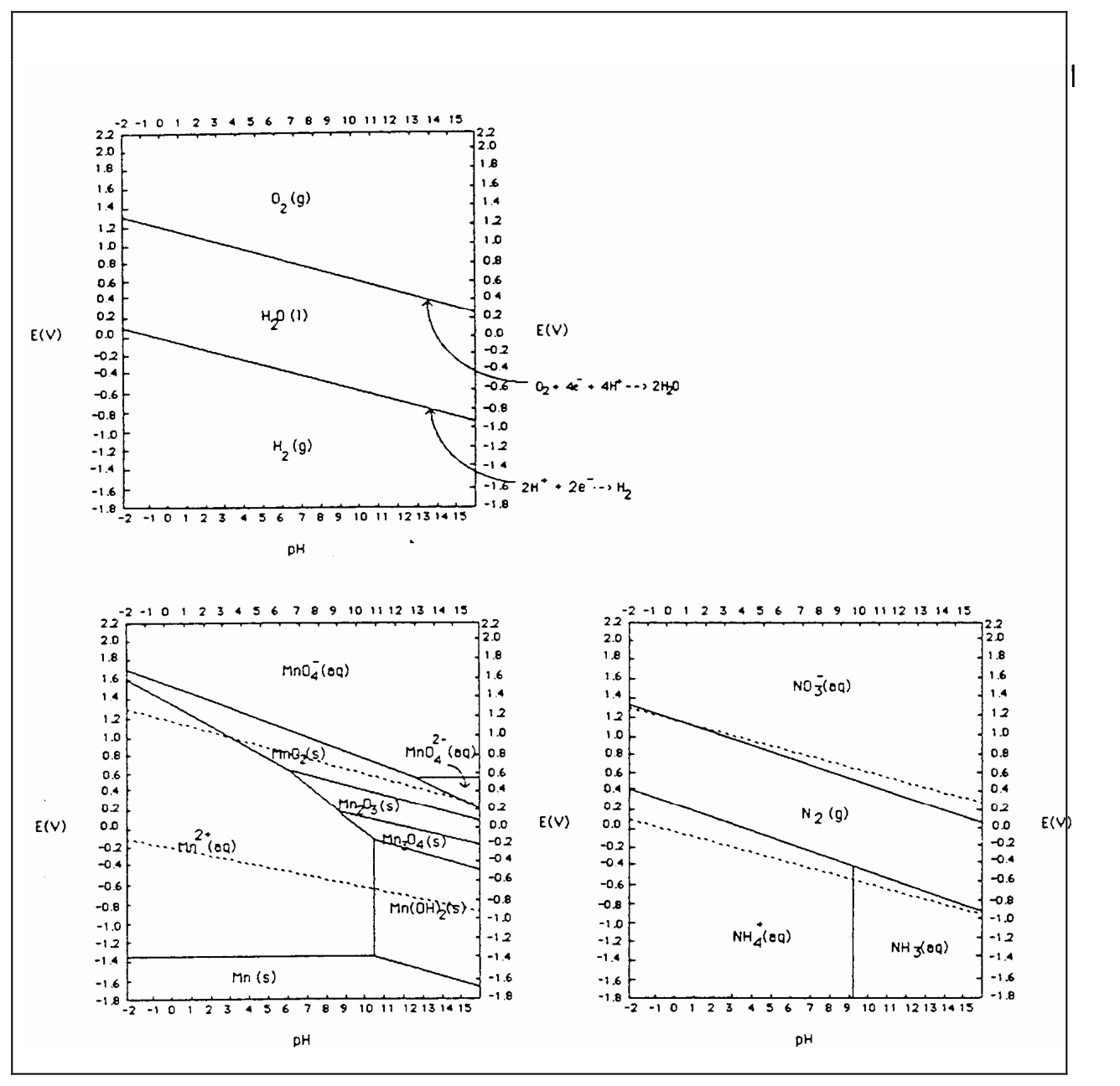
Figure 1
Official English text of the problem.
Answers
Names and SMILES are given at first identification. The manganese oxides, manganese hydroxide, and manganese metal are extended solids, so they have no discrete molecular SMILES representing their solid structures.
- 8.1(i): Nitrate ion, \(\ce{NO3^-}\),
O=[N+]([O-])[O-]. - 8.1(ii): Ammonium ion, \(\ce{NH4+}\),
[NH4+]. - 8.2(i): Manganese(IV) oxide (manganese dioxide), \(\ce{MnO2(s)}\).
- 8.2(ii): Manganese(II) hydroxide, \(\ce{Mn(OH)2(s)}\).
- 8.3(i): Manganese dioxide, \(\ce{MnO2(s)}\).
- 8.3(ii): Manganese(II) ion, \(\ce{Mn^2+(aq)}\),
[Mn+2]. - 8.4(i): Nitrate ion, \(\ce{NO3^-}\), and dinitrogen, \(\ce{N2}\),
N#N. - 8.4(ii): Dinitrogen, \(\ce{N2}\).
- 8.5: Manganese(II,III) oxide, \(\ce{Mn3O4}\); manganese(III) oxide, \(\ce{Mn2O3}\); manganese dioxide, \(\ce{MnO2}\); manganate(VI) ion, \(\ce{MnO4^2-}\),
[O-][Mn](=O)(=O)[O-]; and permanganate ion, \(\ce{MnO4^-}\),[O-][Mn](=O)(=O)=O. - 8.6(i): NO.
- 8.6(ii): NO.
- 8.6(iii): \[ \boxed{\ce{2NH4MnO4 -> 2MnO2 + N2 + 4H2O}} \]
- 8.6(iv): \[ \boxed{\ce{(NH4)2MnO4 -> Mn + N2 + 4H2O}} \]
- 8.7(i): Yes.
- 8.7(ii): No, according to the redox criterion of the diagrams.
- 8.8: \(\boxed{E\approx 1.32\ \mathrm{V}}\) versus the standard hydrogen electrode, assuming \(25^\circ\mathrm{C}\).
Solution
A Pourbaix diagram shows the thermodynamically predominant species as a function of pH and reduction potential. Higher potentials favor oxidized forms; lower potentials favor reduced forms. For the lake questions, oxygen-rich conditions are read near the upper water-stability boundary, while highly oxygen-depleted conditions are interpreted as strongly reducing, near the lower boundary.
Water is \(\ce{H2O}\), SMILES O, and dioxygen is \(\ce{O2}\), SMILES O=O. The manganese oxyanion SMILES above specify formal connectivity and charges; both oxyanions have tetrahedral arrangements of oxygen atoms, which these strings do not depict spatially.
8.1
i) At \(\mathrm{pH}\approx6\), the oxygen/water boundary lies in the nitrate region of the nitrogen diagram. Thus the predominant nitrogen species under oxygen-rich conditions is
\[ \boxed{\ce{NO3^-(aq)}}. \]
ii) At \(\mathrm{pH}\approx3\), strongly reducing conditions lie below the boundary between nitrogen gas and ammonium. The acidic solution also favors ammonium over ammonia. Therefore,
\[ \boxed{\ce{NH4+(aq)}}. \]
8.2
i) At \(\mathrm{pH}\approx6\), the potential associated with oxygen-rich water falls within the manganese dioxide stability region:
\[ \boxed{\ce{MnO2(s)}}. \]
ii) At \(\mathrm{pH}\approx12\), the strongly reducing part of the water-stability region falls within the manganese(II) hydroxide field:
\[ \boxed{\ce{Mn(OH)2(s)}}. \]
Although manganese metal is stable at still lower potentials, its region lies below the lower water-stability boundary.
8.3
i) When the well water stands exposed to air, dissolved oxygen raises its redox potential. At \(\mathrm{pH}\approx5\), this favors insoluble, black manganese dioxide:
\[ \boxed{\ce{MnO2(s)}}. \]
ii) Underground, the water is oxygen-poor and has a lower redox potential. At this pH, dissolved manganese is predominantly
\[ \boxed{\ce{Mn^2+(aq)}}. \]
The precipitation upon aeration can be represented by
\[ \ce{2Mn^2+(aq) + O2(g) + 2H2O(l) -> 2MnO2(s) + 4H+(aq)}. \]
Here \(\ce{H+}\) is the hydrogen ion, SMILES [H+]; in water it represents a solvated proton.
8.4
i) A species can thermodynamically oxidize manganese metal when its reduction potential is above the \(\ce{Mn^2+/Mn}\) boundary at the same pH. Both nitrate and nitrogen gas satisfy this condition:
\[ \boxed{\ce{NO3^-}\ \text{and}\ \ce{N2}}. \]
Nitrate can accept electrons by reduction to a lower nitrogen oxidation state. Nitrogen gas can accept electrons by reduction to ammonium; for example, the corresponding thermodynamic reaction with manganese is
\[ \ce{3Mn(s) + N2(g) + 8H+(aq) -> 3Mn^2+(aq) + 2NH4+(aq)}. \]
ii) The species that does not appreciably oxidize manganese at room temperature is
\[ \boxed{\ce{N2}}. \]
Reduction of nitrogen requires activation of its strong triple bond and has a large kinetic barrier. The Pourbaix diagram predicts thermodynamic favorability, not reaction rate.
8.5
Nitrogen has oxidation state \(-3\) in both ammonia, \(\ce{NH3}\), SMILES N, and ammonium. Conversion to \(\ce{N2}\), where nitrogen has oxidation state \(0\), releases three electrons per nitrogen atom.
The manganese species must therefore accept electrons at a potential above the nitrogen/ammonia or nitrogen/ammonium boundary. Comparison of the diagrams selects
\[ \boxed{\ce{Mn3O4},\ \ce{Mn2O3},\ \ce{MnO2},\ \ce{MnO4^2-},\ \ce{MnO4^-}}. \]
These species contain manganese above oxidation state \(+2\), at least in part:
| Species | Manganese oxidation state |
|---|---|
| \(\ce{Mn3O4}\) | One Mn(II) and two Mn(III) per formula unit |
| \(\ce{Mn2O3}\) | \(+3\) |
| \(\ce{MnO2}\) | \(+4\) |
| \(\ce{MnO4^2-}\) | \(+6\) |
| \(\ce{MnO4^-}\) | \(+7\) |
Their relevant reduction boundaries lie above the nitrogen/\(\mathrm{N}(-III)\) boundary.
The remaining candidates do not qualify. Manganese metal is the reduced form, while reduction of \(\ce{Mn^2+}\) or \(\ce{Mn(OH)2}\) to metal requires potentials below the nitrogen/ammonia–ammonium boundary.
8.6
Ammonium permanganate has the constituent-ion SMILES [NH4+].[O-][Mn](=O)(=O)=O. Ammonium manganate has the constituent-ion SMILES [NH4+].[NH4+].[O-][Mn](=O)(=O)[O-]. These disconnected SMILES describe ionic composition, not crystal packing.
i) NO. The ammonium and permanganate stability regions do not overlap. Ammonium can be oxidized while permanganate is reduced, so internal redox decomposition is thermodynamically favored.
ii) NO. Ammonium and manganate likewise do not have a common stability region and are thermodynamically incompatible.
The existence of an isolable salt does not establish thermodynamic stability: an activation barrier can delay decomposition.
iii) In ammonium permanganate, nitrogen changes from \(-3\) to \(0\), losing three electrons per nitrogen atom. Manganese changes from \(+7\) to \(+4\), gaining three electrons per manganese atom. Two formula units supply the two nitrogen atoms needed for one nitrogen molecule:
\[ \boxed{\ce{2NH4MnO4 -> 2MnO2 + N2 + 4H2O}}. \]
Both sides contain two nitrogen atoms, eight hydrogen atoms, two manganese atoms, and eight oxygen atoms.
iv) In ammonium manganate, two nitrogen atoms each lose three electrons. The manganese atom gains all six electrons, changing from \(+6\) to \(0\). With the products specified in the question,
\[ \boxed{\ce{(NH4)2MnO4 -> Mn + N2 + 4H2O}}. \]
Both sides contain two nitrogen atoms, eight hydrogen atoms, one manganese atom, and four oxygen atoms.
8.7
Potassium nitrate, \(\ce{KNO3}\), has the constituent-ion SMILES [K+].[O-][N+](=O)[O-].
i) Yes. Nitrate is an oxidizing agent and manganese metal is a reducing agent. Their widely separated redox boundaries indicate a favorable redox reaction. Grinding brings them into intimate contact and can help initiate the reaction.
ii) No, according to the diagrams. Oxidizing manganese dioxide to manganate or permanganate requires a higher potential than nitrate reduction provides at the same pH. Thus the diagrams do not predict a favorable redox reaction between potassium nitrate and manganese dioxide.
8.8
First balance the reduction half-reaction:
\[ \ce{MnO4^-(aq) + 4H+(aq) + 3e- -> MnO2(s) + 2H2O(l)}. \]
Thus \(n=3\). Taking the activities of solid manganese dioxide and liquid water as unity,
\[ Q= \frac{1} {a_{\ce{MnO4^-}}\,a_{\ce{H+}}^{\,4}}. \]
Using the concentration approximation for permanganate and the definition of pH,
\[ a_{\ce{MnO4^-}}\approx 1.00\times10^{-3}, \qquad a_{\ce{H+}}=10^{-4.0}. \]
Therefore,
\[ Q=\frac{1}{(10^{-3})(10^{-4})^4}=10^{19}. \]
The Nernst equation at \(25^\circ\mathrm{C}\) is
\[ E=E^\circ-\frac{RT}{nF}\ln Q =E^\circ-\frac{0.05916\ \mathrm{V}}{n}\log_{10}Q. \]
Substitution gives
\[ \begin{aligned} E &=1.692\ \mathrm{V} -\frac{0.05916\ \mathrm{V}}{3}(19)\\ &=1.31732\ \mathrm{V}. \end{aligned} \]
Allowing for the precision of the supplied pH,
\[ \boxed{E\approx1.32\ \mathrm{V}}. \]
The solution was checked against the official solution. Where this solution differs from the official solution, the official solution contains an error or a misprint.
IChO 1992 · Theorieaufgabe 8
Pourbaix-Diagramme von Wasser, Stickstoff und Mangan
Die Pourbaix-Diagramme für Wasser, Stickstoff und Mangan sind in Abb. 1 dargestellt.
8.1 Geben Sie die Formel der Stickstoffspezies an, die vorherrscht
i) in \(\ce{O2}\)-reichen Seen mit \(\mathrm{pH}\approx 6\),
ii) in stark \(\ce{O2}\)-armen Seen, die stark durch sauren Regen belastet sind (\(\mathrm{pH}\approx 3\)),
8.2 Welche Manganspezies herrscht vor
i) in \(\ce{O2}\)-reichen Seen mit \(\mathrm{pH}\approx 6\),
ii) in stark \(\ce{O2}\)-armen Seen, die stark mit Basen verunreinigt sind (\(\mathrm{pH}\approx 12\))?
8.3 Häufig wird beobachtet, dass klares, leicht saures (\(\mathrm{pH}\approx 5\)) Brunnenwasser beim Stehen in Toilettenschüsseln einen schwarzen, manganhaltigen Feststoff abscheidet.
i) Geben Sie die chemische Formel des schwarzen Feststoffs an.
ii) Geben Sie die Formel der Manganspezies an, die im Brunnenwasser vorliegt, solange es sich noch unter der Erde befindet.
8.4 Gemäß den Pourbaix-Diagrammen sollten zwei Stickstoffspezies \(\ce{Mn(s)}\) zu \(\ce{Mn^2+(aq)}\) oxidieren.
i) Geben Sie die Formeln dieser beiden Stickstoffspezies an.
ii) Welche der beiden Stickstoffspezies oxidiert \(\ce{Mn(s)}\) bei Raumtemperatur (in der Praxis) nicht?
8.5 Gemäß den Pourbaix-Diagrammen sollten einige der chemischen Formen von Mangan \(\ce{NH3(aq)}\) oder \(\ce{NH4+(aq)}\) zu \(\ce{N2(g)}\) oxidieren.
Wählen Sie aus der folgenden Liste die Formen von Mn aus, die dazu in der Lage sein sollten:
\[ \ce{Mn},\ \ce{Mn(OH)2},\ \ce{Mn^2+},\ \ce{Mn3O4},\ \ce{Mn2O3},\ \ce{MnO2},\ \ce{MnO4^2-},\ \ce{MnO4^-} \]
8.6 Ammoniumpermanganat, \(\ce{NH4MnO4}\), ist ein wohlbekanntes Salz, während Ammoniummanganat, \(\ce{(NH4)2MnO4}\), ein wenig bekanntes Salz ist.
i) Ist zu erwarten, dass \(\ce{NH4MnO4}\) thermodynamisch stabil ist? (JA oder NEIN)
ii) Ist zu erwarten, dass \(\ce{(NH4)2MnO4}\) thermodynamisch stabil ist? (JA oder NEIN)
iii) Stellen Sie eine ausgeglichene Reaktionsgleichung für die Zersetzung von \(\ce{NH4MnO4}\) zu \(\ce{MnO2}\) und \(\ce{N2}\) auf.
iv) Stellen Sie eine ausgeglichene Reaktionsgleichung für die Zersetzung von \(\ce{(NH4)2MnO4}\) zu \(\ce{Mn}\) und \(\ce{N2}\) auf.
8.7 Ist es gemäß den Pourbaix-Diagrammen gefährlich, die folgenden Stoffe gemeinsam mit einem Pistill im Mörser zu verreiben:
i Kaliumnitrat und metallisches Mangan,
ii) Kaliumnitrat und Mangandioxid?
8.8 Das Standardreduktionspotential \(E^0\) für die Reduktion von \(\ce{MnO4^-}\) zu \(\ce{MnO2}\) beträgt \(1.692\ \mathrm{V}\). Berechnen Sie mithilfe der Nernst-Gleichung das Reduktionspotential \(E\) für die Reduktion einer \(0.00100\ \mathrm{M}\) \(\ce{MnO4^-}\)-Lösung bei einem \(\mathrm{pH}=4.0\).
Abbildung 1
Aufgabentext aus dem offiziellen englischen Text übersetzt.
Antworten
Namen und SMILES werden bei der ersten Identifizierung angegeben. Die Manganoxide, Manganhydroxid und metallisches Mangan sind Feststoffe mit ausgedehnten Strukturen; daher gibt es für sie keine diskreten molekularen SMILES, die ihre Festkörperstrukturen wiedergeben.
- 8.1(i): Nitrat-Ion, \(\ce{NO3^-}\),
O=[N+]([O-])[O-]. - 8.1(ii): Ammonium-Ion, \(\ce{NH4+}\),
[NH4+]. - 8.2(i): Mangan(IV)-oxid (Mangandioxid), \(\ce{MnO2(s)}\).
- 8.2(ii): Mangan(II)-hydroxid, \(\ce{Mn(OH)2(s)}\).
- 8.3(i): Mangandioxid, \(\ce{MnO2(s)}\).
- 8.3(ii): Mangan(II)-Ion, \(\ce{Mn^2+(aq)}\),
[Mn+2]. - 8.4(i): Nitrat-Ion, \(\ce{NO3^-}\), und Distickstoff, \(\ce{N2}\),
N#N. - 8.4(ii): Distickstoff, \(\ce{N2}\).
- 8.5: Mangan(II,III)-oxid, \(\ce{Mn3O4}\); Mangan(III)-oxid, \(\ce{Mn2O3}\); Mangandioxid, \(\ce{MnO2}\); Manganat(VI)-Ion, \(\ce{MnO4^2-}\),
[O-][Mn](=O)(=O)[O-]; und Permanganat-Ion, \(\ce{MnO4^-}\),[O-][Mn](=O)(=O)=O. - 8.6(i): NEIN.
- 8.6(ii): NEIN.
- 8.6(iii): \[ \boxed{\ce{2NH4MnO4 -> 2MnO2 + N2 + 4H2O}} \]
- 8.6(iv): \[ \boxed{\ce{(NH4)2MnO4 -> Mn + N2 + 4H2O}} \]
- 8.7(i): Ja.
- 8.7(ii): Nein, gemäß dem Redoxkriterium der Diagramme.
- 8.8: \(\boxed{E\approx 1.32\ \mathrm{V}}\) gegen die Standardwasserstoffelektrode, unter der Annahme von \(25^\circ\mathrm{C}\).
Lösung
Ein Pourbaix-Diagramm zeigt die thermodynamisch vorherrschende Spezies in Abhängigkeit vom pH-Wert und vom Reduktionspotential. Höhere Potentiale begünstigen oxidierte Formen; niedrigere Potentiale begünstigen reduzierte Formen. Bei den Fragen zu Seen werden sauerstoffreiche Bedingungen nahe der oberen Grenze des Stabilitätsbereichs von Wasser abgelesen, während stark sauerstoffarme Bedingungen als stark reduzierend, nahe der unteren Grenze, aufgefasst werden.
Wasser ist \(\ce{H2O}\), SMILES O, und Disauerstoff ist \(\ce{O2}\), SMILES O=O. Die oben angegebenen SMILES der Mangan-Oxoanionen beschreiben die formale Verknüpfung der Atome und die Ladungen; beide Oxoanionen weisen eine tetraedrische Anordnung der Sauerstoffatome auf, die durch diese Zeichenfolgen nicht räumlich dargestellt wird.
8.1
i) Bei \(\mathrm{pH}\approx6\) liegt die Sauerstoff/Wasser-Grenzlinie im Nitratbereich des Stickstoffdiagramms. Somit ist die unter sauerstoffreichen Bedingungen vorherrschende Stickstoffspezies
\[ \boxed{\ce{NO3^-(aq)}}. \]
ii) Bei \(\mathrm{pH}\approx3\) liegen stark reduzierende Bedingungen unterhalb der Grenzlinie zwischen Stickstoffgas und Ammonium. Die saure Lösung begünstigt zudem Ammonium gegenüber Ammoniak. Daher gilt:
\[ \boxed{\ce{NH4+(aq)}}. \]
8.2
i) Bei \(\mathrm{pH}\approx6\) liegt das zu sauerstoffreichem Wasser gehörende Potential im Stabilitätsbereich von Mangandioxid:
\[ \boxed{\ce{MnO2(s)}}. \]
ii) Bei \(\mathrm{pH}\approx12\) liegt der stark reduzierende Teil des Stabilitätsbereichs von Wasser im Gebiet von Mangan(II)-hydroxid:
\[ \boxed{\ce{Mn(OH)2(s)}}. \]
Obwohl metallisches Mangan bei noch niedrigeren Potentialen stabil ist, liegt sein Gebiet unterhalb der unteren Grenze des Stabilitätsbereichs von Wasser.
8.3
i) Wenn das Brunnenwasser an der Luft steht, erhöht gelöster Sauerstoff sein Redoxpotential. Bei \(\mathrm{pH}\approx5\) begünstigt dies unlösliches, schwarzes Mangandioxid:
\[ \boxed{\ce{MnO2(s)}}. \]
ii) Unter der Erde ist das Wasser sauerstoffarm und hat ein niedrigeres Redoxpotential. Bei diesem pH-Wert liegt gelöstes Mangan überwiegend in folgender Form vor:
\[ \boxed{\ce{Mn^2+(aq)}}. \]
Die Fällung bei Luftzufuhr lässt sich wie folgt darstellen:
\[ \ce{2Mn^2+(aq) + O2(g) + 2H2O(l) -> 2MnO2(s) + 4H+(aq)}. \]
Hier ist \(\ce{H+}\) das Wasserstoff-Ion, SMILES [H+]; in Wasser steht es für ein solvatisiertes Proton.
8.4
i) Eine Spezies kann metallisches Mangan thermodynamisch oxidieren, wenn ihr Reduktionspotential bei demselben pH-Wert oberhalb der \(\ce{Mn^2+/Mn}\)-Grenzlinie liegt. Sowohl Nitrat als auch Stickstoffgas erfüllen diese Bedingung:
\[ \boxed{\ce{NO3^-}\ \text{und}\ \ce{N2}}. \]
Nitrat kann Elektronen aufnehmen, indem es zu einer niedrigeren Oxidationsstufe des Stickstoffs reduziert wird. Stickstoffgas kann durch Reduktion zu Ammonium Elektronen aufnehmen; die entsprechende thermodynamische Reaktion mit Mangan lautet beispielsweise:
\[ \ce{3Mn(s) + N2(g) + 8H+(aq) -> 3Mn^2+(aq) + 2NH4+(aq)}. \]
ii) Die Spezies, die Mangan bei Raumtemperatur nicht in nennenswertem Umfang oxidiert, ist
\[ \boxed{\ce{N2}}. \]
Die Reduktion von Stickstoff erfordert die Aktivierung seiner starken Dreifachbindung und weist eine hohe kinetische Barriere auf. Das Pourbaix-Diagramm sagt die thermodynamische Begünstigung voraus, nicht die Reaktionsgeschwindigkeit.
8.5
Stickstoff hat sowohl in Ammoniak, \(\ce{NH3}\), SMILES N, als auch in Ammonium die Oxidationszahl \(-3\). Bei der Umwandlung zu \(\ce{N2}\), in dem Stickstoff die Oxidationszahl \(0\) hat, werden drei Elektronen pro Stickstoffatom abgegeben.
Die Manganspezies muss daher bei einem Potential oberhalb der Stickstoff/Ammoniak- oder Stickstoff/Ammonium-Grenzlinie Elektronen aufnehmen. Aus dem Vergleich der Diagramme ergeben sich
\[ \boxed{\ce{Mn3O4},\ \ce{Mn2O3},\ \ce{MnO2},\ \ce{MnO4^2-},\ \ce{MnO4^-}}. \]
Diese Spezies enthalten Mangan zumindest teilweise in einer Oxidationsstufe oberhalb von \(+2\):
| Spezies | Oxidationsstufe des Mangans |
|---|---|
| \(\ce{Mn3O4}\) | Ein Mn(II) und zwei Mn(III) pro Formeleinheit |
| \(\ce{Mn2O3}\) | \(+3\) |
| \(\ce{MnO2}\) | \(+4\) |
| \(\ce{MnO4^2-}\) | \(+6\) |
| \(\ce{MnO4^-}\) | \(+7\) |
Ihre maßgeblichen Reduktionsgrenzlinien liegen oberhalb der Stickstoff/\(\mathrm{N}(-III)\)-Grenzlinie.
Die übrigen Kandidaten kommen nicht infrage. Metallisches Mangan ist die reduzierte Form, während die Reduktion von \(\ce{Mn^2+}\) oder \(\ce{Mn(OH)2}\) zum Metall Potentiale unterhalb der Stickstoff/Ammoniak–Ammonium-Grenzlinie erfordert.
8.6
Die SMILES der konstituierenden Ionen von Ammoniumpermanganat lauten [NH4+].[O-][Mn](=O)(=O)=O. Die SMILES der konstituierenden Ionen von Ammoniummanganat lauten [NH4+].[NH4+].[O-][Mn](=O)(=O)[O-]. Diese SMILES mit unverbundenen Komponenten beschreiben die ionische Zusammensetzung, nicht die Kristallpackung.
i) NEIN. Die Stabilitätsbereiche von Ammonium und Permanganat überlappen sich nicht. Ammonium kann oxidiert werden, während Permanganat reduziert wird, sodass eine interne Redoxzersetzung thermodynamisch begünstigt ist.
ii) NEIN. Ammonium und Manganat haben ebenfalls keinen gemeinsamen Stabilitätsbereich und sind thermodynamisch unverträglich.
Die Existenz eines isolierbaren Salzes belegt keine thermodynamische Stabilität: Eine Aktivierungsbarriere kann die Zersetzung verzögern.
iii) In Ammoniumpermanganat geht Stickstoff von \(-3\) zu \(0\) über und gibt dabei drei Elektronen pro Stickstoffatom ab. Mangan geht von \(+7\) zu \(+4\) über und nimmt dabei drei Elektronen pro Manganatom auf. Zwei Formeleinheiten liefern die beiden Stickstoffatome, die für ein Stickstoffmolekül benötigt werden:
\[ \boxed{\ce{2NH4MnO4 -> 2MnO2 + N2 + 4H2O}}. \]
Beide Seiten enthalten zwei Stickstoffatome, acht Wasserstoffatome, zwei Manganatome und acht Sauerstoffatome.
iv) In Ammoniummanganat geben zwei Stickstoffatome jeweils drei Elektronen ab. Das Manganatom nimmt alle sechs Elektronen auf und geht dabei von \(+6\) zu \(0\) über. Mit den in der Aufgabenstellung vorgegebenen Produkten ergibt sich:
\[ \boxed{\ce{(NH4)2MnO4 -> Mn + N2 + 4H2O}}. \]
Beide Seiten enthalten zwei Stickstoffatome, acht Wasserstoffatome, ein Manganatom und vier Sauerstoffatome.
8.7
Die SMILES der konstituierenden Ionen von Kaliumnitrat, \(\ce{KNO3}\), lauten [K+].[O-][N+](=O)[O-].
i) Ja. Nitrat ist ein Oxidationsmittel und metallisches Mangan ein Reduktionsmittel. Ihre weit auseinanderliegenden Redoxgrenzlinien zeigen eine begünstigte Redoxreaktion an. Durch das Verreiben kommen sie in engen Kontakt, was die Einleitung der Reaktion erleichtern kann.
ii) Nein, gemäß den Diagrammen. Die Oxidation von Mangandioxid zu Manganat oder Permanganat erfordert ein höheres Potential, als die Nitratreduktion bei demselben pH-Wert bereitstellt. Daher sagen die Diagramme keine begünstigte Redoxreaktion zwischen Kaliumnitrat und Mangandioxid voraus.
8.8
Zunächst wird die Reduktionshalbreaktion ausgeglichen:
\[ \ce{MnO4^-(aq) + 4H+(aq) + 3e- -> MnO2(s) + 2H2O(l)}. \]
Somit ist \(n=3\). Setzt man die Aktivitäten von festem Mangandioxid und flüssigem Wasser gleich eins, ergibt sich:
\[ Q= \frac{1} {a_{\ce{MnO4^-}}\,a_{\ce{H+}}^{\,4}}. \]
Mit der Konzentrationsnäherung für Permanganat und der Definition des pH-Werts gilt:
\[ a_{\ce{MnO4^-}}\approx 1.00\times10^{-3}, \qquad a_{\ce{H+}}=10^{-4.0}. \]
Daher gilt:
\[ Q=\frac{1}{(10^{-3})(10^{-4})^4}=10^{19}. \]
Die Nernst-Gleichung bei \(25^\circ\mathrm{C}\) lautet:
\[ E=E^\circ-\frac{RT}{nF}\ln Q =E^\circ-\frac{0.05916\ \mathrm{V}}{n}\log_{10}Q. \]
Einsetzen ergibt:
\[ \begin{aligned} E &=1.692\ \mathrm{V} -\frac{0.05916\ \mathrm{V}}{3}(19)\\ &=1.31732\ \mathrm{V}. \end{aligned} \]
Unter Berücksichtigung der Genauigkeit des angegebenen pH-Werts ergibt sich:
\[ \boxed{E\approx1.32\ \mathrm{V}}. \]
Die Lösung wurde mit der offiziellen Lösung abgeglichen. Wo diese Lösung von der offiziellen Lösung abweicht, enthält die offizielle Lösung einen Fehler oder Druckfehler.
IChO 1992 · Teori sorusu 8
Su, azot ve manganın Pourbaix diyagramları
Su, azot ve manganın Pourbaix diyagramları Şekil 1'de gösterilmiştir.
8.1 Aşağıdaki koşullarda baskın olan azot türünün formülünü yazınız:
i) \(\mathrm{pH}\approx 6\) olan, \(\ce{O2}\) bakımından zengin göllerde,
ii) Asit yağmurlarıyla ciddi ölçüde kirlenmiş (\(\mathrm{pH}\approx 3\)), \(\ce{O2}\) bakımından çok fakir göllerde,
8.2 Aşağıdaki koşullarda hangi mangan türü baskındır?
i) \(\mathrm{pH}\approx 6\) olan, \(\ce{O2}\) bakımından zengin göllerde,
ii) Bazlarla ciddi ölçüde kirlenmiş (\(\mathrm{pH}\approx 12\)), \(\ce{O2}\) bakımından çok fakir göllerde?
8.3 İnsanlar, kuyulardan çekilen berrak ve hafif asidik (\(\mathrm{pH}\approx 5\)) suyun klozetlerde beklediğinde mangan içeren siyah bir katı çökelttiğini sıklıkla gözlemler.
i) Siyah katının kimyasal formülünü yazınız.
ii) Kuyu suyu henüz yer altındayken suda bulunan mangan türünün formülünü yazınız.
8.4 Pourbaix diyagramlarına göre iki azot türünün \(\ce{Mn(s)}\)'ı \(\ce{Mn^2+(aq)}\)'a yükseltgemesi beklenir.
i) Bu iki azot türünün formüllerini yazınız.
ii) Bu iki azot türünden hangisi oda sıcaklığında (uygulamada) \(\ce{Mn(s)}\)'ı yükseltgemez?
8.5 Pourbaix diyagramlarına göre manganın bazı kimyasal biçimlerinin \(\ce{NH3(aq)}\) veya \(\ce{NH4+(aq)}\)'ı \(\ce{N2(g)}\)'a yükseltgemesi beklenir.
Aşağıdaki listeden bunu yapması beklenen Mn biçimlerini seçiniz:
\[ \ce{Mn},\ \ce{Mn(OH)2},\ \ce{Mn^2+},\ \ce{Mn3O4},\ \ce{Mn2O3},\ \ce{MnO2},\ \ce{MnO4^2-},\ \ce{MnO4^-} \]
8.6 Amonyum permanganat, \(\ce{NH4MnO4}\), iyi bilinen bir tuzdur; ancak amonyum manganat, \(\ce{(NH4)2MnO4}\), pek bilinmeyen bir tuzdur.
i) \(\ce{NH4MnO4}\)'ın termodinamik olarak kararlı olması beklenir mi? (EVET veya HAYIR)
ii) \(\ce{(NH4)2MnO4}\)'ın termodinamik olarak kararlı olması beklenir mi? (EVET veya HAYIR)
iii) \(\ce{NH4MnO4}\)'ın \(\ce{MnO2}\) ve \(\ce{N2}\) oluşturacak şekilde bozunmasına ilişkin bir denklem yazınız ve denkleştiriniz.
iv) \(\ce{(NH4)2MnO4}\)'ın \(\ce{Mn}\) ve \(\ce{N2}\) oluşturacak şekilde bozunmasına ilişkin bir denklem yazınız ve denkleştiriniz.
8.7 Pourbaix diyagramlarına göre aşağıdaki maddeleri bir havanda havaneliyle birlikte öğütmek tehlikeli midir?
i potasyum nitrat ve mangan metali,
ii) potasyum nitrat ve mangan dioksit?
8.8 \(\ce{MnO4^-}\)'ın \(\ce{MnO2}\)'e indirgenmesi için standart indirgenme potansiyeli, \(E^0\), \(1.692\ \mathrm{V}\)'tur. Nernst denklemini uygulayarak \(\mathrm{pH}=4.0\)'da \(0.00100\ \mathrm{M}\) \(\ce{MnO4^-}\) çözeltisinin indirgenmesi için indirgenme potansiyelini, \(E\), hesaplayınız.
Şekil 1
Soru metni resmi İngilizce metinden çevrilmiştir.
Cevaplar
Adlar ve SMILES gösterimleri, türlerin ilk belirtildiği yerde verilmiştir. Mangan oksitler, mangan hidroksit ve mangan metali, uzanımlı örgü yapısına sahip katılardır; bu nedenle katı yapılarını temsil eden ayrık moleküler SMILES gösterimleri yoktur.
- 8.1(i): Nitrat iyonu, \(\ce{NO3^-}\),
O=[N+]([O-])[O-]. - 8.1(ii): Amonyum iyonu, \(\ce{NH4+}\),
[NH4+]. - 8.2(i): Mangan(IV) oksit (mangan dioksit), \(\ce{MnO2(s)}\).
- 8.2(ii): Mangan(II) hidroksit, \(\ce{Mn(OH)2(s)}\).
- 8.3(i): Mangan dioksit, \(\ce{MnO2(s)}\).
- 8.3(ii): Mangan(II) iyonu, \(\ce{Mn^2+(aq)}\),
[Mn+2]. - 8.4(i): Nitrat iyonu, \(\ce{NO3^-}\), ve diazot, \(\ce{N2}\),
N#N. - 8.4(ii): Diazot, \(\ce{N2}\).
- 8.5: Mangan(II,III) oksit, \(\ce{Mn3O4}\); mangan(III) oksit, \(\ce{Mn2O3}\); mangan dioksit, \(\ce{MnO2}\); manganat(VI) iyonu, \(\ce{MnO4^2-}\),
[O-][Mn](=O)(=O)[O-]; ve permanganat iyonu, \(\ce{MnO4^-}\),[O-][Mn](=O)(=O)=O. - 8.6(i): HAYIR.
- 8.6(ii): HAYIR.
- 8.6(iii): \[ \boxed{\ce{2NH4MnO4 -> 2MnO2 + N2 + 4H2O}} \]
- 8.6(iv): \[ \boxed{\ce{(NH4)2MnO4 -> Mn + N2 + 4H2O}} \]
- 8.7(i): Evet.
- 8.7(ii): Diyagramların redoks ölçütüne göre hayır.
- 8.8: \(25^\circ\mathrm{C}\) varsayılarak, standart hidrojen elektroduna göre \(\boxed{E\approx 1.32\ \mathrm{V}}\).
Çözüm
Bir Pourbaix diyagramı, pH ve indirgenme potansiyelinin fonksiyonu olarak termodinamik açıdan baskın türleri gösterir. Daha yüksek potansiyeller yükseltgenmiş biçimleri, daha düşük potansiyeller ise indirgenmiş biçimleri destekler. Göllerle ilgili sorularda, oksijence zengin koşullar suyun kararlılık bölgesinin üst sınırına yakın bir konumda okunurken, oksijenin çok az olduğu koşullar alt sınıra yakın, kuvvetli indirgen koşullar olarak yorumlanır.
Su, \(\ce{H2O}\), SMILES O; dioksijen ise \(\ce{O2}\), SMILES O=O şeklindedir. Yukarıdaki mangan oksianyonlarının SMILES gösterimleri biçimsel bağlanma düzenini ve yükleri belirtir; her iki oksianyonda da oksijen atomları tetrahedral bir düzende yer alır ve bu dizgiler söz konusu düzeni uzaysal olarak göstermez.
8.1
i) \(\mathrm{pH}\approx6\)'da oksijen/su sınırı, azot diyagramının nitrat bölgesinde yer alır. Dolayısıyla oksijence zengin koşullarda baskın azot türü şudur:
\[ \boxed{\ce{NO3^-(aq)}}. \]
ii) \(\mathrm{pH}\approx3\)'te kuvvetli indirgen koşullar, azot gazı ile amonyum arasındaki sınırın altında yer alır. Asidik çözelti de amonyağa kıyasla amonyumu destekler. Bu nedenle,
\[ \boxed{\ce{NH4+(aq)}}. \]
8.2
i) \(\mathrm{pH}\approx6\)'da oksijence zengin suya karşılık gelen potansiyel, mangan dioksitin kararlılık bölgesine düşer:
\[ \boxed{\ce{MnO2(s)}}. \]
ii) \(\mathrm{pH}\approx12\)'de suyun kararlılık bölgesinin kuvvetli indirgen kısmı, mangan(II) hidroksit bölgesine düşer:
\[ \boxed{\ce{Mn(OH)2(s)}}. \]
Mangan metali daha da düşük potansiyellerde kararlı olsa da onun bölgesi, suyun kararlılık bölgesinin alt sınırının altında yer alır.
8.3
i) Kuyu suyu havayla temas hâlinde beklediğinde, çözünmüş oksijen suyun redoks potansiyelini yükseltir. \(\mathrm{pH}\approx5\)'te bu durum, çözünmeyen siyah mangan dioksitin oluşumunu destekler:
\[ \boxed{\ce{MnO2(s)}}. \]
ii) Yer altında su oksijence fakirdir ve daha düşük bir redoks potansiyeline sahiptir. Bu pH değerinde çözünmüş manganın baskın türü şudur:
\[ \boxed{\ce{Mn^2+(aq)}}. \]
Havalandırma sırasında gerçekleşen çökelme şu şekilde gösterilebilir:
\[ \ce{2Mn^2+(aq) + O2(g) + 2H2O(l) -> 2MnO2(s) + 4H+(aq)}. \]
Burada \(\ce{H+}\), SMILES gösterimi [H+] olan hidrojen iyonudur; suda solvatlanmış bir protonu temsil eder.
8.4
i) Bir türün indirgenme potansiyeli, aynı pH'da \(\ce{Mn^2+/Mn}\) sınırının üzerindeyse bu tür mangan metalini termodinamik olarak yükseltgeyebilir. Hem nitrat hem de azot gazı bu koşulu sağlar:
\[ \boxed{\ce{NO3^-}\ \text{ve}\ \ce{N2}}. \]
Nitrat, azotun daha düşük bir yükseltgenme basamağına indirgenmesi yoluyla elektron alabilir. Azot gazı ise amonyuma indirgenerek elektron alabilir; örneğin manganla buna karşılık gelen termodinamik tepkime şöyledir:
\[ \ce{3Mn(s) + N2(g) + 8H+(aq) -> 3Mn^2+(aq) + 2NH4+(aq)}. \]
ii) Oda sıcaklığında manganı kayda değer ölçüde yükseltgemeyen tür şudur:
\[ \boxed{\ce{N2}}. \]
Azotun indirgenmesi, güçlü üçlü bağının etkinleştirilmesini gerektirir ve büyük bir kinetik engele sahiptir. Pourbaix diyagramı, tepkime hızını değil, termodinamik elverişliliği öngörür.
8.5
Azotun yükseltgenme basamağı hem amonyakta, \(\ce{NH3}\), SMILES N, hem de amonyumda \(-3\)'tür. Azotun yükseltgenme basamağının \(0\) olduğu \(\ce{N2}\)'a dönüşüm, azot atomu başına üç elektron açığa çıkarır.
Bu nedenle mangan türü, azot/amonyak veya azot/amonyum sınırının üzerindeki bir potansiyelde elektron almalıdır. Diyagramlar karşılaştırıldığında şu türler seçilir:
\[ \boxed{\ce{Mn3O4},\ \ce{Mn2O3},\ \ce{MnO2},\ \ce{MnO4^2-},\ \ce{MnO4^-}}. \]
Bu türlerdeki manganın en azından bir kısmının yükseltgenme basamağı \(+2\)'nin üzerindedir:
| Tür | Manganın yükseltgenme basamağı |
|---|---|
| \(\ce{Mn3O4}\) | Formül birimi başına bir Mn(II) ve iki Mn(III) |
| \(\ce{Mn2O3}\) | \(+3\) |
| \(\ce{MnO2}\) | \(+4\) |
| \(\ce{MnO4^2-}\) | \(+6\) |
| \(\ce{MnO4^-}\) | \(+7\) |
Bu türlerin ilgili indirgenme sınırları, azot/\(\mathrm{N}(-III)\) sınırının üzerinde yer alır.
Geriye kalan adaylar bu koşulu sağlamaz. Mangan metali indirgenmiş biçimdir; \(\ce{Mn^2+}\) veya \(\ce{Mn(OH)2}\)'in metale indirgenmesi ise azot/amonyak–amonyum sınırının altında potansiyeller gerektirir.
8.6
Amonyum permanganatı oluşturan iyonların SMILES gösterimi [NH4+].[O-][Mn](=O)(=O)=O şeklindedir. Amonyum manganatı oluşturan iyonların SMILES gösterimi [NH4+].[NH4+].[O-][Mn](=O)(=O)[O-] şeklindedir. Bağlantısız bileşenlerden oluşan bu SMILES gösterimleri, kristal örgüdeki yerleşimi değil, iyonik bileşimi tanımlar.
i) HAYIR. Amonyum ve permanganatın kararlılık bölgeleri örtüşmez. Permanganat indirgenirken amonyum yükseltgenebilir; bu nedenle iç redoks yoluyla bozunma termodinamik olarak elverişlidir.
ii) HAYIR. Benzer şekilde amonyum ve manganatın ortak bir kararlılık bölgesi yoktur ve bu türler termodinamik olarak birbiriyle uyumsuzdur.
İzole edilebilir bir tuzun varlığı, termodinamik kararlılığı kanıtlamaz: bir etkinleşme engeli bozunmayı geciktirebilir.
iii) Amonyum permanganatta azot, azot atomu başına üç elektron vererek \(-3\)'ten \(0\)'a geçer. Mangan, mangan atomu başına üç elektron alarak \(+7\)'den \(+4\)'e geçer. İki formül birimi, bir azot molekülü için gereken iki azot atomunu sağlar:
\[ \boxed{\ce{2NH4MnO4 -> 2MnO2 + N2 + 4H2O}}. \]
Her iki tarafta da iki azot atomu, sekiz hidrojen atomu, iki mangan atomu ve sekiz oksijen atomu bulunur.
iv) Amonyum manganatta iki azot atomunun her biri üç elektron verir. Mangan atomu, altı elektronun tamamını alarak \(+6\)'dan \(0\)'a geçer. Soruda belirtilen ürünlerle,
\[ \boxed{\ce{(NH4)2MnO4 -> Mn + N2 + 4H2O}}. \]
Her iki tarafta da iki azot atomu, sekiz hidrojen atomu, bir mangan atomu ve dört oksijen atomu bulunur.
8.7
Potasyum nitratı, \(\ce{KNO3}\), oluşturan iyonların SMILES gösterimi [K+].[O-][N+](=O)[O-] şeklindedir.
i) Evet. Nitrat bir yükseltgen, mangan metali ise bir indirgendir. Redoks sınırlarının birbirinden oldukça uzak olması, elverişli bir redoks tepkimesine işaret eder. Öğütme, maddelerin yakın temasını sağlar ve tepkimenin başlamasına yardımcı olabilir.
ii) Diyagramlara göre hayır. Mangan dioksitin manganata veya permanganata yükseltgenmesi, aynı pH'da nitratın indirgenmesinin sağladığından daha yüksek bir potansiyel gerektirir. Bu nedenle diyagramlar, potasyum nitrat ile mangan dioksit arasında elverişli bir redoks tepkimesi öngörmez.
8.8
Önce indirgenme yarı tepkimesini denkleştirelim:
\[ \ce{MnO4^-(aq) + 4H+(aq) + 3e- -> MnO2(s) + 2H2O(l)}. \]
Dolayısıyla \(n=3\)'tür. Katı mangan dioksit ve sıvı suyun aktiviteleri bir alınırsa,
\[ Q= \frac{1} {a_{\ce{MnO4^-}}\,a_{\ce{H+}}^{\,4}}. \]
Permanganat için derişim yaklaşımı ve pH tanımı kullanılırsa,
\[ a_{\ce{MnO4^-}}\approx 1.00\times10^{-3}, \qquad a_{\ce{H+}}=10^{-4.0}. \]
Böylece,
\[ Q=\frac{1}{(10^{-3})(10^{-4})^4}=10^{19}. \]
\(25^\circ\mathrm{C}\)'de Nernst denklemi şöyledir:
\[ E=E^\circ-\frac{RT}{nF}\ln Q =E^\circ-\frac{0.05916\ \mathrm{V}}{n}\log_{10}Q. \]
Değerler yerine konulduğunda,
\[ \begin{aligned} E &=1.692\ \mathrm{V} -\frac{0.05916\ \mathrm{V}}{3}(19)\\ &=1.31732\ \mathrm{V}. \end{aligned} \]
Verilen pH değerinin hassasiyeti dikkate alındığında,
\[ \boxed{E\approx1.32\ \mathrm{V}}. \]
Çözüm, resmi çözümle karşılaştırılarak kontrol edildi. Bu çözümün resmi çözümden ayrıldığı yerlerde resmi çözümde bir hata ya da baskı hatası vardır.
IChO 1992 · Problema teórico 8
Diagramas de Pourbaix del agua, el nitrógeno y el manganeso
Los diagramas de Pourbaix del agua, el nitrógeno y el manganeso se muestran en la Fig. 1.
8.1 Escriba la fórmula de la especie de nitrógeno que predomina
i) en lagos ricos en \(\ce{O2}\) con \(\mathrm{pH}\approx 6\),
ii) en lagos con una marcada escasez de \(\ce{O2}\) que están muy contaminados por la lluvia ácida (\(\mathrm{pH}\approx 3\)),
8.2 ¿Qué especie de manganeso predomina
i) en lagos ricos en \(\ce{O2}\) con \(\mathrm{pH}\approx 6\),
ii) en lagos con una marcada escasez de \(\ce{O2}\) que están muy contaminados por bases (\(\mathrm{pH}\approx 12\))?
8.3 A menudo se observa que el agua transparente y ligeramente ácida (\(\mathrm{pH}\approx 5\)) extraída de pozos deposita un sólido negro que contiene manganeso al dejarla reposar en las tazas de los inodoros.
i) Escriba la fórmula química del sólido negro.
ii) Escriba la fórmula de la especie de manganeso presente en el agua de pozo mientras esta se encuentra todavía bajo tierra.
8.4 Según los diagramas de Pourbaix, dos especies de nitrógeno deberían oxidar el \(\ce{Mn(s)}\) a \(\ce{Mn^2+(aq)}\).
i) Escriba las fórmulas de estas dos especies de nitrógeno.
ii) ¿Cuál de las dos especies de nitrógeno no oxida el \(\ce{Mn(s)}\) (en la práctica) a temperatura ambiente?
8.5 Según los diagramas de Pourbaix, algunas de las formas químicas del manganeso deberían oxidar el \(\ce{NH3(aq)}\) o el \(\ce{NH4+(aq)}\) a \(\ce{N2(g)}\).
Seleccione en la siguiente lista las formas de Mn que deberían hacerlo:
\[ \ce{Mn},\ \ce{Mn(OH)2},\ \ce{Mn^2+},\ \ce{Mn3O4},\ \ce{Mn2O3},\ \ce{MnO2},\ \ce{MnO4^2-},\ \ce{MnO4^-} \]
8.6 El permanganato de amonio, \(\ce{NH4MnO4}\), es una sal bien conocida, pero el manganato de amonio, \(\ce{(NH4)2MnO4}\), es una sal poco conocida.
i) ¿Se espera que el \(\ce{NH4MnO4}\) sea termodinámicamente estable? (SÍ o NO)
ii) ¿Se espera que el \(\ce{(NH4)2MnO4}\) sea termodinámicamente estable? (SÍ o NO)
iii) Escriba y ajuste una ecuación para la descomposición del \(\ce{NH4MnO4}\) que produzca \(\ce{MnO2}\) y \(\ce{N2}\).
iv) Escriba y ajuste una ecuación para la descomposición del \(\ce{(NH4)2MnO4}\) que produzca \(\ce{Mn}\) y \(\ce{N2}\).
8.7 Según los diagramas de Pourbaix, ¿es peligroso triturar juntos en un mortero con su mano
i nitrato de potasio y manganeso metálico,
ii) nitrato de potasio y dióxido de manganeso?
8.8 El potencial estándar de reducción, \(E^0\), para la reducción de \(\ce{MnO4^-}\) a \(\ce{MnO2}\) es \(1.692\ \mathrm{V}\). Aplicando la ecuación de Nernst, calcule el potencial de reducción, \(E\), para la reducción de una disolución \(0.00100\ \mathrm{M}\) de \(\ce{MnO4^-}\) a un \(\mathrm{pH}=4.0\).
Figura 1
Enunciado traducido del texto oficial en inglés.
Respuestas
Los nombres y los SMILES se indican cuando se identifica cada especie por primera vez. Los óxidos de manganeso, el hidróxido de manganeso y el manganeso metálico son sólidos de estructura extendida, por lo que no tienen SMILES moleculares discretos que representen sus estructuras sólidas.
- 8.1(i): Ion nitrato, \(\ce{NO3^-}\),
O=[N+]([O-])[O-]. - 8.1(ii): Ion amonio, \(\ce{NH4+}\),
[NH4+]. - 8.2(i): Óxido de manganeso(IV) (dióxido de manganeso), \(\ce{MnO2(s)}\).
- 8.2(ii): Hidróxido de manganeso(II), \(\ce{Mn(OH)2(s)}\).
- 8.3(i): Dióxido de manganeso, \(\ce{MnO2(s)}\).
- 8.3(ii): Ion manganeso(II), \(\ce{Mn^2+(aq)}\),
[Mn+2]. - 8.4(i): Ion nitrato, \(\ce{NO3^-}\), y dinitrógeno, \(\ce{N2}\),
N#N. - 8.4(ii): Dinitrógeno, \(\ce{N2}\).
- 8.5: Óxido de manganeso(II,III), \(\ce{Mn3O4}\); óxido de manganeso(III), \(\ce{Mn2O3}\); dióxido de manganeso, \(\ce{MnO2}\); ion manganato(VI), \(\ce{MnO4^2-}\),
[O-][Mn](=O)(=O)[O-]; e ion permanganato, \(\ce{MnO4^-}\),[O-][Mn](=O)(=O)=O. - 8.6(i): NO.
- 8.6(ii): NO.
- 8.6(iii): \[ \boxed{\ce{2NH4MnO4 -> 2MnO2 + N2 + 4H2O}} \]
- 8.6(iv): \[ \boxed{\ce{(NH4)2MnO4 -> Mn + N2 + 4H2O}} \]
- 8.7(i): Sí.
- 8.7(ii): No, según el criterio redox de los diagramas.
- 8.8: \(\boxed{E\approx 1.32\ \mathrm{V}}\) frente al electrodo estándar de hidrógeno, suponiendo una temperatura de \(25^\circ\mathrm{C}\).
Solución
Un diagrama de Pourbaix muestra la especie termodinámicamente predominante en función del pH y del potencial de reducción. Los potenciales más altos favorecen las formas oxidadas; los potenciales más bajos favorecen las formas reducidas. Para las preguntas sobre los lagos, las condiciones ricas en oxígeno se interpretan cerca del límite superior de estabilidad del agua, mientras que las condiciones de marcada escasez de oxígeno se interpretan como fuertemente reductoras, cerca del límite inferior.
El agua es \(\ce{H2O}\), SMILES O, y el dioxígeno es \(\ce{O2}\), SMILES O=O. Los SMILES de los oxoaniones de manganeso indicados anteriormente especifican la conectividad formal y las cargas; ambos oxoaniones presentan disposiciones tetraédricas de los átomos de oxígeno, que estas cadenas no representan espacialmente.
8.1
i) A \(\mathrm{pH}\approx6\), el límite oxígeno/agua se encuentra en la región del nitrato del diagrama del nitrógeno. Por tanto, la especie de nitrógeno predominante en condiciones ricas en oxígeno es
\[ \boxed{\ce{NO3^-(aq)}}. \]
ii) A \(\mathrm{pH}\approx3\), las condiciones fuertemente reductoras se sitúan por debajo del límite entre el nitrógeno gaseoso y el amonio. La disolución ácida también favorece el amonio frente al amoníaco. Por tanto,
\[ \boxed{\ce{NH4+(aq)}}. \]
8.2
i) A \(\mathrm{pH}\approx6\), el potencial asociado al agua rica en oxígeno se encuentra dentro de la región de estabilidad del dióxido de manganeso:
\[ \boxed{\ce{MnO2(s)}}. \]
ii) A \(\mathrm{pH}\approx12\), la parte fuertemente reductora de la región de estabilidad del agua se encuentra dentro del dominio del hidróxido de manganeso(II):
\[ \boxed{\ce{Mn(OH)2(s)}}. \]
Aunque el manganeso metálico es estable a potenciales aún más bajos, su región se encuentra por debajo del límite inferior de estabilidad del agua.
8.3
i) Cuando el agua de pozo se deja reposar expuesta al aire, el oxígeno disuelto eleva su potencial redox. A \(\mathrm{pH}\approx5\), esto favorece el dióxido de manganeso, negro e insoluble:
\[ \boxed{\ce{MnO2(s)}}. \]
ii) Bajo tierra, el agua es pobre en oxígeno y tiene un potencial redox más bajo. A este pH, el manganeso disuelto se encuentra predominantemente como
\[ \boxed{\ce{Mn^2+(aq)}}. \]
La precipitación al airear puede representarse mediante
\[ \ce{2Mn^2+(aq) + O2(g) + 2H2O(l) -> 2MnO2(s) + 4H+(aq)}. \]
Aquí, \(\ce{H+}\) es el ion hidrógeno, SMILES [H+]; en agua representa un protón solvatado.
8.4
i) Una especie puede oxidar termodinámicamente el manganeso metálico cuando su potencial de reducción está por encima del límite \(\ce{Mn^2+/Mn}\) al mismo pH. Tanto el nitrato como el nitrógeno gaseoso satisfacen esta condición:
\[ \boxed{\ce{NO3^-}\ \text{y}\ \ce{N2}}. \]
El nitrato puede aceptar electrones al reducirse a un estado de oxidación inferior del nitrógeno. El nitrógeno gaseoso puede aceptar electrones al reducirse a amonio; por ejemplo, la reacción termodinámica correspondiente con el manganeso es
\[ \ce{3Mn(s) + N2(g) + 8H+(aq) -> 3Mn^2+(aq) + 2NH4+(aq)}. \]
ii) La especie que no oxida apreciablemente el manganeso a temperatura ambiente es
\[ \boxed{\ce{N2}}. \]
La reducción del nitrógeno requiere la activación de su fuerte enlace triple y presenta una elevada barrera cinética. El diagrama de Pourbaix predice si una reacción es termodinámicamente favorable, no su velocidad.
8.5
El nitrógeno tiene estado de oxidación \(-3\) tanto en el amoníaco, \(\ce{NH3}\), SMILES N, como en el amonio. La conversión a \(\ce{N2}\), donde el nitrógeno tiene estado de oxidación \(0\), libera tres electrones por átomo de nitrógeno.
Por tanto, la especie de manganeso debe aceptar electrones a un potencial superior al límite nitrógeno/amoníaco o nitrógeno/amonio. La comparación de los diagramas permite seleccionar
\[ \boxed{\ce{Mn3O4},\ \ce{Mn2O3},\ \ce{MnO2},\ \ce{MnO4^2-},\ \ce{MnO4^-}}. \]
Estas especies contienen manganeso con un estado de oxidación superior a \(+2\), al menos en parte:
| Especie | Estado de oxidación del manganeso |
|---|---|
| \(\ce{Mn3O4}\) | Un Mn(II) y dos Mn(III) por unidad fórmula |
| \(\ce{Mn2O3}\) | \(+3\) |
| \(\ce{MnO2}\) | \(+4\) |
| \(\ce{MnO4^2-}\) | \(+6\) |
| \(\ce{MnO4^-}\) | \(+7\) |
Sus límites de reducción pertinentes se encuentran por encima del límite nitrógeno/\(\mathrm{N}(-III)\).
Los demás candidatos no cumplen la condición. El manganeso metálico es la forma reducida, mientras que la reducción de \(\ce{Mn^2+}\) o \(\ce{Mn(OH)2}\) a metal requiere potenciales inferiores al límite nitrógeno/amoníaco–amonio.
8.6
El permanganato de amonio tiene el SMILES de sus iones constituyentes [NH4+].[O-][Mn](=O)(=O)=O. El manganato de amonio tiene el SMILES de sus iones constituyentes [NH4+].[NH4+].[O-][Mn](=O)(=O)[O-]. Estos SMILES desconectados describen la composición iónica, no el empaquetamiento cristalino.
i) NO. Las regiones de estabilidad del amonio y del permanganato no se solapan. El amonio puede oxidarse mientras el permanganato se reduce, por lo que la descomposición redox interna está termodinámicamente favorecida.
ii) NO. Del mismo modo, el amonio y el manganato no tienen una región de estabilidad común y son termodinámicamente incompatibles.
La existencia de una sal que puede aislarse no demuestra su estabilidad termodinámica: una barrera de activación puede retrasar la descomposición.
iii) En el permanganato de amonio, el nitrógeno pasa de \(-3\) a \(0\), perdiendo tres electrones por átomo de nitrógeno. El manganeso pasa de \(+7\) a \(+4\), ganando tres electrones por átomo de manganeso. Dos unidades fórmula aportan los dos átomos de nitrógeno necesarios para una molécula de nitrógeno:
\[ \boxed{\ce{2NH4MnO4 -> 2MnO2 + N2 + 4H2O}}. \]
Ambos miembros contienen dos átomos de nitrógeno, ocho átomos de hidrógeno, dos átomos de manganeso y ocho átomos de oxígeno.
iv) En el manganato de amonio, cada uno de los dos átomos de nitrógeno pierde tres electrones. El átomo de manganeso gana los seis electrones, pasando de \(+6\) a \(0\). Con los productos especificados en la pregunta,
\[ \boxed{\ce{(NH4)2MnO4 -> Mn + N2 + 4H2O}}. \]
Ambos miembros contienen dos átomos de nitrógeno, ocho átomos de hidrógeno, un átomo de manganeso y cuatro átomos de oxígeno.
8.7
El nitrato de potasio, \(\ce{KNO3}\), tiene el SMILES de sus iones constituyentes [K+].[O-][N+](=O)[O-].
i) Sí. El nitrato es un agente oxidante y el manganeso metálico es un agente reductor. Sus límites redox, ampliamente separados, indican una reacción redox favorable. La trituración los pone en contacto íntimo y puede ayudar a iniciar la reacción.
ii) No, según los diagramas. La oxidación del dióxido de manganeso a manganato o permanganato requiere un potencial mayor que el que proporciona la reducción del nitrato al mismo pH. Por tanto, los diagramas no predicen una reacción redox favorable entre el nitrato de potasio y el dióxido de manganeso.
8.8
Primero se ajusta la semirreacción de reducción:
\[ \ce{MnO4^-(aq) + 4H+(aq) + 3e- -> MnO2(s) + 2H2O(l)}. \]
Por tanto, \(n=3\). Tomando como unidad las actividades del dióxido de manganeso sólido y del agua líquida,
\[ Q= \frac{1} {a_{\ce{MnO4^-}}\,a_{\ce{H+}}^{\,4}}. \]
Utilizando la aproximación de la actividad por la concentración para el permanganato y la definición de pH,
\[ a_{\ce{MnO4^-}}\approx 1.00\times10^{-3}, \qquad a_{\ce{H+}}=10^{-4.0}. \]
Por tanto,
\[ Q=\frac{1}{(10^{-3})(10^{-4})^4}=10^{19}. \]
La ecuación de Nernst a \(25^\circ\mathrm{C}\) es
\[ E=E^\circ-\frac{RT}{nF}\ln Q =E^\circ-\frac{0.05916\ \mathrm{V}}{n}\log_{10}Q. \]
La sustitución da
\[ \begin{aligned} E &=1.692\ \mathrm{V} -\frac{0.05916\ \mathrm{V}}{3}(19)\\ &=1.31732\ \mathrm{V}. \end{aligned} \]
Teniendo en cuenta la precisión del pH proporcionado,
\[ \boxed{E\approx1.32\ \mathrm{V}}. \]
La solución se comprobó con la solución oficial. Donde esta solución difiere de la solución oficial, la solución oficial contiene un error o una errata.
IChO 1992 · 理论题 8
水、氮和锰的 Pourbaix 图
水、氮和锰的 Pourbaix 图如图 1 所示。
8.1 写出下列条件下占优势的氮物种的化学式
i) 在富含 \(\ce{O2}\)、\(\mathrm{pH}\approx 6\) 的湖泊中,
ii) 在 \(\ce{O2}\) 严重匮乏且受酸雨严重污染(\(\mathrm{pH}\approx 3\))的湖泊中,
8.2 下列条件下哪种锰物种占优势
i) 在富含 \(\ce{O2}\)、\(\mathrm{pH}\approx 6\) 的湖泊中,
ii) 在 \(\ce{O2}\) 严重匮乏且受碱严重污染(\(\mathrm{pH}\approx 12\))的湖泊中?
8.3 人们常发现,从井中抽出的清澈、微酸性(\(\mathrm{pH}\approx 5\))水在抽水马桶内静置后,会析出一种含锰的黑色固体。
i) 写出这种黑色固体的化学式。
ii) 写出井水尚在地下时其中所含锰物种的化学式。
8.4 根据 Pourbaix 图,两种氮物种应能将 \(\ce{Mn(s)}\) 氧化为 \(\ce{Mn^2+(aq)}\)。
i) 写出这两种氮物种的化学式。
ii) 这两种氮物种中的哪一种在室温下(实际上)不能氧化 \(\ce{Mn(s)}\)?
8.5 根据 Pourbaix 图,锰的某些化学形态应能将 \(\ce{NH3(aq)}\) 或 \(\ce{NH4+(aq)}\) 氧化为 \(\ce{N2(g)}\)。
从以下列表中选出应能实现上述氧化的 Mn 的形态:
\[ \ce{Mn},\ \ce{Mn(OH)2},\ \ce{Mn^2+},\ \ce{Mn3O4},\ \ce{Mn2O3},\ \ce{MnO2},\ \ce{MnO4^2-},\ \ce{MnO4^-} \]
8.6 高锰酸铵 \(\ce{NH4MnO4}\) 是一种广为人知的盐,而锰酸铵 \(\ce{(NH4)2MnO4}\) 则是一种鲜为人知的盐。
i) 预计 \(\ce{NH4MnO4}\) 在热力学上稳定吗?(是或否)
ii) 预计 \(\ce{(NH4)2MnO4}\) 在热力学上稳定吗?(是或否)
iii) 写出 \(\ce{NH4MnO4}\) 分解生成 \(\ce{MnO2}\) 和 \(\ce{N2}\) 的反应方程式,并配平。
iv) 写出 \(\ce{(NH4)2MnO4}\) 分解生成 \(\ce{Mn}\) 和 \(\ce{N2}\) 的反应方程式,并配平。
8.7 根据 Pourbaix 图,用研钵和研杵将下列物质一起研磨是否危险
i 硝酸钾和金属锰,
ii) 硝酸钾和二氧化锰?
8.8 \(\ce{MnO4^-}\) 还原为 \(\ce{MnO2}\) 的标准还原电势 \(E^0\) 为 \(1.692\ \mathrm{V}\)。应用能斯特方程,计算 \(\mathrm{pH}=4.0\) 时 \(0.00100\ \mathrm{M}\) 的 \(\ce{MnO4^-}\) 溶液发生该还原反应的还原电势 \(E\)。
图 1
题目译自官方英文原文。
答案
各物种首次出现时给出名称和 SMILES。锰的氧化物、氢氧化物以及金属锰均为具有延展结构的固体,因此不存在可表示其固态结构的独立分子 SMILES。
- 8.1(i): 硝酸根离子,\(\ce{NO3^-}\),
O=[N+]([O-])[O-]。 - 8.1(ii): 铵离子,\(\ce{NH4+}\),
[NH4+]。 - 8.2(i): 氧化锰(IV)(二氧化锰),\(\ce{MnO2(s)}\)。
- 8.2(ii): 氢氧化锰(II),\(\ce{Mn(OH)2(s)}\)。
- 8.3(i): 二氧化锰,\(\ce{MnO2(s)}\)。
- 8.3(ii): 锰(II)离子,\(\ce{Mn^2+(aq)}\),
[Mn+2]。 - 8.4(i): 硝酸根离子,\(\ce{NO3^-}\),和氮气,\(\ce{N2}\),
N#N。 - 8.4(ii): 氮气,\(\ce{N2}\)。
- 8.5: 氧化锰(II,III),\(\ce{Mn3O4}\);氧化锰(III),\(\ce{Mn2O3}\);二氧化锰,\(\ce{MnO2}\);锰酸(VI)根离子,\(\ce{MnO4^2-}\),
[O-][Mn](=O)(=O)[O-];以及高锰酸根离子,\(\ce{MnO4^-}\),[O-][Mn](=O)(=O)=O。 - 8.6(i): 否。
- 8.6(ii): 否。
- 8.6(iii): \[ \boxed{\ce{2NH4MnO4 -> 2MnO2 + N2 + 4H2O}} \]
- 8.6(iv): \[ \boxed{\ce{(NH4)2MnO4 -> Mn + N2 + 4H2O}} \]
- 8.7(i): 是。
- 8.7(ii): 根据图中的氧化还原判据,否。
- 8.8: 假设温度为 \(25^\circ\mathrm{C}\),相对于标准氢电极,\(\boxed{E\approx 1.32\ \mathrm{V}}\)。
解答
Pourbaix 图表示在不同 pH 和还原电势下,热力学上占优势的物种。较高的电势有利于氧化态物种;较低的电势有利于还原态物种。对于有关湖泊的问题,富氧条件应在水稳定区的上边界附近读取,而严重缺氧条件则理解为接近下边界的强还原性条件。
水为 \(\ce{H2O}\),SMILES 为 O;氧气为 \(\ce{O2}\),SMILES 为 O=O。上文中锰的含氧阴离子的 SMILES 表示形式上的连接关系和电荷;这两种含氧阴离子中的氧原子均呈四面体排列,而这些字符串并未描绘其空间构型。
8.1
i) 在 \(\mathrm{pH}\approx6\) 时,氧气/水边界位于氮的 Pourbaix 图中的硝酸根区域。因此,富氧条件下占优势的氮物种为
\[ \boxed{\ce{NO3^-(aq)}}. \]
ii) 在 \(\mathrm{pH}\approx3\) 时,强还原性条件位于氮气与铵离子之间的边界下方。酸性溶液也更有利于铵离子而非氨的存在。因此,
\[ \boxed{\ce{NH4+(aq)}}. \]
8.2
i) 在 \(\mathrm{pH}\approx6\) 时,富氧水对应的电势落在二氧化锰的稳定区内:
\[ \boxed{\ce{MnO2(s)}}. \]
ii) 在 \(\mathrm{pH}\approx12\) 时,水稳定区中强还原性的部分落在氢氧化锰(II)的区域内:
\[ \boxed{\ce{Mn(OH)2(s)}}. \]
虽然金属锰在更低的电势下稳定,但其区域位于水稳定区下边界的下方。
8.3
i) 当井水暴露于空气中静置时,溶解氧使其氧化还原电势升高。在 \(\mathrm{pH}\approx5\) 时,这有利于生成难溶的黑色二氧化锰:
\[ \boxed{\ce{MnO2(s)}}. \]
ii) 在地下,水中缺氧,氧化还原电势较低。在此 pH 下,溶解态锰主要为
\[ \boxed{\ce{Mn^2+(aq)}}. \]
通气时发生的沉淀反应可表示为
\[ \ce{2Mn^2+(aq) + O2(g) + 2H2O(l) -> 2MnO2(s) + 4H+(aq)}. \]
这里,\(\ce{H+}\) 为氢离子,SMILES 为 [H+];在水中,它表示溶剂化质子。
8.4
i) 当一种物种的还原电势高于相同 pH 下的 \(\ce{Mn^2+/Mn}\) 边界时,从热力学上看,该物种能够氧化金属锰。硝酸根和氮气都满足这一条件:
\[ \boxed{\ce{NO3^-}\ \text{和}\ \ce{N2}}. \]
硝酸根可通过还原为氮处于较低氧化态的物种而接受电子。氮气可通过还原为铵离子而接受电子;例如,与锰发生的相应热力学反应为
\[ \ce{3Mn(s) + N2(g) + 8H+(aq) -> 3Mn^2+(aq) + 2NH4+(aq)}. \]
ii) 在室温下不能显著氧化锰的物种是
\[ \boxed{\ce{N2}}. \]
氮气的还原需要活化其牢固的三键,存在很高的动力学能垒。Pourbaix 图预测的是热力学上的有利性,而非反应速率。
8.5
在氨(\(\ce{NH3}\),SMILES 为 N)和铵离子中,氮的氧化态均为 \(-3\)。转化为氮的氧化态为 \(0\) 的 \(\ce{N2}\) 时,每个氮原子释放三个电子。
因此,锰物种必须能在高于氮气/氨或氮气/铵离子边界的电势下接受电子。比较各图,可选出
\[ \boxed{\ce{Mn3O4},\ \ce{Mn2O3},\ \ce{MnO2},\ \ce{MnO4^2-},\ \ce{MnO4^-}}. \]
这些物种中的锰至少有一部分处于高于 \(+2\) 的氧化态:
| 物种 | 锰的氧化态 |
|---|---|
| \(\ce{Mn3O4}\) | 每个化学式单位含一个 Mn(II) 和两个 Mn(III) |
| \(\ce{Mn2O3}\) | \(+3\) |
| \(\ce{MnO2}\) | \(+4\) |
| \(\ce{MnO4^2-}\) | \(+6\) |
| \(\ce{MnO4^-}\) | \(+7\) |
它们相关的还原边界位于氮气/\(\mathrm{N}(-III)\) 边界的上方。
其余候选物种不符合条件。金属锰是还原态,而将 \(\ce{Mn^2+}\) 或 \(\ce{Mn(OH)2}\) 还原为金属所需的电势低于氮气/氨–铵离子边界。
8.6
高锰酸铵的组成离子的 SMILES 为 [NH4+].[O-][Mn](=O)(=O)=O。锰酸铵的组成离子的 SMILES 为 [NH4+].[NH4+].[O-][Mn](=O)(=O)[O-]。这些由不相连片段组成的 SMILES 描述的是离子组成,而非晶体堆积方式。
i) 否。 铵离子和高锰酸根的稳定区没有重叠。铵离子可被氧化,同时高锰酸根被还原,因此内部氧化还原分解在热力学上是有利的。
ii) 否。 铵离子与锰酸根同样没有共同的稳定区,在热力学上不能稳定共存。
一种盐能够被分离出来,并不能证明其具有热力学稳定性:活化能垒可以延缓分解。
iii) 在高锰酸铵中,氮从 \(-3\) 变为 \(0\),每个氮原子失去三个电子。锰从 \(+7\) 变为 \(+4\),每个锰原子得到三个电子。两个化学式单位提供形成一个氮气分子所需的两个氮原子:
\[ \boxed{\ce{2NH4MnO4 -> 2MnO2 + N2 + 4H2O}}. \]
两边均含有两个氮原子、八个氢原子、两个锰原子和八个氧原子。
iv) 在锰酸铵中,两个氮原子各失去三个电子。锰原子得到全部六个电子,从 \(+6\) 变为 \(0\)。按照题目指定的产物,
\[ \boxed{\ce{(NH4)2MnO4 -> Mn + N2 + 4H2O}}. \]
两边均含有两个氮原子、八个氢原子、一个锰原子和四个氧原子。
8.7
硝酸钾 \(\ce{KNO3}\) 的组成离子的 SMILES 为 [K+].[O-][N+](=O)[O-]。
i) 是。 硝酸根是氧化剂,金属锰是还原剂。二者的氧化还原边界相距很远,表明氧化还原反应在热力学上有利。研磨使它们紧密接触,并可能有助于引发反应。
ii) 根据图示,否。 将二氧化锰氧化为锰酸根或高锰酸根所需的电势,高于相同 pH 下硝酸根还原所能提供的电势。因此,这些图并未预测硝酸钾与二氧化锰之间存在热力学上有利的氧化还原反应。
8.8
首先配平还原半反应:
\[ \ce{MnO4^-(aq) + 4H+(aq) + 3e- -> MnO2(s) + 2H2O(l)}. \]
因此,\(n=3\)。将固体二氧化锰和液态水的活度取为 1,
\[ Q= \frac{1} {a_{\ce{MnO4^-}}\,a_{\ce{H+}}^{\,4}}. \]
对高锰酸根采用浓度近似,并利用 pH 的定义,
\[ a_{\ce{MnO4^-}}\approx 1.00\times10^{-3}, \qquad a_{\ce{H+}}=10^{-4.0}. \]
因此,
\[ Q=\frac{1}{(10^{-3})(10^{-4})^4}=10^{19}. \]
\(25^\circ\mathrm{C}\) 时的能斯特方程为
\[ E=E^\circ-\frac{RT}{nF}\ln Q =E^\circ-\frac{0.05916\ \mathrm{V}}{n}\log_{10}Q. \]
代入得
\[ \begin{aligned} E &=1.692\ \mathrm{V} -\frac{0.05916\ \mathrm{V}}{3}(19)\\ &=1.31732\ \mathrm{V}. \end{aligned} \]
考虑到所给 pH 的精度,
\[ \boxed{E\approx1.32\ \mathrm{V}}. \]
解答已与官方解答核对。本解答与官方解答不同之处,均为官方解答中的错误或印刷错误。
IChO 1992 · Теоретическая задача 8
Диаграммы Пурбе для воды, азота и марганца
Диаграммы Пурбе для воды, азота и марганца представлены на рис. 1.
8.1 Напишите формулу преобладающей химической формы азота
i) в озёрах, богатых \(\ce{O2}\), при \(\mathrm{pH}\approx 6\),
ii) в озёрах с очень низким содержанием \(\ce{O2}\), сильно загрязнённых кислотными дождями (\(\mathrm{pH}\approx 3\)),
8.2 Какая химическая форма марганца преобладает
i) в озёрах, богатых \(\ce{O2}\), при \(\mathrm{pH}\approx 6\),
ii) в озёрах с очень низким содержанием \(\ce{O2}\), сильно загрязнённых основаниями (\(\mathrm{pH}\approx 12\))?
8.3 Часто можно наблюдать, как из прозрачной слабокислой (\(\mathrm{pH}\approx 5\)) колодезной воды при стоянии в чаше унитаза выпадает чёрный твёрдый осадок, содержащий марганец.
i) Напишите химическую формулу этого чёрного твёрдого вещества.
ii) Напишите формулу химической формы марганца, присутствующей в колодезной воде, пока она ещё находится под землёй.
8.4 Согласно диаграммам Пурбе, две химические формы азота должны окислять \(\ce{Mn(s)}\) до \(\ce{Mn^2+(aq)}\).
i) Напишите формулы этих двух химических форм азота.
ii) Какая из этих двух химических форм азота на практике не окисляет \(\ce{Mn(s)}\) при комнатной температуре?
8.5 Согласно диаграммам Пурбе, некоторые химические формы марганца должны окислять \(\ce{NH3(aq)}\) или \(\ce{NH4+(aq)}\) до \(\ce{N2(g)}\).
Выберите из следующего списка формы Mn, которые должны осуществлять такое окисление:
\[ \ce{Mn},\ \ce{Mn(OH)2},\ \ce{Mn^2+},\ \ce{Mn3O4},\ \ce{Mn2O3},\ \ce{MnO2},\ \ce{MnO4^2-},\ \ce{MnO4^-} \]
8.6 Перманганат аммония, \(\ce{NH4MnO4}\), — хорошо известная соль, тогда как манганат аммония, \(\ce{(NH4)2MnO4}\), — малоизвестная соль.
i) Ожидается ли, что \(\ce{NH4MnO4}\) термодинамически устойчив? (ДА или НЕТ)
ii) Ожидается ли, что \(\ce{(NH4)2MnO4}\) термодинамически устойчив? (ДА или НЕТ)
iii) Напишите и уравняйте уравнение разложения \(\ce{NH4MnO4}\) с образованием \(\ce{MnO2}\) и \(\ce{N2}\).
iv) Напишите и уравняйте уравнение разложения \(\ce{(NH4)2MnO4}\) с образованием \(\ce{Mn}\) и \(\ce{N2}\).
8.7 Согласно диаграммам Пурбе, опасно ли совместно растирать в ступке пестиком
i нитрат калия и металлический марганец,
ii) нитрат калия и диоксид марганца?
8.8 Стандартный потенциал восстановления, \(E^0\), для восстановления \(\ce{MnO4^-}\) до \(\ce{MnO2}\) равен \(1.692\ \mathrm{V}\). Применяя уравнение Нернста, рассчитайте потенциал восстановления, \(E\), для восстановления раствора с концентрацией \(0.00100\ \mathrm{M}\) \(\ce{MnO4^-}\) при \(\mathrm{pH}=4.0\).
Рисунок 1
Условие переведено с официального английского текста.
Ответы
Названия и SMILES приведены при первом указании соответствующего вещества или иона. Оксиды марганца, гидроксид марганца и металлический марганец представляют собой твёрдые вещества с протяжёнными структурами, поэтому для них нет SMILES отдельных молекул, которые представляли бы их структуру в твёрдом состоянии.
- 8.1(i): Нитрат-ион, \(\ce{NO3^-}\),
O=[N+]([O-])[O-]. - 8.1(ii): Ион аммония, \(\ce{NH4+}\),
[NH4+]. - 8.2(i): Оксид марганца(IV) (диоксид марганца), \(\ce{MnO2(s)}\).
- 8.2(ii): Гидроксид марганца(II), \(\ce{Mn(OH)2(s)}\).
- 8.3(i): Диоксид марганца, \(\ce{MnO2(s)}\).
- 8.3(ii): Ион марганца(II), \(\ce{Mn^2+(aq)}\),
[Mn+2]. - 8.4(i): Нитрат-ион, \(\ce{NO3^-}\), и молекулярный азот, \(\ce{N2}\),
N#N. - 8.4(ii): Молекулярный азот, \(\ce{N2}\).
- 8.5: Оксид марганца(II,III), \(\ce{Mn3O4}\); оксид марганца(III), \(\ce{Mn2O3}\); диоксид марганца, \(\ce{MnO2}\); манганат(VI)-ион, \(\ce{MnO4^2-}\),
[O-][Mn](=O)(=O)[O-]; и перманганат-ион, \(\ce{MnO4^-}\),[O-][Mn](=O)(=O)=O. - 8.6(i): НЕТ.
- 8.6(ii): НЕТ.
- 8.6(iii): \[ \boxed{\ce{2NH4MnO4 -> 2MnO2 + N2 + 4H2O}} \]
- 8.6(iv): \[ \boxed{\ce{(NH4)2MnO4 -> Mn + N2 + 4H2O}} \]
- 8.7(i): Да.
- 8.7(ii): Нет, согласно окислительно-восстановительному критерию диаграмм.
- 8.8: \(\boxed{E\approx 1.32\ \mathrm{V}}\) относительно стандартного водородного электрода, при условии температуры \(25^\circ\mathrm{C}\).
Решение
Диаграмма Пурбе показывает термодинамически преобладающие химические формы в зависимости от pH и потенциала восстановления. Более высокие потенциалы благоприятствуют окисленным формам, более низкие — восстановленным. В вопросах об озёрах условия с высоким содержанием кислорода рассматривают вблизи верхней границы области устойчивости воды, а условия с очень низким содержанием кислорода трактуют как сильно восстановительные, вблизи нижней границы.
Вода — это \(\ce{H2O}\), SMILES O, а молекулярный кислород — \(\ce{O2}\), SMILES O=O. Приведённые выше SMILES кислородсодержащих анионов марганца задают формальные связи между атомами и заряды; в обоих анионах атомы кислорода расположены тетраэдрически, однако эти строки не отображают их пространственное расположение.
8.1
i) При \(\mathrm{pH}\approx6\) граница кислород/вода проходит в области нитрат-иона на диаграмме азота. Следовательно, при высоком содержании кислорода преобладающей химической формой азота является
\[ \boxed{\ce{NO3^-(aq)}}. \]
ii) При \(\mathrm{pH}\approx3\) сильно восстановительные условия соответствуют области ниже границы между газообразным азотом и ионом аммония. Кислая среда также благоприятствует иону аммония по сравнению с аммиаком. Поэтому
\[ \boxed{\ce{NH4+(aq)}}. \]
8.2
i) При \(\mathrm{pH}\approx6\) потенциал, соответствующий воде с высоким содержанием кислорода, находится в области устойчивости диоксида марганца:
\[ \boxed{\ce{MnO2(s)}}. \]
ii) При \(\mathrm{pH}\approx12\) сильно восстановительная часть области устойчивости воды попадает в область гидроксида марганца(II):
\[ \boxed{\ce{Mn(OH)2(s)}}. \]
Хотя металлический марганец устойчив при ещё более низких потенциалах, его область лежит ниже нижней границы области устойчивости воды.
8.3
i) Когда колодезная вода стоит в контакте с воздухом, растворённый кислород повышает её окислительно-восстановительный потенциал. При \(\mathrm{pH}\approx5\) это благоприятствует образованию нерастворимого чёрного диоксида марганца:
\[ \boxed{\ce{MnO2(s)}}. \]
ii) Под землёй вода содержит мало кислорода и имеет более низкий окислительно-восстановительный потенциал. При этом pH растворённый марганец присутствует преимущественно в форме
\[ \boxed{\ce{Mn^2+(aq)}}. \]
Выпадение осадка при аэрации можно представить уравнением
\[ \ce{2Mn^2+(aq) + O2(g) + 2H2O(l) -> 2MnO2(s) + 4H+(aq)}. \]
Здесь \(\ce{H+}\) — ион водорода, SMILES [H+]; в воде он представляет собой сольватированный протон.
8.4
i) Химическая частица термодинамически способна окислять металлический марганец, если её потенциал восстановления лежит выше границы \(\ce{Mn^2+/Mn}\) при том же pH. И нитрат-ион, и газообразный азот удовлетворяют этому условию:
\[ \boxed{\ce{NO3^-}\ \text{и}\ \ce{N2}}. \]
Нитрат-ион может принимать электроны, восстанавливаясь до более низкой степени окисления азота. Газообразный азот может принимать электроны, восстанавливаясь до иона аммония; например, соответствующая термодинамически возможная реакция с марганцем имеет вид
\[ \ce{3Mn(s) + N2(g) + 8H+(aq) -> 3Mn^2+(aq) + 2NH4+(aq)}. \]
ii) Химическая форма, которая практически не окисляет марганец при комнатной температуре, — это
\[ \boxed{\ce{N2}}. \]
Восстановление азота требует активации его прочной тройной связи и характеризуется высоким кинетическим барьером. Диаграмма Пурбе предсказывает термодинамическую выгодность, а не скорость реакции.
8.5
Азот имеет степень окисления \(-3\) как в аммиаке, \(\ce{NH3}\), SMILES N, так и в ионе аммония. При превращении в \(\ce{N2}\), где степень окисления азота равна \(0\), каждый атом азота отдаёт три электрона.
Следовательно, химическая форма марганца должна принимать электроны при потенциале выше границы азот/аммиак или азот/ион аммония. Сравнение диаграмм позволяет выбрать
\[ \boxed{\ce{Mn3O4},\ \ce{Mn2O3},\ \ce{MnO2},\ \ce{MnO4^2-},\ \ce{MnO4^-}}. \]
В этих химических формах марганец хотя бы частично находится в степени окисления выше \(+2\):
| Химическая форма | Степень окисления марганца |
|---|---|
| \(\ce{Mn3O4}\) | Один Mn(II) и два Mn(III) на формульную единицу |
| \(\ce{Mn2O3}\) | \(+3\) |
| \(\ce{MnO2}\) | \(+4\) |
| \(\ce{MnO4^2-}\) | \(+6\) |
| \(\ce{MnO4^-}\) | \(+7\) |
Соответствующие границы их восстановления лежат выше границы азот/\(\mathrm{N}(-III)\).
Остальные варианты не подходят. Металлический марганец является восстановленной формой, а восстановление \(\ce{Mn^2+}\) или \(\ce{Mn(OH)2}\) до металла требует потенциалов ниже границы азот/аммиак–ион аммония.
8.6
SMILES составляющих перманганат аммония ионов имеет вид [NH4+].[O-][Mn](=O)(=O)=O. SMILES составляющих манганат аммония ионов имеет вид [NH4+].[NH4+].[O-][Mn](=O)(=O)[O-]. Эти SMILES с несвязанными фрагментами описывают ионный состав, а не упаковку в кристалле.
i) НЕТ. Области устойчивости иона аммония и перманганат-иона не перекрываются. Ион аммония может окисляться, а перманганат-ион — восстанавливаться, поэтому разложение за счёт внутренней окислительно-восстановительной реакции термодинамически выгодно.
ii) НЕТ. Ион аммония и манганат-ион также не имеют общей области устойчивости и термодинамически несовместимы.
Возможность выделить соль не доказывает её термодинамическую устойчивость: активационный барьер может замедлять разложение.
iii) В перманганате аммония степень окисления азота меняется от \(-3\) до \(0\), при этом каждый атом азота отдаёт три электрона. Степень окисления марганца меняется от \(+7\) до \(+4\), при этом каждый атом марганца принимает три электрона. Две формульные единицы дают два атома азота, необходимые для образования одной молекулы азота:
\[ \boxed{\ce{2NH4MnO4 -> 2MnO2 + N2 + 4H2O}}. \]
Обе части уравнения содержат два атома азота, восемь атомов водорода, два атома марганца и восемь атомов кислорода.
iv) В манганате аммония каждый из двух атомов азота отдаёт три электрона. Атом марганца принимает все шесть электронов, переходя из степени окисления \(+6\) в \(0\). Для продуктов, указанных в условии,
\[ \boxed{\ce{(NH4)2MnO4 -> Mn + N2 + 4H2O}}. \]
Обе части уравнения содержат два атома азота, восемь атомов водорода, один атом марганца и четыре атома кислорода.
8.7
Нитрат калия, \(\ce{KNO3}\), имеет SMILES составляющих его ионов [K+].[O-][N+](=O)[O-].
i) Да. Нитрат-ион является окислителем, а металлический марганец — восстановителем. Большое расстояние между их окислительно-восстановительными границами указывает на выгодность окислительно-восстановительной реакции. Растирание обеспечивает тесный контакт между ними и может способствовать началу реакции.
ii) Нет, согласно диаграммам. Окисление диоксида марганца до манганат-иона или перманганат-иона требует более высокого потенциала, чем обеспечивает восстановление нитрат-иона при том же pH. Таким образом, диаграммы не предсказывают термодинамически выгодной окислительно-восстановительной реакции между нитратом калия и диоксидом марганца.
8.8
Сначала уравняем полуреакцию восстановления:
\[ \ce{MnO4^-(aq) + 4H+(aq) + 3e- -> MnO2(s) + 2H2O(l)}. \]
Следовательно, \(n=3\). Принимая активности твёрдого диоксида марганца и жидкой воды равными единице, получаем
\[ Q= \frac{1} {a_{\ce{MnO4^-}}\,a_{\ce{H+}}^{\,4}}. \]
Используя приближение активности перманганат-иона через его концентрацию и определение pH, получаем
\[ a_{\ce{MnO4^-}}\approx 1.00\times10^{-3}, \qquad a_{\ce{H+}}=10^{-4.0}. \]
Поэтому
\[ Q=\frac{1}{(10^{-3})(10^{-4})^4}=10^{19}. \]
Уравнение Нернста при \(25^\circ\mathrm{C}\) имеет вид
\[ E=E^\circ-\frac{RT}{nF}\ln Q =E^\circ-\frac{0.05916\ \mathrm{V}}{n}\log_{10}Q. \]
Подстановка даёт
\[ \begin{aligned} E &=1.692\ \mathrm{V} -\frac{0.05916\ \mathrm{V}}{3}(19)\\ &=1.31732\ \mathrm{V}. \end{aligned} \]
С учётом точности заданного значения pH,
\[ \boxed{E\approx1.32\ \mathrm{V}}. \]
Решение проверено по официальному решению. Там, где это решение расходится с официальным, в официальном решении есть ошибка или опечатка.
IChO 1992 · مسألة نظرية 8
مخططات بوربيه للماء والنيتروجين والمنغنيز
تُعرض مخططات بوربيه للماء والنيتروجين والمنغنيز في الشكل 1.
8.1 اكتب صيغة النوع الكيميائي للنيتروجين الذي يسود
i) في البحيرات الغنية بـ \(\ce{O2}\) ذات \(\mathrm{pH}\approx 6\)،
ii) في البحيرات التي استُنفد فيها \(\ce{O2}\) بشدة، والملوثة بشدة بالأمطار الحمضية (\(\mathrm{pH}\approx 3\))،
8.2 أي الأنواع الكيميائية للمنغنيز يسود
i) في البحيرات الغنية بـ \(\ce{O2}\) ذات \(\mathrm{pH}\approx 6\)،
ii) في البحيرات التي استُنفد فيها \(\ce{O2}\) بشدة، والملوثة بشدة بالقواعد (\(\mathrm{pH}\approx 12\))؟
8.3 كثيراً ما يلاحظ الناس أن الماء الصافي الحمضي قليلاً (\(\mathrm{pH}\approx 5\)) المستخرج من الآبار يُرسّب مادة صلبة سوداء تحتوي على المنغنيز عند تركه في أحواض المراحيض.
i) اكتب الصيغة الكيميائية للمادة الصلبة السوداء؟
ii) اكتب صيغة النوع الكيميائي للمنغنيز الموجود في ماء البئر حين يكون الماء ما يزال تحت الأرض؟
8.4 وفقاً لمخططات بوربيه، يُفترض أن يؤكسد نوعان كيميائيان من النيتروجين \(\ce{Mn(s)}\) إلى \(\ce{Mn^2+(aq)}\).
i) اكتب صيغتي هذين النوعين الكيميائيين من النيتروجين.
ii) أيٌّ من هذين النوعين الكيميائيين من النيتروجين لا يؤكسد \(\ce{Mn(s)}\) (عملياً) عند درجة حرارة الغرفة؟
8.5 وفقاً لمخططات بوربيه، يُفترض أن تؤكسد بعض الأشكال الكيميائية للمنغنيز \(\ce{NH3(aq)}\) أو \(\ce{NH4+(aq)}\) إلى \(\ce{N2(g)}\).
اختر من القائمة التالية أشكال Mn التي يُفترض أن تفعل ذلك:
\[ \ce{Mn},\ \ce{Mn(OH)2},\ \ce{Mn^2+},\ \ce{Mn3O4},\ \ce{Mn2O3},\ \ce{MnO2},\ \ce{MnO4^2-},\ \ce{MnO4^-} \]
8.6 برمنغنات الأمونيوم، \(\ce{NH4MnO4}\)، ملح معروف جيداً، أما منغنات الأمونيوم، \(\ce{(NH4)2MnO4}\)، فهو ملح قلّما يُعرف.
i) هل يُتوقع أن يكون \(\ce{NH4MnO4}\) مستقراً من الناحية الديناميكية الحرارية؟ (نعم أو لا)
ii) هل يُتوقع أن يكون \(\ce{(NH4)2MnO4}\) مستقراً من الناحية الديناميكية الحرارية؟ (نعم أو لا)
iii) اكتب معادلة تحلل \(\ce{NH4MnO4}\) لإنتاج \(\ce{MnO2}\) و\(\ce{N2}\)، ووازنها.
iv) اكتب معادلة تحلل \(\ce{(NH4)2MnO4}\) لإنتاج \(\ce{Mn}\) و\(\ce{N2}\)، ووازنها.
8.7 وفقاً لمخططات بوربيه، هل من الخطر طحن كلٍّ من الزوجين التاليين معاً باستخدام هاون ومدقّة
i نترات البوتاسيوم وفلز المنغنيز،
ii) نترات البوتاسيوم وثاني أكسيد المنغنيز؟
8.8 جهد الاختزال القياسي، \(E^0\)، لاختزال \(\ce{MnO4^-}\) إلى \(\ce{MnO2}\) هو \(1.692\ \mathrm{V}\). بتطبيق معادلة نرنست، احسب جهد الاختزال، \(E\)، لاختزال محلول بتركيز \(0.00100\ \mathrm{M}\) من \(\ce{MnO4^-}\) عند \(\mathrm{pH}=4.0\).
الشكل 1
نص المسألة مترجم عن النص الإنجليزي الرسمي.
الإجابات
تُذكر الأسماء وتمثيلات SMILES عند التعريف الأول بكل مادة. أكاسيد المنغنيز وهيدروكسيد المنغنيز وفلز المنغنيز مواد صلبة ذات بنى ممتدة، ولذلك ليس لها تمثيلات SMILES لجزيئات منفصلة تمثّل بنيتها الصلبة.
- 8.1(i): أيون النترات، \(\ce{NO3^-}\)،
O=[N+]([O-])[O-]. - 8.1(ii): أيون الأمونيوم، \(\ce{NH4+}\)،
[NH4+]. - 8.2(i): أكسيد المنغنيز(IV) (ثاني أكسيد المنغنيز)، \(\ce{MnO2(s)}\).
- 8.2(ii): هيدروكسيد المنغنيز(II)، \(\ce{Mn(OH)2(s)}\).
- 8.3(i): ثاني أكسيد المنغنيز، \(\ce{MnO2(s)}\).
- 8.3(ii): أيون المنغنيز(II)، \(\ce{Mn^2+(aq)}\)،
[Mn+2]. - 8.4(i): أيون النترات، \(\ce{NO3^-}\)، وثنائي النيتروجين، \(\ce{N2}\)،
N#N. - 8.4(ii): ثنائي النيتروجين، \(\ce{N2}\).
- 8.5: أكسيد المنغنيز(II,III)، \(\ce{Mn3O4}\)؛ وأكسيد المنغنيز(III)، \(\ce{Mn2O3}\)؛ وثاني أكسيد المنغنيز، \(\ce{MnO2}\)؛ وأيون المنغنات(VI)، \(\ce{MnO4^2-}\)،
[O-][Mn](=O)(=O)[O-]؛ وأيون البرمنغنات، \(\ce{MnO4^-}\)،[O-][Mn](=O)(=O)=O. - 8.6(i): لا.
- 8.6(ii): لا.
- 8.6(iii): \[ \boxed{\ce{2NH4MnO4 -> 2MnO2 + N2 + 4H2O}} \]
- 8.6(iv): \[ \boxed{\ce{(NH4)2MnO4 -> Mn + N2 + 4H2O}} \]
- 8.7(i): نعم.
- 8.7(ii): لا، وفقاً لمعيار الأكسدة والاختزال في المخططات.
- 8.8: \(\boxed{E\approx 1.32\ \mathrm{V}}\) بالنسبة إلى قطب الهيدروجين القياسي، بافتراض درجة حرارة \(25^\circ\mathrm{C}\).
الحل
يُبيّن مخطط بوربيه النوع الكيميائي السائد من الناحية الديناميكية الحرارية بدلالة الأس الهيدروجيني وجهد الاختزال. ترجّح الجهود الأعلى الأشكال المؤكسدة، بينما ترجّح الجهود الأدنى الأشكال المختزلة. في الأسئلة المتعلقة بالبحيرات، تُقرأ الظروف الغنية بالأكسجين قرب الحد العلوي لاستقرار الماء، بينما تُفسَّر ظروف الاستنفاد الشديد للأكسجين على أنها ظروف شديدة الاختزال، قرب الحد السفلي.
الماء هو \(\ce{H2O}\)، وتمثيله بصيغة SMILES هو O، وثنائي الأكسجين هو \(\ce{O2}\)، وتمثيله بصيغة SMILES هو O=O. تحدد تمثيلات SMILES السابقة للأنيونات الأكسجينية للمنغنيز الترابط والشحنات الصورية؛ وفي كلا الأنيونين الأكسجينيين تنتظم ذرات الأكسجين في ترتيب رباعي السطوح، وهو ترتيب لا تصفه هذه السلاسل مكانياً.
8.1
i) عند \(\mathrm{pH}\approx6\)، يقع حد الأكسجين/الماء في منطقة النترات في مخطط النيتروجين. ومن ثم فإن النوع الكيميائي السائد للنيتروجين في الظروف الغنية بالأكسجين هو
\[ \boxed{\ce{NO3^-(aq)}}. \]
ii) عند \(\mathrm{pH}\approx3\)، تقع الظروف شديدة الاختزال أسفل الحد الفاصل بين غاز النيتروجين والأمونيوم. كما يرجّح المحلول الحمضي وجود الأمونيوم على الأمونيا. ولذلك،
\[ \boxed{\ce{NH4+(aq)}}. \]
8.2
i) عند \(\mathrm{pH}\approx6\)، يقع الجهد المرتبط بالماء الغني بالأكسجين ضمن منطقة استقرار ثاني أكسيد المنغنيز:
\[ \boxed{\ce{MnO2(s)}}. \]
ii) عند \(\mathrm{pH}\approx12\)، يقع الجزء شديد الاختزال من منطقة استقرار الماء ضمن مجال هيدروكسيد المنغنيز(II):
\[ \boxed{\ce{Mn(OH)2(s)}}. \]
على الرغم من أن فلز المنغنيز مستقر عند جهود أدنى من ذلك، فإن منطقته تقع أسفل الحد السفلي لاستقرار الماء.
8.3
i) عندما يُترك ماء البئر معرضاً للهواء، يرفع الأكسجين المذاب جهد الأكسدة والاختزال فيه. وعند \(\mathrm{pH}\approx5\)، يرجّح ذلك تكوّن ثاني أكسيد المنغنيز الأسود غير القابل للذوبان:
\[ \boxed{\ce{MnO2(s)}}. \]
ii) تحت الأرض، يكون الماء فقيراً بالأكسجين ويكون جهد الأكسدة والاختزال فيه أقل. وعند هذه القيمة للأس الهيدروجيني، يكون المنغنيز المذاب في معظمه على الصورة
\[ \boxed{\ce{Mn^2+(aq)}}. \]
يمكن تمثيل الترسيب عند التهوية بالمعادلة
\[ \ce{2Mn^2+(aq) + O2(g) + 2H2O(l) -> 2MnO2(s) + 4H+(aq)}. \]
هنا \(\ce{H+}\) هو أيون الهيدروجين، وتمثيله بصيغة SMILES هو [H+]؛ وهو يمثّل في الماء بروتوناً مُذاباً محاطاً بجزيئات المذيب.
8.4
i) يستطيع نوع كيميائي أن يؤكسد فلز المنغنيز من الناحية الديناميكية الحرارية عندما يكون جهد اختزاله أعلى من حد \(\ce{Mn^2+/Mn}\) عند الأس الهيدروجيني نفسه. وتستوفي النترات وغاز النيتروجين كلاهما هذا الشرط:
\[ \boxed{\ce{NO3^-}\ \text{و}\ \ce{N2}}. \]
يمكن للنترات أن تستقبل إلكترونات باختزالها إلى حالة أكسدة أدنى للنيتروجين. ويمكن لغاز النيتروجين أن يستقبل إلكترونات باختزاله إلى الأمونيوم؛ فعلى سبيل المثال، يكون التفاعل الديناميكي الحراري المقابل مع المنغنيز هو
\[ \ce{3Mn(s) + N2(g) + 8H+(aq) -> 3Mn^2+(aq) + 2NH4+(aq)}. \]
ii) النوع الكيميائي الذي لا يؤكسد المنغنيز بدرجة ملحوظة عند درجة حرارة الغرفة هو
\[ \boxed{\ce{N2}}. \]
يتطلب اختزال النيتروجين تنشيط رابطته الثلاثية القوية، وله حاجز حركي مرتفع. يتنبأ مخطط بوربيه بملاءمة التفاعل من الناحية الديناميكية الحرارية، لا بسرعة التفاعل.
8.5
للنيتروجين حالة الأكسدة \(-3\) في كلٍّ من الأمونيا، \(\ce{NH3}\)، التي تمثيلها بصيغة SMILES هو N، والأمونيوم. ويحرر التحول إلى \(\ce{N2}\)، حيث تكون حالة أكسدة النيتروجين \(0\)، ثلاثة إلكترونات لكل ذرة نيتروجين.
لذلك يجب أن تستقبل الأنواع الكيميائية للمنغنيز إلكترونات عند جهد أعلى من حد النيتروجين/الأمونيا أو النيتروجين/الأمونيوم. وتؤدي مقارنة المخططات إلى اختيار
\[ \boxed{\ce{Mn3O4},\ \ce{Mn2O3},\ \ce{MnO2},\ \ce{MnO4^2-},\ \ce{MnO4^-}}. \]
تحتوي هذه الأنواع الكيميائية على منغنيز في حالة أكسدة أعلى من \(+2\)، ولو جزئياً على الأقل:
| النوع الكيميائي | حالة أكسدة المنغنيز |
|---|---|
| \(\ce{Mn3O4}\) | ذرة واحدة من Mn(II) وذرتان من Mn(III) لكل وحدة صيغة |
| \(\ce{Mn2O3}\) | \(+3\) |
| \(\ce{MnO2}\) | \(+4\) |
| \(\ce{MnO4^2-}\) | \(+6\) |
| \(\ce{MnO4^-}\) | \(+7\) |
تقع حدود الاختزال ذات الصلة لهذه الأنواع فوق حد النيتروجين/\(\mathrm{N}(-III)\).
لا تستوفي الأنواع المرشحة المتبقية الشرط. ففلز المنغنيز هو الصورة المختزلة، بينما يتطلب اختزال \(\ce{Mn^2+}\) أو \(\ce{Mn(OH)2}\) إلى الفلز جهوداً أدنى من حد النيتروجين/الأمونيا–الأمونيوم.
8.6
تمثيل الأيونات المكوِّنة لبرمنغنات الأمونيوم بصيغة SMILES هو [NH4+].[O-][Mn](=O)(=O)=O. وتمثيل الأيونات المكوِّنة لمنغنات الأمونيوم بصيغة SMILES هو [NH4+].[NH4+].[O-][Mn](=O)(=O)[O-]. تصف تمثيلات SMILES المنفصلة هذه التركيب الأيوني، لا التراص البلوري.
i) لا. لا تتداخل منطقتا استقرار الأمونيوم والبرمنغنات. يمكن أن يتأكسد الأمونيوم بينما تُختزل البرمنغنات، ولذلك يكون التحلل بتفاعل أكسدة واختزال داخلي مرجّحاً من الناحية الديناميكية الحرارية.
ii) لا. كذلك لا توجد منطقة استقرار مشتركة للأمونيوم والمنغنات، وهما غير متوافقين من الناحية الديناميكية الحرارية.
إن وجود ملح قابل للعزل لا يثبت استقراره من الناحية الديناميكية الحرارية: فقد يؤخر حاجز التنشيط تحلله.
iii) في برمنغنات الأمونيوم، تتغير حالة أكسدة النيتروجين من \(-3\) إلى \(0\)، فيفقد ثلاثة إلكترونات لكل ذرة نيتروجين. وتتغير حالة أكسدة المنغنيز من \(+7\) إلى \(+4\)، فيكتسب ثلاثة إلكترونات لكل ذرة منغنيز. وتوفر وحدتا صيغة ذرتي النيتروجين اللازمتين لجزيء نيتروجين واحد:
\[ \boxed{\ce{2NH4MnO4 -> 2MnO2 + N2 + 4H2O}}. \]
يحتوي كلٌّ من طرفي المعادلة على ذرتي نيتروجين وثماني ذرات هيدروجين وذرتي منغنيز وثماني ذرات أكسجين.
iv) في منغنات الأمونيوم، تفقد كلٌّ من ذرتي النيتروجين ثلاثة إلكترونات. وتكتسب ذرة المنغنيز الإلكترونات الستة كلها، فتتغير حالة أكسدتها من \(+6\) إلى \(0\). ومع النواتج المحددة في السؤال،
\[ \boxed{\ce{(NH4)2MnO4 -> Mn + N2 + 4H2O}}. \]
يحتوي كلٌّ من طرفي المعادلة على ذرتي نيتروجين وثماني ذرات هيدروجين وذرة منغنيز واحدة وأربع ذرات أكسجين.
8.7
تمثيل الأيونات المكوِّنة لنترات البوتاسيوم، \(\ce{KNO3}\)، بصيغة SMILES هو [K+].[O-][N+](=O)[O-].
i) نعم. النترات عامل مؤكسد وفلز المنغنيز عامل مختزل. يشير التباعد الكبير بين حدود الأكسدة والاختزال الخاصة بهما إلى أن تفاعل الأكسدة والاختزال مرجّح. ويجعلهما الطحن في تماس وثيق، ويمكن أن يساعد على بدء التفاعل.
ii) لا، وفقاً للمخططات. تتطلب أكسدة ثاني أكسيد المنغنيز إلى المنغنات أو البرمنغنات جهداً أعلى مما يوفره اختزال النترات عند الأس الهيدروجيني نفسه. ومن ثم لا تتنبأ المخططات بتفاعل أكسدة واختزال مرجّح بين نترات البوتاسيوم وثاني أكسيد المنغنيز.
8.8
نوازن أولاً نصف تفاعل الاختزال:
\[ \ce{MnO4^-(aq) + 4H+(aq) + 3e- -> MnO2(s) + 2H2O(l)}. \]
إذن \(n=3\). وباعتبار فعاليتي ثاني أكسيد المنغنيز الصلب والماء السائل مساويتين للواحد،
\[ Q= \frac{1} {a_{\ce{MnO4^-}}\,a_{\ce{H+}}^{\,4}}. \]
باستخدام تقريب الفعالية بالتركيز للبرمنغنات وتعريف الأس الهيدروجيني،
\[ a_{\ce{MnO4^-}}\approx 1.00\times10^{-3}, \qquad a_{\ce{H+}}=10^{-4.0}. \]
لذلك،
\[ Q=\frac{1}{(10^{-3})(10^{-4})^4}=10^{19}. \]
معادلة نرنست عند \(25^\circ\mathrm{C}\) هي
\[ E=E^\circ-\frac{RT}{nF}\ln Q =E^\circ-\frac{0.05916\ \mathrm{V}}{n}\log_{10}Q. \]
بالتعويض نحصل على
\[ \begin{aligned} E &=1.692\ \mathrm{V} -\frac{0.05916\ \mathrm{V}}{3}(19)\\ &=1.31732\ \mathrm{V}. \end{aligned} \]
بمراعاة دقة قيمة الأس الهيدروجيني المعطاة،
\[ \boxed{E\approx1.32\ \mathrm{V}}. \]
تمت مراجعة الحل بمقارنته بالحل الرسمي. حيثما يختلف هذا الحل عن الحل الرسمي، يحتوي الحل الرسمي على خطأ أو خطأ مطبعي.