IChO 1992 · Theory problem 9
Reactions of insect pheromones
Pheromones are chemicals or mixtures of certain chemicals secreted by insects and some animals for communication. They bring about certain responses in another individual of the same species. In the problem below you will find a number of pheromones undergoing reactions which were used in determining their structures. In each case give the structure or structures of the products produced. Show geometric (cis/trans) isomers where appropriate (in part (9.5). You may ignore other forms of stereoisomerism.
9.1
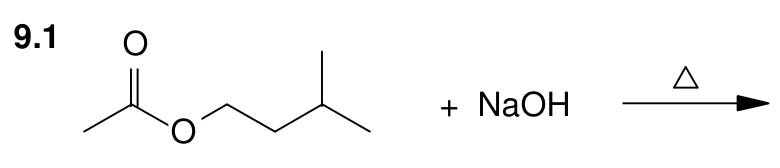
isoamyl acetate,
bee alarm pheromene
9.2
i)

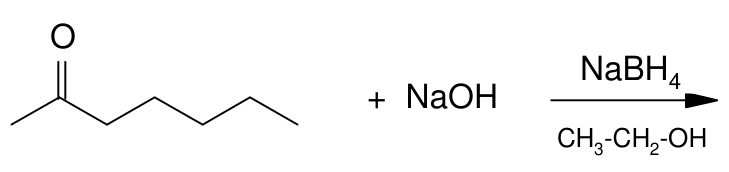
2-heptanone
ant alarm pheromone
ii)
iii)

9.3
i)

green peach -
aphid pheromone
ii)

9.4
(i)
(ii)
(iii)
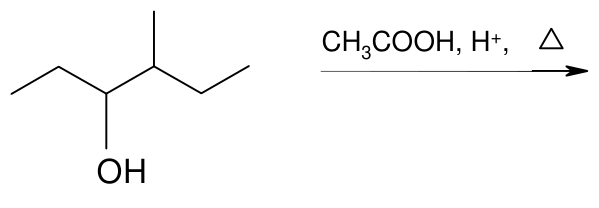
9.5
i)
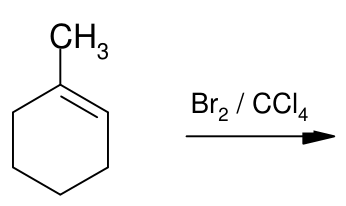
ii)
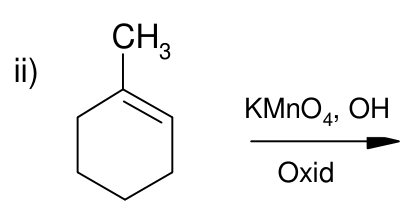
iii)
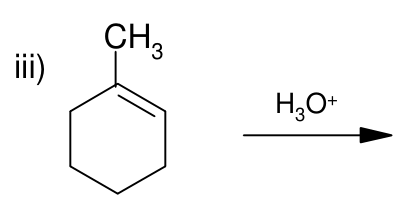
iv)
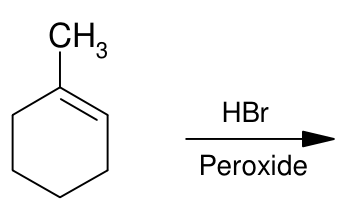
v)
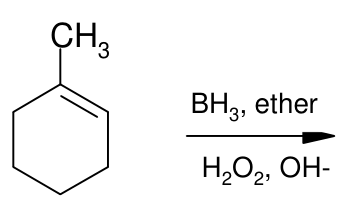
vi)
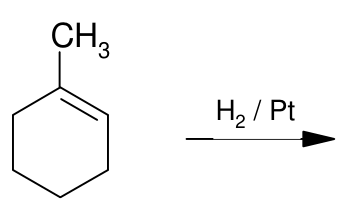
Official English text of the problem.
Answers
Where stereochemical SMILES are given, one representative of each required relative configuration is shown; its mirror image need not be listed separately.
-
9.1: Sodium ethanoate (sodium acetate),
CC(=O)[O-].[Na+], and 3-methylbutan-1-ol (isoamyl alcohol),CC(C)CCO. -
9.2(i): Sodium hexanoate,
CCCCCC(=O)[O-].[Na+], and triiodomethane (iodoform),IC(I)I. -
9.2(ii): Heptan-2-ol,
CC(O)CCCCC. -
9.2(iii): As printed, ethanol quenches the Grignard reagent, producing ethane,
CC, while heptan-2-one,CC(=O)CCCCC, remains available. If ordinary dry-ether Grignard conditions were intended, followed by acidic work-up, the product is 3-methyloctan-3-ol,CCC(C)(O)CCCCC. -
9.3(i): Per molecule of pheromone:
- one propan-2-one (acetone),
CC(=O)C; - one 4-oxopentanal,
CC(=O)CCC=O; - one 2-oxopentanedial,
O=CC(=O)CCC=O; -
two methanal (formaldehyde),
C=O. -
9.3(ii): At the usual aldehyde-to-carboxylic-acid endpoint:
- one propan-2-one,
CC(=O)C; - one 4-oxopentanoic acid (levulinic acid),
CC(=O)CCC(=O)O; - one 2-oxopentanedioic acid (α-ketoglutaric acid),
O=C(O)C(=O)CCC(=O)O; - two methanoic acid (formic acid),
O=CO.
Further oxidation can convert the one-carbon products into carbon dioxide, O=C=O; additional peroxide oxidation is discussed below.
- 9.4(i): Direct dehydration gives:
- 3-methylhex-3-ene: \(E\)
CC/C(C)=C/CC; \(Z\)CC/C(C)=C\CC; - 4-methylhex-2-ene: \(E\)
C/C=C/C(C)CC; \(Z\)C/C=C\C(C)CC.
A favorable hydride rearrangement also permits:
- 3-methylhex-2-ene: \(E\) C/C=C(C)/CCC; \(Z\) C/C=C(C)\CCC;
- 2-ethylpent-1-ene, C=C(CC)CCC.
-
9.4(ii): 4-Methylhexan-3-one,
CCC(=O)C(C)CC. -
9.4(iii): 4-Methylhexan-3-yl ethanoate (acetate),
CC(=O)OC(CC)C(C)CC. -
9.5(i): trans-1,2-Dibromo-1-methylcyclohexane,
C[C@]1(Br)[C@H](Br)CCCC1. The bromine atoms occupy opposite ring faces. -
9.5(ii): cis-1-Methylcyclohexane-1,2-diol,
C[C@]1(O)[C@@H](O)CCCC1. The hydroxyl groups occupy the same ring face. -
9.5(iii): 1-Methylcyclohexan-1-ol,
CC1(O)CCCCC1. -
9.5(iv): Both cis-1-bromo-2-methylcyclohexane,
C[C@H]1[C@@H](Br)CCCC1, and trans-1-bromo-2-methylcyclohexane,C[C@H]1[C@H](Br)CCCC1. Here cis/trans describes bromine relative to methyl. -
9.5(v): trans-2-Methylcyclohexan-1-ol,
C[C@H]1[C@H](O)CCCC1. The hydroxyl and methyl groups occupy opposite ring faces. -
9.5(vi): Methylcyclohexane,
CC1CCCCC1.
Solution
The equations below give balanced molecular or net ionic reactions. Common species are water, O; hydrogen ion, [H+]; hydroxide ion, [OH-]; and hydronium ion, [OH3+]. Metals and solid metal oxides are represented by their chemical formulas.
9.1
The substrate is 3-methylbutyl ethanoate, commonly called isoamyl acetate, CC(=O)OCCC(C)C. Heating with sodium hydroxide, [Na+].[OH-], causes ester saponification:
\[ \ce{CH3COOCH2CH2CH(CH3)2 + NaOH -> CH3COONa + HOCH2CH2CH(CH3)2}. \]
Hydroxide attacks the ester carbonyl carbon. Collapse of the tetrahedral intermediate and proton transfer give the alcohol and the resonance-stabilized acetate ion. The basic medium leaves the carboxylic product as its sodium salt.
9.2(i)
Heptan-2-one, CC(=O)CCCCC, contains the methyl-ketone group \(\ce{CH3CO-}\), so it undergoes the iodoform reaction:
\[ \ce{CH3CO(CH2)4CH3 + 3I2 + 4NaOH -> CH3(CH2)4COONa + CHI3 + 3NaI + 3H2O}. \]
Iodine is II, and the inorganic salt product is sodium iodide, [Na+].[I-].
The three hydrogens of the carbonyl-adjacent methyl group are successively replaced by iodine. Hydroxide then induces cleavage between that carbon and the carbonyl carbon. The methyl carbon becomes iodoform; the remaining six-carbon fragment becomes hexanoate.
9.2(ii)
Sodium borohydride, [Na+].[BH4-], reduces the ketone carbonyl to a secondary alcohol. Ethanol, CCO, supplies a proton to the initially formed alkoxide.
An idealized balanced equation in ethanol is
\[ \ce{4CH3CO(CH2)4CH3 + BH4^- + 4C2H5OH -> 4CH3CH(OH)(CH2)4CH3 + [B(OC2H5)4]^-}. \]
Here the boron residue is represented as tetraethoxyborate, [B-](OCC)(OCC)(OCC)OCC; its actual speciation depends on water content.
Hydride adds to the carbonyl carbon, and protonation of oxygen produces heptan-2-ol. Its newly formed stereocentre need not be specified.
9.2(iii)
There is a material incompatibility in the printed scheme: ethylmagnesium bromide, CC[Mg]Br, is shown in ethanol.
A Grignard reagent undergoes rapid proton transfer with ethanol:
\[ \ce{C2H5MgBr + C2H5OH -> C2H6 + C2H5OMgBr}. \]
The products are ethane and ethoxymagnesium bromide, represented by CCO[Mg]Br. This organomagnesium SMILES specifies connectivity; it does not describe solvent coordination or aggregation.
The subsequent acidic work-up hydrolyses the magnesium ethoxide:
\[ \ce{C2H5OMgBr + H3O+ -> C2H5OH + Mg^2+ + Br^- + H2O}. \]
Magnesium(II) ion is [Mg+2], and bromide ion is [Br-]. The printed hydroxide is also neutralized:
\[ \ce{OH^- + H3O+ -> 2H2O}. \]
Thus the conditions as printed do not support the usual Grignard addition.
If dry ethereal conditions were intended—for example, diethyl ether, CCOCC, without the printed hydroxide—the ethyl group adds to the ketone carbonyl. Subsequent acidic work-up gives the tertiary alcohol. The combined balance for these sequential operations is
\[ \begin{aligned} &\ce{CH3CO(CH2)4CH3 + C2H5MgBr + H3O+}\\ &\quad\ce{-> CH3C(OH)(C2H5)(CH2)4CH3 + Mg^2+ + Br^- + H2O}. \end{aligned} \]
The longest chain containing the hydroxyl-bearing carbon has eight carbons. Both hydroxyl and methyl are at carbon 3, giving 3-methyloctan-3-ol.
9.3(i)
The substrate is \((E)\)-β-farnesene, systematically \((6E)\)-7,11-dimethyl-3-methylidenedodeca-1,6,10-triene, CC(C)=CCC/C(C)=C/CCC(=C)C=C.
Its connectivity can be written as
\[ \ce{(CH3)2C=CH-CH2-CH2-C(CH3)=CH-CH2-CH2-C(=CH2)-CH=CH2}. \]
Ozone, [O-][O+]=O, cleaves all four double bonds. With reductive zinc work-up:
- an alkene carbon bearing no hydrogen becomes a ketone carbonyl;
- an alkene carbon bearing one hydrogen becomes an aldehyde carbonyl;
- a terminal \(\ce{=CH2}\) carbon becomes formaldehyde.
Reading the fragments along the original skeleton gives acetone, 4-oxopentanal, 2-oxopentanedial, and two formaldehyde molecules.
A balanced equation is
\[ \begin{aligned} &\ce{C15H24 + 4O3 + 4Zn + 8H+}\\ &\quad\ce{-> CH3COCH3 + CH3COCH2CH2CHO}\\ &\qquad\ce{+ OHC-C(=O)-CH2-CH2-CHO + 2HCHO}\\ &\qquad\ce{+ 4Zn^2+ + 4H2O}. \end{aligned} \]
Zinc(II) ion is [Zn+2].
The carbon check is
\[ 3+5+5+2(1)=15. \]
There are eight carbonyl groups in total, as expected from cleavage of four double bonds.
9.3(ii)
Hydrogen peroxide, OO, gives an oxidative work-up. At the standard carboxylic-acid endpoint, each aldehyde group is oxidized according to
\[ \ce{RCHO + H2O2 -> RCOOH + H2O}. \]
The ketone carbonyl groups remain in the formal cleavage products. Consequently:
- acetone remains acetone;
- 4-oxopentanal becomes 4-oxopentanoic acid;
- both aldehyde groups of 2-oxopentanedial become carboxyl groups, giving 2-oxopentanedioic acid;
- each formaldehyde becomes formic acid.
A balanced overall equation for that endpoint is
\[ \begin{aligned} &\ce{C15H24 + 4O3 + H2O2}\\ &\quad\ce{-> CH3COCH3 + CH3COCH2CH2COOH}\\ &\qquad\ce{+ HOOC-C(=O)-CH2-CH2-COOH + 2HCOOH + H2O}. \end{aligned} \]
This is a net balance; it does not specify the laboratory excess of oxidant.
Further oxidation introduces an endpoint qualification. Formic acid can be oxidized to carbon dioxide:
\[ \ce{HCOOH + H2O2 -> CO2 + 2H2O}. \]
The α-keto acid can also undergo peroxide-mediated oxidative decarboxylation, producing butanedioic acid (succinic acid), O=C(O)CCC(=O)O:
\[ \begin{aligned} &\ce{HOOC-C(=O)-CH2-CH2-COOH + H2O2}\\ &\quad\ce{-> HOOC-CH2-CH2-COOH + CO2 + H2O}. \end{aligned} \]
The acid list in Answers is therefore the conventional functional-group cleavage answer; an exhaustive oxidation endpoint requires additional assumptions about the work-up.
9.4(i)
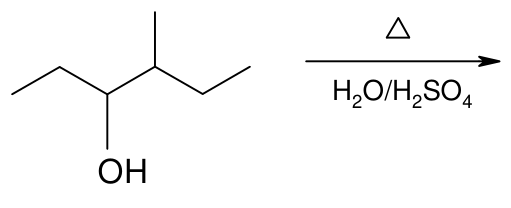
The starting alcohol is 4-methylhexan-3-ol, CCC(O)C(C)CC. Sulfuric acid, OS(=O)(=O)O, and heat promote dehydration. Each alkene-forming channel has the balance
\[ \ce{CH3CH2CH(OH)CH(CH3)CH2CH3 <=> C7H14 + H2O}. \]
Protonation of the hydroxyl group followed by loss of water gives the secondary 4-methylhexan-3-yl carbocation, CC[CH+]C(C)CC.
Removal of a β-hydrogen from either adjacent carbon gives the two direct elimination products:
- removal from carbon 2 gives 4-methylhex-2-ene;
- removal from carbon 4 gives 3-methylhex-3-ene, after renumbering.
Of these, 3-methylhex-3-ene is the more substituted, Zaitsev alkene.
A 1,2-hydride shift from the adjacent methine carbon produces the more stable tertiary 3-methylhexan-3-yl carbocation, CC[C+](C)CCC. Elimination from its three adjacent carbon groups gives:
- 3-methylhex-3-ene again;
- 3-methylhex-2-ene;
- 2-ethylpent-1-ene.
All three internal alkene constitutions admit \(E/Z\) isomerism; their explicit SMILES appear in Answers. The terminal methylene product has no \(E/Z\) pair. The printed conditions do not determine product proportions or the extent of subsequent alkene equilibration.
9.4(ii)
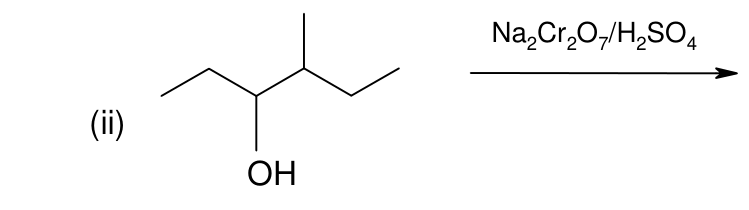
Acidified dichromate oxidizes a secondary alcohol to a ketone. The carbon skeleton is retained:
\[ \begin{aligned} &\ce{3CH3CH2CH(OH)CH(CH3)CH2CH3 + Cr2O7^2- + 8H+}\\ &\quad\ce{-> 3CH3CH2COCH(CH3)CH2CH3 + 2Cr^3+ + 7H2O}. \end{aligned} \]
The reagent ion is dichromate, [O-][Cr](=O)(=O)O[Cr](=O)(=O)[O-]; the reduced chromium species is chromium(III), [Cr+3].
Each alcohol loses two hydrogen atoms, giving 4-methylhexan-3-one.
9.4(iii)
Ethanoic acid (acetic acid), CC(=O)O, reacts with the alcohol by acid-catalysed Fischer esterification:
\[ \begin{aligned} &\ce{CH3CH2CH(OH)CH(CH3)CH2CH3 + CH3COOH}\\ &\quad\ce{<=> CH3CH2CH(OC(=O)CH3)CH(CH3)CH2CH3 + H2O}. \end{aligned} \]
Carbonyl protonation facilitates attack by the alcohol oxygen; proton transfers and water elimination produce 4-methylhexan-3-yl acetate. The reaction is reversible.
9.5
Every substrate in this part is 1-methylcyclohex-1-ene, CC1=CCCCC1. For describing addition, call the methyl-bearing alkene carbon C1 and the adjacent alkene carbon C2.
9.5(i)
Bromine, BrBr, in carbon tetrachloride, ClC(Cl)(Cl)Cl, adds across the double bond:
\[ \ce{C7H12 + Br2 -> C7H12Br2}. \]
A bridged bromonium intermediate is opened by bromide from the opposite face, giving anti addition. The product is therefore trans-1,2-dibromo-1-methylcyclohexane.
To draw it, put one bromine on a solid wedge and the adjacent bromine on a hashed wedge.
9.5(ii)
Under the usual mild alkaline conditions, permanganate, [O-][Mn](=O)(=O)=O, gives syn dihydroxylation:
\[ \ce{3C7H12 + 2MnO4^- + 4H2O -> 3C7H14O2 + 2MnO2 + 2OH^-}. \]
The inorganic precipitate is manganese(IV) oxide, \(\ce{MnO2}\).
Both oxygen atoms are delivered to the same alkene face through a cyclic intermediate. The product is cis-1-methylcyclohexane-1,2-diol.
Draw both hydroxyl groups as solid wedges, or both as hashed wedges.
9.5(iii)
Acid-catalysed hydration has the net balance
\[ \ce{C7H12 + H2O -> C7H14O}. \]
Protonation that places the carbocation at the methyl-bearing carbon gives the more stable tertiary carbocation. Water attacks that carbon, and deprotonation gives the Markovnikov product, 1-methylcyclohexan-1-ol.
Draw the methyl and hydroxyl groups attached to the same ring carbon. There is no distinct cis/trans pair for this product.
9.5(iv)
Hydrogen bromide, [H]Br, adds by a radical chain mechanism in the presence of peroxide:
\[ \ce{C7H12 + HBr -> C7H13Br}. \]
A bromine radical, [Br], adds to C2, leaving the more substituted radical at C1. Hydrogen abstraction from another hydrogen bromide molecule then completes the anti-Markovnikov addition.
This radical sequence is not stereospecific. It produces both:
- cis-1-bromo-2-methylcyclohexane, with methyl and bromine on the same face;
- trans-1-bromo-2-methylcyclohexane, with methyl and bromine on opposite faces.
9.5(v)
Borane, [BH3], undergoes concerted syn addition: boron attaches to the less substituted carbon C2, while hydrogen attaches to C1. Oxidation replaces the carbon–boron bond with a carbon–oxygen bond with retention of configuration.
A balanced overall equation in basic solution is
\[ \ce{3C7H12 + BH3 + 3H2O2 + OH^- -> 3C7H14O + [B(OH)4]^-}. \]
The boron-containing product is tetrahydroxyborate, [B-](O)(O)(O)O.
The newly added hydrogen at C1 and hydroxyl group at C2 are syn. Since the original methyl group at C1 lies opposite that newly added hydrogen, methyl and hydroxyl are trans.
The product is therefore trans-2-methylcyclohexan-1-ol. Draw methyl on a solid wedge and hydroxyl on a hashed wedge, or the mirror-image arrangement.
9.5(vi)
Hydrogen, [H][H], adds over platinum:
\[ \ce{C7H12 + H2 -> C7H14}. \]
Hydrogenation removes the double bond and gives methylcyclohexane. Although surface hydrogenation delivers hydrogen syn, the product has no distinct cis/trans isomers.
The solution was checked against the official solution. Where this solution differs from the official solution, the official solution contains an error or a misprint.
IChO 1992 · Theorieaufgabe 9
Reaktionen von Insektenpheromonen
Pheromone sind chemische Stoffe oder Gemische bestimmter chemischer Stoffe, die von Insekten und einigen anderen Tieren zur Kommunikation abgegeben werden. Sie lösen bei einem anderen Individuum derselben Art bestimmte Reaktionen aus. In der folgenden Aufgabe finden Sie eine Reihe von Pheromonen, die Reaktionen eingehen, welche zur Bestimmung ihrer Strukturen verwendet wurden. Geben Sie jeweils die Struktur oder Strukturen der entstehenden Produkte an. Stellen Sie gegebenenfalls geometrische (cis/trans-)Isomere dar (in Teil (9.5)). Andere Formen der Stereoisomerie können Sie außer Acht lassen.
9.1
Isoamylacetat,
Alarmpheromon der Biene
9.2
i)
2-Heptanon
Alarmpheromon der Ameise
ii)
iii)
9.3
i)
Pheromon der Grünen
Pfirsichblattlaus
ii)
9.4
(i)
(ii)
(iii)
9.5
i)
ii)
iii)
iv)
v)
vi)
Aufgabentext aus dem offiziellen englischen Text übersetzt.
Antworten
Wo stereochemische SMILES angegeben sind, wird jeweils ein Vertreter jeder erforderlichen relativen Konfiguration gezeigt; sein Spiegelbild muss nicht gesondert aufgeführt werden.
-
9.1: Natriumethanoat (Natriumacetat),
CC(=O)[O-].[Na+], und 3-Methylbutan-1-ol (Isoamylalkohol),CC(C)CCO. -
9.2(i): Natriumhexanoat,
CCCCCC(=O)[O-].[Na+], und Triiodmethan (Iodoform),IC(I)I. -
9.2(ii): Heptan-2-ol,
CC(O)CCCCC. -
9.2(iii): Wie abgedruckt wird das Grignard-Reagenz durch Ethanol unter Bildung von Ethan,
CC, abgefangen, während Heptan-2-on,CC(=O)CCCCC, erhalten bleibt. Falls die üblichen Grignard-Bedingungen in wasserfreiem Ether mit anschließender saurer Aufarbeitung gemeint waren, ist das Produkt 3-Methyloctan-3-ol,CCC(C)(O)CCCCC. -
9.3(i): Pro Molekül des Pheromons:
- ein Molekül Propan-2-on (Aceton),
CC(=O)C; - ein Molekül 4-Oxopentanal,
CC(=O)CCC=O; - ein Molekül 2-Oxopentandial,
O=CC(=O)CCC=O; -
zwei Moleküle Methanal (Formaldehyd),
C=O. -
9.3(ii): Beim üblichen Endpunkt der Oxidation von Aldehyden zu Carbonsäuren:
- ein Molekül Propan-2-on,
CC(=O)C; - ein Molekül 4-Oxopentansäure (Lävulinsäure),
CC(=O)CCC(=O)O; - ein Molekül 2-Oxopentandisäure (α-Ketoglutarsäure),
O=C(O)C(=O)CCC(=O)O; - zwei Moleküle Methansäure (Ameisensäure),
O=CO.
Weitere Oxidation kann die Produkte mit einem Kohlenstoffatom in Kohlenstoffdioxid, O=C=O, überführen; eine zusätzliche Oxidation durch Peroxid wird weiter unten erörtert.
- 9.4(i): Direkte Dehydratisierung ergibt:
- 3-Methylhex-3-en: \(E\)
CC/C(C)=C/CC; \(Z\)CC/C(C)=C\CC; - 4-Methylhex-2-en: \(E\)
C/C=C/C(C)CC; \(Z\)C/C=C\C(C)CC.
Eine begünstigte Hydridumlagerung ermöglicht außerdem die Bildung von:
- 3-Methylhex-2-en: \(E\) C/C=C(C)/CCC; \(Z\) C/C=C(C)\CCC;
- 2-Ethylpent-1-en, C=C(CC)CCC.
-
9.4(ii): 4-Methylhexan-3-on,
CCC(=O)C(C)CC. -
9.4(iii): 4-Methylhexan-3-ylethanoat (Acetat),
CC(=O)OC(CC)C(C)CC. -
9.5(i): trans-1,2-Dibrom-1-methylcyclohexan,
C[C@]1(Br)[C@H](Br)CCCC1. Die Bromatome befinden sich auf entgegengesetzten Seiten des Rings. -
9.5(ii): cis-1-Methylcyclohexan-1,2-diol,
C[C@]1(O)[C@@H](O)CCCC1. Die Hydroxygruppen befinden sich auf derselben Seite des Rings. -
9.5(iii): 1-Methylcyclohexan-1-ol,
CC1(O)CCCCC1. -
9.5(iv): Sowohl cis-1-Brom-2-methylcyclohexan,
C[C@H]1[C@@H](Br)CCCC1, als auch trans-1-Brom-2-methylcyclohexan,C[C@H]1[C@H](Br)CCCC1. Hier beschreibt cis/trans die Lage von Brom relativ zur Methylgruppe. -
9.5(v): trans-2-Methylcyclohexan-1-ol,
C[C@H]1[C@H](O)CCCC1. Die Hydroxy- und die Methylgruppe befinden sich auf entgegengesetzten Seiten des Rings. -
9.5(vi): Methylcyclohexan,
CC1CCCCC1.
Lösung
Die folgenden Gleichungen geben ausgeglichene molekulare Reaktionsgleichungen oder Netto-Ionengleichungen wieder. Häufig vorkommende Spezies sind Wasser, O; das Wasserstoffion, [H+]; das Hydroxidion, [OH-]; und das Oxoniumion, [OH3+]. Metalle und feste Metalloxide werden durch ihre chemischen Formeln dargestellt.
9.1
Das Substrat ist 3-Methylbutylethanoat, üblicherweise Isoamylacetat genannt, CC(=O)OCCC(C)C. Erhitzen mit Natriumhydroxid, [Na+].[OH-], führt zur Verseifung des Esters:
\[ \ce{CH3COOCH2CH2CH(CH3)2 + NaOH -> CH3COONa + HOCH2CH2CH(CH3)2}. \]
Das Hydroxidion greift das Carbonylkohlenstoffatom des Esters an. Der Zerfall des tetraedrischen Zwischenprodukts und eine Protonenübertragung ergeben den Alkohol und das mesomeriestabilisierte Acetation. Im basischen Medium liegt das Carbonsäureprodukt als Natriumsalz vor.
9.2(i)
Heptan-2-on, CC(=O)CCCCC, enthält die Methylketongruppe \(\ce{CH3CO-}\) und geht daher die Iodoformreaktion ein:
\[ \ce{CH3CO(CH2)4CH3 + 3I2 + 4NaOH -> CH3(CH2)4COONa + CHI3 + 3NaI + 3H2O}. \]
Iod wird durch II dargestellt, und das als Produkt entstehende anorganische Salz ist Natriumiodid, [Na+].[I-].
Die drei Wasserstoffatome der zur Carbonylgruppe benachbarten Methylgruppe werden nacheinander durch Iod ersetzt. Anschließend bewirkt das Hydroxidion die Spaltung der Bindung zwischen diesem Kohlenstoffatom und dem Carbonylkohlenstoffatom. Aus dem Methylkohlenstoffatom entsteht Iodoform; aus dem verbleibenden Fragment mit sechs Kohlenstoffatomen entsteht Hexanoat.
9.2(ii)
Natriumborhydrid, [Na+].[BH4-], reduziert die Carbonylgruppe des Ketons zu einem sekundären Alkohol. Ethanol, CCO, liefert ein Proton für das zunächst gebildete Alkoholat.
Eine idealisierte ausgeglichene Gleichung in Ethanol lautet
\[ \ce{4CH3CO(CH2)4CH3 + BH4^- + 4C2H5OH -> 4CH3CH(OH)(CH2)4CH3 + [B(OC2H5)4]^-}. \]
Hier wird das borhaltige Restprodukt als Tetraethoxyborat, [B-](OCC)(OCC)(OCC)OCC, dargestellt; welche Spezies tatsächlich vorliegen, hängt vom Wassergehalt ab.
Hydrid addiert an das Carbonylkohlenstoffatom, und durch Protonierung des Sauerstoffatoms entsteht Heptan-2-ol. Die Konfiguration seines neu gebildeten Stereozentrums muss nicht angegeben werden.
9.2(iii)
Im abgedruckten Schema liegt eine wesentliche Unvereinbarkeit vor: Ethylmagnesiumbromid, CC[Mg]Br, ist in Ethanol angegeben.
Ein Grignard-Reagenz reagiert mit Ethanol rasch unter Protonenübertragung:
\[ \ce{C2H5MgBr + C2H5OH -> C2H6 + C2H5OMgBr}. \]
Die Produkte sind Ethan und Ethoxymagnesiumbromid, dargestellt durch CCO[Mg]Br. Dieser SMILES-Ausdruck für die Organomagnesiumverbindung gibt die Konnektivität an; er beschreibt weder die Koordination von Lösungsmittelmolekülen noch die Aggregation.
Bei der anschließenden sauren Aufarbeitung wird das Magnesiumethanolat hydrolysiert:
\[ \ce{C2H5OMgBr + H3O+ -> C2H5OH + Mg^2+ + Br^- + H2O}. \]
Das Magnesium(II)-Ion wird durch [Mg+2] und das Bromidion durch [Br-] dargestellt. Das im Schema angegebene Hydroxid wird ebenfalls neutralisiert:
\[ \ce{OH^- + H3O+ -> 2H2O}. \]
Die Bedingungen in der abgedruckten Form ermöglichen somit nicht die übliche Grignard-Addition.
Falls wasserfreie etherische Bedingungen gemeint waren – beispielsweise Diethylether, CCOCC, ohne das im Schema angegebene Hydroxid –, addiert die Ethylgruppe an die Carbonylgruppe des Ketons. Die anschließende saure Aufarbeitung ergibt den tertiären Alkohol. Die zusammengefasste Bilanz dieser nacheinander durchgeführten Schritte lautet
\[ \begin{aligned} &\ce{CH3CO(CH2)4CH3 + C2H5MgBr + H3O+}\\ &\quad\ce{-> CH3C(OH)(C2H5)(CH2)4CH3 + Mg^2+ + Br^- + H2O}. \end{aligned} \]
Die längste Kette, die das hydroxygruppentragende Kohlenstoffatom enthält, umfasst acht Kohlenstoffatome. Sowohl die Hydroxy- als auch die Methylgruppe befinden sich an Kohlenstoffatom 3; daraus ergibt sich 3-Methyloctan-3-ol.
9.3(i)
Das Substrat ist \((E)\)-β-Farnesen, systematisch \((6E)\)-7,11-Dimethyl-3-methylidendodeca-1,6,10-trien, CC(C)=CCC/C(C)=C/CCC(=C)C=C.
Seine Konnektivität lässt sich wie folgt schreiben:
\[ \ce{(CH3)2C=CH-CH2-CH2-C(CH3)=CH-CH2-CH2-C(=CH2)-CH=CH2}. \]
Ozon, [O-][O+]=O, spaltet alle vier Doppelbindungen. Bei reduktiver Aufarbeitung mit Zink gilt:
- Ein Alkenkohlenstoffatom ohne Wasserstoffatom wird zum Carbonylkohlenstoffatom eines Ketons;
- ein Alkenkohlenstoffatom mit einem Wasserstoffatom wird zum Carbonylkohlenstoffatom eines Aldehyds;
- ein endständiges \(\ce{=CH2}\)-Kohlenstoffatom wird zu Formaldehyd.
Liest man die Fragmente entlang des ursprünglichen Gerüsts ab, erhält man Aceton, 4-Oxopentanal, 2-Oxopentandial und zwei Formaldehydmoleküle.
Eine ausgeglichene Gleichung lautet
\[ \begin{aligned} &\ce{C15H24 + 4O3 + 4Zn + 8H+}\\ &\quad\ce{-> CH3COCH3 + CH3COCH2CH2CHO}\\ &\qquad\ce{+ OHC-C(=O)-CH2-CH2-CHO + 2HCHO}\\ &\qquad\ce{+ 4Zn^2+ + 4H2O}. \end{aligned} \]
Das Zink(II)-Ion wird durch [Zn+2] dargestellt.
Die Kontrolle der Kohlenstoffbilanz ergibt
\[ 3+5+5+2(1)=15. \]
Insgesamt liegen acht Carbonylgruppen vor, wie bei der Spaltung von vier Doppelbindungen zu erwarten ist.
9.3(ii)
Wasserstoffperoxid, OO, bewirkt eine oxidative Aufarbeitung. Beim üblichen Endpunkt der Carbonsäurebildung wird jede Aldehydgruppe gemäß folgender Gleichung oxidiert:
\[ \ce{RCHO + H2O2 -> RCOOH + H2O}. \]
Die Ketoncarbonylgruppen bleiben in den formalen Spaltprodukten erhalten. Folglich gilt:
- Aceton bleibt Aceton;
- 4-Oxopentanal wird zu 4-Oxopentansäure;
- beide Aldehydgruppen des 2-Oxopentandials werden zu Carboxygruppen, wodurch 2-Oxopentandisäure entsteht;
- jedes Formaldehydmolekül wird zu Ameisensäure.
Eine ausgeglichene Gesamtgleichung für diesen Endpunkt lautet
\[ \begin{aligned} &\ce{C15H24 + 4O3 + H2O2}\\ &\quad\ce{-> CH3COCH3 + CH3COCH2CH2COOH}\\ &\qquad\ce{+ HOOC-C(=O)-CH2-CH2-COOH + 2HCOOH + H2O}. \end{aligned} \]
Dies ist eine Nettobilanz; sie gibt den im Labor verwendeten Überschuss an Oxidationsmittel nicht an.
Bei weiterer Oxidation muss die Angabe des Endpunkts eingeschränkt werden. Ameisensäure kann zu Kohlenstoffdioxid oxidiert werden:
\[ \ce{HCOOH + H2O2 -> CO2 + 2H2O}. \]
Die α-Ketosäure kann außerdem eine durch Peroxid vermittelte oxidative Decarboxylierung eingehen, wobei Butandisäure (Bernsteinsäure), O=C(O)CCC(=O)O, entsteht:
\[ \begin{aligned} &\ce{HOOC-C(=O)-CH2-CH2-COOH + H2O2}\\ &\quad\ce{-> HOOC-CH2-CH2-COOH + CO2 + H2O}. \end{aligned} \]
Die Säureliste unter Antworten ist daher die konventionelle Antwort für die Spaltung anhand der funktionellen Gruppen; ein Endpunkt bei vollständiger weitergehender Oxidation erfordert zusätzliche Annahmen zur Aufarbeitung.
9.4(i)
Der Ausgangsalkohol ist 4-Methylhexan-3-ol, CCC(O)C(C)CC. Schwefelsäure, OS(=O)(=O)O, und Wärme fördern die Dehydratisierung. Jeder Reaktionsweg zur Alkenbildung hat die Bilanz
\[ \ce{CH3CH2CH(OH)CH(CH3)CH2CH3 <=> C7H14 + H2O}. \]
Die Protonierung der Hydroxygruppe mit anschließender Wasserabspaltung ergibt das sekundäre 4-Methylhexan-3-yl-Carbeniumion, CC[CH+]C(C)CC.
Die Abspaltung eines β-Wasserstoffatoms von einem der beiden benachbarten Kohlenstoffatome ergibt die beiden direkten Eliminierungsprodukte:
- Abspaltung von Kohlenstoffatom 2 ergibt 4-Methylhex-2-en;
- Abspaltung von Kohlenstoffatom 4 ergibt nach Neunummerierung 3-Methylhex-3-en.
Von diesen ist 3-Methylhex-3-en das höher substituierte Alken, also das Saytzeff-Produkt.
Eine 1,2-Hydridverschiebung vom benachbarten Methinkohlenstoffatom erzeugt das stabilere tertiäre 3-Methylhexan-3-yl-Carbeniumion, CC[C+](C)CCC. Die Eliminierung ausgehend von seinen drei benachbarten Kohlenstoffgruppen ergibt:
- erneut 3-Methylhex-3-en;
- 3-Methylhex-2-en;
- 2-Ethylpent-1-en.
Alle drei Konstitutionsisomere mit interner Doppelbindung weisen \(E/Z\)-Isomerie auf; ihre expliziten SMILES stehen unter Antworten. Das Produkt mit endständiger Methylengruppe besitzt kein \(E/Z\)-Isomerenpaar. Die abgedruckten Bedingungen legen weder die Produktanteile noch das Ausmaß der anschließenden Gleichgewichtseinstellung zwischen den Alkenen fest.
9.4(ii)
Dichromat oxidiert in saurer Lösung einen sekundären Alkohol zu einem Keton. Das Kohlenstoffgerüst bleibt erhalten:
\[ \begin{aligned} &\ce{3CH3CH2CH(OH)CH(CH3)CH2CH3 + Cr2O7^2- + 8H+}\\ &\quad\ce{-> 3CH3CH2COCH(CH3)CH2CH3 + 2Cr^3+ + 7H2O}. \end{aligned} \]
Das Reagenzion ist Dichromat, [O-][Cr](=O)(=O)O[Cr](=O)(=O)[O-]; die reduzierte Chromspezies ist Chrom(III), [Cr+3].
Jedes Alkoholmolekül verliert zwei Wasserstoffatome, wodurch 4-Methylhexan-3-on entsteht.
9.4(iii)
Ethansäure (Essigsäure), CC(=O)O, reagiert mit dem Alkohol durch säurekatalysierte Fischer-Veresterung:
\[ \begin{aligned} &\ce{CH3CH2CH(OH)CH(CH3)CH2CH3 + CH3COOH}\\ &\quad\ce{<=> CH3CH2CH(OC(=O)CH3)CH(CH3)CH2CH3 + H2O}. \end{aligned} \]
Die Protonierung der Carbonylgruppe erleichtert den Angriff des Alkoholsauerstoffatoms; Protonenübertragungen und Wasserabspaltung führen zu 4-Methylhexan-3-ylacetat. Die Reaktion ist reversibel.
9.5
Jedes Substrat in diesem Teil ist 1-Methylcyclohex-1-en, CC1=CCCCC1. Zur Beschreibung der Addition wird das methylgruppentragende Alkenkohlenstoffatom als C1 und das benachbarte Alkenkohlenstoffatom als C2 bezeichnet.
9.5(i)
Brom, BrBr, addiert in Tetrachlormethan, ClC(Cl)(Cl)Cl, an die Doppelbindung:
\[ \ce{C7H12 + Br2 -> C7H12Br2}. \]
Ein verbrücktes Bromonium-Zwischenprodukt wird durch Bromid von der entgegengesetzten Seite geöffnet, sodass eine anti-Addition erfolgt. Das Produkt ist daher trans-1,2-Dibrom-1-methylcyclohexan.
Zeichnen Sie dafür die Bindung zu einem Bromatom als ausgefüllten Keil und die Bindung zum benachbarten Bromatom als gestrichelten Keil.
9.5(ii)
Unter den üblichen milden alkalischen Bedingungen bewirkt Permanganat, [O-][Mn](=O)(=O)=O, eine syn-Dihydroxylierung:
\[ \ce{3C7H12 + 2MnO4^- + 4H2O -> 3C7H14O2 + 2MnO2 + 2OH^-}. \]
Der anorganische Niederschlag ist Mangan(IV)-oxid, \(\ce{MnO2}\).
Beide Sauerstoffatome werden über ein cyclisches Zwischenprodukt von derselben Seite an das Alken addiert. Das Produkt ist cis-1-Methylcyclohexan-1,2-diol.
Zeichnen Sie die Bindungen zu beiden Hydroxygruppen als ausgefüllte Keile oder beide als gestrichelte Keile.
9.5(iii)
Die säurekatalysierte Hydratisierung hat die Nettobilanz
\[ \ce{C7H12 + H2O -> C7H14O}. \]
Eine Protonierung, bei der das Carbeniumion am methylgruppentragenden Kohlenstoffatom entsteht, ergibt das stabilere tertiäre Carbeniumion. Wasser greift dieses Kohlenstoffatom an, und die Deprotonierung ergibt das Markownikow-Produkt, 1-Methylcyclohexan-1-ol.
Zeichnen Sie die Methyl- und die Hydroxygruppe am selben Ringkohlenstoffatom. Für dieses Produkt gibt es kein unterscheidbares cis/trans-Isomerenpaar.
9.5(iv)
Bromwasserstoff, [H]Br, addiert in Gegenwart von Peroxid nach einem radikalischen Kettenmechanismus:
\[ \ce{C7H12 + HBr -> C7H13Br}. \]
Ein Bromradikal, [Br], addiert an C2, wobei das höher substituierte Radikal an C1 entsteht. Die Abstraktion eines Wasserstoffatoms von einem weiteren Bromwasserstoffmolekül vervollständigt anschließend die Anti-Markownikow-Addition.
Diese radikalische Reaktionsfolge ist nicht stereospezifisch. Es entstehen beide Isomere:
- cis-1-Brom-2-methylcyclohexan, mit Methylgruppe und Brom auf derselben Seite;
- trans-1-Brom-2-methylcyclohexan, mit Methylgruppe und Brom auf entgegengesetzten Seiten.
9.5(v)
Boran, [BH3], geht eine konzertierte syn-Addition ein: Bor bindet an das weniger substituierte Kohlenstoffatom C2, während Wasserstoff an C1 bindet. Durch Oxidation wird die Kohlenstoff–Bor-Bindung unter Erhalt der Konfiguration durch eine Kohlenstoff–Sauerstoff-Bindung ersetzt.
Eine ausgeglichene Gesamtgleichung in basischer Lösung lautet
\[ \ce{3C7H12 + BH3 + 3H2O2 + OH^- -> 3C7H14O + [B(OH)4]^-}. \]
Das borhaltige Produkt ist Tetrahydroxyborat, [B-](O)(O)(O)O.
Das neu addierte Wasserstoffatom an C1 und die Hydroxygruppe an C2 stehen syn zueinander. Da die ursprüngliche Methylgruppe an C1 diesem neu addierten Wasserstoffatom gegenüberliegt, stehen Methyl- und Hydroxygruppe trans zueinander.
Das Produkt ist daher trans-2-Methylcyclohexan-1-ol. Zeichnen Sie die Bindung zur Methylgruppe als ausgefüllten Keil und die Bindung zur Hydroxygruppe als gestrichelten Keil oder die spiegelbildliche Anordnung.
9.5(vi)
Wasserstoff, [H][H], addiert an einem Platinkatalysator:
\[ \ce{C7H12 + H2 -> C7H14}. \]
Die Hydrierung beseitigt die Doppelbindung und ergibt Methylcyclohexan. Obwohl die Hydrierung an der Oberfläche den Wasserstoff syn addiert, besitzt das Produkt keine unterscheidbaren cis/trans-Isomere.
Die Lösung wurde mit der offiziellen Lösung abgeglichen. Wo diese Lösung von der offiziellen Lösung abweicht, enthält die offizielle Lösung einen Fehler oder Druckfehler.
IChO 1992 · Teori sorusu 9
Böcek feromonlarının tepkimeleri
Feromonlar, böceklerin ve bazı hayvanların iletişim kurmak için salgıladıkları kimyasal maddeler veya belirli kimyasal maddelerin karışımlarıdır. Aynı türün başka bir bireyinde belirli tepkilere yol açarlar. Aşağıdaki soruda, yapılarının belirlenmesinde kullanılan tepkimelere giren çeşitli feromonlar yer almaktadır. Her durumda oluşan ürünün veya ürünlerin yapısını veriniz. Uygun olduğu durumlarda ((9.5) kısmında) geometrik (cis/trans) izomerleri gösteriniz. Diğer stereoizomerlik türlerini göz ardı edebilirsiniz.
9.1
izoamil asetat,
arı alarm feromonu
9.2
i)
2-heptanon
karınca alarm feromonu
ii)
iii)
9.3
i)
yeşil şeftali
yaprak biti feromonu
ii)
9.4
(i)
(ii)
(iii)
9.5
i)
ii)
iii)
iv)
v)
vi)
Soru metni resmi İngilizce metinden çevrilmiştir.
Cevaplar
Stereokimyasal SMILES gösterimlerinin verildiği yerlerde, gereken her bağıl konfigürasyonun bir temsilcisi gösterilmiştir; bunun ayna görüntüsünün ayrıca listelenmesi gerekmez.
-
9.1: Sodyum etanoat (sodyum asetat),
CC(=O)[O-].[Na+], ve 3-metilbütan-1-ol (izoamil alkol),CC(C)CCO. -
9.2(i): Sodyum heksanoat,
CCCCCC(=O)[O-].[Na+], ve triiyodometan (iyodoform),IC(I)I. -
9.2(ii): Heptan-2-ol,
CC(O)CCCCC. -
9.2(iii): Basılı hâliyle, etanol Grignard reaktifini etkisizleştirerek etan,
CC, oluşturur; heptan-2-on,CC(=O)CCCCC, ise ortamda kalır. Ardından asidik son işlem uygulanan olağan susuz eter ortamındaki Grignard koşulları kastedilmişse, ürün 3-metiloktan-3-ol,CCC(C)(O)CCCCC, olur. -
9.3(i): Her bir feromon molekülü başına:
- bir propan-2-on (aseton),
CC(=O)C; - bir 4-oksopentanal,
CC(=O)CCC=O; - bir 2-oksopentandial,
O=CC(=O)CCC=O; -
iki metanal (formaldehit),
C=O. -
9.3(ii): Aldehitlerin karboksilik asitlere dönüştüğü olağan son durumda:
- bir propan-2-on,
CC(=O)C; - bir 4-oksopentanoik asit (levulinik asit),
CC(=O)CCC(=O)O; - bir 2-oksopentandioik asit (α-ketoglutarik asit),
O=C(O)C(=O)CCC(=O)O; - iki metanoik asit (formik asit),
O=CO.
İleri yükseltgenme, tek karbonlu ürünleri karbon dioksite, O=C=O, dönüştürebilir; peroksitle ek yükseltgenme aşağıda ele alınmaktadır.
- 9.4(i): Doğrudan su ayrılması şu ürünleri verir:
- 3-metilheks-3-en: \(E\)
CC/C(C)=C/CC; \(Z\)CC/C(C)=C\CC; - 4-metilheks-2-en: \(E\)
C/C=C/C(C)CC; \(Z\)C/C=C\C(C)CC.
Elverişli bir hidrür yeniden düzenlenmesi ayrıca şu ürünlerin oluşmasına olanak tanır:
- 3-metilheks-2-en: \(E\) C/C=C(C)/CCC; \(Z\) C/C=C(C)\CCC;
- 2-etilpent-1-en, C=C(CC)CCC.
-
9.4(ii): 4-Metilheksan-3-on,
CCC(=O)C(C)CC. -
9.4(iii): 4-Metilheksan-3-il etanoat (asetat),
CC(=O)OC(CC)C(C)CC. -
9.5(i): trans-1,2-Dibromo-1-metilsikloheksan,
C[C@]1(Br)[C@H](Br)CCCC1. Brom atomları halkanın karşıt yüzlerinde bulunur. -
9.5(ii): cis-1-Metilsikloheksan-1,2-diol,
C[C@]1(O)[C@@H](O)CCCC1. Hidroksil grupları halkanın aynı yüzünde bulunur. -
9.5(iii): 1-Metilsikloheksan-1-ol,
CC1(O)CCCCC1. -
9.5(iv): Hem cis-1-bromo-2-metilsikloheksan,
C[C@H]1[C@@H](Br)CCCC1, hem de trans-1-bromo-2-metilsikloheksan,C[C@H]1[C@H](Br)CCCC1. Burada cis/trans, bromun metile göre konumunu tanımlar. -
9.5(v): trans-2-Metilsikloheksan-1-ol,
C[C@H]1[C@H](O)CCCC1. Hidroksil ve metil grupları halkanın karşıt yüzlerinde bulunur. -
9.5(vi): Metilsikloheksan,
CC1CCCCC1.
Çözüm
Aşağıdaki denklemler, denkleştirilmiş moleküler veya net iyonik tepkimeleri vermektedir. Yaygın türler su, O; hidrojen iyonu, [H+]; hidroksit iyonu, [OH-]; ve hidronyum iyonu, [OH3+], şeklindedir. Metaller ve katı metal oksitler kimyasal formülleriyle gösterilmiştir.
9.1
Substrat, yaygın olarak izoamil asetat adıyla bilinen 3-metilbütil etanoattır, CC(=O)OCCC(C)C. Sodyum hidroksit, [Na+].[OH-], ile ısıtılması esterin sabunlaşmasına neden olur:
\[ \ce{CH3COOCH2CH2CH(CH3)2 + NaOH -> CH3COONa + HOCH2CH2CH(CH3)2}. \]
Hidroksit, esterin karbonil karbonuna saldırır. Dörtyüzlü ara ürünün parçalanması ve proton aktarımı, alkolü ve rezonansla kararlı hâle gelen asetat iyonunu verir. Bazik ortamda karboksilik ürün, sodyum tuzu hâlinde kalır.
9.2(i)
Heptan-2-on, CC(=O)CCCCC, metil keton grubu \(\ce{CH3CO-}\) içerdiğinden iyodoform tepkimesine girer:
\[ \ce{CH3CO(CH2)4CH3 + 3I2 + 4NaOH -> CH3(CH2)4COONa + CHI3 + 3NaI + 3H2O}. \]
İyot II ile gösterilir ve oluşan inorganik tuz, sodyum iyodürdür, [Na+].[I-].
Karbonile komşu metil grubunun üç hidrojeni art arda iyotla yer değiştirir. Ardından hidroksit, bu karbon ile karbonil karbonu arasındaki bağın kopmasını sağlar. Metil karbonu iyodoforma dönüşür; geriye kalan altı karbonlu parça ise heksanoata dönüşür.
9.2(ii)
Sodyum borohidrür, [Na+].[BH4-], keton karbonilini ikincil bir alkole indirger. Etanol, CCO, başlangıçta oluşan alkoksite bir proton sağlar.
Etanol ortamında idealleştirilmiş, denkleştirilmiş bir denklem şöyledir:
\[ \ce{4CH3CO(CH2)4CH3 + BH4^- + 4C2H5OH -> 4CH3CH(OH)(CH2)4CH3 + [B(OC2H5)4]^-}. \]
Burada bor içeren kalıntı tetraetoksiborat, [B-](OCC)(OCC)(OCC)OCC, olarak gösterilmiştir; gerçekte hangi türler hâlinde bulunduğu su içeriğine bağlıdır.
Hidrür, karbonil karbonuna katılır ve oksijenin protonlanması heptan-2-olü oluşturur. Yeni oluşan stereomerkezinin belirtilmesi gerekmez.
9.2(iii)
Basılı şemada önemli bir uyumsuzluk vardır: etilmagnezyum bromür, CC[Mg]Br, etanol içinde gösterilmiştir.
Bir Grignard reaktifi etanolle hızlı bir proton aktarımı tepkimesine girer:
\[ \ce{C2H5MgBr + C2H5OH -> C2H6 + C2H5OMgBr}. \]
Ürünler etan ve CCO[Mg]Br ile gösterilen etoksimagnezyum bromürdür. Bu organomagnezyum SMILES gösterimi, atomların bağlanma düzenini belirtir; çözücü koordinasyonunu veya agregasyonu tanımlamaz.
Ardından uygulanan asidik son işlem, magnezyum etoksiti hidroliz eder:
\[ \ce{C2H5OMgBr + H3O+ -> C2H5OH + Mg^2+ + Br^- + H2O}. \]
Magnezyum(II) iyonu [Mg+2], bromür iyonu ise [Br-] ile gösterilir. Basılı şemada yer alan hidroksit de nötralleşir:
\[ \ce{OH^- + H3O+ -> 2H2O}. \]
Dolayısıyla, basılı hâliyle verilen koşullar olağan Grignard katılmasına olanak sağlamaz.
Susuz eter ortamı kastedilmişse —örneğin basılı şemadaki hidroksit olmaksızın dietil eter, CCOCC— etil grubu keton karboniline katılır. Ardından uygulanan asidik son işlem, üçüncül alkolü verir. Bu ardışık işlemlerin birleşik denklemi şöyledir:
\[ \begin{aligned} &\ce{CH3CO(CH2)4CH3 + C2H5MgBr + H3O+}\\ &\quad\ce{-> CH3C(OH)(C2H5)(CH2)4CH3 + Mg^2+ + Br^- + H2O}. \end{aligned} \]
Hidroksil taşıyan karbonu içeren en uzun zincirde sekiz karbon bulunur. Hem hidroksil hem de metil, 3 numaralı karbondadır; dolayısıyla bileşik 3-metiloktan-3-ol olarak adlandırılır.
9.3(i)
Substrat, sistematik adı \((6E)\)-7,11-dimetil-3-metilidendodeka-1,6,10-trien olan \((E)\)-β-farnesendir, CC(C)=CCC/C(C)=C/CCC(=C)C=C.
Atomlarının bağlanma düzeni şöyle yazılabilir:
\[ \ce{(CH3)2C=CH-CH2-CH2-C(CH3)=CH-CH2-CH2-C(=CH2)-CH=CH2}. \]
Ozon, [O-][O+]=O, dört çift bağın tamamını koparır. Çinko ile indirgen son işlem uygulandığında:
- hidrojen taşımayan bir alken karbonu, keton karboniline dönüşür;
- bir hidrojen taşıyan bir alken karbonu, aldehit karboniline dönüşür;
- uçtaki bir \(\ce{=CH2}\) karbonu, formaldehite dönüşür.
Başlangıçtaki iskelet boyunca parçalar sırasıyla okunduğunda aseton, 4-oksopentanal, 2-oksopentandial ve iki formaldehit molekülü elde edilir.
Denkleştirilmiş bir denklem şöyledir:
\[ \begin{aligned} &\ce{C15H24 + 4O3 + 4Zn + 8H+}\\ &\quad\ce{-> CH3COCH3 + CH3COCH2CH2CHO}\\ &\qquad\ce{+ OHC-C(=O)-CH2-CH2-CHO + 2HCHO}\\ &\qquad\ce{+ 4Zn^2+ + 4H2O}. \end{aligned} \]
Çinko(II) iyonu [Zn+2] ile gösterilir.
Karbon sayısının kontrolü şöyledir:
\[ 3+5+5+2(1)=15. \]
Dört çift bağın kopmasından beklendiği gibi, toplam sekiz karbonil grubu vardır.
9.3(ii)
Hidrojen peroksit, OO, yükseltgen bir son işlem sağlar. Standart karboksilik asit son durumunda, her aldehit grubu aşağıdaki denkleme göre yükseltgenir:
\[ \ce{RCHO + H2O2 -> RCOOH + H2O}. \]
Keton karbonil grupları, biçimsel bağ kopması ürünlerinde korunur. Sonuç olarak:
- aseton, aseton olarak kalır;
- 4-oksopentanal, 4-oksopentanoik aside dönüşür;
- 2-oksopentandialin her iki aldehit grubu da karboksil gruplarına dönüşerek 2-oksopentandioik asidi verir;
- her formaldehit, formik aside dönüşür.
Bu son durum için denkleştirilmiş toplam denklem şöyledir:
\[ \begin{aligned} &\ce{C15H24 + 4O3 + H2O2}\\ &\quad\ce{-> CH3COCH3 + CH3COCH2CH2COOH}\\ &\qquad\ce{+ HOOC-C(=O)-CH2-CH2-COOH + 2HCOOH + H2O}. \end{aligned} \]
Bu bir net denklemdir; laboratuvarda kullanılan yükseltgen fazlasının miktarını belirtmez.
İleri yükseltgenme, son duruma ilişkin bir koşul belirtilmesini gerektirir. Formik asit karbon dioksite yükseltgenebilir:
\[ \ce{HCOOH + H2O2 -> CO2 + 2H2O}. \]
α-Keto asit de peroksit aracılı yükseltgen dekarboksilasyona uğrayarak bütandioik asit (süksinik asit), O=C(O)CCC(=O)O, oluşturabilir:
\[ \begin{aligned} &\ce{HOOC-C(=O)-CH2-CH2-COOH + H2O2}\\ &\quad\ce{-> HOOC-CH2-CH2-COOH + CO2 + H2O}. \end{aligned} \]
Dolayısıyla Cevaplar bölümündeki asit listesi, fonksiyonel gruplar üzerinden verilen geleneksel bağ kopması cevabıdır; tam yükseltgenmenin son durumunu belirlemek, son işlem hakkında ek varsayımlar gerektirir.
9.4(i)
Başlangıç alkolü 4-metilheksan-3-oldür, CCC(O)C(C)CC. Sülfürik asit, OS(=O)(=O)O, ve ısı, su ayrılmasını kolaylaştırır. Alken oluşturan her yol için denklem şöyledir:
\[ \ce{CH3CH2CH(OH)CH(CH3)CH2CH3 <=> C7H14 + H2O}. \]
Hidroksil grubunun protonlanmasını izleyen su kaybı, ikincil 4-metilheksan-3-il karbokatyonunu, CC[CH+]C(C)CC, verir.
Komşu iki karbondan herhangi birinden bir β-hidrojenin uzaklaştırılması, iki doğrudan eliminasyon ürününü verir:
- 2 numaralı karbondan uzaklaştırma, 4-metilheks-2-en verir;
- 4 numaralı karbondan uzaklaştırma, yeniden numaralandırmadan sonra 3-metilheks-3-en verir.
Bunlardan 3-metilheks-3-en, daha fazla sübstitüe olmuş Zaitsev alkenidir.
Komşu metin karbonundan gerçekleşen bir 1,2-hidrür kayması, daha kararlı üçüncül 3-metilheksan-3-il karbokatyonunu, CC[C+](C)CCC, oluşturur. Buna komşu üç karbon grubundan gerçekleşen eliminasyon şu ürünleri verir:
- yeniden 3-metilheks-3-en;
- 3-metilheks-2-en;
- 2-etilpent-1-en.
İç çift bağ içeren bu üç alken yapısının tümünde \(E/Z\) izomerliği mümkündür; bunların açık SMILES gösterimleri Cevaplar bölümünde verilmiştir. Uç metilen ürünü için bir \(E/Z\) çifti yoktur. Basılı koşullar, ürün oranlarını veya daha sonra gerçekleşen alken dengeye ulaşma sürecinin derecesini belirlemez.
9.4(ii)
Asitlendirilmiş dikromat, ikincil bir alkolü ketona yükseltger. Karbon iskeleti korunur:
\[ \begin{aligned} &\ce{3CH3CH2CH(OH)CH(CH3)CH2CH3 + Cr2O7^2- + 8H+}\\ &\quad\ce{-> 3CH3CH2COCH(CH3)CH2CH3 + 2Cr^3+ + 7H2O}. \end{aligned} \]
Reaktif iyonu dikromattır, [O-][Cr](=O)(=O)O[Cr](=O)(=O)[O-]; indirgenmiş krom türü ise krom(III)'tür, [Cr+3].
Her alkol iki hidrojen atomu kaybederek 4-metilheksan-3-on verir.
9.4(iii)
Etanoik asit (asetik asit), CC(=O)O, asit katalizli Fischer esterleşmesi yoluyla alkolle tepkimeye girer:
\[ \begin{aligned} &\ce{CH3CH2CH(OH)CH(CH3)CH2CH3 + CH3COOH}\\ &\quad\ce{<=> CH3CH2CH(OC(=O)CH3)CH(CH3)CH2CH3 + H2O}. \end{aligned} \]
Karbonilin protonlanması, alkol oksijeninin saldırısını kolaylaştırır; proton aktarımları ve su ayrılması, 4-metilheksan-3-il asetatı oluşturur. Tepkime tersinirdir.
9.5
Bu kısımdaki her substrat 1-metilsikloheks-1-endir, CC1=CCCCC1. Katılmayı açıklamak için, metil taşıyan alken karbonunu C1 ve komşu alken karbonunu C2 olarak adlandıralım.
9.5(i)
Karbon tetraklorür, ClC(Cl)(Cl)Cl, içindeki brom, BrBr, çift bağa katılır:
\[ \ce{C7H12 + Br2 -> C7H12Br2}. \]
Köprülü bir bromonyum ara ürünü, karşıt yüzden saldıran bromür tarafından açılır ve anti katılma gerçekleşir. Bu nedenle ürün trans-1,2-dibromo-1-metilsikloheksandır.
Bunu çizmek için bir bromu dolu kama bağıyla, komşu bromu ise kesikli kama bağıyla gösteriniz.
9.5(ii)
Olağan ılımlı bazik koşullarda permanganat, [O-][Mn](=O)(=O)=O, syn dihidroksilleme sağlar:
\[ \ce{3C7H12 + 2MnO4^- + 4H2O -> 3C7H14O2 + 2MnO2 + 2OH^-}. \]
İnorganik çökelek mangan(IV) oksittir, \(\ce{MnO2}\).
Her iki oksijen atomu da halkalı bir ara ürün üzerinden alkenin aynı yüzüne aktarılır. Ürün cis-1-metilsikloheksan-1,2-dioldür.
Her iki hidroksil grubunu da dolu kama bağlarıyla veya her ikisini de kesikli kama bağlarıyla çiziniz.
9.5(iii)
Asit katalizli su katılmasının net denklemi şöyledir:
\[ \ce{C7H12 + H2O -> C7H14O}. \]
Karbokatyonu metil taşıyan karbonda oluşturacak biçimde gerçekleşen protonlanma, daha kararlı üçüncül karbokatyonu verir. Su bu karbona saldırır ve proton kaybı, Markovnikov ürünü olan 1-metilsikloheksan-1-olü verir.
Metil ve hidroksil gruplarını aynı halka karbonuna bağlı olarak çiziniz. Bu ürünün ayrı bir cis/trans çifti yoktur.
9.5(iv)
Hidrojen bromür, [H]Br, peroksit varlığında bir radikal zincir mekanizmasıyla katılır:
\[ \ce{C7H12 + HBr -> C7H13Br}. \]
Bir brom radikali, [Br], C2'ye katılarak C1'de daha fazla sübstitüe olmuş radikali bırakır. Ardından başka bir hidrojen bromür molekülünden hidrojen koparılması, anti-Markovnikov katılmasını tamamlar.
Bu radikal tepkime dizisi stereospesifik değildir. Her iki ürünü de oluşturur:
- metil ve bromun aynı yüzde bulunduğu cis-1-bromo-2-metilsikloheksan;
- metil ve bromun karşıt yüzlerde bulunduğu trans-1-bromo-2-metilsikloheksan.
9.5(v)
Boran, [BH3], eş zamanlı bir syn katılma tepkimesine girer: bor, daha az sübstitüe olmuş C2 karbonuna bağlanırken hidrojen C1'e bağlanır. Yükseltgenme, konfigürasyon korunarak karbon–bor bağının yerine bir karbon–oksijen bağı oluşturur.
Bazik çözeltide denkleştirilmiş toplam denklem şöyledir:
\[ \ce{3C7H12 + BH3 + 3H2O2 + OH^- -> 3C7H14O + [B(OH)4]^-}. \]
Bor içeren ürün tetrahidroksiborattır, [B-](O)(O)(O)O.
C1'e yeni katılan hidrojen ile C2'deki hidroksil grubu syn konumundadır. C1'de başlangıçtan beri bulunan metil grubu, yeni katılan bu hidrojenin karşıt tarafında bulunduğundan metil ve hidroksil trans konumundadır.
Bu nedenle ürün trans-2-metilsikloheksan-1-oldür. Metili dolu kama bağıyla ve hidroksili kesikli kama bağıyla veya bunun ayna görüntüsü olan düzenle çiziniz.
9.5(vi)
Hidrojen, [H][H], platin üzerinde katılır:
\[ \ce{C7H12 + H2 -> C7H14}. \]
Hidrojenleme, çift bağı ortadan kaldırır ve metilsikloheksan verir. Yüzeyde hidrojenleme, hidrojeni syn olarak aktarsa da ürünün ayrı cis/trans izomerleri yoktur.
Çözüm, resmi çözümle karşılaştırılarak kontrol edildi. Bu çözümün resmi çözümden ayrıldığı yerlerde resmi çözümde bir hata ya da baskı hatası vardır.
IChO 1992 · Problema teórico 9
Reacciones de las feromonas de los insectos
Las feromonas son sustancias químicas o mezclas de determinadas sustancias químicas secretadas por los insectos y algunos animales para comunicarse. Provocan determinadas respuestas en otro individuo de la misma especie. En el problema que sigue encontrará varias feromonas sometidas a reacciones que se utilizaron para determinar sus estructuras. En cada caso, indique la estructura o las estructuras de los productos obtenidos. Muestre los isómeros geométricos (cis/trans) cuando corresponda (en el apartado (9.5)). Puede omitir otras formas de estereoisomería.
9.1
acetato de isoamilo,
feromona de alarma de las abejas
9.2
i)
2-heptanona
feromona de alarma de las hormigas
ii)
iii)
9.3
i)
feromona del pulgón verde
del melocotonero
ii)
9.4
(i)
(ii)
(iii)
9.5
i)
ii)
iii)
iv)
v)
vi)
Enunciado traducido del texto oficial en inglés.
Respuestas
Cuando se proporcionan SMILES estereoquímicos, se muestra un representante de cada configuración relativa requerida; no es necesario indicar por separado su imagen especular.
-
9.1: Etanoato de sodio (acetato de sodio),
CC(=O)[O-].[Na+], y 3-metilbutan-1-ol (alcohol isoamílico),CC(C)CCO. -
9.2(i): Hexanoato de sodio,
CCCCCC(=O)[O-].[Na+], y triyodometano (yodoformo),IC(I)I. -
9.2(ii): Heptan-2-ol,
CC(O)CCCCC. -
9.2(iii): Tal como está impreso, el etanol desactiva el reactivo de Grignard y produce etano,
CC, mientras que la heptan-2-ona,CC(=O)CCCCC, permanece disponible. Si se pretendían las condiciones habituales de una reacción de Grignard en éter anhidro, seguidas de un tratamiento final ácido, el producto es 3-metiloctan-3-ol,CCC(C)(O)CCCCC. -
9.3(i): Por molécula de feromona:
- una de propan-2-ona (acetona),
CC(=O)C; - una de 4-oxopentanal,
CC(=O)CCC=O; - una de 2-oxopentanodial,
O=CC(=O)CCC=O; -
dos de metanal (formaldehído),
C=O. -
9.3(ii): Si la oxidación se detiene en la conversión habitual de aldehído en ácido carboxílico:
- una de propan-2-ona,
CC(=O)C; - una de ácido 4-oxopentanoico (ácido levulínico),
CC(=O)CCC(=O)O; - una de ácido 2-oxopentanodioico (ácido α-cetoglutárico),
O=C(O)C(=O)CCC(=O)O; - dos de ácido metanoico (ácido fórmico),
O=CO.
Una oxidación ulterior puede convertir los productos de un carbono en dióxido de carbono, O=C=O; más adelante se analiza la oxidación adicional por el peróxido.
- 9.4(i): La deshidratación directa da:
- 3-metilhex-3-eno: \(E\)
CC/C(C)=C/CC; \(Z\)CC/C(C)=C\CC; - 4-metilhex-2-eno: \(E\)
C/C=C/C(C)CC; \(Z\)C/C=C\C(C)CC.
Una transposición favorable de hidruro permite obtener también:
- 3-metilhex-2-eno: \(E\) C/C=C(C)/CCC; \(Z\) C/C=C(C)\CCC;
- 2-etilpent-1-eno, C=C(CC)CCC.
-
9.4(ii): 4-Metilhexan-3-ona,
CCC(=O)C(C)CC. -
9.4(iii): Etanoato (acetato) de 4-metilhexan-3-ilo,
CC(=O)OC(CC)C(C)CC. -
9.5(i): trans-1,2-Dibromo-1-metilciclohexano,
C[C@]1(Br)[C@H](Br)CCCC1. Los átomos de bromo ocupan caras opuestas del anillo. -
9.5(ii): cis-1-Metilciclohexano-1,2-diol,
C[C@]1(O)[C@@H](O)CCCC1. Los grupos hidroxilo ocupan la misma cara del anillo. -
9.5(iii): 1-Metilciclohexan-1-ol,
CC1(O)CCCCC1. -
9.5(iv): Tanto cis-1-bromo-2-metilciclohexano,
C[C@H]1[C@@H](Br)CCCC1, como trans-1-bromo-2-metilciclohexano,C[C@H]1[C@H](Br)CCCC1. Aquí cis/trans describe la posición del bromo respecto al metilo. -
9.5(v): trans-2-Metilciclohexan-1-ol,
C[C@H]1[C@H](O)CCCC1. Los grupos hidroxilo y metilo ocupan caras opuestas del anillo. -
9.5(vi): Metilciclohexano,
CC1CCCCC1.
Solución
Las ecuaciones siguientes presentan reacciones moleculares o iónicas netas ajustadas. Algunas especies comunes son el agua, O; el ion hidrógeno, [H+]; el ion hidróxido, [OH-]; y el ion hidronio, [OH3+]. Los metales y los óxidos metálicos sólidos se representan mediante sus fórmulas químicas.
9.1
El sustrato es etanoato de 3-metilbutilo, comúnmente llamado acetato de isoamilo, CC(=O)OCCC(C)C. El calentamiento con hidróxido de sodio, [Na+].[OH-], provoca la saponificación del éster:
\[ \ce{CH3COOCH2CH2CH(CH3)2 + NaOH -> CH3COONa + HOCH2CH2CH(CH3)2}. \]
El hidróxido ataca al carbono carbonílico del éster. El colapso del intermedio tetraédrico y la transferencia de un protón dan el alcohol y el ion acetato estabilizado por resonancia. El medio básico mantiene el producto carboxílico en forma de su sal de sodio.
9.2(i)
La heptan-2-ona, CC(=O)CCCCC, contiene el grupo metilcetona \(\ce{CH3CO-}\), por lo que experimenta la reacción del yodoformo:
\[ \ce{CH3CO(CH2)4CH3 + 3I2 + 4NaOH -> CH3(CH2)4COONa + CHI3 + 3NaI + 3H2O}. \]
El yodo es II, y la sal inorgánica producida es yoduro de sodio, [Na+].[I-].
Los tres hidrógenos del grupo metilo adyacente al carbonilo se sustituyen sucesivamente por yodo. A continuación, el hidróxido induce la ruptura entre ese carbono y el carbono carbonílico. El carbono del metilo se convierte en yodoformo; el fragmento restante, de seis carbonos, se convierte en hexanoato.
9.2(ii)
El borohidruro de sodio, [Na+].[BH4-], reduce el carbonilo de la cetona a un alcohol secundario. El etanol, CCO, aporta un protón al alcóxido formado inicialmente.
Una ecuación ajustada idealizada en etanol es
\[ \ce{4CH3CO(CH2)4CH3 + BH4^- + 4C2H5OH -> 4CH3CH(OH)(CH2)4CH3 + [B(OC2H5)4]^-}. \]
Aquí el residuo de boro se representa como tetraetoxiborato, [B-](OCC)(OCC)(OCC)OCC; las especies en las que se encuentra realmente dependen del contenido de agua.
El hidruro se adiciona al carbono carbonílico, y la protonación del oxígeno produce heptan-2-ol. No es necesario especificar su estereocentro recién formado.
9.2(iii)
Hay una incompatibilidad sustancial en el esquema impreso: el bromuro de etilmagnesio, CC[Mg]Br, se muestra en etanol.
Un reactivo de Grignard experimenta una rápida transferencia de protón con el etanol:
\[ \ce{C2H5MgBr + C2H5OH -> C2H6 + C2H5OMgBr}. \]
Los productos son etano y bromuro de etoximagnesio, representado por CCO[Mg]Br. Este SMILES organomagnésico especifica la conectividad; no describe la coordinación del disolvente ni la agregación.
El tratamiento ácido posterior hidroliza el etóxido de magnesio:
\[ \ce{C2H5OMgBr + H3O+ -> C2H5OH + Mg^2+ + Br^- + H2O}. \]
El ion magnesio(II) es [Mg+2], y el ion bromuro es [Br-]. El hidróxido que aparece en el esquema impreso también se neutraliza:
\[ \ce{OH^- + H3O+ -> 2H2O}. \]
Por tanto, las condiciones tal como están impresas no permiten la adición habitual de Grignard.
Si se pretendían condiciones en medio etéreo anhidro —por ejemplo, éter dietílico, CCOCC, sin el hidróxido que aparece impreso—, el grupo etilo se adiciona al carbonilo de la cetona. El tratamiento ácido posterior da el alcohol terciario. El balance combinado de estas operaciones secuenciales es
\[ \begin{aligned} &\ce{CH3CO(CH2)4CH3 + C2H5MgBr + H3O+}\\ &\quad\ce{-> CH3C(OH)(C2H5)(CH2)4CH3 + Mg^2+ + Br^- + H2O}. \end{aligned} \]
La cadena más larga que contiene el carbono portador del hidroxilo tiene ocho carbonos. Tanto el hidroxilo como el metilo se encuentran en el carbono 3, lo que da 3-metiloctan-3-ol.
9.3(i)
El sustrato es \((E)\)-β-farneseno, cuyo nombre sistemático es \((6E)\)-7,11-dimetil-3-metilidendodeca-1,6,10-trieno, CC(C)=CCC/C(C)=C/CCC(=C)C=C.
Su conectividad puede escribirse como
\[ \ce{(CH3)2C=CH-CH2-CH2-C(CH3)=CH-CH2-CH2-C(=CH2)-CH=CH2}. \]
El ozono, [O-][O+]=O, rompe los cuatro dobles enlaces. Con un tratamiento final reductor con zinc:
- un carbono alquénico que no tiene ningún hidrógeno se convierte en un carbonilo de cetona;
- un carbono alquénico que tiene un hidrógeno se convierte en un carbonilo de aldehído;
- un carbono terminal \(\ce{=CH2}\) se convierte en formaldehído.
Al recorrer los fragmentos a lo largo del esqueleto original se obtienen acetona, 4-oxopentanal, 2-oxopentanodial y dos moléculas de formaldehído.
Una ecuación ajustada es
\[ \begin{aligned} &\ce{C15H24 + 4O3 + 4Zn + 8H+}\\ &\quad\ce{-> CH3COCH3 + CH3COCH2CH2CHO}\\ &\qquad\ce{+ OHC-C(=O)-CH2-CH2-CHO + 2HCHO}\\ &\qquad\ce{+ 4Zn^2+ + 4H2O}. \end{aligned} \]
El ion zinc(II) es [Zn+2].
La comprobación del número de carbonos es
\[ 3+5+5+2(1)=15. \]
Hay ocho grupos carbonilo en total, como cabe esperar de la ruptura de cuatro dobles enlaces.
9.3(ii)
El peróxido de hidrógeno, OO, proporciona un tratamiento final oxidante. Si se alcanza el estado final habitual de ácido carboxílico, cada grupo aldehído se oxida según
\[ \ce{RCHO + H2O2 -> RCOOH + H2O}. \]
Los grupos carbonilo de cetona se conservan en los productos formales de ruptura. Por consiguiente:
- la acetona sigue siendo acetona;
- el 4-oxopentanal se convierte en ácido 4-oxopentanoico;
- ambos grupos aldehído del 2-oxopentanodial se convierten en grupos carboxilo y dan ácido 2-oxopentanodioico;
- cada formaldehído se convierte en ácido fórmico.
Una ecuación global ajustada para ese estado final es
\[ \begin{aligned} &\ce{C15H24 + 4O3 + H2O2}\\ &\quad\ce{-> CH3COCH3 + CH3COCH2CH2COOH}\\ &\qquad\ce{+ HOOC-C(=O)-CH2-CH2-COOH + 2HCOOH + H2O}. \end{aligned} \]
Este es un balance neto; no especifica el exceso de oxidante utilizado en el laboratorio.
Una oxidación ulterior obliga a matizar el estado final. El ácido fórmico puede oxidarse a dióxido de carbono:
\[ \ce{HCOOH + H2O2 -> CO2 + 2H2O}. \]
El α-cetoácido también puede experimentar una descarboxilación oxidativa mediada por el peróxido, que produce ácido butanodioico (ácido succínico), O=C(O)CCC(=O)O:
\[ \begin{aligned} &\ce{HOOC-C(=O)-CH2-CH2-COOH + H2O2}\\ &\quad\ce{-> HOOC-CH2-CH2-COOH + CO2 + H2O}. \end{aligned} \]
La lista de ácidos en Respuestas es, por tanto, la respuesta convencional basada en la ruptura y los grupos funcionales; un estado final de oxidación exhaustiva requiere suposiciones adicionales sobre el tratamiento final.
9.4(i)
El alcohol de partida es 4-metilhexan-3-ol, CCC(O)C(C)CC. El ácido sulfúrico, OS(=O)(=O)O, y el calor favorecen la deshidratación. Cada vía de formación de un alqueno tiene el balance
\[ \ce{CH3CH2CH(OH)CH(CH3)CH2CH3 <=> C7H14 + H2O}. \]
La protonación del grupo hidroxilo seguida de la pérdida de agua da el carbocatión secundario 4-metilhexan-3-ilo, CC[CH+]C(C)CC.
La eliminación de un hidrógeno β de cualquiera de los dos carbonos adyacentes da los dos productos de eliminación directa:
- la eliminación desde el carbono 2 da 4-metilhex-2-eno;
- la eliminación desde el carbono 4 da 3-metilhex-3-eno, tras renumerar.
De ellos, el 3-metilhex-3-eno es el alqueno más sustituido, el producto de Zaitsev.
Una migración 1,2 de hidruro desde el carbono metínico adyacente produce el carbocatión terciario 3-metilhexan-3-ilo, más estable, CC[C+](C)CCC. La eliminación desde sus tres grupos carbonados adyacentes da:
- de nuevo, 3-metilhex-3-eno;
- 3-metilhex-2-eno;
- 2-etilpent-1-eno.
Las tres estructuras constitucionales de alquenos internos admiten isomería \(E/Z\); sus SMILES explícitos aparecen en Respuestas. El producto con metileno terminal no tiene un par \(E/Z\). Las condiciones impresas no determinan las proporciones de los productos ni el grado en que los alquenos alcanzan posteriormente el equilibrio.
9.4(ii)
El dicromato acidificado oxida un alcohol secundario a una cetona. El esqueleto carbonado se conserva:
\[ \begin{aligned} &\ce{3CH3CH2CH(OH)CH(CH3)CH2CH3 + Cr2O7^2- + 8H+}\\ &\quad\ce{-> 3CH3CH2COCH(CH3)CH2CH3 + 2Cr^3+ + 7H2O}. \end{aligned} \]
El ion reactivo es el dicromato, [O-][Cr](=O)(=O)O[Cr](=O)(=O)[O-]; la especie de cromo reducida es cromo(III), [Cr+3].
Cada alcohol pierde dos átomos de hidrógeno y da 4-metilhexan-3-ona.
9.4(iii)
El ácido etanoico (ácido acético), CC(=O)O, reacciona con el alcohol mediante una esterificación de Fischer catalizada por ácido:
\[ \begin{aligned} &\ce{CH3CH2CH(OH)CH(CH3)CH2CH3 + CH3COOH}\\ &\quad\ce{<=> CH3CH2CH(OC(=O)CH3)CH(CH3)CH2CH3 + H2O}. \end{aligned} \]
La protonación del carbonilo facilita el ataque del oxígeno del alcohol; las transferencias de protones y la eliminación de agua producen acetato de 4-metilhexan-3-ilo. La reacción es reversible.
9.5
Todos los sustratos de este apartado son 1-metilciclohex-1-eno, CC1=CCCCC1. Para describir la adición, llamaremos C1 al carbono alquénico portador del metilo y C2 al carbono alquénico adyacente.
9.5(i)
El bromo, BrBr, en tetracloruro de carbono, ClC(Cl)(Cl)Cl, se adiciona al doble enlace:
\[ \ce{C7H12 + Br2 -> C7H12Br2}. \]
El bromuro abre un intermedio de bromonio puenteado atacando desde la cara opuesta, lo que da una adición anti. Por tanto, el producto es trans-1,2-dibromo-1-metilciclohexano.
Para dibujarlo, represente un bromo con una cuña sólida y el bromo adyacente con una cuña discontinua.
9.5(ii)
En las condiciones alcalinas suaves habituales, el permanganato, [O-][Mn](=O)(=O)=O, produce una dihidroxilación syn:
\[ \ce{3C7H12 + 2MnO4^- + 4H2O -> 3C7H14O2 + 2MnO2 + 2OH^-}. \]
El precipitado inorgánico es óxido de manganeso(IV), \(\ce{MnO2}\).
Ambos átomos de oxígeno se incorporan por la misma cara del alqueno a través de un intermedio cíclico. El producto es cis-1-metilciclohexano-1,2-diol.
Dibuje ambos grupos hidroxilo con cuñas sólidas, o ambos con cuñas discontinuas.
9.5(iii)
La hidratación catalizada por ácido tiene el balance neto
\[ \ce{C7H12 + H2O -> C7H14O}. \]
La protonación que sitúa el carbocatión en el carbono portador del metilo da el carbocatión terciario, más estable. El agua ataca a ese carbono, y la desprotonación da el producto de Markovnikov, 1-metilciclohexan-1-ol.
Dibuje los grupos metilo e hidroxilo unidos al mismo carbono del anillo. No existe un par cis/trans diferenciado para este producto.
9.5(iv)
El bromuro de hidrógeno, [H]Br, se adiciona mediante un mecanismo radicalario en cadena en presencia de peróxido:
\[ \ce{C7H12 + HBr -> C7H13Br}. \]
Un radical bromo, [Br], se adiciona a C2 y deja el radical más sustituido en C1. La abstracción de hidrógeno de otra molécula de bromuro de hidrógeno completa entonces la adición anti-Markovnikov.
Esta secuencia radicalaria no es estereoespecífica. Produce ambos:
- cis-1-bromo-2-metilciclohexano, con el metilo y el bromo en la misma cara;
- trans-1-bromo-2-metilciclohexano, con el metilo y el bromo en caras opuestas.
9.5(v)
El borano, [BH3], experimenta una adición syn concertada: el boro se une al carbono menos sustituido C2, mientras que el hidrógeno se une a C1. La oxidación sustituye el enlace carbono–boro por un enlace carbono–oxígeno con retención de la configuración.
Una ecuación global ajustada en disolución básica es
\[ \ce{3C7H12 + BH3 + 3H2O2 + OH^- -> 3C7H14O + [B(OH)4]^-}. \]
El producto que contiene boro es el tetrahidroxiborato, [B-](O)(O)(O)O.
El hidrógeno recién añadido en C1 y el grupo hidroxilo en C2 son syn. Puesto que el grupo metilo original de C1 se encuentra en posición opuesta a ese hidrógeno recién añadido, el metilo y el hidroxilo son trans.
Por tanto, el producto es trans-2-metilciclohexan-1-ol. Dibuje el metilo con una cuña sólida y el hidroxilo con una cuña discontinua, o la disposición especular.
9.5(vi)
El hidrógeno, [H][H], se adiciona sobre platino:
\[ \ce{C7H12 + H2 -> C7H14}. \]
La hidrogenación elimina el doble enlace y da metilciclohexano. Aunque la hidrogenación sobre la superficie incorpora el hidrógeno de forma syn, el producto no tiene isómeros cis/trans diferenciados.
La solución se comprobó con la solución oficial. Donde esta solución difiere de la solución oficial, la solución oficial contiene un error o una errata.
IChO 1992 · 理论题 9
昆虫信息素的反应
信息素是昆虫和某些动物为传递信息而分泌的化学物质或某些化学物质的混合物。它们能使同种的另一个个体产生特定的反应。下题列出了一些信息素及其用于确定结构的反应。请在每种情况下给出所生成产物的结构。在适用时标明几何(顺/反)异构体(在第 (9.5) 部分)。其他形式的立体异构可忽略不计。
9.1
乙酸异戊酯,
蜜蜂报警信息素
9.2
i)
2-庚酮
蚂蚁报警信息素
ii)
iii)
9.3
i)
桃蚜——
信息素
ii)
9.4
(i)
(ii)
(iii)
9.5
i)
ii)
iii)
iv)
v)
vi)
题目译自官方英文原文。
答案
凡给出立体化学 SMILES 的地方,每种所需的相对构型均只列出一个代表;不必另行列出其镜像。
-
9.1: 乙酸钠(醋酸钠),
CC(=O)[O-].[Na+],以及 3-甲基-1-丁醇(异戊醇),CC(C)CCO。 -
9.2(i): 己酸钠,
CCCCCC(=O)[O-].[Na+],以及三碘甲烷(碘仿),IC(I)I。 -
9.2(ii): 2-庚醇,
CC(O)CCCCC。 -
9.2(iii): 按原题所印条件,乙醇使格氏试剂淬灭,生成乙烷,
CC,而 2-庚酮,CC(=O)CCCCC,仍留在体系中。若原意是采用通常的无水乙醚介质中的格氏反应条件,随后进行酸性后处理,则产物为 3-甲基-3-辛醇,CCC(C)(O)CCCCC。 -
9.3(i): 每个信息素分子生成:
- 一个 2-丙酮(丙酮),
CC(=O)C; - 一个 4-氧代戊醛,
CC(=O)CCC=O; - 一个 2-氧代戊二醛,
O=CC(=O)CCC=O; -
两个甲醛(蚁醛),
C=O。 -
9.3(ii): 以通常的醛氧化为羧酸作为终点时:
- 一个 2-丙酮,
CC(=O)C; - 一个 4-氧代戊酸(乙酰丙酸),
CC(=O)CCC(=O)O; - 一个 2-氧代戊二酸(α-酮戊二酸),
O=C(O)C(=O)CCC(=O)O; - 两个甲酸(蚁酸),
O=CO。
进一步氧化可将单碳产物转化为二氧化碳,O=C=O;下文还将讨论过氧化物引起的进一步氧化。
- 9.4(i): 直接脱水生成:
- 3-甲基-3-己烯:\(E\)
CC/C(C)=C/CC;\(Z\)CC/C(C)=C\CC; - 4-甲基-2-己烯:\(E\)
C/C=C/C(C)CC;\(Z\)C/C=C\C(C)CC。
有利的氢负离子重排还可生成:
- 3-甲基-2-己烯:\(E\) C/C=C(C)/CCC;\(Z\) C/C=C(C)\CCC;
- 2-乙基-1-戊烯,C=C(CC)CCC。
-
9.4(ii): 4-甲基-3-己酮,
CCC(=O)C(C)CC。 -
9.4(iii): 乙酸-4-甲基己-3-基酯(醋酸-4-甲基己-3-基酯),
CC(=O)OC(CC)C(C)CC。 -
9.5(i): 反式-1,2-二溴-1-甲基环己烷,
C[C@]1(Br)[C@H](Br)CCCC1。两个溴原子位于环的相反两面。 -
9.5(ii): 顺式-1-甲基环己烷-1,2-二醇,
C[C@]1(O)[C@@H](O)CCCC1。两个羟基位于环的同一面。 -
9.5(iii): 1-甲基环己烷-1-醇,
CC1(O)CCCCC1。 -
9.5(iv): 同时生成顺式-1-溴-2-甲基环己烷,
C[C@H]1[C@@H](Br)CCCC1,和反式-1-溴-2-甲基环己烷,C[C@H]1[C@H](Br)CCCC1。此处顺/反描述的是溴相对于甲基的位置关系。 -
9.5(v): 反式-2-甲基环己烷-1-醇,
C[C@H]1[C@H](O)CCCC1。羟基与甲基位于环的相反两面。 -
9.5(vi): 甲基环己烷,
CC1CCCCC1。
解答
以下方程式为配平的分子反应方程式或净离子反应方程式。常见物种包括水,O;氢离子,[H+];氢氧根离子,[OH-];以及水合氢离子,[OH3+]。金属和固态金属氧化物用其化学式表示。
9.1
底物是乙酸-3-甲基丁酯,俗称乙酸异戊酯,CC(=O)OCCC(C)C。与氢氧化钠,[Na+].[OH-],共热会使酯发生皂化反应:
\[ \ce{CH3COOCH2CH2CH(CH3)2 + NaOH -> CH3COONa + HOCH2CH2CH(CH3)2}. \]
氢氧根进攻酯的羰基碳。四面体中间体解离并发生质子转移,生成醇和受共振稳定的乙酸根离子。在碱性介质中,羧酸产物以钠盐形式存在。
9.2(i)
2-庚酮,CC(=O)CCCCC,含有甲基酮基团 \(\ce{CH3CO-}\),因此会发生碘仿反应:
\[ \ce{CH3CO(CH2)4CH3 + 3I2 + 4NaOH -> CH3(CH2)4COONa + CHI3 + 3NaI + 3H2O}. \]
碘为 II,无机盐产物为碘化钠,[Na+].[I-]。
与羰基相邻的甲基上的三个氢依次被碘取代。随后,氢氧根促使该碳与羰基碳之间的键断裂。甲基碳转化为碘仿;剩余的六碳片段转化为己酸根。
9.2(ii)
硼氢化钠,[Na+].[BH4-],将酮羰基还原为仲醇。乙醇,CCO,向最初生成的醇盐提供质子。
在乙醇中的理想化配平方程式为
\[ \ce{4CH3CO(CH2)4CH3 + BH4^- + 4C2H5OH -> 4CH3CH(OH)(CH2)4CH3 + [B(OC2H5)4]^-}. \]
此处将含硼残留物表示为四乙氧基硼酸根,[B-](OCC)(OCC)(OCC)OCC;其实际存在形态取决于含水量。
氢负离子加成到羰基碳上,随后氧原子质子化,生成 2-庚醇。无需指定其新形成的立体中心的构型。
9.2(iii)
原题所印反应示意图存在实质性的条件不相容问题:图中将乙基溴化镁,CC[Mg]Br,置于乙醇中。
格氏试剂会与乙醇迅速发生质子转移:
\[ \ce{C2H5MgBr + C2H5OH -> C2H6 + C2H5OMgBr}. \]
产物为乙烷和乙氧基溴化镁,后者表示为 CCO[Mg]Br。这一有机镁化合物的 SMILES 仅指定原子连接关系,并不描述溶剂配位或聚集状态。
随后的酸性后处理使乙氧基镁化合物水解:
\[ \ce{C2H5OMgBr + H3O+ -> C2H5OH + Mg^2+ + Br^- + H2O}. \]
镁(II)离子为 [Mg+2],溴离子为 [Br-]。原题所印的氢氧根也会被中和:
\[ \ce{OH^- + H3O+ -> 2H2O}. \]
因此,按原题所印条件,通常的格氏加成反应无法进行。
若原意是在无水醚介质中反应——例如使用乙醚,CCOCC,且不含原题所印的氢氧根——则乙基会加成到酮羰基上。随后的酸性后处理生成叔醇。将这些依次进行的操作合并配平,得到
\[ \begin{aligned} &\ce{CH3CO(CH2)4CH3 + C2H5MgBr + H3O+}\\ &\quad\ce{-> CH3C(OH)(C2H5)(CH2)4CH3 + Mg^2+ + Br^- + H2O}. \end{aligned} \]
含有羟基所连碳原子的最长碳链有八个碳。羟基和甲基均位于 3 号碳上,因此产物为 3-甲基-3-辛醇。
9.3(i)
底物是 \((E)\)-β-法呢烯,系统命名为 \((6E)\)-7,11-二甲基-3-亚甲基十二碳-1,6,10-三烯,CC(C)=CCC/C(C)=C/CCC(=C)C=C。
其原子连接关系可写为
\[ \ce{(CH3)2C=CH-CH2-CH2-C(CH3)=CH-CH2-CH2-C(=CH2)-CH=CH2}. \]
臭氧,[O-][O+]=O,使全部四个双键断裂。采用锌进行还原性后处理时:
- 不带氢的烯碳原子转化为酮羰基;
- 带一个氢的烯碳原子转化为醛羰基;
- 末端 \(\ce{=CH2}\) 碳原子转化为甲醛。
沿原有骨架逐一辨认各片段,可得丙酮、4-氧代戊醛、2-氧代戊二醛和两个甲醛分子。
配平的方程式为
\[ \begin{aligned} &\ce{C15H24 + 4O3 + 4Zn + 8H+}\\ &\quad\ce{-> CH3COCH3 + CH3COCH2CH2CHO}\\ &\qquad\ce{+ OHC-C(=O)-CH2-CH2-CHO + 2HCHO}\\ &\qquad\ce{+ 4Zn^2+ + 4H2O}. \end{aligned} \]
锌(II)离子为 [Zn+2]。
碳原子数核对如下
\[ 3+5+5+2(1)=15. \]
产物中共有八个羰基,与四个双键断裂所预期的结果一致。
9.3(ii)
过氧化氢,OO,用于氧化性后处理。以通常的羧酸产物作为终点时,每个醛基均按下式氧化
\[ \ce{RCHO + H2O2 -> RCOOH + H2O}. \]
在形式上的断裂产物中,酮羰基保留。因此:
- 丙酮仍为丙酮;
- 4-氧代戊醛转化为 4-氧代戊酸;
- 2-氧代戊二醛的两个醛基均转化为羧基,生成 2-氧代戊二酸;
- 每个甲醛均转化为甲酸。
以此为终点的配平总反应方程式为
\[ \begin{aligned} &\ce{C15H24 + 4O3 + H2O2}\\ &\quad\ce{-> CH3COCH3 + CH3COCH2CH2COOH}\\ &\qquad\ce{+ HOOC-C(=O)-CH2-CH2-COOH + 2HCOOH + H2O}. \end{aligned} \]
这是净计量关系,并未指定实验中氧化剂的过量用量。
进一步氧化意味着需要对反应终点作出限定。甲酸可被氧化为二氧化碳:
\[ \ce{HCOOH + H2O2 -> CO2 + 2H2O}. \]
α-酮酸也可发生过氧化物介导的氧化脱羧,生成丁二酸(琥珀酸),O=C(O)CCC(=O)O:
\[ \begin{aligned} &\ce{HOOC-C(=O)-CH2-CH2-COOH + H2O2}\\ &\quad\ce{-> HOOC-CH2-CH2-COOH + CO2 + H2O}. \end{aligned} \]
因此,答案中所列的酸是按官能团断裂给出的常规答案;若要确定完全氧化的终点,则需要对后处理条件作出额外假设。
9.4(i)
起始醇为 4-甲基-3-己醇,CCC(O)C(C)CC。硫酸,OS(=O)(=O)O,和加热促进脱水。每条生成烯烃的反应途径均满足以下计量关系
\[ \ce{CH3CH2CH(OH)CH(CH3)CH2CH3 <=> C7H14 + H2O}. \]
羟基先质子化,随后失去水,生成仲碳正离子,即 4-甲基己-3-基碳正离子,CC[CH+]C(C)CC。
从任一相邻碳原子上脱去 β-氢,得到两种直接消除产物:
- 从 2 号碳上脱氢,生成 4-甲基-2-己烯;
- 从 4 号碳上脱氢,经重新编号后,生成 3-甲基-3-己烯。
其中,3-甲基-3-己烯是取代程度更高的扎伊采夫烯烃。
相邻次甲基碳上的氢负离子发生 1,2-迁移,生成更稳定的叔碳正离子,即 3-甲基己-3-基碳正离子,CC[C+](C)CCC。从与其相邻的三个碳基团上发生消除,生成:
- 同样得到 3-甲基-3-己烯;
- 3-甲基-2-己烯;
- 2-乙基-1-戊烯。
这三种内烯烃构造均存在 \(E/Z\) 异构;它们的具体 SMILES 列于答案中。末端亚甲基产物不存在 \(E/Z\) 异构体对。原题所印条件不足以确定产物比例或后续烯烃平衡化的程度。
9.4(ii)
酸化的重铬酸盐将仲醇氧化为酮。碳骨架保持不变:
\[ \begin{aligned} &\ce{3CH3CH2CH(OH)CH(CH3)CH2CH3 + Cr2O7^2- + 8H+}\\ &\quad\ce{-> 3CH3CH2COCH(CH3)CH2CH3 + 2Cr^3+ + 7H2O}. \end{aligned} \]
试剂中的离子为重铬酸根,[O-][Cr](=O)(=O)O[Cr](=O)(=O)[O-];还原后的铬物种为铬(III)离子,[Cr+3]。
每个醇分子失去两个氢原子,生成 4-甲基-3-己酮。
9.4(iii)
乙酸(醋酸),CC(=O)O,与该醇发生酸催化的费歇尔酯化反应:
\[ \begin{aligned} &\ce{CH3CH2CH(OH)CH(CH3)CH2CH3 + CH3COOH}\\ &\quad\ce{<=> CH3CH2CH(OC(=O)CH3)CH(CH3)CH2CH3 + H2O}. \end{aligned} \]
羰基质子化有利于醇氧的进攻;经质子转移和脱水,生成乙酸-4-甲基己-3-基酯。该反应是可逆的。
9.5
本部分的所有底物均为 1-甲基环己-1-烯,CC1=CCCCC1。为描述加成过程,将带甲基的烯碳原子称为 C1,相邻的烯碳原子称为 C2。
9.5(i)
溴,BrBr,在四氯化碳,ClC(Cl)(Cl)Cl,中加成到双键上:
\[ \ce{C7H12 + Br2 -> C7H12Br2}. \]
溴离子从相反一面进攻桥式溴鎓离子中间体,使其开环,形成异面加成。因此,产物为反式-1,2-二溴-1-甲基环己烷。
绘图时,将一个溴画在实楔形键上,相邻的溴画在虚楔形键上。
9.5(ii)
在通常的温和碱性条件下,高锰酸根,[O-][Mn](=O)(=O)=O,引起同面双羟基化:
\[ \ce{3C7H12 + 2MnO4^- + 4H2O -> 3C7H14O2 + 2MnO2 + 2OH^-}. \]
无机沉淀为氧化锰(IV),\(\ce{MnO2}\)。
两个氧原子通过环状中间体加到烯烃的同一面。产物为顺式-1-甲基环己烷-1,2-二醇。
将两个羟基均画在实楔形键上,或均画在虚楔形键上。
9.5(iii)
酸催化水合的净计量关系为
\[ \ce{C7H12 + H2O -> C7H14O}. \]
质子化使正电荷位于带甲基的碳上,生成更稳定的叔碳正离子。水进攻该碳,随后去质子化,生成符合马尔科夫尼科夫规则的产物,即 1-甲基环己烷-1-醇。
将甲基和羟基画在同一个环碳原子上。该产物不存在不同的顺/反异构体对。
9.5(iv)
溴化氢,[H]Br,在过氧化物存在下通过自由基链式机理发生加成:
\[ \ce{C7H12 + HBr -> C7H13Br}. \]
溴自由基,[Br],加到 C2 上,使取代程度更高的自由基中心留在 C1 上。随后从另一个溴化氢分子中夺取氢,完成反马尔科夫尼科夫加成。
这一自由基反应过程不具有立体专一性。它同时生成:
- 顺式-1-溴-2-甲基环己烷,甲基与溴位于同一面;
- 反式-1-溴-2-甲基环己烷,甲基与溴位于相反两面。
9.5(v)
硼烷,[BH3],发生协同的同面加成:硼连到取代程度较低的碳 C2 上,氢则连到 C1 上。氧化时,碳—硼键被碳—氧键取代,构型保持不变。
在碱性溶液中的配平总反应方程式为
\[ \ce{3C7H12 + BH3 + 3H2O2 + OH^- -> 3C7H14O + [B(OH)4]^-}. \]
含硼产物为四羟基硼酸根,[B-](O)(O)(O)O。
C1 上新加成的氢与 C2 上的羟基处于同面。由于 C1 上原有的甲基与新加成的氢处于相反两面,因此甲基与羟基呈反式关系。
因此,产物为反式-2-甲基环己烷-1-醇。将甲基画在实楔形键上,羟基画在虚楔形键上,或画出其镜像排列。
9.5(vi)
氢气,[H][H],在铂催化下发生加成:
\[ \ce{C7H12 + H2 -> C7H14}. \]
氢化使双键消失,生成甲基环己烷。尽管表面氢化使氢发生同面加成,但该产物不存在不同的顺/反异构体。
解答已与官方解答核对。本解答与官方解答不同之处,均为官方解答中的错误或印刷错误。
IChO 1992 · Теоретическая задача 9
Реакции феромонов насекомых
Феромоны — это химические вещества или смеси определённых химических веществ, выделяемые насекомыми и некоторыми животными для коммуникации. Они вызывают определённые реакции у другой особи того же вида. В приведённой ниже задаче рассматривается ряд феромонов, вступающих в реакции, которые использовались для установления их строения. В каждом случае укажите структурную формулу или структурные формулы образующихся продуктов. Там, где это необходимо, покажите геометрические (цис/транс) изомеры (в пункте (9.5)). Другими видами стереоизомерии можно пренебречь.
9.1
изоамилацетат,
феромон тревоги пчёл
9.2
i)
гептан-2-он
феромон тревоги муравьёв
ii)
iii)
9.3
i)
феромон зелёной
персиковой тли
ii)
9.4
(i)
(ii)
(iii)
9.5
i)
ii)
iii)
iv)
v)
vi)
Условие переведено с официального английского текста.
Ответы
Там, где приведены стереохимические SMILES, показан один представитель каждой требуемой относительной конфигурации; его зеркальное отражение отдельно приводить не требуется.
-
9.1: Этаноат натрия (ацетат натрия),
CC(=O)[O-].[Na+], и 3-метилбутан-1-ол (изоамиловый спирт),CC(C)CCO. -
9.2(i): Гексаноат натрия,
CCCCCC(=O)[O-].[Na+], и трииодметан (иодоформ),IC(I)I. -
9.2(ii): Гептан-2-ол,
CC(O)CCCCC. -
9.2(iii): В условиях, указанных в исходной схеме, этанол разлагает реактив Гриньяра с образованием этана,
CC, а гептан-2-он,CC(=O)CCCCC, остаётся в реакционной смеси. Если подразумевались обычные условия реакции Гриньяра в сухом эфире с последующей кислотной обработкой, продуктом является 3-метилоктан-3-ол,CCC(C)(O)CCCCC. -
9.3(i): На одну молекулу феромона:
- одна молекула пропан-2-она (ацетона),
CC(=O)C; - одна молекула 4-оксопентаналя,
CC(=O)CCC=O; - одна молекула 2-оксопентандиаля,
O=CC(=O)CCC=O; -
две молекулы метаналя (формальдегида),
C=O. -
9.3(ii): При обычном окислении альдегидов до карбоновых кислот:
- одна молекула пропан-2-она,
CC(=O)C; - одна молекула 4-оксопентановой кислоты (левулиновой кислоты),
CC(=O)CCC(=O)O; - одна молекула 2-оксопентандиовой кислоты (α-кетоглутаровой кислоты),
O=C(O)C(=O)CCC(=O)O; - две молекулы метановой кислоты (муравьиной кислоты),
O=CO.
Дальнейшее окисление может превратить одноуглеродные продукты в диоксид углерода, O=C=O; дополнительное окисление пероксидом обсуждается ниже.
- 9.4(i): Непосредственная дегидратация даёт:
- 3-метилгекс-3-ен: \(E\)
CC/C(C)=C/CC; \(Z\)CC/C(C)=C\CC; - 4-метилгекс-2-ен: \(E\)
C/C=C/C(C)CC; \(Z\)C/C=C\C(C)CC.
Энергетически выгодная перегруппировка с гидридным сдвигом также допускает образование:
- 3-метилгекс-2-ена: \(E\) C/C=C(C)/CCC; \(Z\) C/C=C(C)\CCC;
- 2-этилпент-1-ена, C=C(CC)CCC.
-
9.4(ii): 4-Метилгексан-3-он,
CCC(=O)C(C)CC. -
9.4(iii): Этаноат (ацетат) 4-метилгексан-3-ила,
CC(=O)OC(CC)C(C)CC. -
9.5(i): транс-1,2-Дибром-1-метилциклогексан,
C[C@]1(Br)[C@H](Br)CCCC1. Атомы брома расположены по разные стороны кольца. -
9.5(ii): цис-1-Метилциклогексан-1,2-диол,
C[C@]1(O)[C@@H](O)CCCC1. Гидроксильные группы расположены по одну сторону кольца. -
9.5(iii): 1-Метилциклогексан-1-ол,
CC1(O)CCCCC1. -
9.5(iv): Как цис-1-бром-2-метилциклогексан,
C[C@H]1[C@@H](Br)CCCC1, так и транс-1-бром-2-метилциклогексан,C[C@H]1[C@H](Br)CCCC1. Здесь цис/транс характеризует положение брома относительно метильной группы. -
9.5(v): транс-2-Метилциклогексан-1-ол,
C[C@H]1[C@H](O)CCCC1. Гидроксильная и метильная группы расположены по разные стороны кольца. -
9.5(vi): Метилциклогексан,
CC1CCCCC1.
Решение
Приведённые ниже уравнения представляют собой уравненные молекулярные или сокращённые ионные уравнения реакций. Часто встречающиеся частицы: вода, O; ион водорода, [H+]; гидроксид-ион, [OH-]; и ион гидроксония, [OH3+]. Металлы и твёрдые оксиды металлов представлены своими химическими формулами.
9.1
Исходное вещество — этаноат 3-метилбутила, обычно называемый изоамилацетатом, CC(=O)OCCC(C)C. Нагревание с гидроксидом натрия, [Na+].[OH-], вызывает омыление сложного эфира:
\[ \ce{CH3COOCH2CH2CH(CH3)2 + NaOH -> CH3COONa + HOCH2CH2CH(CH3)2}. \]
Гидроксид-ион атакует карбонильный атом углерода сложного эфира. Распад тетраэдрического промежуточного соединения и перенос протона приводят к образованию спирта и резонансно-стабилизированного ацетат-иона. В щелочной среде карбоксильный продукт находится в виде натриевой соли.
9.2(i)
Гептан-2-он, CC(=O)CCCCC, содержит метилкетонную группу \(\ce{CH3CO-}\), поэтому вступает в иодоформную реакцию:
\[ \ce{CH3CO(CH2)4CH3 + 3I2 + 4NaOH -> CH3(CH2)4COONa + CHI3 + 3NaI + 3H2O}. \]
Иод записывается как II, а образующаяся неорганическая соль — иодид натрия, [Na+].[I-].
Три атома водорода метильной группы, соседней с карбонильной, последовательно замещаются иодом. Затем гидроксид-ион вызывает расщепление связи между этим атомом углерода и карбонильным атомом углерода. Углерод метильной группы переходит в иодоформ; оставшийся шестиуглеродный фрагмент превращается в гексаноат.
9.2(ii)
Борогидрид натрия, [Na+].[BH4-], восстанавливает карбонильную группу кетона до вторичного спирта. Этанол, CCO, служит источником протона для первоначально образующегося алкоголят-иона.
Идеализированное уравненное уравнение реакции в этаноле имеет вид
\[ \ce{4CH3CO(CH2)4CH3 + BH4^- + 4C2H5OH -> 4CH3CH(OH)(CH2)4CH3 + [B(OC2H5)4]^-}. \]
Здесь борсодержащий остаток представлен в виде тетраэтоксобората, [B-](OCC)(OCC)(OCC)OCC; его реальный состав зависит от содержания воды.
Гидрид-ион присоединяется к карбонильному атому углерода, а протонирование кислорода приводит к образованию гептан-2-ола. Конфигурацию вновь образовавшегося стереоцентра указывать не требуется.
9.2(iii)
В исходной схеме имеется существенная несовместимость: этилмагнийбромид, CC[Mg]Br, указан в этаноле.
Реактив Гриньяра быстро вступает с этанолом в реакцию переноса протона:
\[ \ce{C2H5MgBr + C2H5OH -> C2H6 + C2H5OMgBr}. \]
Продуктами являются этан и этоксимагнийбромид, представленный как CCO[Mg]Br. Эта запись SMILES магнийорганического соединения задаёт порядок связей; она не описывает координацию растворителя или агрегацию.
Последующая кислотная обработка гидролизует этоксид магния:
\[ \ce{C2H5OMgBr + H3O+ -> C2H5OH + Mg^2+ + Br^- + H2O}. \]
Ион магния(II) записывается как [Mg+2], а бромид-ион — как [Br-]. Указанный в исходной схеме гидроксид-ион также нейтрализуется:
\[ \ce{OH^- + H3O+ -> 2H2O}. \]
Таким образом, условия, указанные в исходной схеме, не позволяют осуществить обычное присоединение реактива Гриньяра.
Если подразумевалась реакция в сухом эфире — например, в диэтиловом эфире, CCOCC, без указанного в исходной схеме гидроксид-иона, — этильная группа присоединяется к карбонильной группе кетона. Последующая кислотная обработка даёт третичный спирт. Суммарное уравнение этих последовательных операций имеет вид
\[ \begin{aligned} &\ce{CH3CO(CH2)4CH3 + C2H5MgBr + H3O+}\\ &\quad\ce{-> CH3C(OH)(C2H5)(CH2)4CH3 + Mg^2+ + Br^- + H2O}. \end{aligned} \]
Самая длинная цепь, содержащая атом углерода с гидроксильной группой, включает восемь атомов углерода. И гидроксильная, и метильная группы находятся при атоме углерода 3, поэтому соединение называется 3-метилоктан-3-ол.
9.3(i)
Исходное вещество — \((E)\)-β-фарнезен, систематическое название — \((6E)\)-7,11-диметил-3-метилидендодека-1,6,10-триен, CC(C)=CCC/C(C)=C/CCC(=C)C=C.
Порядок связей в его молекуле можно записать в виде
\[ \ce{(CH3)2C=CH-CH2-CH2-C(CH3)=CH-CH2-CH2-C(=CH2)-CH=CH2}. \]
Озон, [O-][O+]=O, расщепляет все четыре двойные связи. При восстановительной обработке цинком:
- атом углерода алкена, не несущий атомов водорода, становится атомом углерода кетонной карбонильной группы;
- атом углерода алкена, несущий один атом водорода, становится атомом углерода альдегидной карбонильной группы;
- концевой атом углерода \(\ce{=CH2}\) превращается в формальдегид.
Если последовательно рассмотреть фрагменты вдоль исходного скелета, получаются ацетон, 4-оксопентаналь, 2-оксопентандиаль и две молекулы формальдегида.
Уравненное уравнение имеет вид
\[ \begin{aligned} &\ce{C15H24 + 4O3 + 4Zn + 8H+}\\ &\quad\ce{-> CH3COCH3 + CH3COCH2CH2CHO}\\ &\qquad\ce{+ OHC-C(=O)-CH2-CH2-CHO + 2HCHO}\\ &\qquad\ce{+ 4Zn^2+ + 4H2O}. \end{aligned} \]
Ион цинка(II) записывается как [Zn+2].
Проверка числа атомов углерода:
\[ 3+5+5+2(1)=15. \]
Всего образуется восемь карбонильных групп, как и следует ожидать при расщеплении четырёх двойных связей.
9.3(ii)
Пероксид водорода, OO, обеспечивает окислительную обработку. При стандартном окислении до карбоновых кислот каждая альдегидная группа окисляется согласно уравнению
\[ \ce{RCHO + H2O2 -> RCOOH + H2O}. \]
Кетонные карбонильные группы сохраняются в формальных продуктах расщепления. Следовательно:
- ацетон остаётся ацетоном;
- 4-оксопентаналь превращается в 4-оксопентановую кислоту;
- обе альдегидные группы 2-оксопентандиаля превращаются в карбоксильные группы с образованием 2-оксопентандиовой кислоты;
- каждая молекула формальдегида превращается в муравьиную кислоту.
Уравненное суммарное уравнение для этой степени окисления имеет вид
\[ \begin{aligned} &\ce{C15H24 + 4O3 + H2O2}\\ &\quad\ce{-> CH3COCH3 + CH3COCH2CH2COOH}\\ &\qquad\ce{+ HOOC-C(=O)-CH2-CH2-COOH + 2HCOOH + H2O}. \end{aligned} \]
Это суммарный материальный баланс; он не задаёт избыток окислителя, используемый в лаборатории.
Возможность дальнейшего окисления требует уточнения конечной степени окисления. Муравьиная кислота может окисляться до диоксида углерода:
\[ \ce{HCOOH + H2O2 -> CO2 + 2H2O}. \]
α-Кетокислота также может подвергаться окислительному декарбоксилированию под действием пероксида с образованием бутандиовой кислоты (янтарной кислоты), O=C(O)CCC(=O)O:
\[ \begin{aligned} &\ce{HOOC-C(=O)-CH2-CH2-COOH + H2O2}\\ &\quad\ce{-> HOOC-CH2-CH2-COOH + CO2 + H2O}. \end{aligned} \]
Таким образом, перечень кислот в разделе Ответы представляет собой общепринятый ответ о продуктах расщепления с учётом превращений функциональных групп; для определения продуктов исчерпывающего окисления необходимы дополнительные предположения об условиях обработки.
9.4(i)
Исходный спирт — 4-метилгексан-3-ол, CCC(O)C(C)CC. Серная кислота, OS(=O)(=O)O, и нагревание способствуют дегидратации. Для каждого пути образования алкена материальный баланс имеет вид
\[ \ce{CH3CH2CH(OH)CH(CH3)CH2CH3 <=> C7H14 + H2O}. \]
Протонирование гидроксильной группы с последующим отщеплением воды даёт вторичный 4-метилгексан-3-ильный карбокатион, CC[CH+]C(C)CC.
Отщепление β-водорода от любого из двух соседних атомов углерода даёт два продукта прямого элиминирования:
- отщепление от атома углерода 2 даёт 4-метилгекс-2-ен;
- отщепление от атома углерода 4 даёт 3-метилгекс-3-ен после изменения нумерации.
Из них 3-метилгекс-3-ен является более замещённым алкеном — продуктом по правилу Зайцева.
1,2-Гидридный сдвиг от соседнего метинового атома углерода приводит к образованию более устойчивого третичного 3-метилгексан-3-ильного карбокатиона, CC[C+](C)CCC. Элиминирование с участием трёх соседних углеродных групп даёт:
- снова 3-метилгекс-3-ен;
- 3-метилгекс-2-ен;
- 2-этилпент-1-ен.
Для всех трёх структур алкенов с внутренней двойной связью возможна \(E/Z\)-изомерия; их явные записи SMILES приведены в разделе Ответы. Продукт с концевой метиленовой группой не имеет пары \(E/Z\)-изомеров. Указанные в исходной схеме условия не определяют соотношение продуктов или степень последующего установления равновесия между алкенами.
9.4(ii)
Дихромат в кислой среде окисляет вторичный спирт до кетона. Углеродный скелет сохраняется:
\[ \begin{aligned} &\ce{3CH3CH2CH(OH)CH(CH3)CH2CH3 + Cr2O7^2- + 8H+}\\ &\quad\ce{-> 3CH3CH2COCH(CH3)CH2CH3 + 2Cr^3+ + 7H2O}. \end{aligned} \]
Ион-реагент — дихромат, [O-][Cr](=O)(=O)O[Cr](=O)(=O)[O-]; восстановленная форма хрома — хром(III), [Cr+3].
Каждая молекула спирта теряет два атома водорода, образуя 4-метилгексан-3-он.
9.4(iii)
Этановая кислота (уксусная кислота), CC(=O)O, реагирует со спиртом в катализируемой кислотой реакции этерификации Фишера:
\[ \begin{aligned} &\ce{CH3CH2CH(OH)CH(CH3)CH2CH3 + CH3COOH}\\ &\quad\ce{<=> CH3CH2CH(OC(=O)CH3)CH(CH3)CH2CH3 + H2O}. \end{aligned} \]
Протонирование карбонильной группы облегчает атаку атома кислорода спирта; переносы протонов и отщепление воды приводят к образованию ацетата 4-метилгексан-3-ила. Реакция обратима.
9.5
Во всех случаях исходным веществом в этой части является 1-метилциклогекс-1-ен, CC1=CCCCC1. Для описания присоединения обозначим атом углерода двойной связи, несущий метильную группу, как C1, а соседний атом углерода двойной связи — как C2.
9.5(i)
Бром, BrBr, в тетрахлорметане, ClC(Cl)(Cl)Cl, присоединяется по двойной связи:
\[ \ce{C7H12 + Br2 -> C7H12Br2}. \]
Мостиковый бромониевый промежуточный ион раскрывается при атаке бромид-иона с противоположной стороны, что приводит к анти-присоединению. Поэтому продуктом является транс-1,2-дибром-1-метилциклогексан.
Чтобы изобразить его, покажите связь с одним атомом брома сплошным клином, а с соседним атомом брома — штриховым клином.
9.5(ii)
В обычных мягких щелочных условиях перманганат, [O-][Mn](=O)(=O)=O, вызывает син-дигидроксилирование:
\[ \ce{3C7H12 + 2MnO4^- + 4H2O -> 3C7H14O2 + 2MnO2 + 2OH^-}. \]
Неорганический осадок — оксид марганца(IV), \(\ce{MnO2}\).
Оба атома кислорода присоединяются с одной и той же стороны алкена через циклическое промежуточное соединение. Продуктом является цис-1-метилциклогексан-1,2-диол.
Изобразите связи с обеими гидроксильными группами сплошными клиньями или обе — штриховыми клиньями.
9.5(iii)
Суммарное уравнение катализируемой кислотой гидратации имеет вид
\[ \ce{C7H12 + H2O -> C7H14O}. \]
Протонирование, при котором карбокатионный центр оказывается на атоме углерода, несущем метильную группу, даёт более устойчивый третичный карбокатион. Вода атакует этот атом углерода, а депротонирование даёт продукт присоединения по правилу Марковникова — 1-метилциклогексан-1-ол.
Изобразите метильную и гидроксильную группы, присоединённые к одному и тому же атому углерода кольца. Для этого продукта не существует отдельной пары цис/транс-изомеров.
9.5(iv)
Бромоводород, [H]Br, в присутствии пероксида присоединяется по радикально-цепному механизму:
\[ \ce{C7H12 + HBr -> C7H13Br}. \]
Радикал брома, [Br], присоединяется к C2, в результате чего на C1 образуется более замещённый радикальный центр. Последующий отрыв атома водорода от другой молекулы бромоводорода завершает присоединение против правила Марковникова.
Эта последовательность радикальных стадий не является стереоспецифичной. Образуются оба продукта:
- цис-1-бром-2-метилциклогексан, в котором метильная группа и бром находятся по одну сторону кольца;
- транс-1-бром-2-метилциклогексан, в котором метильная группа и бром находятся по разные стороны кольца.
9.5(v)
Боран, [BH3], вступает в согласованное син-присоединение: бор присоединяется к менее замещённому атому углерода C2, а водород — к C1. При окислении связь углерод–бор заменяется связью углерод–кислород с сохранением конфигурации.
Уравненное суммарное уравнение в щелочном растворе имеет вид
\[ \ce{3C7H12 + BH3 + 3H2O2 + OH^- -> 3C7H14O + [B(OH)4]^-}. \]
Борсодержащий продукт — тетрагидроксоборат, [B-](O)(O)(O)O.
Вновь присоединённый атом водорода при C1 и гидроксильная группа при C2 находятся в син-положении. Поскольку исходная метильная группа при C1 расположена с противоположной стороны относительно вновь присоединённого атома водорода, метильная и гидроксильная группы находятся в транс-положении.
Поэтому продуктом является транс-2-метилциклогексан-1-ол. Изобразите связь с метильной группой сплошным клином, а с гидроксильной — штриховым клином или изобразите зеркальное отражение такого расположения.
9.5(vi)
Водород, [H][H], присоединяется на платиновом катализаторе:
\[ \ce{C7H12 + H2 -> C7H14}. \]
При гидрировании двойная связь исчезает и образуется метилциклогексан. Хотя при гидрировании на поверхности катализатора водород присоединяется в син-положении, продукт не имеет отдельных цис/транс-изомеров.
Решение проверено по официальному решению. Там, где это решение расходится с официальным, в официальном решении есть ошибка или опечатка.
IChO 1992 · مسألة نظرية 9
تفاعلات فيرومونات الحشرات
الفيرومونات مواد كيميائية أو مخاليط من مواد كيميائية معينة تفرزها الحشرات وبعض الحيوانات للتواصل. وهي تُحدث استجابات معينة لدى فرد آخر من النوع نفسه. ستجد في المسألة أدناه عددًا من الفيرومونات التي تخضع لتفاعلات استُخدمت في تحديد بنياتها. أعطِ في كل حالة بنية الناتج أو بنيات النواتج المتكوّنة. بيّن المتماكبات الهندسية (مقرون/مفروق) حيثما يلزم (في الجزء (9.5)). يمكنك إهمال الأشكال الأخرى من التصاوغ الفراغي.
9.1
أسيتات الأيزوأميل،
فيرومون الإنذار لدى النحل
9.2
i)
2-هبتانون
فيرومون الإنذار لدى النمل
ii)
iii)
9.3
i)
فيرومون مَنّ الخوخ -
الأخضر
ii)
9.4
(i)
(ii)
(iii)
9.5
i)
ii)
iii)
iv)
v)
vi)
نص المسألة مترجم عن النص الإنجليزي الرسمي.
الإجابات
حيثما ترد صيغ SMILES التي تحدد الكيمياء الفراغية، يُعرض ممثل واحد لكل تشكيل نسبي مطلوب؛ ولا يلزم إدراج صورته المرآتية على نحو منفصل.
-
9.1: إيثانوات الصوديوم (أسيتات الصوديوم)،
CC(=O)[O-].[Na+]، و3-ميثيل بوتان-1-ول (كحول الأيزوأميل)،CC(C)CCO. -
9.2(i): هكسانوات الصوديوم،
CCCCCC(=O)[O-].[Na+]، وثلاثي يودو الميثان (اليودوفورم)،IC(I)I. -
9.2(ii): هبتان-2-ول،
CC(O)CCCCC. -
9.2(iii): وفقًا لما هو مطبوع، يُبطل الإيثانول مفعول كاشف غرينيارد، فينتج الإيثان،
CC، بينما يبقى هبتان-2-ون،CC(=O)CCCCC، متاحًا. إذا كان المقصود ظروف تفاعل غرينيارد المعتادة في إيثر جاف، تتبعها معالجة حمضية، فإن الناتج هو 3-ميثيل أوكتان-3-ول،CCC(C)(O)CCCCC. -
9.3(i): لكل جزيء من الفيرومون:
- جزيء واحد من بروبان-2-ون (الأسيتون)،
CC(=O)C؛ - جزيء واحد من 4-أوكسوبنتانال،
CC(=O)CCC=O؛ - جزيء واحد من 2-أوكسوبنتانديال،
O=CC(=O)CCC=O؛ -
جزيئان من الميثانال (الفورمالدهيد)،
C=O. -
9.3(ii): عند نقطة النهاية المعتادة لتحويل الألدهيد إلى حمض كربوكسيلي:
- جزيء واحد من بروبان-2-ون،
CC(=O)C؛ - جزيء واحد من حمض 4-أوكسوبنتانويك (حمض الليفولينيك)،
CC(=O)CCC(=O)O؛ - جزيء واحد من حمض 2-أوكسوبنتانديويك (حمض ألفا-كيتوغلوتاريك)،
O=C(O)C(=O)CCC(=O)O؛ - جزيئان من حمض الميثانويك (حمض الفورميك)،
O=CO.
يمكن أن تحوّل الأكسدة الإضافية النواتج أحادية الكربون إلى ثاني أكسيد الكربون، O=C=O؛ وتُناقَش أدناه الأكسدة الإضافية بالبيروكسيد.
- 9.4(i): يعطي نزع الماء المباشر:
- 3-ميثيل هكس-3-ين: \(E\)
CC/C(C)=C/CC؛ \(Z\)CC/C(C)=C\CC؛ - 4-ميثيل هكس-2-ين: \(E\)
C/C=C/C(C)CC؛ \(Z\)C/C=C\C(C)CC.
كما تتيح إعادة ترتيب مفضّلة بانتقال هيدريد تكوّن:
- 3-ميثيل هكس-2-ين: \(E\) C/C=C(C)/CCC؛ \(Z\) C/C=C(C)\CCC؛
- 2-إيثيل بنت-1-ين، C=C(CC)CCC.
-
9.4(ii): 4-ميثيل هكسان-3-ون،
CCC(=O)C(C)CC. -
9.4(iii): إيثانوات (أسيتات) 4-ميثيل هكسان-3-يل،
CC(=O)OC(CC)C(C)CC. -
9.5(i): مفروق-1،2-ثنائي برومو-1-ميثيل سيكلوهكسان،
C[C@]1(Br)[C@H](Br)CCCC1. تقع ذرتا البروم على وجهين متقابلين من الحلقة. -
9.5(ii): مقرون-1-ميثيل سيكلوهكسان-1،2-ديول،
C[C@]1(O)[C@@H](O)CCCC1. تقع مجموعتا الهيدروكسيل على الوجه نفسه من الحلقة. -
9.5(iii): 1-ميثيل سيكلوهكسان-1-ول،
CC1(O)CCCCC1. -
9.5(iv): كلٌّ من مقرون-1-برومو-2-ميثيل سيكلوهكسان،
C[C@H]1[C@@H](Br)CCCC1، ومفروق-1-برومو-2-ميثيل سيكلوهكسان،C[C@H]1[C@H](Br)CCCC1. يصف مقرون/مفروق هنا موضع البروم بالنسبة إلى الميثيل. -
9.5(v): مفروق-2-ميثيل سيكلوهكسان-1-ول،
C[C@H]1[C@H](O)CCCC1. تقع مجموعتا الهيدروكسيل والميثيل على وجهين متقابلين من الحلقة. -
9.5(vi): ميثيل سيكلوهكسان،
CC1CCCCC1.
الحل
تعطي المعادلات أدناه تفاعلات جزيئية موزونة أو تفاعلات أيونية صافية موزونة. ومن الأنواع الشائعة الماء، O؛ وأيون الهيدروجين، [H+]؛ وأيون الهيدروكسيد، [OH-]؛ وأيون الهيدرونيوم، [OH3+]. تُمثَّل الفلزات وأكاسيد الفلزات الصلبة بصيغها الكيميائية.
9.1
الركيزة هي إيثانوات 3-ميثيل بيوتيل، المعروفة عادةً باسم أسيتات الأيزوأميل، CC(=O)OCCC(C)C. يؤدي التسخين مع هيدروكسيد الصوديوم، [Na+].[OH-]، إلى تصبّن الإستر:
\[ \ce{CH3COOCH2CH2CH(CH3)2 + NaOH -> CH3COONa + HOCH2CH2CH(CH3)2}. \]
يهاجم الهيدروكسيد ذرة كربون الكربونيل في الإستر. ويعطي انهيار الوسيط رباعي السطوح وانتقال البروتون الكحول وأيون الأسيتات المثبَّت بالرنين. يُبقي الوسط القاعدي الناتج الكربوكسيلي في صورة ملحه الصوديومي.
9.2(i)
يحتوي هبتان-2-ون، CC(=O)CCCCC، على مجموعة ميثيل كيتون \(\ce{CH3CO-}\)، ولذلك يخضع لتفاعل اليودوفورم:
\[ \ce{CH3CO(CH2)4CH3 + 3I2 + 4NaOH -> CH3(CH2)4COONa + CHI3 + 3NaI + 3H2O}. \]
يُمثَّل اليود بالصيغة II، والناتج الملحي غير العضوي هو يوديد الصوديوم، [Na+].[I-].
تُستبدَل ذرات الهيدروجين الثلاث في مجموعة الميثيل المجاورة للكربونيل تباعًا بذرات يود. ثم يُحدث الهيدروكسيد انشطارًا بين ذرة الكربون تلك وذرة كربون الكربونيل. يتحول كربون الميثيل إلى يودوفورم؛ وتتحول القطعة المتبقية ذات ذرات الكربون الست إلى هكسانوات.
9.2(ii)
يختزل بوروهيدريد الصوديوم، [Na+].[BH4-]، كربونيل الكيتون إلى كحول ثانوي. ويزوّد الإيثانول، CCO، الألكوكسيد المتكوّن أولًا ببروتون.
تُكتب معادلة موزونة مثالية في الإيثانول كما يأتي
\[ \ce{4CH3CO(CH2)4CH3 + BH4^- + 4C2H5OH -> 4CH3CH(OH)(CH2)4CH3 + [B(OC2H5)4]^-}. \]
تُمثَّل البقية المحتوية على البورون هنا برباعي إيثوكسي بورات، [B-](OCC)(OCC)(OCC)OCC؛ أما الأنواع الكيميائية الفعلية التي توجد بها فتعتمد على محتوى الماء.
يُضاف الهيدريد إلى ذرة كربون الكربونيل، وتنتج بروتنة الأكسجين هبتان-2-ول. ولا يلزم تحديد المركز الفراغي المتكوّن حديثًا فيه.
9.2(iii)
يوجد تعارض جوهري في المخطط المطبوع: إذ يظهر بروميد إيثيل المغنيسيوم، CC[Mg]Br، في الإيثانول.
يخضع كاشف غرينيارد لانتقال سريع للبروتون مع الإيثانول:
\[ \ce{C2H5MgBr + C2H5OH -> C2H6 + C2H5OMgBr}. \]
الناتجان هما الإيثان وبروميد إيثوكسي المغنيسيوم، الممثَّل بالصيغة CCO[Mg]Br. تحدد صيغة SMILES هذه لمركب المغنيسيوم العضوي كيفية اتصال الذرات؛ ولا تصف تناسق المذيب أو التجمّع.
تُحلِّل المعالجة الحمضية اللاحقة إيثوكسيد المغنيسيوم مائيًا:
\[ \ce{C2H5OMgBr + H3O+ -> C2H5OH + Mg^2+ + Br^- + H2O}. \]
أيون المغنيسيوم(II) هو [Mg+2]، وأيون البروميد هو [Br-]. كما يُعادَل الهيدروكسيد الوارد في النص المطبوع:
\[ \ce{OH^- + H3O+ -> 2H2O}. \]
وعليه، فإن الظروف كما هي مطبوعة لا تتيح إضافة غرينيارد المعتادة.
إذا كان المقصود ظروفًا إيثرية جافة — مثل إيثر ثنائي الإيثيل، CCOCC، من دون الهيدروكسيد الوارد في النص المطبوع — فإن مجموعة الإيثيل تُضاف إلى كربونيل الكيتون. وتعطي المعالجة الحمضية اللاحقة الكحول الثالثي. وتُكتب المعادلة الموزونة المجمّعة لهذه العمليات المتتابعة كما يأتي
\[ \begin{aligned} &\ce{CH3CO(CH2)4CH3 + C2H5MgBr + H3O+}\\ &\quad\ce{-> CH3C(OH)(C2H5)(CH2)4CH3 + Mg^2+ + Br^- + H2O}. \end{aligned} \]
تحتوي أطول سلسلة تضم ذرة الكربون الحاملة للهيدروكسيل على ثماني ذرات كربون. وتقع كلٌّ من الهيدروكسيل والميثيل عند الكربون 3، فيكون الناتج 3-ميثيل أوكتان-3-ول.
9.3(i)
الركيزة هي \((E)\)-بيتا-فارنيزين، واسمها النظامي \((6E)\)-7،11-ثنائي ميثيل-3-ميثيليدين دوديكا-1،6،10-ترايين، CC(C)=CCC/C(C)=C/CCC(=C)C=C.
يمكن كتابة كيفية اتصال ذراتها كما يأتي
\[ \ce{(CH3)2C=CH-CH2-CH2-C(CH3)=CH-CH2-CH2-C(=CH2)-CH=CH2}. \]
يشطر الأوزون، [O-][O+]=O، الروابط المزدوجة الأربع جميعها. وعند إجراء معالجة اختزالية بالزنك:
- تتحول ذرة كربون الألكين التي لا تحمل هيدروجينًا إلى كربونيل كيتون؛
- تتحول ذرة كربون الألكين التي تحمل ذرة هيدروجين واحدة إلى كربونيل ألدهيد؛
- تتحول ذرة كربون \(\ce{=CH2}\) الطرفية إلى فورمالدهيد.
بتتبّع القطع على امتداد الهيكل الأصلي، نحصل على الأسيتون و4-أوكسوبنتانال و2-أوكسوبنتانديال وجزيئين من الفورمالدهيد.
تُكتب معادلة موزونة كما يأتي
\[ \begin{aligned} &\ce{C15H24 + 4O3 + 4Zn + 8H+}\\ &\quad\ce{-> CH3COCH3 + CH3COCH2CH2CHO}\\ &\qquad\ce{+ OHC-C(=O)-CH2-CH2-CHO + 2HCHO}\\ &\qquad\ce{+ 4Zn^2+ + 4H2O}. \end{aligned} \]
أيون الزنك(II) هو [Zn+2].
يكون التحقق من عدد ذرات الكربون كما يأتي
\[ 3+5+5+2(1)=15. \]
توجد ثماني مجموعات كربونيل إجمالًا، كما هو متوقَّع من شطر أربع روابط مزدوجة.
9.3(ii)
يتيح بيروكسيد الهيدروجين، OO، إجراء معالجة تأكسدية. وعند نقطة النهاية القياسية المتمثلة في الحمض الكربوكسيلي، تتأكسد كل مجموعة ألدهيد وفقًا للمعادلة
\[ \ce{RCHO + H2O2 -> RCOOH + H2O}. \]
تبقى مجموعات كربونيل الكيتون في نواتج الشطر الصورية. وبناءً على ذلك:
- يبقى الأسيتون أسيتونًا؛
- يتحول 4-أوكسوبنتانال إلى حمض 4-أوكسوبنتانويك؛
- تتحول مجموعتا الألدهيد في 2-أوكسوبنتانديال كلتاهما إلى مجموعتي كربوكسيل، فينتج حمض 2-أوكسوبنتانديويك؛
- يتحول كل جزيء فورمالدهيد إلى حمض الفورميك.
تُكتب معادلة كلية موزونة لنقطة النهاية تلك كما يأتي
\[ \begin{aligned} &\ce{C15H24 + 4O3 + H2O2}\\ &\quad\ce{-> CH3COCH3 + CH3COCH2CH2COOH}\\ &\qquad\ce{+ HOOC-C(=O)-CH2-CH2-COOH + 2HCOOH + H2O}. \end{aligned} \]
هذه معادلة صافية موزونة؛ وهي لا تحدد مقدار فائض العامل المؤكسد المستخدم في المختبر.
تستدعي الأكسدة الإضافية تقييدًا بشأن نقطة النهاية. إذ يمكن أكسدة حمض الفورميك إلى ثاني أكسيد الكربون:
\[ \ce{HCOOH + H2O2 -> CO2 + 2H2O}. \]
كما يمكن أن يخضع حمض ألفا-كيتو لنزع كربوكسيل تأكسدي بوساطة البيروكسيد، فينتج حمض البوتانديويك (حمض السكسينيك)، O=C(O)CCC(=O)O:
\[ \begin{aligned} &\ce{HOOC-C(=O)-CH2-CH2-COOH + H2O2}\\ &\quad\ce{-> HOOC-CH2-CH2-COOH + CO2 + H2O}. \end{aligned} \]
لذلك فإن قائمة الأحماض في الإجابات هي الإجابة التقليدية عن الشطر على مستوى المجموعات الوظيفية؛ أما تحديد نقطة نهاية الأكسدة التامة فيتطلب افتراضات إضافية بشأن المعالجة.
9.4(i)
الكحول الابتدائي هو 4-ميثيل هكسان-3-ول، CCC(O)C(C)CC. يعزز حمض الكبريتيك، OS(=O)(=O)O، والتسخين نزع الماء. ويُمثَّل كل مسار لتكوين الألكين بالمعادلة الموزونة
\[ \ce{CH3CH2CH(OH)CH(CH3)CH2CH3 <=> C7H14 + H2O}. \]
تعطي بروتنة مجموعة الهيدروكسيل، التي يتبعها فقدان الماء، كربوكاتيون 4-ميثيل هكسان-3-يل الثانوي، CC[CH+]C(C)CC.
يعطي انتزاع هيدروجين بيتا من أيٍّ من ذرتي الكربون المجاورتين ناتجَي الحذف المباشرين:
- يعطي الانتزاع من الكربون 2 4-ميثيل هكس-2-ين؛
- يعطي الانتزاع من الكربون 4 3-ميثيل هكس-3-ين، بعد إعادة الترقيم.
ومن بين هذين الناتجين، يكون 3-ميثيل هكس-3-ين الألكين الأكثر استبدالًا، وهو ألكين زايتسيف.
تُنتج إزاحة هيدريد 1،2 من كربون الميثين المجاور كربوكاتيون 3-ميثيل هكسان-3-يل الثالثي الأكثر استقرارًا، CC[C+](C)CCC. ويعطي الحذف من مجموعاته الكربونية الثلاث المجاورة:
- 3-ميثيل هكس-3-ين مرة أخرى؛
- 3-ميثيل هكس-2-ين؛
- 2-إيثيل بنت-1-ين.
تقبل البنى الثلاث جميعها للألكينات الداخلية التصاوغ \(E/Z\)؛ وترد صيغ SMILES الصريحة لها في الإجابات. وليس للناتج ذي الميثيلين الطرفي زوج \(E/Z\). ولا تحدد الظروف المطبوعة نسب النواتج أو مدى بلوغ الألكينات الاتزان لاحقًا.
9.4(ii)
تؤكسد ثنائي الكرومات المُحمَّضة الكحول الثانوي إلى كيتون. ويُحتفَظ بالهيكل الكربوني:
\[ \begin{aligned} &\ce{3CH3CH2CH(OH)CH(CH3)CH2CH3 + Cr2O7^2- + 8H+}\\ &\quad\ce{-> 3CH3CH2COCH(CH3)CH2CH3 + 2Cr^3+ + 7H2O}. \end{aligned} \]
أيون الكاشف هو ثنائي الكرومات، [O-][Cr](=O)(=O)O[Cr](=O)(=O)[O-]؛ والنوع الكيميائي الناتج عن اختزال الكروم هو الكروم(III)، [Cr+3].
يفقد كل جزيء كحول ذرتي هيدروجين، فيعطي 4-ميثيل هكسان-3-ون.
9.4(iii)
يتفاعل حمض الإيثانويك (حمض الأسيتيك)، CC(=O)O، مع الكحول بأسترة فيشر المحفَّزة بالحمض:
\[ \begin{aligned} &\ce{CH3CH2CH(OH)CH(CH3)CH2CH3 + CH3COOH}\\ &\quad\ce{<=> CH3CH2CH(OC(=O)CH3)CH(CH3)CH2CH3 + H2O}. \end{aligned} \]
تُيسِّر بروتنة الكربونيل هجوم أكسجين الكحول؛ وتُنتج انتقالات البروتون وحذف الماء أسيتات 4-ميثيل هكسان-3-يل. والتفاعل عكوس.
9.5
كل ركيزة في هذا الجزء هي 1-ميثيل سيكلوهكس-1-ين، CC1=CCCCC1. ولوصف الإضافة، سمِّ ذرة كربون الألكين الحاملة للميثيل C1 وذرة كربون الألكين المجاورة C2.
9.5(i)
يُضاف البروم، BrBr، في رباعي كلوريد الكربون، ClC(Cl)(Cl)Cl، عبر الرابطة المزدوجة:
\[ \ce{C7H12 + Br2 -> C7H12Br2}. \]
يفتح البروميد وسيط البرومونيوم الجسري من الوجه المقابل، فتحدث إضافة متضادة. لذلك يكون الناتج مفروق-1،2-ثنائي برومو-1-ميثيل سيكلوهكسان.
لرسمه، ضع إحدى ذرتي البروم على رابطة إسفينية ممتلئة وذرة البروم المجاورة على رابطة إسفينية متقطعة.
9.5(ii)
في الظروف القلوية اللطيفة المعتادة، تعطي البرمنغنات، [O-][Mn](=O)(=O)=O، إضافة متوافقة لمجموعتي هيدروكسيل:
\[ \ce{3C7H12 + 2MnO4^- + 4H2O -> 3C7H14O2 + 2MnO2 + 2OH^-}. \]
الراسب غير العضوي هو أكسيد المنغنيز(IV)، \(\ce{MnO2}\).
تُضاف ذرتا الأكسجين كلتاهما إلى الوجه نفسه من الألكين عبر وسيط حلقي. والناتج هو مقرون-1-ميثيل سيكلوهكسان-1،2-ديول.
ارسم مجموعتي الهيدروكسيل كلتيهما على رابطتين إسفينيتين ممتلئتين، أو كلتيهما على رابطتين إسفينيتين متقطعتين.
9.5(iii)
تُمثَّل الإماهة المحفَّزة بالحمض بالمعادلة الصافية الموزونة
\[ \ce{C7H12 + H2O -> C7H14O}. \]
تعطي البروتنة التي تضع الكربوكاتيون عند ذرة الكربون الحاملة للميثيل الكربوكاتيون الثالثي الأكثر استقرارًا. ويهاجم الماء ذرة الكربون تلك، ثم يعطي نزع البروتون ناتج ماركوفنيكوف، 1-ميثيل سيكلوهكسان-1-ول.
ارسم مجموعتي الميثيل والهيدروكسيل مرتبطتين بذرة الكربون نفسها في الحلقة. ولا يوجد لهذا الناتج زوج متميز من متماكبي مقرون/مفروق.
9.5(iv)
يُضاف بروميد الهيدروجين، [H]Br، بآلية سلسلة جذرية في وجود البيروكسيد:
\[ \ce{C7H12 + HBr -> C7H13Br}. \]
يُضاف جذر البروم، [Br]، إلى C2، تاركًا الجذر الأكثر استبدالًا عند C1. ثم يُكمل انتزاع الهيدروجين من جزيء آخر من بروميد الهيدروجين الإضافة المضادة لماركوفنيكوف.
هذا التسلسل الجذري غير نوعي فراغيًا. فهو ينتج كليهما:
- مقرون-1-برومو-2-ميثيل سيكلوهكسان، حيث يقع الميثيل والبروم على الوجه نفسه؛
- مفروق-1-برومو-2-ميثيل سيكلوهكسان، حيث يقع الميثيل والبروم على وجهين متقابلين.
9.5(v)
يخضع البوران، [BH3]، لإضافة متوافقة متزامنة: يرتبط البورون بذرة الكربون الأقل استبدالًا C2، بينما يرتبط الهيدروجين بذرة C1. وتستبدل الأكسدة رابطة كربون–أكسجين برابطة كربون–بورون مع الاحتفاظ بالتشكيل الفراغي.
تُكتب معادلة كلية موزونة في محلول قاعدي كما يأتي
\[ \ce{3C7H12 + BH3 + 3H2O2 + OH^- -> 3C7H14O + [B(OH)4]^-}. \]
الناتج المحتوي على البورون هو رباعي هيدروكسي بورات، [B-](O)(O)(O)O.
تكون ذرة الهيدروجين المضافة حديثًا عند C1 ومجموعة الهيدروكسيل عند C2 على الوجه نفسه. وبما أن مجموعة الميثيل الأصلية عند C1 تقع على الوجه المقابل لذرة الهيدروجين المضافة حديثًا، فإن الميثيل والهيدروكسيل في وضع مفروق.
لذلك يكون الناتج مفروق-2-ميثيل سيكلوهكسان-1-ول. ارسم الميثيل على رابطة إسفينية ممتلئة والهيدروكسيل على رابطة إسفينية متقطعة، أو ارسم الترتيب الذي يمثل صورته المرآتية.
9.5(vi)
يُضاف الهيدروجين، [H][H]، على سطح البلاتين:
\[ \ce{C7H12 + H2 -> C7H14}. \]
تزيل الهدرجة الرابطة المزدوجة وتعطي ميثيل سيكلوهكسان. وعلى الرغم من أن الهدرجة السطحية تضيف الهيدروجين إضافة متوافقة، فإن الناتج لا يملك متماكبات متميزة من نوع مقرون/مفروق.
تمت مراجعة الحل بمقارنته بالحل الرسمي. حيثما يختلف هذا الحل عن الحل الرسمي، يحتوي الحل الرسمي على خطأ أو خطأ مطبعي.