IChO 1992 · Theory problem 4
Geraniol from rose oil
Rose oil is an essential oil obtained from the steam distillation of plant material from roses. It contains a number of terpenes, one of which is geraniol, \(\ce{C10H18O}\) (A). Upon oxidation, geraniol can either give a ten-carbon aldehyde or a ten-carbon carboxylic acid. Reaction with two moles of bromine gives a tetrabromide (\(\ce{C10H18OBr4}\)) (B). Geraniol reacts with \(\ce{HBr}\) to give two bromides of formula \(\ce{C10H17Br}\).
When geraniol is vigorously oxidized, three products are obtained:
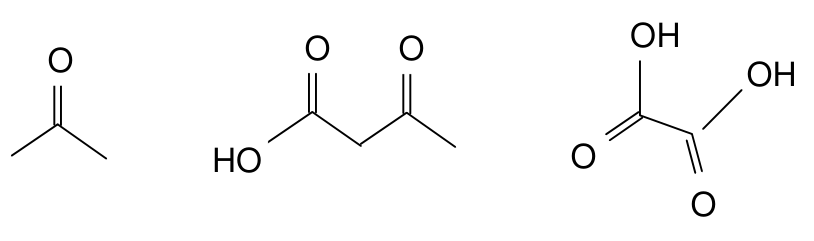
4.1 Give the structure of geraniol A.
4.2 Give the structure of compound B.
4.3 Give the structures of the two bromides of formula \(\ce{C10H17Br}\).
4.4 Indicate which of the two bromides is formed in greater proportions.
Official English text of the problem.
Answers
The following are the intended answers for geraniol. The middle oxidation-product drawing contains a carbon-count discrepancy, explained below.
-
4.1 Geraniol, \((2E)\)-3,7-dimethylocta-2,6-dien-1-ol:
OC/C=C(C)/CCC=C(C)C\[ \ce{HOCH2-CH=C(CH3)-CH2-CH2-CH=C(CH3)2} \] -
4.2 B, 2,3,6,7-tetrabromo-3,7-dimethyloctan-1-ol:
OCC(Br)C(Br)(C)CCC(Br)C(Br)(C)C
This connectivity represents a mixture of stereoisomers. \[ \ce{HOCH2-CHBr-C(Br)(CH3)-CH2-CH2-CHBr-C(Br)(CH3)2} \] -
4.3 The two constitutional substitution products are:
- Geranyl bromide, \((2E)\)-1-bromo-3,7-dimethylocta-2,6-diene:
BrC/C=C(C)/CCC=C(C)C -
Linalyl bromide, racemic 3-bromo-3,7-dimethylocta-1,6-diene:
C=CC(Br)(C)CCC=C(C)C -
4.4 Linalyl bromide is the expected major product under the allylic-carbocation model intended by the question.
Solution
4.1 — Identification of geraniol
The degree of unsaturation is \[ \mathrm{DBE}=\frac{2(10)+2-18}{2}=2. \] Addition of two equivalents of bromine accounts for two carbon–carbon double bonds, using both degrees of unsaturation.
Oxidation to either an aldehyde or a carboxylic acid, retaining all ten carbons, identifies a primary alcohol, \(\ce{-CH2OH}\).
There is a problem with the printed degradation diagram:
| Position in the figure | Product actually drawn | SMILES | Carbon atoms |
|---|---|---|---|
| Left | Propan-2-one, acetone | CC(=O)C |
3 |
| Middle | 3-Oxobutanoic acid, acetoacetic acid | CC(=O)CC(=O)O |
4 |
| Right | Ethanedioic acid, oxalic acid | O=C(O)C(=O)O |
2 |
These fragments contain \(3+4+2=9\) carbons. For the ordinary oxidative cleavage of ten-carbon geraniol, the middle product must instead be 4-oxopentanoic acid, levulinic acid, CC(=O)CCC(=O)O. Its structure contains an additional \(\ce{CH2}\) group.
Using that explicit correction, the fragments reconstruct the molecule:
- Acetone identifies an alkene end of the form \(\ce{=C(CH3)2}\): an alkene carbon without hydrogen gives a ketone.
- Oxalic acid identifies the alcohol-containing end \(\ce{HOCH2-CH=}\). The primary alcohol becomes one carboxyl group, while oxidative cleavage of the alkene carbon bearing hydrogen produces the other.
- Levulinic acid, \(\ce{CH3COCH2CH2COOH}\), identifies the intervening portion \(\ce{=C(CH3)-CH2-CH2-CH=}\).
Joining these pieces gives \[ \boxed{\ce{HOCH2-CH=C(CH3)-CH2-CH2-CH=C(CH3)2}}. \]
The name geraniol specifies the \(E\) configuration at the C2=C3 double bond. Thus the \(\ce{CH2OH}\) group and the continuing carbon chain lie on opposite sides of that double bond. The C6=C7 bond has no \(E/Z\) configuration because C7 bears two identical methyl groups.
The mild oxidation products are:
- Geranial, \((2E)\)-3,7-dimethylocta-2,6-dienal:
O=C/C=C(C)/CCC=C(C)C - Geranic acid, \((2E)\)-3,7-dimethylocta-2,6-dienoic acid:
O=C(O)/C=C(C)/CCC=C(C)C
Writing \(\ce{[O]}\) for one oxygen-atom equivalent supplied by the unspecified oxidant, the balanced equations are
\[
\ce{C10H18O + [O] -> C10H16O + H2O},
\]
\[
\ce{C10H18O + 2[O] -> C10H16O2 + H2O}.
\]
Here water has SMILES O.
The balanced vigorous-oxidation equation, with the corrected middle product, is \[ \ce{C10H18O + 8[O] -> CH3COCH3 + CH3COCH2CH2COOH + HOOC-COOH + H2O}. \]
4.2 — Formation of the tetrabromide
Bromine, BrBr, adds across each double bond, placing one bromine atom on each former alkene carbon:
\[
\ce{C10H18O + 2Br2 -> C10H18OBr4}.
\]
Consequently, \[ \boxed{\ce{B = HOCH2-CHBr-C(Br)(CH3)-CH2-CH2-CHBr-C(Br)(CH3)2}}. \]
Ordinary electrophilic bromination proceeds through bromonium ions, followed by attack of bromide ion, [Br-], from the opposite face. Addition is therefore anti.
The product has stereogenic centers at C2, C3 and C6; C7 is not stereogenic because it bears two methyl groups. One permitted stereoisomer of B is represented by
OC[C@H](Br)[C@@](Br)(C)CC[C@H](Br)C(Br)(C)C.
Its mirror image and the corresponding C6 epimers give four possible stereoisomers, arranged in two enantiomeric pairs. The problem does not specify their relative proportions.
4.3 — Formation of the two bromides
The product formula indicates substitution of the hydroxyl group by bromine, with loss of water. For either constitutional product, the balanced net equation with hydrogen bromide, [H]Br, is
\[
\ce{C10H18O + HBr -> C10H17Br + H2O}.
\]
Protonation gives protonated geraniol,
[OH2+]C/C=C(C)/CCC=C(C)C.
The C–O bonding electron pair then leaves with water, generating an allylic carbocation. Its two resonance contributors are represented by:
- Geranyl-cation contributor, with charge at C1:
[CH2+]/C=C(C)/CCC=C(C)C - Linalyl-cation contributor, with charge at C3:
C=C[C+](C)CCC=C(C)C
These are two representations of the same delocalized ion. Moving the C2=C3 \(\pi\)-electron pair toward C1 forms C1=C2 and shifts the positive charge to C3.
A lone pair on bromide can attack either end of this allylic system:
-
Attack at C1 gives geranyl bromide: \[ \ce{BrCH2-CH=C(CH3)-CH2-CH2-CH=C(CH3)2}. \]
-
Attack at C3 gives linalyl bromide, with the first double bond shifted to C1=C2: \[ \ce{CH2=CH-C(Br)(CH3)-CH2-CH2-CH=C(CH3)2}. \]
Attack at the planar C3 center can occur from either face. In an achiral medium, linalyl bromide is therefore racemic; its two enantiomeric SMILES are
C=C[C@](Br)(C)CCC=C(C)C and
C=C[C@@](Br)(C)CCC=C(C)C.
4.4 — Major bromide
The contributor with positive charge at C3 places the charge on a tertiary carbon; the C1 contributor places it on a primary carbon. The tertiary contributor is better stabilized by the surrounding alkyl groups.
The intended qualitative argument therefore predicts preferential bromide capture at C3, giving linalyl bromide as the major product. No numerical product ratio can be obtained from the supplied information.
The solution was checked against the official solution.
IChO 1992 · Theorieaufgabe 4
Geraniol aus Rosenöl
Rosenöl ist ein ätherisches Öl, das durch Wasserdampfdestillation von Pflanzenmaterial von Rosen gewonnen wird. Es enthält eine Reihe von Terpenen, darunter Geraniol, \(\ce{C10H18O}\) (A). Bei der Oxidation kann Geraniol entweder einen Aldehyd mit zehn Kohlenstoffatomen oder eine Carbonsäure mit zehn Kohlenstoffatomen ergeben. Die Reaktion mit zwei Mol Brom ergibt ein Tetrabromid (\(\ce{C10H18OBr4}\)) (B). Geraniol reagiert mit \(\ce{HBr}\) zu zwei Bromiden mit der Formel \(\ce{C10H17Br}\).
Bei der Oxidation von Geraniol unter drastischen Bedingungen entstehen drei Produkte:
4.1 Geben Sie die Struktur von Geraniol A an.
4.2 Geben Sie die Struktur der Verbindung B an.
4.3 Geben Sie die Strukturen der beiden Bromide mit der Formel \(\ce{C10H17Br}\) an.
4.4 Geben Sie an, welches der beiden Bromide in größerem Anteil gebildet wird.
Aufgabentext aus dem offiziellen englischen Text übersetzt.
Antworten
Die folgenden Antworten sind die für Geraniol vorgesehenen Antworten. Die Zeichnung des mittleren Oxidationsprodukts weist eine Unstimmigkeit bei der Anzahl der Kohlenstoffatome auf, die weiter unten erläutert wird.
-
4.1 Geraniol, \((2E)\)-3,7-Dimethylocta-2,6-dien-1-ol:
OC/C=C(C)/CCC=C(C)C\[ \ce{HOCH2-CH=C(CH3)-CH2-CH2-CH=C(CH3)2} \] -
4.2 B, 2,3,6,7-Tetrabrom-3,7-dimethyloctan-1-ol:
OCC(Br)C(Br)(C)CCC(Br)C(Br)(C)C
Diese Verknüpfung der Atome steht für ein Gemisch von Stereoisomeren. \[ \ce{HOCH2-CHBr-C(Br)(CH3)-CH2-CH2-CHBr-C(Br)(CH3)2} \] -
4.3 Die beiden konstitutionsisomeren Substitutionsprodukte sind:
- Geranylbromid, \((2E)\)-1-Brom-3,7-dimethylocta-2,6-dien:
BrC/C=C(C)/CCC=C(C)C -
Linalylbromid, racemisches 3-Brom-3,7-dimethylocta-1,6-dien:
C=CC(Br)(C)CCC=C(C)C -
4.4 Linalylbromid ist das erwartete Hauptprodukt nach dem in der Aufgabenstellung vorgesehenen Modell eines allylischen Carbokations.
Lösung
4.1 — Identifizierung von Geraniol
Der Ungesättigtheitsgrad beträgt \[ \mathrm{DBE}=\frac{2(10)+2-18}{2}=2. \] Die Addition von zwei Äquivalenten Brom lässt sich durch zwei Kohlenstoff–Kohlenstoff-Doppelbindungen erklären, die beide Ungesättigtheitsgrade ausschöpfen.
Die Oxidation entweder zu einem Aldehyd oder zu einer Carbonsäure unter Erhalt aller zehn Kohlenstoffatome weist auf einen primären Alkohol, \(\ce{-CH2OH}\), hin.
Das abgedruckte Abbauschema weist ein Problem auf:
| Position in der Abbildung | Tatsächlich gezeichnetes Produkt | SMILES | Kohlenstoffatome |
|---|---|---|---|
| Links | Propan-2-on, Aceton | CC(=O)C |
3 |
| Mitte | 3-Oxobutansäure, Acetessigsäure | CC(=O)CC(=O)O |
4 |
| Rechts | Ethandisäure, Oxalsäure | O=C(O)C(=O)O |
2 |
Diese Fragmente enthalten \(3+4+2=9\) Kohlenstoffatome. Bei der üblichen oxidativen Spaltung von Geraniol mit zehn Kohlenstoffatomen muss das mittlere Produkt stattdessen 4-Oxopentansäure, Lävulinsäure, CC(=O)CCC(=O)O, sein. Ihre Struktur enthält eine zusätzliche \(\ce{CH2}\)-Gruppe.
Mit dieser ausdrücklich vorgenommenen Korrektur lässt sich das Molekül aus den Fragmenten rekonstruieren:
- Aceton weist auf ein Alkenende der Form \(\ce{=C(CH3)2}\) hin: Ein Alken-Kohlenstoffatom ohne Wasserstoff ergibt ein Keton.
- Oxalsäure weist auf das alkoholhaltige Ende \(\ce{HOCH2-CH=}\) hin. Der primäre Alkohol wird zu einer Carboxylgruppe, während die oxidative Spaltung am wasserstofftragenden Alken-Kohlenstoffatom die andere erzeugt.
- Lävulinsäure, \(\ce{CH3COCH2CH2COOH}\), weist auf den dazwischenliegenden Abschnitt \(\ce{=C(CH3)-CH2-CH2-CH=}\) hin.
Das Zusammenfügen dieser Teile ergibt \[ \boxed{\ce{HOCH2-CH=C(CH3)-CH2-CH2-CH=C(CH3)2}}. \]
Der Name Geraniol legt die \(E\)-Konfiguration an der C2=C3-Doppelbindung fest. Somit liegen die \(\ce{CH2OH}\)-Gruppe und die weiterführende Kohlenstoffkette auf entgegengesetzten Seiten dieser Doppelbindung. Die C6=C7-Bindung besitzt keine \(E/Z\)-Konfiguration, da C7 zwei identische Methylgruppen trägt.
Die Produkte der milden Oxidation sind:
- Geranial, \((2E)\)-3,7-Dimethylocta-2,6-dienal:
O=C/C=C(C)/CCC=C(C)C - Geraniumsäure, \((2E)\)-3,7-Dimethylocta-2,6-diensäure:
O=C(O)/C=C(C)/CCC=C(C)C
Wenn \(\ce{[O]}\) für ein Sauerstoffatom-Äquivalent steht, das vom nicht näher angegebenen Oxidationsmittel bereitgestellt wird, lauten die ausgeglichenen Gleichungen
\[
\ce{C10H18O + [O] -> C10H16O + H2O},
\]
\[
\ce{C10H18O + 2[O] -> C10H16O2 + H2O}.
\]
Dabei hat Wasser den SMILES-Code O.
Die ausgeglichene Gleichung für die Oxidation unter drastischen Bedingungen lautet mit dem korrigierten mittleren Produkt \[ \ce{C10H18O + 8[O] -> CH3COCH3 + CH3COCH2CH2COOH + HOOC-COOH + H2O}. \]
4.2 — Bildung des Tetrabromids
Brom, BrBr, addiert sich an jede Doppelbindung, wobei an jedes ehemalige Alken-Kohlenstoffatom ein Bromatom gebunden wird:
\[
\ce{C10H18O + 2Br2 -> C10H18OBr4}.
\]
Folglich gilt \[ \boxed{\ce{B = HOCH2-CHBr-C(Br)(CH3)-CH2-CH2-CHBr-C(Br)(CH3)2}}. \]
Die gewöhnliche elektrophile Bromierung verläuft über Bromoniumionen, gefolgt vom Angriff eines Bromidions, [Br-], von der gegenüberliegenden Seite. Die Addition erfolgt daher anti.
Das Produkt besitzt stereogene Zentren an C2, C3 und C6; C7 ist nicht stereogen, da es zwei Methylgruppen trägt. Ein mögliches Stereoisomer von B wird dargestellt durch
OC[C@H](Br)[C@@](Br)(C)CC[C@H](Br)C(Br)(C)C.
Zusammen mit seinem Spiegelbild und den entsprechenden C6-Epimeren ergeben sich vier mögliche Stereoisomere, die zwei Enantiomerenpaare bilden. Die Aufgabe gibt ihre relativen Anteile nicht an.
4.3 — Bildung der beiden Bromide
Die Produktformel weist auf die Substitution der Hydroxygruppe durch Brom unter Abspaltung von Wasser hin. Für beide konstitutionsisomeren Produkte lautet die ausgeglichene Nettogleichung mit Bromwasserstoff, [H]Br,
\[
\ce{C10H18O + HBr -> C10H17Br + H2O}.
\]
Durch Protonierung entsteht protoniertes Geraniol,
[OH2+]C/C=C(C)/CCC=C(C)C.
Das bindende Elektronenpaar der C–O-Bindung wird anschließend mit dem Wasser abgespalten, wodurch ein allylisches Carbokation entsteht. Seine beiden mesomeren Grenzstrukturen werden dargestellt durch:
- Geranylkation-Grenzstruktur, mit der Ladung an C1:
[CH2+]/C=C(C)/CCC=C(C)C - Linalylkation-Grenzstruktur, mit der Ladung an C3:
C=C[C+](C)CCC=C(C)C
Dies sind zwei Darstellungen desselben delokalisierten Ions. Die Verschiebung des \(\pi\)-Elektronenpaars von C2=C3 in Richtung C1 bildet C1=C2 und verlagert die positive Ladung auf C3.
Ein freies Elektronenpaar am Bromid kann an einem der beiden Enden dieses allylischen Systems angreifen:
-
Angriff an C1 ergibt Geranylbromid: \[ \ce{BrCH2-CH=C(CH3)-CH2-CH2-CH=C(CH3)2}. \]
-
Angriff an C3 ergibt Linalylbromid, wobei die erste Doppelbindung nach C1=C2 verschoben ist: \[ \ce{CH2=CH-C(Br)(CH3)-CH2-CH2-CH=C(CH3)2}. \]
Der Angriff am planaren C3-Zentrum kann von beiden Seiten erfolgen. In einem achiralen Medium ist Linalylbromid daher racemisch; die SMILES-Codes seiner beiden Enantiomere lauten
C=C[C@](Br)(C)CCC=C(C)C und
C=C[C@@](Br)(C)CCC=C(C)C.
4.4 — Hauptsächlich gebildetes Bromid
In der Grenzstruktur mit positiver Ladung an C3 sitzt die Ladung an einem tertiären Kohlenstoffatom; in der C1-Grenzstruktur sitzt sie an einem primären Kohlenstoffatom. Die tertiäre Grenzstruktur wird durch die umgebenden Alkylgruppen besser stabilisiert.
Die vorgesehene qualitative Argumentation sagt daher einen bevorzugten Angriff von Bromid an C3 voraus, wodurch Linalylbromid als Hauptprodukt entsteht. Aus den gegebenen Informationen lässt sich kein zahlenmäßiges Produktverhältnis bestimmen.
Die Lösung wurde mit der offiziellen Lösung abgeglichen.
IChO 1992 · Teori sorusu 4
Gül yağından geraniol
Gül yağı, güllerden elde edilen bitkisel materyalin su buharı damıtmasıyla üretilen bir uçucu yağdır. İçerdiği çeşitli terpenlerden biri geranioldür, \(\ce{C10H18O}\) (A). Geraniol, yükseltgendiğinde on karbonlu bir aldehit veya on karbonlu bir karboksilik asit verebilir. İki mol bromla tepkimesi bir tetrabromür (\(\ce{C10H18OBr4}\)) (B) verir. Geraniol, \(\ce{HBr}\) ile tepkimeye girerek \(\ce{C10H17Br}\) formülüne sahip iki bromür verir.
Geraniol kuvvetli koşullarda yükseltgendiğinde üç ürün elde edilir:
4.1 Geraniol A'nın yapısını veriniz.
4.2 B bileşiğinin yapısını veriniz.
4.3 \(\ce{C10H17Br}\) formülüne sahip iki bromürün yapılarını veriniz.
4.4 İki bromürden hangisinin daha yüksek oranda oluştuğunu belirtiniz.
Soru metni resmi İngilizce metinden çevrilmiştir.
Cevaplar
Aşağıdakiler, geraniol için beklenen cevaplardır. Ortadaki yükseltgenme ürünü çiziminde karbon sayısı bakımından bir tutarsızlık vardır; bu durum aşağıda açıklanmıştır.
-
4.1 Geraniol, \((2E)\)-3,7-dimetilokta-2,6-dien-1-ol:
OC/C=C(C)/CCC=C(C)C\[ \ce{HOCH2-CH=C(CH3)-CH2-CH2-CH=C(CH3)2} \] -
4.2 B, 2,3,6,7-tetrabromo-3,7-dimetiloktan-1-ol:
OCC(Br)C(Br)(C)CCC(Br)C(Br)(C)C
Bu bağlanma düzeni, bir stereoizomer karışımını temsil eder. \[ \ce{HOCH2-CHBr-C(Br)(CH3)-CH2-CH2-CHBr-C(Br)(CH3)2} \] -
4.3 Yapısal izomer olan iki yer değiştirme ürünü şunlardır:
- Geranil bromür, \((2E)\)-1-bromo-3,7-dimetilokta-2,6-dien:
BrC/C=C(C)/CCC=C(C)C -
Linalil bromür, rasemik 3-bromo-3,7-dimetilokta-1,6-dien:
C=CC(Br)(C)CCC=C(C)C -
4.4 Soruda esas alınan allilik karbokatyon modeline göre beklenen ana ürün linalil bromürdür.
Çözüm
4.1 — Geraniolün belirlenmesi
Doymamışlık derecesi şöyledir: \[ \mathrm{DBE}=\frac{2(10)+2-18}{2}=2. \] İki eşdeğer bromun katılması, iki karbon–karbon çift bağının varlığını gösterir; böylece her iki doymamışlık derecesi de açıklanır.
On karbonun tamamı korunarak bir aldehide veya bir karboksilik aside yükseltgenmesi, bir birincil alkol, \(\ce{-CH2OH}\), olduğunu gösterir.
Basılı parçalanma şemasında bir sorun vardır:
| Şekildeki konum | Gerçekte çizilen ürün | SMILES | Karbon atomu sayısı |
|---|---|---|---|
| Sol | Propan-2-on, aseton | CC(=O)C |
3 |
| Orta | 3-Oksobütanoik asit, asetoasetik asit | CC(=O)CC(=O)O |
4 |
| Sağ | Etandioik asit, oksalik asit | O=C(O)C(=O)O |
2 |
Bu parçalar \(3+4+2=9\) karbon içerir. On karbonlu geraniolün olağan yükseltgenerek parçalanmasında ortadaki ürünün bunun yerine 4-oksopentanoik asit, levulinik asit, CC(=O)CCC(=O)O, olması gerekir. Bunun yapısında ek bir \(\ce{CH2}\) grubu bulunur.
Bu açık düzeltme kullanıldığında, molekül bu parçalardan yeniden oluşturulur:
- Aseton, \(\ce{=C(CH3)2}\) biçimindeki bir alken ucunu gösterir: hidrojen taşımayan bir alken karbonu keton verir.
- Oksalik asit, alkol içeren \(\ce{HOCH2-CH=}\) ucunu gösterir. Birincil alkol bir karboksil grubuna dönüşürken, hidrojen taşıyan alken karbonunun yükseltgenerek parçalanması diğer karboksil grubunu oluşturur.
- Levulinik asit, \(\ce{CH3COCH2CH2COOH}\), aradaki \(\ce{=C(CH3)-CH2-CH2-CH=}\) bölümünü gösterir.
Bu parçalar birleştirildiğinde şu yapı elde edilir: \[ \boxed{\ce{HOCH2-CH=C(CH3)-CH2-CH2-CH=C(CH3)2}}. \]
Geraniol adı, C2=C3 çift bağındaki \(E\) konfigürasyonunu belirtir. Dolayısıyla \(\ce{CH2OH}\) grubu ile devam eden karbon zinciri bu çift bağın karşı taraflarında yer alır. C7 iki özdeş metil grubu taşıdığı için C6=C7 bağının \(E/Z\) konfigürasyonu yoktur.
Ilımlı koşullardaki yükseltgenme ürünleri şunlardır:
- Geranial, \((2E)\)-3,7-dimetilokta-2,6-dienal:
O=C/C=C(C)/CCC=C(C)C - Geranik asit, \((2E)\)-3,7-dimetilokta-2,6-dienoik asit:
O=C(O)/C=C(C)/CCC=C(C)C
Belirtilmemiş yükseltgenin sağladığı bir oksijen atomu eşdeğerini \(\ce{[O]}\) ile gösterirsek, denkleştirilmiş denklemler şöyledir:
\[
\ce{C10H18O + [O] -> C10H16O + H2O},
\]
\[
\ce{C10H18O + 2[O] -> C10H16O2 + H2O}.
\]
Burada suyun SMILES gösterimi O'dur.
Ortadaki ürün düzeltilmiş hâliyle, kuvvetli koşullardaki yükseltgenmenin denkleştirilmiş denklemi şöyledir: \[ \ce{C10H18O + 8[O] -> CH3COCH3 + CH3COCH2CH2COOH + HOOC-COOH + H2O}. \]
4.2 — Tetrabromürün oluşumu
Brom, BrBr, her bir çift bağa katılır ve başlangıçtaki alken karbonlarının her birine bir brom atomu bağlanır:
\[
\ce{C10H18O + 2Br2 -> C10H18OBr4}.
\]
Sonuç olarak, \[ \boxed{\ce{B = HOCH2-CHBr-C(Br)(CH3)-CH2-CH2-CHBr-C(Br)(CH3)2}}. \]
Olağan elektrofilik bromlanma, bromonyum iyonları üzerinden ilerler; ardından bromür iyonu, [Br-], karşı yüzden saldırır. Dolayısıyla katılma anti biçimindedir.
Üründe C2, C3 ve C6'da stereojenik merkezler vardır; C7, iki metil grubu taşıdığı için stereojenik değildir. B'nin olası stereoizomerlerinden biri şu şekilde gösterilir:
OC[C@H](Br)[C@@](Br)(C)CC[C@H](Br)C(Br)(C)C.
Bunun ayna görüntüsü ve bunlara karşılık gelen C6 epimerleri, iki enantiyomer çifti hâlinde dört olası stereoizomer verir. Soruda bunların bağıl oranları belirtilmemiştir.
4.3 — İki bromürün oluşumu
Ürün formülü, su kaybıyla birlikte hidroksil grubunun yerini bromun aldığını gösterir. Yapısal izomer olan ürünlerin her biri için hidrojen bromür, [H]Br, ile gerçekleşen tepkimenin denkleştirilmiş net denklemi şöyledir:
\[
\ce{C10H18O + HBr -> C10H17Br + H2O}.
\]
Protonlanma, protonlanmış geraniolü verir:
[OH2+]C/C=C(C)/CCC=C(C)C.
Ardından C–O bağ elektron çifti suyla birlikte ayrılır ve bir allilik karbokatyon oluşur. Bunun iki rezonans katkı yapısı şu şekilde gösterilir:
- Yükün C1'de olduğu geranil katyonu katkı yapısı:
[CH2+]/C=C(C)/CCC=C(C)C - Yükün C3'te olduğu linalil katyonu katkı yapısı:
C=C[C+](C)CCC=C(C)C
Bunlar, aynı delokalize iyonun iki gösterimidir. C2=C3 bağındaki \(\pi\)-elektron çiftinin C1'e doğru kayması C1=C2 bağını oluşturur ve pozitif yükü C3'e taşır.
Bromür üzerindeki ortaklanmamış bir elektron çifti, bu allilik sistemin her iki ucuna da saldırabilir:
-
C1'e saldırı, geranil bromür verir: \[ \ce{BrCH2-CH=C(CH3)-CH2-CH2-CH=C(CH3)2}. \]
-
C3'e saldırı, ilk çift bağın C1=C2 konumuna kaydığı linalil bromürü verir: \[ \ce{CH2=CH-C(Br)(CH3)-CH2-CH2-CH=C(CH3)2}. \]
Düzlemsel C3 merkezine saldırı her iki yüzden de gerçekleşebilir. Bu nedenle akiral bir ortamda linalil bromür rasemiktir; iki enantiyomerinin SMILES gösterimleri şöyledir:
C=C[C@](Br)(C)CCC=C(C)C ve
C=C[C@@](Br)(C)CCC=C(C)C.
4.4 — Ana bromür ürünü
Pozitif yükün C3'te olduğu katkı yapısında yük üçüncül bir karbon üzerindedir; C1 katkı yapısında ise birincil bir karbon üzerindedir. Üçüncül katkı yapısı, çevresindeki alkil grupları tarafından daha iyi kararlılaştırılır.
Dolayısıyla soruda amaçlanan nitel açıklama, bromürün tercihen C3'e bağlanmasını ve ana ürün olarak linalil bromürün oluşmasını öngörür. Verilen bilgilerden sayısal bir ürün oranı elde edilemez.
Çözüm, resmi çözümle karşılaştırılarak kontrol edildi.
IChO 1992 · Problema teórico 4
Geraniol del aceite de rosas
El aceite de rosas es un aceite esencial obtenido por destilación por arrastre de vapor de material vegetal de rosas. Contiene varios terpenos, uno de los cuales es el geraniol, \(\ce{C10H18O}\) (A). Al oxidarse, el geraniol puede dar un aldehído de diez átomos de carbono o un ácido carboxílico de diez átomos de carbono. La reacción con dos moles de bromo da un tetrabromuro (\(\ce{C10H18OBr4}\)) (B). El geraniol reacciona con \(\ce{HBr}\) para dar dos bromuros de fórmula \(\ce{C10H17Br}\).
Cuando el geraniol se somete a una oxidación enérgica, se obtienen tres productos:
4.1 Indique la estructura del geraniol A.
4.2 Indique la estructura del compuesto B.
4.3 Indique las estructuras de los dos bromuros de fórmula \(\ce{C10H17Br}\).
4.4 Indique cuál de los dos bromuros se forma en mayor proporción.
Enunciado traducido del texto oficial en inglés.
Respuestas
Las siguientes son las respuestas previstas para el geraniol. El dibujo del producto de oxidación central contiene una discrepancia en el número de átomos de carbono, que se explica a continuación.
-
4.1 Geraniol, \((2E)\)-3,7-dimetilocta-2,6-dien-1-ol:
OC/C=C(C)/CCC=C(C)C\[ \ce{HOCH2-CH=C(CH3)-CH2-CH2-CH=C(CH3)2} \] -
4.2 B, 2,3,6,7-tetrabromo-3,7-dimetiloctan-1-ol:
OCC(Br)C(Br)(C)CCC(Br)C(Br)(C)C
Esta conectividad representa una mezcla de estereoisómeros. \[ \ce{HOCH2-CHBr-C(Br)(CH3)-CH2-CH2-CHBr-C(Br)(CH3)2} \] -
4.3 Los dos productos de sustitución constitucionalmente distintos son:
- Bromuro de geranilo, \((2E)\)-1-bromo-3,7-dimetilocta-2,6-dieno:
BrC/C=C(C)/CCC=C(C)C -
Bromuro de linalilo, 3-bromo-3,7-dimetilocta-1,6-dieno racémico:
C=CC(Br)(C)CCC=C(C)C -
4.4 El bromuro de linalilo es el producto mayoritario esperado según el modelo del carbocatión alílico previsto en la pregunta.
Solución
4.1 — Identificación del geraniol
El grado de insaturación es \[ \mathrm{DBE}=\frac{2(10)+2-18}{2}=2. \] La adición de dos equivalentes de bromo corresponde a dos dobles enlaces carbono–carbono, que representan ambos grados de insaturación.
La oxidación a un aldehído o a un ácido carboxílico, conservando los diez átomos de carbono, permite identificar un alcohol primario, \(\ce{-CH2OH}\).
Hay un problema en el esquema de degradación impreso:
| Posición en la figura | Producto realmente dibujado | SMILES | Átomos de carbono |
|---|---|---|---|
| Izquierda | Propan-2-ona, acetona | CC(=O)C |
3 |
| Centro | Ácido 3-oxobutanoico, ácido acetoacético | CC(=O)CC(=O)O |
4 |
| Derecha | Ácido etanodioico, ácido oxálico | O=C(O)C(=O)O |
2 |
Estos fragmentos contienen \(3+4+2=9\) átomos de carbono. En la escisión oxidativa habitual del geraniol de diez átomos de carbono, el producto central debe ser, en cambio, ácido 4-oxopentanoico, ácido levulínico, CC(=O)CCC(=O)O. Su estructura contiene un grupo \(\ce{CH2}\) adicional.
Con esta corrección explícita, los fragmentos permiten reconstruir la molécula:
- La acetona permite identificar un extremo alquénico de la forma \(\ce{=C(CH3)2}\): un carbono alquénico sin hidrógeno da una cetona.
- El ácido oxálico permite identificar el extremo que contiene el grupo alcohol, \(\ce{HOCH2-CH=}\). El alcohol primario se convierte en un grupo carboxilo, mientras que la escisión oxidativa del carbono alquénico que lleva un hidrógeno produce el otro.
- El ácido levulínico, \(\ce{CH3COCH2CH2COOH}\), permite identificar la porción intermedia \(\ce{=C(CH3)-CH2-CH2-CH=}\).
Al unir estos fragmentos se obtiene \[ \boxed{\ce{HOCH2-CH=C(CH3)-CH2-CH2-CH=C(CH3)2}}. \]
El nombre geraniol especifica la configuración \(E\) en el doble enlace C2=C3. Por tanto, el grupo \(\ce{CH2OH}\) y la continuación de la cadena carbonada se encuentran en lados opuestos de ese doble enlace. El enlace C6=C7 no presenta configuración \(E/Z\) porque C7 lleva dos grupos metilo idénticos.
Los productos de oxidación suave son:
- Geranial, \((2E)\)-3,7-dimetilocta-2,6-dienal:
O=C/C=C(C)/CCC=C(C)C - Ácido geránico, ácido \((2E)\)-3,7-dimetilocta-2,6-dienoico:
O=C(O)/C=C(C)/CCC=C(C)C
Si se escribe \(\ce{[O]}\) para representar un equivalente de átomo de oxígeno suministrado por el oxidante no especificado, las ecuaciones ajustadas son
\[
\ce{C10H18O + [O] -> C10H16O + H2O},
\]
\[
\ce{C10H18O + 2[O] -> C10H16O2 + H2O}.
\]
Aquí el agua tiene el SMILES O.
La ecuación ajustada de la oxidación enérgica, con el producto central corregido, es \[ \ce{C10H18O + 8[O] -> CH3COCH3 + CH3COCH2CH2COOH + HOOC-COOH + H2O}. \]
4.2 — Formación del tetrabromuro
El bromo, BrBr, se adiciona a cada doble enlace, de modo que un átomo de bromo queda unido a cada uno de los carbonos que formaban el enlace alquénico:
\[
\ce{C10H18O + 2Br2 -> C10H18OBr4}.
\]
Por consiguiente, \[ \boxed{\ce{B = HOCH2-CHBr-C(Br)(CH3)-CH2-CH2-CHBr-C(Br)(CH3)2}}. \]
La bromación electrófila habitual transcurre mediante iones bromonio, seguida del ataque del ion bromuro, [Br-], por la cara opuesta. Por tanto, la adición es anti.
El producto tiene centros estereogénicos en C2, C3 y C6; C7 no es estereogénico porque lleva dos grupos metilo. Uno de los estereoisómeros posibles de B se representa mediante
OC[C@H](Br)[C@@](Br)(C)CC[C@H](Br)C(Br)(C)C.
Su imagen especular y los correspondientes epímeros en C6 dan cuatro estereoisómeros posibles, agrupados en dos pares de enantiómeros. El problema no especifica sus proporciones relativas.
4.3 — Formación de los dos bromuros
La fórmula del producto indica la sustitución del grupo hidroxilo por bromo, con pérdida de agua. Para cualquiera de los dos productos constitucionalmente distintos, la ecuación neta ajustada con bromuro de hidrógeno, [H]Br, es
\[
\ce{C10H18O + HBr -> C10H17Br + H2O}.
\]
La protonación da geraniol protonado,
[OH2+]C/C=C(C)/CCC=C(C)C.
El par de electrones del enlace C–O se separa entonces junto con el agua, generando un carbocatión alílico. Sus dos formas contribuyentes de resonancia se representan mediante:
- Forma contribuyente del catión geranilo, con la carga en C1:
[CH2+]/C=C(C)/CCC=C(C)C - Forma contribuyente del catión linalilo, con la carga en C3:
C=C[C+](C)CCC=C(C)C
Estas son dos representaciones del mismo ion deslocalizado. El desplazamiento del par de electrones \(\pi\) de C2=C3 hacia C1 forma C1=C2 y traslada la carga positiva a C3.
Un par de electrones no enlazantes del bromuro puede atacar cualquiera de los extremos de este sistema alílico:
-
El ataque en C1 da bromuro de geranilo: \[ \ce{BrCH2-CH=C(CH3)-CH2-CH2-CH=C(CH3)2}. \]
-
El ataque en C3 da bromuro de linalilo, con el primer doble enlace desplazado a C1=C2: \[ \ce{CH2=CH-C(Br)(CH3)-CH2-CH2-CH=C(CH3)2}. \]
El ataque al centro plano C3 puede producirse por cualquiera de sus caras. En un medio aquiral, el bromuro de linalilo es, por tanto, racémico; los SMILES de sus dos enantiómeros son
C=C[C@](Br)(C)CCC=C(C)C y
C=C[C@@](Br)(C)CCC=C(C)C.
4.4 — Bromuro mayoritario
La forma contribuyente con carga positiva en C3 sitúa la carga en un carbono terciario; la forma contribuyente con carga en C1 la sitúa en un carbono primario. La forma contribuyente terciaria está mejor estabilizada por los grupos alquilo circundantes.
Por tanto, el argumento cualitativo previsto predice la captura preferente del bromuro en C3, dando bromuro de linalilo como producto mayoritario. No se puede obtener una proporción numérica de los productos a partir de la información proporcionada.
La solución se comprobó con la solución oficial.
IChO 1992 · 理论题 4
玫瑰油中的香叶醇
玫瑰油是将玫瑰植物材料进行水蒸气蒸馏得到的一种精油。它含有多种萜类化合物,其中一种是香叶醇,\(\ce{C10H18O}\)(A)。香叶醇氧化时,可以生成含十个碳原子的醛或含十个碳原子的羧酸。与两摩尔溴反应时,生成四溴化物(\(\ce{C10H18OBr4}\))(B)。香叶醇与 \(\ce{HBr}\) 反应,生成两种分子式为 \(\ce{C10H17Br}\) 的溴代物。
香叶醇经强烈氧化后,得到三种产物:
4.1 写出香叶醇 A 的结构。
4.2 写出化合物 B 的结构。
4.3 写出两种分子式为 \(\ce{C10H17Br}\) 的溴代物的结构。
4.4 指出这两种溴代物中哪一种的生成比例较大。
题目译自官方英文原文。
答案
以下是本题关于香叶醇的预期答案。中间的氧化产物结构图存在碳原子数不符的问题,下文将予以说明。
-
4.1 香叶醇,\((2E)\)-3,7-二甲基-2,6-辛二烯-1-醇:
OC/C=C(C)/CCC=C(C)C\[ \ce{HOCH2-CH=C(CH3)-CH2-CH2-CH=C(CH3)2} \] -
4.2 B,2,3,6,7-四溴-3,7-二甲基-1-辛醇:
OCC(Br)C(Br)(C)CCC(Br)C(Br)(C)C
这一连接方式表示的是立体异构体的混合物。 \[ \ce{HOCH2-CHBr-C(Br)(CH3)-CH2-CH2-CHBr-C(Br)(CH3)2} \] -
4.3 两种互为构造异构体的取代产物为:
- 溴代香叶基,\((2E)\)-1-溴-3,7-二甲基-2,6-辛二烯:
BrC/C=C(C)/CCC=C(C)C -
溴代芳樟基,外消旋的 3-溴-3,7-二甲基-1,6-辛二烯:
C=CC(Br)(C)CCC=C(C)C -
4.4 根据本题所采用的烯丙基碳正离子模型,预期的主要产物为溴代芳樟基。
解答
4.1 — 香叶醇的结构确定
不饱和度为 \[ \mathrm{DBE}=\frac{2(10)+2-18}{2}=2. \] 能够加成两当量的溴,说明分子中有两个碳碳双键,恰好占据全部两个不饱和度。
氧化时既可生成醛,也可生成羧酸,且保留全部十个碳原子,说明它是伯醇,含有 \(\ce{-CH2OH}\)。
题目印出的降解产物图存在一个问题:
| 图中位置 | 实际画出的产物 | SMILES | 碳原子数 |
|---|---|---|---|
| 左侧 | 2-丙酮,即丙酮 | CC(=O)C |
3 |
| 中间 | 3-氧代丁酸,即乙酰乙酸 | CC(=O)CC(=O)O |
4 |
| 右侧 | 乙二酸,即草酸 | O=C(O)C(=O)O |
2 |
这些片段共含有 \(3+4+2=9\) 个碳原子。对于含十个碳原子的香叶醇的常规氧化断裂,中间的产物应当是 4-氧代戊酸,即乙酰丙酸,CC(=O)CCC(=O)O。其结构比图示产物多一个 \(\ce{CH2}\) 基团。
采用上述明确的修正后,可利用这些片段重建分子结构:
- 丙酮表明烯烃的一端具有 \(\ce{=C(CH3)2}\) 的形式:不带氢的烯碳原子氧化后生成酮。
- 草酸表明含醇基的一端为 \(\ce{HOCH2-CH=}\)。伯醇基团转变为一个羧基,而带氢的烯碳原子经氧化断裂后形成另一个羧基。
- 乙酰丙酸,\(\ce{CH3COCH2CH2COOH}\),表明中间部分为 \(\ce{=C(CH3)-CH2-CH2-CH=}\)。
将这些片段连接起来,得到 \[ \boxed{\ce{HOCH2-CH=C(CH3)-CH2-CH2-CH=C(CH3)2}}. \]
香叶醇这一名称规定 C2=C3 双键为 \(E\) 构型。因此,\(\ce{CH2OH}\) 基团与其余碳链位于该双键的两侧。C6=C7 双键不存在 \(E/Z\) 构型,因为 C7 上连接着两个相同的甲基。
温和氧化的产物为:
- 香叶醛,\((2E)\)-3,7-二甲基-2,6-辛二烯醛:
O=C/C=C(C)/CCC=C(C)C - 香叶酸,\((2E)\)-3,7-二甲基-2,6-辛二烯酸:
O=C(O)/C=C(C)/CCC=C(C)C
用 \(\ce{[O]}\) 表示由未指明的氧化剂提供的一个氧原子当量,则配平后的方程式为
\[
\ce{C10H18O + [O] -> C10H16O + H2O},
\]
\[
\ce{C10H18O + 2[O] -> C10H16O2 + H2O}.
\]
这里,水的 SMILES 为 O。
采用修正后的中间产物,配平后的强烈氧化反应方程式为 \[ \ce{C10H18O + 8[O] -> CH3COCH3 + CH3COCH2CH2COOH + HOOC-COOH + H2O}. \]
4.2 — 四溴化物的生成
溴,BrBr,分别与每个双键发生加成,使原先构成双键的每个碳原子上各连接一个溴原子:
\[
\ce{C10H18O + 2Br2 -> C10H18OBr4}.
\]
因此, \[ \boxed{\ce{B = HOCH2-CHBr-C(Br)(CH3)-CH2-CH2-CHBr-C(Br)(CH3)2}}. \]
常规的亲电溴化反应先形成溴鎓离子,随后溴离子 [Br-] 从相反的一面进攻。因此,加成为反式加成。
产物在 C2、C3 和 C6 处具有立体中心;C7 不是立体中心,因为它连接着两个甲基。B 的一种可能的立体异构体可表示为
OC[C@H](Br)[C@@](Br)(C)CC[C@H](Br)C(Br)(C)C。
该异构体及其镜像,再加上相应的 C6 差向异构体,共构成四种可能的立体异构体,分为两对对映异构体。题目未指明它们的相对比例。
4.3 — 两种溴代物的生成
产物的分子式表明,羟基被溴取代,同时脱去水。对于任一种构造异构产物,与溴化氢 [H]Br 反应的配平总反应方程式均为
\[
\ce{C10H18O + HBr -> C10H17Br + H2O}.
\]
质子化后得到质子化的香叶醇,
[OH2+]C/C=C(C)/CCC=C(C)C。
随后,C–O 成键电子对随水一同离去,生成烯丙基碳正离子。它的两个共振贡献式可表示为:
- 香叶基正离子贡献式,电荷位于 C1:
[CH2+]/C=C(C)/CCC=C(C)C - 芳樟基正离子贡献式,电荷位于 C3:
C=C[C+](C)CCC=C(C)C
它们是同一个离域离子的两种表示方式。将 C2=C3 的 \(\pi\) 电子对移向 C1,即形成 C1=C2,并使正电荷转移至 C3。
溴离子上的一对孤电子可以进攻该烯丙基体系的任意一端:
-
进攻 C1 生成溴代香叶基: \[ \ce{BrCH2-CH=C(CH3)-CH2-CH2-CH=C(CH3)2}. \]
-
进攻 C3 生成溴代芳樟基,第一个双键移至 C1=C2: \[ \ce{CH2=CH-C(Br)(CH3)-CH2-CH2-CH=C(CH3)2}. \]
对平面型 C3 中心的进攻可从任意一面发生。因此,在非手性介质中,溴代芳樟基为外消旋体;其两个对映异构体的 SMILES 分别为
C=C[C@](Br)(C)CCC=C(C)C 和
C=C[C@@](Br)(C)CCC=C(C)C。
4.4 — 主要溴代物
正电荷位于 C3 的贡献式中,电荷处于一个叔碳原子上;在 C1 贡献式中,电荷则处于一个伯碳原子上。周围的烷基使叔碳正离子贡献式得到更好的稳定。
因此,题目预期的定性推理预测,溴离子优先在 C3 处被捕获,从而使溴代芳樟基成为主要产物。根据所给信息,无法求得产物比例的数值。
解答已与官方解答核对。
IChO 1992 · Теоретическая задача 4
Гераниол из розового масла
Розовое масло — это эфирное масло, получаемое перегонкой растительного сырья из роз с водяным паром. Оно содержит ряд терпенов, одним из которых является гераниол, \(\ce{C10H18O}\) (A). При окислении гераниола может образоваться либо альдегид с десятью атомами углерода, либо карбоновая кислота с десятью атомами углерода. При реакции с двумя молями брома образуется тетрабромпроизводное (\(\ce{C10H18OBr4}\)) (B). Гераниол реагирует с \(\ce{HBr}\) с образованием двух бромпроизводных состава \(\ce{C10H17Br}\).
При окислении гераниола в жёстких условиях образуются три продукта:
4.1 Приведите структурную формулу гераниола A.
4.2 Приведите структурную формулу соединения B.
4.3 Приведите структурные формулы двух бромпроизводных состава \(\ce{C10H17Br}\).
4.4 Укажите, какое из двух бромпроизводных образуется в большей доле.
Условие переведено с официального английского текста.
Ответы
Ниже приведены предполагаемые ответы для гераниола. В изображении среднего продукта окисления имеется несоответствие числа атомов углерода, которое объясняется ниже.
-
4.1 Гераниол, \((2E)\)-3,7-диметилокта-2,6-диен-1-ол:
OC/C=C(C)/CCC=C(C)C\[ \ce{HOCH2-CH=C(CH3)-CH2-CH2-CH=C(CH3)2} \] -
4.2 B, 2,3,6,7-тетрабром-3,7-диметилоктан-1-ол:
OCC(Br)C(Br)(C)CCC(Br)C(Br)(C)C
Эта последовательность соединения атомов соответствует смеси стереоизомеров. \[ \ce{HOCH2-CHBr-C(Br)(CH3)-CH2-CH2-CHBr-C(Br)(CH3)2} \] -
4.3 Два структурно-изомерных продукта замещения:
- Геранилбромид, \((2E)\)-1-бром-3,7-диметилокта-2,6-диен:
BrC/C=C(C)/CCC=C(C)C -
Линалилбромид, рацемический 3-бром-3,7-диметилокта-1,6-диен:
C=CC(Br)(C)CCC=C(C)C -
4.4 Линалилбромид — ожидаемый основной продукт в рамках предполагаемой в задаче модели аллильного карбокатиона.
Решение
4.1 — Установление строения гераниола
Степень ненасыщенности равна \[ \mathrm{DBE}=\frac{2(10)+2-18}{2}=2. \] Присоединение двух эквивалентов брома указывает на наличие двух двойных связей углерод–углерод, на которые приходятся обе единицы ненасыщенности.
Окисление до альдегида или карбоновой кислоты с сохранением всех десяти атомов углерода указывает на первичный спирт, \(\ce{-CH2OH}\).
В напечатанной схеме окислительного расщепления имеется ошибка:
| Положение на рисунке | Фактически изображённый продукт | SMILES | Число атомов углерода |
|---|---|---|---|
| Слева | Пропан-2-он, ацетон | CC(=O)C |
3 |
| Посередине | 3-Оксобутановая кислота, ацетоуксусная кислота | CC(=O)CC(=O)O |
4 |
| Справа | Этандиовая кислота, щавелевая кислота | O=C(O)C(=O)O |
2 |
Эти фрагменты содержат \(3+4+2=9\) атомов углерода. При обычном окислительном расщеплении гераниола, содержащего десять атомов углерода, средним продуктом должна быть 4-оксопентановая кислота, левулиновая кислота, CC(=O)CCC(=O)O. Её структура содержит дополнительную группу \(\ce{CH2}\).
С учётом этой явно указанной поправки по фрагментам можно восстановить строение молекулы:
- Ацетон указывает на концевой алкеновый фрагмент вида \(\ce{=C(CH3)2}\): атом углерода двойной связи, не связанный с водородом, даёт кетон.
- Щавелевая кислота указывает на концевой фрагмент со спиртовой группой \(\ce{HOCH2-CH=}\). Первичная спиртовая группа превращается в одну карбоксильную группу, а при окислительном расщеплении по атому углерода двойной связи, несущему водород, образуется другая.
- Левулиновая кислота, \(\ce{CH3COCH2CH2COOH}\), указывает на промежуточный фрагмент \(\ce{=C(CH3)-CH2-CH2-CH=}\).
Соединяя эти фрагменты, получаем \[ \boxed{\ce{HOCH2-CH=C(CH3)-CH2-CH2-CH=C(CH3)2}}. \]
Название гераниол определяет \(E\)-конфигурацию двойной связи C2=C3. Таким образом, группа \(\ce{CH2OH}\) и продолжающаяся углеродная цепь находятся по разные стороны этой двойной связи. Связь C6=C7 не имеет \(E/Z\)-конфигурации, поскольку C7 несёт две одинаковые метильные группы.
Продукты окисления в мягких условиях:
- Гераниаль, \((2E)\)-3,7-диметилокта-2,6-диеналь:
O=C/C=C(C)/CCC=C(C)C - Гераниевая кислота, \((2E)\)-3,7-диметилокта-2,6-диеновая кислота:
O=C(O)/C=C(C)/CCC=C(C)C
Обозначая через \(\ce{[O]}\) один эквивалент атомарного кислорода, предоставляемый неуказанным окислителем, получаем уравнения с расставленными коэффициентами:
\[
\ce{C10H18O + [O] -> C10H16O + H2O},
\]
\[
\ce{C10H18O + 2[O] -> C10H16O2 + H2O}.
\]
Здесь SMILES воды — O.
Уравнение окисления в жёстких условиях с расставленными коэффициентами, с исправленным средним продуктом, имеет вид \[ \ce{C10H18O + 8[O] -> CH3COCH3 + CH3COCH2CH2COOH + HOOC-COOH + H2O}. \]
4.2 — Образование тетрабромпроизводного
Бром, BrBr, присоединяется по каждой двойной связи, причём к каждому из атомов углерода, ранее образовывавших двойную связь, присоединяется один атом брома:
\[
\ce{C10H18O + 2Br2 -> C10H18OBr4}.
\]
Следовательно, \[ \boxed{\ce{B = HOCH2-CHBr-C(Br)(CH3)-CH2-CH2-CHBr-C(Br)(CH3)2}}. \]
Обычное электрофильное бромирование протекает через образование бромониевых ионов с последующей атакой бромид-иона, [Br-], с противоположной стороны. Поэтому происходит анти-присоединение.
Продукт имеет стереогенные центры при C2, C3 и C6; C7 не является стереогенным центром, поскольку несёт две метильные группы. Один из допустимых стереоизомеров B представлен записью
OC[C@H](Br)[C@@](Br)(C)CC[C@H](Br)C(Br)(C)C.
Его зеркальное отражение и соответствующие эпимеры по C6 дают четыре возможных стереоизомера, образующих две пары энантиомеров. Их относительные доли в задаче не указаны.
4.3 — Образование двух бромпроизводных
Формула продукта указывает на замещение гидроксильной группы бромом с отщеплением воды. Для каждого из двух структурно-изомерных продуктов суммарное уравнение реакции с бромоводородом, [H]Br, с расставленными коэффициентами имеет вид
\[
\ce{C10H18O + HBr -> C10H17Br + H2O}.
\]
Протонирование даёт протонированный гераниол,
[OH2+]C/C=C(C)/CCC=C(C)C.
Затем электронная пара связи C–O уходит вместе с водой, в результате чего образуется аллильный карбокатион. Его две резонансные структуры представлены следующим образом:
- Резонансная структура геранильного катиона, с зарядом на C1:
[CH2+]/C=C(C)/CCC=C(C)C - Резонансная структура линалильного катиона, с зарядом на C3:
C=C[C+](C)CCC=C(C)C
Это два способа изображения одного и того же делокализованного иона. Смещение \(\pi\)-электронной пары связи C2=C3 к C1 приводит к образованию связи C1=C2 и переносу положительного заряда на C3.
Неподелённая электронная пара бромид-иона может атаковать любой из двух концов этой аллильной системы:
-
Атака по C1 даёт геранилбромид: \[ \ce{BrCH2-CH=C(CH3)-CH2-CH2-CH=C(CH3)2}. \]
-
Атака по C3 даёт линалилбромид, причём первая двойная связь смещается в положение C1=C2: \[ \ce{CH2=CH-C(Br)(CH3)-CH2-CH2-CH=C(CH3)2}. \]
Атака по плоскому центру C3 может происходить с любой стороны. Поэтому в ахиральной среде линалилбромид образуется в виде рацемата; SMILES двух его энантиомеров:
C=C[C@](Br)(C)CCC=C(C)C и
C=C[C@@](Br)(C)CCC=C(C)C.
4.4 — Основное бромпроизводное
В резонансной структуре с положительным зарядом на C3 заряд находится на третичном атоме углерода; в структуре с зарядом на C1 — на первичном атоме углерода. Структура с третичным карбокатионным центром лучше стабилизирована окружающими алкильными группами.
Таким образом, предполагаемое качественное рассуждение предсказывает преимущественное присоединение бромид-иона к C3 с образованием линалилбромида в качестве основного продукта. Из предоставленной информации нельзя получить численное соотношение продуктов.
Решение проверено по официальному решению.
IChO 1992 · مسألة نظرية 4
الجيرانيول من زيت الورد
زيت الورد زيت عطري يُستخلص بالتقطير بالبخار للمادة النباتية المأخوذة من الورد. ويحتوي على عدد من التربينات، أحدها الجيرانيول، \(\ce{C10H18O}\) (A). يمكن أن تؤدي أكسدة الجيرانيول إلى ألدهيد يحتوي على عشر ذرات كربون أو إلى حمض كربوكسيلي يحتوي على عشر ذرات كربون. ويعطي تفاعله مع مولين من البروم مركبًا رباعي البروم (\(\ce{C10H18OBr4}\)) (B). ويتفاعل الجيرانيول مع \(\ce{HBr}\) ليعطي بروميدين صيغتهما \(\ce{C10H17Br}\).
عند أكسدة الجيرانيول أكسدة شديدة، يُحصل على ثلاثة نواتج:
4.1 أعطِ بنية الجيرانيول A.
4.2 أعطِ بنية المركب B.
4.3 أعطِ بنيتي البروميدين ذوي الصيغة \(\ce{C10H17Br}\).
4.4 حدّد أيّ البروميدين يتكوّن بنسبة أكبر.
نص المسألة مترجم عن النص الإنجليزي الرسمي.
الإجابات
فيما يلي الإجابات المقصودة للجيرانيول. يتضمن رسم ناتج الأكسدة الأوسط اختلافًا في عدد ذرات الكربون، وهو موضّح أدناه.
-
4.1 الجيرانيول، \((2E)\)-3,7-ثنائي ميثيل أوكتا-2,6-ديين-1-ول:
OC/C=C(C)/CCC=C(C)C\[ \ce{HOCH2-CH=C(CH3)-CH2-CH2-CH=C(CH3)2} \] -
4.2 B، 2,3,6,7-رباعي برومو-3,7-ثنائي ميثيل أوكتان-1-ول:
OCC(Br)C(Br)(C)CCC(Br)C(Br)(C)C
يمثّل نمط اتصال الذرات هذا مزيجًا من المتماكبات الفراغية. \[ \ce{HOCH2-CHBr-C(Br)(CH3)-CH2-CH2-CHBr-C(Br)(CH3)2} \] -
4.3 ناتجا الاستبدال المتماكبان بنيويًا هما:
- بروميد الجيرانيل، \((2E)\)-1-برومو-3,7-ثنائي ميثيل أوكتا-2,6-ديين:
BrC/C=C(C)/CCC=C(C)C -
بروميد الليناليل، 3-برومو-3,7-ثنائي ميثيل أوكتا-1,6-ديين الراسيمي:
C=CC(Br)(C)CCC=C(C)C -
4.4 بروميد الليناليل هو الناتج الرئيسي المتوقع وفق نموذج الكربوكاتيون الأليلي المقصود في السؤال.
الحل
4.1 — تحديد هوية الجيرانيول
درجة عدم الإشباع هي \[ \mathrm{DBE}=\frac{2(10)+2-18}{2}=2. \] تدل إضافة مكافئين من البروم على وجود رابطتين مزدوجتين بين ذرات الكربون، وهما تستنفدان درجتي عدم الإشباع.
تدل الأكسدة إلى ألدهيد أو حمض كربوكسيلي، مع الاحتفاظ بذرات الكربون العشر جميعها، على وجود كحول أولي، \(\ce{-CH2OH}\).
توجد مشكلة في مخطط التفكك المطبوع:
| الموضع في الشكل | الناتج المرسوم فعليًا | SMILES | ذرات الكربون |
|---|---|---|---|
| اليسار | بروبان-2-ون، الأسيتون | CC(=O)C |
3 |
| الوسط | حمض 3-أوكسوبوتانويك، حمض الأسيتوأسيتيك | CC(=O)CC(=O)O |
4 |
| اليمين | حمض الإيثانيديويك، حمض الأكساليك | O=C(O)C(=O)O |
2 |
تحتوي هذه الشظايا على \(3+4+2=9\) ذرات كربون. وفي الانشطار التأكسدي المعتاد للجيرانيول ذي ذرات الكربون العشر، يجب أن يكون الناتج الأوسط بدلًا من ذلك حمض 4-أوكسوبنتانويك، حمض الليفولينيك، CC(=O)CCC(=O)O. وتحتوي بنيته على مجموعة \(\ce{CH2}\) إضافية.
باستخدام هذا التصحيح الصريح، يمكن إعادة بناء الجزيء من الشظايا:
- يدل الأسيتون على طرف ألكيني من الشكل \(\ce{=C(CH3)2}\): إذ تعطي ذرة كربون ألكينية لا تحمل هيدروجينًا كيتونًا.
- يدل حمض الأكساليك على الطرف المحتوي على مجموعة الكحول \(\ce{HOCH2-CH=}\). يتحول الكحول الأولي إلى إحدى مجموعتي الكربوكسيل، بينما ينتج الانشطار التأكسدي عند ذرة الكربون الألكينية الحاملة للهيدروجين المجموعة الأخرى.
- يدل حمض الليفولينيك، \(\ce{CH3COCH2CH2COOH}\)، على الجزء الواقع بين الطرفين \(\ce{=C(CH3)-CH2-CH2-CH=}\).
يعطي وصل هذه الأجزاء \[ \boxed{\ce{HOCH2-CH=C(CH3)-CH2-CH2-CH=C(CH3)2}}. \]
يحدّد اسم الجيرانيول التشكيل \(E\) عند الرابطة المزدوجة C2=C3. ومن ثم تقع مجموعة \(\ce{CH2OH}\) وامتداد السلسلة الكربونية على جانبين متقابلين من تلك الرابطة المزدوجة. ولا تتصف الرابطة C6=C7 بتشكيل \(E/Z\)، لأن C7 تحمل مجموعتي ميثيل متماثلتين.
نواتج الأكسدة المعتدلة هي:
- الجيرانيال، \((2E)\)-3,7-ثنائي ميثيل أوكتا-2,6-ديينال:
O=C/C=C(C)/CCC=C(C)C - حمض الجيرانيك، حمض \((2E)\)-3,7-ثنائي ميثيل أوكتا-2,6-ديينويك:
O=C(O)/C=C(C)/CCC=C(C)C
إذا رمزنا بـ \(\ce{[O]}\) إلى مكافئ واحد من ذرات الأكسجين يوفّره العامل المؤكسد غير المحدّد، فإن المعادلتين الموزونتين هما
\[
\ce{C10H18O + [O] -> C10H16O + H2O},
\]
\[
\ce{C10H18O + 2[O] -> C10H16O2 + H2O}.
\]
هنا تمثيل الماء بصيغة SMILES هو O.
معادلة الأكسدة الشديدة الموزونة، مع تصحيح الناتج الأوسط، هي \[ \ce{C10H18O + 8[O] -> CH3COCH3 + CH3COCH2CH2COOH + HOOC-COOH + H2O}. \]
4.2 — تكوّن المركب رباعي البروم
يُضاف البروم، BrBr، عبر كل رابطة مزدوجة، فتُوضَع ذرة بروم واحدة على كل ذرة كربون كانت ألكينية:
\[
\ce{C10H18O + 2Br2 -> C10H18OBr4}.
\]
وبالتالي، \[ \boxed{\ce{B = HOCH2-CHBr-C(Br)(CH3)-CH2-CH2-CHBr-C(Br)(CH3)2}}. \]
تجري البرومة الإلكتروفيلية المعتادة عبر أيونات البرومونيوم، ويتبعها هجوم أيون البروميد، [Br-]، من الوجه المقابل. ولذلك تكون الإضافة متضادة.
يحتوي الناتج على مراكز مولّدة للتصاوغ الفراغي عند C2 وC3 وC6؛ أما C7 فليست مركزًا مولّدًا للتصاوغ الفراغي لأنها تحمل مجموعتي ميثيل. ويُمثَّل أحد المتماكبات الفراغية الممكنة للمركب B بالصيغة
OC[C@H](Br)[C@@](Br)(C)CC[C@H](Br)C(Br)(C)C.
وتعطي صورته المرآتية والإبيمران المناظران عند C6 أربعة متماكبات فراغية ممكنة، موزّعة على زوجين من المتماكبات المرآتية. ولا تحدّد المسألة نسبها بعضها إلى بعض.
4.3 — تكوّن البروميدين
تدل صيغة الناتج على استبدال مجموعة الهيدروكسيل بالبروم، مع فقدان الماء. ولكلٍّ من الناتجين المتماكبين بنيويًا، تكون المعادلة الصافية الموزونة للتفاعل مع بروميد الهيدروجين، [H]Br، هي
\[
\ce{C10H18O + HBr -> C10H17Br + H2O}.
\]
تعطي البروتنة الجيرانيول المبرتن،
[OH2+]C/C=C(C)/CCC=C(C)C.
ثم يغادر زوج إلكترونات الرابطة C–O مع الماء، مولّدًا كربوكاتيونًا أليليًا. وتُمثَّل صيغتا الرنين المساهمتان له كما يلي:
- صيغة الرنين المساهمة لكاتيون الجيرانيل، التي تقع فيها الشحنة عند C1:
[CH2+]/C=C(C)/CCC=C(C)C - صيغة الرنين المساهمة لكاتيون الليناليل، التي تقع فيها الشحنة عند C3:
C=C[C+](C)CCC=C(C)C
هاتان صيغتان تمثيليتان للأيون نفسه ذي الشحنة غير المتمركزة. ويؤدي انتقال زوج إلكترونات \(\pi\) للرابطة C2=C3 نحو C1 إلى تكوّن C1=C2 وانتقال الشحنة الموجبة إلى C3.
يمكن لزوج إلكتروني حر على أيون البروميد أن يهاجم أيًّا من طرفي هذا النظام الأليلي:
-
يعطي الهجوم عند C1 بروميد الجيرانيل: \[ \ce{BrCH2-CH=C(CH3)-CH2-CH2-CH=C(CH3)2}. \]
-
يعطي الهجوم عند C3 بروميد الليناليل، مع انتقال الرابطة المزدوجة الأولى إلى C1=C2: \[ \ce{CH2=CH-C(Br)(CH3)-CH2-CH2-CH=C(CH3)2}. \]
يمكن أن يحدث الهجوم على المركز المستوي C3 من أيٍّ من الوجهين. ولذلك يكون بروميد الليناليل راسيميًا في وسط غير كيرالي؛ وتمثيلا متماكبيه المرآتيين بصيغة SMILES هما
C=C[C@](Br)(C)CCC=C(C)C و
C=C[C@@](Br)(C)CCC=C(C)C.
4.4 — البروميد الرئيسي
في صيغة الرنين المساهمة ذات الشحنة الموجبة عند C3، تقع الشحنة على ذرة كربون ثالثية؛ أما في صيغة الرنين المساهمة عند C1، فتقع على ذرة كربون أولية. وتوفّر مجموعات الألكيل المحيطة تثبيتًا أكبر لصيغة الرنين المساهمة الثالثية.
لذلك يتنبأ التعليل النوعي المقصود بأن الارتباط بأيون البروميد يُفضَّل عند C3، مما يعطي بروميد الليناليل بوصفه الناتج الرئيسي. ولا يمكن استخلاص نسبة عددية للناتجين من المعلومات المعطاة.
تمت مراجعة الحل بمقارنته بالحل الرسمي.