International Chemistry Olympiad
IChO 1979
Leningrad, Soviet Union · 6 theory problems with complete solutions
Problem 1: Programmed assignment: 20 multiple-choice questions
When carrying out this programmed assignment, encircle those letters which in your opinion correspond to the correct answers to each of the 20 questions.
- Which element is oxidized in the reaction between ethylene and an aqueous solution of potassium permanganate?
A) carbon, B) hydrogen, C) potassium, D) manganese, E) oxygen.
- How many litres of \(\ce{CO2}\) will approximately be evolved in the reaction of 18 g of potassium hydrogen carbonate with 65 g of 10 % sulphuric acid?
A) 1, B) 2, C) 3, D) 4, E) 5.
- Which of the following hydrocarbons gives the maximum heat yield on complete combustion of 1 litre of the gas:
A) propane, B) methane, C) acetylene, D) ethylene, E) all give the same yield.
- How many isomers can have a compound if its formula is \(\ce{C3H5Br}\)?
A) 1, B) 2, C) 3, D) 4, E) 5.
- Which of the following hydrocarbons will be the best engine fuel?
A) cyclooctane, B) 2,2-dimethylhexane, C) normal octane, D) 3-ethylhexane, E) 2,2,4-trimethylpentane.
- With which of the following compounds will an aqueous solution of a higher oxide of element No 33 react?
A) \(\ce{CO2}\), B) \(\ce{K2SO4}\), C) \(\ce{HCl}\), D) \(\ce{NaOH}\), E) magnesium.
- What must be the minimum concentration (% by mass) of 1 kg of a potassium hydroxide solution for a complete neutralisation of 3.57 moles of nitric acid?
A) 5 %, B) 10 %, C) 15 %, D) 20 %, E) 25 %.
- How many compounds with the formula \(\ce{C3H9N}\) can exist?
A) 1, B) 2, C) 3, D) 4, E) 5.
- In which of the following compounds has the nitrogen content (in mass %) a maximum value?
A) potassium nitrate, B) barium nitrate, C) aluminium nitrate, D) lithium nitrate, E) sodium nitrate.
-
To which carbon atom (indicate the serial number) will chlorine mainly add in the reaction of \(\ce{HCl}\) with penten-2-oic acid?
A) 1, B) 2, C) 3, D) 4, E) 5.
-
How many moles of water are there per mole of calcium nitrate in a crystallohydrate if the water content is 30.5 % by mass?
A) 1, B) 2, C) 3, D) 4, E) 5.
-
Which of these organic acids is the strongest?
A) benzoic, B) 2-chlorobenzoic, C) 4-methylbenzoic, D) 2-aminobenzoic, E) 4-bromobenzoic.
-
Which of these acids has the highest degree of dissociation?
A) \(\ce{HClO}\), B) \(\ce{HClO2}\), C) \(\ce{HClO3}\), D) \(\ce{HClO4}\), E) all have the same degree.
-
Which of the salts given below do not undergo hydrolysis?
A) potassium bromide, B) aluminium sulphate, C) sodium carbonate, D) iron(III) nitrate, E) barium sulphate.
-
How many litres of air are approximately required for complete combustion of 1 litre of ammonia?
A) 1, B) 2, C) 3, D) 4, E) 5.
-
Which element is oxidised in the thermal decomposition of sodium hydrogen carbonate?
A) sodium, B) hydrogen, C) oxygen, D) carbon, E) none.
-
Which of the following changes have no effect on the chemical equilibrium in the thermal decomposition of \(\ce{CaCO3}\)?
A) temperature elevation, B) pressure decrease, C) addition of catalyst, D) a change in the \(\ce{CO2}\) concentration, E) an increase in the amount of the initial substance.
-
Which of the substances given bellow will be formed at the Pt-anode in the electrolysis of an aqueous solution of aluminium chloride?
A) aluminium, B) oxygen, C) hydrogen, D) aluminium hydroxide, E) chlorine.
-
The apparatus shown in the figures is intended for preparing ammonia under laboratory conditions. The test tube being heated contains a mixture of \(\ce{NH4Cl}\) and \(\ce{Ca(OH)2}\). Which of the figures is correct?
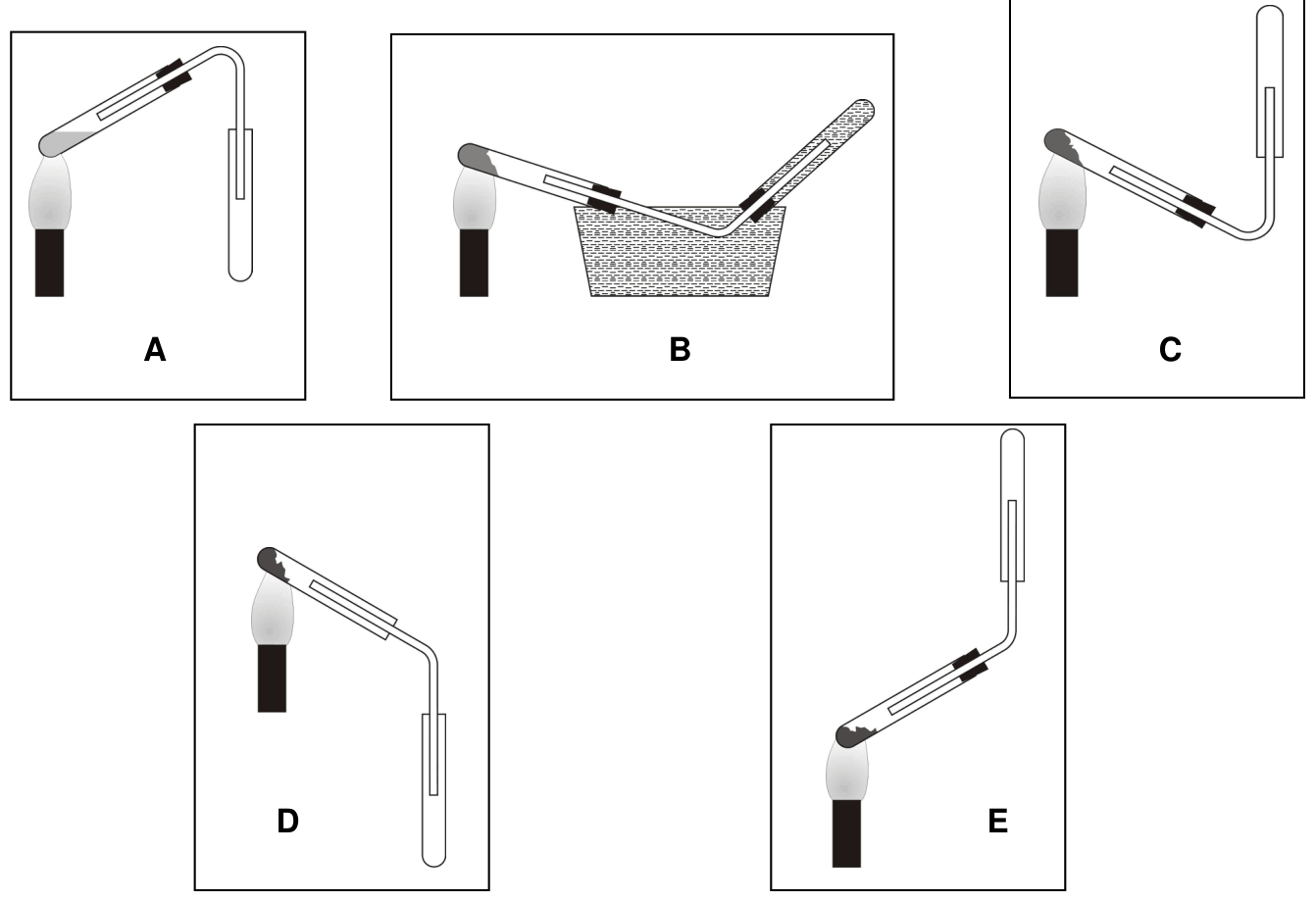
- Which of the apparatuses shown in the figures is the best one for the synthesis of bromethane from potassium bromide, concentrated sulphuric acid and ethanol?
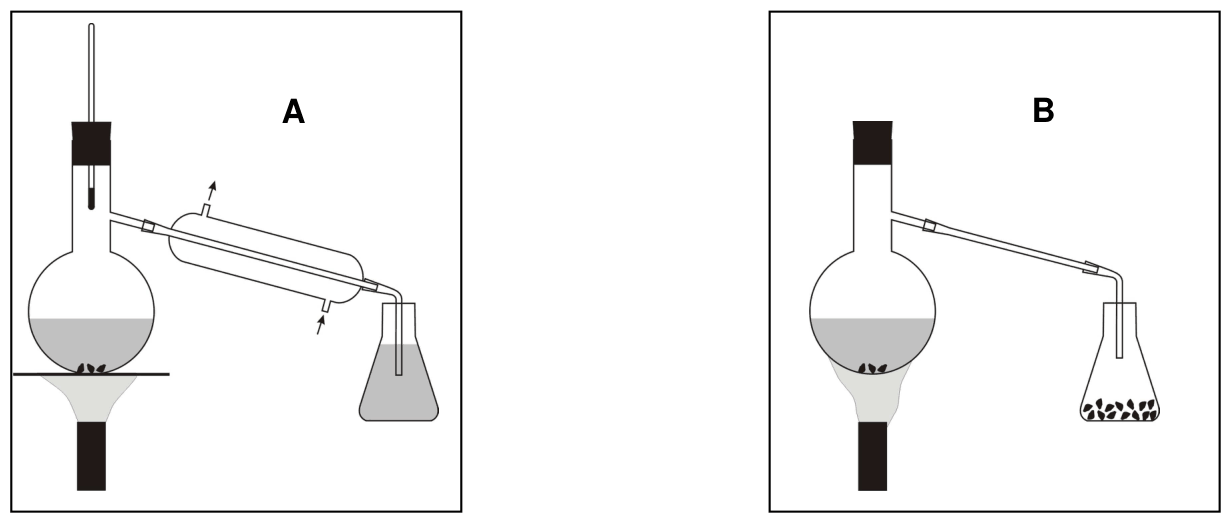
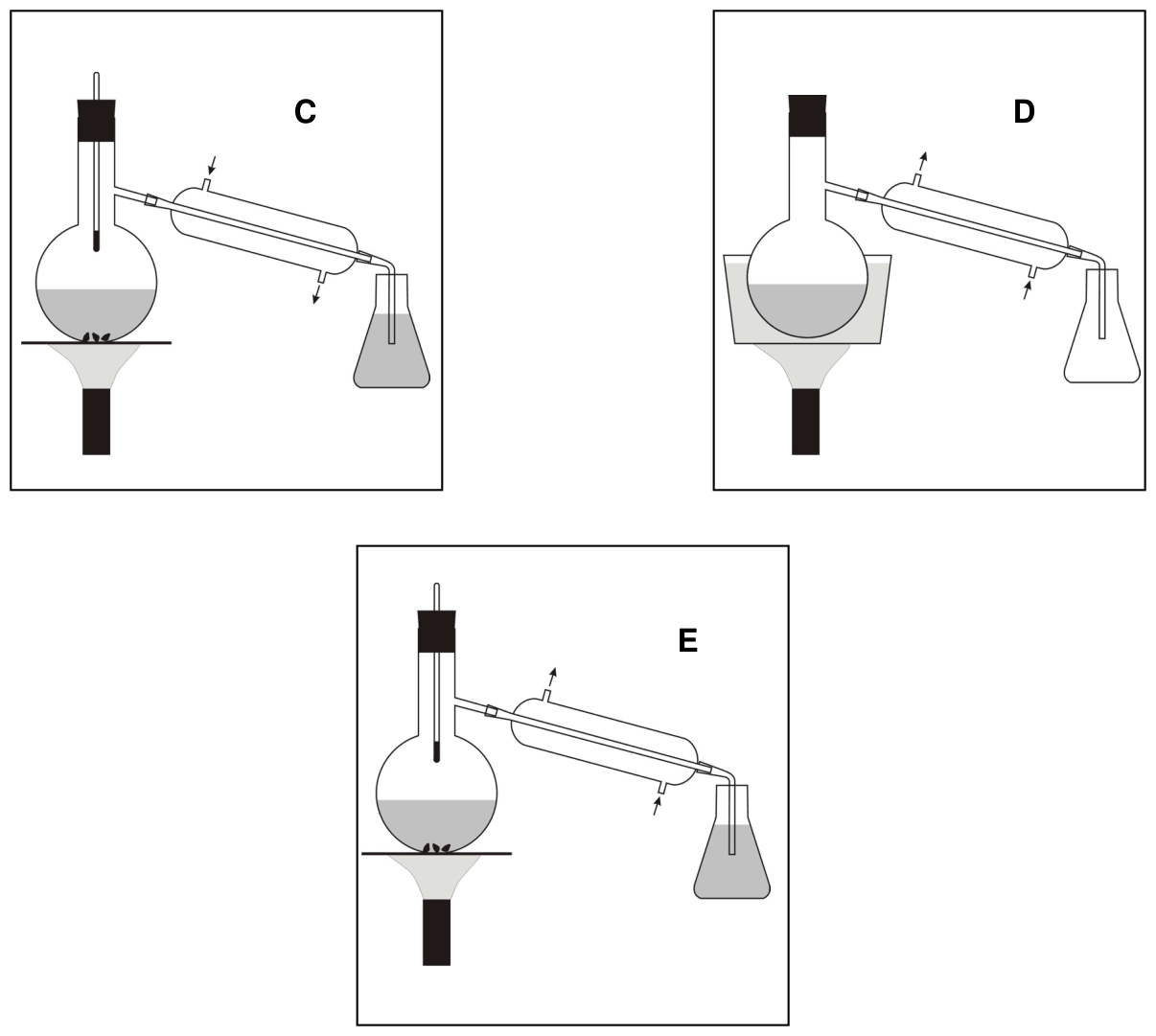
Official English text of the problem.
Problem 2: Gravimetric and titrimetric analysis of a Cd-Sn-Bi-Pb alloy
An alloy comprises the following metals: cadmium, tin, bismuth, and lead. A sample of this alloy weighing 1.2860 g, was treated with a solution of concentrated nitric acid. The individual compound of metal A obtained as a precipitate, was separated, thoroughly washed, dried and calcinated. The mass of the precipitate after the calcination to constant mass, was 0.3265 g.
An aqueous ammonia solution was added in excess to the solution obtained after separation of the precipitate. A compound of metal B remained in the solution while all the other metals precipitated in the form of sparingly soluble compounds. The solution was first quantitatively separated from the precipitate, and then hydrogen sulphide was passed through the separated solution to saturation. The resulting precipitate containing metal B was separated, washed and dried. The mass of the precipitate was 0.6613 g.
The precipitate containing the compounds of metals C and D was treated with an excess of a \(\ce{NaOH}\) solution. The solution and the precipitate were then quantitatively separated. A solution of \(\ce{HNO3}\) was added to the alkaline solution to reach pH 5 – 6, and an excess of \(\ce{K2CrO4}\) solution was added to the resulting transparent solution. The yellow precipitate was separated, washed and quantitatively transferred to a beaker. Finally a dilute \(\ce{H2SO4}\) solution and crystalline \(\ce{KI}\) were added. Iodine produced as a result of the reaction was titrated with sodium thiosulphate solution in the presence of starch as an indicator. 18.46 \(\mathrm{cm^3}\) of 0.1512 normal \(\ce{Na2S2O3}\) solution were required.
The last metal contained in the precipitate as a sparingly soluble compound was transformed to an even less soluble phosphate and its mass was found to be 0.4675 g.
2.1 Write all equations of the chemical reactions on which the quantitative analysis of the alloy sample is based. Name metals A, B, C, and D. Calculate the mass percentage of the metals in the alloy.
Official English text of the problem.
Problem 3: Chemical processes in five mixtures of reagents (ionic and organic equations)
Which chemical processes can take place in the interaction of:
a) aluminium ammonium sulphate with baryta water,
b) potassium chromate, ferrous chloride and sulphuric acid,
c) calcinated soda and sodium hydrogen sulphate,
d) 4-bromoethyl benzene and chlorine,
e) n-propyl alcohol, phenol and concentrated sulphuric acid?
Write ionic equations for the reactions that proceed in aqueous solutions. For the other chemical reactions write complete equations and indicate the type of the reaction. Indicate the differences in the reaction conditions for those reactions that may lead to the formation of various substances.
Official English text of the problem.
Problem 4: Formula of a nitrogen-hydrogen compound X from its thermal decomposition
Compound X contains nitrogen and hydrogen. Strong heating of 3.2 g of X leads to its decomposition without the formation of a solid residue. The resulting mixture of gases is partially absorbed by sulphuric acid (the volume of the gaseous mixture decreased by a factor of 2.8). The non-absorbed gas, that is a mixture of hydrogen and nitrogen, occupies under normal conditions a volume of 1.4 dm³ and has a density of 0.786 g dm⁻³.
Determine the formula of compound X.
Official English text of the problem.
Problem 5: Structure of a benzene derivative C9H12 from its bromination products
Benzene derivative X has the empirical formula \(\ce{C9H12}\). Its bromination in the light leads to the formation of two monobromo derivatives in approximately identical yield. Bromination in the dark in the presence of iron also gives two monobromo derivatives. If the reaction is carried out to a higher degree, the formation of four dibromo derivatives may occur.
Suggest the structure for compound X and for the bromination products. Write schemes for the reactions.
Official English text of the problem.
Problem 6: Identification of a metal M dissolved in dilute nitric acid
130 g of an unknown metal M were treated with excess of a dilute nitric acid. Excess hot alkaline solution was added to the resulting solution and 1.12 dm³ of a gas evolved (normal conditions).
What metal M was dissolved in the nitric solution?
Official English text of the problem.
Internationale Chemie-Olympiade
IChO 1979
Leningrad, Sowjetunion · 6 Theorieaufgaben mit vollständigen Lösungen
Aufgabe 1: Programmierte Aufgabe: 20 Multiple-Choice-Fragen
Kreisen Sie bei der Bearbeitung dieser programmierten Aufgabe diejenigen Buchstaben ein, die Ihrer Meinung nach den richtigen Antworten auf die einzelnen 20 Fragen entsprechen.
- Welches Element wird bei der Reaktion zwischen Ethylen und einer wässrigen Kaliumpermanganatlösung oxidiert?
A) Kohlenstoff, B) Wasserstoff, C) Kalium, D) Mangan, E) Sauerstoff.
- Wie viele Liter \(\ce{CO2}\) werden bei der Reaktion von 18 g Kaliumhydrogencarbonat mit 65 g 10%iger Schwefelsäure ungefähr freigesetzt?
A) 1, B) 2, C) 3, D) 4, E) 5.
- Welcher der folgenden Kohlenwasserstoffe liefert bei der vollständigen Verbrennung von 1 Liter des Gases die größte Wärmemenge:
A) Propan, B) Methan, C) Acetylen, D) Ethylen, E) alle liefern die gleiche Wärmemenge.
- Wie viele Isomere kann eine Verbindung mit der Formel \(\ce{C3H5Br}\) haben?
A) 1, B) 2, C) 3, D) 4, E) 5.
- Welcher der folgenden Kohlenwasserstoffe ist der beste Motorkraftstoff?
A) Cyclooctan, B) 2,2-Dimethylhexan, C) n-Octan, D) 3-Ethylhexan, E) 2,2,4-Trimethylpentan.
- Mit welchen der folgenden Verbindungen reagiert eine wässrige Lösung eines höheren Oxids des Elements Nr. 33?
A) \(\ce{CO2}\), B) \(\ce{K2SO4}\), C) \(\ce{HCl}\), D) \(\ce{NaOH}\), E) Magnesium.
- Welche Mindestkonzentration (in Massen-%) muss 1 kg einer Kaliumhydroxidlösung aufweisen, um 3.57 Mol Salpetersäure vollständig zu neutralisieren?
A) 5 %, B) 10 %, C) 15 %, D) 20 %, E) 25 %.
- Wie viele Verbindungen mit der Formel \(\ce{C3H9N}\) können existieren?
A) 1, B) 2, C) 3, D) 4, E) 5.
- In welcher der folgenden Verbindungen ist der Stickstoffgehalt (in Massen-%) am höchsten?
A) Kaliumnitrat, B) Bariumnitrat, C) Aluminiumnitrat, D) Lithiumnitrat, E) Natriumnitrat.
-
An welches Kohlenstoffatom (geben Sie die Positionsnummer an) addiert sich Chlor bei der Reaktion von \(\ce{HCl}\) mit Pent-2-ensäure hauptsächlich?
A) 1, B) 2, C) 3, D) 4, E) 5.
-
Wie viele Mol Wasser kommen in einem Kristallhydrat auf ein Mol Calciumnitrat, wenn der Wassergehalt 30.5 Massen-% beträgt?
A) 1, B) 2, C) 3, D) 4, E) 5.
-
Welche dieser organischen Säuren ist die stärkste?
A) Benzoesäure, B) 2-Chlorbenzoesäure, C) 4-Methylbenzoesäure, D) 2-Aminobenzoesäure, E) 4-Brombenzoesäure.
-
Welche dieser Säuren hat den höchsten Dissoziationsgrad?
A) \(\ce{HClO}\), B) \(\ce{HClO2}\), C) \(\ce{HClO3}\), D) \(\ce{HClO4}\), E) alle haben den gleichen Dissoziationsgrad.
-
Welche der folgenden Salze unterliegen keiner Hydrolyse?
A) Kaliumbromid, B) Aluminiumsulfat, C) Natriumcarbonat, D) Eisen(III)-nitrat, E) Bariumsulfat.
-
Wie viele Liter Luft werden für die vollständige Verbrennung von 1 Liter Ammoniak ungefähr benötigt?
A) 1, B) 2, C) 3, D) 4, E) 5.
-
Welches Element wird bei der thermischen Zersetzung von Natriumhydrogencarbonat oxidiert?
A) Natrium, B) Wasserstoff, C) Sauerstoff, D) Kohlenstoff, E) keines.
-
Welche der folgenden Änderungen haben keinen Einfluss auf das chemische Gleichgewicht bei der thermischen Zersetzung von \(\ce{CaCO3}\)?
A) Temperaturerhöhung, B) Drucksenkung, C) Zugabe eines Katalysators, D) Änderung der \(\ce{CO2}\)-Konzentration, E) Erhöhung der Menge des Ausgangsstoffs.
-
Welche der folgenden Stoffe entstehen bei der Elektrolyse einer wässrigen Aluminiumchloridlösung an der Pt-Anode?
A) Aluminium, B) Sauerstoff, C) Wasserstoff, D) Aluminiumhydroxid, E) Chlor.
-
Die in den Abbildungen gezeigte Apparatur dient zur Herstellung von Ammoniak unter Laborbedingungen. Das erhitzte Reagenzglas enthält ein Gemisch aus \(\ce{NH4Cl}\) und \(\ce{Ca(OH)2}\). Welche der Abbildungen ist richtig?
- Welche der in den Abbildungen gezeigten Apparaturen eignet sich am besten zur Synthese von Bromethan aus Kaliumbromid, konzentrierter Schwefelsäure und Ethanol?
Aufgabentext aus dem offiziellen englischen Text übersetzt.
Aufgabe 2: Gravimetrische und titrimetrische Analyse einer Cd-Sn-Bi-Pb-Legierung
Eine Legierung besteht aus den folgenden Metallen: Cadmium, Zinn, Bismut und Blei. Eine Probe dieser Legierung mit einer Masse von 1.2860 g wurde mit konzentrierter Salpetersäure behandelt. Die als Niederschlag erhaltene Verbindung des Metalls A wurde abgetrennt, gründlich gewaschen, getrocknet und geglüht. Die Masse des Niederschlags nach dem Glühen bis zur Massenkonstanz betrug 0.3265 g.
Zu der nach Abtrennung des Niederschlags erhaltenen Lösung wurde wässrige Ammoniaklösung im Überschuss gegeben. Eine Verbindung des Metalls B blieb in Lösung, während alle anderen Metalle in Form schwer löslicher Verbindungen ausfielen. Die Lösung wurde zunächst quantitativ vom Niederschlag abgetrennt; anschließend wurde Schwefelwasserstoff bis zur Sättigung durch die abgetrennte Lösung geleitet. Der dabei entstandene, Metall B enthaltende Niederschlag wurde abgetrennt, gewaschen und getrocknet. Die Masse des Niederschlags betrug 0.6613 g.
Der Niederschlag mit den Verbindungen der Metalle C und D wurde mit einem Überschuss an \(\ce{NaOH}\)-Lösung behandelt. Anschließend wurden die Lösung und der Niederschlag quantitativ voneinander getrennt. Zur alkalischen Lösung wurde \(\ce{HNO3}\)-Lösung gegeben, bis pH 5 – 6 erreicht war, und zu der entstandenen klaren Lösung wurde ein Überschuss an \(\ce{K2CrO4}\)-Lösung gegeben. Der gelbe Niederschlag wurde abgetrennt, gewaschen und quantitativ in ein Becherglas überführt. Schließlich wurden verdünnte \(\ce{H2SO4}\)-Lösung und kristallines \(\ce{KI}\) zugegeben. Das bei der Reaktion entstandene Iod wurde mit Natriumthiosulfatlösung in Gegenwart von Stärke als Indikator titriert. Es wurden 18.46 \(\mathrm{cm^3}\) einer 0.1512-normalen \(\ce{Na2S2O3}\)-Lösung benötigt.
Das letzte Metall, das im Niederschlag als schwer lösliche Verbindung enthalten war, wurde in ein noch schwerer lösliches Phosphat überführt, dessen Masse zu 0.4675 g bestimmt wurde.
2.1 Geben Sie sämtliche Gleichungen der chemischen Reaktionen an, auf denen die quantitative Analyse der Legierungsprobe beruht. Benennen Sie die Metalle A, B, C und D. Berechnen Sie die Massenanteile der Metalle in der Legierung in Prozent.
Aufgabentext aus dem offiziellen englischen Text übersetzt.
Aufgabe 3: Chemische Vorgänge in fünf Reagenziengemischen (Ionen- und organische Reaktionsgleichungen)
Welche chemischen Vorgänge können bei der Wechselwirkung von:
a) Aluminiumammoniumsulfat mit Barytwasser,
b) Kaliumchromat, Eisen(II)-chlorid und Schwefelsäure,
c) kalzinierter Soda und Natriumhydrogensulfat,
d) 4-Bromethylbenzol und Chlor,
e) n-Propylalkohol, Phenol und konzentrierter Schwefelsäure stattfinden?
Stellen Sie Ionengleichungen für die Reaktionen auf, die in wässrigen Lösungen ablaufen. Stellen Sie für die übrigen chemischen Reaktionen vollständige Gleichungen auf und geben Sie den Reaktionstyp an. Geben Sie die Unterschiede in den Reaktionsbedingungen für diejenigen Reaktionen an, die zur Bildung verschiedener Stoffe führen können.
Aufgabentext aus dem offiziellen englischen Text übersetzt.
Aufgabe 4: Formel einer Stickstoff-Wasserstoff-Verbindung X aus ihrer thermischen Zersetzung
Die Verbindung X enthält Stickstoff und Wasserstoff. Starkes Erhitzen von 3.2 g X führt zu ihrer Zersetzung, ohne dass ein fester Rückstand entsteht. Das entstehende Gasgemisch wird teilweise von Schwefelsäure absorbiert (das Volumen des Gasgemisches verringert sich um den Faktor 2.8). Das nicht absorbierte Gas, ein Gemisch aus Wasserstoff und Stickstoff, nimmt unter Normalbedingungen ein Volumen von 1.4 dm³ ein und hat eine Dichte von 0.786 g dm⁻³.
Bestimmen Sie die Formel der Verbindung X.
Aufgabentext aus dem offiziellen englischen Text übersetzt.
Aufgabe 5: Struktur eines Benzolderivats C9H12 anhand seiner Bromierungsprodukte
Das Benzolderivat X hat die Verhältnisformel \(\ce{C9H12}\). Seine Bromierung unter Lichteinwirkung führt zur Bildung zweier Monobromderivate in annähernd gleicher Ausbeute. Die Bromierung im Dunkeln in Gegenwart von Eisen ergibt ebenfalls zwei Monobromderivate. Wird die Reaktion weitergeführt, können vier Dibromderivate entstehen.
Schlagen Sie die Struktur der Verbindung X und der Bromierungsprodukte vor. Stellen Sie die Reaktionsschemata auf.
Aufgabentext aus dem offiziellen englischen Text übersetzt.
Aufgabe 6: Identifizierung eines in verdünnter Salpetersäure gelösten Metalls M
130 g eines unbekannten Metalls M wurden mit einem Überschuss an verdünnter Salpetersäure behandelt. Zu der entstandenen Lösung wurde überschüssige heiße alkalische Lösung gegeben, wobei sich 1.12 dm³ eines Gases entwickelten (Normalbedingungen).
Welches Metall M wurde in der Salpetersäurelösung gelöst?
Aufgabentext aus dem offiziellen englischen Text übersetzt.
Uluslararası Kimya Olimpiyatı
IChO 1979
Leningrad, Sovyetler Birliği · 6 teori sorusu, tam çözümleriyle
Soru 1: Programlı çalışma: 20 çoktan seçmeli soru
Bu programlı çalışmayı yaparken, 20 sorunun her biri için doğru olduğunu düşündüğünüz cevaplara karşılık gelen harfleri daire içine alınız.
- Etilen ile sulu potasyum permanganat çözeltisi arasındaki tepkimede hangi element yükseltgenir?
A) karbon, B) hidrojen, C) potasyum, D) mangan, E) oksijen.
- 18 g potasyum hidrojen karbonatın 65 g %10'luk sülfürik asit ile tepkimesinde yaklaşık kaç litre \(\ce{CO2}\) açığa çıkar?
A) 1, B) 2, C) 3, D) 4, E) 5.
- Aşağıdaki hidrokarbonlardan hangisinin gaz hâlindeki 1 litresinin tam yanmasıyla en fazla ısı açığa çıkar?
A) propan, B) metan, C) asetilen, D) etilen, E) hepsi aynı miktarda ısı verir.
- Formülü \(\ce{C3H5Br}\) olan bir bileşiğin kaç izomeri olabilir?
A) 1, B) 2, C) 3, D) 4, E) 5.
- Aşağıdaki hidrokarbonlardan hangisi en iyi motor yakıtıdır?
A) siklooktan, B) 2,2-dimetilheksan, C) normal oktan, D) 3-etilheksan, E) 2,2,4-trimetilpentan.
- Atom numarası 33 olan elementin yüksek yükseltgenme basamağındaki oksidinin sulu çözeltisi, aşağıdaki bileşiklerden hangileriyle tepkimeye girer?
A) \(\ce{CO2}\), B) \(\ce{K2SO4}\), C) \(\ce{HCl}\), D) \(\ce{NaOH}\), E) magnezyum.
- 3.57 mol nitrik asidi tamamen nötrleştirmek için 1 kg potasyum hidroksit çözeltisinin derişimi en az (kütlece %) kaç olmalıdır?
A) %5, B) %10, C) %15, D) %20, E) %25.
- \(\ce{C3H9N}\) formülüne sahip kaç bileşik bulunabilir?
A) 1, B) 2, C) 3, D) 4, E) 5.
- Aşağıdaki bileşiklerden hangisinin azot içeriği (kütlece %) en yüksektir?
A) potasyum nitrat, B) baryum nitrat, C) alüminyum nitrat, D) lityum nitrat, E) sodyum nitrat.
-
\(\ce{HCl}\)'nin pent-2-enoik asit ile tepkimesinde klor ağırlıklı olarak hangi karbon atomuna katılır (sıra numarasını belirtiniz)?
A) 1, B) 2, C) 3, D) 4, E) 5.
-
Su içeriği kütlece %30.5 olan bir kristal hidratta, bir mol kalsiyum nitrat başına kaç mol su bulunur?
A) 1, B) 2, C) 3, D) 4, E) 5.
-
Bu organik asitlerden hangisi en kuvvetlidir?
A) benzoik asit, B) 2-klorobenzoik asit, C) 4-metilbenzoik asit, D) 2-aminobenzoik asit, E) 4-bromobenzoik asit.
-
Bu asitlerden hangisinin ayrışma derecesi en yüksektir?
A) \(\ce{HClO}\), B) \(\ce{HClO2}\), C) \(\ce{HClO3}\), D) \(\ce{HClO4}\), E) hepsinin ayrışma derecesi aynıdır.
-
Aşağıda verilen tuzlardan hangileri hidrolize uğramaz?
A) potasyum bromür, B) alüminyum sülfat, C) sodyum karbonat, D) demir(III) nitrat, E) baryum sülfat.
-
1 litre amonyağın tam yanması için yaklaşık kaç litre hava gerekir?
A) 1, B) 2, C) 3, D) 4, E) 5.
-
Sodyum hidrojen karbonatın ısıl bozunmasında hangi element yükseltgenir?
A) sodyum, B) hidrojen, C) oksijen, D) karbon, E) hiçbiri.
-
Aşağıdaki değişikliklerden hangileri \(\ce{CaCO3}\)'ün ısıl bozunmasındaki kimyasal dengeyi etkilemez?
A) sıcaklığın artırılması, B) basıncın azaltılması, C) katalizör eklenmesi, D) \(\ce{CO2}\) derişiminin değiştirilmesi, E) başlangıç maddesinin miktarının artırılması.
-
Sulu alüminyum klorür çözeltisinin elektrolizinde Pt anotta aşağıda verilen maddelerden hangileri oluşur?
A) alüminyum, B) oksijen, C) hidrojen, D) alüminyum hidroksit, E) klor.
-
Şekillerde gösterilen düzenekler, laboratuvar koşullarında amonyak hazırlamak için tasarlanmıştır. Isıtılan deney tüpü, \(\ce{NH4Cl}\) ve \(\ce{Ca(OH)2}\) karışımı içermektedir. Şekillerden hangisi doğrudur?
- Şekillerde gösterilen düzeneklerden hangisi potasyum bromür, derişik sülfürik asit ve etanolden bromoetan sentezi için en uygundur?
Soru metni resmi İngilizce metinden çevrilmiştir.
Soru 2: Bir Cd-Sn-Bi-Pb alaşımının gravimetrik ve titrimetrik analizi
Bir alaşım şu metallerden oluşmaktadır: kadmiyum, kalay, bizmut ve kurşun. Bu alaşımdan alınan 1.2860 g kütleli bir numune, derişik nitrik asit çözeltisiyle işleme tabi tutulmuştur. Çökelek olarak elde edilen A metalinin bileşiği ayrılmış, iyice yıkanmış, kurutulmuş ve kalsine edilmiştir. Sabit kütleye kadar kalsinasyondan sonra çökeleğin kütlesi 0.3265 g olmuştur.
Çökeleğin ayrılmasından sonra elde edilen çözeltiye fazla miktarda sulu amonyak çözeltisi eklenmiştir. B metalinin bir bileşiği çözeltide kalırken diğer tüm metaller az çözünen bileşikler hâlinde çökmüştür. Önce çözelti çökelekten nicel olarak ayrılmış, ardından ayrılan çözeltiden doygunluğa ulaşıncaya kadar hidrojen sülfür geçirilmiştir. Oluşan ve B metalini içeren çökelek ayrılmış, yıkanmış ve kurutulmuştur. Çökeleğin kütlesi 0.6613 g olmuştur.
C ve D metallerinin bileşiklerini içeren çökelek, fazla miktarda \(\ce{NaOH}\) çözeltisiyle işleme tabi tutulmuştur. Ardından çözelti ile çökelek nicel olarak birbirinden ayrılmıştır. Bazik çözeltiye pH 5 – 6 değerine ulaşılıncaya kadar \(\ce{HNO3}\) çözeltisi eklenmiş ve oluşan berrak çözeltiye fazla miktarda \(\ce{K2CrO4}\) çözeltisi ilave edilmiştir. Sarı çökelek ayrılmış, yıkanmış ve nicel olarak bir behere aktarılmıştır. Son olarak seyreltik \(\ce{H2SO4}\) çözeltisi ve kristal \(\ce{KI}\) eklenmiştir. Tepkime sonucunda oluşan iyot, indikatör olarak nişasta varlığında sodyum tiyosülfat çözeltisiyle titre edilmiştir. 0.1512 normal \(\ce{Na2S2O3}\) çözeltisinden 18.46 \(\mathrm{cm^3}\) gerekmiştir.
Çökelekte az çözünen bir bileşik hâlinde bulunan son metal, çözünürlüğü daha da düşük olan bir fosfata dönüştürülmüş ve bunun kütlesi 0.4675 g olarak bulunmuştur.
2.1 Alaşım numunesinin nicel analizinin dayandığı tüm kimyasal tepkimelerin denklemlerini yazınız. A, B, C ve D metallerini adlandırınız. Alaşımdaki metallerin kütlece yüzdelerini hesaplayınız.
Soru metni resmi İngilizce metinden çevrilmiştir.
Soru 3: Beş reaktif karışımında kimyasal süreçler (iyonik ve organik denklemler)
Aşağıdakilerin etkileşiminde hangi kimyasal süreçler gerçekleşebilir?
a) alüminyum amonyum sülfat ile barit suyu,
b) potasyum kromat, demir(II) klorür ve sülfürik asit,
c) kalsine soda ve sodyum hidrojen sülfat,
d) 4-bromoetil benzen ve klor,
e) n-propil alkol, fenol ve derişik sülfürik asit?
Sulu çözeltilerde gerçekleşen tepkimeler için iyonik denklemleri yazınız. Diğer kimyasal tepkimeler için tam denklemleri yazınız ve tepkime türünü belirtiniz. Farklı maddelerin oluşumuna yol açabilen tepkimeler için tepkime koşullarındaki farklılıkları belirtiniz.
Soru metni resmi İngilizce metinden çevrilmiştir.
Soru 4: Azot ve hidrojen içeren X bileşiğinin ısıl bozunmasından formülünün belirlenmesi
X bileşiği azot ve hidrojen içerir. 3.2 g X kuvvetlice ısıtıldığında katı bir kalıntı oluşmadan bozunur. Oluşan gaz karışımı sülfürik asit tarafından kısmen soğurulur (gaz karışımının hacmi başlangıç hacminin 2.8'de birine düşmüştür). Soğurulmayan gaz, hidrojen ve azot karışımıdır; normal koşullarda 1.4 dm³ hacim kaplar ve yoğunluğu 0.786 g dm⁻³'tür.
X bileşiğinin formülünü belirleyiniz.
Soru metni resmi İngilizce metinden çevrilmiştir.
Soru 5: Bromlama ürünlerinden hareketle bir C9H12 benzen türevinin yapısının belirlenmesi
Benzen türevi X'in basit formülü \(\ce{C9H12}\)'dir. Işıkta bromlanması, yaklaşık olarak aynı verimle iki monobromo türevinin oluşmasına yol açar. Demir varlığında karanlıkta bromlanması da iki monobromo türevi verir. Tepkime daha ileri götürülürse dört dibromo türevi oluşabilir.
X bileşiği ve bromlama ürünleri için yapılar öneriniz. Tepkime şemalarını yazınız.
Soru metni resmi İngilizce metinden çevrilmiştir.
Soru 6: Seyreltik nitrik asitte çözünen bir M metalinin belirlenmesi
Bilinmeyen bir M metalinin 130 g'ı, aşırı miktarda seyreltik nitrik asitle muamele edildi. Oluşan çözeltiye aşırı miktarda sıcak bazik çözelti eklendi ve (normal koşullarda) 1.12 dm³ gaz açığa çıktı.
Nitrik asit çözeltisinde çözünen M metali nedir?
Soru metni resmi İngilizce metinden çevrilmiştir.
Olimpiada Internacional de Química
IChO 1979
Leningrado, Unión Soviética · 6 problemas teóricos con soluciones completas
Problema 1: Ejercicio programado: 20 preguntas de opción múltiple
Al realizar este ejercicio programado, rodee con un círculo las letras que, en su opinión, correspondan a las respuestas correctas de cada una de las 20 preguntas.
- ¿Qué elemento se oxida en la reacción entre el etileno y una disolución acuosa de permanganato de potasio?
A) carbono, B) hidrógeno, C) potasio, D) manganeso, E) oxígeno.
- ¿Cuántos litros de \(\ce{CO2}\) se desprenderán aproximadamente en la reacción de 18 g de hidrogenocarbonato de potasio con 65 g de ácido sulfúrico al 10 %?
A) 1, B) 2, C) 3, D) 4, E) 5.
- ¿Cuál de los siguientes hidrocarburos libera la mayor cantidad de calor en la combustión completa de 1 litro del gas?
A) propano, B) metano, C) acetileno, D) etileno, E) todos liberan la misma cantidad.
- ¿Cuántos isómeros puede tener un compuesto cuya fórmula es \(\ce{C3H5Br}\)?
A) 1, B) 2, C) 3, D) 4, E) 5.
- ¿Cuál de los siguientes hidrocarburos será el mejor combustible para motores?
A) ciclooctano, B) 2,2-dimetilhexano, C) octano normal, D) 3-etilhexano, E) 2,2,4-trimetilpentano.
- ¿Con cuáles de los siguientes compuestos reaccionará una disolución acuosa de un óxido superior del elemento n.º 33?
A) \(\ce{CO2}\), B) \(\ce{K2SO4}\), C) \(\ce{HCl}\), D) \(\ce{NaOH}\), E) magnesio.
- ¿Cuál debe ser la concentración mínima (% en masa) de 1 kg de una disolución de hidróxido de potasio para neutralizar completamente 3.57 moles de ácido nítrico?
A) 5 %, B) 10 %, C) 15 %, D) 20 %, E) 25 %.
- ¿Cuántos compuestos con la fórmula \(\ce{C3H9N}\) pueden existir?
A) 1, B) 2, C) 3, D) 4, E) 5.
- ¿En cuál de los siguientes compuestos alcanza su valor máximo el contenido de nitrógeno (en % en masa)?
A) nitrato de potasio, B) nitrato de bario, C) nitrato de aluminio, D) nitrato de litio, E) nitrato de sodio.
-
¿A qué átomo de carbono (indique su número en la cadena) se adicionará principalmente el cloro en la reacción de \(\ce{HCl}\) con ácido pent-2-enoico?
A) 1, B) 2, C) 3, D) 4, E) 5.
-
¿Cuántos moles de agua hay por mol de nitrato de calcio en un hidrato cristalino si el contenido de agua es del 30.5 % en masa?
A) 1, B) 2, C) 3, D) 4, E) 5.
-
¿Cuál de estos ácidos orgánicos es el más fuerte?
A) benzoico, B) 2-clorobenzoico, C) 4-metilbenzoico, D) 2-aminobenzoico, E) 4-bromobenzoico.
-
¿Cuál de estos ácidos tiene el mayor grado de disociación?
A) \(\ce{HClO}\), B) \(\ce{HClO2}\), C) \(\ce{HClO3}\), D) \(\ce{HClO4}\), E) todos tienen el mismo grado.
-
¿Cuáles de las sales que se indican a continuación no experimentan hidrólisis?
A) bromuro de potasio, B) sulfato de aluminio, C) carbonato de sodio, D) nitrato de hierro(III), E) sulfato de bario.
-
¿Cuántos litros de aire se necesitan aproximadamente para la combustión completa de 1 litro de amoníaco?
A) 1, B) 2, C) 3, D) 4, E) 5.
-
¿Qué elemento se oxida en la descomposición térmica del hidrogenocarbonato de sodio?
A) sodio, B) hidrógeno, C) oxígeno, D) carbono, E) ninguno.
-
¿Cuáles de los siguientes cambios no afectan al equilibrio químico de la descomposición térmica de \(\ce{CaCO3}\)?
A) aumento de la temperatura, B) disminución de la presión, C) adición de un catalizador, D) un cambio en la concentración de \(\ce{CO2}\), E) un aumento de la cantidad de sustancia inicial.
-
¿Cuáles de las sustancias que se indican a continuación se formarán en el ánodo de Pt durante la electrólisis de una disolución acuosa de cloruro de aluminio?
A) aluminio, B) oxígeno, C) hidrógeno, D) hidróxido de aluminio, E) cloro.
-
El aparato que se muestra en las figuras está destinado a preparar amoníaco en condiciones de laboratorio. El tubo de ensayo que se calienta contiene una mezcla de \(\ce{NH4Cl}\) y \(\ce{Ca(OH)2}\). ¿Cuál de las figuras es correcta?
- ¿Cuál de los aparatos que se muestran en las figuras es el más adecuado para la síntesis de bromoetano a partir de bromuro de potasio, ácido sulfúrico concentrado y etanol?
Enunciado traducido del texto oficial en inglés.
Problema 2: Análisis gravimétrico y volumétrico de una aleación de Cd-Sn-Bi-Pb
Una aleación está formada por los siguientes metales: cadmio, estaño, bismuto y plomo. Una muestra de esta aleación de 1.2860 g de masa se trató con una disolución de ácido nítrico concentrado. El compuesto del metal A obtenido como precipitado se separó, se lavó exhaustivamente, se secó y se calcinó. La masa del precipitado después de la calcinación hasta masa constante fue de 0.3265 g.
Se añadió una disolución acuosa de amoníaco en exceso a la disolución obtenida tras separar el precipitado. Un compuesto del metal B permaneció en disolución, mientras que todos los demás metales precipitaron en forma de compuestos poco solubles. Primero se separó cuantitativamente la disolución del precipitado y, a continuación, se hizo pasar sulfuro de hidrógeno por la disolución separada hasta saturarla. El precipitado resultante que contenía el metal B se separó, se lavó y se secó. La masa del precipitado fue de 0.6613 g.
El precipitado que contenía los compuestos de los metales C y D se trató con un exceso de una disolución de \(\ce{NaOH}\). A continuación, se separaron cuantitativamente la disolución y el precipitado. Se añadió una disolución de \(\ce{HNO3}\) a la disolución alcalina hasta alcanzar un pH de 5 – 6, y se añadió un exceso de disolución de \(\ce{K2CrO4}\) a la disolución transparente resultante. El precipitado amarillo se separó, se lavó y se transfirió cuantitativamente a un vaso de precipitados. Finalmente, se añadieron una disolución diluida de \(\ce{H2SO4}\) y \(\ce{KI}\) cristalino. El yodo producido como resultado de la reacción se valoró con una disolución de tiosulfato de sodio en presencia de almidón como indicador. Se necesitaron 18.46 \(\mathrm{cm^3}\) de disolución de \(\ce{Na2S2O3}\) 0.1512 normal.
El último metal, contenido en el precipitado en forma de un compuesto poco soluble, se transformó en un fosfato aún menos soluble, cuya masa resultó ser de 0.4675 g.
2.1 Escriba todas las ecuaciones de las reacciones químicas en las que se basa el análisis cuantitativo de la muestra de aleación. Nombre los metales A, B, C y D. Calcule el porcentaje en masa de los metales en la aleación.
Enunciado traducido del texto oficial en inglés.
Problema 3: Procesos químicos en cinco mezclas de reactivos (ecuaciones iónicas y orgánicas)
¿Qué procesos químicos pueden tener lugar al hacer reaccionar:
a) sulfato de aluminio y amonio con agua de barita,
b) cromato de potasio, cloruro ferroso y ácido sulfúrico,
c) sosa calcinada e hidrogenosulfato de sodio,
d) 4-bromoetilbenceno y cloro,
e) alcohol n-propílico, fenol y ácido sulfúrico concentrado?
Escriba las ecuaciones iónicas de las reacciones que tienen lugar en disolución acuosa. Para las demás reacciones químicas, escriba las ecuaciones completas e indique el tipo de reacción. Indique las diferencias en las condiciones de reacción para aquellas reacciones que puedan dar lugar a la formación de distintas sustancias.
Enunciado traducido del texto oficial en inglés.
Problema 4: Fórmula de un compuesto X de nitrógeno e hidrógeno a partir de su descomposición térmica
El compuesto X contiene nitrógeno e hidrógeno. Al calentar intensamente 3.2 g de X, este se descompone sin formar un residuo sólido. La mezcla de gases resultante es absorbida parcialmente por ácido sulfúrico (el volumen de la mezcla gaseosa se redujo en un factor de 2.8). El gas no absorbido, que es una mezcla de hidrógeno y nitrógeno, ocupa en condiciones normales un volumen de 1.4 dm³ y tiene una densidad de 0.786 g dm⁻³.
Determine la fórmula del compuesto X.
Enunciado traducido del texto oficial en inglés.
Problema 5: Estructura de un derivado del benceno C9H12 a partir de sus productos de bromación
El derivado del benceno X tiene la fórmula empírica \(\ce{C9H12}\). Su bromación en presencia de luz da lugar a la formación de dos derivados monobromados con rendimientos aproximadamente iguales. La bromación en la oscuridad en presencia de hierro también da dos derivados monobromados. Si la reacción se lleva a un grado de bromación mayor, puede producirse la formación de cuatro derivados dibromados.
Proponga la estructura del compuesto X y de los productos de bromación. Escriba los esquemas de las reacciones.
Enunciado traducido del texto oficial en inglés.
Problema 6: Identificación de un metal M disuelto en ácido nítrico diluido
Se trataron 130 g de un metal desconocido M con un exceso de ácido nítrico diluido. Se añadió un exceso de disolución alcalina caliente a la disolución resultante y se desprendieron 1.12 dm³ de un gas (en condiciones normales).
¿Qué metal M se disolvió en la disolución de ácido nítrico?
Enunciado traducido del texto oficial en inglés.
国际化学奥林匹克
IChO 1979
苏联列宁格勒 · 6 道理论题及完整解答
题目 1:程序化作业:20 道选择题
完成本程序化作业时,请圈出你认为与这 20 道题各题正确答案对应的字母。
- 乙烯与高锰酸钾水溶液反应时,哪种元素被氧化?
A) 碳,B) 氢,C) 钾,D) 锰,E) 氧。
- 18 g 碳酸氢钾与 65 g 10 % 的硫酸反应,大约会放出多少升 \(\ce{CO2}\)?
A) 1,B) 2,C) 3,D) 4,E) 5。
- 下列哪种烃的气体在完全燃烧 1 升时放出的热量最多:
A) 丙烷,B) 甲烷,C) 乙炔,D) 乙烯,E) 放出的热量都相同。
- 分子式为 \(\ce{C3H5Br}\) 的化合物可以有多少种异构体?
A) 1,B) 2,C) 3,D) 4,E) 5。
- 下列哪种烃是最好的发动机燃料?
A) 环辛烷,B) 2,2-二甲基己烷,C) 正辛烷,D) 3-乙基己烷,E) 2,2,4-三甲基戊烷。
- 33 号元素的高价氧化物的水溶液会与下列哪些化合物反应?
A) \(\ce{CO2}\),B) \(\ce{K2SO4}\),C) \(\ce{HCl}\),D) \(\ce{NaOH}\),E) 镁。
- 要完全中和 3.57 摩尔硝酸,1 kg 氢氧化钾溶液的最低浓度(质量百分数)必须是多少?
A) 5 %,B) 10 %,C) 15 %,D) 20 %,E) 25 %。
- 分子式为 \(\ce{C3H9N}\) 的化合物可以有多少种?
A) 1,B) 2,C) 3,D) 4,E) 5。
- 下列哪种化合物的氮含量(质量百分数)最高?
A) 硝酸钾,B) 硝酸钡,C) 硝酸铝,D) 硝酸锂,E) 硝酸钠。
-
\(\ce{HCl}\) 与 2-戊烯酸反应时,氯主要加成到哪个碳原子上(指出其编号)?
A) 1,B) 2,C) 3,D) 4,E) 5。
-
某结晶水合物中水的质量百分数为 30.5 %,则每摩尔硝酸钙对应多少摩尔水?
A) 1,B) 2,C) 3,D) 4,E) 5。
-
下列哪种有机酸的酸性最强?
A) 苯甲酸,B) 2-氯苯甲酸,C) 4-甲基苯甲酸,D) 2-氨基苯甲酸,E) 4-溴苯甲酸。
-
下列哪种酸的电离度最高?
A) \(\ce{HClO}\),B) \(\ce{HClO2}\),C) \(\ce{HClO3}\),D) \(\ce{HClO4}\),E) 电离度都相同。
-
下列哪些盐不发生水解?
A) 溴化钾,B) 硫酸铝,C) 碳酸钠,D) 硝酸铁(III),E) 硫酸钡。
-
完全燃烧 1 升氨气大约需要多少升空气?
A) 1,B) 2,C) 3,D) 4,E) 5。
-
碳酸氢钠受热分解时,哪种元素被氧化?
A) 钠,B) 氢,C) 氧,D) 碳,E) 没有。
-
下列哪些变化不影响 \(\ce{CaCO3}\) 热分解反应的化学平衡?
A) 升高温度,B) 降低压力,C) 加入催化剂,D) 改变 \(\ce{CO2}\) 的浓度,E) 增加起始物质的量。
-
电解氯化铝水溶液时,下列哪些物质会在 Pt 阳极上生成?
A) 铝,B) 氧气,C) 氢气,D) 氢氧化铝,E) 氯气。
-
图示装置用于在实验室条件下制备氨气。受热的试管内装有 \(\ce{NH4Cl}\) 和 \(\ce{Ca(OH)2}\) 的混合物。哪幅图是正确的?
- 用溴化钾、浓硫酸和乙醇合成溴乙烷时,图示装置中哪一个最合适?
题目译自官方英文原文。
题目 2:Cd-Sn-Bi-Pb 合金的重量分析和滴定分析
某合金由以下金属组成:镉、锡、铋和铅。取质量为 1.2860 g 的该合金试样,用浓硝酸溶液处理。将以沉淀形式得到的金属 A 的单一化合物分离,充分洗涤、干燥并灼烧。灼烧至恒重后,沉淀的质量为 0.3265 g。
向分离沉淀后得到的溶液中加入过量氨水。金属 B 的化合物留在溶液中,而其余所有金属均以难溶化合物的形式沉淀。先将溶液与沉淀定量分离,再向分离出的溶液中通入硫化氢至饱和。将生成的含金属 B 的沉淀分离、洗涤并干燥。沉淀的质量为 0.6613 g。
用过量的 \(\ce{NaOH}\) 溶液处理含金属 C 和 D 的化合物的沉淀。随后将溶液与沉淀定量分离。向碱性溶液中加入 \(\ce{HNO3}\) 溶液,使 pH 达到 5 – 6,再向所得澄清溶液中加入过量 \(\ce{K2CrO4}\) 溶液。将黄色沉淀分离、洗涤并定量转移至烧杯中。最后加入稀 \(\ce{H2SO4}\) 溶液和 \(\ce{KI}\) 晶体。以淀粉为指示剂,用硫代硫酸钠溶液滴定反应生成的碘。共消耗 18.46 \(\mathrm{cm^3}\) 的 0.1512 当量浓度的 \(\ce{Na2S2O3}\) 溶液。
将沉淀中以难溶化合物形式存在的最后一种金属转化为溶解度更小的磷酸盐,测得其质量为 0.4675 g。
2.1 写出该合金试样定量分析所依据的所有化学反应方程式。指出金属 A、B、C 和 D 的名称。计算合金中各金属的质量百分含量。
题目译自官方英文原文。
题目 3:五组试剂混合物中的化学过程(离子方程式与有机反应方程式)
下列物质相互作用时,可能发生哪些化学过程?
a) 硫酸铝铵与氢氧化钡溶液,
b) 铬酸钾、氯化亚铁和硫酸,
c) 无水碳酸钠与硫酸氢钠,
d) 4-溴乙苯与氯气,
e) 正丙醇、苯酚和浓硫酸?
对于在水溶液中进行的反应,写出离子方程式。对于其他化学反应,写出完整的反应方程式,并指出反应类型。对于可能生成不同物质的反应,指出其反应条件的差异。
题目译自官方英文原文。
题目 4:根据热分解确定氮氢化合物 X 的化学式
化合物 X 含有氮和氢。强热 3.2 g X,使其分解,不生成固体残留物。所得混合气体被硫酸部分吸收(混合气体的体积减小至原来的 1/2.8)。未被吸收的气体是氢气和氮气的混合物,在标准状况下的体积为 1.4 dm³,密度为 0.786 g dm⁻³。
确定化合物 X 的化学式。
题目译自官方英文原文。
题目 5:根据溴化产物确定苯的衍生物 C9H12 的结构
苯的衍生物 X 的实验式为 \(\ce{C9H12}\)。它在光照下发生溴化反应,生成两种产率近似相同的一溴衍生物。在避光且有铁存在的条件下进行溴化,也得到两种一溴衍生物。若使反应进一步进行,则可能生成四种二溴衍生物。
提出化合物 X 及其溴化产物的结构,并写出反应式。
题目译自官方英文原文。
题目 6:溶于稀硝酸的金属 M 的鉴定
用过量稀硝酸处理 130 g 未知金属 M。向所得溶液中加入过量热碱溶液,放出 1.12 dm³ 气体(标准状况)。
溶于硝酸溶液中的金属 M 是什么?
题目译自官方英文原文。
Международная химическая олимпиада
IChO 1979
Ленинград, Советский Союз · 6 теоретических задач с полными решениями
Задача 1: Программированное задание: 20 вопросов с выбором ответа
При выполнении этого программированного задания обведите буквы, которые, по вашему мнению, соответствуют правильным ответам на каждый из 20 вопросов.
- Какой элемент окисляется в реакции этилена с водным раствором перманганата калия?
A) углерод, B) водород, C) калий, D) марганец, E) кислород.
- Сколько литров \(\ce{CO2}\) приблизительно выделится при реакции 18 г гидрокарбоната калия с 65 г 10 %-ной серной кислоты?
A) 1, B) 2, C) 3, D) 4, E) 5.
- Какой из следующих углеводородов выделяет наибольшее количество теплоты при полном сгорании 1 литра газа:
A) пропан, B) метан, C) ацетилен, D) этилен, E) все выделяют одинаковое количество теплоты.
- Сколько изомеров может иметь соединение с формулой \(\ce{C3H5Br}\)?
A) 1, B) 2, C) 3, D) 4, E) 5.
- Какой из следующих углеводородов будет наилучшим моторным топливом?
A) циклооктан, B) 2,2-диметилгексан, C) нормальный октан, D) 3-этилгексан, E) 2,2,4-триметилпентан.
- С какими из следующих веществ будет реагировать водный раствор высшего оксида элемента № 33?
A) \(\ce{CO2}\), B) \(\ce{K2SO4}\), C) \(\ce{HCl}\), D) \(\ce{NaOH}\), E) магний.
- Какой должна быть минимальная концентрация (в массовых %) раствора гидроксида калия массой 1 кг для полной нейтрализации 3.57 моль азотной кислоты?
A) 5 %, B) 10 %, C) 15 %, D) 20 %, E) 25 %.
- Сколько соединений с формулой \(\ce{C3H9N}\) может существовать?
A) 1, B) 2, C) 3, D) 4, E) 5.
- В каком из следующих соединений содержание азота (в массовых %) максимально?
A) нитрат калия, B) нитрат бария, C) нитрат алюминия, D) нитрат лития, E) нитрат натрия.
-
К какому атому углерода (укажите его порядковый номер) будет преимущественно присоединяться хлор в реакции \(\ce{HCl}\) с пент-2-еновой кислотой?
A) 1, B) 2, C) 3, D) 4, E) 5.
-
Сколько молей воды приходится на один моль нитрата кальция в кристаллогидрате, если массовая доля воды составляет 30.5 %?
A) 1, B) 2, C) 3, D) 4, E) 5.
-
Какая из этих органических кислот является самой сильной?
A) бензойная, B) 2-хлорбензойная, C) 4-метилбензойная, D) 2-аминобензойная, E) 4-бромбензойная.
-
Какая из этих кислот имеет наибольшую степень диссоциации?
A) \(\ce{HClO}\), B) \(\ce{HClO2}\), C) \(\ce{HClO3}\), D) \(\ce{HClO4}\), E) все имеют одинаковую степень диссоциации.
-
Какие из приведённых ниже солей не подвергаются гидролизу?
A) бромид калия, B) сульфат алюминия, C) карбонат натрия, D) нитрат железа(III), E) сульфат бария.
-
Сколько литров воздуха приблизительно требуется для полного сгорания 1 литра аммиака?
A) 1, B) 2, C) 3, D) 4, E) 5.
-
Какой элемент окисляется при термическом разложении гидрокарбоната натрия?
A) натрий, B) водород, C) кислород, D) углерод, E) ни один.
-
Какие из следующих изменений не влияют на химическое равновесие при термическом разложении \(\ce{CaCO3}\)?
A) повышение температуры, B) понижение давления, C) добавление катализатора, D) изменение концентрации \(\ce{CO2}\), E) увеличение количества исходного вещества.
-
Какие из приведённых ниже веществ будут образовываться на Pt-аноде при электролизе водного раствора хлорида алюминия?
A) алюминий, B) кислород, C) водород, D) гидроксид алюминия, E) хлор.
-
Установки, показанные на рисунках, предназначены для получения аммиака в лабораторных условиях. Нагреваемая пробирка содержит смесь \(\ce{NH4Cl}\) и \(\ce{Ca(OH)2}\). На каком рисунке показана правильная установка?
- Какая из установок, показанных на рисунках, лучше всего подходит для синтеза бромэтана из бромида калия, концентрированной серной кислоты и этанола?
Условие переведено с официального английского текста.
Задача 2: Гравиметрический и титриметрический анализ сплава Cd-Sn-Bi-Pb
Сплав состоит из следующих металлов: кадмия, олова, висмута и свинца. Навеску этого сплава массой 1.2860 г обработали раствором концентрированной азотной кислоты. Индивидуальное соединение металла A, выпавшее в осадок, отделили, тщательно промыли, высушили и прокалили. Масса осадка после прокаливания до постоянной массы составила 0.3265 г.
К раствору, полученному после отделения осадка, добавили избыток водного раствора аммиака. Соединение металла B осталось в растворе, тогда как все остальные металлы выпали в осадок в виде малорастворимых соединений. Раствор сначала количественно отделили от осадка, а затем через отделённый раствор пропускали сероводород до насыщения. Полученный осадок, содержащий металл B, отделили, промыли и высушили. Масса осадка составила 0.6613 г.
Осадок, содержащий соединения металлов C и D, обработали избытком раствора \(\ce{NaOH}\). Затем раствор и осадок количественно разделили. К щелочному раствору добавили раствор \(\ce{HNO3}\) до достижения pH 5 – 6, а к полученному прозрачному раствору добавили избыток раствора \(\ce{K2CrO4}\). Жёлтый осадок отделили, промыли и количественно перенесли в химический стакан. Наконец, добавили разбавленный раствор \(\ce{H2SO4}\) и кристаллический \(\ce{KI}\). Образовавшийся в результате реакции иод оттитровали раствором тиосульфата натрия в присутствии крахмала в качестве индикатора. На титрование потребовалось 18.46 \(\mathrm{cm^3}\) раствора \(\ce{Na2S2O3}\) нормальностью 0.1512.
Последний металл, находившийся в осадке в виде малорастворимого соединения, перевели в ещё менее растворимый фосфат, масса которого составила 0.4675 г.
2.1 Напишите все уравнения химических реакций, на которых основан количественный анализ навески сплава. Назовите металлы A, B, C и D. Рассчитайте массовые доли металлов в сплаве в процентах.
Условие переведено с официального английского текста.
Задача 3: Химические процессы в пяти смесях реагентов (ионные и органические уравнения)
Какие химические процессы могут протекать при взаимодействии:
a) сульфата алюминия-аммония с баритовой водой,
b) хромата калия, хлорида железа(II) и серной кислоты,
c) кальцинированной соды и гидросульфата натрия,
d) 4-бромэтилбензола и хлора,
e) н-пропилового спирта, фенола и концентрированной серной кислоты?
Напишите ионные уравнения реакций, протекающих в водных растворах. Для остальных химических реакций напишите полные уравнения и укажите тип реакции. Укажите различия в условиях проведения тех реакций, которые могут приводить к образованию различных веществ.
Условие переведено с официального английского текста.
Задача 4: Определение формулы соединения азота с водородом X по его термическому разложению
Соединение X содержит азот и водород. При сильном нагревании 3.2 г X происходит его разложение без образования твёрдого остатка. Полученная смесь газов частично поглощается серной кислотой (объём газовой смеси уменьшается в 2.8 раза). Непоглощённый газ, представляющий собой смесь водорода и азота, при нормальных условиях занимает объём 1.4 дм³ и имеет плотность 0.786 г дм⁻³.
Определите формулу соединения X.
Условие переведено с официального английского текста.
Задача 5: Определение строения производного бензола C9H12 по продуктам его бромирования
Производное бензола X имеет эмпирическую формулу \(\ce{C9H12}\). При его бромировании на свету образуются два монобромпроизводных с приблизительно одинаковыми выходами. Бромирование в темноте в присутствии железа также даёт два монобромпроизводных. При более глубоком протекании реакции возможно образование четырёх дибромпроизводных.
Предложите структуры соединения X и продуктов его бромирования. Напишите схемы реакций.
Условие переведено с официального английского текста.
Задача 6: Определение металла M, растворённого в разбавленной азотной кислоте
130 g неизвестного металла M обработали избытком разбавленной азотной кислоты. К полученному раствору добавили избыток горячего раствора щёлочи, при этом выделилось 1.12 dm³ газа (при нормальных условиях).
Какой металл M был растворён в азотной кислоте?
Условие переведено с официального английского текста.
الأولمبياد الدولي للكيمياء
IChO 1979
لينينغراد، الاتحاد السوفيتي · 6 مسائل نظرية مع حلول كاملة
المسألة 1: تكليف مبرمج: 20 سؤالًا من نوع الاختيار من متعدد
عند تنفيذ هذا التكليف المبرمج، ضع دائرة حول الحروف التي ترى أنها تقابل الإجابات الصحيحة عن كل سؤال من الأسئلة العشرين.
- أي عنصر يتأكسد في التفاعل بين الإيثيلين ومحلول مائي من برمنغنات البوتاسيوم؟
A) الكربون، B) الهيدروجين، C) البوتاسيوم، D) المنغنيز، E) الأكسجين.
- كم لترًا من \(\ce{CO2}\) ينطلق تقريبًا عند تفاعل 18 g من هيدروجين كربونات البوتاسيوم مع 65 g من حمض الكبريتيك بتركيز 10 %؟
A) 1، B) 2، C) 3، D) 4، E) 5.
- أي الهيدروكربونات الآتية يعطي أكبر كمية من الحرارة عند الاحتراق التام للتر واحد من الغاز:
A) البروبان، B) الميثان، C) الأسيتيلين، D) الإيثيلين، E) جميعها تعطي الكمية نفسها.
- كم متماكبًا يمكن أن يكون لمركب صيغته \(\ce{C3H5Br}\)؟
A) 1، B) 2، C) 3، D) 4، E) 5.
- أي الهيدروكربونات الآتية هو أفضل وقود للمحركات؟
A) السيكلوأوكتان، B) 2,2-ثنائي ميثيل الهكسان، C) الأوكتان النظامي، D) 3-إيثيل الهكسان، E) 2,2,4-ثلاثي ميثيل البنتان.
- مع أي المركبات الآتية يتفاعل محلول مائي للأكسيد الأعلى للعنصر ذي العدد الذري 33؟
A) \(\ce{CO2}\)، B) \(\ce{K2SO4}\)، C) \(\ce{HCl}\)، D) \(\ce{NaOH}\)، E) المغنيسيوم.
- ما الحد الأدنى اللازم لتركيز 1 kg من محلول هيدروكسيد البوتاسيوم (بالنسبة المئوية الكتلية) لمعادلة 3.57 مول من حمض النتريك معادلة تامة؟
A) 5 %، B) 10 %، C) 15 %، D) 20 %، E) 25 %.
- كم مركبًا يمكن أن يوجد بالصيغة \(\ce{C3H9N}\)؟
A) 1، B) 2، C) 3، D) 4، E) 5.
- في أي المركبات الآتية يكون محتوى النيتروجين (بالنسبة المئوية الكتلية) أعظميًا؟
A) نترات البوتاسيوم، B) نترات الباريوم، C) نترات الألومنيوم، D) نترات الليثيوم، E) نترات الصوديوم.
-
إلى أي ذرة كربون (حدّد رقمها التسلسلي) يضاف الكلور أساسًا عند تفاعل \(\ce{HCl}\) مع حمض البنت-2-ينويك؟
A) 1، B) 2، C) 3، D) 4، E) 5.
-
كم مولًا من الماء يوجد لكل مول من نترات الكالسيوم في هيدرات بلورية إذا كان المحتوى المائي 30.5 % كتليًا؟
A) 1، B) 2، C) 3، D) 4، E) 5.
-
أي هذه الأحماض العضوية هو الأقوى؟
A) حمض البنزويك، B) حمض 2-كلوروبنزويك، C) حمض 4-ميثيل بنزويك، D) حمض 2-أمينوبنزويك، E) حمض 4-بروموبنزويك.
-
أي هذه الأحماض له أعلى درجة تفكك؟
A) \(\ce{HClO}\)، B) \(\ce{HClO2}\)، C) \(\ce{HClO3}\)، D) \(\ce{HClO4}\)، E) جميعها لها درجة التفكك نفسها.
-
أي الأملاح الواردة أدناه لا يخضع للتحلل المائي؟
A) بروميد البوتاسيوم، B) كبريتات الألومنيوم، C) كربونات الصوديوم، D) نترات الحديد(III)، E) كبريتات الباريوم.
-
كم لترًا من الهواء يلزم تقريبًا للاحتراق التام للتر واحد من الأمونيا؟
A) 1، B) 2، C) 3، D) 4، E) 5.
-
أي عنصر يتأكسد في التحلل الحراري لهيدروجين كربونات الصوديوم؟
A) الصوديوم، B) الهيدروجين، C) الأكسجين، D) الكربون، E) لا شيء منها.
-
أي التغيرات الآتية لا يؤثر في الاتزان الكيميائي للتحلل الحراري لـ \(\ce{CaCO3}\)؟
A) رفع درجة الحرارة، B) خفض الضغط، C) إضافة حفاز، D) تغيير تركيز \(\ce{CO2}\)، E) زيادة كمية المادة الابتدائية.
-
أي المواد الواردة أدناه يتكون عند المصعد المصنوع من Pt في التحليل الكهربائي لمحلول مائي من كلوريد الألومنيوم؟
A) الألومنيوم، B) الأكسجين، C) الهيدروجين، D) هيدروكسيد الألومنيوم، E) الكلور.
-
الجهاز المبين في الأشكال مخصص لتحضير الأمونيا في الظروف المختبرية. يحتوي أنبوب الاختبار الذي يجري تسخينه على مزيج من \(\ce{NH4Cl}\) و\(\ce{Ca(OH)2}\). أي الأشكال صحيح؟
- أي الأجهزة المبينة في الأشكال هو الأنسب لتحضير البروموإيثان من بروميد البوتاسيوم وحمض الكبريتيك المركز والإيثانول؟
نص المسألة مترجم عن النص الإنجليزي الرسمي.
المسألة 2: التحليل الوزني والمعايري لسبيكة Cd-Sn-Bi-Pb
تتكون سبيكة من الفلزات الآتية: الكادميوم والقصدير والبزموت والرصاص. عولجت عينة من هذه السبيكة كتلتها 1.2860 g بمحلول حمض النتريك المركز. وفُصل المركب المنفرد للفلز A الذي تكوّن على هيئة راسب، وغُسل جيدًا وجُفف وكُلّس. بلغت كتلة الراسب بعد التكليس حتى ثبات الكتلة 0.3265 g.
أُضيف محلول أمونيا مائي بكمية فائضة إلى المحلول الناتج بعد فصل الراسب. بقي مركب الفلز B في المحلول، بينما ترسبت جميع الفلزات الأخرى على هيئة مركبات شحيحة الذوبان. فُصل المحلول أولًا عن الراسب فصلًا كميًا، ثم مُرّر كبريتيد الهيدروجين في المحلول المفصول حتى الإشباع. فُصل الراسب الناتج المحتوي على الفلز B وغُسل وجُفف. بلغت كتلة الراسب 0.6613 g.
عولج الراسب المحتوي على مركبات الفلزين C وD بفائض من محلول \(\ce{NaOH}\). ثم فُصل المحلول والراسب فصلًا كميًا. أُضيف محلول \(\ce{HNO3}\) إلى المحلول القلوي حتى بلغ الأس الهيدروجيني pH قيمة 5 – 6، ثم أُضيف فائض من محلول \(\ce{K2CrO4}\) إلى المحلول الرائق الناتج. فُصل الراسب الأصفر وغُسل ونُقل كميًا إلى كأس مخبري. وأخيرًا أُضيف محلول مخفف من \(\ce{H2SO4}\) و\(\ce{KI}\) بلوري. عُويِر اليود الناتج عن التفاعل بمحلول ثيوكبريتات الصوديوم بوجود النشا دليلًا. تطلبت المعايرة 18.46 \(\mathrm{cm^3}\) من محلول \(\ce{Na2S2O3}\) ذي العيارية 0.1512.
حُوّل الفلز الأخير الموجود في الراسب على هيئة مركب شحيح الذوبان إلى فوسفات أقل ذوبانًا، ووُجد أن كتلتها 0.4675 g.
2.1 اكتب جميع معادلات التفاعلات الكيميائية التي يستند إليها التحليل الكمي لعينة السبيكة. سمِّ الفلزات A وB وC وD. احسب النسبة المئوية الكتلية للفلزات في السبيكة.
نص المسألة مترجم عن النص الإنجليزي الرسمي.
المسألة 3: العمليات الكيميائية في خمسة مخاليط من الكواشف (المعادلات الأيونية والعضوية)
ما العمليات الكيميائية التي يمكن أن تحدث عند تفاعل:
a) كبريتات الأمونيوم والألومنيوم مع ماء الباريتا،
b) كرومات البوتاسيوم وكلوريد الحديدوز وحمض الكبريتيك،
c) الصودا المكلّسة وكبريتات الصوديوم الهيدروجينية،
d) 4-برومو إيثيل بنزين والكلور،
e) الكحول البروبيلي النظامي والفينول وحمض الكبريتيك المركّز؟
اكتب المعادلات الأيونية للتفاعلات التي تجري في المحاليل المائية. وللتفاعلات الكيميائية الأخرى، اكتب المعادلات الكاملة وبيّن نوع التفاعل. وبيّن الاختلافات في شروط التفاعل للتفاعلات التي قد تؤدي إلى تكوّن مواد مختلفة.
نص المسألة مترجم عن النص الإنجليزي الرسمي.
المسألة 4: تحديد صيغة مركّب X من النيتروجين والهيدروجين من تحلّله الحراري
يحتوي المركّب X على النيتروجين والهيدروجين. يؤدي التسخين الشديد لـ 3.2 g من X إلى تحلّله دون تخلّف بقايا صلبة. يمتص حمض الكبريتيك جزءًا من مزيج الغازات الناتج (انخفض حجم المزيج الغازي بمعامل قدره 2.8). ويشغل الغاز غير الممتص، وهو مزيج من الهيدروجين والنيتروجين، حجمًا قدره 1.4 dm³ في الظروف النظامية، وتبلغ كثافته 0.786 g dm⁻³.
حدّد صيغة المركّب X.
نص المسألة مترجم عن النص الإنجليزي الرسمي.
المسألة 5: بنية مشتق للبنزين C9H12 من نواتج برومته
لمشتق البنزين X الصيغة الأولية \(\ce{C9H12}\). تؤدي برومته في الضوء إلى تكوّن مشتقين أحاديي البروم بمردودين متساويين تقريبًا. كما تعطي البرومة في الظلام بوجود الحديد مشتقين أحاديي البروم. وإذا أُجري التفاعل إلى مدى أكبر، فقد تتكوّن أربعة مشتقات ثنائية البروم.
اقترح بنية للمركب X ولناتج كل تفاعل من تفاعلات البرومة. اكتب مخططات التفاعلات.
نص المسألة مترجم عن النص الإنجليزي الرسمي.
المسألة 6: تعيين هوية فلز M مذاب في حمض النتريك المخفف
عولج 130 g من فلز مجهول M بكمية فائضة من حمض النتريك المخفف. وأُضيفت كمية فائضة من محلول قلوي ساخن إلى المحلول الناتج، فانطلق 1.12 dm³ من غاز (في الظروف النظامية).
ما الفلز M الذي أُذيب في محلول حمض النتريك؟
نص المسألة مترجم عن النص الإنجليزي الرسمي.