IChO 1979 · Theory problem 1
Programmed assignment: 20 multiple-choice questions
When carrying out this programmed assignment, encircle those letters which in your opinion correspond to the correct answers to each of the 20 questions.
- Which element is oxidized in the reaction between ethylene and an aqueous solution of potassium permanganate?
A) carbon, B) hydrogen, C) potassium, D) manganese, E) oxygen.
- How many litres of \(\ce{CO2}\) will approximately be evolved in the reaction of 18 g of potassium hydrogen carbonate with 65 g of 10 % sulphuric acid?
A) 1, B) 2, C) 3, D) 4, E) 5.
- Which of the following hydrocarbons gives the maximum heat yield on complete combustion of 1 litre of the gas:
A) propane, B) methane, C) acetylene, D) ethylene, E) all give the same yield.
- How many isomers can have a compound if its formula is \(\ce{C3H5Br}\)?
A) 1, B) 2, C) 3, D) 4, E) 5.
- Which of the following hydrocarbons will be the best engine fuel?
A) cyclooctane, B) 2,2-dimethylhexane, C) normal octane, D) 3-ethylhexane, E) 2,2,4-trimethylpentane.
- With which of the following compounds will an aqueous solution of a higher oxide of element No 33 react?
A) \(\ce{CO2}\), B) \(\ce{K2SO4}\), C) \(\ce{HCl}\), D) \(\ce{NaOH}\), E) magnesium.
- What must be the minimum concentration (% by mass) of 1 kg of a potassium hydroxide solution for a complete neutralisation of 3.57 moles of nitric acid?
A) 5 %, B) 10 %, C) 15 %, D) 20 %, E) 25 %.
- How many compounds with the formula \(\ce{C3H9N}\) can exist?
A) 1, B) 2, C) 3, D) 4, E) 5.
- In which of the following compounds has the nitrogen content (in mass %) a maximum value?
A) potassium nitrate, B) barium nitrate, C) aluminium nitrate, D) lithium nitrate, E) sodium nitrate.
-
To which carbon atom (indicate the serial number) will chlorine mainly add in the reaction of \(\ce{HCl}\) with penten-2-oic acid?
A) 1, B) 2, C) 3, D) 4, E) 5.
-
How many moles of water are there per mole of calcium nitrate in a crystallohydrate if the water content is 30.5 % by mass?
A) 1, B) 2, C) 3, D) 4, E) 5.
-
Which of these organic acids is the strongest?
A) benzoic, B) 2-chlorobenzoic, C) 4-methylbenzoic, D) 2-aminobenzoic, E) 4-bromobenzoic.
-
Which of these acids has the highest degree of dissociation?
A) \(\ce{HClO}\), B) \(\ce{HClO2}\), C) \(\ce{HClO3}\), D) \(\ce{HClO4}\), E) all have the same degree.
-
Which of the salts given below do not undergo hydrolysis?
A) potassium bromide, B) aluminium sulphate, C) sodium carbonate, D) iron(III) nitrate, E) barium sulphate.
-
How many litres of air are approximately required for complete combustion of 1 litre of ammonia?
A) 1, B) 2, C) 3, D) 4, E) 5.
-
Which element is oxidised in the thermal decomposition of sodium hydrogen carbonate?
A) sodium, B) hydrogen, C) oxygen, D) carbon, E) none.
-
Which of the following changes have no effect on the chemical equilibrium in the thermal decomposition of \(\ce{CaCO3}\)?
A) temperature elevation, B) pressure decrease, C) addition of catalyst, D) a change in the \(\ce{CO2}\) concentration, E) an increase in the amount of the initial substance.
-
Which of the substances given bellow will be formed at the Pt-anode in the electrolysis of an aqueous solution of aluminium chloride?
A) aluminium, B) oxygen, C) hydrogen, D) aluminium hydroxide, E) chlorine.
-
The apparatus shown in the figures is intended for preparing ammonia under laboratory conditions. The test tube being heated contains a mixture of \(\ce{NH4Cl}\) and \(\ce{Ca(OH)2}\). Which of the figures is correct?
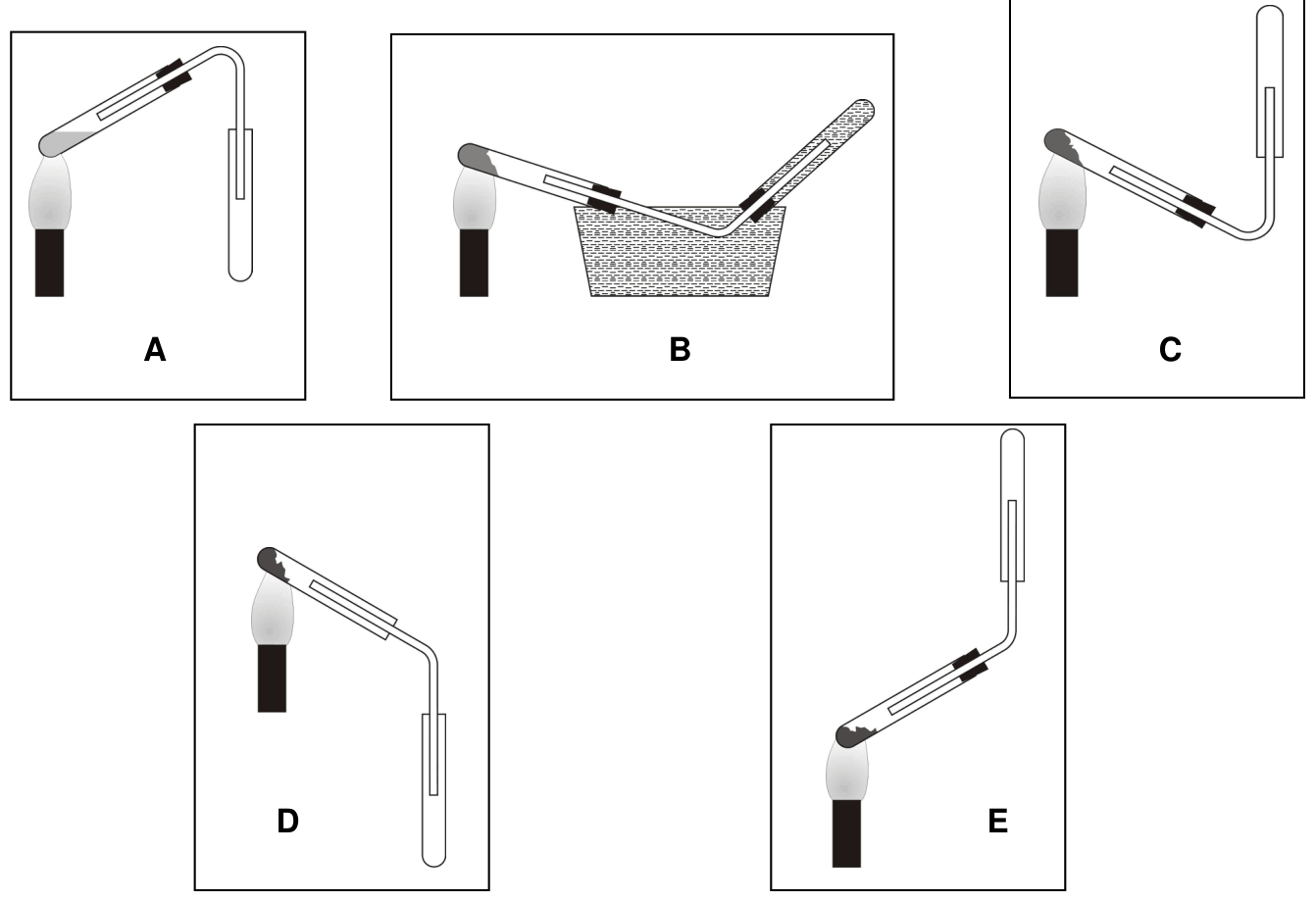
- Which of the apparatuses shown in the figures is the best one for the synthesis of bromethane from potassium bromide, concentrated sulphuric acid and ethanol?
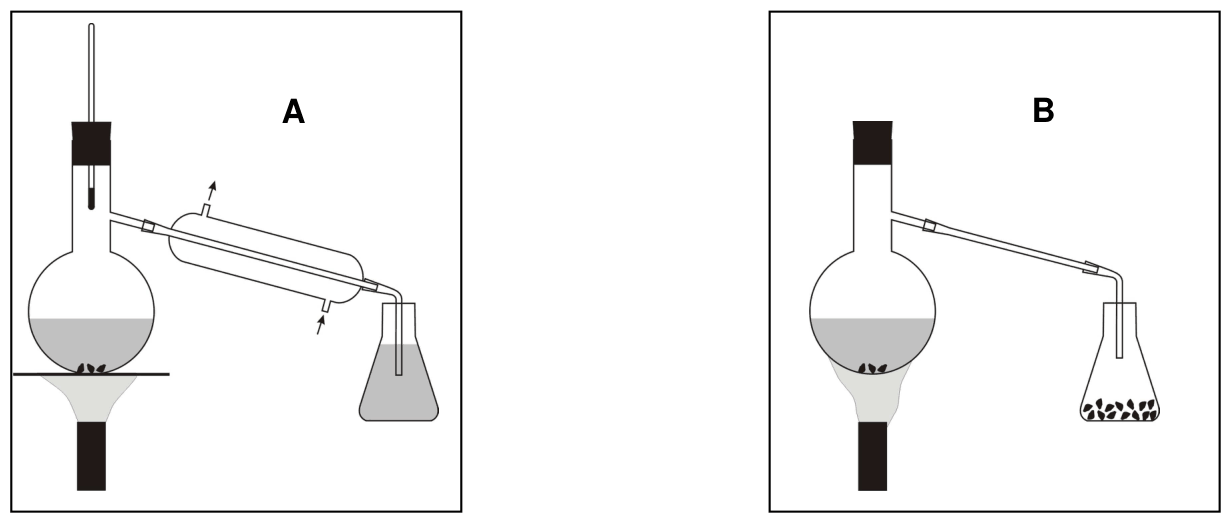
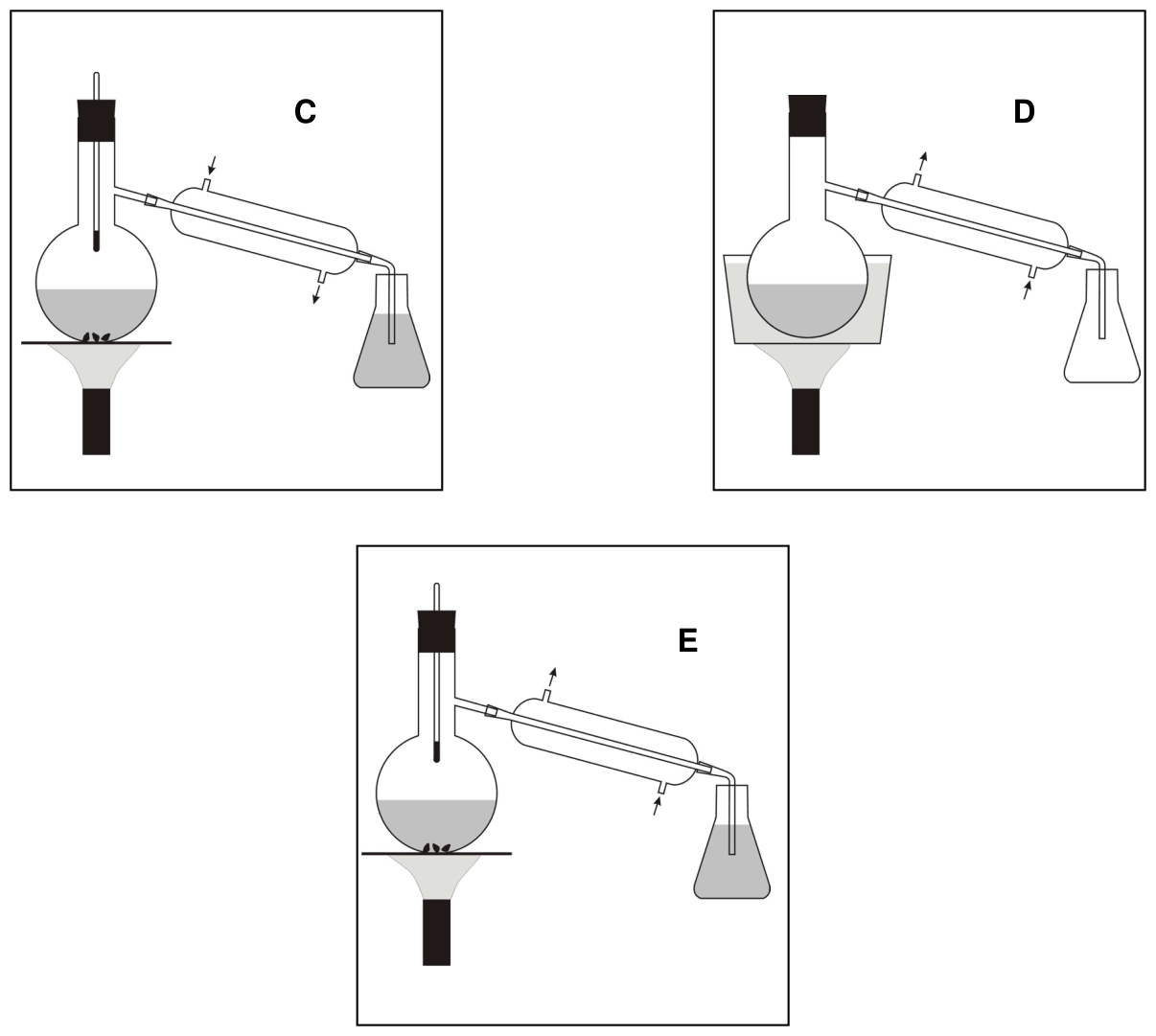
Official English text of the problem.
Answers
- A — carbon.
- C — approximately \(3\ \mathrm{L}\) of carbon dioxide,
O=C=O. - A — propane,
CCC. - E — 5 isomers, including geometrical isomers.
- E — 2,2,4-trimethylpentane,
CC(C)(C)CC(C)C. - D and E — sodium hydroxide,
[Na+].[OH-], and magnesium. - D — \(20\%\) by mass.
- D — 4 compounds.
- D — lithium nitrate,
[Li+].[O-][N+](=O)[O-]. - C — carbon atom 3.
- D — 4 waters of crystallisation: calcium nitrate tetrahydrate, \(\ce{Ca(NO3)2.4H2O}\),
[Ca+2].[O-][N+](=O)[O-].[O-][N+](=O)[O-].O.O.O.O. - B — 2-chlorobenzoic acid,
O=C(O)c1ccccc1Cl. - D — perchloric acid,
OCl(=O)(=O)=O. - A and E — potassium bromide,
[K+].[Br-], and barium sulphate,[Ba+2].[O-]S(=O)(=O)[O-]. - D — approximately \(4\ \mathrm{L}\) of air.
- E — none.
- C and E — addition of a catalyst and increasing the amount of solid calcium carbonate.
- B and E — oxygen,
O=O, and chlorine,ClCl. - C.
- A.
Solution
Rounded atomic masses are sufficient for the numerical choices. Gas volumes are compared at the same temperature and pressure; for question 2, the conventional standard molar volume \(22.4\ \mathrm{L\,mol^{-1}}\) is used.
SMILES for ionic salts below describe formal ionic composition, not crystal structures. Dot-separated waters in a hydrate do not specify their coordination. Recurring molecular species are water O, carbon dioxide O=C=O, hydrogen [H][H], oxygen O=O, nitrogen N#N, and ammonia N. The proton, hydronium ion, and hydroxide ion are [H+], [OH3+], and [OH-], respectively.
1. Oxidation of ethylene — A
Ethylene, or ethene, C=C, undergoes oxidation to ethane-1,2-diol, OCCO, in the usual dilute aqueous permanganate reaction:
\[ \ce{3CH2=CH2 + 2KMnO4 + 4H2O -> 3HOCH2CH2OH + 2MnO2(s) + 2KOH}. \]
Potassium permanganate has the formal ionic SMILES [K+].[O-][Mn](=O)(=O)=O; potassium hydroxide is [K+].[OH-].
Each carbon atom changes oxidation state from \(-2\) in ethylene to \(-1\) in the diol. Thus carbon is oxidized. Manganese changes from \(+7\) to \(+4\), so it is reduced.
2. Carbon dioxide from hydrogen carbonate — C
Potassium hydrogen carbonate is [K+].O=C(O)[O-]; sulphuric acid is OS(=O)(=O)O. The reaction is
\[ \ce{2KHCO3 + H2SO4 -> K2SO4 + 2CO2 + 2H2O}. \]
Potassium sulphate has the ionic representation [K+].[K+].[O-]S(=O)(=O)[O-].
The solution contains
\[ m(\ce{H2SO4})=65\ \mathrm{g}\times0.10=6.5\ \mathrm{g}. \]
Using \(M(\ce{KHCO3})=100\ \mathrm{g\,mol^{-1}}\) and \(M(\ce{H2SO4})=98\ \mathrm{g\,mol^{-1}}\),
\[ n(\ce{KHCO3})=\frac{18}{100}=0.180\ \mathrm{mol}, \qquad n(\ce{H2SO4})=\frac{6.5}{98}=0.0663\ \mathrm{mol}. \]
The acid can consume \(2(0.0663)=0.1327\ \mathrm{mol}\) of hydrogen carbonate, so the acid is limiting. Therefore,
\[ n(\ce{CO2})=0.1327\ \mathrm{mol}, \]
\[ V(\ce{CO2})=0.1327\times22.4 =2.97\ \mathrm{L}\approx3\ \mathrm{L}. \]
3. Maximum heat from equal gas volumes — A
At equal temperature and pressure, equal gas volumes contain equal amounts in moles. The relevant comparison is therefore heat released per mole, rather than per gram.
The combustion equations are
\[ \begin{aligned} \ce{C3H8 + 5O2 &-> 3CO2 + 4H2O},\\ \ce{CH4 + 2O2 &-> CO2 + 2H2O},\\ \ce{2C2H2 + 5O2 &-> 4CO2 + 2H2O},\\ \ce{C2H4 + 3O2 &-> 2CO2 + 2H2O}. \end{aligned} \]
The structures are propane CCC, methane C, acetylene or ethyne C#C, and ethylene C=C.
Among these particular hydrocarbons, propane has the greatest molar heat of combustion. Its molecule contains more carbon and hydrogen to oxidize than any of the other listed molecules. Consequently, one litre of propane gives the greatest heat yield.
4. Isomers of \(\ce{C3H5Br}\) — E
Counting bromine as hydrogen, the degree of unsaturation is
\[ \mathrm{DBE}=\frac{2(3)+2-5-1}{2}=1. \]
The molecule therefore contains either one double bond or one ring.
| Isomer | SMILES |
|---|---|
| \((E)\)-1-Bromoprop-1-ene | C/C=C/Br |
| \((Z)\)-1-Bromoprop-1-ene | C/C=C\Br |
| 2-Bromoprop-1-ene | C=C(Br)C |
| 3-Bromoprop-1-ene, or allyl bromide | C=CCBr |
| Bromocyclopropane | BrC1CC1 |
In 1-bromoprop-1-ene, each double-bond carbon has two different substituents. Its \(E\) and \(Z\) forms have the higher-priority bromine and methyl groups on opposite and the same sides, respectively.
There are therefore four constitutional isomers but five isomers when geometrical isomerism is included.
5. Best engine fuel — E
The intended criterion is resistance to knocking in a spark-ignition engine. Branching generally improves the antiknock properties of alkanes.
The listed structures are:
| Hydrocarbon | SMILES |
|---|---|
| Cyclooctane | C1CCCCCCC1 |
| 2,2-Dimethylhexane | CC(C)(C)CCCC |
| Normal octane | CCCCCCCC |
| 3-Ethylhexane | CCC(CC)CCC |
| 2,2,4-Trimethylpentane | CC(C)(C)CC(C)C |
2,2,4-Trimethylpentane, commonly called isooctane, is the highly branched reference fuel assigned an octane number of \(100\). It is the intended best choice.
6. Reactions of the higher oxide of element 33 — D and E
Element 33 is arsenic. Its higher oxide is arsenic(V) oxide, \(\ce{As2O5}\), which forms arsenic acid, O=[As](O)(O)O, in water:
\[ \ce{As2O5 + 3H2O -> 2H3AsO4}. \]
Arsenic(V) oxide is an extended solid; a discrete molecular SMILES would not describe its solid structure.
The acidic solution reacts with sodium hydroxide:
\[ \ce{H3AsO4 + 3NaOH -> Na3AsO4 + 3H2O}. \]
The arsenate ion is O=[As]([O-])([O-])[O-]. The displayed equation represents complete neutralisation; acid salts can form with less hydroxide.
Magnesium also reacts. It is an active reducing metal, and acid reduction can be represented by
\[ \ce{Mg + 2H+ -> Mg^2+ + H2}. \]
The magnesium ion is [Mg+2]. Arsenic(V) itself can also be reduced; for example, a balanced reduction step is
\[ \ce{H3AsO4 + Mg + 2H+ -> H3AsO3 + Mg^2+ + H2O}. \]
Here arsenious acid, \(\ce{H3AsO3}\), is O[As](O)O. Further arsenic reduction depends on conditions; a unique final reduction product is not needed to establish that magnesium reacts.
Carbon dioxide and hydrochloric acid, [H]Cl, are acidic substances, while potassium sulphate provides no conventional reaction driving force in this comparison. Thus D and E are selected.
7. Required potassium hydroxide concentration — D
Nitric acid is O=[N+]([O-])O. Neutralisation is one-to-one:
\[ \ce{KOH + HNO3 -> KNO3 + H2O}. \]
Therefore,
\[ n(\ce{KOH})=3.57\ \mathrm{mol}. \]
Using \(M(\ce{KOH})=56\ \mathrm{g\,mol^{-1}}\),
\[ m(\ce{KOH})=3.57\times56=199.92\ \mathrm{g} \approx200\ \mathrm{g}. \]
For \(1.00\ \mathrm{kg}=1000\ \mathrm{g}\) of solution,
\[ w(\ce{KOH})= \frac{199.92}{1000}\times100\% \approx20.0\%. \]
8. Compounds with formula \(\ce{C3H9N}\) — D
The degree of unsaturation is zero:
\[ \mathrm{DBE}=\frac{2(3)+2+1-9}{2}=0. \]
The ordinary neutral compounds are saturated, acyclic amines. Distributing three carbon atoms among the substituents on nitrogen gives:
| Compound | Type | SMILES |
|---|---|---|
| Propan-1-amine | Primary amine | CCCN |
| Propan-2-amine | Primary amine | CC(N)C |
| \(N\)-Methylethanamine | Secondary amine | CCNC |
| Trimethylamine | Tertiary amine | CN(C)C |
Thus there are four compounds.
9. Greatest nitrogen mass fraction — D
For a nitrate of formula \(\ce{M(NO3)_{$z$}}\),
\[ w_\mathrm{N} =\frac{14z}{A_\mathrm{M}+62z}\times100\%. \]
Using rounded atomic masses gives:
| Salt | SMILES | Molar mass / \(\mathrm{g\,mol^{-1}}\) | Nitrogen / mass % |
|---|---|---|---|
| Potassium nitrate | [K+].[O-][N+](=O)[O-] |
101 | 13.86 |
| Barium nitrate | [Ba+2].[O-][N+](=O)[O-].[O-][N+](=O)[O-] |
261 | 10.73 |
| Aluminium nitrate | [Al+3].[O-][N+](=O)[O-].[O-][N+](=O)[O-].[O-][N+](=O)[O-] |
213 | 19.72 |
| Lithium nitrate | [Li+].[O-][N+](=O)[O-] |
69 | 20.29 |
| Sodium nitrate | [Na+].[O-][N+](=O)[O-] |
85 | 16.47 |
The greatest nitrogen content is therefore that of lithium nitrate.
10. Addition of hydrogen chloride to pent-2-enoic acid — C
Pent-2-enoic acid has SMILES CCC=CC(=O)O. Numbering begins at the carboxyl carbon:
\[ \underset{1}{\ce{HOOC}}- \underset{2}{\ce{CH}}= \underset{3}{\ce{CH}}- \underset{4}{\ce{CH2}}- \underset{5}{\ce{CH3}}. \]
The electron-withdrawing carboxyl group makes the \(\beta\)-carbon, carbon 3, the site for chloride addition. The overall reaction is
\[ \ce{HOOC-CH=CH-CH2-CH3 + HCl -> HOOC-CH2-CHCl-CH2-CH3}. \]
Thus chlorine attaches mainly to carbon 3, giving 3-chloropentanoic acid.
Under achiral conditions the product is racemic. Its two enantiomers are represented by CC[C@H](Cl)CC(=O)O and CC[C@@H](Cl)CC(=O)O. These SMILES specify configuration, but do not depict the electron redistribution during addition.
11. Calcium nitrate hydrate — D
Write the hydrate as \(\ce{Ca(NO3)2.$n$ H2O}\). The molar mass of anhydrous calcium nitrate is
\[ M(\ce{Ca(NO3)2})=40+2(14+3\times16) =164\ \mathrm{g\,mol^{-1}}. \]
The water mass fraction gives
\[ \frac{18n}{164+18n}=0.305. \]
Therefore,
\[ 18n=0.305(164+18n), \]
\[ n=\frac{0.305\times164}{18(1-0.305)} =3.998\approx4. \]
The hydrate is calcium nitrate tetrahydrate. Checking,
\[ \frac{4\times18}{164+4\times18}\times100\% =30.51\%, \]
which agrees with the stated \(30.5\%\).
12. Strongest organic acid — B
The structures being compared are:
| Acid | SMILES |
|---|---|
| Benzoic acid | O=C(O)c1ccccc1 |
| 2-Chlorobenzoic acid | O=C(O)c1ccccc1Cl |
| 4-Methylbenzoic acid | O=C(O)c1ccc(C)cc1 |
| 2-Aminobenzoic acid | O=C(O)c1ccccc1N |
| 4-Bromobenzoic acid | O=C(O)c1ccc(Br)cc1 |
The intended strongest acid is 2-chlorobenzoic acid. Its nearby chlorine substituent produces strong electron withdrawal, together with the characteristic ortho enhancement of benzoic-acid acidity. This favours formation of the carboxylate:
\[ \ce{C6H4ClCOOH + H2O <=> C6H4ClCOO- + H3O+}. \]
The conjugate base, 2-chlorobenzoate, is O=C([O-])c1ccccc1Cl.
The methyl group donates electron density. An unprotonated amino group also donates by resonance, while the more distant para-bromine substituent has a weaker acid-strengthening effect than ortho-chlorine.
For 2-aminobenzoic acid, zwitterionic equilibria also matter: its zwitterion is O=C([O-])c1ccccc1[NH3+]. Acidity of a separately protonated amino-acid cation must not be confused with dissociation of the net-neutral acid being compared here.
13. Highest degree of dissociation — D
The acids are:
| Acid | SMILES |
|---|---|
| Hypochlorous acid | OCl |
| Chlorous acid | OCl=O |
| Chloric acid | OCl(=O)=O |
| Perchloric acid | OCl(=O)(=O)=O |
Their dissociation can be written generally as
\[ \ce{HClO_{$n$} + H2O <=> H3O+ + ClO_{$n$}^{-}}, \qquad n=1,2,3,4. \]
Increasing the number of oxygen atoms increases electron withdrawal and stabilises the conjugate anion. The acid-strength order is
\[ \ce{HClO}<\ce{HClO2}<\ce{HClO3}<\ce{HClO4}. \]
The conjugate anions are hypochlorite [O-]Cl, chlorite [O-]Cl=O, chlorate [O-]Cl(=O)=O, and perchlorate [O-]Cl(=O)(=O)=O. These are individual Lewis representations; SMILES does not depict resonance delocalisation.
Under the intended comparison at otherwise equal conditions, perchloric acid has the greatest tendency to dissociate.
14. Salts that do not undergo hydrolysis — A and E
Potassium bromide is formed from a strong acid and a strong base. Its dissolution supplies potassium ions [K+] and bromide ions [Br-], neither of which appreciably hydrolyses:
\[ \ce{KBr(s) -> K+(aq) + Br-(aq)}. \]
Barium sulphate is likewise treated as a salt of a strong base and strong acid, with no appreciable hydrolysis in this classification. It is also very sparingly soluble:
\[ \ce{BaSO4(s) <=> Ba^2+(aq) + SO4^2-(aq)}. \]
The barium ion is [Ba+2], and sulphate is [O-]S(=O)(=O)[O-].
The other salts do hydrolyse:
- Aluminium(III) and iron(III) aquo ions acidify water by hydrolysis.
- Carbonate is a basic anion and produces hydroxide.
For either trivalent metal, the first hydrolysis step is
\[ \ce{[M(H2O)6]^3+ + H2O <=> [M(OH)(H2O)5]^2+ + H3O+}, \qquad M=\ce{Al},\ce{Fe}. \]
For completeness, dative-bond SMILES for these species are:
| Species | SMILES |
|---|---|
| Hexaaquaaluminium(III) | O->[Al+3](<-O)(<-O)(<-O)(<-O)<-O |
| Pentaaquahydroxidoaluminium(III) | [OH-]->[Al+3](<-O)(<-O)(<-O)(<-O)<-O |
| Hexaaquairon(III) | O->[Fe+3](<-O)(<-O)(<-O)(<-O)<-O |
| Pentaaquahydroxidoiron(III) | [OH-]->[Fe+3](<-O)(<-O)(<-O)(<-O)<-O |
The six oxygen donors occupy approximately octahedral coordination environments; the SMILES does not encode that spatial arrangement.
Carbonate hydrolysis is
\[ \ce{CO3^2- + H2O <=> HCO3- + OH-}. \]
Carbonate is O=C([O-])[O-], and hydrogen carbonate is O=C(O)[O-]. Thus the correct selections are A and E.
15. Air required to burn ammonia — D
Ordinary combustion of ammonia gives nitrogen and water:
\[ \ce{4NH3 + 3O2 -> 2N2 + 6H2O}. \]
At the same temperature and pressure,
\[ V(\ce{O2})=\frac34V(\ce{NH3}). \]
Thus \(1\ \mathrm{L}\) of ammonia requires \(0.75\ \mathrm{L}\) of oxygen. Taking air as approximately \(21\%\) oxygen by volume,
\[ V(\text{air})=\frac{0.75}{0.21}=3.57\ \mathrm{L}. \]
Using the school approximation of \(20\%\) gives \(3.75\ \mathrm{L}\). In either case, the nearest answer is \(4\ \mathrm{L}\).
16. Thermal decomposition of sodium hydrogen carbonate — E
Sodium hydrogen carbonate is [Na+].O=C(O)[O-]. It decomposes according to
\[ \ce{2NaHCO3 ->[\Delta] Na2CO3 + CO2 + H2O}. \]
Sodium carbonate is [Na+].[Na+].O=C([O-])[O-].
The oxidation states remain:
\[ \ce{Na}:\ +1,\qquad \ce{H}:\ +1,\qquad \ce{O}:\ -2,\qquad \ce{C}:\ +4. \]
No oxidation state changes, so no element is oxidised.
17. Calcium carbonate decomposition equilibrium — C and E
The equilibrium is
\[ \ce{CaCO3(s) <=> CaO(s) + CO2(g)}. \]
Calcium carbonate and calcium oxide have the formal ionic representations [Ca+2].[O-]C(=O)[O-] and [Ca+2].[O-2], respectively.
When both solid phases are present, their activities are unity, so
\[ K_p=\frac{p_{\ce{CO2}}}{p^\circ}. \]
Consequently:
- A: Increasing temperature favours the endothermic decomposition.
- B: Decreasing pressure by expansion lowers the carbon dioxide partial pressure and favours decomposition.
- C: A catalyst changes the rates of approach to equilibrium, but not the equilibrium position.
- D: Changing carbon dioxide concentration changes the reaction quotient.
- E: Adding more pure solid calcium carbonate does not change its activity and therefore does not shift equilibrium, provided the solid phases remain present.
The changes with no effect on equilibrium position are C and E.
18. Products at the platinum anode — B and E
At an inert platinum anode, chloride oxidation and water oxidation are competing processes in aqueous aluminium chloride.
Chloride ions, [Cl-], produce chlorine:
\[ \ce{2Cl- -> Cl2 + 2e-}. \]
Water oxidation produces oxygen:
\[ \ce{2H2O -> O2 + 4H+ + 4e-}. \]
Thus both oxygen and chlorine must be included: B and E. Their relative production depends on chloride concentration, electrode potential, current density, and mass transport; the problem does not determine their ratio.
Hydrogen formation is a cathodic process, for example
\[ \ce{2H2O + 2e- -> H2 + 2OH-}. \]
Any aluminium hydroxide formed by local alkalinisation also belongs to the cathodic region:
\[ \ce{Al^3+ + 3OH- -> Al(OH)3(s)}. \]
Aluminium hydroxide is an extended solid, formally represented by [Al+3].[OH-].[OH-].[OH-]. Neither it nor metallic aluminium is an anodic product here.
19. Apparatus for preparing ammonia — C
The preparation reaction is
\[ \ce{2NH4Cl + Ca(OH)2 ->[\Delta] 2NH3 + CaCl2 + 2H2O}. \]
The salt representations are ammonium chloride [NH4+].[Cl-], calcium hydroxide [Ca+2].[OH-].[OH-], and calcium chloride [Ca+2].[Cl-].[Cl-].
The correct apparatus must satisfy three requirements:
- Ammonia is lighter than air, so it is collected in an inverted receiver, displacing air downward.
- Ammonia is highly soluble in water, so collection over water is unsuitable.
- The heated generating tube should slope downward toward its mouth, so condensed water does not run back onto the strongly heated end.
Figure C satisfies all three. Figures A and D have upright receivers; B attempts collection over water; E slopes the generating tube so condensate can return to the hot end.
20. Apparatus for preparing bromoethane — A
Hydrogen bromide is generated from potassium bromide and sulphuric acid:
\[ \ce{KBr + H2SO4 -> KHSO4 + HBr}. \]
It reacts with ethanol:
\[ \ce{CH3CH2OH + HBr -> CH3CH2Br + H2O}. \]
The overall equation is
\[ \ce{KBr + H2SO4 + CH3CH2OH -> KHSO4 + CH3CH2Br + H2O}. \]
The relevant structures are ethanol CCO, hydrogen bromide [H]Br, bromoethane CCBr, and potassium hydrogen sulphate [K+].OS(=O)(=O)[O-].
Bromoethane is volatile and is distilled as it forms. Apparatus A has the appropriate arrangement:
- The thermometer bulb is near the side-arm entrance, where it measures the temperature of the vapour entering the condenser.
- Cooling water enters the lower, receiver-side connection and leaves through the upper, flask-side connection, keeping the condenser jacket filled.
- The delivery tube extends below the receiving liquid, helping retain the volatile product.
B lacks a water-cooled condenser. C reverses the cooling-water flow and places the thermometer too low. E also places the thermometer too low. D lacks the thermometer and liquid collection arrangement provided in A.
The answers were checked against the official answers published by the organisers.
IChO 1979 · Theorieaufgabe 1
Programmierte Aufgabe: 20 Multiple-Choice-Fragen
Kreisen Sie bei der Bearbeitung dieser programmierten Aufgabe diejenigen Buchstaben ein, die Ihrer Meinung nach den richtigen Antworten auf die einzelnen 20 Fragen entsprechen.
- Welches Element wird bei der Reaktion zwischen Ethylen und einer wässrigen Kaliumpermanganatlösung oxidiert?
A) Kohlenstoff, B) Wasserstoff, C) Kalium, D) Mangan, E) Sauerstoff.
- Wie viele Liter \(\ce{CO2}\) werden bei der Reaktion von 18 g Kaliumhydrogencarbonat mit 65 g 10%iger Schwefelsäure ungefähr freigesetzt?
A) 1, B) 2, C) 3, D) 4, E) 5.
- Welcher der folgenden Kohlenwasserstoffe liefert bei der vollständigen Verbrennung von 1 Liter des Gases die größte Wärmemenge:
A) Propan, B) Methan, C) Acetylen, D) Ethylen, E) alle liefern die gleiche Wärmemenge.
- Wie viele Isomere kann eine Verbindung mit der Formel \(\ce{C3H5Br}\) haben?
A) 1, B) 2, C) 3, D) 4, E) 5.
- Welcher der folgenden Kohlenwasserstoffe ist der beste Motorkraftstoff?
A) Cyclooctan, B) 2,2-Dimethylhexan, C) n-Octan, D) 3-Ethylhexan, E) 2,2,4-Trimethylpentan.
- Mit welchen der folgenden Verbindungen reagiert eine wässrige Lösung eines höheren Oxids des Elements Nr. 33?
A) \(\ce{CO2}\), B) \(\ce{K2SO4}\), C) \(\ce{HCl}\), D) \(\ce{NaOH}\), E) Magnesium.
- Welche Mindestkonzentration (in Massen-%) muss 1 kg einer Kaliumhydroxidlösung aufweisen, um 3.57 Mol Salpetersäure vollständig zu neutralisieren?
A) 5 %, B) 10 %, C) 15 %, D) 20 %, E) 25 %.
- Wie viele Verbindungen mit der Formel \(\ce{C3H9N}\) können existieren?
A) 1, B) 2, C) 3, D) 4, E) 5.
- In welcher der folgenden Verbindungen ist der Stickstoffgehalt (in Massen-%) am höchsten?
A) Kaliumnitrat, B) Bariumnitrat, C) Aluminiumnitrat, D) Lithiumnitrat, E) Natriumnitrat.
-
An welches Kohlenstoffatom (geben Sie die Positionsnummer an) addiert sich Chlor bei der Reaktion von \(\ce{HCl}\) mit Pent-2-ensäure hauptsächlich?
A) 1, B) 2, C) 3, D) 4, E) 5.
-
Wie viele Mol Wasser kommen in einem Kristallhydrat auf ein Mol Calciumnitrat, wenn der Wassergehalt 30.5 Massen-% beträgt?
A) 1, B) 2, C) 3, D) 4, E) 5.
-
Welche dieser organischen Säuren ist die stärkste?
A) Benzoesäure, B) 2-Chlorbenzoesäure, C) 4-Methylbenzoesäure, D) 2-Aminobenzoesäure, E) 4-Brombenzoesäure.
-
Welche dieser Säuren hat den höchsten Dissoziationsgrad?
A) \(\ce{HClO}\), B) \(\ce{HClO2}\), C) \(\ce{HClO3}\), D) \(\ce{HClO4}\), E) alle haben den gleichen Dissoziationsgrad.
-
Welche der folgenden Salze unterliegen keiner Hydrolyse?
A) Kaliumbromid, B) Aluminiumsulfat, C) Natriumcarbonat, D) Eisen(III)-nitrat, E) Bariumsulfat.
-
Wie viele Liter Luft werden für die vollständige Verbrennung von 1 Liter Ammoniak ungefähr benötigt?
A) 1, B) 2, C) 3, D) 4, E) 5.
-
Welches Element wird bei der thermischen Zersetzung von Natriumhydrogencarbonat oxidiert?
A) Natrium, B) Wasserstoff, C) Sauerstoff, D) Kohlenstoff, E) keines.
-
Welche der folgenden Änderungen haben keinen Einfluss auf das chemische Gleichgewicht bei der thermischen Zersetzung von \(\ce{CaCO3}\)?
A) Temperaturerhöhung, B) Drucksenkung, C) Zugabe eines Katalysators, D) Änderung der \(\ce{CO2}\)-Konzentration, E) Erhöhung der Menge des Ausgangsstoffs.
-
Welche der folgenden Stoffe entstehen bei der Elektrolyse einer wässrigen Aluminiumchloridlösung an der Pt-Anode?
A) Aluminium, B) Sauerstoff, C) Wasserstoff, D) Aluminiumhydroxid, E) Chlor.
-
Die in den Abbildungen gezeigte Apparatur dient zur Herstellung von Ammoniak unter Laborbedingungen. Das erhitzte Reagenzglas enthält ein Gemisch aus \(\ce{NH4Cl}\) und \(\ce{Ca(OH)2}\). Welche der Abbildungen ist richtig?
- Welche der in den Abbildungen gezeigten Apparaturen eignet sich am besten zur Synthese von Bromethan aus Kaliumbromid, konzentrierter Schwefelsäure und Ethanol?
Aufgabentext aus dem offiziellen englischen Text übersetzt.
Antworten
- A — Kohlenstoff.
- C — ungefähr \(3\ \mathrm{L}\) Kohlenstoffdioxid,
O=C=O. - A — Propan,
CCC. - E — 5 Isomere, einschließlich geometrischer Isomere.
- E — 2,2,4-Trimethylpentan,
CC(C)(C)CC(C)C. - D und E — Natriumhydroxid,
[Na+].[OH-], und Magnesium. - D — \(20\%\) Massenanteil.
- D — 4 Verbindungen.
- D — Lithiumnitrat,
[Li+].[O-][N+](=O)[O-]. - C — Kohlenstoffatom 3.
- D — 4 Kristallwassermoleküle: Calciumnitrat-Tetrahydrat, \(\ce{Ca(NO3)2.4H2O}\),
[Ca+2].[O-][N+](=O)[O-].[O-][N+](=O)[O-].O.O.O.O. - B — 2-Chlorbenzoesäure,
O=C(O)c1ccccc1Cl. - D — Perchlorsäure,
OCl(=O)(=O)=O. - A und E — Kaliumbromid,
[K+].[Br-], und Bariumsulfat,[Ba+2].[O-]S(=O)(=O)[O-]. - D — ungefähr \(4\ \mathrm{L}\) Luft.
- E — keines.
- C und E — Zugabe eines Katalysators und Erhöhung der Menge an festem Calciumcarbonat.
- B und E — Sauerstoff,
O=O, und Chlor,ClCl. - C.
- A.
Lösung
Für die Auswahl der numerischen Antworten reichen gerundete Atommassen aus. Gasvolumina werden bei gleicher Temperatur und gleichem Druck verglichen; für Frage 2 wird das übliche molare Normvolumen \(22.4\ \mathrm{L\,mol^{-1}}\) verwendet.
Die nachstehenden SMILES für ionische Salze beschreiben die formale ionische Zusammensetzung, nicht die Kristallstrukturen. Durch Punkte abgetrennte Wassermoleküle in einem Hydrat legen deren Koordination nicht fest. Wiederkehrende molekulare Spezies sind Wasser O, Kohlenstoffdioxid O=C=O, Wasserstoff [H][H], Sauerstoff O=O, Stickstoff N#N und Ammoniak N. Das Proton, das Oxoniumion und das Hydroxidion werden durch [H+], [OH3+] bzw. [OH-] dargestellt.
1. Oxidation von Ethylen — A
Ethylen, auch Ethen genannt, C=C, wird bei der üblichen Reaktion mit verdünnter wässriger Permanganatlösung zu Ethan-1,2-diol, OCCO, oxidiert:
\[ \ce{3CH2=CH2 + 2KMnO4 + 4H2O -> 3HOCH2CH2OH + 2MnO2(s) + 2KOH}. \]
Kaliumpermanganat hat die formale ionische SMILES-Darstellung [K+].[O-][Mn](=O)(=O)=O; Kaliumhydroxid wird durch [K+].[OH-] dargestellt.
Die Oxidationszahl jedes Kohlenstoffatoms ändert sich von \(-2\) im Ethylen zu \(-1\) im Diol. Somit wird Kohlenstoff oxidiert. Die Oxidationszahl von Mangan ändert sich von \(+7\) zu \(+4\), es wird also reduziert.
2. Kohlenstoffdioxid aus Hydrogencarbonat — C
Kaliumhydrogencarbonat wird durch [K+].O=C(O)[O-] dargestellt; Schwefelsäure durch OS(=O)(=O)O. Die Reaktion lautet
\[ \ce{2KHCO3 + H2SO4 -> K2SO4 + 2CO2 + 2H2O}. \]
Kaliumsulfat hat die ionische Darstellung [K+].[K+].[O-]S(=O)(=O)[O-].
Die Lösung enthält
\[ m(\ce{H2SO4})=65\ \mathrm{g}\times0.10=6.5\ \mathrm{g}. \]
Mit \(M(\ce{KHCO3})=100\ \mathrm{g\,mol^{-1}}\) und \(M(\ce{H2SO4})=98\ \mathrm{g\,mol^{-1}}\) ergibt sich
\[ n(\ce{KHCO3})=\frac{18}{100}=0.180\ \mathrm{mol}, \qquad n(\ce{H2SO4})=\frac{6.5}{98}=0.0663\ \mathrm{mol}. \]
Die Säure kann \(2(0.0663)=0.1327\ \mathrm{mol}\) Hydrogencarbonat umsetzen und ist daher der limitierende Reaktand. Somit gilt
\[ n(\ce{CO2})=0.1327\ \mathrm{mol}, \]
\[ V(\ce{CO2})=0.1327\times22.4 =2.97\ \mathrm{L}\approx3\ \mathrm{L}. \]
3. Größte Wärmemenge aus gleichen Gasvolumina — A
Bei gleicher Temperatur und gleichem Druck enthalten gleiche Gasvolumina gleiche Stoffmengen. Zu vergleichen ist daher die freigesetzte Wärme pro Mol, nicht pro Gramm.
Die Verbrennungsgleichungen lauten
\[ \begin{aligned} \ce{C3H8 + 5O2 &-> 3CO2 + 4H2O},\\ \ce{CH4 + 2O2 &-> CO2 + 2H2O},\\ \ce{2C2H2 + 5O2 &-> 4CO2 + 2H2O},\\ \ce{C2H4 + 3O2 &-> 2CO2 + 2H2O}. \end{aligned} \]
Die Strukturen sind Propan CCC, Methan C, Acetylen oder Ethin C#C und Ethylen C=C.
Unter diesen Kohlenwasserstoffen hat Propan die größte molare Verbrennungswärme. Sein Molekül enthält mehr oxidierbaren Kohlenstoff und Wasserstoff als jedes der anderen aufgeführten Moleküle. Folglich liefert ein Liter Propan die größte Wärmemenge.
4. Isomere von \(\ce{C3H5Br}\) — E
Wird Brom wie Wasserstoff gezählt, ergibt sich für den Ungesättigtheitsgrad
\[ \mathrm{DBE}=\frac{2(3)+2-5-1}{2}=1. \]
Das Molekül enthält daher entweder eine Doppelbindung oder einen Ring.
| Isomer | SMILES |
|---|---|
| \((E)\)-1-Bromprop-1-en | C/C=C/Br |
| \((Z)\)-1-Bromprop-1-en | C/C=C\Br |
| 2-Bromprop-1-en | C=C(Br)C |
| 3-Bromprop-1-en oder Allylbromid | C=CCBr |
| Bromcyclopropan | BrC1CC1 |
In 1-Bromprop-1-en trägt jedes Kohlenstoffatom der Doppelbindung zwei unterschiedliche Substituenten. Bei der \(E\)-Form liegen die höher priorisierten Brom- und Methylgruppen auf entgegengesetzten Seiten, bei der \(Z\)-Form auf derselben Seite.
Es gibt daher vier Konstitutionsisomere, aber fünf Isomere, wenn die geometrische Isomerie berücksichtigt wird.
5. Bester Motorkraftstoff — E
Das beabsichtigte Kriterium ist die Klopffestigkeit in einem Ottomotor. Verzweigungen verbessern im Allgemeinen die Klopffestigkeit von Alkanen.
Die aufgeführten Strukturen sind:
| Kohlenwasserstoff | SMILES |
|---|---|
| Cyclooctan | C1CCCCCCC1 |
| 2,2-Dimethylhexan | CC(C)(C)CCCC |
| n-Octan | CCCCCCCC |
| 3-Ethylhexan | CCC(CC)CCC |
| 2,2,4-Trimethylpentan | CC(C)(C)CC(C)C |
2,2,4-Trimethylpentan, üblicherweise Isooctan genannt, ist der stark verzweigte Referenzkraftstoff, dem die Oktanzahl \(100\) zugeordnet ist. Es ist die beabsichtigte beste Wahl.
6. Reaktionen des höheren Oxids von Element 33 — D und E
Element 33 ist Arsen. Sein höheres Oxid ist Arsen(V)-oxid, \(\ce{As2O5}\), das in Wasser Arsensäure, O=[As](O)(O)O, bildet:
\[ \ce{As2O5 + 3H2O -> 2H3AsO4}. \]
Arsen(V)-oxid ist ein Feststoff mit ausgedehnter Struktur; eine SMILES-Darstellung eines diskreten Moleküls würde seine Festkörperstruktur nicht beschreiben.
Die saure Lösung reagiert mit Natriumhydroxid:
\[ \ce{H3AsO4 + 3NaOH -> Na3AsO4 + 3H2O}. \]
Das Arsenation wird durch O=[As]([O-])([O-])[O-] dargestellt. Die angegebene Gleichung beschreibt die vollständige Neutralisation; bei geringerer Hydroxidmenge können saure Salze entstehen.
Auch Magnesium reagiert. Es ist ein unedles, reduzierend wirkendes Metall, und die Reduktion der Säure lässt sich folgendermaßen darstellen:
\[ \ce{Mg + 2H+ -> Mg^2+ + H2}. \]
Das Magnesiumion wird durch [Mg+2] dargestellt. Arsen(V) selbst kann ebenfalls reduziert werden; ein ausgeglichener Reduktionsschritt ist beispielsweise
\[ \ce{H3AsO4 + Mg + 2H+ -> H3AsO3 + Mg^2+ + H2O}. \]
Hier wird arsenige Säure, \(\ce{H3AsO3}\), durch O[As](O)O dargestellt. Eine weitere Reduktion des Arsens hängt von den Bedingungen ab; ein eindeutig festgelegtes endgültiges Reduktionsprodukt ist nicht erforderlich, um festzustellen, dass Magnesium reagiert.
Kohlenstoffdioxid und Salzsäure, [H]Cl, sind saure Stoffe, während Kaliumsulfat in diesem Vergleich keine übliche Triebkraft für eine Reaktion liefert. Daher werden D und E ausgewählt.
7. Erforderliche Kaliumhydroxidkonzentration — D
Salpetersäure wird durch O=[N+]([O-])O dargestellt. Die Neutralisation erfolgt im Verhältnis eins zu eins:
\[ \ce{KOH + HNO3 -> KNO3 + H2O}. \]
Daher gilt
\[ n(\ce{KOH})=3.57\ \mathrm{mol}. \]
Mit \(M(\ce{KOH})=56\ \mathrm{g\,mol^{-1}}\) ergibt sich
\[ m(\ce{KOH})=3.57\times56=199.92\ \mathrm{g} \approx200\ \mathrm{g}. \]
Für \(1.00\ \mathrm{kg}=1000\ \mathrm{g}\) Lösung gilt
\[ w(\ce{KOH})= \frac{199.92}{1000}\times100\% \approx20.0\%. \]
8. Verbindungen mit der Formel \(\ce{C3H9N}\) — D
Der Ungesättigtheitsgrad ist null:
\[ \mathrm{DBE}=\frac{2(3)+2+1-9}{2}=0. \]
Die üblichen neutralen Verbindungen sind gesättigte, acyclische Amine. Die Verteilung von drei Kohlenstoffatomen auf die Substituenten am Stickstoff ergibt:
| Verbindung | Typ | SMILES |
|---|---|---|
| Propan-1-amin | Primäres Amin | CCCN |
| Propan-2-amin | Primäres Amin | CC(N)C |
| \(N\)-Methylethanamin | Sekundäres Amin | CCNC |
| Trimethylamin | Tertiäres Amin | CN(C)C |
Somit gibt es vier Verbindungen.
9. Größter Stickstoffmassenanteil — D
Für ein Nitrat der Formel \(\ce{M(NO3)_{$z$}}\) gilt
\[ w_\mathrm{N} =\frac{14z}{A_\mathrm{M}+62z}\times100\%. \]
Mit gerundeten Atommassen erhält man:
| Salz | SMILES | Molare Masse / \(\mathrm{g\,mol^{-1}}\) | Stickstoff / Massen-% |
|---|---|---|---|
| Kaliumnitrat | [K+].[O-][N+](=O)[O-] |
101 | 13.86 |
| Bariumnitrat | [Ba+2].[O-][N+](=O)[O-].[O-][N+](=O)[O-] |
261 | 10.73 |
| Aluminiumnitrat | [Al+3].[O-][N+](=O)[O-].[O-][N+](=O)[O-].[O-][N+](=O)[O-] |
213 | 19.72 |
| Lithiumnitrat | [Li+].[O-][N+](=O)[O-] |
69 | 20.29 |
| Natriumnitrat | [Na+].[O-][N+](=O)[O-] |
85 | 16.47 |
Den höchsten Stickstoffgehalt hat daher Lithiumnitrat.
10. Addition von Chlorwasserstoff an Pent-2-ensäure — C
Pent-2-ensäure hat die SMILES-Darstellung CCC=CC(=O)O. Die Nummerierung beginnt am Carboxylkohlenstoffatom:
\[ \underset{1}{\ce{HOOC}}- \underset{2}{\ce{CH}}= \underset{3}{\ce{CH}}- \underset{4}{\ce{CH2}}- \underset{5}{\ce{CH3}}. \]
Die elektronenziehende Carboxylgruppe macht das \(\beta\)-Kohlenstoffatom, Kohlenstoffatom 3, zur Stelle der Chloridaddition. Die Gesamtreaktion lautet
\[ \ce{HOOC-CH=CH-CH2-CH3 + HCl -> HOOC-CH2-CHCl-CH2-CH3}. \]
Chlor bindet somit hauptsächlich an Kohlenstoffatom 3, wobei 3-Chlorpentansäure entsteht.
Unter achiralen Bedingungen ist das Produkt racemisch. Seine beiden Enantiomere werden durch CC[C@H](Cl)CC(=O)O und CC[C@@H](Cl)CC(=O)O dargestellt. Diese SMILES legen die Konfiguration fest, stellen aber die Elektronenumverteilung während der Addition nicht dar.
11. Calciumnitrathydrat — D
Man schreibt das Hydrat als \(\ce{Ca(NO3)2.$n$ H2O}\). Die molare Masse von wasserfreiem Calciumnitrat beträgt
\[ M(\ce{Ca(NO3)2})=40+2(14+3\times16) =164\ \mathrm{g\,mol^{-1}}. \]
Aus dem Massenanteil des Wassers ergibt sich
\[ \frac{18n}{164+18n}=0.305. \]
Daher gilt
\[ 18n=0.305(164+18n), \]
\[ n=\frac{0.305\times164}{18(1-0.305)} =3.998\approx4. \]
Das Hydrat ist Calciumnitrat-Tetrahydrat. Zur Kontrolle ergibt sich
\[ \frac{4\times18}{164+4\times18}\times100\% =30.51\%, \]
was mit den angegebenen \(30.5\%\) übereinstimmt.
12. Stärkste organische Säure — B
Verglichen werden die folgenden Strukturen:
| Säure | SMILES |
|---|---|
| Benzoesäure | O=C(O)c1ccccc1 |
| 2-Chlorbenzoesäure | O=C(O)c1ccccc1Cl |
| 4-Methylbenzoesäure | O=C(O)c1ccc(C)cc1 |
| 2-Aminobenzoesäure | O=C(O)c1ccccc1N |
| 4-Brombenzoesäure | O=C(O)c1ccc(Br)cc1 |
Die als stärkste Säure vorgesehene Antwort ist 2-Chlorbenzoesäure. Ihr nahe gelegener Chlorsubstituent übt einen starken elektronenziehenden Effekt aus, zusammen mit der charakteristischen Verstärkung der Acidität von Benzoesäuren durch den ortho-Effekt. Dies begünstigt die Bildung des Carboxylats:
\[ \ce{C6H4ClCOOH + H2O <=> C6H4ClCOO- + H3O+}. \]
Die konjugierte Base, 2-Chlorbenzoat, wird durch O=C([O-])c1ccccc1Cl dargestellt.
Die Methylgruppe wirkt elektronenschiebend. Eine unprotonierte Aminogruppe wirkt durch Mesomerie ebenfalls elektronenschiebend, während der weiter entfernte para-Bromsubstituent einen schwächeren säureverstärkenden Effekt hat als ortho-Chlor.
Bei 2-Aminobenzoesäure spielen auch Zwitterionengleichgewichte eine Rolle: Ihr Zwitterion wird durch O=C([O-])c1ccccc1[NH3+] dargestellt. Die Acidität eines gesondert protonierten Aminosäurekations darf nicht mit der Dissoziation der hier verglichenen, insgesamt neutralen Säure verwechselt werden.
13. Höchster Dissoziationsgrad — D
Die Säuren sind:
| Säure | SMILES |
|---|---|
| Hypochlorige Säure | OCl |
| Chlorige Säure | OCl=O |
| Chlorsäure | OCl(=O)=O |
| Perchlorsäure | OCl(=O)(=O)=O |
Ihre Dissoziation lässt sich allgemein schreiben als
\[ \ce{HClO_{$n$} + H2O <=> H3O+ + ClO_{$n$}^{-}}, \qquad n=1,2,3,4. \]
Mit zunehmender Anzahl von Sauerstoffatomen verstärkt sich der elektronenziehende Effekt, und das konjugierte Anion wird stabilisiert. Die Reihenfolge der Säurestärke ist
\[ \ce{HClO}<\ce{HClO2}<\ce{HClO3}<\ce{HClO4}. \]
Die konjugierten Anionen sind Hypochlorit [O-]Cl, Chlorit [O-]Cl=O, Chlorat [O-]Cl(=O)=O und Perchlorat [O-]Cl(=O)(=O)=O. Dies sind einzelne Lewis-Darstellungen; SMILES stellt die mesomere Delokalisierung nicht dar.
Bei dem beabsichtigten Vergleich unter ansonsten gleichen Bedingungen hat Perchlorsäure die größte Neigung zur Dissoziation.
14. Salze, die keiner Hydrolyse unterliegen — A und E
Kaliumbromid entsteht aus einer starken Säure und einer starken Base. Beim Lösen liefert es Kaliumionen [K+] und Bromidionen [Br-], die beide nicht in nennenswertem Umfang hydrolysieren:
\[ \ce{KBr(s) -> K+(aq) + Br-(aq)}. \]
Bariumsulfat wird ebenfalls als Salz einer starken Base und einer starken Säure behandelt, das in dieser Einteilung keiner nennenswerten Hydrolyse unterliegt. Es ist außerdem sehr schwer löslich:
\[ \ce{BaSO4(s) <=> Ba^2+(aq) + SO4^2-(aq)}. \]
Das Bariumion wird durch [Ba+2] dargestellt, Sulfat durch [O-]S(=O)(=O)[O-].
Die anderen Salze hydrolysieren:
- Aluminium(III)- und Eisen(III)-Aquaionen säuern Wasser durch Hydrolyse an.
- Carbonat ist ein basisches Anion und erzeugt Hydroxid.
Für beide dreiwertigen Metalle lautet der erste Hydrolyseschritt
\[ \ce{[M(H2O)6]^3+ + H2O <=> [M(OH)(H2O)5]^2+ + H3O+}, \qquad M=\ce{Al},\ce{Fe}. \]
Der Vollständigkeit halber lauten die SMILES mit koordinativen Bindungen für diese Spezies:
| Spezies | SMILES |
|---|---|
| Hexaaquaaluminium(III) | O->[Al+3](<-O)(<-O)(<-O)(<-O)<-O |
| Pentaaquahydroxidoaluminium(III) | [OH-]->[Al+3](<-O)(<-O)(<-O)(<-O)<-O |
| Hexaaquaeisen(III) | O->[Fe+3](<-O)(<-O)(<-O)(<-O)<-O |
| Pentaaquahydroxidoeisen(III) | [OH-]->[Fe+3](<-O)(<-O)(<-O)(<-O)<-O |
Die sechs Sauerstoffdonoren bilden annähernd oktaedrische Koordinationsumgebungen; die SMILES-Darstellung codiert diese räumliche Anordnung nicht.
Die Carbonathydrolyse lautet
\[ \ce{CO3^2- + H2O <=> HCO3- + OH-}. \]
Carbonat wird durch O=C([O-])[O-] dargestellt, Hydrogencarbonat durch O=C(O)[O-]. Somit sind A und E die richtigen Antworten.
15. Zur Verbrennung von Ammoniak benötigte Luft — D
Bei der gewöhnlichen Verbrennung von Ammoniak entstehen Stickstoff und Wasser:
\[ \ce{4NH3 + 3O2 -> 2N2 + 6H2O}. \]
Bei gleicher Temperatur und gleichem Druck gilt
\[ V(\ce{O2})=\frac34V(\ce{NH3}). \]
Somit benötigt \(1\ \mathrm{L}\) Ammoniak \(0.75\ \mathrm{L}\) Sauerstoff. Nimmt man für Luft einen Sauerstoffvolumenanteil von ungefähr \(21\%\) an, ergibt sich
\[ V(\text{Luft})=\frac{0.75}{0.21}=3.57\ \mathrm{L}. \]
Mit der in der Schule üblichen Näherung von \(20\%\) erhält man \(3.75\ \mathrm{L}\). In beiden Fällen ist die nächstliegende Antwort \(4\ \mathrm{L}\).
16. Thermische Zersetzung von Natriumhydrogencarbonat — E
Natriumhydrogencarbonat wird durch [Na+].O=C(O)[O-] dargestellt. Es zersetzt sich gemäß
\[ \ce{2NaHCO3 ->[\Delta] Na2CO3 + CO2 + H2O}. \]
Natriumcarbonat wird durch [Na+].[Na+].O=C([O-])[O-] dargestellt.
Die Oxidationszahlen bleiben unverändert:
\[ \ce{Na}:\ +1,\qquad \ce{H}:\ +1,\qquad \ce{O}:\ -2,\qquad \ce{C}:\ +4. \]
Keine Oxidationszahl ändert sich, daher wird kein Element oxidiert.
17. Gleichgewicht der Calciumcarbonatzersetzung — C und E
Das Gleichgewicht lautet
\[ \ce{CaCO3(s) <=> CaO(s) + CO2(g)}. \]
Calciumcarbonat und Calciumoxid haben die formalen ionischen Darstellungen [Ca+2].[O-]C(=O)[O-] bzw. [Ca+2].[O-2].
Wenn beide festen Phasen vorhanden sind, betragen ihre Aktivitäten eins, sodass gilt:
\[ K_p=\frac{p_{\ce{CO2}}}{p^\circ}. \]
Folglich gilt:
- A: Eine Temperaturerhöhung begünstigt die endotherme Zersetzung.
- B: Eine Drucksenkung durch Expansion verringert den Kohlenstoffdioxidpartialdruck und begünstigt die Zersetzung.
- C: Ein Katalysator verändert die Geschwindigkeiten der Annäherung an das Gleichgewicht, aber nicht die Gleichgewichtslage.
- D: Eine Änderung der Kohlenstoffdioxidkonzentration verändert den Reaktionsquotienten.
- E: Die Zugabe von weiterem reinem, festem Calciumcarbonat verändert dessen Aktivität nicht und verschiebt daher das Gleichgewicht nicht, sofern die festen Phasen weiterhin vorhanden sind.
Die Änderungen ohne Einfluss auf die Gleichgewichtslage sind C und E.
18. Produkte an der Platinanode — B und E
An einer inerten Platinanode sind die Chloridoxidation und die Wasseroxidation in wässriger Aluminiumchloridlösung konkurrierende Prozesse.
Chloridionen, [Cl-], bilden Chlor:
\[ \ce{2Cl- -> Cl2 + 2e-}. \]
Bei der Wasseroxidation entsteht Sauerstoff:
\[ \ce{2H2O -> O2 + 4H+ + 4e-}. \]
Somit müssen sowohl Sauerstoff als auch Chlor berücksichtigt werden: B und E. Ihr Mengenverhältnis hängt von der Chloridkonzentration, dem Elektrodenpotential, der Stromdichte und dem Stofftransport ab; die Aufgabe legt ihr Verhältnis nicht fest.
Die Wasserstoffbildung ist ein kathodischer Prozess, beispielsweise
\[ \ce{2H2O + 2e- -> H2 + 2OH-}. \]
Auch Aluminiumhydroxid, das durch lokale Alkalisierung entsteht, ist dem kathodischen Bereich zuzuordnen:
\[ \ce{Al^3+ + 3OH- -> Al(OH)3(s)}. \]
Aluminiumhydroxid ist ein Feststoff mit ausgedehnter Struktur, der formal durch [Al+3].[OH-].[OH-].[OH-] dargestellt wird. Weder dieses noch metallisches Aluminium ist hier ein anodisches Produkt.
19. Apparatur zur Herstellung von Ammoniak — C
Die Herstellungsreaktion lautet
\[ \ce{2NH4Cl + Ca(OH)2 ->[\Delta] 2NH3 + CaCl2 + 2H2O}. \]
Die Salzdarstellungen sind Ammoniumchlorid [NH4+].[Cl-], Calciumhydroxid [Ca+2].[OH-].[OH-] und Calciumchlorid [Ca+2].[Cl-].[Cl-].
Die richtige Apparatur muss drei Anforderungen erfüllen:
- Ammoniak ist leichter als Luft und wird daher in einem umgedrehten Auffanggefäß gesammelt, wobei die Luft nach unten verdrängt wird.
- Ammoniak ist sehr gut wasserlöslich, daher ist das Auffangen über Wasser ungeeignet.
- Das erhitzte Gasentwicklungsrohr sollte zur Öffnung hin nach unten geneigt sein, damit kondensiertes Wasser nicht auf das stark erhitzte Ende zurückfließt.
Abbildung C erfüllt alle drei Anforderungen. In den Abbildungen A und D stehen die Auffanggefäße aufrecht; in B wird versucht, das Gas über Wasser aufzufangen; in E ist das Gasentwicklungsrohr so geneigt, dass Kondensat zum heißen Ende zurückfließen kann.
20. Apparatur zur Herstellung von Bromethan — A
Bromwasserstoff wird aus Kaliumbromid und Schwefelsäure erzeugt:
\[ \ce{KBr + H2SO4 -> KHSO4 + HBr}. \]
Er reagiert mit Ethanol:
\[ \ce{CH3CH2OH + HBr -> CH3CH2Br + H2O}. \]
Die Gesamtgleichung lautet
\[ \ce{KBr + H2SO4 + CH3CH2OH -> KHSO4 + CH3CH2Br + H2O}. \]
Die relevanten Strukturen sind Ethanol CCO, Bromwasserstoff [H]Br, Bromethan CCBr und Kaliumhydrogensulfat [K+].OS(=O)(=O)[O-].
Bromethan ist flüchtig und wird während seiner Bildung abdestilliert. Apparatur A weist die geeignete Anordnung auf:
- Das Thermometergefäß befindet sich nahe dem Eingang zum seitlichen Ansatz, wo es die Temperatur des in den Kühler eintretenden Dampfes misst.
- Das Kühlwasser tritt durch den unteren, vorlagenseitigen Anschluss ein und durch den oberen, kolbenseitigen Anschluss aus, wodurch der Kühlmantel gefüllt bleibt.
- Das Ableitungsrohr taucht in die Flüssigkeit der Vorlage ein und hilft so, das flüchtige Produkt zurückzuhalten.
B besitzt keinen wassergekühlten Kühler. Bei C ist die Kühlwasserströmung umgekehrt, und das Thermometer sitzt zu tief. Bei E sitzt das Thermometer ebenfalls zu tief. D besitzt weder das Thermometer noch die in A vorhandene Anordnung zum Auffangen in Flüssigkeit.
Die Ergebnisse wurden mit den von den Veranstaltern veröffentlichten offiziellen Ergebnissen abgeglichen.
IChO 1979 · Teori sorusu 1
Programlı çalışma: 20 çoktan seçmeli soru
Bu programlı çalışmayı yaparken, 20 sorunun her biri için doğru olduğunu düşündüğünüz cevaplara karşılık gelen harfleri daire içine alınız.
- Etilen ile sulu potasyum permanganat çözeltisi arasındaki tepkimede hangi element yükseltgenir?
A) karbon, B) hidrojen, C) potasyum, D) mangan, E) oksijen.
- 18 g potasyum hidrojen karbonatın 65 g %10'luk sülfürik asit ile tepkimesinde yaklaşık kaç litre \(\ce{CO2}\) açığa çıkar?
A) 1, B) 2, C) 3, D) 4, E) 5.
- Aşağıdaki hidrokarbonlardan hangisinin gaz hâlindeki 1 litresinin tam yanmasıyla en fazla ısı açığa çıkar?
A) propan, B) metan, C) asetilen, D) etilen, E) hepsi aynı miktarda ısı verir.
- Formülü \(\ce{C3H5Br}\) olan bir bileşiğin kaç izomeri olabilir?
A) 1, B) 2, C) 3, D) 4, E) 5.
- Aşağıdaki hidrokarbonlardan hangisi en iyi motor yakıtıdır?
A) siklooktan, B) 2,2-dimetilheksan, C) normal oktan, D) 3-etilheksan, E) 2,2,4-trimetilpentan.
- Atom numarası 33 olan elementin yüksek yükseltgenme basamağındaki oksidinin sulu çözeltisi, aşağıdaki bileşiklerden hangileriyle tepkimeye girer?
A) \(\ce{CO2}\), B) \(\ce{K2SO4}\), C) \(\ce{HCl}\), D) \(\ce{NaOH}\), E) magnezyum.
- 3.57 mol nitrik asidi tamamen nötrleştirmek için 1 kg potasyum hidroksit çözeltisinin derişimi en az (kütlece %) kaç olmalıdır?
A) %5, B) %10, C) %15, D) %20, E) %25.
- \(\ce{C3H9N}\) formülüne sahip kaç bileşik bulunabilir?
A) 1, B) 2, C) 3, D) 4, E) 5.
- Aşağıdaki bileşiklerden hangisinin azot içeriği (kütlece %) en yüksektir?
A) potasyum nitrat, B) baryum nitrat, C) alüminyum nitrat, D) lityum nitrat, E) sodyum nitrat.
-
\(\ce{HCl}\)'nin pent-2-enoik asit ile tepkimesinde klor ağırlıklı olarak hangi karbon atomuna katılır (sıra numarasını belirtiniz)?
A) 1, B) 2, C) 3, D) 4, E) 5.
-
Su içeriği kütlece %30.5 olan bir kristal hidratta, bir mol kalsiyum nitrat başına kaç mol su bulunur?
A) 1, B) 2, C) 3, D) 4, E) 5.
-
Bu organik asitlerden hangisi en kuvvetlidir?
A) benzoik asit, B) 2-klorobenzoik asit, C) 4-metilbenzoik asit, D) 2-aminobenzoik asit, E) 4-bromobenzoik asit.
-
Bu asitlerden hangisinin ayrışma derecesi en yüksektir?
A) \(\ce{HClO}\), B) \(\ce{HClO2}\), C) \(\ce{HClO3}\), D) \(\ce{HClO4}\), E) hepsinin ayrışma derecesi aynıdır.
-
Aşağıda verilen tuzlardan hangileri hidrolize uğramaz?
A) potasyum bromür, B) alüminyum sülfat, C) sodyum karbonat, D) demir(III) nitrat, E) baryum sülfat.
-
1 litre amonyağın tam yanması için yaklaşık kaç litre hava gerekir?
A) 1, B) 2, C) 3, D) 4, E) 5.
-
Sodyum hidrojen karbonatın ısıl bozunmasında hangi element yükseltgenir?
A) sodyum, B) hidrojen, C) oksijen, D) karbon, E) hiçbiri.
-
Aşağıdaki değişikliklerden hangileri \(\ce{CaCO3}\)'ün ısıl bozunmasındaki kimyasal dengeyi etkilemez?
A) sıcaklığın artırılması, B) basıncın azaltılması, C) katalizör eklenmesi, D) \(\ce{CO2}\) derişiminin değiştirilmesi, E) başlangıç maddesinin miktarının artırılması.
-
Sulu alüminyum klorür çözeltisinin elektrolizinde Pt anotta aşağıda verilen maddelerden hangileri oluşur?
A) alüminyum, B) oksijen, C) hidrojen, D) alüminyum hidroksit, E) klor.
-
Şekillerde gösterilen düzenekler, laboratuvar koşullarında amonyak hazırlamak için tasarlanmıştır. Isıtılan deney tüpü, \(\ce{NH4Cl}\) ve \(\ce{Ca(OH)2}\) karışımı içermektedir. Şekillerden hangisi doğrudur?
- Şekillerde gösterilen düzeneklerden hangisi potasyum bromür, derişik sülfürik asit ve etanolden bromoetan sentezi için en uygundur?
Soru metni resmi İngilizce metinden çevrilmiştir.
Cevaplar
- A — karbon.
- C — yaklaşık \(3\ \mathrm{L}\) karbon dioksit,
O=C=O. - A — propan,
CCC. - E — 5 izomer, geometrik izomerler dâhil.
- E — 2,2,4-trimetilpentan,
CC(C)(C)CC(C)C. - D ve E — sodyum hidroksit,
[Na+].[OH-], ve magnezyum. - D — kütlece \(20\%\).
- D — 4 bileşik.
- D — lityum nitrat,
[Li+].[O-][N+](=O)[O-]. - C — 3 numaralı karbon atomu.
- D — 4 kristal suyu: kalsiyum nitrat tetrahidrat, \(\ce{Ca(NO3)2.4H2O}\),
[Ca+2].[O-][N+](=O)[O-].[O-][N+](=O)[O-].O.O.O.O. - B — 2-klorobenzoik asit,
O=C(O)c1ccccc1Cl. - D — perklorik asit,
OCl(=O)(=O)=O. - A ve E — potasyum bromür,
[K+].[Br-], ve baryum sülfat,[Ba+2].[O-]S(=O)(=O)[O-]. - D — yaklaşık \(4\ \mathrm{L}\) hava.
- E — hiçbiri.
- C ve E — katalizör eklenmesi ve katı kalsiyum karbonat miktarının artırılması.
- B ve E — oksijen,
O=O, ve klor,ClCl. - C.
- A.
Çözüm
Sayısal seçenekler için yuvarlatılmış atom kütleleri yeterlidir. Gaz hacimleri aynı sıcaklık ve basınçta karşılaştırılır; 2. soruda standart koşullar için geleneksel molar hacim değeri olan \(22.4\ \mathrm{L\,mol^{-1}}\) kullanılır.
Aşağıda iyonik tuzlar için verilen SMILES gösterimleri, kristal yapılarını değil, biçimsel iyonik bileşimlerini tanımlar. Bir hidratta noktalarla ayrılmış su molekülleri, bunların koordinasyonunu belirtmez. Tekrarlanan moleküler türler su O, karbon dioksit O=C=O, hidrojen [H][H], oksijen O=O, azot N#N ve amonyak N şeklindedir. Proton, hidronyum iyonu ve hidroksit iyonu sırasıyla [H+], [OH3+] ve [OH-] ile gösterilir.
1. Etilenin yükseltgenmesi — A
Etilen veya eten, C=C, seyreltik sulu permanganat ile olağan tepkimesinde etan-1,2-diole, OCCO, yükseltgenir:
\[ \ce{3CH2=CH2 + 2KMnO4 + 4H2O -> 3HOCH2CH2OH + 2MnO2(s) + 2KOH}. \]
Potasyum permanganatın biçimsel iyonik SMILES gösterimi [K+].[O-][Mn](=O)(=O)=O; potasyum hidroksidinki ise [K+].[OH-] şeklindedir.
Her karbon atomunun yükseltgenme basamağı etilende \(-2\) iken diolde \(-1\) olur. Dolayısıyla karbon yükseltgenir. Manganın yükseltgenme basamağı \(+7\)'den \(+4\)'e değiştiği için mangan indirgenir.
2. Hidrojen karbonattan karbon dioksit oluşumu — C
Potasyum hidrojen karbonatın gösterimi [K+].O=C(O)[O-]; sülfürik asidinki ise OS(=O)(=O)O şeklindedir. Tepkime şöyledir:
\[ \ce{2KHCO3 + H2SO4 -> K2SO4 + 2CO2 + 2H2O}. \]
Potasyum sülfatın iyonik gösterimi [K+].[K+].[O-]S(=O)(=O)[O-] şeklindedir.
Çözeltinin içerdiği sülfürik asit kütlesi:
\[ m(\ce{H2SO4})=65\ \mathrm{g}\times0.10=6.5\ \mathrm{g}. \]
\(M(\ce{KHCO3})=100\ \mathrm{g\,mol^{-1}}\) ve \(M(\ce{H2SO4})=98\ \mathrm{g\,mol^{-1}}\) kullanılarak,
\[ n(\ce{KHCO3})=\frac{18}{100}=0.180\ \mathrm{mol}, \qquad n(\ce{H2SO4})=\frac{6.5}{98}=0.0663\ \mathrm{mol}. \]
Asit, \(2(0.0663)=0.1327\ \mathrm{mol}\) hidrojen karbonat tüketebilir; dolayısıyla sınırlayıcı bileşen asittir. Bu nedenle,
\[ n(\ce{CO2})=0.1327\ \mathrm{mol}, \]
\[ V(\ce{CO2})=0.1327\times22.4 =2.97\ \mathrm{L}\approx3\ \mathrm{L}. \]
3. Eşit gaz hacimlerinden elde edilen en yüksek ısı — A
Aynı sıcaklık ve basınçta eşit hacimdeki gazlar eşit mol miktarları içerir. Bu nedenle karşılaştırılması gereken, gram başına değil, mol başına açığa çıkan ısıdır.
Yanma denklemleri şöyledir:
\[ \begin{aligned} \ce{C3H8 + 5O2 &-> 3CO2 + 4H2O},\\ \ce{CH4 + 2O2 &-> CO2 + 2H2O},\\ \ce{2C2H2 + 5O2 &-> 4CO2 + 2H2O},\\ \ce{C2H4 + 3O2 &-> 2CO2 + 2H2O}. \end{aligned} \]
Yapılar propan CCC, metan C, asetilen veya etin C#C ve etilen C=C şeklindedir.
Bu hidrokarbonlar arasında molar yanma ısısı en yüksek olan propandır. Propan molekülü, listelenen diğer moleküllerin her birinden daha fazla yükseltgenebilecek karbon ve hidrojen içerir. Dolayısıyla bir litre propan en fazla ısıyı verir.
4. \(\ce{C3H5Br}\) izomerleri — E
Brom hidrojen gibi sayıldığında doymamışlık derecesi şöyledir:
\[ \mathrm{DBE}=\frac{2(3)+2-5-1}{2}=1. \]
Dolayısıyla molekül ya bir çift bağ ya da bir halka içerir.
| İzomer | SMILES |
|---|---|
| \((E)\)-1-Bromoprop-1-en | C/C=C/Br |
| \((Z)\)-1-Bromoprop-1-en | C/C=C\Br |
| 2-Bromoprop-1-en | C=C(Br)C |
| 3-Bromoprop-1-en veya allil bromür | C=CCBr |
| Bromosiklopropan | BrC1CC1 |
1-Bromoprop-1-ende çift bağdaki her karbon atomuna iki farklı sübstitüent bağlıdır. \(E\) ve \(Z\) biçimlerinde, önceliği daha yüksek olan brom ve metil grupları sırasıyla karşı taraflarda ve aynı tarafta bulunur.
Dolayısıyla dört yapı izomeri, geometrik izomerlik dâhil edildiğinde ise beş izomer vardır.
5. En iyi motor yakıtı — E
Burada kastedilen ölçüt, bujiyle ateşlemeli bir motorda vuruntuya karşı dirençtir. Dallanma, alkanların vuruntuya karşı direncini genellikle artırır.
Listelenen yapılar şöyledir:
| Hidrokarbon | SMILES |
|---|---|
| Siklooktan | C1CCCCCCC1 |
| 2,2-Dimetilheksan | CC(C)(C)CCCC |
| Normal oktan | CCCCCCCC |
| 3-Etilheksan | CCC(CC)CCC |
| 2,2,4-Trimetilpentan | CC(C)(C)CC(C)C |
Yaygın olarak izooktan adıyla bilinen 2,2,4-trimetilpentan, oktan sayısı \(100\) olarak tanımlanmış, oldukça dallanmış referans yakıttır. Soruda beklenen en iyi seçenek budur.
6. 33 numaralı elementin yüksek yükseltgenme basamağındaki oksidinin tepkimeleri — D ve E
33 numaralı element arseniktir. Yüksek yükseltgenme basamağındaki oksidi, suda arsenik asit, O=[As](O)(O)O, oluşturan arsenik(V) oksit, \(\ce{As2O5}\)'tir:
\[ \ce{As2O5 + 3H2O -> 2H3AsO4}. \]
Arsenik(V) oksit, sürekli ağ yapısına sahip bir katıdır; tek bir moleküle ait SMILES gösterimi onun katı yapısını tanımlamaz.
Asidik çözelti sodyum hidroksit ile tepkimeye girer:
\[ \ce{H3AsO4 + 3NaOH -> Na3AsO4 + 3H2O}. \]
Arsenat iyonunun gösterimi O=[As]([O-])([O-])[O-] şeklindedir. Verilen denklem tam nötrleşmeyi gösterir; daha az hidroksit kullanıldığında asit tuzları oluşabilir.
Magnezyum da tepkimeye girer. Aktif ve indirgen bir metaldir; asidin indirgenmesi şu şekilde gösterilebilir:
\[ \ce{Mg + 2H+ -> Mg^2+ + H2}. \]
Magnezyum iyonunun gösterimi [Mg+2] şeklindedir. Arsenik(V)'in kendisi de indirgenebilir; örneğin, denkleştirilmiş bir indirgenme basamağı şöyledir:
\[ \ce{H3AsO4 + Mg + 2H+ -> H3AsO3 + Mg^2+ + H2O}. \]
Burada arsenöz asidin, \(\ce{H3AsO3}\), gösterimi O[As](O)O şeklindedir. Arseniğin daha ileri indirgenmesi koşullara bağlıdır; magnezyumun tepkimeye girdiğini belirlemek için tek bir nihai indirgenme ürününün saptanması gerekmez.
Karbon dioksit ve hidroklorik asit, [H]Cl, asidik maddelerdir; potasyum sülfat ise bu karşılaştırmada tepkimeyi yürüten olağan bir itici güç sağlamaz. Dolayısıyla D ve E seçilir.
7. Gerekli potasyum hidroksit derişimi — D
Nitrik asidin gösterimi O=[N+]([O-])O şeklindedir. Nötrleşme bire bir oranında gerçekleşir:
\[ \ce{KOH + HNO3 -> KNO3 + H2O}. \]
Dolayısıyla,
\[ n(\ce{KOH})=3.57\ \mathrm{mol}. \]
\(M(\ce{KOH})=56\ \mathrm{g\,mol^{-1}}\) kullanılarak,
\[ m(\ce{KOH})=3.57\times56=199.92\ \mathrm{g} \approx200\ \mathrm{g}. \]
\(1.00\ \mathrm{kg}=1000\ \mathrm{g}\) çözelti için,
\[ w(\ce{KOH})= \frac{199.92}{1000}\times100\% \approx20.0\%. \]
8. \(\ce{C3H9N}\) formüllü bileşikler — D
Doymamışlık derecesi sıfırdır:
\[ \mathrm{DBE}=\frac{2(3)+2+1-9}{2}=0. \]
Olağan nötr bileşikler doymuş, açık zincirli aminlerdir. Üç karbon atomunun azota bağlı sübstitüentler arasında dağıtılmasıyla şu bileşikler elde edilir:
| Bileşik | Tür | SMILES |
|---|---|---|
| Propan-1-amin | Birincil amin | CCCN |
| Propan-2-amin | Birincil amin | CC(N)C |
| \(N\)-Metiletanamin | İkincil amin | CCNC |
| Trimetilamin | Üçüncül amin | CN(C)C |
Dolayısıyla dört bileşik vardır.
9. En yüksek azot kütle kesri — D
\(\ce{M(NO3)_{$z$}}\) formüllü bir nitrat için,
\[ w_\mathrm{N} =\frac{14z}{A_\mathrm{M}+62z}\times100\%. \]
Yuvarlatılmış atom kütleleri kullanıldığında şu değerler elde edilir:
| Tuz | SMILES | Molar kütle / \(\mathrm{g\,mol^{-1}}\) | Azot / kütlece % |
|---|---|---|---|
| Potasyum nitrat | [K+].[O-][N+](=O)[O-] |
101 | 13.86 |
| Baryum nitrat | [Ba+2].[O-][N+](=O)[O-].[O-][N+](=O)[O-] |
261 | 10.73 |
| Alüminyum nitrat | [Al+3].[O-][N+](=O)[O-].[O-][N+](=O)[O-].[O-][N+](=O)[O-] |
213 | 19.72 |
| Lityum nitrat | [Li+].[O-][N+](=O)[O-] |
69 | 20.29 |
| Sodyum nitrat | [Na+].[O-][N+](=O)[O-] |
85 | 16.47 |
Dolayısıyla azot içeriği en yüksek olan lityum nitrattır.
10. Pent-2-enoik aside hidrojen klorür katılması — C
Pent-2-enoik asidin SMILES gösterimi CCC=CC(=O)O şeklindedir. Numaralandırma karboksil karbonundan başlar:
\[ \underset{1}{\ce{HOOC}}- \underset{2}{\ce{CH}}= \underset{3}{\ce{CH}}- \underset{4}{\ce{CH2}}- \underset{5}{\ce{CH3}}. \]
Elektron çeken karboksil grubu, \(\beta\)-karbonunu, yani 3 numaralı karbonu klorürün katıldığı yer hâline getirir. Toplam tepkime şöyledir:
\[ \ce{HOOC-CH=CH-CH2-CH3 + HCl -> HOOC-CH2-CHCl-CH2-CH3}. \]
Dolayısıyla klor ağırlıklı olarak 3 numaralı karbona bağlanarak 3-kloropentanoik asit oluşturur.
Aşiral koşullarda ürün rasemiktir. İki enantiyomeri CC[C@H](Cl)CC(=O)O ve CC[C@@H](Cl)CC(=O)O ile gösterilir. Bu SMILES gösterimleri konfigürasyonu belirtir, ancak katılma sırasında elektronların yeniden dağılımını göstermez.
11. Kalsiyum nitrat hidratı — D
Hidratı \(\ce{Ca(NO3)2.$n$ H2O}\) şeklinde yazalım. Susuz kalsiyum nitratın molar kütlesi şöyledir:
\[ M(\ce{Ca(NO3)2})=40+2(14+3\times16) =164\ \mathrm{g\,mol^{-1}}. \]
Suyun kütle kesrinden şu eşitlik elde edilir:
\[ \frac{18n}{164+18n}=0.305. \]
Dolayısıyla,
\[ 18n=0.305(164+18n), \]
\[ n=\frac{0.305\times164}{18(1-0.305)} =3.998\approx4. \]
Hidrat, kalsiyum nitrat tetrahidrattır. Kontrol edildiğinde,
\[ \frac{4\times18}{164+4\times18}\times100\% =30.51\%, \]
bulunur; bu, verilen \(30.5\%\) değeriyle uyumludur.
12. En kuvvetli organik asit — B
Karşılaştırılan yapılar şöyledir:
| Asit | SMILES |
|---|---|
| Benzoik asit | O=C(O)c1ccccc1 |
| 2-Klorobenzoik asit | O=C(O)c1ccccc1Cl |
| 4-Metilbenzoik asit | O=C(O)c1ccc(C)cc1 |
| 2-Aminobenzoik asit | O=C(O)c1ccccc1N |
| 4-Bromobenzoik asit | O=C(O)c1ccc(Br)cc1 |
Soruda beklenen en kuvvetli asit 2-klorobenzoik asittir. Yakındaki klor sübstitüenti, benzoik asitlerde asitliği artıran karakteristik orto etkisiyle birlikte güçlü bir elektron çekici etki gösterir. Bu, karboksilat oluşumunu destekler:
\[ \ce{C6H4ClCOOH + H2O <=> C6H4ClCOO- + H3O+}. \]
Eşlenik baz olan 2-klorobenzoatın gösterimi O=C([O-])c1ccccc1Cl şeklindedir.
Metil grubu elektron yoğunluğu verir. Protonlanmamış bir amino grubu da rezonans yoluyla elektron verir; daha uzaktaki para-brom sübstitüentinin asitliği artırıcı etkisi ise orto-klorunkinden daha zayıftır.
2-Aminobenzoik asit için zwitteriyon dengeleri de önemlidir: zwitteriyonunun gösterimi O=C([O-])c1ccccc1[NH3+] şeklindedir. Ayrıca protonlanmış bir amino asit katyonunun asitliği, burada karşılaştırılan net yükü sıfır olan asidin ayrışmasıyla karıştırılmamalıdır.
13. En yüksek ayrışma derecesi — D
Asitler şunlardır:
| Asit | SMILES |
|---|---|
| Hipokloröz asit | OCl |
| Kloröz asit | OCl=O |
| Klorik asit | OCl(=O)=O |
| Perklorik asit | OCl(=O)(=O)=O |
Ayrışmaları genel olarak şu şekilde yazılabilir:
\[ \ce{HClO_{$n$} + H2O <=> H3O+ + ClO_{$n$}^{-}}, \qquad n=1,2,3,4. \]
Oksijen atomlarının sayısının artması elektron çekici etkiyi artırır ve eşlenik anyonu kararlı kılar. Asit kuvveti sıralaması şöyledir:
\[ \ce{HClO}<\ce{HClO2}<\ce{HClO3}<\ce{HClO4}. \]
Eşlenik anyonlar hipoklorit [O-]Cl, klorit [O-]Cl=O, klorat [O-]Cl(=O)=O ve perklorat [O-]Cl(=O)(=O)=O şeklindedir. Bunlar tek tek Lewis gösterimleridir; SMILES, rezonans delokalizasyonunu göstermez.
Diğer koşulların aynı tutulduğu, soruda amaçlanan karşılaştırmada perklorik asit en yüksek ayrışma eğilimine sahiptir.
14. Hidrolize uğramayan tuzlar — A ve E
Potasyum bromür, kuvvetli bir asit ile kuvvetli bir bazdan oluşur. Çözünmesiyle potasyum iyonları [K+] ve bromür iyonları [Br-] açığa çıkar; bunların hiçbiri kayda değer ölçüde hidrolize uğramaz:
\[ \ce{KBr(s) -> K+(aq) + Br-(aq)}. \]
Baryum sülfat da benzer şekilde kuvvetli bir baz ile kuvvetli bir asidin tuzu olarak değerlendirilir ve bu sınıflandırmada kayda değer ölçüde hidrolize uğramaz. Ayrıca çözünürlüğü çok düşüktür:
\[ \ce{BaSO4(s) <=> Ba^2+(aq) + SO4^2-(aq)}. \]
Baryum iyonunun gösterimi [Ba+2], sülfatınki ise [O-]S(=O)(=O)[O-] şeklindedir.
Diğer tuzlar hidrolize uğrar:
- Alüminyum(III) ve demir(III) akua iyonları, hidroliz yoluyla suyu asitleştirir.
- Karbonat bazik bir anyondur ve hidroksit oluşturur.
Üç değerlikli metallerin her ikisi için de ilk hidroliz basamağı şöyledir:
\[ \ce{[M(H2O)6]^3+ + H2O <=> [M(OH)(H2O)5]^2+ + H3O+}, \qquad M=\ce{Al},\ce{Fe}. \]
Eksiksiz olması için bu türlerin koordinatif bağ içeren SMILES gösterimleri aşağıda verilmiştir:
| Tür | SMILES |
|---|---|
| Heksaakuaalüminyum(III) | O->[Al+3](<-O)(<-O)(<-O)(<-O)<-O |
| Pentaakuahidroksidoalüminyum(III) | [OH-]->[Al+3](<-O)(<-O)(<-O)(<-O)<-O |
| Heksaakuademir(III) | O->[Fe+3](<-O)(<-O)(<-O)(<-O)<-O |
| Pentaakuahidroksidodemir(III) | [OH-]->[Fe+3](<-O)(<-O)(<-O)(<-O)<-O |
Altı oksijen donörü yaklaşık oktahedral koordinasyon çevreleri oluşturur; SMILES bu uzaysal düzeni kodlamaz.
Karbonatın hidrolizi şöyledir:
\[ \ce{CO3^2- + H2O <=> HCO3- + OH-}. \]
Karbonatın gösterimi O=C([O-])[O-], hidrojen karbonatınki ise O=C(O)[O-] şeklindedir. Dolayısıyla doğru seçenekler A ve E'dir.
15. Amonyağı yakmak için gerekli hava — D
Amonyağın olağan yanmasıyla azot ve su oluşur:
\[ \ce{4NH3 + 3O2 -> 2N2 + 6H2O}. \]
Aynı sıcaklık ve basınçta,
\[ V(\ce{O2})=\frac34V(\ce{NH3}). \]
Dolayısıyla \(1\ \mathrm{L}\) amonyak için \(0.75\ \mathrm{L}\) oksijen gerekir. Havanın hacimce yaklaşık \(21\%\) oksijen içerdiği kabul edilirse,
\[ V(\text{hava})=\frac{0.75}{0.21}=3.57\ \mathrm{L}. \]
Okullarda kullanılan \(20\%\) yaklaşımıyla \(3.75\ \mathrm{L}\) elde edilir. Her iki durumda da en yakın cevap \(4\ \mathrm{L}\)'dir.
16. Sodyum hidrojen karbonatın ısıl bozunması — E
Sodyum hidrojen karbonatın gösterimi [Na+].O=C(O)[O-] şeklindedir. Şu denkleme göre bozunur:
\[ \ce{2NaHCO3 ->[\Delta] Na2CO3 + CO2 + H2O}. \]
Sodyum karbonatın gösterimi [Na+].[Na+].O=C([O-])[O-] şeklindedir.
Yükseltgenme basamakları değişmeden kalır:
\[ \ce{Na}:\ +1,\qquad \ce{H}:\ +1,\qquad \ce{O}:\ -2,\qquad \ce{C}:\ +4. \]
Hiçbir yükseltgenme basamağı değişmediği için hiçbir element yükseltgenmez.
17. Kalsiyum karbonatın bozunma dengesi — C ve E
Denge şöyledir:
\[ \ce{CaCO3(s) <=> CaO(s) + CO2(g)}. \]
Kalsiyum karbonat ve kalsiyum oksidin biçimsel iyonik gösterimleri sırasıyla [Ca+2].[O-]C(=O)[O-] ve [Ca+2].[O-2] şeklindedir.
Her iki katı faz da mevcut olduğunda aktiviteleri bir olduğundan,
\[ K_p=\frac{p_{\ce{CO2}}}{p^\circ}. \]
Buna göre:
- A: Sıcaklığın artırılması, endotermik bozunmayı destekler.
- B: Genleşmeyle basıncın azaltılması, karbon dioksidin kısmi basıncını düşürür ve bozunmayı destekler.
- C: Katalizör, dengeye ulaşma hızlarını değiştirir, ancak denge konumunu değiştirmez.
- D: Karbon dioksit derişiminin değiştirilmesi, tepkime bölümünü değiştirir.
- E: Daha fazla saf katı kalsiyum karbonat eklenmesi, aktivitesini değiştirmez ve dolayısıyla katı fazlar mevcut kalmak koşuluyla dengeyi kaydırmaz.
Denge konumunu etkilemeyen değişiklikler C ve E'dir.
18. Platin anottaki ürünler — B ve E
İnert bir platin anotta, sulu alüminyum klorür çözeltisinde klorürün yükseltgenmesi ile suyun yükseltgenmesi birbiriyle yarışan süreçlerdir.
Klorür iyonları, [Cl-], klor oluşturur:
\[ \ce{2Cl- -> Cl2 + 2e-}. \]
Suyun yükseltgenmesiyle oksijen oluşur:
\[ \ce{2H2O -> O2 + 4H+ + 4e-}. \]
Dolayısıyla hem oksijen hem de klor dâhil edilmelidir: B ve E. Göreli oluşum miktarları klorür derişimine, elektrot potansiyeline, akım yoğunluğuna ve kütle taşınımına bağlıdır; soruda bunların oranı belirlenmemektedir.
Hidrojen oluşumu katodik bir süreçtir; örneğin,
\[ \ce{2H2O + 2e- -> H2 + 2OH-}. \]
Yerel bazikleşmeyle oluşan alüminyum hidroksit de katodik bölgeye aittir:
\[ \ce{Al^3+ + 3OH- -> Al(OH)3(s)}. \]
Alüminyum hidroksit, biçimsel olarak [Al+3].[OH-].[OH-].[OH-] ile gösterilen, sürekli ağ yapısına sahip bir katıdır. Burada ne alüminyum hidroksit ne de metalik alüminyum anodik bir üründür.
19. Amonyak hazırlama düzeneği — C
Hazırlama tepkimesi şöyledir:
\[ \ce{2NH4Cl + Ca(OH)2 ->[\Delta] 2NH3 + CaCl2 + 2H2O}. \]
Tuzların gösterimleri amonyum klorür [NH4+].[Cl-], kalsiyum hidroksit [Ca+2].[OH-].[OH-] ve kalsiyum klorür [Ca+2].[Cl-].[Cl-] şeklindedir.
Doğru düzenek üç koşulu sağlamalıdır:
- Amonyak havadan daha hafiftir; bu nedenle havayı aşağı doğru yerinden ederek ters çevrilmiş bir toplama kabında toplanır.
- Amonyak suda çok iyi çözünür; bu nedenle su üzerinde toplanması uygun değildir.
- Isıtılan gaz üretim tüpü, yoğuşan suyun kuvvetle ısıtılan uca geri akmaması için ağzına doğru aşağı eğimli olmalıdır.
C şekli üç koşulu da sağlar. A ve D şekillerinde toplama kapları dik durmaktadır; B'de su üzerinde toplama denenmektedir; E'de ise gaz üretim tüpünün eğimi, yoğuşan suyun sıcak uca geri dönmesine izin verir.
20. Bromoetan hazırlama düzeneği — A
Potasyum bromür ve sülfürik asitten hidrojen bromür elde edilir:
\[ \ce{KBr + H2SO4 -> KHSO4 + HBr}. \]
Hidrojen bromür, etanol ile tepkimeye girer:
\[ \ce{CH3CH2OH + HBr -> CH3CH2Br + H2O}. \]
Toplam denklem şöyledir:
\[ \ce{KBr + H2SO4 + CH3CH2OH -> KHSO4 + CH3CH2Br + H2O}. \]
İlgili yapılar etanol CCO, hidrojen bromür [H]Br, bromoetan CCBr ve potasyum hidrojen sülfat [K+].OS(=O)(=O)[O-] şeklindedir.
Bromoetan uçucudur ve oluştukça damıtılır. A düzeneği uygun düzenlemeye sahiptir:
- Termometrenin haznesi yan kolun girişine yakındır; burada soğutucuya giren buharın sıcaklığını ölçer.
- Soğutma suyu alttaki, toplama kabı tarafındaki bağlantıdan girer ve üstteki, balon tarafındaki bağlantıdan çıkar; böylece soğutucunun su ceketi dolu kalır.
- İletim borusu, toplama sıvısının yüzeyinin altına kadar uzanarak uçucu ürünün tutulmasına yardımcı olur.
B'de suyla soğutulan bir soğutucu yoktur. C'de soğutma suyunun akış yönü ters çevrilmiştir ve termometre çok aşağıya yerleştirilmiştir. E'de de termometre çok aşağıya yerleştirilmiştir. D'de, A'da bulunan termometre ve sıvı toplama düzenlemesi yoktur.
Sonuçlar, düzenleyicilerin yayımladığı resmi sonuçlarla karşılaştırılarak kontrol edildi.
IChO 1979 · Problema teórico 1
Ejercicio programado: 20 preguntas de opción múltiple
Al realizar este ejercicio programado, rodee con un círculo las letras que, en su opinión, correspondan a las respuestas correctas de cada una de las 20 preguntas.
- ¿Qué elemento se oxida en la reacción entre el etileno y una disolución acuosa de permanganato de potasio?
A) carbono, B) hidrógeno, C) potasio, D) manganeso, E) oxígeno.
- ¿Cuántos litros de \(\ce{CO2}\) se desprenderán aproximadamente en la reacción de 18 g de hidrogenocarbonato de potasio con 65 g de ácido sulfúrico al 10 %?
A) 1, B) 2, C) 3, D) 4, E) 5.
- ¿Cuál de los siguientes hidrocarburos libera la mayor cantidad de calor en la combustión completa de 1 litro del gas?
A) propano, B) metano, C) acetileno, D) etileno, E) todos liberan la misma cantidad.
- ¿Cuántos isómeros puede tener un compuesto cuya fórmula es \(\ce{C3H5Br}\)?
A) 1, B) 2, C) 3, D) 4, E) 5.
- ¿Cuál de los siguientes hidrocarburos será el mejor combustible para motores?
A) ciclooctano, B) 2,2-dimetilhexano, C) octano normal, D) 3-etilhexano, E) 2,2,4-trimetilpentano.
- ¿Con cuáles de los siguientes compuestos reaccionará una disolución acuosa de un óxido superior del elemento n.º 33?
A) \(\ce{CO2}\), B) \(\ce{K2SO4}\), C) \(\ce{HCl}\), D) \(\ce{NaOH}\), E) magnesio.
- ¿Cuál debe ser la concentración mínima (% en masa) de 1 kg de una disolución de hidróxido de potasio para neutralizar completamente 3.57 moles de ácido nítrico?
A) 5 %, B) 10 %, C) 15 %, D) 20 %, E) 25 %.
- ¿Cuántos compuestos con la fórmula \(\ce{C3H9N}\) pueden existir?
A) 1, B) 2, C) 3, D) 4, E) 5.
- ¿En cuál de los siguientes compuestos alcanza su valor máximo el contenido de nitrógeno (en % en masa)?
A) nitrato de potasio, B) nitrato de bario, C) nitrato de aluminio, D) nitrato de litio, E) nitrato de sodio.
-
¿A qué átomo de carbono (indique su número en la cadena) se adicionará principalmente el cloro en la reacción de \(\ce{HCl}\) con ácido pent-2-enoico?
A) 1, B) 2, C) 3, D) 4, E) 5.
-
¿Cuántos moles de agua hay por mol de nitrato de calcio en un hidrato cristalino si el contenido de agua es del 30.5 % en masa?
A) 1, B) 2, C) 3, D) 4, E) 5.
-
¿Cuál de estos ácidos orgánicos es el más fuerte?
A) benzoico, B) 2-clorobenzoico, C) 4-metilbenzoico, D) 2-aminobenzoico, E) 4-bromobenzoico.
-
¿Cuál de estos ácidos tiene el mayor grado de disociación?
A) \(\ce{HClO}\), B) \(\ce{HClO2}\), C) \(\ce{HClO3}\), D) \(\ce{HClO4}\), E) todos tienen el mismo grado.
-
¿Cuáles de las sales que se indican a continuación no experimentan hidrólisis?
A) bromuro de potasio, B) sulfato de aluminio, C) carbonato de sodio, D) nitrato de hierro(III), E) sulfato de bario.
-
¿Cuántos litros de aire se necesitan aproximadamente para la combustión completa de 1 litro de amoníaco?
A) 1, B) 2, C) 3, D) 4, E) 5.
-
¿Qué elemento se oxida en la descomposición térmica del hidrogenocarbonato de sodio?
A) sodio, B) hidrógeno, C) oxígeno, D) carbono, E) ninguno.
-
¿Cuáles de los siguientes cambios no afectan al equilibrio químico de la descomposición térmica de \(\ce{CaCO3}\)?
A) aumento de la temperatura, B) disminución de la presión, C) adición de un catalizador, D) un cambio en la concentración de \(\ce{CO2}\), E) un aumento de la cantidad de sustancia inicial.
-
¿Cuáles de las sustancias que se indican a continuación se formarán en el ánodo de Pt durante la electrólisis de una disolución acuosa de cloruro de aluminio?
A) aluminio, B) oxígeno, C) hidrógeno, D) hidróxido de aluminio, E) cloro.
-
El aparato que se muestra en las figuras está destinado a preparar amoníaco en condiciones de laboratorio. El tubo de ensayo que se calienta contiene una mezcla de \(\ce{NH4Cl}\) y \(\ce{Ca(OH)2}\). ¿Cuál de las figuras es correcta?
- ¿Cuál de los aparatos que se muestran en las figuras es el más adecuado para la síntesis de bromoetano a partir de bromuro de potasio, ácido sulfúrico concentrado y etanol?
Enunciado traducido del texto oficial en inglés.
Respuestas
- A — carbono.
- C — aproximadamente \(3\ \mathrm{L}\) de dióxido de carbono,
O=C=O. - A — propano,
CCC. - E — 5 isómeros, incluidos los isómeros geométricos.
- E — 2,2,4-trimetilpentano,
CC(C)(C)CC(C)C. - D y E — hidróxido de sodio,
[Na+].[OH-], y magnesio. - D — \(20\%\) en masa.
- D — 4 compuestos.
- D — nitrato de litio,
[Li+].[O-][N+](=O)[O-]. - C — átomo de carbono 3.
- D — 4 moléculas de agua de cristalización: nitrato de calcio tetrahidratado, \(\ce{Ca(NO3)2.4H2O}\),
[Ca+2].[O-][N+](=O)[O-].[O-][N+](=O)[O-].O.O.O.O. - B — ácido 2-clorobenzoico,
O=C(O)c1ccccc1Cl. - D — ácido perclórico,
OCl(=O)(=O)=O. - A y E — bromuro de potasio,
[K+].[Br-], y sulfato de bario,[Ba+2].[O-]S(=O)(=O)[O-]. - D — aproximadamente \(4\ \mathrm{L}\) de aire.
- E — ninguno.
- C y E — adición de un catalizador y aumento de la cantidad de carbonato de calcio sólido.
- B y E — oxígeno,
O=O, y cloro,ClCl. - C.
- A.
Solución
Las masas atómicas redondeadas son suficientes para elegir las opciones numéricas. Los volúmenes de los gases se comparan a la misma temperatura y presión; para la pregunta 2 se utiliza el volumen molar estándar convencional de \(22.4\ \mathrm{L\,mol^{-1}}\).
Los SMILES de las sales iónicas que aparecen a continuación describen su composición iónica formal, no sus estructuras cristalinas. Las moléculas de agua separadas por puntos en un hidrato no especifican su coordinación. Las especies moleculares que aparecen repetidamente son el agua O, el dióxido de carbono O=C=O, el hidrógeno [H][H], el oxígeno O=O, el nitrógeno N#N y el amoníaco N. El protón, el ion hidronio y el ion hidróxido son [H+], [OH3+] y [OH-], respectivamente.
1. Oxidación del etileno — A
El etileno, o eteno, C=C, se oxida a etano-1,2-diol, OCCO, en la reacción habitual con permanganato en disolución acuosa diluida:
\[ \ce{3CH2=CH2 + 2KMnO4 + 4H2O -> 3HOCH2CH2OH + 2MnO2(s) + 2KOH}. \]
El permanganato de potasio tiene el SMILES iónico formal [K+].[O-][Mn](=O)(=O)=O; el hidróxido de potasio es [K+].[OH-].
Cada átomo de carbono cambia su estado de oxidación de \(-2\) en el etileno a \(-1\) en el diol. Por tanto, el carbono se oxida. El manganeso pasa de \(+7\) a \(+4\), por lo que se reduce.
2. Dióxido de carbono a partir de hidrogenocarbonato — C
El hidrogenocarbonato de potasio es [K+].O=C(O)[O-]; el ácido sulfúrico es OS(=O)(=O)O. La reacción es
\[ \ce{2KHCO3 + H2SO4 -> K2SO4 + 2CO2 + 2H2O}. \]
El sulfato de potasio tiene la representación iónica [K+].[K+].[O-]S(=O)(=O)[O-].
La disolución contiene
\[ m(\ce{H2SO4})=65\ \mathrm{g}\times0.10=6.5\ \mathrm{g}. \]
Utilizando \(M(\ce{KHCO3})=100\ \mathrm{g\,mol^{-1}}\) y \(M(\ce{H2SO4})=98\ \mathrm{g\,mol^{-1}}\),
\[ n(\ce{KHCO3})=\frac{18}{100}=0.180\ \mathrm{mol}, \qquad n(\ce{H2SO4})=\frac{6.5}{98}=0.0663\ \mathrm{mol}. \]
El ácido puede consumir \(2(0.0663)=0.1327\ \mathrm{mol}\) de hidrogenocarbonato, por lo que el ácido es el reactivo limitante. Por tanto,
\[ n(\ce{CO2})=0.1327\ \mathrm{mol}, \]
\[ V(\ce{CO2})=0.1327\times22.4 =2.97\ \mathrm{L}\approx3\ \mathrm{L}. \]
3. Calor máximo a partir de volúmenes iguales de gas — A
A igual temperatura y presión, volúmenes iguales de gas contienen cantidades iguales en moles. Por tanto, la comparación pertinente es la del calor liberado por mol, en lugar de por gramo.
Las ecuaciones de combustión son
\[ \begin{aligned} \ce{C3H8 + 5O2 &-> 3CO2 + 4H2O},\\ \ce{CH4 + 2O2 &-> CO2 + 2H2O},\\ \ce{2C2H2 + 5O2 &-> 4CO2 + 2H2O},\\ \ce{C2H4 + 3O2 &-> 2CO2 + 2H2O}. \end{aligned} \]
Las estructuras son propano CCC, metano C, acetileno o etino C#C y etileno C=C.
Entre estos hidrocarburos concretos, el propano tiene el mayor calor molar de combustión. Su molécula contiene más carbono e hidrógeno que oxidar que cualquiera de las otras moléculas enumeradas. En consecuencia, un litro de propano libera la mayor cantidad de calor.
4. Isómeros de \(\ce{C3H5Br}\) — E
Contando el bromo como hidrógeno, el grado de insaturación es
\[ \mathrm{DBE}=\frac{2(3)+2-5-1}{2}=1. \]
Por tanto, la molécula contiene un doble enlace o un anillo.
| Isómero | SMILES |
|---|---|
| \((E)\)-1-bromoprop-1-eno | C/C=C/Br |
| \((Z)\)-1-bromoprop-1-eno | C/C=C\Br |
| 2-bromoprop-1-eno | C=C(Br)C |
| 3-bromoprop-1-eno, o bromuro de alilo | C=CCBr |
| Bromociclopropano | BrC1CC1 |
En el 1-bromoprop-1-eno, cada carbono del doble enlace tiene dos sustituyentes distintos. Sus formas \(E\) y \(Z\) tienen los grupos de mayor prioridad, bromo y metilo, en lados opuestos y en el mismo lado, respectivamente.
Por tanto, hay cuatro isómeros constitucionales, pero cinco isómeros si se incluye la isomería geométrica.
5. Mejor combustible para motores — E
El criterio que se pretende aplicar es la resistencia a la detonación en un motor de encendido por chispa. La ramificación suele mejorar las propiedades antidetonantes de los alcanos.
Las estructuras enumeradas son:
| Hidrocarburo | SMILES |
|---|---|
| Ciclooctano | C1CCCCCCC1 |
| 2,2-dimetilhexano | CC(C)(C)CCCC |
| Octano normal | CCCCCCCC |
| 3-etilhexano | CCC(CC)CCC |
| 2,2,4-trimetilpentano | CC(C)(C)CC(C)C |
El 2,2,4-trimetilpentano, llamado comúnmente isooctano, es el combustible de referencia muy ramificado al que se asigna un índice de octano de \(100\). Es la mejor opción que se espera seleccionar.
6. Reacciones del óxido superior del elemento 33 — D y E
El elemento 33 es el arsénico. Su óxido superior es el óxido de arsénico(V), \(\ce{As2O5}\), que forma ácido arsénico, O=[As](O)(O)O, en agua:
\[ \ce{As2O5 + 3H2O -> 2H3AsO4}. \]
El óxido de arsénico(V) es un sólido de estructura extendida; un SMILES molecular discreto no describiría su estructura sólida.
La disolución ácida reacciona con hidróxido de sodio:
\[ \ce{H3AsO4 + 3NaOH -> Na3AsO4 + 3H2O}. \]
El ion arsenato es O=[As]([O-])([O-])[O-]. La ecuación mostrada representa la neutralización completa; con menos hidróxido pueden formarse sales ácidas.
El magnesio también reacciona. Es un metal reductor activo, y la reducción del ácido puede representarse mediante
\[ \ce{Mg + 2H+ -> Mg^2+ + H2}. \]
El ion magnesio es [Mg+2]. El propio arsénico(V) también puede reducirse; por ejemplo, una etapa de reducción ajustada es
\[ \ce{H3AsO4 + Mg + 2H+ -> H3AsO3 + Mg^2+ + H2O}. \]
Aquí, el ácido arsenioso, \(\ce{H3AsO3}\), es O[As](O)O. La reducción posterior del arsénico depende de las condiciones; no es necesario establecer un único producto final de reducción para determinar que el magnesio reacciona.
El dióxido de carbono y el ácido clorhídrico, [H]Cl, son sustancias ácidas, mientras que el sulfato de potasio no proporciona una fuerza impulsora convencional para la reacción en esta comparación. Por tanto, se seleccionan D y E.
7. Concentración necesaria de hidróxido de potasio — D
El ácido nítrico es O=[N+]([O-])O. La neutralización se produce en proporción uno a uno:
\[ \ce{KOH + HNO3 -> KNO3 + H2O}. \]
Por tanto,
\[ n(\ce{KOH})=3.57\ \mathrm{mol}. \]
Utilizando \(M(\ce{KOH})=56\ \mathrm{g\,mol^{-1}}\),
\[ m(\ce{KOH})=3.57\times56=199.92\ \mathrm{g} \approx200\ \mathrm{g}. \]
Para \(1.00\ \mathrm{kg}=1000\ \mathrm{g}\) de disolución,
\[ w(\ce{KOH})= \frac{199.92}{1000}\times100\% \approx20.0\%. \]
8. Compuestos con fórmula \(\ce{C3H9N}\) — D
El grado de insaturación es cero:
\[ \mathrm{DBE}=\frac{2(3)+2+1-9}{2}=0. \]
Los compuestos neutros habituales son aminas saturadas y acíclicas. Al distribuir tres átomos de carbono entre los sustituyentes del nitrógeno se obtiene:
| Compuesto | Tipo | SMILES |
|---|---|---|
| Propan-1-amina | Amina primaria | CCCN |
| Propan-2-amina | Amina primaria | CC(N)C |
| \(N\)-metiletanamina | Amina secundaria | CCNC |
| Trimetilamina | Amina terciaria | CN(C)C |
Por tanto, hay cuatro compuestos.
9. Mayor fracción másica de nitrógeno — D
Para un nitrato de fórmula \(\ce{M(NO3)_{$z$}}\),
\[ w_\mathrm{N} =\frac{14z}{A_\mathrm{M}+62z}\times100\%. \]
Utilizando masas atómicas redondeadas se obtiene:
| Sal | SMILES | Masa molar / \(\mathrm{g\,mol^{-1}}\) | Nitrógeno / % en masa |
|---|---|---|---|
| Nitrato de potasio | [K+].[O-][N+](=O)[O-] |
101 | 13.86 |
| Nitrato de bario | [Ba+2].[O-][N+](=O)[O-].[O-][N+](=O)[O-] |
261 | 10.73 |
| Nitrato de aluminio | [Al+3].[O-][N+](=O)[O-].[O-][N+](=O)[O-].[O-][N+](=O)[O-] |
213 | 19.72 |
| Nitrato de litio | [Li+].[O-][N+](=O)[O-] |
69 | 20.29 |
| Nitrato de sodio | [Na+].[O-][N+](=O)[O-] |
85 | 16.47 |
Por tanto, el mayor contenido de nitrógeno es el del nitrato de litio.
10. Adición de cloruro de hidrógeno al ácido pent-2-enoico — C
El ácido pent-2-enoico tiene el SMILES CCC=CC(=O)O. La numeración comienza en el carbono del grupo carboxilo:
\[ \underset{1}{\ce{HOOC}}- \underset{2}{\ce{CH}}= \underset{3}{\ce{CH}}- \underset{4}{\ce{CH2}}- \underset{5}{\ce{CH3}}. \]
El grupo carboxilo, que atrae electrones, hace que el carbono \(\beta\), el carbono 3, sea el sitio de adición del cloruro. La reacción global es
\[ \ce{HOOC-CH=CH-CH2-CH3 + HCl -> HOOC-CH2-CHCl-CH2-CH3}. \]
Por tanto, el cloro se une principalmente al carbono 3, dando ácido 3-cloropentanoico.
En condiciones aquirales, el producto es racémico. Sus dos enantiómeros se representan mediante CC[C@H](Cl)CC(=O)O y CC[C@@H](Cl)CC(=O)O. Estos SMILES especifican la configuración, pero no representan la redistribución electrónica durante la adición.
11. Hidrato de nitrato de calcio — D
Escribimos el hidrato como \(\ce{Ca(NO3)2.$n$ H2O}\). La masa molar del nitrato de calcio anhidro es
\[ M(\ce{Ca(NO3)2})=40+2(14+3\times16) =164\ \mathrm{g\,mol^{-1}}. \]
La fracción másica de agua da
\[ \frac{18n}{164+18n}=0.305. \]
Por tanto,
\[ 18n=0.305(164+18n), \]
\[ n=\frac{0.305\times164}{18(1-0.305)} =3.998\approx4. \]
El hidrato es nitrato de calcio tetrahidratado. Al comprobarlo,
\[ \frac{4\times18}{164+4\times18}\times100\% =30.51\%, \]
lo que concuerda con el \(30.5\%\) indicado.
12. Ácido orgánico más fuerte — B
Las estructuras que se comparan son:
| Ácido | SMILES |
|---|---|
| Ácido benzoico | O=C(O)c1ccccc1 |
| Ácido 2-clorobenzoico | O=C(O)c1ccccc1Cl |
| Ácido 4-metilbenzoico | O=C(O)c1ccc(C)cc1 |
| Ácido 2-aminobenzoico | O=C(O)c1ccccc1N |
| Ácido 4-bromobenzoico | O=C(O)c1ccc(Br)cc1 |
El ácido más fuerte que se espera seleccionar es el ácido 2-clorobenzoico. Su sustituyente cloro cercano produce una fuerte atracción de electrones, junto con el aumento característico de la acidez del ácido benzoico debido al efecto orto. Esto favorece la formación del carboxilato:
\[ \ce{C6H4ClCOOH + H2O <=> C6H4ClCOO- + H3O+}. \]
La base conjugada, el 2-clorobenzoato, es O=C([O-])c1ccccc1Cl.
El grupo metilo dona densidad electrónica. Un grupo amino no protonado también dona por resonancia, mientras que el sustituyente bromo en posición para, más alejado, tiene un efecto de aumento de la fuerza ácida más débil que el cloro en posición orto.
Para el ácido 2-aminobenzoico, los equilibrios zwitteriónicos también son importantes: su zwitterión es O=C([O-])c1ccccc1[NH3+]. La acidez de un catión de aminoácido protonado por separado no debe confundirse con la disociación del ácido de carga neta neutra que se compara aquí.
13. Mayor grado de disociación — D
Los ácidos son:
| Ácido | SMILES |
|---|---|
| Ácido hipocloroso | OCl |
| Ácido cloroso | OCl=O |
| Ácido clórico | OCl(=O)=O |
| Ácido perclórico | OCl(=O)(=O)=O |
Su disociación puede escribirse de forma general como
\[ \ce{HClO_{$n$} + H2O <=> H3O+ + ClO_{$n$}^{-}}, \qquad n=1,2,3,4. \]
El aumento del número de átomos de oxígeno incrementa la atracción de electrones y estabiliza el anión conjugado. El orden de fuerza ácida es
\[ \ce{HClO}<\ce{HClO2}<\ce{HClO3}<\ce{HClO4}. \]
Los aniones conjugados son hipoclorito [O-]Cl, clorito [O-]Cl=O, clorato [O-]Cl(=O)=O y perclorato [O-]Cl(=O)(=O)=O. Estas son representaciones de Lewis individuales; SMILES no representa la deslocalización por resonancia.
En la comparación prevista, manteniendo iguales las demás condiciones, el ácido perclórico tiene la mayor tendencia a disociarse.
14. Sales que no experimentan hidrólisis — A y E
El bromuro de potasio se forma a partir de un ácido fuerte y una base fuerte. Su disolución aporta iones potasio [K+] e iones bromuro [Br-], ninguno de los cuales se hidroliza apreciablemente:
\[ \ce{KBr(s) -> K+(aq) + Br-(aq)}. \]
El sulfato de bario se trata igualmente como una sal de una base fuerte y un ácido fuerte, sin hidrólisis apreciable en esta clasificación. Además, es muy poco soluble:
\[ \ce{BaSO4(s) <=> Ba^2+(aq) + SO4^2-(aq)}. \]
El ion bario es [Ba+2], y el sulfato es [O-]S(=O)(=O)[O-].
Las demás sales sí se hidrolizan:
- Los iones acuo de aluminio(III) y hierro(III) acidifican el agua por hidrólisis.
- El carbonato es un anión básico y produce hidróxido.
Para cualquiera de los dos metales trivalentes, la primera etapa de hidrólisis es
\[ \ce{[M(H2O)6]^3+ + H2O <=> [M(OH)(H2O)5]^2+ + H3O+}, \qquad M=\ce{Al},\ce{Fe}. \]
Para completar la descripción, los SMILES con enlaces dativos de estas especies son:
| Especie | SMILES |
|---|---|
| Hexaaquaaluminio(III) | O->[Al+3](<-O)(<-O)(<-O)(<-O)<-O |
| Pentaaquahidroxidoaluminio(III) | [OH-]->[Al+3](<-O)(<-O)(<-O)(<-O)<-O |
| Hexaaquahierro(III) | O->[Fe+3](<-O)(<-O)(<-O)(<-O)<-O |
| Pentaaquahidroxidohierro(III) | [OH-]->[Fe+3](<-O)(<-O)(<-O)(<-O)<-O |
Los seis átomos de oxígeno donadores ocupan entornos de coordinación aproximadamente octaédricos; el SMILES no codifica esa disposición espacial.
La hidrólisis del carbonato es
\[ \ce{CO3^2- + H2O <=> HCO3- + OH-}. \]
El carbonato es O=C([O-])[O-], y el hidrogenocarbonato es O=C(O)[O-]. Por tanto, las opciones correctas son A y E.
15. Aire necesario para quemar amoníaco — D
La combustión ordinaria del amoníaco produce nitrógeno y agua:
\[ \ce{4NH3 + 3O2 -> 2N2 + 6H2O}. \]
A la misma temperatura y presión,
\[ V(\ce{O2})=\frac34V(\ce{NH3}). \]
Por tanto, \(1\ \mathrm{L}\) de amoníaco requiere \(0.75\ \mathrm{L}\) de oxígeno. Considerando que el aire contiene aproximadamente un \(21\%\) de oxígeno en volumen,
\[ V(\text{aire})=\frac{0.75}{0.21}=3.57\ \mathrm{L}. \]
Si se utiliza la aproximación escolar del \(20\%\), se obtienen \(3.75\ \mathrm{L}\). En ambos casos, la respuesta más próxima es \(4\ \mathrm{L}\).
16. Descomposición térmica del hidrogenocarbonato de sodio — E
El hidrogenocarbonato de sodio es [Na+].O=C(O)[O-]. Se descompone según
\[ \ce{2NaHCO3 ->[\Delta] Na2CO3 + CO2 + H2O}. \]
El carbonato de sodio es [Na+].[Na+].O=C([O-])[O-].
Los estados de oxidación se mantienen:
\[ \ce{Na}:\ +1,\qquad \ce{H}:\ +1,\qquad \ce{O}:\ -2,\qquad \ce{C}:\ +4. \]
No cambia ningún estado de oxidación, por lo que ningún elemento se oxida.
17. Equilibrio de descomposición del carbonato de calcio — C y E
El equilibrio es
\[ \ce{CaCO3(s) <=> CaO(s) + CO2(g)}. \]
El carbonato de calcio y el óxido de calcio tienen las representaciones iónicas formales [Ca+2].[O-]C(=O)[O-] y [Ca+2].[O-2], respectivamente.
Cuando ambas fases sólidas están presentes, sus actividades son iguales a la unidad, por lo que
\[ K_p=\frac{p_{\ce{CO2}}}{p^\circ}. \]
En consecuencia:
- A: El aumento de la temperatura favorece la descomposición endotérmica.
- B: La disminución de la presión por expansión reduce la presión parcial del dióxido de carbono y favorece la descomposición.
- C: Un catalizador modifica las velocidades con las que se alcanza el equilibrio, pero no la posición del equilibrio.
- D: Cambiar la concentración de dióxido de carbono modifica el cociente de reacción.
- E: Añadir más carbonato de calcio sólido puro no cambia su actividad y, por tanto, no desplaza el equilibrio, siempre que las fases sólidas sigan presentes.
Los cambios que no afectan a la posición del equilibrio son C y E.
18. Productos en el ánodo de platino — B y E
En un ánodo inerte de platino, la oxidación del cloruro y la oxidación del agua son procesos que compiten en una disolución acuosa de cloruro de aluminio.
Los iones cloruro, [Cl-], producen cloro:
\[ \ce{2Cl- -> Cl2 + 2e-}. \]
La oxidación del agua produce oxígeno:
\[ \ce{2H2O -> O2 + 4H+ + 4e-}. \]
Por tanto, deben incluirse tanto el oxígeno como el cloro: B y E. Su producción relativa depende de la concentración de cloruro, el potencial del electrodo, la densidad de corriente y el transporte de materia; el problema no determina su proporción.
La formación de hidrógeno es un proceso catódico, por ejemplo
\[ \ce{2H2O + 2e- -> H2 + 2OH-}. \]
Cualquier hidróxido de aluminio formado por alcalinización local también corresponde a la región catódica:
\[ \ce{Al^3+ + 3OH- -> Al(OH)3(s)}. \]
El hidróxido de aluminio es un sólido de estructura extendida, representado formalmente por [Al+3].[OH-].[OH-].[OH-]. Ni este ni el aluminio metálico son productos anódicos en este caso.
19. Aparato para preparar amoníaco — C
La reacción de preparación es
\[ \ce{2NH4Cl + Ca(OH)2 ->[\Delta] 2NH3 + CaCl2 + 2H2O}. \]
Las representaciones de las sales son cloruro de amonio [NH4+].[Cl-], hidróxido de calcio [Ca+2].[OH-].[OH-] y cloruro de calcio [Ca+2].[Cl-].[Cl-].
El aparato correcto debe cumplir tres requisitos:
- El amoníaco es más ligero que el aire, por lo que se recoge en un recipiente invertido, desplazando el aire hacia abajo.
- El amoníaco es muy soluble en agua, por lo que no es adecuado recogerlo sobre agua.
- El tubo generador que se calienta debe inclinarse hacia abajo en dirección a su boca, de modo que el agua condensada no regrese al extremo sometido a calentamiento intenso.
La figura C cumple los tres requisitos. Las figuras A y D tienen recipientes colectores en posición vertical con la boca hacia arriba; B intenta recoger el gas sobre agua; E inclina el tubo generador de modo que el condensado puede regresar al extremo caliente.
20. Aparato para preparar bromoetano — A
El bromuro de hidrógeno se genera a partir de bromuro de potasio y ácido sulfúrico:
\[ \ce{KBr + H2SO4 -> KHSO4 + HBr}. \]
Reacciona con etanol:
\[ \ce{CH3CH2OH + HBr -> CH3CH2Br + H2O}. \]
La ecuación global es
\[ \ce{KBr + H2SO4 + CH3CH2OH -> KHSO4 + CH3CH2Br + H2O}. \]
Las estructuras pertinentes son etanol CCO, bromuro de hidrógeno [H]Br, bromoetano CCBr e hidrogenosulfato de potasio [K+].OS(=O)(=O)[O-].
El bromoetano es volátil y se destila a medida que se forma. El aparato A tiene la disposición adecuada:
- El bulbo del termómetro está cerca de la entrada del brazo lateral, donde mide la temperatura del vapor que entra en el condensador.
- El agua de refrigeración entra por la conexión inferior, del lado del recipiente colector, y sale por la conexión superior, del lado del matraz, manteniendo llena la camisa del condensador.
- El tubo de salida se extiende por debajo del nivel del líquido receptor, lo que ayuda a retener el producto volátil.
B carece de un condensador refrigerado por agua. C invierte el flujo del agua de refrigeración y sitúa el termómetro demasiado bajo. E también sitúa el termómetro demasiado bajo. D carece del termómetro y del sistema de recogida de líquido presentes en A.
Los resultados se comprobaron con los resultados oficiales publicados por los organizadores.
IChO 1979 · 理论题 1
程序化作业:20 道选择题
完成本程序化作业时,请圈出你认为与这 20 道题各题正确答案对应的字母。
- 乙烯与高锰酸钾水溶液反应时,哪种元素被氧化?
A) 碳,B) 氢,C) 钾,D) 锰,E) 氧。
- 18 g 碳酸氢钾与 65 g 10 % 的硫酸反应,大约会放出多少升 \(\ce{CO2}\)?
A) 1,B) 2,C) 3,D) 4,E) 5。
- 下列哪种烃的气体在完全燃烧 1 升时放出的热量最多:
A) 丙烷,B) 甲烷,C) 乙炔,D) 乙烯,E) 放出的热量都相同。
- 分子式为 \(\ce{C3H5Br}\) 的化合物可以有多少种异构体?
A) 1,B) 2,C) 3,D) 4,E) 5。
- 下列哪种烃是最好的发动机燃料?
A) 环辛烷,B) 2,2-二甲基己烷,C) 正辛烷,D) 3-乙基己烷,E) 2,2,4-三甲基戊烷。
- 33 号元素的高价氧化物的水溶液会与下列哪些化合物反应?
A) \(\ce{CO2}\),B) \(\ce{K2SO4}\),C) \(\ce{HCl}\),D) \(\ce{NaOH}\),E) 镁。
- 要完全中和 3.57 摩尔硝酸,1 kg 氢氧化钾溶液的最低浓度(质量百分数)必须是多少?
A) 5 %,B) 10 %,C) 15 %,D) 20 %,E) 25 %。
- 分子式为 \(\ce{C3H9N}\) 的化合物可以有多少种?
A) 1,B) 2,C) 3,D) 4,E) 5。
- 下列哪种化合物的氮含量(质量百分数)最高?
A) 硝酸钾,B) 硝酸钡,C) 硝酸铝,D) 硝酸锂,E) 硝酸钠。
-
\(\ce{HCl}\) 与 2-戊烯酸反应时,氯主要加成到哪个碳原子上(指出其编号)?
A) 1,B) 2,C) 3,D) 4,E) 5。
-
某结晶水合物中水的质量百分数为 30.5 %,则每摩尔硝酸钙对应多少摩尔水?
A) 1,B) 2,C) 3,D) 4,E) 5。
-
下列哪种有机酸的酸性最强?
A) 苯甲酸,B) 2-氯苯甲酸,C) 4-甲基苯甲酸,D) 2-氨基苯甲酸,E) 4-溴苯甲酸。
-
下列哪种酸的电离度最高?
A) \(\ce{HClO}\),B) \(\ce{HClO2}\),C) \(\ce{HClO3}\),D) \(\ce{HClO4}\),E) 电离度都相同。
-
下列哪些盐不发生水解?
A) 溴化钾,B) 硫酸铝,C) 碳酸钠,D) 硝酸铁(III),E) 硫酸钡。
-
完全燃烧 1 升氨气大约需要多少升空气?
A) 1,B) 2,C) 3,D) 4,E) 5。
-
碳酸氢钠受热分解时,哪种元素被氧化?
A) 钠,B) 氢,C) 氧,D) 碳,E) 没有。
-
下列哪些变化不影响 \(\ce{CaCO3}\) 热分解反应的化学平衡?
A) 升高温度,B) 降低压力,C) 加入催化剂,D) 改变 \(\ce{CO2}\) 的浓度,E) 增加起始物质的量。
-
电解氯化铝水溶液时,下列哪些物质会在 Pt 阳极上生成?
A) 铝,B) 氧气,C) 氢气,D) 氢氧化铝,E) 氯气。
-
图示装置用于在实验室条件下制备氨气。受热的试管内装有 \(\ce{NH4Cl}\) 和 \(\ce{Ca(OH)2}\) 的混合物。哪幅图是正确的?
- 用溴化钾、浓硫酸和乙醇合成溴乙烷时,图示装置中哪一个最合适?
题目译自官方英文原文。
答案
- A — 碳。
- C — 约 \(3\ \mathrm{L}\) 二氧化碳,
O=C=O。 - A — 丙烷,
CCC。 - E — 5 种异构体,包括几何异构体。
- E — 2,2,4-三甲基戊烷,
CC(C)(C)CC(C)C。 - D 和 E — 氢氧化钠,
[Na+].[OH-],以及镁。 - D — 质量百分数为 \(20\%\)。
- D — 4 种化合物。
- D — 硝酸锂,
[Li+].[O-][N+](=O)[O-]。 - C — 3 号碳原子。
- D — 4 个结晶水:四水合硝酸钙,\(\ce{Ca(NO3)2.4H2O}\),
[Ca+2].[O-][N+](=O)[O-].[O-][N+](=O)[O-].O.O.O.O。 - B — 2-氯苯甲酸,
O=C(O)c1ccccc1Cl。 - D — 高氯酸,
OCl(=O)(=O)=O。 - A 和 E — 溴化钾,
[K+].[Br-],以及硫酸钡,[Ba+2].[O-]S(=O)(=O)[O-]。 - D — 约 \(4\ \mathrm{L}\) 空气。
- E — 没有。
- C 和 E — 加入催化剂以及增加固体碳酸钙的量。
- B 和 E — 氧气,
O=O,以及氯气,ClCl。 - C。
- A。
解答
对于这些数值选项,使用取整后的原子量即可。气体体积在相同温度和压力下进行比较;第 2 题采用通常使用的标准状况下的摩尔体积 \(22.4\ \mathrm{L\,mol^{-1}}\)。
下文离子盐的 SMILES 描述的是形式上的离子组成,而非晶体结构。水合物中以点分隔的水分子并不指定其配位方式。反复出现的分子物种有水 O、二氧化碳 O=C=O、氢气 [H][H]、氧气 O=O、氮气 N#N 和氨 N。质子、水合氢离子和氢氧根离子分别为 [H+]、[OH3+] 和 [OH-]。
1. 乙烯的氧化 — A
乙烯 C=C 在通常的稀高锰酸盐水溶液反应中被氧化为乙烷-1,2-二醇(乙二醇)OCCO:
\[ \ce{3CH2=CH2 + 2KMnO4 + 4H2O -> 3HOCH2CH2OH + 2MnO2(s) + 2KOH}. \]
高锰酸钾的形式离子 SMILES 为 [K+].[O-][Mn](=O)(=O)=O;氢氧化钾为 [K+].[OH-]。
每个碳原子的氧化态由乙烯中的 \(-2\) 变为二醇中的 \(-1\)。因此,碳被氧化。锰由 \(+7\) 变为 \(+4\),所以被还原。
2. 碳酸氢盐产生二氧化碳 — C
碳酸氢钾为 [K+].O=C(O)[O-];硫酸为 OS(=O)(=O)O。反应为
\[ \ce{2KHCO3 + H2SO4 -> K2SO4 + 2CO2 + 2H2O}. \]
硫酸钾的离子表示式为 [K+].[K+].[O-]S(=O)(=O)[O-]。
溶液中含有
\[ m(\ce{H2SO4})=65\ \mathrm{g}\times0.10=6.5\ \mathrm{g}. \]
采用 \(M(\ce{KHCO3})=100\ \mathrm{g\,mol^{-1}}\) 和 \(M(\ce{H2SO4})=98\ \mathrm{g\,mol^{-1}}\),
\[ n(\ce{KHCO3})=\frac{18}{100}=0.180\ \mathrm{mol}, \qquad n(\ce{H2SO4})=\frac{6.5}{98}=0.0663\ \mathrm{mol}. \]
这些酸可消耗 \(2(0.0663)=0.1327\ \mathrm{mol}\) 碳酸氢盐,因此酸是限量试剂。所以,
\[ n(\ce{CO2})=0.1327\ \mathrm{mol}, \]
\[ V(\ce{CO2})=0.1327\times22.4 =2.97\ \mathrm{L}\approx3\ \mathrm{L}. \]
3. 等体积气体放出的最大热量 — A
在相同温度和压力下,等体积气体具有相同的物质的量。因此,应比较的是每摩尔放出的热量,而不是每克放出的热量。
燃烧方程式为
\[ \begin{aligned} \ce{C3H8 + 5O2 &-> 3CO2 + 4H2O},\\ \ce{CH4 + 2O2 &-> CO2 + 2H2O},\\ \ce{2C2H2 + 5O2 &-> 4CO2 + 2H2O},\\ \ce{C2H4 + 3O2 &-> 2CO2 + 2H2O}. \end{aligned} \]
各物质的结构为丙烷 CCC、甲烷 C、乙炔 C#C 和乙烯 C=C。
在这些特定的烃中,丙烷的摩尔燃烧热最大。其分子中可被氧化的碳和氢比其他所列分子都多。因此,一升丙烷放出的热量最多。
4. \(\ce{C3H5Br}\) 的异构体 — E
将溴按氢计,不饱和度为
\[ \mathrm{DBE}=\frac{2(3)+2-5-1}{2}=1. \]
因此,该分子含有一个双键或一个环。
| 异构体 | SMILES |
|---|---|
| \((E)\)-1-溴-1-丙烯 | C/C=C/Br |
| \((Z)\)-1-溴-1-丙烯 | C/C=C\Br |
| 2-溴-1-丙烯 | C=C(Br)C |
| 3-溴-1-丙烯,又称烯丙基溴 | C=CCBr |
| 溴环丙烷 | BrC1CC1 |
在 1-溴-1-丙烯中,每个双键碳原子都连接着两个不同的取代基。其 \(E\) 型和 \(Z\) 型中,优先级较高的溴和甲基分别位于双键的异侧和同侧。
因此,有四种构造异构体,计入几何异构时则有五种异构体。
5. 最好的发动机燃料 — E
本题所采用的判据是燃料在火花点火式发动机中的抗爆震能力。支化通常能提高烷烃的抗爆性。
所列物质的结构如下:
| 烃 | SMILES |
|---|---|
| 环辛烷 | C1CCCCCCC1 |
| 2,2-二甲基己烷 | CC(C)(C)CCCC |
| 正辛烷 | CCCCCCCC |
| 3-乙基己烷 | CCC(CC)CCC |
| 2,2,4-三甲基戊烷 | CC(C)(C)CC(C)C |
2,2,4-三甲基戊烷通常称为异辛烷,是一种高度支化的基准燃料,其辛烷值规定为 \(100\)。它是本题预期的最佳选项。
6. 33 号元素的高价氧化物的反应 — D 和 E
33 号元素是砷。其高价氧化物为氧化砷(V),\(\ce{As2O5}\),在水中形成砷酸 O=[As](O)(O)O:
\[ \ce{As2O5 + 3H2O -> 2H3AsO4}. \]
氧化砷(V) 是具有延展结构的固体;单个分子的 SMILES 无法描述其固体结构。
该酸性溶液与氢氧化钠反应:
\[ \ce{H3AsO4 + 3NaOH -> Na3AsO4 + 3H2O}. \]
砷酸根离子为 O=[As]([O-])([O-])[O-]。所示方程式表示完全中和;氢氧化物用量较少时可形成酸式盐。
镁也会发生反应。它是一种活泼的还原性金属,酸被还原的过程可表示为
\[ \ce{Mg + 2H+ -> Mg^2+ + H2}. \]
镁离子为 [Mg+2]。砷(V) 本身也可被还原;例如,一个配平的还原步骤为
\[ \ce{H3AsO4 + Mg + 2H+ -> H3AsO3 + Mg^2+ + H2O}. \]
这里的亚砷酸 \(\ce{H3AsO3}\) 为 O[As](O)O。砷的进一步还原取决于反应条件;要确定镁会发生反应,并不需要确定唯一的最终还原产物。
二氧化碳和盐酸 [H]Cl 是酸性物质,而在本题的比较中,硫酸钾不提供常规的反应驱动力。因此选 D 和 E。
7. 所需的氢氧化钾浓度 — D
硝酸为 O=[N+]([O-])O。中和反应的物质的量之比为一比一:
\[ \ce{KOH + HNO3 -> KNO3 + H2O}. \]
因此,
\[ n(\ce{KOH})=3.57\ \mathrm{mol}. \]
采用 \(M(\ce{KOH})=56\ \mathrm{g\,mol^{-1}}\),
\[ m(\ce{KOH})=3.57\times56=199.92\ \mathrm{g} \approx200\ \mathrm{g}. \]
对于 \(1.00\ \mathrm{kg}=1000\ \mathrm{g}\) 溶液,
\[ w(\ce{KOH})= \frac{199.92}{1000}\times100\% \approx20.0\%. \]
8. 分子式为 \(\ce{C3H9N}\) 的化合物 — D
不饱和度为零:
\[ \mathrm{DBE}=\frac{2(3)+2+1-9}{2}=0. \]
通常的中性化合物是饱和无环胺。将三个碳原子分配到氮上的各取代基中,可得:
| 化合物 | 类型 | SMILES |
|---|---|---|
| 1-丙胺 | 伯胺 | CCCN |
| 2-丙胺 | 伯胺 | CC(N)C |
| \(N\)-甲基乙胺 | 仲胺 | CCNC |
| 三甲胺 | 叔胺 | CN(C)C |
因此,共有四种化合物。
9. 最大的氮质量分数 — D
对于化学式为 \(\ce{M(NO3)_{$z$}}\) 的硝酸盐,
\[ w_\mathrm{N} =\frac{14z}{A_\mathrm{M}+62z}\times100\%. \]
使用取整后的原子量,得到:
| 盐 | SMILES | 摩尔质量 / \(\mathrm{g\,mol^{-1}}\) | 氮 / 质量百分数 |
|---|---|---|---|
| 硝酸钾 | [K+].[O-][N+](=O)[O-] |
101 | 13.86 |
| 硝酸钡 | [Ba+2].[O-][N+](=O)[O-].[O-][N+](=O)[O-] |
261 | 10.73 |
| 硝酸铝 | [Al+3].[O-][N+](=O)[O-].[O-][N+](=O)[O-].[O-][N+](=O)[O-] |
213 | 19.72 |
| 硝酸锂 | [Li+].[O-][N+](=O)[O-] |
69 | 20.29 |
| 硝酸钠 | [Na+].[O-][N+](=O)[O-] |
85 | 16.47 |
因此,氮含量最高的是硝酸锂。
10. 氯化氢与 2-戊烯酸的加成 — C
2-戊烯酸的 SMILES 为 CCC=CC(=O)O。编号从羧基碳原子开始:
\[ \underset{1}{\ce{HOOC}}- \underset{2}{\ce{CH}}= \underset{3}{\ce{CH}}- \underset{4}{\ce{CH2}}- \underset{5}{\ce{CH3}}. \]
吸电子的羧基使 \(\beta\) 碳原子,即 3 号碳原子,成为氯离子的加成位点。总反应为
\[ \ce{HOOC-CH=CH-CH2-CH3 + HCl -> HOOC-CH2-CHCl-CH2-CH3}. \]
因此,氯主要连接到 3 号碳原子上,生成 3-氯戊酸。
在非手性条件下,产物为外消旋体。其两个对映体分别表示为 CC[C@H](Cl)CC(=O)O 和 CC[C@@H](Cl)CC(=O)O。这些 SMILES 指定了构型,但并未描绘加成过程中的电子重新分布。
11. 硝酸钙水合物 — D
将水合物写为 \(\ce{Ca(NO3)2.$n$ H2O}\)。无水硝酸钙的摩尔质量为
\[ M(\ce{Ca(NO3)2})=40+2(14+3\times16) =164\ \mathrm{g\,mol^{-1}}. \]
由水的质量分数可得
\[ \frac{18n}{164+18n}=0.305. \]
因此,
\[ 18n=0.305(164+18n), \]
\[ n=\frac{0.305\times164}{18(1-0.305)} =3.998\approx4. \]
该水合物为四水合硝酸钙。检验可得,
\[ \frac{4\times18}{164+4\times18}\times100\% =30.51\%, \]
与题给的 \(30.5\%\) 一致。
12. 酸性最强的有机酸 — B
所比较的结构如下:
| 酸 | SMILES |
|---|---|
| 苯甲酸 | O=C(O)c1ccccc1 |
| 2-氯苯甲酸 | O=C(O)c1ccccc1Cl |
| 4-甲基苯甲酸 | O=C(O)c1ccc(C)cc1 |
| 2-氨基苯甲酸 | O=C(O)c1ccccc1N |
| 4-溴苯甲酸 | O=C(O)c1ccc(Br)cc1 |
本题预期的最强酸是 2-氯苯甲酸。邻近的氯取代基产生较强的吸电子作用,同时还有苯甲酸酸性因邻位取代而增强的特征效应。这有利于羧酸根的形成:
\[ \ce{C6H4ClCOOH + H2O <=> C6H4ClCOO- + H3O+}. \]
其共轭碱 2-氯苯甲酸根为 O=C([O-])c1ccccc1Cl。
甲基具有供电子作用。未质子化的氨基也通过共振供电子,而距离更远的对位溴取代基增强酸性的作用弱于邻位氯。
对于 2-氨基苯甲酸,两性离子平衡也很重要:其两性离子为 O=C([O-])c1ccccc1[NH3+]。额外质子化的氨基酸阳离子的酸性,不应与这里所比较的净电荷为零的酸的电离相混淆。
13. 最高的电离度 — D
这些酸为:
| 酸 | SMILES |
|---|---|
| 次氯酸 | OCl |
| 亚氯酸 | OCl=O |
| 氯酸 | OCl(=O)=O |
| 高氯酸 | OCl(=O)(=O)=O |
它们的电离可统一写为
\[ \ce{HClO_{$n$} + H2O <=> H3O+ + ClO_{$n$}^{-}}, \qquad n=1,2,3,4. \]
氧原子数目增加会增强吸电子作用,并使共轭阴离子更稳定。酸性强弱顺序为
\[ \ce{HClO}<\ce{HClO2}<\ce{HClO3}<\ce{HClO4}. \]
共轭阴离子分别为次氯酸根 [O-]Cl、亚氯酸根 [O-]Cl=O、氯酸根 [O-]Cl(=O)=O 和高氯酸根 [O-]Cl(=O)(=O)=O。这些各自只是一个路易斯结构表示;SMILES 并不描绘共振离域。
按照本题在其他条件相同情况下进行比较的意图,高氯酸的电离倾向最大。
14. 不发生水解的盐 — A 和 E
溴化钾由强酸和强碱形成。它溶解后产生钾离子 [K+] 和溴离子 [Br-],二者均不发生明显水解:
\[ \ce{KBr(s) -> K+(aq) + Br-(aq)}. \]
硫酸钡同样被视为强碱强酸盐,在这种分类中不发生明显水解。它的溶解度也极小:
\[ \ce{BaSO4(s) <=> Ba^2+(aq) + SO4^2-(aq)}. \]
钡离子为 [Ba+2],硫酸根为 [O-]S(=O)(=O)[O-]。
其他盐则会发生水解:
- 铝(III) 和铁(III) 的水合离子通过水解使水呈酸性。
- 碳酸根是一种碱性阴离子,会产生氢氧根。
对于这两种三价金属,第一步水解为
\[ \ce{[M(H2O)6]^3+ + H2O <=> [M(OH)(H2O)5]^2+ + H3O+}, \qquad M=\ce{Al},\ce{Fe}. \]
为完整起见,下面列出这些物种以配位键表示的 SMILES:
| 物种 | SMILES |
|---|---|
| 六水合铝(III) 离子 | O->[Al+3](<-O)(<-O)(<-O)(<-O)<-O |
| 五水羟基合铝(III) 离子 | [OH-]->[Al+3](<-O)(<-O)(<-O)(<-O)<-O |
| 六水合铁(III) 离子 | O->[Fe+3](<-O)(<-O)(<-O)(<-O)<-O |
| 五水羟基合铁(III) 离子 | [OH-]->[Fe+3](<-O)(<-O)(<-O)(<-O)<-O |
六个氧配位原子形成近似八面体的配位环境;SMILES 并未编码这种空间排列。
碳酸根的水解为
\[ \ce{CO3^2- + H2O <=> HCO3- + OH-}. \]
碳酸根为 O=C([O-])[O-],碳酸氢根为 O=C(O)[O-]。因此,正确选项为 A 和 E。
15. 燃烧氨气所需的空气 — D
氨气通常燃烧生成氮气和水:
\[ \ce{4NH3 + 3O2 -> 2N2 + 6H2O}. \]
在相同温度和压力下,
\[ V(\ce{O2})=\frac34V(\ce{NH3}). \]
因此,\(1\ \mathrm{L}\) 氨气需要 \(0.75\ \mathrm{L}\) 氧气。取空气中氧气的体积分数约为 \(21\%\),
\[ V(\text{空气})=\frac{0.75}{0.21}=3.57\ \mathrm{L}. \]
采用学校教学中 \(20\%\) 的近似值,则得到 \(3.75\ \mathrm{L}\)。无论哪种情况,最接近的答案都是 \(4\ \mathrm{L}\)。
16. 碳酸氢钠的热分解 — E
碳酸氢钠为 [Na+].O=C(O)[O-]。它按下式分解
\[ \ce{2NaHCO3 ->[\Delta] Na2CO3 + CO2 + H2O}. \]
碳酸钠为 [Na+].[Na+].O=C([O-])[O-]。
各元素的氧化态保持为:
\[ \ce{Na}:\ +1,\qquad \ce{H}:\ +1,\qquad \ce{O}:\ -2,\qquad \ce{C}:\ +4. \]
没有氧化态变化,因此没有元素被氧化。
17. 碳酸钙的分解平衡 — C 和 E
平衡为
\[ \ce{CaCO3(s) <=> CaO(s) + CO2(g)}. \]
碳酸钙和氧化钙的形式离子表示式分别为 [Ca+2].[O-]C(=O)[O-] 和 [Ca+2].[O-2]。
当两种固相均存在时,它们的活度均为一,因此
\[ K_p=\frac{p_{\ce{CO2}}}{p^\circ}. \]
由此可知:
- A:升高温度有利于吸热的分解反应。
- B:通过膨胀降低压力会降低二氧化碳分压,从而有利于分解。
- C:催化剂会改变趋近平衡的速率,但不改变平衡位置。
- D:改变二氧化碳浓度会改变反应商。
- E:加入更多纯固体碳酸钙不会改变其活度,因此只要各固相仍然存在,就不会使平衡移动。
不影响平衡位置的变化是 C 和 E。
18. 铂阳极上的产物 — B 和 E
在氯化铝水溶液中的惰性铂阳极上,氯离子的氧化和水的氧化是相互竞争的过程。
氯离子 [Cl-] 生成氯气:
\[ \ce{2Cl- -> Cl2 + 2e-}. \]
水的氧化生成氧气:
\[ \ce{2H2O -> O2 + 4H+ + 4e-}. \]
因此,氧气和氯气都必须包括在内:B 和 E。它们的相对生成量取决于氯离子浓度、电极电势、电流密度和传质;题目无法确定二者的比例。
氢气的生成是阴极过程,例如
\[ \ce{2H2O + 2e- -> H2 + 2OH-}. \]
由局部碱化形成的任何氢氧化铝也位于阴极区域:
\[ \ce{Al^3+ + 3OH- -> Al(OH)3(s)}. \]
氢氧化铝是具有延展结构的固体,形式上表示为 [Al+3].[OH-].[OH-].[OH-]。在这里,它和金属铝都不是阳极产物。
19. 制备氨气的装置 — C
制备反应为
\[ \ce{2NH4Cl + Ca(OH)2 ->[\Delta] 2NH3 + CaCl2 + 2H2O}. \]
这些盐类的表示式为氯化铵 [NH4+].[Cl-]、氢氧化钙 [Ca+2].[OH-].[OH-] 和氯化钙 [Ca+2].[Cl-].[Cl-]。
正确的装置必须满足三个要求:
- 氨气的密度小于空气,因此应在倒置的收集容器中用向下排空气法收集。
- 氨气极易溶于水,因此不宜用排水法收集。
- 受热的发生试管应向管口方向向下倾斜,以免冷凝水倒流至强热端。
图 C 满足这三个要求。图 A 和 D 的收集容器直立;B 试图用排水法收集;E 中发生试管的倾斜方向会使冷凝水流回热端。
20. 制备溴乙烷的装置 — A
溴化钾与硫酸反应生成溴化氢:
\[ \ce{KBr + H2SO4 -> KHSO4 + HBr}. \]
溴化氢与乙醇反应:
\[ \ce{CH3CH2OH + HBr -> CH3CH2Br + H2O}. \]
总反应方程式为
\[ \ce{KBr + H2SO4 + CH3CH2OH -> KHSO4 + CH3CH2Br + H2O}. \]
相关结构为乙醇 CCO、溴化氢 [H]Br、溴乙烷 CCBr 和硫酸氢钾 [K+].OS(=O)(=O)[O-]。
溴乙烷易挥发,在生成的同时被蒸馏出来。装置 A 的配置合适:
- 温度计液球位于支管入口附近,可测量进入冷凝管的蒸气温度。
- 冷却水从靠近接收器一侧的下方接口进入,从靠近烧瓶一侧的上方接口流出,使冷凝管夹套保持充满水。
- 导管伸入接收液液面以下,有助于留住易挥发的产物。
B 缺少水冷冷凝管。C 的冷却水流向相反,且温度计位置过低。E 的温度计位置也过低。D 缺少 A 中的温度计和液体收集配置。
结果已与主办方公布的官方答案核对。
IChO 1979 · Теоретическая задача 1
Программированное задание: 20 вопросов с выбором ответа
При выполнении этого программированного задания обведите буквы, которые, по вашему мнению, соответствуют правильным ответам на каждый из 20 вопросов.
- Какой элемент окисляется в реакции этилена с водным раствором перманганата калия?
A) углерод, B) водород, C) калий, D) марганец, E) кислород.
- Сколько литров \(\ce{CO2}\) приблизительно выделится при реакции 18 г гидрокарбоната калия с 65 г 10 %-ной серной кислоты?
A) 1, B) 2, C) 3, D) 4, E) 5.
- Какой из следующих углеводородов выделяет наибольшее количество теплоты при полном сгорании 1 литра газа:
A) пропан, B) метан, C) ацетилен, D) этилен, E) все выделяют одинаковое количество теплоты.
- Сколько изомеров может иметь соединение с формулой \(\ce{C3H5Br}\)?
A) 1, B) 2, C) 3, D) 4, E) 5.
- Какой из следующих углеводородов будет наилучшим моторным топливом?
A) циклооктан, B) 2,2-диметилгексан, C) нормальный октан, D) 3-этилгексан, E) 2,2,4-триметилпентан.
- С какими из следующих веществ будет реагировать водный раствор высшего оксида элемента № 33?
A) \(\ce{CO2}\), B) \(\ce{K2SO4}\), C) \(\ce{HCl}\), D) \(\ce{NaOH}\), E) магний.
- Какой должна быть минимальная концентрация (в массовых %) раствора гидроксида калия массой 1 кг для полной нейтрализации 3.57 моль азотной кислоты?
A) 5 %, B) 10 %, C) 15 %, D) 20 %, E) 25 %.
- Сколько соединений с формулой \(\ce{C3H9N}\) может существовать?
A) 1, B) 2, C) 3, D) 4, E) 5.
- В каком из следующих соединений содержание азота (в массовых %) максимально?
A) нитрат калия, B) нитрат бария, C) нитрат алюминия, D) нитрат лития, E) нитрат натрия.
-
К какому атому углерода (укажите его порядковый номер) будет преимущественно присоединяться хлор в реакции \(\ce{HCl}\) с пент-2-еновой кислотой?
A) 1, B) 2, C) 3, D) 4, E) 5.
-
Сколько молей воды приходится на один моль нитрата кальция в кристаллогидрате, если массовая доля воды составляет 30.5 %?
A) 1, B) 2, C) 3, D) 4, E) 5.
-
Какая из этих органических кислот является самой сильной?
A) бензойная, B) 2-хлорбензойная, C) 4-метилбензойная, D) 2-аминобензойная, E) 4-бромбензойная.
-
Какая из этих кислот имеет наибольшую степень диссоциации?
A) \(\ce{HClO}\), B) \(\ce{HClO2}\), C) \(\ce{HClO3}\), D) \(\ce{HClO4}\), E) все имеют одинаковую степень диссоциации.
-
Какие из приведённых ниже солей не подвергаются гидролизу?
A) бромид калия, B) сульфат алюминия, C) карбонат натрия, D) нитрат железа(III), E) сульфат бария.
-
Сколько литров воздуха приблизительно требуется для полного сгорания 1 литра аммиака?
A) 1, B) 2, C) 3, D) 4, E) 5.
-
Какой элемент окисляется при термическом разложении гидрокарбоната натрия?
A) натрий, B) водород, C) кислород, D) углерод, E) ни один.
-
Какие из следующих изменений не влияют на химическое равновесие при термическом разложении \(\ce{CaCO3}\)?
A) повышение температуры, B) понижение давления, C) добавление катализатора, D) изменение концентрации \(\ce{CO2}\), E) увеличение количества исходного вещества.
-
Какие из приведённых ниже веществ будут образовываться на Pt-аноде при электролизе водного раствора хлорида алюминия?
A) алюминий, B) кислород, C) водород, D) гидроксид алюминия, E) хлор.
-
Установки, показанные на рисунках, предназначены для получения аммиака в лабораторных условиях. Нагреваемая пробирка содержит смесь \(\ce{NH4Cl}\) и \(\ce{Ca(OH)2}\). На каком рисунке показана правильная установка?
- Какая из установок, показанных на рисунках, лучше всего подходит для синтеза бромэтана из бромида калия, концентрированной серной кислоты и этанола?
Условие переведено с официального английского текста.
Ответы
- A — углерод.
- C — приблизительно \(3\ \mathrm{L}\) диоксида углерода,
O=C=O. - A — пропан,
CCC. - E — 5 изомеров, включая геометрические изомеры.
- E — 2,2,4-триметилпентан,
CC(C)(C)CC(C)C. - D и E — гидроксид натрия,
[Na+].[OH-], и магний. - D — \(20\%\) по массе.
- D — 4 соединения.
- D — нитрат лития,
[Li+].[O-][N+](=O)[O-]. - C — атом углерода 3.
- D — 4 молекулы кристаллизационной воды: тетрагидрат нитрата кальция, \(\ce{Ca(NO3)2.4H2O}\),
[Ca+2].[O-][N+](=O)[O-].[O-][N+](=O)[O-].O.O.O.O. - B — 2-хлорбензойная кислота,
O=C(O)c1ccccc1Cl. - D — хлорная кислота,
OCl(=O)(=O)=O. - A и E — бромид калия,
[K+].[Br-], и сульфат бария,[Ba+2].[O-]S(=O)(=O)[O-]. - D — приблизительно \(4\ \mathrm{L}\) воздуха.
- E — ни один.
- C и E — добавление катализатора и увеличение количества твёрдого карбоната кальция.
- B и E — кислород,
O=O, и хлор,ClCl. - C.
- A.
Решение
Для выбора численных ответов достаточно округлённых атомных масс. Объёмы газов сравниваются при одинаковых температуре и давлении; в вопросе 2 используется общепринятый молярный объём при нормальных условиях \(22.4\ \mathrm{L\,mol^{-1}}\).
Приведённые ниже SMILES ионных солей описывают формальный ионный состав, а не кристаллические структуры. Молекулы воды в гидрате, отделённые точками, не задают их координацию. Повторяющиеся молекулярные частицы — вода O, диоксид углерода O=C=O, водород [H][H], кислород O=O, азот N#N и аммиак N. Протон, ион гидроксония и гидроксид-ион обозначаются соответственно [H+], [OH3+] и [OH-].
1. Окисление этилена — A
Этилен, или этен, C=C, в обычной реакции с разбавленным водным раствором перманганата окисляется до этан-1,2-диола, OCCO:
\[ \ce{3CH2=CH2 + 2KMnO4 + 4H2O -> 3HOCH2CH2OH + 2MnO2(s) + 2KOH}. \]
Формальная ионная запись SMILES перманганата калия — [K+].[O-][Mn](=O)(=O)=O; гидроксида калия — [K+].[OH-].
Степень окисления каждого атома углерода изменяется от \(-2\) в этилене до \(-1\) в диоле. Таким образом, углерод окисляется. Степень окисления марганца изменяется от \(+7\) до \(+4\), поэтому он восстанавливается.
2. Диоксид углерода из гидрокарбоната — C
Гидрокарбонат калия имеет запись [K+].O=C(O)[O-]; серная кислота — OS(=O)(=O)O. Реакция протекает по уравнению
\[ \ce{2KHCO3 + H2SO4 -> K2SO4 + 2CO2 + 2H2O}. \]
Ионное представление сульфата калия — [K+].[K+].[O-]S(=O)(=O)[O-].
Раствор содержит
\[ m(\ce{H2SO4})=65\ \mathrm{g}\times0.10=6.5\ \mathrm{g}. \]
Используя \(M(\ce{KHCO3})=100\ \mathrm{g\,mol^{-1}}\) и \(M(\ce{H2SO4})=98\ \mathrm{g\,mol^{-1}}\), получаем
\[ n(\ce{KHCO3})=\frac{18}{100}=0.180\ \mathrm{mol}, \qquad n(\ce{H2SO4})=\frac{6.5}{98}=0.0663\ \mathrm{mol}. \]
Кислота может израсходовать \(2(0.0663)=0.1327\ \mathrm{mol}\) гидрокарбоната, поэтому кислота является лимитирующим реагентом. Следовательно,
\[ n(\ce{CO2})=0.1327\ \mathrm{mol}, \]
\[ V(\ce{CO2})=0.1327\times22.4 =2.97\ \mathrm{L}\approx3\ \mathrm{L}. \]
3. Наибольшее количество теплоты при сгорании равных объёмов газов — A
При одинаковых температуре и давлении равные объёмы газов содержат одинаковые количества вещества в молях. Поэтому следует сравнивать теплоту, выделяющуюся на моль, а не на грамм.
Уравнения горения имеют вид
\[ \begin{aligned} \ce{C3H8 + 5O2 &-> 3CO2 + 4H2O},\\ \ce{CH4 + 2O2 &-> CO2 + 2H2O},\\ \ce{2C2H2 + 5O2 &-> 4CO2 + 2H2O},\\ \ce{C2H4 + 3O2 &-> 2CO2 + 2H2O}. \end{aligned} \]
Структуры: пропан CCC, метан C, ацетилен, или этин, C#C и этилен C=C.
Среди перечисленных углеводородов пропан имеет наибольшую молярную теплоту сгорания. Его молекула содержит больше углерода и водорода, способных окисляться, чем любая из остальных перечисленных молекул. Следовательно, при сгорании одного литра пропана выделяется наибольшее количество теплоты.
4. Изомеры \(\ce{C3H5Br}\) — E
Считая бром эквивалентным водороду, получаем степень ненасыщенности
\[ \mathrm{DBE}=\frac{2(3)+2-5-1}{2}=1. \]
Следовательно, молекула содержит либо одну двойную связь, либо один цикл.
| Изомер | SMILES |
|---|---|
| \((E)\)-1-бромпроп-1-ен | C/C=C/Br |
| \((Z)\)-1-бромпроп-1-ен | C/C=C\Br |
| 2-бромпроп-1-ен | C=C(Br)C |
| 3-бромпроп-1-ен, или бромистый аллил | C=CCBr |
| Бромциклопропан | BrC1CC1 |
В 1-бромпроп-1-ене каждый атом углерода при двойной связи имеет два разных заместителя. В его \(E\)- и \(Z\)-формах старшие заместители — бром и метильная группа — находятся соответственно по разные стороны и по одну сторону двойной связи.
Таким образом, существуют четыре структурных изомера, но пять изомеров с учётом геометрической изомерии.
5. Наилучшее моторное топливо — E
Подразумеваемый критерий — устойчивость к детонации в двигателе с искровым зажиганием. Разветвление обычно улучшает антидетонационные свойства алканов.
Структуры перечисленных соединений:
| Углеводород | SMILES |
|---|---|
| Циклооктан | C1CCCCCCC1 |
| 2,2-диметилгексан | CC(C)(C)CCCC |
| Нормальный октан | CCCCCCCC |
| 3-этилгексан | CCC(CC)CCC |
| 2,2,4-триметилпентан | CC(C)(C)CC(C)C |
2,2,4-Триметилпентан, обычно называемый изооктаном, — эталонное топливо с сильно разветвлённой структурой, которому присвоено октановое число \(100\). Именно он является предполагаемым наилучшим вариантом ответа.
6. Реакции высшего оксида элемента 33 — D и E
Элемент 33 — мышьяк. Его высший оксид — оксид мышьяка(V), \(\ce{As2O5}\), который в воде образует мышьяковую кислоту, O=[As](O)(O)O:
\[ \ce{As2O5 + 3H2O -> 2H3AsO4}. \]
Оксид мышьяка(V) — твёрдое вещество с протяжённой структурой; SMILES отдельной молекулы не описывал бы его структуру в твёрдом состоянии.
Кислый раствор реагирует с гидроксидом натрия:
\[ \ce{H3AsO4 + 3NaOH -> Na3AsO4 + 3H2O}. \]
Арсенат-ион имеет запись O=[As]([O-])([O-])[O-]. Приведённое уравнение описывает полную нейтрализацию; при меньшем количестве гидроксида могут образовываться кислые соли.
Магний также реагирует. Это активный металл-восстановитель, и восстановление кислоты можно представить уравнением
\[ \ce{Mg + 2H+ -> Mg^2+ + H2}. \]
Ион магния имеет запись [Mg+2]. Сам мышьяк(V) также может восстанавливаться; например, уравнение одной из стадий восстановления имеет вид
\[ \ce{H3AsO4 + Mg + 2H+ -> H3AsO3 + Mg^2+ + H2O}. \]
Здесь мышьяковистая кислота, \(\ce{H3AsO3}\), имеет запись O[As](O)O. Дальнейшее восстановление мышьяка зависит от условий; для установления того, что магний реагирует, не требуется однозначно определять конечный продукт восстановления.
Диоксид углерода и соляная кислота, [H]Cl, обладают кислотными свойствами, а для сульфата калия в рамках этого сравнения нет обычной движущей силы реакции. Поэтому выбираются D и E.
7. Необходимая концентрация гидроксида калия — D
Азотная кислота имеет запись O=[N+]([O-])O. Нейтрализация протекает в соотношении один к одному:
\[ \ce{KOH + HNO3 -> KNO3 + H2O}. \]
Следовательно,
\[ n(\ce{KOH})=3.57\ \mathrm{mol}. \]
Используя \(M(\ce{KOH})=56\ \mathrm{g\,mol^{-1}}\), получаем
\[ m(\ce{KOH})=3.57\times56=199.92\ \mathrm{g} \approx200\ \mathrm{g}. \]
Для раствора массой \(1.00\ \mathrm{kg}=1000\ \mathrm{g}\)
\[ w(\ce{KOH})= \frac{199.92}{1000}\times100\% \approx20.0\%. \]
8. Соединения с формулой \(\ce{C3H9N}\) — D
Степень ненасыщенности равна нулю:
\[ \mathrm{DBE}=\frac{2(3)+2+1-9}{2}=0. \]
Обычные нейтральные соединения являются насыщенными ациклическими аминами. Распределение трёх атомов углерода между заместителями при азоте даёт:
| Соединение | Тип | SMILES |
|---|---|---|
| Пропан-1-амин | Первичный амин | CCCN |
| Пропан-2-амин | Первичный амин | CC(N)C |
| \(N\)-метилэтанамин | Вторичный амин | CCNC |
| Триметиламин | Третичный амин | CN(C)C |
Таким образом, существуют четыре соединения.
9. Наибольшая массовая доля азота — D
Для нитрата с формулой \(\ce{M(NO3)_{$z$}}\)
\[ w_\mathrm{N} =\frac{14z}{A_\mathrm{M}+62z}\times100\%. \]
Использование округлённых атомных масс даёт:
| Соль | SMILES | Молярная масса / \(\mathrm{g\,mol^{-1}}\) | Азот / массовые % |
|---|---|---|---|
| Нитрат калия | [K+].[O-][N+](=O)[O-] |
101 | 13.86 |
| Нитрат бария | [Ba+2].[O-][N+](=O)[O-].[O-][N+](=O)[O-] |
261 | 10.73 |
| Нитрат алюминия | [Al+3].[O-][N+](=O)[O-].[O-][N+](=O)[O-].[O-][N+](=O)[O-] |
213 | 19.72 |
| Нитрат лития | [Li+].[O-][N+](=O)[O-] |
69 | 20.29 |
| Нитрат натрия | [Na+].[O-][N+](=O)[O-] |
85 | 16.47 |
Следовательно, наибольшее содержание азота имеет нитрат лития.
10. Присоединение хлороводорода к пент-2-еновой кислоте — C
Пент-2-еновая кислота имеет SMILES CCC=CC(=O)O. Нумерация начинается с карбоксильного атома углерода:
\[ \underset{1}{\ce{HOOC}}- \underset{2}{\ce{CH}}= \underset{3}{\ce{CH}}- \underset{4}{\ce{CH2}}- \underset{5}{\ce{CH3}}. \]
Электроноакцепторная карбоксильная группа делает \(\beta\)-атом углерода, то есть атом углерода 3, местом присоединения хлорид-иона. Суммарная реакция имеет вид
\[ \ce{HOOC-CH=CH-CH2-CH3 + HCl -> HOOC-CH2-CHCl-CH2-CH3}. \]
Таким образом, хлор присоединяется преимущественно к атому углерода 3, образуя 3-хлорпентановую кислоту.
В ахиральных условиях продукт представляет собой рацемическую смесь. Его два энантиомера описываются записями CC[C@H](Cl)CC(=O)O и CC[C@@H](Cl)CC(=O)O. Эти SMILES задают конфигурацию, но не изображают перераспределение электронов при присоединении.
11. Кристаллогидрат нитрата кальция — D
Запишем формулу кристаллогидрата как \(\ce{Ca(NO3)2.$n$ H2O}\). Молярная масса безводного нитрата кальция равна
\[ M(\ce{Ca(NO3)2})=40+2(14+3\times16) =164\ \mathrm{g\,mol^{-1}}. \]
Из массовой доли воды получаем
\[ \frac{18n}{164+18n}=0.305. \]
Следовательно,
\[ 18n=0.305(164+18n), \]
\[ n=\frac{0.305\times164}{18(1-0.305)} =3.998\approx4. \]
Кристаллогидрат представляет собой тетрагидрат нитрата кальция. Проверка даёт
\[ \frac{4\times18}{164+4\times18}\times100\% =30.51\%, \]
что согласуется с указанным значением \(30.5\%\).
12. Самая сильная органическая кислота — B
Сравниваются следующие структуры:
| Кислота | SMILES |
|---|---|
| Бензойная кислота | O=C(O)c1ccccc1 |
| 2-хлорбензойная кислота | O=C(O)c1ccccc1Cl |
| 4-метилбензойная кислота | O=C(O)c1ccc(C)cc1 |
| 2-аминобензойная кислота | O=C(O)c1ccccc1N |
| 4-бромбензойная кислота | O=C(O)c1ccc(Br)cc1 |
Предполагаемая самая сильная кислота — 2-хлорбензойная кислота. Близко расположенный заместитель хлора оказывает сильное электроноакцепторное действие, которое сочетается с характерным для орто-замещения усилением кислотности бензойной кислоты. Это способствует образованию карбоксилат-иона:
\[ \ce{C6H4ClCOOH + H2O <=> C6H4ClCOO- + H3O+}. \]
Сопряжённое основание, 2-хлорбензоат-ион, имеет запись O=C([O-])c1ccccc1Cl.
Метильная группа отдаёт электронную плотность. Непротонированная аминогруппа также проявляет электронодонорное действие за счёт сопряжения, тогда как более удалённый заместитель брома в пара-положении усиливает кислотность слабее, чем хлор в орто-положении.
Для 2-аминобензойной кислоты существенны также равновесия с участием цвиттер-иона: её цвиттер-ион имеет запись O=C([O-])c1ccccc1[NH3+]. Кислотность отдельно протонированного катиона аминокислоты не следует путать с диссоциацией сравниваемой здесь кислоты с нулевым суммарным зарядом.
13. Наибольшая степень диссоциации — D
Рассматриваемые кислоты:
| Кислота | SMILES |
|---|---|
| Хлорноватистая кислота | OCl |
| Хлористая кислота | OCl=O |
| Хлорноватая кислота | OCl(=O)=O |
| Хлорная кислота | OCl(=O)(=O)=O |
Их диссоциацию можно записать в общем виде
\[ \ce{HClO_{$n$} + H2O <=> H3O+ + ClO_{$n$}^{-}}, \qquad n=1,2,3,4. \]
Увеличение числа атомов кислорода усиливает оттягивание электронной плотности и стабилизирует сопряжённый анион. Сила кислот возрастает в ряду
\[ \ce{HClO}<\ce{HClO2}<\ce{HClO3}<\ce{HClO4}. \]
Сопряжённые анионы — гипохлорит [O-]Cl, хлорит [O-]Cl=O, хлорат [O-]Cl(=O)=O и перхлорат [O-]Cl(=O)(=O)=O. Это отдельные структуры Льюиса; SMILES не изображает резонансную делокализацию.
При подразумеваемом сравнении в прочих равных условиях наибольшую склонность к диссоциации имеет хлорная кислота.
14. Соли, не подвергающиеся гидролизу — A и E
Бромид калия образован сильной кислотой и сильным основанием. При его растворении образуются ионы калия [K+] и бромид-ионы [Br-], ни один из которых не подвергается заметному гидролизу:
\[ \ce{KBr(s) -> K+(aq) + Br-(aq)}. \]
Сульфат бария в этой классификации также рассматривается как соль сильного основания и сильной кислоты, не подвергающаяся заметному гидролизу. Кроме того, он очень малорастворим:
\[ \ce{BaSO4(s) <=> Ba^2+(aq) + SO4^2-(aq)}. \]
Ион бария имеет запись [Ba+2], а сульфат-ион — [O-]S(=O)(=O)[O-].
Остальные соли подвергаются гидролизу:
- Акваионы алюминия(III) и железа(III) подкисляют воду вследствие гидролиза.
- Карбонат — анион с основными свойствами, образующий гидроксид-ионы.
Для обоих трёхвалентных металлов первая стадия гидролиза имеет вид
\[ \ce{[M(H2O)6]^3+ + H2O <=> [M(OH)(H2O)5]^2+ + H3O+}, \qquad M=\ce{Al},\ce{Fe}. \]
Для полноты приведём SMILES этих частиц с донорно-акцепторными связями:
| Частица | SMILES |
|---|---|
| Гексаакваалюминий(III) | O->[Al+3](<-O)(<-O)(<-O)(<-O)<-O |
| Пентааквагидроксидоалюминий(III) | [OH-]->[Al+3](<-O)(<-O)(<-O)(<-O)<-O |
| Гексаакважелезо(III) | O->[Fe+3](<-O)(<-O)(<-O)(<-O)<-O |
| Пентааквагидроксидожелезо(III) | [OH-]->[Fe+3](<-O)(<-O)(<-O)(<-O)<-O |
Шесть донорных атомов кислорода образуют приблизительно октаэдрическое координационное окружение; SMILES не кодирует это пространственное расположение.
Гидролиз карбоната протекает по уравнению
\[ \ce{CO3^2- + H2O <=> HCO3- + OH-}. \]
Карбонат-ион имеет запись O=C([O-])[O-], а гидрокарбонат-ион — O=C(O)[O-]. Таким образом, правильные варианты — A и E.
15. Воздух, необходимый для сгорания аммиака — D
При обычном горении аммиака образуются азот и вода:
\[ \ce{4NH3 + 3O2 -> 2N2 + 6H2O}. \]
При одинаковых температуре и давлении
\[ V(\ce{O2})=\frac34V(\ce{NH3}). \]
Таким образом, на \(1\ \mathrm{L}\) аммиака требуется \(0.75\ \mathrm{L}\) кислорода. Принимая объёмную долю кислорода в воздухе приблизительно равной \(21\%\), получаем
\[ V(\text{воздух})=\frac{0.75}{0.21}=3.57\ \mathrm{L}. \]
Использование школьного приближения \(20\%\) даёт \(3.75\ \mathrm{L}\). В обоих случаях ближайший ответ — \(4\ \mathrm{L}\).
16. Термическое разложение гидрокарбоната натрия — E
Гидрокарбонат натрия имеет запись [Na+].O=C(O)[O-]. Он разлагается по уравнению
\[ \ce{2NaHCO3 ->[\Delta] Na2CO3 + CO2 + H2O}. \]
Карбонат натрия имеет запись [Na+].[Na+].O=C([O-])[O-].
Степени окисления сохраняются:
\[ \ce{Na}:\ +1,\qquad \ce{H}:\ +1,\qquad \ce{O}:\ -2,\qquad \ce{C}:\ +4. \]
Ни одна степень окисления не изменяется, поэтому ни один элемент не окисляется.
17. Равновесие разложения карбоната кальция — C и E
Равновесие имеет вид
\[ \ce{CaCO3(s) <=> CaO(s) + CO2(g)}. \]
Карбонат кальция и оксид кальция имеют формальные ионные представления [Ca+2].[O-]C(=O)[O-] и [Ca+2].[O-2] соответственно.
Когда присутствуют обе твёрдые фазы, их активности равны единице, поэтому
\[ K_p=\frac{p_{\ce{CO2}}}{p^\circ}. \]
Следовательно:
- A: Повышение температуры способствует эндотермическому разложению.
- B: Понижение давления путём расширения снижает парциальное давление диоксида углерода и способствует разложению.
- C: Катализатор изменяет скорости достижения равновесия, но не положение равновесия.
- D: Изменение концентрации диоксида углерода изменяет реакционное отношение.
- E: Добавление дополнительного количества чистого твёрдого карбоната кальция не изменяет его активность и поэтому не смещает равновесие при условии, что твёрдые фазы остаются в системе.
Изменения, не влияющие на положение равновесия, — C и E.
18. Продукты на платиновом аноде — B и E
На инертном платиновом аноде в водном растворе хлорида алюминия окисление хлорид-ионов и окисление воды являются конкурирующими процессами.
Хлорид-ионы, [Cl-], образуют хлор:
\[ \ce{2Cl- -> Cl2 + 2e-}. \]
При окислении воды образуется кислород:
\[ \ce{2H2O -> O2 + 4H+ + 4e-}. \]
Таким образом, необходимо включить и кислород, и хлор: B и E. Соотношение количеств образующихся продуктов зависит от концентрации хлорид-ионов, потенциала электрода, плотности тока и массопереноса; условие задачи не определяет это соотношение.
Образование водорода — катодный процесс, например
\[ \ce{2H2O + 2e- -> H2 + 2OH-}. \]
Образование гидроксида алюминия вследствие локального подщелачивания также происходит в катодной области:
\[ \ce{Al^3+ + 3OH- -> Al(OH)3(s)}. \]
Гидроксид алюминия — твёрдое вещество с протяжённой структурой, формально представляемое записью [Al+3].[OH-].[OH-].[OH-]. Ни он, ни металлический алюминий здесь не являются анодными продуктами.
19. Установка для получения аммиака — C
Реакция получения имеет вид
\[ \ce{2NH4Cl + Ca(OH)2 ->[\Delta] 2NH3 + CaCl2 + 2H2O}. \]
Ионные представления: хлорид аммония [NH4+].[Cl-], гидроксид кальция [Ca+2].[OH-].[OH-] и хлорид кальция [Ca+2].[Cl-].[Cl-].
Правильная установка должна удовлетворять трём требованиям:
- Аммиак легче воздуха, поэтому его собирают в перевёрнутый приёмник, вытесняя воздух вниз.
- Аммиак хорошо растворим в воде, поэтому собирать его над водой нельзя.
- Нагреваемая пробирка, в которой получают газ, должна быть наклонена отверстием вниз, чтобы конденсирующаяся вода не стекала обратно на сильно нагретый конец.
Рисунок C удовлетворяет всем трём требованиям. На рисунках A и D приёмники расположены отверстием вверх; в B предпринимается попытка собирать газ над водой; в E пробирка для получения газа наклонена так, что конденсат может стекать обратно к горячему концу.
20. Установка для получения бромэтана — A
Бромоводород получают из бромида калия и серной кислоты:
\[ \ce{KBr + H2SO4 -> KHSO4 + HBr}. \]
Он реагирует с этанолом:
\[ \ce{CH3CH2OH + HBr -> CH3CH2Br + H2O}. \]
Суммарное уравнение имеет вид
\[ \ce{KBr + H2SO4 + CH3CH2OH -> KHSO4 + CH3CH2Br + H2O}. \]
Соответствующие структуры: этанол CCO, бромоводород [H]Br, бромэтан CCBr и гидросульфат калия [K+].OS(=O)(=O)[O-].
Бромэтан летуч, и его отгоняют по мере образования. Установка A собрана надлежащим образом:
- Резервуар термометра находится возле входа в боковой отвод, где он измеряет температуру пара, поступающего в холодильник.
- Охлаждающая вода поступает через нижний патрубок со стороны приёмника и выходит через верхний патрубок со стороны колбы, благодаря чему рубашка холодильника остаётся заполненной.
- Газоотводная трубка погружена в жидкость в приёмнике, что помогает удерживать летучий продукт.
В B отсутствует холодильник с водяным охлаждением. В C направление потока охлаждающей воды обратное, а термометр расположен слишком низко. В E термометр также расположен слишком низко. В D отсутствуют термометр и предусмотренная в A система сбора продукта в жидкость.
Ответы проверены по официальным ответам, опубликованным организаторами.
IChO 1979 · مسألة نظرية 1
تكليف مبرمج: 20 سؤالًا من نوع الاختيار من متعدد
عند تنفيذ هذا التكليف المبرمج، ضع دائرة حول الحروف التي ترى أنها تقابل الإجابات الصحيحة عن كل سؤال من الأسئلة العشرين.
- أي عنصر يتأكسد في التفاعل بين الإيثيلين ومحلول مائي من برمنغنات البوتاسيوم؟
A) الكربون، B) الهيدروجين، C) البوتاسيوم، D) المنغنيز، E) الأكسجين.
- كم لترًا من \(\ce{CO2}\) ينطلق تقريبًا عند تفاعل 18 g من هيدروجين كربونات البوتاسيوم مع 65 g من حمض الكبريتيك بتركيز 10 %؟
A) 1، B) 2، C) 3، D) 4، E) 5.
- أي الهيدروكربونات الآتية يعطي أكبر كمية من الحرارة عند الاحتراق التام للتر واحد من الغاز:
A) البروبان، B) الميثان، C) الأسيتيلين، D) الإيثيلين، E) جميعها تعطي الكمية نفسها.
- كم متماكبًا يمكن أن يكون لمركب صيغته \(\ce{C3H5Br}\)؟
A) 1، B) 2، C) 3، D) 4، E) 5.
- أي الهيدروكربونات الآتية هو أفضل وقود للمحركات؟
A) السيكلوأوكتان، B) 2,2-ثنائي ميثيل الهكسان، C) الأوكتان النظامي، D) 3-إيثيل الهكسان، E) 2,2,4-ثلاثي ميثيل البنتان.
- مع أي المركبات الآتية يتفاعل محلول مائي للأكسيد الأعلى للعنصر ذي العدد الذري 33؟
A) \(\ce{CO2}\)، B) \(\ce{K2SO4}\)، C) \(\ce{HCl}\)، D) \(\ce{NaOH}\)، E) المغنيسيوم.
- ما الحد الأدنى اللازم لتركيز 1 kg من محلول هيدروكسيد البوتاسيوم (بالنسبة المئوية الكتلية) لمعادلة 3.57 مول من حمض النتريك معادلة تامة؟
A) 5 %، B) 10 %، C) 15 %، D) 20 %، E) 25 %.
- كم مركبًا يمكن أن يوجد بالصيغة \(\ce{C3H9N}\)؟
A) 1، B) 2، C) 3، D) 4، E) 5.
- في أي المركبات الآتية يكون محتوى النيتروجين (بالنسبة المئوية الكتلية) أعظميًا؟
A) نترات البوتاسيوم، B) نترات الباريوم، C) نترات الألومنيوم، D) نترات الليثيوم، E) نترات الصوديوم.
-
إلى أي ذرة كربون (حدّد رقمها التسلسلي) يضاف الكلور أساسًا عند تفاعل \(\ce{HCl}\) مع حمض البنت-2-ينويك؟
A) 1، B) 2، C) 3، D) 4، E) 5.
-
كم مولًا من الماء يوجد لكل مول من نترات الكالسيوم في هيدرات بلورية إذا كان المحتوى المائي 30.5 % كتليًا؟
A) 1، B) 2، C) 3، D) 4، E) 5.
-
أي هذه الأحماض العضوية هو الأقوى؟
A) حمض البنزويك، B) حمض 2-كلوروبنزويك، C) حمض 4-ميثيل بنزويك، D) حمض 2-أمينوبنزويك، E) حمض 4-بروموبنزويك.
-
أي هذه الأحماض له أعلى درجة تفكك؟
A) \(\ce{HClO}\)، B) \(\ce{HClO2}\)، C) \(\ce{HClO3}\)، D) \(\ce{HClO4}\)، E) جميعها لها درجة التفكك نفسها.
-
أي الأملاح الواردة أدناه لا يخضع للتحلل المائي؟
A) بروميد البوتاسيوم، B) كبريتات الألومنيوم، C) كربونات الصوديوم، D) نترات الحديد(III)، E) كبريتات الباريوم.
-
كم لترًا من الهواء يلزم تقريبًا للاحتراق التام للتر واحد من الأمونيا؟
A) 1، B) 2، C) 3، D) 4، E) 5.
-
أي عنصر يتأكسد في التحلل الحراري لهيدروجين كربونات الصوديوم؟
A) الصوديوم، B) الهيدروجين، C) الأكسجين، D) الكربون، E) لا شيء منها.
-
أي التغيرات الآتية لا يؤثر في الاتزان الكيميائي للتحلل الحراري لـ \(\ce{CaCO3}\)؟
A) رفع درجة الحرارة، B) خفض الضغط، C) إضافة حفاز، D) تغيير تركيز \(\ce{CO2}\)، E) زيادة كمية المادة الابتدائية.
-
أي المواد الواردة أدناه يتكون عند المصعد المصنوع من Pt في التحليل الكهربائي لمحلول مائي من كلوريد الألومنيوم؟
A) الألومنيوم، B) الأكسجين، C) الهيدروجين، D) هيدروكسيد الألومنيوم، E) الكلور.
-
الجهاز المبين في الأشكال مخصص لتحضير الأمونيا في الظروف المختبرية. يحتوي أنبوب الاختبار الذي يجري تسخينه على مزيج من \(\ce{NH4Cl}\) و\(\ce{Ca(OH)2}\). أي الأشكال صحيح؟
- أي الأجهزة المبينة في الأشكال هو الأنسب لتحضير البروموإيثان من بروميد البوتاسيوم وحمض الكبريتيك المركز والإيثانول؟
نص المسألة مترجم عن النص الإنجليزي الرسمي.
الإجابات
- A — الكربون.
- C — نحو \(3\ \mathrm{L}\) من ثاني أكسيد الكربون،
O=C=O. - A — البروبان،
CCC. - E — 5 متماكبات، بما فيها المتماكبات الهندسية.
- E — 2,2,4-ثلاثي ميثيل البنتان،
CC(C)(C)CC(C)C. - D وE — هيدروكسيد الصوديوم،
[Na+].[OH-]، والمغنيسيوم. - D — \(20\%\) كتليًا.
- D — 4 مركبات.
- D — نترات الليثيوم،
[Li+].[O-][N+](=O)[O-]. - C — ذرة الكربون 3.
- D — 4 جزيئات من ماء التبلور: نترات الكالسيوم رباعية الهيدرات، \(\ce{Ca(NO3)2.4H2O}\)،
[Ca+2].[O-][N+](=O)[O-].[O-][N+](=O)[O-].O.O.O.O. - B — حمض 2-كلوروبنزويك،
O=C(O)c1ccccc1Cl. - D — حمض البيركلوريك،
OCl(=O)(=O)=O. - A وE — بروميد البوتاسيوم،
[K+].[Br-]، وكبريتات الباريوم،[Ba+2].[O-]S(=O)(=O)[O-]. - D — نحو \(4\ \mathrm{L}\) من الهواء.
- E — لا شيء منها.
- C وE — إضافة حفاز وزيادة كمية كربونات الكالسيوم الصلبة.
- B وE — الأكسجين،
O=O، والكلور،ClCl. - C.
- A.
الحل
تكفي الكتل الذرية المقرّبة للاختيار بين الإجابات العددية. تُقارَن أحجام الغازات عند درجة الحرارة والضغط نفسيهما؛ ويُستخدم في السؤال 2 الحجم المولي القياسي المتعارف عليه \(22.4\ \mathrm{L\,mol^{-1}}\).
تصف تمثيلات SMILES للأملاح الأيونية أدناه التركيب الأيوني الصوري، لا البنى البلورية. ولا تحدد جزيئات الماء المفصولة بنقاط في الهيدرات كيفية تناسقها. الأنواع الجزيئية المتكررة هي الماء O، وثاني أكسيد الكربون O=C=O، والهيدروجين [H][H]، والأكسجين O=O، والنيتروجين N#N، والأمونيا N. أما البروتون وأيون الهيدرونيوم وأيون الهيدروكسيد فتمثيلاتها هي [H+] و[OH3+] و[OH-]، على الترتيب.
1. أكسدة الإيثيلين — A
يتأكسد الإيثيلين، أو الإيثين، C=C، إلى الإيثان-1,2-ديول، OCCO، في التفاعل المعتاد مع محلول البرمنغنات المائي المخفف:
\[ \ce{3CH2=CH2 + 2KMnO4 + 4H2O -> 3HOCH2CH2OH + 2MnO2(s) + 2KOH}. \]
تمثيل SMILES الأيوني الصوري لبرمنغنات البوتاسيوم هو [K+].[O-][Mn](=O)(=O)=O؛ وتمثيل هيدروكسيد البوتاسيوم هو [K+].[OH-].
تتغير حالة أكسدة كل ذرة كربون من \(-2\) في الإيثيلين إلى \(-1\) في الديول. إذن يتأكسد الكربون. وتتغير حالة أكسدة المنغنيز من \(+7\) إلى \(+4\)، لذا فإنه يُختزل.
2. ثاني أكسيد الكربون الناتج من هيدروجين الكربونات — C
تمثيل هيدروجين كربونات البوتاسيوم هو [K+].O=C(O)[O-]؛ وتمثيل حمض الكبريتيك هو OS(=O)(=O)O. والتفاعل هو
\[ \ce{2KHCO3 + H2SO4 -> K2SO4 + 2CO2 + 2H2O}. \]
التمثيل الأيوني لكبريتات البوتاسيوم هو [K+].[K+].[O-]S(=O)(=O)[O-].
يحتوي المحلول على
\[ m(\ce{H2SO4})=65\ \mathrm{g}\times0.10=6.5\ \mathrm{g}. \]
باستخدام \(M(\ce{KHCO3})=100\ \mathrm{g\,mol^{-1}}\) و \(M(\ce{H2SO4})=98\ \mathrm{g\,mol^{-1}}\)،
\[ n(\ce{KHCO3})=\frac{18}{100}=0.180\ \mathrm{mol}, \qquad n(\ce{H2SO4})=\frac{6.5}{98}=0.0663\ \mathrm{mol}. \]
يمكن للحمض أن يستهلك \(2(0.0663)=0.1327\ \mathrm{mol}\) من هيدروجين الكربونات، لذا فالحمض هو المتفاعل المحدِّد. ومن ثم،
\[ n(\ce{CO2})=0.1327\ \mathrm{mol}, \]
\[ V(\ce{CO2})=0.1327\times22.4 =2.97\ \mathrm{L}\approx3\ \mathrm{L}. \]
3. أكبر كمية من الحرارة من أحجام غازية متساوية — A
عند تساوي درجة الحرارة والضغط، تحتوي الأحجام الغازية المتساوية على كميات متساوية بالمولات. لذا تكون المقارنة المناسبة للحرارة المنطلقة لكل مول، لا لكل غرام.
معادلات الاحتراق هي
\[ \begin{aligned} \ce{C3H8 + 5O2 &-> 3CO2 + 4H2O},\\ \ce{CH4 + 2O2 &-> CO2 + 2H2O},\\ \ce{2C2H2 + 5O2 &-> 4CO2 + 2H2O},\\ \ce{C2H4 + 3O2 &-> 2CO2 + 2H2O}. \end{aligned} \]
البنى هي البروبان CCC، والميثان C، والأسيتيلين أو الإيثاين C#C، والإيثيلين C=C.
من بين هذه الهيدروكربونات تحديدًا، للبروبان أكبر حرارة احتراق مولية. ويحتوي جزيئه على مقدار من الكربون والهيدروجين القابلين للأكسدة أكبر مما في أي من الجزيئات الأخرى المذكورة. وبالتالي، يعطي لتر واحد من البروبان أكبر كمية من الحرارة.
4. متماكبات \(\ce{C3H5Br}\) — E
باحتساب البروم كالهيدروجين، تكون درجة عدم الإشباع
\[ \mathrm{DBE}=\frac{2(3)+2-5-1}{2}=1. \]
إذن يحتوي الجزيء إما على رابطة مزدوجة واحدة أو على حلقة واحدة.
| المتماكب | SMILES |
|---|---|
| \((E)\)-1-بروموبروب-1-ين | C/C=C/Br |
| \((Z)\)-1-بروموبروب-1-ين | C/C=C\Br |
| 2-بروموبروب-1-ين | C=C(Br)C |
| 3-بروموبروب-1-ين، أو بروميد الأليل | C=CCBr |
| بروموسيكلوبروبان | BrC1CC1 |
في 1-بروموبروب-1-ين، ترتبط كل ذرة كربون في الرابطة المزدوجة بمستبدَلين مختلفين. وتقع مجموعتا البروم والميثيل، ذواتا الأولوية الأعلى، على جهتين متقابلتين في الشكل \(E\) وعلى الجهة نفسها في الشكل \(Z\)، على الترتيب.
لذلك توجد أربعة متماكبات بنائية، ولكن خمسة متماكبات عند احتساب التماكب الهندسي.
5. أفضل وقود للمحركات — E
المعيار المقصود هو مقاومة الطرق في محرك الإشعال بالشرارة. ويحسّن التفرع عمومًا خصائص الألكانات المضادة للطرق.
البنى المذكورة هي:
| الهيدروكربون | SMILES |
|---|---|
| السيكلوأوكتان | C1CCCCCCC1 |
| 2,2-ثنائي ميثيل الهكسان | CC(C)(C)CCCC |
| الأوكتان النظامي | CCCCCCCC |
| 3-إيثيل الهكسان | CCC(CC)CCC |
| 2,2,4-ثلاثي ميثيل البنتان | CC(C)(C)CC(C)C |
2,2,4-ثلاثي ميثيل البنتان، المعروف عادةً باسم الأيزوأوكتان، هو الوقود المرجعي الشديد التفرع الذي أُسند إليه رقم أوكتان مقداره \(100\). وهو الاختيار الأفضل المقصود.
6. تفاعلات الأكسيد الأعلى للعنصر 33 — D وE
العنصر 33 هو الزرنيخ. وأكسيده الأعلى هو أكسيد الزرنيخ(V)، \(\ce{As2O5}\)، الذي يُكوِّن حمض الزرنيخيك، O=[As](O)(O)O، في الماء:
\[ \ce{As2O5 + 3H2O -> 2H3AsO4}. \]
أكسيد الزرنيخ(V) مادة صلبة ذات بنية ممتدة؛ ولن يصف تمثيل SMILES لجزيء منفرد بنيته الصلبة.
يتفاعل المحلول الحمضي مع هيدروكسيد الصوديوم:
\[ \ce{H3AsO4 + 3NaOH -> Na3AsO4 + 3H2O}. \]
تمثيل أيون الزرنيخات هو O=[As]([O-])([O-])[O-]. تمثل المعادلة المعروضة التعادل التام؛ وقد تتكون أملاح حمضية عند استخدام كمية أقل من الهيدروكسيد.
يتفاعل المغنيسيوم أيضًا. فهو فلز نشط مختزِل، ويمكن تمثيل اختزال الحمض بالمعادلة
\[ \ce{Mg + 2H+ -> Mg^2+ + H2}. \]
تمثيل أيون المغنيسيوم هو [Mg+2]. ويمكن أيضًا اختزال الزرنيخ(V) نفسه؛ فعلى سبيل المثال، إحدى خطوات الاختزال الموزونة هي
\[ \ce{H3AsO4 + Mg + 2H+ -> H3AsO3 + Mg^2+ + H2O}. \]
هنا يُمثَّل حمض الزرنيخوز، \(\ce{H3AsO3}\)، بـ O[As](O)O. ويعتمد استمرار اختزال الزرنيخ على الظروف؛ ولا يلزم تحديد ناتج اختزال نهائي وحيد لإثبات أن المغنيسيوم يتفاعل.
ثاني أكسيد الكربون وحمض الهيدروكلوريك، [H]Cl، مادتان حمضيتان، بينما لا توفر كبريتات البوتاسيوم قوة دافعة معتادة للتفاعل في هذه المقارنة. لذا يُختار D وE.
7. تركيز هيدروكسيد البوتاسيوم المطلوب — D
تمثيل حمض النتريك هو O=[N+]([O-])O. يحدث التعادل بنسبة واحد إلى واحد:
\[ \ce{KOH + HNO3 -> KNO3 + H2O}. \]
إذن،
\[ n(\ce{KOH})=3.57\ \mathrm{mol}. \]
باستخدام \(M(\ce{KOH})=56\ \mathrm{g\,mol^{-1}}\)،
\[ m(\ce{KOH})=3.57\times56=199.92\ \mathrm{g} \approx200\ \mathrm{g}. \]
لكمية من المحلول مقدارها \(1.00\ \mathrm{kg}=1000\ \mathrm{g}\)،
\[ w(\ce{KOH})= \frac{199.92}{1000}\times100\% \approx20.0\%. \]
8. المركبات ذات الصيغة \(\ce{C3H9N}\) — D
درجة عدم الإشباع تساوي صفرًا:
\[ \mathrm{DBE}=\frac{2(3)+2+1-9}{2}=0. \]
المركبات المتعادلة المعتادة هي أمينات مشبعة غير حلقية. ويعطي توزيع ثلاث ذرات كربون بين المستبدَلات المرتبطة بالنيتروجين ما يأتي:
| المركب | النوع | SMILES |
|---|---|---|
| بروبان-1-أمين | أمين أولي | CCCN |
| بروبان-2-أمين | أمين أولي | CC(N)C |
| \(N\)-ميثيل إيثان أمين | أمين ثانوي | CCNC |
| ثلاثي ميثيل أمين | أمين ثالثي | CN(C)C |
إذن توجد أربعة مركبات.
9. أكبر كسر كتلي للنيتروجين — D
لنترات صيغتها \(\ce{M(NO3)_{$z$}}\)،
\[ w_\mathrm{N} =\frac{14z}{A_\mathrm{M}+62z}\times100\%. \]
يعطي استخدام الكتل الذرية المقرّبة ما يأتي:
| الملح | SMILES | الكتلة المولية / \(\mathrm{g\,mol^{-1}}\) | النيتروجين / % كتلية |
|---|---|---|---|
| نترات البوتاسيوم | [K+].[O-][N+](=O)[O-] |
101 | 13.86 |
| نترات الباريوم | [Ba+2].[O-][N+](=O)[O-].[O-][N+](=O)[O-] |
261 | 10.73 |
| نترات الألومنيوم | [Al+3].[O-][N+](=O)[O-].[O-][N+](=O)[O-].[O-][N+](=O)[O-] |
213 | 19.72 |
| نترات الليثيوم | [Li+].[O-][N+](=O)[O-] |
69 | 20.29 |
| نترات الصوديوم | [Na+].[O-][N+](=O)[O-] |
85 | 16.47 |
إذن يكون أكبر محتوى من النيتروجين في نترات الليثيوم.
10. إضافة كلوريد الهيدروجين إلى حمض البنت-2-ينويك — C
تمثيل SMILES لحمض البنت-2-ينويك هو CCC=CC(=O)O. يبدأ الترقيم من ذرة كربون الكربوكسيل:
\[ \underset{1}{\ce{HOOC}}- \underset{2}{\ce{CH}}= \underset{3}{\ce{CH}}- \underset{4}{\ce{CH2}}- \underset{5}{\ce{CH3}}. \]
تجعل مجموعة الكربوكسيل الساحبة للإلكترونات ذرة الكربون \(\beta\)، أي ذرة الكربون 3، موضعًا لإضافة الكلوريد. والتفاعل الإجمالي هو
\[ \ce{HOOC-CH=CH-CH2-CH3 + HCl -> HOOC-CH2-CHCl-CH2-CH3}. \]
إذن يرتبط الكلور أساسًا بذرة الكربون 3، فينتج حمض 3-كلوروبنتانويك.
في ظروف غير كيرالية، يكون الناتج مزيجًا راسيميًا. ويُمثَّل متماكباه المرآتيان بـ CC[C@H](Cl)CC(=O)O وCC[C@@H](Cl)CC(=O)O. تحدد تمثيلات SMILES هذه التهيئة الفراغية، لكنها لا تصوّر إعادة توزيع الإلكترونات أثناء الإضافة.
11. هيدرات نترات الكالسيوم — D
نكتب الهيدرات على الصورة \(\ce{Ca(NO3)2.$n$ H2O}\). الكتلة المولية لنترات الكالسيوم اللامائية هي
\[ M(\ce{Ca(NO3)2})=40+2(14+3\times16) =164\ \mathrm{g\,mol^{-1}}. \]
يعطي الكسر الكتلي للماء
\[ \frac{18n}{164+18n}=0.305. \]
إذن،
\[ 18n=0.305(164+18n), \]
\[ n=\frac{0.305\times164}{18(1-0.305)} =3.998\approx4. \]
الهيدرات هي نترات الكالسيوم رباعية الهيدرات. وللتحقق،
\[ \frac{4\times18}{164+4\times18}\times100\% =30.51\%, \]
وهذا يتفق مع القيمة المعطاة \(30.5\%\).
12. أقوى حمض عضوي — B
البنى التي تجري مقارنتها هي:
| الحمض | SMILES |
|---|---|
| حمض البنزويك | O=C(O)c1ccccc1 |
| حمض 2-كلوروبنزويك | O=C(O)c1ccccc1Cl |
| حمض 4-ميثيل بنزويك | O=C(O)c1ccc(C)cc1 |
| حمض 2-أمينوبنزويك | O=C(O)c1ccccc1N |
| حمض 4-بروموبنزويك | O=C(O)c1ccc(Br)cc1 |
أقوى حمض مقصود هو حمض 2-كلوروبنزويك. يُحدث مستبدَل الكلور القريب فيه سحبًا قويًا للإلكترونات، إلى جانب التعزيز المميز لحموضة حمض البنزويك بفعل الاستبدال في الموضع أورثو. وهذا يرجّح تكوّن الكربوكسيلات:
\[ \ce{C6H4ClCOOH + H2O <=> C6H4ClCOO- + H3O+}. \]
تمثيل القاعدة المرافقة، 2-كلوروبنزوات، هو O=C([O-])c1ccccc1Cl.
تمنح مجموعة الميثيل كثافة إلكترونية. كما تمنح مجموعة الأمينو غير المبرتنة إلكترونات بالرنين، بينما يكون تأثير مستبدَل البروم الأبعد في الموضع بارا في زيادة قوة الحمض أضعف من تأثير الكلور في الموضع أورثو.
في حالة حمض 2-أمينوبنزويك، تؤدي اتزانات الأيون المزدوج دورًا أيضًا: فتمثيل أيونه المزدوج هو O=C([O-])c1ccccc1[NH3+]. ويجب عدم الخلط بين حموضة كاتيون الحمض الأميني المبرتن على نحو منفصل وبين تفكك الحمض المتعادل الشحنة الكلية الذي تجري مقارنته هنا.
13. أعلى درجة تفكك — D
الأحماض هي:
| الحمض | SMILES |
|---|---|
| حمض الهيبوكلوروز | OCl |
| حمض الكلوروز | OCl=O |
| حمض الكلوريك | OCl(=O)=O |
| حمض البيركلوريك | OCl(=O)(=O)=O |
يمكن كتابة تفككها بصورة عامة كما يأتي
\[ \ce{HClO_{$n$} + H2O <=> H3O+ + ClO_{$n$}^{-}}, \qquad n=1,2,3,4. \]
تؤدي زيادة عدد ذرات الأكسجين إلى زيادة سحب الإلكترونات وتثبيت الأنيون المرافق. وترتيب قوة الأحماض هو
\[ \ce{HClO}<\ce{HClO2}<\ce{HClO3}<\ce{HClO4}. \]
الأنيونات المرافقة هي الهيبوكلوريت [O-]Cl، والكلوريت [O-]Cl=O، والكلورات [O-]Cl(=O)=O، والبيركلورات [O-]Cl(=O)(=O)=O. وهذه تمثيلات لويس منفردة؛ ولا يصوّر SMILES عدم تمركز الإلكترونات بفعل الرنين.
في المقارنة المقصودة، مع تساوي سائر الظروف، يكون حمض البيركلوريك الأكثر ميلًا إلى التفكك.
14. الأملاح التي لا تخضع للتحلل المائي — A وE
يتكون بروميد البوتاسيوم من حمض قوي وقاعدة قوية. ويوفر ذوبانه أيونات البوتاسيوم [K+] وأيونات البروميد [Br-]، ولا يخضع أي منهما لتحلل مائي ملحوظ:
\[ \ce{KBr(s) -> K+(aq) + Br-(aq)}. \]
تُعامَل كبريتات الباريوم كذلك بوصفها ملحًا لقاعدة قوية وحمض قوي، دون تحلل مائي ملحوظ في هذا التصنيف. كما أن ذوبانيتها ضئيلة جدًا:
\[ \ce{BaSO4(s) <=> Ba^2+(aq) + SO4^2-(aq)}. \]
تمثيل أيون الباريوم هو [Ba+2]، وتمثيل الكبريتات هو [O-]S(=O)(=O)[O-].
أما الأملاح الأخرى فتخضع للتحلل المائي:
- تزيد الأيونات المائية للألومنيوم(III) والحديد(III) حموضة الماء بالتحلل المائي.
- الكربونات أنيون قاعدي يُنتج الهيدروكسيد.
لكل من الفلزين الثلاثيي التكافؤ، تكون الخطوة الأولى للتحلل المائي
\[ \ce{[M(H2O)6]^3+ + H2O <=> [M(OH)(H2O)5]^2+ + H3O+}, \qquad M=\ce{Al},\ce{Fe}. \]
واستكمالًا للعرض، فإن تمثيلات SMILES التي تُظهر الروابط التناسقية لهذه الأنواع هي:
| النوع الكيميائي | SMILES |
|---|---|
| سداسي أكوا ألومنيوم(III) | O->[Al+3](<-O)(<-O)(<-O)(<-O)<-O |
| خماسي أكوا هيدروكسيدو ألومنيوم(III) | [OH-]->[Al+3](<-O)(<-O)(<-O)(<-O)<-O |
| سداسي أكوا حديد(III) | O->[Fe+3](<-O)(<-O)(<-O)(<-O)<-O |
| خماسي أكوا هيدروكسيدو حديد(III) | [OH-]->[Fe+3](<-O)(<-O)(<-O)(<-O)<-O |
تشغل ذرات الأكسجين المانحة الست بيئات تناسق ثمانية السطوح تقريبًا؛ ولا يرمّز SMILES هذا الترتيب الفراغي.
التحلل المائي للكربونات هو
\[ \ce{CO3^2- + H2O <=> HCO3- + OH-}. \]
تمثيل الكربونات هو O=C([O-])[O-]، وتمثيل هيدروجين الكربونات هو O=C(O)[O-]. إذن الاختياران الصحيحان هما A وE.
15. الهواء اللازم لحرق الأمونيا — D
ينتج عن الاحتراق المعتاد للأمونيا النيتروجين والماء:
\[ \ce{4NH3 + 3O2 -> 2N2 + 6H2O}. \]
عند درجة الحرارة والضغط نفسيهما،
\[ V(\ce{O2})=\frac34V(\ce{NH3}). \]
إذن يتطلب \(1\ \mathrm{L}\) من الأمونيا \(0.75\ \mathrm{L}\) من الأكسجين. وباعتبار أن الهواء يحتوي على نحو \(21\%\) من الأكسجين حجمًا،
\[ V(\text{الهواء})=\frac{0.75}{0.21}=3.57\ \mathrm{L}. \]
يعطي استخدام التقريب المدرسي البالغ \(20\%\) حجمًا مقداره \(3.75\ \mathrm{L}\). وفي الحالتين، تكون الإجابة الأقرب هي \(4\ \mathrm{L}\).
16. التحلل الحراري لهيدروجين كربونات الصوديوم — E
تمثيل هيدروجين كربونات الصوديوم هو [Na+].O=C(O)[O-]. وهي تتحلل وفقًا للمعادلة
\[ \ce{2NaHCO3 ->[\Delta] Na2CO3 + CO2 + H2O}. \]
تمثيل كربونات الصوديوم هو [Na+].[Na+].O=C([O-])[O-].
تبقى حالات الأكسدة كما يأتي:
\[ \ce{Na}:\ +1,\qquad \ce{H}:\ +1,\qquad \ce{O}:\ -2,\qquad \ce{C}:\ +4. \]
لا تتغير أي حالة أكسدة، لذا لا يتأكسد أي عنصر.
17. اتزان تحلل كربونات الكالسيوم — C وE
الاتزان هو
\[ \ce{CaCO3(s) <=> CaO(s) + CO2(g)}. \]
التمثيلان الأيونيان الصوريان لكربونات الكالسيوم وأكسيد الكالسيوم هما [Ca+2].[O-]C(=O)[O-] و[Ca+2].[O-2]، على الترتيب.
عند وجود كلا الطورين الصلبين، تكون فعاليتاهما مساويتين للواحد، لذا
\[ K_p=\frac{p_{\ce{CO2}}}{p^\circ}. \]
وبالتالي:
- A: ترجّح زيادة درجة الحرارة التحلل الماص للحرارة.
- B: يؤدي خفض الضغط بالتمدد إلى خفض الضغط الجزئي لثاني أكسيد الكربون ويرجّح التحلل.
- C: يغيّر الحفاز سرعات الوصول إلى الاتزان، لكنه لا يغيّر موضع الاتزان.
- D: يؤدي تغيير تركيز ثاني أكسيد الكربون إلى تغيير حاصل التفاعل.
- E: لا تؤدي إضافة مزيد من كربونات الكالسيوم الصلبة النقية إلى تغيير فعاليتها، ومن ثم لا تُزيح الاتزان، شريطة بقاء الطورين الصلبين موجودين.
التغيران اللذان لا يؤثران في موضع الاتزان هما C وE.
18. النواتج عند مصعد البلاتين — B وE
عند مصعد خامل من البلاتين، تكون أكسدة الكلوريد وأكسدة الماء عمليتين متنافستين في محلول كلوريد الألومنيوم المائي.
تُنتج أيونات الكلوريد، [Cl-]، الكلور:
\[ \ce{2Cl- -> Cl2 + 2e-}. \]
تُنتج أكسدة الماء الأكسجين:
\[ \ce{2H2O -> O2 + 4H+ + 4e-}. \]
إذن يجب إدراج كل من الأكسجين والكلور: B وE. وتعتمد كميتا إنتاجهما النسبيتان على تركيز الكلوريد وجهد القطب وكثافة التيار وانتقال الكتلة؛ ولا تحدد المسألة النسبة بينهما.
تكوّن الهيدروجين عملية مهبطية، على سبيل المثال
\[ \ce{2H2O + 2e- -> H2 + 2OH-}. \]
كما أن أي هيدروكسيد ألومنيوم يتكون بفعل الزيادة الموضعية في القلوية ينتمي إلى منطقة المهبط:
\[ \ce{Al^3+ + 3OH- -> Al(OH)3(s)}. \]
هيدروكسيد الألومنيوم مادة صلبة ذات بنية ممتدة، تُمثَّل صوريًا بـ [Al+3].[OH-].[OH-].[OH-]. ولا يُعد هو ولا الألومنيوم الفلزي ناتجًا مصعديًا هنا.
19. جهاز تحضير الأمونيا — C
تفاعل التحضير هو
\[ \ce{2NH4Cl + Ca(OH)2 ->[\Delta] 2NH3 + CaCl2 + 2H2O}. \]
تمثيلات الأملاح هي كلوريد الأمونيوم [NH4+].[Cl-]، وهيدروكسيد الكالسيوم [Ca+2].[OH-].[OH-]، وكلوريد الكالسيوم [Ca+2].[Cl-].[Cl-].
يجب أن يستوفي الجهاز الصحيح ثلاثة شروط:
- الأمونيا أخف من الهواء، لذا تُجمع في وعاء استقبال مقلوب، مع إزاحة الهواء إلى أسفل.
- الأمونيا شديدة الذوبان في الماء، لذا لا يناسبها الجمع فوق الماء.
- ينبغي أن يميل أنبوب التوليد المسخَّن إلى أسفل نحو فوهته، حتى لا يعود الماء المتكثف إلى الطرف الشديد السخونة.
يستوفي الشكل C الشروط الثلاثة جميعًا. يحتوي الشكلان A وD على وعاءي استقبال قائمين؛ ويستخدم B الجمع فوق الماء؛ أما E فيميل فيه أنبوب التوليد بحيث يمكن للمكثفات أن تعود إلى الطرف الساخن.
20. جهاز تحضير البروموإيثان — A
يُولَّد بروميد الهيدروجين من بروميد البوتاسيوم وحمض الكبريتيك:
\[ \ce{KBr + H2SO4 -> KHSO4 + HBr}. \]
ويتفاعل مع الإيثانول:
\[ \ce{CH3CH2OH + HBr -> CH3CH2Br + H2O}. \]
المعادلة الإجمالية هي
\[ \ce{KBr + H2SO4 + CH3CH2OH -> KHSO4 + CH3CH2Br + H2O}. \]
البنى ذات الصلة هي الإيثانول CCO، وبروميد الهيدروجين [H]Br، والبروموإيثان CCBr، وهيدروجين كبريتات البوتاسيوم [K+].OS(=O)(=O)[O-].
البروموإيثان متطاير ويُقطَّر أثناء تكوّنه. ويتميز الجهاز A بالترتيب الملائم:
- تقع بصيلة مقياس الحرارة قرب مدخل الذراع الجانبية، حيث تقيس درجة حرارة البخار الداخل إلى المكثف.
- يدخل ماء التبريد عبر الوصلة السفلية من جهة وعاء الاستقبال ويخرج عبر الوصلة العلوية من جهة الدورق، مما يُبقي غلاف المكثف ممتلئًا.
- يمتد أنبوب التوصيل إلى ما دون سطح السائل المستقبِل، مما يساعد على الاحتفاظ بالناتج المتطاير.
يفتقر B إلى مكثف مبرد بالماء. ويعكس C اتجاه تدفق ماء التبريد ويضع مقياس الحرارة في موضع منخفض أكثر من اللازم. ويضع E أيضًا مقياس الحرارة في موضع منخفض أكثر من اللازم. ويفتقر D إلى مقياس الحرارة وترتيب جمع السائل الموجودين في A.
تمت مراجعة النتائج بمقارنتها بالنتائج الرسمية التي نشرها المنظمون.