International Chemistry Olympiad
IChO 1975
Veszprém, Hungary · 8 theory problems with complete solutions
Problem 1: Crystallisation of alum on evaporation
How many grams of alum \(\ce{KAl(SO4)2 . 12H2O}\) are crystallised out from 320 g \(\ce{KAl(SO4)2}\) solution saturated at 20 °C if 160 g of water are evaporated from the solution at 20 °C?
(The solution saturated at 20 °C contains 5.50 % of \(\ce{KAl(SO4)2}\) by mass.)
Relative atomic masses:
\(A_\mathrm{r}(\ce{K}) = 39.10;\quad A_\mathrm{r}(\ce{Al}) = 26.98;\quad A_\mathrm{r}(\ce{S}) = 32.06;\quad A_\mathrm{r}(\ce{O}) = 16.0;\quad A_\mathrm{r}(\ce{H}) = 1.01\)
Official English text of the problem.
Problem 2: Composition of an Al-Zn-Si-Cu alloy
An alloy prepared for experimental purposes contains aluminium, zinc, silicon, and copper. If 1000 mg of the alloy are dissolved in hydrochloric acid, 843 cm³ of hydrogen (0 °C, 101.325 kPa) are evolved and 170 mg of an undissolved residue remain. A sample of 500 mg of the alloy when reacted with a \(\ce{NaOH}\) solution produces 517 cm³ of hydrogen at the above conditions and in this case remains also an undissolved fraction.
Problem:
2.1 Calculate the composition of the alloy in % by mass.
Relative atomic masses:
\(A_{\mathrm r}(\ce{Al}) = 26.98;\qquad A_{\mathrm r}(\ce{Zn}) = 65.37;\qquad A_{\mathrm r}(\ce{Si}) = 28.09;\qquad A_{\mathrm r}(\ce{Cu}) = 63.55.\)
Official English text of the problem.
Problem 3: Composition of an Ag-Cu-Cr alloy
A sample of 1500 mg of an alloy that contains silver, copper, and chromium is dissolved and the solution containing \(\ce{Ag+}\), \(\ce{Cu^2+}\), and \(\ce{Cr^3+}\) ions, is diluted to exactly 500 \(\mathrm{cm^3}\). One tenth of the volume of that solution is taken for further procedure:
After elimination of silver and copper, chromium is oxidised in it according to the following unbalanced equation:

Then 25.00 \(\mathrm{cm^3}\) of a 0.100 molar Fe(II) salt solution are added. The following reaction (written in an unbalanced form) is taking place:

According to the unbalanced equation:

a volume of 17.20 \(\mathrm{cm^3}\) of a 0.020-molar \(\ce{KMnO4}\) solution is required for an oxidation of the Fe(II) salt which remains unoxidized in the solution.
In another experiment, a volume of 200 \(\mathrm{cm^3}\) of the initial solution is electrolysed. Due to secondary reactions, the efficiency of the electrolysis is 90 % for metals under consideration. All three metals are quantitatively deposited in 14.50 minutes by passing a current of 2 A through the solution.
Problem:
3.1 Balance the three chemical equations and calculate the composition of the alloy in % by mass.
Relative atomic masses: \(A_{\mathrm r}(\ce{Cu}) = 63.55;\quad A_{\mathrm r}(\ce{Ag}) = 107.87;\quad A_{\mathrm r}(\ce{Cr}) = 52.00\)
Official English text of the problem.
Problem 4: Dilution of formic acid and degree of ionisation
The pH value of a solution containing 3 % by mass of formic acid (\(\rho = 1.0049\ \mathrm{g\,cm^{-3}}\)) is equal to 1.97.
Problem:
4.1 How many times should the solution be diluted to attain a tenfold increase in the value of ionisation degree?
Relative atomic masses: \(A_{\mathrm r}(\ce{H}) = 1.01;\quad A_{\mathrm r}(\ce{C}) = 12.01;\quad A_{\mathrm r}(\ce{O}) = 16.\)
Official English text of the problem.
Problem 5: Two consecutive aldehydes of a homologous series
A certain aldehyde B is subsequent to an aldehyde A in the homologous series of aldehydes. An amount of 19 g of aldehyde B is added to 100 g of an aqueous solution containing 23 mass % of aldehyde A. Addition of \(\ce{AgNO3}\) in ammonia solution to 2 g of the aldehydes solution results in a precipitation of 4.35 g of silver.
Problems:
5.1 Determine by calculation what aldehydes were used.
5.2 Give the structural formulas of the aldehydes.
Relative atomic masses:
\(A_{\mathrm r}(\ce{C})=12.01;\quad A_{\mathrm r}(\ce{O})=16.00;\quad A_{\mathrm r}(\ce{H})=1.01;\quad A_{\mathrm r}(\ce{Ag})=107.87\)
Official English text of the problem.
Problem 6: Hydrogen iodide equilibrium at 600 °C
The equilibrium constant of the reaction
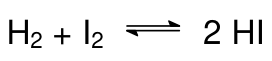
is at 600 °C equal to 70.0.
Problems:
6.1 How much iodine (in %) is converted till the equilibrium is reached if the reactants are mixed in:
a) 1 : 1 molar ratio at 600 °C;
b) 2 : 1 molar ratio at 600 °C (the amount of hydrogen is twice as great as that of iodine).
6.2 How many moles of hydrogen should be mixed with one mole of iodine when 99 % of iodine is to be converted to hydrogen iodide till the equilibrium is reached at 600 °C?
Official English text of the problem.
Problem 7: Oxidation products of a saturated hydrocarbon
A certain saturated hydrocarbon A is transformed by a catalytic oxidation partly into a secondary alcohol B, and partly into a ketone C. The ketone when oxidised with nitric acid in the presence of catalyst yields a compound D with a formula of \(\ce{C6H10O4}\). From compound D when heated in the presence of acetic anhydride, a ketone E is formed, its formation being accompanied by evolution of \(\ce{CO2}\) and \(\ce{H2O}\). Compounds E and C have similar structures but compound E contains one methylene group less than ketone C. Compound D is one of the starting materials in the production of an important polycondensation synthetic fibre.
Problem:
7.1 Write the structural formulas of compounds A, B, C, D, and E.
Official English text of the problem.
Problem 8: Molecular properties table and isoelectronic species
a) Mark by the "+" in a corresponding window those molecules for which the assertions written on the left side of the Table, are true.
Assertion Molecule \(\ce{C2H4}\) \(\ce{N2H4}\) \(\ce{H2O2}\) \(\ce{H2F2}\) There is a covalent bond between two equal atoms The molecule contains a double bond The molecule is planar The molecule is polar There is also a hydrogen bond in the molecule It has basic properties in relation to water b) The following assertion and Table are incomplete. Fill in the dotted places by a missing word and the missing formulas, respectively.
Assertion: The electronic structures of the molecules (ions) being placed in the Table one under the other are . . . . . . . . . . . . . . . . . . . . . . . . .
\(\ce{CH4}\) \(\ce{C2H6}\) \(\ce{CO3^2-}\) . . . . . . \(\ce{C2O4^2-}\) . . . . . . \(\ce{NH4+}\) \(\ce{N2H6^2+}\) . . . . . . \(\ce{NO2+}\) . . . . . . \(\ce{N2}\) Official English text of the problem.
Internationale Chemie-Olympiade
IChO 1975
Veszprém, Ungarn · 8 Theorieaufgaben mit vollständigen Lösungen
Aufgabe 1: Kristallisation von Alaun beim Eindampfen
Wie viele Gramm Alaun \(\ce{KAl(SO4)2 . 12H2O}\) kristallisieren aus 320 g einer bei 20 °C gesättigten \(\ce{KAl(SO4)2}\)-Lösung aus, wenn der Lösung bei 20 °C 160 g Wasser durch Verdampfen entzogen werden?
(Die bei 20 °C gesättigte Lösung enthält 5.50 % \(\ce{KAl(SO4)2}\) als Massenanteil.)
Relative Atommassen:
\(A_\mathrm{r}(\ce{K}) = 39.10;\quad A_\mathrm{r}(\ce{Al}) = 26.98;\quad A_\mathrm{r}(\ce{S}) = 32.06;\quad A_\mathrm{r}(\ce{O}) = 16.0;\quad A_\mathrm{r}(\ce{H}) = 1.01\)
Aufgabentext aus dem offiziellen englischen Text übersetzt.
Aufgabe 2: Zusammensetzung einer Al-Zn-Si-Cu-Legierung
Eine für Versuchszwecke hergestellte Legierung enthält Aluminium, Zink, Silicium und Kupfer. Werden 1000 mg der Legierung in Salzsäure gelöst, so entstehen 843 cm³ Wasserstoff (0 °C, 101.325 kPa), und 170 mg eines ungelösten Rückstands bleiben zurück. Eine Probe von 500 mg der Legierung entwickelt bei der Reaktion mit einer \(\ce{NaOH}\)-Lösung unter den oben genannten Bedingungen 517 cm³ Wasserstoff; auch in diesem Fall bleibt ein ungelöster Anteil zurück.
Aufgabe:
2.1 Berechnen Sie die Zusammensetzung der Legierung in Massenprozent.
Relative Atommassen:
\(A_{\mathrm r}(\ce{Al}) = 26.98;\qquad A_{\mathrm r}(\ce{Zn}) = 65.37;\qquad A_{\mathrm r}(\ce{Si}) = 28.09;\qquad A_{\mathrm r}(\ce{Cu}) = 63.55.\)
Aufgabentext aus dem offiziellen englischen Text übersetzt.
Aufgabe 3: Zusammensetzung einer Ag-Cu-Cr-Legierung
Eine Probe von 1500 mg einer Legierung, die Silber, Kupfer und Chrom enthält, wird aufgelöst, und die Lösung, die \(\ce{Ag+}\)-, \(\ce{Cu^2+}\)- und \(\ce{Cr^3+}\)-Ionen enthält, wird auf genau 500 \(\mathrm{cm^3}\) verdünnt. Ein Zehntel des Volumens dieser Lösung wird für das weitere Vorgehen entnommen:
Nach der Abtrennung von Silber und Kupfer wird das darin enthaltene Chrom gemäß der folgenden, noch nicht ausgeglichenen Gleichung oxidiert:
Anschließend werden 25.00 \(\mathrm{cm^3}\) einer 0.100-molaren Fe(II)-Salzlösung zugegeben. Dabei läuft die folgende Reaktion ab (in nicht ausgeglichener Form angegeben):
Gemäß der nicht ausgeglichenen Gleichung:
wird ein Volumen von 17.20 \(\mathrm{cm^3}\) einer 0.020-molaren \(\ce{KMnO4}\)-Lösung zur Oxidation des Fe(II)-Salzes benötigt, das in der Lösung nicht oxidiert wurde.
In einem weiteren Versuch wird ein Volumen von 200 \(\mathrm{cm^3}\) der Ausgangslösung elektrolysiert. Aufgrund von Nebenreaktionen beträgt die Stromausbeute der Elektrolyse für die betrachteten Metalle 90 %. Alle drei Metalle werden innerhalb von 14.50 Minuten quantitativ abgeschieden, indem ein Strom von 2 A durch die Lösung geleitet wird.
Aufgabe:
3.1 Gleichen Sie die drei chemischen Gleichungen aus und berechnen Sie die Zusammensetzung der Legierung in Massenprozent.
Relative Atommassen: \(A_{\mathrm r}(\ce{Cu}) = 63.55;\quad A_{\mathrm r}(\ce{Ag}) = 107.87;\quad A_{\mathrm r}(\ce{Cr}) = 52.00\)
Aufgabentext aus dem offiziellen englischen Text übersetzt.
Aufgabe 4: Verdünnung von Ameisensäure und Dissoziationsgrad
Der pH-Wert einer Lösung mit einem Massenanteil an Ameisensäure von 3 % (\(\rho = 1.0049\ \mathrm{g\,cm^{-3}}\)) beträgt 1.97.
Aufgabe:
4.1 Um welchen Faktor muss die Lösung verdünnt werden, damit der Dissoziationsgrad auf das Zehnfache steigt?
Relative Atommassen: \(A_{\mathrm r}(\ce{H}) = 1.01;\quad A_{\mathrm r}(\ce{C}) = 12.01;\quad A_{\mathrm r}(\ce{O}) = 16.\)
Aufgabentext aus dem offiziellen englischen Text übersetzt.
Aufgabe 5: Zwei aufeinanderfolgende Aldehyde einer homologen Reihe
Ein bestimmter Aldehyd B folgt in der homologen Reihe der Aldehyde unmittelbar auf einen Aldehyd A. Zu 100 g einer wässrigen Lösung mit einem Massenanteil von 23 % an Aldehyd A werden 19 g Aldehyd B gegeben. Die Zugabe von \(\ce{AgNO3}\) in ammoniakalischer Lösung zu 2 g der Aldehydlösung führt zur Abscheidung von 4.35 g Silber.
Aufgaben:
5.1 Bestimmen Sie rechnerisch, welche Aldehyde verwendet wurden.
5.2 Geben Sie die Strukturformeln der Aldehyde an.
Relative Atommassen:
\(A_{\mathrm r}(\ce{C})=12.01;\quad A_{\mathrm r}(\ce{O})=16.00;\quad A_{\mathrm r}(\ce{H})=1.01;\quad A_{\mathrm r}(\ce{Ag})=107.87\)
Aufgabentext aus dem offiziellen englischen Text übersetzt.
Aufgabe 6: Iodwasserstoff-Gleichgewicht bei 600 °C
Die Gleichgewichtskonstante der Reaktion
beträgt bei 600 °C 70.0.
Aufgaben:
6.1 Wie viel Iod (in %) wird bis zum Erreichen des Gleichgewichts umgesetzt, wenn die Edukte in folgendem Verhältnis gemischt werden:
a) im Molverhältnis 1 : 1 bei 600 °C;
b) im Molverhältnis 2 : 1 bei 600 °C (die Stoffmenge an Wasserstoff ist doppelt so groß wie die an Iod).
6.2 Wie viele Mol Wasserstoff sollten mit einem Mol Iod gemischt werden, wenn bis zum Erreichen des Gleichgewichts bei 600 °C 99 % des Iods zu Iodwasserstoff umgesetzt werden sollen?
Aufgabentext aus dem offiziellen englischen Text übersetzt.
Aufgabe 7: Oxidationsprodukte eines gesättigten Kohlenwasserstoffs
Ein bestimmter gesättigter Kohlenwasserstoff A wird durch katalytische Oxidation teilweise in einen sekundären Alkohol B und teilweise in ein Keton C umgewandelt. Bei der Oxidation mit Salpetersäure in Gegenwart eines Katalysators liefert das Keton eine Verbindung D mit der Summenformel \(\ce{C6H10O4}\). Beim Erhitzen der Verbindung D in Gegenwart von Essigsäureanhydrid entsteht ein Keton E, wobei \(\ce{CO2}\) und \(\ce{H2O}\) freigesetzt werden. Die Verbindungen E und C haben ähnliche Strukturen, aber die Verbindung E enthält eine Methylengruppe weniger als das Keton C. Die Verbindung D ist einer der Ausgangsstoffe für die Herstellung einer wichtigen, durch Polykondensation gewonnenen Synthesefaser.
Aufgabe:
7.1 Geben Sie die Strukturformeln der Verbindungen A, B, C, D und E an.
Aufgabentext aus dem offiziellen englischen Text übersetzt.
Aufgabe 8: Tabelle der Moleküleigenschaften und isoelektronische Spezies
a) Kennzeichnen Sie diejenigen Moleküle, für die die auf der linken Seite der Tabelle aufgeführten Aussagen zutreffen, durch ein „+“ im entsprechenden Feld.
Aussage Molekül \(\ce{C2H4}\) \(\ce{N2H4}\) \(\ce{H2O2}\) \(\ce{H2F2}\) Es gibt eine kovalente Bindung zwischen zwei gleichen Atomen Das Molekül enthält eine Doppelbindung Das Molekül ist planar Das Molekül ist polar Im Molekül gibt es auch eine Wasserstoffbrückenbindung Es besitzt gegenüber Wasser basische Eigenschaften b) Die folgende Aussage und die Tabelle sind unvollständig. Ergänzen Sie an den durch Punkte gekennzeichneten Stellen das fehlende Wort beziehungsweise die fehlenden Formeln.
Aussage: Die Elektronenstrukturen der Moleküle (Ionen), die in der Tabelle untereinander stehen, sind . . . . . . . . . . . . . . . . . . . . . . . . .
\(\ce{CH4}\) \(\ce{C2H6}\) \(\ce{CO3^2-}\) . . . . . . \(\ce{C2O4^2-}\) . . . . . . \(\ce{NH4+}\) \(\ce{N2H6^2+}\) . . . . . . \(\ce{NO2+}\) . . . . . . \(\ce{N2}\) Aufgabentext aus dem offiziellen englischen Text übersetzt.
Uluslararası Kimya Olimpiyatı
IChO 1975
Veszprém, Macaristan · 8 teori sorusu, tam çözümleriyle
Soru 1: Buharlaştırma sırasında şapın kristallenmesi
20 °C'de doymuş 320 g \(\ce{KAl(SO4)2}\) çözeltisinden 20 °C'de 160 g su buharlaştırılırsa kaç gram şap \(\ce{KAl(SO4)2 . 12H2O}\) kristallenerek ayrılır?
(20 °C'de doymuş çözelti kütlece % 5.50 \(\ce{KAl(SO4)2}\) içerir.)
Bağıl atom kütleleri:
\(A_\mathrm{r}(\ce{K}) = 39.10;\quad A_\mathrm{r}(\ce{Al}) = 26.98;\quad A_\mathrm{r}(\ce{S}) = 32.06;\quad A_\mathrm{r}(\ce{O}) = 16.0;\quad A_\mathrm{r}(\ce{H}) = 1.01\)
Soru metni resmi İngilizce metinden çevrilmiştir.
Soru 2: Bir Al-Zn-Si-Cu alaşımının bileşimi
Deneysel amaçlarla hazırlanan bir alaşım alüminyum, çinko, silisyum ve bakır içermektedir. Alaşımın 1000 mg'ı hidroklorik asitte çözündürüldüğünde 843 cm³ hidrojen (0 °C, 101.325 kPa) açığa çıkar ve 170 mg çözünmemiş kalıntı kalır. Alaşımdan alınan 500 mg'lık bir numune, bir \(\ce{NaOH}\) çözeltisiyle tepkimeye sokulduğunda yukarıdaki koşullarda 517 cm³ hidrojen üretir ve bu durumda da çözünmemiş bir kısım kalır.
Soru:
2.1 Alaşımın kütlece yüzde bileşimini hesaplayınız.
Bağıl atom kütleleri:
\(A_{\mathrm r}(\ce{Al}) = 26.98;\qquad A_{\mathrm r}(\ce{Zn}) = 65.37;\qquad A_{\mathrm r}(\ce{Si}) = 28.09;\qquad A_{\mathrm r}(\ce{Cu}) = 63.55.\)
Soru metni resmi İngilizce metinden çevrilmiştir.
Soru 3: Bir Ag-Cu-Cr alaşımının bileşimi
Gümüş, bakır ve krom içeren bir alaşımdan alınan 1500 mg kütleli bir numune çözülür ve \(\ce{Ag+}\), \(\ce{Cu^2+}\) ve \(\ce{Cr^3+}\) iyonlarını içeren çözelti tam olarak 500 \(\mathrm{cm^3}\) hacme seyreltilir. Sonraki işlemler için bu çözeltinin hacminin onda biri alınır:
Gümüş ve bakır uzaklaştırıldıktan sonra, bu çözeltideki krom aşağıdaki denkleştirilmemiş denkleme göre yükseltgenir:
Ardından 0.100 molar Fe(II) tuzu çözeltisinden 25.00 \(\mathrm{cm^3}\) eklenir. Aşağıdaki tepkime (denkleştirilmemiş biçimde yazılmıştır) gerçekleşir:
Aşağıdaki denkleştirilmemiş denkleme göre:
çözeltide yükseltgenmeden kalan Fe(II) tuzunun yükseltgenmesi için 0.020 molar \(\ce{KMnO4}\) çözeltisinden 17.20 \(\mathrm{cm^3}\) gereklidir.
Başka bir deneyde, başlangıç çözeltisinin 200 \(\mathrm{cm^3}\) hacmindeki bir kısmı elektroliz edilir. Yan tepkimeler nedeniyle, söz konusu metaller için elektroliz verimi %90'dır. Çözeltiden 2 A akım geçirilerek üç metalin tamamı 14.50 dakikada nicel olarak biriktirilir.
Soru:
3.1 Üç kimyasal denklemi denkleştirin ve alaşımın kütlece yüzde bileşimini hesaplayın.
Bağıl atom kütleleri: \(A_{\mathrm r}(\ce{Cu}) = 63.55;\quad A_{\mathrm r}(\ce{Ag}) = 107.87;\quad A_{\mathrm r}(\ce{Cr}) = 52.00\)
Soru metni resmi İngilizce metinden çevrilmiştir.
Soru 4: Formik asidin seyreltilmesi ve iyonlaşma derecesi
Kütlece % 3 formik asit içeren bir çözeltinin (\(\rho = 1.0049\ \mathrm{g\,cm^{-3}}\)) pH değeri 1.97'ye eşittir.
Soru:
4.1 İyonlaşma derecesinin değerini on katına çıkarmak için çözelti kaç kat seyreltilmelidir?
Bağıl atom kütleleri: \(A_{\mathrm r}(\ce{H}) = 1.01;\quad A_{\mathrm r}(\ce{C}) = 12.01;\quad A_{\mathrm r}(\ce{O}) = 16.\)
Soru metni resmi İngilizce metinden çevrilmiştir.
Soru 5: Bir homolog serinin ardışık iki aldehidi
Bir B aldehidi, aldehitlerin homolog serisinde bir A aldehidinden hemen sonra gelmektedir. Kütlece %23 A aldehidi içeren 100 g sulu çözeltiye 19 g B aldehidi eklenir. Aldehit çözeltisinin 2 g'ına amonyak çözeltisi içinde \(\ce{AgNO3}\) eklenmesi sonucunda 4.35 g gümüş çöker.
Sorular:
5.1 Hangi aldehitlerin kullanıldığını hesaplayarak belirleyiniz.
5.2 Aldehitlerin yapı formüllerini veriniz.
Bağıl atom kütleleri:
\(A_{\mathrm r}(\ce{C})=12.01;\quad A_{\mathrm r}(\ce{O})=16.00;\quad A_{\mathrm r}(\ce{H})=1.01;\quad A_{\mathrm r}(\ce{Ag})=107.87\)
Soru metni resmi İngilizce metinden çevrilmiştir.
Soru 6: 600 °C'de hidrojen iyodür dengesi
Aşağıdaki tepkimenin denge sabiti
600 °C'de 70.0'a eşittir.
Sorular:
6.1 Tepkimeye giren maddeler aşağıdaki oranlarda karıştırıldığında dengeye ulaşılıncaya kadar iyodun yüzde kaçı dönüşür?
a) 600 °C'de 1 : 1 mol oranında;
b) 600 °C'de 2 : 1 mol oranında (hidrojen miktarı iyot miktarının iki katıdır).
6.2 600 °C'de dengeye ulaşılıncaya kadar iyodun %99'unun hidrojen iyodüre dönüşmesi için bir mol iyot ile kaç mol hidrojen karıştırılmalıdır?
Soru metni resmi İngilizce metinden çevrilmiştir.
Soru 7: Doymuş bir hidrokarbonun yükseltgenme ürünleri
Doymuş bir hidrokarbon olan A, katalitik yükseltgenmeyle kısmen ikincil bir alkol olan B'ye, kısmen de bir keton olan C'ye dönüşür. Bu keton, katalizör varlığında nitrik asitle yükseltgendiğinde, formülü \(\ce{C6H10O4}\) olan D bileşiğini verir. D bileşiği asetik anhidrit varlığında ısıtıldığında bir keton olan E oluşur; bu oluşuma \(\ce{CO2}\) ve \(\ce{H2O}\) çıkışı eşlik eder. E ve C bileşikleri benzer yapılara sahiptir, ancak E bileşiği C ketonundan bir metilen grubu daha az içerir. D bileşiği, polikondenzasyon yoluyla elde edilen önemli bir sentetik lifin üretiminde kullanılan başlangıç maddelerinden biridir.
Soru:
7.1 A, B, C, D ve E bileşiklerinin yapı formüllerini yazınız.
Soru metni resmi İngilizce metinden çevrilmiştir.
Soru 8: Moleküler özellikler tablosu ve izoelektronik türler
a) Tablonun sol tarafında yazılı ifadelerin doğru olduğu moleküller için ilgili kutucuğa "+" işareti koyunuz.
İfade Molekül \(\ce{C2H4}\) \(\ce{N2H4}\) \(\ce{H2O2}\) \(\ce{H2F2}\) Aynı türden iki atom arasında kovalent bağ vardır Molekül çift bağ içerir Molekül düzlemseldir Molekül polardır Molekülde ayrıca hidrojen bağı vardır Suya karşı bazik özellik gösterir b) Aşağıdaki ifade ve tablo eksiktir. Noktalı yerleri sırasıyla eksik sözcük ve eksik formüllerle doldurunuz.
İfade: Tabloda alt alta yer alan moleküllerin (iyonların) elektronik yapıları . . . . . . . . . . . . . . . . . . . . . . . . .
\(\ce{CH4}\) \(\ce{C2H6}\) \(\ce{CO3^2-}\) . . . . . . \(\ce{C2O4^2-}\) . . . . . . \(\ce{NH4+}\) \(\ce{N2H6^2+}\) . . . . . . \(\ce{NO2+}\) . . . . . . \(\ce{N2}\) Soru metni resmi İngilizce metinden çevrilmiştir.
Olimpiada Internacional de Química
IChO 1975
Veszprém, Hungría · 8 problemas teóricos con soluciones completas
Problema 1: Cristalización del alumbre por evaporación
¿Cuántos gramos de alumbre \(\ce{KAl(SO4)2 . 12H2O}\) cristalizan a partir de 320 g de una disolución de \(\ce{KAl(SO4)2}\) saturada a 20 °C si se evaporan 160 g de agua de la disolución a 20 °C?
(La disolución saturada a 20 °C contiene un 5.50 % en masa de \(\ce{KAl(SO4)2}\).)
Masas atómicas relativas:
\(A_\mathrm{r}(\ce{K}) = 39.10;\quad A_\mathrm{r}(\ce{Al}) = 26.98;\quad A_\mathrm{r}(\ce{S}) = 32.06;\quad A_\mathrm{r}(\ce{O}) = 16.0;\quad A_\mathrm{r}(\ce{H}) = 1.01\)
Enunciado traducido del texto oficial en inglés.
Problema 2: Composición de una aleación de Al-Zn-Si-Cu
Una aleación preparada con fines experimentales contiene aluminio, zinc, silicio y cobre. Si se disuelven 1000 mg de la aleación en ácido clorhídrico, se desprenden 843 cm³ de hidrógeno (0 °C, 101.325 kPa) y quedan 170 mg de un residuo sin disolver. Una muestra de 500 mg de la aleación, al reaccionar con una disolución de \(\ce{NaOH}\), produce 517 cm³ de hidrógeno en las condiciones anteriores y, en este caso, también queda una fracción sin disolver.
Problema:
2.1 Calcule la composición de la aleación en % en masa.
Masas atómicas relativas:
\(A_{\mathrm r}(\ce{Al}) = 26.98;\qquad A_{\mathrm r}(\ce{Zn}) = 65.37;\qquad A_{\mathrm r}(\ce{Si}) = 28.09;\qquad A_{\mathrm r}(\ce{Cu}) = 63.55.\)
Enunciado traducido del texto oficial en inglés.
Problema 3: Composición de una aleación de Ag-Cu-Cr
Se disuelve una muestra de 1500 mg de una aleación que contiene plata, cobre y cromo, y la disolución que contiene los iones \(\ce{Ag+}\), \(\ce{Cu^2+}\) y \(\ce{Cr^3+}\) se diluye hasta un volumen de exactamente 500 \(\mathrm{cm^3}\). Se toma una décima parte del volumen de esa disolución para continuar el procedimiento:
Tras eliminar la plata y el cobre, el cromo se oxida en ella según la siguiente ecuación sin ajustar:
A continuación, se añaden 25.00 \(\mathrm{cm^3}\) de una disolución 0.100 molar de una sal de Fe(II). Tiene lugar la siguiente reacción (escrita sin ajustar):
Según la ecuación sin ajustar:
se requiere un volumen de 17.20 \(\mathrm{cm^3}\) de una disolución 0.020 molar de \(\ce{KMnO4}\) para oxidar la sal de Fe(II) que permanece sin oxidar en la disolución.
En otro experimento, se somete a electrólisis un volumen de 200 \(\mathrm{cm^3}\) de la disolución inicial. Debido a reacciones secundarias, el rendimiento de la electrólisis es del 90 % para los metales considerados. Los tres metales se depositan cuantitativamente en 14.50 minutos al hacer pasar una corriente de 2 A a través de la disolución.
Problema:
3.1 Ajuste las tres ecuaciones químicas y calcule la composición de la aleación en % en masa.
Masas atómicas relativas: \(A_{\mathrm r}(\ce{Cu}) = 63.55;\quad A_{\mathrm r}(\ce{Ag}) = 107.87;\quad A_{\mathrm r}(\ce{Cr}) = 52.00\)
Enunciado traducido del texto oficial en inglés.
Problema 4: Dilución del ácido fórmico y grado de ionización
El valor del pH de una disolución que contiene un 3 % en masa de ácido fórmico (\(\rho = 1.0049\ \mathrm{g\,cm^{-3}}\)) es igual a 1.97.
Problema:
4.1 ¿Cuántas veces debe diluirse la disolución para que el valor del grado de ionización aumente diez veces?
Masas atómicas relativas: \(A_{\mathrm r}(\ce{H}) = 1.01;\quad A_{\mathrm r}(\ce{C}) = 12.01;\quad A_{\mathrm r}(\ce{O}) = 16.\)
Enunciado traducido del texto oficial en inglés.
Problema 5: Dos aldehídos consecutivos de una serie homóloga
Un cierto aldehído B es el siguiente a un aldehído A en la serie homóloga de los aldehídos. Se añaden 19 g del aldehído B a 100 g de una disolución acuosa que contiene un 23 % en masa del aldehído A. La adición de \(\ce{AgNO3}\) en disolución amoniacal a 2 g de la disolución de aldehídos da lugar a la precipitación de 4.35 g de plata.
Cuestiones:
5.1 Determine mediante cálculos qué aldehídos se utilizaron.
5.2 Indique las fórmulas estructurales de los aldehídos.
Masas atómicas relativas:
\(A_{\mathrm r}(\ce{C})=12.01;\quad A_{\mathrm r}(\ce{O})=16.00;\quad A_{\mathrm r}(\ce{H})=1.01;\quad A_{\mathrm r}(\ce{Ag})=107.87\)
Enunciado traducido del texto oficial en inglés.
Problema 6: Equilibrio del yoduro de hidrógeno a 600 °C
La constante de equilibrio de la reacción
es igual a 70.0 a 600 °C.
Problemas:
6.1 ¿Qué porcentaje de yodo se convierte al alcanzarse el equilibrio si los reactivos se mezclan en:
a) una proporción molar de 1 : 1 a 600 °C;
b) una proporción molar de 2 : 1 a 600 °C (la cantidad de hidrógeno es el doble que la de yodo)?
6.2 ¿Cuántos moles de hidrógeno deben mezclarse con un mol de yodo para que el 99 % del yodo se convierta en yoduro de hidrógeno al alcanzarse el equilibrio a 600 °C?
Enunciado traducido del texto oficial en inglés.
Problema 7: Productos de oxidación de un hidrocarburo saturado
Un determinado hidrocarburo saturado A se transforma mediante una oxidación catalítica en parte en un alcohol secundario B y en parte en una cetona C. La cetona, al oxidarse con ácido nítrico en presencia de un catalizador, da un compuesto D de fórmula \(\ce{C6H10O4}\). Al calentar el compuesto D en presencia de anhídrido acético, se forma una cetona E, cuya formación va acompañada del desprendimiento de \(\ce{CO2}\) y \(\ce{H2O}\). Los compuestos E y C tienen estructuras similares, pero el compuesto E contiene un grupo metileno menos que la cetona C. El compuesto D es una de las materias primas utilizadas en la producción de una importante fibra sintética de policondensación.
Problema:
7.1 Escriba las fórmulas estructurales de los compuestos A, B, C, D y E.
Enunciado traducido del texto oficial en inglés.
Problema 8: Tabla de propiedades moleculares y especies isoelectrónicas
a) Marque con un "+" en la casilla correspondiente aquellas moléculas para las que sean verdaderas las afirmaciones escritas en el lado izquierdo de la tabla.
Afirmación Molécula \(\ce{C2H4}\) \(\ce{N2H4}\) \(\ce{H2O2}\) \(\ce{H2F2}\) Hay un enlace covalente entre dos átomos iguales La molécula contiene un doble enlace La molécula es plana La molécula es polar También hay un enlace de hidrógeno en la molécula Tiene propiedades básicas frente al agua b) La siguiente afirmación y la tabla están incompletas. Complete los espacios de puntos con la palabra y las fórmulas que faltan, respectivamente.
Afirmación: Las estructuras electrónicas de las moléculas (iones) situadas una debajo de la otra en la tabla son . . . . . . . . . . . . . . . . . . . . . . . . .
\(\ce{CH4}\) \(\ce{C2H6}\) \(\ce{CO3^2-}\) . . . . . . \(\ce{C2O4^2-}\) . . . . . . \(\ce{NH4+}\) \(\ce{N2H6^2+}\) . . . . . . \(\ce{NO2+}\) . . . . . . \(\ce{N2}\) Enunciado traducido del texto oficial en inglés.
国际化学奥林匹克
IChO 1975
匈牙利维斯普雷姆 · 8 道理论题及完整解答
题目 1:蒸发过程中明矾的结晶
在 20 °C 下,从 320 g 在 20 °C 时饱和的 \(\ce{KAl(SO4)2}\) 溶液中蒸发掉 160 g 水,会析出多少克明矾 \(\ce{KAl(SO4)2 . 12H2O}\)?
(在 20 °C 时饱和的溶液中,\(\ce{KAl(SO4)2}\) 的质量分数为 5.50 %。)
相对原子质量:
\(A_\mathrm{r}(\ce{K}) = 39.10;\quad A_\mathrm{r}(\ce{Al}) = 26.98;\quad A_\mathrm{r}(\ce{S}) = 32.06;\quad A_\mathrm{r}(\ce{O}) = 16.0;\quad A_\mathrm{r}(\ce{H}) = 1.01\)
题目译自官方英文原文。
题目 2:Al-Zn-Si-Cu 合金的组成
为实验目的制备的一种合金含有铝、锌、硅和铜。将 1000 mg 该合金溶于盐酸,释放出 843 cm³ 氢气(0 °C,101.325 kPa),并剩下 170 mg 未溶解的残渣。将 500 mg 该合金样品与 \(\ce{NaOH}\) 溶液反应,在上述条件下产生 517 cm³ 氢气,此时也有一部分物质未溶解。
问题:
2.1 计算合金的组成,以质量百分数表示。
相对原子质量:
\(A_{\mathrm r}(\ce{Al}) = 26.98;\qquad A_{\mathrm r}(\ce{Zn}) = 65.37;\qquad A_{\mathrm r}(\ce{Si}) = 28.09;\qquad A_{\mathrm r}(\ce{Cu}) = 63.55.\)
题目译自官方英文原文。
题目 3:Ag-Cu-Cr 合金的组成
将一份含有银、铜和铬的 1500 mg 合金样品溶解,将含有 \(\ce{Ag+}\)、\(\ce{Cu^2+}\) 和 \(\ce{Cr^3+}\) 离子的溶液准确稀释至 500 \(\mathrm{cm^3}\)。取该溶液体积的十分之一进行后续操作:
除去银和铜后,按照下列未配平的方程式将其中的铬氧化:
然后加入 25.00 \(\mathrm{cm^3}\) 浓度为 0.100 mol/L 的 Fe(II) 盐溶液。发生如下反应(以未配平的形式表示):
根据下列未配平的方程式:
氧化溶液中剩余的未被氧化的 Fe(II) 盐,需要 17.20 \(\mathrm{cm^3}\) 浓度为 0.020 mol/L 的 \(\ce{KMnO4}\) 溶液。
在另一次实验中,对 200 \(\mathrm{cm^3}\) 初始溶液进行电解。由于发生副反应,所考察金属的电解电流效率为 90 %。以 2 A 的电流通过溶液,14.50 分钟后三种金属均定量析出。
问题:
3.1 配平这三个化学方程式,并计算合金的质量百分组成。
相对原子质量:\(A_{\mathrm r}(\ce{Cu}) = 63.55;\quad A_{\mathrm r}(\ce{Ag}) = 107.87;\quad A_{\mathrm r}(\ce{Cr}) = 52.00\)
题目译自官方英文原文。
题目 4:甲酸的稀释与电离度
质量分数为 3 % 的甲酸溶液(\(\rho = 1.0049\ \mathrm{g\,cm^{-3}}\))的 pH 值为 1.97。
问题:
4.1 要使电离度增大至原来的十倍,应将该溶液稀释至原体积的多少倍?
相对原子质量:\(A_{\mathrm r}(\ce{H}) = 1.01;\quad A_{\mathrm r}(\ce{C}) = 12.01;\quad A_{\mathrm r}(\ce{O}) = 16.\)
题目译自官方英文原文。
题目 5:同系物系列中两个相邻的醛
某种醛 B 是醛的同系物系列中紧接在醛 A 之后的成员。将 19 g 醛 B 加入 100 g 含醛 A 的质量分数为 23% 的水溶液中。向 2 g 所得的醛溶液中加入 \(\ce{AgNO3}\) 的氨溶液,析出 4.35 g 银。
问题:
5.1 通过计算确定所用的醛。
5.2 写出这些醛的结构式。
相对原子质量:
\(A_{\mathrm r}(\ce{C})=12.01;\quad A_{\mathrm r}(\ce{O})=16.00;\quad A_{\mathrm r}(\ce{H})=1.01;\quad A_{\mathrm r}(\ce{Ag})=107.87\)
题目译自官方英文原文。
题目 6:600 °C 时的碘化氢平衡
反应
在 600 °C 时的平衡常数等于 70.0。
问题:
6.1 若反应物按以下条件混合,达到平衡时有多少碘(以 % 表示)发生转化:
a) 在 600 °C 时,摩尔比为 1 : 1;
b) 在 600 °C 时,摩尔比为 2 : 1(氢气的物质的量为碘的两倍)。
6.2 若要使 600 °C 时达到平衡时有 99 % 的碘转化为碘化氢,应将多少摩尔的氢气与一摩尔的碘混合?
题目译自官方英文原文。
题目 7:饱和烃的氧化产物
某饱和烃 A 经催化氧化,一部分转化为仲醇 B,另一部分转化为酮 C。该酮在催化剂存在下用硝酸氧化,生成分子式为 \(\ce{C6H10O4}\) 的化合物 D。化合物 D 在乙酸酐存在下加热,生成酮 E,同时放出 \(\ce{CO2}\) 和 \(\ce{H2O}\)。化合物 E 和 C 的结构相似,但化合物 E 比酮 C 少一个亚甲基。化合物 D 是生产一种重要的缩聚型合成纤维的原料之一。
问题:
7.1 写出化合物 A、B、C、D 和 E 的结构式。
题目译自官方英文原文。
题目 8:分子性质表与等电子物种
a) 对于表格左侧所列陈述成立的分子,在相应的空格内标上“+”。
陈述 分子 \(\ce{C2H4}\) \(\ce{N2H4}\) \(\ce{H2O2}\) \(\ce{H2F2}\) 两个相同元素的原子之间存在共价键 分子中含有双键 分子为平面结构 分子具有极性 分子中还存在氢键 相对于水表现出碱性 b) 以下陈述和表格尚不完整。请分别在点线处填入缺失的词语和化学式。
陈述: 表格中上下对应的分子(离子)的电子结构是 . . . . . . . . . . . . . . . . . . . . . . . . .
\(\ce{CH4}\) \(\ce{C2H6}\) \(\ce{CO3^2-}\) . . . . . . \(\ce{C2O4^2-}\) . . . . . . \(\ce{NH4+}\) \(\ce{N2H6^2+}\) . . . . . . \(\ce{NO2+}\) . . . . . . \(\ce{N2}\) 题目译自官方英文原文。
Международная химическая олимпиада
IChO 1975
Веспрем, Венгрия · 8 теоретических задач с полными решениями
Задача 1: Кристаллизация квасцов при испарении
Сколько граммов квасцов \(\ce{KAl(SO4)2 . 12H2O}\) выкристаллизуется из 320 г раствора \(\ce{KAl(SO4)2}\), насыщенного при 20 °C, если из раствора при 20 °C испарится 160 г воды?
(Раствор, насыщенный при 20 °C, содержит 5.50 % \(\ce{KAl(SO4)2}\) по массе.)
Относительные атомные массы:
\(A_\mathrm{r}(\ce{K}) = 39.10;\quad A_\mathrm{r}(\ce{Al}) = 26.98;\quad A_\mathrm{r}(\ce{S}) = 32.06;\quad A_\mathrm{r}(\ce{O}) = 16.0;\quad A_\mathrm{r}(\ce{H}) = 1.01\)
Условие переведено с официального английского текста.
Задача 2: Состав сплава Al-Zn-Si-Cu
Сплав, приготовленный для экспериментальных целей, содержит алюминий, цинк, кремний и медь. При растворении 1000 мг сплава в соляной кислоте выделяется 843 см³ водорода (0 °C, 101.325 кПа) и остаётся 170 мг нерастворившегося остатка. При взаимодействии образца сплава массой 500 мг с раствором \(\ce{NaOH}\) выделяется 517 см³ водорода при указанных выше условиях, и в этом случае также остаётся нерастворившаяся часть.
Задание:
2.1 Рассчитайте состав сплава в массовых процентах.
Относительные атомные массы:
\(A_{\mathrm r}(\ce{Al}) = 26.98;\qquad A_{\mathrm r}(\ce{Zn}) = 65.37;\qquad A_{\mathrm r}(\ce{Si}) = 28.09;\qquad A_{\mathrm r}(\ce{Cu}) = 63.55.\)
Условие переведено с официального английского текста.
Задача 3: Состав сплава Ag-Cu-Cr
Образец сплава массой 1500 мг, содержащего серебро, медь и хром, растворяют, а раствор, содержащий ионы \(\ce{Ag+}\), \(\ce{Cu^2+}\) и \(\ce{Cr^3+}\), разбавляют до точного объёма 500 \(\mathrm{cm^3}\). Для дальнейшего анализа отбирают одну десятую объёма этого раствора:
После удаления серебра и меди хром в нём окисляют согласно следующему неуравненному уравнению:
Затем добавляют 25.00 \(\mathrm{cm^3}\) 0.100-молярного раствора соли Fe(II). Протекает следующая реакция (записанная в неуравненном виде):
Согласно неуравненному уравнению:
для окисления соли Fe(II), оставшейся в растворе неокисленной, требуется 17.20 \(\mathrm{cm^3}\) 0.020-молярного раствора \(\ce{KMnO4}\).
В другом опыте электролизу подвергают 200 \(\mathrm{cm^3}\) исходного раствора. Из-за побочных реакций выход по току для рассматриваемых металлов составляет 90 %. Все три металла количественно осаждаются за 14.50 минут при пропускании через раствор тока силой 2 А.
Задание:
3.1 Расставьте коэффициенты в трёх химических уравнениях и рассчитайте состав сплава в массовых процентах.
Относительные атомные массы: \(A_{\mathrm r}(\ce{Cu}) = 63.55;\quad A_{\mathrm r}(\ce{Ag}) = 107.87;\quad A_{\mathrm r}(\ce{Cr}) = 52.00\)
Условие переведено с официального английского текста.
Задача 4: Разбавление муравьиной кислоты и степень ионизации
Значение pH раствора с массовой долей муравьиной кислоты 3 % (\(\rho = 1.0049\ \mathrm{g\,cm^{-3}}\)) равно 1.97.
Задание:
4.1 Во сколько раз следует разбавить раствор, чтобы степень ионизации увеличилась в десять раз?
Относительные атомные массы: \(A_{\mathrm r}(\ce{H}) = 1.01;\quad A_{\mathrm r}(\ce{C}) = 12.01;\quad A_{\mathrm r}(\ce{O}) = 16.\)
Условие переведено с официального английского текста.
Задача 5: Два последовательных альдегида гомологического ряда
Некоторый альдегид B является следующим гомологом альдегида A в гомологическом ряду альдегидов. К 100 г водного раствора, содержащего 23 масс. % альдегида A, добавляют 19 г альдегида B. При добавлении аммиачного раствора \(\ce{AgNO3}\) к 2 г раствора альдегидов выпадает осадок серебра массой 4.35 г.
Задания:
5.1 Определите расчётом, какие альдегиды были использованы.
5.2 Приведите структурные формулы альдегидов.
Относительные атомные массы:
\(A_{\mathrm r}(\ce{C})=12.01;\quad A_{\mathrm r}(\ce{O})=16.00;\quad A_{\mathrm r}(\ce{H})=1.01;\quad A_{\mathrm r}(\ce{Ag})=107.87\)
Условие переведено с официального английского текста.
Задача 6: Равновесие образования иодоводорода при 600 °C
Константа равновесия реакции
при 600 °C равна 70.0.
Задания:
6.1 Какая доля иода (в %) прореагирует к моменту достижения равновесия, если реагенты смешать в:
a) молярном соотношении 1 : 1 при 600 °C;
b) молярном соотношении 2 : 1 при 600 °C (количество водорода вдвое больше количества иода).
6.2 Сколько молей водорода следует смешать с одним молем иода, чтобы к моменту достижения равновесия при 600 °C 99 % иода превратилось в иодоводород?
Условие переведено с официального английского текста.
Задача 7: Продукты окисления насыщенного углеводорода
Некоторый насыщенный углеводород A при каталитическом окислении частично превращается во вторичный спирт B, а частично — в кетон C. При окислении кетона азотной кислотой в присутствии катализатора образуется соединение D с формулой \(\ce{C6H10O4}\). Из соединения D при нагревании в присутствии уксусного ангидрида образуется кетон E, причём его образование сопровождается выделением \(\ce{CO2}\) и \(\ce{H2O}\). Соединения E и C имеют сходное строение, но соединение E содержит на одну метиленовую группу меньше, чем кетон C. Соединение D является одним из исходных веществ для производства важного синтетического волокна, получаемого поликонденсацией.
Задание:
7.1 Напишите структурные формулы соединений A, B, C, D и E.
Условие переведено с официального английского текста.
Задача 8: Таблица свойств молекул и изоэлектронные частицы
a) Отметьте знаком «+» в соответствующих клетках те молекулы, для которых верны утверждения, приведённые в левой части таблицы.
Утверждение Молекула \(\ce{C2H4}\) \(\ce{N2H4}\) \(\ce{H2O2}\) \(\ce{H2F2}\) Между двумя одинаковыми атомами имеется ковалентная связь Молекула содержит двойную связь Молекула плоская Молекула полярная В молекуле имеется также водородная связь Проявляет основные свойства по отношению к воде b) Следующее утверждение и таблица не завершены. Вставьте на места, обозначенные точками, соответственно недостающее слово и недостающие формулы.
Утверждение: Электронные структуры молекул (ионов), расположенных в таблице друг под другом, . . . . . . . . . . . . . . . . . . . . . . . . .
\(\ce{CH4}\) \(\ce{C2H6}\) \(\ce{CO3^2-}\) . . . . . . \(\ce{C2O4^2-}\) . . . . . . \(\ce{NH4+}\) \(\ce{N2H6^2+}\) . . . . . . \(\ce{NO2+}\) . . . . . . \(\ce{N2}\) Условие переведено с официального английского текста.
الأولمبياد الدولي للكيمياء
IChO 1975
فيسبريم، المجر · 8 مسائل نظرية مع حلول كاملة
المسألة 1: تبلور الشب عند التبخير
كم غرامًا من الشب \(\ce{KAl(SO4)2 . 12H2O}\) يتبلور من 320 g من محلول \(\ce{KAl(SO4)2}\) المشبع عند 20 °C إذا بُخِّر 160 g من الماء من المحلول عند 20 °C؟
(يحتوي المحلول المشبع عند 20 °C على 5.50 % من \(\ce{KAl(SO4)2}\) كتليًا.)
الكتل الذرية النسبية:
\(A_\mathrm{r}(\ce{K}) = 39.10;\quad A_\mathrm{r}(\ce{Al}) = 26.98;\quad A_\mathrm{r}(\ce{S}) = 32.06;\quad A_\mathrm{r}(\ce{O}) = 16.0;\quad A_\mathrm{r}(\ce{H}) = 1.01\)
نص المسألة مترجم عن النص الإنجليزي الرسمي.
المسألة 2: تركيب سبيكة Al-Zn-Si-Cu
تحتوي سبيكة أُعدّت لأغراض تجريبية على الألومنيوم والزنك والسيليكون والنحاس. عند إذابة 1000 mg من السبيكة في حمض الهيدروكلوريك، ينطلق 843 cm³ من الهيدروجين (0 °C، 101.325 kPa)، وتتبقى بقية غير ذائبة كتلتها 170 mg. وعند تفاعل عينة من السبيكة كتلتها 500 mg مع محلول \(\ce{NaOH}\)، ينتج 517 cm³ من الهيدروجين في الظروف المذكورة أعلاه، ويتبقى في هذه الحالة أيضًا جزء غير ذائب.
المطلوب:
2.1 احسب تركيب السبيكة بالنسبة المئوية الكتلية.
الكتل الذرية النسبية:
\(A_{\mathrm r}(\ce{Al}) = 26.98;\qquad A_{\mathrm r}(\ce{Zn}) = 65.37;\qquad A_{\mathrm r}(\ce{Si}) = 28.09;\qquad A_{\mathrm r}(\ce{Cu}) = 63.55.\)
نص المسألة مترجم عن النص الإنجليزي الرسمي.
المسألة 3: تركيب سبيكة Ag-Cu-Cr
تُذاب عينة كتلتها 1500 mg من سبيكة تحتوي على الفضة والنحاس والكروم، ويُخفَّف المحلول المحتوي على أيونات \(\ce{Ag+}\) و\(\ce{Cu^2+}\) و\(\ce{Cr^3+}\) إلى حجم قدره 500 \(\mathrm{cm^3}\) بالضبط. ويُؤخذ عُشر حجم هذا المحلول لإجراء الخطوات اللاحقة:
بعد فصل الفضة والنحاس، يُؤكسَد الكروم فيه وفق المعادلة غير الموزونة الآتية:
ثم تُضاف 25.00 \(\mathrm{cm^3}\) من محلول ملح الحديد(II) بتركيز مولاري قدره 0.100. ويحدث التفاعل الآتي (المكتوب بصيغة غير موزونة):
وفقًا للمعادلة غير الموزونة:
يلزم حجم قدره 17.20 \(\mathrm{cm^3}\) من محلول \(\ce{KMnO4}\) بتركيز مولاري قدره 0.020 لأكسدة ملح الحديد(II) المتبقي دون أكسدة في المحلول.
في تجربة أخرى، يُحلَّل كهربائيًا حجم قدره 200 \(\mathrm{cm^3}\) من المحلول الأصلي. وبسبب التفاعلات الثانوية، تبلغ كفاءة التحليل الكهربائي 90 % بالنسبة إلى الفلزات المعنية. وتُرسَّب الفلزات الثلاثة جميعها ترسيبًا كميًا خلال 14.50 دقيقة بتمرير تيار شدته 2 A عبر المحلول.
المطلوب:
3.1 وازن المعادلات الكيميائية الثلاث واحسب تركيب السبيكة بالنسبة المئوية الكتلية.
الكتل الذرية النسبية: \(A_{\mathrm r}(\ce{Cu}) = 63.55;\quad A_{\mathrm r}(\ce{Ag}) = 107.87;\quad A_{\mathrm r}(\ce{Cr}) = 52.00\)
نص المسألة مترجم عن النص الإنجليزي الرسمي.
المسألة 4: تخفيف حمض الفورميك ودرجة التأين
تساوي قيمة الأس الهيدروجيني pH لمحلول يحتوي على 3 % كتليًا من حمض الفورميك (\(\rho = 1.0049\ \mathrm{g\,cm^{-3}}\)) القيمة 1.97.
المطلوب:
4.1 كم مرة ينبغي تخفيف المحلول لزيادة قيمة درجة التأين إلى عشرة أمثالها؟
الكتل الذرية النسبية: \(A_{\mathrm r}(\ce{H}) = 1.01;\quad A_{\mathrm r}(\ce{C}) = 12.01;\quad A_{\mathrm r}(\ce{O}) = 16.\)
نص المسألة مترجم عن النص الإنجليزي الرسمي.
المسألة 5: ألدهيدان متتاليان في سلسلة متجانسة
يلي ألدهيدٌ معيّن B ألدهيدًا A في السلسلة المتجانسة للألدهيدات. تُضاف كمية مقدارها 19 g من الألدهيد B إلى 100 g من محلول مائي يحتوي على الألدهيد A بنسبة كتلية قدرها 23 %. وتؤدي إضافة \(\ce{AgNO3}\) في محلول الأمونيا إلى 2 g من محلول الألدهيدين إلى ترسّب 4.35 g من الفضة.
المطلوب:
5.1 حدّد بالحساب الألدهيدين المستخدمين.
5.2 أعطِ الصيغ البنائية للألدهيدين.
الكتل الذرية النسبية:
\(A_{\mathrm r}(\ce{C})=12.01;\quad A_{\mathrm r}(\ce{O})=16.00;\quad A_{\mathrm r}(\ce{H})=1.01;\quad A_{\mathrm r}(\ce{Ag})=107.87\)
نص المسألة مترجم عن النص الإنجليزي الرسمي.
المسألة 6: اتزان يوديد الهيدروجين عند 600 °C
ثابت الاتزان للتفاعل
يساوي 70.0 عند 600 °C.
المطلوب:
6.1 ما النسبة المئوية من اليود التي تتحول حتى بلوغ الاتزان إذا مُزجت المواد المتفاعلة وفقًا لما يأتي:
a) بنسبة مولية 1 : 1 عند 600 °C؛
b) بنسبة مولية 2 : 1 عند 600 °C (كمية الهيدروجين تساوي ضعف كمية اليود).
6.2 كم مولًا من الهيدروجين ينبغي مزجه مع مول واحد من اليود لكي يتحول 99 % من اليود إلى يوديد الهيدروجين حتى بلوغ الاتزان عند 600 °C؟
نص المسألة مترجم عن النص الإنجليزي الرسمي.
المسألة 7: نواتج أكسدة هيدروكربون مشبع
يتحول هيدروكربون مشبع معين A بالأكسدة الحفزية جزئيًا إلى كحول ثانوي B، وجزئيًا إلى كيتون C. ويعطي الكيتون، عند أكسدته بحمض النتريك في وجود حفاز، مركبًا D صيغته \(\ce{C6H10O4}\). وعند تسخين المركب D في وجود أنهيدريد الأسيتيك، يتكون كيتون E، ويصاحب تكوّنه انطلاق \(\ce{CO2}\) و\(\ce{H2O}\). وللمركبين E وC بنيتان متشابهتان، لكن المركب E يحتوي على مجموعة ميثيلين واحدة أقل من الكيتون C. ويُعد المركب D إحدى المواد الأولية المستخدمة في إنتاج أحد الألياف الاصطناعية المهمة بالتكاثف المتعدد.
المطلوب:
7.1 اكتب الصيغ البنائية للمركبات A وB وC وD وE.
نص المسألة مترجم عن النص الإنجليزي الرسمي.
المسألة 8: جدول الخواص الجزيئية والأنواع الكيميائية المتساوية إلكترونيًا
a) ضع علامة "+" في الخانة المناسبة للجزيئات التي تصح عليها العبارات المكتوبة في الجانب الأيسر من الجدول.
العبارة الجزيء \(\ce{C2H4}\) \(\ce{N2H4}\) \(\ce{H2O2}\) \(\ce{H2F2}\) توجد رابطة تساهمية بين ذرتين متماثلتين يحتوي الجزيء على رابطة مزدوجة الجزيء مستوٍ الجزيء قطبي توجد أيضًا رابطة هيدروجينية في الجزيء له خواص قاعدية تجاه الماء b) العبارة والجدول الآتيان غير مكتملين. املأ المواضع المنقّطة بالكلمة الناقصة والصيغ الناقصة، على الترتيب.
العبارة: التراكيب الإلكترونية للجزيئات (الأيونات) الموضوعة في الجدول بعضها تحت بعض هي . . . . . . . . . . . . . . . . . . . . . . . . .
\(\ce{CH4}\) \(\ce{C2H6}\) \(\ce{CO3^2-}\) . . . . . . \(\ce{C2O4^2-}\) . . . . . . \(\ce{NH4+}\) \(\ce{N2H6^2+}\) . . . . . . \(\ce{NO2+}\) . . . . . . \(\ce{N2}\) نص المسألة مترجم عن النص الإنجليزي الرسمي.