IChO 1975 · Theory problem 6
Hydrogen iodide equilibrium at 600 °C
The equilibrium constant of the reaction
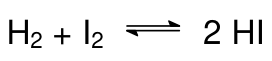
is at 600 °C equal to 70.0.
Problems:
6.1 How much iodine (in %) is converted till the equilibrium is reached if the reactants are mixed in:
a) 1 : 1 molar ratio at 600 °C;
b) 2 : 1 molar ratio at 600 °C (the amount of hydrogen is twice as great as that of iodine).
6.2 How many moles of hydrogen should be mixed with one mole of iodine when 99 % of iodine is to be converted to hydrogen iodide till the equilibrium is reached at 600 °C?
Official English text of the problem.
Answers
- 6.1 a) \(80.7\%\) of the iodine is converted.
- 6.1 b) \(95.1\%\) of the iodine is converted.
- 6.2 Initially mix \(6.59\ \mathrm{mol}\) of hydrogen with one mole of iodine.
Solution
The balanced equilibrium reaction is
\[ \ce{H2(g) + I2(g) <=> 2HI(g)}. \]
The species are hydrogen, \(\ce{H2}\), [H][H]; iodine, \(\ce{I2}\), II; and hydrogen iodide, \(\ce{HI}\), [H]I.
Take an initial amount of \(1.00\ \mathrm{mol}\) of iodine and \(r\ \mathrm{mol}\) of hydrogen, with no hydrogen iodide initially. Let \(x\) be the fraction of the initial iodine converted.
| Species | Initial amount / mol | Equilibrium amount / mol |
|---|---|---|
| \(\ce{H2}\) | \(r\) | \(r-x\) |
| \(\ce{I2}\) | \(1\) | \(1-x\) |
| \(\ce{HI}\) | \(0\) | \(2x\) |
At \(600\,^\circ\mathrm{C}\),
\[ K=\frac{[\ce{HI}]^2}{[\ce{H2}][\ce{I2}]}=70.0. \]
The volume factors cancel because the total stoichiometric coefficients are equal on both sides:
\[ 70.0 =\frac{(2x/V)^2}{((r-x)/V)((1-x)/V)} =\frac{4x^2}{(r-x)(1-x)}. \]
6.1 a) Initial molar ratio \(1:1\)
Here \(r=1\), so
\[ 70.0=\frac{4x^2}{(1-x)^2}. \]
Since \(0<x<1\), taking the positive square root gives
\[ \sqrt{70.0}=\frac{2x}{1-x}, \qquad x=\frac{\sqrt{70.0}}{2+\sqrt{70.0}} =0.807073. \]
Therefore,
\[ \boxed{\text{Iodine conversion}=80.7\%.} \]
6.1 b) Initial molar ratio \(2:1\)
Here \(r=2\):
\[ 70.0=\frac{4x^2}{(2-x)(1-x)}. \]
Rearranging,
\[ 70(2-3x+x^2)=4x^2, \]
\[ 33x^2-105x+70=0. \]
Thus,
\[ x=\frac{105\pm\sqrt{1785}}{66}. \]
The larger root, \(2.23105\), is impossible because the iodine conversion cannot exceed \(1\). The physical root is
\[ x=\frac{105-\sqrt{1785}}{66}=0.950769. \]
Therefore,
\[ \boxed{\text{Iodine conversion}=95.1\%.} \]
6.2 Hydrogen required for \(99\%\) iodine conversion
Set \(x=0.99\). With one mole of iodine initially, the equilibrium amounts are
\[ n(\ce{I2})=0.01\ \mathrm{mol},\qquad n(\ce{HI})=1.98\ \mathrm{mol},\qquad n(\ce{H2})=(r-0.99)\ \mathrm{mol}. \]
Hence,
\[ 70.0=\frac{1.98^2}{(r-0.99)(0.01)}. \]
Solving for the initial hydrogen amount,
\[ r=0.99+\frac{1.98^2}{70.0(0.01)} =6.59057. \]
Therefore,
\[ \boxed{n_0(\ce{H2})=6.59\ \mathrm{mol} \quad\text{per }1\ \mathrm{mol}\text{ of iodine}.} \]
Of this hydrogen, \(0.99\ \mathrm{mol}\) reacts and approximately \(5.60\ \mathrm{mol}\) remains at equilibrium.
The solution was checked against the official solution.
IChO 1975 · Theorieaufgabe 6
Iodwasserstoff-Gleichgewicht bei 600 °C
Die Gleichgewichtskonstante der Reaktion
beträgt bei 600 °C 70.0.
Aufgaben:
6.1 Wie viel Iod (in %) wird bis zum Erreichen des Gleichgewichts umgesetzt, wenn die Edukte in folgendem Verhältnis gemischt werden:
a) im Molverhältnis 1 : 1 bei 600 °C;
b) im Molverhältnis 2 : 1 bei 600 °C (die Stoffmenge an Wasserstoff ist doppelt so groß wie die an Iod).
6.2 Wie viele Mol Wasserstoff sollten mit einem Mol Iod gemischt werden, wenn bis zum Erreichen des Gleichgewichts bei 600 °C 99 % des Iods zu Iodwasserstoff umgesetzt werden sollen?
Aufgabentext aus dem offiziellen englischen Text übersetzt.
Antworten
- 6.1 a) \(80.7\%\) des Iods werden umgesetzt.
- 6.1 b) \(95.1\%\) des Iods werden umgesetzt.
- 6.2 Zu Beginn sind \(6.59\ \mathrm{mol}\) Wasserstoff mit einem Mol Iod zu mischen.
Lösung
Die ausgeglichene Reaktionsgleichung des Gleichgewichts lautet
\[ \ce{H2(g) + I2(g) <=> 2HI(g)}. \]
Die beteiligten Stoffe sind Wasserstoff, \(\ce{H2}\), [H][H]; Iod, \(\ce{I2}\), II; und Iodwasserstoff, \(\ce{HI}\), [H]I.
Als Anfangsstoffmengen werden \(1.00\ \mathrm{mol}\) Iod und \(r\ \mathrm{mol}\) Wasserstoff angesetzt; zu Beginn ist kein Iodwasserstoff vorhanden. Mit \(x\) wird der Anteil des anfänglich vorhandenen Iods bezeichnet, der umgesetzt wird.
| Stoff | Anfangsstoffmenge / mol | Gleichgewichtsstoffmenge / mol |
|---|---|---|
| \(\ce{H2}\) | \(r\) | \(r-x\) |
| \(\ce{I2}\) | \(1\) | \(1-x\) |
| \(\ce{HI}\) | \(0\) | \(2x\) |
Bei \(600\,^\circ\mathrm{C}\) gilt
\[ K=\frac{[\ce{HI}]^2}{[\ce{H2}][\ce{I2}]}=70.0. \]
Die Volumenfaktoren kürzen sich heraus, da die Summen der stöchiometrischen Koeffizienten auf beiden Seiten gleich sind:
\[ 70.0 =\frac{(2x/V)^2}{((r-x)/V)((1-x)/V)} =\frac{4x^2}{(r-x)(1-x)}. \]
6.1 a) Anfängliches Molverhältnis \(1:1\)
Hier ist \(r=1\), also gilt
\[ 70.0=\frac{4x^2}{(1-x)^2}. \]
Da \(0<x<1\) ist, ergibt das Ziehen der positiven Quadratwurzel
\[ \sqrt{70.0}=\frac{2x}{1-x}, \qquad x=\frac{\sqrt{70.0}}{2+\sqrt{70.0}} =0.807073. \]
Somit gilt
\[ \boxed{\text{Iodumsatz}=80.7\%.} \]
6.1 b) Anfängliches Molverhältnis \(2:1\)
Hier ist \(r=2\):
\[ 70.0=\frac{4x^2}{(2-x)(1-x)}. \]
Durch Umformen erhält man
\[ 70(2-3x+x^2)=4x^2, \]
\[ 33x^2-105x+70=0. \]
Daraus folgt
\[ x=\frac{105\pm\sqrt{1785}}{66}. \]
Die größere Lösung, \(2.23105\), ist nicht möglich, da der Iodumsatz \(1\) nicht überschreiten kann. Die physikalisch sinnvolle Lösung lautet
\[ x=\frac{105-\sqrt{1785}}{66}=0.950769. \]
Somit gilt
\[ \boxed{\text{Iodumsatz}=95.1\%.} \]
6.2 Erforderliche Wasserstoffmenge für einen Iodumsatz von \(99\%\)
Man setzt \(x=0.99\). Bei einer Anfangsstoffmenge von einem Mol Iod betragen die Stoffmengen im Gleichgewicht
\[ n(\ce{I2})=0.01\ \mathrm{mol},\qquad n(\ce{HI})=1.98\ \mathrm{mol},\qquad n(\ce{H2})=(r-0.99)\ \mathrm{mol}. \]
Damit gilt
\[ 70.0=\frac{1.98^2}{(r-0.99)(0.01)}. \]
Auflösen nach der Anfangsstoffmenge an Wasserstoff ergibt
\[ r=0.99+\frac{1.98^2}{70.0(0.01)} =6.59057. \]
Somit gilt
\[ \boxed{n_0(\ce{H2})=6.59\ \mathrm{mol} \quad\text{pro }1\ \mathrm{mol}\text{ Iod}.} \]
Von diesem Wasserstoff reagieren \(0.99\ \mathrm{mol}\), und etwa \(5.60\ \mathrm{mol}\) verbleiben im Gleichgewicht.
Die Lösung wurde mit der offiziellen Lösung abgeglichen.
IChO 1975 · Teori sorusu 6
600 °C'de hidrojen iyodür dengesi
Aşağıdaki tepkimenin denge sabiti
600 °C'de 70.0'a eşittir.
Sorular:
6.1 Tepkimeye giren maddeler aşağıdaki oranlarda karıştırıldığında dengeye ulaşılıncaya kadar iyodun yüzde kaçı dönüşür?
a) 600 °C'de 1 : 1 mol oranında;
b) 600 °C'de 2 : 1 mol oranında (hidrojen miktarı iyot miktarının iki katıdır).
6.2 600 °C'de dengeye ulaşılıncaya kadar iyodun %99'unun hidrojen iyodüre dönüşmesi için bir mol iyot ile kaç mol hidrojen karıştırılmalıdır?
Soru metni resmi İngilizce metinden çevrilmiştir.
Cevaplar
- 6.1 a) İyodun \(80.7\%\)'si dönüşür.
- 6.1 b) İyodun \(95.1\%\)'i dönüşür.
- 6.2 Başlangıçta bir mol iyot ile \(6.59\ \mathrm{mol}\) hidrojen karıştırılmalıdır.
Çözüm
Denkleştirilmiş denge tepkimesi şöyledir:
\[ \ce{H2(g) + I2(g) <=> 2HI(g)}. \]
Kimyasal türler hidrojen, \(\ce{H2}\), [H][H]; iyot, \(\ce{I2}\), II; ve hidrojen iyodür, \(\ce{HI}\), [H]I şeklindedir.
Başlangıçta \(1.00\ \mathrm{mol}\) iyot ve \(r\ \mathrm{mol}\) hidrojen bulunduğunu, hidrojen iyodür ise bulunmadığını kabul edelim. Başlangıçtaki iyodun dönüşen kesri \(x\) olsun.
| Kimyasal tür | Başlangıç miktarı / mol | Dengedeki miktar / mol |
|---|---|---|
| \(\ce{H2}\) | \(r\) | \(r-x\) |
| \(\ce{I2}\) | \(1\) | \(1-x\) |
| \(\ce{HI}\) | \(0\) | \(2x\) |
\(600\,^\circ\mathrm{C}\)'de,
\[ K=\frac{[\ce{HI}]^2}{[\ce{H2}][\ce{I2}]}=70.0. \]
Stokiyometrik katsayıların toplamı her iki tarafta eşit olduğundan hacim çarpanları sadeleşir:
\[ 70.0 =\frac{(2x/V)^2}{((r-x)/V)((1-x)/V)} =\frac{4x^2}{(r-x)(1-x)}. \]
6.1 a) Başlangıç mol oranı \(1:1\)
Burada \(r=1\) olduğundan
\[ 70.0=\frac{4x^2}{(1-x)^2}. \]
\(0<x<1\) olduğundan pozitif karekök alındığında
\[ \sqrt{70.0}=\frac{2x}{1-x}, \qquad x=\frac{\sqrt{70.0}}{2+\sqrt{70.0}} =0.807073. \]
Dolayısıyla,
\[ \boxed{\text{İyot dönüşümü}=80.7\%.} \]
6.1 b) Başlangıç mol oranı \(2:1\)
Burada \(r=2\):
\[ 70.0=\frac{4x^2}{(2-x)(1-x)}. \]
Yeniden düzenlendiğinde,
\[ 70(2-3x+x^2)=4x^2, \]
\[ 33x^2-105x+70=0. \]
Böylece,
\[ x=\frac{105\pm\sqrt{1785}}{66}. \]
Büyük kök olan \(2.23105\) mümkün değildir; çünkü iyodun dönüşen kesri \(1\)'i aşamaz. Fiziksel olarak anlamlı kök şöyledir:
\[ x=\frac{105-\sqrt{1785}}{66}=0.950769. \]
Dolayısıyla,
\[ \boxed{\text{İyot dönüşümü}=95.1\%.} \]
6.2 \(99\%\) iyot dönüşümü için gereken hidrojen
\(x=0.99\) alalım. Başlangıçta bir mol iyot bulunduğunda dengedeki miktarlar şöyledir:
\[ n(\ce{I2})=0.01\ \mathrm{mol},\qquad n(\ce{HI})=1.98\ \mathrm{mol},\qquad n(\ce{H2})=(r-0.99)\ \mathrm{mol}. \]
Buna göre,
\[ 70.0=\frac{1.98^2}{(r-0.99)(0.01)}. \]
Başlangıçtaki hidrojen miktarı için çözüldüğünde,
\[ r=0.99+\frac{1.98^2}{70.0(0.01)} =6.59057. \]
Dolayısıyla,
\[ \boxed{n_0(\ce{H2})=6.59\ \mathrm{mol} \quad\text{her }1\ \mathrm{mol}\text{ iyot için}.} \]
Bu hidrojenin \(0.99\ \mathrm{mol}\)'ü tepkimeye girer ve dengede yaklaşık \(5.60\ \mathrm{mol}\) hidrojen kalır.
Çözüm, resmi çözümle karşılaştırılarak kontrol edildi.
IChO 1975 · Problema teórico 6
Equilibrio del yoduro de hidrógeno a 600 °C
La constante de equilibrio de la reacción
es igual a 70.0 a 600 °C.
Problemas:
6.1 ¿Qué porcentaje de yodo se convierte al alcanzarse el equilibrio si los reactivos se mezclan en:
a) una proporción molar de 1 : 1 a 600 °C;
b) una proporción molar de 2 : 1 a 600 °C (la cantidad de hidrógeno es el doble que la de yodo)?
6.2 ¿Cuántos moles de hidrógeno deben mezclarse con un mol de yodo para que el 99 % del yodo se convierta en yoduro de hidrógeno al alcanzarse el equilibrio a 600 °C?
Enunciado traducido del texto oficial en inglés.
Respuestas
- 6.1 a) Se convierte el \(80.7\%\) del yodo.
- 6.1 b) Se convierte el \(95.1\%\) del yodo.
- 6.2 Mezclar inicialmente \(6.59\ \mathrm{mol}\) de hidrógeno con un mol de yodo.
Solución
La reacción de equilibrio ajustada es
\[ \ce{H2(g) + I2(g) <=> 2HI(g)}. \]
Las especies son hidrógeno, \(\ce{H2}\), [H][H]; yodo, \(\ce{I2}\), II; y yoduro de hidrógeno, \(\ce{HI}\), [H]I.
Se toma una cantidad inicial de \(1.00\ \mathrm{mol}\) de yodo y \(r\ \mathrm{mol}\) de hidrógeno, sin yoduro de hidrógeno inicialmente. Sea \(x\) la fracción del yodo inicial que se convierte.
| Especie | Cantidad inicial / mol | Cantidad en el equilibrio / mol |
|---|---|---|
| \(\ce{H2}\) | \(r\) | \(r-x\) |
| \(\ce{I2}\) | \(1\) | \(1-x\) |
| \(\ce{HI}\) | \(0\) | \(2x\) |
A \(600\,^\circ\mathrm{C}\),
\[ K=\frac{[\ce{HI}]^2}{[\ce{H2}][\ce{I2}]}=70.0. \]
Los factores de volumen se cancelan porque las sumas de los coeficientes estequiométricos son iguales en ambos lados:
\[ 70.0 =\frac{(2x/V)^2}{((r-x)/V)((1-x)/V)} =\frac{4x^2}{(r-x)(1-x)}. \]
6.1 a) Proporción molar inicial \(1:1\)
Aquí \(r=1\), por lo que
\[ 70.0=\frac{4x^2}{(1-x)^2}. \]
Como \(0<x<1\), al tomar la raíz cuadrada positiva se obtiene
\[ \sqrt{70.0}=\frac{2x}{1-x}, \qquad x=\frac{\sqrt{70.0}}{2+\sqrt{70.0}} =0.807073. \]
Por tanto,
\[ \boxed{\text{Conversión del yodo}=80.7\%.} \]
6.1 b) Proporción molar inicial \(2:1\)
Aquí \(r=2\):
\[ 70.0=\frac{4x^2}{(2-x)(1-x)}. \]
Reordenando,
\[ 70(2-3x+x^2)=4x^2, \]
\[ 33x^2-105x+70=0. \]
Así,
\[ x=\frac{105\pm\sqrt{1785}}{66}. \]
La raíz mayor, \(2.23105\), es imposible porque la conversión del yodo no puede superar \(1\). La raíz físicamente admisible es
\[ x=\frac{105-\sqrt{1785}}{66}=0.950769. \]
Por tanto,
\[ \boxed{\text{Conversión del yodo}=95.1\%.} \]
6.2 Hidrógeno necesario para una conversión del yodo del \(99\%\)
Se fija \(x=0.99\). Con un mol de yodo inicialmente, las cantidades en el equilibrio son
\[ n(\ce{I2})=0.01\ \mathrm{mol},\qquad n(\ce{HI})=1.98\ \mathrm{mol},\qquad n(\ce{H2})=(r-0.99)\ \mathrm{mol}. \]
Por consiguiente,
\[ 70.0=\frac{1.98^2}{(r-0.99)(0.01)}. \]
Despejando la cantidad inicial de hidrógeno,
\[ r=0.99+\frac{1.98^2}{70.0(0.01)} =6.59057. \]
Por tanto,
\[ \boxed{n_0(\ce{H2})=6.59\ \mathrm{mol} \quad\text{por }1\ \mathrm{mol}\text{ de yodo}.} \]
De este hidrógeno, reaccionan \(0.99\ \mathrm{mol}\) y quedan aproximadamente \(5.60\ \mathrm{mol}\) en el equilibrio.
La solución se comprobó con la solución oficial.
IChO 1975 · 理论题 6
600 °C 时的碘化氢平衡
反应
在 600 °C 时的平衡常数等于 70.0。
问题:
6.1 若反应物按以下条件混合,达到平衡时有多少碘(以 % 表示)发生转化:
a) 在 600 °C 时,摩尔比为 1 : 1;
b) 在 600 °C 时,摩尔比为 2 : 1(氢气的物质的量为碘的两倍)。
6.2 若要使 600 °C 时达到平衡时有 99 % 的碘转化为碘化氢,应将多少摩尔的氢气与一摩尔的碘混合?
题目译自官方英文原文。
答案
- 6.1 a) 有 \(80.7\%\) 的碘发生转化。
- 6.1 b) 有 \(95.1\%\) 的碘发生转化。
- 6.2 起始时将 \(6.59\ \mathrm{mol}\) 氢气与一摩尔碘混合。
解答
配平后的平衡反应方程式为
\[ \ce{H2(g) + I2(g) <=> 2HI(g)}. \]
各物种分别为氢气,\(\ce{H2}\),[H][H];碘,\(\ce{I2}\),II;以及碘化氢,\(\ce{HI}\),[H]I。
取起始物质的量为 \(1.00\ \mathrm{mol}\) 的碘和 \(r\ \mathrm{mol}\) 的氢气,起始时无碘化氢。设 \(x\) 为起始碘中发生转化的比例。
| 物种 | 起始物质的量 / mol | 平衡物质的量 / mol |
|---|---|---|
| \(\ce{H2}\) | \(r\) | \(r-x\) |
| \(\ce{I2}\) | \(1\) | \(1-x\) |
| \(\ce{HI}\) | \(0\) | \(2x\) |
在 \(600\,^\circ\mathrm{C}\) 时,
\[ K=\frac{[\ce{HI}]^2}{[\ce{H2}][\ce{I2}]}=70.0. \]
由于反应方程式两边的化学计量数之和相等,体积因子相互抵消:
\[ 70.0 =\frac{(2x/V)^2}{((r-x)/V)((1-x)/V)} =\frac{4x^2}{(r-x)(1-x)}. \]
6.1 a) 起始摩尔比为 \(1:1\)
此时 \(r=1\),因此
\[ 70.0=\frac{4x^2}{(1-x)^2}. \]
由于 \(0<x<1\),取正平方根得
\[ \sqrt{70.0}=\frac{2x}{1-x}, \qquad x=\frac{\sqrt{70.0}}{2+\sqrt{70.0}} =0.807073. \]
因此,
\[ \boxed{\text{碘的转化率}=80.7\%.} \]
6.1 b) 起始摩尔比为 \(2:1\)
此时 \(r=2\):
\[ 70.0=\frac{4x^2}{(2-x)(1-x)}. \]
整理得,
\[ 70(2-3x+x^2)=4x^2, \]
\[ 33x^2-105x+70=0. \]
于是,
\[ x=\frac{105\pm\sqrt{1785}}{66}. \]
较大的根 \(2.23105\) 不可能成立,因为碘的转化率不能超过 \(1\)。具有物理意义的根为
\[ x=\frac{105-\sqrt{1785}}{66}=0.950769. \]
因此,
\[ \boxed{\text{碘的转化率}=95.1\%.} \]
6.2 碘的转化率达到 \(99\%\) 时所需的氢气
令 \(x=0.99\)。起始时有一摩尔碘,各物种的平衡物质的量为
\[ n(\ce{I2})=0.01\ \mathrm{mol},\qquad n(\ce{HI})=1.98\ \mathrm{mol},\qquad n(\ce{H2})=(r-0.99)\ \mathrm{mol}. \]
因此,
\[ 70.0=\frac{1.98^2}{(r-0.99)(0.01)}. \]
解得氢气的起始物质的量,
\[ r=0.99+\frac{1.98^2}{70.0(0.01)} =6.59057. \]
因此,
\[ \boxed{n_0(\ce{H2})=6.59\ \mathrm{mol} \quad\text{每 }1\ \mathrm{mol}\text{ 碘所需}.} \]
其中,\(0.99\ \mathrm{mol}\) 的氢气参与反应,达到平衡时约剩余 \(5.60\ \mathrm{mol}\)。
解答已与官方解答核对。
IChO 1975 · Теоретическая задача 6
Равновесие образования иодоводорода при 600 °C
Константа равновесия реакции
при 600 °C равна 70.0.
Задания:
6.1 Какая доля иода (в %) прореагирует к моменту достижения равновесия, если реагенты смешать в:
a) молярном соотношении 1 : 1 при 600 °C;
b) молярном соотношении 2 : 1 при 600 °C (количество водорода вдвое больше количества иода).
6.2 Сколько молей водорода следует смешать с одним молем иода, чтобы к моменту достижения равновесия при 600 °C 99 % иода превратилось в иодоводород?
Условие переведено с официального английского текста.
Ответы
- 6.1 a) Прореагирует \(80.7\%\) иода.
- 6.1 b) Прореагирует \(95.1\%\) иода.
- 6.2 В исходной смеси на один моль иода должно приходиться \(6.59\ \mathrm{mol}\) водорода.
Решение
Уравнение равновесной реакции с расставленными коэффициентами имеет вид
\[ \ce{H2(g) + I2(g) <=> 2HI(g)}. \]
В реакции участвуют водород, \(\ce{H2}\), [H][H]; иод, \(\ce{I2}\), II; и иодоводород, \(\ce{HI}\), [H]I.
Пусть исходная смесь содержит \(1.00\ \mathrm{mol}\) иода и \(r\ \mathrm{mol}\) водорода, а иодоводород в ней отсутствует. Обозначим через \(x\) долю исходного иода, вступившего в реакцию.
| Вещество | Исходное количество / моль | Равновесное количество / моль |
|---|---|---|
| \(\ce{H2}\) | \(r\) | \(r-x\) |
| \(\ce{I2}\) | \(1\) | \(1-x\) |
| \(\ce{HI}\) | \(0\) | \(2x\) |
При \(600\,^\circ\mathrm{C}\)
\[ K=\frac{[\ce{HI}]^2}{[\ce{H2}][\ce{I2}]}=70.0. \]
Множители, содержащие объём, сокращаются, поскольку суммы стехиометрических коэффициентов в обеих частях уравнения равны:
\[ 70.0 =\frac{(2x/V)^2}{((r-x)/V)((1-x)/V)} =\frac{4x^2}{(r-x)(1-x)}. \]
6.1 a) Исходное молярное соотношение \(1:1\)
Здесь \(r=1\), поэтому
\[ 70.0=\frac{4x^2}{(1-x)^2}. \]
Поскольку \(0<x<1\), извлекая положительный квадратный корень, получаем
\[ \sqrt{70.0}=\frac{2x}{1-x}, \qquad x=\frac{\sqrt{70.0}}{2+\sqrt{70.0}} =0.807073. \]
Следовательно,
\[ \boxed{\text{Степень превращения иода}=80.7\%.} \]
6.1 b) Исходное молярное соотношение \(2:1\)
Здесь \(r=2\):
\[ 70.0=\frac{4x^2}{(2-x)(1-x)}. \]
Преобразуя, получаем
\[ 70(2-3x+x^2)=4x^2, \]
\[ 33x^2-105x+70=0. \]
Таким образом,
\[ x=\frac{105\pm\sqrt{1785}}{66}. \]
Больший корень, \(2.23105\), недопустим, поскольку степень превращения иода не может превышать \(1\). Физически допустимый корень равен
\[ x=\frac{105-\sqrt{1785}}{66}=0.950769. \]
Следовательно,
\[ \boxed{\text{Степень превращения иода}=95.1\%.} \]
6.2 Количество водорода, необходимое для превращения \(99\%\) иода
Положим \(x=0.99\). Если исходное количество иода составляет один моль, равновесные количества веществ равны
\[ n(\ce{I2})=0.01\ \mathrm{mol},\qquad n(\ce{HI})=1.98\ \mathrm{mol},\qquad n(\ce{H2})=(r-0.99)\ \mathrm{mol}. \]
Отсюда
\[ 70.0=\frac{1.98^2}{(r-0.99)(0.01)}. \]
Решая уравнение относительно исходного количества водорода, получаем
\[ r=0.99+\frac{1.98^2}{70.0(0.01)} =6.59057. \]
Следовательно,
\[ \boxed{n_0(\ce{H2})=6.59\ \mathrm{mol} \quad\text{на }1\ \mathrm{mol}\text{ иода}.} \]
Из этого количества водорода \(0.99\ \mathrm{mol}\) вступает в реакцию, а приблизительно \(5.60\ \mathrm{mol}\) остаётся при равновесии.
Решение проверено по официальному решению.
IChO 1975 · مسألة نظرية 6
اتزان يوديد الهيدروجين عند 600 °C
ثابت الاتزان للتفاعل
يساوي 70.0 عند 600 °C.
المطلوب:
6.1 ما النسبة المئوية من اليود التي تتحول حتى بلوغ الاتزان إذا مُزجت المواد المتفاعلة وفقًا لما يأتي:
a) بنسبة مولية 1 : 1 عند 600 °C؛
b) بنسبة مولية 2 : 1 عند 600 °C (كمية الهيدروجين تساوي ضعف كمية اليود).
6.2 كم مولًا من الهيدروجين ينبغي مزجه مع مول واحد من اليود لكي يتحول 99 % من اليود إلى يوديد الهيدروجين حتى بلوغ الاتزان عند 600 °C؟
نص المسألة مترجم عن النص الإنجليزي الرسمي.
الإجابات
- 6.1 a) يتحول \(80.7\%\) من اليود.
- 6.1 b) يتحول \(95.1\%\) من اليود.
- 6.2 يُمزج في البداية \(6.59\ \mathrm{mol}\) من الهيدروجين مع مول واحد من اليود.
الحل
معادلة تفاعل الاتزان الموزونة هي
\[ \ce{H2(g) + I2(g) <=> 2HI(g)}. \]
الأنواع الكيميائية هي الهيدروجين، \(\ce{H2}\)، [H][H]؛ واليود، \(\ce{I2}\)، II؛ ويوديد الهيدروجين، \(\ce{HI}\)، [H]I.
لنأخذ كمية ابتدائية مقدارها \(1.00\ \mathrm{mol}\) من اليود و\(r\ \mathrm{mol}\) من الهيدروجين، دون وجود يوديد الهيدروجين في البداية. وليكن \(x\) الكسر المتحول من كمية اليود الابتدائية.
| النوع الكيميائي | الكمية الابتدائية / mol | الكمية عند الاتزان / mol |
|---|---|---|
| \(\ce{H2}\) | \(r\) | \(r-x\) |
| \(\ce{I2}\) | \(1\) | \(1-x\) |
| \(\ce{HI}\) | \(0\) | \(2x\) |
عند \(600\,^\circ\mathrm{C}\)،
\[ K=\frac{[\ce{HI}]^2}{[\ce{H2}][\ce{I2}]}=70.0. \]
تُختزل عوامل الحجم لأن مجموع المعاملات الستوكيومترية متساوٍ في طرفي المعادلة:
\[ 70.0 =\frac{(2x/V)^2}{((r-x)/V)((1-x)/V)} =\frac{4x^2}{(r-x)(1-x)}. \]
6.1 a) النسبة المولية الابتدائية \(1:1\)
هنا \(r=1\)، ومن ثم
\[ 70.0=\frac{4x^2}{(1-x)^2}. \]
بما أن \(0<x<1\)، فإن أخذ الجذر التربيعي الموجب يعطي
\[ \sqrt{70.0}=\frac{2x}{1-x}, \qquad x=\frac{\sqrt{70.0}}{2+\sqrt{70.0}} =0.807073. \]
وعليه،
\[ \boxed{\text{نسبة تحول اليود}=80.7\%.} \]
6.1 b) النسبة المولية الابتدائية \(2:1\)
هنا \(r=2\):
\[ 70.0=\frac{4x^2}{(2-x)(1-x)}. \]
بإعادة الترتيب،
\[ 70(2-3x+x^2)=4x^2, \]
\[ 33x^2-105x+70=0. \]
إذن،
\[ x=\frac{105\pm\sqrt{1785}}{66}. \]
الجذر الأكبر، \(2.23105\)، غير ممكن لأن الكسر المتحول من اليود لا يمكن أن يتجاوز \(1\). والجذر المقبول فيزيائيًا هو
\[ x=\frac{105-\sqrt{1785}}{66}=0.950769. \]
وعليه،
\[ \boxed{\text{نسبة تحول اليود}=95.1\%.} \]
6.2 الهيدروجين اللازم لتحول \(99\%\) من اليود
نضع \(x=0.99\). مع وجود مول واحد من اليود في البداية، تكون الكميات عند الاتزان
\[ n(\ce{I2})=0.01\ \mathrm{mol},\qquad n(\ce{HI})=1.98\ \mathrm{mol},\qquad n(\ce{H2})=(r-0.99)\ \mathrm{mol}. \]
ومن ثم،
\[ 70.0=\frac{1.98^2}{(r-0.99)(0.01)}. \]
بحل المعادلة لإيجاد كمية الهيدروجين الابتدائية،
\[ r=0.99+\frac{1.98^2}{70.0(0.01)} =6.59057. \]
وعليه،
\[ \boxed{n_0(\ce{H2})=6.59\ \mathrm{mol} \quad\text{لكل }1\ \mathrm{mol}\text{ من اليود}.} \]
من هذه الكمية من الهيدروجين، يتفاعل \(0.99\ \mathrm{mol}\) ويتبقى نحو \(5.60\ \mathrm{mol}\) عند الاتزان.
تمت مراجعة الحل بمقارنته بالحل الرسمي.