International Chemistry Olympiad
IChO 1974
Bucharest, Romania · 5 theory problems with complete solutions
Problem 1: From electrolytic hydrogen to methyl orange
By electrochemical decomposition of water, there are in an electric circuit a voltmeter, platinum electrodes and a battery containing ten galvanic cells connected in series, each of it having the voltage of 1.5 V and internal resistance of 0.4 Ω. The resistance of the voltmeter is 0.5 Ω and the polarisation voltage of the battery is 1.5 V. Electric current flows for 8 hours, 56 minutes and 7 seconds through the electrolyte. Hydrogen obtained in this way was used for a synthesis with another substance, thus forming a gaseous substance A which can be converted by oxidation with oxygen via oxide to substance B.
By means of substance B it is possible to prepare substance C from which after reduction by hydrogen substance D can be obtained. Substance D reacts at 180 °C with a concentration solution of sulphuric acid to produce sulphanilic acid. By diazotization and successive copulation with p-N,N-dimethylaniline, an azo dye, methyl orange is formed.
Problems:
- Write chemical equations for all the above mentioned reactions.
- Calculate the mass of product D.
- Give the exact chemical name for the indicator methyl orange. Show by means of structural formulas what changes take place in dependence on concentration of \(\ce{H3O+}\) ions in the solution.
Relative atomic masses: \(A_\mathrm{r}(\ce{N}) = 14;\quad A_\mathrm{r}(\ce{O}) = 16;\quad A_\mathrm{r}(\ce{C}) = 12;\quad A_\mathrm{r}(\ce{H}) = 1.\)
Official English text of the problem.
Problem 2: Reaction scheme leading to substance G
Substance G can be prepared by several methods according to the following scheme:
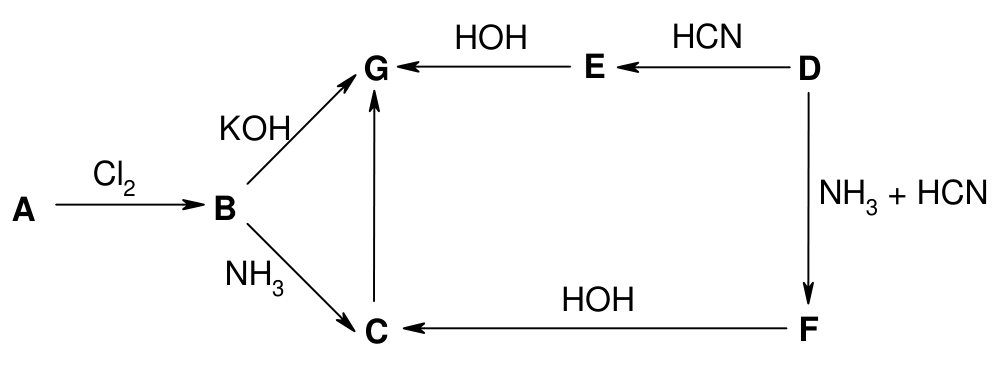
Compound A is 48.60 mass % carbon, 8.10 % hydrogen, and 43.30 % oxygen. It reacts with a freshly prepared silver(I) oxide to form an undissolved salt. An amount of 1.81 g of silver(I) salt is formed from 0.74 g of compound A.
Compound D contains 54.54 mass % of carbon, 9.09 % of hydrogen, and 36.37 % of oxygen. It combines with \(\ce{NaHSO3}\) to produce a compound containing 21.6 % of sulphur.
Problems:
- Write summary as well as structural formulas of substances A and D.
- Write structural formulas of substances B, C, E, F, and G.
- Classify the reactions in the scheme marked by arrows and discuss more in detail reactions B → G and D → E.
- Write structural formulas of possible isomers of substance G and give the type of isomerism.
Relative atomic masses:
\[ A_r(\ce{C})=12;\quad A_r(\ce{H})=1;\quad A_r(\ce{O})=16;\quad A_r(\ce{Ag})=108;\quad A_r(\ce{Na})=23;\quad A_r(\ce{S})=32. \]
Official English text of the problem.
Problem 3: Acid-base reactions of 0.2 M solutions A-H
The following 0.2 molar solutions are available:
A: \(\ce{HCl}\) B: \(\ce{HSO4-}\) C: \(\ce{CH3COOH}\) D: \(\ce{NaOH}\) E: \(\ce{CO3^2-}\) F: \(\ce{CH3COONa}\) G: \(\ce{HPO4^2-}\) H: \(\ce{H2SO4}\) Problems:
- Determine the concentration of \(\ce{H3O+}\) ions in solution C.
- Determine pH value in solution A.
- Write an equation for the chemical reaction that takes place when substances B and E are allowed to react and mark conjugate acid-base pairs.
- Compare acid-base properties of substances A, B, and C and determine which one will show the most basic properties. Explain your decision.
- Write a chemical equation for the reaction between substances B and G, and explain the shift of equilibrium.
- Write a chemical equation for the reaction between substances C and E, and explain the shift of equilibrium.
- Calculate the volume of D solution which is required to neutralise 20.0 \(\mathrm{cm^3}\) of H solution.
- What would be the volume of hydrogen chloride being present in one litre of A solution if it were in gaseous state at a pressure of 202.65 kPa and a temperature of 37 °C?
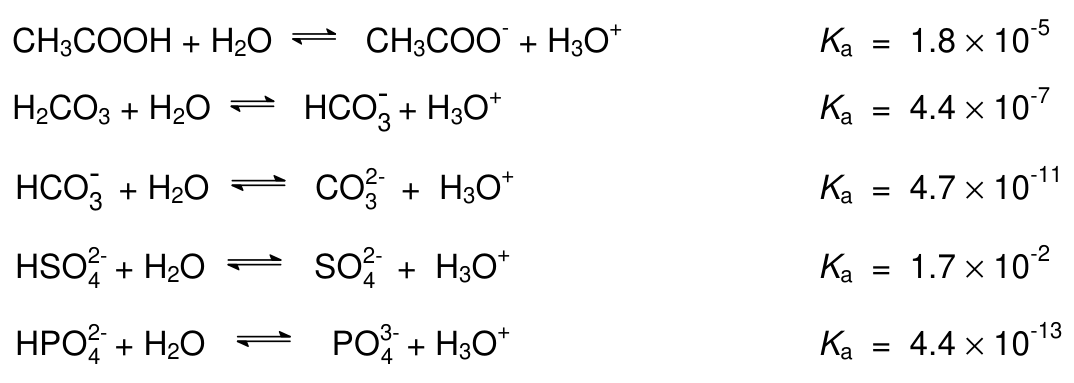
Ionisation constants:
Relative atomic masses:
\(A_{\mathrm r}(\ce{Na})=23;\quad A_{\mathrm r}(\ce{S})=32;\quad A_{\mathrm r}(\ce{O})=16.\)
Official English text of the problem.
Problem 4: Mixture of two oxygen-containing organic compounds
A mixture contains two organic compounds, A and B. Both of them have in their molecules oxygen and they can be mixed together in arbitrary ratios. Oxidation of this mixture on cooling yields the only substance C that combines with \(\ce{NaHSO3}\). The ratio of the molar mass of the substance being formed in the reaction with \(\ce{NaHSO3}\) to that of substance C, is equal to 2.7931.
The mixture of substances A and B is burned in the presence of a stoichiometric amount of air (20 % \(\ce{O2}\) and 80 % of \(\ce{N2}\) by volume) in an eudiometer to produce a mixture of gases with a total volume of \(5.432\ \mathrm{dm^3}\) at STP. After the gaseous mixture is bubbled through a \(\ce{Ba(OH)2}\) solution, its volume is decreased by 15.46 %.
Problems:
4.1 Write structural formulas of substance A and B.
4.2 Calculate the molar ratio of substances A and B in the mixture.
\[ A_{\mathrm r}(\ce{C})=12;\qquad A_{\mathrm r}(\ce{O})=16;\qquad A_{\mathrm r}(\ce{S})=32;\qquad A_{\mathrm r}(\ce{Na})=23. \]
Official English text of the problem.
Problem 5: Mixture of two metals: hydrides, hydroxides and a precipitate
A mixture of two metals found in Mendelejev's periodical table in different groups, reacted with 56 cm³ of hydrogen on heating (measured at STP conditions) to produce two ionic compounds. These compounds were allowed to react with 270 mg of water but only one third of water reacted. A basic solution was formed in which the content of hydroxides was 30 % by mass and at the same time deposited a precipitate with a mass that represented 59.05 % of a total mass of the products formed by the reaction. After filtration the precipitate was heated and its mass decreased by 27 mg.
When a stoichiometric amount of ammonium carbonate was added to the basic solution, a slightly soluble precipitate was obtained, at the same time ammonia was liberated and the content of hydroxides in the solution decreased to 16.81 %.
Problem:
5.1 Determine the metals in the starting mixture and their masses.
Official English text of the problem.
Internationale Chemie-Olympiade
IChO 1974
Bukarest, Rumänien · 5 Theorieaufgaben mit vollständigen Lösungen
Aufgabe 1: Vom elektrolytisch gewonnenen Wasserstoff zum Methylorange
Bei der elektrochemischen Zersetzung von Wasser befinden sich in einem Stromkreis ein Voltmeter, Platinelektroden und eine Batterie aus zehn in Reihe geschalteten galvanischen Zellen, von denen jede eine Spannung von 1.5 V und einen Innenwiderstand von 0.4 Ω aufweist. Der Widerstand des Voltmeters beträgt 0.5 Ω und die Polarisationsspannung der Batterie 1.5 V. Durch den Elektrolyten fließt 8 Stunden, 56 Minuten und 7 Sekunden lang elektrischer Strom. Der auf diese Weise gewonnene Wasserstoff wurde für eine Synthese mit einem anderen Stoff verwendet, wobei ein gasförmiger Stoff A entstand, der durch Oxidation mit Sauerstoff über ein Oxid in den Stoff B überführt werden kann.
Mithilfe des Stoffes B lässt sich der Stoff C herstellen, aus dem durch Reduktion mit Wasserstoff der Stoff D gewonnen werden kann. Der Stoff D reagiert bei 180 °C mit konzentrierter Schwefelsäurelösung zu Sulfanilsäure. Durch Diazotierung und anschließende Kupplung mit p-N,N-Dimethylanilin entsteht der Azofarbstoff Methylorange.
Aufgaben:
- Stellen Sie die chemischen Gleichungen für alle oben genannten Reaktionen auf.
- Berechnen Sie die Masse des Produkts D.
- Geben Sie den genauen chemischen Namen des Indikators Methylorange an. Zeigen Sie anhand von Strukturformeln, welche Veränderungen in Abhängigkeit von der Konzentration der \(\ce{H3O+}\)-Ionen in der Lösung stattfinden.
Relative Atommassen: \(A_\mathrm{r}(\ce{N}) = 14;\quad A_\mathrm{r}(\ce{O}) = 16;\quad A_\mathrm{r}(\ce{C}) = 12;\quad A_\mathrm{r}(\ce{H}) = 1.\)
Aufgabentext aus dem offiziellen englischen Text übersetzt.
Aufgabe 2: Reaktionsschema zur Herstellung von Stoff G
Stoff G kann nach dem folgenden Schema auf mehreren Wegen hergestellt werden:
Verbindung A enthält 48.60 Massen-% Kohlenstoff, 8.10 % Wasserstoff und 43.30 % Sauerstoff. Sie reagiert mit frisch hergestelltem Silber(I)-oxid unter Bildung eines ungelösten Salzes. Aus 0.74 g der Verbindung A entstehen 1.81 g des Silber(I)-salzes.
Verbindung D enthält 54.54 Massen-% Kohlenstoff, 9.09 % Wasserstoff und 36.37 % Sauerstoff. Sie reagiert mit \(\ce{NaHSO3}\) zu einer Verbindung, die 21.6 % Schwefel enthält.
Aufgaben:
- Geben Sie die Summenformeln sowie die Strukturformeln der Stoffe A und D an.
- Geben Sie die Strukturformeln der Stoffe B, C, E, F und G an.
- Ordnen Sie die im Schema durch Pfeile gekennzeichneten Reaktionen den Reaktionstypen zu und erörtern Sie die Reaktionen B → G und D → E ausführlicher.
- Geben Sie die Strukturformeln möglicher Isomere von Stoff G und die Art der Isomerie an.
Relative Atommassen:
\[ A_r(\ce{C})=12;\quad A_r(\ce{H})=1;\quad A_r(\ce{O})=16;\quad A_r(\ce{Ag})=108;\quad A_r(\ce{Na})=23;\quad A_r(\ce{S})=32. \]
Aufgabentext aus dem offiziellen englischen Text übersetzt.
Aufgabe 3: Säure-Base-Reaktionen von 0.2 M Lösungen A-H
Die folgenden 0.2-molaren Lösungen stehen zur Verfügung:
A: \(\ce{HCl}\) B: \(\ce{HSO4-}\) C: \(\ce{CH3COOH}\) D: \(\ce{NaOH}\) E: \(\ce{CO3^2-}\) F: \(\ce{CH3COONa}\) G: \(\ce{HPO4^2-}\) H: \(\ce{H2SO4}\) Aufgaben:
- Bestimmen Sie die Konzentration der \(\ce{H3O+}\)-Ionen in Lösung C.
- Bestimmen Sie den pH-Wert in Lösung A.
- Stellen Sie eine Gleichung für die chemische Reaktion auf, die stattfindet, wenn die Stoffe B und E miteinander reagieren, und kennzeichnen Sie die konjugierten Säure-Base-Paare.
- Vergleichen Sie die Säure-Base-Eigenschaften der Stoffe A, B und C und bestimmen Sie, welcher davon die stärksten basischen Eigenschaften aufweist. Begründen Sie Ihre Entscheidung.
- Stellen Sie eine chemische Gleichung für die Reaktion zwischen den Stoffen B und G auf und erläutern Sie die Verschiebung des Gleichgewichts.
- Stellen Sie eine chemische Gleichung für die Reaktion zwischen den Stoffen C und E auf und erläutern Sie die Verschiebung des Gleichgewichts.
- Berechnen Sie das Volumen der Lösung D, das zur Neutralisation von 20.0 \(\mathrm{cm^3}\) der Lösung H benötigt wird.
- Welches Volumen hätte der in einem Liter der Lösung A enthaltene Chlorwasserstoff, wenn er bei einem Druck von 202.65 kPa und einer Temperatur von 37 °C gasförmig vorläge?
Ionisationskonstanten:
Relative Atommassen:
\(A_{\mathrm r}(\ce{Na})=23;\quad A_{\mathrm r}(\ce{S})=32;\quad A_{\mathrm r}(\ce{O})=16.\)
Aufgabentext aus dem offiziellen englischen Text übersetzt.
Aufgabe 4: Gemisch aus zwei sauerstoffhaltigen organischen Verbindungen
Ein Gemisch enthält zwei organische Verbindungen, A und B. Beide enthalten Sauerstoff in ihren Molekülen und sind in beliebigen Verhältnissen miteinander mischbar. Die Oxidation dieses Gemisches unter Kühlung liefert als einzigen Stoff C, der mit \(\ce{NaHSO3}\) reagiert. Das Verhältnis der molaren Masse des bei der Reaktion mit \(\ce{NaHSO3}\) entstehenden Stoffes zur molaren Masse des Stoffes C beträgt 2.7931.
Das Gemisch der Stoffe A und B wird in Gegenwart einer stöchiometrischen Menge Luft (20 % \(\ce{O2}\) und 80 % \(\ce{N2}\), bezogen auf das Volumen) in einem Eudiometer verbrannt. Dabei entsteht ein Gasgemisch mit einem Gesamtvolumen von \(5.432\ \mathrm{dm^3}\) unter Standardbedingungen (STP). Nachdem das Gasgemisch durch eine \(\ce{Ba(OH)2}\)-Lösung geleitet wurde, hat sich sein Volumen um 15.46 % verringert.
Aufgaben:
4.1 Geben Sie die Strukturformeln der Stoffe A und B an.
4.2 Berechnen Sie das Stoffmengenverhältnis der Stoffe A und B im Gemisch.
\[ A_{\mathrm r}(\ce{C})=12;\qquad A_{\mathrm r}(\ce{O})=16;\qquad A_{\mathrm r}(\ce{S})=32;\qquad A_{\mathrm r}(\ce{Na})=23. \]
Aufgabentext aus dem offiziellen englischen Text übersetzt.
Aufgabe 5: Gemisch zweier Metalle: Hydride, Hydroxide und ein Niederschlag
Ein Gemisch zweier Metalle, die im Periodensystem von Mendelejew in verschiedenen Gruppen stehen, reagierte beim Erhitzen mit 56 cm³ Wasserstoff (gemessen unter Standardbedingungen, STP) unter Bildung zweier ionischer Verbindungen. Diese Verbindungen wurden mit 270 mg Wasser zur Reaktion gebracht, wobei jedoch nur ein Drittel des Wassers reagierte. Es entstand eine basische Lösung, deren Massenanteil an Hydroxiden 30 % betrug, und gleichzeitig fiel ein Niederschlag aus, dessen Masse 59.05 % der Gesamtmasse der durch die Reaktion gebildeten Produkte ausmachte. Nach der Filtration wurde der Niederschlag erhitzt, wobei seine Masse um 27 mg abnahm.
Bei Zugabe einer stöchiometrischen Menge Ammoniumcarbonat zur basischen Lösung entstand ein schwer löslicher Niederschlag; gleichzeitig wurde Ammoniak freigesetzt, und der Hydroxidgehalt der Lösung sank auf 16.81 %.
Aufgabe:
5.1 Bestimmen Sie die Metalle im Ausgangsgemisch und ihre Massen.
Aufgabentext aus dem offiziellen englischen Text übersetzt.
Uluslararası Kimya Olimpiyatı
IChO 1974
Bükreş, Romanya · 5 teori sorusu, tam çözümleriyle
Soru 1: Elektrolizle elde edilen hidrojenden metil oranja
Suyun elektrokimyasal olarak ayrıştırıldığı bir elektrik devresinde bir voltmetre, platin elektrotlar ve her biri 1.5 V gerilime ve 0.4 Ω iç dirence sahip, seri bağlanmış on galvanik hücreden oluşan bir batarya bulunmaktadır. Voltmetrenin direnci 0.5 Ω ve bataryanın polarizasyon gerilimi 1.5 V'tur. Elektrolitten 8 saat, 56 dakika ve 7 saniye boyunca elektrik akımı geçer. Bu yolla elde edilen hidrojen, başka bir maddeyle bir sentez tepkimesinde kullanılarak gaz hâlindeki A maddesi oluşturulur; bu madde, oksijenle yükseltgenerek oksit üzerinden B maddesine dönüştürülebilir.
B maddesi kullanılarak C maddesi hazırlanabilir ve bu maddenin hidrojenle indirgenmesiyle D maddesi elde edilebilir. D maddesi, 180 °C'de derişik sülfürik asit çözeltisiyle tepkimeye girerek sülfanilik asit oluşturur. Diazolama ve ardından p-N,N-dimetilanilin ile kenetlenme sonucunda bir azo boyası olan metil oranj oluşur.
Sorular:
- Yukarıda sözü edilen tüm tepkimelerin kimyasal denklemlerini yazınız.
- D ürününün kütlesini hesaplayınız.
- Metil oranj indikatörünün tam kimyasal adını veriniz. Çözeltideki \(\ce{H3O+}\) iyonlarının derişimine bağlı olarak hangi değişikliklerin gerçekleştiğini yapı formülleriyle gösteriniz.
Bağıl atom kütleleri: \(A_\mathrm{r}(\ce{N}) = 14;\quad A_\mathrm{r}(\ce{O}) = 16;\quad A_\mathrm{r}(\ce{C}) = 12;\quad A_\mathrm{r}(\ce{H}) = 1.\)
Soru metni resmi İngilizce metinden çevrilmiştir.
Soru 2: G maddesinin elde edilmesini sağlayan tepkime şeması
G maddesi, aşağıdaki şemaya göre çeşitli yöntemlerle hazırlanabilir:
A bileşiği kütlece %48.60 karbon, %8.10 hidrojen ve %43.30 oksijen içerir. Taze hazırlanmış gümüş(I) oksit ile tepkimeye girerek çözünmeyen bir tuz oluşturur. 0.74 g A bileşiğinden 1.81 g gümüş(I) tuzu oluşur.
D bileşiği kütlece %54.54 karbon, %9.09 hidrojen ve %36.37 oksijen içerir. \(\ce{NaHSO3}\) ile birleşerek %21.6 kükürt içeren bir bileşik oluşturur.
Sorular:
- A ve D maddelerinin molekül formüllerini ve yapı formüllerini yazınız.
- B, C, E, F ve G maddelerinin yapı formüllerini yazınız.
- Şemada oklarla gösterilen tepkimeleri sınıflandırınız ve B → G ile D → E tepkimelerini daha ayrıntılı olarak tartışınız.
- G maddesinin olası izomerlerinin yapı formüllerini yazınız ve izomerlik türünü belirtiniz.
Bağıl atom kütleleri:
\[ A_r(\ce{C})=12;\quad A_r(\ce{H})=1;\quad A_r(\ce{O})=16;\quad A_r(\ce{Ag})=108;\quad A_r(\ce{Na})=23;\quad A_r(\ce{S})=32. \]
Soru metni resmi İngilizce metinden çevrilmiştir.
Soru 3: 0.2 M A-H çözeltilerinin asit-baz tepkimeleri
Aşağıdaki 0.2 molar çözeltiler mevcuttur:
A: \(\ce{HCl}\) B: \(\ce{HSO4-}\) C: \(\ce{CH3COOH}\) D: \(\ce{NaOH}\) E: \(\ce{CO3^2-}\) F: \(\ce{CH3COONa}\) G: \(\ce{HPO4^2-}\) H: \(\ce{H2SO4}\) Sorular:
- C çözeltisindeki \(\ce{H3O+}\) iyonlarının derişimini belirleyiniz.
- A çözeltisinin pH değerini belirleyiniz.
- B ve E maddeleri tepkimeye sokulduğunda gerçekleşen kimyasal tepkimenin denklemini yazınız ve eşlenik asit-baz çiftlerini belirtiniz.
- A, B ve C maddelerinin asit-baz özelliklerini karşılaştırınız ve hangisinin en belirgin bazik özellikleri göstereceğini belirleyiniz. Kararınızı açıklayınız.
- B ve G maddeleri arasındaki tepkimenin kimyasal denklemini yazınız ve dengenin kayma yönünü açıklayınız.
- C ve E maddeleri arasındaki tepkimenin kimyasal denklemini yazınız ve dengenin kayma yönünü açıklayınız.
- 20.0 \(\mathrm{cm^3}\) H çözeltisini nötrleştirmek için gereken D çözeltisinin hacmini hesaplayınız.
- Bir litre A çözeltisinde bulunan hidrojen klorür, 202.65 kPa basınçta ve 37 °C sıcaklıkta gaz hâlinde olsaydı hacmi ne olurdu?
İyonlaşma sabitleri:
Bağıl atom kütleleri:
\(A_{\mathrm r}(\ce{Na})=23;\quad A_{\mathrm r}(\ce{S})=32;\quad A_{\mathrm r}(\ce{O})=16.\)
Soru metni resmi İngilizce metinden çevrilmiştir.
Soru 4: Oksijen içeren iki organik bileşiğin karışımı
Bir karışım, A ve B olmak üzere iki organik bileşik içermektedir. Her ikisinin de moleküllerinde oksijen bulunur ve bu bileşikler birbirleriyle her oranda karışabilir. Bu karışım soğutularak yükseltgendiğinde, \(\ce{NaHSO3}\) ile birleşen tek bir madde, C, oluşur. \(\ce{NaHSO3}\) ile tepkimede oluşan maddenin molar kütlesinin C maddesinin molar kütlesine oranı 2.7931'dir.
A ve B maddelerinin karışımı, bir ödyometrede stokiyometrik miktarda hava (hacimce %20 \(\ce{O2}\) ve %80 \(\ce{N2}\)) varlığında yakıldığında, standart sıcaklık ve basınçta (STP) toplam hacmi \(5.432\ \mathrm{dm^3}\) olan bir gaz karışımı elde edilir. Gaz karışımı bir \(\ce{Ba(OH)2}\) çözeltisinden kabarcıklar hâlinde geçirildikten sonra hacmi %15.46 azalır.
Sorular:
4.1 A ve B maddelerinin yapı formüllerini yazınız.
4.2 Karışımdaki A ve B maddelerinin mol oranını hesaplayınız.
\[ A_{\mathrm r}(\ce{C})=12;\qquad A_{\mathrm r}(\ce{O})=16;\qquad A_{\mathrm r}(\ce{S})=32;\qquad A_{\mathrm r}(\ce{Na})=23. \]
Soru metni resmi İngilizce metinden çevrilmiştir.
Soru 5: İki metalin karışımı: hidrürler, hidroksitler ve bir çökelti
Mendelejev'in periyodik tablosunda farklı gruplarda bulunan iki metalin karışımı, ısıtıldığında 56 cm³ hidrojenle (standart sıcaklık ve basınç koşullarında (STP) ölçülmüş) tepkimeye girerek iki iyonik bileşik oluşturdu. Bu bileşikler 270 mg su ile tepkimeye sokuldu, ancak suyun yalnızca üçte biri tepkimeye girdi. Hidroksit içeriği kütlece %30 olan bazik bir çözelti oluştu ve aynı zamanda, kütlesi tepkime sonucunda oluşan ürünlerin toplam kütlesinin %59.05'ini oluşturan bir çökelti meydana geldi. Süzme işleminden sonra çökelti ısıtıldı ve kütlesi 27 mg azaldı.
Bazik çözeltiye stokiyometrik miktarda amonyum karbonat eklendiğinde, az çözünen bir çökelti elde edildi; aynı zamanda amonyak açığa çıktı ve çözeltinin hidroksit içeriği %16.81'e düştü.
Soru:
5.1 Başlangıç karışımındaki metalleri ve kütlelerini belirleyiniz.
Soru metni resmi İngilizce metinden çevrilmiştir.
Olimpiada Internacional de Química
IChO 1974
Bucarest, Rumanía · 5 problemas teóricos con soluciones completas
Problema 1: Del hidrógeno electrolítico al naranja de metilo
Para la descomposición electroquímica del agua, se dispone de un circuito eléctrico con un voltímetro, electrodos de platino y una batería que contiene diez pilas galvánicas conectadas en serie, cada una de ellas con una tensión de 1.5 V y una resistencia interna de 0.4 Ω. La resistencia del voltímetro es de 0.5 Ω y la tensión de polarización de la batería es de 1.5 V. La corriente eléctrica circula a través del electrolito durante 8 horas, 56 minutos y 7 segundos. El hidrógeno obtenido de este modo se utilizó en una síntesis con otra sustancia, formando así una sustancia gaseosa A que puede convertirse, por oxidación con oxígeno pasando por un óxido, en la sustancia B.
Mediante la sustancia B es posible preparar la sustancia C, de la que se puede obtener la sustancia D tras su reducción con hidrógeno. La sustancia D reacciona a 180 °C con una disolución concentrada de ácido sulfúrico para producir ácido sulfanílico. Mediante diazotación y posterior copulación con p-N,N-dimetilanilina, se forma un colorante azoico, el naranja de metilo.
Cuestiones:
- Escriba las ecuaciones químicas de todas las reacciones mencionadas anteriormente.
- Calcule la masa del producto D.
- Indique el nombre químico exacto del indicador naranja de metilo. Muestre mediante fórmulas estructurales qué cambios se producen en función de la concentración de iones \(\ce{H3O+}\) en la disolución.
Masas atómicas relativas: \(A_\mathrm{r}(\ce{N}) = 14;\quad A_\mathrm{r}(\ce{O}) = 16;\quad A_\mathrm{r}(\ce{C}) = 12;\quad A_\mathrm{r}(\ce{H}) = 1.\)
Enunciado traducido del texto oficial en inglés.
Problema 2: Esquema de reacciones que conducen a la sustancia G
La sustancia G puede prepararse mediante varios métodos de acuerdo con el siguiente esquema:
El compuesto A contiene un 48.60 % en masa de carbono, un 8.10 % de hidrógeno y un 43.30 % de oxígeno. Reacciona con óxido de plata(I) recién preparado para formar una sal que no se disuelve. A partir de 0.74 g del compuesto A se forman 1.81 g de la sal de plata(I).
El compuesto D contiene un 54.54 % en masa de carbono, un 9.09 % de hidrógeno y un 36.37 % de oxígeno. Se combina con \(\ce{NaHSO3}\) para producir un compuesto que contiene un 21.6 % de azufre.
Cuestiones:
- Escriba las fórmulas moleculares y estructurales de las sustancias A y D.
- Escriba las fórmulas estructurales de las sustancias B, C, E, F y G.
- Clasifique las reacciones indicadas mediante flechas en el esquema y analice con más detalle las reacciones B → G y D → E.
- Escriba las fórmulas estructurales de los posibles isómeros de la sustancia G e indique el tipo de isomería.
Masas atómicas relativas:
\[ A_r(\ce{C})=12;\quad A_r(\ce{H})=1;\quad A_r(\ce{O})=16;\quad A_r(\ce{Ag})=108;\quad A_r(\ce{Na})=23;\quad A_r(\ce{S})=32. \]
Enunciado traducido del texto oficial en inglés.
Problema 3: Reacciones ácido-base de disoluciones 0.2 M A-H
Se dispone de las siguientes disoluciones 0.2 molares:
A: \(\ce{HCl}\) B: \(\ce{HSO4-}\) C: \(\ce{CH3COOH}\) D: \(\ce{NaOH}\) E: \(\ce{CO3^2-}\) F: \(\ce{CH3COONa}\) G: \(\ce{HPO4^2-}\) H: \(\ce{H2SO4}\) Cuestiones:
- Determine la concentración de iones \(\ce{H3O+}\) en la disolución C.
- Determine el valor del pH de la disolución A.
- Escriba una ecuación para la reacción química que tiene lugar cuando se hacen reaccionar las sustancias B y E, e indique los pares ácido-base conjugados.
- Compare las propiedades ácido-base de las sustancias A, B y C, y determine cuál de ellas mostrará las propiedades más básicas. Justifique su decisión.
- Escriba una ecuación química para la reacción entre las sustancias B y G, y explique el desplazamiento del equilibrio.
- Escriba una ecuación química para la reacción entre las sustancias C y E, y explique el desplazamiento del equilibrio.
- Calcule el volumen de disolución D necesario para neutralizar 20.0 \(\mathrm{cm^3}\) de disolución H.
- ¿Qué volumen ocuparía el cloruro de hidrógeno presente en un litro de disolución A si se encontrara en estado gaseoso a una presión de 202.65 kPa y una temperatura de 37 °C?
Constantes de ionización:
Masas atómicas relativas:
\(A_{\mathrm r}(\ce{Na})=23;\quad A_{\mathrm r}(\ce{S})=32;\quad A_{\mathrm r}(\ce{O})=16.\)
Enunciado traducido del texto oficial en inglés.
Problema 4: Mezcla de dos compuestos orgánicos oxigenados
Una mezcla contiene dos compuestos orgánicos, A y B. Ambos contienen oxígeno en sus moléculas y pueden mezclarse entre sí en cualquier proporción. La oxidación de esta mezcla bajo enfriamiento produce una única sustancia C, que se combina con \(\ce{NaHSO3}\). La relación entre la masa molar de la sustancia formada en la reacción con \(\ce{NaHSO3}\) y la de la sustancia C es igual a 2.7931.
La mezcla de las sustancias A y B se quema en presencia de una cantidad estequiométrica de aire (20 % de \(\ce{O2}\) y 80 % de \(\ce{N2}\) en volumen) en un eudiómetro, para producir una mezcla de gases con un volumen total de \(5.432\ \mathrm{dm^3}\) en condiciones normales de temperatura y presión. Tras hacer burbujear la mezcla gaseosa a través de una disolución de \(\ce{Ba(OH)2}\), su volumen disminuye un 15.46 %.
Cuestiones:
4.1 Escriba las fórmulas estructurales de las sustancias A y B.
4.2 Calcule la relación molar de las sustancias A y B en la mezcla.
\[ A_{\mathrm r}(\ce{C})=12;\qquad A_{\mathrm r}(\ce{O})=16;\qquad A_{\mathrm r}(\ce{S})=32;\qquad A_{\mathrm r}(\ce{Na})=23. \]
Enunciado traducido del texto oficial en inglés.
Problema 5: Mezcla de dos metales: hidruros, hidróxidos y un precipitado
Una mezcla de dos metales situados en grupos diferentes de la tabla periódica de Mendelejev reaccionó al calentarse con 56 cm³ de hidrógeno (medidos en condiciones normales de presión y temperatura, STP) para producir dos compuestos iónicos. Estos compuestos se hicieron reaccionar con 270 mg de agua, pero solo reaccionó un tercio del agua. Se formó una disolución básica cuyo contenido de hidróxidos era del 30 % en masa y, al mismo tiempo, se depositó un precipitado cuya masa representaba el 59.05 % de la masa total de los productos formados en la reacción. Tras la filtración, se calentó el precipitado y su masa disminuyó en 27 mg.
Cuando se añadió una cantidad estequiométrica de carbonato de amonio a la disolución básica, se obtuvo un precipitado poco soluble, al mismo tiempo se liberó amoníaco y el contenido de hidróxidos en la disolución disminuyó al 16.81 %.
Problema:
5.1 Determine los metales de la mezcla inicial y sus masas.
Enunciado traducido del texto oficial en inglés.
国际化学奥林匹克
IChO 1974
罗马尼亚布加勒斯特 · 5 道理论题及完整解答
题目 1:从电解制氢到甲基橙
用电化学方法分解水时,电路中接有一个电压表、铂电极和一个由十个原电池串联组成的电池组,每个原电池的电压为 1.5 V,内阻为 0.4 Ω。电压表的电阻为 0.5 Ω,电池组的极化电压为 1.5 V。电流通过电解液的时间为 8 小时 56 分 7 秒。用这种方法得到的氢气与另一种物质进行合成反应,生成气态物质 A;A 可被氧气氧化,经氧化物转化为物质 B。
利用物质 B 可以制备物质 C,后者经氢气还原可得到物质 D。物质 D 在 180 °C 下与浓硫酸溶液反应,生成对氨基苯磺酸。经重氮化后,再与 p-N,N-二甲基苯胺偶合,生成偶氮染料甲基橙。
问题:
- 写出上述所有反应的化学方程式。
- 计算产物 D 的质量。
- 给出指示剂甲基橙的确切化学名称。用结构式表示溶液中 \(\ce{H3O+}\) 离子浓度变化时发生的变化。
相对原子质量:\(A_\mathrm{r}(\ce{N}) = 14;\quad A_\mathrm{r}(\ce{O}) = 16;\quad A_\mathrm{r}(\ce{C}) = 12;\quad A_\mathrm{r}(\ce{H}) = 1.\)
题目译自官方英文原文。
题目 2:制备物质 G 的反应路线
物质 G 可按照下列反应路线,通过几种方法制备:
化合物 A 中碳的质量分数为 48.60 %,氢为 8.10 %,氧为 43.30 %。它与新制备的氧化银(I)反应,生成不溶性盐。0.74 g 化合物 A 可生成 1.81 g 银(I)盐。
化合物 D 中碳的质量分数为 54.54 %,氢为 9.09 %,氧为 36.37 %。它与 \(\ce{NaHSO3}\) 结合,生成硫含量为 21.6 % 的化合物。
问题:
- 写出物质 A 和 D 的分子式及结构式。
- 写出物质 B、C、E、F 和 G 的结构式。
- 对反应路线中箭头所示的反应进行分类,并较详细地讨论反应 B → G 和 D → E。
- 写出物质 G 可能的异构体的结构式,并指出异构类型。
相对原子质量:
\[ A_r(\ce{C})=12;\quad A_r(\ce{H})=1;\quad A_r(\ce{O})=16;\quad A_r(\ce{Ag})=108;\quad A_r(\ce{Na})=23;\quad A_r(\ce{S})=32. \]
题目译自官方英文原文。
题目 3:0.2 M 溶液 A-H 的酸碱反应
现有下列浓度均为 0.2 mol/L 的溶液:
A: \(\ce{HCl}\) B: \(\ce{HSO4-}\) C: \(\ce{CH3COOH}\) D: \(\ce{NaOH}\) E: \(\ce{CO3^2-}\) F: \(\ce{CH3COONa}\) G: \(\ce{HPO4^2-}\) H: \(\ce{H2SO4}\) 问题:
- 求溶液 C 中 \(\ce{H3O+}\) 离子的浓度。
- 求溶液 A 的 pH 值。
- 写出物质 B 和 E 反应时发生的化学反应方程式,并标出共轭酸碱对。
- 比较物质 A、B 和 C 的酸碱性质,判断哪一种表现出最强的碱性。说明判断的理由。
- 写出物质 B 和 G 之间反应的化学方程式,并解释平衡的移动方向。
- 写出物质 C 和 E 之间反应的化学方程式,并解释平衡的移动方向。
- 计算中和 20.0 \(\mathrm{cm^3}\) 的 H 溶液所需的 D 溶液的体积。
- 一升 A 溶液中所含的氯化氢,若在压强为 202.65 kPa、温度为 37 °C 的条件下以气态存在,其体积是多少?
电离常数:
相对原子质量:
\(A_{\mathrm r}(\ce{Na})=23;\quad A_{\mathrm r}(\ce{S})=32;\quad A_{\mathrm r}(\ce{O})=16.\)
题目译自官方英文原文。
题目 4:两种含氧有机化合物的混合物
某混合物含有两种有机化合物 A 和 B。二者的分子中均含有氧,并且可以任意比例混合。在冷却条件下氧化该混合物,仅生成一种物质 C,它能与 \(\ce{NaHSO3}\) 结合。与 \(\ce{NaHSO3}\) 反应生成的物质的摩尔质量与物质 C 的摩尔质量之比为 2.7931。
在量气管中,使物质 A 和 B 的混合物在化学计量的空气(按体积计,含 20 % 的 \(\ce{O2}\) 和 80 % 的 \(\ce{N2}\))中燃烧,所得混合气体在标准温度和压力(STP)下的总体积为 \(5.432\ \mathrm{dm^3}\)。将该混合气体鼓泡通入 \(\ce{Ba(OH)2}\) 溶液后,其体积减小了 15.46 %。
问题:
4.1 写出物质 A 和 B 的结构式。
4.2 计算混合物中物质 A 和 B 的物质的量之比。
\[ A_{\mathrm r}(\ce{C})=12;\qquad A_{\mathrm r}(\ce{O})=16;\qquad A_{\mathrm r}(\ce{S})=32;\qquad A_{\mathrm r}(\ce{Na})=23. \]
题目译自官方英文原文。
题目 5:两种金属的混合物:氢化物、氢氧化物和沉淀
由门捷列夫元素周期表中不同族的两种金属组成的混合物,加热时与 56 cm³ 氢气(在标准状况下测量)反应,生成两种离子化合物。使这些化合物与 270 mg 水反应,但只有三分之一的水参与了反应。反应形成了氢氧化物质量分数为 30 % 的碱性溶液,同时析出沉淀,其质量占反应生成的产物总质量的 59.05 %。过滤后,将沉淀加热,其质量减少了 27 mg。
向该碱性溶液中加入化学计量的碳酸铵时,得到一种微溶性沉淀,同时释放出氨气,溶液中氢氧化物的含量降至 16.81 %。
问题:
5.1 确定起始混合物中的金属及其质量。
题目译自官方英文原文。
Международная химическая олимпиада
IChO 1974
Бухарест, Румыния · 5 теоретических задач с полными решениями
Задача 1: От электролитического водорода к метиловому оранжевому
При электрохимическом разложении воды в электрическую цепь включены вольтметр, платиновые электроды и батарея из десяти последовательно соединённых гальванических элементов, каждый из которых имеет напряжение 1.5 В и внутреннее сопротивление 0.4 Ом. Сопротивление вольтметра составляет 0.5 Ом, а напряжение поляризации батареи — 1.5 В. Электрический ток проходит через электролит в течение 8 часов, 56 минут и 7 секунд. Полученный таким способом водород использовали для синтеза с другим веществом, в результате чего образовалось газообразное вещество A, которое окислением кислородом через оксид можно превратить в вещество B.
С помощью вещества B можно получить вещество C, из которого после восстановления водородом можно получить вещество D. Вещество D реагирует при 180 °C с концентрированным раствором серной кислоты с образованием сульфаниловой кислоты. При диазотировании и последующем сочетании с п-N,N-диметиланилином образуется азокраситель метиловый оранжевый.
Задания:
- Напишите химические уравнения всех упомянутых выше реакций.
- Рассчитайте массу продукта D.
- Приведите точное химическое название индикатора метилового оранжевого. Покажите с помощью структурных формул, какие изменения происходят в зависимости от концентрации ионов \(\ce{H3O+}\) в растворе.
Относительные атомные массы: \(A_\mathrm{r}(\ce{N}) = 14;\quad A_\mathrm{r}(\ce{O}) = 16;\quad A_\mathrm{r}(\ce{C}) = 12;\quad A_\mathrm{r}(\ce{H}) = 1.\)
Условие переведено с официального английского текста.
Задача 2: Схема реакций получения вещества G
Вещество G можно получить несколькими способами согласно следующей схеме:
Соединение A содержит 48.60 масс. % углерода, 8.10 % водорода и 43.30 % кислорода. Оно реагирует со свежеприготовленным оксидом серебра(I) с образованием нерастворимой соли. Из 0.74 г соединения A образуется 1.81 г соли серебра(I).
Соединение D содержит 54.54 масс. % углерода, 9.09 % водорода и 36.37 % кислорода. Оно присоединяет \(\ce{NaHSO3}\) с образованием соединения, содержащего 21.6 % серы.
Задания:
- Напишите молекулярные и структурные формулы веществ A и D.
- Напишите структурные формулы веществ B, C, E, F и G.
- Классифицируйте реакции, обозначенные стрелками на схеме, и подробнее рассмотрите реакции B → G и D → E.
- Напишите структурные формулы возможных изомеров вещества G и укажите тип изомерии.
Относительные атомные массы:
\[ A_r(\ce{C})=12;\quad A_r(\ce{H})=1;\quad A_r(\ce{O})=16;\quad A_r(\ce{Ag})=108;\quad A_r(\ce{Na})=23;\quad A_r(\ce{S})=32. \]
Условие переведено с официального английского текста.
Задача 3: Кислотно-основные реакции 0.2 M растворов A-H
Имеются следующие растворы с молярной концентрацией 0.2 моль/л:
A: \(\ce{HCl}\) B: \(\ce{HSO4-}\) C: \(\ce{CH3COOH}\) D: \(\ce{NaOH}\) E: \(\ce{CO3^2-}\) F: \(\ce{CH3COONa}\) G: \(\ce{HPO4^2-}\) H: \(\ce{H2SO4}\) Задания:
- Определите концентрацию ионов \(\ce{H3O+}\) в растворе C.
- Определите значение pH раствора A.
- Напишите уравнение химической реакции, протекающей при взаимодействии веществ B и E, и укажите сопряжённые кислотно-основные пары.
- Сравните кислотно-основные свойства веществ A, B и C и определите, какое из них проявляет наиболее выраженные основные свойства. Объясните свой выбор.
- Напишите уравнение химической реакции между веществами B и G и объясните смещение равновесия.
- Напишите уравнение химической реакции между веществами C и E и объясните смещение равновесия.
- Рассчитайте объём раствора D, необходимый для нейтрализации 20.0 \(\mathrm{cm^3}\) раствора H.
- Какой объём занимал бы хлороводород, содержащийся в одном литре раствора A, если бы он находился в газообразном состоянии при давлении 202.65 кПа и температуре 37 °C?
Константы ионизации:
Относительные атомные массы:
\(A_{\mathrm r}(\ce{Na})=23;\quad A_{\mathrm r}(\ce{S})=32;\quad A_{\mathrm r}(\ce{O})=16.\)
Условие переведено с официального английского текста.
Задача 4: Смесь двух кислородсодержащих органических соединений
Смесь содержит два органических соединения, A и B. Молекулы обоих соединений содержат кислород, и эти соединения смешиваются друг с другом в любых соотношениях. При окислении этой смеси при охлаждении образуется единственное вещество C, которое присоединяет \(\ce{NaHSO3}\). Отношение молярной массы вещества, образующегося в реакции с \(\ce{NaHSO3}\), к молярной массе вещества C равно 2.7931.
Смесь веществ A и B сжигают в эвдиометре в присутствии стехиометрического количества воздуха (20 % \(\ce{O2}\) и 80 % \(\ce{N2}\) по объёму), получая смесь газов общим объёмом \(5.432\ \mathrm{dm^3}\) при нормальных условиях. После пропускания газовой смеси через раствор \(\ce{Ba(OH)2}\) её объём уменьшается на 15.46 %.
Задания:
4.1 Напишите структурные формулы веществ A и B.
4.2 Рассчитайте молярное соотношение веществ A и B в смеси.
\[ A_{\mathrm r}(\ce{C})=12;\qquad A_{\mathrm r}(\ce{O})=16;\qquad A_{\mathrm r}(\ce{S})=32;\qquad A_{\mathrm r}(\ce{Na})=23. \]
Условие переведено с официального английского текста.
Задача 5: Смесь двух металлов: гидриды, гидроксиды и осадок
Смесь двух металлов, находящихся в разных группах периодической таблицы Менделеева, при нагревании прореагировала с 56 см³ водорода (объём измерен при нормальных условиях) с образованием двух ионных соединений. Эти соединения ввели в реакцию с 270 мг воды, однако прореагировала лишь треть воды. Образовался щелочной раствор с массовой долей гидроксидов 30 %, и одновременно выпал осадок, масса которого составляла 59.05 % общей массы продуктов реакции. После фильтрования осадок нагрели, и его масса уменьшилась на 27 мг.
При добавлении к щелочному раствору стехиометрического количества карбоната аммония образовался малорастворимый осадок, одновременно выделился аммиак, а массовая доля гидроксидов в растворе уменьшилась до 16.81 %.
Задание:
5.1 Определите металлы в исходной смеси и их массы.
Условие переведено с официального английского текста.
الأولمبياد الدولي للكيمياء
IChO 1974
بوخارست، رومانيا · 5 مسائل نظرية مع حلول كاملة
المسألة 1: من الهيدروجين الناتج بالتحليل الكهربائي إلى الميثيل البرتقالي
لإجراء التحليل الكهروكيميائي للماء، تتكون دائرة كهربائية من فولتمتر وأقطاب من البلاتين وبطارية تحتوي على عشر خلايا جلفانية موصولة على التوالي، جهد كل منها 1.5 V ومقاومتها الداخلية 0.4 Ω. تبلغ مقاومة الفولتمتر 0.5 Ω وجهد استقطاب البطارية 1.5 V. يمر التيار الكهربائي عبر الكهرل مدة 8 ساعات و56 دقيقة و7 ثوانٍ. استُخدم الهيدروجين الناتج بهذه الطريقة في تفاعل اصطناع مع مادة أخرى، فتكوّنت مادة غازية A يمكن تحويلها بالأكسدة بالأكسجين، مرورًا بأكسيد، إلى المادة B.
باستخدام المادة B يمكن تحضير المادة C، التي يمكن الحصول منها على المادة D بعد اختزالها بالهيدروجين. تتفاعل المادة D عند 180 °C مع محلول مركز من حمض الكبريتيك لتعطي حمض السلفانيليك. وبإجراء الديازتة ثم الاقتران مع بارا-N,N-ثنائي ميثيل الأنيلين، تتكوّن صبغة آزوية هي الميثيل البرتقالي.
المطلوب:
- اكتب المعادلات الكيميائية لجميع التفاعلات المذكورة أعلاه.
- احسب كتلة الناتج D.
- أعطِ الاسم الكيميائي الدقيق للدليل الميثيل البرتقالي. وضّح باستخدام الصيغ البنائية التغيرات التي تحدث تبعًا لتركيز أيونات \(\ce{H3O+}\) في المحلول.
الكتل الذرية النسبية: \(A_\mathrm{r}(\ce{N}) = 14;\quad A_\mathrm{r}(\ce{O}) = 16;\quad A_\mathrm{r}(\ce{C}) = 12;\quad A_\mathrm{r}(\ce{H}) = 1.\)
نص المسألة مترجم عن النص الإنجليزي الرسمي.
المسألة 2: مخطط تفاعلات يؤدي إلى المادة G
يمكن تحضير المادة G بعدة طرائق وفقًا للمخطط الآتي:
يحتوي المركب A على 48.60 % كتليًا من الكربون، و8.10 % من الهيدروجين، و43.30 % من الأكسجين. ويتفاعل مع أكسيد الفضة(I) المحضّر حديثًا ليكوّن ملحًا غير ذائب. وتتكوّن كمية مقدارها 1.81 g من ملح الفضة(I) من 0.74 g من المركب A.
يحتوي المركب D على 54.54 % كتليًا من الكربون، و9.09 % من الهيدروجين، و36.37 % من الأكسجين. ويتحد مع \(\ce{NaHSO3}\) لينتج مركبًا يحتوي على 21.6 % من الكبريت.
المطلوب:
- اكتب الصيغ الجزيئية وكذلك الصيغ البنائية للمادتين A وD.
- اكتب الصيغ البنائية للمواد B وC وE وF وG.
- صنّف التفاعلات المشار إليها بالأسهم في المخطط، وناقش بمزيد من التفصيل التفاعلين B → G وD → E.
- اكتب الصيغ البنائية للمتماكبات الممكنة للمادة G، وحدّد نوع التماكب.
الكتل الذرية النسبية:
\[ A_r(\ce{C})=12;\quad A_r(\ce{H})=1;\quad A_r(\ce{O})=16;\quad A_r(\ce{Ag})=108;\quad A_r(\ce{Na})=23;\quad A_r(\ce{S})=32. \]
نص المسألة مترجم عن النص الإنجليزي الرسمي.
المسألة 3: تفاعلات الأحماض والقواعد للمحاليل A-H ذات التركيز 0.2 M
تتوفر المحاليل الآتية بتركيز 0.2 مولاري:
A: \(\ce{HCl}\) B: \(\ce{HSO4-}\) C: \(\ce{CH3COOH}\) D: \(\ce{NaOH}\) E: \(\ce{CO3^2-}\) F: \(\ce{CH3COONa}\) G: \(\ce{HPO4^2-}\) H: \(\ce{H2SO4}\) المطلوب:
- حدد تركيز أيونات \(\ce{H3O+}\) في المحلول C.
- حدد قيمة pH في المحلول A.
- اكتب معادلة التفاعل الكيميائي الذي يحدث عند السماح للمادتين B وE بالتفاعل، وحدد أزواج الحمض والقاعدة المترافقة.
- قارن الخواص الحمضية والقاعدية للمواد A وB وC، وحدد أيها يُظهر أكبر قدر من الخواص القاعدية. علل اختيارك.
- اكتب معادلة كيميائية للتفاعل بين المادتين B وG، وفسر انزياح الاتزان.
- اكتب معادلة كيميائية للتفاعل بين المادتين C وE، وفسر انزياح الاتزان.
- احسب حجم المحلول D اللازم لمعادلة 20.0 \(\mathrm{cm^3}\) من المحلول H.
- ما حجم كلوريد الهيدروجين الموجود في لتر واحد من المحلول A لو كان في الحالة الغازية عند ضغط 202.65 kPa ودرجة حرارة 37 °C؟
ثوابت التأين:
الكتل الذرية النسبية:
\(A_{\mathrm r}(\ce{Na})=23;\quad A_{\mathrm r}(\ce{S})=32;\quad A_{\mathrm r}(\ce{O})=16.\)
نص المسألة مترجم عن النص الإنجليزي الرسمي.
المسألة 4: مزيج من مركبين عضويين يحتويان على الأكسجين
يحتوي مزيج على مركبين عضويين، A وB. يحتوي كلاهما على الأكسجين في جزيئاته، ويمكن مزجهما معًا بنسب اعتباطية. تؤدي أكسدة هذا المزيج مع التبريد إلى الحصول على مادة وحيدة C تتحد مع \(\ce{NaHSO3}\). وتساوي نسبة الكتلة المولية للمادة المتكوّنة في التفاعل مع \(\ce{NaHSO3}\) إلى الكتلة المولية للمادة C مقدار 2.7931.
يُحرَق مزيج المادتين A وB بوجود كمية متكافئة ستوكيومتريًا من الهواء (20 % من \(\ce{O2}\) و80 % من \(\ce{N2}\) حجمًا) في مقياس للغازات، فينتج مزيج غازي حجمه الكلي \(5.432\ \mathrm{dm^3}\) عند درجة الحرارة والضغط القياسيين (STP). وبعد تمرير المزيج الغازي على هيئة فقاعات عبر محلول \(\ce{Ba(OH)2}\)، ينخفض حجمه بنسبة 15.46 %.
المطلوب:
4.1 اكتب الصيغ البنائية للمادتين A وB.
4.2 احسب النسبة المولية للمادتين A وB في المزيج.
\[ A_{\mathrm r}(\ce{C})=12;\qquad A_{\mathrm r}(\ce{O})=16;\qquad A_{\mathrm r}(\ce{S})=32;\qquad A_{\mathrm r}(\ce{Na})=23. \]
نص المسألة مترجم عن النص الإنجليزي الرسمي.
المسألة 5: مزيج من فلزين: هيدريدات وهيدروكسيدات وراسب
تفاعل مزيج من فلزين يقعان في مجموعتين مختلفتين في جدول مندلييف الدوري مع 56 cm³ من الهيدروجين عند التسخين (قيس الحجم في الظروف القياسية لدرجة الحرارة والضغط)، فتكوّن مركّبان أيونيان. سُمح لهذين المركّبين بالتفاعل مع 270 mg من الماء، ولكن لم يتفاعل سوى ثلث الماء. تكوّن محلول قاعدي بلغت النسبة الكتلية للهيدروكسيدات فيه 30 %، وترسّب في الوقت نفسه راسب مثّلت كتلته 59.05 % من الكتلة الكلية للنواتج المتكوّنة من التفاعل. بعد الترشيح، سُخّن الراسب فنقصت كتلته بمقدار 27 mg.
عند إضافة كمية متكافئة ستوكيومتريًا من كربونات الأمونيوم إلى المحلول القاعدي، تكوّن راسب شحيح الذوبان، وتحررت الأمونيا في الوقت نفسه، وانخفضت نسبة الهيدروكسيدات في المحلول إلى 16.81 %.
المطلوب:
5.1 حدّد الفلزين في المزيج الابتدائي وكتلتيهما.
نص المسألة مترجم عن النص الإنجليزي الرسمي.